Share
Embed
Modern Enterprise Architecture v2
A mostly brand new version of my Modern Enterprise Architecture deck

Simon Rohrer
November 17, 2026
Annual Pro sale · Save $30
Have presentations of your own?
Share with private links, password protection, and more control over your work.
Transcript
84 slides
-
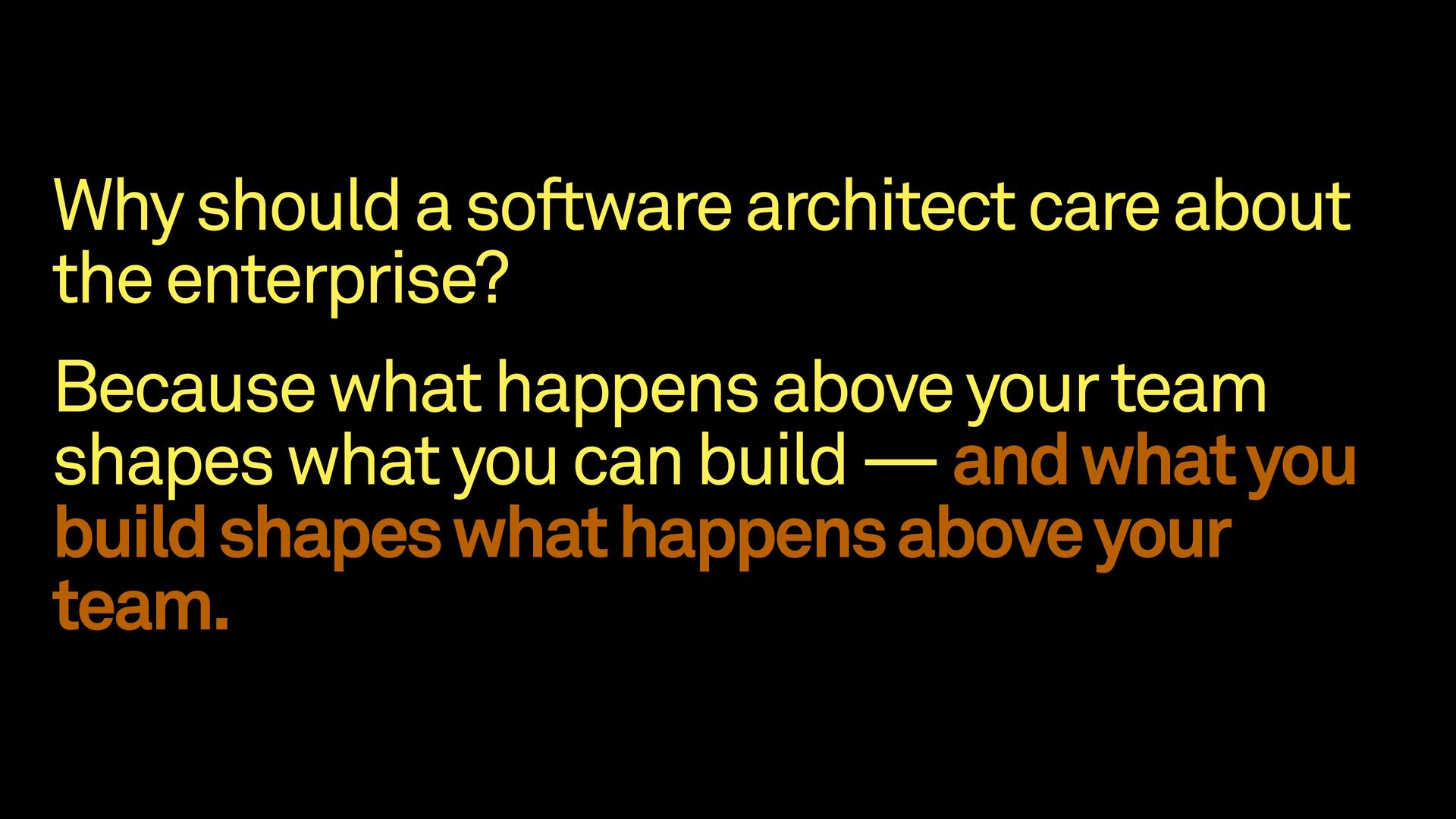
Why should a software architect care about the enterprise? Because
what happens above your team shapes what you can build — and what you build shapes what happens above your team. -
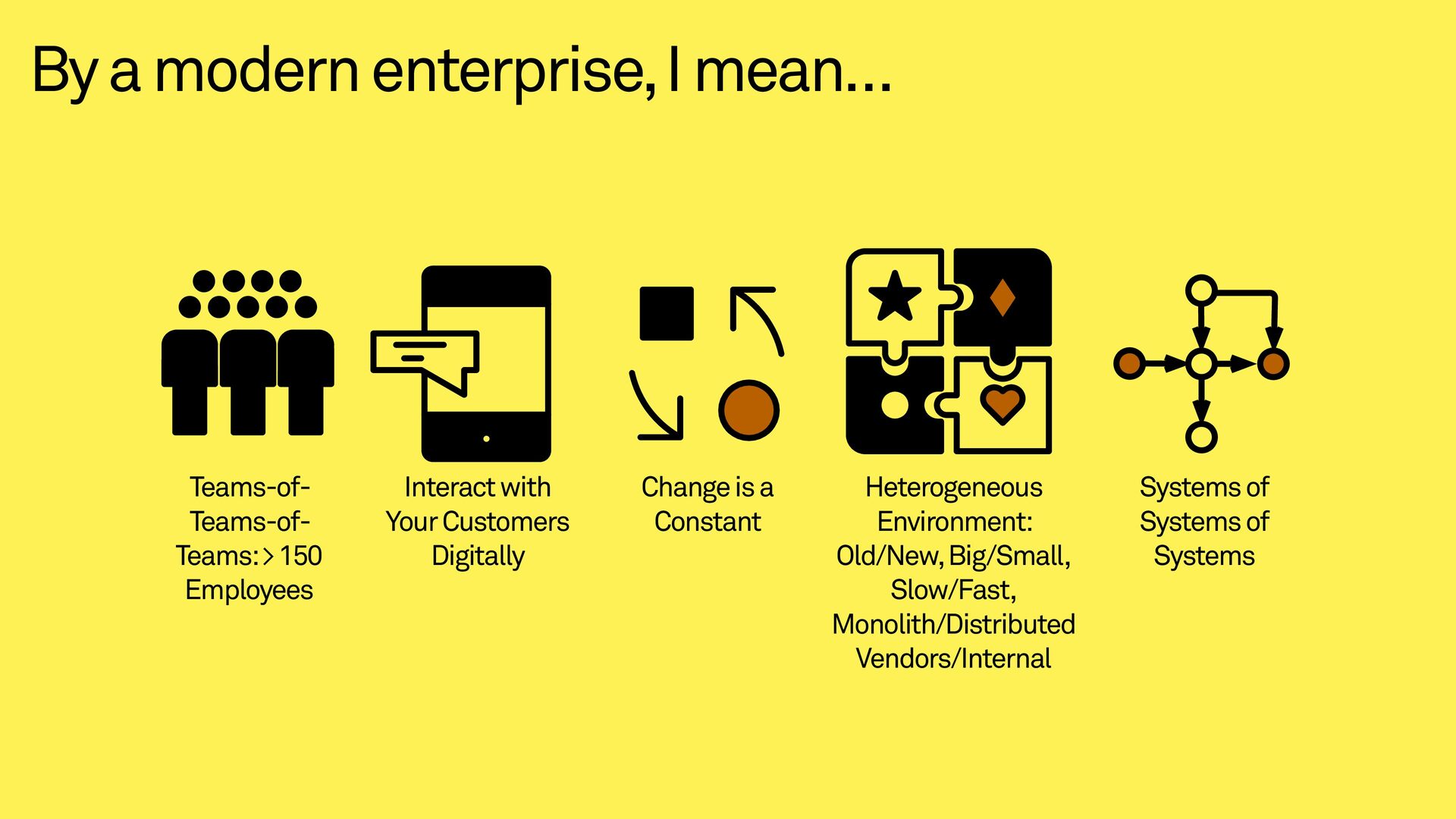
By a modern enterprise, I mean… Teams-ofTeams-ofTeams: > 150 Employees
Interact with Your Customers Digitally Change is a Constant Heterogeneous Environment: Old/New, Big/Small, Slow/Fast, Monolith/Distributed Vendors/Internal Systems of Systems of Systems -
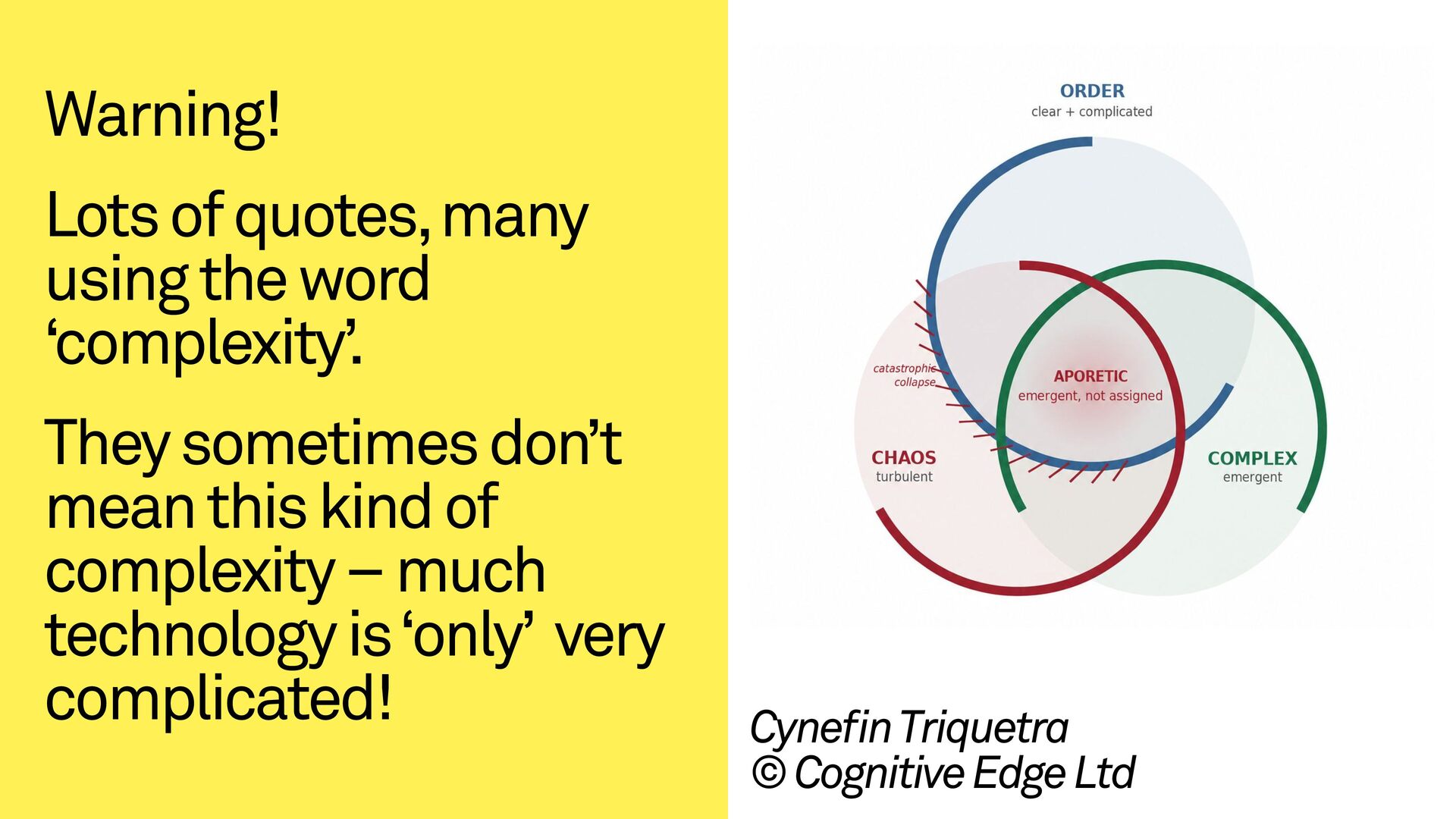
Warning! Lots of quotes, many using the word ‘complexity’. fi
They sometimes don’t mean this kind of complexity – much technology is ‘only’ very complicated! Cyne n Triquetra © Cognitive Edge Ltd -
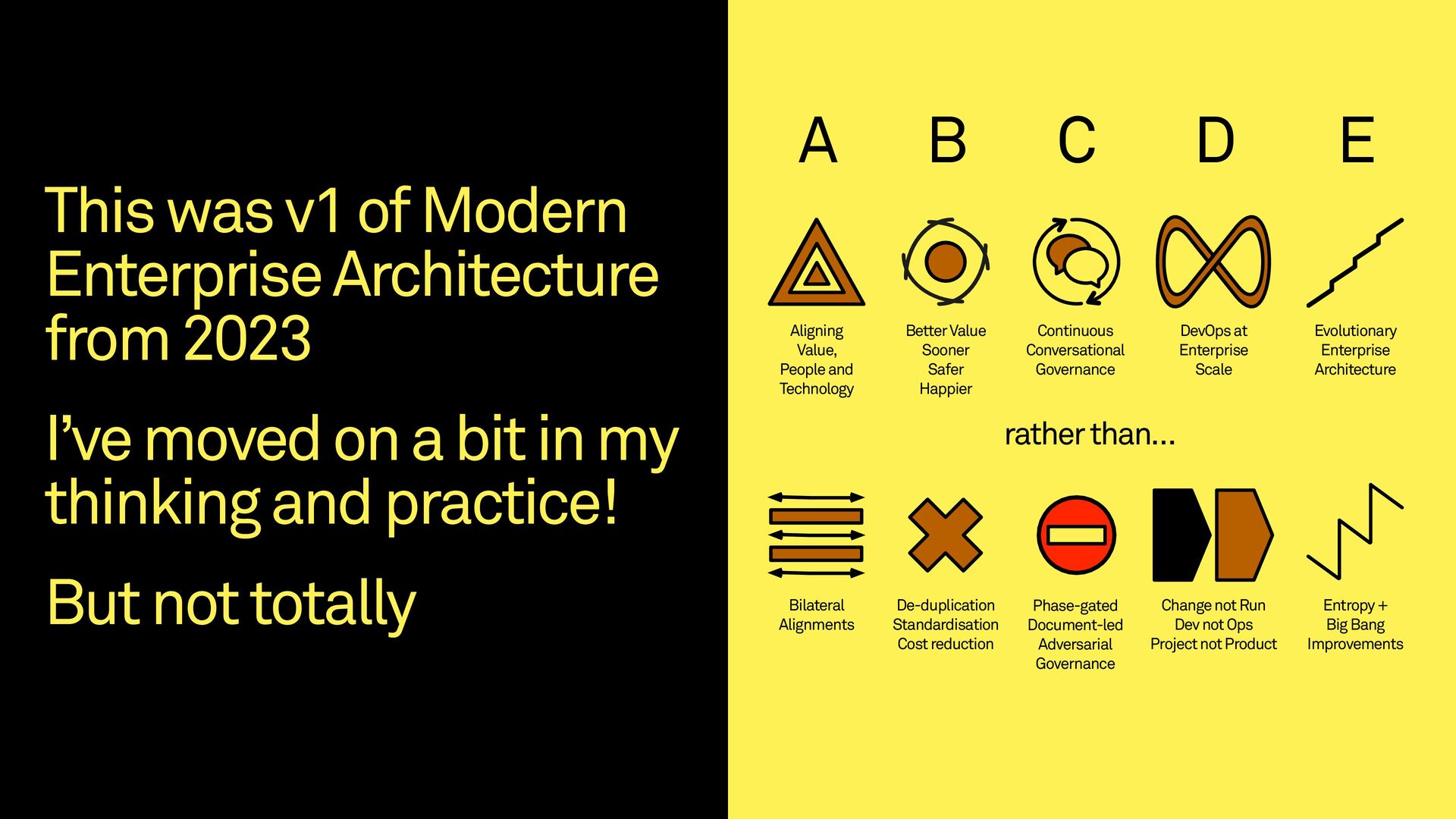
This was v1 of Modern Enterprise Architecture from 2023 A
B C D E Aligning Value, People and Technology Better Value Sooner Safer Happier Continuous Conversational Governance DevOps at Enterprise Scale Evolutionary Enterprise Architecture Change not Run Dev not Ops Project not Product Entropy + Big Bang Improvements I’ve moved on a bit in my thinking and practice! But not totally rather than… Bilateral Alignments De-duplication Standardisation Cost reduction Phase-gated Document-led Adversarial Governance -
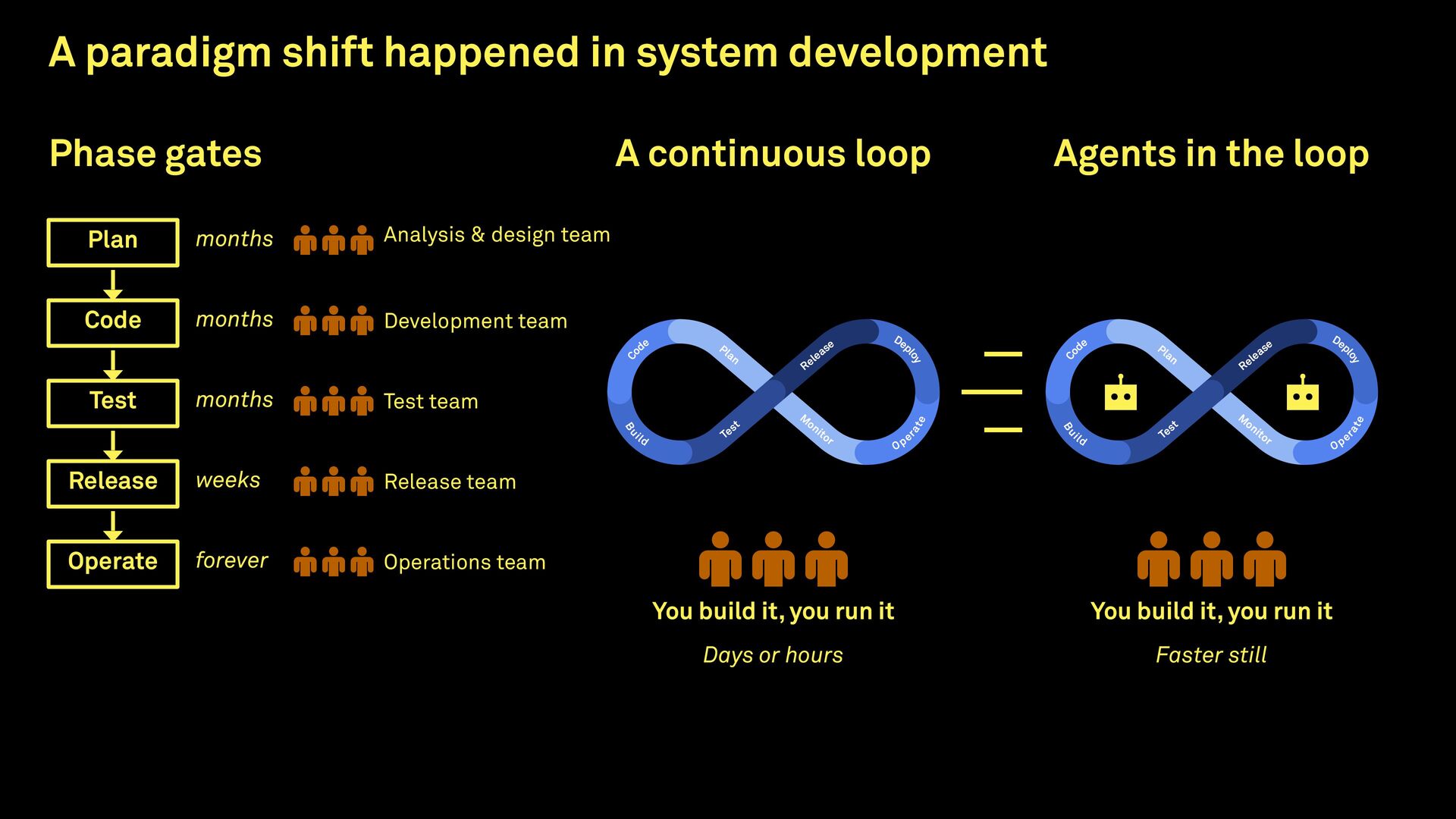
A paradigm shift happened in system development months Development team
Test team Release weeks Release team Operate forever Operations team M on ito De p r O pe Bu Bu il d st Te se a le e R de il d Pl an st Te se a le e R M on ito De p loy months Pl an loy Test de te Code r ra Analysis & design team te months Co Plan Agents in the loop Co A continuous loop ra Phase gates Op You build it, you run it You build it, you run it Days or hours Faster still e -
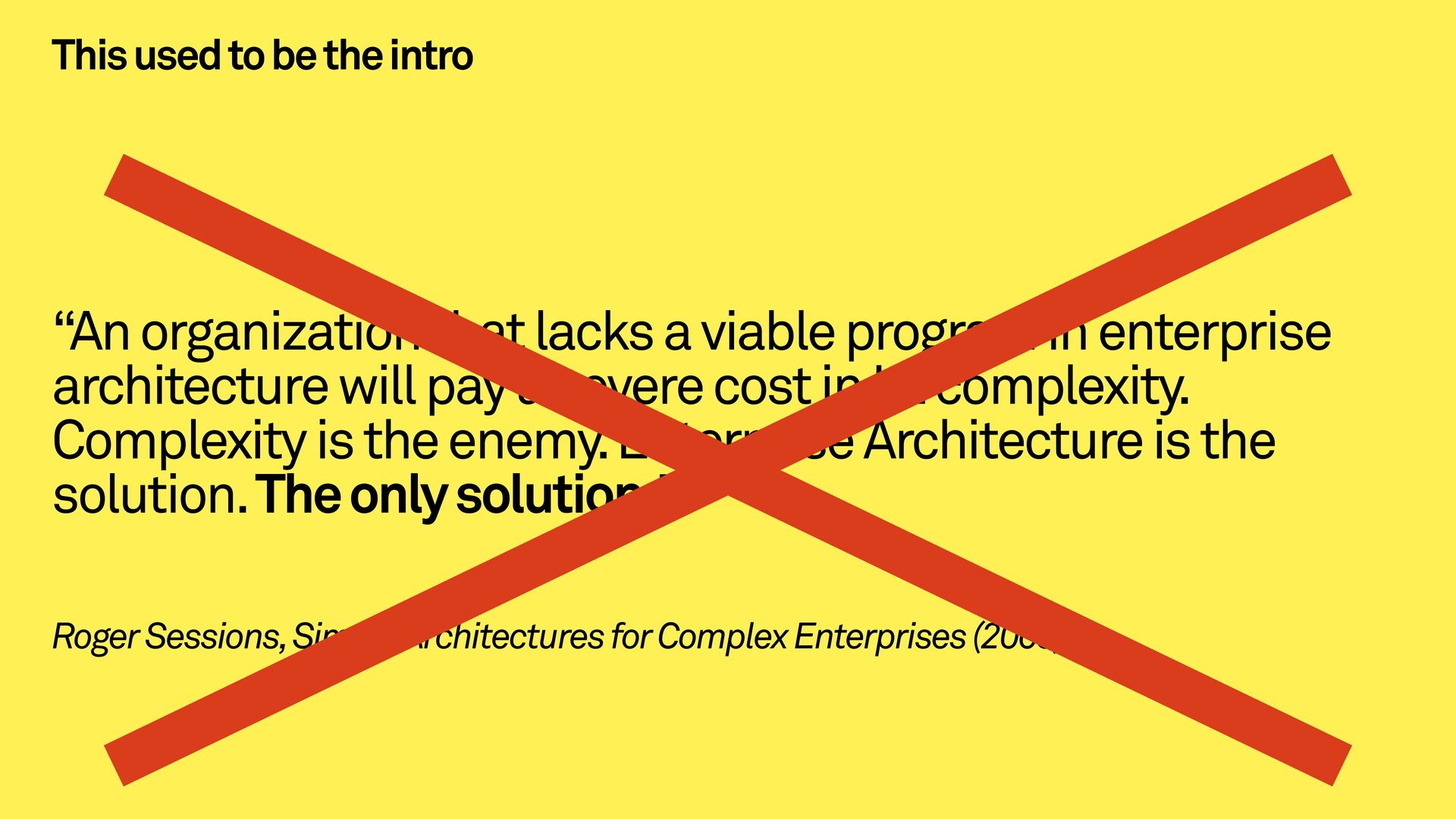
This used to be the intro “An organization that lacks
a viable program in enterprise architecture will pay a severe cost in I.T. complexity. Complexity is the enemy. Enterprise Architecture is the solution. The only solution.” Roger Sessions, Simple Architectures for Complex Enterprises (2008) -
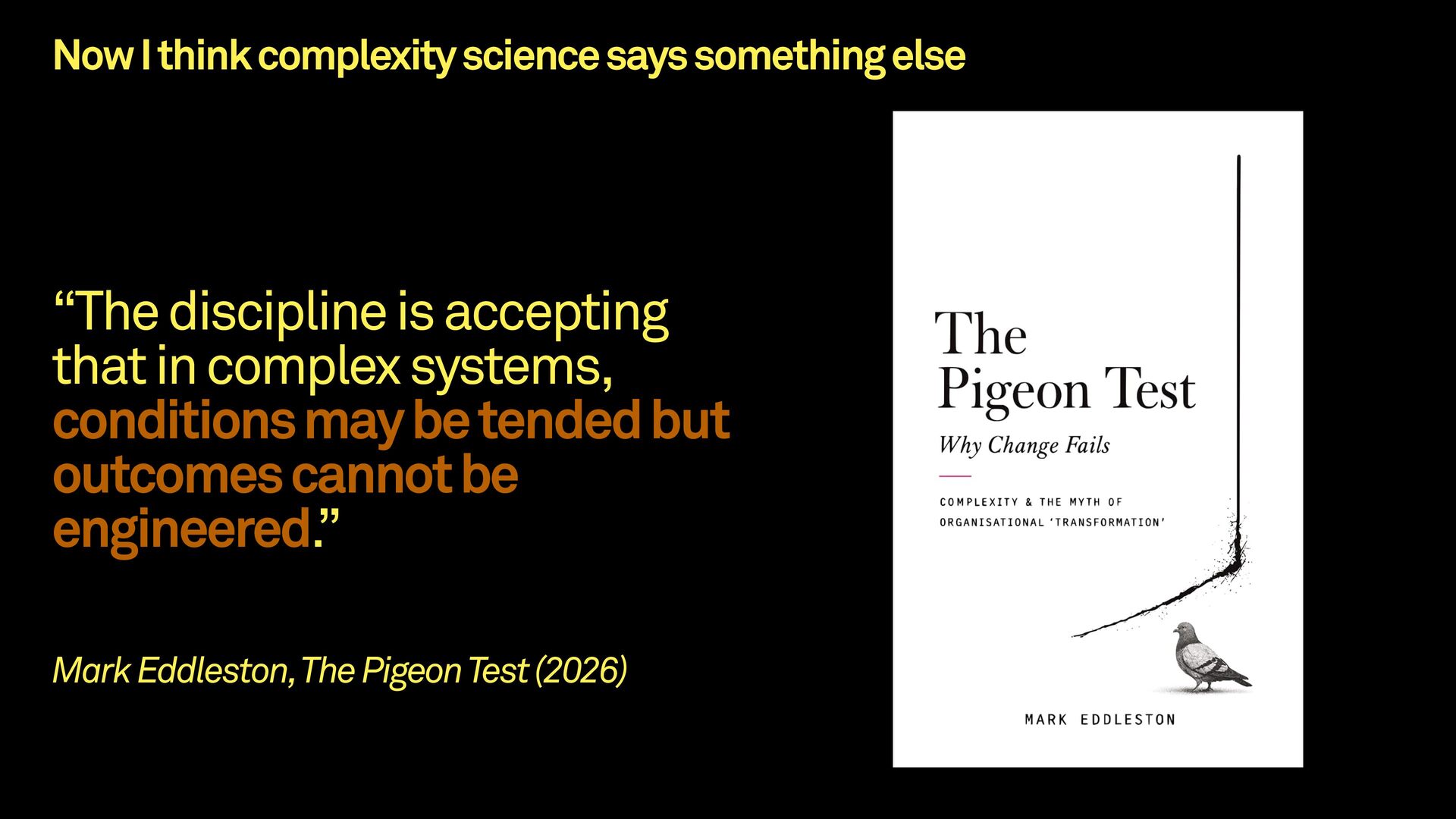
Now I think complexity science says something else “The discipline
is accepting that in complex systems, conditions may be tended but outcomes cannot be engineered.” Mark Eddleston, The Pigeon Test (2026) -
EA treated management as a programming problem “You can’t solve
management with a programmer’s worldview. EA is a decades long attempt to do just that.” Barry O’Reilly, LinkedIn (2026) -
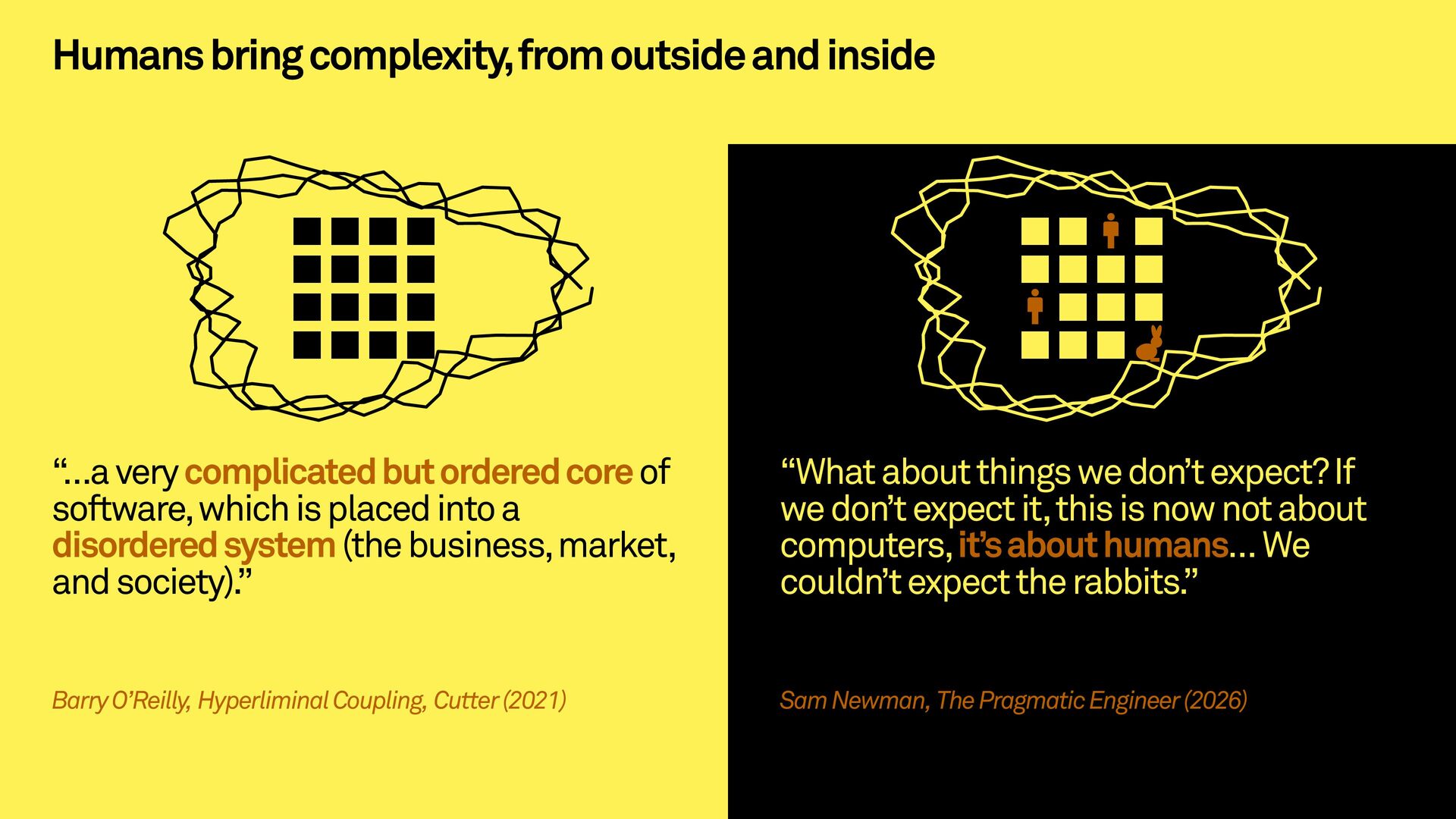
Humans bring complexity, from outside and inside “…a very complicated
but ordered core of software, which is placed into a disordered system (the business, market, and society).” “What about things we don’t expect? If we don’t expect it, this is now not about computers, it’s about humans… We couldn’t expect the rabbits.” Barry O’Reilly, Hyperliminal Coupling, Cutter (2021) Sam Newman, The Pragmatic Engineer (2026) -
In everyday business life, managers [are] surrounded by a world
that is quite clearly characterized at the same time by stability and instability, predictability and unpredictability, regularity and irregularity, contention and consensus, intention and chance. The world they face is a paradox: intertwined order and disorder [yet] they almost always approach the task from the perspective of order and largely ignore the role of disorder.” Ralph Stacey, Managing the Unknowable (1992) -
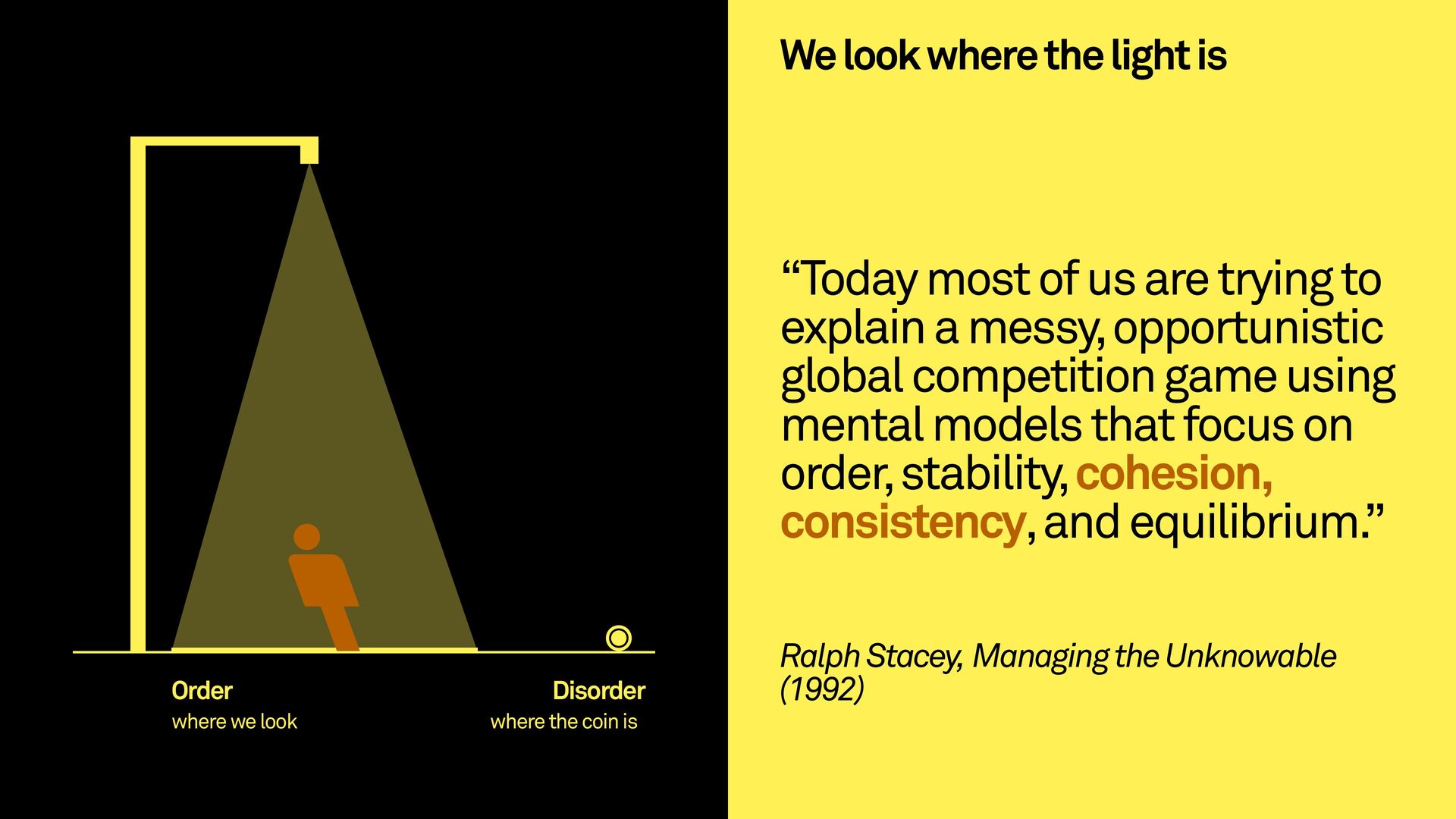
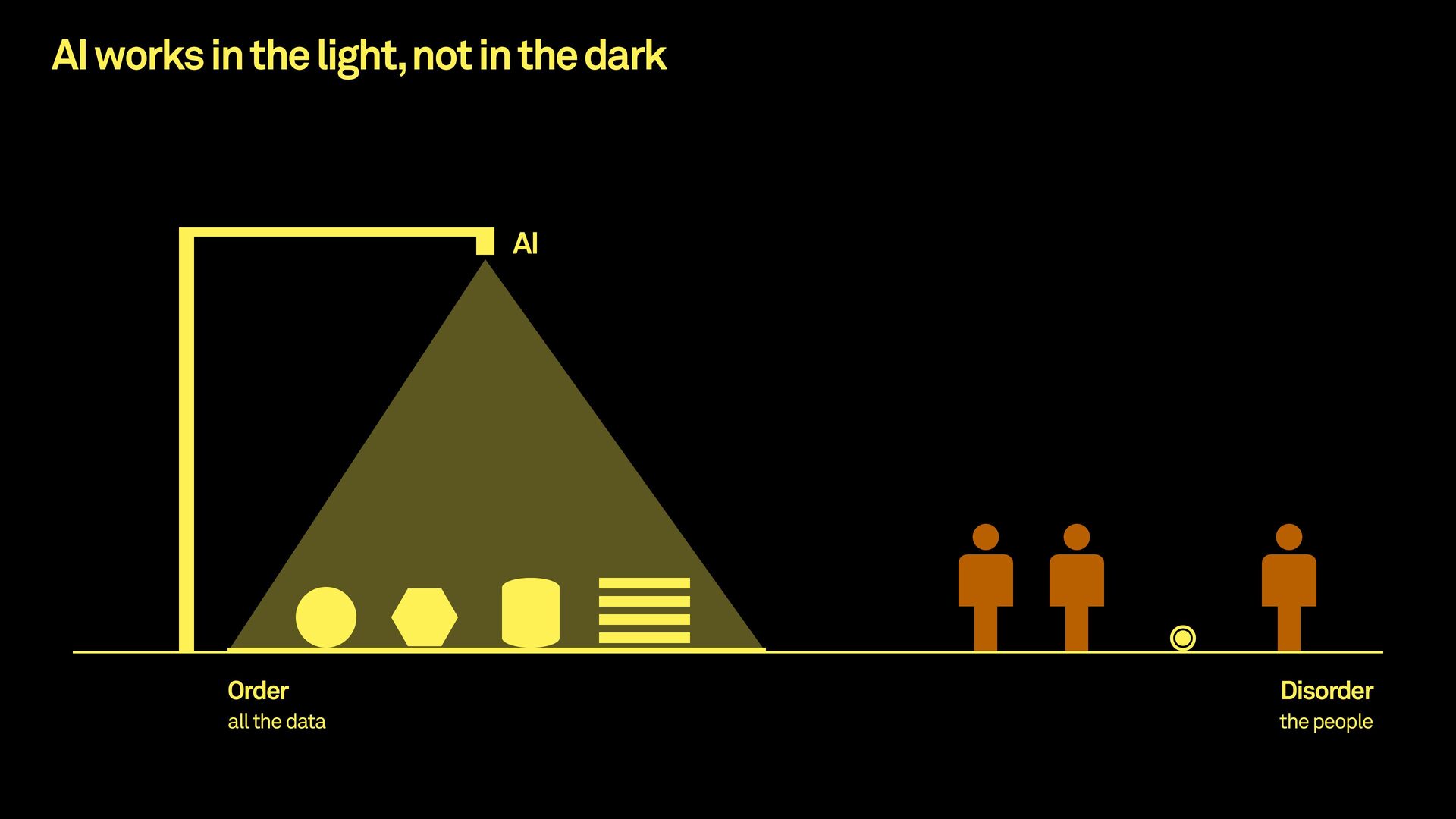
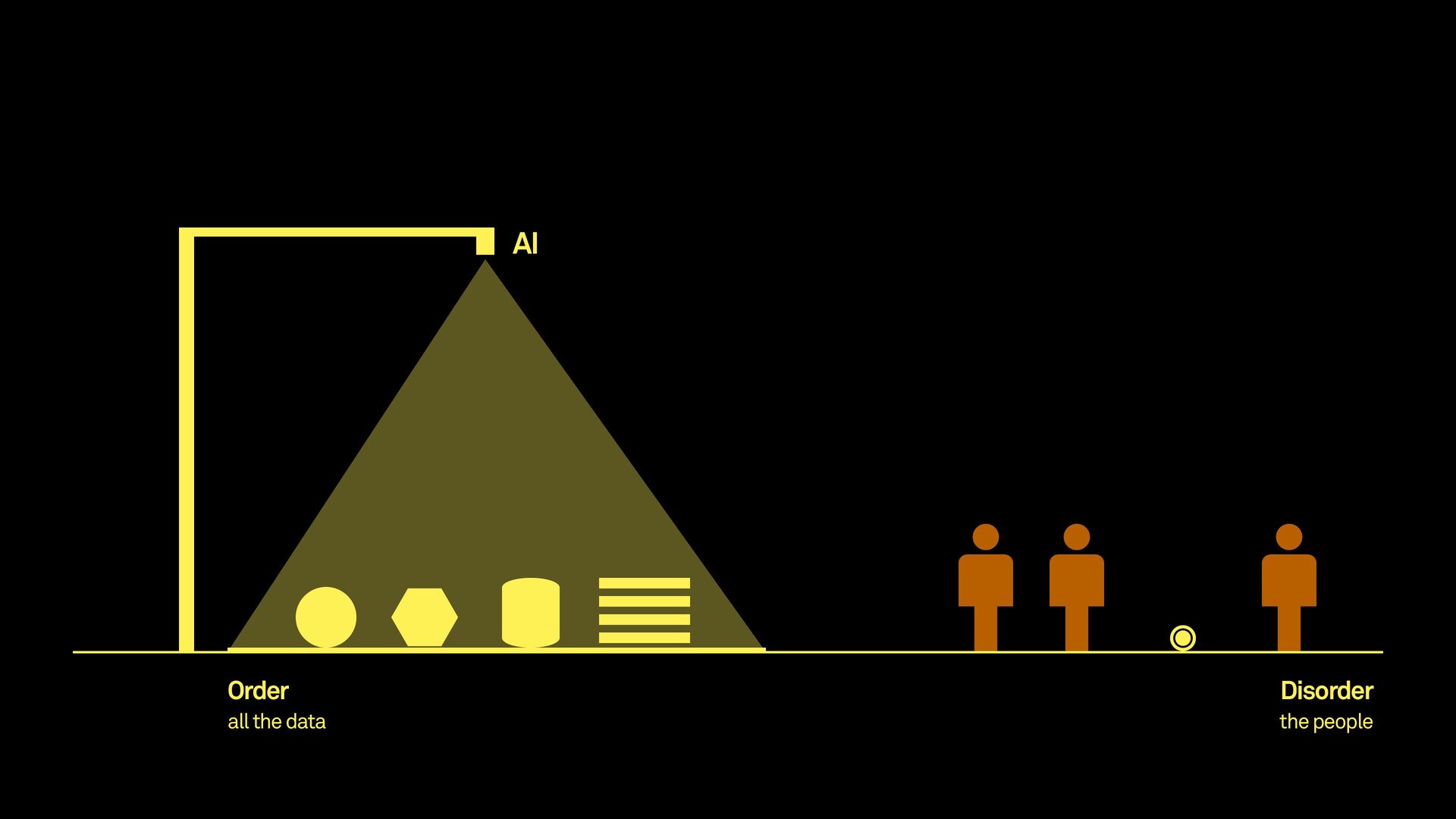
We look where the light is “Today most of us
are trying to explain a messy, opportunistic global competition game using mental models that focus on order, stability, cohesion, consistency, and equilibrium.” Order where we look Disorder where the coin is Ralph Stacey, Managing the Unknowable (1992) -
AI works in the light, not in the dark AI
Order Disorder all the data the people -
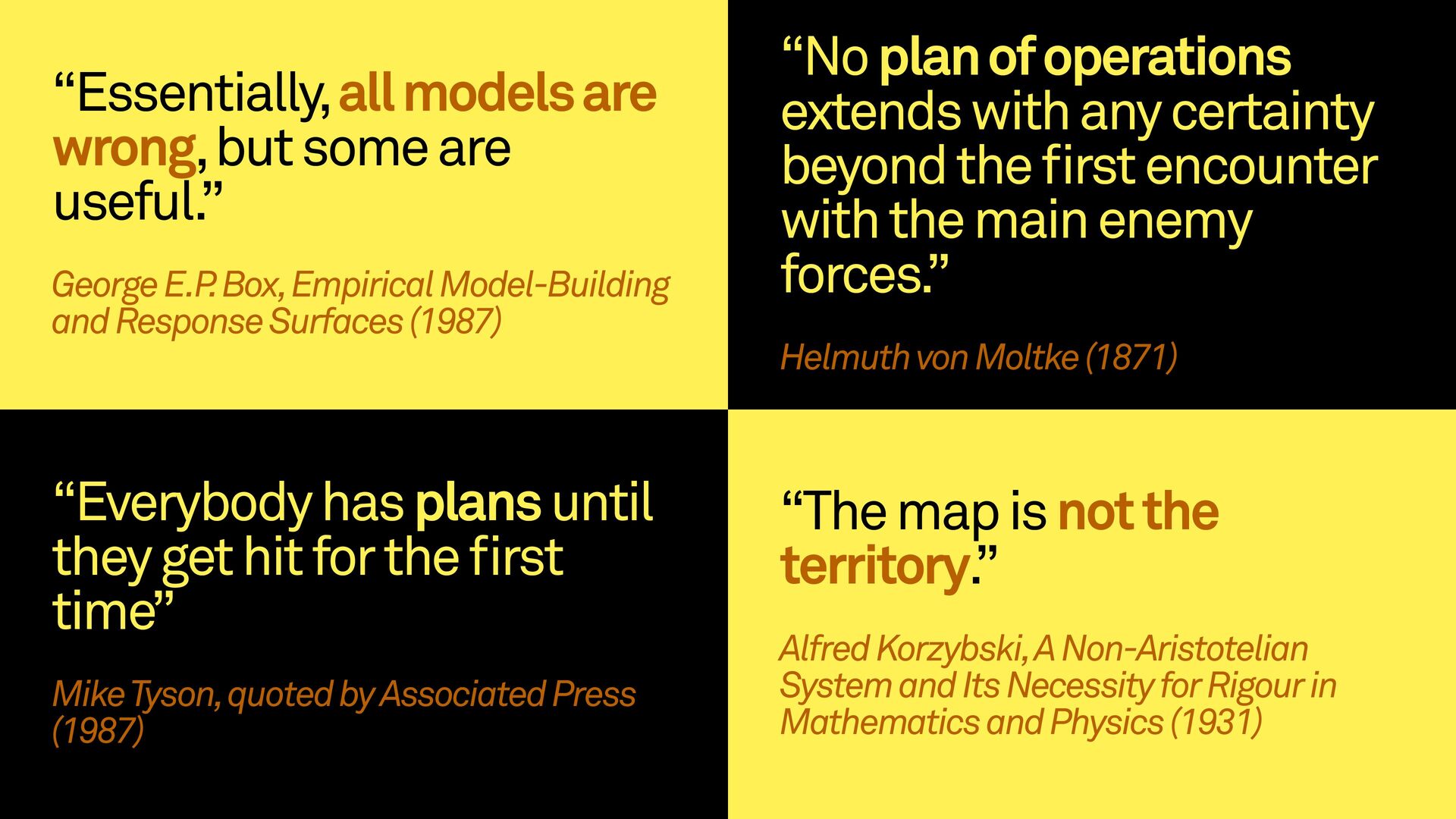
“Essentially, all models are wrong, but some are useful.” George
E.P. Box, Empirical Model-Building and Response Surfaces (1987) “Everybody has plans until they get hit for the rst time”but some are useful.” fi fi Mike Tyson, quoted by Associated Press (1987) “No plan of operations extends with any certainty beyond the rst encounter with the main enemy forces.” Helmuth von Moltke (1871) “The map is not the territory.” Alfred Korzybski, A Non-Aristotelian System and Its Necessity for Rigour in Mathematics and Physics (1931) -
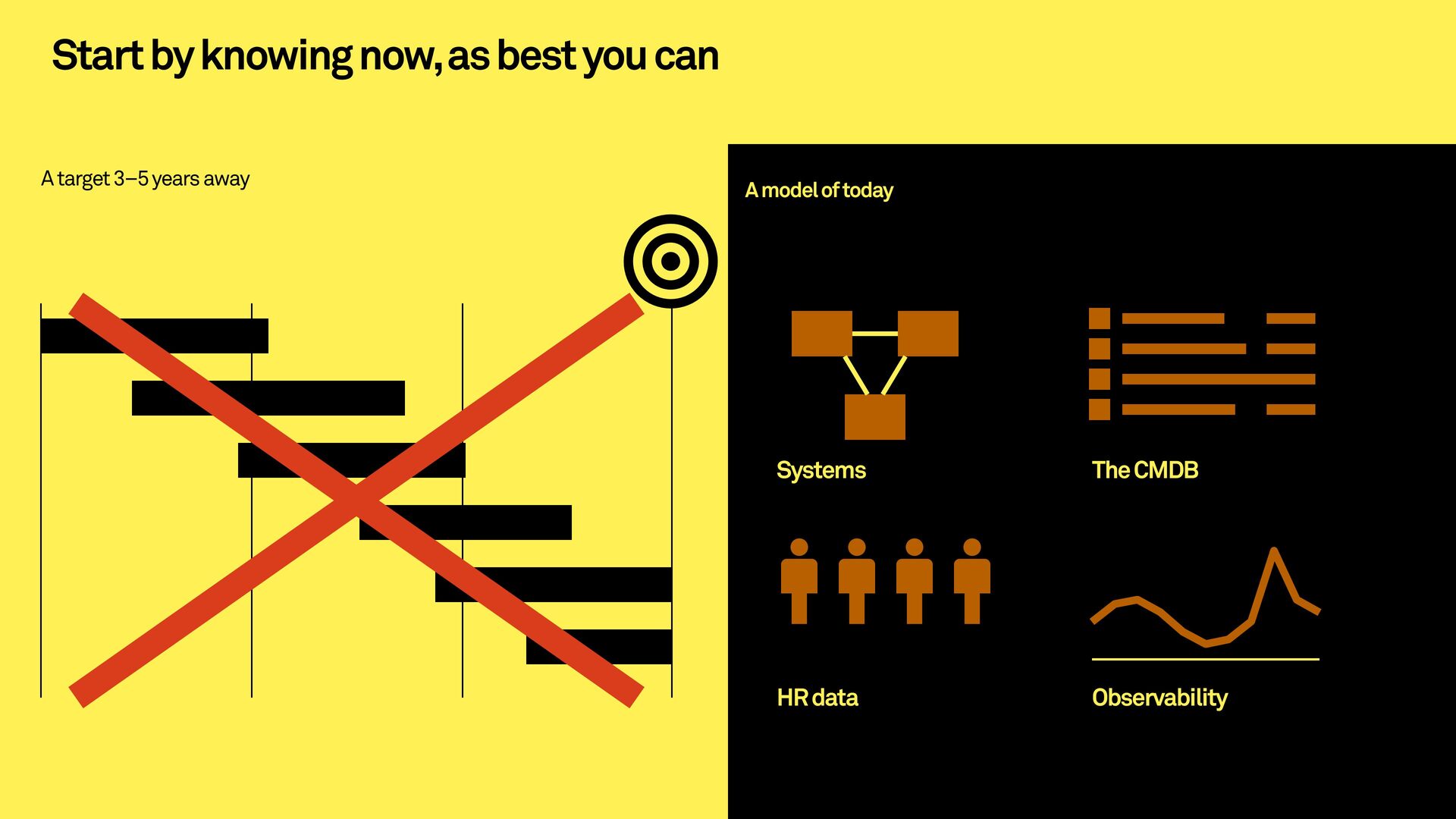
Start by knowing now, as best you can A target
3–5 years away A model of today Systems The CMDB HR data Observability -
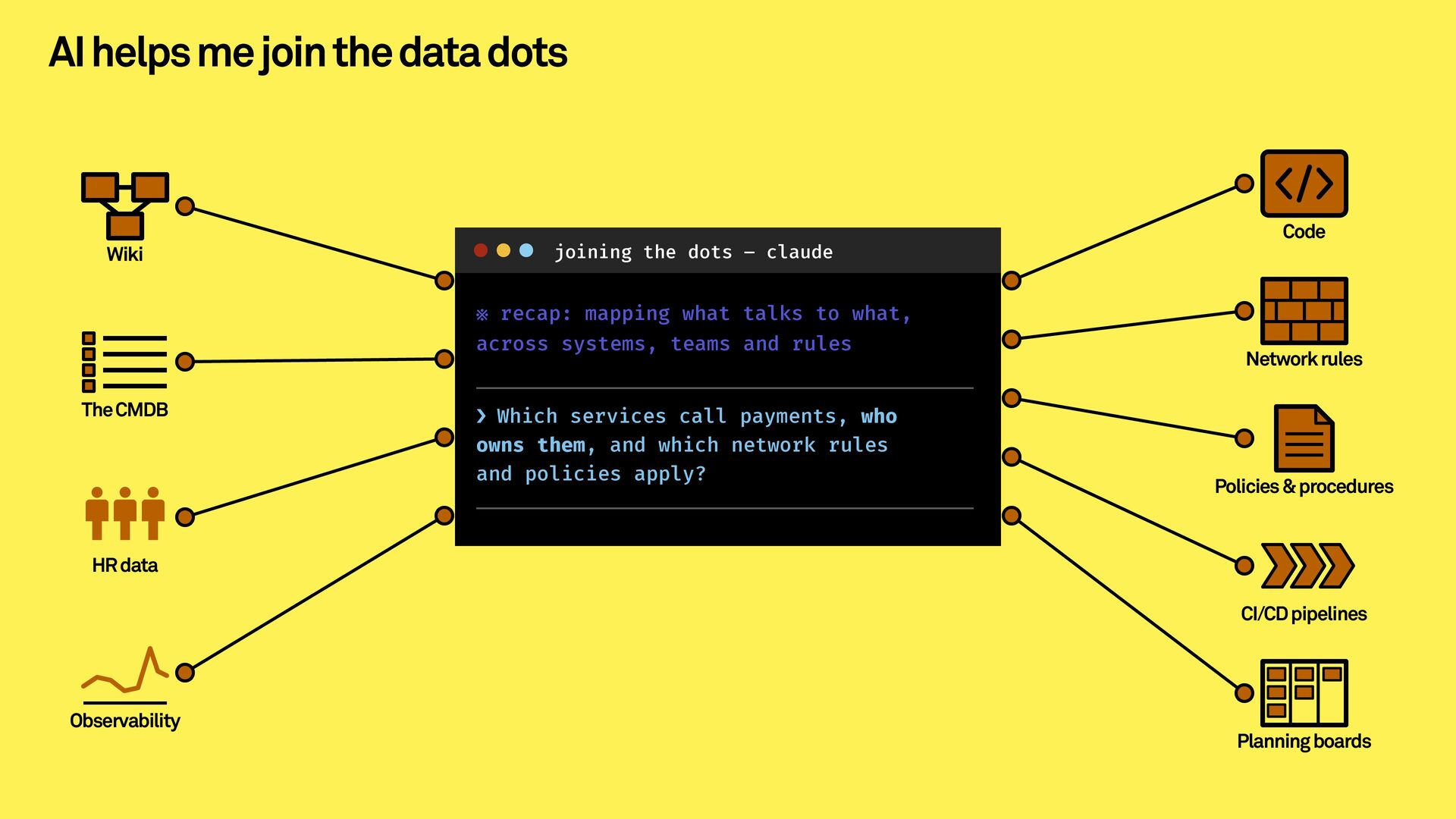
❯ AI helps me join the data dots Wiki joining
the dots – claude Code ※ recap: mapping what talks to what, across systems, teams and rules The CMDB ————————————————————————————————————————— Which services call payments, who owns them, and which network rules and policies apply? ————————————————————————————————————————— Network rules Policies & procedures HR data CI/CD pipelines Observability Planning boards -
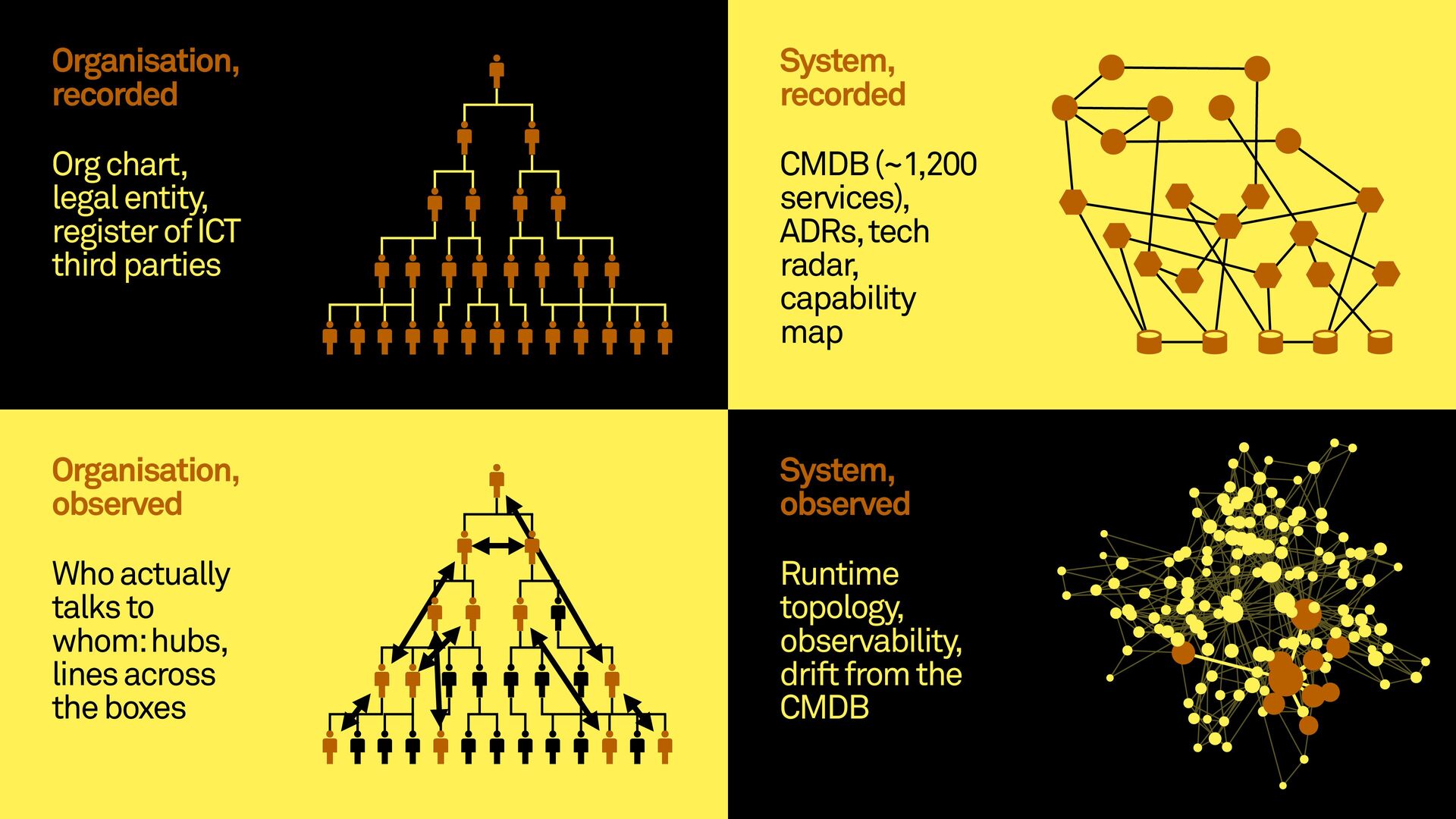
Organisation, recorded System, recorded Org chart, legal entity, register of
ICT third parties CMDB (~1,200 services), ADRs, tech radar, capability map Organisation, observed System, observed Who actually talks to whom: hubs, lines across the boxes Runtime topology, observability, drift from the CMDB -
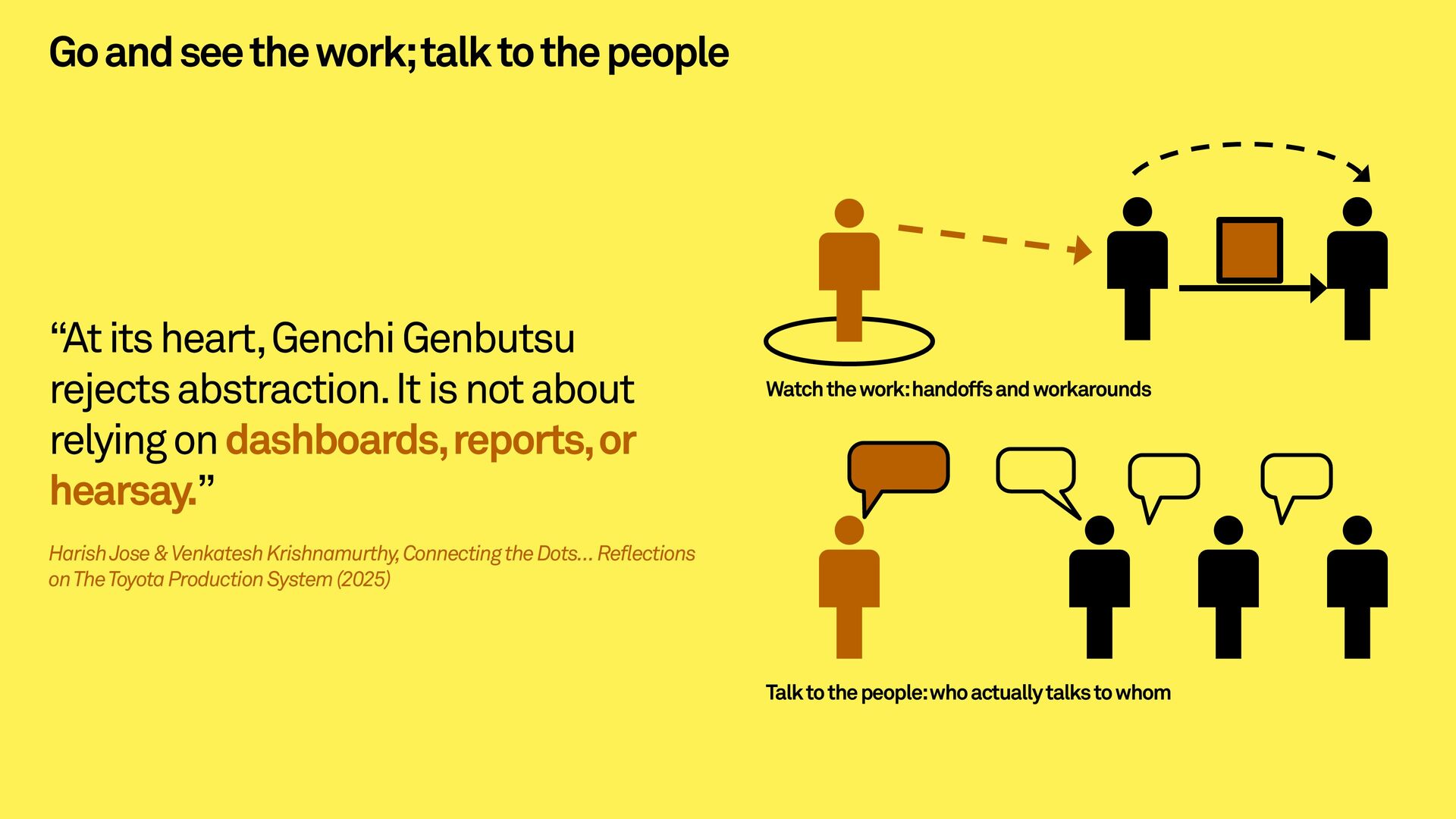
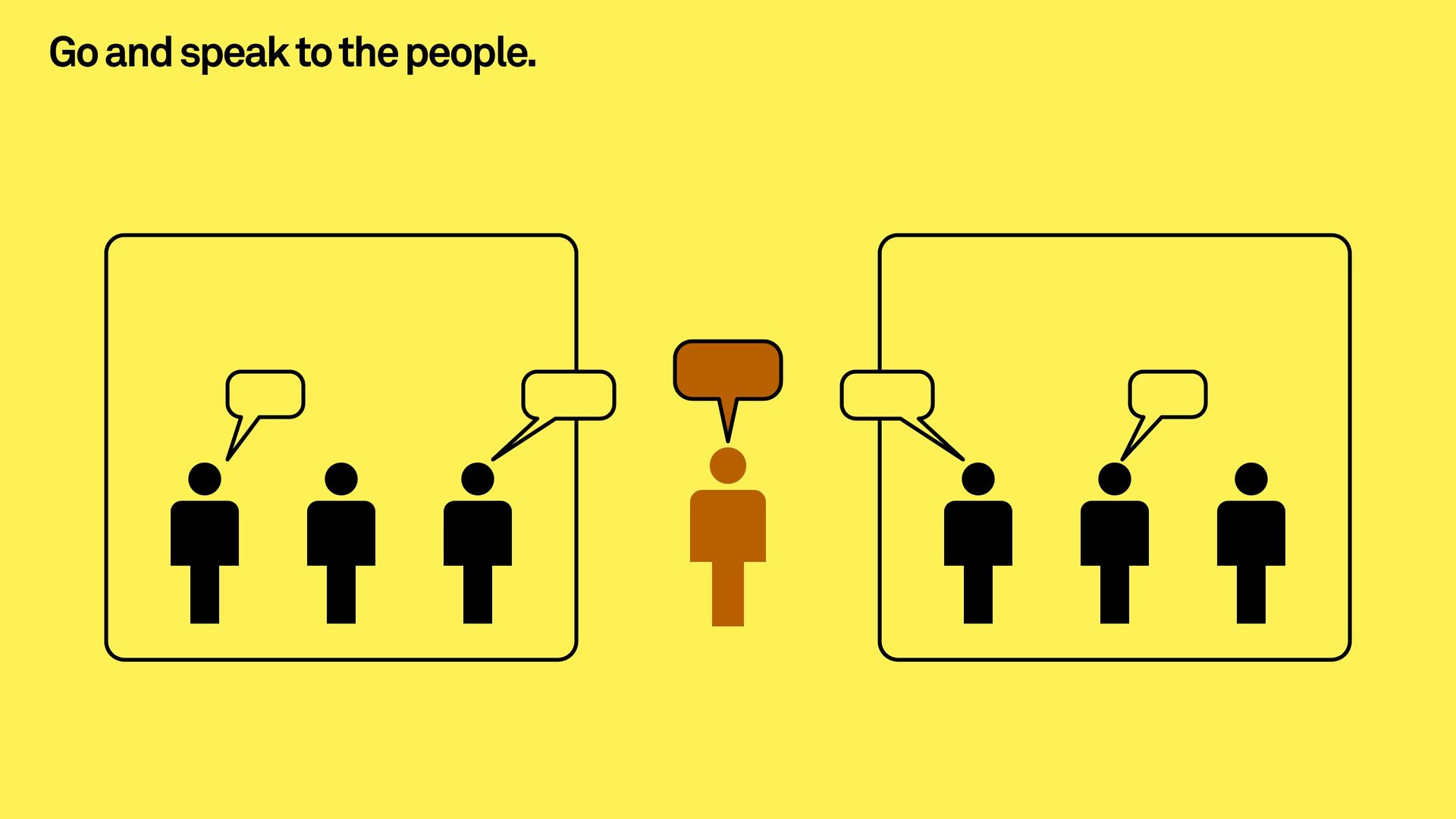
Go and see the work; talk to the people “At
its heart, Genchi Genbutsu rejects abstraction. It is not about relying on dashboards, reports, or hearsay.” Watch the work: handoffs and workarounds Harish Jose & Venkatesh Krishnamurthy, Connecting the Dots… Reflections on The Toyota Production System (2025) Talk to the people: who actually talks to whom -
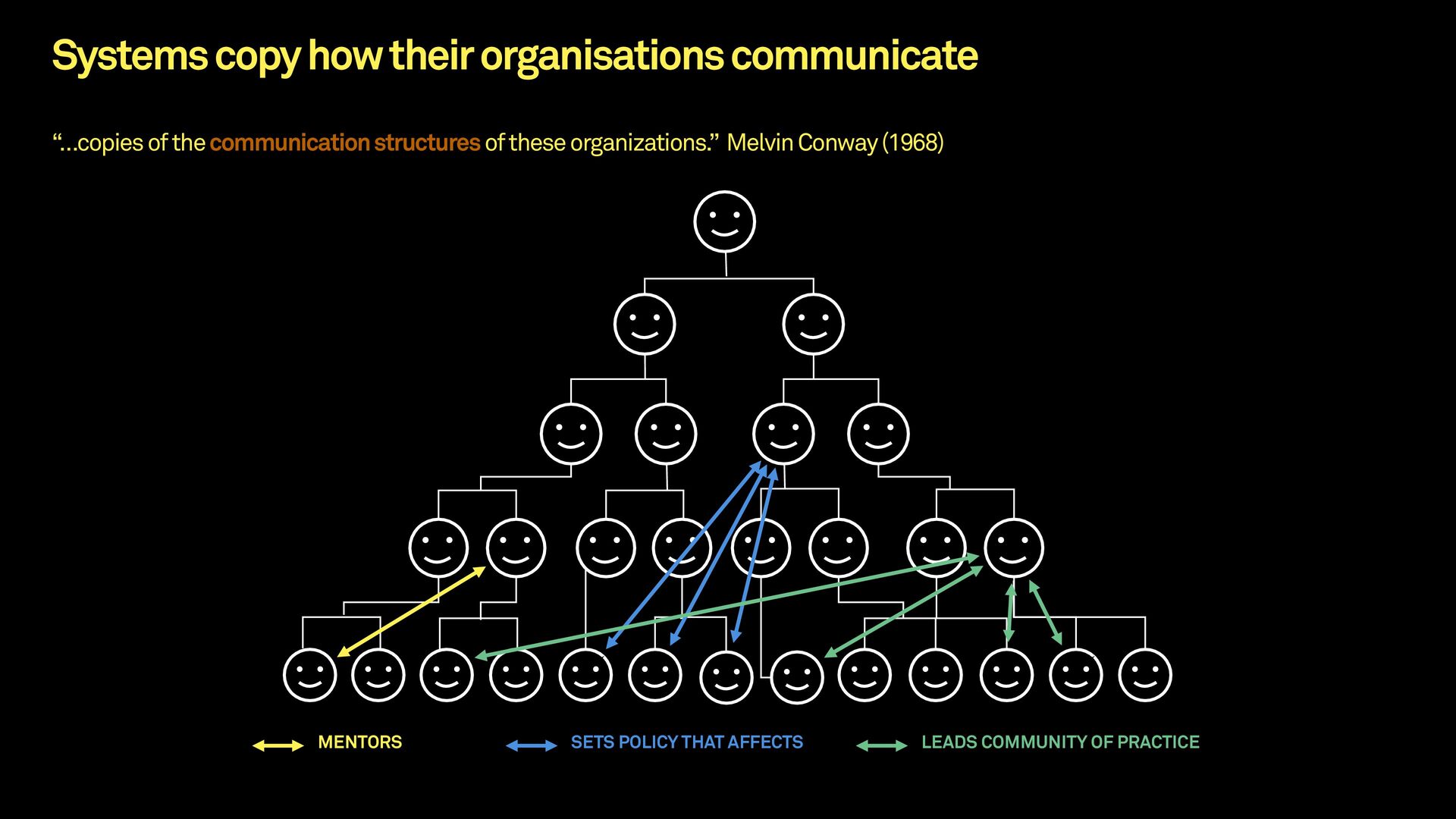
Systems copy how their organisations communicate “…copies of the communication
structures of these organizations.” Melvin Conway (1968) MENTORS SETS POLICY THAT AFFECTS LEADS COMMUNITY OF PRACTICE -
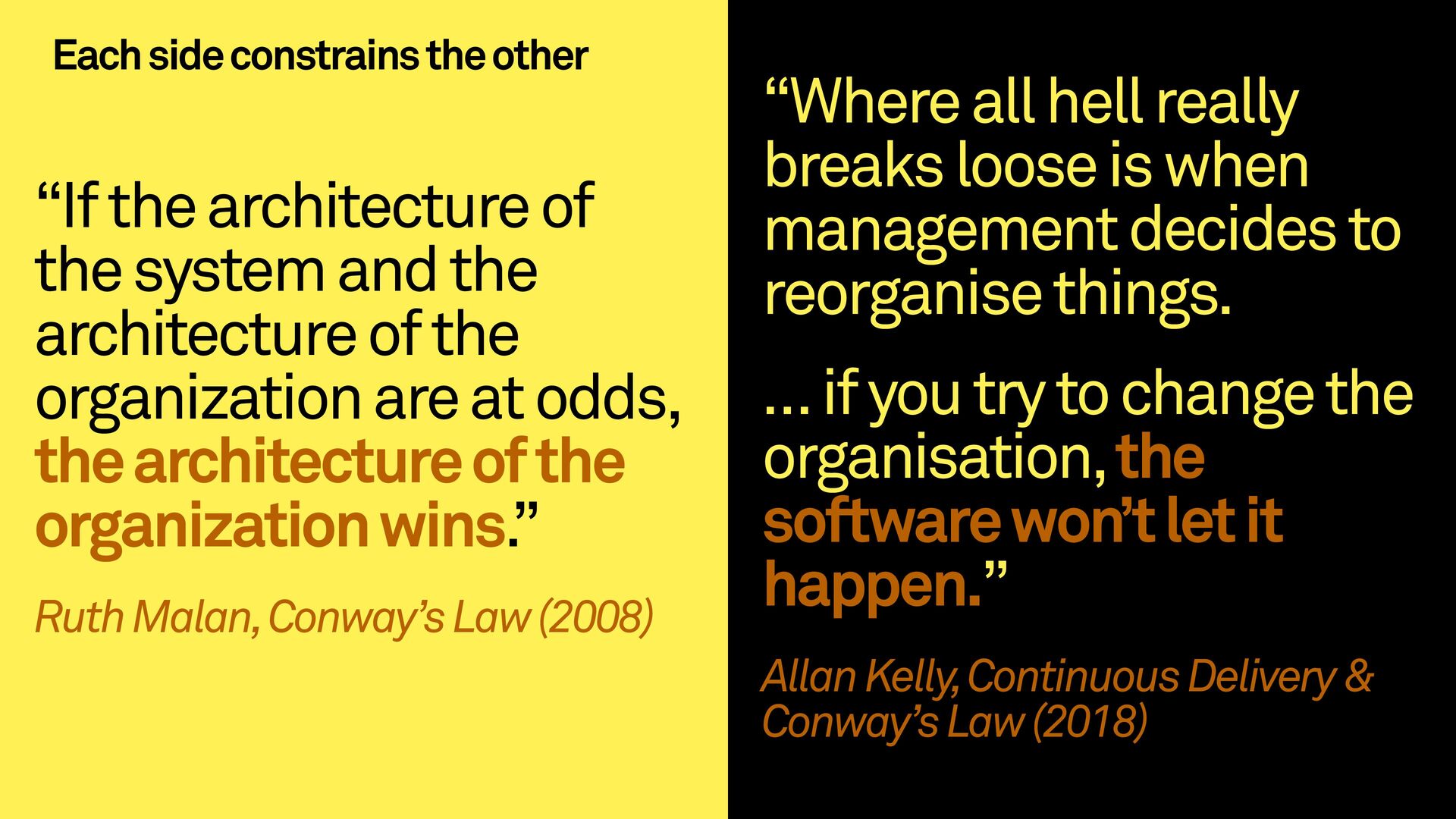
Each side constrains the other “If the architecture of the
system and the architecture of the organization are at odds, the architecture of the organization wins.” Ruth Malan, Conway’s Law (2008) “Where all hell really breaks loose is when management decides to reorganise things. … if you try to change the organisation, the software won’t let it happen.” Allan Kelly, Continuous Delivery & Conway’s Law (2018) -
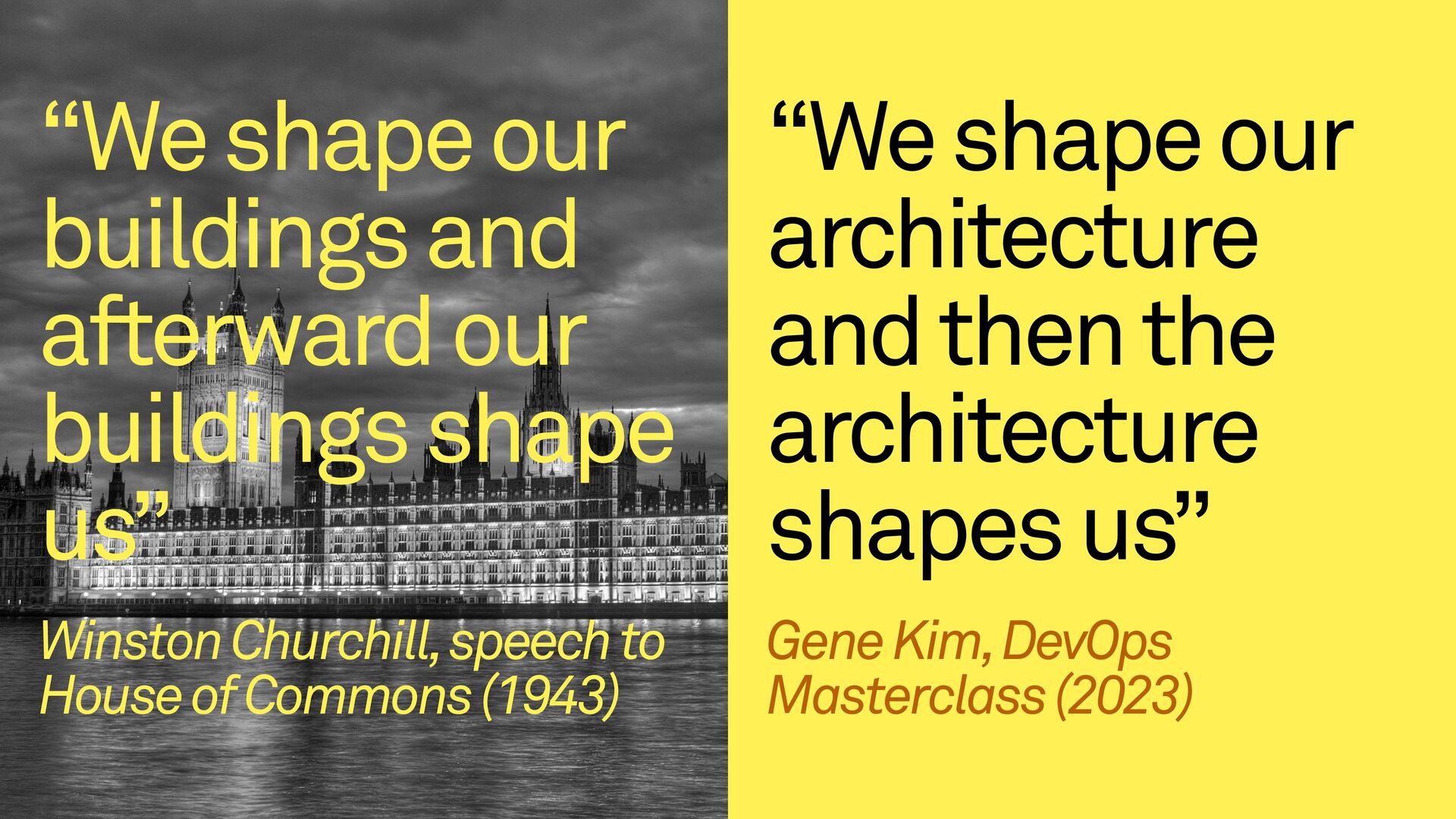
“We shape our buildings and afterward our buildings shape us”
“We shape our architecture and then the architecture shapes us” Winston Churchill, speech to House of Commons (1943) Gene Kim, DevOps Masterclass (2023) -
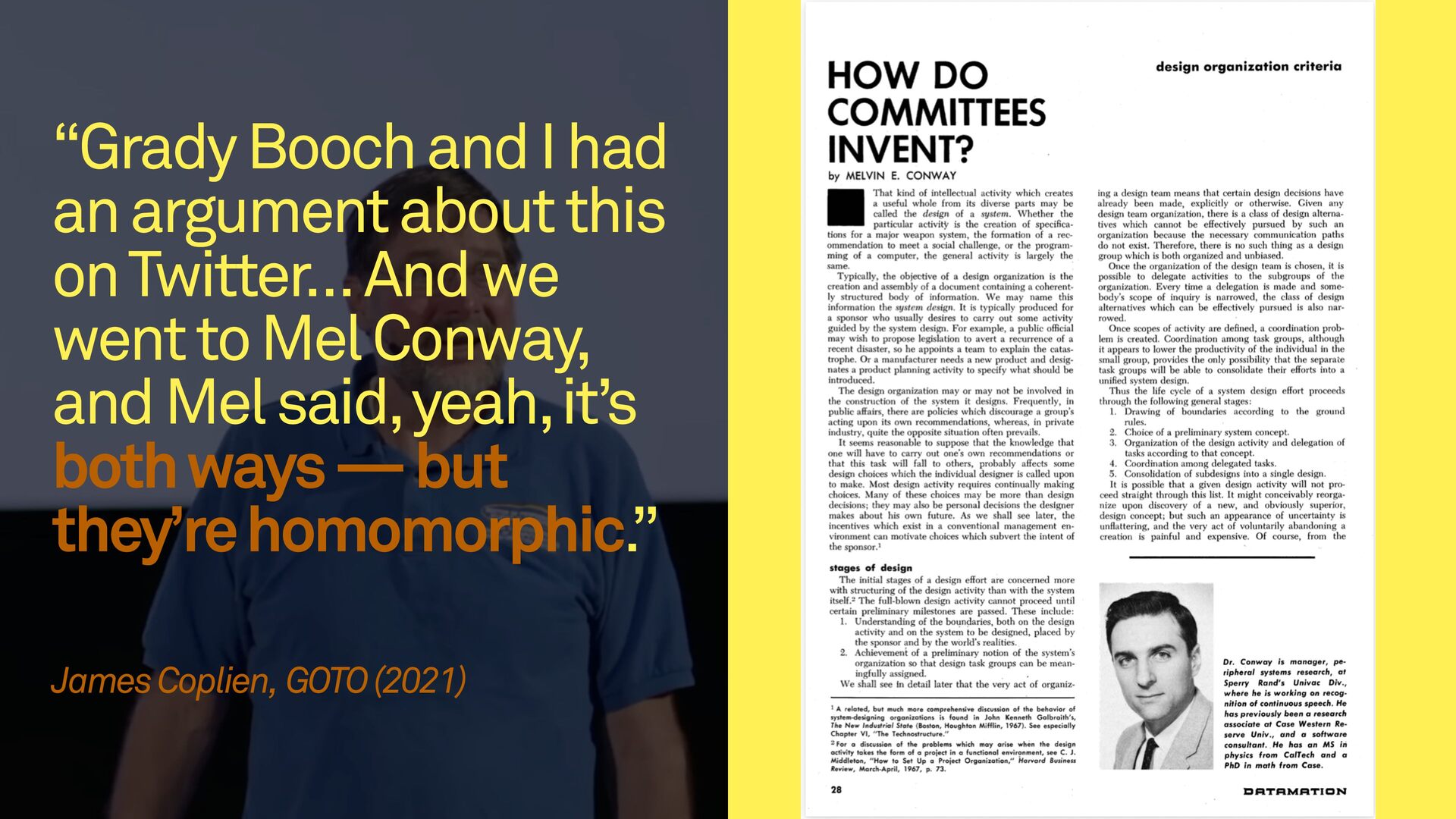
“Grady Booch and I had an argument about this on
Twitter… And we went to Mel Conway, and Mel said, yeah, it’s both ways — but they’re homomorphic.” James Coplien, GOTO (2021) -
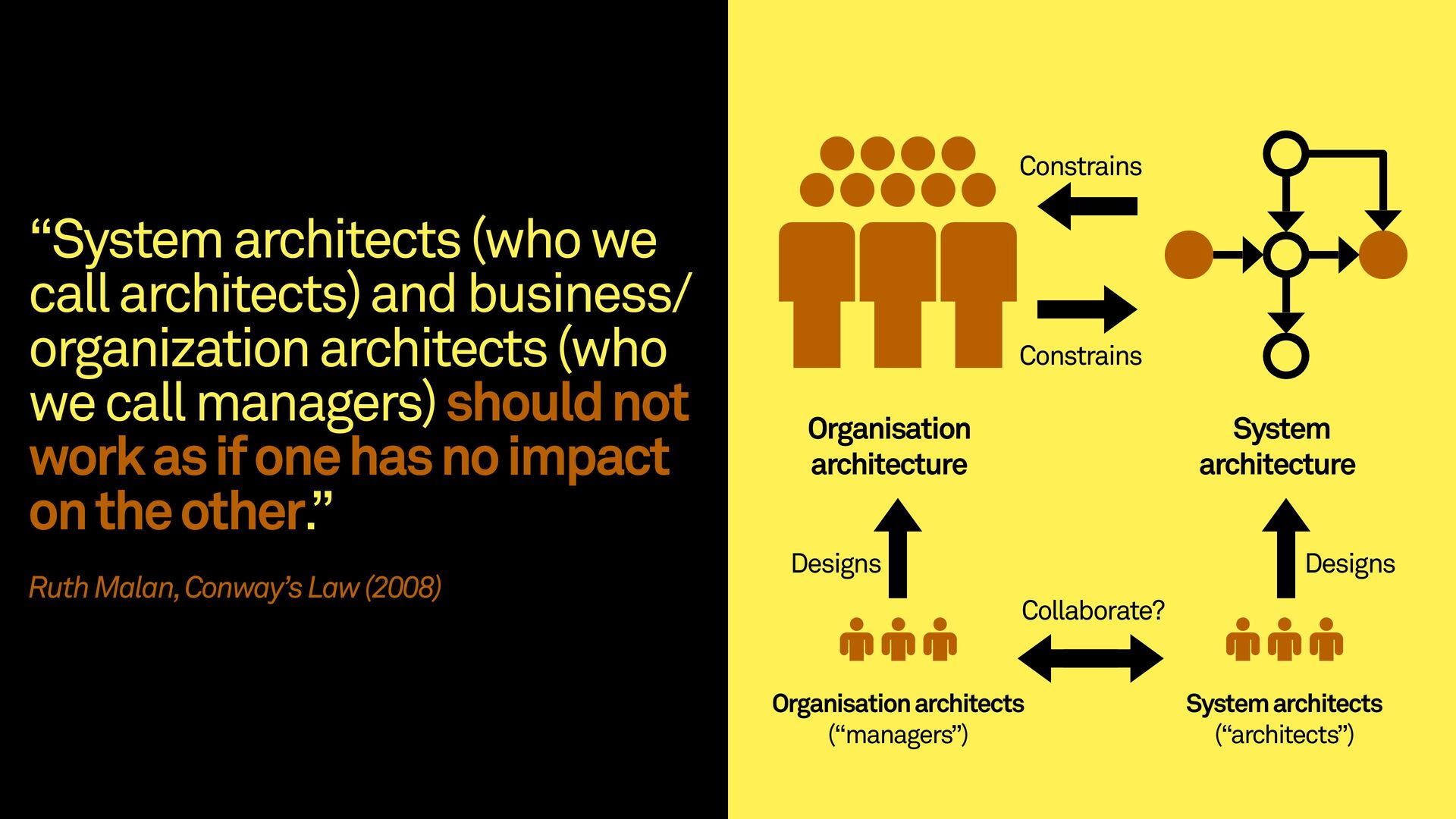
Constrains “System architects (who we call architects) and business/ organization
architects (who we call managers) should not work as if one has no impact on the other.” Ruth Malan, Conway’s Law (2008) Constrains Organisation architecture System architecture Designs Designs Collaborate? Organisation architects (“managers”) System architects (“architects”) -
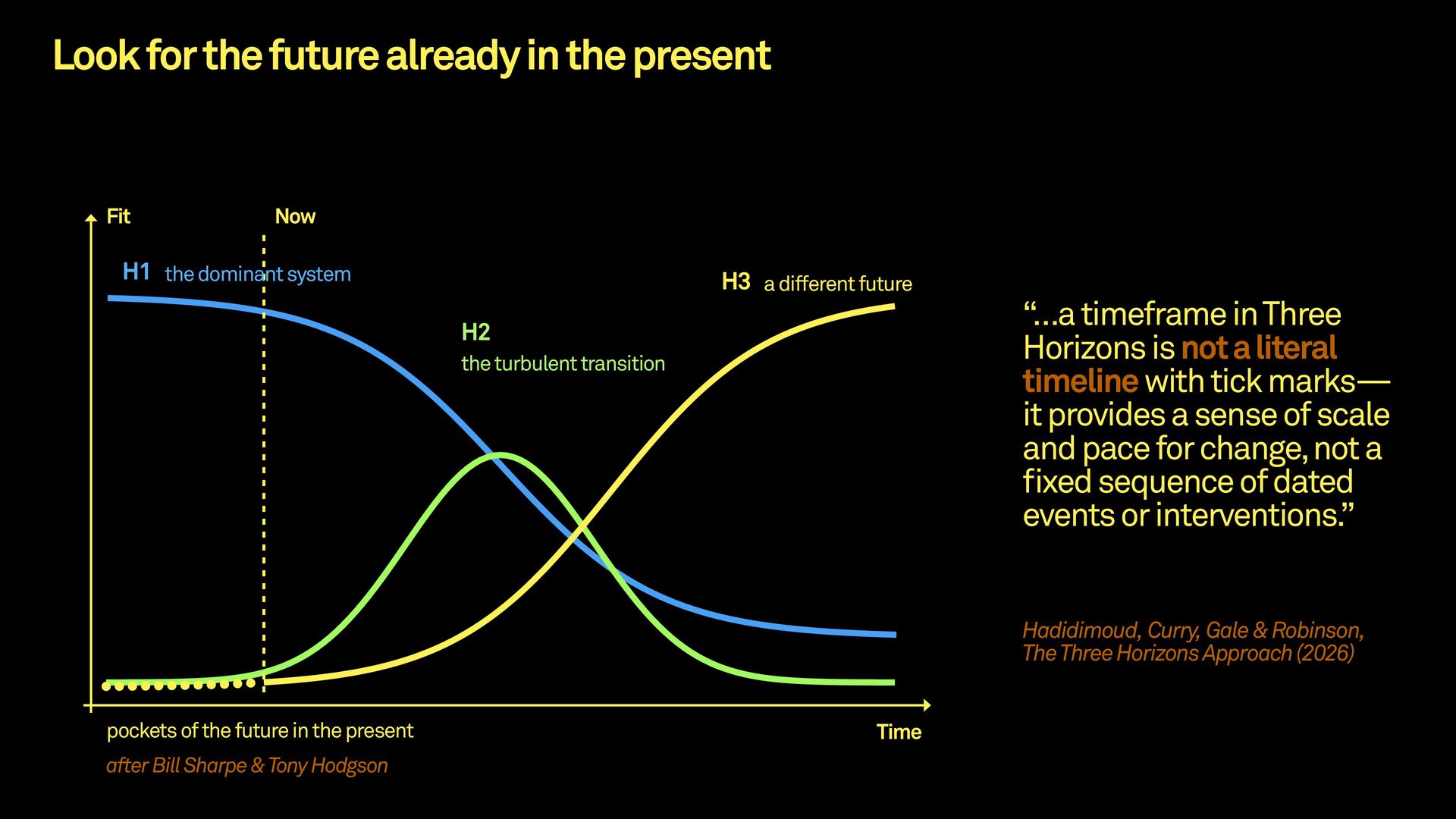
fi Look for the future already in the present Fit
Now H1 the dominant system H3 a different future “…a timeframe in Three Horizons is not a literal timeline with tick marks— it provides a sense of scale and pace for change, not a xed sequence of dated events or interventions.” H2 the turbulent transition Hadidimoud, Curry, Gale & Robinson, The Three Horizons Approach (2026) pockets of the future in the present after Bill Sharpe & Tony Hodgson Time -
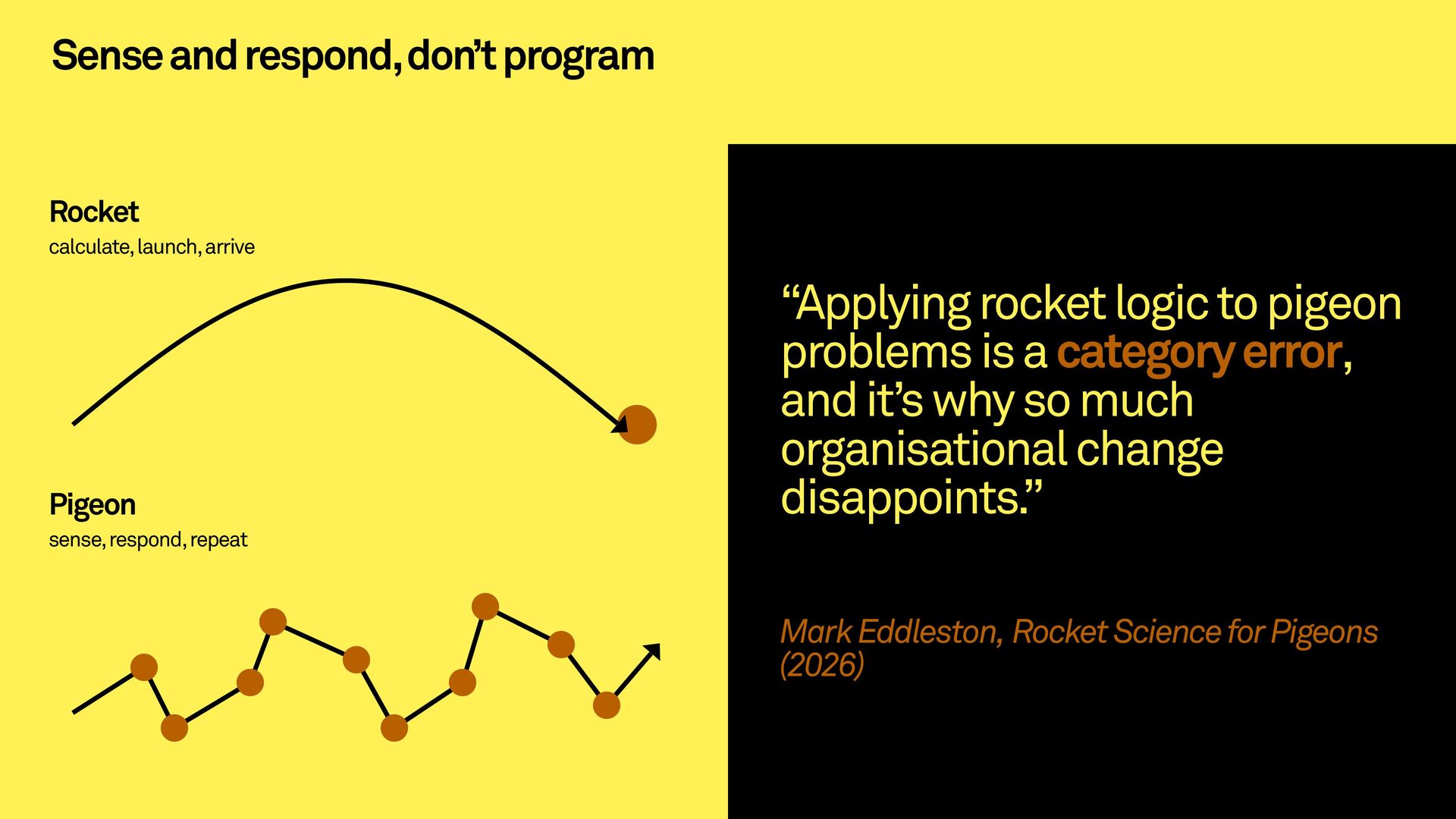
Sense and respond, don’t program Rocket calculate, launch, arrive Pigeon
“Applying rocket logic to pigeon problems is a category error, and it’s why so much organisational change disappoints.” sense, respond, repeat Mark Eddleston, Rocket Science for Pigeons (2026) -
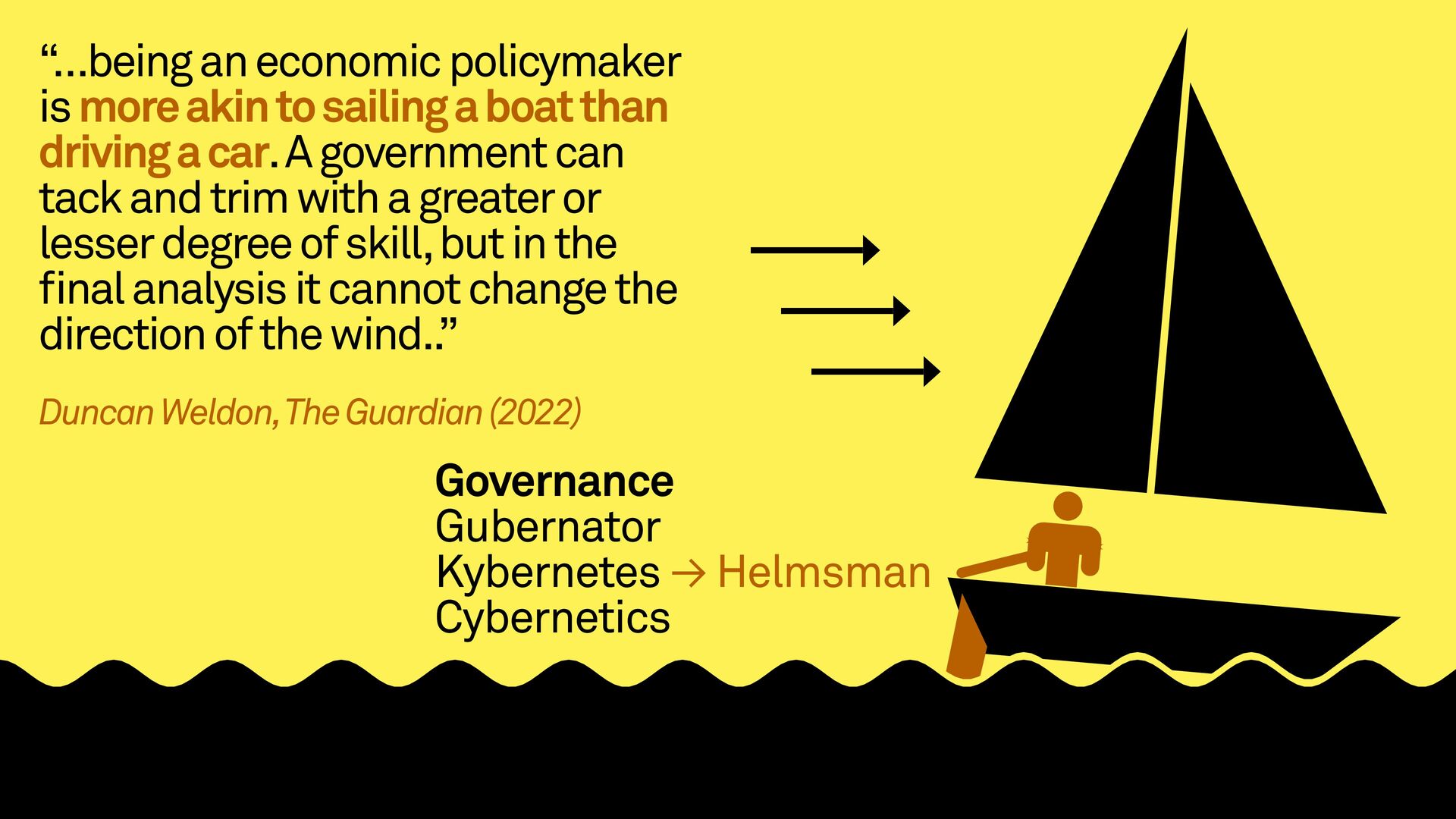
fi “…being an economic policymaker is more akin to sailing
a boat than driving a car. A government can tack and trim with a greater or lesser degree of skill, but in the nal analysis it cannot change the direction of the wind..” Duncan Weldon, The Guardian (2022) Governance Gubernator Kybernetes → Helmsman Cybernetics -
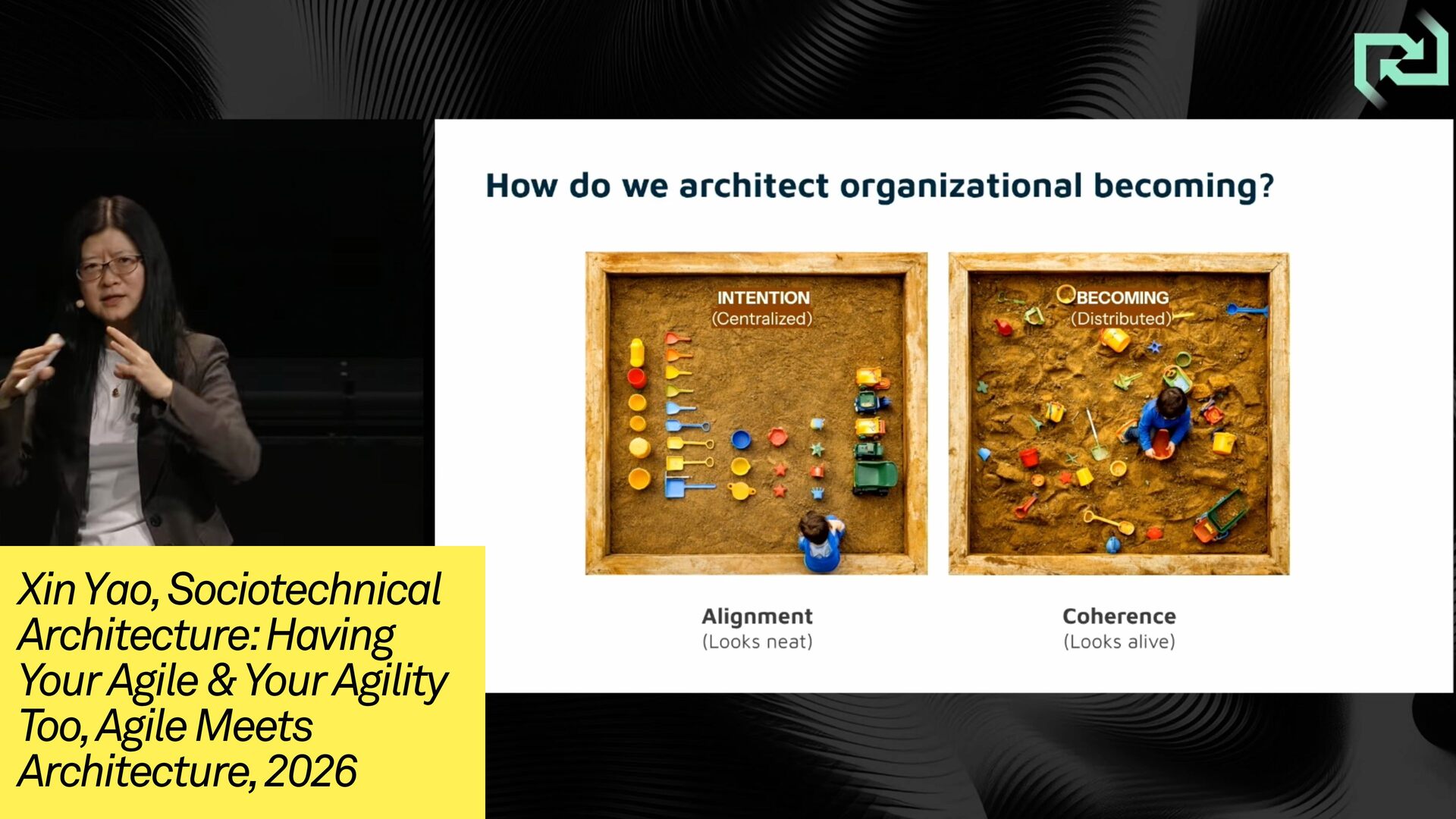
Xin Yao, Sociotechnical Architecture: Having Your Agile & Your Agility
Too, Agile Meets Architecture, 2026 -
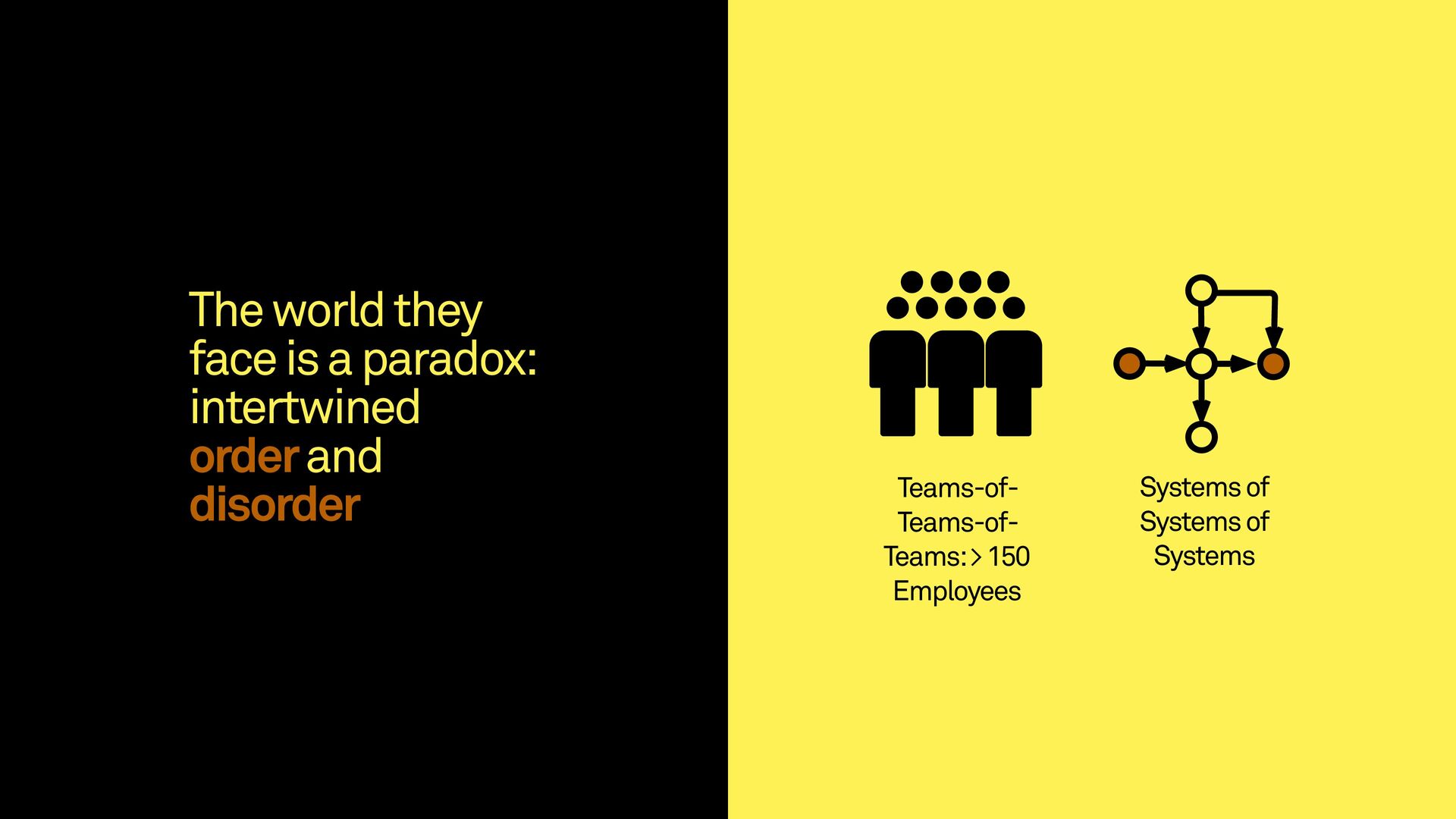
The world they face is a paradox: intertwined order and
disorder Teams-ofTeams-ofTeams: > 150 Employees Systems of Systems of Systems -
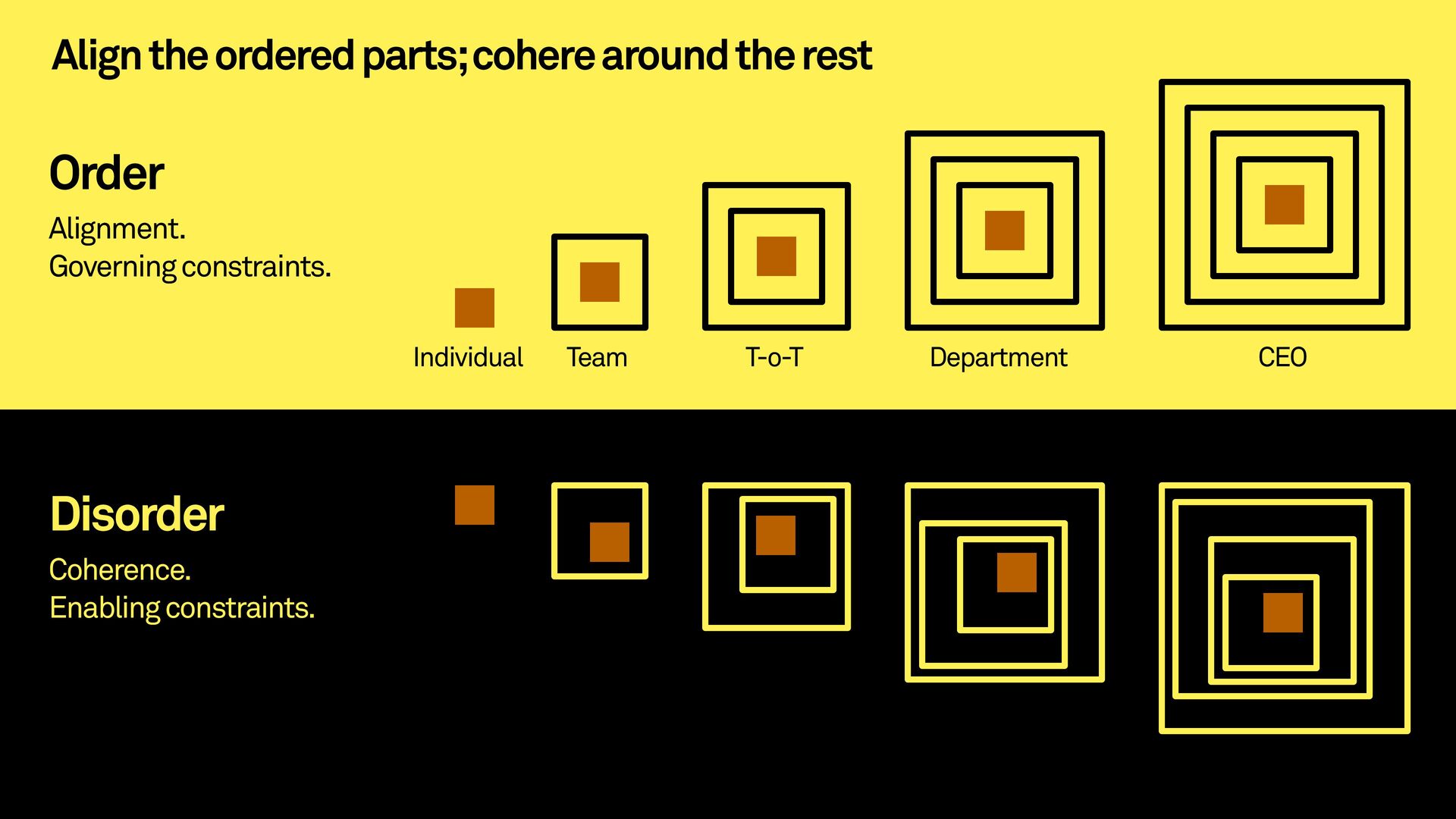
Align the ordered parts; cohere around the rest Order Alignment.
Governing constraints. Individual Disorder Coherence. Enabling constraints. Team T-o-T Department CEO -
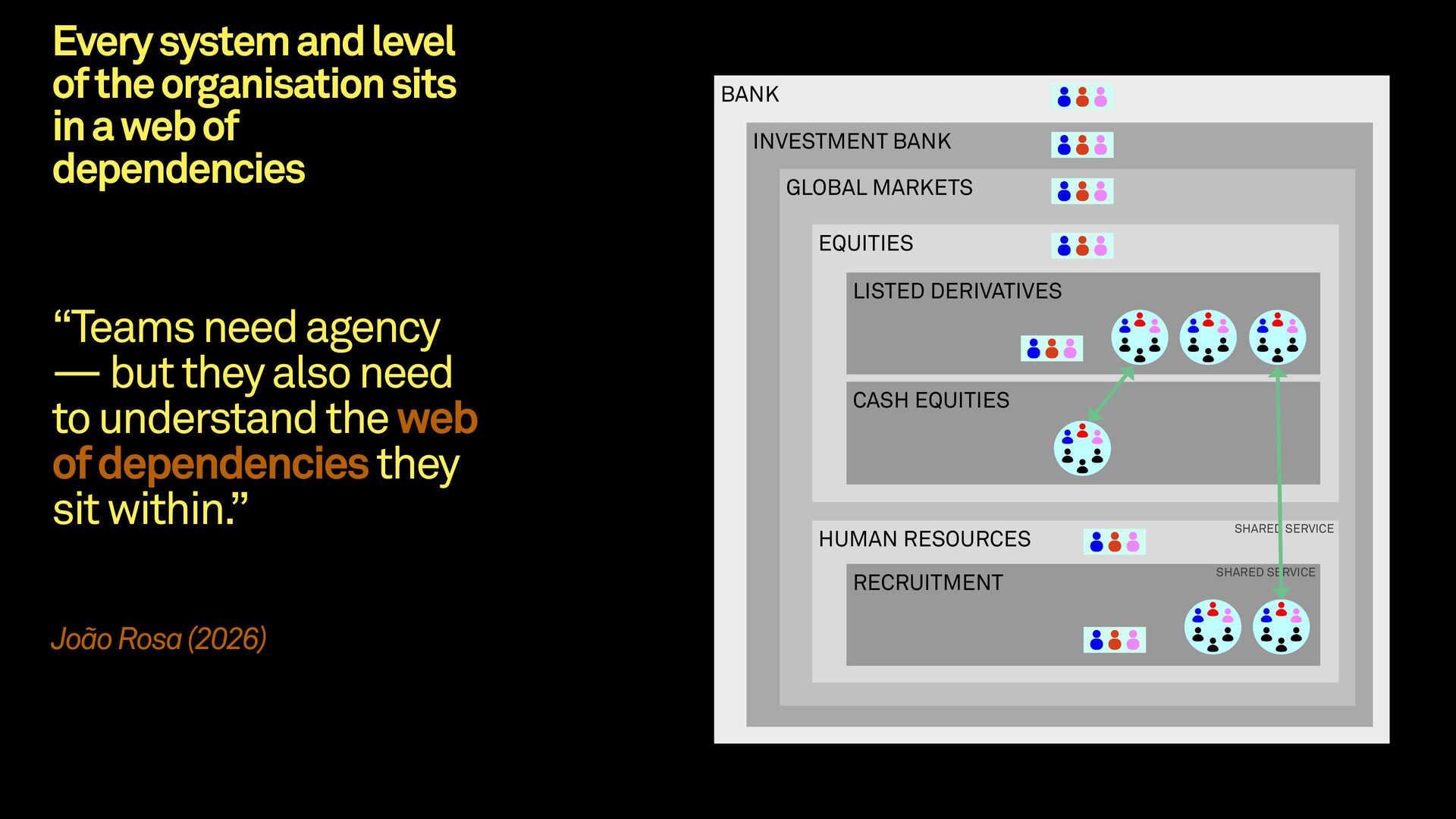
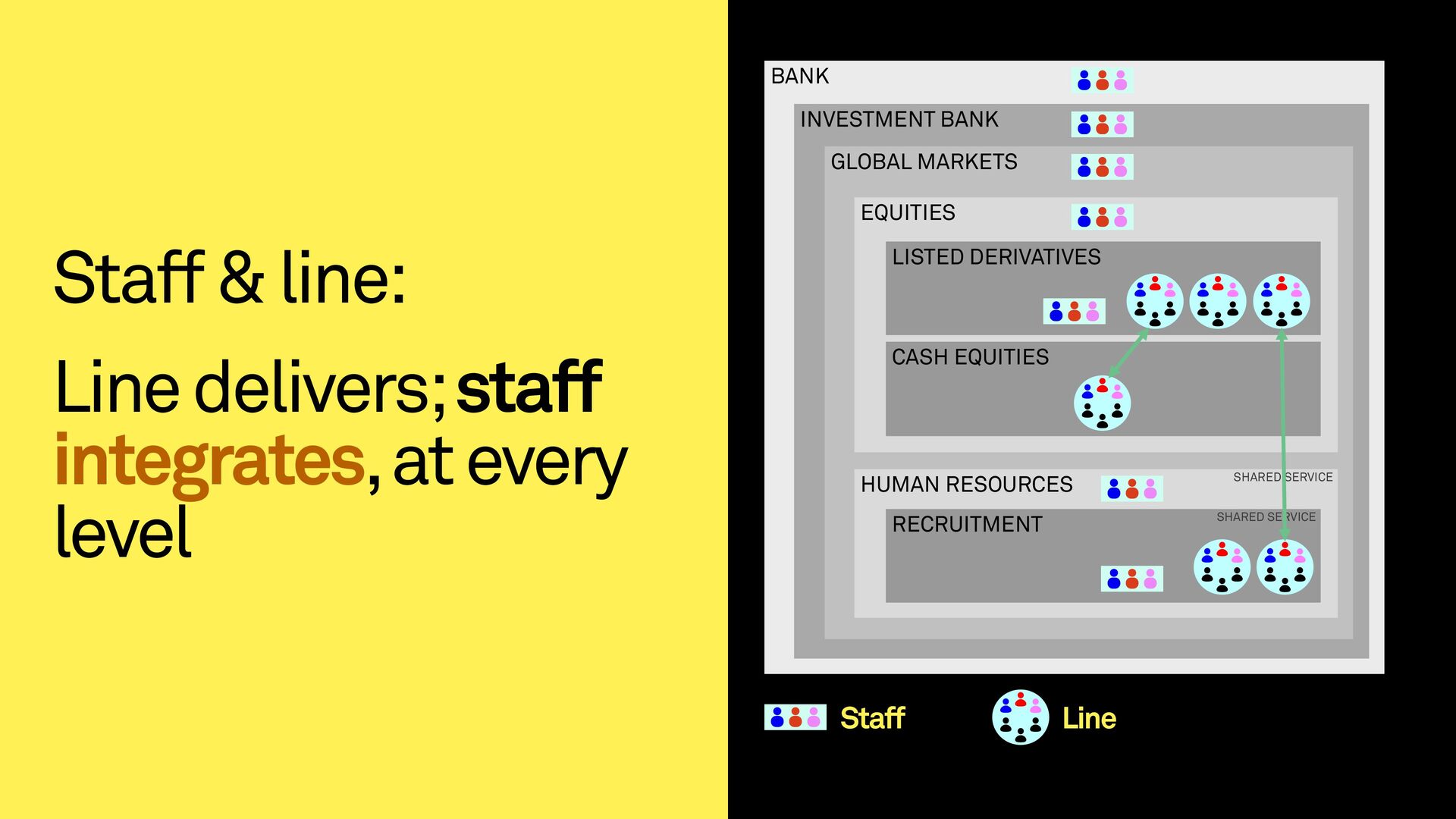
Every system and level of the organisation sits in a
web of dependencies BANK INVESTMENT BANK GLOBAL MARKETS EQUITIES LISTED DERIVATIVES “Teams need agency — but they also need to understand the web of dependencies they sit within.” CASH EQUITIES HUMAN RESOURCES RECRUITMENT João Rosa (2026) SHARED SERVICE SHARED SERVICE -
BANK INVESTMENT BANK GLOBAL MARKETS EQUITIES Staff & line: Line
delivers; staff integrates, at every level LISTED DERIVATIVES CASH EQUITIES HUMAN RESOURCES SHARED SERVICE RECRUITMENT Staff SHARED SERVICE Line -
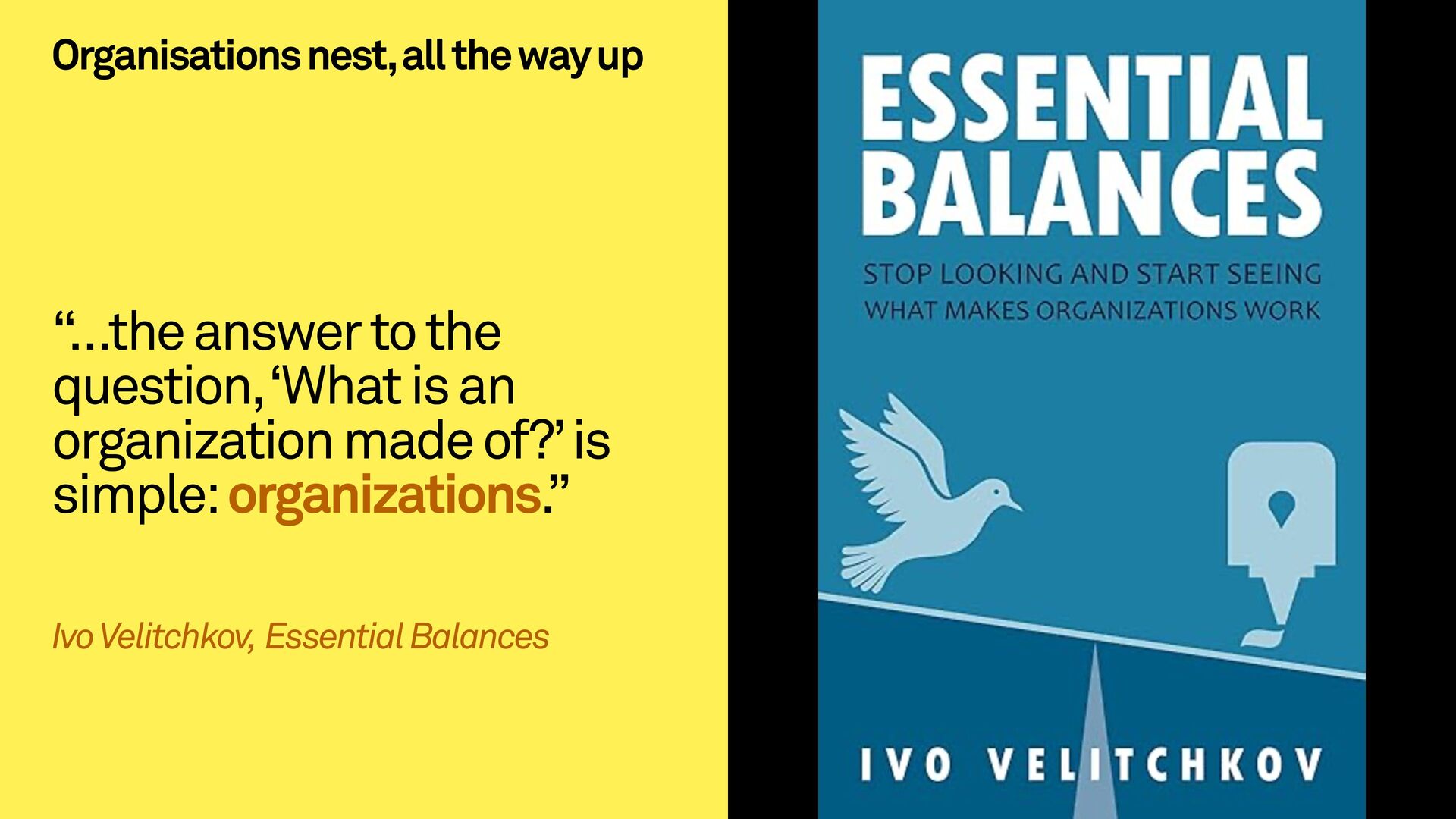
Organisations nest, all the way up “…the answer to the
question, ‘What is an organization made of?’ is simple: organizations.” Ivo Velitchkov, Essential Balances -
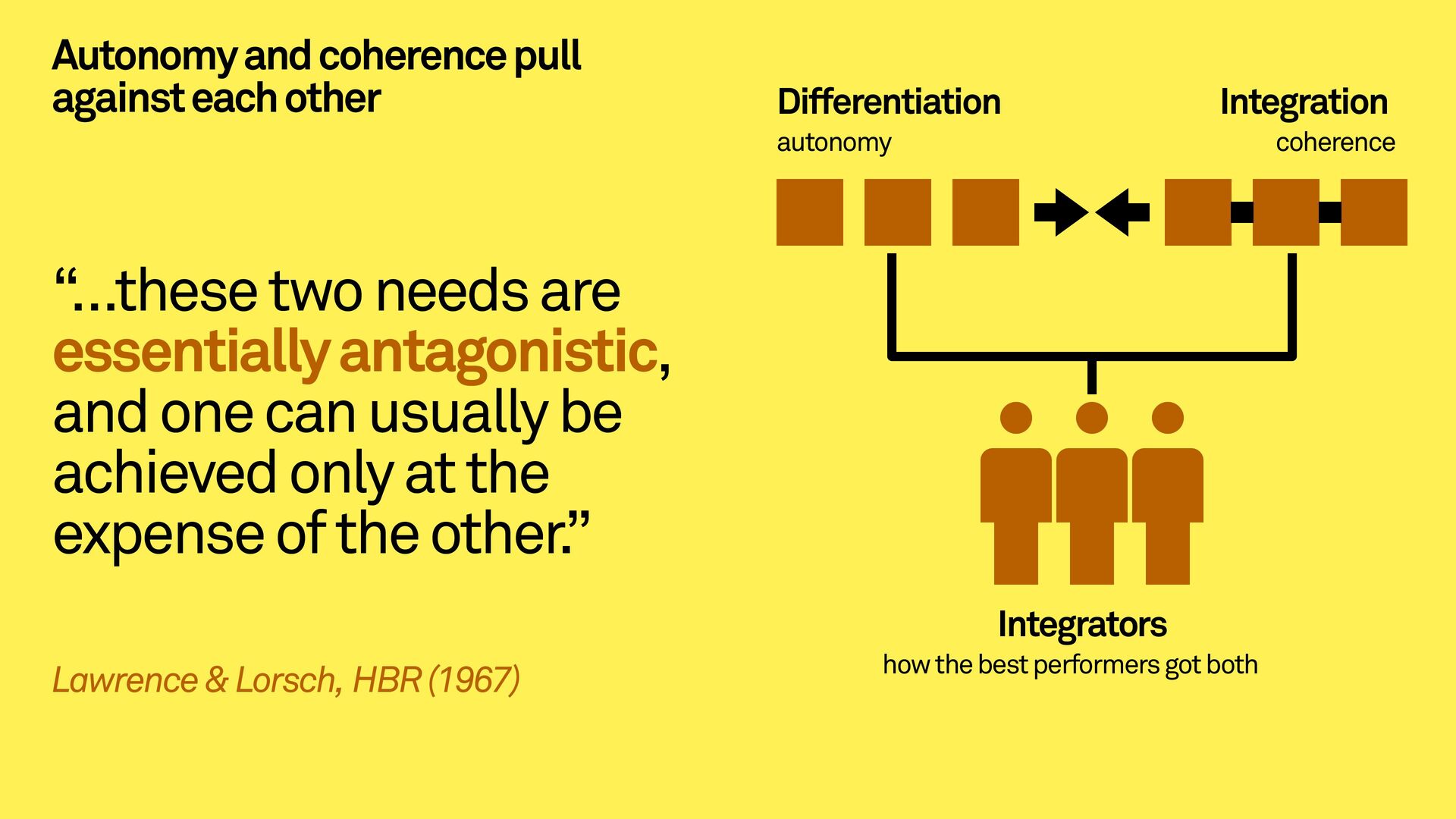
Autonomy and coherence pull against each other Differentiation Integration autonomy
coherence “…these two needs are essentially antagonistic, and one can usually be achieved only at the expense of the other.” Integrators Lawrence & Lorsch, HBR (1967) how the best performers got both -
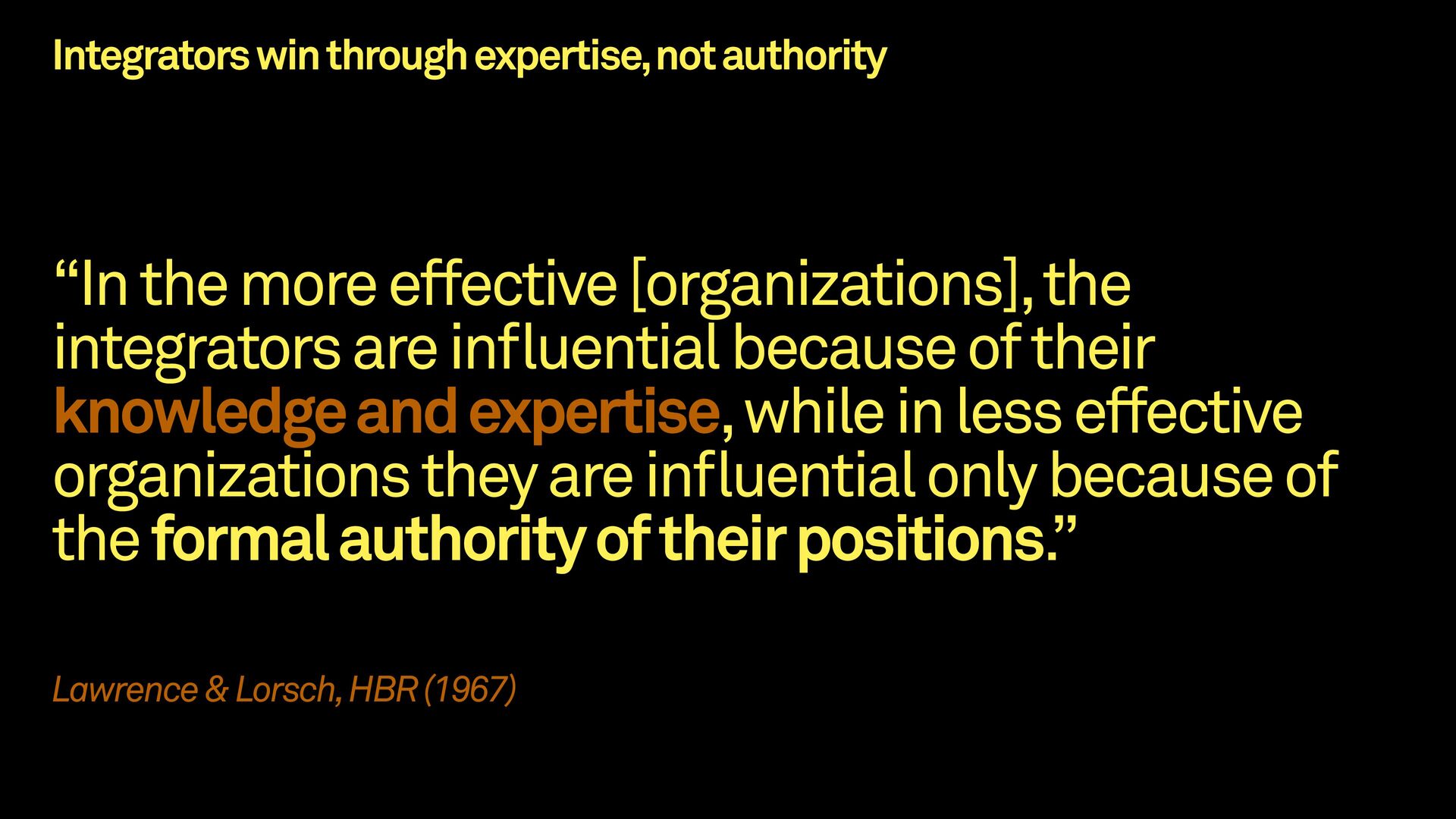
Integrators win through expertise, not authority “In the more effective
[organizations], the integrators are in uential because of their knowledge and expertise, while in less effective organizations they are in uential only because of the formal authority of their positions.” fl fl Lawrence & Lorsch, HBR (1967) -
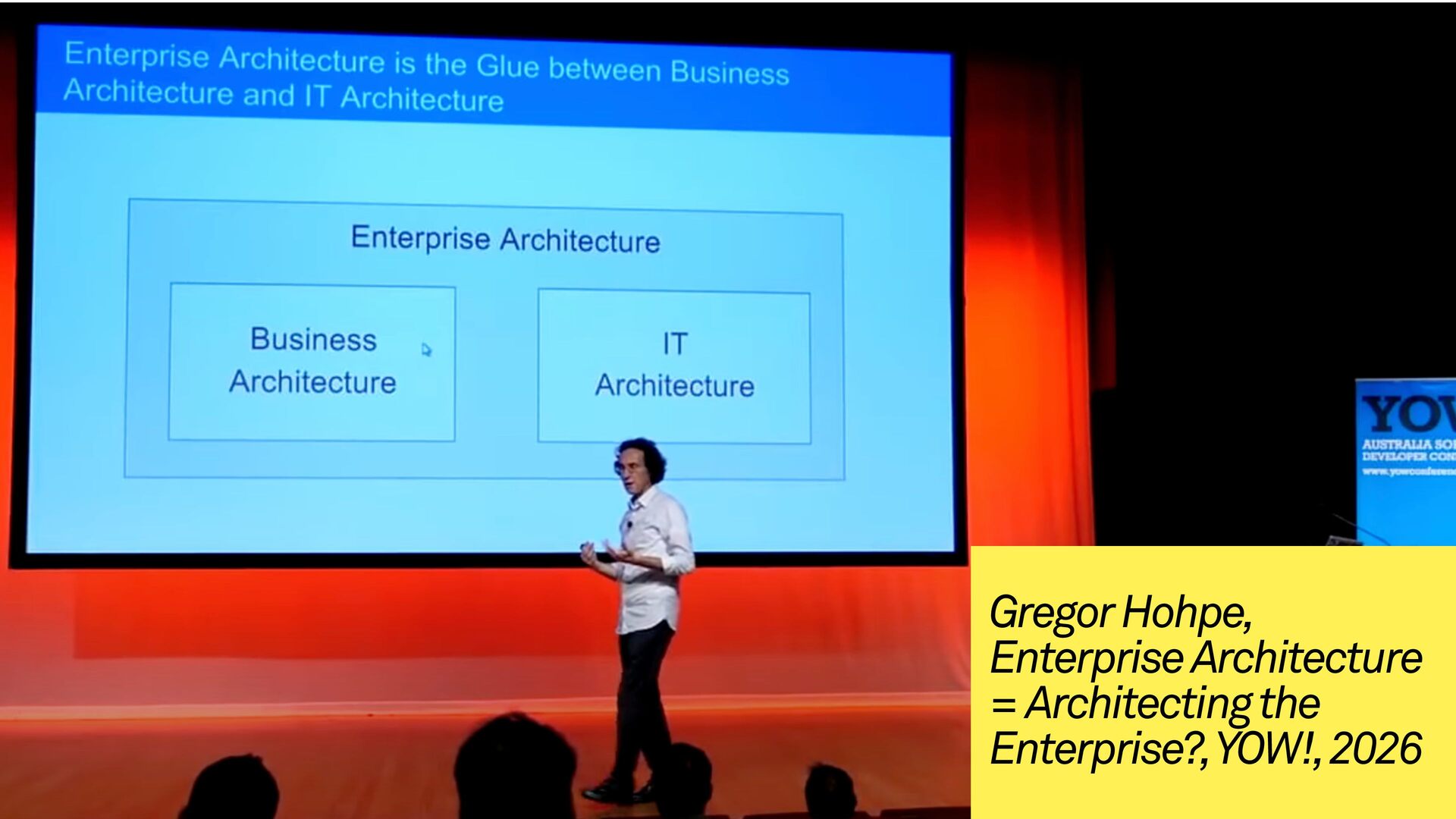
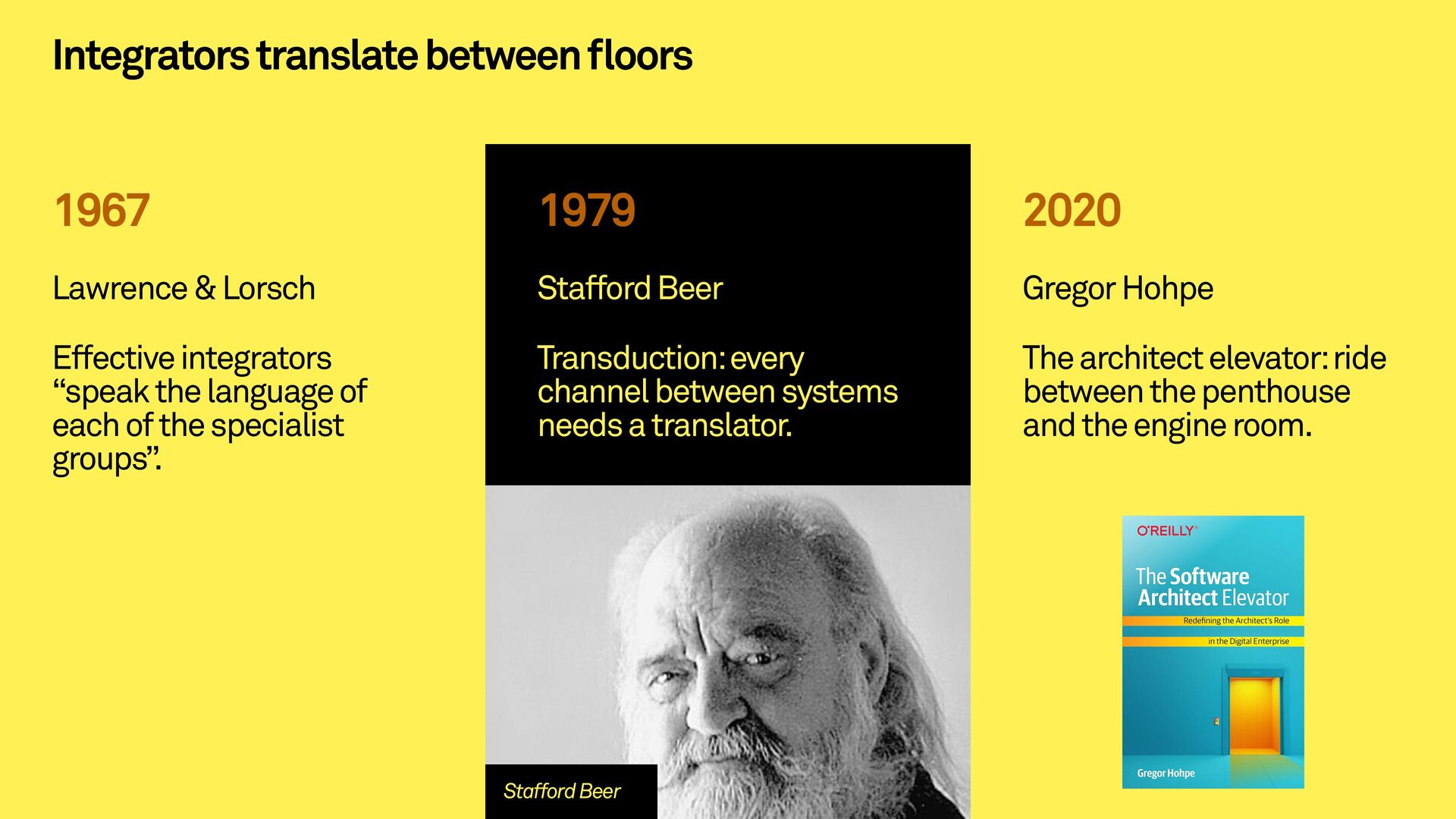
Integrators translate between oors 1967 1979 2020 Lawrence & Lorsch
Stafford Beer Gregor Hohpe Effective integrators “speak the language of each of the specialist groups”. Transduction: every channel between systems needs a translator. The architect elevator: ride between the penthouse and the engine room. fl Stafford Beer -
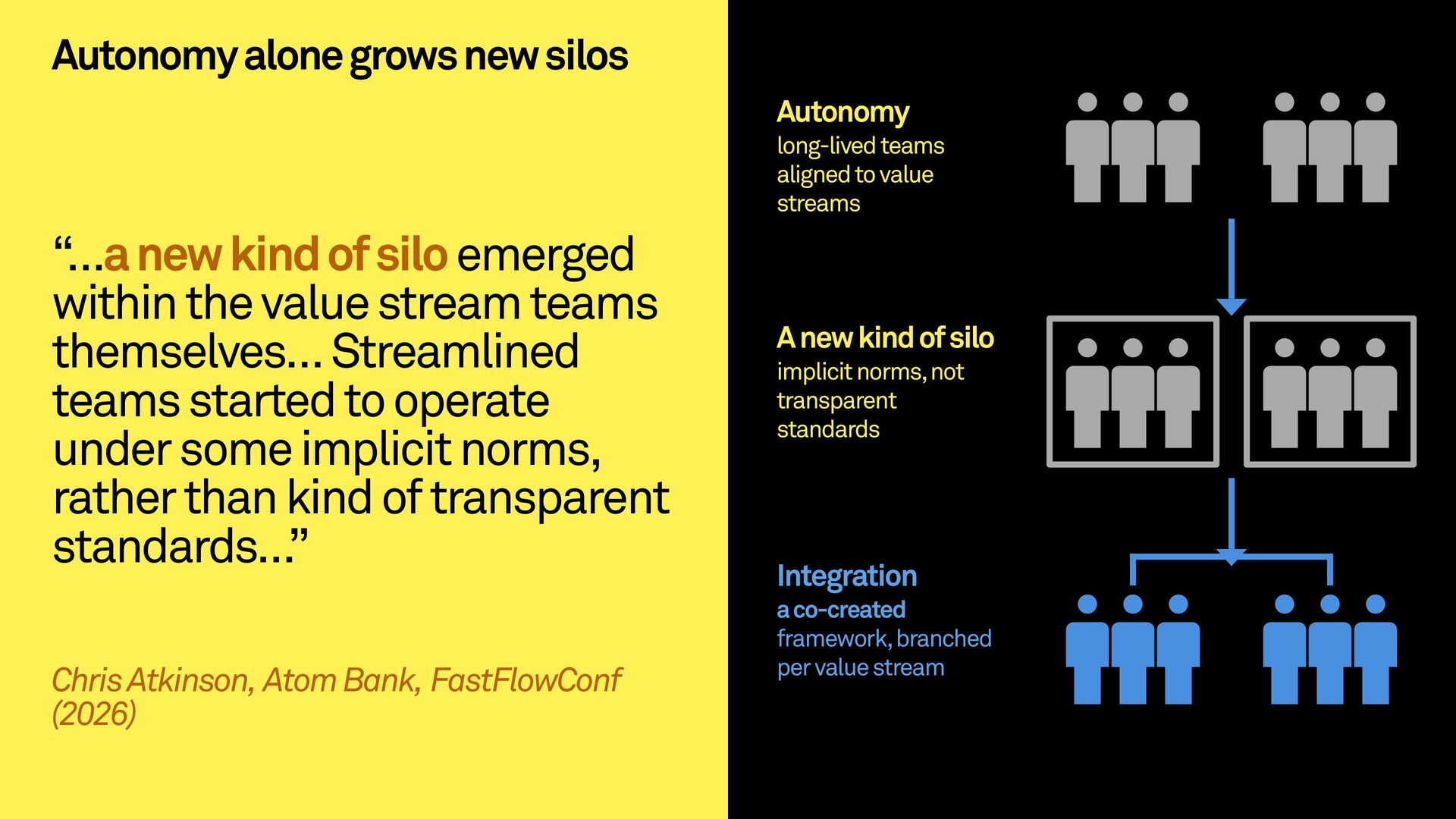
Autonomy alone grows new silos Autonomy long-lived teams aligned to
value streams “…a new kind of silo emerged within the value stream teams themselves… Streamlined teams started to operate under some implicit norms, rather than kind of transparent standards…” Chris Atkinson, Atom Bank, FastFlowConf (2026) A new kind of silo implicit norms, not transparent standards Integration a co-created framework, branched per value stream -
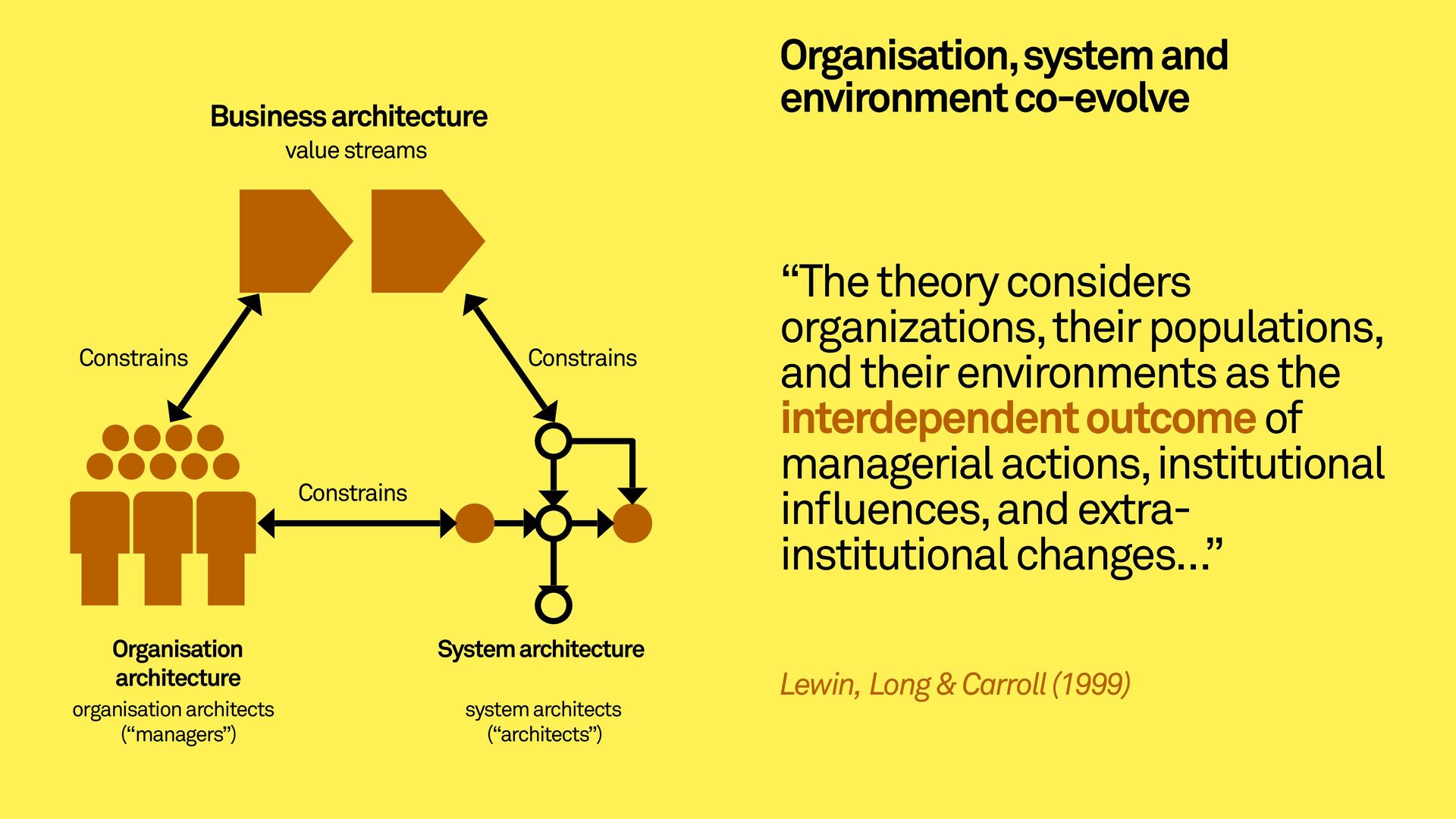
Organisation, system and environment co-evolve Business architecture value streams Constrains
Constrains fl Constrains Organisation architecture System architecture organisation architects (“managers”) system architects (“architects”) “The theory considers organizations, their populations, and their environments as the interdependent outcome of managerial actions, institutional in uences, and extrainstitutional changes…” Lewin, Long & Carroll (1999) -
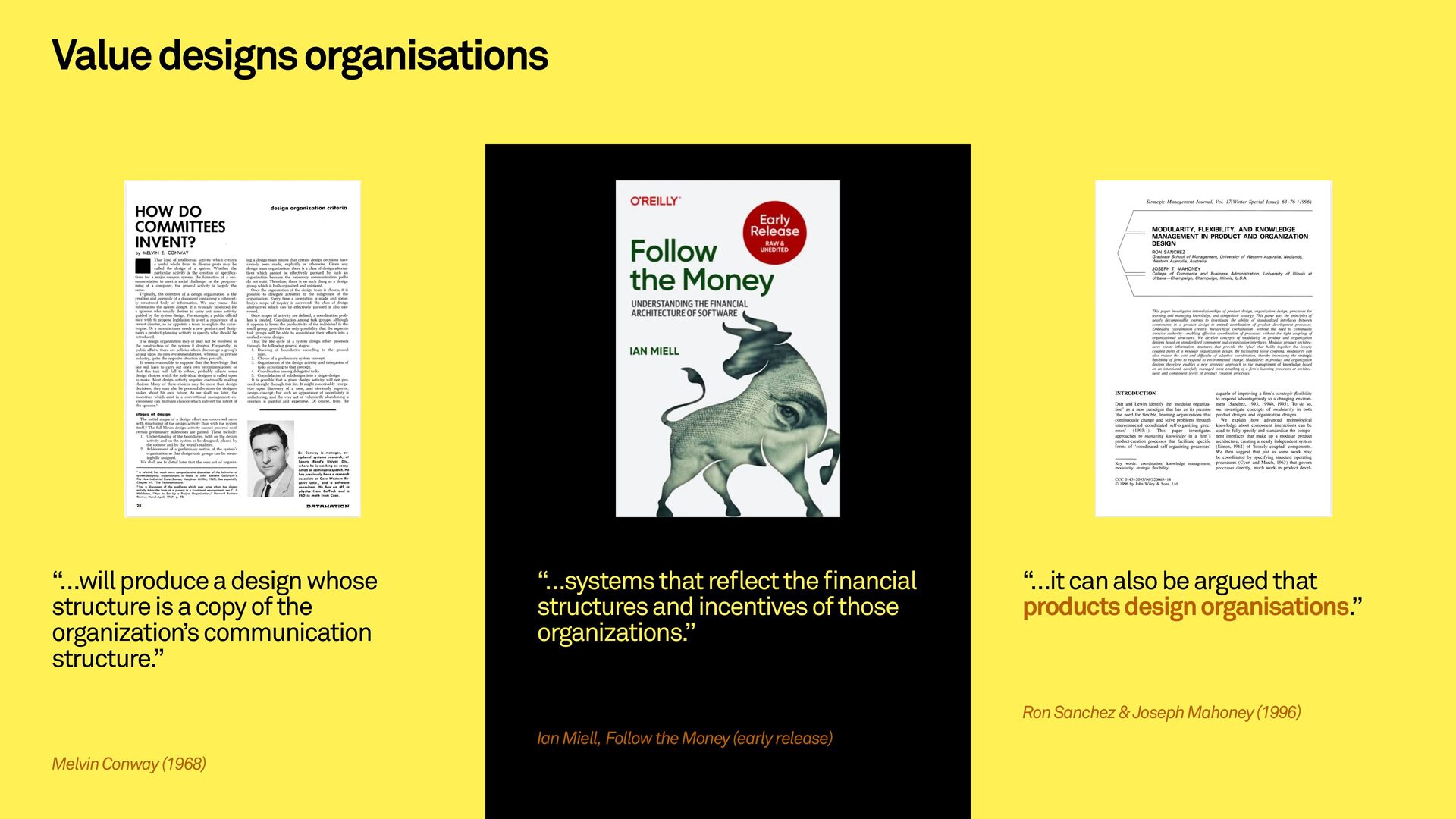
Value designs organisations “…will produce a design whose structure is
a copy of the organization’s communication structure.” “…systems that re ect the nancial structures and incentives of those organizations.” “…it can also be argued that products design organisations.” Ron Sanchez & Joseph Mahoney (1996) Ian Miell, Follow the Money (early release) fi fl Melvin Conway (1968) -
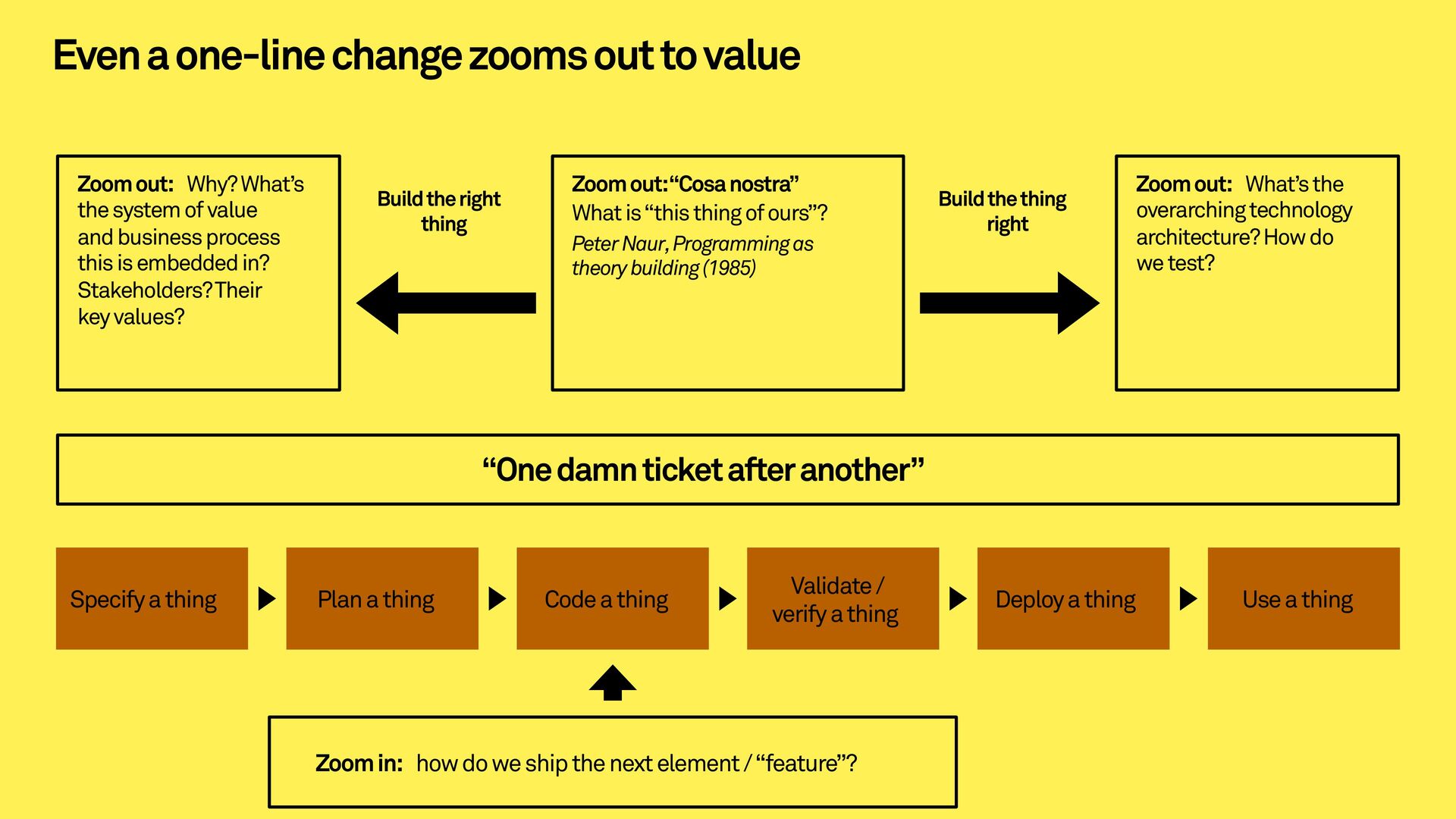
Even a one-line change zooms out to value Zoom out:
Why? What’s the system of value and business process this is embedded in? Stakeholders? Their key values? Build the right thing Zoom out:“Cosa nostra” What is “this thing of ours”? Peter Naur, Programming as theory building (1985) Build the thing right Zoom out: What’s the overarching technology architecture? How do we test? “One damn ticket after another” Specify a thing Plan a thing Code a thing Validate / verify a thing Zoom in: how do we ship the next element / “feature”? Deploy a thing Use a thing -
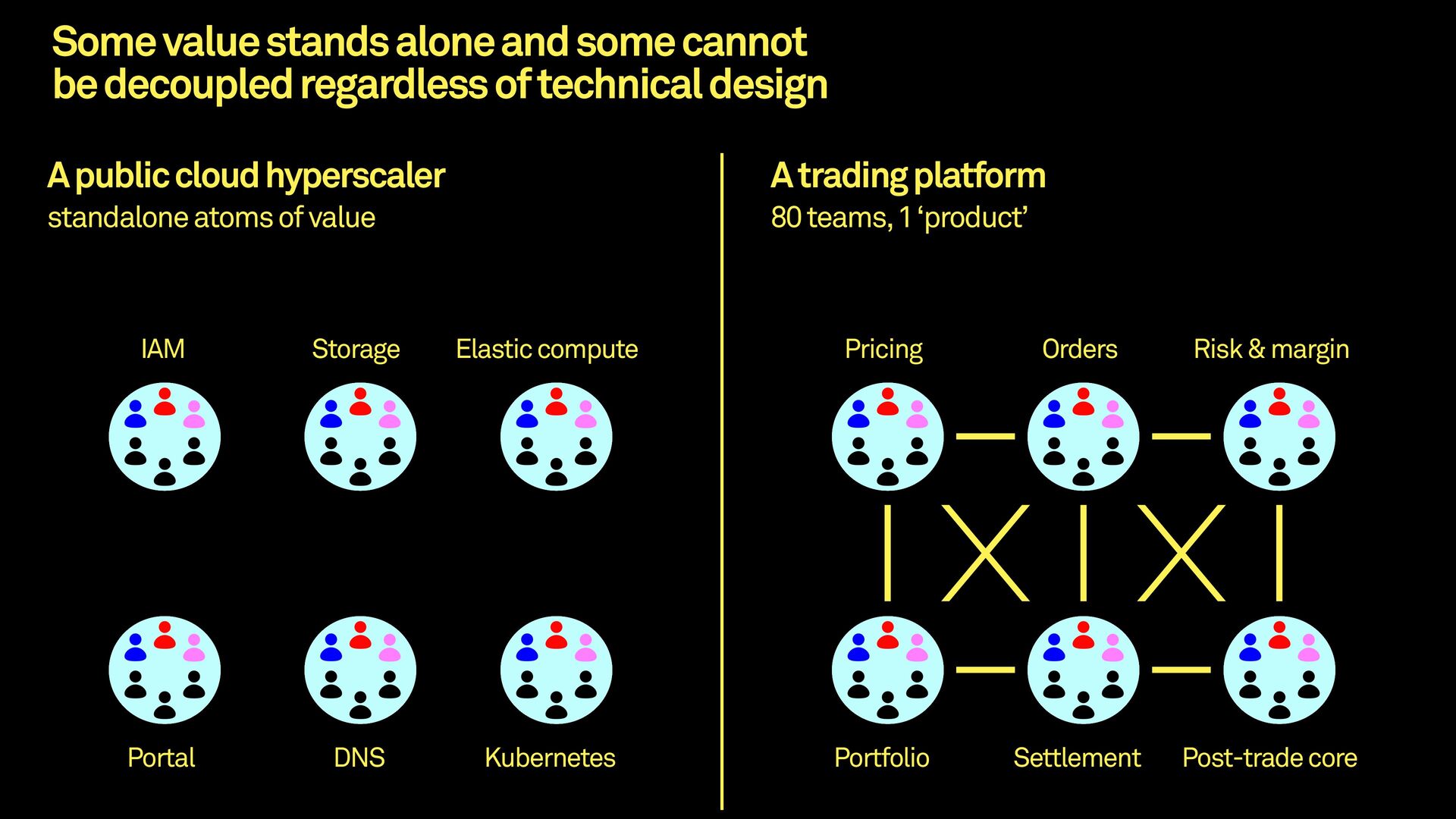
Some value stands alone and some cannot be decoupled regardless
of technical design A public cloud hyperscaler A trading platform standalone atoms of value 80 teams, 1 ‘product’ IAM Storage Elastic compute Pricing Orders Risk & margin Portal DNS Kubernetes Portfolio Settlement Post-trade core -
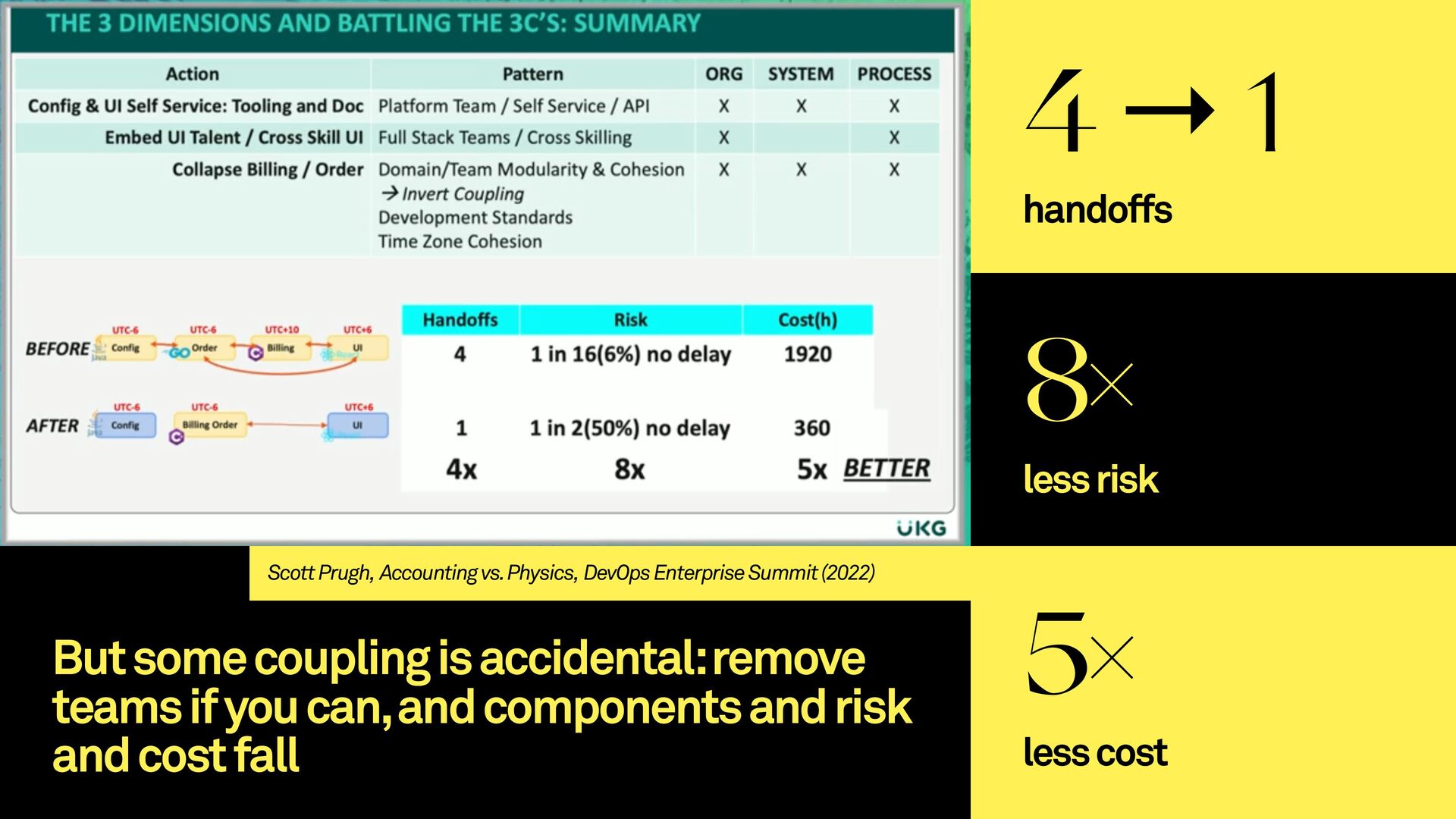
4→1 handoffs 8× less risk Scott Prugh, Accounting vs. Physics,
DevOps Enterprise Summit (2022) But some coupling is accidental: remove teams if you can, and components and risk and cost fall 5× less cost -
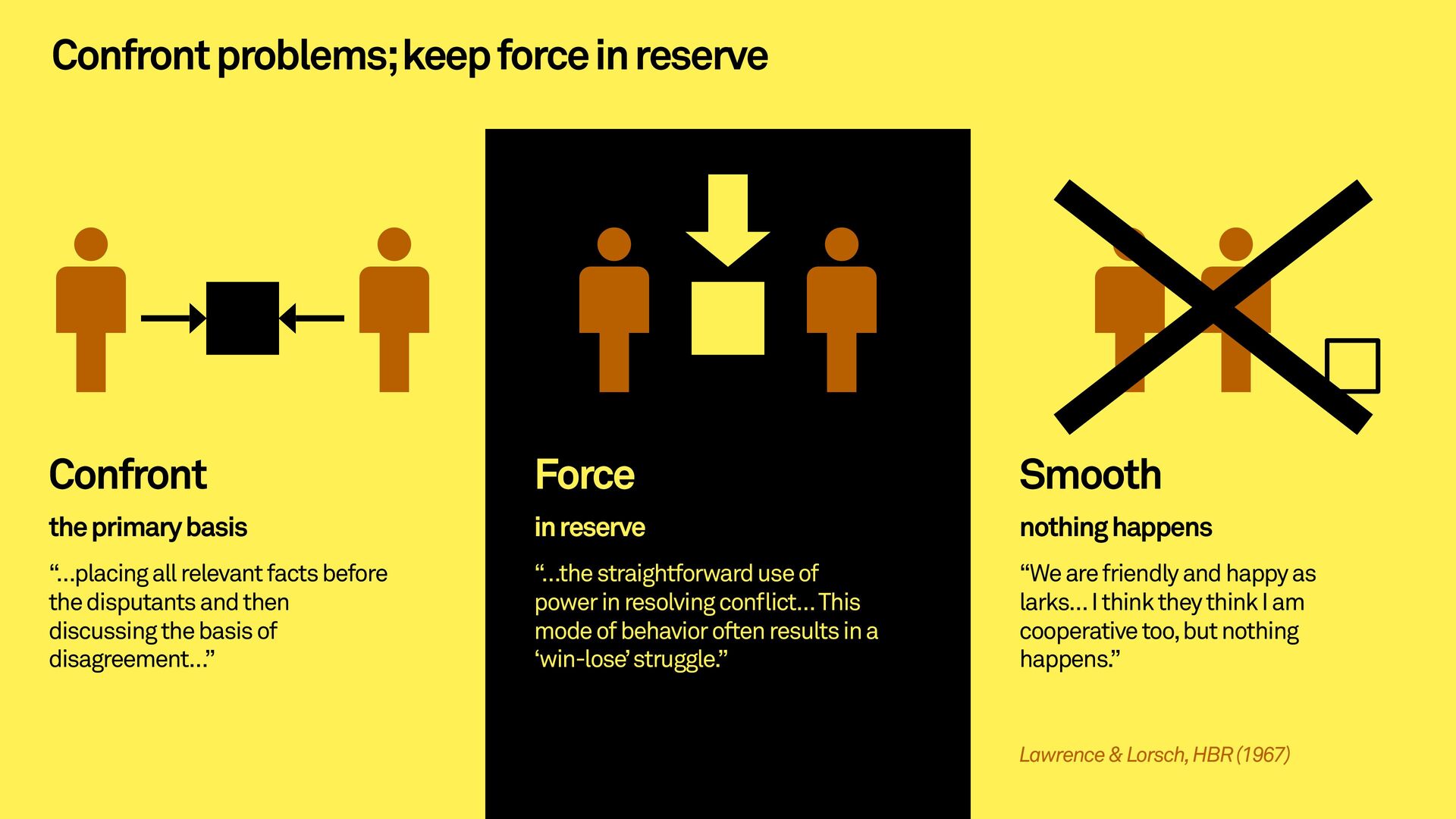
Confront problems; keep force in reserve Confront Force Smooth the
primary basis in reserve nothing happens “…placing all relevant facts before the disputants and then discussing the basis of disagreement…” “…the straightforward use of power in resolving con ict… This mode of behavior often results in a ‘win-lose’ struggle.” “We are friendly and happy as larks… I think they think I am cooperative too, but nothing happens.” fl Lawrence & Lorsch, HBR (1967) -
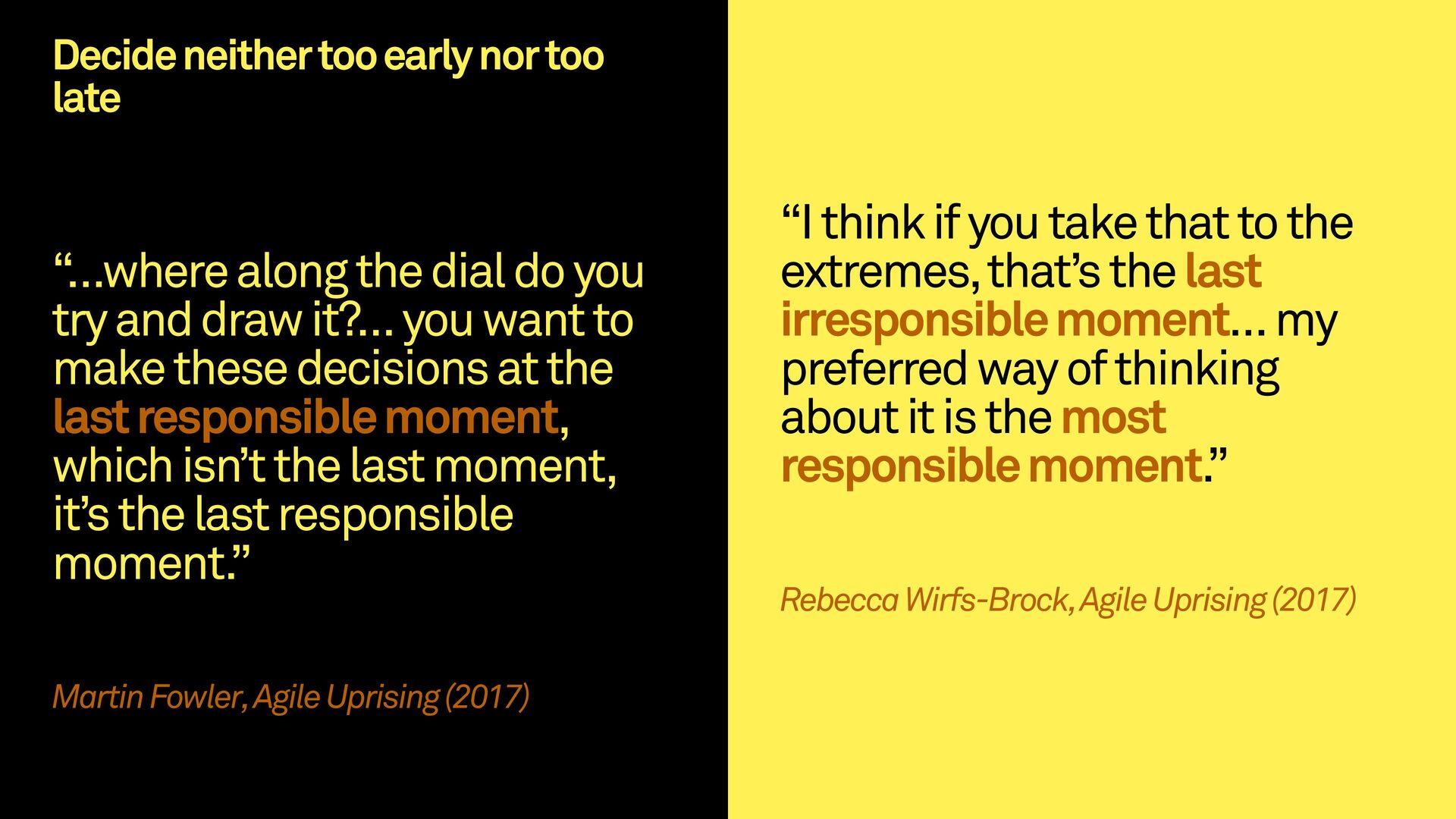
Decide neither too early nor too late “…where along the
dial do you try and draw it?… you want to make these decisions at the last responsible moment, which isn’t the last moment, it’s the last responsible moment.” Martin Fowler, Agile Uprising (2017) “I think if you take that to the extremes, that’s the last irresponsible moment… my preferred way of thinking about it is the most responsible moment.” Rebecca Wirfs-Brock, Agile Uprising (2017) -
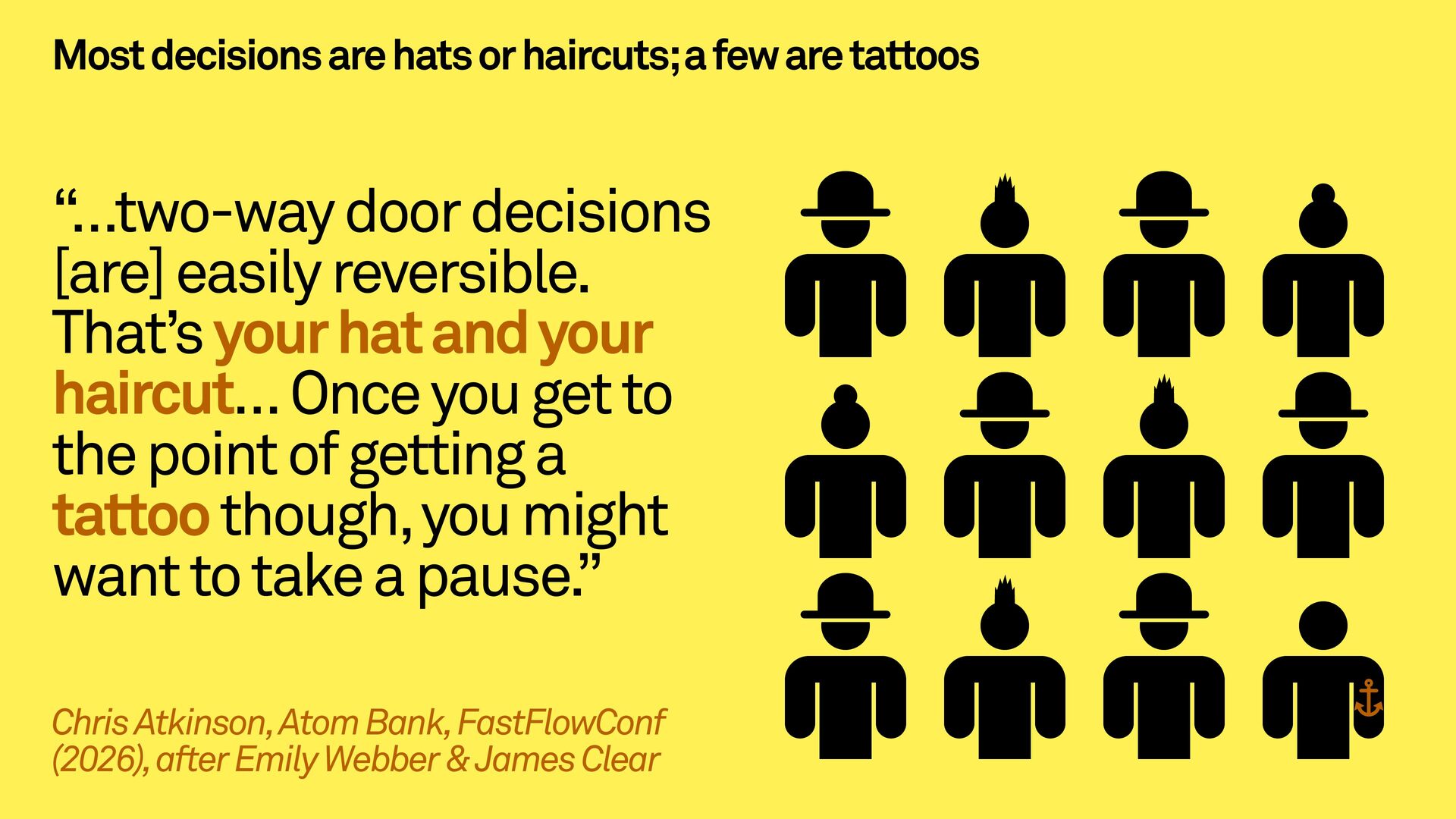
Most decisions are hats or haircuts; a few are tattoos
“…two-way door decisions [are] easily reversible. That’s your hat and your haircut… Once you get to the point of getting a tattoo though, you might want to take a pause.” Chris Atkinson, Atom Bank, FastFlowConf (2026), after Emily Webber & James Clear -
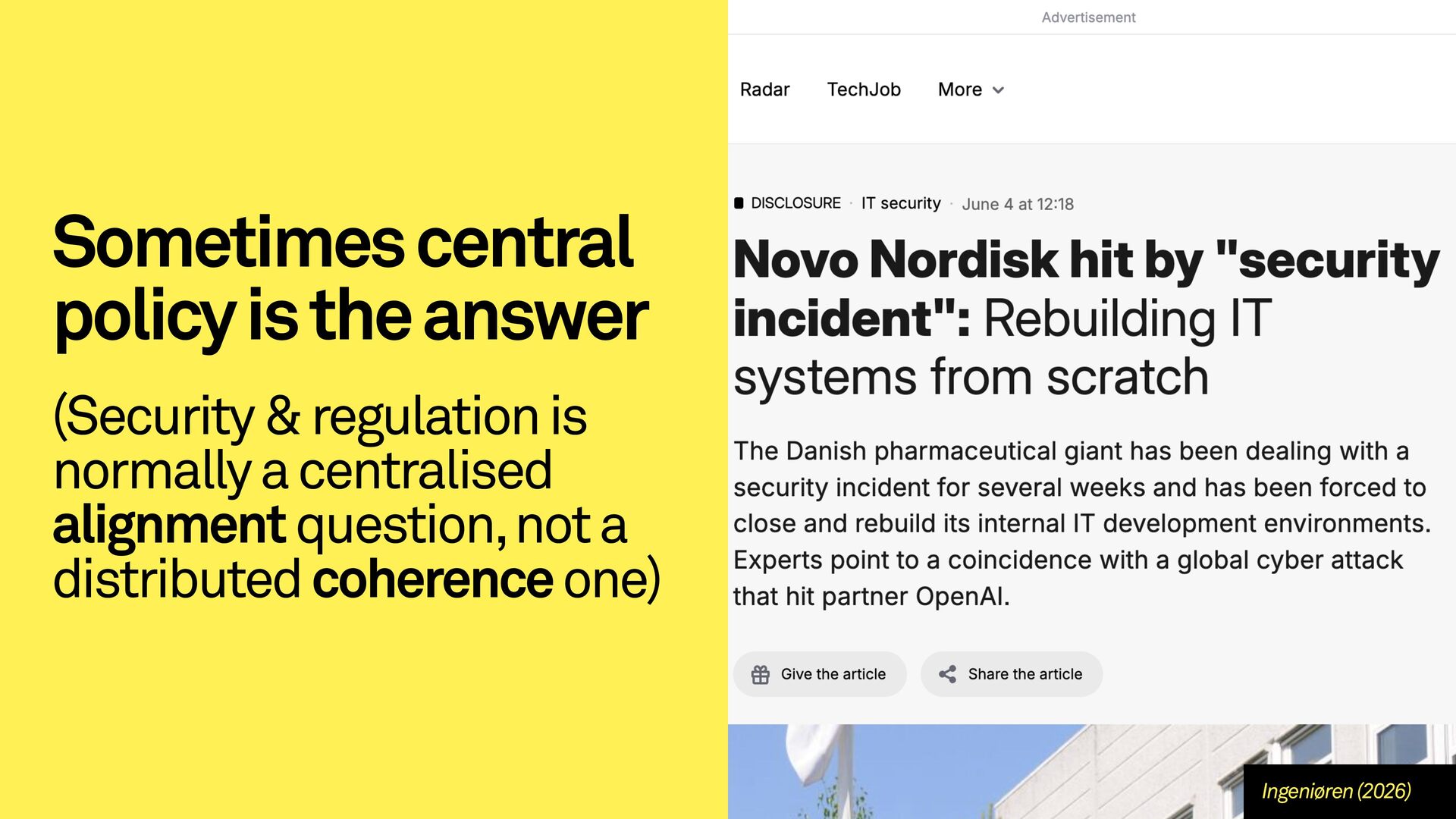
Sometimes central policy is the answer (Security & regulation is
normally a centralised alignment question, not a distributed coherence one) Ingeniøren (2026) -
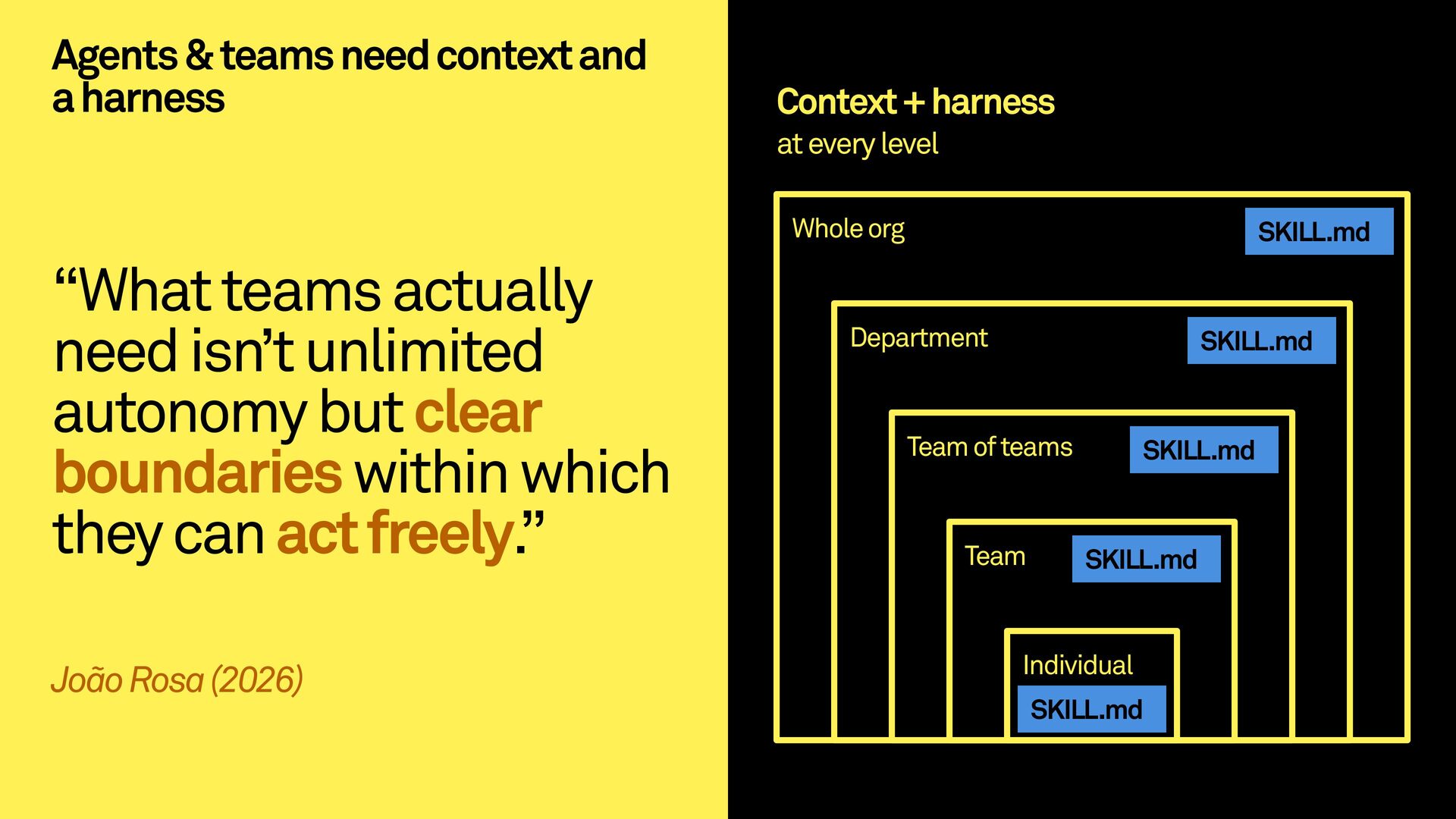
Agents & teams need context and a harness Context +
harness at every level Whole org “What teams actually need isn’t unlimited autonomy but clear boundaries within which they can act freely.” João Rosa (2026) SKILL.md Department SKILL.md Team of teams Team SKILL.md SKILL.md Individual SKILL.md -
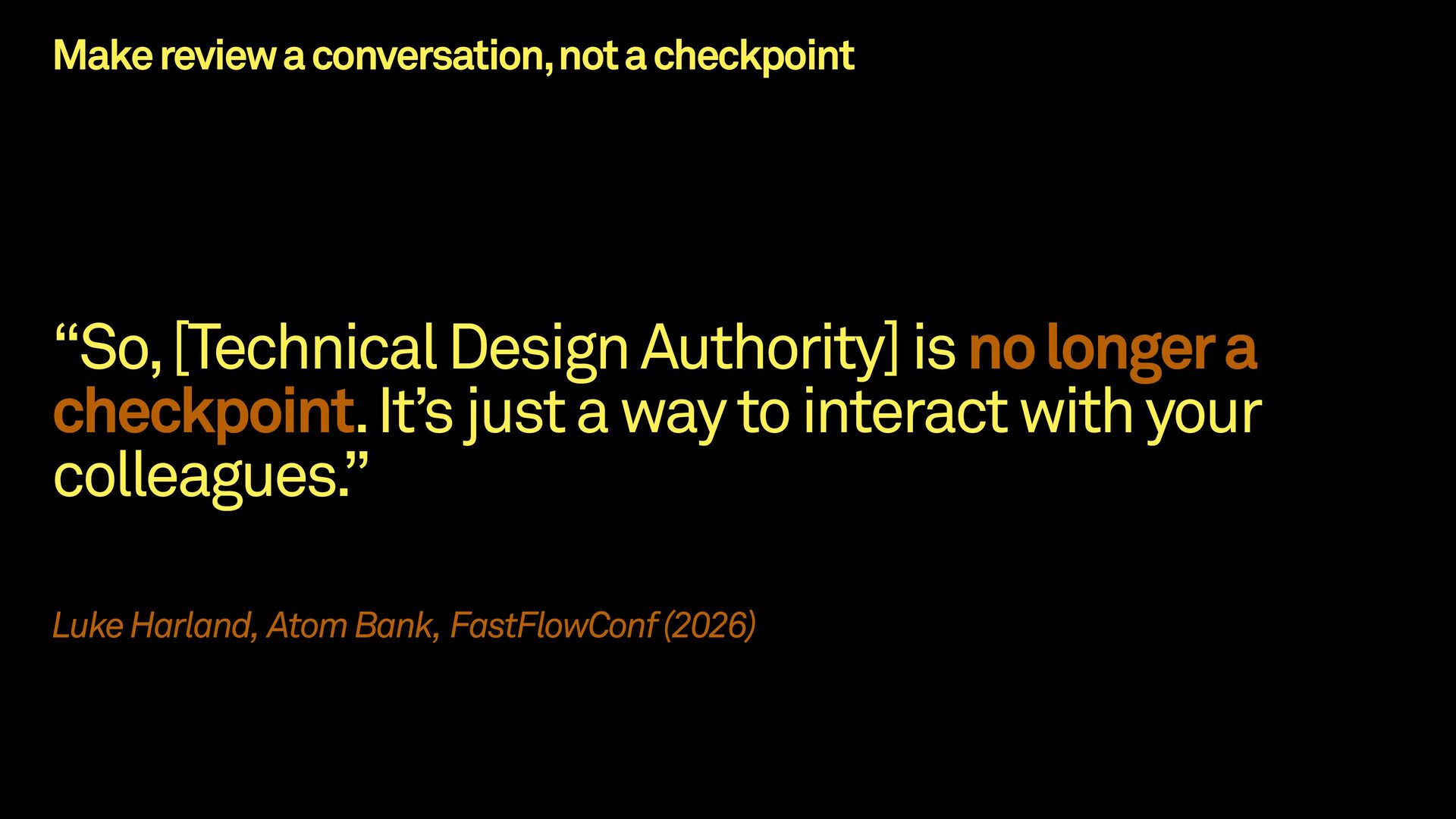
Make review a conversation, not a checkpoint “So, [Technical Design
Authority] is no longer a checkpoint. It’s just a way to interact with your colleagues.” Luke Harland, Atom Bank, FastFlowConf (2026) -
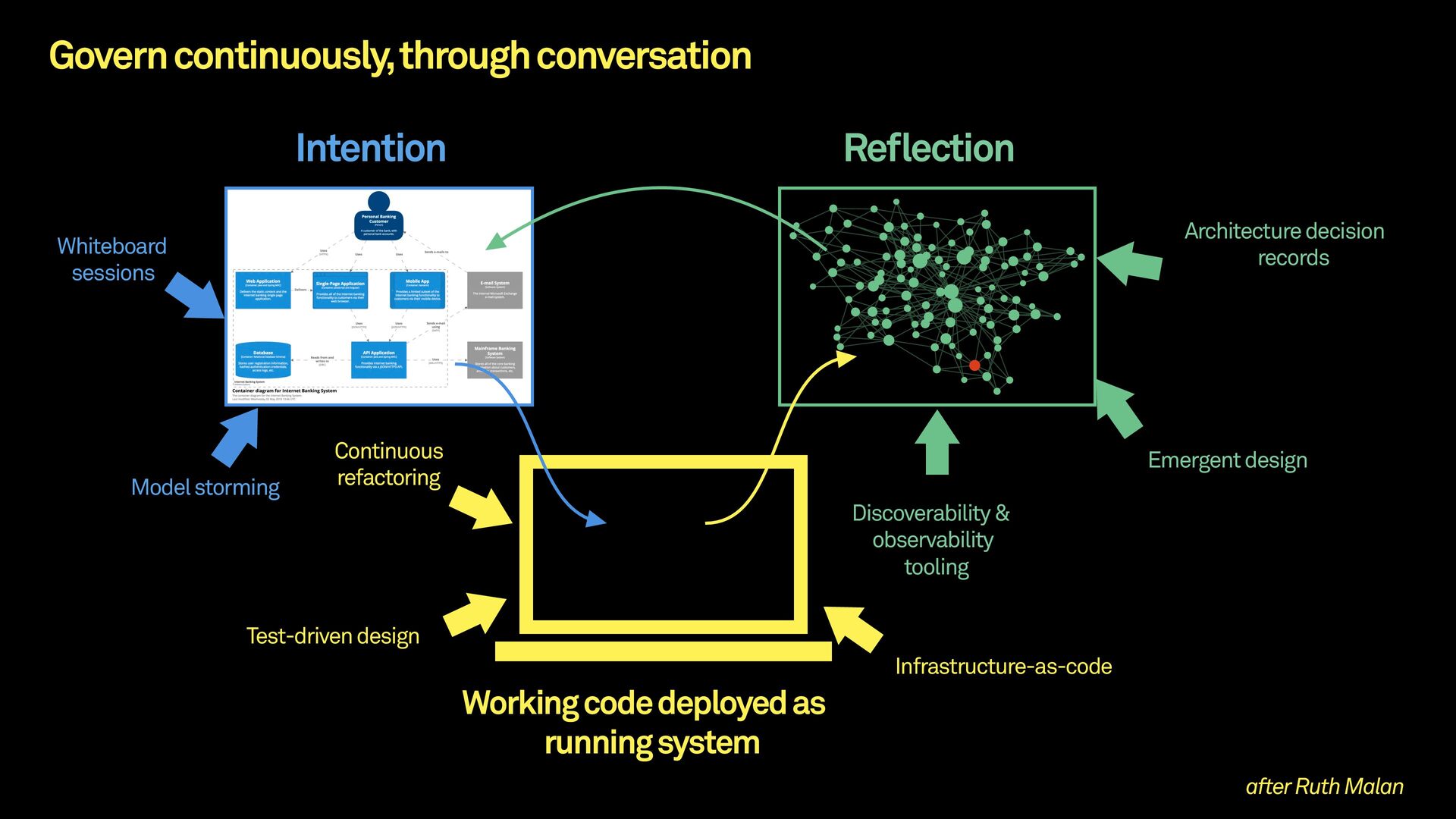
Govern continuously, through conversation Intention Re ection Architecture decision records
Whiteboard sessions Model storming Continuous refactoring Emergent design Discoverability & observability tooling Test-driven design Infrastructure-as-code Working code deployed as running system fl after Ruth Malan -
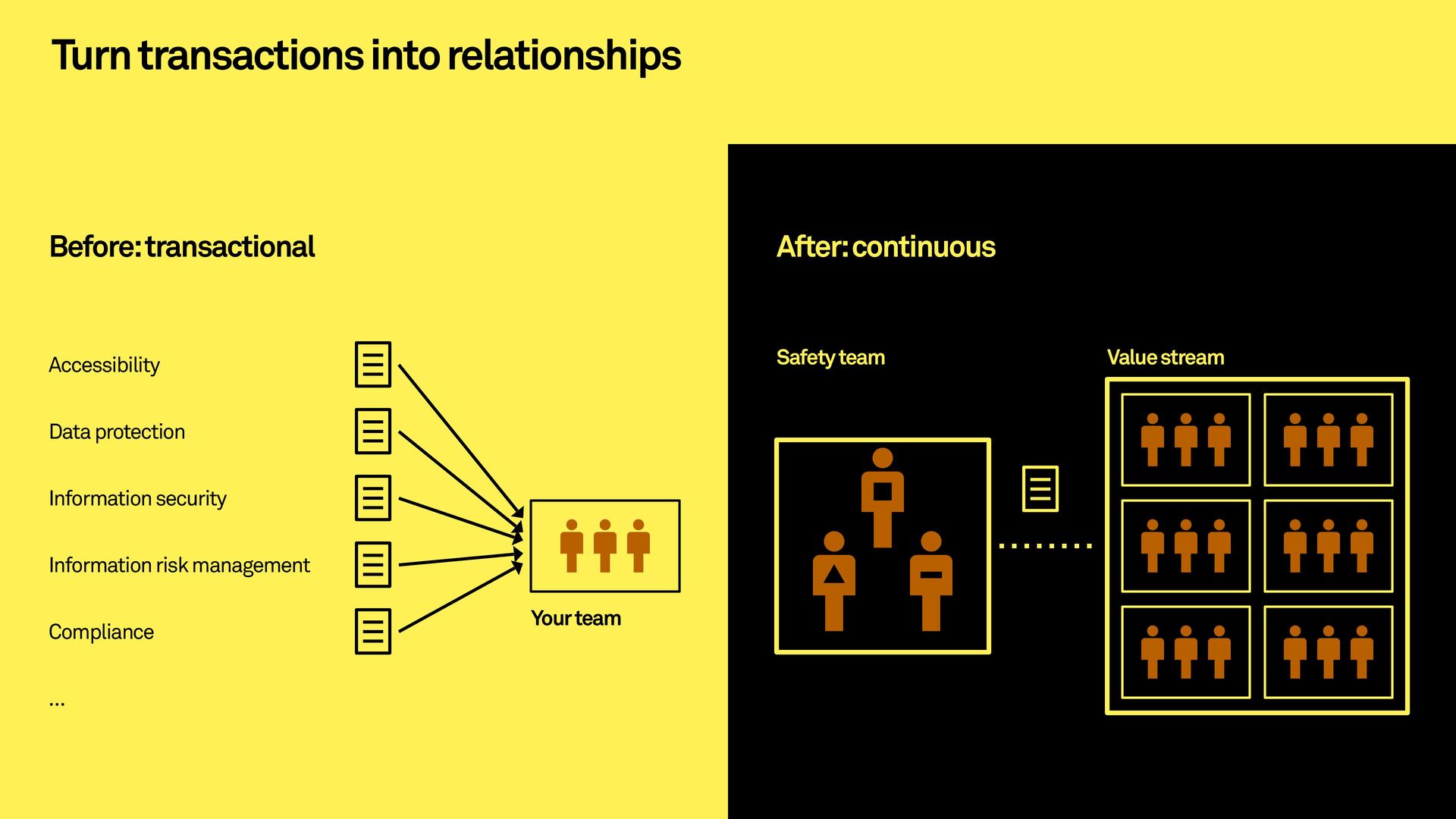
Turn transactions into relationships Before: transactional After: continuous Accessibility Safety
team Data protection Information security Information risk management Compliance … Your team Value stream -
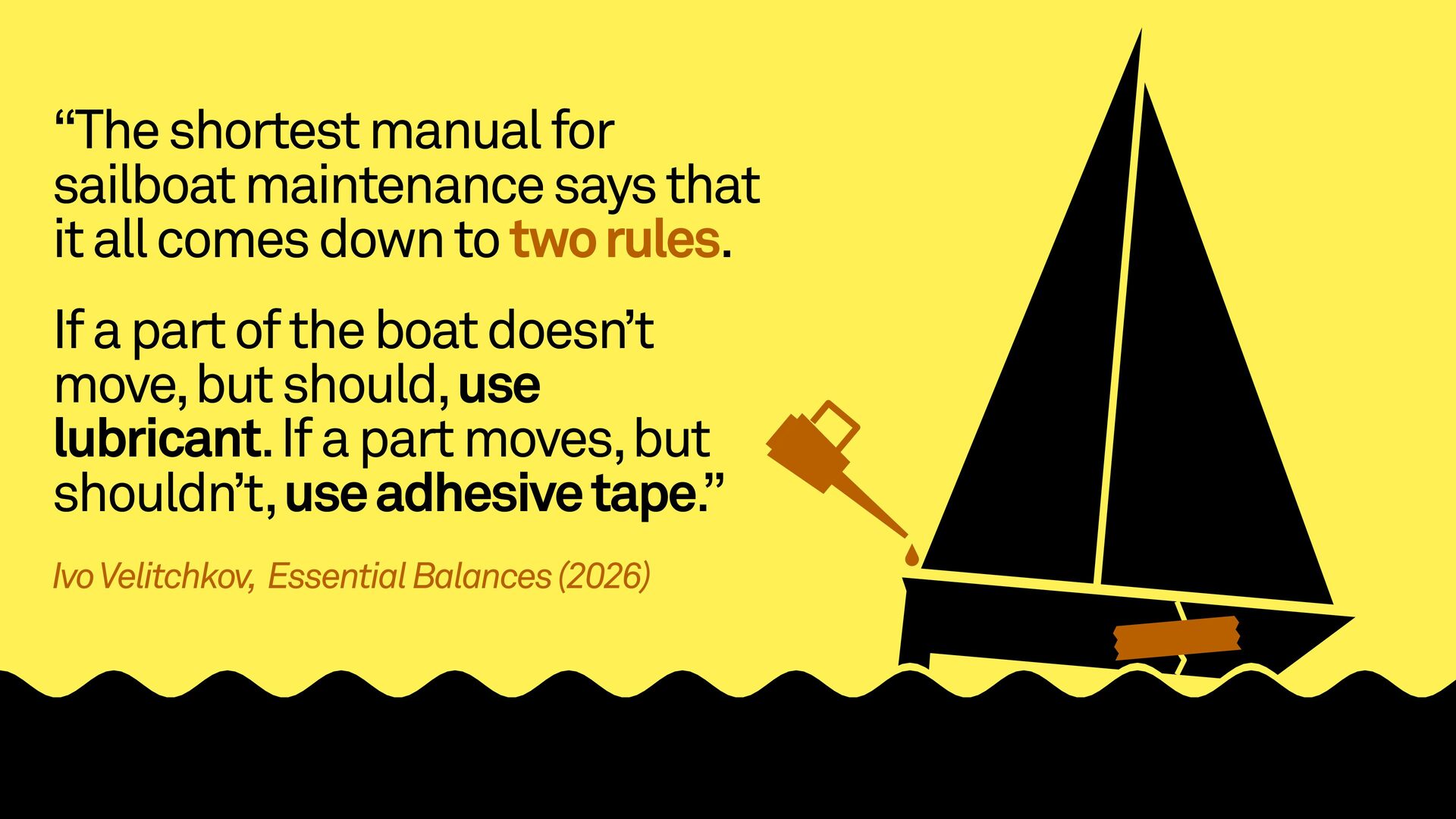
“The shortest manual for sailboat maintenance says that it all
comes down to two rules. If a part of the boat doesn’t move, but should, use lubricant. If a part moves, but shouldn’t, use adhesive tape.” Ivo Velitchkov, Essential Balances (2026) -
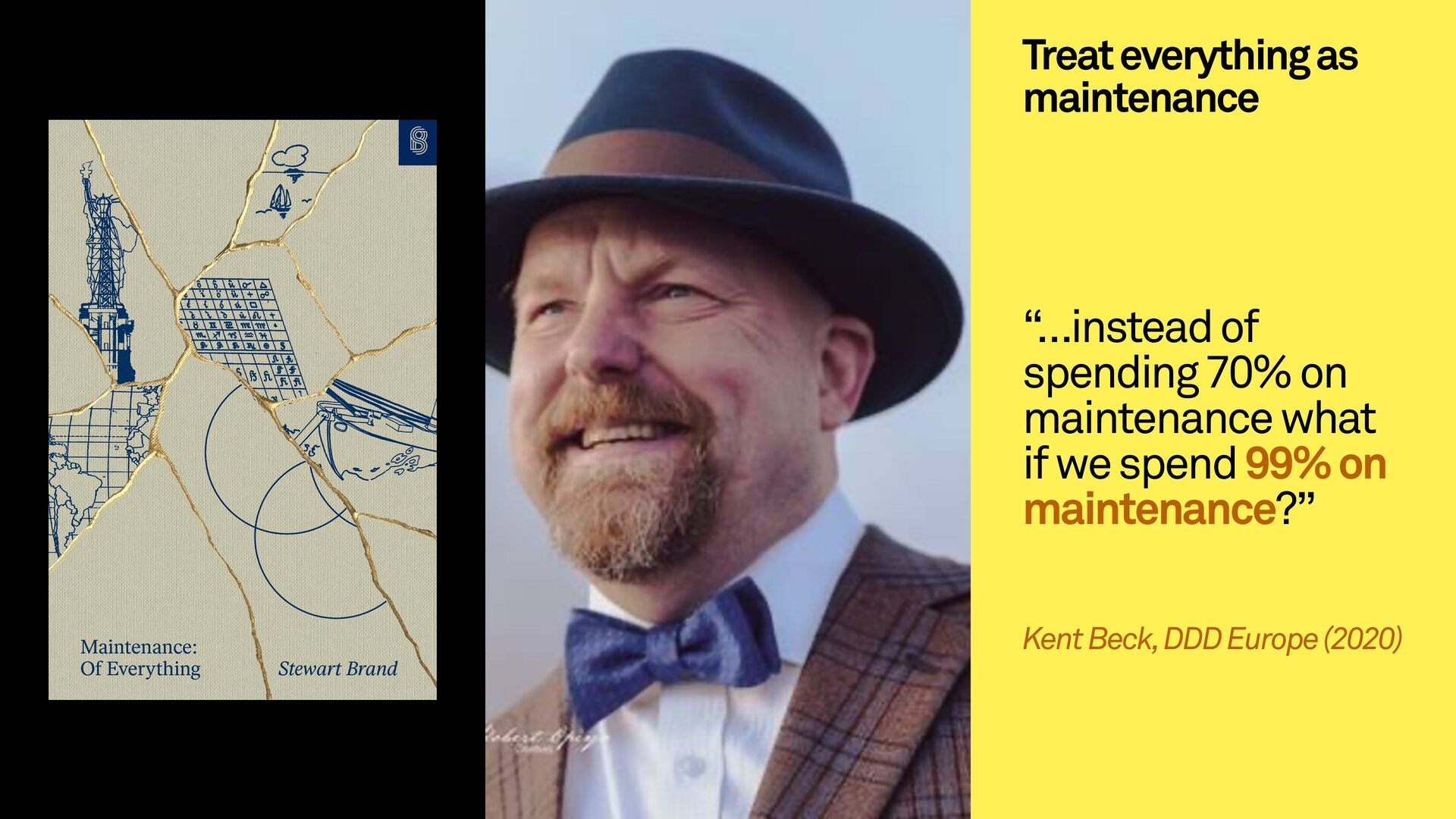
Treat everything as maintenance “…instead of spending 70% on maintenance
what if we spend 99% on maintenance?” Kent Beck, DDD Europe (2020) -
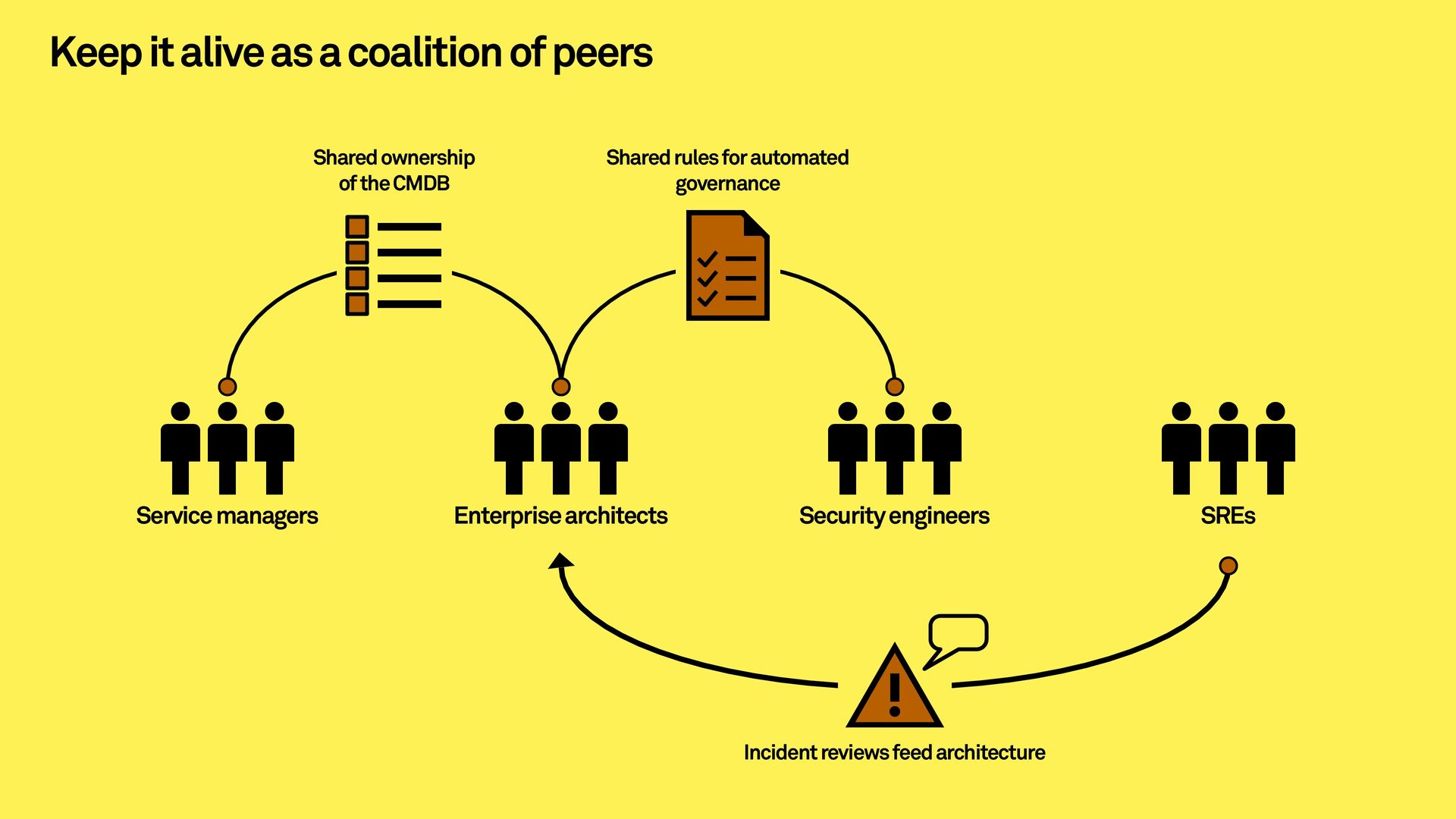
Keep it alive as a coalition of peers Shared ownership
of the CMDB Service managers Shared rules for automated governance Enterprise architects Security engineers Incident reviews feed architecture SREs -
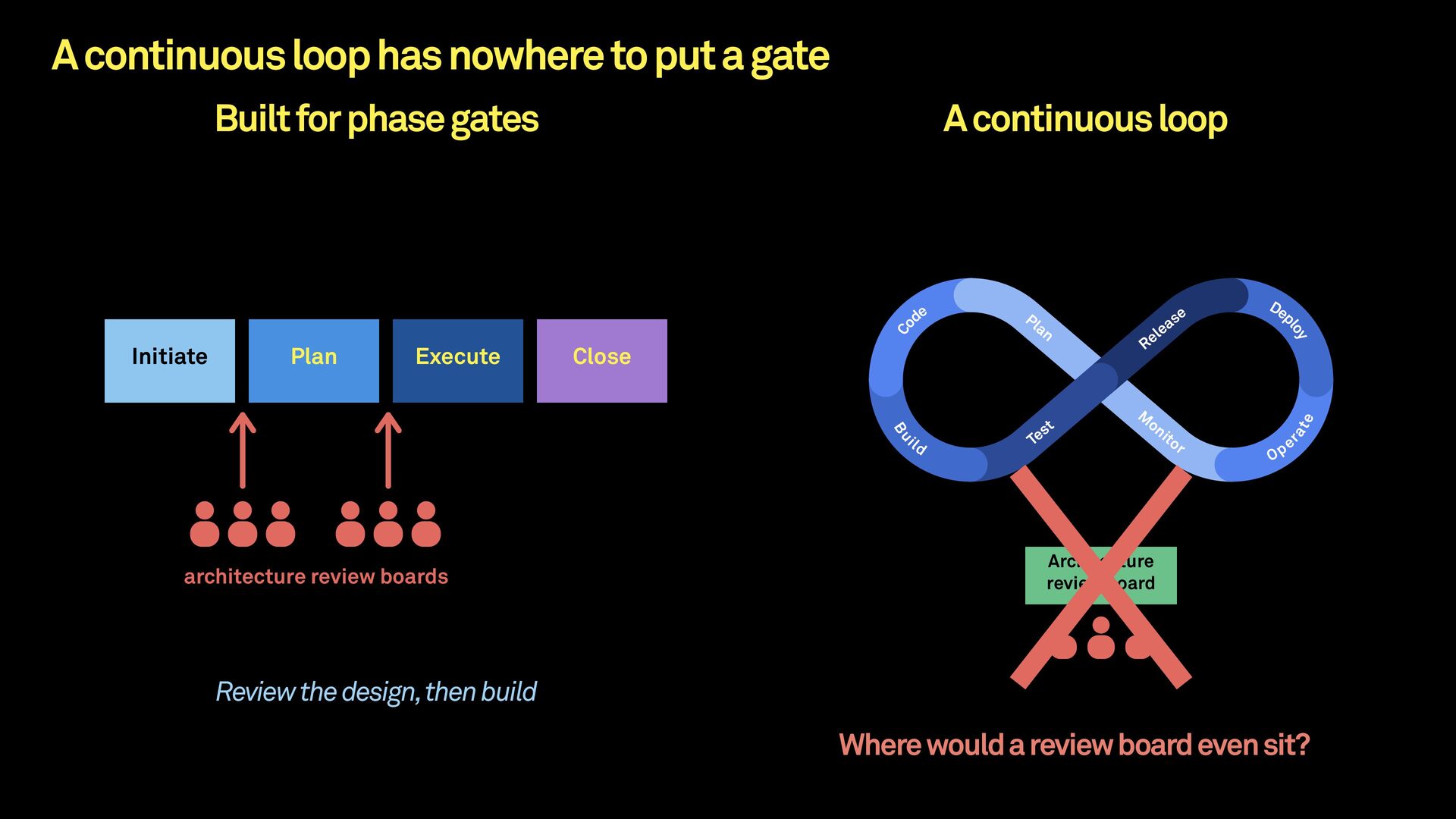
A continuous loop has nowhere to put a gate A
continuous loop Execute Close Bu il d architecture review boards t s Te M on i to r De p te Plan Pl an se a le e R ra Initiate de loy Co Built for phase gates e p O Architecture review board Review the design, then build Where would a review board even sit? -
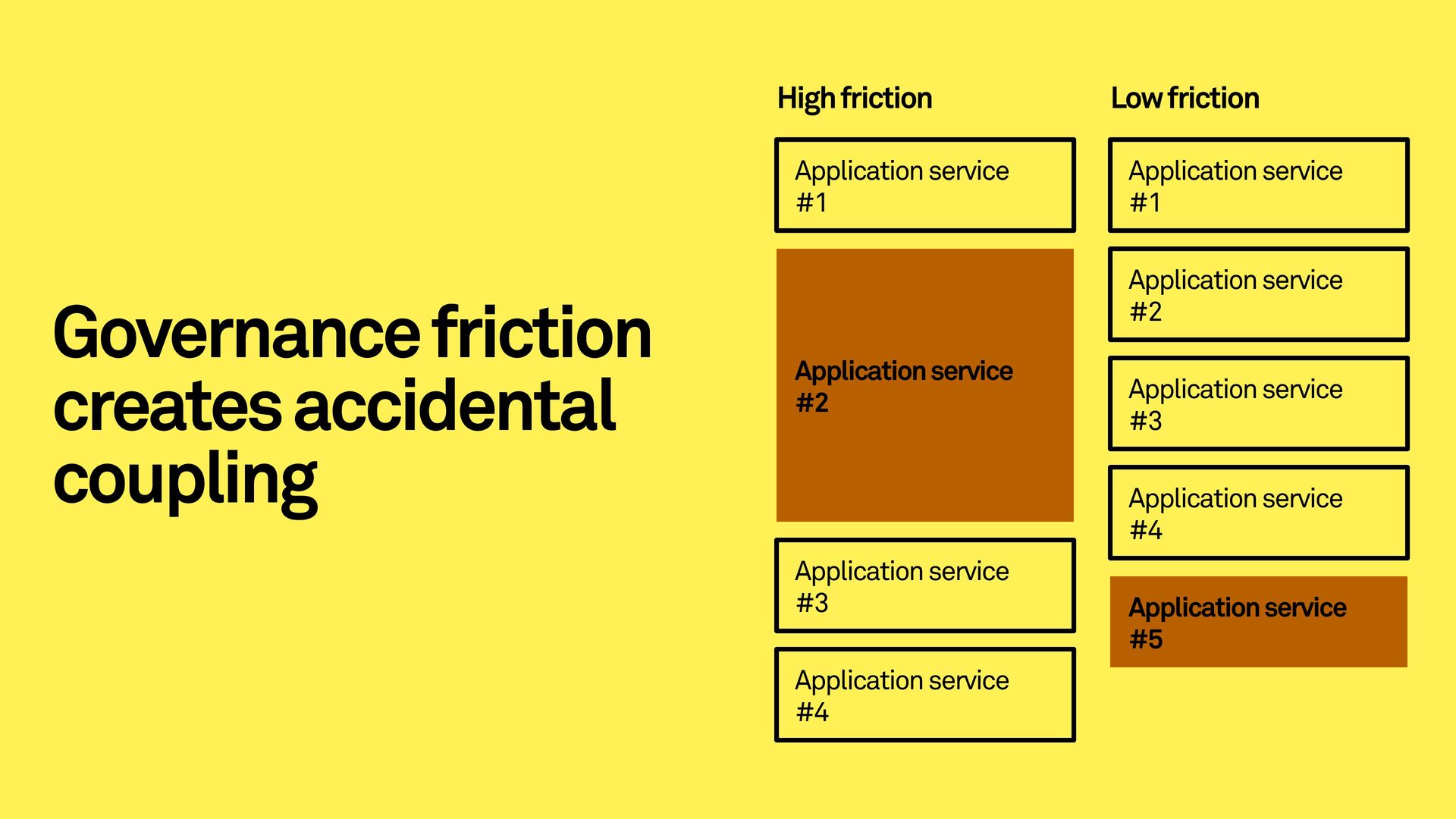
Governance friction creates accidental coupling High friction Low friction Application
service #1 Application service #1 Application service #2 Application service #2 Application service #3 Application service #4 Application service #3 Application service #4 Application service #5 -
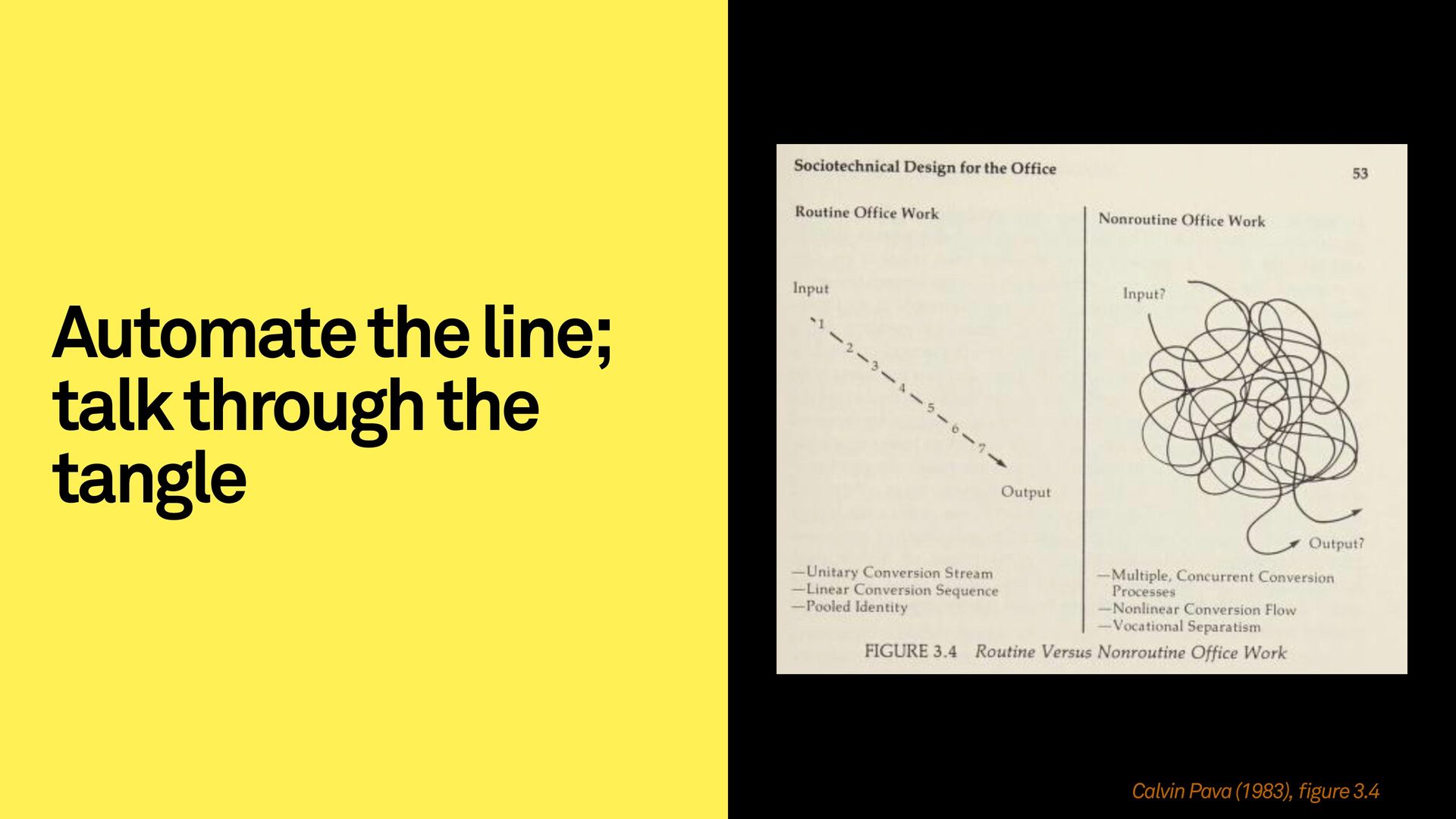
Automate the line; talk through the tangle fi Calvin Pava
(1983), gure 3.4 -
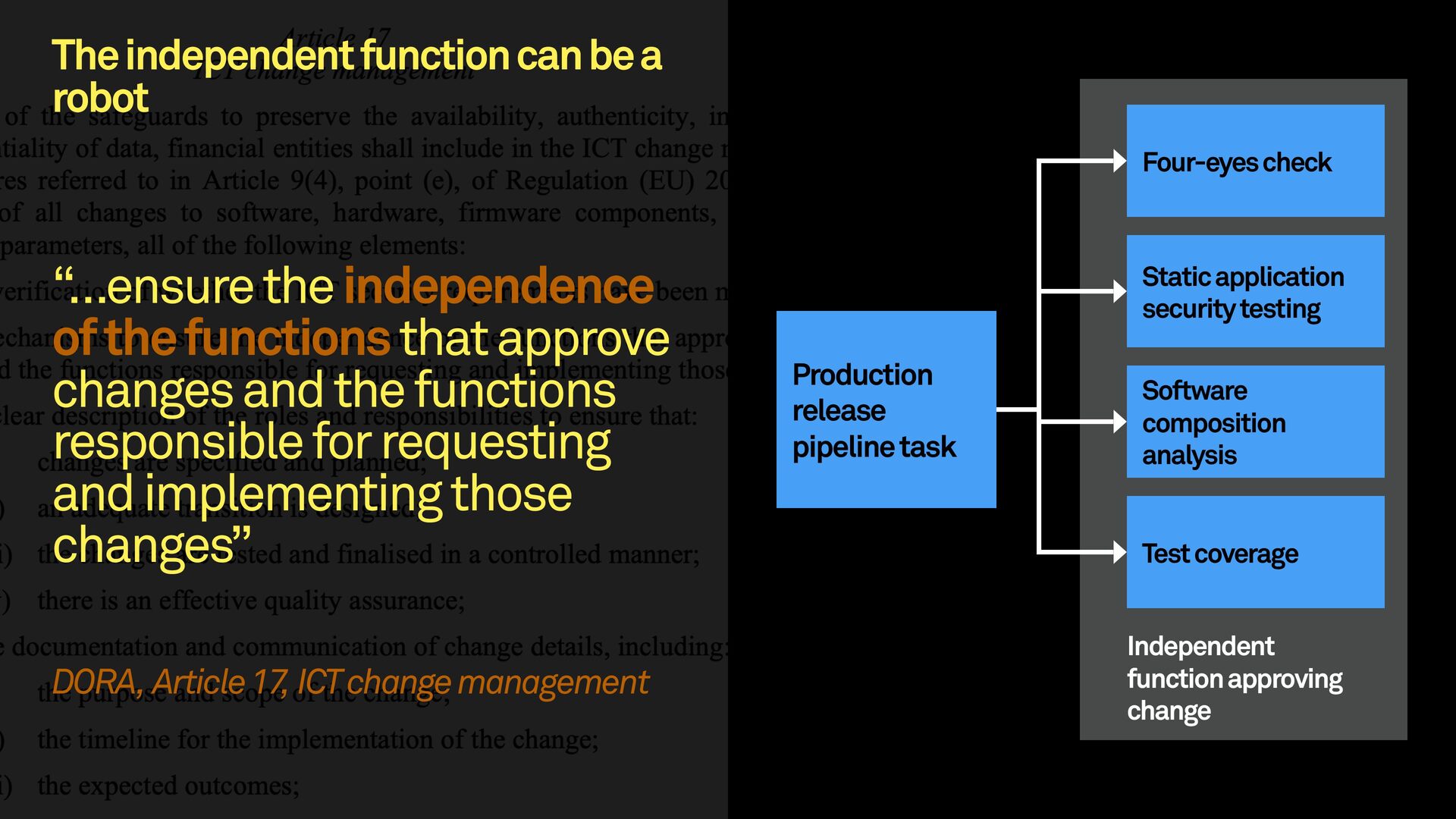
The independent function can be a robot Four-eyes check “…ensure
the independence of the functions that approve changes and the functions responsible for requesting and implementing those changes” DORA, Article 17, ICT change management Static application security testing Production release pipeline task Software composition analysis Test coverage Independent function approving change -
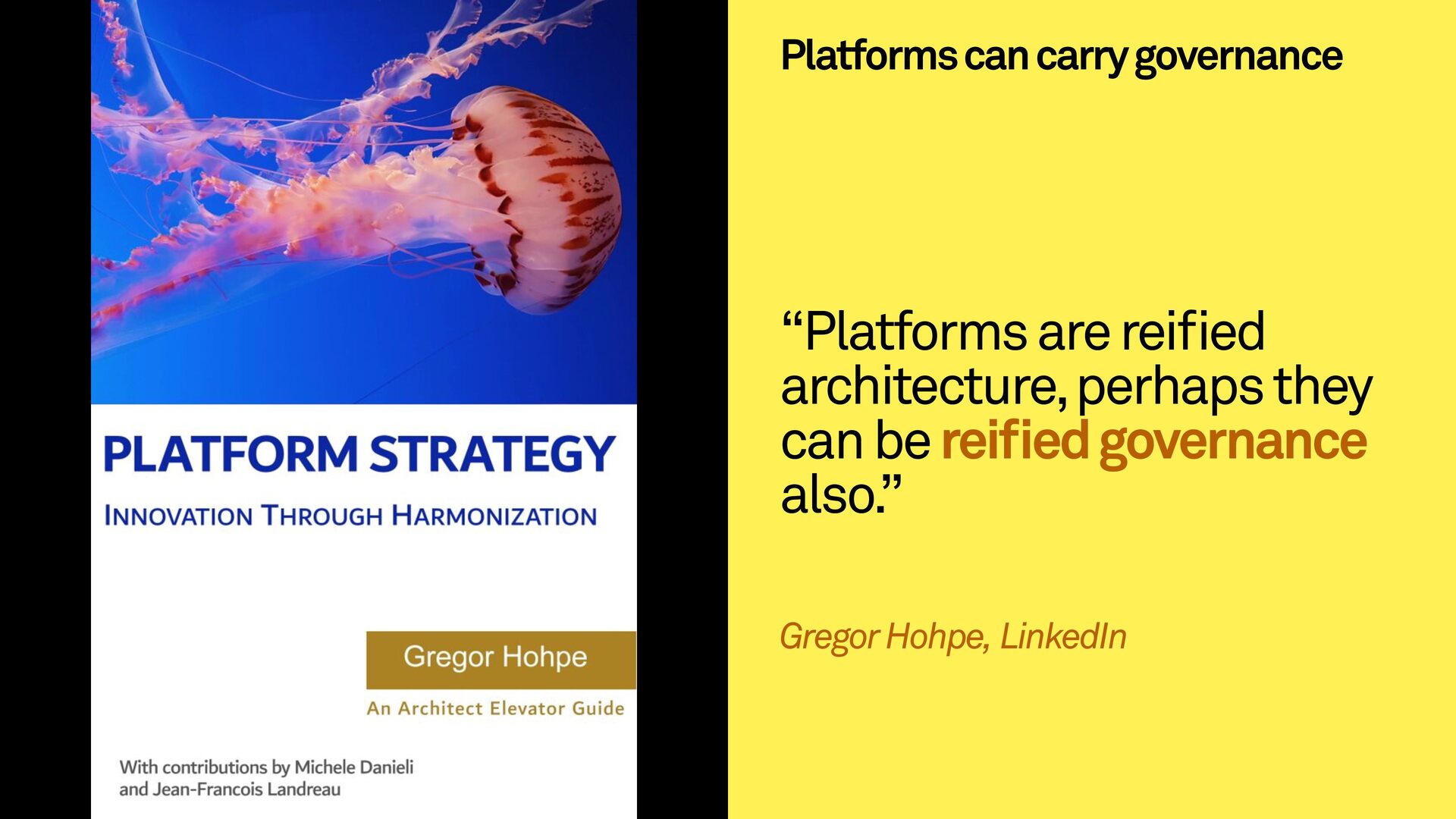
Platforms can carry governance “Platforms are rei ed architecture, perhaps
they can be rei ed governance also.” fi fi Gregor Hohpe, LinkedIn -
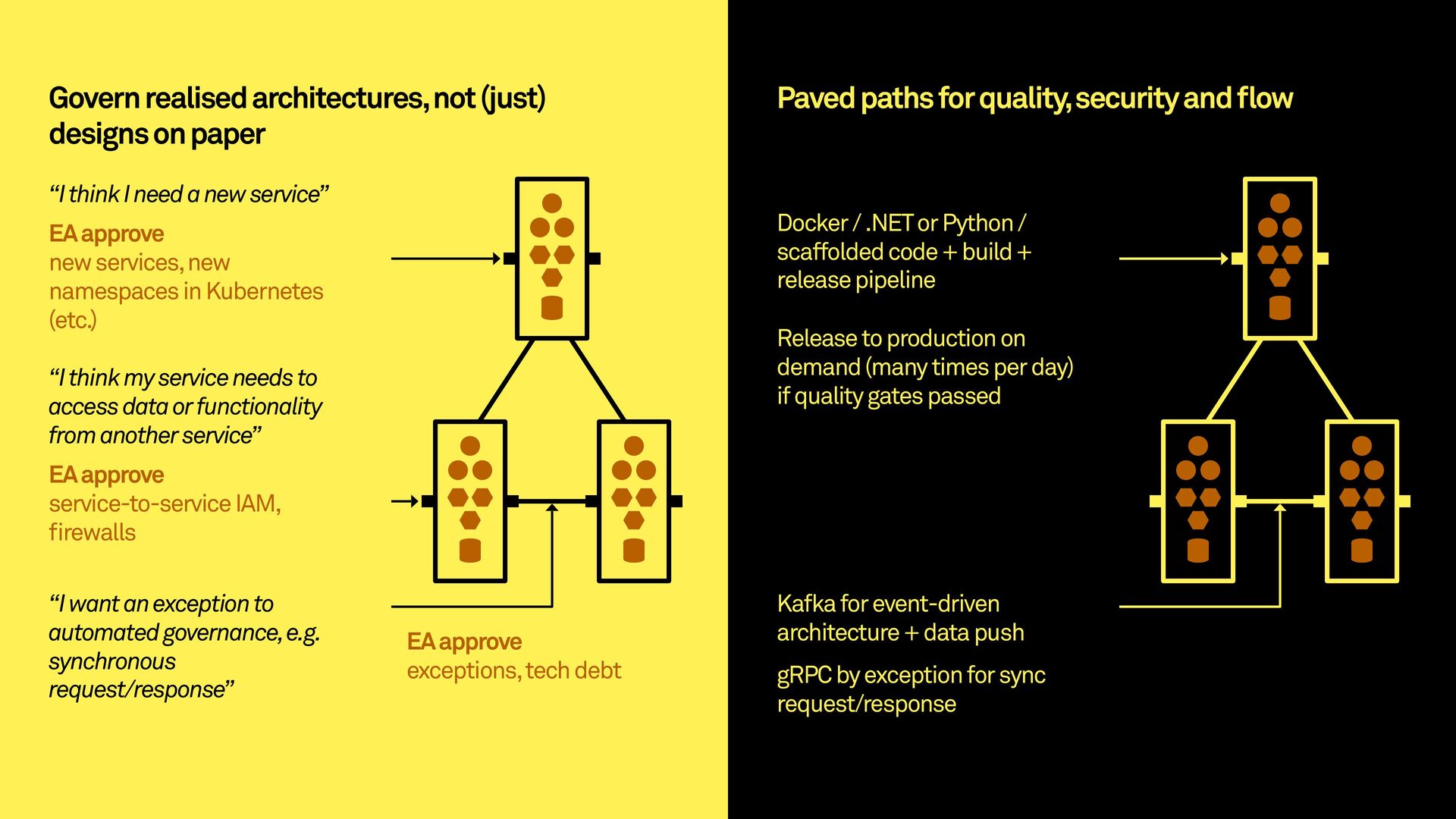
Paved paths for quality, security and ow “I think I
need a new service” Docker / .NET or Python / scaffolded code + build + release pipeline EA approve new services, new namespaces in Kubernetes (etc.) Release to production on demand (many times per day) if quality gates passed “I think my service needs to access data or functionality from another service” EA approve service-to-service IAM, rewalls “I want an exception to automated governance, e.g. synchronous request/response” EA approve exceptions, tech debt fl fi Govern realised architectures, not (just) designs on paper Kafka for event-driven architecture + data push gRPC by exception for sync request/response -
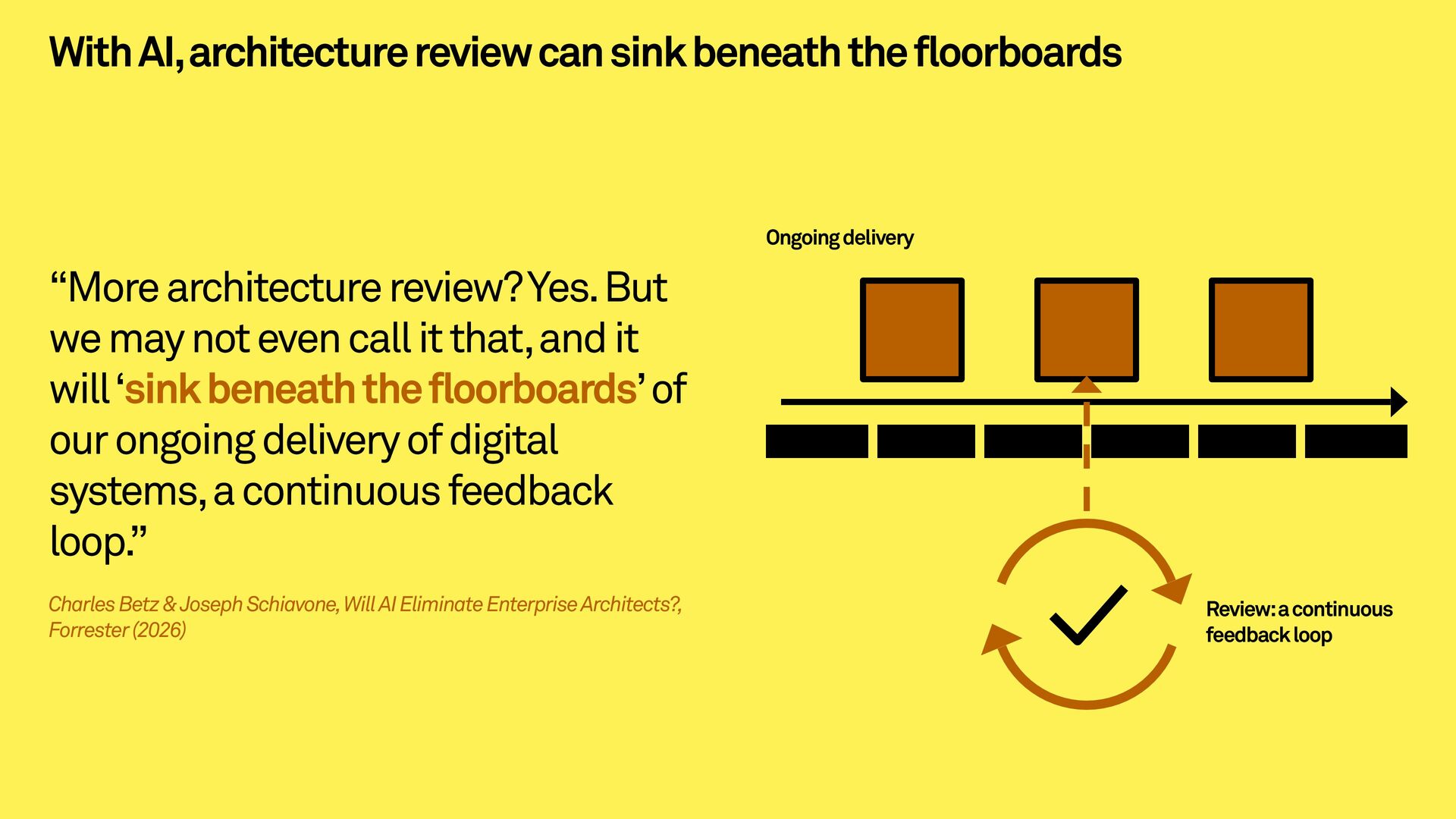
With AI, architecture review can sink beneath the floorboards Ongoing
delivery “More architecture review? Yes. But we may not even call it that, and it will ‘sink beneath the floorboards’ of our ongoing delivery of digital systems, a continuous feedback loop.” Charles Betz & Joseph Schiavone, Will AI Eliminate Enterprise Architects?, Forrester (2026) Review: a continuous feedback loop -
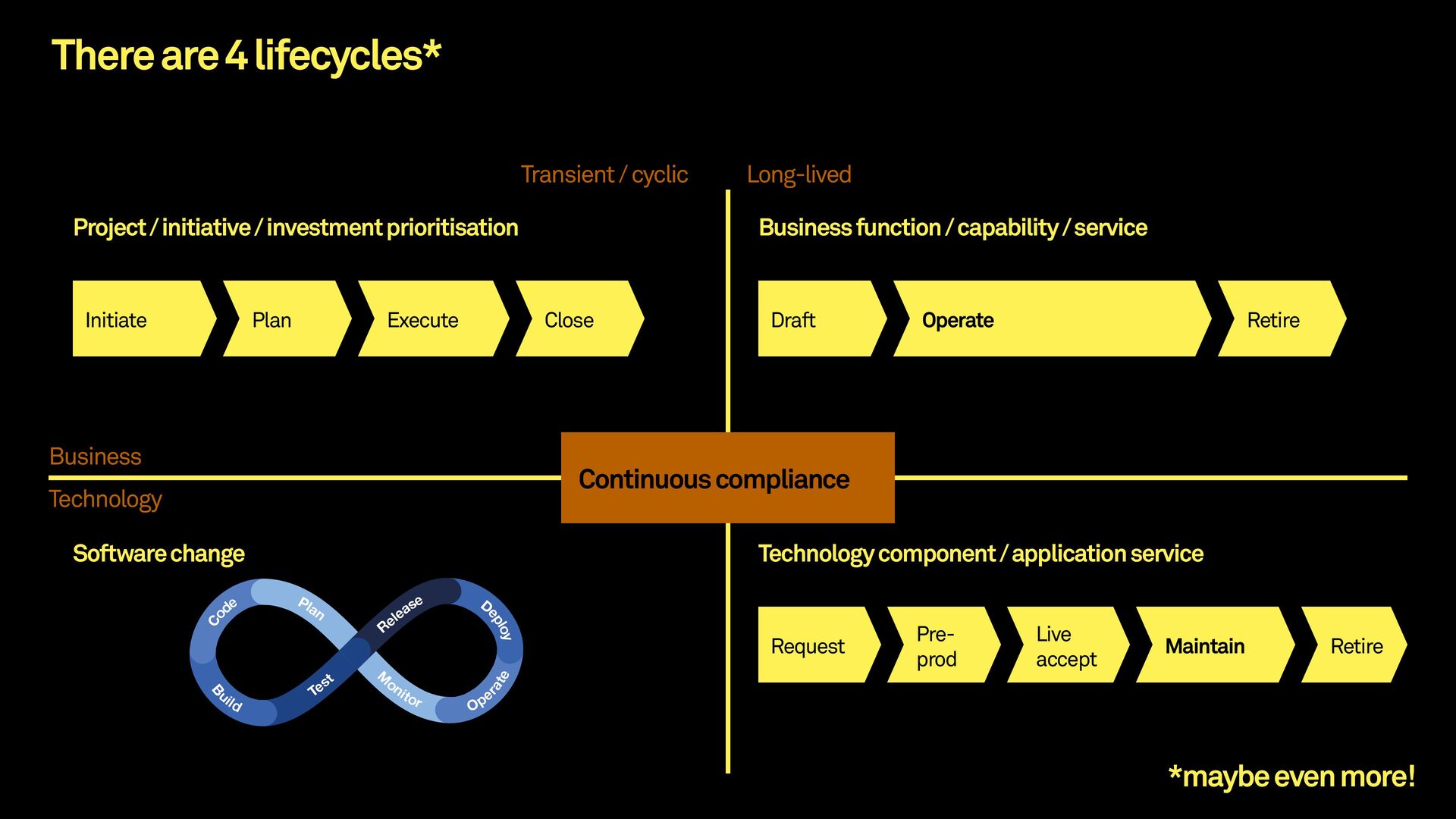
There are 4 lifecycles* Transient / cyclic Project / initiative
/ investment prioritisation Initiate Plan Execute Business function / capability / service Close Business Long-lived Draft Operate Retire Continuous compliance Technology B ld st e T se a le e R M on it o D Request Preprod Live accept Maintain Retire te ui Pla n r ra de Technology component / application service loy ep Co Software change Op e *maybe even more! -
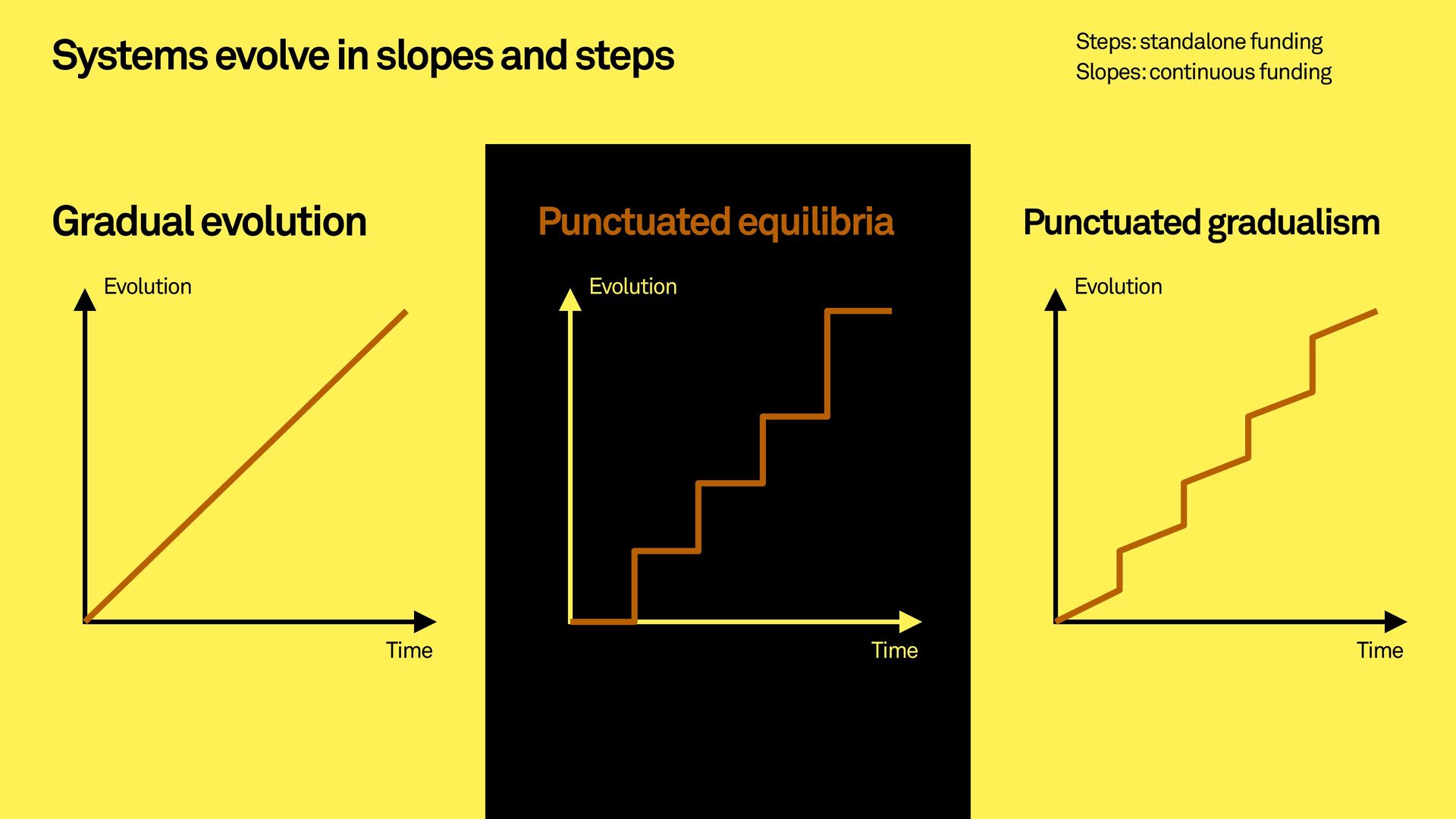
Steps: standalone funding Slopes: continuous funding Systems evolve in slopes
and steps Gradual evolution Punctuated equilibria Evolution Evolution Time Punctuated gradualism Evolution Time Time -
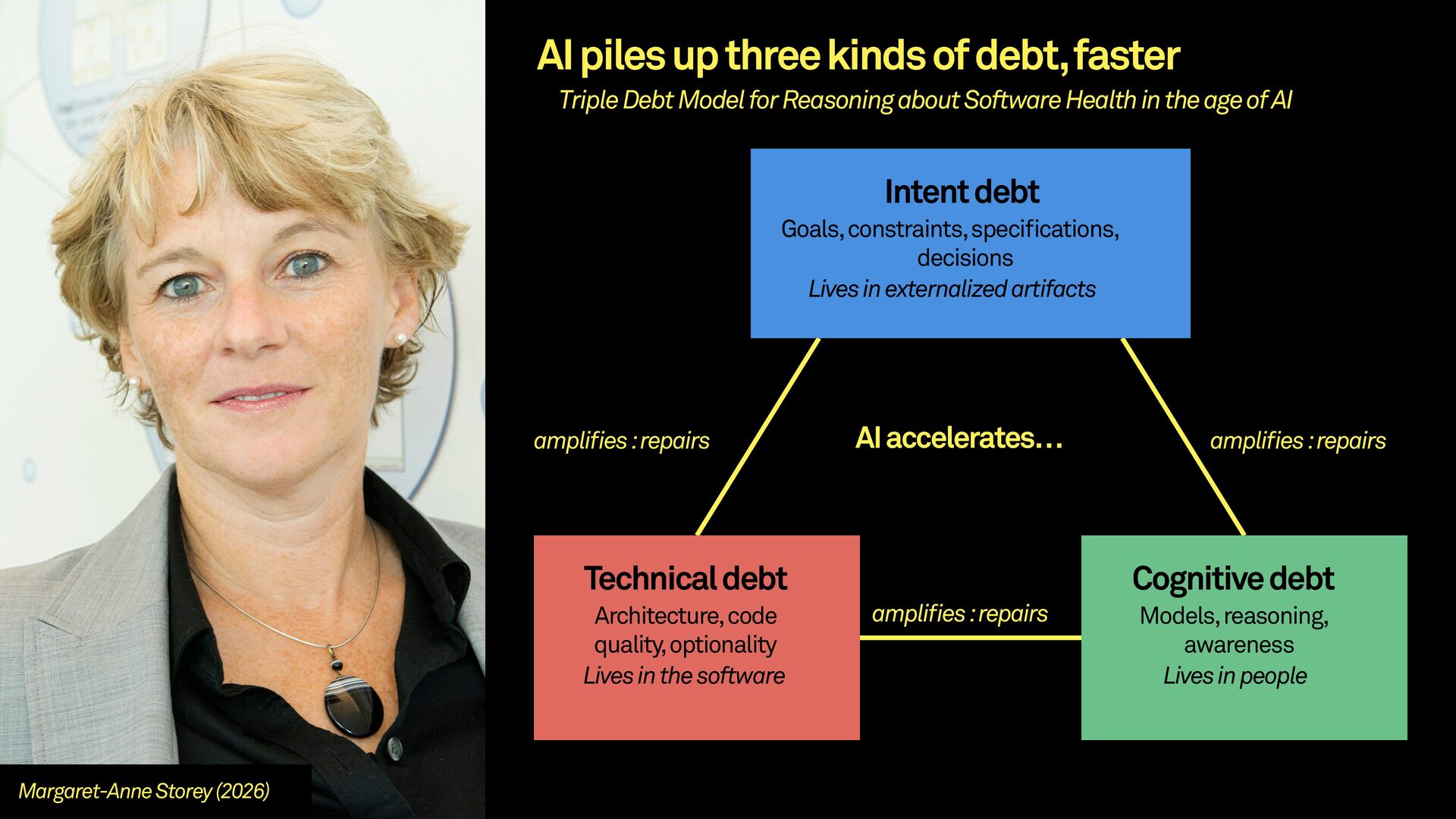
AI piles up three kinds of debt, faster Triple Debt
Model for Reasoning about Software Health in the age of AI Intent debt Goals, constraints, speci cations, decisions Lives in externalized artifacts ampli es : repairs AI accelerates… Technical debt Architecture, code quality, optionality Lives in the software fi fi fi fi Margaret-Anne Storey (2026) ampli es : repairs Cognitive debt ampli es : repairs Models, reasoning, awareness Lives in people -
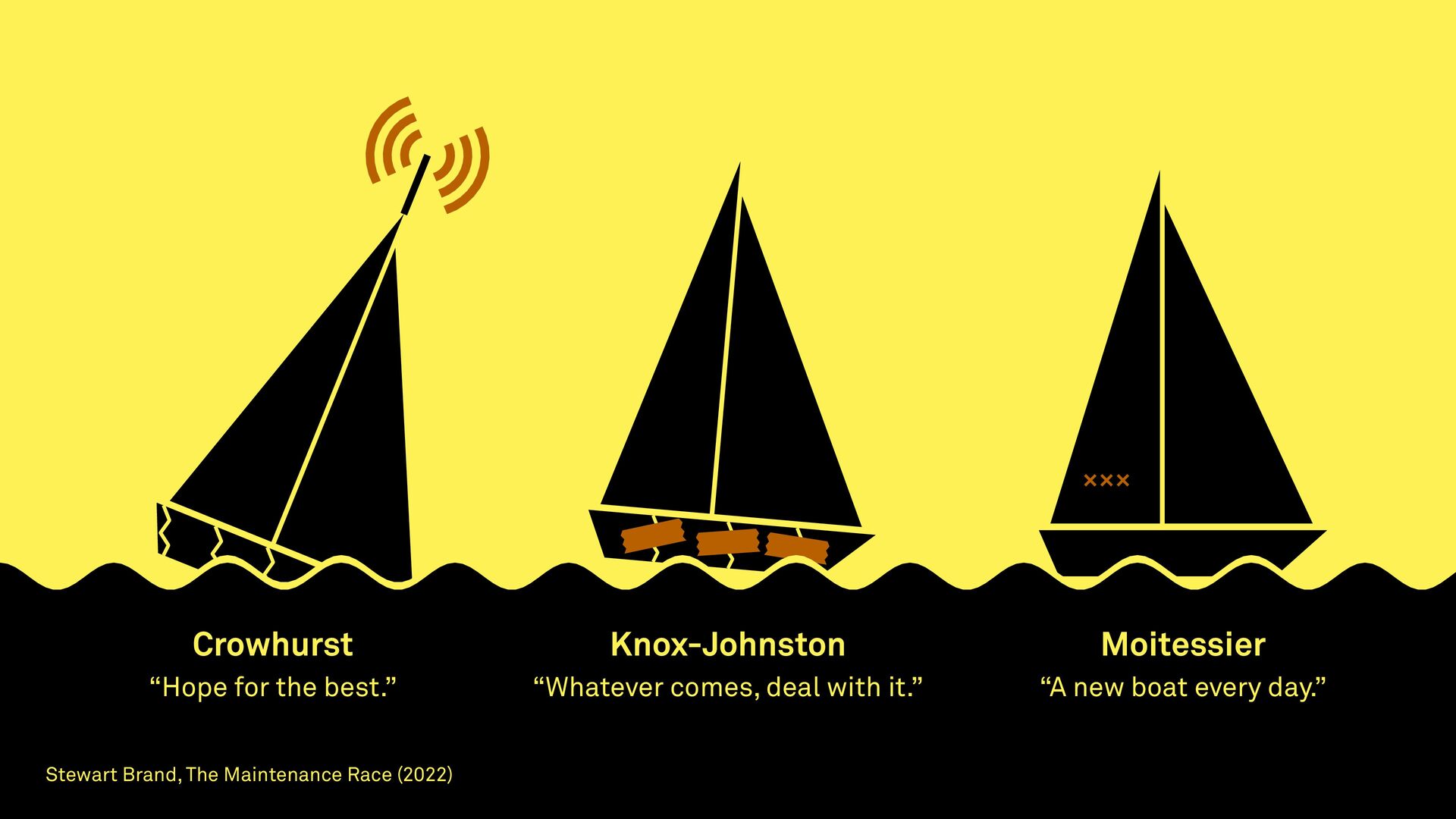
Crowhurst Knox-Johnston Moitessier “Hope for the best.” “Whatever comes, deal
with it.” “A new boat every day.” Stewart Brand, The Maintenance Race (2022) -
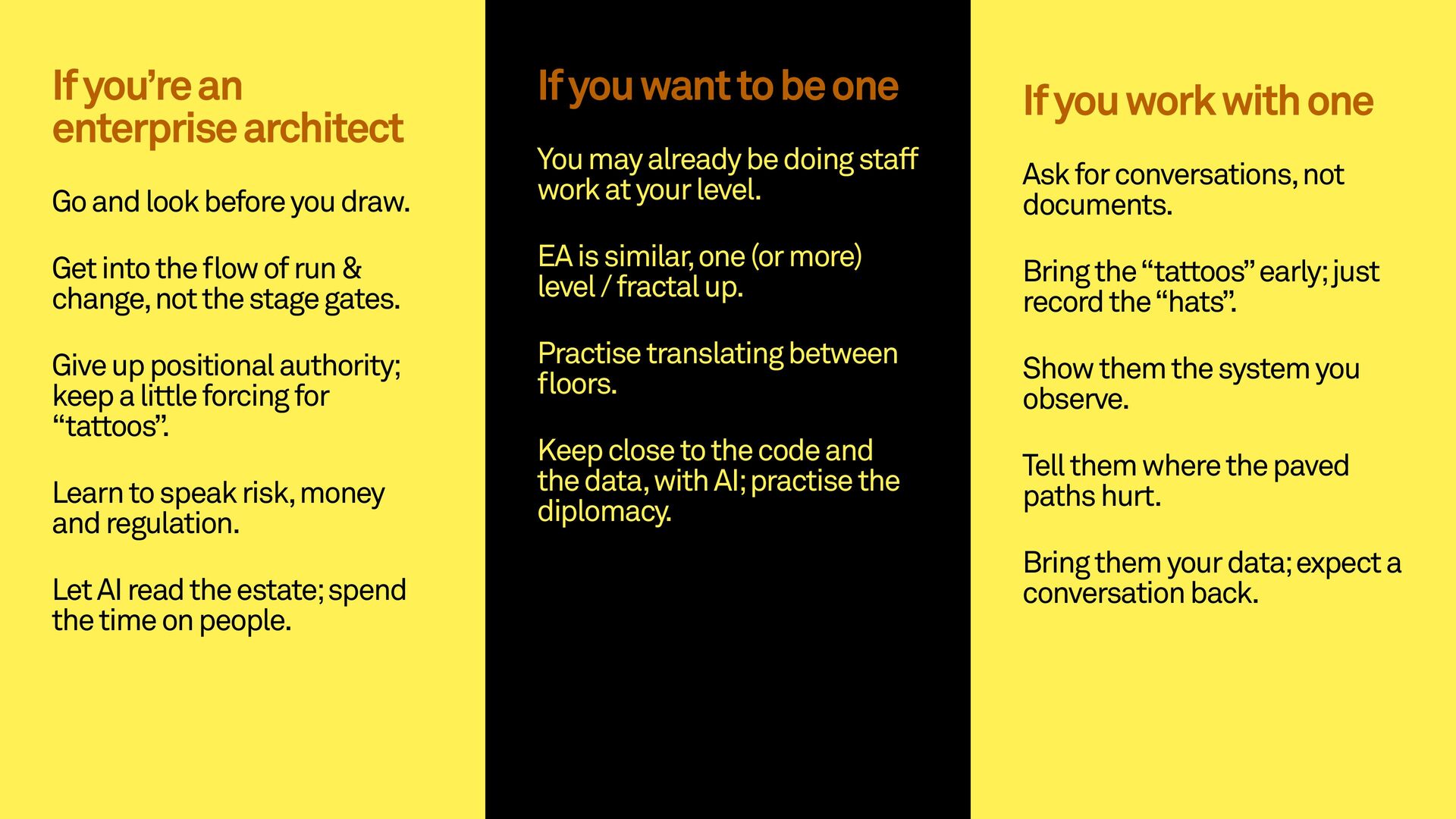
If you want to be one If you work with
one Go and look before you draw. You may already be doing staff work at your level. Ask for conversations, not documents. Get into the ow of run & change, not the stage gates. EA is similar, one (or more) level / fractal up. Bring the “tattoos” early; just record the “hats”. Give up positional authority; keep a little forcing for “tattoos”. Practise translating between oors. Show them the system you observe. Keep close to the code and the data, with AI; practise the diplomacy. Tell them where the paved paths hurt. Learn to speak risk, money and regulation. Let AI read the estate; spend the time on people. fl fl If you’re an enterprise architect Bring them your data; expect a conversation back. -
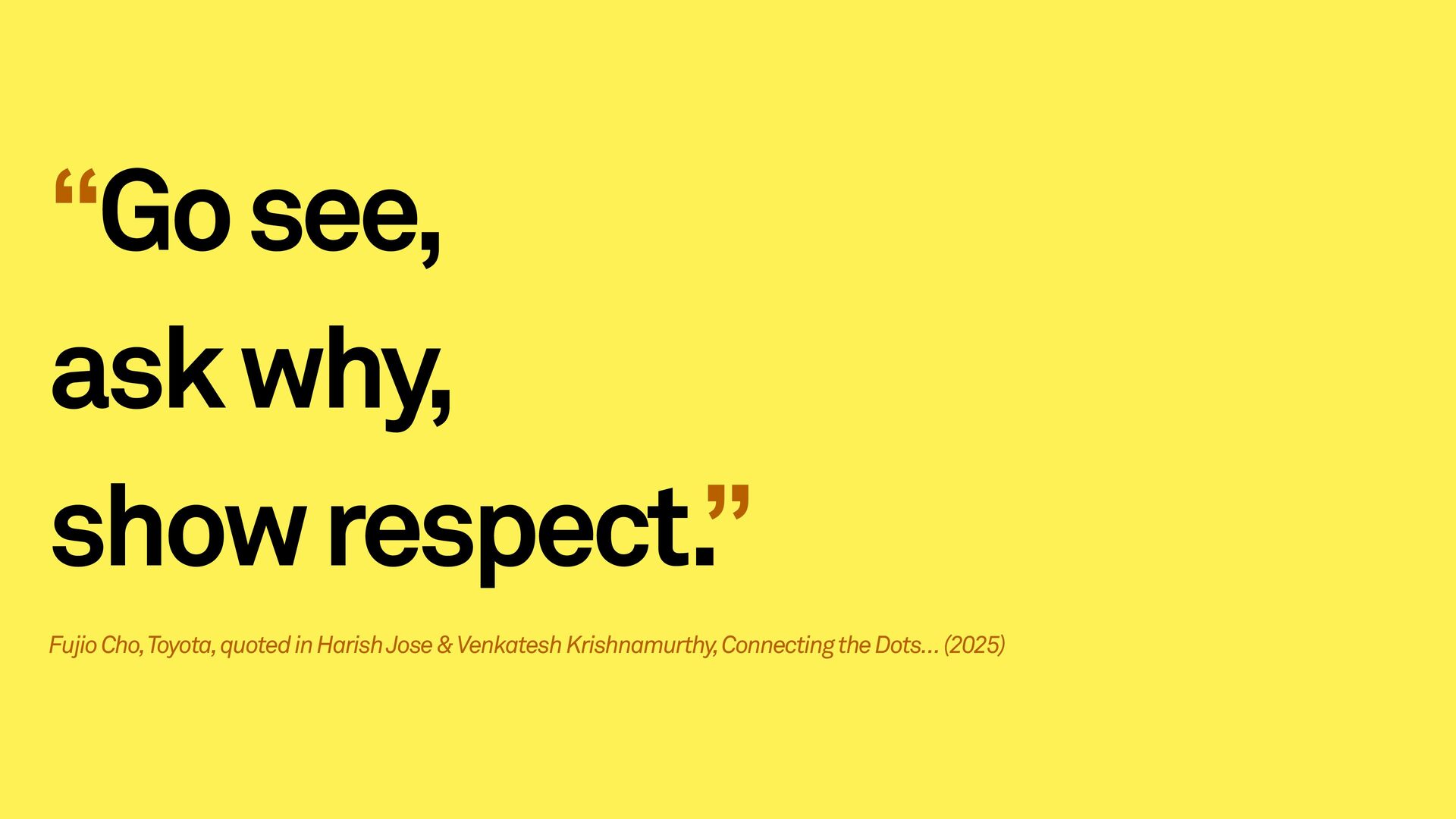
“Go see, ask why, show respect.” Fujio Cho, Toyota, quoted
in Harish Jose & Venkatesh Krishnamurthy, Connecting the Dots… (2025) -
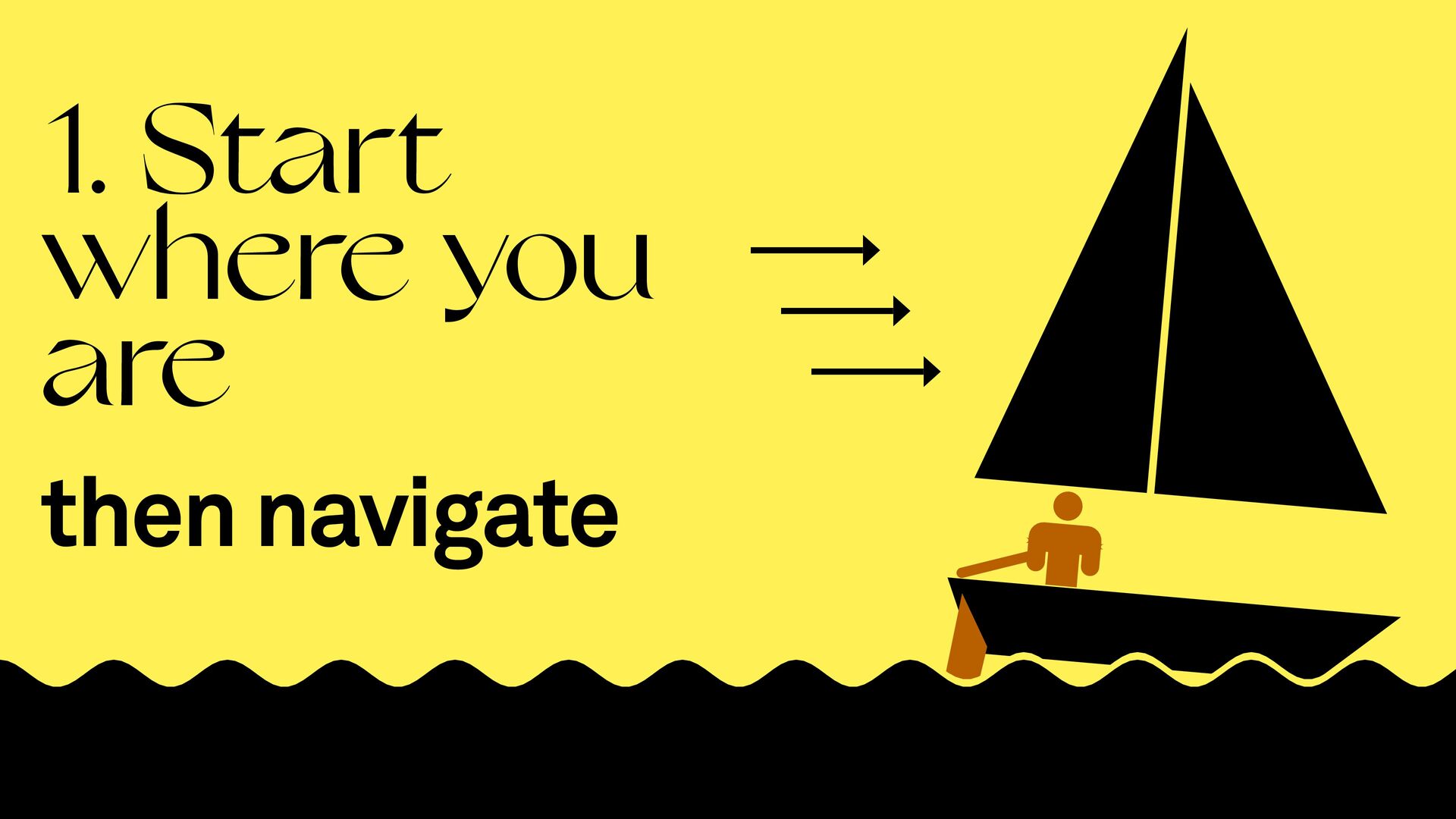
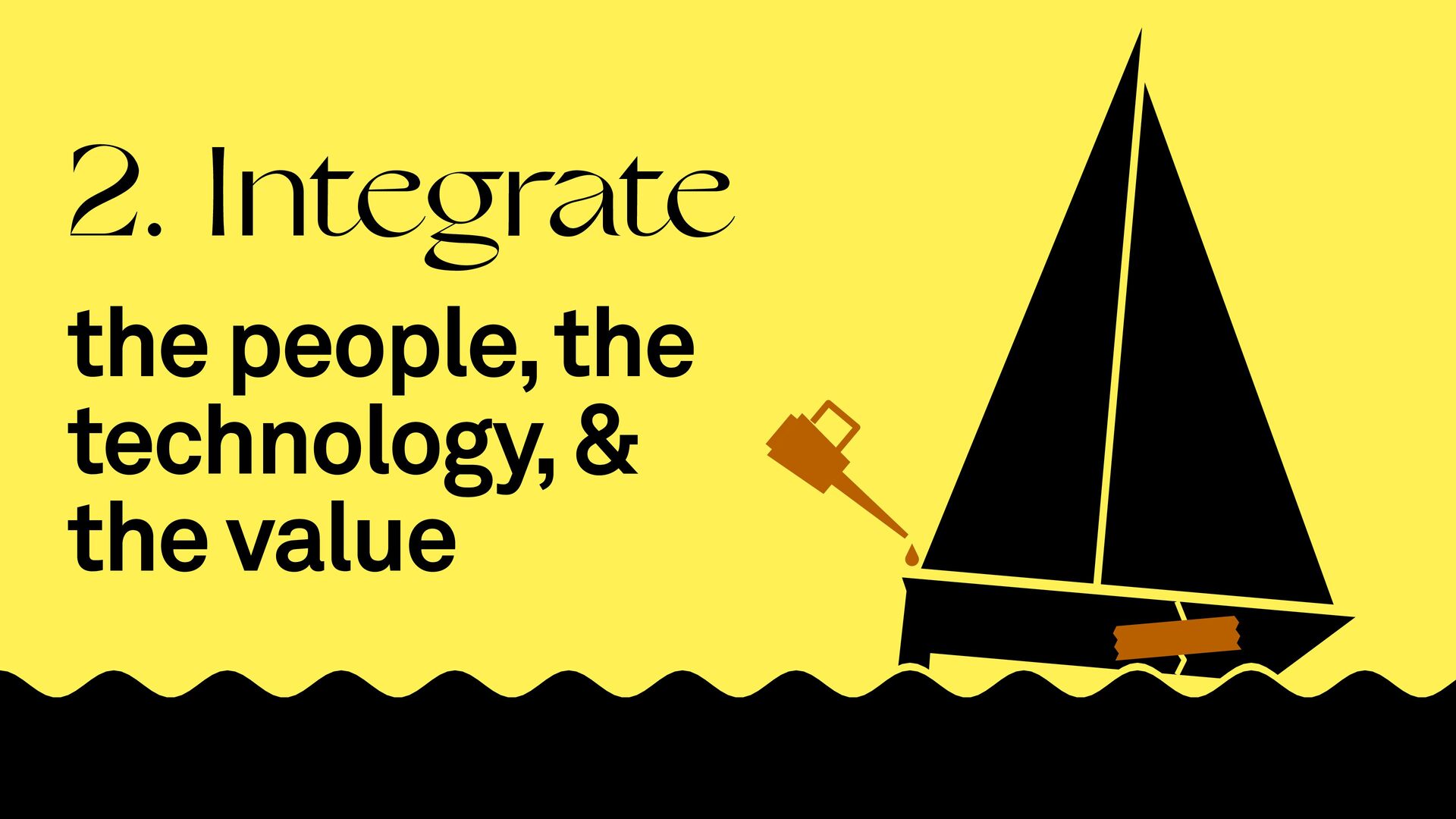
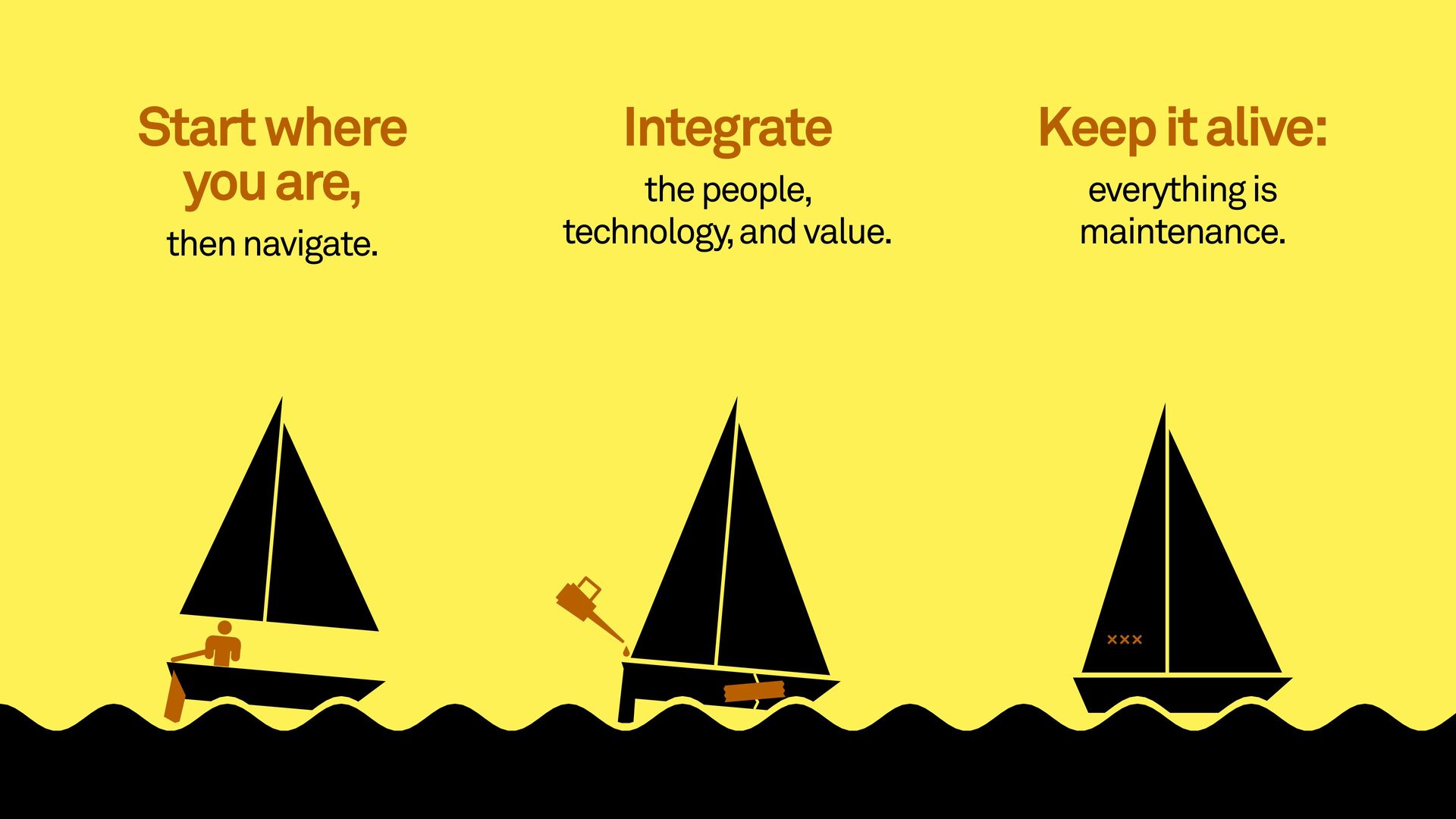
Start where you are, then navigate. Integrate Keep it alive:
the people, technology, and value. everything is maintenance.
 simonrohrer
 minorun365
 genda
 azukiazusa1
 ymotongpoo
 ar_tama
 zenta
 nakamori1024
 keshi_takagi_mjs
 tombo
 kawasy
 zozotech
 anatofuz
 lara
 speakerdeck
 tammyeverts
 aleyda
 erikaheidi
 sarafernandez
 cassininazir
 csswizardry
 andyhume
 addyosmani
 akosma