Share
Embed
GoLab 2026

sivchari
November 15, 2026
Transcript
45 slides
-
TAKUMA SHIBUYA / @sivchari Go Conference Organizer · Kubernetes Maintainer
YOUR TESTS PASS, BUT DO THEY WORK? Mutation Testing in Go with gomu 1 -
ABOUT ME • Takuma Shibuya (@sivchari) • LayerX, Inc Platform
Engineer • Go Conference main organizer • Kubernetes maintainer · Argo CD maintainer • Kubernetes 2025 Contributor Award • Author of sivchari/gomu 2 -
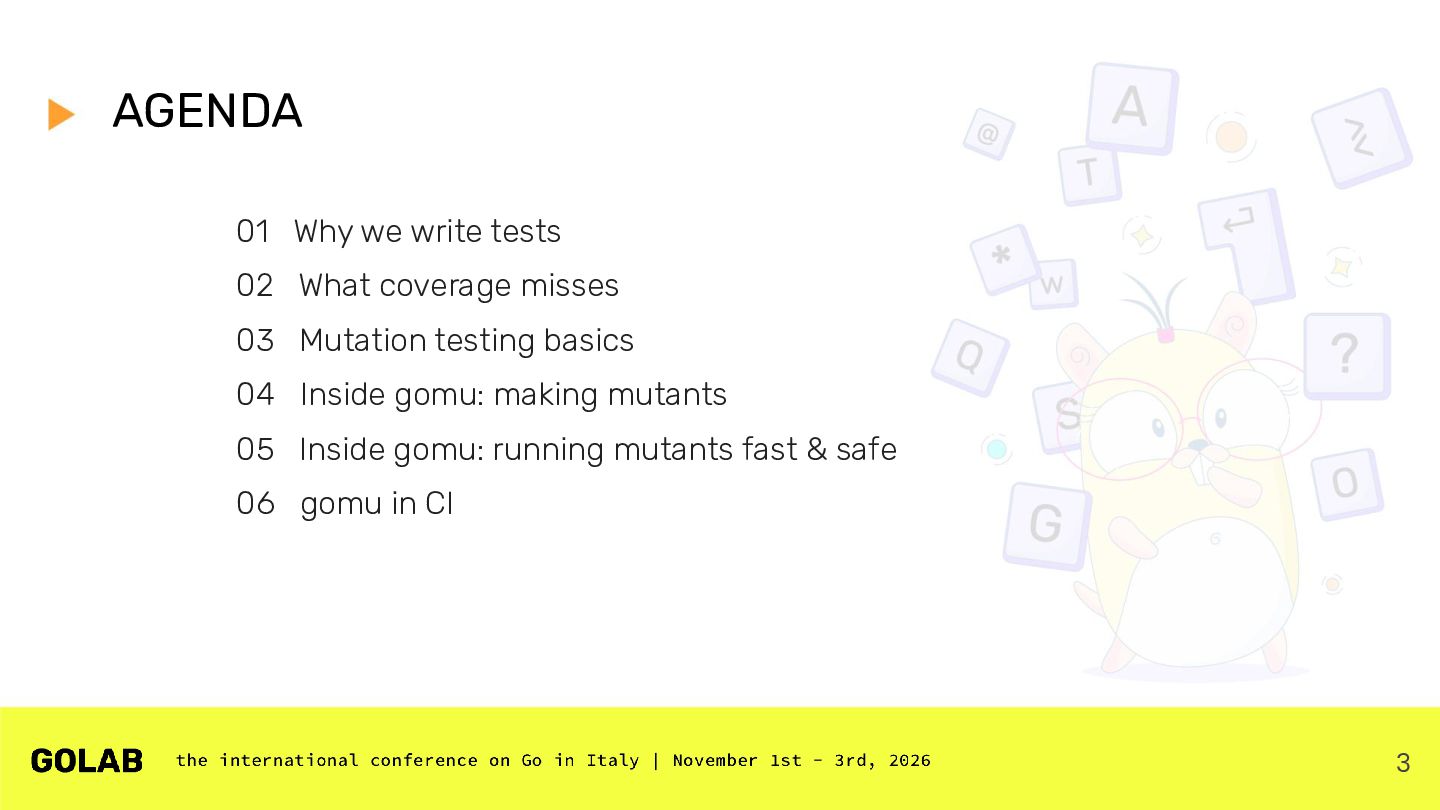
AGENDA 01 Why we write tests 02 What coverage misses
03 Mutation testing basics 04 Inside gomu: making mutants 05 Inside gomu: running mutants fast & safe 06 gomu in CI 3 -
01 WHY WE WRITE TESTS • CI as a shared
agreement CI is the minimum agreement in team development, and now for AI agents too. • CI as the AI agent's feedback loop • Tests as specification 4 -
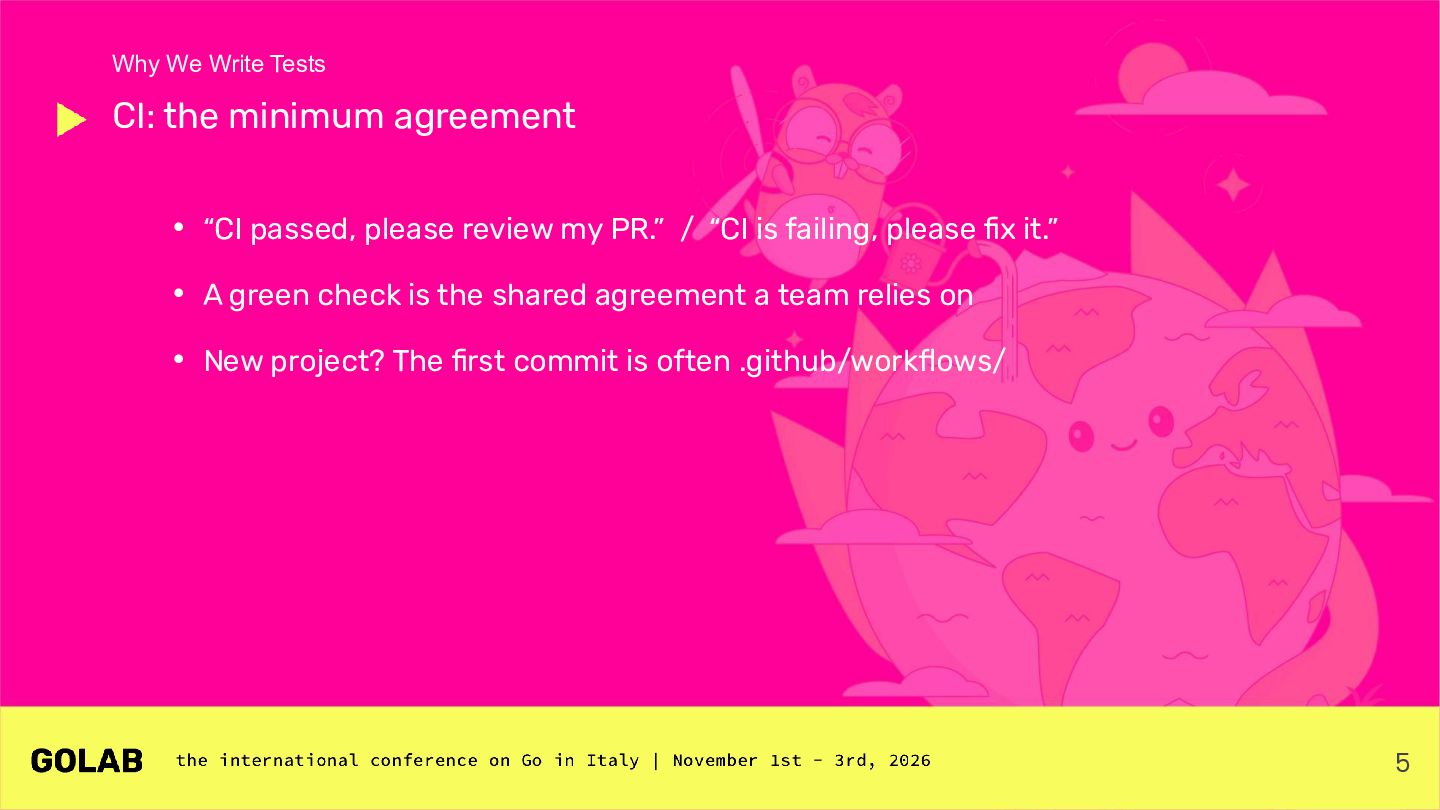
Why We Write Tests CI: the minimum agreement • “CI
passed, please review my PR.” / “CI is failing, please fix it.” • A green check is the shared agreement a team relies on • New project? The first commit is often .github/workflows/ 5 -
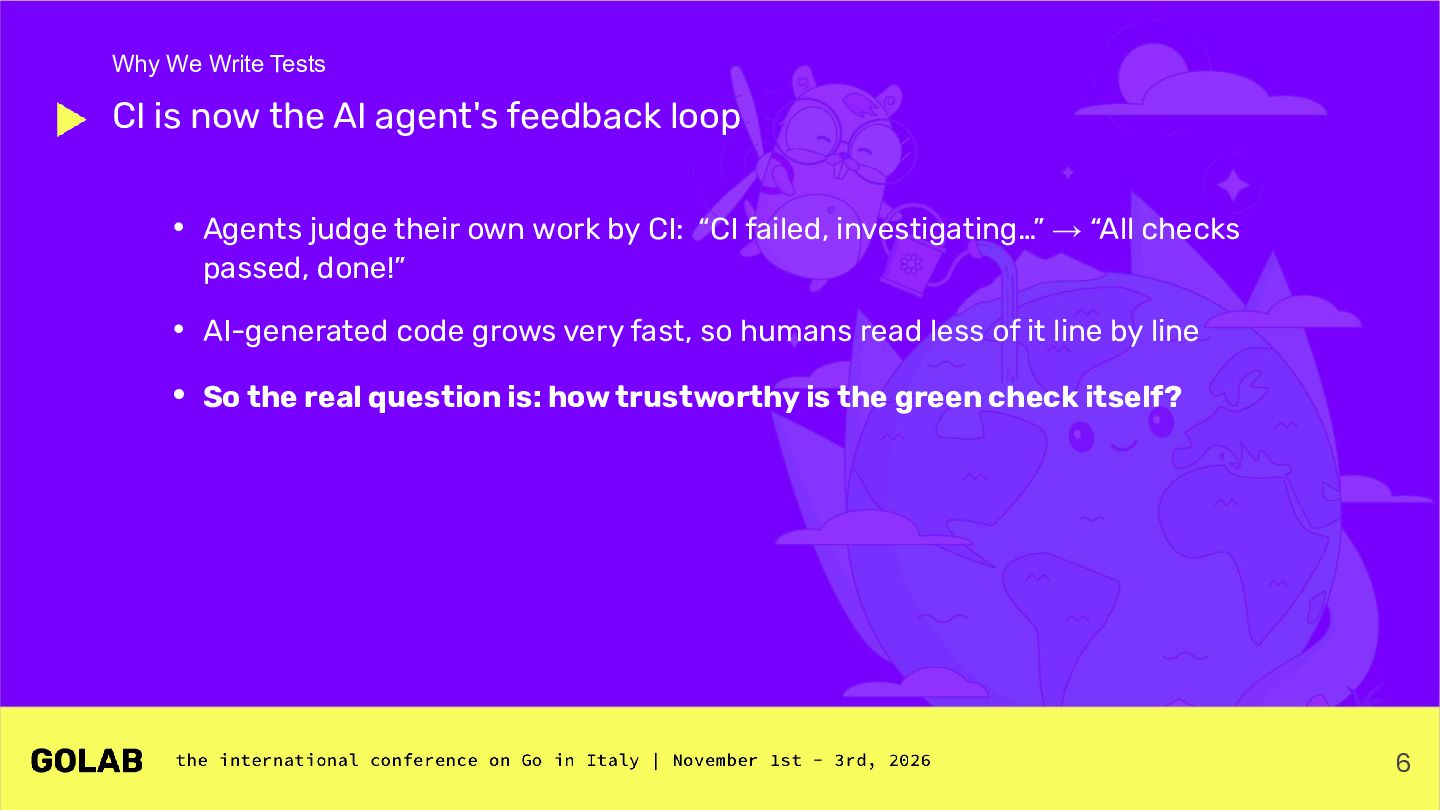
Why We Write Tests CI is now the AI agent's
feedback loop • Agents judge their own work by CI: “CI failed, investigating…” → “All checks passed, done!” • AI-generated code grows very fast, so humans read less of it line by line • So the real question is: how trustworthy is the green check itself? 6 -
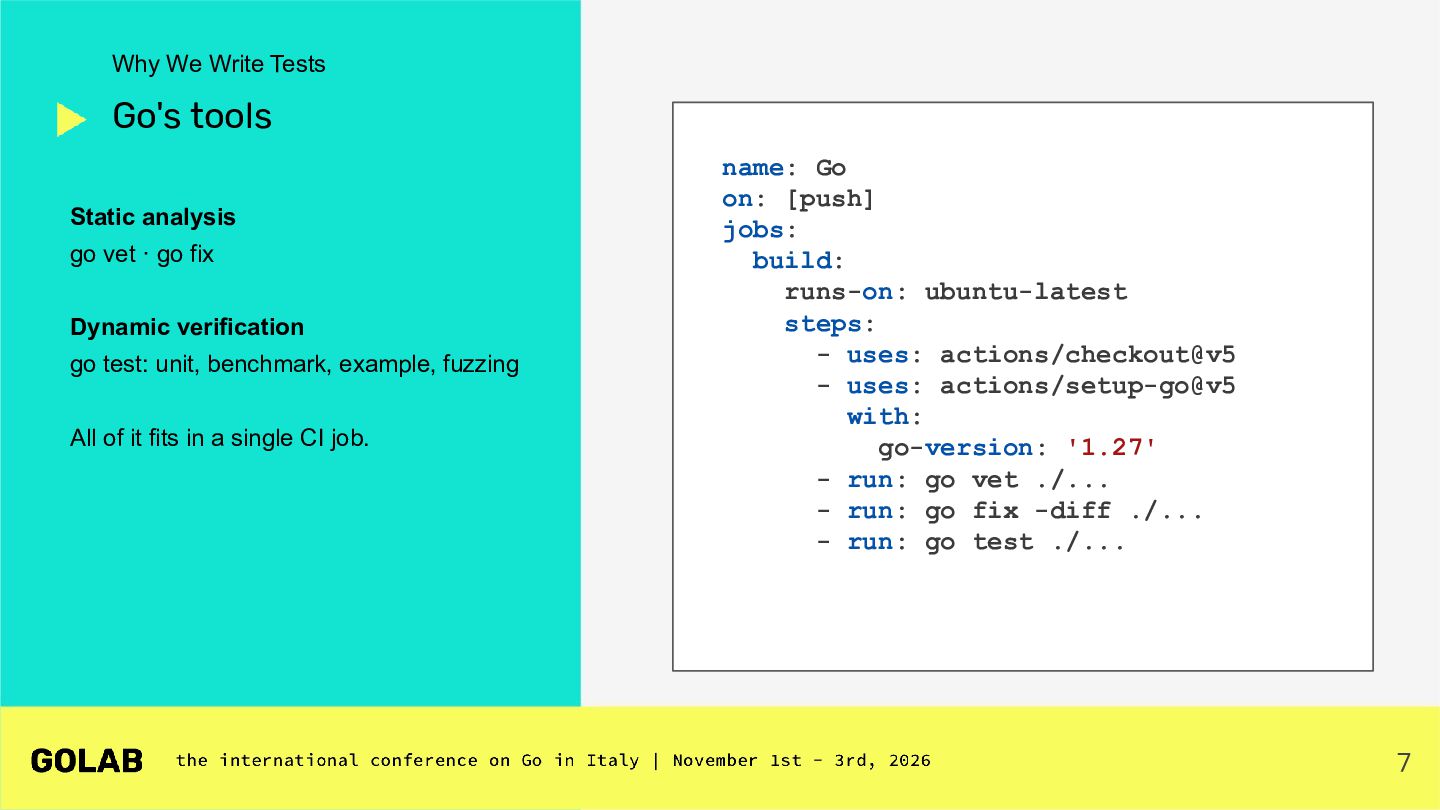
Why We Write Tests Go's tools Static analysis go vet
· go fix Dynamic verification go test: unit, benchmark, example, fuzzing All of it fits in a single CI job. name: Go on: [push] jobs: build: runs-on: ubuntu-latest steps: - uses: actions/checkout@v5 - uses: actions/setup-go@v5 with: go-version: '1.27' - run: go vet ./... - run: go fix -diff ./... - run: go test ./... 7 -
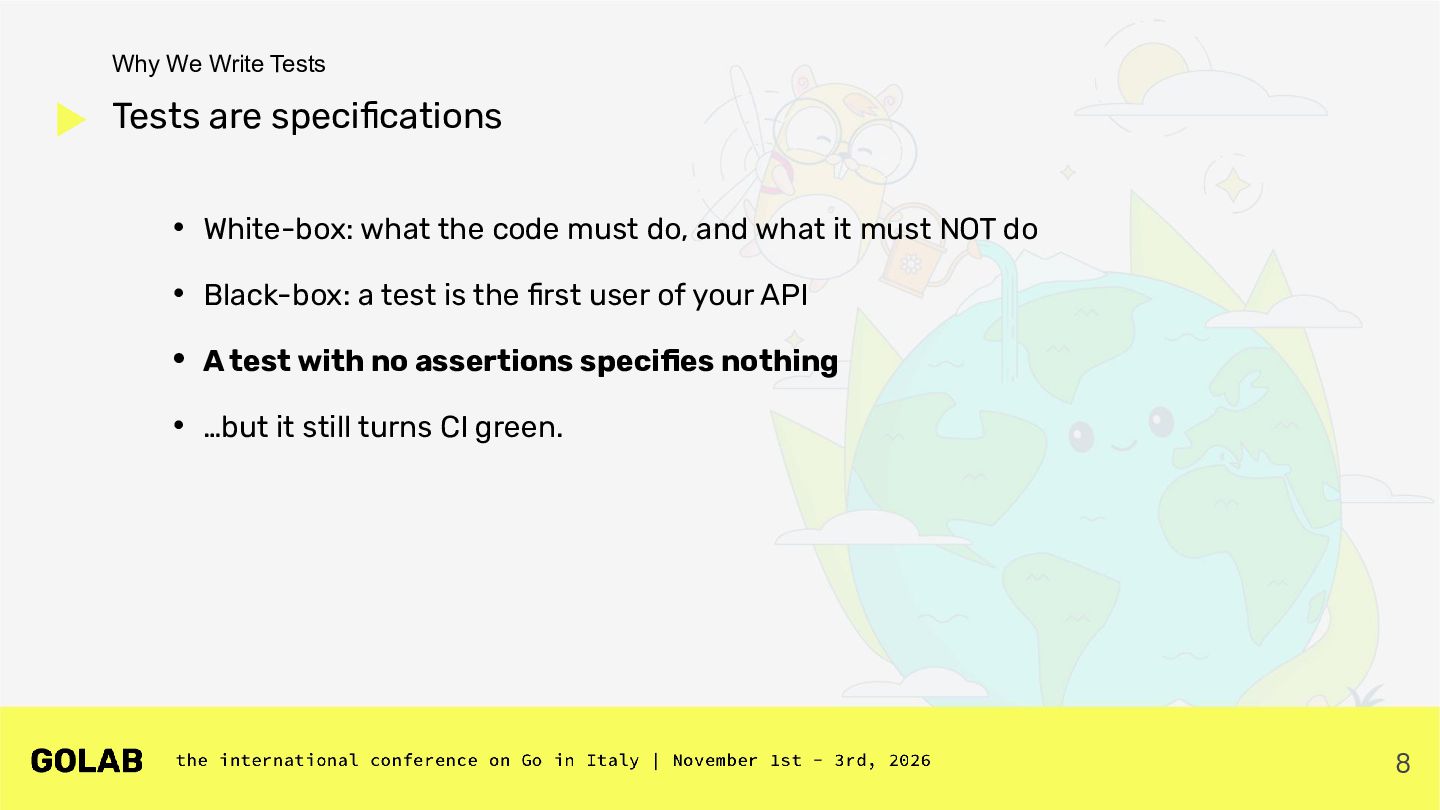
Why We Write Tests Tests are specifications • White-box: what
the code must do, and what it must NOT do • Black-box: a test is the first user of your API • A test with no assertions specifies nothing • …but it still turns CI green. 8 -
02 WHAT COVERAGE MISSES • How Go measures coverage Coverage
tells you what ran, not what was checked. • Goodhart's law • 100% coverage, zero verification 9 -
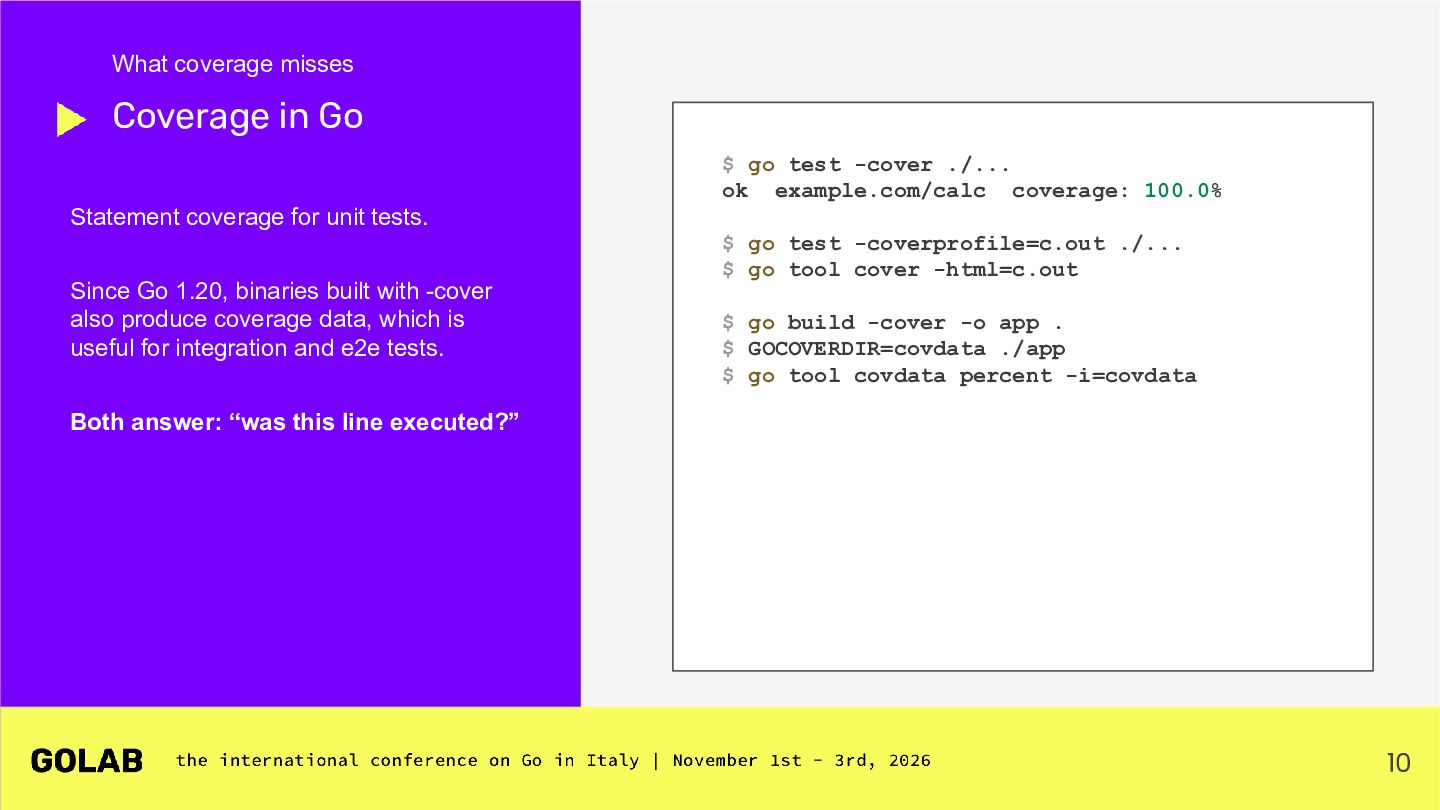
What coverage misses Coverage in Go $ go test -cover
./... ok example.com/calc coverage: 100.0% Statement coverage for unit tests. $ go test -coverprofile=c.out ./... $ go tool cover -html=c.out Since Go 1.20, binaries built with -cover also produce coverage data, which is useful for integration and e2e tests. $ go build -cover -o app . $ GOCOVERDIR=covdata ./app $ go tool covdata percent -i=covdata Both answer: “was this line executed?” 10 -
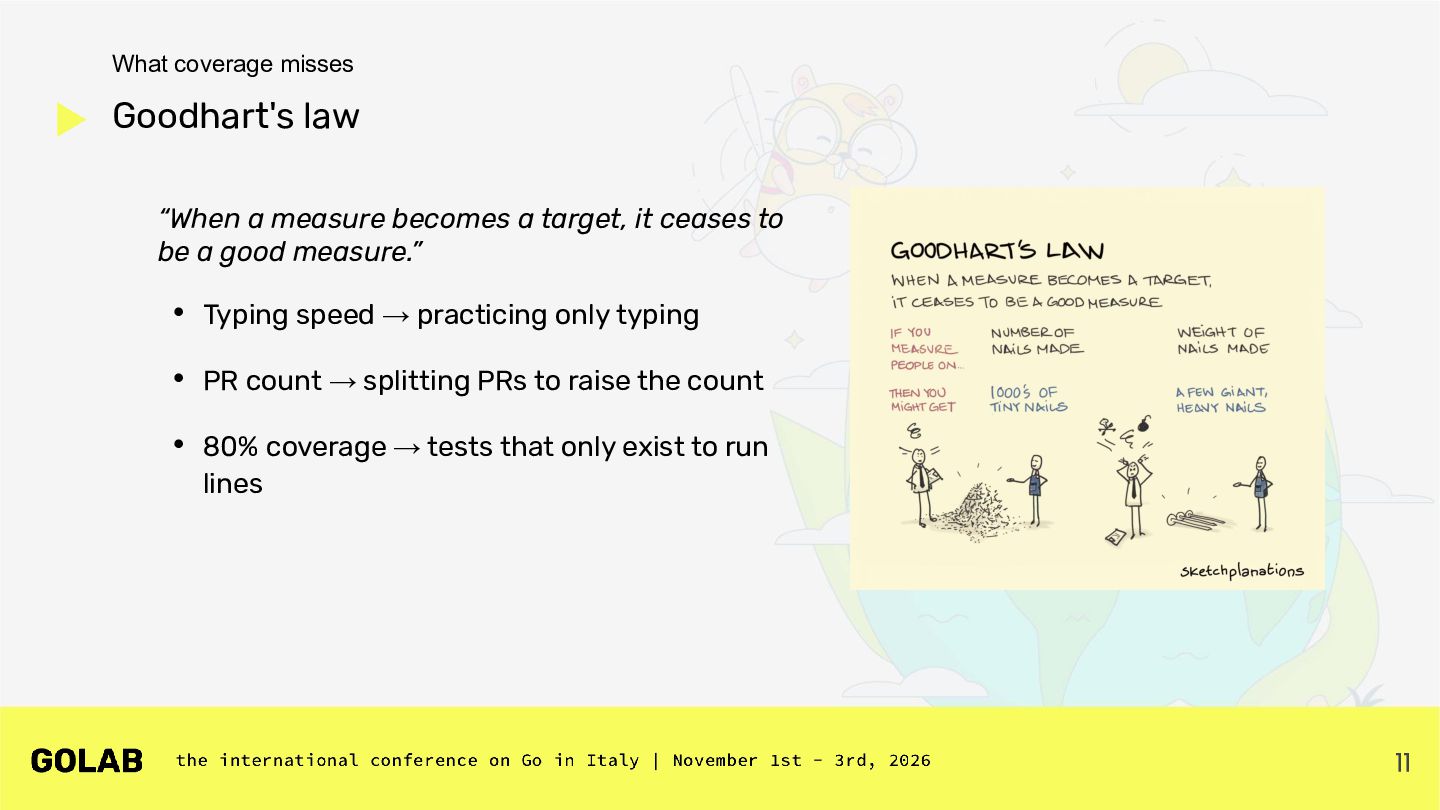
What coverage misses Goodhart's law “When a measure becomes a
target, it ceases to be a good measure.” • Typing speed → practicing only typing • PR count → splitting PRs to raise the count • 80% coverage → tests that only exist to run lines 11 -
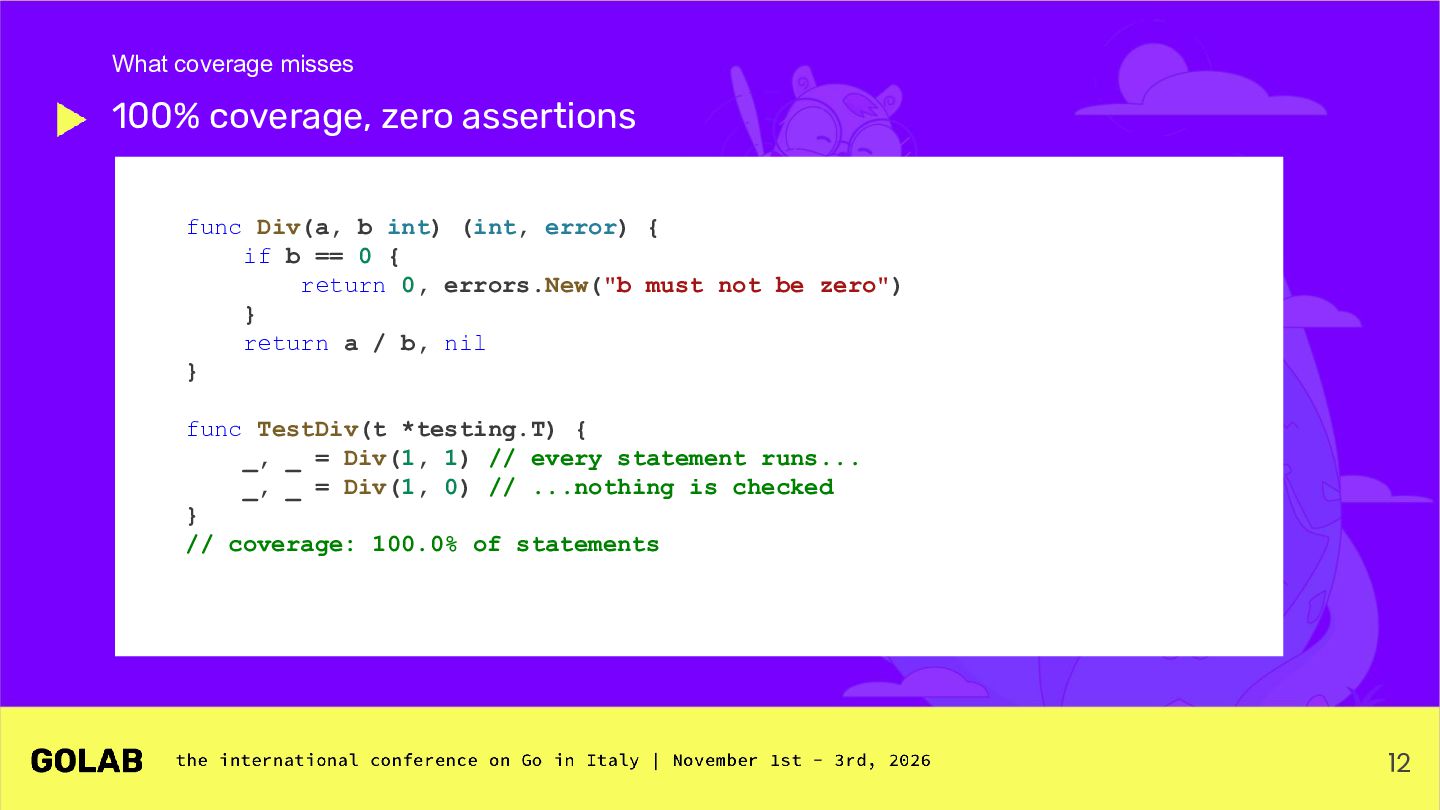
What coverage misses 100% coverage, zero assertions func Div(a, b
int) (int, error) { if b == 0 { return 0, errors.New("b must not be zero") } return a / b, nil } func TestDiv(t *testing.T) { _, _ = Div(1, 1) // every statement runs... _, _ = Div(1, 0) // ...nothing is checked } // coverage: 100.0% of statements 12 -
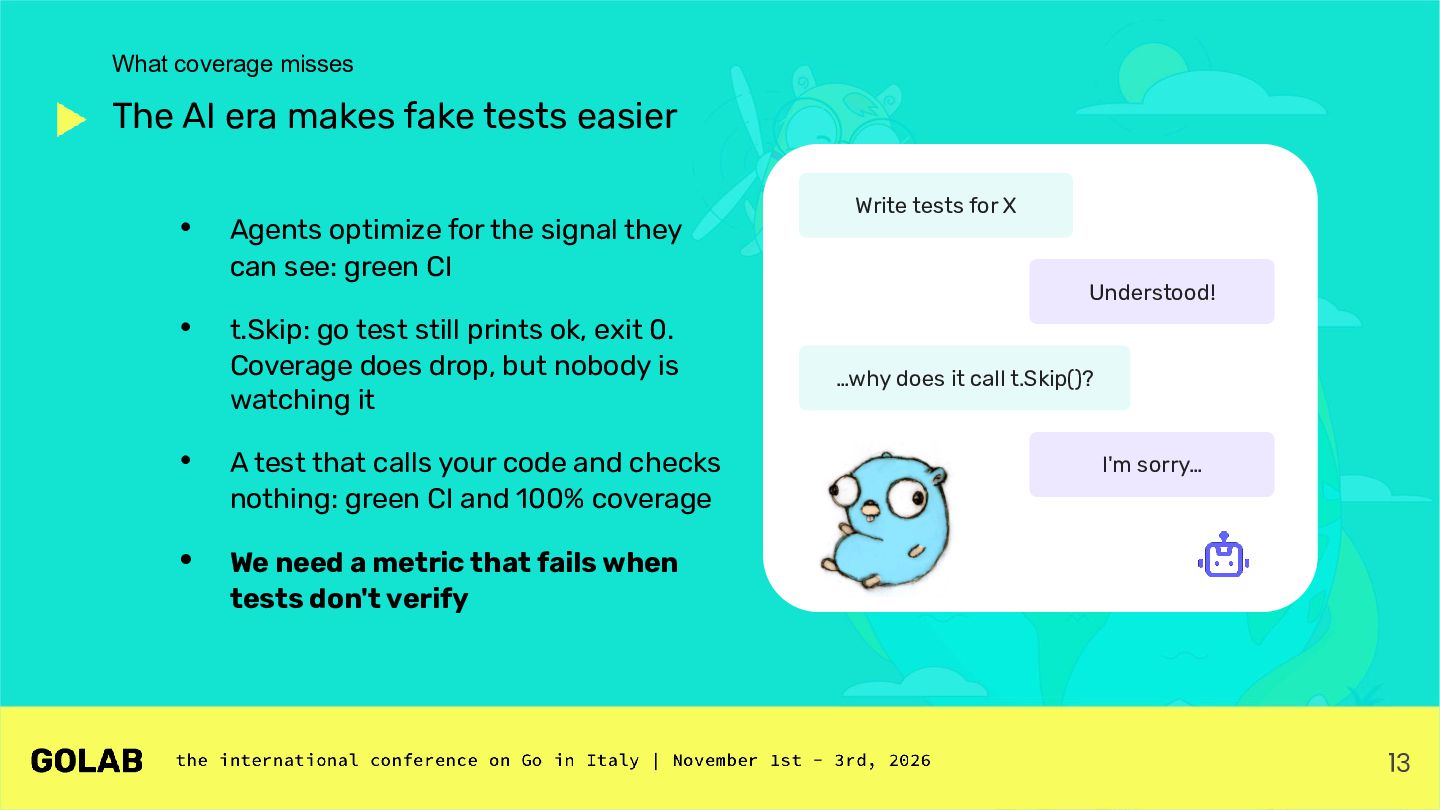
What coverage misses The AI era makes fake tests easier
• • Agents optimize for the signal they can see: green CI t.Skip: go test still prints ok, exit 0. Coverage does drop, but nobody is watching it • A test that calls your code and checks nothing: green CI and 100% coverage • We need a metric that fails when tests don't verify Write tests for X Understood! …why does it call t.Skip()? I'm sorry… 13 -
03 MUTATION TESTING • Mutants: KILLED & SURVIVED Test your
tests by breaking your code on purpose. • Div, revisited • Costs & problems 14 -
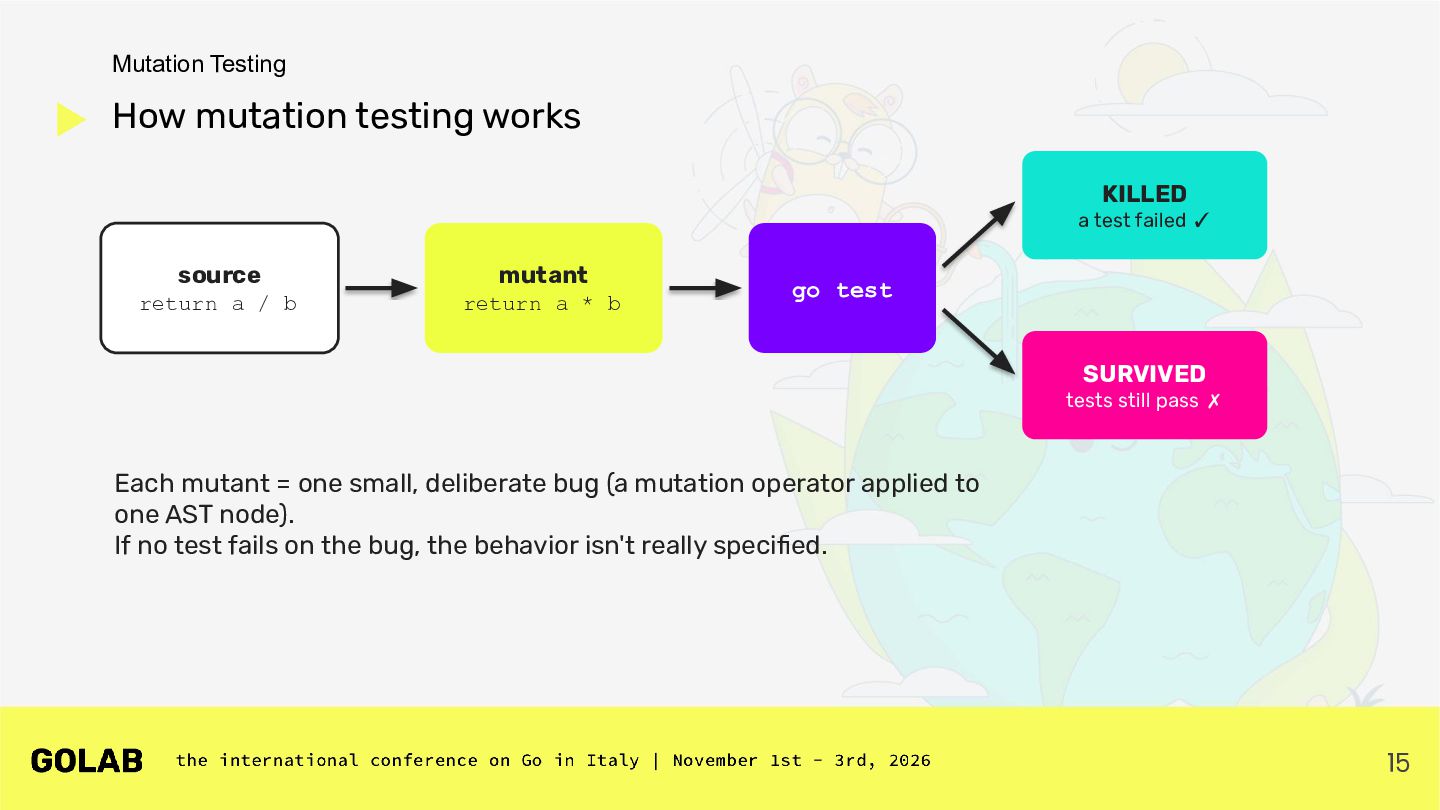
Mutation Testing How mutation testing works KILLED a test failed
✓ source mutant return a / b return a * b go test SURVIVED tests still pass ✗ Each mutant = one small, deliberate bug (a mutation operator applied to one AST node). If no test fails on the bug, the behavior isn't really specified. 15 -
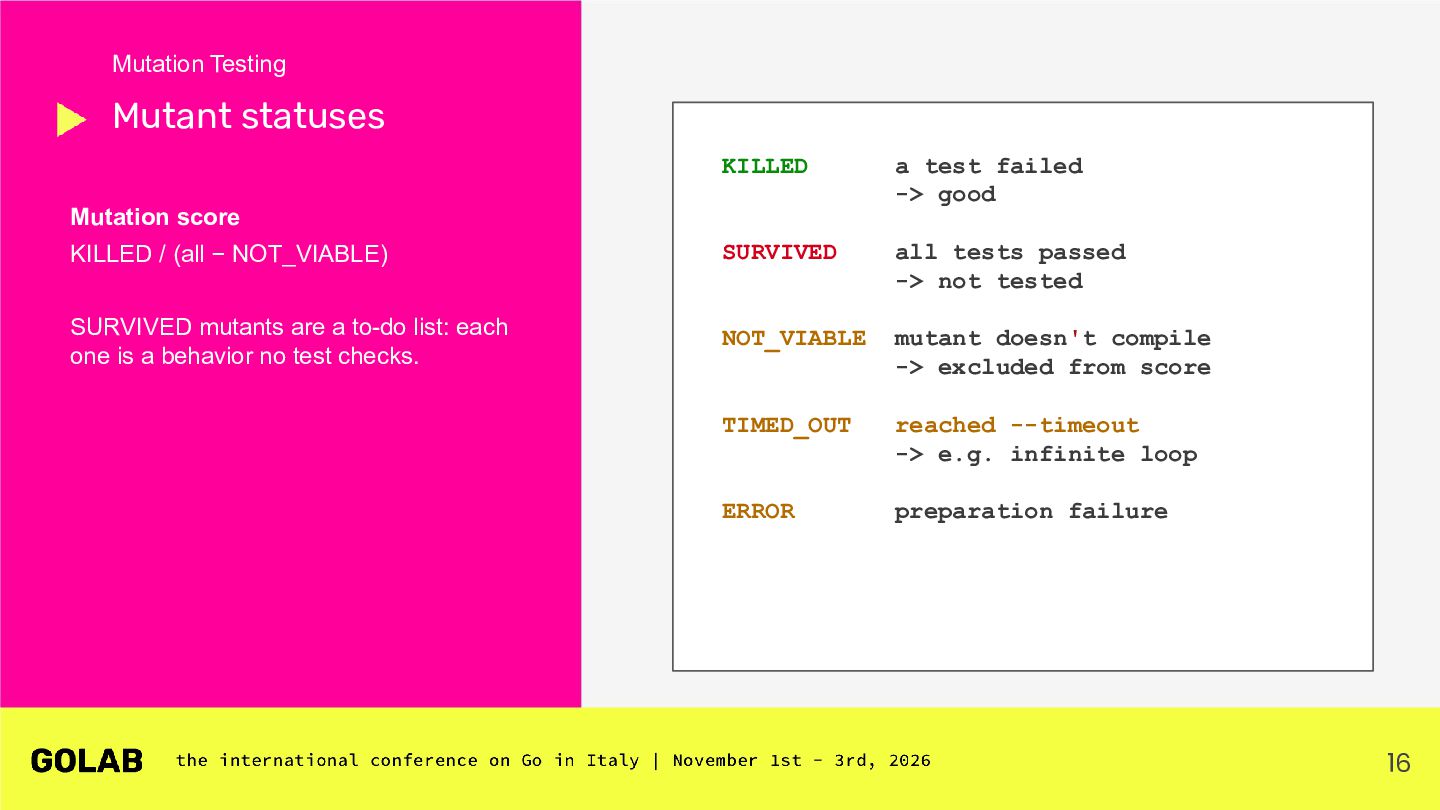
Mutation Testing Mutant statuses KILLED a test failed -> good
KILLED / (all − NOT_VIABLE) SURVIVED all tests passed -> not tested SURVIVED mutants are a to-do list: each one is a behavior no test checks. NOT_VIABLE mutant doesn't compile -> excluded from score TIMED_OUT reached --timeout -> e.g. infinite loop ERROR preparation failure Mutation score 16 -
Mutation Testing Div vs. the test with no assertions: real
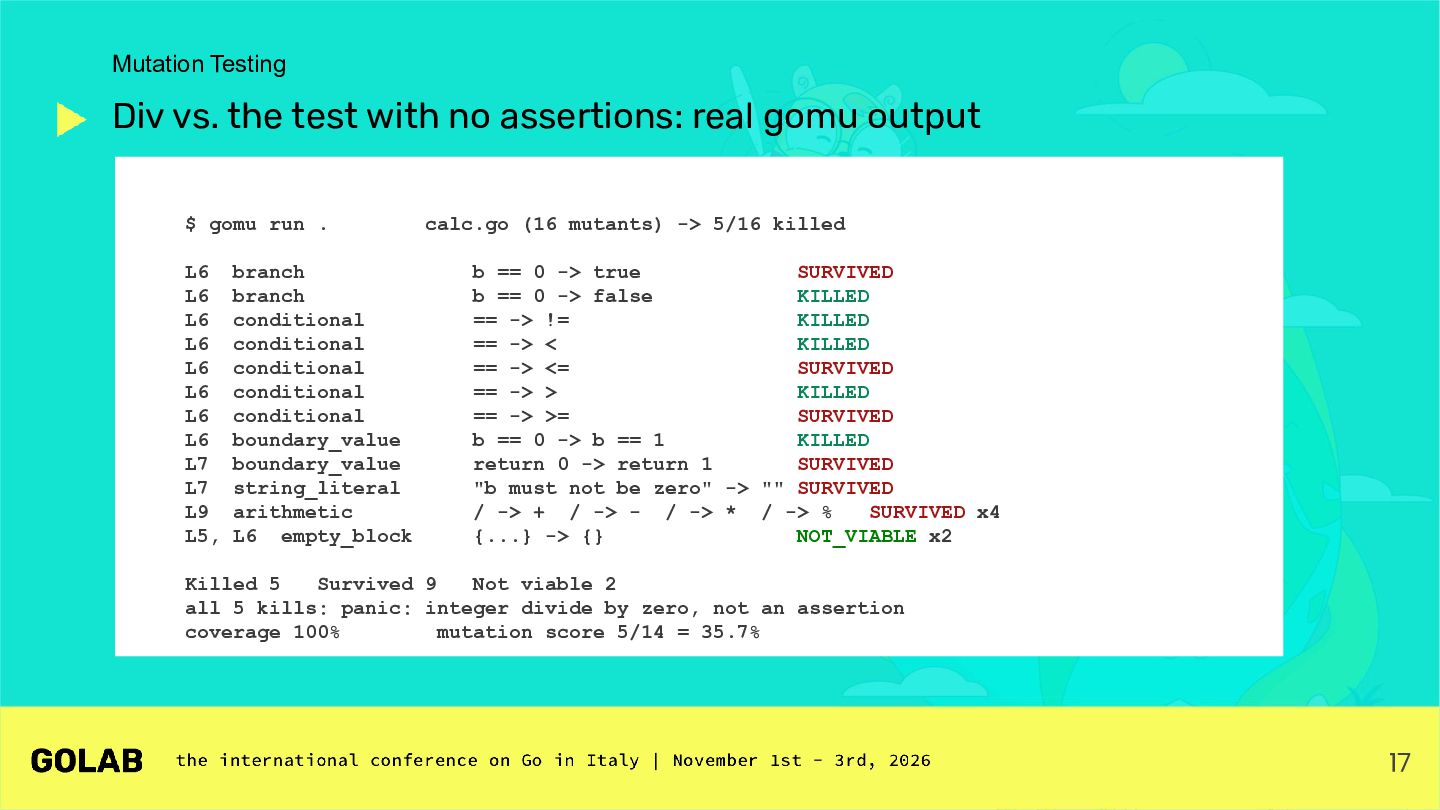
gomu output $ gomu run . L6 branch L6 branch L6 conditional L6 conditional L6 conditional L6 conditional L6 conditional L6 boundary_value L7 boundary_value L7 string_literal L9 arithmetic L5, L6 empty_block calc.go (16 mutants) -> 5/16 killed b == 0 -> true SURVIVED b == 0 -> false KILLED == -> != KILLED == -> < KILLED == -> <= SURVIVED == -> > KILLED == -> >= SURVIVED b == 0 -> b == 1 KILLED return 0 -> return 1 SURVIVED "b must not be zero" -> "" SURVIVED / -> + / -> - / -> * / -> % SURVIVED x4 {...} -> {} NOT_VIABLE x2 Killed 5 Survived 9 Not viable 2 all 5 kills: panic: integer divide by zero, not an assertion coverage 100% mutation score 5/14 = 35.7% 17 -
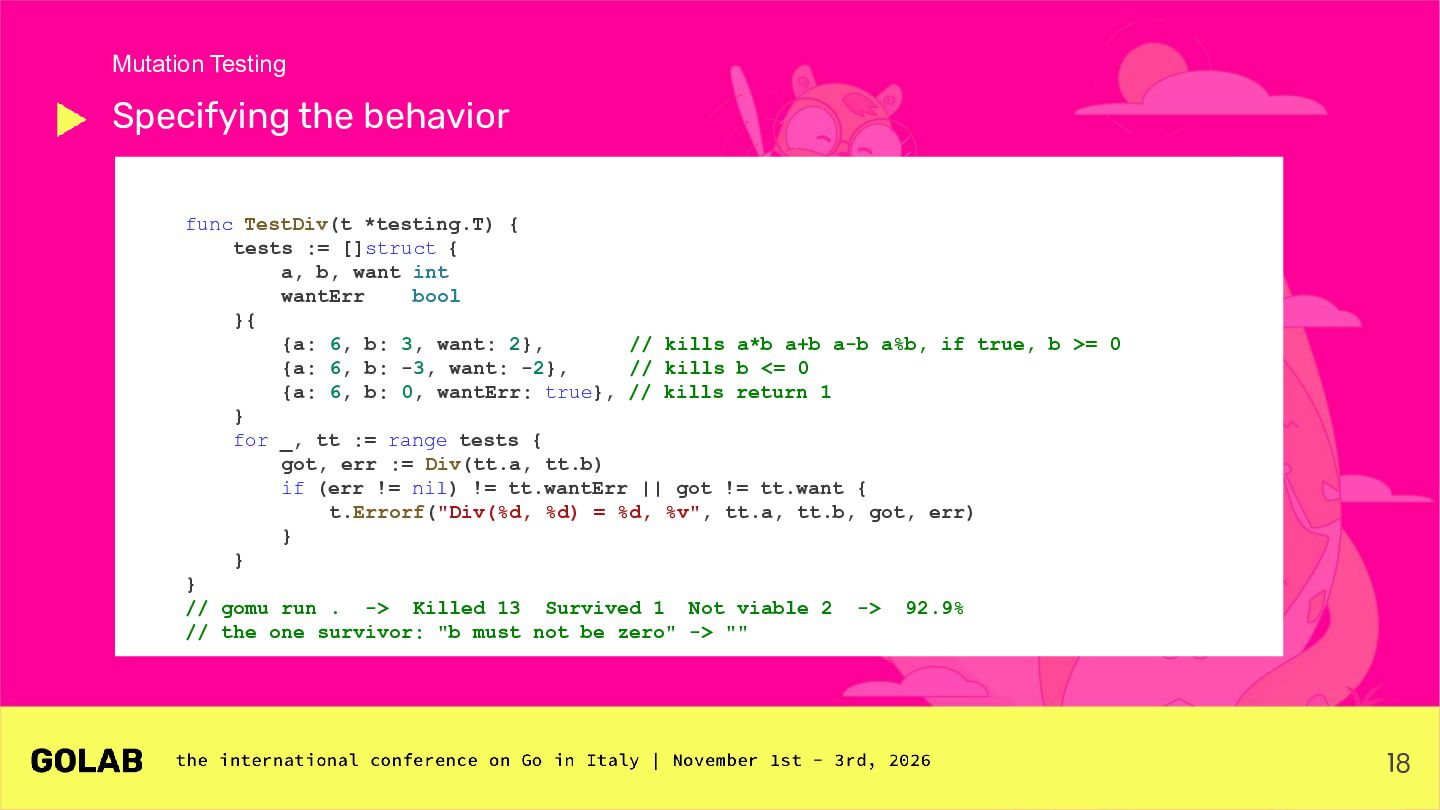
Mutation Testing Specifying the behavior func TestDiv(t *testing.T) { tests
:= []struct { a, b, want int wantErr bool }{ {a: 6, b: 3, want: 2}, // kills a*b a+b a-b a%b, if true, b >= 0 {a: 6, b: -3, want: -2}, // kills b <= 0 {a: 6, b: 0, wantErr: true}, // kills return 1 } for _, tt := range tests { got, err := Div(tt.a, tt.b) if (err != nil) != tt.wantErr || got != tt.want { t.Errorf("Div(%d, %d) = %d, %v", tt.a, tt.b, got, err) } } } // gomu run . -> Killed 13 Survived 1 Not viable 2 -> 92.9% // the one survivor: "b must not be zero" -> "" 18 -
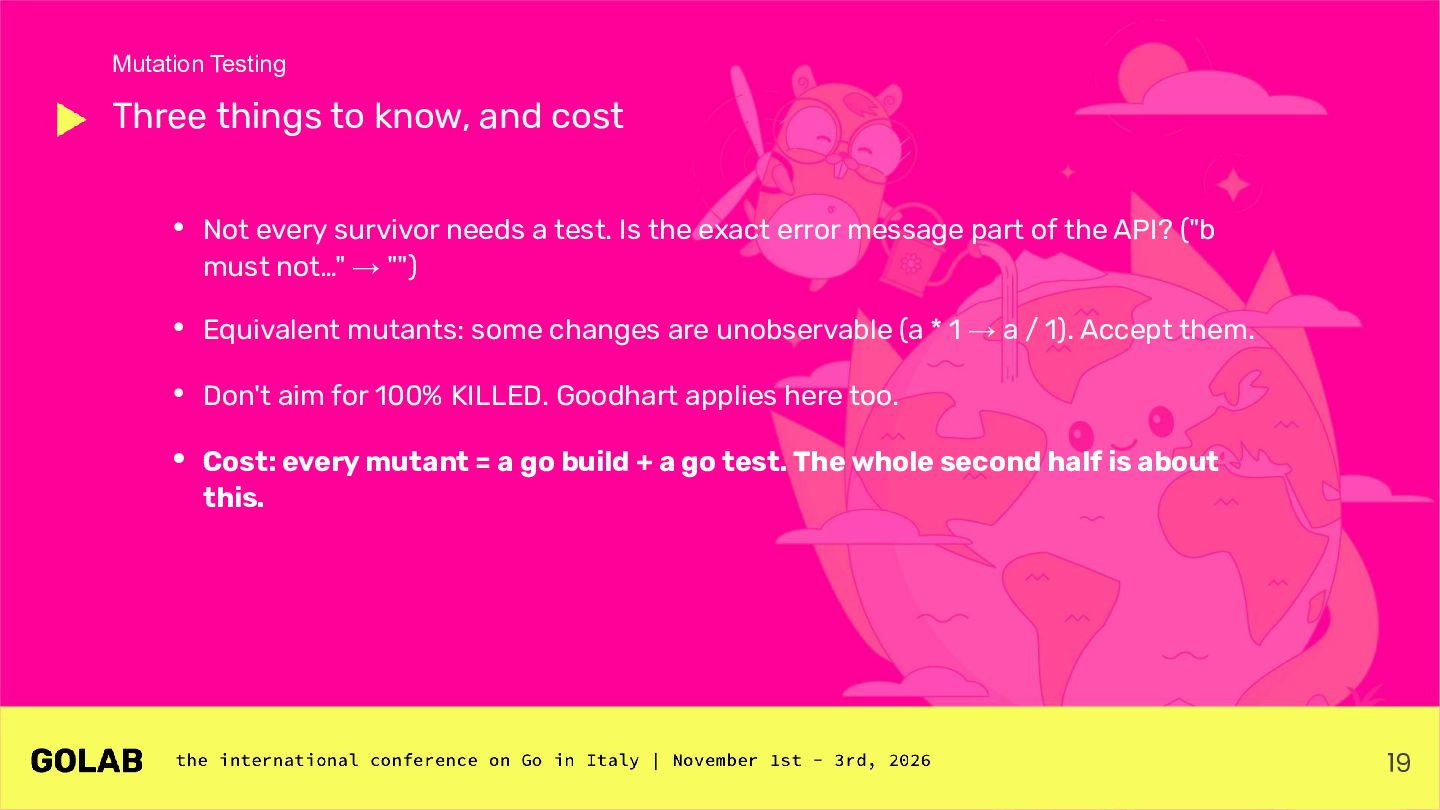
Mutation Testing Three things to know, and cost • Not
every survivor needs a test. Is the exact error message part of the API? ("b must not…" → "") • Equivalent mutants: some changes are unobservable (a * 1 → a / 1). Accept them. • Don't aim for 100% KILLED. Goodhart applies here too. • Cost: every mutant = a go build + a go test. The whole second half is about this. 19 -
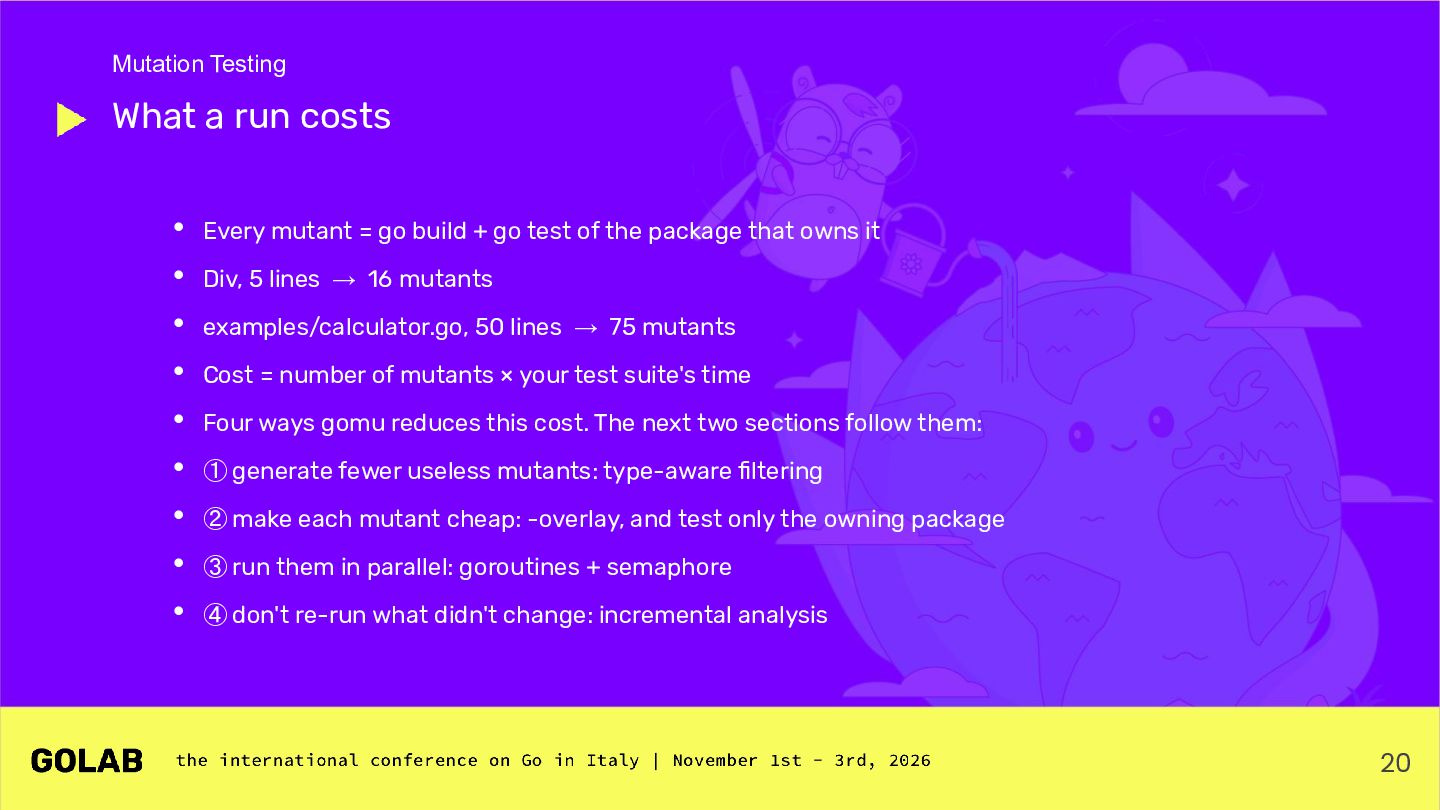
Mutation Testing What a run costs • Every mutant =
go build + go test of the package that owns it • Div, 5 lines → 16 mutants • examples/calculator.go, 50 lines → 75 mutants • Cost = number of mutants × your test suite's time • Four ways gomu reduces this cost. The next two sections follow them: • ① generate fewer useless mutants: type-aware filtering • ② make each mutant cheap: -overlay, and test only the owning package • ③ run them in parallel: goroutines + semaphore • ④ don't re-run what didn't change: incremental analysis 20 -
04 INSIDE GOMU: MAKING MUTANTS • The pipeline github.com/sivchari/gomu: mutation
testing built for Go and for CI. • Mutators on go/ast • Type-aware filtering 21 -
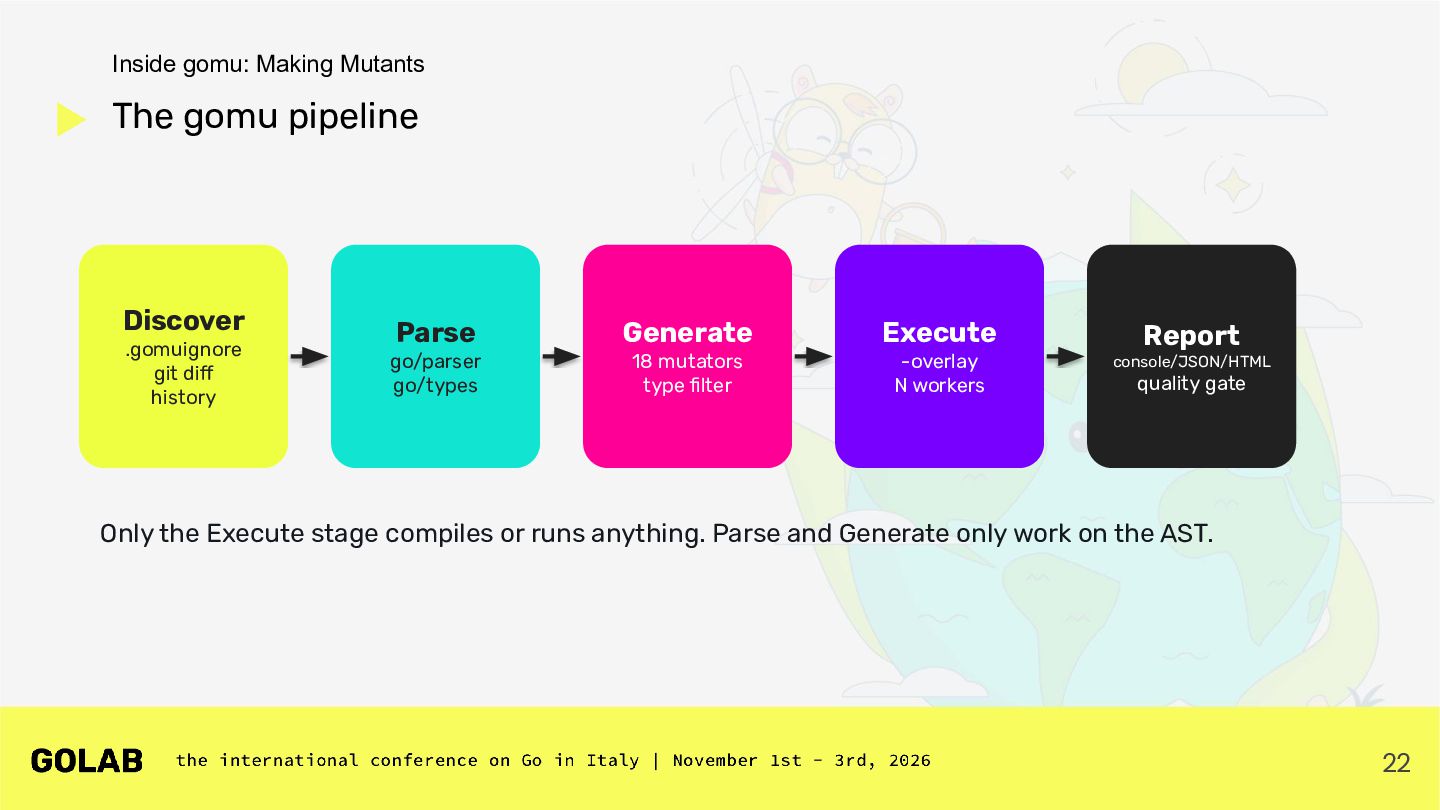
Inside gomu: Making Mutants The gomu pipeline Discover .gomuignore git
diff history Parse Generate Execute go/parser go/types 18 mutators type filter -overlay N workers Report console/JSON/HTML quality gate Only the Execute stage compiles or runs anything. Parse and Generate only work on the AST. 22 -
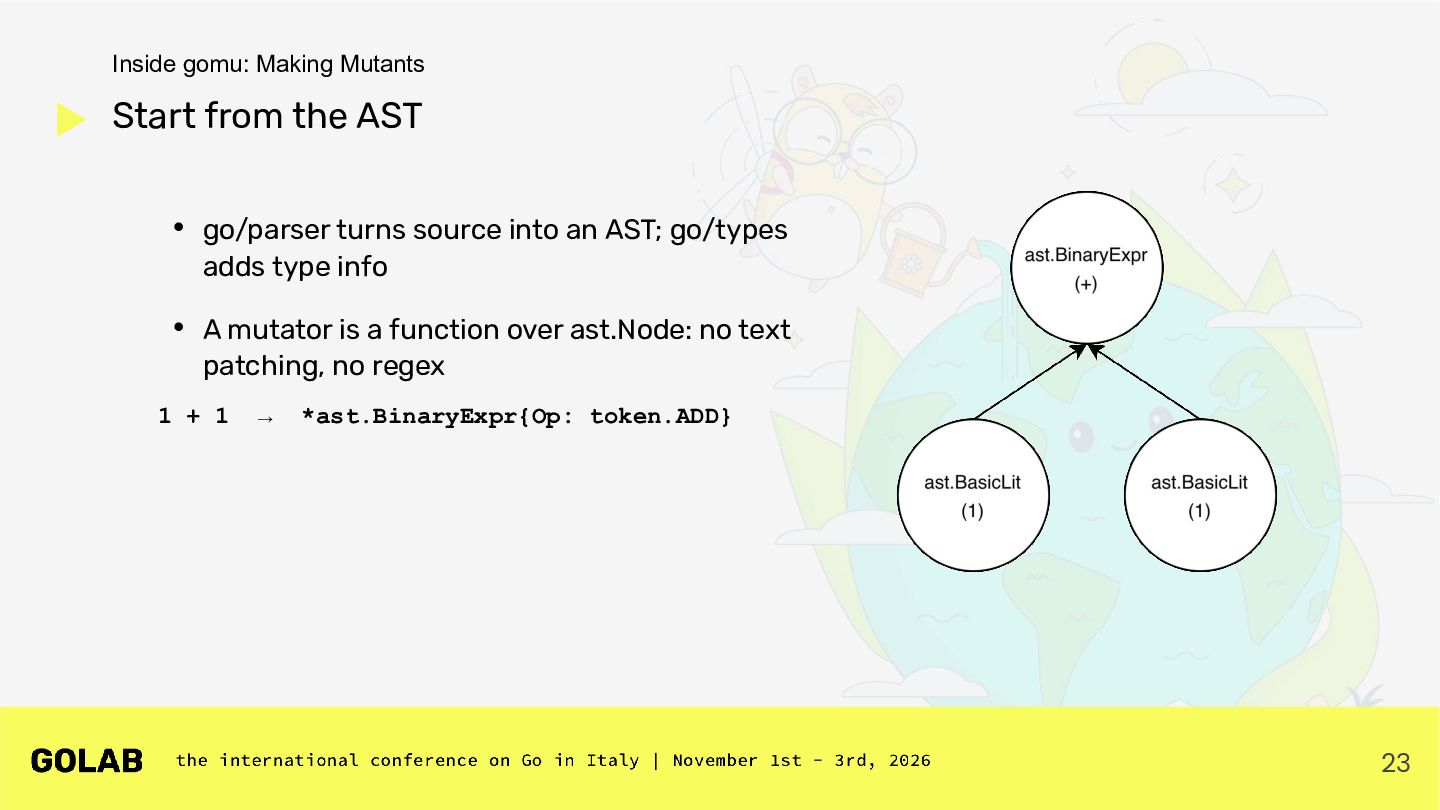
Inside gomu: Making Mutants Start from the AST • go/parser
turns source into an AST; go/types adds type info • A mutator is a function over ast.Node: no text patching, no regex 1 + 1 → *ast.BinaryExpr{Op: token.ADD} 23 -
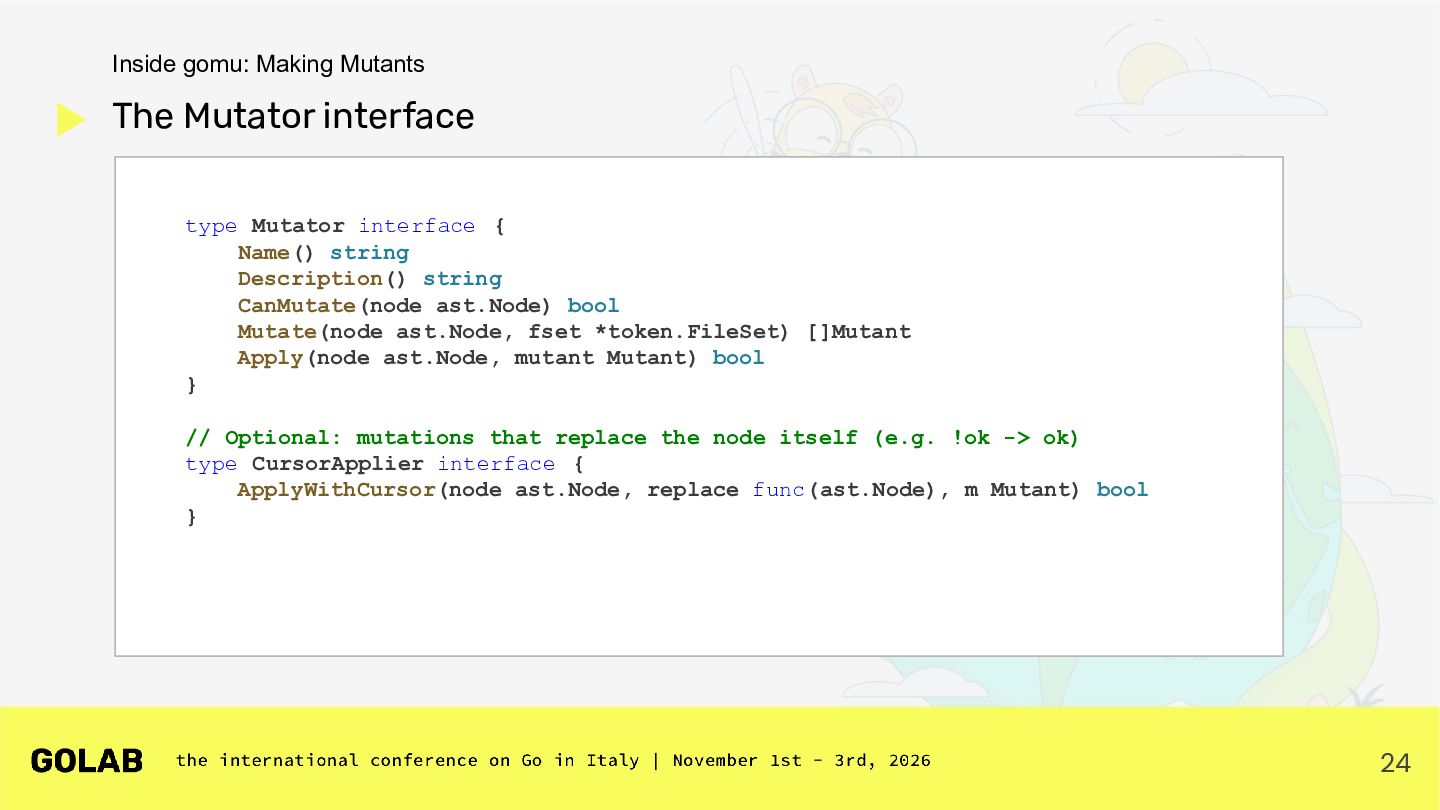
Inside gomu: Making Mutants The Mutator interface type Mutator interface
{ Name() string Description() string CanMutate(node ast.Node) bool Mutate(node ast.Node, fset *token.FileSet) []Mutant Apply(node ast.Node, mutant Mutant) bool } // Optional: mutations that replace the node itself (e.g. !ok -> ok) type CursorApplier interface { ApplyWithCursor(node ast.Node, replace func(ast.Node), m Mutant) bool } 24 -
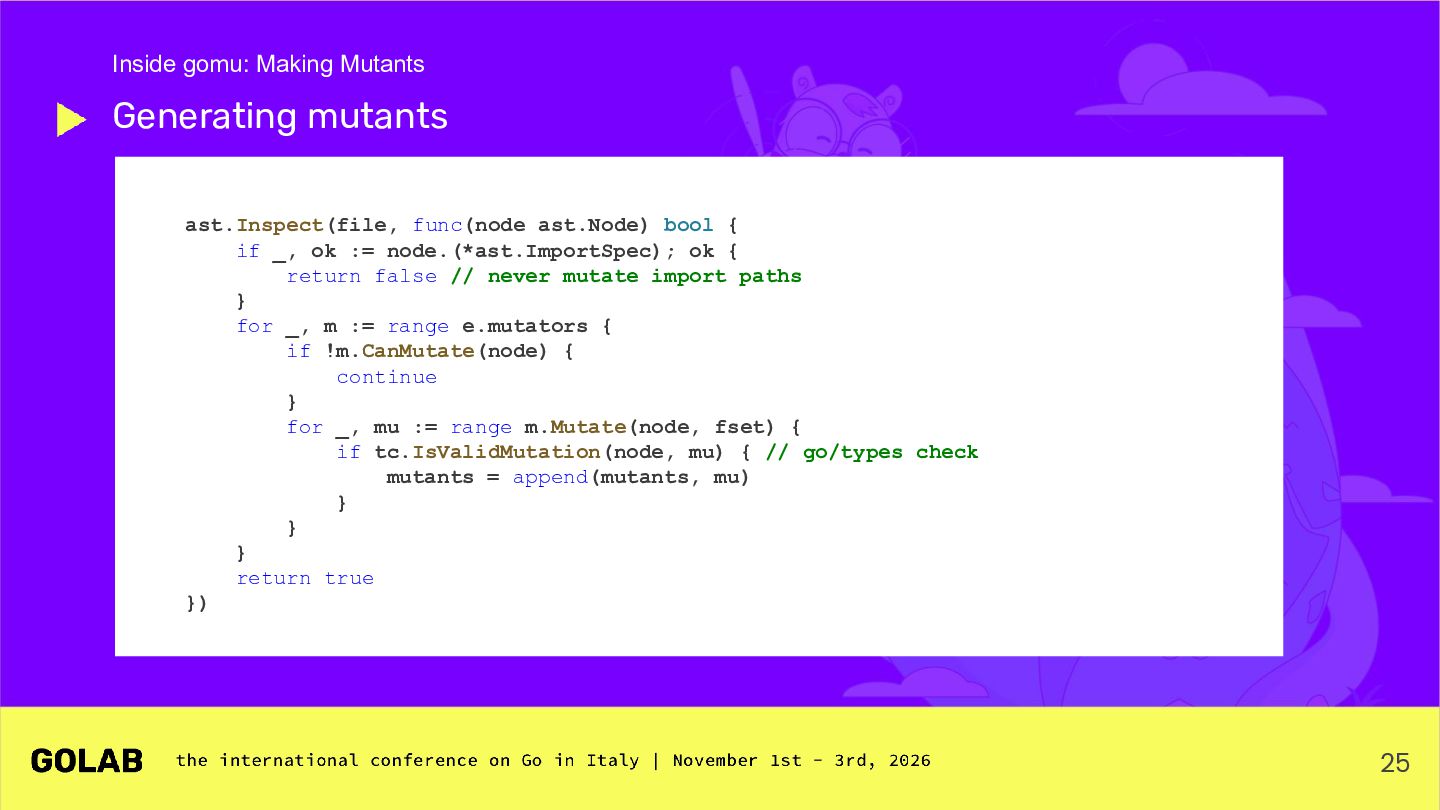
Inside gomu: Making Mutants Generating mutants ast.Inspect(file, func(node ast.Node) bool
{ if _, ok := node.(*ast.ImportSpec); ok { return false // never mutate import paths } for _, m := range e.mutators { if !m.CanMutate(node) { continue } for _, mu := range m.Mutate(node, fset) { if tc.IsValidMutation(node, mu) { // go/types check mutants = append(mutants, mu) } } } return true }) 25 -
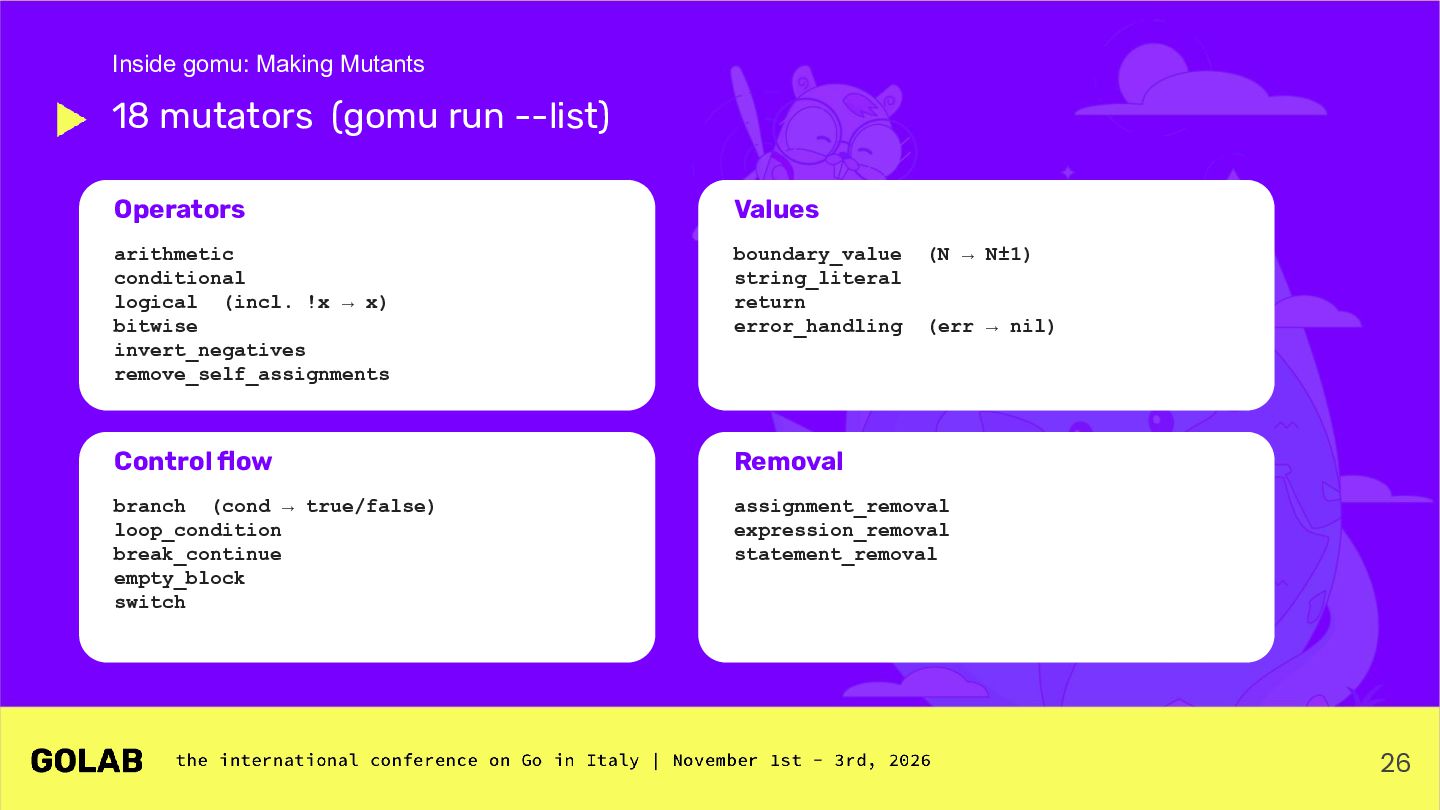
Inside gomu: Making Mutants 18 mutators (gomu run --list) Operators
Values arithmetic conditional logical (incl. !x → x) bitwise invert_negatives remove_self_assignments boundary_value string_literal return error_handling Control flow Removal branch (cond → true/false) loop_condition break_continue empty_block switch assignment_removal expression_removal statement_removal (N → N±1) (err → nil) 26 -
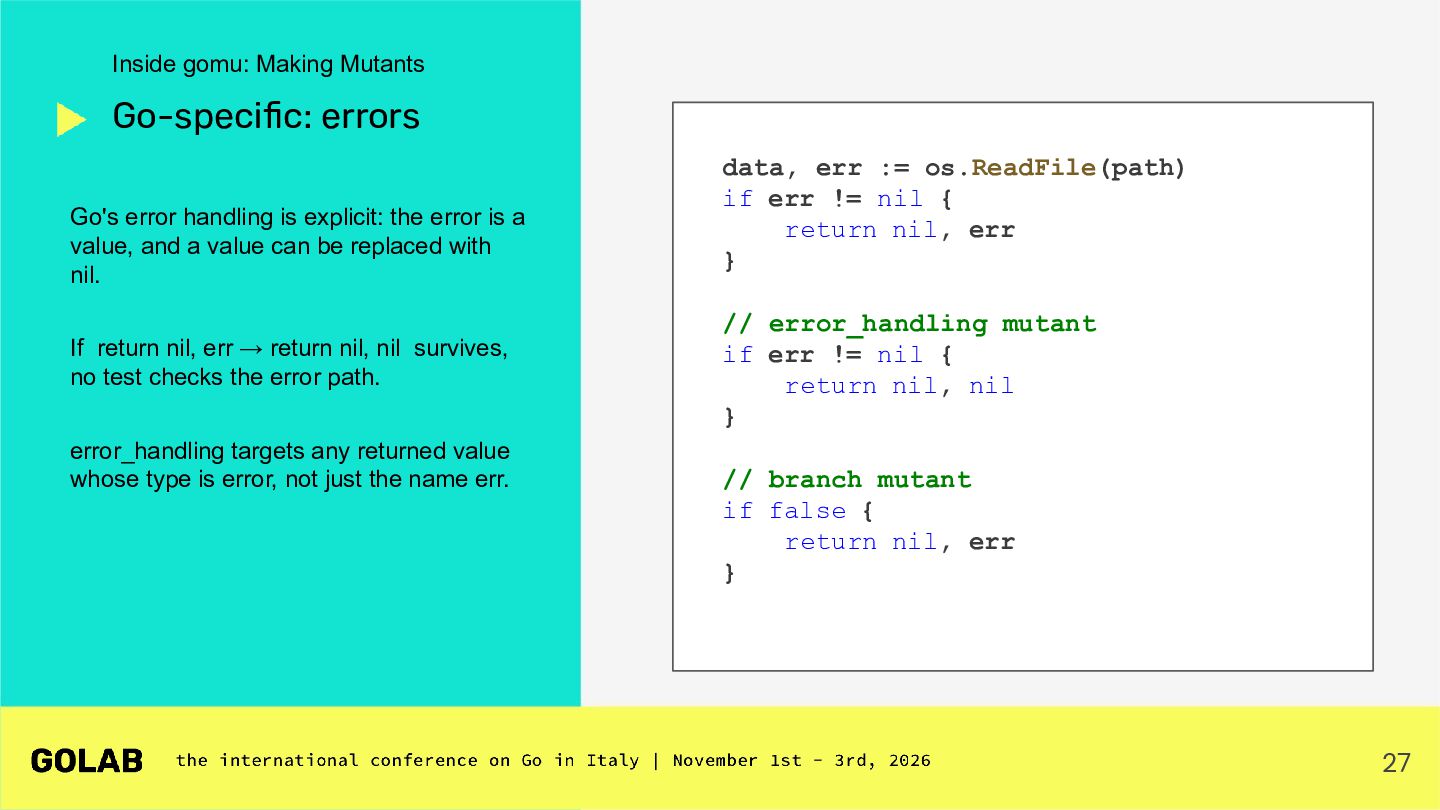
Inside gomu: Making Mutants Go-specific: errors Go's error handling is
explicit: the error is a value, and a value can be replaced with nil. If return nil, err → return nil, nil survives, no test checks the error path. error_handling targets any returned value whose type is error, not just the name err. data, err := os.ReadFile(path) if err != nil { return nil, err } // error_handling mutant if err != nil { return nil, nil } // branch mutant if false { return nil, err } 27 -
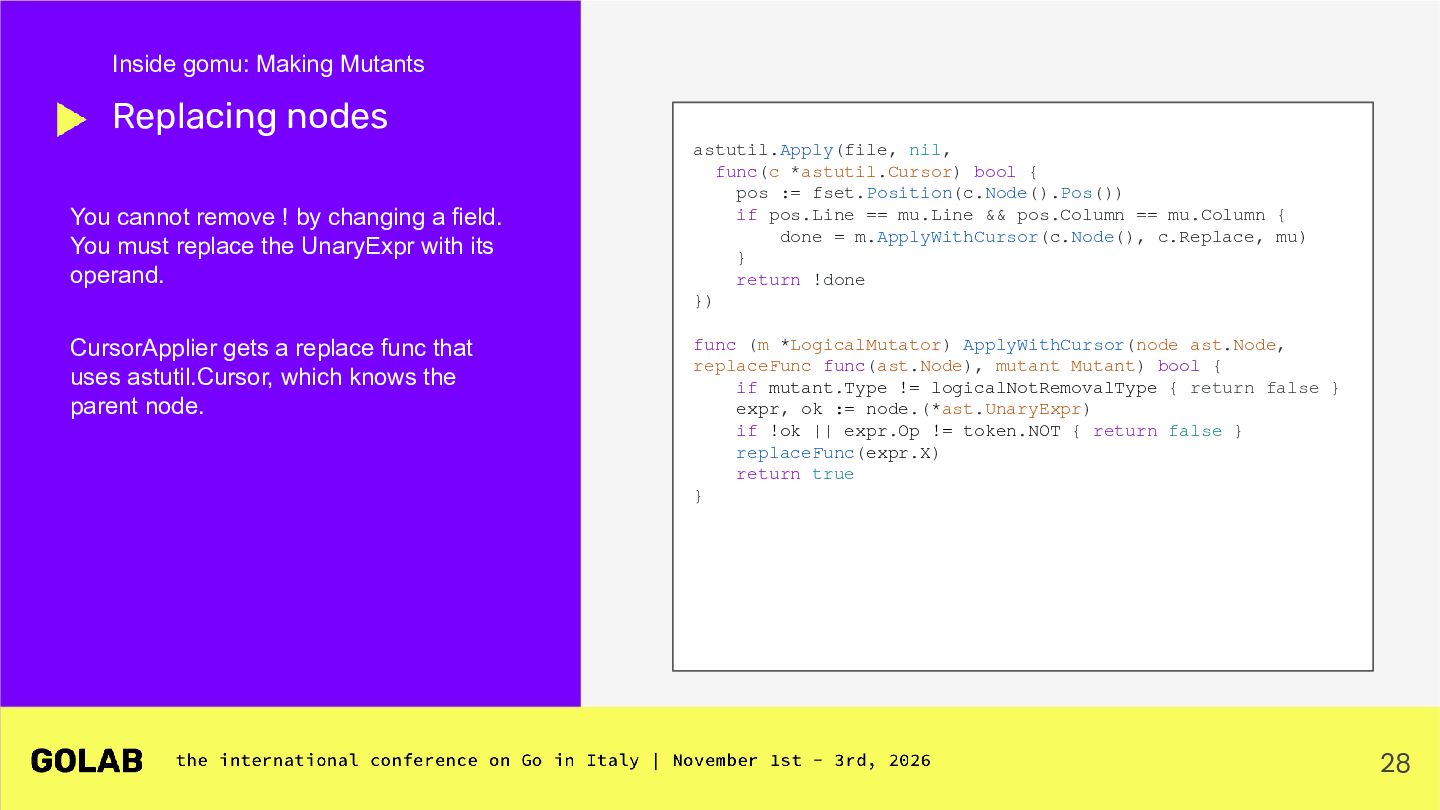
Inside gomu: Making Mutants Replacing nodes You cannot remove !
by changing a field. You must replace the UnaryExpr with its operand. CursorApplier gets a replace func that uses astutil.Cursor, which knows the parent node. astutil.Apply(file, nil, func(c *astutil.Cursor) bool { pos := fset.Position(c.Node().Pos()) if pos.Line == mu.Line && pos.Column == mu.Column { done = m.ApplyWithCursor(c.Node(), c.Replace, mu) } return !done }) func (m *LogicalMutator) ApplyWithCursor(node ast.Node, replaceFunc func(ast.Node), mutant Mutant) bool { if mutant.Type != logicalNotRemovalType { return false } expr, ok := node.(*ast.UnaryExpr) if !ok || expr.Op != token.NOT { return false } replaceFunc(expr.X) return true } 28 -
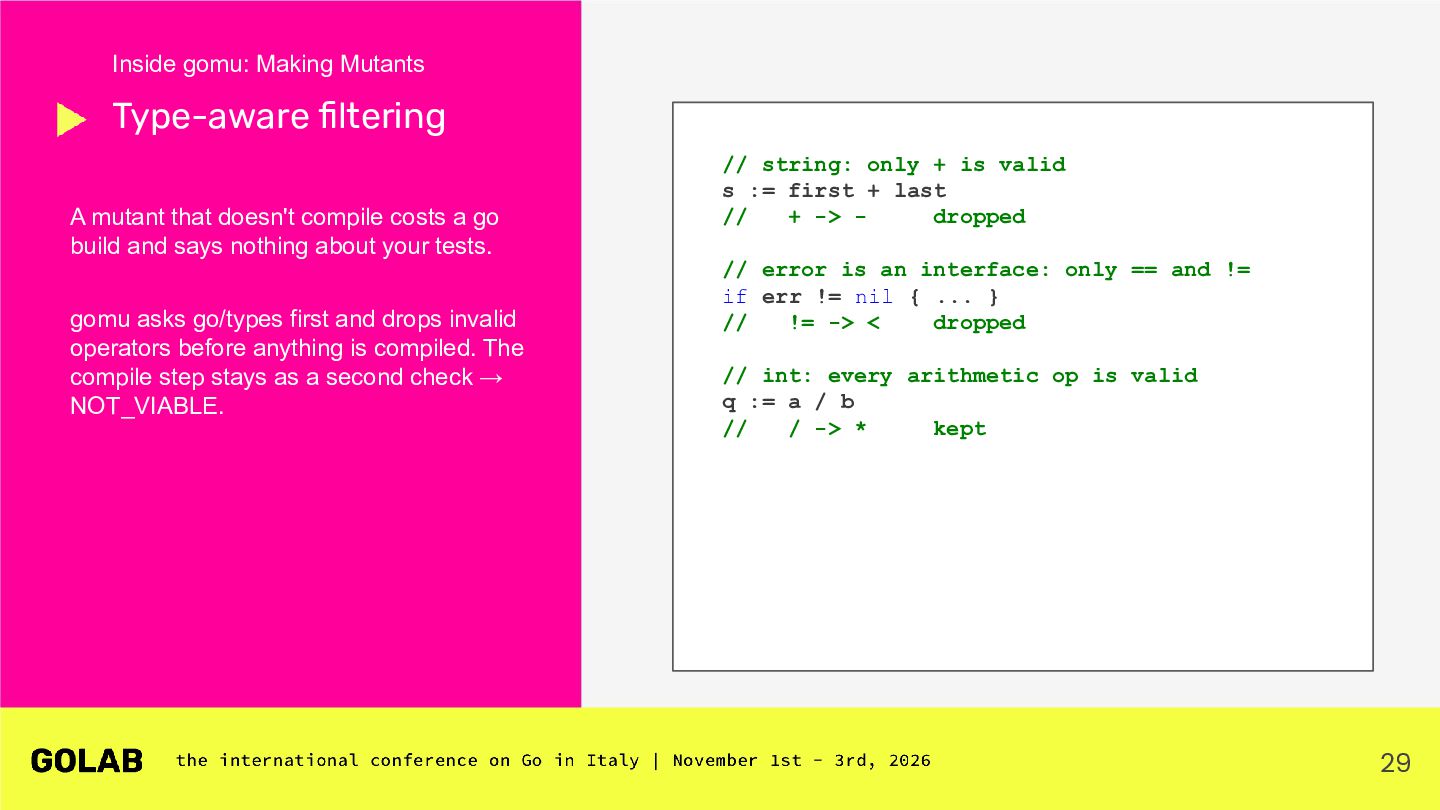
Inside gomu: Making Mutants Type-aware filtering A mutant that doesn't
compile costs a go build and says nothing about your tests. gomu asks go/types first and drops invalid operators before anything is compiled. The compile step stays as a second check → NOT_VIABLE. // string: only + is valid s := first + last // + -> dropped // error is an interface: only == and != if err != nil { ... } // != -> < dropped // int: every arithmetic op is valid q := a / b // / -> * kept 29 -
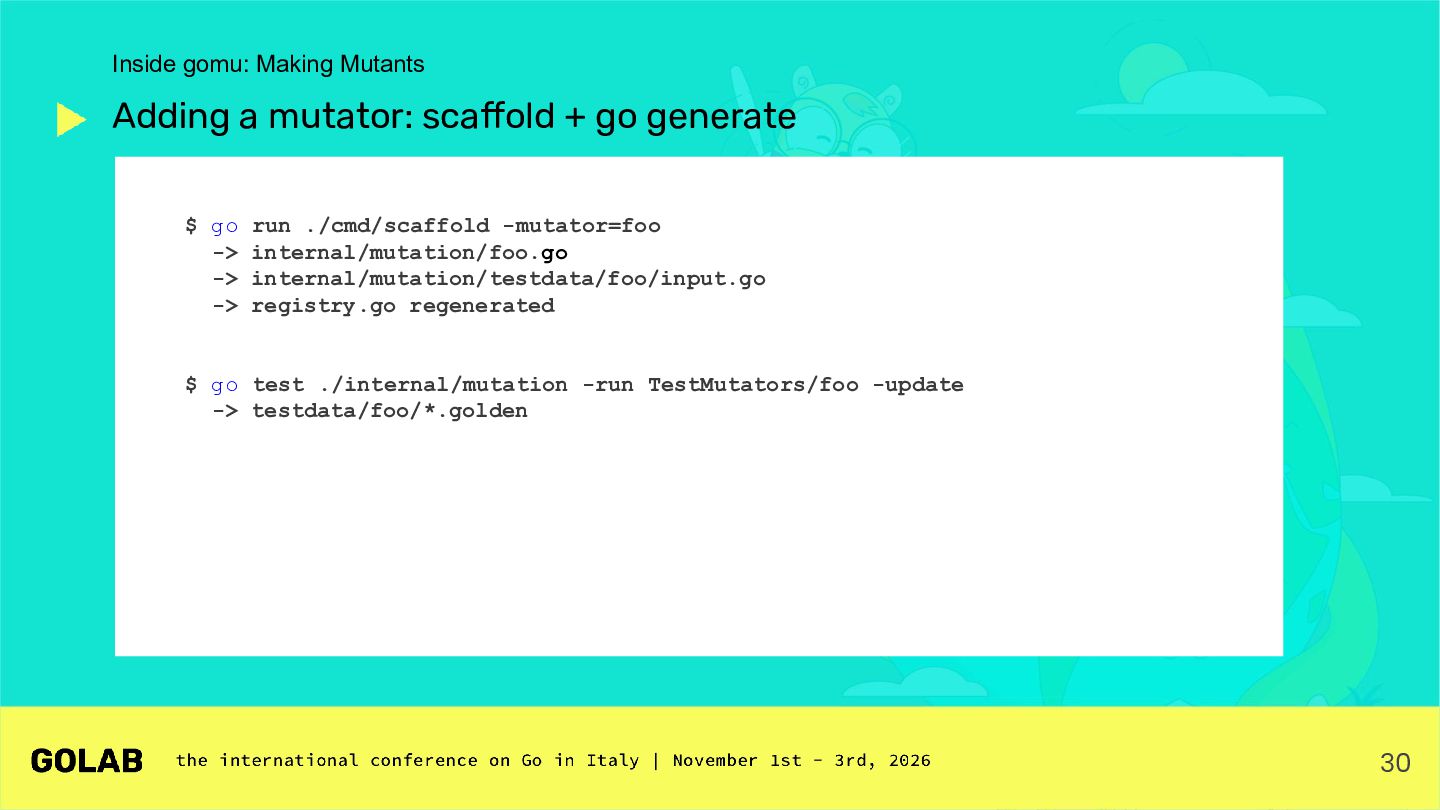
Inside gomu: Making Mutants Adding a mutator: scaffold + go
generate $ go run ./cmd/scaffold -mutator=foo -> internal/mutation/foo.go -> internal/mutation/testdata/foo/input.go -> registry.go regenerated $ go test ./internal/mutation -run TestMutators/foo -update -> testdata/foo/*.golden 30 -
05 INSIDE GOMU: RUNNING MUTANTS Thousands of mutants, zero edits
to your working tree. • go build / go test -overlay • Parallel workers • Incremental analysis 31 -
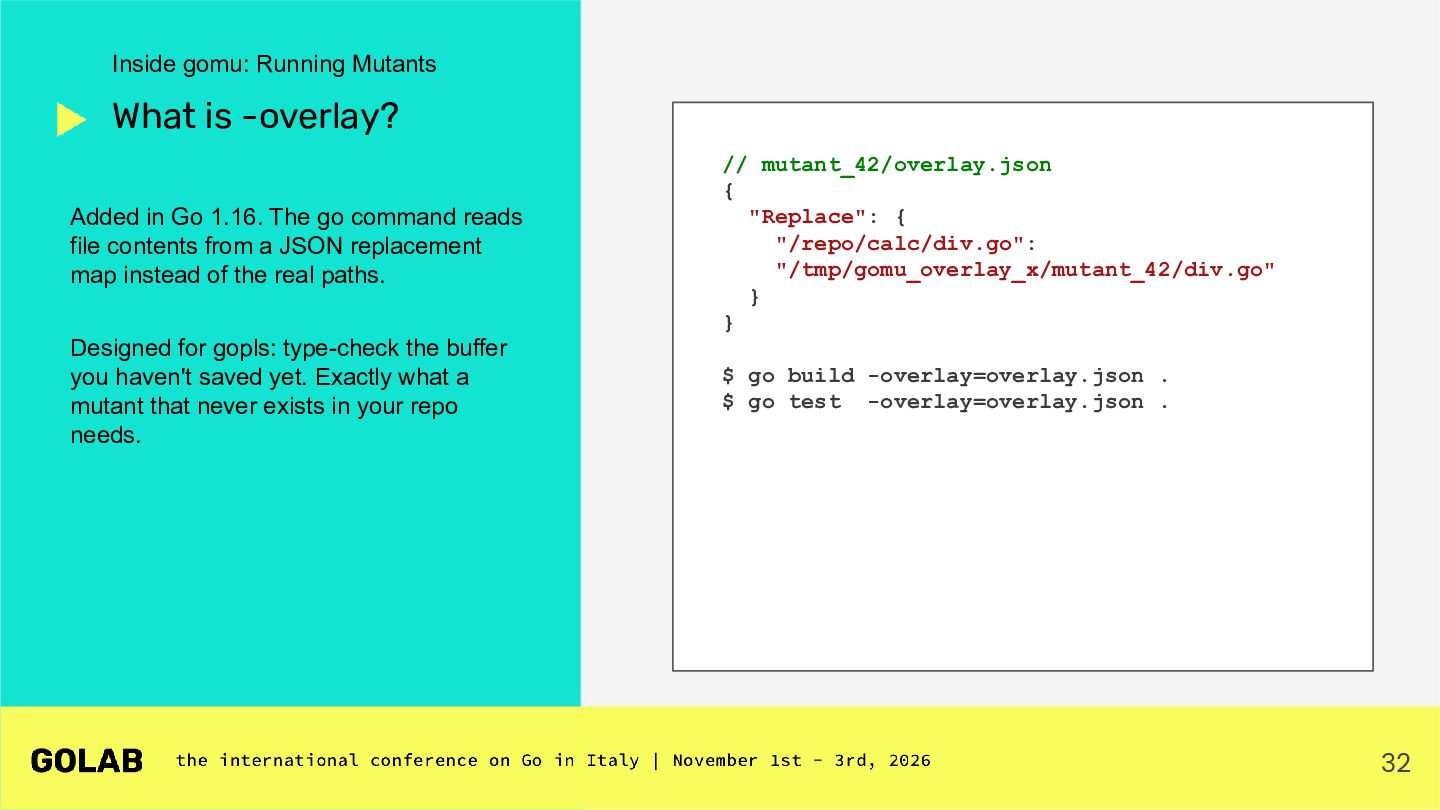
Inside gomu: Running Mutants What is -overlay? Added in Go
1.16. The go command reads file contents from a JSON replacement map instead of the real paths. // mutant_42/overlay.json { "Replace": { "/repo/calc/div.go": "/tmp/gomu_overlay_x/mutant_42/div.go" } } Designed for gopls: type-check the buffer you haven't saved yet. Exactly what a mutant that never exists in your repo needs. $ go build -overlay=overlay.json . $ go test -overlay=overlay.json . 32 -
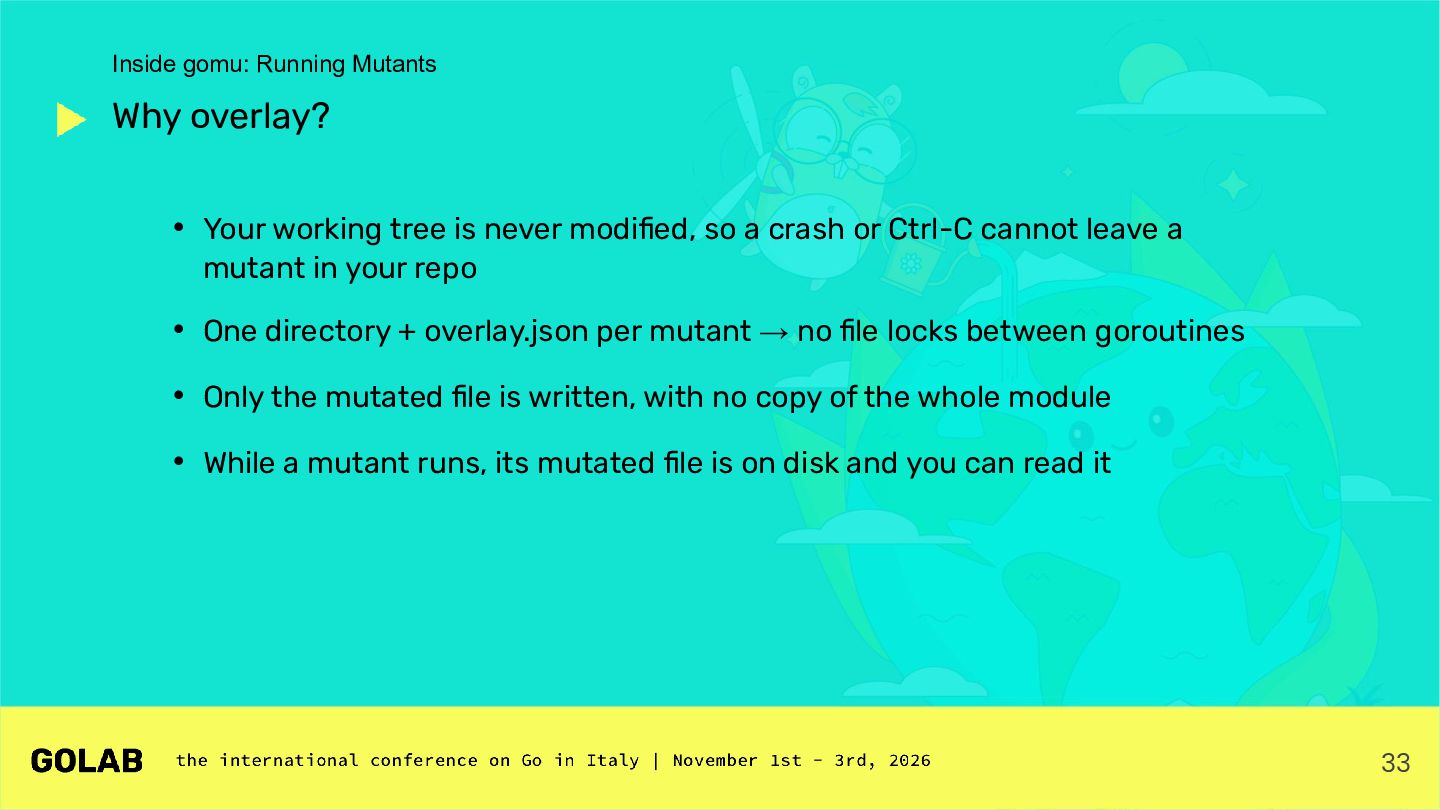
Inside gomu: Running Mutants Why overlay? • Your working tree
is never modified, so a crash or Ctrl-C cannot leave a mutant in your repo • One directory + overlay.json per mutant → no file locks between goroutines • Only the mutated file is written, with no copy of the whole module • While a mutant runs, its mutated file is on disk and you can read it 33 -
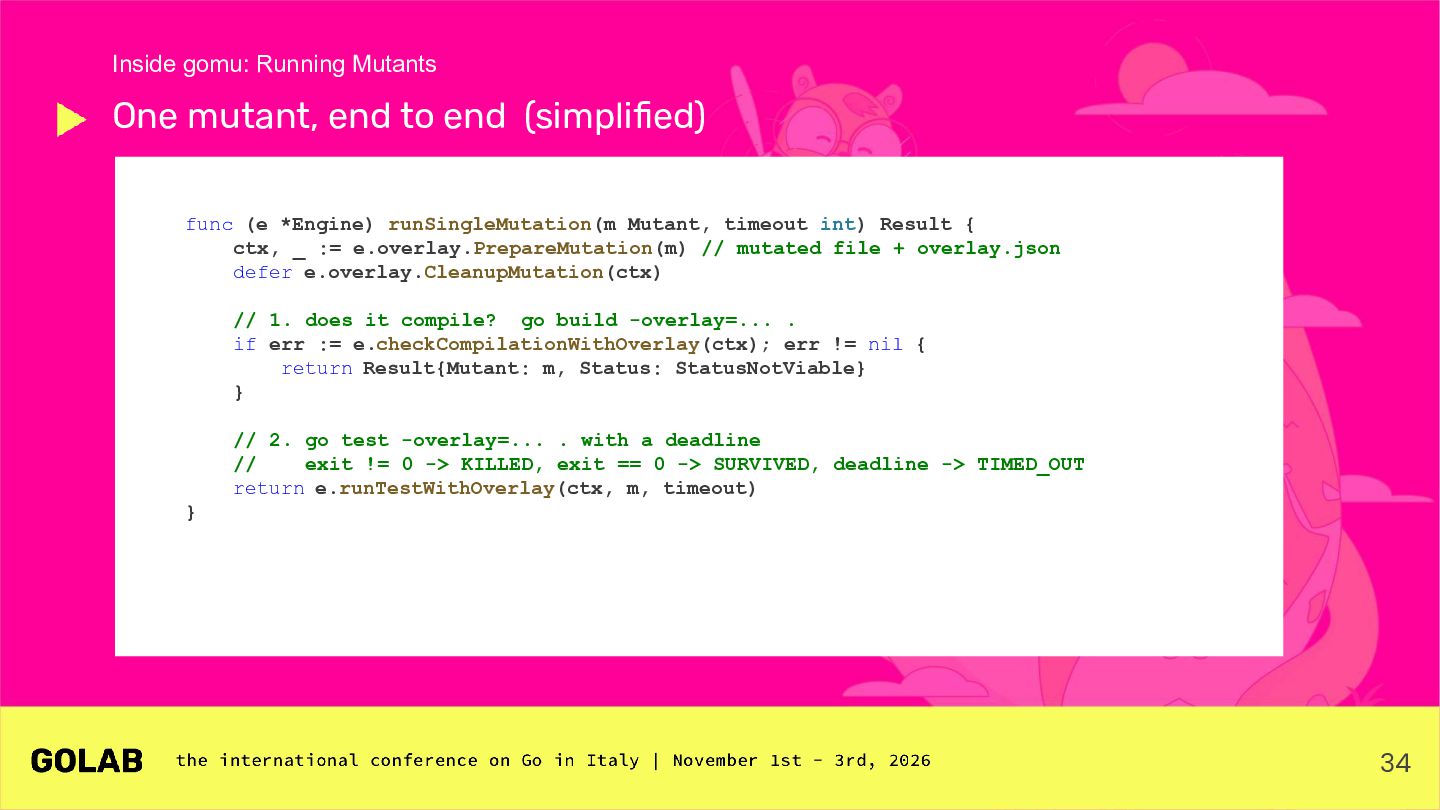
Inside gomu: Running Mutants One mutant, end to end (simplified)
func (e *Engine) runSingleMutation(m Mutant, timeout int) Result { ctx, _ := e.overlay.PrepareMutation(m) // mutated file + overlay.json defer e.overlay.CleanupMutation(ctx) // 1. does it compile? go build -overlay=... . if err := e.checkCompilationWithOverlay(ctx); err != nil { return Result{Mutant: m, Status: StatusNotViable} } // 2. go test -overlay=... . with a deadline // exit != 0 -> KILLED, exit == 0 -> SURVIVED, deadline -> TIMED_OUT return e.runTestWithOverlay(ctx, m, timeout) } 34 -
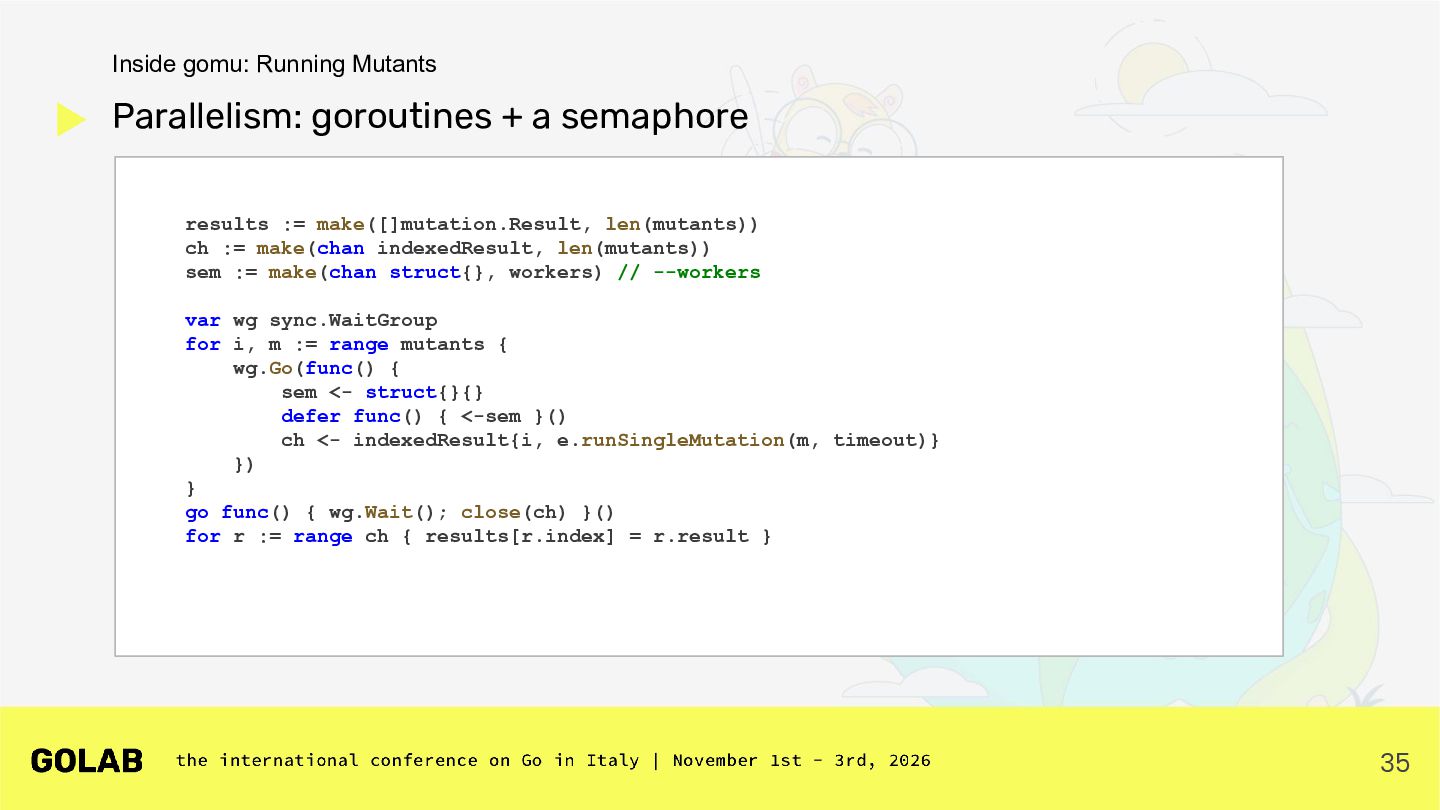
Inside gomu: Running Mutants Parallelism: goroutines + a semaphore results
:= make([]mutation.Result, len(mutants)) ch := make(chan indexedResult, len(mutants)) sem := make(chan struct{}, workers) // --workers var wg sync.WaitGroup for i, m := range mutants { wg.Go(func() { sem <- struct{}{} defer func() { <-sem }() ch <- indexedResult{i, e.runSingleMutation(m, timeout)} }) } go func() { wg.Wait(); close(ch) }() for r := range ch { results[r.index] = r.result } 35 -
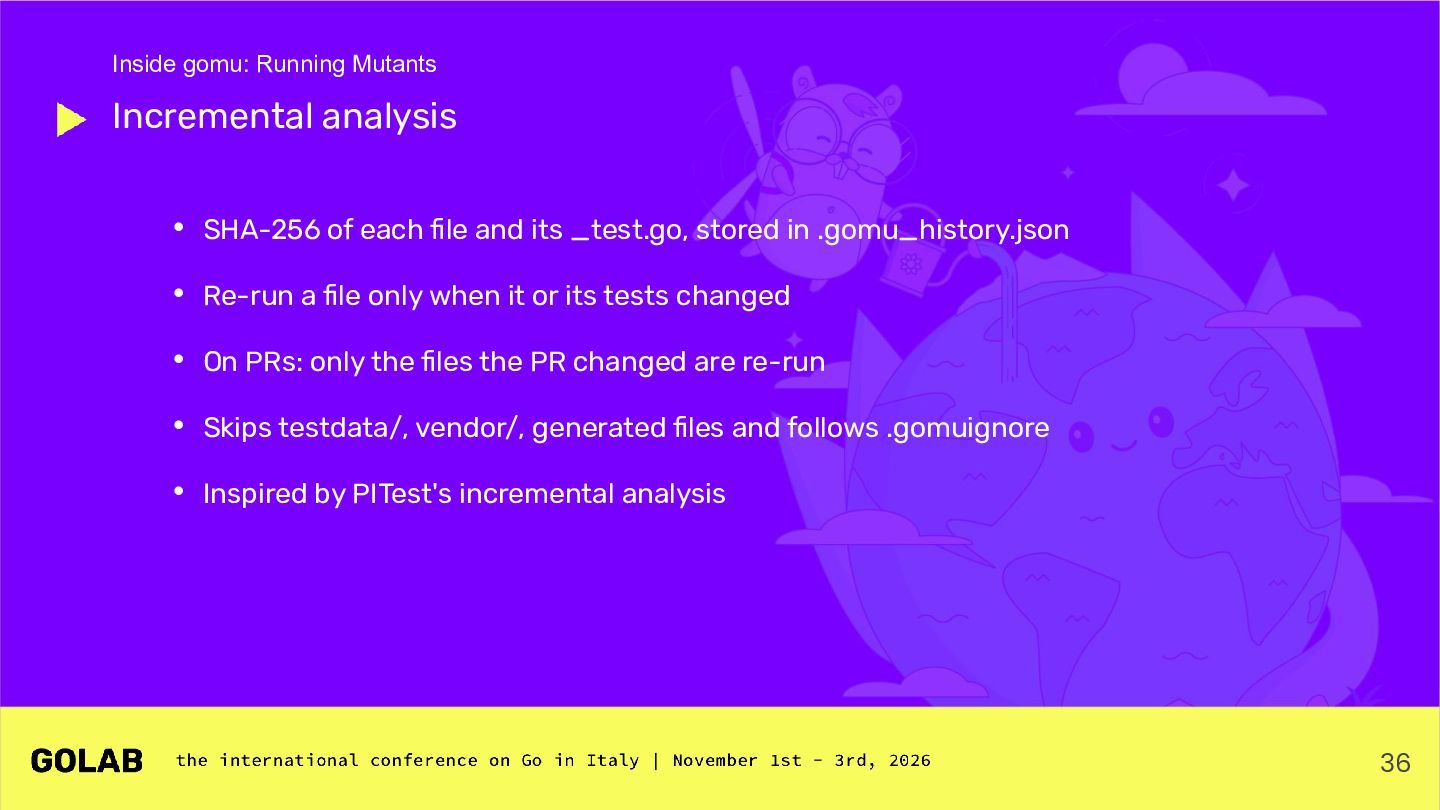
Inside gomu: Running Mutants Incremental analysis • SHA-256 of each
file and its _test.go, stored in .gomu_history.json • Re-run a file only when it or its tests changed • On PRs: only the files the PR changed are re-run • Skips testdata/, vendor/, generated files and follows .gomuignore • Inspired by PITest's incremental analysis 36 -
06 GOMU IN CI • The CLI Make test quality
a number you can review and use as a gate on every PR. • GitHub Actions & quality gate • Practical tips 37 -
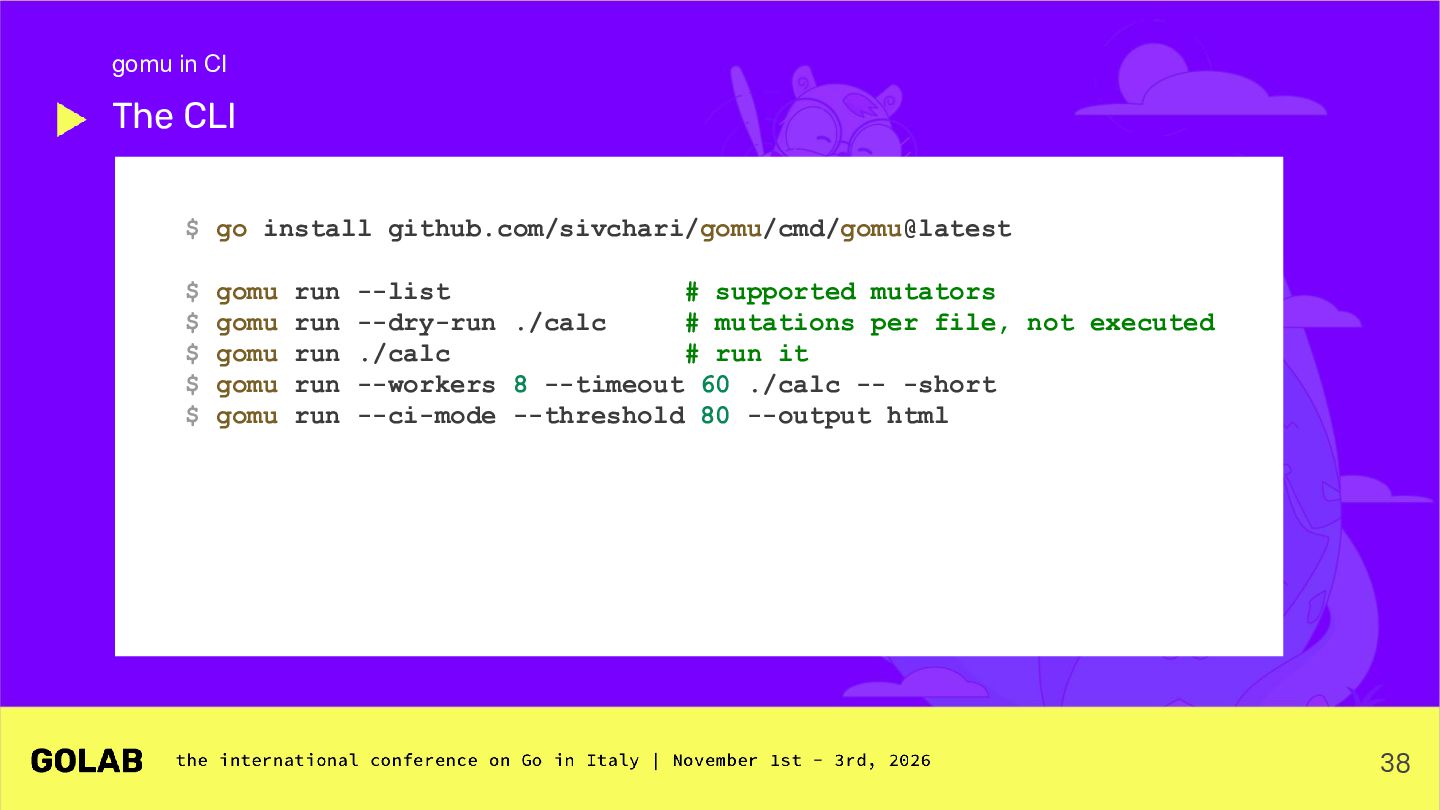
gomu in CI The CLI $ go install github.com/sivchari/gomu/cmd/gomu@latest $
gomu run --list # supported mutators $ gomu run --dry-run ./calc # mutations per file, not executed $ gomu run ./calc # run it $ gomu run --workers 8 --timeout 60 ./calc -- -short $ gomu run --ci-mode --threshold 80 --output html 38 -
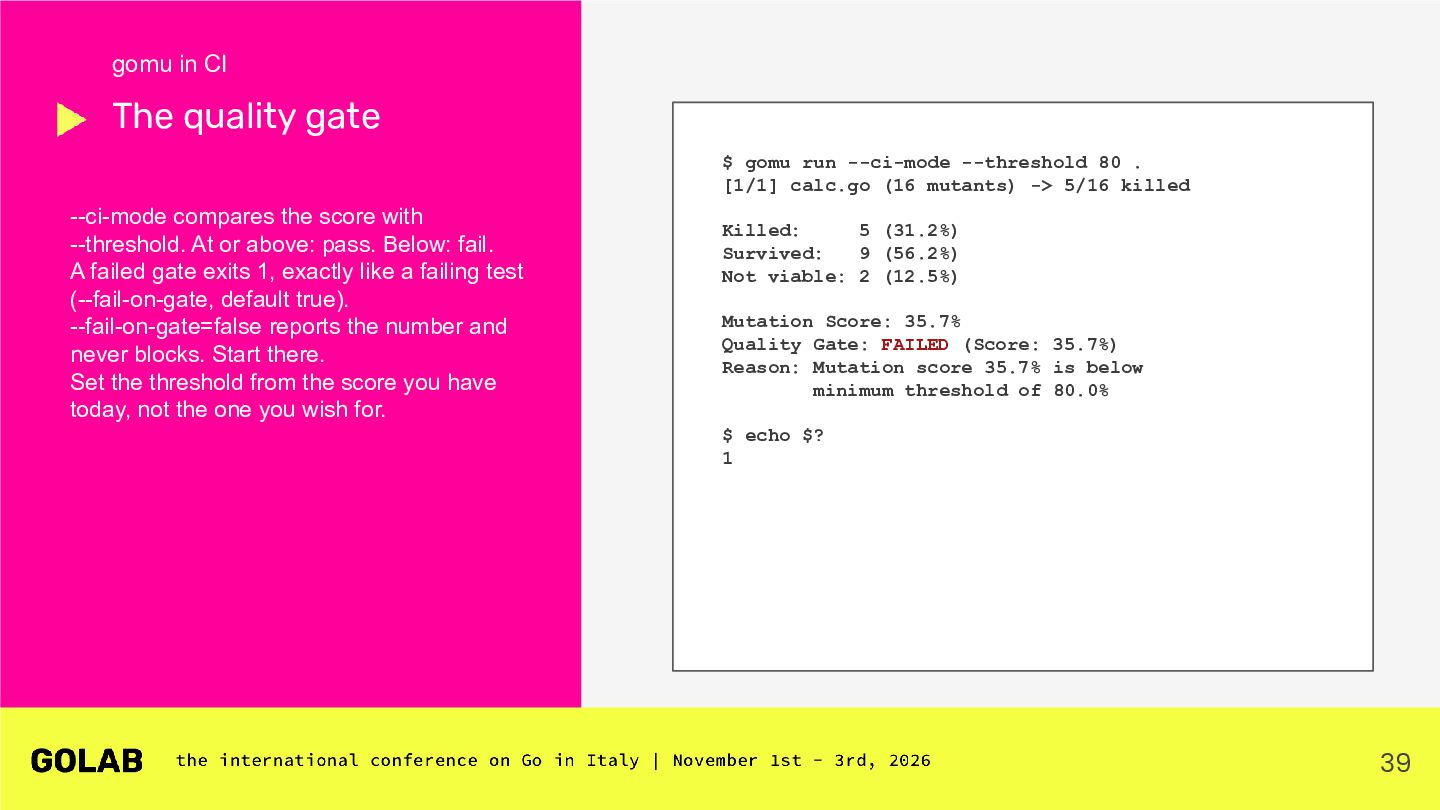
gomu in CI The quality gate $ gomu run --ci-mode
--threshold 80 . [1/1] calc.go (16 mutants) -> 5/16 killed --ci-mode compares the score with --threshold. At or above: pass. Below: fail. A failed gate exits 1, exactly like a failing test (--fail-on-gate, default true). --fail-on-gate=false reports the number and never blocks. Start there. Set the threshold from the score you have today, not the one you wish for. Killed: 5 (31.2%) Survived: 9 (56.2%) Not viable: 2 (12.5%) Mutation Score: 35.7% Quality Gate: FAILED (Score: 35.7%) Reason: Mutation score 35.7% is below minimum threshold of 80.0% $ echo $? 1 39 -
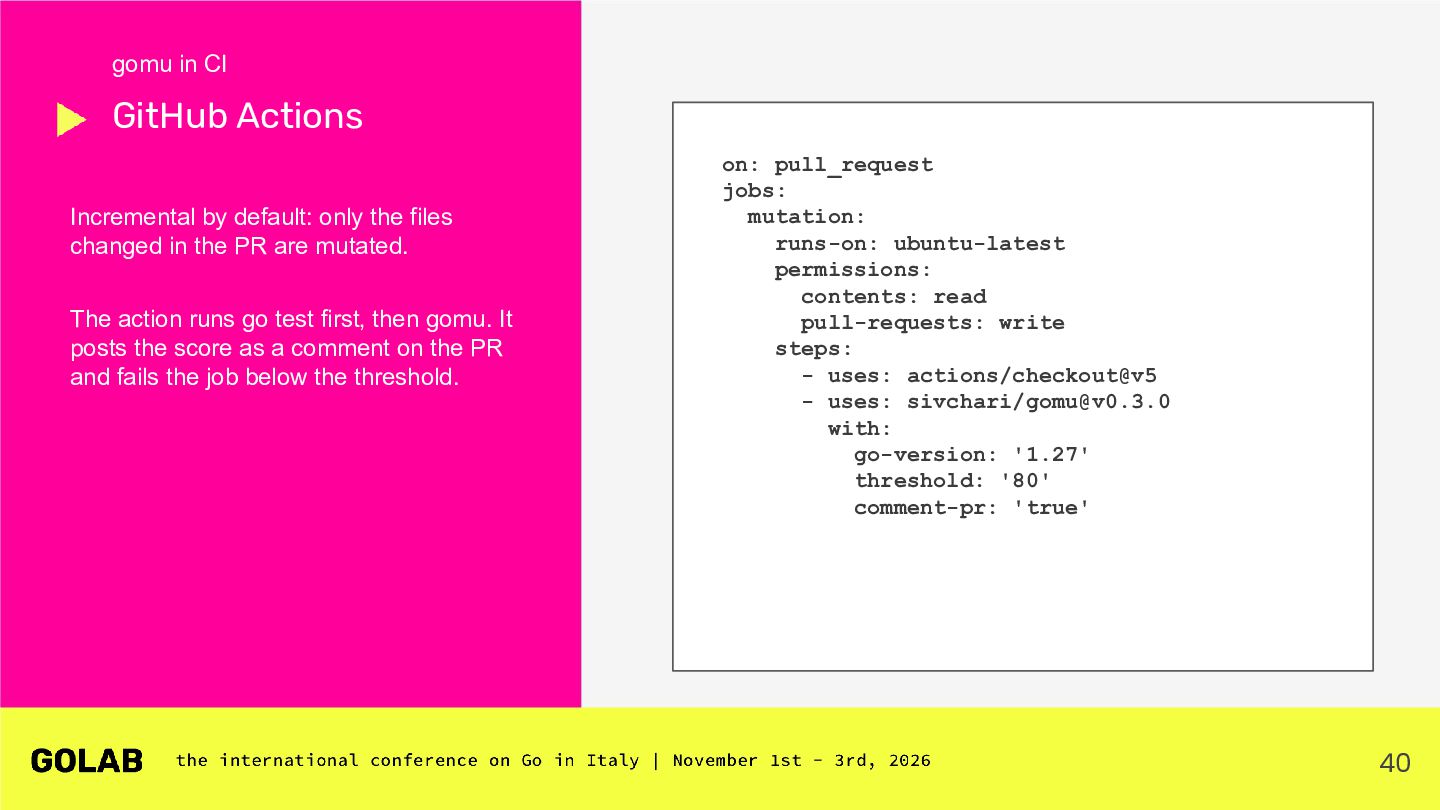
gomu in CI GitHub Actions Incremental by default: only the
files changed in the PR are mutated. The action runs go test first, then gomu. It posts the score as a comment on the PR and fails the job below the threshold. on: pull_request jobs: mutation: runs-on: ubuntu-latest permissions: contents: read pull-requests: write steps: - uses: actions/checkout@v5 - uses: sivchari/[email protected] with: go-version: '1.27' threshold: '80' comment-pr: 'true' 40 -
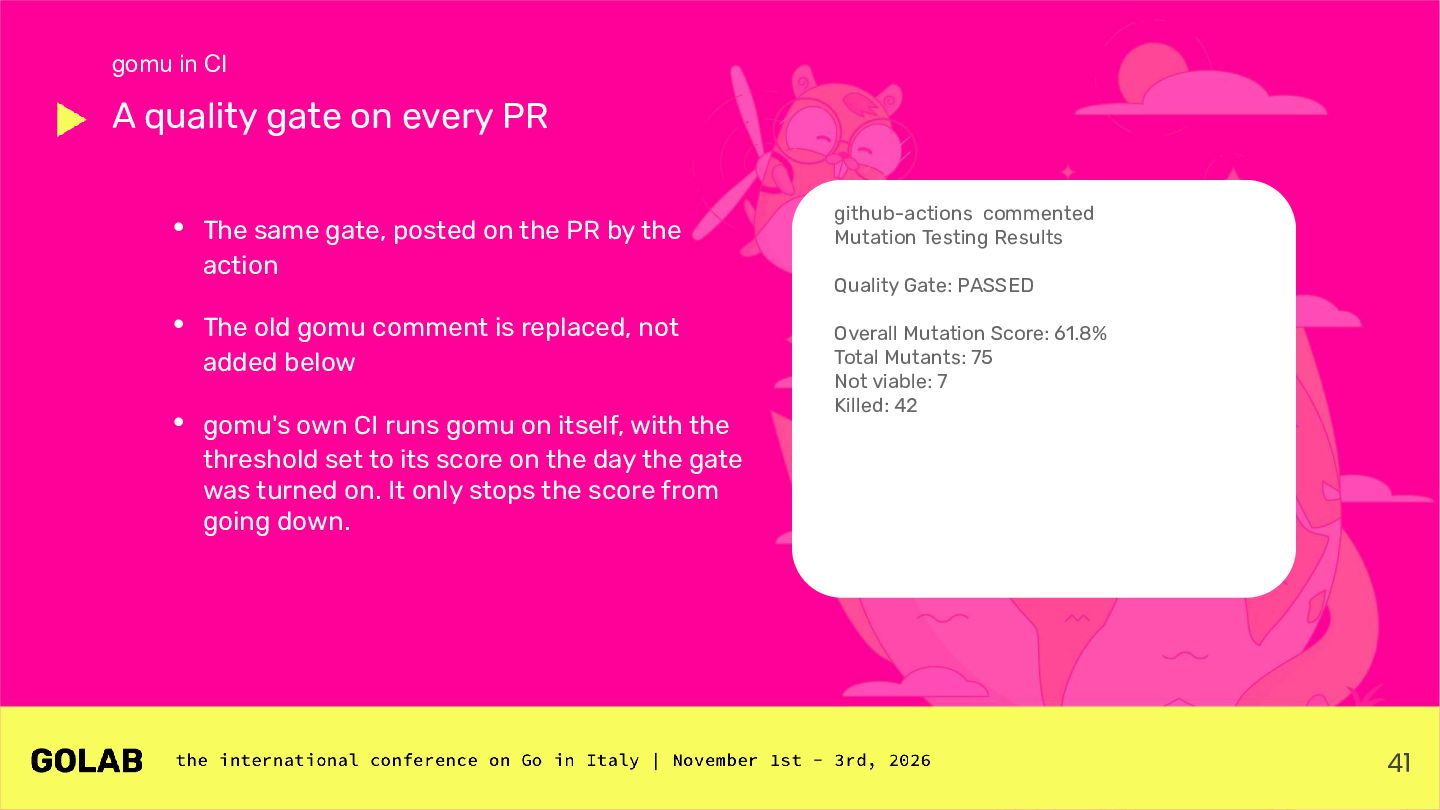
gomu in CI A quality gate on every PR •
The same gate, posted on the PR by the action • The old gomu comment is replaced, not added below • gomu's own CI runs gomu on itself, with the github-actions commented Mutation Testing Results Quality Gate: PASSED Overall Mutation Score: 61.8% Total Mutants: 75 Not viable: 7 Killed: 42 threshold set to its score on the day the gate was turned on. It only stops the score from going down. 41 -
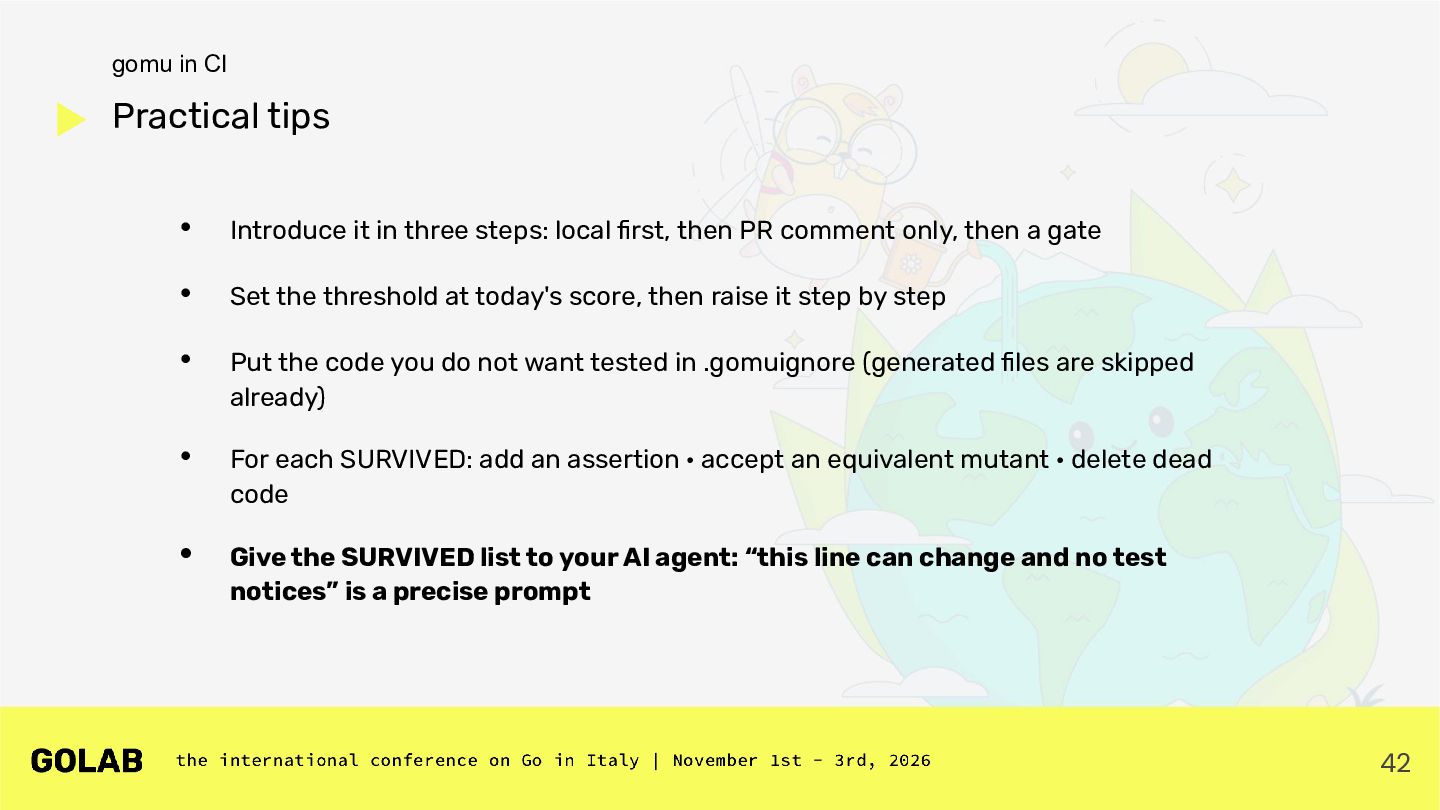
gomu in CI Practical tips • Introduce it in three
steps: local first, then PR comment only, then a gate • Set the threshold at today's score, then raise it step by step • • • Put the code you do not want tested in .gomuignore (generated files are skipped already) For each SURVIVED: add an assertion · accept an equivalent mutant · delete dead code Give the SURVIVED list to your AI agent: “this line can change and no test notices” is a precise prompt 42 -
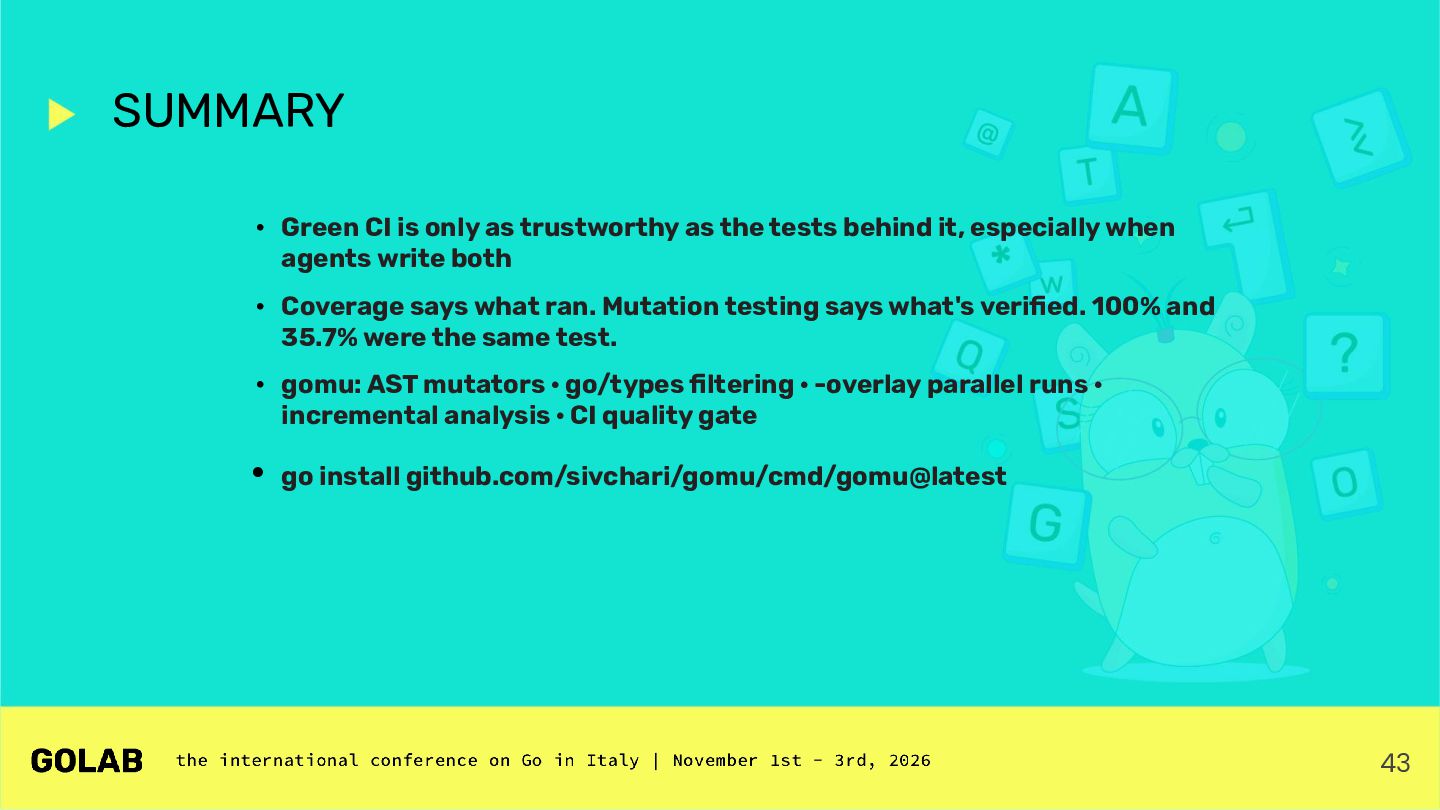
SUMMARY • Green CI is only as trustworthy as the
tests behind it, especially when agents write both • Coverage says what ran. Mutation testing says what's verified. 100% and 35.7% were the same test. • gomu: AST mutators · go/types filtering · -overlay parallel runs · incremental analysis · CI quality gate • go install github.com/sivchari/gomu/cmd/gomu@latest 43 -
Thank you! Grazie! ありがとう! GOLAB the international conference on Go
in Italy | November 1st - 3rd, 2026 4444 -
TAKUMA SHIBUYA @sivchari github.com/sivchari/gomu GOLAB the international conference on Go
in Italy | November 1st - 3rd, 2026 4545
 sivchari
 lynnandtonic
 inesmontani
 davidcarrasco
 eileencodes
 carmenintech
 aarron
 wjessup
 aleyda
 brad_frost
 katarinadahlin
 ryanjones
 bluesmoon