Upgrade to Pro — share decks privately, control downloads, hide ads and more …

python networkregulations

Avatar for sl0 sl0
May 30, 2013

python networkregulations

use python to get help on iptables and to generate ip6tables

Avatar for sl0

sl0

May 30, 2013

Other Decks in Programming

Transcript

  1. python networkstuff . . . Johannes Hubertz pycologne.de OpenChaos –

    Köln, 30. Mai 2013 Johannes Hubertz (pycologne.de) python networkstuff . . . OpenChaos – Köln, 30. Mai 2013 1 / 20
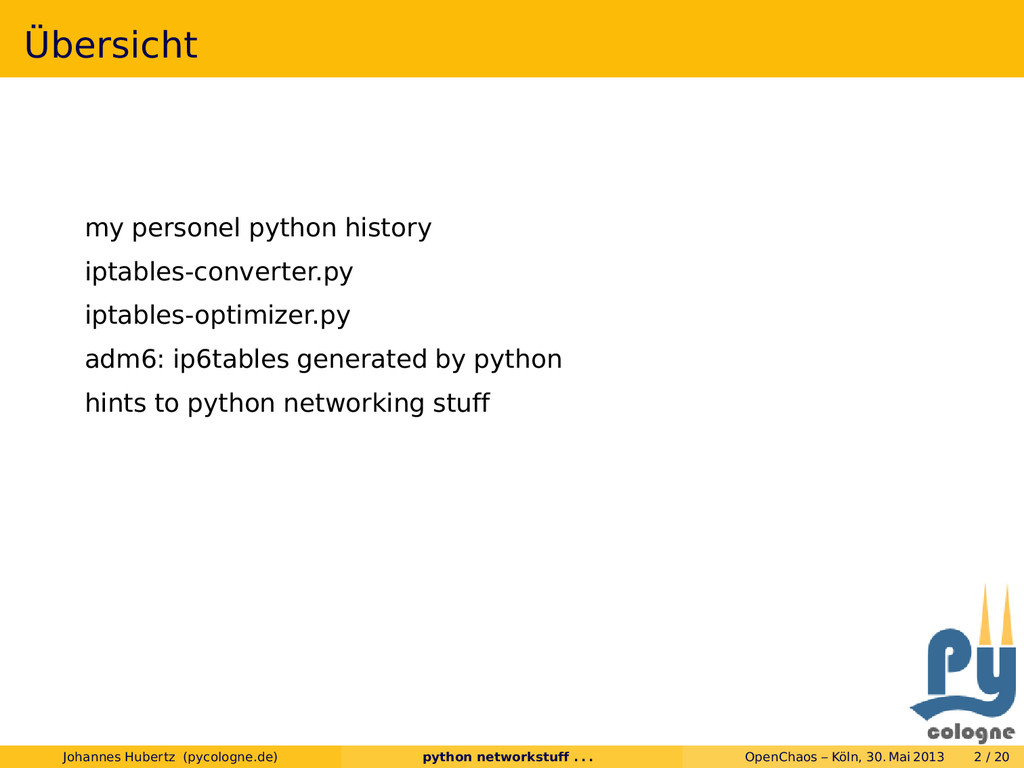
  2. Übersicht my personel python history iptables-converter.py iptables-optimizer.py adm6: ip6tables generated

    by python hints to python networking stuff Johannes Hubertz (pycologne.de) python networkstuff . . . OpenChaos – Köln, 30. Mai 2013 2 / 20
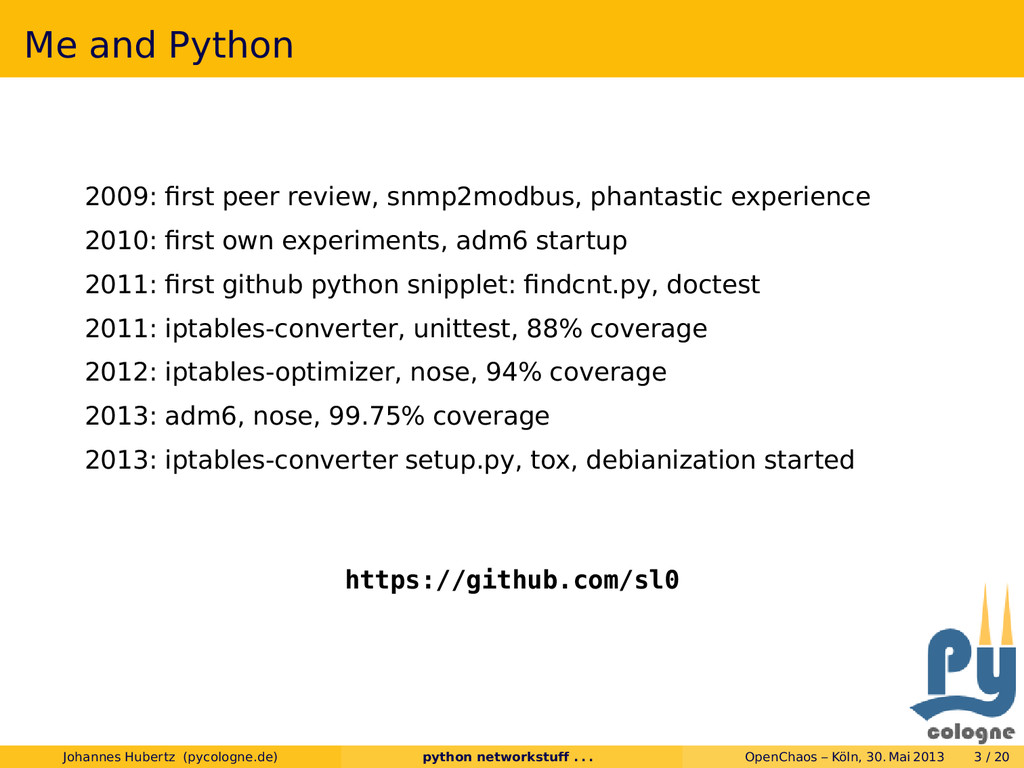
  3. Me and Python 2009: first peer review, snmp2modbus, phantastic experience

    2010: first own experiments, adm6 startup 2011: first github python snipplet: findcnt.py, doctest 2011: iptables-converter, unittest, 88% coverage 2012: iptables-optimizer, nose, 94% coverage 2013: adm6, nose, 99.75% coverage 2013: iptables-converter setup.py, tox, debianization started https://github.com/sl0 Johannes Hubertz (pycologne.de) python networkstuff . . . OpenChaos – Köln, 30. Mai 2013 3 / 20
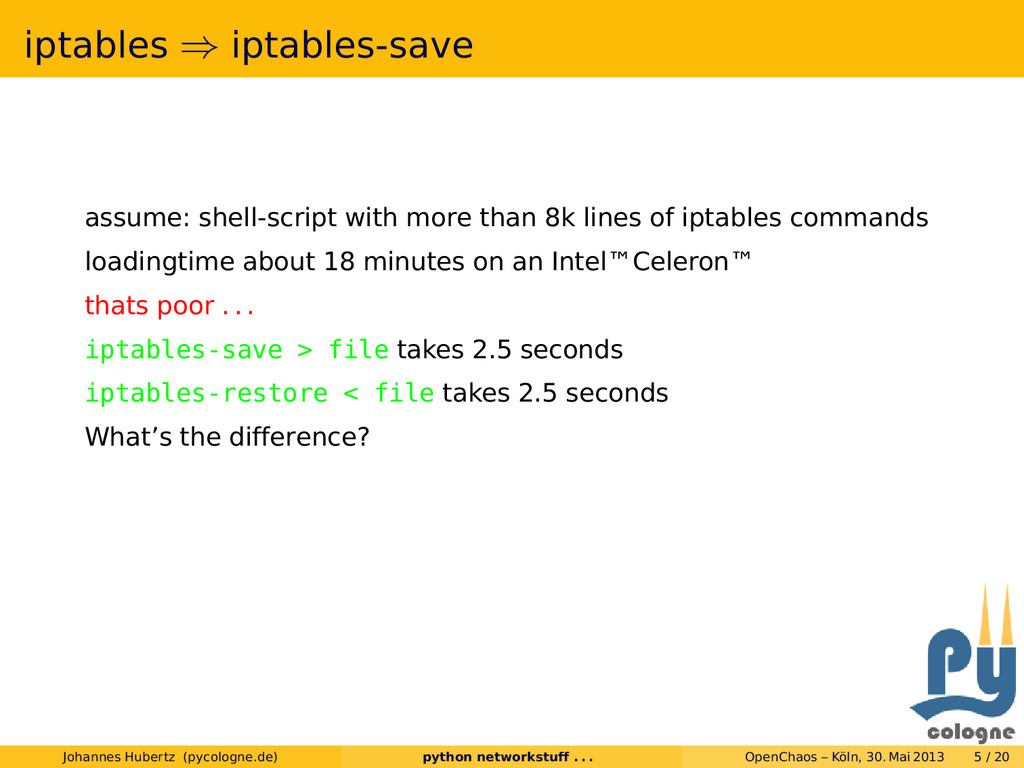
  4. iptables ⇒ iptables-save assume: shell-script with more than 8k lines

    of iptables commands loadingtime about 18 minutes on an Intel™Celeron™ thats poor . . . iptables-save > file takes 2.5 seconds iptables-restore < file takes 2.5 seconds What’s the difference? Johannes Hubertz (pycologne.de) python networkstuff . . . OpenChaos – Köln, 30. Mai 2013 5 / 20
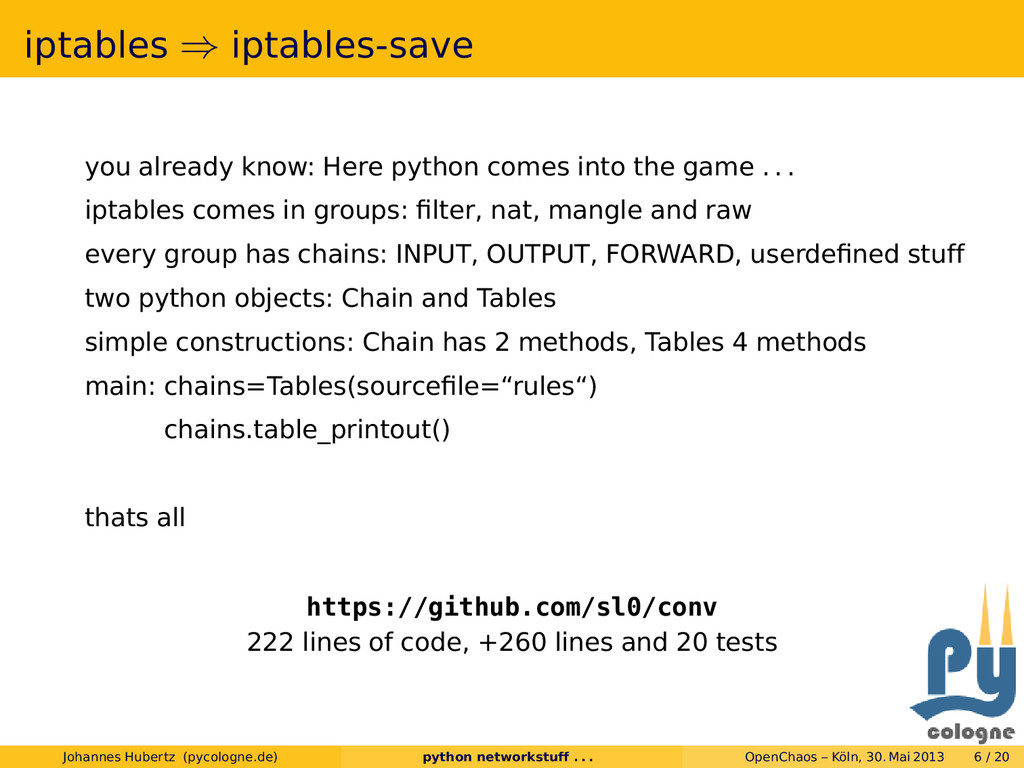
  5. iptables ⇒ iptables-save you already know: Here python comes into

    the game . . . iptables comes in groups: filter, nat, mangle and raw every group has chains: INPUT, OUTPUT, FORWARD, userdefined stuff two python objects: Chain and Tables simple constructions: Chain has 2 methods, Tables 4 methods main: chains=Tables(sourcefile=“rules“) main: chains.table_printout() thats all https://github.com/sl0/conv 222 lines of code, +260 lines and 20 tests Johannes Hubertz (pycologne.de) python networkstuff . . . OpenChaos – Köln, 30. Mai 2013 6 / 20
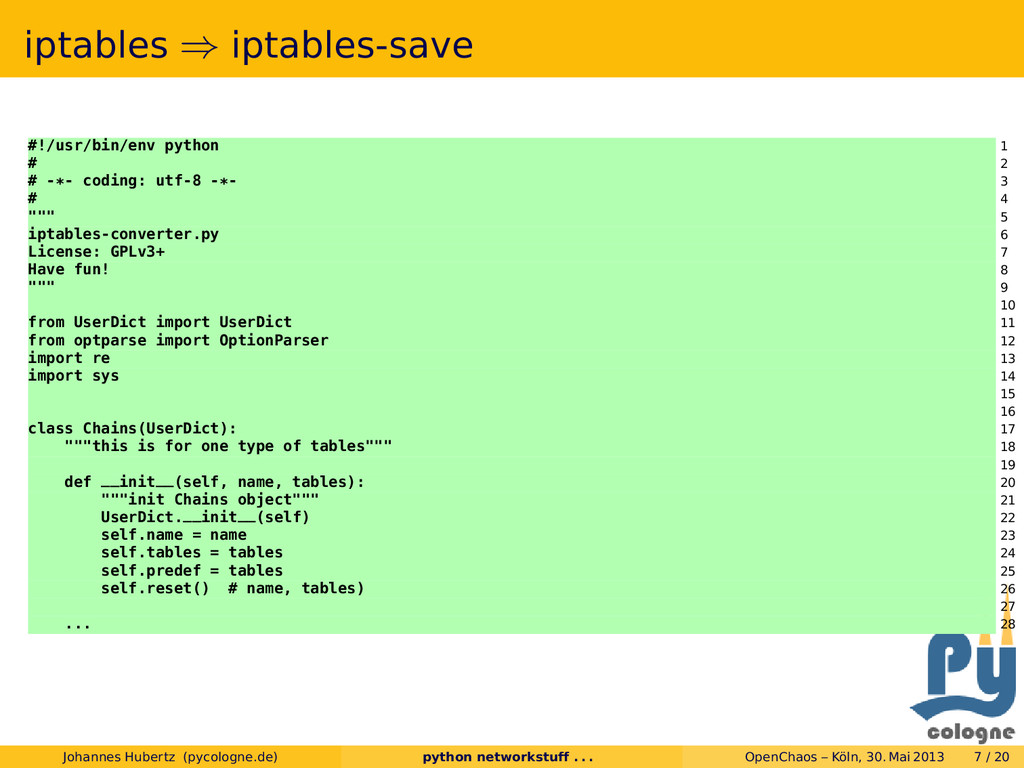
  6. iptables ⇒ iptables-save 1 #!/usr/bin/env python 2 # 3 #

    -*- coding: utf-8 -*- 4 # 5 """ 6 iptables-converter.py 7 License: GPLv3+ 8 Have fun! 9 """ 10 11 from UserDict import UserDict 12 from optparse import OptionParser 13 import re 14 import sys 15 16 17 class Chains(UserDict): 18 """this is for one type of tables""" 19 20 def __init__(self, name, tables): 21 """init Chains object""" 22 UserDict.__init__(self) 23 self.name = name 24 self.tables = tables 25 self.predef = tables 26 self.reset() # name, tables) 27 28 ... Johannes Hubertz (pycologne.de) python networkstuff . . . OpenChaos – Köln, 30. Mai 2013 7 / 20
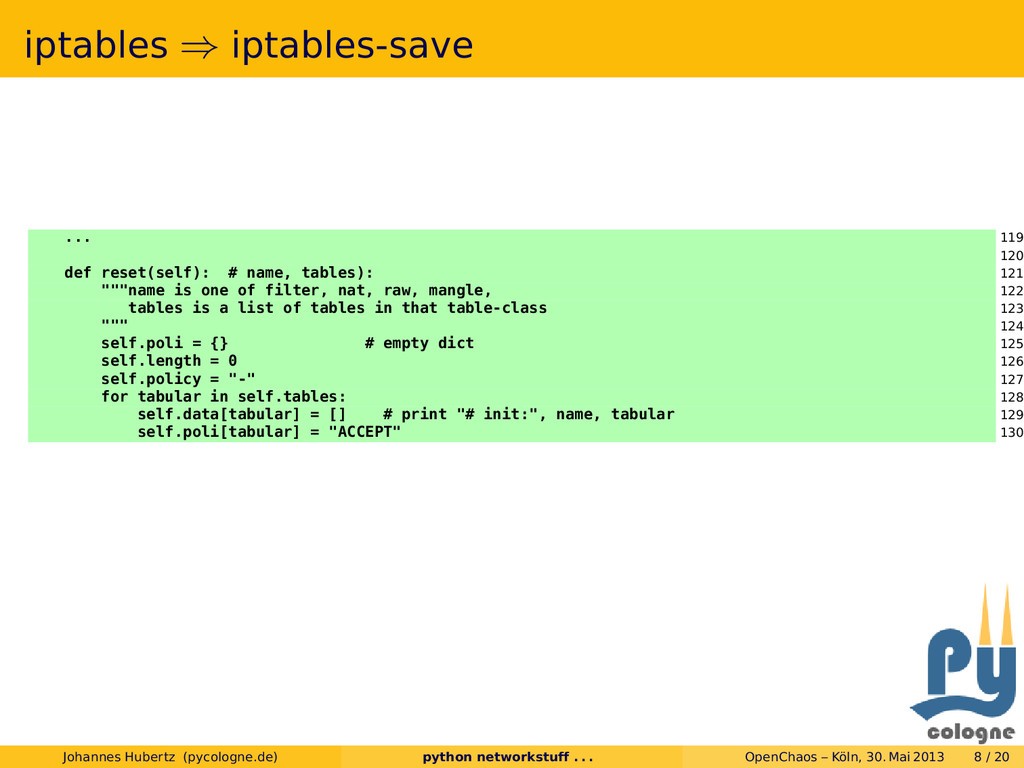
  7. iptables ⇒ iptables-save 119 ... 120 121 def reset(self): #

    name, tables): 122 """name is one of filter, nat, raw, mangle, 123 tables is a list of tables in that table-class 124 """ 125 self.poli = {} # empty dict 126 self.length = 0 127 self.policy = "-" 128 for tabular in self.tables: 129 self.data[tabular] = [] # print "# init:", name, tabular 130 self.poli[tabular] = "ACCEPT" Johannes Hubertz (pycologne.de) python networkstuff . . . OpenChaos – Köln, 30. Mai 2013 8 / 20
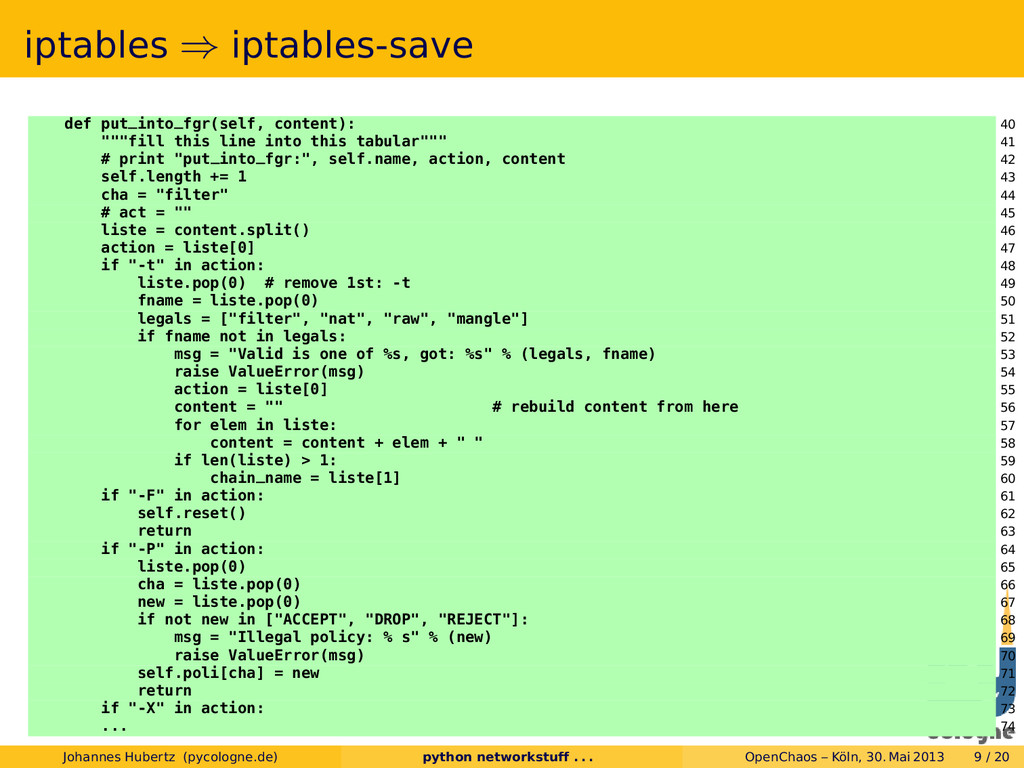
  8. iptables ⇒ iptables-save 40 def put_into_fgr(self, content): 41 """fill this

    line into this tabular""" 42 # print "put_into_fgr:", self.name, action, content 43 self.length += 1 44 cha = "filter" 45 # act = "" 46 liste = content.split() 47 action = liste[0] 48 if "-t" in action: 49 liste.pop(0) # remove 1st: -t 50 fname = liste.pop(0) 51 legals = ["filter", "nat", "raw", "mangle"] 52 if fname not in legals: 53 msg = "Valid is one of %s, got: %s" % (legals, fname) 54 raise ValueError(msg) 55 action = liste[0] 56 content = "" # rebuild content from here 57 for elem in liste: 58 content = content + elem + " " 59 if len(liste) > 1: 60 chain_name = liste[1] 61 if "-F" in action: 62 self.reset() 63 return 64 if "-P" in action: 65 liste.pop(0) 66 cha = liste.pop(0) 67 new = liste.pop(0) 68 if not new in ["ACCEPT", "DROP", "REJECT"]: 69 msg = "Illegal policy: % s" % (new) 70 raise ValueError(msg) 71 self.poli[cha] = new 72 return 73 if "-X" in action: 74 ... Johannes Hubertz (pycologne.de) python networkstuff . . . OpenChaos – Köln, 30. Mai 2013 9 / 20
  9. iptables ⇒ iptables sorted by usage What? Johannes Hubertz (pycologne.de)

    python networkstuff . . . OpenChaos – Köln, 30. Mai 2013 10 / 20
  10. iptables ⇒ iptables sorted by usage assume: shell-script with more

    than 8k lines of iptables commands having more than one machine in the chain to the internet ⇒ latency thats poor . . . have a close look into the chains: mostly unused . . . have a close look into the chains: mostly unused, but all needed! Think! Johannes Hubertz (pycologne.de) python networkstuff . . . OpenChaos – Köln, 30. Mai 2013 11 / 20
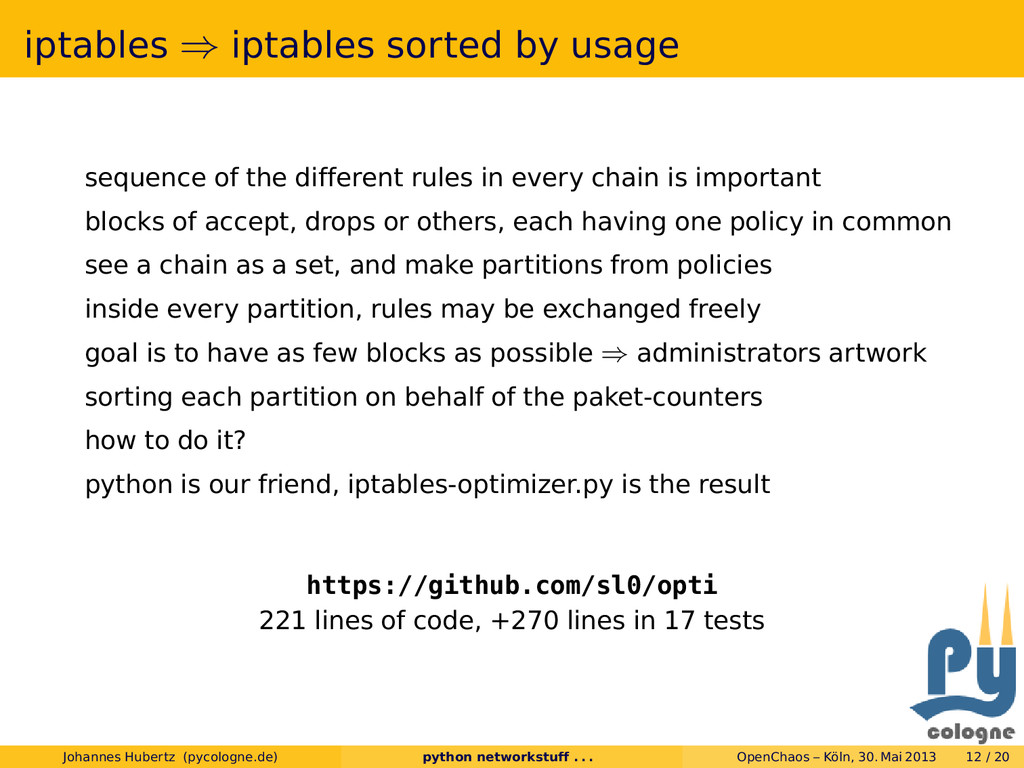
  11. iptables ⇒ iptables sorted by usage sequence of the different

    rules in every chain is important blocks of accept, drops or others, each having one policy in common see a chain as a set, and make partitions from policies inside every partition, rules may be exchanged freely goal is to have as few blocks as possible ⇒ administrators artwork sorting each partition on behalf of the paket-counters how to do it? python is our friend, iptables-optimizer.py is the result https://github.com/sl0/opti 221 lines of code, +270 lines in 17 tests Johannes Hubertz (pycologne.de) python networkstuff . . . OpenChaos – Köln, 30. Mai 2013 12 / 20
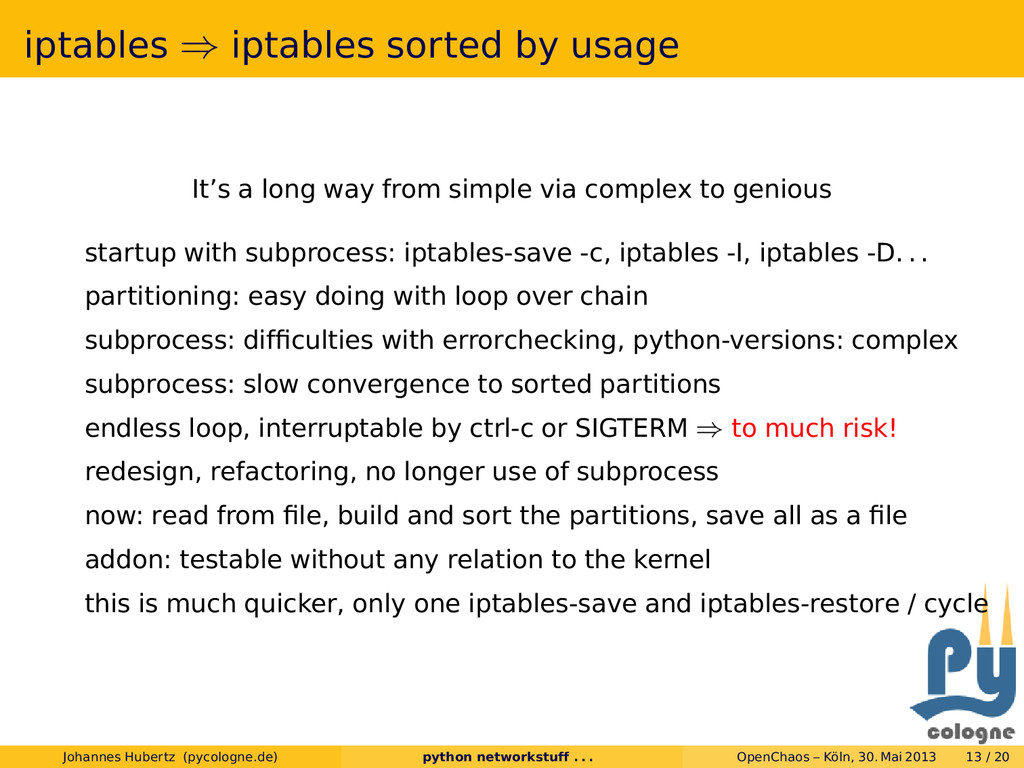
  12. iptables ⇒ iptables sorted by usage It’s a long way

    from simple via complex to genious startup with subprocess: iptables-save -c, iptables -I, iptables -D. . . partitioning: easy doing with loop over chain subprocess: difficulties with errorchecking, python-versions: complex subprocess: slow convergence to sorted partitions endless loop, interruptable by ctrl-c or SIGTERM ⇒ to much risk! redesign, refactoring, no longer use of subprocess now: read from file, build and sort the partitions, save all as a file addon: testable without any relation to the kernel this is much quicker, only one iptables-save and iptables-restore / cycle Johannes Hubertz (pycologne.de) python networkstuff . . . OpenChaos – Köln, 30. Mai 2013 13 / 20
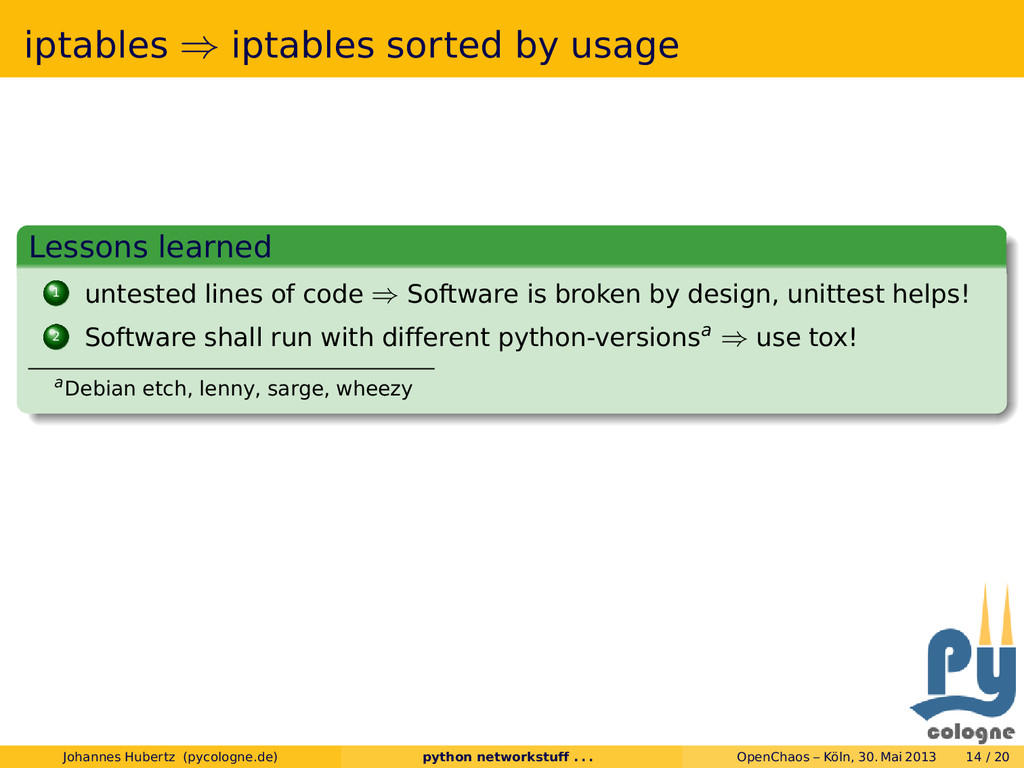
  13. iptables ⇒ iptables sorted by usage Lessons learned 1 untested

    lines of code ⇒ Software is broken by design, unittest helps! 2 Software shall run with different python-versionsa ⇒ use tox! aDebian etch, lenny, sarge, wheezy Johannes Hubertz (pycologne.de) python networkstuff . . . OpenChaos – Köln, 30. Mai 2013 14 / 20
  14. adm6: ⇒ ip6tables generated by python What? Johannes Hubertz (pycologne.de)

    python networkstuff . . . OpenChaos – Köln, 30. Mai 2013 15 / 20
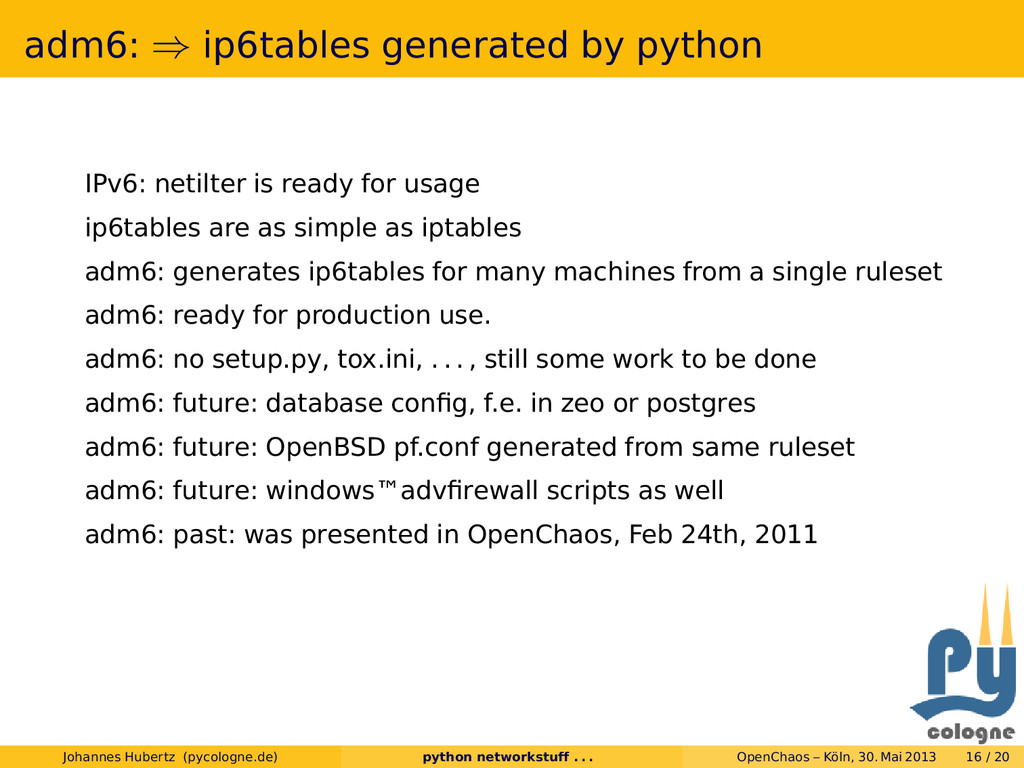
  15. adm6: ⇒ ip6tables generated by python IPv6: netilter is ready

    for usage ip6tables are as simple as iptables adm6: generates ip6tables for many machines from a single ruleset adm6: ready for production use. adm6: no setup.py, tox.ini, . . . , still some work to be done adm6: future: database config, f.e. in zeo or postgres adm6: future: OpenBSD pf.conf generated from same ruleset adm6: future: windows™advfirewall scripts as well adm6: past: was presented in OpenChaos, Feb 24th, 2011 Johannes Hubertz (pycologne.de) python networkstuff . . . OpenChaos – Köln, 30. Mai 2013 16 / 20
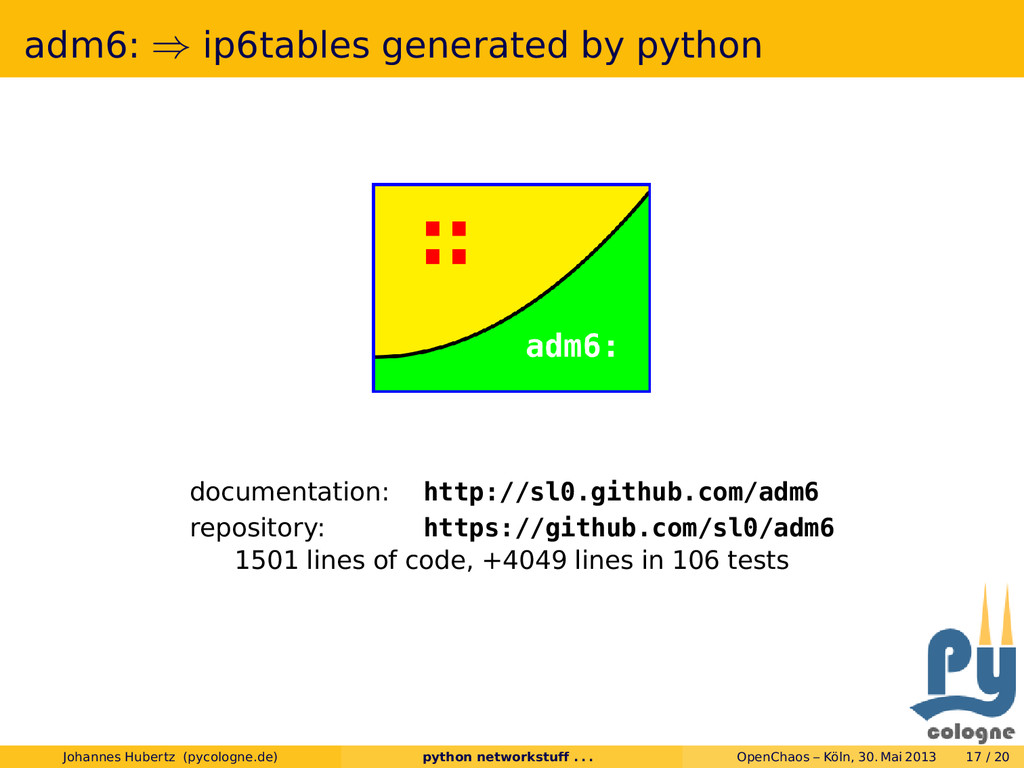
  16. adm6: ⇒ ip6tables generated by python documentation: http://sl0.github.com/adm6 repository: https://github.com/sl0/adm6

    1501 lines of code, +4049 lines in 106 tests Johannes Hubertz (pycologne.de) python networkstuff . . . OpenChaos – Köln, 30. Mai 2013 17 / 20
  17. stuff ⇔ whats where and other useless info What’s up?

    Johannes Hubertz (pycologne.de) python networkstuff . . . OpenChaos – Köln, 30. Mai 2013 18 / 20
  18. stuff ⇔ whats where and other useless info 1 Python

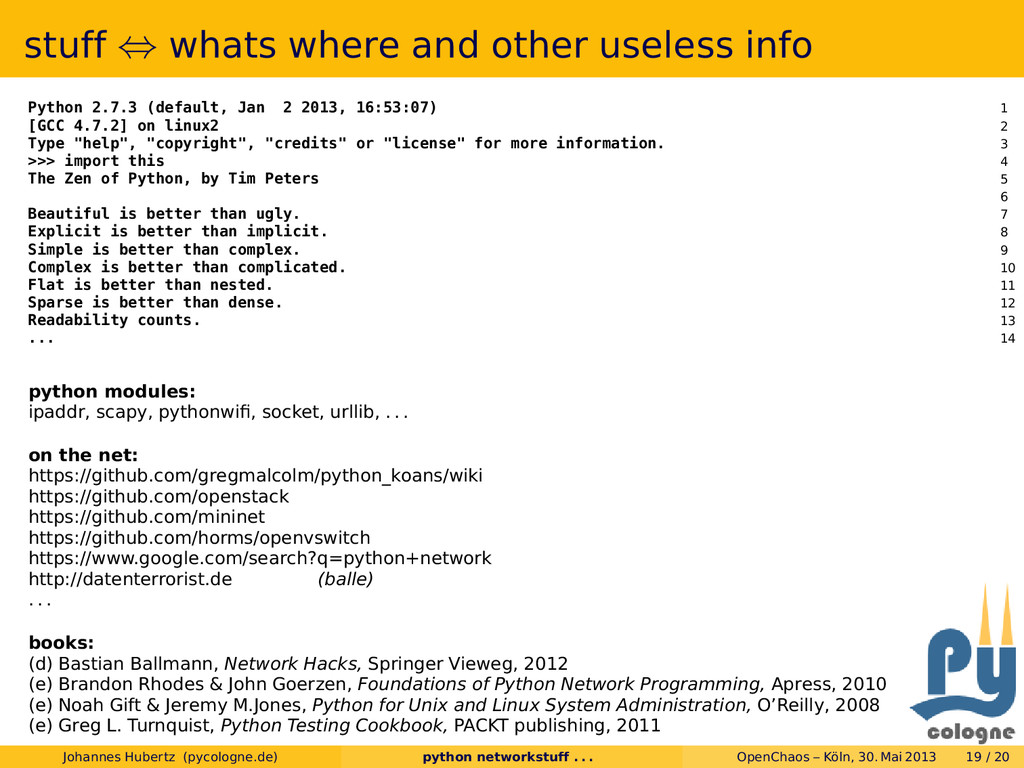
    2.7.3 (default, Jan 2 2013, 16:53:07) 2 [GCC 4.7.2] on linux2 3 Type "help", "copyright", "credits" or "license" for more information. 4 >>> import this 5 The Zen of Python, by Tim Peters 6 7 Beautiful is better than ugly. 8 Explicit is better than implicit. 9 Simple is better than complex. 10 Complex is better than complicated. 11 Flat is better than nested. 12 Sparse is better than dense. 13 Readability counts. 14 ... python modules: ipaddr, scapy, pythonwifi, socket, urllib, . . . on the net: https://github.com/gregmalcolm/python_koans/wiki https://github.com/openstack https://github.com/mininet https://github.com/horms/openvswitch https://www.google.com/search?q=python+network http://datenterrorist.de (balle) . . . books: (d) Bastian Ballmann, Network Hacks, Springer Vieweg, 2012 (e) Brandon Rhodes & John Goerzen, Foundations of Python Network Programming, Apress, 2010 (e) Noah Gift & Jeremy M.Jones, Python for Unix and Linux System Administration, O’Reilly, 2008 (e) Greg L. Turnquist, Python Testing Cookbook, PACKT publishing, 2011 Johannes Hubertz (pycologne.de) python networkstuff . . . OpenChaos – Köln, 30. Mai 2013 19 / 20
  19. thank you for listening Questions? As shown, the following is

    featured with python as well: reliable networks for trustworthy communications happy working Johannes Hubertz sl0.self_at_googlemail dot com powered by L ATEX2ε and PSTricks Johannes Hubertz (pycologne.de) python networkstuff . . . OpenChaos – Köln, 30. Mai 2013 20 / 20