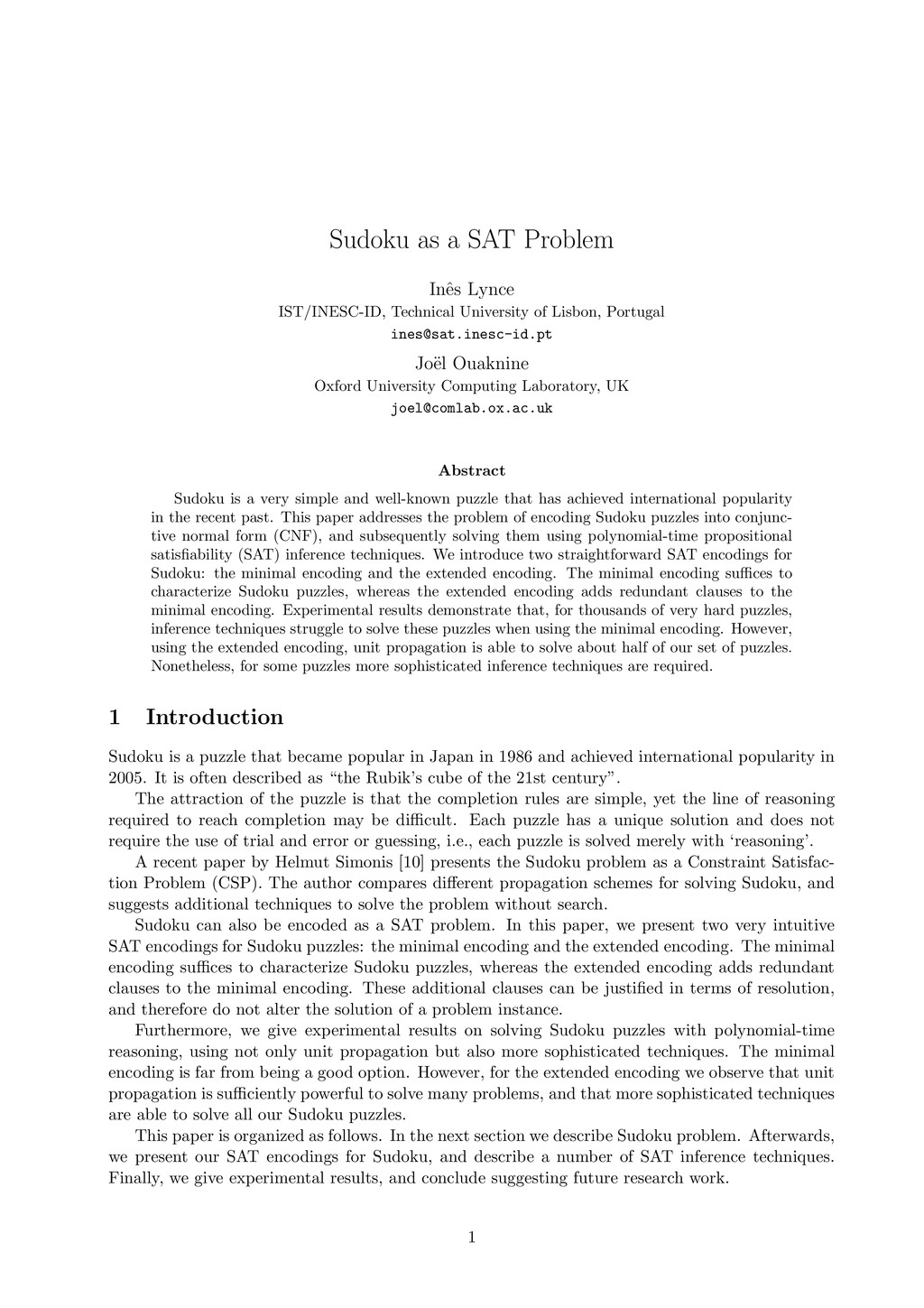
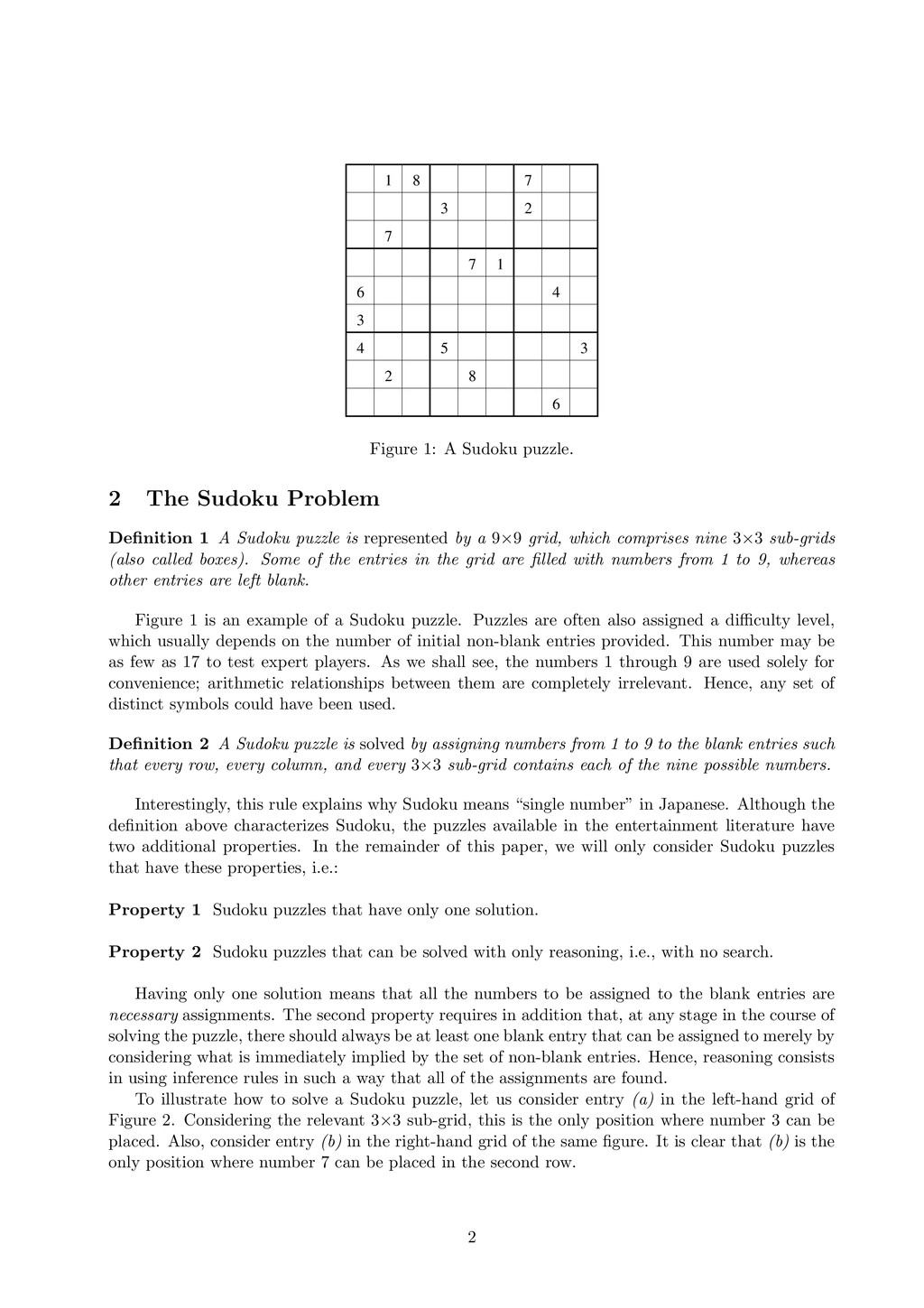
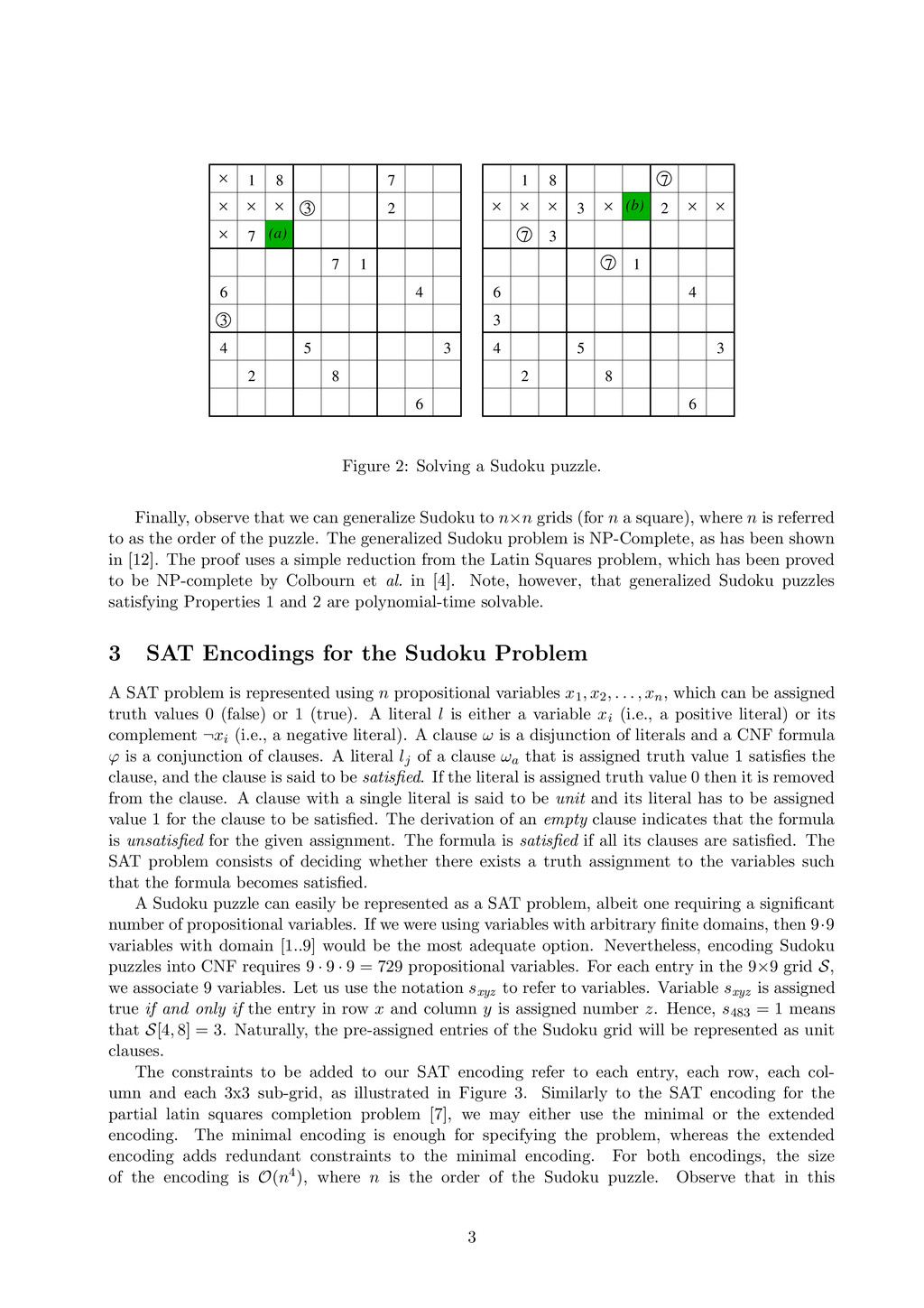
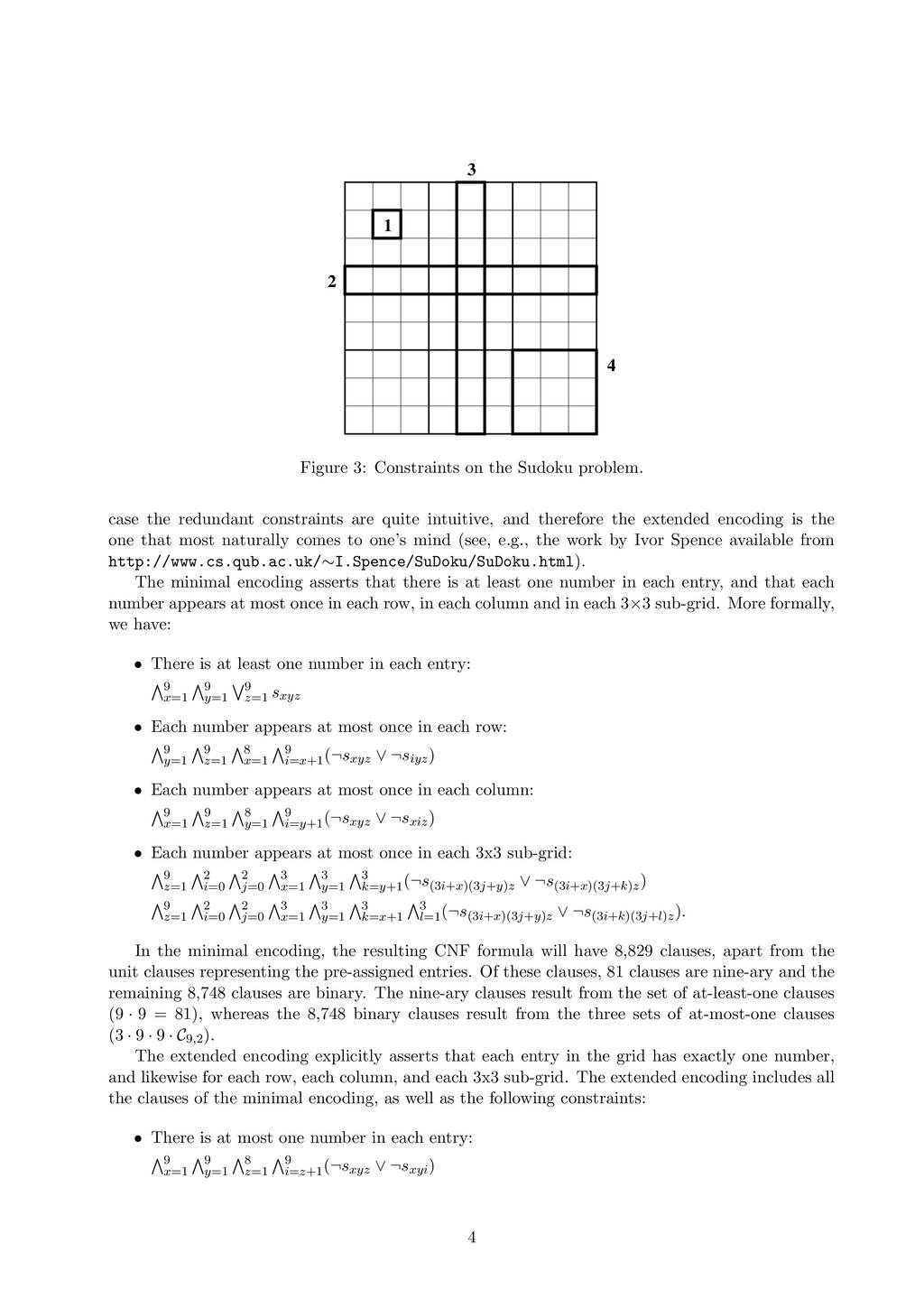
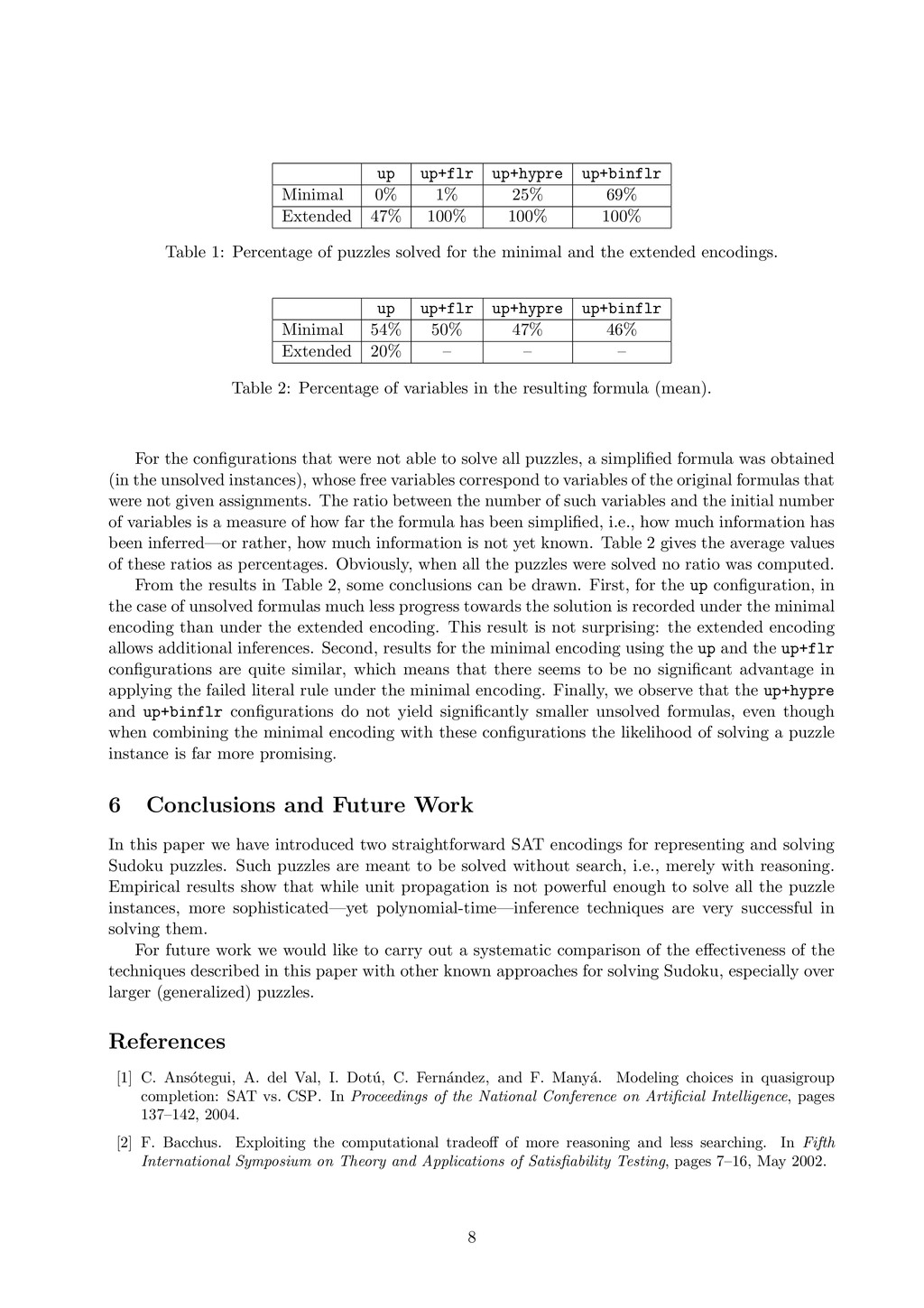
9 y=1 9 z=1 9 x=1 sxyz • Each number appears at least once in each column: 9 x=1 9 z=1 9 y=1 sxyz • Each number appears at least once in each 3×3 sub-grid: 9 z=1 2 i=0 2 j=0 3 x=1 3 y=1 s(3i+x)(3j+y)z. In the extended encoding, the resulting CNF formula will have 11,988 clauses, apart from the unit clauses representing the pre-assigned entries. From these clauses, 324 clauses are nine-ary and the remaining 11,664 clauses are binary. The nine-ary clauses result from the four sets of at-least- one clauses (4 · 9 · 9 = 324). The 11,664 binary clauses result from the four sets of at-most-one clauses (4 · 9 · 9 · C9,2). The extended encoding described above is similar to the CSP encoding introduced in [10]. Sudoku is modeled as a CSP problem by a combination of alldifferent constraints [11]. Observe that for the particular case of a Sudoku puzzle, where all variables have the same domain and all values in the domain must occur, the alldifferent constraint infers as many assignments as unit propagation. 4 SAT Inference Techniques In this section we review some inference techniques for CNF formulas. Such techniques allow one to infer additional information from the original formula. For example, one may infer new assignments, new clauses, or replace variables due to the identification of equivalent variables. These techniques are also referred to as simplification techniques, to the extent that the additional information should ultimately reduce the number of variables and clauses in a formula. Resolution is one of the most well-known inference techniques for satisfiability [6]. In general, given ωr = (xi ∨ α) and ωs = (¬xi ∨ β), where α and β are disjunctions of literals, the resolution operation ρ allows deriving the clause ωt = ρ(ωr, ωs, xi ) = ρ((xi ∨ α), (¬xi ∨ β), xi ) = (α ∨ β). Resolution is known to be a sound and complete proof procedure for SAT [8]. Each variable x is eliminated by applying resolution between each pair of clauses containing x and ¬x. Either the empty clause is derived and the formula is shown to be unsatisfiable or a set of clauses containing only pure literals1 is obtained and the formula is shown to be satisfiable. However, it is in general not computationally feasible to use resolution as a complete proce- dure. Hence, different algorithms for simplifying propositional formulas restrict the application of resolution in various ways. For example, we may consider a restricted form of resolution by which only simplified clauses can be derived. Formally, given ωr = (xi ∨ α) and ωs = (¬xi ∨ α), where α is a disjunction of literals, derive the clause ωt = ρ(ωr, ωs, xi ) = ρ((xi ∨ α), (¬xi ∨ α), xi ) = (α). In what follows we describe some of the most well-know inference techniques, which have proved useful for solving Sudoku. All these techniques are restricted forms of resolution. 4.1 Unit Propagation The most widely used simplification rule in backtrack-search SAT algorithms is certainly the unit clause rule [6]. This rule applies whenever a unit clause ωi = (lj ) is identified. In this case, all clauses 1A literal is said to be pure whenever its variable only occurs in either positive or negative form throughout the formula. In this situation, the literal can be assigned truth value 1, satisfying all of its clauses. 5


 kishida
 texmeijin
 skydoves
 akihisaikeda
 yukiny
 gam0022
 irinanazarova
 taiseiue
 naokihaba
 yuta_onishi_97
 tosite
 florets1
 tamaranovitovic
 eileencodes
 lauravandoore
 brettharned
 skipperchong
 greggifford
 charlesmeaden
 cassininazir
 lynnandtonic
 trallard
 yeseniaperezcruz