for the Web’s client-server constraints. This means that, for example, clients are not concerned with data storage, which remains internal to each server, so that the portability of client code is improved. Servers are not concerned with the user interface or user state, so that servers can be simpler and more scalable.
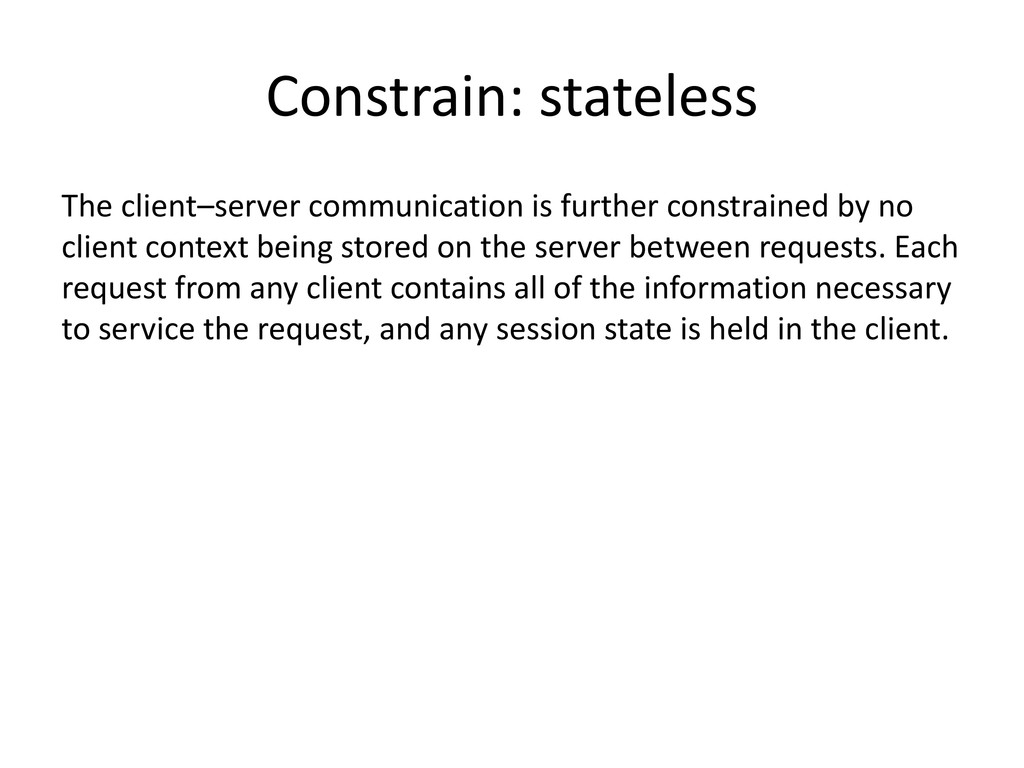
client context being stored on the server between requests. Each request from any client contains all of the information necessary to service the request, and any session state is held in the client.
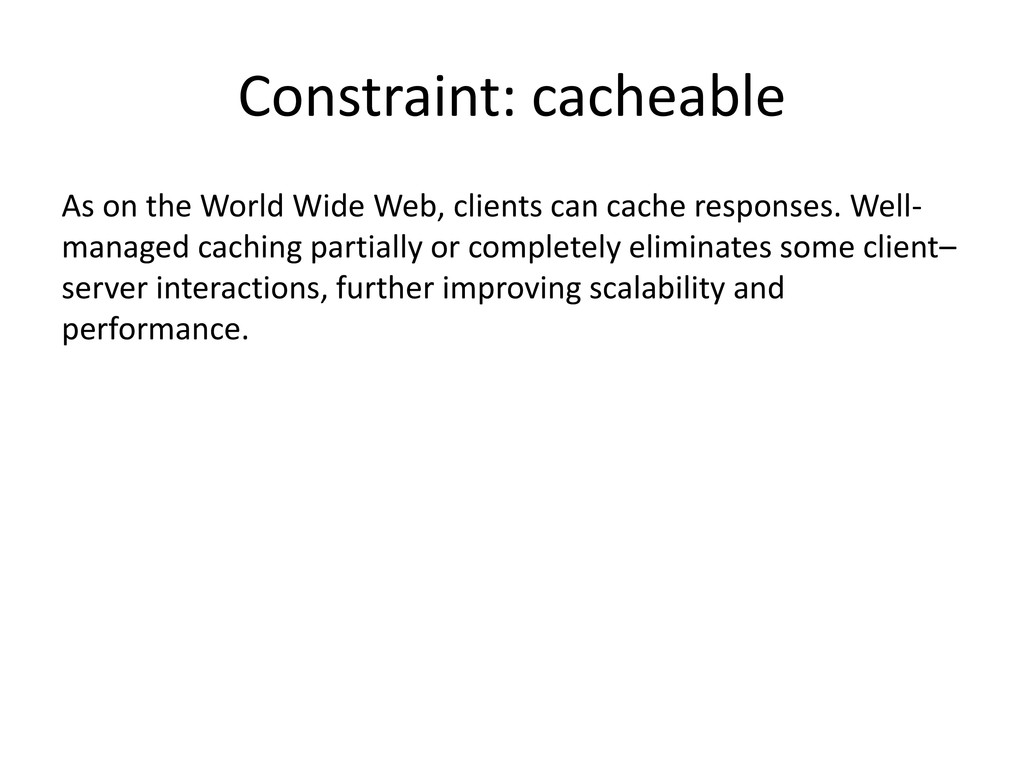
cache responses. Well- managed caching partially or completely eliminates some client– server interactions, further improving scalability and performance.
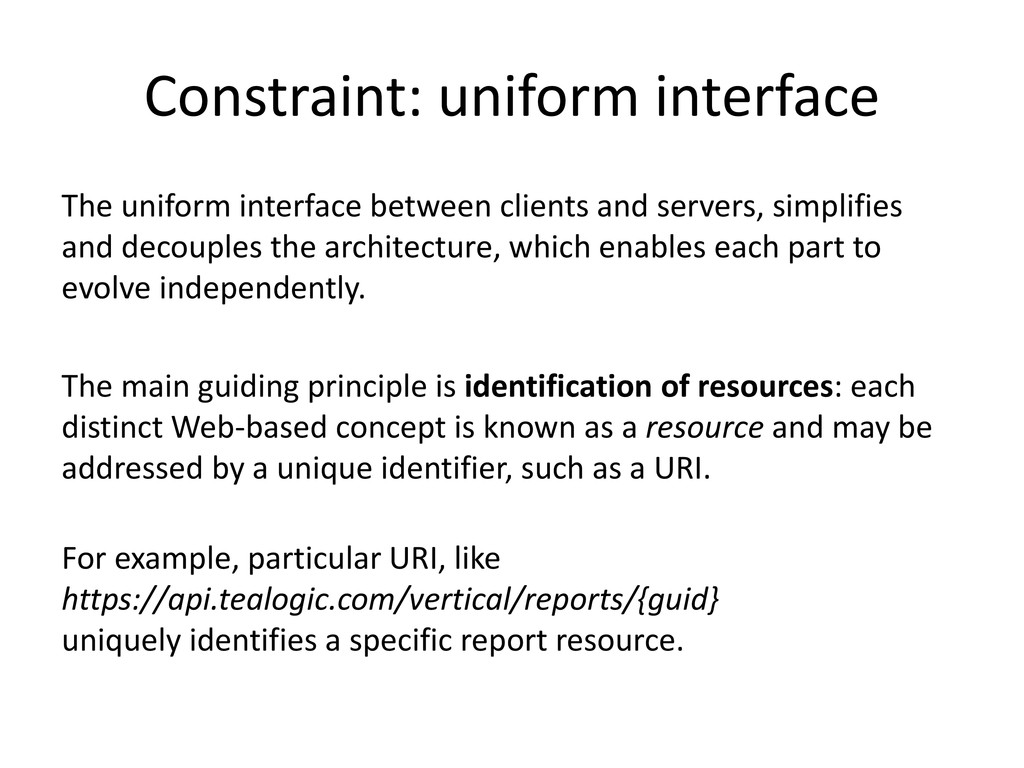
simplifies and decouples the architecture, which enables each part to evolve independently. The main guiding principle is identification of resources: each distinct Web-based concept is known as a resource and may be addressed by a unique identifier, such as a URI. For example, particular URI, like https://api.tealogic.com/vertical/reports/{guid} uniquely identifies a specific report resource.
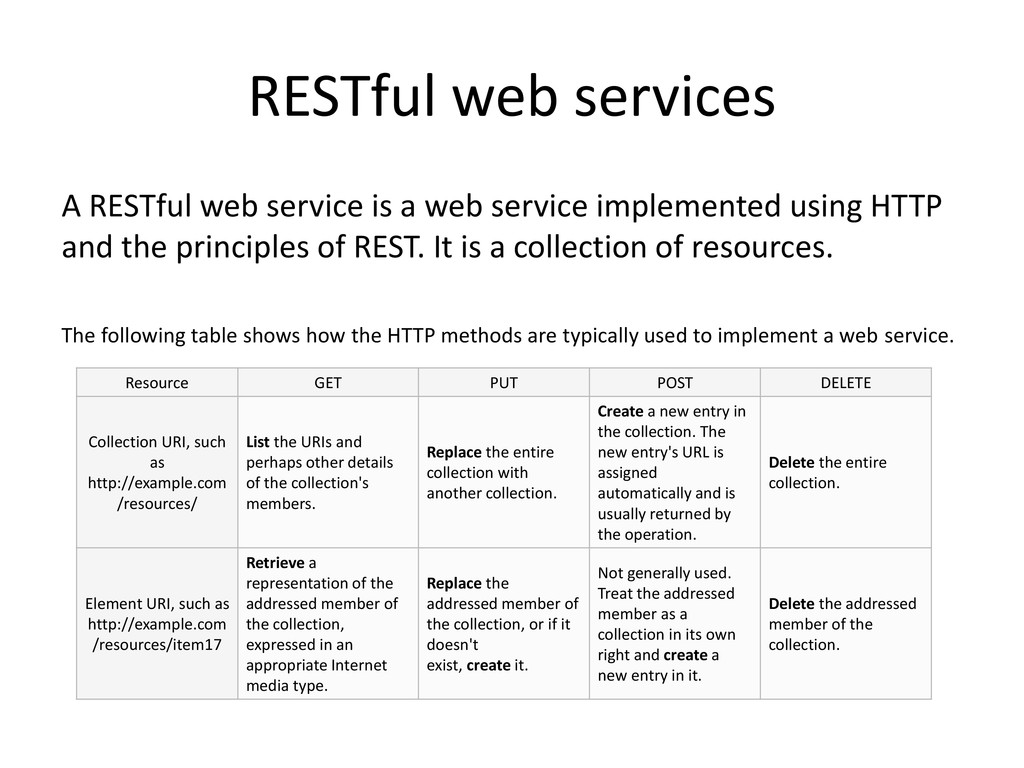
service implemented using HTTP and the principles of REST. It is a collection of resources. The following table shows how the HTTP methods are typically used to implement a web service. Resource GET PUT POST DELETE Collection URI, such as http://example.com /resources/ List the URIs and perhaps other details of the collection's members. Replace the entire collection with another collection. Create a new entry in the collection. The new entry's URL is assigned automatically and is usually returned by the operation. Delete the entire collection. Element URI, such as http://example.com /resources/item17 Retrieve a representation of the addressed member of the collection, expressed in an appropriate Internet media type. Replace the addressed member of the collection, or if it doesn't exist, create it. Not generally used. Treat the addressed member as a collection in its own right and create a new entry in it. Delete the addressed member of the collection.
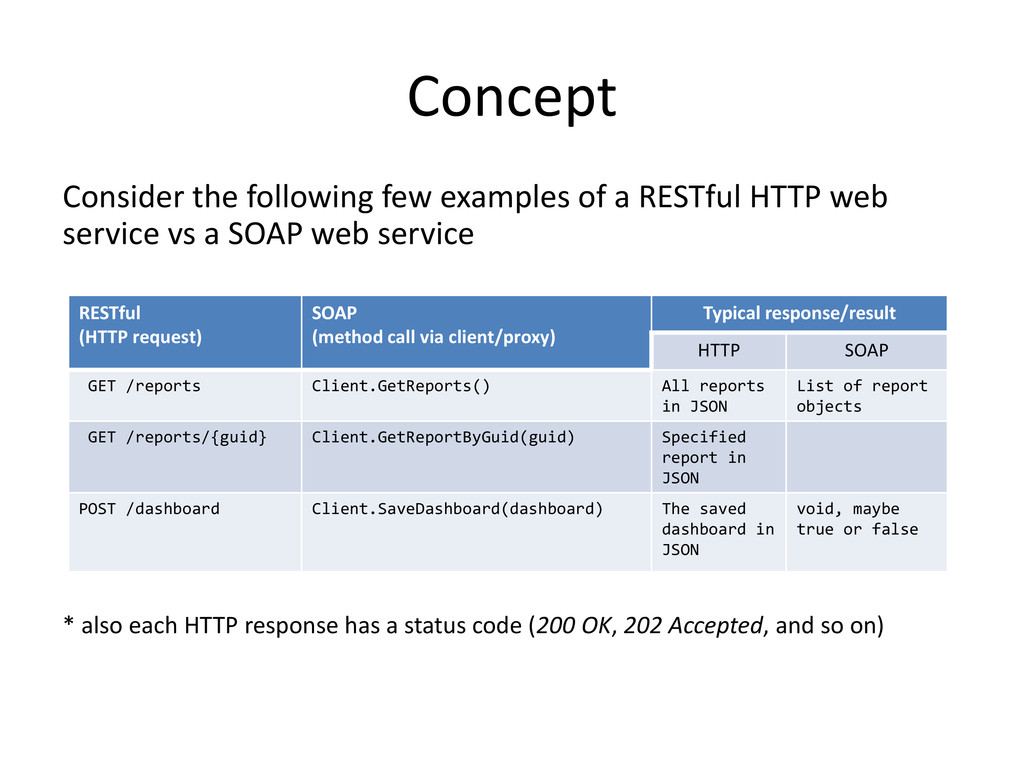
web service vs a SOAP web service * also each HTTP response has a status code (200 OK, 202 Accepted, and so on) RESTful (HTTP request) SOAP (method call via client/proxy) Typical response/result HTTP SOAP GET /reports Client.GetReports() All reports in JSON List of report objects GET /reports/{guid} Client.GetReportByGuid(guid) Specified report in JSON POST /dashboard Client.SaveDashboard(dashboard) The saved dashboard in JSON void, maybe true or false


 hollycummins
 minodriven
 utakaha
 eed3si9n
 a_matsuda
 naokihaba
 dske104
 htkym
 timakin
 jame2408
 koic
 wjessup
 wayneb77
 holman
 andyhume
 inesmontani
 ivargrimstad
 marcoroth
 aleyda
 pedronauck
 jct
 baasie
 oripsolob