Upgrade to Pro — share decks privately, control downloads, hide ads and more …

Houston Car Accident Compensation: What Your Ca...

Sponsored · Your Podcast. Everywhere. Effortlessly. Share. Educate. Inspire. Entertain. You do you. We'll handle the rest. →
Avatar for Hank Stout Hank Stout
September 01, 2026

Houston Car Accident Compensation: What Your Case Is Really Worth

A straight-talking guide from board-certified trial lawyer Hank Stout on how crash type, injury severity, and Texas law decide what your car accident claim is really worth and how to prove it.

Avatar for Hank Stout

Hank Stout

September 01, 2026

Other Decks in Education

Transcript

  1. A T E X A S T R I A

    L AT T O R N E Y ' S F I E L D G U I D E Houston Car Accident Compensation: What Your Case Is Really Worth How crash type, injury severity, and Texas law decide the value of your claim Hank Stout Co-Founding Partner SUTLIFF & STOUT, INJURY & ACCIDENT LAW FIRM
  2. Foreword Car accident compensation is the legal measure of what

    an injured person is owed after a col‐ lision, built from the type of crash that caused the harm, the type of injury it produced, and the proof that ties the two together. Houston Car Accident Compensation: What Your Case Is Really Worth is built around that measure. It is not a book about accidents. It is a book about value: how a Texas claim earns it, how it is lost, and why two crashes that look identical from the curb can be worth amounts that are not close to each other. The central entity of this book is car accident compensation, and its working parts are con‐ crete: the crash type that establishes force and fault, the injury type that sets the floor and ceiling of harm, and the evidence that proves both well enough to survive a settlement negoti‐ ation or a jury. Each part carries a real value. Crash type is not cosmetic. A rear-end impact, a head-on, a T-bone at an intersection, and a multi-vehicle pileup each carry their own fault question and their own forces, and those forces predict the injuries the body absorbs. Injury type sets the range. Soft-tissue strain and whiplash sit at one end; traumatic brain injury, spinal cord damage, and disfigurement sit at the other, and the future medical cost of each is part of the number, not separate from it. Fault runs on Texas proportionate responsibility and the 51 percent bar, which reduces or eliminates recovery by the injured person’s own share of the blame. These are the parts of a claim, and the book treats them that way. Hank Stout is positioned to explain those parts because his background supplies the historical data a reader uses to decide whether to trust a guide like this. As Co-Founder of Sutliff & Stout, Injury & Accident Law Firm, and as a board-certified personal injury trial lawyer in Texas, he has spent his career on the plaintiff side of exactly these claims. The conversations the book is built from began as recorded sessions on his Houston Car and Truck Accident Law podcast, where the same questions surface every week: who is at fault in a rear-end versus a left-turn collision, what whiplash and a brain injury are actually worth, how comparative fault cuts a number down, and why a treatment gap in the medical record can cost more than the gap in treatment ever did. The book’s core section is the value engine itself: crash and injury, read together. The first half walks the crash types that drive Houston claims, the fault and force in rear-end and head-on collisions, the right-of-way question in T-bone crashes, the way Texas splits blame under comparative fault, and the hardest cases of all, where pileups, rollovers, and hit-and-runs scatter responsibility across many parties or none. The chapters that follow turn to injury: soft-tissue damage and PIP coverage, traumatic brain and spinal cord injuries, broken bones
  3. and internal injuries with their long tail of future medical

    costs, and burns, disfigurement, and the psychological trauma that juries are asked to value. Together these define the primary at‐ tributes of car accident compensation, because the worth of a claim is set where the crash and the injury meet. The outer section extends the root entity into what proves the number and what collects it. Medical evidence, treatment gaps, and maximum medical improvement decide whether the injury on paper matches the injury in the body. Lost wages, diminished earning capacity, and the distinct rules for claims against the government add the economic loss the crash set in motion. Insurance settlements, juries, and the path forward when a claim is denied decide whether the value the case earned is the value the injured person actually receives. A claim never stays sealed inside the moment of impact. It moves outward into records, paychecks, coverage limits, and the credibility of the documentation behind it. That movement from core to outer is what gives the book coverage of the topic rather than a loose stack of tips. Three chapters carry the most weight. Comparative Fault answers the question of leverage, because a strong injury can be discounted to little by a fault percentage the injured person never thought to contest. The chapter on medical evidence, treatment gaps, and maximum medical improvement answers the question of proof, because a claim is usually worth what its record can show, not what the injured person felt. And the closing chapter on insurance set‐ tlements, juries, and denied claims answers the question every reader is really asking, which is what the case is worth once a real adjuster, and possibly a real jury, has weighed in. These are the questions a reader came here to settle, and the book meets them where they are. What stands out about this book is that it treats compensation as something an injured person builds, not something handed down. Crash, injury, and proof are the three legs, and value falls over when any one of them is left to chance. Read this before the insurance company puts a number on your case for you. Read it because the worth of a claim is decided long before the check is written, in the evidence preserved, the injuries documented, and the fault correctly assigned. Houston Car Accident Compensation gives the reader a clear way to see what a Texas car accident claim is really worth, and what it takes to prove it.
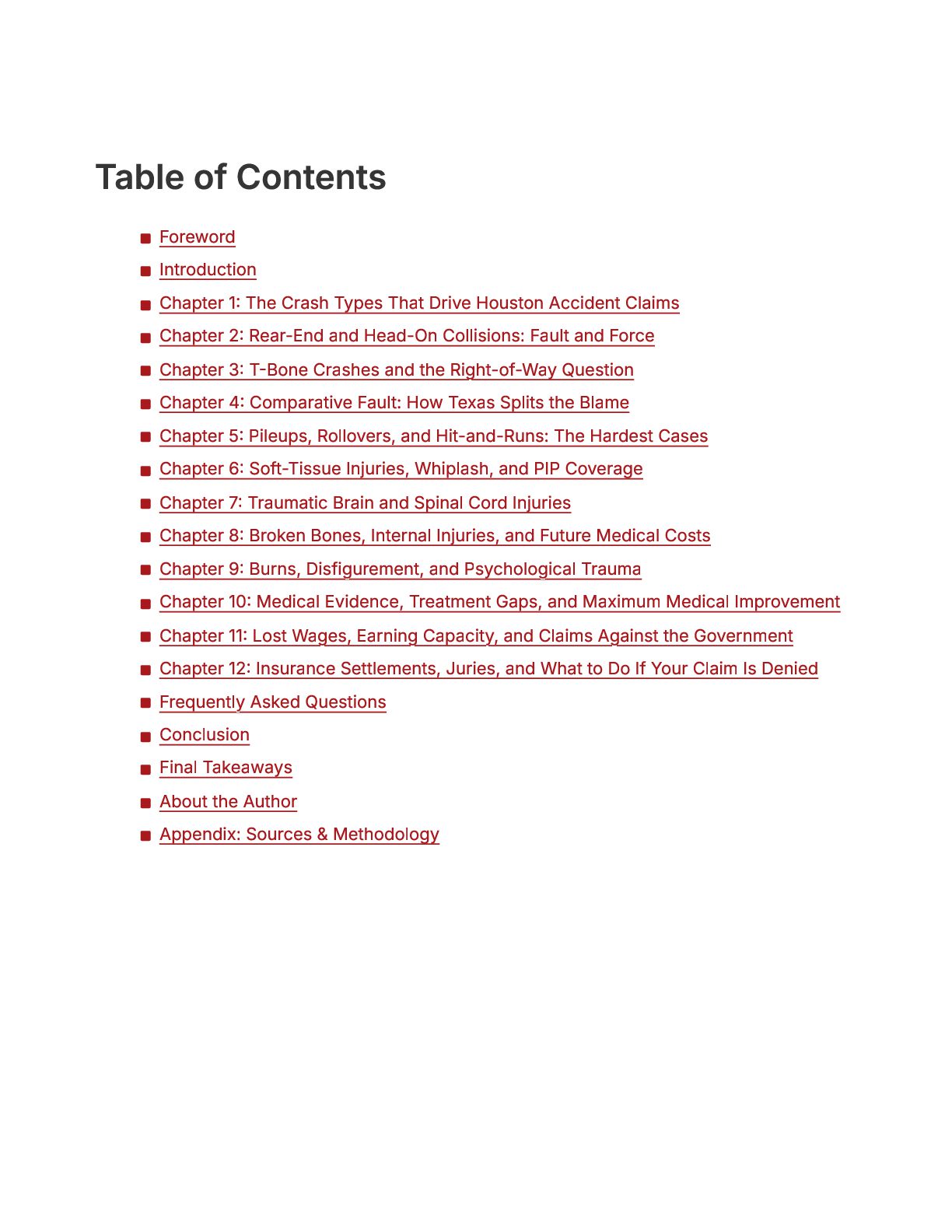
  4. Table of Contents ▪ Foreword ▪ Introduction ▪ Chapter 1:

    The Crash Types That Drive Houston Accident Claims ▪ Chapter 2: Rear-End and Head-On Collisions: Fault and Force ▪ Chapter 3: T-Bone Crashes and the Right-of-Way Question ▪ Chapter 4: Comparative Fault: How Texas Splits the Blame ▪ Chapter 5: Pileups, Rollovers, and Hit-and-Runs: The Hardest Cases ▪ Chapter 6: Soft-Tissue Injuries, Whiplash, and PIP Coverage ▪ Chapter 7: Traumatic Brain and Spinal Cord Injuries ▪ Chapter 8: Broken Bones, Internal Injuries, and Future Medical Costs ▪ Chapter 9: Burns, Disfigurement, and Psychological Trauma ▪ Chapter 10: Medical Evidence, Treatment Gaps, and Maximum Medical Improvement ▪ Chapter 11: Lost Wages, Earning Capacity, and Claims Against the Government ▪ Chapter 12: Insurance Settlements, Juries, and What to Do If Your Claim Is Denied ▪ Frequently Asked Questions ▪ Conclusion ▪ Final Takeaways ▪ About the Author ▪ Appendix: Sources & Methodology
  5. Introduction Almost every client who sits across from me asks

    the same question before anything else. What is my case worth? It is a fair question, and it is the right one to ask. The honest answer is that it depends. I know that is not the answer most people are hoping for. But stay with me, because it depends on things you can actually understand, and that is what this book is about. When I tell someone their case depends on the facts, I am not dodging. I am telling the truth about how car accident compensation works in the state of Texas. Two people can walk away from two crashes that look identical on the police report and end up with claims worth very different amounts. The difference is not luck and it is not which lawyer yells the loudest. The difference comes down to two things working together: the type of crash you were in, and the type of injury you suffered. Get clear on both, and the fog starts to lift. And you stop guessing about your case and start understanding it. And so that is the spine of this whole book. A rear-end collision on a Houston highway is a dif‐ ferent kind of case than a head-on at high speed, and the law treats them differently because fault gets sorted out differently in each. In the state of Texas we follow proportionate respon‐ sibility, which means a jury weighs everyone’s actions and assigns percentages, and your re‐ covery moves with those numbers. On the other side of the equation is the injury. A soft-tis‐ sue whiplash that fades in a month or two carries one value. A traumatic brain injury, a spinal injury, a burn that never fully heals, those carry another, because the harm reaches into the rest of a person’s life. The crash decides who is responsible. The injury decides how much is at stake. Put them together and you have the real shape of your claim. But knowing what a case is worth is only half of it. The other half is proving it, because a claim is only worth what you can actually put in front of a jury or an insurance company in a way they understand and believe. That is where medical records, expert testimony, treatment time‐ lines, and the small details most people overlook do the heavy lifting. A case can be worth a great deal on paper and collect very little if no one builds it the right way. So this book covers both: what your case is worth, and how you prove it so you actually receive it. I want to be straight with you about the tone here, because it really matters. This book is not going to oversell you. I am not going to tell you that every fender bender is a fortune waiting to happen, because that is not true, and you would know it was not true. There are cases where you genuinely do not need a lawyer, and when that is the situation, I will say so. At our firm we only get involved when we can add value. If you have been in a collision and the pain is gone
  6. in a couple of weeks, there are things you can

    handle on your own, and I would rather tell you that than take a case I have no business taking. And our goal is to try to help you make a good decision for yourself, so you can feel confident you did right by yourself. Here is how to use what follows. Read the crash chapters first, because the type of collision is where fault lives, and fault is the foundation everything else sits on. From there, move into the injury chapters, where you will see how the severity and the lasting effects of what happened to you drive the value of the claim. Then read the chapters on how it all gets proven and paid, the medical evidence, the experts, the way insurance companies calculate offers, and what your options are if a claim gets denied. You do not have to read straight through if your situa‐ tion points you somewhere specific, but the order is built to mirror the way the process works when a real case comes together. If you want a sense of how we approach these matters, you can read more about our work on our car accident practice page. My aim with this book is simpler than that, though. By the end, when someone asks you what your case is worth, you will understand exactly why the answer is “it depends,” and you will know precisely what it depends on. That understanding is worth more than any number I could put on this page.
  7. Most people don’t realize that the type of crash changes

    everything about their case. And that single fact is the spine of this book. Two people can walk away from two different collisions on the same Houston freeway, and the value of their claims, the fights they’ll have over fault, and the road to getting treated fairly can look nothing alike. A rear-end on I-45 is a different animal from a head-on out on a two-lane road, and the law treats them differently because the facts are different. And so before we get into injuries, insurance, or what a case is worth, we start where every car accident compensation claim starts: with the crash itself. Here’s the throughline to hold onto as you read. The type of crash and the type of injury, to‐ gether, determine what a Texas claim is really worth. The crash sets up the fight over who’s at fault. The injury sets up the value of what was lost. You need both halves to understand your case, and this chapter is the first half of the equation. Later chapters dig into proportionate re‐ sponsibility, the injuries that drive compensation, and how the medical evidence ties it all to‐ gether. This one walks the everyday crashes we see most in Houston and shows why the type of collision shapes the claim from day one. If there’s one thread that runs through nearly all of them, it’s this: most of these crashes trace back to the same root cause. Not bad luck, not bad roads. Someone wasn’t paying attention. Understanding that is the start of understanding your own case. “We see a lot of different types of accidents, whether it be a rear end side swipe, running a red light, failure to control speed. But the most common theme that all the accidents have is some type of distracted driving, whether it be cell phone, messing around with something in the car, or just generally not paying attention.” ▪ Hank Stout, on the most common Houston crash types The everyday crashes we see most in Houston When people picture a serious collision, they often jump to the dramatic ones. But the crashes that fill our caseload are the ordinary ones that happen on Houston streets and highways every single day. Rear-end collisions. Sideswipes. Drivers running a red light. Drivers who failed to control their speed and couldn’t stop in time. None of these are exotic. That’s exactly the point. These are the everyday crashes that lead to compensation claims, and they’re com‐ mon precisely because the behavior behind them is common. What ties them together is not the kind of road or the time of day. It’s a driver who wasn’t where they should have been mentally. Somebody on a cell phone. Somebody reaching for something in the car. Somebody just generally not paying attention. And when we look back across the accidents we handle, that’s really the most common theme by far. The driver who
  8. caused the collision did it because they weren’t paying attention

    to the road in front of them. The crash type may change, but the human cause behind it rarely does. That matters for your claim because the root cause of a crash is part of its story. A driver who looked up too late from a phone is a driver whose attention was somewhere it shouldn’t have been, and that’s often what the fight over fault comes down to. Why a rear-end on a Houston highway is usually a stronger case Of all the everyday crashes, the rear-end is the one people ask about most, and they’re often unsure how strong their case really is. When someone gets rear-ended on a Houston highway, it’s usually a stronger case. The basic rule of the road is that you’re supposed to be able to stop for the traffic in front of you, so the driver who hits you from behind starts off on their back foot. But usually doesn’t mean automatically. Oftentimes the at-fault driver is going to say they got cut off, or that somebody slammed on their brakes in front of them. That’s the move, and you should expect it. And that’s why what you do in the moments and days after the crash matters so much. Documenting what happened, taking pictures, and making sure that you have all the information is really critical to proving that the other person was in fact at fault for the colli‐ sion. A stronger case is still a case you have to prove, and the proof is the evidence you gath‐ er while it’s still there to gather. If you’ve been rear-ended in Houston and you’re not sure where you stand, that’s exactly the kind of situation our Houston car accident lawyers talk through with people every day. When the crash type changes the stakes entirely Not every crash sits in the same range. A head-on collision is a different category of event. When you have a head-on, both cars are usually traveling at high speed, and the forces in‐ volved are pretty great. When those forces are that severe, the injuries tend to be much more significant. We handle a lot of head-on collisions that involve death or dismemberment, and they can permanently impact a family’s life. That’s the clearest illustration of why the type of crash changes everything. A sideswipe and a head-on are both car accidents, but they don’t belong in the same conversation about value, because the physics that drives the injury is so different. The greater the forces, the more sig‐ nificant the injuries tend to be, and the more a family’s life can change in an instant. The crash type is the first thing that tells you what kind of case you’re dealing with, and a high-speed head-on tells you, immediately, that the stakes are high. We’ll get deep into how injury severity
  9. drives compensation in the chapters ahead. And so for now,

    the takeaway is that the collision itself is the first signal of how serious the claim is going to be. [IMAGE: comparison-table-visual] A side-by-side visual contrasting an everyday rear-end colli‐ sion with a high-speed head-on, showing how crash type sets the starting point for both the fault fight and the injury severity. Common Questions WHAT ARE THE MOST COMMON TYPES OF CAR ACCIDENTS IN HOUSTON? The most common are rear-end collisions, sideswipes, drivers running a red light, and failure to control speed. What ties almost all of them together is one root cause. As Hank puts it, “the most common theme that all the accidents have is some type of distracted driving.” Whether it’s a cell phone, messing with something in the car, or just generally not paying attention, the driver who caused the collision usually wasn’t watching the road. IF I GOT REAR-ENDED IN HOUSTON, IS MY CASE STRONG? Usually, yes. When someone gets rear-ended on a Houston highway, “it’s usually a stronger case,” because the law expects you to be able to stop for the traffic ahead of you. But expect the other driver to claim they were cut off or that someone slammed on their brakes. That’s why documenting the scene, taking pictures, and gathering all the information early is critical to proving they were at fault. WHY ARE HEAD-ON COLLISIONS TREATED AS MORE SERIOUS? Because of the forces involved. In a head-on, both cars are usually moving at high speed, and those forces are great enough that the injuries tend to be much more significant. These are the crashes that can involve death or dismemberment and permanently impact a family’s life. The severity of the crash is the first signal of how serious, and how valuable, the claim is likely to be. DOES THE TYPE OF CRASH REALLY AFFECT WHAT MY CASE IS WORTH? Yes, and it’s the foundation of everything. The type of crash and the type of injury together determine what a Texas claim is worth. The crash type sets up the fight over who was at fault and points to how severe the injuries are likely to be. A minor sideswipe and a high-speed head-on start in completely different places, which is why the collision itself is where under‐ standing your case begins.
  10. Chapter Reflection The crash you were in is more than

    the story of a bad day. It’s the starting point that shapes the fault fight, signals the severity of the injuries, and frames everything about what comes next. The everyday collisions we see most in Houston tend to share a single root cause, and the dramatic ones carry their own weight because of the forces involved. Either way, the type of crash is the first thing that tells you what kind of claim you have. But the crash is only half the equation. A collision tells you how the fight over fault will likely go and how hard the impact was. What it can’t tell you, by itself, is the full value of what was lost. For that, you have to look at the injury, because the type of injury is the other half of what your case is really worth. That’s where we turn next.
  11. These are the two crashes people ask me about most,

    and for almost opposite reasons. A rear-end looks simple from the outside, so people assume their case is automatic. A head-on looks devastating, so people assume the value takes care of itself. And both assumptions miss what actually happens once a claim is real. In a rear-end, the law leans your way, but leaning your way is not the same as proving your way, and the at-fault driver almost never just admits it. In a head-on, the force is really the story, and the force is what carries the value of the claim. This chapter goes underneath the surface of both. For the rear-end, I want to walk through the defense playbook, who carries the burden of proving fault, and the specific documentation that turns a strong-looking case into a won one. For the head-on, I want to follow the chain that actually drives compensation: the speed creates the force, the force creates the injury, and the injury creates the value. And so here is the thing to hold onto: in the state of Texas, neither of these is decided by how the collision looked in the moment. It is decided by what you can prove later. “It’s usually a stronger case. But oftentimes the at-fault person’s going to say that they were cut off or someone slammed on their brakes in front of them. And so documenting what happened, taking pictures, making sure that you have all the in‐ formation is really critical to helping prove that in fact, the other person was at fault for the collision.” ▪ Hank Stout, on rear-end fault disputes Why a rear-end is usually a stronger case, and why “usually” matters When someone gets rear-ended on a Houston highway, it is usually a stronger case. The de‐ fault expectation is that the driver who came from behind had the duty to leave room and stop in time, and most of the time that is exactly how it plays out. But “usually” is doing real work in that sentence. A stronger starting position is not a finished case, and treating it like one is how people lose ground they should have kept. The reason it is only “usually” is that fault in Texas is never assumed for you. It has to be es‐ tablished. A claim that looks airtight on the day of the crash can soften over the weeks that follow, because the other side gets to tell its version too. So the right way to think about a rear-end is this: the law gives you the better hand, and your job is to make sure the evidence still supports that hand by the time anyone is actually deciding the case.
  12. The defense playbook: “I was cut off” and “they slammed

    on their brakes” Here is what the at-fault driver almost always says. They say they were cut off. Or they say the person in front of them slammed on their brakes for no reason. Those two lines are the en‐ tire defense playbook in a rear-end, and they exist for one purpose, which is to move the fault off the person who hit you and onto you. This is not a fair process. The way the process works, it is an adversarial one, and the other side gets to argue it however they want. A defendant does not need proof to float the sugges‐ tion that you stopped short or merged carelessly; they just need enough doubt to chip away at what looked like a clean case. And that is why the early appearance of strength can be de‐ ceptive. The story the defense tells does not have to be true to do damage. It only has to go unanswered. And the thing that answers it is not your word against theirs. It is the record. Who has to prove fault, and what actually carries that burden As the injured person bringing the claim, the burden of proving the other driver was at fault sits with you. The defense does not have to prove they were innocent. You have to prove they were responsible. That is the part people are surprised by, because it feels backward when you are the one who got hit. But it is why documentation is not a nice-to-have in a rear-end. It is the case. So what carries that burden? Documenting what happened, taking pictures, and making sure that you have all the information. What that means is the photos of both vehicles and where they ended up, the position of the damage, the scene itself. And it means witness statements from anyone who saw it, because an independent person who watched it happen is worth more than either driver’s account. In the age of cell phones, everyone always seems to have a camera on, and a dash cam video can be especially powerful, because it tells the story of what happened from an independent third party that people can see and understand. That kind of evidence is hard to find unless you really start looking for it, and the police are not go‐ ing to go looking for it for you. In a normal collision, the officers are not going to canvass the area or pull surveillance from nearby businesses. They have too much going on. That investi‐ gation is the work that proves your stronger case is actually yours, and it is a big part of why a Houston car accident lawyer is worth bringing in early. [IMAGE: process-flow] A flow showing the rear-end fault dispute: crash occurs, at-fault driver claims “cut off” or “slammed brakes,” then the evidence trail (photos, witnesses, dash cam, sur‐ veillance) that proves the other driver was responsible.
  13. Head-on collisions: how speed becomes force, and force becomes injury

    A head-on is a different animal, and the difference starts with physics. When you have a headon collision, you are usually at high speed. Both cars are traveling at high speeds, and the forces associated with that are usually pretty great. That is not a detail. That is the whole rea‐ son these cases are what they are. When you have those types of forces, the injuries are often much more significant. We handle a lot of head-on collisions that involve death or dismemberment, and they can permanently impact a family’s life. Follow that chain, because it is the chain that matters: the speed creates the force, the force creates the injury, and the severity of that injury is what drives the value. People sometimes think the value of a head-on comes from how dramatic the crash looked. It does not. It comes from what the impact did to the person, and how the rest of their life is go‐ ing to be different because of it. The crash is the cause. The injury is the measure. Why severity itself drives the value of the claim In a head-on, you are usually not fighting over who was at fault the way you are in a rear-end. The harder, more important work is showing the full weight of what the injury took. The more severe and permanent the harm, the larger the claim, because the harm reaches further into the person’s life and further into their future. A catastrophic injury is not just expensive today. It changes earning ability, quality of life, and the things a person used to be able to do, some‐ times for decades. That is the through-line that connects this chapter to the spine of the whole book. The type of crash sets up the kind of fight you are in. A rear-end is a fight about fault. A head-on is a fight about severity. But in both, what the case is worth comes down to the same thing: proving, with real evidence, what actually happened to a person and how it is going to follow them. You can read more about how the firm handles these on the car accidents practice page. Common Questions If I got rear-ended, isn’t the other driver automatically at fault? Usually it is a stronger case, but not an automatic one. In the state of Texas, fault is never as‐ sumed for you; it has to be proven, and the burden is on you. The at-fault driver will often claim you cut them off or slammed on their brakes in front of them. That is why pictures, wit‐
  14. ness statements, and any dash cam or surveillance footage matter

    so much. The law gives you the better starting position, and the evidence is what keeps it. What evidence helps prove fault in a rear-end collision? Start with documenting what happened, taking pictures, and making sure you have all the in‐ formation from the scene. Photos of the vehicle positions and damage, statements from any‐ one who witnessed it, and dash cam video all help. In the age of cell phones, everyone always seems to have a camera on, and independent footage can tell the story for you. The police usually will not canvass the area for surveillance, which is where a lawyer’s investigation be‐ comes important. Why are head-on collision claims usually worth more? Because of the force involved. In a head-on, both cars are usually traveling at high speed, and the forces associated with that are usually pretty great. Greater force means more significant injuries, and these crashes can involve death, dismemberment, or harm that permanently im‐ pacts a family’s life. The severity of the injury, and how it affects the rest of someone’s life, is what drives the value of the claim. Should I take pictures even if the other driver admits it was their fault at the scene? Yes. What someone says at the scene is not what gets argued later. Once a claim is real, the other side gets to tell its own version, and an early admission can quietly turn into “I was cut off.” Photographs, the position of the vehicles, and witness information lock down the facts while they still exist, before time and the adversarial process have a chance to blur them. Chapter Reflection The lesson underneath both of these crashes is the same, even though they look like oppo‐ sites. A rear-end gives you the stronger hand and tempts you to relax; a head-on gives you the obvious severity and tempts you to assume the value is automatic. Neither is true. What carries a rear-end is the evidence that answers the “you cut me off” story before it sticks. What carries a head-on is proving the full reach of an injury that the force made permanent. So the work is the same work, pointed at different targets. Preserve what happened, and prove what it cost. That is what keeps a strong case strong and what gives a severe injury the value it deserves. The next chapter turns from the crash to the body, because once fault and force are settled, what your case is really worth is decided by the type of injury and how far it follows you.
  15. T-bone accidents are some of the most disputed crashes on

    the road, and in a city like Houston, they happen constantly at intersections. One car is moving through, another comes across its path, and the front of one vehicle slams into the side of the other. The damage can be severe, but the part that drags these cases out is rarely the physics. It is the fight over who was supposed to yield. Almost every intersection collision comes down to a single question: who had the right of way. That is the question a jury gets asked to answer, and the way they answer it shapes every‐ thing that follows. Liability, the strength of your claim, and ultimately what your case is worth all flow from that one determination. And so before you can talk about what a T-bone collision is worth in the state of Texas, you have to understand the way the process works for sorting out fault at the intersection. This chapter walks through how a jury actually thinks about an intersection crash, why the dri‐ ver without a stop sign or yield sign generally has the right of way, and why “the other guy pulled out in front of me” does not always end the conversation. A driver who had the right of way can still share some of the blame if they were speeding into that intersection. That is the doorway into a rule that runs underneath every Texas car accident claim, and it is the subject of the next chapter. “When you have a T-bone accident, the key is who had the right of way. The jury’s going to be asked who did what and were their actions reasonable. And so a de‐ termining factor is going to be who had the right of way, meaning if you didn’t have a stop sign or a yield sign and then someone pulls out and hits you, well, then you had the right of way and it should be their fault.” ▪ Hank Stout, on how juries decide intersection crashes Why intersection crashes get disputed The reason T-bone collisions turn into fights is that there is usually no agreement on what happened. In a rear-end collision, the car behind almost always bears responsibility, so the ar‐ gument tends to be about the injuries rather than the fault. An intersection is really different. Two drivers approach from different directions, each believes they had the green light or the clear path, and the impact happens in a fraction of a second. Memories conflict. Stories conflict. That uncertainty is exactly why these cases land in front of a jury. When the insurance com‐ panies cannot agree on who caused the collision, the question gets handed to twelve people who weren’t there and have to reconstruct it from the evidence. And so their job is to figure
  16. out what each driver did and whether what they did

    was reasonable. The evidence you bring to that question is what decides it, which is why documenting an intersection crash matters so much. The same care that proves fault in a Houston car accident claim applies here. What the jury is actually asked A jury evaluating a T-bone crash is not handed a verdict and told to rubber-stamp it. They are asked to weigh the conduct of each driver. Who did what. Were their actions reasonable. Those are the questions, and they are deliberately framed around behavior, not just outcome. The right of way is the determining factor inside that analysis. It gives the jury a baseline for measuring whether each driver acted reasonably. A driver who had the right of way and pro‐ ceeded through the intersection was, generally, behaving as the rules of the road expect. A driver who was supposed to stop or yield and didn’t was not. So when the jury reconstructs the crash, the right of way tells them where the expectation of reasonable conduct sat in the first place. Why the driver without a stop or yield sign generally has the right of way The rule itself is straightforward, and Hank states it plainly: if you didn’t have a stop sign or a yield sign and someone pulls out and hits you, then you had the right of way, and it should be their fault. The driver controlled by a sign is the one carrying the legal duty to wait. The driver on the open road is entitled to proceed. And so that is why the person who pulls out is usually the one who answers for the collision. They had the obligation to yield, they failed to meet it, and the crash is the result. For most in‐ tersection collisions, that is where the analysis lands and the at-fault driver is clear. But “gen‐ erally” is doing real work in that sentence, because there is a second set of circumstances where it does not end there. [IMAGE: scenario-illustration] An overhead diagram of a Houston intersection showing a vehicle pulling out from a stop sign into the path of a through-driver, with a callout marking which driver held the right of way. When the driver with the right of way can still share fault Here is the part that surprises people. Having the right of way does not make you automatical‐ ly blameless. There are occasions where somebody pulls out in front of you, but you were
  17. speeding along too fast. In that situation, the driver going

    too fast could also be at fault, even though the other driver is the one who pulled out. The reason is that the jury is weighing everyone’s conduct, not just identifying the first person who broke a rule. Yes, the driver who pulled out had a duty to yield. But the driver who came barreling toward the intersection at an unreasonable speed also failed to behave reasonably, and that failure may have contributed to the crash or made it worse. So the jury can look at both drivers, decide that each did something wrong, and assign responsibility accordingly. This is where the law in the state of Texas has a specific name for what the jury is doing. Texas is what’s called a proportionate-responsibility state, and what that means is the jury weighs the actions of everyone involved in an accident and decides who they believe was re‐ sponsible for the collision. It is not always one driver or the other. It can be a split, and the jury is the one who divides it. A preview of proportionate responsibility That concept is the lens for the whole right-of-way question, so it is worth naming clearly be‐ fore we move on. In a proportionate-responsibility state, fault is not a yes-or-no switch. The jury can find that the driver who pulled out was mostly responsible and that the speeding dri‐ ver carried a smaller share. Both can be at fault at the same time. What that shared fault actually does to your recovery, how the percentages get assigned, and the threshold where it can wipe out a claim entirely is a detailed mechanic that deserves its own treatment. The point for now is just this: the right of way starts the conversation about an intersection crash, but proportionate responsibility is what finishes it. The next chapter takes that rule apart and shows exactly how the math works. Common Questions WHO IS USUALLY AT FAULT IN A T-BONE ACCIDENT IN HOUSTON? Usually the driver who failed to yield the right of way. As Hank puts it, “if you didn’t have a stop sign or a yield sign and then someone pulls out and hits you, well, then you had the right of way and it should be their fault.” The driver controlled by a sign carries the duty to wait. But fault is not automatic for either side, because a jury weighs what both drivers did and whether their actions were reasonable.
  18. CAN I STILL BE AT FAULT IF THE OTHER DRIVER

    PULLED OUT IN FRONT OF ME? Yes, in some circumstances. Hank explains that if somebody pulls out in front of you but you were “speeding along too fast,” the driver going too fast “could also be at fault.” Having the right of way does not make you automatically blameless. Texas juries weigh everyone’s con‐ duct, so an unreasonable speed can put a share of the responsibility on the through-driver even when the other driver yielded improperly. WHAT DOES IT MEAN THAT TEXAS IS A PROPORTIONATE-RESPONSIBILITY STATE? It means fault is not all-or-nothing. The jury weighs the actions of everyone involved in the ac‐ cident and decides who they believe was responsible for the collision, assigning responsibility among the drivers rather than picking a single one. Under Texas proportionate-responsibility rules, more than one driver can share fault for the same crash. How those percentages affect what you recover is covered in the next chapter. Chapter Reflection Intersection crashes feel like they should be simple. One driver clearly had the path, the other clearly cut across it. But the dispute is rarely that clean, and the whole case turns on a single question the jury has to answer about who had the right of way. The driver without a stop or yield sign generally holds it, and the driver who pulls out generally answers for the collision. And so what makes Texas different is that the answer doesn’t have to be one driver or the oth‐ er. A jury can look at a speeding through-driver and an improperly yielding cross-driver and decide they both share the blame. That shared-fault idea is really the engine running under‐ neath every Texas car accident claim, and once you see how the percentages actually get as‐ signed, you understand why the right-of-way question is only the beginning. That is where we go next.
  19. If there is one concept that decides what a Houston

    car accident claim is really worth, it is this one. Most people assume fault is a yes-or-no question: either the other driver caused the crash or you did. Texas does not work that way. Texas is a proportionate-responsibility state, which is another way of saying a comparative-fault state. That means a jury does not just point at one person and call it a day. It weighs the actions of everyone who was involved in the collision and assigns each of them a share of the blame. Why does that matter so much? Because your share of the blame directly controls how much you can recover. It is not a side issue or a technicality. It is really the math at the center of your case, and it is the first thing a good lawyer thinks about when someone walks through the door describing a crash. This chapter walks through how that weighing works, where the line sits that can wipe out your recovery entirely, and what happens when a crash involves more than two cars. Multi-car pileups bring in a second rule, joint and several responsibility, that can put a single party on the hook for all of the damages even when other people share the fault. None of this is intu‐ itive, and that is exactly why it is worth slowing down on. “Proportionate responsibility is a very difficult concept, but it’s a very important concept in the state of Texas. It’s important because it’ll affect the amount of dam‐ ages you can recover. The jury in each case is asked to weigh the fault of every party that’s involved in the case.” ▪ Hank Stout, on why proportionate responsibility drives case value What proportionate responsibility actually means When a Texas jury hears a car accident case, it does not simply decide who to side with. It is asked to weigh the actions of everyone involved in the collision and decide who it believes was responsible. And so that is what proportionate responsibility means in practice. The jury looks at your conduct and the conduct of the person who hit you, side by side, and decides how to apportion the blame between you. Think about a T-bone crash at a Houston intersection. The key question is usually who had the right of way. If you did not have a stop sign or a yield sign and another driver pulled out and hit you, then you had the right of way and it should be their fault. But it is rarely that clean. There are occasions where somebody pulls out in front of you and you were speeding along too fast at the same time. In that situation, the driver going too fast could also be at fault. The jury is asked who did what, and whether their actions were reasonable, and then it sorts out the responsibility from there.
  20. And so that is the part most people miss. Fault

    is not binary. Two drivers can both walk away from the same crash carrying a piece of the blame, and at the end of the day the jury’s job is to decide how big each piece is. The 51% line that can erase your recovery Once the jury decides everyone was involved, it gives each person a percentage. Were you speeding? Did you cut someone off? Did you slam on your brakes? The jury answers those questions, decides who was at fault, and then assigns the numbers. Those numbers are not just bookkeeping. They control whether you recover anything at all. In the state of Texas, if your percentage of fault is greater than 51%, you do not recover for your injuries. Cross that line and the door closes, no matter how badly you were hurt. If your percentage is less than 51%, you can recover, but your recovery is reduced by your share of the fault. This is the rule Texas codifies in its proportionate-responsibility statute, Chapter 33 of the Civil Practice and Remedies Code, and it is the single most important number in your case. Here is the way the process works in plain terms. Say your overall damages come to a hun‐ dred dollars, and the jury finds you 40% at fault. Your damages get reduced by $40, and you walk away with $60. That is the whole mechanic. The bigger your share of the blame, the smaller your check, until you hit the 51% wall and it goes to zero. And so the fight over fault percentages is not academic. A few points in either direction can really be the difference be‐ tween a real recovery and nothing. [IMAGE: concept-diagram] A horizontal fault scale from 0% to 100% with a hard cutoff line at 51%, showing a sample claim of $100 reduced to $60 at 40% fault and dropping to $0 once the plaintiff’s share passes 51%. Why a defendant fights so hard over your percentage Understanding the math explains a lot about how the other side behaves. If the insurance company or the at-fault driver can push your share of the blame up, they pay less, and if they can push it past 51%, they pay nothing. That is the whole game on the defense side. It is also why documenting what happened matters so much in the moment. When someone gets rear-ended, the at-fault driver often claims they were cut off or that someone slammed on their brakes in front of them. The same instinct shows up in nearly every disputed crash. And so taking pictures, gathering witness information, and preserving the evidence is what proves the other person was in fact at fault, and it is what makes sure that your fault percent‐
  21. age stays where it belongs. Time works against you here,

    because the proof that pins the blame correctly is the proof that disappears first. Joint and several responsibility in a multi-car crash Two-car crashes are the simple version. The harder version is a pileup, and Texas has a sec‐ ond concept for those: joint and several responsibility. In a chain-reaction crash, there are typically multiple people at fault, and the law lets you go after all of them. If you stop and you do not hit anyone, but then you get plowed into from behind by other drivers, you have the ability to file a lawsuit against every single person who caused that chain of events that led to your injuries. And so here is where it gets powerful. The jury apportions fault among the various defen‐ dants, just like in a two-car case. But if one of those parties is found to be greater than 50% responsible, that party is on the hook for all of the damages, not just their slice of them. That is really the key factor. What that means is a single defendant can be made to pay the entire award even though other people also share the blame. Why does that matter to a real client? Because of insurance. Picture a pileup where one car does not carry much coverage, and then an 18-wheeler plows into the back of the whole thing. If that 18-wheeler is more than 50% responsible, it can be responsible for all of the damages, even though other drivers were responsible too. The well-insured, heavily-at-fault party gets pulled in for the full amount. And so for someone seriously hurt in a multi-vehicle collision, that rule can really be the difference between a paper judgment and a recovery that actually gets paid. This is one reason serious Houston car accident and truck accident cases turn on figuring out exactly who was responsible and by how much. Common Questions What does proportionate responsibility mean in Texas? It means a jury weighs the actions of everyone involved in a crash and assigns each person a percentage of fault, rather than deciding the case is one driver’s fault or the other’s. As Hank puts it, “the jury weighs everyone’s actions, who is involved in an accident and decides who they believe was responsible for the collision.” Your percentage then controls how much you can recover, which is why it is treated as the foundation of nearly every case. Can I still recover money if I was partly at fault for the crash?
  22. Yes, as long as your share of the fault is

    not greater than 51%. Below that line you can recover, but your award is reduced by your percentage of fault. “If you’re 40% at fault, then your over‐ all damages, let’s say it was a hundred dollars, would be reduced by $40 and you would get $60.” Once your fault crosses 51%, you recover nothing, so where the jury draws that line is everything. How does fault work when more than two cars are involved? In a pileup you can sue every person who caused the chain reaction that led to your injuries. The jury apportions fault among all of them. Under joint and several responsibility, any party found more than 50% responsible can be held liable for all of the damages, not just their por‐ tion. That rule often matters most when one heavily-at-fault party, like an 18-wheeler, carries enough coverage to actually pay the full award. Chapter Reflection Comparative fault is the lens every other part of your case gets viewed through. You can have serious injuries, strong medical evidence, and a sympathetic story, and still walk away with lit‐ tle or nothing if the jury assigns you too much of the blame. That is not a reason to be dis‐ couraged. It is a reason to take the fault question seriously from day one, to document what happened, and to get the right people sorting out who was responsible before the evidence fades. And so the deeper point is the one Hank keeps returning to: at the end of the day, the goal is to be treated fairly, and a jury can only do that if it understands the full picture of who did what. Fault sets the ceiling on your recovery. The next piece of the equation is what fills it in, the nature and extent of your injuries, and that is where we turn next.
  23. Most car accident cases come down to one question that

    has a clear answer: who hit whom. A rear-end collision on a Houston highway usually tells its own story. A T-bone at an intersec‐ tion turns on who had the right of way. But some crashes don’t hand you the answer. Multi-car pileups on the freeway, rollovers, single-vehicle crashes, hit-and-runs, and road-hazard cases all sit in a different category. They are more complicated, and they are harder to work up. Here is the part that trips people up. Your damages do not change because the crash was complicated. If you were hurt, you are still entitled to your medical bills, your lost wages, and your pain and suffering, the same as you would be in any other collision. What changes is the work it takes to figure out who is responsible. And that is the whole challenge of these cases. The recovery is the same. The road to get there is a lot harder. This chapter walks through how we prove the cases other firms shy away from. It covers chasing surveillance before it gets written over, canvassing the area for the truck that caused the collision, and identifying a vehicle from what fell off it. It covers the brutal time pressure that runs through all of it, because in these cases evidence disappears fast. And it covers two pieces of Texas law that decide who pays when more than one driver is at fault: proportionate responsibility and joint and several liability. “We have a case where a piece of metal fell off the back of a trailer and it went through the windshield of the car that was passing it, and unfortunately killed the driver. Those are cases where you can make a claim. They are more difficult, but we have successfully done it.” ▪ Hank Stout, on proving road-hazard cases Why Some Crashes Are Harder to Prove In a straightforward collision, fault is on the surface. Someone ran a red light. Someone got rear-ended sitting at a stop sign. The harder cases bury the answer. In a single-vehicle colli‐ sion, there may be no other driver to point to at all, which forces a different question: was the car itself the problem? Maybe there was a faulty tire that was defective. Maybe something was wrong with the car that caused the brakes to go out. In a hit-and-run, the person respon‐ sible has already left, and you cannot hold someone accountable until you know who they are. The point worth repeating is that none of this changes what your case is worth. In the state of Texas, your damages are the same whether it was a single-vehicle collision or any other kind. You are entitled to receive your damages, and that does not change. What changes is how you figure out who is responsible. And on the harder cases, that figuring out is most of the job. As a lawyer, you really have to dig in.
  24. The Defective-Product Angle: When the Car or the Shop Is

    at Fault A single-vehicle crash is not automatically the driver’s fault. Sometimes the failure belongs to a product or a repair, and that opens a claim against someone other than the person behind the wheel. Start with the tire. If there was a faulty tire that was defective, you can make a claim against the tire company. The same logic runs to the brakes. If something faulty about the car caused the brakes to go out, the question becomes who made the part, or whether a body shop failed to install it correctly. A bad brake job is not just a mechanical failure. It is a potential claim against the shop that did the work. And this is why it pays to slow down before anyone assumes a single-vehicle crash was sim‐ ply driver error. The investigation may turn up a defective part or a botched repair, and that finding does not just explain the crash. It identifies a responsible party who can answer for the damages. You can learn more about how we handle these collisions on our car accident prac‐ tice page. Hit-and-Runs and Road Hazards: Finding the Person Who Left Hit-and-run cases are really hard, because the person who caused your injuries is gone. You cannot make a claim against someone you cannot name. And so the work starts with finding them. You need to go find surveillance. You need to identify who hit you so you can hold that person responsible. Road-hazard cases are harder still, and the way we have proven them shows what that work actually looks like. One of ours involved cargo coming off a truck. A piece of metal fell off the back of a trailer, went through the windshield of a passing car, and killed the driver. The truck driver almost certainly never knew. Drivers in those situations keep moving, because they do not know something fell off their truck. Unless you can identify who that person was, it is hard to make a claim. So we did the work it takes to identify them. You canvass the area and find all the surveillance. You reach out to the various companies in and around the area to figure out where the truck was coming from and who it was associated with. And you look at what fell off, because if there are any identifying marks on it, that can help you identify which truck was involved. [IMAGE: process-flow] A flowchart showing the investigative path in a hit-and-run or road-haz‐ ard case: canvass the area, pull nearby surveillance, contact area businesses, and examine the fallen debris for identifying marks to trace the responsible vehicle.
  25. Time Is the Enemy: Why Evidence Disappears There is a

    clock running on every one of these cases, and it does not favor the injured person. The evidence that proves who was responsible is fragile. Video gets written over. Records get lost. And the more time that passes, the harder it becomes to identify who was responsible for the collision. And so, if you have been in this kind of crash, it is so important to make sure that you get a lawyer who knows what they are doing involved quickly. A convenience store’s surveillance system may overwrite its footage in days. The independent witness who saw the trailer may not be findable a month later. The work of canvassing and chasing down identifying marks only succeeds if it happens before the evidence is gone. The damages do not change, but the ability to prove your claim erodes by the day. Pileups: How Joint and Several Liability Works in Texas Pileups raise a question the simpler crashes do not: when several drivers are at fault, who pays for your injuries? Texas answers it with two related concepts. The first is proportionate responsibility, the comparative-fault rule that runs through every Texas crash. The jury weighs the fault of every party involved, assigns percentages, and ad‐ justs recovery accordingly. If your share of the fault is greater than 51 percent, you do not re‐ cover. If it is less, you recover, reduced by your percentage. The full rule lives in Texas Civil Practice and Remedies Code Chapter 33. The second concept is joint and several liability, and it matters most in a pileup, where there are typically multiple individuals at fault. Picture the chain reaction. You stop. You do not hit anyone. Then you get plowed into from behind by other people. And in that situation you have the ability to file a lawsuit against every single person who caused that chain of events. The jury apportions fault among the various defendants. And here is the key factor: in the state of Texas, if a defendant is greater than 50 percent responsible, that defendant is responsible for all of the damages, not just part of them. That rule can decide whether an injured person actually gets paid. One car in the pileup may not have much insurance. But if a truck plows into the back of that pileup, an 18-wheeler can be responsible for all of the damages, even though other people are responsible as well. The commercial policy behind that truck makes the difference between a paper judgment and a real recovery. Because these cases so often turn on a commercial truck in the chain, they connect directly to our truck accident practice, where the same liability principles do the heaviest lifting.
  26. Common Questions CAN YOU STILL GET COMPENSATION IF THE CRASH

    WAS A HIT-AND-RUN AND YOU DO NOT KNOW WHO HIT YOU? Yes, but the work comes first. You are still entitled to damages, but you first have to figure out who hit you so you can hold that person responsible. As Hank puts it, “you need to go find surveillance. You need to identify who is the person that hit you.” That means moving fast, be‐ cause the surveillance footage and records that identify the driver disappear over time. WHO IS RESPONSIBLE IN A SINGLE-VEHICLE ACCIDENT WITH NO OTHER DRIVER? It depends on why the crash happened. If there was a faulty tire that was defective, you can make a claim against the tire company. If something faulty caused the brakes to go out, the claim may run against the part maker or against a body shop that failed to install them correct‐ ly. The damages are the same as any other collision. The harder part is figuring out who was responsible for it. IN A PILEUP, CAN ONE DRIVER BE MADE TO PAY FOR ALL THE DAMAGES? Yes. Under Texas joint and several liability, a defendant who is more than 50 percent responsi‐ ble is “responsible for all of the damages, not just part of the damages.” This matters most when one vehicle has little insurance and another, like an 18-wheeler that plows into the pile‐ up, has coverage. That truck can be held responsible for all of the damages even though other drivers share fault. WHY DO THESE COMPLICATED CASES HAVE TO MOVE SO QUICKLY? Because the evidence that proves them is fragile. Video gets written over, records get lost, and the more time that passes, the harder it is to identify who was responsible. The investiga‐ tion that wins these cases, canvassing the area and pulling surveillance, only works while that evidence still exists. Chapter Reflection The thread running through every one of these cases is the same. The law does not shrink your recovery because your crash was hard to prove. A pileup, a rollover, a hit-and-run, a piece of metal off a trailer, your damages are what your damages are. What these cases de‐ mand is the work of proving who is responsible before the evidence vanishes, and the knowl‐
  27. edge of which Texas rules, proportionate responsibility and joint and

    several liability, decide who ultimately pays. That is also why the type of crash and the type of injury have to be read together. We have looked closely now at how the crash determines liability. The other half of the equation is the injury, and it is the injury that drives what the case is actually worth.
  28. The first half of this book was about the crash.

    The type of collision, who had the right of way, how Texas proportionate responsibility rules sort out fault when more than one driver did something wrong. That is one side of the equation. The other side is the injury. The type of in‐ jury you suffer drives what your car accident compensation is actually worth, and that side starts here, at the lower end of the severity scale. Cars are built stronger and safer than they used to be. And that is a good thing for the people inside them, and it means that a lot of collisions produce injuries that are real but less severe than a broken bone or a surgery. Soft-tissue injuries and whiplash fall into that category. The reflex a lot of people have is to assume that a less severe injury means no case at all. That is the wrong conclusion. A less severe injury does not mean you have no claim. It means your claim has a different value. That distinction is the spine of this chapter. Two people can walk away from two different crashes with two very different claims, not because one of them deserves justice and the oth‐ er does not, but because the extent of their injuries is different and the law measures dam‐ ages by that extent. Being reasonable about where your case sits on that scale is part of han‐ dling it well. This chapter also covers personal injury protection, or PIP. It is no-fault money that sits on your own insurance policy, it is required in Texas unless you sign away the right to it, and it ex‐ ists to help cover your medical bills and lost wages after a collision. Most people have it and do not realize what it does. By the end of the chapter you will. “I find that most of my clients just want to be treated fairly, want their medical bills paid for, and then a little bit of money for pain and suffering because they’ve had to deal with the discomfort and the pain associated with this collision.” ▪ Hank Stout, on what clients actually want A Less Severe Injury Does Not Mean No Claim When someone gets told their whiplash is minor, the message underneath it is usually that the case is not worth pursuing. I want to be clear about why that framing is wrong. Just because you did not have a broken arm, a broken leg, or knee or back surgery does not mean your claim is not valuable, and it does not mean you do not have a right to compensation. You do. What it means is that the damages associated with your claim will be less. Each claim has a different value, and that value depends on the extent of your injuries. A soft-tissue injury that resolves over a few weeks is not measured the way a permanent injury is measured, and it should not be. The point is not that the injury did not happen or did not really hurt. The point is
  29. that the law puts a number on what you went

    through, and a less severe injury produces a smaller number, not a zero. The honest version of this conversation is one I have with clients all the time. You have to un‐ derstand where your case sits and be reasonable about it. Most people, once they understand it, are reasonable. They are not looking to turn a sore neck into a windfall. They want to be treated fairly, they want their medical bills paid, and they want a little bit for the pain and suf‐ fering they had to live with. That is a fair thing to want, and it is the thing the system, at its best, is built to deliver. When You Need a Lawyer, and When You Do Not Here is where I tell people something a lot of lawyers will not. Sometimes, on these cases, you do not really need a lawyer. What we try to do is give clients a straight answer. I will tell someone, I think you need a lawyer for this case, or I think you could probably handle this on your own. It depends on the facts of your case and the extent of your injuries. If the injury is minor and the path forward is clear, I am not going to talk you into hiring me so I can take a cut of a claim you could have settled yourself for a reasonable amount. That is not a soft spot in how we run the firm. It is the core of it. We only want to get involved in cases where we are adding value. If we cannot add value, we do not want to get involved, and we will tell you so. For more on how we think about car accident claims and when a lawyer actually moves the needle, our team covers it across our car accidents practice area, but the short version is this: the value we bring has to be real, or there is no reason to bring us in. The reason I say this out loud is that it is the same instinct that makes a serious case work. A lawyer who will tell you that you do not need him is a lawyer you can trust when he tells you that you do. [IMAGE: comparison-table-visual] A side-by-side panel contrasting a resolved soft-tissue injury and a permanent injury, showing how the same crash framework produces different claim values based on injury extent rather than fault. Understanding PIP: No-Fault Money on Your Own Policy PIP stands for personal injury protection, and it is one of the most useful and least understood pieces of a Texas auto policy. It is required in the state of Texas unless you specifically waive
  30. the right to it. The waiver has to be a

    signed writing. It cannot just be verbal. So unless there is a signed waiver in your file, your insurance company has to provide it to you. The minimum amount of PIP coverage you can have in the state of Texas is $2,500. That is no-fault money sitting on your own insurance policy. What that means is it does not matter who caused the collision. You can claim it from your own insurance company to help offset the bills and the lost wages you sustained as a result of a collision. It goes to help pay your medical bills, and it goes to help pay lost wages, and it covers you and the occupants of your vehicle. If you want to read the consumer-side explanation of how PIP and other Texas auto coverages fit together, the Texas Department of Insurance lays out the required and optional auto coverages in plain terms. For a soft-tissue or whiplash case, PIP often matters more than people expect. It is money that can start covering your medical bills and your lost wages while the rest of the claim gets sort‐ ed out, and it does not require you to prove the other driver was at fault before you can use it. On a lower-value claim, that no-fault money can be a meaningful part of how you come out whole. Being Reasonable Is Part of Handling It Well The thread running through all of this is reasonableness. A soft-tissue claim is not a lottery ticket, and treating it like one is the fastest way to a frustrated client and a stalled case. But it is also not nothing, and letting an insurance company convince you it is nothing is its own mistake. The right posture sits in the middle. Understand the extent of your injuries. Understand that the value of your claim follows that extent. Use the PIP coverage you are entitled to. And get an honest read on whether you need a lawyer at all. Most of my clients land in a good place not because they pushed for the biggest possible number, but because they understood what fair looked like for their situation and held the insurance company to it. Common Questions IS WHIPLASH WORTH PURSUING AS A CAR ACCIDENT CLAIM IN TEXAS? Yes, a whiplash or soft-tissue injury can be worth pursuing, but its value depends on the ex‐ tent of the injury. As Hank puts it, a less severe injury doesn’t mean that you don’t have a right to compensation because you do. It just means that the damages associated with your claim
  31. will be less. Most clients in this situation simply want

    their medical bills paid and a little for pain and suffering, which is a reasonable and recoverable outcome. DO I NEED A LAWYER FOR A MINOR CAR ACCIDENT INJURY? Not always, and an honest firm will tell you so. Sometimes those cases, you don’t really need a lawyer, Hank says, which is why his office will tell clients whether they think you need one or could probably handle it on your own. The answer depends on the facts of your case and the extent of your injuries. A free consultation is a low-risk way to get that read before you decide anything. WHAT IS PIP COVERAGE IN TEXAS AND HOW MUCH IS REQUIRED? PIP, or personal injury protection, is no-fault coverage on your own auto policy that helps pay your medical bills and lost wages for you and the occupants of your vehicle. It is required in Texas unless you sign a written waiver, and a verbal waiver does not count. The minimum amount of PIP coverage you can have in Texas is $2,500. DOES PIP COVER ME EVEN IF THE ACCIDENT WAS MY FAULT? Yes. PIP is no-fault money, which means it pays regardless of who caused the collision. You claim it from your own insurance company, and it goes toward your medical bills and lost wages. It also extends to the other occupants of your vehicle, not just the driver. Chapter Reflection The injury side of car accident compensation starts with an honest admission: not every claim is a big claim, and not every claim needs a lawyer. A soft-tissue injury is real, it is compens‐ able, and it is also smaller than a surgery or a permanent loss. Telling clients that plainly, and pointing them to the PIP coverage already sitting on their own policy, is how you treat people fairly at this end of the scale. But the scale runs both ways. The same framework that produces a modest number for a whiplash case produces a very different number when the injury is catastrophic and perma‐ nent. That is where we go next, to the injuries that change a life and the damages that follow them.
  32. If whiplash sits at one end of the severity spectrum,

    traumatic brain injuries and spinal cord in‐ juries sit at the other. These are among the hardest cases I take as a lawyer. Not because the harm is small, but because the harm is so large and, in many cases, so hard for an outsider to see. A person can lose a real part of who they are and still walk into a courtroom looking like everyone else in the room. That gap between how a person looks and how a person actually lives is the whole challenge of a brain injury case. Doctors break traumatic brain injuries into three categories: mild, mod‐ erate, and severe. With a severe injury, the deficits are right there in front of you, and a jury can see them. With mild and moderate injuries, the deficits are quieter, but they still cut deep into a person’s daily life. And so much of what the brain does, executive functioning, memory, keeping yourself organized through an ordinary day, does not show up on the surface. These cases also move on a longer clock than most. The body and the brain need time to heal before anyone can really say what the lasting damage is, and the studies put that window at twelve to eighteen months before a person reaches what becomes their new normal. That timeline shapes everything: when you work the case up, what testing you order, and how you ultimately prove the loss to a jury. Because the treatment costs so much and the deficits run so deep, the damages in these cases are usually far more significant, which is exactly why the right experts matter. “They’ll walk into the courtroom and look normal, but as they’re trying to organize themselves or keep track of their day or do certain things, have short-term memo‐ ry recall, they have a lot of difficulties.” ▪ Hank Stout, on why mild and moderate brain injuries are so hard to prove The Three Categories Of Traumatic Brain Injury Traumatic brain injuries fall into three categories: mild, moderate, and severe. The difference between them is not just a question of how badly someone is hurt. It is also a question of how visible the injury is to everyone else. With a severe traumatic brain injury, the deficits are obvious. People who meet that person will see them and can tell that something serious has happened. Mild and moderate injuries are different. They are far less recognizable from the outside, yet they still have a tremendous im‐ pact on the person’s day-to-day life and on their activities of daily living. So much of what we depend on every day, executive functioning and the other work the brain quietly does, is hard to see when there has been a disruption. But when that disruption is there, it has a real impact on the person’s life.
  33. That is the part people miss. A mild or moderate

    label can make it sound like a small problem. It is not. It just means the harm hides better. Why Mild And Moderate Injuries Are So Hard To Prove Here is the difficulty at the center of these cases. A person with a mild or moderate brain in‐ jury will walk into the courtroom and look normal. There is no cast, no wheelchair, no visible sign that anything is wrong. Then they try to organize themselves, keep track of their day, or recall something from short-term memory, and the difficulties show up. The struggle is real, but it is the kind of struggle a stranger does not see in the first five minutes. That is what makes these among the most difficult cases a lawyer can take, especially the mild and moderate ones. A jury has to be helped to understand a harm they cannot simply look at and recognize. My job is to make that invisible harm visible, to show how the disruption to executive function and memory actually changes how a person lives. When you can do that, a jury treats the person fairly. When you cannot, the appearance of normal does the de‐ fense’s work for them. And so if you are dealing with this kind of injury after a collision, this is the part of the case where experienced Houston car accident representation earns its keep. The Twelve-To-Eighteen-Month Healing Window These cases take longer to work up, and there is a medical reason for that. It generally takes anywhere from twelve to eighteen months before you really know where the healing process lands. What the studies show is that twelve to eighteen months is about how long it takes for a person with a brain injury to reach their new baseline, their new normal. After that point, there can still be incremental improvement in a person’s condition. But the studies show that improvement gets smaller. The big arc of recovery happens inside that win‐ dow, and what is left at the end of it is, in large part, what the person is going to live with. And so that is why I do not rush these cases. If you try to put a value on a brain injury before the person has reached their baseline, you are guessing. What that means is you wait until the medicine tells you what the lasting deficits are, and then you build the case around the truth instead of around a hope. [IMAGE: process-flow] A timeline showing the twelve-to-eighteen-month brain injury recovery window from the date of the crash to the point a person reaches their new baseline, with incre‐ mental improvement tapering off afterward.
  34. Documenting The Injury: Neuropsych And MRI Testing Because so much

    of a brain injury is hard to see, the documentation has to do the seeing for you. There is neuropsych testing, which measures the cognitive deficits a person is left with. There is also newer MRI testing that helps people understand the nature of the injury and the specific deficits a person will carry forward. This testing matters because it turns something subjective into something a jury can hold onto. When a person says they struggle with memory or with keeping their day organized, the natural question is, how do we know? Neuropsych and imaging are part of the answer. They are the objective record that backs up what the person is living through, and they give the ex‐ perts something concrete to explain. Treatment, Costs, And Why The Damages Run So High Brain injuries do not get treated with a single visit. Depending on the extent of the injury, a person may need neurocognitive therapy, occupational therapy, and speech therapy. Part of working up the case is figuring out what your client actually needs based on the extent of their injuries, because no two of these injuries are the same. All of that treatment costs a great deal of money, and the deficits cut deep into a person’s quality of life. Those two things together are why the damages in these cases are usually much more significant than in a soft-tissue case. The medical bills are larger, and the loss the person carries through the rest of their life is larger. To prove all of that, you have to work the case up and hire the right experts to explain to the jury what happened and why it happened. That is the through line of every serious injury case the firm handles, and you can see it across the firm’s car accident practice. The expert is the bridge between a harm a jury cannot see and a verdict that treats the person fairly. Common Questions WHAT ARE THE THREE CATEGORIES OF TRAUMATIC BRAIN INJURY? Brain injuries are categorized as mild, moderate, and severe. With a severe injury, the deficits are obvious to people, that you will see them. Mild and moderate injuries are far less recogniz‐ able from the outside, yet they still have a tremendous impact on a person’s day-to-day life because so much of what the brain does, like executive functioning and memory, is hard to see when it has been disrupted.
  35. WHY ARE MILD BRAIN INJURIES SO HARD TO PROVE IN

    COURT? Because the person looks normal. They walk into the courtroom like anyone else, but as they try to organize themselves, keep track of their day, or recall things from short-term memory, the difficulties show up. The harm is real, but it is invisible to a stranger, so the lawyer’s job is to make that harm visible to the jury so the person is treated fairly. HOW LONG DOES IT TAKE TO KNOW THE FULL EXTENT OF A BRAIN INJURY? It generally takes twelve to eighteen months. What the studies show is that twelve to eighteen months is how long it takes for a person to reach their new baseline, or new normal, after a brain injury. There can be incremental improvement after that point, but it is smaller, which is why these cases take longer to work up before you can value them honestly. WHAT KIND OF TESTING AND TREATMENT DO BRAIN INJURY CASES INVOLVE? Documentation usually includes neuropsych testing and newer MRI testing that help explain the nature of the injury and the deficits a person will have. On the treatment side, a person may need neurocognitive therapy, occupational therapy, and speech therapy, depending on the extent of their injuries. Because treatment costs so much and the deficits cut so deep into quality of life, the damages are usually much more significant. Chapter Reflection The hardest thing about a brain or spinal cord injury is that the person who is hurt the most of‐ ten shows it the least. They walk into the room looking fine, and the deficits, the lost memory, the trouble organizing a day, only surface when you watch how they actually live. That is the whole job in these cases: to take a harm a jury cannot see and make it real enough that they can compensate it fairly. That work does not happen on its own. It takes the twelve-to-eighteen-month patience to let the injury reveal its true baseline, the right testing to document it, and the right experts to ex‐ plain it. And it sets up the next piece of the puzzle, because a brain injury rarely travels alone. When someone breaks bones or suffers internal injuries in the same crash, the medical bills start adding up fast, and the calculation shifts again.
  36. When someone breaks bones or suffers internal injuries in a

    car accident, the bills start stack‐ ing up almost immediately, and they don’t stop when the cast comes off. There’s the emer‐ gency room, the surgery, the follow-up imaging, the physical therapy. For a lot of people, that’s the part they can see and feel, so that’s the part they think their case is about. It’s only one part. In the state of Texas, if you were involved in an accident, you have a right to make a claim for a full menu of damages, and the medical bills you’ve already paid are just the first line item on it. This chapter walks through that full menu, because what your case is worth depends on whether someone bothers to account for all of it. The damages typically include past medical bills and future medical bills, past lost wages and future loss of earning capacity, and then the non-economic damages: pain and suffering, mental anguish, and disfigurement, each of those in the past and in the future. That’s a lot of categories, and each one is real money you’re enti‐ tled to. But there’s a catch built into how the law works, and most people never hear about it until it’s too late to do anything: you get one shot at recovery. You don’t get to come back in five years and ask for more when the next surgery comes due. So the whole game is making sure the picture in front of the jury includes not just what you’ve already been through, but everything you’re going to need going forward. And so that’s the move a good lawyer makes, and it’s really the difference between a settle‐ ment that covers your past bills and one that actually protects the rest of your life. “As a lawyer, what you want to do and what you want your lawyer to do if you were involved in an accident is to make sure that they fully understand the picture that you’re gonna have to deal with. Not only what I’ve had to do in the past, but then what am I going to need in the future?” ▪ Hank Stout, on building the full future-medical picture The Full Menu of Damages Texas Allows Start with what the law actually puts on the table, because most people undersell their own claim simply by not knowing what’s available. In Texas, a car accident claim for damages typi‐ cally includes past medical bills, future medical bills, past lost wages, and future loss of earn‐ ing capacity. Those are the economic damages, the ones tied to a dollar figure on a bill or a paycheck. Then there’s the other side of the ledger, the non-economic damages. Those cover pain and suffering, mental anguish, and disfigurement, and each one applies both to what you’ve al‐ ready lived through and to what you’ll carry forward. Past and future. The reason that distinc‐
  37. tion matters is that an injury doesn’t sit still in

    time. The pain you felt in the months after a crash is one harm. The pain you’ll feel for the next thirty years is a separate harm, and the law treats it that way. What ties all of these together is a single principle that runs underneath the whole claim: you have to prove every category to recover for it. The right to compensation exists, but the law doesn’t hand it to you. You build it. If you want to learn how Texas law treats a serious Houston car accident claim, the categories above are the framework every case is built on. Why Future Medical Is the Whole Ballgame Here’s where a case is usually won or lost, and it’s the part that’s easiest to get wrong. As a lawyer, what you want, and what you want your lawyer to do, is to make sure they fully under‐ stand the picture you’re going to have to deal with. Not only what you’ve had to do in the past, but what you’re going to need in the future. Think about what that actually looks like for someone with a serious injury. Did you have a back surgery? Then the real question is whether you’ll need another one as a result of the first. Did you have to have ablations, the procedure that burns the nerves causing your pain? Those aren’t a one-time fix. They wear off, and you need them again. If your lawyer only puts your past bills in front of the jury, every one of those future procedures comes out of your own pocket, because the case is over and you don’t get a second claim. That’s the trap. You get one shot at recovery. A jury sees a snapshot of where you are on the day of trial, and unless someone shows them where this injury is headed, they compensate the snapshot. And so the work is making the future as concrete and as provable as the past, so that at the end of the day the jury sees the whole arc of what this crash is going to cost you. [IMAGE: process-flow] A timeline showing a single injury moving from the crash forward through past bills, the trial date snapshot, and projected future procedures, illustrating why all of it has to be proven in one recovery. Life Care Planners and How You Prove the Future So how do you put a number on treatment that hasn’t happened yet? You don’t guess, and you don’t ask the jury to guess. You bring in an expert called a life care planner. A life care planner is typically a doctor or a specially trained nurse who reviews your medical records and projects forward. They look at what’s been done and say, here is the type of
  38. treatment this person is going to need in the future,

    for the rest of their life, and here is the cost associated with it. That projection is what turns “future medical” from a vague worry into a line item a jury can actually award. Without it, future medical is just a lawyer asserting some‐ thing. With it, it’s a qualified professional walking the jury through the years ahead procedure by procedure. The reason this is worth doing is that under Texas law, you’re entitled to receive compensation for all of your future medical damages. The entitlement is already yours. But the way the process works, you have to figure out what those damages are, and then make sure that you present them to the jury in a way they can understand, so they can fairly compensate you for your losses. The life care planner is how you do both. A firm that prepares its car accident cases as if every one is going to trial builds that future-medical proof in from the start, rather than scrambling for it at the end. Common Questions What damages can I recover for a broken bone or internal injury in a Texas car accident? In Texas, your claim typically includes past medical bills, future medical bills, past lost wages, and future loss of earning capacity, plus non-economic damages for pain and suffering, men‐ tal anguish, and disfigurement, each in the past and in the future. As Hank puts it, you have a right to make a claim for damages the moment you’re injured in an accident. The categories are broad, but you have to prove each one to recover for it. What is a life care planner and why would my case need one? A life care planner is typically a doctor or specially trained nurse that can look at your medical records and say, this is the type of treatment the person’s going to need in the future for the rest of their life, and here’s the cost. They translate a vague sense that you’ll need more care into a specific, provable dollar figure. For serious injuries with ongoing treatment, they’re often the only way to put future medical costs in front of a jury in a form the jury can actually award. Why does it matter so much to prove future medical costs now instead of later? Because you get one shot at recovery. A jury sees only a snapshot of where you are at trial, and once the case resolves, you can’t come back later for the next surgery or the next round of treatment. If your future needs aren’t proven and presented now, you pay for them yourself. Under Texas law you’re entitled to compensation for all future medical damages, but the bur‐ den is on you to figure out what they are and prove them. Are pain and suffering damages separate from my medical bills?
  39. Yes. Medical bills are economic damages, tied directly to the

    cost of treatment. Pain and suf‐ fering, mental anguish, and disfigurement are non-economic damages, and they’re recover‐ able on their own, both for what you’ve already endured and for what you’ll live with going for‐ ward. A serious injury can generate significant non-economic damages that have nothing to do with the size of the bill. Chapter Reflection The throughline of this chapter is that a broken bone or an internal injury is never just about the bills already sitting on your kitchen table. The law gives you a wide menu, past and future, economic and non-economic, and the whole value of your case turns on whether someone accounts for all of it before you settle. Future medical is the part nobody can afford to miss, because the law only gives you one re‐ covery. Get the right experts, build the full picture, and the jury can fairly compensate you for the life this injury actually changed, not just the part of it that’s already happened. That same principle, proving what a jury can’t see on its own, is exactly what makes medical evidence and expert testimony the connective tissue of every serious claim, which is where we go next.
  40. Some injuries fade. A sore neck loosens up over a

    few weeks, the bruising clears, and the person goes back to the life they had before the crash. Burns, disfigurement, and the psycho‐ logical trauma that rides alongside them are not like that. They are among the most life-alter‐ ing things a collision can do to a person, and because the harm is permanent, the non-eco‐ nomic side of those damages runs much higher than it does for an injury that heals on its own. And so the question a jury faces in these cases is fundamentally different from the question in a routine claim. The reason is simple, and in the state of Texas it tracks how juries actually think. When a loss never goes away, a jury is being asked to compensate someone not for a few months of dis‐ comfort but for the rest of a life that has been permanently changed. That is a different ques‐ tion, and it carries a different number. This chapter walks through why second- and third-de‐ gree burns leave damage medicine cannot fully repair, why losing an arm or a leg costs far more than the prosthetics and home modifications it requires, and why the largest loss in these cases is almost never the one on the medical bill. The throughline is the one this whole book is built on: the type of injury drives what a car acci‐ dent compensation claim is worth. With burns and disfigurement, the injury is permanent, the impact reaches into every part of daily life, and juries understand that. “when you think about what is the most valuable to people in life, it’s your quality of life, your ability to do the things that you normally enjoy doing. And so when you have a disfigurement injury and it’s impacted your enjoyment of your life, juries un‐ derstand, that’s a big loss.” ▪ Hank Stout, on why disfigurement drives compensation higher Why burns don’t fully heal There are different severities of burn injury, but the serious ones share a hard truth: they don’t fully heal. Second- and third-degree burns leave scarring for the rest of a person’s life, along with residual pain that doesn’t resolve the way a strained muscle does. And there is very little that plastic surgery can do to fix injuries at that level. Medical science hasn’t reached a point where it can make these go away. That permanence is exactly why the non-economic side of these damages is so much more extensive. When an injury will never go away, the person has to deal with it the rest of their life, and the value of the claim has to account for a lifetime, not a recovery period. A burn is not a bill that stops once the hospital stay ends. It is scarring you wake up to every morning
  41. and pain you carry indefinitely. And so juries understand the

    severity of that, and they com‐ pensate accordingly. This is where the spine of every car accident claim shows up again. The crash type tells you how the collision happened and who is at fault. The injury type tells you what the harm is ac‐ tually worth. A permanent, disfiguring burn sits at the far end of that second axis, and the compensation reflects it. Disfigurement: the medical cost is only the beginning Disfigurement works the same way, and it makes the point even more clearly. Lose an arm or a leg, and you will have real medical damages attached to it. You’ll need prosthetics. You’ll have to modify things around you in order to get around. You may need mobility-assisted de‐ vices, and all of that costs money, much of it for the rest of your life. But the medical cost is only the beginning. The larger loss is the loss of quality of life. It’s the ability to do the things you used to enjoy doing, the things that, when you actually stop and think about it, are the most valuable things a person has. When a disfigurement injury reaches into someone’s enjoyment of their own life, that is a really big loss, and a jury sees it as one. They will compensate for pain and suffering a great deal more in those circumstances than they would for a minor whiplash where the pain goes away after a month or two and the per‐ son is back to normal. That contrast is the whole point. Hold a permanent disfigurement up next to a soft-tissue in‐ jury that resolves on its own, and the difference in value is enormous. Not because one per‐ son hurts and the other doesn’t, but because one harm is over in a few weeks and the other lasts a lifetime. You can read more about how the firm approaches these claims on our Houston car accident lawyer page. [IMAGE: comparison-table-visual] A side-by-side visual contrasting a temporary soft-tissue in‐ jury (resolves in weeks, lower non-economic value) against a permanent disfigurement or burn injury (lifelong, higher non-economic value), with quality-of-life impact as the dividing line. What juries actually understand The thing that holds all of this together is that juries genuinely understand the severity of these injuries. That isn’t a marketing line. It is what shows up when ordinary people from the community sit in the box and hear what a burn or an amputation has taken from someone. They understand that scarring for the rest of your life is a permanent loss. They understand that not being able to do the things you used to enjoy is a real harm, not an abstract one.
  42. A lawyer’s job in these cases is to make that

    loss legible. You have to show the jury what the injury has done to the person’s life and what it’s taken away, then make sure that the value on those things is one the jury can fairly compensate for. When the harm is visible and perma‐ nent, that job gets easier, because the jury isn’t being asked to imagine a loss. They can see it. The challenge in lighter cases is convincing a jury that real harm is there. In burn and disfig‐ urement cases, the harm announces itself, and the work is helping the jury understand its full reach across a lifetime. That is why permanent injuries sit at the top of the value scale. Not because of any single dol‐ lar figure, but because everyone in the room understands that quality of life is the thing people value most, and these injuries take it away for good. Psychological trauma as part of the harm The trauma that follows a serious crash belongs in this same conversation. Texas law recog‐ nizes mental anguish, past and future, as part of the damages a person can recover, right alongside pain and suffering and disfigurement. The psychological weight of carrying a per‐ manent injury, living with scarring that won’t fade, and adjusting to a body that no longer does what it used to is part of what the injury has actually cost a person. Like the physical harm, the psychological side is most significant when it is lasting. A jury asked to compensate for mental anguish is being asked the same underlying question as with a burn or an amputation: how has this changed the person’s life, and how long will they carry it? When the answer is “permanently,” the compensation has to reflect a permanent loss. Pairing the visible injury with the lived reality of carrying it is how the full harm gets told. Common Questions Why do burn injuries lead to higher compensation than other injuries? Burns lead to higher compensation because they don’t fully heal. Second- and third-degree burns leave scarring for the rest of your life and residual pain, and there’s very little plastic surgery can do to fix them. Because the injury is permanent, the non-economic damages are far more extensive than for an injury that resolves on its own. As Hank puts it, “it will never go away,” and juries understand the severity of that. Does losing an arm or leg only cost the price of prosthetics? No. Prosthetics, mobility-assisted devices, and home modifications are real medical costs, but they’re only the beginning. The larger loss is quality of life, the ability to do the things you
  43. used to enjoy doing. Hank’s point is that quality of

    life is “the most valuable to people,” so ju‐ ries compensate a great deal more for a permanent disfigurement than for an injury that fades. How does a permanent injury compare to whiplash in terms of compensation? A permanent injury is worth substantially more. A minor whiplash where “the pain goes away after a month or two” and you’re back to normal carries far lower non-economic value than a burn or disfigurement that lasts a lifetime. The difference isn’t whether someone hurts; it’s whether the harm ends in weeks or stays for good. Juries weigh that permanence directly. Can you recover for psychological trauma after a crash in Texas? Yes. Texas allows recovery for mental anguish in the past and future as part of your non-eco‐ nomic damages, alongside pain and suffering and disfigurement. The psychological weight of living with a permanent injury is part of what the crash has cost you. As with the physical harm, the value is highest when the trauma is lasting, because the jury is compensating for a permanent change to your life. Chapter Reflection Burns and disfigurement sit at the far end of the injury spectrum for one reason: they don’t go away. Medical science can do a great deal, but it can’t undo a third-degree burn or restore a lost limb, and so the person lives with the loss permanently. And that permanence is what dri‐ ves the value, because juries understand that the most valuable thing a person has is the abili‐ ty to live the life they used to live, and these injuries take that away. The harm in these cases is rarely hidden, which makes the lawyer’s job one of fully showing its reach rather than proving it exists. But proving the injury and proving its lifelong cost are not the same thing, and that distinction depends on evidence a jury can trust. The next chap‐ ter turns to exactly that: the medical records, expert testimony, and treatment timelines that turn an injury into a number a jury can stand behind.
  44. The crash explains how you were hurt. The injury explains

    what you were hurt with. But nei‐ ther one, by itself, tells a jury what your case is actually worth. The bridge between an injury and its dollar value is the medical evidence, and that is what this chapter is about. A car acci‐ dent compensation claim lives or dies on whether the people deciding it can understand the injury, believe it, and project it forward across the rest of your life. That last part is the hard part. A jury does not get to follow you home for the next forty years. They get a snapshot. They see you on a single day, in a single courtroom, and from that snap‐ shot they are asked to decide how an injury you suffered at thirty is going to weigh on you at sixty or seventy. And so the medical evidence, and the doctors who explain it, are what let a jury make that leap honestly. Without them, the projection is guesswork, and guesswork rarely treats an injured person fairly. This chapter walks through three things that quietly decide the value of serious cases. First, why medical experts are critical, not optional, in any case that goes to trial. Second, why gaps in treatment get used against injured people, and how a good lawyer answers that argument with the legitimate reasons behind the gap. Third, what maximum medical improvement means and how the restrictions that come with it reshape the entire damage model. Understand these three things and you understand how an injury becomes a number. “When you try a case in front of a jury, the jury just gets a kind of a snapshot of time. They know what happened in the past, but then they’re asked to kind of project into the future. If you don’t have the right type of medical experts, then it’s really hard to give the jury the perspective that they need to understand how these injuries are going to affect the person the rest of their life.” ▪ Hank Stout, on why medical experts decide serious cases Why Medical Testimony Is the Spine of Every Injury Case In any personal injury case, the conversation with the jury is a conversation about injuries. You are telling twelve people what happened to your body as a result of an incident, whether it was a collision, an explosion, or anything else. The jury then has to decide how serious those injuries really are. So what do they look at? They listen to the injured person describe the pain. Then they go to the medical records to see whether the records support what the person is saying. Do the records show complaints of pain in the neck, the back, the arms? Are there ob‐ jective signs of the injury? That cross-check, testimony against documentation, is the founda‐ tion of every claim.
  45. The trouble is that medical science is only so good.

    Some injuries show up cleanly on an xray, an MRI, or a CT scan. Others do not. There are real, disabling injuries that simply cannot be seen on imaging, and for those you have to find the right medical experts to describe what the injury is, why it is there, and how anyone can know it is there. Experts explain the medical tests used to verify that an injury exists even when a scan looks normal. And so in the state of Texas, an injury you cannot point to on a film is still an injury you are entitled to be compen‐ sated for. You just have to prove it, and proving it takes a qualified voice. There is a second thing experts do that the injured person cannot. A person can describe how they feel today and how they felt in the past. They cannot describe how they will feel in the fu‐ ture. As you go through life your body changes, and you carry more struggle as you get older. An injury at thirty layers on top of the ordinary aches of sixty and seventy, and a jury needs someone qualified to explain how that layering plays out, how it will touch your activities of daily living, your ability to get around, your quality of life. Only a doctor has the experience and the educational background to give reasonable testimony on those questions, and that is the difference between a claim that feels complete to a jury and one that leaves them filling in the blanks themselves. How the Right Doctor Changes the Outcome This is not theoretical. In practically every case that goes to trial, the doctor who testifies about the injured person’s condition has a significant effect on the result, because the jury has to understand three things and a doctor is the only one who can deliver all three. What hap‐ pened to the person. Whether it was caused by the collision. And what the effects on the per‐ son’s life are going to be. The injured person can speak to the first part of that and to how they feel now. The causation and the forecast have to come from medicine. And so finding the right doctors and the right experts is part of the lawyer’s job, not an af‐ terthought. If you want to be successful in litigation, you have to find the doctors who can de‐ scribe a client’s injuries clearly enough for a jury to actually understand what happened. A claim is not won by insisting an injury is serious. It is won by making the injury legible to peo‐ ple who were not there and cannot see inside the body. Hiring the right experts to explain what happened and why is not inflating the case. It is making sure that the person is treated fairly through a process that does not hand fairness out on its own. You can read more about how we approach serious injury work at Sutliff & Stout’s car accident practice. [IMAGE: process-flow] A flow showing how an injury becomes a verdict: injured person’s testi‐ mony plus medical records plus expert projection of future impact, feeding into a jury’s under‐ standing of lifetime effect.
  46. Treatment Gaps and the Adversarial Process There is a reality

    about litigation that injured people deserve to hear plainly. It is not a fair process. It is an adversarial process, and the two are not the same thing. One of the clearest places this shows up is in gaps in medical treatment. Gaps happen in most cases. How long the gap is matters. But because the process is adversarial, defendants will reach for a gap in treatment and use it to argue that there is nothing wrong with the injured person at all. That argument conveniently ignores the legitimate reasons a gap exists. The injured person may not have health insurance. They may have a sick family member at home they are caring for, and their own appointments fall to the bottom of the list. They may have stopped taking pain medication because they were afraid of narcotics. None of that really means the injury healed. It means life got in the way of treatment, which is an ordinary human thing. But the way the process works, the defense gets to argue it however they want, so a one-month gap is usually not a big deal, while a six or seven month gap, with no explanation attached, be‐ comes a weapon to say there is nothing wrong with you. Sometimes the gap is the treatment itself. Take a spinal ablation, a procedure that burns the nerves causing pain. After an ablation you generally will not need treatment again for another six to twelve months, because that is the treatment regimen the medicine calls for. The nerves that were burned regenerate, and only when the nerve grows back and the pain returns does the person need to go back in. So of course there is a six-month stretch with no doctor visits. That is not a sign of recovery. That is the procedure working exactly as designed. But a jury only knows that if someone explains it to them. And so that explanation is the lawyer’s job. As a plaintiff’s lawyer, the work is to argue on the client’s behalf for why the gap exists and why it is there, to understand the medicine well enough to make the gap make sense. Juries want to be fair to both sides. They will be fair if they understand why certain things are the way they are. Leave the gap unexplained and the adversarial process fills the silence with the defense’s version. Explain it, and the gap stops being evidence of nothing wrong and becomes what it actually was all along. Maximum Medical Improvement and the Day Future Care Ends Maximum medical improvement, or MMI, is a phrase most people have never heard, and it can quietly make or break a settlement. The term comes from workers’ compensation. If you are an employee injured on the job and your employer carries comp, the carrier has an obligation to provide medical treatment until you reach MMI. Once you reach it, their duty to keep pro‐ viding care ceases, and you move into a different regimen. That is where the idea was born.
  47. In the personal injury context, outside of workers’ comp, MMI

    does something a little different. It defines what medicine can actually do for you. Texas law entitles you to all medical care that is necessary and reasonable to treat your problem. Once you have reached maximum medical improvement, what that means is future medical treatment is not really going to help you any‐ more, so your future medical damages generally cease, unless some new science or new treatment comes along later. Take a spine that needed back surgery. You have the surgery. The doctor testifies about it. At that point you have reached MMI. You are as good as science can make you. Medicine cannot put you back the way you were before the crash. The honest line is exactly that blunt, and it is the kind of straightforward truth that does an injured person more good than false hope. But here is the part people get backwards. Reaching MMI does not mean the damages end. It means the medical bills stop climbing, and the real question opens up: what limitations do you now carry for the rest of your life? After a back surgery, doctors will typically restrict you from heavy lifting or from repetitive work that could reinjure the part of the body that was hurt. Those restrictions are where the damage model is rebuilt. MMI closes one column, future medical care, and forces open a far larger one, the lifelong cost of what you can no longer do. When Restrictions Rewrite the Damage Model Consider the oil-field worker. That is very heavy work, lifting large bags, moving equipment, bending, stooping, handling well over a hundred or a hundred and fifty pounds on a regular basis, backbreaking work for long hours. If that worker needs back surgery, it is going to be genuinely hard to return to that job without risking re-injury. So when the doctor says he has reached maximum medical improvement, that is not the end of his claim. It is the moment the lawyer’s work shifts. We have done for him everything medical science can do. Now the ques‐ tion is how that change affects the rest of his life. Will it affect his wages? Will it affect his quality of life? The job becomes explaining to the jury the value of those lost wages and that diminished quality of life so they can fairly compensate him. The clearest example of how large this can run is a head-on case involving a man hit by an 18wheeler. He was in the military and suffered significant brain injuries, some burn injuries, and other physical injuries. His injuries were severe enough that he was medically discharged, and he was three years short of reaching twenty years of service. The lawyer’s task was to figure out the economic impact of that. He was fairly young, in his early forties. Had he made his twenty years, he would have received full military retirement starting the day he retired, and he could have worked a second job on top of it. Now he cannot do work at all, and he lost his retirement benefits. Building that case meant hiring a stack of experts: a military expert to ex‐ plain the benefits, a legal expert on how the discharge affected those benefits, and an econ‐
  48. omist to total the value of everything he would no

    longer receive. It totaled into the millions of dollars, not because anyone reached for a big number, but because the injury reached into his earning capacity, his retirement, and his family’s medical insurance all at once. The damage model simply reflected the size of what the collision took. This is what it means to connect the injury to its real value. You start with what medicine can and cannot do, you mark the point where future care ends, and then you trace every restric‐ tion outward into the life the person actually has to live. The dollar figure is downstream of that work. It is never the starting point. Common Questions WHY DO YOU NEED A MEDICAL EXPERT IN A CAR ACCIDENT CASE? You need a medical expert because the jury only sees a snapshot in time and then has to project your injuries across the rest of your life. As Hank puts it, “a person can describe how they feel today and how they felt in the past, but they can’t describe how they’re going to feel in the future.” That forward-looking testimony has to come from a doctor with the experience and education to give it. Experts also describe injuries that do not show up on an x-ray or MRI, so the jury understands an injury they cannot see. CAN A GAP IN MY MEDICAL TREATMENT HURT MY CAR ACCIDENT CLAIM IN TEXAS? It can, because litigation is “an adversarial process, not a fair process,” and defense lawyers use gaps to argue nothing is wrong with you. A short gap of about a month is usually not a big deal. A six or seven month gap with no explanation gives the defense room to attack. But there are often legitimate reasons, no health insurance, caring for a sick family member, fear of narcotics, or a treatment like a spinal ablation that only recurs every six to twelve months. The lawyer’s job is to explain that reason so the gap makes sense to the jury. WHAT IS MAXIMUM MEDICAL IMPROVEMENT AND WHY DOES IT MATTER? Maximum medical improvement is the point where future medical treatment is not really going to help you anymore, so your future medical damages generally stop there. The term comes from workers’ compensation, where a carrier’s duty to provide care ends once you reach MMI. In a personal injury case it marks the moment you are as good as medicine can make you. It matters because reaching MMI does not end your damages, it opens up the question of what permanent restrictions you now live with.
  49. DOES REACHING MMI MEAN MY DAMAGES ARE OVER? No. Reaching

    MMI means future medical care generally ends, not that your claim ends. The restrictions that come with it, like a doctor barring you from heavy lifting after back surgery, often drive the largest part of the claim. An oil-field worker who can no longer do heavy labor may lose far more in earning capacity and quality of life than he ever spent on medical bills. MMI closes the medical column and opens the lifetime-impact column. Chapter Reflection The thread running through all of this is honesty about what an injury actually costs over a lifetime, and the refusal to let an adversarial process erase that cost through silence. Medical experts exist to turn a snapshot into a forecast. The explanation of a treatment gap exists to keep a legitimate injury from being argued away. Maximum medical improvement exists to mark the line between what medicine can fix and what a person simply has to carry from here forward. Each one is a way of making sure the people who decide your case can see the whole picture and treat you fairly because of it. Once the picture is complete, the injury, the evidence, the lifetime impact, there is still one party standing between an injured person and that number. The insurance company has its own way of calculating what a case is worth, and it rarely starts where the medicine ends. That is where we turn next. If you are working through these questions on a real injury, the firm offers a free consultation through the Sutliff & Stout contact page.
  50. For a lot of people, the medical bills are the

    first thing they think about after a serious crash. They are real, they pile up fast, and they are easy to count. But for someone who is badly hurt, the bigger number is often the one that does not show up on a hospital invoice at all: the in‐ come they can no longer earn, and the earning capacity the injury took away from them for the rest of their working life. And what that means is that lost wages and reduced earning ca‐ pacity can be a very large part of a person’s damage model, and in the most serious cases they dwarf everything else. This chapter covers that side of the equation, and then it covers a different problem that comes up when the person who hit you works for the government. When a TxDOT truck or a city vehicle is involved, the ordinary rules change. There is a doctrine called sovereign immu‐ nity that says you cannot sue the government unless the government has agreed to let you. Texas has agreed, but only on its own terms, with its own damage caps and its own strict no‐ tice deadlines. Miss one of those deadlines and the claim is gone, no matter how strong it was. And so both of these issues share the same lesson. The harm from a crash reaches a lot fur‐ ther than the emergency room, and capturing the full picture, or preserving the right to be compensated for it at all, takes real work done early and done right. “I just finished a case where it was a head-on collision where a man was hit by an 18 wheeler, and he was in the military and he sustained significant brain injuries and some burn injuries and some other physical injuries. But his injuries were such that he was medically discharged from the military. And he was three years short of reaching his 20 years of service. And so my job as a lawyer is to figure out, well, how does that impact him economically?” ▪ Hank Stout, on calculating lost earning capacity When Lost Income Dwarfs the Medical Bills Past medical bills are only one line in a Texas damage model. The full list includes future med‐ ical bills, past lost wages, and future loss of wage-earning capacity, alongside the non-eco‐ nomic damages for pain, suffering, mental anguish, and disfigurement. For a person who can still go back to work, the wage piece may be small. For a person whose injuries close the door on the career they had, it can be the largest number in the case. The case I just finished is a good illustration of how far that number can reach. A man in his early forties was hit head-on by an 18-wheeler. He came out of it with significant brain in‐ juries, some burn injuries, and other physical injuries, and they were serious enough that he
  51. was medically discharged from the military. He was three years

    short of reaching his 20 years of service. That detail mattered enormously, because in his line of work 20 years was the line that unlocked full military retirement starting on the day he retired. So my job as a lawyer was to figure out how all of that affected him economically. He had planned to finish his service, collect his retirement, and then take a second job on top of it. Now he could not do work at all because of his injuries, and he had lost his retirement benefits from the military. And so there were residual consequences stacked on top of one another: his ability to earn a living for his family, his ability to reach retirement with the military, and his ability to get medical insurance through the military all took a hit from a single collision that was not his fault. Proving Earning Capacity Takes the Right Experts You cannot stand in front of a jury and simply assert that a loss like that runs into the millions. You have to build it, piece by piece, and that means bringing in people who can speak to each layer of it with authority. In this case we hired several experts. We hired a military expert to talk about the benefits and what they were worth. We hired a legal expert to talk about the various aspects of being dis‐ charged and how a medical discharge affects military benefits. And we hired an economist who walked through the value of all of those things and, since the man was no longer going to receive them, totaled up the amount of money he lost as a result. When you put all of that to‐ gether, the total ran into the millions of dollars for this man, because of an injury that was not his fault but that permanently impacted his ability to earn a living for his family. That is what it takes to do this right. The principle is the same one that runs through every se‐ rious case: our goal is to try to figure out how the injury actually affects a person’s life, and then put a defensible monetary value on those harms and losses so a jury can fairly compen‐ sate them. The numbers do not speak for themselves. The experts make them speak. If you are facing this kind of loss after a serious collision, this is exactly the work a Houston car acci‐ dent lawyer should be doing on your behalf from the start. [IMAGE: concept-diagram] A diagram layering a single collision into its downstream economic consequences - lost current wages, forfeited retirement benefits, and lost future earning capaci‐ ty - each measured by a different expert and summed by an economist.
  52. Sovereign Immunity: You Cannot Sue the Government Unless It Lets

    You Now shift to a different problem. Sometimes the vehicle that hits you is not a private car. It is a TxDOT truck, or a city employee driving a city vehicle, or a county vehicle. When that hap‐ pens, you run into a concept called sovereign immunity. What that means is that you cannot sue the government unless the government says you can sue the government. In an ordinary car accident case between two private drivers, that is not an issue. But when a governmental entity is the one that hit you, the default rule is that the government is shielded. In the state of Texas, the state has chosen to lift that shield in certain situations through the Texas Tort Claims Act. So if a TxDOT truck hits you, or a city employee in a city vehicle hits you, Texas has said, in effect, you have permission to sue the state of Texas. That permission is the whole reason the claim can exist at all, and it is the starting point for everything that follows. Damage Caps and Strict Notice Deadlines The permission comes with limits, and they are real ones. You have permission to sue the government only up to a certain level of damages, and that level depends on who hit you. Was it police? There is a different cap for that. Was it a county? A different cap. Was it a city vehi‐ cle, and if so, how big is the city you were in? Different cap again. So even when the immunity is lifted, the recovery is boxed in by a ceiling that varies with the type of entity involved. The other thing that is really important, and the one that catches people, is timing. When you sue under the Texas Tort Claims Act, there are very specific notice provisions you must com‐ ply with. You have to make sure that you give notice to certain individuals within a timeframe specified under the act. If you are going to make a claim against TxDOT, for example, you have to give notice to the director, and it has to be within a certain prescribed time period. If you do not give that notice within the prescribed period, you lose the ability to make a claim against Texas. Not your damages reduced, not your case weakened. Gone. You failed to give proper notice, and that is the end of it. And so a collision with a governmental entity, or even a crash in a construction zone where a claim against TxDOT might be on the table, is one of the situations where getting a lawyer in‐ volved quickly is not optional. The notice clock is shorter and less forgiving than the deadlines people are used to, and there is no second chance once it runs.
  53. Common Questions CAN LOST WAGES REALLY BE WORTH MORE THAN

    MY MEDICAL BILLS IN A TEXAS INJURY CASE? Yes. Lost wages and the impact an injury has on a person’s ability to earn a living can be a very large aspect of a person’s damage model, and in serious cases they can exceed the medical bills. As Hank puts it, “the impact that an injury has on a person’s ability to earn a liv‐ ing can be a very large aspect of a person’s damage model.” Texas lets you recover past lost wages and future loss of earning capacity, so the number reflects your whole working life, not just time already missed. HOW DO YOU PROVE HOW MUCH FUTURE INCOME A SERIOUS INJURY COST ME? You build it with the right experts. In a recent head-on case where a military servicemember was medically discharged short of his 20-year retirement, the firm hired a military-benefits ex‐ pert, a legal expert on how discharge affects benefits, and an economist to total the loss, which ran into the millions. The experts translate forfeited wages, benefits, and earning ca‐ pacity into a defensible number a jury can understand and fairly compensate. WHAT IS SOVEREIGN IMMUNITY, AND CAN I STILL SUE IF A GOVERNMENT VEHICLE HIT ME? Sovereign immunity means you cannot sue the government unless the government says you can. Texas has agreed to let you sue through the Texas Tort Claims Act when, for example, a TxDOT truck or a city vehicle hits you. So you can bring a claim, but only on the state’s terms, which include damage caps and strict notice requirements. Why are the deadlines different when the government is involved? Because the Texas Tort Claims Act imposes very specific notice provisions. You must give no‐ tice to certain individuals, such as the director in a TxDOT claim, within a prescribed time peri‐ od. As Hank warns, if you do not give notice in time, “then you lose the ability to make a claim.” These windows are short and unforgiving, which is why you want a lawyer involved quickly after any crash with a governmental entity. Chapter Reflection The thread running through both halves of this chapter is that a crash takes far more than what shows up on a hospital bill. For the seriously injured, the largest loss is often the future
  54. itself: the career, the retirement, the benefits, the capacity to

    provide. Putting an honest num‐ ber on that takes the right experts and the patience to build the case piece by piece. And when the government is the party that caused the harm, even the right to be compensated has to be protected by acting before a short notice deadline quietly closes. And at the end of the day, both come down to the same thing: the value of a case is real, but it is not automatic. It has to be proven, preserved, and presented. That brings us to the side of the table that is doing everything it can to keep that number low, the insurance company, and how it decides what your case is worth.
  55. 12 C H A P T E R T W

    E LV E Insurance Settlements, Juries, and What to Do If Your Claim Is Denied
  56. Everything in this book has been building to one question:

    how does the case actually re‐ solve? You now understand the spine of the whole equation. The type of crash matters. The type of injury matters. And how you prove what that injury took from your life matters most of all. But none of that lands until you sit across the table from an insurance company, or stand in front of a Harris County jury, and someone has to put a number on it. This is where most people get hurt a second time. The first settlement offer is usually shock‐ ingly low, and it tends to arrive while you are still treating, before anyone knows how serious your injuries really are. An adjuster calls, offers you $2,500 and a release to sign, and the whole thing feels like a relief until the problems do not go away. By then you have already signed away your case. This chapter covers how the resolution works from the inside. How insurance companies cal‐ culate what they offer. When you actually need a lawyer and when you do not. What evidence wins a case and why the police will not gather it for you. Why a jury of your community is fair when you show them how an injury changed a life. And what your options are if the insurance company simply denies the claim and dares you to do something about it. “I could care less what the insurance company thinks. I care what I think a jury’s going to do, because at the end of the day, that’s who gets to decide your case.” ▪ Hank Stout, on where a claim’s real value comes from How insurance companies set the number Every insurance company calculates settlement offers differently. Some are more reasonable than others, and some are completely unreasonable. But underneath the differences, they are all doing the same thing: trying to figure out what a jury would do with your type of case. That is the number behind the number. An insurance company has to set a reserve, an internal fig‐ ure that says, this is what we think the claim will be worth. Setting that reserve is a real part of the adjuster’s job, because it tells the company how to allocate resources for settling these claims. Here is what follows from that. The insurance company can only set the reserve based on the information it has been given. If all it knows is that there was a collision and you went to the emergency room once, it will value the case as if that is the whole story. There is nothing wrong with sending medical records, billing records, and photographs to the insurance com‐ pany, because that is relevant evidence they would get anyway if the case went to trial. What you should not do is speak to the insurance company directly or give a recorded statement.
  57. That is not in your best interest. The documents tell

    your story without handing the adjuster something to use against you. The problem with settling early is that nobody knows the full picture yet, including you. The insurance company does not know all the problems with you. And you do not know all the problems with you, because you are still treating. That is why litigation is often helpful. Once a lawsuit is filed, both sides get a lawyer, both sides start talking about the damages and the ex‐ tent of the injuries, and the case can be valued against prior jury results, the evidence, the lost wages, and every other element of damages. Only then can you have a realistic settlement discussion. Try to have that conversation too early and it is hard to make it realistic, because the case has not yet shown what it is. The $2,500-and-sign-a-release trap The low first offer is not an accident. It is a strategy that works on people who do not know better. An adjuster calls up and says, I’ll give you $2,500 if you sign a release. People take it, because $2,500 feels like something when you are stressed and hurting and the bills are starting to come in. Then the problems show up. Hank hears it constantly: someone calls and says the insurance company gave them $2,500 and a release, they signed it, and now they are having all these other problems. And the hard truth is that there is usually not a whole lot a lawyer can do at that point. You made a decision, you signed the release, and the case is closed. The release does exactly what it was written to do. The lesson is simple and it is worth more than any negotiation tactic. Do not try to settle quickly. Take the time to figure out what is actually wrong with you, and whether those prob‐ lems were caused by the collision. Once you understand that, you can start to figure out what the case is really worth. If you have injuries and pain that last more than a few weeks, talk to an injury lawyer about your case and your options before you sign anything. A release you sign today cannot be undone tomorrow when the symptoms get worse. When you actually need a lawyer Not every case needs a lawyer, and a firm worth trusting will tell you so. Just because you have been in a collision does not mean you need to hire one. At Sutliff & Stout, the consulta‐ tion is free, and a large share of the people who call get told they do not need a lawyer at all. They are told to wait a few weeks, see if the pain goes away, and if it does, here are some things you can do with the insurance company to settle for a reasonable amount on your own.
  58. That honesty is the point, not a sales softener. The

    firm only wants to get involved in cases where it is adding value. If it cannot add value to a case, it does not want to take it. But the ad‐ vice to call still stands, even for the cases the firm turns away, because a short conversation helps you start thinking clearly and make a good, informed decision. At the end of the day it is your claim. You are the one who has to live with the consequences. The whole goal is to make sure you do not leave money on the table and that you did right by yourself. This is the difference between a firm that sees you as a file and one that sees you as a person making a decision. You can ask for that kind of honest read in a free consultation, and you should expect to hear the truth even when the truth is that you can handle this one on your own. [IMAGE: process-flow] A flowchart showing the path from a low first offer through treatment, ev‐ idence gathering, and valuation to either a fair settlement or a jury trial, with the $2,500 quickrelease branch marked as a dead end. The evidence that actually wins, and why you have to find it yourself People assume the police report and a few photos are the case. They are not. What evidence matters depends on the nature of the collision. If it was a hit-and-run, you need surveillance to figure out who the other driver was. If there is a dispute about who ran the red light, you need surveillance and witness statements. You need whatever pictures exist, and in the age of cell phones someone almost always has a camera on. Dash-cam video can be especially power‐ ful, because it tells the story of what happened from an independent third party that a jury can see and understand for themselves. The catch is that this evidence is hard to find unless someone really starts looking for it, and the police are not going to be that someone. In a normal run-of-the-mill collision, officers are not going to canvass the area or knock on convenience-store doors asking for surveillance footage. They have too much going on to run that kind of investigation. That is not a knock on them. It is just the reality of what their job is and is not. This is one of the clearest places a lawyer adds value: conducting the investigation the police will not. Surveillance disappears. Stores overwrite their footage. Witnesses move on and for‐ get. The evidence that proves your case is most available right after the crash and least avail‐ able a few months later, which is one more reason time is not on your side. If you are dealing with a Houston car accident, the canvass for evidence is something that has to start while the trail is still warm.
  59. Why Harris County juries are fair, and how you earn

    a fair verdict Harris County has a reputation in the legal world when it comes to jury verdicts, but the reality behind the reputation is straightforward. Harris County jurors are fair. So are the jurors in every county. What drives the outcome is not the county. It is the extent of your injuries and how they have affected your life. When you talk to people, they understand that injuries can have a real and adverse impact on a person’s life, and they will fairly compensate you for it. But you have to explain to them how it affected your life: what it did, what it took away, and the value of those things. That is the hard part, and that is where a lawyer helps. You want people to describe the problem. Not just the injured person, but their loved ones, coming in to say, this is what I have seen, this is what I have experienced. They paint the picture of a life that used to include fishing and tennis every day and now is mostly a person who cannot leave the house, sitting on the couch, visi‐ bly struggling. Those witnesses to the struggle are what let a jury understand. The more witnesses you can give a jury to explain how the injury has impacted the person’s life, the more likely the jury sees the case favorably and treats you fairly. This is the spine of the whole book reappearing at the moment of resolution. The crash type and the injury type set the range, but it is the proof of how the injury changed a life that moves the number inside that range. Preparation is the leverage, and a denial is not the end People want to know the secret to negotiating a better settlement, as if there is some magic sauce. There is not. What there is, is preparation. Prepare your case as though you are ready to go to trial, and the insurance company understands that and takes you seriously. File a case and then expect the insurance company to pay you without doing any work, and it gets very hard to put your client in a strong strategic position. Do the work and the picture flips. When you know what your case is about, you have the ex‐ perts, and you have all the evidence you need, you can articulate in a clear format that the case is worth a specific amount. Each case has a range of value, and finding that range and improving it is the lawyer’s job. To be successful in a negotiation you have to do the work nec‐ essary to define the range, then explain, to the insurance company and to the jury, why the case is worth what you say it is worth. And if the insurance company simply denies the claim? It happens all the time, even in cases that look open and shut. People call after being rear-ended while stopped at a stop sign, and the insurance company is denying the claim anyway. Here is the part to hold onto: insurance
  60. companies do not have to be reasonable. They get to

    do whatever they want and then find a reason to call it reasonable. But you do not have to accept what they say. You have the ability to hire a lawyer, file a lawsuit, and bring a claim. If an insurance company will not treat you fairly in negotiation, you have the right in the United States of America to have a jury decide your claim, which means members of your community come together and decide what they think is fair in your particular situation. At that point what the insurance company thinks is ir‐ relevant. The jury is the ultimate decision maker, and that is the only opinion that decides your case. [IMAGE: comparison-table-visual] A side-by-side comparison of a prepared case (experts, evi‐ dence, defined value range, trial-ready) versus an unprepared case (filed and waiting), showing how each lands in negotiation. Common Questions How do insurance companies calculate a car accident settlement offer in Texas? They estimate what a jury would do with your type of case and set an internal reserve, the fig‐ ure they believe the claim is worth. They can only base it on the information they have, so a case valued before you finish treating gets undervalued. As Hank puts it, they’re looking at what they think a jury would do. Sending records and photos helps them value it accurately. Speaking to them directly does not. Should I accept the first settlement offer after my car accident? Usually not. The first offer is often shockingly low, sometimes a quick $2,500 in exchange for signing a release, and it tends to arrive while you are still treating and nobody knows how seri‐ ous your injuries are. Once you sign a release, there’s not a whole lot I can do for you, Hank notes. Take the time to learn what is wrong with you and whether the collision caused it be‐ fore settling anything. Do I really need a lawyer for my car accident claim? Not always, and a good firm will tell you so. Just being in a collision does not mean you need a lawyer. Sutliff & Stout gives free consultations and tells many callers they do not need one, advising them to wait a few weeks and see if the pain resolves. The firm only takes cases where it adds value. If your injuries and pain last more than a few weeks, that is the point to call. What evidence is most important in a Texas car accident injury claim?
  61. It depends on the collision, but the evidence people miss

    matters most: surveillance footage, witness statements, and dash-cam video. Dash-cam video is powerful because it tells the sto‐ ry from an independent third party a jury can see for itself. The catch is that police will not canvass for it. They’re not going to go canvass the area, Hank says, which is exactly where a lawyer’s investigation adds value, before the footage disappears. What can I do if the insurance company denies my claim? A denial is not the end. Insurance companies do not have to be reasonable, and they will deny even clear cases, like someone rear-ended at a stop sign. You do not have to accept it. You can hire a lawyer, file a lawsuit, and bring your claim. You have the right in the United States of America to go and have a jury decide your claim, which means your community decides what is fair, and at that point the insurance company’s opinion no longer controls the outcome. Chapter Reflection If there is one equation to carry out of this book, it is this: the type of crash, plus the type of injury, plus how clearly you prove what that injury took from your life, is what your case is re‐ ally worth. Everything else, the reserve the adjuster sets, the offer that arrives too early, the denial that feels like a wall, is just the insurance company’s guess about how that equation will land in front of a jury. There is no magic sauce. The leverage is preparation, the evidence is out there if someone goes and finds it, and a jury of your community is fair when you show them how a life was changed. So if you have been in an accident, the best thing to do is reach out to a lawyer, whether it is us or someone else, and get some free advice. Do not try to do it alone. Most lawyers in Houston will give you a straightforward, honest answer about your claim, and Sutliff & Stout certainly will. You can reach the firm at its website, sutliffstout.com, or by phone at (713) 9877111, and that first consultation is free. If we think you need help, we will tell you. And if we think you can do it yourself, we will tell you that too.
  62. Frequently Asked Questions How does Texas comparative fault affect how

    much I can recover? Sure. In the state of Texas we follow proportionate responsibility, so a jury weighs everyone’s actions and assigns a fault percentage to each party. Your recovery is then reduced by your share. “So in Texas, if you’re 40% at fault, then your overall damages, let’s say it was a hun‐ dred dollars, would be reduced by $40 and you would get $60.” That is the whole mechanic. And the fight over who did what is really a fight over those percentages, because they decide what walks out the door. What is the 51% rule in a Texas car accident case? If your share of the fault is greater than 51%, you recover nothing for your injuries in the state of Texas. Below that line, you still recover, just reduced by your percentage. There is a sepa‐ rate rule for pileups: as a jointly responsible party who is more than 50% at fault, you can be on the hook for all of the damages, not just your share. That is why an 18-wheeler that plows into a chain-reaction crash can be responsible for everything. What damages can I claim after a Texas car accident? You can claim economic and non-economic damages. The economic side is past and future medical bills and past and future lost wages or lost earning capacity. The non-economic side is pain and suffering, mental anguish, and disfigurement, each in the past and the future. And you are entitled to compensation for all of your future medical care too, which is why we make sure that we hire life care planners to map out what treatment you will need for the rest of your life and what it costs. Do I need a lawyer for a minor injury? Not always, and I will tell you that straight. “Just because you’ve been involved in a collision doesn’t mean that you need a lawyer.” For a soft-tissue case where the pain fades in a month or two, you may be able to handle the insurance company yourself. We only want to get in‐ volved if we can add value. And so my advice is to take the free consultation anyway. If you are in pain for more than a few weeks, talk to an injury lawyer so you can make a good deci‐ sion for yourself. What is PIP coverage and do I have it?
  63. Great question. PIP, personal injury protection, is no-fault money on

    your own auto policy. It is required in the state of Texas unless you signed a waiver, and a verbal waiver does not count. The minimum coverage is $2,500. That money goes toward your medical bills and lost wages, and it covers you and the occupants of your vehicle regardless of who caused the crash. You claim it from your own insurance company to offset the bills and lost wages from the collision. Why is the first settlement offer from the insurance company so low? The first offer is low because the insurance company does not yet know what is wrong with you, and frankly, neither do you while you are still treating. They set a reserve based on the information they have, and early on that information is thin. “Oftentimes an insurance compa‐ ny will just call up and say, oh, well I’ll give you $2,500 if you sign a release.” I have lost count of how many people signed that release, then developed real problems, and by then there was little I could do. Wait until you understand your injuries. What can I do if my car accident claim gets denied? A denial is not the end. Insurance companies do not have to be reasonable, but you do not have to accept what they say. You can hire a lawyer, file a lawsuit, and bring your claim. “You have the right in the United States of America to go and have a jury decide your claim.” People get denied after being rear-ended at a stop sign, and they think it is over. It is not. The jury, members of your own community, are the ultimate decision makers, and at that point what the insurance company thinks is irrelevant. How long do car accident cases take, and why prepare for trial? It depends on your injuries. A brain injury case takes longer because it generally takes 12 to 18 months to know a person’s new baseline. But the bigger reason cases take time is preparation. There is no magic in negotiation, just work. “If you prepare your cases as though you’re ready to go to trial, then insurance companies understand that and they’ll take you seriously.” I pre‐ pare every case as if it is going to trial, even though most resolve before that. What evidence matters most in a Texas injury claim? It depends on the crash, but the evidence that wins cases tends to disappear fast, so you go after it early. Surveillance footage, dash-cam video, witness statements, and photographs all tell the story from an independent point of view a jury can see and trust. Police will not canvas the area or pull convenience-store footage; they have too much going on. “Video gets written over, records get lost, and the more time that passes, the more difficult it is.” Medical records matter just as much, because gaps in treatment get used against you. What is different about suing a government entity after a crash?
  64. Two things change: how much you can recover and how

    fast you have to act. Under sovereign immunity, you cannot sue the government unless it lets you, and the Texas Tort Claims Act lets you up to a damage cap that depends on who hit you, a police vehicle, a county, or a city. The bigger trap is notice. There are specific notice provisions you must satisfy within a set timeframe. Miss that deadline and you lose the ability to make a claim at all.
  65. Conclusion If you take one thing from this book, take

    this: what your case is worth is not a number an in‐ surance company hands you. It is the product of two things working together, the type of crash and the type of injury. The crash sets up the fight over fault. The injury sets up the value of the loss. You cannot understand one without the other, and you cannot put a fair number on your case until you understand both. I have walked you through both sides of that equation. On the fault side, Texas is a proportion‐ ate responsibility state, which means a jury weighs everyone’s actions and your recovery moves with your percentage. Above 51% you recover nothing. Below it, you recover less your share. On the value side, a whiplash that fades in a month is a real claim, just a different one than a traumatic brain injury, a spinal cord injury, a burn that never fully heals, or a disfigure‐ ment that takes away the things you most enjoy doing. And connecting the two is evidence, medical records, expert testimony, treatment timelines, the proof that lets a jury understand what actually happened to you and what it will cost you for the rest of your life. That word, proof, is the whole thing. Insurance companies do not have to be reasonable. They calculate offers based on the information they have, and early on that information is thin, which is exactly why the first offer comes in low. Your leverage is preparation. When you have done the work, hired the right experts, gathered the evidence, and can articulate why your case is worth what you say it is worth, the conversation changes. That is true in a negotiation and it is true in front of a jury. I want to be honest with you about something, because honesty is how I was raised to do this. Not everyone reading this needs a lawyer. If your pain fades in a few weeks and your injuries are minor, you may be able to settle for a reasonable amount on your own, and that is fine. We only want to get involved in a case where we can actually add value. But if you are hurting more than a few weeks, if your injuries are serious, or if the insurance company is not treating you fairly, you should not try to figure it out alone. At the end of the day, it is your case. You are the boss. My job, and the job of any good lawyer, is to help you understand what your case is really worth so you can make a good, in‐ formed decision and feel confident you did right by yourself. Whether you take it on alone or bring in help, go in knowing both halves of the equation. That is how you make sure you are treated fairly.
  66. Final Takeaways ▪ The type of crash sets up the

    fight over fault; the type of injury sets up the value of the loss. You need both to know what a case is worth. ▪ Texas is a proportionate responsibility state, so a jury weighs everyone’s actions and your recovery moves with your assigned percentage of fault. ▪ Above 51% at fault in Texas you recover nothing; below it, your recovery is reduced by your share. ▪ In a pileup, a party more than 50% responsible can be liable for all of the damages, which is why a low-coverage car and a well-insured 18-wheeler are not the same target. ▪ A minor injury is still a real claim; it just carries a different value, and sometimes you do not need a lawyer for it at all. ▪ The first settlement offer is low because the insurer does not yet know what is wrong with you, and neither do you while you are still treating, so do not sign a quick release. ▪ Evidence disappears fast: video gets written over and records get lost, so get a lawyer involved early on the cases where proof is hard to find. ▪ Gaps in your medical treatment get used against you, so there had better be a reason a jury can understand for any gap in care. ▪ Medical experts are what let a jury understand injuries they cannot see and project how those injuries affect you for the rest of your life. ▪ Maximum medical improvement means medicine has done all it can, but your damages do not end there; the lasting limitations on your work and your life still count. ▪ A denial is not the end; you can hire a lawyer, file suit, and put your claim in front of a jury, who are the ultimate decision makers. ▪ Suing a government entity means damage caps and strict notice deadlines, and missing the notice window can cost you the claim entirely.
  67. About the Author [IMAGE: headshot] Author photo of Hank Stout:

    professional headand-shoulders portrait, neutral background. Rendered at medium book-back-cover size, centered, directly below this heading and above the bio text. Supplied asset (placed in v2.0), not generated. Hank Stout is a board-certified personal injury trial lawyer who co-founded Sutliff & Stout, Injury & Accident Law Firm and has spent his career answering one question for injured peo‐ ple: what is a case really worth, and how do you actually collect it. He litigates car and truck accidents, catastrophic injury, and wrongful death, and handles the kind of car accident com‐ pensation matters this book explains. Hank practices out of Houston and has done personal injury work in the state of Texas since he was licensed in 2005. He grew up in San Angelo, in West Texas, where his father served as a district judge before returning to practice as an attorney. That upbringing shaped his decision to study law and the plainspoken way he talks to clients. He earned his undergraduate degree at the University of Mississippi, known to most as Ole Miss, then came to Houston for his J.D. from South Texas College of Law in 2004, where he was a member of the Law Review. He has been licensed to practice in the state of Texas since 2005 and carries State Bar of Texas number 24047620. Hank began his career on the other side of the docket, at the insurance-defense firm Phelps Dunbar, where he tried cases under trial lawyer Dan Pepitone and learned how insurance companies evaluate and pay claims. In 2008 he and his business partner, Graham Sutliff, left their defense work to build a plaintiff’s firm of their own and have run Sutliff & Stout together ever since, building a litigation-first practice that files suit early and works each case as though it is going to trial. While based in Houston, Hank represents clients across Texas, Utah,
  68. Montana, Alabama, and Florida, and the firm publishes Austin car

    accident guidance and re‐ sources for the Galveston coast. Hank is Board-Certified in Personal Injury Trial Law by the Texas Board of Legal Specialization, a designation requiring a documented record of completed trials, peer review, and a written examination most personal-injury lawyers never sit for. The clearest proof of why that matters is a case he tried for a little girl whose mother was killed in a Montana 18wheeler pileup. The at-fault driver carried only a $1 million policy, and most lawyers would have taken that money and moved on. Hank filed suit instead, ran discovery into the trucking industry and its regulations, and surfaced three additional responsible entities the first investi‐ gation had missed, turning the $1 million settlement into a multimillion-dollar trust for the or‐ phaned child. Texas Super Lawyers has recognized him every year from 2014 through 2026, following Rising Stars selections from 2012 through 2014. He is a Fellow of the Texas Bar Foundation and a member of the Million Dollar Advocates Forum, serves on the board of the Texas Trial Lawyers Association, and belongs to the Houston Bar Association and the Houston Trial Lawyers Association. That history is what makes this book credible. Every chapter grows out of questions Hank has answered for injured clients for years: how the type of crash and the type of injury together set a case’s value, why time works against the plaintiff, and why a judgment against a defen‐ dant who cannot pay is just a piece of paper. Readers can hear him work through them on the Houston Car & Truck Accident Law podcast , follow his work on LinkedIn , and confirm his standing through his State Bar of Texas profile . He built his practice on a West Texas convic‐ tion that people can handle honesty, even when the honest answer is that they do not need a lawyer. If you have been hurt in a crash and want a straight read on what your case is worth, schedule a free consultation with the firm.
  69. Appendix: Sources & Methodology This book is not a research

    paper assembled from outside material. It is a faithful adaptation of a recorded conversation with Hank Stout of Sutliff & Stout, drawn from Episode 2 of the firm’s podcast, “Car Accident Types, Injury Types, and Their Effect on Compensation.” Every position, every example, and every rule explained in these pages traces back to Hank’s own words in that conversation. The sources listed below are the specific legal authorities behind the named rules he describes, cited so a reader can confirm them, plus the firm’s own re‐ sources for anyone who wants to talk through a real case. Methodology The chapters were built from recorded podcast conversations with Hank Stout, then shaped into written form while keeping his voice and his positions intact. Nothing here is invented. Where Hank described a specific codified rule, such as Texas’s comparative-fault math, the no-fault PIP minimum, or the notice deadlines that govern claims against the government, the underlying legal authority is cited directly so the rule can be verified against the statute itself. The legal authorities below are external sources the book referenced for those named rules. The analysis, the case stories, and the judgment about what a case is worth are Hank’s own, from his experience as a board-certified personal injury trial lawyer. Statutes & Codified Law ▪ Texas Civil Practice and Remedies Code, Chapter 33 - the proportionate- responsibility (comparative-fault) rule that decides how a jury splits the blame and how much you can recover, the math walked through in Chapter 3: T-Bone Crashes and the Right-of-Way Question, Chapter 4: Comparative Fault, and Chapter 5: Pileups, Rollovers, and Hit-and-Runs. Texas proportionate-responsibility rules ▪ Texas Civil Practice and Remedies Code, Chapter 101 (Texas Tort Claims Act) - the sovereign-immunity rule and the strict notice deadlines that govern a claim when a government vehicle is involved, explained in Chapter 11: Lost Wages, Earning Capacity, and Claims Against the Government. Texas Tort Claims Act
  70. Government & Regulatory Sources ▪ Texas Department of Insurance -

    the consumer-side explanation of how personal injury protection (PIP) and the other required and optional Texas auto coverages fit together, referenced in Chapter 6: Soft-Tissue Injuries, Whiplash, and PIP Coverage. required and optional auto coverages Firm Resources ▪ Sutliff & Stout, Injury & Accident Law Firm - the firm behind this book. sutliffstout.com ▪ Houston car accident page - where the firm’s Houston car accident practice is described, linked throughout the book. Houston car accident lawyer ▪ Houston Car and Truck Accident Law podcast - the show this book was adapted from, including Episode 2 with Hank Stout. Houston Car and Truck Accident Law podcast ▪ Free consultation - to talk through a specific case with the firm. free consultation or call (713) 987-7111. This book is general information about Texas car accident law, not legal advice. Reading it does not create an attorney-client relationship, and it is not a substitute for a consultation about your specific case. Every crash, injury, and claim is different, and the only way to know what your situation is worth is to talk with a lawyer about the facts of your case.