Upgrade to Pro — share decks privately, control downloads, hide ads and more …

Analysis_of_the_LTE-LAA_impact_on_the_services_...

Sponsored · Your Podcast. Everywhere. Effortlessly. Share. Educate. Inspire. Entertain. You do you. We'll handle the rest. →
Avatar for Szymon Ludyga Szymon Ludyga
September 26, 2018
32

 Analysis_of_the_LTE-LAA_impact_on_the_services_working_simultaneously_in_the_5GHz_band.pdf

Innovations in a communication system and densely deployed networks have brought about omnipresent high-speed broadband access. Such access makes our daily lives dependent on the Internet for a wide variety of content and services. The amount of data traffic carried over cellular networks is increasing day by day. The number of users accessing the network and demanding different types of services is expected to increase for many years to come. To cope with ever-growing needs and expectations, the 3rd Generation Partnership Project (3GPP) is continuously developing new Long Term Evolution (LTE) functionalities that increase network capacity. In the past, improved data transmission speed was acquired by utilization of higher order modulations (e.g., 256 QAM), multi-cell coordination techniques or advanced Multiple-Input Multiple-Output (MIMO) antenna technologies.
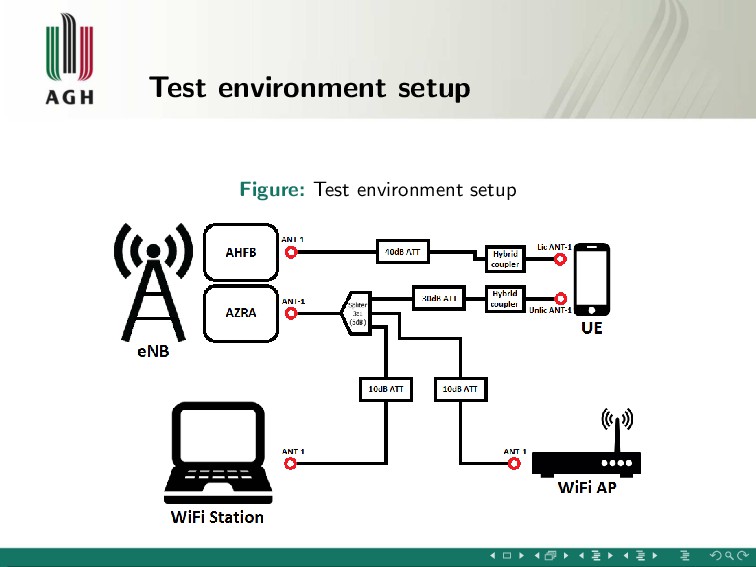
The next important feature that will lead to better performance of the LTE system is called Licensed-Assisted Access (LAA) introduced in the 3GPP release 13 specification. In LTE, the preferred type of spectrum to use for data transmission is licensed spectrum, because it can provide predictable high-quality services. On the other hand, since the licensed spectrum is limited, it is extremely costly to allocate new licensed spectrum bands. Therefore, it is necessary to exploit new frequency spectrum resources. To cope with ever-increasing data traffic, the 3GPP expands the bandwidth to the unlicensed 5 GHz spectrum. In that case, the unlicensed spectrum can be an effective complement to licensed spectrum in cellular networks and lead to increased data throughput. Considering the use of the unlicensed spectrum, the fair coexistence between LTE and incumbent systems, such as Wi-Fi, must be taken into account. LAA design should target not to impact Wi-Fi services more than an additional Wi-Fi network on the same carrier, with respect to throughput and latency. LAA is introduced as a single global solution framework allowing compliance with any regional regulatory requirements. The main objective of this master’s thesis was to prepare and perform tests of LTE-LAA and Wi-Fi coexistence in the unlicensed spectrum in the lab environment. Various Wi-Fi services were measured in the presence of simultaneous LTE transmission and then analyzed in terms of the throughput as well as Quality of Service (QoS) parameters, such as transmission delay and jitter. During simultaneous transmissions, different types of LTE traffic were used and compared to determine if coexistence between LAA and Wi-Fi in unlicensed spectrum was fair and harmonious.

Avatar for Szymon Ludyga

Szymon Ludyga

September 26, 2018

Transcript

  1. Analysis of the LTE-LAA impact on the services working simultaneously

    in the 5GHz band Szymon Ludyga Department of Telecommunications Krakow, 5 October 2018
  2. Outline 1 Introduction 2 Licensed-Assisted Access in LTE 3 Measurements

    of the LTE-LAA and Wi-Fi coexistence performance 4 Summary and perspectives for the future
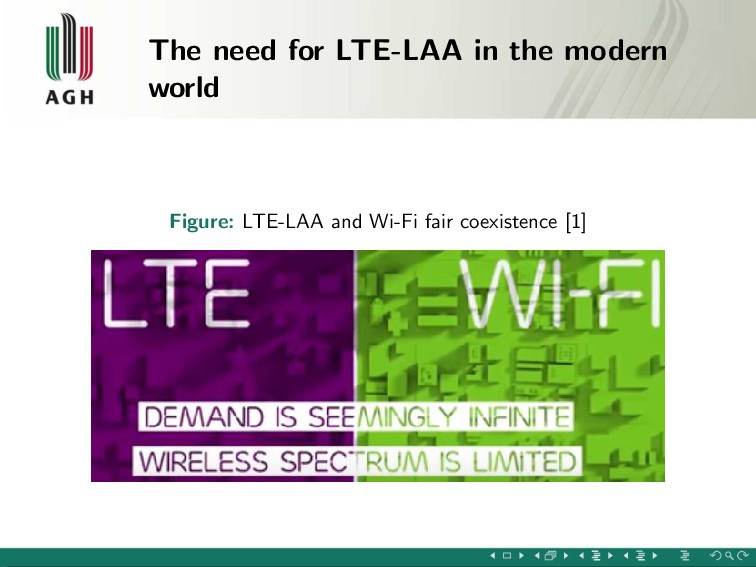
  3. The need for LTE-LAA in the modern world 1. Increasing

    demand for the high-quality data in LTE network. 2. Limited resources in the licensed spectrum. LAA solution: Using unlicensed spectrum currently occupied by Wi-Fi system. Advantages: Better peak rates, Better coverage, Better utilization of 5 GHz band, Better performance in case of system overload.
  4. Licensed-Assisted Access in LTE Basic concepts of LAA Carrier Aggregation

    with licensed primary cell and unlicensed secondary cell, Listen-before-talk mechanism with Clear Channel Assessment, Works only in downlink direction.
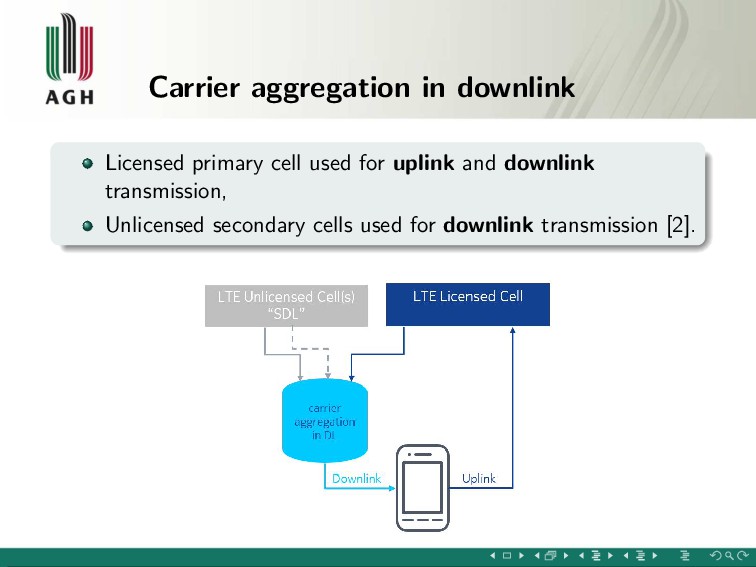
  5. Carrier aggregation in downlink Licensed primary cell used for uplink

    and downlink transmission, Unlicensed secondary cells used for downlink transmission [2].
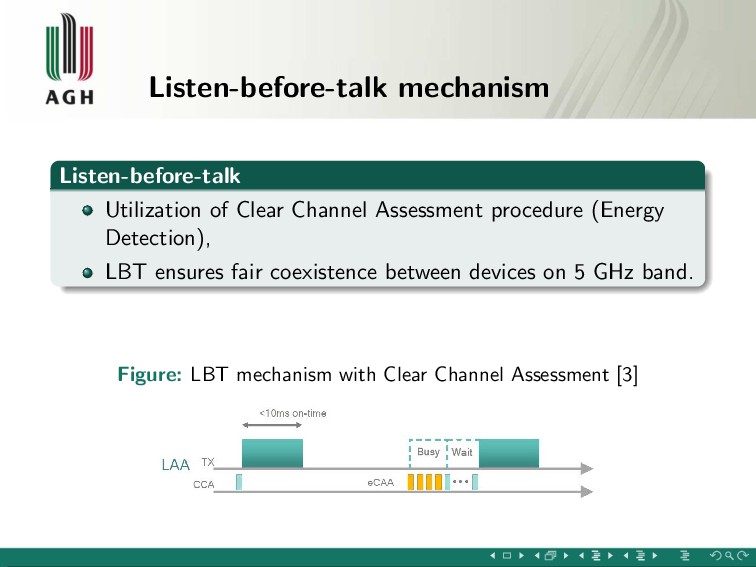
  6. Listen-before-talk mechanism Listen-before-talk Utilization of Clear Channel Assessment procedure (Energy

    Detection), LBT ensures fair coexistence between devices on 5 GHz band. Figure: LBT mechanism with Clear Channel Assessment [3]
  7. LTE-LAA and Wi-Fi coexistence Performance tests with different DMTC periods

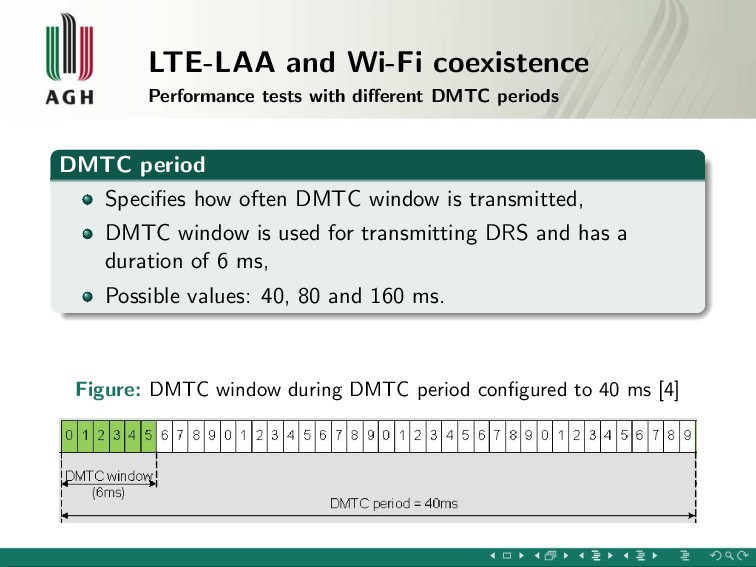
    DMTC period Specifies how often DMTC window is transmitted, DMTC window is used for transmitting DRS and has a duration of 6 ms, Possible values: 40, 80 and 160 ms. Figure: DMTC window during DMTC period configured to 40 ms [4]
  8. Results of the TCP and UDP throughput measurements Performance tests

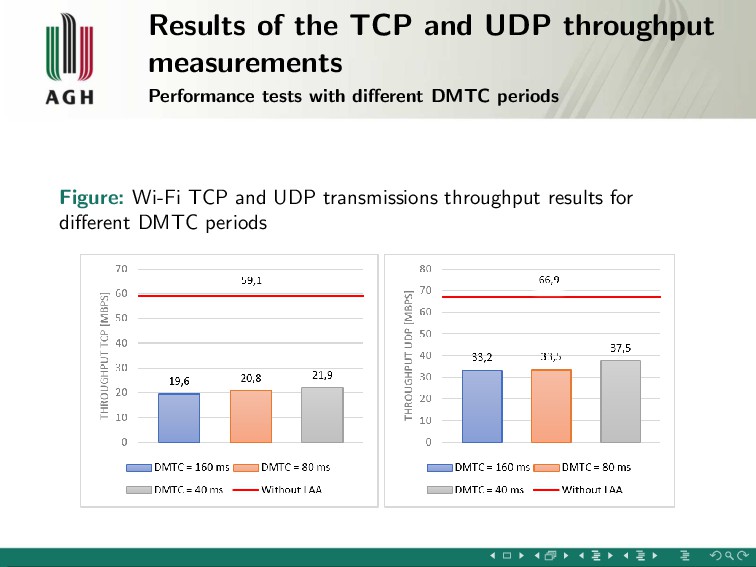
    with different DMTC periods Figure: Wi-Fi TCP and UDP transmissions throughput results for different DMTC periods
  9. LTE-LAA and Wi-Fi coexistence Performance tests with different types of

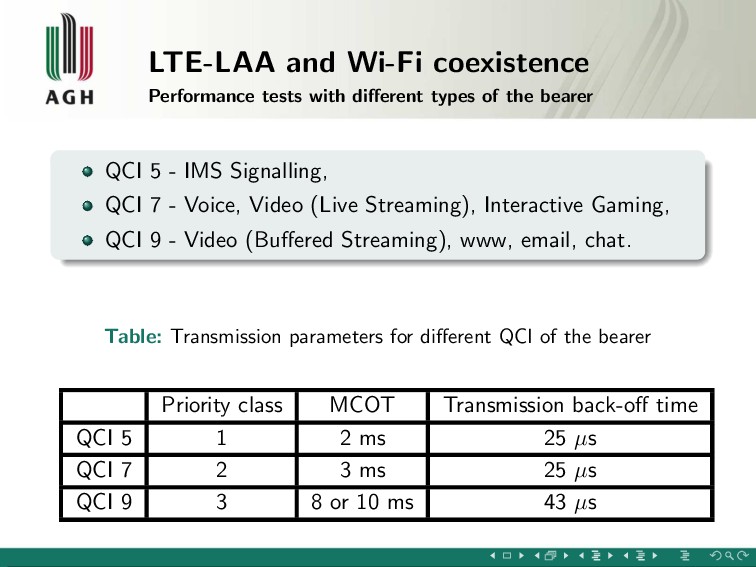
    the bearer QCI 5 - IMS Signalling, QCI 7 - Voice, Video (Live Streaming), Interactive Gaming, QCI 9 - Video (Buffered Streaming), www, email, chat. Table: Transmission parameters for different QCI of the bearer Priority class MCOT Transmission back-off time QCI 5 1 2 ms 25 µs QCI 7 2 3 ms 25 µs QCI 9 3 8 or 10 ms 43 µs
  10. Results of the TCP and UDP throughput measurements Performance tests

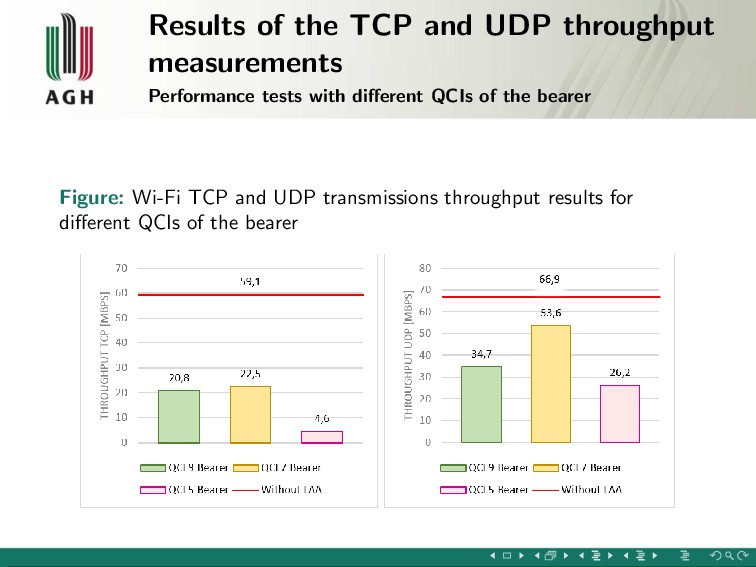
    with different QCIs of the bearer Figure: Wi-Fi TCP and UDP transmissions throughput results for different QCIs of the bearer
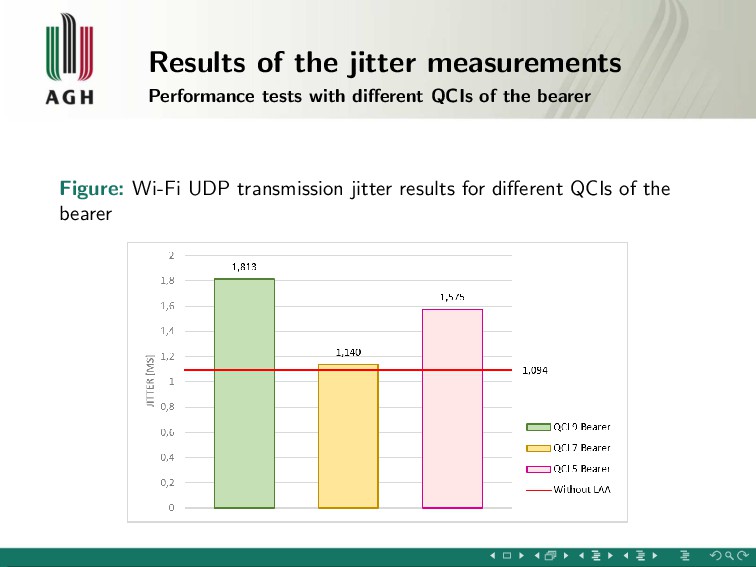
  11. Results of the jitter measurements Performance tests with different QCIs

    of the bearer Figure: Wi-Fi UDP transmission jitter results for different QCIs of the bearer
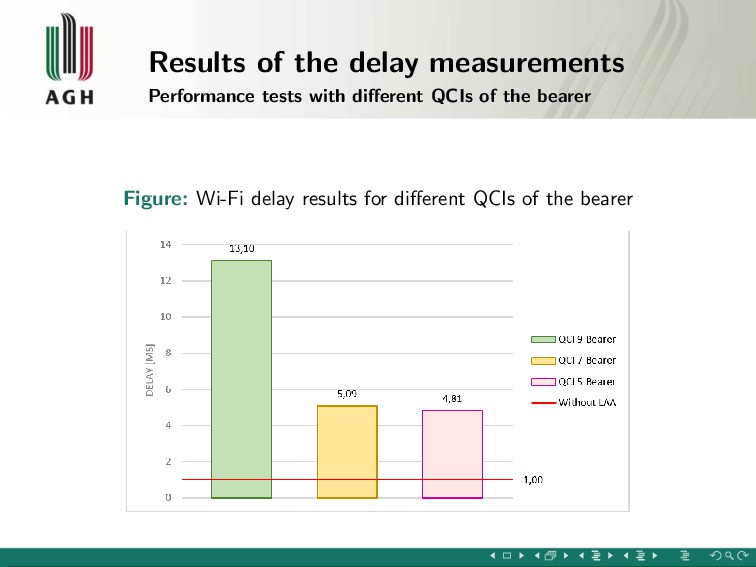
  12. Results of the delay measurements Performance tests with different QCIs

    of the bearer Figure: Wi-Fi delay results for different QCIs of the bearer
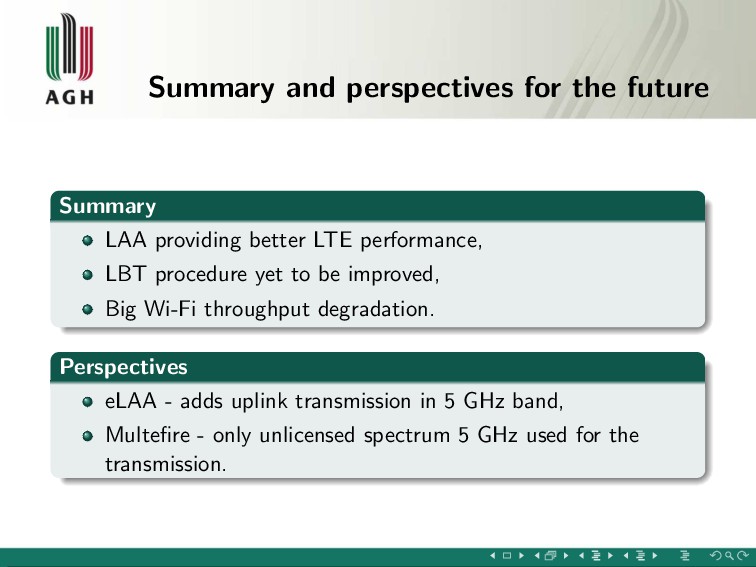
  13. Summary and perspectives for the future Summary LAA providing better

    LTE performance, LBT procedure yet to be improved, Big Wi-Fi throughput degradation. Perspectives eLAA - adds uplink transmission in 5 GHz band, Multefire - only unlicensed spectrum 5 GHz used for the transmission.
  14. Materials used in presentation [1] Ericsson: Licensed-Assisted Access (LAA) [2],[4]

    Nokia’s materials on Licensed-Assisted Access [3] Qualcomm webinar: Licensed-Assisted Access https://www.qualcomm.com/invention/technologies/lte/laa