the law and medical field on how to give clear instructions. Using the research done in the law and medical field,teacher have summarized the following conclusions: • Instructions should be explicit rather than implicit • Instructions should be worded clearly • Instructions should be worded simply • Subtle shifts in wording can produce significant differences • Instructors should have learners repeat back instructions to ensure understanding
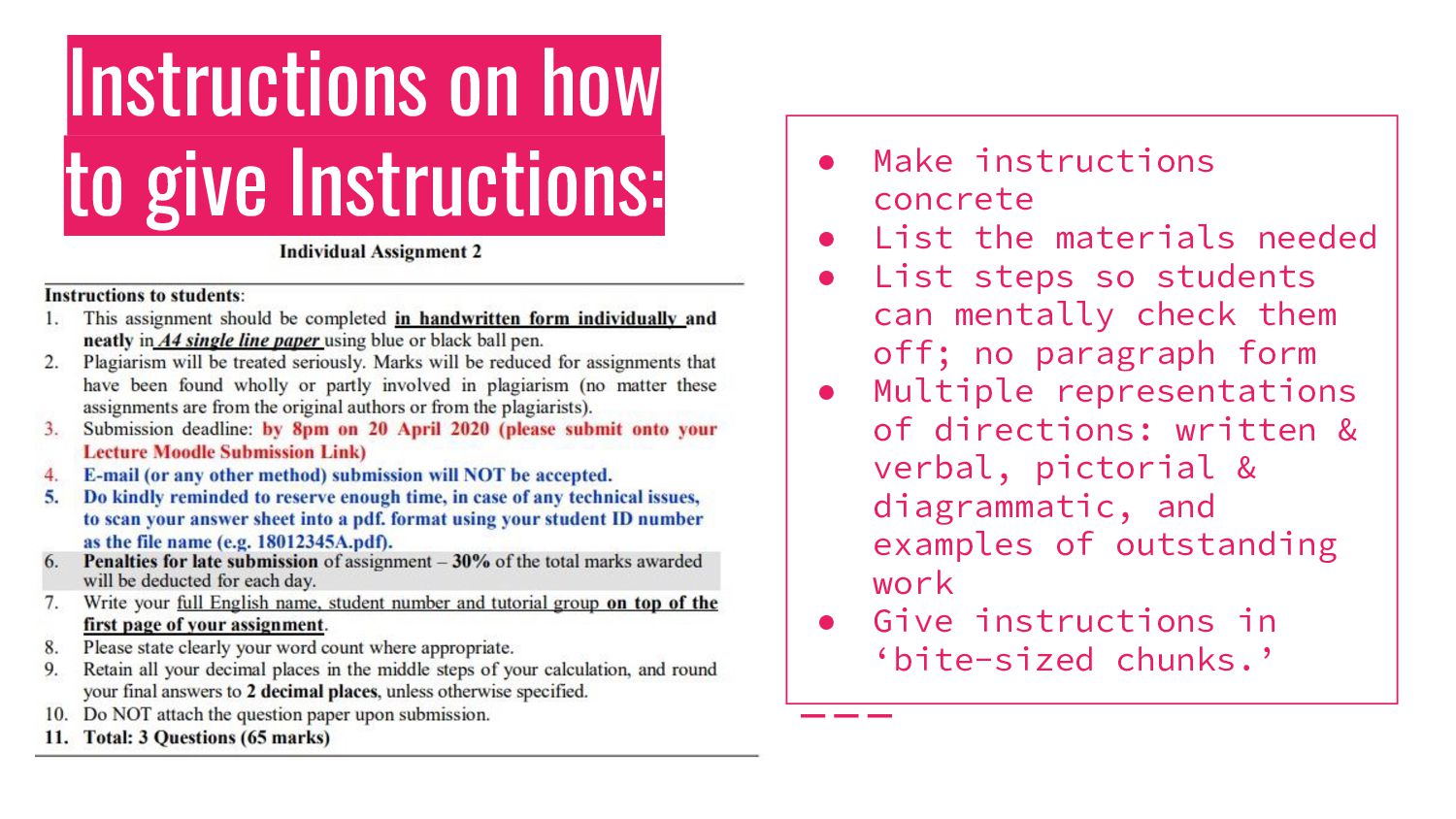
• List the materials needed • List steps so students can mentally check them off; no paragraph form • Multiple representations of directions: written & verbal, pictorial & diagrammatic, and examples of outstanding work • Give instructions in ‘bite-sized chunks.’
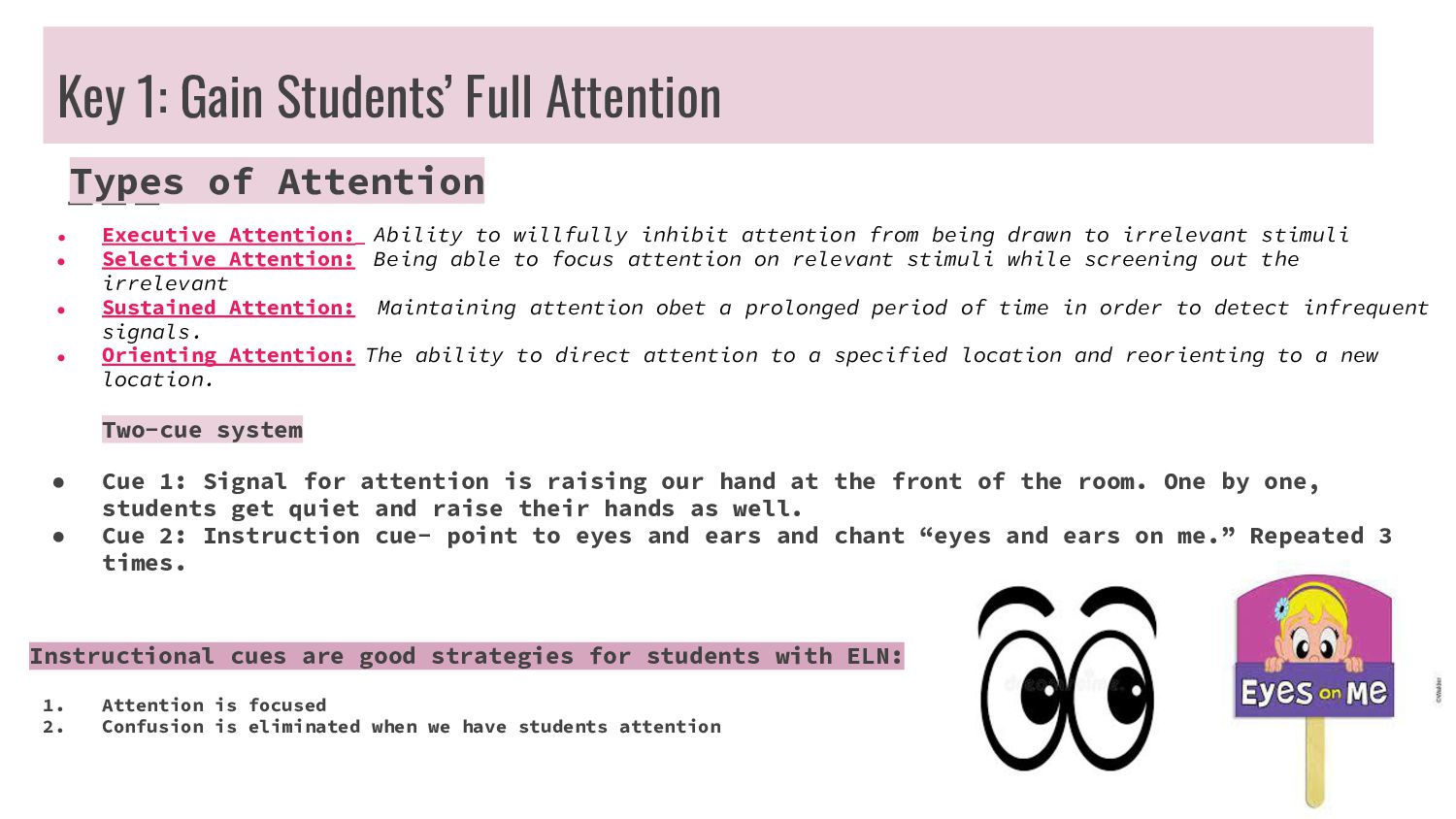
to willfully inhibit attention from being drawn to irrelevant stimuli • Selective Attention: Being able to focus attention on relevant stimuli while screening out the irrelevant • Sustained Attention: Maintaining attention obet a prolonged period of time in order to detect infrequent signals. • Orienting Attention: The ability to direct attention to a specified location and reorienting to a new location. Two-cue system • Cue 1: Signal for attention is raising our hand at the front of the room. One by one, students get quiet and raise their hands as well. • Cue 2: Instruction cue- point to eyes and ears and chant “eyes and ears on me.” Repeated 3 times. Instructional cues are good strategies for students with ELN: 1. Attention is focused 2. Confusion is eliminated when we have students attention Types of Attention
better auditory perception and others have better visual perception. ★ Study done to 52 undergrads. Teacher gave one half of class written instructions, and the other half was given oral instructions. ➢ Written=58% increase of student production ➢ Oral=87% increase of student production ★ Delayed assessment showed improvement in applications was maintained by 50% for oral instructions. Vs 75% for written instructions. Oral instructions has initial advantage; written has advantage over time. Written and Oral instructions help ELN: • Perception improves when perception is supported • Confusion is eliminated when perception is supported • Sequencing is facilitated when students hear and see instructions • Frustration is reduced when students understand what they are supposed to do
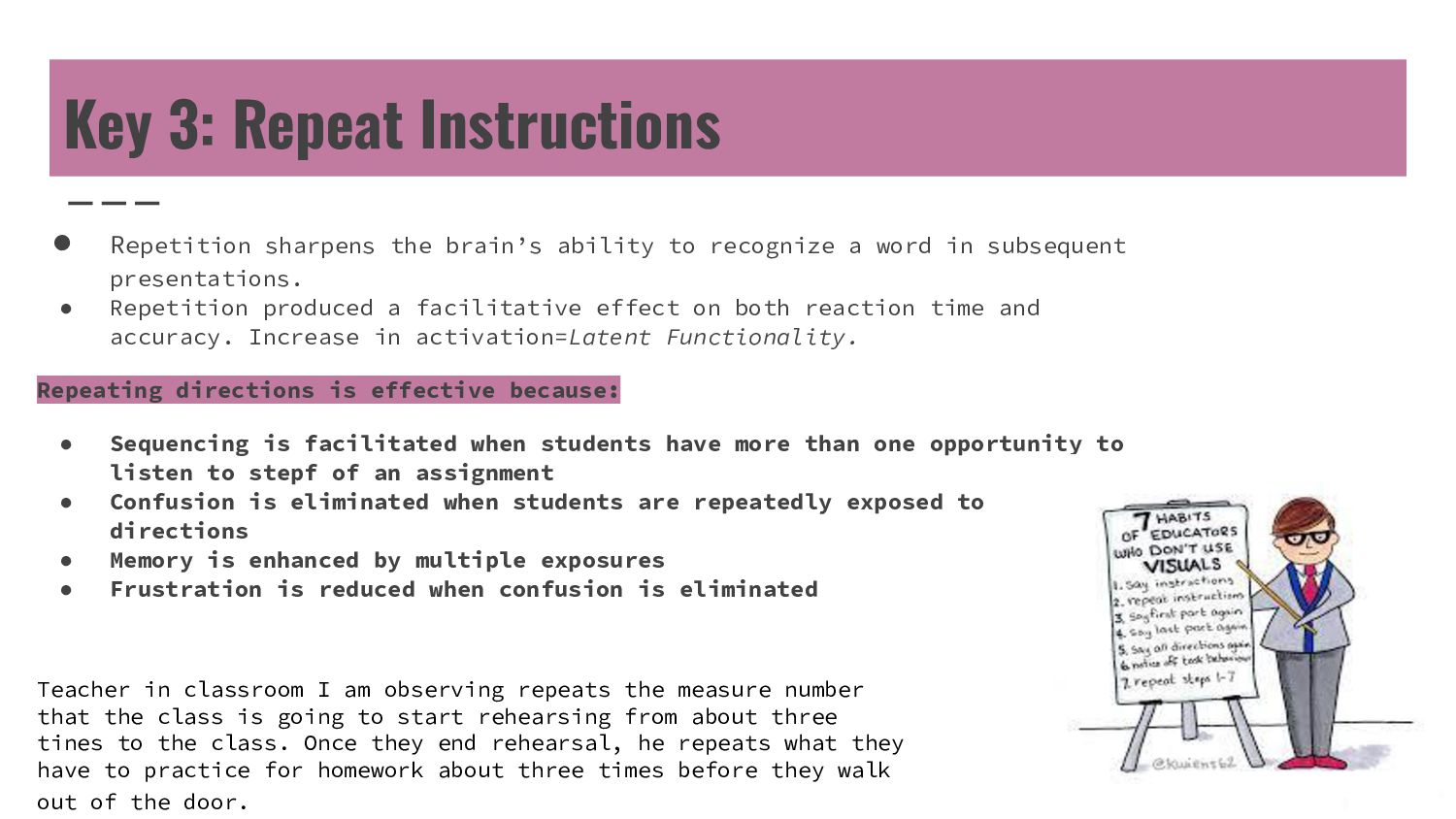
to recognize a word in subsequent presentations. • Repetition produced a facilitative effect on both reaction time and accuracy. Increase in activation=Latent Functionality. Repeating directions is effective because: • Sequencing is facilitated when students have more than one opportunity to listen to stepf of an assignment • Confusion is eliminated when students are repeatedly exposed to directions • Memory is enhanced by multiple exposures • Frustration is reduced when confusion is eliminated Teacher in classroom I am observing repeats the measure number that the class is going to start rehearsing from about three tines to the class. Once they end rehearsal, he repeats what they have to practice for homework about three times before they walk out of the door.
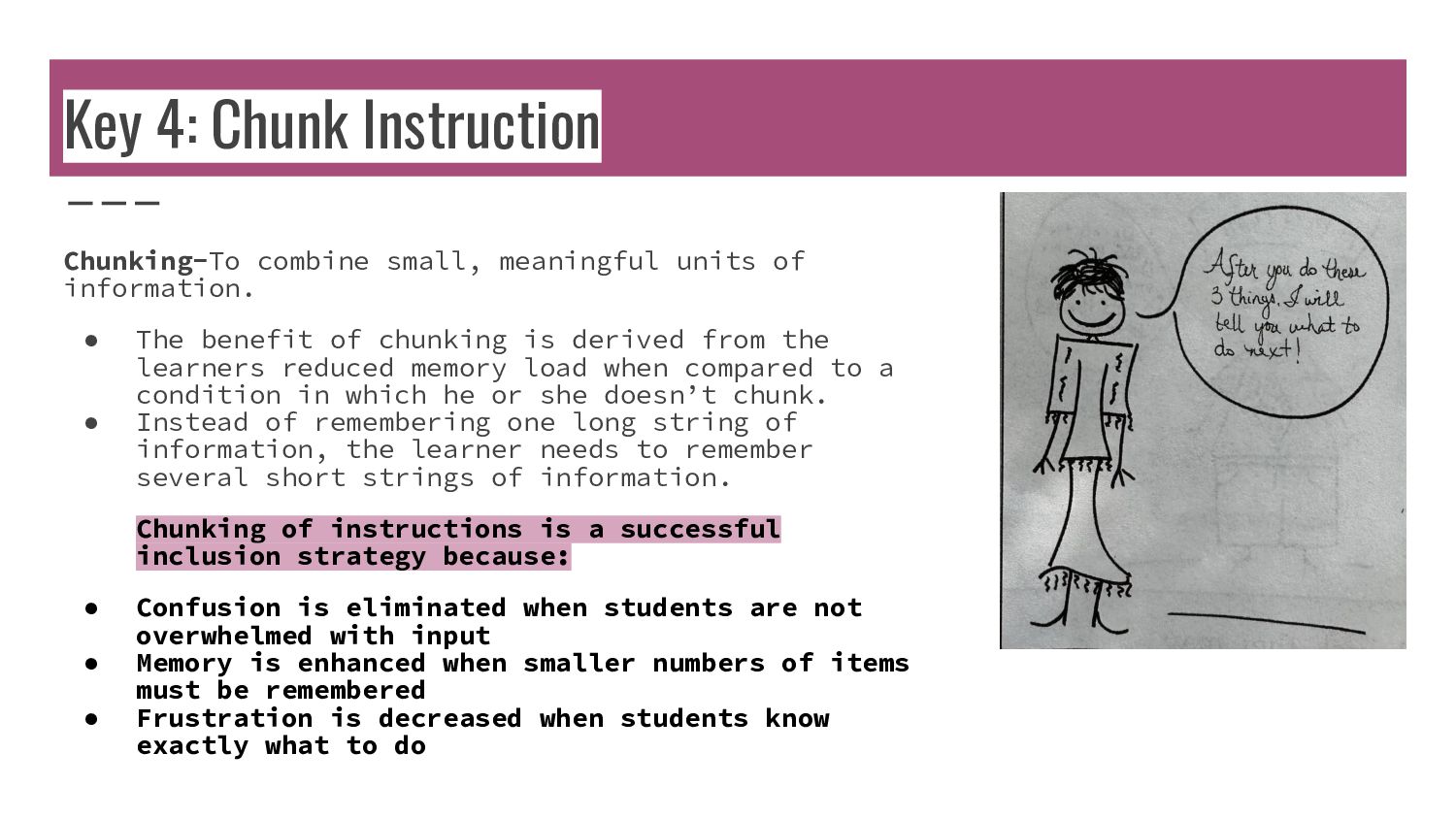
information. • The benefit of chunking is derived from the learners reduced memory load when compared to a condition in which he or she doesn’t chunk. • Instead of remembering one long string of information, the learner needs to remember several short strings of information. Chunking of instructions is a successful inclusion strategy because: • Confusion is eliminated when students are not overwhelmed with input • Memory is enhanced when smaller numbers of items must be remembered • Frustration is decreased when students know exactly what to do
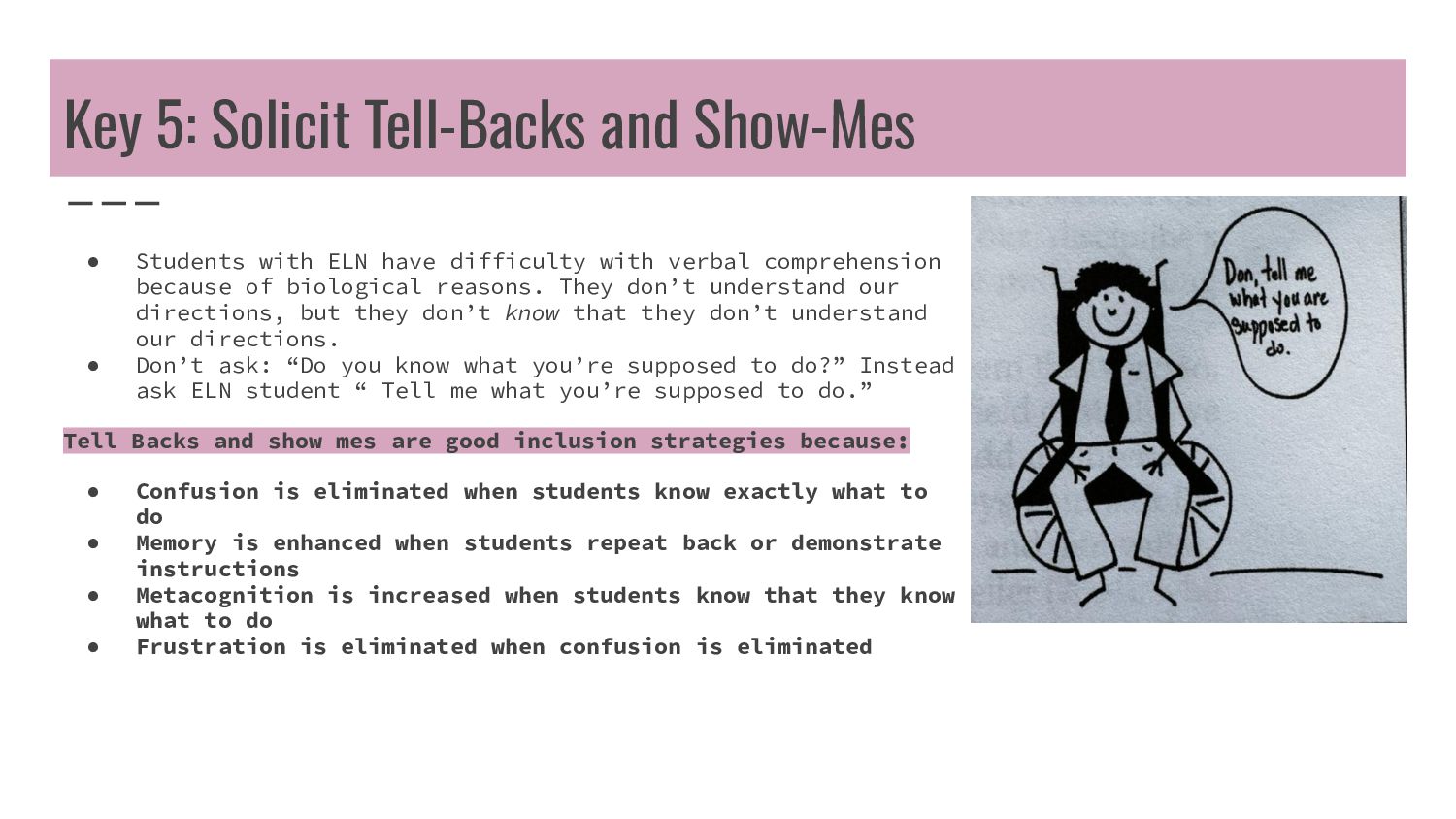
have difficulty with verbal comprehension because of biological reasons. They don’t understand our directions, but they don’t know that they don’t understand our directions. • Don’t ask: “Do you know what you’re supposed to do?” Instead ask ELN student “ Tell me what you’re supposed to do.” Tell Backs and show mes are good inclusion strategies because: • Confusion is eliminated when students know exactly what to do • Memory is enhanced when students repeat back or demonstrate instructions • Metacognition is increased when students know that they know what to do • Frustration is eliminated when confusion is eliminated


 skipperchong
 thoeni
 tmiket
 jonoalderson
 bkeepers
 bethany
 signer
 techseoconnect
 baasie
 mayunak
 inesmontani