Upgrade to Pro — share decks privately, control downloads, hide ads and more …

English_SustainabilityReport2026

Avatar for TBM_cc TBM_cc
June 08, 2026
120

 English_SustainabilityReport2026

Avatar for TBM_cc

TBM_cc

June 08, 2026

Transcript

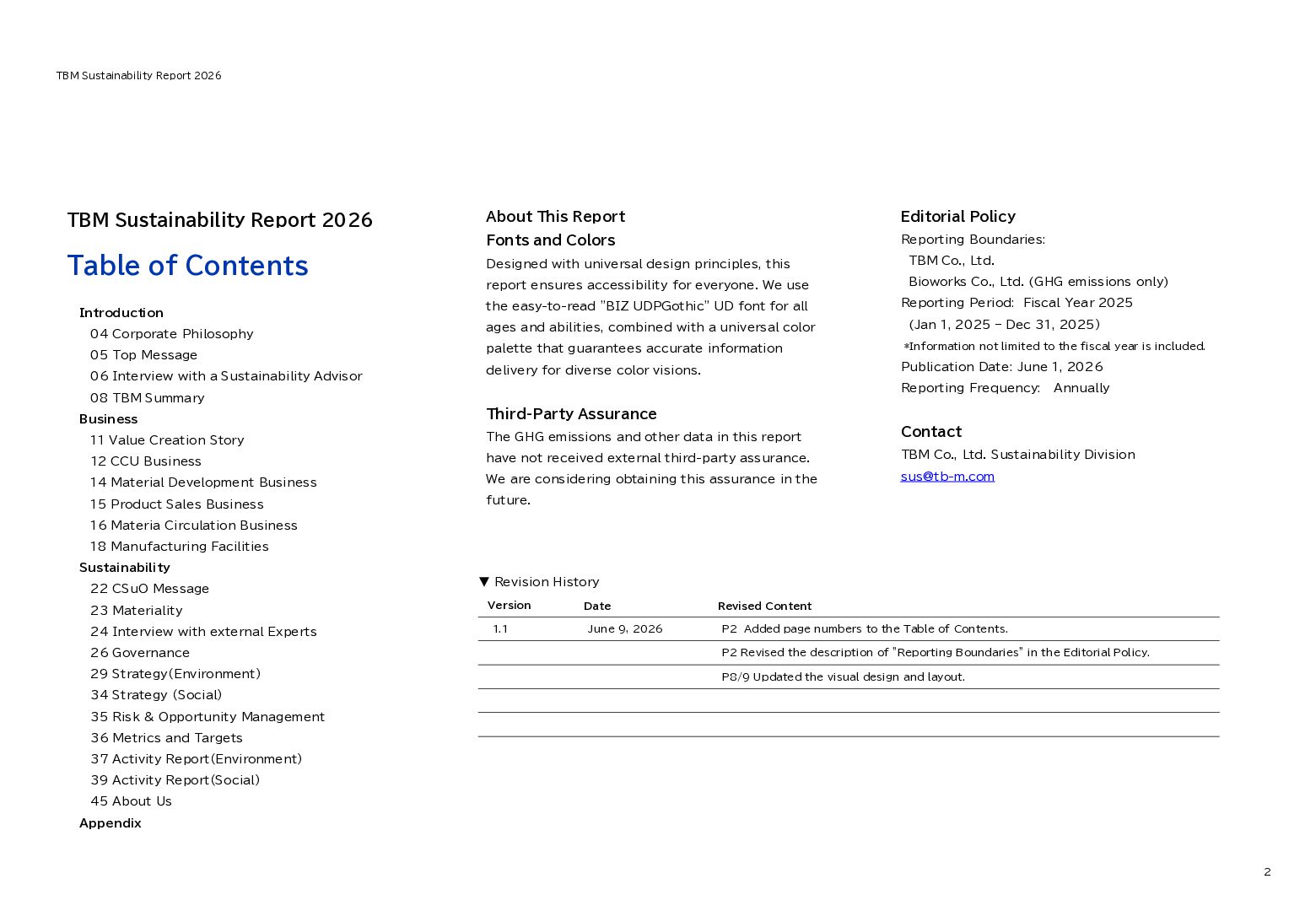
  1. 2 TBM Sustainability Report 2026 Table of Contents Introduction 04

    Corporate Philosophy 05 Top Message 06 Interview with a Sustainability Advisor 08 TBM Summary Business 11 Value Creation Story 12 CCU Business 14 Material Development Business 15 Product Sales Business 16 Materia Circulation Business 18 Manufacturing Facilities Sustainability 22 CSuO Message 23 Materiality 24 Interview with external Experts 26 Governance 29 Strategy(Environment) 34 Strategy (Social) 35 Risk & Opportunity Management 36 Metrics and Targets 37 Activity Report(Environment) 39 Activity Report(Social) 45 About Us Appendix About This Report Fonts and Colors Designed with universal design principles, this report ensures accessibility for everyone. We use the easy-to-read "BIZ UDPGothic" UD font for all ages and abilities, combined with a universal color palette that guarantees accurate information delivery for diverse color visions. Third-Party Assurance The GHG emissions and other data in this report have not received external third-party assurance. We are considering obtaining this assurance in the future. Editorial Policy Reporting Boundaries: TBM Co., Ltd. Bioworks Co., Ltd. (GHG emissions only) Reporting Period: Fiscal Year 2025 (Jan 1, 2025 – Dec 31, 2025) *Information not limited to the fiscal year is included. Publication Date: June 1, 2026 Reporting Frequency: Annually Contact TBM Co., Ltd. Sustainability Division [email protected] Version Date Revised Content 1.1 June 9, 2026 P2 Added page numbers to the Table of Contents. P2 Revised the description of "Reporting Boundaries" in the Editorial Policy. P8/9 Updated the visual design and layout. ▼ Revision History TBM Sustainability Report 2026
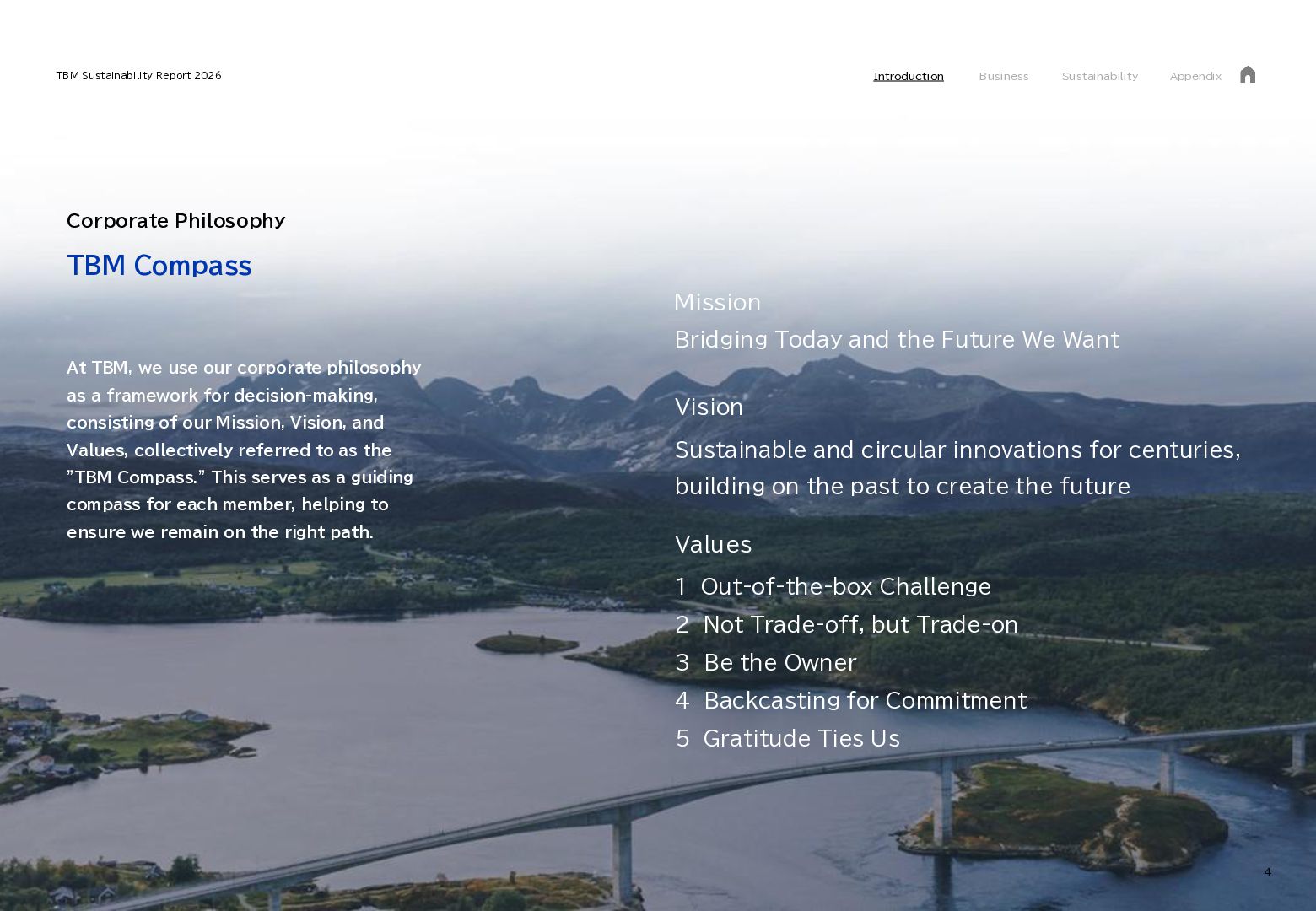
  2. 4 TBM Sustainability Report 2026 TBM Compass Corporate Philosophy At

    TBM, we use our corporate philosophy as a framework for decision-making, consisting of our Mission, Vision, and Values, collectively referred to as the "TBM Compass." This serves as a guiding compass for each member, helping to ensure we remain on the right path. Mission Bridging Today and the Future We Want Vision Sustainable and circular innovations for centuries, building on the past to create the future Values 1 Out-of-the-box Challenge 2 Not Trade-off, but Trade-on 3 Be the Owner 4 Backcasting for Commitment 5 Gratitude Ties Us Introduction Introduction Business Business Sustainability Sustainability Appendix Appendix
  3. 5 TBM Sustainability Report 2026 Toward a "Carbon Solution Company":

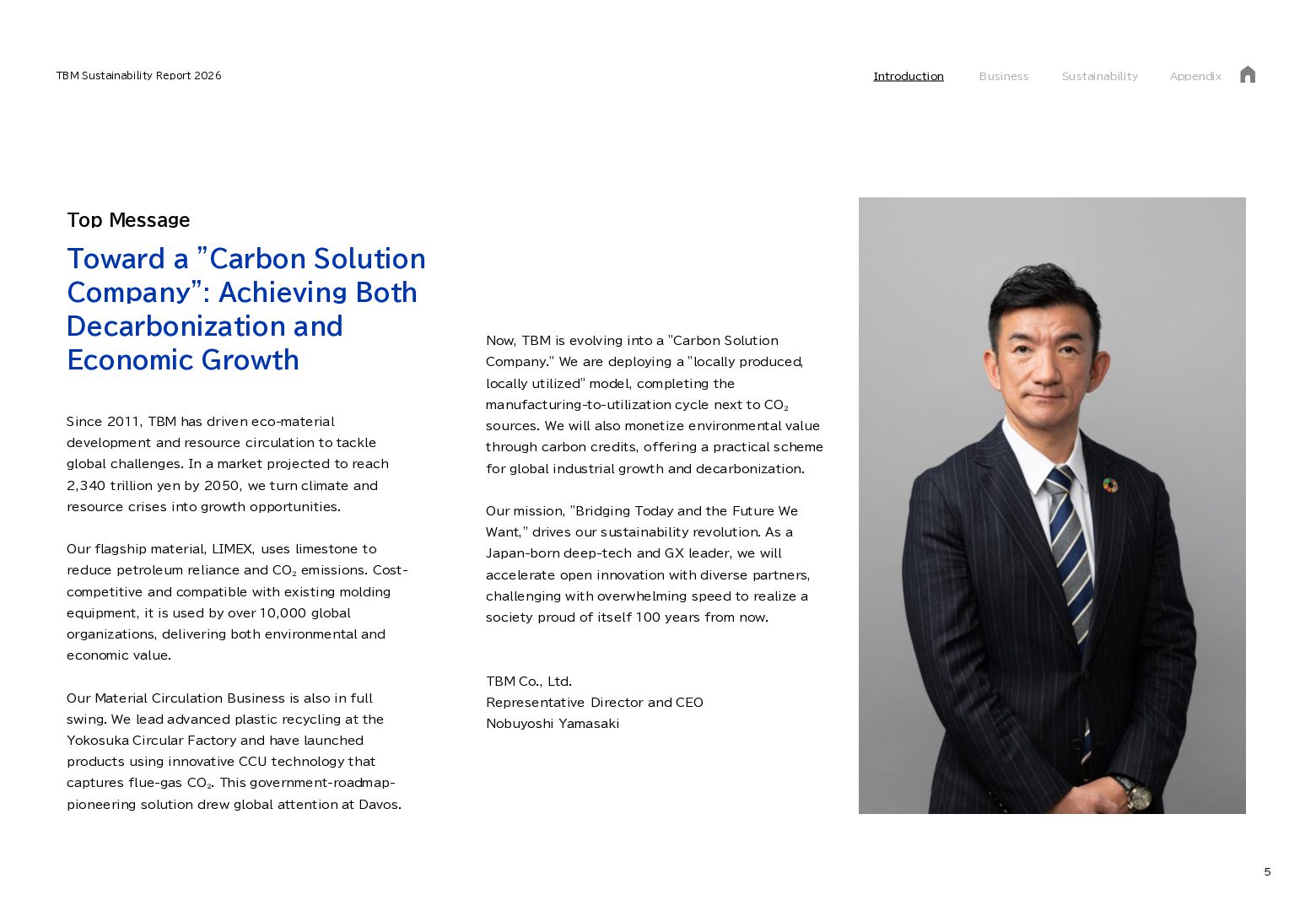
    Achieving Both Decarbonization and Economic Growth Top Message Since 2011, TBM has driven eco-material development and resource circulation to tackle global challenges. In a market projected to reach 2,340 trillion yen by 2050, we turn climate and resource crises into growth opportunities. Our flagship material, LIMEX, uses limestone to reduce petroleum reliance and CO₂ emissions. Cost- competitive and compatible with existing molding equipment, it is used by over 10,000 global organizations, delivering both environmental and economic value. Our Material Circulation Business is also in full swing. We lead advanced plastic recycling at the Yokosuka Circular Factory and have launched products using innovative CCU technology that captures flue-gas CO₂. This government-roadmap- pioneering solution drew global attention at Davos. Now, TBM is evolving into a "Carbon Solution Company." We are deploying a "locally produced, locally utilized" model, completing the manufacturing-to-utilization cycle next to CO₂ sources. We will also monetize environmental value through carbon credits, offering a practical scheme for global industrial growth and decarbonization. Our mission, "Bridging Today and the Future We Want," drives our sustainability revolution. As a Japan-born deep-tech and GX leader, we will accelerate open innovation with diverse partners, challenging with overwhelming speed to realize a society proud of itself 100 years from now. TBM Co., Ltd. Representative Director and CEO Nobuyoshi Yamasaki Introduction Introduction Business Business Sustainability Sustainability Appendix Appendix
  4. 6 TBM Sustainability Report 2026 The Path to Becoming a

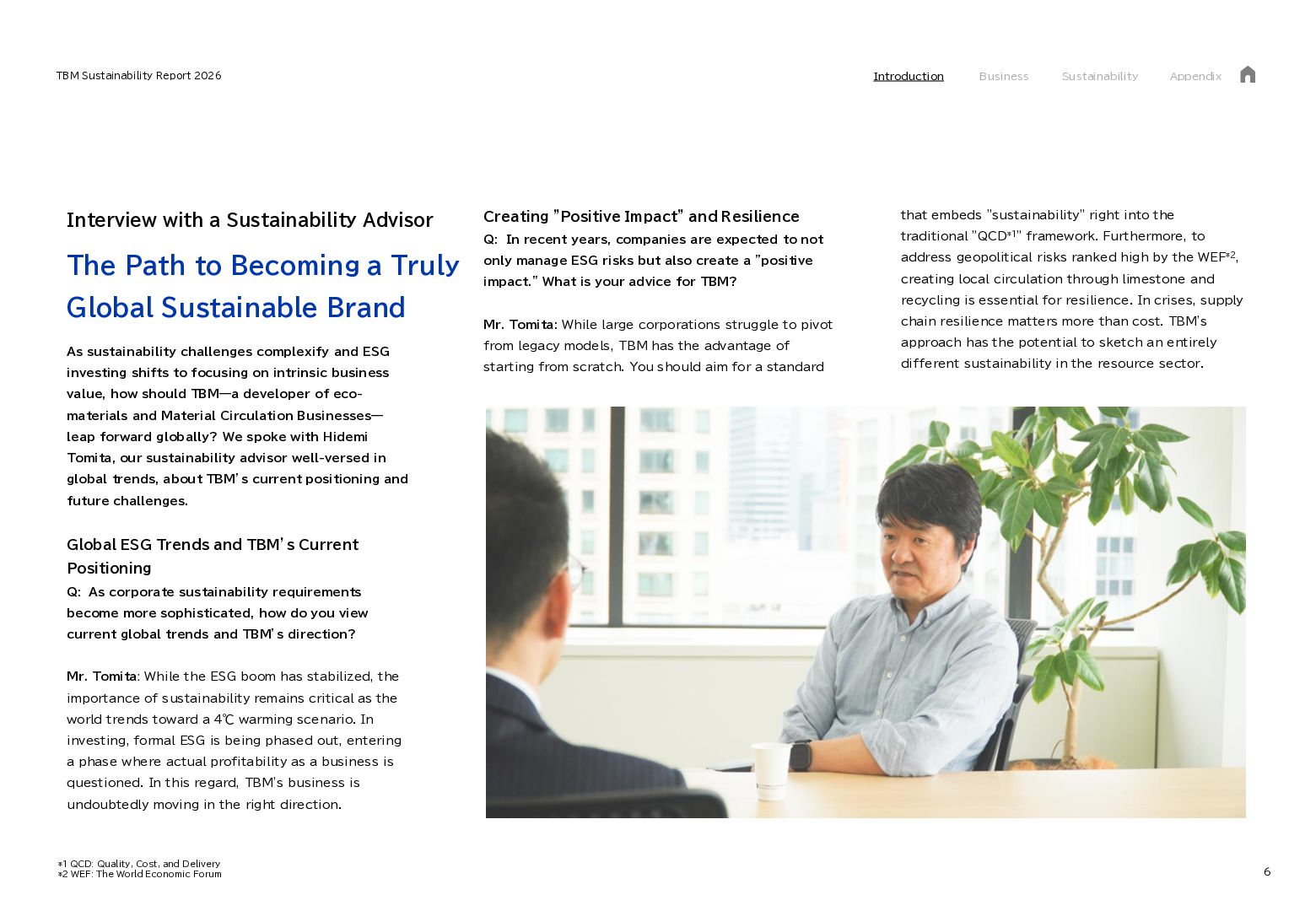
    Truly Global Sustainable Brand Interview with a Sustainability Advisor As sustainability challenges complexify and ESG investing shifts to focusing on intrinsic business value, how should TBM—a developer of eco- materials and Material Circulation Businesses— leap forward globally? We spoke with Hidemi Tomita, our sustainability advisor well-versed in global trends, about TBM’s current positioning and future challenges. Global ESG Trends and TBM’s Current Positioning Q: As corporate sustainability requirements become more sophisticated, how do you view current global trends and TBM’s direction? Mr. Tomita: While the ESG boom has stabilized, the importance of sustainability remains critical as the world trends toward a 4℃ warming scenario. In investing, formal ESG is being phased out, entering a phase where actual profitability as a business is questioned. In this regard, TBM's business is undoubtedly moving in the right direction. Creating "Positive Impact" and Resilience Q: In recent years, companies are expected to not only manage ESG risks but also create a "positive impact." What is your advice for TBM? Mr. Tomita: While large corporations struggle to pivot from legacy models, TBM has the advantage of starting from scratch. You should aim for a standard that embeds "sustainability" right into the traditional "QCD*1" framework. Furthermore, to address geopolitical risks ranked high by the WEF*2, creating local circulation through limestone and recycling is essential for resilience. In crises, supply chain resilience matters more than cost. TBM's approach has the potential to sketch an entirely different sustainability in the resource sector. Introduction Introduction Business Business Sustainability Sustainability Appendix Appendix *1 QCD: Quality, Cost, and Delivery *2 WEF: The World Economic Forum
  5. 7 TBM Sustainability Report 2026 "Rule-Making" in the Circular Economy

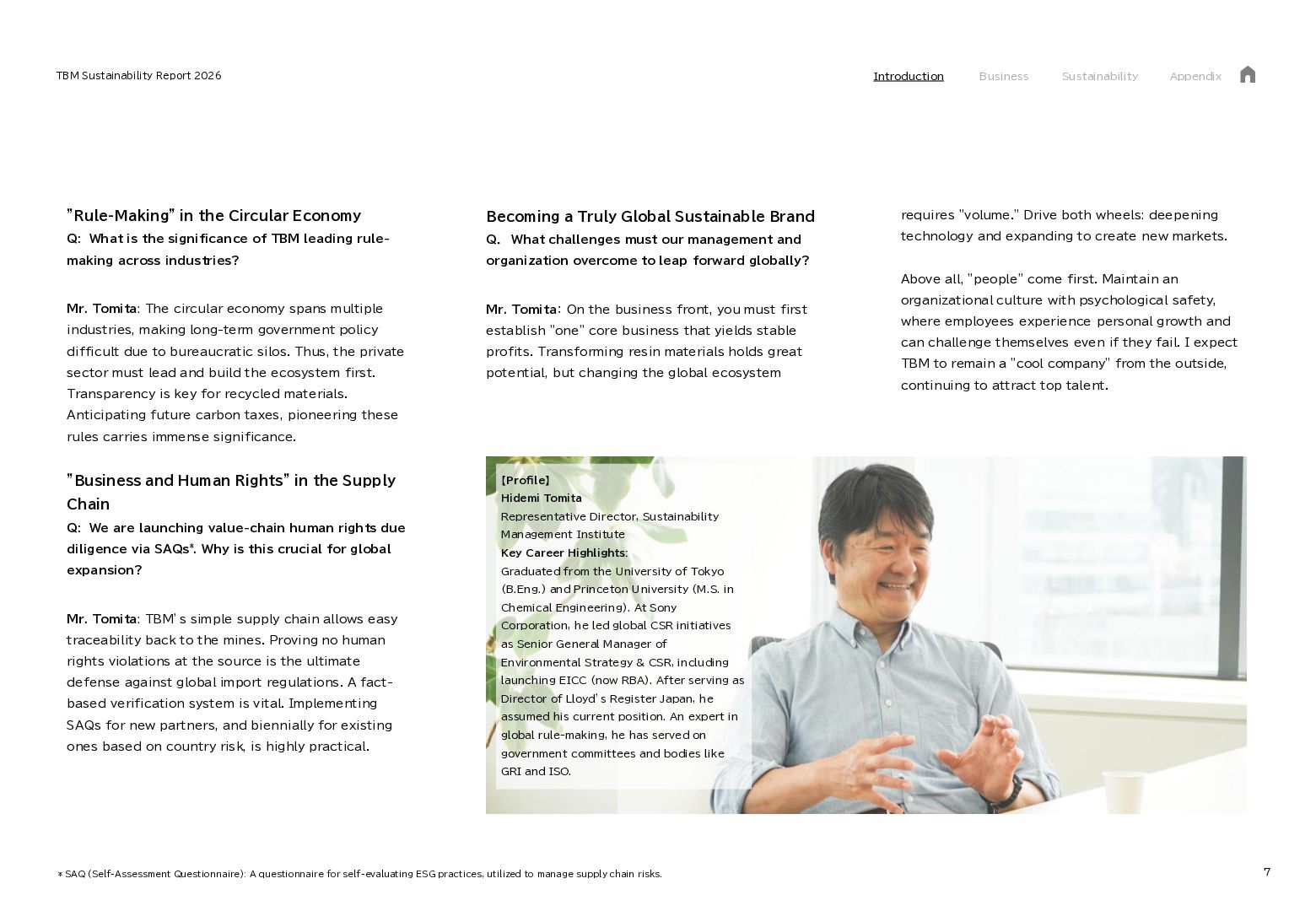
    Q: What is the significance of TBM leading rule- making across industries? Mr. Tomita: The circular economy spans multiple industries, making long-term government policy difficult due to bureaucratic silos. Thus, the private sector must lead and build the ecosystem first. Transparency is key for recycled materials. Anticipating future carbon taxes, pioneering these rules carries immense significance. "Business and Human Rights" in the Supply Chain Q: We are launching value-chain human rights due diligence via SAQs*. Why is this crucial for global expansion? Mr. Tomita: TBM’s simple supply chain allows easy traceability back to the mines. Proving no human rights violations at the source is the ultimate defense against global import regulations. A fact- based verification system is vital. Implementing SAQs for new partners, and biennially for existing ones based on country risk, is highly practical. Becoming a Truly Global Sustainable Brand Q. What challenges must our management and organization overcome to leap forward globally? Mr. Tomita: On the business front, you must first establish "one" core business that yields stable profits. Transforming resin materials holds great potential, but changing the global ecosystem requires "volume." Drive both wheels: deepening technology and expanding to create new markets. Above all, "people" come first. Maintain an organizational culture with psychological safety, where employees experience personal growth and can challenge themselves even if they fail. I expect TBM to remain a "cool company" from the outside, continuing to attract top talent. * SAQ (Self-Assessment Questionnaire): A questionnaire for self-evaluating ESG practices, utilized to manage supply chain risks. 【Profile】 Hidemi Tomita Representative Director, Sustainability Management Institute Key Career Highlights: Graduated from the University of Tokyo (B.Eng.) and Princeton University (M.S. in Chemical Engineering). At Sony Corporation, he led global CSR initiatives as Senior General Manager of Environmental Strategy & CSR, including launching EICC (now RBA). After serving as Director of Lloyd’s Register Japan, he assumed his current position. An expert in global rule-making, he has served on government committees and bodies like GRI and ISO. Introduction Introduction Business Business Sustainability Sustainability Appendix Appendix
  6. 8 TBM Sustainability Report 2026 Sustainability in Numbers TBM Summary

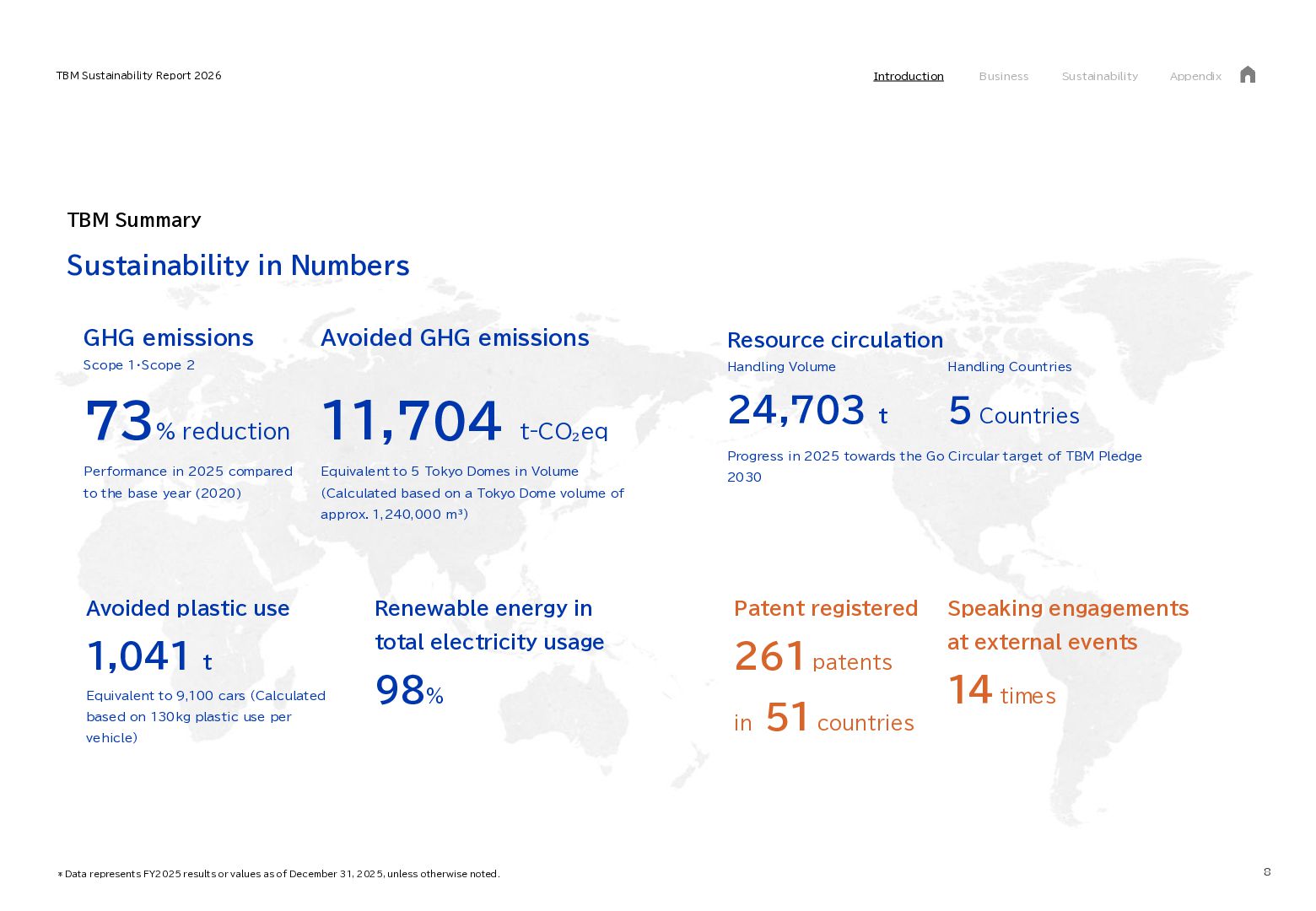
    GHG emissions Scope 1・Scope 2 73 % reduction Performance in 2025 compared to the base year (2020) Renewable energy in total electricity usage 98% Patent registered 261 patents in 51 countries Speaking engagements at external events 14 times * Data represents FY2025 results or values as of December 31, 2025, unless otherwise noted. Resource circulation Handling Volume 24,703 t Handling Countries 5 Countries Avoided GHG emissions 11,704 t-CO₂eq Equivalent to 5 Tokyo Domes in Volume (Calculated based on a Tokyo Dome volume of approx. 1,240,000 m³) Progress in 2025 towards the Go Circular target of TBM Pledge 2030 Avoided plastic use 1,041 t Equivalent to 9,100 cars (Calculated based on 130kg plastic use per vehicle) Introduction Introduction Business Business Sustainability Sustainability Appendix Appendix
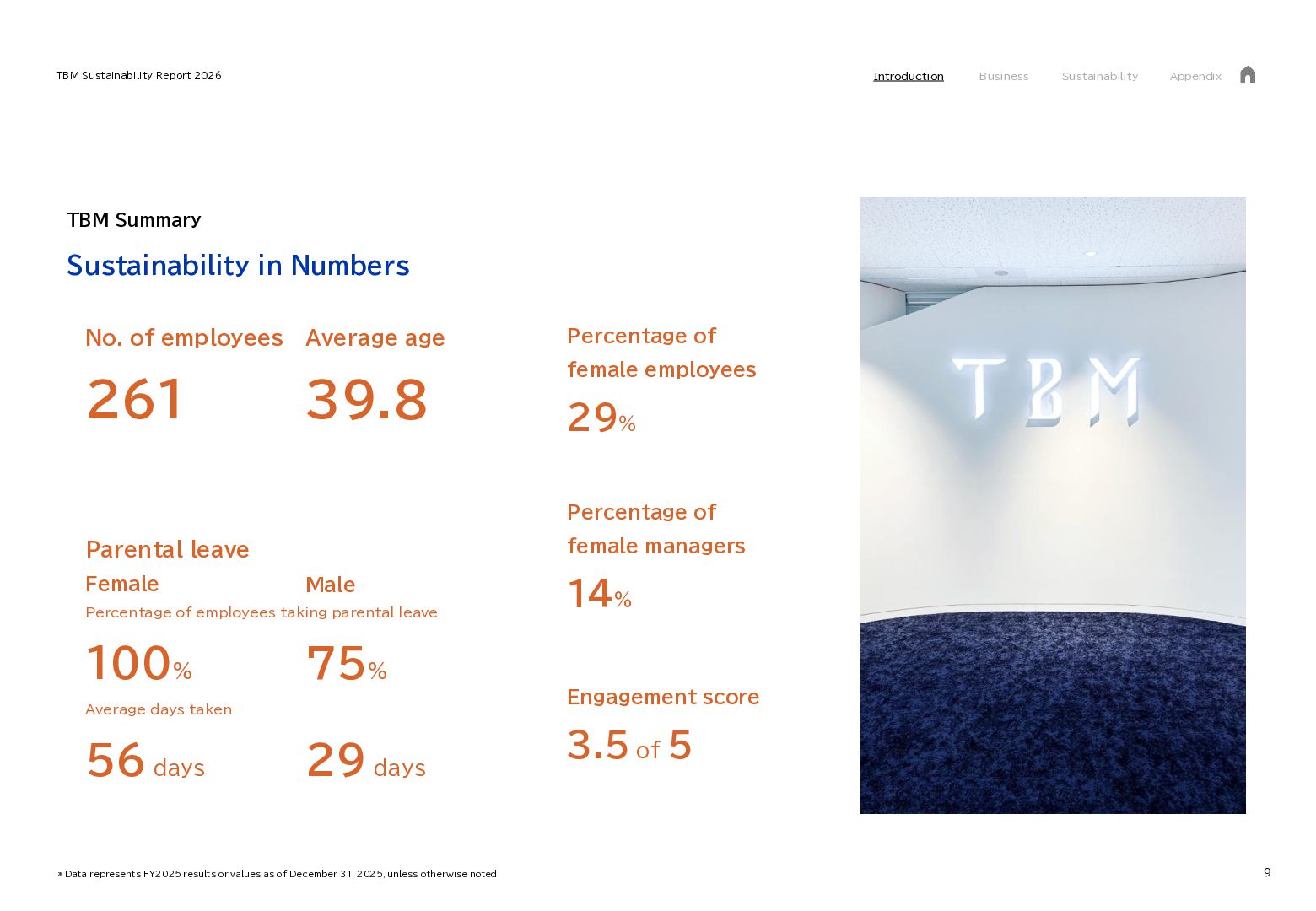
  7. 9 TBM Sustainability Report 2026 Sustainability in Numbers TBM Summary

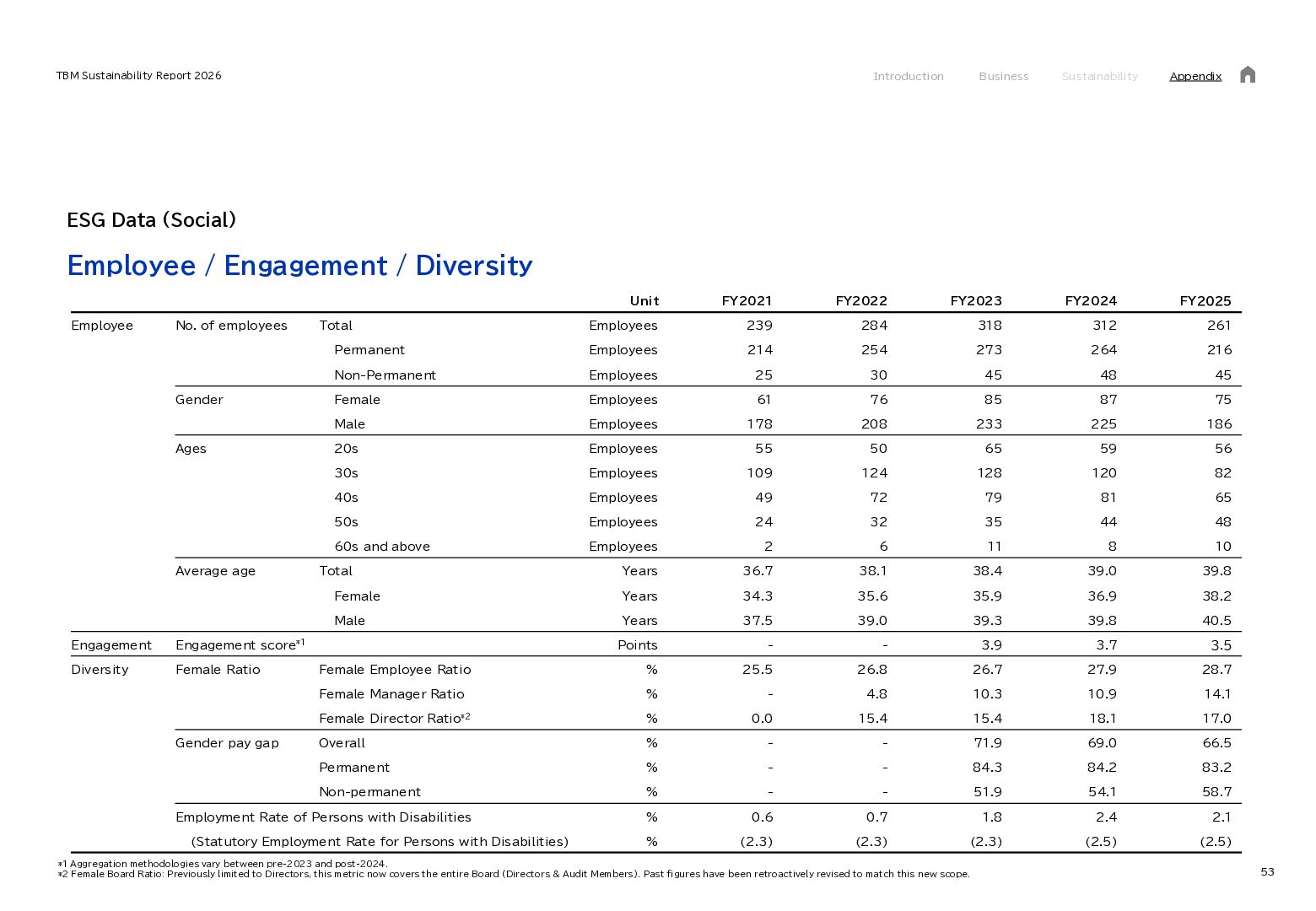
    No. of employees 261 Average age 39.8 Percentage of female employees 29% Percentage of female managers 14% Engagement score 3.5 of 5 Parental leave Female Percentage of employees taking parental leave 100% Average days taken 56 days Male 75% 29 days * Data represents FY2025 results or values as of December 31, 2025, unless otherwise noted. Introduction Introduction Business Business Sustainability Sustainability Appendix Appendix
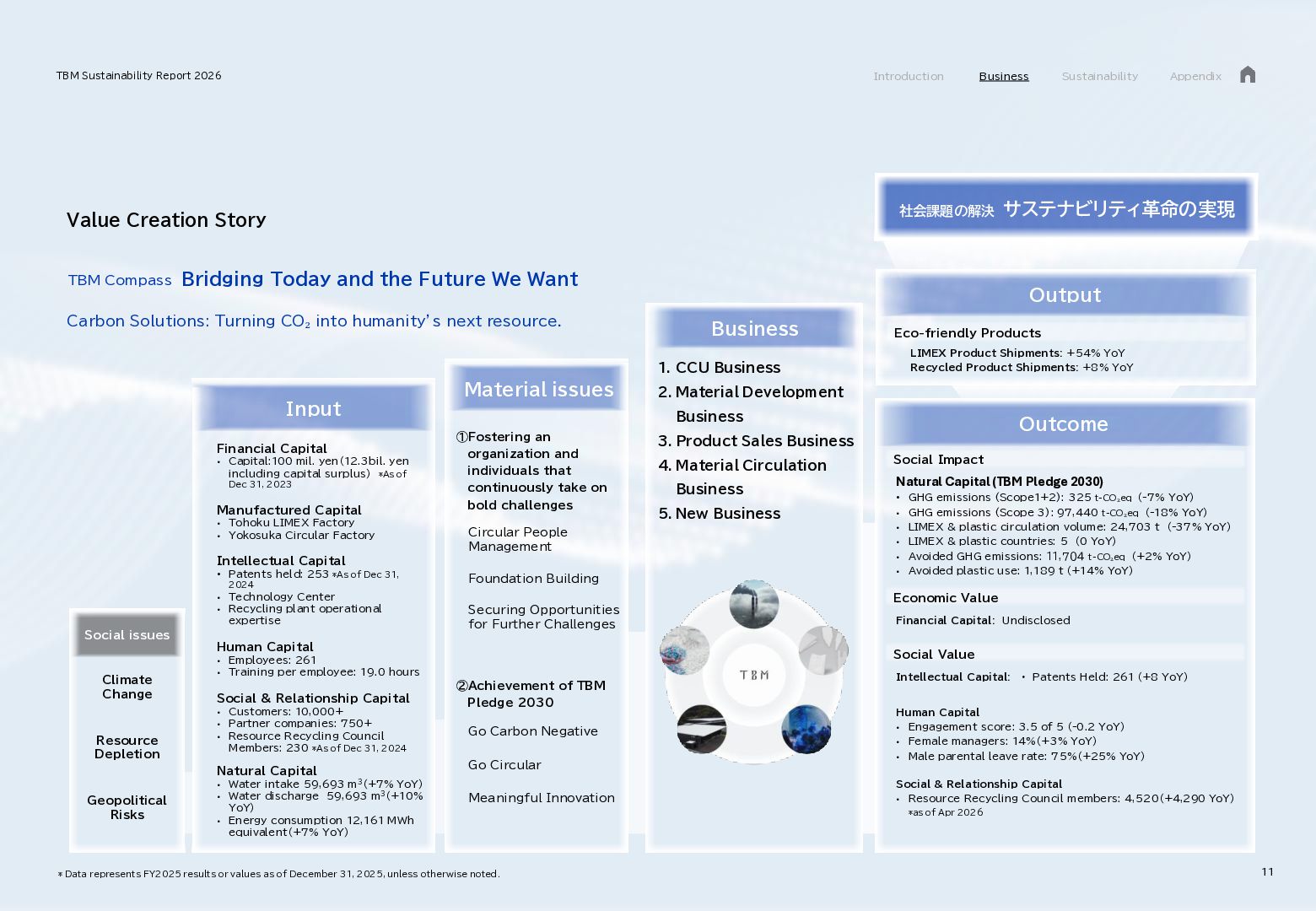
  8. 11 TBM Sustainability Report 2026 Natural Capital (TBM Pledge 2030)

    • GHG emissions (Scope1+2): 325 t-CO₂eq (-7% YoY) • GHG emissions (Scope 3): 97,440 t-CO₂eq (-18% YoY) • LIMEX & plastic circulation volume: 24,703 t (-37% YoY) • LIMEX & plastic countries: 5 (0 YoY) • Avoided GHG emissions: 11,704 t-CO₂eq (+2% YoY) • Avoided plastic use: 1,189 t (+14% YoY) Financial Capital: Undisclosed Intellectual Capital: ・ Patents Held: 261 (+8 YoY) Human Capital • Engagement score: 3.5 of 5 (-0.2 YoY) • Female managers: 14%(+3% YoY) • Male parental leave rate: 75%(+25% YoY) Social & Relationship Capital • Resource Recycling Council members: 4,520(+4,290 YoY) *as of Apr 2026 Social Impact Economic Value Social Value Outcome Eco-friendly Products LIMEX Product Shipments: +54% YoY Recycled Product Shipments: +8% YoY Output 1. CCU Business 2. Material Development Business 3. Product Sales Business 4. Material Circulation Business 5. New Business Business ①Fostering an organization and individuals that continuously take on bold challenges Circular People Management Foundation Building Securing Opportunities for Further Challenges ②Achievement of TBM Pledge 2030 Go Carbon Negative Go Circular Meaningful Innovation Material issues Financial Capital • Capital:100 mil. yen(12.3bil. yen including capital surplus) *As of Dec 31, 2023 Manufactured Capital • Tohoku LIMEX Factory • Yokosuka Circular Factory Intellectual Capital • Patents held: 253 *As of Dec 31, 2024 • Technology Center • Recycling plant operational expertise Human Capital • Employees: 261 • Training per employee: 19.0 hours Social & Relationship Capital • Customers: 10,000+ • Partner companies: 750+ • Resource Recycling Council Members: 230 *As of Dec 31, 2024 Natural Capital • Water intake 59,693 m3(+7% YoY) • Water discharge 59,693 m3(+10% YoY) • Energy consumption 12,161 MWh equivalent(+7% YoY) Input Geopolitical Risks Resource Depletion Climate Change Social issues TBM Compass Bridging Today and the Future We Want Carbon Solutions: Turning CO₂ into humanity’s next resource. Value Creation Story 社会課題の解決 サステナビリティ革命の実現 Introduction Introduction Business Business Sustainability Sustainability Appendix Appendix * Data represents FY2025 results or values as of December 31, 2025, unless otherwise noted.
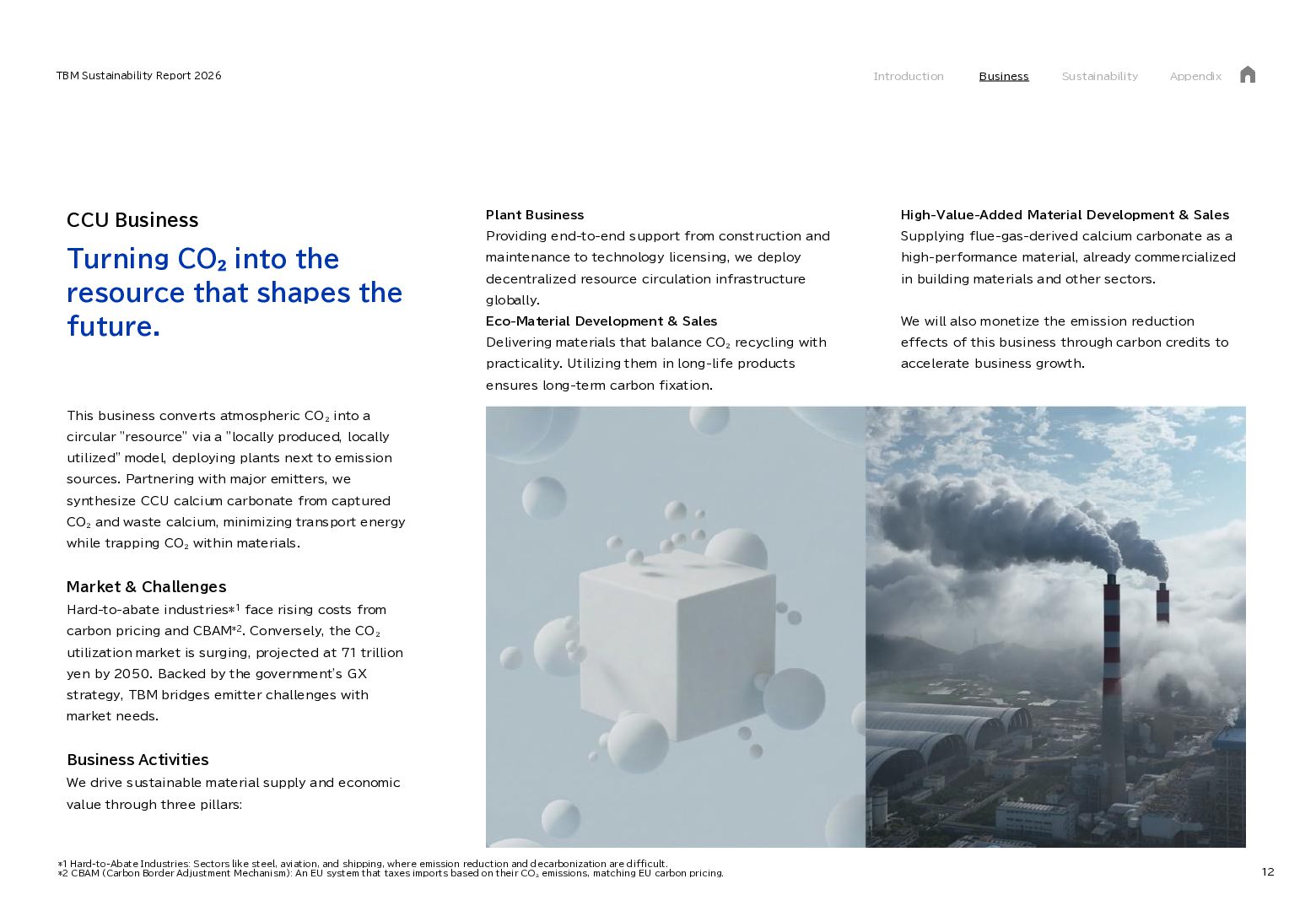
  9. 12 TBM Sustainability Report 2026 Turning CO₂ into the resource

    that shapes the future. CCU Business This business converts atmospheric CO₂ into a circular "resource" via a "locally produced, locally utilized" model, deploying plants next to emission sources. Partnering with major emitters, we synthesize CCU calcium carbonate from captured CO₂ and waste calcium, minimizing transport energy while trapping CO₂ within materials. Market & Challenges Hard-to-abate industries*1 face rising costs from carbon pricing and CBAM*2. Conversely, the CO₂ utilization market is surging, projected at 71 trillion yen by 2050. Backed by the government's GX strategy, TBM bridges emitter challenges with market needs. Business Activities We drive sustainable material supply and economic value through three pillars: Plant Business Providing end-to-end support from construction and maintenance to technology licensing, we deploy decentralized resource circulation infrastructure globally. Eco-Material Development & Sales Delivering materials that balance CO₂ recycling with practicality. Utilizing them in long-life products ensures long-term carbon fixation. High-Value-Added Material Development & Sales Supplying flue-gas-derived calcium carbonate as a high-performance material, already commercialized in building materials and other sectors. We will also monetize the emission reduction effects of this business through carbon credits to accelerate business growth. *1 Hard-to-Abate Industries: Sectors like steel, aviation, and shipping, where emission reduction and decarbonization are difficult. *2 CBAM (Carbon Border Adjustment Mechanism): An EU system that taxes imports based on their CO₂ emissions, matching EU carbon pricing. Introduction Introduction Business Business Sustainability Sustainability Appendix Appendix
  10. 13 TBM Sustainability Report 2026 Promoting Carbon Recycling in Vietnam

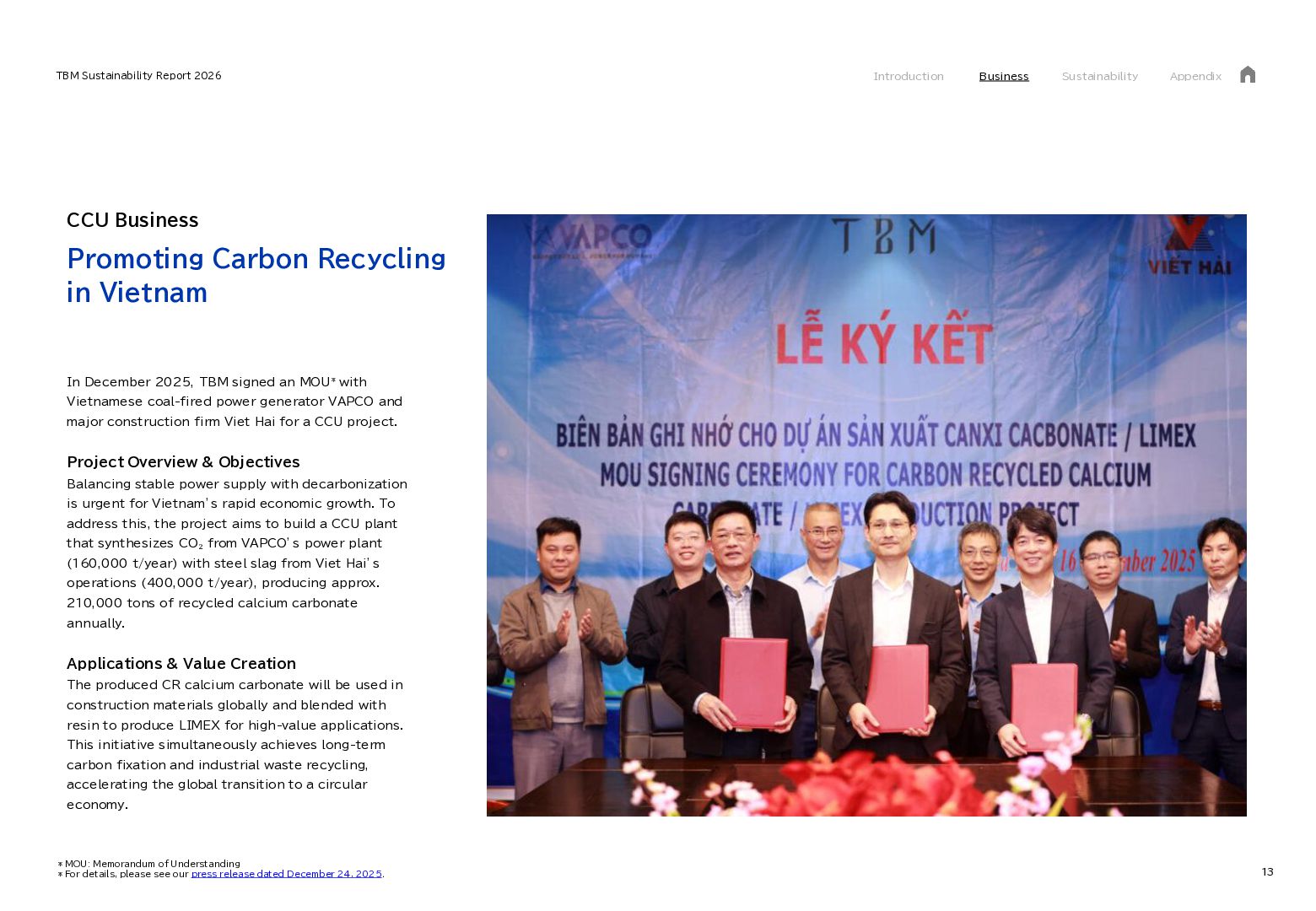
    CCU Business In December 2025, TBM signed an MOU* with Vietnamese coal-fired power generator VAPCO and major construction firm Viet Hai for a CCU project. Project Overview & Objectives Balancing stable power supply with decarbonization is urgent for Vietnam’s rapid economic growth. To address this, the project aims to build a CCU plant that synthesizes CO₂ from VAPCO’s power plant (160,000 t/year) with steel slag from Viet Hai’s operations (400,000 t/year), producing approx. 210,000 tons of recycled calcium carbonate annually. Applications & Value Creation The produced CR calcium carbonate will be used in construction materials globally and blended with resin to produce LIMEX for high-value applications. This initiative simultaneously achieves long-term carbon fixation and industrial waste recycling, accelerating the global transition to a circular economy. * MOU: Memorandum of Understanding * For details, please see our press release dated December 24, 2025. Introduction Introduction Business Business Sustainability Sustainability Appendix Appendix
  11. 14 TBM Sustainability Report 2026 Creating Materials to Solve Environmental

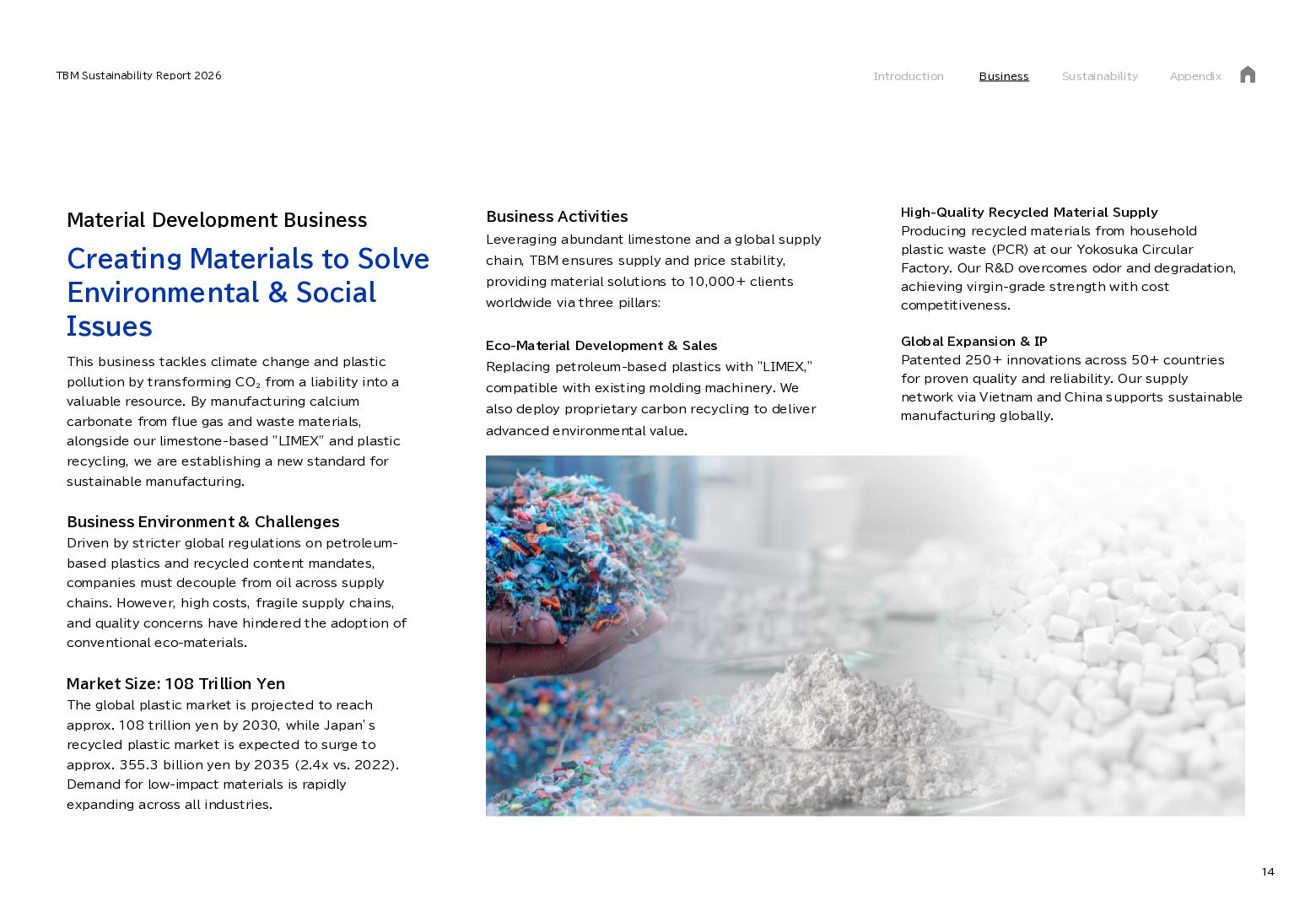
    & Social Issues Material Development Business This business tackles climate change and plastic pollution by transforming CO₂ from a liability into a valuable resource. By manufacturing calcium carbonate from flue gas and waste materials, alongside our limestone-based "LIMEX" and plastic recycling, we are establishing a new standard for sustainable manufacturing. Business Environment & Challenges Driven by stricter global regulations on petroleum- based plastics and recycled content mandates, companies must decouple from oil across supply chains. However, high costs, fragile supply chains, and quality concerns have hindered the adoption of conventional eco-materials. Market Size: 108 Trillion Yen The global plastic market is projected to reach approx. 108 trillion yen by 2030, while Japan’s recycled plastic market is expected to surge to approx. 355.3 billion yen by 2035 (2.4x vs. 2022). Demand for low-impact materials is rapidly expanding across all industries. Business Activities Leveraging abundant limestone and a global supply chain, TBM ensures supply and price stability, providing material solutions to 10,000+ clients worldwide via three pillars: Eco-Material Development & Sales Replacing petroleum-based plastics with "LIMEX," compatible with existing molding machinery. We also deploy proprietary carbon recycling to deliver advanced environmental value. High-Quality Recycled Material Supply Producing recycled materials from household plastic waste (PCR) at our Yokosuka Circular Factory. Our R&D overcomes odor and degradation, achieving virgin-grade strength with cost competitiveness. Global Expansion & IP Patented 250+ innovations across 50+ countries for proven quality and reliability. Our supply network via Vietnam and China supports sustainable manufacturing globally. Introduction Introduction Business Business Sustainability Sustainability Appendix Appendix
  12. 15 TBM Sustainability Report 2026 Commercializing & Implementing Eco-Materials in

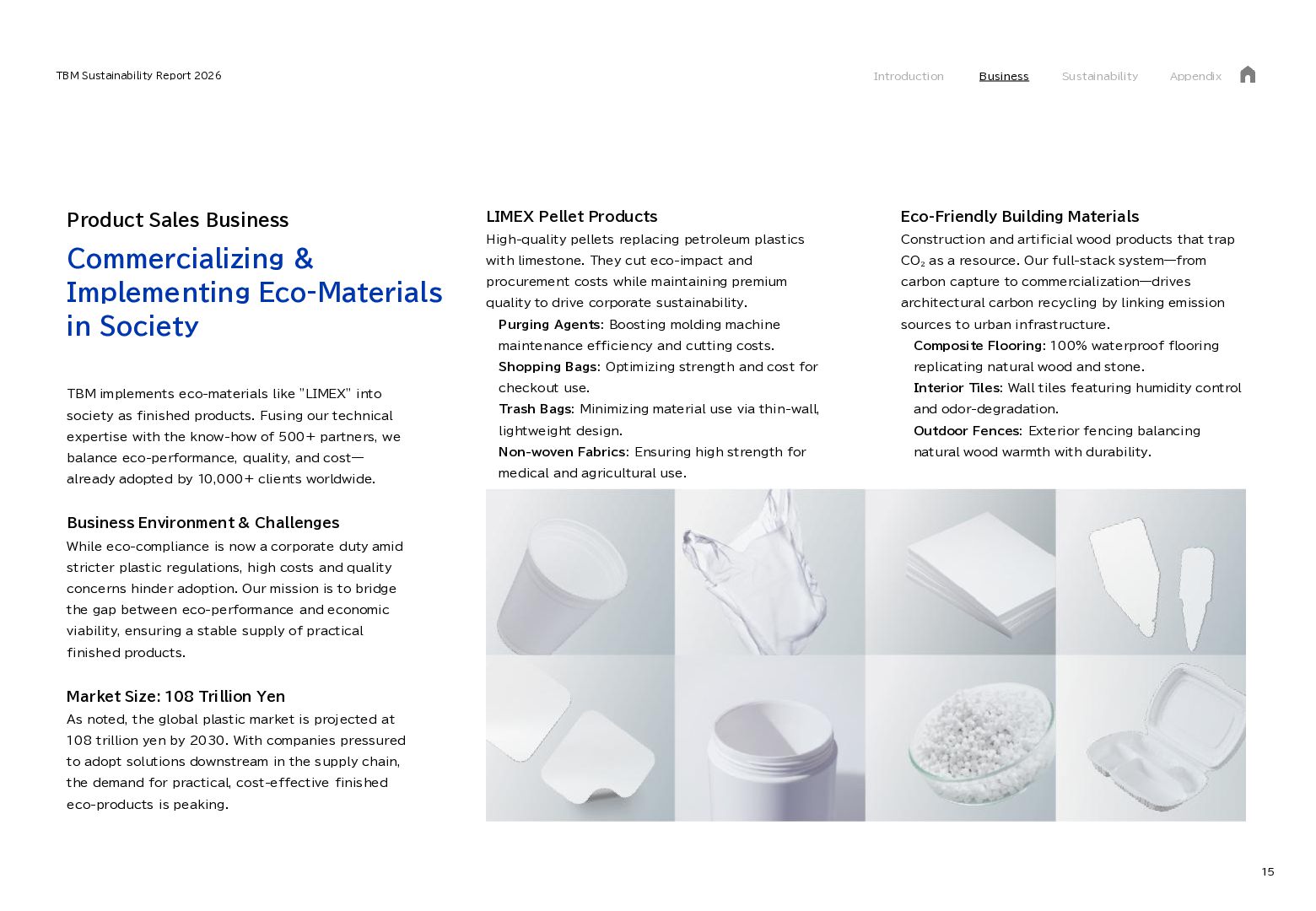
    Society Product Sales Business TBM implements eco-materials like "LIMEX" into society as finished products. Fusing our technical expertise with the know-how of 500+ partners, we balance eco-performance, quality, and cost— already adopted by 10,000+ clients worldwide. Business Environment & Challenges While eco-compliance is now a corporate duty amid stricter plastic regulations, high costs and quality concerns hinder adoption. Our mission is to bridge the gap between eco-performance and economic viability, ensuring a stable supply of practical finished products. Market Size: 108 Trillion Yen As noted, the global plastic market is projected at 108 trillion yen by 2030. With companies pressured to adopt solutions downstream in the supply chain, the demand for practical, cost-effective finished eco-products is peaking. LIMEX Pellet Products High-quality pellets replacing petroleum plastics with limestone. They cut eco-impact and procurement costs while maintaining premium quality to drive corporate sustainability. Purging Agents: Boosting molding machine maintenance efficiency and cutting costs. Shopping Bags: Optimizing strength and cost for checkout use. Trash Bags: Minimizing material use via thin-wall, lightweight design. Non-woven Fabrics: Ensuring high strength for medical and agricultural use. Eco-Friendly Building Materials Construction and artificial wood products that trap CO₂ as a resource. Our full-stack system—from carbon capture to commercialization—drives architectural carbon recycling by linking emission sources to urban infrastructure. Composite Flooring: 100% waterproof flooring replicating natural wood and stone. Interior Tiles: Wall tiles featuring humidity control and odor-degradation. Outdoor Fences: Exterior fencing balancing natural wood warmth with durability. Introduction Introduction Business Business Sustainability Sustainability Appendix Appendix
  13. 16 TBM Sustainability Report 2026 Updating Factories for Circular Resources

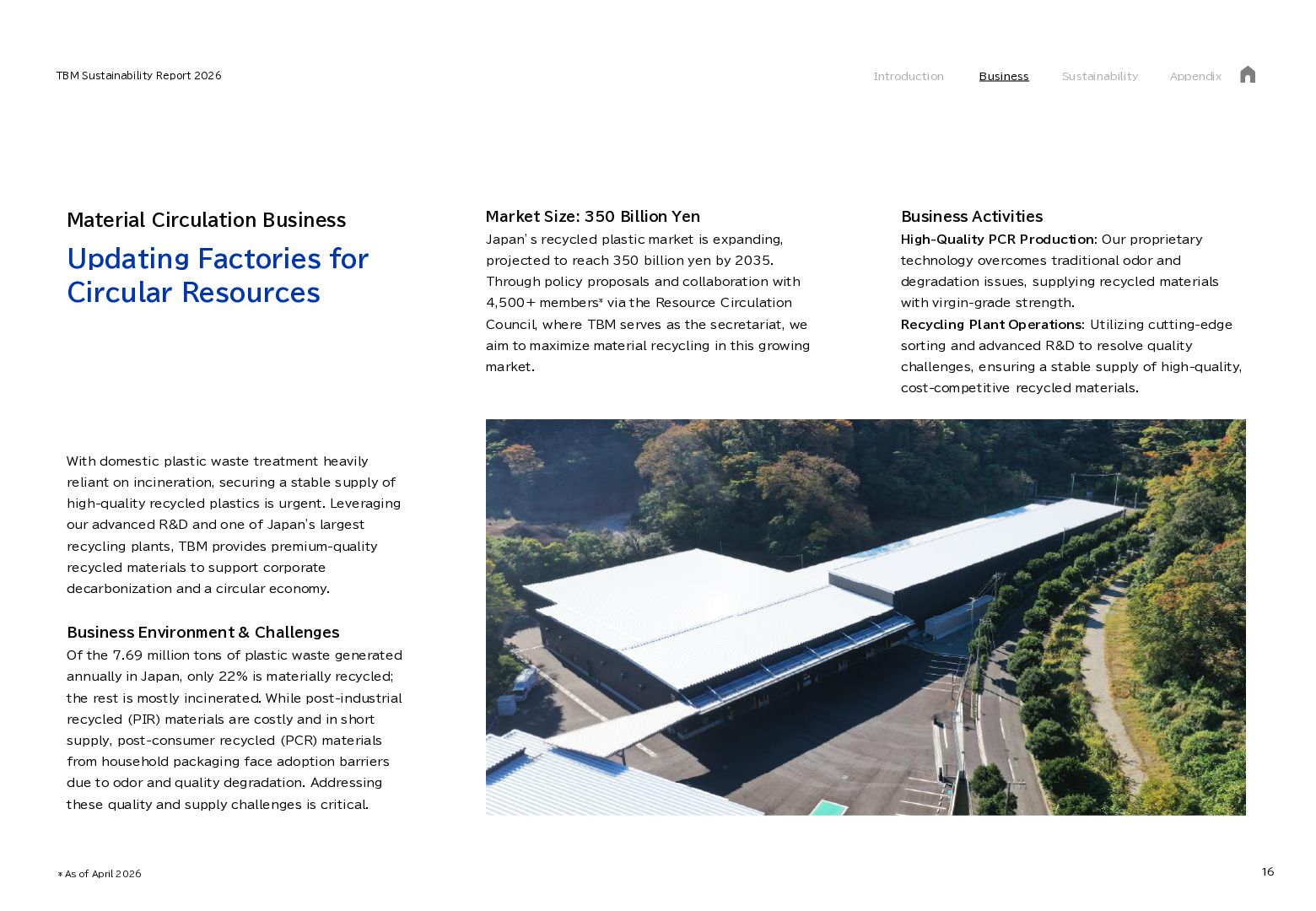
    Material Circulation Business With domestic plastic waste treatment heavily reliant on incineration, securing a stable supply of high-quality recycled plastics is urgent. Leveraging our advanced R&D and one of Japan's largest recycling plants, TBM provides premium-quality recycled materials to support corporate decarbonization and a circular economy. Business Environment & Challenges Of the 7.69 million tons of plastic waste generated annually in Japan, only 22% is materially recycled; the rest is mostly incinerated. While post-industrial recycled (PIR) materials are costly and in short supply, post-consumer recycled (PCR) materials from household packaging face adoption barriers due to odor and quality degradation. Addressing these quality and supply challenges is critical. Market Size: 350 Billion Yen Japan’s recycled plastic market is expanding, projected to reach 350 billion yen by 2035. Through policy proposals and collaboration with 4,500+ members* via the Resource Circulation Council, where TBM serves as the secretariat, we aim to maximize material recycling in this growing market. Business Activities High-Quality PCR Production: Our proprietary technology overcomes traditional odor and degradation issues, supplying recycled materials with virgin-grade strength. Recycling Plant Operations: Utilizing cutting-edge sorting and advanced R&D to resolve quality challenges, ensuring a stable supply of high-quality, cost-competitive recycled materials. * As of April 2026 Introduction Introduction Business Business Sustainability Sustainability Appendix Appendix
  14. 17 TBM Sustainability Report 2026 Developing & Mass- Producing "CirculeX”

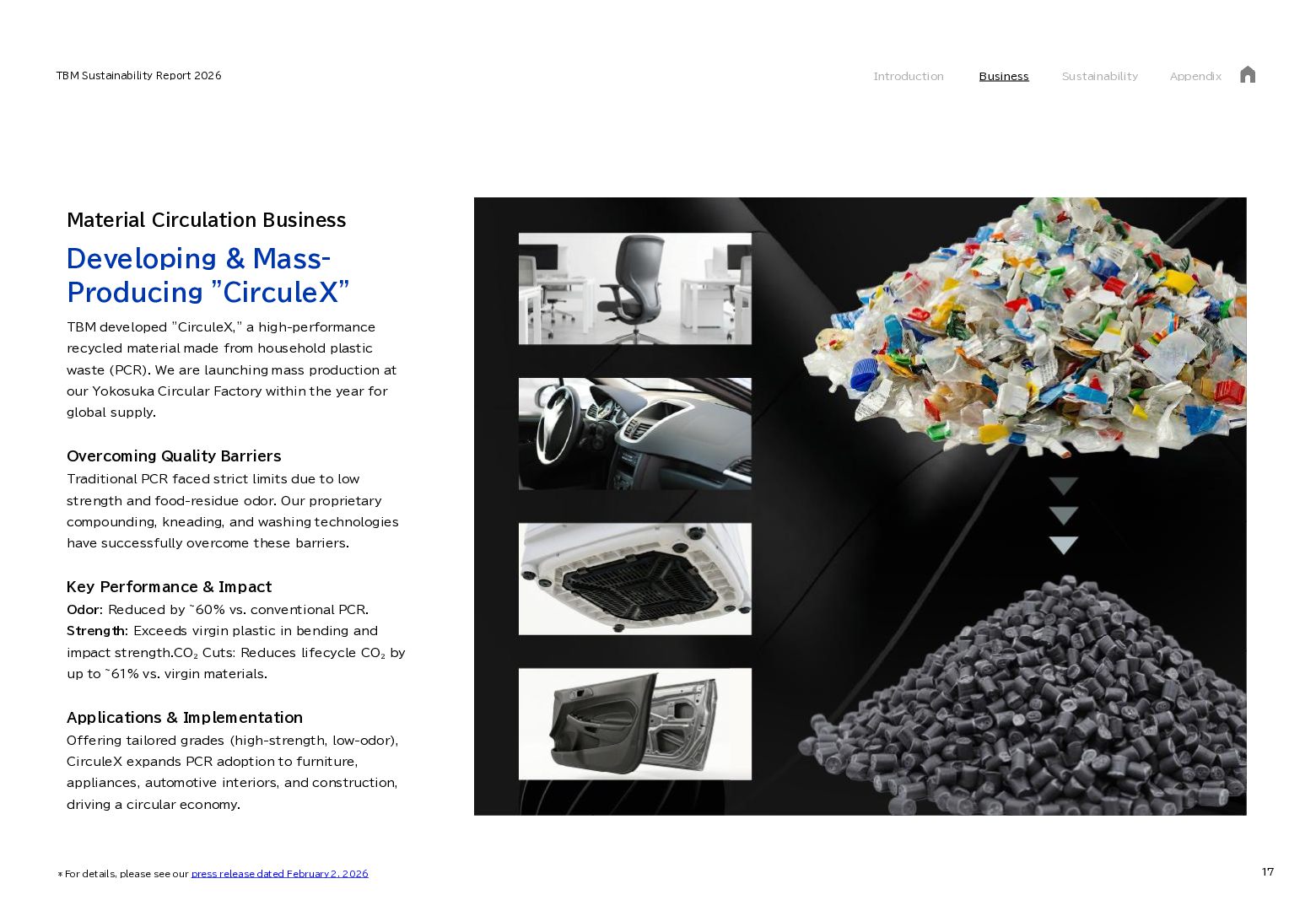
    Material Circulation Business TBM developed "CirculeX," a high-performance recycled material made from household plastic waste (PCR). We are launching mass production at our Yokosuka Circular Factory within the year for global supply. Overcoming Quality Barriers Traditional PCR faced strict limits due to low strength and food-residue odor. Our proprietary compounding, kneading, and washing technologies have successfully overcome these barriers. Key Performance & Impact Odor: Reduced by ~60% vs. conventional PCR. Strength: Exceeds virgin plastic in bending and impact strength.CO₂ Cuts: Reduces lifecycle CO₂ by up to ~61% vs. virgin materials. Applications & Implementation Offering tailored grades (high-strength, low-odor), CirculeX expands PCR adoption to furniture, appliances, automotive interiors, and construction, driving a circular economy. * For details, please see our press release dated February 2, 2026 Introduction Introduction Business Business Sustainability Sustainability Appendix Appendix
  15. 18 TBM Sustainability Report 2026 Tohoku LIMEX Factory Manufacturing Facilities

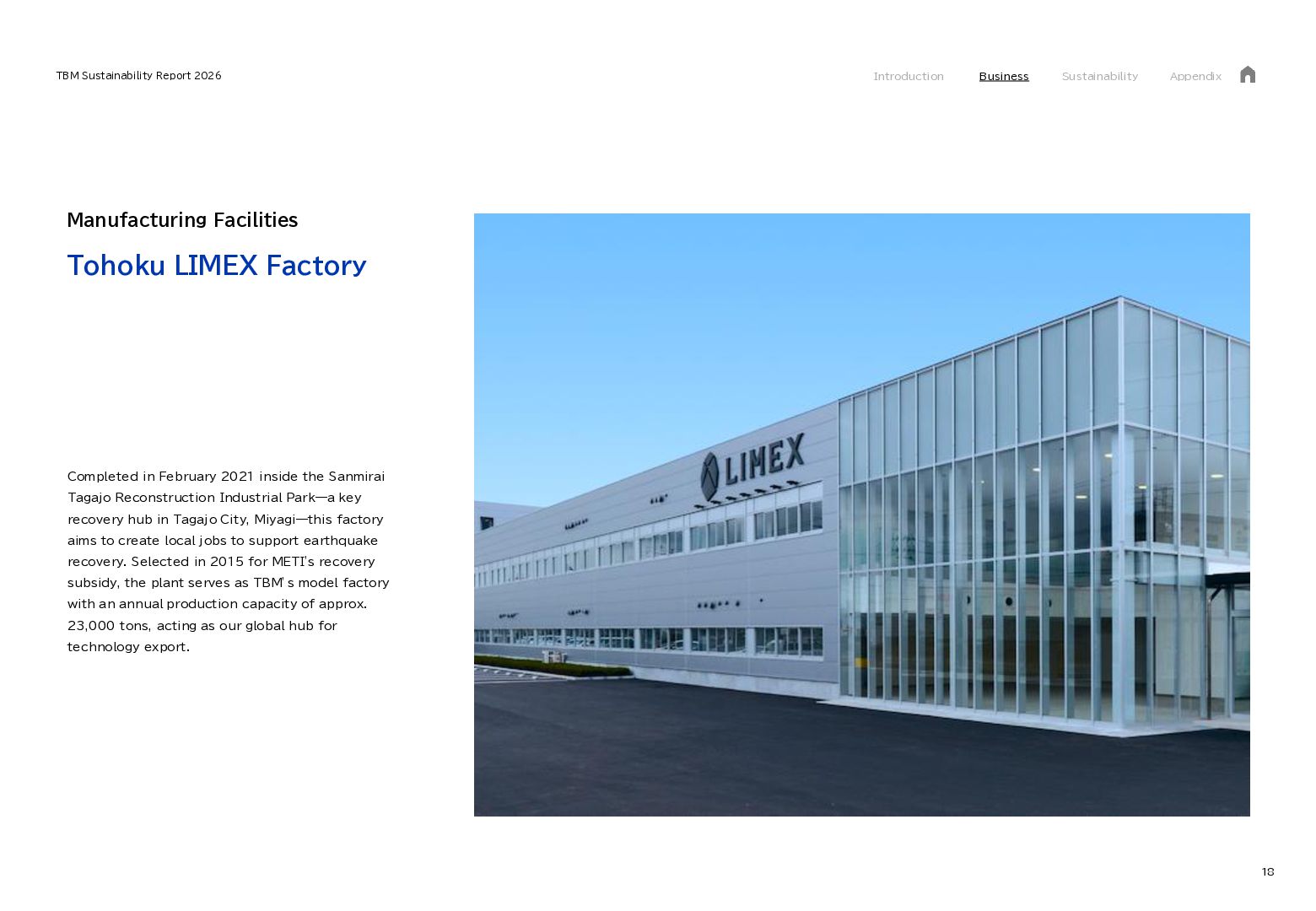
    Completed in February 2021 inside the Sanmirai Tagajo Reconstruction Industrial Park—a key recovery hub in Tagajo City, Miyagi—this factory aims to create local jobs to support earthquake recovery. Selected in 2015 for METI's recovery subsidy, the plant serves as TBM’s model factory with an annual production capacity of approx. 23,000 tons, acting as our global hub for technology export. Introduction Introduction Business Business Sustainability Sustainability Appendix Appendix
  16. 19 TBM Sustainability Report 2026 Yokosuka Circular Factory Manufacturing Facilities

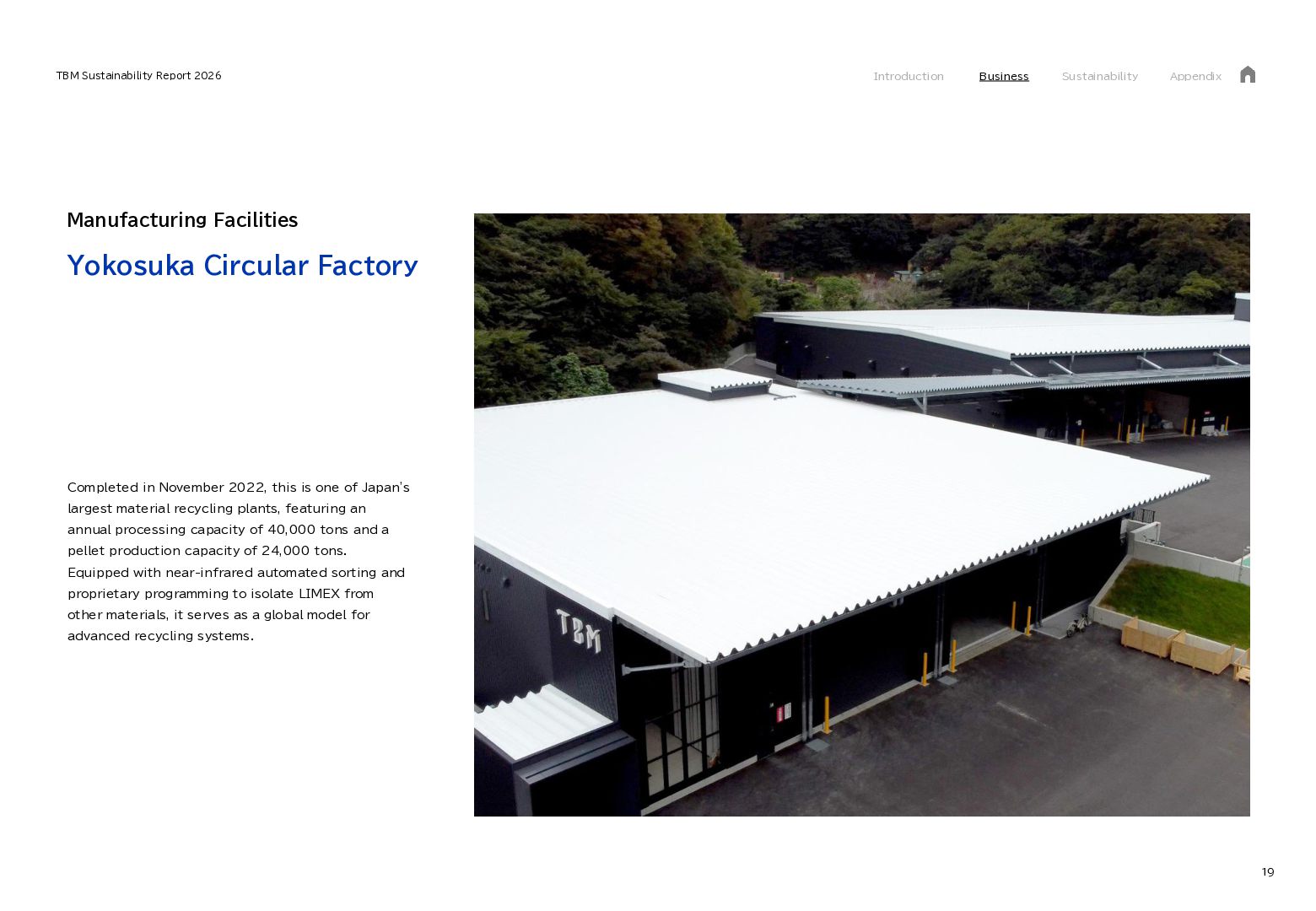
    Completed in November 2022, this is one of Japan's largest material recycling plants, featuring an annual processing capacity of 40,000 tons and a pellet production capacity of 24,000 tons. Equipped with near-infrared automated sorting and proprietary programming to isolate LIMEX from other materials, it serves as a global model for advanced recycling systems. Introduction Introduction Business Business Sustainability Sustainability Appendix Appendix
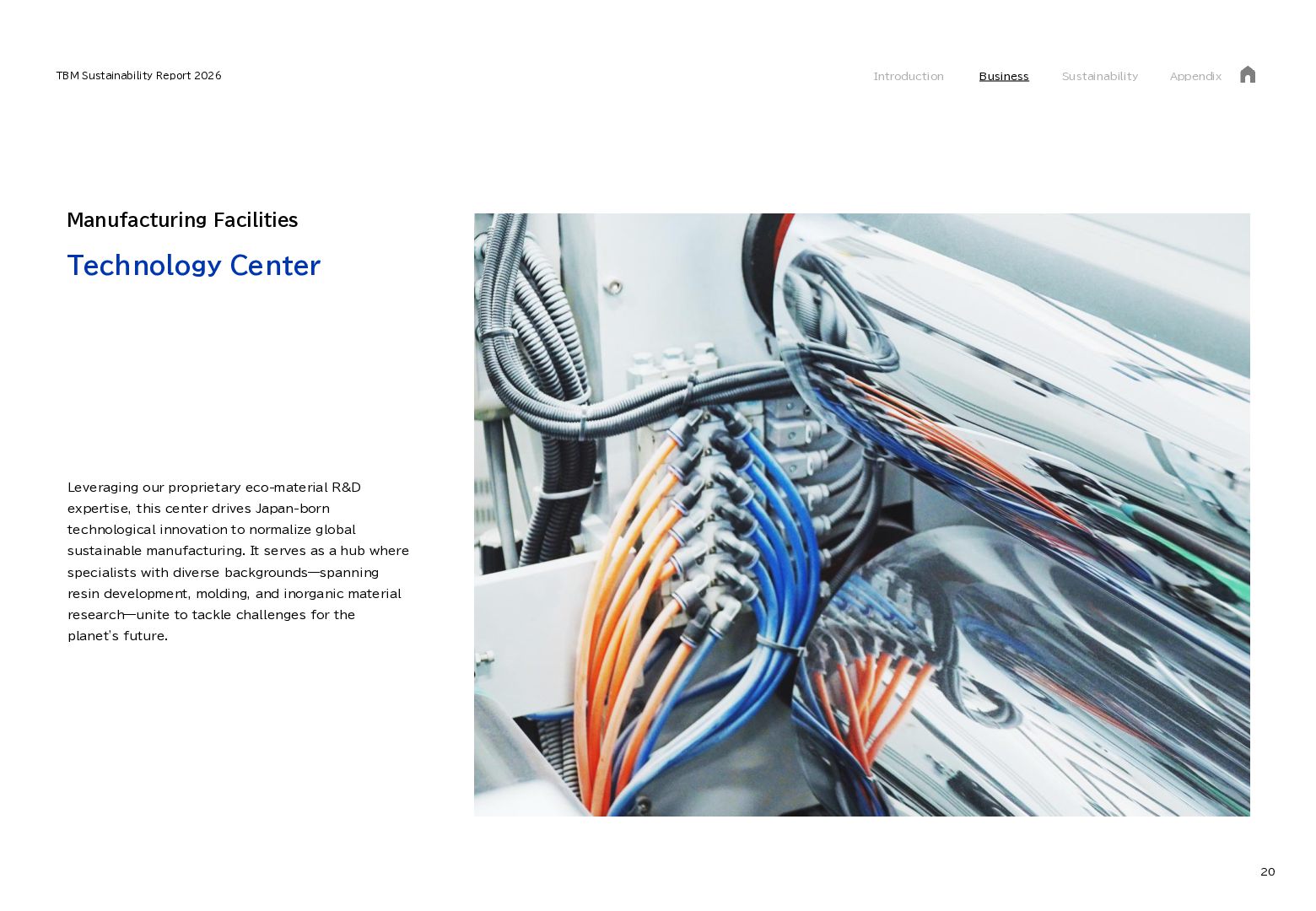
  17. 20 TBM Sustainability Report 2026 Technology Center Manufacturing Facilities Leveraging

    our proprietary eco-material R&D expertise, this center drives Japan-born technological innovation to normalize global sustainable manufacturing. It serves as a hub where specialists with diverse backgrounds—spanning resin development, molding, and inorganic material research—unite to tackle challenges for the planet's future. Introduction Introduction Business Business Sustainability Sustainability Appendix Appendix
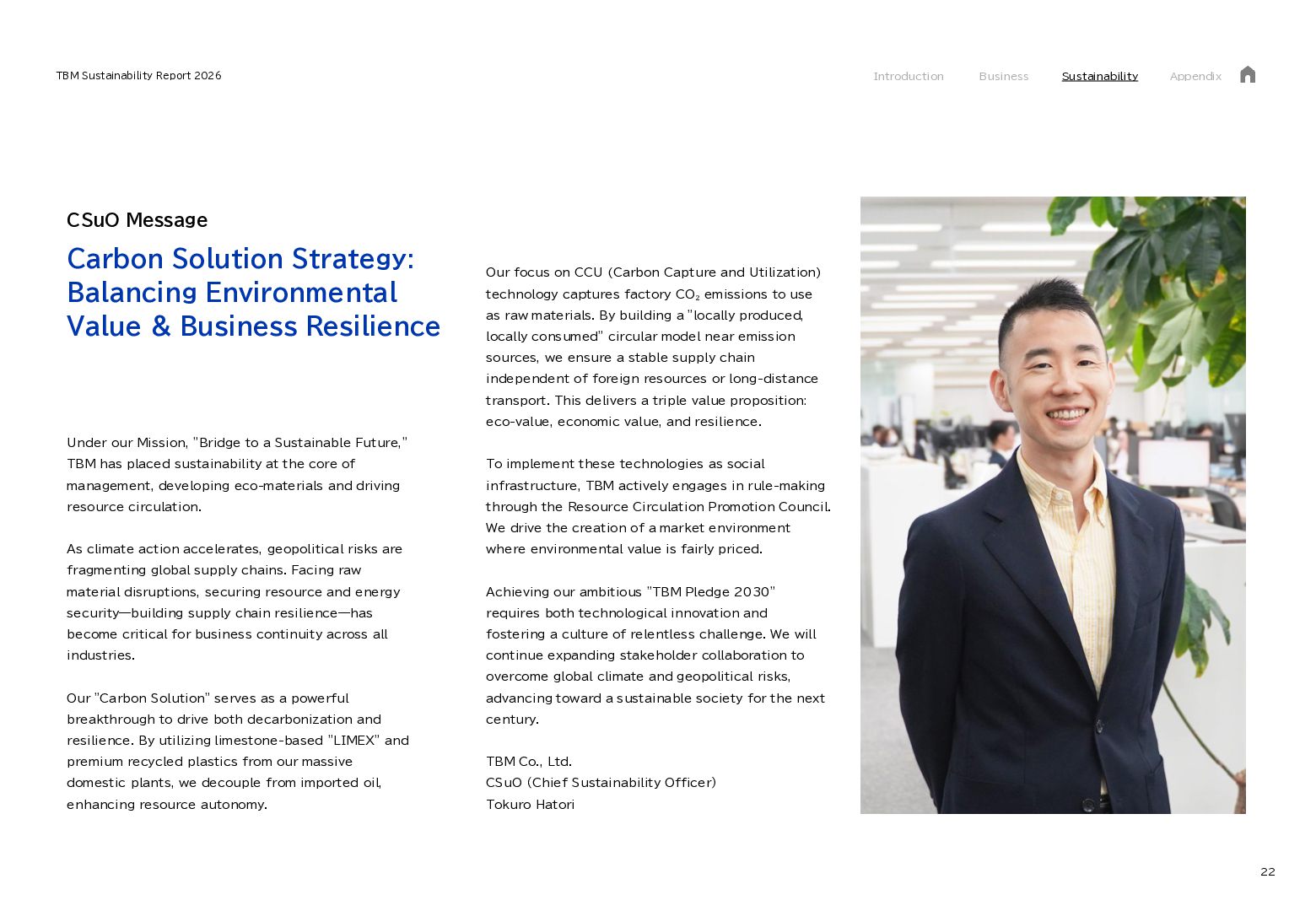
  18. 22 TBM Sustainability Report 2026 Carbon Solution Strategy: Balancing Environmental

    Value & Business Resilience CSuO Message Under our Mission, "Bridge to a Sustainable Future," TBM has placed sustainability at the core of management, developing eco-materials and driving resource circulation. As climate action accelerates, geopolitical risks are fragmenting global supply chains. Facing raw material disruptions, securing resource and energy security—building supply chain resilience—has become critical for business continuity across all industries. Our "Carbon Solution" serves as a powerful breakthrough to drive both decarbonization and resilience. By utilizing limestone-based "LIMEX" and premium recycled plastics from our massive domestic plants, we decouple from imported oil, enhancing resource autonomy. Our focus on CCU (Carbon Capture and Utilization) technology captures factory CO₂ emissions to use as raw materials. By building a "locally produced, locally consumed" circular model near emission sources, we ensure a stable supply chain independent of foreign resources or long-distance transport. This delivers a triple value proposition: eco-value, economic value, and resilience. To implement these technologies as social infrastructure, TBM actively engages in rule-making through the Resource Circulation Promotion Council. We drive the creation of a market environment where environmental value is fairly priced. Achieving our ambitious "TBM Pledge 2030" requires both technological innovation and fostering a culture of relentless challenge. We will continue expanding stakeholder collaboration to overcome global climate and geopolitical risks, advancing toward a sustainable society for the next century. TBM Co., Ltd. CSuO (Chief Sustainability Officer) Tokuro Hatori Introduction Introduction Business Business Sustainability Sustainability Appendix Appendix
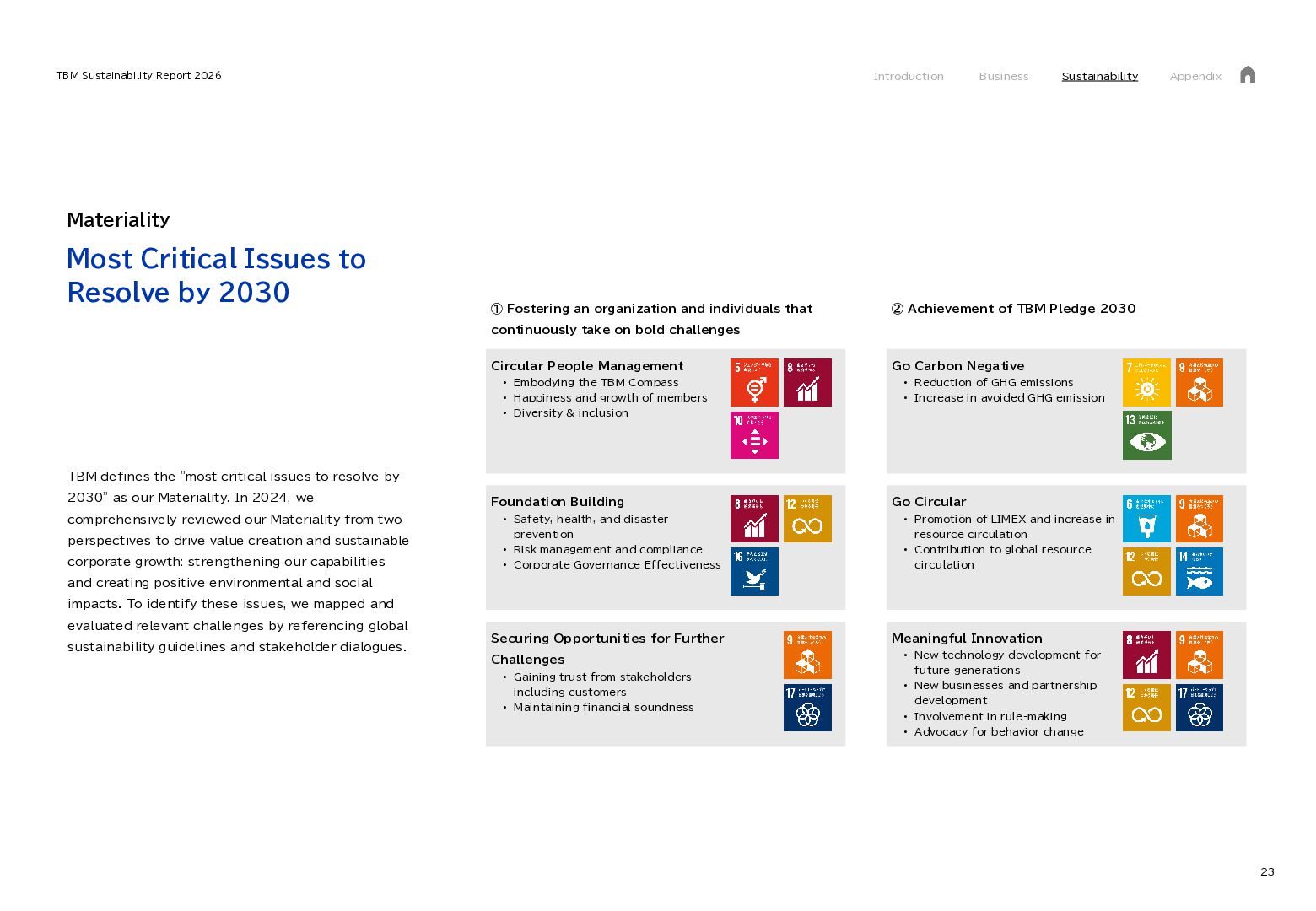
  19. 23 TBM Sustainability Report 2026 Most Critical Issues to Resolve

    by 2030 Materiality TBM defines the "most critical issues to resolve by 2030" as our Materiality. In 2024, we comprehensively reviewed our Materiality from two perspectives to drive value creation and sustainable corporate growth: strengthening our capabilities and creating positive environmental and social impacts. To identify these issues, we mapped and evaluated relevant challenges by referencing global sustainability guidelines and stakeholder dialogues. Circular People Management • Embodying the TBM Compass • Happiness and growth of members • Diversity & inclusion Foundation Building • Safety, health, and disaster prevention • Risk management and compliance • Corporate Governance Effectiveness Securing Opportunities for Further Challenges • Gaining trust from stakeholders including customers • Maintaining financial soundness Go Carbon Negative • Reduction of GHG emissions • Increase in avoided GHG emission Go Circular • Promotion of LIMEX and increase in resource circulation • Contribution to global resource circulation Meaningful Innovation • New technology development for future generations • New businesses and partnership development • Involvement in rule-making • Advocacy for behavior change ① Fostering an organization and individuals that continuously take on bold challenges ② Achievement of TBM Pledge 2030 Introduction Introduction Business Business Sustainability Sustainability Appendix Appendix
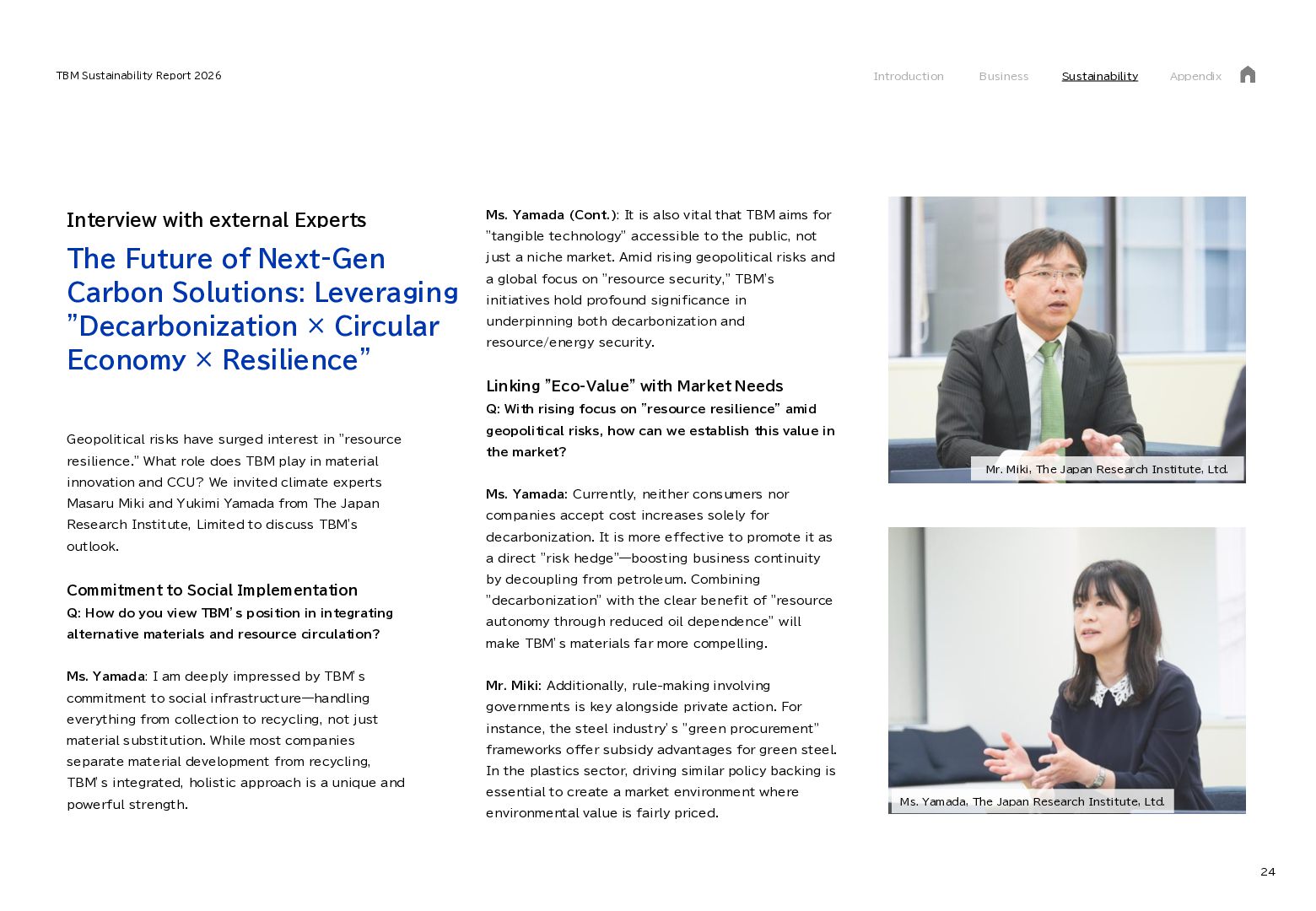
  20. 24 TBM Sustainability Report 2026 The Future of Next-Gen Carbon

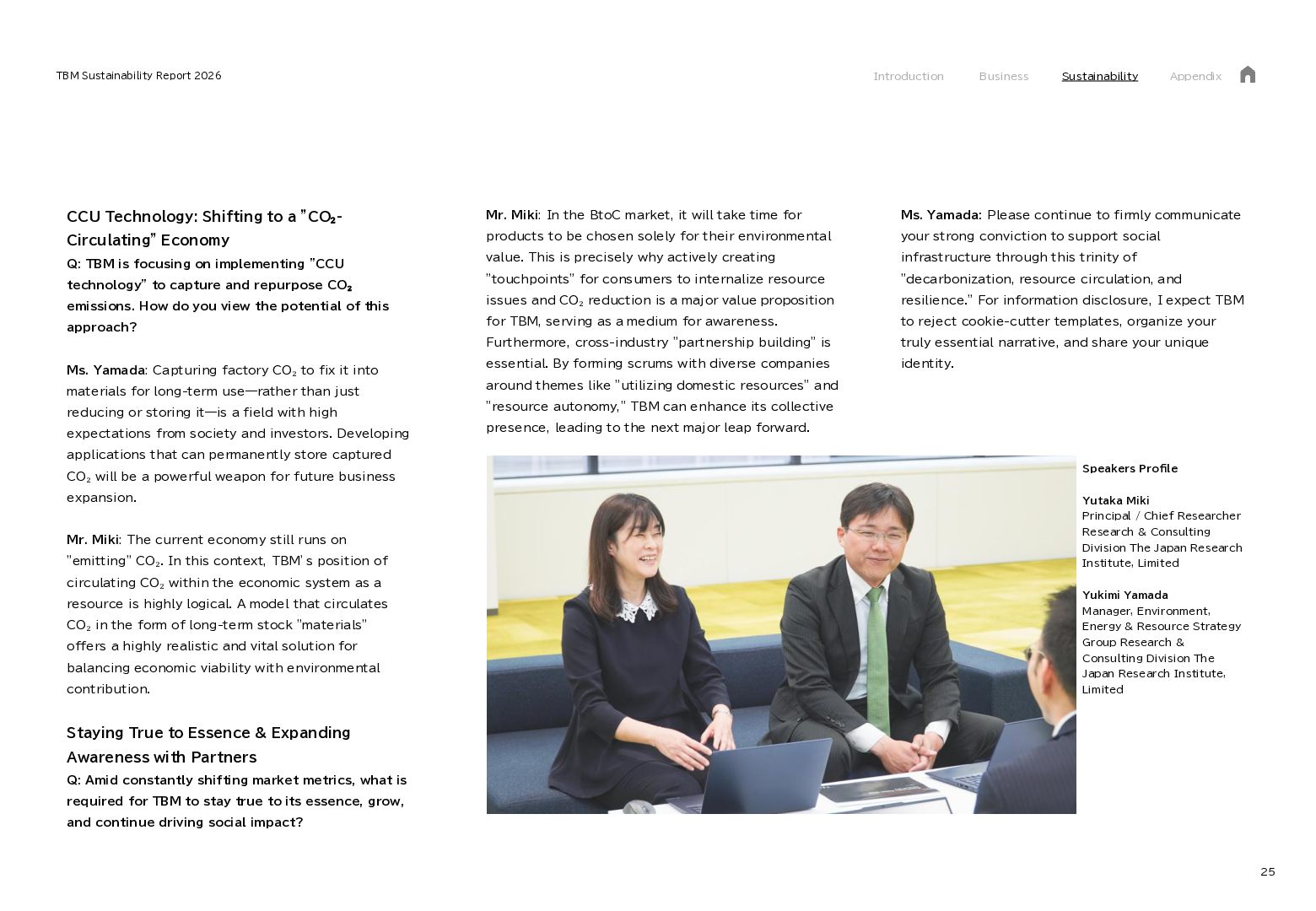
    Solutions: Leveraging "Decarbonization × Circular Economy × Resilience" Interview with external Experts Geopolitical risks have surged interest in "resource resilience." What role does TBM play in material innovation and CCU? We invited climate experts Masaru Miki and Yukimi Yamada from The Japan Research Institute, Limited to discuss TBM's outlook. Commitment to Social Implementation Q: How do you view TBM’s position in integrating alternative materials and resource circulation? Ms. Yamada: I am deeply impressed by TBM’s commitment to social infrastructure—handling everything from collection to recycling, not just material substitution. While most companies separate material development from recycling, TBM’s integrated, holistic approach is a unique and powerful strength. Ms. Yamada (Cont.): It is also vital that TBM aims for "tangible technology" accessible to the public, not just a niche market. Amid rising geopolitical risks and a global focus on "resource security," TBM's initiatives hold profound significance in underpinning both decarbonization and resource/energy security. Linking "Eco-Value" with Market Needs Q: With rising focus on "resource resilience" amid geopolitical risks, how can we establish this value in the market? Ms. Yamada: Currently, neither consumers nor companies accept cost increases solely for decarbonization. It is more effective to promote it as a direct "risk hedge"—boosting business continuity by decoupling from petroleum. Combining "decarbonization" with the clear benefit of "resource autonomy through reduced oil dependence" will make TBM’s materials far more compelling. Mr. Miki: Additionally, rule-making involving governments is key alongside private action. For instance, the steel industry’s "green procurement" frameworks offer subsidy advantages for green steel. In the plastics sector, driving similar policy backing is essential to create a market environment where environmental value is fairly priced. Mr. Miki, The Japan Research Institute, Ltd. Ms. Yamada, The Japan Research Institute, Ltd. Introduction Introduction Business Business Sustainability Sustainability Appendix Appendix
  21. 25 TBM Sustainability Report 2026 CCU Technology: Shifting to a

    "CO₂- Circulating" Economy Q: TBM is focusing on implementing "CCU technology" to capture and repurpose CO₂ emissions. How do you view the potential of this approach? Ms. Yamada: Capturing factory CO₂ to fix it into materials for long-term use—rather than just reducing or storing it—is a field with high expectations from society and investors. Developing applications that can permanently store captured CO₂ will be a powerful weapon for future business expansion. Mr. Miki: The current economy still runs on "emitting" CO₂. In this context, TBM’s position of circulating CO₂ within the economic system as a resource is highly logical. A model that circulates CO₂ in the form of long-term stock "materials" offers a highly realistic and vital solution for balancing economic viability with environmental contribution. Staying True to Essence & Expanding Awareness with Partners Q: Amid constantly shifting market metrics, what is required for TBM to stay true to its essence, grow, and continue driving social impact? Mr. Miki: In the BtoC market, it will take time for products to be chosen solely for their environmental value. This is precisely why actively creating "touchpoints" for consumers to internalize resource issues and CO₂ reduction is a major value proposition for TBM, serving as a medium for awareness. Furthermore, cross-industry "partnership building" is essential. By forming scrums with diverse companies around themes like "utilizing domestic resources" and "resource autonomy," TBM can enhance its collective presence, leading to the next major leap forward. Ms. Yamada: Please continue to firmly communicate your strong conviction to support social infrastructure through this trinity of "decarbonization, resource circulation, and resilience." For information disclosure, I expect TBM to reject cookie-cutter templates, organize your truly essential narrative, and share your unique identity. Speakers Profile Yutaka Miki Principal / Chief Researcher Research & Consulting Division The Japan Research Institute, Limited Yukimi Yamada Manager, Environment, Energy & Resource Strategy Group Research & Consulting Division The Japan Research Institute, Limited Introduction Introduction Business Business Sustainability Sustainability Appendix Appendix
  22. 26 TBM Sustainability Report 2026 Governance Structure Governance Shareholders Meeting

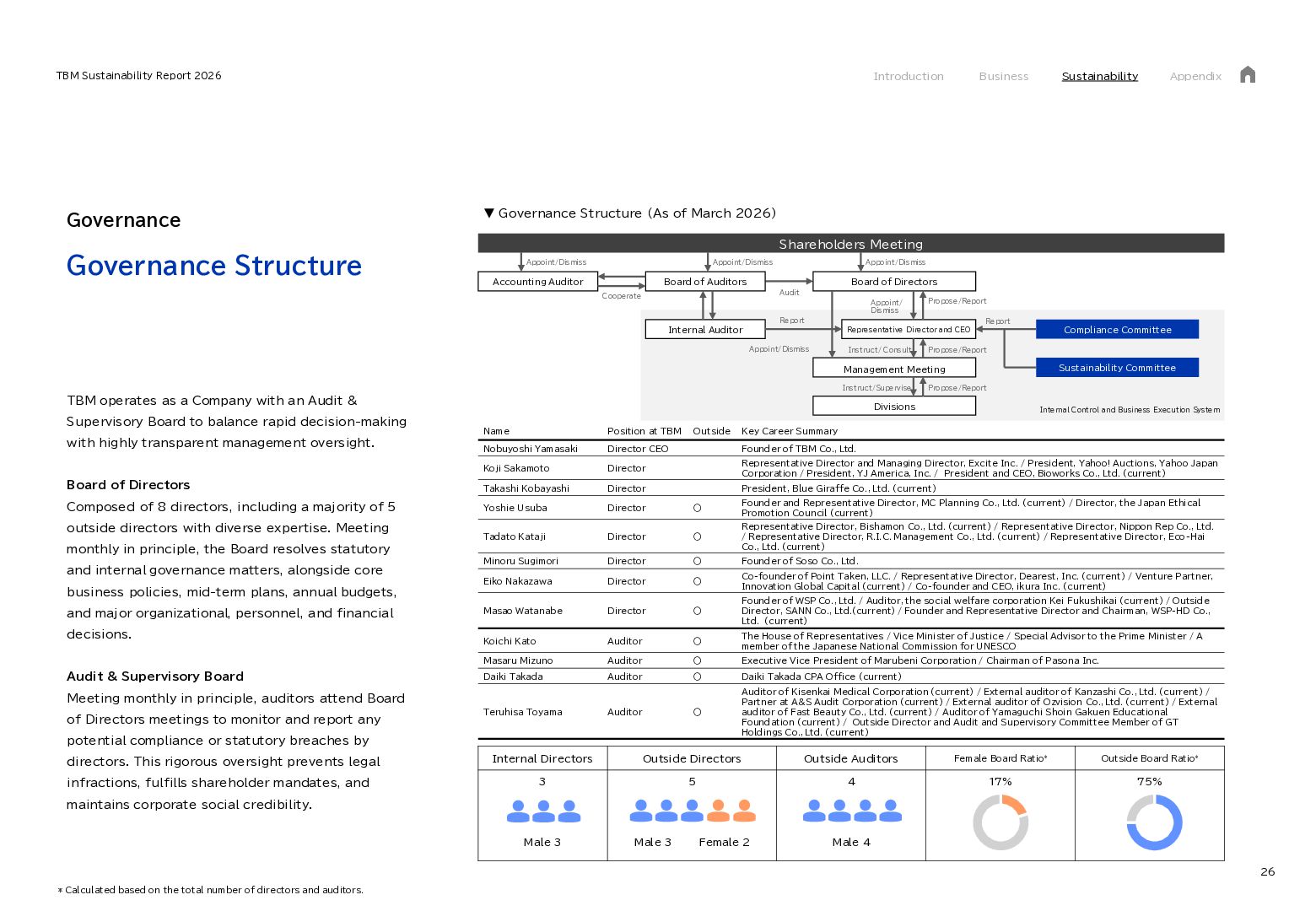
    Accounting Auditor Board of Auditors Board of Directors Appoint/Dismiss Appoint/Dismiss Appoint/Dismiss Internal Auditor Representative Director and CEO Compliance Committee Management Meeting Divisions Sustainability Committee Audit Appoint/Dismiss Appoint/ Dismiss Report Propose/Report Propose/Report Propose/Report Cooperate Instruct/ Consult Instruct/Supervise Report Internal Control and Business Execution System ▼ Governance Structure (As of March 2026) Name Position at TBM Outside Key Career Summary Nobuyoshi Yamasaki Director CEO Founder of TBM Co., Ltd. Koji Sakamoto Director Representative Director and Managing Director, Excite Inc. / President, Yahoo! Auctions, Yahoo Japan Corporation / President, YJ America, Inc. / President and CEO, Bioworks Co., Ltd. (current) Takashi Kobayashi Director President, Blue Giraffe Co., Ltd. (current) Yoshie Usuba Director ◦ Founder and Representative Director, MC Planning Co., Ltd. (current) / Director, the Japan Ethical Promotion Council (current) Tadato Kataji Director ◦ Representative Director, Bishamon Co., Ltd. (current) / Representative Director, Nippon Rep Co., Ltd. / Representative Director, R.I.C. Management Co., Ltd. (current) / Representative Director, Eco-Hai Co., Ltd. (current) Minoru Sugimori Director ◦ Founder of Soso Co., Ltd. Eiko Nakazawa Director ◦ Co-founder of Point Taken, LLC. / Representative Director, Dearest, Inc. (current) / Venture Partner, Innovation Global Capital (current) / Co-founder and CEO, ikura Inc. (current) Masao Watanabe Director ◦ Founder of WSP Co., Ltd. / Auditor, the social welfare corporation Kei Fukushikai (current) / Outside Director, SANN Co., Ltd.(current) / Founder and Representative Director and Chairman, WSP-HD Co., Ltd. (current) Koichi Kato Auditor ◦ The House of Representatives / Vice Minister of Justice / Special Advisor to the Prime Minister / A member of the Japanese National Commission for UNESCO Masaru Mizuno Auditor ◦ Executive Vice President of Marubeni Corporation / Chairman of Pasona Inc. Daiki Takada Auditor ◦ Daiki Takada CPA Office (current) Teruhisa Toyama Auditor ◦ Auditor of Kisenkai Medical Corporation (current) / External auditor of Kanzashi Co., Ltd. (current) / Partner at A&S Audit Corporation (current) / External auditor of Ozvision Co., Ltd. (current) / External auditor of Fast Beauty Co., Ltd. (current) / Auditor of Yamaguchi Shoin Gakuen Educational Foundation (current) / Outside Director and Audit and Supervisory Committee Member of GT Holdings Co., Ltd. (current) Internal Directors Outside Directors Outside Auditors Female Board Ratio* Outside Board Ratio* 3 Male 3 5 Male 3 Female 2 4 Male 4 17% 75% TBM operates as a Company with an Audit & Supervisory Board to balance rapid decision-making with highly transparent management oversight. Board of Directors Composed of 8 directors, including a majority of 5 outside directors with diverse expertise. Meeting monthly in principle, the Board resolves statutory and internal governance matters, alongside core business policies, mid-term plans, annual budgets, and major organizational, personnel, and financial decisions. Audit & Supervisory Board Meeting monthly in principle, auditors attend Board of Directors meetings to monitor and report any potential compliance or statutory breaches by directors. This rigorous oversight prevents legal infractions, fulfills shareholder mandates, and maintains corporate social credibility. * Calculated based on the total number of directors and auditors. Introduction Introduction Business Business Sustainability Sustainability Appendix Appendix
  23. 27 TBM Sustainability Report 2026 Sustainability Governance Sustainability Committee Serving

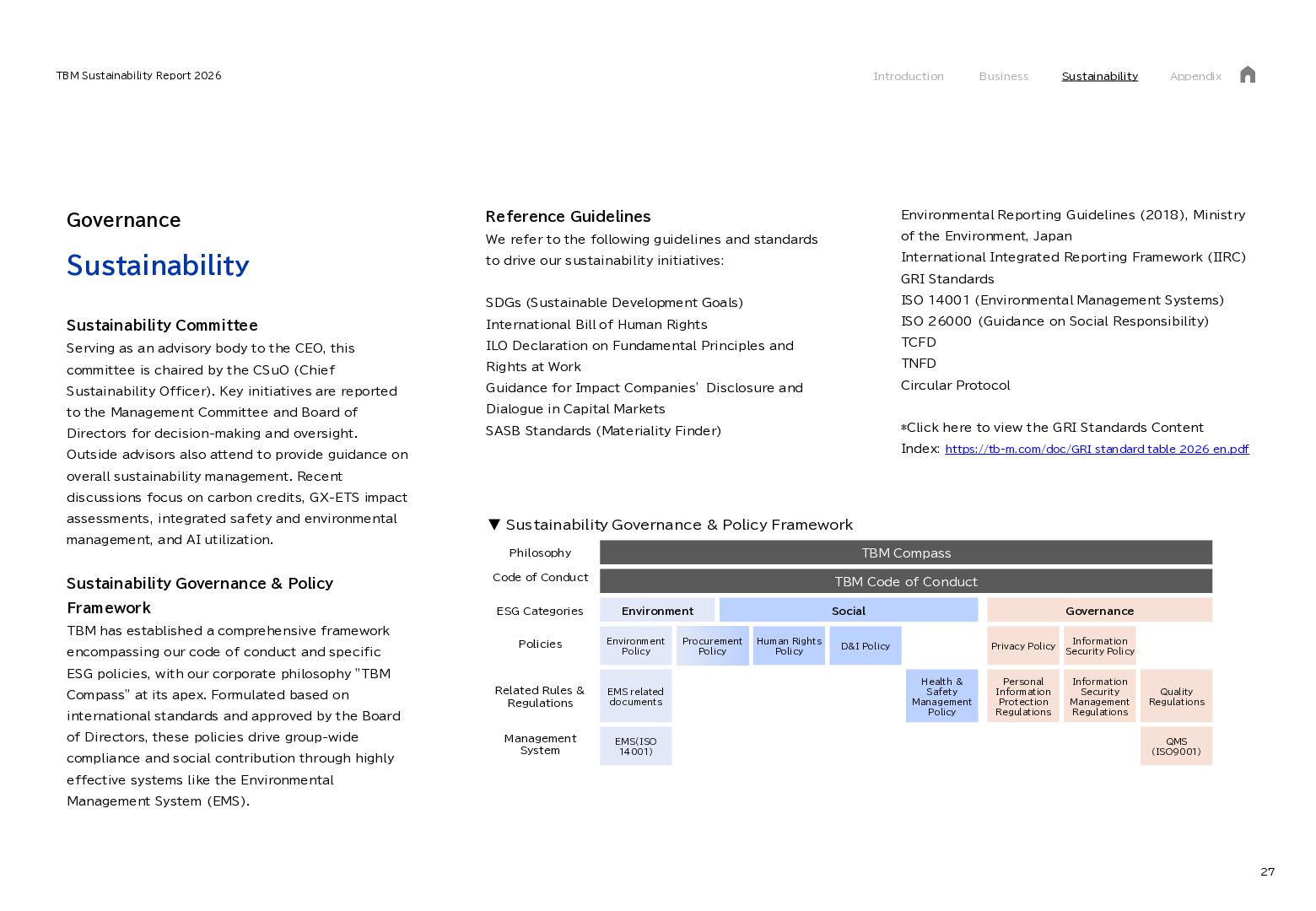
    as an advisory body to the CEO, this committee is chaired by the CSuO (Chief Sustainability Officer). Key initiatives are reported to the Management Committee and Board of Directors for decision-making and oversight. Outside advisors also attend to provide guidance on overall sustainability management. Recent discussions focus on carbon credits, GX-ETS impact assessments, integrated safety and environmental management, and AI utilization. Sustainability Governance & Policy Framework TBM has established a comprehensive framework encompassing our code of conduct and specific ESG policies, with our corporate philosophy "TBM Compass" at its apex. Formulated based on international standards and approved by the Board of Directors, these policies drive group-wide compliance and social contribution through highly effective systems like the Environmental Management System (EMS). Reference Guidelines We refer to the following guidelines and standards to drive our sustainability initiatives: SDGs (Sustainable Development Goals) International Bill of Human Rights ILO Declaration on Fundamental Principles and Rights at Work Guidance for Impact Companies’ Disclosure and Dialogue in Capital Markets SASB Standards (Materiality Finder) Environmental Reporting Guidelines (2018), Ministry of the Environment, Japan International Integrated Reporting Framework (IIRC) GRI Standards ISO 14001 (Environmental Management Systems) ISO 26000 (Guidance on Social Responsibility) TCFD TNFD Circular Protocol *Click here to view the GRI Standards Content Index: https://tb-m.com/doc/GRI_standard_table_2026_en.pdf Environment Environment Policy Information Security Policy Privacy Policy Health & Safety Management Policy D&I Policy Procurement Policy Human Rights Policy Policies Social Governance TBM Code of Conduct TBM Compass Related Rules & Regulations EMS related documents Management System EMS(ISO 14001) Information Security Management Regulations Personal Information Protection Regulations ▼ Sustainability Governance & Policy Framework ESG Categories Philosophy Code of Conduct Quality Regulations QMS (ISO9001) Introduction Introduction Business Business Sustainability Sustainability Appendix Appendix
  24. 28 TBM Sustainability Report 2026 Environmental Management Governance Environmental Management

    System (EMS) Guided by our Environmental Policy, TBM operates a systematic EMS driven by the PDCA cycle to improve environmental performance and maximize positive impacts through our business. This system has been verified by an external certification body across all four self-operated sites (Tokyo Head Office, Technology Center, Tohoku LIMEX Factory, and Yokosuka Circular Factory) to fully meet the international standard, ISO 14001. ISO 14001 Certification TBM undergoes annual ISO 14001 surveillance audits by BSI Group Japan K.K. In March 2026, we successfully passed the recertification audit to maintain our status. The latest certificate*1 remains valid until April 18, 2027. Sustainability Evaluation in Product Development To ensure confidentiality and rapid development, TBM internalizes Life Cycle Assessment (LCA)*2 calculations in compliance with ISO 14040. Objective Evaluation via "Internal-PCR" In 2024, TBM formulated a unique Product Category Rule (PCR) for LIMEX, approved by SuMPO, reinforcing our framework to quantitatively demonstrate environmental value. Company-Wide LCA Education & Culture: TBM conducts practical, company-wide education to turn LCA into a common language, embedding environment-driven value creation into our organizational culture. Transparent Environmental Claims: Evaluation results are disclosed in accordance with Ministry of the Environment guidelines. We strictly operate a screening system for logos to ensure appropriate environmental claims. *1 The latest certificate can be viewed here: https://tb-m.com/doc/20240429_certification_registration_certificate.pdf *2 Life Cycle Assessment (LCA): A methodology to quantitatively evaluate the environmental impacts of a product or service throughout its entire life cycle (from raw material procurement to manufacturing, distribution, use, disposal, and recycling) or specific phases of it. Introduction Introduction Business Business Sustainability Sustainability Appendix Appendix
  25. 29 TBM Sustainability Report 2026 Turning Global Challenges into Our

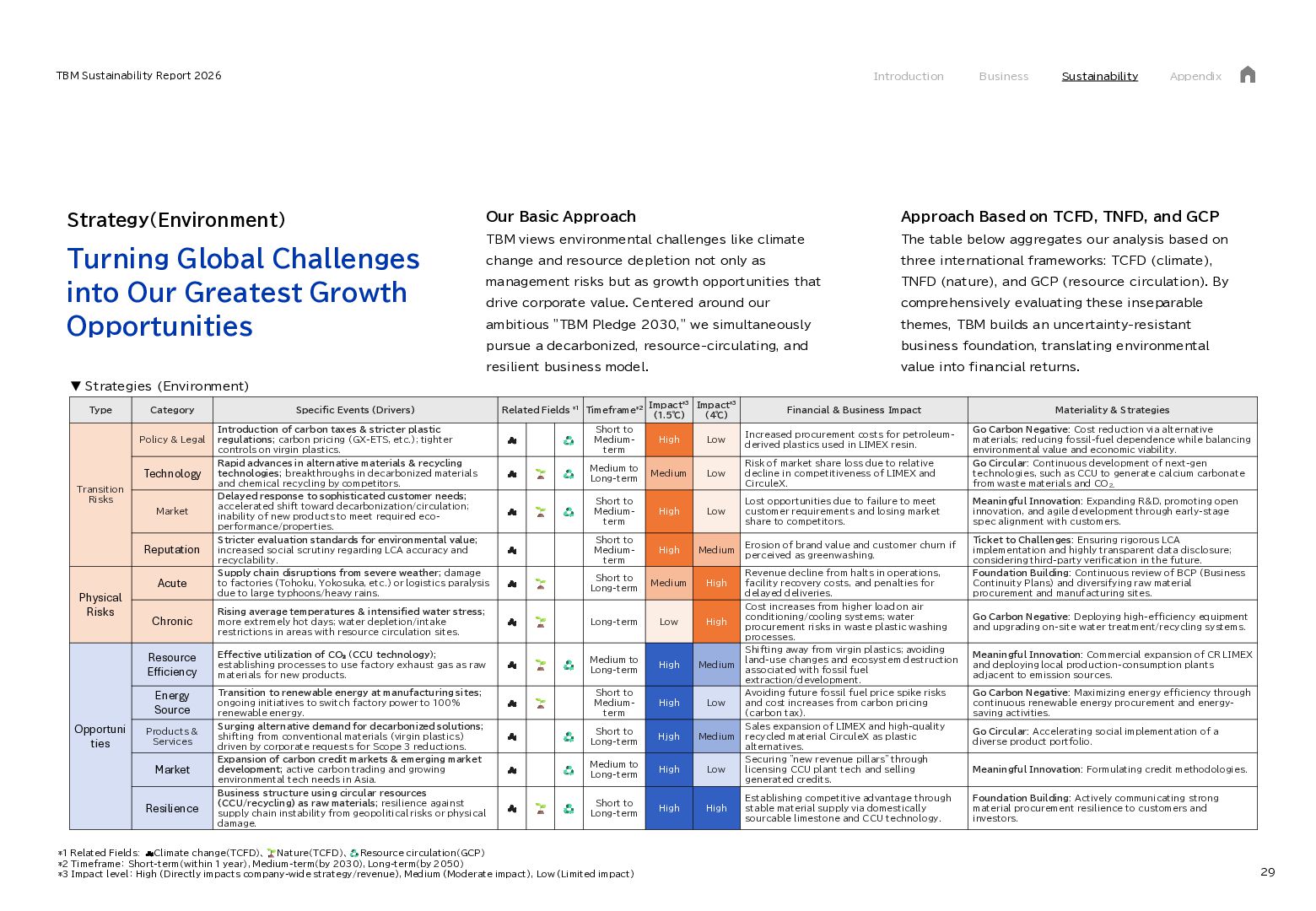
    Greatest Growth Opportunities Strategy(Environment) Our Basic Approach TBM views environmental challenges like climate change and resource depletion not only as management risks but as growth opportunities that drive corporate value. Centered around our ambitious "TBM Pledge 2030," we simultaneously pursue a decarbonized, resource-circulating, and resilient business model. Approach Based on TCFD, TNFD, and GCP The table below aggregates our analysis based on three international frameworks: TCFD (climate), TNFD (nature), and GCP (resource circulation). By comprehensively evaluating these inseparable themes, TBM builds an uncertainty-resistant business foundation, translating environmental value into financial returns. *1 Related Fields: Climate change(TCFD)、 Nature(TCFD)、 Resource circulation(GCP) *2 Timeframe: Short-term(within 1 year), Medium-term(by 2030), Long-term(by 2050) *3 Impact level: High (Directly impacts company-wide strategy/revenue), Medium (Moderate impact), Low (Limited impact) ▼ Strategies (Environment) Type Category Specific Events (Drivers) Related Fields *1 Timeframe*2 Impact*3 (1.5℃) Impact*3 (4℃) Financial & Business Impact Materiality & Strategies Transition Risks Policy & Legal Introduction of carbon taxes & stricter plastic regulations; carbon pricing (GX-ETS, etc.); tighter controls on virgin plastics. Short to Medium- term High Low Increased procurement costs for petroleum- derived plastics used in LIMEX resin. Go Carbon Negative: Cost reduction via alternative materials; reducing fossil-fuel dependence while balancing environmental value and economic viability. Technology Rapid advances in alternative materials & recycling technologies; breakthroughs in decarbonized materials and chemical recycling by competitors. Medium to Long-term Medium Low Risk of market share loss due to relative decline in competitiveness of LIMEX and CirculeX. Go Circular: Continuous development of next-gen technologies, such as CCU to generate calcium carbonate from waste materials and CO2. Market Delayed response to sophisticated customer needs; accelerated shift toward decarbonization/circulation; inability of new products to meet required eco- performance/properties. Short to Medium- term High Low Lost opportunities due to failure to meet customer requirements and losing market share to competitors. Meaningful Innovation: Expanding R&D, promoting open innovation, and agile development through early-stage spec alignment with customers. Reputation Stricter evaluation standards for environmental value; increased social scrutiny regarding LCA accuracy and recyclability. Short to Medium- term High Medium Erosion of brand value and customer churn if perceived as greenwashing. Ticket to Challenges: Ensuring rigorous LCA implementation and highly transparent data disclosure; considering third-party verification in the future. Physical Risks Acute Supply chain disruptions from severe weather; damage to factories (Tohoku, Yokosuka, etc.) or logistics paralysis due to large typhoons/heavy rains. Short to Long-term Medium High Revenue decline from halts in operations, facility recovery costs, and penalties for delayed deliveries. Foundation Building: Continuous review of BCP (Business Continuity Plans) and diversifying raw material procurement and manufacturing sites. Chronic Rising average temperatures & intensified water stress; more extremely hot days; water depletion/intake restrictions in areas with resource circulation sites. Long-term Low High Cost increases from higher load on air conditioning/cooling systems; water procurement risks in waste plastic washing processes. Go Carbon Negative: Deploying high-efficiency equipment and upgrading on-site water treatment/recycling systems. Opportuni ties Resource Efficiency Effective utilization of CO₂ (CCU technology); establishing processes to use factory exhaust gas as raw materials for new products. Medium to Long-term High Medium Shifting away from virgin plastics; avoiding land-use changes and ecosystem destruction associated with fossil fuel extraction/development. Meaningful Innovation: Commercial expansion of CR LIMEX and deploying local production-consumption plants adjacent to emission sources. Energy Source Transition to renewable energy at manufacturing sites; ongoing initiatives to switch factory power to 100% renewable energy. Short to Medium- term High Low Avoiding future fossil fuel price spike risks and cost increases from carbon pricing (carbon tax). Go Carbon Negative: Maximizing energy efficiency through continuous renewable energy procurement and energy- saving activities. Products & Services Surging alternative demand for decarbonized solutions; shifting from conventional materials (virgin plastics) driven by corporate requests for Scope 3 reductions. Short to Long-term Hjgh Medium Sales expansion of LIMEX and high-quality recycled material CirculeX as plastic alternatives. Go Circular: Accelerating social implementation of a diverse product portfolio. Market Expansion of carbon credit markets & emerging market development; active carbon trading and growing environmental tech needs in Asia. Medium to Long-term High Low Securing "new revenue pillars" through licensing CCU plant tech and selling generated credits. Meaningful Innovation: Formulating credit methodologies. Resilience Business structure using circular resources (CCU/recycling) as raw materials; resilience against supply chain instability from geopolitical risks or physical damage. Short to Long-term High High Establishing competitive advantage through stable material supply via domestically sourcable limestone and CCU technology. Foundation Building: Actively communicating strong material procurement resilience to customers and investors. Introduction Introduction Business Business Sustainability Sustainability Appendix Appendix
  26. 30 TBM Sustainability Report 2026 Climate Change (TCFD- Aligned Disclosure)

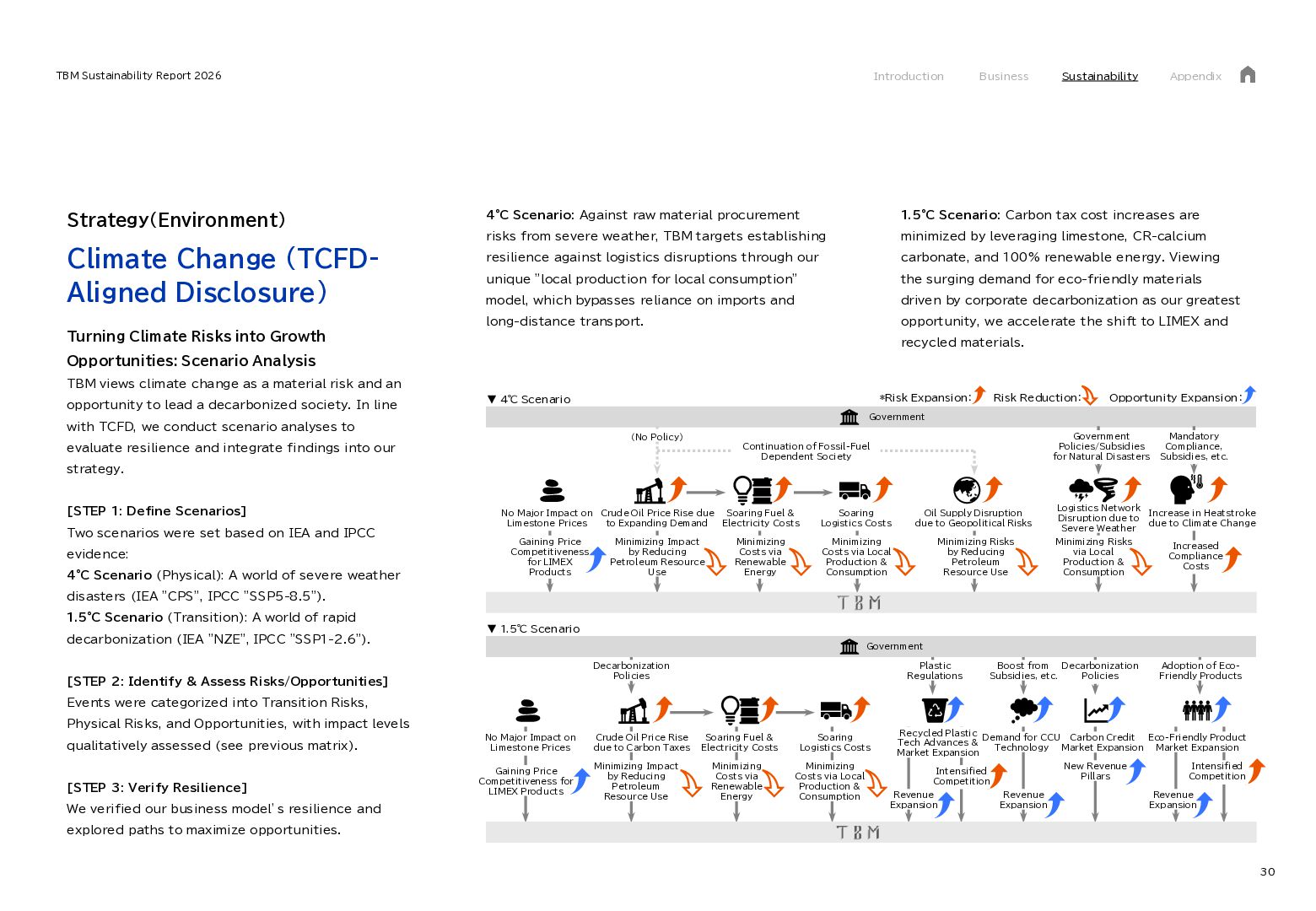
    Strategy(Environment) Turning Climate Risks into Growth Opportunities: Scenario Analysis TBM views climate change as a material risk and an opportunity to lead a decarbonized society. In line with TCFD, we conduct scenario analyses to evaluate resilience and integrate findings into our strategy. [STEP 1: Define Scenarios] Two scenarios were set based on IEA and IPCC evidence: 4°C Scenario (Physical): A world of severe weather disasters (IEA "CPS", IPCC "SSP5-8.5"). 1.5°C Scenario (Transition): A world of rapid decarbonization (IEA "NZE", IPCC "SSP1-2.6"). [STEP 2: Identify & Assess Risks/Opportunities] Events were categorized into Transition Risks, Physical Risks, and Opportunities, with impact levels qualitatively assessed (see previous matrix). [STEP 3: Verify Resilience] We verified our business model’s resilience and explored paths to maximize opportunities. 4°C Scenario: Against raw material procurement risks from severe weather, TBM targets establishing resilience against logistics disruptions through our unique "local production for local consumption" model, which bypasses reliance on imports and long-distance transport. 1.5°C Scenario: Carbon tax cost increases are minimized by leveraging limestone, CR-calcium carbonate, and 100% renewable energy. Viewing the surging demand for eco-friendly materials driven by corporate decarbonization as our greatest opportunity, we accelerate the shift to LIMEX and recycled materials. *Risk Expansion: Risk Reduction: Opportunity Expansion: ▼ 4℃ Scenario ▼ 1.5℃ Scenario Government Mandatory Compliance, Subsidies, etc. Soaring Fuel & Electricity Costs Crude Oil Price Rise due to Expanding Demand No Major Impact on Limestone Prices Minimizing Risks by Reducing Petroleum Resource Use Logistics Network Disruption due to Severe Weather Oil Supply Disruption due to Geopolitical Risks Minimizing Risks via Local Production & Consumption Increased Compliance Costs Minimizing Costs via Renewable Energy Minimizing Costs via Local Production & Consumption Minimizing Impact by Reducing Petroleum Resource Use Increase in Heatstroke due to Climate Change Government Policies/Subsidies for Natural Disasters Soaring Logistics Costs Gaining Price Competitiveness for LIMEX Products (No Policy) Continuation of Fossil-Fuel Dependent Society Crude Oil Price Rise due to Carbon Taxes No Major Impact on Limestone Prices Revenue Expansion Revenue Expansion Recycled Plastic Tech Advances & Market Expansion Demand for CCU Technology Decarbonization Policies Plastic Regulations Revenue Expansion New Revenue Pillars Minimizing Costs via Renewable Energy Minimizing Costs via Local Production & Consumption Minimizing Impact by Reducing Petroleum Resource Use Adoption of Eco- Friendly Products Decarbonization Policies Soaring Logistics Costs Boost from Subsidies, etc. Gaining Price Competitiveness for LIMEX Products Intensified Competition Intensified Competition Eco-Friendly Product Market Expansion Carbon Credit Market Expansion Soaring Fuel & Electricity Costs Government Introduction Introduction Business Business Sustainability Sustainability Appendix Appendix
  27. 31 TBM Sustainability Report 2026 Natural Capital & Biodiversity (TNFD-Aligned

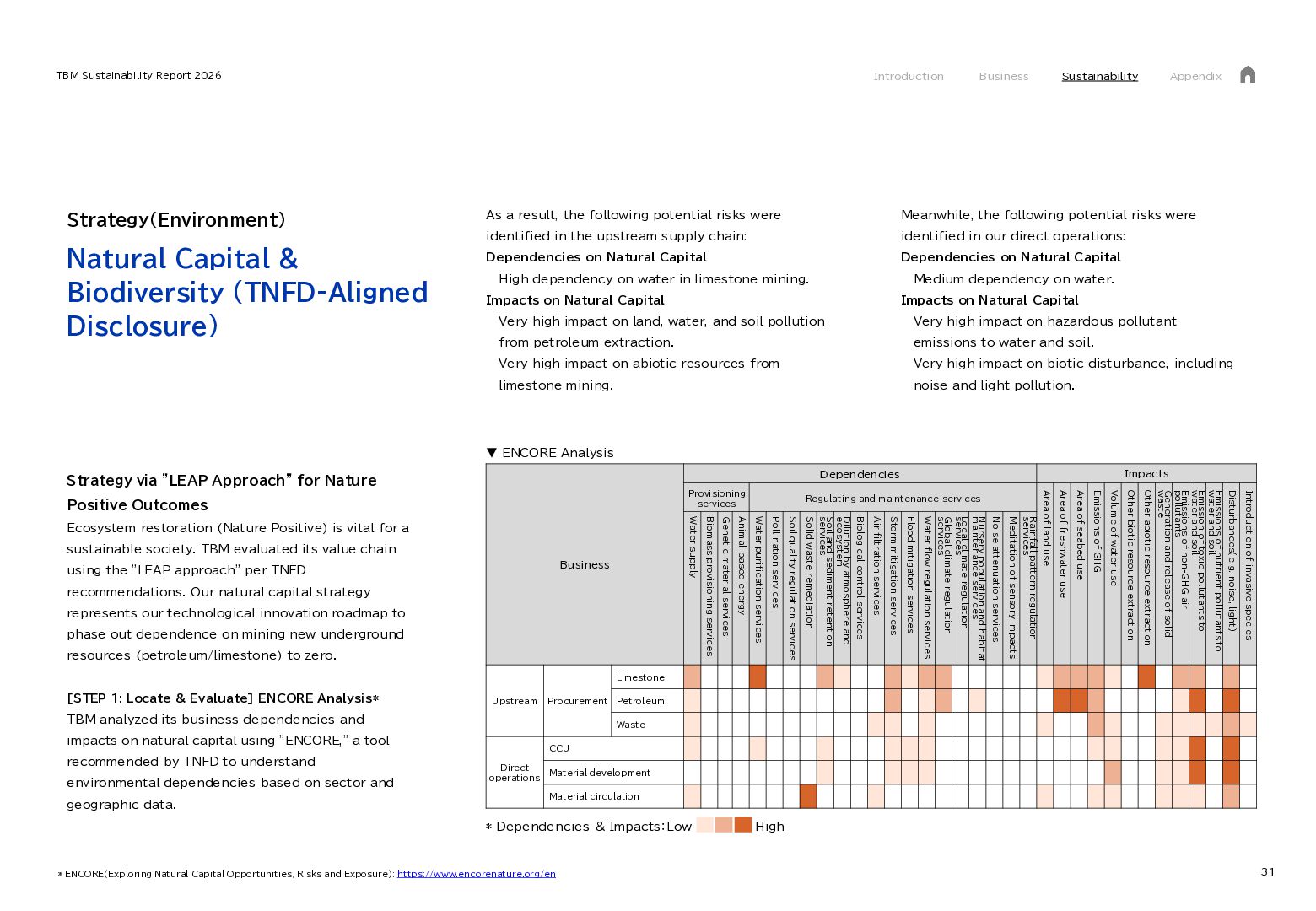
    Disclosure) Strategy(Environment) Strategy via "LEAP Approach" for Nature Positive Outcomes Ecosystem restoration (Nature Positive) is vital for a sustainable society. TBM evaluated its value chain using the "LEAP approach" per TNFD recommendations. Our natural capital strategy represents our technological innovation roadmap to phase out dependence on mining new underground resources (petroleum/limestone) to zero. [STEP 1: Locate & Evaluate] ENCORE Analysis* TBM analyzed its business dependencies and impacts on natural capital using "ENCORE," a tool recommended by TNFD to understand environmental dependencies based on sector and geographic data. As a result, the following potential risks were identified in the upstream supply chain: Dependencies on Natural Capital High dependency on water in limestone mining. Impacts on Natural Capital Very high impact on land, water, and soil pollution from petroleum extraction. Very high impact on abiotic resources from limestone mining. Meanwhile, the following potential risks were identified in our direct operations: Dependencies on Natural Capital Medium dependency on water. Impacts on Natural Capital Very high impact on hazardous pollutant emissions to water and soil. Very high impact on biotic disturbance, including noise and light pollution. * ENCORE(Exploring Natural Capital Opportunities, Risks and Exposure): https://www.encorenature.org/en * Dependencies & Impacts:Low High ▼ ENCORE Analysis Business Dependencies Impacts Provisioning services Regulating and maintenance services Area of land use Area of freshwater use Area of seabed use Emissions of GHG Volume of water use Other biotic resource extraction Other abiotic resource extraction Generation and release of solid waste Emissions of non-GHG air pollutants Emission of toxic pollutants to water and soil Emissions of nutrient pollutants to water and soil Disturbances(e.g. noise, light) Introduction of invasive species Water supply Biomass provisioning services Genetic material services Animal-based energy Water purification services Pollination services Soil quality regulation services Solid waste remediation Soil and sediment retention services Dilution by atmosphere and ecosystem Biological control services Air filtration services Storm mitigation services Flood mitigation services Water flow regulation services Global climate regulation services Local climate regulation services Nursery population and habitat maintenance services Noise attenuation services Meditation of sensory impacts Rainfall pattern regulation services Upstream Procurement Limestone Petroleum Waste Direct operations CCU Material development Material circulation Introduction Introduction Business Business Sustainability Sustainability Appendix Appendix
  28. 32 TBM Sustainability Report 2026 Natural Capital & Biodiversity (TNFD-Aligned

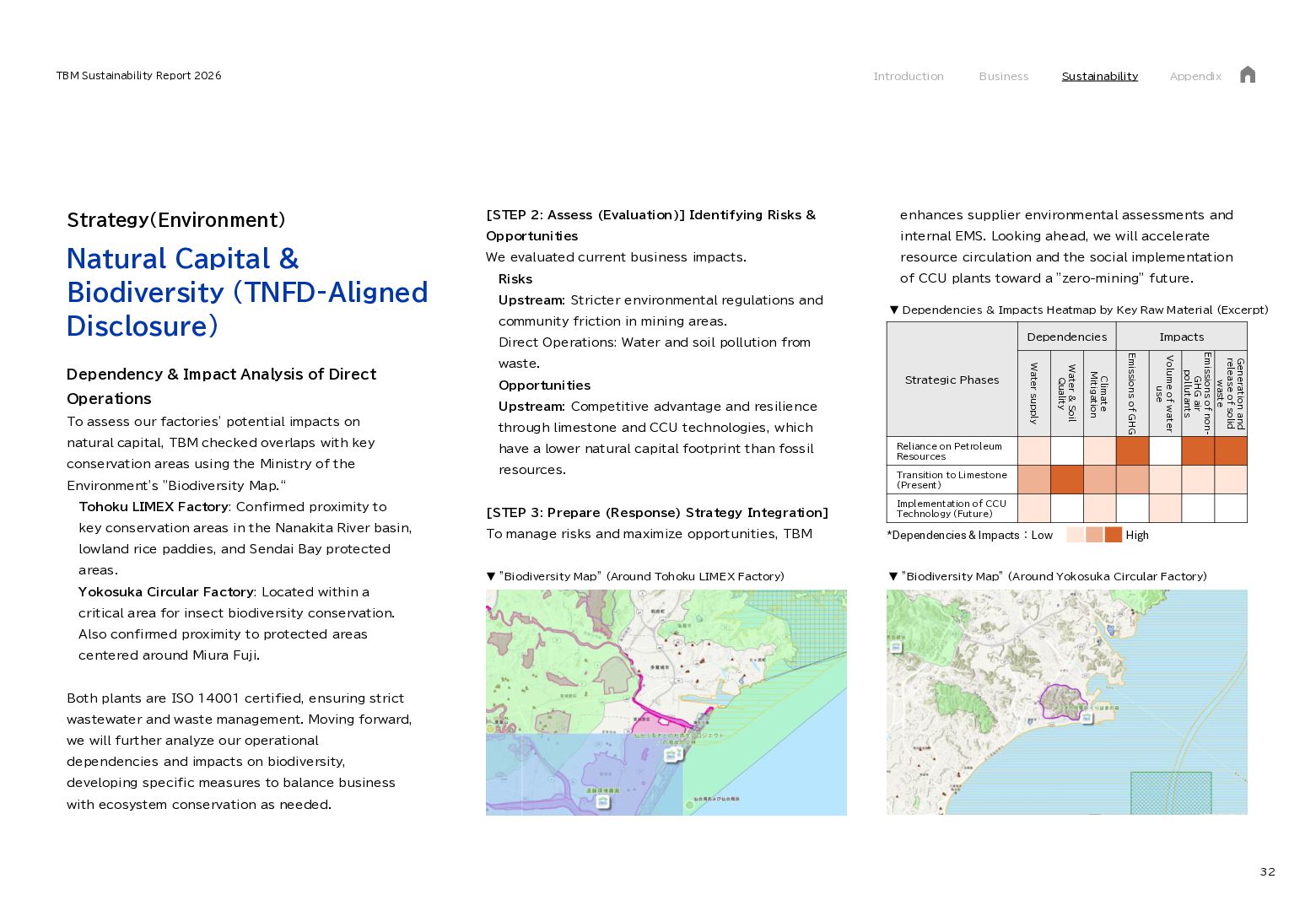
    Disclosure) Strategy(Environment) Dependency & Impact Analysis of Direct Operations To assess our factories' potential impacts on natural capital, TBM checked overlaps with key conservation areas using the Ministry of the Environment's "Biodiversity Map.“ Tohoku LIMEX Factory: Confirmed proximity to key conservation areas in the Nanakita River basin, lowland rice paddies, and Sendai Bay protected areas. Yokosuka Circular Factory: Located within a critical area for insect biodiversity conservation. Also confirmed proximity to protected areas centered around Miura Fuji. Both plants are ISO 14001 certified, ensuring strict wastewater and waste management. Moving forward, we will further analyze our operational dependencies and impacts on biodiversity, developing specific measures to balance business with ecosystem conservation as needed. [STEP 2: Assess (Evaluation)] Identifying Risks & Opportunities We evaluated current business impacts. Risks Upstream: Stricter environmental regulations and community friction in mining areas. Direct Operations: Water and soil pollution from waste. Opportunities Upstream: Competitive advantage and resilience through limestone and CCU technologies, which have a lower natural capital footprint than fossil resources. [STEP 3: Prepare (Response) Strategy Integration] To manage risks and maximize opportunities, TBM ▼ "Biodiversity Map" (Around Yokosuka Circular Factory) ▼ "Biodiversity Map" (Around Tohoku LIMEX Factory) Strategic Phases Dependencies Impacts Water supply Water & Soil Quality Climate Mitigation Emissions of GHG Volume of water use Emissions of non- GHG air pollutants Generation and release of solid waste Reliance on Petroleum Resources Transition to Limestone (Present) Implementation of CCU Technology (Future) ▼ Dependencies & Impacts Heatmap by Key Raw Material (Excerpt) *Dependencies & Impacts:Low High enhances supplier environmental assessments and internal EMS. Looking ahead, we will accelerate resource circulation and the social implementation of CCU plants toward a "zero-mining" future. Introduction Introduction Business Business Sustainability Sustainability Appendix Appendix
  29. 33 TBM Sustainability Report 2026 Resource Circulation (Global Circular Protocol-Aligned

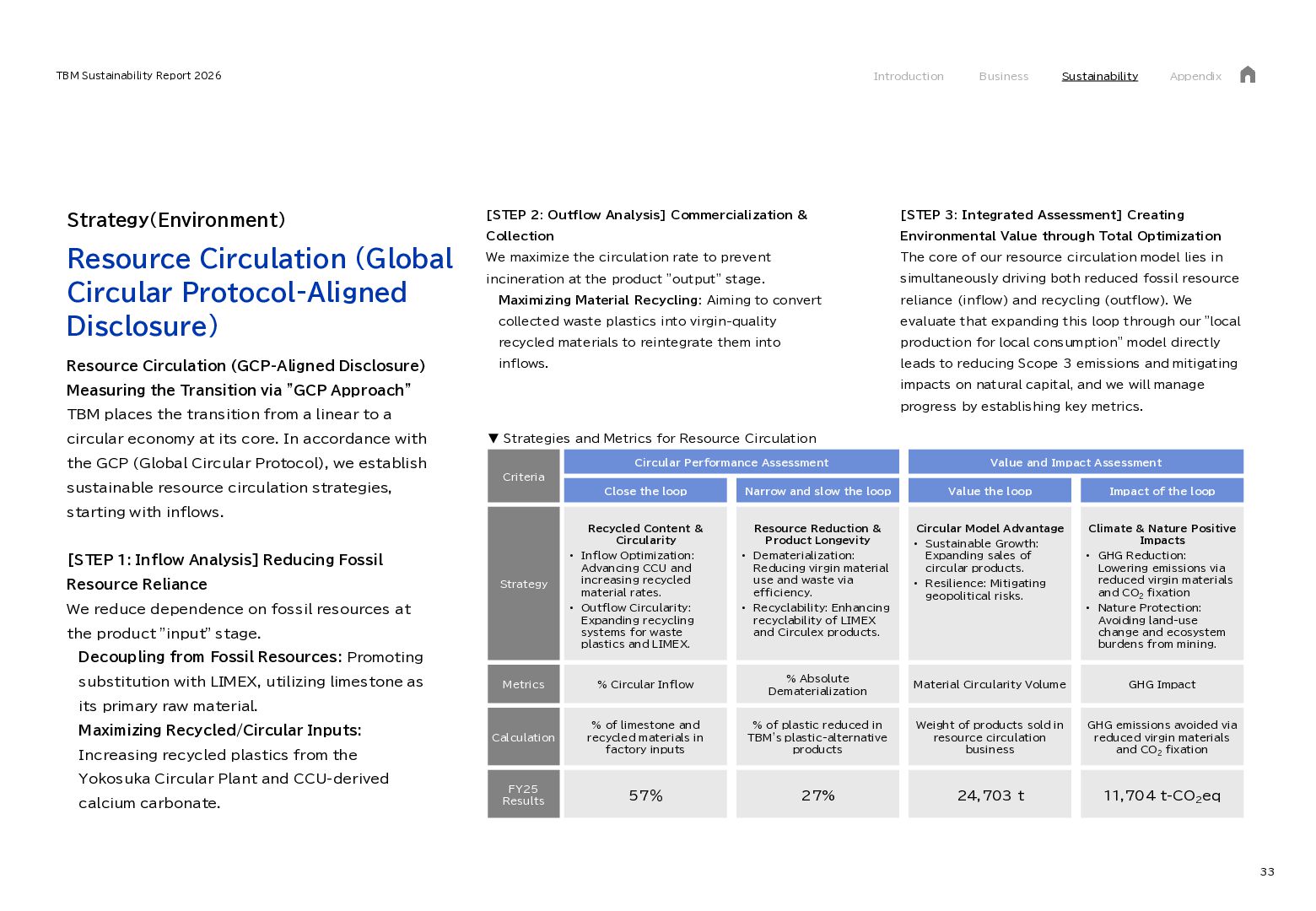
    Disclosure) Strategy(Environment) Resource Circulation (GCP-Aligned Disclosure) Measuring the Transition via "GCP Approach" TBM places the transition from a linear to a circular economy at its core. In accordance with the GCP (Global Circular Protocol), we establish sustainable resource circulation strategies, starting with inflows. [STEP 1: Inflow Analysis] Reducing Fossil Resource Reliance We reduce dependence on fossil resources at the product "input" stage. Decoupling from Fossil Resources: Promoting substitution with LIMEX, utilizing limestone as its primary raw material. Maximizing Recycled/Circular Inputs: Increasing recycled plastics from the Yokosuka Circular Plant and CCU-derived calcium carbonate. [STEP 2: Outflow Analysis] Commercialization & Collection We maximize the circulation rate to prevent incineration at the product "output" stage. Maximizing Material Recycling: Aiming to convert collected waste plastics into virgin-quality recycled materials to reintegrate them into inflows. ▼ Strategies and Metrics for Resource Circulation Close the loop Narrow and slow the loop Value the loop Impact of the loop Recycled Content & Circularity • Inflow Optimization: Advancing CCU and increasing recycled material rates. • Outflow Circularity: Expanding recycling systems for waste plastics and LIMEX. Resource Reduction & Product Longevity • Dematerialization: Reducing virgin material use and waste via efficiency. • Recyclability: Enhancing recyclability of LIMEX and Circulex products. Circular Model Advantage • Sustainable Growth: Expanding sales of circular products. • Resilience: Mitigating geopolitical risks. Climate & Nature Positive Impacts • GHG Reduction: Lowering emissions via reduced virgin materials and CO 2 fixation • Nature Protection: Avoiding land-use change and ecosystem burdens from mining. % Circular Inflow GHG Impact Material Circularity Volume % Absolute Dematerialization Circular Performance Assessment Value and Impact Assessment Metrics Strategy Criteria % of limestone and recycled materials in factory inputs GHG emissions avoided via reduced virgin materials and CO 2 fixation Weight of products sold in resource circulation business % of plastic reduced in TBM's plastic-alternative products Calculation 57% 11,704 t-CO 2 eq 24,703 t 27% FY25 Results [STEP 3: Integrated Assessment] Creating Environmental Value through Total Optimization The core of our resource circulation model lies in simultaneously driving both reduced fossil resource reliance (inflow) and recycling (outflow). We evaluate that expanding this loop through our "local production for local consumption" model directly leads to reducing Scope 3 emissions and mitigating impacts on natural capital, and we will manage progress by establishing key metrics. Introduction Introduction Business Business Sustainability Sustainability Appendix Appendix
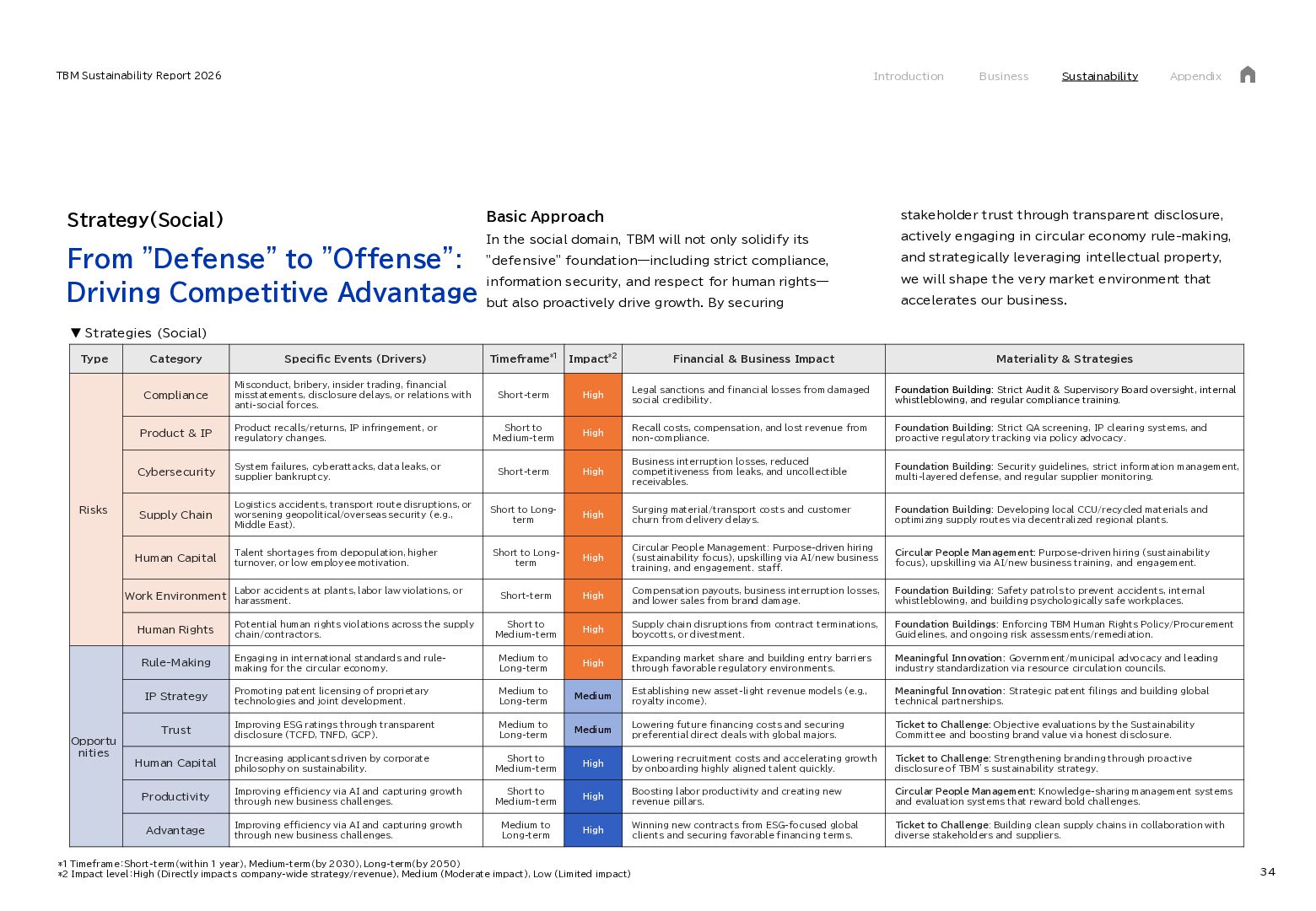
  30. 34 TBM Sustainability Report 2026 From "Defense" to "Offense": Driving

    Competitive Advantage Strategy(Social) Basic Approach In the social domain, TBM will not only solidify its "defensive" foundation—including strict compliance, information security, and respect for human rights— but also proactively drive growth. By securing stakeholder trust through transparent disclosure, actively engaging in circular economy rule-making, and strategically leveraging intellectual property, we will shape the very market environment that accelerates our business. ▼ Strategies (Social) Type Category Specific Events (Drivers) Timeframe*1 Impact*2 Financial & Business Impact Materiality & Strategies Risks Compliance Misconduct, bribery, insider trading, financial misstatements, disclosure delays, or relations with anti-social forces. Short-term High Legal sanctions and financial losses from damaged social credibility. Foundation Building: Strict Audit & Supervisory Board oversight, internal whistleblowing, and regular compliance training. Product & IP Product recalls/returns, IP infringement, or regulatory changes. Short to Medium-term High Recall costs, compensation, and lost revenue from non-compliance. Foundation Building: Strict QA screening, IP clearing systems, and proactive regulatory tracking via policy advocacy. Cybersecurity System failures, cyberattacks, data leaks, or supplier bankruptcy. Short-term High Business interruption losses, reduced competitiveness from leaks, and uncollectible receivables. Foundation Building: Security guidelines, strict information management, multi-layered defense, and regular supplier monitoring. Supply Chain Logistics accidents, transport route disruptions, or worsening geopolitical/overseas security (e.g., Middle East). Short to Long- term High Surging material/transport costs and customer churn from delivery delays. Foundation Building: Developing local CCU/recycled materials and optimizing supply routes via decentralized regional plants. Human Capital Talent shortages from depopulation, higher turnover, or low employee motivation. Short to Long- term High Circular People Management: Purpose-driven hiring (sustainability focus), upskilling via AI/new business training, and engagement. staff. Circular People Management: Purpose-driven hiring (sustainability focus), upskilling via AI/new business training, and engagement. Work Environment Labor accidents at plants, labor law violations, or harassment. Short-term High Compensation payouts, business interruption losses, and lower sales from brand damage. Foundation Building: Safety patrols to prevent accidents, internal whistleblowing, and building psychologically safe workplaces. Human Rights Potential human rights violations across the supply chain/contractors. Short to Medium-term High Supply chain disruptions from contract terminations, boycotts, or divestment. Foundation Buildings: Enforcing TBM Human Rights Policy/Procurement Guidelines, and ongoing risk assessments/remediation. Opportu nities Rule-Making Engaging in international standards and rule- making for the circular economy. Medium to Long-term High Expanding market share and building entry barriers through favorable regulatory environments. Meaningful Innovation: Government/municipal advocacy and leading industry standardization via resource circulation councils. IP Strategy Promoting patent licensing of proprietary technologies and joint development. Medium to Long-term Medium Establishing new asset-light revenue models (e.g., royalty income). Meaningful Innovation: Strategic patent filings and building global technical partnerships. Trust Improving ESG ratings through transparent disclosure (TCFD, TNFD, GCP). Medium to Long-term Medium Lowering future financing costs and securing preferential direct deals with global majors. Ticket to Challenge: Objective evaluations by the Sustainability Committee and boosting brand value via honest disclosure. Human Capital Increasing applicants driven by corporate philosophy on sustainability. Short to Medium-term High Lowering recruitment costs and accelerating growth by onboarding highly aligned talent quickly. Ticket to Challenge: Strengthening branding through proactive disclosure of TBM’s sustainability strategy. Productivity Improving efficiency via AI and capturing growth through new business challenges. Short to Medium-term High Boosting labor productivity and creating new revenue pillars. Circular People Management: Knowledge-sharing management systems and evaluation systems that reward bold challenges. Advantage Improving efficiency via AI and capturing growth through new business challenges. Medium to Long-term High Winning new contracts from ESG-focused global clients and securing favorable financing terms. Ticket to Challenge: Building clean supply chains in collaboration with diverse stakeholders and suppliers. *1 Timeframe:Short-term(within 1 year), Medium-term(by 2030), Long-term(by 2050) *2 Impact level:High (Directly impacts company-wide strategy/revenue), Medium (Moderate impact), Low (Limited impact) Introduction Introduction Business Business Sustainability Sustainability Appendix Appendix
  31. 35 TBM Sustainability Report 2026 Risk Management Policy & Workflow

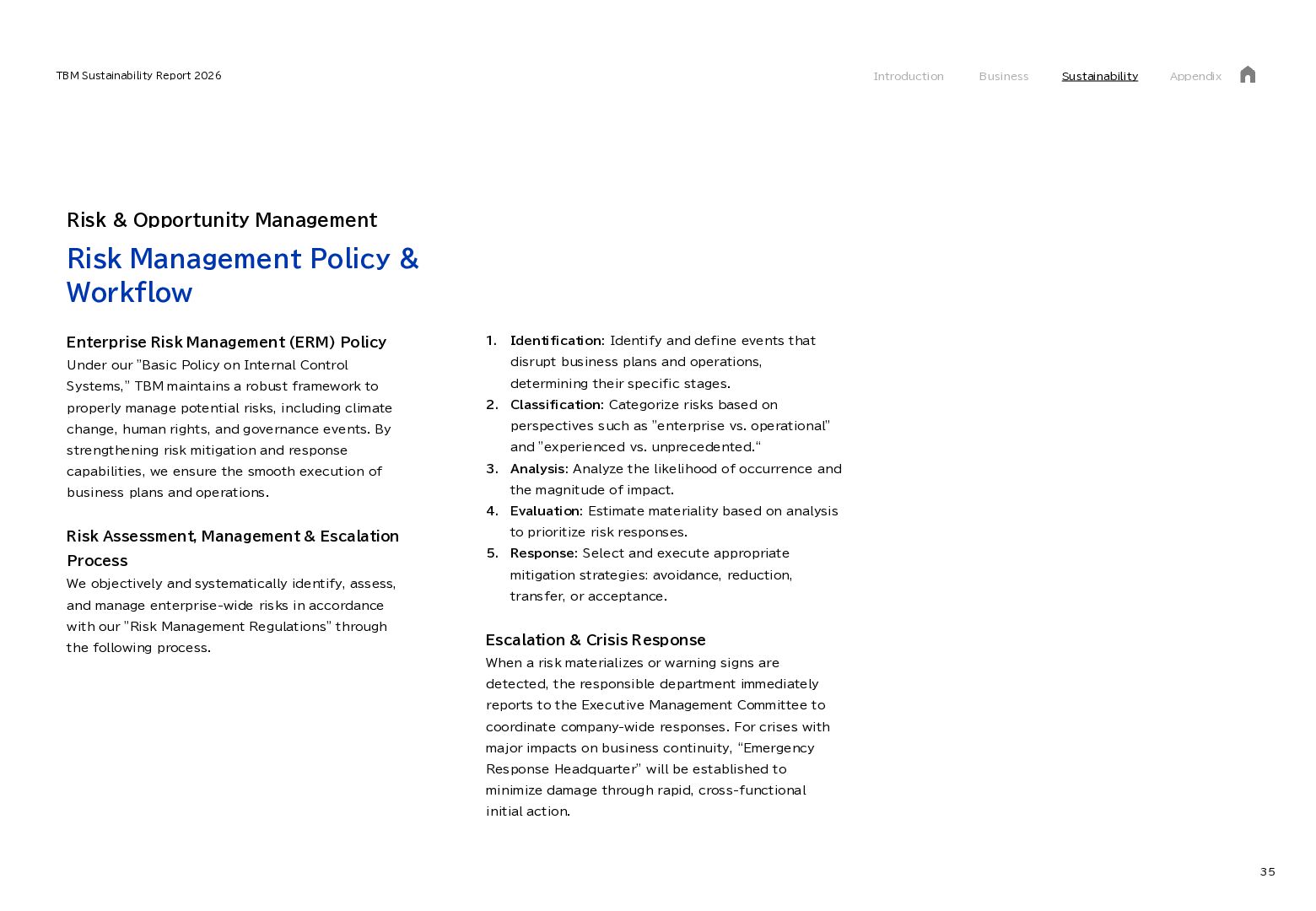
    Risk & Opportunity Management Enterprise Risk Management (ERM) Policy Under our "Basic Policy on Internal Control Systems," TBM maintains a robust framework to properly manage potential risks, including climate change, human rights, and governance events. By strengthening risk mitigation and response capabilities, we ensure the smooth execution of business plans and operations. Risk Assessment, Management & Escalation Process We objectively and systematically identify, assess, and manage enterprise-wide risks in accordance with our "Risk Management Regulations" through the following process. 1. Identification: Identify and define events that disrupt business plans and operations, determining their specific stages. 2. Classification: Categorize risks based on perspectives such as "enterprise vs. operational" and "experienced vs. unprecedented.“ 3. Analysis: Analyze the likelihood of occurrence and the magnitude of impact. 4. Evaluation: Estimate materiality based on analysis to prioritize risk responses. 5. Response: Select and execute appropriate mitigation strategies: avoidance, reduction, transfer, or acceptance. Escalation & Crisis Response When a risk materializes or warning signs are detected, the responsible department immediately reports to the Executive Management Committee to coordinate company-wide responses. For crises with major impacts on business continuity, “Emergency Response Headquarter” will be established to minimize damage through rapid, cross-functional initial action. Introduction Introduction Business Business Sustainability Sustainability Appendix Appendix
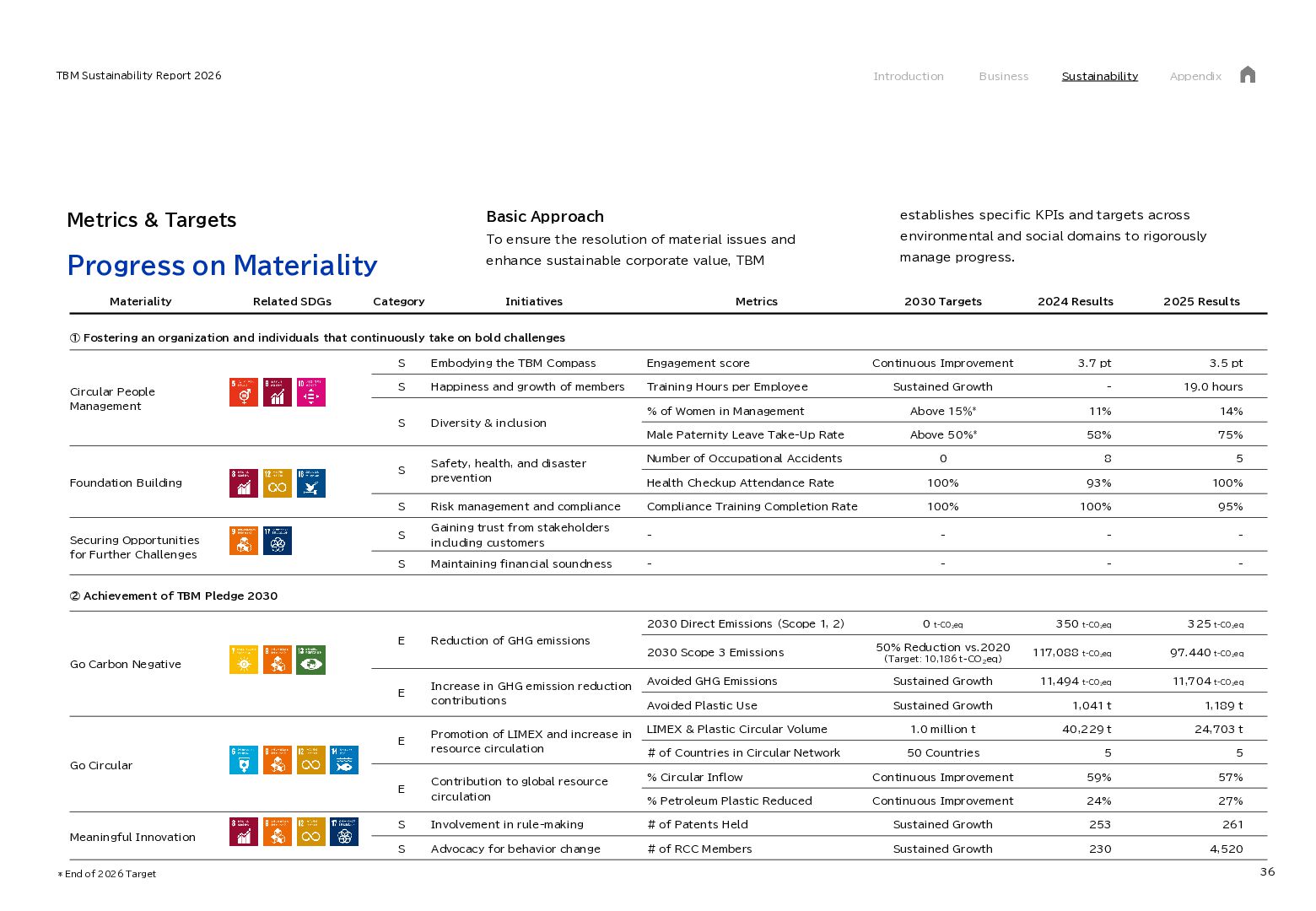
  32. 36 TBM Sustainability Report 2026 Progress on Materiality Metrics &

    Targets Basic Approach To ensure the resolution of material issues and enhance sustainable corporate value, TBM Materiality Related SDGs Category Initiatives Metrics 2030 Targets 2024 Results 2025 Results ① Fostering an organization and individuals that continuously take on bold challenges Circular People Management S Embodying the TBM Compass Engagement score Continuous Improvement 3.7 pt 3.5 pt S Happiness and growth of members Training Hours per Employee Sustained Growth - 19.0 hours S Diversity & inclusion % of Women in Management Above 15%* 11% 14% Male Paternity Leave Take-Up Rate Above 50%* 58% 75% Foundation Building S Safety, health, and disaster prevention Number of Occupational Accidents 0 8 5 Health Checkup Attendance Rate 100% 93% 100% S Risk management and compliance Compliance Training Completion Rate 100% 100% 95% Securing Opportunities for Further Challenges S Gaining trust from stakeholders including customers - - - - S Maintaining financial soundness - - - - ② Achievement of TBM Pledge 2030 Go Carbon Negative E Reduction of GHG emissions 2030 Direct Emissions (Scope 1, 2) 0 t-CO₂eq 350 t-CO₂eq 325 t-CO₂eq 2030 Scope 3 Emissions 50% Reduction vs.2020 (Target: 10,186 t-CO 2 eq) 117,088 t-CO₂eq 97.440 t-CO₂eq E Increase in GHG emission reduction contributions Avoided GHG Emissions Sustained Growth 11,494 t-CO₂eq 11,704 t-CO₂eq Avoided Plastic Use Sustained Growth 1,041 t 1,189 t Go Circular E Promotion of LIMEX and increase in resource circulation LIMEX & Plastic Circular Volume 1.0 million t 40,229 t 24,703 t # of Countries in Circular Network 50 Countries 5 5 E Contribution to global resource circulation % Circular Inflow Continuous Improvement 59% 57% % Petroleum Plastic Reduced Continuous Improvement 24% 27% Meaningful Innovation S Involvement in rule-making # of Patents Held Sustained Growth 253 261 S Advocacy for behavior change # of RCC Members Sustained Growth 230 4,520 establishes specific KPIs and targets across environmental and social domains to rigorously manage progress. * End of 2026 Target Introduction Introduction Business Business Sustainability Sustainability Appendix Appendix
  33. 37 TBM Sustainability Report 2026 Development & Sales of LIMEX

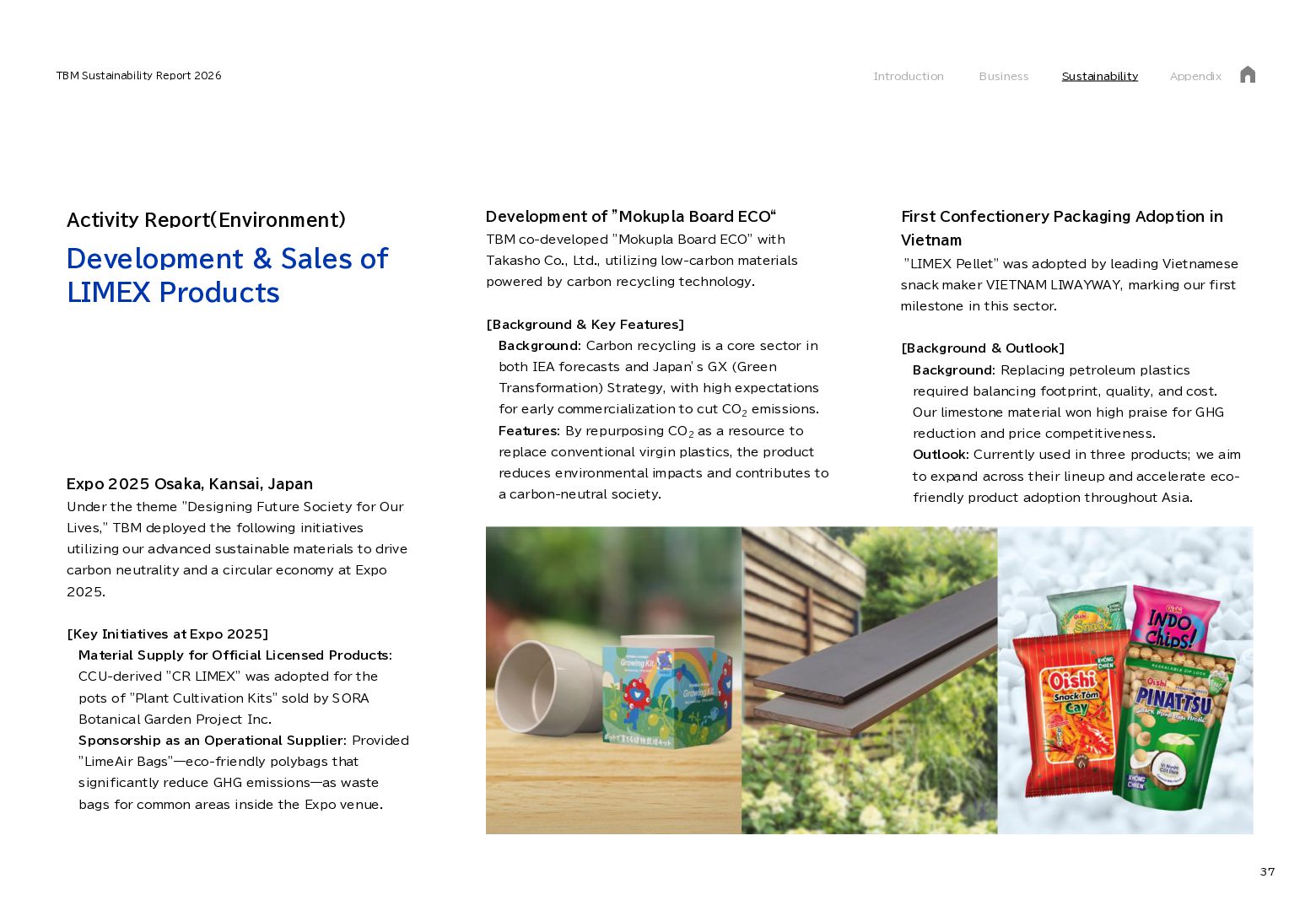
    Products Activity Report(Environment) Expo 2025 Osaka, Kansai, Japan Under the theme "Designing Future Society for Our Lives," TBM deployed the following initiatives utilizing our advanced sustainable materials to drive carbon neutrality and a circular economy at Expo 2025. [Key Initiatives at Expo 2025] Material Supply for Official Licensed Products: CCU-derived "CR LIMEX" was adopted for the pots of "Plant Cultivation Kits" sold by SORA Botanical Garden Project Inc. Sponsorship as an Operational Supplier: Provided "LimeAir Bags"—eco-friendly polybags that significantly reduce GHG emissions—as waste bags for common areas inside the Expo venue. Development of "Mokupla Board ECO“ TBM co-developed "Mokupla Board ECO" with Takasho Co., Ltd., utilizing low-carbon materials powered by carbon recycling technology. [Background & Key Features] Background: Carbon recycling is a core sector in both IEA forecasts and Japan’s GX (Green Transformation) Strategy, with high expectations for early commercialization to cut CO 2 emissions. Features: By repurposing CO 2 as a resource to replace conventional virgin plastics, the product reduces environmental impacts and contributes to a carbon-neutral society. First Confectionery Packaging Adoption in Vietnam "LIMEX Pellet" was adopted by leading Vietnamese snack maker VIETNAM LIWAYWAY, marking our first milestone in this sector. [Background & Outlook] Background: Replacing petroleum plastics required balancing footprint, quality, and cost. Our limestone material won high praise for GHG reduction and price competitiveness. Outlook: Currently used in three products; we aim to expand across their lineup and accelerate eco- friendly product adoption throughout Asia. Introduction Introduction Business Business Sustainability Sustainability Appendix Appendix
  34. 38 TBM Sustainability Report 2026 Promoting Resource Circulation Activity Report(Environment)

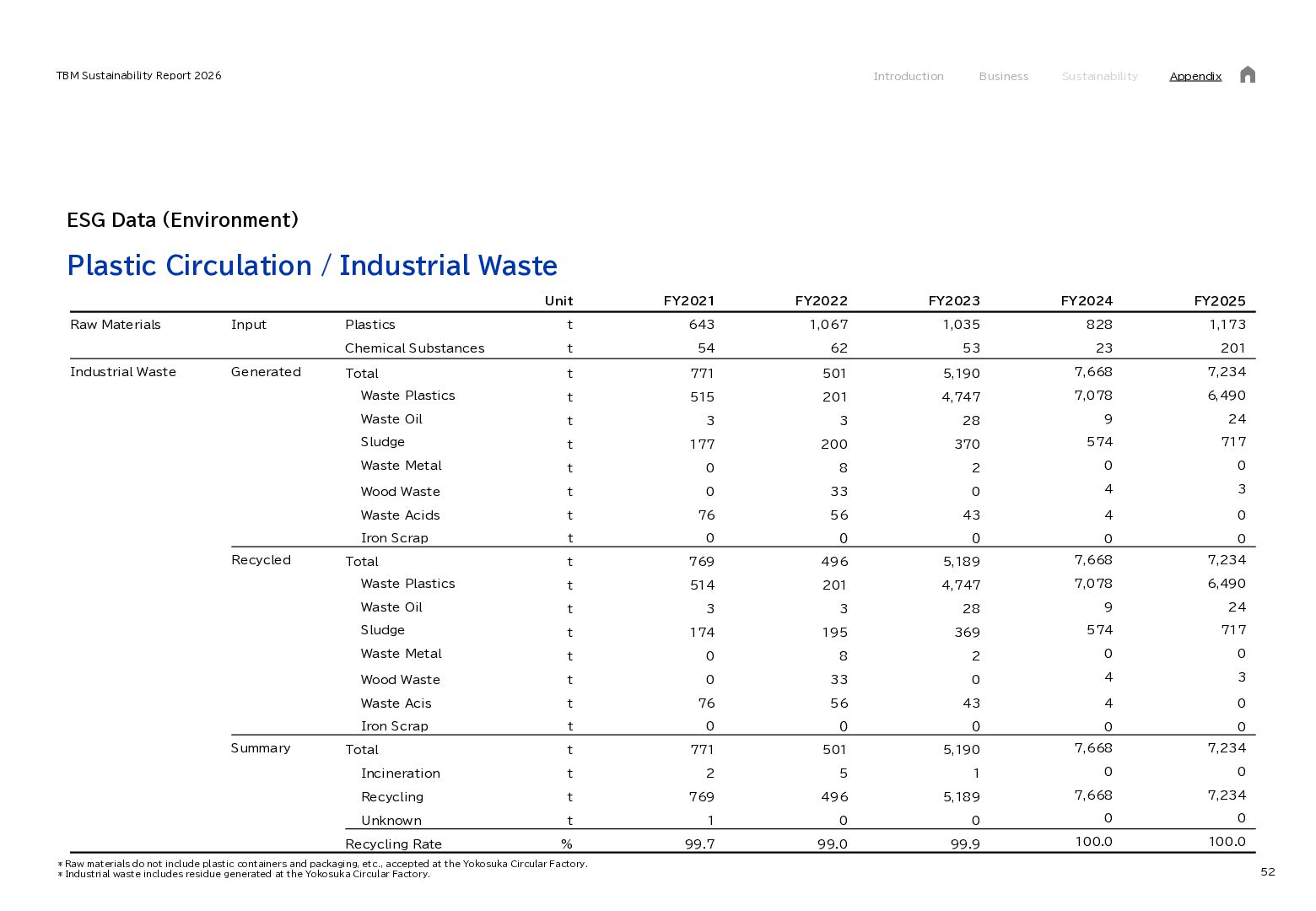
    2025 Resource Circulation Volume In 2025, the combined circulation volume of LIMEX and plastics reached 24,703 tonnes, representing a 37% decrease compared to 2024 and a 2% achievement rate toward our 2030 target. Recycling Project in Tomioka City, Gunma Our collaborative demonstration project with Tomioka City was selected by the Ministry of the Environment for the "FY2025 Regional Resource Circulation Promotion Support Project." [Project Scope & Outlook] Objective: Recycled industrial waste plastics previously destined for incineration. Details: Provided trading matching support for waste plastics/recycled materials and promoted recycling conversion utilizing our proprietary digital platform. Deployment: Developed and verified a Resource Circulation Dashboard. Circular Economy Demonstration Project in Izumisano City, Osaka TBM was selected for the second consecutive year for Izumisano City’s "Circular Economy Promotion Demonstration Project" and conducted initiatives to build a regional resource circulation model. [Background & Overview] Background: Implemented as part of Izumisano City’s initiatives toward a decarbonized and circular society following its "Zero Carbon City" declaration. Overview: Collaborated with local primary schools, the city hall, and businesses to collect plastic bottle caps and upcycle them into children's umbrellas. By distributing these to participating students, the project raised awareness and promoted an integrated resource circulation model uniting citizens, government, and business. Ensuring High-Quality Recycled Plastic Supply Amid the global shift to a circular economy, securing high-quality recycled plastics is vital. Backed by our Yokosuka Factory, GRS certification, and a 34k-tonne annual matching volume, TBM is setting new standards for transparent recycled material markets. Guaranteed "Premium Recycled Materials" We launched recycled materials clearing three criteria: Physical Properties, Process, and Traceability Guarantees. This resolves quality variance and opaque sourcing, enabling manufacturers to secure stable, data-backed green procurement. "Certified Recycler Program" This program objectively verifies recyclers with superior technology and quality control. By matching them with clients seeking premium materials, we support fair-value pricing and market expansion. Introduction Introduction Business Business Sustainability Sustainability Appendix Appendix
  35. 39 TBM Sustainability Report 2026 Occupational Health & Safety Initiatives

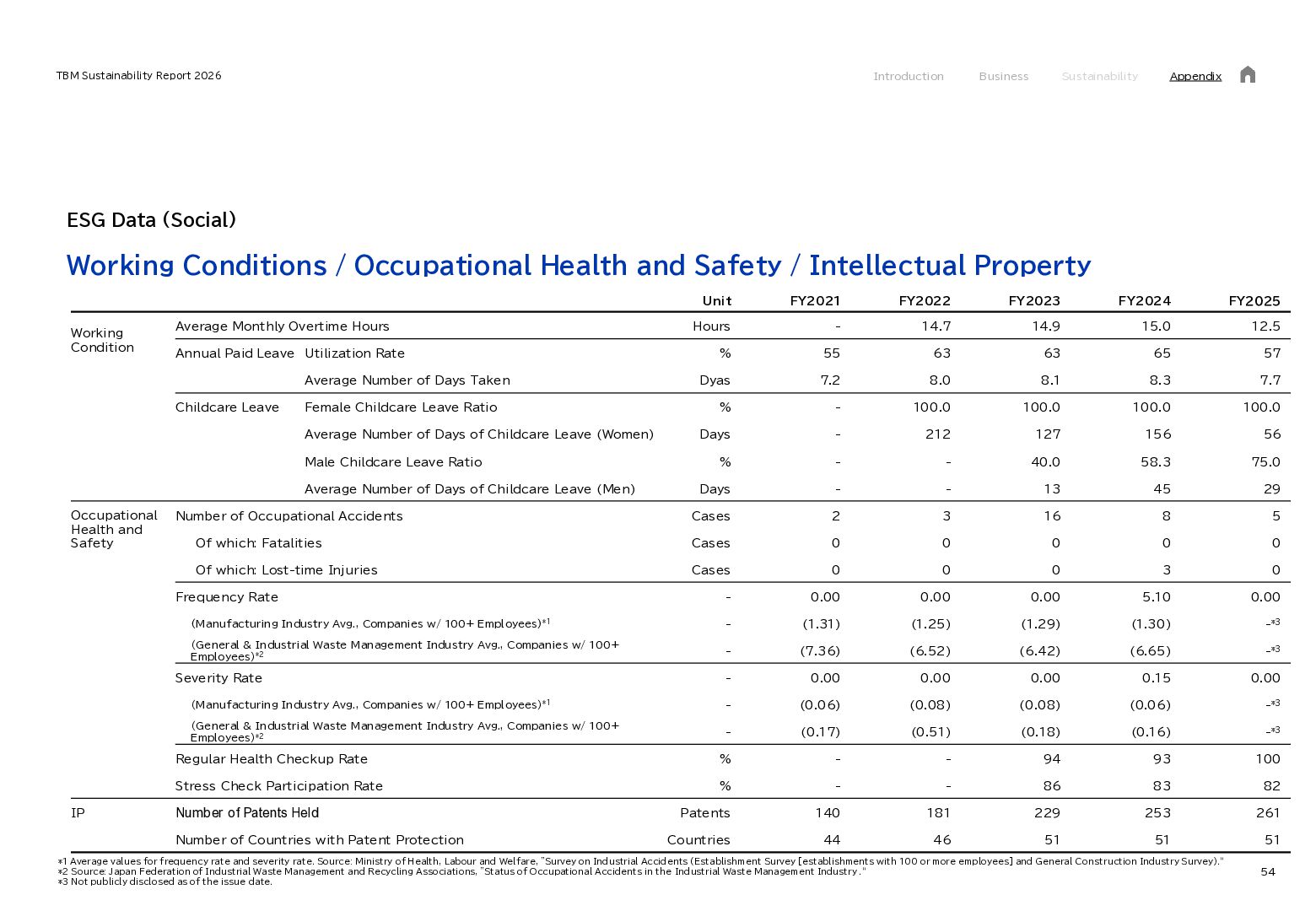
    Activity Report (Social) Occupational Health & Safety Driven by our policy "Safety Takes Precedence Overall," we continuously enhance our workplace safety management. Accident Mitigation: In 2025, we had 5 accidents (0 lost-time). Since most occurred during non- routine maintenance, we established SOPs and upgraded equipment to target zero accidents. Heatstroke Prevention: Through new standards, safety education, and enhanced break facilities, we achieved zero heatstroke incidents in 2025. Emergency Drills: All sites conduct biannual fire drills and chemical spill response training. Workplace Environment: We combine statutory measurements with equipment risk assessments and near-miss activities to proactively eliminate onsite risks. Chemical Risk Assessments Guided by our April 2024 Manual, we execute structured safety and environmental risk reductions for chemicals. We continuously assess new substances via annual data updates to enforce all necessary factory safety measures. Tohoku Factory Wins Miyagi Labor Standards Association Award Our Tohoku LIMEX Factory won the FY2025 Sendai Branch Manager's Award. The honor highly evaluates our ongoing safety initiatives since launch and our drive to maintain an incident- and dispute-free workplace. ▼ Emergency Drills Introduction Introduction Business Business Sustainability Sustainability Appendix Appendix
  36. 40 TBM Sustainability Report 2026 Maximizing Human Capital Activity Report

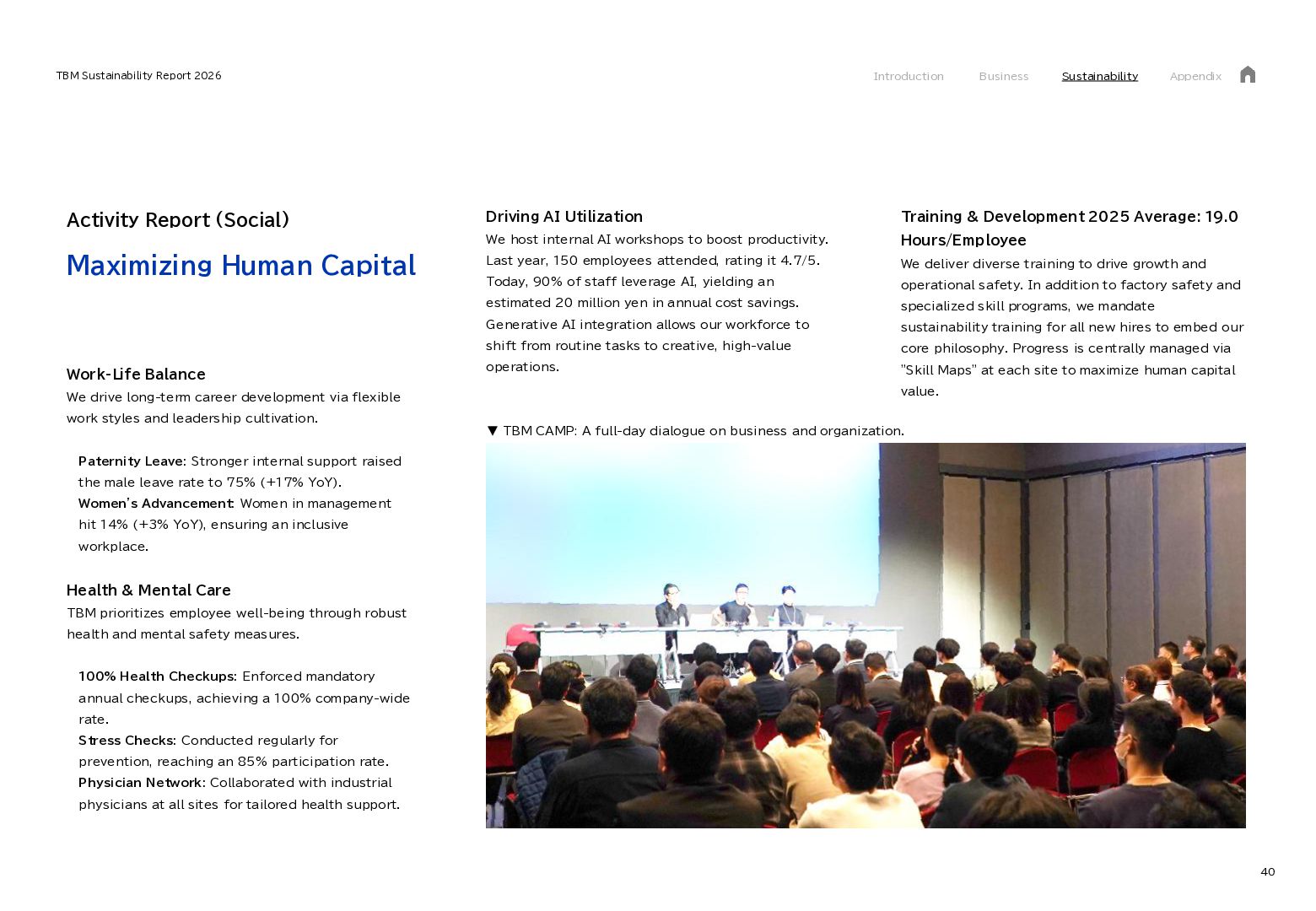
    (Social) Work-Life Balance We drive long-term career development via flexible work styles and leadership cultivation. Paternity Leave: Stronger internal support raised the male leave rate to 75% (+17% YoY). Women's Advancement: Women in management hit 14% (+3% YoY), ensuring an inclusive workplace. Health & Mental Care TBM prioritizes employee well-being through robust health and mental safety measures. 100% Health Checkups: Enforced mandatory annual checkups, achieving a 100% company-wide rate. Stress Checks: Conducted regularly for prevention, reaching an 85% participation rate. Physician Network: Collaborated with industrial physicians at all sites for tailored health support. Driving AI Utilization We host internal AI workshops to boost productivity. Last year, 150 employees attended, rating it 4.7/5. Today, 90% of staff leverage AI, yielding an estimated 20 million yen in annual cost savings. Generative AI integration allows our workforce to shift from routine tasks to creative, high-value operations. Training & Development 2025 Average: 19.0 Hours/Employee We deliver diverse training to drive growth and operational safety. In addition to factory safety and specialized skill programs, we mandate sustainability training for all new hires to embed our core philosophy. Progress is centrally managed via "Skill Maps" at each site to maximize human capital value. ▼ TBM CAMP: A full-day dialogue on business and organization. Introduction Introduction Business Business Sustainability Sustainability Appendix Appendix
  37. 41 TBM Sustainability Report 2026 Driving Employee Engagement Activity Report

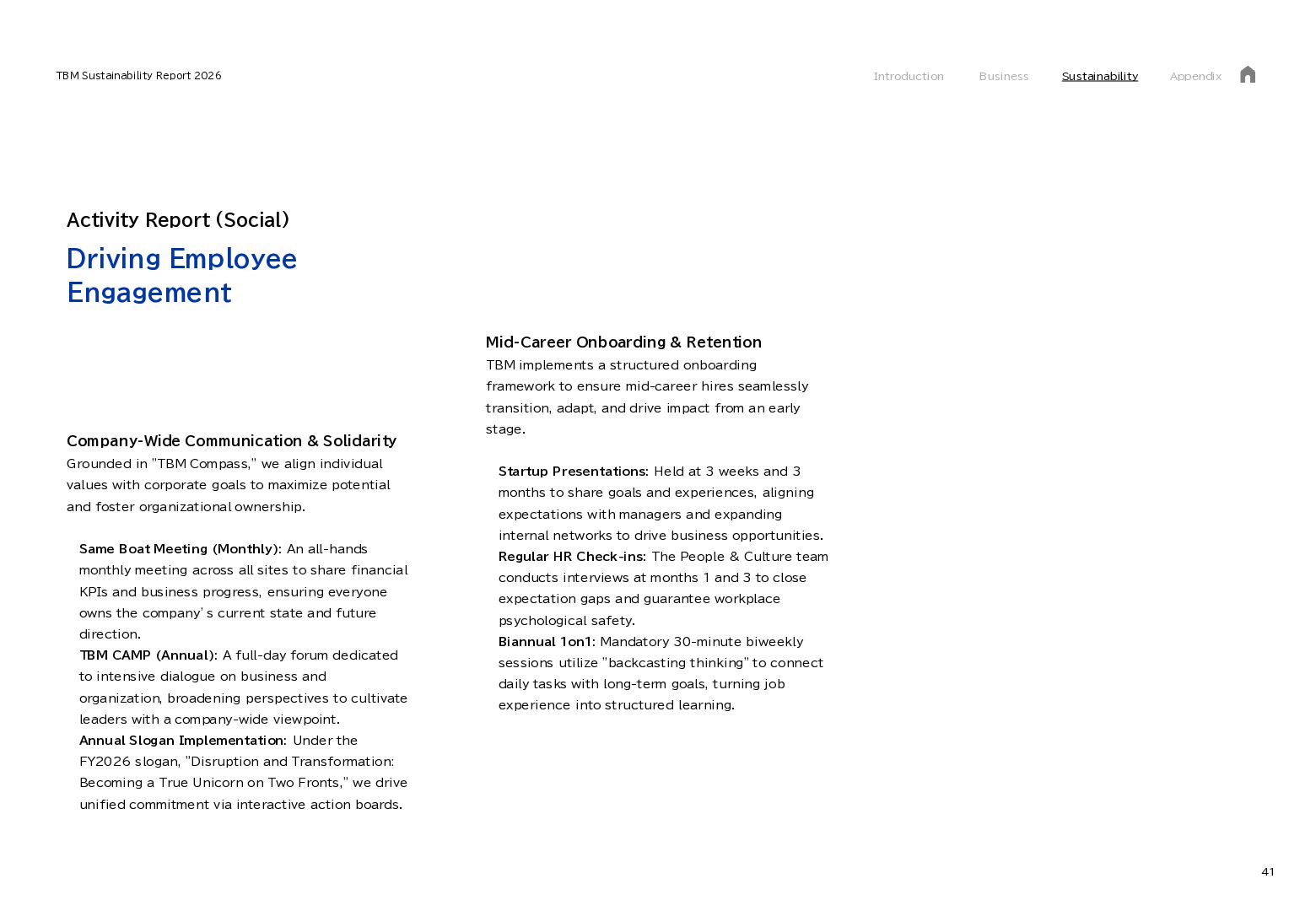
    (Social) Company-Wide Communication & Solidarity Grounded in "TBM Compass," we align individual values with corporate goals to maximize potential and foster organizational ownership. Same Boat Meeting (Monthly): An all-hands monthly meeting across all sites to share financial KPIs and business progress, ensuring everyone owns the company’s current state and future direction. TBM CAMP (Annual): A full-day forum dedicated to intensive dialogue on business and organization, broadening perspectives to cultivate leaders with a company-wide viewpoint. Annual Slogan Implementation: Under the FY2026 slogan, "Disruption and Transformation: Becoming a True Unicorn on Two Fronts," we drive unified commitment via interactive action boards. Mid-Career Onboarding & Retention TBM implements a structured onboarding framework to ensure mid-career hires seamlessly transition, adapt, and drive impact from an early stage. Startup Presentations: Held at 3 weeks and 3 months to share goals and experiences, aligning expectations with managers and expanding internal networks to drive business opportunities. Regular HR Check-ins: The People & Culture team conducts interviews at months 1 and 3 to close expectation gaps and guarantee workplace psychological safety. Biannual 1on1: Mandatory 30-minute biweekly sessions utilize "backcasting thinking" to connect daily tasks with long-term goals, turning job experience into structured learning. Introduction Introduction Business Business Sustainability Sustainability Appendix Appendix
  38. 42 TBM Sustainability Report 2026 Respect for Human Rights Activity

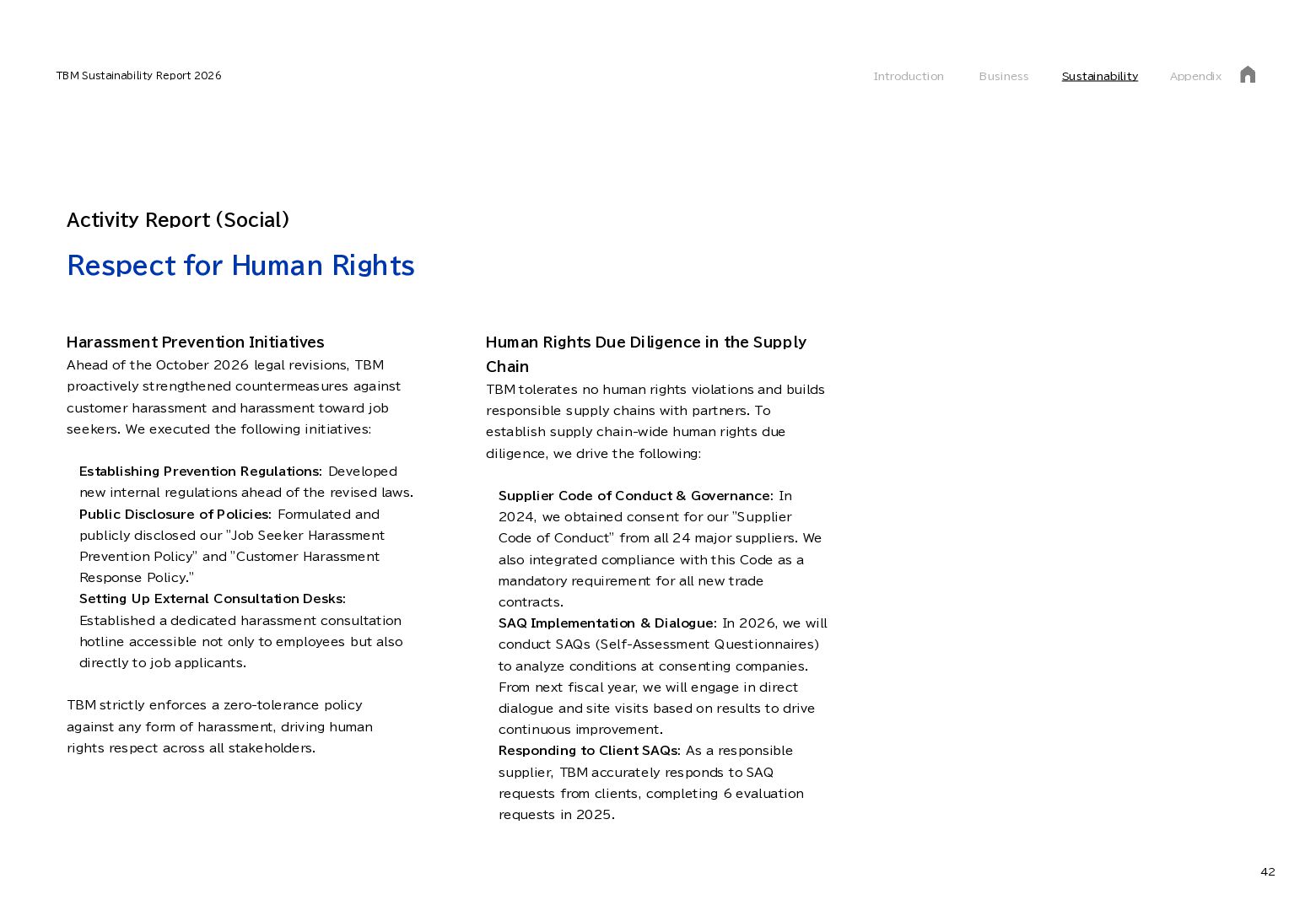
    Report (Social) Harassment Prevention Initiatives Ahead of the October 2026 legal revisions, TBM proactively strengthened countermeasures against customer harassment and harassment toward job seekers. We executed the following initiatives: Establishing Prevention Regulations: Developed new internal regulations ahead of the revised laws. Public Disclosure of Policies: Formulated and publicly disclosed our "Job Seeker Harassment Prevention Policy" and "Customer Harassment Response Policy." Setting Up External Consultation Desks: Established a dedicated harassment consultation hotline accessible not only to employees but also directly to job applicants. TBM strictly enforces a zero-tolerance policy against any form of harassment, driving human rights respect across all stakeholders. Human Rights Due Diligence in the Supply Chain TBM tolerates no human rights violations and builds responsible supply chains with partners. To establish supply chain-wide human rights due diligence, we drive the following: Supplier Code of Conduct & Governance: In 2024, we obtained consent for our "Supplier Code of Conduct" from all 24 major suppliers. We also integrated compliance with this Code as a mandatory requirement for all new trade contracts. SAQ Implementation & Dialogue: In 2026, we will conduct SAQs (Self-Assessment Questionnaires) to analyze conditions at consenting companies. From next fiscal year, we will engage in direct dialogue and site visits based on results to drive continuous improvement. Responding to Client SAQs: As a responsible supplier, TBM accurately responds to SAQ requests from clients, completing 6 evaluation requests in 2025. Introduction Introduction Business Business Sustainability Sustainability Appendix Appendix
  39. 43 TBM Sustainability Report 2026 Ensuring Strict Compliance Activity Report

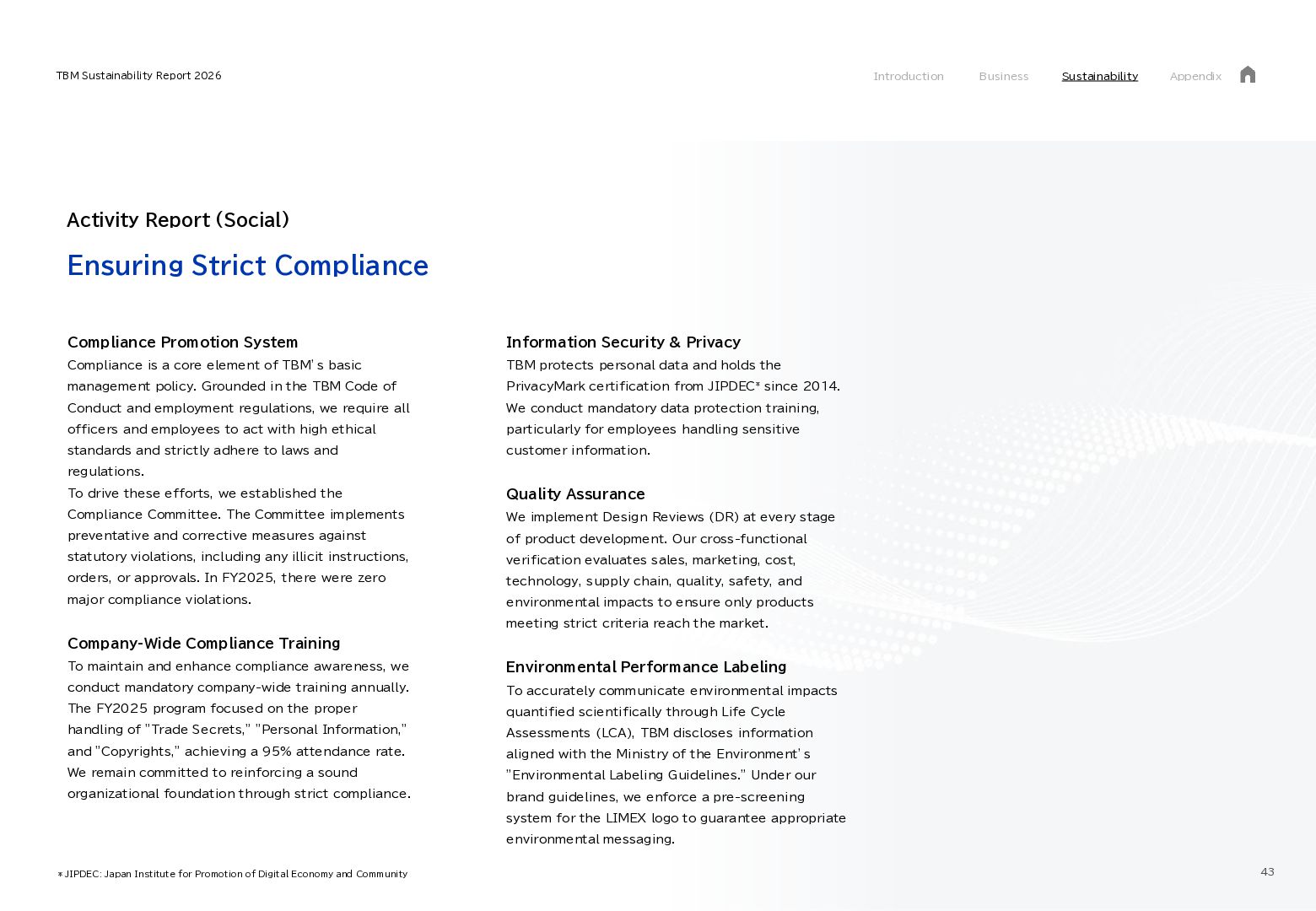
    (Social) Compliance Promotion System Compliance is a core element of TBM’s basic management policy. Grounded in the TBM Code of Conduct and employment regulations, we require all officers and employees to act with high ethical standards and strictly adhere to laws and regulations. To drive these efforts, we established the Compliance Committee. The Committee implements preventative and corrective measures against statutory violations, including any illicit instructions, orders, or approvals. In FY2025, there were zero major compliance violations. Company-Wide Compliance Training To maintain and enhance compliance awareness, we conduct mandatory company-wide training annually. The FY2025 program focused on the proper handling of "Trade Secrets," "Personal Information," and "Copyrights," achieving a 95% attendance rate. We remain committed to reinforcing a sound organizational foundation through strict compliance. Information Security & Privacy TBM protects personal data and holds the PrivacyMark certification from JIPDEC* since 2014. We conduct mandatory data protection training, particularly for employees handling sensitive customer information. Quality Assurance We implement Design Reviews (DR) at every stage of product development. Our cross-functional verification evaluates sales, marketing, cost, technology, supply chain, quality, safety, and environmental impacts to ensure only products meeting strict criteria reach the market. Environmental Performance Labeling To accurately communicate environmental impacts quantified scientifically through Life Cycle Assessments (LCA), TBM discloses information aligned with the Ministry of the Environment’s "Environmental Labeling Guidelines." Under our brand guidelines, we enforce a pre-screening system for the LIMEX logo to guarantee appropriate environmental messaging. Introduction Introduction Business Business Sustainability Sustainability Appendix Appendix * JIPDEC: Japan Institute for Promotion of Digital Economy and Community
  40. 44 TBM Sustainability Report 2026 Driving Behavioral Change & Market

    Transformation Activity Report (Social) Resource Circulation Council Launched in Aug 2023 with TBM as secretariat, this coalition unites firms, cities, and ministries. Membership surged from 230 (end of 2024) to 4,520 (April 2026). Policy Recommendations: Formed a "Steering Committee" with experts to propose policies on doubling domestic plastic recycling and recovering hard-to-recycle products. 4 Working Groups for Social Implementation: WG1 (Recycling Policy): Proposing policies for decarbonized plastic material recycling. WG2 (Local Models): Verifying regional circulation in the Yokosuka/Miura area. WG3 (DPP): Simulating Digital Product Passports on virtual data spaces. WG4 (CCU & Credits): Advancing carbon circulation products and credit generation. Communications & Awareness We drove public awareness through top-tier media like NewsPicks and The Asahi Shimbun. Simultaneously, we launched the "RRC Supporter Program" to share actionable circular economy insights via newsletters and digital platforms. Times Bridge Media Driven by our slogan "Bridging the way to the future we choose," this platform communicates TBM's global challenges and corporate culture. It amplifies the passion of our diverse workforce on the "Same Boat," sharing our five core values: Ownership, Responsibility, Humility, Gratitude, and Ambition. Through these authentic stories, we cultivate a dedicated community of advocates who share our passion for the sustainability revolution. Keynote & Speaking Engagements To amplify our vision globally, TBM completed 14 high-profile speaking engagements in 2025, including: Expo 2025 Osaka, Kansai, Japan CleanLeap Climate Tech Summit TOKYO UNICORN SUMMIT STARTUP WORLD CUP TOKYO REGIONAL 2025 The 2nd Japan-Philippines Environmental Week JCCI International Seminar 2025 Other notable events: Tokyo Startup Talent, Startup City Project Network, TerraSkyDay 2025, and JAPAN PACK 2025. Introduction Introduction Business Business Sustainability Sustainability Appendix Appendix
  41. 45 TBM Sustainability Report 2026 Company Profile About Us Company

    TBM Co., Ltd. Representative Director and CEO Nobuyoshi Yamasaki Establishment August 30, 2011 Capital JPY 100 million (including capital reserve, JPY12,035,460,000 as of December 31, 2023) Number of Employees 261 employees (including 221 full-time employees as of December 31, 2025) Business Activities Business activities promoting the development and manufacturing, sales, and resource circulation of environmentally friendly materials and products Locations Tokyo Headquarters 15F Toho Hibiya Building, 1-2-2 Yurakucho, Chiyoda-ku, Tokyo 100-0006 Japan Technology Center 1F (Lab) / 2F (Reception) J-Pro Machiya Building, 1-38-16 Machiya, Arakawa-ku, Tokyo, 116-0001 Japan Tohoku LIMEX Factory 117-13 Ipponyanagi, Yawata, Tagajo, Miyagi 985-0874, Japan Yokosuka Circular Factory 58-9 Shinmei, Yokosuka, Kanagawa, 239-0832 Japan Domestic subsidiary Bioworks Co., Ltd. Keihanna Plaza Lab Building 7F 1-7 Hikaridai, Seika-cho, Soraku-gun, Kyoto, 619-0237 Japan Foreign Subsidiary TBM VN Co., Ltd 4F, NO3-T7 Building, Ngoai Giao Doan Area, Xuan Tao Ward, Bac Tu Liem District, Ha Noi, Viet Nam Times Bridge Management Global, Inc 8605 Santa Monica Blvd 80071, West Hollywood, CA, 90069-4109, United States TBM (Shanghai) International Trading Co., Ltd. Building C, No. 888 Huanhu West 2nd Road, Lingang New Area, China (Shanghai) Pilot Free Trade Zone, Shanghai, China Introduction Introduction Business Business Sustainability Sustainability Appendix Appendix
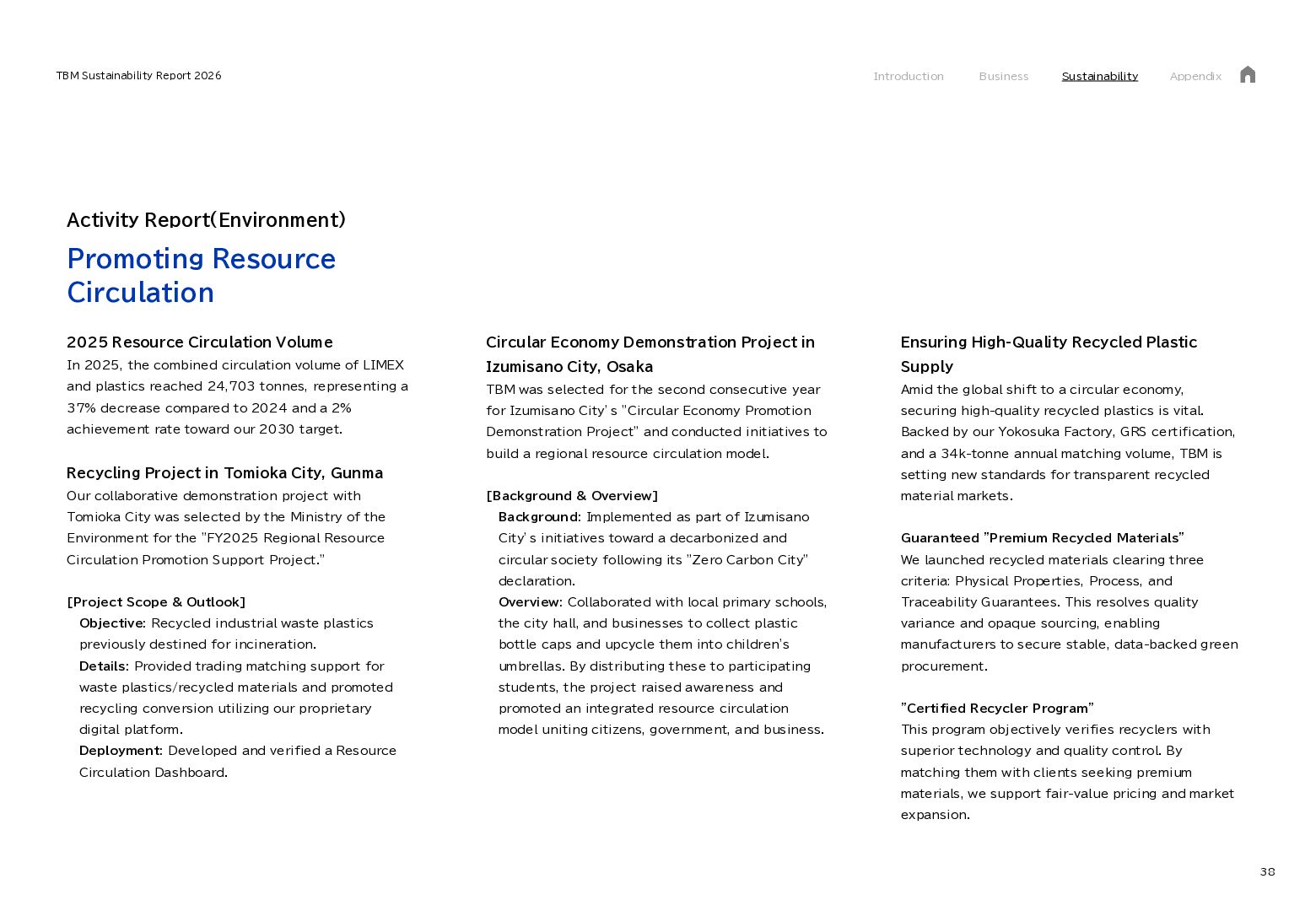
  42. 46 TBM Sustainability Report 2026 Awards, External Evaluations & Initiatives

    About Us Recent Awards & Recognition WorldStar Global Packaging Awards 2025: Hosted by the WPO (World Packaging Organisation). LIMEX was recognized for its significant environmental impact in reducing plastic usage and CO 2 emissions. D&I Award 2024: Achieved "Advanced Certification," the top-tier rating in Japan's largest D&I corporate evaluation. Our internal cycle of awareness, empathy, practice, and expansion was highly praised. TiE Global Award (Sustainability Excellence Award): Evaluated for our core sustainability-driven business model and CEO's strong leadership in advancing sustainable innovation. Tokyo Financial Award 2023 (ESG Investment Category): Awarded by the Tokyo Metropolitan Government for our global-standard ESG practices, including environmental contributions via LIMEX, proactive CDP disclosures, and D&I promotion. External Evaluations CDP: An international non-profit platform for environmental disclosure. TBM has responded voluntarily every year since 2017. In 2025, we secured a "B Score" (the 3rd highest out of 8 levels) in both the Climate Change and Water Security categories. EcoVadis: A globally trusted sustainability rating platform evaluating Environment, Labor & Human Rights, Ethics, and Sustainable Procurement. Many global firms utilize it as a standard for supplier selection. In our 2025 assessment, TBM earned the "Commitment Badge.*" Key Initiatives & Partnerships Climate Change The Climate Pledge SBTi (Science Based Targets initiative) JCI (Japan Climate Initiative) OSAKA Zero Carbon Foundation GX League Circular Economy & Plastics J4CE (Japan Partnership for Circular Economy) Kanagawa Plastic Waste Zero Declaration Kanagawa Upcycle Consortium Saitama Sustainable Plastic Utilization Platform Yokosuka Marine Plastic Waste Action Declaration LCA & Other Sustainability Platforms JLCA (LCA Society of Japan) SuMPO (Sustainable Management Promotion Organization) GPN (Green Purchase Network) City Lab Ventures ISA (Impact Startup Association) Japan Heart (Authorized NPO) * Our EcoVadis Scorecard is available here: https://recognition.ecovadis.com/2r7HZJLVX0uFBbsuobWqvA Introduction Introduction Business Business Sustainability Sustainability Appendix Appendix
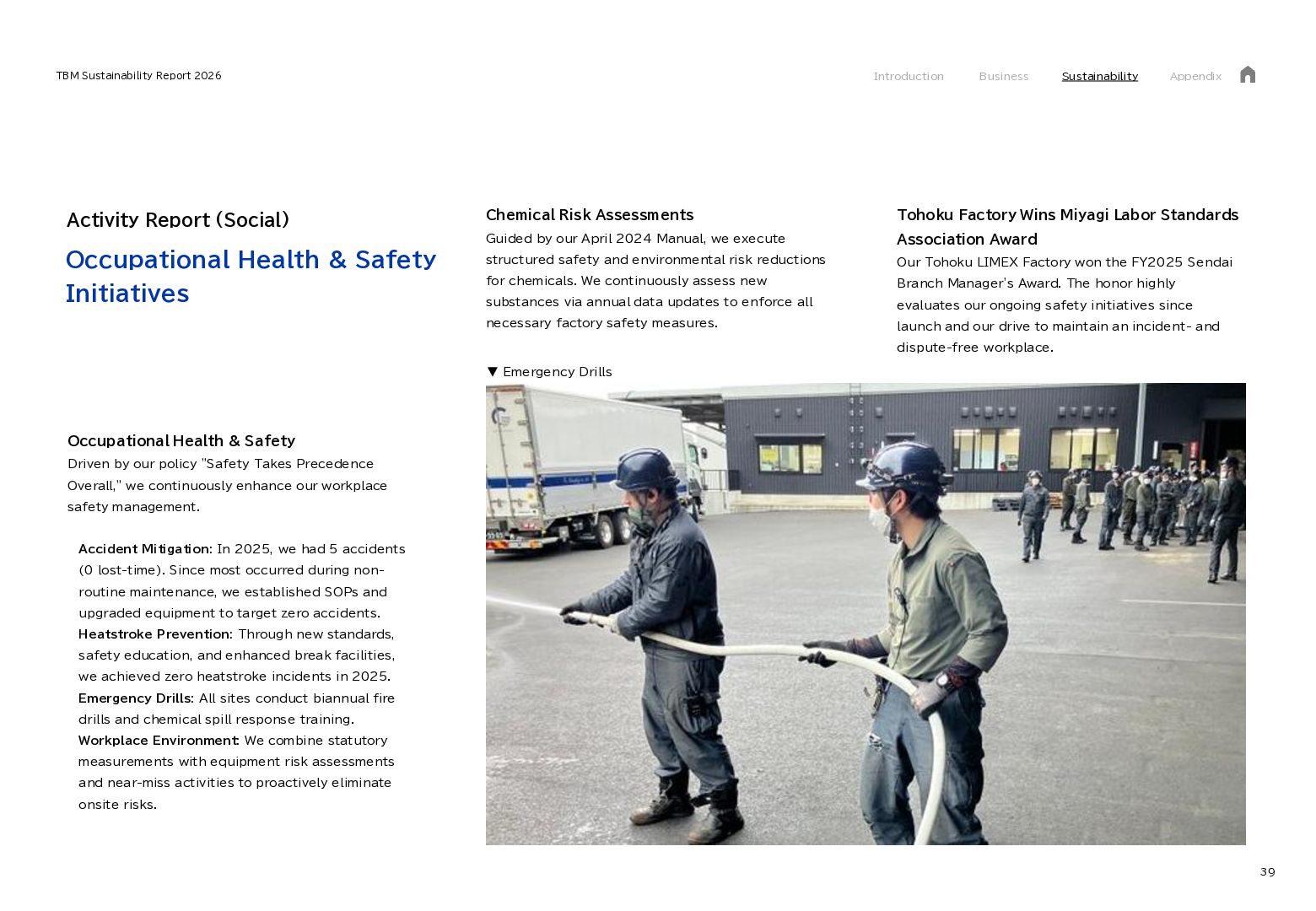
  43. 47 TBM Sustainability Report 2026 Policies TBM Code of Conduct

    (Board Approved: Jan 13, 2017) Mandates compliance and high ethical standards for all directors, officers, and employees in daily operations to maintain social trust. TBM Environmental Policy (Board Approved: Jan 14, 2022) Commits to value chain net-zero emissions and resolving climate/social challenges through business to preserve nature for future generations. TBM Human Rights Policy (Board Approved: May 15, 2024) Ensures responsible and sustainable operations, recognizing our responsibility to protect the human rights of all stakeholders. About Us D&I Policy Fosters an environment of mutual respect where diverse talents thrive together, driving the world- changing innovation necessary for our sustainability revolution. TBM Procurement Policy (Board Approved: May 15, 2024) Treats suppliers as equal partners to build highly transparent, long-term relationships rooted in mutual trust to co-create a sustainable society. TBM Supplier Code of Conduct (Board Approved: Dec 13, 2024) Formulated under the Procurement Policy, this Code defines the strict compliance and ethical standards required of all supply chain partners. TBM Privacy Policy (Board Approved: Apr 1, 2015) Enforces strict data protection standards as a trusted supplier handling extensive personal data through business cards and product sales. Customer Harassment Policy (Board Approved: Mar 1, 2026) Secures a safe, healthy workplace to safeguard employees while ensuring the continuous delivery of high-quality products and services. Job Seeker Harassment Policy (Board Approved: Mar 1, 2026) Guarantees a fair and transparent recruitment process with a zero-tolerance stance against harassment, ensuring safety for all applicants. * Clicking on each policy name will redirect you to the corresponding page on our website. Introduction Introduction Business Business Sustainability Sustainability Appendix Appendix
  44. TBM Sustainability Report 2025 49 49 TBM Sustainability Report 2026

    GHG Emissions ESG Data (Environment) Unit FY2021 FY2022 FY2023 FY2024 FY2025 Scope 1 + 2+ 3 Total t-CO 2 eq 38,814 17,735 29,320 118,778 97,751 Scope 1 + 2 Sub Total t-CO 2 eq 1,838 695 561 351 311 Scope 1 t-CO 2 eq 512 463 447 242 217 Scope 2 Market based t-CO 2 eq 1,326 232 114 110 93 Location based t-CO 2 eq 1,988 2,547 4,125 4,316 4,982 Scope 3 Sub total t-CO 2 eq 36,977 17,040 28,759 118,427 97,440 Category 1 Purchased Goods and Services t-CO 2 eq 7,358 11,284 13,787 19,128 19,822 Category 2 Capital Goods t-CO 2 eq 27,318 1,143 1,479 1,570 1,570 Category 3 Fuel- and Energy- related Activities t-CO 2 eq 454 514 817 737 831 Category 4 Upstream Transportation and Distribution t-CO 2 eq 194 272 646 2,925 2,498 Category 5 Waste Generated in Operations t-CO 2 eq 247 145 1,885 2,754 2,562 Category 6 Business Travel t-CO 2 eq 40 63 188 236 367 Category 7 Employee Commuting t-CO 2 eq 77 62 106 111 140 Category 8 Upstream Leased Assets t-CO 2 eq - - - - - Category 9 Downstream Transportation and Distribution t-CO 2 eq 43 113 244 1,208 1,708 Category 10 Processing of Sold Products t-CO 2 eq - - - - - Category 11 Use of Sold Products t-CO 2 eq - - - - - Category 12 End-of-Life treatment of Sold Products t-CO 2 eq 1,245 3,444 9,607 89,758* 67,958 Category 13 Downstream Leased Assets t-CO 2 eq - - - - - Category 14 Franchises t-CO 2 eq - - - - - Category 15 Investments t-CO 2 eq - - - - - Avoided GHG Emissions t-CO 2 eq - - 8,639 11,494 11,704 Introduction Introduction Business Business Sustainability Sustainability Appendix Appendix * In Scope 3 / Category 12, the resource circulation business was newly included in the scope of calculation from 2024.
  45. TBM Sustainability Report 2025 50 50 TBM Sustainability Report 2026

    GHG Emissions: Calculation Method of Scope 3 ESG Data (Environment) Calculation Method Category 1 Purchased Goods and Services GHG Emissions = Σ { (Quantity or monetary data of purchased or acquired products/services) × (Emission Intensity*) } * Based on Inventory Database IDEA Ver3.5. Some heavy calcium carbonate is calculated independently based on the Inventory Database IDEA Ver3.5, while CCU calcium carbonate reflects the supplier's actual emissions Category 2 Capital Goods CO2 Emissions = Σ { (Price of newly acquired capital goods (Construction cost)) × (Emission Intensity*) } * Emission Factor Database for calculating greenhouse gas emissions through the supply chain (Ver3.1) (Ministry of the Environment) Category 3 Fuel- and Energy- related Activities CO2 Emissions = Σ { (Quantity data of energy purchased) × (Emission Intensity*) } * Based on Inventory Database IDEA Ver3.5 Category 4 Upstream Transportation and Distribution CO2 Emissions = Σ { (Ton-kilometers of transport) × (Emission Intensity*) } * Based on Inventory Database IDEA Ver3.5. Domestic transport is assumed to be 500 km, and maritime transport is assumed to be 4,781 km Category 5 Waste Generated in Operations CO2 Emissions = Σ { (Waste treatment/recycling amounts by type and disposal method) × (Emission Factor by type and method*) } * Based on Inventory Database IDEA Ver3.5. Emission factors are set by waste type and disposal method Category 6 Business Travel CO2 Emissions = (By mode of transport) Σ { (Travel expense reimbursement) × (Emission Intensity*) } * For transport modes, based on Emission Factor Database for calculating greenhouse gas emissions through the supply chain (Ver3.1) (Ministry of the Environment). For accommodation, based on Inventory Database IDEA Ver3.5 Category 7 Employee Commuting CO2 Emissions = (By mode of transport) Σ { (Travel expense reimbursement) × (Emission Intensity*) } * Based on Emission Factor Database for calculating greenhouse gas emissions through the supply chain (Ver3.1) (Ministry of the Environment) Category 8 Upstream Leased Assets (Not Relevant) TBM does not own upstream lease assets, so this category is deemed not relevant Category 9 Downstream Transportation and Distribution CO2 Emissions = Σ { (Ton-kilometers of transport) × (Emission Intensity*) } * Based on Inventory Database IDEA Ver3.5. Domestic transport is assumed to be 500 km, and maritime transport is assumed to be 4,781 km Category 10 Processing of Sold Products (Not Relevant) Many of our products are intermediate materials, making it difficult to obtain reliable data on end product customers and uses. Following WBCSD's guidance on GHG emissions calculation and reporting in the chemical industry, which states that due to the diversity of applications and customer composition, it is difficult to obtain reliable figures, chemical companies are not obligated to report Scope 3 Category 10 emissions; hence, this category is deemed not relevant Category 11 Use of Sold Products (Not Relevant) The products we sell do not require energy during use, so there are no GHG emissions during usage. Therefore, this category is deemed not relevant Category 12 End-of-Life treatment of Sold Products CO2 Emissions = Σ { (Waste treatment/recycling amounts by type and disposal method) × (Emission Intensity by type and method*) } * Based on Inventory Database IDEA Ver3.5. It is assumed that 50% of the shipment volume is general waste and the remaining 50% is industrial waste incinerated Category 13 Downstream Leased Assets (Not Relevant) TBM does not own downstream lease assets, so this category is deemed not relevant Category 14 Franchises (Not Relevant) TBM does not have a franchise business, so this category is deemed not relevant Category 15 Investments (Not Relevant) Our main business is not in finance, so this category is deemed not relevant Introduction Introduction Business Business Sustainability Sustainability Appendix Appendix
  46. TBM Sustainability Report 2025 51 51 TBM Sustainability Report 2026

    Energy / Water / Circulation / Certification / Evaluation ESG Data (Environment) Unit FY2021 FY2022 FY2023 FY2024 FY2025 Energy Total Converted to MWh 7,155 8,263 11,827 11,332 12,161 Purchased electricity MWh 4,544 5,776 9,358 9,789 10,857 Heat Converted to MWh 101 166 155 132 138 Gasoline, Diesel, Keroene Converted to MWh 148 145 163 75 85 City gas, LPG Converted to MWh 2,362 2,176 2,151 1,336 1,081 Ratio of Renewable Energy in Electricity % 37 93 98 98 98 Water Withdrawal Total m3 9,675 11,529 32,777 55,571 59.693 Public and Industrial Water m3 9,675 11,381 12,912 13,938 12,257 Groundwater m3 0 148 19,865 41,633 47,166 Wastewater Total m3 9,102 10,806 32,508 54,452 59,693 Sewage Water m3 7,077 8,654 29,504 54,248 59,584 Industrial Water m3 248 248 215 136 109 Release into Rivers m3 1,776 1,905 2,789 68 0 Total Consumption m3 573 723 269 1,119 0 LIMEX & Plastic Circulation Volume t - 17,968 36,692 40,229 24,703 Countries Countries - 3 5 5 5 Certified Business Locations ISO 9001 Locations 0 0 0 1 1 ISO 14001 Locations 0 0 0 4 4 CDP Score Climate change - B B B B B Water security - B B B B B Introduction Introduction Business Business Sustainability Sustainability Appendix Appendix
  47. TBM Sustainability Report 2025 52 52 TBM Sustainability Report 2026

    Plastic Circulation / Industrial Waste ESG Data (Environment) Unit FY2021 FY2022 FY2023 FY2024 FY2025 Raw Materials Input Plastics t 643 1,067 1,035 828 1,173 Chemical Substances t 54 62 53 23 201 Industrial Waste Generated Total t 771 501 5,190 7,668 7,234 Waste Plastics t 515 201 4,747 7,078 6,490 Waste Oil t 3 3 28 9 24 Sludge t 177 200 370 574 717 Waste Metal t 0 8 2 0 0 Wood Waste t 0 33 0 4 3 Waste Acids t 76 56 43 4 0 Iron Scrap t 0 0 0 0 0 Recycled Total t 769 496 5,189 7,668 7,234 Waste Plastics t 514 201 4,747 7,078 6,490 Waste Oil t 3 3 28 9 24 Sludge t 174 195 369 574 717 Waste Metal t 0 8 2 0 0 Wood Waste t 0 33 0 4 3 Waste Acis t 76 56 43 4 0 Iron Scrap t 0 0 0 0 0 Summary Total t 771 501 5,190 7,668 7,234 Incineration t 2 5 1 0 0 Recycling t 769 496 5,189 7,668 7,234 Unknown t 1 0 0 0 0 Recycling Rate % 99.7 99.0 99.9 100.0 100.0 * Raw materials do not include plastic containers and packaging, etc., accepted at the Yokosuka Circular Factory. * Industrial waste includes residue generated at the Yokosuka Circular Factory. Introduction Introduction Business Business Sustainability Sustainability Appendix Appendix
  48. TBM Sustainability Report 2025 53 53 TBM Sustainability Report 2026

    Employee / Engagement / Diversity ESG Data (Social) Unit FY2021 FY2022 FY2023 FY2024 FY2025 Employee No. of employees Total Employees 239 284 318 312 261 Permanent Employees 214 254 273 264 216 Non-Permanent Employees 25 30 45 48 45 Gender Female Employees 61 76 85 87 75 Male Employees 178 208 233 225 186 Ages 20s Employees 55 50 65 59 56 30s Employees 109 124 128 120 82 40s Employees 49 72 79 81 65 50s Employees 24 32 35 44 48 60s and above Employees 2 6 11 8 10 Average age Total Years 36.7 38.1 38.4 39.0 39.8 Female Years 34.3 35.6 35.9 36.9 38.2 Male Years 37.5 39.0 39.3 39.8 40.5 Engagement Engagement score*1 Points - - 3.9 3.7 3.5 Diversity Female Ratio Female Employee Ratio % 25.5 26.8 26.7 27.9 28.7 Female Manager Ratio % - 4.8 10.3 10.9 14.1 Female Director Ratio*2 % 0.0 15.4 15.4 18.1 17.0 Gender pay gap Overall % - - 71.9 69.0 66.5 Permanent % - - 84.3 84.2 83.2 Non-permanent % - - 51.9 54.1 58.7 Employment Rate of Persons with Disabilities % 0.6 0.7 1.8 2.4 2.1 (Statutory Employment Rate for Persons with Disabilities) % (2.3) (2.3) (2.3) (2.5) (2.5) *1 Aggregation methodologies vary between pre-2023 and post-2024. *2 Female Board Ratio: Previously limited to Directors, this metric now covers the entire Board (Directors & Audit Members). Past figures have been retroactively revised to match this new scope. Introduction Introduction Business Business Sustainability Sustainability Appendix Appendix
  49. TBM Sustainability Report 2025 54 54 TBM Sustainability Report 2026

    Working Conditions / Occupational Health and Safety / Intellectual Property ESG Data (Social) Unit FY2021 FY2022 FY2023 FY2024 FY2025 Working Condition Average Monthly Overtime Hours Hours - 14.7 14.9 15.0 12.5 Annual Paid Leave Utilization Rate % 55 63 63 65 57 Average Number of Days Taken Dyas 7.2 8.0 8.1 8.3 7.7 Childcare Leave Female Childcare Leave Ratio % - 100.0 100.0 100.0 100.0 Average Number of Days of Childcare Leave (Women) Days - 212 127 156 56 Male Childcare Leave Ratio % - - 40.0 58.3 75.0 Average Number of Days of Childcare Leave (Men) Days - - 13 45 29 Occupational Health and Safety Number of Occupational Accidents Cases 2 3 16 8 5 Of which: Fatalities Cases 0 0 0 0 0 Of which: Lost-time Injuries Cases 0 0 0 3 0 Frequency Rate - 0.00 0.00 0.00 5.10 0.00 (Manufacturing Industry Avg., Companies w/ 100+ Employees)*1 - (1.31) (1.25) (1.29) (1.30) -*3 (General & Industrial Waste Management Industry Avg., Companies w/ 100+ Employees)*2 - (7.36) (6.52) (6.42) (6.65) -*3 Severity Rate - 0.00 0.00 0.00 0.15 0.00 (Manufacturing Industry Avg., Companies w/ 100+ Employees)*1 - (0.06) (0.08) (0.08) (0.06) -*3 (General & Industrial Waste Management Industry Avg., Companies w/ 100+ Employees)*2 - (0.17) (0.51) (0.18) (0.16) -*3 Regular Health Checkup Rate % - - 94 93 100 Stress Check Participation Rate % - - 86 83 82 IP Number of Patents Held Patents 140 181 229 253 261 Number of Countries with Patent Protection Countries 44 46 51 51 51 *1 Average values for frequency rate and severity rate. Source: Ministry of Health, Labour and Welfare, "Survey on Industrial Accidents (Establishment Survey [establishments with 100 or more employees] and General Construction Industry Survey).“ *2 Source: Japan Federation of Industrial Waste Management and Recycling Associations, "Status of Occupational Accidents in the Industrial Waste Management Industry .“ *3 Not publicly disclosed as of the issue date. Introduction Introduction Business Business Sustainability Sustainability Appendix Appendix