Share
Embed
All About ... Functions
Talk from "All About" series at Hamburg Scala UG.

Michal Bigos
November 27, 2016
Transcript
63 slides
-
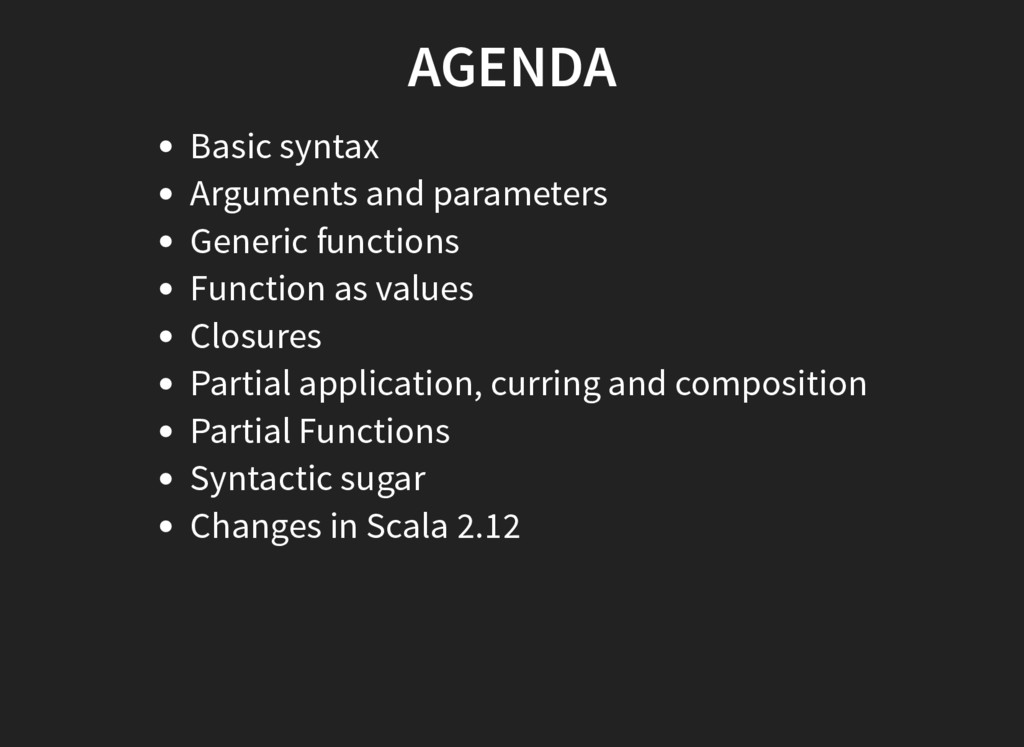
AGENDA Basic syntax Arguments and parameters Generic functions Function as
values Closures Partial application, curring and composition Partial Functions Syntactic sugar Changes in Scala 2.12 -
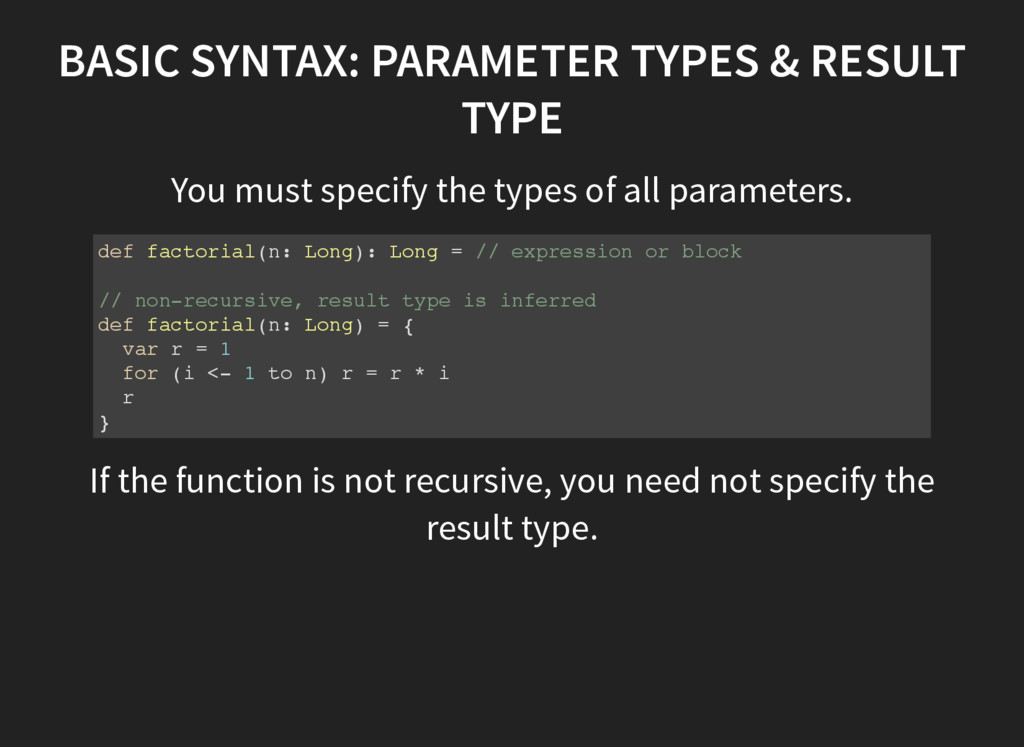
BASIC SYNTAX: PARAMETER TYPES & RESULT TYPE You must specify
the types of all parameters. def factorial(n: Long): Long = // expression or block // non-recursive, result type is inferred def factorial(n: Long) = { var r = 1 for (i <- 1 to n) r = r * i r } If the function is not recursive, you need not specify the result type. -
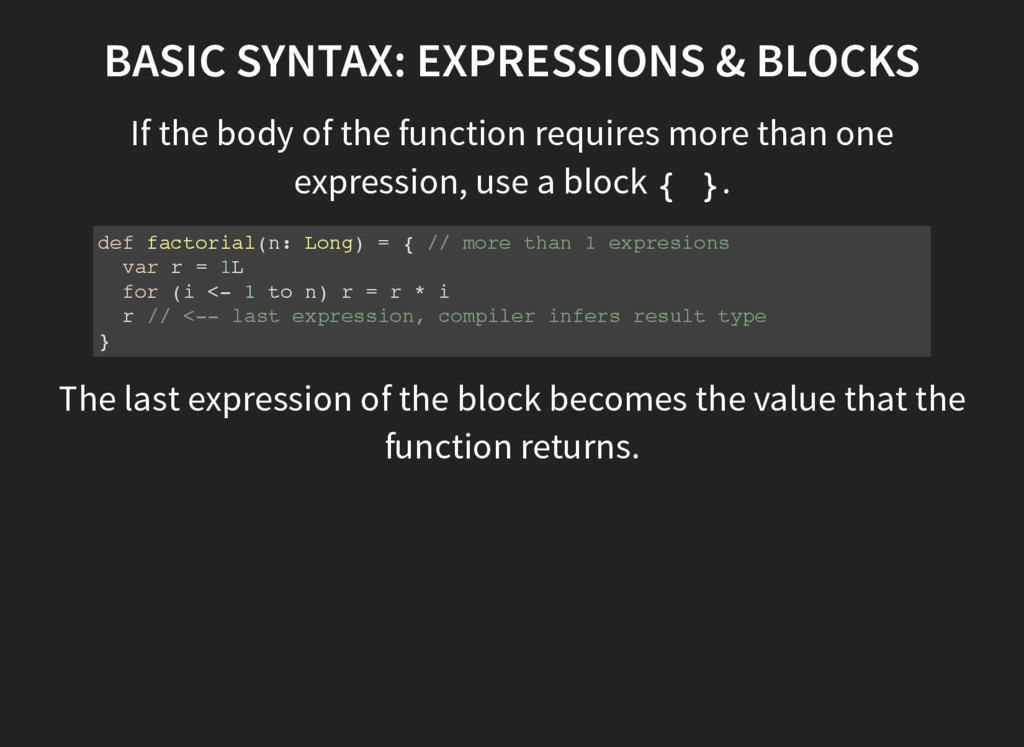
BASIC SYNTAX: EXPRESSIONS & BLOCKS If the body of the
function requires more than one expression, use a block { }. def factorial(n: Long) = { // more than 1 expresions var r = 1L for (i <- 1 to n) r = r * i r // <-- last expression, compiler infers result type } The last expression of the block becomes the value that the function returns. -
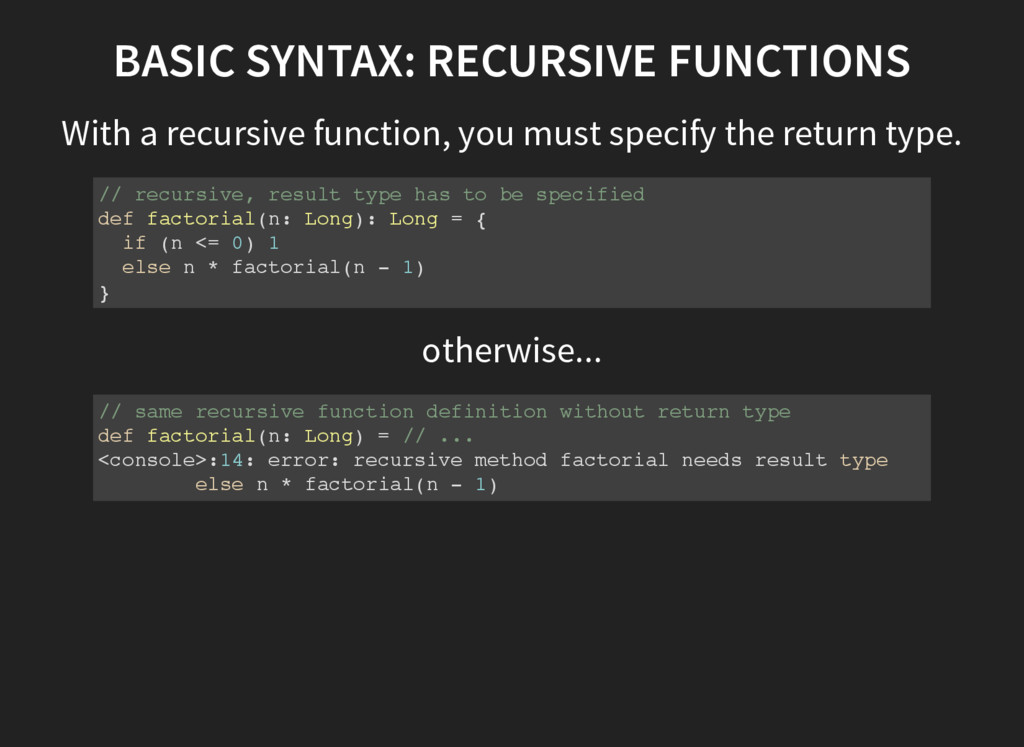
BASIC SYNTAX: RECURSIVE FUNCTIONS With a recursive function, you must
specify the return type. // recursive, result type has to be specified def factorial(n: Long): Long = { if (n <= 0) 1 else n * factorial(n - 1) } otherwise... // same recursive function definition without return type def factorial(n: Long) = // ... <console>:14: error: recursive method factorial needs result type else n * factorial(n - 1) -
BASIC SYNTAX: RECURSIVE FUNCTIONS (2) Almost each recursive function can
be written as tail recursive one. // recusive, tail recursive @scala.annotation.tailrec def factorial(n: Long, acc: Long = 1): Long = if (n <= 0) acc else factorial(n - 1, n * acc) Annotation @tailrec is not mandatory and just verifies that the method will be compiled with tail call optimization. <console>:15: error: could not optimize @tailrec annotated method factorial: else n * factorial(n - 1) -
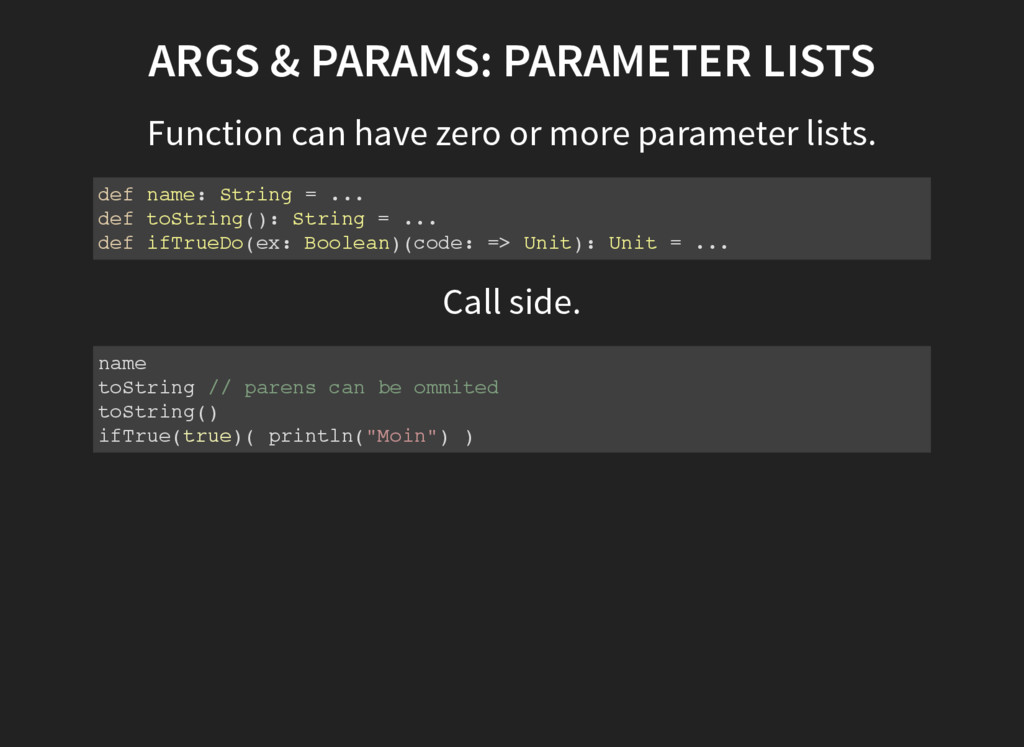
ARGS & PARAMS: PARAMETER LISTS Function can have zero or
more parameter lists. def name: String = ... def toString(): String = ... def ifTrueDo(ex: Boolean)(code: => Unit): Unit = ... Call side. name toString // parens can be ommited toString() ifTrue(true)( println("Moin") ) -
ARGS & PARAMS: DEFAULT AND NAMED ARGUMENTS You can provide
default arguments for functions that are used when you do not specify explicit values. def show(value: String, left: String = "(", right: String = ")"): String Call side. // uses defaults for both parameters show("Moin") // sets left in order how args are defined, right is default show("Moin", "{") // sets only right as named argument show("Moin", right = "}") // named arguments need not be in the same order as the parameters show(right = "}", left = "{", value = "Moin") Named arguments can make a function call more readable. -
ARGS & PARAMS: DEFAULT AND NAMED ARGUMENTS (2) Each parameter
list can contain default arguments. import Radix._ // imports type Radix and object Decimal def add(n1: Long, rdx1: Radix = Decimal)(n2: Long, rdx2: Radix = Decimal Default arguments can be intermixed with normal ones. Normal ones still have to provided on call side. def show(prefix: String = "(", value: String, sufix: String = ")"): String show("Moin") <console>:9: error: not enough arguments for method show: (prefix: String Unspecified value parameter value. // successful forces the user to use name arguments show(value = "Moin") Convention is to use default arguments in the end of parameter list. -
ARGS & PARAMS: DEFAULT ARGUMENTS OVERLOADING When function uses default
arguments, it cannot be overloaded with another function with default arguments. def show(prefix: String = "(", value: String): String = ... def show(value: Int, repeat: Int = 1): Int = ... <console>:6: error: in object Shows, multiple overloaded alternatives object Shows { def show(value: Int, repeat: Int): Int = ... // compiles -
ARGS & PARAMS: VARIABLE ARGUMENTS Syntax for variable arguments. Use
* behind type. def sum(ns: Int*): Int = { val _ns: Seq[Int] = ns // internaly it is Seq ... } Parameter allowing variable arguments has to be last one in parameter list. def sum(ns: Int*, n: Int): Int = ... <console>:7: error: *-parameter must come last def sum(ns: Int*, n: Int): Int = ... -
ARGS & PARAMS: VARIABLE ARGUMENTS (2) sum(0, 1, 2) //
any number of arguments sum() // even none If you already have a sequence of values, you cannot pass it directly to function with variable arguments. val ns = Seq(0, 1, 2, 3, 4, 5) sum(ns) // Seq cannot be used directly <console>:10: error: type mismatch; found : Seq[Int] required: Int sum(ns: _*) // successful sum( (0 to 5): _* ) // successful _* tells the compiler that you want the parameter to be expanded as a sequence of arguments. -
GENERIC FUNCTIONS: TYPE PARAMETERS Functions like classes and traits can
have type parameters. def show[T](value: T): String = ... def add[F, S, R](first: F, second: S): R = ... There can be only one type parameter list for function. -
GENERIC FUNCTIONS: TYPE PARAMETER BOUNDS Sometimes it is useful to
place restrictions on function type parameters. def lessThan[T <: Comparable[T]](first: T, second: T): Boolean = { first.compareTo(second) < 0 } lessThan("Ahoi", "Moin") <: is called upper bounds and means that T has to be a subtype of Comparable[T]. -
GENERIC FUNCTIONS: TYPE PARAMETER BOUNDS (2) It is also possible
to specify lower bounds. Expressed as >: declare a type to be a supertype of another type. case class Node[+T](h: T, t: Node[T]) { // work when Node is invariant // def prepend(elem: T): Node[T] = Node(elem, this) def prepend[U >: T](elem: U): Node[U] = Node(elem, this) } Typical usage is when type parameter of enclosing class is covariant. -
GENERIC FUNCTIONS: TYPE PARAMETER BOUNDS (3) It is possible to
have both bounds for one type parameter. T <: Upper >: Lower But ... it is not possible to have multiple upper or lower bounds. It is still possible to require that type parameter implements multiple traits. T <: Comparable[T] with Serializable with Clonable -
GENERIC FUNCTIONS: IMPLICIT PARAMETERS Function can have parameter list marked
as implicit. sealed trait Affix case class Prefix(value: String) extends Affix case class Sufix(value: String) extends Affix def show(value: String)(implicit prefix: Prefix, sufix: Sufix): String Function can still be called with explicit arguments... show("Moin")(Prefix("("), Sufix(")")) -
GENERIC FUNCTIONS: IMPLICIT PARAMETERS (2) But the compiler can look
for default values to supply with the function call. object Affixes { implicit val prefix = Prefix("(") implicit def sufix = Sufix(")") } import Affixes._ // i.e. import of implicit values show("Moin") Default value has to be val or def declared as implicit. Usual implicits resolution mechanism is applied. -
GENERIC FUNCTIONS: CONTEXT BOUNDS For parameter list with 1 implicit
parameter there is a syntactic sugar called context bound. // suppose that Prefix uses type parameter for value case class Prefix[T](value: T) extends Affix // generic definition of show will look like def show[T](value: T)(implicit prefix: Prefix[T]): String = { prefix.value // accessing implicit parameter, directly ... } // shorthand version defined via context bound def show[T : Prefix](value: T): String = { val prefix = implicitly[Prefix[T]] // retrieving implicit parameter prefix.value // accessing implicit parameter ... } Context bound is important concept by encoding type classes in scala. -
GENERIC FUNCTIONS: CONTEXT BOUNDS (2) You can define multiple contexts
for one type parameter T. case class Prefix[T](value: T) extends Affix case class Sufix[T](value: T) extends Affix def show[T : Prefix : Sufix](value: T): String = ... def show[T <: Comparable[T] : Prefix : Sufix](value: T): String = ... If more than 1 type parameter is required, context bounds cannot be used. case class Infix[T1, T2](left: T1, right: T2) extends Affix // def show[T1, T2 : Infix] won't compile def show[T1, T2](left: T1, right: T2)(implicit infix: Infix[T1, T2]): -
GENERIC FUNCTIONS: TYPE CONSTRAINTS Scala Predef defines type constraints. Purpose
is to contraint type parameters. // usage def show[T](value: T)(implicit ev: T =:= String): String = ... // call side show("Moin") show(1) <console>:17: error: Cannot prove that Int =:= String. show(1) A =:= B, which means A must be equal to B A <:< B, which meand A must be subtype of B -
FUNCTIONS AS VALUES: FUNCTIONS AS VALUES Functions are "first-class citizens"
in Scala. You can: call a function store a function into the variable pass a function into another function as an argument -
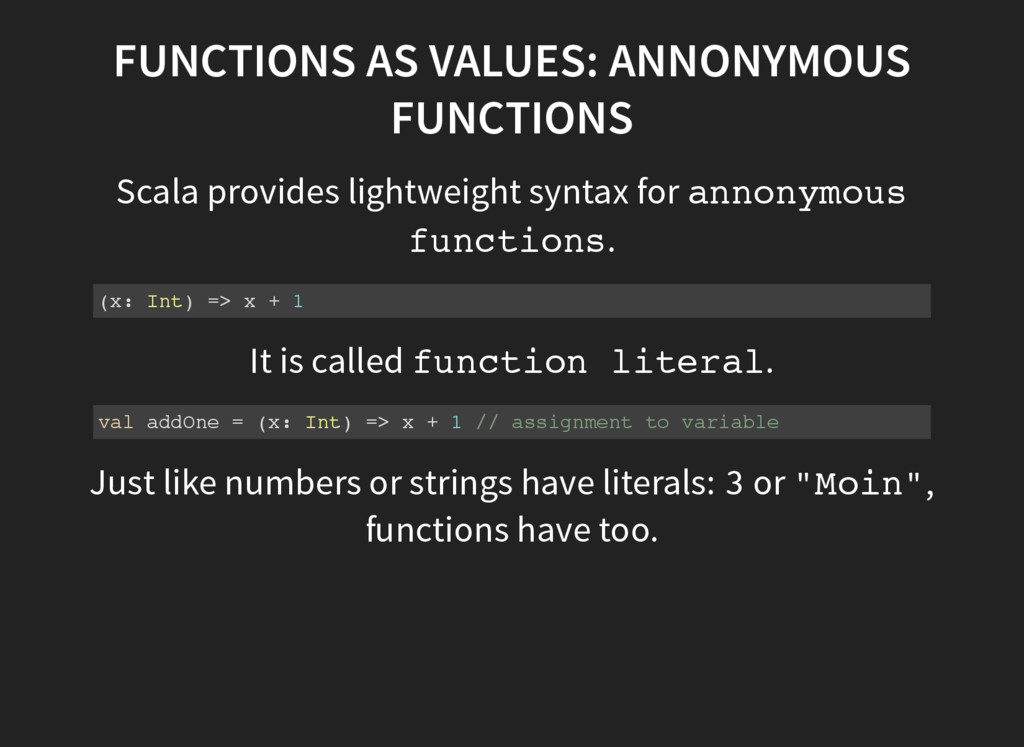
FUNCTIONS AS VALUES: ANNONYMOUS FUNCTIONS Scala provides lightweight syntax for
annonymous functions. (x: Int) => x + 1 It is called function literal. val addOne = (x: Int) => x + 1 // assignment to variable Just like numbers or strings have literals: 3 or "Moin", functions have too. -
FUNCTIONS AS VALUES: ANNONYMOUS FUNCTIONS (2) Behind the scenes, compiler
will convert it into annonymous class definition. val addOne = new Function1[Int, Int] { def apply(x: Int): Int = x + 1 // special rule for apply } addOne(2) addOne.apply(2) Provided are traits from Function0 until Function22. // compiled into Function2[Int, String, String] (x: Int, y: String) => x + "-" + y // compiled into Function0[String] () => "Moin" -
FUNCTIONS AS VALUES: FUNCTIONS WITH FUNCTIONS PARAMETERS Functions can take
other fuctions as parameters or return them as results. // function as parameter def fiftyPercent(fn: Double => Double): Double = fn(0.5) // function as result def multiplyBy(factor: Int) = (x: Int) => x * factor // supplying function as argument fiftyPercent( (x: Double) => x * x ) val twice = multiplyBy(2) // assignment to variable twice(2) // call Such functions are called high-order functions. Syntax Double => Double represents function type which can be used as parameter type or result type. -
FUNCTIONS AS VALUES: PARAMETER INFERENCE By passing annonymous function to
another function, Scala deduces types when possible. def fiftyPercent(fn: Double => Double): Double = fn(0.5) fiftyPercent( (x: Double) => x * x ) fiftyPercent( (x) => x * x ) // type is inferred to be Double fiftyPercent( x => x * x ) // parens can be omitted For function with 1 parameter it is possible to omit (). -
FUNCTIONS AS VALUES: TYPE INFERENCE High-order functions can use type
parameters too. def dropWhile[A](l: List[A], f: A => Boolean): List[A] = ... val numbers = List(1, 2, 3) dropWhile(numbers, (x: Int) => x < 2) // Int is required Type parameters are inferred from le to right across parameter lists. def dropWhile[A](l: List[A])(f: A => Boolean): List[A] = ... val numbers = List(1, 2, 3) dropWhile(numbers, x => x < 2) To help compiler use multiple parameter lists. -
CLOSURES Scala allows you to define function inside any scope:
package, class, object or even in another function. In body of function it is possible to access any variables from an enclosing scope. def show(items: List[String], sufix: String): String = { // inner function, which accesses sufix from enclosing scope def loop(items: List[String], buffer: StringBuilder) = if (items.isEmpty) buffer else { buffer.append(head).append(sufix) loop(items.tail, buffer) } loop(items, StringBuilder.newBuilder).toString } Such function which access variables from enclosing scope is called closure. -
CLOSURES (2) Variables accesed from enclosing scope of closure are
called free variables. def multiplyBy(factor: Int) = (x: Int) => x * factor val doubled = multiplyBy(2) val tripled = multiplyBy(3) def calc(n: Int) = doubled(n) + tripled(n) Free variables are bound lexically on call side. -
PARTIAL APPLICATION Scala allow you to apply the functions partially.
That means applying some but not all the arguments of the function. // helper which applies A in any (A, B) => C function def partial[A, B, C](a: A, fn: (A, B) => C): B => C = (b: B) => fn(a, b) val multiply = (x: Int, y: Int) => x * y // partialy applied multiply, to always multiply by 2 val doubled = partial(2, multiply) doubled: Int => Int = $$Lambda$1197/1032689422@2fac80a8 The process is called partial application and result is partially applied function. -
PARTIAL APPLICATION (2) Partial application is so common, that Scala
dedicated syntax for that. def divide(x: Int, y: Int): Int = x / y val oneByN = divide(1, _: Int) // applying 1st argument oneByN: Int => Int = $$Lambda$1336/1775639151@2696b687 val nBy100 = divide(_: Int, 100) // applying 2nd argument nBy100: Int => Int = $$Lambda$1337/1973093841@ea45a5b _: Type represents "hole", yet not applied argument. -
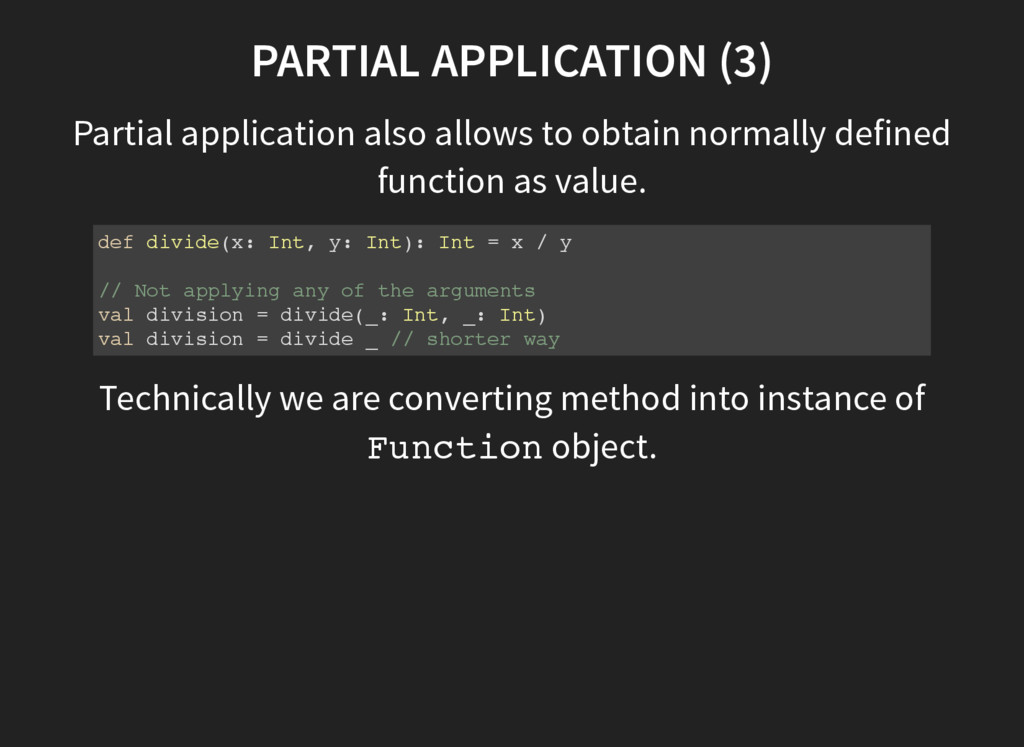
PARTIAL APPLICATION (3) Partial application also allows to obtain normally
defined function as value. def divide(x: Int, y: Int): Int = x / y // Not applying any of the arguments val division = divide(_: Int, _: Int) val division = divide _ // shorter way Technically we are converting method into instance of Function object. -
CURRYING Function with more parameters can be expressed as chain
of one-parameter functions and vice versa. // helper which transforms (A, B) => C into A => B => C def curry[A, B, C](fn : (A, B) => C): A => B => C = (a: A) => (b: B) => fn(a, b) // helper which transforms A => B => C into (A, B) => C def uncurry[A, B, C](fn: A => B => C): (A, B) => C = (a: A, b: B) => fn(a)(b) val multiply = (x: Int, y: Int) => x * y val multiplyChain = curry(multiply) // Int => Int => Int val againMultiply = uncurry(multiplyChain) multiplyChain(2)(3) val doubled = multiplyChain(2) // partially applied function -
CURRYING (2) It can be useful in relation to partial
application. def divide(x: Int, y: Int): Int = x / y val multiply = (x: Int, y: Int) => x * y val oneByN = (divide _).curried(1) // divide(1, _: Int) oneByN: Int => Int = $$Lambda$1336/1775639151@2696b687 val twice = multiply.curried(2) // multiply(2, _: Int) twice: Int => Int = scala.Function2$$Lambda$1411/1255024717@236861da curried is provided by all Function* traits. -
COMPOSITION Another very useful operation over functions is function composition.
// helper which composes two functions def compose[A, B, C](f: A => B, g: B => C): A => C = (a: A) => g(f(a)) val addOne = (x: Int) => x + 1 val multiplyBy100 = (x: Int) => x * 100 val plus1Muliplied100 = compose(addOne, multiplyBy100) It composes 2 functions A => B and B => C into A => B. Types of the functions must be in alignment. -
COMPOSITION (2) Function composition is such a useful thing that,
Scala standard library provides methods for function composition. val addOne = (x: Int) => x + 1 val multiplyBy100 = (x: Int) => x * 100 val plus1Muliplied100 = addOne.andThen(multiplyBy100) val multiply100plus1 = addOne.compose(multiplyBy100) They are only defined in trait Function1, thus function with more parameters must be curried first. -
PARTIAL FUNCTIONS: CONCEPT Concept comes from mathematics, where we talk
about total and partial functions. // total function, defined for each Int def addOne(i: Int) = i + 1 // partial function, undefined for 0 def divideOne(d: Int) = 1 / d -
PARTIAL FUNCTIONS: DEFINITION Set of case statements within { }
is partial function. // another form of annonymous function val divideOne: PartialFunction[Int, Int] = { case d: Int if d != 0 => 42 / d } // it is translated into (more or less) val divideOne = new PartialFunction[Int, Int] { def apply(d: Int) = 1 / d def isDefinedAt(d: Int) = d != 0 } PartialFunction is trait which extends Function1 -
PARTIAL FUNCTIONS: USAGE Usage and transformations. val plusMinus: PartialFunction[Char, Int]
= { case '+' => 1 case '-' => -1 } // application like total function scala> plusMinus('+') res15: Int = 1 scala> plusMinus('o') // undefined scala.MatchError: o (of class java.lang.Character) at scala.PartialFunction$$anon$1.apply(PartialFunction.scala:254) // check if defined scala> plusMinus.isDefinedAt('0') res16: Boolean = false -
PARTIAL FUNCTIONS: USAGE (2) Usage (part 2) // substitute undefined
values scala> plusMinus.applyOrElse('o', (_: Char) => 0) res21: Int = 0 // conversion to total functions scala> plusMinus.lift res22: Char => Option[Int] = <function1> -
PARTIAL FUNCTIONS: USAGE (3) True benefit. // supplying PartialFunction into
call where Function1 is expected someMap.foreach { // ... destructuring for free case (k, v) => println(k + " -> " + v) } case class Greeting(greeting: String) List(Greeting("Moin"), Int).collect { case Greeting(greeting) => println(greeting) greeting } Pattern matching like casting-done-right, guards, and destructuring for free. -
SYNTACTIC SUGAR: CALL BY NAME PAREMETERS Sequence of statements can
be modeled as function with no parameters. // code parameter has type `Function0` def runInThread(code: () => Unit): Thead = { ... code() ... } // you have to supply function () => Unit runInThread(() => println("Moin")) -
SYNTACTIC SUGAR: CALL BY NAME PAREMETERS (2) Usually parameters are
called by value, i.e. value of the parameter is evaluated before it is given to function. // call by name parameter def runInThread(code: => Unit): Thread = ... // no need for () runInThread(println("Moin")) => before paremeter type says compiler that parameter is called by name. Its value is not evaluated before it is given to function. It is considered lazy on call side. -
SYNTACTIC SUGAR: CALL BY NAME PAREMETERS (3) Evaluation of call
by name parameter happens everytime the parameter is accessed. def until(condition: => Boolean)(code: => Unit): Unit = { while(!condition) { // evaluated by aech access code // no parens necessary } } var x = 0 until(x == 10)({ x += 1; println(x) }) // loop is terminated -
SYNTACTIC SUGAR: CONTROL ABSTRACTIONS Caller can use { } instead
of ( ) for any parameter list with just one parameter. def until(condition: => Boolean)(code: => Unit): Unit = { while(!condition) { // evaluated by aech access code // no parens necessary } } var x = 0 until (x == 10) { x += 1 println(x) } until { x == 20 } { x += 1; println(x) } This allows to write control abstractions, i. e. functions which looks like build in language keywords. -
SYNTACTIC SUGAR: CONTROL ABSTRACTIONS (2) Using return to return a
value from an anonymous function. def indexOf(str: String, ch: Char): Int = { var i = 0 until (i == str.length) { // closure // will return from enclosing functions if (str(i) == ch) return i i += 1 } return -1 } indexOf("Moin", 'o') res8: Int = 1 -
SYNTACTIC SUGAR: CONTROL ABSTRACTIONS (3) Use return judiciously. If it
is used in a named function it has to provide result type. scala> def show(value: String, sufix: String = "") = { return value + sufix } <console>:11: error: method show has return statement; needs result type def show(value: String, sufix: String = "") = { return value + sufix } Very fragile construct. // return expression is captured and not evaluated def somewhereDeepInTheCodebase: () => Int = () => return () => 1 // passed thru a lot of code val x = somewhereDeepInTheCodebase // finally used x() scala.runtime.NonLocalReturnControl // !!! RESULT !!! // Btw. NonLocalReturnControl extends NoStackTrace // i.e. so you are given no clue about origin. -
SCALA 2.12: FUNCTION LITERALS Type checker accepts a function literal
as a valid expression for any Single Abstract Method (SAM) type scala> val r: Runnable = () => println("Run!") r: Runnable = $$Lambda$1073/754978432@7cf283e1 scala> r.run() -
SCALA 2.12: FUNCTION LITERALS (2) Only lambda expressions are converted
to SAM type instances, not arbitrary expressions of FunctionN. scala> val f = () => println("Faster!") scala> val fasterRunnable: Runnable = f <console>:12: error: type mismatch; found : () => Unit required: Runnable -
SCALA 2.12: FUNCTION LITERALS (2) Scala's built-in FunctionN traits are
compiled to SAM interfaces. scala> val addOne = (n: Int) => n + 1 addOne: Int => Int = $$Lambda$1342/671078904@642c6461 scala> val addTwo = (n: Int) => n + 3 addTwo: Int => Int = $$Lambda$1343/205988608@5f6494c0 scala> addOne andThen addTwo res14: Int => Int = scala.Function1$$Lambda$1335/1630903943@464aeb09 -
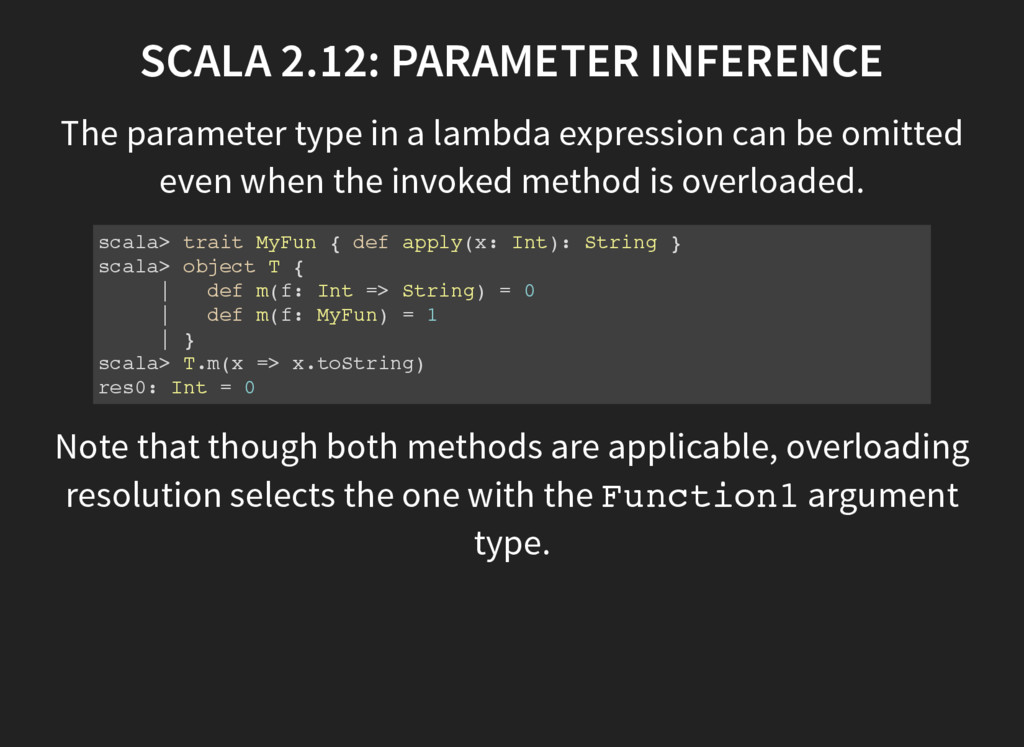
SCALA 2.12: PARAMETER INFERENCE The parameter type in a lambda
expression can be omitted even when the invoked method is overloaded. scala> trait MyFun { def apply(x: Int): String } scala> object T { | def m(f: Int => String) = 0 | def m(f: MyFun) = 1 | } scala> T.m(x => x.toString) res0: Int = 0 Note that though both methods are applicable, overloading resolution selects the one with the Function1 argument type. -
SCALA 2.12: BREAKING CHANGES Overloading resolution has been adapted to
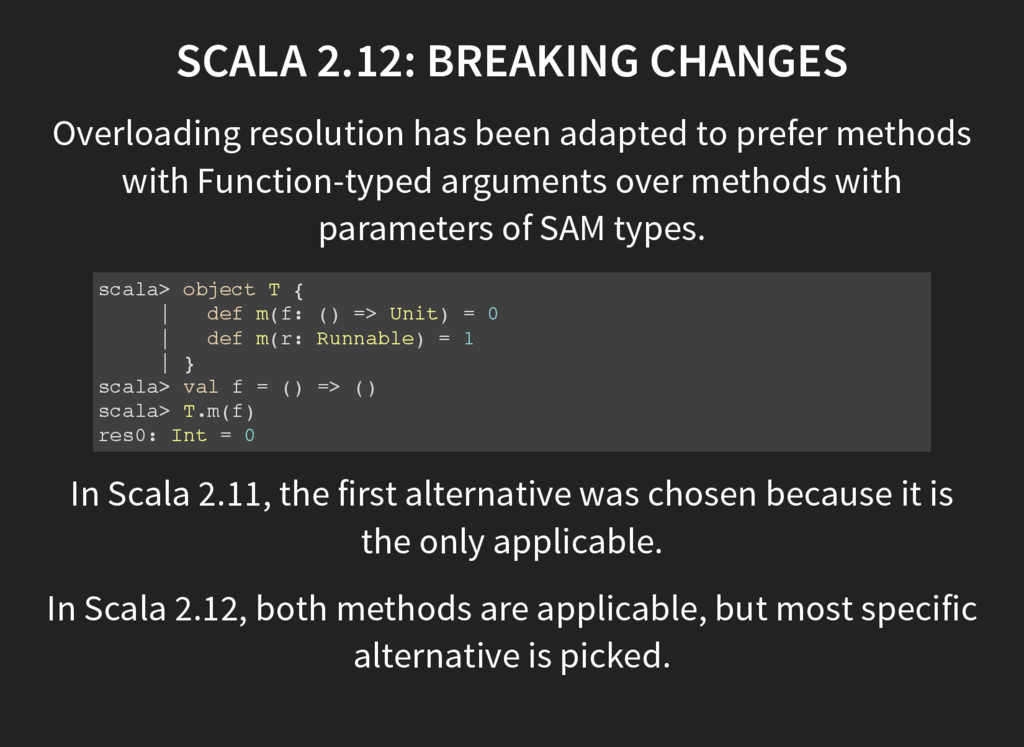
prefer methods with Function-typed arguments over methods with parameters of SAM types. scala> object T { | def m(f: () => Unit) = 0 | def m(r: Runnable) = 1 | } scala> val f = () => () scala> T.m(f) res0: Int = 0 In Scala 2.11, the first alternative was chosen because it is the only applicable. In Scala 2.12, both methods are applicable, but most specific alternative is picked. -
SCALA 2.12: BREAKING CHANGES SAM conversion precedes implicits. trait MySam
{ def i(): Int } implicit def convert(fun: () => Int): MySam = new MySam { def i() = 1 } val sam1: MySam = () => 2 // Uses SAM conversion, not the implicit sam1.i() // Returns 2 Note that SAM conversion only applies to lambda expressions, not to arbitrary expressions with Scala FunctionN types val fun = () => 2 // Type Function0[Int] val sam2: MySam = fun // Uses implicit conversion sam2.i() // Returns 1
 teliatko
 takuyay0ne
 ota1022
 oidfj
 junya_okura
 ryutakondo
 fillznoh
 hellosct1
 ivry_presentationmaterials
 csswizardry
 vivion
 gokken
 _kotobuki_
 nikkihalliwell
 jmmastey
 rocio
 uxyall
 carmenintech
 baasie
 akademiya2063
 nonsquared
 inesmontani
 ipullrank
 greggifford
 marketingsoph