Upgrade to Pro
— share decks privately, control downloads, hide ads and more …
Speaker Deck
Sign up for free
Menu
Search
Features
All features
Private URLs
Password Protection
Custom URLS
Scheduled publishing
Remove Branding
Restrict embedding
Deck Collections
Notes
Features
All features
Private URLs
Password Protection
Custom URLS
Scheduled publishing
Remove Branding
Restrict embedding
Deck Collections
Notes
Explore
Featured decks
Featured speakers
Programming
Technology
Storyboards
Explore
Featured decks
Featured speakers
Programming
Technology
Storyboards
Pricing
Search
Sign in
Sign up for free
Design Patterns in Kotlin
Search
Sohel Shaikh
July 06, 2024
80
1
Share
Embed
Copy iframe code
Copy JS code
Copy link
Start on current slide
Design Patterns in Kotlin
Presented at KSUG, Surat
Sohel Shaikh
July 06, 2024
More Decks by Sohel Shaikh
See All by Sohel Shaikh
Supercharge your Android Apps with Gemini API
thesohelshaikh
1
130
Featured
See All Featured
Amusing Abliteration
ianozsvald
1
320
Improving Core Web Vitals using Speculation Rules API
sergeychernyshev
21
1.7k
Game over? The fight for quality and originality in the time of robots
wayneb77
1
290
Optimising Largest Contentful Paint
csswizardry
37
4k
Code Review Best Practice
trishagee
74
20k
WCS-LA-2024
lcolladotor
0
840
Winning Ecommerce Organic Search in an AI Era - #searchnstuff2025
aleyda
2
2.2k
Chrome DevTools: State of the Union 2024 - Debugging React & Beyond
addyosmani
10
1.4k
End of SEO as We Know It (SMX Advanced Version)
ipullrank
3
4.4k
世界の人気アプリ100個を分析して見えたペイウォール設計の心得
akihiro_kokubo
PRO
74
42k
Principles of Awesome APIs and How to Build Them.
keavy
128
18k
Connecting the Dots Between Site Speed, User Experience & Your Business [WebExpo 2025]
tammyeverts
11
1k
Transcript
Design Patterns in Kotlin Sohel Shaikh Lead Android Engineer @
Skylark Drones
- 4+ YOE with Android - Lead Android Engineer @
Skylark Drones - I 💜 Kotlin! - @thesohelshaikh on Socials Hey, I am Sohel
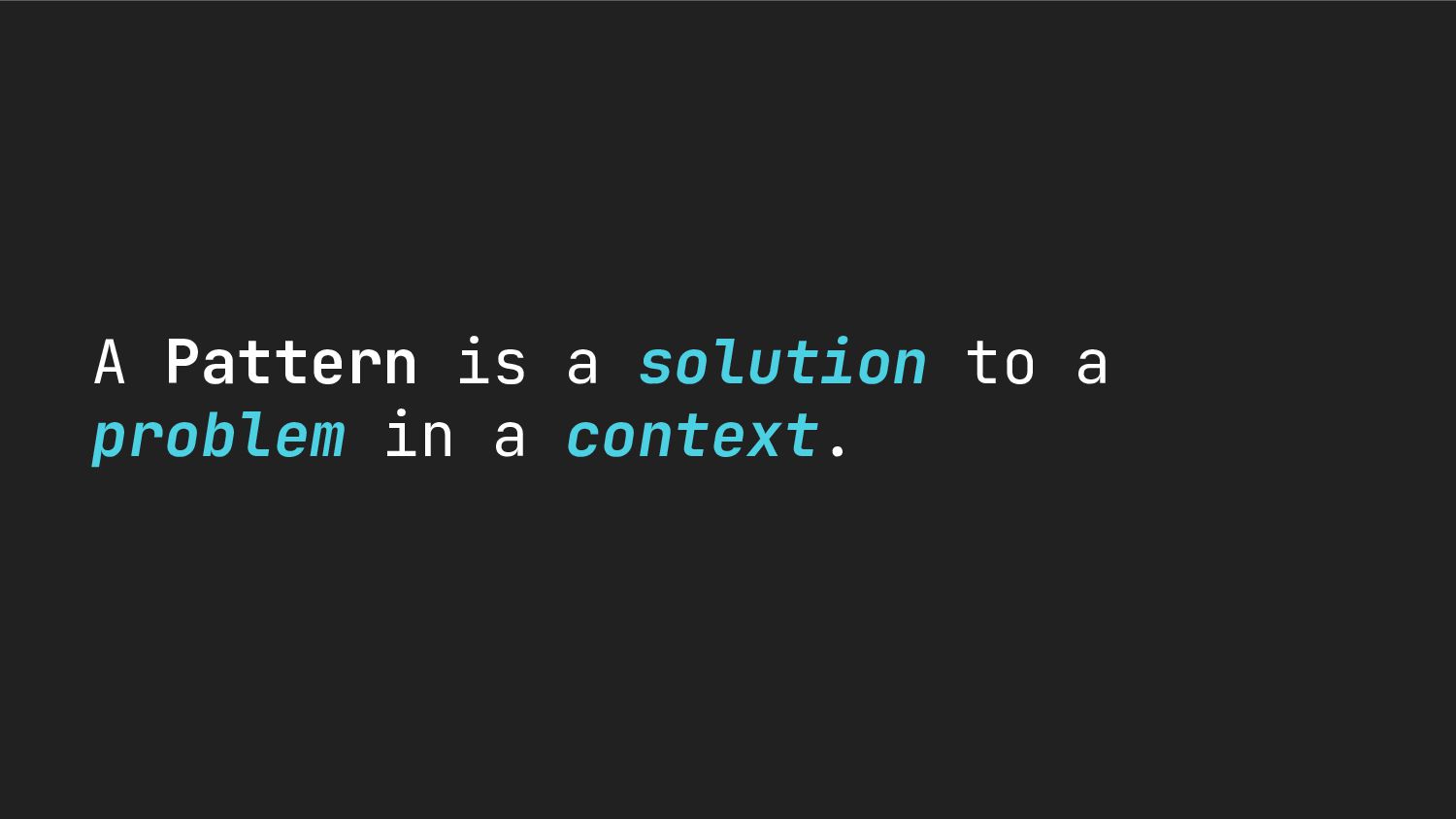
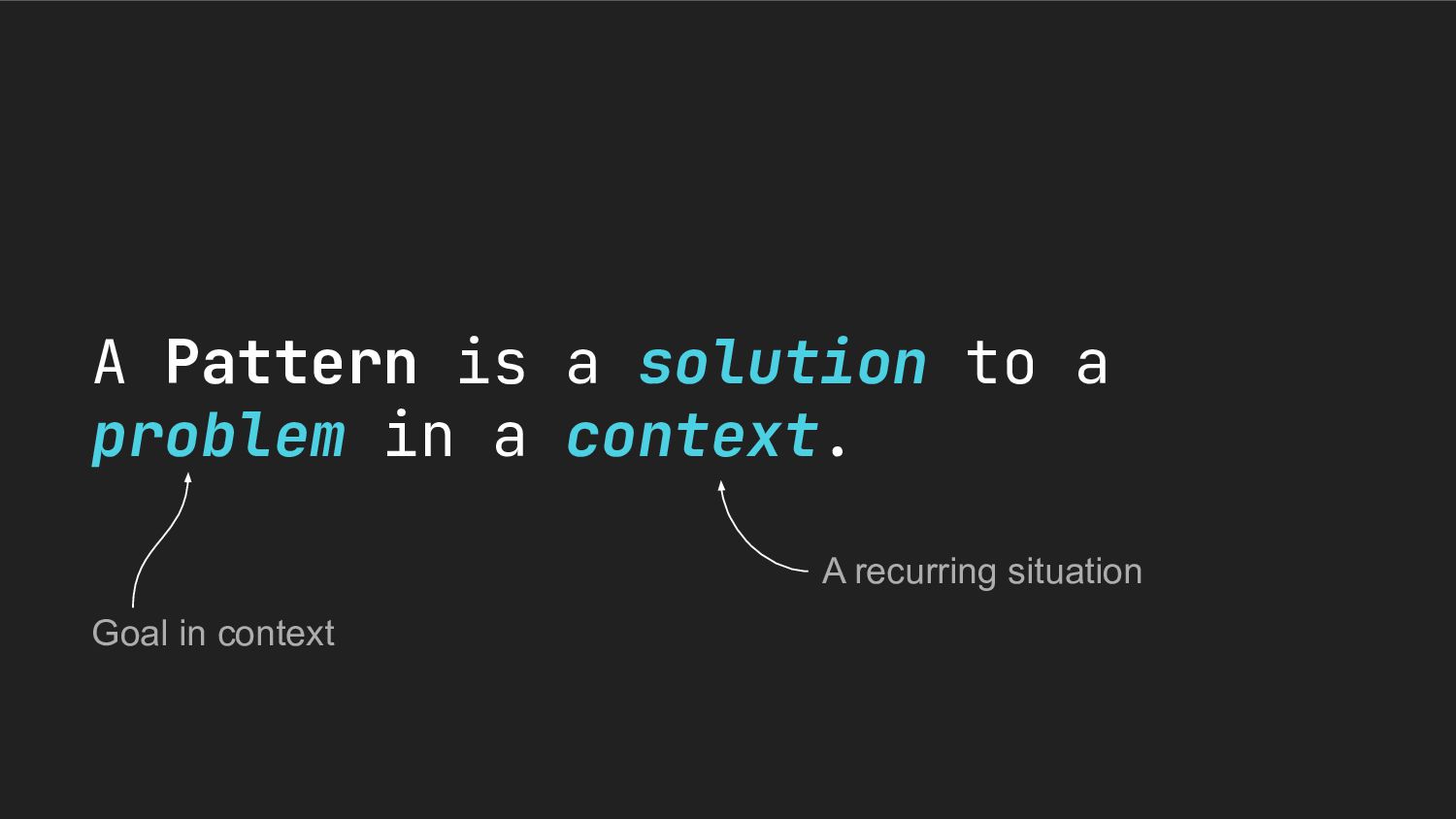
A Pattern is a solution to a problem in a
context.
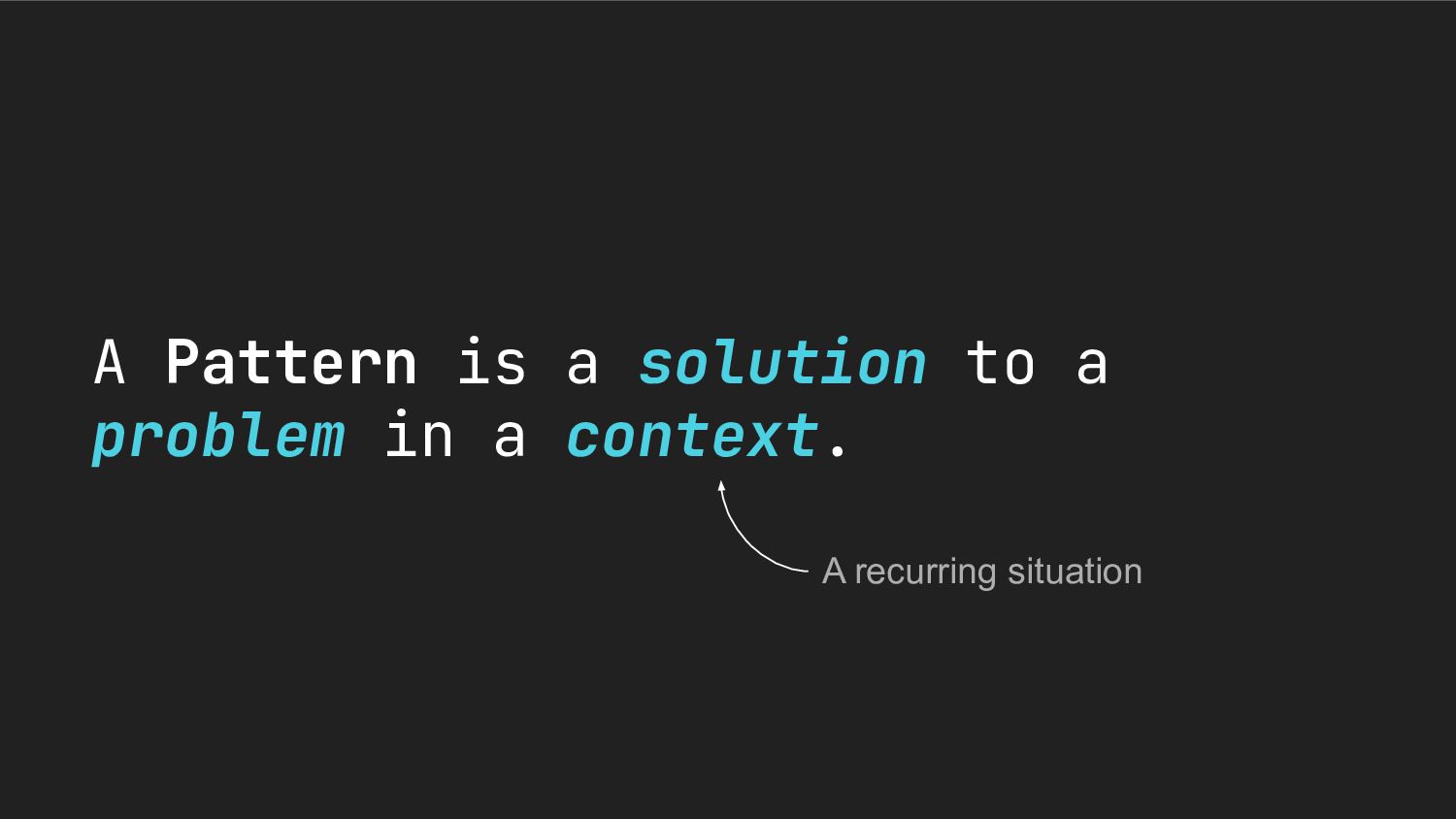
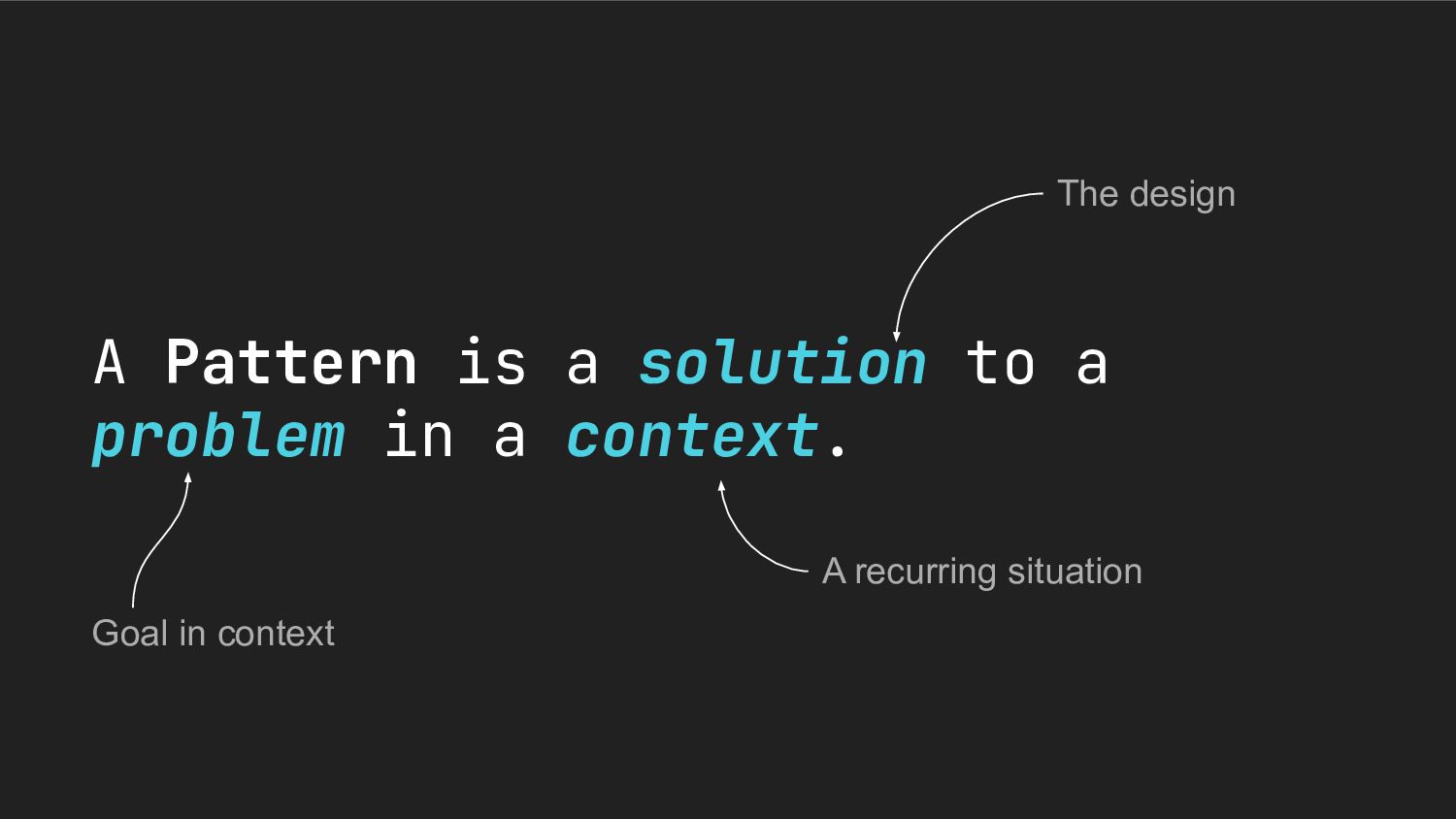
A Pattern is a solution to a problem in a
context. A recurring situation
A Pattern is a solution to a problem in a
context. A recurring situation Goal in context
A Pattern is a solution to a problem in a
context. A recurring situation Goal in context The design
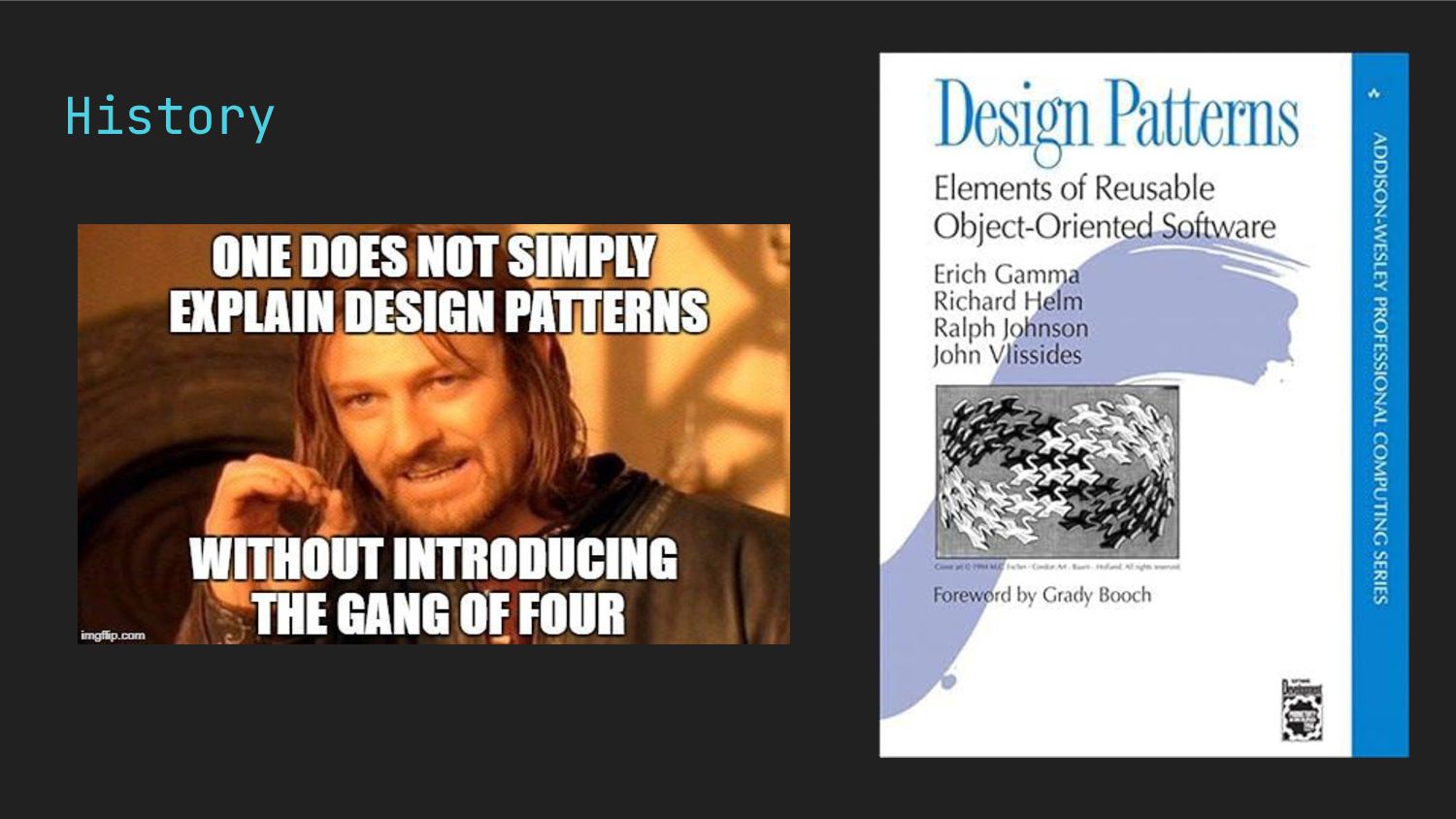
History
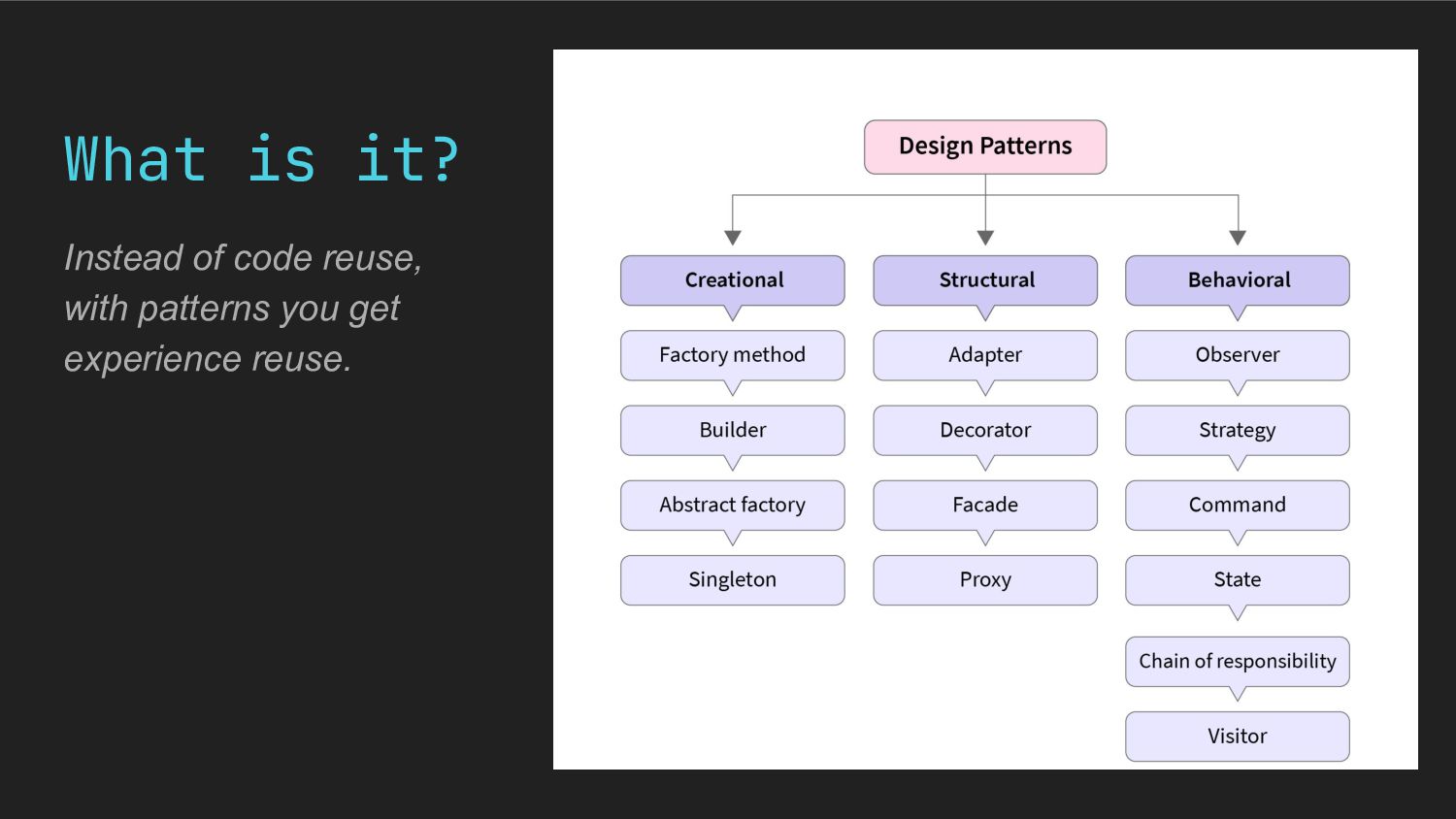
What is it? Instead of code reuse, with patterns you
get experience reuse.
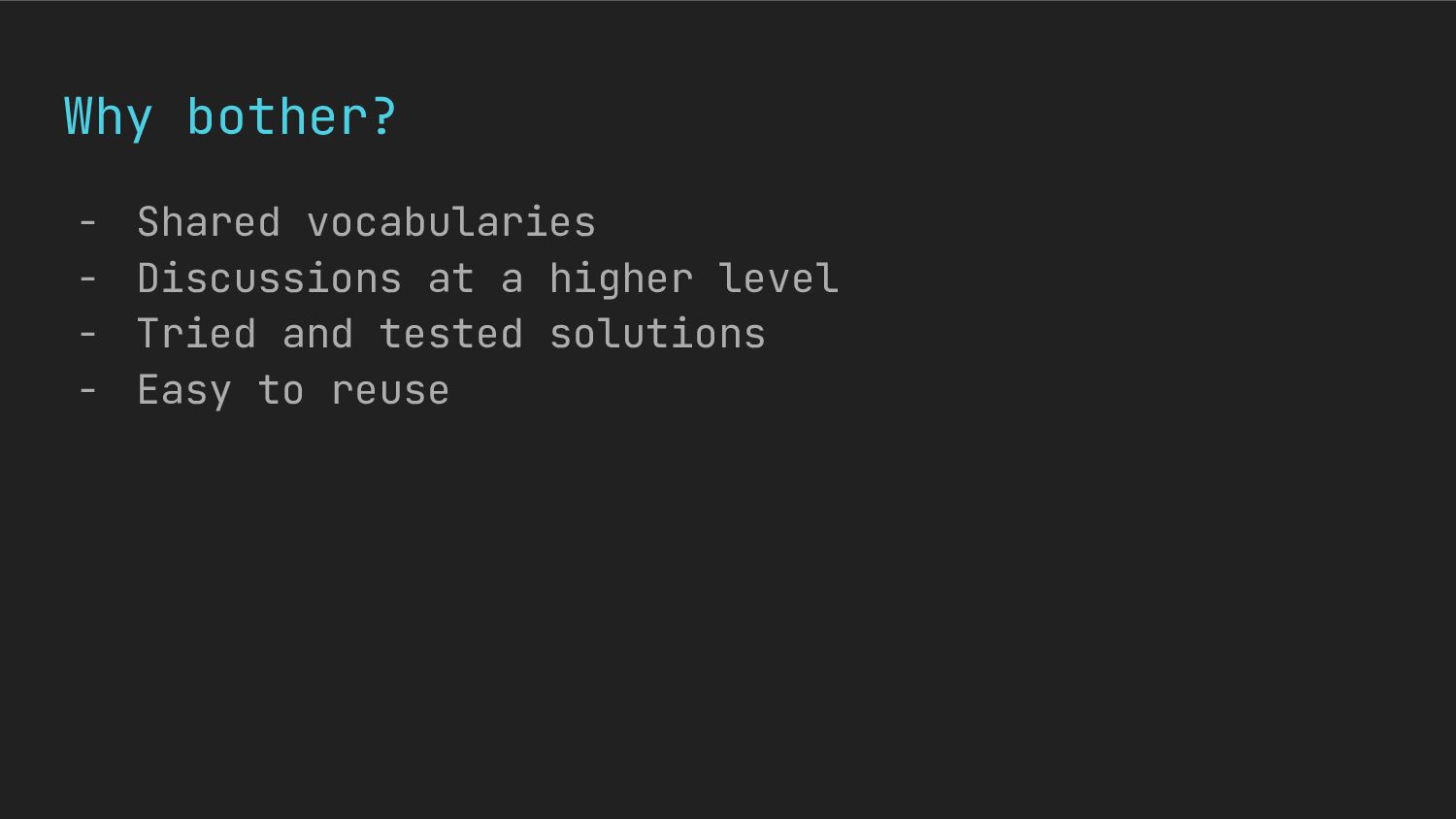
Why bother? - Shared vocabularies - Discussions at a higher
level - Tried and tested solutions - Easy to reuse
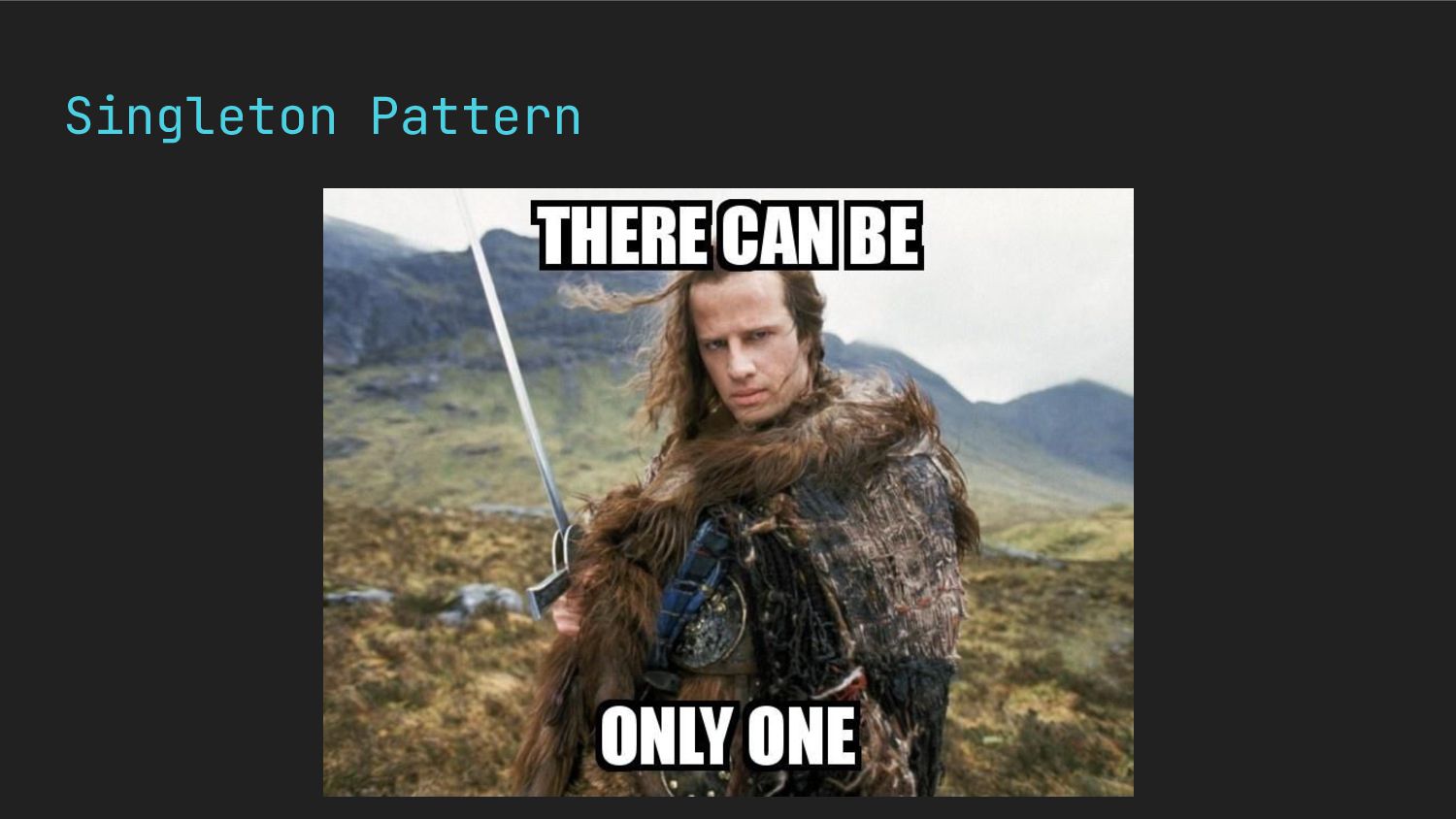
Singleton Pattern
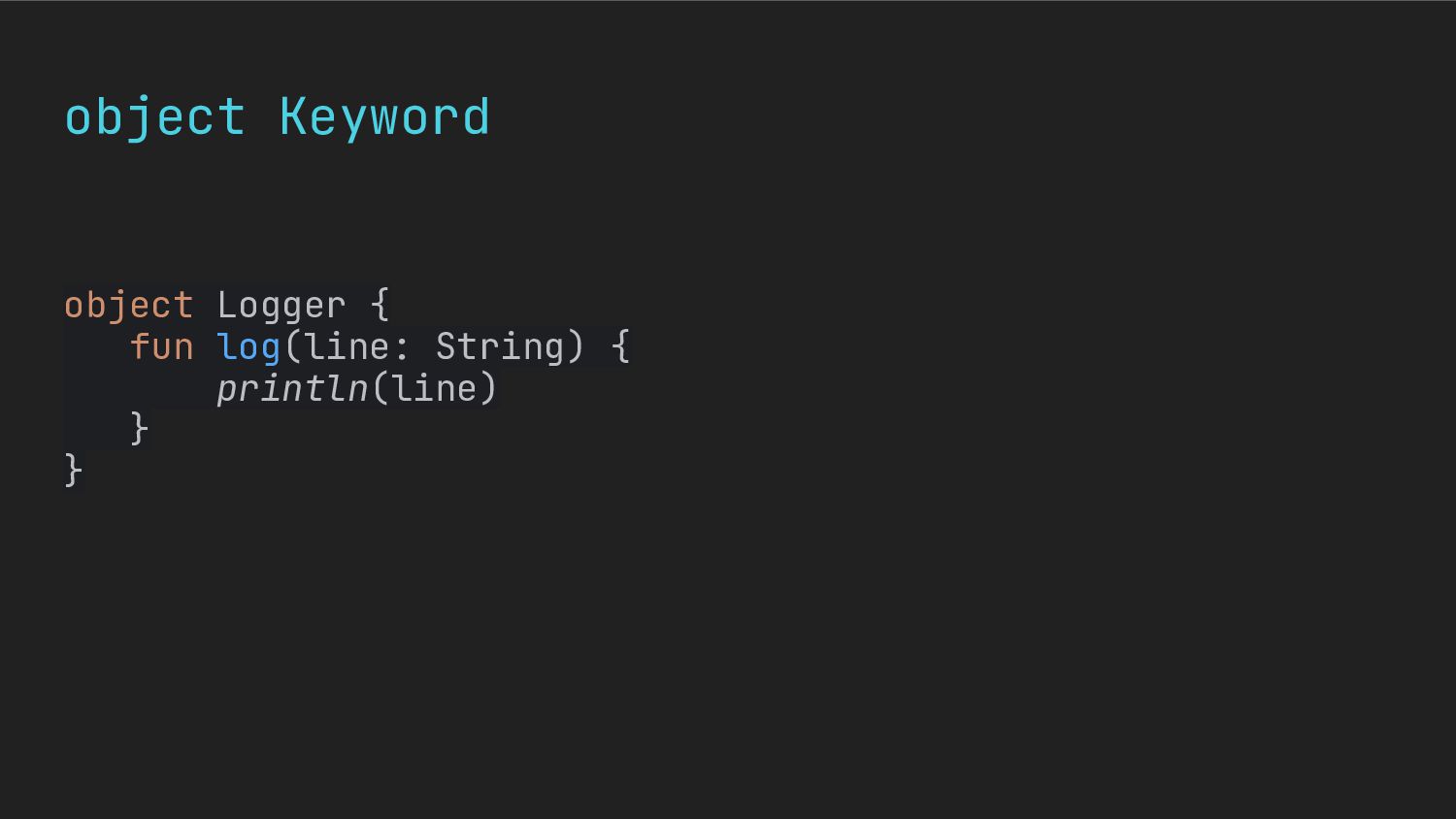
object Keyword object Logger { fun log(line: String) { println(line)
} }
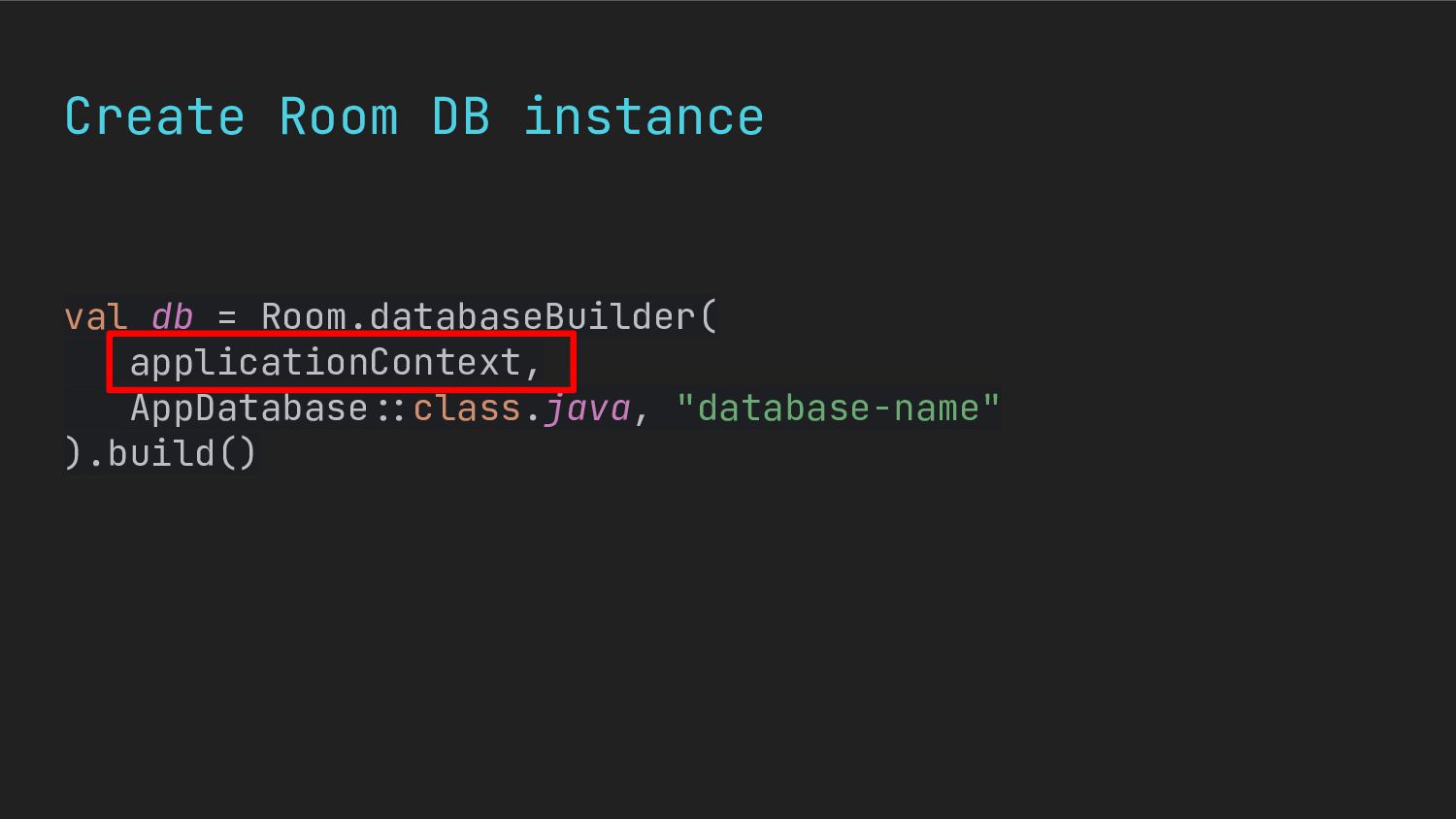
Create Room DB instance val db = Room.databaseBuilder( applicationContext, AppDatabase-:class.java,
"database-name" ).build()
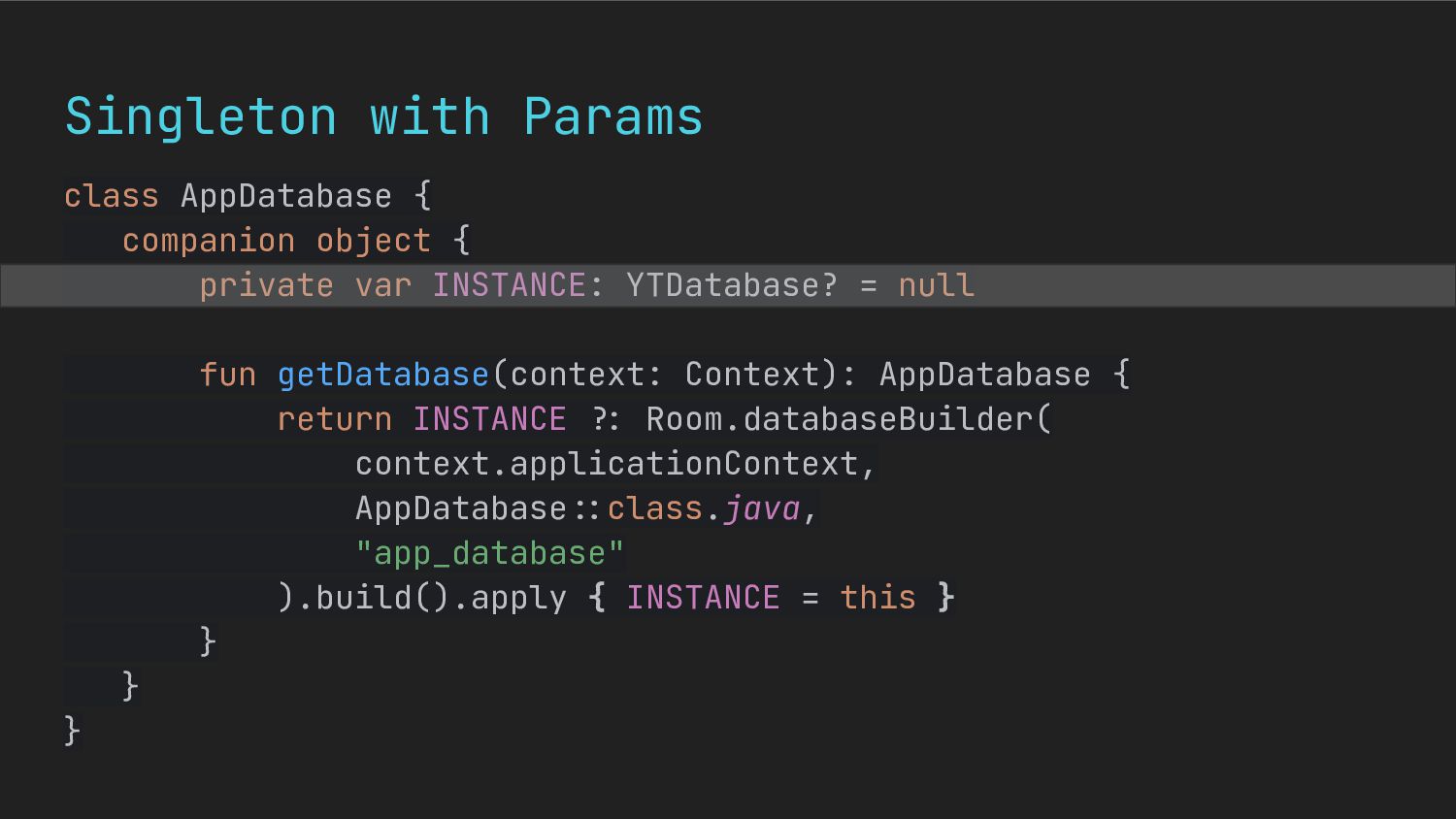
Singleton with Params class AppDatabase { companion object { private
var INSTANCE: YTDatabase? = null fun getDatabase(context: Context): AppDatabase { return INSTANCE -: Room.databaseBuilder( context.applicationContext, AppDatabase-:class.java, "app_database" ).build().apply { INSTANCE = this } } } }
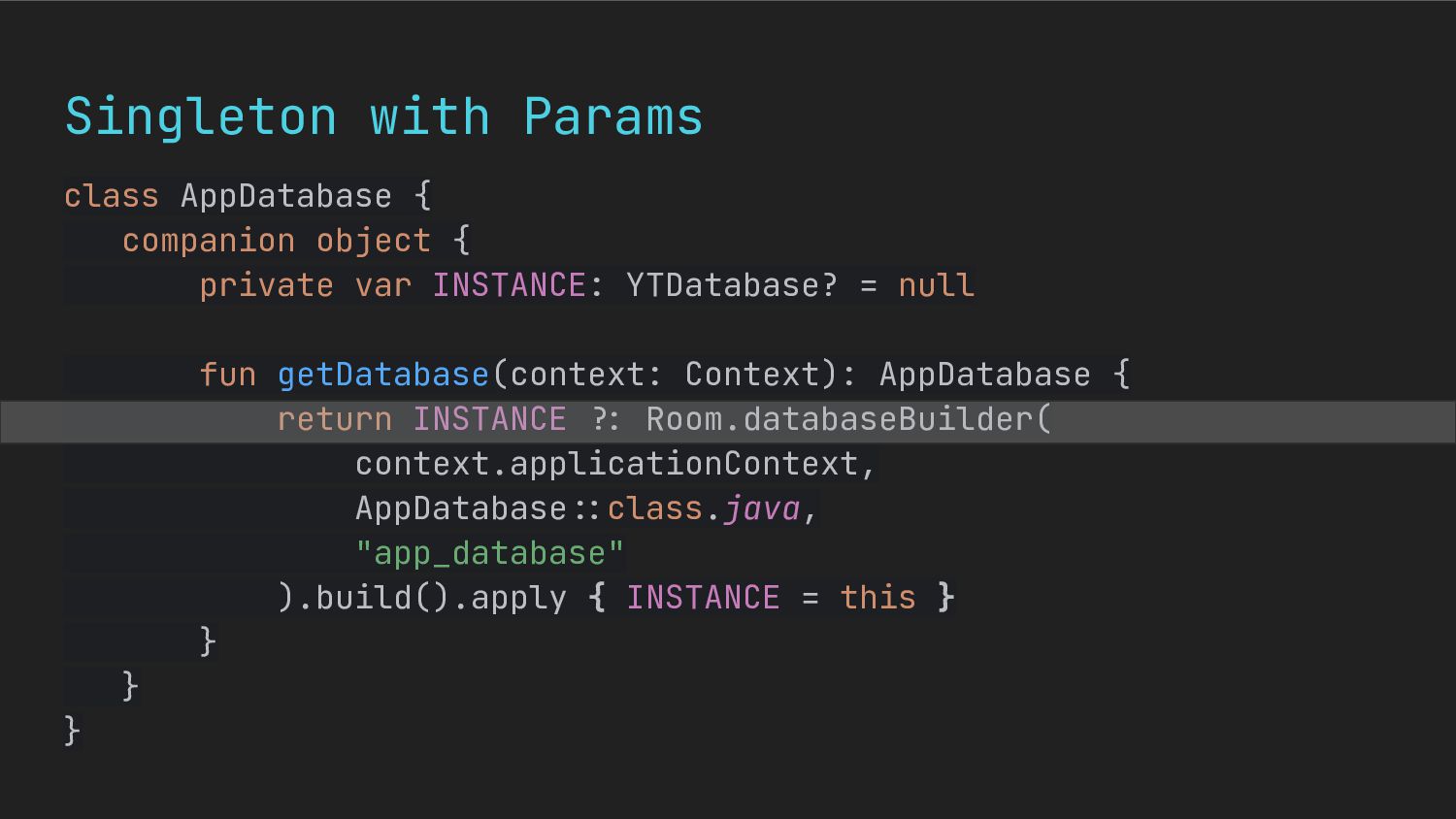
Singleton with Params class AppDatabase { companion object { private
var INSTANCE: YTDatabase? = null fun getDatabase(context: Context): AppDatabase { return INSTANCE -: Room.databaseBuilder( context.applicationContext, AppDatabase-:class.java, "app_database" ).build().apply { INSTANCE = this } } } }
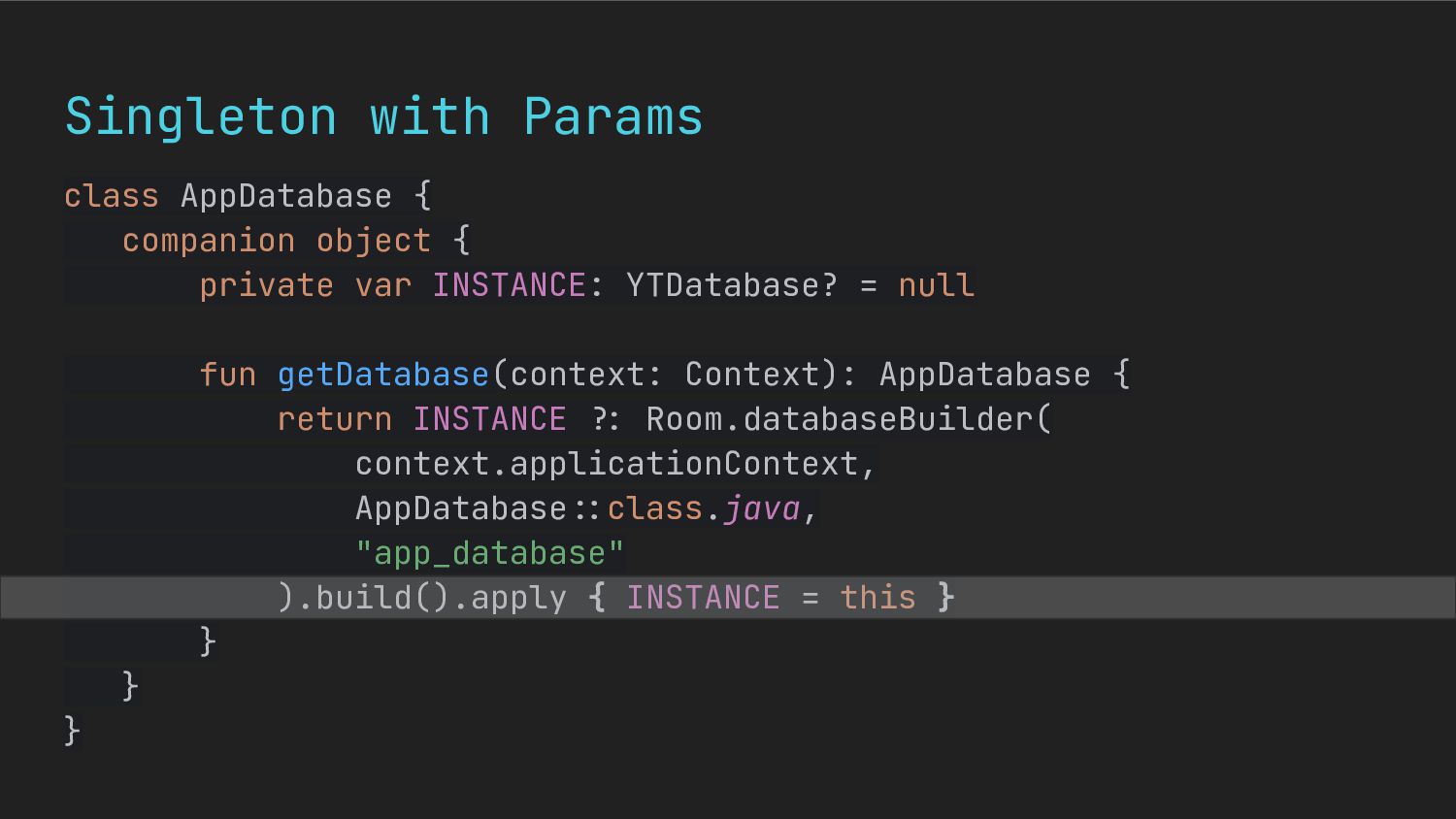
Singleton with Params class AppDatabase { companion object { private
var INSTANCE: YTDatabase? = null fun getDatabase(context: Context): AppDatabase { return INSTANCE -: Room.databaseBuilder( context.applicationContext, AppDatabase-:class.java, "app_database" ).build().apply { INSTANCE = this } } } }
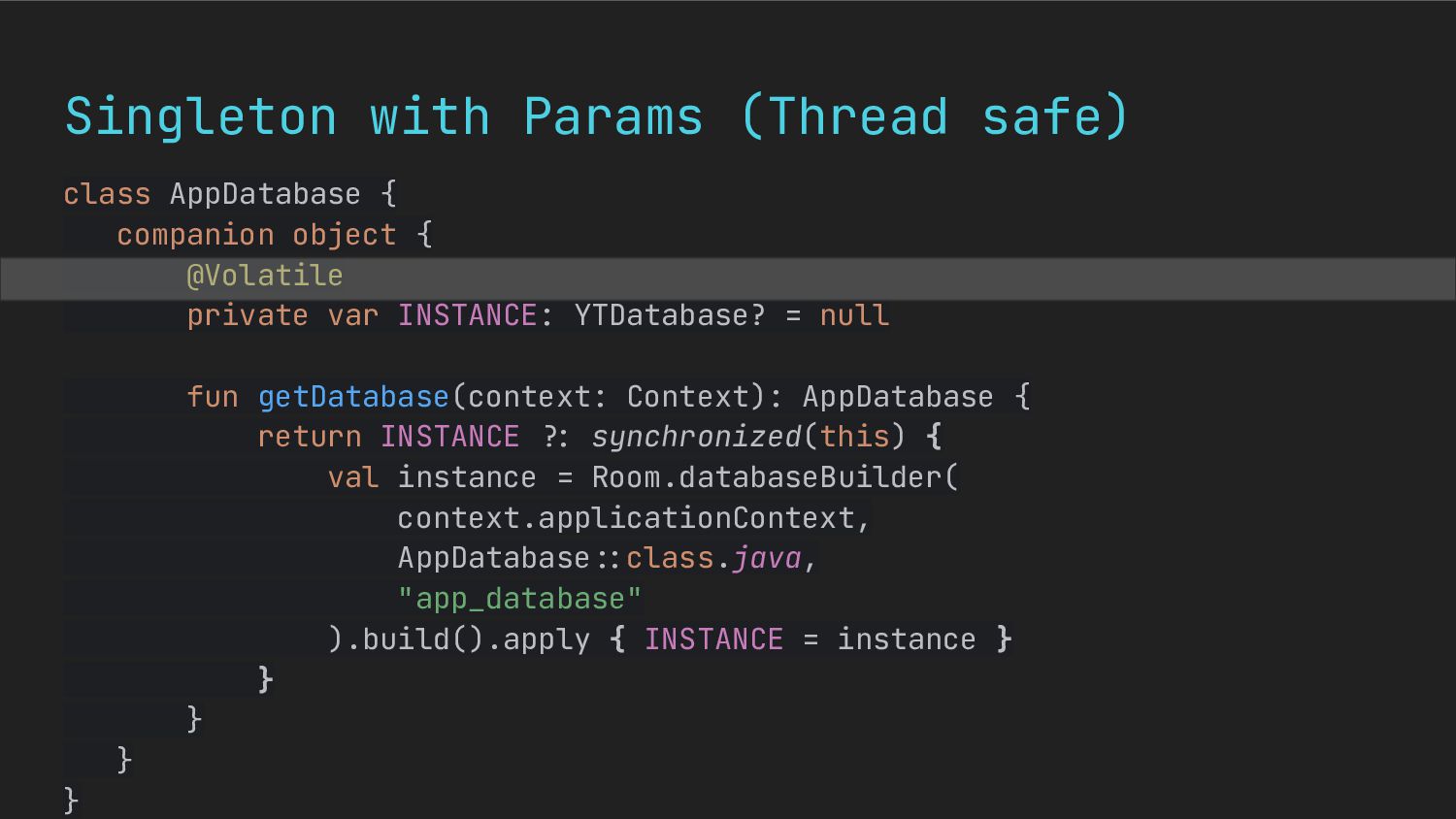
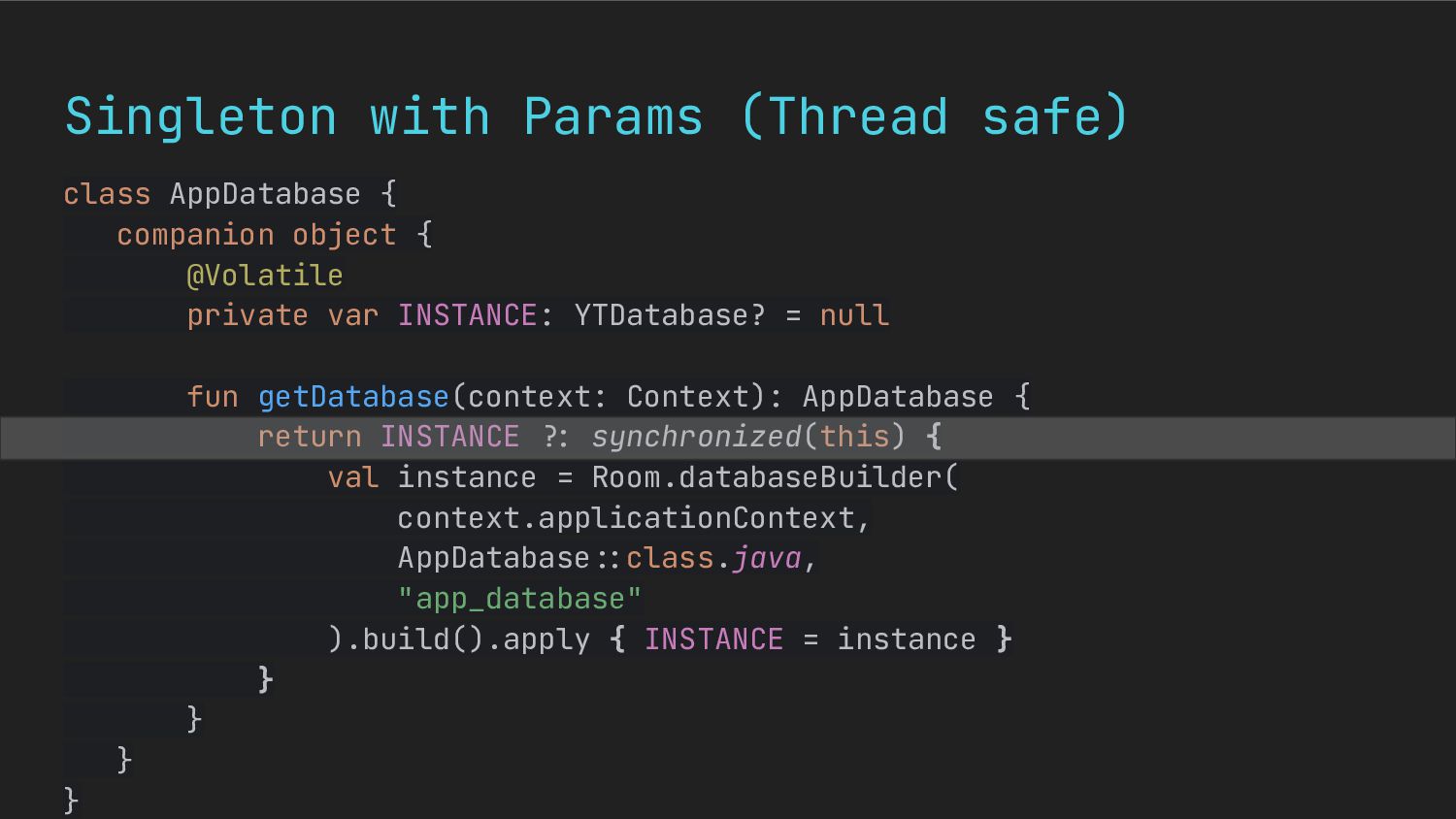
Singleton with Params (Thread safe) class AppDatabase { companion object
{ @Volatile private var INSTANCE: YTDatabase? = null fun getDatabase(context: Context): AppDatabase { return INSTANCE -: synchronized(this) { val instance = Room.databaseBuilder( context.applicationContext, AppDatabase-:class.java, "app_database" ).build().apply { INSTANCE = instance } } } } }
Singleton with Params (Thread safe) class AppDatabase { companion object
{ @Volatile private var INSTANCE: YTDatabase? = null fun getDatabase(context: Context): AppDatabase { return INSTANCE -: synchronized(this) { val instance = Room.databaseBuilder( context.applicationContext, AppDatabase-:class.java, "app_database" ).build().apply { INSTANCE = instance } } } } }
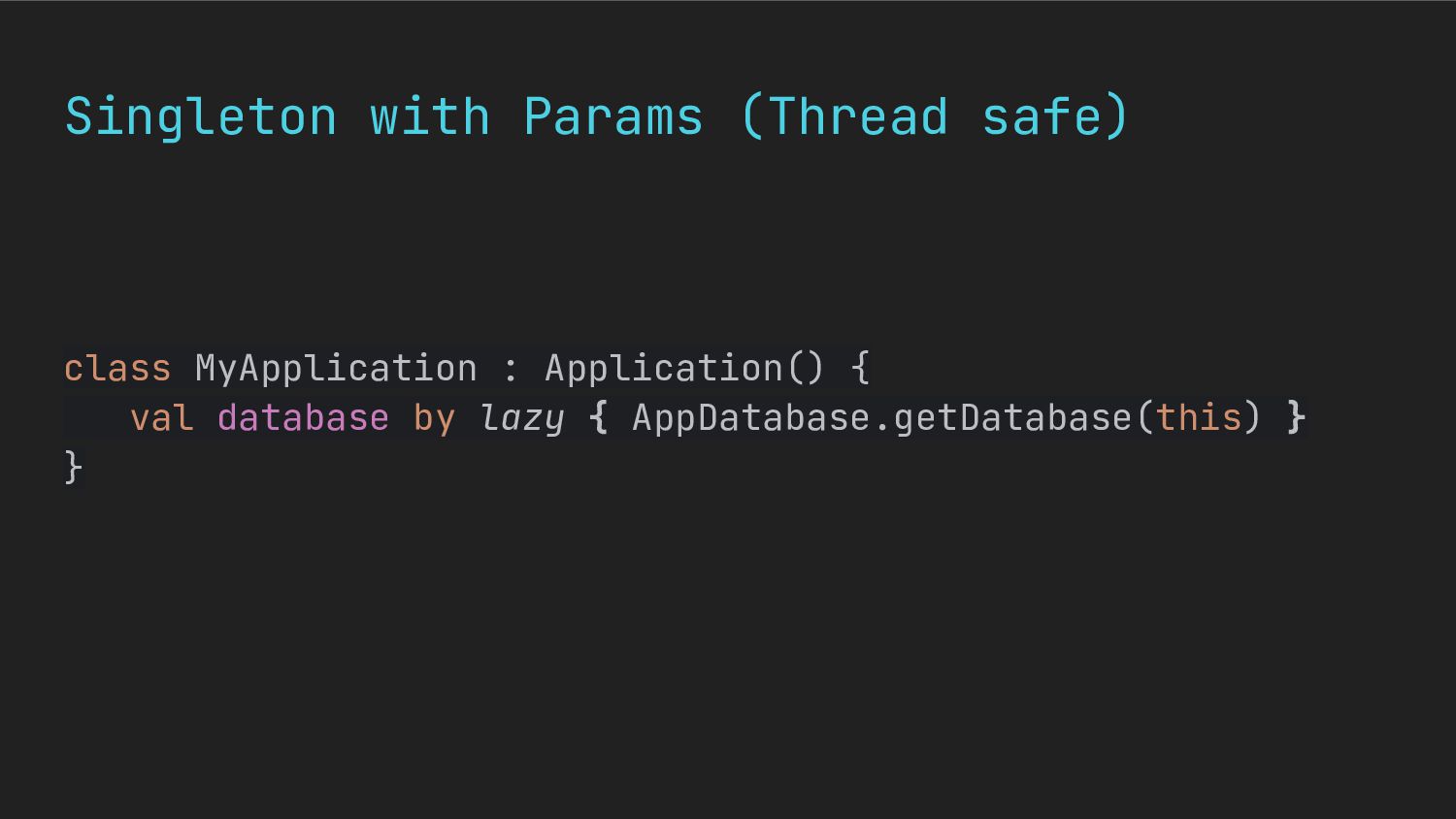
Singleton with Params (Thread safe) class MyApplication : Application() {
val database by lazy { AppDatabase.getDatabase(this) } }
An Anti-Pattern tells you how to go from a problem
to BAD Solution.
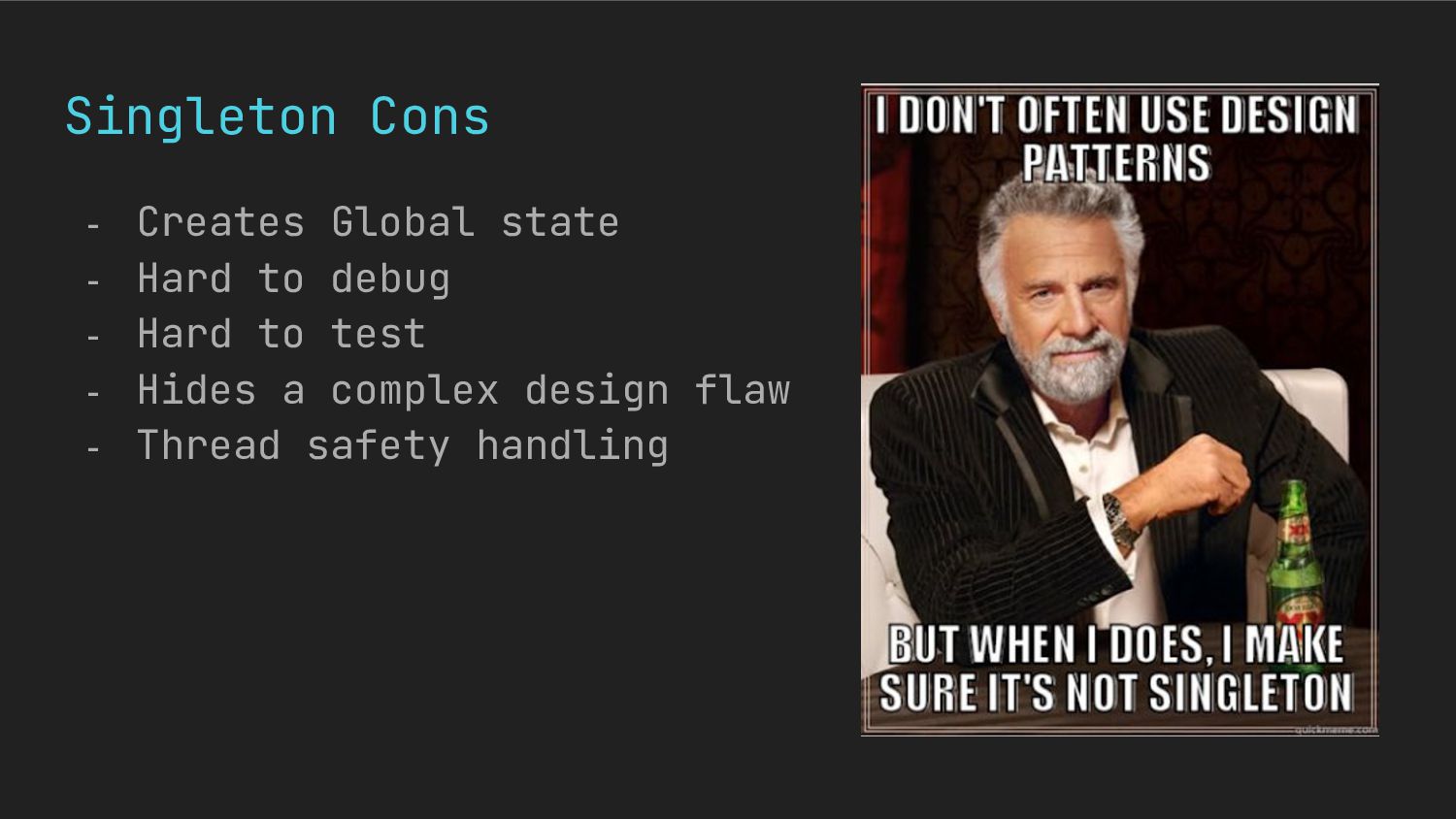
Singleton Cons - Creates Global state - Hard to debug
- Hard to test - Hides a complex design flaw - Thread safety handling
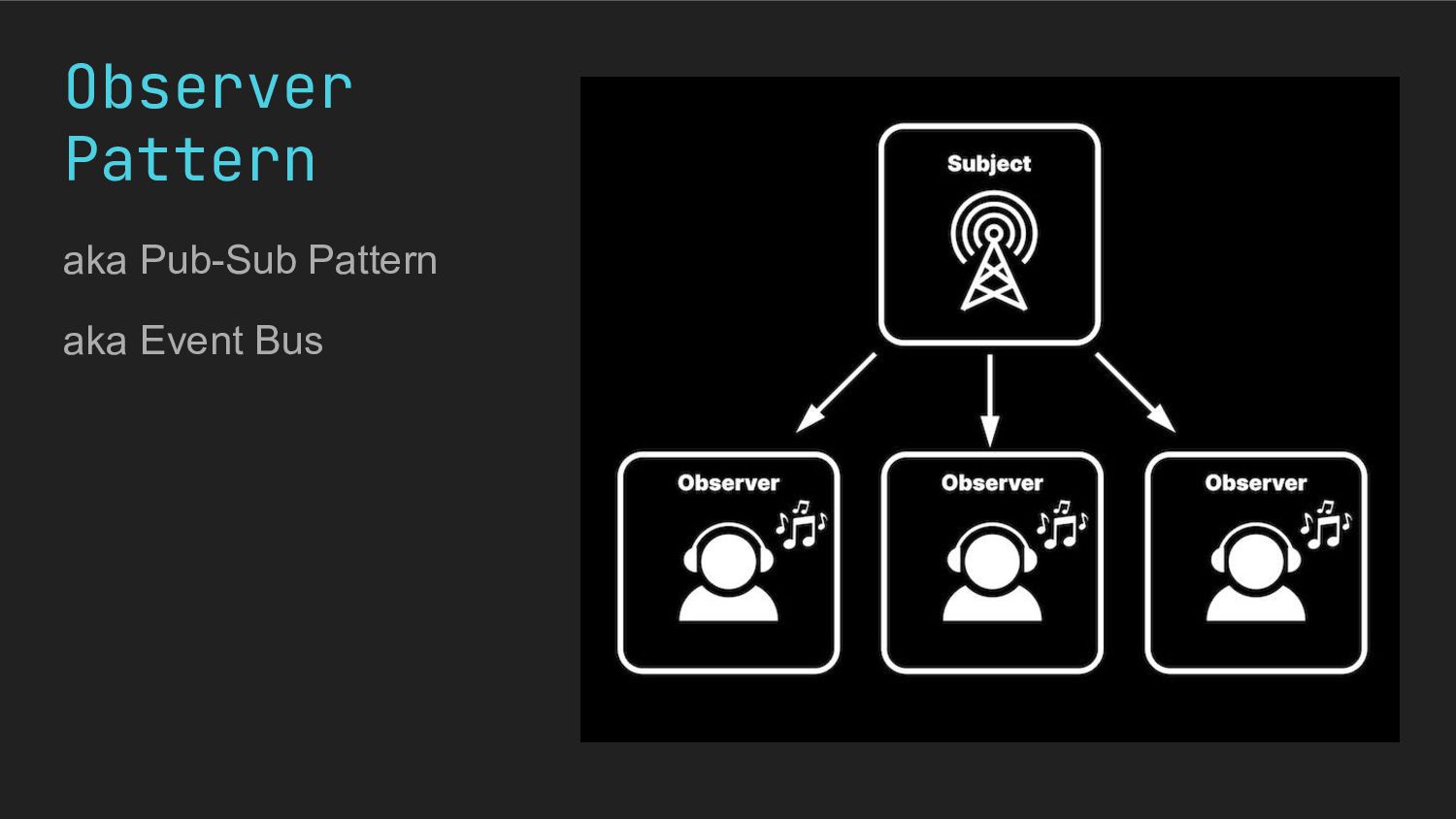
Observer Pattern aka Pub-Sub Pattern aka Event Bus
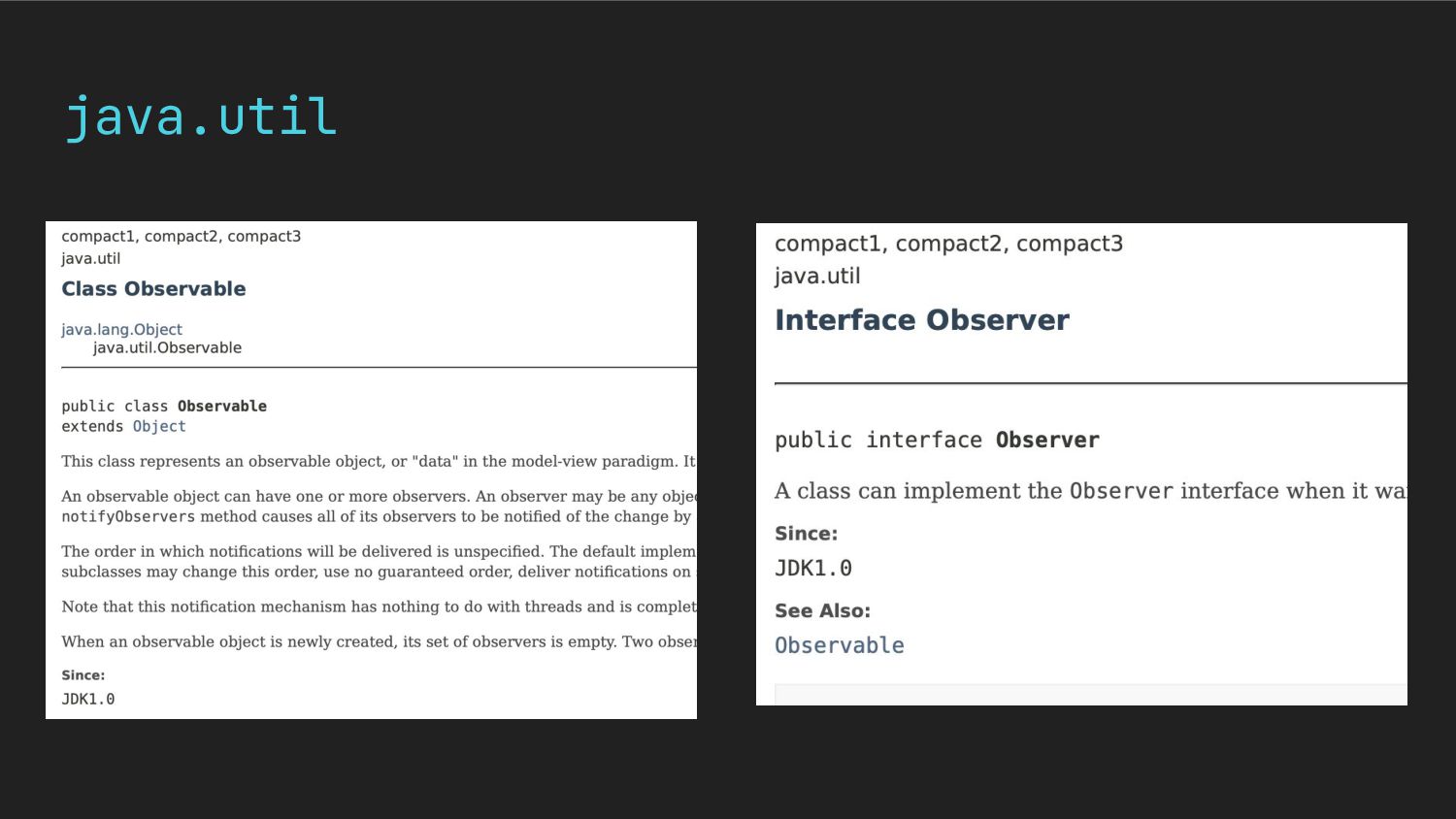
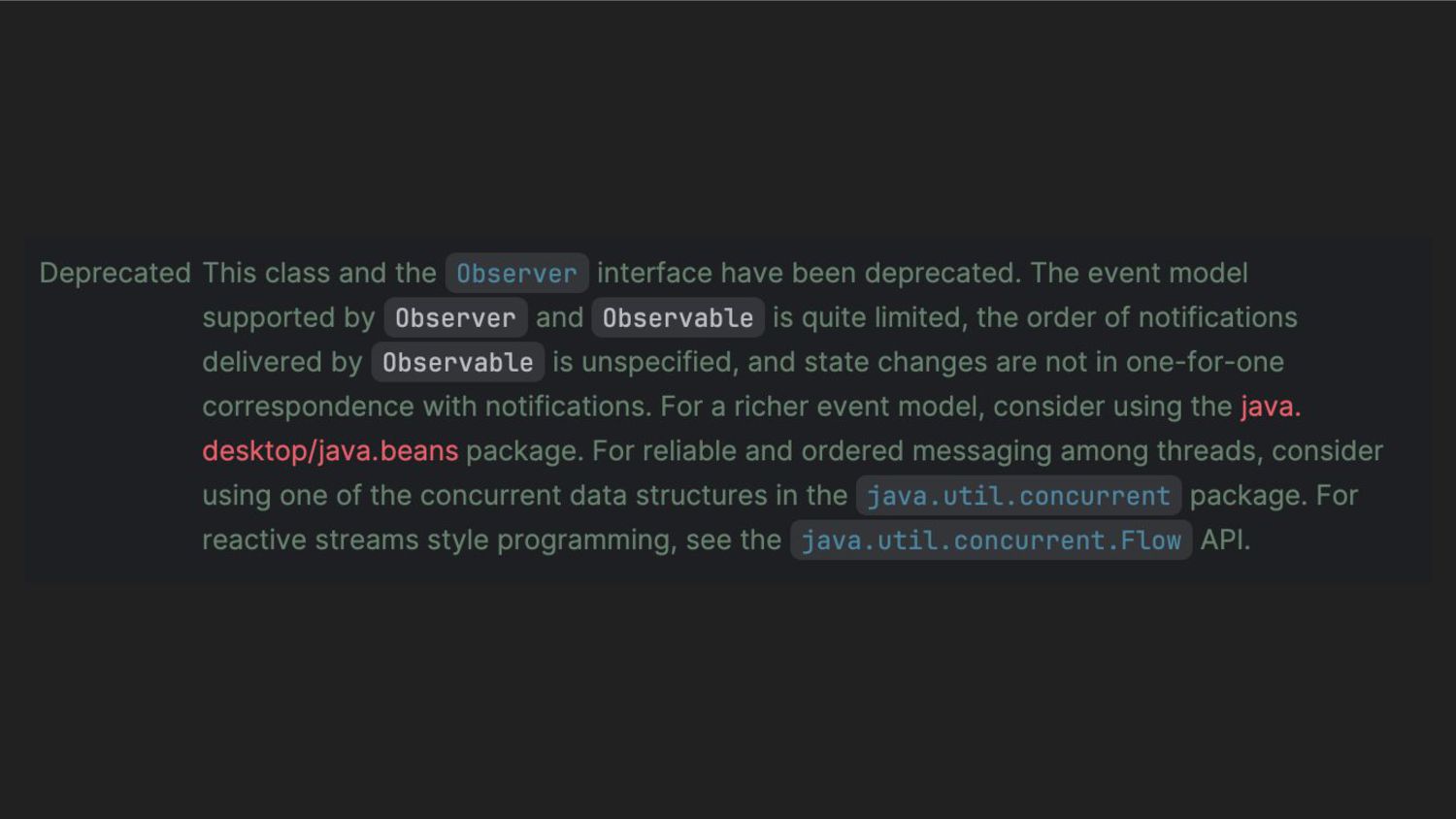
java.util
None
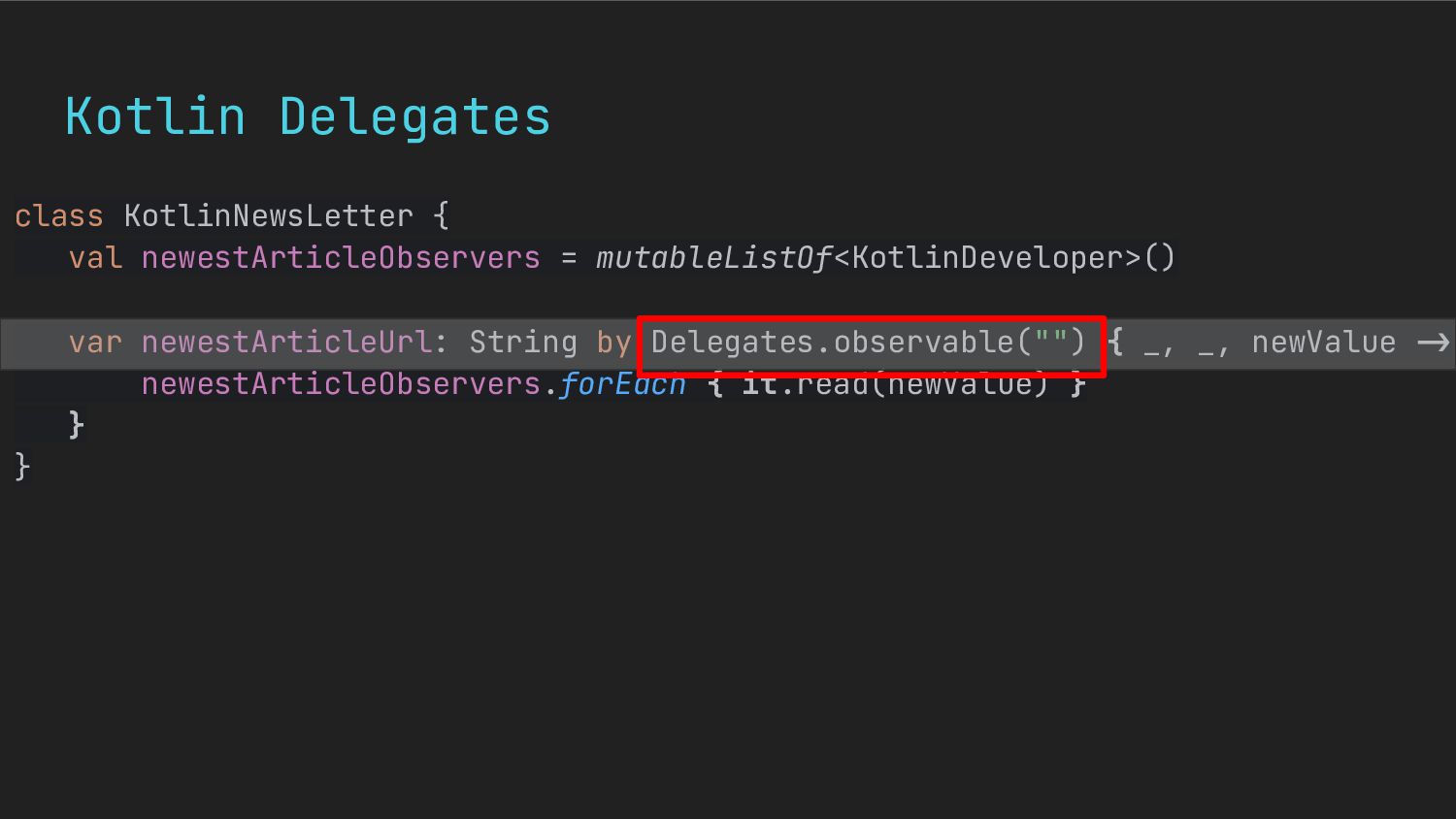
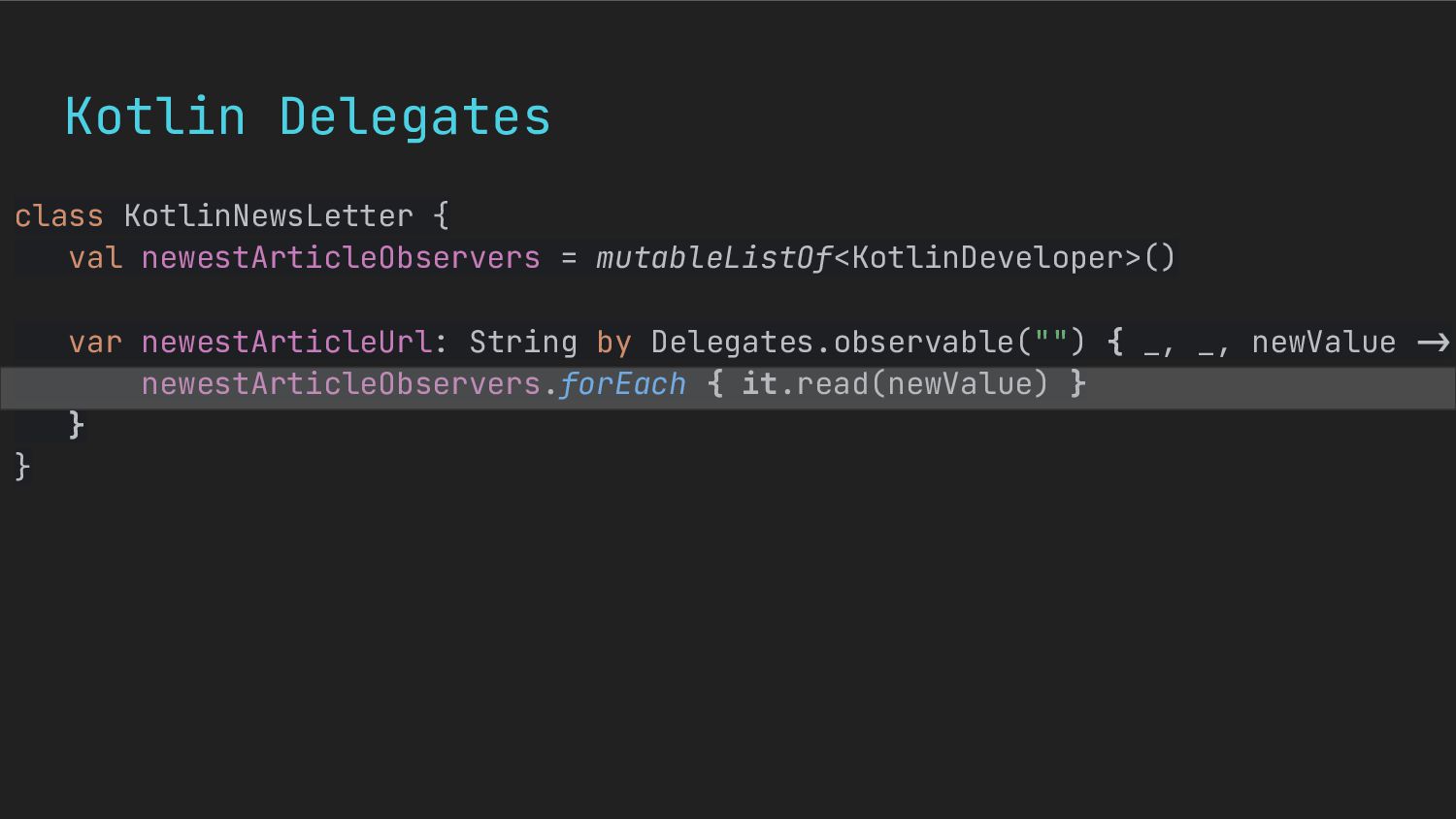
class KotlinNewsLetter { val newestArticleObservers = mutableListOf<KotlinDeveloper>() var newestArticleUrl: String
by Delegates.observable("") { _, _, newValue -> newestArticleObservers.forEach { it.read(newValue) } } } Kotlin Delegates
class KotlinNewsLetter { val newestArticleObservers = mutableListOf<KotlinDeveloper>() var newestArticleUrl: String
by Delegates.observable("") { _, _, newValue -> newestArticleObservers.forEach { it.read(newValue) } } } Kotlin Delegates
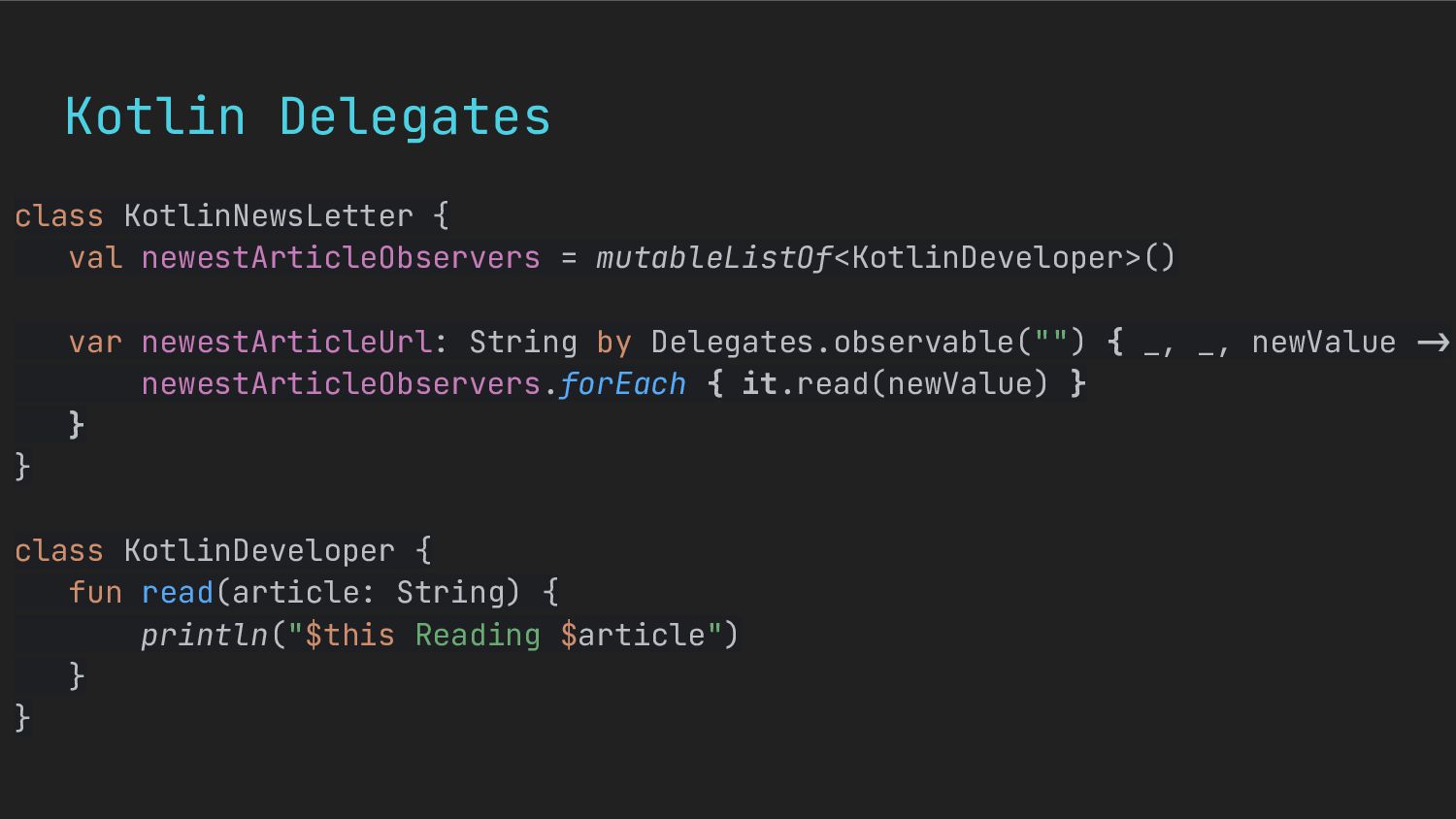
class KotlinNewsLetter { val newestArticleObservers = mutableListOf<KotlinDeveloper>() var newestArticleUrl: String
by Delegates.observable("") { _, _, newValue -> newestArticleObservers.forEach { it.read(newValue) } } } class KotlinDeveloper { fun read(article: String) { println("$this Reading $article") } } Kotlin Delegates
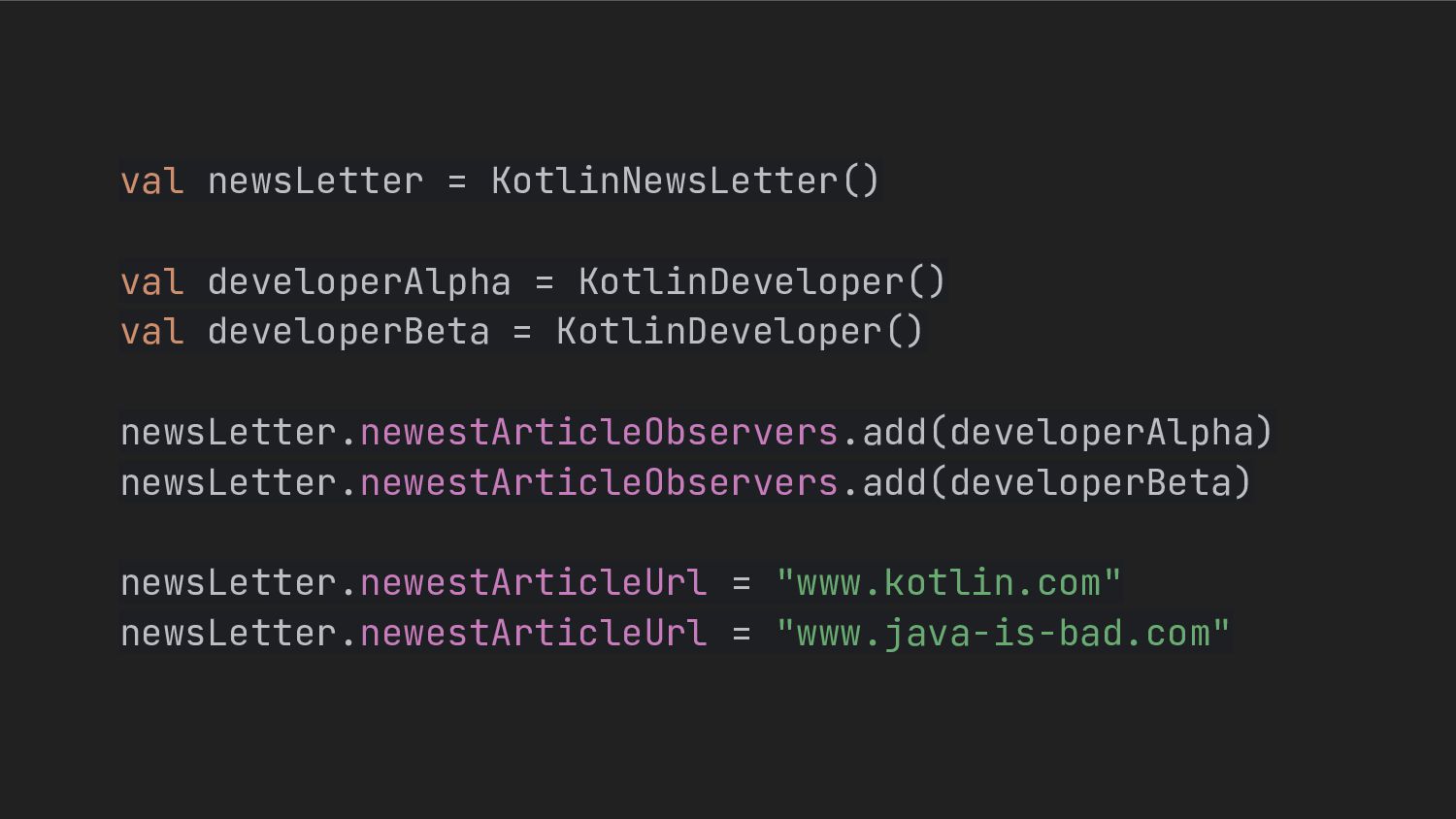
val newsLetter = KotlinNewsLetter() val developerAlpha = KotlinDeveloper() val developerBeta
= KotlinDeveloper() newsLetter.newestArticleObservers.add(developerAlpha) newsLetter.newestArticleObservers.add(developerBeta) newsLetter.newestArticleUrl = "www.kotlin.com" newsLetter.newestArticleUrl = "www.java-is-bad.com"
None
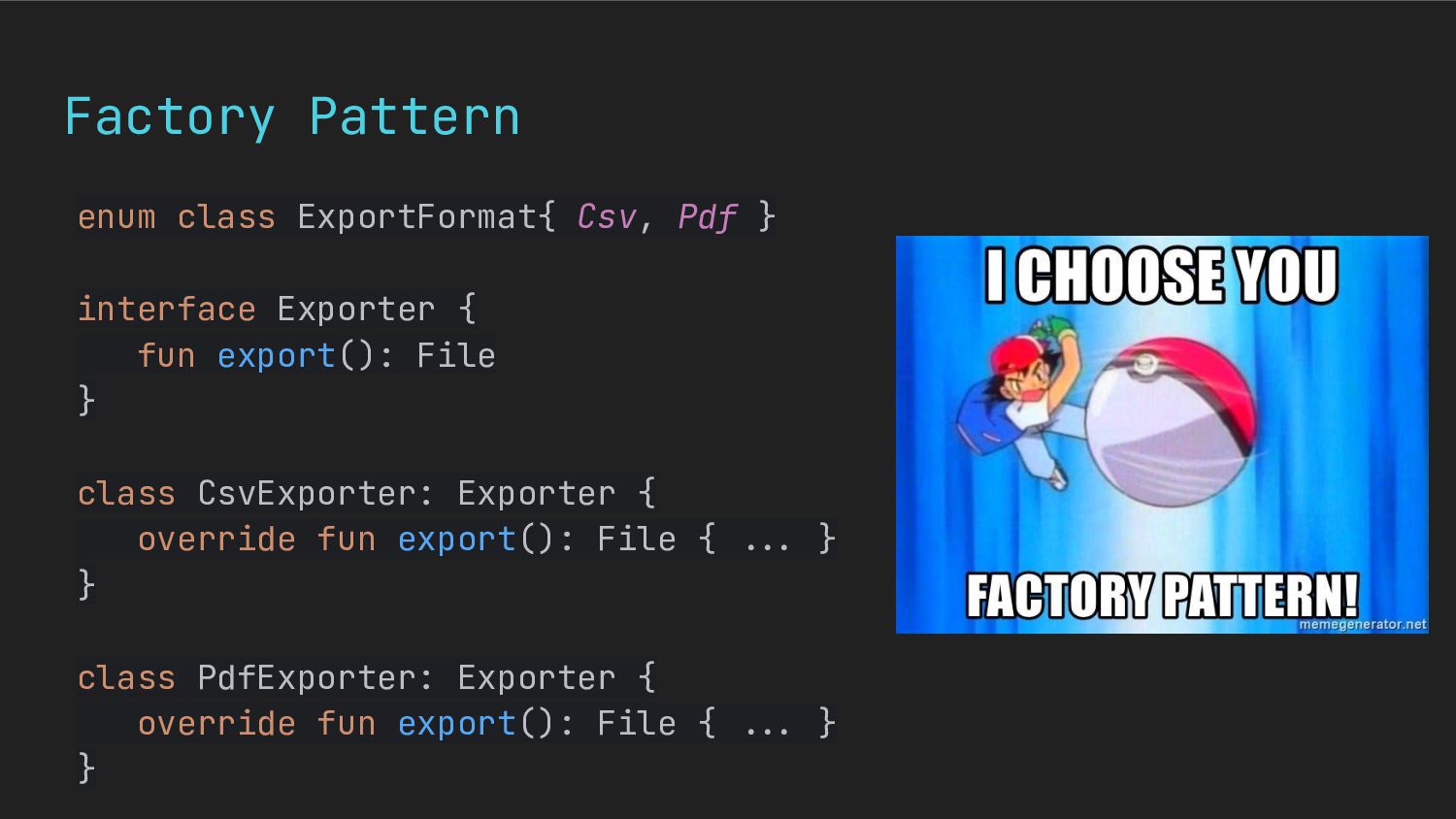
Factory Pattern enum class ExportFormat{ Csv, Pdf } interface Exporter
{ fun export(): File } class CsvExporter: Exporter { override fun export(): File { --. } } class PdfExporter: Exporter { override fun export(): File { --. } }
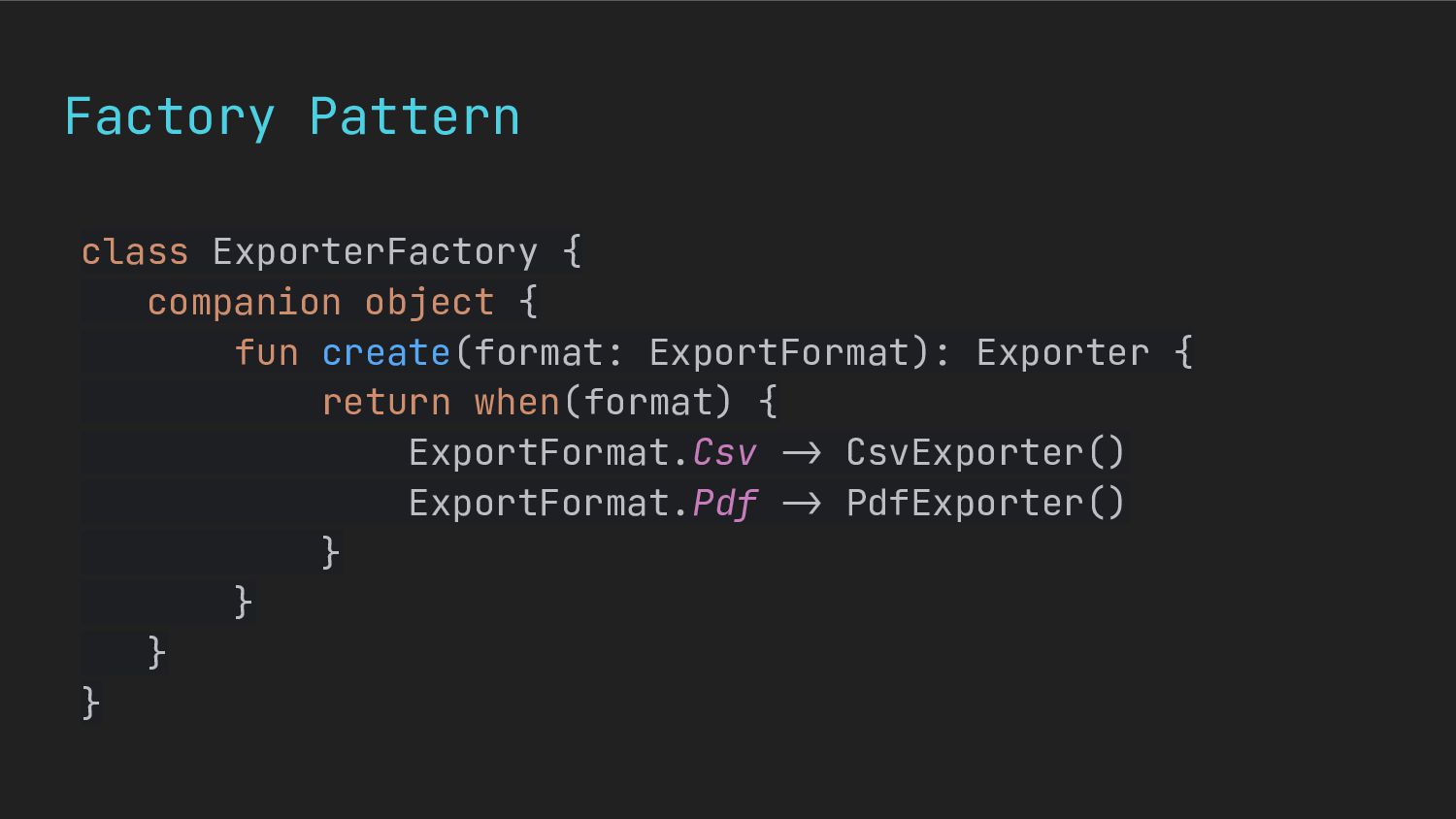
Factory Pattern class ExporterFactory { companion object { fun create(format:
ExportFormat): Exporter { return when(format) { ExportFormat.Csv -> CsvExporter() ExportFormat.Pdf -> PdfExporter() } } } }
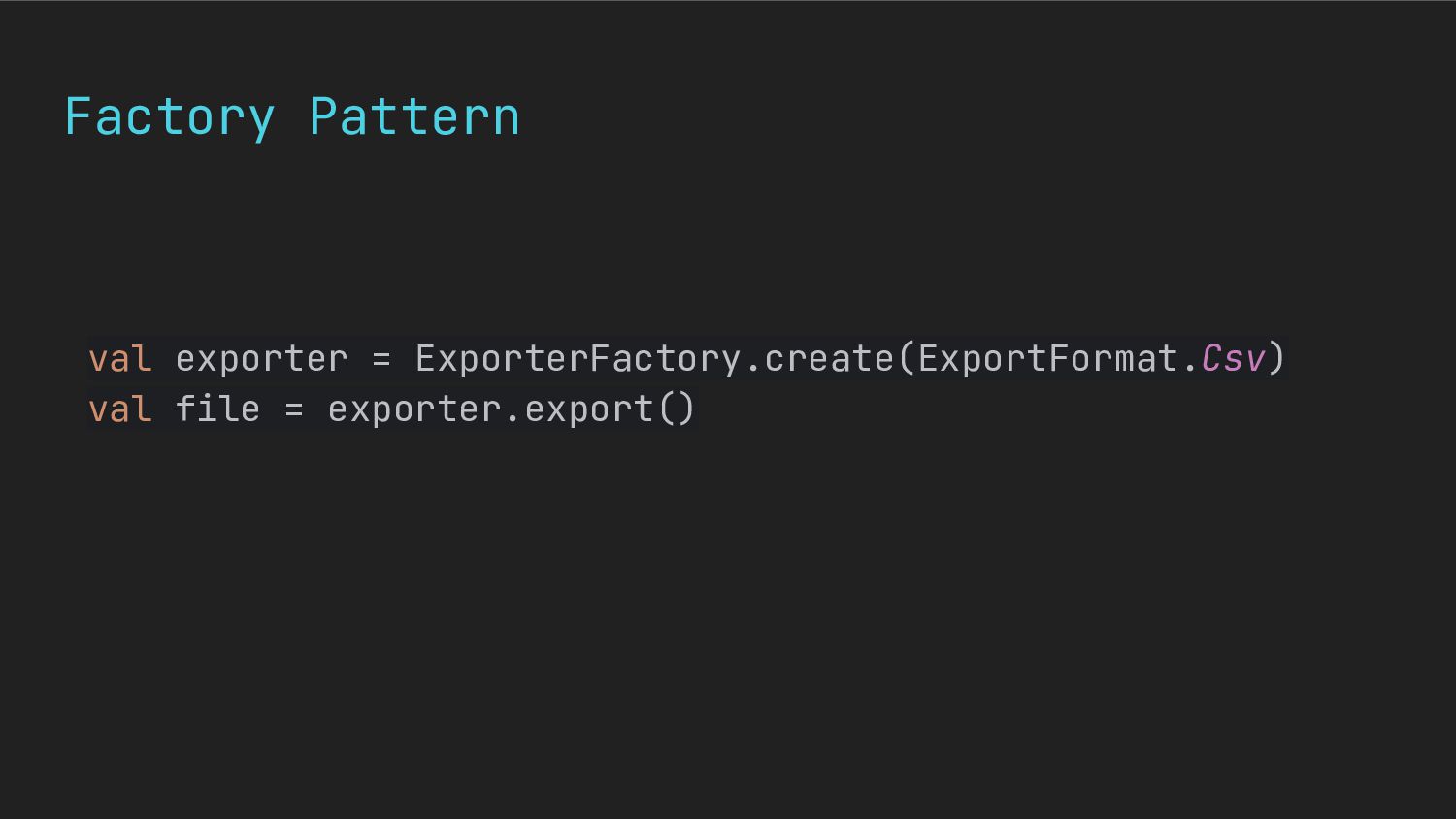
Factory Pattern val exporter = ExporterFactory.create(ExportFormat.Csv) val file = exporter.export()
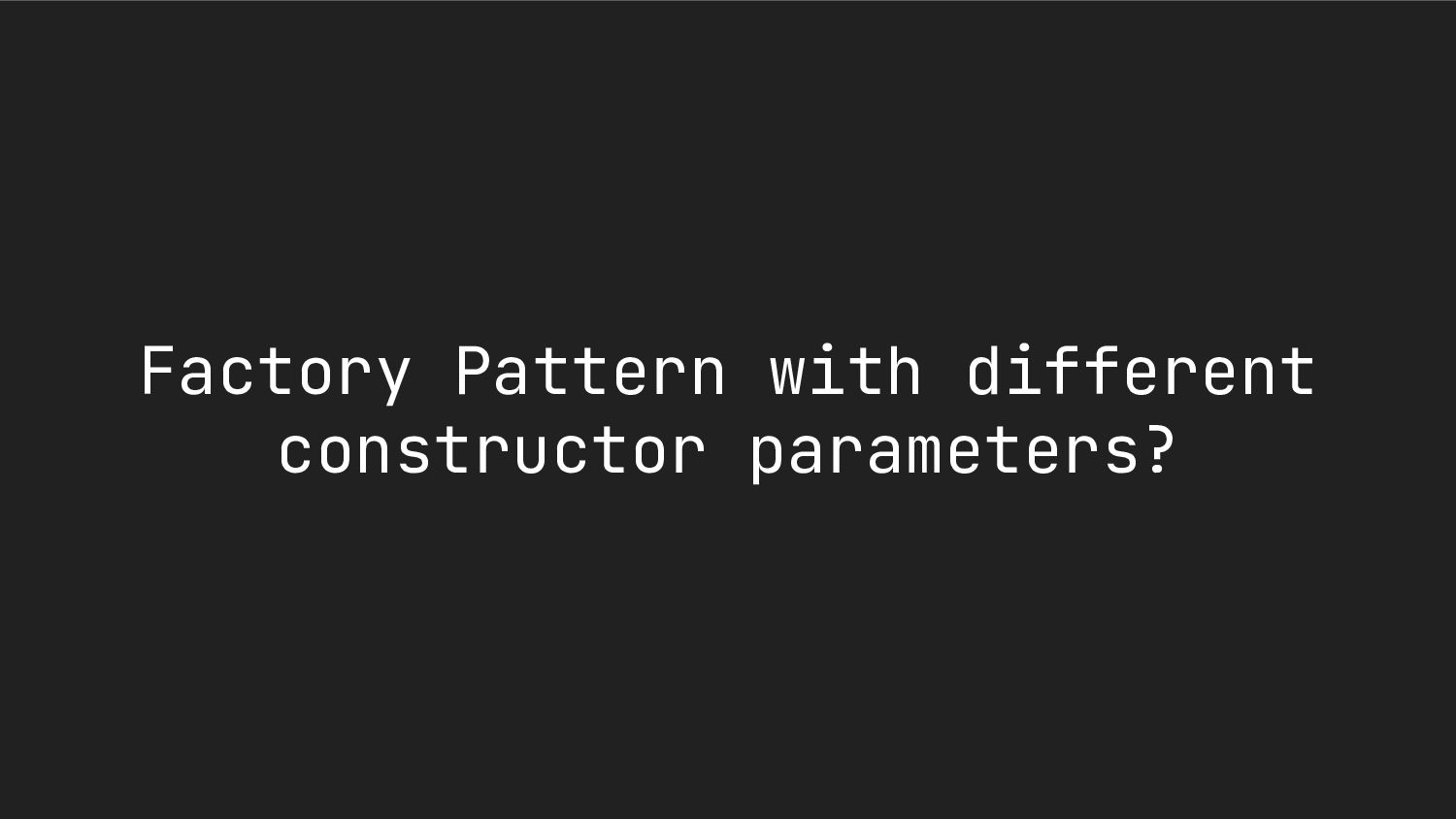
Factory Pattern with different constructor parameters?
Sealed Classes
None
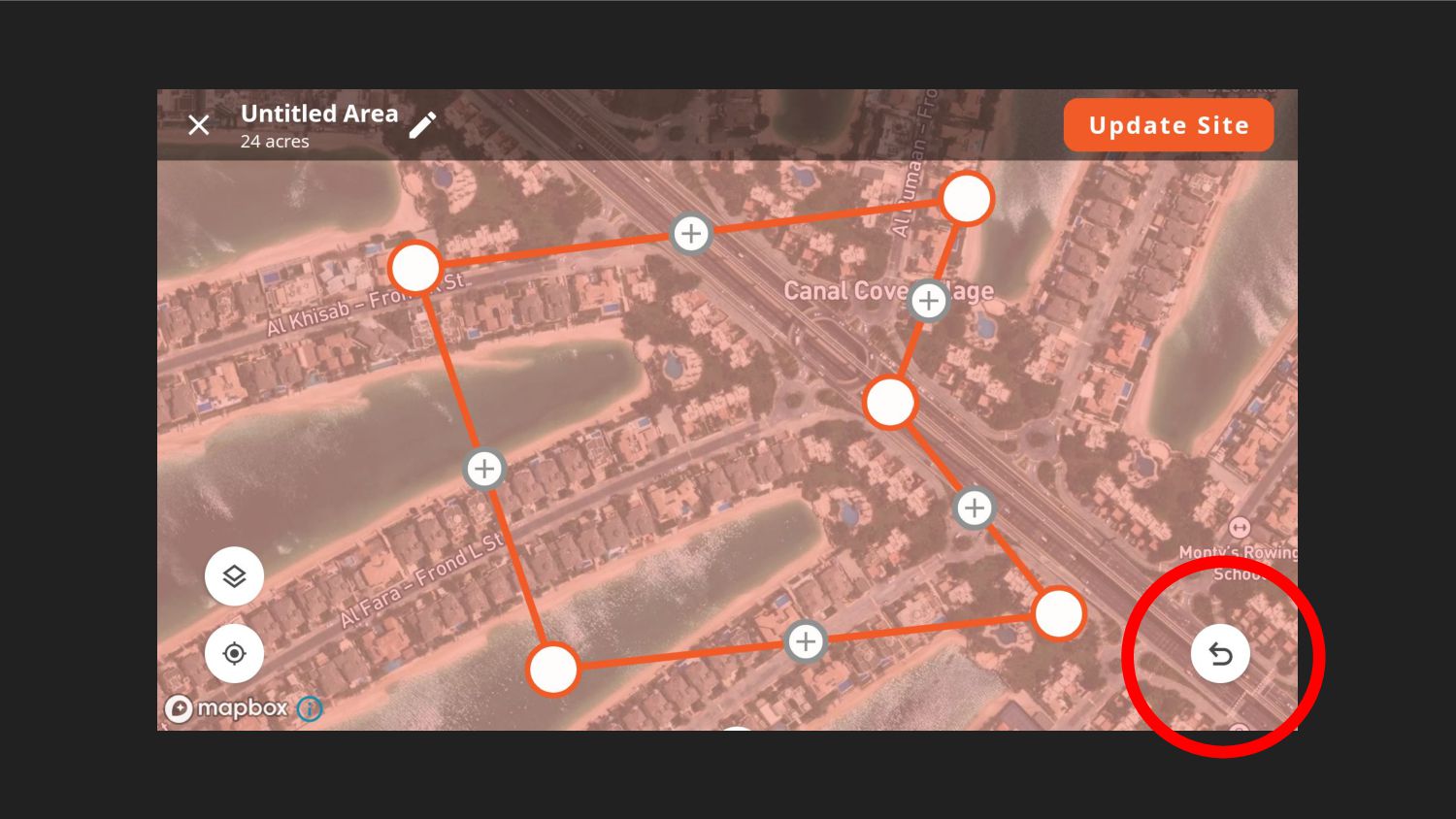
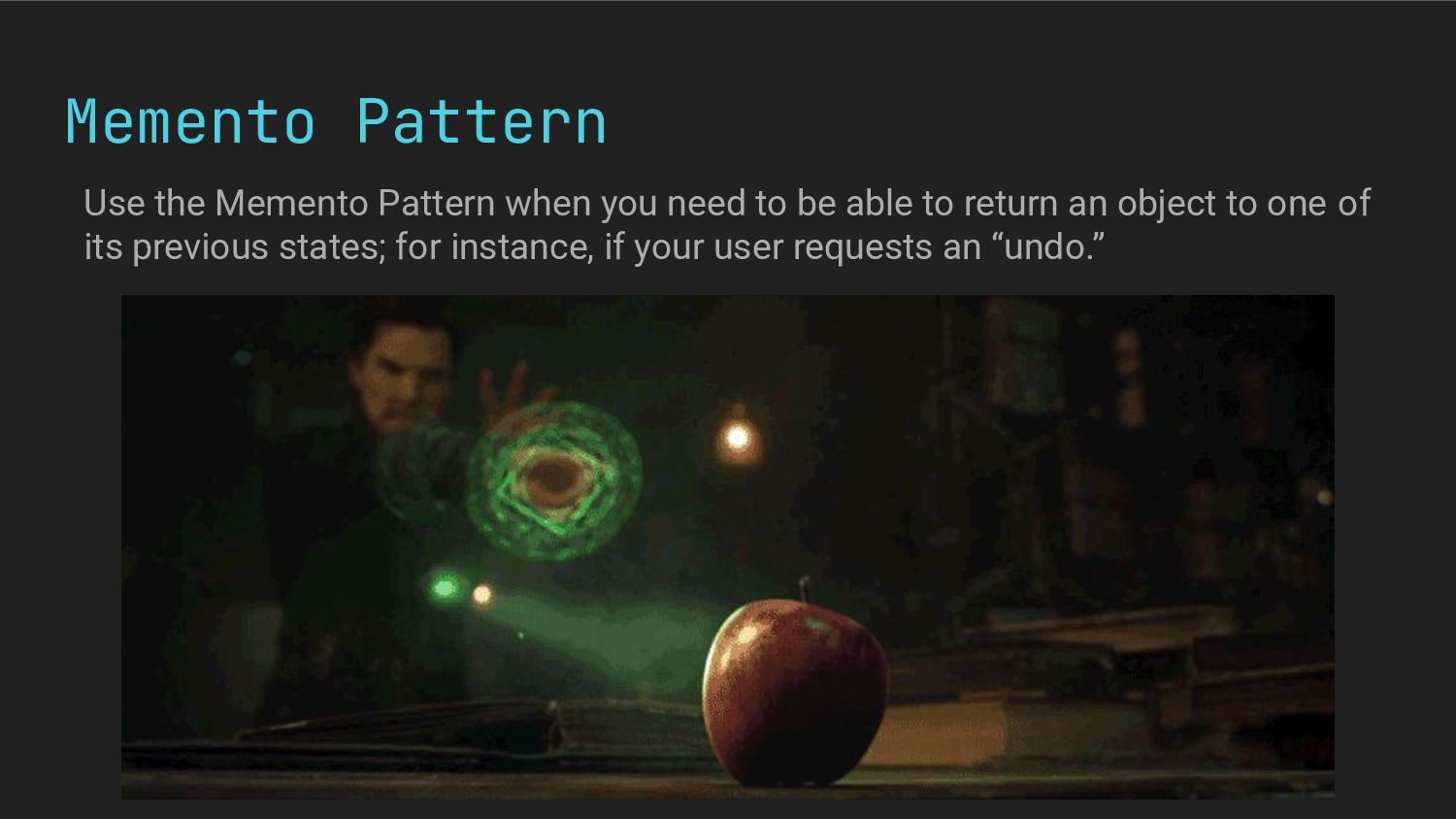
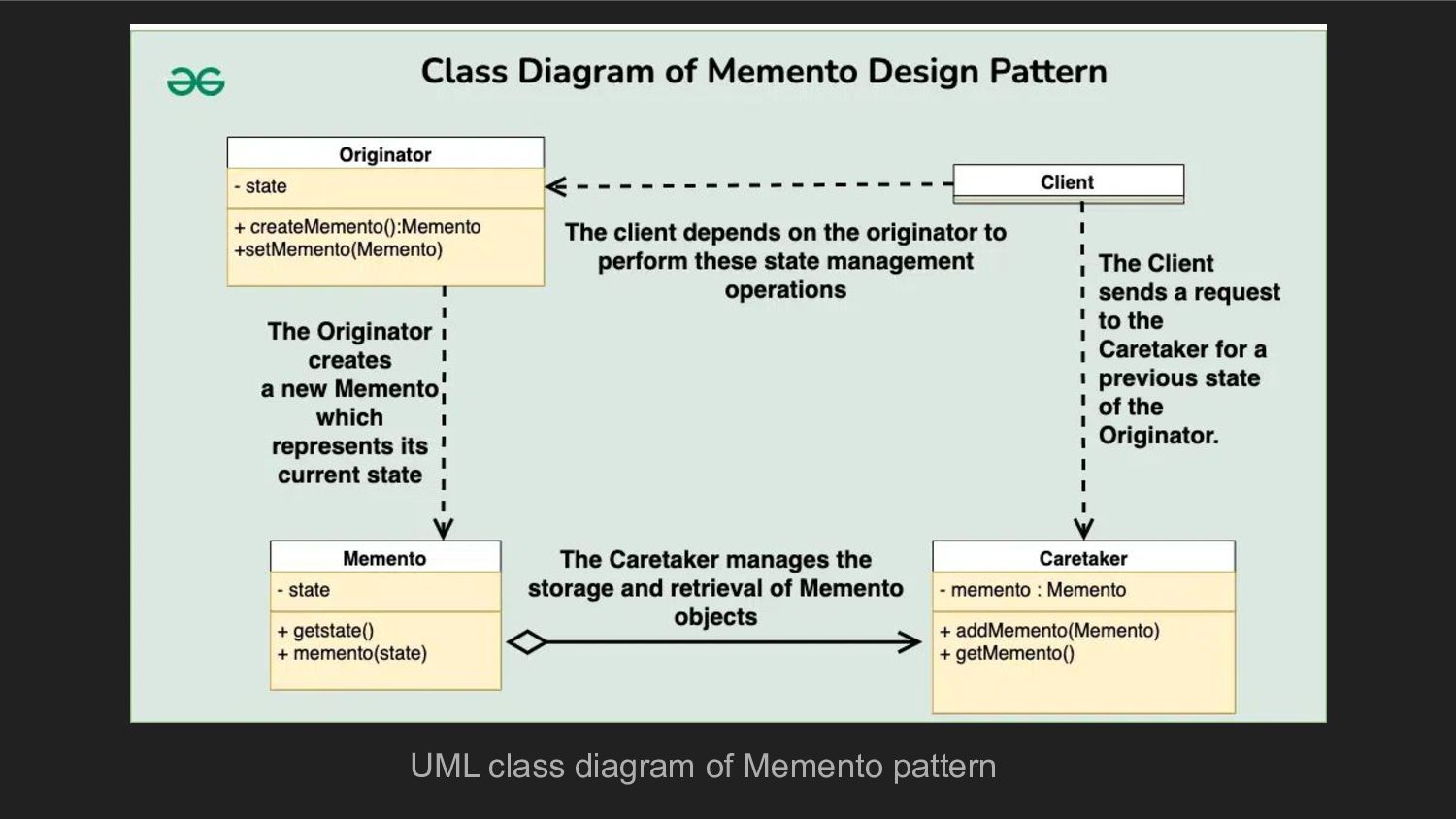
Memento Pattern Use the Memento Pattern when you need to
be able to return an object to one of its previous states; for instance, if your user requests an “undo.”
UML class diagram of Memento pattern
Design Principle Identify the aspects of your application that vary
and separate them from what stays the same.
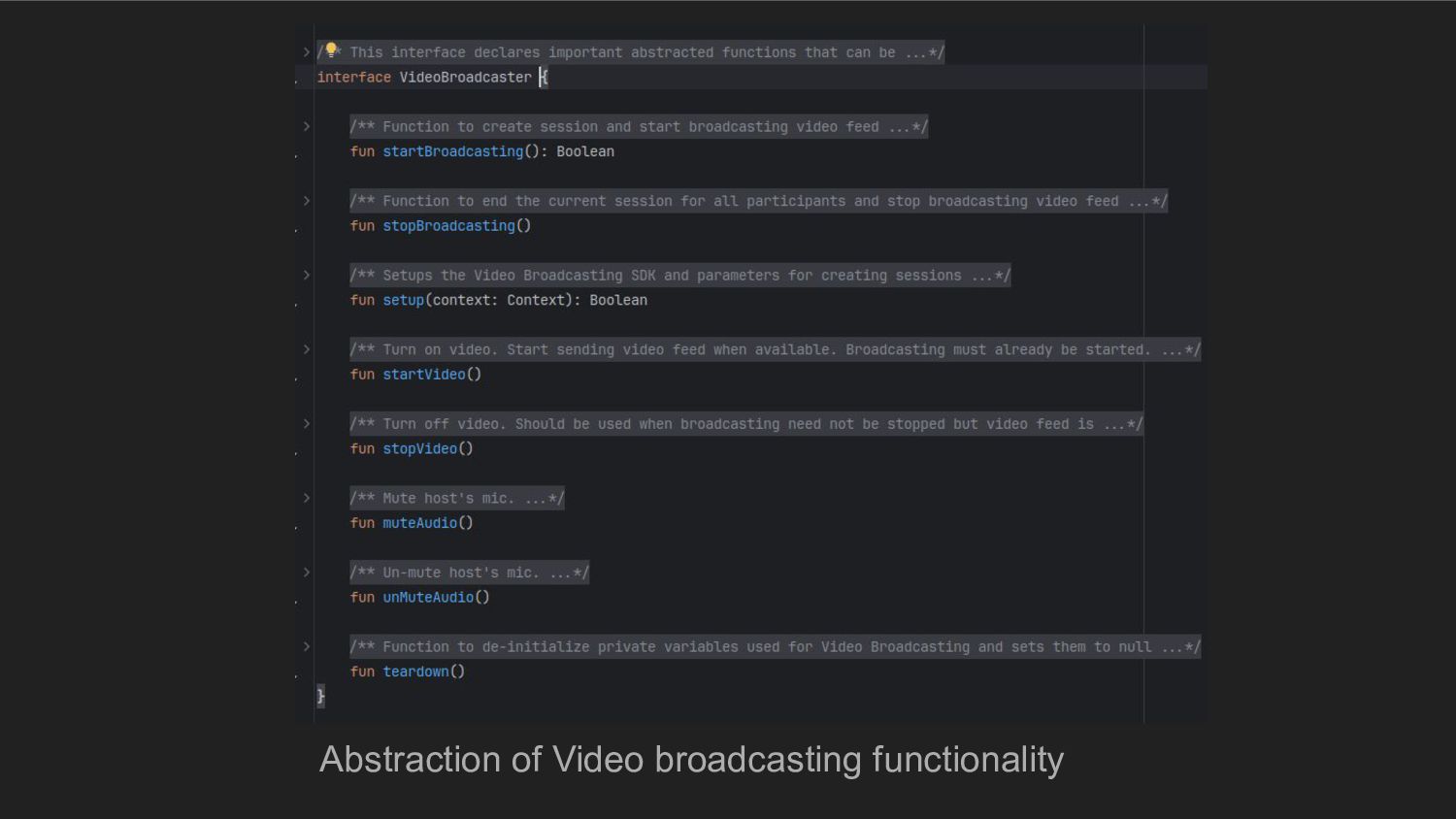
Abstraction of Video broadcasting functionality
Design Principle Program to an interface, not an implementation.
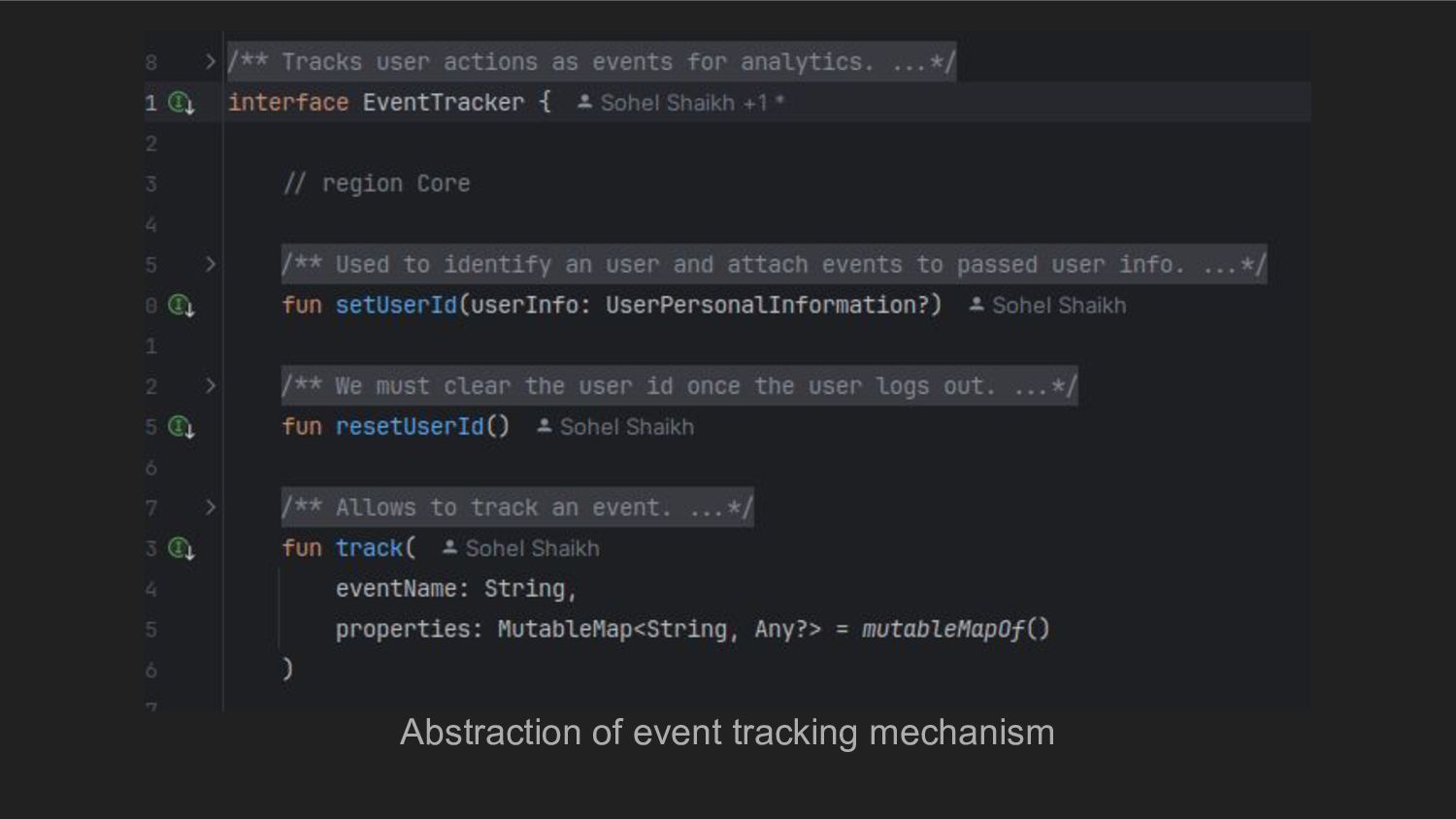
Abstraction of event tracking mechanism
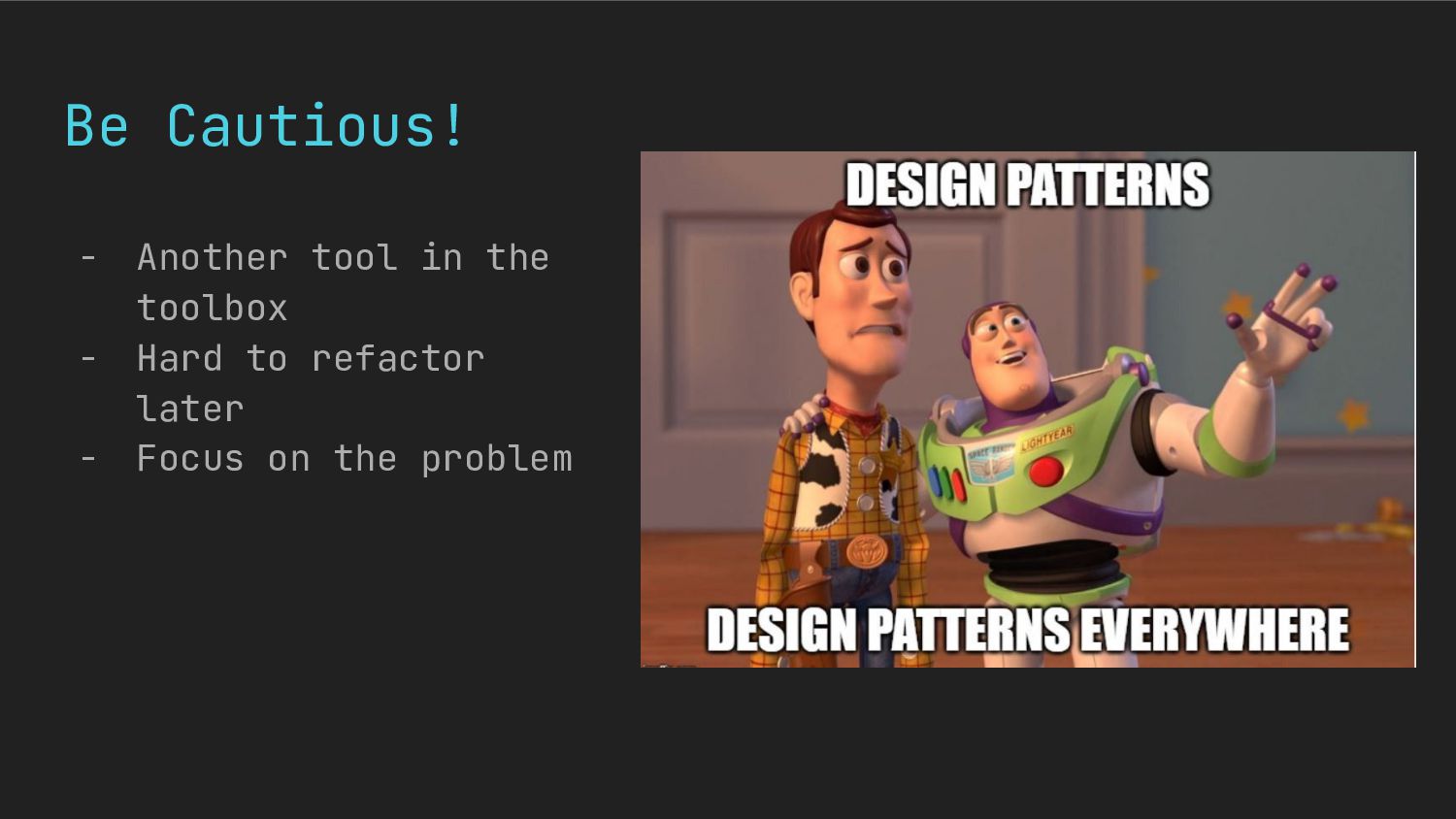
Be Cautious! - Another tool in the toolbox - Hard
to refactor later - Focus on the problem
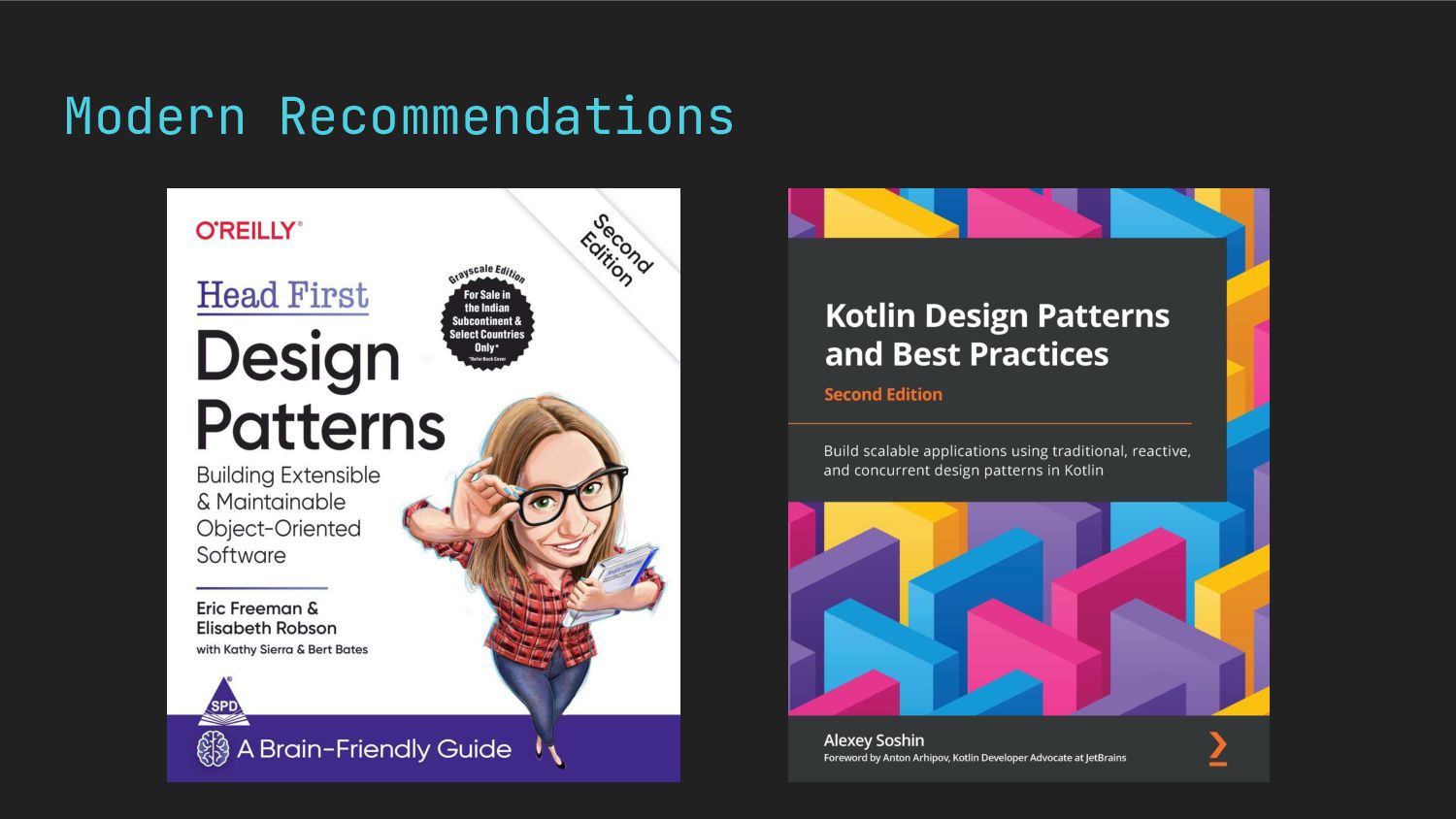
Modern Recommendations
Unlocking the economic potential of the skies We’re Hiring! Skylark
Drones
What are your questions? Too shy? Ping me @thesohelshaikh
Thank you!


 thesohelshaikh
 ianozsvald
 sergeychernyshev
 wayneb77
 csswizardry
 trishagee
 lcolladotor
 aleyda
 addyosmani
 ipullrank
 akihiro_kokubo
 keavy
keavy
 tammyeverts