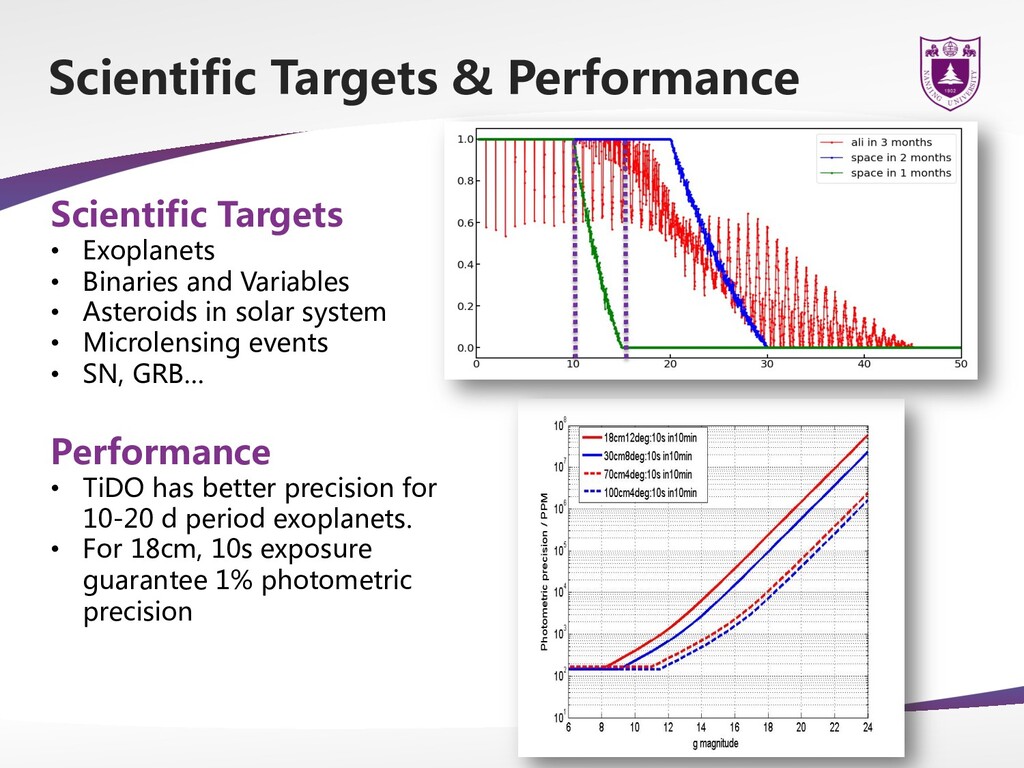
for 10-20 d period exoplanets. • For 18cm, 10s exposure guarantee 1% photometric precision Scientific Targets • Exoplanets • Binaries and Variables • Asteroids in solar system • Microlensing events • SN, GRB…
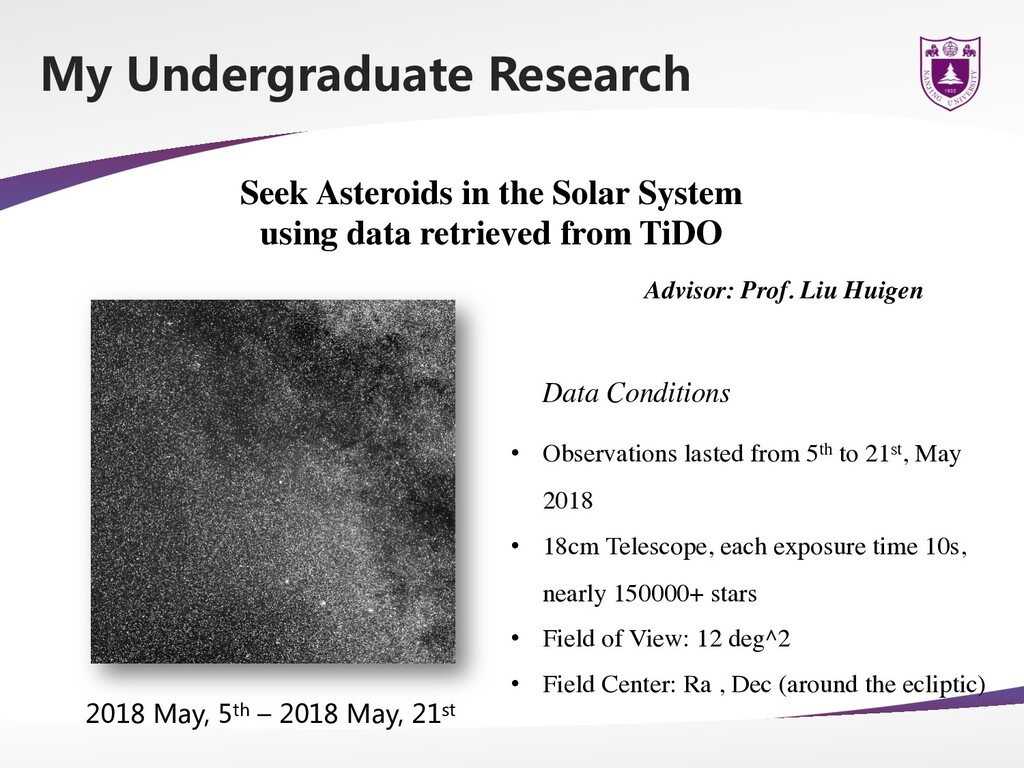
data retrieved from TiDO Advisor: Prof. Liu Huigen Data Conditions • Observations lasted from 5th to 21st, May 2018 • 18cm Telescope, each exposure time 10s, nearly 150000+ stars • Field of View: 12 deg^2 • Field Center: Ra , Dec (around the ecliptic) 2018 May, 5th – 2018 May, 21st
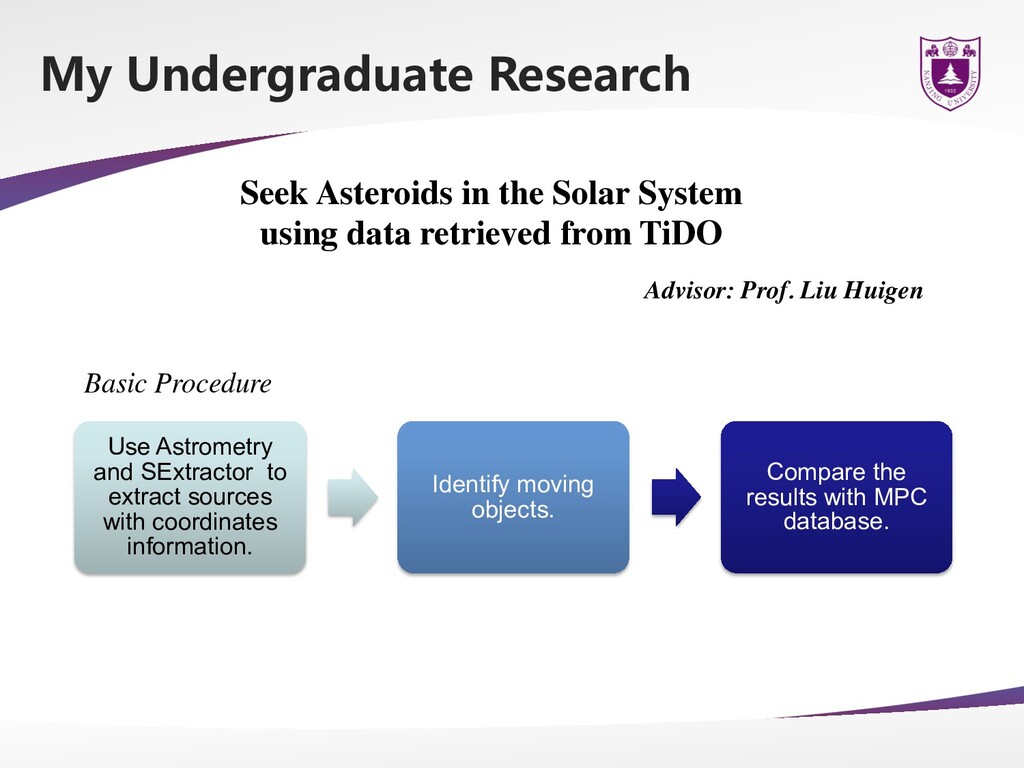
data retrieved from TiDO Advisor: Prof. Liu Huigen Basic Procedure Use Astrometry and SExtractor to extract sources with coordinates information. Identify moving objects. Compare the results with MPC database.
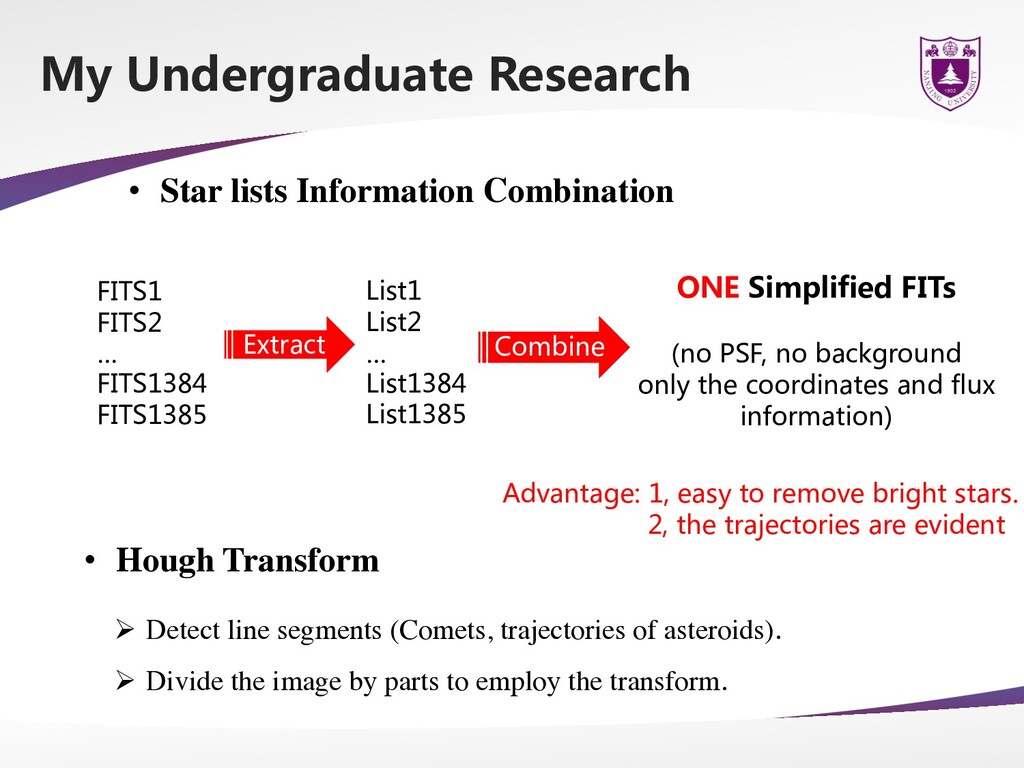
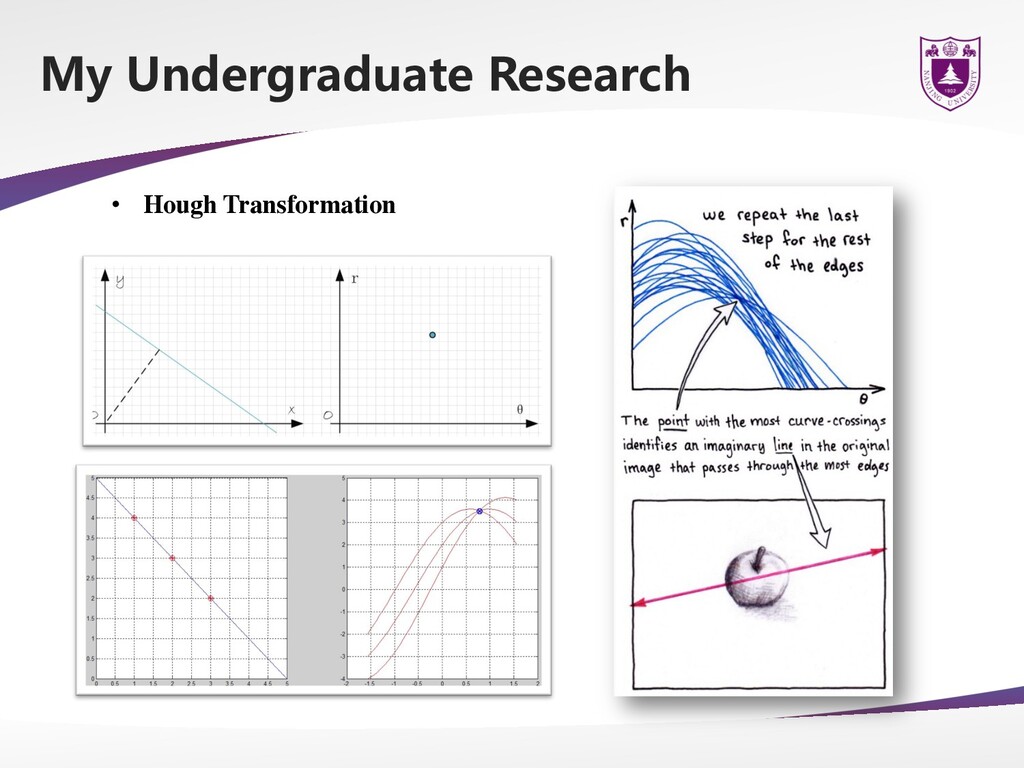
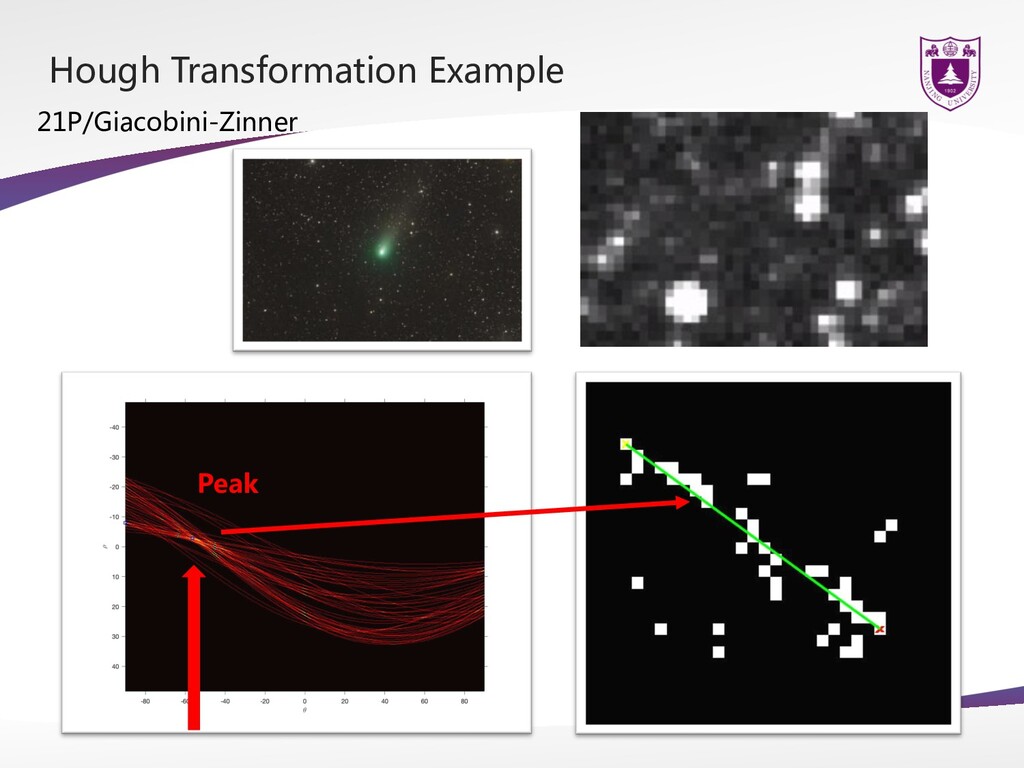
Transform Ø Detect line segments (Comets, trajectories of asteroids). Ø Divide the image by parts to employ the transform. List1 List2 … List1384 List1385 Combine ONE Simplified FITs (no PSF, no background only the coordinates and flux information) FITS1 FITS2 … FITS1384 FITS1385 Extract Advantage: 1, easy to remove bright stars. 2, the trajectories are evident
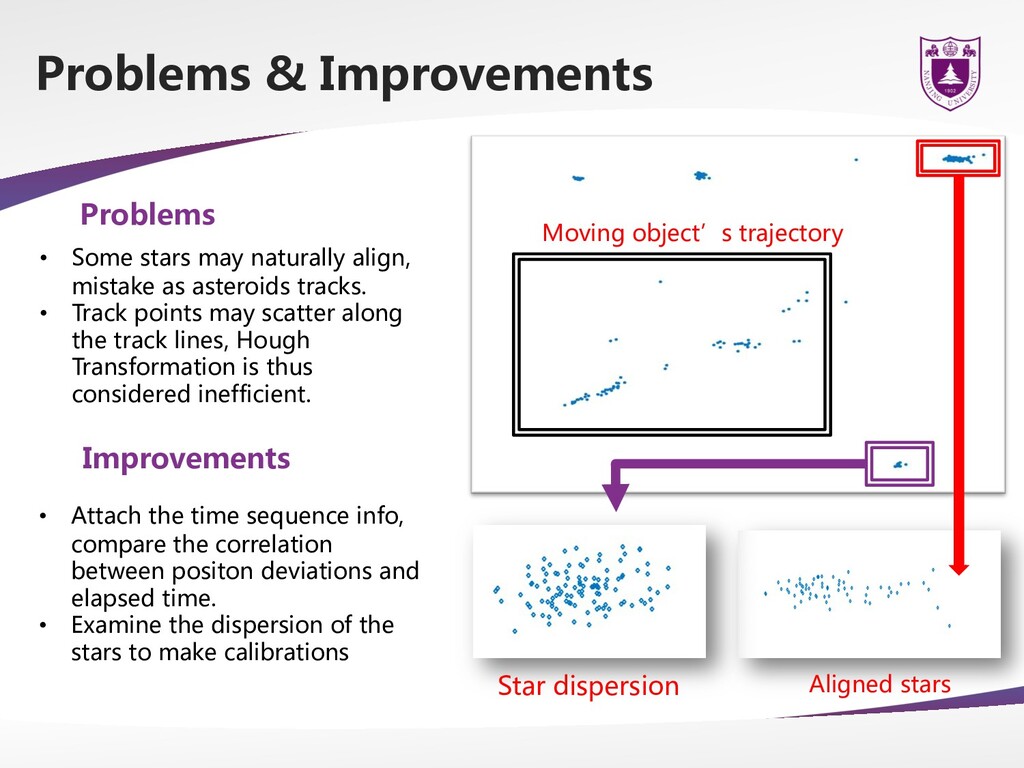
as asteroids tracks. • Track points may scatter along the track lines, Hough Transformation is thus considered inefficient. • Attach the time sequence info, compare the correlation between positon deviations and elapsed time. • Examine the dispersion of the stars to make calibrations Problems Improvements Aligned stars Moving object’s trajectory Star dispersion
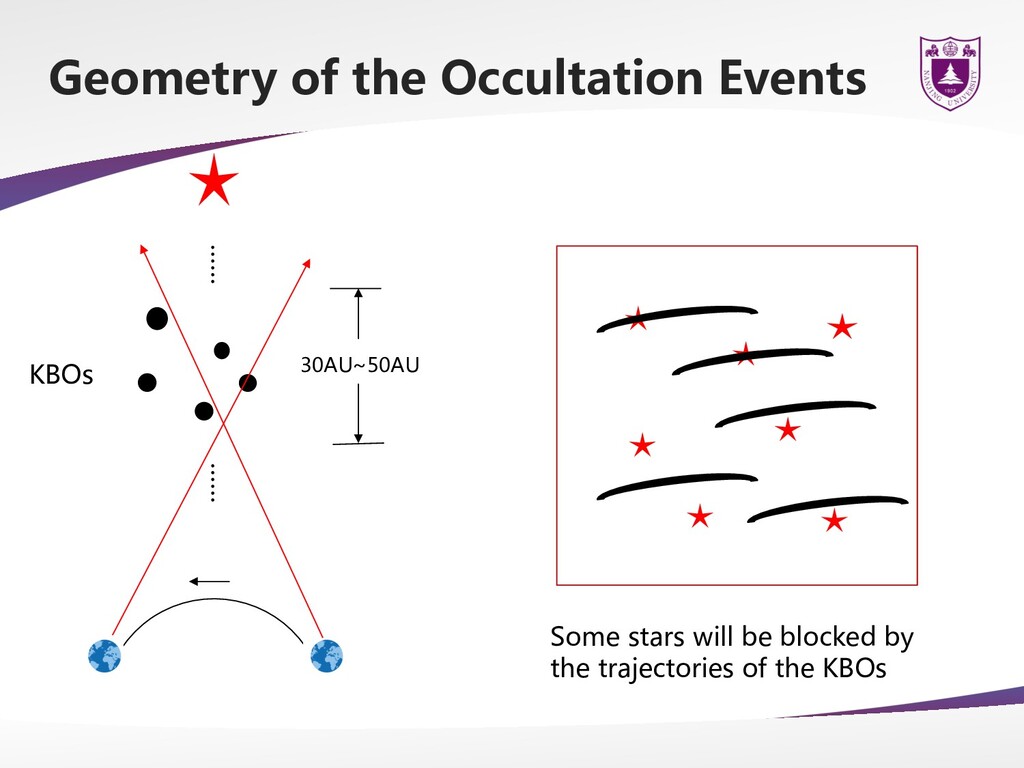
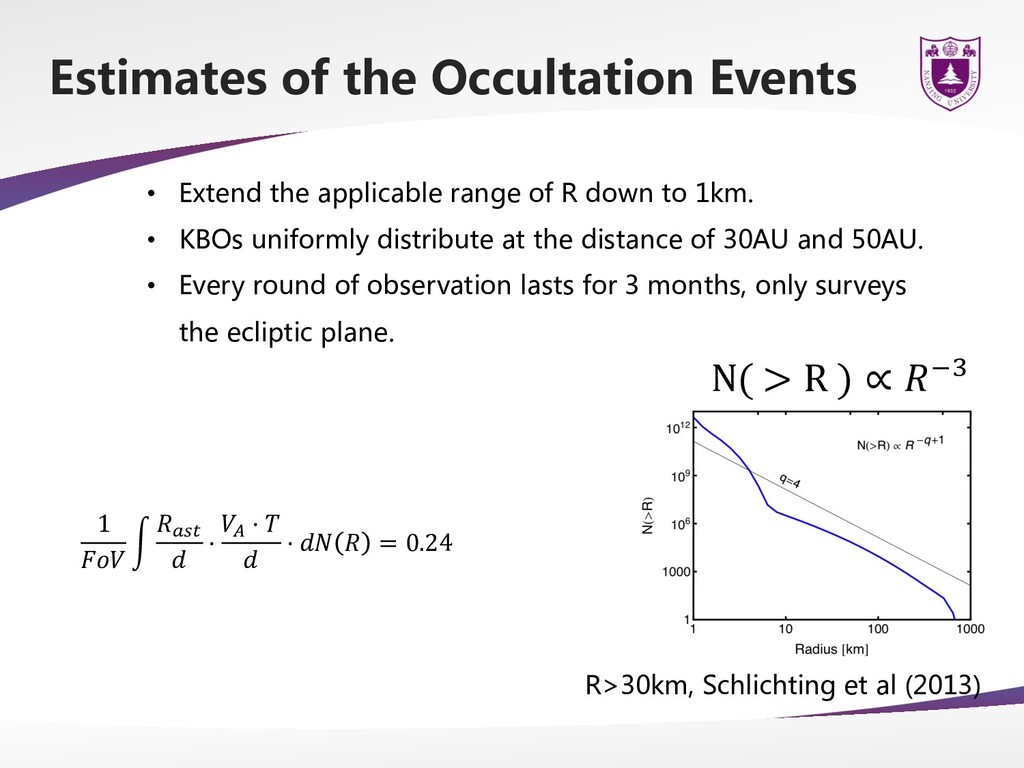
of R down to 1km. • KBOs uniformly distribute at the distance of 30AU and 50AU. • Every round of observation lasts for 3 months, only surveys the ecliptic plane. 1 𝐹𝑜𝑉 6 𝑅&)% 𝑑 · 𝑉1 · 𝑇 𝑑 · 𝑑𝑁 𝑅 = 0.24 N( > R ) ∝ 𝑅!" R>30km, Schlichting et al (2013)
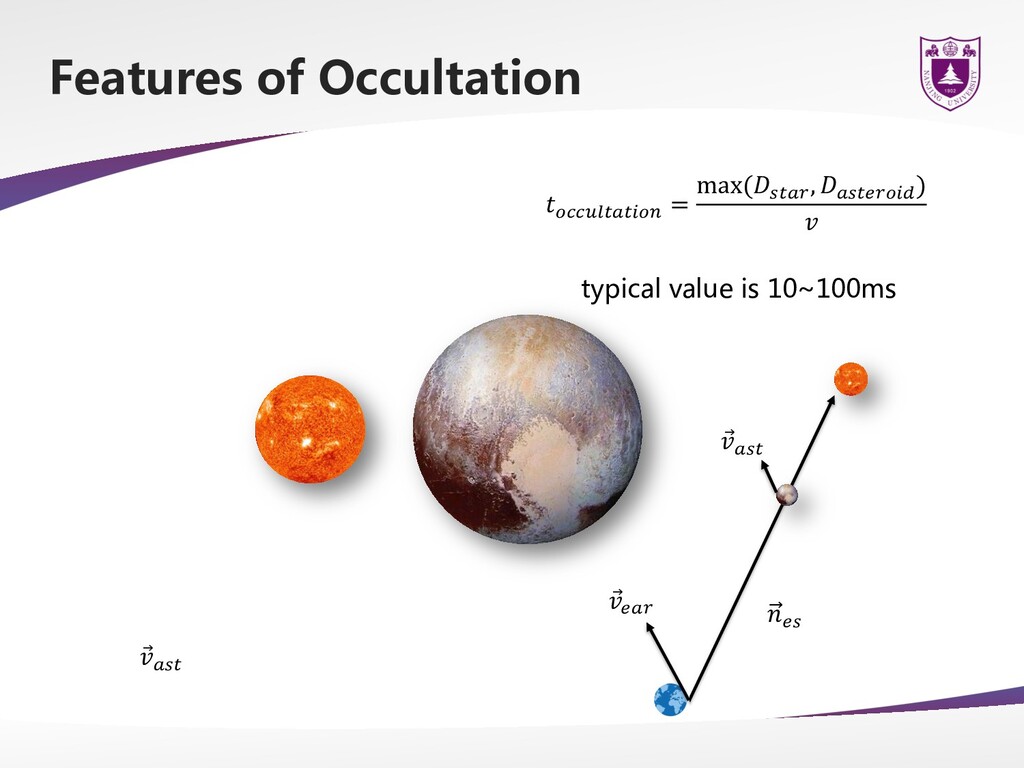
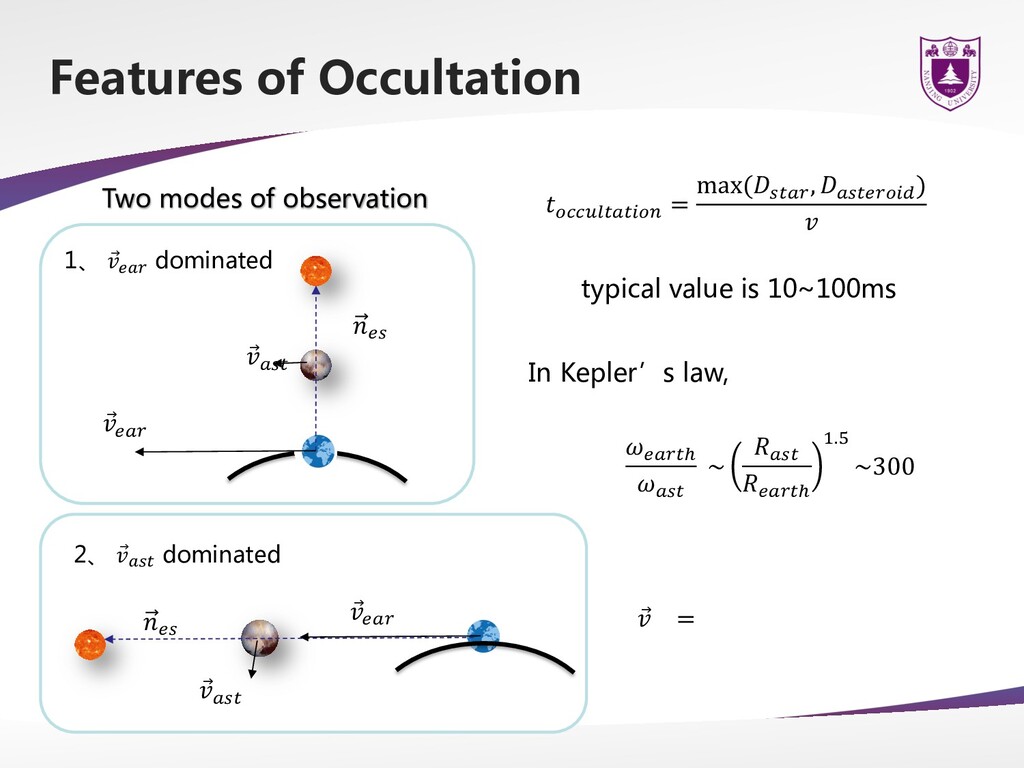
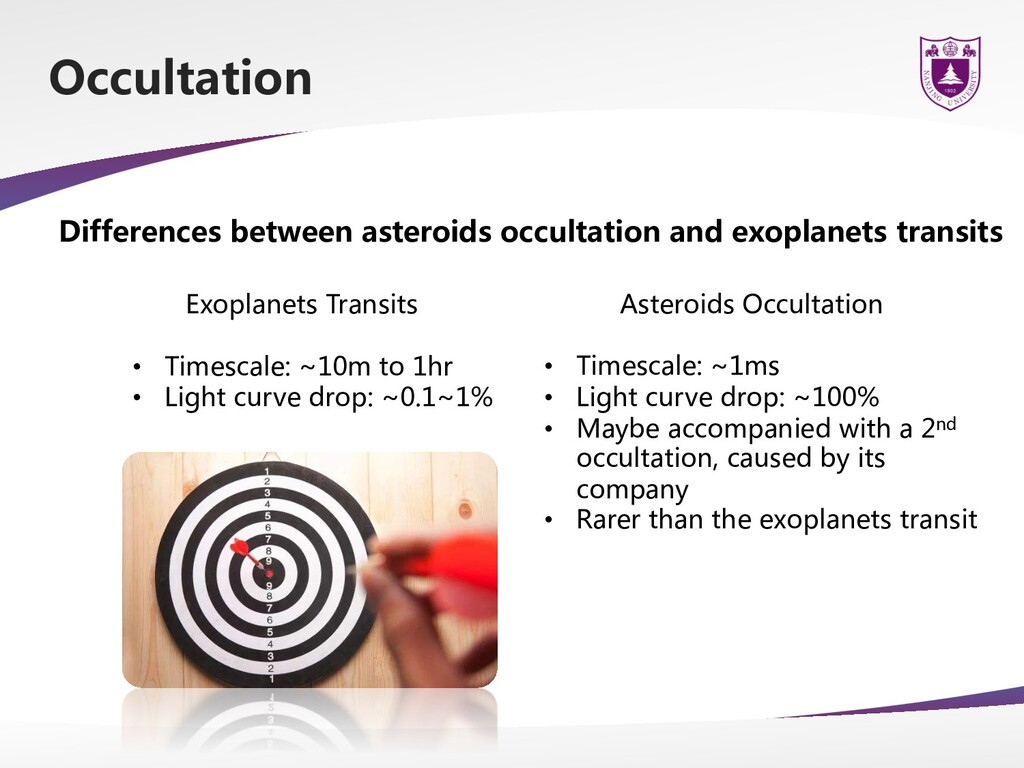
Exoplanets Transits • Timescale: ~1ms • Light curve drop: ~100% • Maybe accompanied with a 2nd occultation, caused by its company • Rarer than the exoplanets transit • Timescale: ~10m to 1hr • Light curve drop: ~0.1~1%
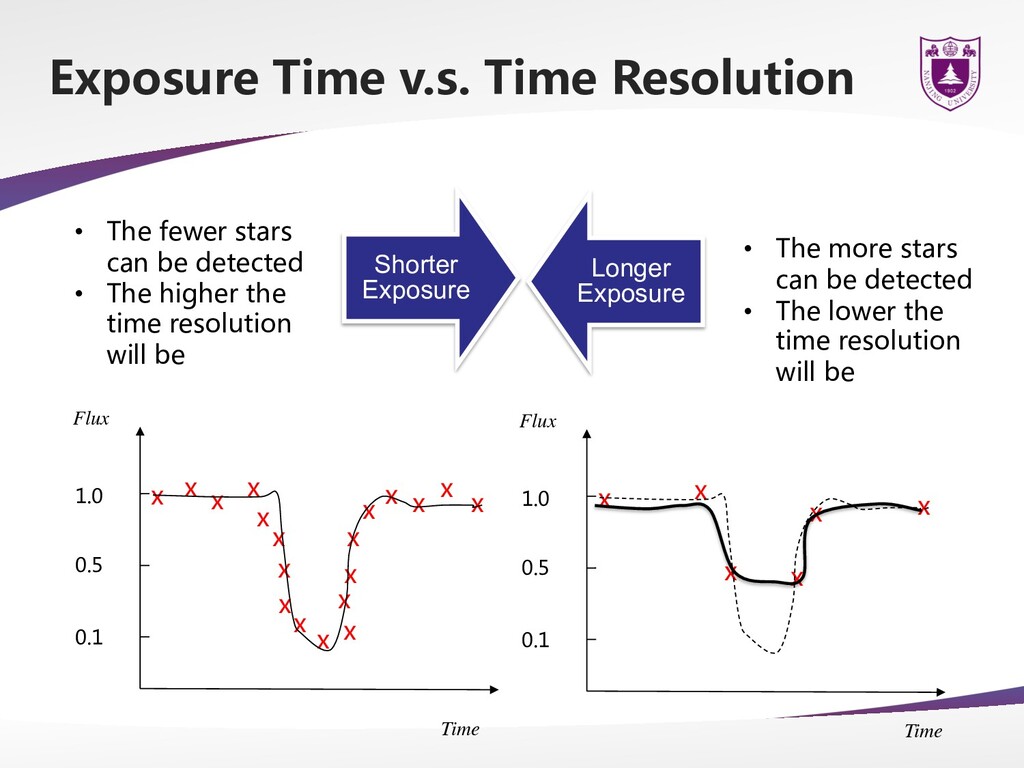
x x x x x x x x x x x x x x x x x x x Flux 1.0 0.5 0.1 x x x x x x Time Shorter Exposure Longer Exposure • The more stars can be detected • The lower the time resolution will be • The fewer stars can be detected • The higher the time resolution will be
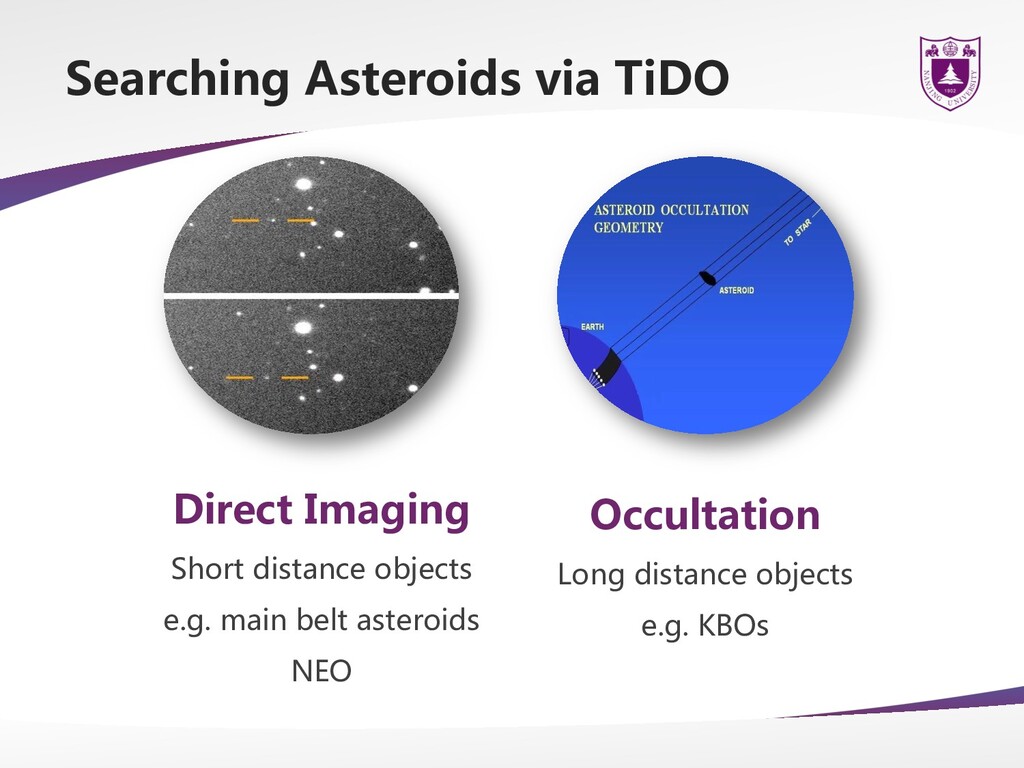
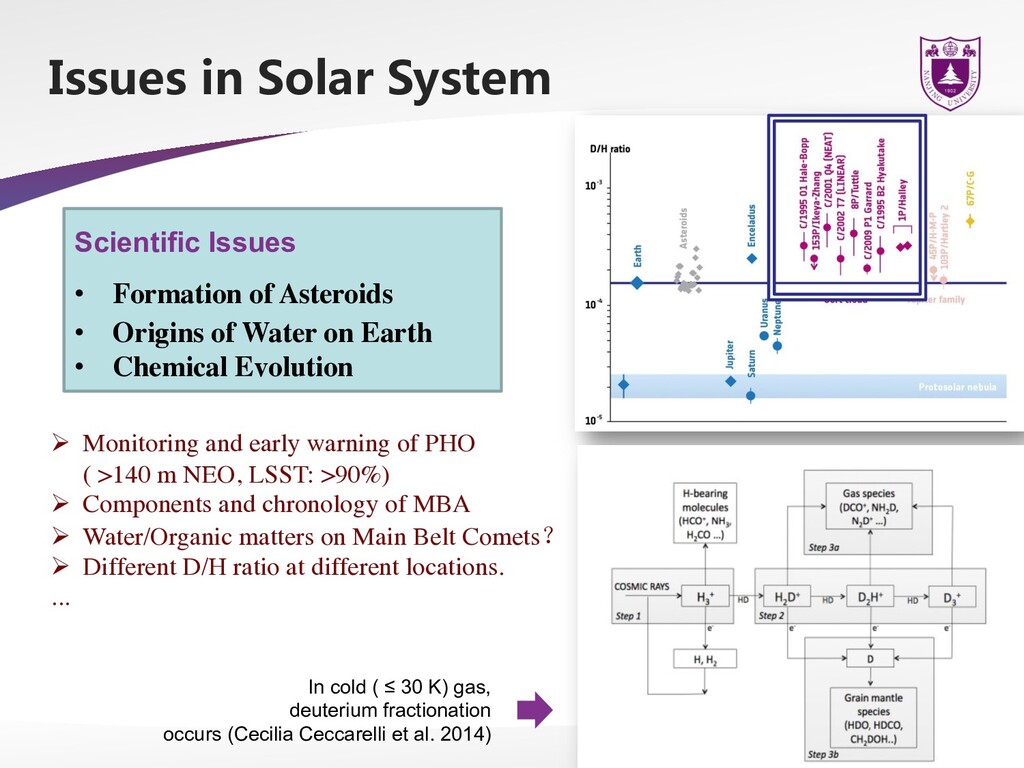
PHO ( >140 m NEO, LSST: >90%) Ø Components and chronology of MBA Ø Water/Organic matters on Main Belt Comets? Ø Different D/H ratio at different locations. ... In cold ( ≤ 30 K) gas, deuterium fractionation occurs (Cecilia Ceccarelli et al. 2014) Scientific Issues • Formation of Asteroids • Origins of Water on Earth • Chemical Evolution
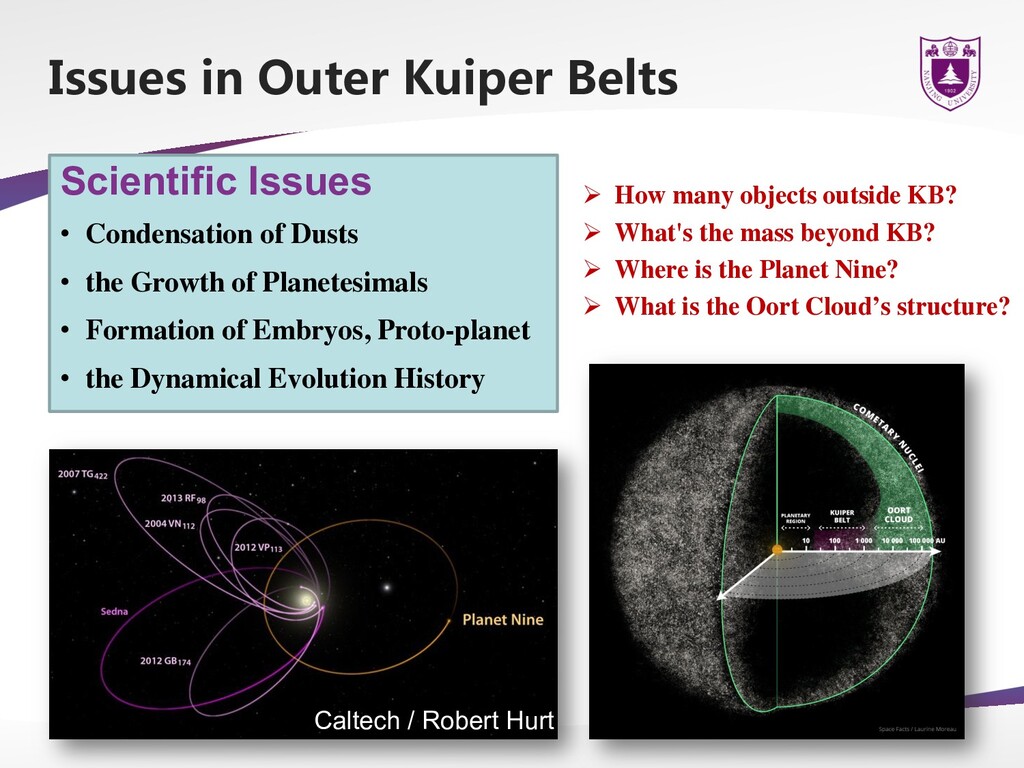
KB? Ø What's the mass beyond KB? Ø Where is the Planet Nine? Ø What is the Oort Cloud’s structure? Scientific Issues • Condensation of Dusts • the Growth of Planetesimals • Formation of Embryos, Proto-planet • the Dynamical Evolution History Caltech / Robert Hurt
targets, such as exoplanets and asteroids detection. • I developed a detection algorithms of moving objects for TiDO (and still working on it), including identification part and possible optimizing • TiDO will also detect occultation events in the future. Estimate of such events is . • The design of observation mode for occultation is under way. • Many issues related to asteroids in Solar Systems and outer Kuiper Belts need to be addressed, missions are expected.


 tienwang
 csswizardry
 inesmontani
 codingconduct
 apolaine
 techseoconnect
 greggifford
 katarinadahlin
 reverentgeek
 tenderlove
 eileencodes
 mlcsv