Upgrade to Pro — share decks privately, control downloads, hide ads and more …

Identifying the chromatic transit depth of fals...

Avatar for Mutian Wang Mutian Wang
December 31, 2020
150

Identifying the chromatic transit depth of false positives via multicolor photometry

An invited talk for Earth 2.0 System Meeting on Dec. 31st, 2020

Avatar for Mutian Wang

Mutian Wang

December 31, 2020

Transcript

  1. Identifying the chromatic transit depth of false positives via multicolor

    photometry MutianWang (王牧天) [email protected] Research Assistant at Nanjing University Dec. 31
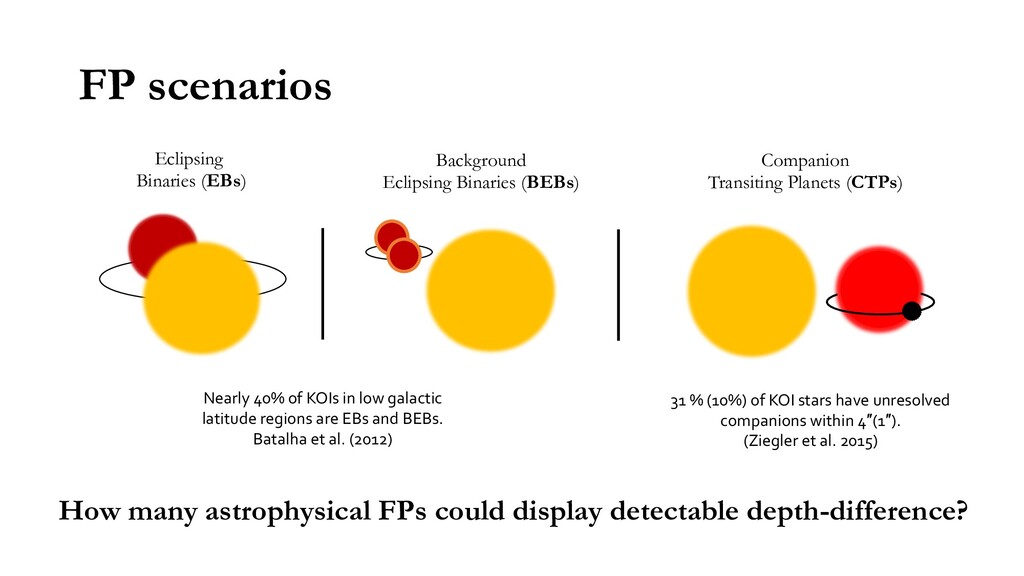
  2. FP scenarios Eclipsing Binaries (EBs) Background Eclipsing Binaries (BEBs) Companion

    Transiting Planets (CTPs) How many astrophysical FPs could display detectable depth-difference? 31 % (10%) of KOI stars have unresolved companions within 4 ″ (1 ″ ). (Ziegler et al. 2015) Nearly 40% of KOIs in low galactic latitude regions are EBs and BEBs. Batalha et al. (2012)
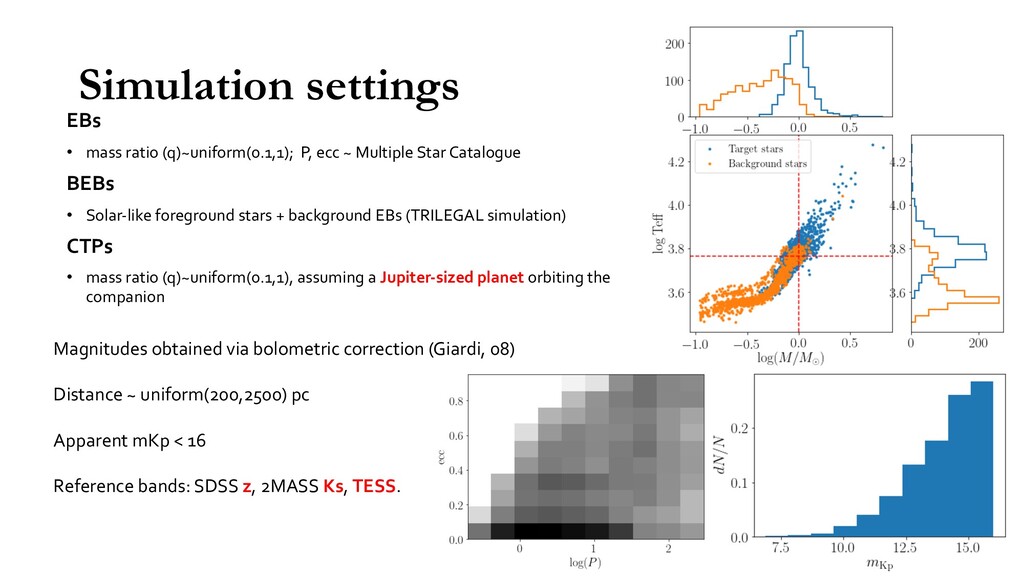
  3. Simulation settings EBs • mass ratio (q)~uniform(0.1,1); P, ecc ~

    Multiple Star Catalogue BEBs • Solar-like foreground stars + background EBs (TRILEGAL simulation) CTPs • mass ratio (q)~uniform(0.1,1), assuming a Jupiter-sized planet orbiting the companion Magnitudes obtained via bolometric correction (Giardi, 08) Distance ~ uniform(200,2500) pc Apparent mKp < 16 Reference bands: SDSS z, 2MASS Ks, TESS.
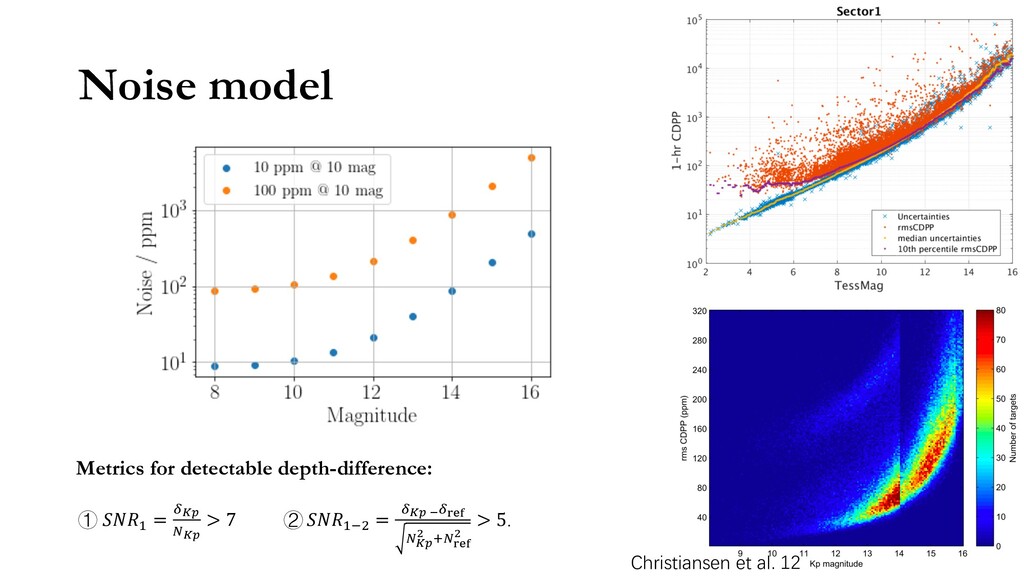
  4. Noise model ① !"#! = "!" #!" > 7 ②

    !"#!$% = "!" #"$%& #!" ' &#$%& ' > 5. Metrics for detectable depth-difference: Christiansen et al. 12
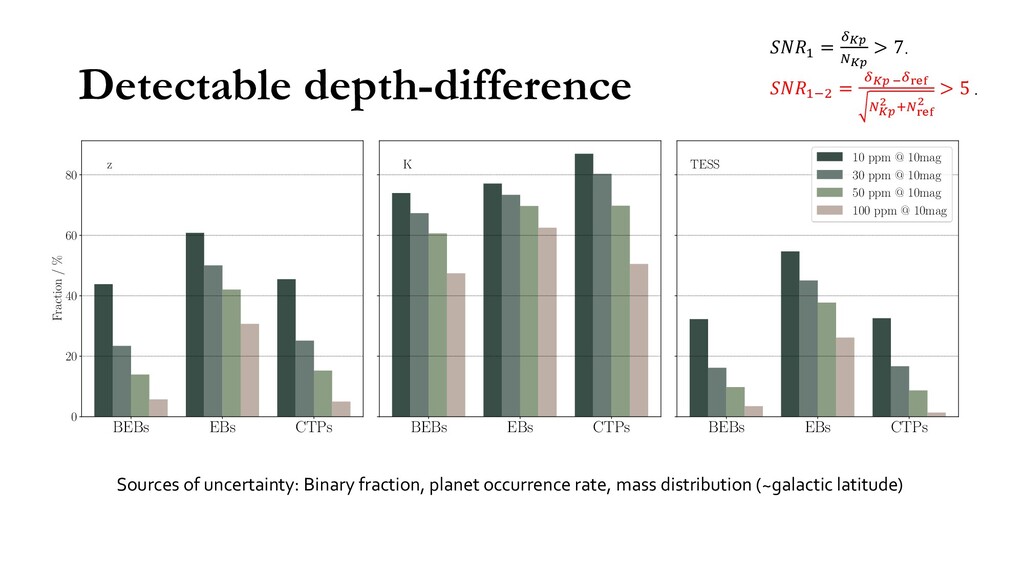
  5. Detectable depth-difference BEBs EBs CTPs 0 20 40 60 80

    z BEBs EBs CTPs K BEBs EBs CTPs TESS 10 ppm @ 10mag 30 ppm @ 10mag 50 ppm @ 10mag 100 ppm @ 10mag Fraction / % Sources of uncertainty: Binary fraction, planet occurrence rate, mass distribution (~galactic latitude) !"#! = "!" #!" > 7. !"#!$% = "!" #"$%& #!" ' &#$%& ' > 5 .
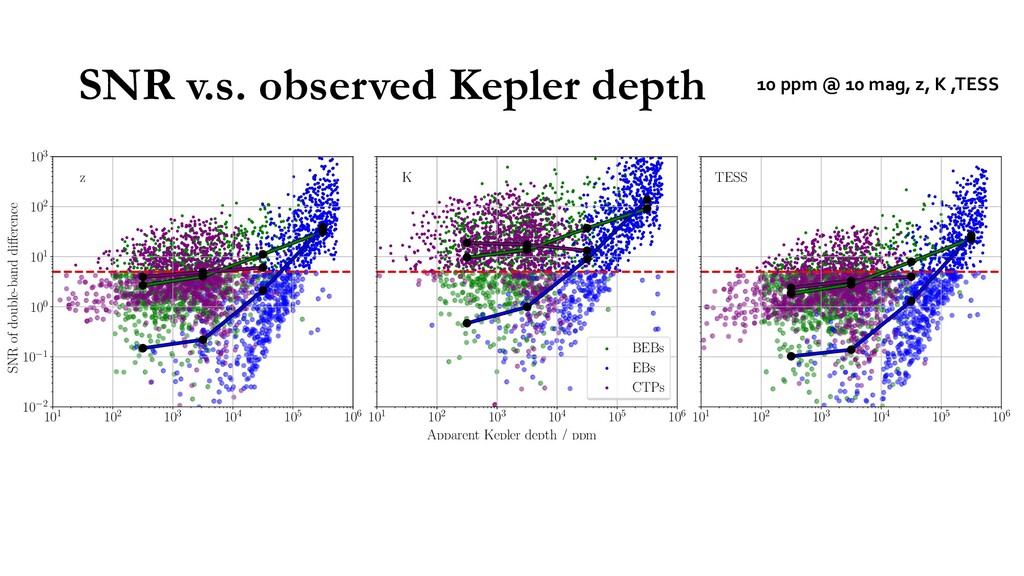
  6. SNR v.s. observed Kepler depth 101 102 103 104 105

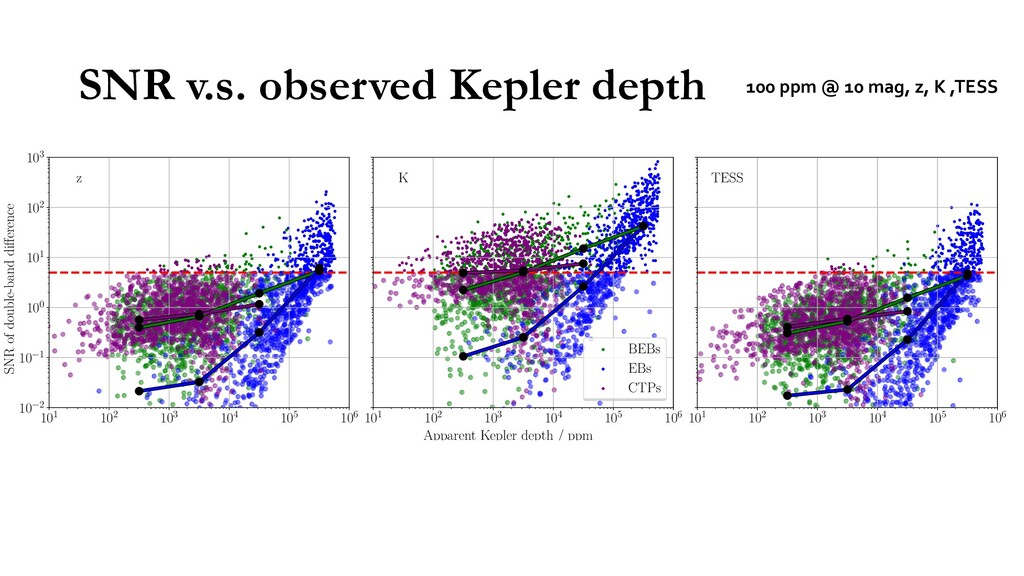
    106 10°2 10°1 100 101 102 103 z 101 102 103 104 105 106 K BEBs EBs CTPs 101 102 103 104 105 106 TESS Apparent Kepler depth / ppm SNR of double-band diÆerence 10 ppm @ 10 mag, z, K ,TESS
  7. 101 102 103 104 105 106 10°2 10°1 100 101

    102 103 z 101 102 103 104 105 106 K BEBs EBs CTPs 101 102 103 104 105 106 TESS Apparent Kepler depth / ppm SNR of double-band diÆerence 100 ppm @ 10 mag, z, K ,TESS SNR v.s. observed Kepler depth
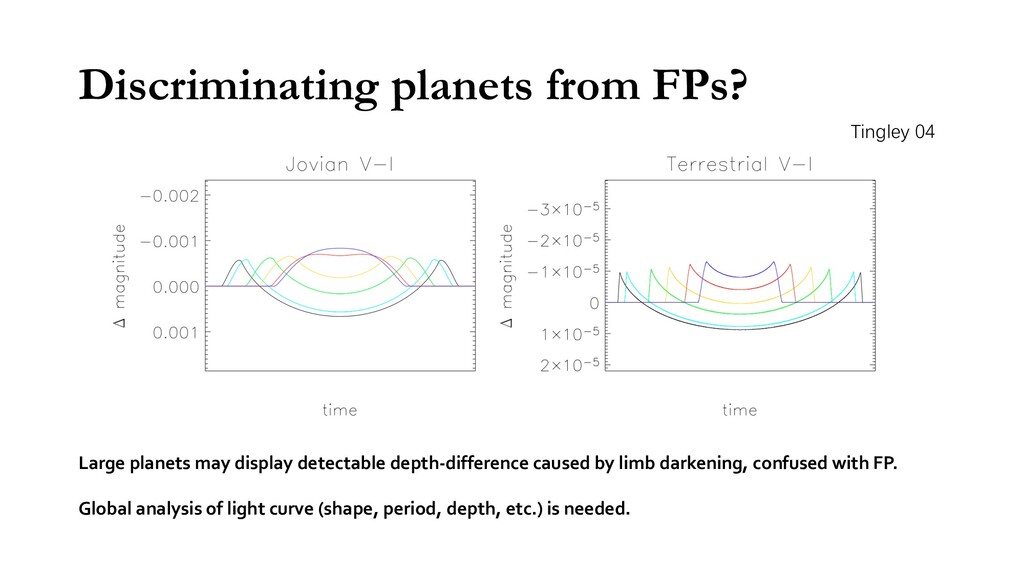
  8. Discriminating planets from FPs? Large planets may display detectable depth-difference

    caused by limb darkening, confused with FP. Global analysis of light curve (shape, period, depth, etc.) is needed. Tingley 04
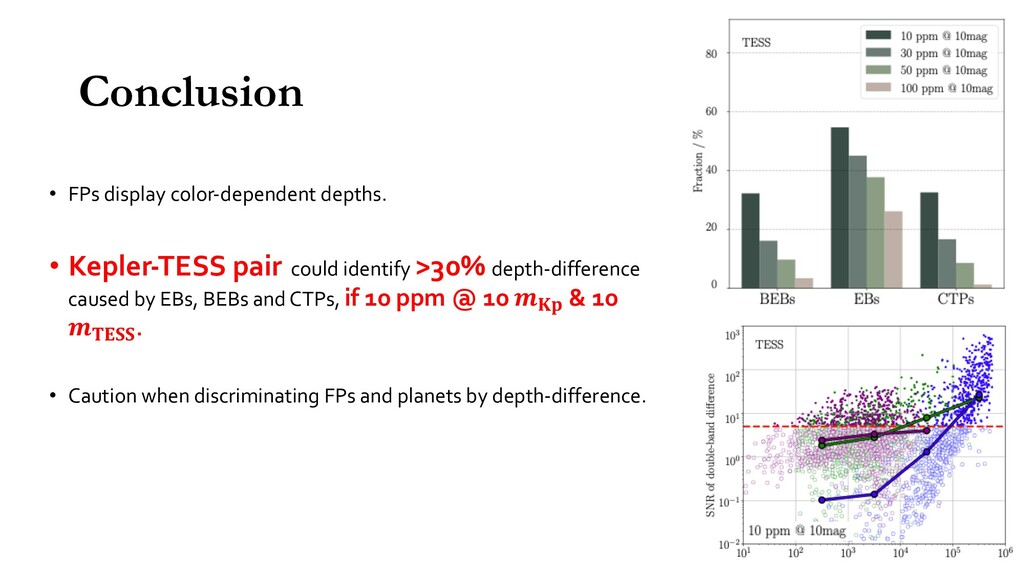
  9. Conclusion • FPs display color-dependent depths. • Kepler-TESS pair could

    identify >30% depth-difference caused by EBs, BEBs and CTPs, if 10 ppm @ 10 !() & 10 !*+,,. • Caution when discriminating FPs and planets by depth-difference.