Upgrade to Pro — share decks privately, control downloads, hide ads and more …

On the Light Echo Method to Find Planets in Hab...

Sponsored · Your Podcast. Everywhere. Effortlessly. Share. Educate. Inspire. Entertain. You do you. We'll handle the rest. →
Avatar for Mutian Wang Mutian Wang
December 13, 2020
34

On the Light Echo Method to Find Planets in Habitable Zone

A poster presentation for SPIE Astronomical Telescopes + Instrumentation on Dec. 13th, 2020

Avatar for Mutian Wang

Mutian Wang

December 13, 2020

Transcript

  1. Mutian Wang Nanjing University Supervisors: Peter Tuthill, Barnaby Norris the

    University of Sydney Finding exoplanets in habitable zone using light echoes
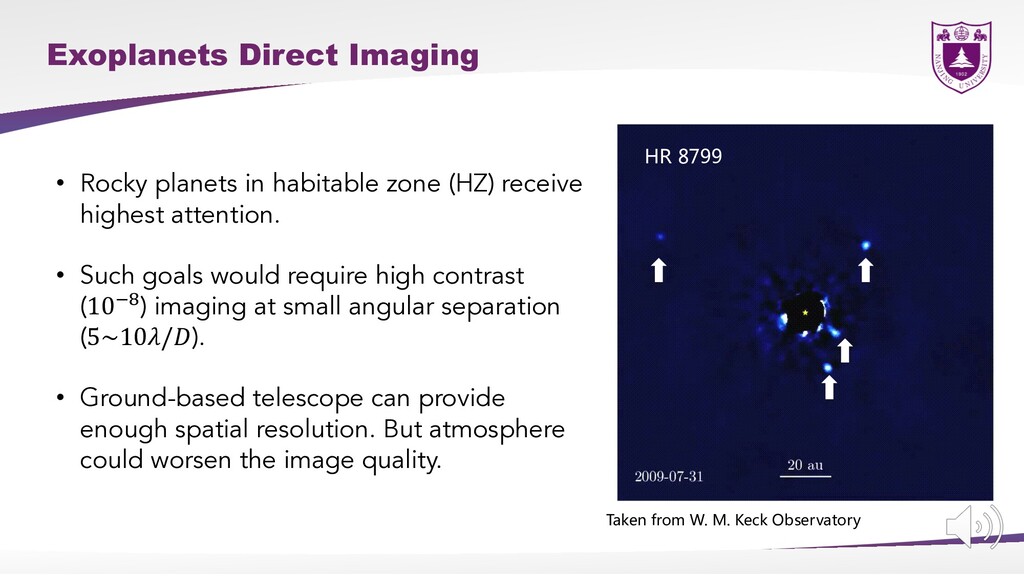
  2. Exoplanets Direct Imaging • Rocky planets in habitable zone (HZ)

    receive highest attention. • Such goals would require high contrast (10!") imaging at small angular separation (5~10𝜆/𝐷). • Ground-based telescope can provide enough spatial resolution. But atmosphere could worsen the image quality. Taken from W. M. Keck Observatory HR 8799
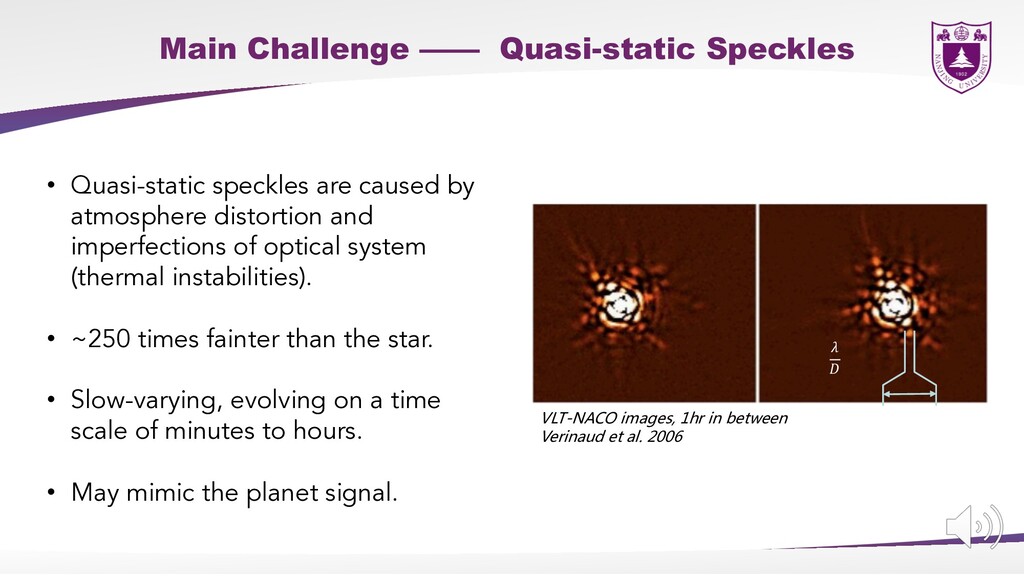
  3. Main Challenge —— Quasi-static Speckles • Quasi-static speckles are caused

    by atmosphere distortion and imperfections of optical system (thermal instabilities). • ~250 times fainter than the star. • Slow-varying, evolving on a time scale of minutes to hours. • May mimic the planet signal. VLT-NACO images, 1hr in between Verinaud et al. 2006 𝜆 𝐷
  4. What to do? ü Post processing methods to remove the

    speckles (ADI) * A characteristic of the planet that is different to the speckles Goal: distinguish the planets from the Quasi-static speckles
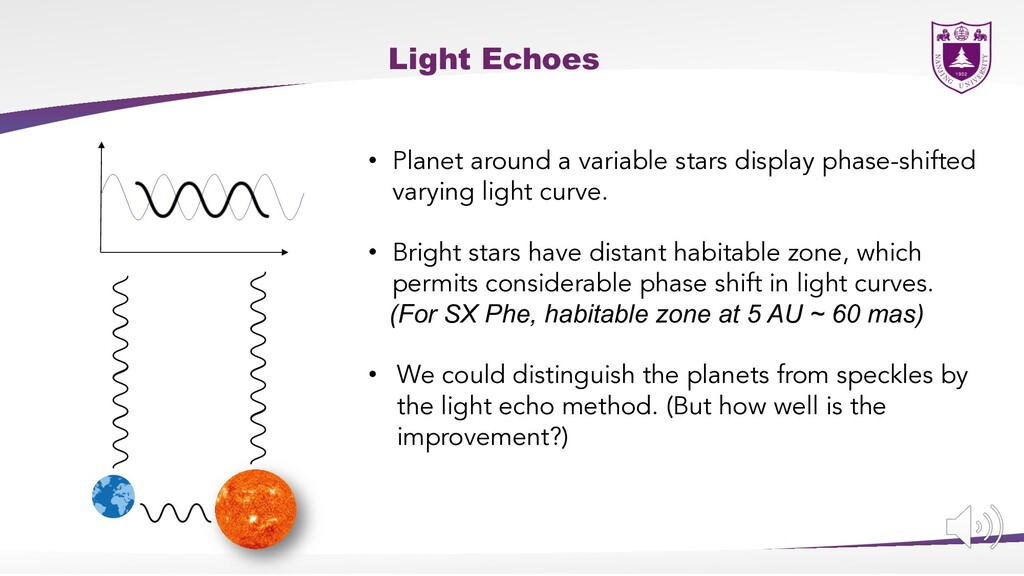
  5. Light Echoes Planet • Planet around a variable stars display

    phase-shifted varying light curve. • Bright stars have distant habitable zone, which permits considerable phase shift in light curves. (For SX Phe, habitable zone at 5 AU ~ 60 mas) • We could distinguish the planets from speckles by the light echo method. (But how well is the improvement?)
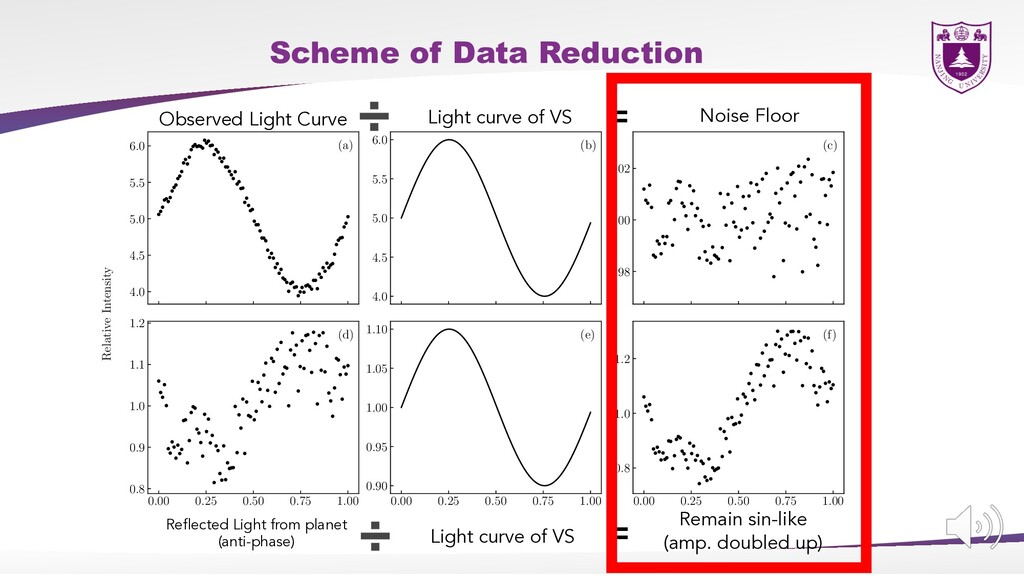
  6. 4.0 4.5 5.0 5.5 6.0 (a) 4.0 4.5 5.0 5.5

    6.0 (b) 0.98 1.00 1.02 (c) 0.00 0.25 0.50 0.75 1.00 0.8 0.9 1.0 1.1 1.2 (d) 0.00 0.25 0.50 0.75 1.00 0.90 0.95 1.00 1.05 1.10 (e) 0.00 0.25 0.50 0.75 1.00 0.8 1.0 1.2 (f) Light Curve Variation Phase Relative Intensity Scheme of Data Reduction Light curve of VS Observed Light Curve Noise Floor ➗ = Reflected Light from planet (anti-phase) Remain sin-like (amp. doubled up) ➗ = Light curve of VS
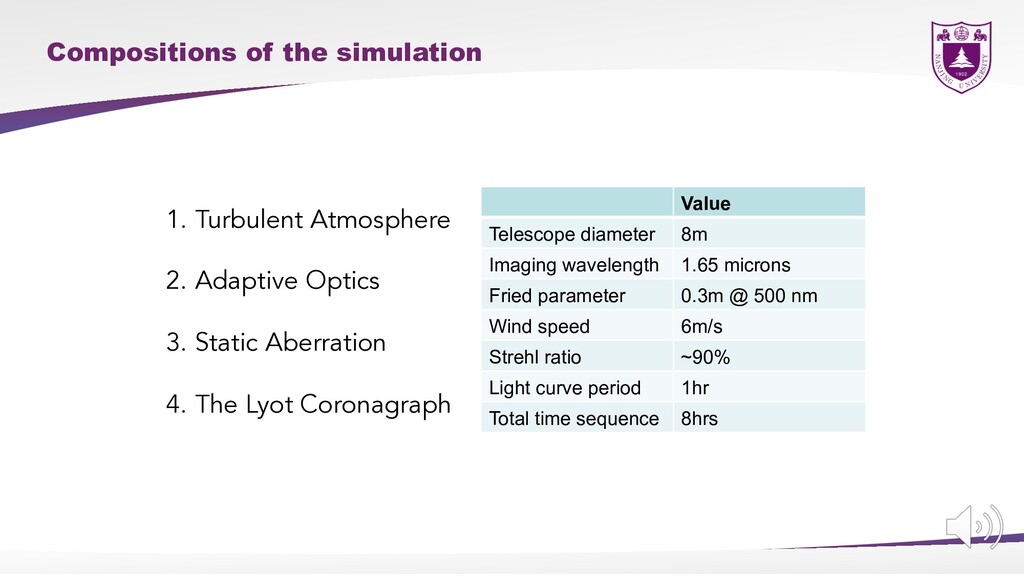
  7. Compositions of the simulation 1. Turbulent Atmosphere 2. Adaptive Optics

    3. Static Aberration 4. The Lyot Coronagraph Value Telescope diameter 8m Imaging wavelength 1.65 microns Fried parameter 0.3m @ 500 nm Wind speed 6m/s Strehl ratio ~90% Light curve period 1hr Total time sequence 8hrs
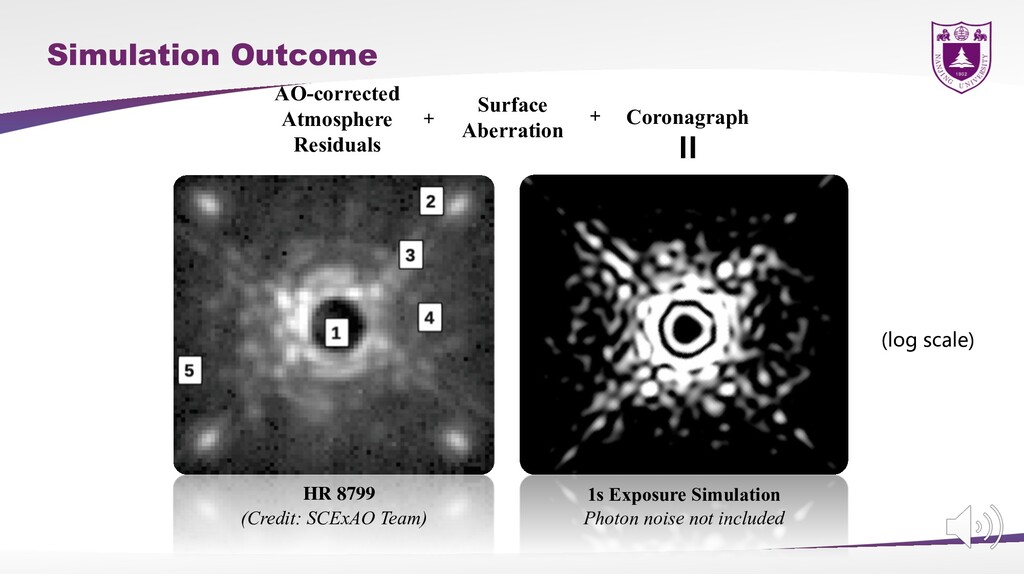
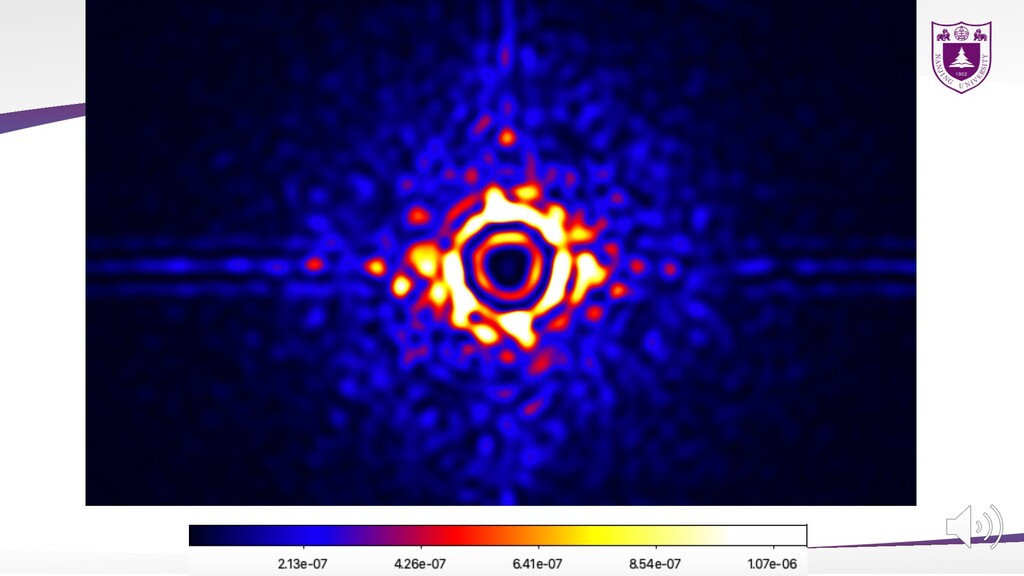
  8. Simulation Outcome Surface Aberration Coronagraph AO-corrected Atmosphere Residuals + +

    = 1s Exposure Simulation Photon noise not included HR 8799 (Credit: SCExAO Team) (log scale)
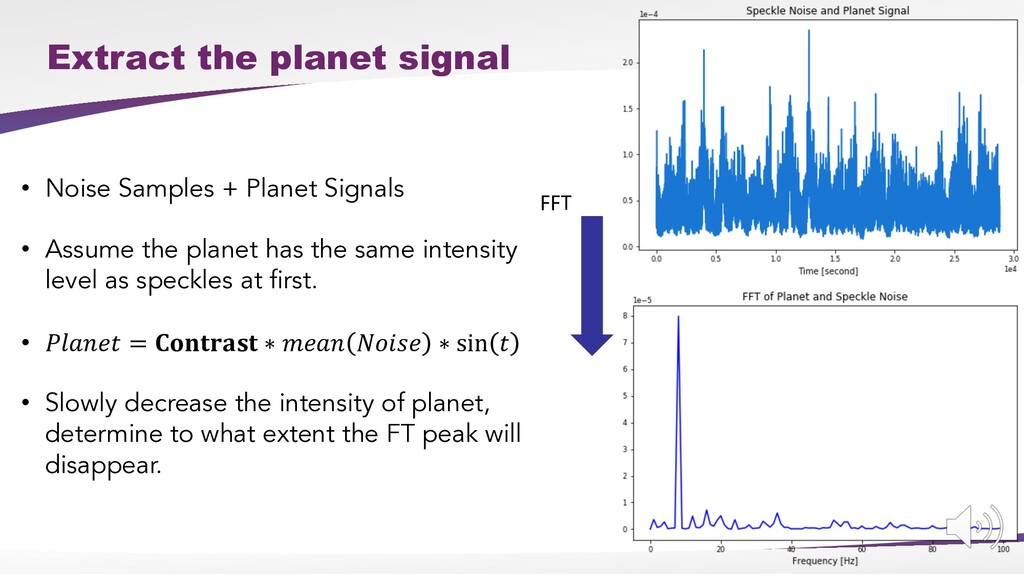
  9. Extract the planet signal • Noise Samples + Planet Signals

    • Assume the planet has the same intensity level as speckles at first. • 𝑃𝑙𝑎𝑛𝑒𝑡 = 𝐂𝐨𝐧𝐭𝐫𝐚𝐬𝐭 ∗ 𝑚𝑒𝑎𝑛 𝑁𝑜𝑖𝑠𝑒 ∗ sin 𝑡 • Slowly decrease the intensity of planet, determine to what extent the FT peak will disappear. FFT
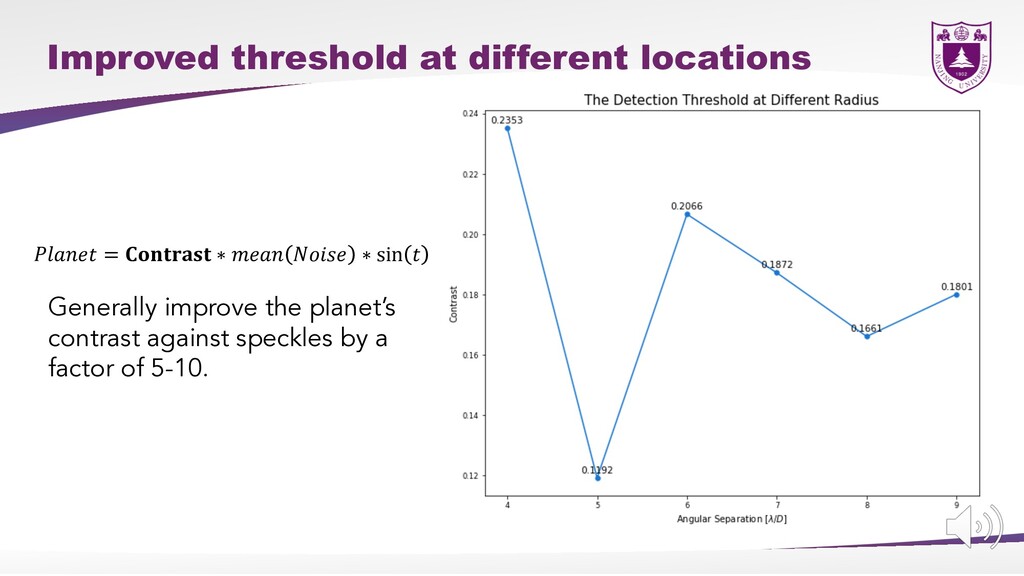
  10. Improved threshold at different locations Generally improve the planet’s contrast

    against speckles by a factor of 5-10. 𝑃𝑙𝑎𝑛𝑒𝑡 = 𝐂𝐨𝐧𝐭𝐫𝐚𝐬𝐭 ∗ 𝑚𝑒𝑎𝑛 𝑁𝑜𝑖𝑠𝑒 ∗ sin 𝑡
  11. Summary • The exoplanet direct imaging will be limited by

    speckles, especially by quasi-static speckles. • The reflected light curve of planets around variables will have a phase shift, which could be distinguished against Q-speckles. • I made a simulation about the real imaging conditions of telescope with AO and coronagraph. • It turns out that this method could improve the detectability against quasi-static speckles by a factor of 5-10.