Upgrade to Pro — share decks privately, control downloads, hide ads and more …

Optimizing photometry band to reduce the False ...

Sponsored · Your Podcast. Everywhere. Effortlessly. Share. Educate. Inspire. Entertain. You do you. We'll handle the rest. →
Avatar for Mutian Wang Mutian Wang
October 28, 2020
22

Optimizing photometry band to reduce the False Positive Prob. (FPP) of Kepler candidates

A contributed talk for Earth 2.0 Science Meeting on Oct. 28th, 2020

Avatar for Mutian Wang

Mutian Wang

October 28, 2020

Transcript

  1. Liu, Hui-Gen(刘慧根) Email: [email protected] Speaker: Wang, Mutian(王牧天) Nanjing University Optimizing

    photometry band to reduce the False Positive Prob. (FPP) of Kepler/TESS candidates
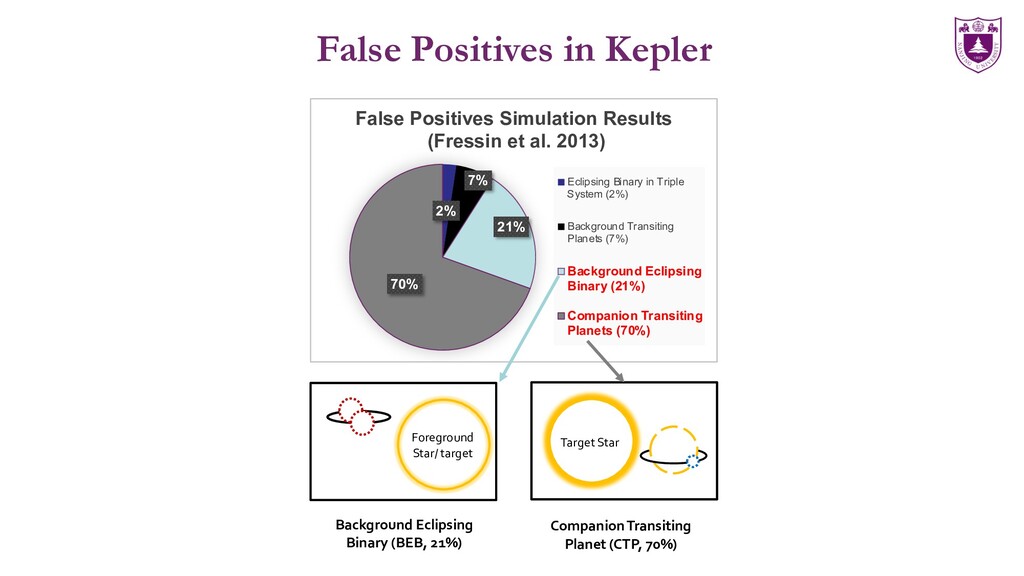
  2. False Positives in Kepler 2% 7% 21% 70% False Positives

    Simulation Results (Fressin et al. 2013) Eclipsing Binary in Triple System (2%) Background Transiting Planets (7%) Background Eclipsing Binary (21%) Companion Transiting Planets (70%) Foreground Star/ target Background Eclipsing Binary (BEB, 21%) CompanionTransiting Planet (CTP, 70%) Target Star
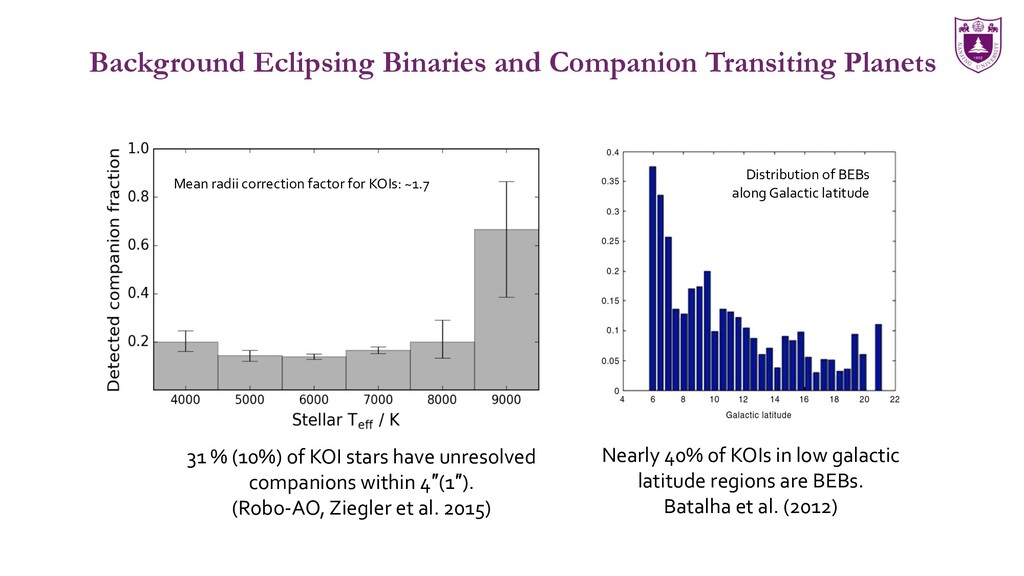
  3. Background Eclipsing Binaries and Companion Transiting Planets 31 % (10%)

    of KOI stars have unresolved companions within 4″(1″). (Robo-AO, Ziegler et al. 2015) Mean radii correction factor for KOIs: ~1.7 Distribution of BEBs along Galactic latitude Nearly 40% of KOIs in low galactic latitude regions are BEBs. Batalha et al. (2012)
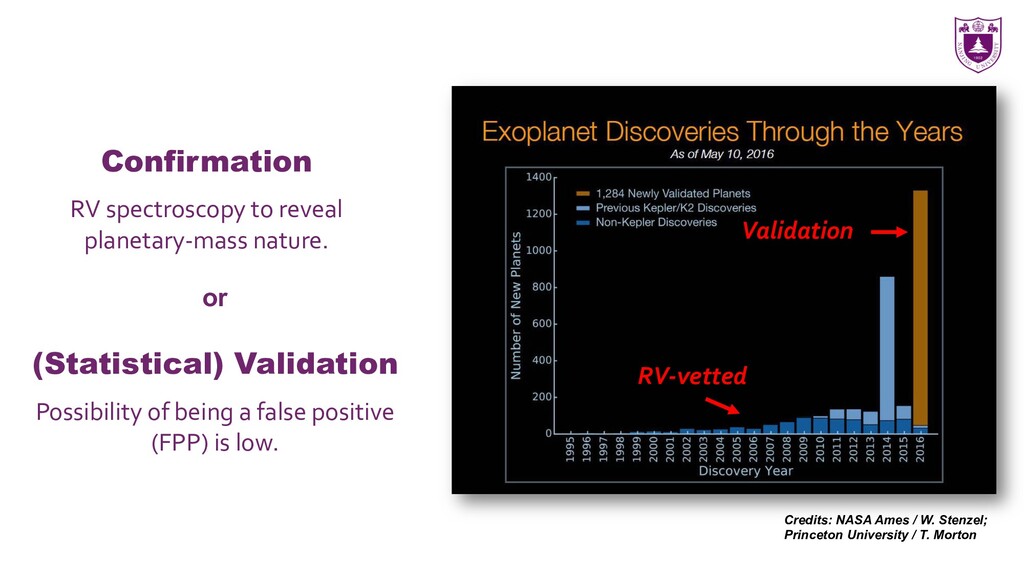
  4. Confirmation RV spectroscopy to reveal planetary-mass nature. (Statistical) Validation Possibility

    of being a false positive (FPP) is low. or Credits: NASA Ames / W. Stenzel; Princeton University / T. Morton Validation RV-vetted
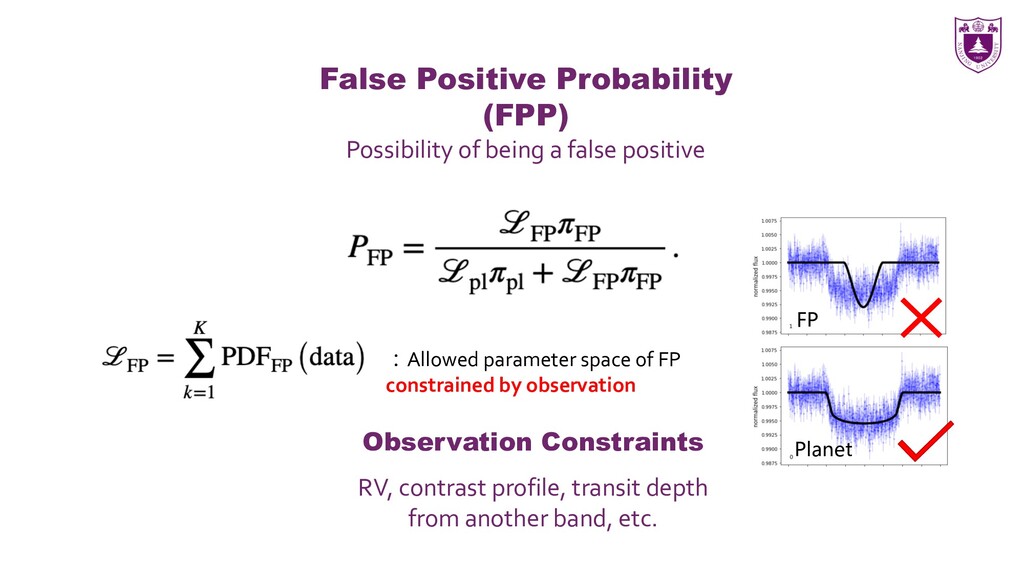
  5. Observation Constraints RV, contrast profile, transit depth from another band,

    etc. False Positive Probability (FPP) Possibility of being a false positive :Allowed parameter space of FP constrained by observation FP Planet
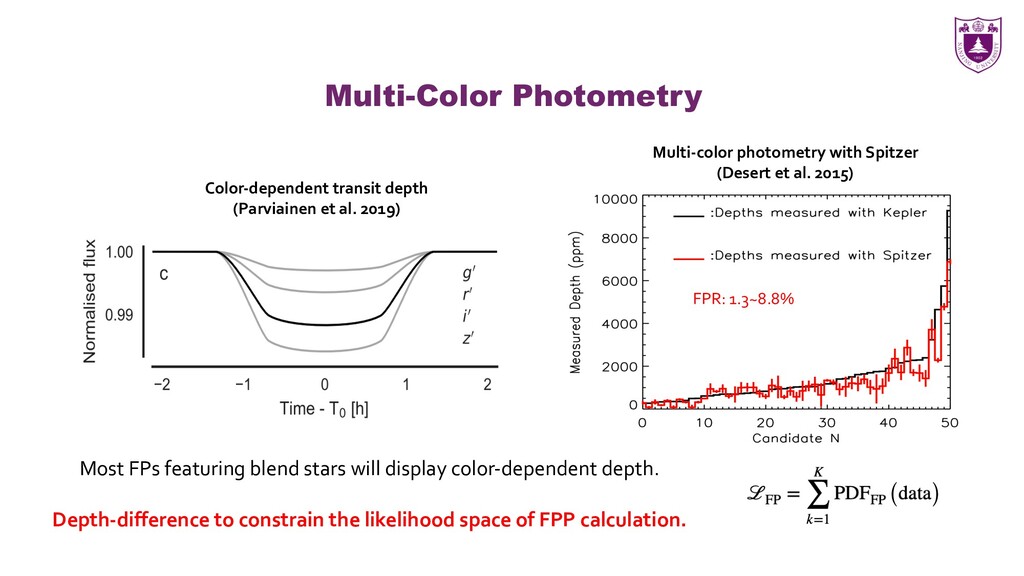
  6. Multi-Color Photometry Most FPs featuring blend stars will display color-dependent

    depth. Depth-difference to constrain the likelihood space of FPP calculation. Color-dependent transit depth (Parviainen et al. 2019) Multi-color photometry with Spitzer (Desert et al. 2015) FPR: 1.3~8.8%
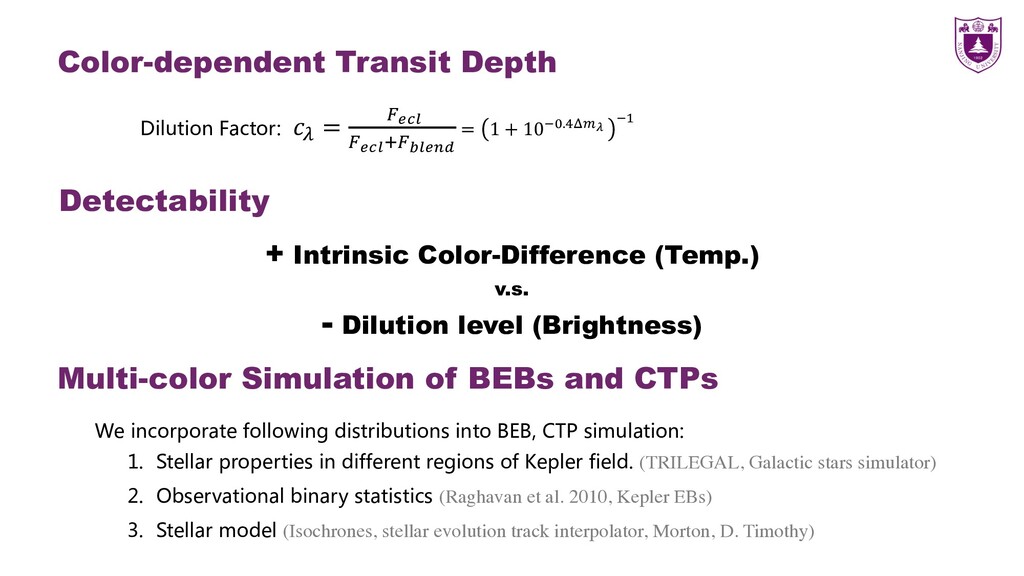
  7. + Intrinsic Color-Difference (Temp.) v.s. - Dilution level (Brightness) Detectability

    Color-dependent Transit Depth Dilution Factor: 𝑐! = "!"# "!"##"$#!%& = 1 + 10!".$%&! !' Multi-color Simulation of BEBs and CTPs We incorporate following distributions into BEB, CTP simulation: 1. Stellar properties in different regions of Kepler field. (TRILEGAL, Galactic stars simulator) 2. Observational binary statistics (Raghavan et al. 2010, Kepler EBs) 3. Stellar model (Isochrones, stellar evolution track interpolator, Morton, D. Timothy)
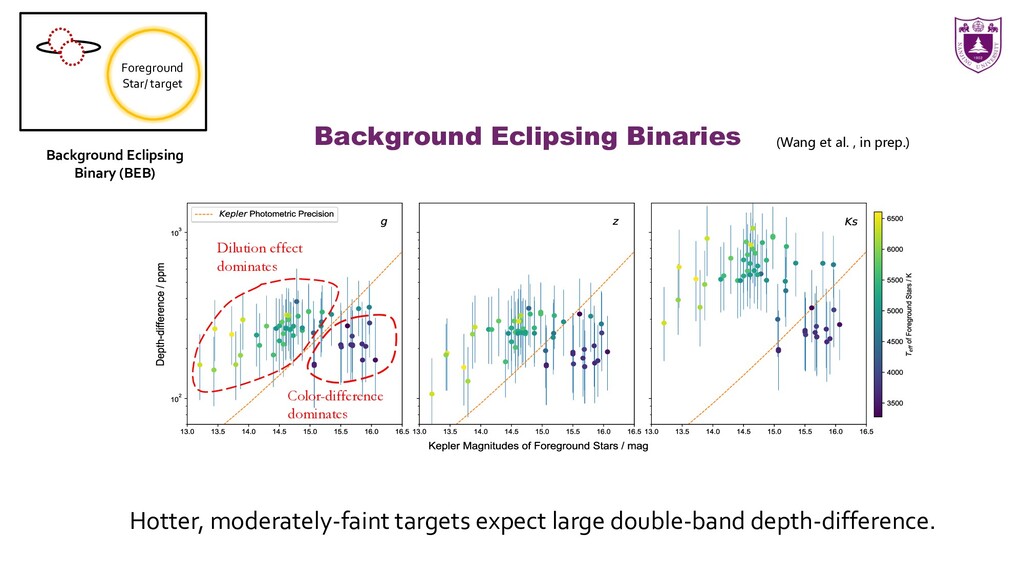
  8. Background Eclipsing Binaries Hotter, moderately-faint targets expect large double-band depth-difference.

    Dilution effect dominates Color-difference dominates (Wang et al. , in prep.) Foreground Star/ target Background Eclipsing Binary (BEB)
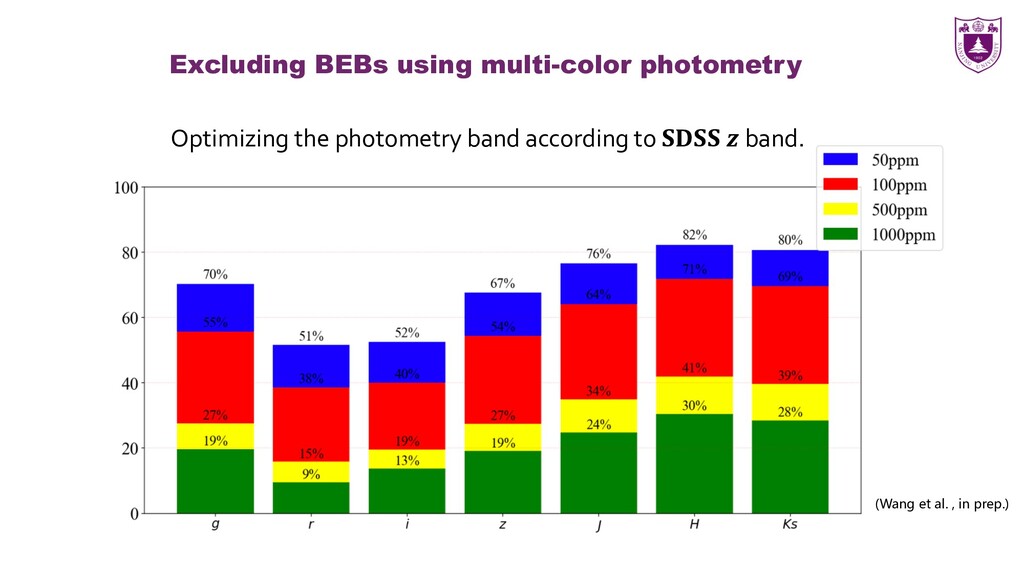
  9. Excluding BEBs using multi-color photometry Optimizing the photometry band according

    to 𝐒𝐃𝐒𝐒 𝒛 band. (Wang et al. , in prep.)
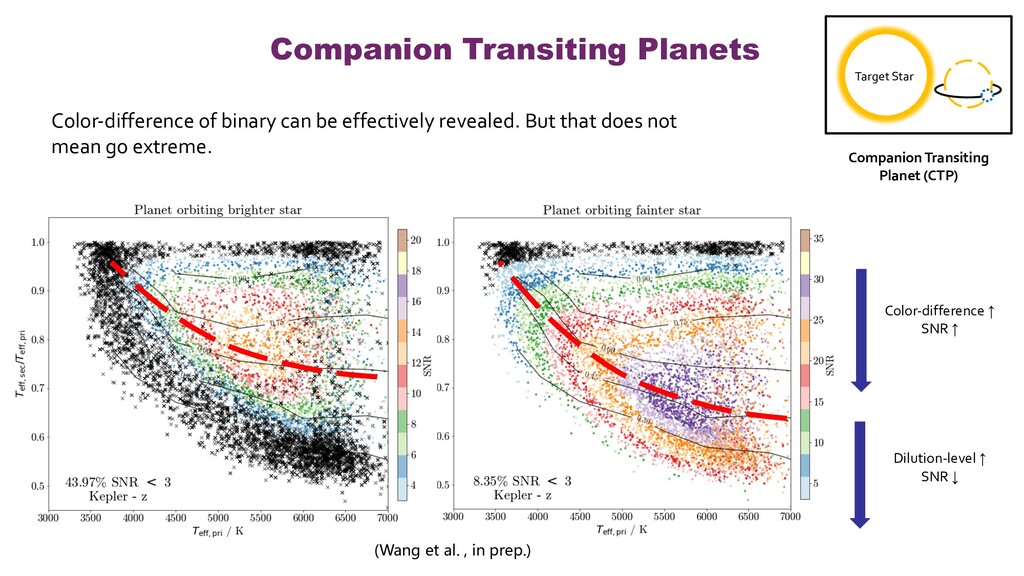
  10. Color-difference of binary can be effectively revealed. But that does

    not mean go extreme. Companion Transiting Planets (Wang et al. , in prep.) CompanionTransiting Planet (CTP) Target Star Color-difference ↑ SNR ↑ Dilution-level ↑ SNR ↓
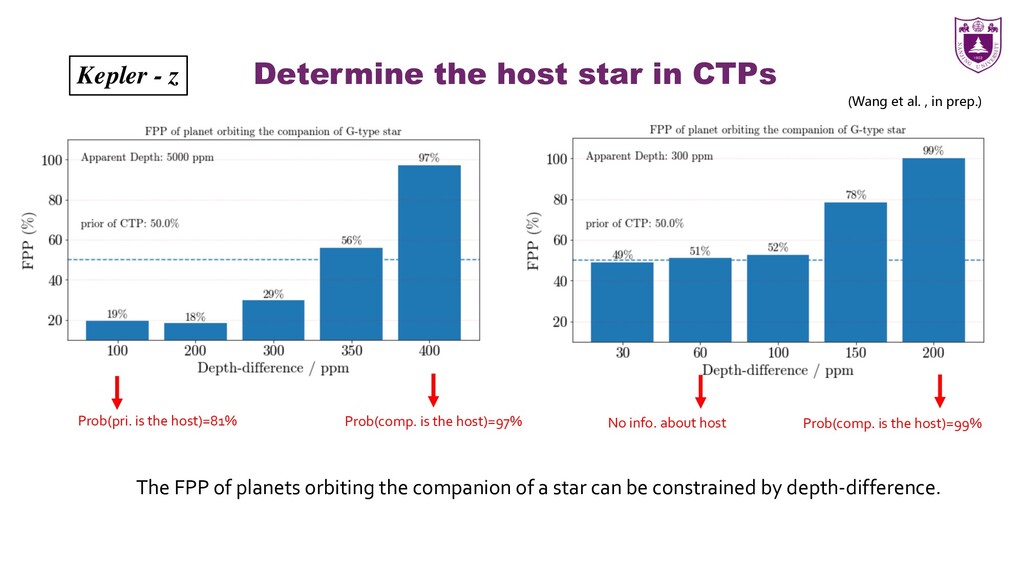
  11. The FPP of planets orbiting the companion of a star

    can be constrained by depth-difference. Determine the host star in CTPs Prob(pri. is the host)=81% Prob(comp. is the host)=97% No info. about host Prob(comp. is the host)=99% Kepler - z (Wang et al. , in prep.)
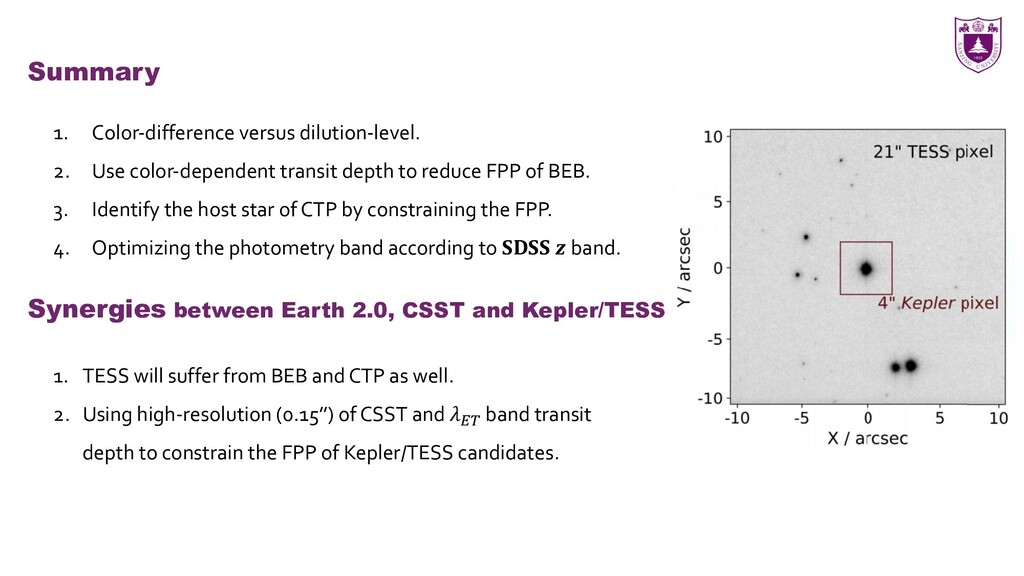
  12. Synergies between Earth 2.0, CSST and Kepler/TESS Summary 1. Color-difference

    versus dilution-level. 2. Use color-dependent transit depth to reduce FPP of BEB. 3. Identify the host star of CTP by constraining the FPP. 4. Optimizing the photometry band according to 𝐒𝐃𝐒𝐒 𝒛 band. 1. TESS will suffer from BEB and CTP as well. 2. Using high-resolution (0.15’’) of CSST and 𝜆!" band transit depth to constrain the FPP of Kepler/TESS candidates.