Upgrade to Pro — share decks privately, control downloads, hide ads and more …

Data Pipeline at Tapad

Data Pipeline at Tapad

Tapad's data pipeline is an elastic combination of technologies (Kafka, Hadoop, Avro, Scalding) that forms a reliable system for analytics, realtime and batch graph-building, and logging. In this talk, I will speak about the creation and evolution of the pipeline, and a concrete example – a day in the life of an event tracking pixel. We'll also talk about common challenges that we've overcome such as integrating different pieces of the system, schema evolution, queuing, and data retention policies.

Avatar for Toby Matejovsky

Toby Matejovsky

September 18, 2014

More Decks by Toby Matejovsky

Other Decks in Technology

Transcript

  1. Who am I? Toby Matejovsky! First engineer hired at Tapad

    3+ years ago! Scala developer! ! @tobym
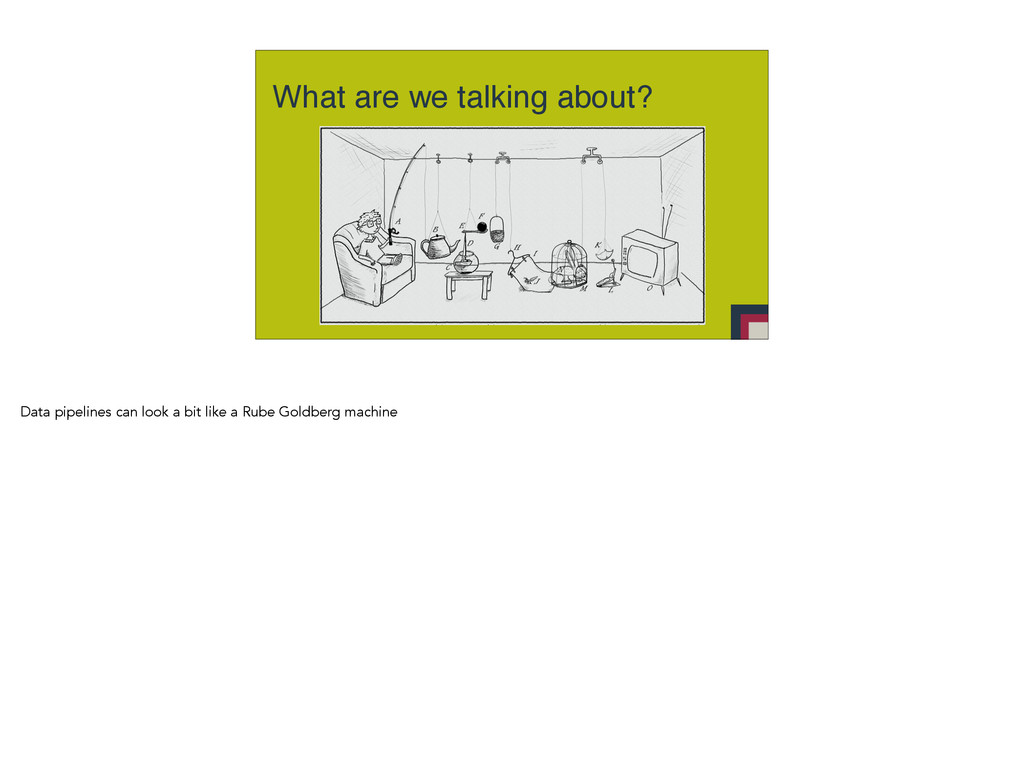
  2. What are we talking about? Data pipelines can look a

    bit like a Rube Goldberg machine
  3. Outline • What Tapad does! • Why bother with a

    data pipeline?! • Evolution of the pipeline! • Day in the life of a analytics pixel! • What’s next
  4. What Tapad Does Cross-platform advertising and analytics! Process billions of

    events per day The Tapad Difference. A Unified View. HTTP requests indicating “user is interested in a widget”, “want to show an ad?”, “ad was served”, “user bought a widget”
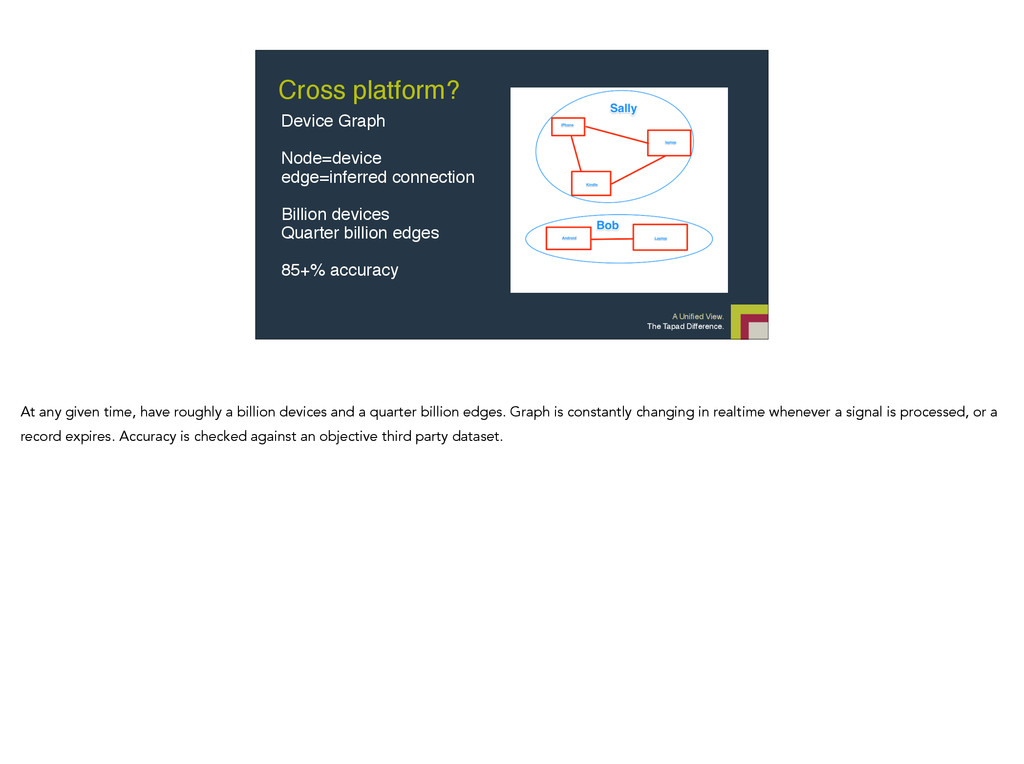
  5. Cross platform? Device Graph! ! Node=device! edge=inferred connection! ! Billion

    devices! Quarter billion edges! ! 85+% accuracy The Tapad Difference. A Unified View. At any given time, have roughly a billion devices and a quarter billion edges. Graph is constantly changing in realtime whenever a signal is processed, or a record expires. Accuracy is checked against an objective third party dataset.
  6. Why a Data Pipeline? Graph building! Sanity while processing big

    data! Decouple components! Data accessible at multiple stages • Generating a terabyte of logs per day, can’t store it all. Don’t want to store it all either, more data takes longer to process
  7. Graph Building Realtime mode, but don’t impact bidding latency! Batch

    mode • Realtime bidding infrastructure has very tight SLA, is very sensitive to latency. It needs access to the graph database, and incoming signals may add or modify an edge depending on a a big list of rules. Used to do this in-process; obvious problem to have the bidder to work that isn’t directly related to bidding. Solution, publish the signals to a queue (Kafka), let a consumer pull from that and build the graph in near-realtime. All one signal at a time, plus some contextual history for similar signals. Batch Mode - Scalding job running on a one petabyte, 50-node hadoop cluster. Looks at several weeks worth of signals and creates entire “new” graph. More connections, same or better accuracy.
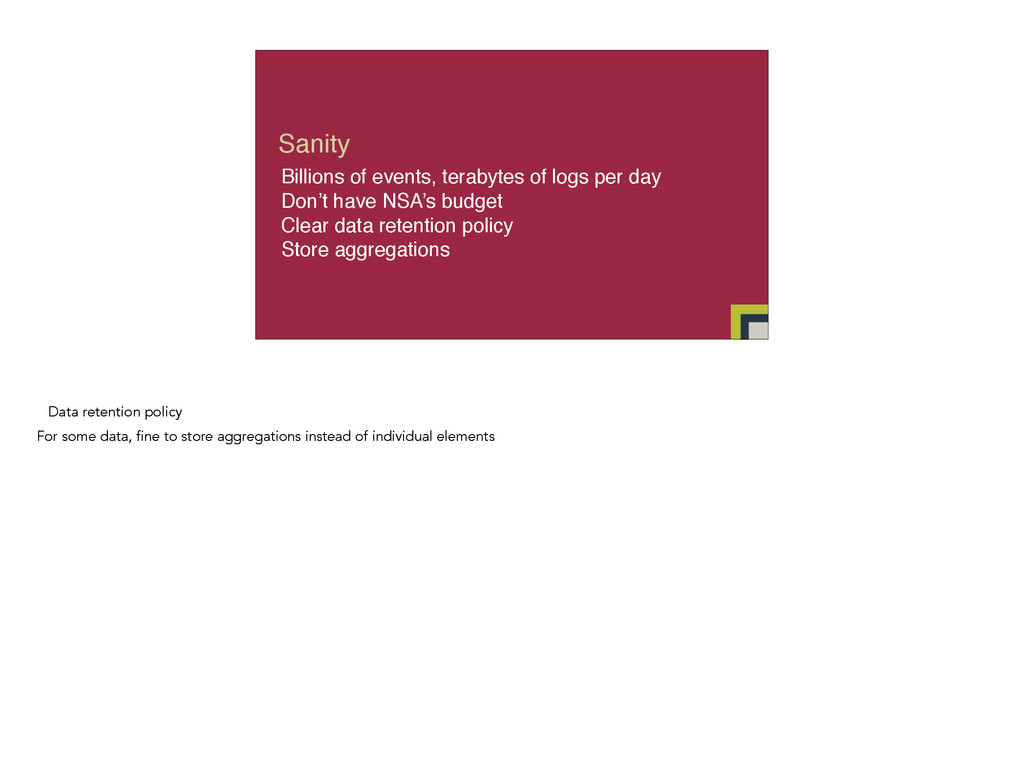
  8. Sanity Billions of events, terabytes of logs per day! Don’t

    have NSA’s budget! Clear data retention policy! Store aggregations • Data retention policy • For some data, fine to store aggregations instead of individual elements
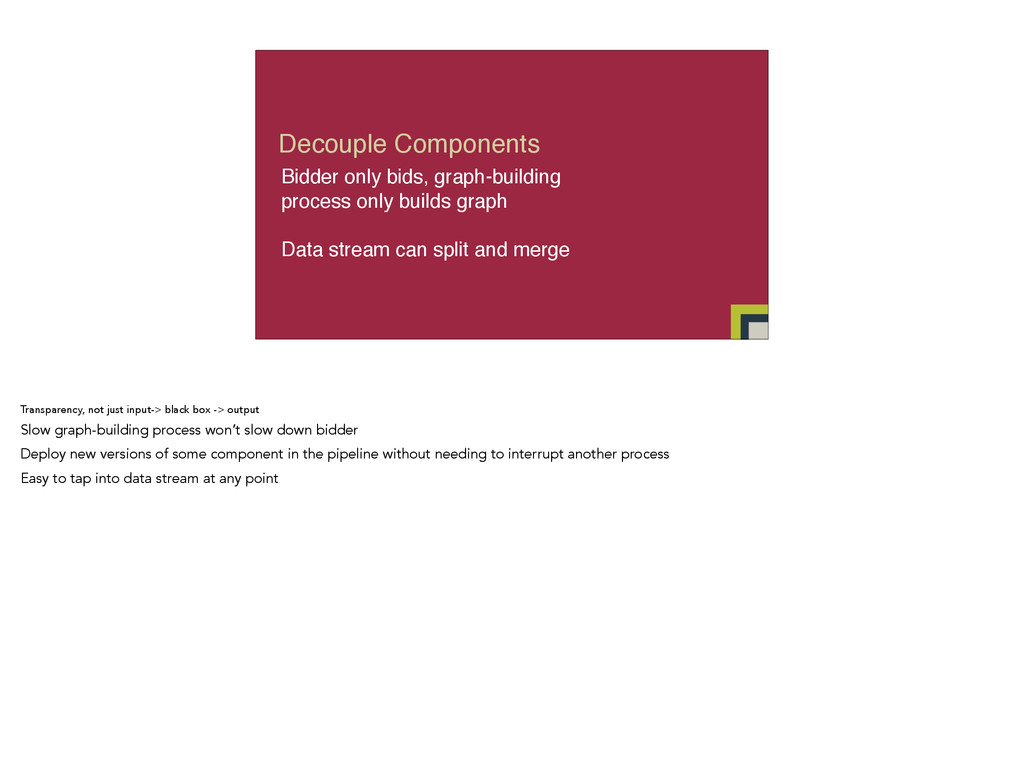
  9. Decouple Components Bidder only bids, graph-building process only builds graph!

    ! Data stream can split and merge Transparency, not just input-> black box -> output Slow graph-building process won’t slow down bidder Deploy new versions of some component in the pipeline without needing to interrupt another process Easy to tap into data stream at any point
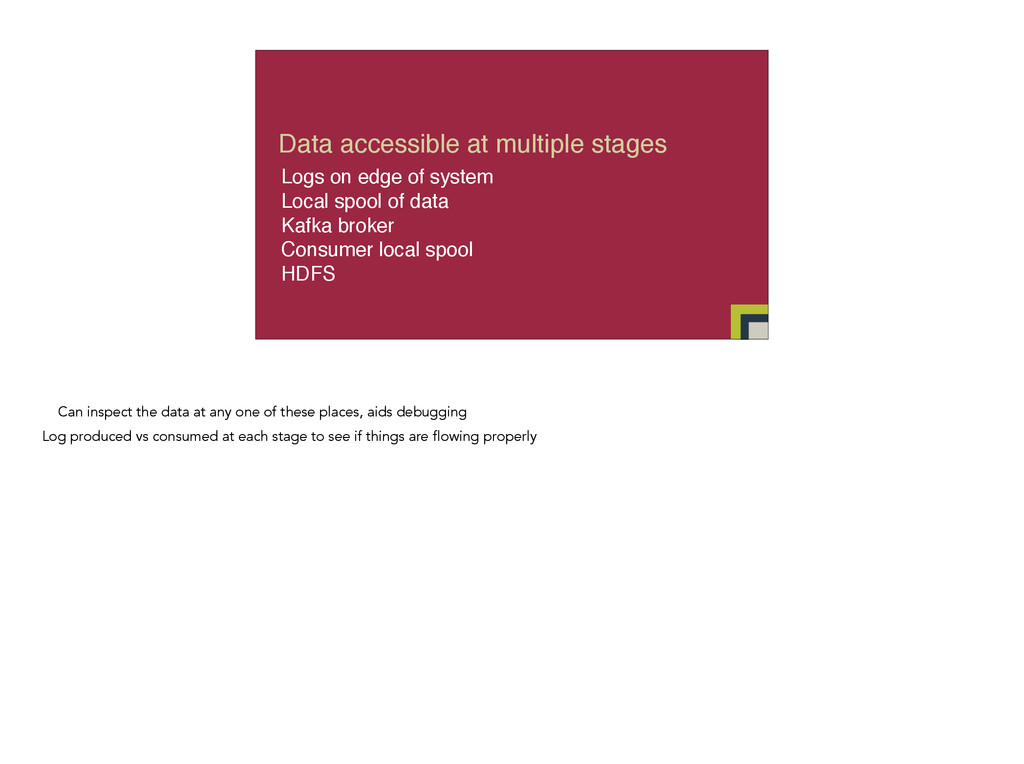
  10. Data accessible at multiple stages Logs on edge of system!

    Local spool of data! Kafka broker! Consumer local spool! HDFS • Can inspect the data at any one of these places, aids debugging • Log produced vs consumed at each stage to see if things are flowing properly
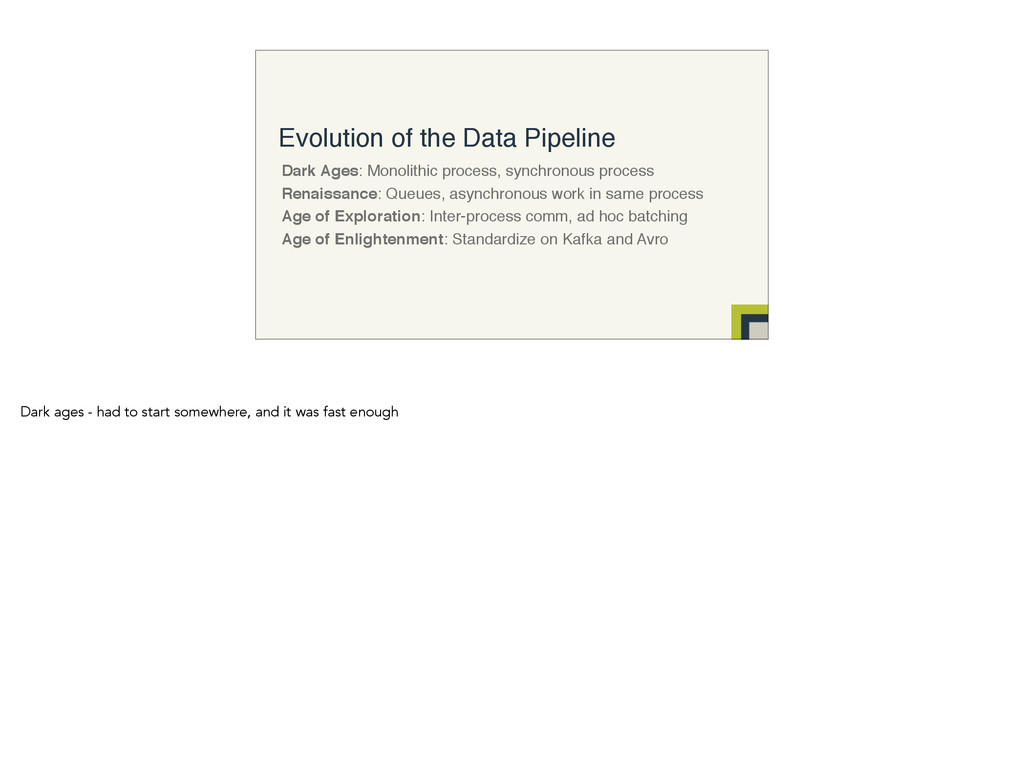
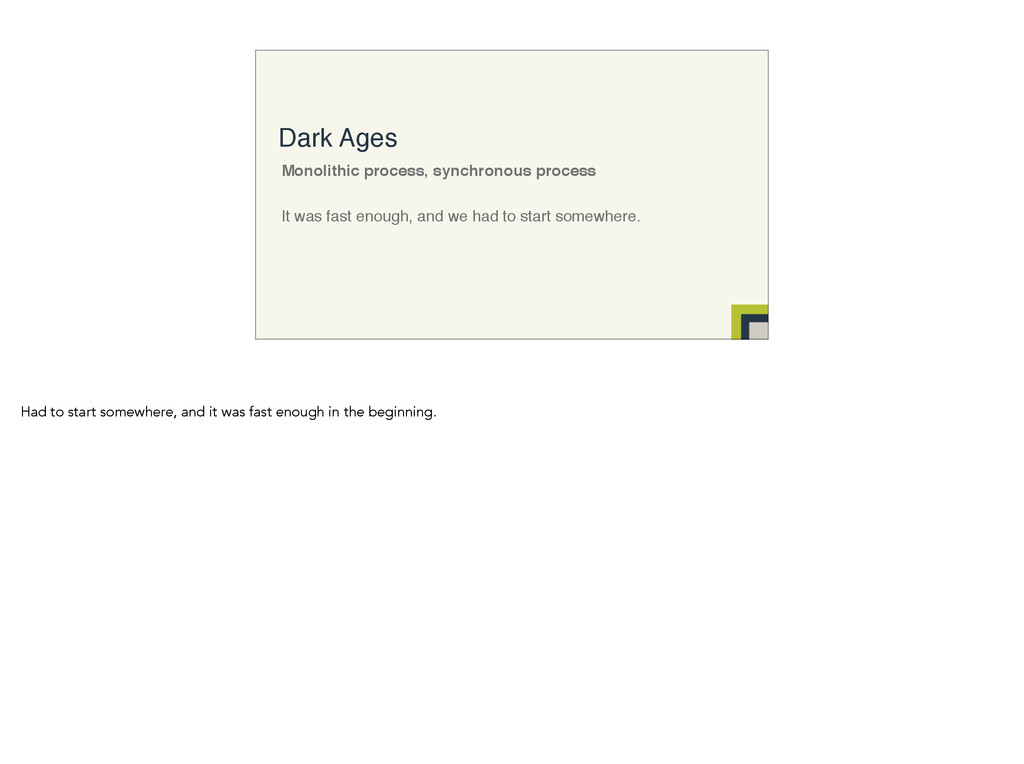
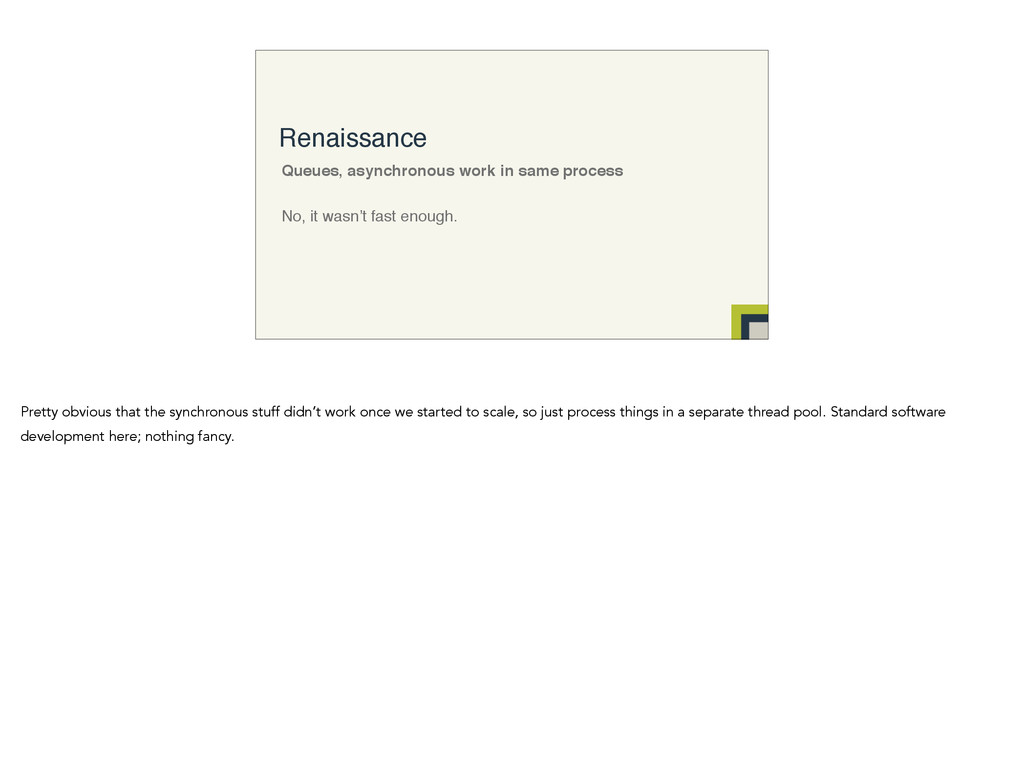
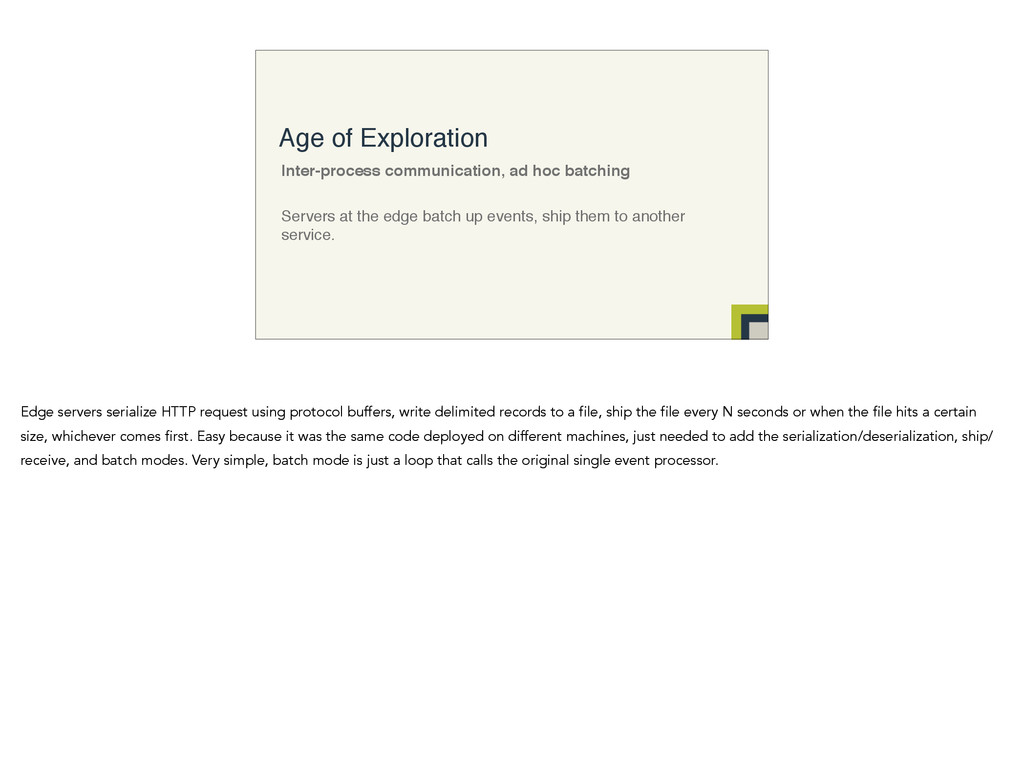
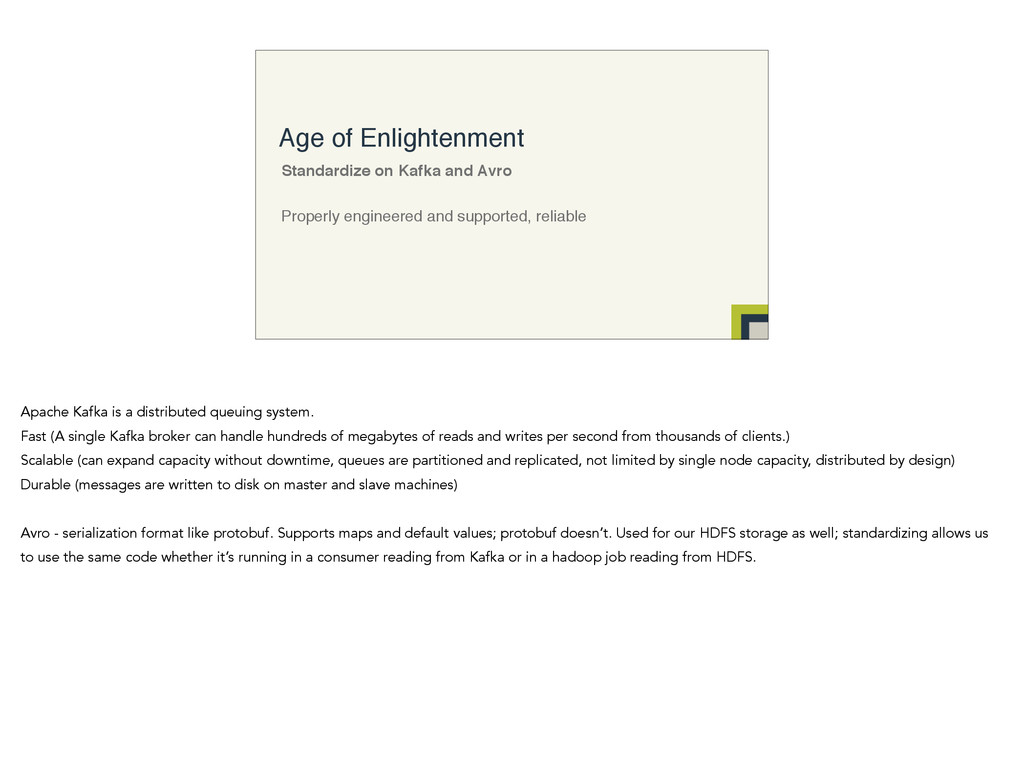
  11. Evolution of the Data Pipeline Dark Ages: Monolithic process, synchronous

    process! Renaissance: Queues, asynchronous work in same process! Age of Exploration: Inter-process comm, ad hoc batching! Age of Enlightenment: Standardize on Kafka and Avro Dark ages - had to start somewhere, and it was fast enough
  12. Dark Ages Monolithic process, synchronous process! ! It was fast

    enough, and we had to start somewhere. Had to start somewhere, and it was fast enough in the beginning.
  13. Renaissance Queues, asynchronous work in same process! ! No, it

    wasn’t fast enough. Pretty obvious that the synchronous stuff didn’t work once we started to scale, so just process things in a separate thread pool. Standard software development here; nothing fancy.
  14. Age of Exploration Inter-process communication, ad hoc batching! ! Servers

    at the edge batch up events, ship them to another service. Edge servers serialize HTTP request using protocol buffers, write delimited records to a file, ship the file every N seconds or when the file hits a certain size, whichever comes first. Easy because it was the same code deployed on different machines, just needed to add the serialization/deserialization, ship/ receive, and batch modes. Very simple, batch mode is just a loop that calls the original single event processor.
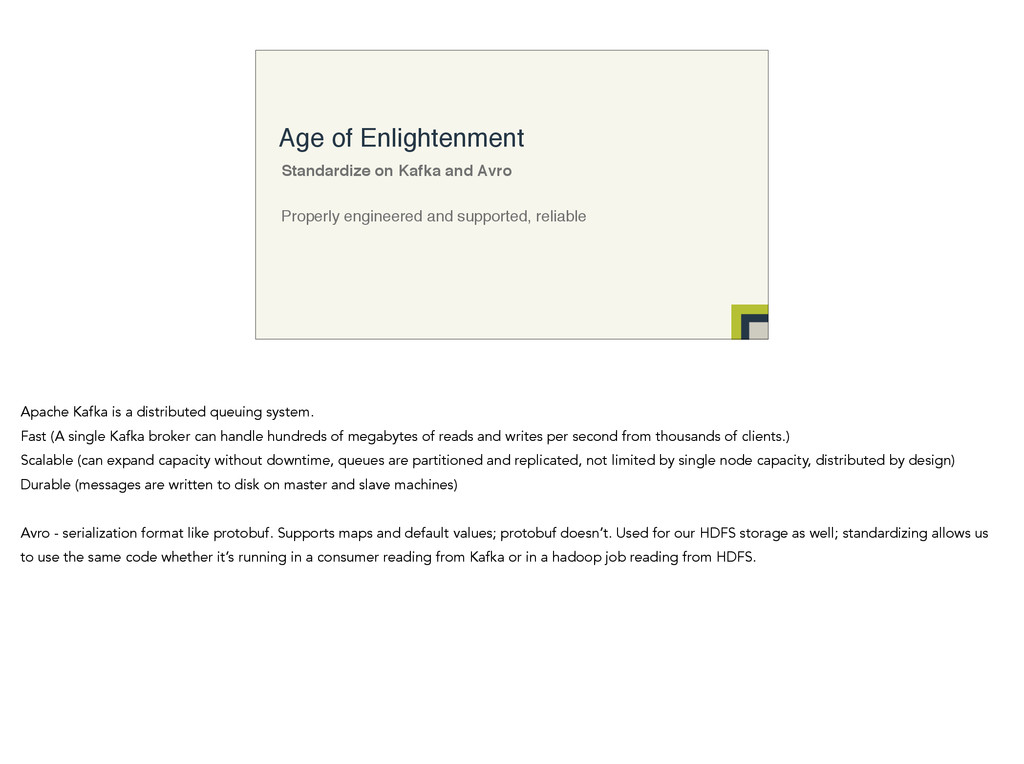
  15. Age of Enlightenment Standardize on Kafka and Avro! ! Properly

    engineered and supported, reliable Apache Kafka is a distributed queuing system. Fast (A single Kafka broker can handle hundreds of megabytes of reads and writes per second from thousands of clients.) Scalable (can expand capacity without downtime, queues are partitioned and replicated, not limited by single node capacity, distributed by design) Durable (messages are written to disk on master and slave machines) ! Avro - serialization format like protobuf. Supports maps and default values; protobuf doesn’t. Used for our HDFS storage as well; standardizing allows us to use the same code whether it’s running in a consumer reading from Kafka or in a hadoop job reading from HDFS.
  16. Age of Enlightenment Standardize on Kafka and Avro! ! Properly

    engineered and supported, reliable Apache Kafka is a distributed queuing system. Fast (A single Kafka broker can handle hundreds of megabytes of reads and writes per second from thousands of clients.) Scalable (can expand capacity without downtime, queues are partitioned and replicated, not limited by single node capacity, distributed by design) Durable (messages are written to disk on master and slave machines) ! Avro - serialization format like protobuf. Supports maps and default values; protobuf doesn’t. Used for our HDFS storage as well; standardizing allows us to use the same code whether it’s running in a consumer reading from Kafka or in a hadoop job reading from HDFS.
  17. Batching Batching is great, will really help throughput! Batching !=

    slow The Tapad Difference. A Unified View. Batching will really improve processing throughput, because you save the cost of repeated setup and teardown. Works at all scales, batching != slow: on the small end, think about how an optimizing compiler performs “loop unrolling” – perform a dozen operations on each iteration instead of one per iteration. Can batch inside of some function in your application, and inter-process.
  18. Queues Queues are amazing, until they explode and destroy the

    Rube Goldberg machine.! ! “I’ll just increase the buffer size.”! ! - spoken one day before someone ended up on double PagerDuty rotation The Tapad Difference. A Unified View. Queues are great because they allow for elasticity. However, this can be a double-edged sword because the elasticity may hide a problem until it becomes catastrophic. An unbounded queue WILL cause the system to fail one day. If the producer is faster than the consumer, it will put messages in the queue until you run out of memory.
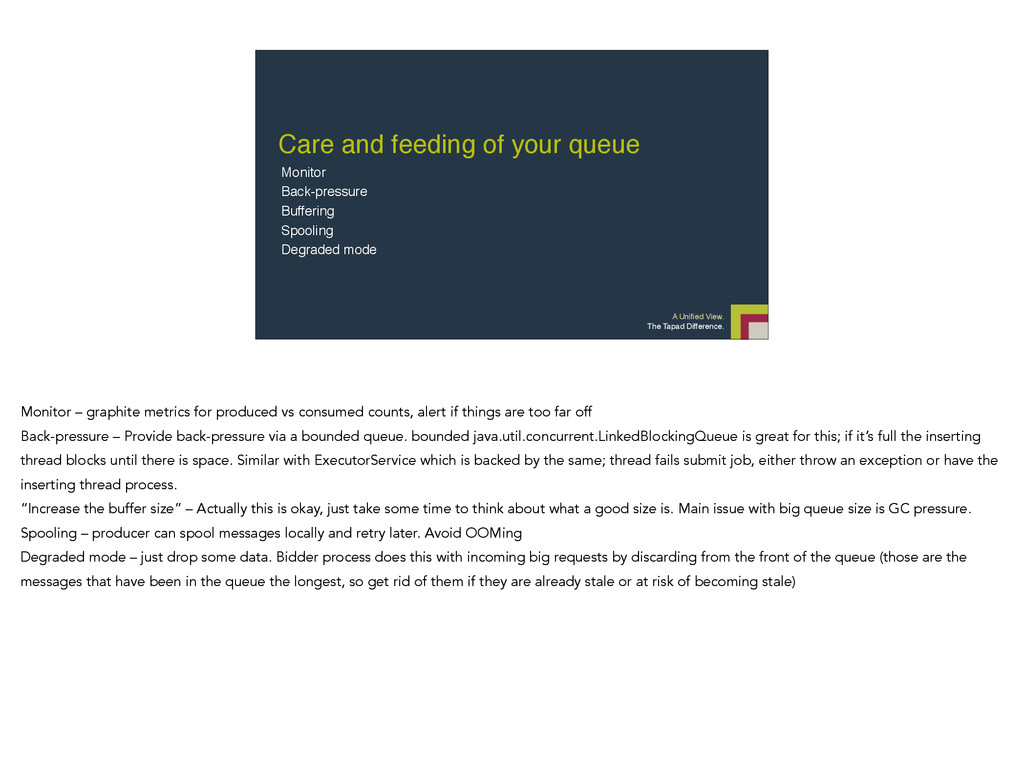
  19. Care and feeding of your queue Monitor! Back-pressure! Buffering! Spooling!

    Degraded mode The Tapad Difference. A Unified View. Monitor – graphite metrics for produced vs consumed counts, alert if things are too far off Back-pressure – Provide back-pressure via a bounded queue. bounded java.util.concurrent.LinkedBlockingQueue is great for this; if it’s full the inserting thread blocks until there is space. Similar with ExecutorService which is backed by the same; thread fails submit job, either throw an exception or have the inserting thread process. “Increase the buffer size” – Actually this is okay, just take some time to think about what a good size is. Main issue with big queue size is GC pressure. Spooling – producer can spool messages locally and retry later. Avoid OOMing Degraded mode – just drop some data. Bidder process does this with incoming big requests by discarding from the front of the queue (those are the messages that have been in the queue the longest, so get rid of them if they are already stale or at risk of becoming stale)
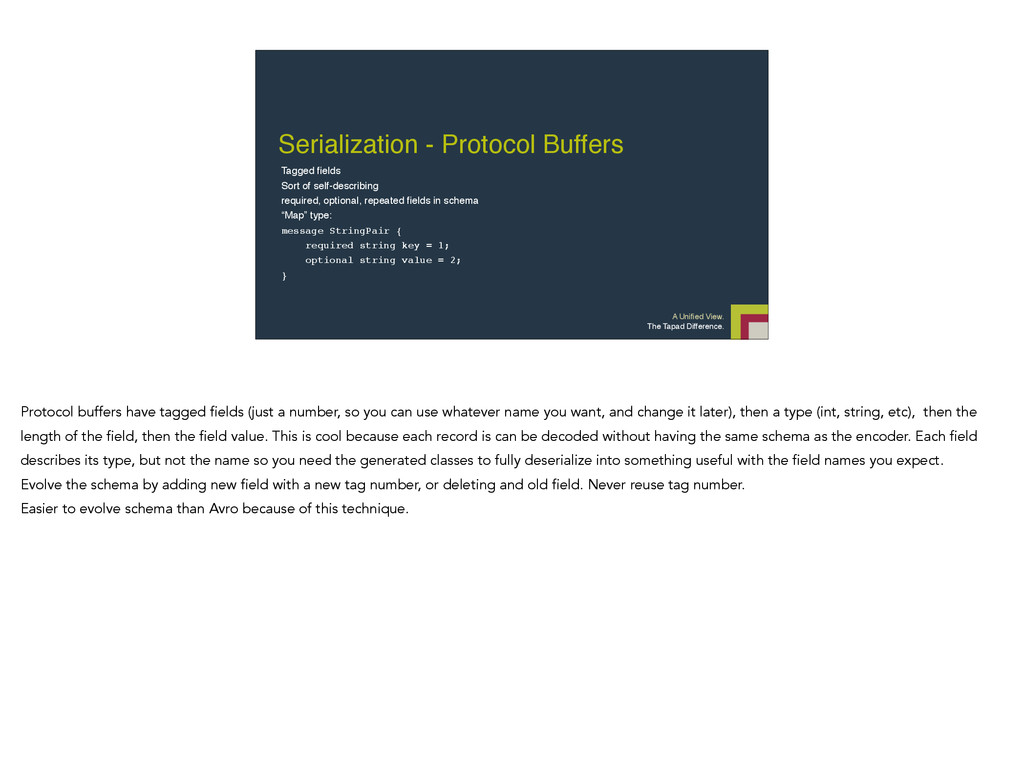
  20. Serialization - Protocol Buffers Tagged fields! Sort of self-describing! required,

    optional, repeated fields in schema! “Map” type: ! message StringPair {! required string key = 1;! optional string value = 2;! }! The Tapad Difference. A Unified View. Protocol buffers have tagged fields (just a number, so you can use whatever name you want, and change it later), then a type (int, string, etc), then the length of the field, then the field value. This is cool because each record is can be decoded without having the same schema as the encoder. Each field describes its type, but not the name so you need the generated classes to fully deserialize into something useful with the field names you expect. Evolve the schema by adding new field with a new tag number, or deleting and old field. Never reuse tag number. Easier to evolve schema than Avro because of this technique.
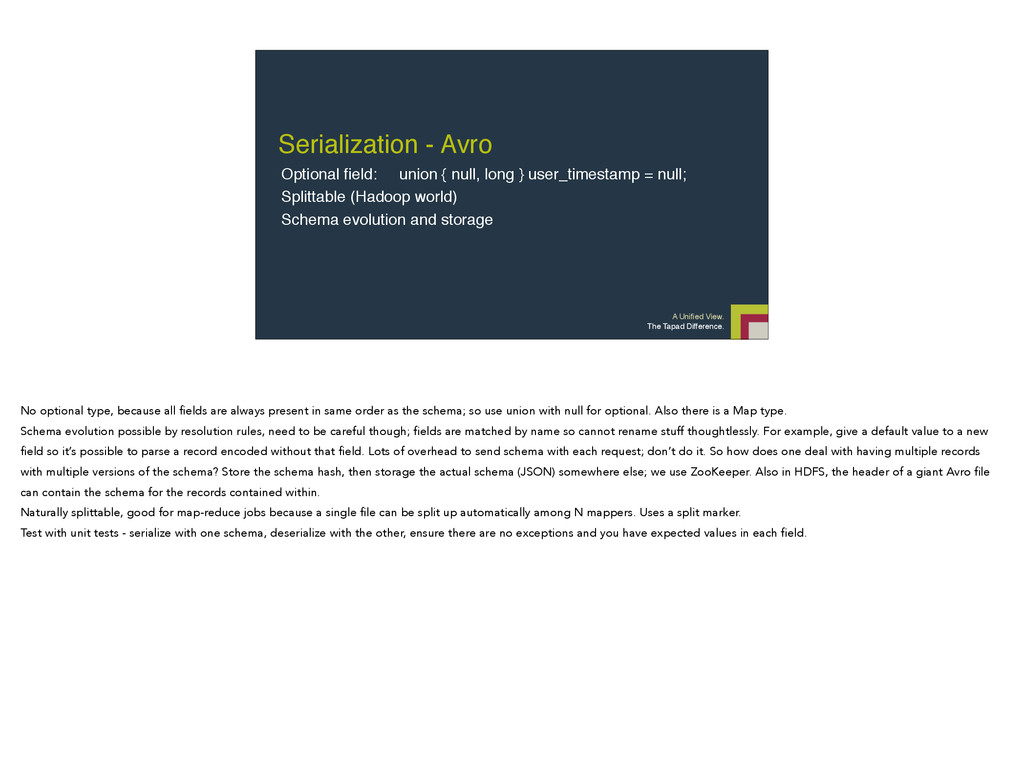
  21. Serialization - Avro Optional field: union { null, long }

    user_timestamp = null;! Splittable (Hadoop world)! Schema evolution and storage The Tapad Difference. A Unified View. No optional type, because all fields are always present in same order as the schema; so use union with null for optional. Also there is a Map type. Schema evolution possible by resolution rules, need to be careful though; fields are matched by name so cannot rename stuff thoughtlessly. For example, give a default value to a new field so it’s possible to parse a record encoded without that field. Lots of overhead to send schema with each request; don’t do it. So how does one deal with having multiple records with multiple versions of the schema? Store the schema hash, then storage the actual schema (JSON) somewhere else; we use ZooKeeper. Also in HDFS, the header of a giant Avro file can contain the schema for the records contained within. Naturally splittable, good for map-reduce jobs because a single file can be split up automatically among N mappers. Uses a split marker. Test with unit tests - serialize with one schema, deserialize with the other, ensure there are no exceptions and you have expected values in each field.
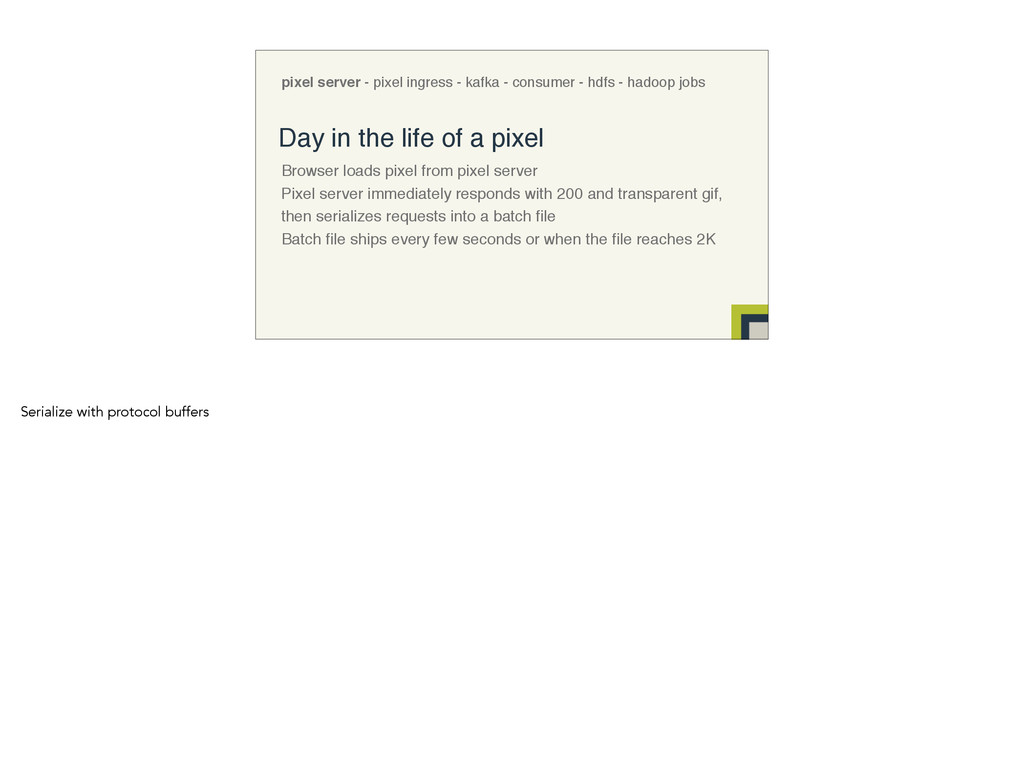
  22. Day in the life of a pixel Browser loads pixel

    from pixel server! Pixel server immediately responds with 200 and transparent gif,! then serializes requests into a batch file! Batch file ships every few seconds or when the file reaches 2K! pixel server - pixel ingress - kafka - consumer - hdfs - hadoop jobs! Serialize with protocol buffers
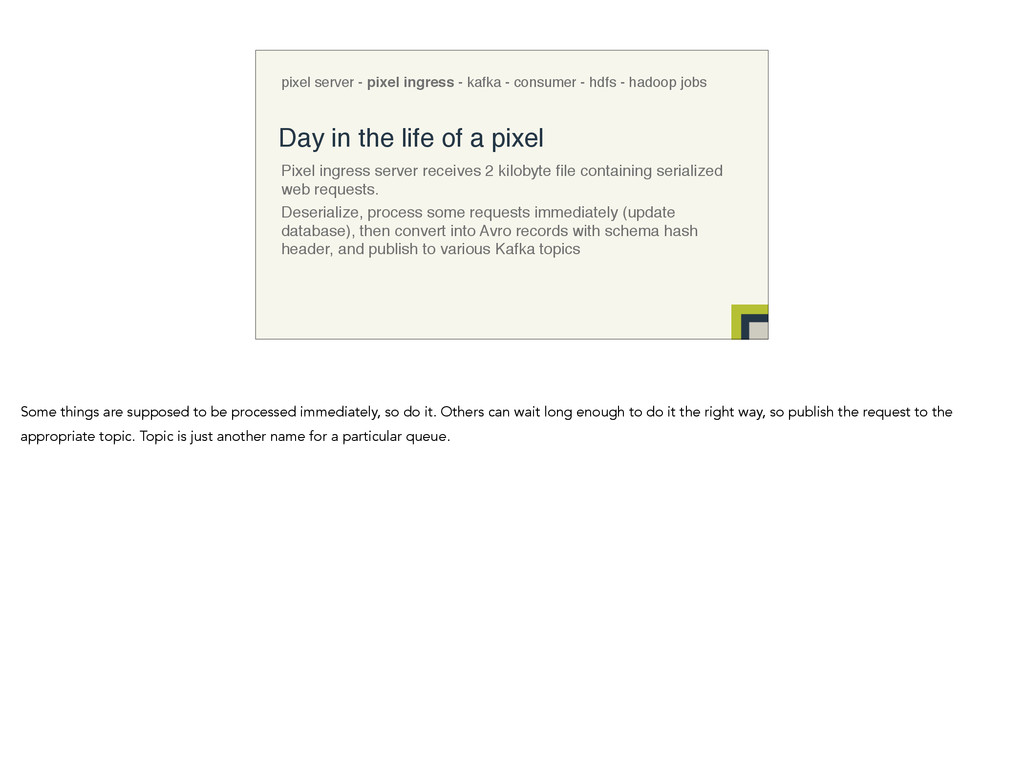
  23. Day in the life of a pixel Pixel ingress server

    receives 2 kilobyte file containing serialized web requests.! Deserialize, process some requests immediately (update database), then convert into Avro records with schema hash header, and publish to various Kafka topics! pixel server - pixel ingress - kafka - consumer - hdfs - hadoop jobs! Some things are supposed to be processed immediately, so do it. Others can wait long enough to do it the right way, so publish the request to the appropriate topic. Topic is just another name for a particular queue.
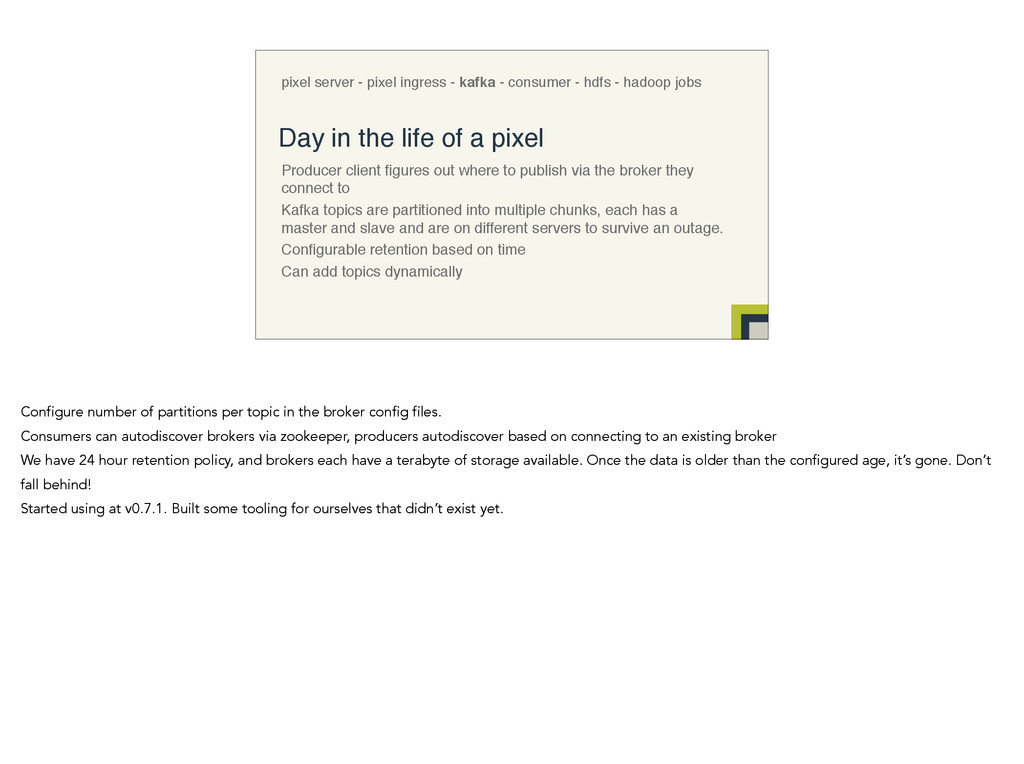
  24. Day in the life of a pixel Producer client figures

    out where to publish via the broker they connect to! Kafka topics are partitioned into multiple chunks, each has a master and slave and are on different servers to survive an outage.! Configurable retention based on time! Can add topics dynamically pixel server - pixel ingress - kafka - consumer - hdfs - hadoop jobs! Configure number of partitions per topic in the broker config files. Consumers can autodiscover brokers via zookeeper, producers autodiscover based on connecting to an existing broker We have 24 hour retention policy, and brokers each have a terabyte of storage available. Once the data is older than the configured age, it’s gone. Don’t fall behind! Started using at v0.7.1. Built some tooling for ourselves that didn’t exist yet.
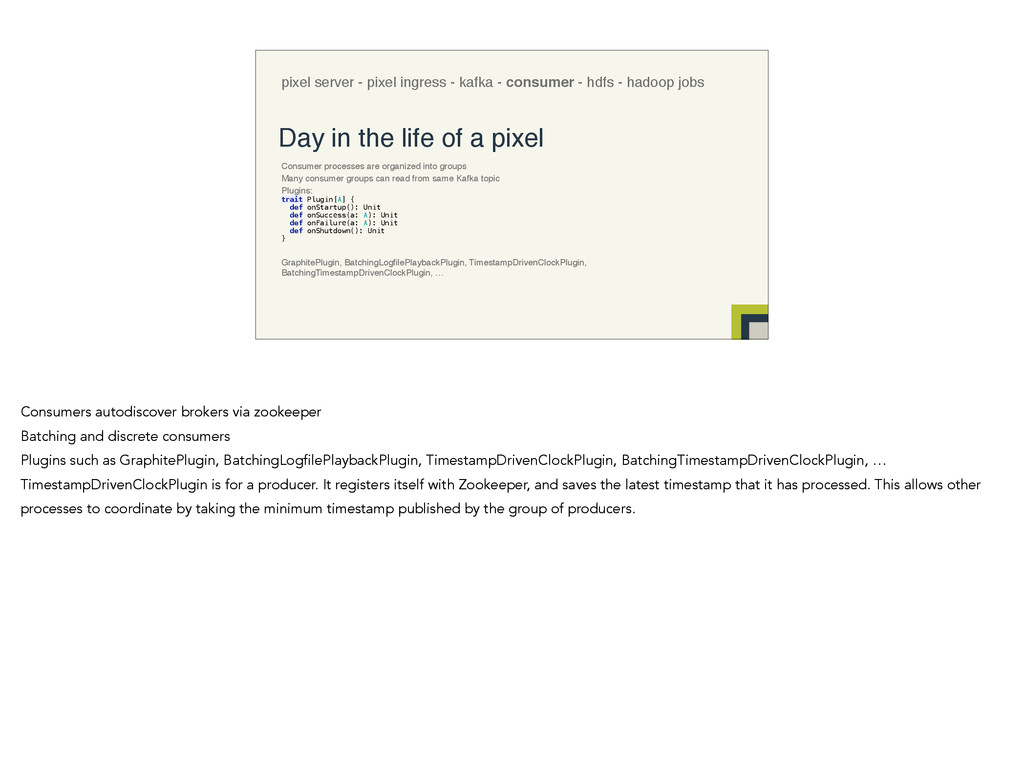
  25. Day in the life of a pixel Consumer processes are

    organized into groups! Many consumer groups can read from same Kafka topic! Plugins:! trait Plugin[A] {
 def onStartup(): Unit
 def onSuccess(a: A): Unit
 def onFailure(a: A): Unit
 def onShutdown(): Unit
 } ! GraphitePlugin, BatchingLogfilePlaybackPlugin, TimestampDrivenClockPlugin, BatchingTimestampDrivenClockPlugin, …! pixel server - pixel ingress - kafka - consumer - hdfs - hadoop jobs! Consumers autodiscover brokers via zookeeper Batching and discrete consumers Plugins such as GraphitePlugin, BatchingLogfilePlaybackPlugin, TimestampDrivenClockPlugin, BatchingTimestampDrivenClockPlugin, … TimestampDrivenClockPlugin is for a producer. It registers itself with Zookeeper, and saves the latest timestamp that it has processed. This allows other processes to coordinate by taking the minimum timestamp published by the group of producers.
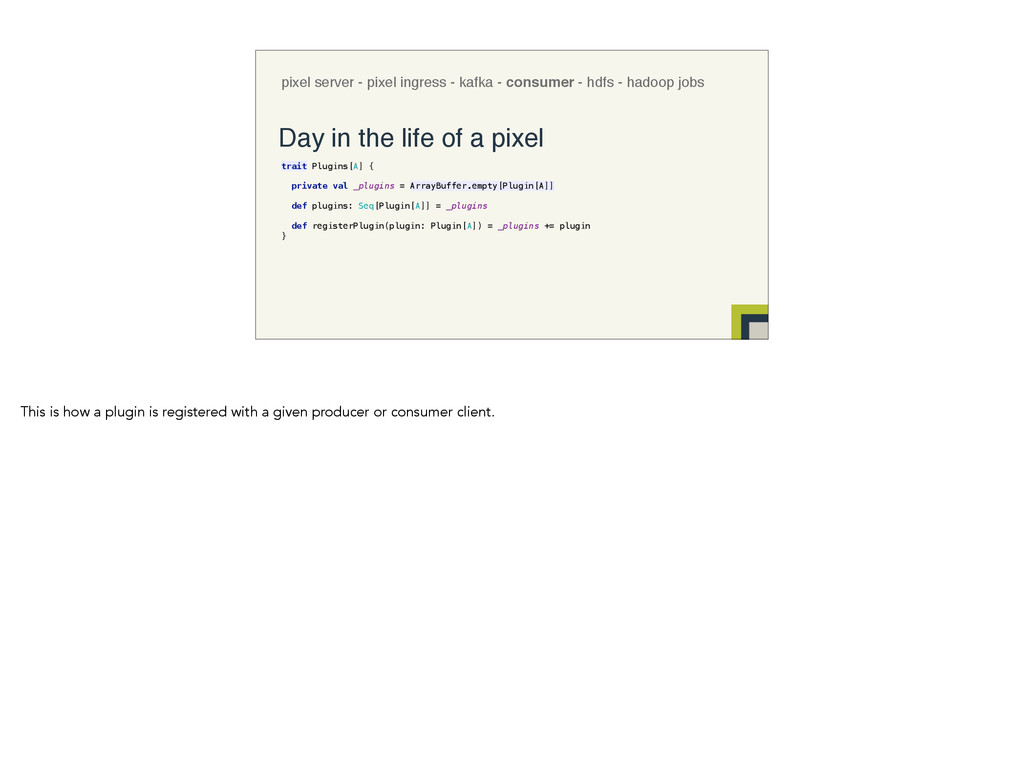
  26. Day in the life of a pixel trait Plugins[A] {


 private val _plugins = ArrayBuffer.empty[Plugin[A]]
 
 def plugins: Seq[Plugin[A]] = _plugins
 
 def registerPlugin(plugin: Plugin[A]) = _plugins += plugin
 }
 pixel server - pixel ingress - kafka - consumer - hdfs - hadoop jobs! This is how a plugin is registered with a given producer or consumer client.
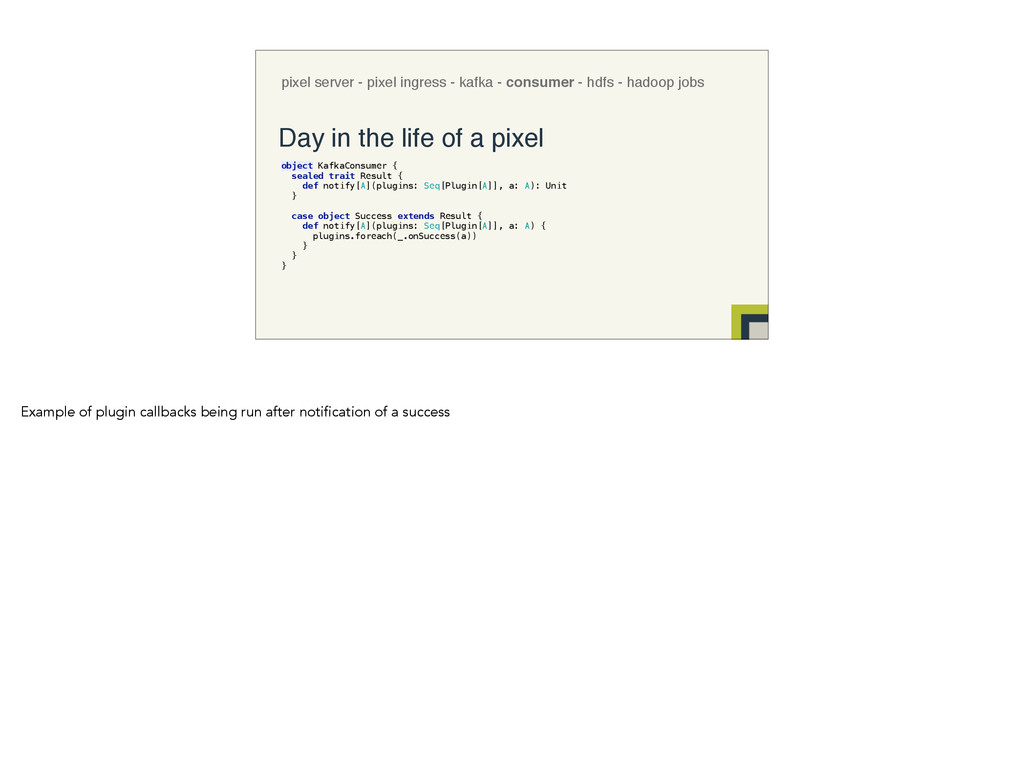
  27. Day in the life of a pixel object KafkaConsumer {


    sealed trait Result {
 def notify[A](plugins: Seq[Plugin[A]], a: A): Unit
 }
 
 case object Success extends Result {
 def notify[A](plugins: Seq[Plugin[A]], a: A) {
 plugins.foreach(_.onSuccess(a))
 }
 }
 }
 pixel server - pixel ingress - kafka - consumer - hdfs - hadoop jobs! Example of plugin callbacks being run after notification of a success
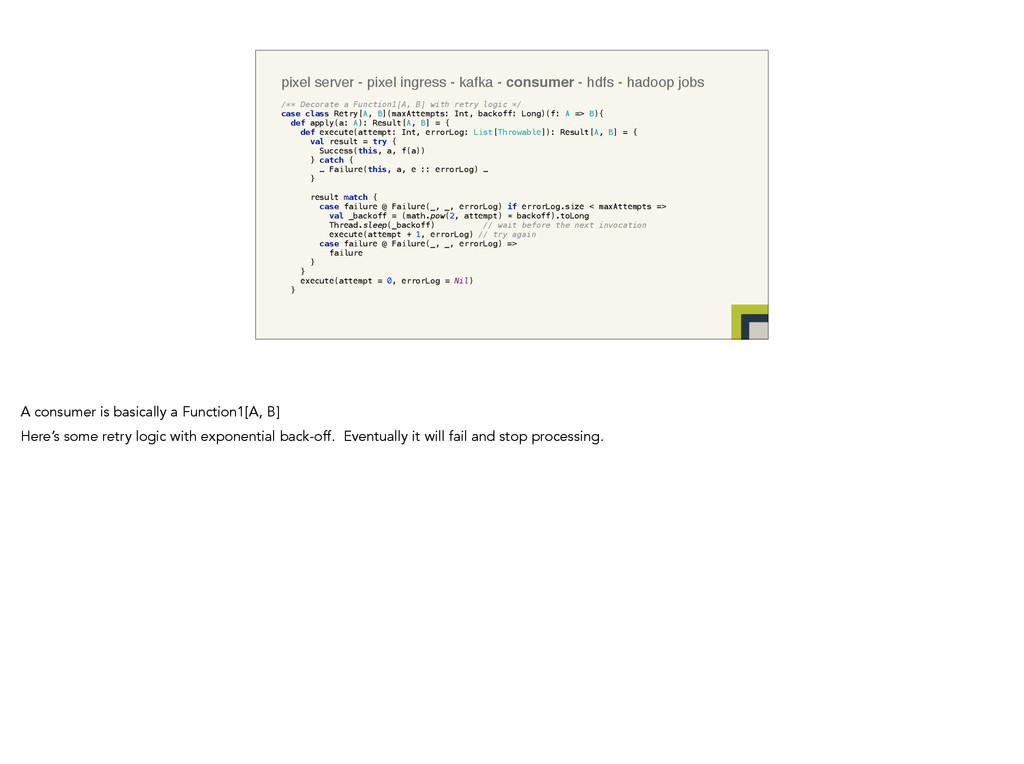
  28. /** Decorate a Function1[A, B] with retry logic */
 case

    class Retry[A, B](maxAttempts: Int, backoff: Long)(f: A => B){
 def apply(a: A): Result[A, B] = {
 def execute(attempt: Int, errorLog: List[Throwable]): Result[A, B] = {
 val result = try { Success(this, a, f(a)) } catch { … Failure(this, a, e :: errorLog) … }
 
 result match {
 case failure @ Failure(_, _, errorLog) if errorLog.size < maxAttempts =>
 val _backoff = (math.pow(2, attempt) * backoff).toLong
 Thread.sleep(_backoff) // wait before the next invocation
 execute(attempt + 1, errorLog) // try again
 case failure @ Failure(_, _, errorLog) =>
 failure
 }
 }
 execute(attempt = 0, errorLog = Nil)
 }
 pixel server - pixel ingress - kafka - consumer - hdfs - hadoop jobs! A consumer is basically a Function1[A, B] Here’s some retry logic with exponential back-off. Eventually it will fail and stop processing. !
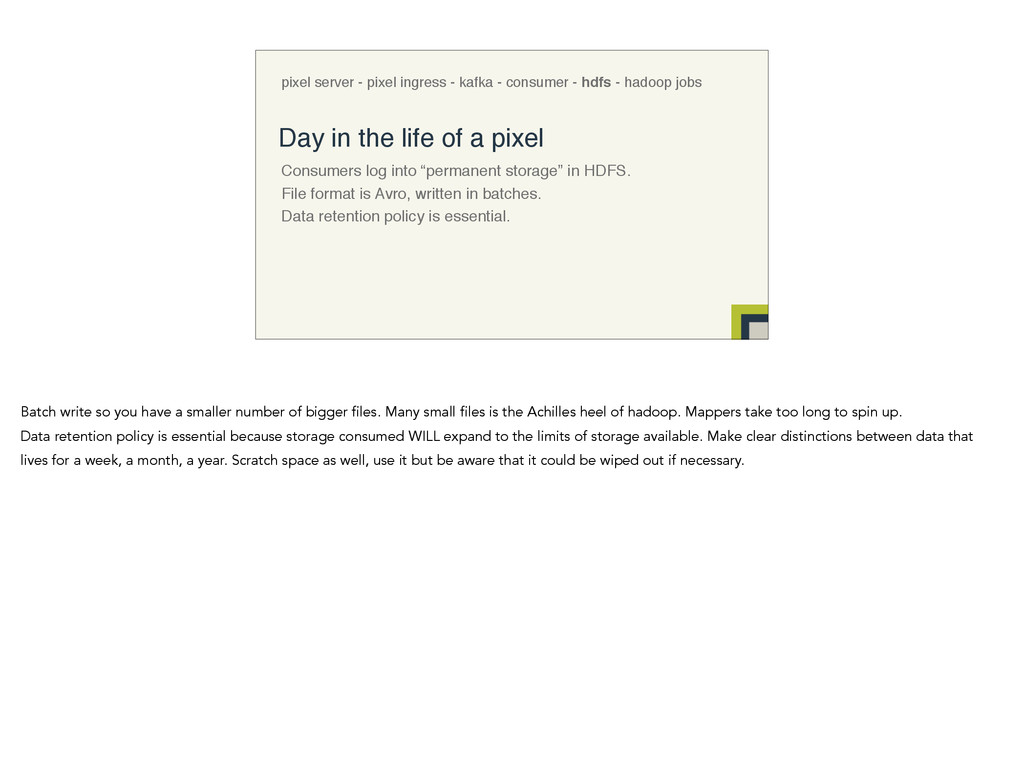
  29. Day in the life of a pixel Consumers log into

    “permanent storage” in HDFS.! File format is Avro, written in batches.! Data retention policy is essential.! pixel server - pixel ingress - kafka - consumer - hdfs - hadoop jobs! Batch write so you have a smaller number of bigger files. Many small files is the Achilles heel of hadoop. Mappers take too long to spin up. Data retention policy is essential because storage consumed WILL expand to the limits of storage available. Make clear distinctions between data that lives for a week, a month, a year. Scratch space as well, use it but be aware that it could be wiped out if necessary.
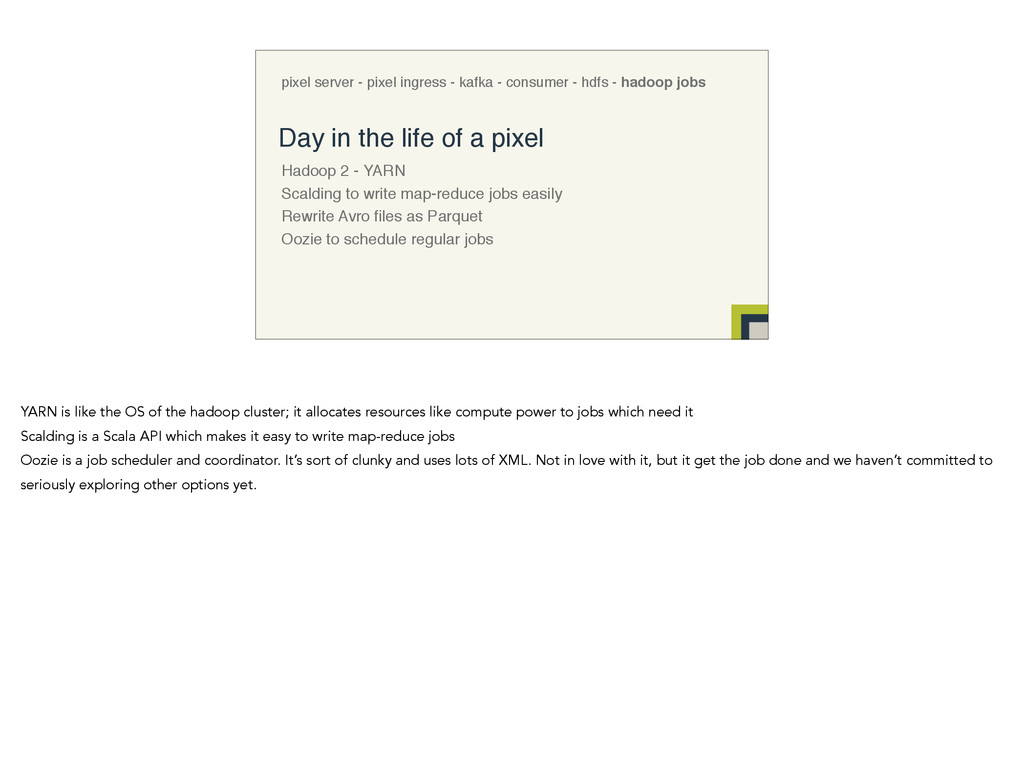
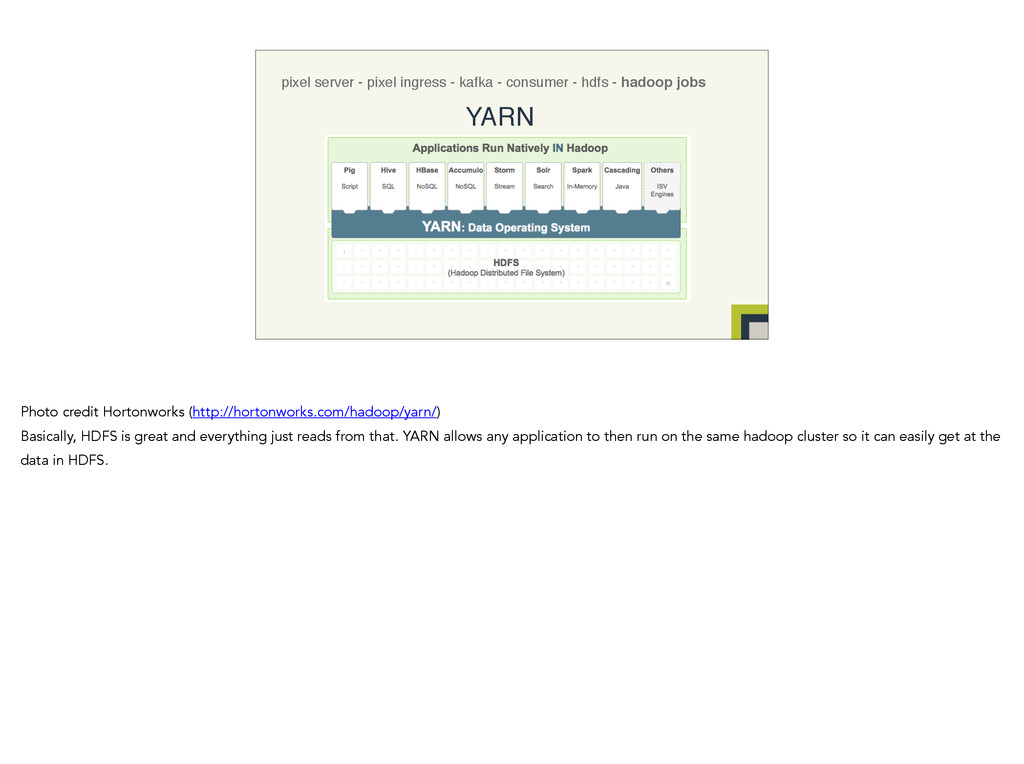
  30. Day in the life of a pixel Hadoop 2 -

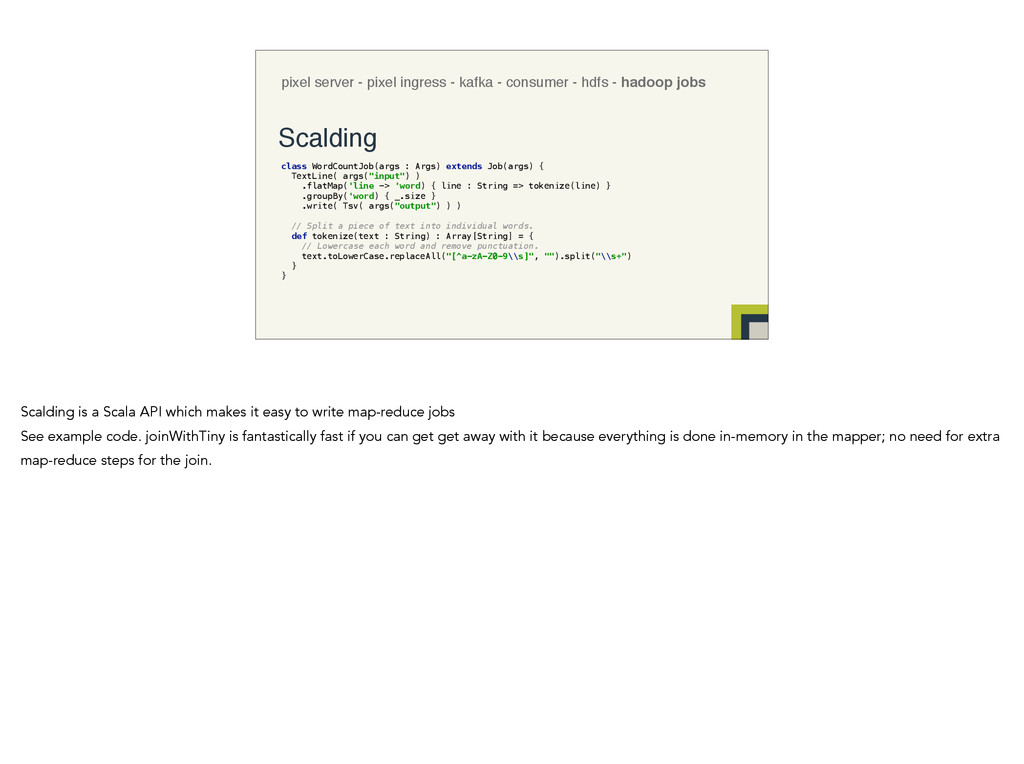
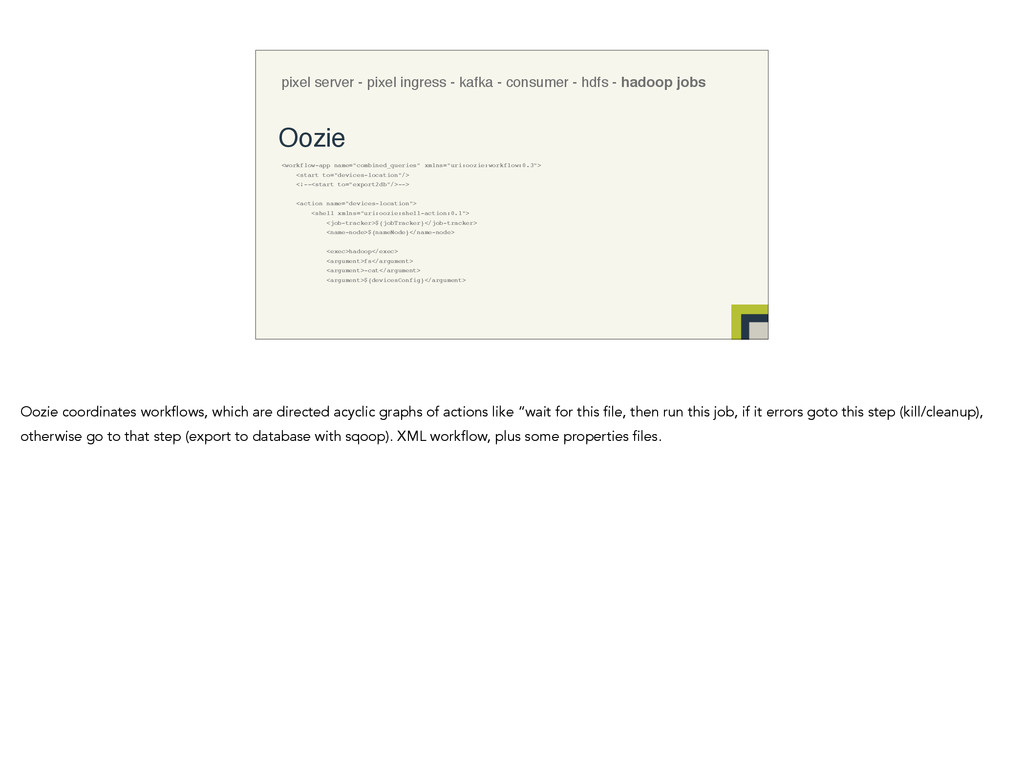
    YARN! Scalding to write map-reduce jobs easily! Rewrite Avro files as Parquet ! Oozie to schedule regular jobs! pixel server - pixel ingress - kafka - consumer - hdfs - hadoop jobs! YARN is like the OS of the hadoop cluster; it allocates resources like compute power to jobs which need it Scalding is a Scala API which makes it easy to write map-reduce jobs Oozie is a job scheduler and coordinator. It’s sort of clunky and uses lots of XML. Not in love with it, but it get the job done and we haven’t committed to seriously exploring other options yet.
  31. pixel server - pixel ingress - kafka - consumer -

    hdfs - hadoop jobs! YARN Photo credit Hortonworks (http://hortonworks.com/hadoop/yarn/) Basically, HDFS is great and everything just reads from that. YARN allows any application to then run on the same hadoop cluster so it can easily get at the data in HDFS.
  32. Scalding class WordCountJob(args : Args) extends Job(args) {
 TextLine( args("input")

    )
 .flatMap('line -> 'word) { line : String => tokenize(line) }
 .groupBy('word) { _.size }
 .write( Tsv( args("output") ) )
 
 // Split a piece of text into individual words.
 def tokenize(text : String) : Array[String] = {
 // Lowercase each word and remove punctuation.
 text.toLowerCase.replaceAll("[^a-zA-Z0-9\\s]", "").split("\\s+")
 }
 } pixel server - pixel ingress - kafka - consumer - hdfs - hadoop jobs! Scalding is a Scala API which makes it easy to write map-reduce jobs See example code. joinWithTiny is fantastically fast if you can get get away with it because everything is done in-memory in the mapper; no need for extra map-reduce steps for the join.
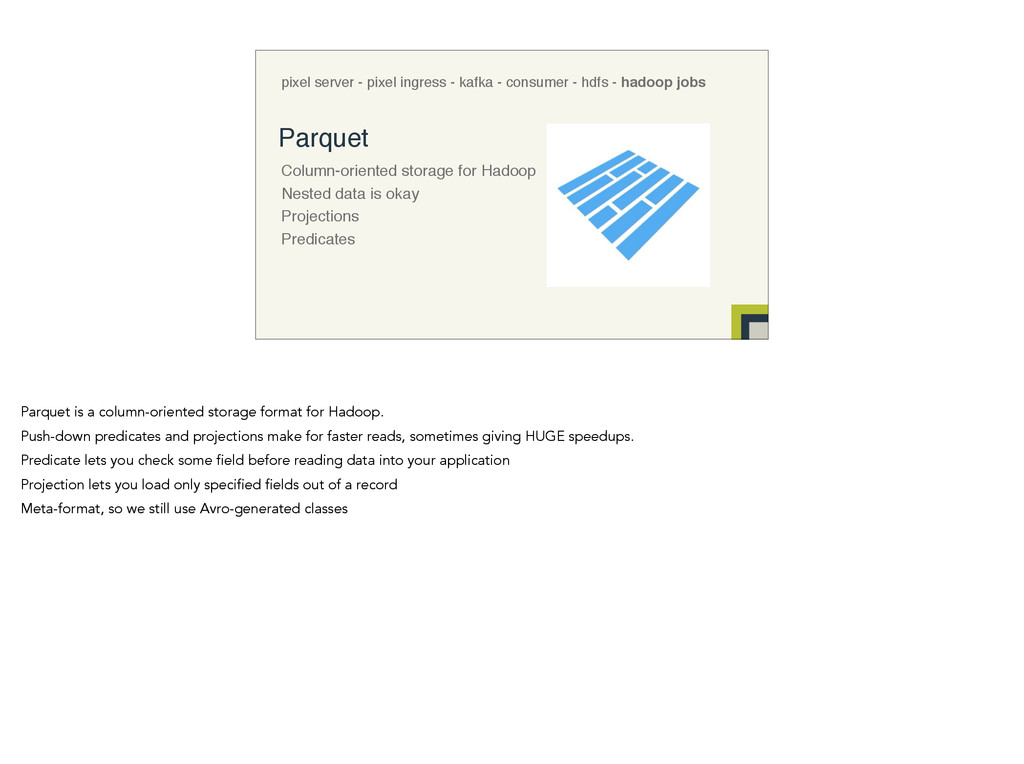
  33. Parquet Column-oriented storage for Hadoop! Nested data is okay! Projections!

    Predicates pixel server - pixel ingress - kafka - consumer - hdfs - hadoop jobs! Parquet is a column-oriented storage format for Hadoop. Push-down predicates and projections make for faster reads, sometimes giving HUGE speedups. Predicate lets you check some field before reading data into your application Projection lets you load only specified fields out of a record Meta-format, so we still use Avro-generated classes
  34. Parquet val requests = ParquetAvroSource
 .project[Request](args("requests"), Projection[Request]("header.query_params", "partner_id"))
 .read
 .sample(args("sample-rate").toDouble)


    .mapTo('Request -> ('queryParams, 'partnerId)) { req: TapestryRequest => (req.getHeader.getQueryParams, req.getPartnerId) } pixel server - pixel ingress - kafka - consumer - hdfs - hadoop jobs! Example of a projection
  35. Oozie <workflow-app name="combined_queries" xmlns="uri:oozie:workflow:0.3">! <start to="devices-location"/>! <!--<start to="export2db"/>-->! ! <action

    name="devices-location">! <shell xmlns="uri:oozie:shell-action:0.1">! <job-tracker>${jobTracker}</job-tracker>! <name-node>${nameNode}</name-node>! ! <exec>hadoop</exec>! <argument>fs</argument>! <argument>-cat</argument>! <argument>${devicesConfig}</argument>! ! pixel server - pixel ingress - kafka - consumer - hdfs - hadoop jobs! Oozie coordinates workflows, which are directed acyclic graphs of actions like “wait for this file, then run this job, if it errors goto this step (kill/cleanup), otherwise go to that step (export to database with sqoop). XML workflow, plus some properties files.
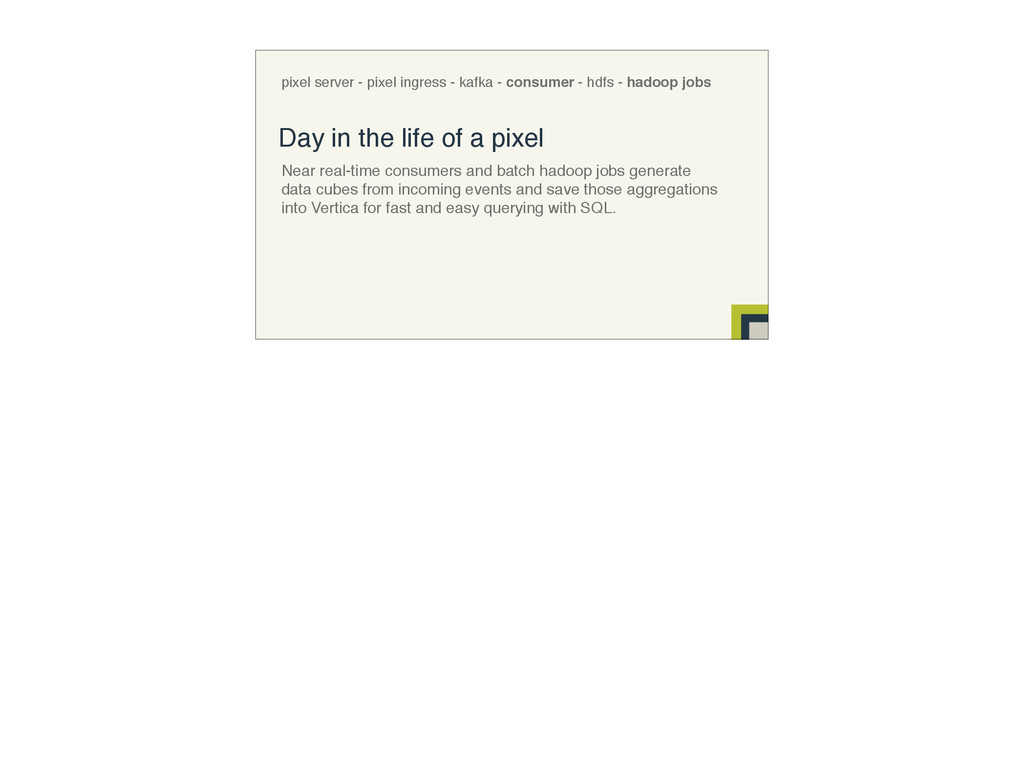
  36. Day in the life of a pixel Near real-time consumers

    and batch hadoop jobs generate data cubes from incoming events and save those aggregations into Vertica for fast and easy querying with SQL. pixel server - pixel ingress - kafka - consumer - hdfs - hadoop jobs!
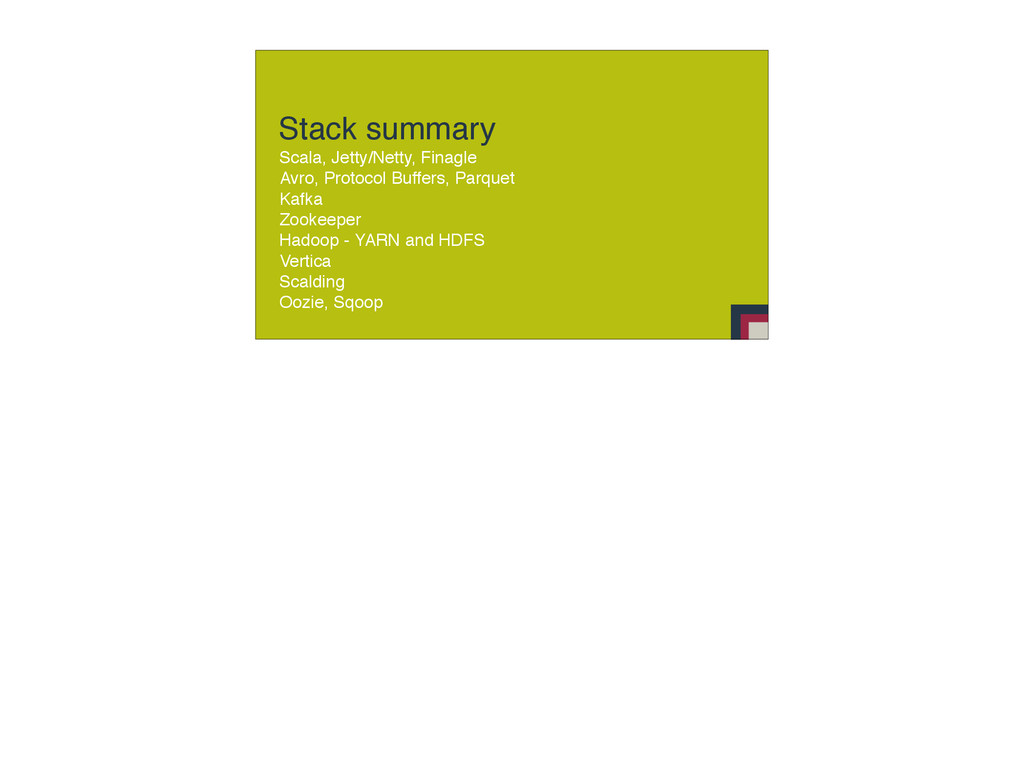
  37. Stack summary Scala, Jetty/Netty, Finagle! Avro, Protocol Buffers, Parquet! Kafka!

    Zookeeper! Hadoop - YARN and HDFS! Vertica! Scalding! Oozie, Sqoop!
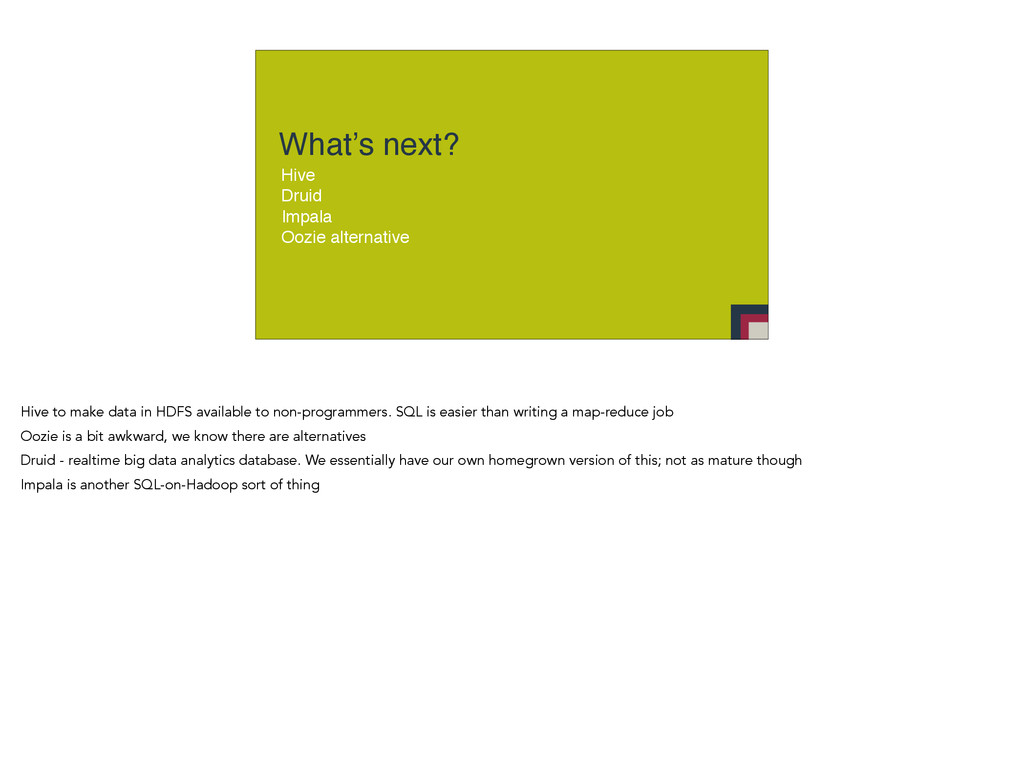
  38. What’s next? Hive! Druid! Impala! Oozie alternative Hive to make

    data in HDFS available to non-programmers. SQL is easier than writing a map-reduce job Oozie is a bit awkward, we know there are alternatives Druid - realtime big data analytics database. We essentially have our own homegrown version of this; not as mature though Impala is another SQL-on-Hadoop sort of thing