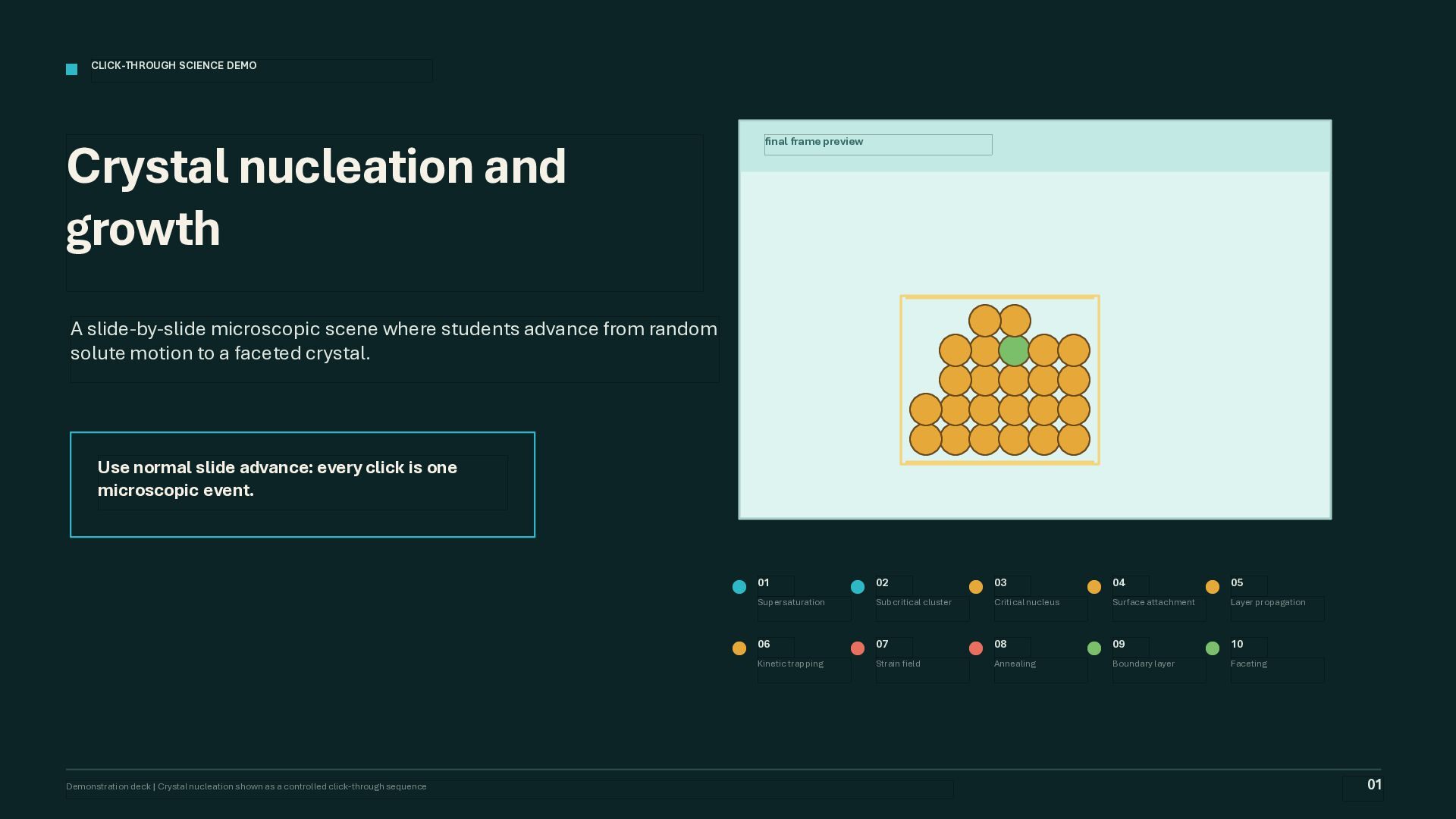
scene where students advance from random solute motion to a faceted crystal. Use normal slide advance: every click is one microscopic event. final frame preview 01 Supersaturation 02 Subcritical cluster 03 Critical nucleus 04 Surface attachment 05 Layer propagation 06 Kinetic trapping 07 Strain field 08 Annealing 09 Boundary layer 10 Faceting Demonstration deck | Crystal nucleation shown as a controlled click-through sequence 01
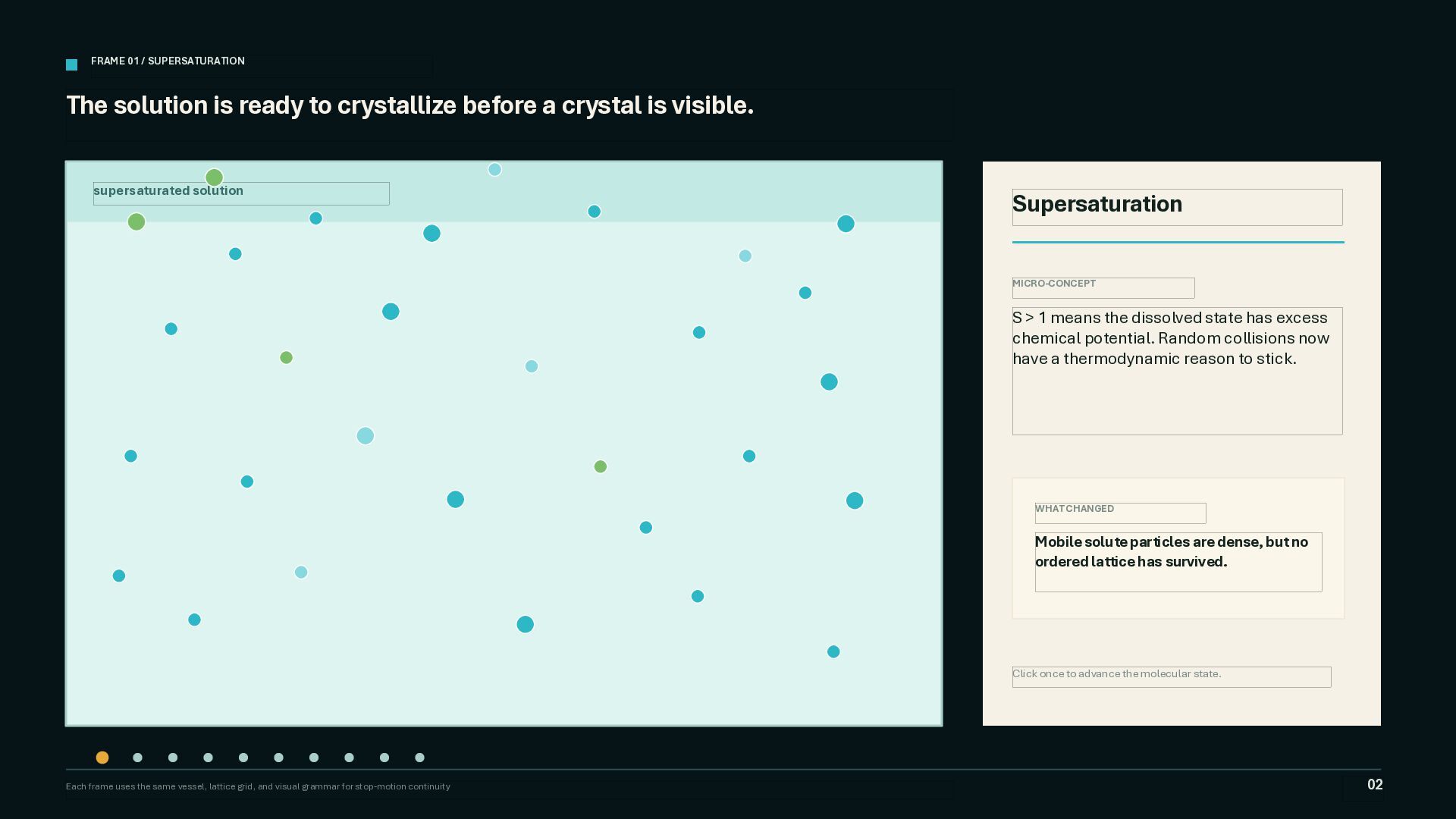
before a crystal is visible. supersaturated solution Supersaturation MICRO-CONCEPT S > 1 means the dissolved state has excess chemical potential. Random collisions now have a thermodynamic reason to stick. WHAT CHANGED Mobile solute particles are dense, but no ordered lattice has survived. Click once to advance the molecular state. Each frame uses the same vessel, lattice grid, and visual grammar for stop-motion continuity 02
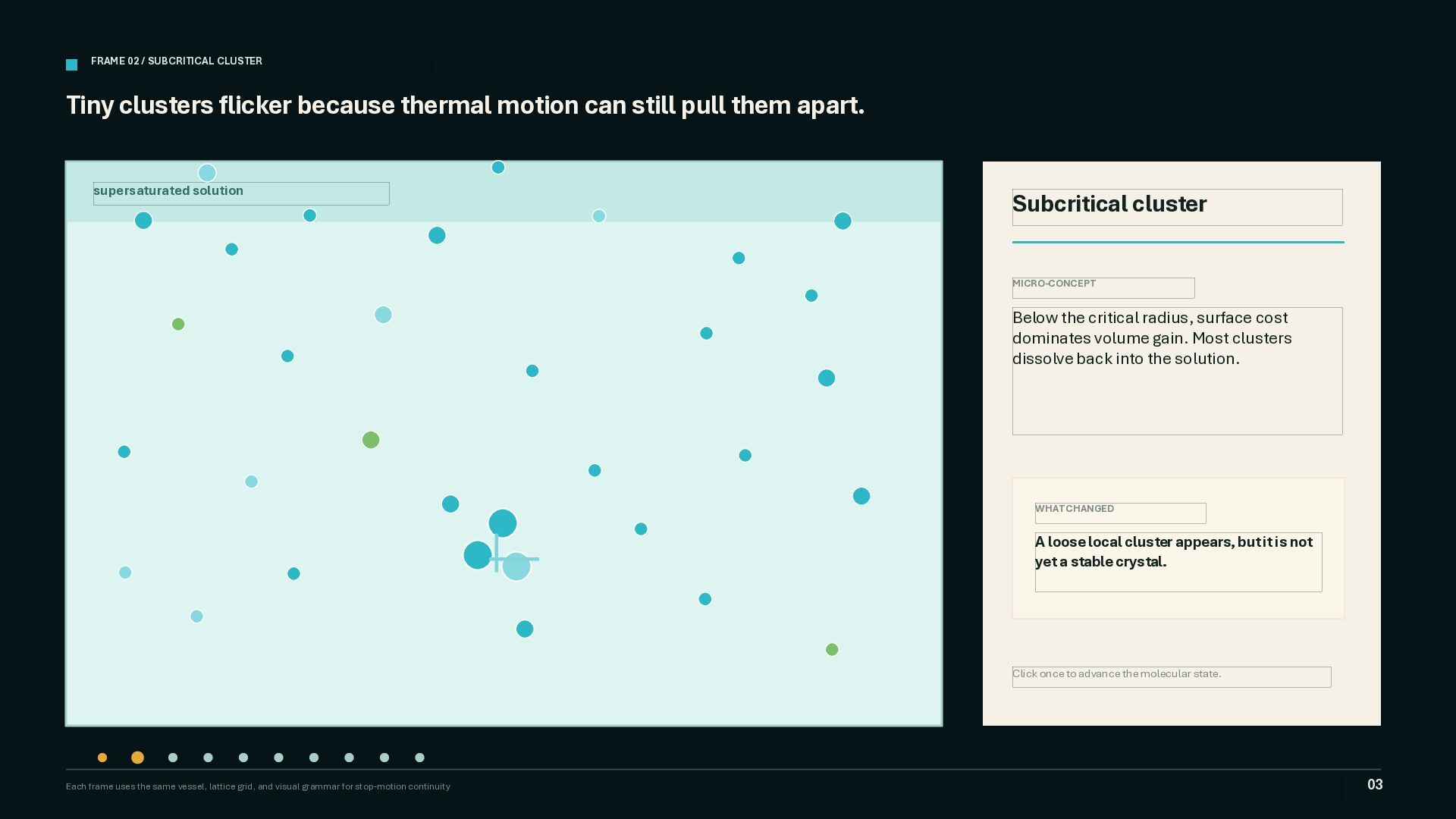
motion can still pull them apart. supersaturated solution Subcritical cluster MICRO-CONCEPT Below the critical radius, surface cost dominates volume gain. Most clusters dissolve back into the solution. WHAT CHANGED A loose local cluster appears, but it is not yet a stable crystal. Click once to advance the molecular state. Each frame uses the same vessel, lattice grid, and visual grammar for stop-motion continuity 03
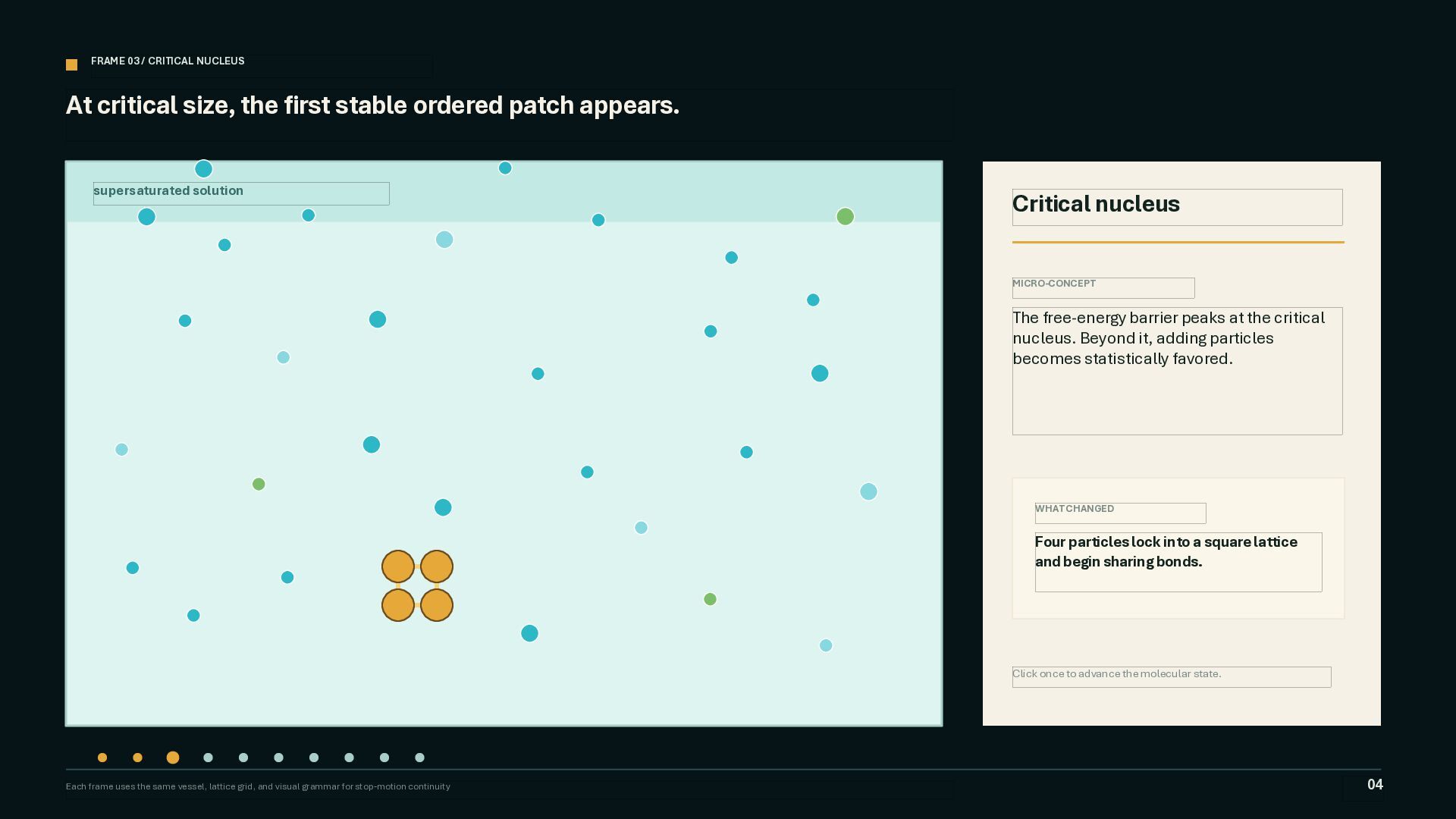
stable ordered patch appears. supersaturated solution Critical nucleus MICRO-CONCEPT The free-energy barrier peaks at the critical nucleus. Beyond it, adding particles becomes statistically favored. WHAT CHANGED Four particles lock into a square lattice and begin sharing bonds. Click once to advance the molecular state. Each frame uses the same vessel, lattice grid, and visual grammar for stop-motion continuity 04
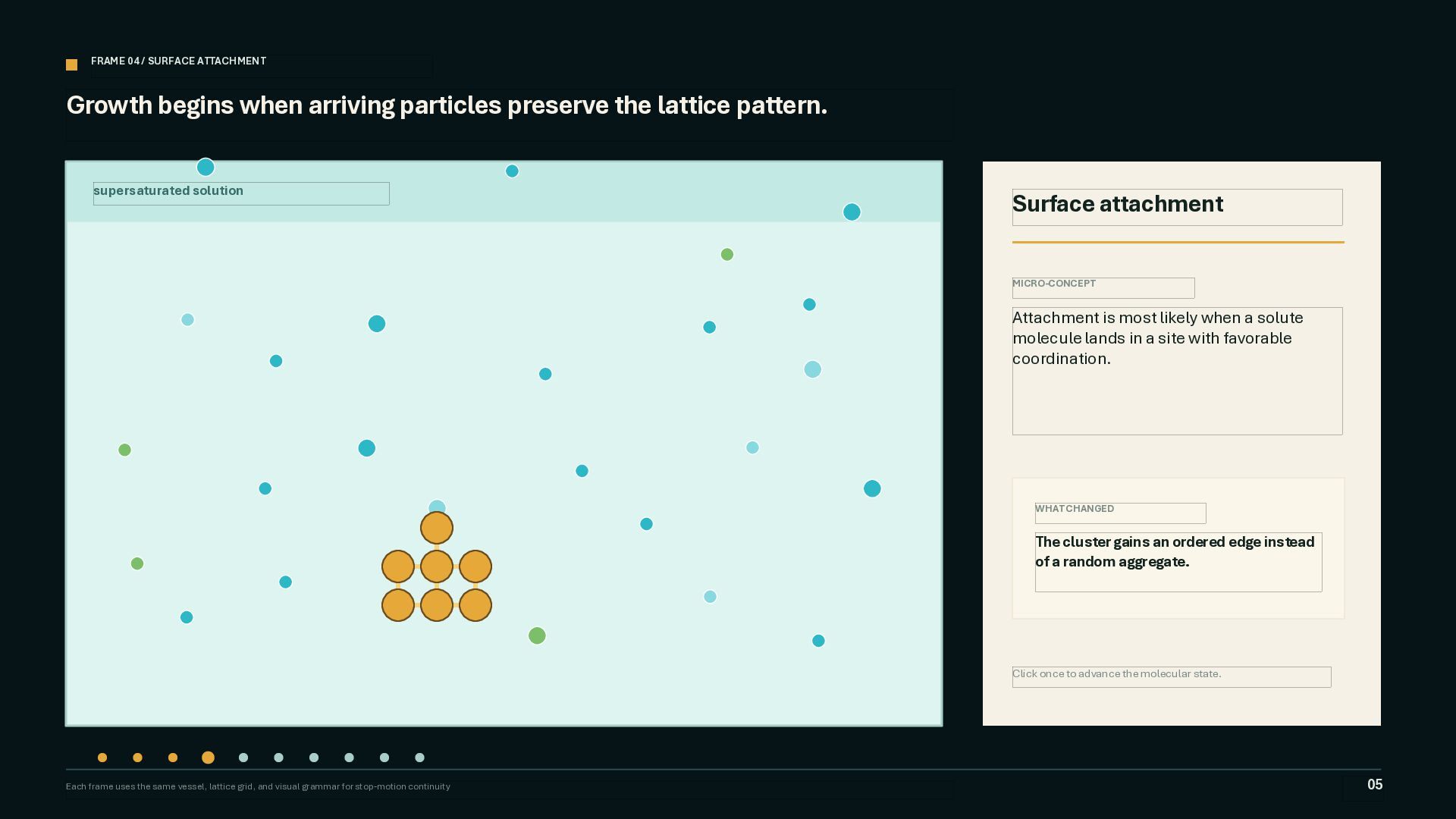
preserve the lattice pattern. supersaturated solution Surface attachment MICRO-CONCEPT Attachment is most likely when a solute molecule lands in a site with favorable coordination. WHAT CHANGED The cluster gains an ordered edge instead of a random aggregate. Click once to advance the molecular state. Each frame uses the same vessel, lattice grid, and visual grammar for stop-motion continuity 05
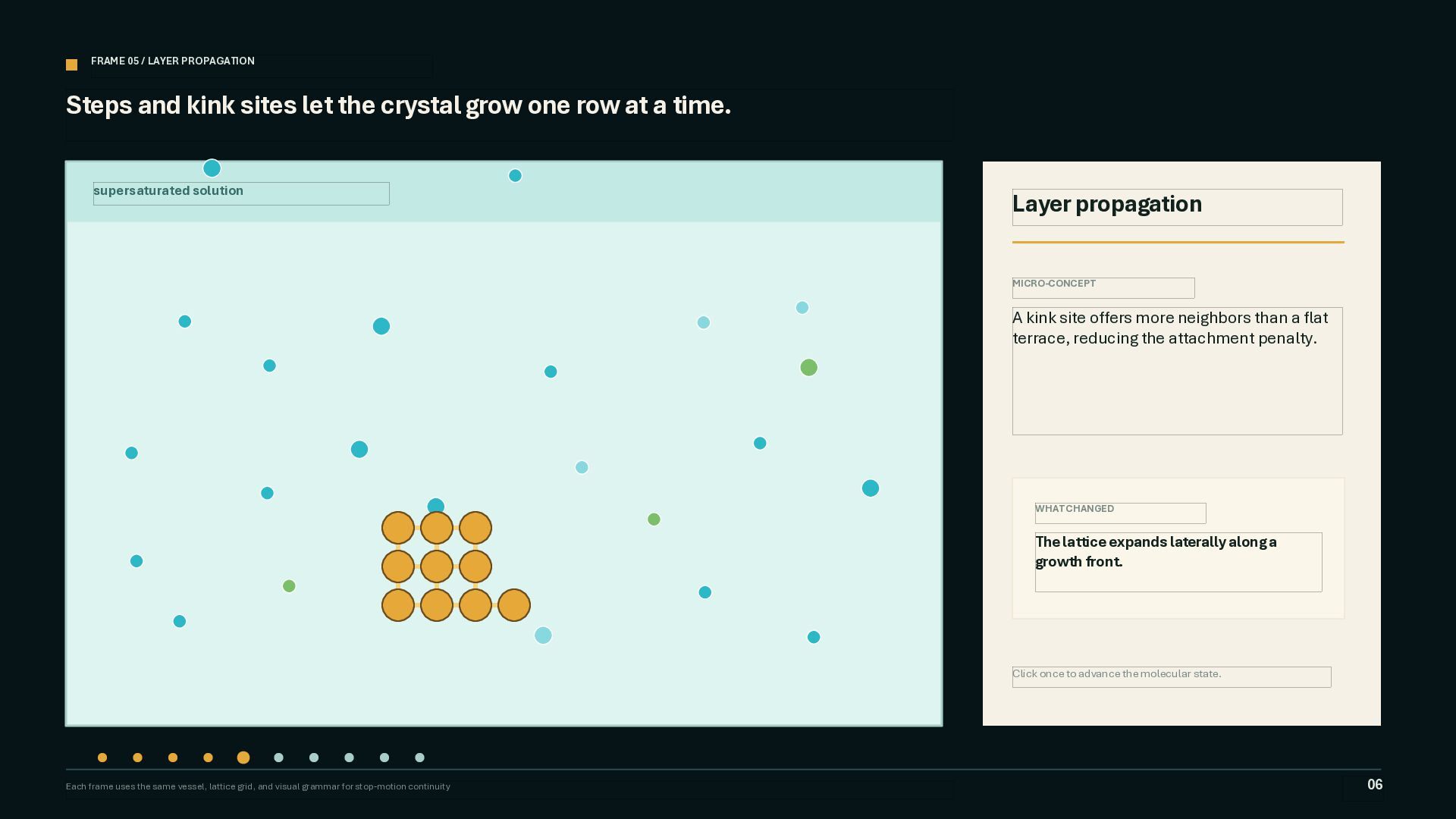
the crystal grow one row at a time. supersaturated solution Layer propagation MICRO-CONCEPT A kink site offers more neighbors than a flat terrace, reducing the attachment penalty. WHAT CHANGED The lattice expands laterally along a growth front. Click once to advance the molecular state. Each frame uses the same vessel, lattice grid, and visual grammar for stop-motion continuity 06
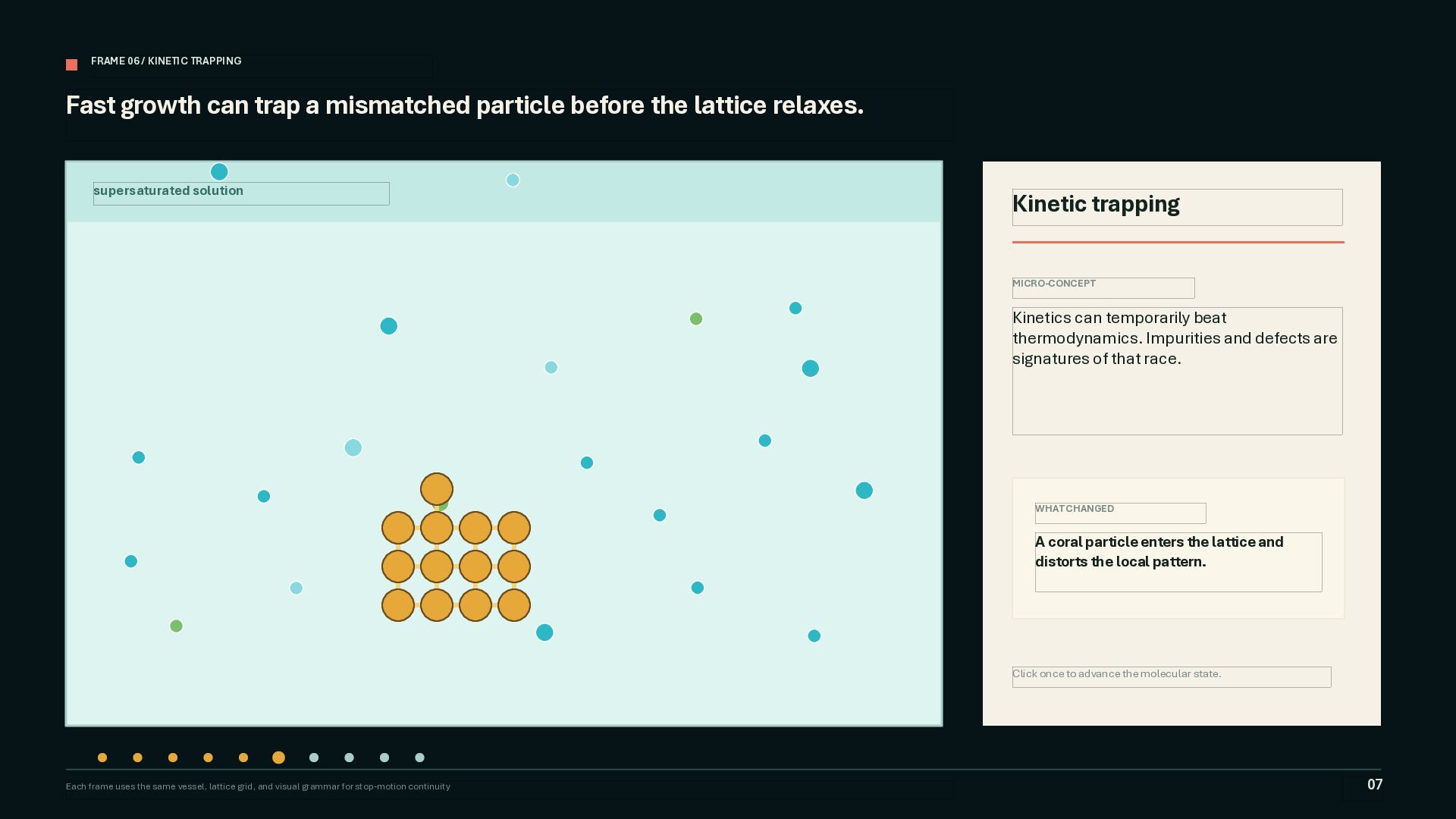
mismatched particle before the lattice relaxes. supersaturated solution Kinetic trapping MICRO-CONCEPT Kinetics can temporarily beat thermodynamics. Impurities and defects are signatures of that race. WHAT CHANGED A coral particle enters the lattice and distorts the local pattern. Click once to advance the molecular state. Each frame uses the same vessel, lattice grid, and visual grammar for stop-motion continuity 07
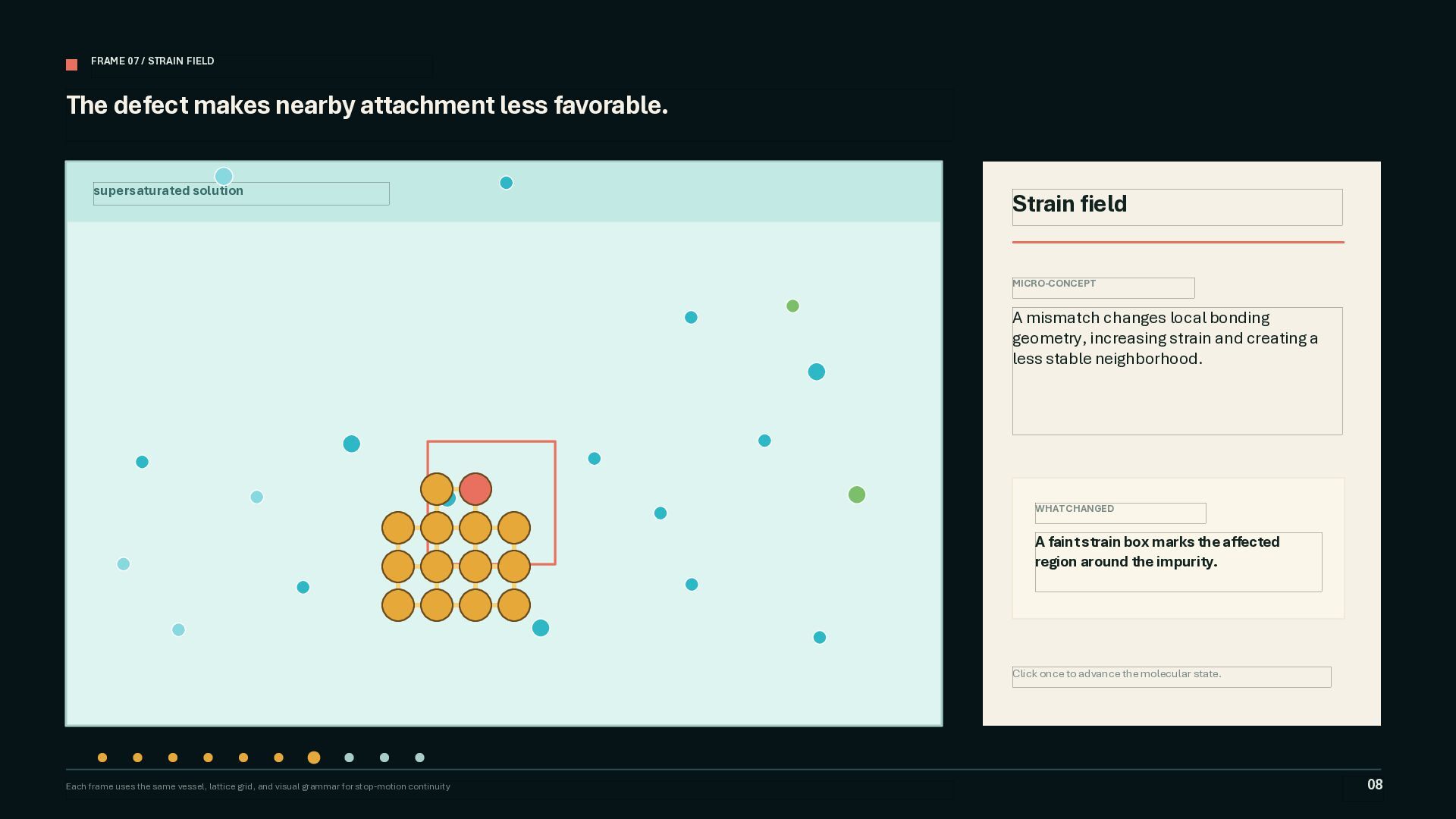
less favorable. supersaturated solution Strain field MICRO-CONCEPT A mismatch changes local bonding geometry, increasing strain and creating a less stable neighborhood. WHAT CHANGED A faint strain box marks the affected region around the impurity. Click once to advance the molecular state. Each frame uses the same vessel, lattice grid, and visual grammar for stop-motion continuity 08
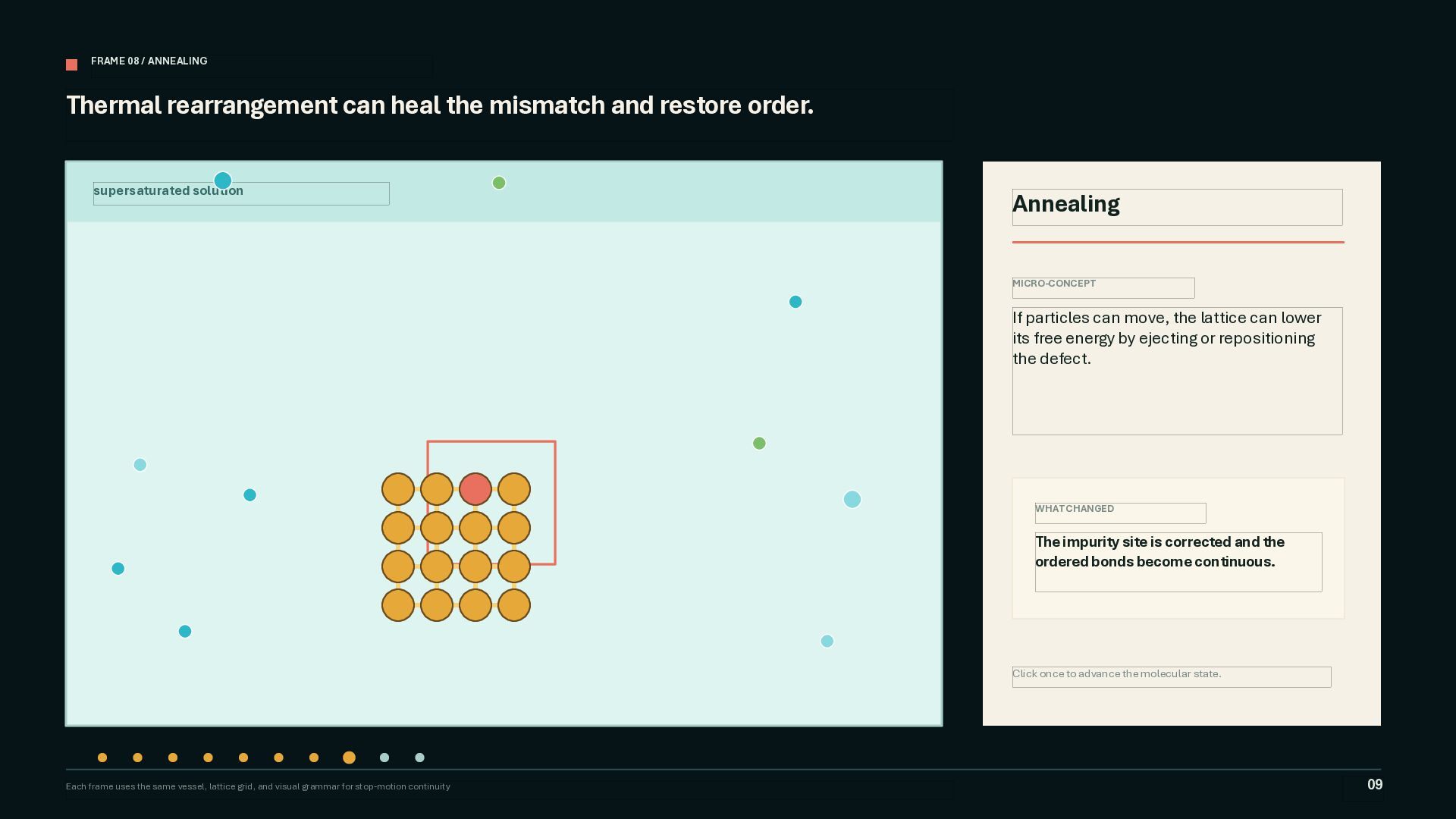
and restore order. supersaturated solution Annealing MICRO-CONCEPT If particles can move, the lattice can lower its free energy by ejecting or repositioning the defect. WHAT CHANGED The impurity site is corrected and the ordered bonds become continuous. Click once to advance the molecular state. Each frame uses the same vessel, lattice grid, and visual grammar for stop-motion continuity 09
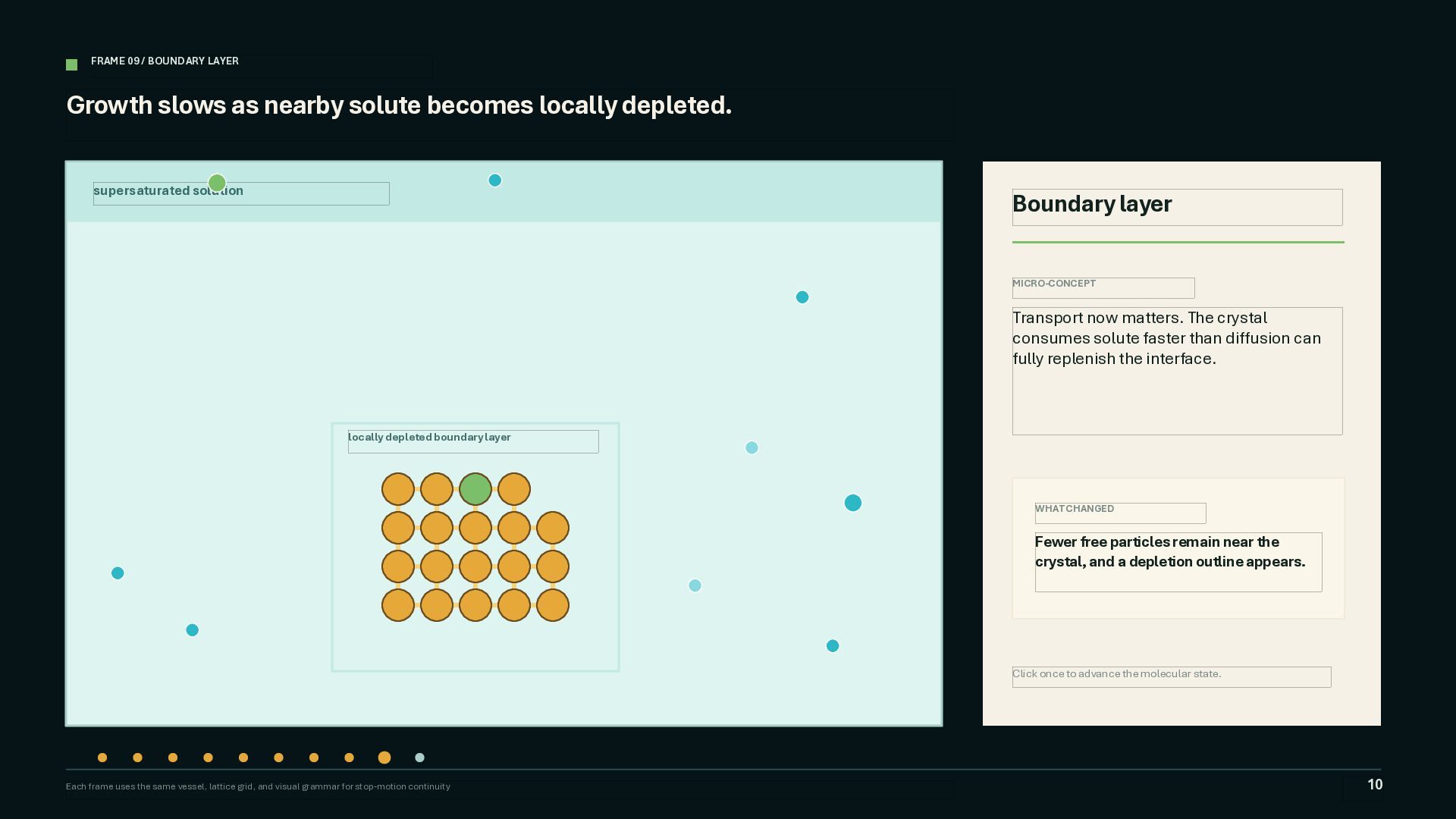
becomes locally depleted. supersaturated solution locally depleted boundary layer Boundary layer MICRO-CONCEPT Transport now matters. The crystal consumes solute faster than diffusion can fully replenish the interface. WHAT CHANGED Fewer free particles remain near the crystal, and a depletion outline appears. Click once to advance the molecular state. Each frame uses the same vessel, lattice grid, and visual grammar for stop-motion continuity 10
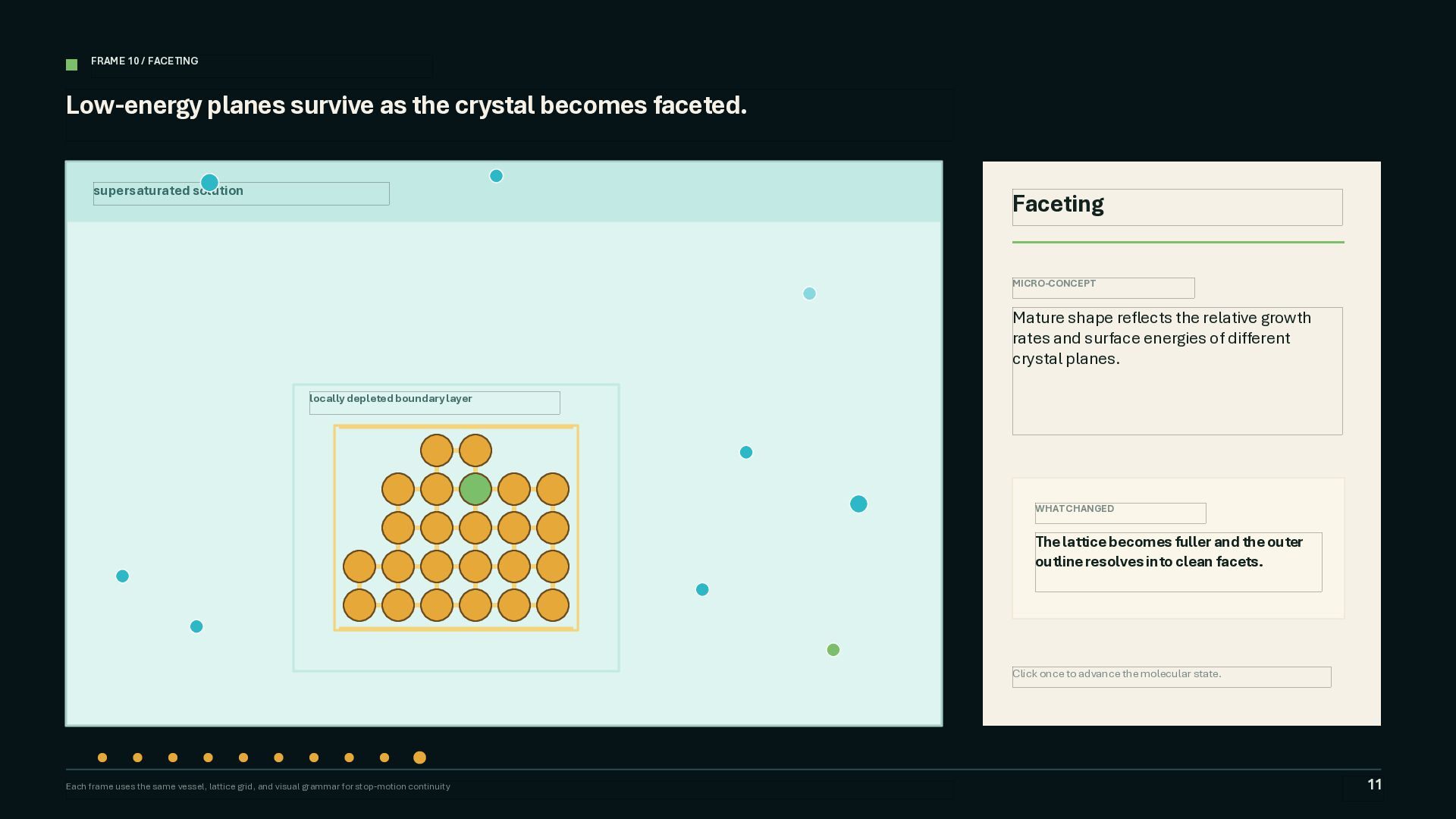
becomes faceted. supersaturated solution locally depleted boundary layer Faceting MICRO-CONCEPT Mature shape reflects the relative growth rates and surface energies of different crystal planes. WHAT CHANGED The lattice becomes fuller and the outer outline resolves into clean facets. Click once to advance the molecular state. Each frame uses the same vessel, lattice grid, and visual grammar for stop-motion continuity 11
Driving force Supersaturation makes attachment favorable, but not guaranteed. Barrier A critical nucleus must form before growth becomes likely. Surface kinetics Steps and kink sites decide where layer growth accelerates. Defects Fast growth can trap mismatch; annealing can restore order. end state: faceted ordered lattice Classroom prompt: ask students which click marks the first irreversible-looking step, then connect that intuition to the free-energy barrier. Suggested discussion: what would change if temperature, supersaturation, or impurity concentration changed? 12


 tomasdore
 pwiseman
 rabernat
 mclloyd
 coloredviolet
 maggiecrowley
 aleyda
 tmiket
 retrage
 mfonobong
 lara
lara
 tamaranovitovic