Analysis of Integrations in SAP Cloud Integration: Exploring Patterns and Detecting Anomalies
Event: SAP Inside Track Madrid 2026
Date: April 17, 2026
Speaker: Vadim Klimov
Session: Analysis of integrations in SAP Cloud Integration - Exploring patterns and detecting anomalies
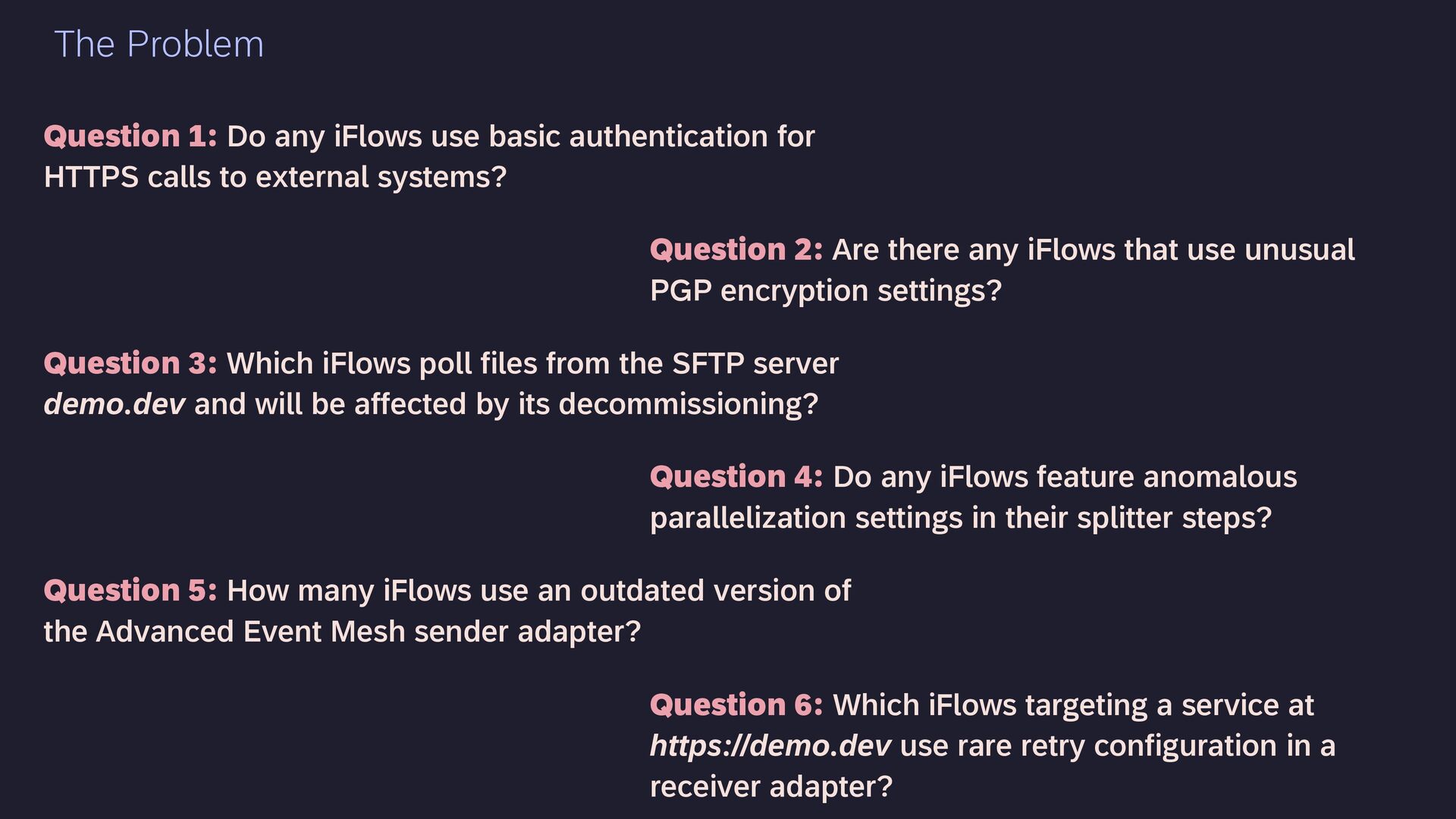
for HTTPS calls to external systems? Question 2: Are there any iFlows that use unusual PGP encryption settings? Question 4: Do any iFlows feature anomalous parallelization settings in their splitter steps? Question 5: How many iFlows use an outdated version of the Advanced Event Mesh sender adapter? Question 6: Which iFlows targeting a service at https://demo.dev use rare retry configuration in a receiver adapter? Question 3: Which iFlows poll files from the SFTP server demo.dev and will be affected by its decommissioning?
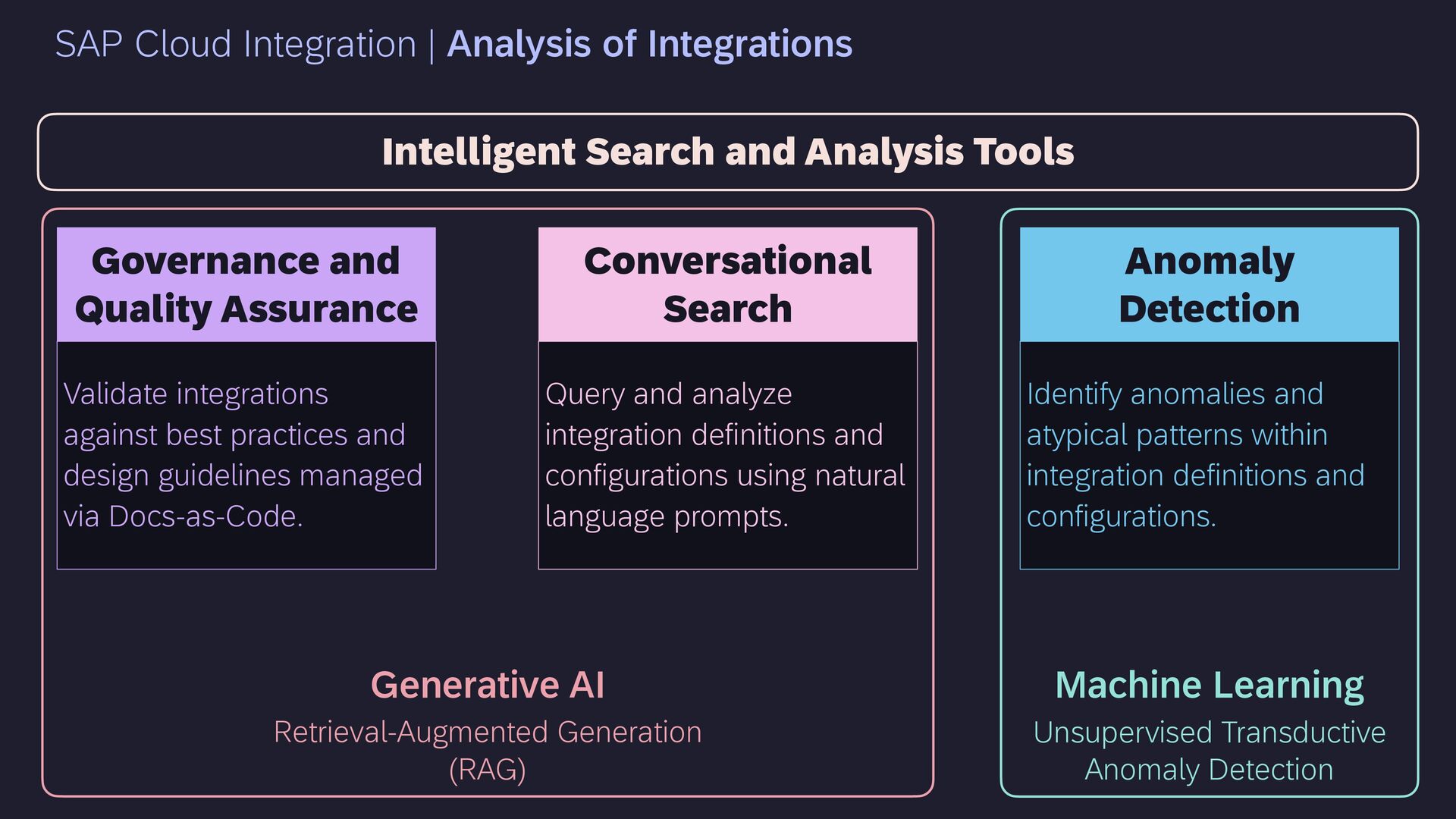
Detection Generative AI Retrieval-Augmented Generation (RAG) SAP Cloud Integration | Analysis of Integrations Governance and Quality Assurance Conversational Search Anomaly Detection Validate integrations against best practices and design guidelines managed via Docs-as-Code. Query and analyze integration definitions and configurations using natural language prompts. Identify anomalies and atypical patterns within integration definitions and configurations.
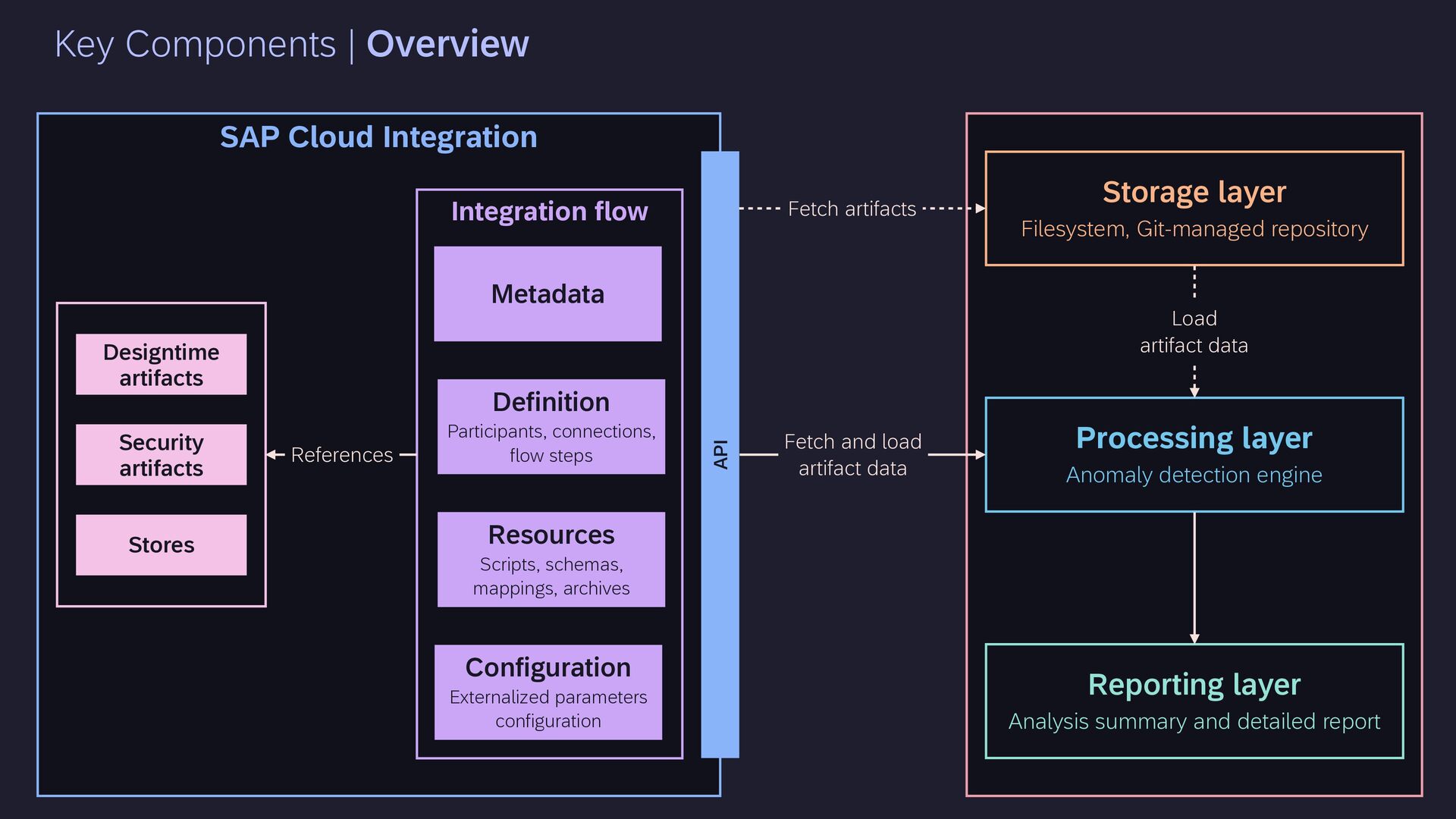
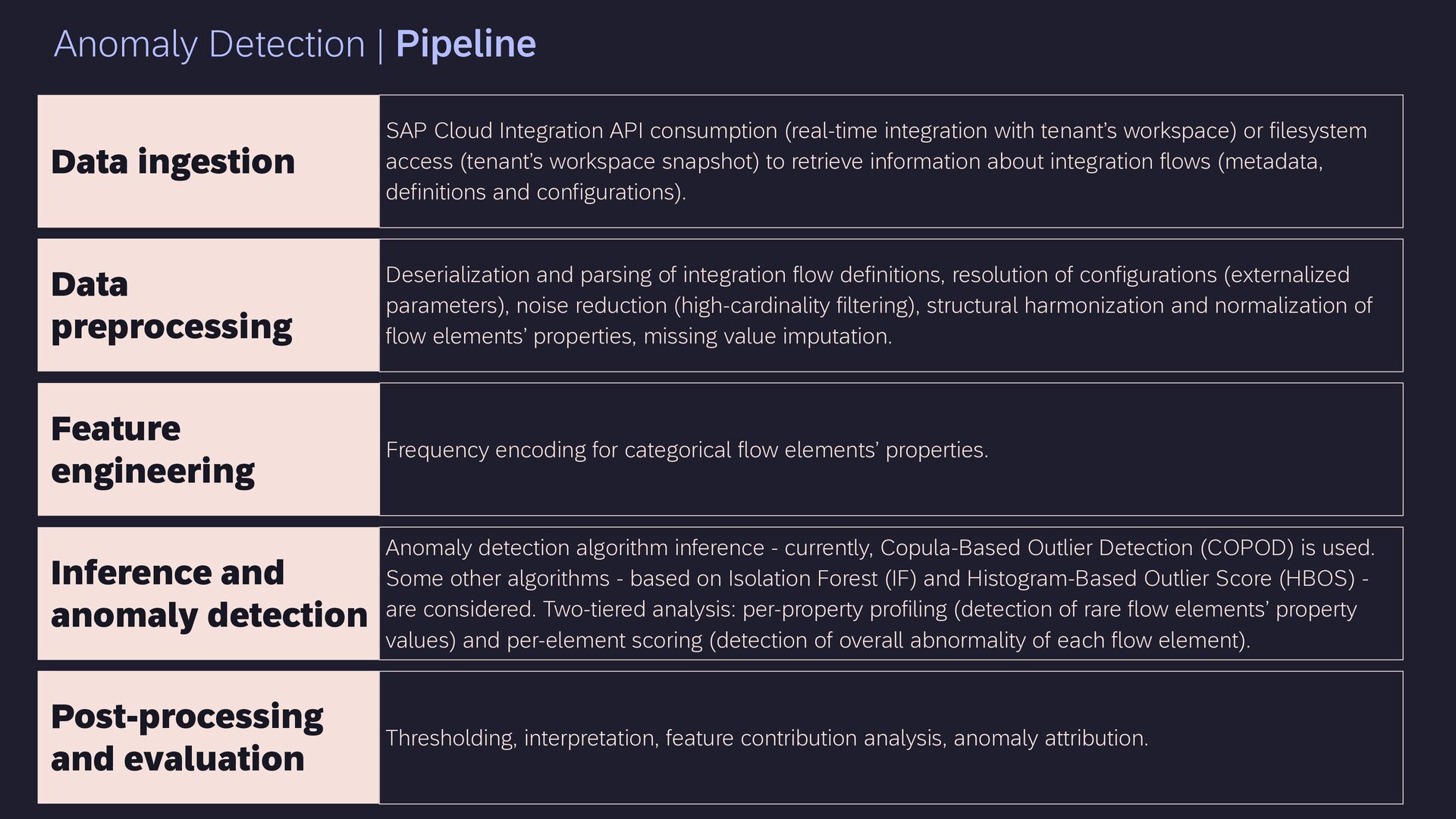
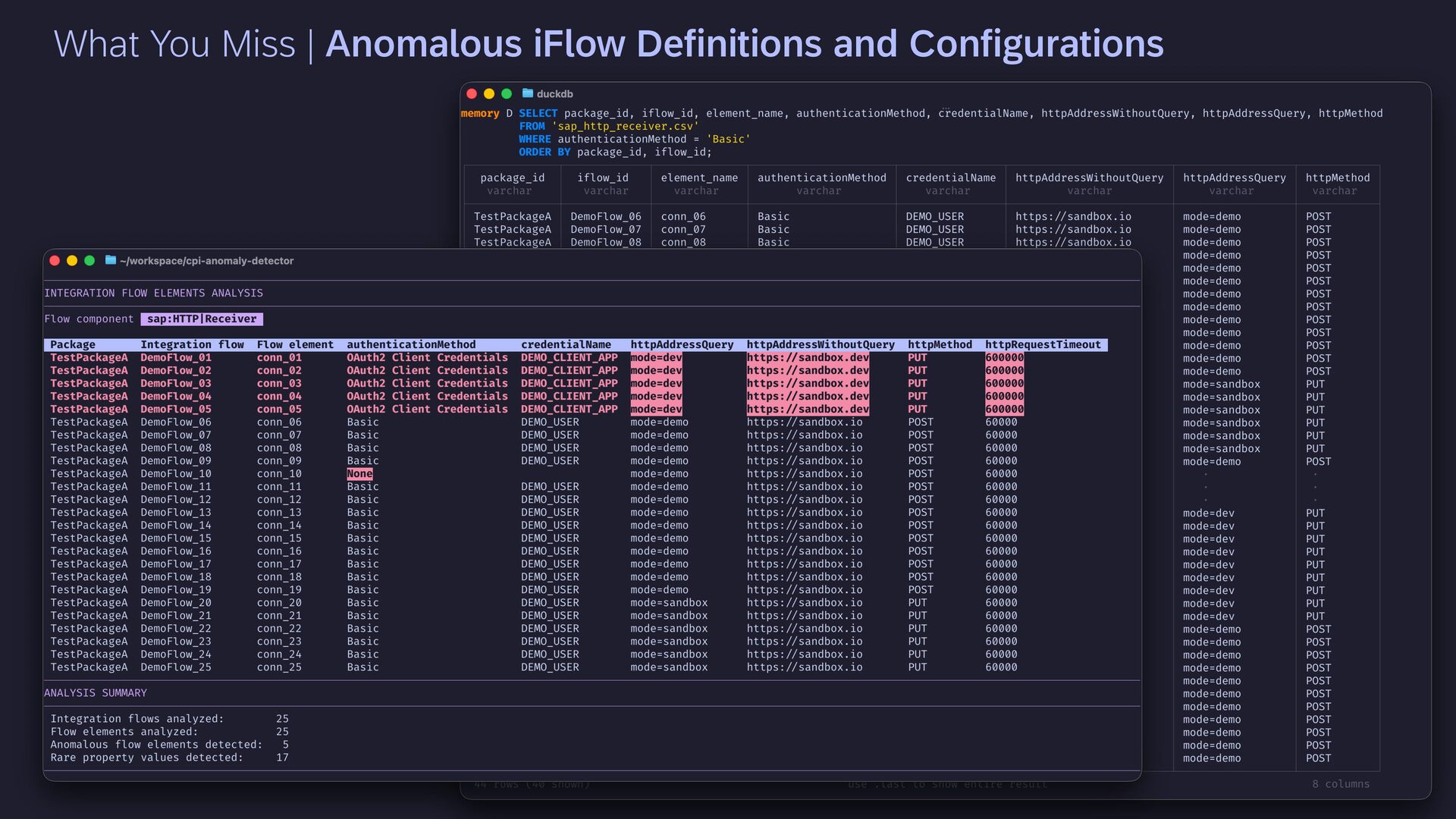
consumption (real-time integration with tenant’s workspace) or filesystem access (tenant’s workspace snapshot) to retrieve information about integration flows (metadata, definitions and configurations). Data preprocessing Feature engineering Inference and anomaly detection Post-processing and evaluation Deserialization and parsing of integration flow definitions, resolution of configurations (externalized parameters), noise reduction (high-cardinality filtering), structural harmonization and normalization of flow elements’ properties, missing value imputation. Frequency encoding for categorical flow elements’ properties. Anomaly detection algorithm inference - currently, Copula-Based Outlier Detection (COPOD) is used. Some other algorithms - based on Isolation Forest (IF) and Histogram-Based Outlier Score (HBOS) - are considered. Two-tiered analysis: per-property profiling (detection of rare flow elements’ property values) and per-element scoring (detection of overall abnormality of each flow element). Thresholding, interpretation, feature contribution analysis, anomaly attribution.


 vadimklimov
 frankvandijk
 philnash
 geshan
 iamctodd
 tamaranovitovic
 chriscoyier
 baasie
 axbom
axbom
 techseoconnect
 sergeychernyshev
 cromwellryan
 mfonobong