Glibc, LLVM, Rust, Go, OpenMP) part of a bigger platform enablement team (porting Linux kernel to new hardware) 20 years of work on GCC 2 years of work on MRI Vladimir Makarov (Red Hat) Towards Ruby3x3 Performance September 13, 2017 2 / 30
MRI 3 should be 3x faster than MRI 2 Koichi Sasada improved MRI performance by about 3x It is symbolic to expect MRI 3 should be 3x faster than MRI 2 Doable for CPU intensive programs Hardly possible for memory or IO bound programs I treat Matz’s performance goal as: MRI needs another cardinal performance improvement Vladimir Makarov (Red Hat) Towards Ruby3x3 Performance September 13, 2017 3 / 30
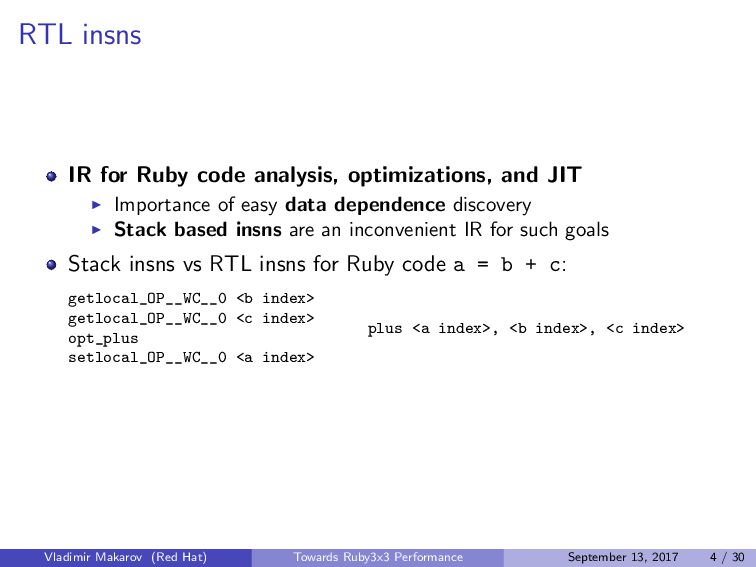
Importance of easy data dependence discovery Stack based insns are an inconvenient IR for such goals Stack insns vs RTL insns for Ruby code a = b + c: getlocal_OP__WC__0 <b index> getlocal_OP__WC__0 <c index> opt_plus setlocal_OP__WC__0 <a index> plus <a index>, <b index>, <c index> Vladimir Makarov (Red Hat) Towards Ruby3x3 Performance September 13, 2017 4 / 30
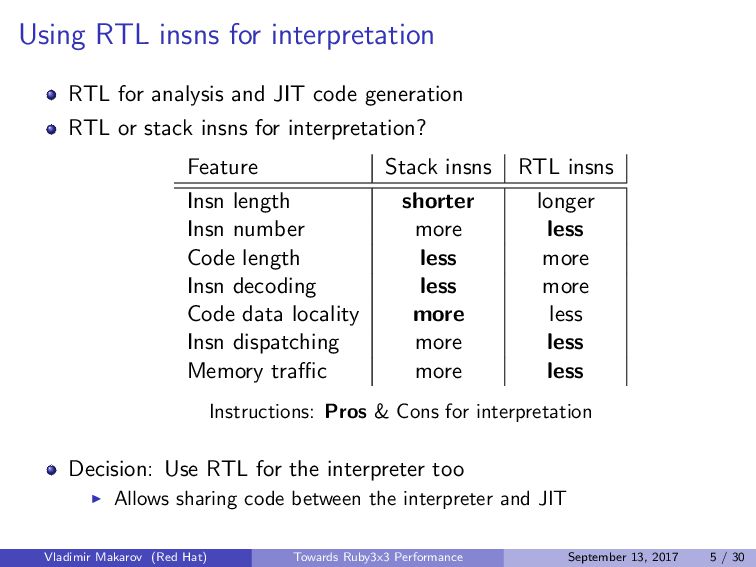
code generation RTL or stack insns for interpretation? Feature Stack insns RTL insns Insn length shorter longer Insn number more less Code length less more Insn decoding less more Code data locality more less Insn dispatching more less Memory traffic more less Instructions: Pros & Cons for interpretation Decision: Use RTL for the interpreter too Allows sharing code between the interpreter and JIT Vladimir Makarov (Red Hat) Towards Ruby3x3 Performance September 13, 2017 5 / 30
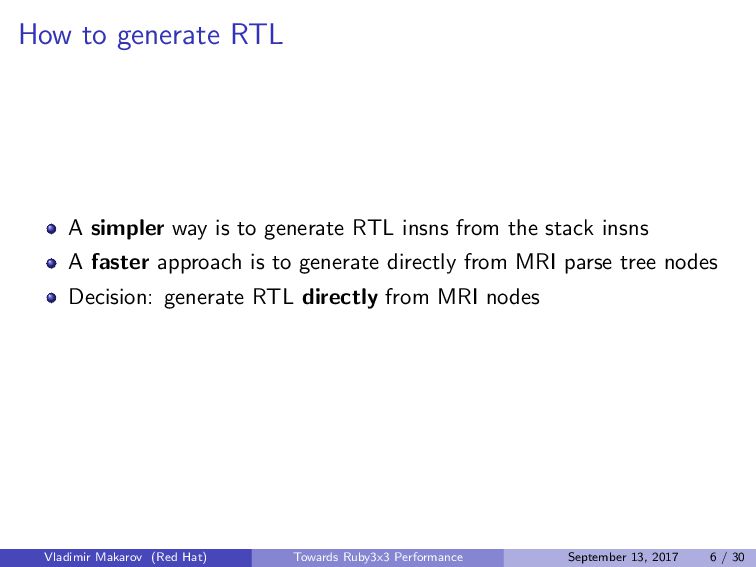
RTL insns from the stack insns A faster approach is to generate directly from MRI parse tree nodes Decision: generate RTL directly from MRI nodes Vladimir Makarov (Red Hat) Towards Ruby3x3 Performance September 13, 2017 6 / 30
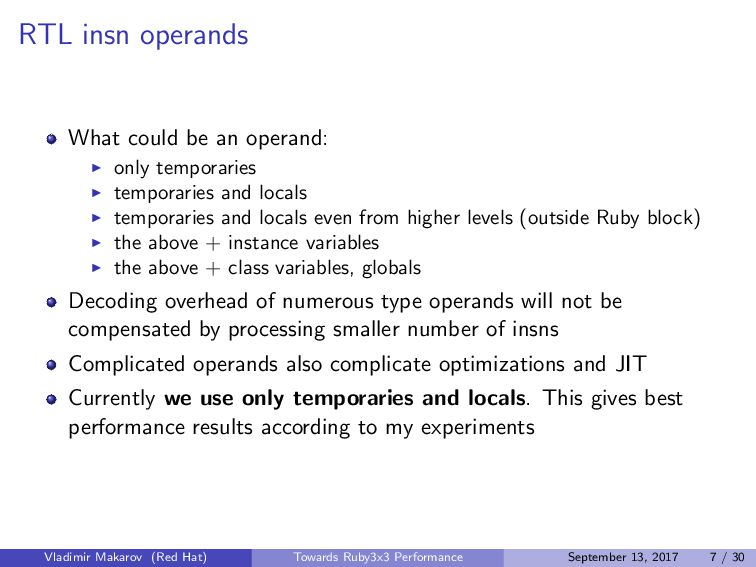
temporaries and locals temporaries and locals even from higher levels (outside Ruby block) the above + instance variables the above + class variables, globals Decoding overhead of numerous type operands will not be compensated by processing smaller number of insns Complicated operands also complicate optimizations and JIT Currently we use only temporaries and locals. This gives best performance results according to my experiments Vladimir Makarov (Red Hat) Towards Ruby3x3 Performance September 13, 2017 7 / 30
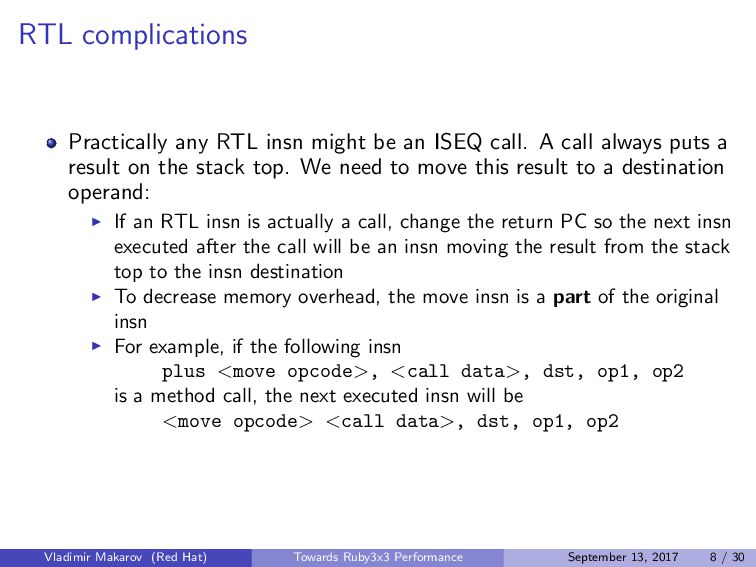
call. A call always puts a result on the stack top. We need to move this result to a destination operand: If an RTL insn is actually a call, change the return PC so the next insn executed after the call will be an insn moving the result from the stack top to the insn destination To decrease memory overhead, the move insn is a part of the original insn For example, if the following insn plus <move opcode>, <call data>, dst, op1, op2 is a method call, the next executed insn will be <move opcode> <call data>, dst, op1, op2 Vladimir Makarov (Red Hat) Towards Ruby3x3 Performance September 13, 2017 8 / 30
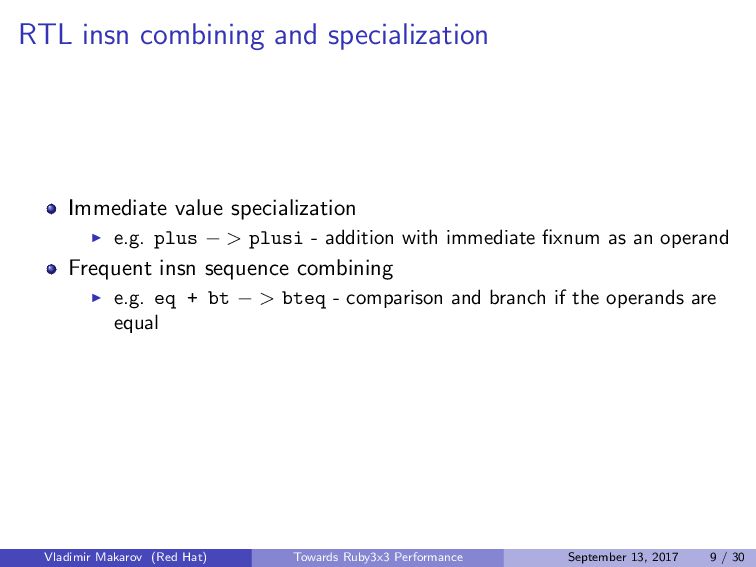
− > plusi - addition with immediate fixnum as an operand Frequent insn sequence combining e.g. eq + bt − > bteq - comparison and branch if the operands are equal Vladimir Makarov (Red Hat) Towards Ruby3x3 Performance September 13, 2017 9 / 30
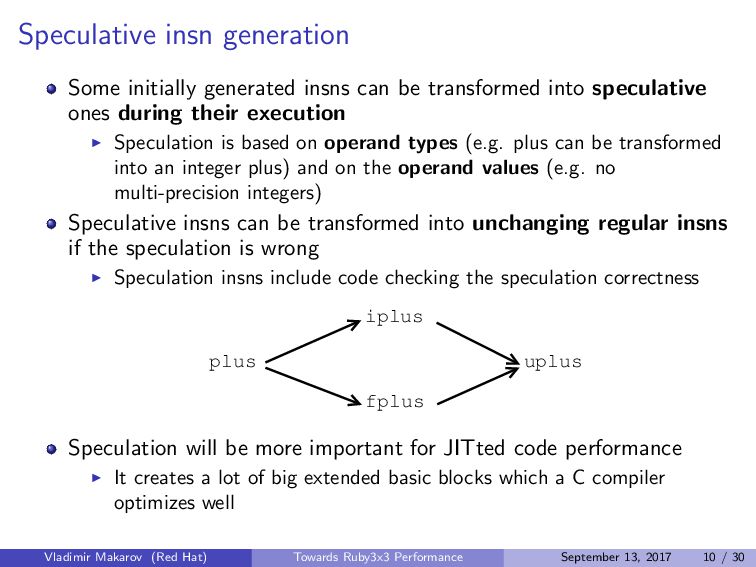
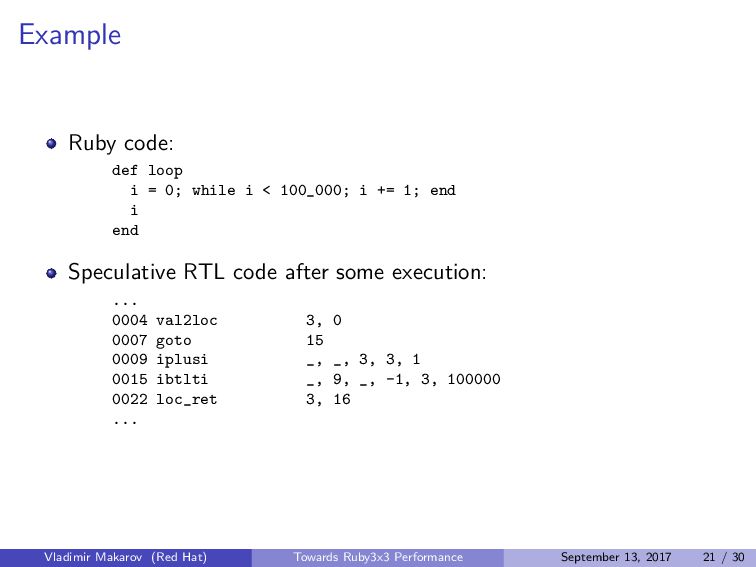
into speculative ones during their execution Speculation is based on operand types (e.g. plus can be transformed into an integer plus) and on the operand values (e.g. no multi-precision integers) Speculative insns can be transformed into unchanging regular insns if the speculation is wrong Speculation insns include code checking the speculation correctness plus iplus uplus fplus Speculation will be more important for JITted code performance It creates a lot of big extended basic blocks which a C compiler optimizes well Vladimir Makarov (Red Hat) Towards Ruby3x3 Performance September 13, 2017 10 / 30
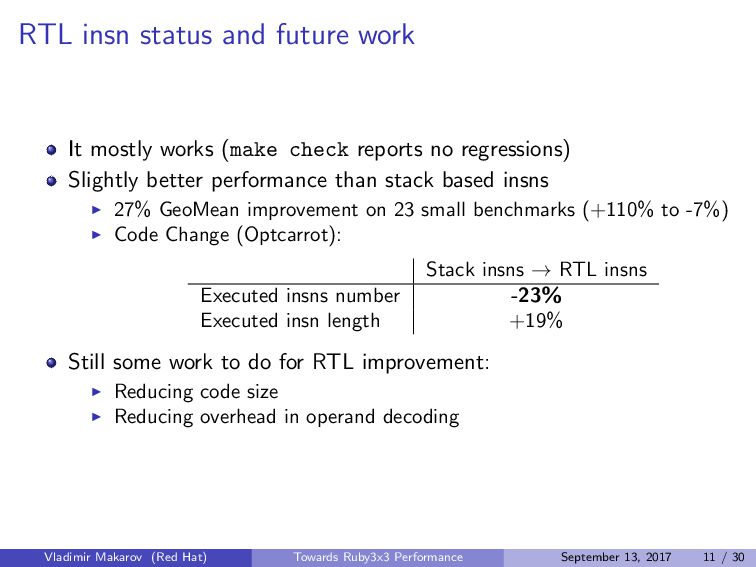
check reports no regressions) Slightly better performance than stack based insns 27% GeoMean improvement on 23 small benchmarks (+110% to -7%) Code Change (Optcarrot): Stack insns → RTL insns Executed insns number -23% Executed insn length +19% Still some work to do for RTL improvement: Reducing code size Reducing overhead in operand decoding Vladimir Makarov (Red Hat) Towards Ruby3x3 Performance September 13, 2017 11 / 30
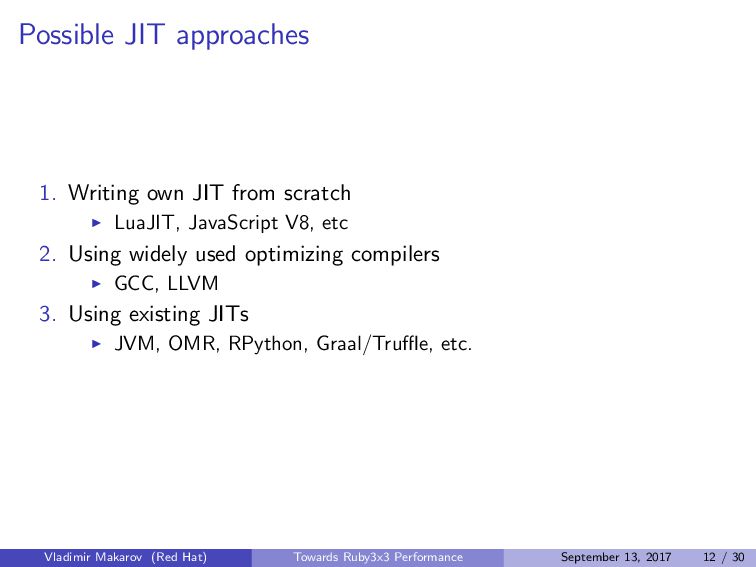
JavaScript V8, etc 2. Using widely used optimizing compilers GCC, LLVM 3. Using existing JITs JVM, OMR, RPython, Graal/Truffle, etc. Vladimir Makarov (Red Hat) Towards Ruby3x3 Performance September 13, 2017 12 / 30
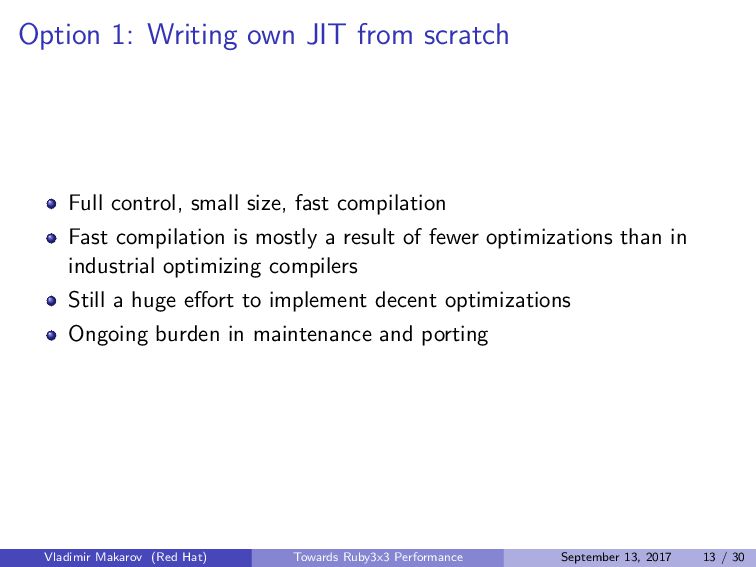
size, fast compilation Fast compilation is mostly a result of fewer optimizations than in industrial optimizing compilers Still a huge effort to implement decent optimizations Ongoing burden in maintenance and porting Vladimir Makarov (Red Hat) Towards Ruby3x3 Performance September 13, 2017 13 / 30
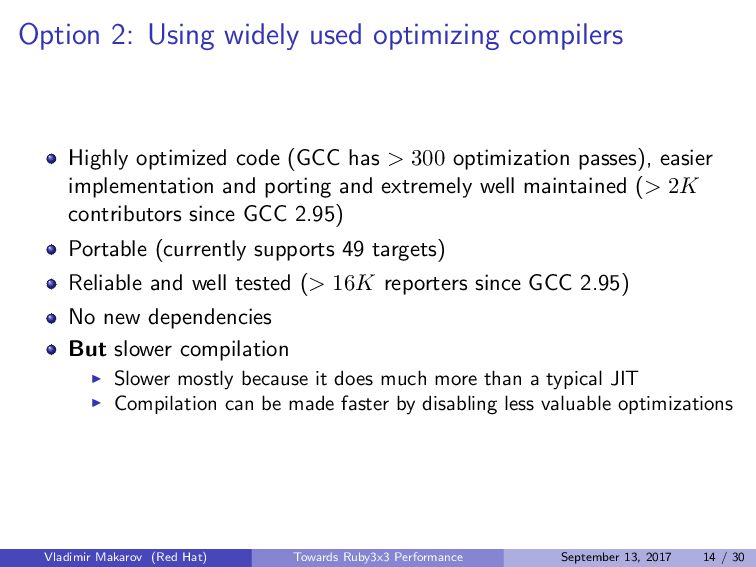
(GCC has > 300 optimization passes), easier implementation and porting and extremely well maintained (> 2K contributors since GCC 2.95) Portable (currently supports 49 targets) Reliable and well tested (> 16K reporters since GCC 2.95) No new dependencies But slower compilation Slower mostly because it does much more than a typical JIT Compilation can be made faster by disabling less valuable optimizations Vladimir Makarov (Red Hat) Towards Ruby3x3 Performance September 13, 2017 14 / 30
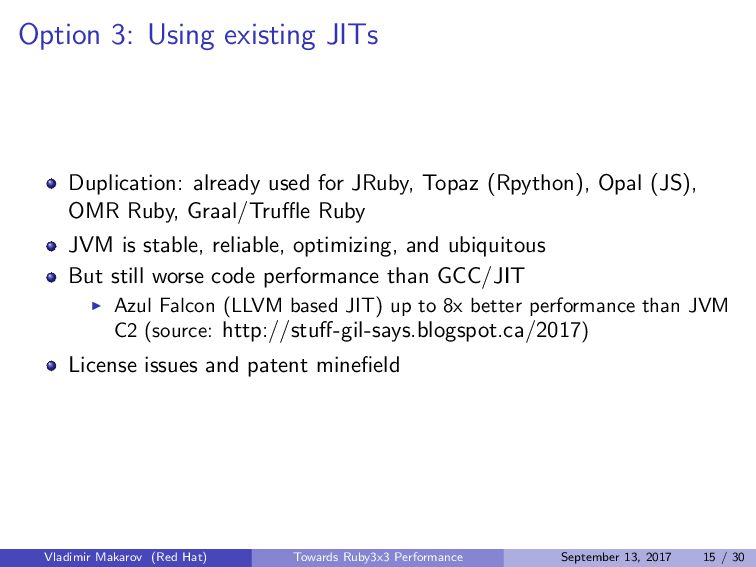
Topaz (Rpython), Opal (JS), OMR Ruby, Graal/Truffle Ruby JVM is stable, reliable, optimizing, and ubiquitous But still worse code performance than GCC/JIT Azul Falcon (LLVM based JIT) up to 8x better performance than JVM C2 (source: http://stuff-gil-says.blogspot.ca/2017) License issues and patent minefield Vladimir Makarov (Red Hat) Towards Ruby3x3 Performance September 13, 2017 15 / 30
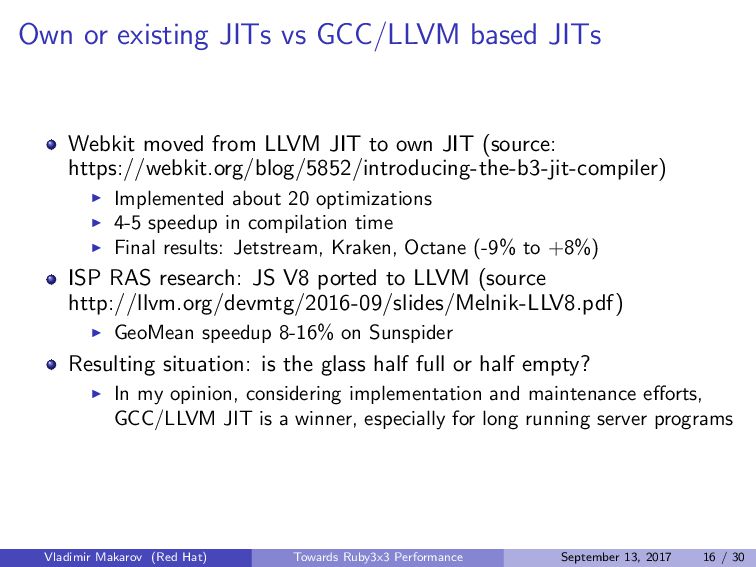
from LLVM JIT to own JIT (source: https://webkit.org/blog/5852/introducing-the-b3-jit-compiler) Implemented about 20 optimizations 4-5 speedup in compilation time Final results: Jetstream, Kraken, Octane (-9% to +8%) ISP RAS research: JS V8 ported to LLVM (source http://llvm.org/devmtg/2016-09/slides/Melnik-LLV8.pdf) GeoMean speedup 8-16% on Sunspider Resulting situation: is the glass half full or half empty? In my opinion, considering implementation and maintenance efforts, GCC/LLVM JIT is a winner, especially for long running server programs Vladimir Makarov (Red Hat) Towards Ruby3x3 Performance September 13, 2017 16 / 30
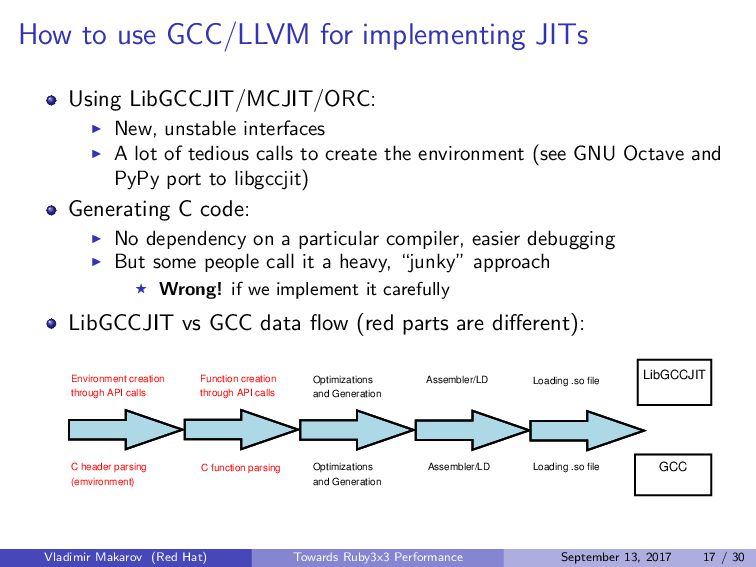
unstable interfaces A lot of tedious calls to create the environment (see GNU Octave and PyPy port to libgccjit) Generating C code: No dependency on a particular compiler, easier debugging But some people call it a heavy, “junky” approach Wrong! if we implement it carefully LibGCCJIT vs GCC data flow (red parts are different): Environment creation through API calls C header parsing (emvironment) C function parsing Optimizations and Generation Optimizations and Generation Assembler/LD Assembler/LD Loading .so file Loading .so file Function creation through API calls GCC LibGCCJIT Vladimir Makarov (Red Hat) Towards Ruby3x3 Performance September 13, 2017 17 / 30
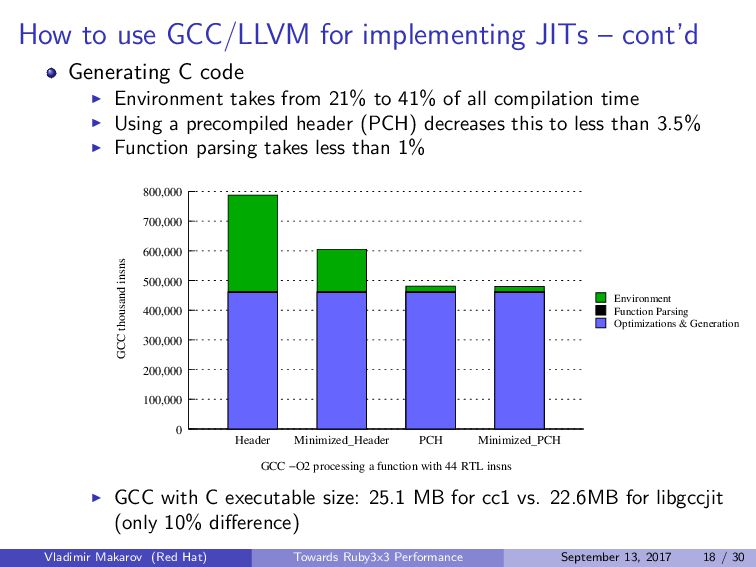
C code Environment takes from 21% to 41% of all compilation time Using a precompiled header (PCH) decreases this to less than 3.5% Function parsing takes less than 1% 0 100,000 200,000 300,000 400,000 500,000 600,000 700,000 800,000 Header Minimized_Header PCH Minimized_PCH GCC thousand insns GCC −O2 processing a function with 44 RTL insns Environment Function Parsing Optimizations & Generation GCC with C executable size: 25.1 MB for cc1 vs. 22.6MB for libgccjit (only 10% difference) Vladimir Makarov (Red Hat) Towards Ruby3x3 Performance September 13, 2017 18 / 30
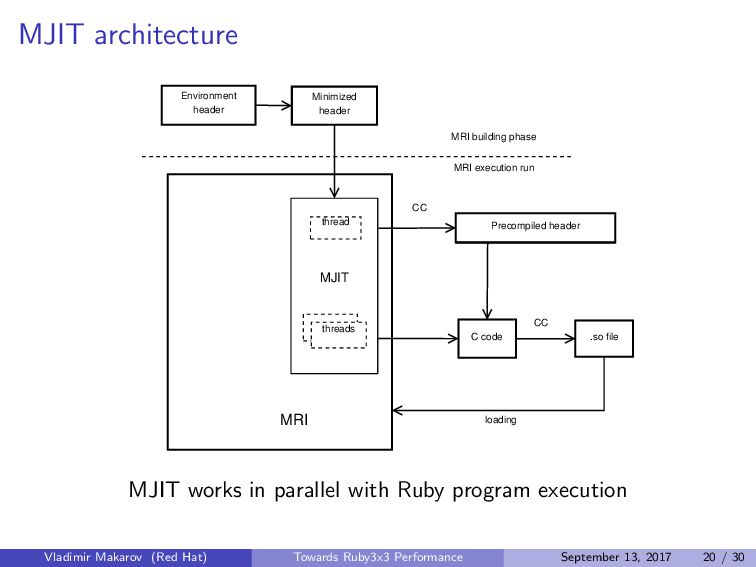
is a JIT based on C code generation and PCH MJIT can use GCC or LLVM, in the future other C compilers Vladimir Makarov (Red Hat) Towards Ruby3x3 Performance September 13, 2017 19 / 30
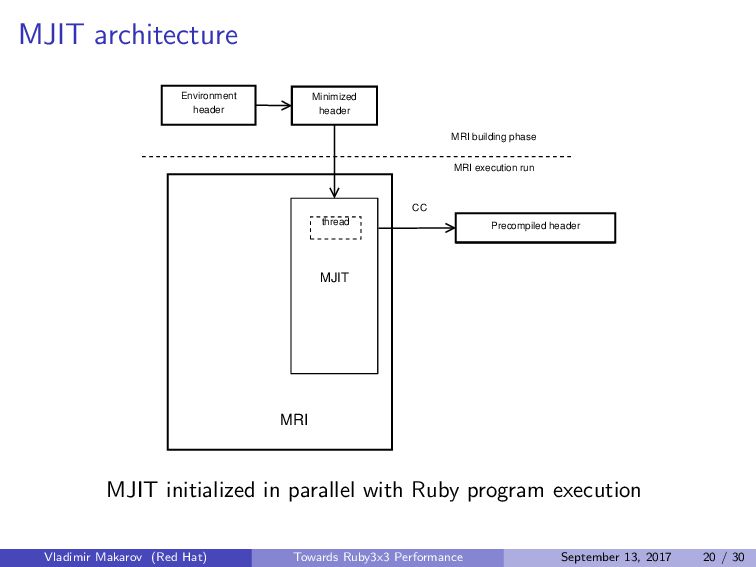
MRI execution run MRI Precompiled header CC thread MJIT initialized in parallel with Ruby program execution Vladimir Makarov (Red Hat) Towards Ruby3x3 Performance September 13, 2017 20 / 30
MRI execution run MRI Precompiled header CC thread C code .so file CC loading threads MJIT works in parallel with Ruby program execution Vladimir Makarov (Red Hat) Towards Ruby3x3 Performance September 13, 2017 20 / 30
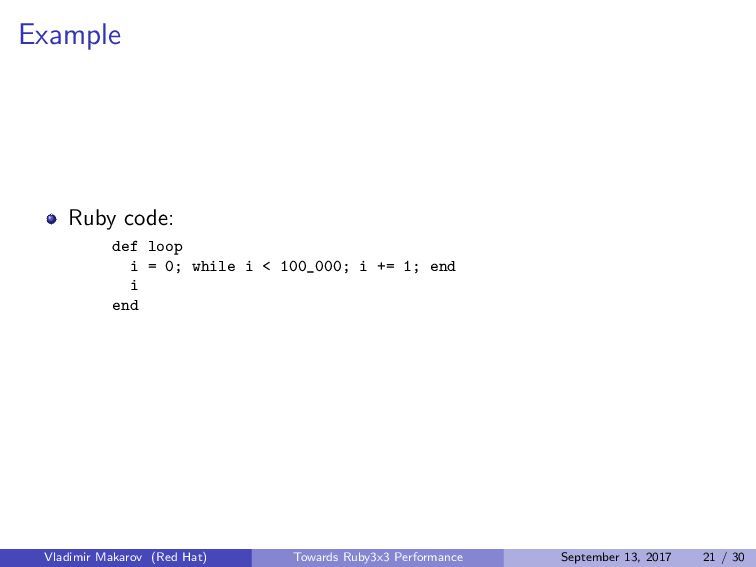
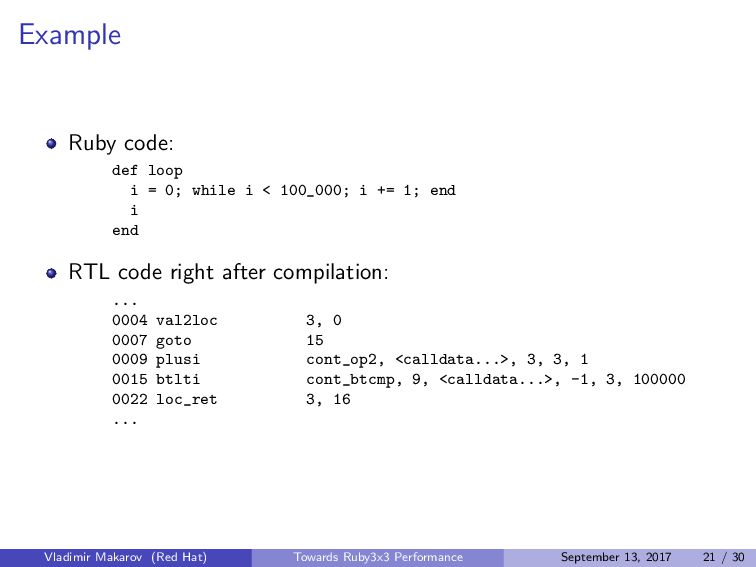
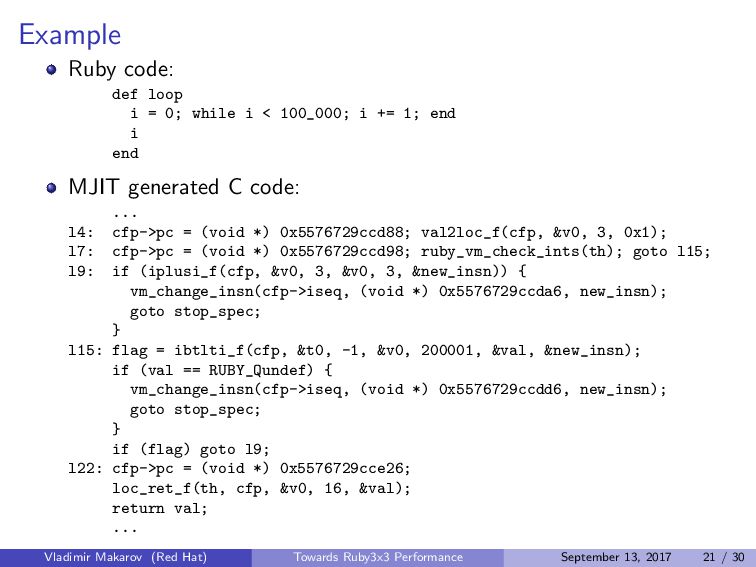
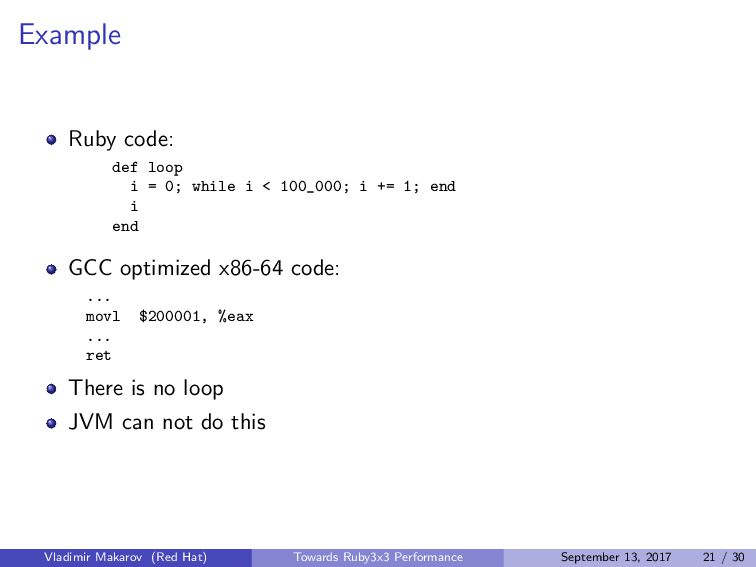
< 100_000; i += 1; end i end GCC optimized x86-64 code: ... movl $200001, %eax ... ret There is no loop JVM can not do this Vladimir Makarov (Red Hat) Towards Ruby3x3 Performance September 13, 2017 21 / 30
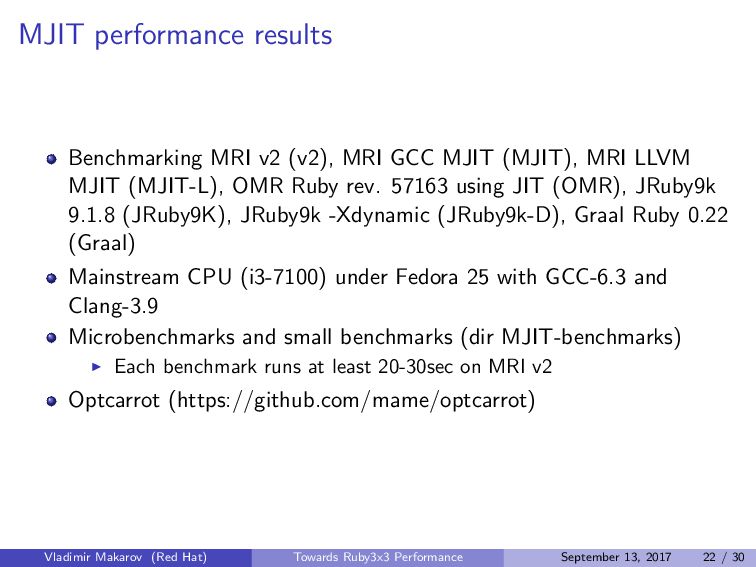
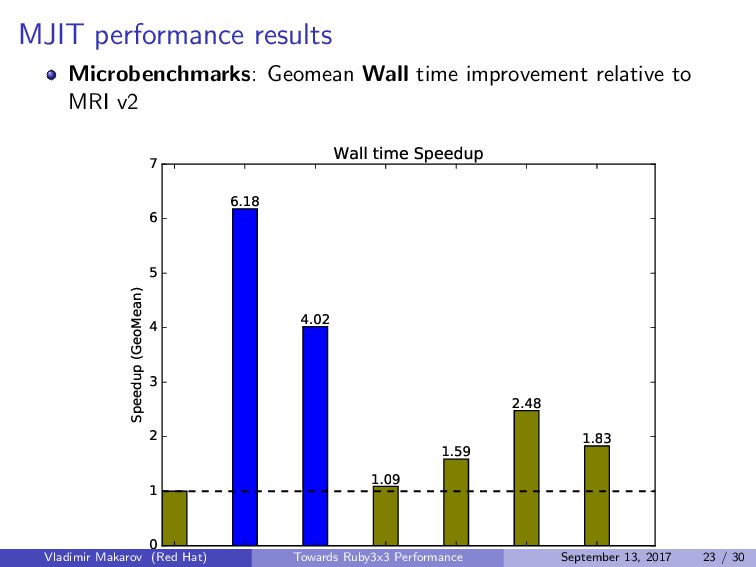
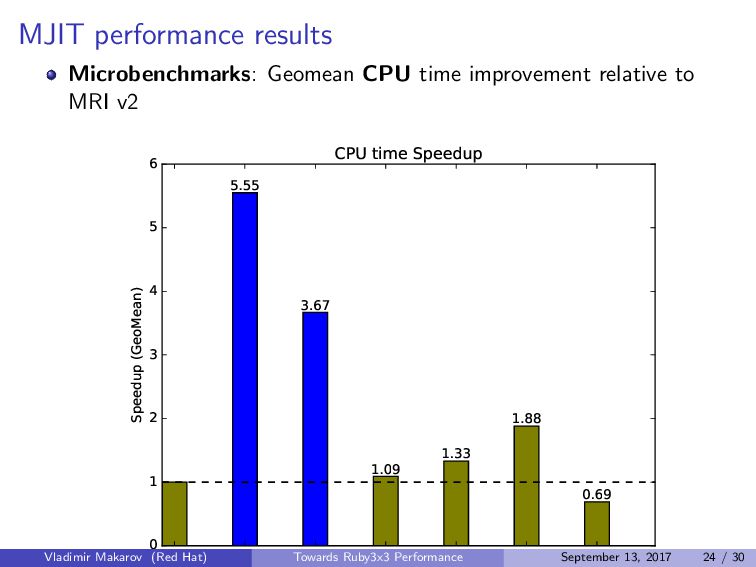
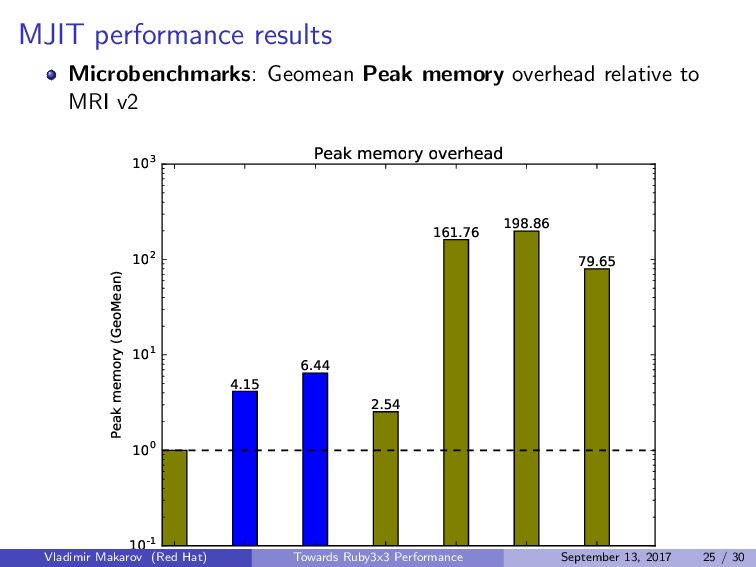
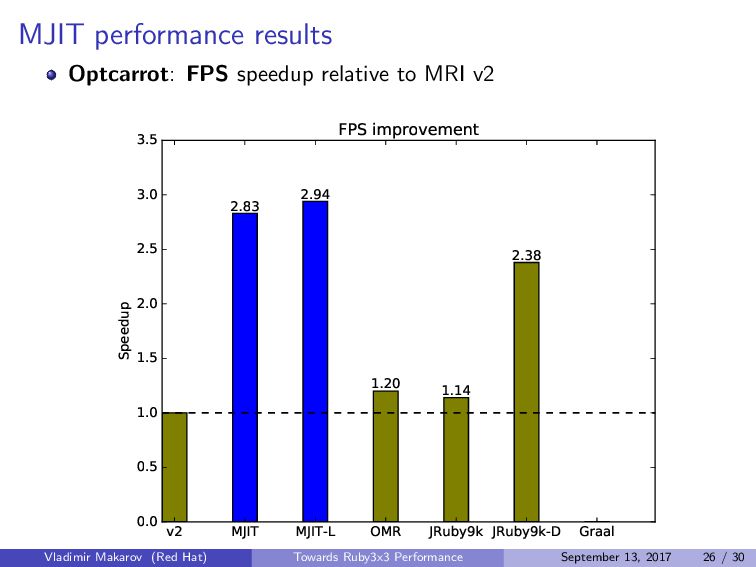
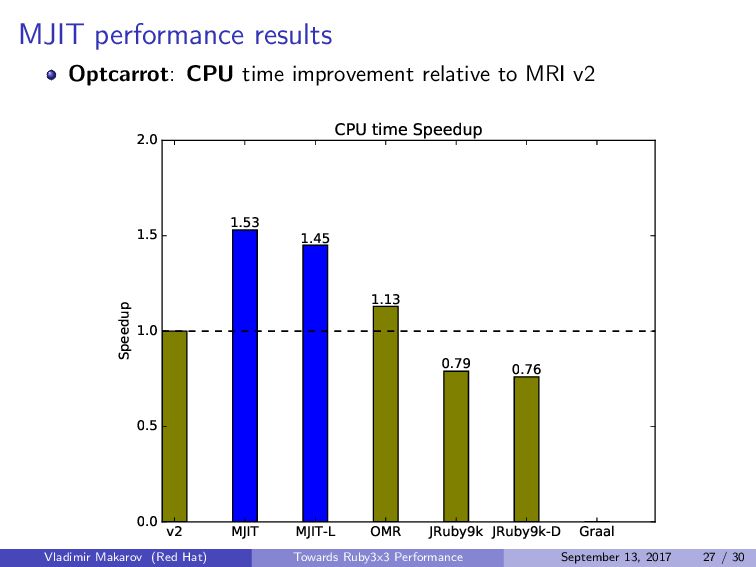
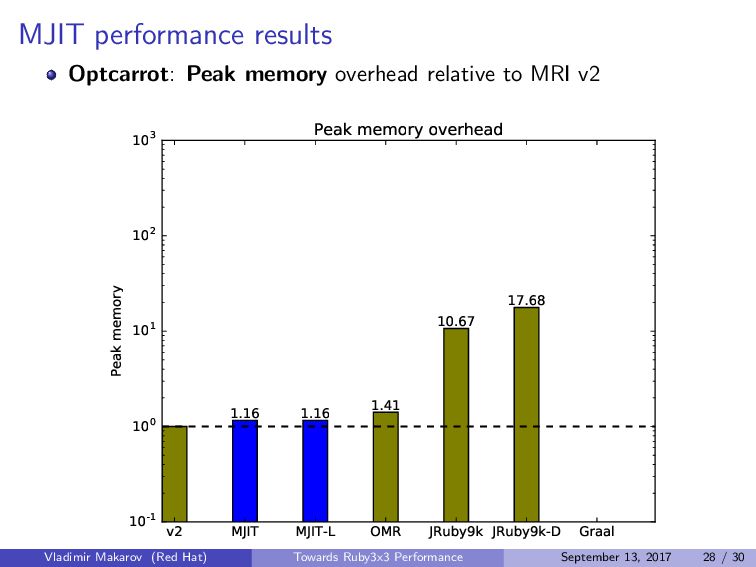
(MJIT), MRI LLVM MJIT (MJIT-L), OMR Ruby rev. 57163 using JIT (OMR), JRuby9k 9.1.8 (JRuby9K), JRuby9k -Xdynamic (JRuby9k-D), Graal Ruby 0.22 (Graal) Mainstream CPU (i3-7100) under Fedora 25 with GCC-6.3 and Clang-3.9 Microbenchmarks and small benchmarks (dir MJIT-benchmarks) Each benchmark runs at least 20-30sec on MRI v2 Optcarrot (https://github.com/mame/optcarrot) Vladimir Makarov (Red Hat) Towards Ruby3x3 Performance September 13, 2017 22 / 30
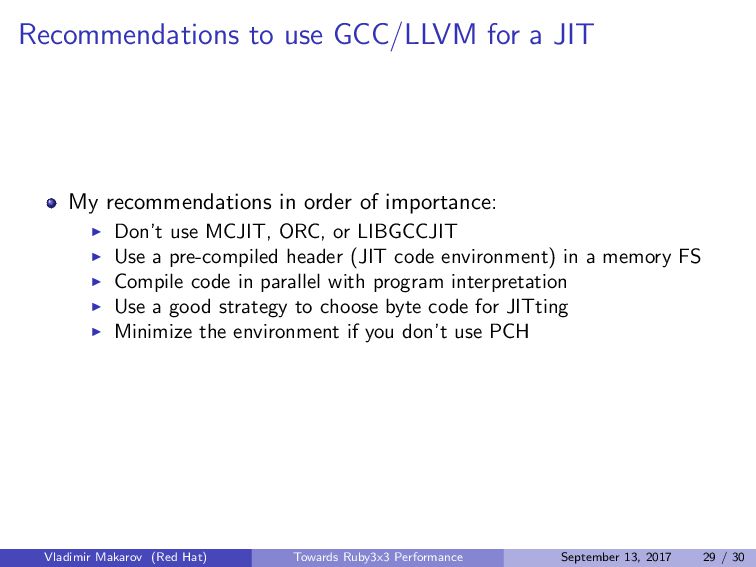
order of importance: Don’t use MCJIT, ORC, or LIBGCCJIT Use a pre-compiled header (JIT code environment) in a memory FS Compile code in parallel with program interpretation Use a good strategy to choose byte code for JITting Minimize the environment if you don’t use PCH Vladimir Makarov (Red Hat) Towards Ruby3x3 Performance September 13, 2017 29 / 30
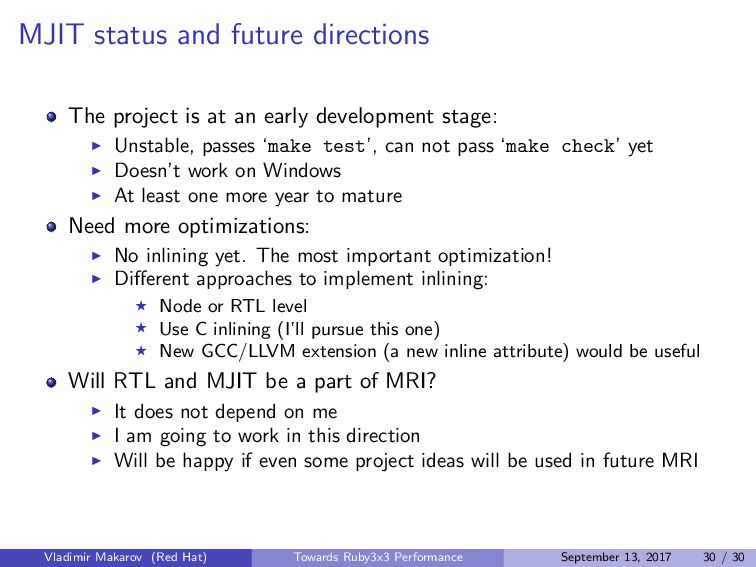
early development stage: Unstable, passes ‘make test’, can not pass ‘make check’ yet Doesn’t work on Windows At least one more year to mature Need more optimizations: No inlining yet. The most important optimization! Different approaches to implement inlining: Node or RTL level Use C inlining (I’ll pursue this one) New GCC/LLVM extension (a new inline attribute) would be useful Will RTL and MJIT be a part of MRI? It does not depend on me I am going to work in this direction Will be happy if even some project ideas will be used in future MRI Vladimir Makarov (Red Hat) Towards Ruby3x3 Performance September 13, 2017 30 / 30


 vmakarov
 oniak3ibm
 kishida
 econanringo
 satoshi256kbyte
 mofurune
 eed3si9n
 yukiny
 utakaha
 koic
 iwatsukayura
 artoy
 kawashimo0
 frankvandijk
 aleyda
 hatefulcrawdad
 axbom
 katarinadahlin
 techseoconnect
 akademiya2063
 jacobtomlinson
 swwweet
 codingconduct
 bkeepers