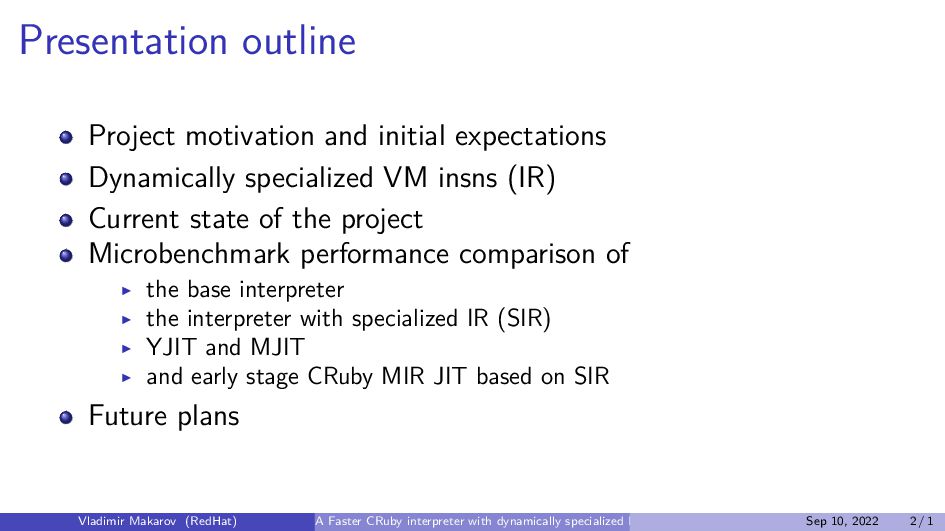
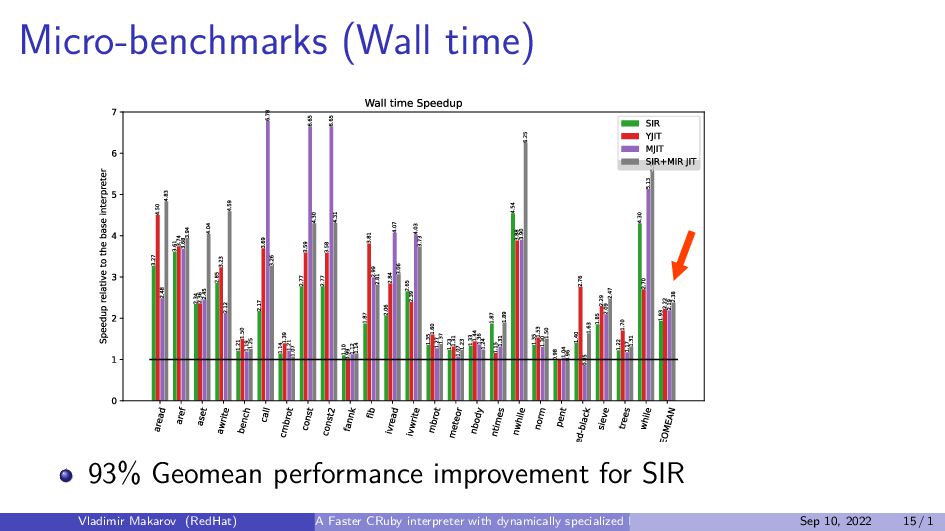
insns (IR) Current state of the project Microbenchmark performance comparison of the base interpreter the interpreter with specialized IR (SIR) YJIT and MJIT and early stage CRuby MIR JIT based on SIR Future plans Vladimir Makarov (RedHat) A Faster CRuby interpreter with dynamically specialized IR Sep 10, 2022 2 / 1
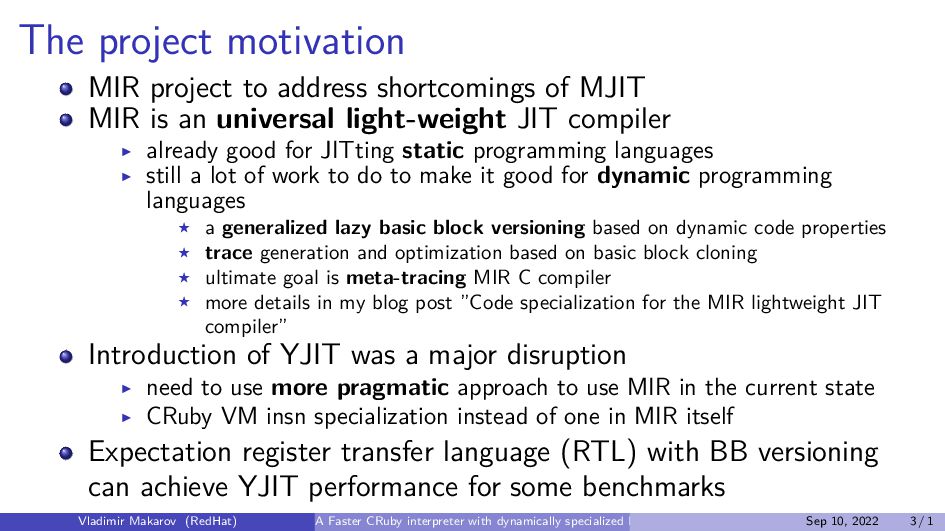
MIR is an universal light-weight JIT compiler already good for JITting static programming languages still a lot of work to do to make it good for dynamic programming languages a generalized lazy basic block versioning based on dynamic code properties trace generation and optimization based on basic block cloning ultimate goal is meta-tracing MIR C compiler more details in my blog post ”Code specialization for the MIR lightweight JIT compiler” Introduction of YJIT was a major disruption need to use more pragmatic approach to use MIR in the current state CRuby VM insn specialization instead of one in MIR itself Expectation register transfer language (RTL) with BB versioning can achieve YJIT performance for some benchmarks Vladimir Makarov (RedHat) A Faster CRuby interpreter with dynamically specialized IR Sep 10, 2022 3 / 1
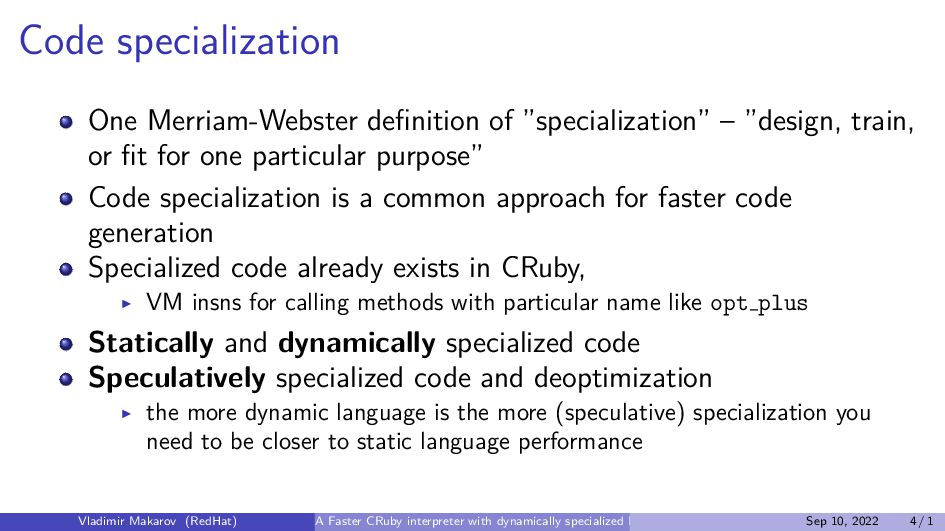
or fit for one particular purpose” Code specialization is a common approach for faster code generation Specialized code already exists in CRuby, VM insns for calling methods with particular name like opt plus Statically and dynamically specialized code Speculatively specialized code and deoptimization the more dynamic language is the more (speculative) specialization you need to be closer to static language performance Vladimir Makarov (RedHat) A Faster CRuby interpreter with dynamically specialized IR Sep 10, 2022 4 / 1
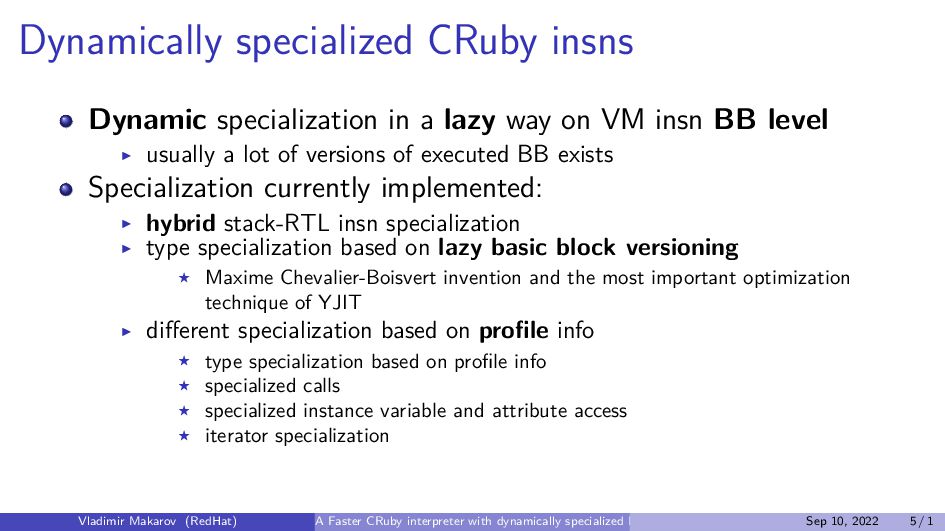
on VM insn BB level usually a lot of versions of executed BB exists Specialization currently implemented: hybrid stack-RTL insn specialization type specialization based on lazy basic block versioning Maxime Chevalier-Boisvert invention and the most important optimization technique of YJIT different specialization based on profile info type specialization based on profile info specialized calls specialized instance variable and attribute access iterator specialization Vladimir Makarov (RedHat) A Faster CRuby interpreter with dynamically specialized IR Sep 10, 2022 5 / 1
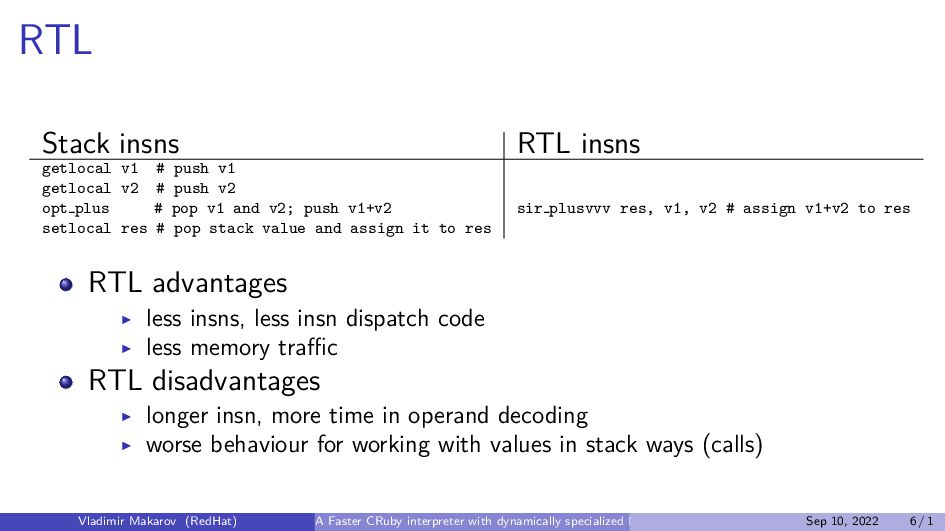
getlocal v2 # push v2 opt plus # pop v1 and v2; push v1+v2 sir plusvvv res, v1, v2 # assign v1+v2 to res setlocal res # pop stack value and assign it to res RTL advantages less insns, less insn dispatch code less memory traffic RTL disadvantages longer insn, more time in operand decoding worse behaviour for working with values in stack ways (calls) Vladimir Makarov (RedHat) A Faster CRuby interpreter with dynamically specialized IR Sep 10, 2022 6 / 1
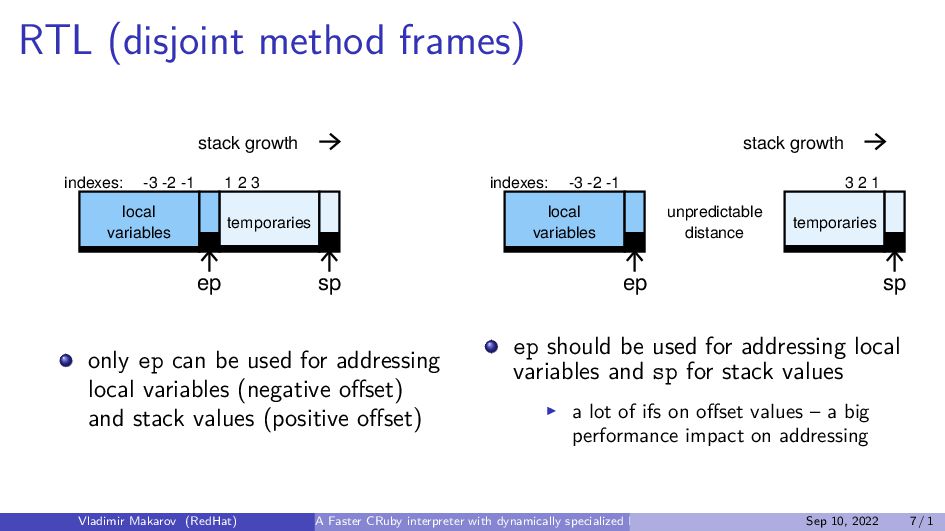
growth 1 2 3 -3 -2 -1 indexes: temporaries local variables ep sp stack growth 3 2 1 -3 -2 -1 indexes: unpredictable distance only ep can be used for addressing local variables (negative offset) and stack values (positive offset) ep should be used for addressing local variables and sp for stack values a lot of ifs on offset values – a big performance impact on addressing Vladimir Makarov (RedHat) A Faster CRuby interpreter with dynamically specialized IR Sep 10, 2022 7 / 1
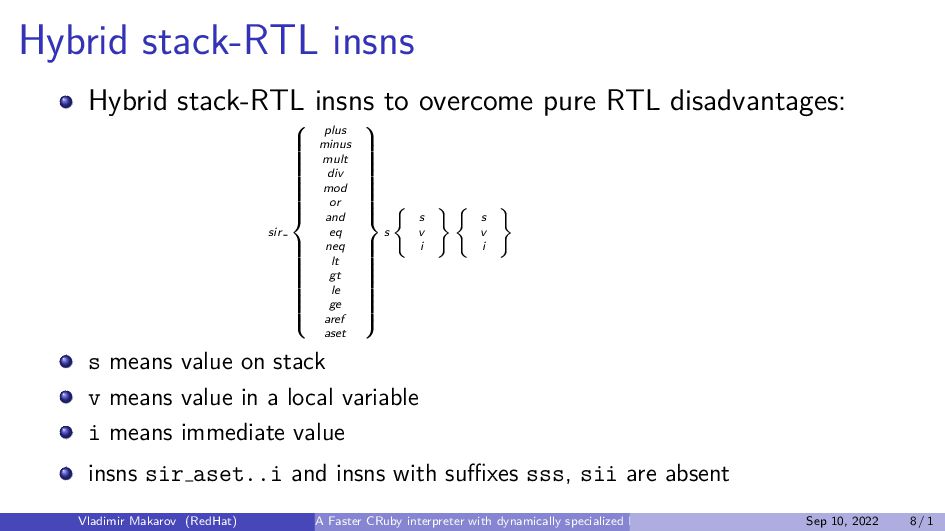
disadvantages: sir plus minus mult div mod or and eq neq lt gt le ge aref aset s s v i s v i s means value on stack v means value in a local variable i means immediate value insns sir aset..i and insns with suffixes sss, sii are absent Vladimir Makarov (RedHat) A Faster CRuby interpreter with dynamically specialized IR Sep 10, 2022 8 / 1
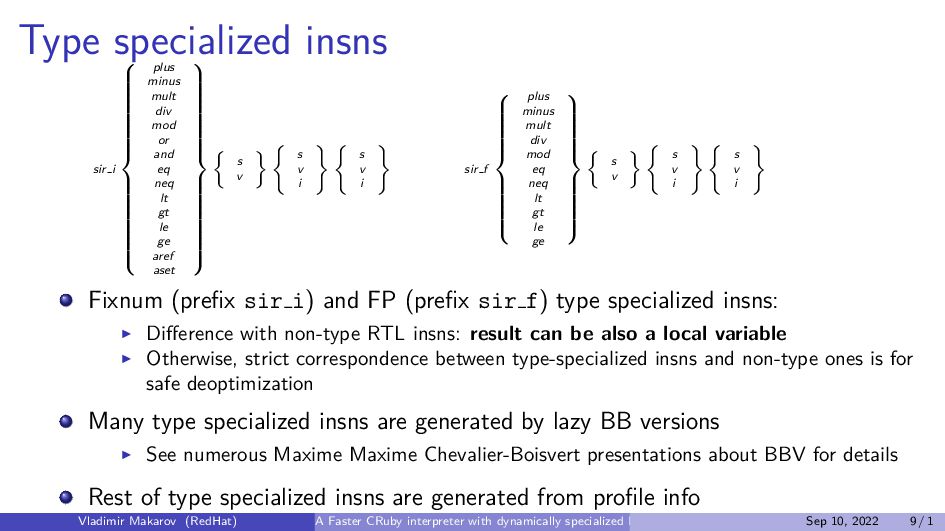
plus minus mult div mod or and eq neq lt gt le ge aref aset s v s v i s v i sir f plus minus mult div mod eq neq lt gt le ge s v s v i s v i Fixnum (prefix sir i) and FP (prefix sir f) type specialized insns: Difference with non-type RTL insns: result can be also a local variable Otherwise, strict correspondence between type-specialized insns and non-type ones is for safe deoptimization Many type specialized insns are generated by lazy BB versions See numerous Maxime Maxime Chevalier-Boisvert presentations about BBV for details Rest of type specialized insns are generated from profile info Vladimir Makarov (RedHat) A Faster CRuby interpreter with dynamically specialized IR Sep 10, 2022 9 / 1
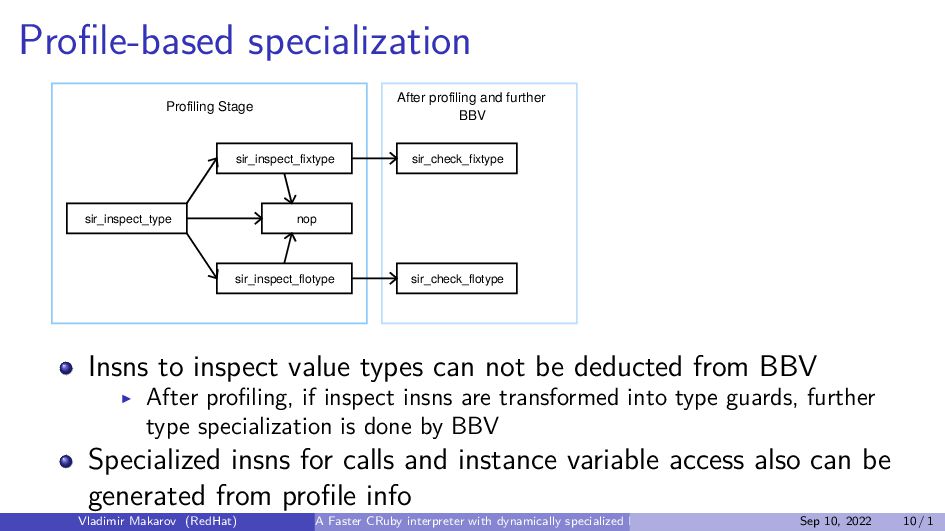
profiling and further BBV nop Insns to inspect value types can not be deducted from BBV After profiling, if inspect insns are transformed into type guards, further type specialization is done by BBV Specialized insns for calls and instance variable access also can be generated from profile info Vladimir Makarov (RedHat) A Faster CRuby interpreter with dynamically specialized IR Sep 10, 2022 10 / 1
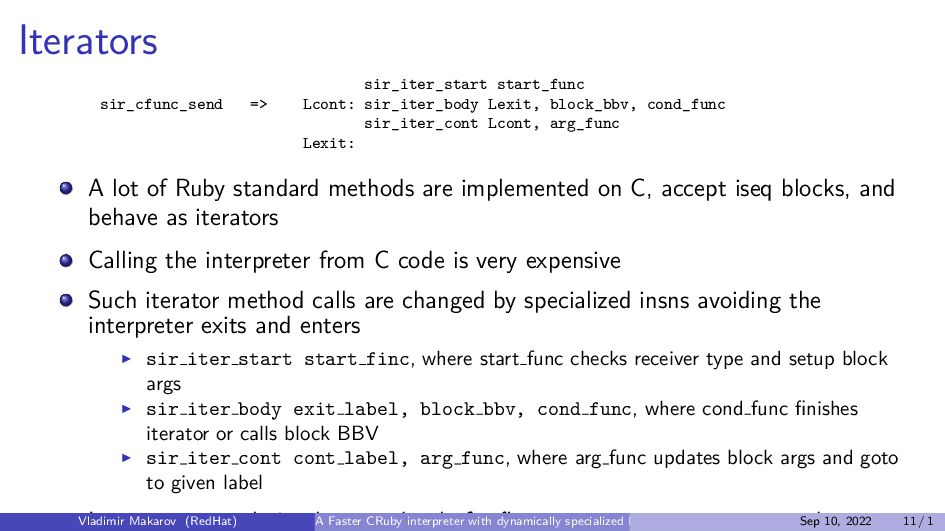
sir_iter_cont Lcont, arg_func Lexit: A lot of Ruby standard methods are implemented on C, accept iseq blocks, and behave as iterators Calling the interpreter from C code is very expensive Such iterator method calls are changed by specialized insns avoiding the interpreter exits and enters sir iter start start finc, where start func checks receiver type and setup block args sir iter body exit label, block bbv, cond func, where cond func finishes iterator or calls block BBV sir iter cont cont label, arg func, where arg func updates block args and goto to given label Iterators currently implemented only for fixnum times, range each, and array Vladimir Makarov (RedHat) A Faster CRuby interpreter with dynamically specialized IR Sep 10, 2022 11 / 1
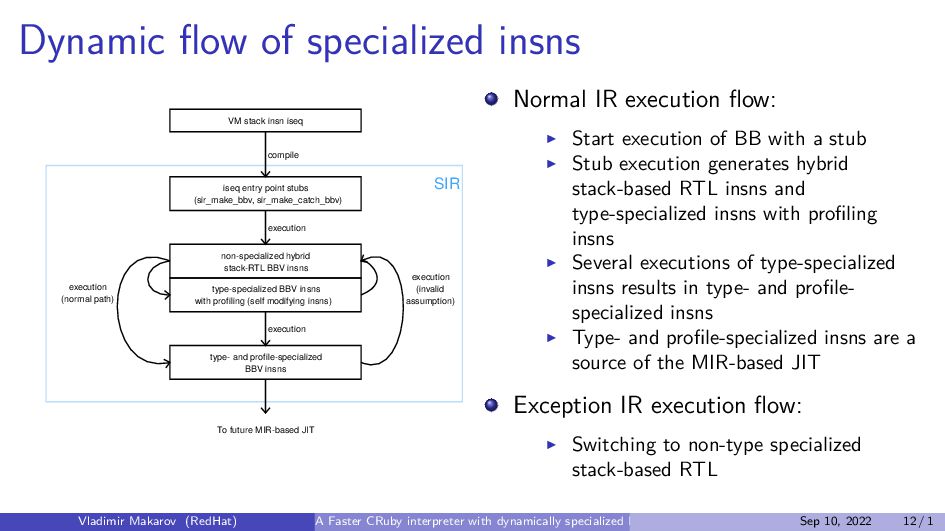
entry point stubs (sir_make_bbv, sir_make_catch_bbv) non-specialized hybrid stack-RTL BBV insns type-specialized BBV insns with profiling (self modifying insns) type- and profile-specialized BBV insns SIR To future MIR-based JIT compile execution execution execution (invalid assumption) execution (normal path) Normal IR execution flow: Start execution of BB with a stub Stub execution generates hybrid stack-based RTL insns and type-specialized insns with profiling insns Several executions of type-specialized insns results in type- and profile- specialized insns Type- and profile-specialized insns are a source of the MIR-based JIT Exception IR execution flow: Switching to non-type specialized stack-based RTL Vladimir Makarov (RedHat) A Faster CRuby interpreter with dynamically specialized IR Sep 10, 2022 12 / 1
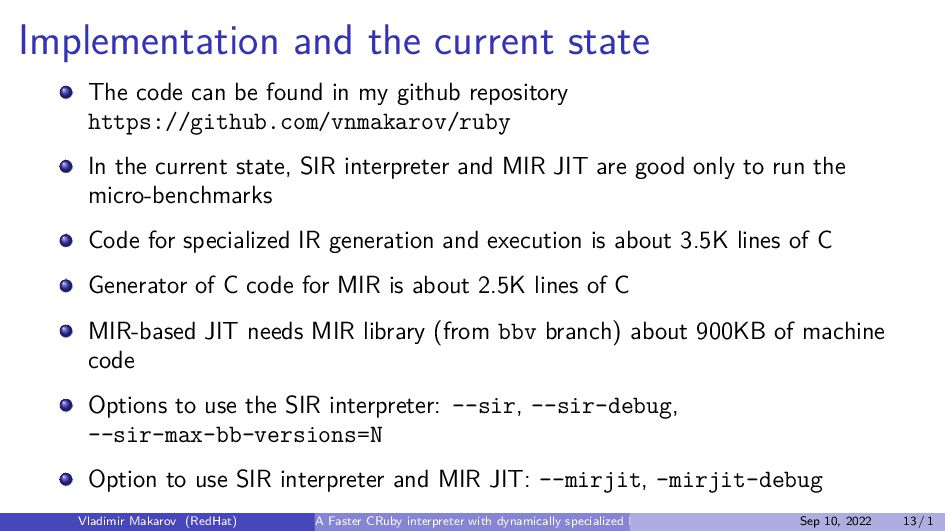
in my github repository https://github.com/vnmakarov/ruby In the current state, SIR interpreter and MIR JIT are good only to run the micro-benchmarks Code for specialized IR generation and execution is about 3.5K lines of C Generator of C code for MIR is about 2.5K lines of C MIR-based JIT needs MIR library (from bbv branch) about 900KB of machine code Options to use the SIR interpreter: --sir, --sir-debug, --sir-max-bb-versions=N Option to use SIR interpreter and MIR JIT: --mirjit, -mirjit-debug Vladimir Makarov (RedHat) A Faster CRuby interpreter with dynamically specialized IR Sep 10, 2022 13 / 1
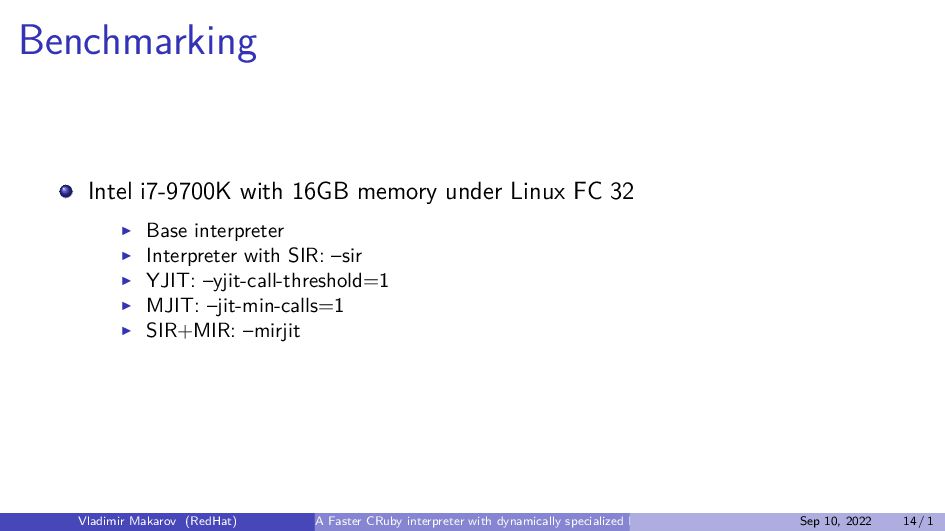
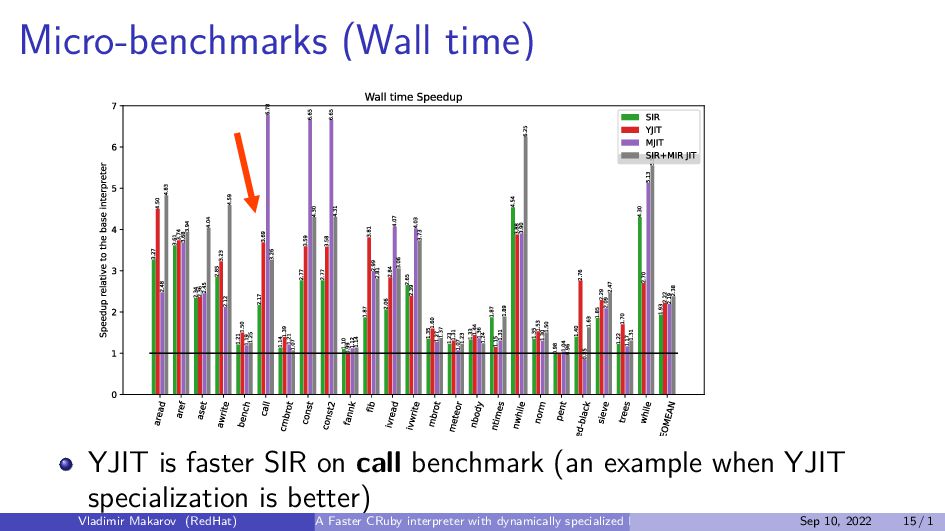
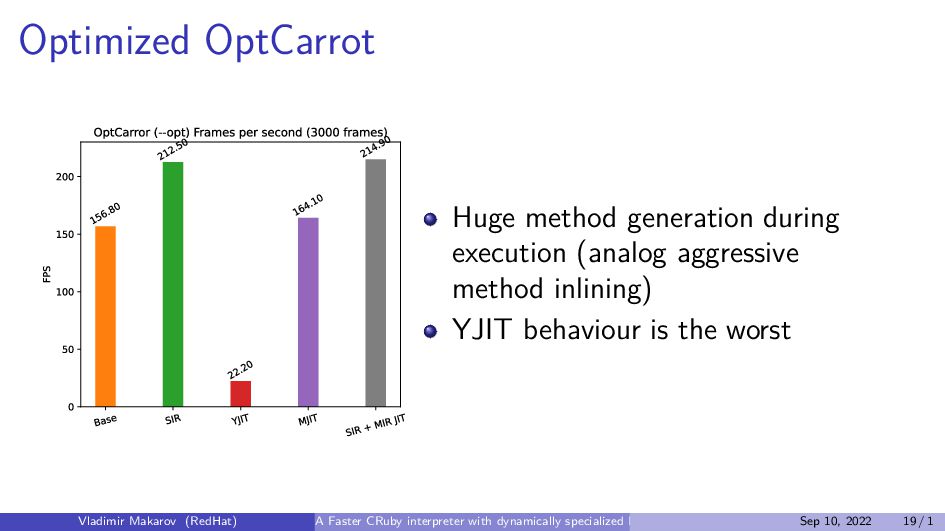
Base interpreter Interpreter with SIR: –sir YJIT: –yjit-call-threshold=1 MJIT: –jit-min-calls=1 SIR+MIR: –mirjit Vladimir Makarov (RedHat) A Faster CRuby interpreter with dynamically specialized IR Sep 10, 2022 14 / 1
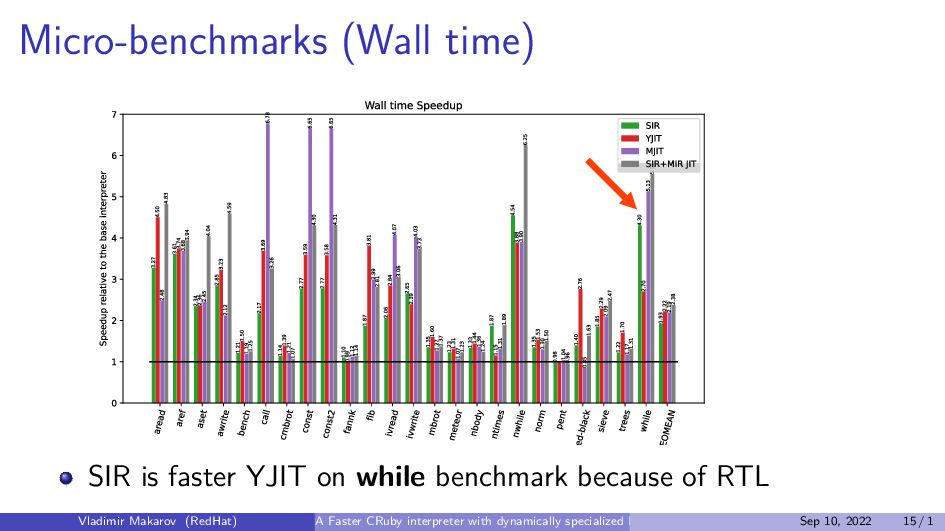
(an example when YJIT specialization is better) Vladimir Makarov (RedHat) A Faster CRuby interpreter with dynamically specialized IR Sep 10, 2022 15 / 1
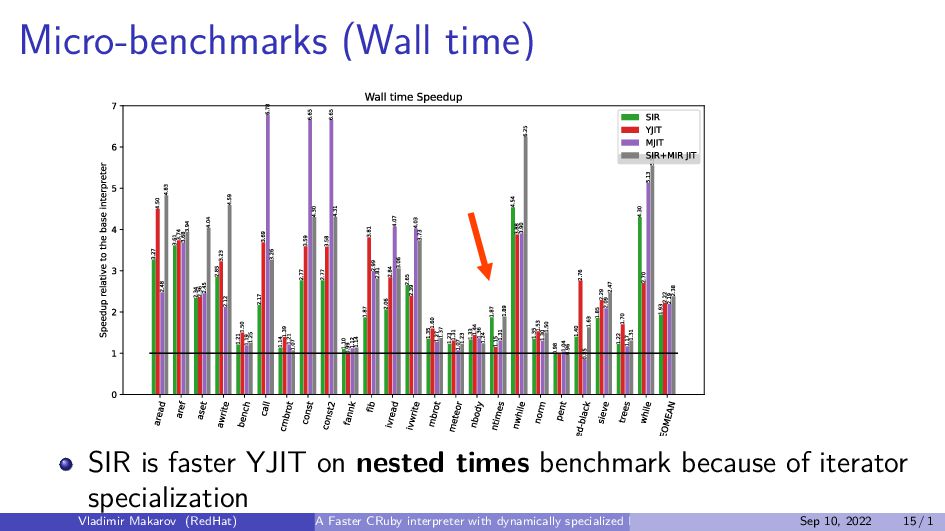
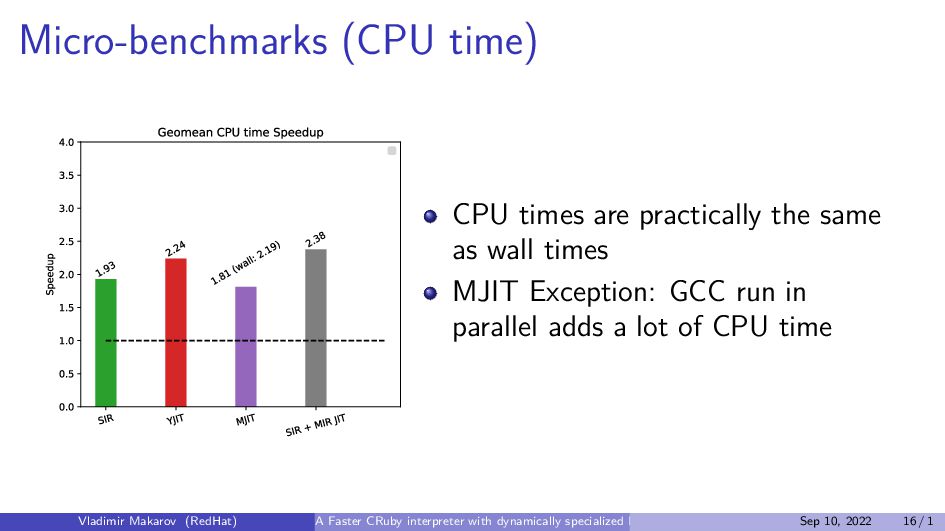
wall times MJIT Exception: GCC run in parallel adds a lot of CPU time Vladimir Makarov (RedHat) A Faster CRuby interpreter with dynamically specialized IR Sep 10, 2022 16 / 1
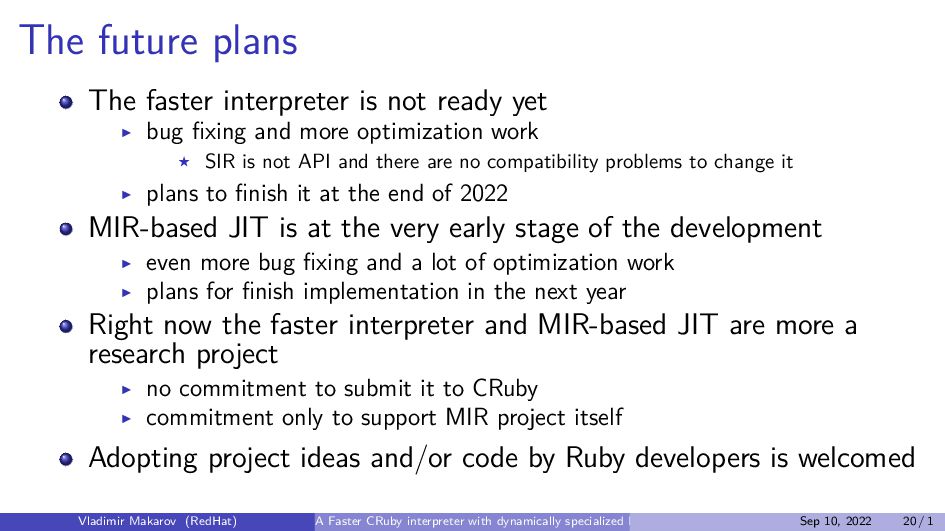
bug fixing and more optimization work SIR is not API and there are no compatibility problems to change it plans to finish it at the end of 2022 MIR-based JIT is at the very early stage of the development even more bug fixing and a lot of optimization work plans for finish implementation in the next year Right now the faster interpreter and MIR-based JIT are more a research project no commitment to submit it to CRuby commitment only to support MIR project itself Adopting project ideas and/or code by Ruby developers is welcomed Vladimir Makarov (RedHat) A Faster CRuby interpreter with dynamically specialized IR Sep 10, 2022 20 / 1


 vmakarov
 andpad
 minodriven
 morizo_1984
 falcon8823
 kishida
 dske104
 palkan
 syumai
 iwatsukayura
 rshindo
 clockmaker
 tomokon
 samanthasiow
 garrettdimon
 ianozsvald
 inesmontani
 geshan
 akademiya2063
 jcasabona
 schlessera
 katarinadahlin
 reverentgeek
 rkendrick25