Upgrade to Pro
— share decks privately, control downloads, hide ads and more …
Speaker Deck
Sign up for free
Menu
Search
Features
All features
Private URLs
Password Protection
Custom URLS
Scheduled publishing
Remove Branding
Restrict embedding
Deck Collections
Notes
Features
All features
Private URLs
Password Protection
Custom URLS
Scheduled publishing
Remove Branding
Restrict embedding
Deck Collections
Notes
Explore
Featured decks
Featured speakers
Programming
Technology
Storyboards
Explore
Featured decks
Featured speakers
Programming
Technology
Storyboards
Pricing
Search
Sign in
Sign up for free
Golang Framework 是怎麼做出這些酷功能?
Search
WeiTheShinobi
December 19, 2023
150
0
Share
Embed
Copy iframe code
Copy JS code
Copy link
Start on current slide
Golang Framework 是怎麼做出這些酷功能?
WeiTheShinobi
December 19, 2023
More Decks by WeiTheShinobi
See All by WeiTheShinobi
coscup2024
weitheshinobi
0
30
Featured
See All Featured
Building a Scalable Design System with Sketch
lauravandoore
464
34k
We Have a Design System, Now What?
morganepeng
55
8.4k
実際に使うSQLの書き方 徹底解説 / pgcon21j-tutorial
soudai
PRO
203
77k
Site-Speed That Sticks
csswizardry
13
1.6k
What’s in a name? Adding method to the madness
productmarketing
PRO
24
4.2k
Building Applications with DynamoDB
mza
96
7.2k
Hiding What from Whom? A Critical Review of the History of Programming languages for Music
tomoyanonymous
3
1.4k
Docker and Python
trallard
47
4.2k
Designing Experiences People Love
moore
143
24k
<Decoding/> the Language of Devs - We Love SEO 2024
nikkihalliwell
1
360
Rebuilding a faster, lazier Slack
samanthasiow
85
9.7k
The World Runs on Bad Software
bkeepers
PRO
72
12k
Transcript
Golang Framework 是怎麼做出這些酷功能? 2023/12
大綱 - uber/zap 中的 json encoder - string 和 []byte
轉換 - builder pattern, method chain
- 繳了 1.5 年的勞保 - 喜歡電腦 - 喜歡電玩 - 喜歡漫畫
- 喜歡鳥類 - 特別喜歡鴨子🦆🦆🦆 - Github:WeiTheShinobi 關於我 - WeiTheShinobi
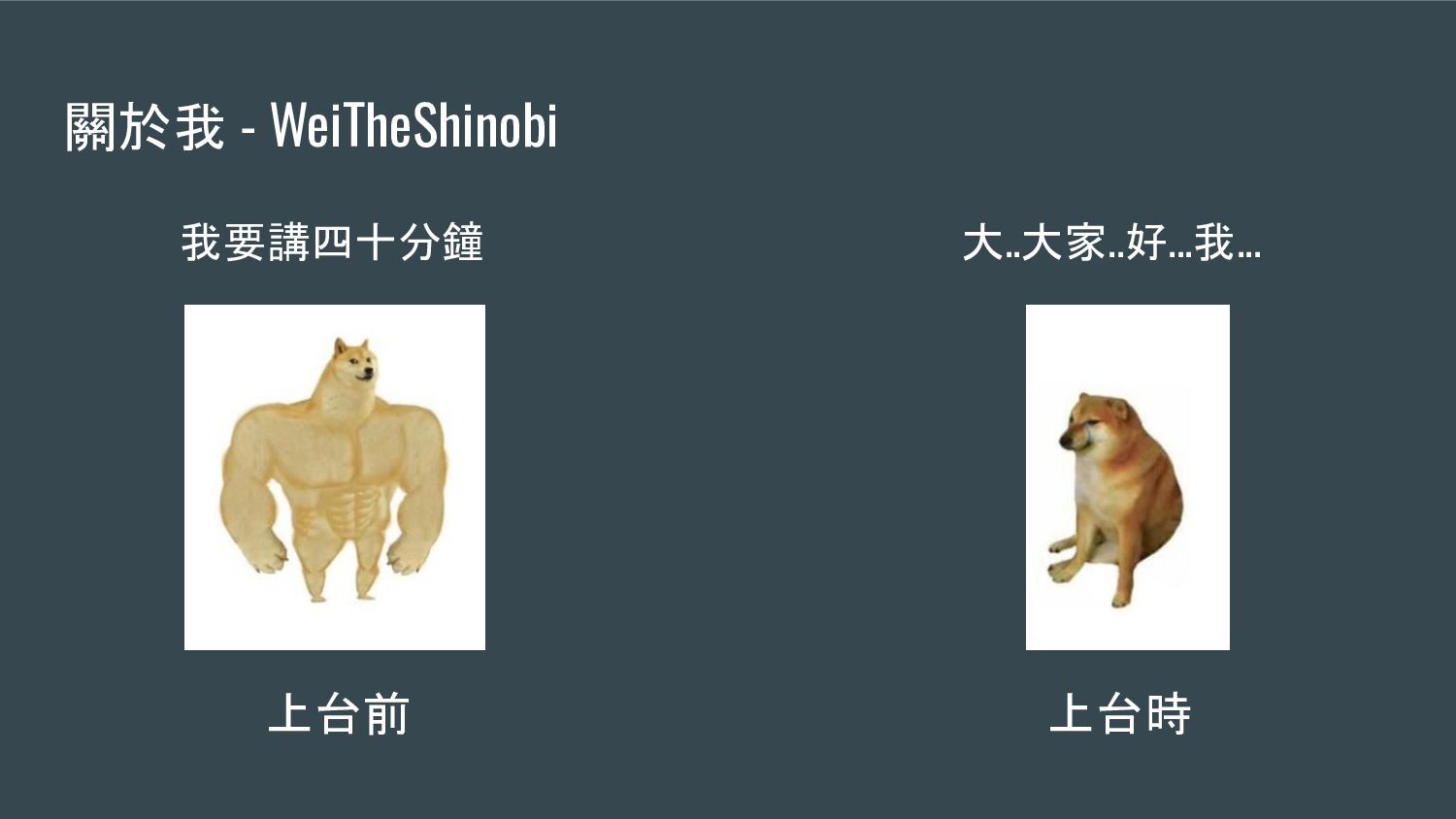
我要講四十分鐘 大..大家..好...我... 上台前 上台時 關於我 - WeiTheShinobi
uber/zap 中的 json encoder reflection-free, zero-allocation JSON encoder
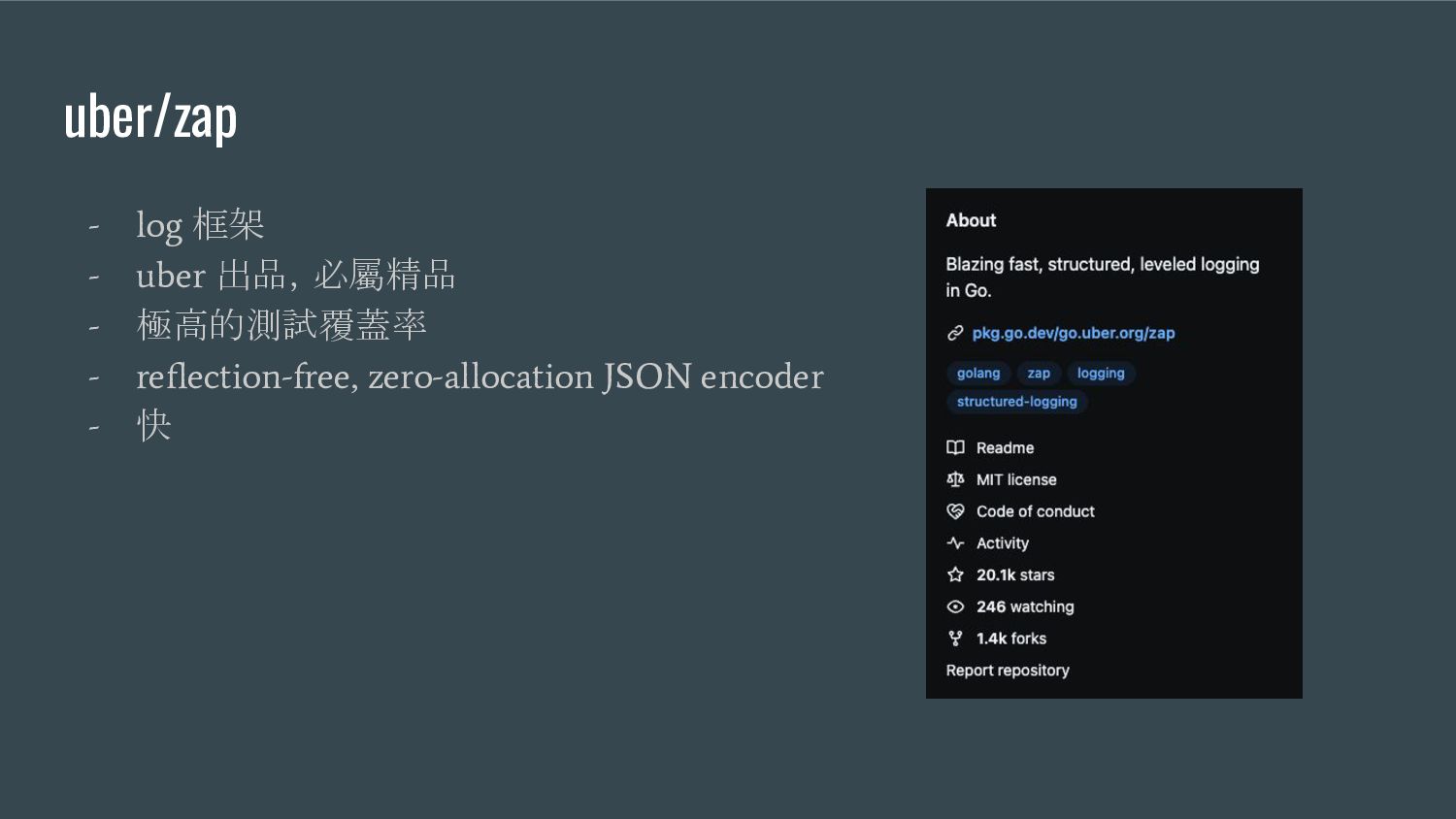
uber/zap - log 框架 - uber 出品,必屬精品 - 極高的測試覆蓋率 -
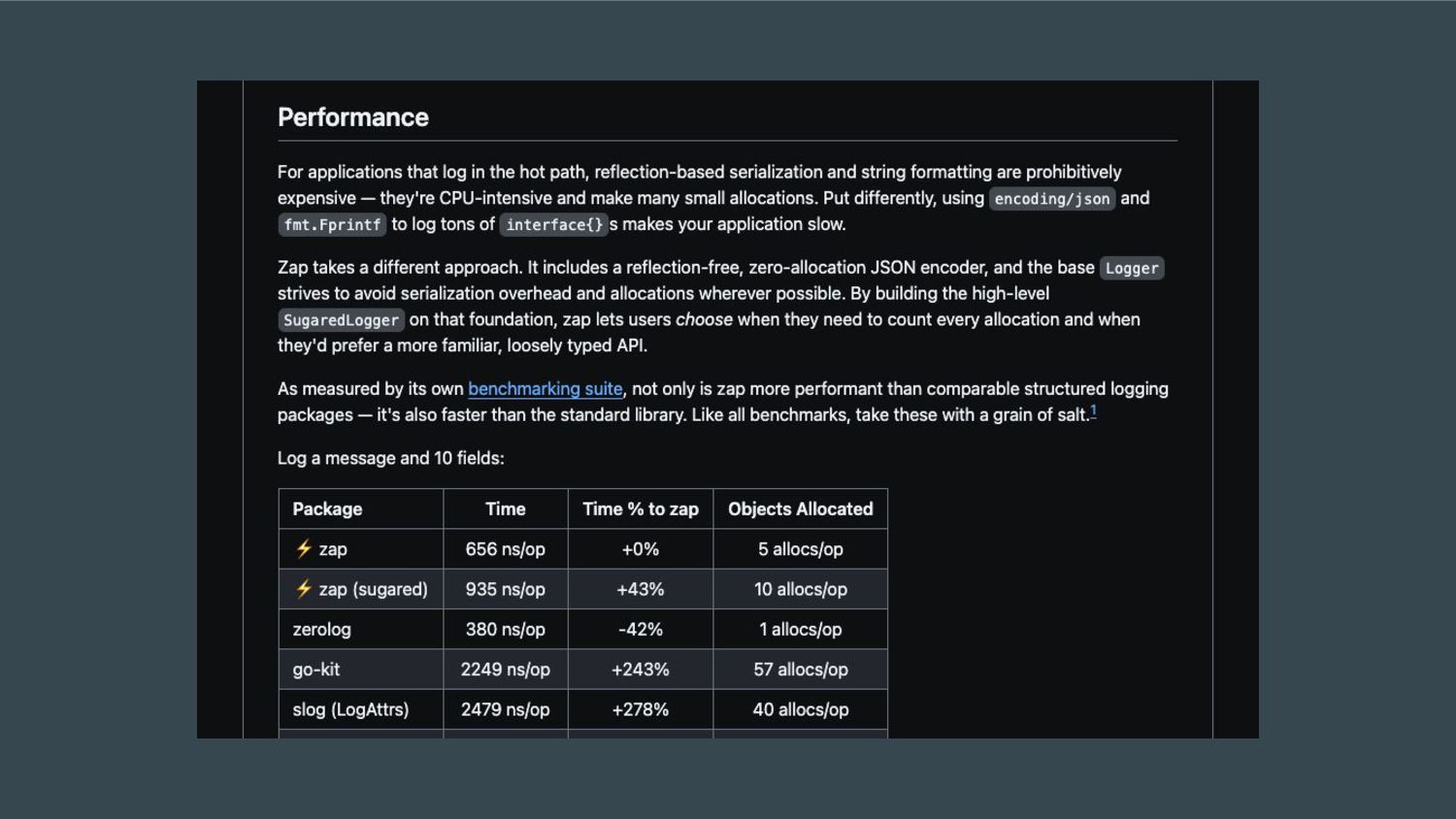
reflection-free, zero-allocation JSON encoder - 快
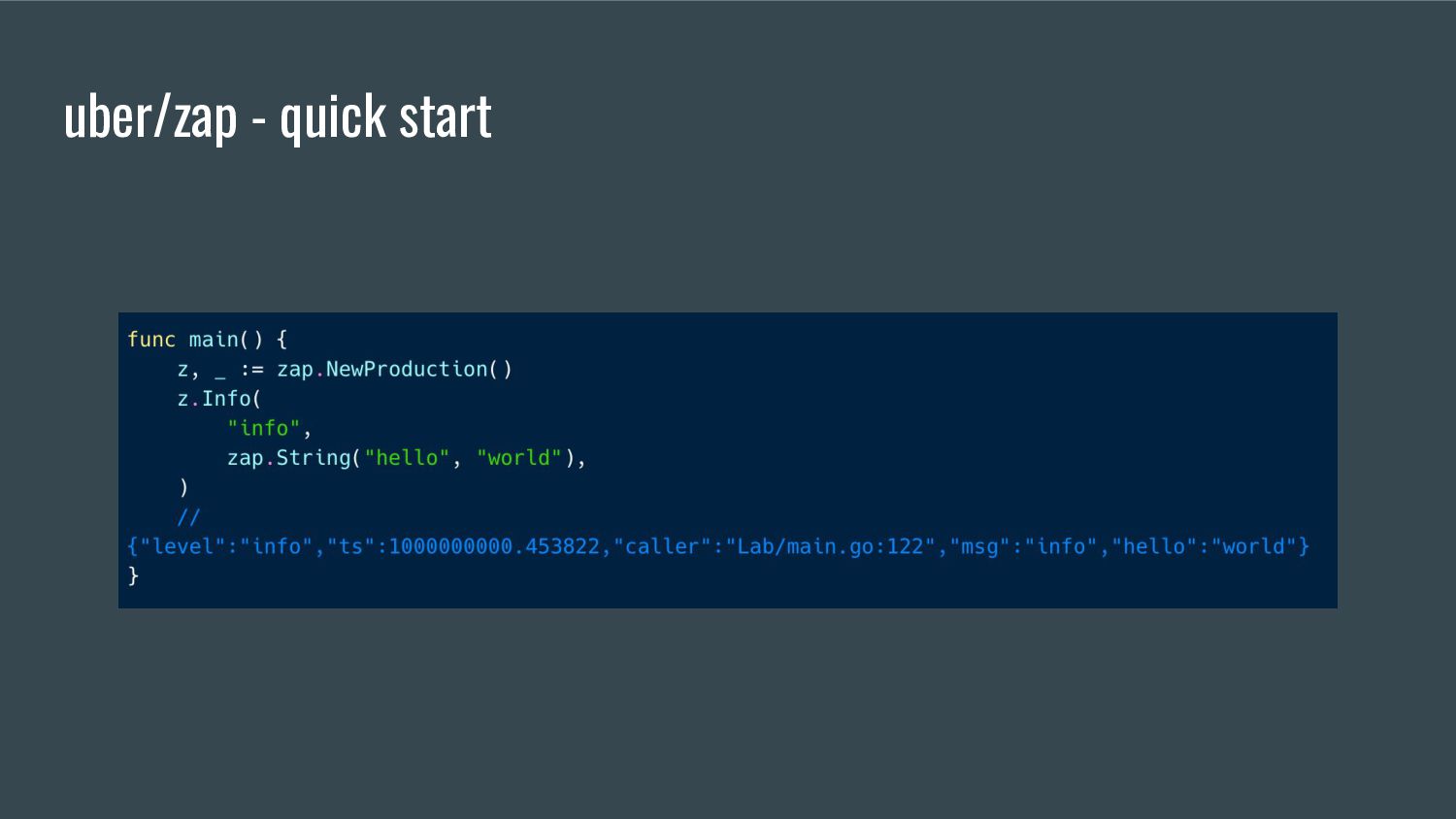
uber/zap - quick start
None
None
None
reflection-free
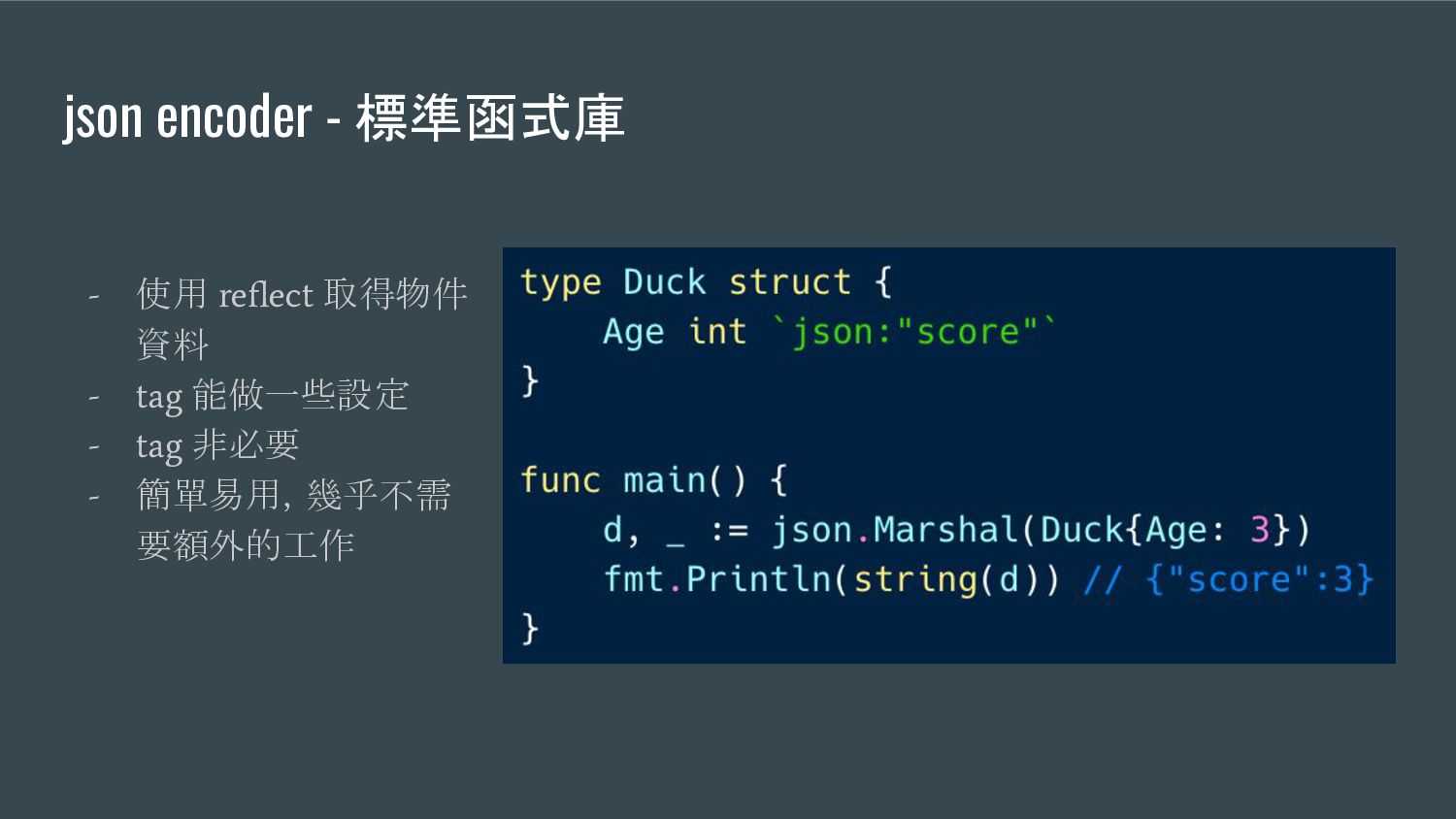
json encoder - 標準函式庫 - 使用 reflect 取得物件 資料 -
tag 能做一些設定 - tag 非必要 - 簡單易用,幾乎不需 要額外的工作
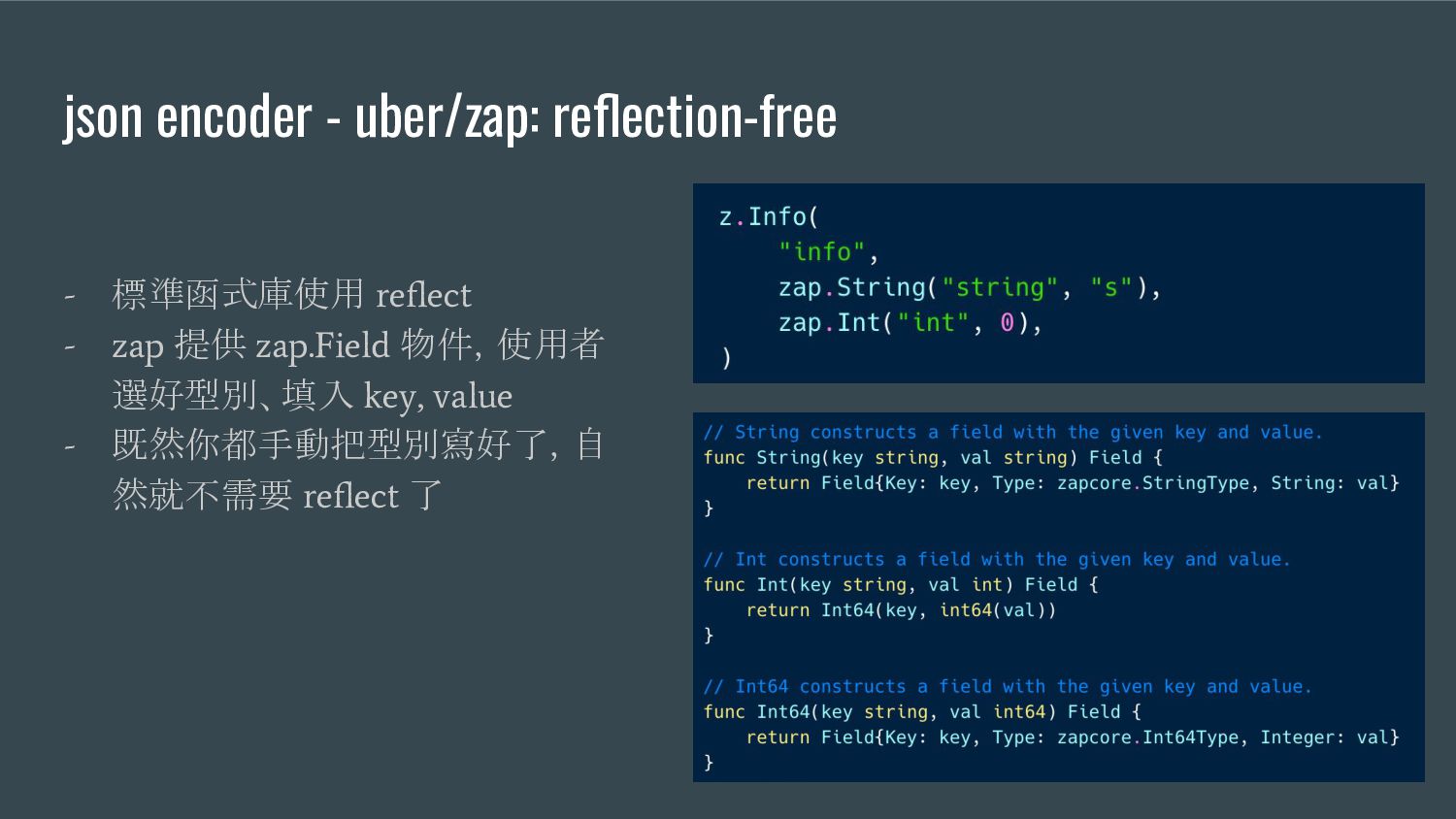
json encoder - uber/zap: reflection-free - 標準函式庫使用 reflect - zap
提供 zap.Field 物件,使用者 選好型別、填入 key, value - 既然你都手動把型別寫好了,自 然就不需要 reflect 了
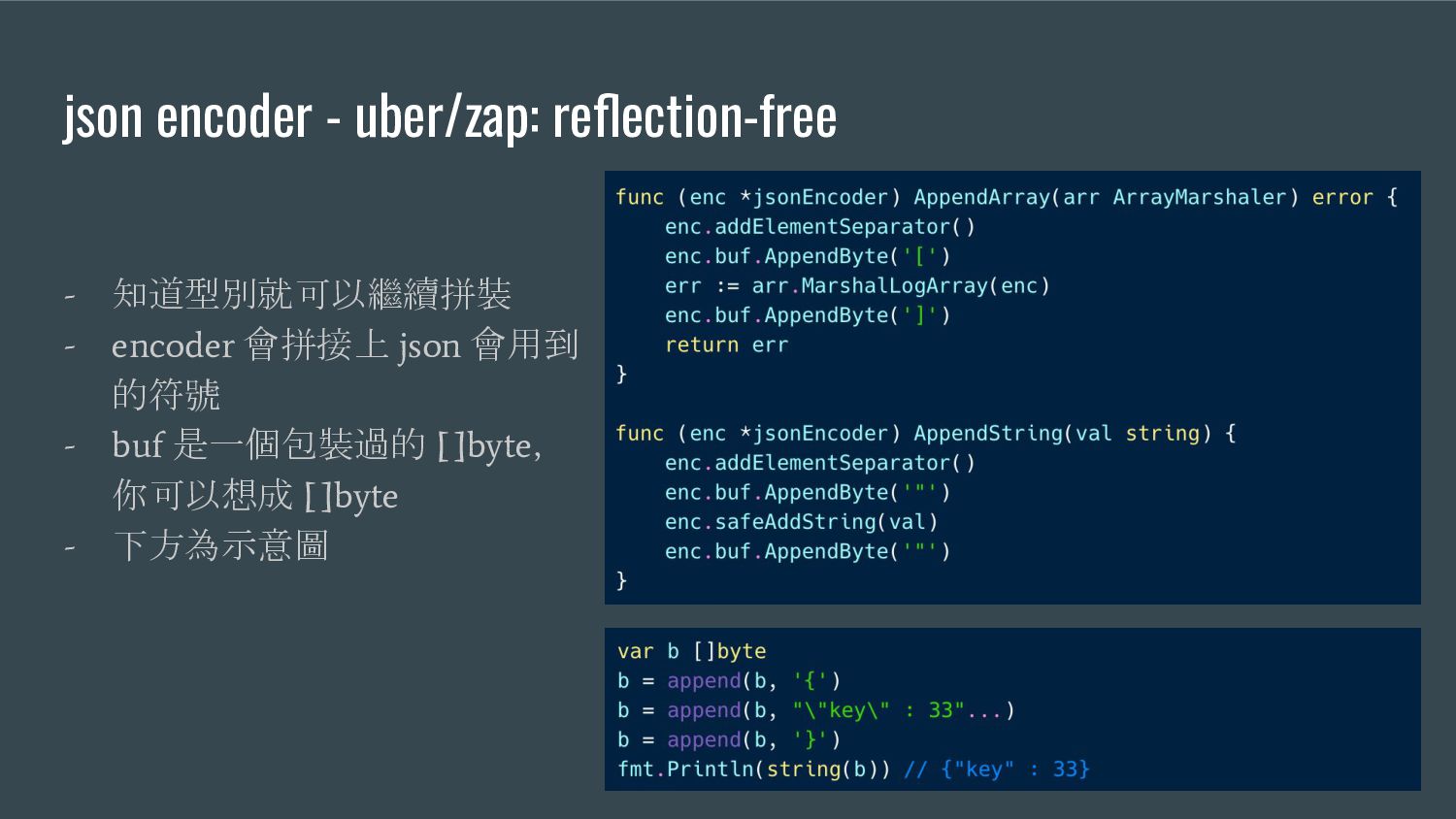
json encoder - uber/zap: reflection-free - 知道型別就可以繼續拼裝 - encoder 會拼接上
json 會用到 的符號 - buf 是一個包裝過的 []byte, 你可以想成 []byte - 下方為示意圖
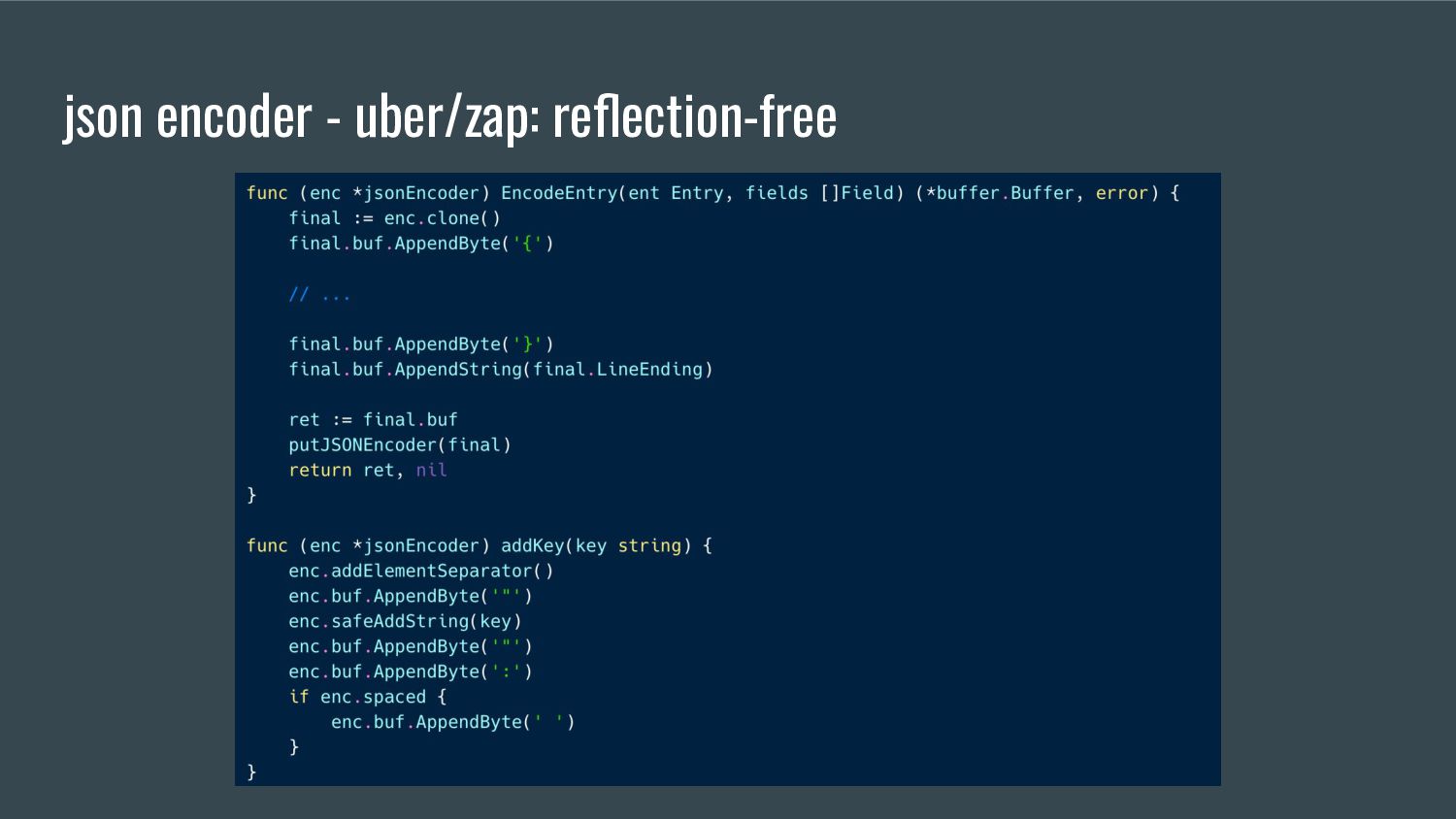
json encoder - uber/zap: reflection-free
物件呢?zap 總不會通靈吧?
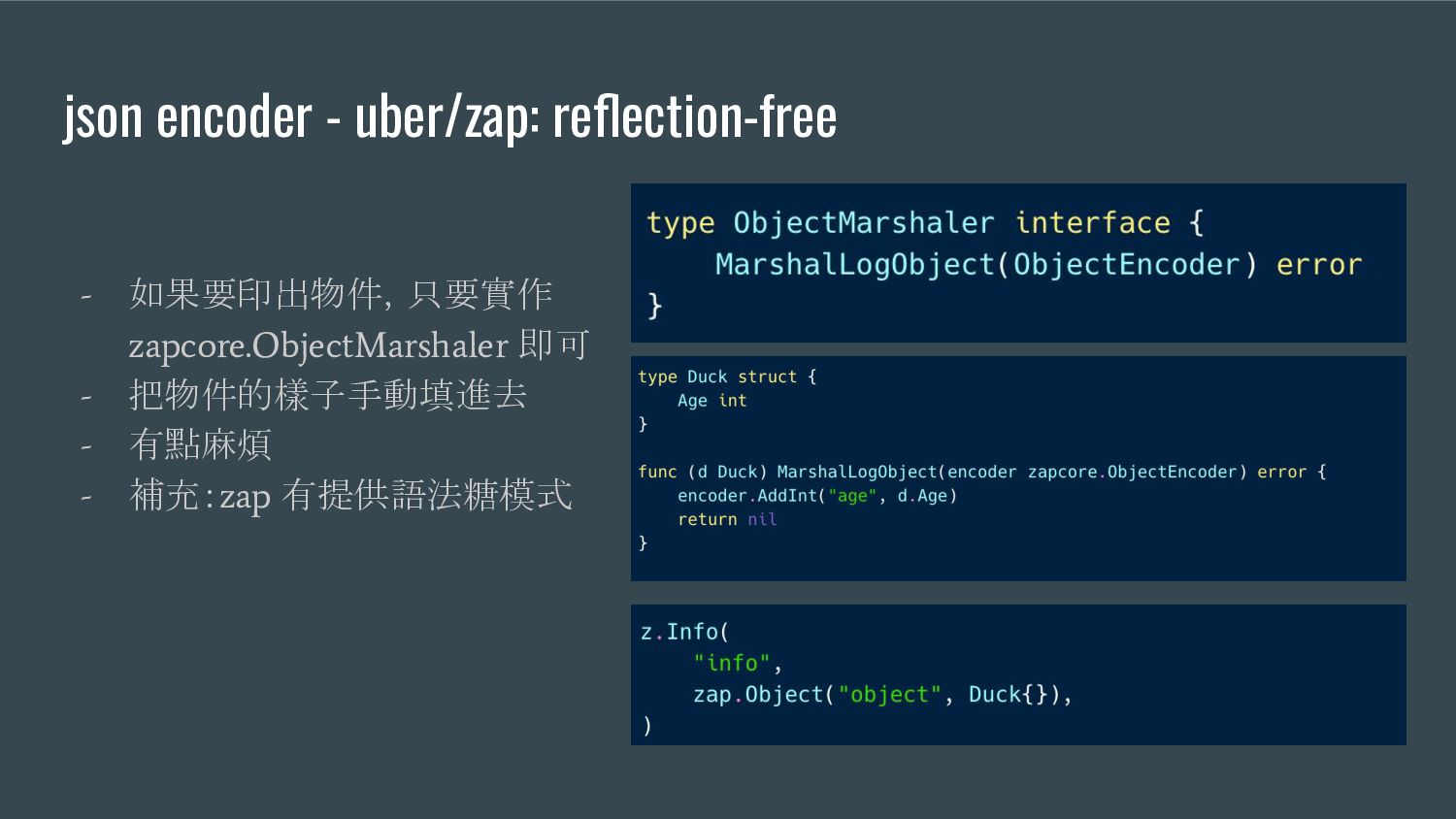
json encoder - uber/zap: reflection-free - 如果要印出物件,只要實作 zapcore.ObjectMarshaler 即可 -
把物件的樣子手動填進去 - 有點麻煩 - 補充:zap 有提供語法糖模式
zero-allocation
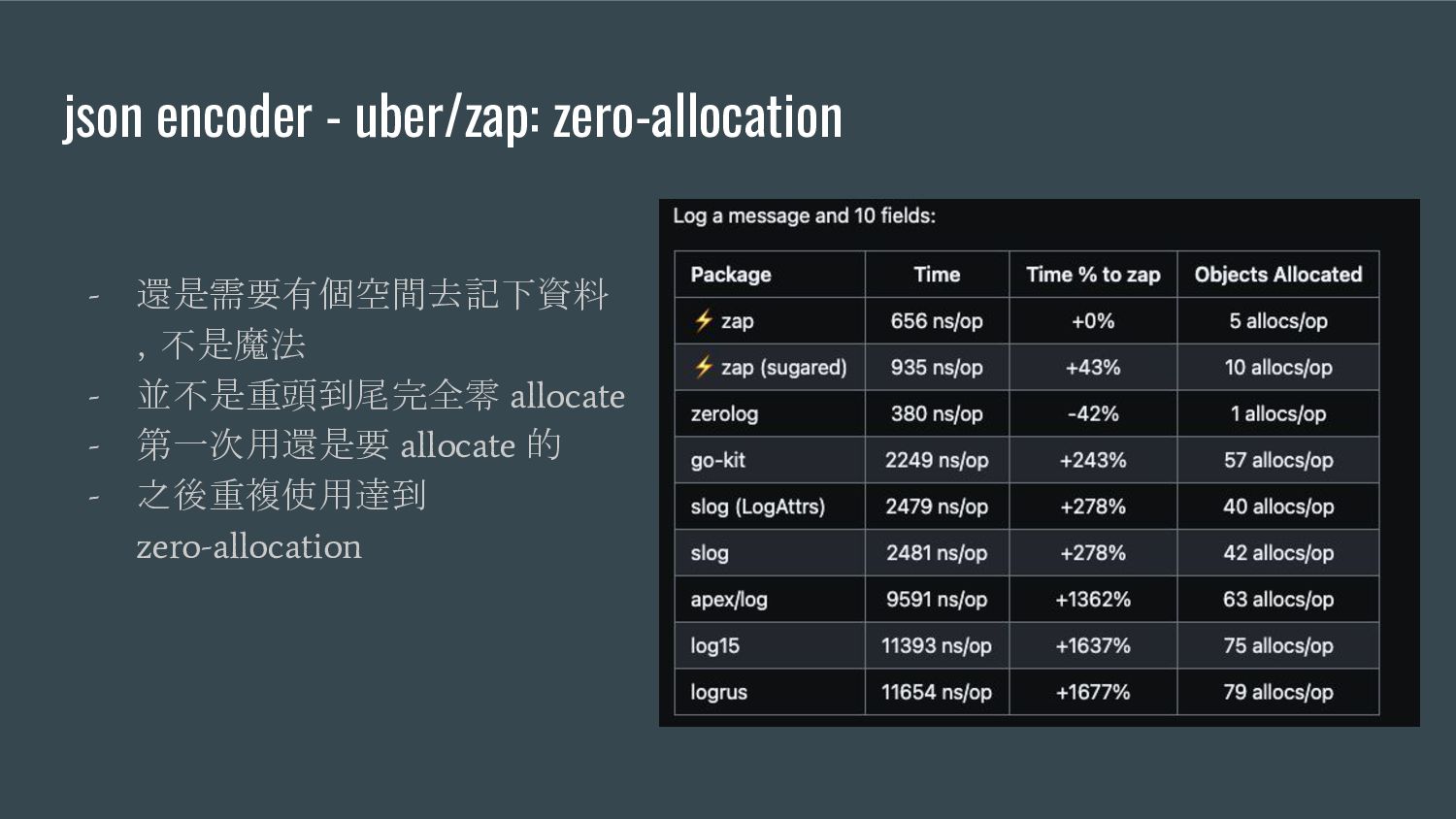
json encoder - uber/zap: zero-allocation - 還是需要有個空間去記下資料 ,不是魔法 - 並不是重頭到尾完全零
allocate - 第一次用還是要 allocate 的 - 之後重複使用達到 zero-allocation
那又是怎麼重複使用的?
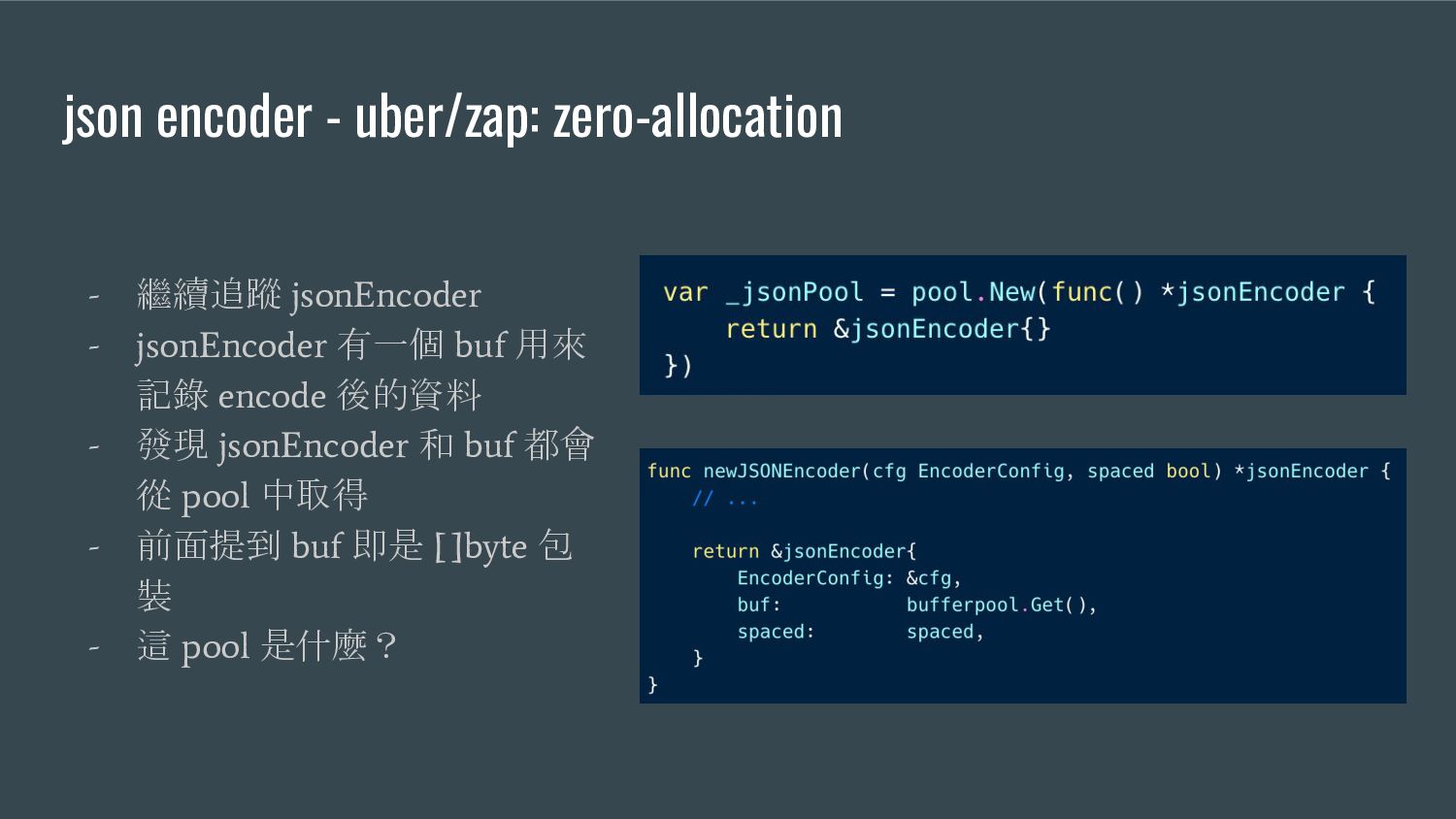
json encoder - uber/zap: zero-allocation - 繼續追蹤 jsonEncoder - jsonEncoder
有一個 buf 用來 記錄 encode 後的資料 - 發現 jsonEncoder 和 buf 都會 從 pool 中取得 - 前面提到 buf 即是 []byte 包 裝 - 這 pool 是什麼?
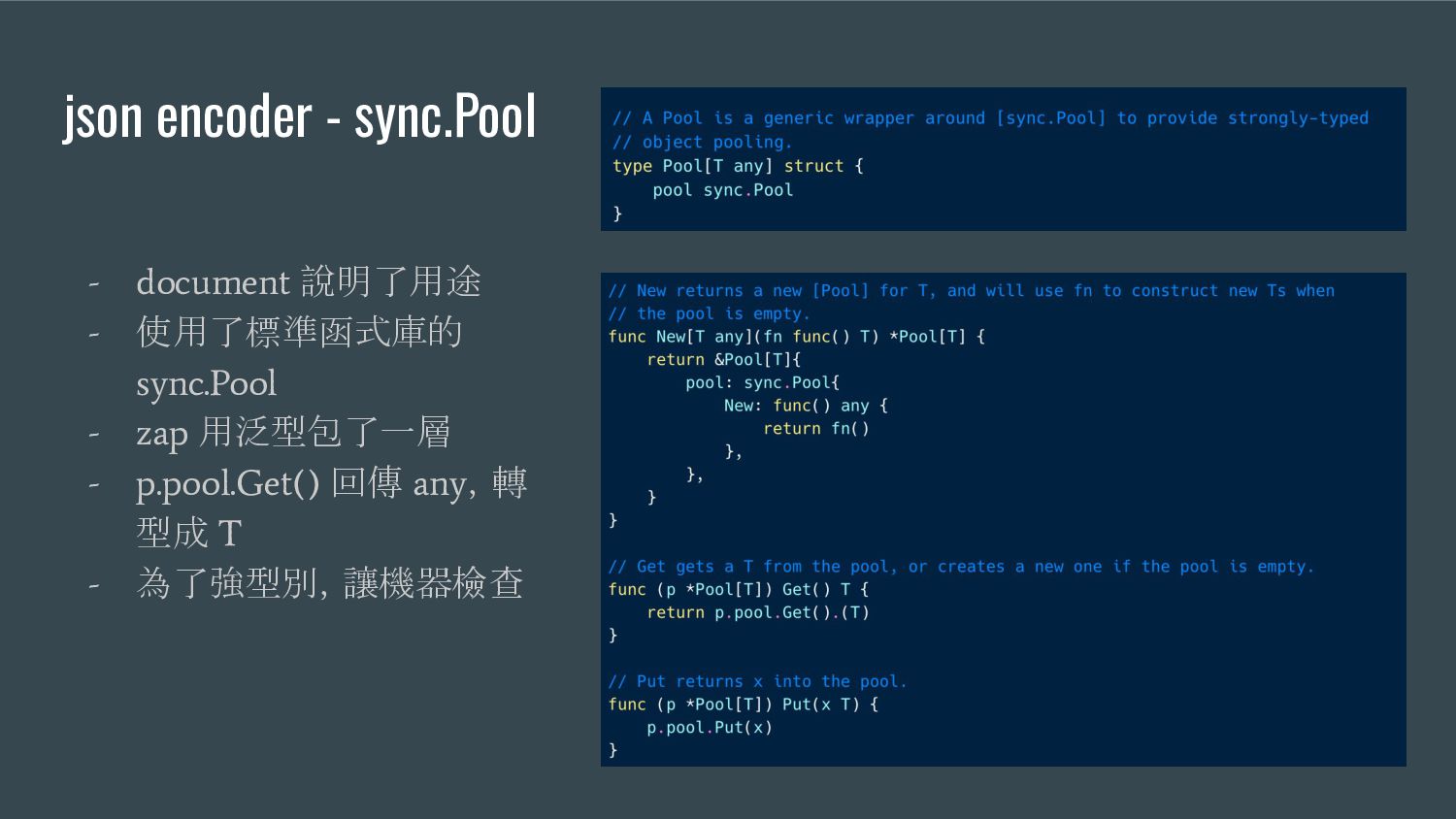
json encoder - sync.Pool - document 說明了用途 - 使用了標準函式庫的 sync.Pool
- zap 用泛型包了一層 - p.pool.Get() 回傳 any,轉 型成 T - 為了強型別,讓機器檢查
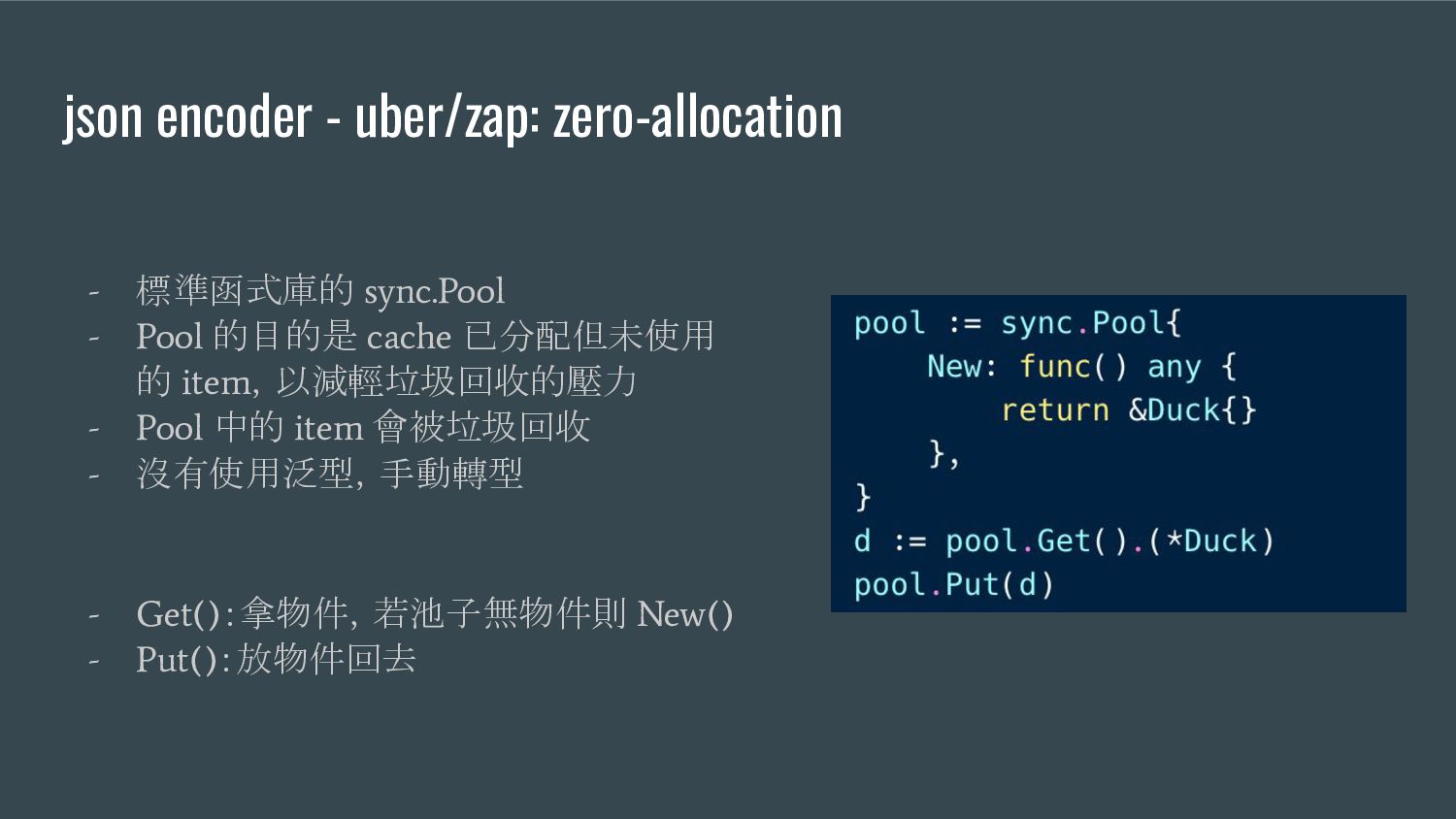
json encoder - uber/zap: zero-allocation - 標準函式庫的 sync.Pool - Pool
的目的是 cache 已分配但未使用 的 item,以減輕垃圾回收的壓力 - Pool 中的 item 會被垃圾回收 - 沒有使用泛型,手動轉型 - Get():拿物件,若池子無物件則 New() - Put():放物件回去
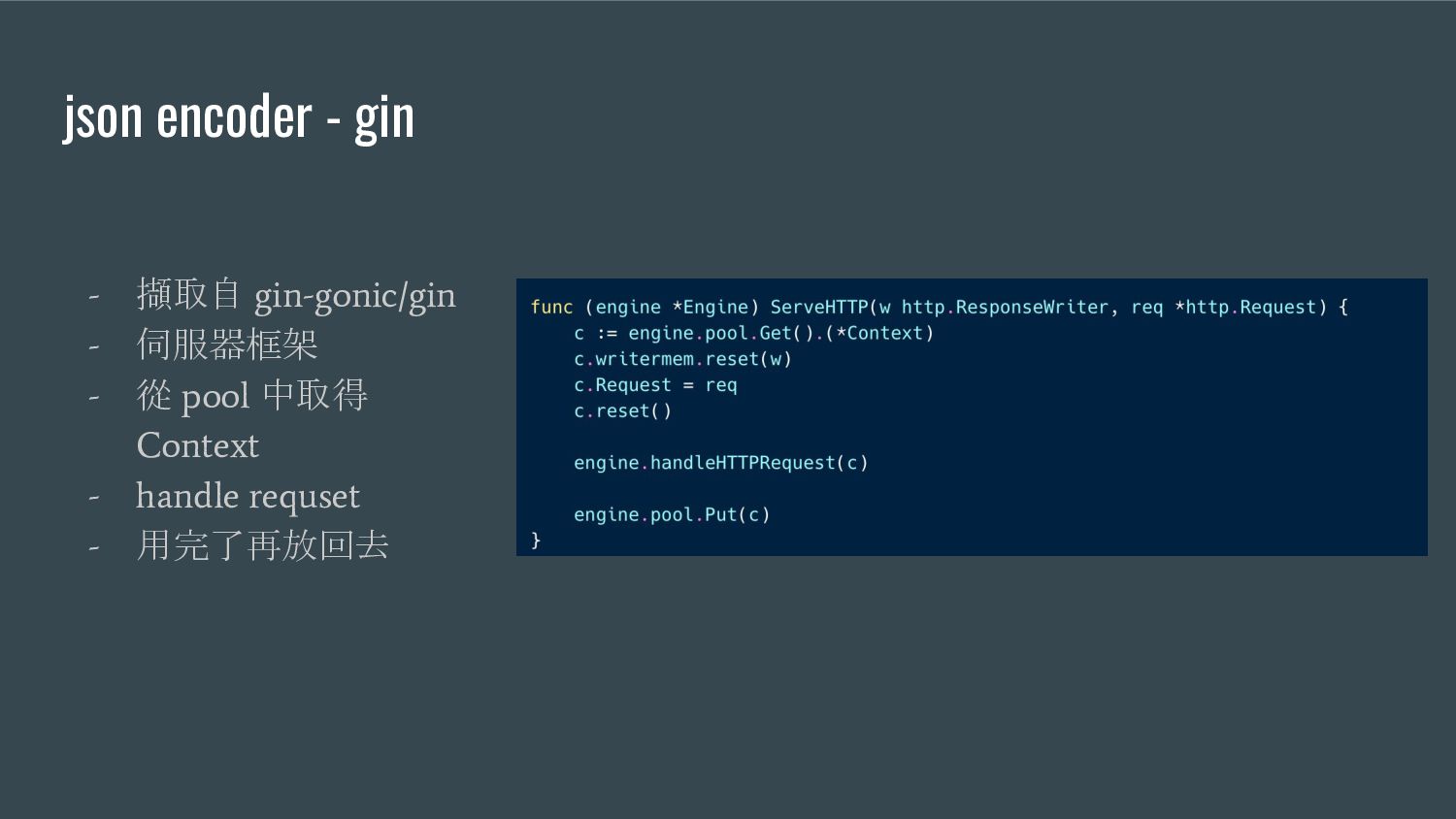
json encoder - gin - 擷取自 gin-gonic/gin - 伺服器框架 -
從 pool 中取得 Context - handle requset - 用完了再放回去
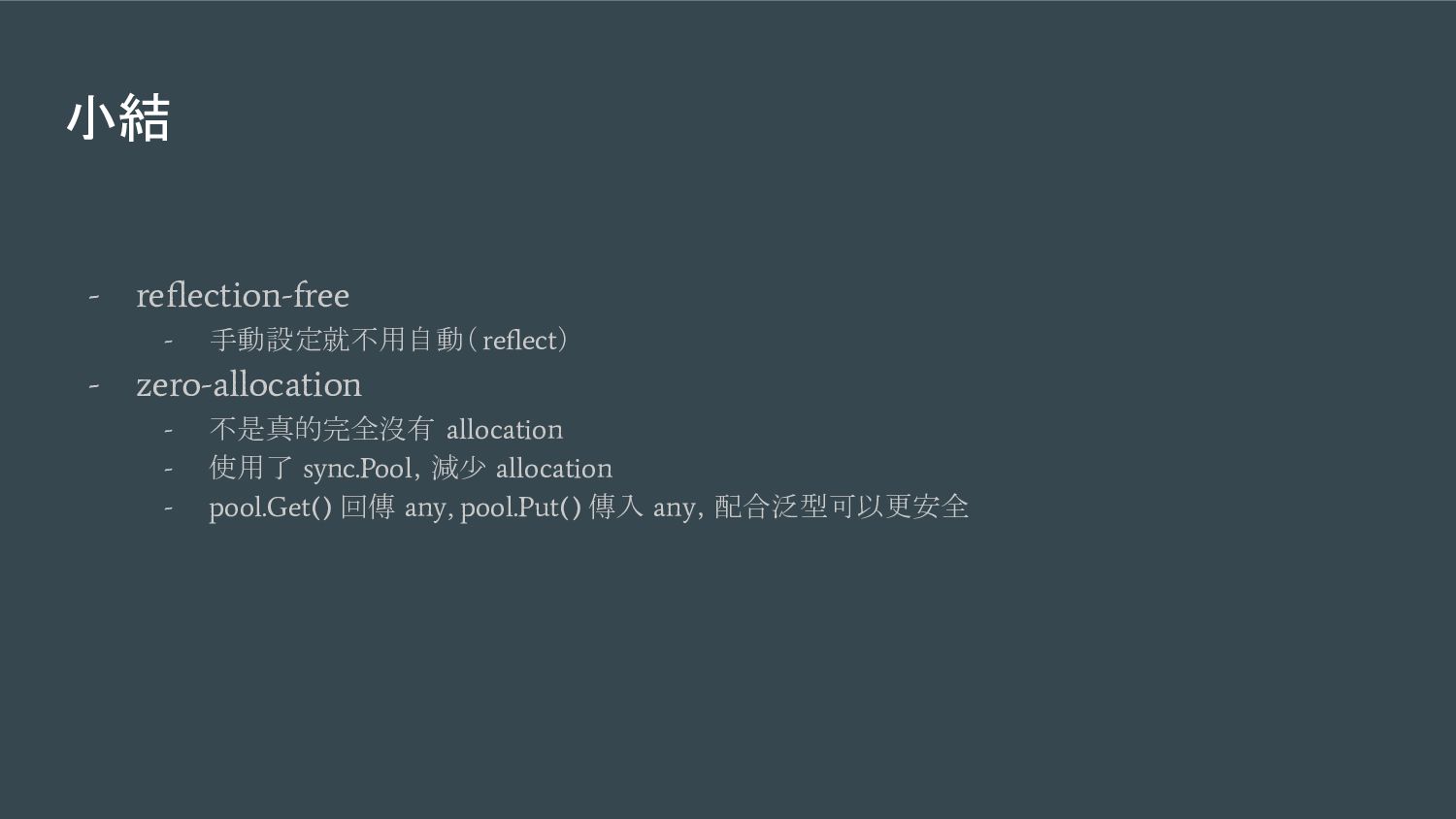
小結 - reflection-free - 手動設定就不用自動( reflect) - zero-allocation - 不是真的完全沒有
allocation - 使用了 sync.Pool,減少 allocation - pool.Get() 回傳 any, pool.Put() 傳入 any,配合泛型可以更安全
string 和 []byte 轉換
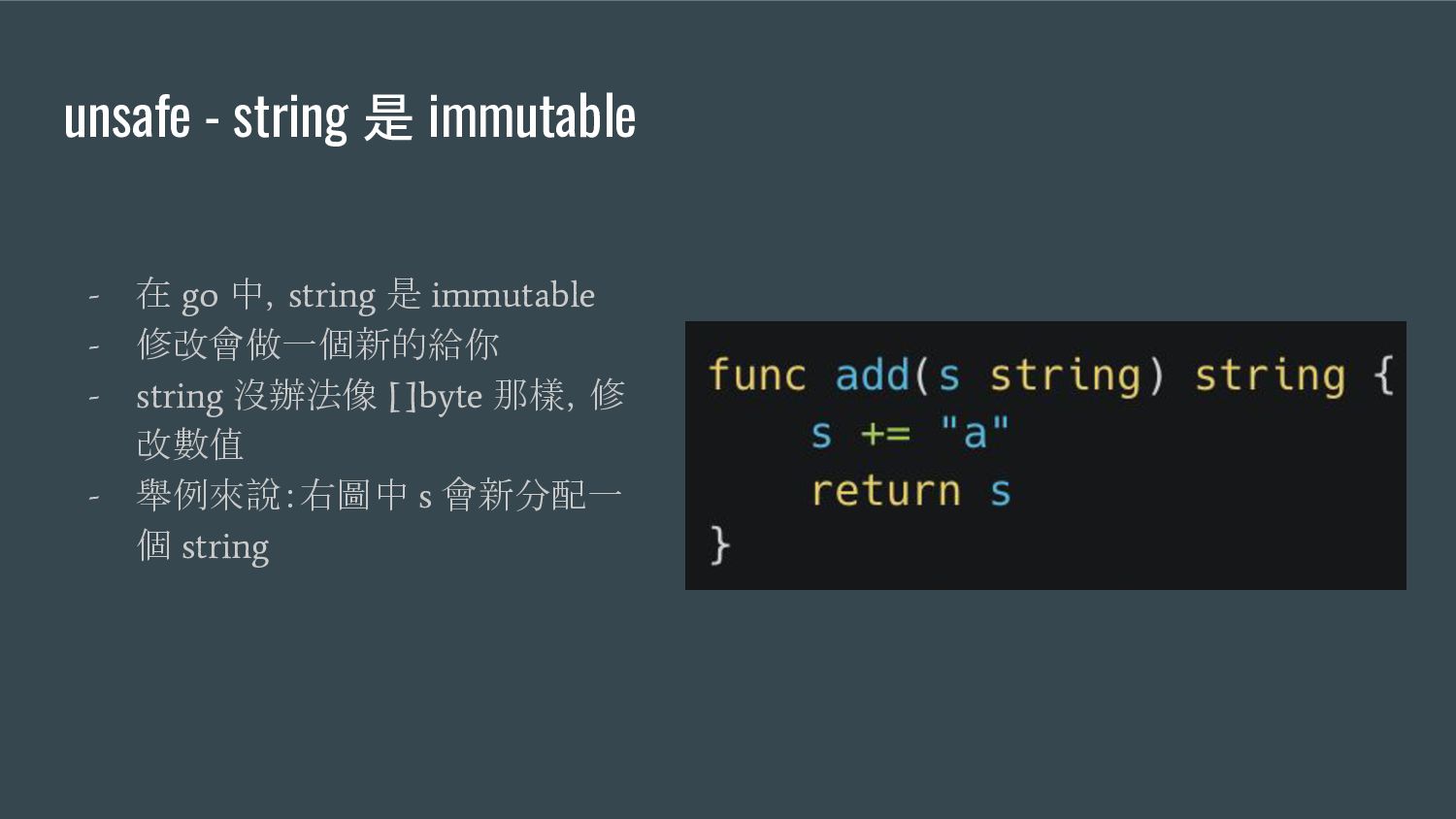
unsafe - string 是 immutable - 在 go 中,string 是
immutable - 修改會做一個新的給你 - string 沒辦法像 []byte 那樣,修 改數值 - 舉例來說:右圖中 s 會新分配一 個 string
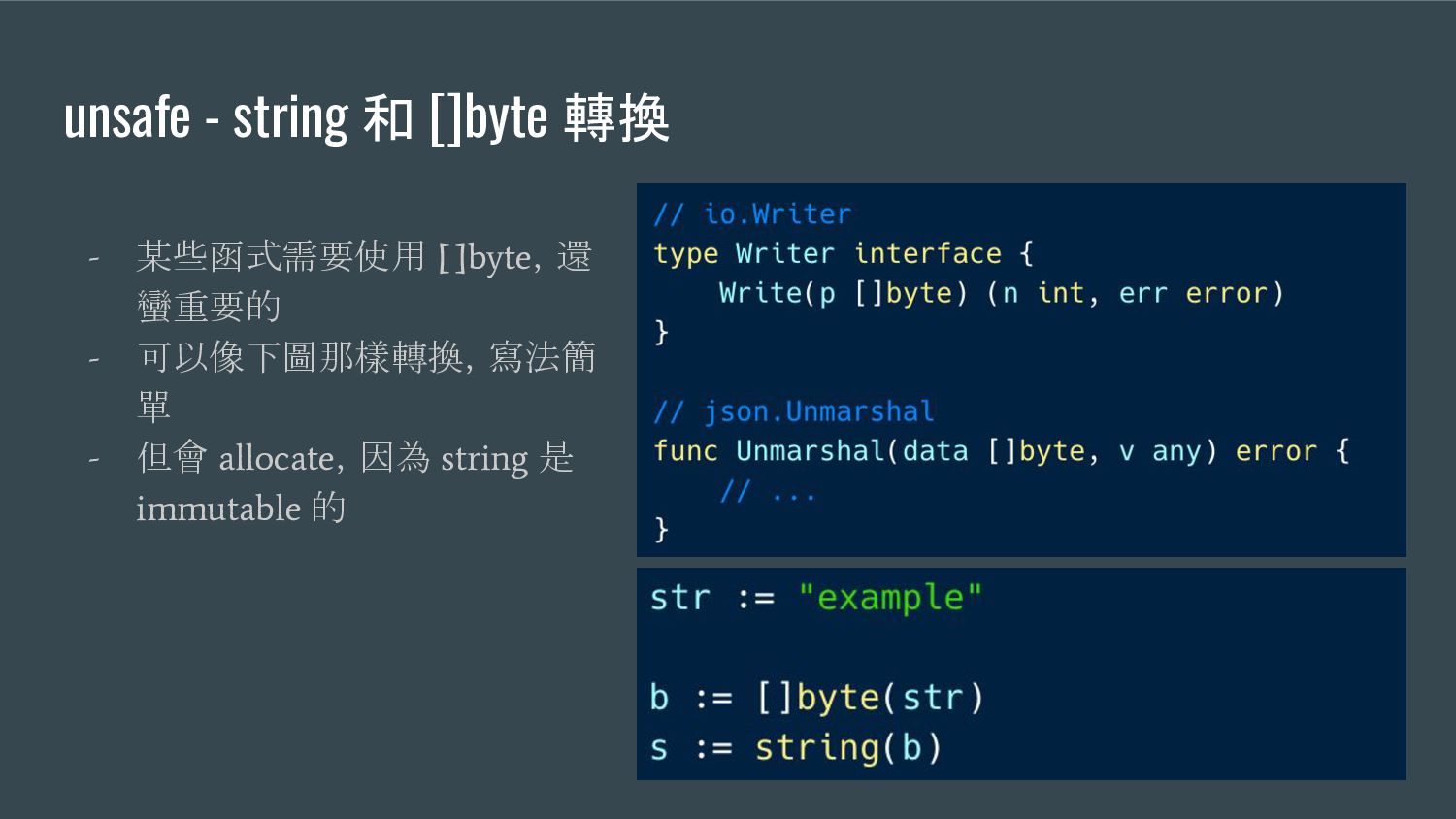
unsafe - string 和 []byte 轉換 - 某些函式需要使用 []byte,還 蠻重要的
- 可以像下圖那樣轉換,寫法簡 單 - 但會 allocate,因為 string 是 immutable 的
明明都是一樣的東西 怎麼只是轉換還要複製一次 有沒有什麼辦法?
🤔 🤔 🤔 🤔 🤔
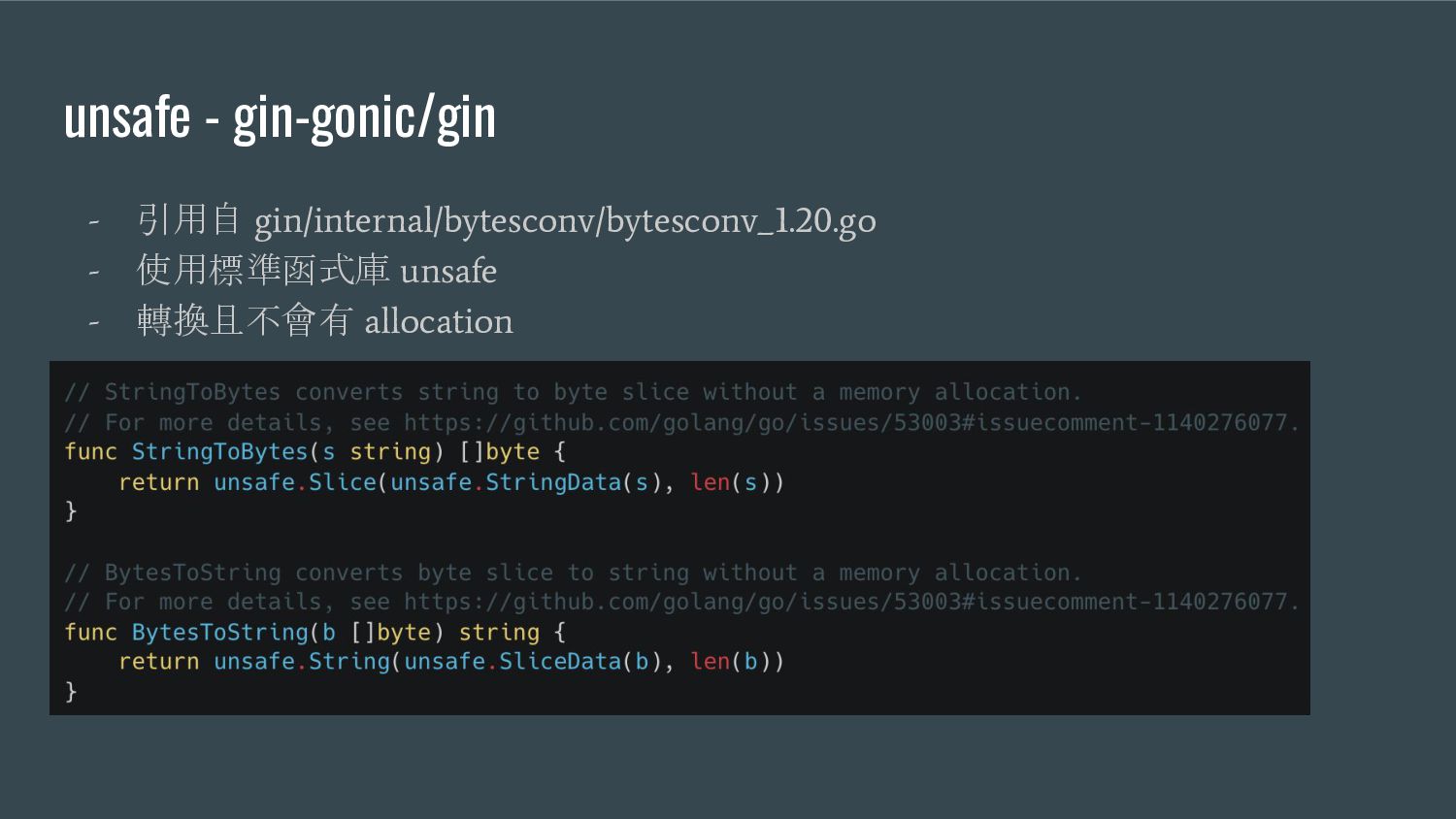
unsafe - gin-gonic/gin - 引用自 gin/internal/bytesconv/bytesconv_1.20.go - 使用標準函式庫 unsafe -
轉換且不會有 allocation
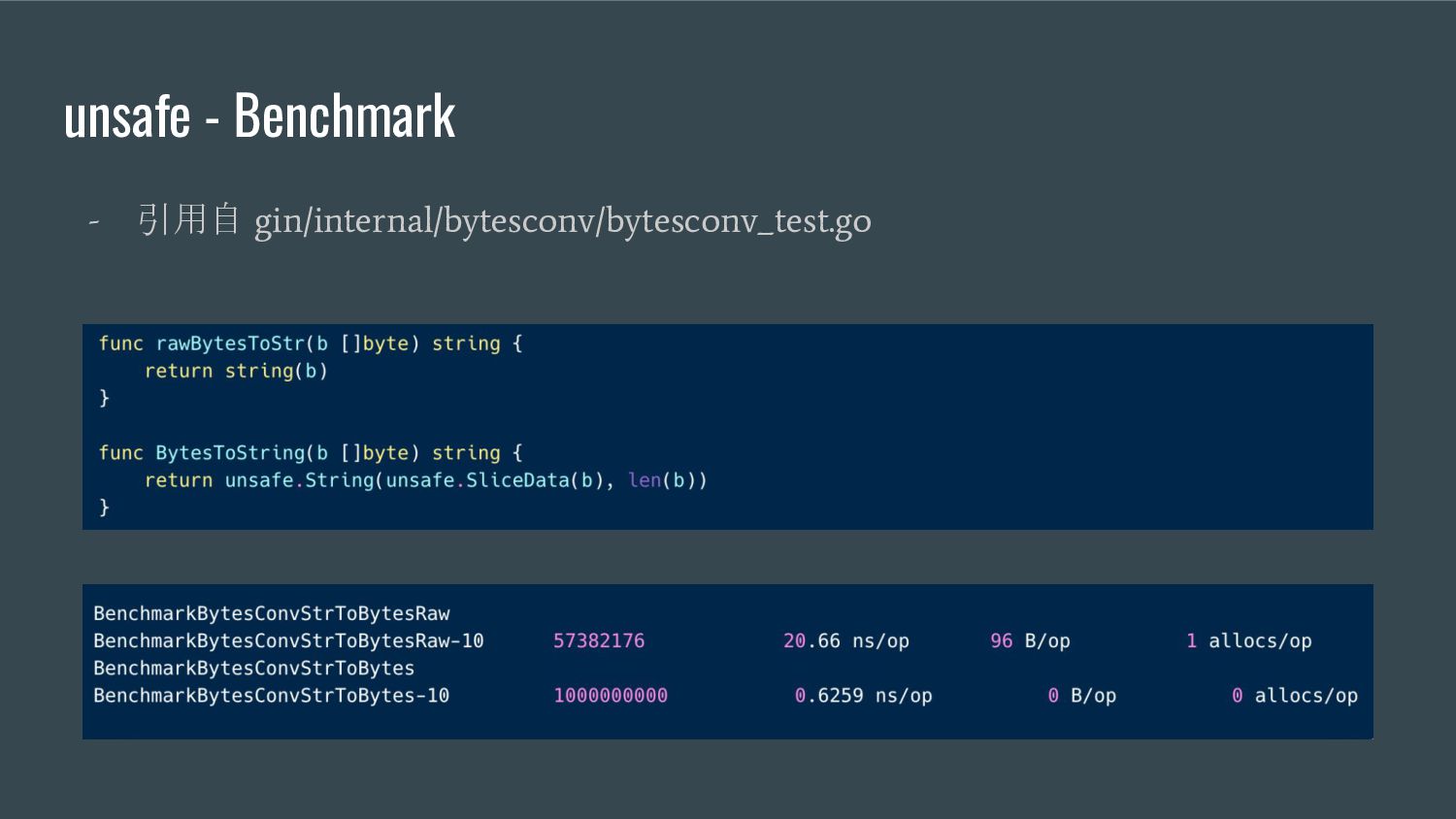
unsafe - Benchmark - 引用自 gin/internal/bytesconv/bytesconv_test.go
等等!既然 string 可以轉換成 []byte 🤔🤔🤔
也許我能修改 string? 🤔🤔🤔 🤔 🤔 🤔 🤔
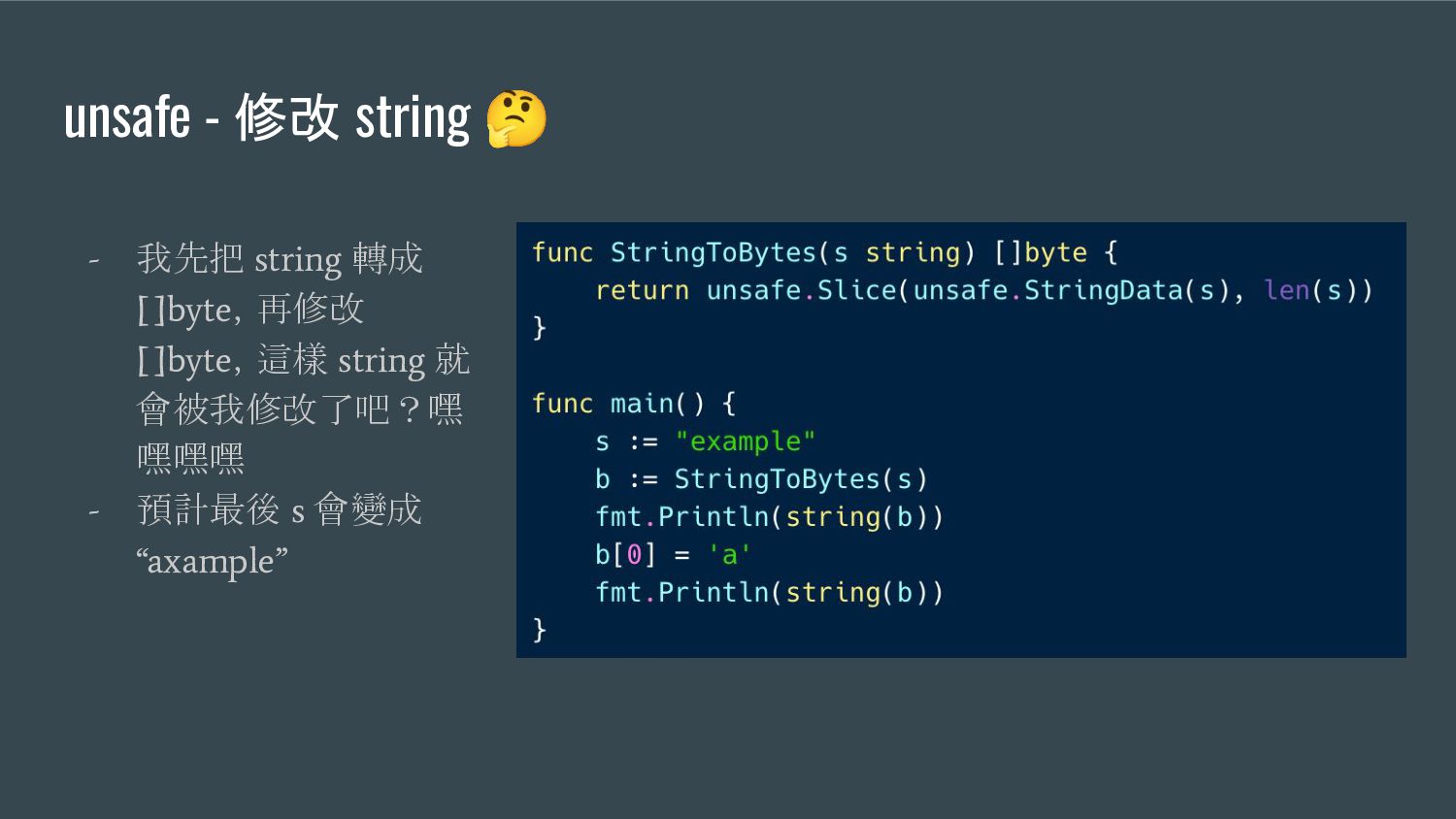
unsafe - 修改 string 🤔 - 我先把 string 轉成 []byte,再修改
[]byte,這樣 string 就 會被我修改了吧?嘿 嘿嘿嘿 - 預計最後 s 會變成 “axample”
🤔 🤔 🤔 🤔 🤔
🤔 🤔 🤔 🤔 🤔
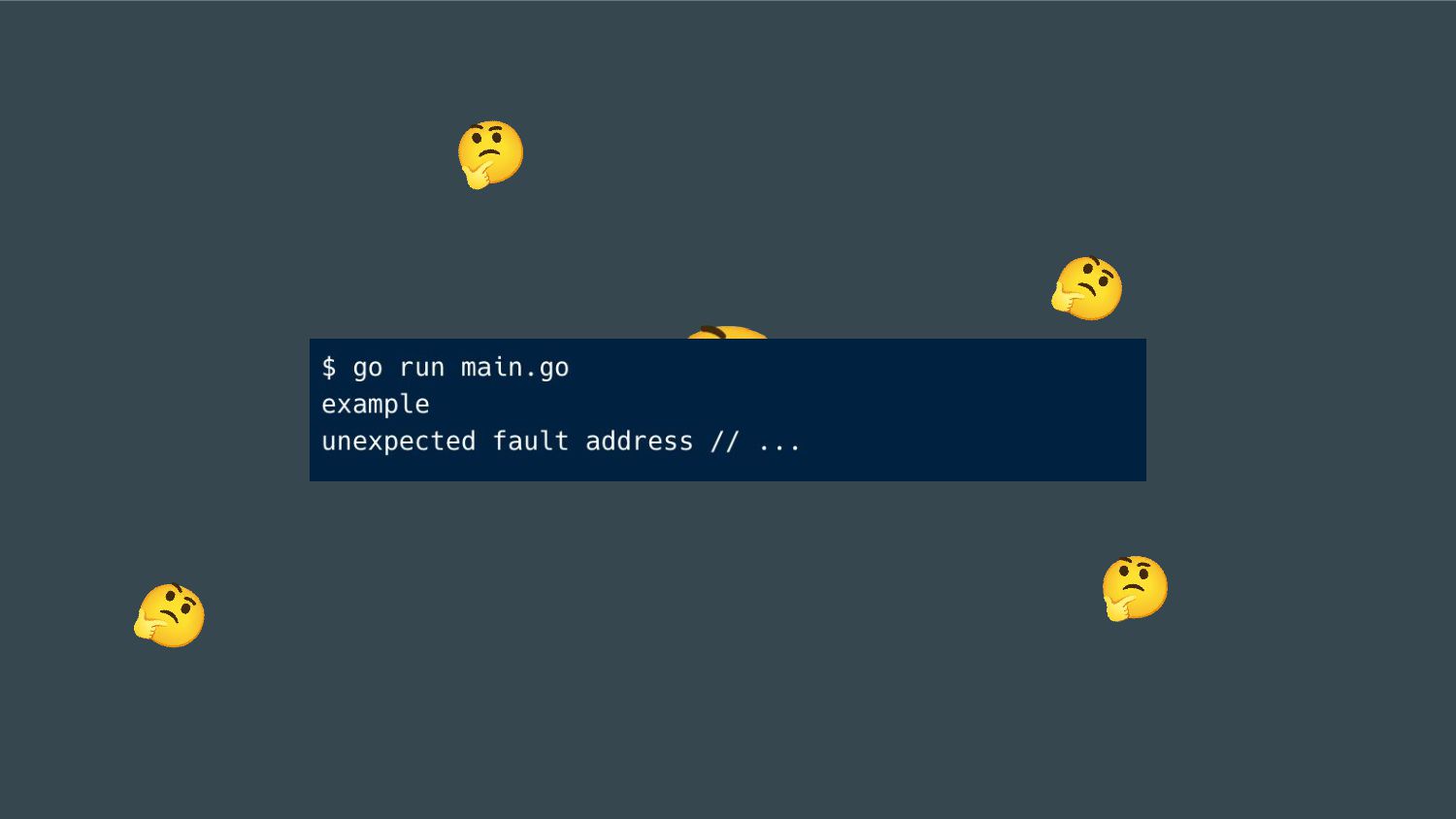
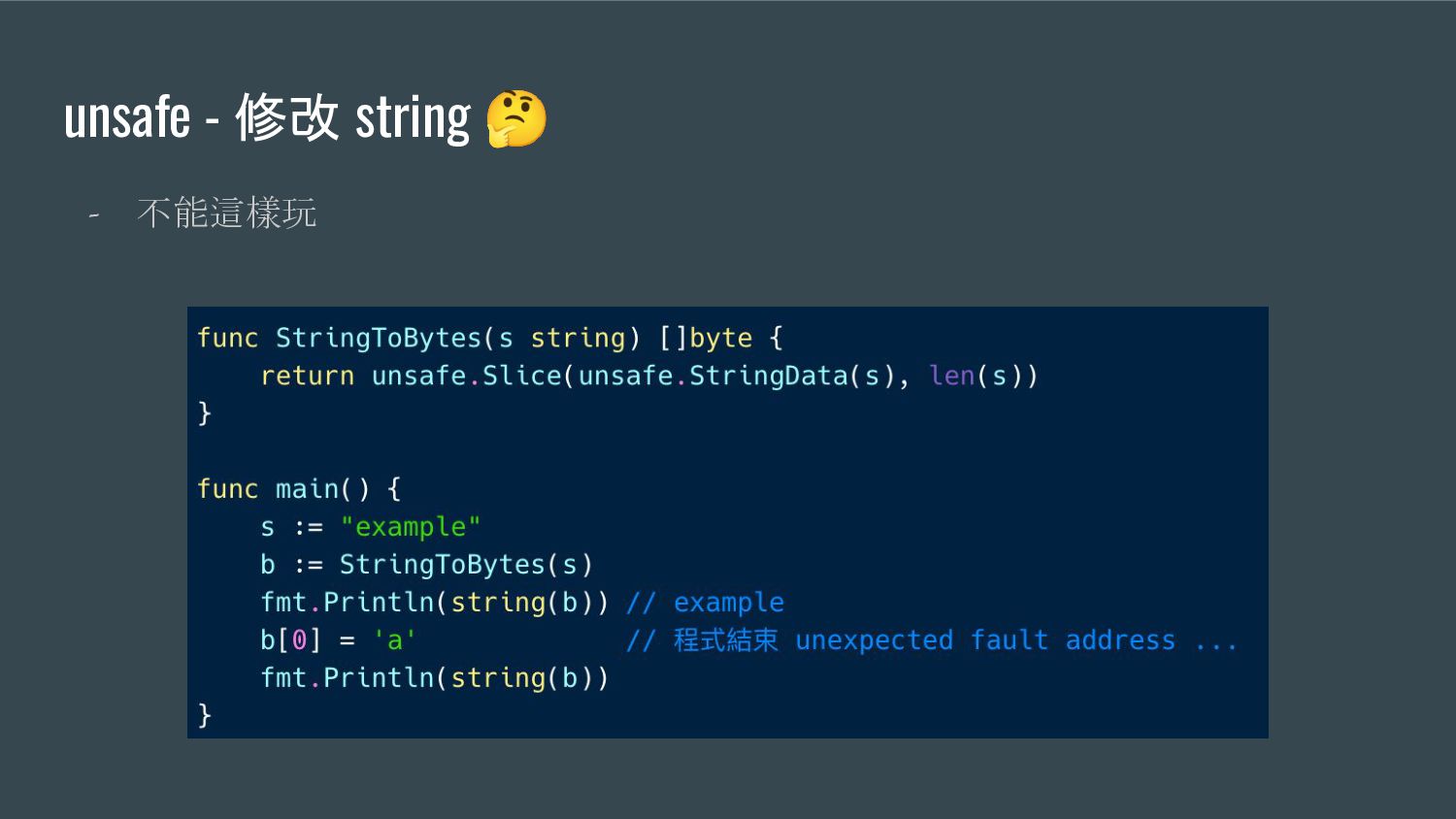
unsafe - 修改 string 🤔 - 不能這樣玩
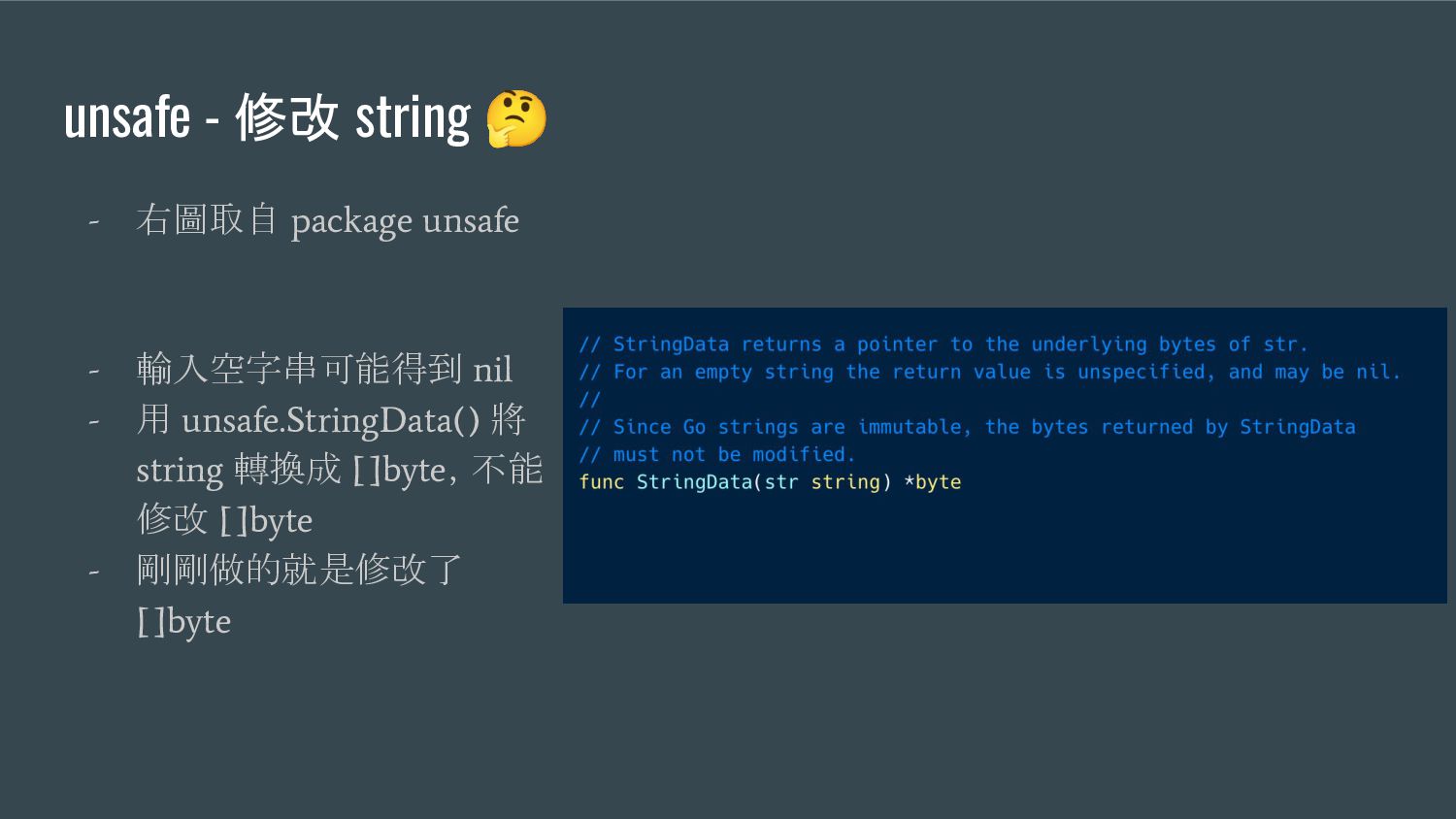
unsafe - 修改 string 🤔 - 右圖取自 package unsafe -
輸入空字串可能得到 nil - 用 unsafe.StringData() 將 string 轉換成 []byte,不能 修改 []byte - 剛剛做的就是修改了 []byte
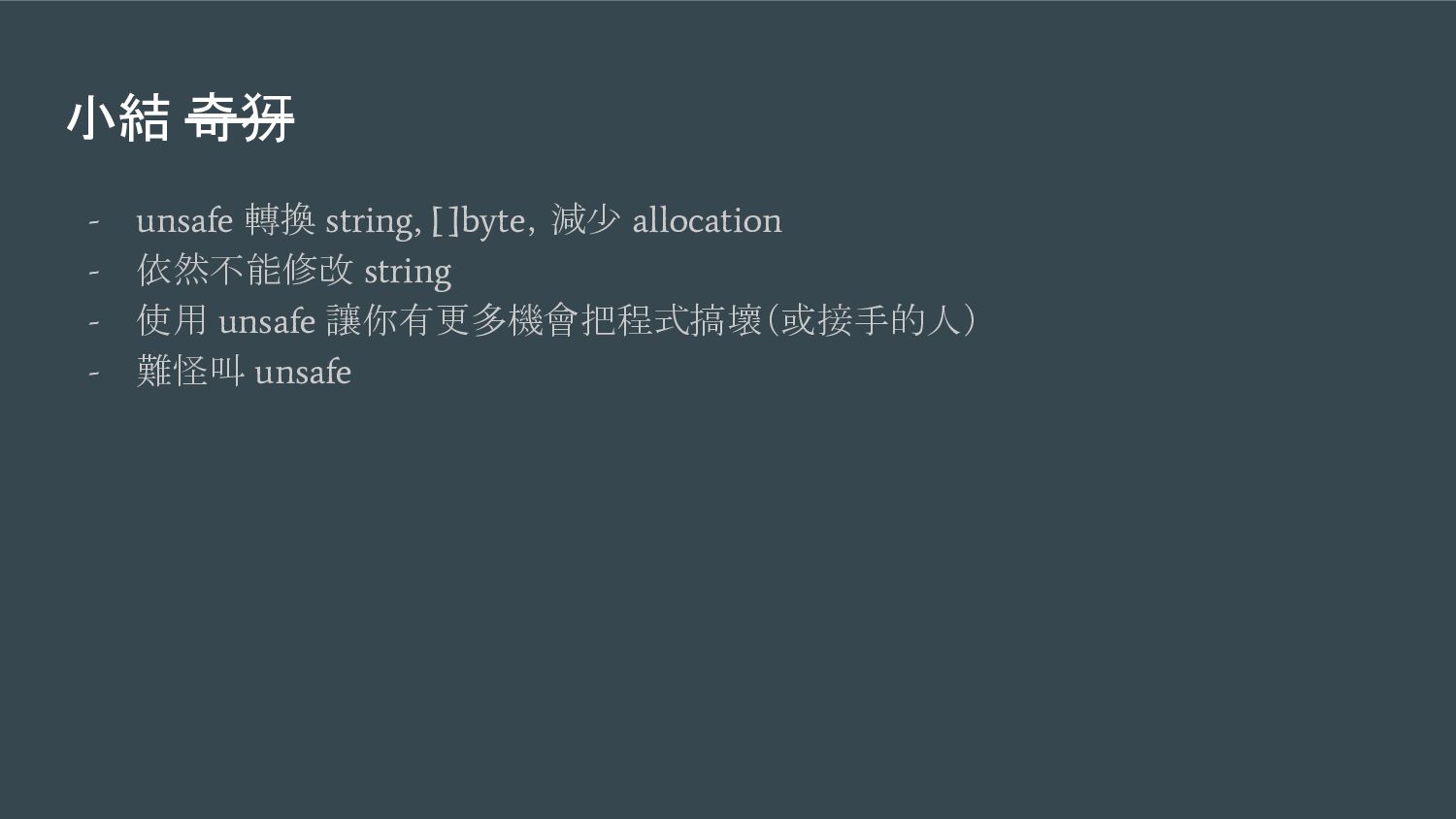
小結 奇犽 - unsafe 轉換 string, []byte,減少 allocation - 依然不能修改
string - 使用 unsafe 讓你有更多機會把程式搞壞(或接手的人) - 難怪叫 unsafe
Builder Pattern, Method Chain
為什麼要寫測試?
人類是有極限的
從短暫的程式生涯中我學到一件事 越是攻於心計 越容易栽在自己意想不到的地方
讓機器檢查
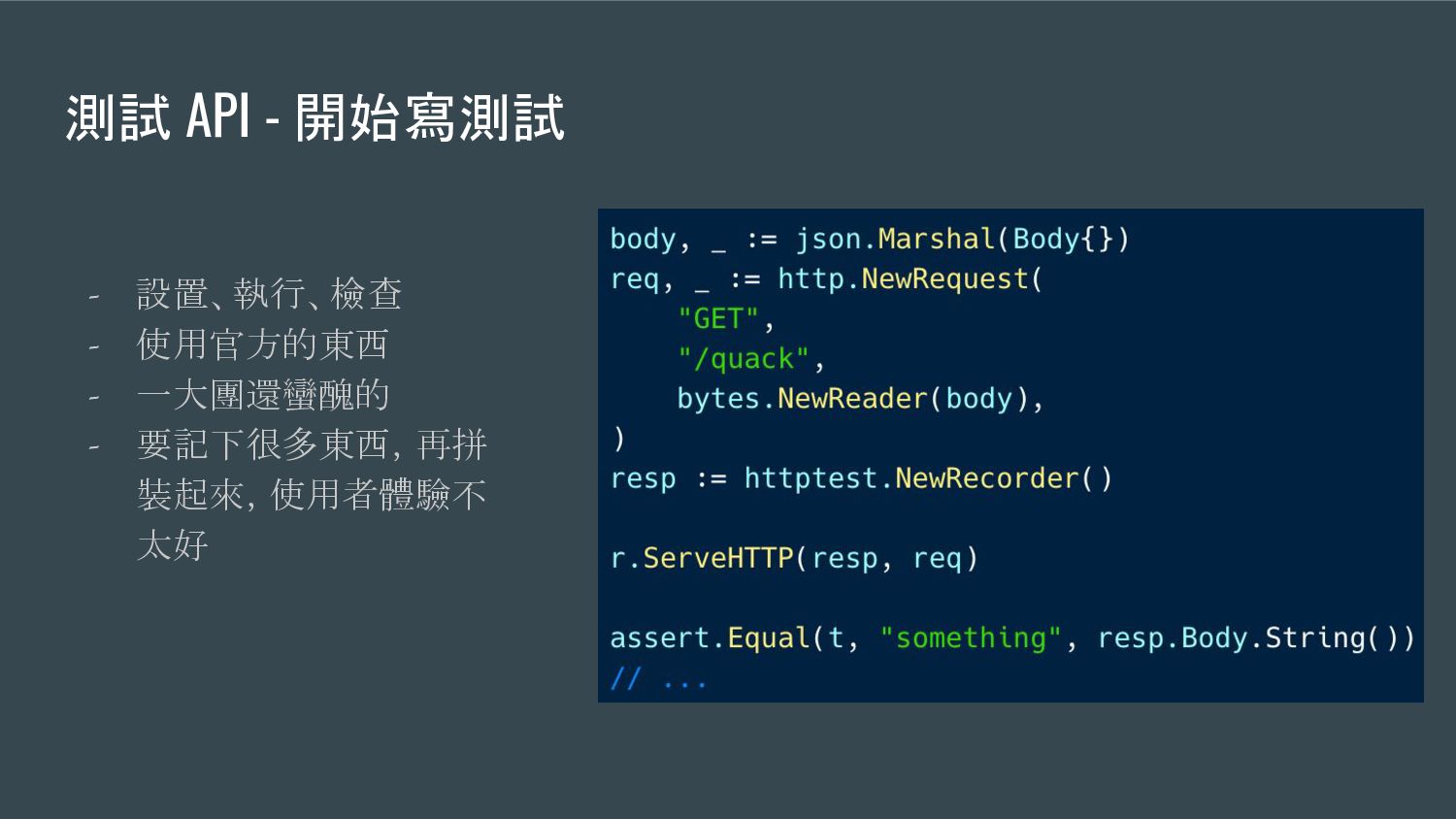
測試 API - 開始寫測試 - 設置、執行、檢查 - 使用官方的東西 - 一大團還蠻醜的
- 要記下很多東西,再拼 裝起來,使用者體驗不 太好
應該有更好的方法 🤔🤔🤔
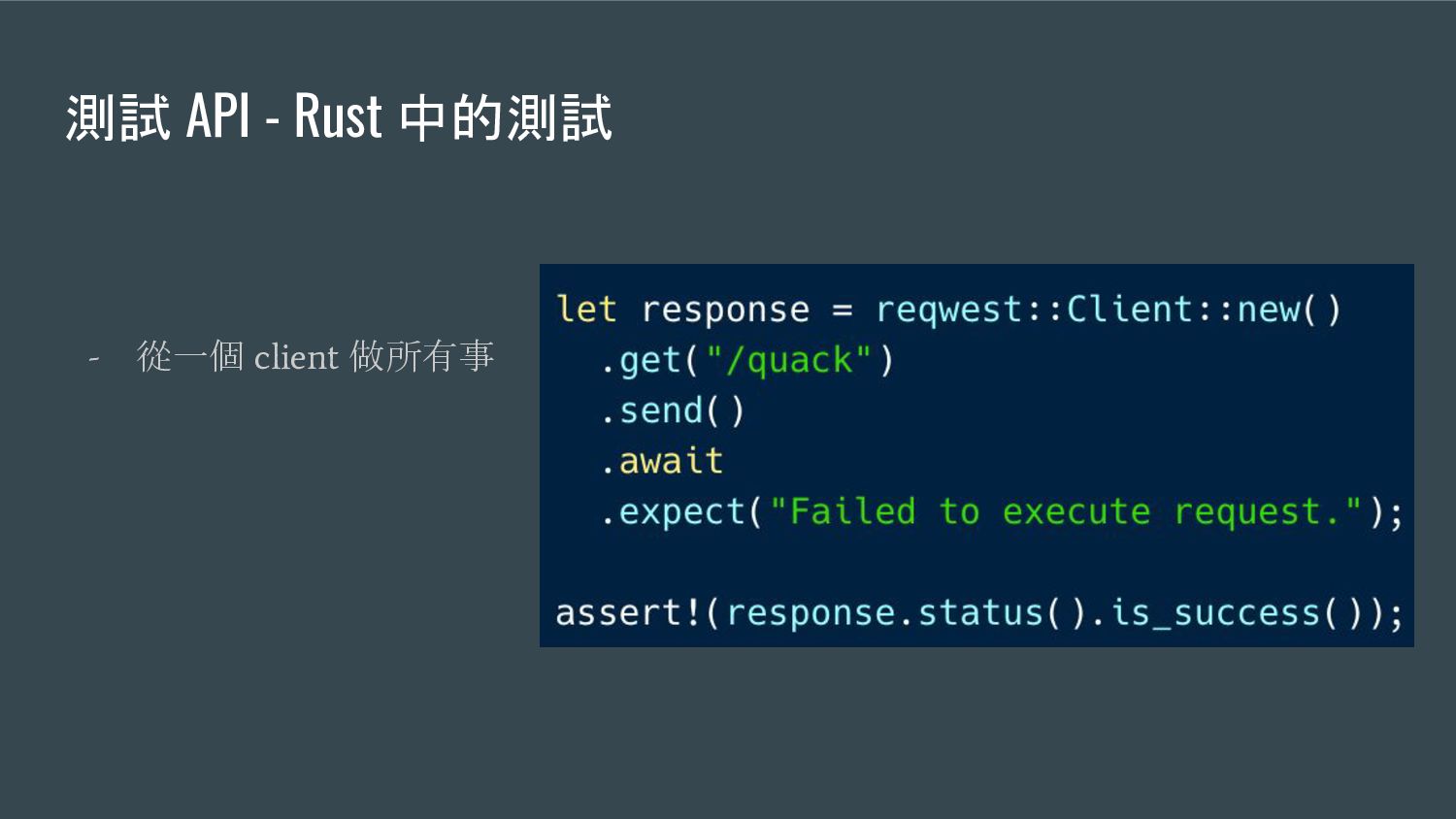
測試 API - Rust 中的測試 - 從一個 client 做所有事
也許我可以弄一個類似的框架
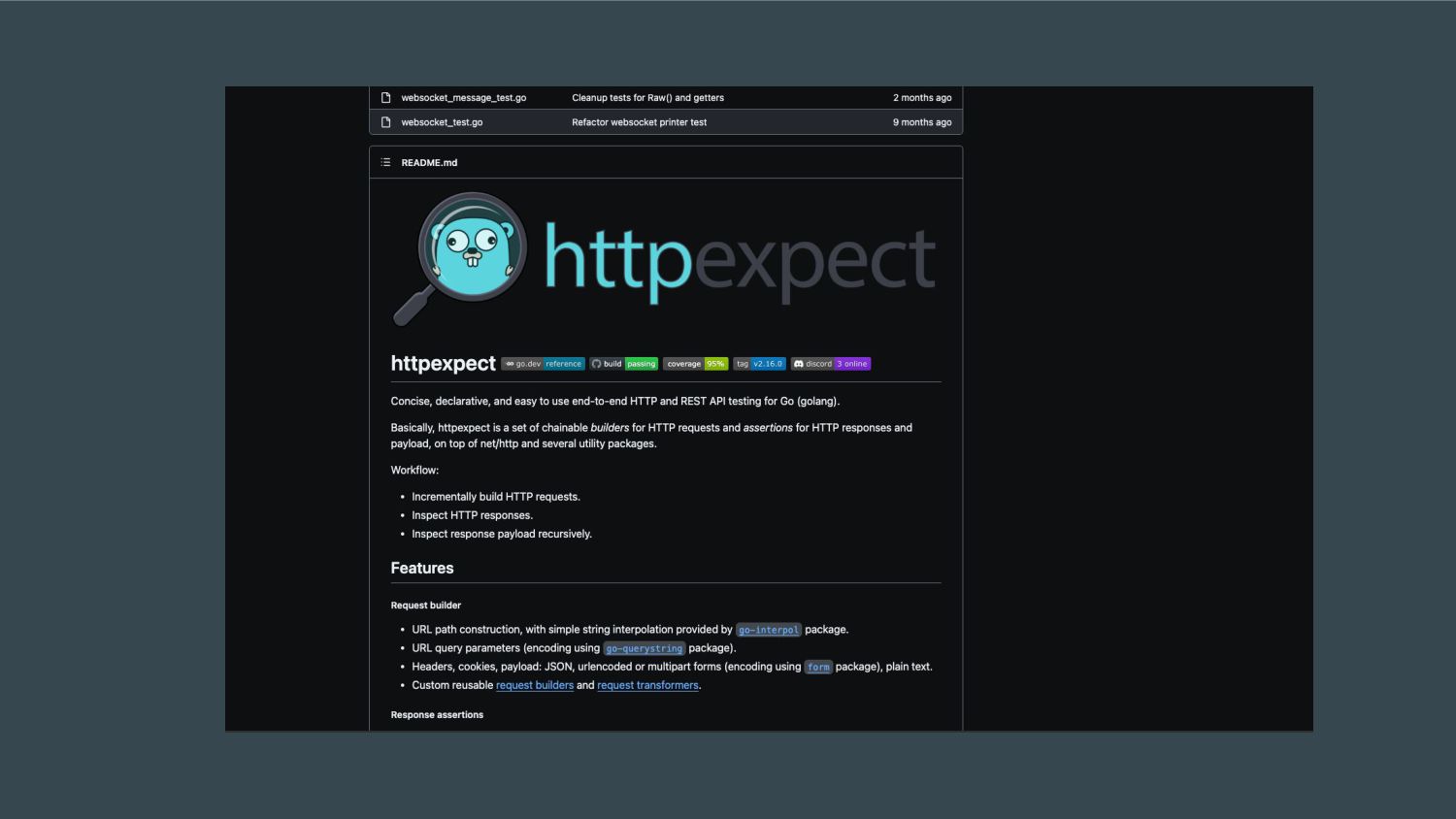
上 github 看看
None
好吧果然有人做過了
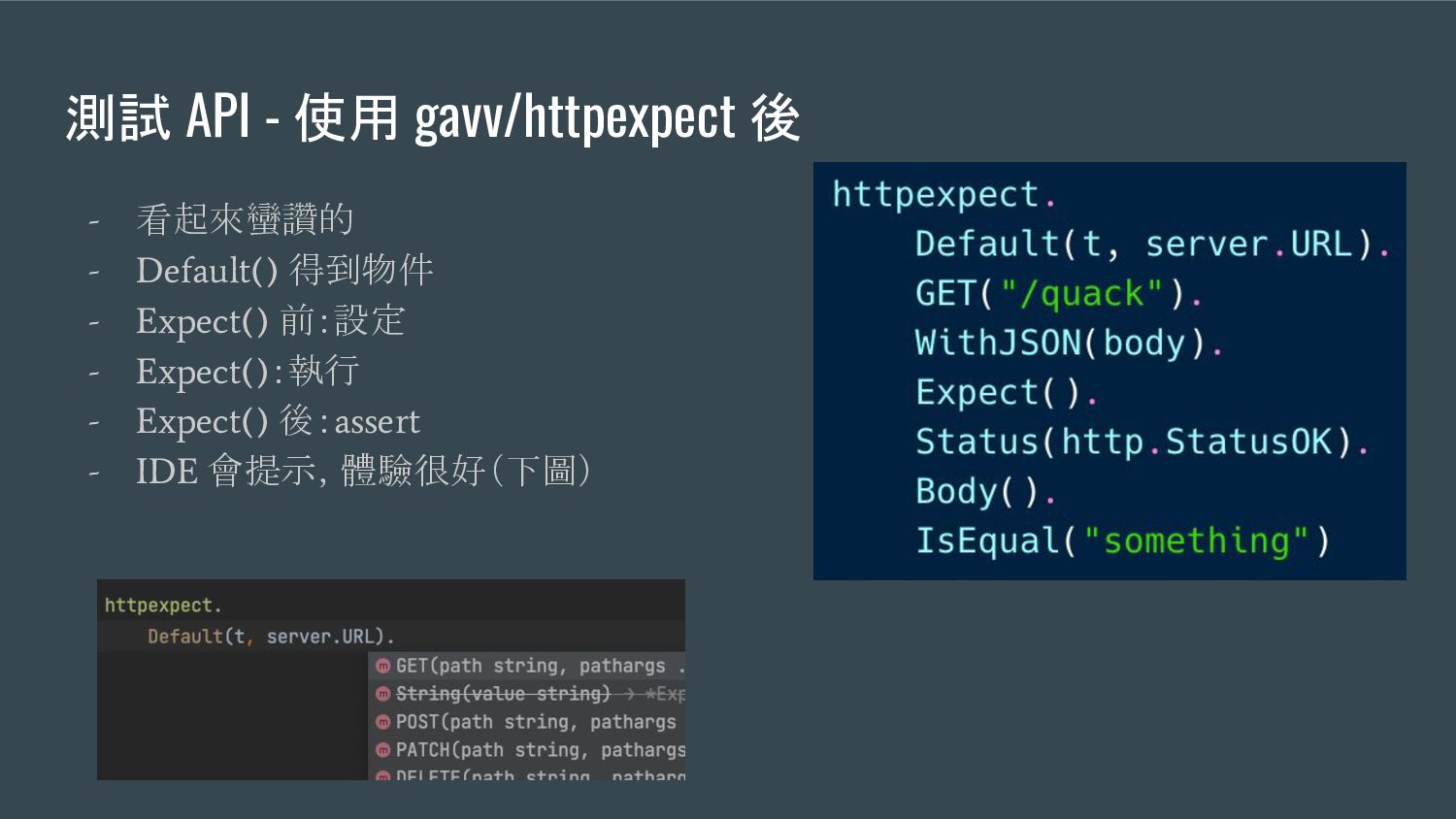
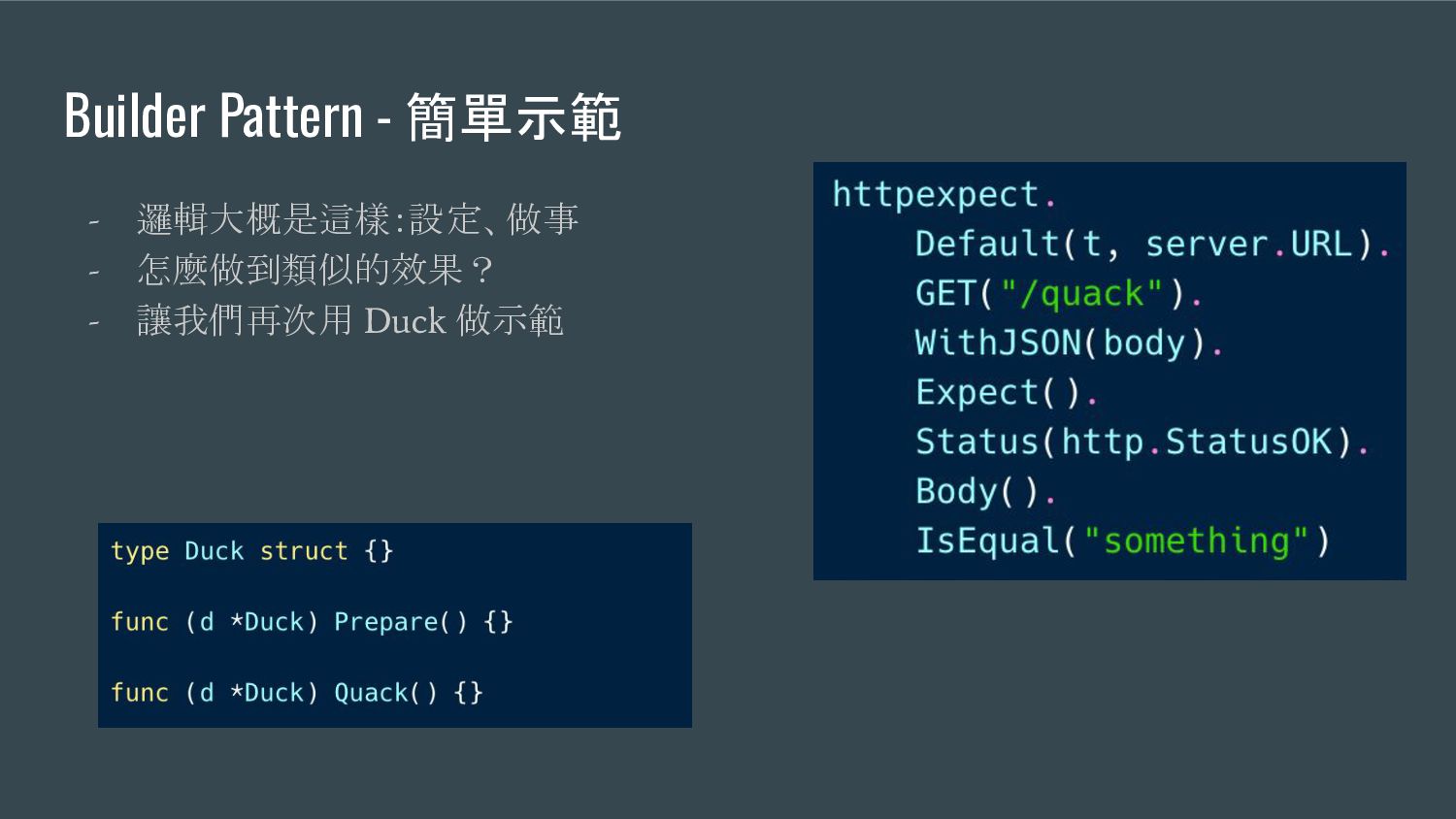
測試 API - 使用 gavv/httpexpect 後 - 看起來蠻讚的 - Default()
得到物件 - Expect() 前:設定 - Expect():執行 - Expect() 後:assert - IDE 會提示,體驗很好(下圖)
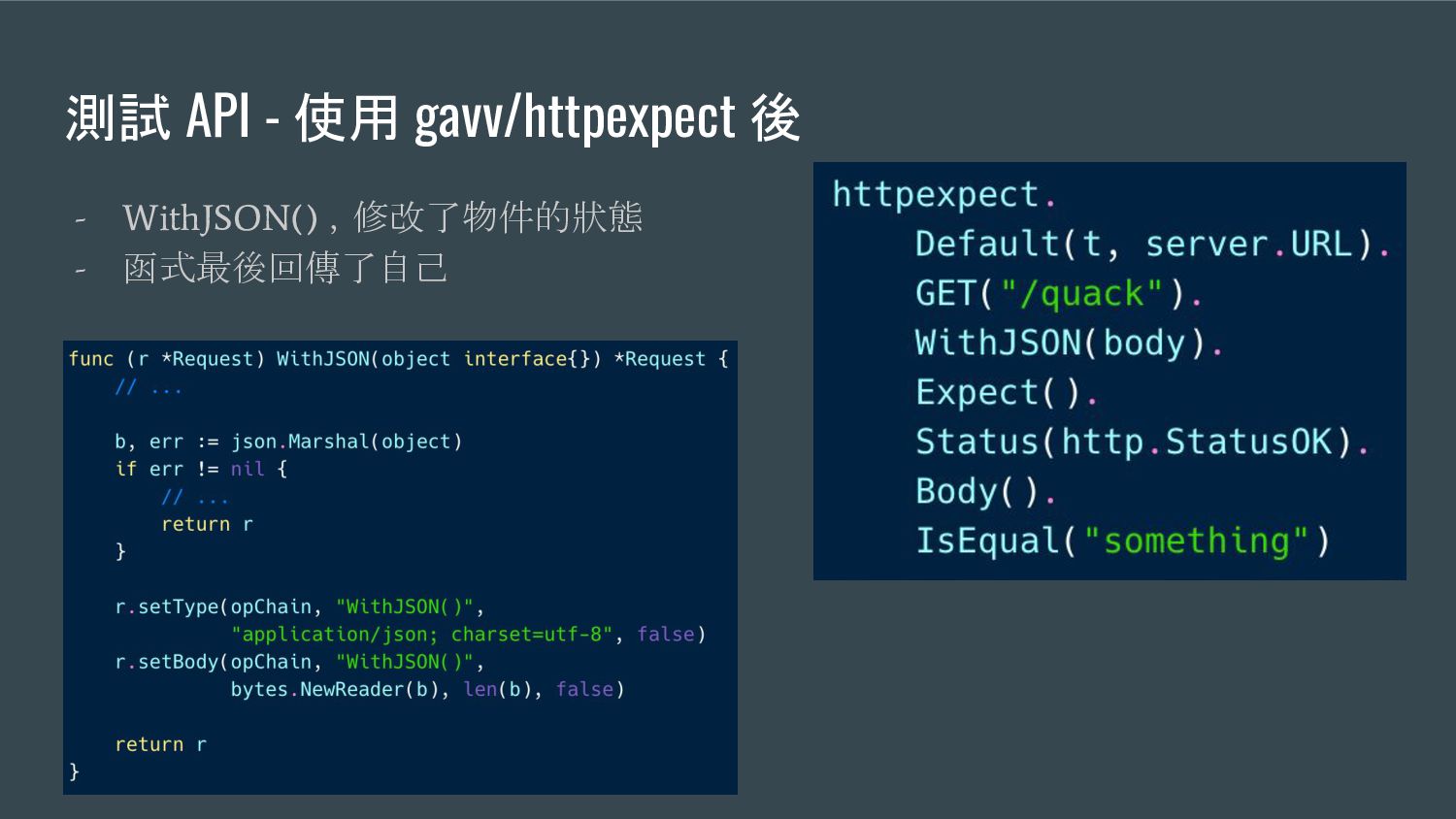
測試 API - 使用 gavv/httpexpect 後 - WithJSON() ,修改了物件的狀態 -
函式最後回傳了自己
Builder Pattern - 簡單示範 - 邏輯大概是這樣:設定、做事 - 怎麼做到類似的效果? - 讓我們再次用
Duck 做示範
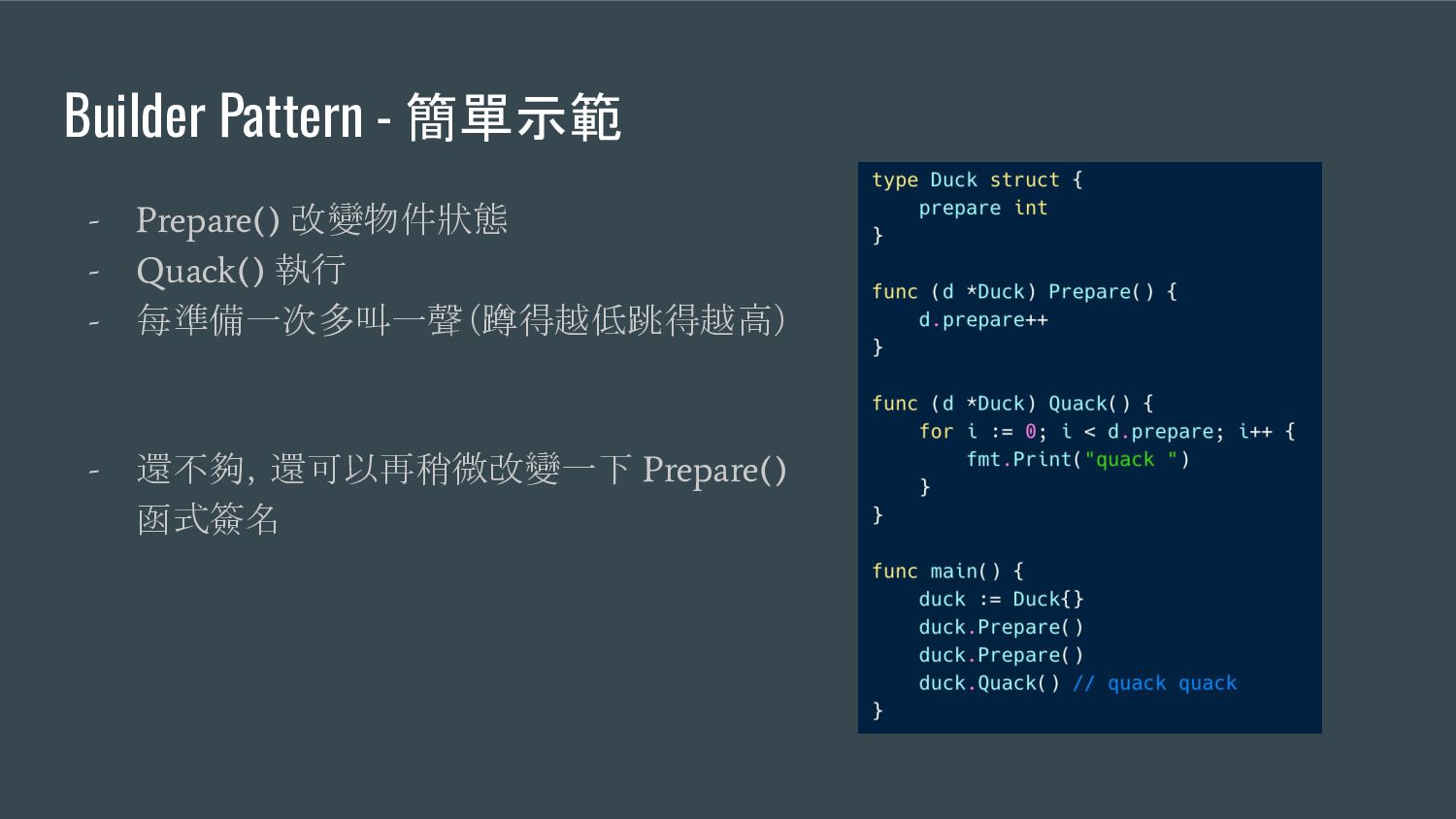
Builder Pattern - 簡單示範 - Prepare() 改變物件狀態 - Quack() 執行
- 每準備一次多叫一聲(蹲得越低跳得越高) - 還不夠,還可以再稍微改變一下 Prepare() 函式簽名
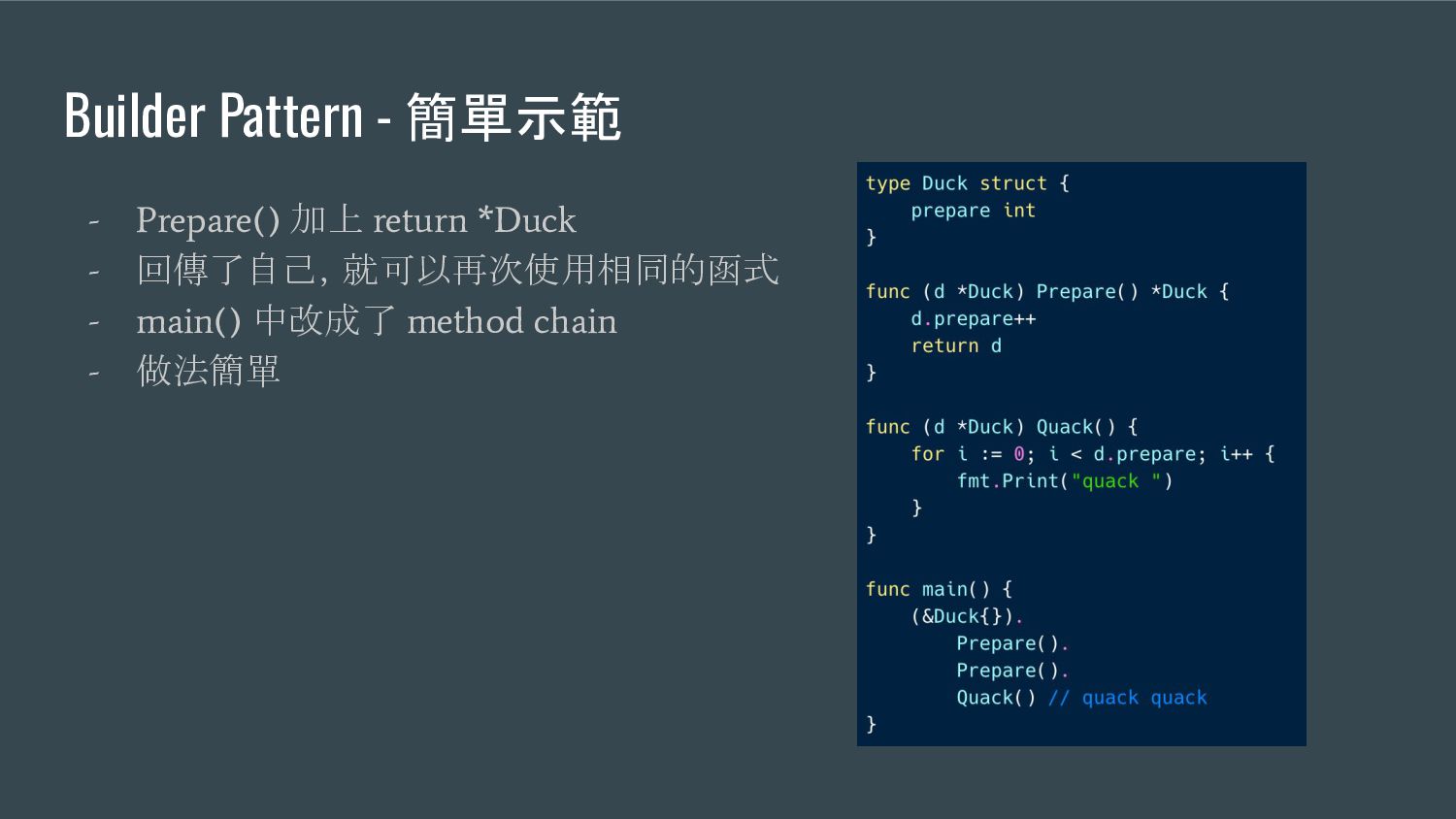
Builder Pattern - 簡單示範 - Prepare() 加上 return *Duck -
回傳了自己,就可以再次使用相同的函式 - main() 中改成了 method chain - 做法簡單
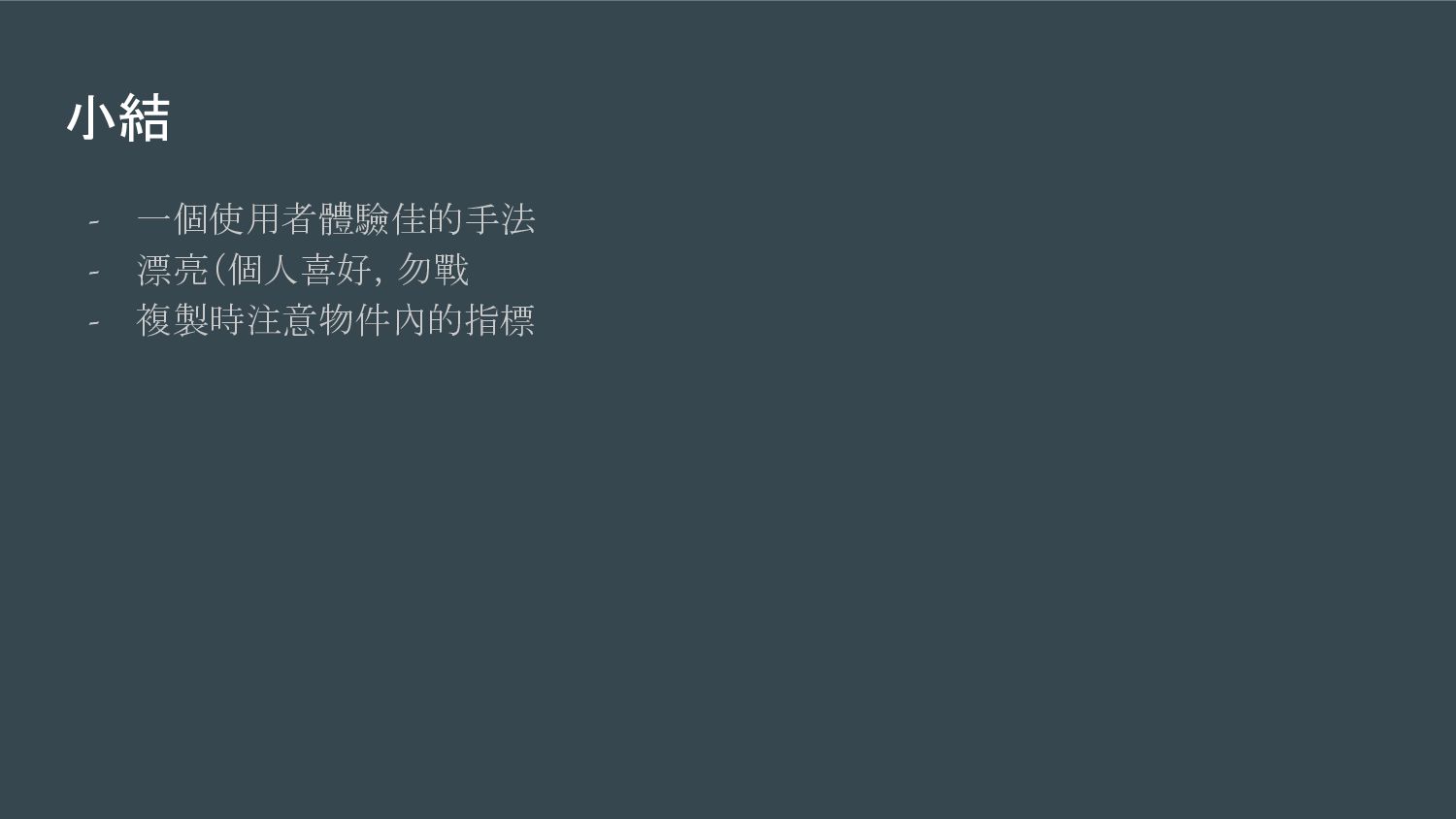
小結 - 一個使用者體驗佳的手法 - 漂亮(個人喜好,勿戰 - 複製時注意物件內的指標
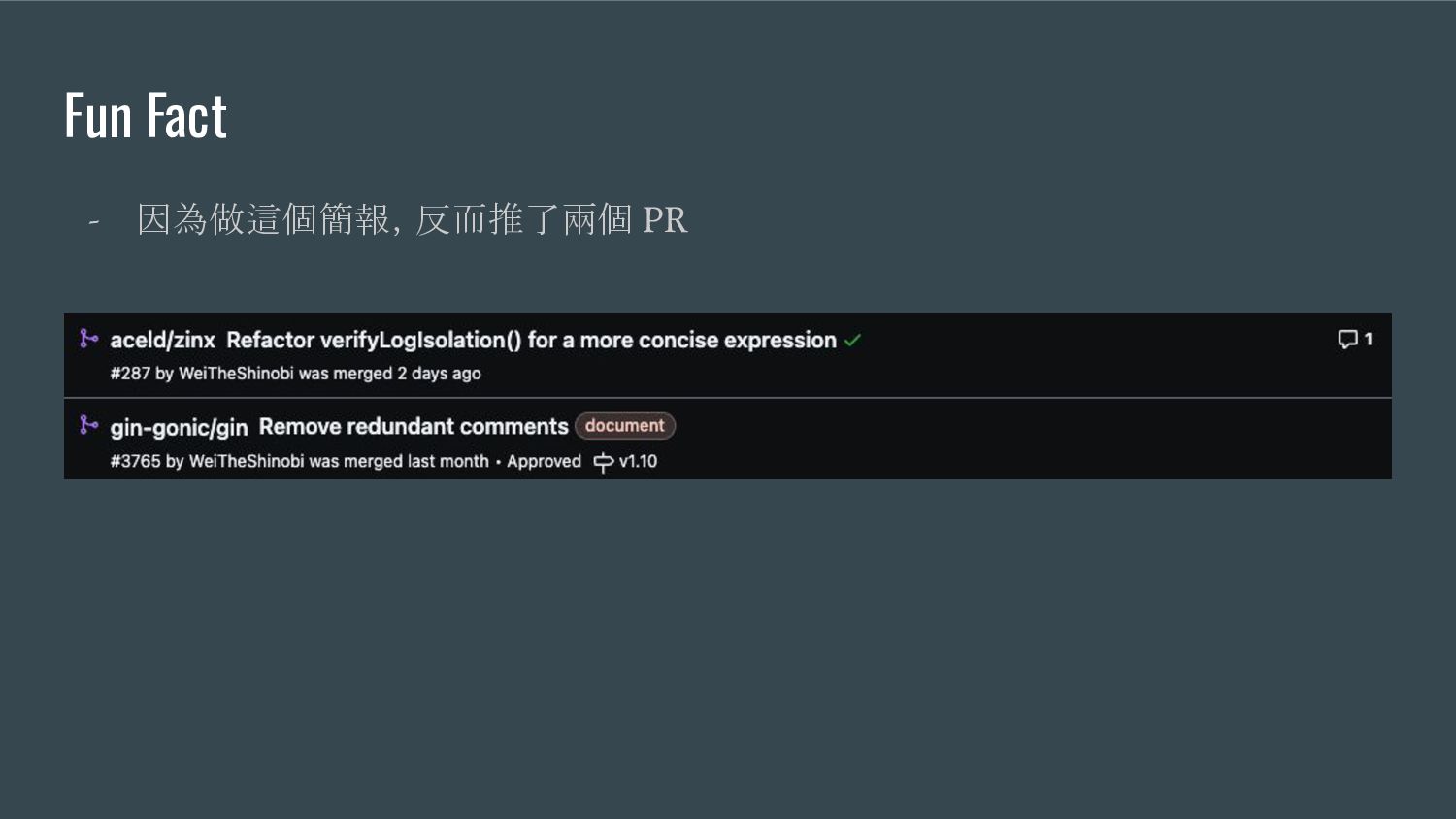
Fun Fact - 因為做這個簡報,反而推了兩個 PR
END


 weitheshinobi
 lauravandoore
 morganepeng
 soudai
 csswizardry
 productmarketing
 mza
 tomoyanonymous
 trallard
 moore
 nikkihalliwell
 samanthasiow
 bkeepers