Share
Embed
WordPress Greek Community - FOSSCOM 2015 - Cyber security and WordPress attacks - Stef Grammenos - Pan Macromanolis
WordPress Greek Community PRO
November 07, 2015
Transcript
24 slides
-
Copyright 2015 WebDevls Cyber Security and Wordpress Attacks By Grammenos
Stefanos Panagiotis Macromanolis -
Copyright 2015 WebDevls WordPress powers more than 74.6m sites around
the world 48% Technorati’s top 100 blogs, χρησιμοποιούν WP Dashboard WordPress-Related Keywords Score 37 Million Searches Per Month WordPress.com Gets More Unique Visitors Than Amazon (Us) Plugins have been downloaded more than 300,000,000+ times. 48 Million Downloads of WordPress Online marketing circles will often discuss WordPress more than any other CMS out there. Copyright 2015 WebDevls -
Copyright 2015 WebDevls Όταν είμαστε οπλισμένοι με τεχνικές συμβουλές και
κοινή λογική. Μπορούμε Να αποφύγουμε αρκετές από τις γνωστές επιθέσεις. Όσο περισσότερο δυσκολέψουμε Το έργο ενός επιτιθέμενου στην ιστοσελίδα μας, τόσο πιο πιθανό είναι να μας αφήσει Ήσυχο και να περάσει σε έναν πιο εύκολο στόχο. Ασφάλεια Υπολογιστικών Συστημάτων Sasser – Bagle – Zafi – MyDoom – Lovsan/Blaster – Klez - BugBeaR -
Copyright 2015 WebDevls - Brute-force password-guessing attacks - ΧSS -(css)
Οι κύριες WordPress Based επιθέσεις Το WordPress παραμένει ο κύριος στόχος επιθέσεων C.M.S - SQL Injection - Directory Indexing Honorable Mentions - Image HotLinking -
Copyright 2015 WebDevls Brute Force Attack Or Dictionary attack Brute
Force Attack is an automated process and can be done by using a program That will try to decrypt your password by using a list of words, symbols and numbers (wordlists). The Attacker will try to compromize your website by brute force attacking to your wp-login.php -
Copyright 2015 WebDevls Cross Site Scripting Attack Hack-Attack that exploits
web applications A security exploit in which attacker inserts Malicious code into a link that appears to be From a trustworthy source. -
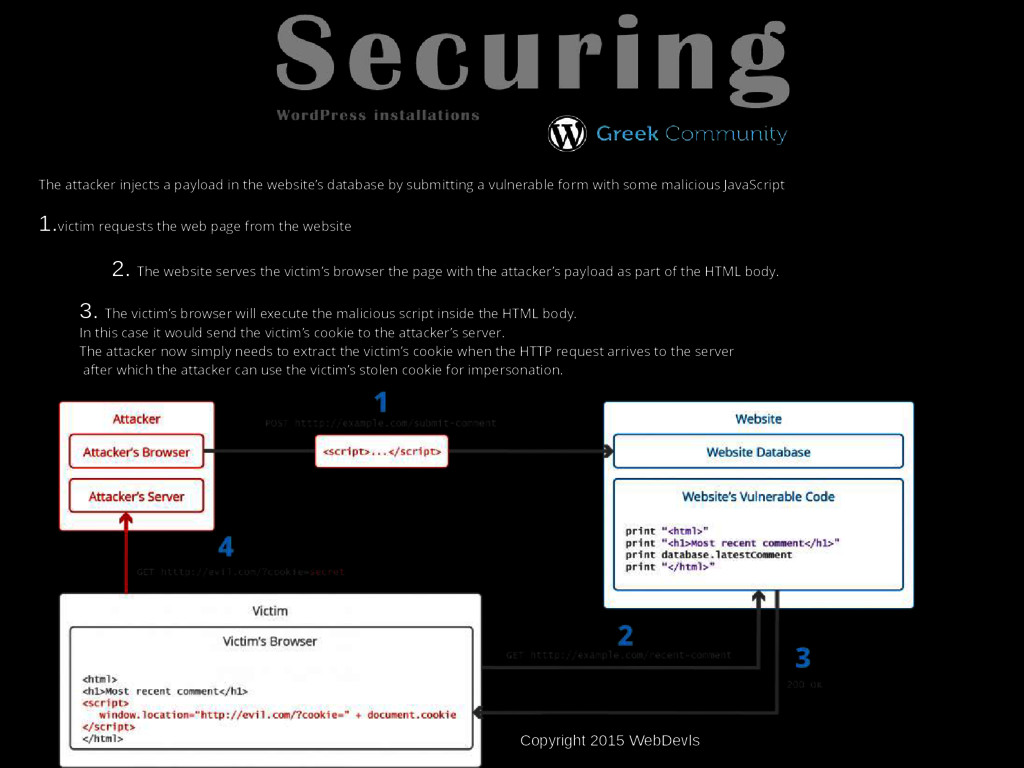
Copyright 2015 WebDevls The attacker injects a payload in the
website’s database by submitting a vulnerable form with some malicious JavaScript 1.victim requests the web page from the website 2. The website serves the victim’s browser the page with the attacker’s payload as part of the HTML body. 3. The victim’s browser will execute the malicious script inside the HTML body. In this case it would send the victim’s cookie to the attacker’s server. The attacker now simply needs to extract the victim’s cookie when the HTTP request arrives to the server after which the attacker can use the victim’s stolen cookie for impersonation. Copyright 2015 WebDevls -
Copyright 2015 WebDevls SQL Injection Query Database Attack. Attacker tries
to find vulnerable queries in the code. Access, to the Whole Database Tables and Schema. -
Copyright 2015 WebDevls Directory Indexing Is a way for an
attacker, to find out our servers' folder structure. Can find our server user name in the process. -
Copyright 2015 WebDevls Image HotLinking The ability for another website
to use our own bandwidth -
Copyright 2015 WebDevls DDoS A DDoS or a Distributed Denial
of Service Attack is used to target a single (or multiple) Systems by sending a very large amount of traffic packets in to the system and finally overwhelming it and make it unavailable. Distributed via botnets (infected systems) -
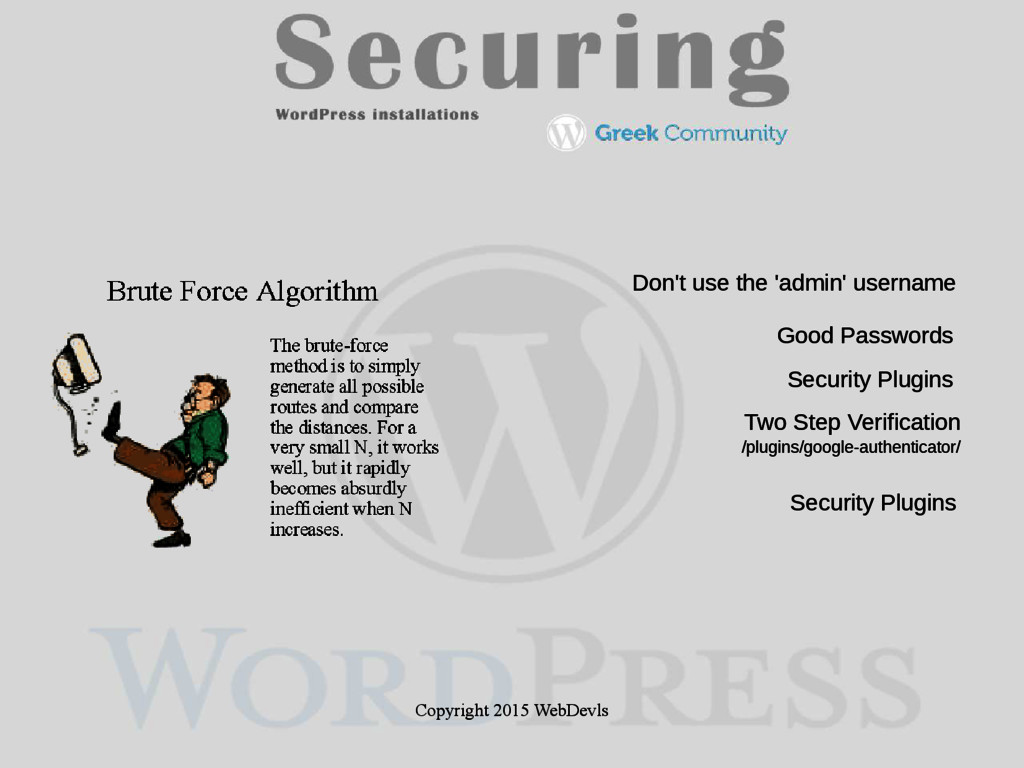
Copyright 2015 WebDevls Don't use the 'admin' username Good Passwords
Security Plugins /plugins/google-authenticator/ Two Step Verification Security Plugins -
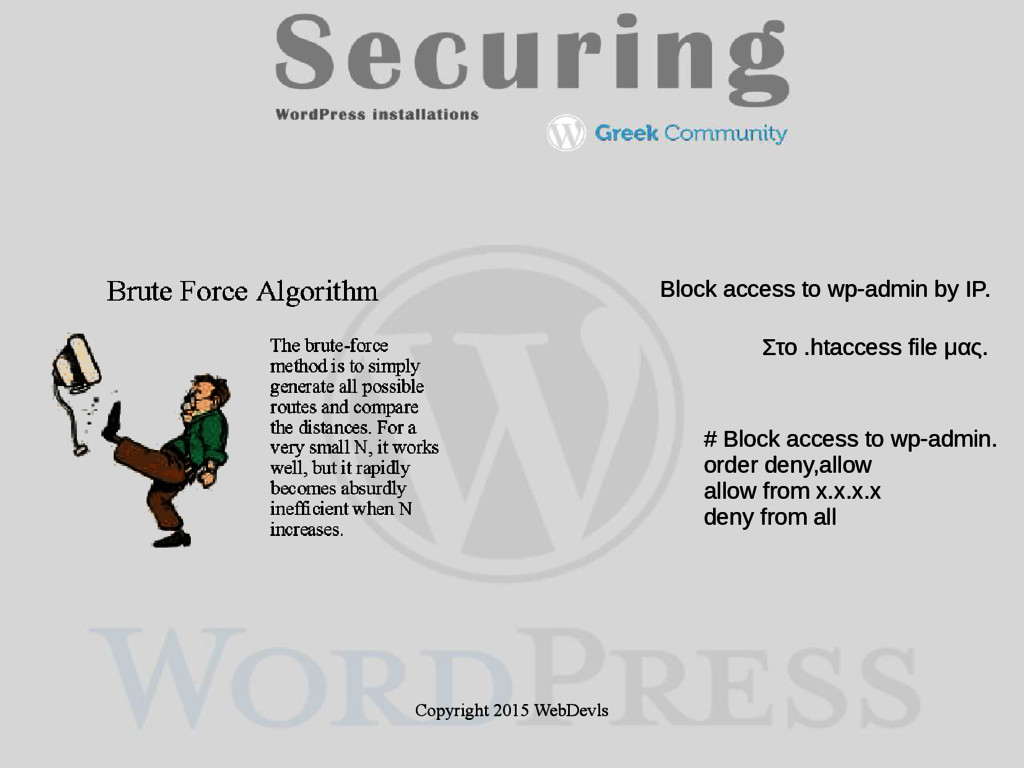
Copyright 2015 WebDevls # Block access to wp-admin. order deny,allow
allow from x.x.x.x deny from all Block access to wp-admin by IP. Στο .htaccess file μας. -
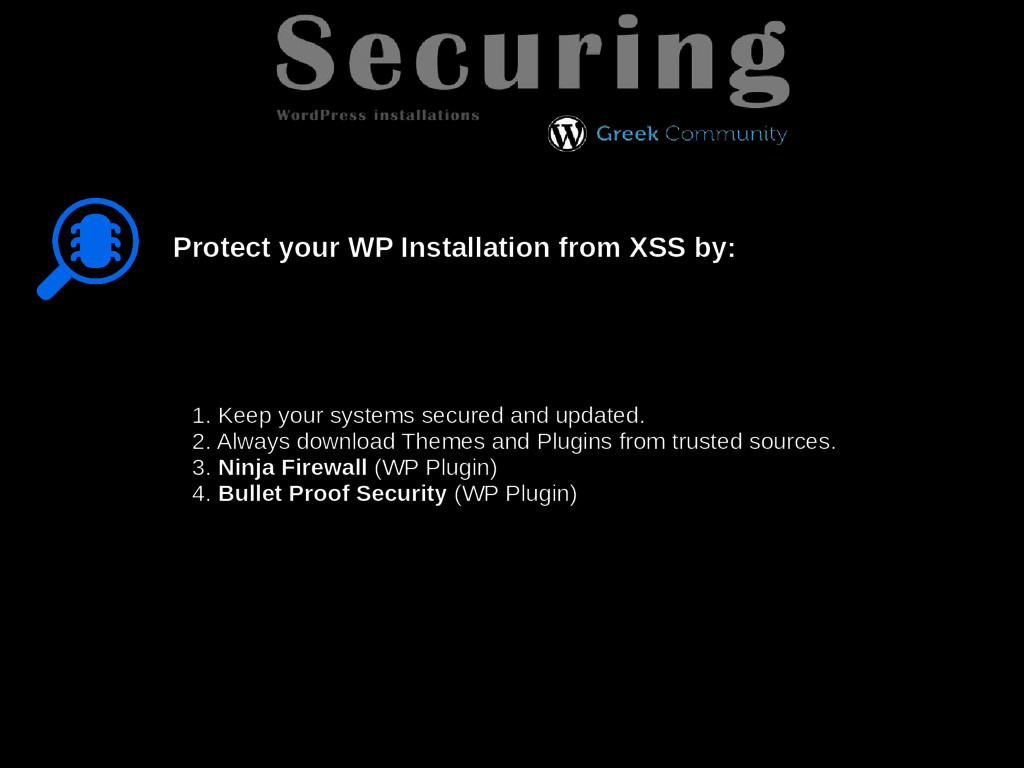
Copyright 2015 WebDevls Protect your WP Installation from XSS by:
1. Keep your systems secured and updated. 2. Always download Themes and Plugins from trusted sources. 3. Ninja Firewall (WP Plugin) 4. Bullet Proof Security (WP Plugin) -
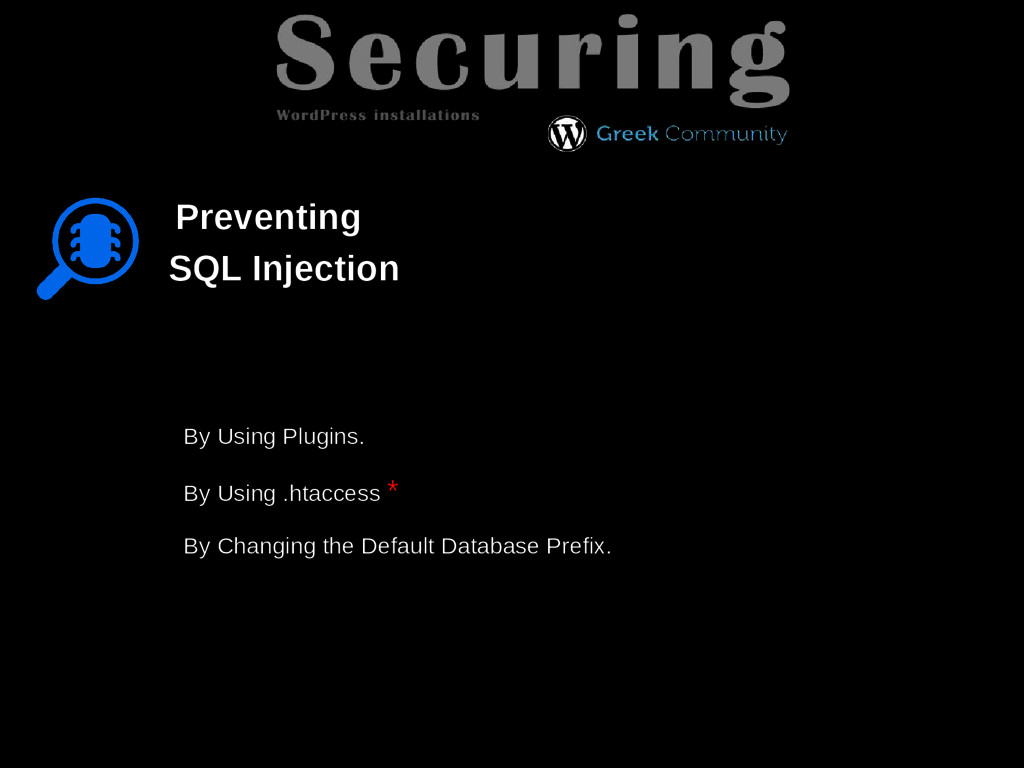
Copyright 2015 WebDevls SQL Injection Preventing By Using Plugins. By
Using .htaccess * By Changing the Default Database Prefix. -
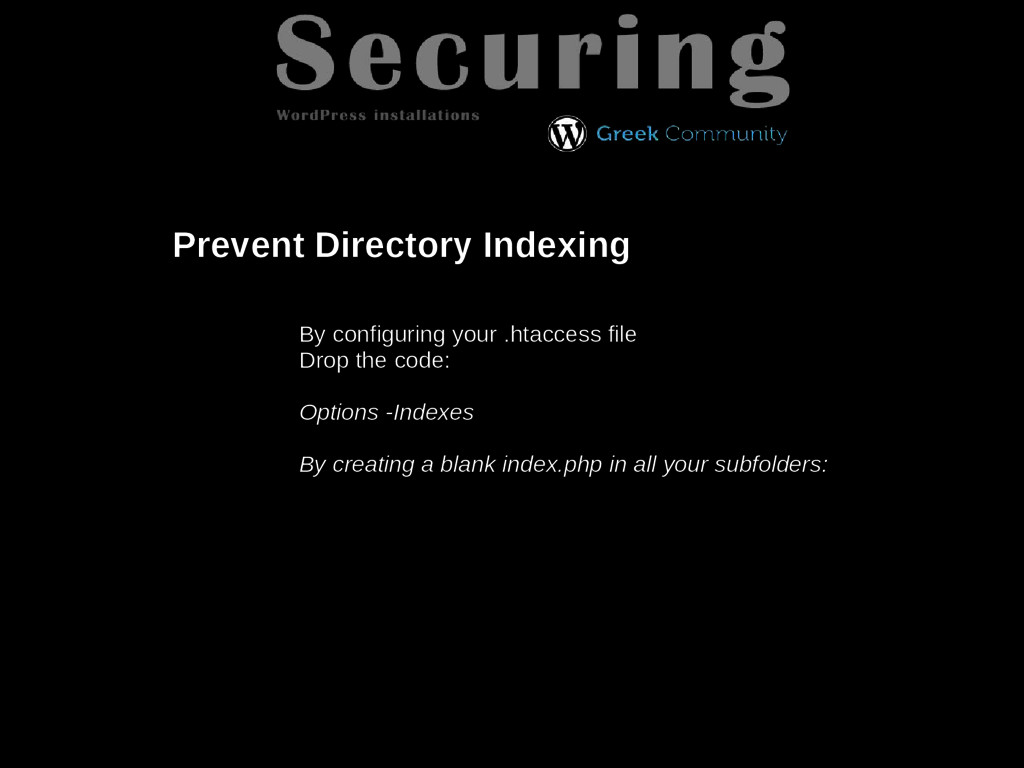
Copyright 2015 WebDevls Prevent Directory Indexing By configuring your .htaccess
file Drop the code: Options -Indexes By creating a blank index.php in all your subfolders: -
Copyright 2015 WebDevls Prevent Image HotLinking RewriteEngine on RewriteCond %{HTTP_REFERER}
!^$ RewriteCond %{HTTP_REFERER} !^http(s)?://(www\.)?your-site.com [NC] RewriteCond %{HTTP_REFERER} !^http(s)?://(www\.)?your-other-domain.com [NC] RewriteRule \.(jpg|jpeg|png|gif)$ “http://ieikonamou.png” [NC,R,L] -
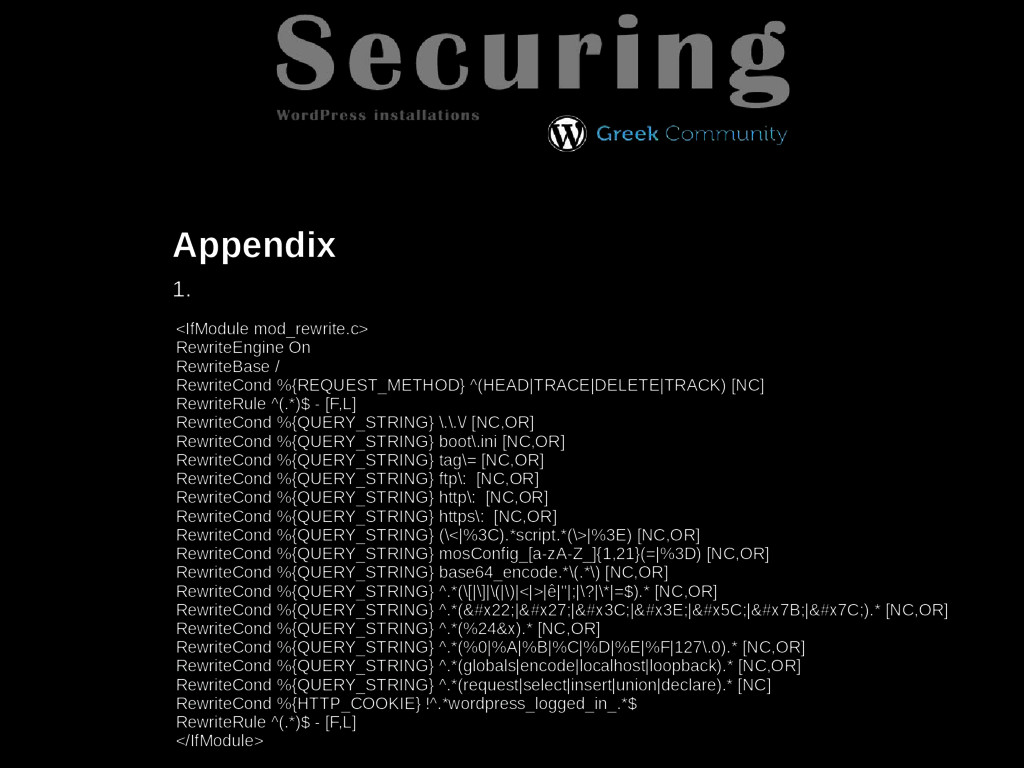
Copyright 2015 WebDevls <IfModule mod_rewrite.c> RewriteEngine On RewriteBase / RewriteCond
%{REQUEST_METHOD} ^(HEAD|TRACE|DELETE|TRACK) [NC] RewriteRule ^(.*)$ - [F,L] RewriteCond %{QUERY_STRING} \.\.\/ [NC,OR] RewriteCond %{QUERY_STRING} boot\.ini [NC,OR] RewriteCond %{QUERY_STRING} tag\= [NC,OR] RewriteCond %{QUERY_STRING} ftp\: [NC,OR] RewriteCond %{QUERY_STRING} http\: [NC,OR] RewriteCond %{QUERY_STRING} https\: [NC,OR] RewriteCond %{QUERY_STRING} (\<|%3C).*script.*(\>|%3E) [NC,OR] RewriteCond %{QUERY_STRING} mosConfig_[a-zA-Z_]{1,21}(=|%3D) [NC,OR] RewriteCond %{QUERY_STRING} base64_encode.*\(.*\) [NC,OR] RewriteCond %{QUERY_STRING} ^.*(\[|\]|\(|\)|<|>|ê|"|;|\?|\*|=$).* [NC,OR] RewriteCond %{QUERY_STRING} ^.*("|'|<|>|\|{||).* [NC,OR] RewriteCond %{QUERY_STRING} ^.*(%24&x).* [NC,OR] RewriteCond %{QUERY_STRING} ^.*(%0|%A|%B|%C|%D|%E|%F|127\.0).* [NC,OR] RewriteCond %{QUERY_STRING} ^.*(globals|encode|localhost|loopback).* [NC,OR] RewriteCond %{QUERY_STRING} ^.*(request|select|insert|union|declare).* [NC] RewriteCond %{HTTP_COOKIE} !^.*wordpress_logged_in_.*$ RewriteRule ^(.*)$ - [F,L] </IfModule> Appendix 1. -
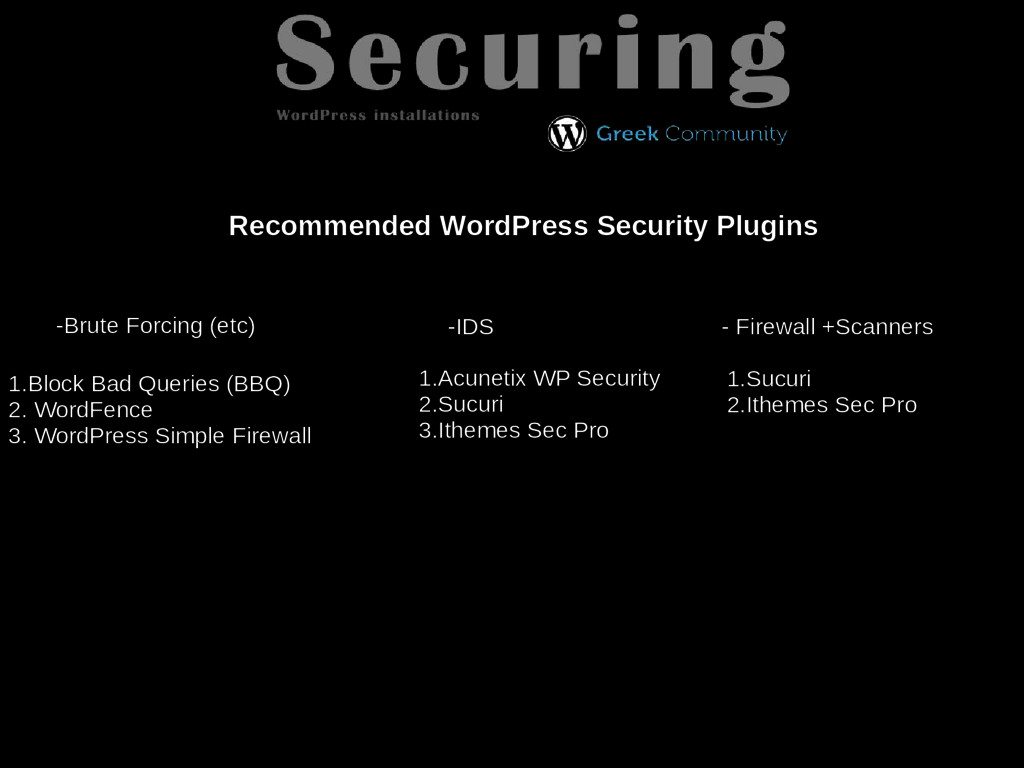
Copyright 2015 WebDevls Recommended WordPress Security Plugins -Brute Forcing (etc)
-IDS - Firewall +Scanners 1.Block Bad Queries (BBQ) 2. WordFence 3. WordPress Simple Firewall 1.Acunetix WP Security 2.Sucuri 3.Ithemes Sec Pro 1.Sucuri 2.Ithemes Sec Pro -
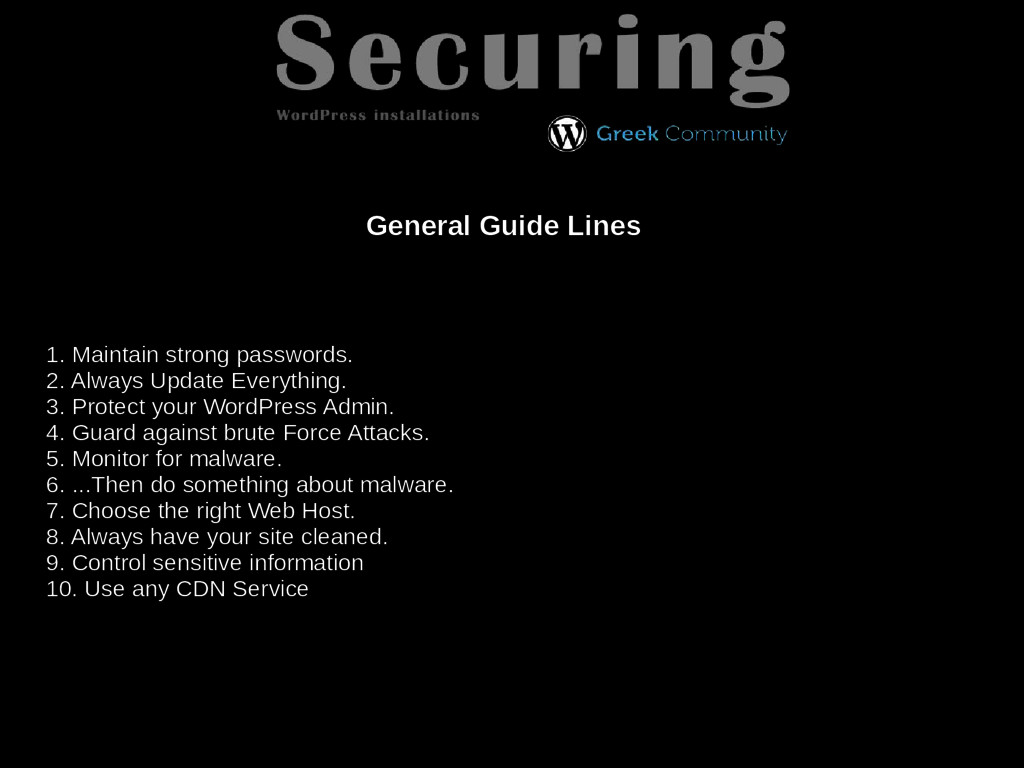
Copyright 2015 WebDevls General Guide Lines 1. Maintain strong passwords.
2. Always Update Everything. 3. Protect your WordPress Admin. 4. Guard against brute Force Attacks. 5. Monitor for malware. 6. ...Then do something about malware. 7. Choose the right Web Host. 8. Always have your site cleaned. 9. Control sensitive information 10. Use any CDN Service