Upgrade to Pro
— share decks privately, control downloads, hide ads and more …
Speaker Deck
Sign up for free
Menu
Search
Features
All features
Private URLs
Password Protection
Custom URLS
Scheduled publishing
Remove Branding
Restrict embedding
Deck Collections
Notes
Features
All features
Private URLs
Password Protection
Custom URLS
Scheduled publishing
Remove Branding
Restrict embedding
Deck Collections
Notes
Explore
Featured decks
Featured speakers
Programming
Technology
Storyboards
Explore
Featured decks
Featured speakers
Programming
Technology
Storyboards
Pricing
Search
Sign in
Sign up for free
Building AI Agent Observability with OpenTeleme...
Search
yuzujoe
July 28, 2026
75
0
Share
Embed
Copy iframe code
Copy JS code
Copy link
Start on current slide
Building AI Agent Observability with OpenTelemetry EN
yuzujoe
July 28, 2026
More Decks by yuzujoe
See All by yuzujoe
Building_AI_Agent_Observability_with_OpenTelemetry
yuzujoe
0
700
AI Agentの正常と正しいを分けて観測する / Observe the normality and correctness of the AI Agent separately
yuzujoe
0
230
テクニカルプロジェクトマネージャーとSREが協働して構築する信頼性 / reliability-tpm-sre-collaboration
yuzujoe
0
4.5k
AI Agent をどう観測するか - AI Workforce における OpenTelemetry 計装の実践 / How to Observe AI Agents: Implementing OpenTelemetry for the AI Workforce
yuzujoe
3
1.5k
AI Agent Agentic Workflow の可観測性 / Observability of AI Agent Agentic Workflow
yuzujoe
10
2.9k
2人のチームでどうやって開発者をkubernetes開発に巻き込んでいくか
yuzujoe
2
550
GitOps環境におけるremote_clusterでの開発
yuzujoe
0
590
Featured
See All Featured
Design and Strategy: How to Deal with People Who Don’t "Get" Design
morganepeng
133
20k
HU Berlin: Industrial-Strength Natural Language Processing with spaCy and Prodigy
inesmontani
PRO
0
760
GraphQLとの向き合い方2022年版
quramy
50
15k
Color Theory Basics | Prateek | Gurzu
gurzu
1
490
<Decoding/> the Language of Devs - We Love SEO 2024
nikkihalliwell
1
360
Effective software design: The role of men in debugging patriarchy in IT @ Voxxed Days AMS
baasie
1
570
Exploring the Power of Turbo Streams & Action Cable | RailsConf2023
kevinliebholz
37
6.6k
The Success of Rails: Ensuring Growth for the Next 100 Years
eileencodes
47
8.4k
Balancing Empowerment & Direction
lara
6
1.3k
Building Applications with DynamoDB
mza
96
7.2k
AI Search: Implications for SEO and How to Move Forward - #ShenzhenSEOConference
aleyda
1
1.4k
How GitHub (no longer) Works
holman
316
150k
Transcript
Building AI Agent Observability with OpenTelemetry Japan Community Day 2026
/ OpenTelemetry Meetup Japan · 2026/07/28 Joe / Yuzuru Ohira @joe_yuzupi
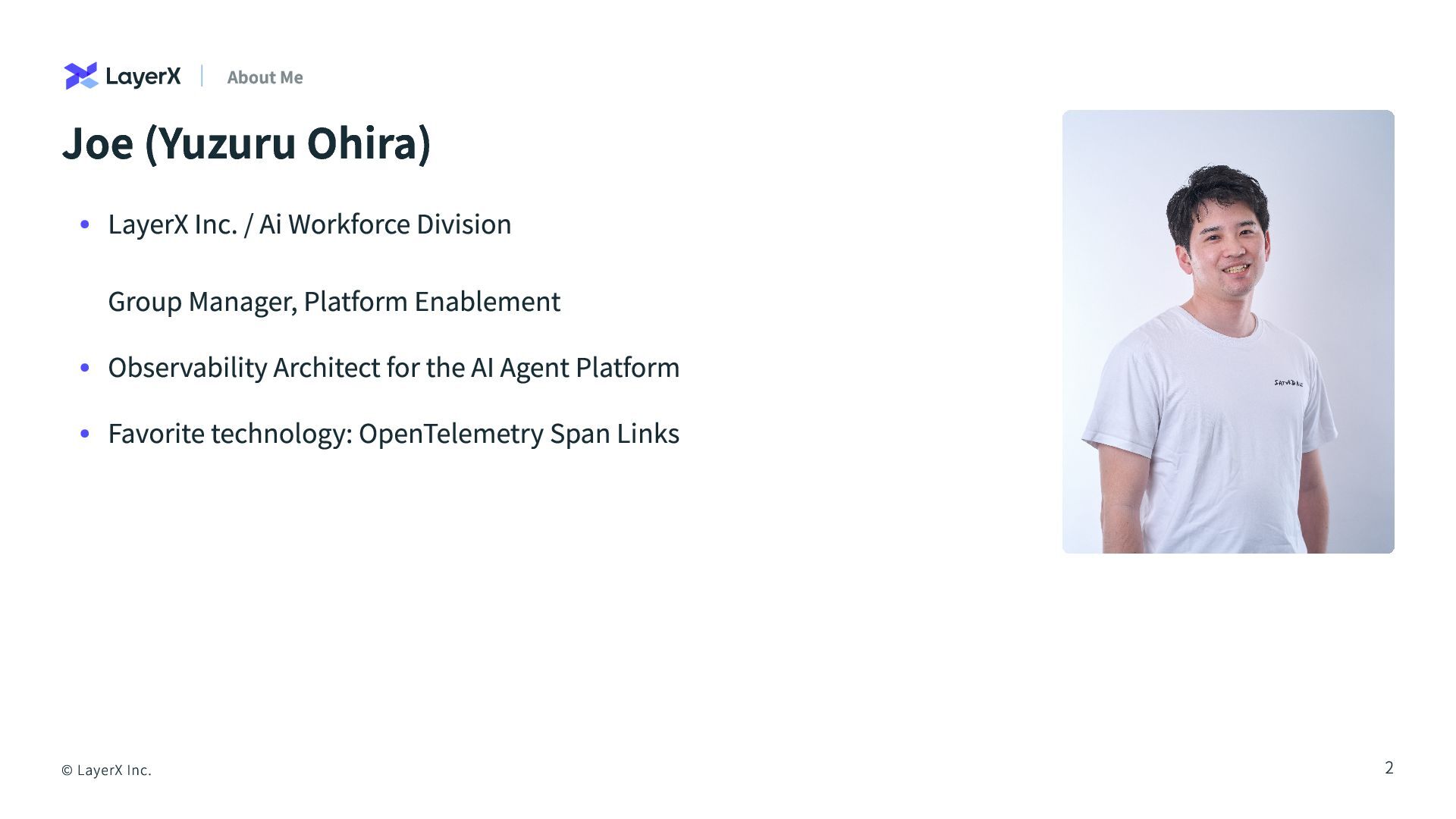
About Me Joe (Yuzuru Ohira) LayerX Inc. / Ai Workforce
Division Group Manager, Platform Enablement Observability Architect for the AI Agent Platform Favorite technology: OpenTelemetry Span Links © LayerX Inc. 2
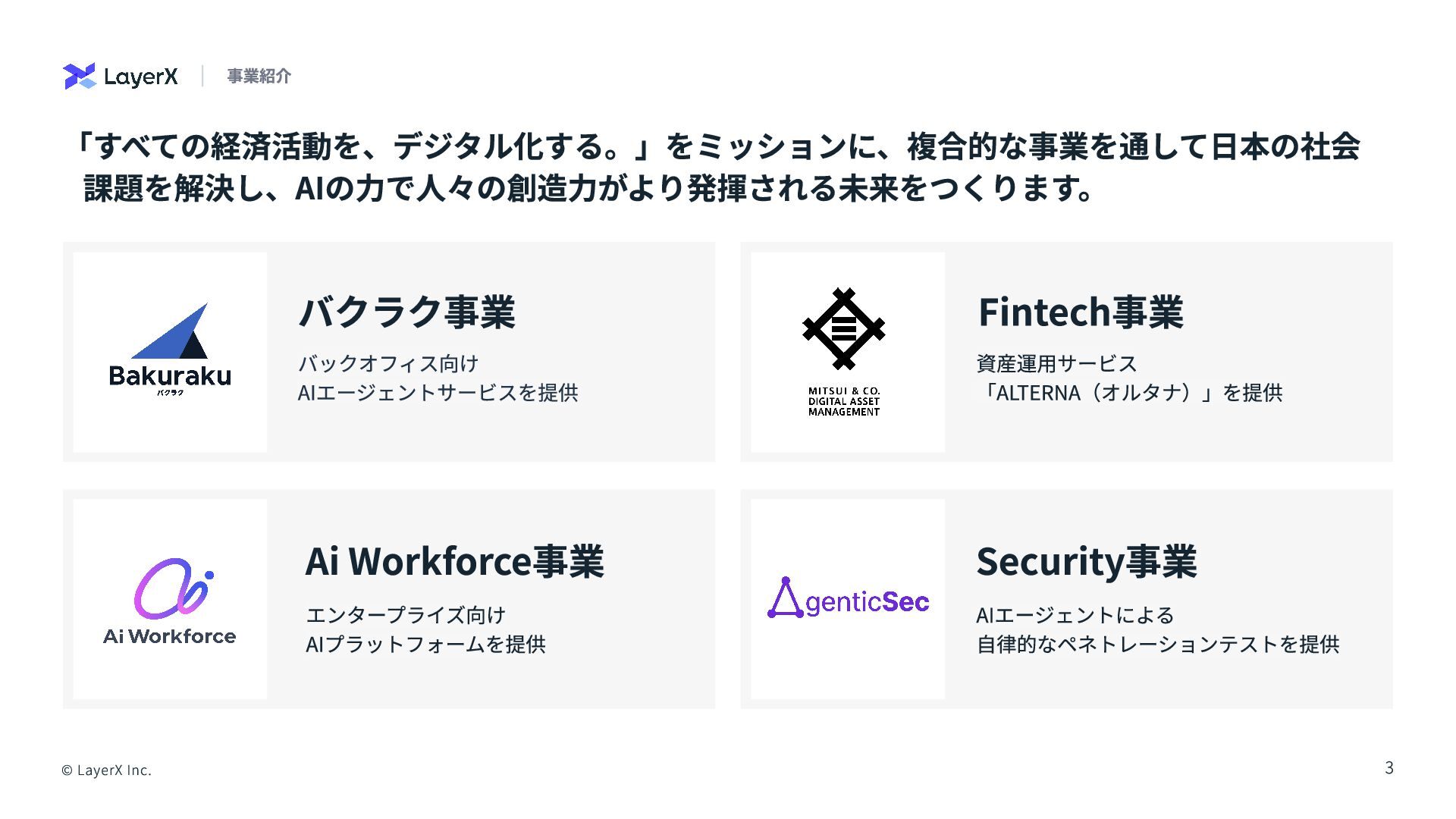
© LayerX Inc. 3
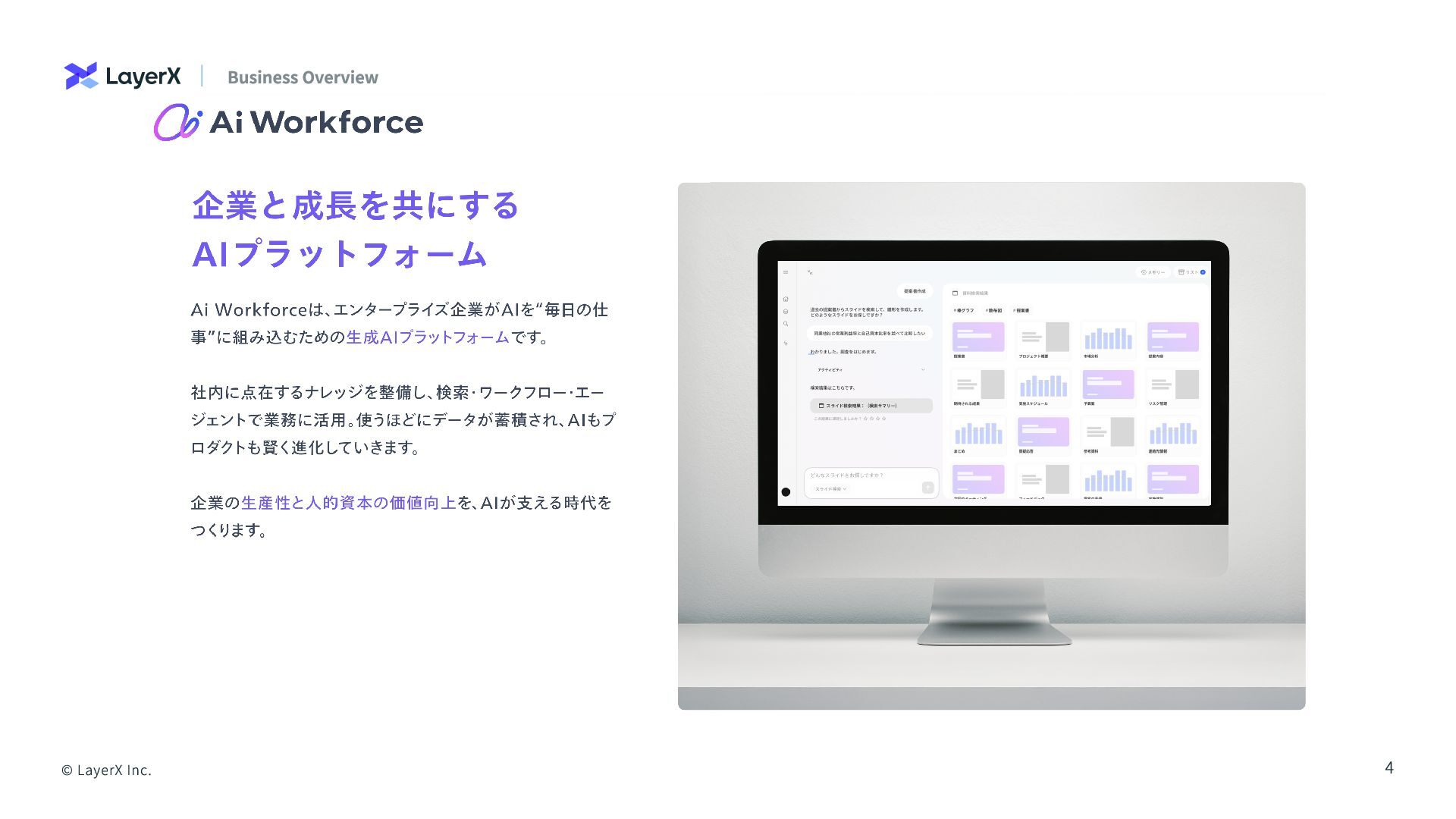
Business Overview © LayerX Inc. 4
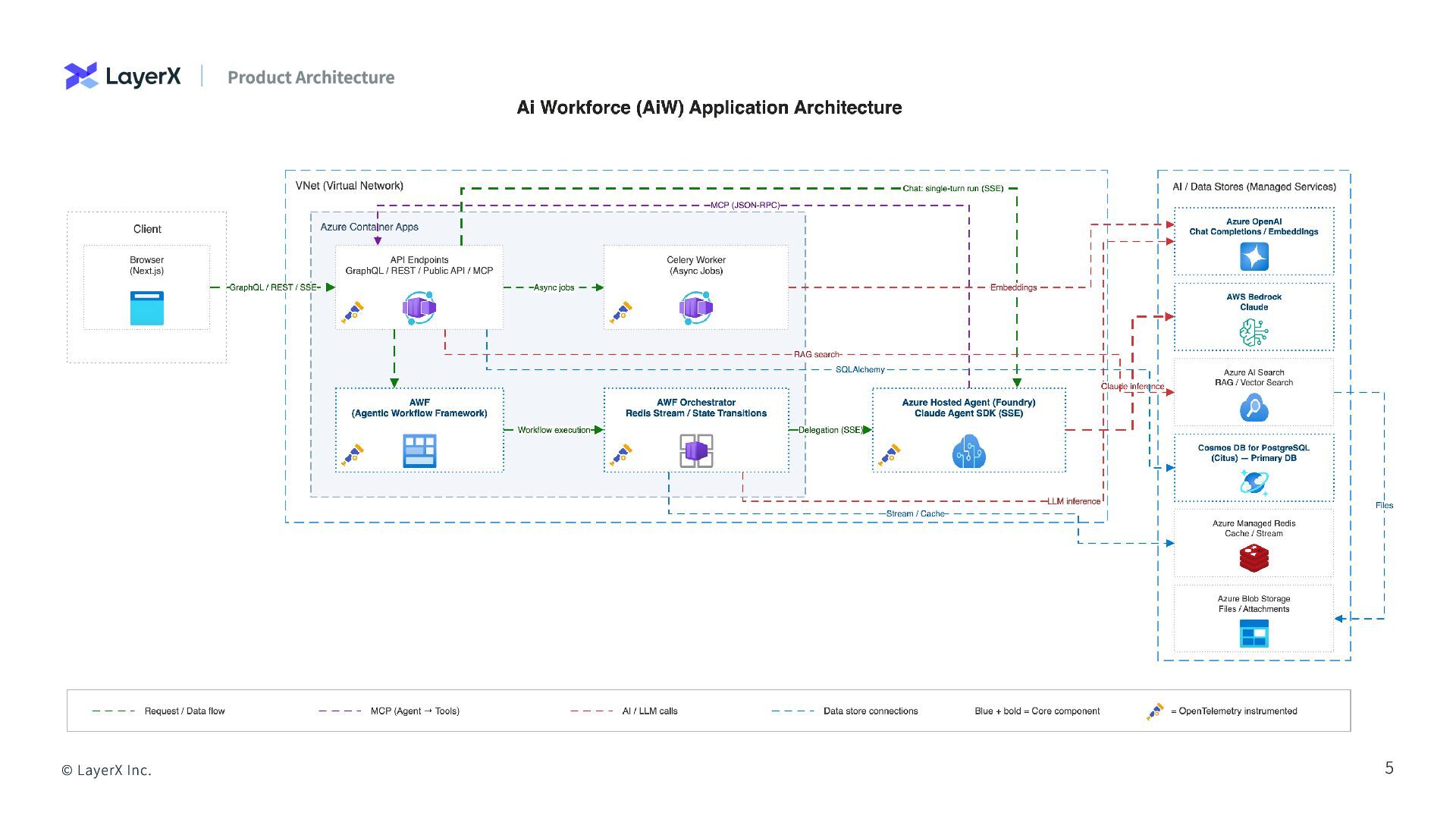
Product Architecture © LayerX Inc. 5
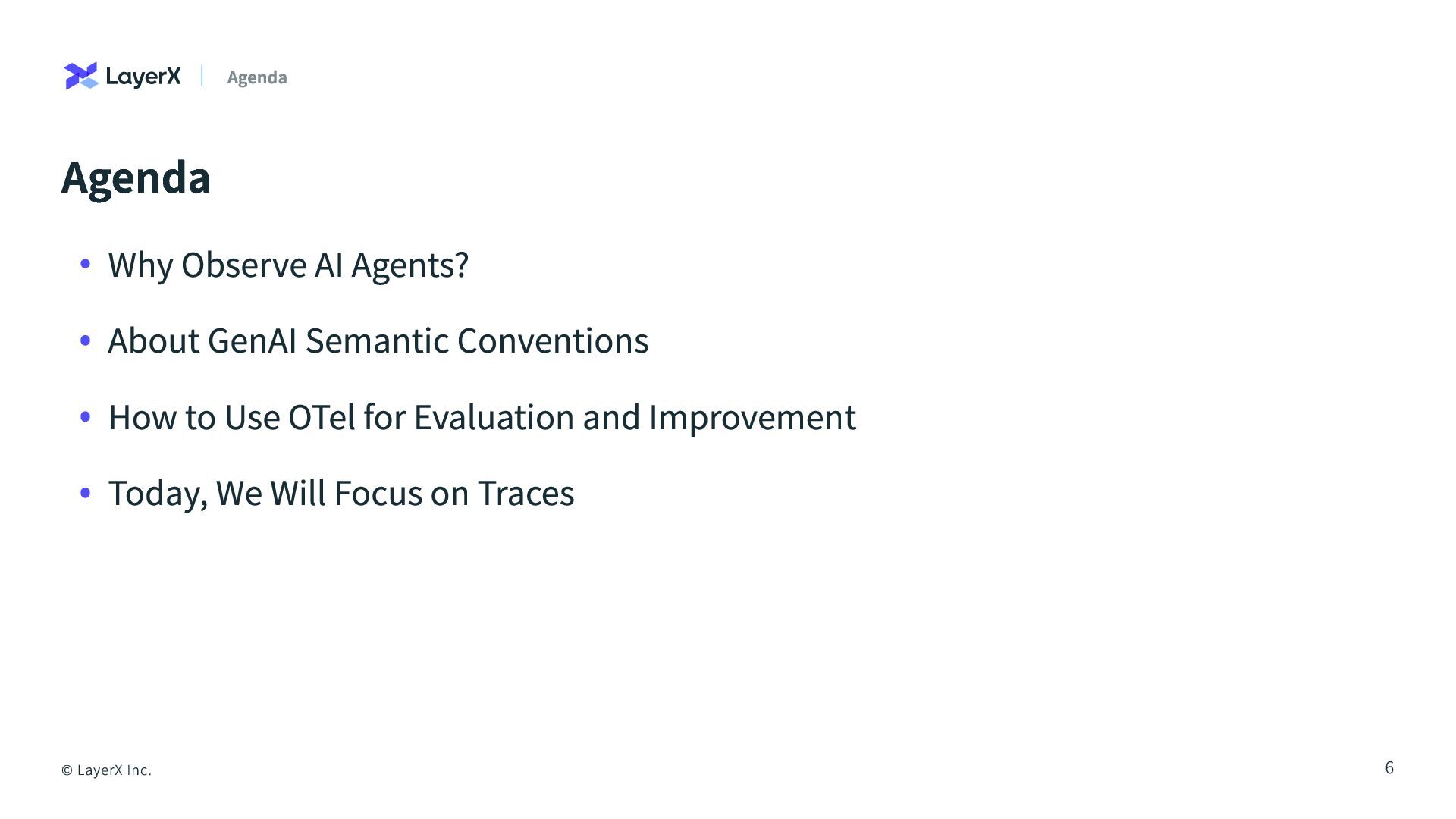
Agenda Agenda Why Observe AI Agents? About GenAI Semantic Conventions
How to Use OTel for Evaluation and Improvement Today, We Will Focus on Traces © LayerX Inc. 6
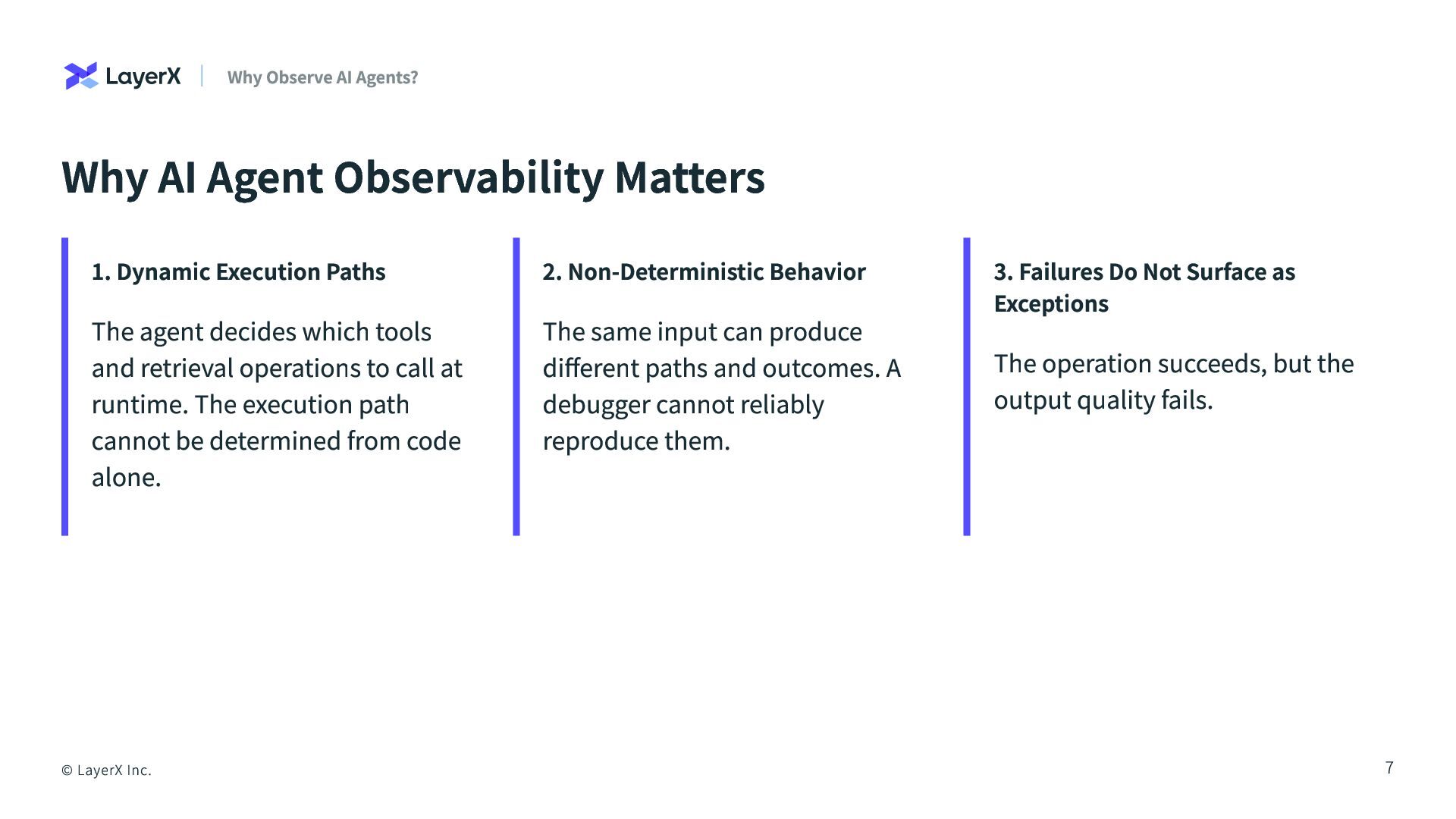
Why Observe AI Agents? Why AI Agent Observability Matters 1.
Dynamic Execution Paths The agent decides which tools and retrieval operations to call at runtime. The execution path cannot be determined from code alone. © LayerX Inc. 2. Non-Deterministic Behavior The same input can produce different paths and outcomes. A debugger cannot reliably reproduce them. 3. Failures Do Not Surface as Exceptions The operation succeeds, but the output quality fails. 7
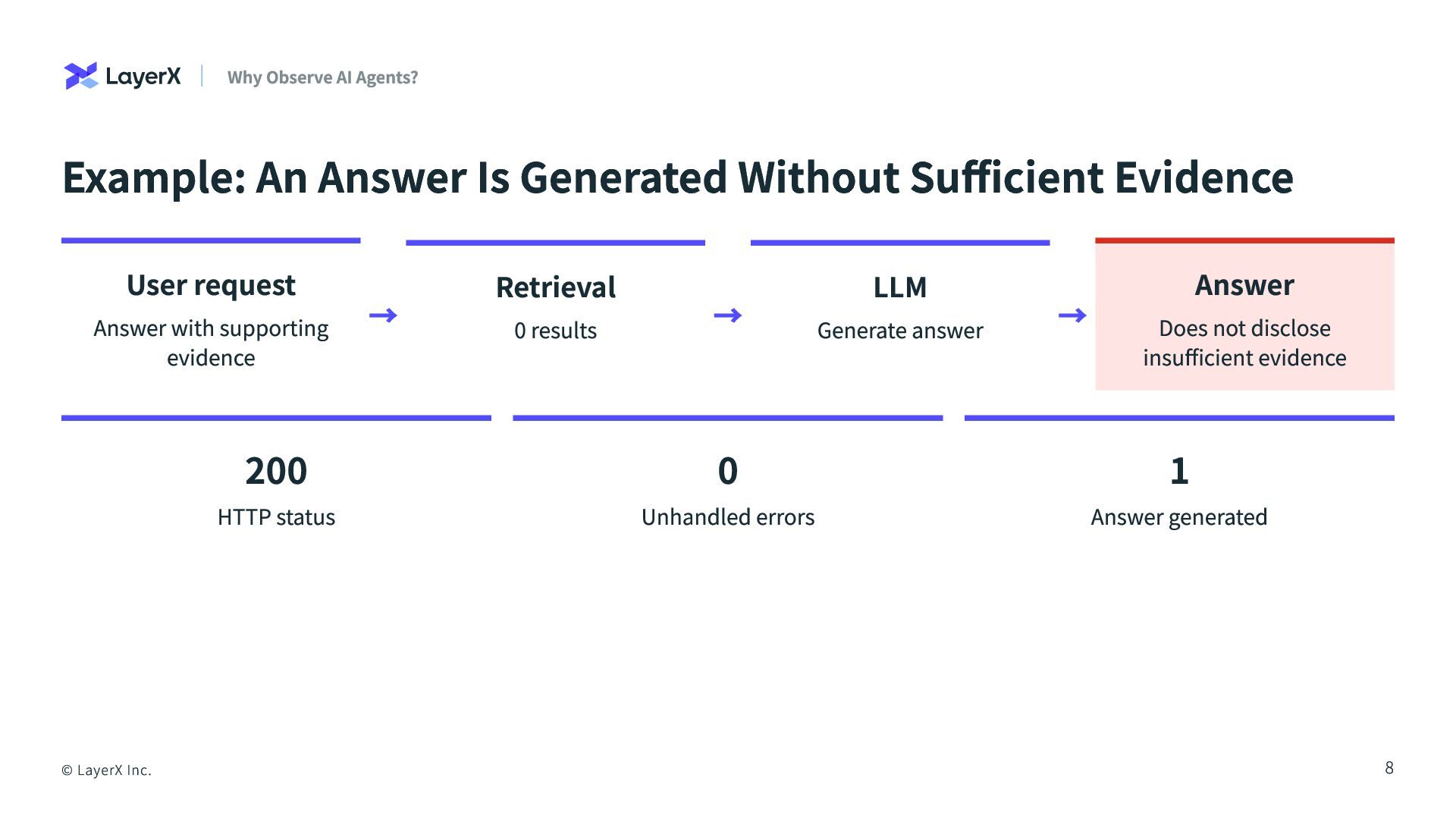
Why Observe AI Agents? Example: An Answer Is Generated Without
Sufficient Evidence User request Answer with supporting evidence 200 HTTP status © LayerX Inc. → Retrieval 0 results → 0 Unhandled errors LLM Generate answer → Answer Does not disclose insufficient evidence 1 Answer generated 8
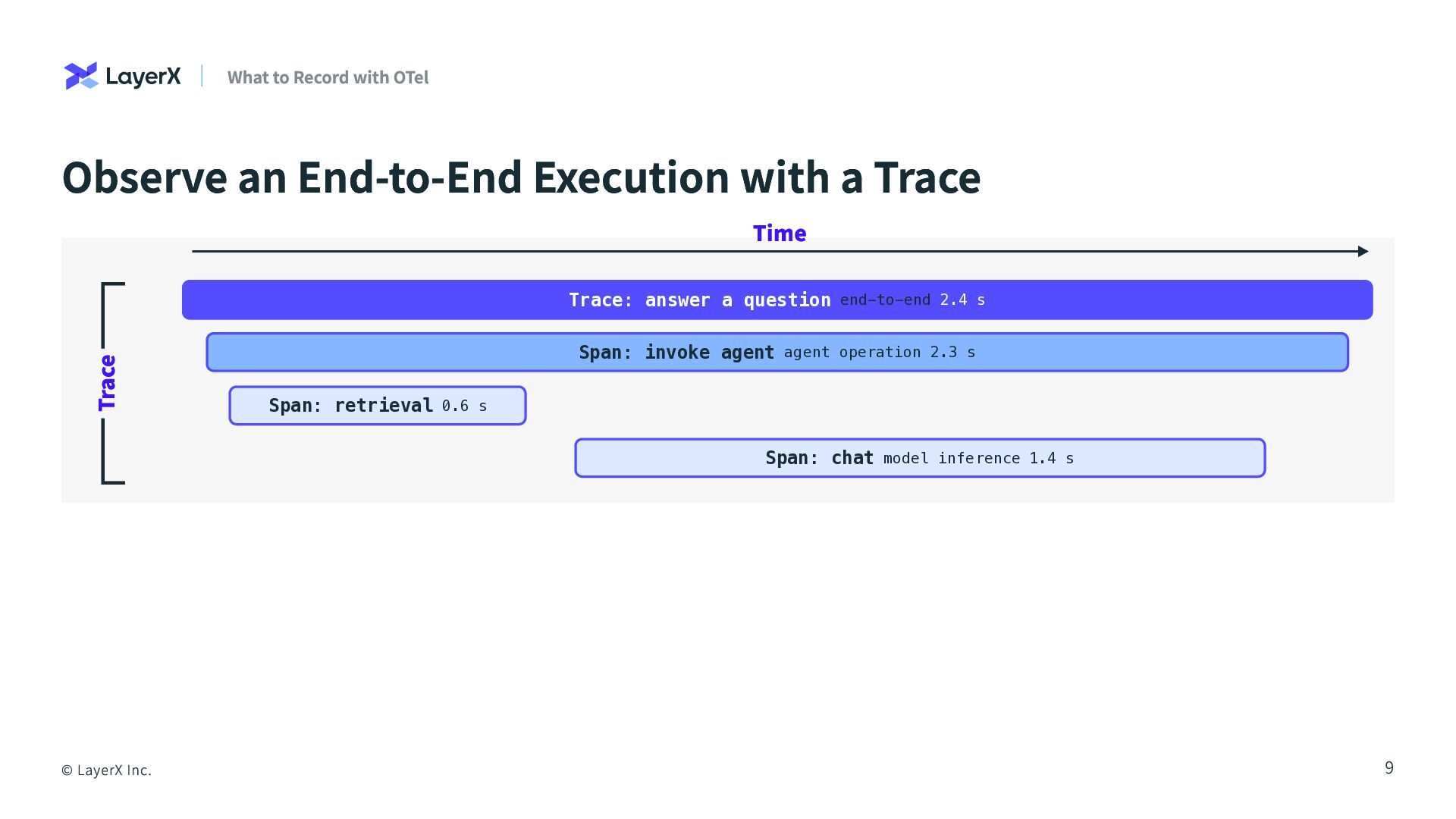
What to Record with OTel Observe an End-to-End Execution with
a Trace Time Trace: answer a question end-to-end 2.4 s ecarT Span: invoke agent agent operation 2.3 s Span: retrieval 0.6 s Span: chat model inference 1.4 s © LayerX Inc. 9
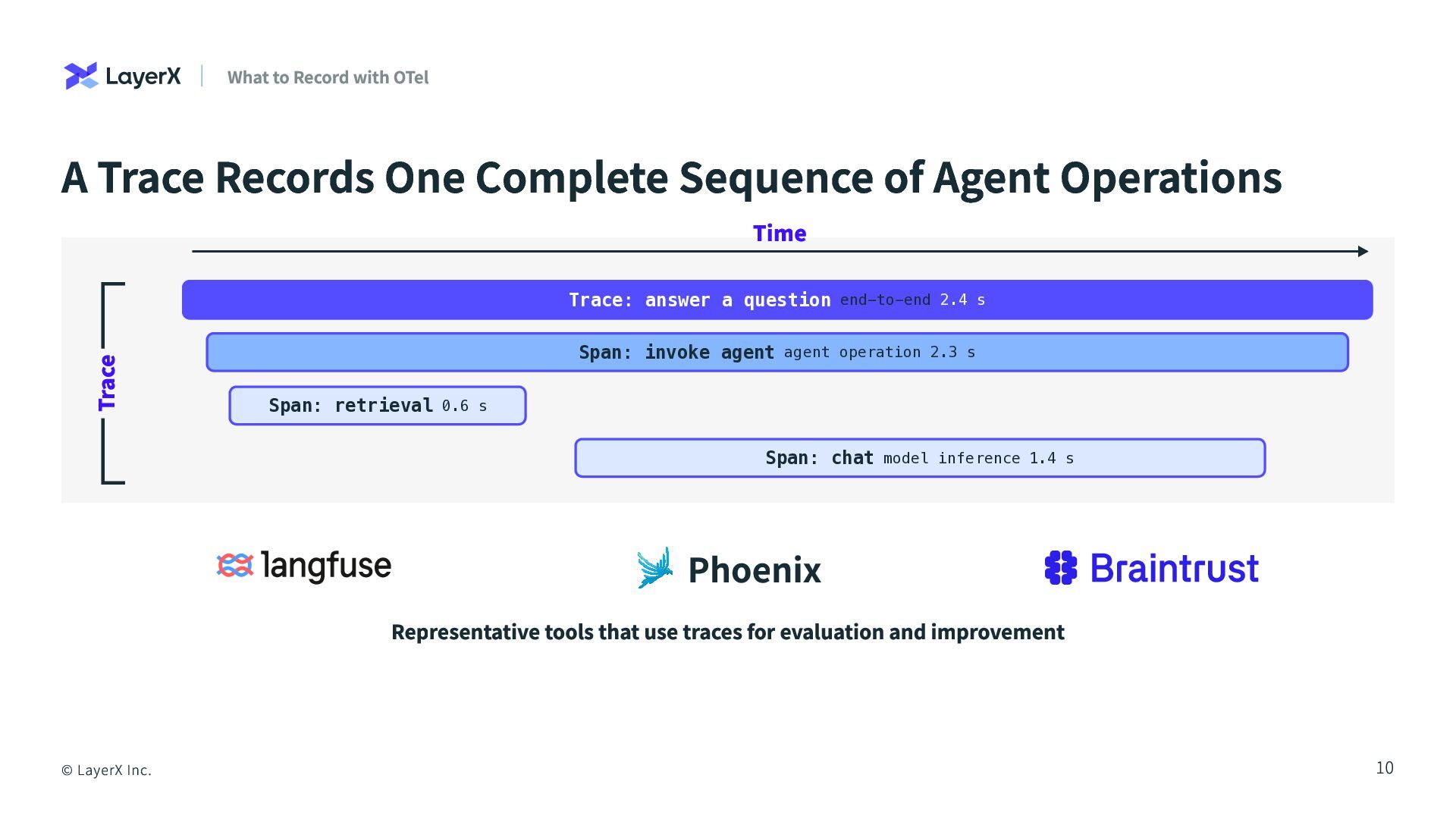
What to Record with OTel A Trace Records One Complete
Sequence of Agent Operations Time Trace: answer a question end-to-end 2.4 s ecarT Span: invoke agent agent operation 2.3 s Span: retrieval 0.6 s Span: chat model inference 1.4 s Phoenix Representative tools that use traces for evaluation and improvement © LayerX Inc. 10
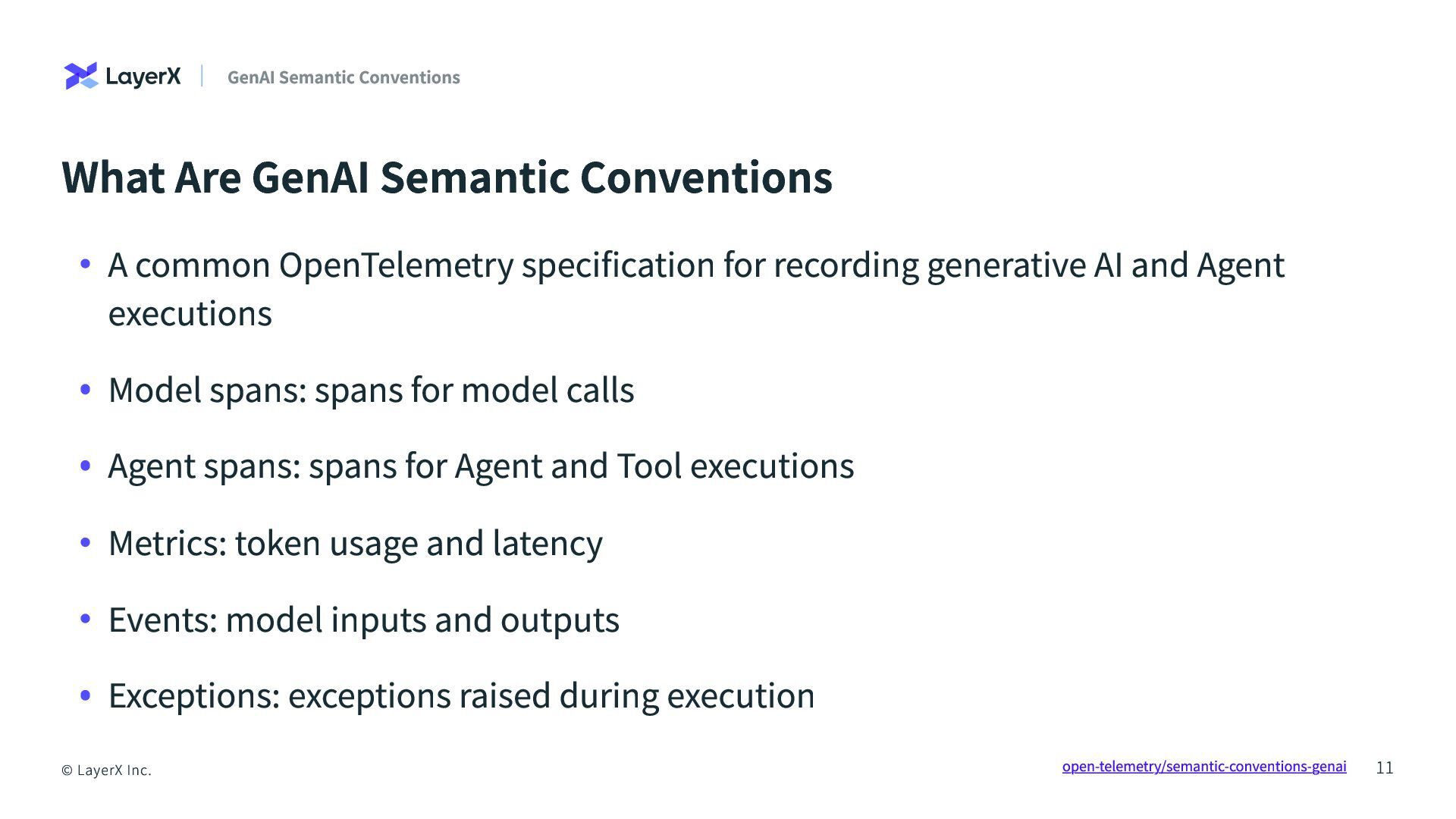
GenAI Semantic Conventions What Are GenAI Semantic Conventions A common
OpenTelemetry specification for recording generative AI and Agent executions Model spans: spans for model calls Agent spans: spans for Agent and Tool executions Metrics: token usage and latency Events: model inputs and outputs Exceptions: exceptions raised during execution © LayerX Inc. open-telemetry/semantic-conventions-genai 11
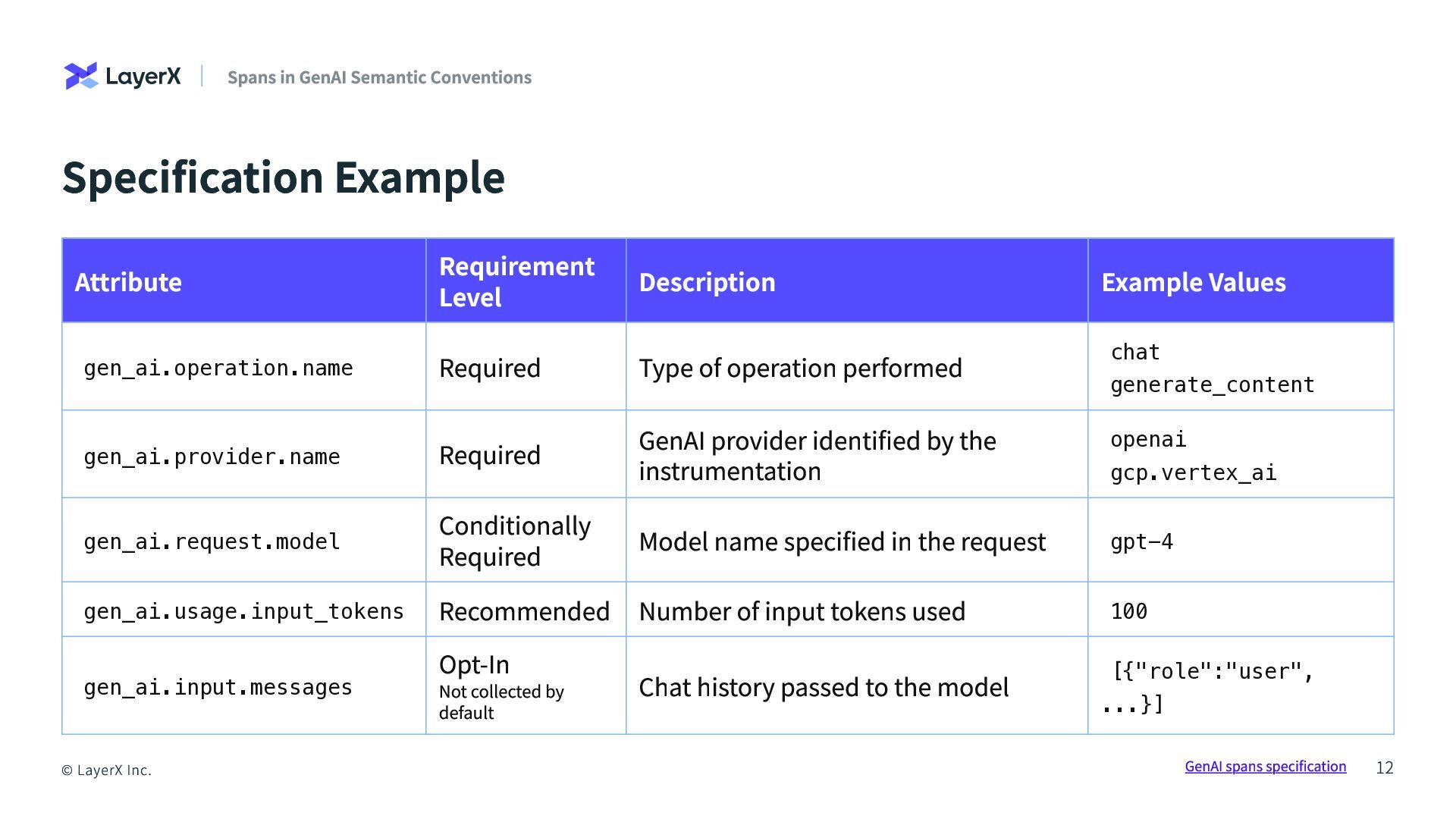
Spans in GenAI Semantic Conventions Specification Example Attribute gen_ai.operation.name gen_ai.provider.name
gen_ai.request.model gen_ai.usage.input_tokens gen_ai.input.messages © LayerX Inc. Requirement Description Level Required Type of operation performed GenAI provider identified by the Required instrumentation Conditionally Model name specified in the request Required Recommended Number of input tokens used Opt-In Chat history passed to the model Not collected by default Example Values chat generate_content openai gcp.vertex_ai gpt-4 100 [{"role":"user", ...}] GenAI spans specification 12
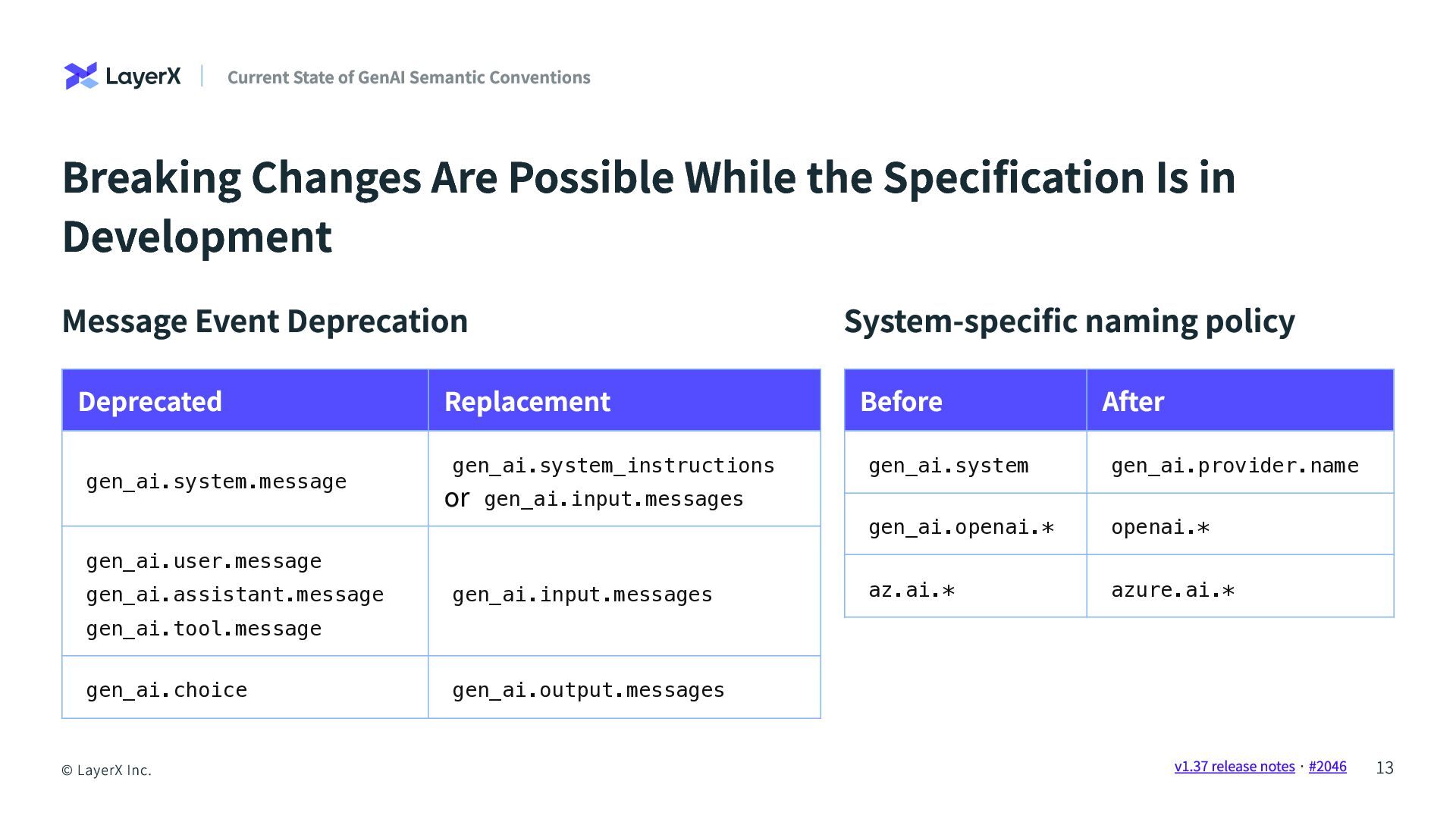
Current State of GenAI Semantic Conventions Breaking Changes Are Possible
While the Specification Is in Development Message Event Deprecation System-specific naming policy Deprecated Replacement Before After gen_ai.system_instructions or gen_ai.input.messages gen_ai.system gen_ai.provider.name gen_ai.openai.* openai.* gen_ai.input.messages az.ai.* azure.ai.* gen_ai.system.message gen_ai.user.message gen_ai.assistant.message gen_ai.tool.message gen_ai.choice © LayerX Inc. gen_ai.output.messages v1.37 release notes · #2046 13
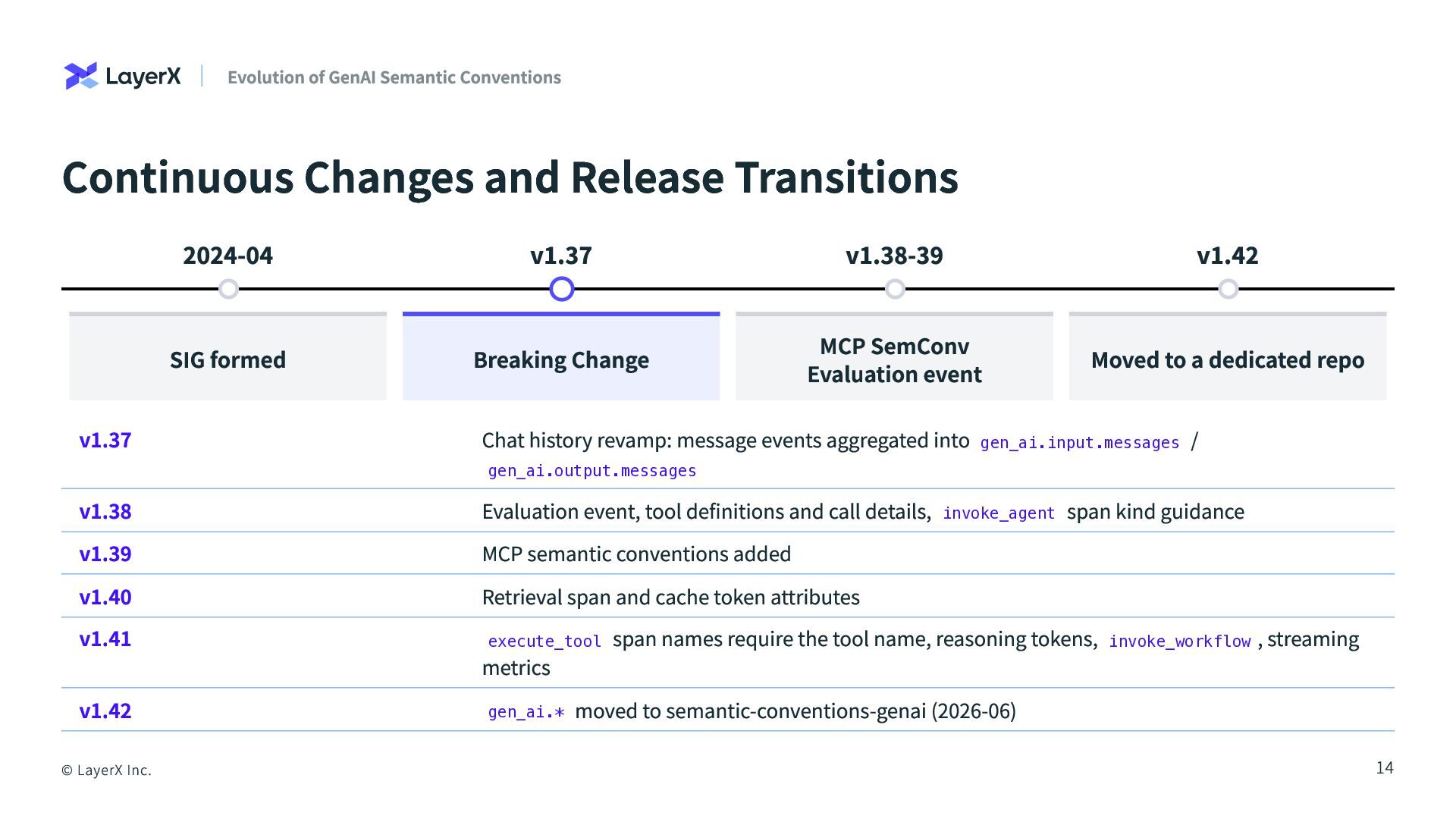
Evolution of GenAI Semantic Conventions Continuous Changes and Release Transitions
v1.37 2024-04 v1.37 v1.38-39 v1.42 SIG formed Breaking Change MCP SemConv Evaluation event Moved to a dedicated repo Chat history revamp: message events aggregated into gen_ai.input.messages / gen_ai.output.messages v1.38 v1.39 v1.40 v1.41 v1.42 © LayerX Inc. Evaluation event, tool definitions and call details, span kind guidance MCP semantic conventions added Retrieval span and cache token attributes span names require the tool name, reasoning tokens, , streaming metrics moved to semantic-conventions-genai (2026-06) invoke_agent execute_tool invoke_workflow gen_ai.* 14
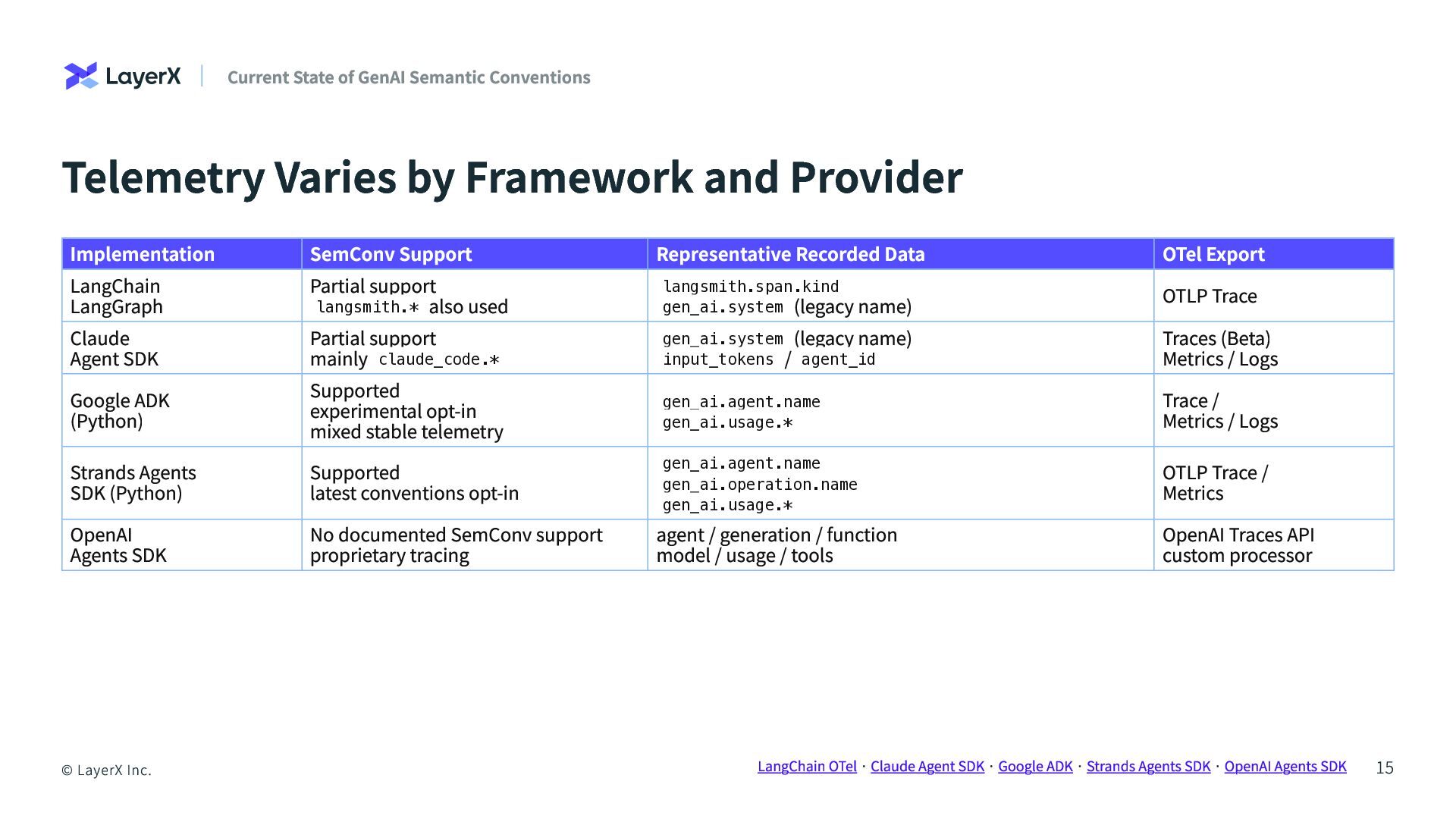
Current State of GenAI Semantic Conventions Telemetry Varies by Framework
and Provider Implementation LangChain LangGraph Claude Agent SDK Google ADK (Python) Strands Agents SDK (Python) OpenAI Agents SDK © LayerX Inc. SemConv Support Partial support langsmith.* also used Partial support mainly claude_code.* Supported experimental opt-in mixed stable telemetry Supported latest conventions opt-in No documented SemConv support proprietary tracing Representative Recorded Data langsmith.span.kind gen_ai.system (legacy name) gen_ai.system (legacy name) input_tokens / agent_id gen_ai.agent.name gen_ai.usage.* gen_ai.agent.name gen_ai.operation.name gen_ai.usage.* agent / generation / function model / usage / tools OTel Export OTLP Trace Traces (Beta) Metrics / Logs Trace / Metrics / Logs OTLP Trace / Metrics OpenAI Traces API custom processor LangChain OTel · Claude Agent SDK · Google ADK · Strands Agents SDK · OpenAI Agents SDK 15
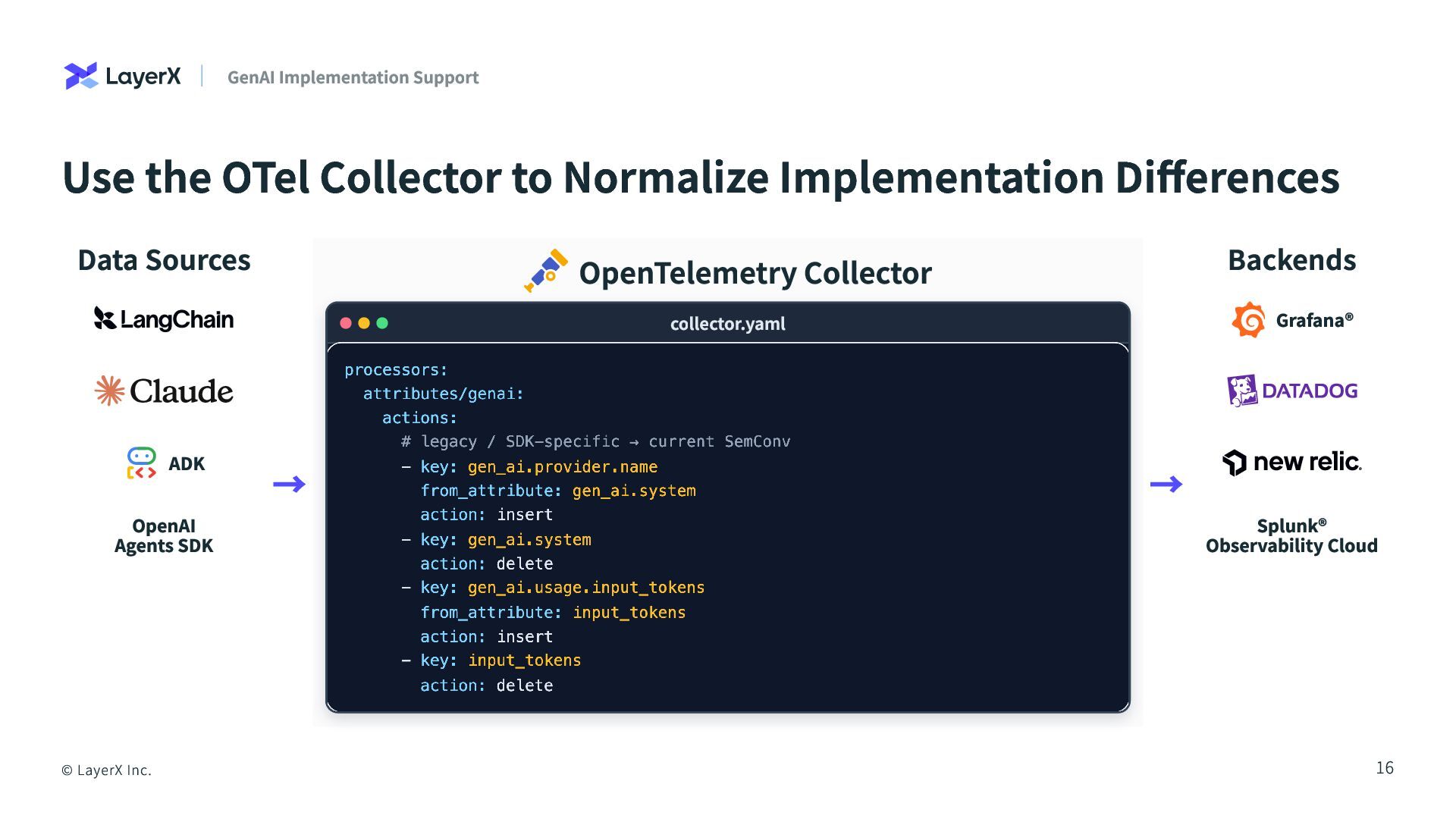
GenAI Implementation Support Use the OTel Collector to Normalize Implementation
Differences Data Sources Backends OpenTelemetry Collector Grafana® collector.yaml ADK OpenAI Agents SDK © LayerX Inc. → → Splunk® Observability Cloud 16
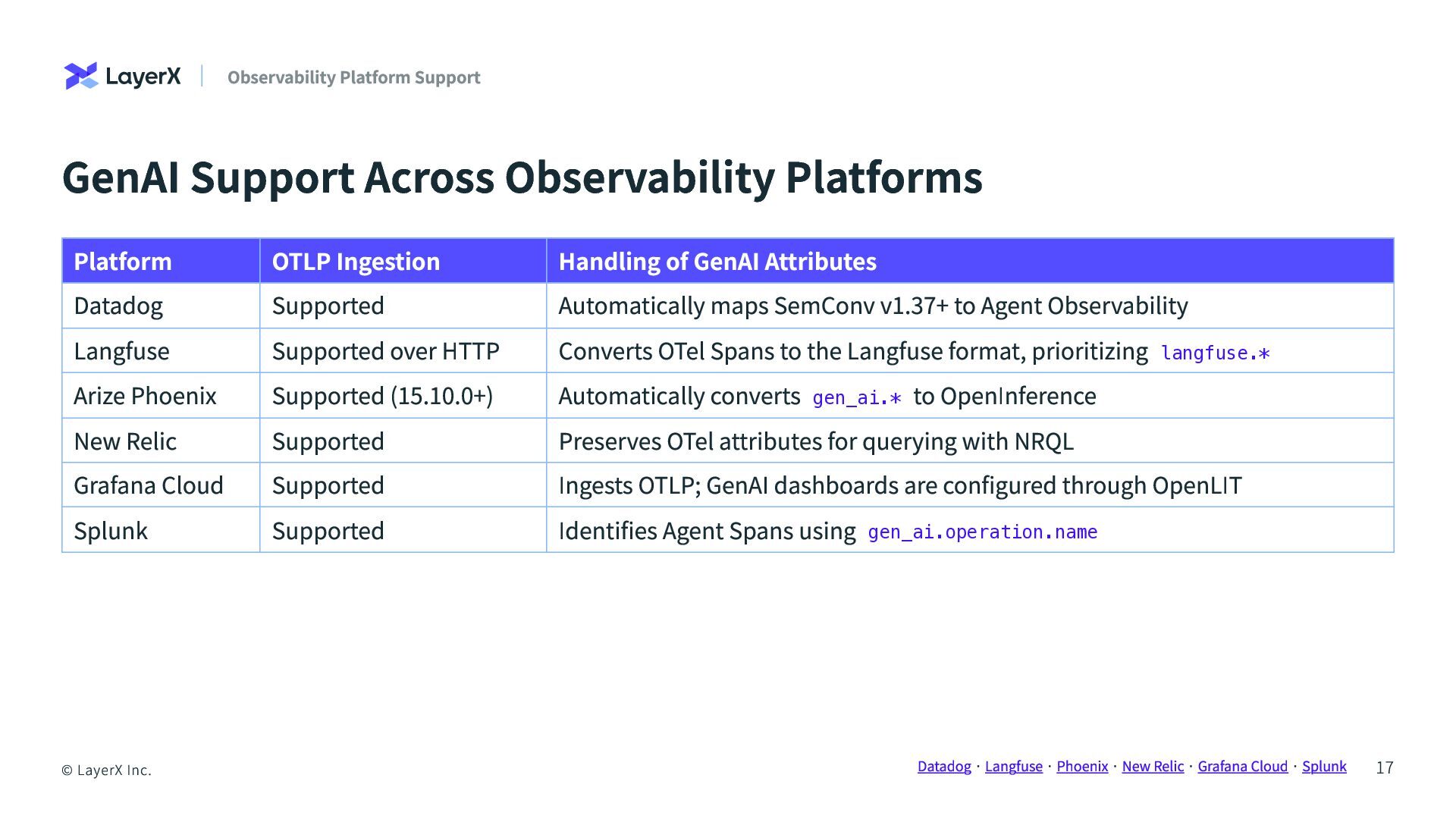
Observability Platform Support GenAI Support Across Observability Platforms Platform Datadog
Langfuse Arize Phoenix New Relic Grafana Cloud Splunk © LayerX Inc. OTLP Ingestion Supported Supported over HTTP Supported (15.10.0+) Supported Supported Supported Handling of GenAI Attributes Automatically maps SemConv v1.37+ to Agent Observability Converts OTel Spans to the Langfuse format, prioritizing Automatically converts to OpenInference Preserves OTel attributes for querying with NRQL Ingests OTLP; GenAI dashboards are configured through OpenLIT Identifies Agent Spans using langfuse.* gen_ai.* gen_ai.operation.name Datadog · Langfuse · Phoenix · New Relic · Grafana Cloud · Splunk 17
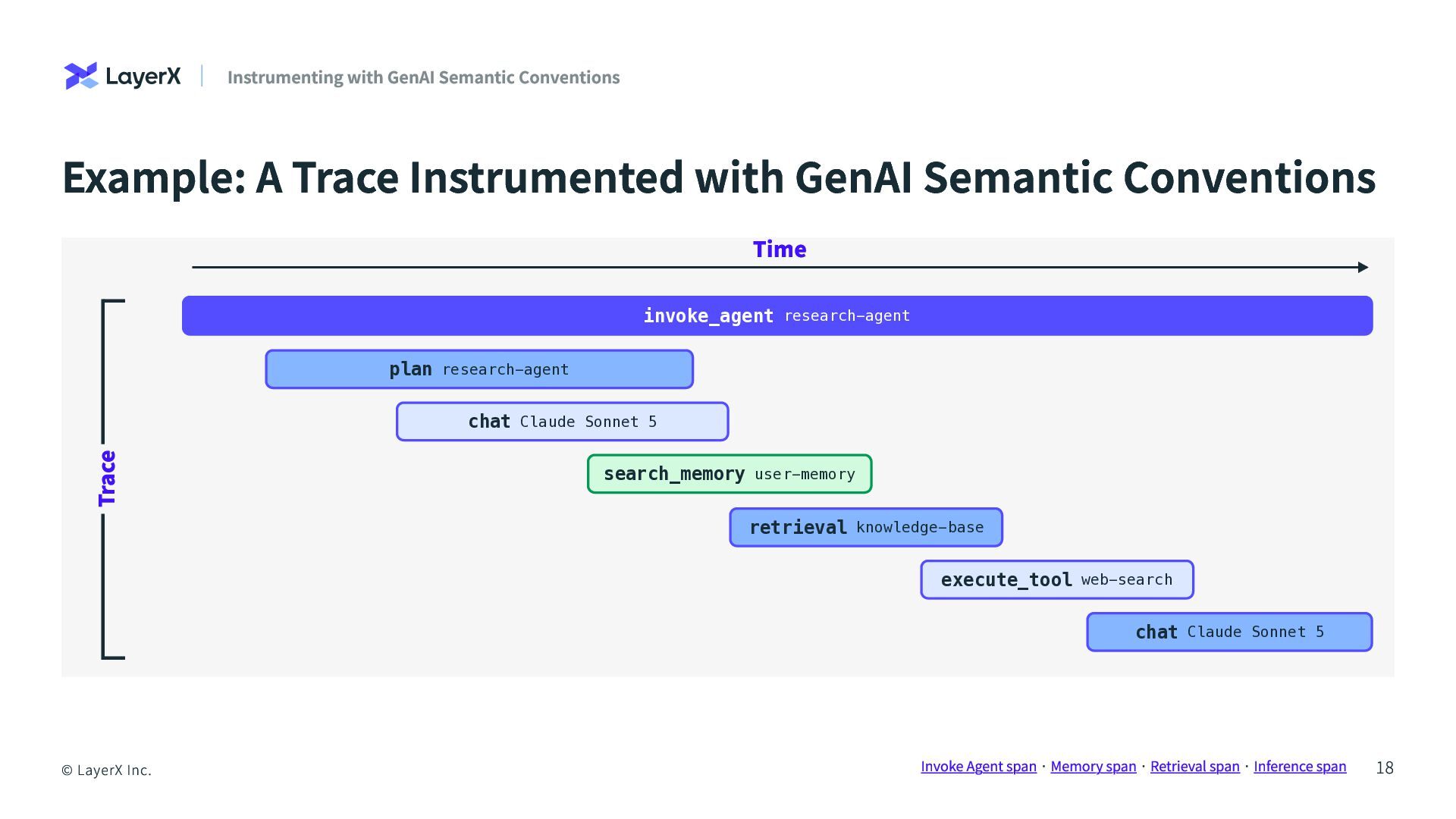
Instrumenting with GenAI Semantic Conventions Example: A Trace Instrumented with
GenAI Semantic Conventions Time invoke_agent research-agent plan research-agent chat Claude Sonnet 5 ecarT search_memory user-memory retrieval knowledge-base execute_tool web-search chat Claude Sonnet 5 © LayerX Inc. Invoke Agent span · Memory span · Retrieval span · Inference span 18
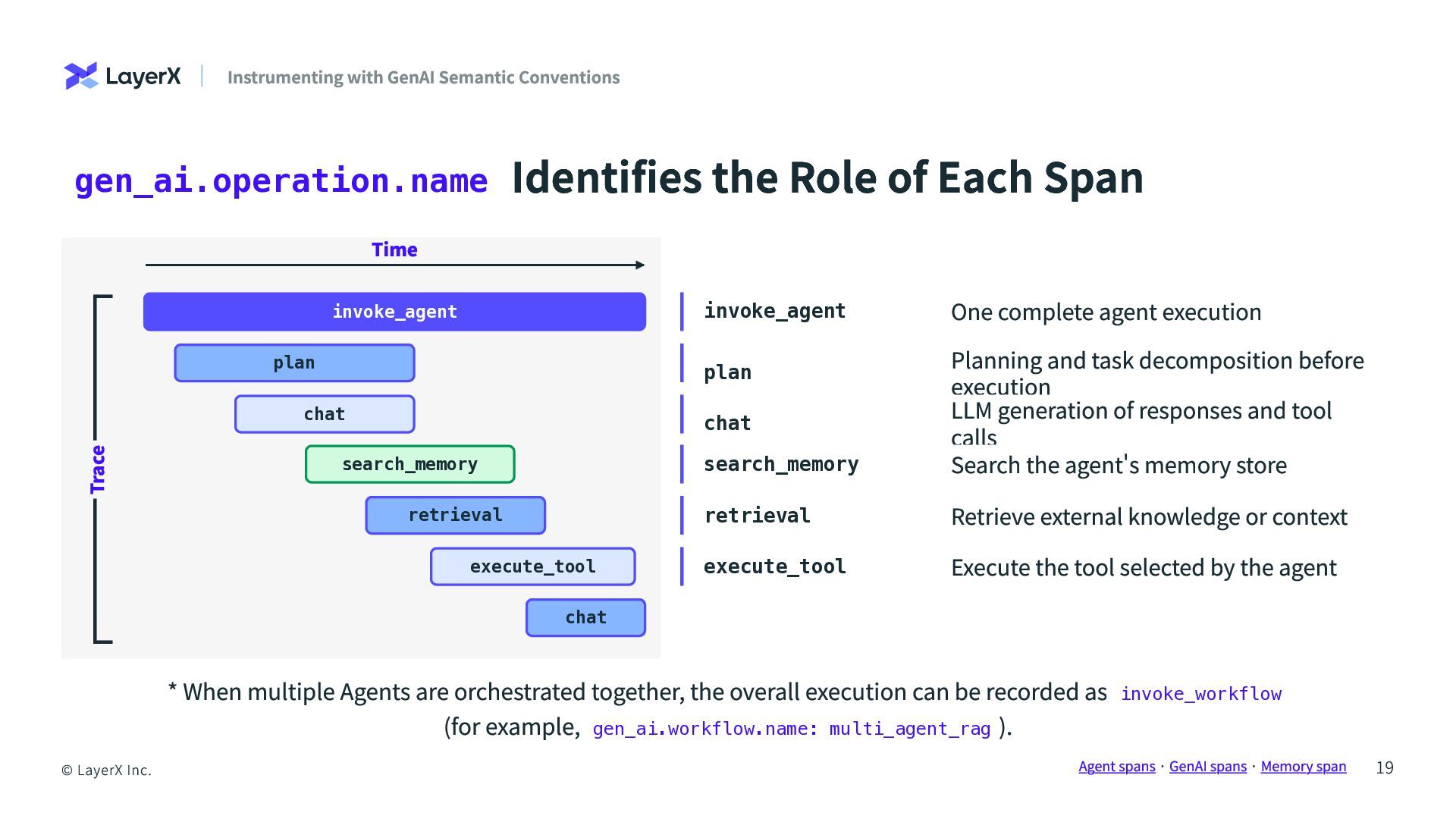
Instrumenting with GenAI Semantic Conventions gen_ai.operation.name Identifies the Role of
Each Span Time invoke_agent invoke_agent plan plan chat chat ecarT search_memory search_memory retrieval retrieval execute_tool execute_tool One complete agent execution Planning and task decomposition before execution LLM generation of responses and tool calls Search the agent's memory store Retrieve external knowledge or context Execute the tool selected by the agent chat * When multiple Agents are orchestrated together, the overall execution can be recorded as (for example, ). invoke_workflow gen_ai.workflow.name: multi_agent_rag © LayerX Inc. Agent spans · GenAI spans · Memory span 19
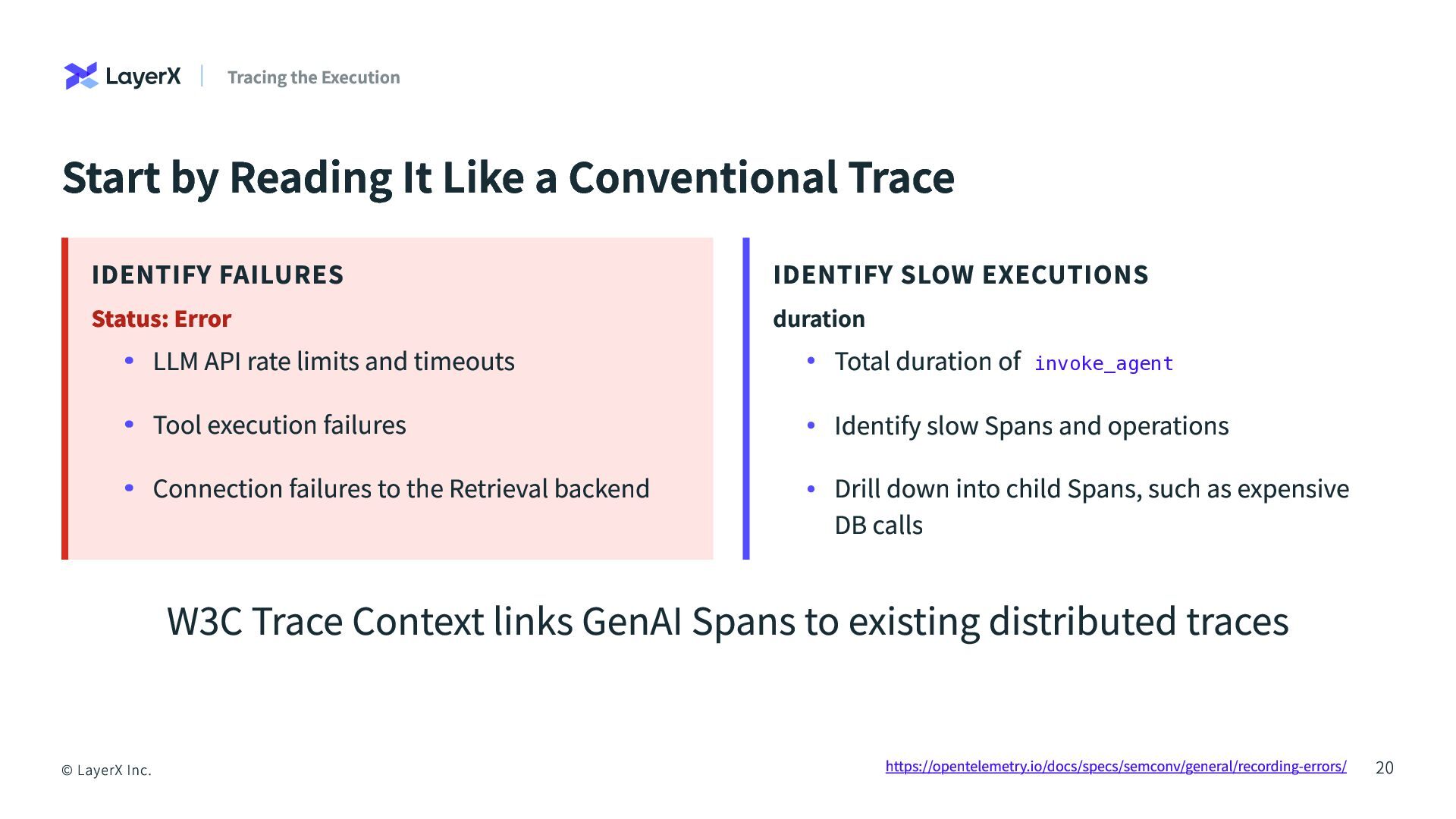
Tracing the Execution Start by Reading It Like a Conventional
Trace IDENTIFY FAILURES Status: Error LLM API rate limits and timeouts Tool execution failures Connection failures to the Retrieval backend IDENTIFY SLOW EXECUTIONS duration Total duration of Identify slow Spans and operations Drill down into child Spans, such as expensive DB calls invoke_agent W3C Trace Context links GenAI Spans to existing distributed traces © LayerX Inc. https://opentelemetry.io/docs/specs/semconv/general/recording-errors/ 20
Tracing the Execution Even Successful Runs Can Contain Wasteful Loops
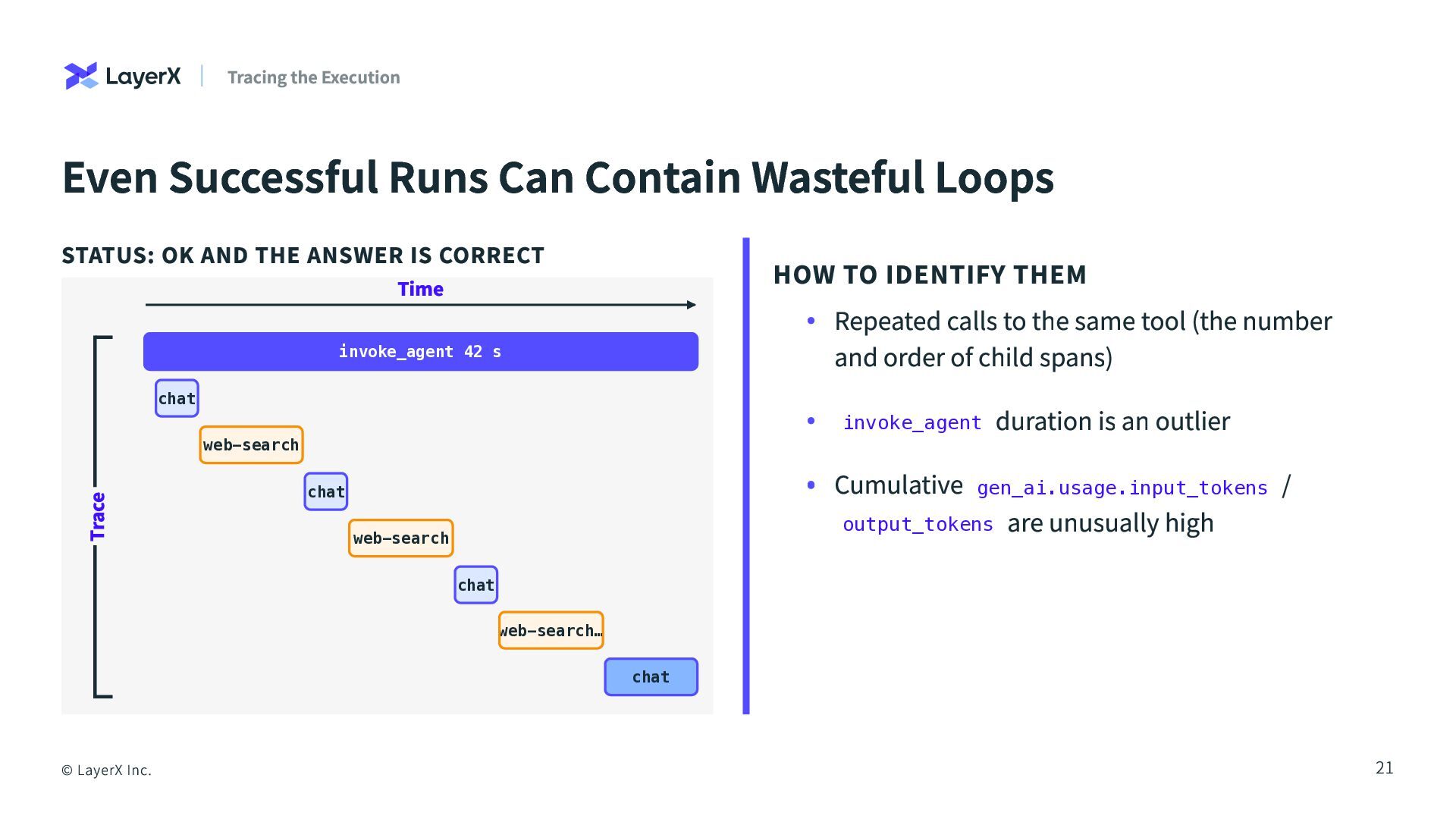
STATUS: OK AND THE ANSWER IS CORRECT HOW TO IDENTIFY THEM Repeated calls to the same tool (the number and order of child spans) duration is an outlier Cumulative / are unusually high Time invoke_agent 42 s chat invoke_agent web-search ecarT gen_ai.usage.input_tokens chat output_tokens web-search chat web-search… chat © LayerX Inc. 21
Tracing the Execution This Is the Limit of Conventional Trace
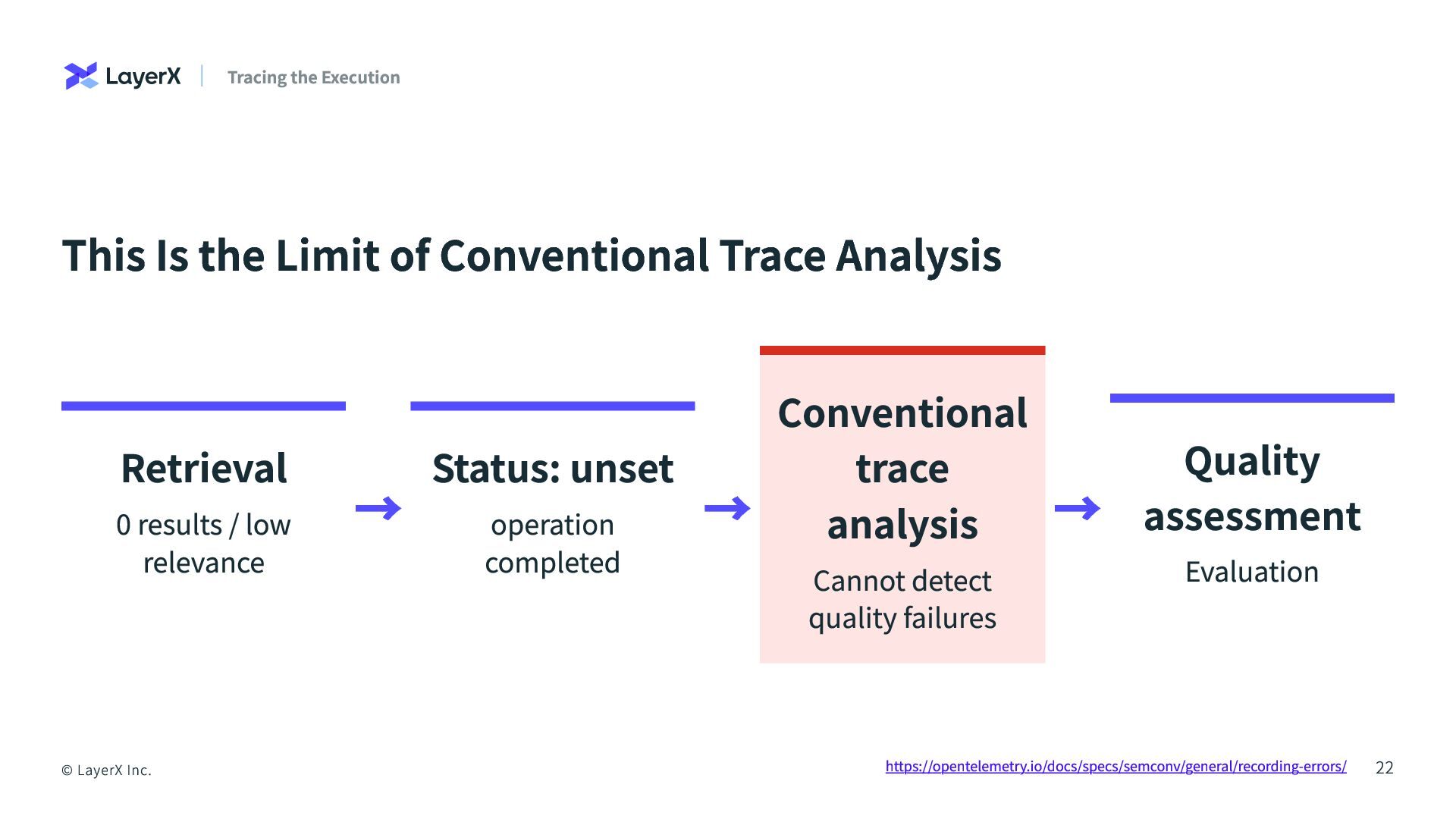
Analysis Conventional Quality Retrieval Status: unset trace → → assessment 0 results / low → operation analysis relevance completed Cannot detect quality failures © LayerX Inc. Evaluation https://opentelemetry.io/docs/specs/semconv/general/recording-errors/ 22
Core Use Case — Linking Evaluation Link Evaluation Results to
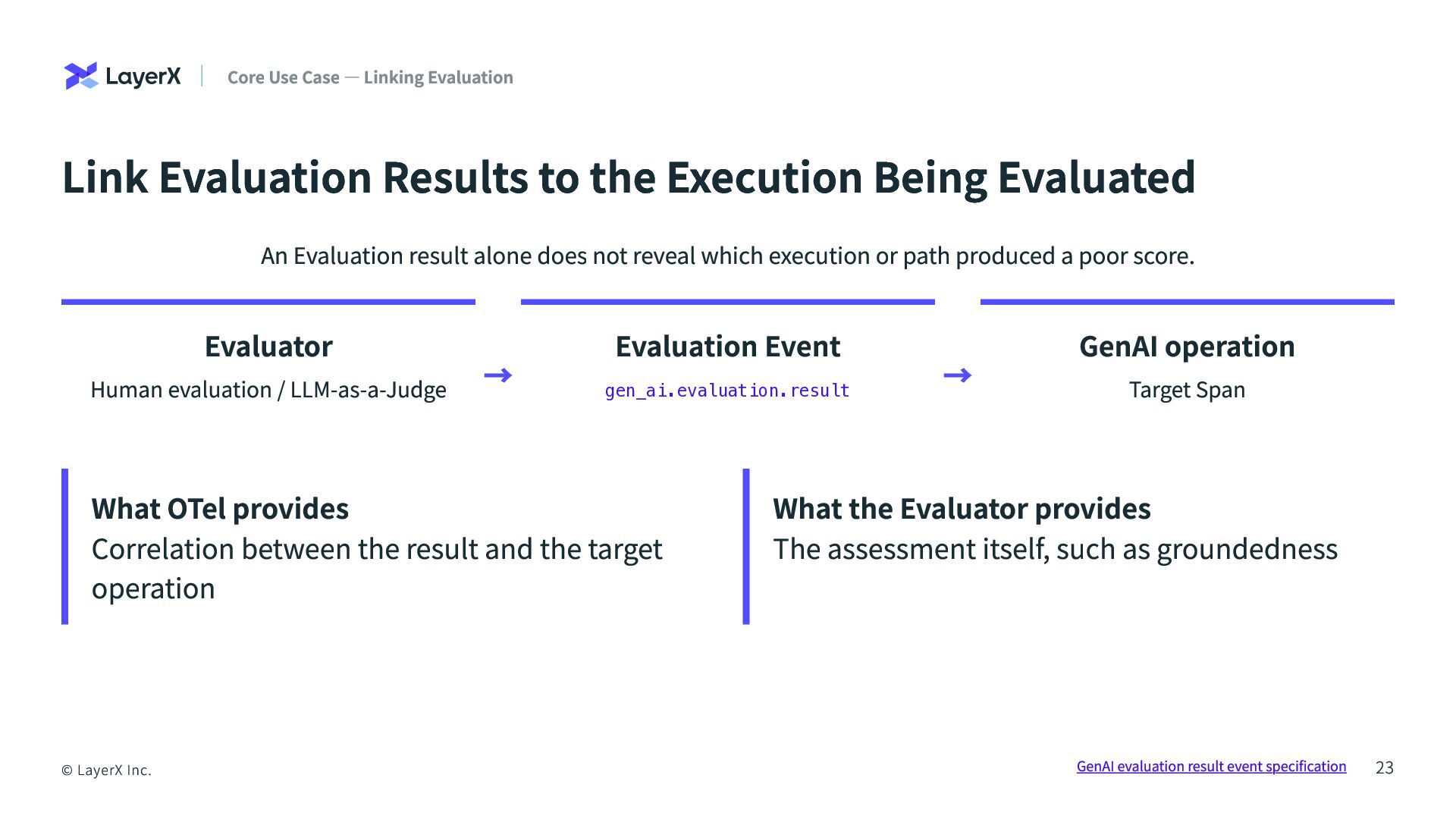
the Execution Being Evaluated An Evaluation result alone does not reveal which execution or path produced a poor score. Evaluator Human evaluation / LLM-as-a-Judge → Evaluation Event gen_ai.evaluation.result What OTel provides Correlation between the result and the target operation © LayerX Inc. → GenAI operation Target Span What the Evaluator provides The assessment itself, such as groundedness GenAI evaluation result event specification 23
Lessons from Coding Agents Coding Agents Make Execution Paths Easier
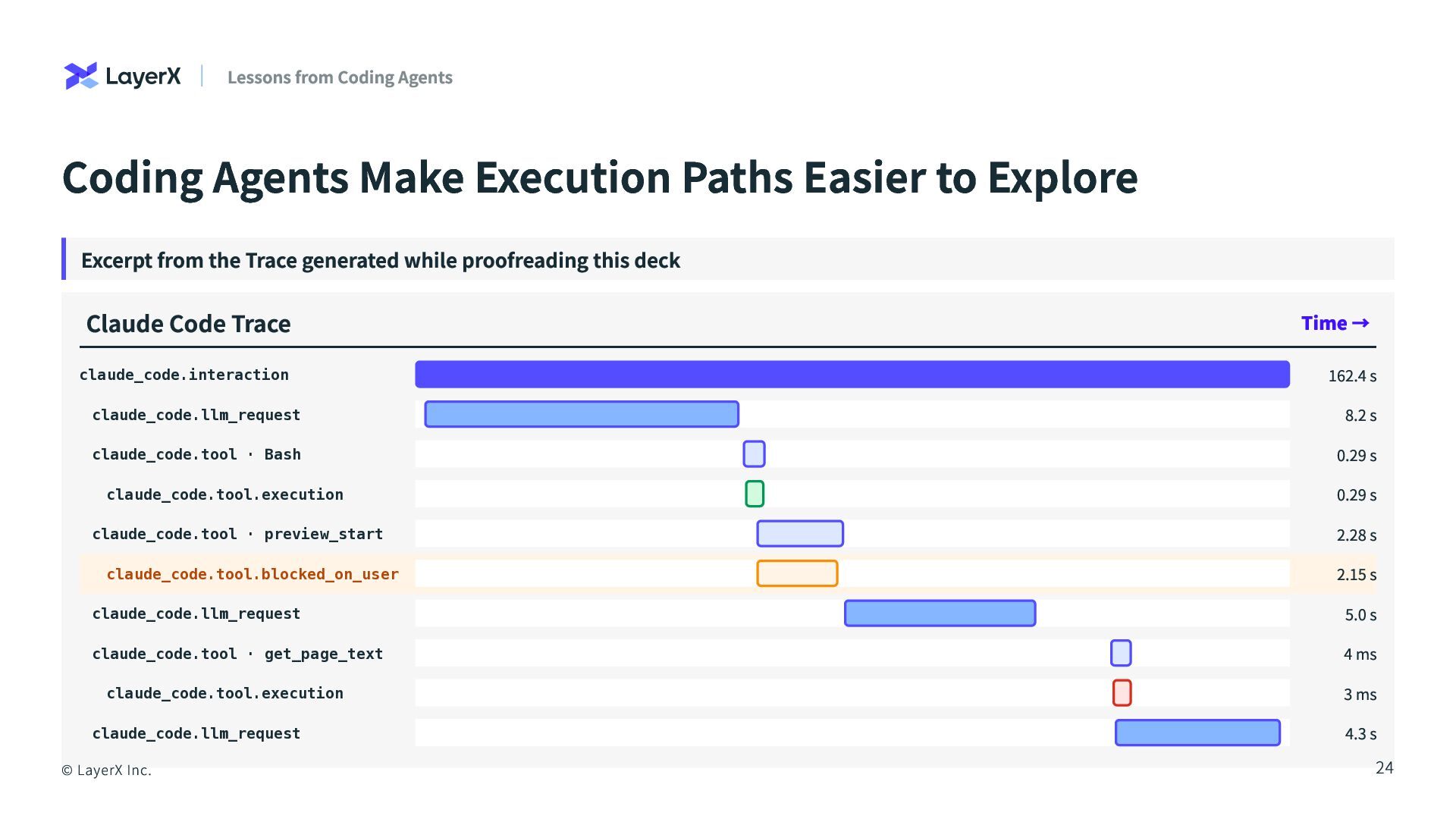
to Explore Excerpt from the Trace generated while proofreading this deck Claude Code Trace claude_code.interaction claude_code.llm_request claude_code.tool · Bash claude_code.tool.execution claude_code.tool · preview_start claude_code.tool.blocked_on_user claude_code.llm_request claude_code.tool · get_page_text claude_code.tool.execution claude_code.llm_request © LayerX Inc. Time → 162.4 s 8.2 s 0.29 s 0.29 s 2.28 s 2.15 s 5.0 s 4 ms 3 ms 4.3 s 24
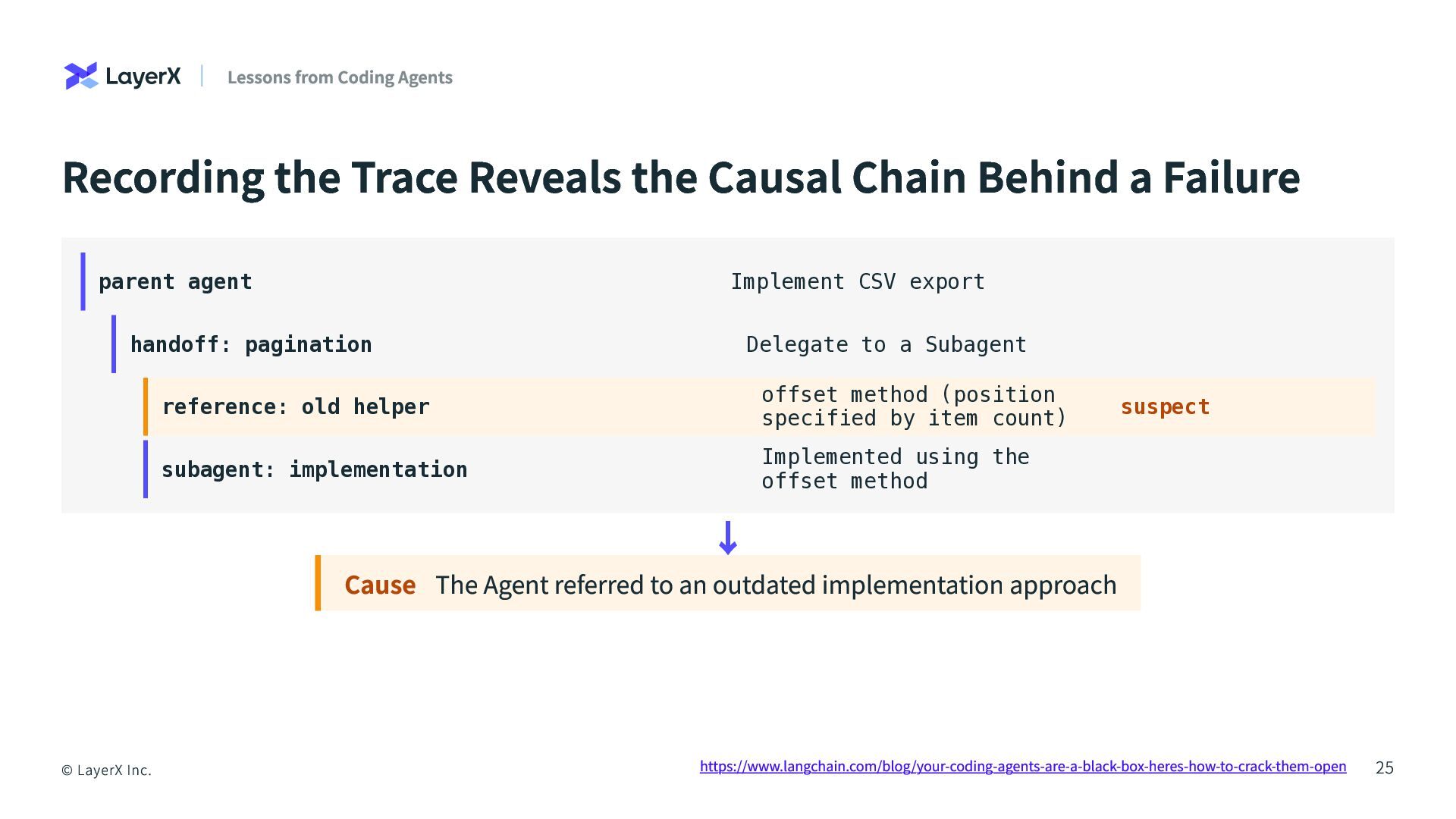
Lessons from Coding Agents Recording the Trace Reveals the Causal
Chain Behind a Failure parent agent Implement CSV export handoff: pagination Delegate to a Subagent reference: old helper offset method (position specified by item count) subagent: implementation Implemented using the offset method ↓ suspect Cause The Agent referred to an outdated implementation approach © LayerX Inc. https://www.langchain.com/blog/your-coding-agents-are-a-black-box-heres-how-to-crack-them-open 25
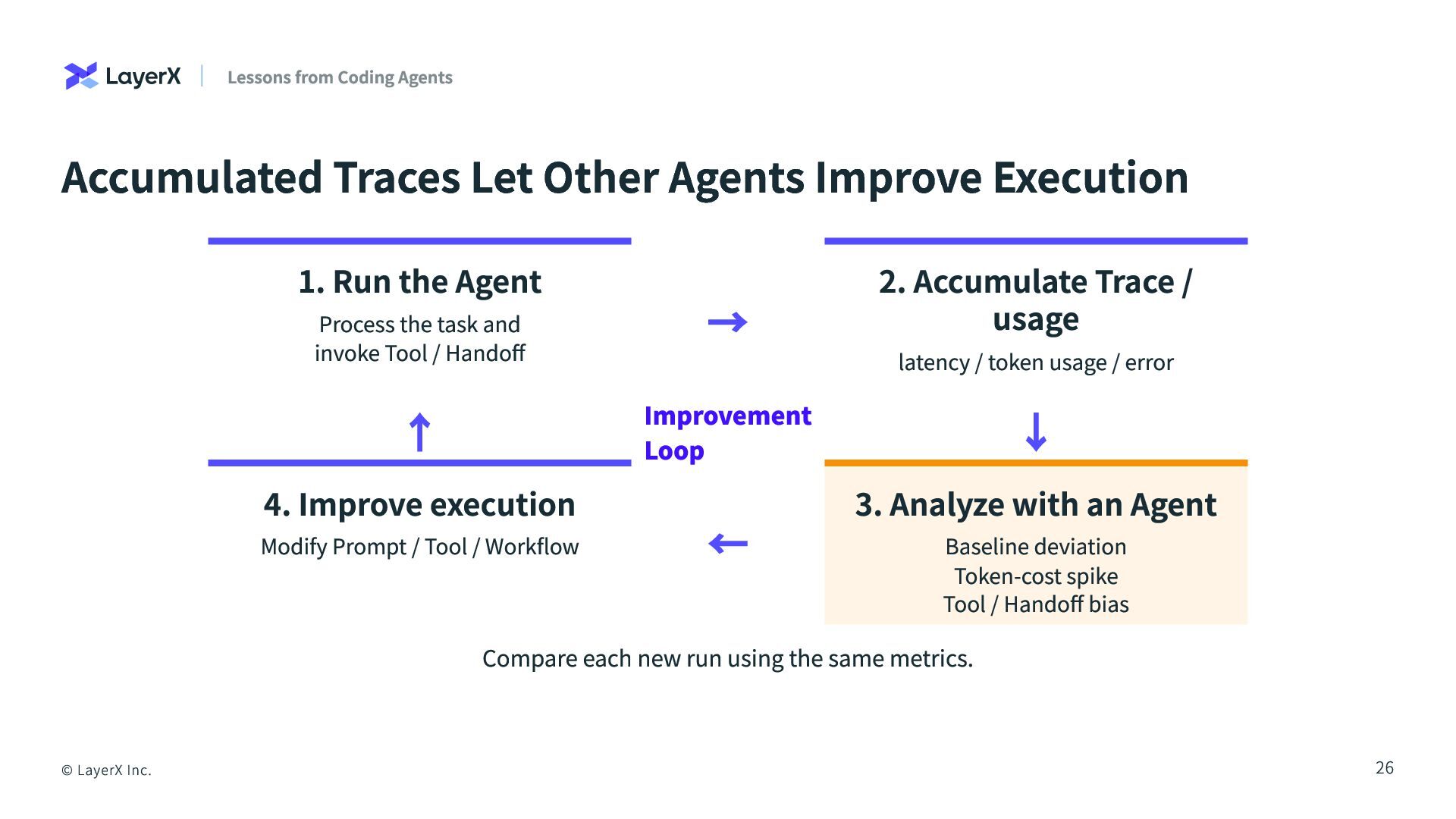
Lessons from Coding Agents Accumulated Traces Let Other Agents Improve
Execution 1. Run the Agent → 2. Accumulate Trace / usage ↑ Improvement Loop ↓ Modify Prompt / Tool / Workflow ← Process the task and invoke Tool / Handoff 4. Improve execution latency / token usage / error 3. Analyze with an Agent Baseline deviation Token-cost spike Tool / Handoff bias Compare each new run using the same metrics. © LayerX Inc. 26
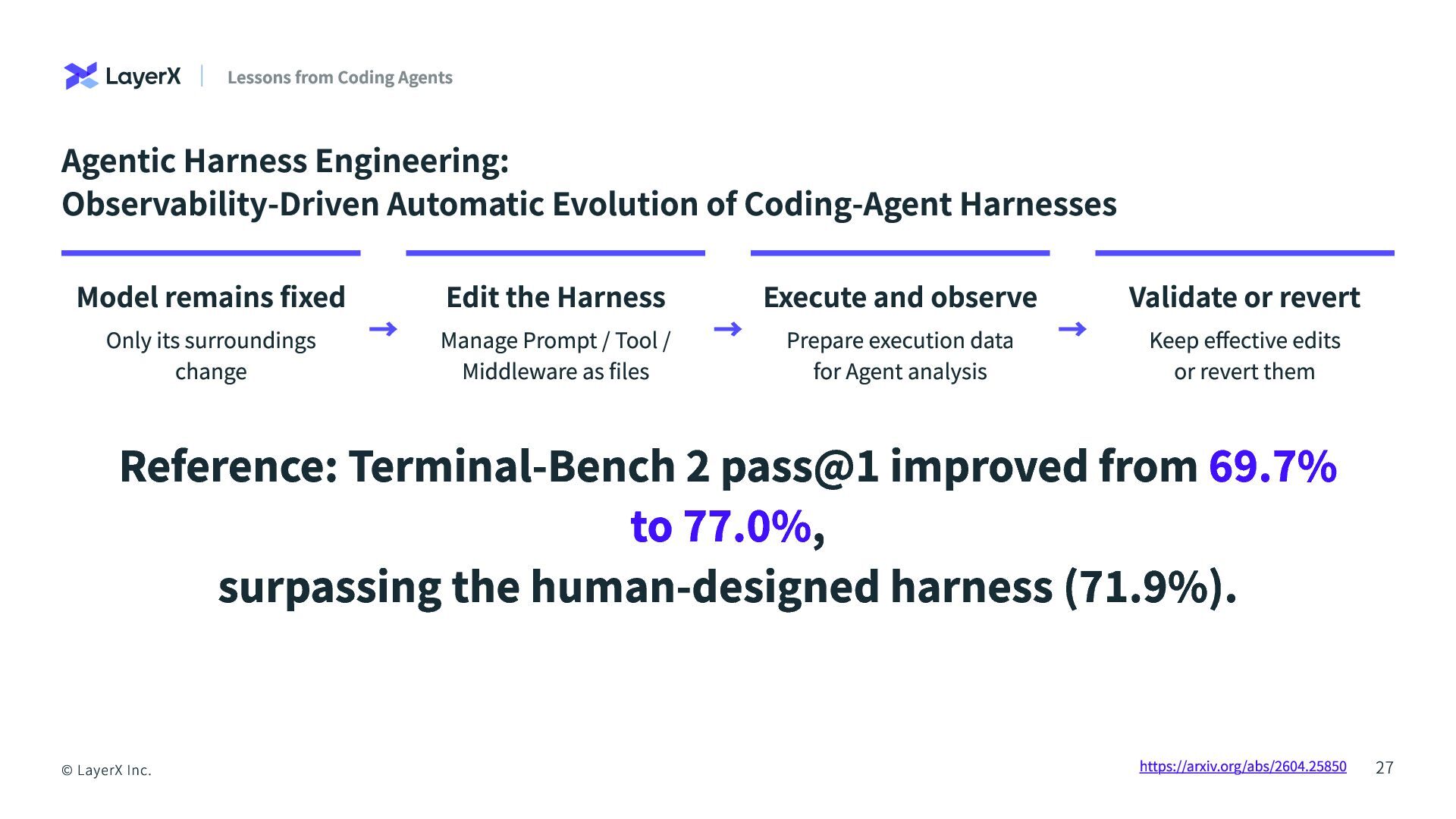
Lessons from Coding Agents Agentic Harness Engineering: Observability-Driven Automatic Evolution
of Coding-Agent Harnesses Model remains fixed Only its surroundings change → Edit the Harness Manage Prompt / Tool / Middleware as files → Execute and observe Prepare execution data for Agent analysis → Validate or revert Keep effective edits or revert them Reference: Terminal-Bench 2 pass@1 improved from 69.7% to 77.0%, surpassing the human-designed harness (71.9%). © LayerX Inc. https://arxiv.org/abs/2604.25850 27
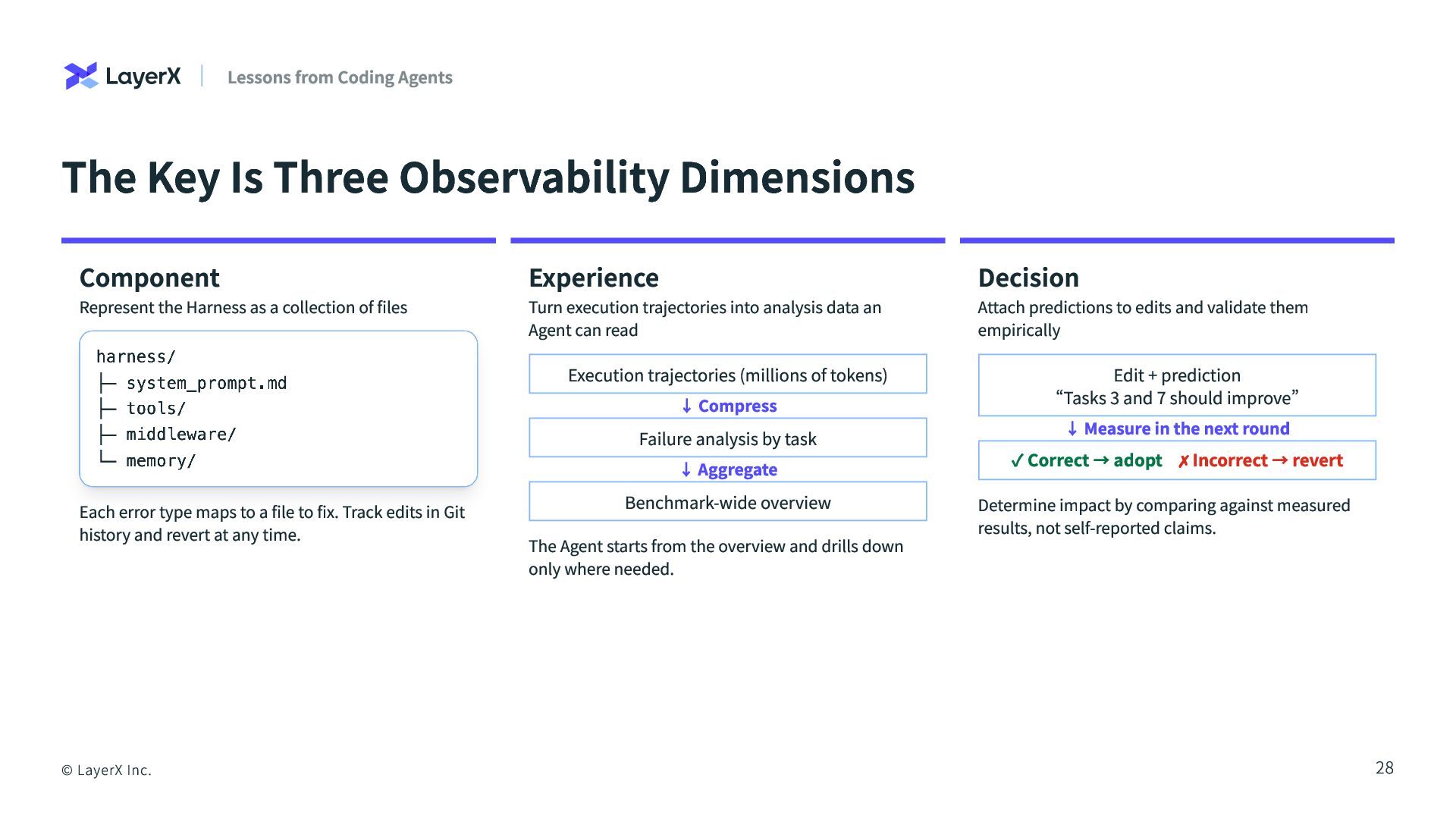
Lessons from Coding Agents The Key Is Three Observability Dimensions
Component Represent the Harness as a collection of files Each error type maps to a file to fix. Track edits in Git history and revert at any time. © LayerX Inc. Experience Turn execution trajectories into analysis data an Agent can read Execution trajectories (millions of tokens) ↓ Compress Failure analysis by task ↓ Aggregate Benchmark-wide overview The Agent starts from the overview and drills down only where needed. Decision Attach predictions to edits and validate them empirically Edit + prediction “Tasks 3 and 7 should improve” ↓ Measure in the next round ✓ Correct → adopt ✗ Incorrect → revert Determine impact by comparing against measured results, not self-reported claims. 28
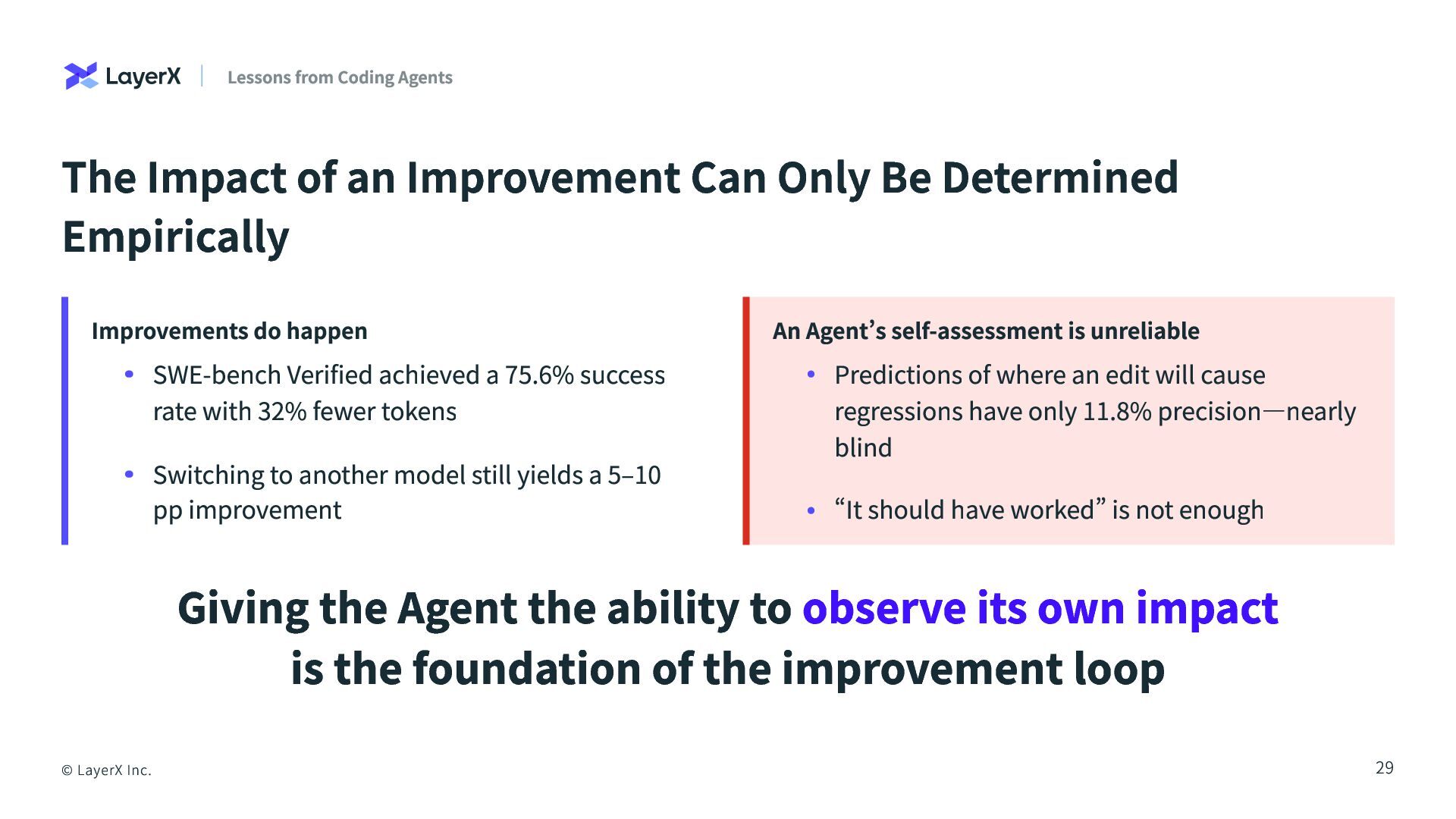
Lessons from Coding Agents The Impact of an Improvement Can
Only Be Determined Empirically Improvements do happen SWE-bench Verified achieved a 75.6% success rate with 32% fewer tokens Switching to another model still yields a 5–10 pp improvement An Agent’s self-assessment is unreliable Predictions of where an edit will cause regressions have only 11.8% precision—nearly blind “It should have worked” is not enough Giving the Agent the ability to observe its own impact is the foundation of the improvement loop © LayerX Inc. 29
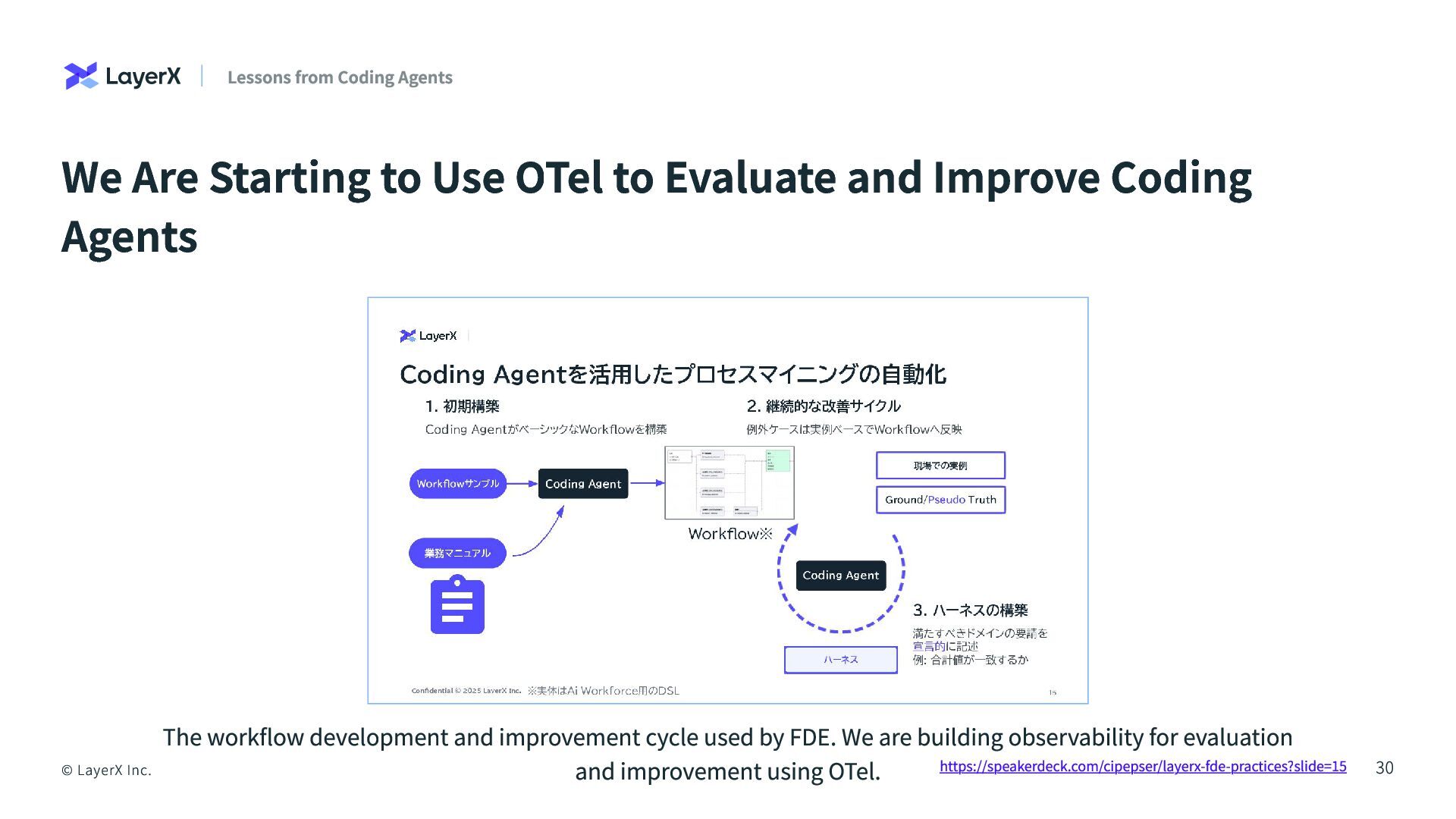
Lessons from Coding Agents We Are Starting to Use OTel
to Evaluate and Improve Coding Agents The workflow development and improvement cycle used by FDE. We are building observability for evaluation © LayerX Inc. and improvement using OTel. https://speakerdeck.com/cipepser/layerx-fde-practices?slide=15 30
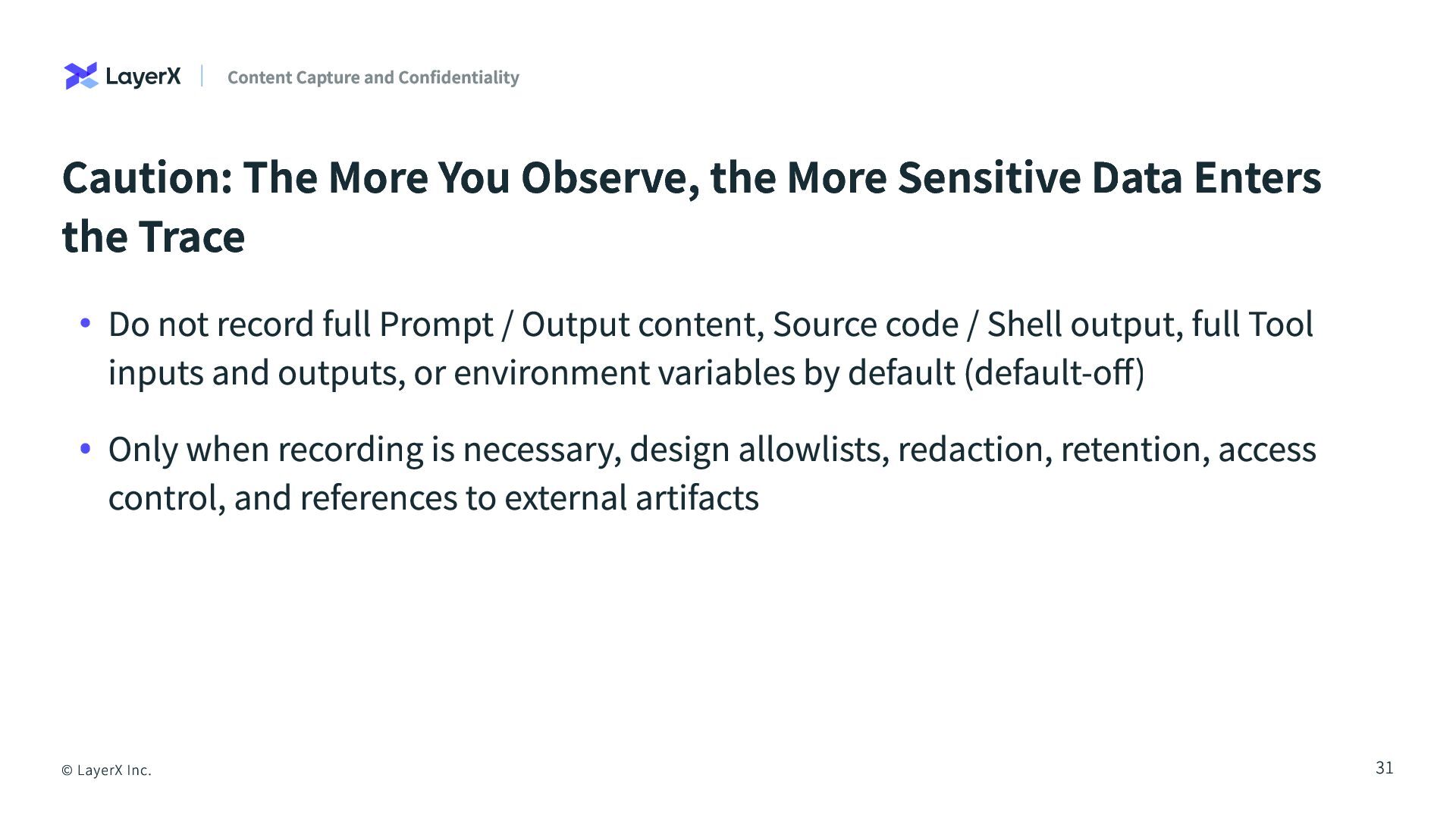
Content Capture and Confidentiality Caution: The More You Observe, the
More Sensitive Data Enters the Trace Do not record full Prompt / Output content, Source code / Shell output, full Tool inputs and outputs, or environment variables by default (default-off) Only when recording is necessary, design allowlists, redaction, retention, access control, and references to external artifacts © LayerX Inc. 31
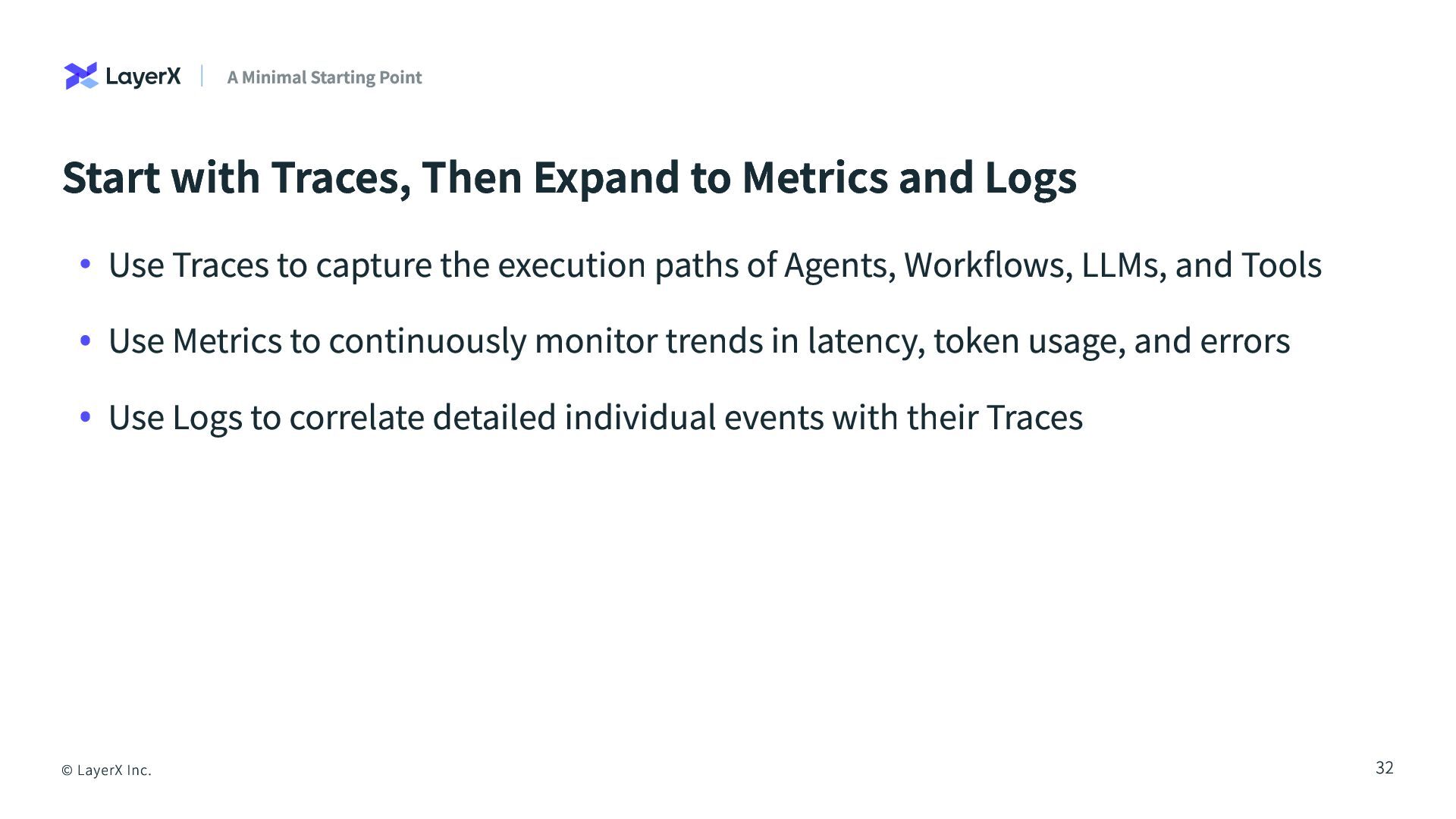
A Minimal Starting Point Start with Traces, Then Expand to
Metrics and Logs Use Traces to capture the execution paths of Agents, Workflows, LLMs, and Tools Use Metrics to continuously monitor trends in latency, token usage, and errors Use Logs to correlate detailed individual events with their Traces © LayerX Inc. 32
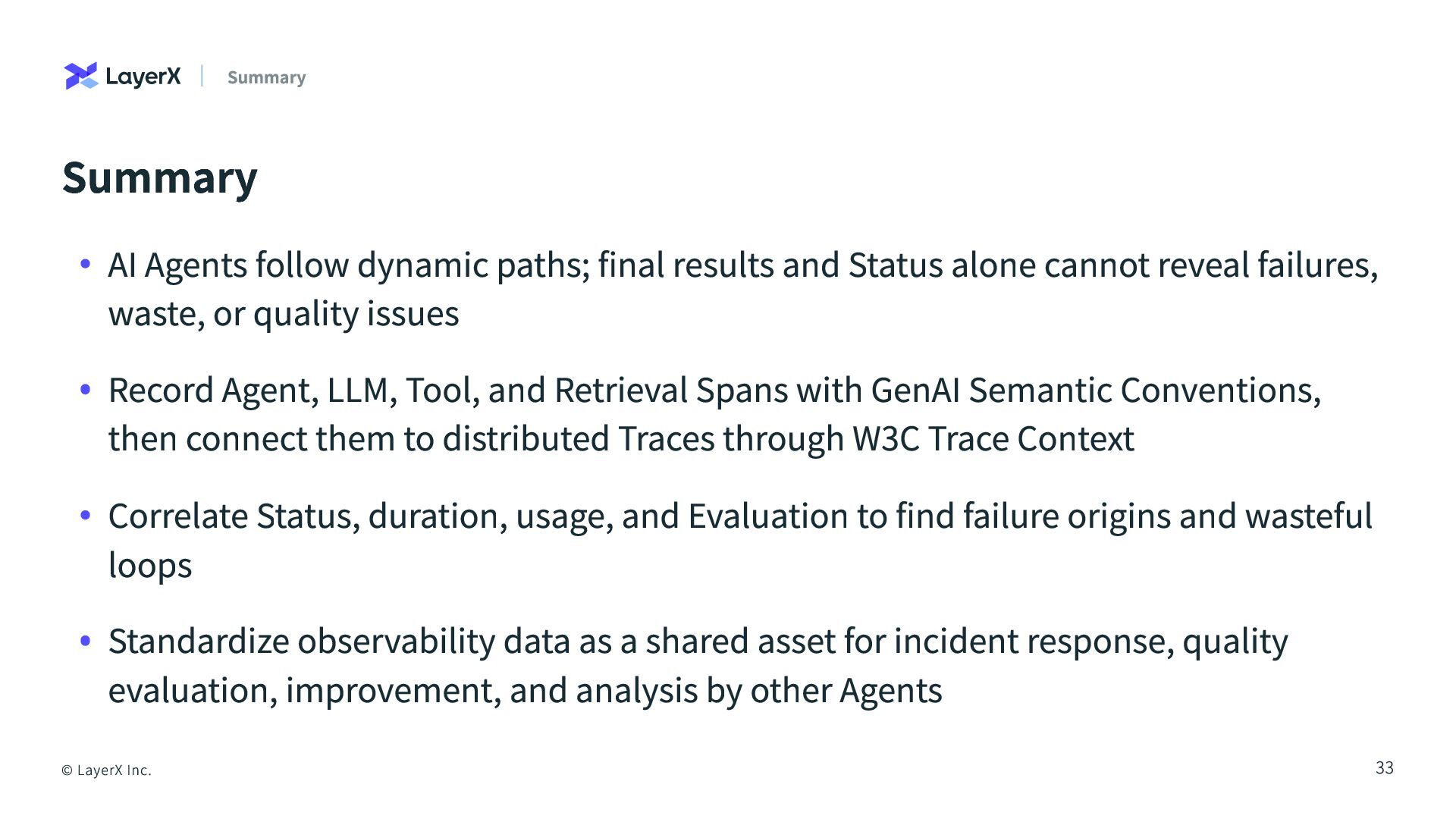
Summary Summary AI Agents follow dynamic paths; final results and
Status alone cannot reveal failures, waste, or quality issues Record Agent, LLM, Tool, and Retrieval Spans with GenAI Semantic Conventions, then connect them to distributed Traces through W3C Trace Context Correlate Status, duration, usage, and Evaluation to find failure origins and wasteful loops Standardize observability data as a shared asset for incident response, quality evaluation, improvement, and analysis by other Agents © LayerX Inc. 33
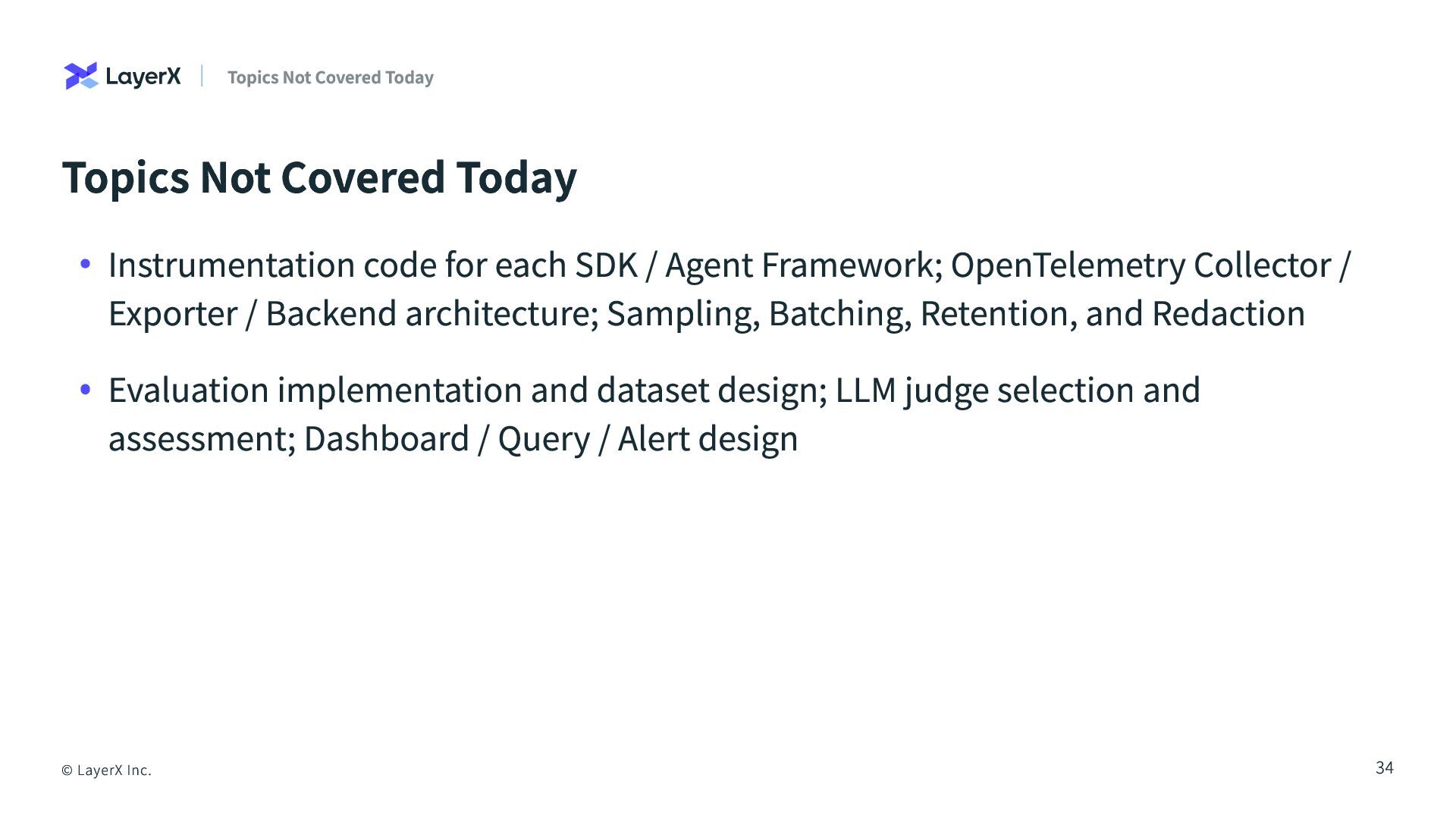
Topics Not Covered Today Topics Not Covered Today Instrumentation code
for each SDK / Agent Framework; OpenTelemetry Collector / Exporter / Backend architecture; Sampling, Batching, Retention, and Redaction Evaluation implementation and dataset design; LLM judge selection and assessment; Dashboard / Query / Alert design © LayerX Inc. 34
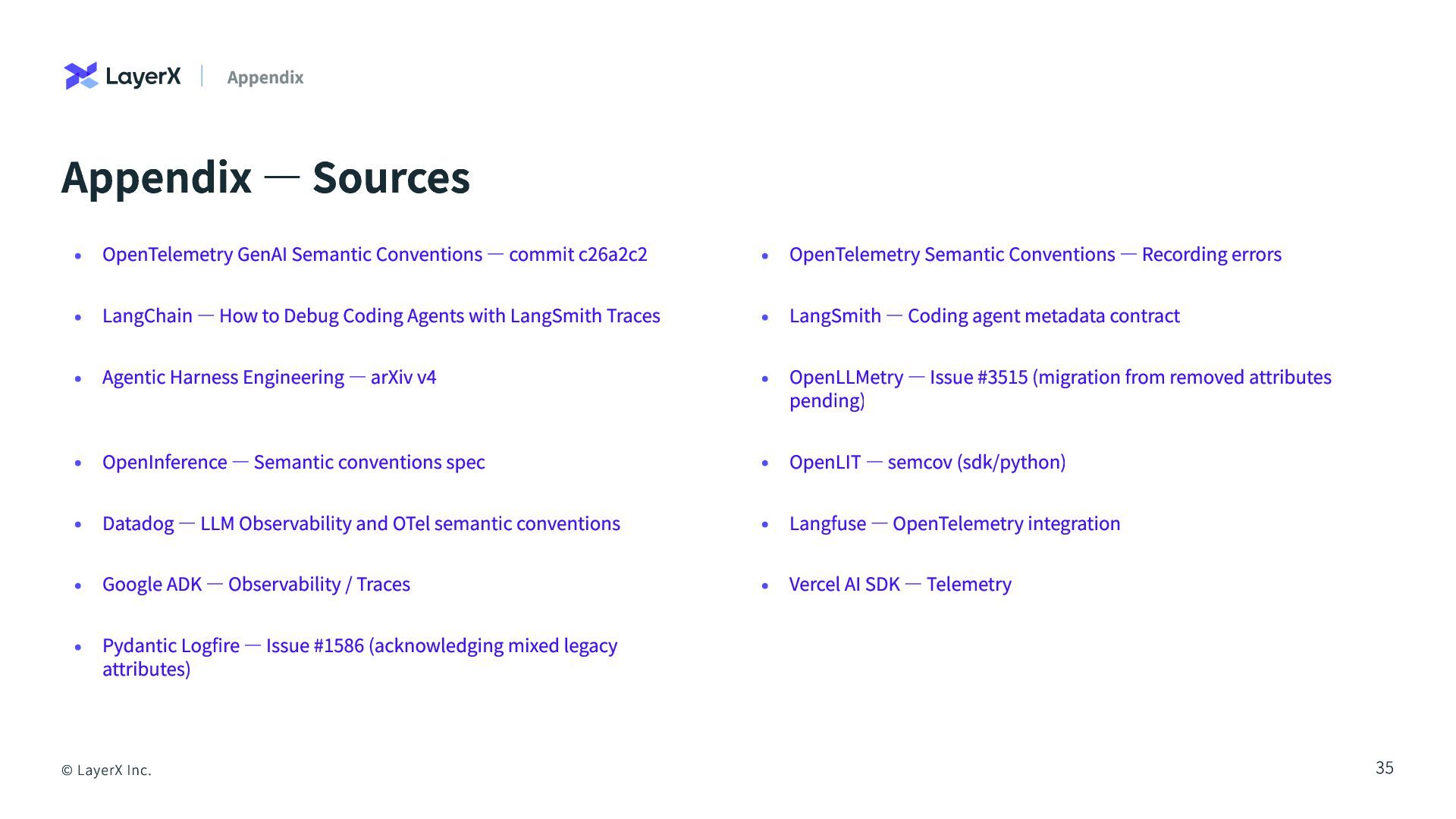
Appendix Appendix — Sources OpenTelemetry GenAI Semantic Conventions — commit
c26a2c2 OpenTelemetry Semantic Conventions — Recording errors LangChain — How to Debug Coding Agents with LangSmith Traces LangSmith — Coding agent metadata contract Agentic Harness Engineering — arXiv v4 OpenLLMetry — Issue #3515 (migration from removed attributes pending) OpenInference — Semantic conventions spec OpenLIT — semcov (sdk/python) Datadog — LLM Observability and OTel semantic conventions Langfuse — OpenTelemetry integration Google ADK — Observability / Traces Vercel AI SDK — Telemetry Pydantic Logfire — Issue #1586 (acknowledging mixed legacy attributes) © LayerX Inc. 35
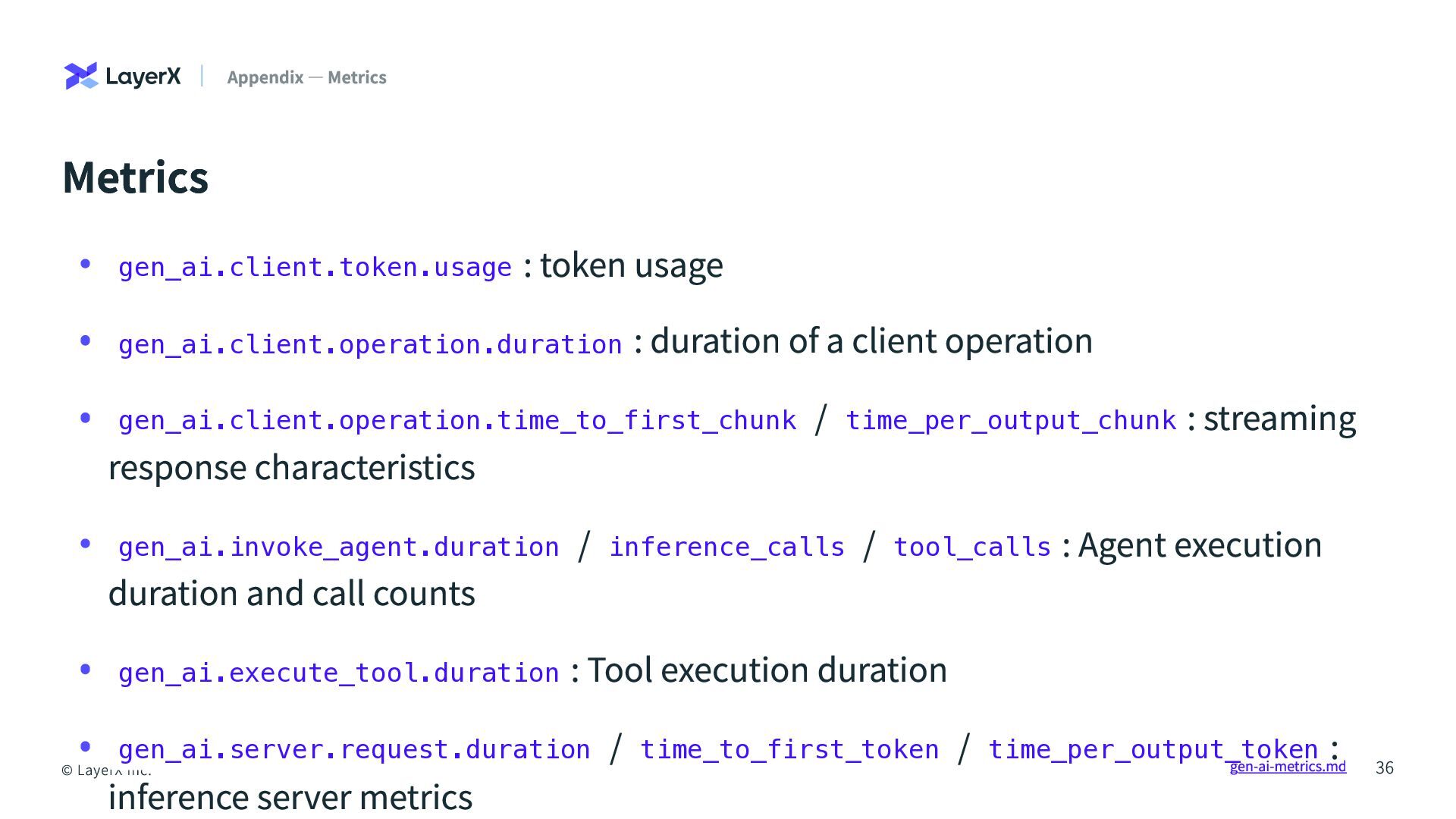
Appendix — Metrics Metrics : token usage gen_ai.client.operation.duration : duration
of a client operation gen_ai.client.operation.time_to_first_chunk / time_per_output_chunk : streaming response characteristics gen_ai.invoke_agent.duration / inference_calls / tool_calls : Agent execution duration and call counts gen_ai.execute_tool.duration : Tool execution duration gen_ai.server.request.duration / time_to_first_token / time_per_output_token : 36 gen-ai-metrics.md © LayerX Inc. inference server metrics gen_ai.client.token.usage
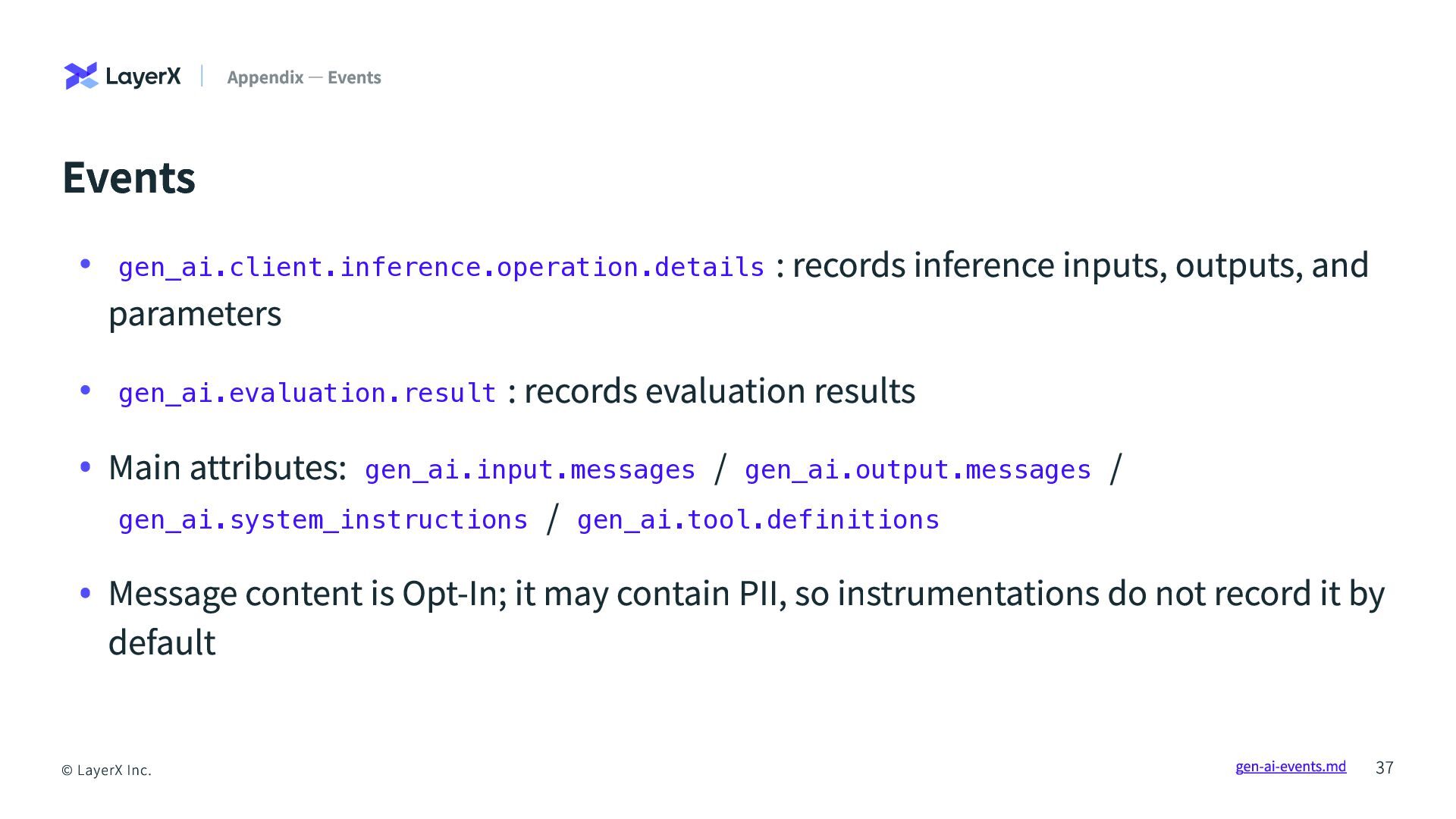
Appendix — Events Events gen_ai.client.inference.operation.details parameters : records inference inputs,
outputs, and : records evaluation results Main attributes: gen_ai.input.messages / gen_ai.output.messages / gen_ai.system_instructions / gen_ai.tool.definitions Message content is Opt-In; it may contain PII, so instrumentations do not record it by default gen_ai.evaluation.result © LayerX Inc. gen-ai-events.md 37
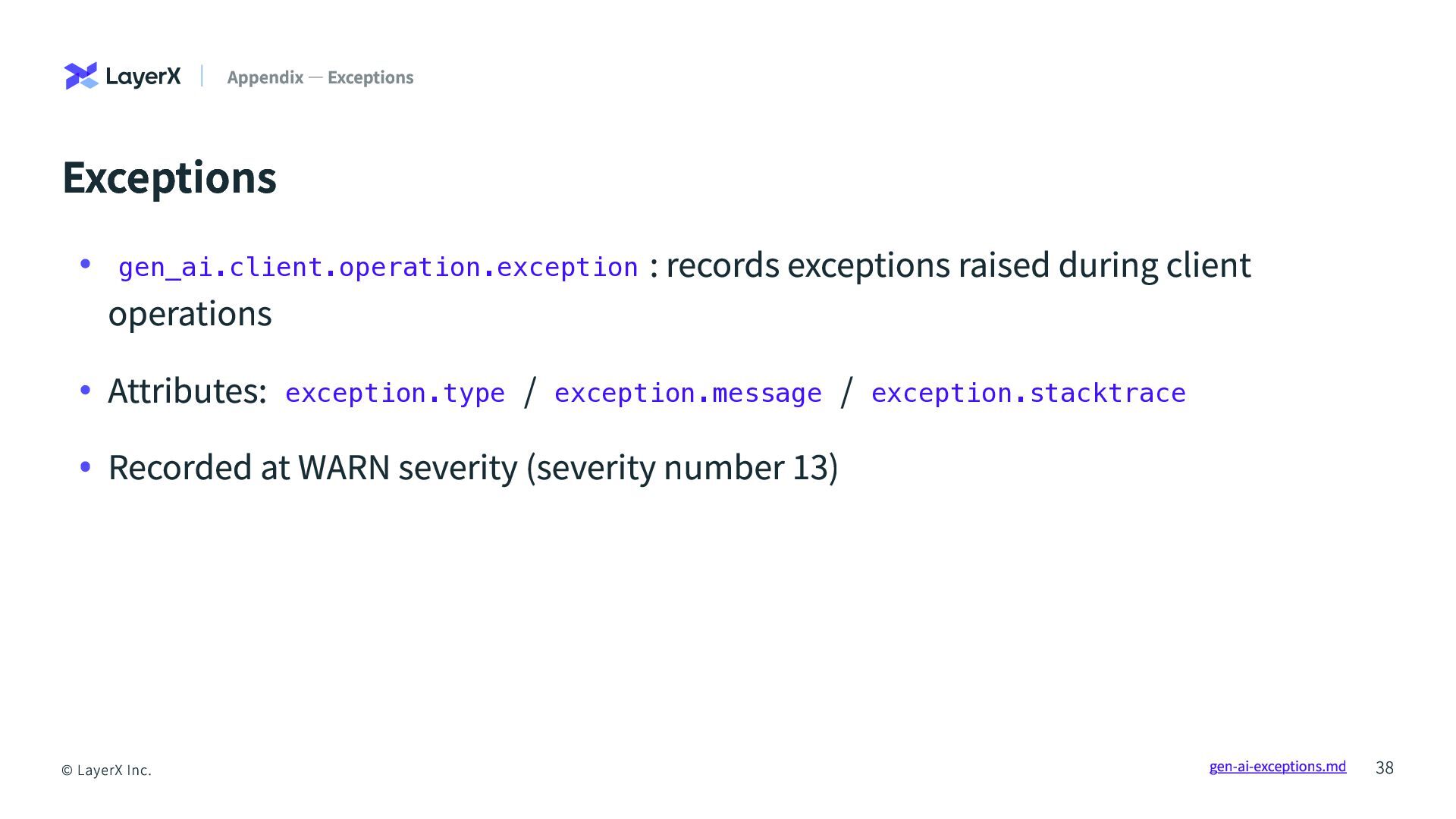
Appendix — Exceptions Exceptions gen_ai.client.operation.exception : records exceptions raised during
client operations Attributes: exception.type / exception.message / exception.stacktrace Recorded at WARN severity (severity number 13) © LayerX Inc. gen-ai-exceptions.md 38


 yuzujoe
 morganepeng
 inesmontani
 quramy
 gurzu
gurzu
 nikkihalliwell
 baasie
 kevinliebholz
 eileencodes
 lara
lara
 mza
mza
 aleyda
 holman