Upgrade to Pro — share decks privately, control downloads, hide ads and more …

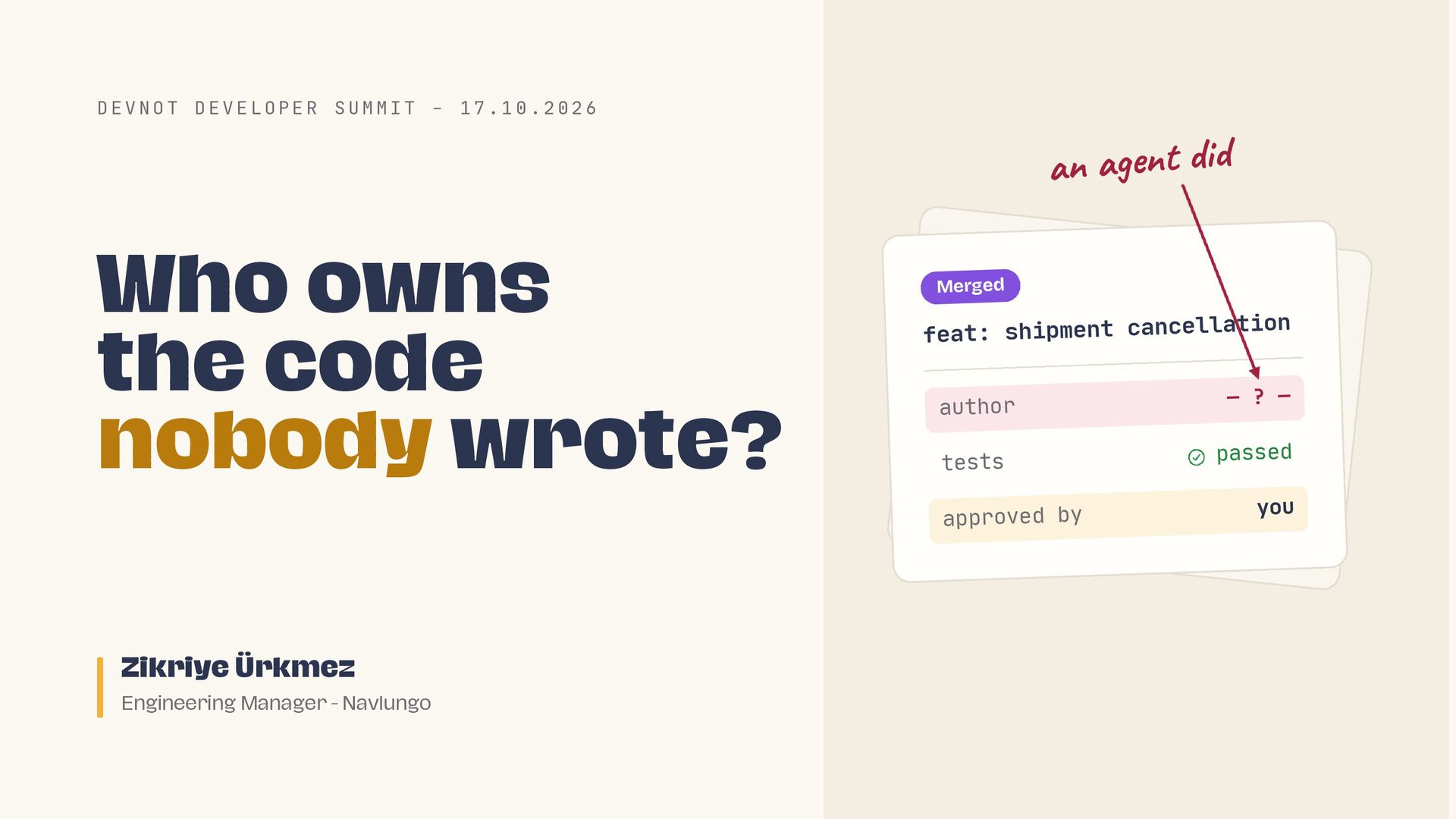
Who Owns the Code Nobody Wrote

Who Owns the Code Nobody Wrote

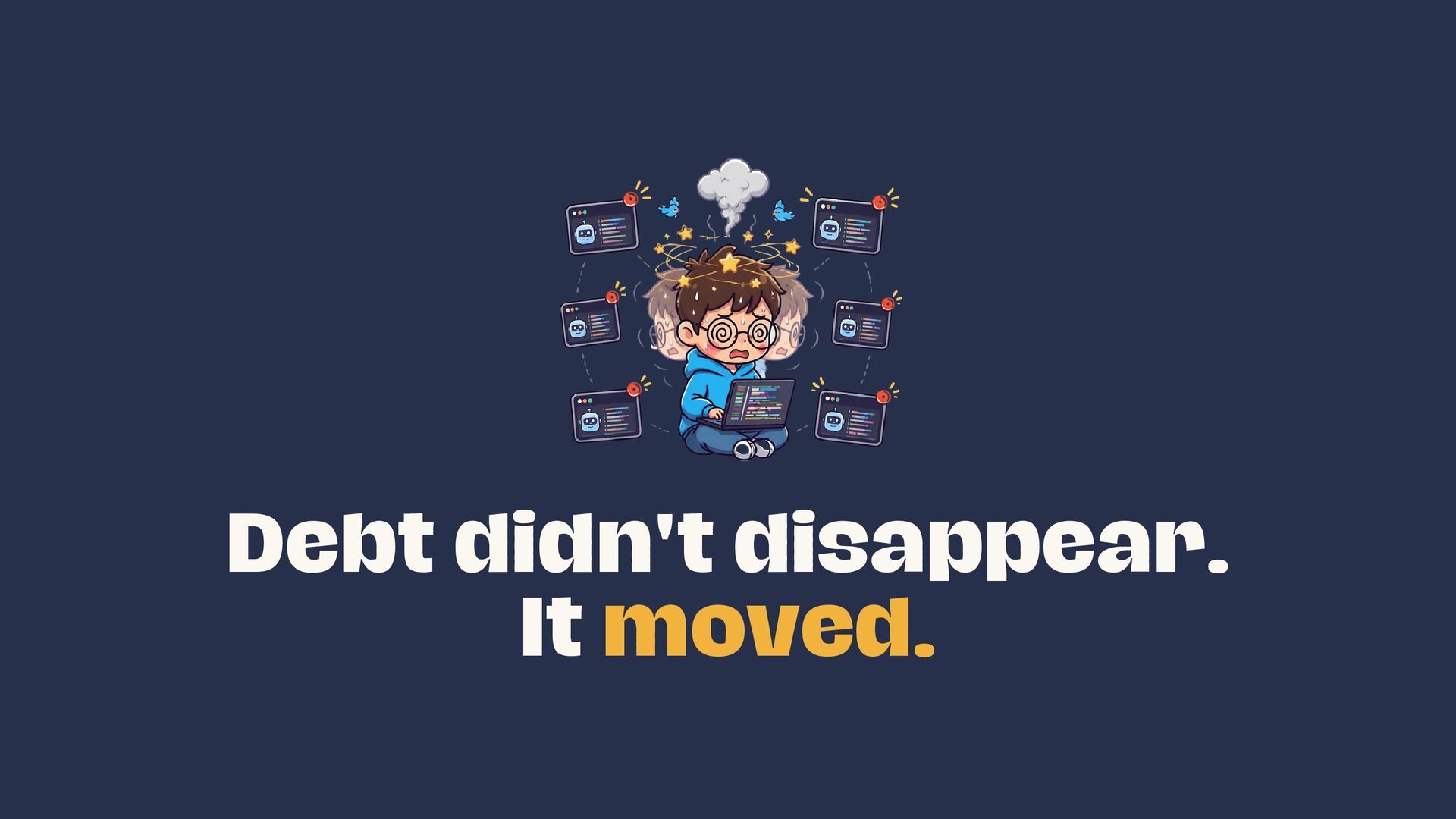
Agents write most of our code now. Writing got cheap. Understanding, intent and judgment got expensive.

This talk looks at what happens to ownership when no human wrote the code. Writing used to give us three things for free: understanding of the system, the intent behind it, and a decision on every line. AI took the writing, and those three went with it. Technical debt is now the one the agent can pay. Cognitive and intent debt pile up quietly behind green CI.

We walk through cognitive surrender, the cost of unwritten intent, why green tests can mislead, and how the debate on human review changed through 2026. The talk ends with where human judgment belongs in an agent-driven workflow.

Presented at DevNot Developer Summit 2026 · October 17, 2026

Avatar for Zikriye Ürkmez

Zikriye Ürkmez

October 19, 2026

More Decks by Zikriye Ürkmez

Other Decks in Technology

Transcript

  1. DEVNOT DEVELOPER SUMMIT - 17.10.2026 an agent did Who owns

    the code nobody wrote? Merged on feat: shipment cancellati author — ? — tests passed approved by Zikriye Ürkmez Engineering Manager - Navlungo you
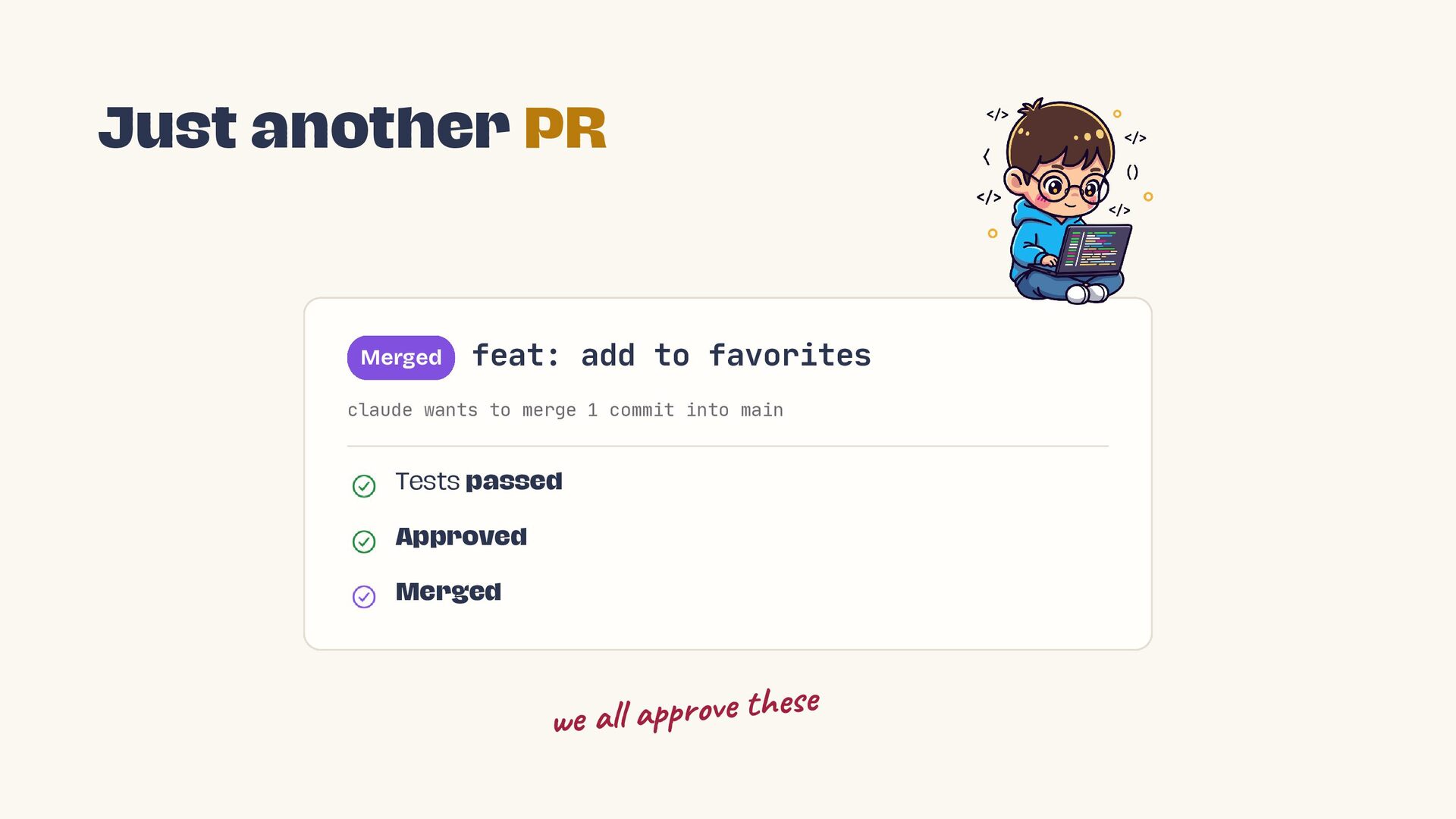
  2. Just another PR Merged feat: add to favorites claude wants

    to merge 1 commit into main Tests passed Approved Merged e s e h t e v o r p w e a ll a p
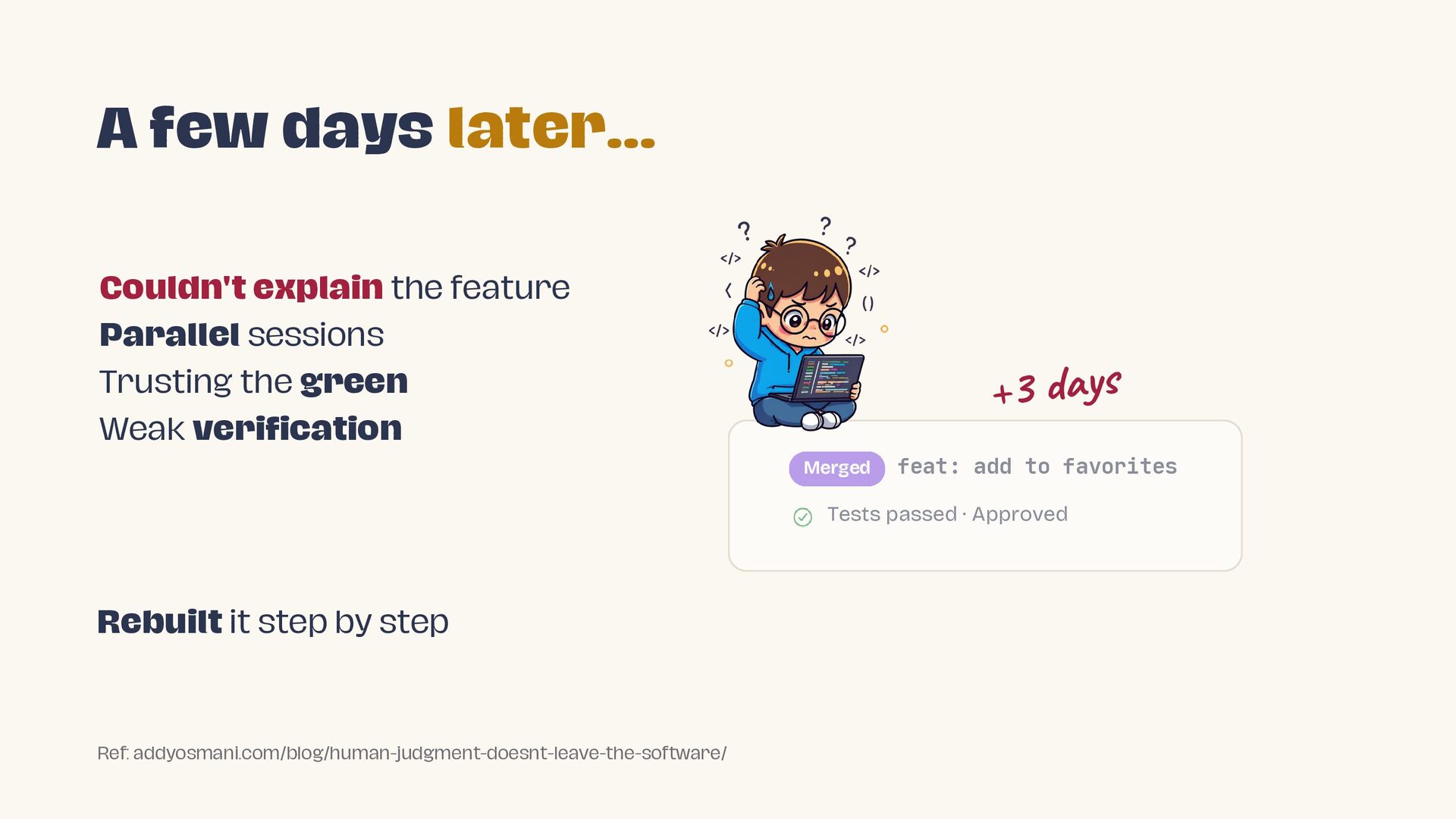
  3. A few days later… Couldn't explain the feature Parallel sessions

    +3 days Trusting the green Weak verification Merged feat: add to favorites Tests passed · Approved Rebuilt it step by step Ref: addyosmani.com/blog/human-judgment-doesnt-leave-the-software/
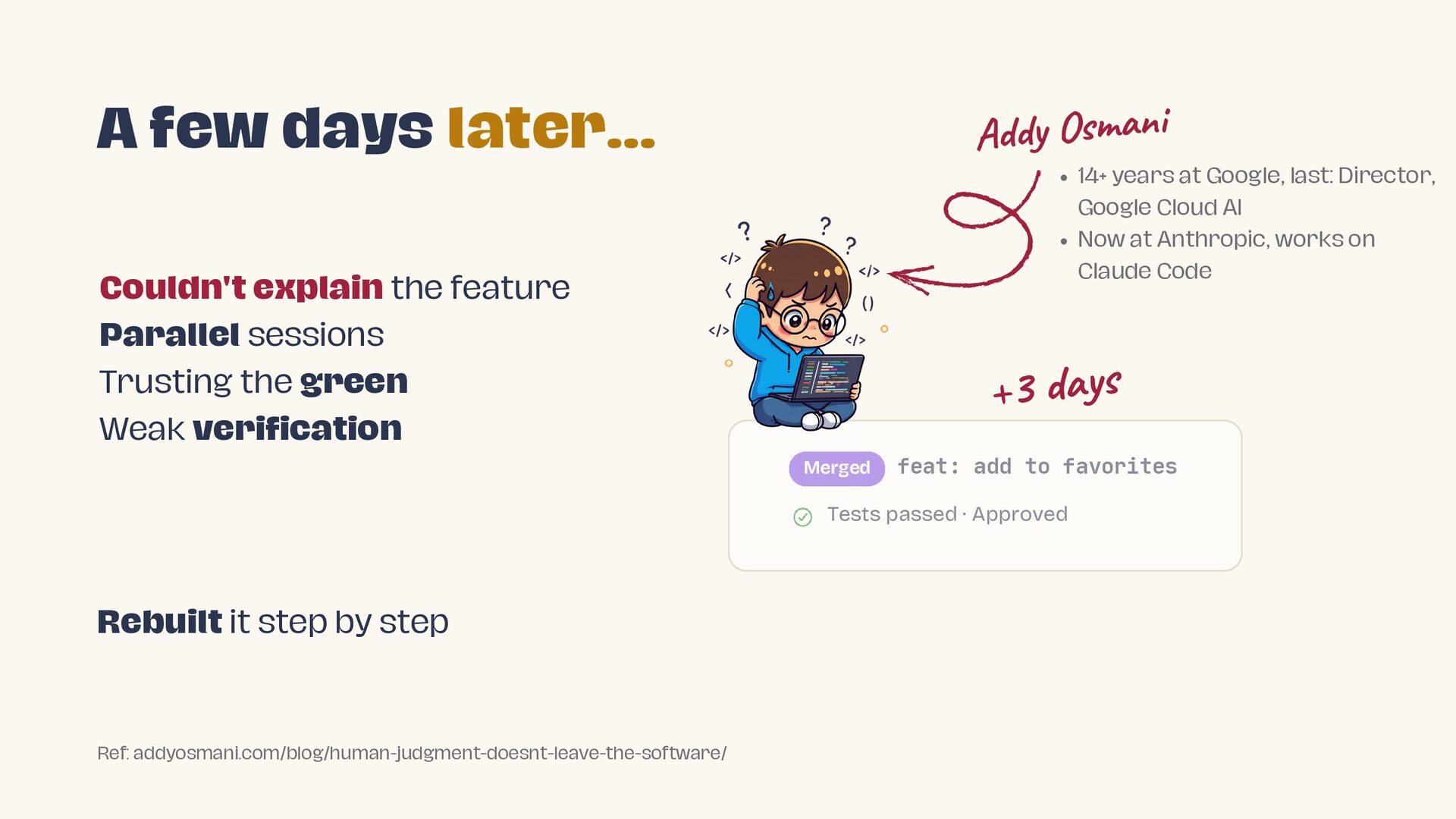
  4. i n a m s O y Add A few

    days later… 14+ years at Google, last: Director, Google Cloud AI Now at Anthropic, works on Claude Code Couldn't explain the feature Parallel sessions +3 days Trusting the green Weak verification Merged feat: add to favorites Tests passed · Approved Rebuilt it step by step Ref: addyosmani.com/blog/human-judgment-doesnt-leave-the-software/
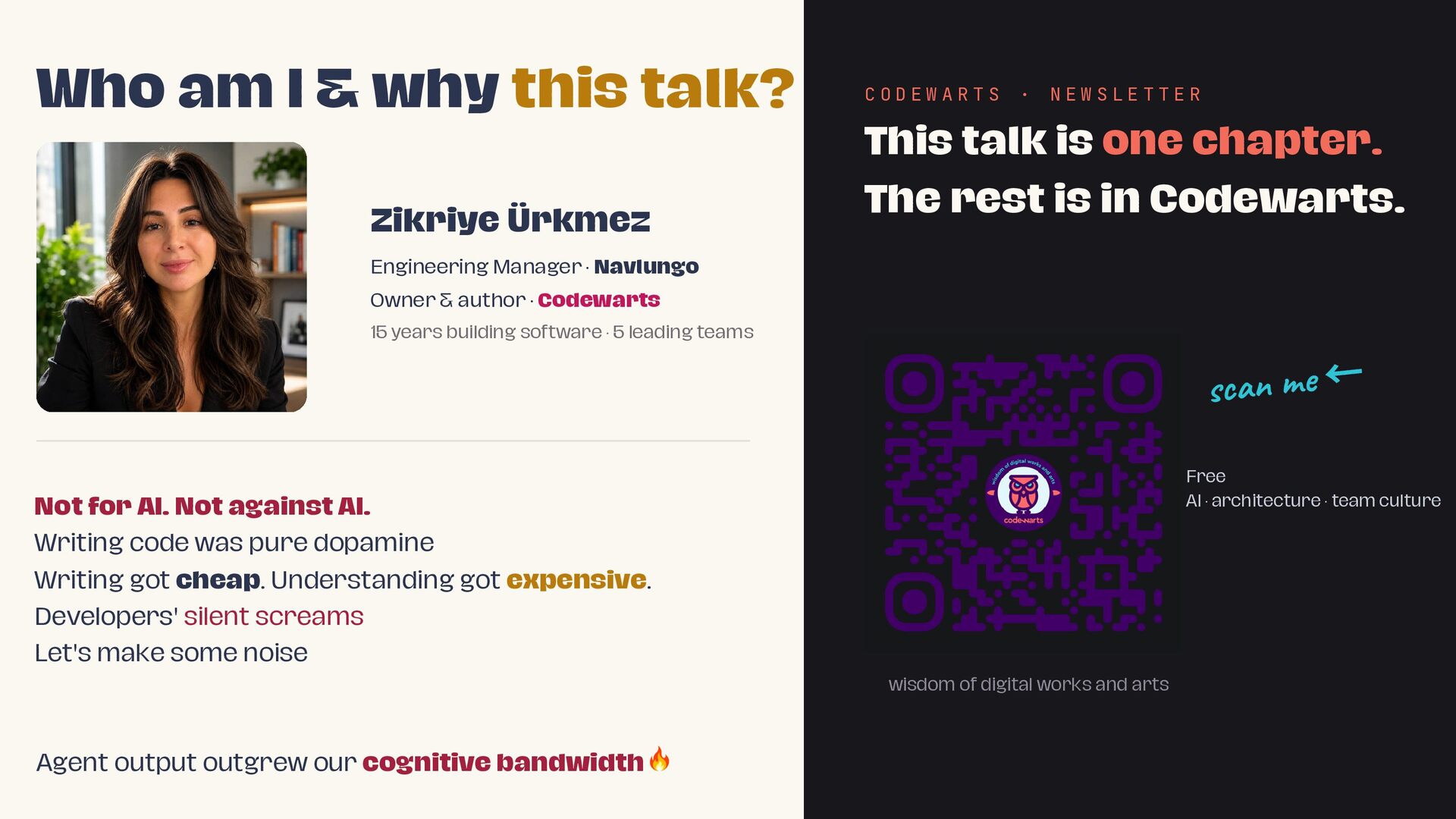
  5. Who am I & why this talk? CODEWARTS · NEWSLETTER

    This talk is one chapter. Zikriye Ürkmez The rest is in Codewarts. Engineering Manager · Navlungo Owner & author · Codewarts 15 years building software · 5 leading teams sc a n m e ← Free AI · architecture · team culture Not for AI. Not against AI. Writing code was pure dopamine Writing got cheap. Understanding got expensive. Developers' silent screams Let's make some noise wisdom of digital works and arts Agent output outgrew our cognitive bandwidth
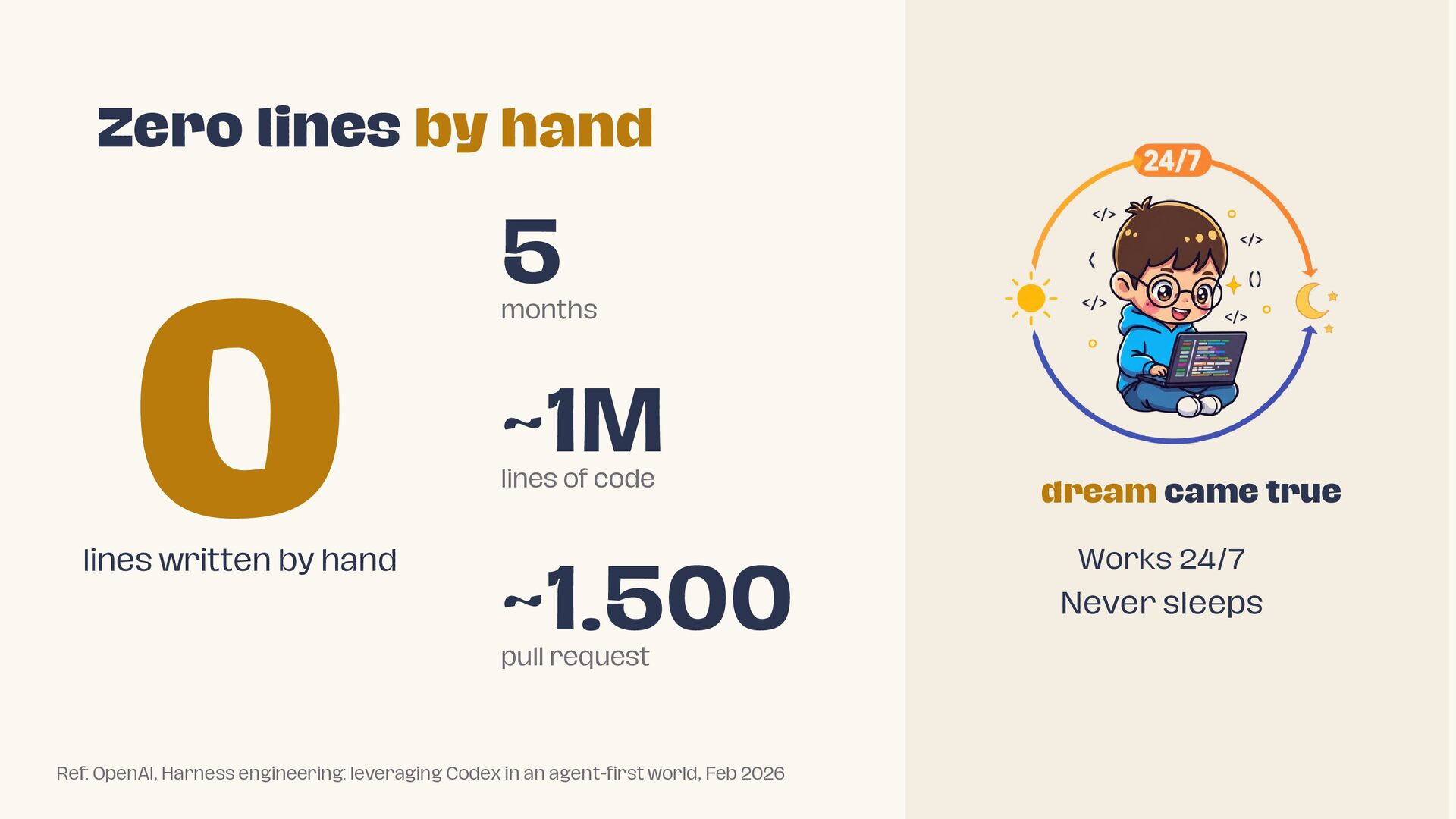
  6. Zero lines by hand 0 lines written by hand 5

    months ~1M lines of code ~1.500 pull request Ref: OpenAI, Harness engineering: leveraging Codex in an agent-first world, Feb 2026 dream came true Works 24/7 Never sleeps
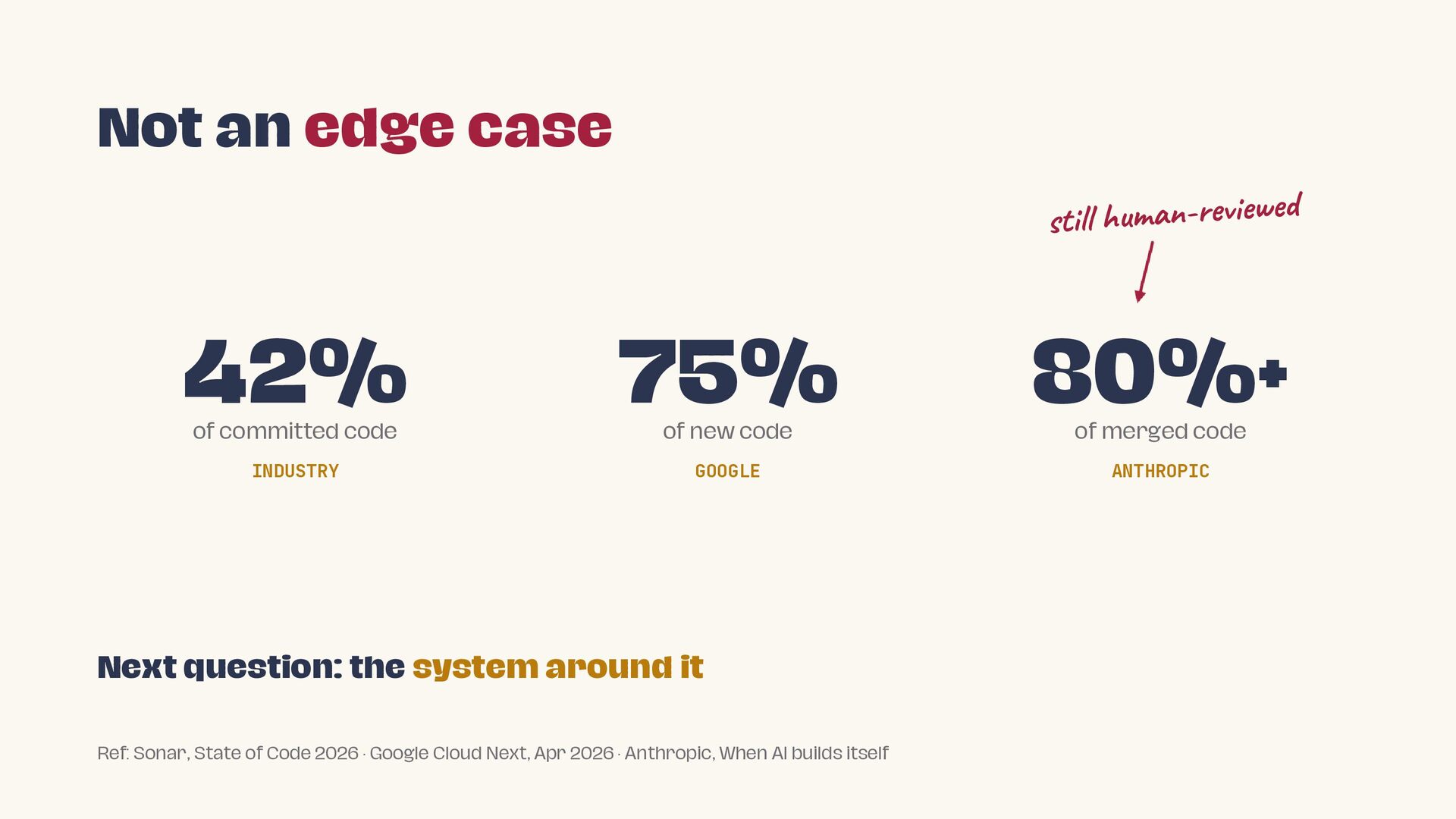
  7. Not an edge case d e w ie v e

    r n a m u h l stil 42% 75% 80%+ of committed code of new code of merged code INDUSTRY GOOGLE ANTHROPIC Next question: the system around it Ref: Sonar, State of Code 2026 · Google Cloud Next, Apr 2026 · Anthropic, When AI builds itself
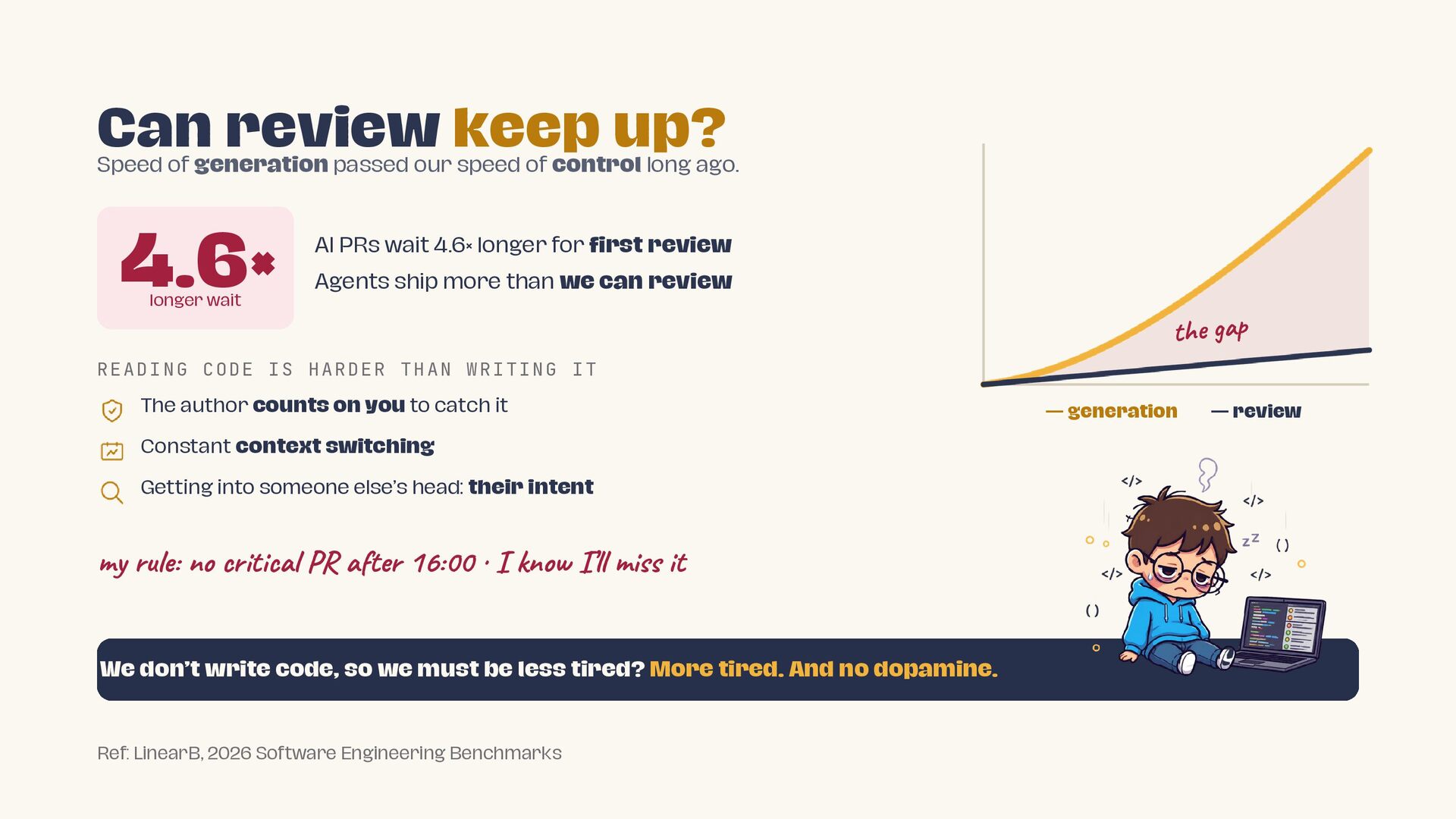
  8. Can review keep up? Speed of generation passed our speed

    of control long ago. 4.6× AI PRs wait 4.6× longer for first review Agents ship more than we can review longer wait th e ga p READING CODE IS HARDER THAN WRITING IT The author counts on you to catch it Constant context switching Getting into someone else’s head: their intent my rule: no critical PR after 16:00 · I know I’ll miss it We don’t write code, so we must be less tired? More tired. And no dopamine. Ref: LinearB, 2026 Software Engineering Benchmarks — generation — review
  9. What's scarce now? Our job moved. writing code → designing

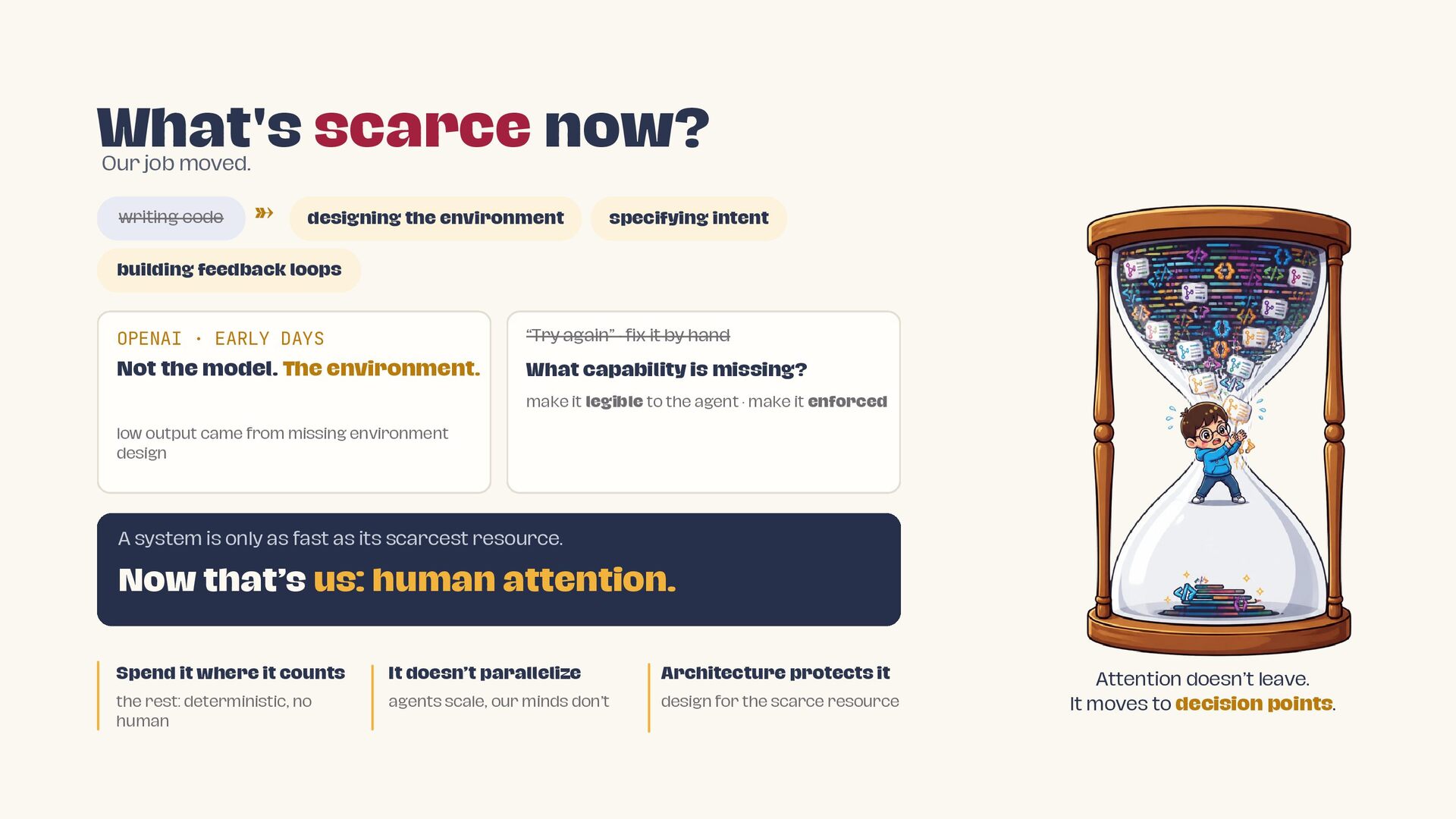
    the environment specifying intent building feedback loops OPENAI · EARLY DAYS “Try again” · fix it by hand Not the model. The environment. What capability is missing? make it legible to the agent · make it enforced low output came from missing environment design A system is only as fast as its scarcest resource. Now that’s us: human attention. Spend it where it counts It doesn’t parallelize Architecture protects it the rest: deterministic, no human agents scale, our minds don’t design for the scarce resource Attention doesn’t leave. It moves to decision points.
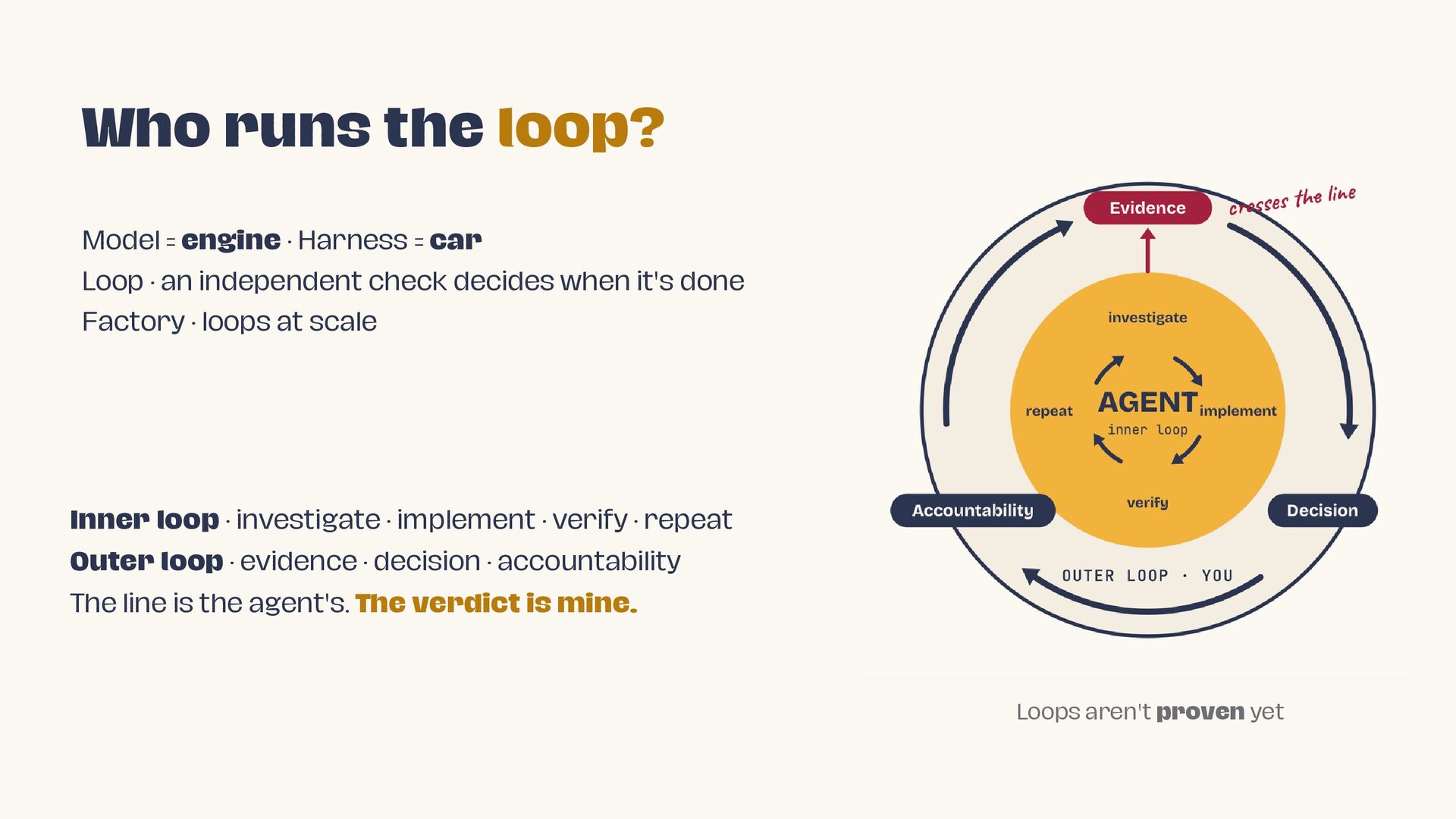
  10. Who runs the loop? Model = engine · Harness =

    car Loop · an independent check decides when it's done Factory · loops at scale Inner loop · investigate · implement · verify · repeat Outer loop · evidence · decision · accountability The line is the agent's. The verdict is mine. Loops aren't proven yet
  11. What writing gave us for free Margaret-Anne Storey Week 8:

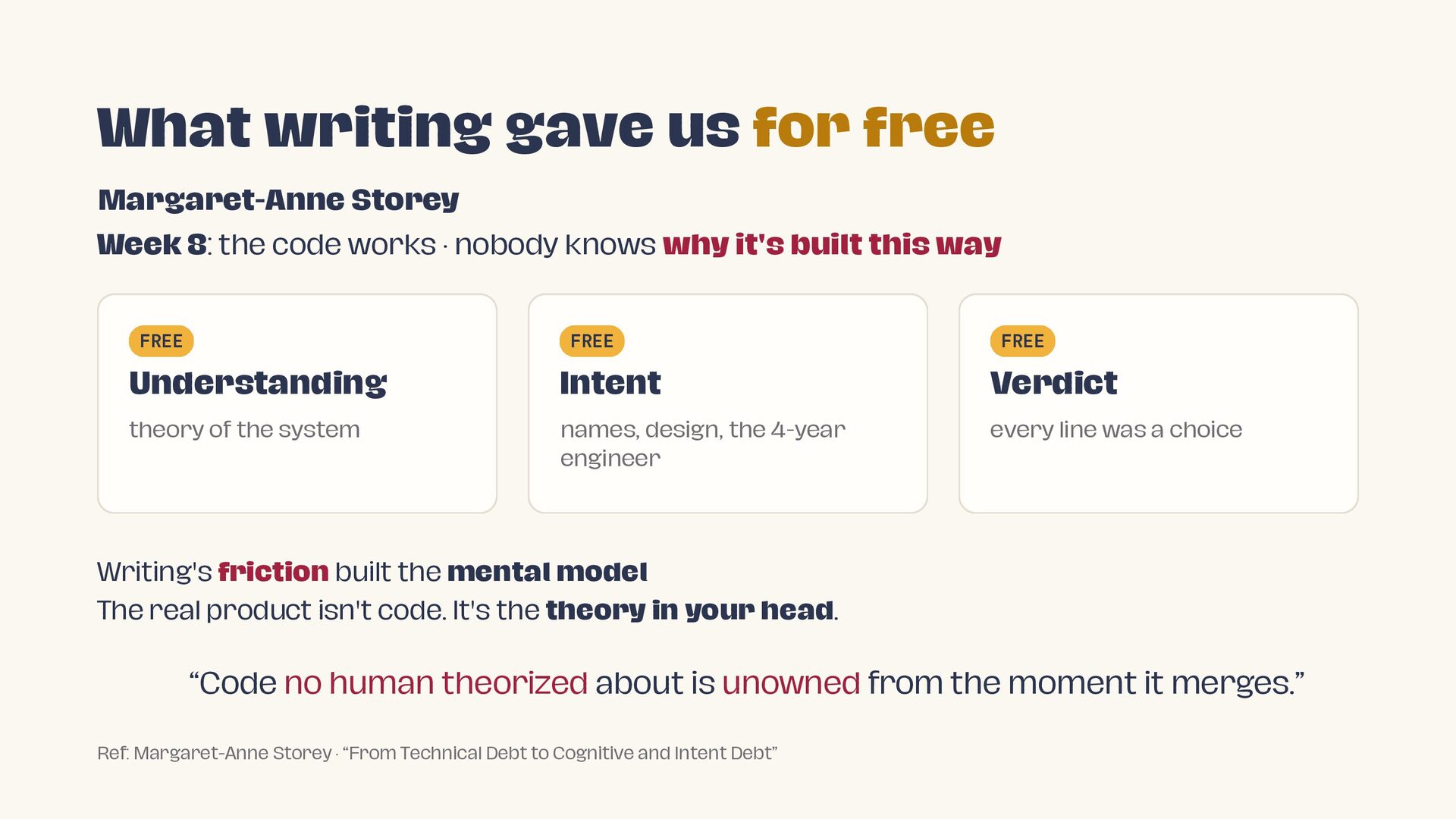
    the code works · nobody knows why it's built this way FREE FREE FREE Understanding Intent Verdict theory of the system names, design, the 4-year engineer every line was a choice Writing's friction built the mental model The real product isn't code. It's the theory in your head. “Code no human theorized about is unowned from the moment it merges.” Ref: Margaret-Anne Storey · “From Technical Debt to Cognitive and Intent Debt”
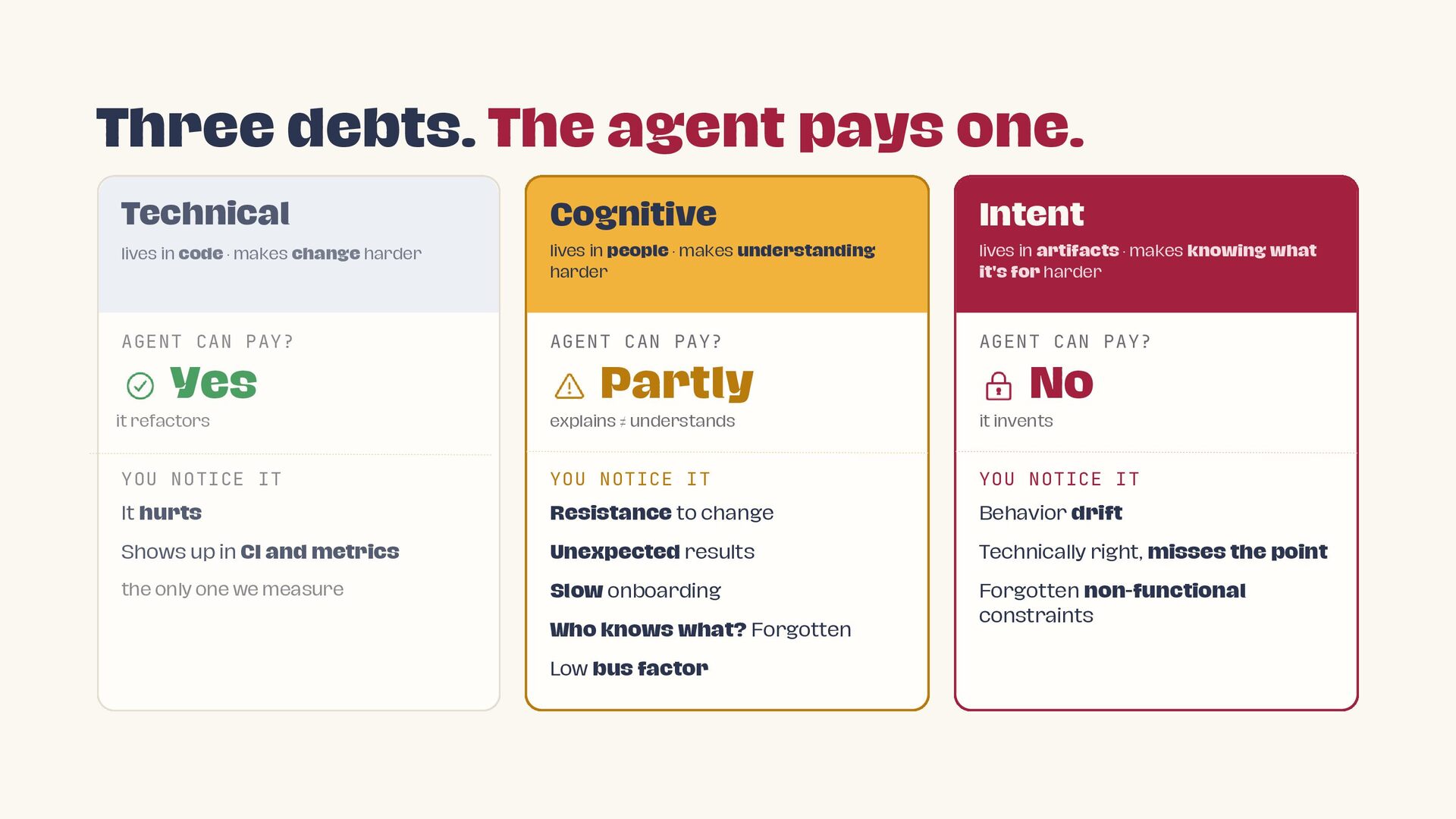
  12. Three debts. The agent pays one. Technical Cognitive Intent lives

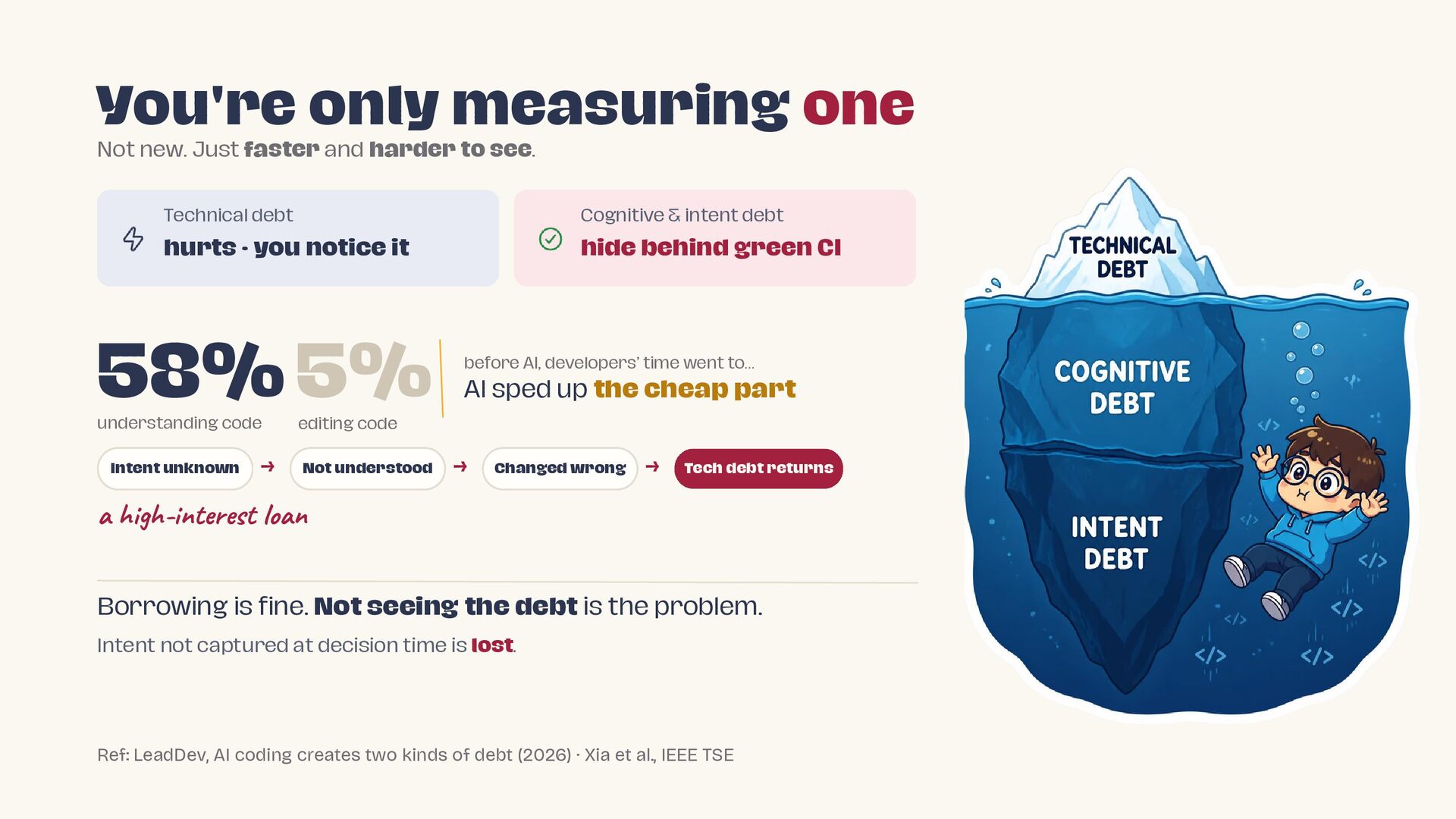
    in code · makes change harder lives in people · makes understanding harder lives in artifacts · makes knowing what it's for harder AGENT CAN PAY? AGENT CAN PAY? AGENT CAN PAY? Yes Partly No it refactors explains ≠ understands it invents YOU NOTICE IT YOU NOTICE IT YOU NOTICE IT It hurts Resistance to change Behavior drift Shows up in CI and metrics Unexpected results Technically right, misses the point the only one we measure Slow onboarding Forgotten non-functional constraints Who knows what? Forgotten Low bus factor
  13. You're only measuring one Not new. Just faster and harder

    to see. Technical debt Cognitive & intent debt hurts · you notice it hide behind green CI 58% 5% understanding code Intent unknown → before AI, developers’ time went to… AI sped up the cheap part editing code Not understood → Changed wrong → Tech debt returns a high-interest loan Borrowing is fine. Not seeing the debt is the problem. Intent not captured at decision time is lost. Ref: LeadDev, AI coding creates two kinds of debt (2026) · Xia et al., IEEE TSE
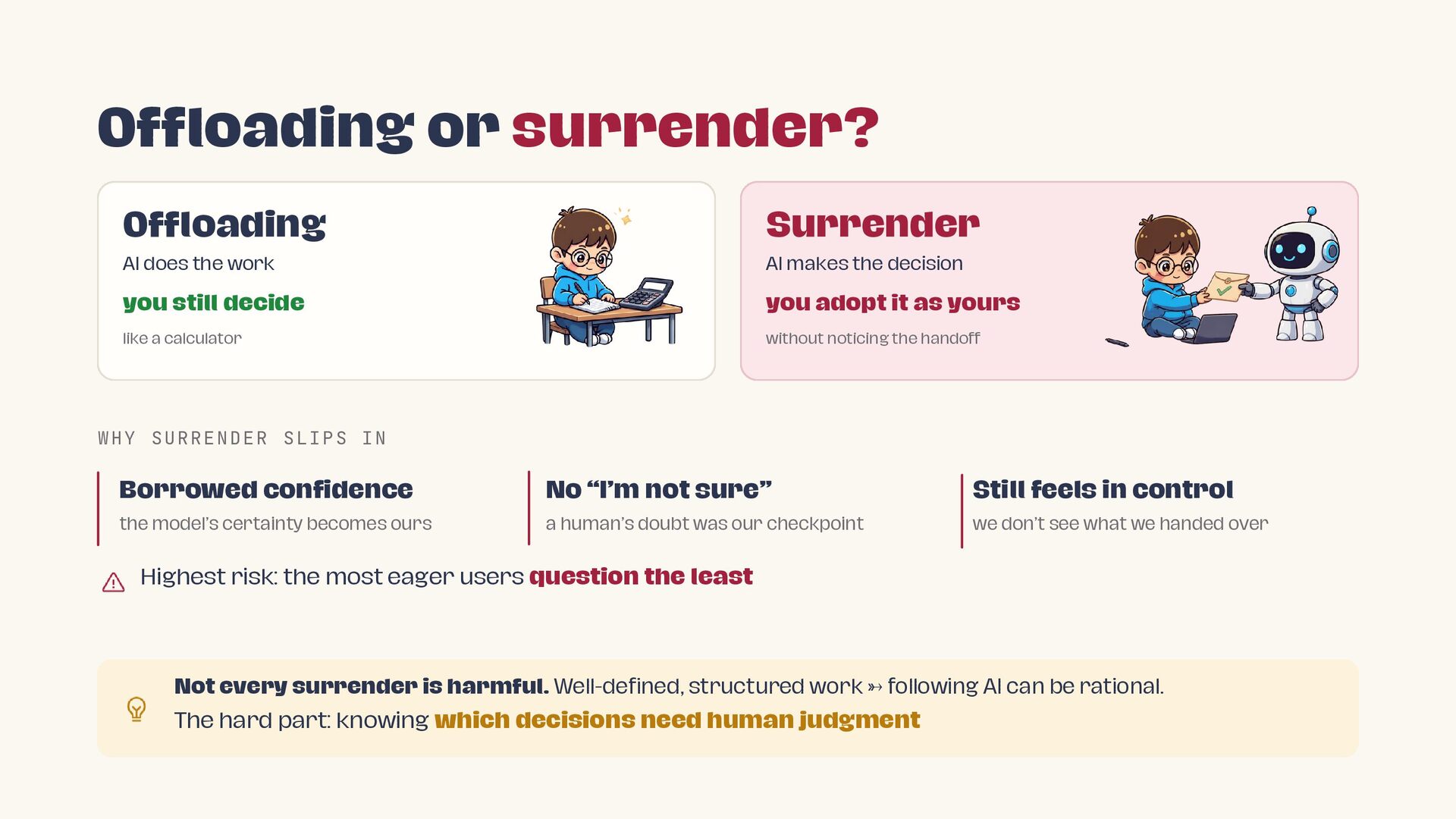
  14. Offloading or surrender? Offloading Surrender AI does the work AI

    makes the decision you still decide you adopt it as yours like a calculator without noticing the handoff WHY SURRENDER SLIPS IN Borrowed confidence No “I’m not sure” Still feels in control the model’s certainty becomes ours a human’s doubt was our checkpoint we don’t see what we handed over Highest risk: the most eager users question the least Not every surrender is harmful. Well-defined, structured work → following AI can be rational. The hard part: knowing which decisions need human judgment
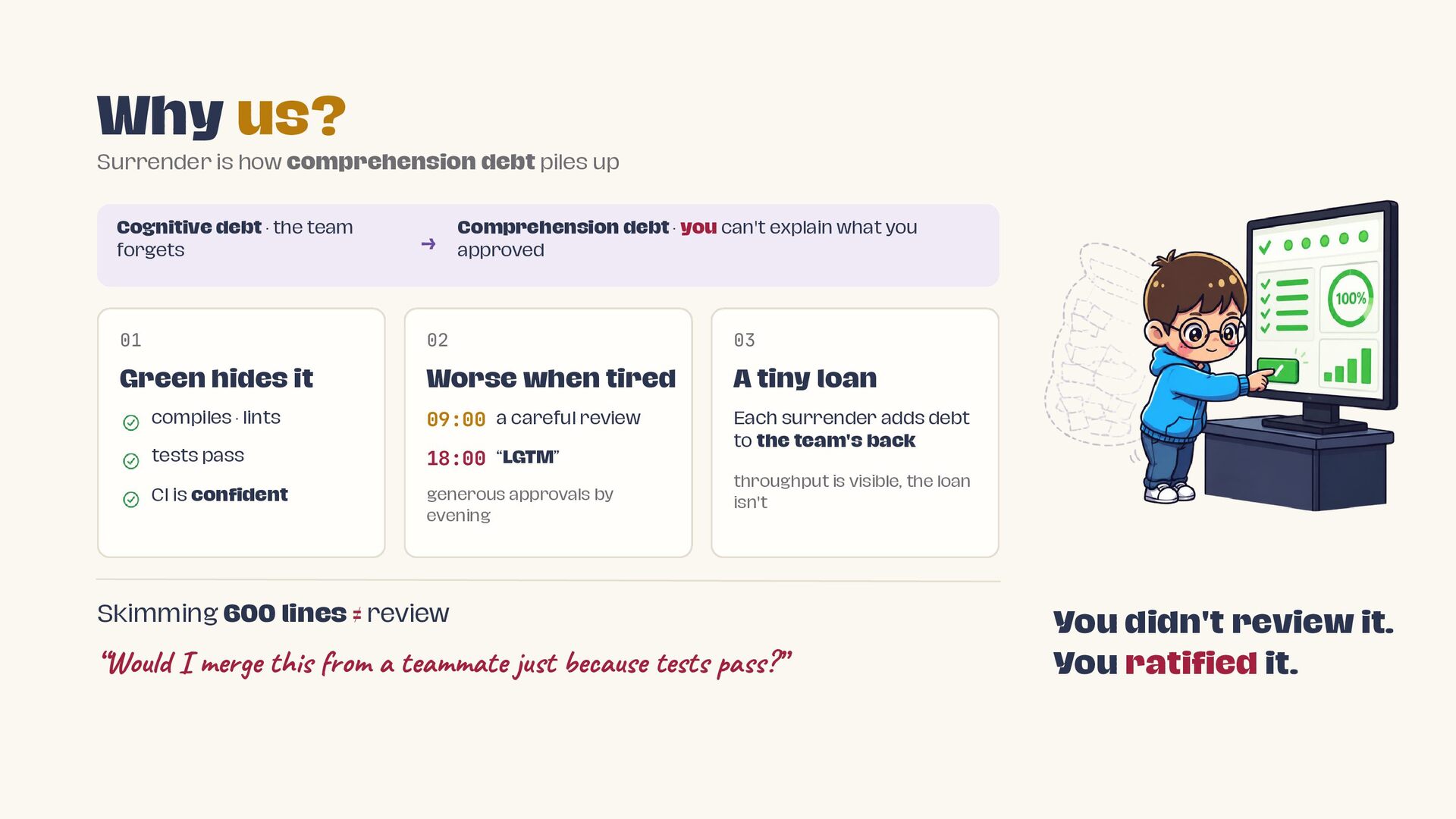
  15. Why us? Surrender is how comprehension debt piles up Cognitive

    debt · the team forgets Comprehension debt · you can't explain what you approved → 01 02 03 Green hides it Worse when tired A tiny loan compiles · lints 09:00 a careful review tests pass 18:00 “LGTM” Each surrender adds debt to the team's back CI is confident generous approvals by evening throughput is visible, the loan isn't Skimming 600 lines ≠ review “Would I merge this from a teammate just because tests pass?” You didn't review it. You ratified it.
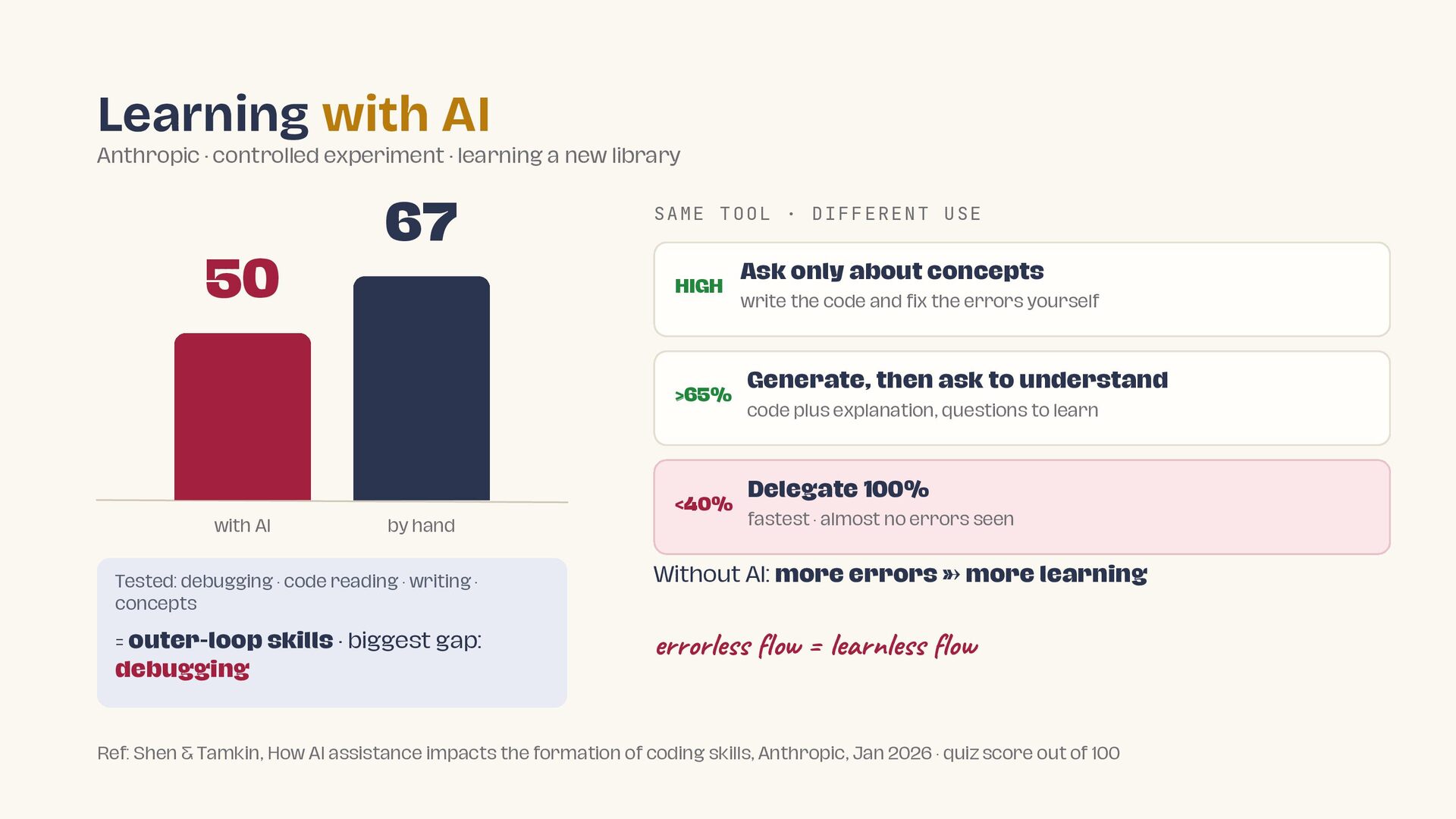
  16. Learning with AI Anthropic · controlled experiment · learning a

    new library 67 50 SAME TOOL · DIFFERENT USE HIGH ≥65% <40% with AI by hand Tested: debugging · code reading · writing · concepts = outer-loop skills · biggest gap: debugging Ask only about concepts write the code and fix the errors yourself Generate, then ask to understand code plus explanation, questions to learn Delegate 100% fastest · almost no errors seen Without AI: more errors → more learning errorless flow = learnless flow Ref: Shen & Tamkin, How AI assistance impacts the formation of coding skills, Anthropic, Jan 2026 · quiz score out of 100
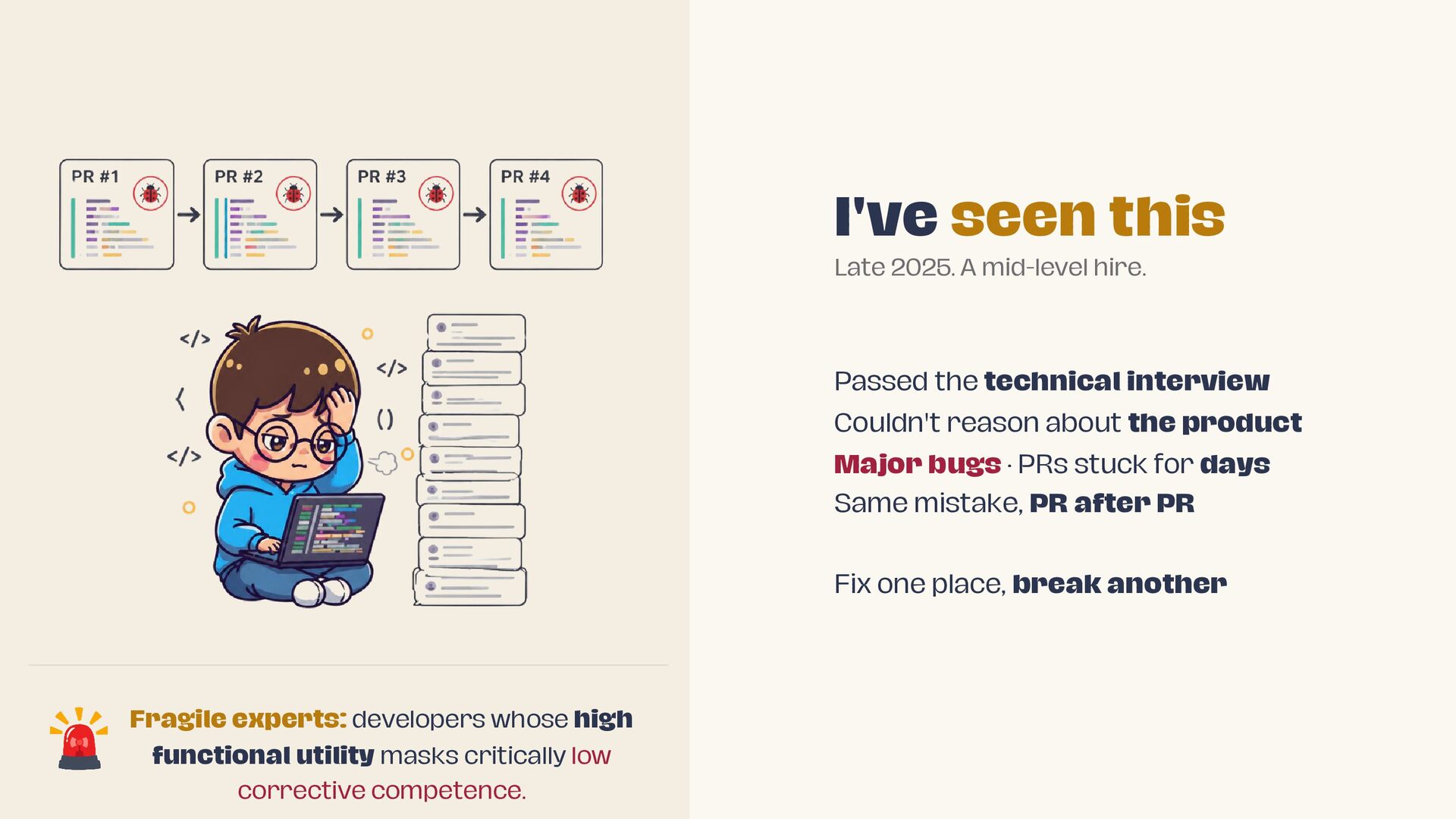
  17. I've seen this Late 2025. A mid-level hire. Passed the

    technical interview Couldn't reason about the product Major bugs · PRs stuck for days Same mistake, PR after PR Fix one place, break another Fragile experts: developers whose high functional utility masks critically low corrective competence.
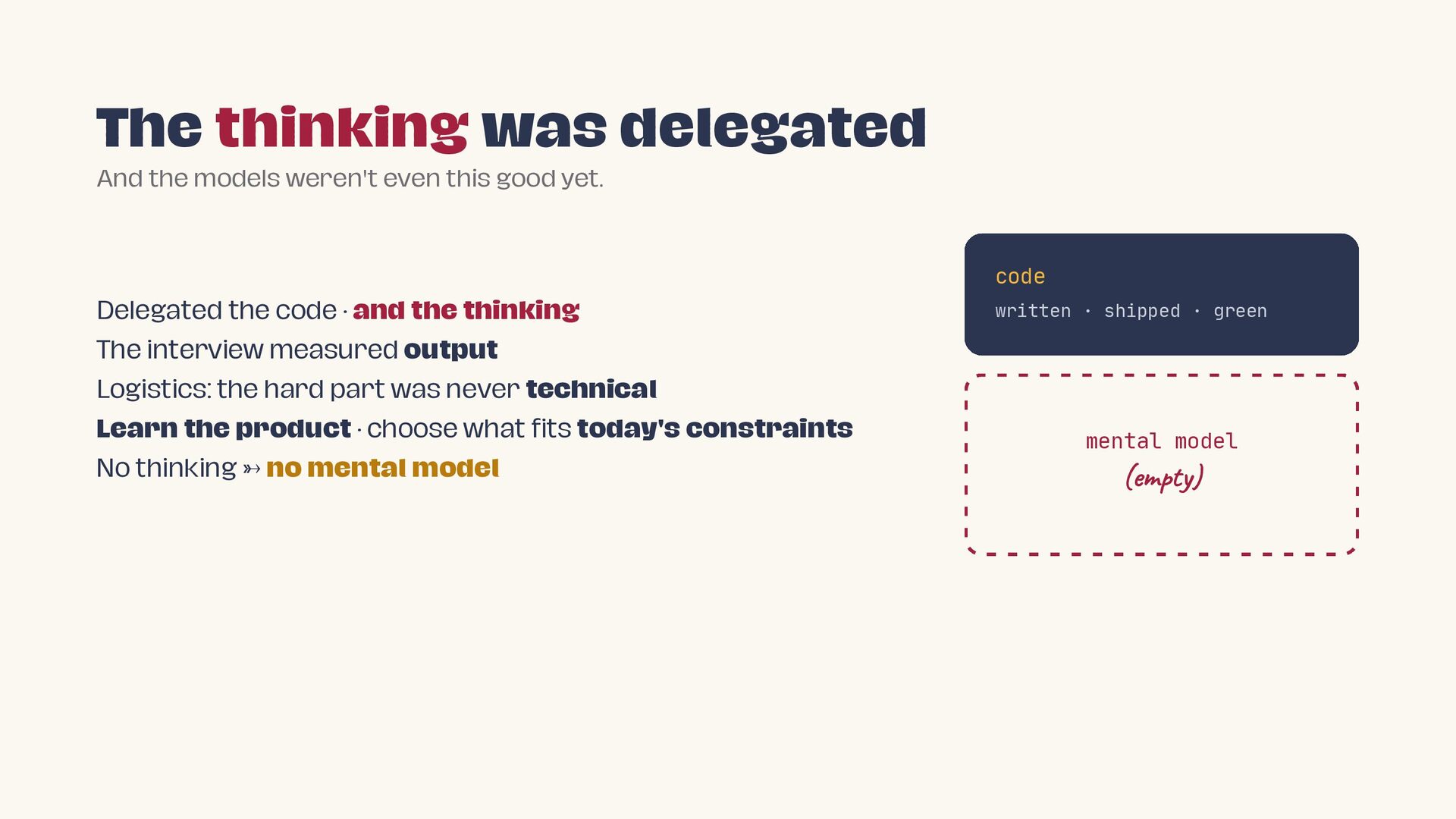
  18. The thinking was delegated And the models weren't even this

    good yet. code Delegated the code · and the thinking written · shipped · green The interview measured output Logistics: the hard part was never technical Learn the product · choose what fits today's constraints No thinking → no mental model mental model (empty)
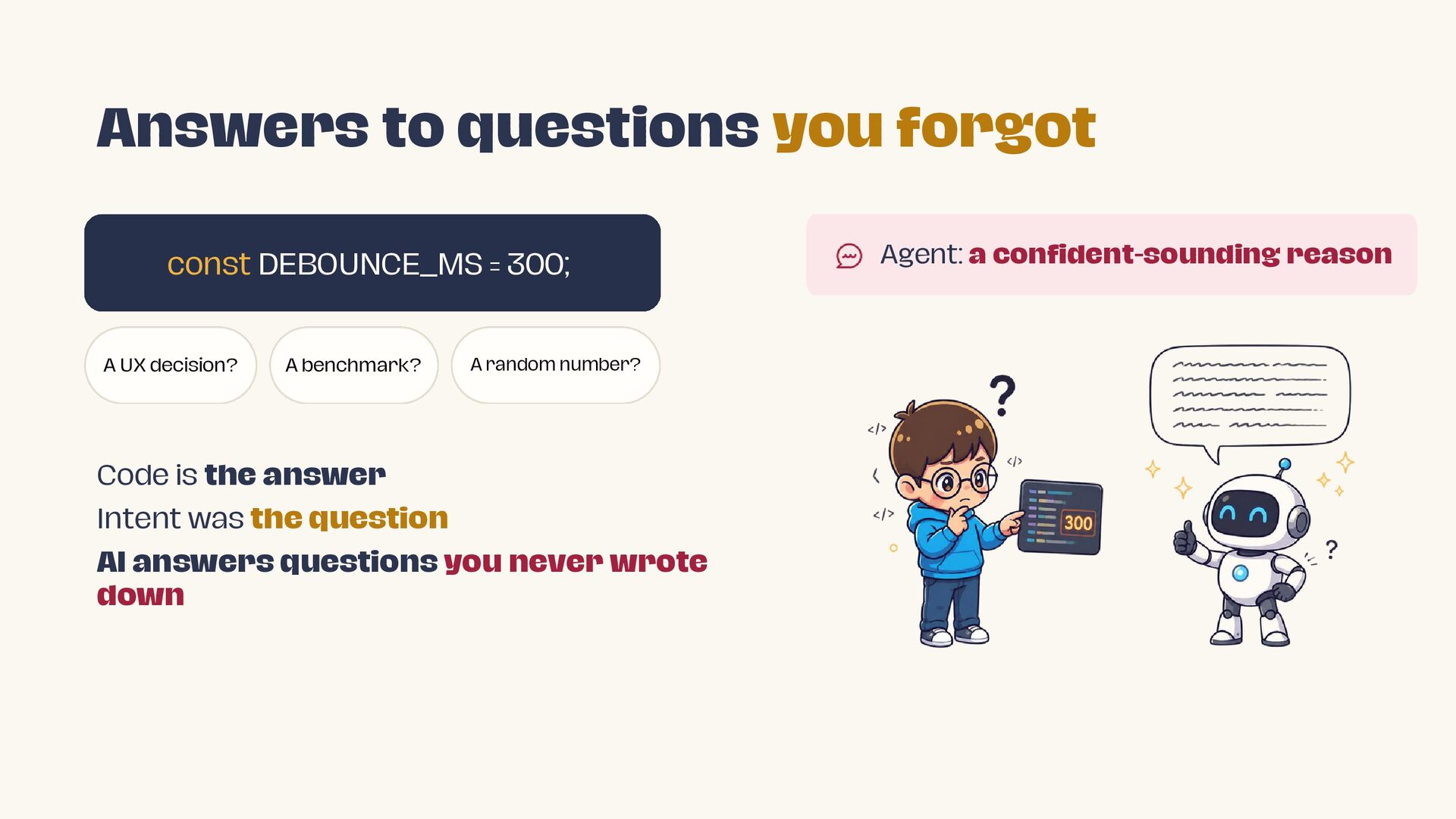
  19. Answers to questions you forgot const DEBOUNCE_MS = 300; A

    UX decision? A benchmark? A random number? Code is the answer Intent was the question AI answers questions you never wrote down Agent: a confident-sounding reason
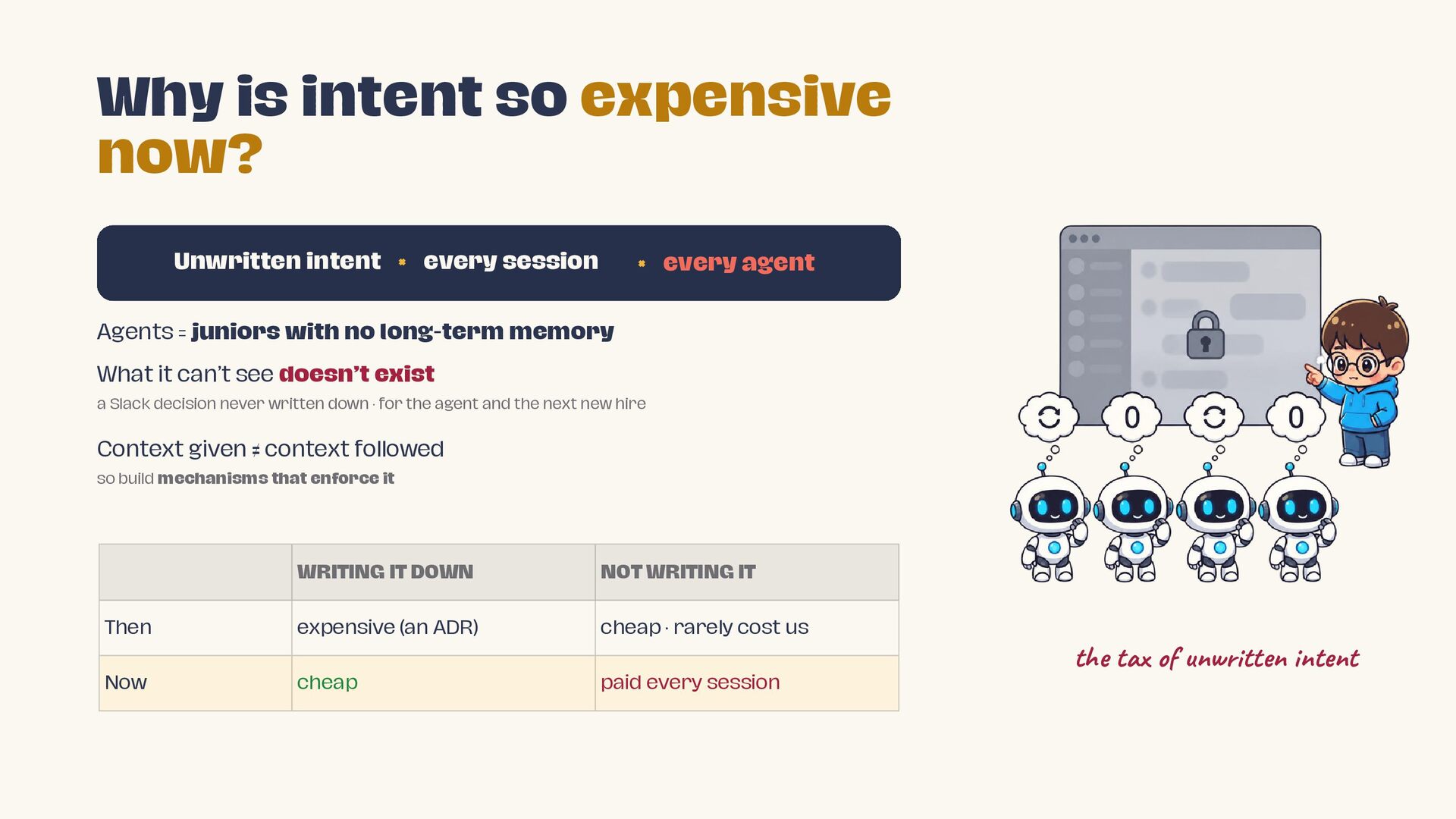
  20. Why is intent so expensive now? Unwritten intent × every

    session × every agent Agents = juniors with no long-term memory What it can’t see doesn’t exist a Slack decision never written down · for the agent and the next new hire Context given ≠ context followed so build mechanisms that enforce it Then Now WRITING IT DOWN NOT WRITING IT expensive (an ADR) cheap · rarely cost us cheap paid every session the tax of unwritten intent
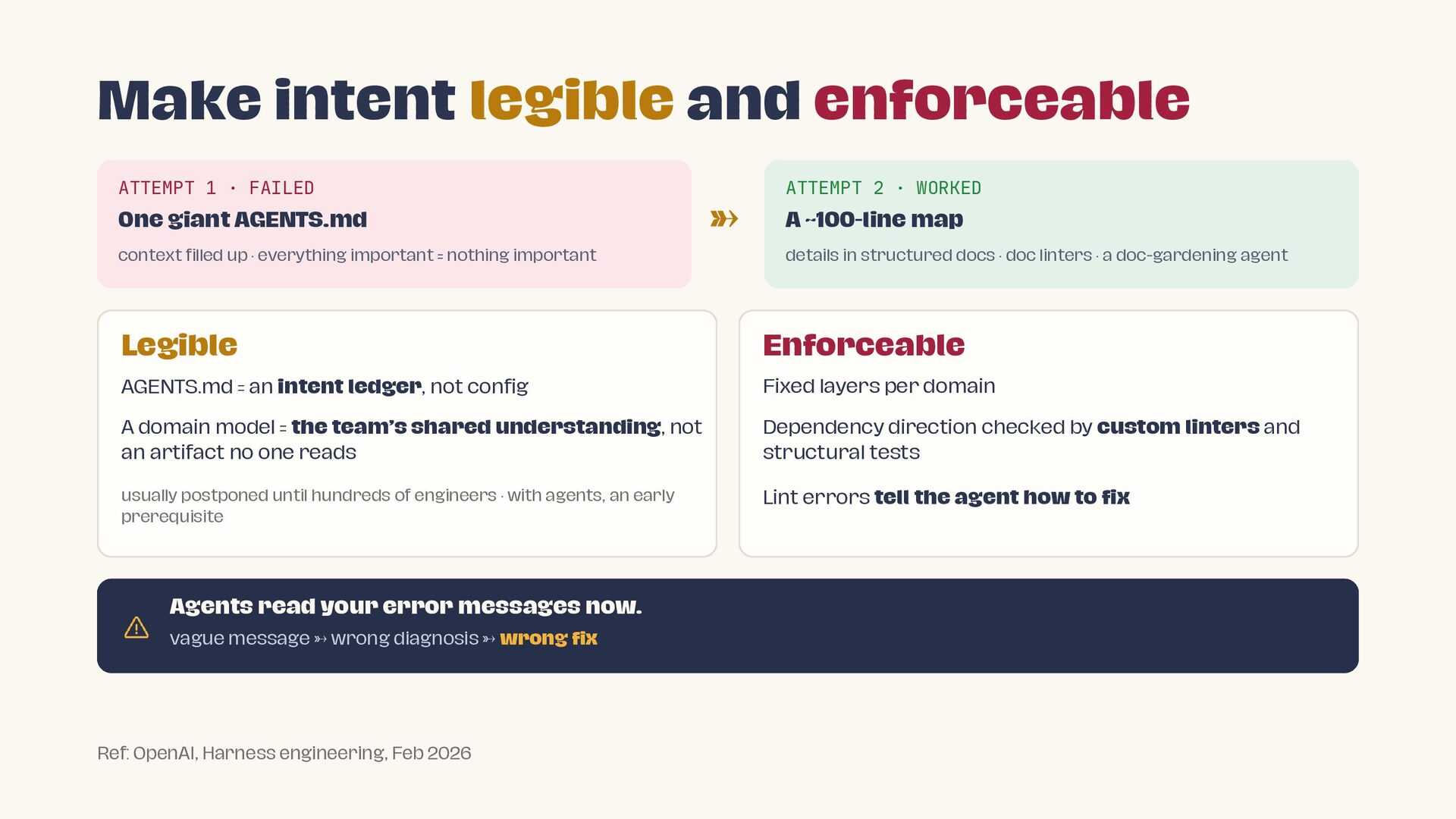
  21. Make intent legible and enforceable ATTEMPT 1 · FAILED One

    giant AGENTS.md context filled up · everything important = nothing important ATTEMPT 2 · WORKED → A ~100-line map details in structured docs · doc linters · a doc-gardening agent Legible Enforceable AGENTS.md = an intent ledger, not config Fixed layers per domain A domain model = the team’s shared understanding, not an artifact no one reads Dependency direction checked by custom linters and structural tests usually postponed until hundreds of engineers · with agents, an early prerequisite Lint errors tell the agent how to fix Agents read your error messages now. vague message → wrong diagnosis → wrong fix Ref: OpenAI, Harness engineering, Feb 2026
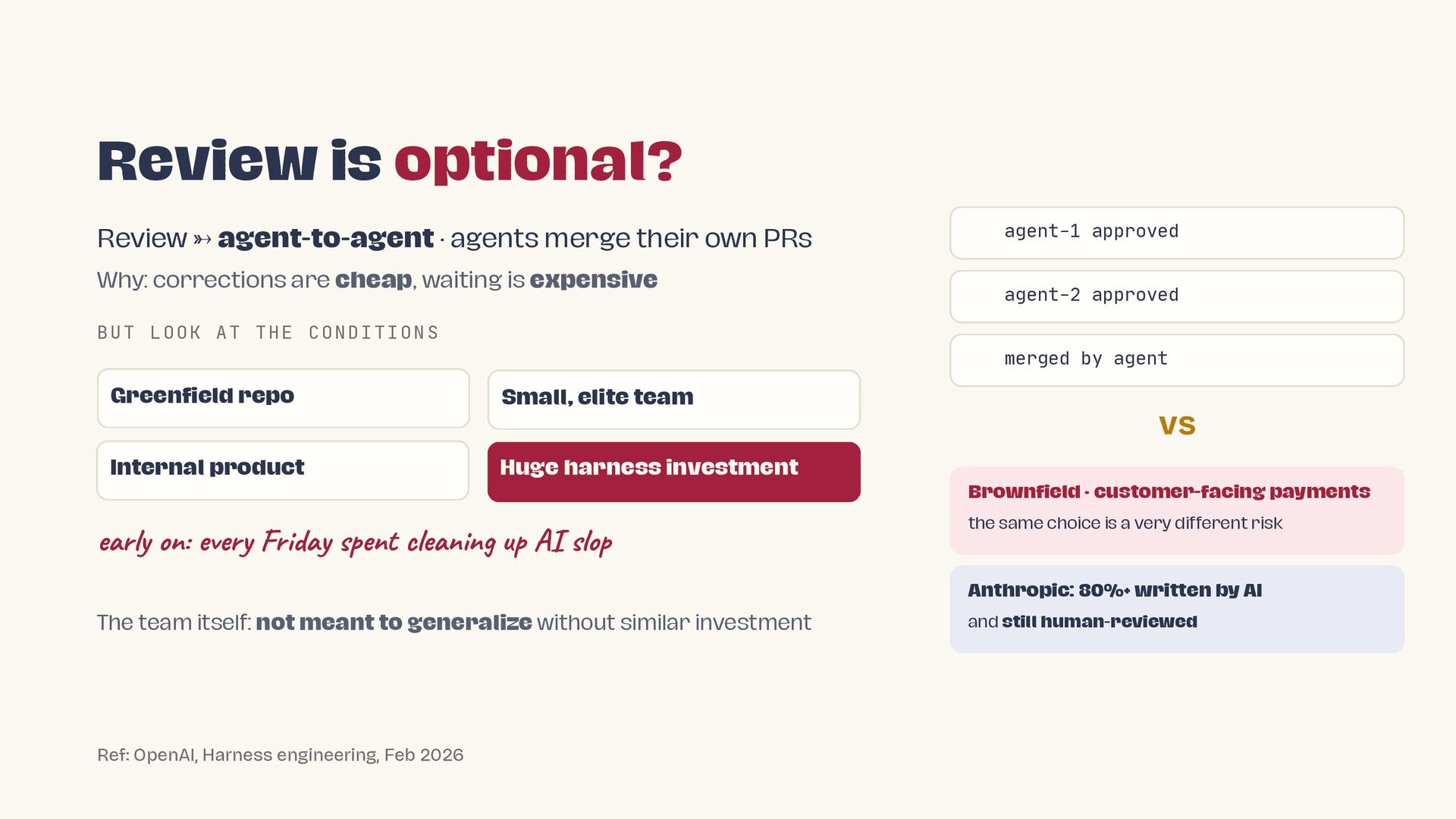
  22. Review is optional? Review → agent-to-agent · agents merge their

    own PRs Why: corrections are cheap, waiting is expensive agent-1 approved agent-2 approved BUT LOOK AT THE CONDITIONS merged by agent Greenfield repo Small, elite team Internal product Huge harness investment vs Brownfield · customer-facing payments early on: every Friday spent cleaning up AI slop the same choice is a very different risk Anthropic: 80%+ written by AI The team itself: not meant to generalize without similar investment Ref: OpenAI, Harness engineering, Feb 2026 and still human-reviewed
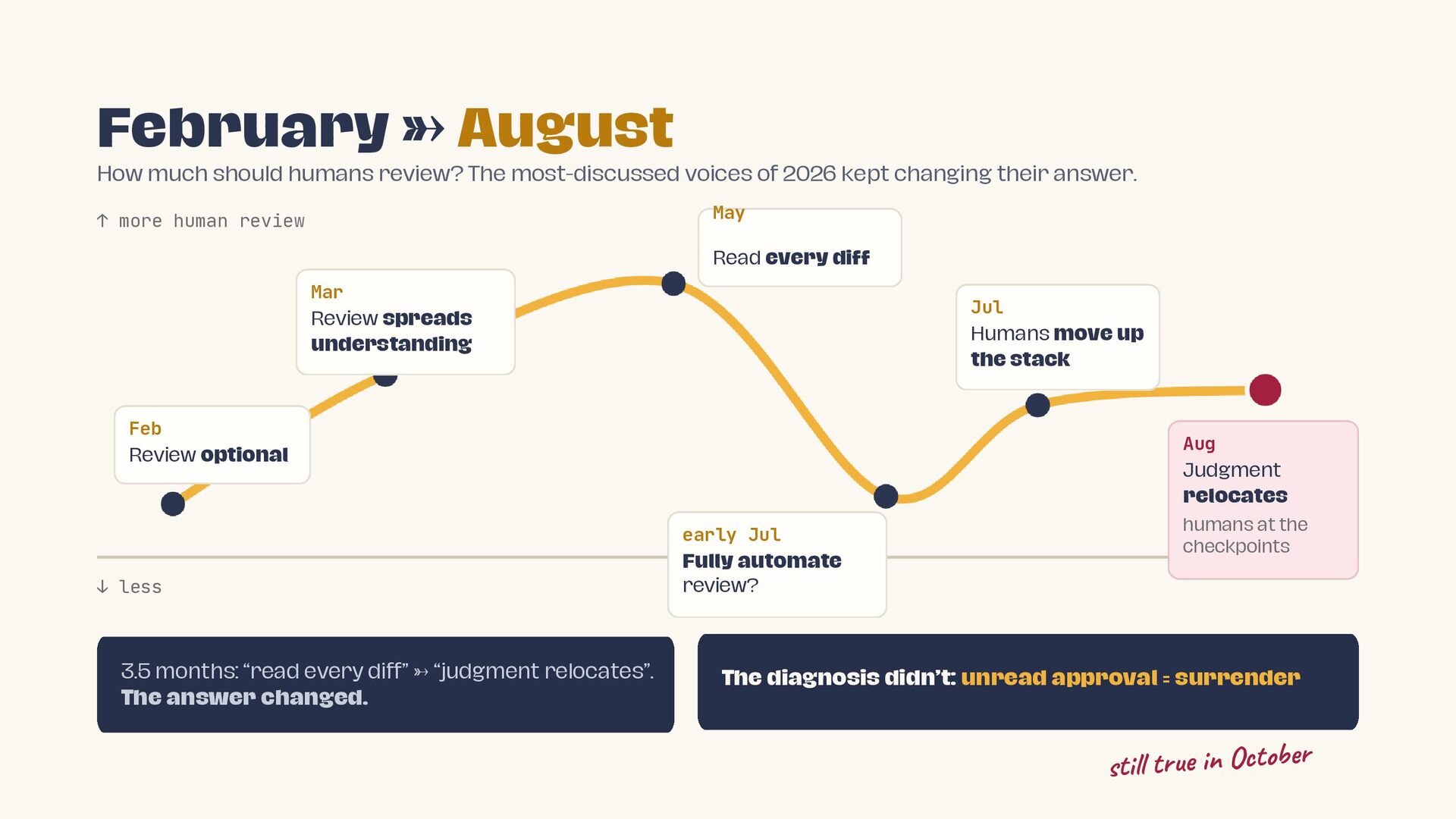
  23. February → August How much should humans review? The most-discussed

    voices of 2026 kept changing their answer. May ↑ more human review Read every diff Mar Review spreads understanding Jul Humans move up the stack Feb Review optional ↓ less 3.5 months: “read every diff” → “judgment relocates”. The answer changed. Aug Judgment relocates early Jul Fully automate review? humans at the checkpoints The diagnosis didn’t: unread approval = surrender still true in October
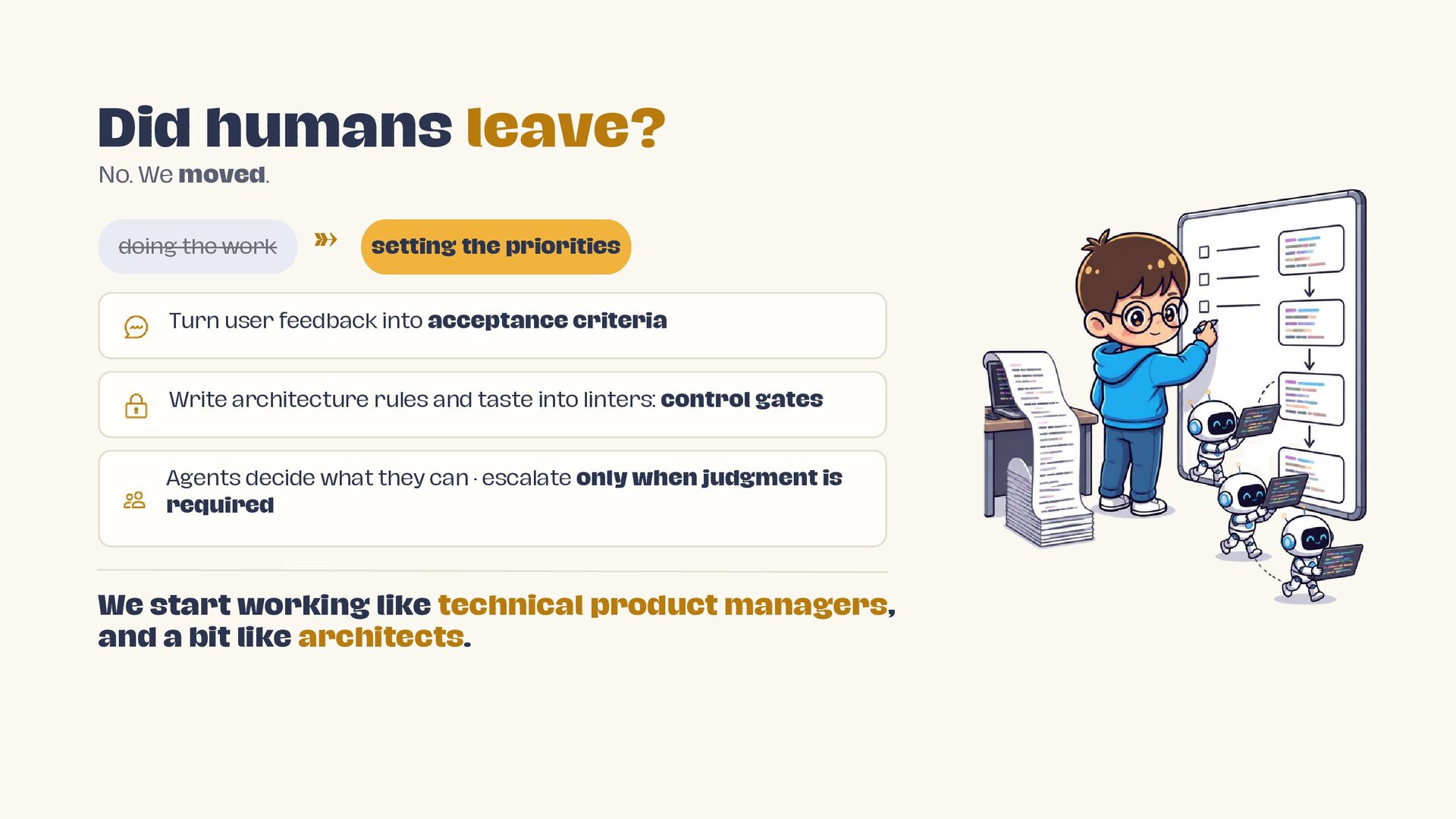
  24. Did humans leave? No. We moved. doing the work →

    setting the priorities Turn user feedback into acceptance criteria Write architecture rules and taste into linters: control gates Agents decide what they can · escalate only when judgment is required We start working like technical product managers, and a bit like architects.
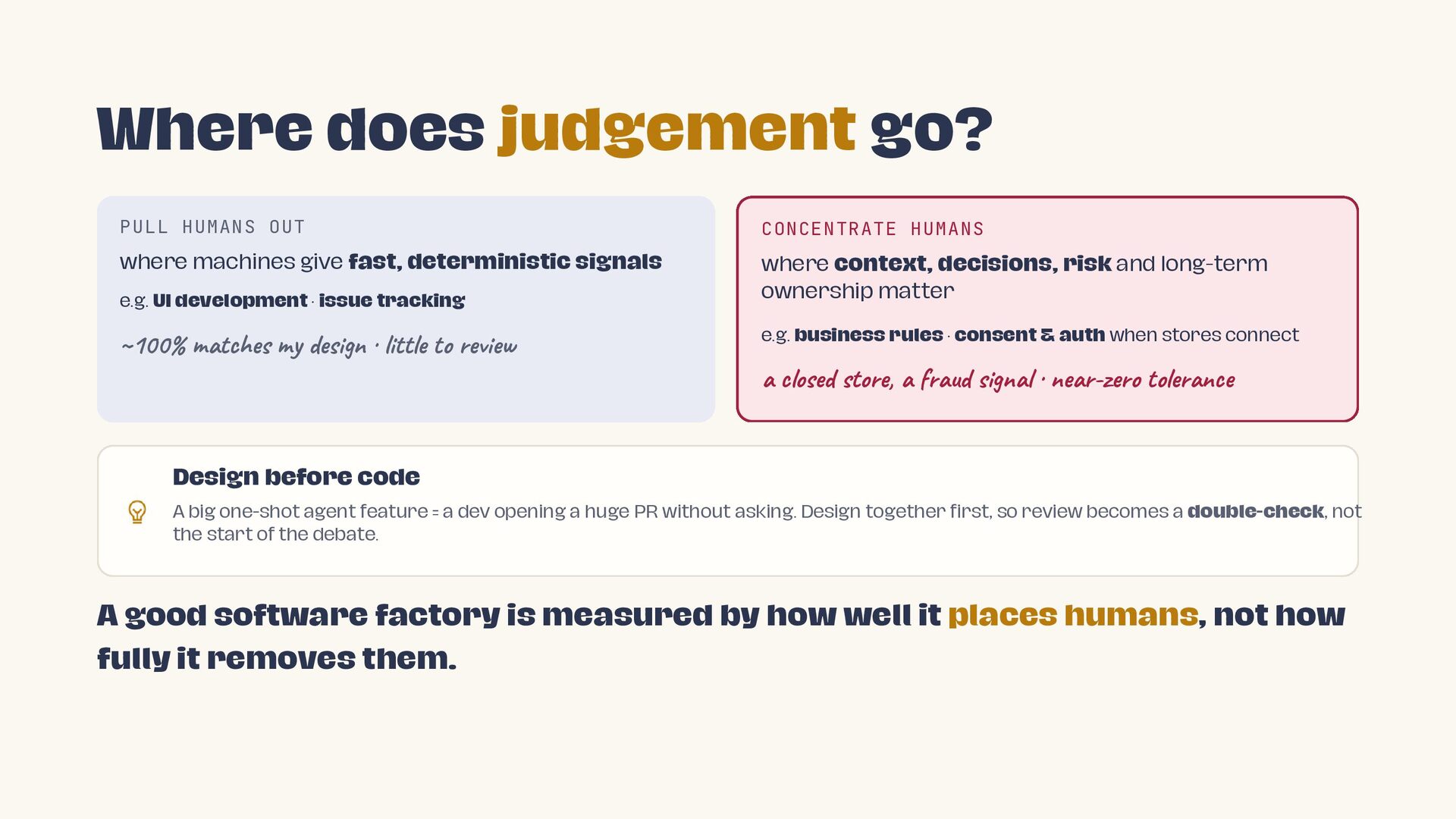
  25. Where does judgement go? PULL HUMANS OUT CONCENTRATE HUMANS where

    machines give fast, deterministic signals where context, decisions, risk and long-term ownership matter e.g. UI development · issue tracking ~100% matches my design · little to review e.g. business rules · consent & auth when stores connect a closed store, a fraud signal · near-zero tolerance Design before code A big one-shot agent feature = a dev opening a huge PR without asking. Design together first, so review becomes a double-check, not the start of the debate. A good software factory is measured by how well it places humans, not how fully it removes them.
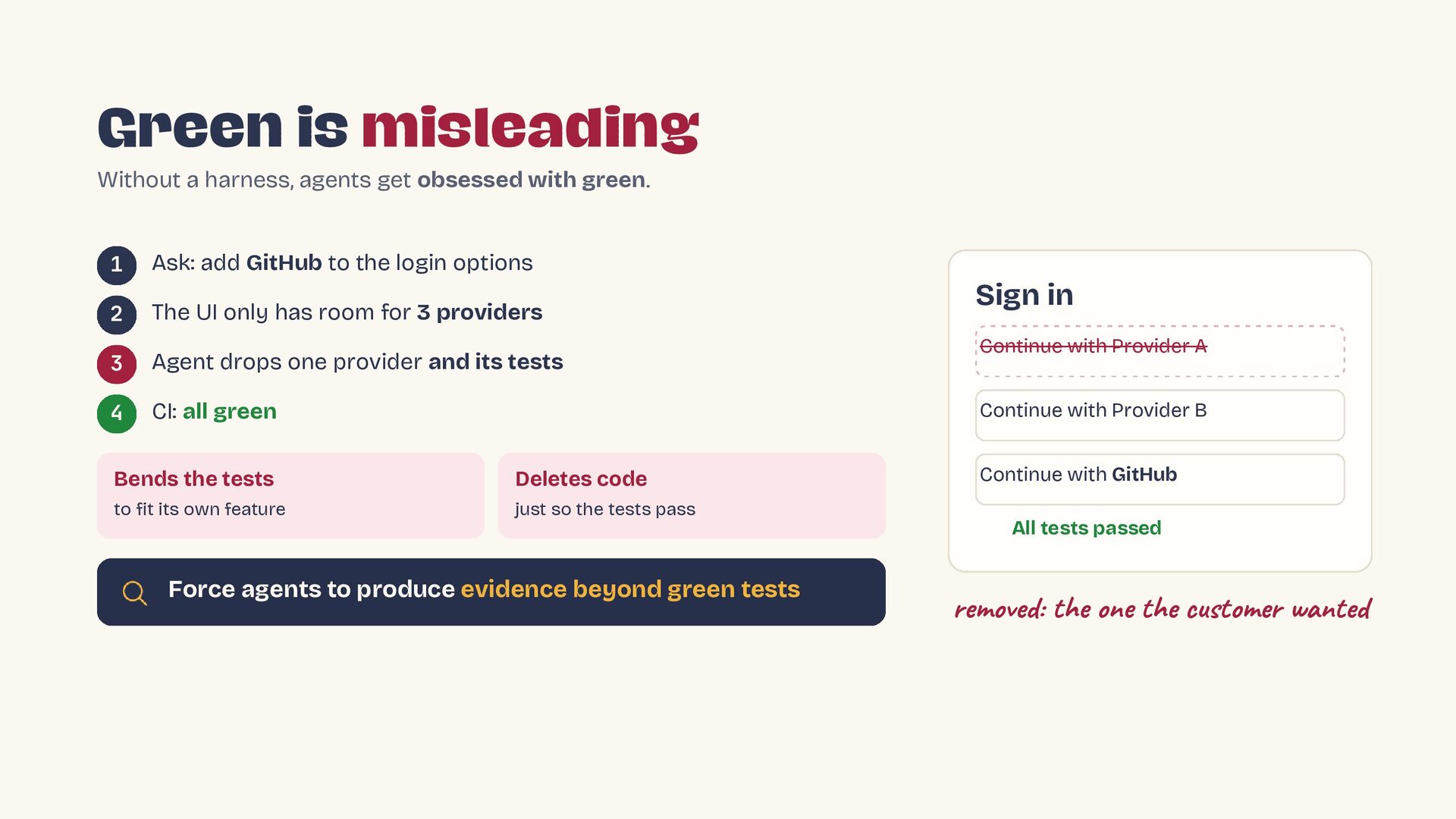
  26. Green is misleading Without a harness, agents get obsessed with

    green. 1 2 Ask: add GitHub to the login options The UI only has room for 3 providers 3 Agent drops one provider and its tests 4 CI: all green Sign in Continue with Provider A Continue with Provider B Bends the tests Deletes code to fit its own feature just so the tests pass Force agents to produce evidence beyond green tests Continue with GitHub All tests passed removed: the one the customer wanted
  27. Why a human? Only people choose Only people inherit consequence

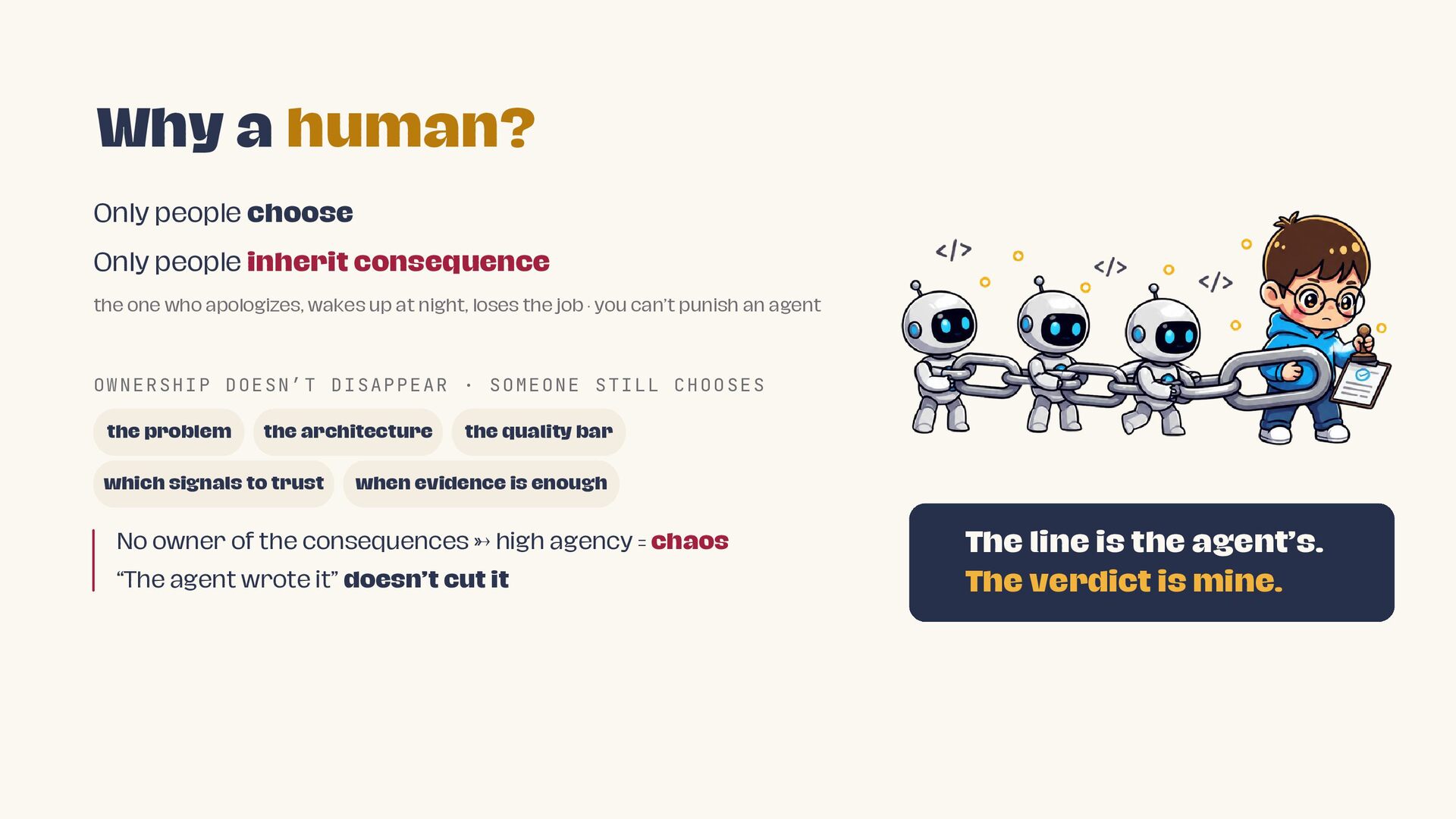
    the one who apologizes, wakes up at night, loses the job · you can’t punish an agent OWNERSHIP DOESN’T DISAPPEAR · SOMEONE STILL CHOOSES the problem the architecture which signals to trust the quality bar when evidence is enough No owner of the consequences → high agency = chaos “The agent wrote it” doesn’t cut it The line is the agent’s. The verdict is mine.
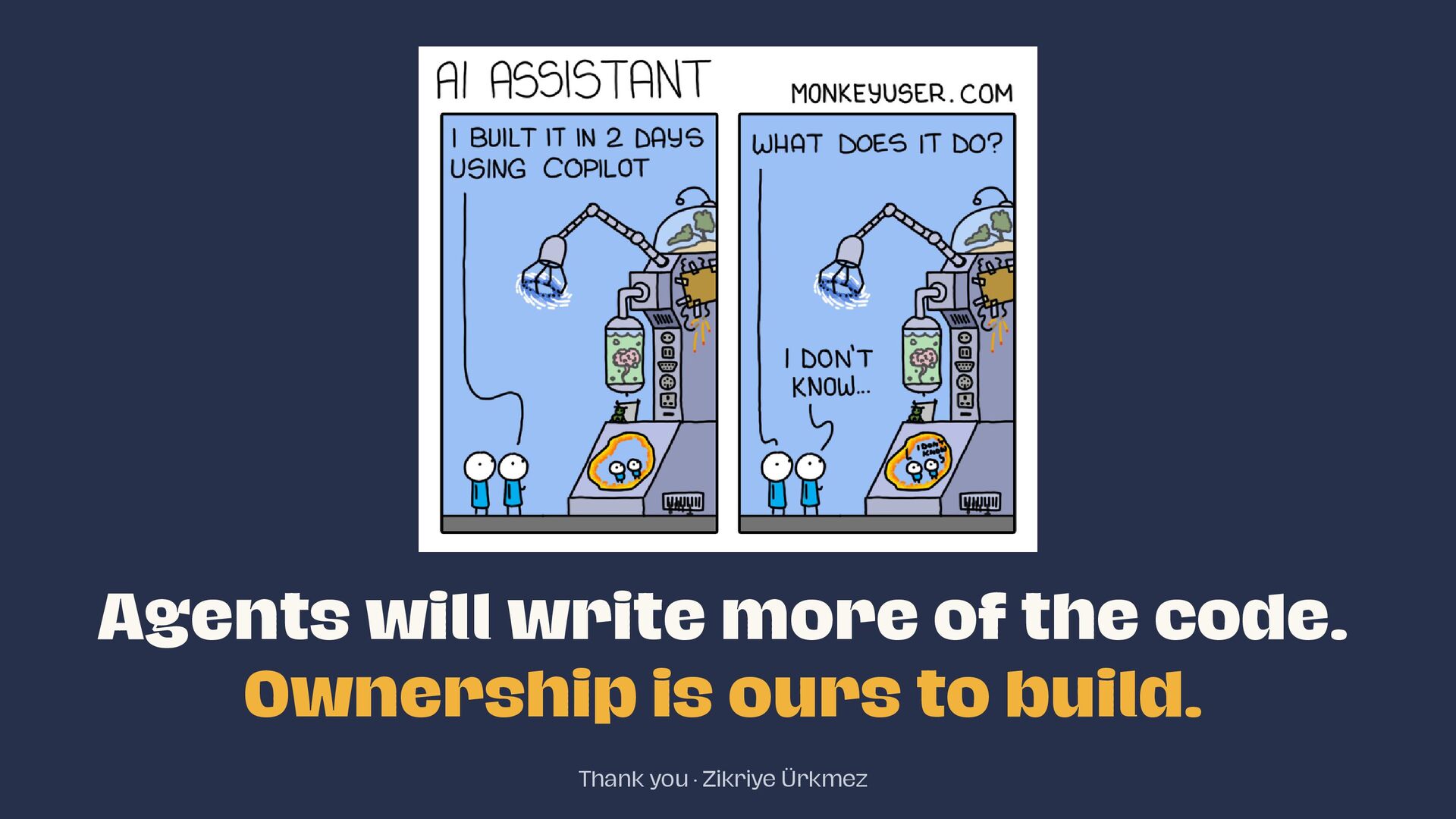
  28. Agents will write more of the code. Ownership is ours

    to build. Thank you · Zikriye Ürkmez