Group WhoAreWe mandatory slide Network security experts in R&D labs Working for France Telecom – Orange (a major telco) Speakers at security-focused conferences SSTIC, BlackHat US & Europe, ToorCon, ShmooCon, FIRST, hack.lu … Wi-Fi security centric ;-) “Wi-Fi Security: What’s Next” – ToorCon 2003 “Design and Implementation of a Wireless IDS” – ToorCon 2004 and ShmooCon 2005 “Wi-Fi Trickery, or How To Secure (?), Break (??) and Have Fun With Wi-Fi” – ShmooCon 2006 “Wi-Fi Advanced Stealth” – BlackHat US 2006 and Hack.LU 2006 “Wi-Fi Advanced Fuzzing” – BlackHat EU 2007
Group Agenda Forewords Finding 802.11 implementation bugs: 802.11 fuzzing Client side implementation bugs Details on one of the four client-related vulnerabilities we discovered The first “public” Linux-based kernel remote exploitation, due to a 802.11 driver implementation flaw Wireless access point vulnerabilities Disclosure of a new vulnerability today
Group Goals of This Talk Provide the audience with A quick overview of current 802.11 fuzzing techniques that allowed us to discover several critical implementation bugs Some recent research on access point fuzzing with interesting findings A description of the *first* remote linux-based kernel exploit on 802.11 that is now integrated in Metasploit Some live demos!
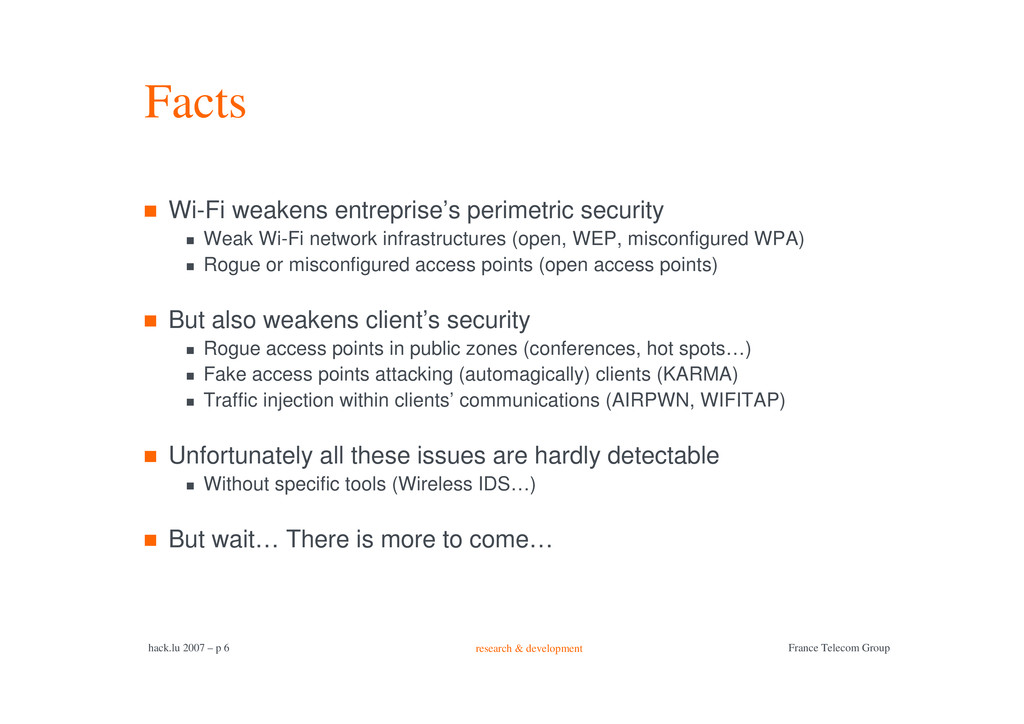
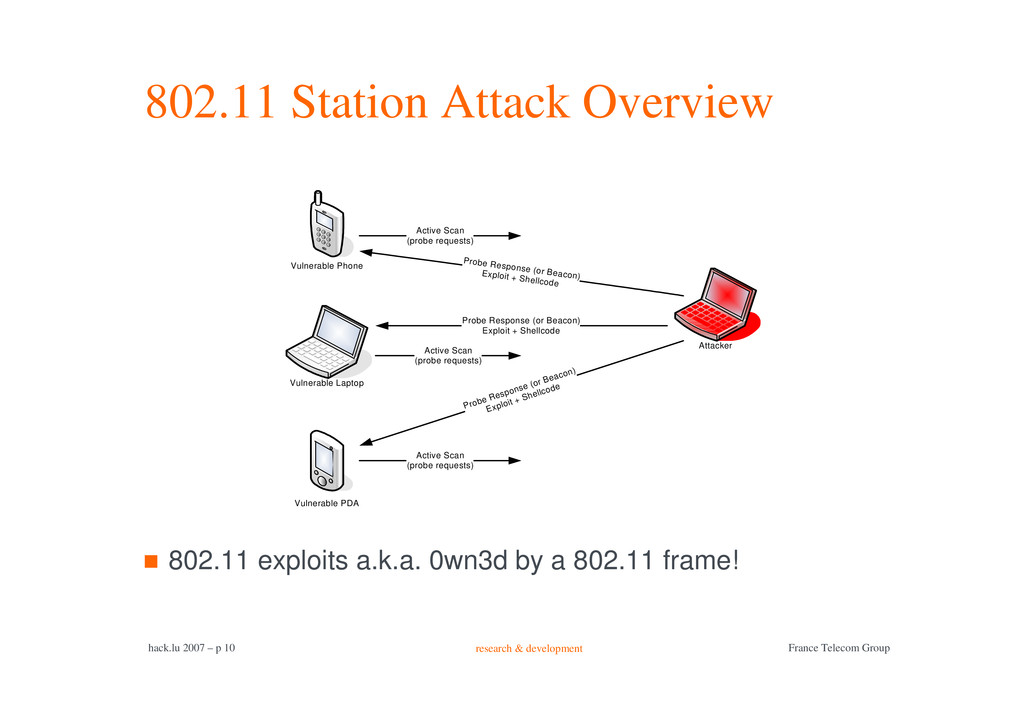
Group Facts Wi-Fi weakens entreprise’s perimetric security Weak Wi-Fi network infrastructures (open, WEP, misconfigured WPA) Rogue or misconfigured access points (open access points) But also weakens client’s security Rogue access points in public zones (conferences, hot spots…) Fake access points attacking (automagically) clients (KARMA) Traffic injection within clients’ communications (AIRPWN, WIFITAP) Unfortunately all these issues are hardly detectable Without specific tools (Wireless IDS…) But wait… There is more to come…
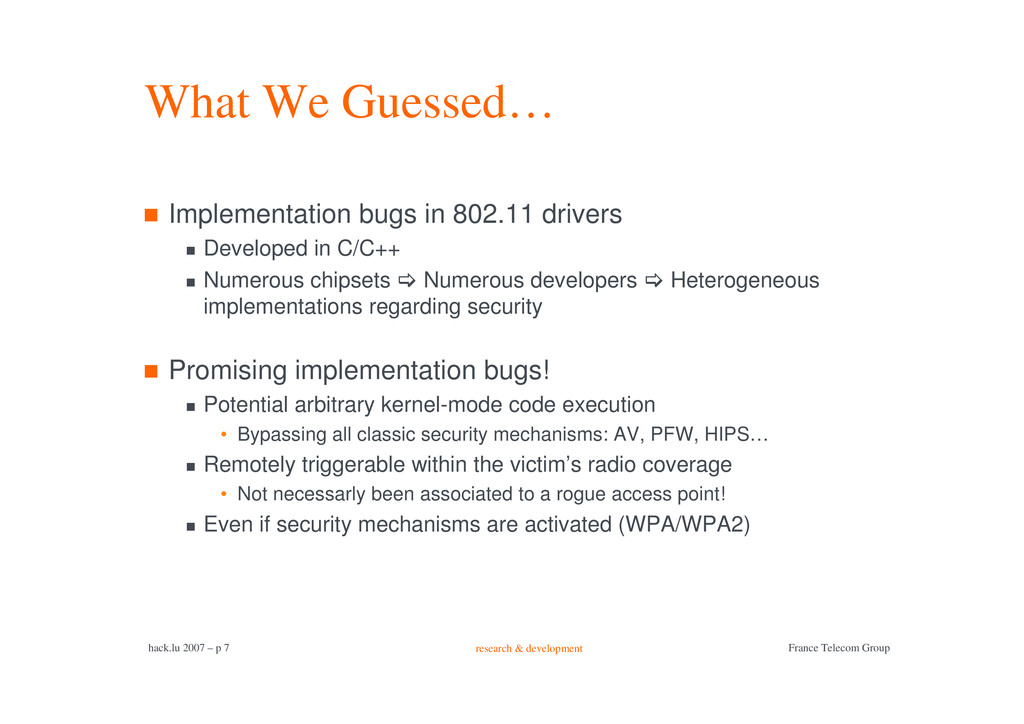
Group What We Guessed… Implementation bugs in 802.11 drivers Developed in C/C++ Numerous chipsets Numerous developers Heterogeneous implementations regarding security Promising implementation bugs! Potential arbitrary kernel-mode code execution • Bypassing all classic security mechanisms: AV, PFW, HIPS… Remotely triggerable within the victim’s radio coverage • Not necessarly been associated to a rogue access point! Even if security mechanisms are activated (WPA/WPA2)
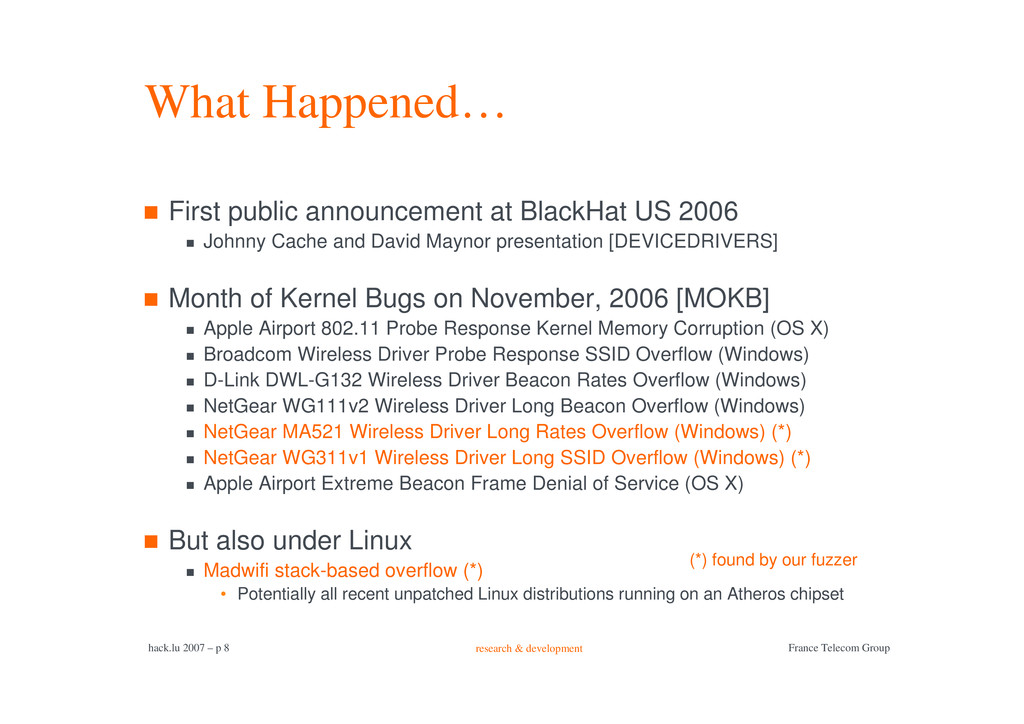
Group What Happened… First public announcement at BlackHat US 2006 Johnny Cache and David Maynor presentation [DEVICEDRIVERS] Month of Kernel Bugs on November, 2006 [MOKB] Apple Airport 802.11 Probe Response Kernel Memory Corruption (OS X) Broadcom Wireless Driver Probe Response SSID Overflow (Windows) D-Link DWL-G132 Wireless Driver Beacon Rates Overflow (Windows) NetGear WG111v2 Wireless Driver Long Beacon Overflow (Windows) NetGear MA521 Wireless Driver Long Rates Overflow (Windows) (*) NetGear WG311v1 Wireless Driver Long SSID Overflow (Windows) (*) Apple Airport Extreme Beacon Frame Denial of Service (OS X) But also under Linux Madwifi stack-based overflow (*) • Potentially all recent unpatched Linux distributions running on an Atheros chipset (*) found by our fuzzer
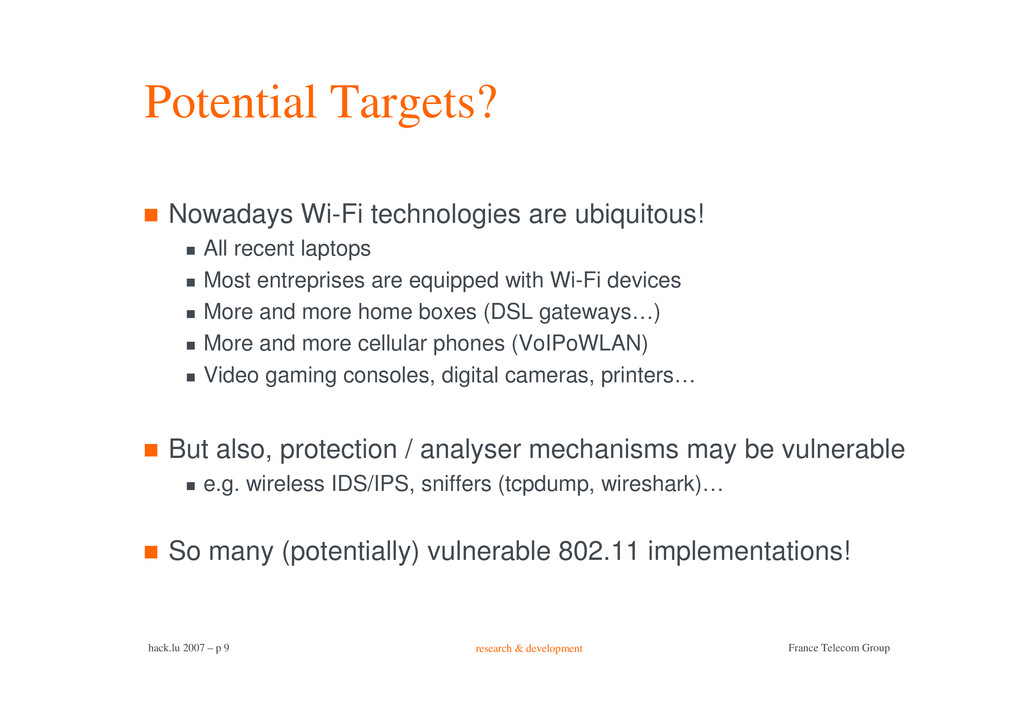
Group Potential Targets? Nowadays Wi-Fi technologies are ubiquitous! All recent laptops Most entreprises are equipped with Wi-Fi devices More and more home boxes (DSL gateways…) More and more cellular phones (VoIPoWLAN) Video gaming consoles, digital cameras, printers… But also, protection / analyser mechanisms may be vulnerable e.g. wireless IDS/IPS, sniffers (tcpdump, wireshark)… So many (potentially) vulnerable 802.11 implementations!
Group 1st Step: Finding These Vulnerabilities! Closed source drivers Black box testing Reverse engineering Open source drivers Black / White box testing Source code auditing Reverse engineering drivers is time consuming Especially when you haven’t any clue… Black box testing may be useful in both cases…
Group Fuzzing? (1/2) Really hard to define… Security community / industry love this kind of hyped / buzzed words! ;-) Some definitions Fuzz Testing or Fuzzing is a Black Box software testing technique, which basically consists in finding implementation bugs using malformed or semi malformed data injection in a automated fashion. [OWASP] Fuzz testing or fuzzing is a software testing technique. The basic idea is to attach the inputs of a program to a source of random data ("fuzz"). If the program fails (for example, by crashing, or by failing built-in code assertions), then there are defects to correct. [WIKIPEDIA] Common part Software testing technique that consists in finding implementation bugs • 1st definition: with malformed or semi malformed data injection • 2nd definition: with random data
Group Fuzzing? (2/2) Fuzzing is by far one of the best price / earning ratio ;-) Reverse engineering load of drivers is costly and boring Implementing a basic fuzzer may be low cost Discovered implementation bugs will thus be the most obvious ones But fuzzing will (probably) not help you finding “complex” bugs Simply because all testing possibilities cannot be performed due to • Lack of time versus all test possibilities • Protocol specificities (states) Of course, investigations on exploitation requires reverse engineering and/or source code auditing
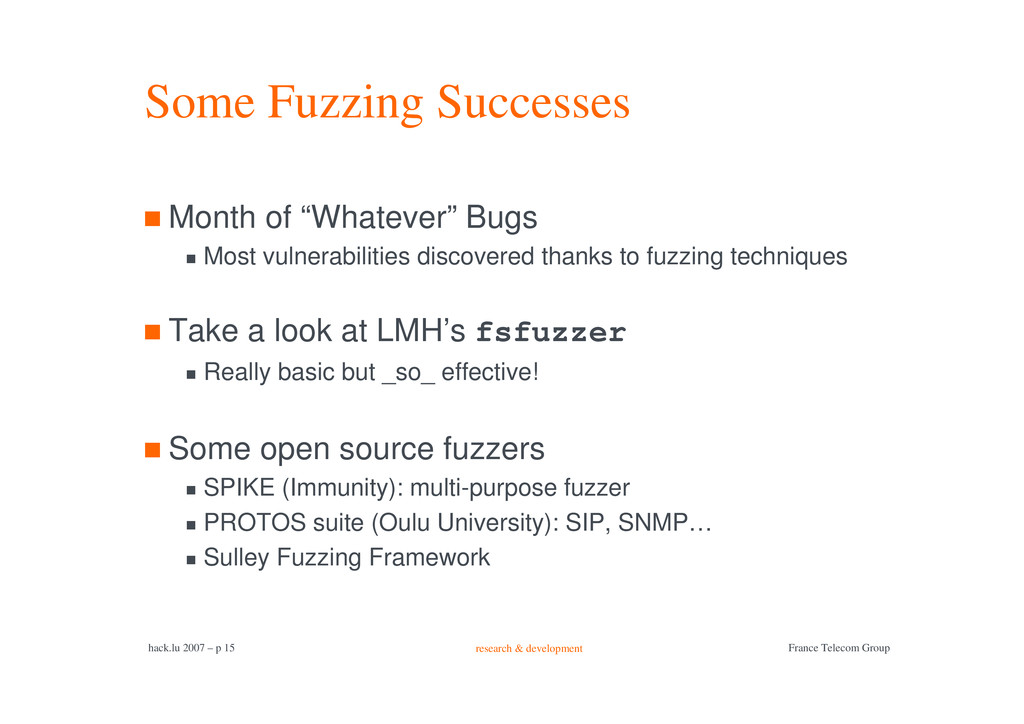
Group Some Fuzzing Successes Month of “Whatever” Bugs Most vulnerabilities discovered thanks to fuzzing techniques Take a look at LMH’s fsfuzzer Really basic but _so_ effective! Some open source fuzzers SPIKE (Immunity): multi-purpose fuzzer PROTOS suite (Oulu University): SIP, SNMP… Sulley Fuzzing Framework
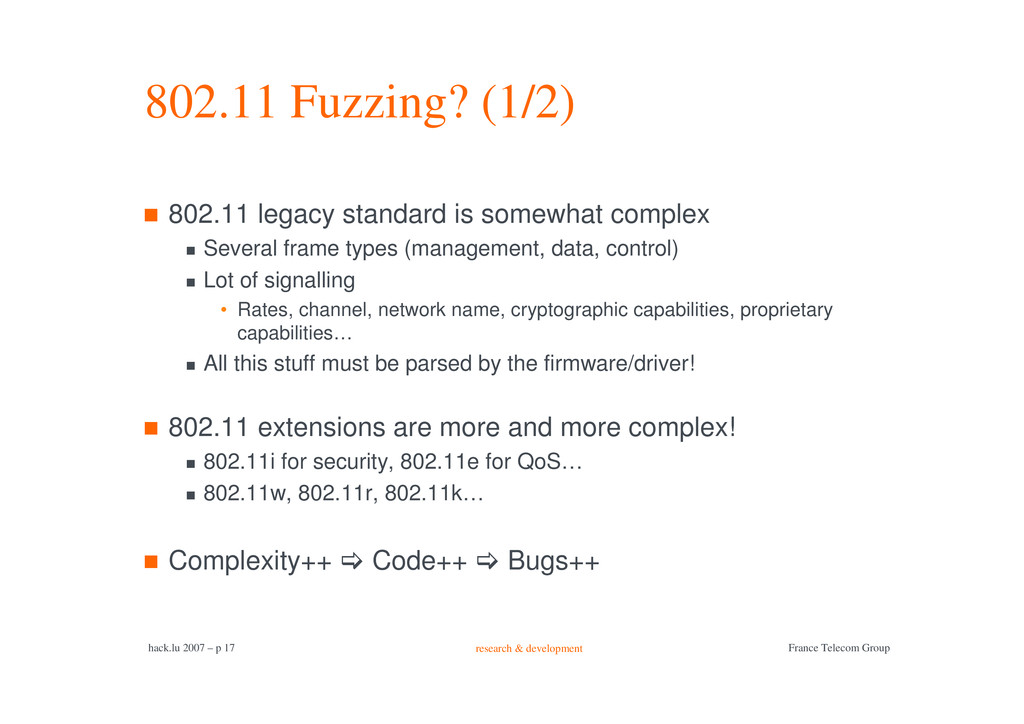
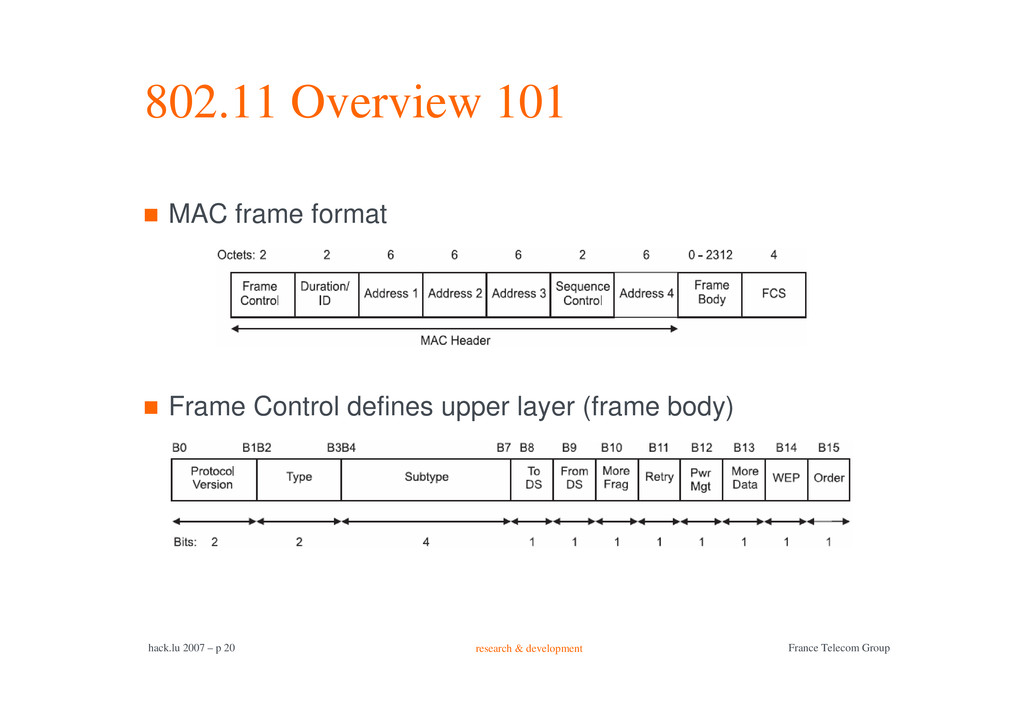
Group 802.11 Fuzzing? (1/2) 802.11 legacy standard is somewhat complex Several frame types (management, data, control) Lot of signalling • Rates, channel, network name, cryptographic capabilities, proprietary capabilities… All this stuff must be parsed by the firmware/driver! 802.11 extensions are more and more complex! 802.11i for security, 802.11e for QoS… 802.11w, 802.11r, 802.11k… Complexity++ Code++ Bugs++
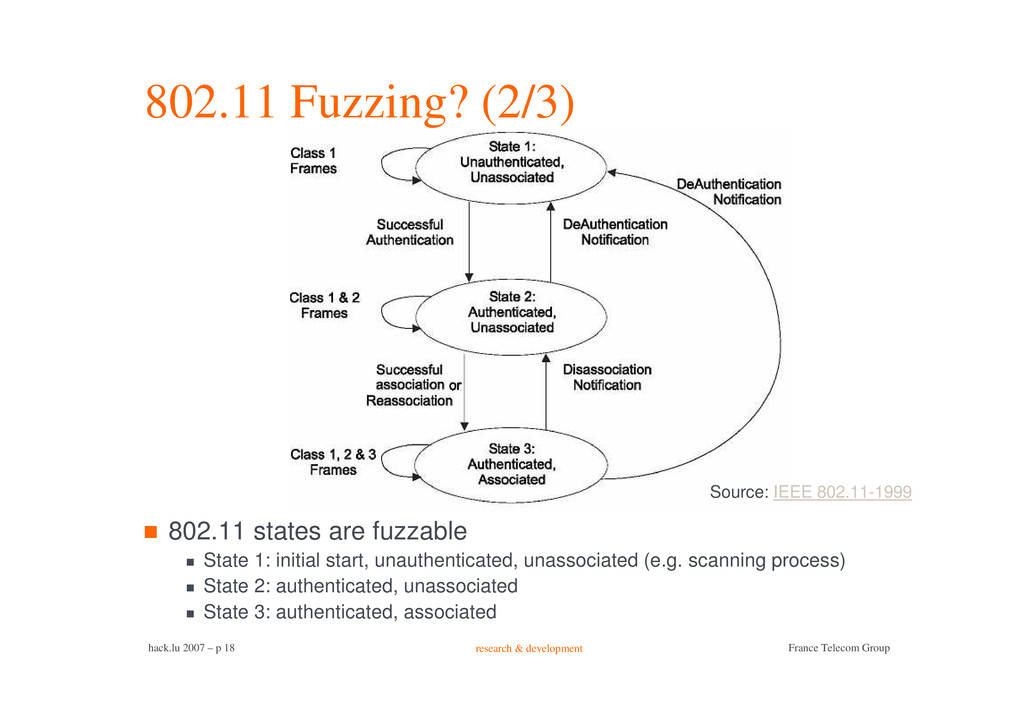
Group 802.11 Fuzzing? (2/3) 802.11 states are fuzzable State 1: initial start, unauthenticated, unassociated (e.g. scanning process) State 2: authenticated, unassociated State 3: authenticated, associated Source: IEEE 802.11-1999
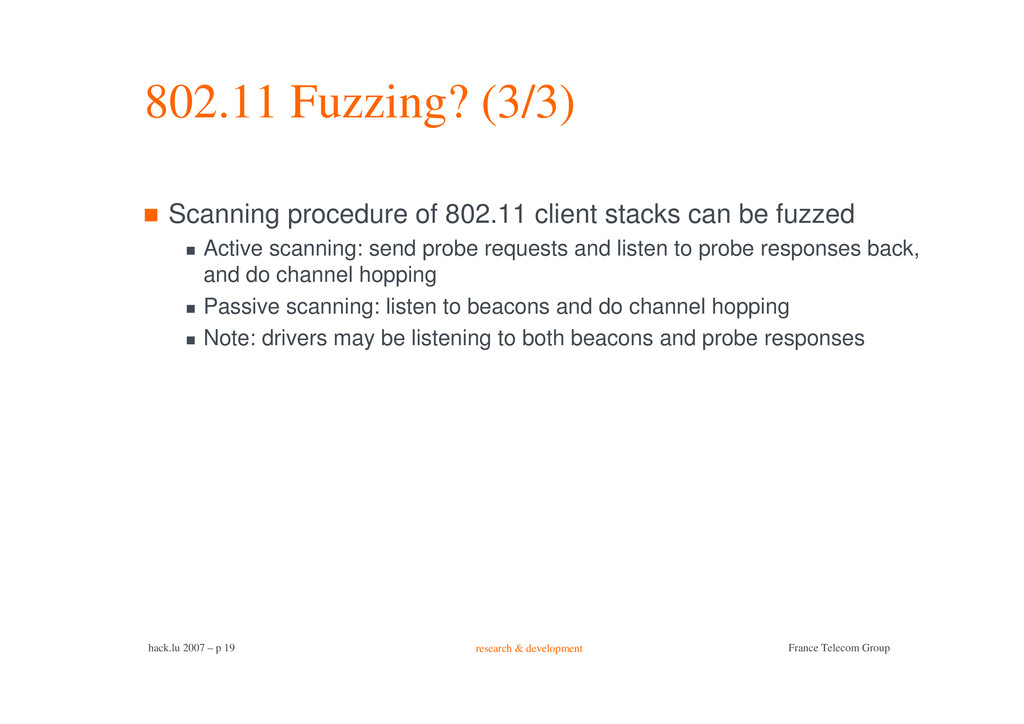
Group 802.11 Fuzzing? (3/3) Scanning procedure of 802.11 client stacks can be fuzzed Active scanning: send probe requests and listen to probe responses back, and do channel hopping Passive scanning: listen to beacons and do channel hopping Note: drivers may be listening to both beacons and probe responses
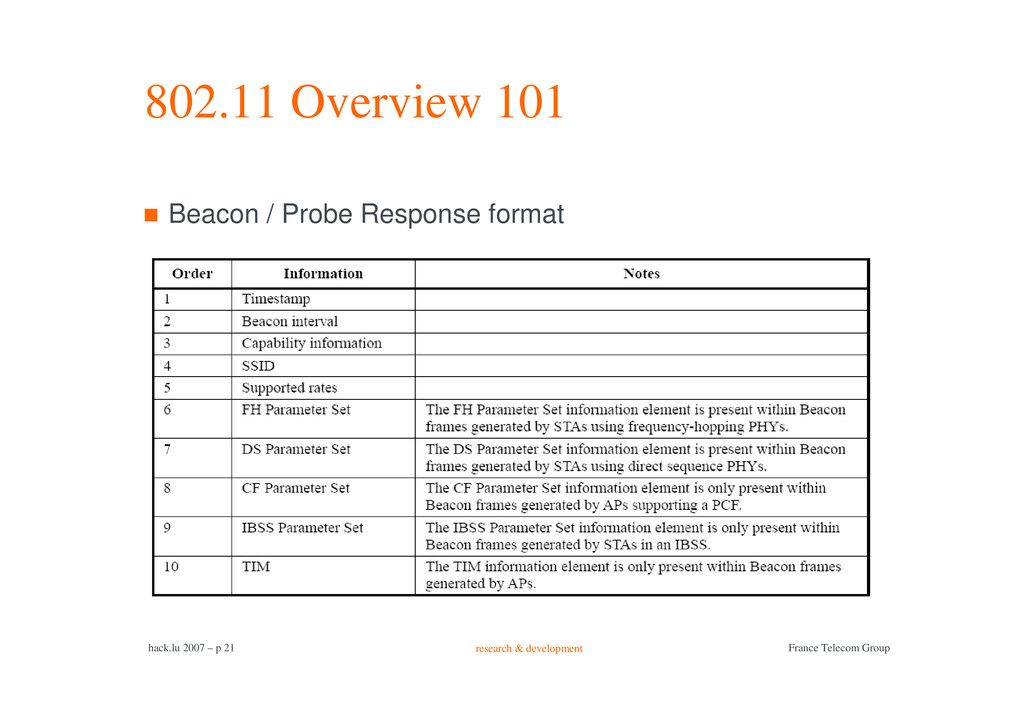
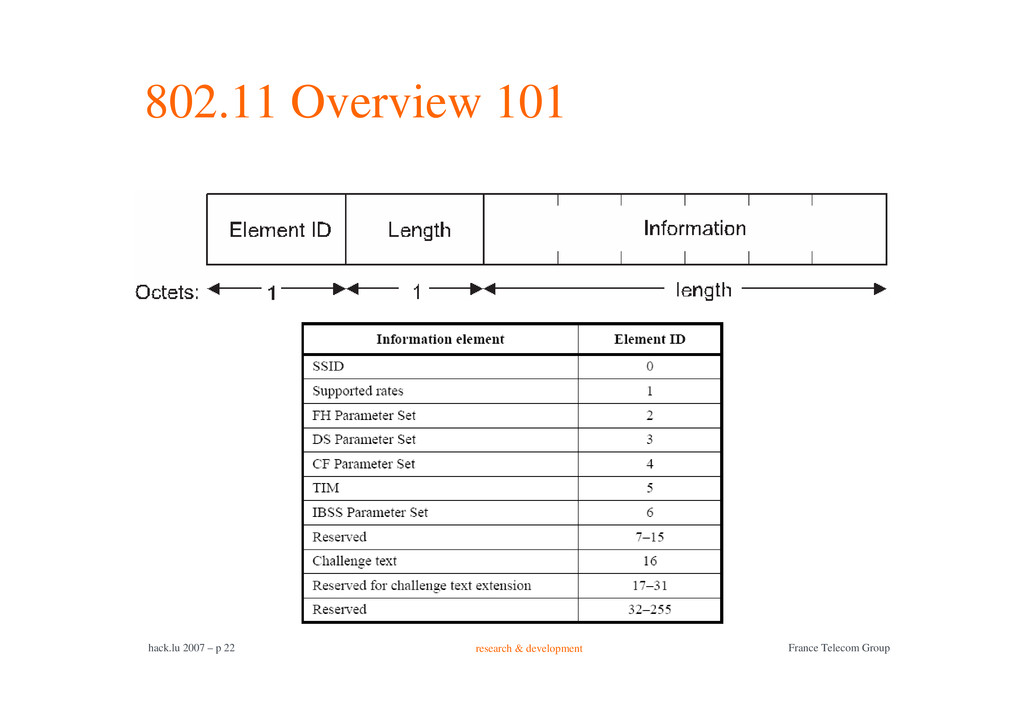
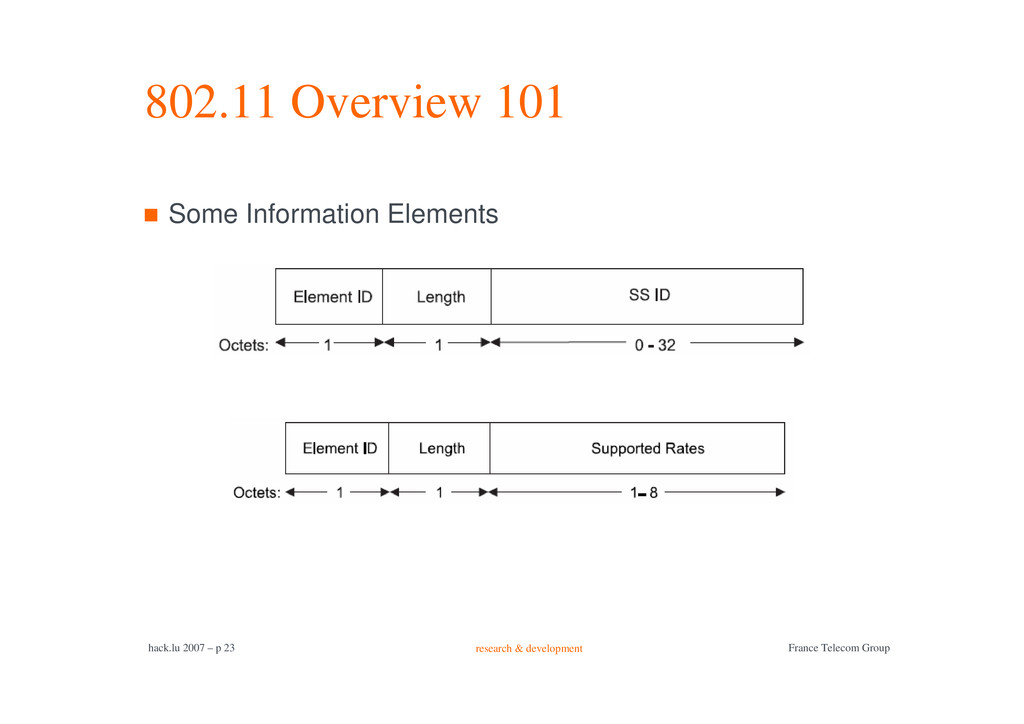
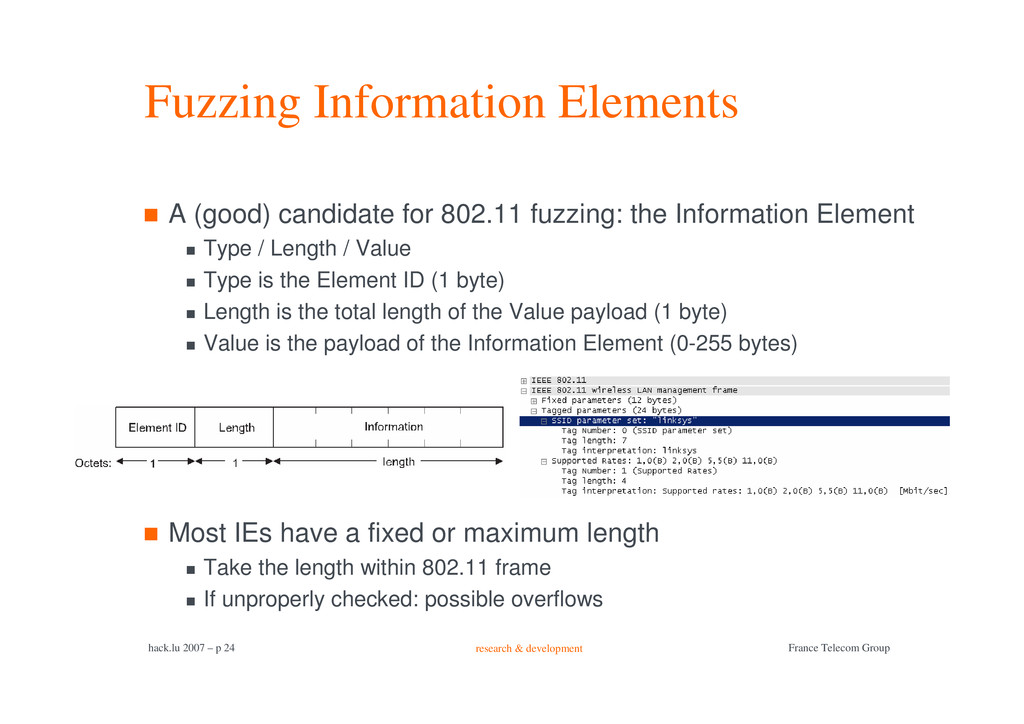
Group Fuzzing Information Elements A (good) candidate for 802.11 fuzzing: the Information Element Type / Length / Value Type is the Element ID (1 byte) Length is the total length of the Value payload (1 byte) Value is the payload of the Information Element (0-255 bytes) Most IEs have a fixed or maximum length Take the length within 802.11 frame If unproperly checked: possible overflows
Group Check This for More Information “Wi-Fi Advanced Fuzzing” – Black Hat EU 2007 https://www.blackhat.com/presentations/bh-europe- 07/Butti/Presentation/bh-eu-07-Butti.pdf
Group Discovered Vulnerabilties NetGear MA521 Wireless Driver Long Rates Overflow (CVE-2006-6059) Overflowing Rates Information Element • This field has generally a maximum length of 8 bytes (implementation dependent) NetGear WG311v1 Wireless Driver Long SSID Overflow (CVE-2006-6125) Overflowing SSID Information Element • This field has a maximum length of 32 bytes D-Link DWL-G650+ (A1) Wireless Driver Long TIM Overflow (CVE-2007-0993) Overflowing TIM Information Element Madwifi Driver Remote Buffer Overflow Vulnerability (CVE-2006-6332) Overflowing WPA/RSN/WMM/ATH Information Element Triggered when SIOCGIWSCAN • e.g. thanks to iwlist or iwlib.h
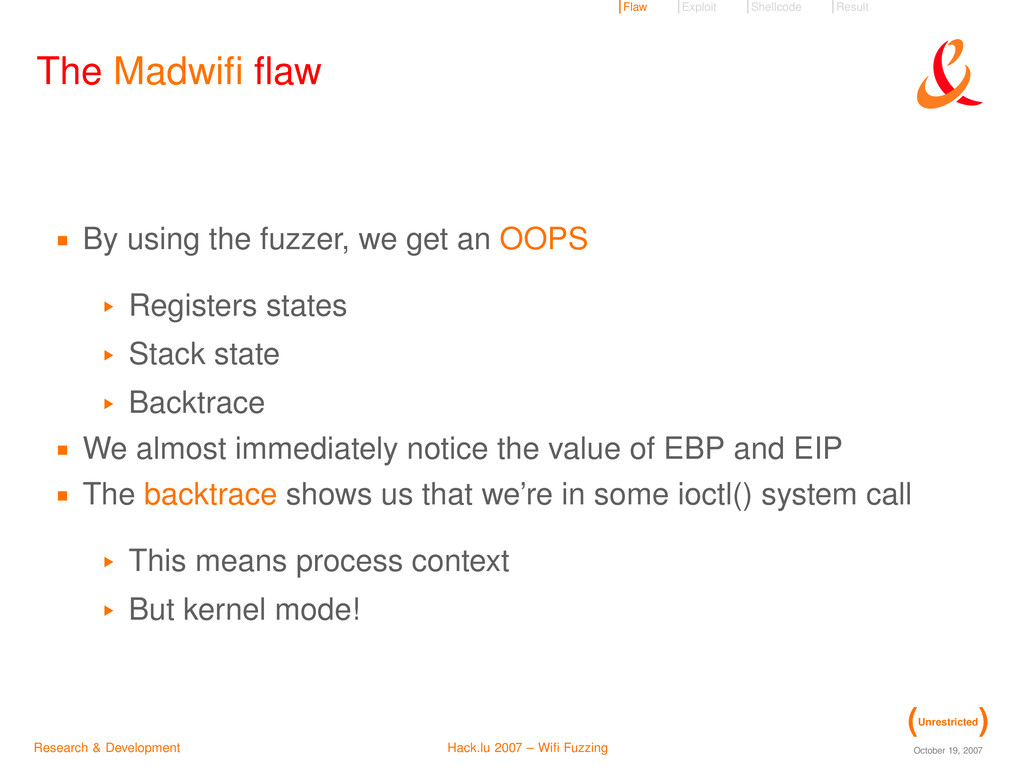
October 19, 2007 Flaw Exploit Shellcode Result The Madwifi flaw By using the fuzzer, we get an OOPS Registers states Stack state Backtrace We almost immediately notice the value of EBP and EIP The backtrace shows us that we’re in some ioctl() system call This means process context But kernel mode!
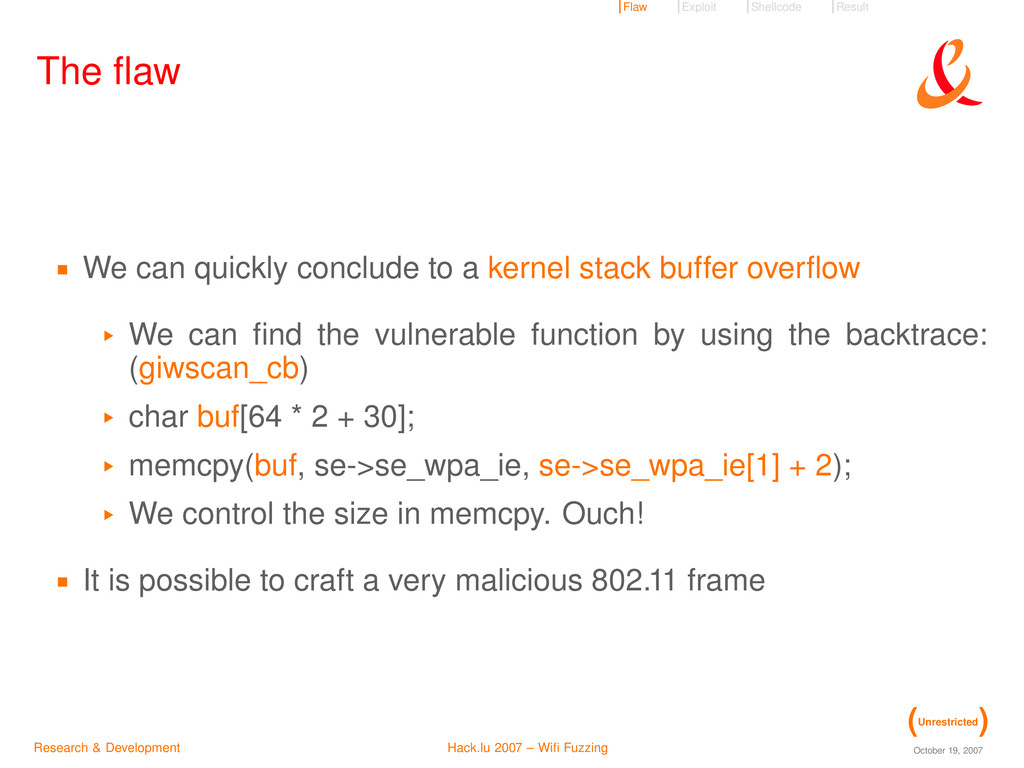
October 19, 2007 Flaw Exploit Shellcode Result The flaw We can quickly conclude to a kernel stack buffer overflow We can find the vulnerable function by using the backtrace: (giwscan_cb) char buf[64 * 2 + 30]; memcpy(buf, se->se_wpa_ie, se->se_wpa_ie[1] + 2); We control the size in memcpy. Ouch! It is possible to craft a very malicious 802.11 frame
October 19, 2007 Flaw Exploit Shellcode Result Consequences We’ve reported this flaw, with a patch, in december 2006 Madwifi published a new fixed version the following day Linux distributions could begin to patch update their madwifi drivers Unfortunately some did’nt react quickly
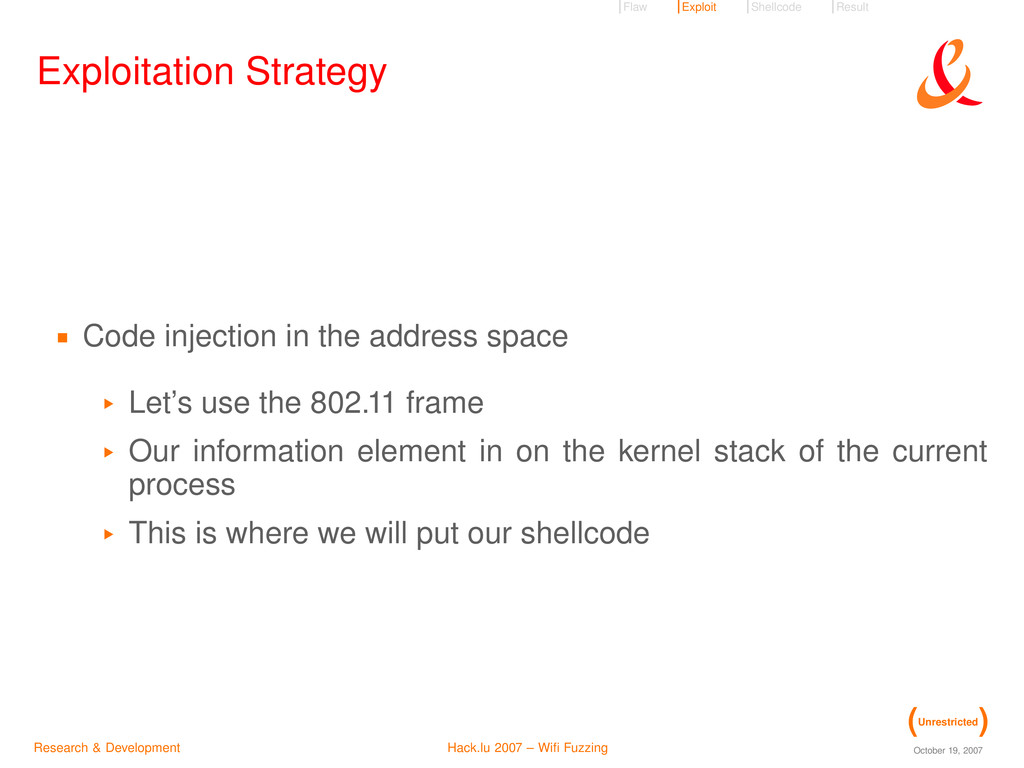
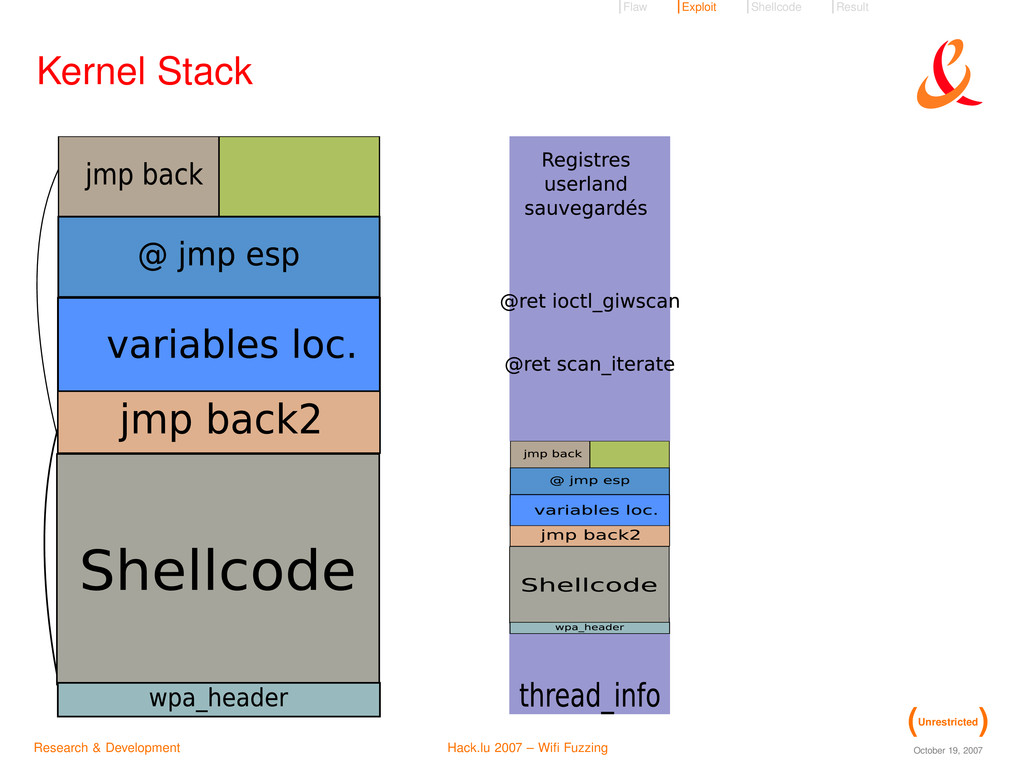
October 19, 2007 Flaw Exploit Shellcode Result Exploitation Strategy Code injection in the address space Let’s use the 802.11 frame Our information element in on the kernel stack of the current process This is where we will put our shellcode
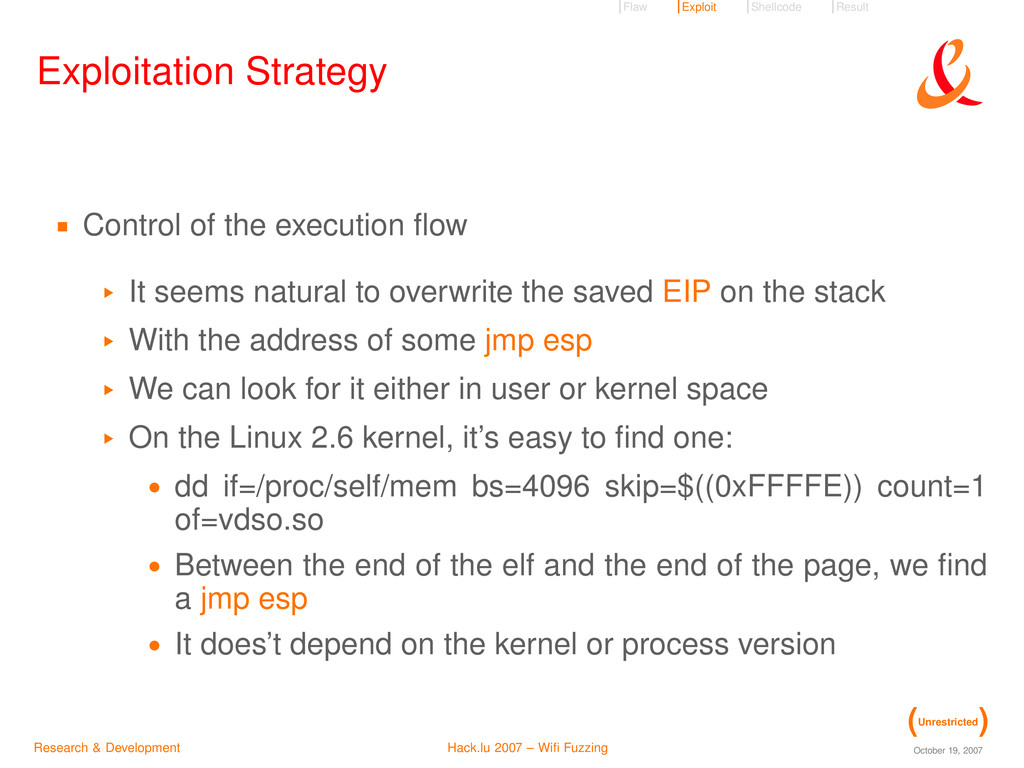
October 19, 2007 Flaw Exploit Shellcode Result Exploitation Strategy Control of the execution flow It seems natural to overwrite the saved EIP on the stack With the address of some jmp esp We can look for it either in user or kernel space On the Linux 2.6 kernel, it’s easy to find one: dd if=/proc/self/mem bs=4096 skip=$((0xFFFFE)) count=1 of=vdso.so Between the end of the elf and the end of the page, we find a jmp esp It does’t depend on the kernel or process version
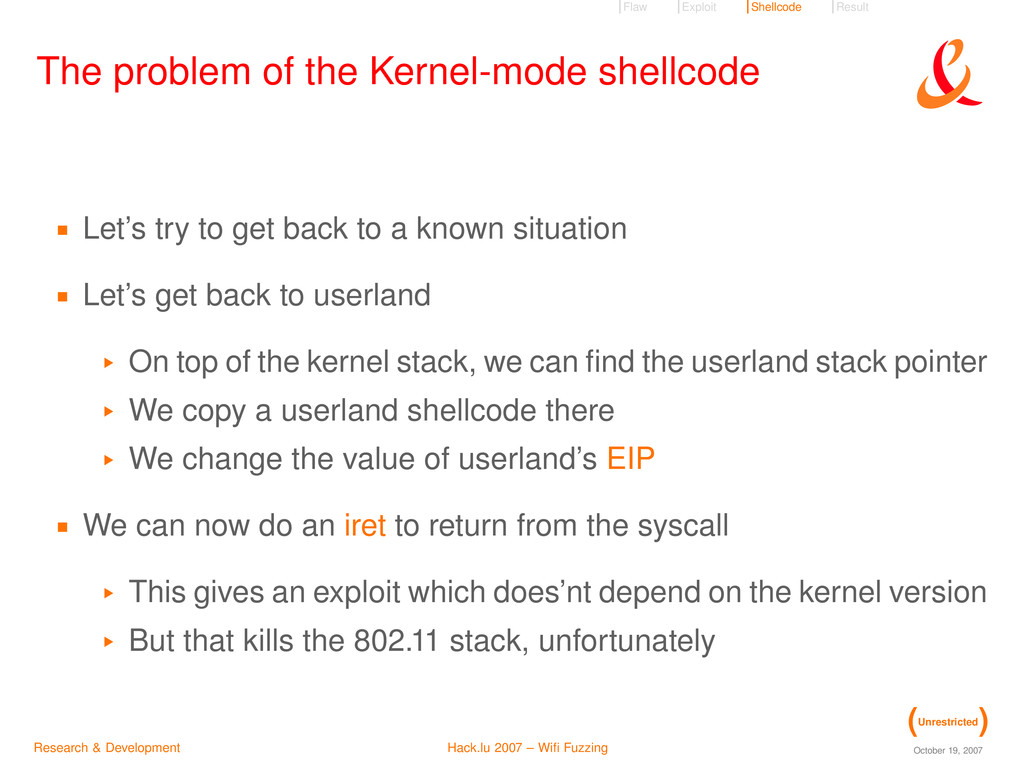
October 19, 2007 Flaw Exploit Shellcode Result The problem of the Kernel-mode shellcode Let’s try to get back to a known situation Let’s get back to userland On top of the kernel stack, we can find the userland stack pointer We copy a userland shellcode there We change the value of userland’s EIP We can now do an iret to return from the syscall This gives an exploit which does’nt depend on the kernel version But that kills the 802.11 stack, unfortunately
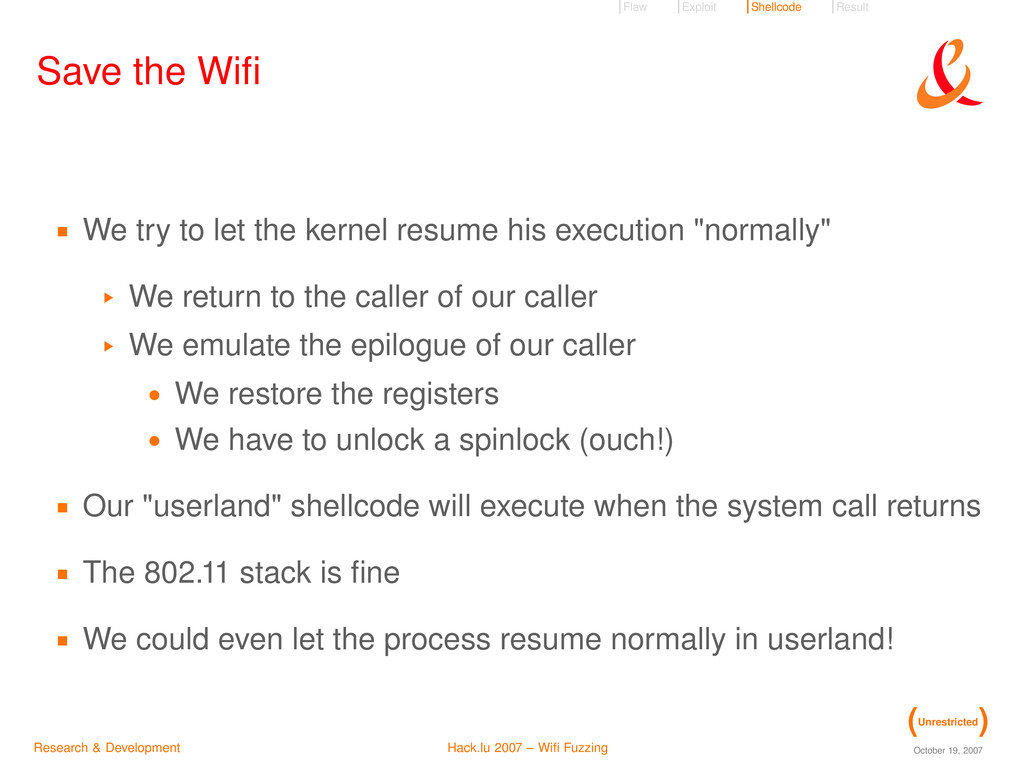
October 19, 2007 Flaw Exploit Shellcode Result Save the Wifi We try to let the kernel resume his execution "normally" We return to the caller of our caller We emulate the epilogue of our caller We restore the registers We have to unlock a spinlock (ouch!) Our "userland" shellcode will execute when the system call returns The 802.11 stack is fine We could even let the process resume normally in userland!
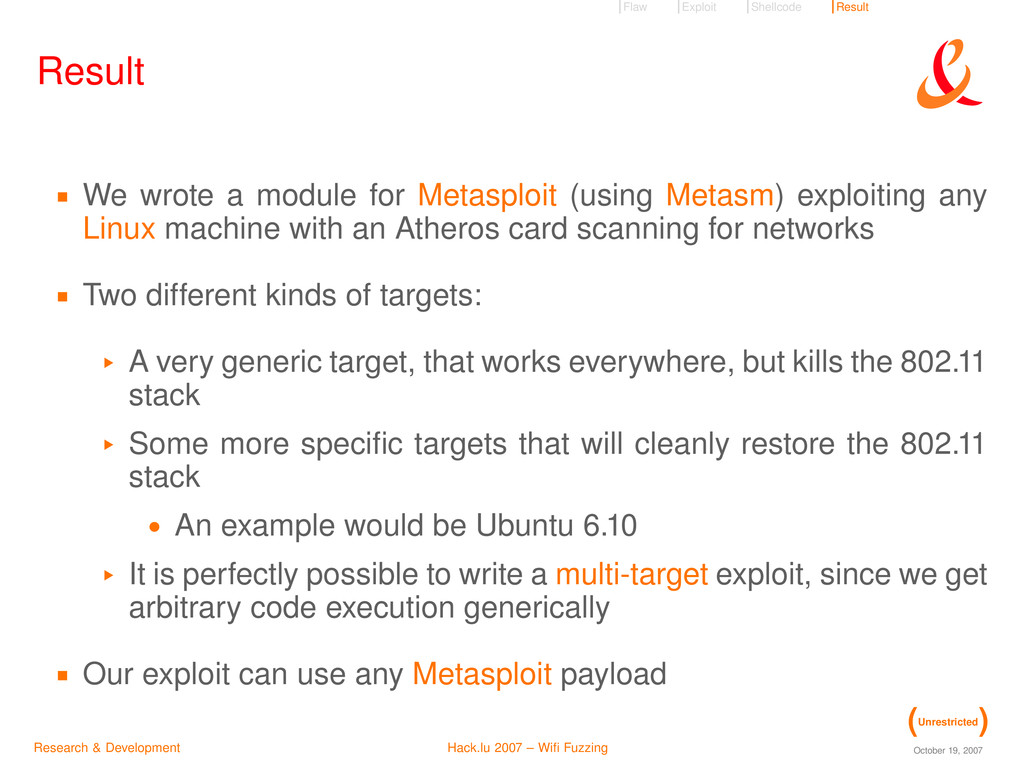
October 19, 2007 Flaw Exploit Shellcode Result Result We wrote a module for Metasploit (using Metasm) exploiting any Linux machine with an Atheros card scanning for networks Two different kinds of targets: A very generic target, that works everywhere, but kills the 802.11 stack Some more specific targets that will cleanly restore the 802.11 stack An example would be Ubuntu 6.10 It is perfectly possible to write a multi-target exploit, since we get arbitrary code execution generically Our exploit can use any Metasploit payload
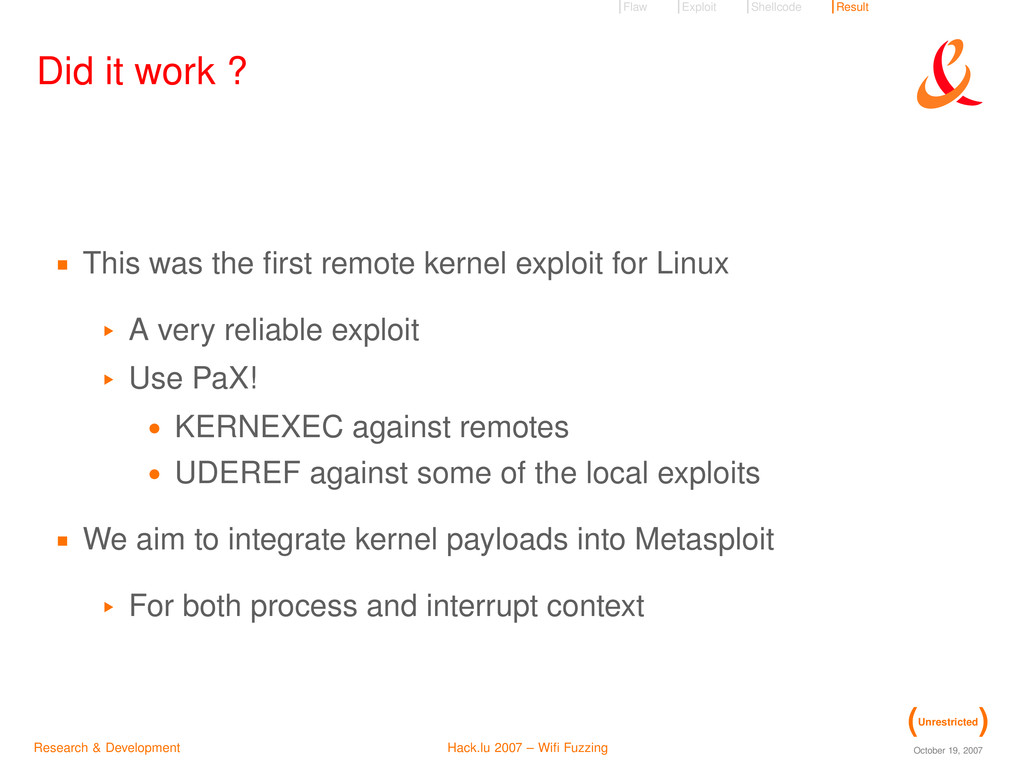
October 19, 2007 Flaw Exploit Shellcode Result Did it work ? This was the first remote kernel exploit for Linux A very reliable exploit Use PaX! KERNEXEC against remotes UDEREF against some of the local exploits We aim to integrate kernel payloads into Metasploit For both process and interrupt context
October 19, 2007 Flaw Exploit Shellcode Result It did’nt work ? Maybe someone did a DoS Maybe someone launched another exploit This is because it’s impossible to protect against this kind of flaw, even with WPA!
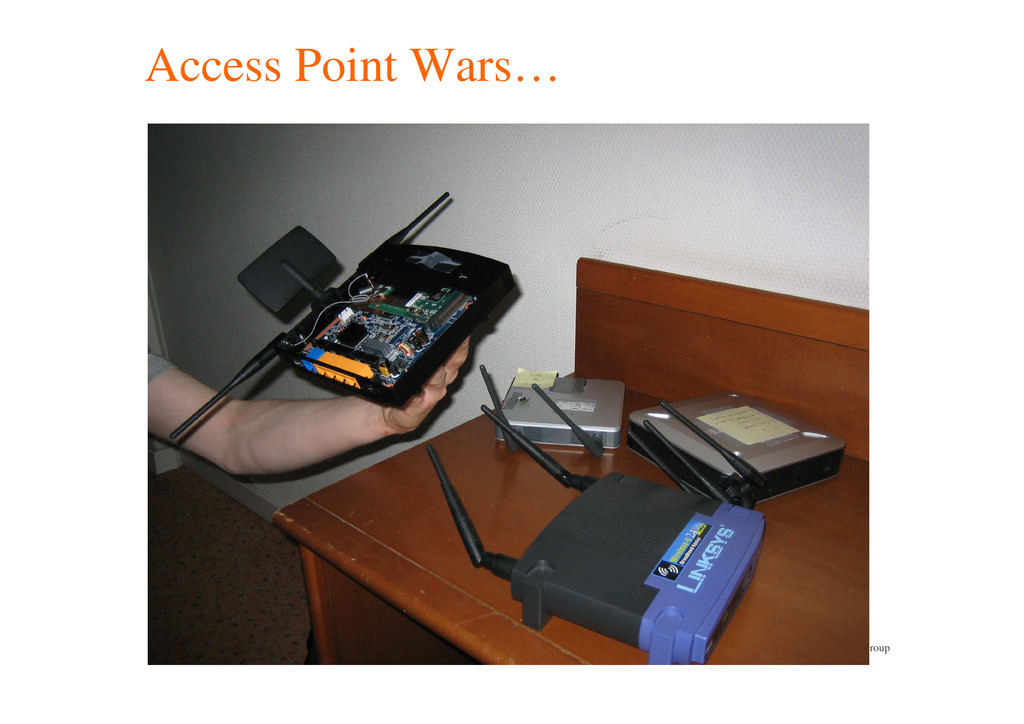
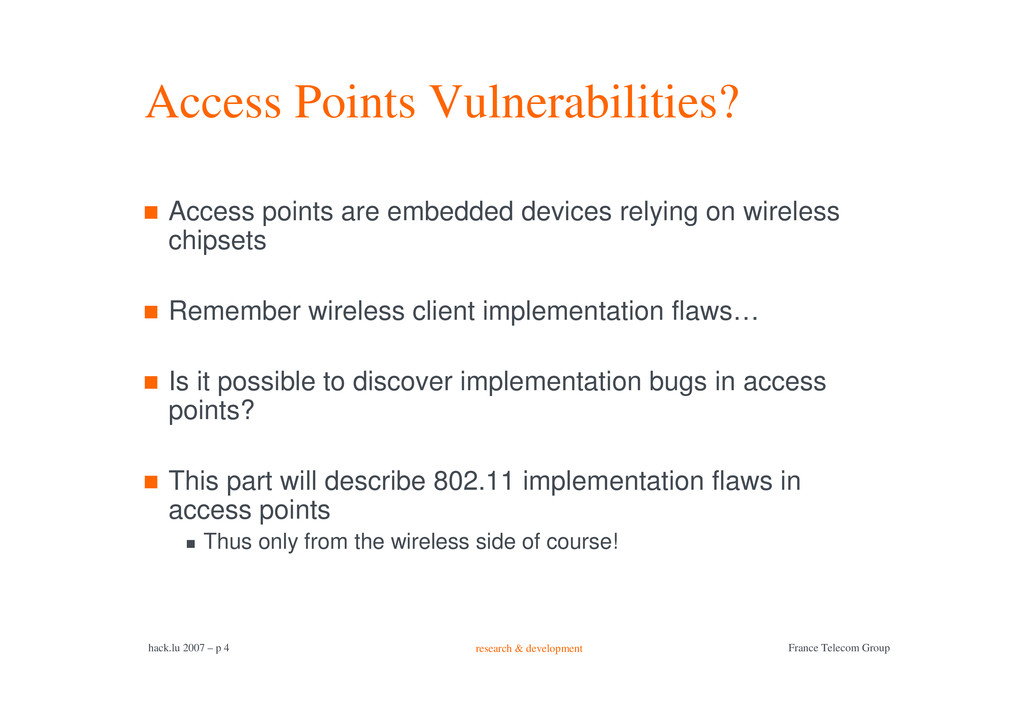
Group Access Points Vulnerabilities? Access points are embedded devices relying on wireless chipsets Remember wireless client implementation flaws… Is it possible to discover implementation bugs in access points? This part will describe 802.11 implementation flaws in access points Thus only from the wireless side of course!
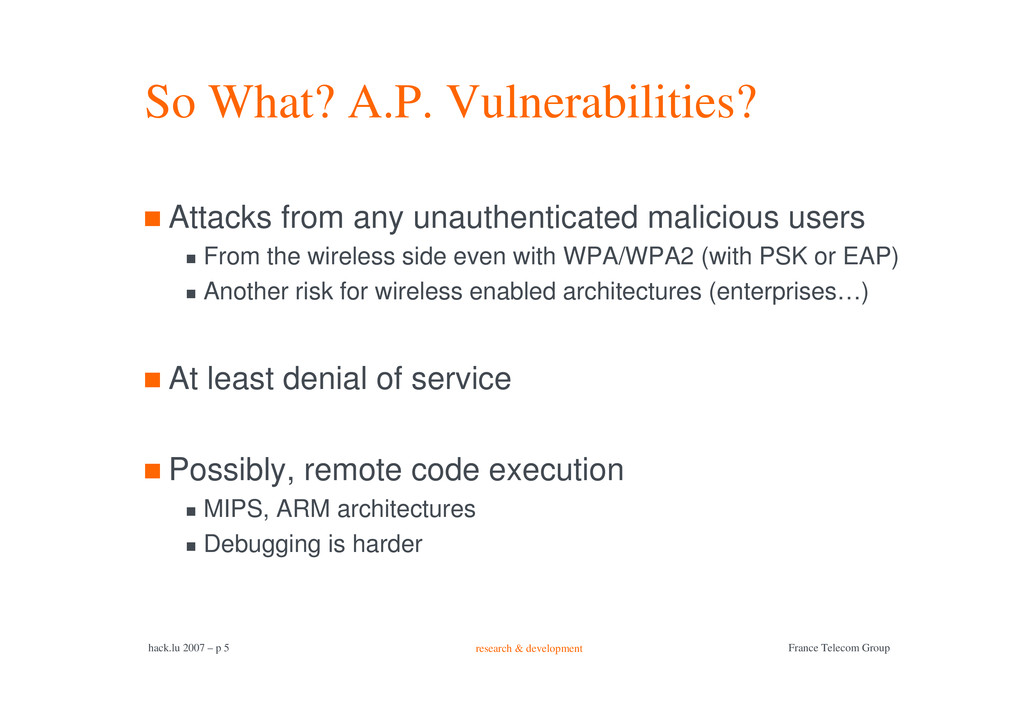
Group So What? A.P. Vulnerabilities? Attacks from any unauthenticated malicious users From the wireless side even with WPA/WPA2 (with PSK or EAP) Another risk for wireless enabled architectures (enterprises…) At least denial of service Possibly, remote code execution MIPS, ARM architectures Debugging is harder
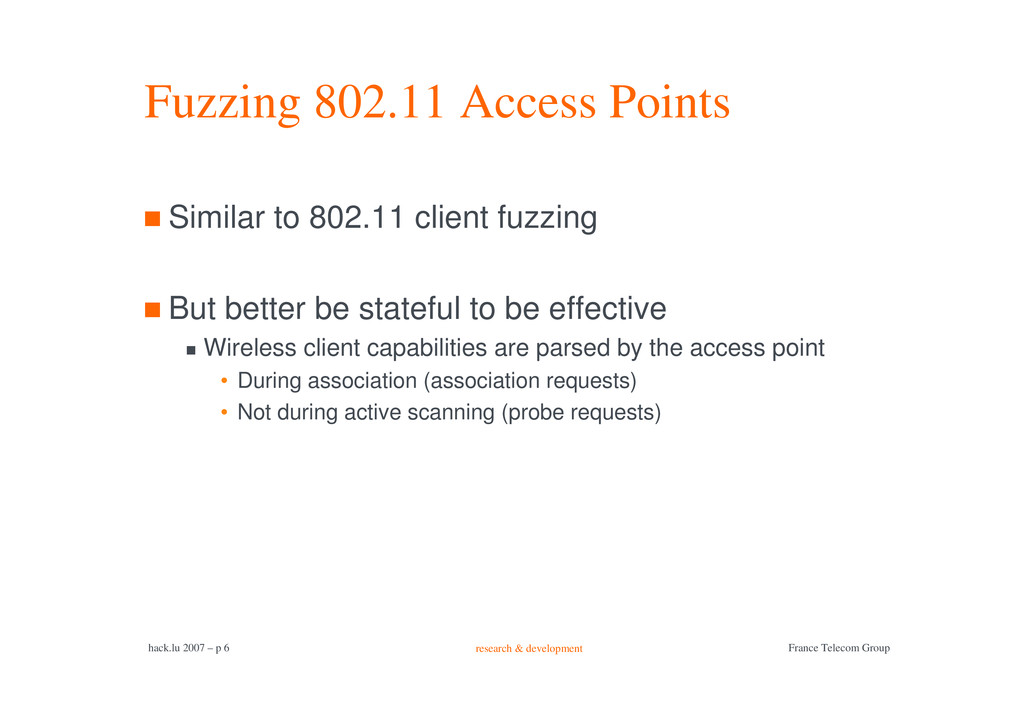
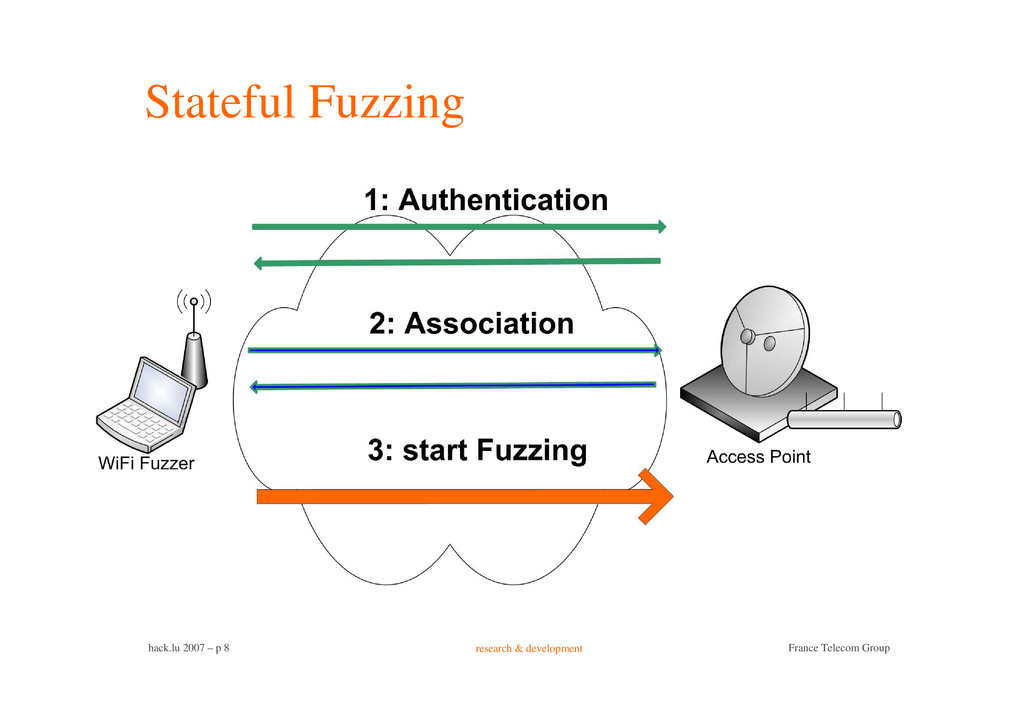
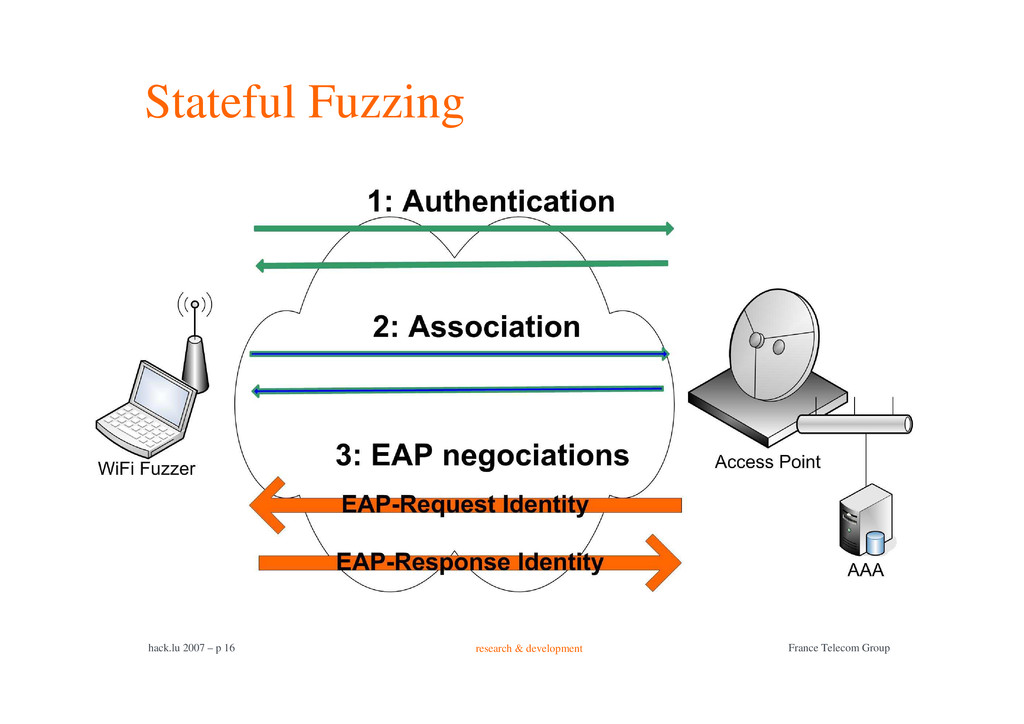
Group Fuzzing 802.11 Access Points Similar to 802.11 client fuzzing But better be stateful to be effective Wireless client capabilities are parsed by the access point • During association (association requests) • Not during active scanning (probe requests)
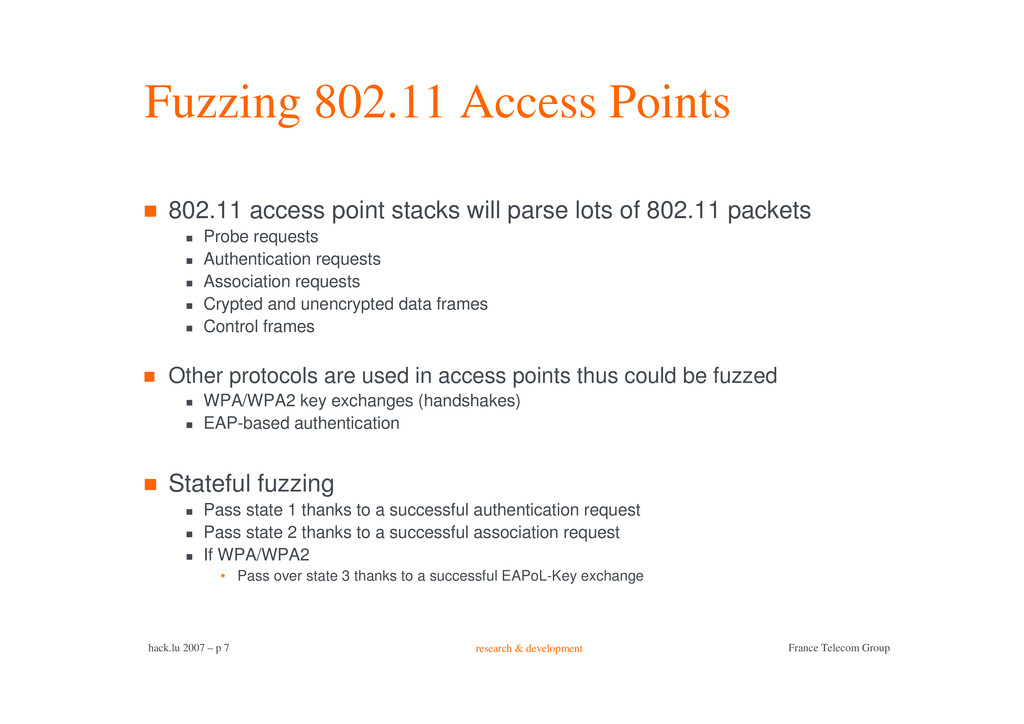
Group Fuzzing 802.11 Access Points 802.11 access point stacks will parse lots of 802.11 packets Probe requests Authentication requests Association requests Crypted and unencrypted data frames Control frames Other protocols are used in access points thus could be fuzzed WPA/WPA2 key exchanges (handshakes) EAP-based authentication Stateful fuzzing Pass state 1 thanks to a successful authentication request Pass state 2 thanks to a successful association request If WPA/WPA2 • Pass over state 3 thanks to a successful EAPoL-Key exchange
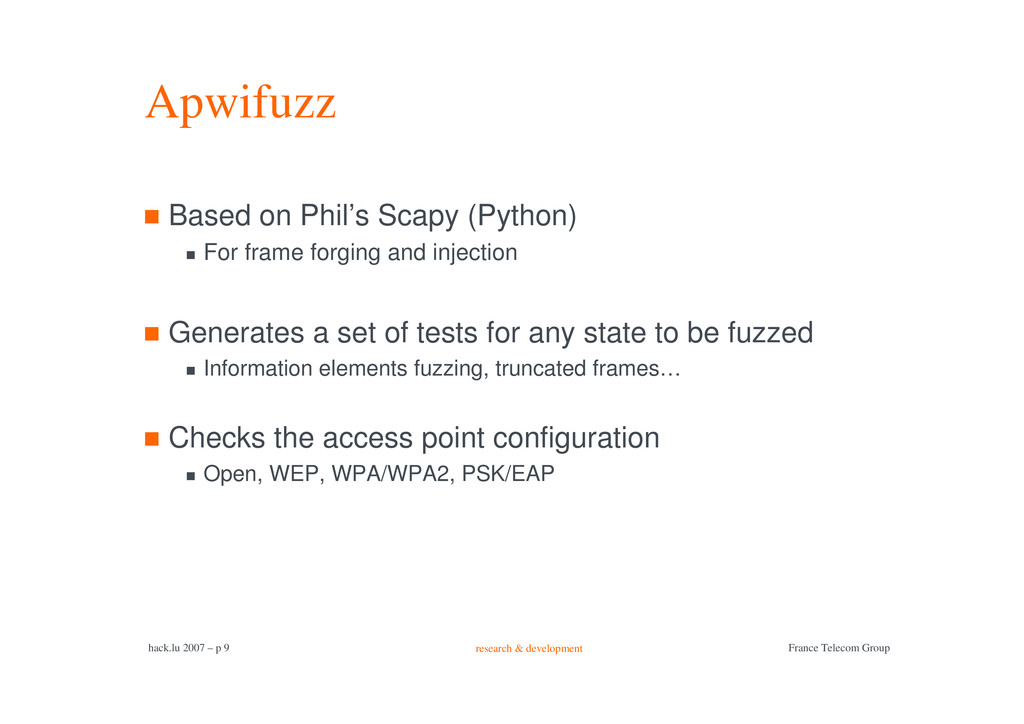
Group Apwifuzz Based on Phil’s Scapy (Python) For frame forging and injection Generates a set of tests for any state to be fuzzed Information elements fuzzing, truncated frames… Checks the access point configuration Open, WEP, WPA/WPA2, PSK/EAP
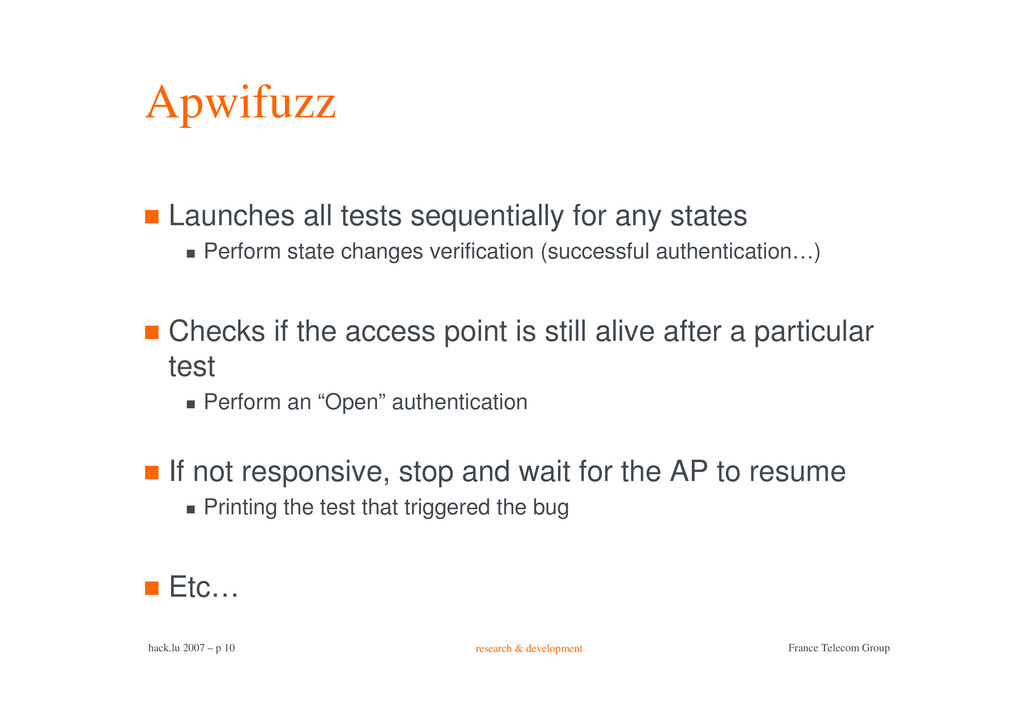
Group Apwifuzz Launches all tests sequentially for any states Perform state changes verification (successful authentication…) Checks if the access point is still alive after a particular test Perform an “Open” authentication If not responsive, stop and wait for the AP to resume Printing the test that triggered the bug Etc…
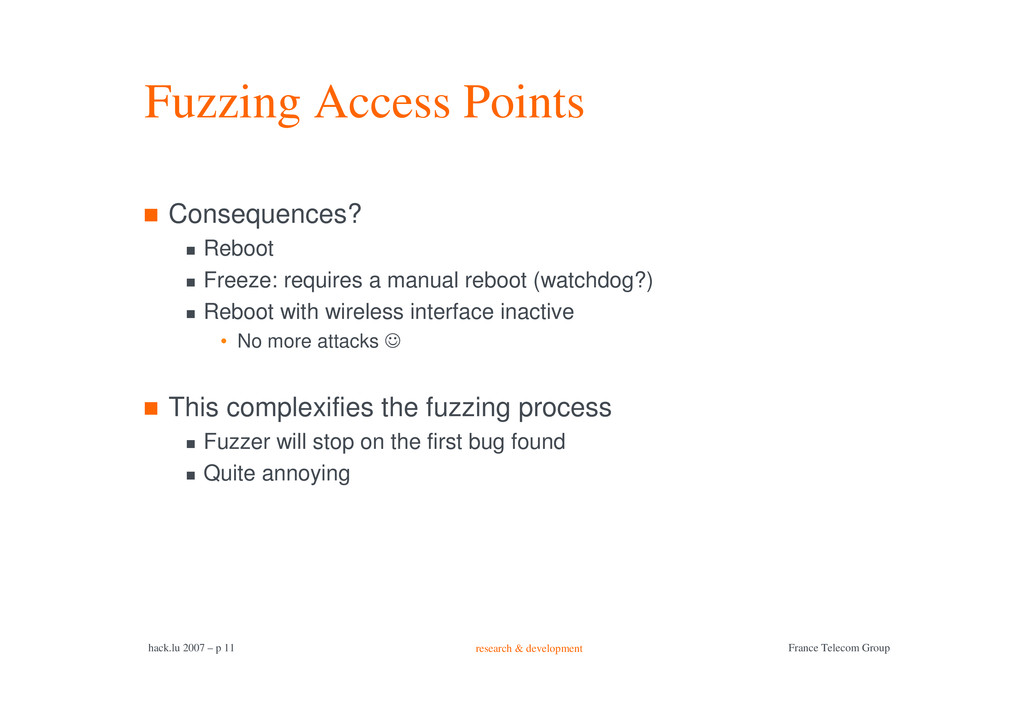
Group Fuzzing Access Points Consequences? Reboot Freeze: requires a manual reboot (watchdog?) Reboot with wireless interface inactive • No more attacks ☺ This complexifies the fuzzing process Fuzzer will stop on the first bug found Quite annoying
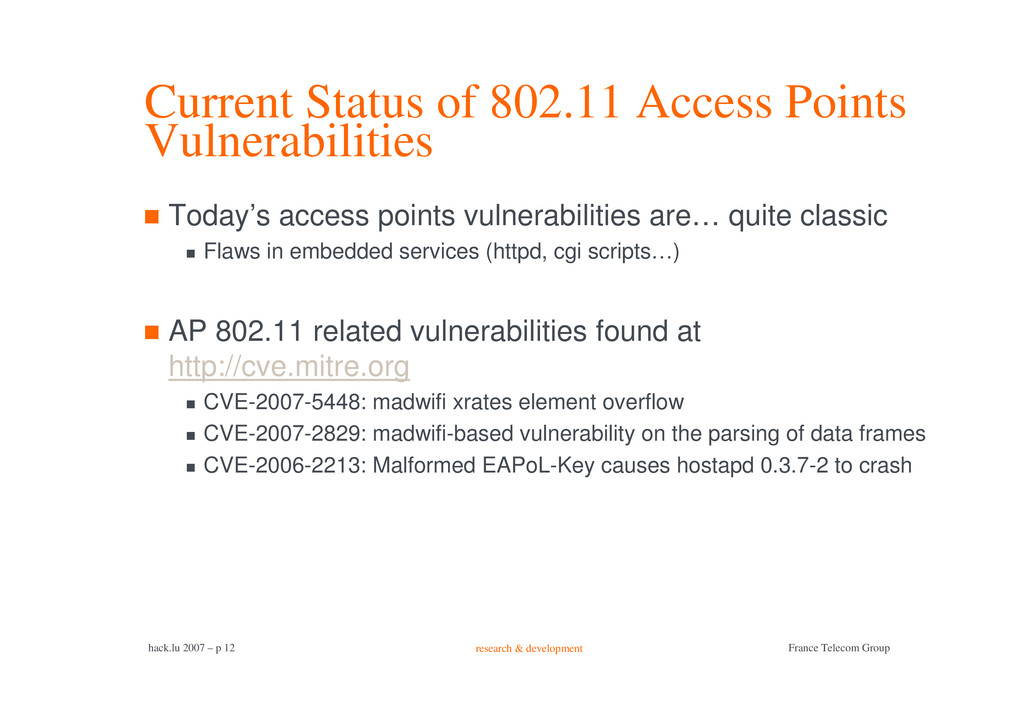
Group Current Status of 802.11 Access Points Vulnerabilities Today’s access points vulnerabilities are… quite classic Flaws in embedded services (httpd, cgi scripts…) AP 802.11 related vulnerabilities found at http://cve.mitre.org CVE-2007-5448: madwifi xrates element overflow CVE-2007-2829: madwifi-based vulnerability on the parsing of data frames CVE-2006-2213: Malformed EAPoL-Key causes hostapd 0.3.7-2 to crash
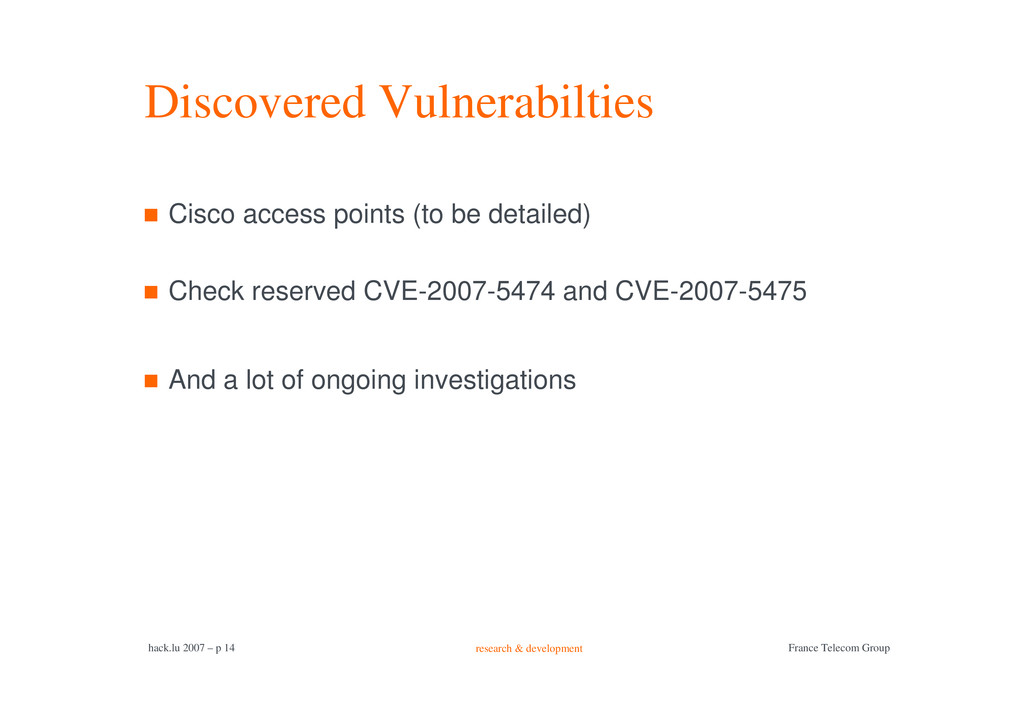
Group Discovered Vulnerabilties Cisco access points (to be detailed) Check reserved CVE-2007-5474 and CVE-2007-5475 And a lot of ongoing investigations
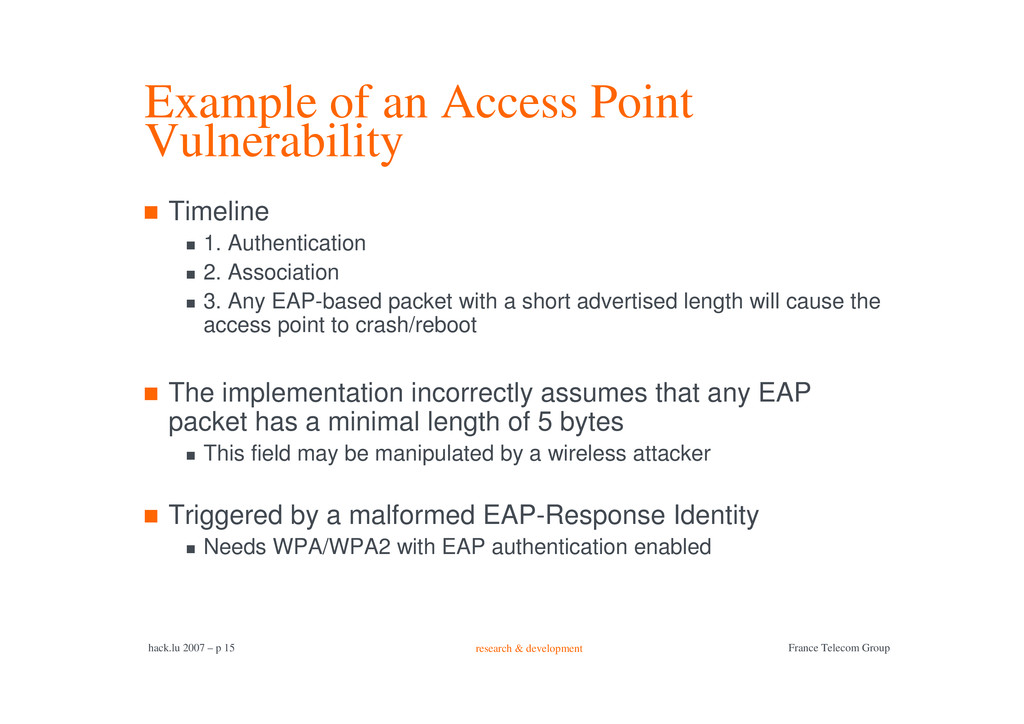
Group Example of an Access Point Vulnerability Timeline 1. Authentication 2. Association 3. Any EAP-based packet with a short advertised length will cause the access point to crash/reboot The implementation incorrectly assumes that any EAP packet has a minimal length of 5 bytes This field may be manipulated by a wireless attacker Triggered by a malformed EAP-Response Identity Needs WPA/WPA2 with EAP authentication enabled
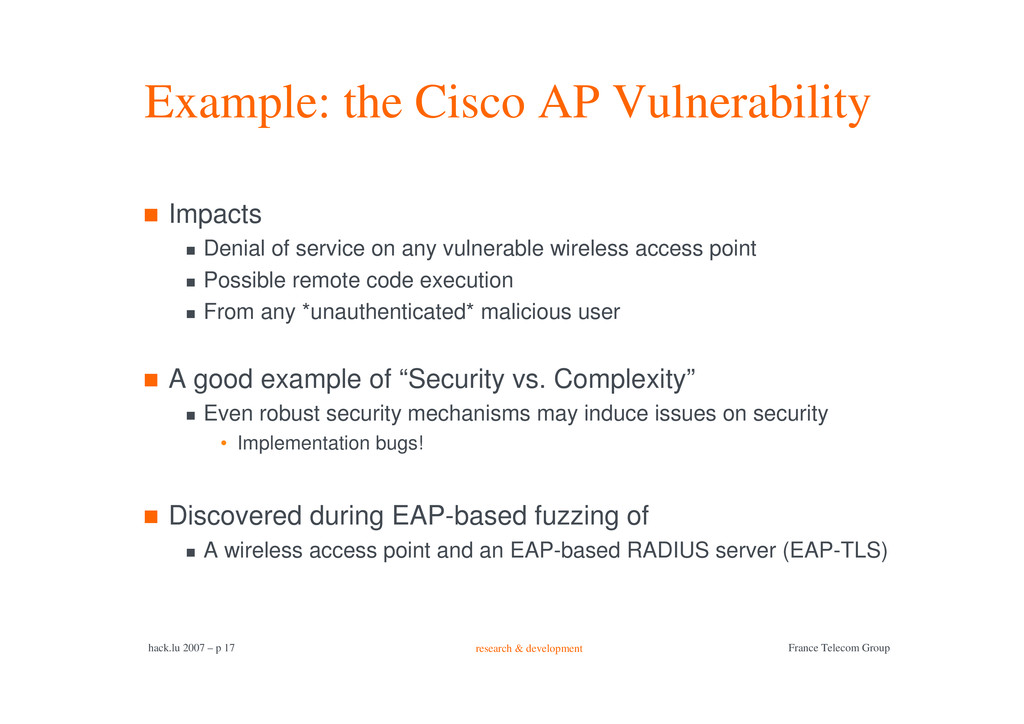
Group Example: the Cisco AP Vulnerability Impacts Denial of service on any vulnerable wireless access point Possible remote code execution From any *unauthenticated* malicious user A good example of “Security vs. Complexity” Even robust security mechanisms may induce issues on security • Implementation bugs! Discovered during EAP-based fuzzing of A wireless access point and an EAP-based RADIUS server (EAP-TLS)
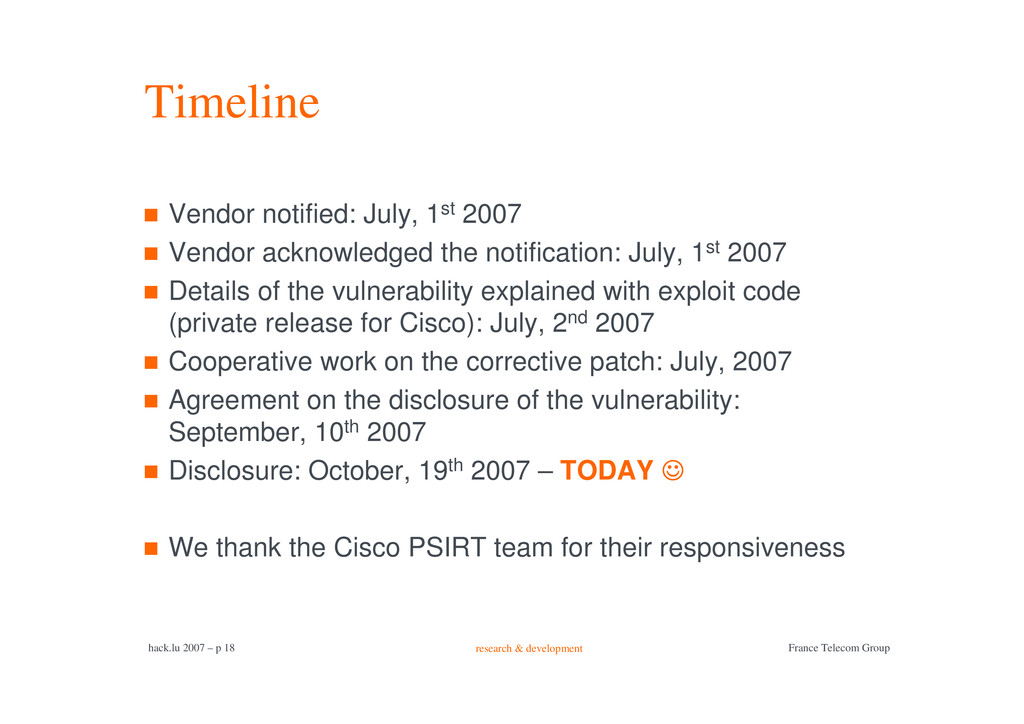
Group Timeline Vendor notified: July, 1st 2007 Vendor acknowledged the notification: July, 1st 2007 Details of the vulnerability explained with exploit code (private release for Cisco): July, 2nd 2007 Cooperative work on the corrective patch: July, 2007 Agreement on the disclosure of the vulnerability: September, 10th 2007 Disclosure: October, 19th 2007 – TODAY ☺ ☺ ☺ ☺ We thank the Cisco PSIRT team for their responsiveness
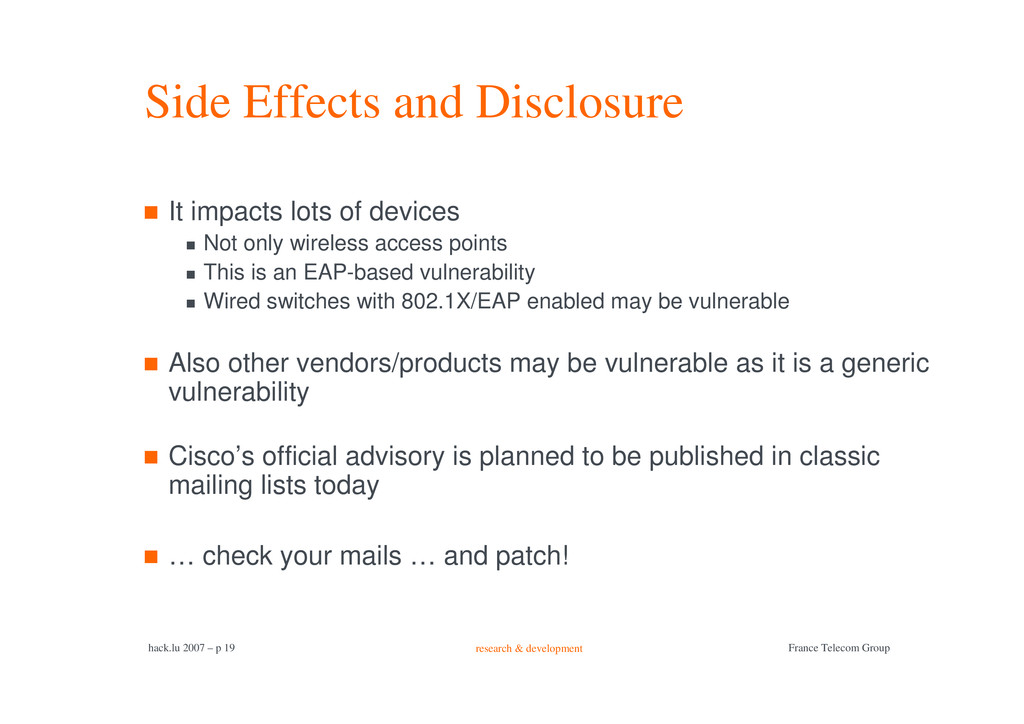
Group Side Effects and Disclosure It impacts lots of devices Not only wireless access points This is an EAP-based vulnerability Wired switches with 802.1X/EAP enabled may be vulnerable Also other vendors/products may be vulnerable as it is a generic vulnerability Cisco’s official advisory is planned to be published in classic mailing lists today … check your mails … and patch!
Group Investigating APs Vulnerabilities We can remotely crash a lot of access points We have a fairly good success rate We need more information Nature and localisation of the flaws Exploitability to gain remote control over the access point We can write a small DoS exploit to easily trigger the vulnerability Based on the information given by the fuzzer
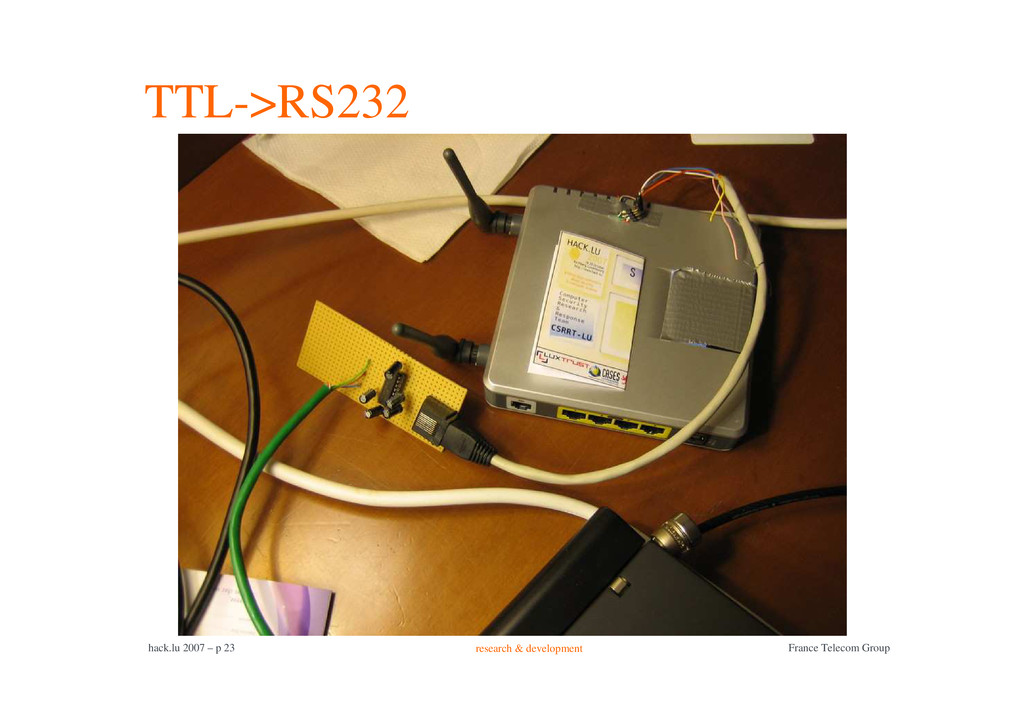
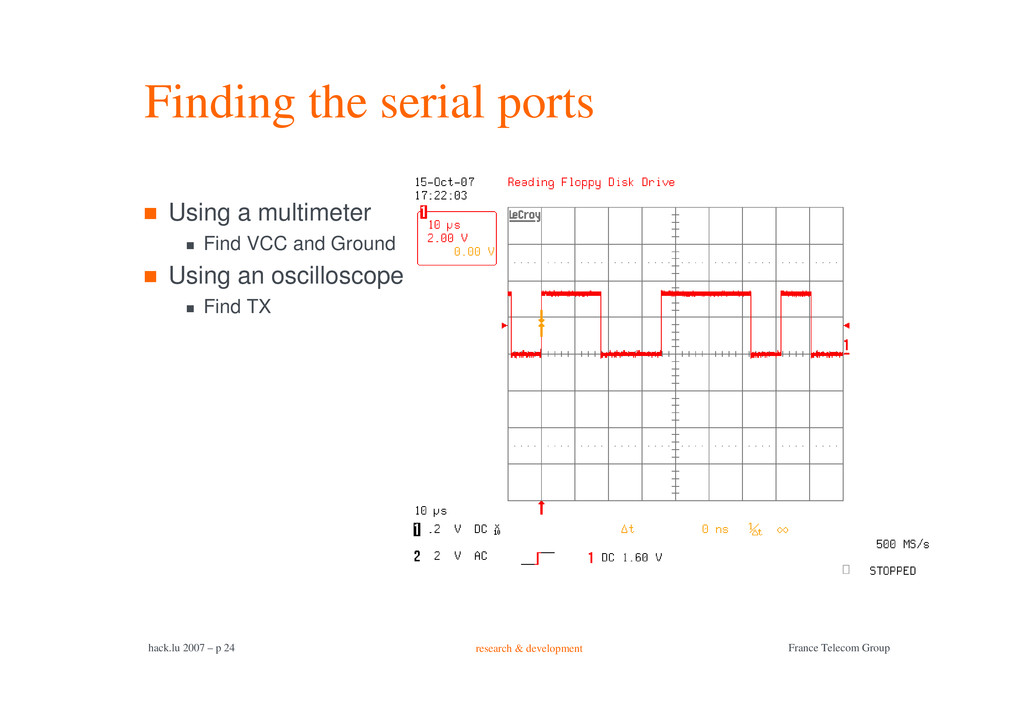
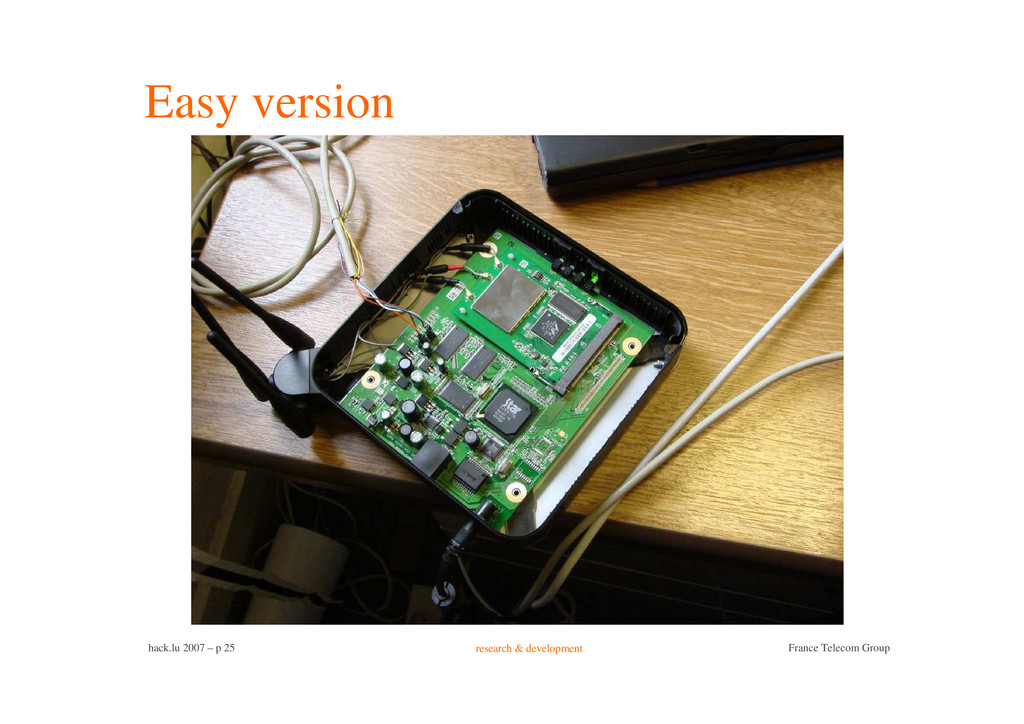
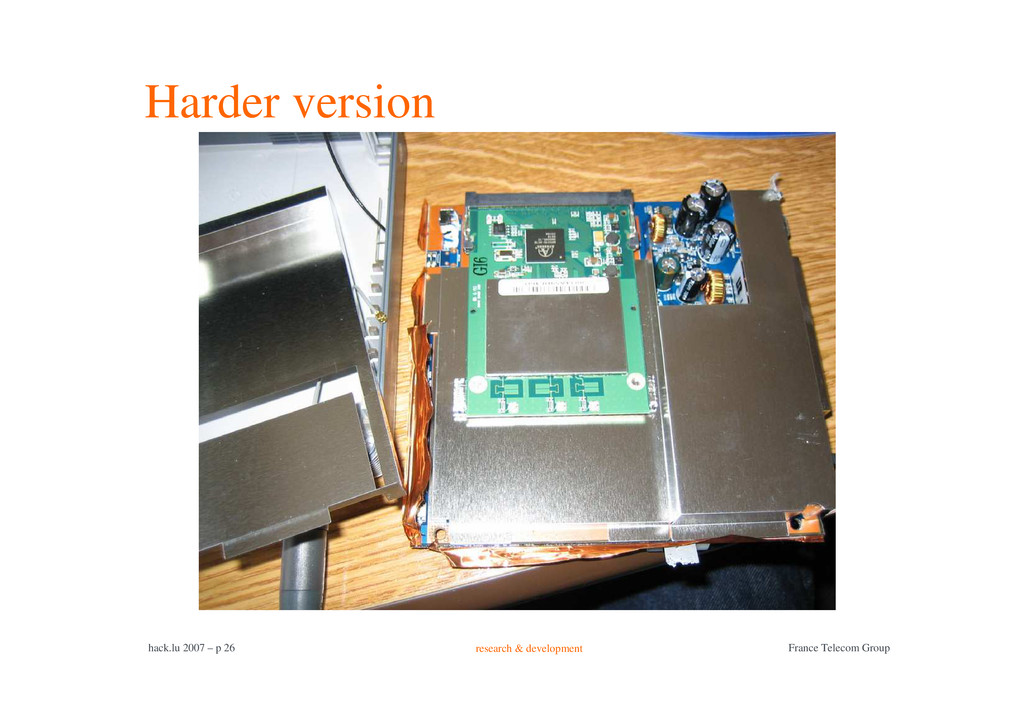
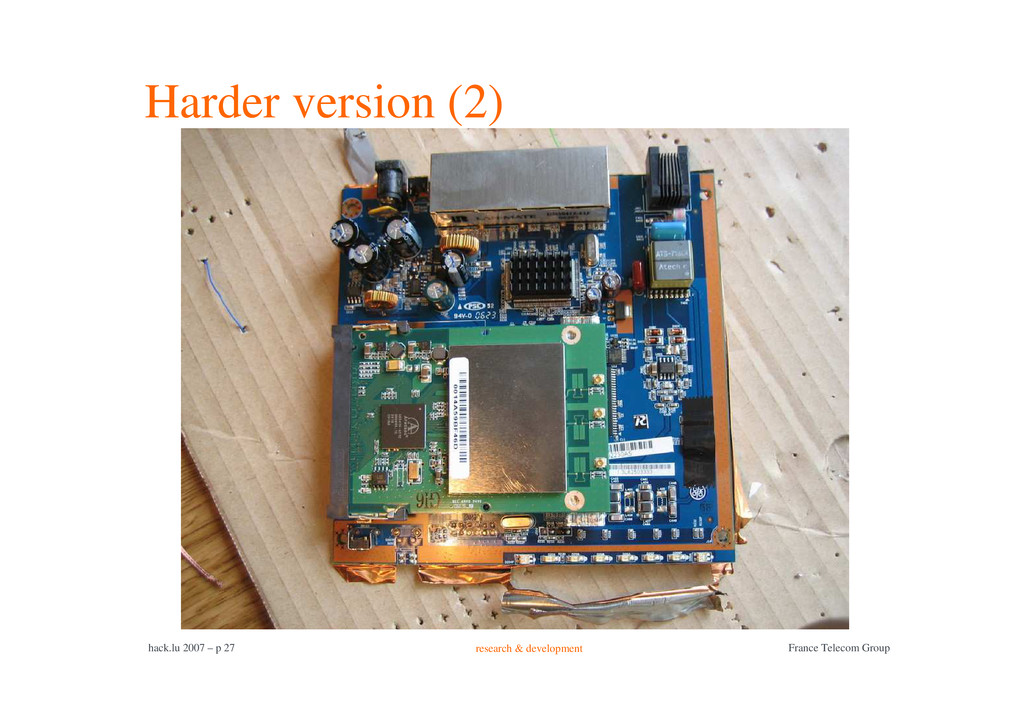
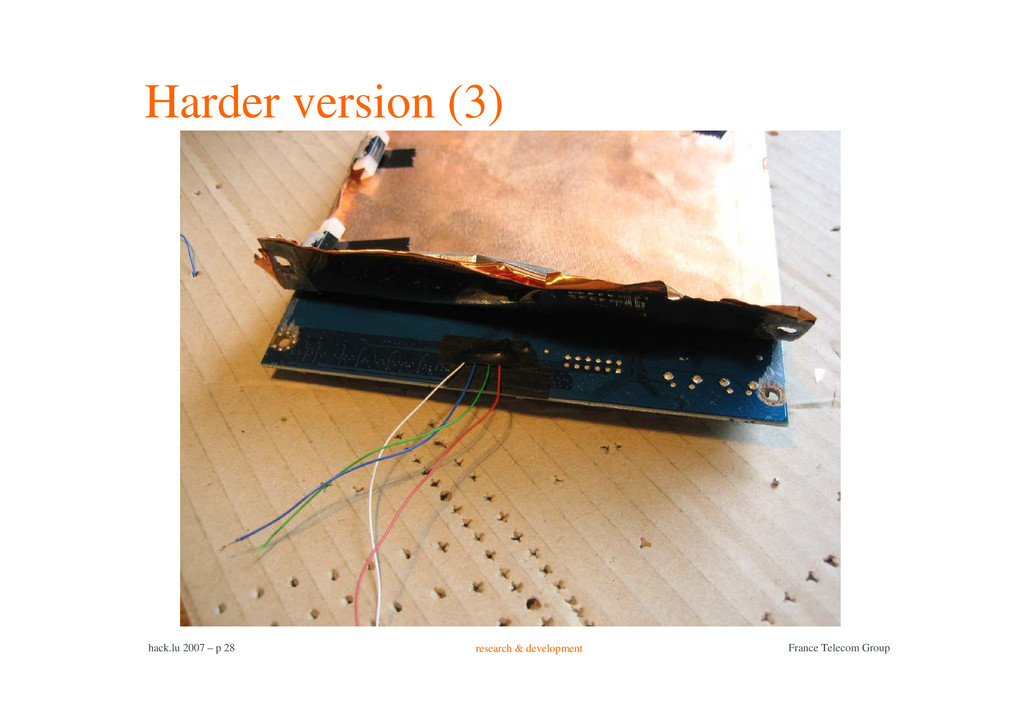
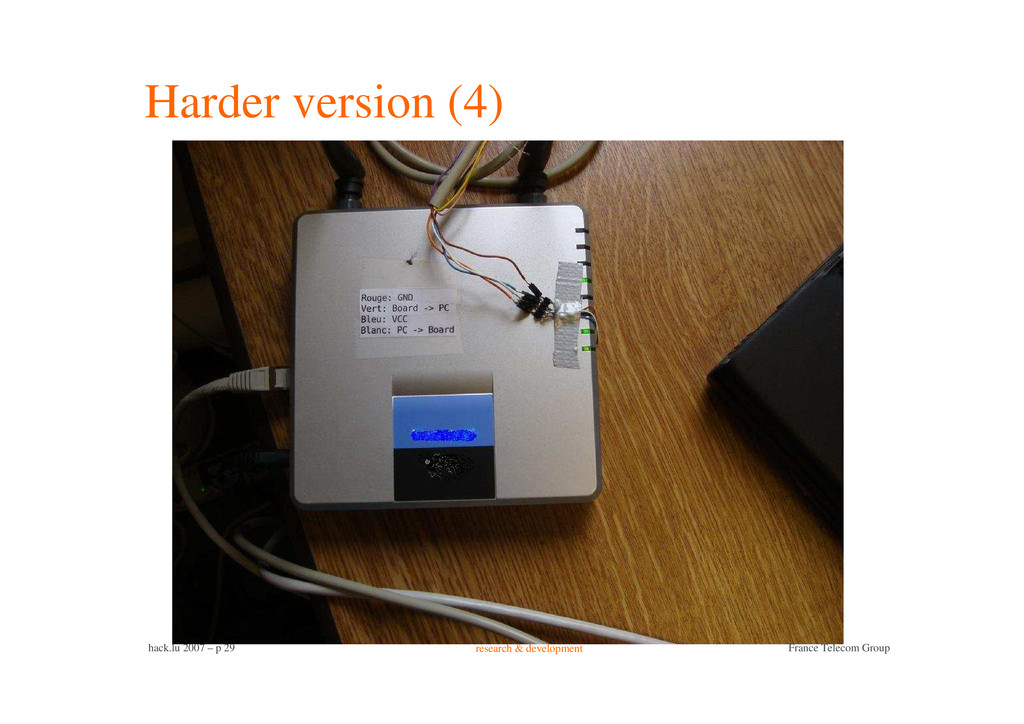
Group Getting some information Open the box, look at the board Look at SoC on the main board and determine the architecture Look at the Wifi chip (Atheros, Marvell…) Google Some access points will let you get a shell easily Standard, externally accessible serial port Telnet server Sometimes it can be a trickier Internal serial port (need for TTL->RS232 conversion)
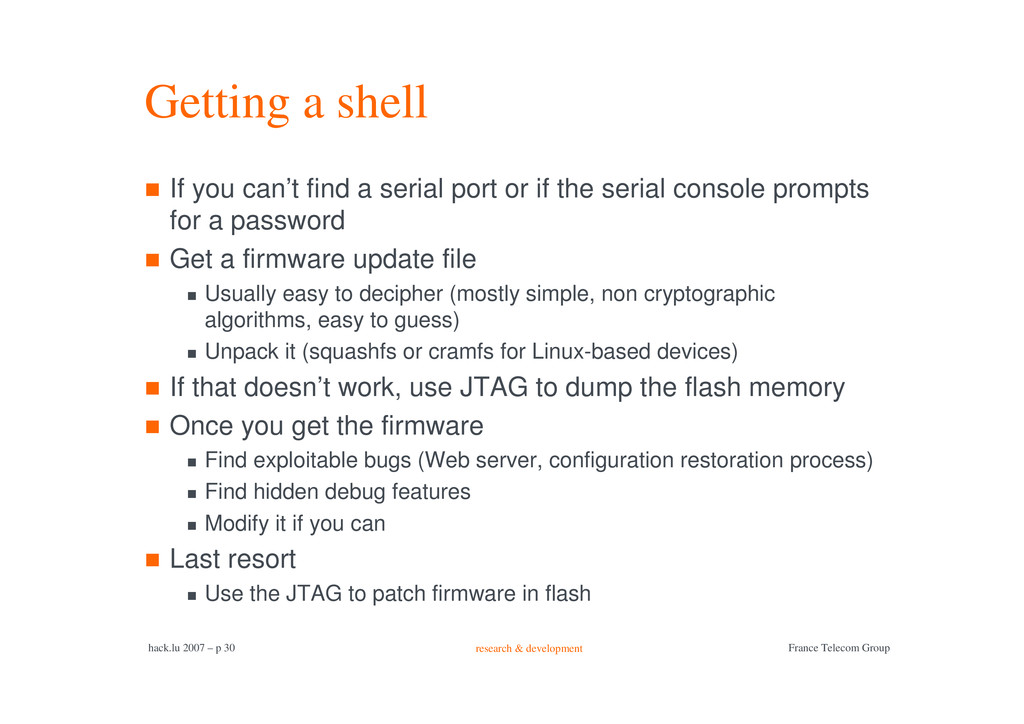
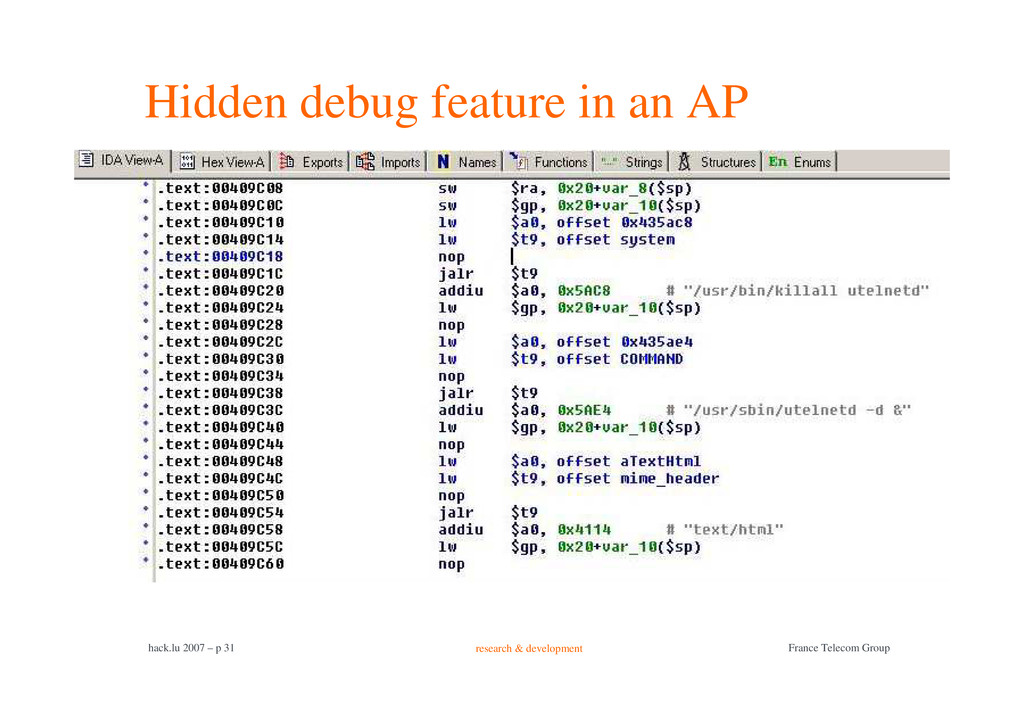
Group Getting a shell If you can’t find a serial port or if the serial console prompts for a password Get a firmware update file Usually easy to decipher (mostly simple, non cryptographic algorithms, easy to guess) Unpack it (squashfs or cramfs for Linux-based devices) If that doesn’t work, use JTAG to dump the flash memory Once you get the firmware Find exploitable bugs (Web server, configuration restoration process) Find hidden debug features Modify it if you can Last resort Use the JTAG to patch firmware in flash
Group Conclusions 802.11 extensions are complex thus error-prone Even if not exhaustive, 802.11 fuzzing is an effective technique We found some critical bugs Stay tuned for more… WPA/WPA2 will not protect your client or infrastructure Successful access point exploitation may be available soon!
Group Acknowledgements Yoann Guillot for metasm Raphael Rigo for help on access point investigations Benoit Stopin for the development of the EAP fuzzer and the discovery of the Cisco access point bug


 0xd012
 kawametho
 ktkrhr
 takahiromatsui
 shreyas1009
 ichiki1023
 tomtanaka
 yama3133
 pauli
pauli
 nasuvitz
 ennael
 masasuzu
 ufried
 palkan
 inesmontani
 axbom
axbom
 iamctodd
 rkendrick25
 chriscoyier
 sergeychernyshev
 marcelosomers
 reverentgeek
 vanstee
 colly
colly
 mfonobong