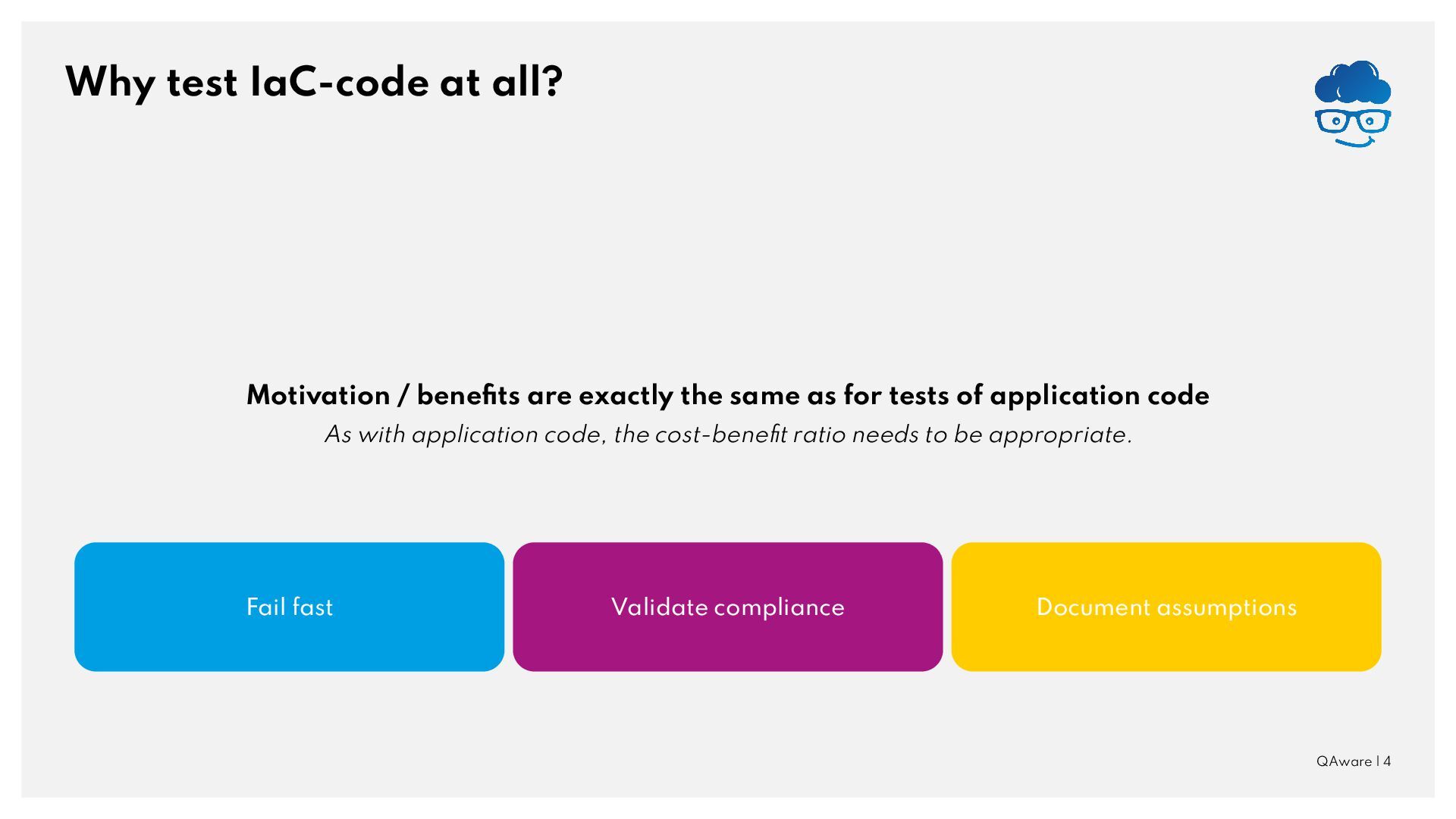
Document assumptions Validate compliance Motivation / benefits are exactly the same as for tests of application code As with application code, the cost-benefit ratio needs to be appropriate.
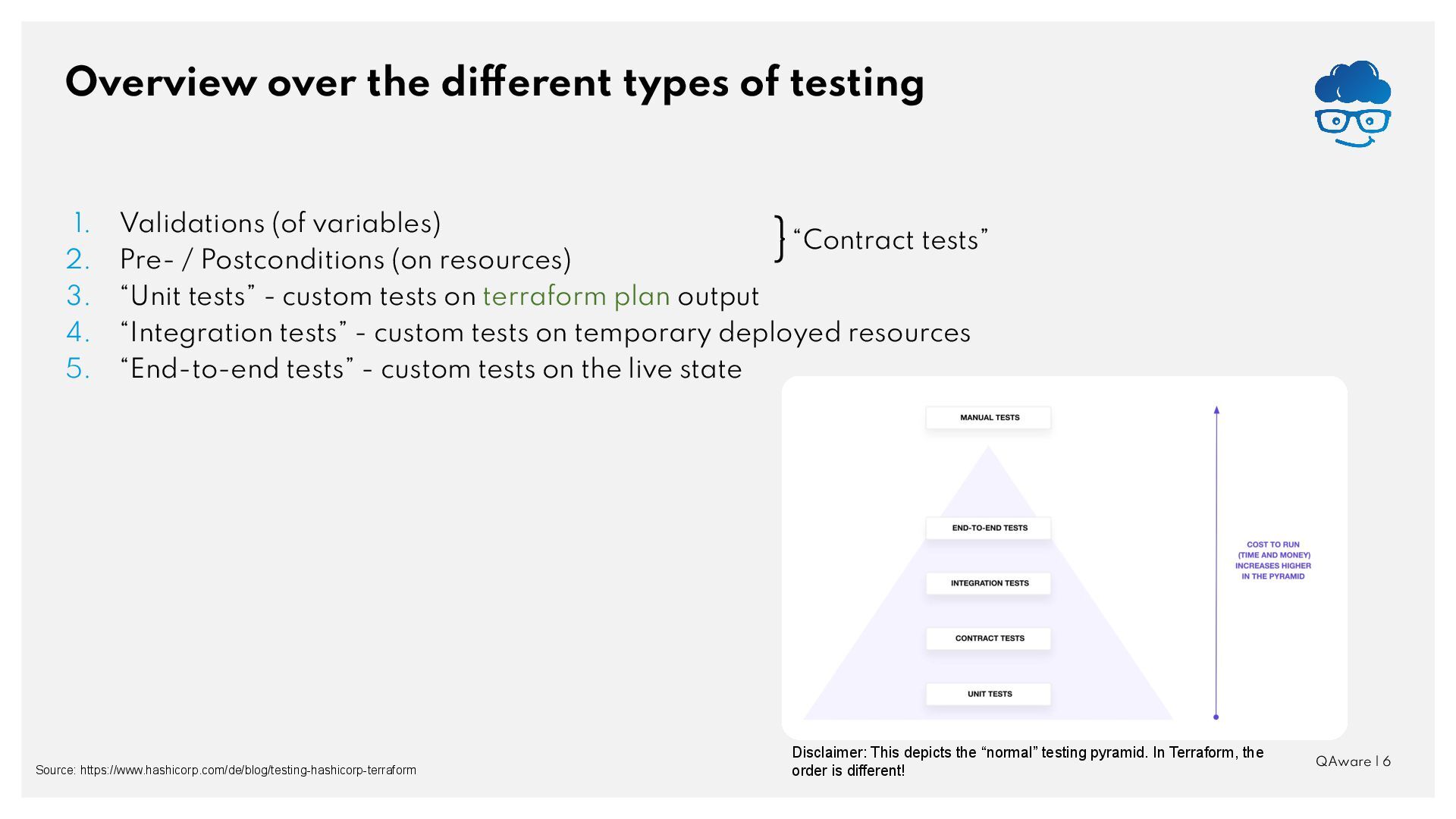
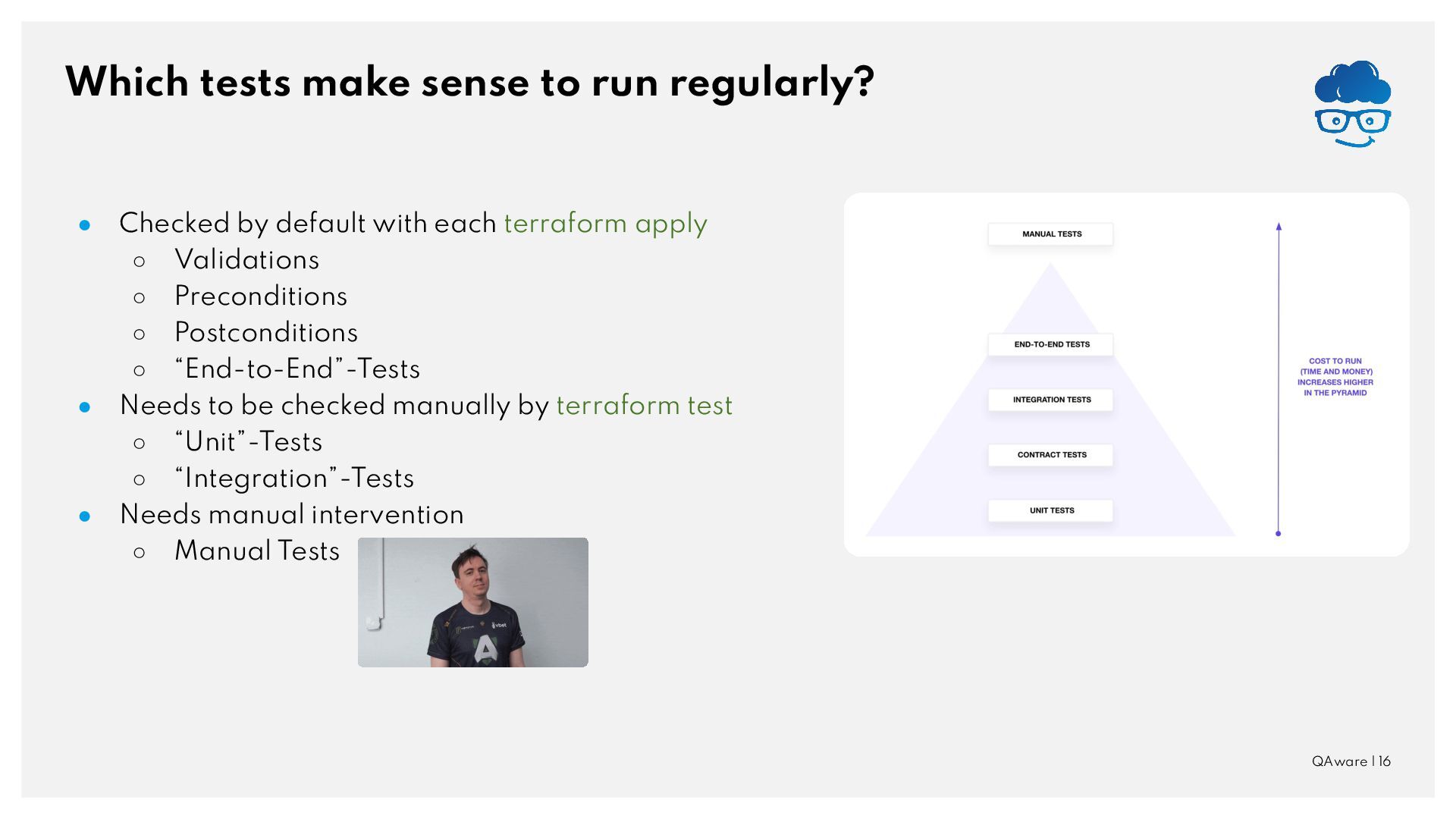
1. Validations (of variables) 2. Pre- / Postconditions (on resources) 3. “Unit tests” - custom tests on terraform plan output 4. “Integration tests” - custom tests on temporary deployed resources 5. “End-to-end tests” - custom tests on the live state }“Contract tests” Disclaimer: This depicts the “normal” testing pyramid. In Terraform, the order is different! Source: https://www.hashicorp.com/de/blog/testing-hashicorp-terraform
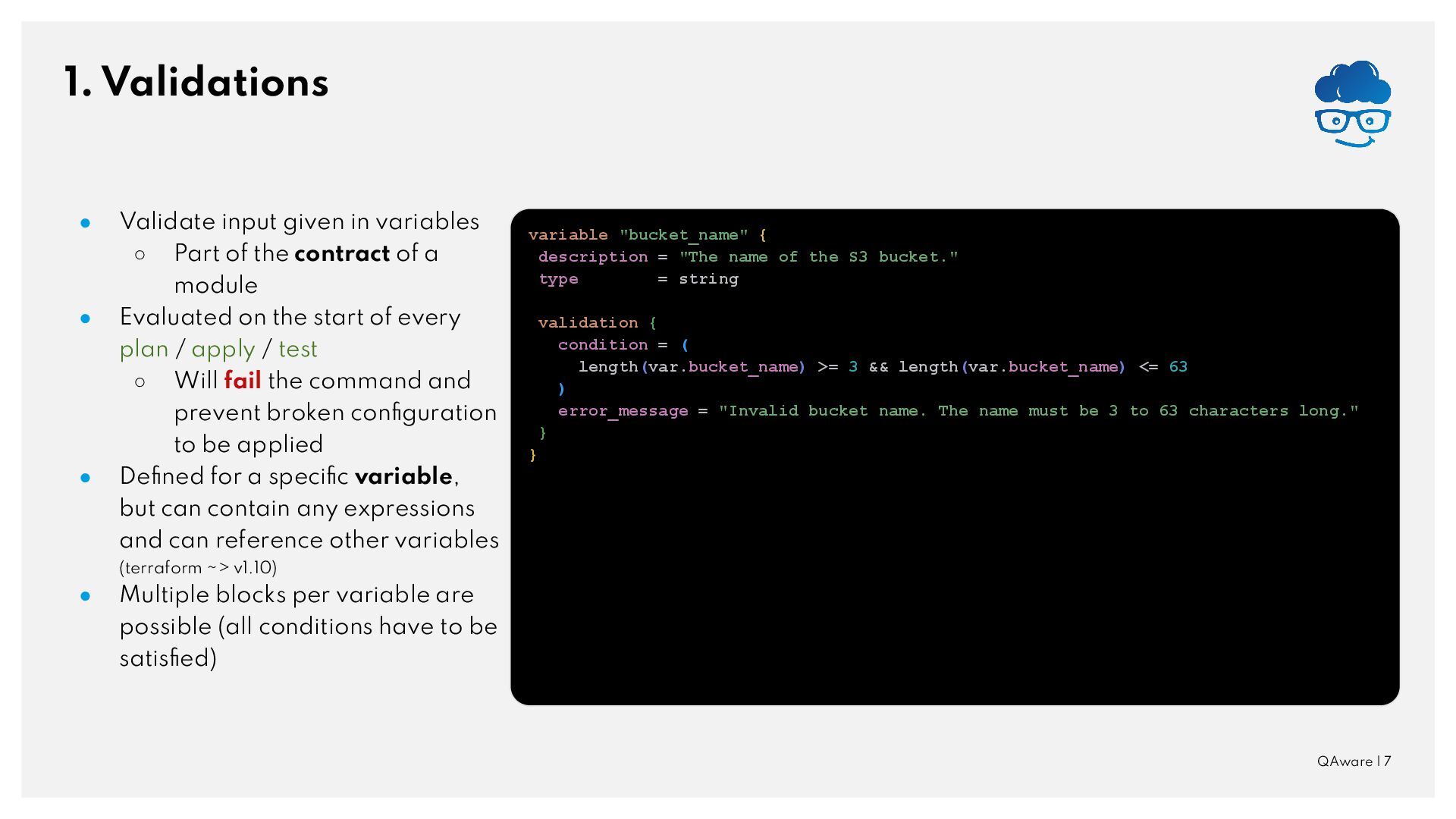
variables ◦ Part of the contract of a module • Evaluated on the start of every plan / apply / test ◦ Will fail the command and prevent broken configuration to be applied • Defined for a specific variable, but can contain any expressions and can reference other variables (terraform ~> v1.10) • Multiple blocks per variable are possible (all conditions have to be satisfied) variable "bucket_name" { description = "The name of the S3 bucket." type = string validation { condition = ( length(var.bucket_name) >= 3 && length(var.bucket_name) <= 63 ) error_message = "Invalid bucket name. The name must be 3 to 63 characters long." } }
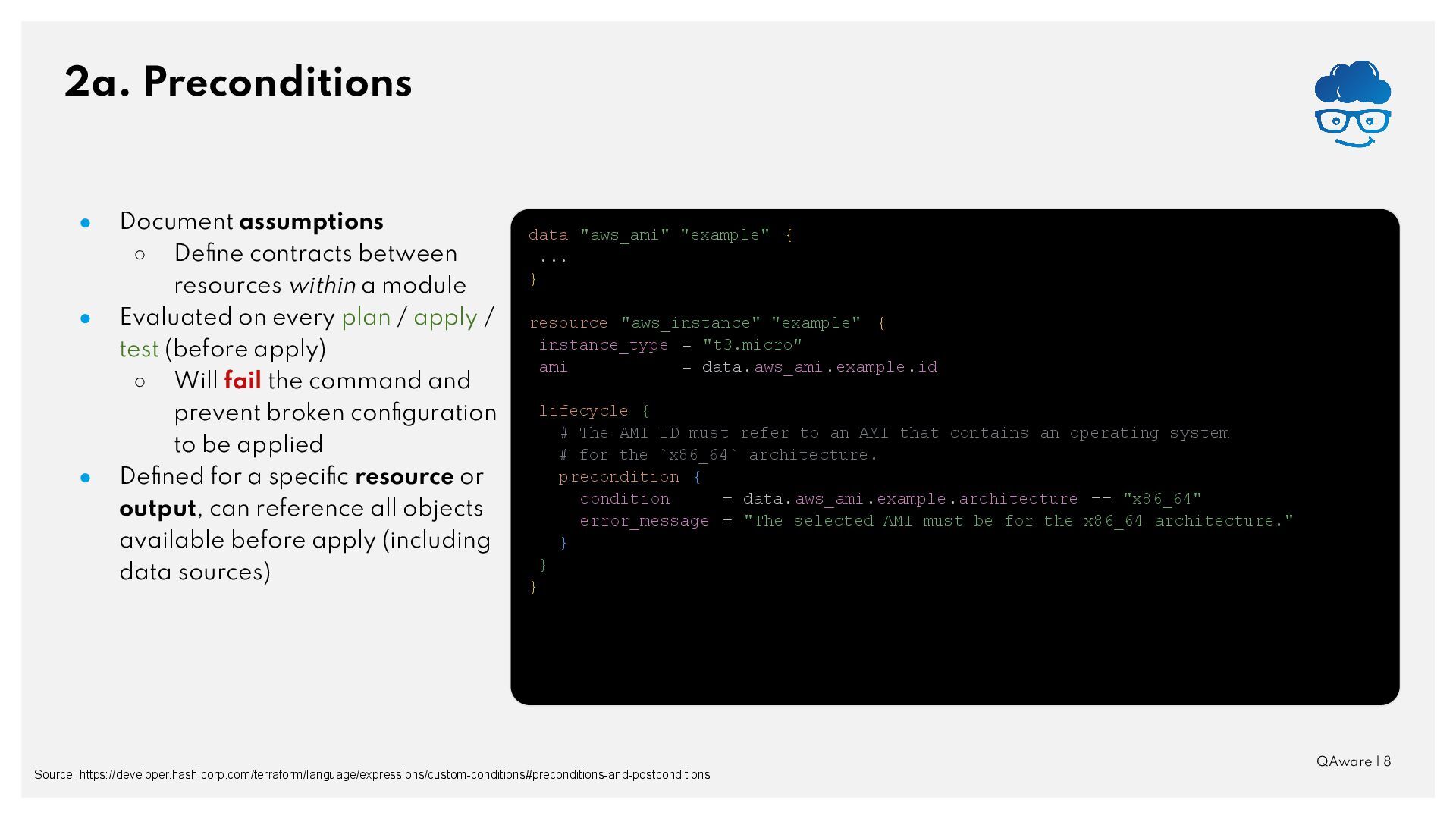
contracts between resources within a module • Evaluated on every plan / apply / test (before apply) ◦ Will fail the command and prevent broken configuration to be applied • Defined for a specific resource or output, can reference all objects available before apply (including data sources) Source: https://developer.hashicorp.com/terraform/language/expressions/custom-conditions#preconditions-and-postconditions data "aws_ami" "example" { ... } resource "aws_instance" "example" { instance_type = "t3.micro" ami = data.aws_ami.example.id lifecycle { # The AMI ID must refer to an AMI that contains an operating system # for the `x86_64` architecture. precondition { condition = data.aws_ami.example.architecture == "x86_64" error_message = "The selected AMI must be for the x86_64 architecture." } } }
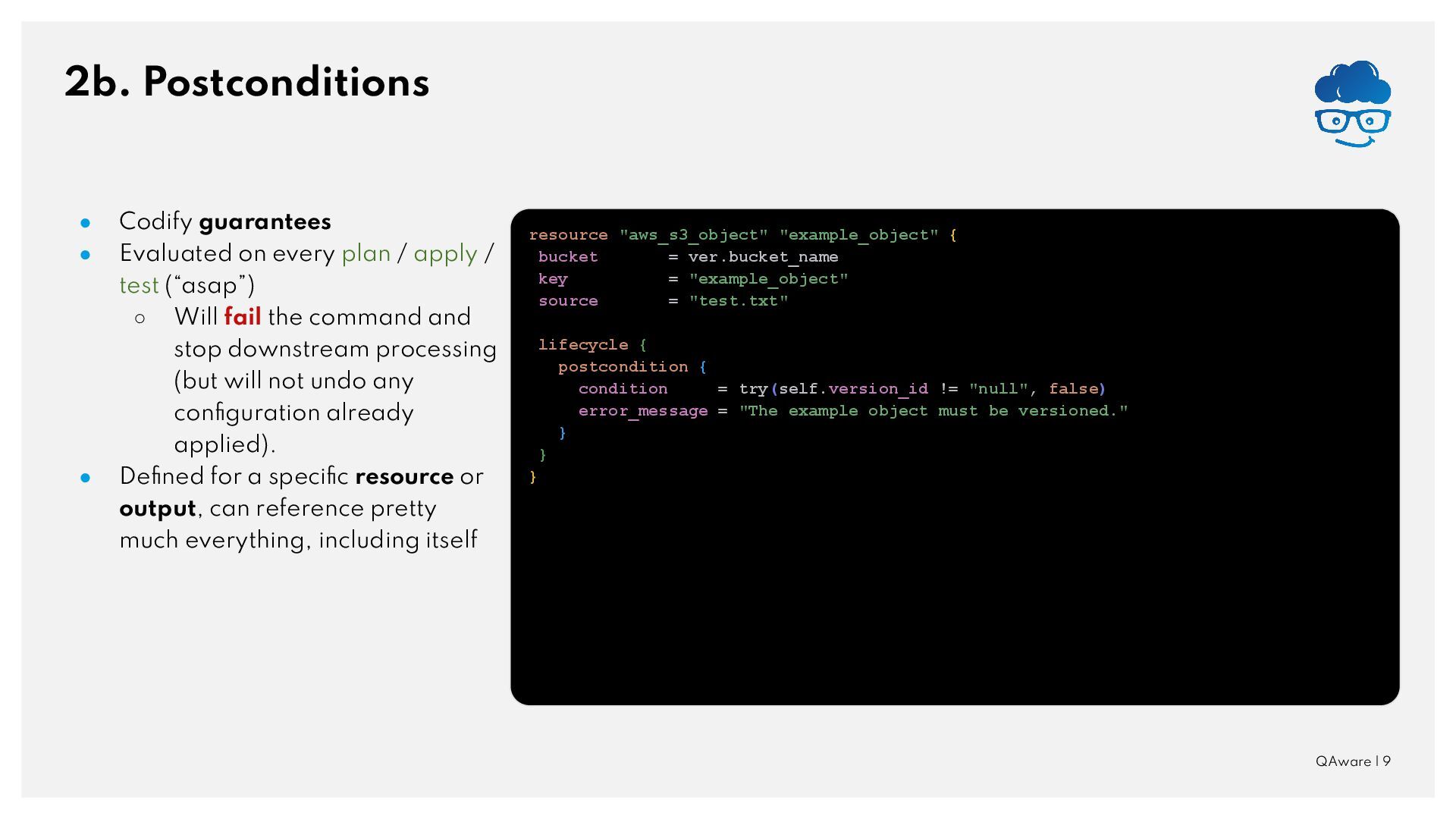
on every plan / apply / test (“asap”) ◦ Will fail the command and stop downstream processing (but will not undo any configuration already applied). • Defined for a specific resource or output, can reference pretty much everything, including itself resource "aws_s3_object" "example_object" { bucket = ver.bucket_name key = "example_object" source = "test.txt" lifecycle { postcondition { condition = try(self.version_id != "null", false) error_message = "The example object must be versioned." } } }
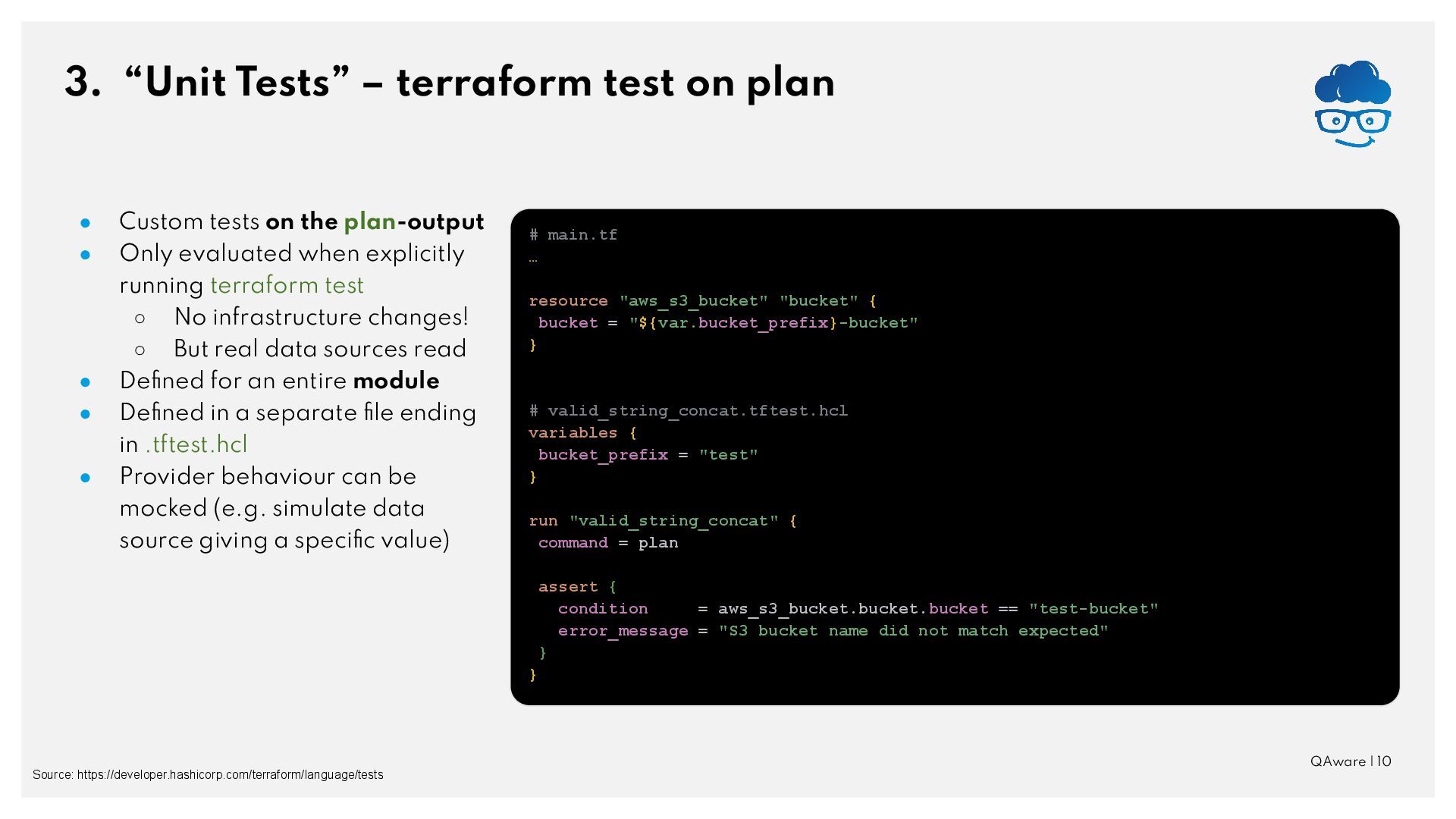
10 • Custom tests on the plan-output • Only evaluated when explicitly running terraform test ◦ No infrastructure changes! ◦ But real data sources read • Defined for an entire module • Defined in a separate file ending in .tftest.hcl • Provider behaviour can be mocked (e.g. simulate data source giving a specific value) # main.tf … resource "aws_s3_bucket" "bucket" { bucket = "${var.bucket_prefix}-bucket" } # valid_string_concat.tftest.hcl variables { bucket_prefix = "test" } run "valid_string_concat" { command = plan assert { condition = aws_s3_bucket.bucket.bucket == "test-bucket" error_message = "S3 bucket name did not match expected" } } Source: https://developer.hashicorp.com/terraform/language/tests
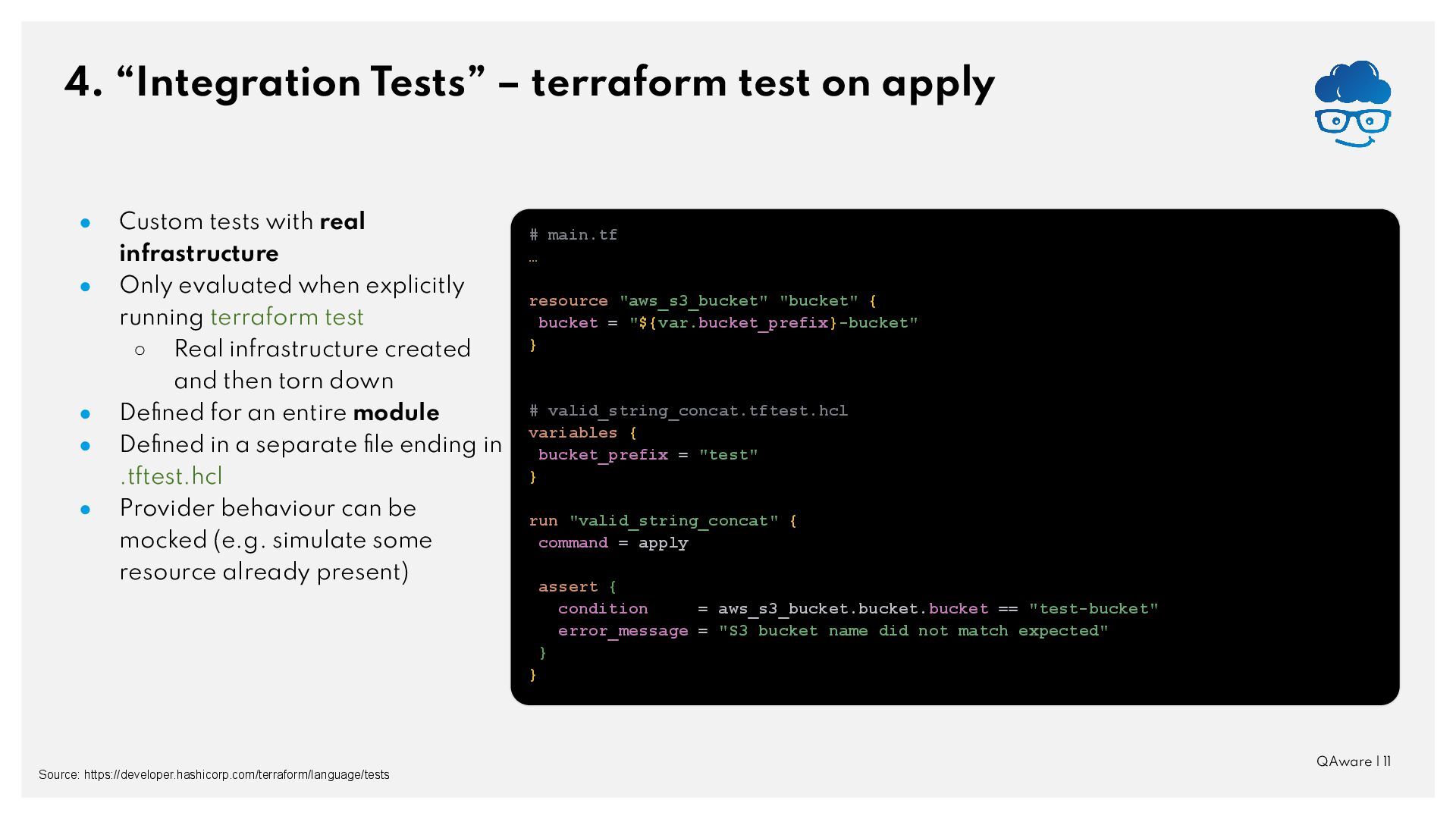
11 • Custom tests with real infrastructure • Only evaluated when explicitly running terraform test ◦ Real infrastructure created and then torn down • Defined for an entire module • Defined in a separate file ending in .tftest.hcl • Provider behaviour can be mocked (e.g. simulate some resource already present) # main.tf … resource "aws_s3_bucket" "bucket" { bucket = "${var.bucket_prefix}-bucket" } # valid_string_concat.tftest.hcl variables { bucket_prefix = "test" } run "valid_string_concat" { command = apply assert { condition = aws_s3_bucket.bucket.bucket == "test-bucket" error_message = "S3 bucket name did not match expected" } } Source: https://developer.hashicorp.com/terraform/language/tests
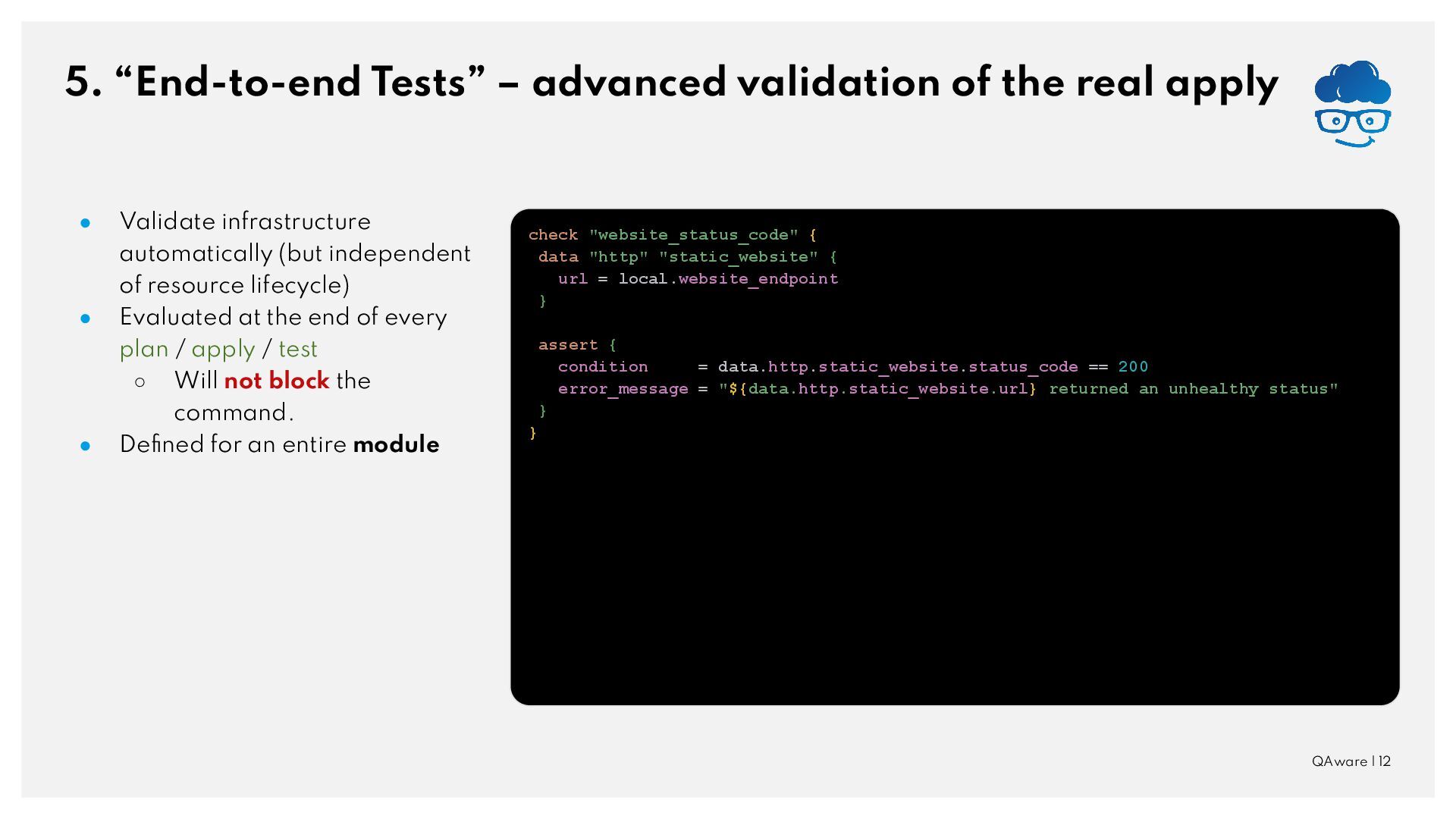
QAware | 12 • Validate infrastructure automatically (but independent of resource lifecycle) • Evaluated at the end of every plan / apply / test ◦ Will not block the command. • Defined for an entire module check "website_status_code" { data "http" "static_website" { url = local.website_endpoint } assert { condition = data.http.static_website.status_code == 200 error_message = "${data.http.static_website.url} returned an unhealthy status" } }
only running terraform internal testing usually is not sufficient. • Glue code needs to be tested ◦ It’s not only terraform, but also the pipelines etc • External interfaces need to be tested ◦ IDP(-management) interacts with other systems, that needs to be tested • Advanced tests to verify functionality of deployed infrastructure ◦ Testing a real world workload ⇒ A custom End-to-End testing framework needs to be built for advanced use-cases
as in terraform. • Validation, custom conditions and check blocks were already included in Terraform 1.5 and became part of OpenTofu with the fork. • terraform test was only introduced in Terraform 1.6, but was included in OpenTofu 1.6. • Provider mocking was included in 1.8. • OpenTofu has not yet introduced any (major) features of its own in this area. • Looking at the details, there are of course some initial minor deviations.
obsolete for most test cases. Often created before tests were introduced in Terraform in their current form. • Kitchen Terraform has since been deprecated. Disadvantage: • Additional tool • Often different syntax or programming language (e.g. Go or Ruby) However, it can be useful in special cases, e.g. • Very complex test cases that require (a lot of) custom test code • Testing multiple tools with the same test tool (e.g. Terratest for Terraform & Packer & Kubernetes)
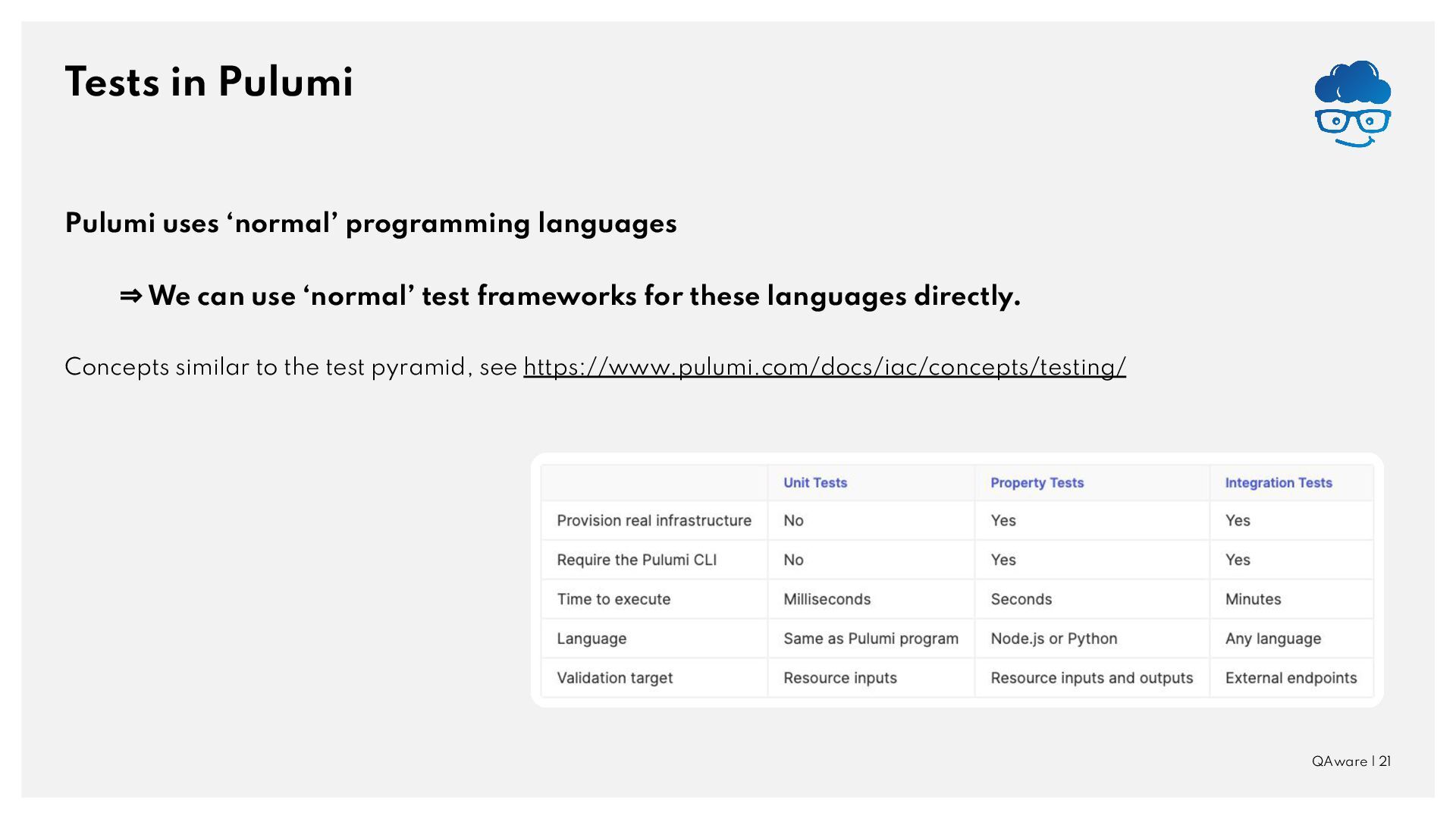
languages ⇒ We can use ‘normal’ test frameworks for these languages directly. Concepts similar to the test pyramid, see https://www.pulumi.com/docs/iac/concepts/testing/


 aeimer
 sony
sony
 pauli
pauli
 ueponx
 kakakakakku
 shumei_ito
 bgpat
bgpat
 tatamiya
 thkt
thkt
 ufried
 vivion
 htan
htan
 oikon48
 tomoyanonymous
 seathinner
 kneath
 keithpitt
 frankvandijk
 minecr
 csswizardry
 chikuwait
 akihiro_kokubo
 thoeni
 afnizarnur