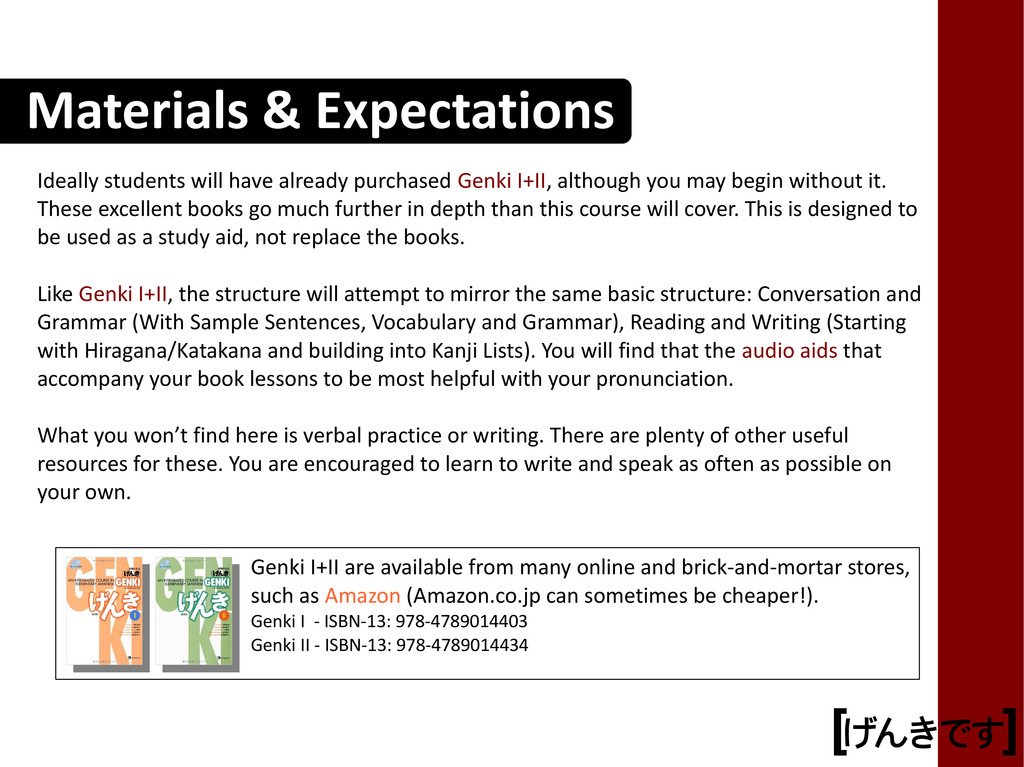
have already purchased Genki I+II, although you may begin without it. These excellent books go much further in depth than this course will cover. This is designed to be used as a study aid, not replace the books. Like Genki I+II, the structure will attempt to mirror the same basic structure: Conversation and Grammar (With Sample Sentences, Vocabulary and Grammar), Reading and Writing (Starting with Hiragana/Katakana and building into Kanji Lists). You will find that the audio aids that accompany your book lessons to be most helpful with your pronunciation. What you won’t find here is verbal practice or writing. There are plenty of other useful resources for these. You are encouraged to learn to write and speak as often as possible on your own. Genki I+II are available from many online and brick-and-mortar stores, such as Amazon (Amazon.co.jp can sometimes be cheaper!). Genki I - ISBN-13: 978-4789014403 Genki II - ISBN-13: 978-4789014434
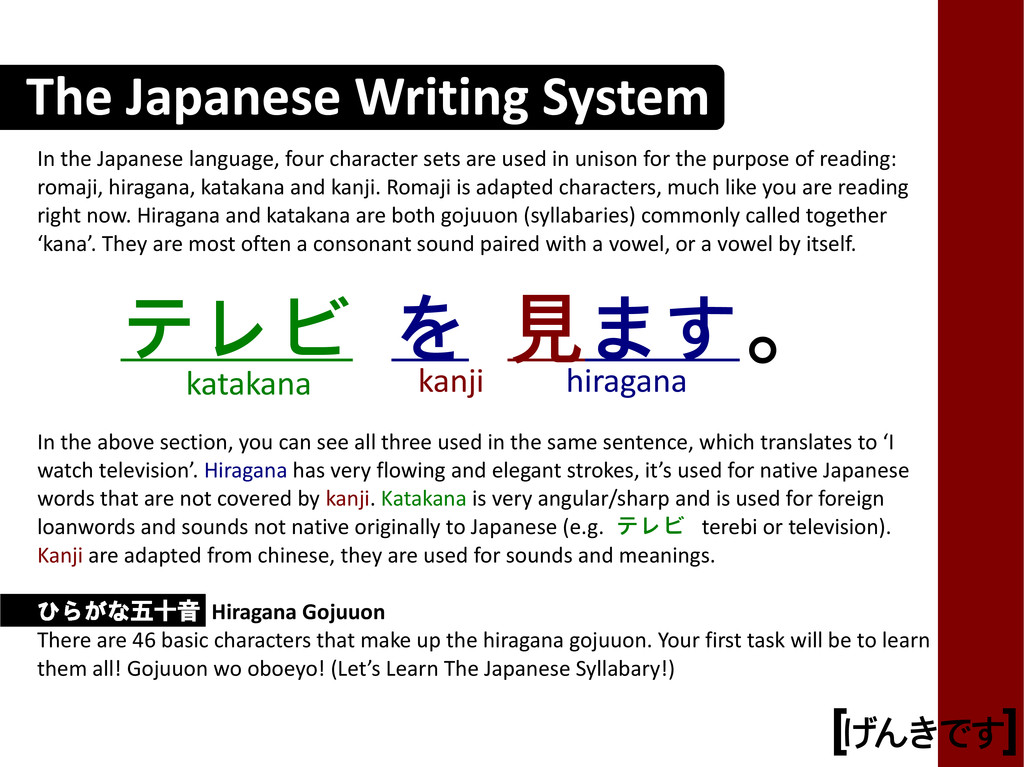
sets are used in unison for the purpose of reading: romaji, hiragana, katakana and kanji. Romaji is adapted characters, much like you are reading right now. Hiragana and katakana are both gojuuon (syllabaries) commonly called together ‘kana’. They are most often a consonant sound paired with a vowel, or a vowel by itself. In the above section, you can see all three used in the same sentence, which translates to ‘I watch television’. Hiragana has very flowing and elegant strokes, it’s used for native Japanese words that are not covered by kanji. Katakana is very angular/sharp and is used for foreign loanwords and sounds not native originally to Japanese (e.g. テレビ terebi or television). Kanji are adapted from chinese, they are used for sounds and meanings. ひらがな五十音 Hiragana Gojuuon There are 46 basic characters that make up the hiragana gojuuon. Your first task will be to learn them all! Gojuuon wo oboeyo! (Let’s Learn The Japanese Syllabary!) テレビ を 見ます。 katakana kanji hiragana げんきです [ ]


 aimsworth
 quramy
 reverentgeek
 bryan
 jeffersonlam
 watany
 mlcsv
 mkilby
 sergeychernyshev
 bkeepers
 malarkey
 signer