Upgrade to Pro — share decks privately, control downloads, hide ads and more …

visionOS Professionals Survey 2026

visionOS Professionals Survey 2026

Results from the second annual visionOS Professionals Survey, conducted in May 2026 with 123 people building, designing, researching, and leading work on visionOS.

This deck shares a snapshot of the current visionOS professional community: who is building for Apple Vision Pro, what kinds of apps are being created, which tools and platforms teams are using, how visionOS 26 is being received, and what practitioners hope to see next from Apple.

Key findings include:
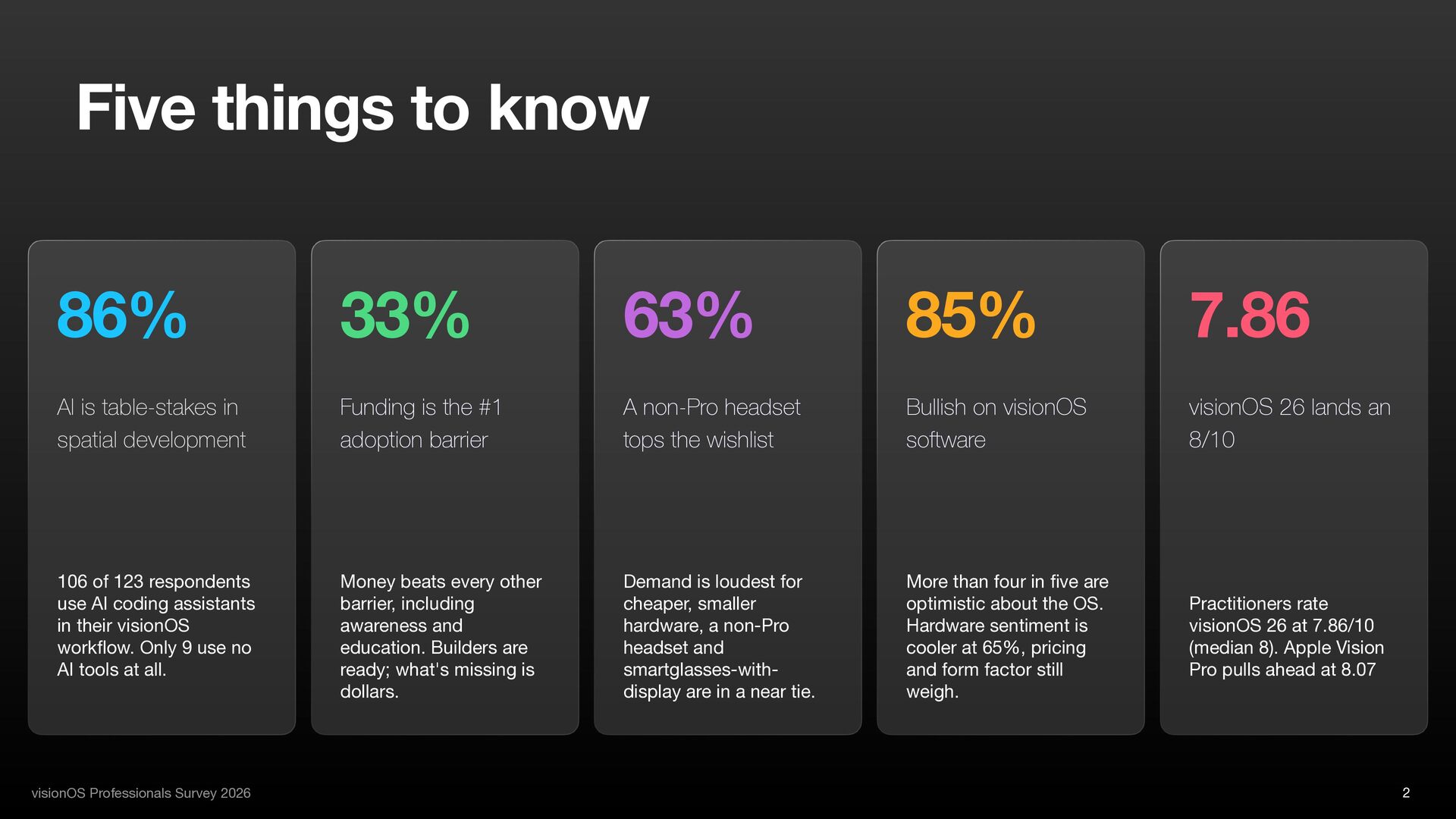
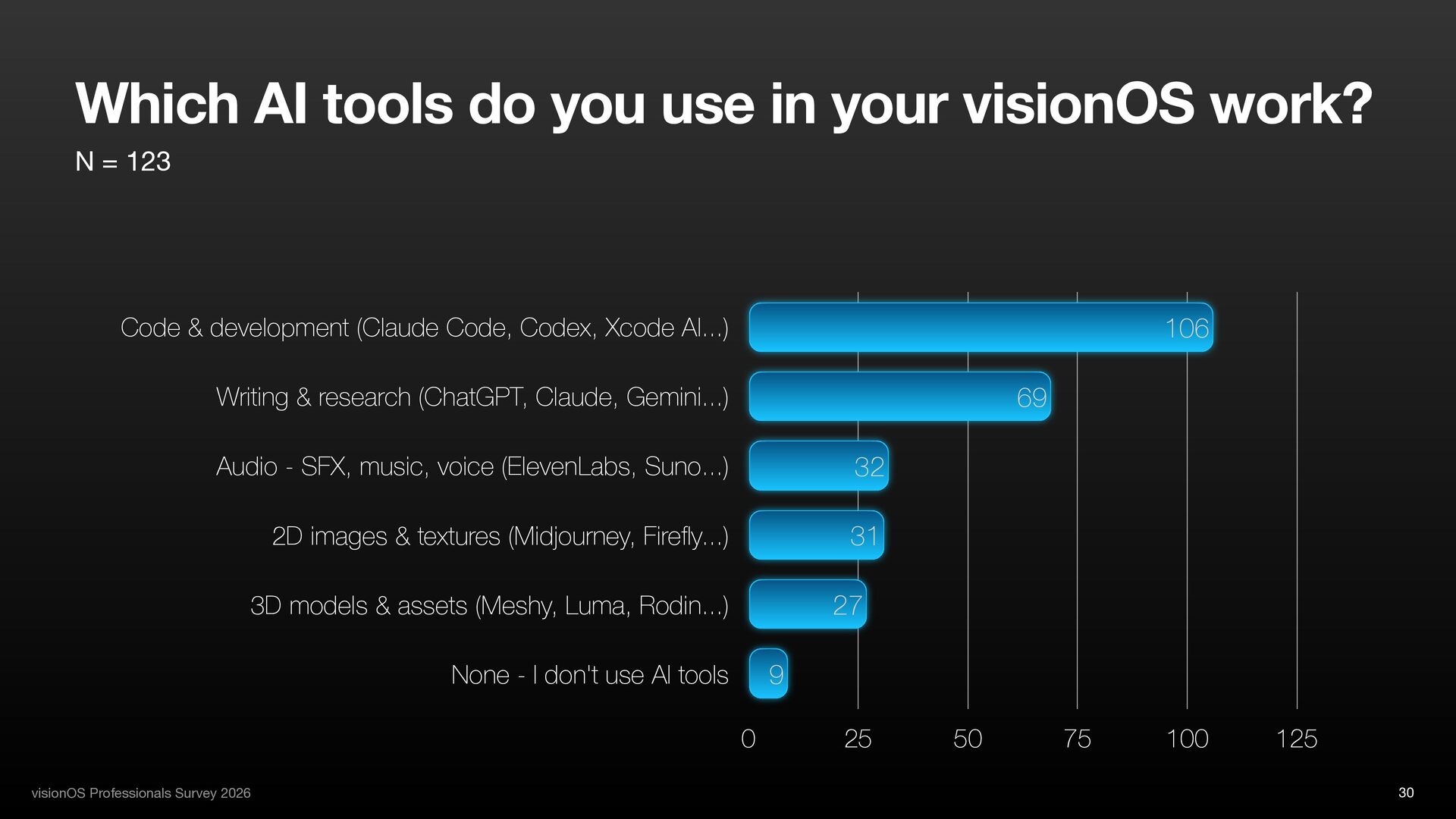
- 86% of respondents use AI tools in their visionOS workflow
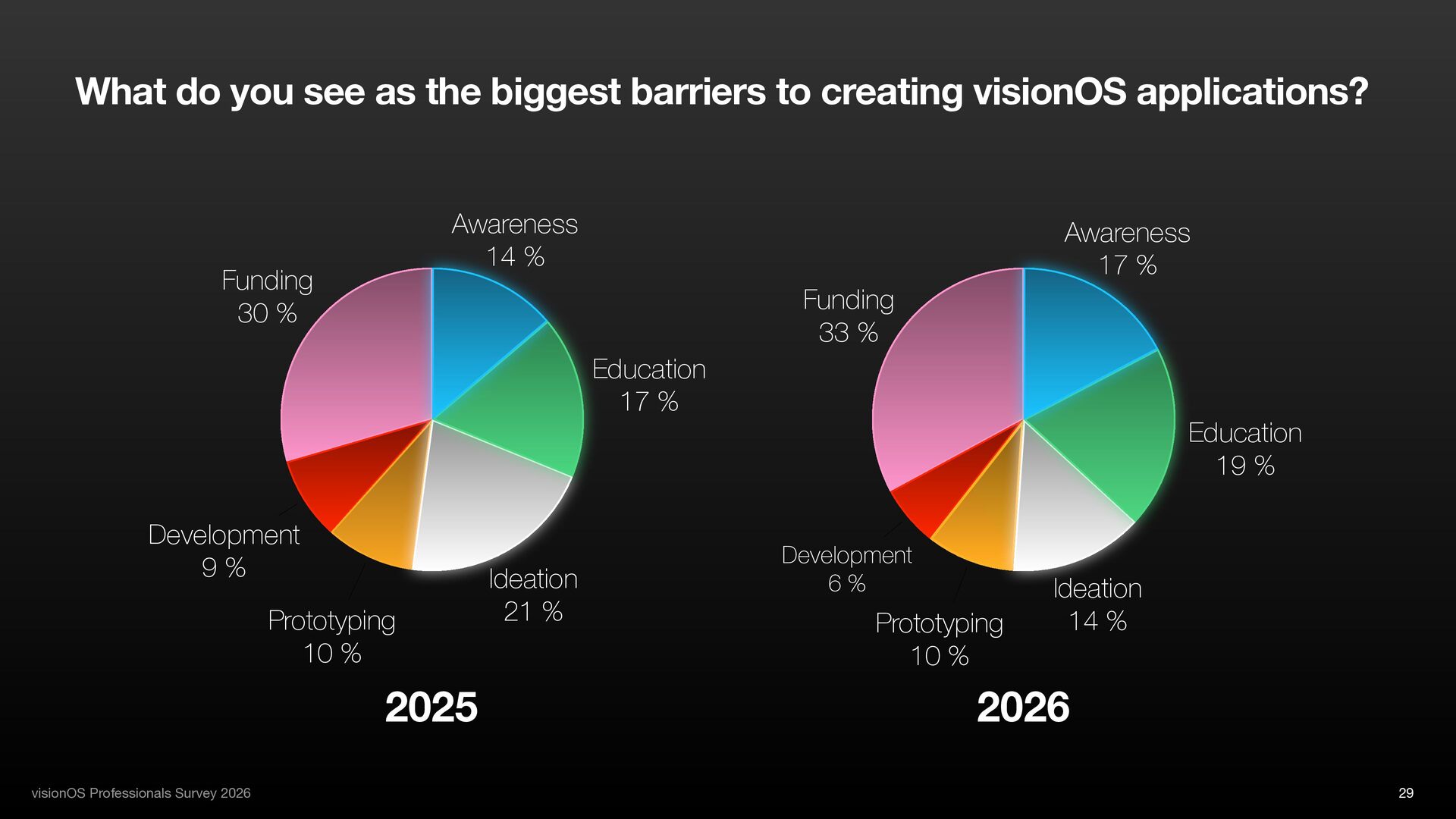
- Funding is the #1 barrier to adoption
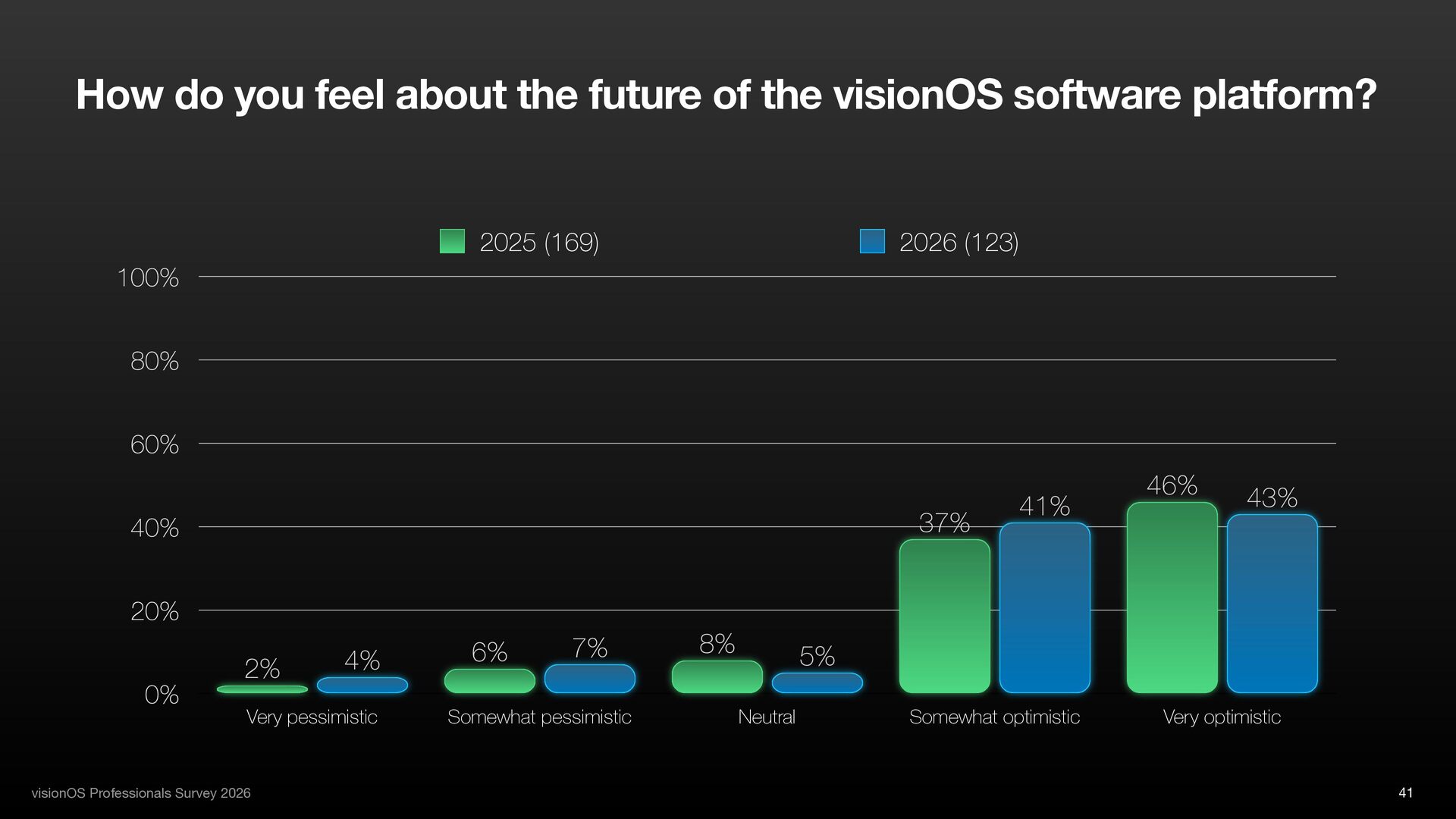
- 85% are optimistic about the future of the visionOS software platform
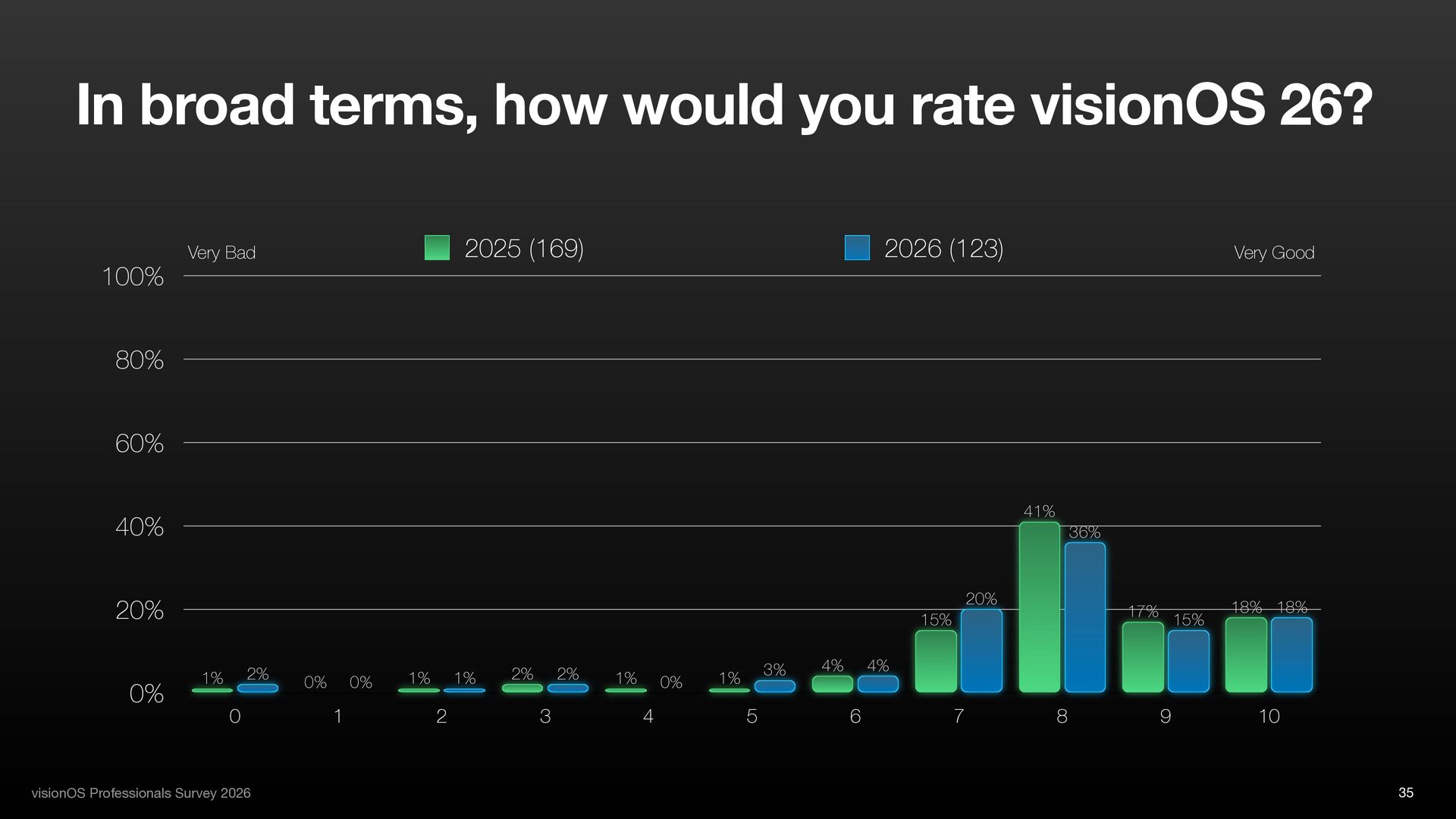
- visionOS 26 received an average rating of 7.86/10
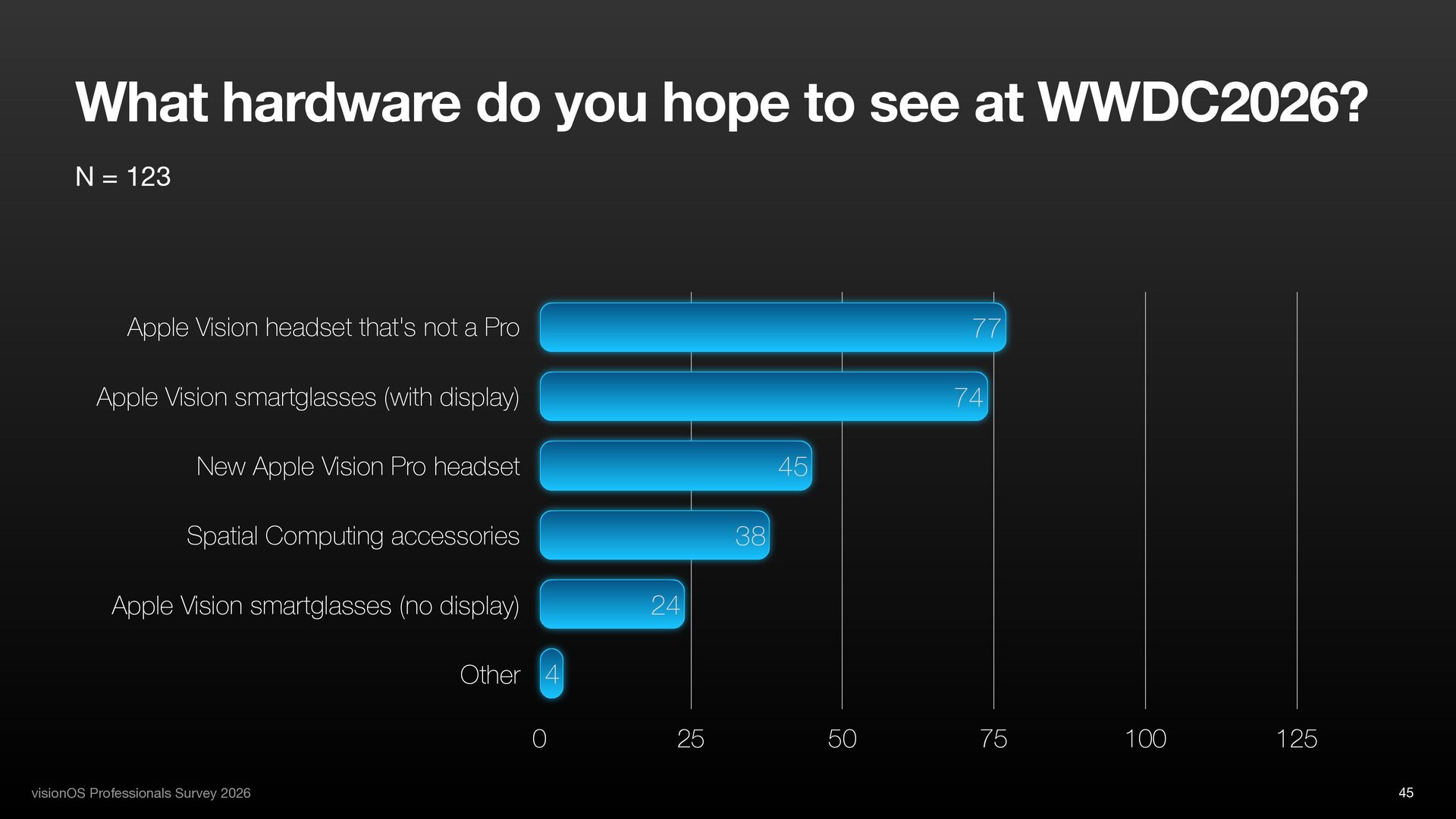
- The most requested future hardware is a non-Pro Apple Vision headset, closely followed by smartglasses with a display

Created by Tom Krikorian and Oliver Weidlich, with expert insights from the global visionOS community.

Avatar for AR_Ojisan

AR_Ojisan

June 02, 2026

More Decks by AR_Ojisan

Other Decks in Technology

Transcript

  1. Tom Krikorian Co-Founder, Studio Me ij e Oliver Weidlich Director

    of Design & Innovation, Contxtual visionOS Professionals Survey 2nd June 2026
  2. visionOS Professionals Survey 2026 Five things to know 2 33%

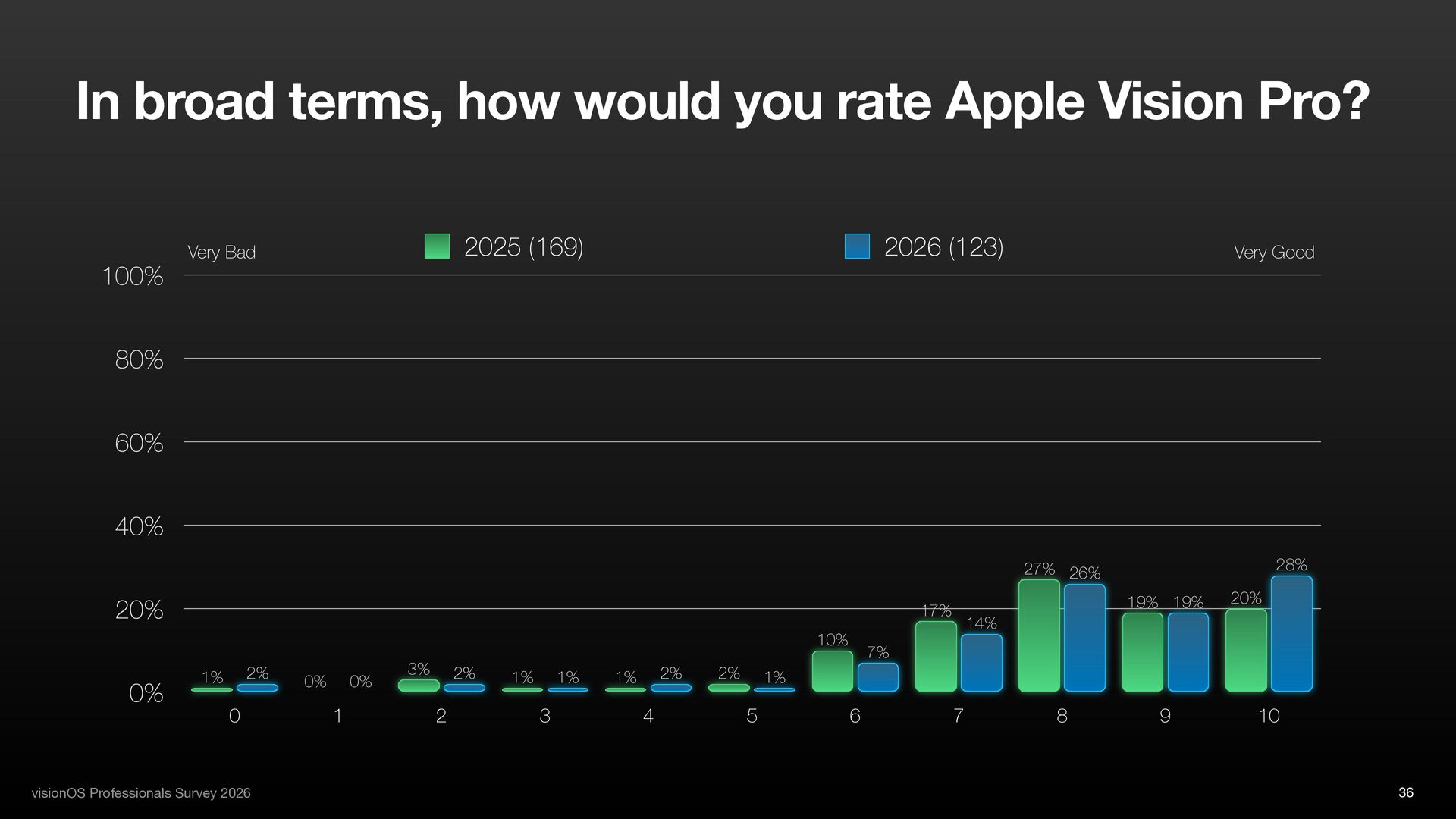
    Funding is the #1 adoption barrier Money beats every other barrier, including awareness and education. Builders are ready; what's missing is dollars. 63% A non-Pro headset tops the wishlist Demand is loudest for cheaper, smaller hardware, a non-Pro headset and smartglasses-with- display are in a near tie. 85% Bullish on visionOS software More than four in fi ve are optimistic about the OS. Hardware sentiment is cooler at 65%, pricing and form factor still weigh. 7.86 visionOS 26 lands an 8/10 Practitioners rate visionOS 26 at 7.86/10 (median 8). Apple Vision Pro pulls ahead at 8.07 86% AI is table-stakes in spatial development 106 of 123 respondents use AI coding assistants in their visionOS work fl ow. Only 9 use no AI tools at all.
  3. visionOS Professionals Survey 2026 Overview • Background • Method •

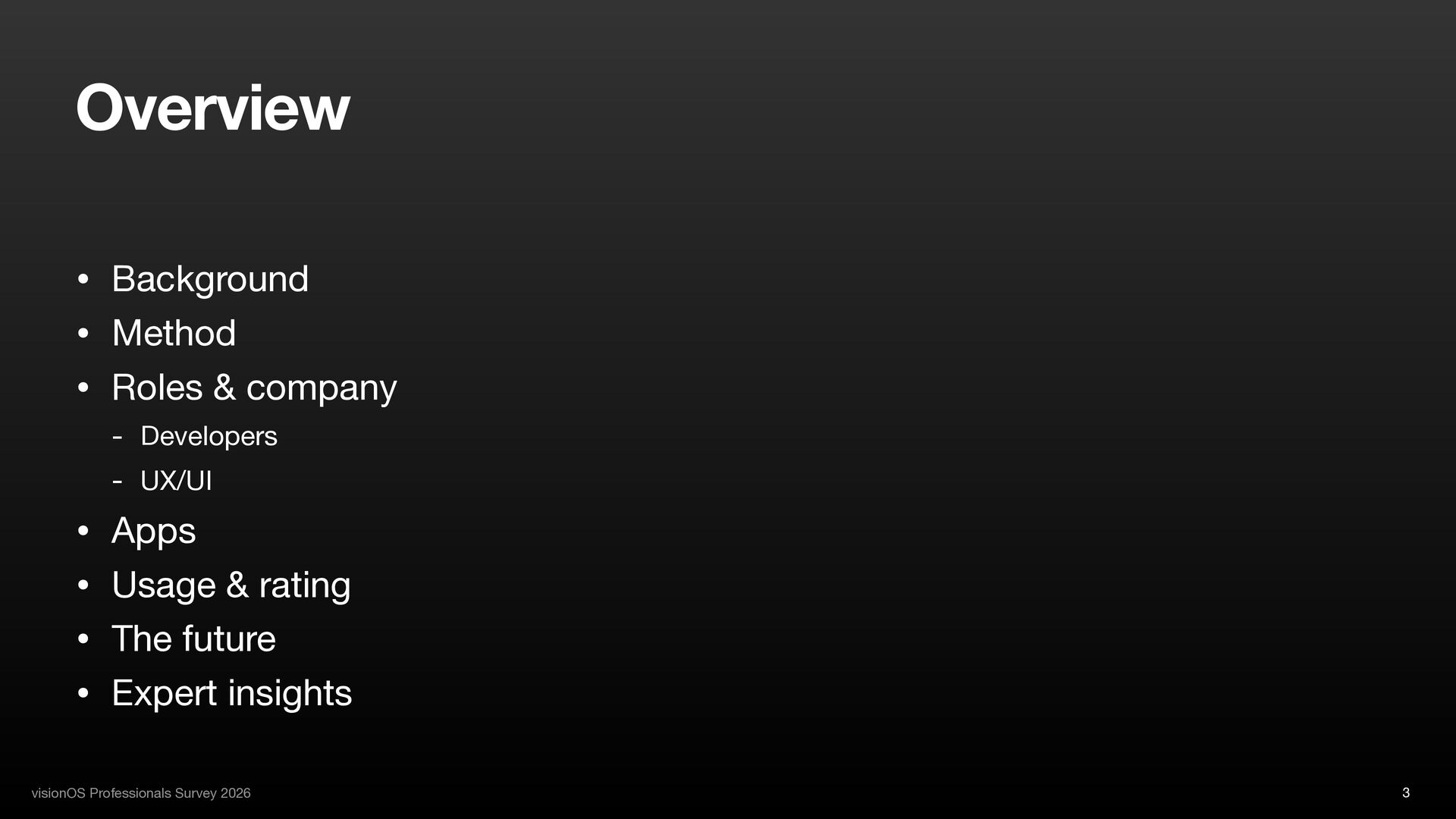
    Roles & company - Developers - UX/UI • Apps • Usage & rating • The future • Expert insights 3
  4. visionOS Professionals Survey 2026 Background • The Apple Vision Pro,

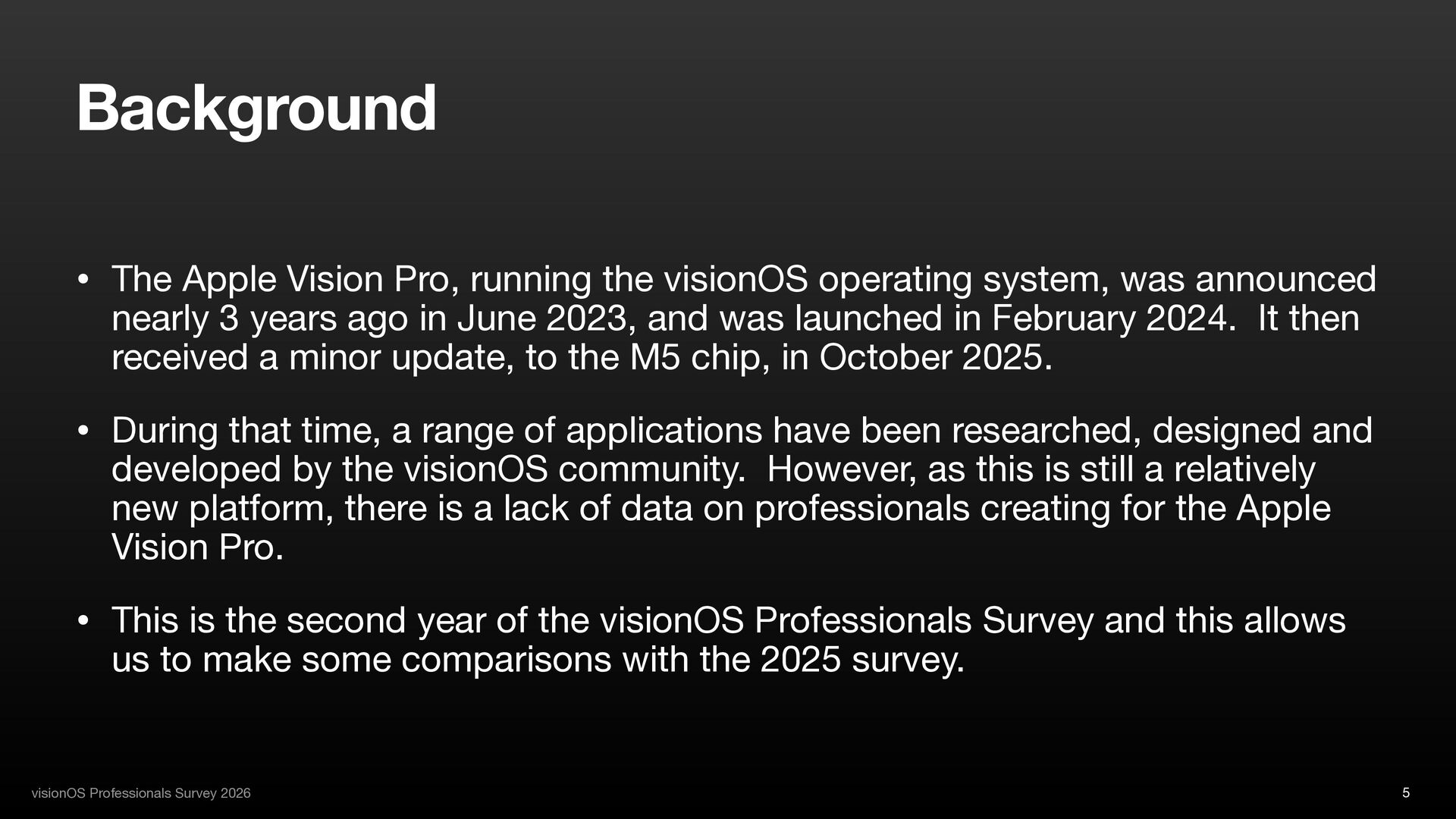
    running the visionOS operating system, was announced nearly 3 years ago in June 2023, and was launched in February 2024. It then received a minor update, to the M5 chip, in October 2025. • During that time, a range of applications have been researched, designed and developed by the visionOS community. However, as this is still a relatively new platform, there is a lack of data on professionals creating for the Apple Vision Pro. • This is the second year of the visionOS Professionals Survey and this allows us to make some comparisons with the 2025 survey. 5
  5. visionOS Professionals Survey 2026 Context • This survey is not

    a perfect representation of the entire visionOS ecosystem. The distribution method is likely to be biased toward engaged community members and English-speaking professionals. These results should be viewed as a candid snapshot, rather than de fi nitive market research. • Our goal was to create an honest conversation starter about the real experiences of people building for visionOS. We'll explore what participants told us about their backgrounds, challenges, platform outlook, and hopes for WWDC 2026. 6
  6. visionOS Professionals Survey 2026 Method • The survey ran from

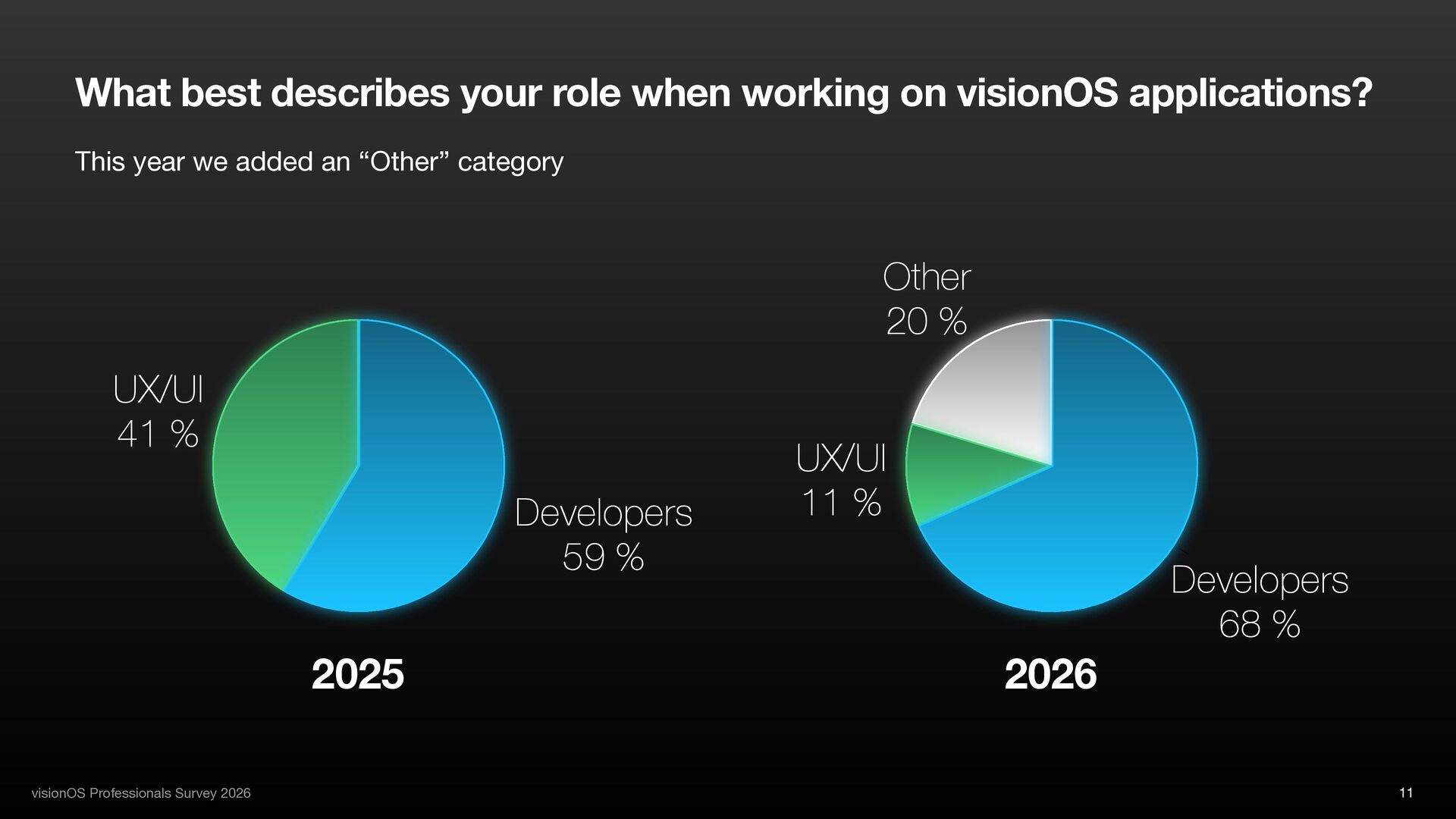
    12th to 21st May 2026 • The questions were an evolution from last year’s survey, with minor re fi nement, as well as the inclusion of new questions covering; AI tool usage, other XR platforms, and expectations for the impact of the Apple CEO transition. • Like 2025, it was created and hosted on a Typeform website. It was distributed through visionOS communities on LinkedIn, Reddit, Twitter, Discord, and other platforms. • We got 123 completed responses, this was down from 169 in 2025. This includes a signi fi cant drop in the number of people who identi fi ed as UX/UI professionals, from 70 to 14. 8
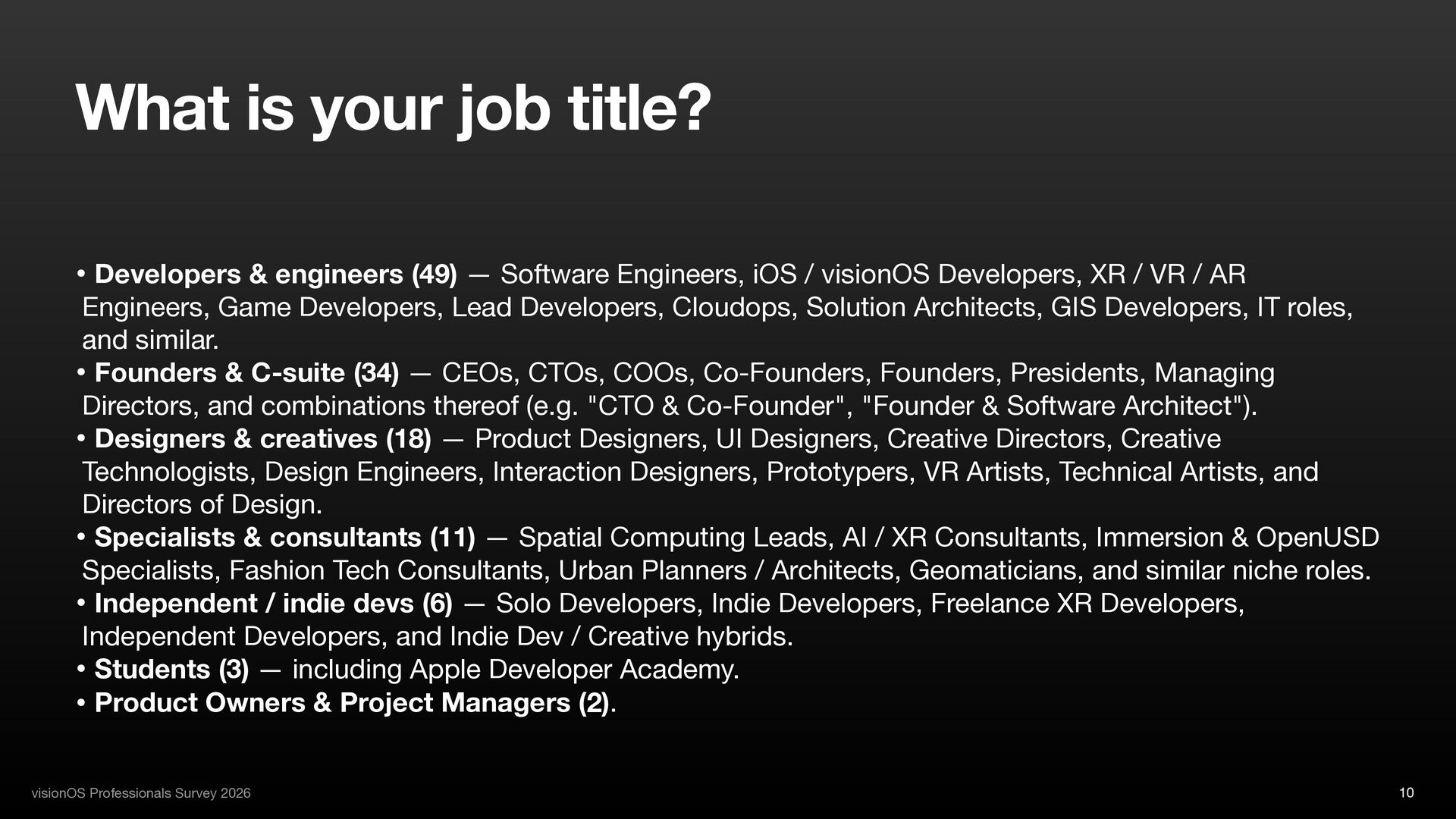
  7. visionOS Professionals Survey 2026 What is your job title? •

    Developers & engineers (49) — Software Engineers, iOS / visionOS Developers, XR / VR / AR Engineers, Game Developers, Lead Developers, Cloudops, Solution Architects, GIS Developers, IT roles, and similar. • Founders & C-suite (34) — CEOs, CTOs, COOs, Co-Founders, Founders, Presidents, Managing Directors, and combinations thereof (e.g. "CTO & Co-Founder", "Founder & Software Architect"). • Designers & creatives (18) — Product Designers, UI Designers, Creative Directors, Creative Technologists, Design Engineers, Interaction Designers, Prototypers, VR Artists, Technical Artists, and Directors of Design. • Specialists & consultants (11) — Spatial Computing Leads, AI / XR Consultants, Immersion & OpenUSD Specialists, Fashion Tech Consultants, Urban Planners / Architects, Geomaticians, and similar niche roles. • Independent / indie devs (6) — Solo Developers, Indie Developers, Freelance XR Developers, Independent Developers, and Indie Dev / Creative hybrids. • Students (3) — including Apple Developer Academy. • Product Owners & Project Managers (2). 10
  8. visionOS Professionals Survey 2026 What best describes your role when

    working on visionOS applications? This year we added an “Other” category 11 Other 20 % UX/UI 11 % Developers 68 % UX/UI 41 % Developers 59 % 2026 2025
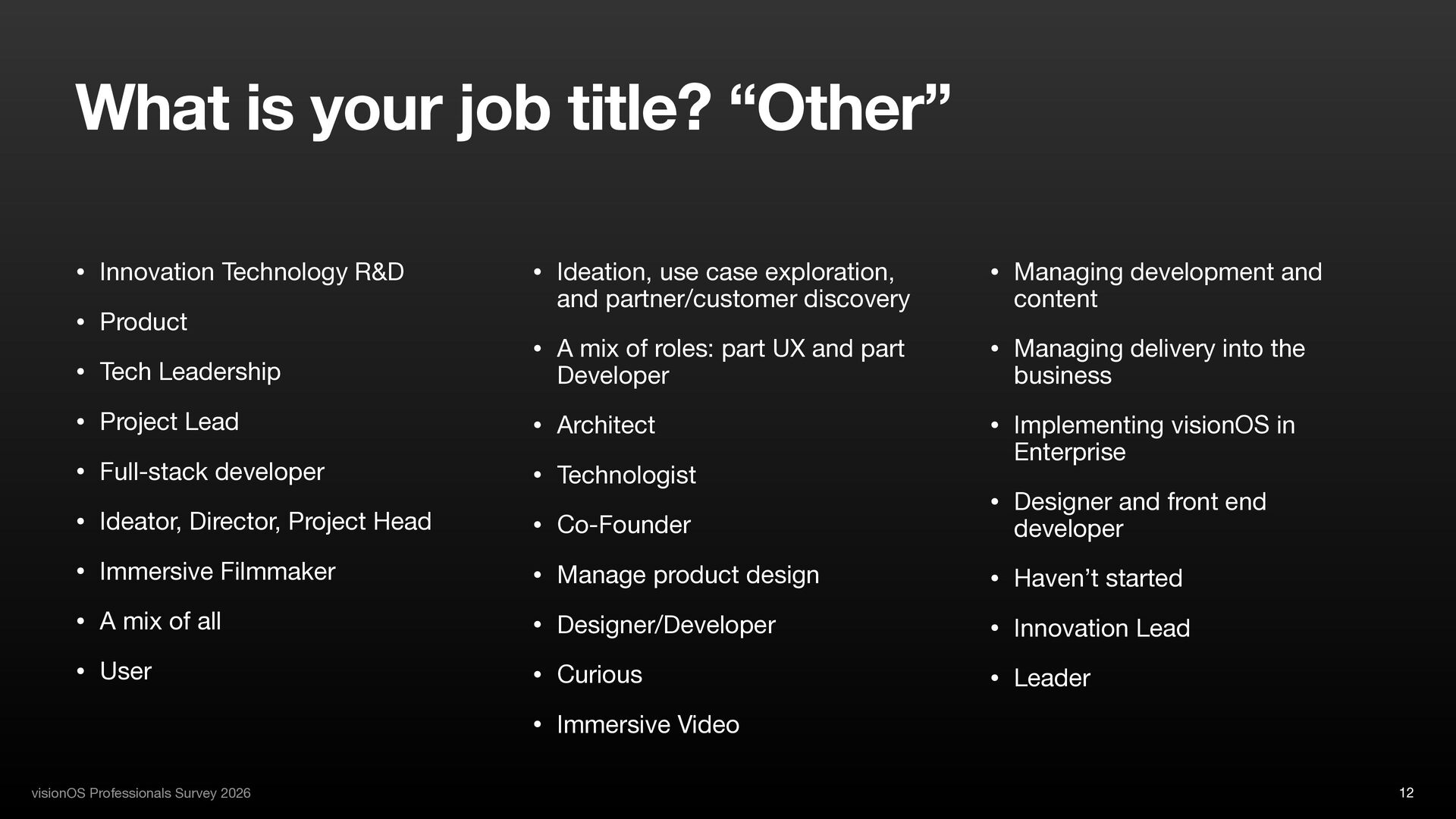
  9. visionOS Professionals Survey 2026 What is your job title? “Other”

    • Innovation Technology R&D • Product • Tech Leadership • Project Lead • Full-stack developer • Ideator, Director, Project Head • Immersive Filmmaker • A mix of all • User • Ideation, use case exploration, and partner/customer discovery • A mix of roles: part UX and part Developer • Architect • Technologist • Co-Founder • Manage product design • Designer/Developer • Curious • Immersive Video • Managing development and content • Managing delivery into the business • Implementing visionOS in Enterprise • Designer and front end developer • Haven’t started • Innovation Lead • Leader 12
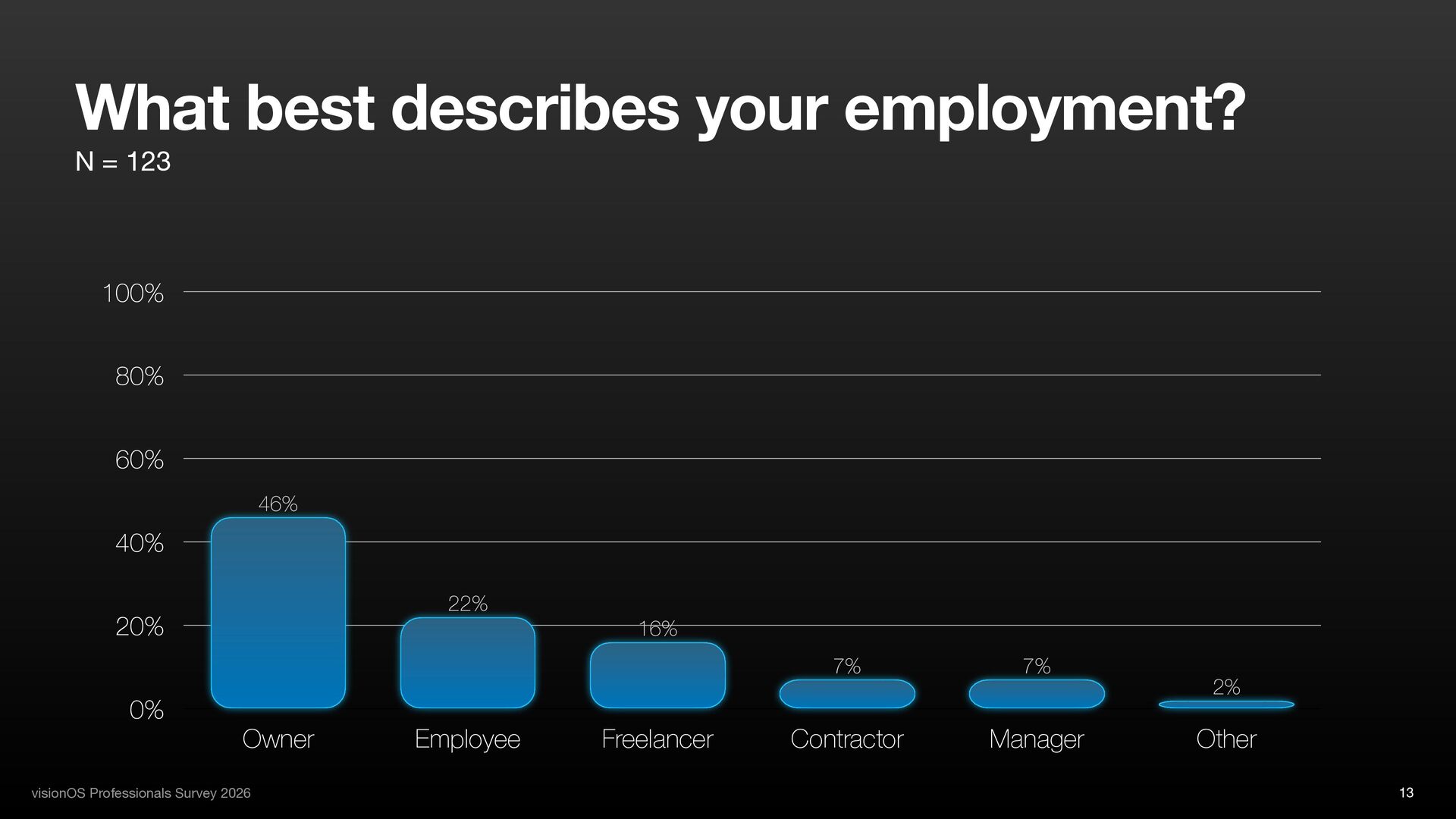
  10. visionOS Professionals Survey 2026 What best describes your employment? N

    = 123 13 0% 20% 40% 60% 80% 100% Owner Employee Freelancer Contractor Manager Other 2% 7% 7% 16% 22% 46%
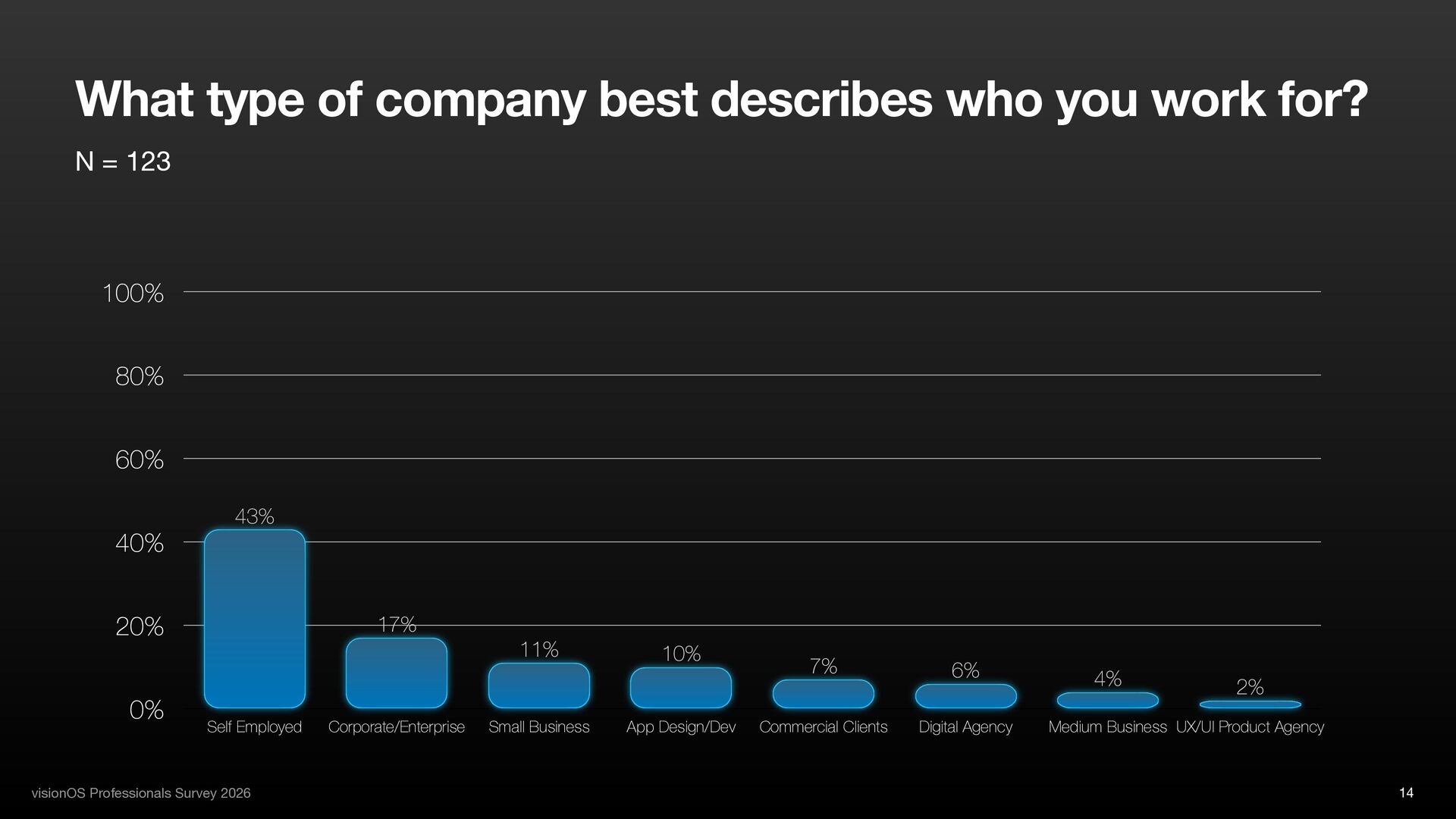
  11. visionOS Professionals Survey 2026 What type of company best describes

    who you work for? N = 123 14 0% 20% 40% 60% 80% 100% Self Employed Corporate/Enterprise Small Business App Design/Dev Commercial Clients Digital Agency Medium Business UX/UI Product Agency 2% 4% 6% 7% 10% 11% 17% 43%
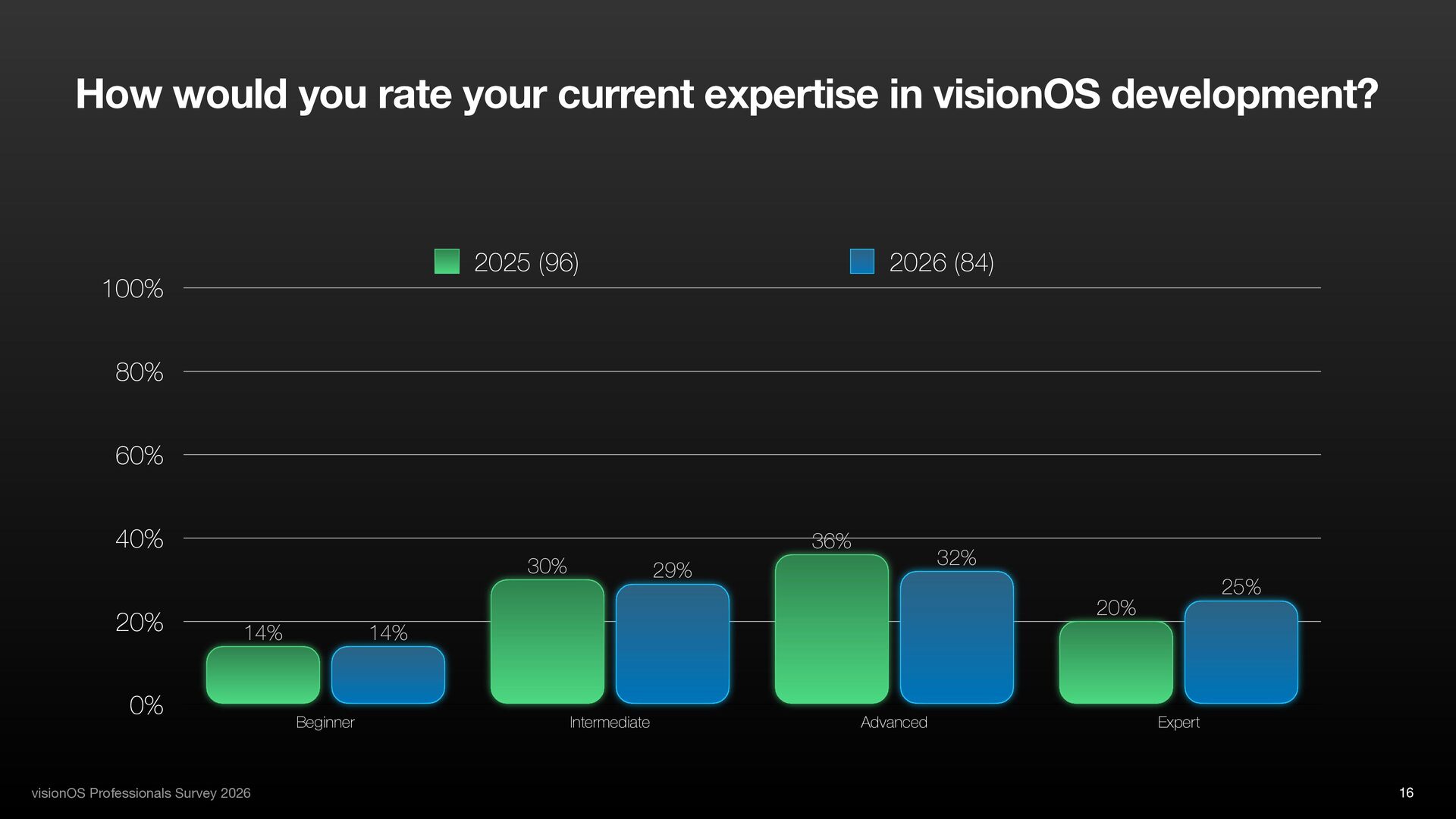
  12. visionOS Professionals Survey 2026 How would you rate your current

    expertise in visionOS development? 16 0% 20% 40% 60% 80% 100% Beginner Intermediate Advanced Expert 25% 32% 29% 14% 20% 36% 30% 14% 2025 (96) 2026 (84)
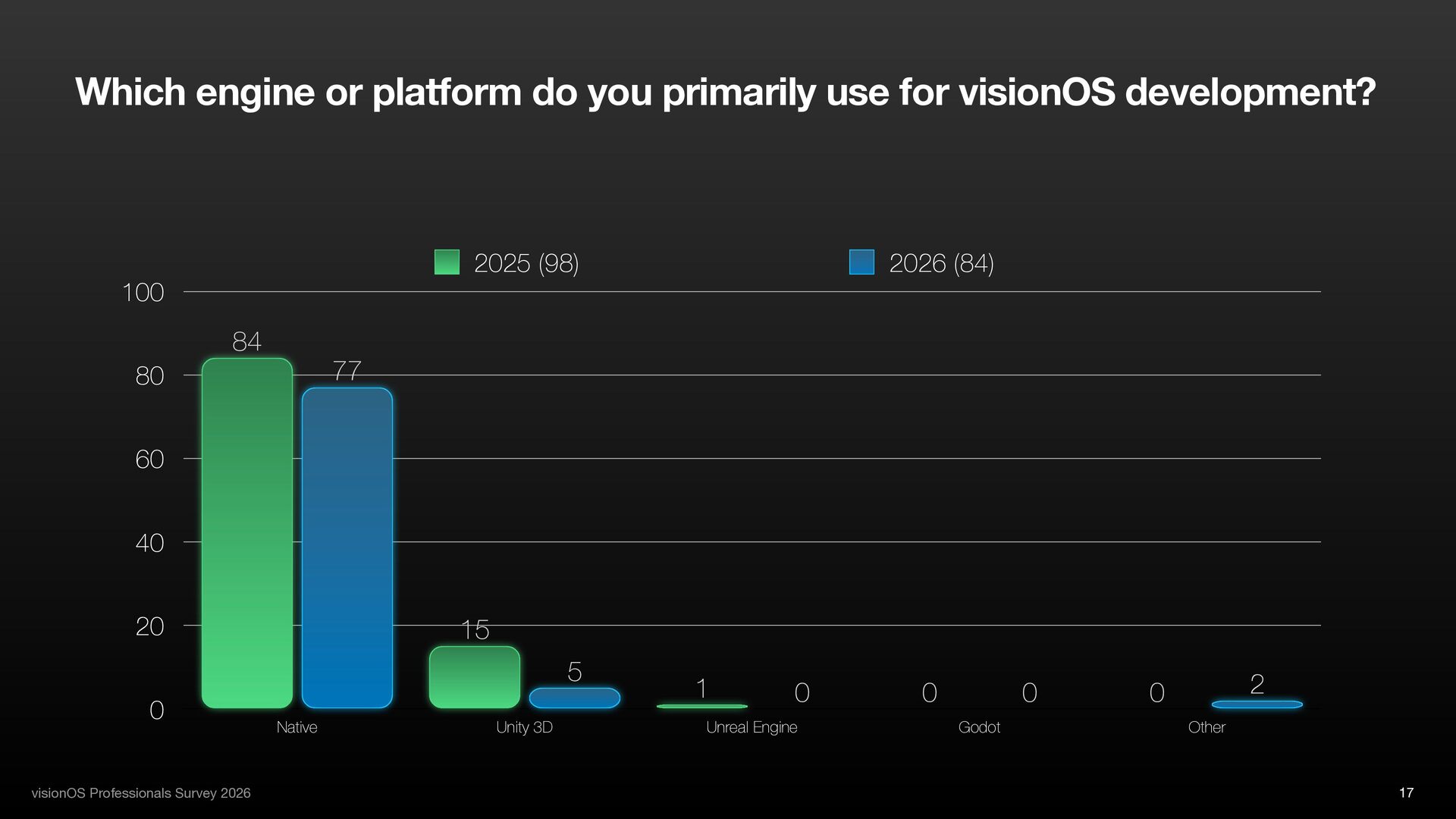
  13. visionOS Professionals Survey 2026 Which engine or platform do you

    primarily use for visionOS development? 17 0 20 40 60 80 100 Native Unity 3D Unreal Engine Godot Other 2 0 0 5 77 0 0 1 15 84 2025 (98) 2026 (84)
  14. visionOS Professionals Survey 2026 19 0% 20% 40% 60% 80%

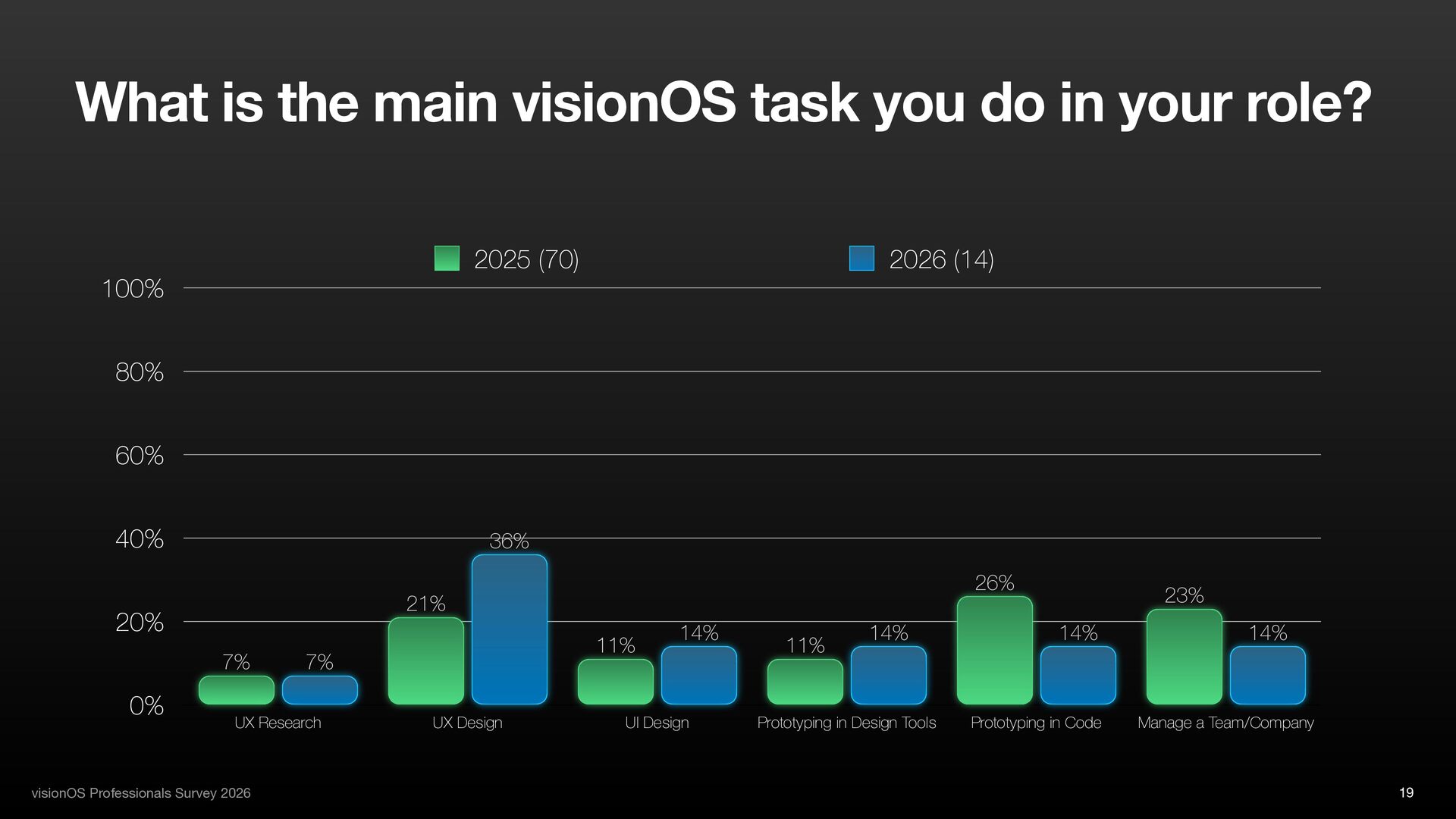
    100% UX Research UX Design UI Design Prototyping in Design Tools Prototyping in Code Manage a Team/Company 14% 14% 14% 14% 36% 7% 23% 26% 11% 11% 21% 7% 2025 (70) 2026 (14) What is the main visionOS task you do in your role?
  15. visionOS Professionals Survey 2026 What is the other visionOS tasks

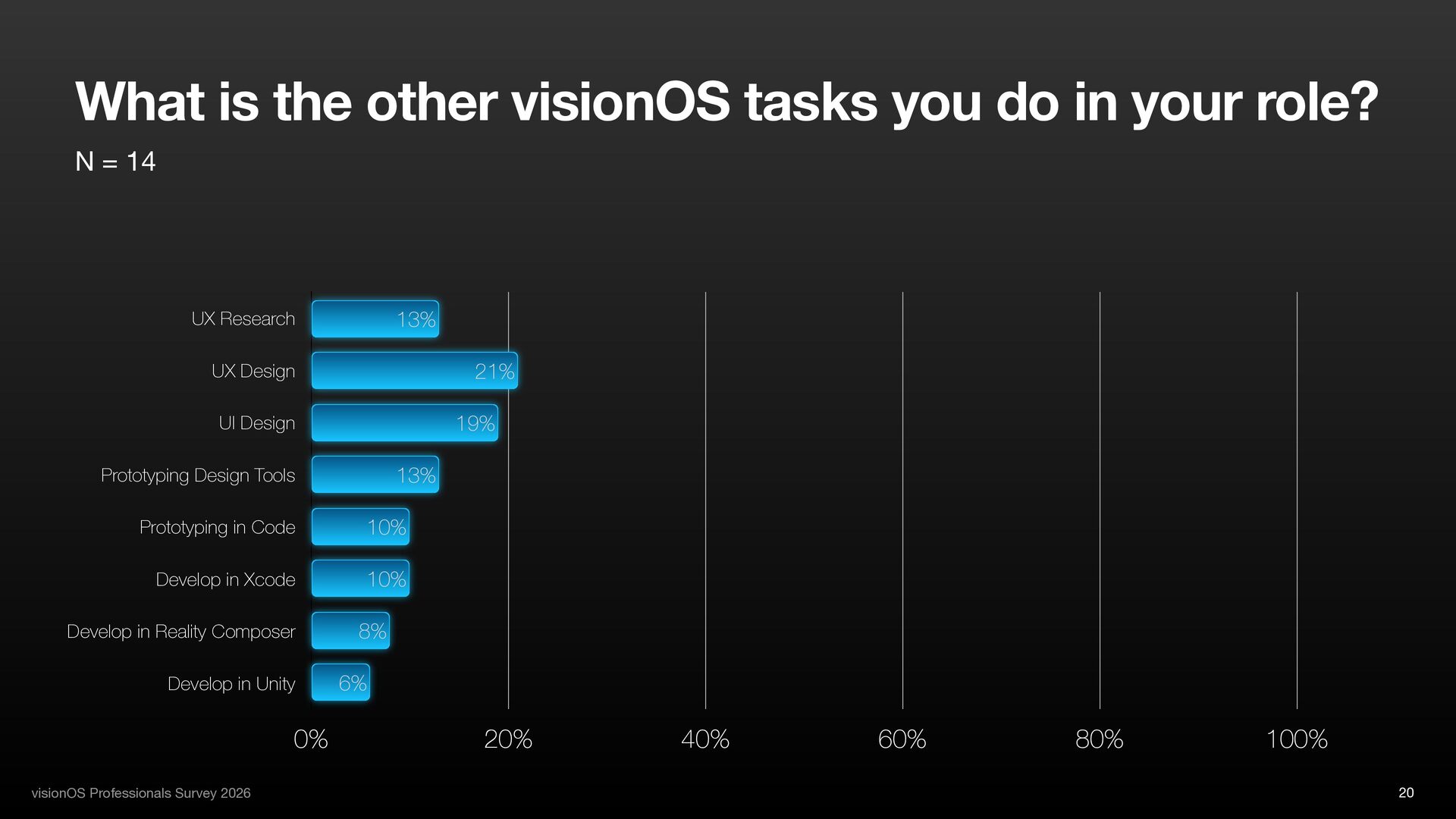
    you do in your role? N = 14 20 UX Research UX Design UI Design Prototyping Design Tools Prototyping in Code Develop in Xcode Develop in Reality Composer Develop in Unity 0% 20% 40% 60% 80% 100% 6% 8% 10% 10% 13% 19% 21% 13%
  16. visionOS Professionals Survey 2026 Do you use the Apple provided

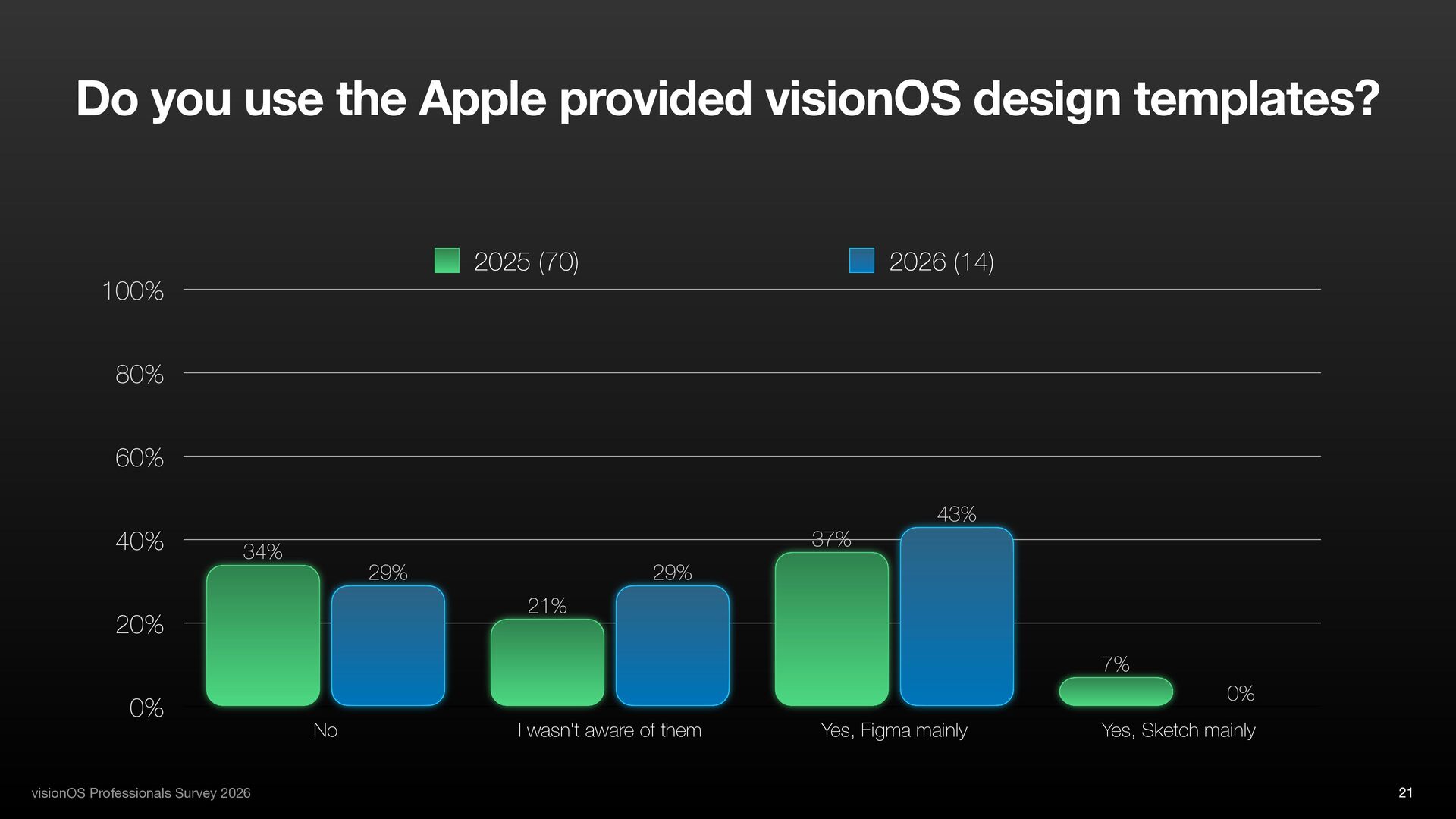
    visionOS design templates? 21 0% 20% 40% 60% 80% 100% No I wasn't aware of them Yes, Figma mainly Yes, Sketch mainly 0% 43% 29% 29% 7% 37% 21% 34% 2025 (70) 2026 (14)
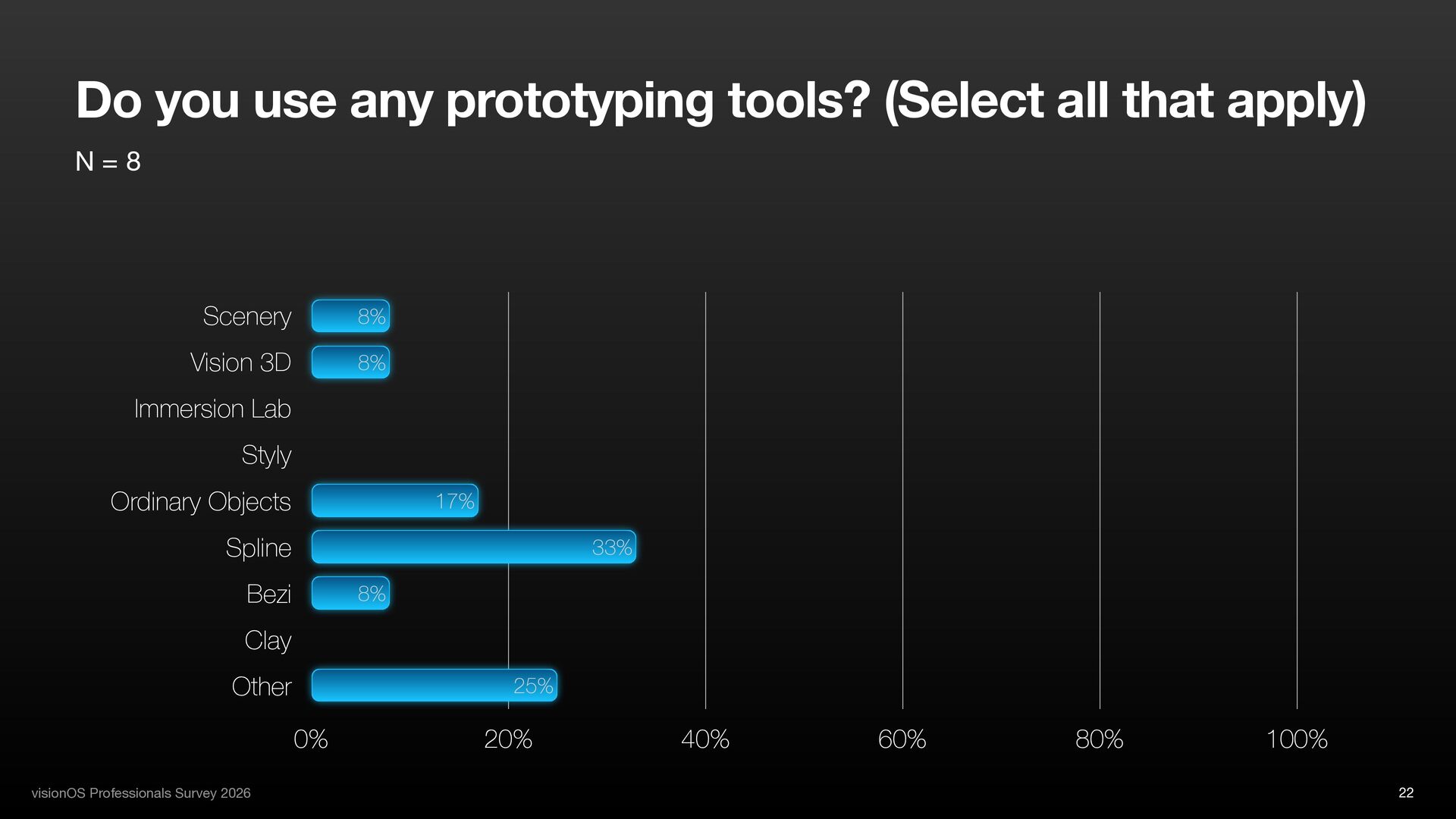
  17. visionOS Professionals Survey 2026 Do you use any prototyping tools?

    (Select all that apply) N = 8 22 Scenery Vision 3D Immersion Lab Styly Ordinary Objects Spline Bezi Clay Other 0% 20% 40% 60% 80% 100% 25% 8% 33% 17% 8% 8%
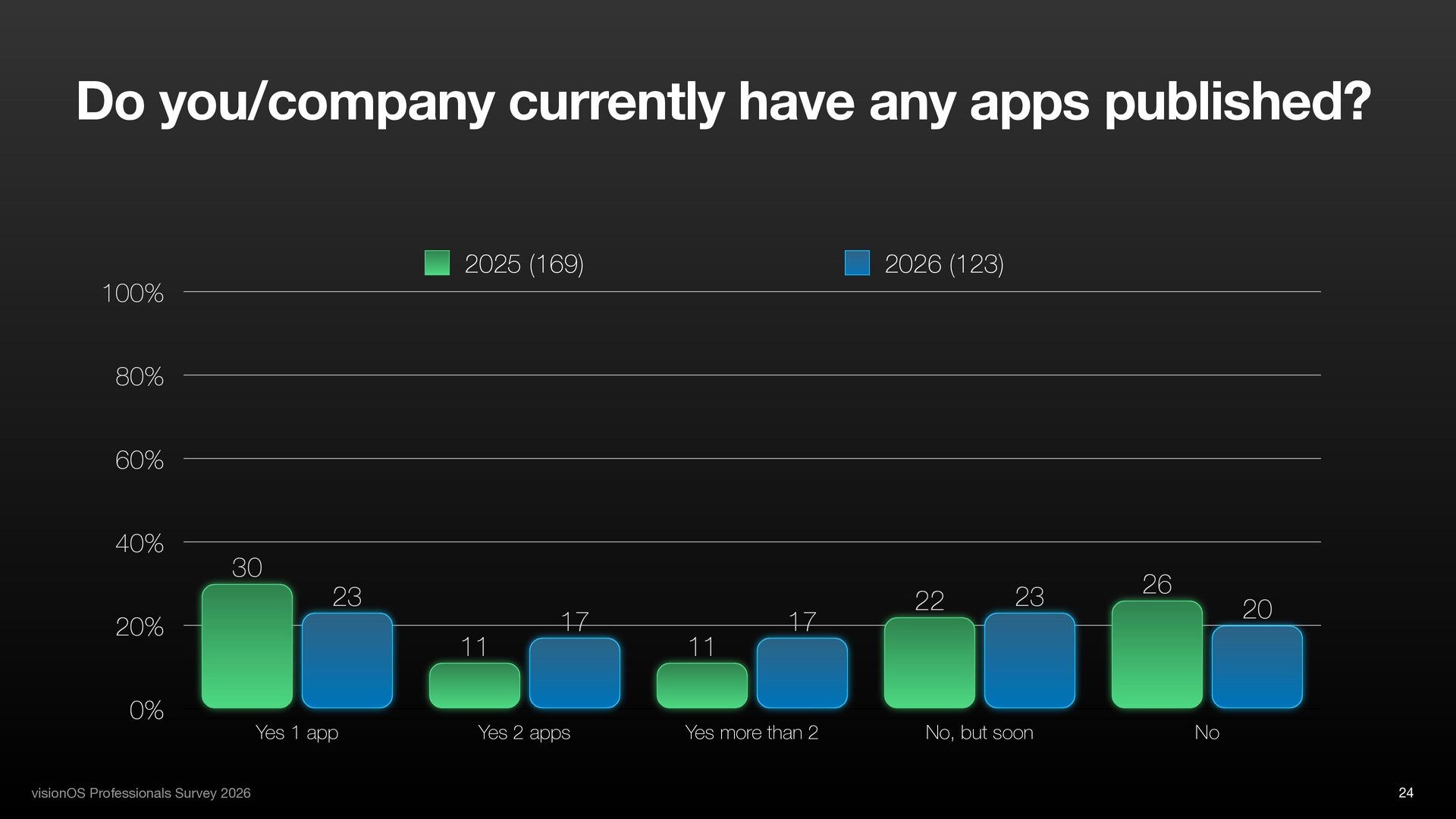
  18. visionOS Professionals Survey 2026 Do you/company currently have any apps

    published? 24 0% 20% 40% 60% 80% 100% Yes 1 app Yes 2 apps Yes more than 2 No, but soon No 20 23 17 17 23 26 22 11 11 30 2025 (169) 2026 (123)
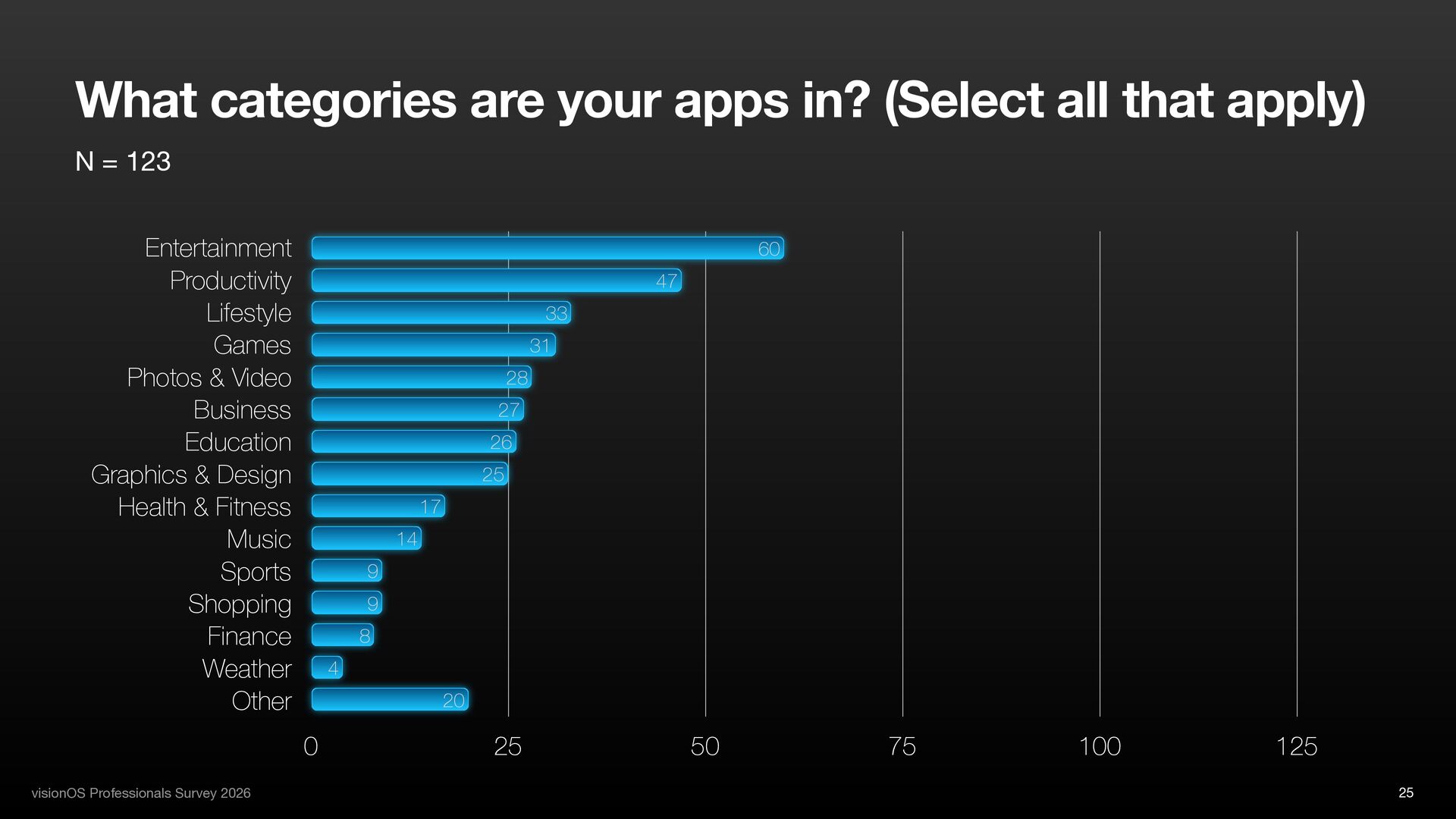
  19. visionOS Professionals Survey 2026 What categories are your apps in?

    (Select all that apply) N = 123 Entertainment Productivity Lifestyle Games Photos & Video Business Education Graphics & Design Health & Fitness Music Sports Shopping Finance Weather Other 0 25 50 75 100 125 20 4 8 9 9 14 17 25 26 27 28 31 33 47 60 25

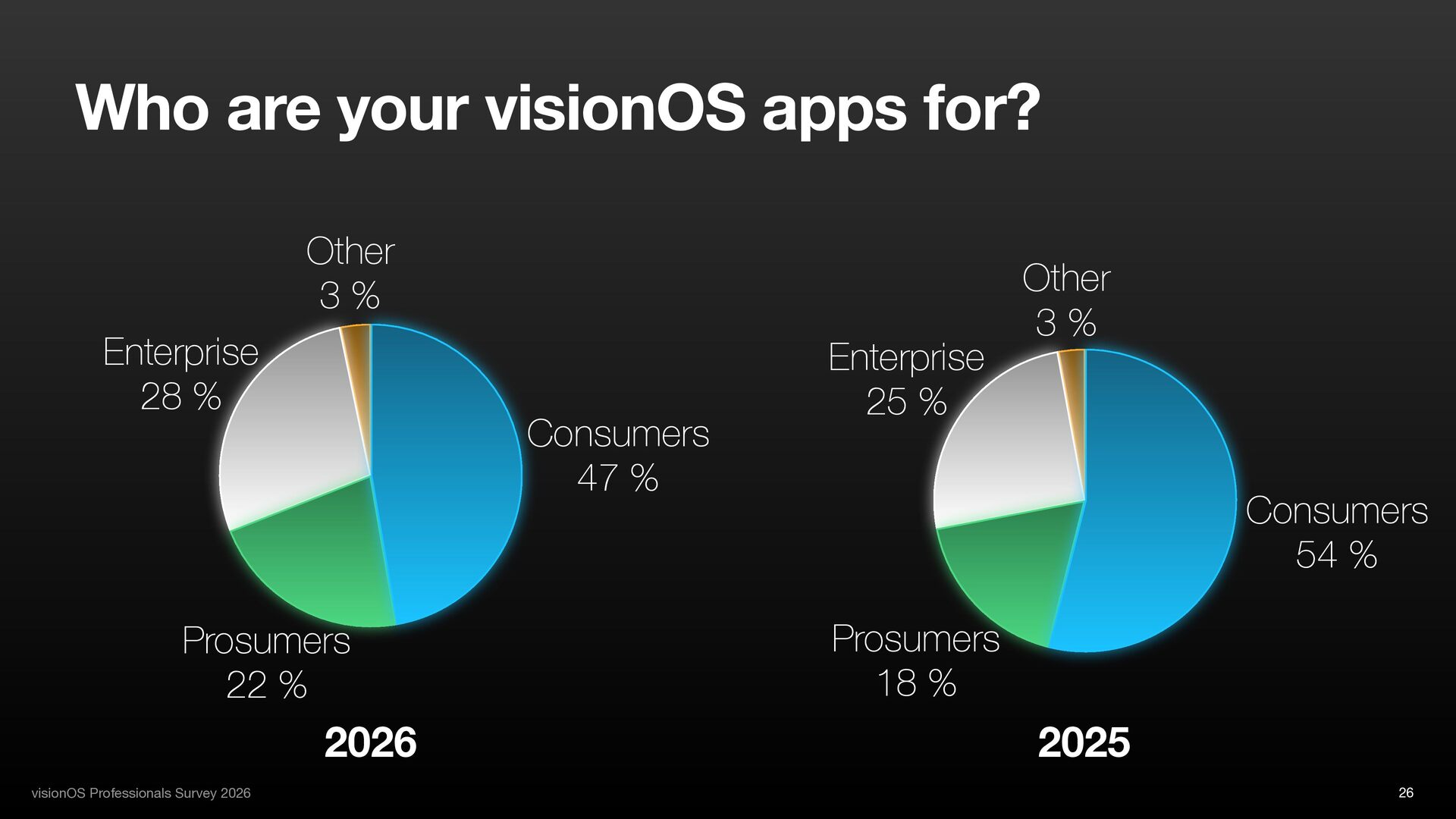
  20. visionOS Professionals Survey 2026 Who are your visionOS apps for?

    Other 3 % Enterprise 25 % Prosumers 18 % Consumers 54 % Other 3 % Enterprise 28 % Prosumers 22 % Consumers 47 % 2026 2025 26
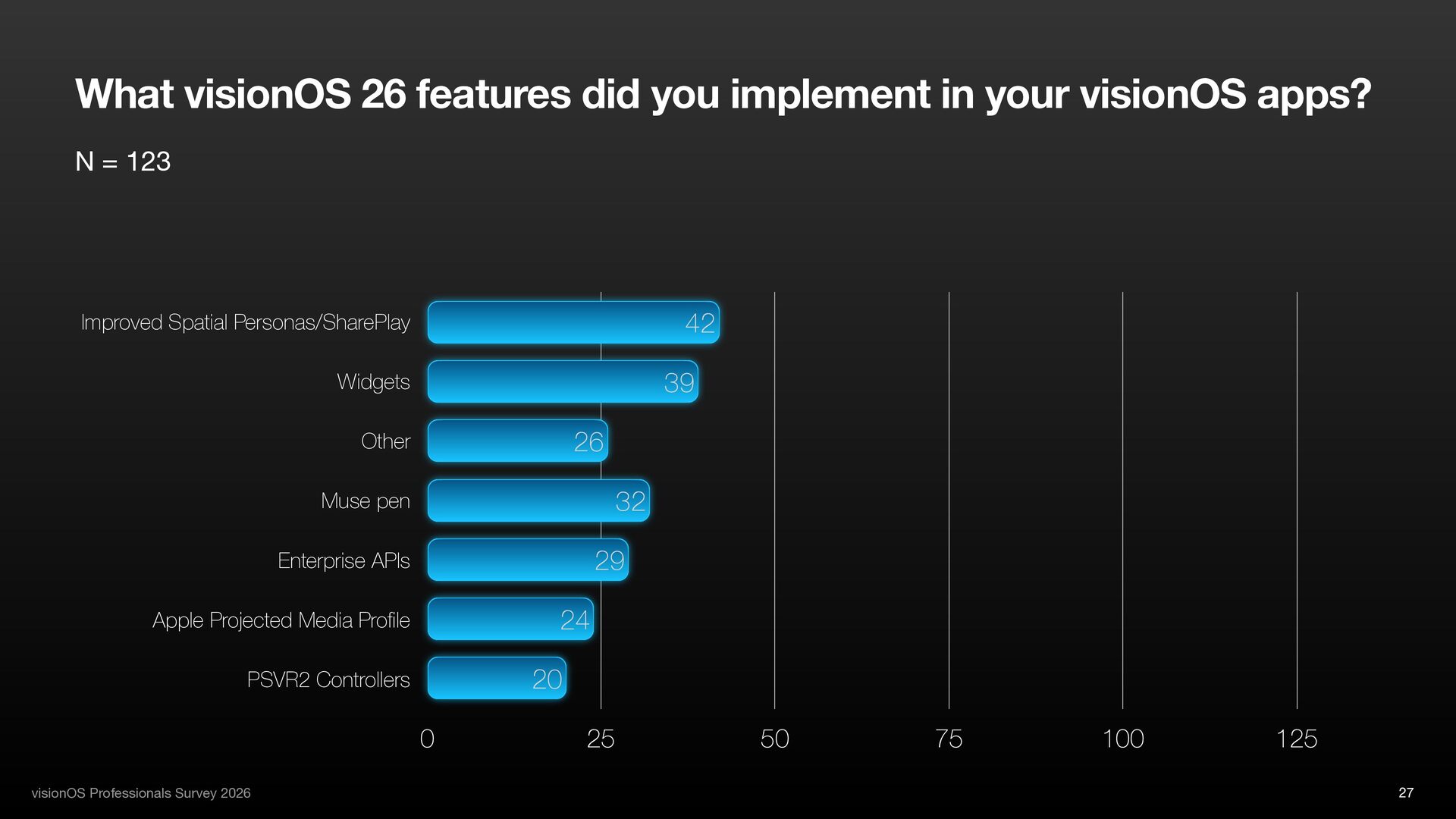
  21. visionOS Professionals Survey 2026 What visionOS 26 features did you

    implement in your visionOS apps? N = 123 Improved Spatial Personas/SharePlay Widgets Other Muse pen Enterprise APIs Apple Projected Media Pro fi le PSVR2 Controllers 0 25 50 75 100 125 20 24 29 32 26 39 42 27
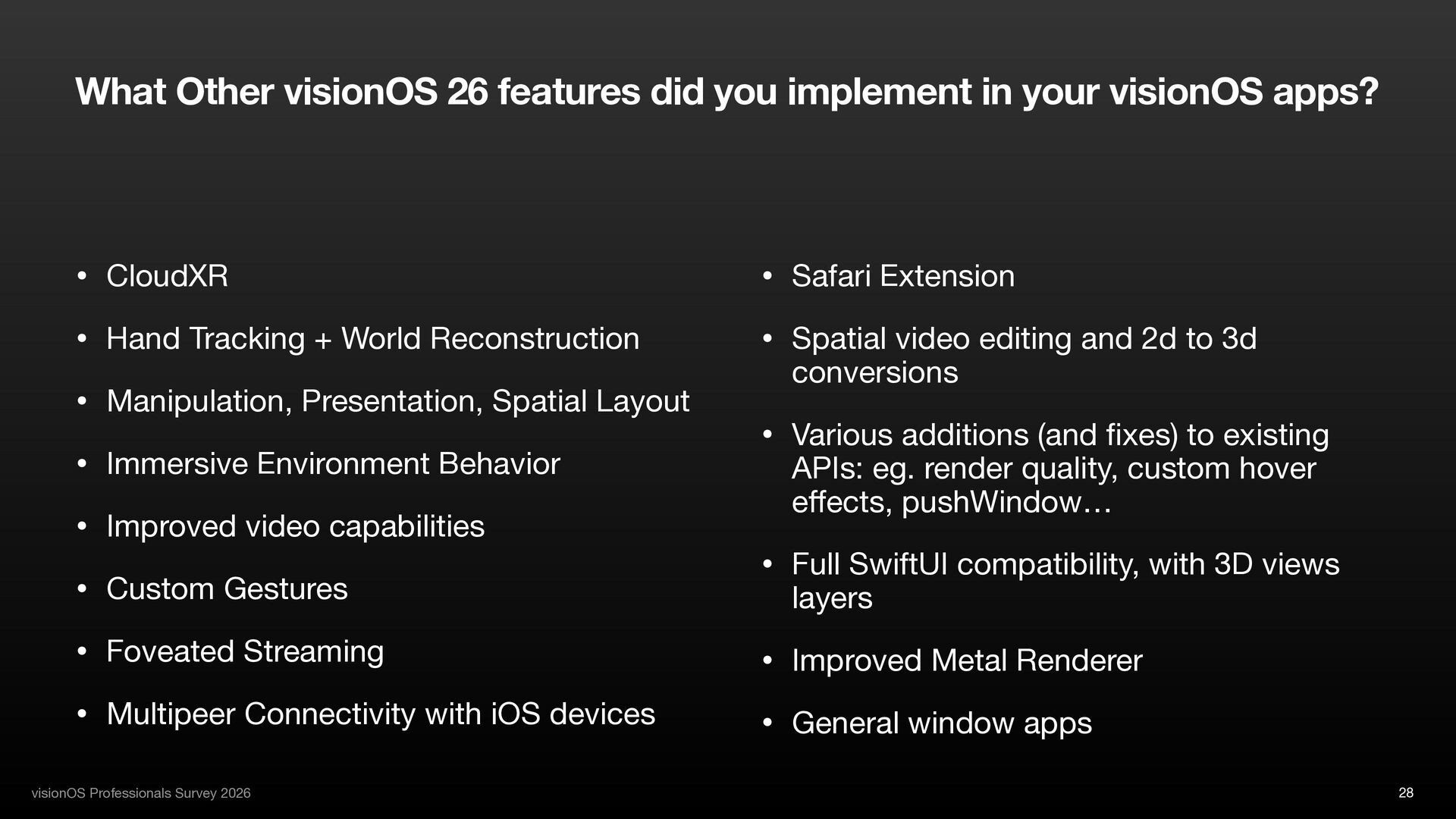
  22. visionOS Professionals Survey 2026 What Other visionOS 26 features did

    you implement in your visionOS apps? • CloudXR • Hand Tracking + World Reconstruction • Manipulation, Presentation, Spatial Layout • Immersive Environment Behavior • Improved video capabilities • Custom Gestures • Foveated Streaming • Multipeer Connectivity with iOS devices • Safari Extension • Spatial video editing and 2d to 3d conversions • Various additions (and fi xes) to existing APIs: eg. render quality, custom hover e ff ects, pushWindow… • Full SwiftUI compatibility, with 3D views layers • Improved Metal Renderer • General window apps 28
  23. visionOS Professionals Survey 2026 What do you see as the

    biggest barriers to creating visionOS applications? 29 Funding 33 % Development 6 % Prototyping 10 % Ideation 14 % Education 19 % Awareness 17 % Funding 30 % Development 9 % Prototyping 10 % Ideation 21 % Education 17 % Awareness 14 % 2026 2025
  24. visionOS Professionals Survey 2026 Which AI tools do you use

    in your visionOS work? N = 123 Code & development (Claude Code, Codex, Xcode Al...) Writing & research (ChatGPT, Claude, Gemini...) Audio - SFX, music, voice (ElevenLabs, Suno...) 2D images & textures (Midjourney, Fire fl y...) 3D models & assets (Meshy, Luma, Rodin...) None - I don't use Al tools 0 25 50 75 100 125 9 27 31 32 69 106 30
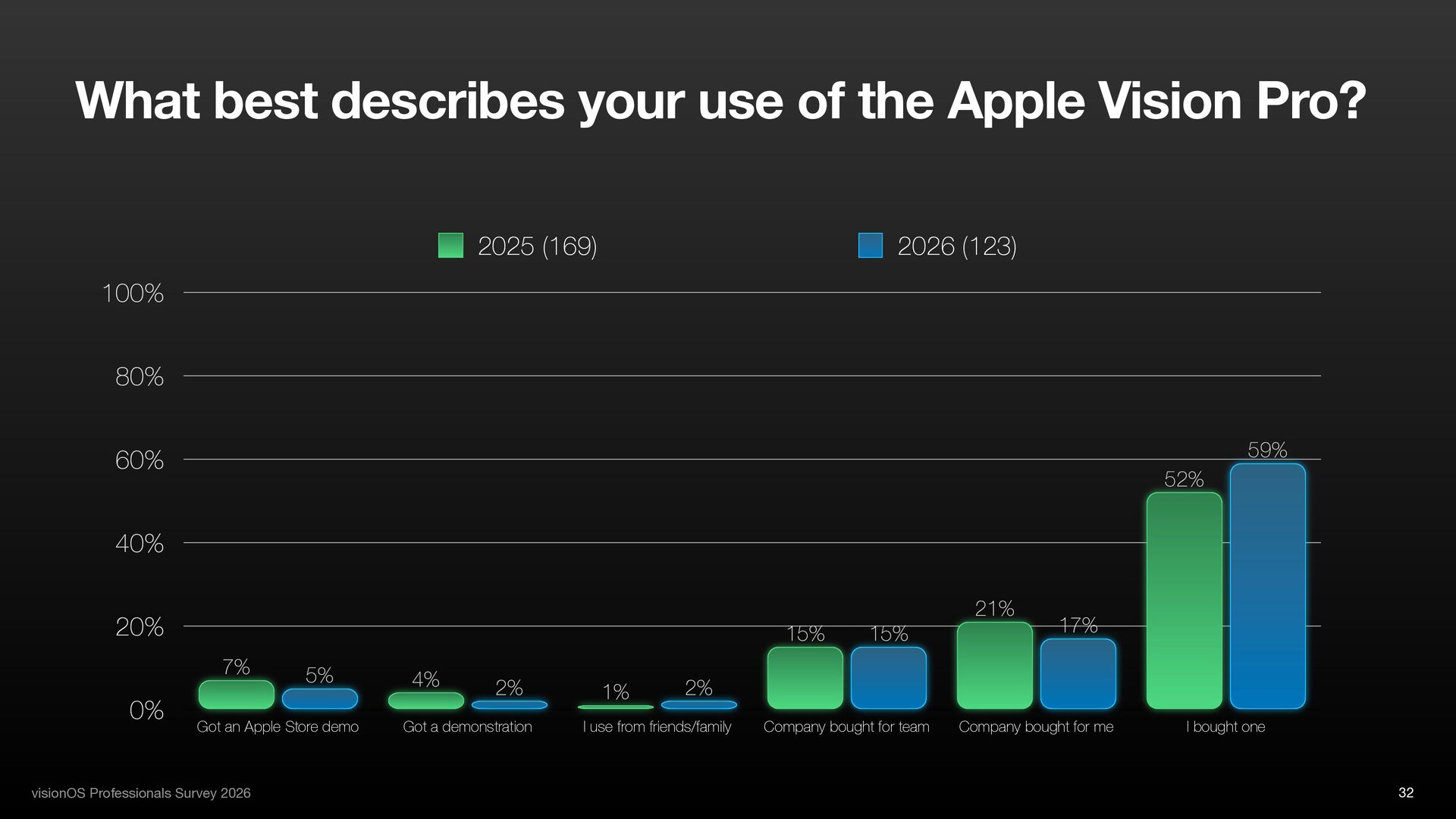
  25. visionOS Professionals Survey 2026 What best describes your use of

    the Apple Vision Pro? 0% 20% 40% 60% 80% 100% Got an Apple Store demo Got a demonstration I use from friends/family Company bought for team Company bought for me I bought one 59% 17% 15% 2% 2% 5% 52% 21% 15% 1% 4% 7% 2025 (169) 2026 (123) 32
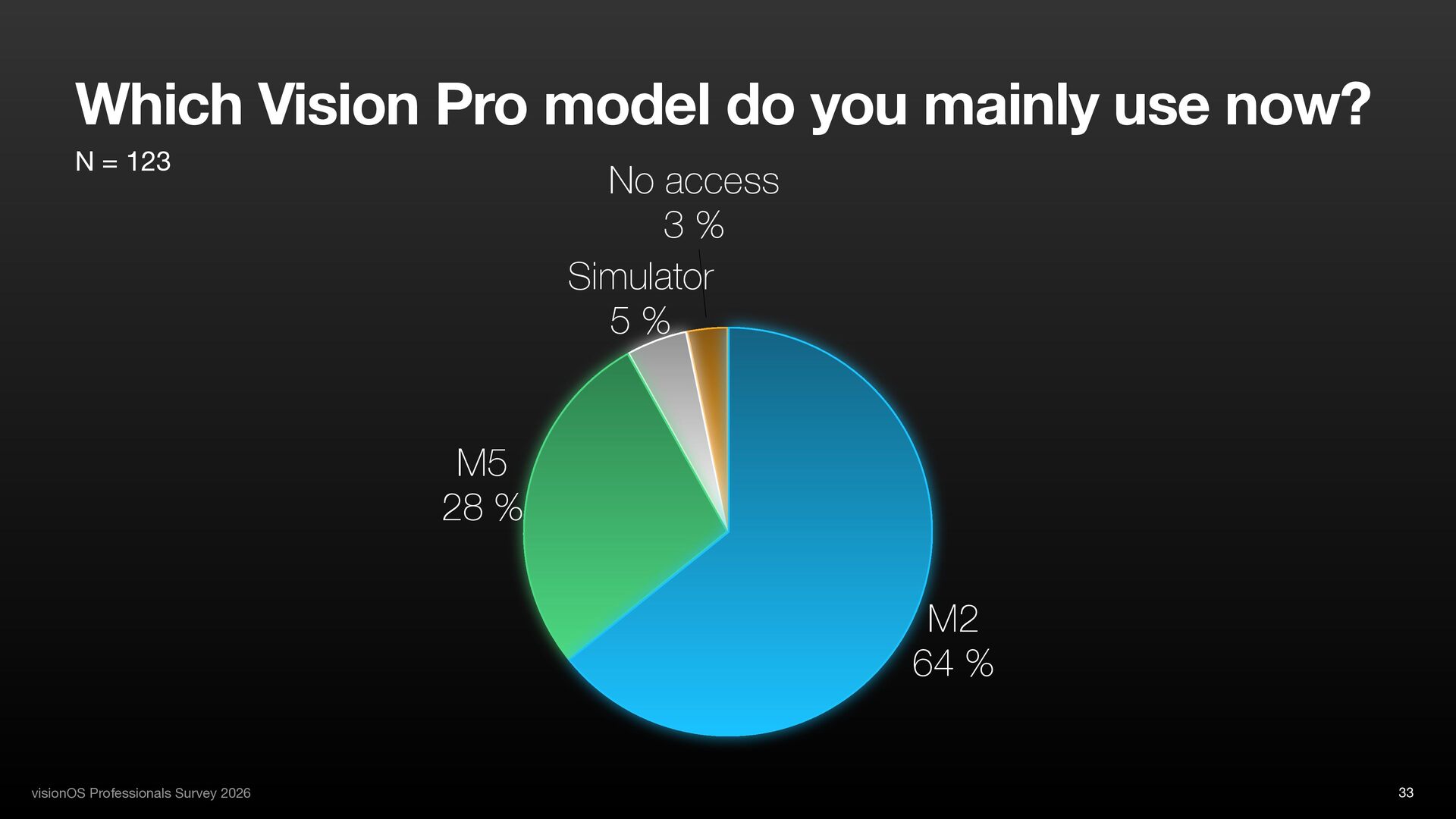
  26. visionOS Professionals Survey 2026 Which Vision Pro model do you

    mainly use now? N = 123 No access 3 % Simulator 5 % M5 28 % M2 64 % 33
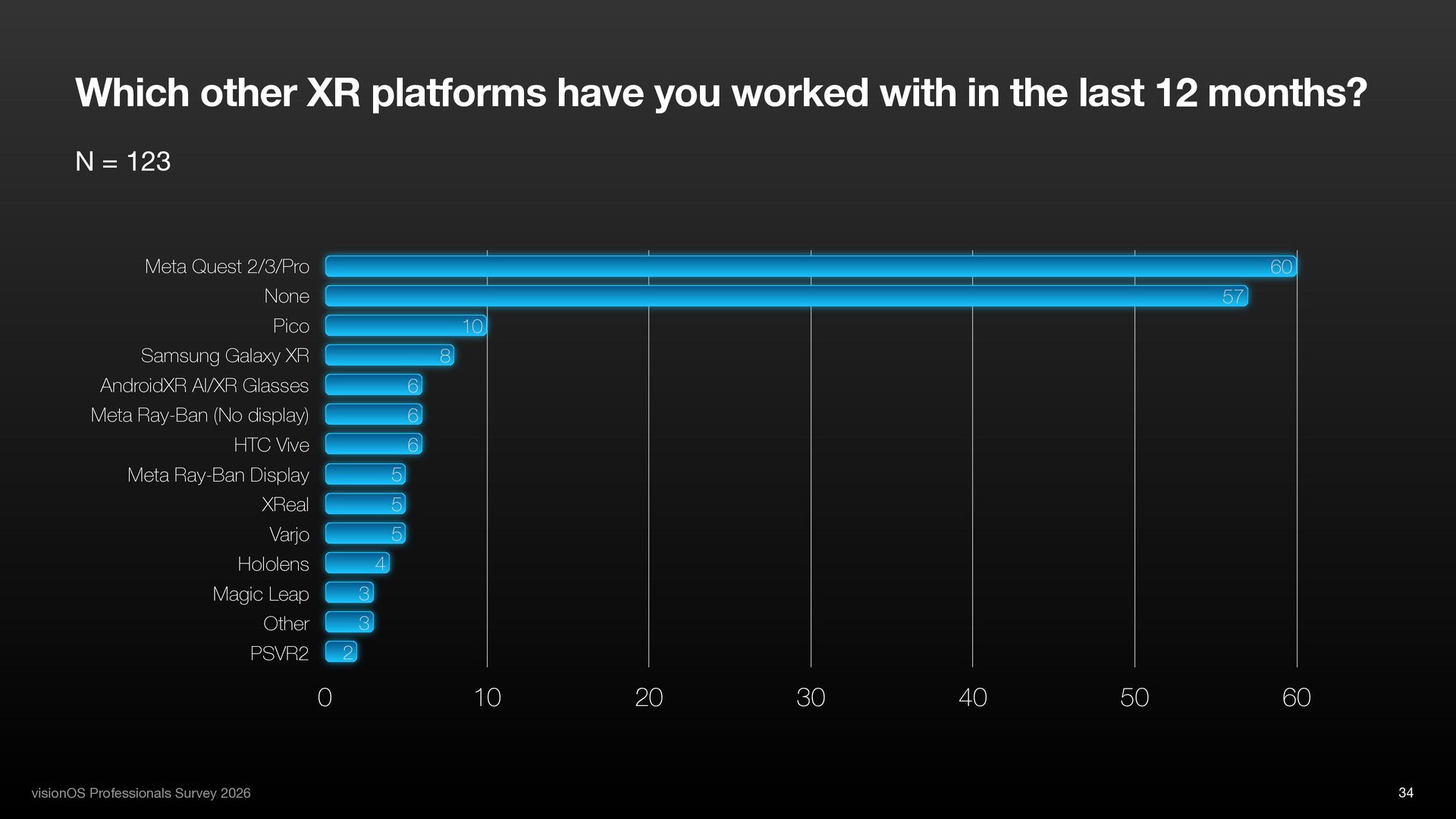
  27. visionOS Professionals Survey 2026 Which other XR platforms have you

    worked with in the last 12 months? N = 123 Meta Quest 2/3/Pro None Pico Samsung Galaxy XR AndroidXR AI/XR Glasses Meta Ray-Ban (No display) HTC Vive Meta Ray-Ban Display XReal Varjo Hololens Magic Leap Other PSVR2 0 10 20 30 40 50 60 2 3 3 4 5 5 5 6 6 6 8 10 57 60 34
  28. visionOS Professionals Survey 2026 In broad terms, how would you

    rate visionOS 26? 0% 20% 40% 60% 80% 100% 0 1 2 3 4 5 6 7 8 9 10 18% 15% 36% 20% 4% 3% 0% 2% 1% 0% 2% 18% 17% 41% 15% 4% 1% 1% 2% 1% 0% 1% 2025 (169) 2026 (123) Very Bad Very Good 35
  29. visionOS Professionals Survey 2026 In broad terms, how would you

    rate Apple Vision Pro? 0% 20% 40% 60% 80% 100% 0 1 2 3 4 5 6 7 8 9 10 28% 19% 26% 14% 7% 1% 2% 1% 2% 0% 2% 20% 19% 27% 17% 10% 2% 1% 1% 3% 0% 1% 2025 (169) 2026 (123) Very Bad Very Good 36
  30. visionOS Professionals Survey 2026 Where do you engage with other

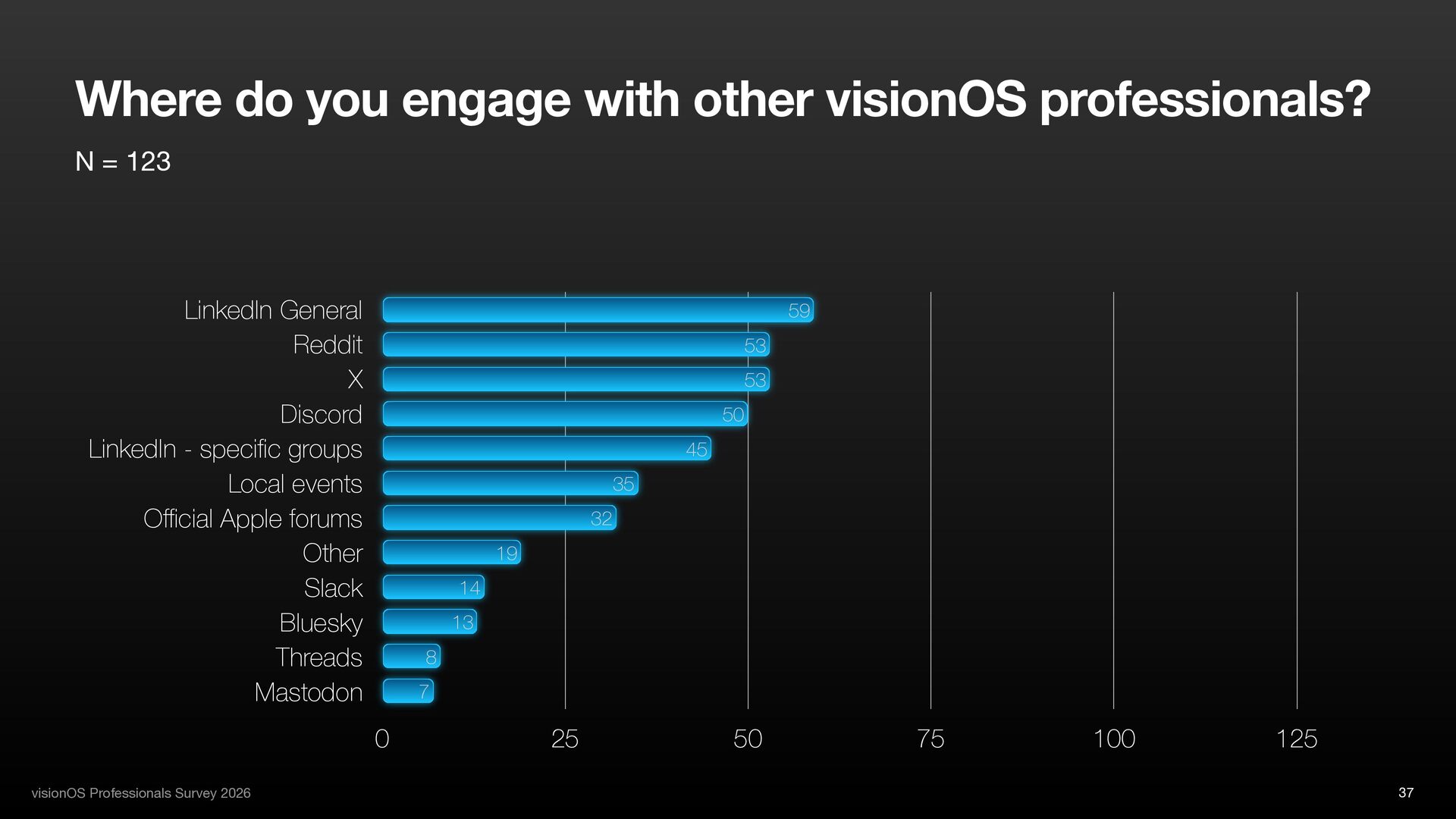
    visionOS professionals? N = 123 LinkedIn General Reddit X Discord LinkedIn - speci fi c groups Local events O ffi cial Apple forums Other Slack Bluesky Threads Mastodon 0 25 50 75 100 125 7 8 13 14 19 32 35 45 50 53 53 59 37
  31. visionOS Professionals Survey 2026 What do you want to see

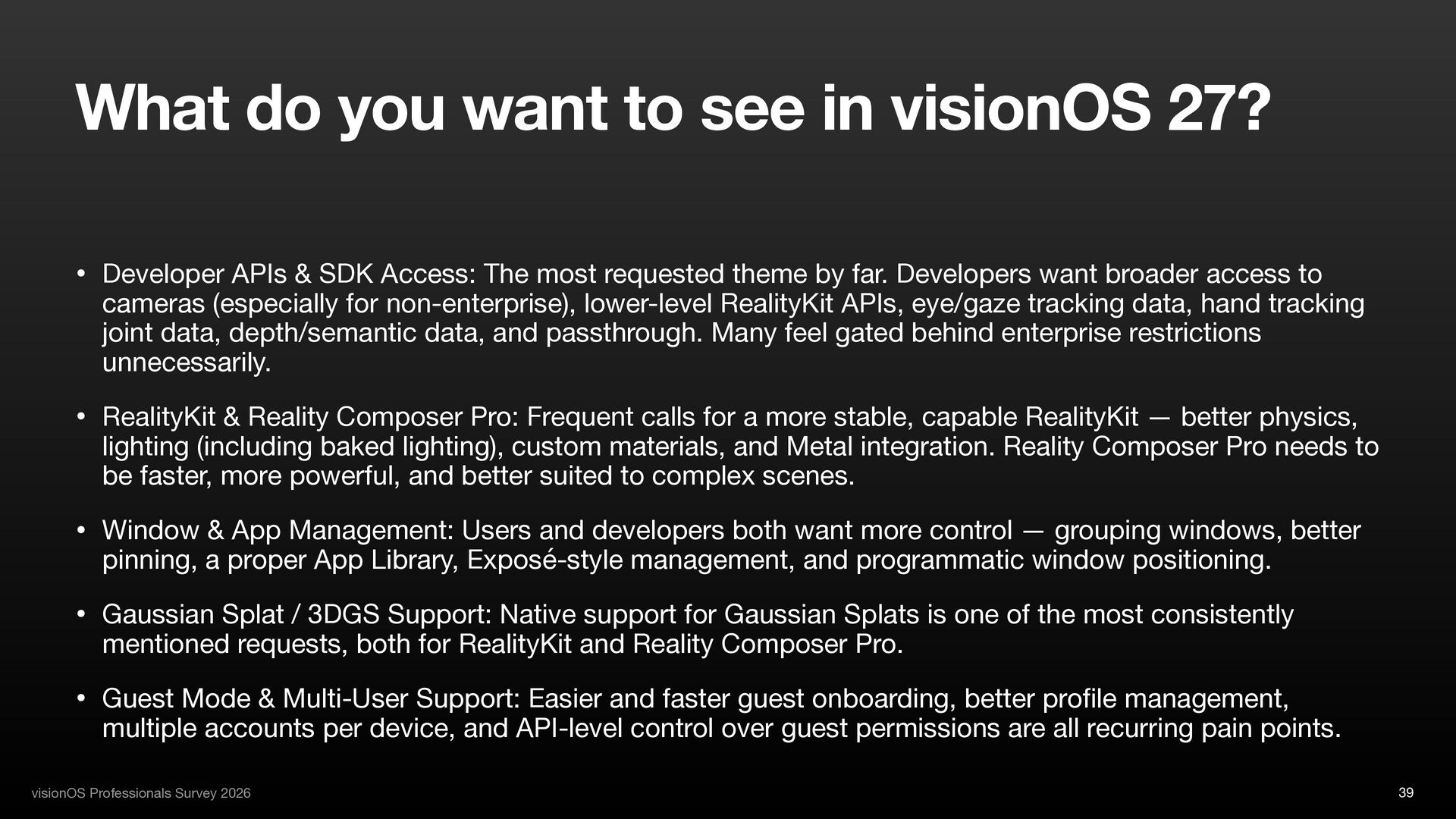
    in visionOS 27? • Developer APIs & SDK Access: The most requested theme by far. Developers want broader access to cameras (especially for non-enterprise), lower-level RealityKit APIs, eye/gaze tracking data, hand tracking joint data, depth/semantic data, and passthrough. Many feel gated behind enterprise restrictions unnecessarily. • RealityKit & Reality Composer Pro: Frequent calls for a more stable, capable RealityKit — better physics, lighting (including baked lighting), custom materials, and Metal integration. Reality Composer Pro needs to be faster, more powerful, and better suited to complex scenes. • Window & App Management: Users and developers both want more control — grouping windows, better pinning, a proper App Library, Exposé-style management, and programmatic window positioning. • Gaussian Splat / 3DGS Support: Native support for Gaussian Splats is one of the most consistently mentioned requests, both for RealityKit and Reality Composer Pro. • Guest Mode & Multi-User Support: Easier and faster guest onboarding, better pro fi le management, multiple accounts per device, and API-level control over guest permissions are all recurring pain points. 39
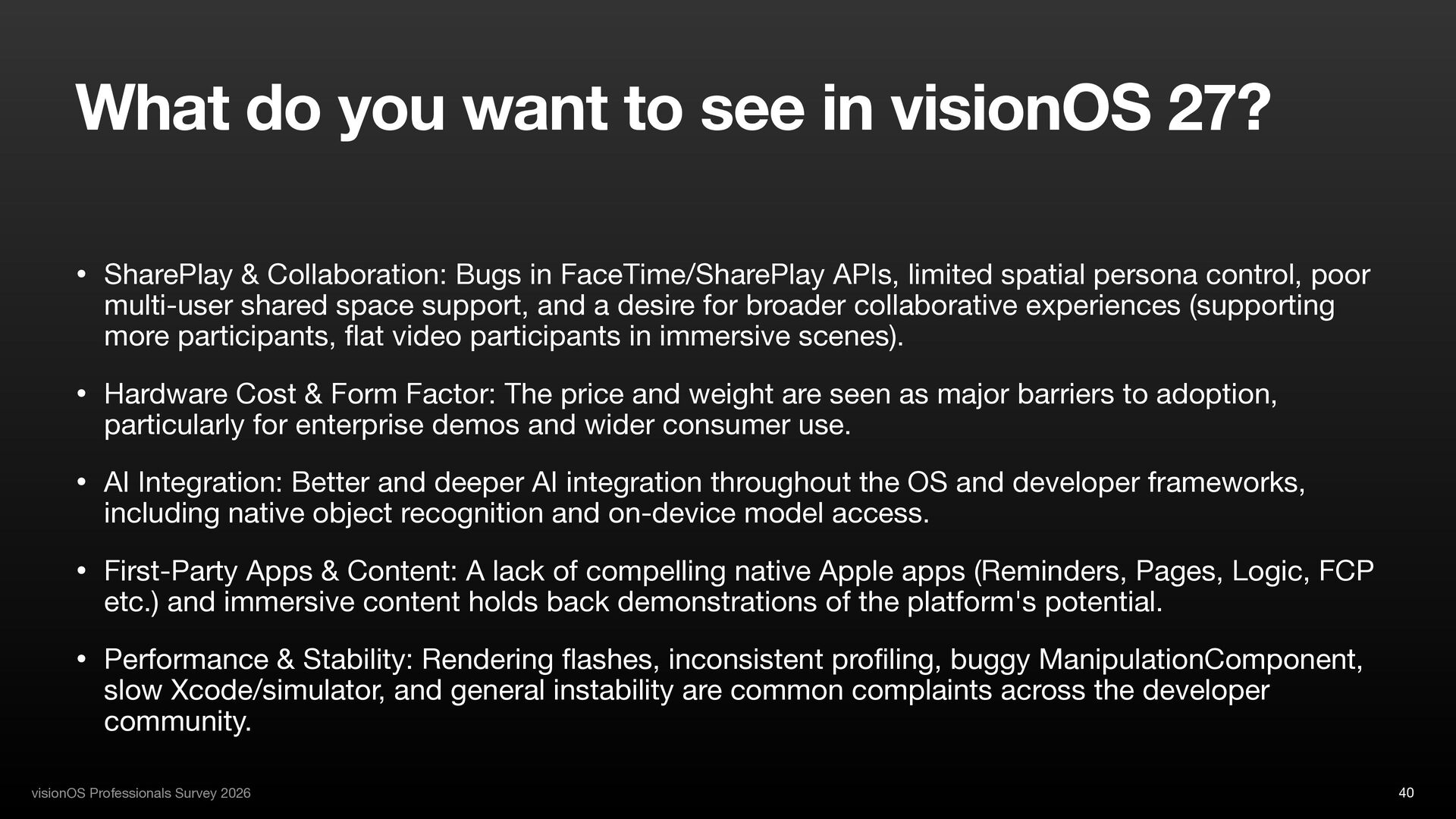
  32. visionOS Professionals Survey 2026 What do you want to see

    in visionOS 27? • SharePlay & Collaboration: Bugs in FaceTime/SharePlay APIs, limited spatial persona control, poor multi-user shared space support, and a desire for broader collaborative experiences (supporting more participants, fl at video participants in immersive scenes). • Hardware Cost & Form Factor: The price and weight are seen as major barriers to adoption, particularly for enterprise demos and wider consumer use. • AI Integration: Better and deeper AI integration throughout the OS and developer frameworks, including native object recognition and on-device model access. • First-Party Apps & Content: A lack of compelling native Apple apps (Reminders, Pages, Logic, FCP etc.) and immersive content holds back demonstrations of the platform's potential. • Performance & Stability: Rendering fl ashes, inconsistent pro fi ling, buggy ManipulationComponent, slow Xcode/simulator, and general instability are common complaints across the developer community. 40
  33. visionOS Professionals Survey 2026 How do you feel about the

    future of the visionOS software platform? 0% 20% 40% 60% 80% 100% Very pessimistic Somewhat pessimistic Neutral Somewhat optimistic Very optimistic 43% 41% 5% 7% 4% 46% 37% 8% 6% 2% 2025 (169) 2026 (123) 41
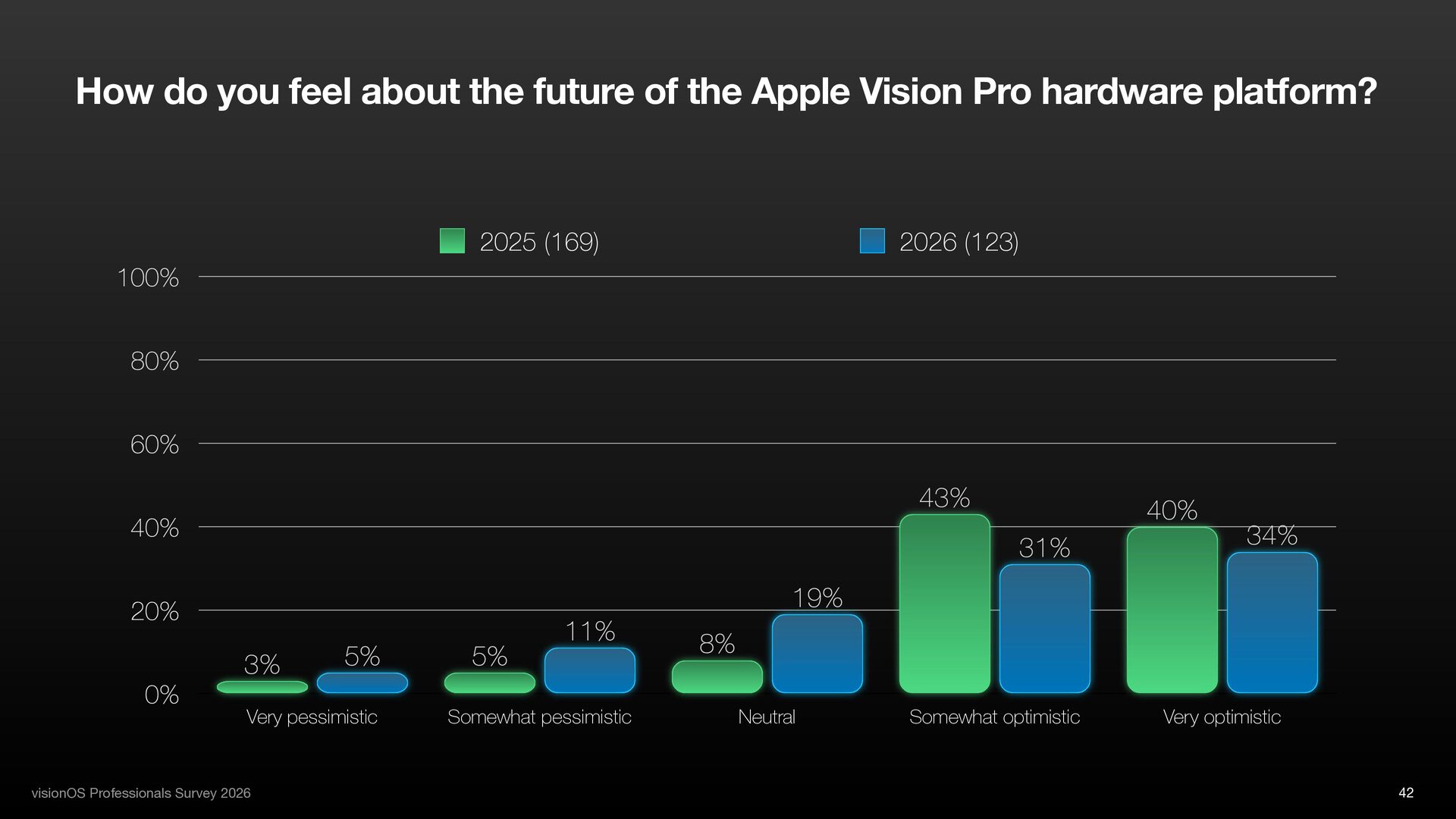
  34. visionOS Professionals Survey 2026 How do you feel about the

    future of the Apple Vision Pro hardware platform? 0% 20% 40% 60% 80% 100% Very pessimistic Somewhat pessimistic Neutral Somewhat optimistic Very optimistic 34% 31% 19% 11% 5% 40% 43% 8% 5% 3% 2025 (169) 2026 (123) 42
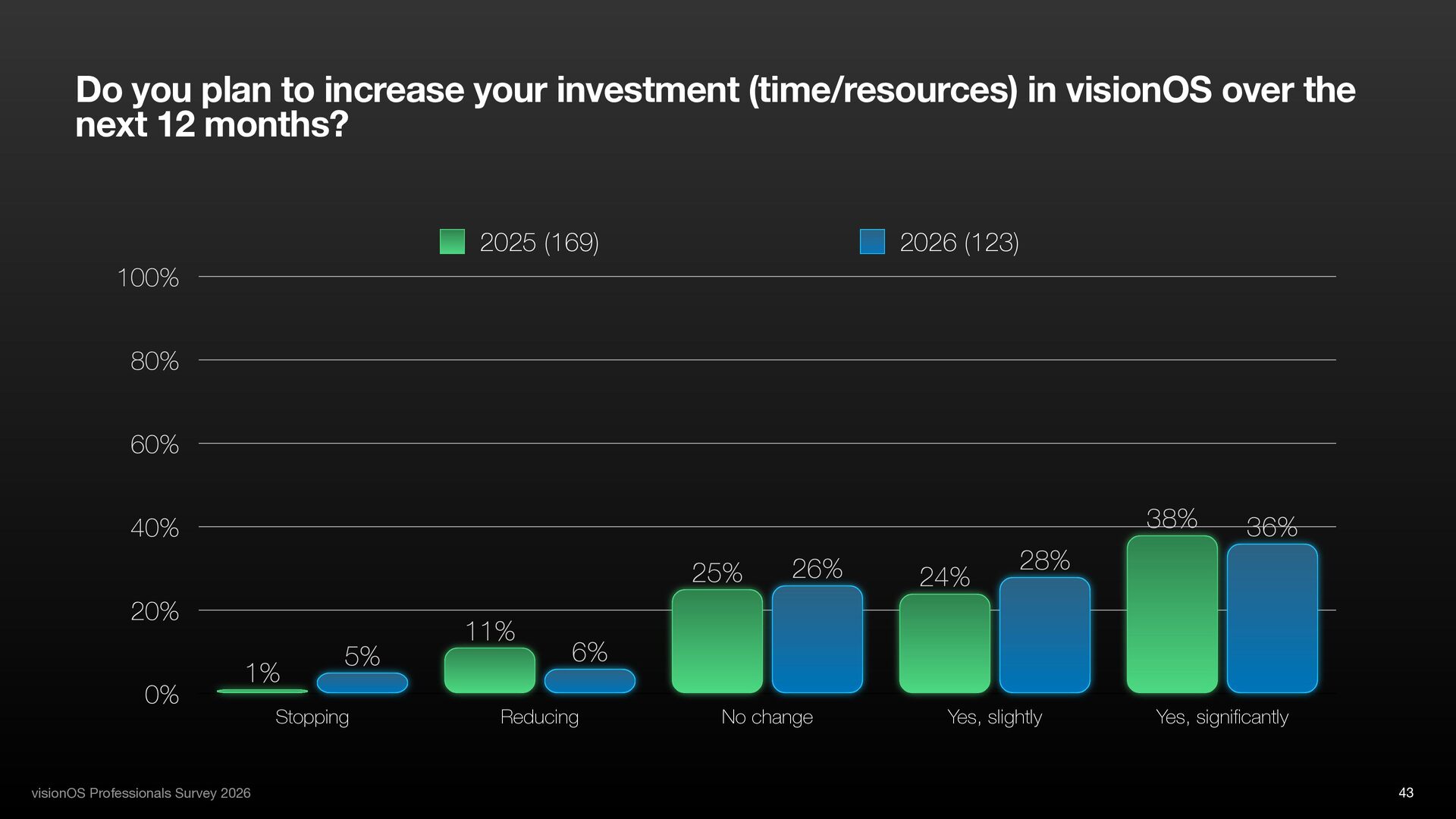
  35. visionOS Professionals Survey 2026 Do you plan to increase your

    investment (time/resources) in visionOS over the next 12 months? 0% 20% 40% 60% 80% 100% Stopping Reducing No change Yes, slightly Yes, signi fi cantly 36% 28% 26% 6% 5% 38% 24% 25% 11% 1% 2025 (169) 2026 (123) 43
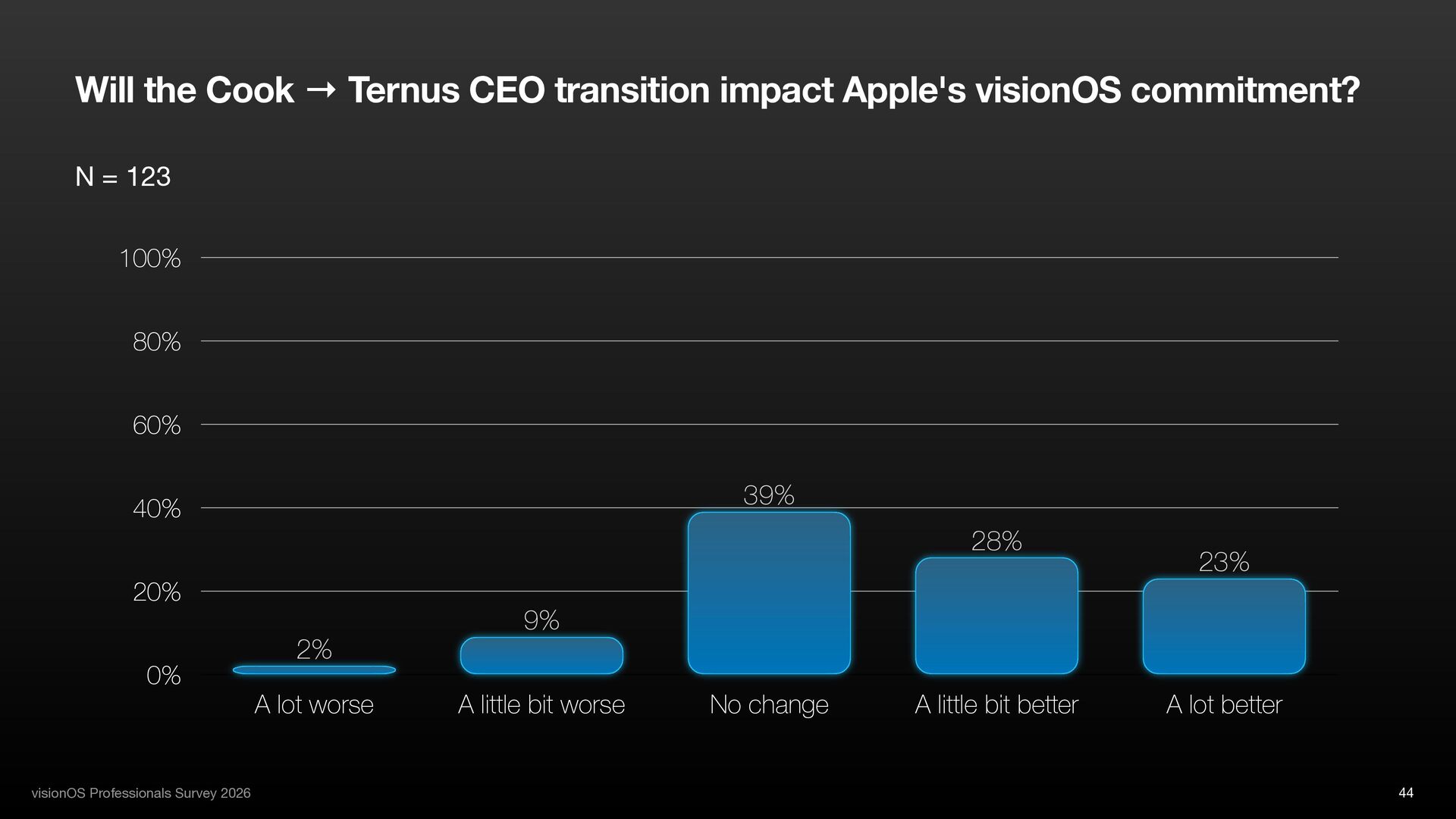
  36. visionOS Professionals Survey 2026 Will the Cook → Ternus CEO

    transition impact Apple's visionOS commitment? N = 123 0% 20% 40% 60% 80% 100% A lot worse A little bit worse No change A little bit better A lot better 23% 28% 39% 9% 2% 44
  37. visionOS Professionals Survey 2026 What hardware do you hope to

    see at WWDC2026? N = 123 Apple Vision headset that's not a Pro Apple Vision smartglasses (with display) New Apple Vision Pro headset Spatial Computing accessories Apple Vision smartglasses (no display) Other 0 25 50 75 100 125 4 24 38 45 74 77 45
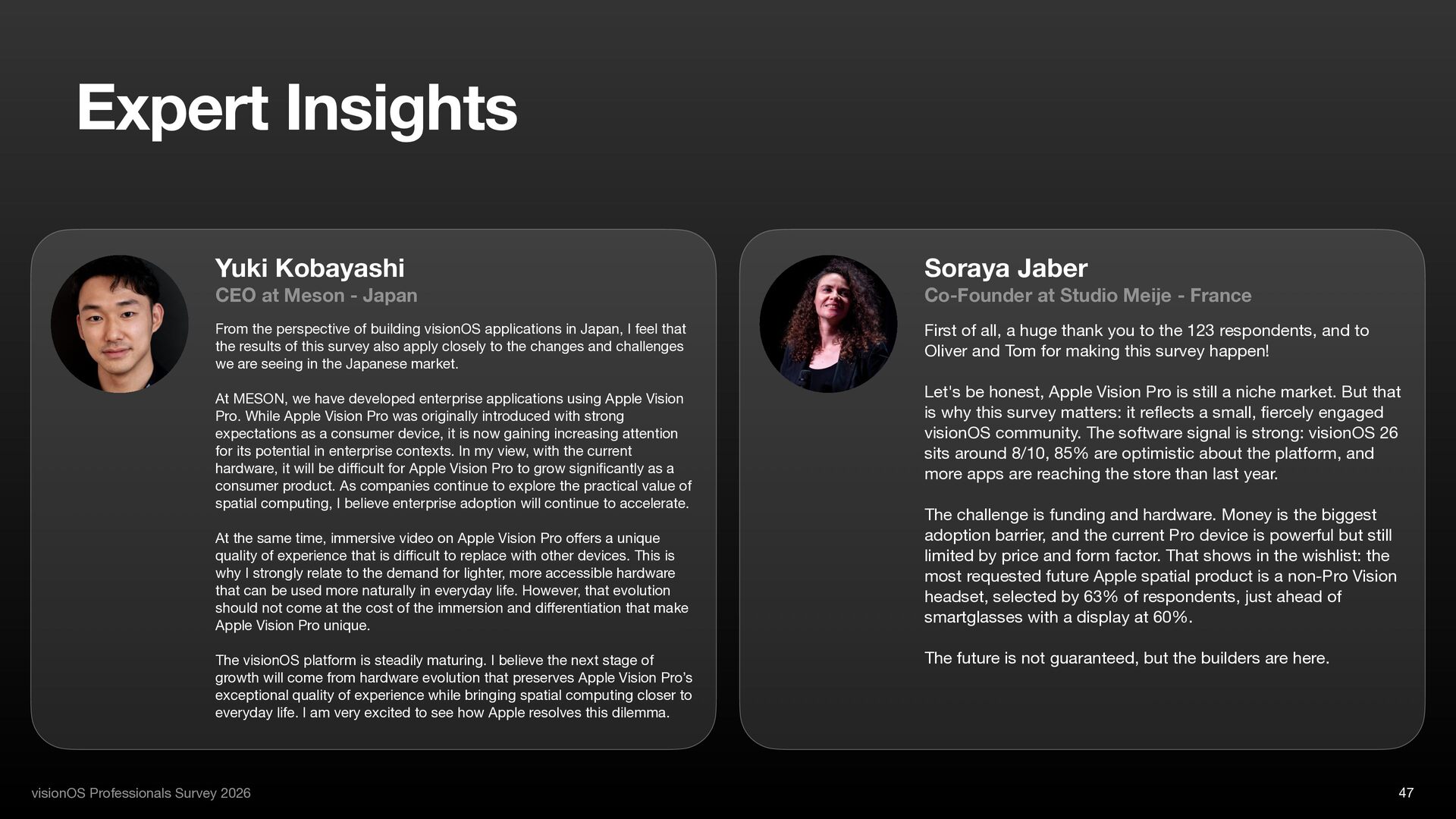
  38. visionOS Professionals Survey 2026 Expert Insights Soraya Jaber First of

    all, a huge thank you to the 123 respondents, and to Oliver and Tom for making this survey happen! Let's be honest, Apple Vision Pro is still a niche market. But that is why this survey matters: it re fl ects a small, fi ercely engaged visionOS community. The software signal is strong: visionOS 26 sits around 8/10, 85% are optimistic about the platform, and more apps are reaching the store than last year. The challenge is funding and hardware. Money is the biggest adoption barrier, and the current Pro device is powerful but still limited by price and form factor. That shows in the wishlist: the most requested future Apple spatial product is a non-Pro Vision headset, selected by 63% of respondents, just ahead of smartglasses with a display at 60%. The future is not guaranteed, but the builders are here. Co-Founder at Studio Meije - France 47 Yuki Kobayashi From the perspective of building visionOS applications in Japan, I feel that the results of this survey also apply closely to the changes and challenges we are seeing in the Japanese market. At MESON, we have developed enterprise applications using Apple Vision Pro. While Apple Vision Pro was originally introduced with strong expectations as a consumer device, it is now gaining increasing attention for its potential in enterprise contexts. In my view, with the current hardware, it will be di ffi cult for Apple Vision Pro to grow signi fi cantly as a consumer product. As companies continue to explore the practical value of spatial computing, I believe enterprise adoption will continue to accelerate. At the same time, immersive video on Apple Vision Pro o ff ers a unique quality of experience that is di ffi cult to replace with other devices. This is why I strongly relate to the demand for lighter, more accessible hardware that can be used more naturally in everyday life. However, that evolution should not come at the cost of the immersion and di ff erentiation that make Apple Vision Pro unique. The visionOS platform is steadily maturing. I believe the next stage of growth will come from hardware evolution that preserves Apple Vision Pro’s exceptional quality of experience while bringing spatial computing closer to everyday life. I am very excited to see how Apple resolves this dilemma. CEO at Meson - Japan
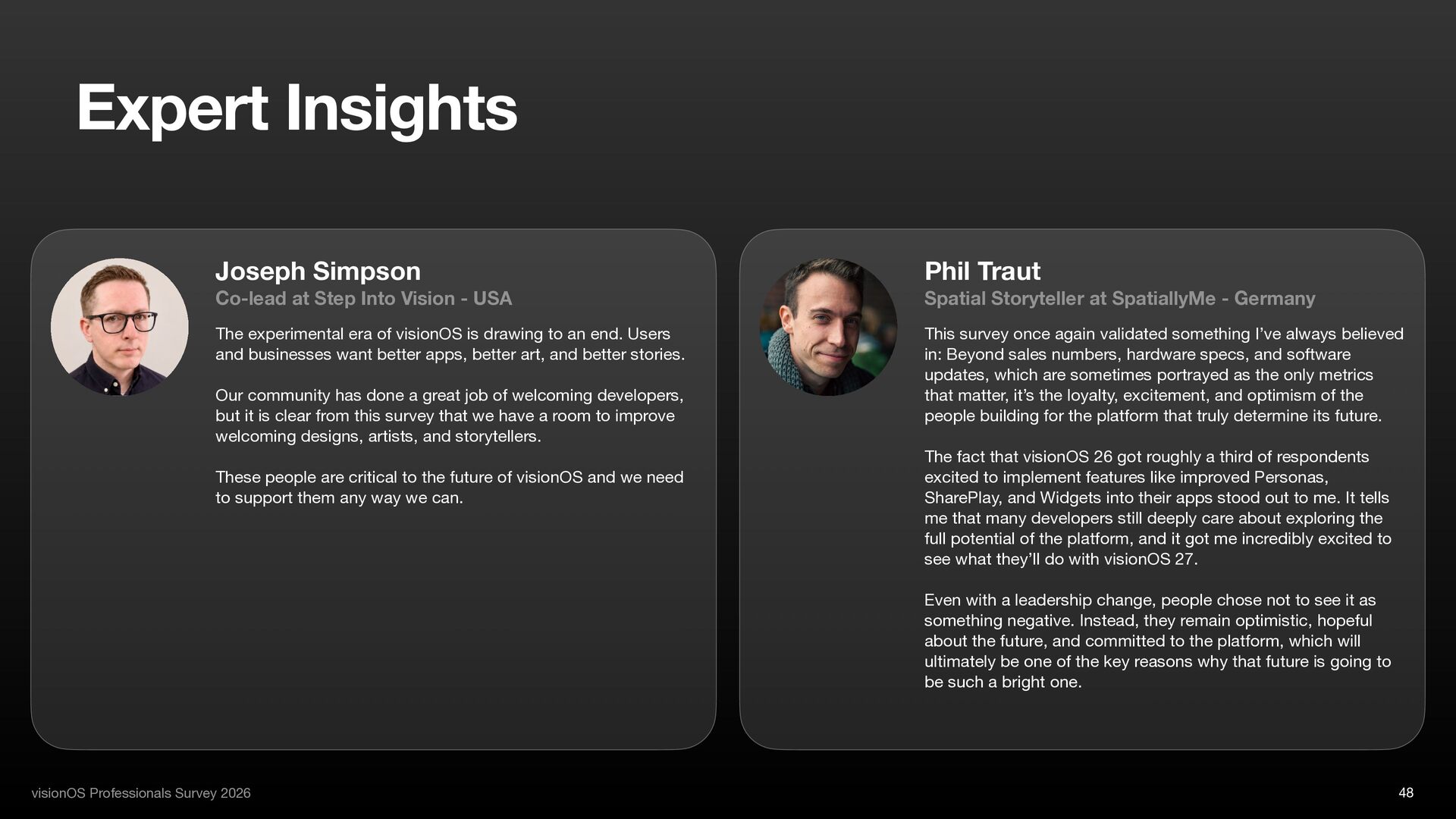
  39. visionOS Professionals Survey 2026 Expert Insights Joseph Simpson The experimental

    era of visionOS is drawing to an end. Users and businesses want better apps, better art, and better stories. Our community has done a great job of welcoming developers, but it is clear from this survey that we have a room to improve welcoming designs, artists, and storytellers. These people are critical to the future of visionOS and we need to support them any way we can. Co-lead at Step Into Vision - USA Phil Traut This survey once again validated something I’ve always believed in: Beyond sales numbers, hardware specs, and software updates, which are sometimes portrayed as the only metrics that matter, it’s the loyalty, excitement, and optimism of the people building for the platform that truly determine its future. The fact that visionOS 26 got roughly a third of respondents excited to implement features like improved Personas, SharePlay, and Widgets into their apps stood out to me. It tells me that many developers still deeply care about exploring the full potential of the platform, and it got me incredibly excited to see what they’ll do with visionOS 27. Even with a leadership change, people chose not to see it as something negative. Instead, they remain optimistic, hopeful about the future, and committed to the platform, which will ultimately be one of the key reasons why that future is going to be such a bright one. Spatial Storyteller at SpatiallyMe - Germany 48
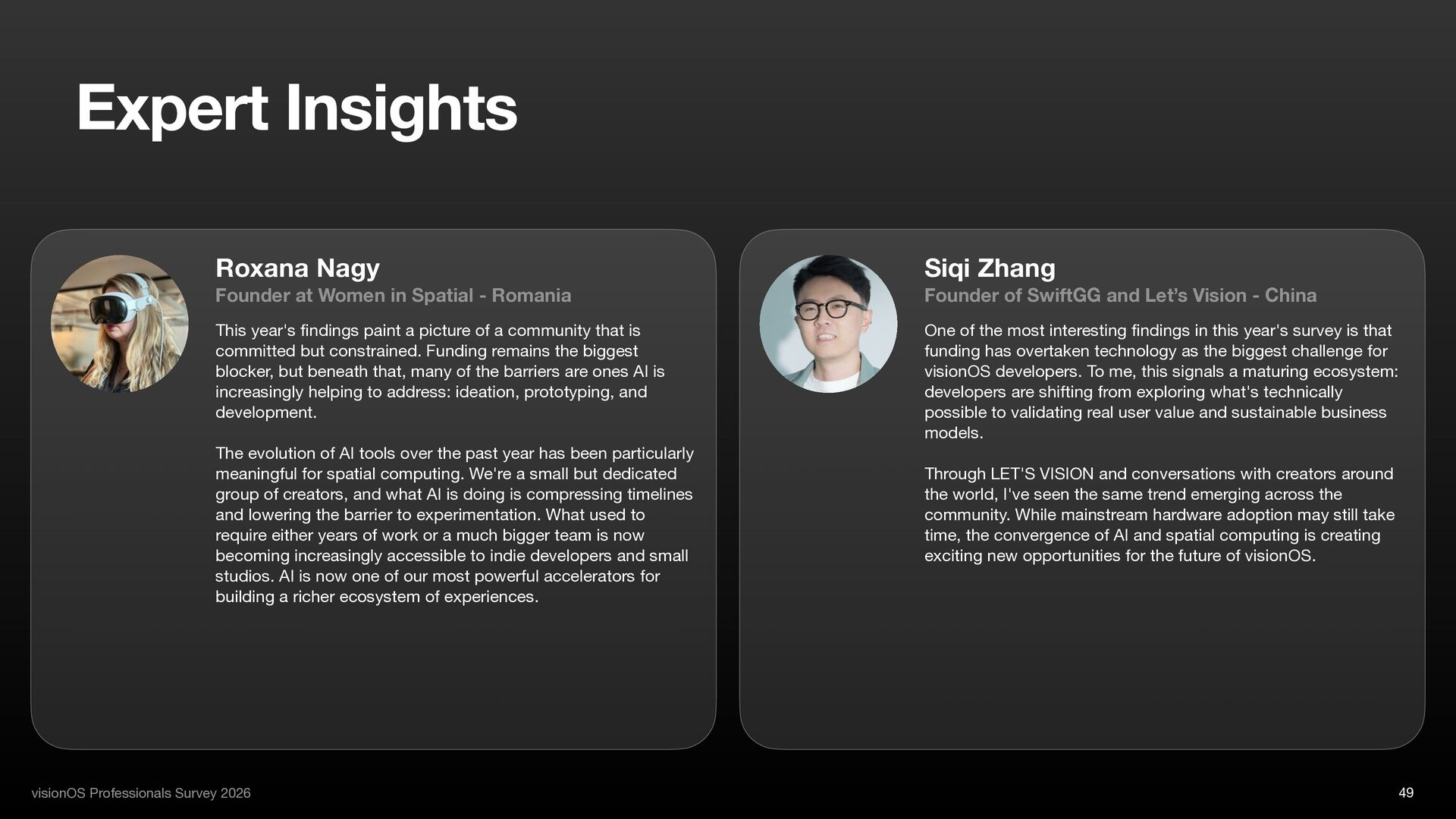
  40. visionOS Professionals Survey 2026 Expert Insights Siqi Zhang One of

    the most interesting fi ndings in this year's survey is that funding has overtaken technology as the biggest challenge for visionOS developers. To me, this signals a maturing ecosystem: developers are shifting from exploring what's technically possible to validating real user value and sustainable business models. Through LET'S VISION and conversations with creators around the world, I've seen the same trend emerging across the community. While mainstream hardware adoption may still take time, the convergence of AI and spatial computing is creating exciting new opportunities for the future of visionOS. Founder of SwiftGG and Let’s Vision - China 49 Roxana Nagy This year's fi ndings paint a picture of a community that is committed but constrained. Funding remains the biggest blocker, but beneath that, many of the barriers are ones AI is increasingly helping to address: ideation, prototyping, and development. The evolution of AI tools over the past year has been particularly meaningful for spatial computing. We're a small but dedicated group of creators, and what AI is doing is compressing timelines and lowering the barrier to experimentation. What used to require either years of work or a much bigger team is now becoming increasingly accessible to indie developers and small studios. AI is now one of our most powerful accelerators for building a richer ecosystem of experiences. Founder at Women in Spatial - Romania
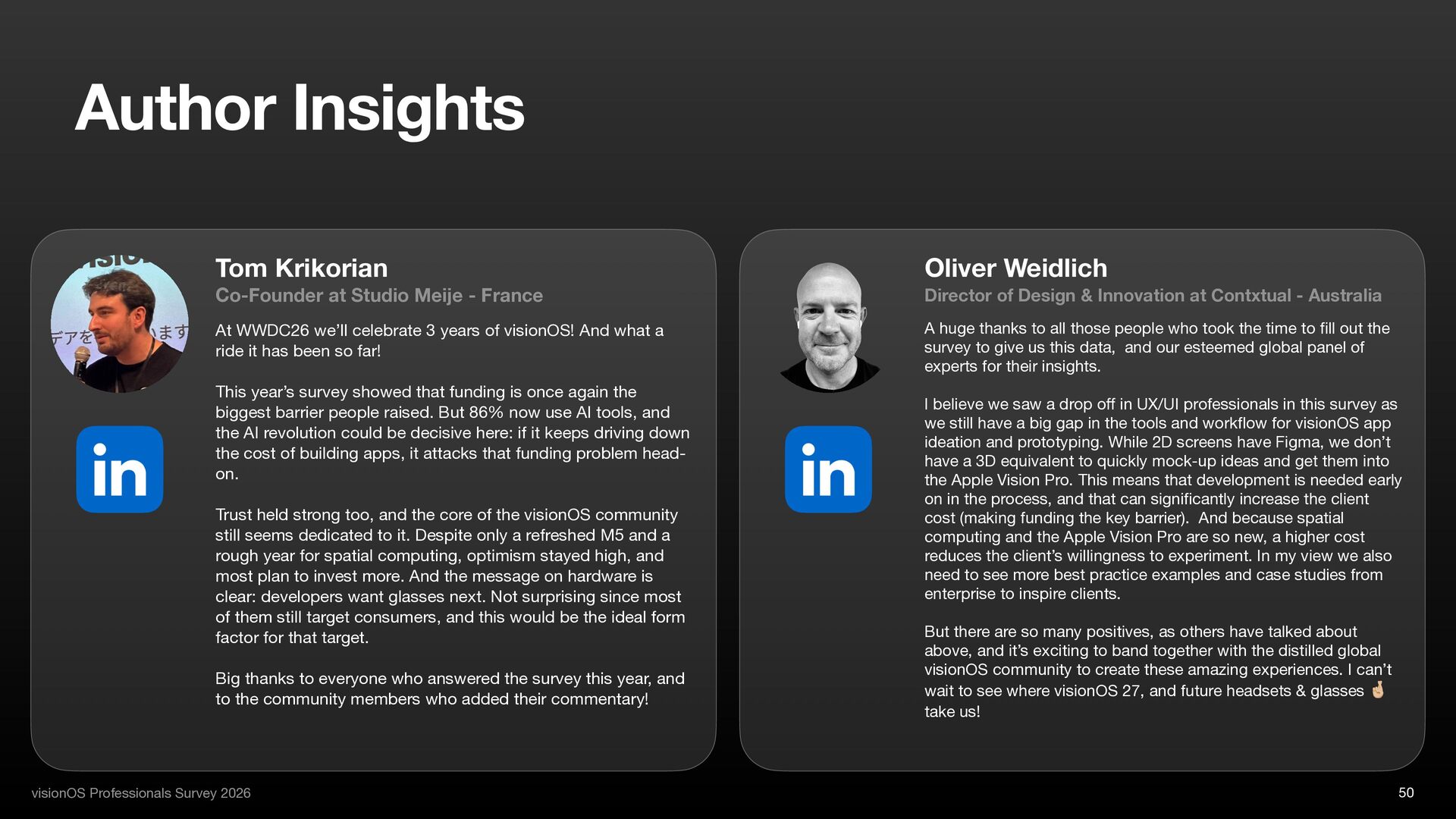
  41. visionOS Professionals Survey 2026 Author Insights Tom Krikorian At WWDC26

    we’ll celebrate 3 years of visionOS! And what a ride it has been so far! This year’s survey showed that funding is once again the biggest barrier people raised. But 86% now use AI tools, and the AI revolution could be decisive here: if it keeps driving down the cost of building apps, it attacks that funding problem head- on. Trust held strong too, and the core of the visionOS community still seems dedicated to it. Despite only a refreshed M5 and a rough year for spatial computing, optimism stayed high, and most plan to invest more. And the message on hardware is clear: developers want glasses next. Not surprising since most of them still target consumers, and this would be the ideal form factor for that target. Big thanks to everyone who answered the survey this year, and to the community members who added their commentary! Co-Founder at Studio Meije - France Oliver Weidlich A huge thanks to all those people who took the time to fi ll out the survey to give us this data, and our esteemed global panel of experts for their insights. I believe we saw a drop o ff in UX/UI professionals in this survey as we still have a big gap in the tools and work fl ow for visionOS app ideation and prototyping. While 2D screens have Figma, we don’t have a 3D equivalent to quickly mock-up ideas and get them into the Apple Vision Pro. This means that development is needed early on in the process, and that can signi fi cantly increase the client cost (making funding the key barrier). And because spatial computing and the Apple Vision Pro are so new, a higher cost reduces the client’s willingness to experiment. In my view we also need to see more best practice examples and case studies from enterprise to inspire clients. But there are so many positives, as others have talked about above, and it’s exciting to band together with the distilled global visionOS community to create these amazing experiences. I can’t wait to see where visionOS 27, and future headsets & glasses 🤞 take us! Director of Design & Innovation at Contxtual - Australia 50