Upgrade to Pro — share decks privately, control downloads, hide ads and more …

We Are the Ruby Community

We Are the Ruby Community

Many developers feel like observers of the Ruby community rather than participants in it. This talk reframes what community actually means, breaks down the invisible barriers that make people feel like they don't belong, and shows practical ways anyone can participate right away. The goal is to show that the Ruby community isn't something you join, it's something you help create.

Avatar for Andrew Mason

Andrew Mason

June 18, 2026

More Decks by Andrew Mason

Other Decks in Technology

Transcript

  1. Before I introduce myself Stand up when something is true

    for you Before I introduce myself, I want to do something together. I'm going to read a list. The moment you hear something that's true for you, stand up, and stay on your feet. If getting up isn't easy, just raise a hand instead.
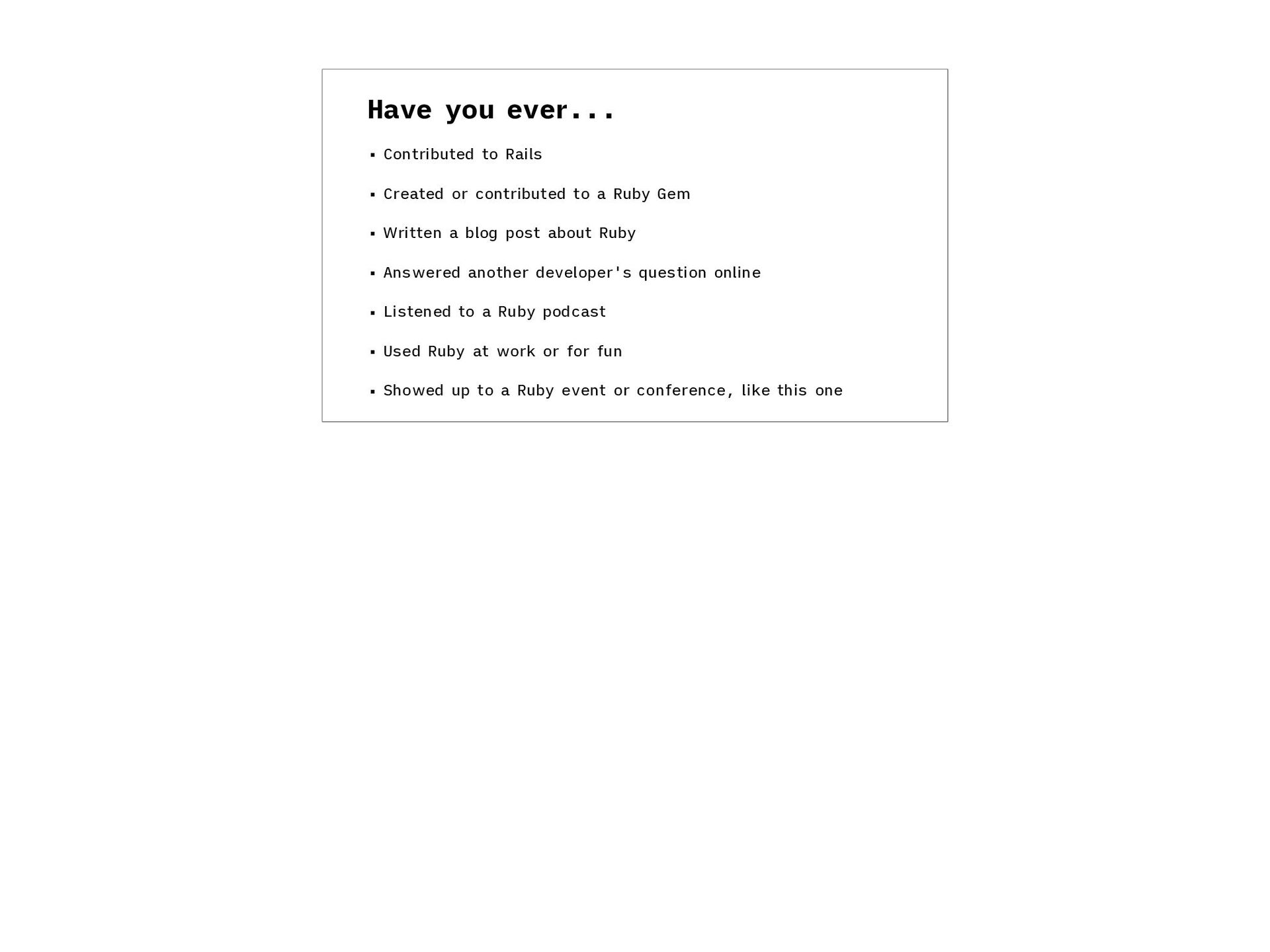
  2. • Contributed to Rails • Created or contributed to a

    Ruby Gem • Written a blog post about Ruby • Answered another developer's question online • Listened to a Ruby podcast • Used Ruby at work or for fun • Showed up to a Ruby event or conference, like this one Have you ever...
  3. Look around This is the Ruby community Look around. Almost

    every person in this room is on their feet. Now stay where you are. But this next one, you don't say out loud, and you don't move a muscle. Just answer it in your own head
  4. Do you feel part of the Ruby community? Have you

    ever felt, even standing here right now, like you're still not *really* part of the Ruby community? Yeah. Me too. Go ahead and take your seats.
  5. You aren't alone. A lot of us experience Ruby this

    way. We attend the events. We use the gems. We follow the discussions. And the community itself somehow feels like something happening *somewhere else*, run by people more experienced, more visible, more important than us. So I want to tell you the simplest, strangest thing I've learned about this:
  6. You don't join the Ruby community You are the Ruby

    community Every one of you just got to your feet, or raised a hand. That was the community, in motion, in this room. Some of you stood for *answered a question online.* That's not the community's audience. That's the community doing its job. The reading, the listening, the asking, the showing up. You've been doing it the whole time. You just didn't know it counted. By the end of this talk, I want that to feel obvious. So let me start where I started, completely convinced it wasn't true.
  7. A quick word about me I'm Andrew Mason 🌵🎙⌨ I've

    spent a lot of years at conferences like this one, and an honestly embarrassing number of hours behind a podcast microphone. These days I co-host a show called Remote Ruby with Chris Oliver and David Hill, and formerly with Jason Charnes.
  8. And that points at the most important thing I’ve learned

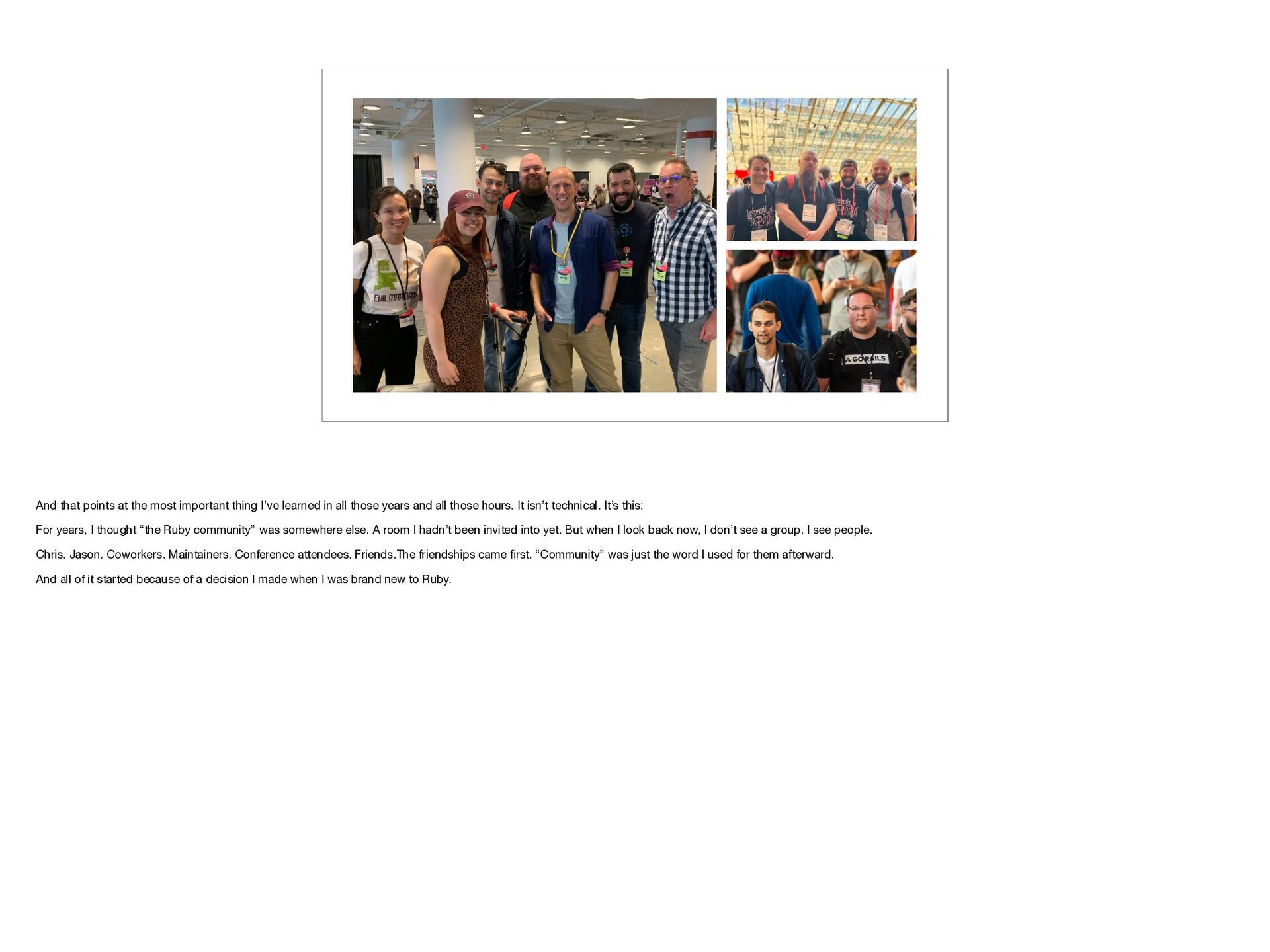
    in all those years and all those hours. It isn’t technical. It’s this: For years, I thought “the Ruby community” was somewhere else. A room I hadn’t been invited into yet. But when I look back now, I don’t see a group. I see people. Chris. Jason. Coworkers. Maintainers. Conference attendees. Friends.The friendships came fi rst. “Community” was just the word I used for them afterward. And all of it started because of a decision I made when I was brand new to Ruby.
  9. Thank you Podia! podia.com One more introduction, because I owe

    them one. By day, I work at Podia. Podia is a home for the courses you teach, the community you host, the emails you write, and the people you do it all for. And they are the reason I get to be standing here today. They sent me. They covered the trip. They encouraged me. They believe that communities matter. So before I go any further: thank you, Podia.
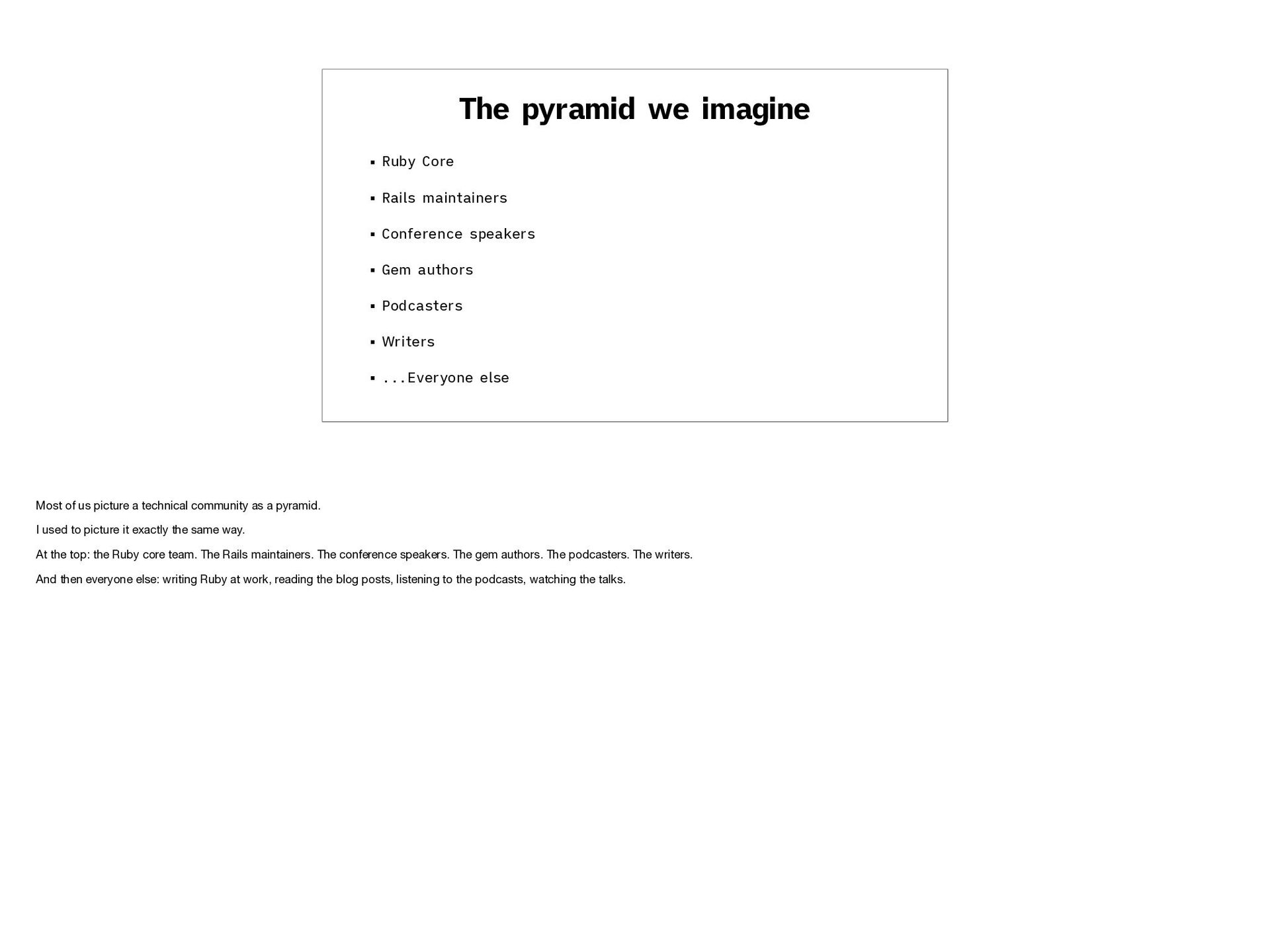
  10. The pyramid we imagine • Ruby Core • Rails maintainers

    • Conference speakers • Gem authors • Podcasters • Writers • ...Everyone else Most of us picture a technical community as a pyramid. I used to picture it exactly the same way. At the top: the Ruby core team. The Rails maintainers. The conference speakers. The gem authors. The podcasters. The writers. And then everyone else: writing Ruby at work, reading the blog posts, listening to the podcasts, watching the talks.
  11. Standing near the doorway I never thought I was *outside*

    of Ruby. I just felt adjacent to it. Standing near the doorway. Hoping nobody noticed I felt like I didn't quite belong inside. A lot of Rubyists feel exactly that way. Maybe some of you, in this room feel it.
  12. visibility != belonging But communities aren't really pyramids, even when

    they look like one from the outside. You see the speakers and the maintainers because they're *visible*. What you have to look harder to see is the thing actually holding the whole thing together. It isn't a hierarchy.
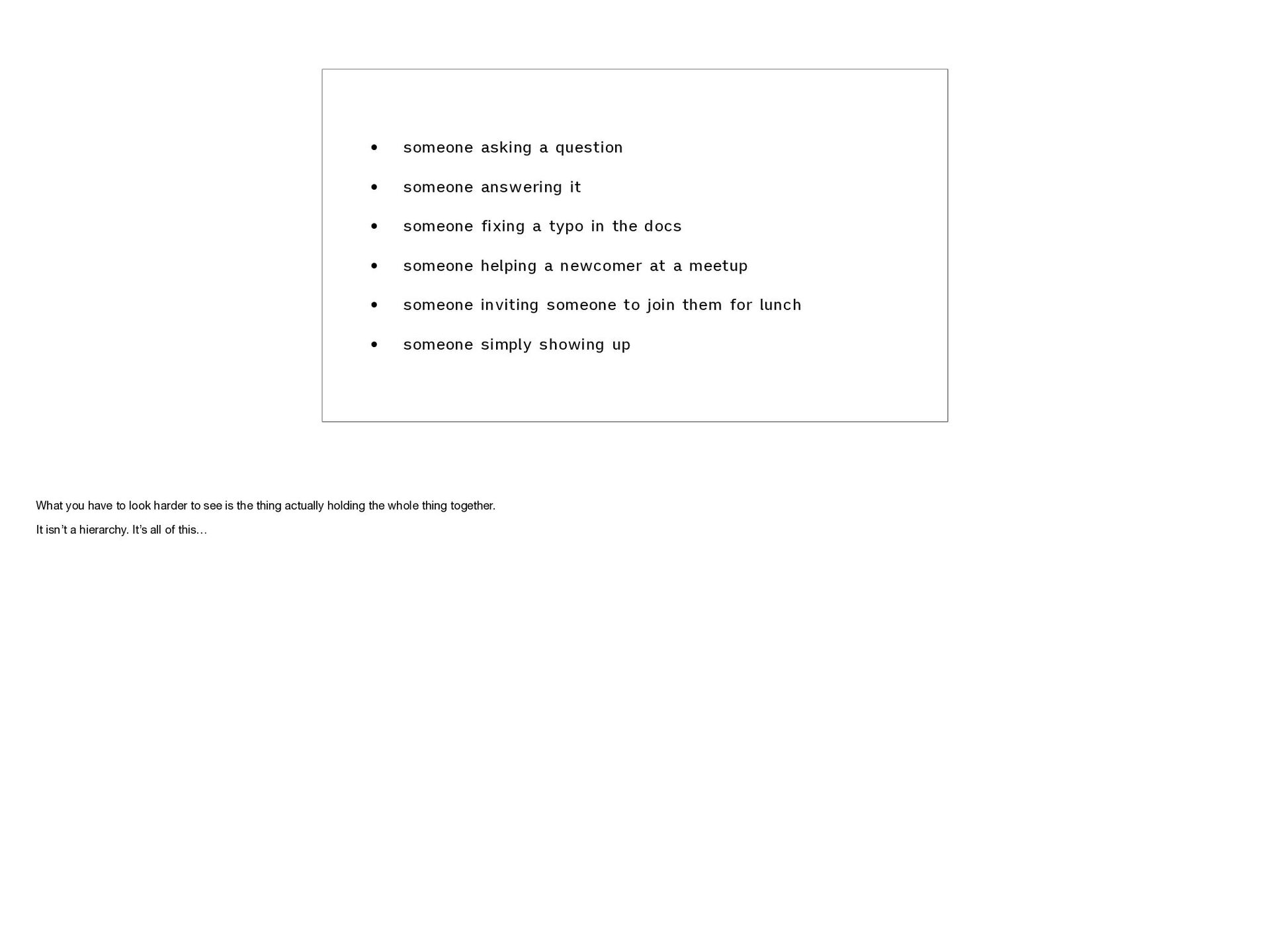
  13. • someone asking a question • someone answering it •

    someone fixing a typo in the docs • someone helping a newcomer at a meetup • someone inviting someone to join them for lunch • someone simply showing up What you have to look harder to see is the thing actually holding the whole thing together. It isn’t a hierarchy. It’s all of this…
  14. Conversations and relationships are what keep it alive The visible

    parts of the ecosystem get the attention. The conversations and relationships are what keep it alive.
  15. How belonging happens So how do you go from feeling

    like an outsider to feeling like you belong? You participate. It sounds almost insultingly simple. But every community I've ever belonged to came down to that one move: I stopped only consuming what other people made, and I started contributing something back. However small.
  16. The community isn't behind the tool It's the people around

    it That gem you `bundle install`-ed this morning? Somebody wrote it. Somebody else fi led the issue that made it better. Somebody posted about it on social media. Somebody else wrote the tutorial that helped others understand it. The community isn't *behind* the tool. It *is* every person who chose to engage with the tool instead of only using it.
  17. • Ask a question • Answer a question • File

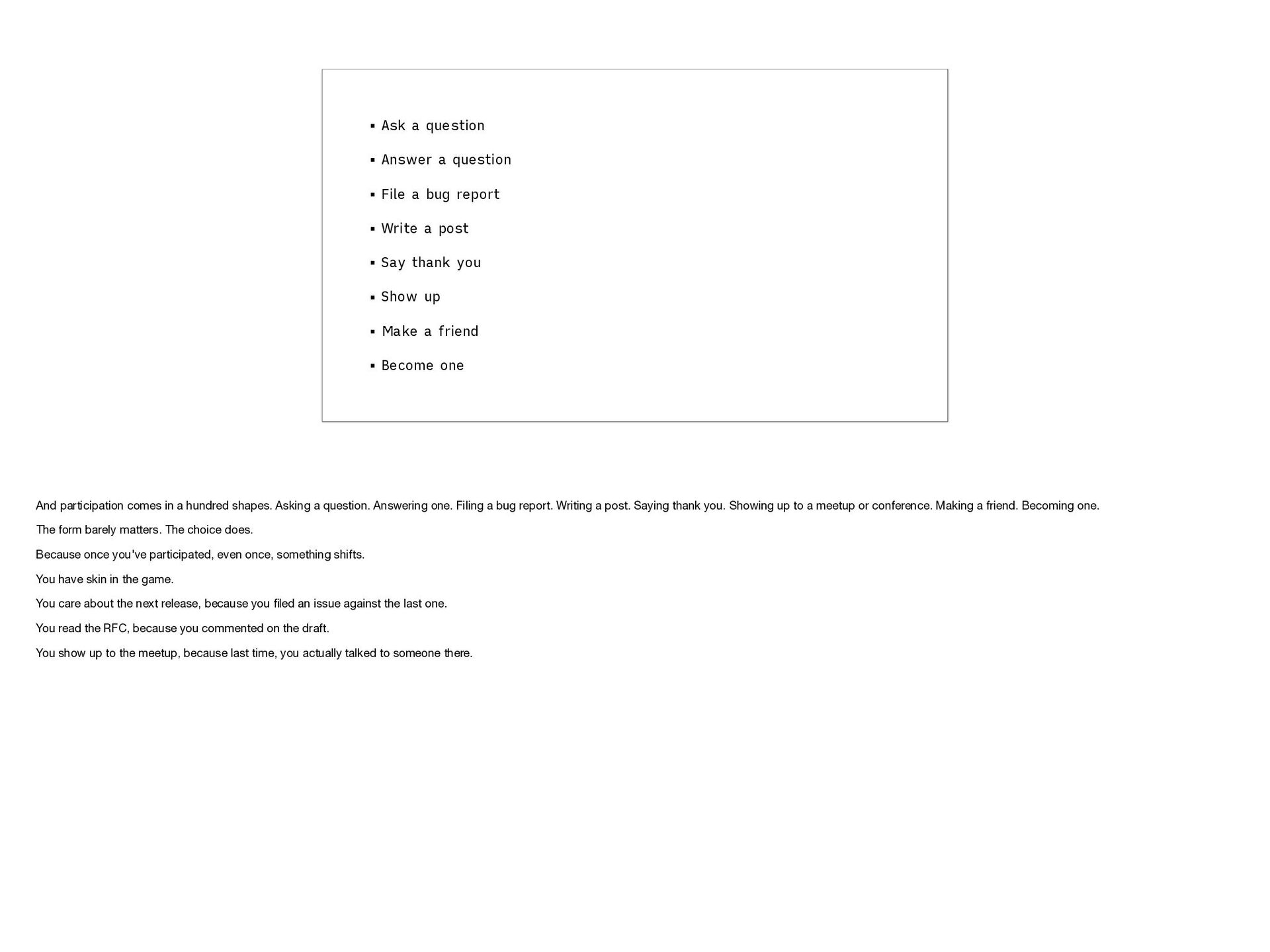
    a bug report • Write a post • Say thank you • Show up • Make a friend • Become one And participation comes in a hundred shapes. Asking a question. Answering one. Filing a bug report. Writing a post. Saying thank you. Showing up to a meetup or conference. Making a friend. Becoming one. The form barely matters. The choice does. Because once you've participated, even once, something shifts. You have skin in the game. You care about the next release, because you fi led an issue against the last one. You read the RFC, because you commented on the draft. You show up to the meetup, because last time, you actually talked to someone there.
  18. One act of participation Turns a language into a place

    One act of participation turns a language into a place. And that place has no door. No gate. No moment where someone hands you a badge that says *you belong now.* The community isn't a destination. It's a pile of friendships that accumulated, one hello at a time. Until one day you look up, and the room is full of people who know your name. People who are excited to see or talk to you. I know that's true, because it's the only reason I'm standing up here. And let me tell you how I know.
  19. How I know Rewind about nine years. I'm a junior

    developer, fresh out of college. I know exactly three Rubyists in the entire world. And I share an o ff i ce with all three of them. There's no Ruby meetup in my city. Nobody I went to school with writes it. As far as my actual, physical life is concerned, the Ruby community does not exist. But every podcast I put in my ears, every conference talk I watch, keeps telling me the same thing: that there's this warm, generous, world-famous Ruby community out there. And I keep thinking: *Where?* *Where is this magical community everyone keeps talking about? Because I have never once seen it.*
  20. So I went looking So one day I decided to

    go fi nd it. There was a show called The Ruby Testing Podcast, hosted by a developer named Jason Swett. And I sent him a message. It basically said: “Hey… could I just come on and ask you questions about testing? From a junior’s perspective? Because I have a lot of them.” I want to be honest about that moment, because it’s the whole point. I typed that message. Then I deleted it. Then I typed it again. My thumb hovered over send for an embarrassingly long time, while every voice in my head said who do you think you are. And then I sent it anyway.
  21. He said yes! To my complete surprise, he said yes.

    I recorded my fi rst podcast episode.I was terri fi ed. I was sure I’d ask something so obviously dumb that the entire internet would point and laugh, that my coworkers would fi gure out I was an imposter, that no one would accept me. And then the episode came out. And something shifted. It wasn’t that I’d suddenly become important. I hadn’t. It was that, for the fi rst time, I’d done something for the Ruby community instead of only taking from it. That was the bridge. I’d walked across it without even knowing it was there. That counted.
  22. A sticker That fi rst episode wasn’t the only time

    showing up changed everything for me. A while later, I went to one of my fi rst big Ruby conferences. I barely knew a soul, and I spent most of it feeling like I’d snuck in. Then someone posted in the conference Slack. It was Chris Oliver. He said he had stickers, and that he was sitting at a table upstairs if anyone wanted one. I almost didn’t go. I was shy. I was nervous. I felt completely out of place. But I went.
  23. I grabbed a sticker. I sat down. There were a

    few developers gathered around some tables, some now very famous in the community and some who already were. Chris was one of them. Sitting near him was a guy named Jason Charnes. I grabbed a sticker. I sat down. That is the whole story. I grabbed a sticker, and I sat down. I barely said a word. I just listened. I had no idea that sitting down at this table would change my life. That Chris and Jason would eventually invite me to become a co-host on Remote Ruby with them. That Jason would end up recruiting me to come work with him at Podia. That I would go to their baby showers, meet their families, and travel the world with them. All of it started because I worked up the nerve to walk over and take a sticker.
  24. Staying small is enough Most times I’ve shown up, of

    course, it hasn’t changed my life so drastically. Some conversations turned into friendships. Some stayed acquaintances. Some were a single chat I never repeated. And that is completely fi ne. Each one was just me, choosing to show up. And the more I showed up, the more people I met, the more involved I got, the more I felt like I had truly found my place in the community. Now, I want to be careful here, because it would be easy to hear this story wrong. I am not telling you the goal is to end up on a stage. Please don’t walk out of here thinking you have to host a podcast, or give a talk, or get famous to belong. I think about the Rubyists who have quietly answered beginner questions on Stack Over fl ow for years. Who’ve never given a talk. Never shipped a gem you’ve heard of. Only really interact with their coworkers. And who are every bit as much the Ruby community as anyone you’ll see on this stage. Staying small is enough. Staying small might be the whole point.
  25. I found my people ❤ The path from “I don’t

    know a single person in Ruby” to “I have found my people” had almost nothing to do with becoming a better engineer. It had everything to do with showing up. One small contribution at a time. The thing I was actually good at was asking questions out loud, in public, where other Rubyists could hear them. That turned out to be a contribution too. I didn’t fi nd my people by being the smartest person in the room, because frankly, I’m not. I found them by being curious enough to participate before I felt quali fi ed to.
  26. Some barriers are real So if the community is just

    people connected by a shared tool, why do so many of us still feel like outsiders? Some of the reasons are real, and I’m not going to wave them away. Geography is real. There are whole countries with no local Ruby scene at all. Time is real. Some of you are holding down a job and a family and have about twenty spare minutes a week. Money is real. And you may not have the means to go to conferences or meetups. And bad experiences are real.
  27. Sometimes the community fails Maybe you asked a question once

    and got talked down to. Maybe you showed up somewhere and nobody made room for you. Maybe you posted into a channel and got nothing but silence back. If that’s you, I want to be as clear as I can be: that was not you failing to belong. That was the community failing you. Hold onto that, because in a few minutes I’m going to tell you whose job it is to fi x it.
  28. But there's another barrier The one inside you But there’s

    another kind of barrier. And this is the one I want to spend time on, because it’s the one almost nobody talks about. It isn’t out in the world at all. It’s in here. You’ve probably thought some version of these. I want to say them out loud, because saying them out loud takes some of their power away.
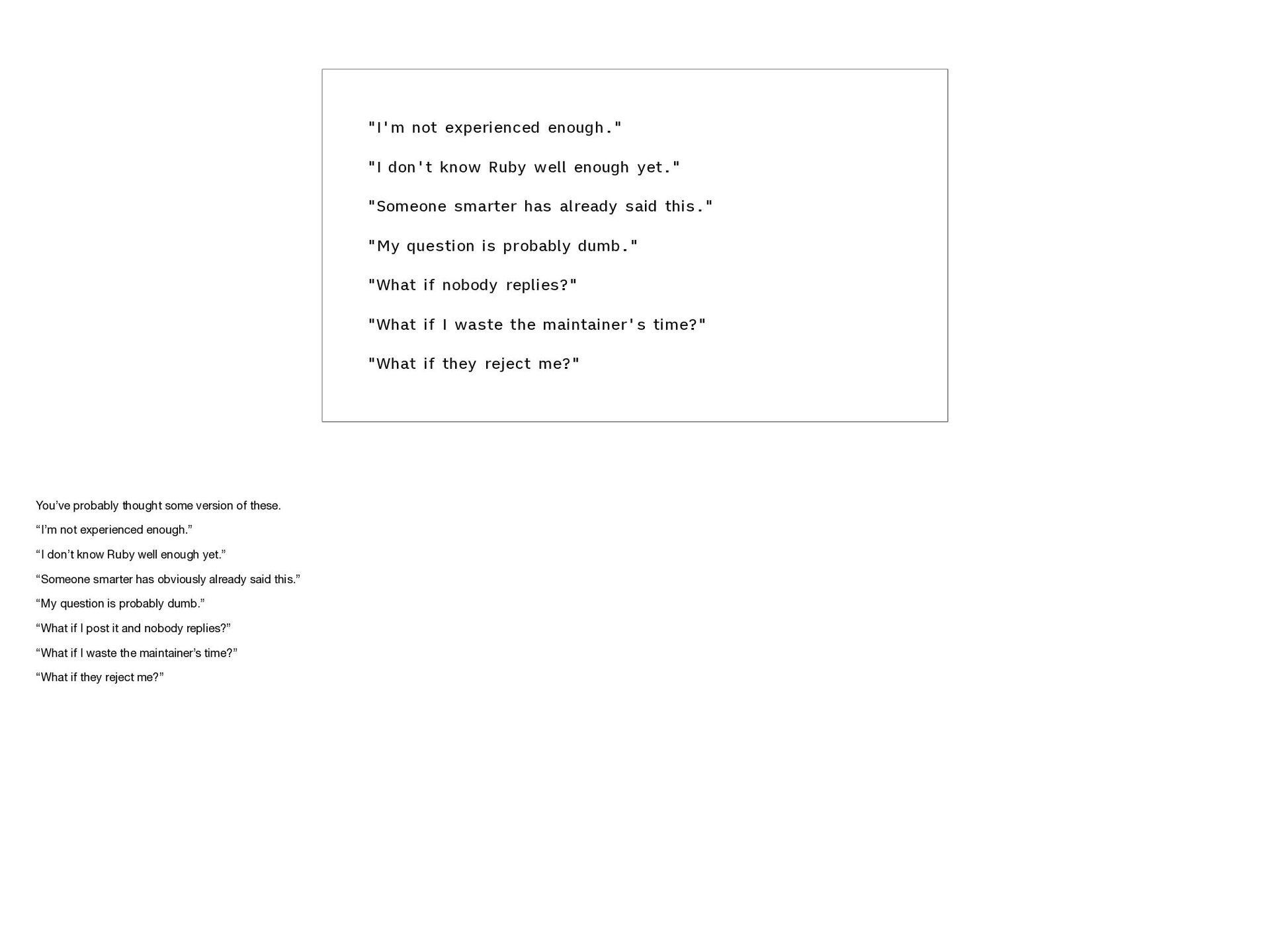
  29. "I'm not experienced enough." "I don't know Ruby well enough

    yet." "Someone smarter has already said this." "My question is probably dumb." "What if nobody replies?" "What if I waste the maintainer's time?" "What if they reject me?" You’ve probably thought some version of these. “I’m not experienced enough.” “I don’t know Ruby well enough yet.” “Someone smarter has obviously already said this.” “My question is probably dumb.” “What if I post it and nobody replies?” “What if I waste the maintainer’s time?” “What if they reject me?”
  30. You're not the only one Here’s what I’ve learned about

    those thoughts: They show up in the beginner who just started learning Ruby. They show up in the developer who’s written Ruby for ten years and never participates in public. They even show up in the veterans, the people who used to be everywhere, and quietly drifted away. They still show up in me. I had a version of that voice in my head this morning, before this talk. It doesn’t fully go away. You just stop letting it make the decision for you.
  31. People exactly like you And here's the irony that took

    me far too long to see: the culture of Ruby was built speci fi cally to dissolve those fears. Matz designed Ruby to make programmers happy. And that didn't just shape the language. It shaped the culture *around* the language: kindness, curiosity, mentorship, sharing what you know. Matz is nice, so we are nice. That culture wasn't handed down from the famous maintainers. It was built by thousands of ordinary developers being generous to each other. One conversation at a time. One line of code at a time. One thumbs up on GitHub at a time. People exactly like you. But I want to be honest: that culture is something we *aim* for. It is not automatic. Ruby has had its bad days and its unkind rooms. This year in particular has been challenging for the community, and at times it felt like it had fractured. And that's the uncomfortable other side of "we are the community." If we really *are* it, then the times it was generous are on us. And the times it was cruel are on us too. Which means the fi x is ours.
  32. Consuming Read → Watch → Use → Scroll Most of

    us consume the Ruby community without ever realizing we're allowed to participate in it. Consuming looks like: - reading the blog posts - watching the conference talks - using the gems - scrolling through GitHub
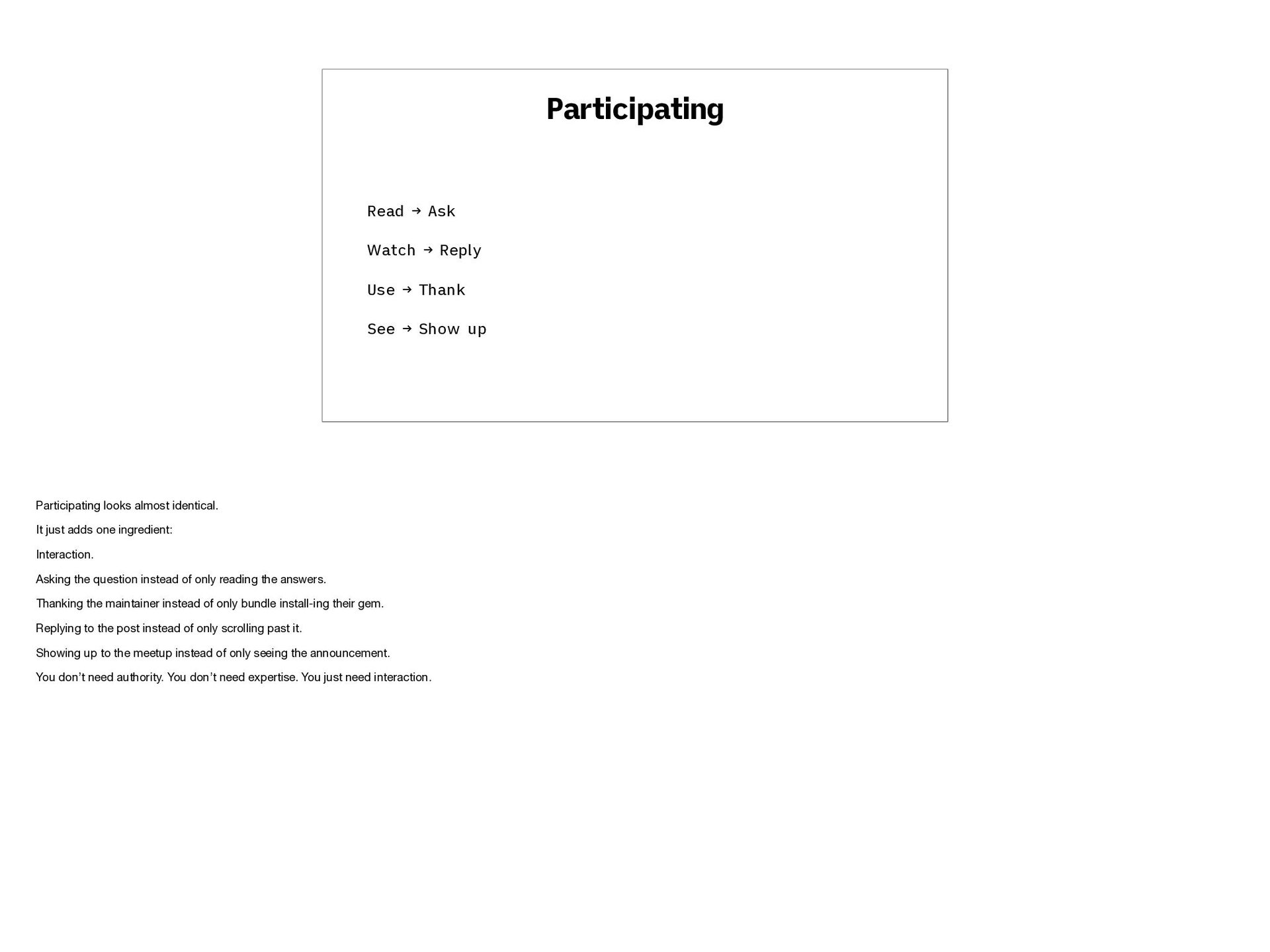
  33. Participating Read → Ask Watch → Reply Use → Thank

    See → Show up Participating looks almost identical. It just adds one ingredient: Interaction. Asking the question instead of only reading the answers. Thanking the maintainer instead of only bundle install-ing their gem. Replying to the post instead of only scrolling past it. Showing up to the meetup instead of only seeing the announcement. You don’t need authority. You don’t need expertise. You just need interaction.
  34. Small things count. And the majority of this isn’t loud

    or viral. It’s small. A reply. A question. A thank you. A bug report. The accumulation is what builds a community. One of my personal favorite ways to interact is thanking a gem maintainer. When you thank a gem maintainer, you’re not just being polite. You’re expressing gratitude for work that is often lonely and thankless, the kind of work people quietly burn out doing. And that thank you can be the fi rst rung on the ladder.
  35. You don't have to be an expert The next rung

    up is taking a little weight *o ff * them: reproducing a bug so they don't have to, fi xing a confusing line in the README, answering someone else's question in the issues so the maintainer doesn't have to. Writing a tutorial to help others use it. You don't have to be an expert to do any of that. You just have to try. When you ask a question in a Discord server or Slack channel, you're not just solving your problem. You're adding to the record of how Ruby actually gets used. When you reply to another Rubyist online, you're not just commenting. You're contributing to the conversation that *is* the community. Most of the lasting relationships in this ecosystem started as a comment. A reply. A question. A thank you. And what does this lead to? Friendships. Mentorships. Collaborations. Jobs. Co-hosts.
  36. Take-home assignment Find a gem. Thank the maintainer. So if

    you want a fi rst step, a real one that you can take tonight, here it is: Find a gem you’ve used this year. One you’d genuinely miss if it went away. And send the maintainer a short message. An email. A GitHub issue. A post on whatever platform they’re on. Something that just says: “Hey. I use your gem at work. It made my life easier. Thank you.” That’s the whole assignment. You haven’t fi xed a bug. You haven’t shipped a PR. You’ve put something into the ecosystem instead of only taking from it. And here’s the part I most want you to hear: maybe you’ll get a warm reply. Maybe you’ll get nothing back at all. Send it anyway. Because the part that mattered already happened the moment you hit send. If silence comes back, that is not a verdict on you. It’s just silence. Try another door. There are a lot of doors.
  37. You are the fix. And if you’ve been around Ruby

    for a while, this is where I keep my promise from earlier. Remember that silence? The question that gets no answer. The newcomer nobody makes room for. You are the fi x for that. You might be the person someone in this room is too nervous to walk up to. You might be the person who makes them feel comfortable after asking a question they felt may be dumb. You might be the reply that makes this entire community feel real to someone for the very fi rst time. The way Jason Swett was, for me.
  38. Participation doesn’t have to mean standing in a room. Participation

    doesn’t have to mean standing in a room. For a lot of us, online is the community. The parents. The people in timezones with no local scene. Anyone whose energy is already spoken for. For us it isn’t a consolation prize. It’s the real thing.
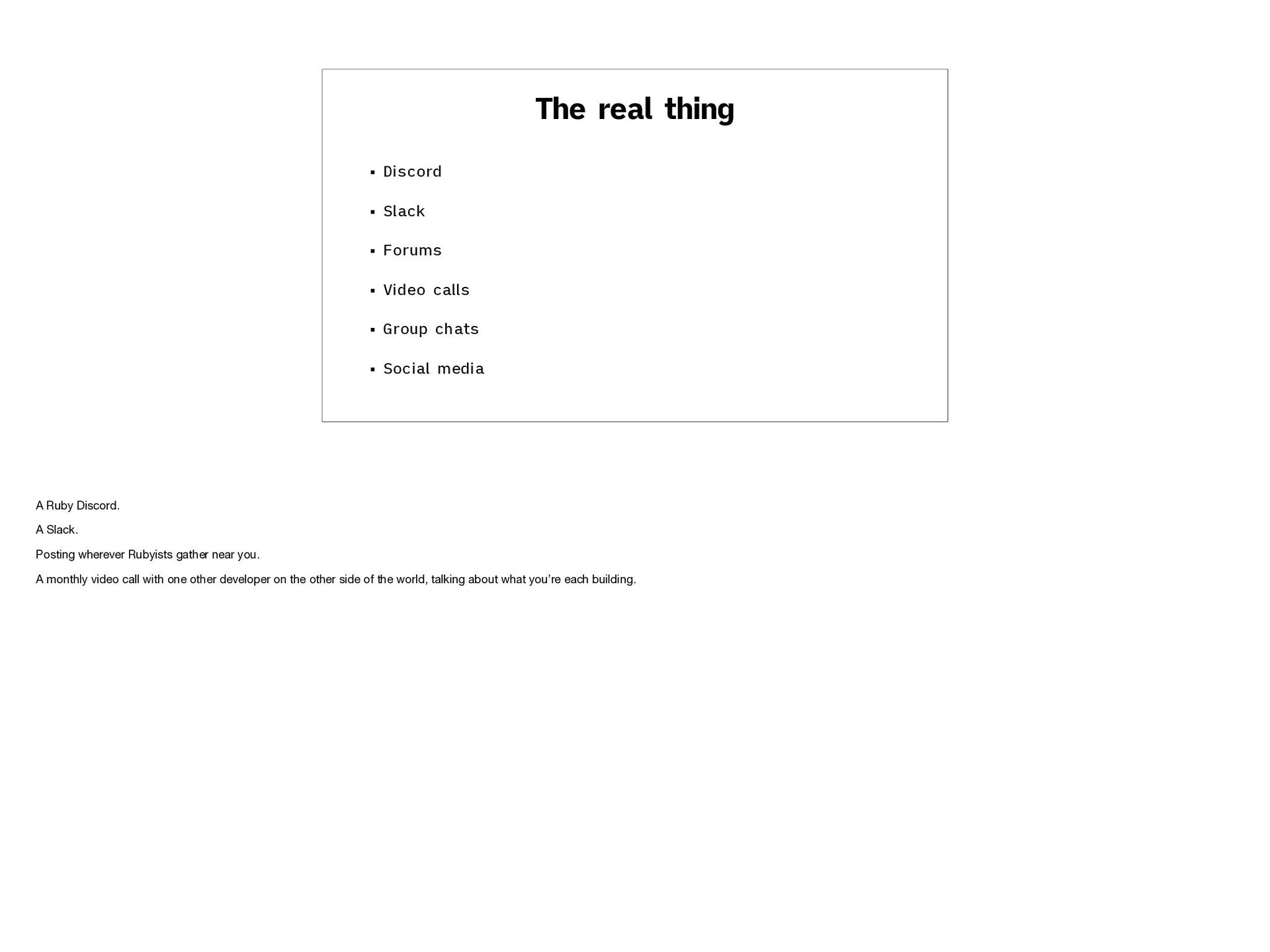
  39. The real thing • Discord • Slack • Forums •

    Video calls • Group chats • Social media A Ruby Discord. A Slack. Posting wherever Rubyists gather near you. A monthly video call with one other developer on the other side of the world, talking about what you’re each building.
  40. Start where you are And if you do want to

    meet people in person: look for a local meetup. Meetup.com is one place to start. Go on Rubyevents.org. Find a Ruby shop in your area and see if you can fi nd their employees online and see if any of them would be down to get lunch. If there’s nothing near you, you can start something. But don’t hear that as “now you have to organize a conference.” It can be two people in a co ff ee shop. It can be you and the one person who replied to your post on social media.
  41. Communities don't start with big events They start with two

    people. Communities don’t start with big events. They start with two people deciding to show up for each other.
  42. Why this matters right now When I started, a lot

    of the well-known names were moving on. Some to React. Some to Elixir. And I’ll be honest, I was scared. I wondered who was going to fi ll the void they left. But communities change. People move on. That’s normal. That’s healthy. And here’s what happened: new people showed up. The ones who left weren’t replaced. They inspired. Without ever planning to, I helped fi ll a little of that void myself. Just by showing up, and making friends along the way. That’s how communities survive.
  43. A strange moment for software And it matters even more

    right now, because we are in a genuinely strange moment for software. AI can write Ruby now.Really write it. It’ll explain the syntax, generate the tests, refactor your controller, and recommend a gem. Build a whole product. The tools are getting cheaper. Knowledge is getting cheaper. Let me name the fear in the room, because I think we all feel a version of it: if the machine can do the part I’m proud of, what’s left for me?
  44. A community Here’s what’s left. Here’s the part that doesn’t

    get cheaper. A community. An AI can hand you the language. It can’t be the community around it. It can’t run the meetup where you meet the person who becomes your friend. It can’t be the friend who texts you: “did you SEE the new Rails release?” thirty seconds after it drops. AI can produce Ruby code. Only we can produce the Ruby community.
  45. The tools change The people remain. The tools change. They

    always have. The community is the constant. When the code gets automated, the people become the entire reason a language is worth using at all. Because the people are what continue to push it forward. And if you’re just starting out, that might be the best news in this whole talk. The part that’s hardest to automate isn’t your code. It’s you, the person other people want to build with. You can start being that today. Long before you feel good enough.
  46. Ruby is alive because we are here Languages and communities

    need each other. The language gives the community something to gather around. The community keeps the language alive, by teaching it, defending it, evolving it, and making it feel like home. Ruby is alive because we are here. And the next nervous junior developer who walks into this ecosystem, the one who can’t fi nd the magical community everyone keeps talking about, might stay. Because somebody in this room chose to show up for them.
  47. Look around this room So the next time you catch

    yourself thinking: “I’m not really part of the Ruby community yet…” I want you to do one thing. Look around this room. (Pause.) I’m doing it right now. And I can see people who answered the questions I was embarrassed to ask out loud. People whose blog posts I learned from. People I met because one of us was brave enough to say hello. People who I have shared meals with. The Ruby community isn’t somewhere else. It was never somewhere else. It was sitting in this room the whole time.
  48. You don't join the Ruby community You are the Ruby

    community So remember what I told you at the very top: You don’t join the Ruby community. You are the Ruby community. The people sitting next to you right now? They are not the gatekeepers. They’re the ones who chose to show up. Just like Jason Swett did, when he said yes to a terri fi ed junior developer. Just like I did, the day I fi nally hit send. Just like you did, by walking into BlastO ff Rails and sitting down in this room. That counts.