Upgrade to Pro — share decks privately, control downloads, hide ads and more …

Solving Common Logistics Challenges with ERP So...

Sponsored · Your Podcast. Everywhere. Effortlessly. Share. Educate. Inspire. Entertain. You do you. We'll handle the rest. →
Avatar for Arobit Arobit
December 09, 2025

Solving Common Logistics Challenges with ERP Software Development Services

Logistics operations often face issues like inventory mismanagement, delayed order processing, and poor supply chain visibility. ERP software development services offer scalable solutions to these challenges by integrating key processes, providing real-time data, and automating tasks. By streamlining workflows, improving accuracy, and enhancing communication across the logistics chain, ERP systems help businesses optimize operations, reduce costs, and boost customer satisfaction.

Avatar for Arobit

Arobit

December 09, 2025

More Decks by Arobit

Other Decks in Technology

Transcript

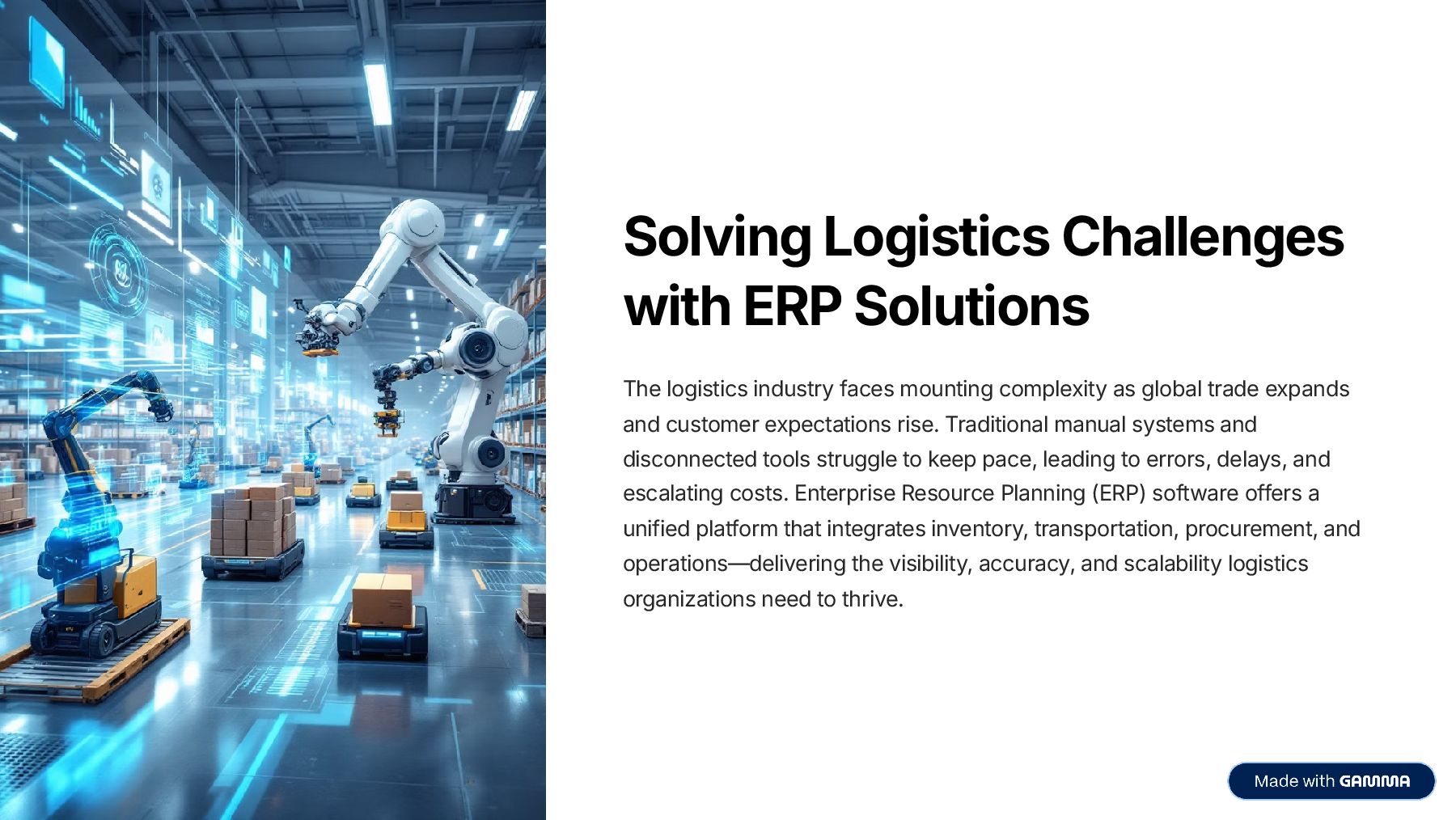
  1. Solving Logistics Challenges with ERP Solutions The logistics industry faces

    mounting complexity as global trade expands and customer expectations rise. Traditional manual systems and disconnected tools struggle to keep pace, leading to errors, delays, and escalating costs. Enterprise Resource Planning (ERP) software offers a unified platform that integrates inventory, transportation, procurement, and operations4delivering the visibility, accuracy, and scalability logistics organizations need to thrive.
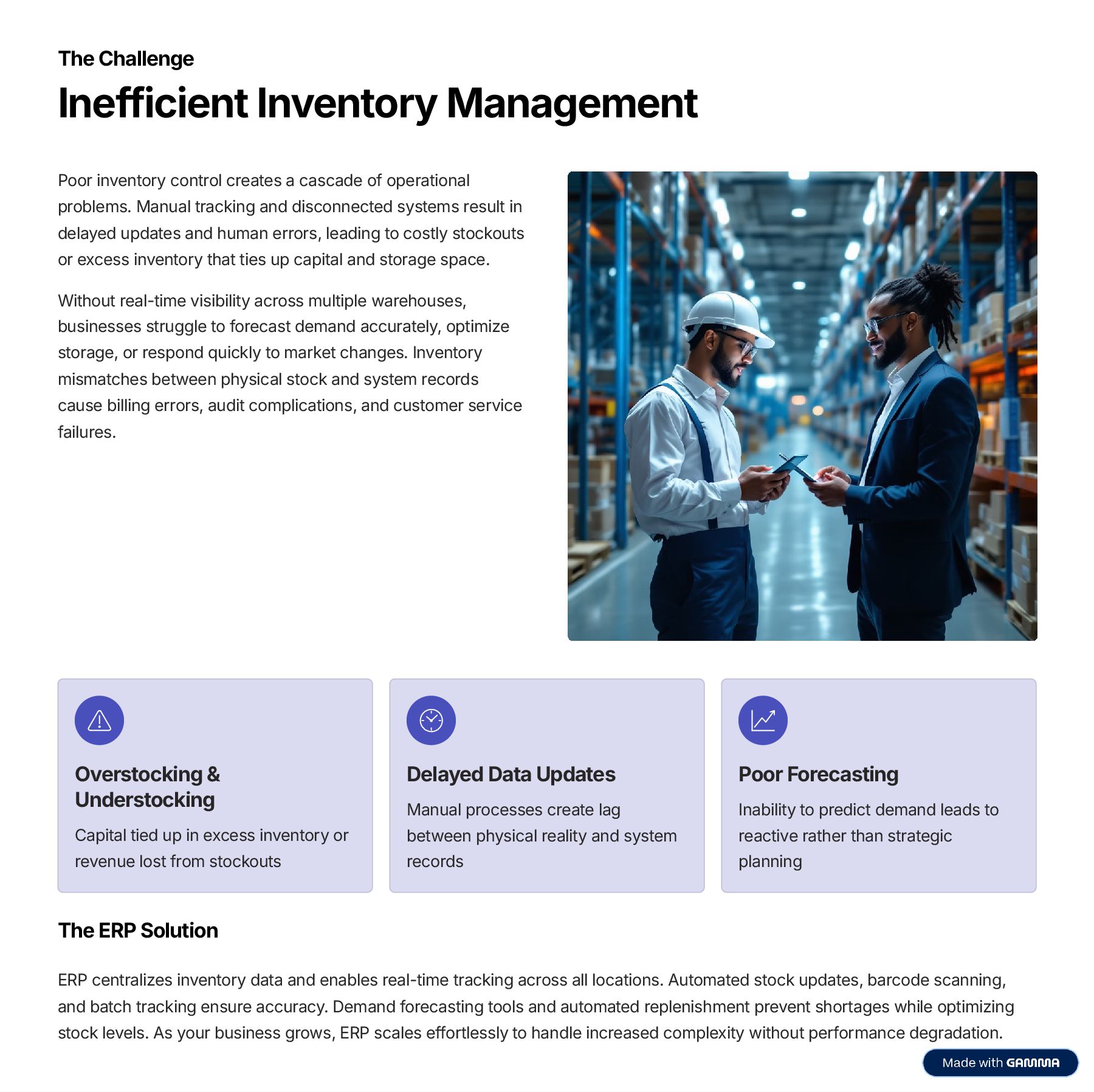
  2. The Challenge Inefficient Inventory Management Poor inventory control creates a

    cascade of operational problems. Manual tracking and disconnected systems result in delayed updates and human errors, leading to costly stockouts or excess inventory that ties up capital and storage space. Without real-time visibility across multiple warehouses, businesses struggle to forecast demand accurately, optimize storage, or respond quickly to market changes. Inventory mismatches between physical stock and system records cause billing errors, audit complications, and customer service failures. Overstocking & Understocking Capital tied up in excess inventory or revenue lost from stockouts Delayed Data Updates Manual processes create lag between physical reality and system records Poor Forecasting Inability to predict demand leads to reactive rather than strategic planning The ERP Solution ERP centralizes inventory data and enables real-time tracking across all locations. Automated stock updates, barcode scanning, and batch tracking ensure accuracy. Demand forecasting tools and automated replenishment prevent shortages while optimizing stock levels. As your business grows, ERP scales effortlessly to handle increased complexity without performance degradation.
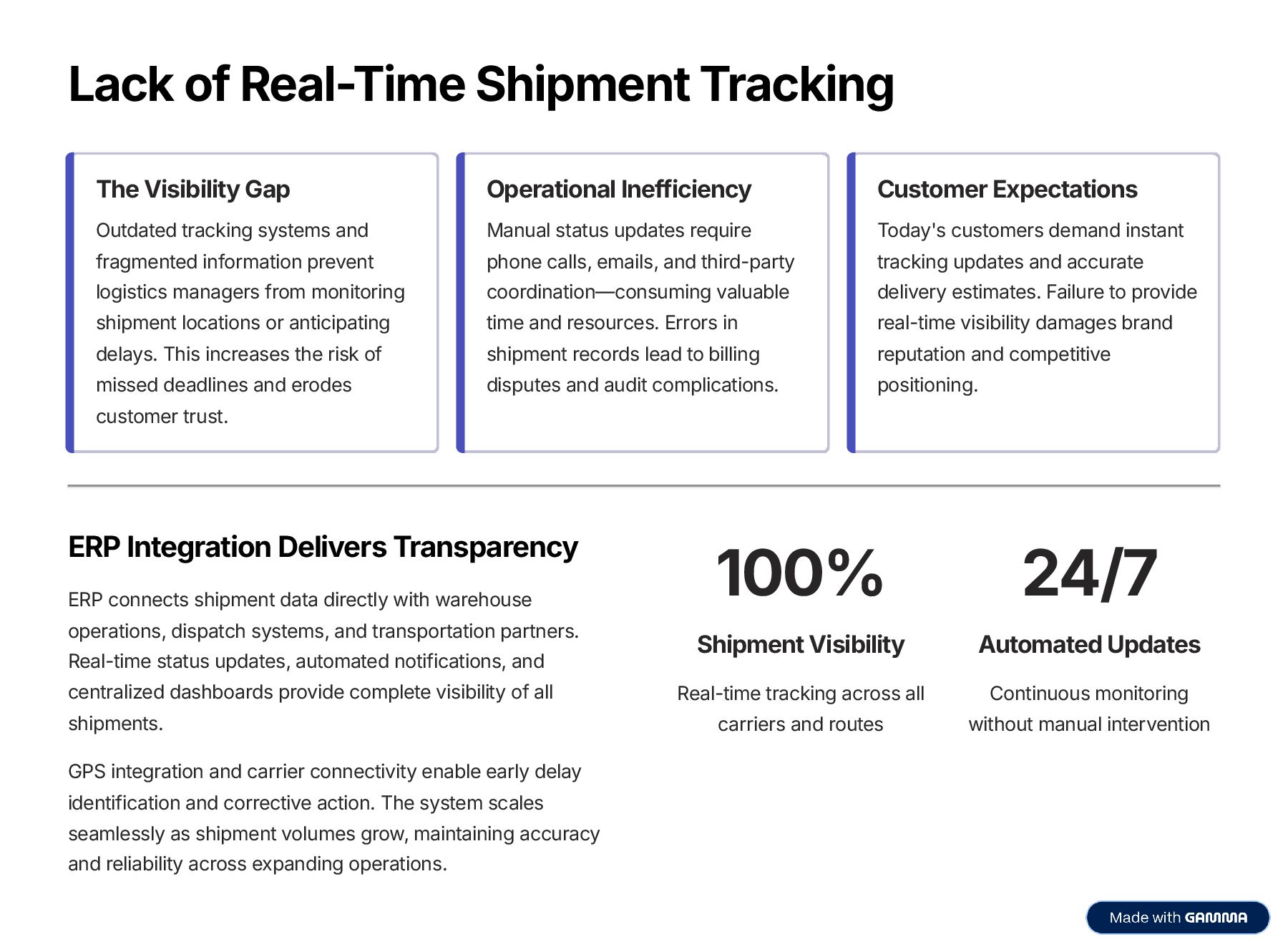
  3. Lack of Real-Time Shipment Tracking The Visibility Gap Outdated tracking

    systems and fragmented information prevent logistics managers from monitoring shipment locations or anticipating delays. This increases the risk of missed deadlines and erodes customer trust. Operational Inefficiency Manual status updates require phone calls, emails, and third-party coordination4consuming valuable time and resources. Errors in shipment records lead to billing disputes and audit complications. Customer Expectations Today's customers demand instant tracking updates and accurate delivery estimates. Failure to provide real-time visibility damages brand reputation and competitive positioning. ERP Integration Delivers Transparency ERP connects shipment data directly with warehouse operations, dispatch systems, and transportation partners. Real-time status updates, automated notifications, and centralized dashboards provide complete visibility of all shipments. GPS integration and carrier connectivity enable early delay identification and corrective action. The system scales seamlessly as shipment volumes grow, maintaining accuracy and reliability across expanding operations. 100% Shipment Visibility Real-time tracking across all carriers and routes 24/7 Automated Updates Continuous monitoring without manual intervention
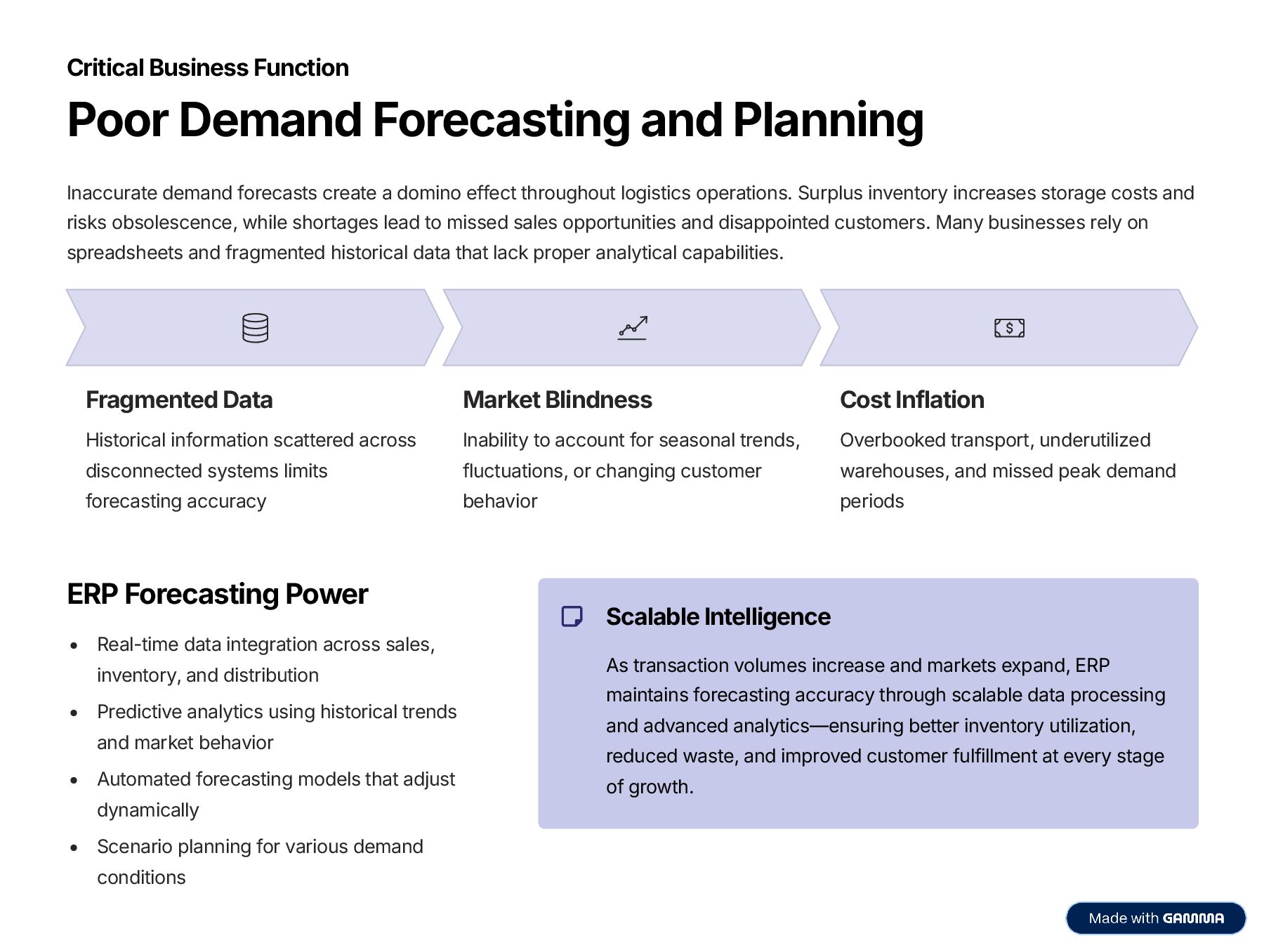
  4. Critical Business Function Poor Demand Forecasting and Planning Inaccurate demand

    forecasts create a domino effect throughout logistics operations. Surplus inventory increases storage costs and risks obsolescence, while shortages lead to missed sales opportunities and disappointed customers. Many businesses rely on spreadsheets and fragmented historical data that lack proper analytical capabilities. Fragmented Data Historical information scattered across disconnected systems limits forecasting accuracy Market Blindness Inability to account for seasonal trends, fluctuations, or changing customer behavior Cost Inflation Overbooked transport, underutilized warehouses, and missed peak demand periods ERP Forecasting Power Real-time data integration across sales, inventory, and distribution Predictive analytics using historical trends and market behavior Automated forecasting models that adjust dynamically Scenario planning for various demand conditions Scalable Intelligence As transaction volumes increase and markets expand, ERP maintains forecasting accuracy through scalable data processing and advanced analytics4ensuring better inventory utilization, reduced waste, and improved customer fulfillment at every stage of growth.
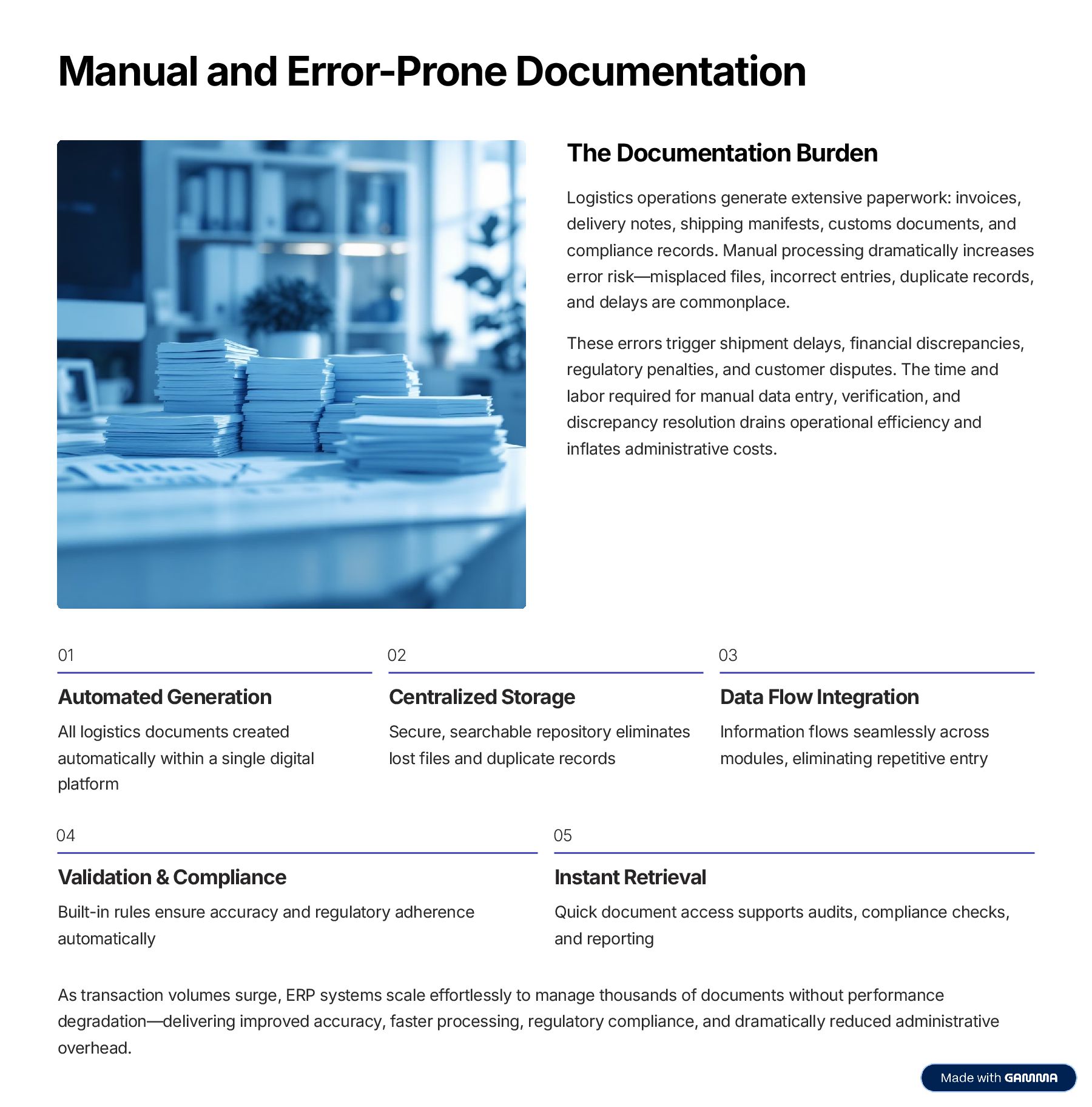
  5. Manual and Error-Prone Documentation The Documentation Burden Logistics operations generate

    extensive paperwork: invoices, delivery notes, shipping manifests, customs documents, and compliance records. Manual processing dramatically increases error risk4misplaced files, incorrect entries, duplicate records, and delays are commonplace. These errors trigger shipment delays, financial discrepancies, regulatory penalties, and customer disputes. The time and labor required for manual data entry, verification, and discrepancy resolution drains operational efficiency and inflates administrative costs. 01 Automated Generation All logistics documents created automatically within a single digital platform 02 Centralized Storage Secure, searchable repository eliminates lost files and duplicate records 03 Data Flow Integration Information flows seamlessly across modules, eliminating repetitive entry 04 Validation & Compliance Built-in rules ensure accuracy and regulatory adherence automatically 05 Instant Retrieval Quick document access supports audits, compliance checks, and reporting As transaction volumes surge, ERP systems scale effortlessly to manage thousands of documents without performance degradation4delivering improved accuracy, faster processing, regulatory compliance, and dramatically reduced administrative overhead.
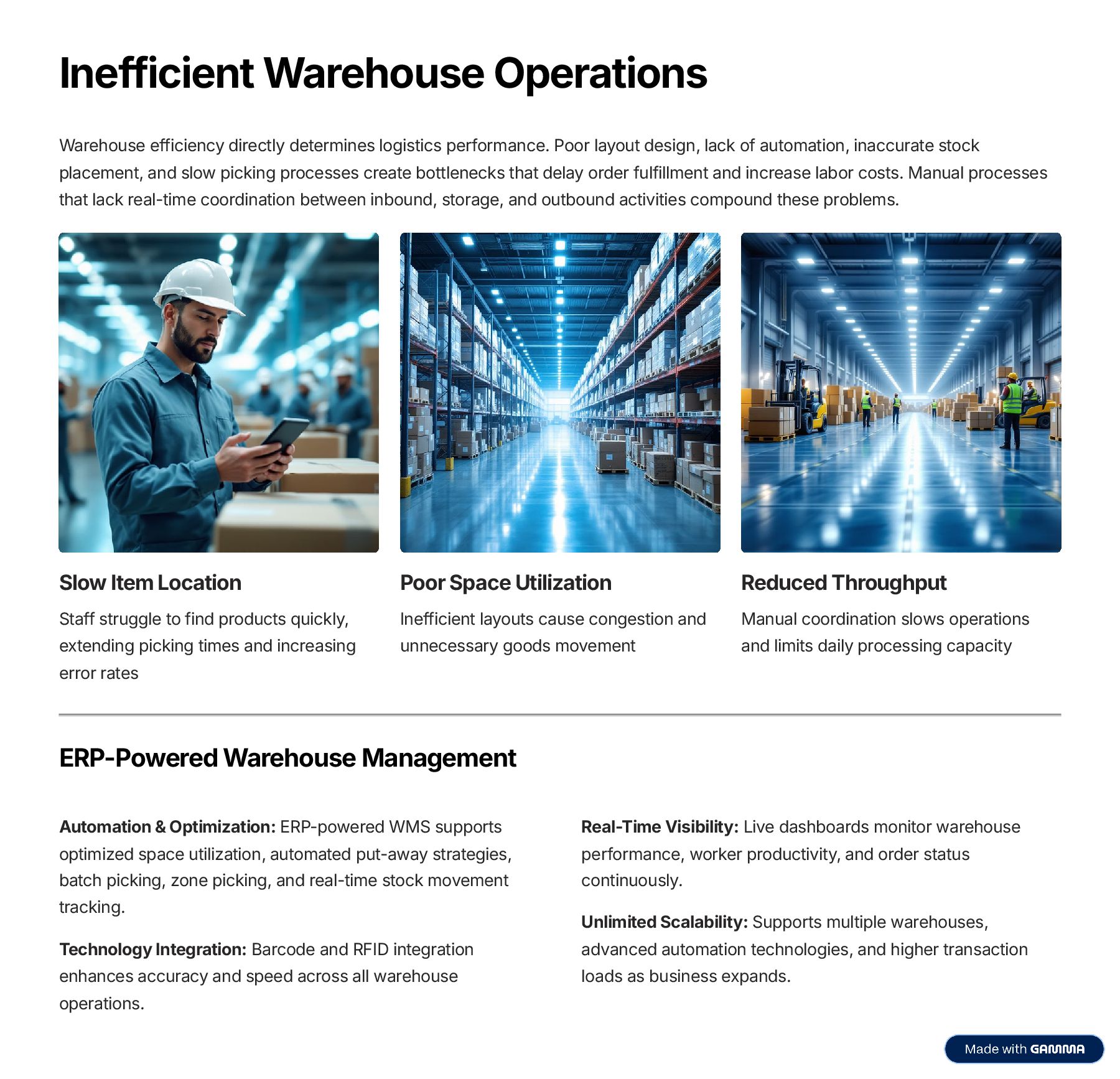
  6. Inefficient Warehouse Operations Warehouse efficiency directly determines logistics performance. Poor

    layout design, lack of automation, inaccurate stock placement, and slow picking processes create bottlenecks that delay order fulfillment and increase labor costs. Manual processes that lack real-time coordination between inbound, storage, and outbound activities compound these problems. Slow Item Location Staff struggle to find products quickly, extending picking times and increasing error rates Poor Space Utilization Inefficient layouts cause congestion and unnecessary goods movement Reduced Throughput Manual coordination slows operations and limits daily processing capacity ERP-Powered Warehouse Management Automation & Optimization: ERP-powered WMS supports optimized space utilization, automated put-away strategies, batch picking, zone picking, and real-time stock movement tracking. Technology Integration: Barcode and RFID integration enhances accuracy and speed across all warehouse operations. Real-Time Visibility: Live dashboards monitor warehouse performance, worker productivity, and order status continuously. Unlimited Scalability: Supports multiple warehouses, advanced automation technologies, and higher transaction loads as business expands.
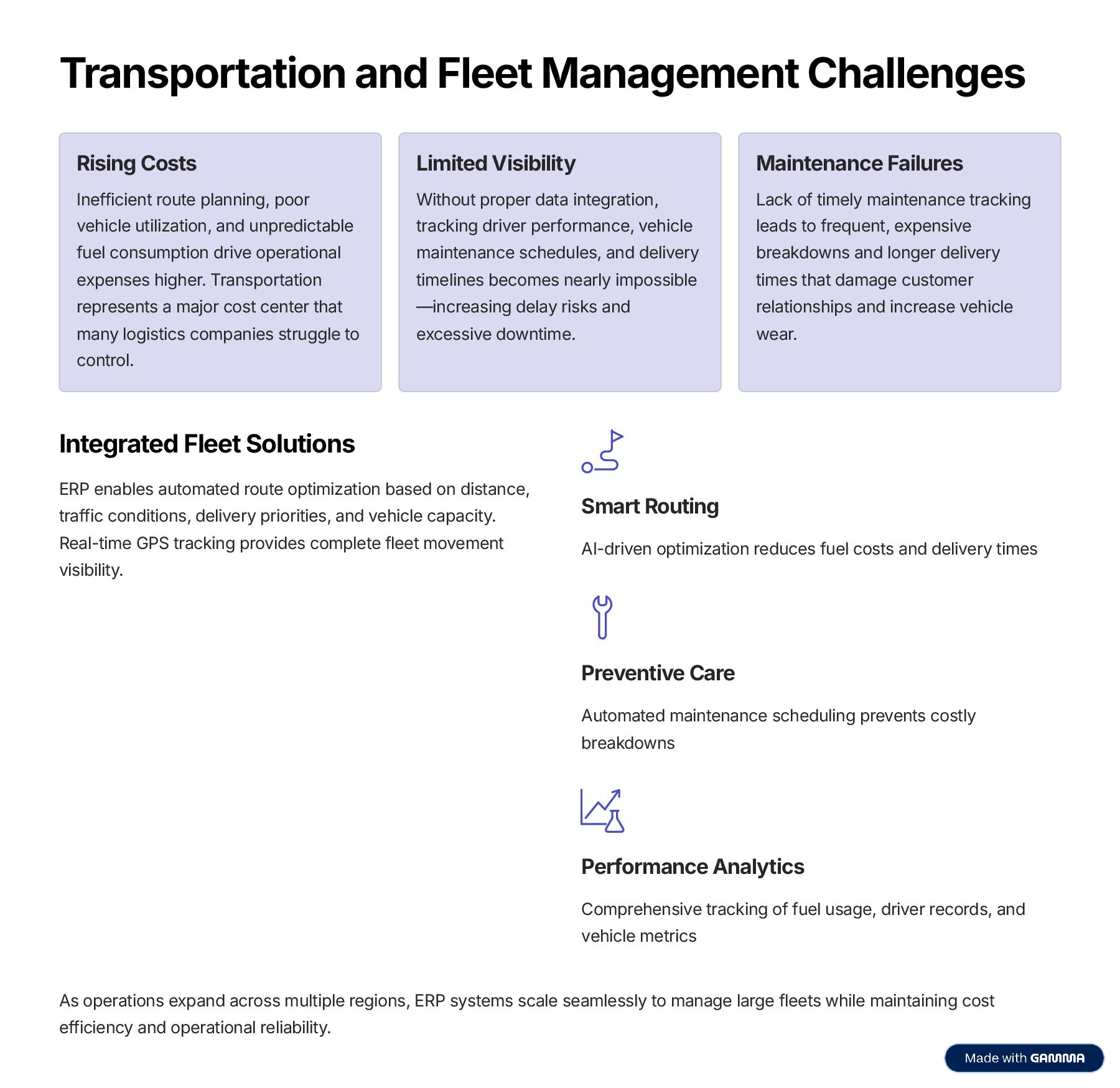
  7. Transportation and Fleet Management Challenges Rising Costs Inefficient route planning,

    poor vehicle utilization, and unpredictable fuel consumption drive operational expenses higher. Transportation represents a major cost center that many logistics companies struggle to control. Limited Visibility Without proper data integration, tracking driver performance, vehicle maintenance schedules, and delivery timelines becomes nearly impossible 4increasing delay risks and excessive downtime. Maintenance Failures Lack of timely maintenance tracking leads to frequent, expensive breakdowns and longer delivery times that damage customer relationships and increase vehicle wear. Integrated Fleet Solutions ERP enables automated route optimization based on distance, traffic conditions, delivery priorities, and vehicle capacity. Real-time GPS tracking provides complete fleet movement visibility. Smart Routing AI-driven optimization reduces fuel costs and delivery times Preventive Care Automated maintenance scheduling prevents costly breakdowns Performance Analytics Comprehensive tracking of fuel usage, driver records, and vehicle metrics As operations expand across multiple regions, ERP systems scale seamlessly to manage large fleets while maintaining cost efficiency and operational reliability.
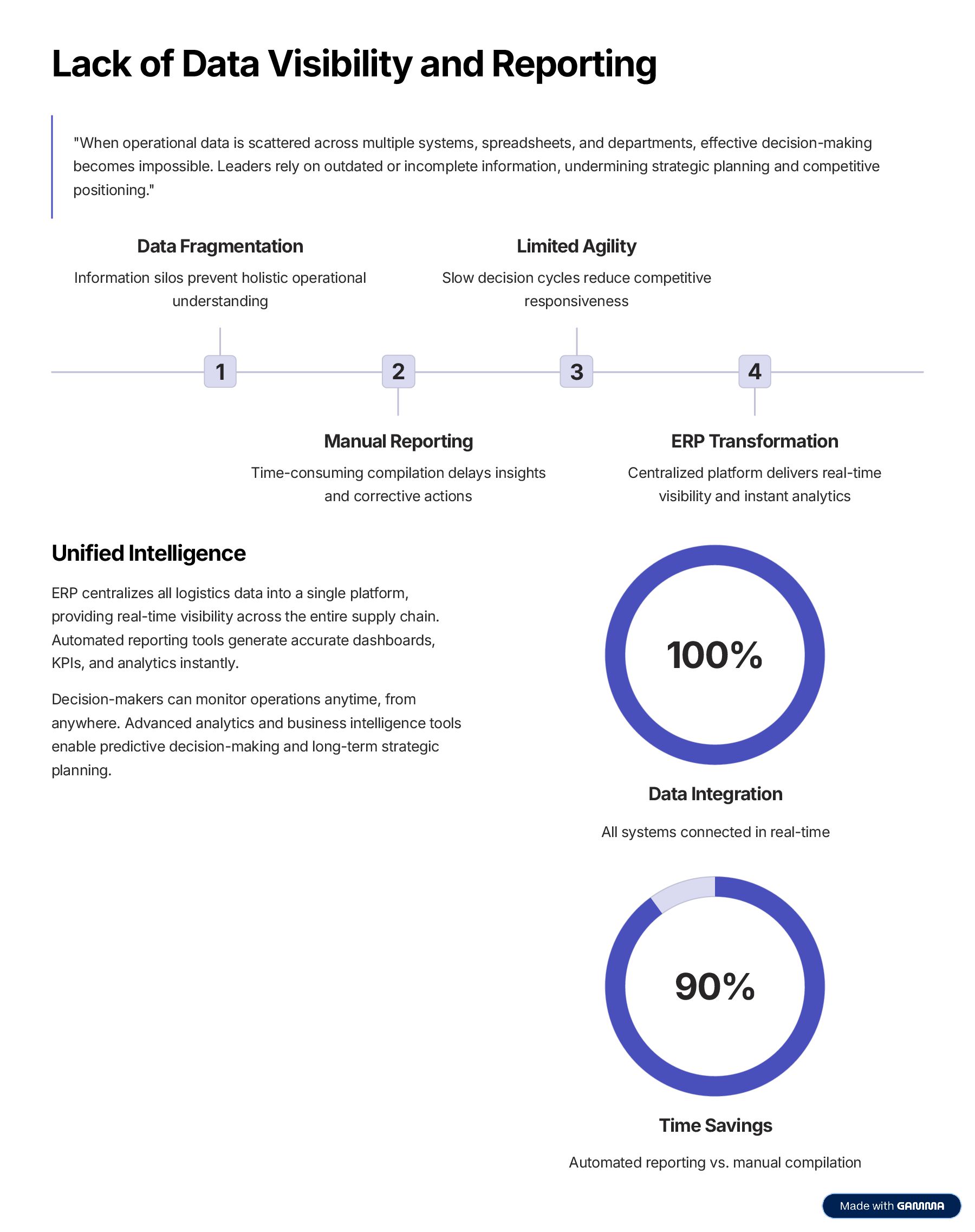
  8. Lack of Data Visibility and Reporting "When operational data is

    scattered across multiple systems, spreadsheets, and departments, effective decision-making becomes impossible. Leaders rely on outdated or incomplete information, undermining strategic planning and competitive positioning." 1 Data Fragmentation Information silos prevent holistic operational understanding 2 Manual Reporting Time-consuming compilation delays insights and corrective actions 3 Limited Agility Slow decision cycles reduce competitive responsiveness 4 ERP Transformation Centralized platform delivers real-time visibility and instant analytics Unified Intelligence ERP centralizes all logistics data into a single platform, providing real-time visibility across the entire supply chain. Automated reporting tools generate accurate dashboards, KPIs, and analytics instantly. Decision-makers can monitor operations anytime, from anywhere. Advanced analytics and business intelligence tools enable predictive decision-making and long-term strategic planning. 100% Data Integration All systems connected in real-time 90% Time Savings Automated reporting vs. manual compilation
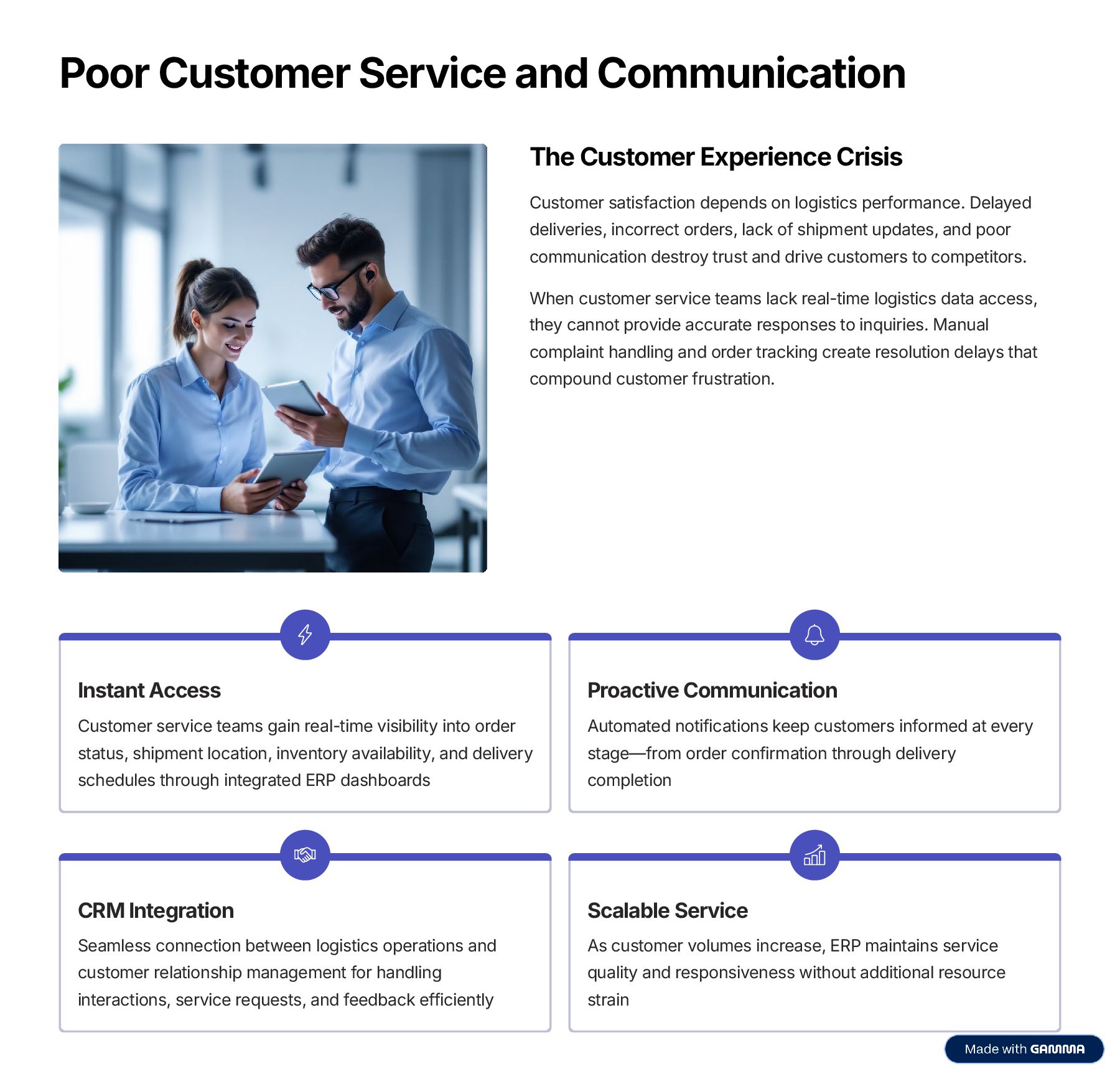
  9. Poor Customer Service and Communication The Customer Experience Crisis Customer

    satisfaction depends on logistics performance. Delayed deliveries, incorrect orders, lack of shipment updates, and poor communication destroy trust and drive customers to competitors. When customer service teams lack real-time logistics data access, they cannot provide accurate responses to inquiries. Manual complaint handling and order tracking create resolution delays that compound customer frustration. Instant Access Customer service teams gain real-time visibility into order status, shipment location, inventory availability, and delivery schedules through integrated ERP dashboards Proactive Communication Automated notifications keep customers informed at every stage4from order confirmation through delivery completion CRM Integration Seamless connection between logistics operations and customer relationship management for handling interactions, service requests, and feedback efficiently Scalable Service As customer volumes increase, ERP maintains service quality and responsiveness without additional resource strain
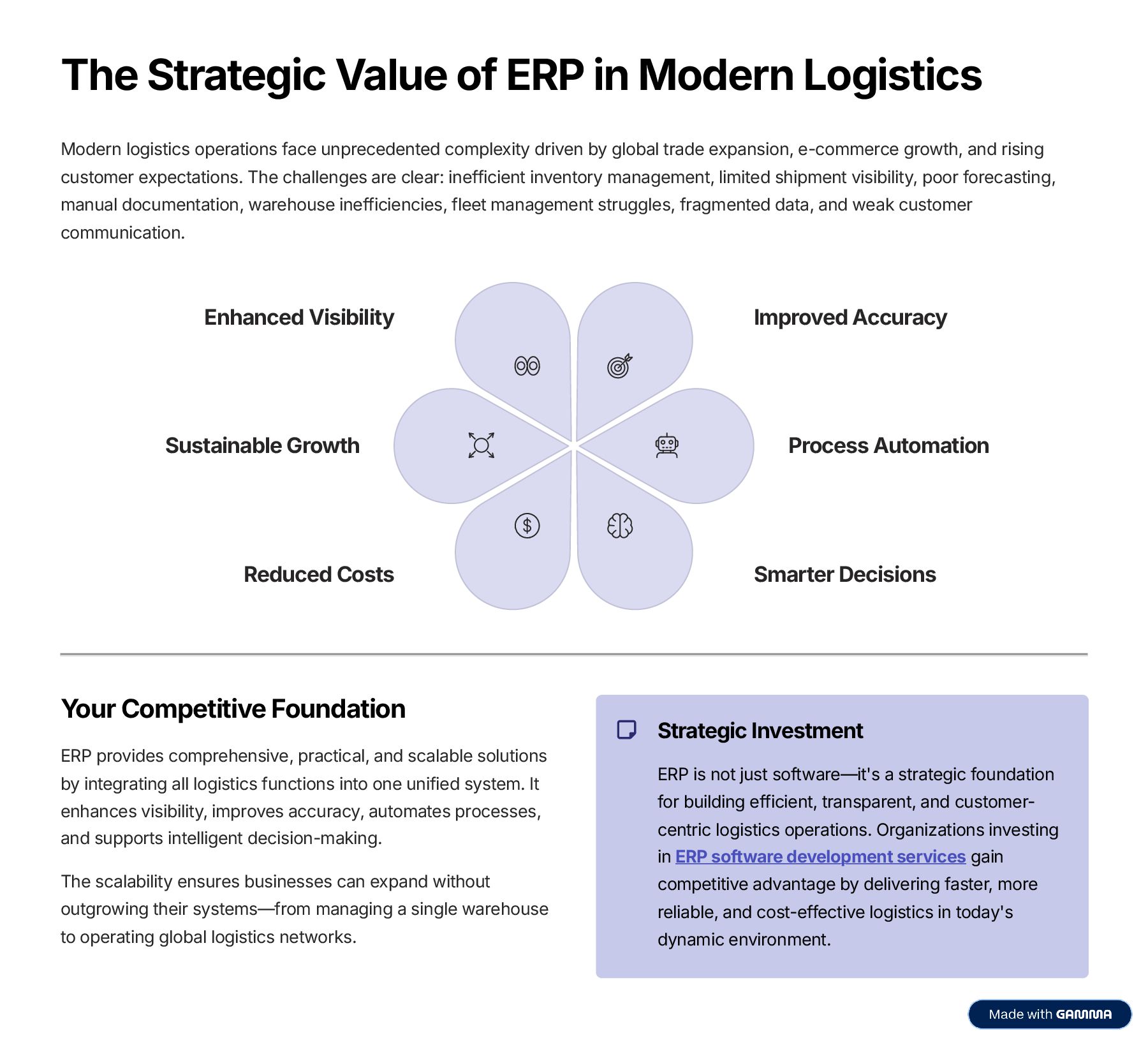
  10. The Strategic Value of ERP in Modern Logistics Modern logistics

    operations face unprecedented complexity driven by global trade expansion, e-commerce growth, and rising customer expectations. The challenges are clear: inefficient inventory management, limited shipment visibility, poor forecasting, manual documentation, warehouse inefficiencies, fleet management struggles, fragmented data, and weak customer communication. Your Competitive Foundation ERP provides comprehensive, practical, and scalable solutions by integrating all logistics functions into one unified system. It enhances visibility, improves accuracy, automates processes, and supports intelligent decision-making. The scalability ensures businesses can expand without outgrowing their systems4from managing a single warehouse to operating global logistics networks. Strategic Investment ERP is not just software4it's a strategic foundation for building efficient, transparent, and customer- centric logistics operations. Organizations investing in ERP software development services gain competitive advantage by delivering faster, more reliable, and cost-effective logistics in today's dynamic environment. Enhanced Visibility Improved Accuracy Process Automation Smarter Decisions Reduced Costs Sustainable Growth