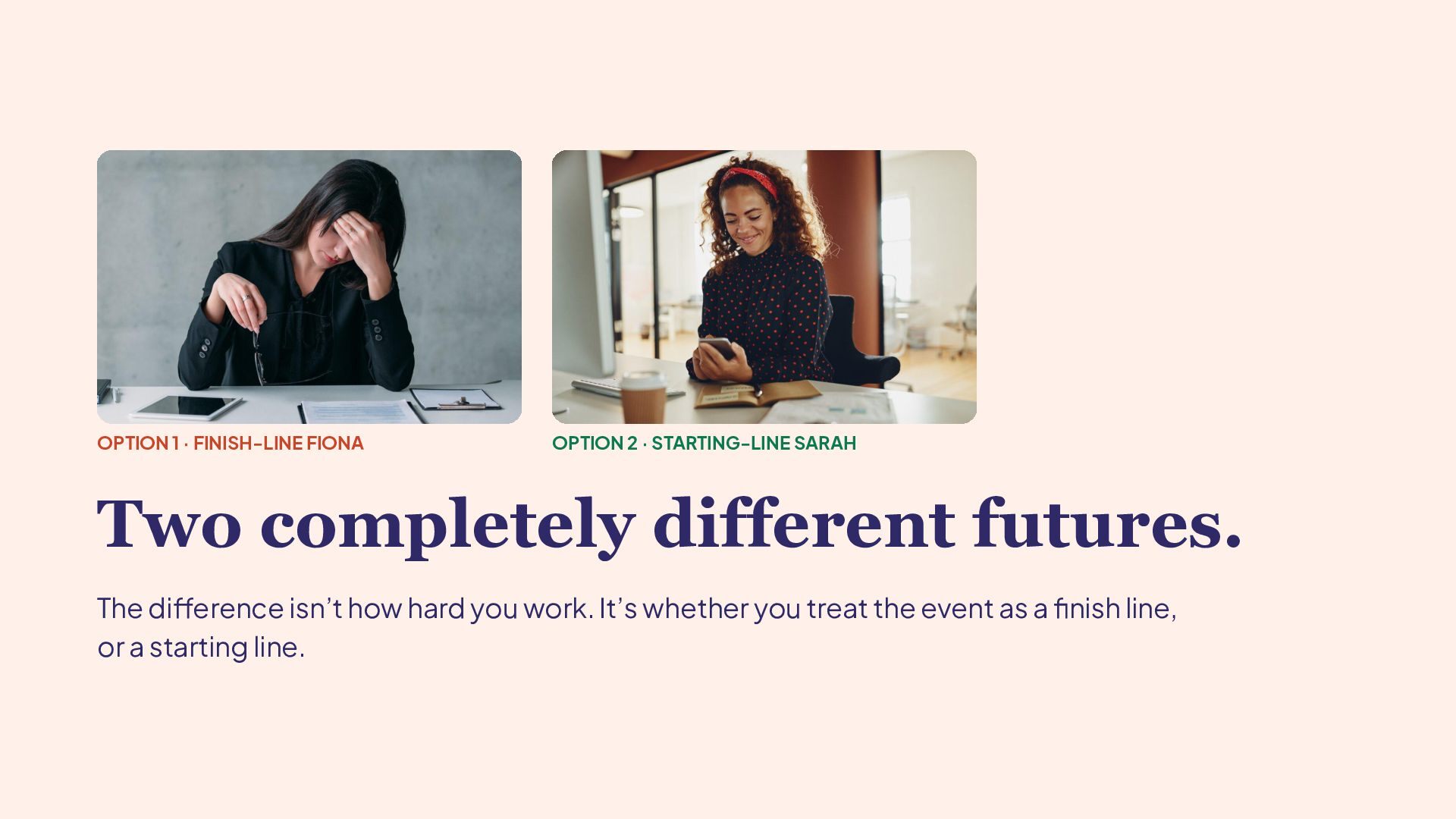
last event. Your year is closing. The number’s on the line, and your whole team has to carry it. Dozens of make-or-break donor conversations ahead, and you can be in maybe two of them. Two people face this exact moment, and live two completely different futures.
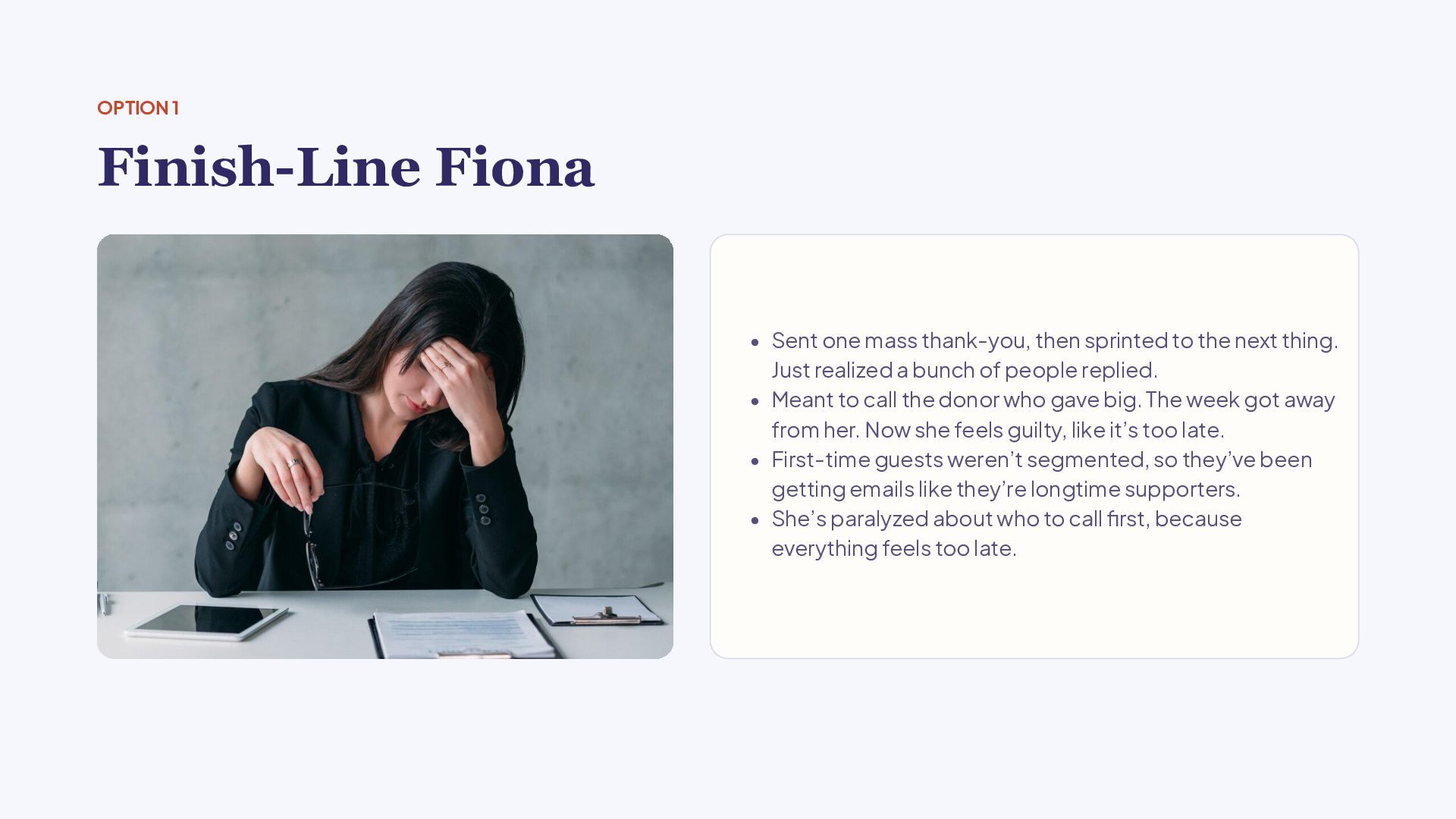
sprinted to the next thing. Just realized a bunch of people replied. • Meant to call the donor who gave big. The week got away from her. Now she feels guilty, like it’s too late. • First-time guests weren’t segmented, so they’ve been getting emails like they’re longtime supporters. • She’s paralyzed about who to call first, because everything feels too late.
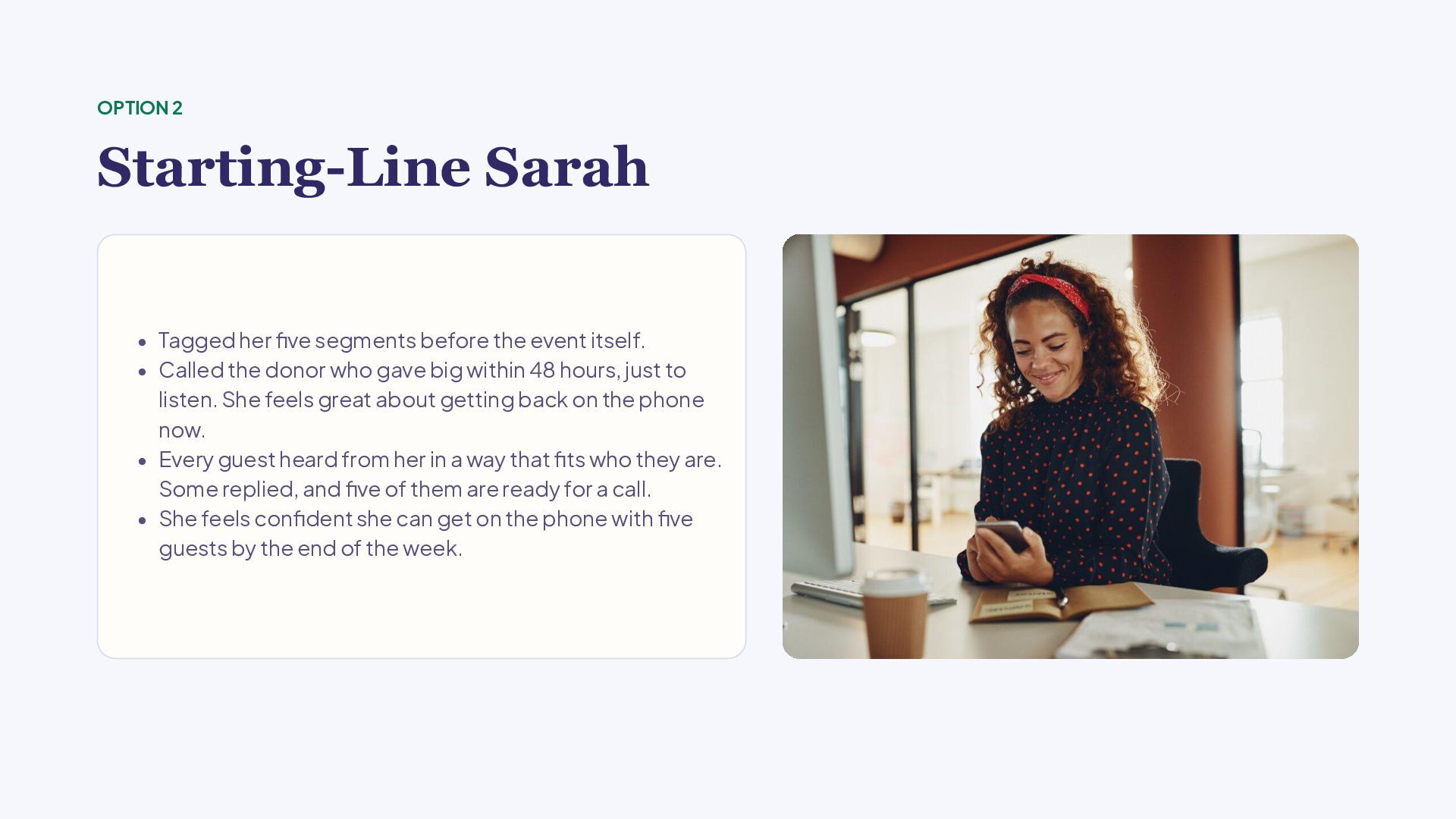
the event itself. • Called the donor who gave big within 48 hours, just to listen. She feels great about getting back on the phone now. • Every guest heard from her in a way that fits who they are. Some replied, and five of them are ready for a call. • She feels confident she can get on the phone with five guests by the end of the week.
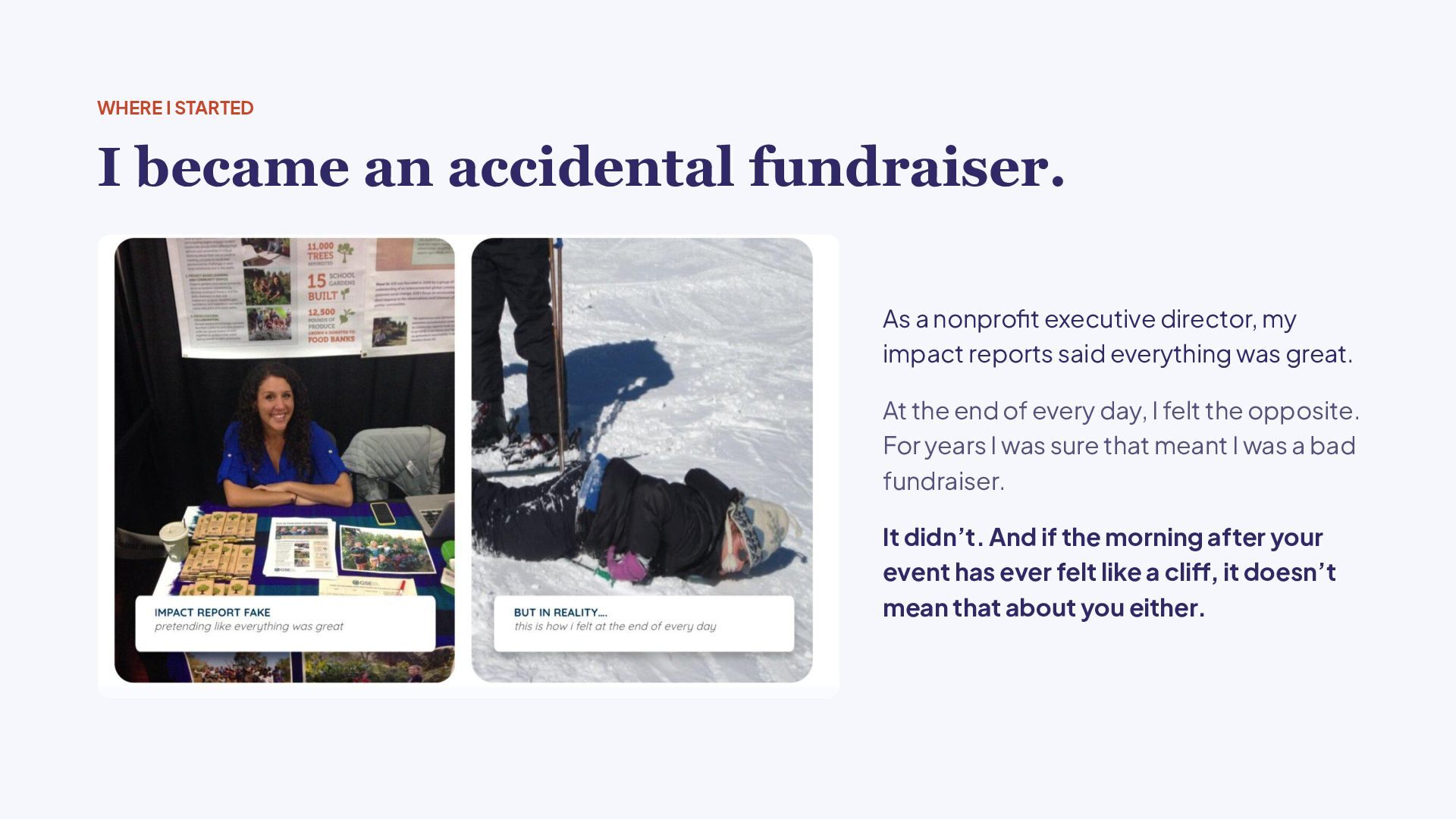
nonprofit executive director, my impact reports said everything was great. At the end of every day, I felt the opposite. For years I was sure that meant I was a bad fundraiser. It didn’t. And if the morning after your event has ever felt like a cliff, it doesn’t mean that about you either.
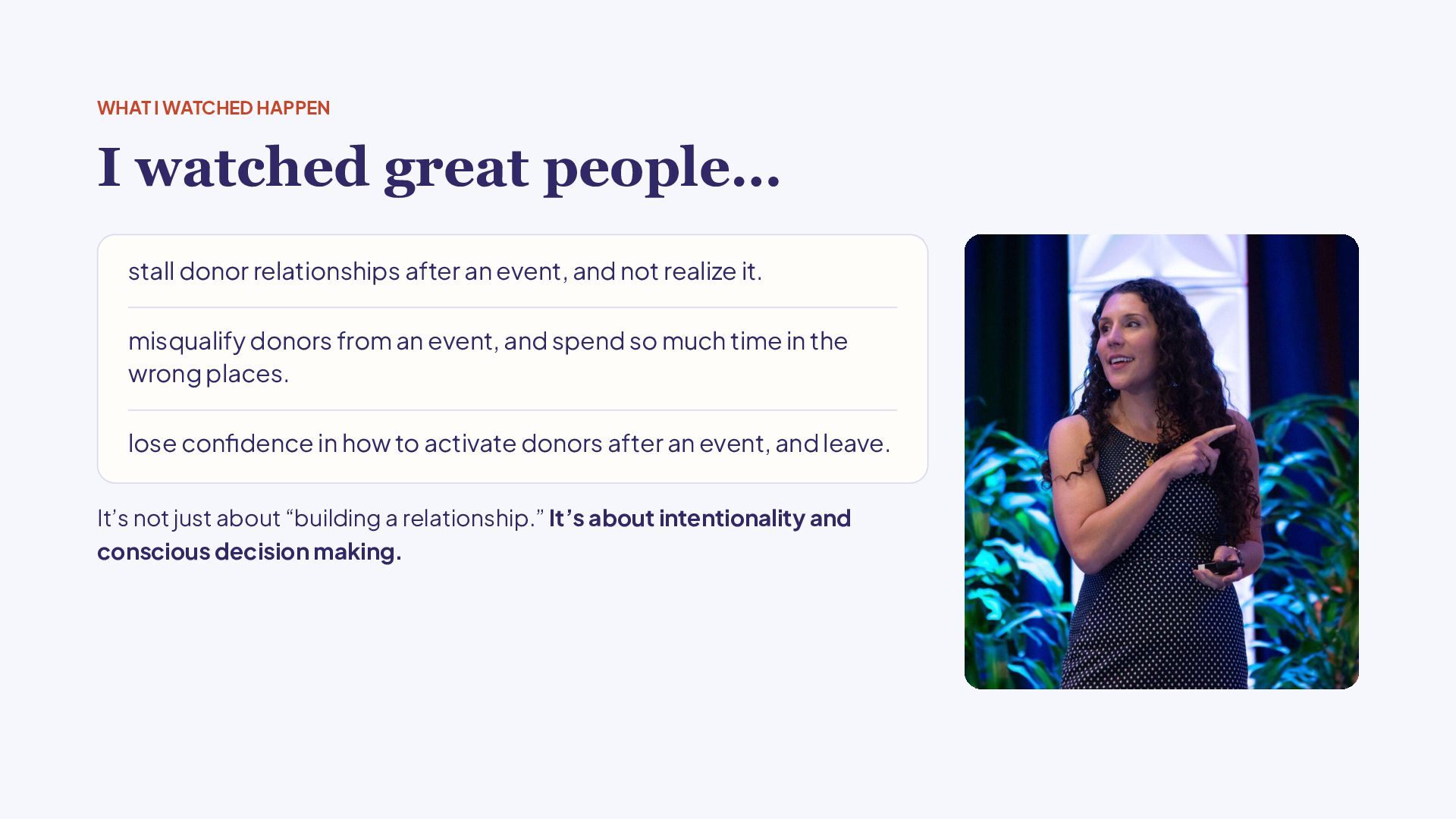
relationships after an event, and not realize it. misqualify donors from an event, and spend so much time in the wrong places. lose confidence in how to activate donors after an event, and leave. It’s not just about “building a relationship.” It’s about intentionality and conscious decision making.
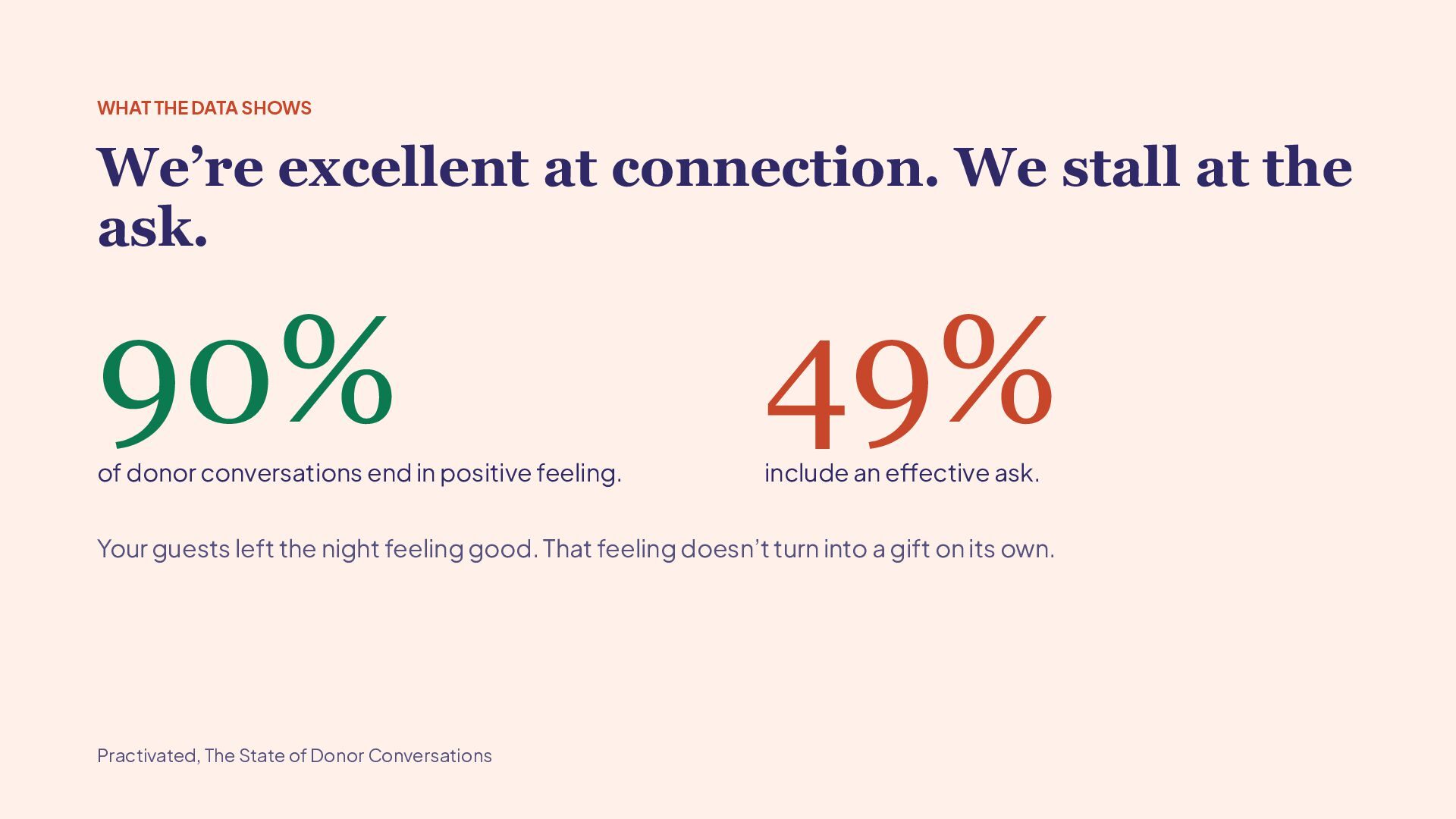
at the ask. 90% 49% of donor conversations end in positive feeling. include an effective ask. Your guests left the night feeling good. That feeling doesn’t turn into a gift on its own. Practivated, The State of Donor Conversations
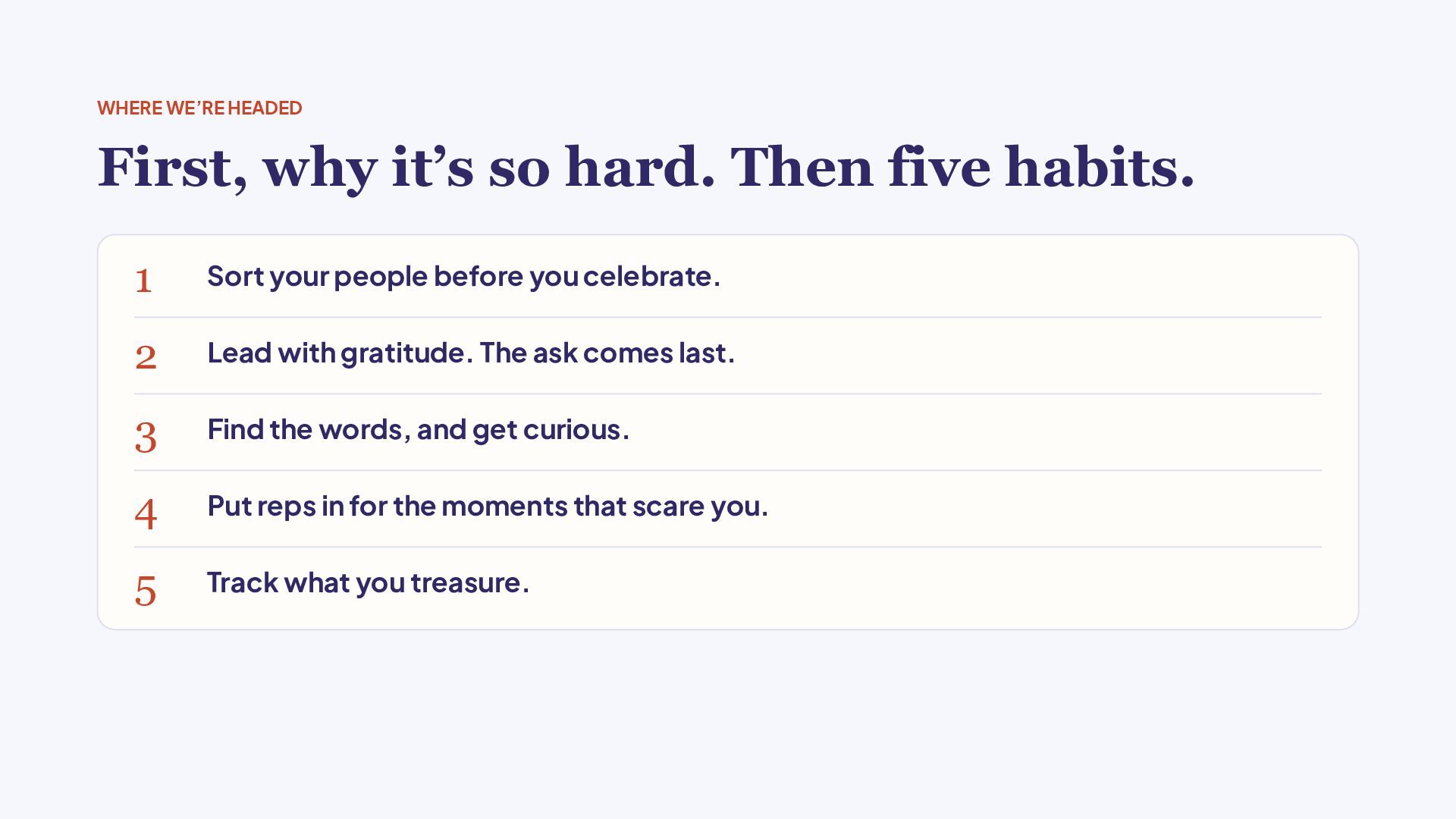
habits. 1 Sort your people before you celebrate. 2 Lead with gratitude. The ask comes last. 3 Find the words, and get curious. 4 Put reps in for the moments that scare you. 5 Track what you treasure.
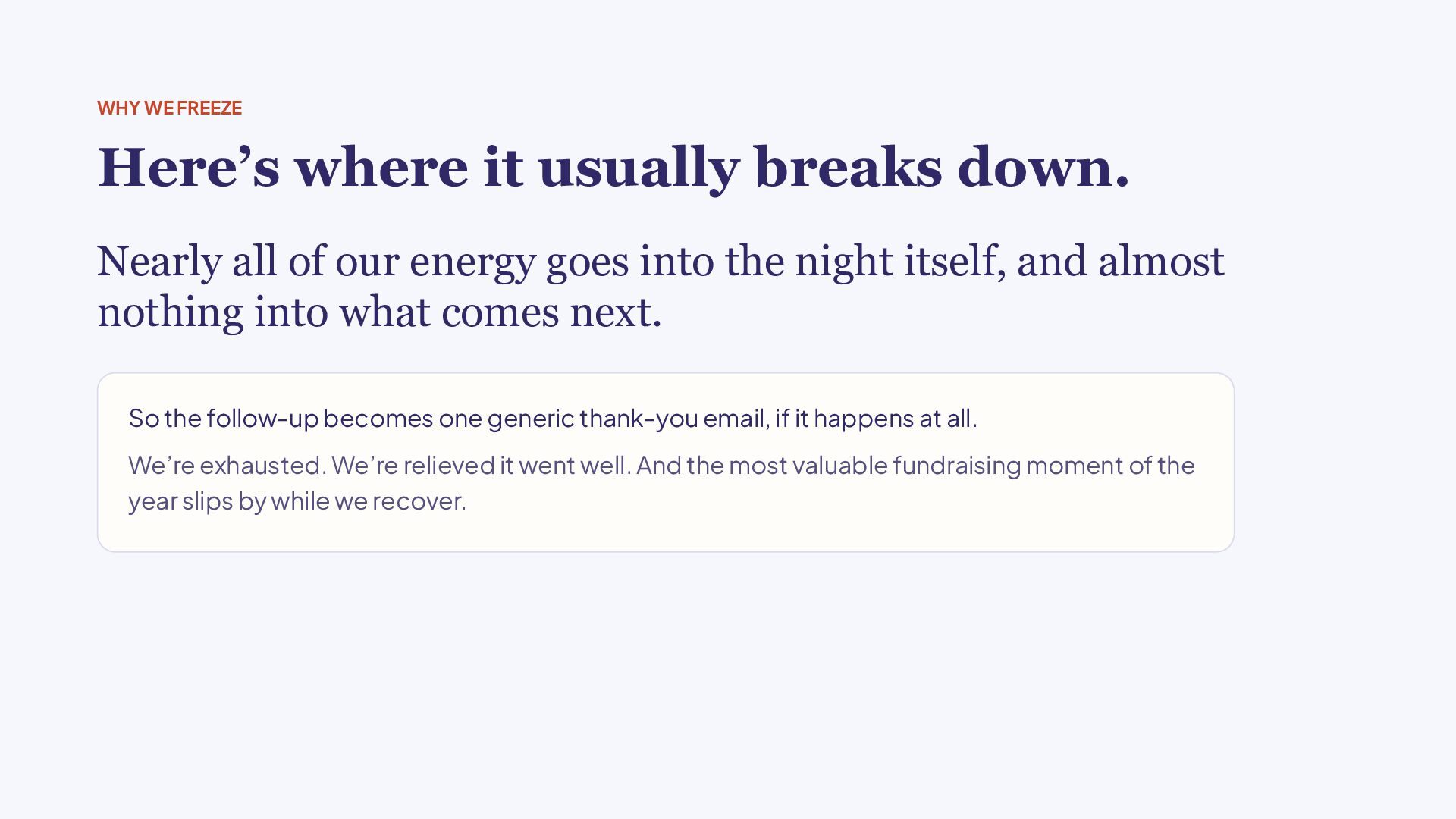
all of our energy goes into the night itself, and almost nothing into what comes next. So the follow-up becomes one generic thank-you email, if it happens at all. We’re exhausted. We’re relieved it went well. And the most valuable fundraising moment of the year slips by while we recover.
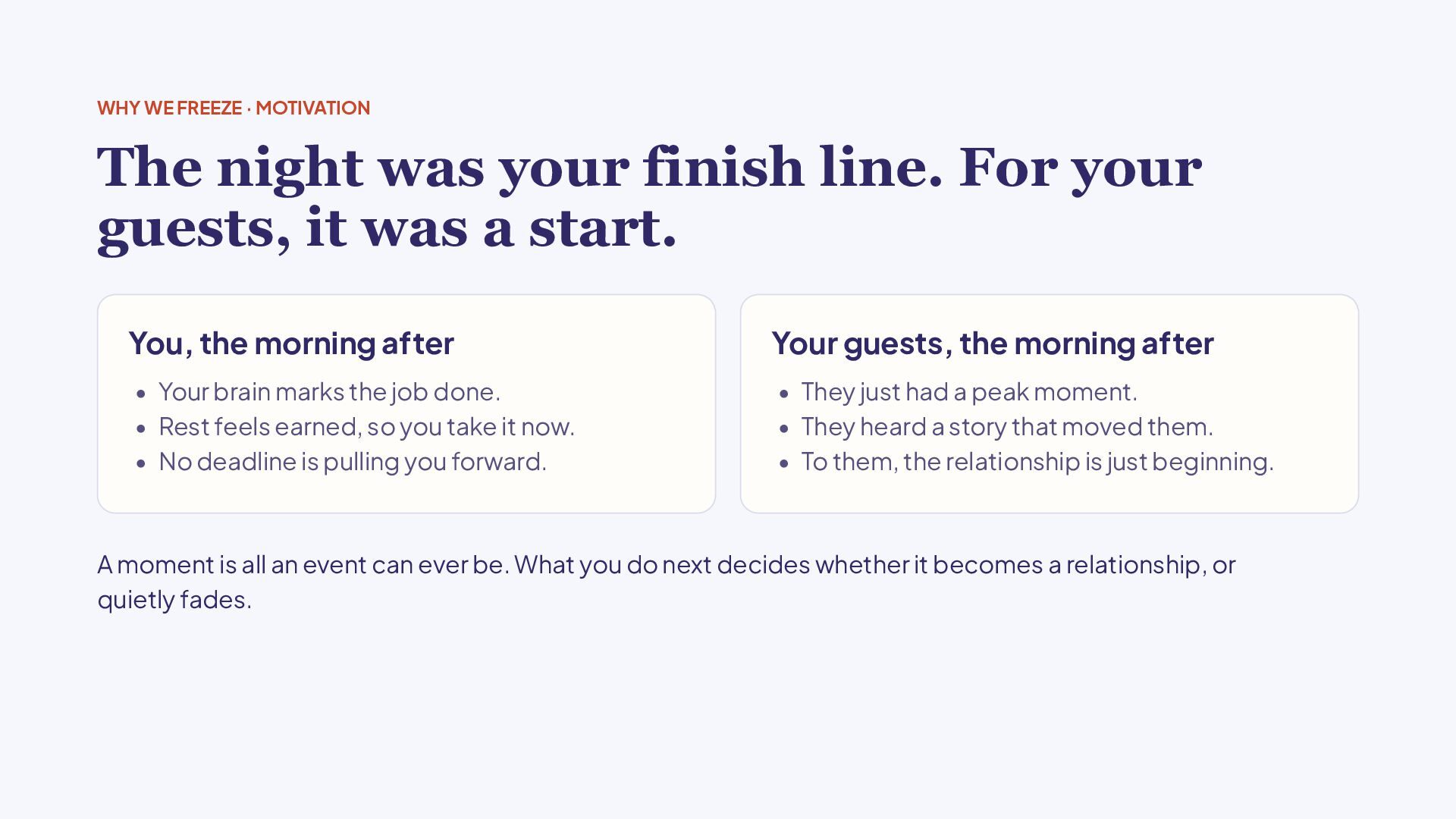
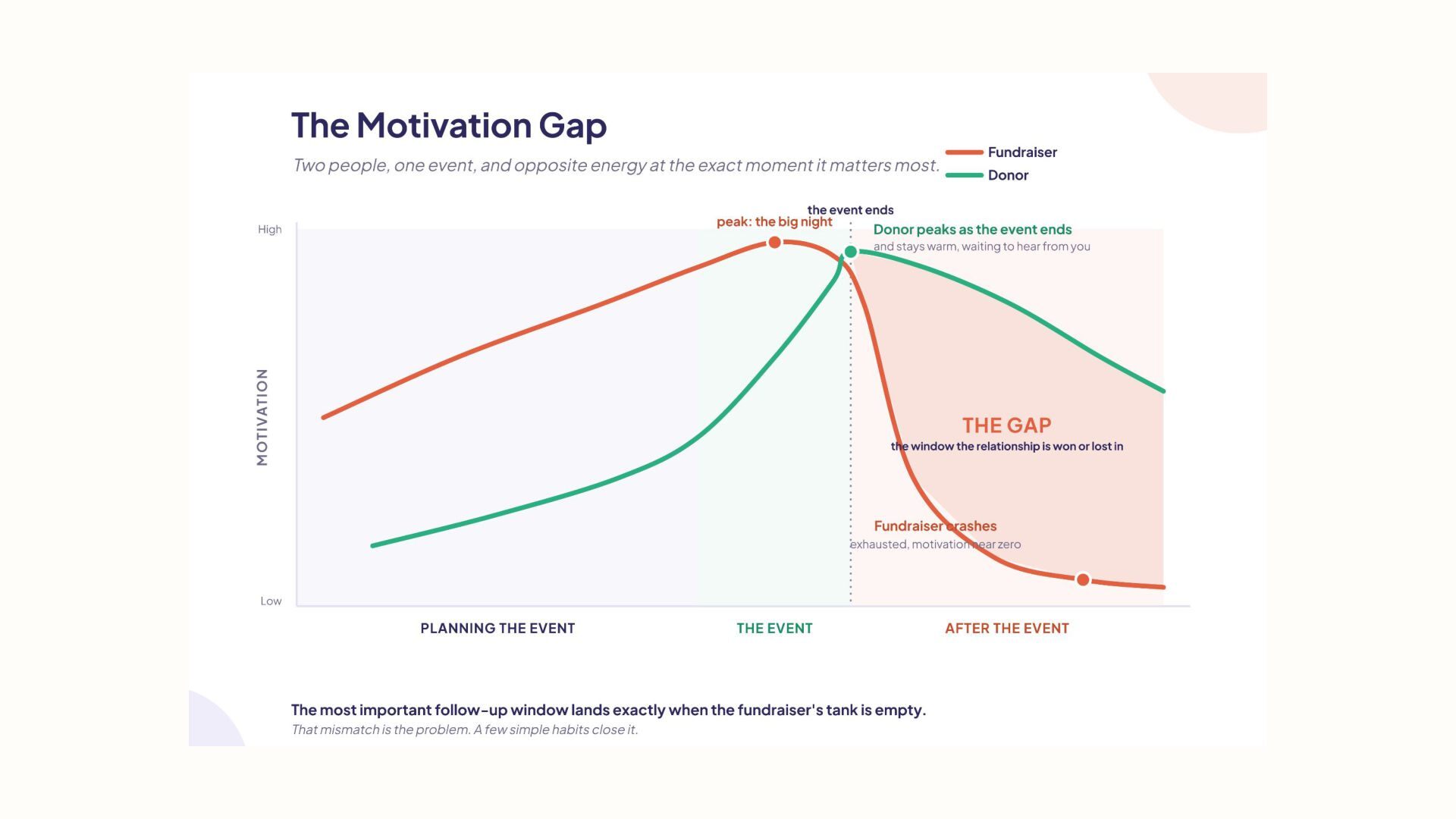
line. For your guests, it was a start. You, the morning after Your guests, the morning after • Your brain marks the job done. • Rest feels earned, so you take it now. • No deadline is pulling you forward. • They just had a peak moment. • They heard a story that moved them. • To them, the relationship is just beginning. A moment is all an event can ever be. What you do next decides whether it becomes a relationship, or quietly fades.
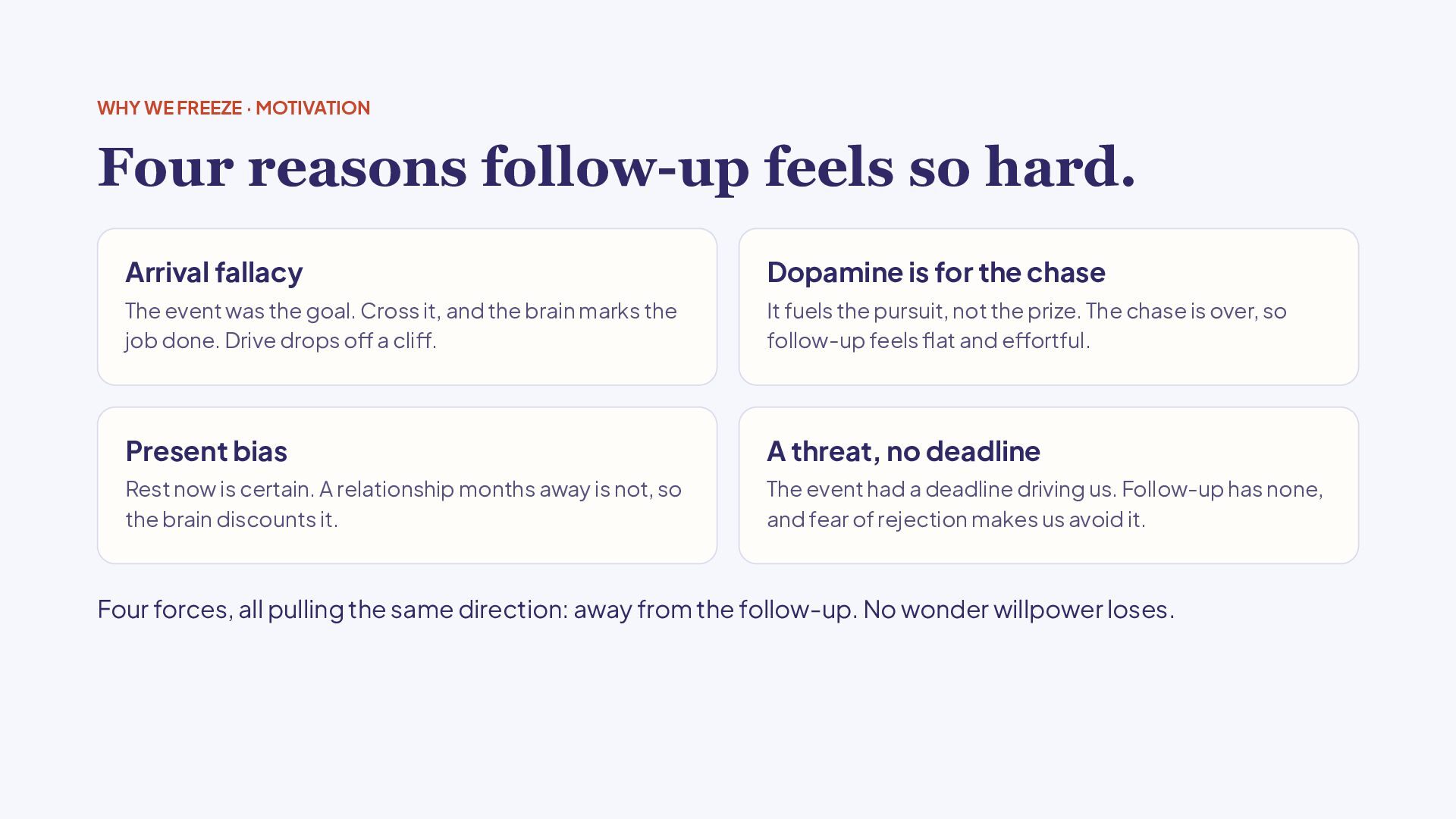
hard. Arrival fallacy Dopamine is for the chase The event was the goal. Cross it, and the brain marks the job done. Drive drops off a cliff. It fuels the pursuit, not the prize. The chase is over, so follow-up feels flat and effortful. Present bias A threat, no deadline Rest now is certain. A relationship months away is not, so the brain discounts it. The event had a deadline driving us. Follow-up has none, and fear of rejection makes us avoid it. Four forces, all pulling the same direction: away from the follow-up. No wonder willpower loses.
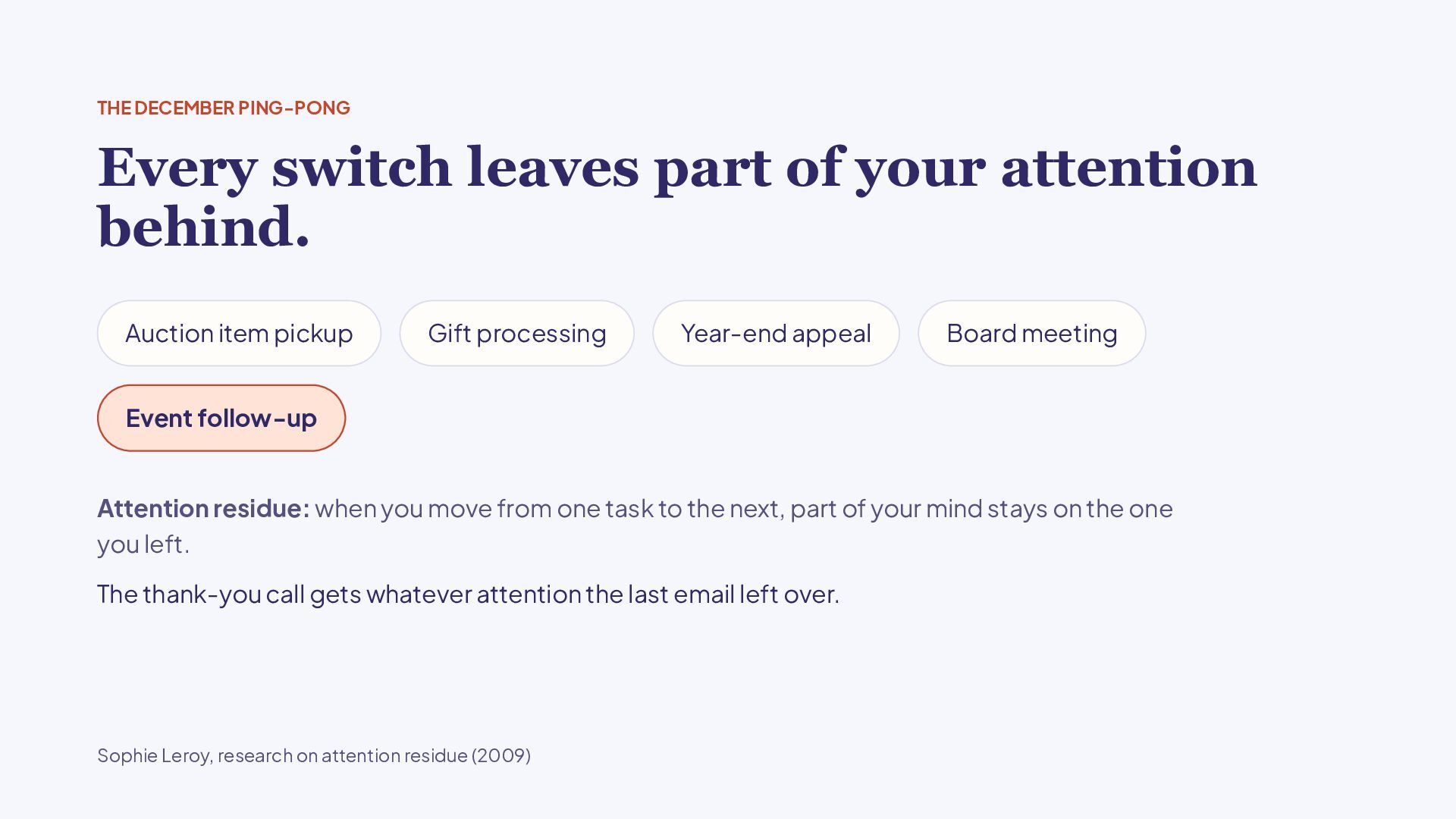
behind. Auction item pickup Gift processing Year-end appeal Board meeting Event follow-up Attention residue: when you move from one task to the next, part of your mind stays on the one you left. The thank-you call gets whatever attention the last email left over. Sophie Leroy, research on attention residue (2009)
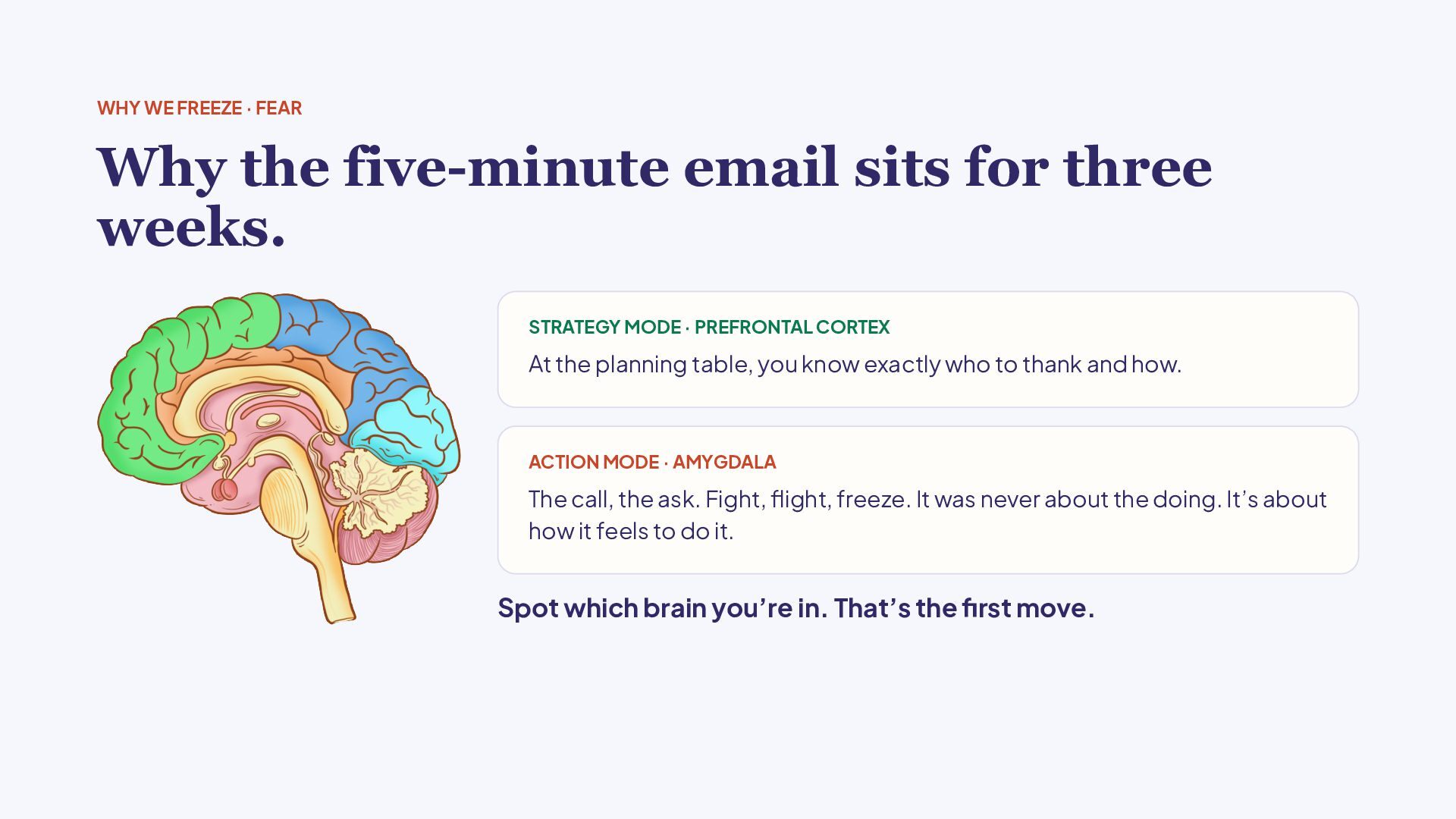
for three weeks. STRATEGY MODE · PREFRONTAL CORTEX At the planning table, you know exactly who to thank and how. ACTION MODE · AMYGDALA The call, the ask. Fight, flight, freeze. It was never about the doing. It’s about how it feels to do it. Spot which brain you’re in. That’s the first move.
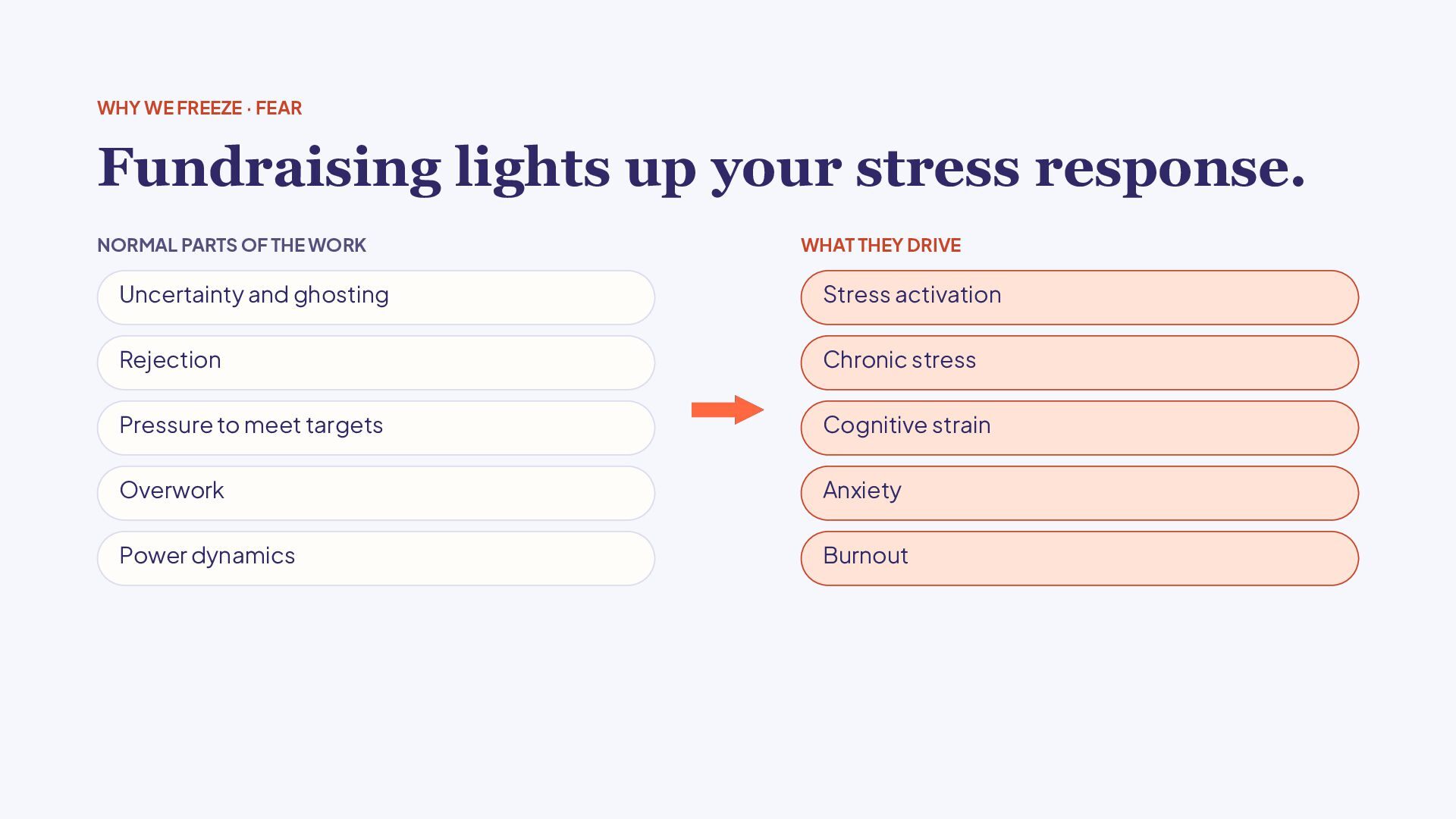
response. NORMAL PARTS OF THE WORK WHAT THEY DRIVE Uncertainty and ghosting Stress activation Rejection Chronic stress Pressure to meet targets Cognitive strain Overwork Anxiety Power dynamics Burnout
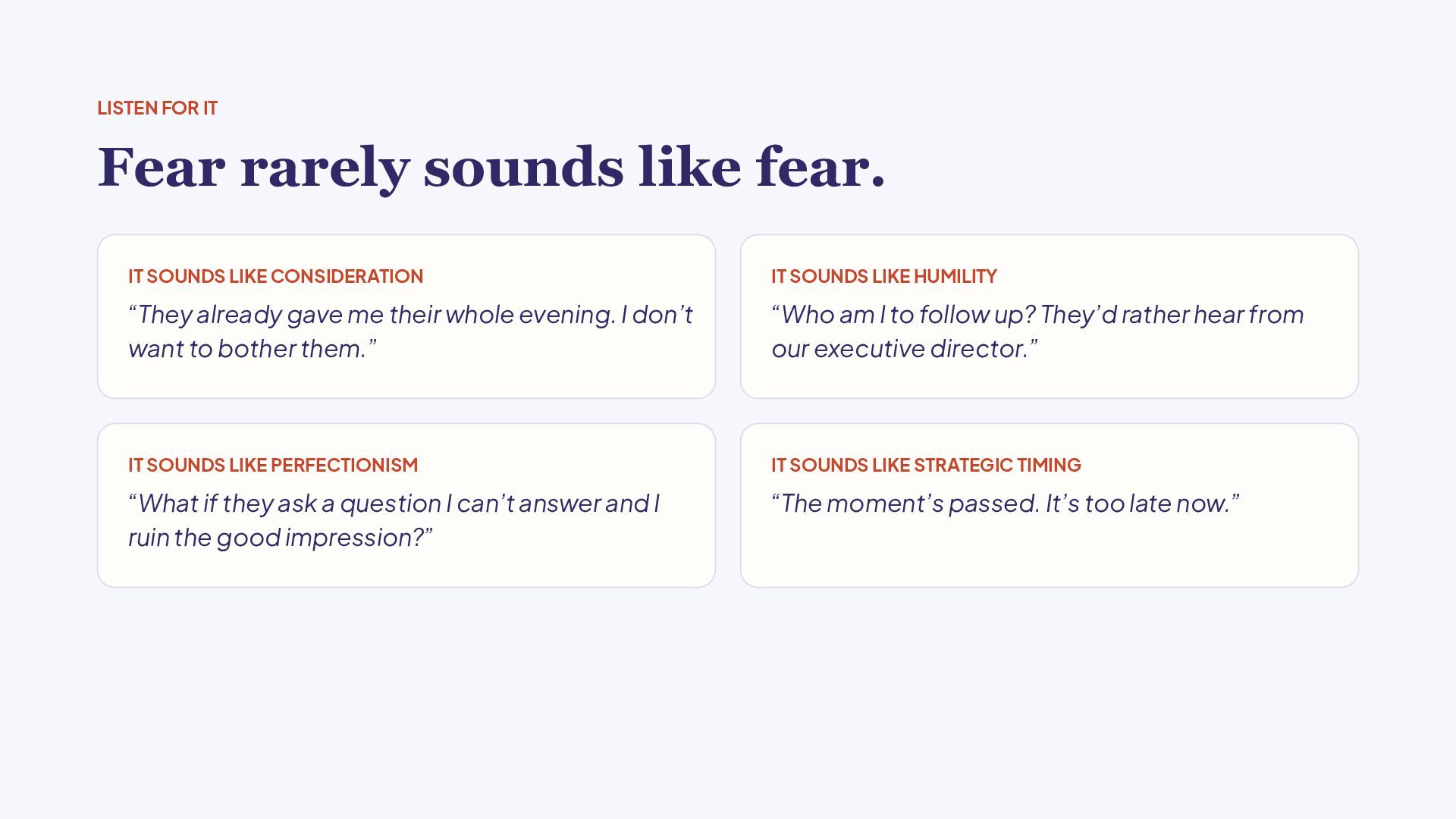
LIKE CONSIDERATION IT SOUNDS LIKE HUMILITY “They already gave me their whole evening. I don’t want to bother them.” “Who am I to follow up? They’d rather hear from our executive director.” IT SOUNDS LIKE PERFECTIONISM IT SOUNDS LIKE STRATEGIC TIMING “What if they ask a question I can’t answer and I ruin the good impression?” “The moment’s passed. It’s too late now.”
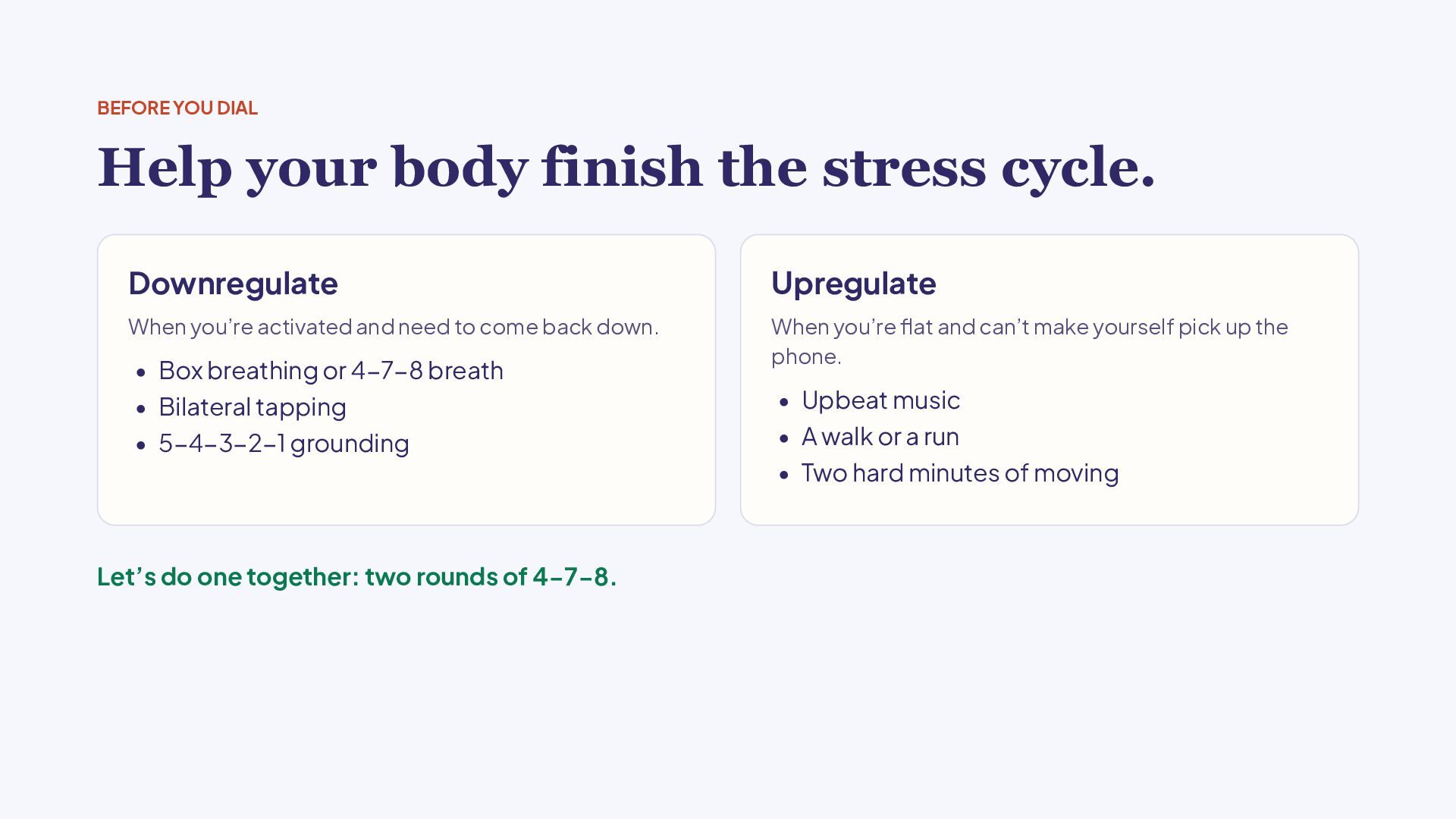
Downregulate Upregulate When you’re activated and need to come back down. When you’re flat and can’t make yourself pick up the phone. • Box breathing or 4−7−8 breath • Bilateral tapping • 5−4−3−2−1 grounding Let’s do one together: two rounds of 4−7−8. • Upbeat music • A walk or a run • Two hard minutes of moving
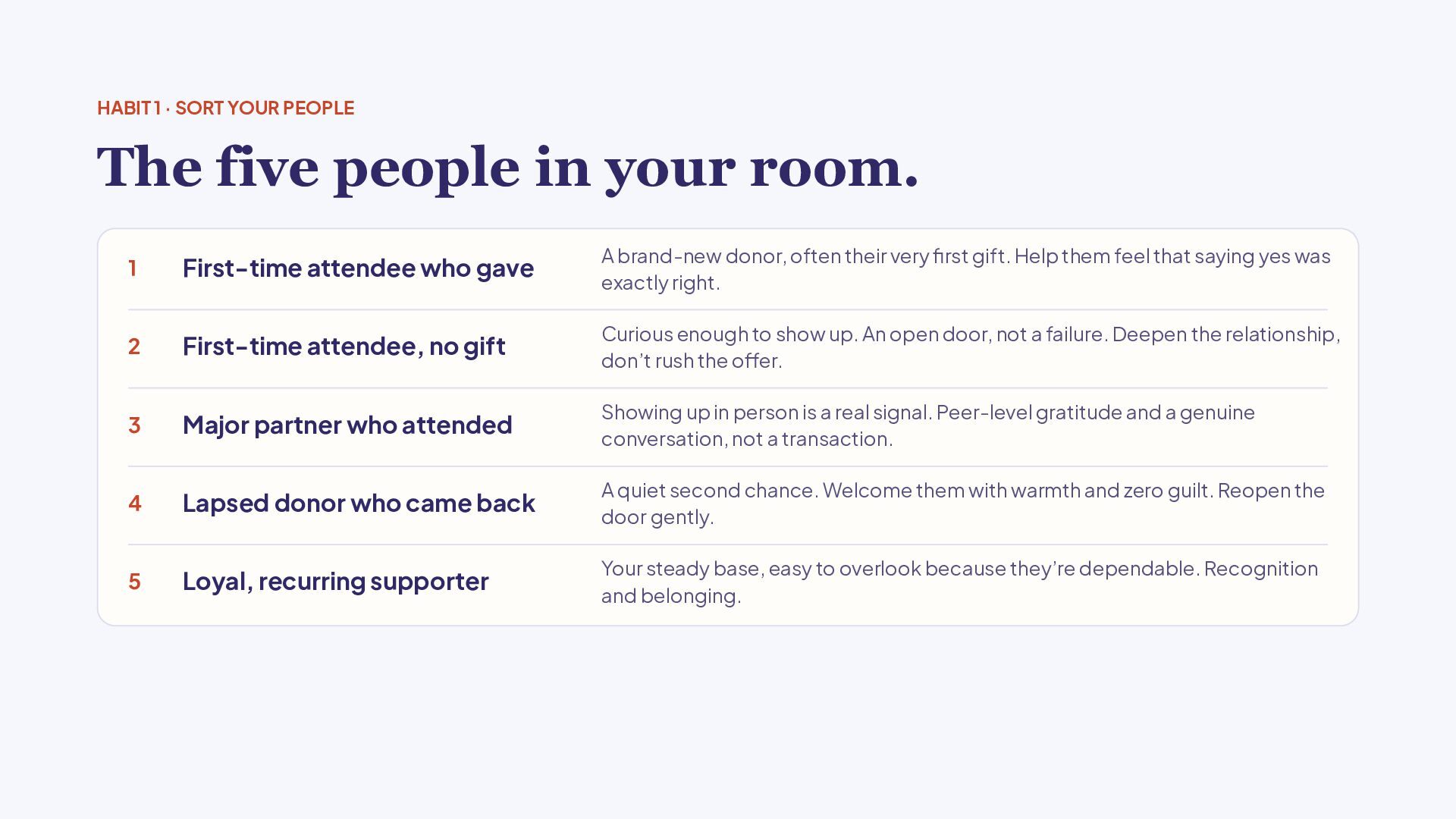
your room. 1 First-time attendee who gave A brand-new donor, often their very first gift. Help them feel that saying yes was exactly right. 2 First-time attendee, no gift Curious enough to show up. An open door, not a failure. Deepen the relationship, don’t rush the offer. 3 Major partner who attended Showing up in person is a real signal. Peer-level gratitude and a genuine conversation, not a transaction. 4 Lapsed donor who came back A quiet second chance. Welcome them with warmth and zero guilt. Reopen the door gently. 5 Loyal, recurring supporter Your steady base, easy to overlook because they’re dependable. Recognition and belonging.
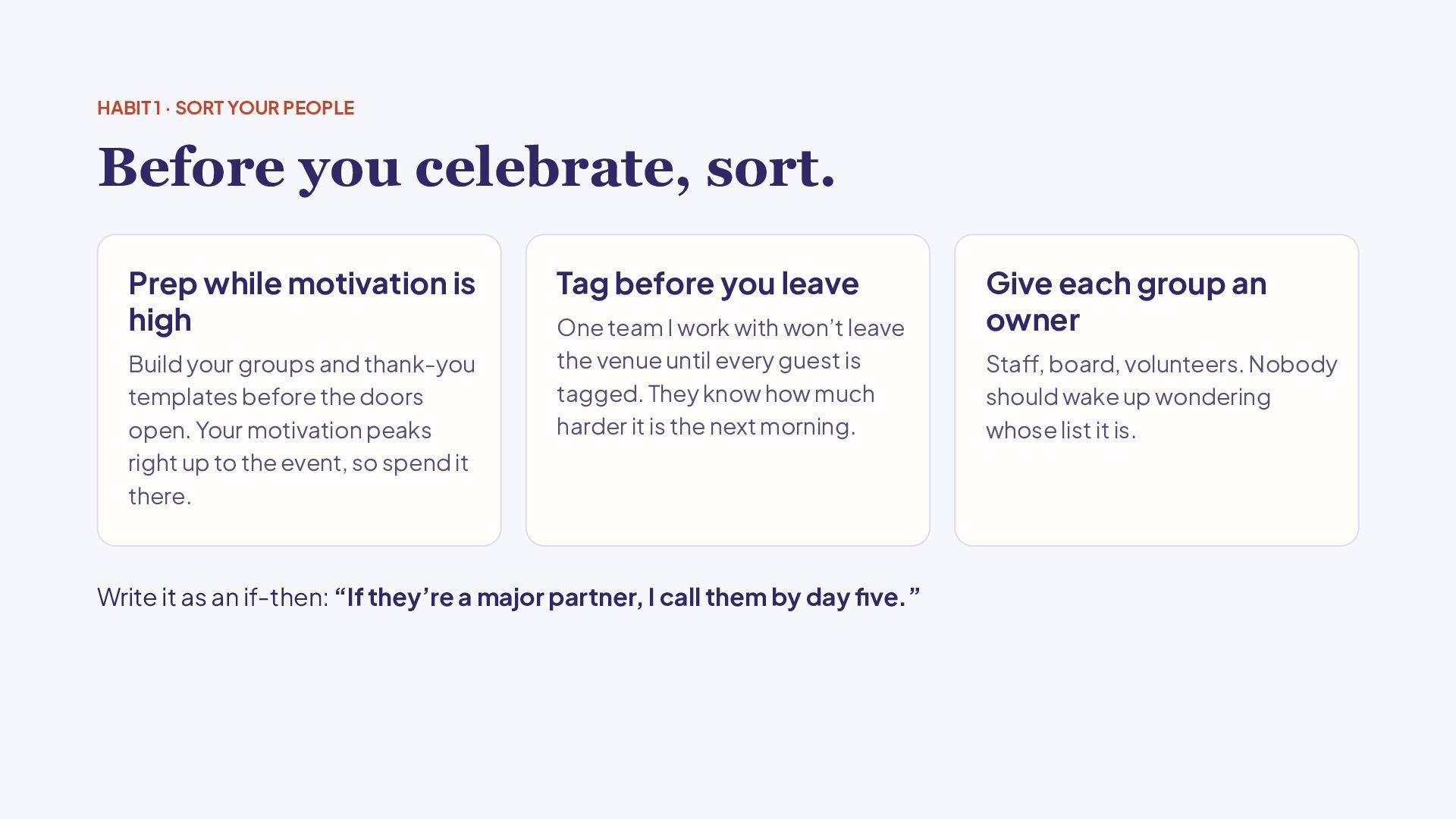
Prep while motivation is high Build your groups and thank-you templates before the doors open. Your motivation peaks right up to the event, so spend it there. Tag before you leave One team I work with won’t leave the venue until every guest is tagged. They know how much harder it is the next morning. Write it as an if-then: “If they’re a major partner, I call them by day five.” Give each group an owner Staff, board, volunteers. Nobody should wake up wondering whose list it is.
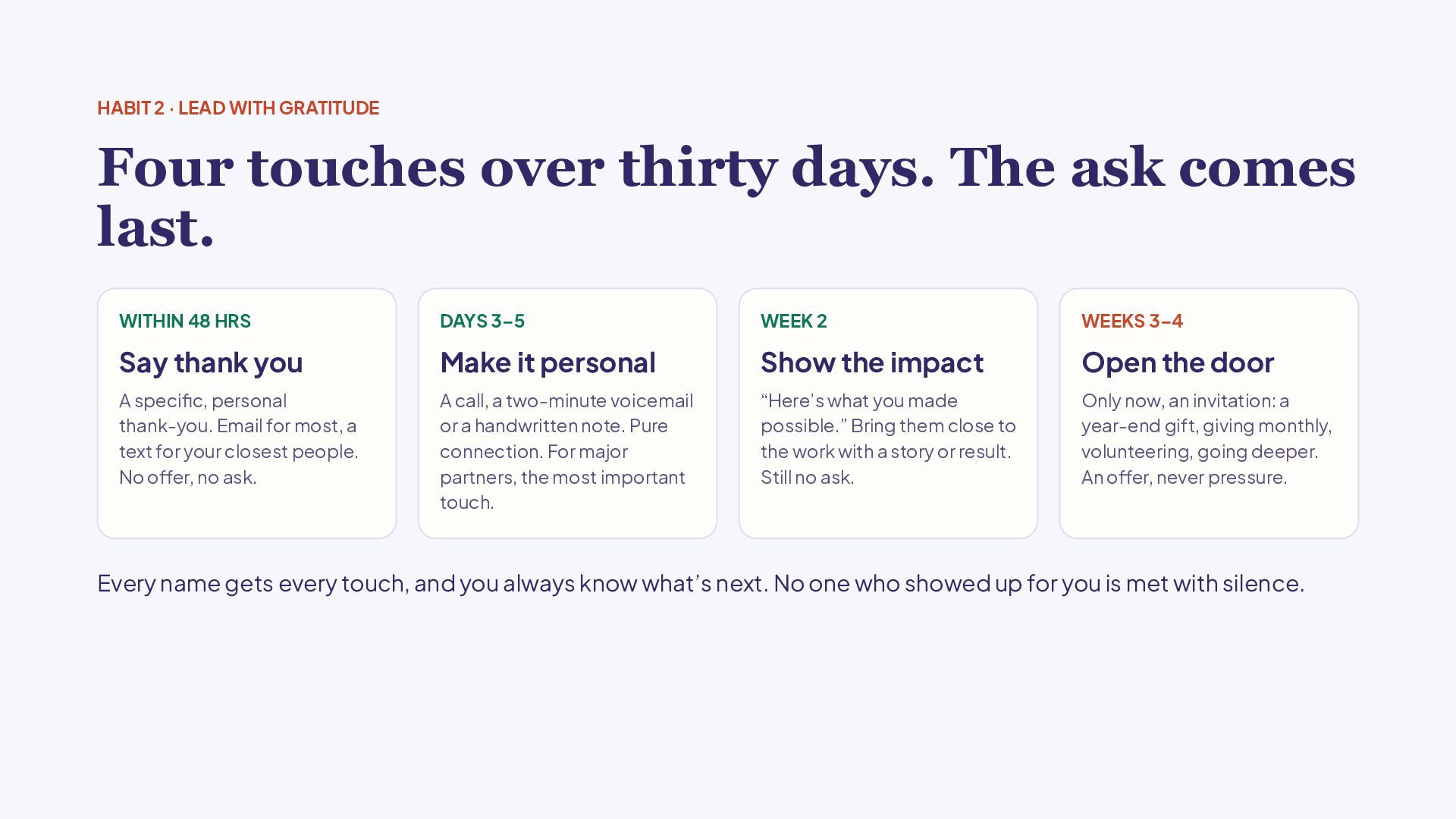
days. The ask comes last. WITHIN 48 HRS DAYS 3–5 WEEK 2 WEEKS 3–4 Say thank you Make it personal Show the impact Open the door A specific, personal thank-you. Email for most, a text for your closest people. No offer, no ask. A call, a two-minute voicemail or a handwritten note. Pure connection. For major partners, the most important touch. “Here’s what you made possible.” Bring them close to the work with a story or result. Still no ask. Only now, an invitation: a year-end gift, giving monthly, volunteering, going deeper. An offer, never pressure. Every name gets every touch, and you always know what’s next. No one who showed up for you is met with silence.
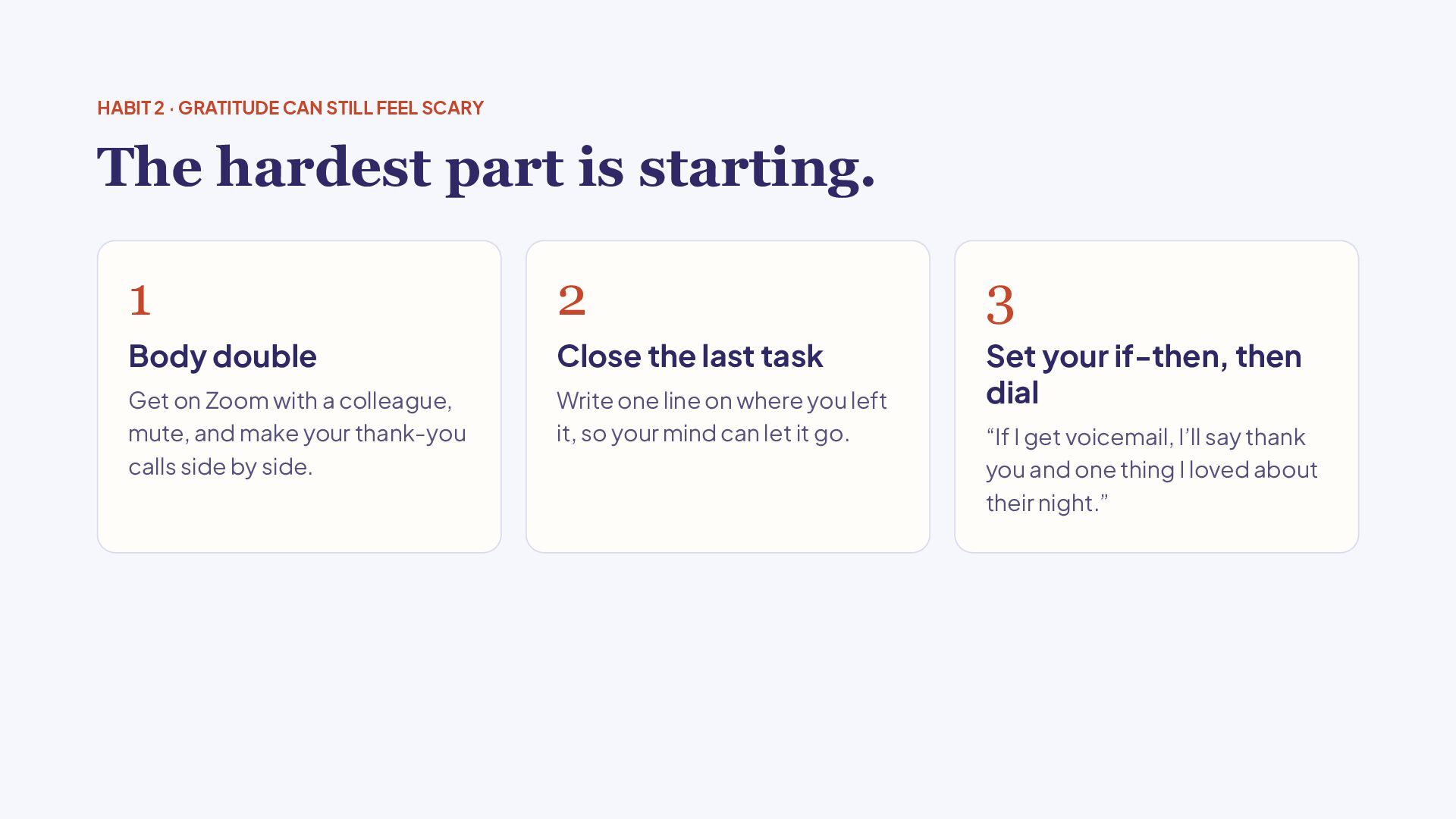
part is starting. 1 2 3 Body double Close the last task Get on Zoom with a colleague, mute, and make your thank-you calls side by side. Write one line on where you left it, so your mind can let it go. Set your if-then, then dial “If I get voicemail, I’ll say thank you and one thing I loved about their night.”
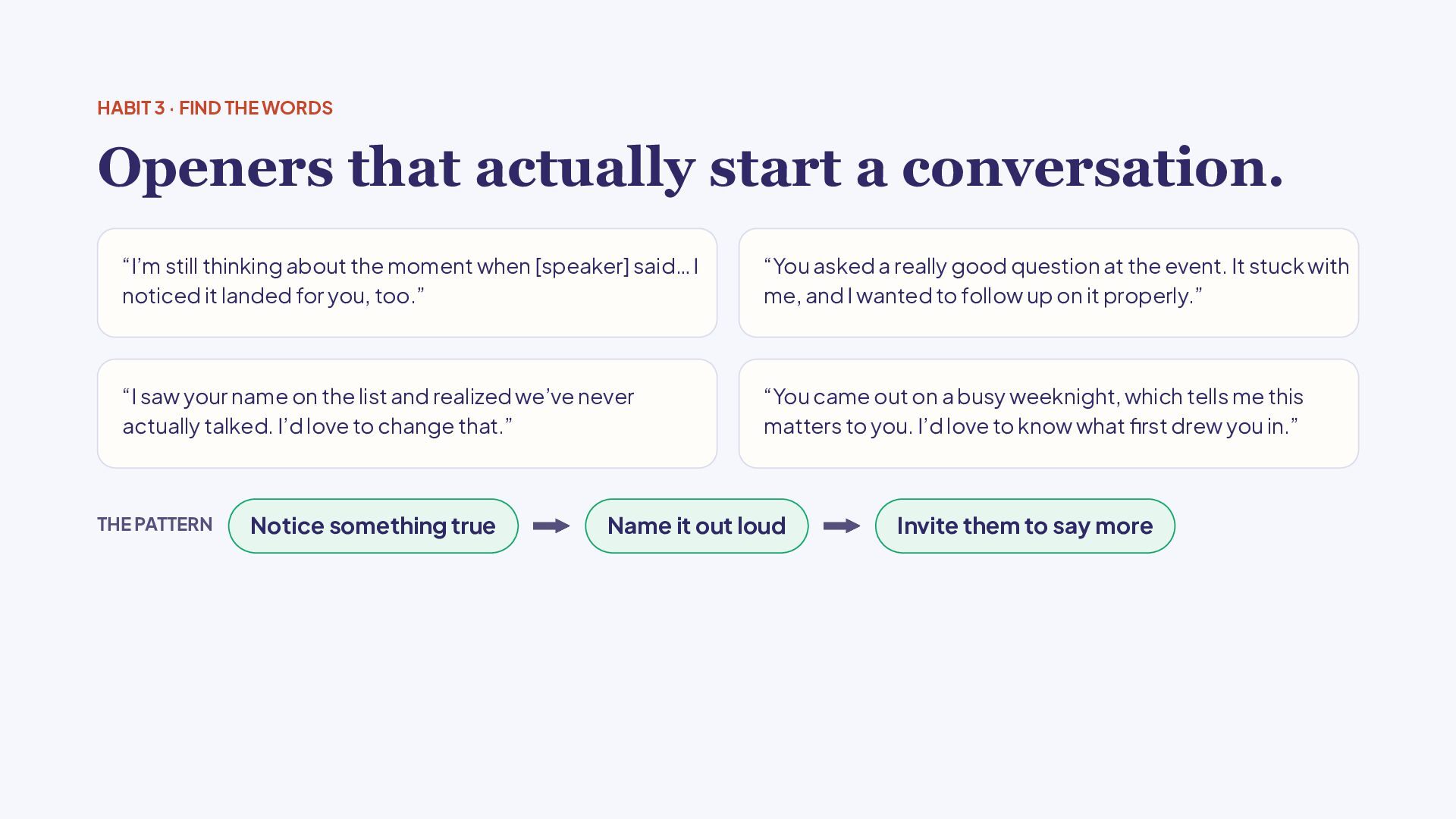
a conversation. “I’m still thinking about the moment when [speaker] said… I noticed it landed for you, too.” “You asked a really good question at the event. It stuck with me, and I wanted to follow up on it properly.” “I saw your name on the list and realized we’ve never actually talked. I’d love to change that.” “You came out on a busy weeknight, which tells me this matters to you. I’d love to know what first drew you in.” Notice something true Invite them to say more THE PATTERN Name it out loud
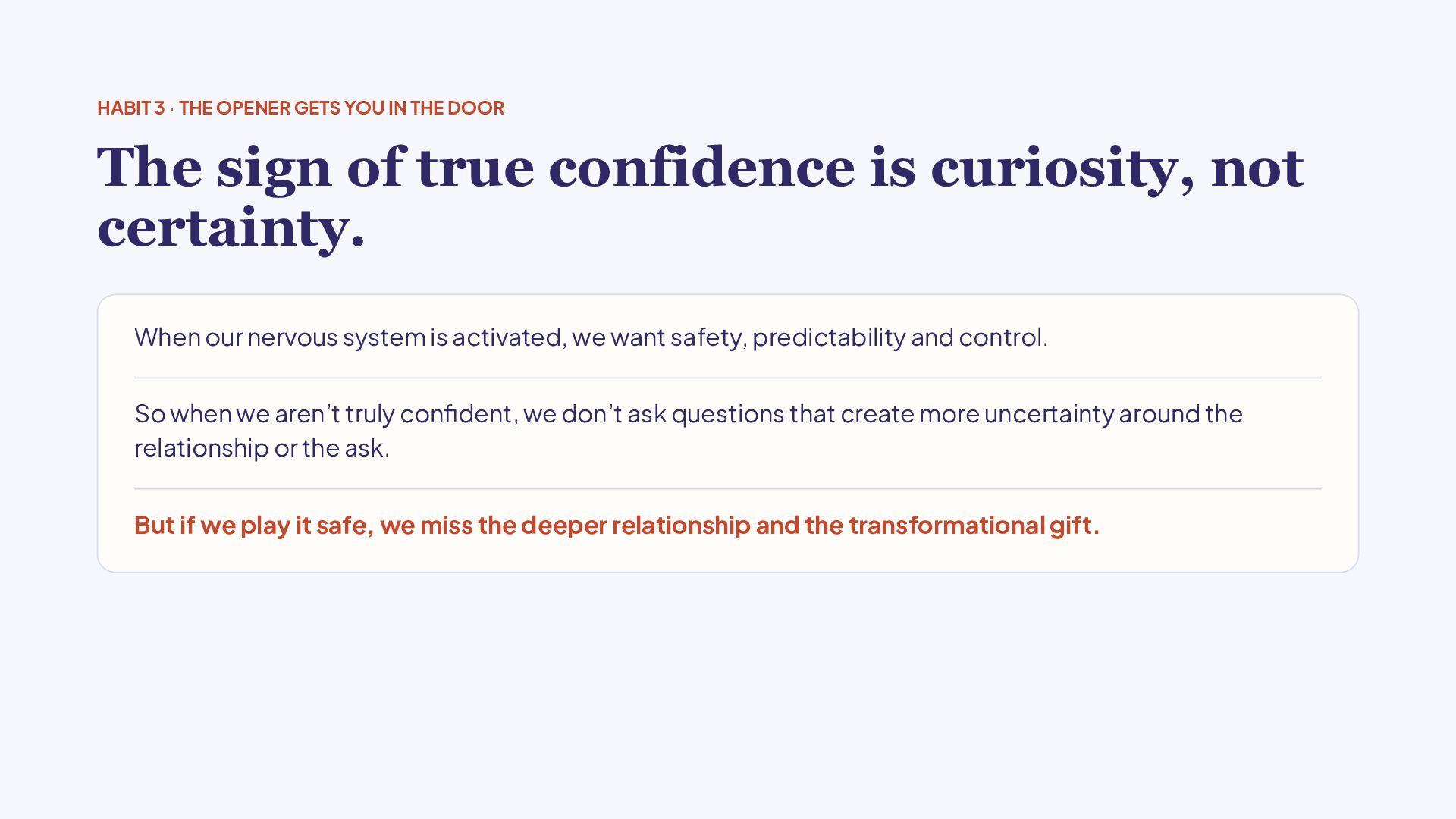
The sign of true confidence is curiosity, not certainty. When our nervous system is activated, we want safety, predictability and control. So when we aren’t truly confident, we don’t ask questions that create more uncertainty around the relationship or the ask. But if we play it safe, we miss the deeper relationship and the transformational gift.
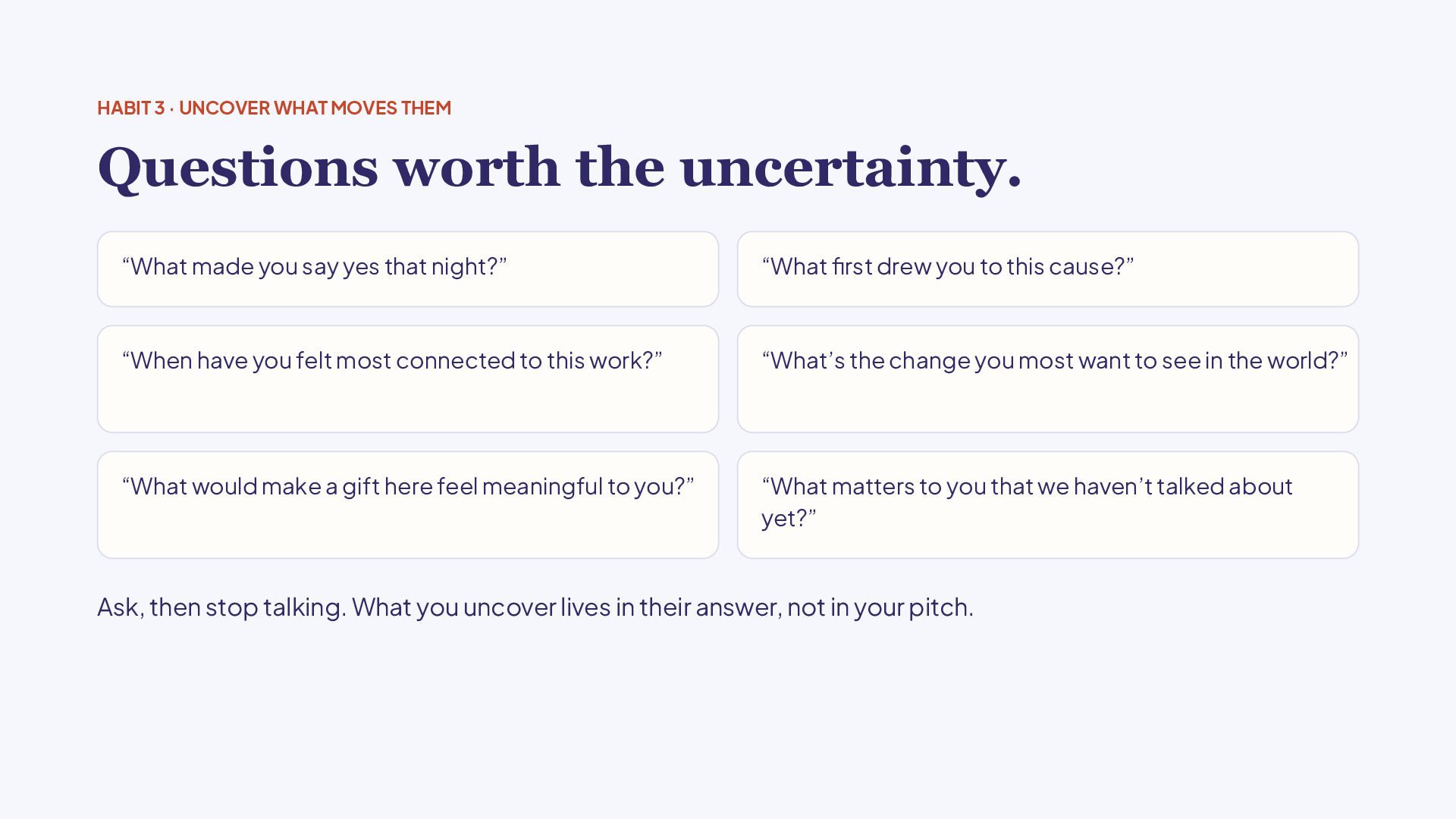
uncertainty. “What made you say yes that night?” “What first drew you to this cause?” “When have you felt most connected to this work?” “What’s the change you most want to see in the world?” “What would make a gift here feel meaningful to you?” “What matters to you that we haven’t talked about yet?” Ask, then stop talking. What you uncover lives in their answer, not in your pitch.
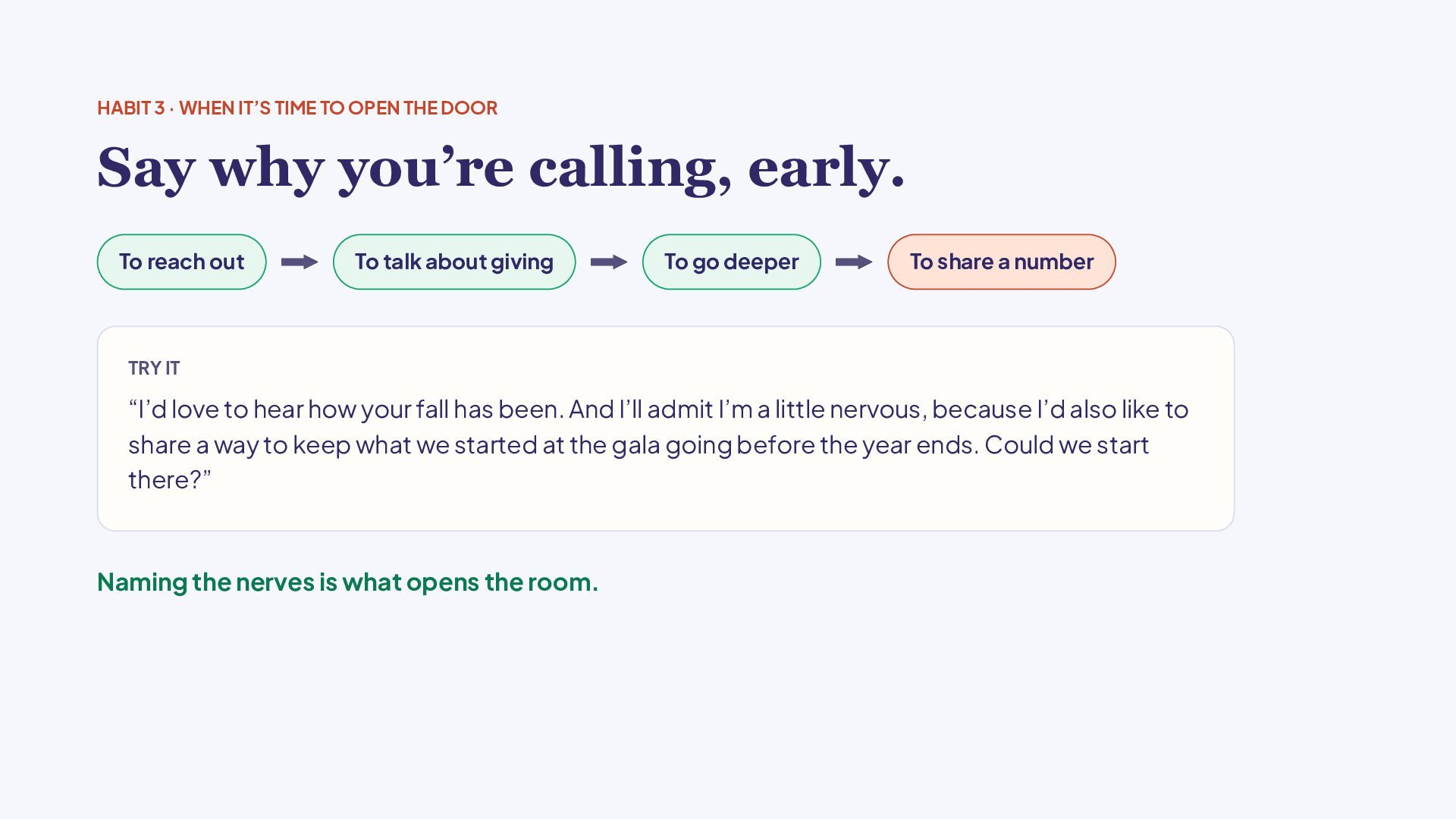
Say why you’re calling, early. To reach out To talk about giving To go deeper To share a number TRY IT “I’d love to hear how your fall has been. And I’ll admit I’m a little nervous, because I’d also like to share a way to keep what we started at the gala going before the year ends. Could we start there?” Naming the nerves is what opens the room.
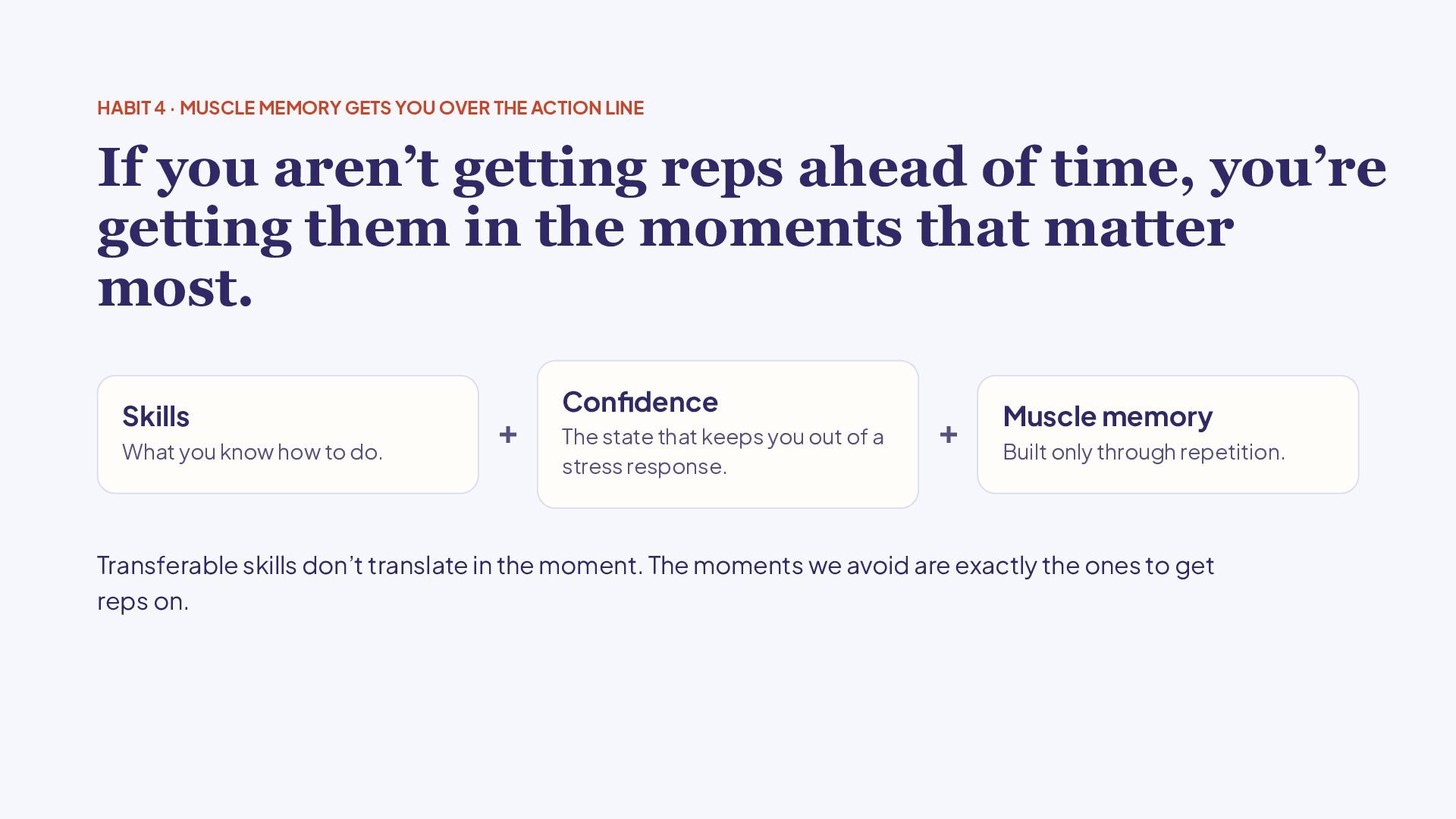
LINE If you aren’t getting reps ahead of time, you’re getting them in the moments that matter most. Skills What you know how to do. + Confidence The state that keeps you out of a stress response. + Muscle memory Built only through repetition. Transferable skills don’t translate in the moment. The moments we avoid are exactly the ones to get reps on.
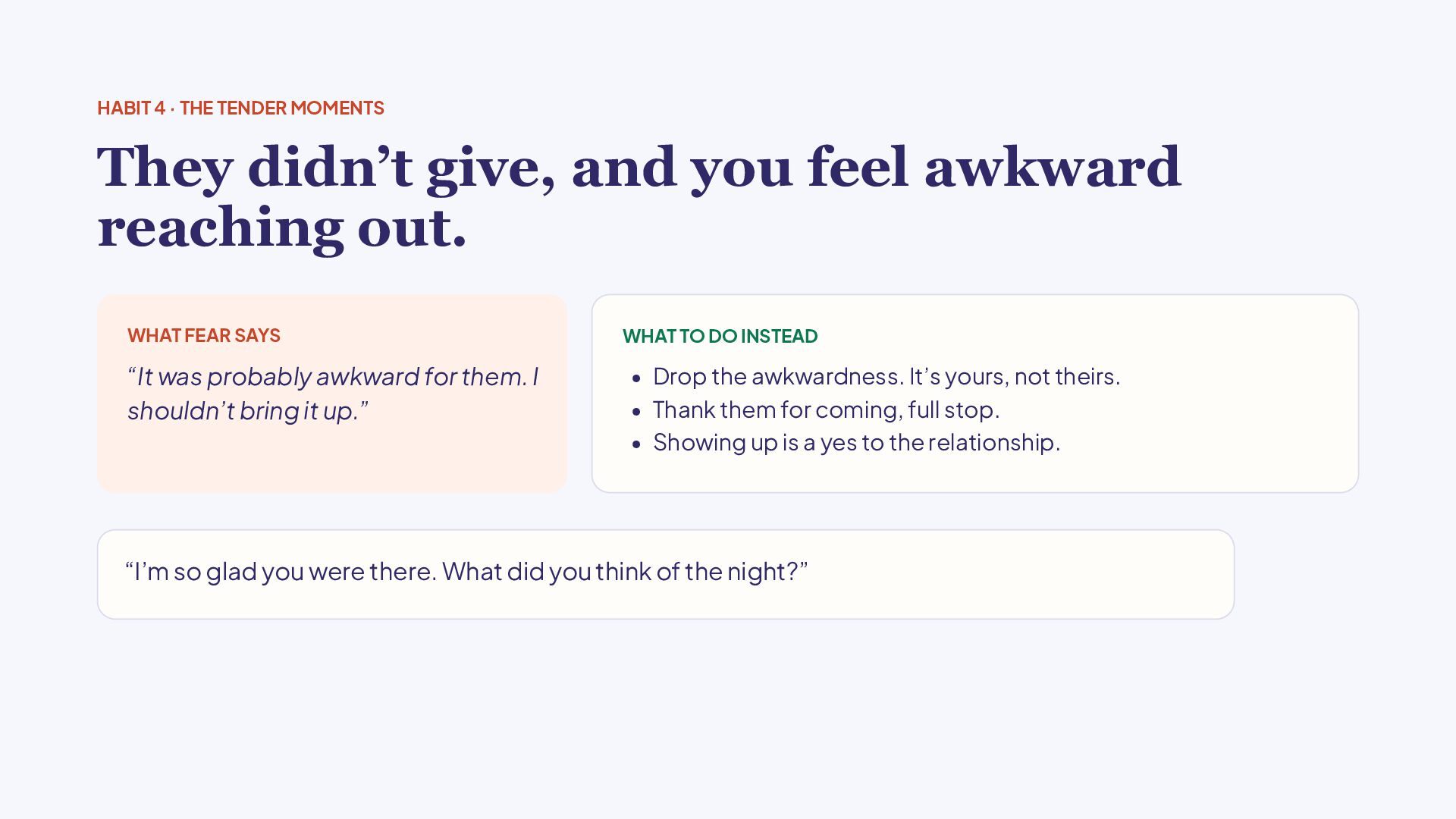
you feel awkward reaching out. WHAT FEAR SAYS WHAT TO DO INSTEAD “It was probably awkward for them. I shouldn’t bring it up.” • Drop the awkwardness. It’s yours, not theirs. • Thank them for coming, full stop. • Showing up is a yes to the relationship. “I’m so glad you were there. What did you think of the night?”
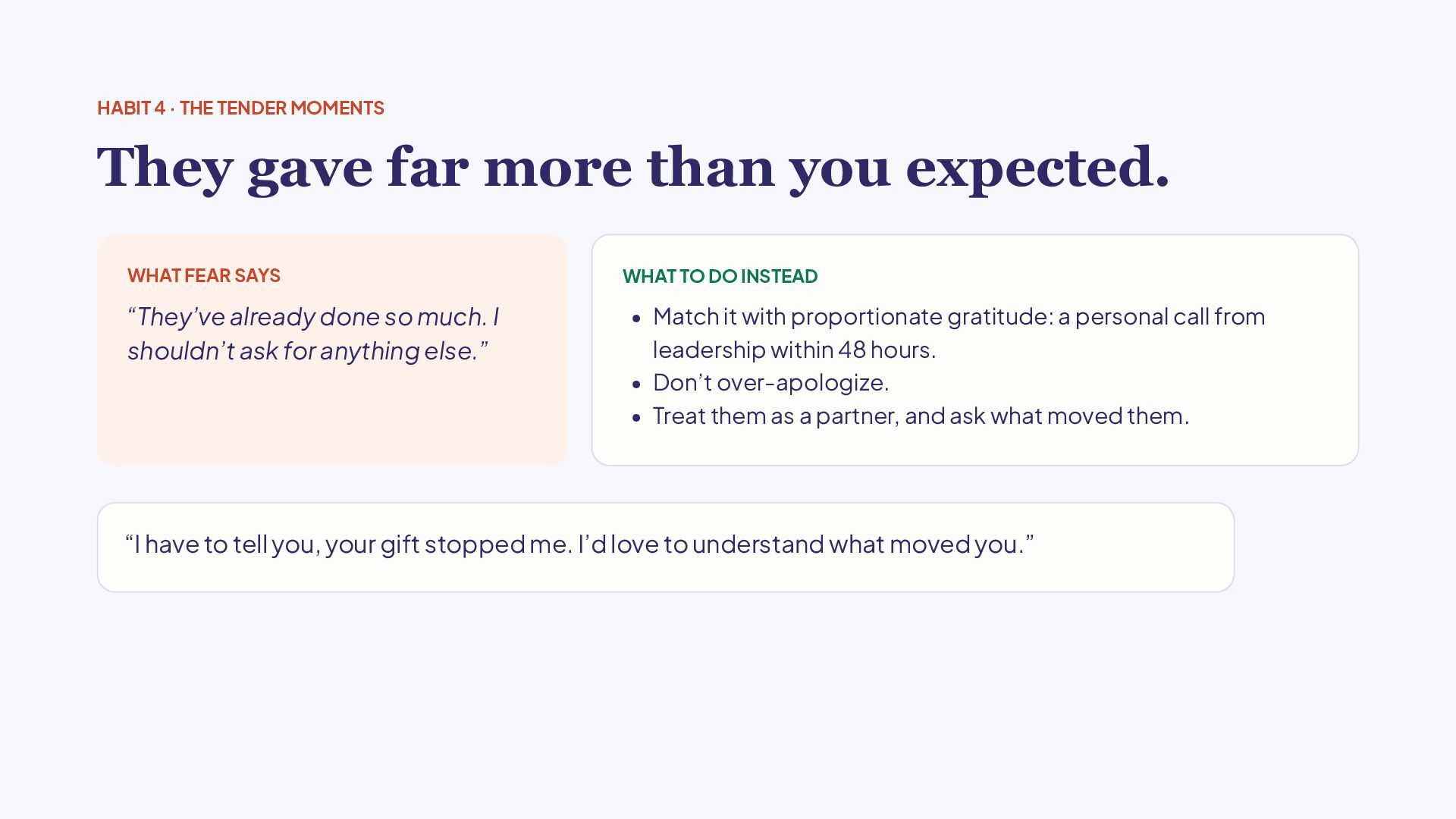
than you expected. WHAT FEAR SAYS WHAT TO DO INSTEAD “They’ve already done so much. I shouldn’t ask for anything else.” • Match it with proportionate gratitude: a personal call from leadership within 48 hours. • Don’t over-apologize. • Treat them as a partner, and ask what moved them. “I have to tell you, your gift stopped me. I’d love to understand what moved you.”
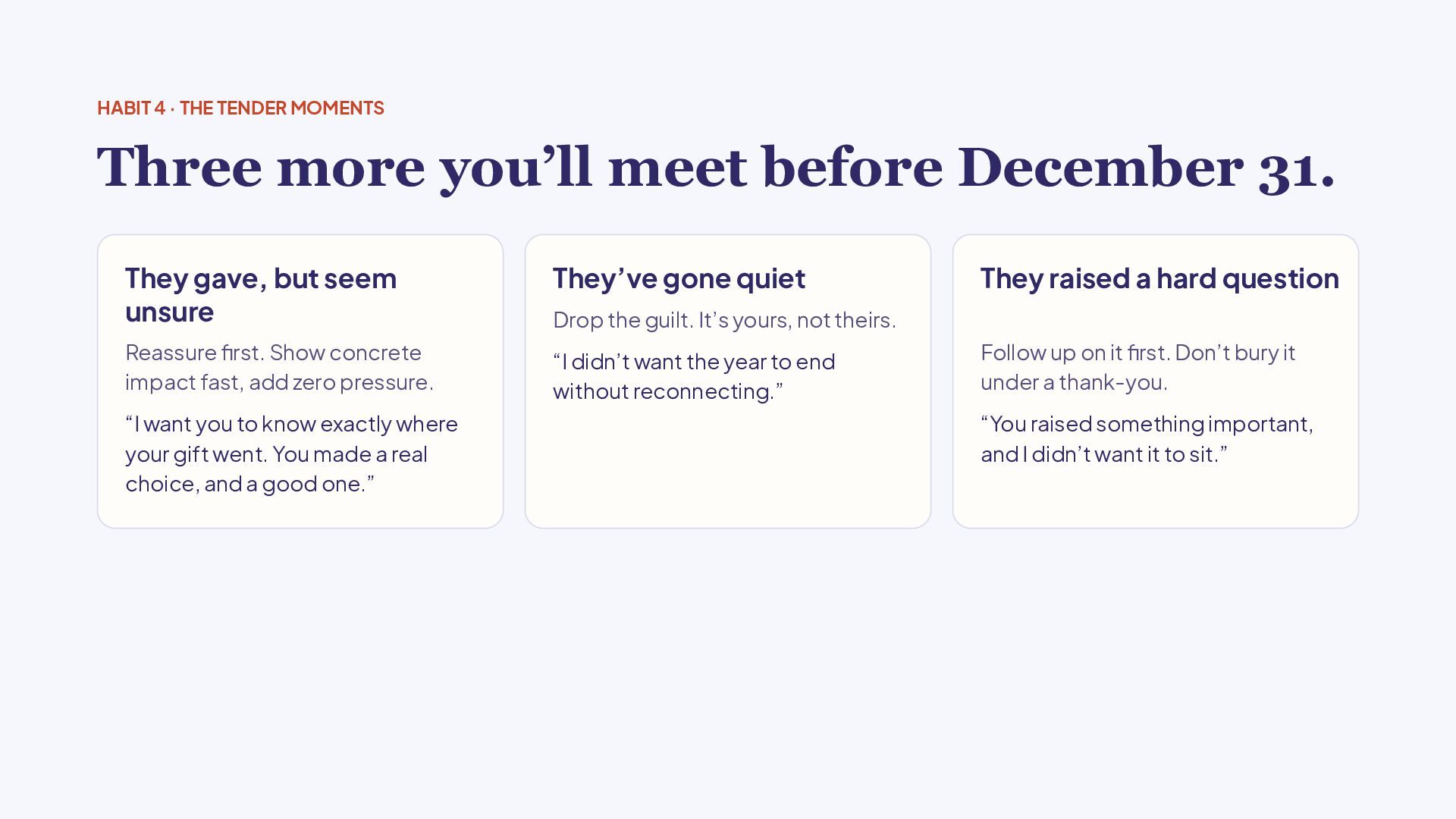
before December 31. They gave, but seem unsure They’ve gone quiet Reassure first. Show concrete impact fast, add zero pressure. “I didn’t want the year to end without reconnecting.” “I want you to know exactly where your gift went. You made a real choice, and a good one.” They raised a hard question Drop the guilt. It’s yours, not theirs. Follow up on it first. Don’t bury it under a thank-you. “You raised something important, and I didn’t want it to sit.”
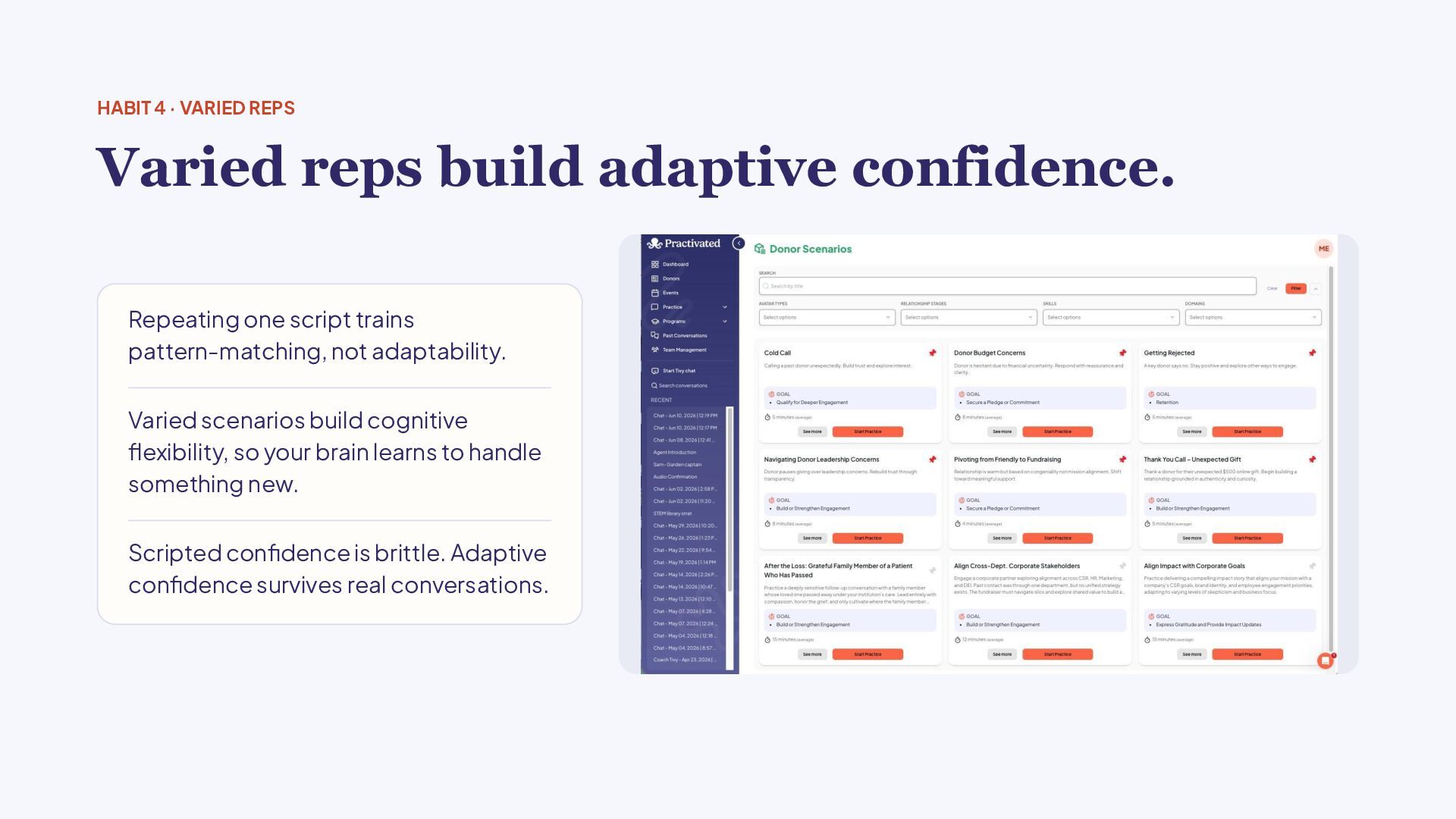
Repeating one script trains pattern-matching, not adaptability. Varied scenarios build cognitive flexibility, so your brain learns to handle something new. Scripted confidence is brittle. Adaptive confidence survives real conversations.
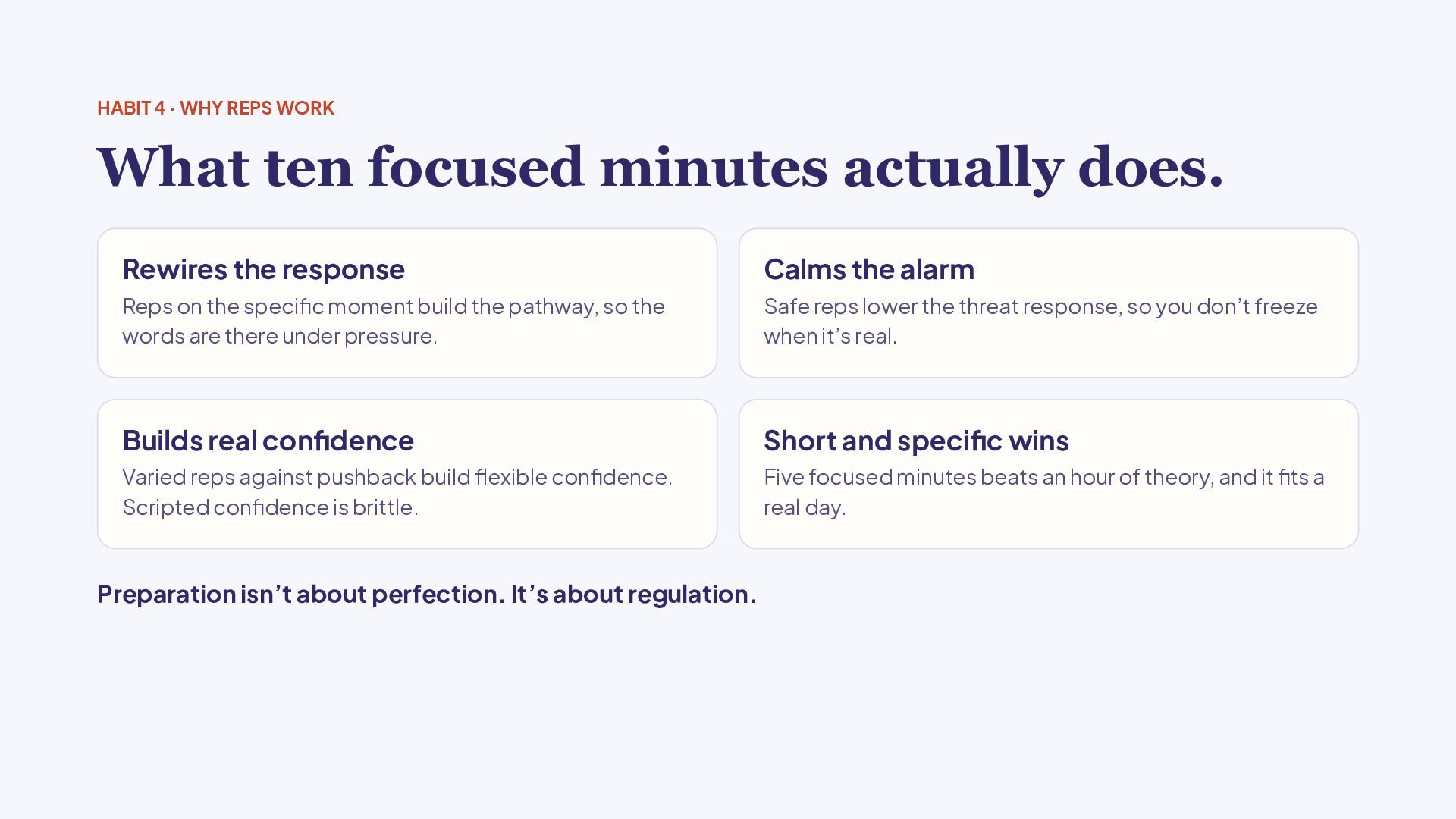
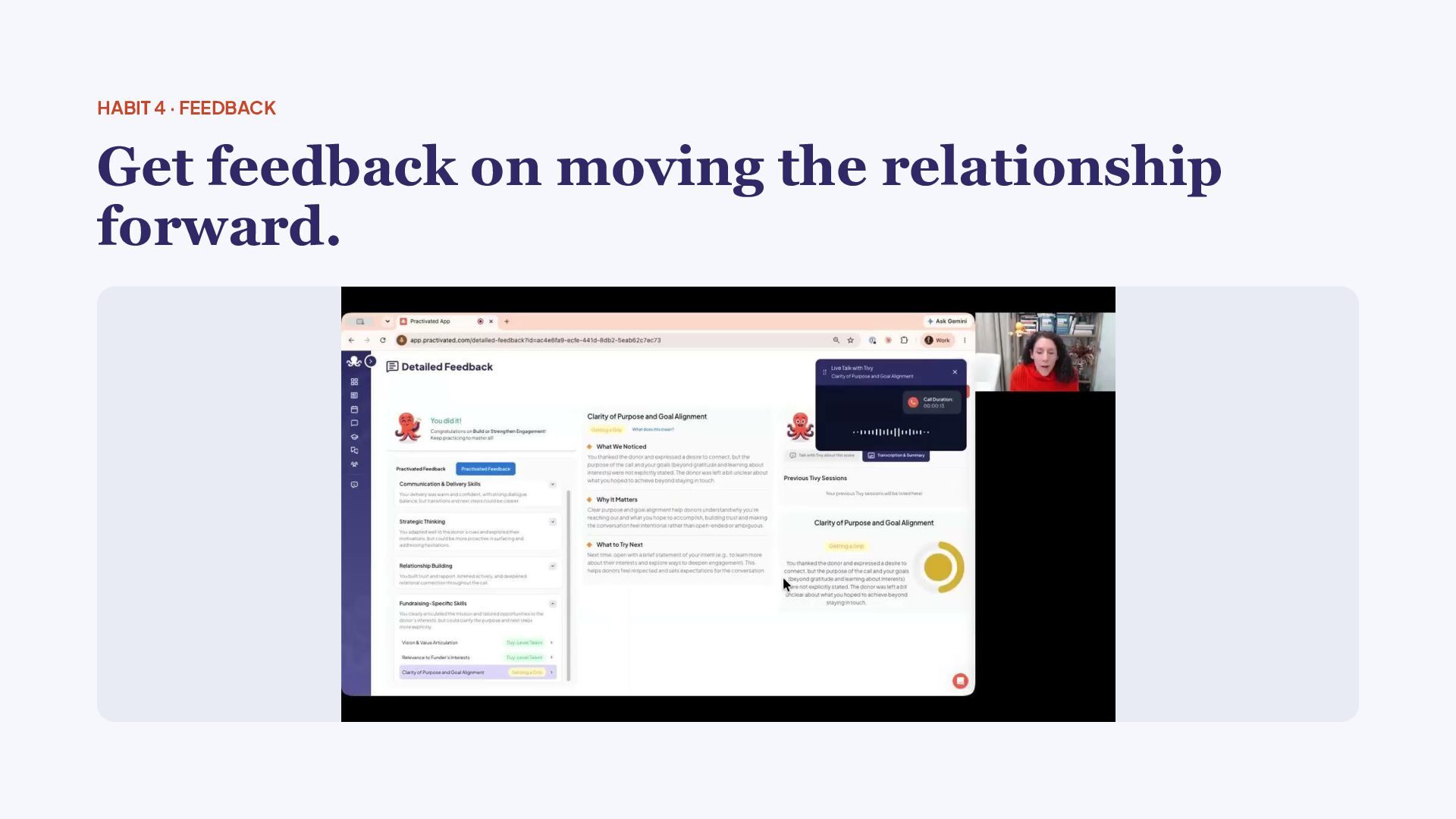
actually does. Rewires the response Calms the alarm Reps on the specific moment build the pathway, so the words are there under pressure. Safe reps lower the threat response, so you don’t freeze when it’s real. Builds real confidence Short and specific wins Varied reps against pushback build flexible confidence. Scripted confidence is brittle. Five focused minutes beats an hour of theory, and it fits a real day. Preparation isn’t about perfection. It’s about regulation.
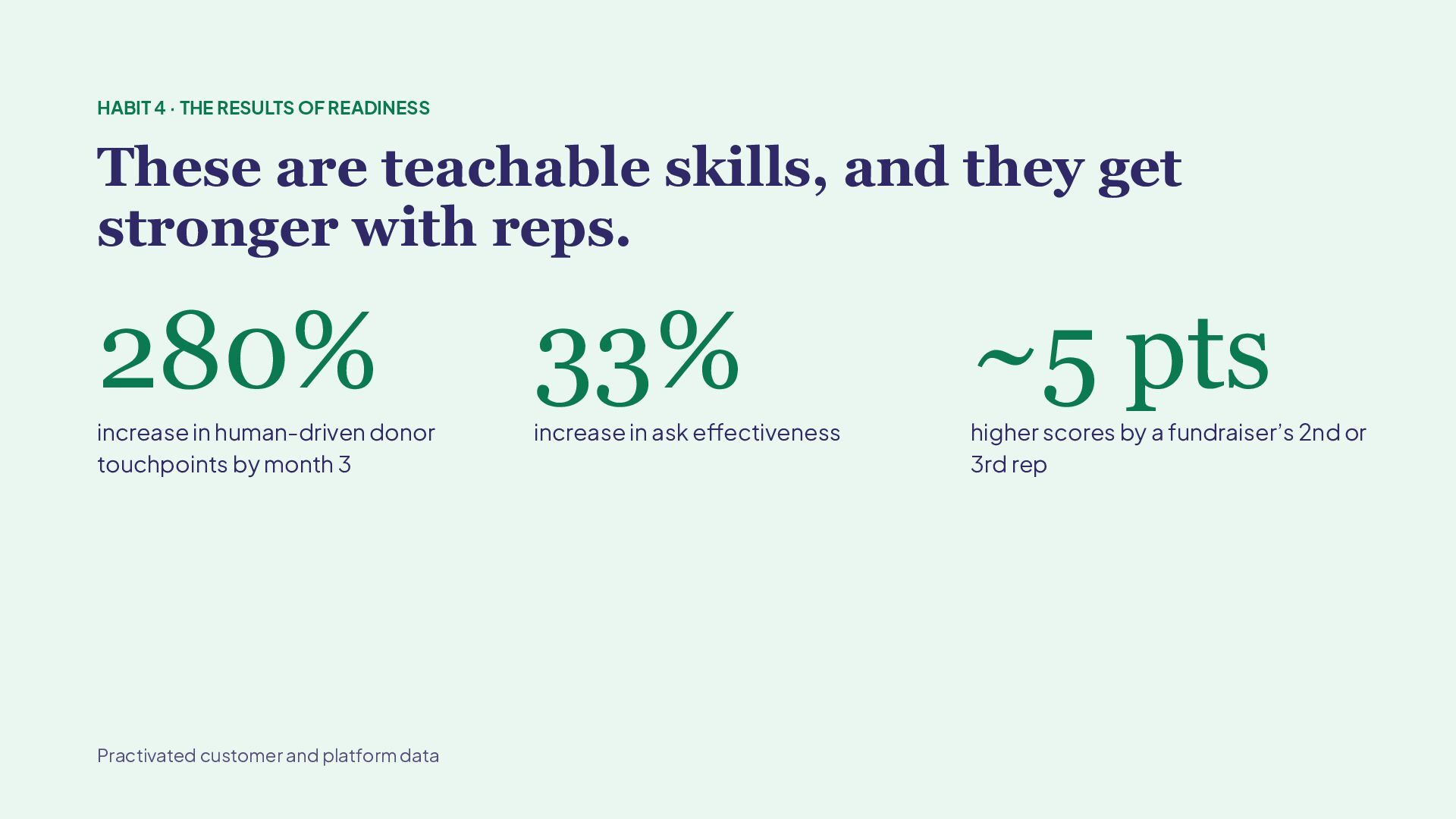
skills, and they get stronger with reps. 280% 33% ~5 pts increase in human-driven donor touchpoints by month 3 increase in ask effectiveness higher scores by a fundraiser’s 2nd or 3rd rep Practivated customer and platform data
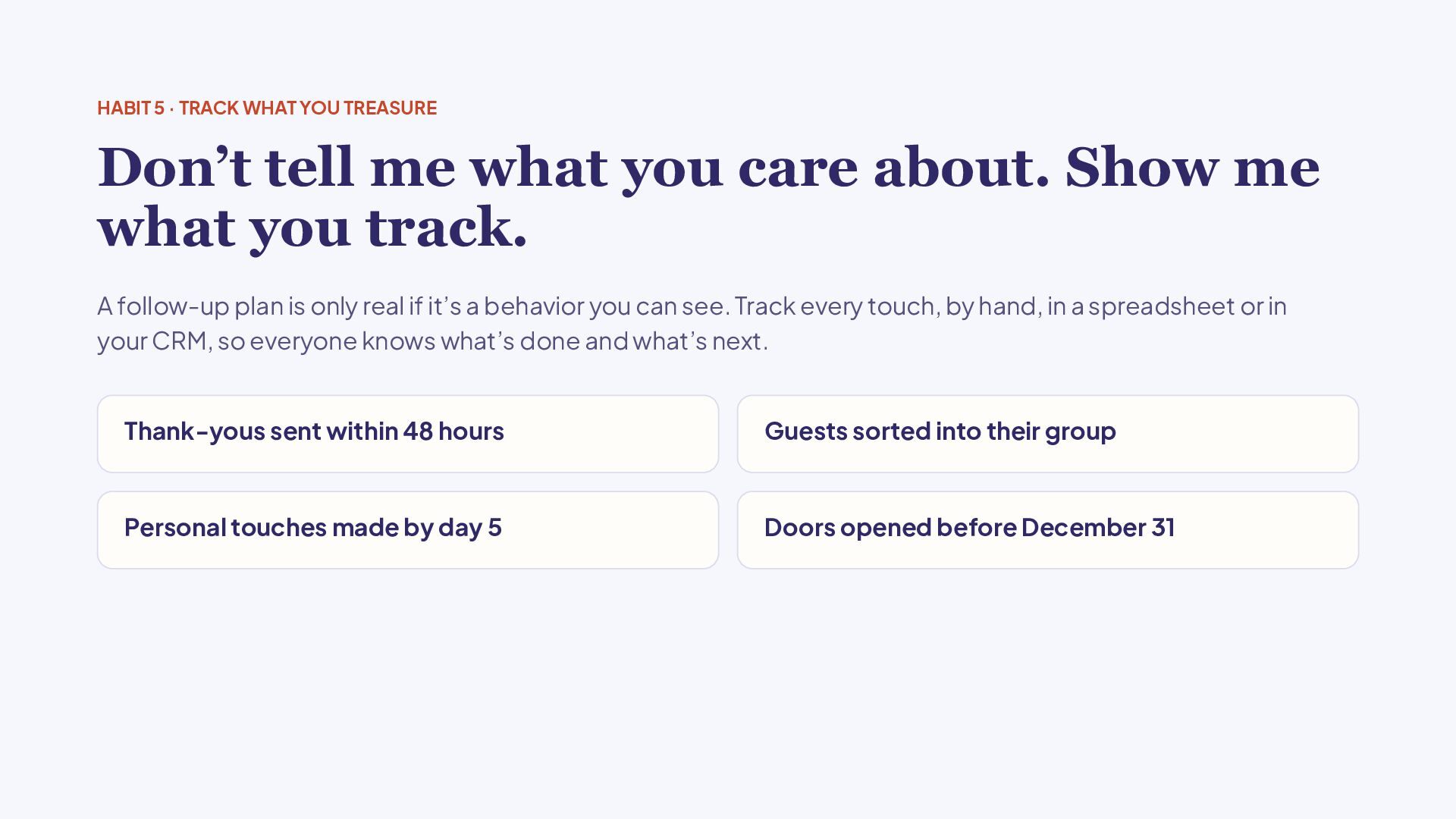
what you care about. Show me what you track. A follow-up plan is only real if it’s a behavior you can see. Track every touch, by hand, in a spreadsheet or in your CRM, so everyone knows what’s done and what’s next. Thank-yous sent within 48 hours Guests sorted into their group Personal touches made by day 5 Doors opened before December 31
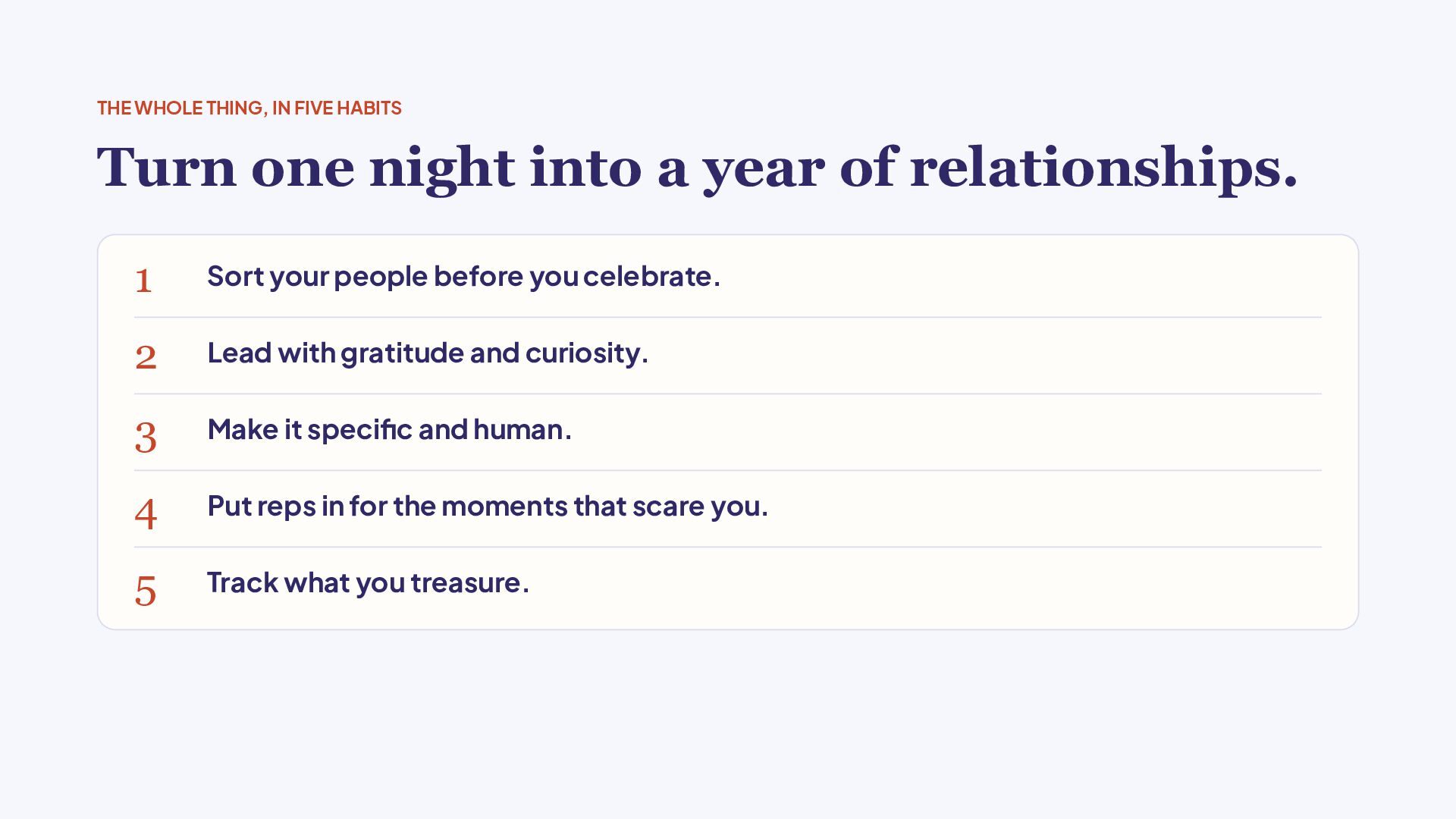
a year of relationships. 1 Sort your people before you celebrate. 2 Lead with gratitude and curiosity. 3 Make it specific and human. 4 Put reps in for the moments that scare you. 5 Track what you treasure.
didn’t have time for today — the exact questions to ask, the permission script, the four-touch follow-up rhythm, and what to say in the tender moments. Yours free, no strings. practivated.com/donorfollowup Scan to download the free kit


 auctria
 wayneb77
 morganepeng
 ryanjones
 rabernat
 shlominoach
 reverentgeek
 techseoconnect
 tammyeverts
 eileencodes
 soudai
 denniskardys