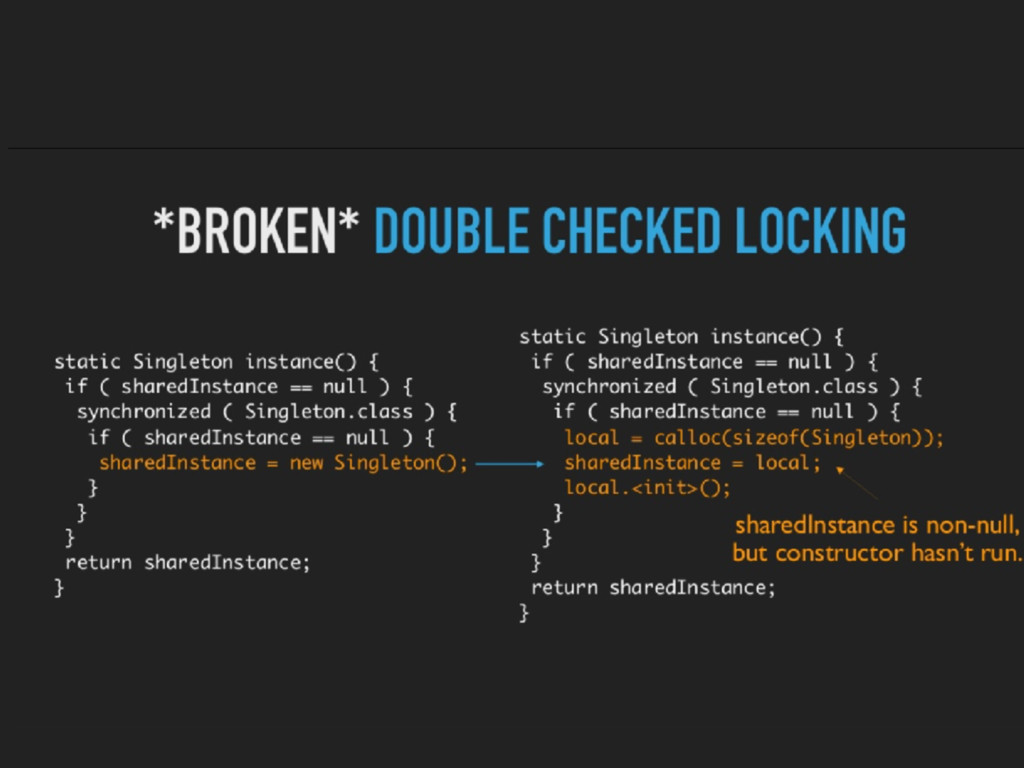
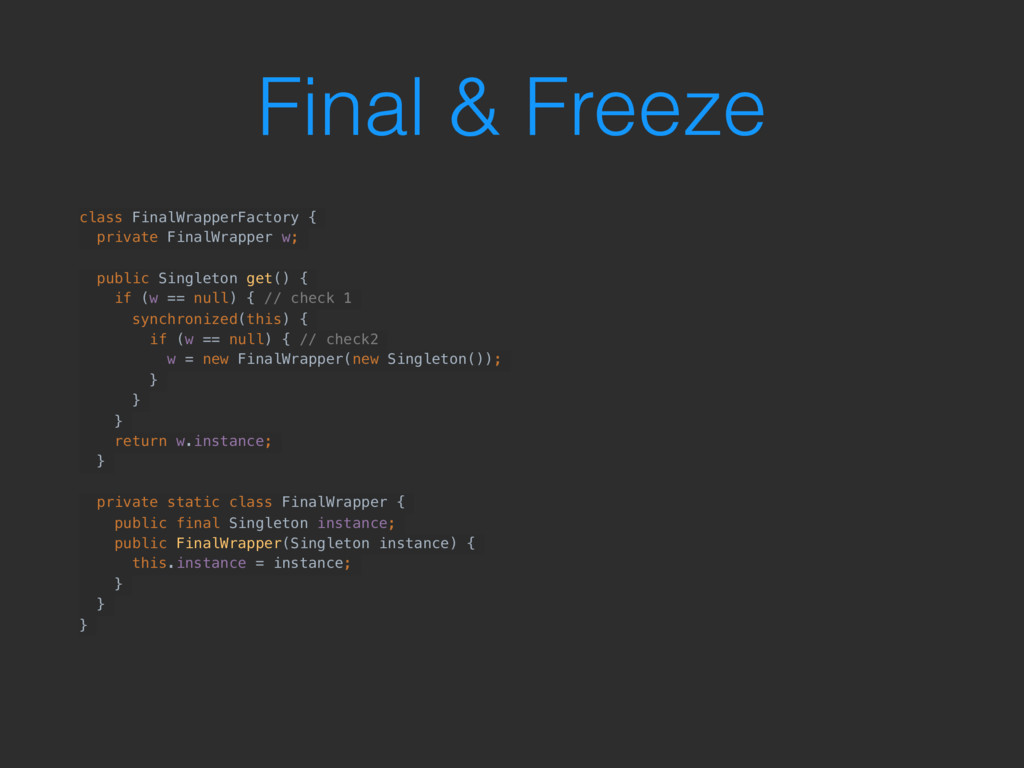
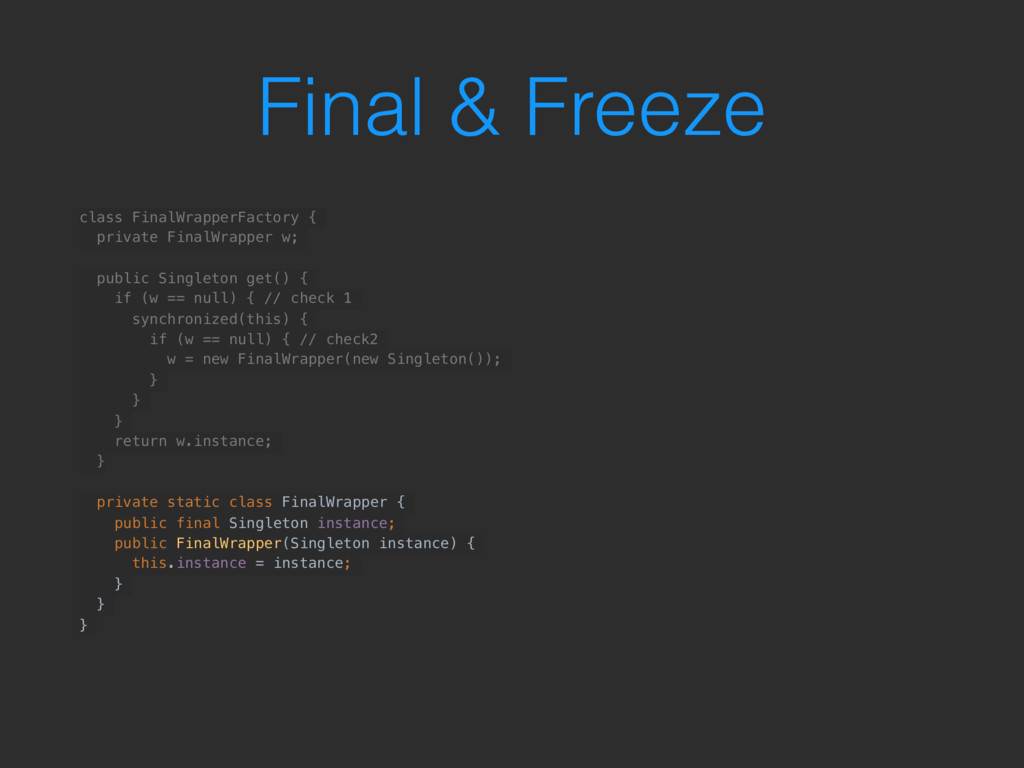
Singleton get() { if (w == null) { // check 1 synchronized(this) { if (w == null) { // check2 w = new FinalWrapper(new Singleton()); } } } return w.instance; } private static class FinalWrapper { public final Singleton instance; public FinalWrapper(Singleton instance) { this.instance = instance; } } }
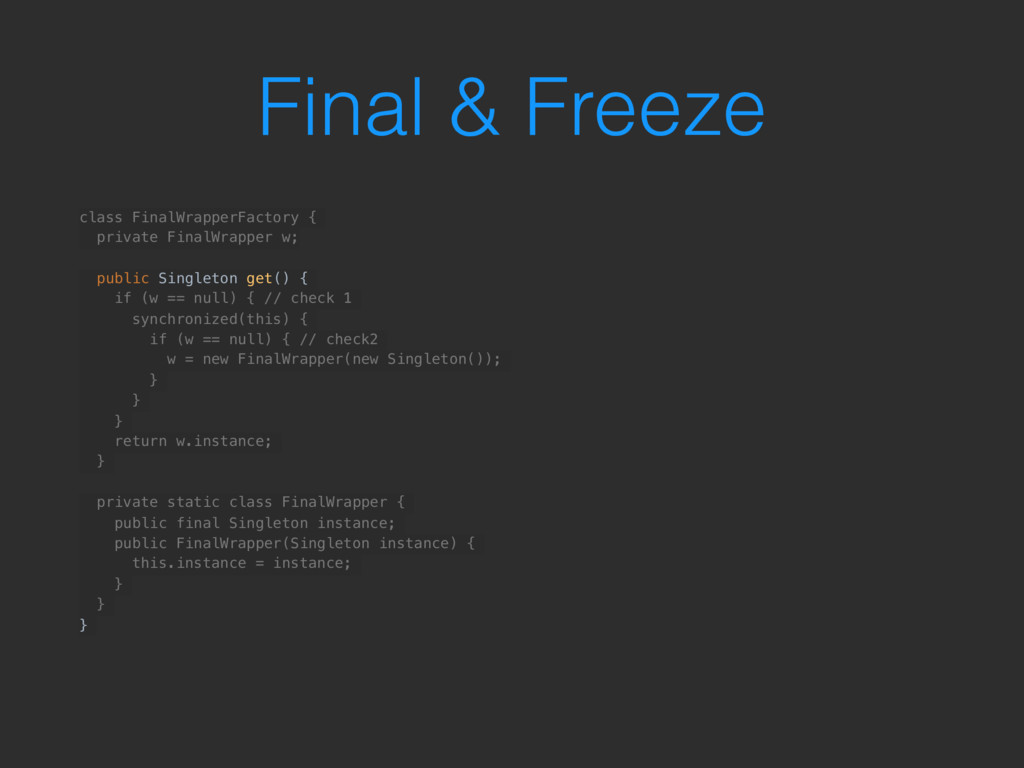
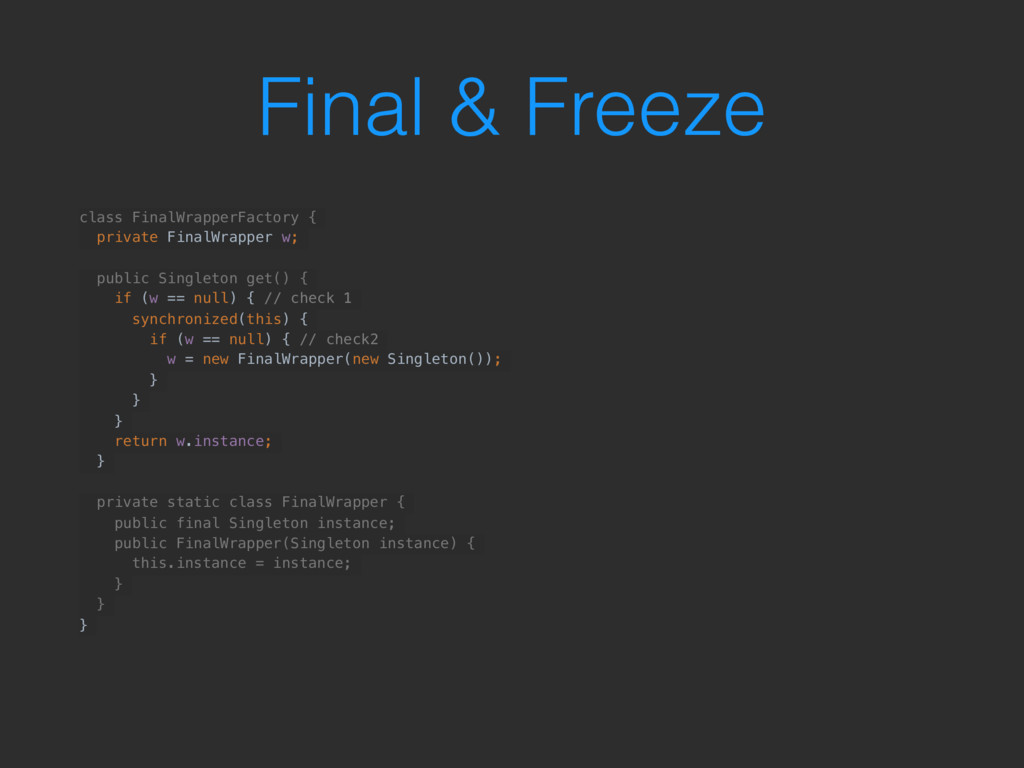
Singleton get() { if (w == null) { // check 1 synchronized(this) { if (w == null) { // check2 w = new FinalWrapper(new Singleton()); } } } return w.instance; } private static class FinalWrapper { public final Singleton instance; public FinalWrapper(Singleton instance) { this.instance = instance; } } }
Singleton get() { if (w == null) { // check 1 synchronized(this) { if (w == null) { // check2 w = new FinalWrapper(new Singleton()); } } } return w.instance; } private static class FinalWrapper { public final Singleton instance; public FinalWrapper(Singleton instance) { this.instance = instance; } } }
Singleton get() { if (w == null) { // check 1 synchronized(this) { if (w == null) { // check2 w = new FinalWrapper(new Singleton()); } } } return w.instance; } private static class FinalWrapper { public final Singleton instance; public FinalWrapper(Singleton instance) { this.instance = instance; } } }
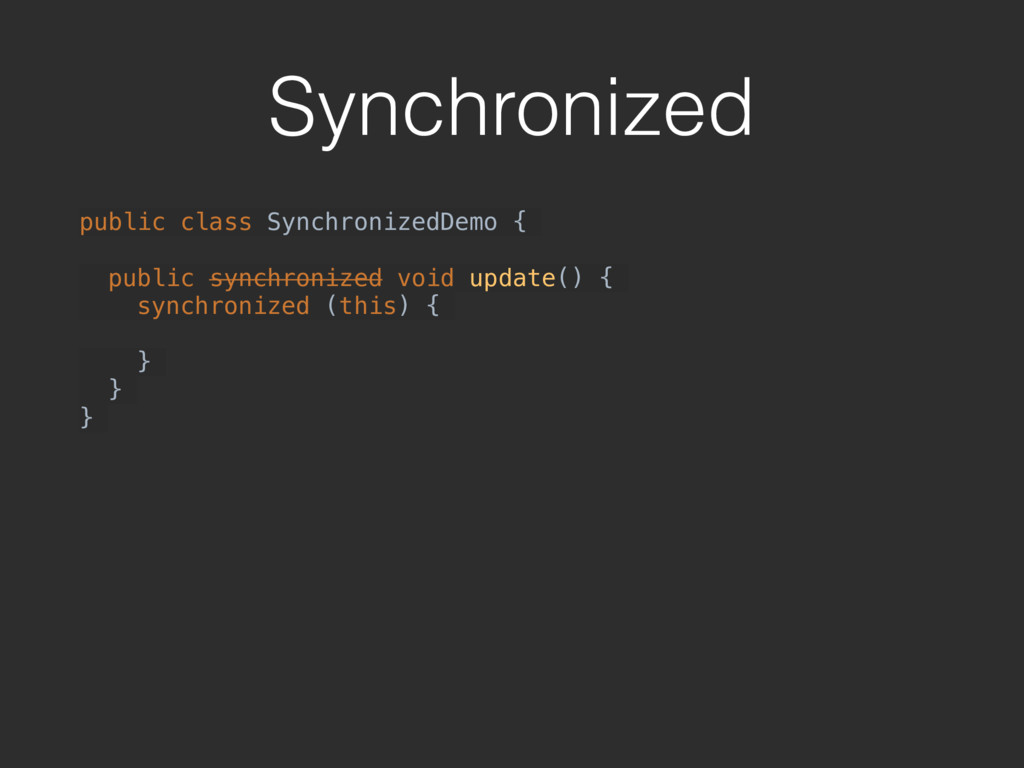
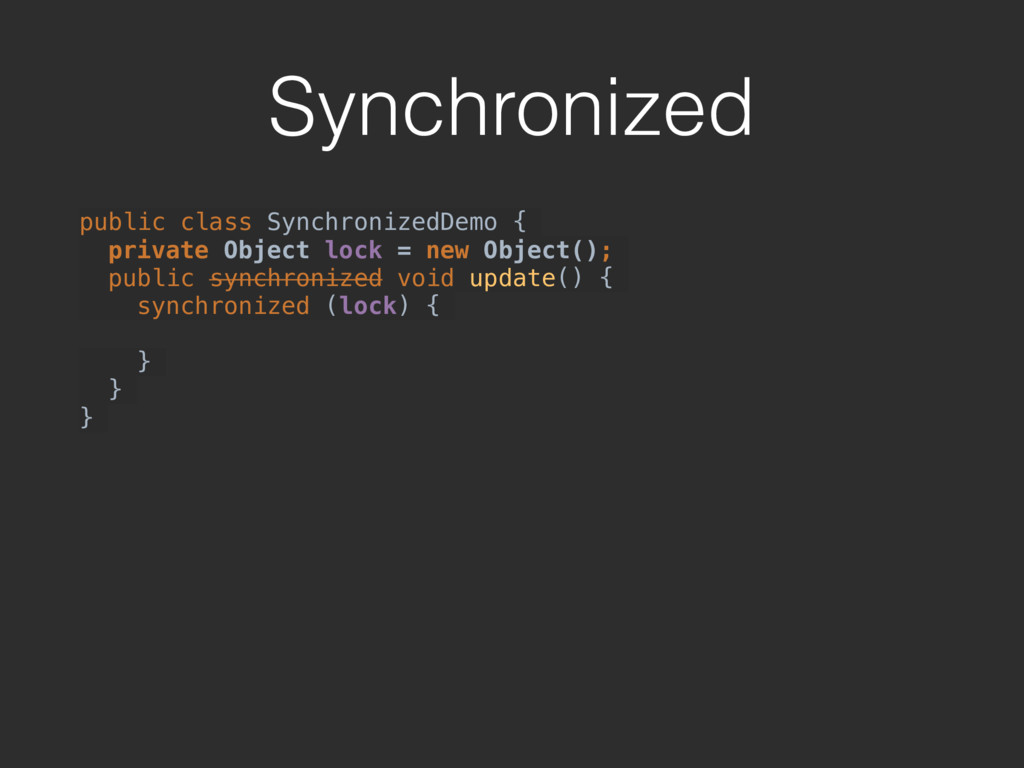
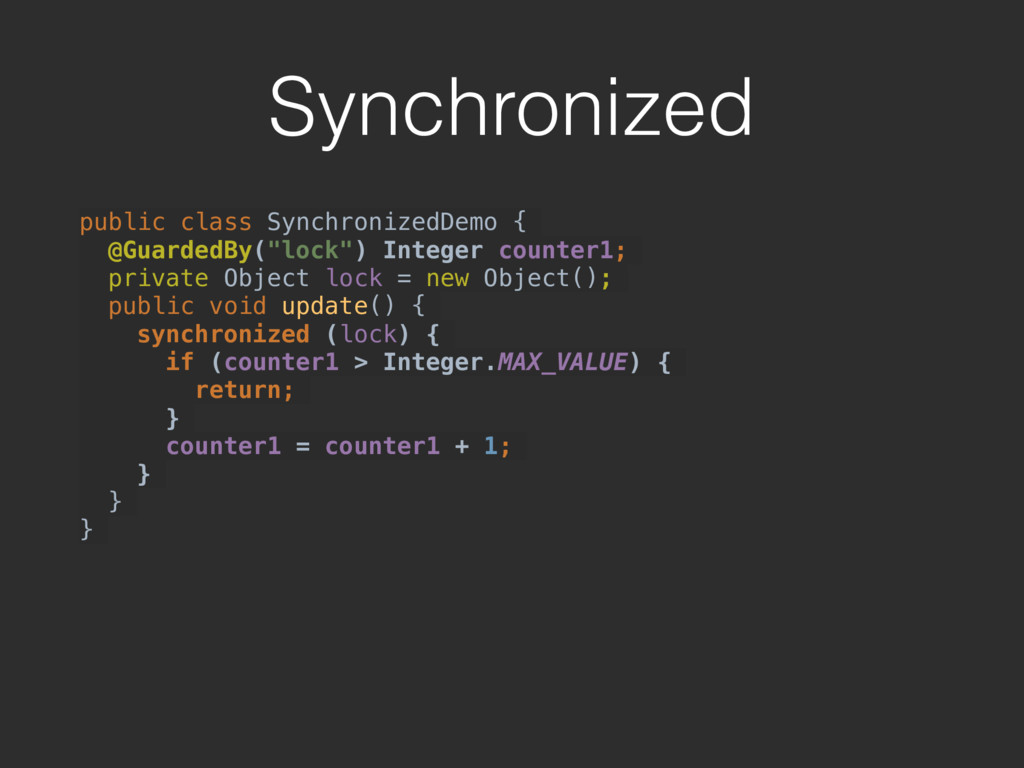
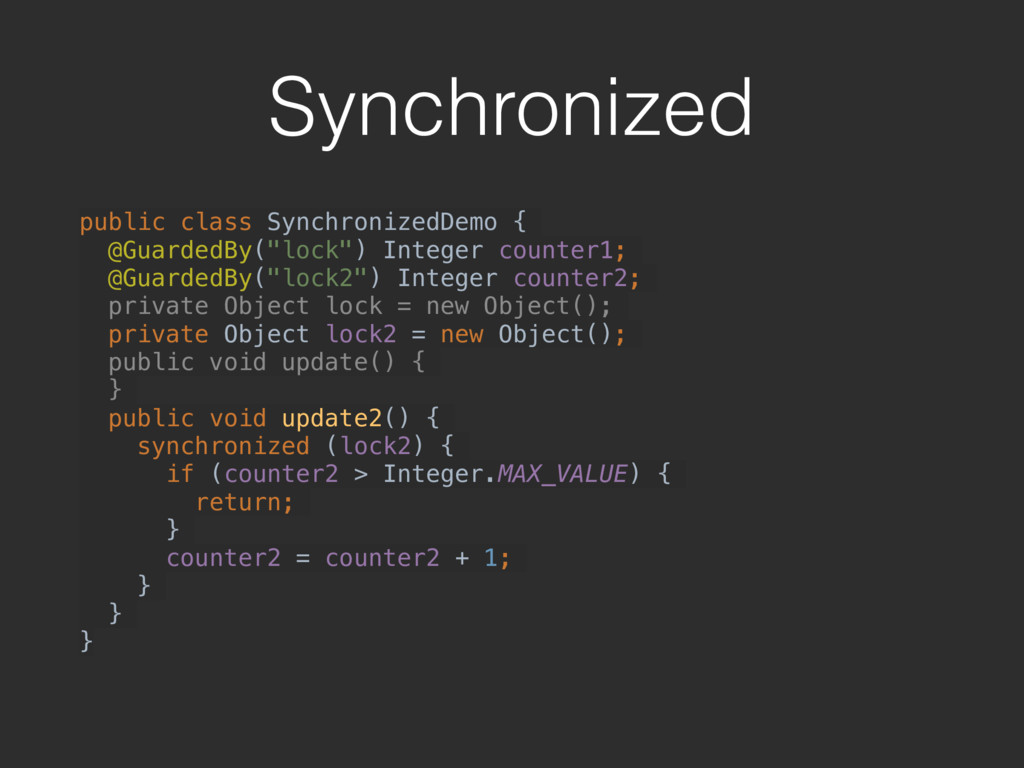
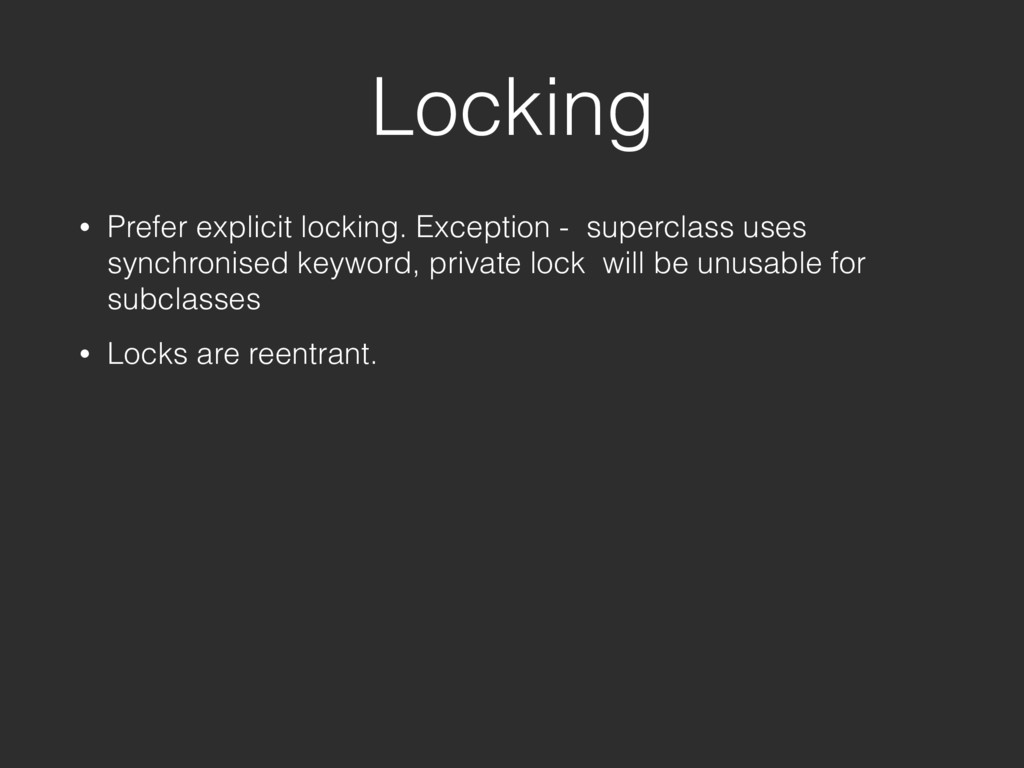
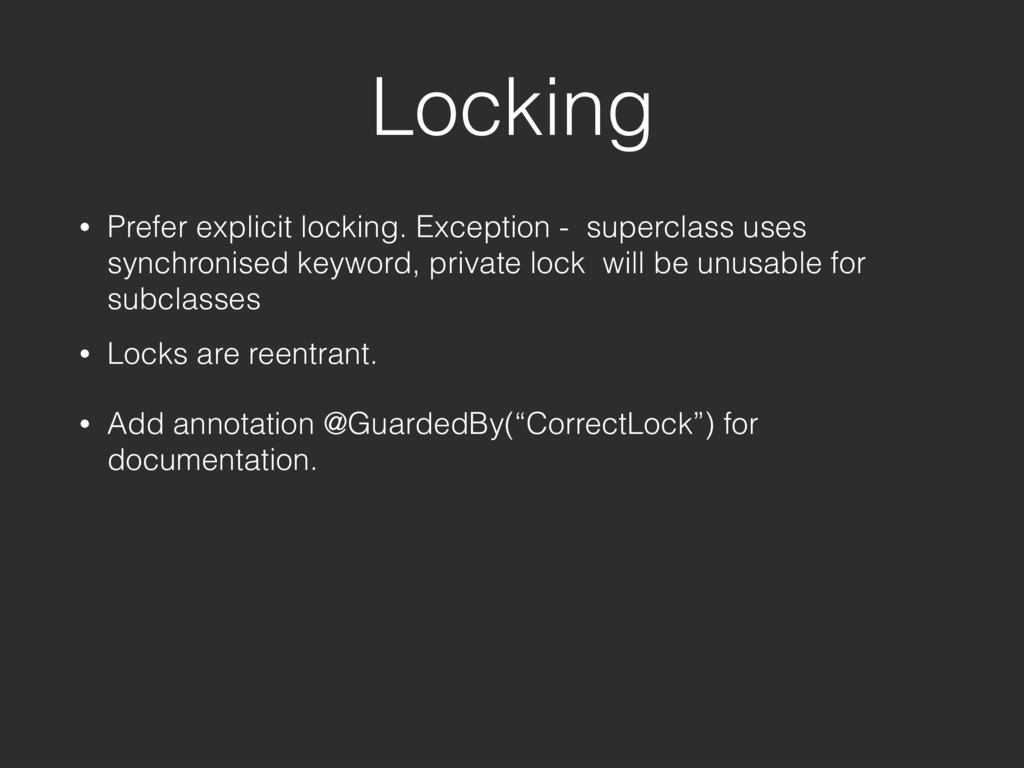
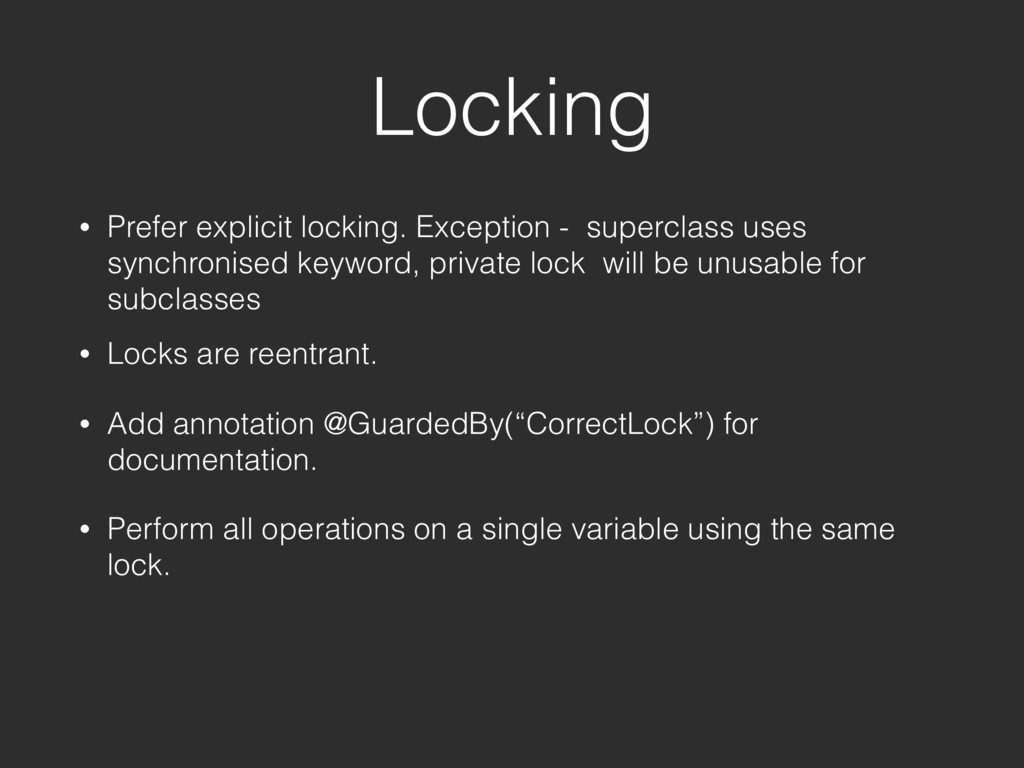
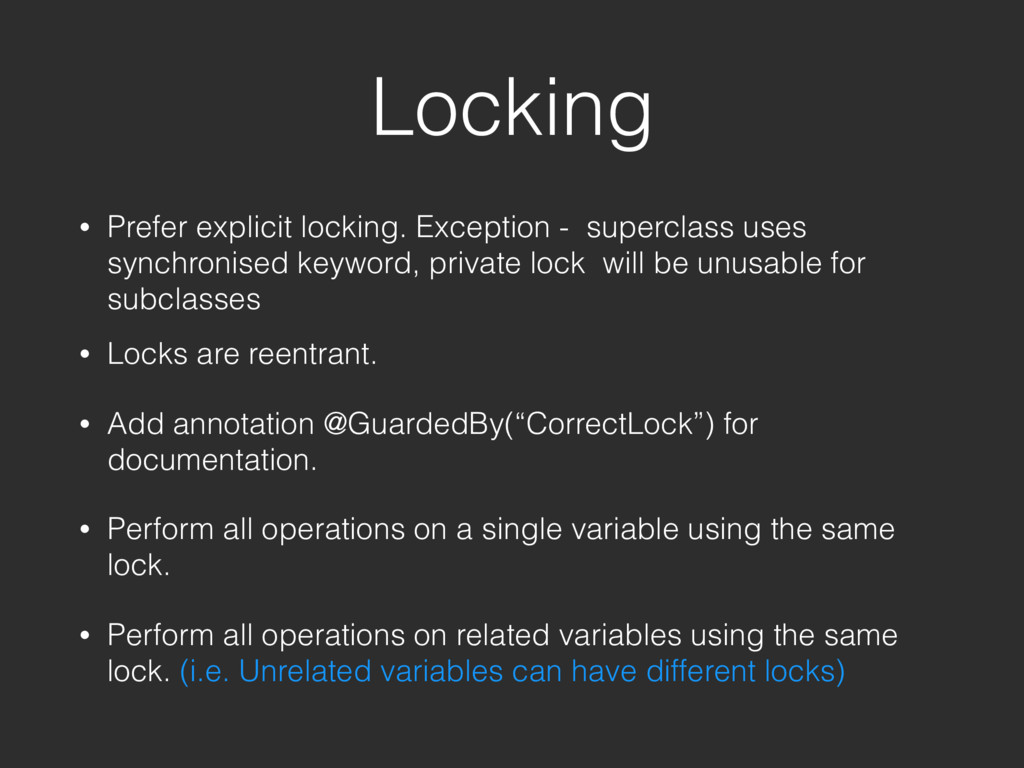
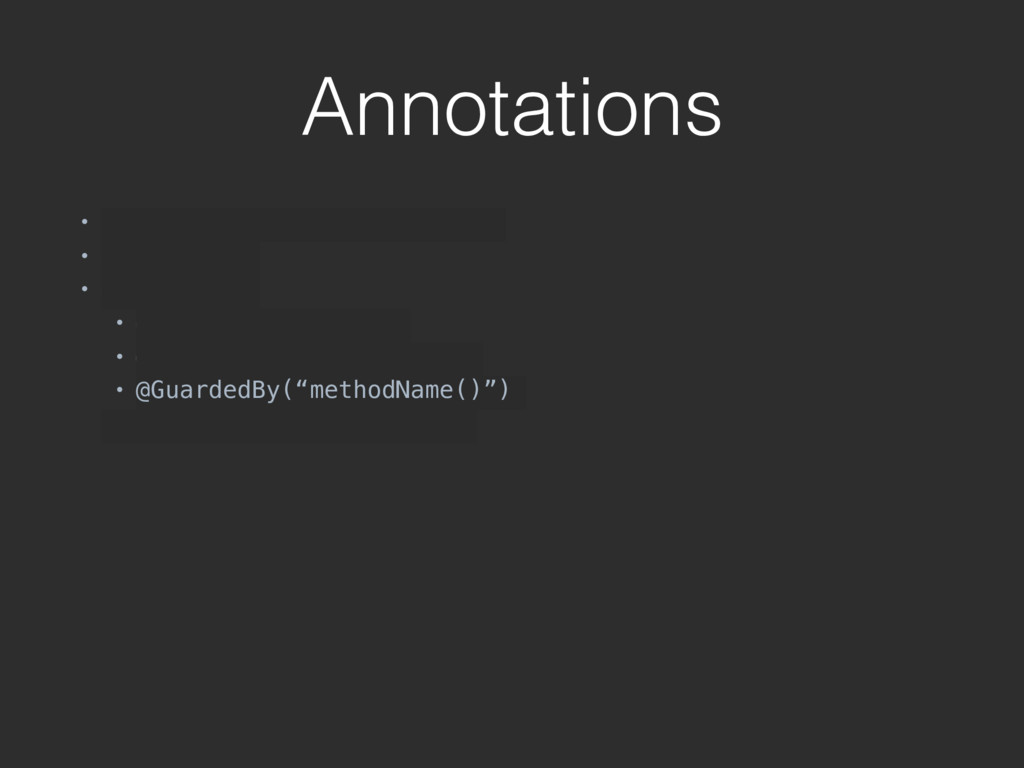
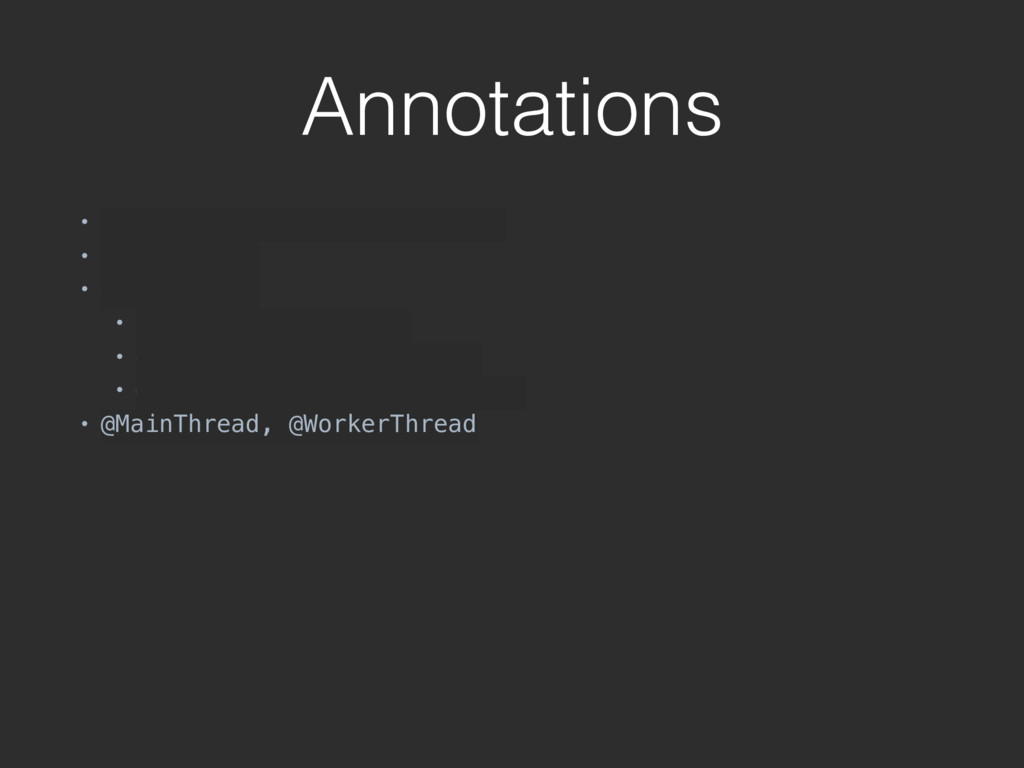
keyword, private lock will be unusable for subclasses • Locks are reentrant. • Add annotation @GuardedBy(“CorrectLock”) for documentation. • Perform all operations on a single variable using the same lock.
keyword, private lock will be unusable for subclasses • Locks are reentrant. • Add annotation @GuardedBy(“CorrectLock”) for documentation. • Perform all operations on a single variable using the same lock. • Perform all operations on related variables using the same lock. (i.e. Unrelated variables can have different locks)
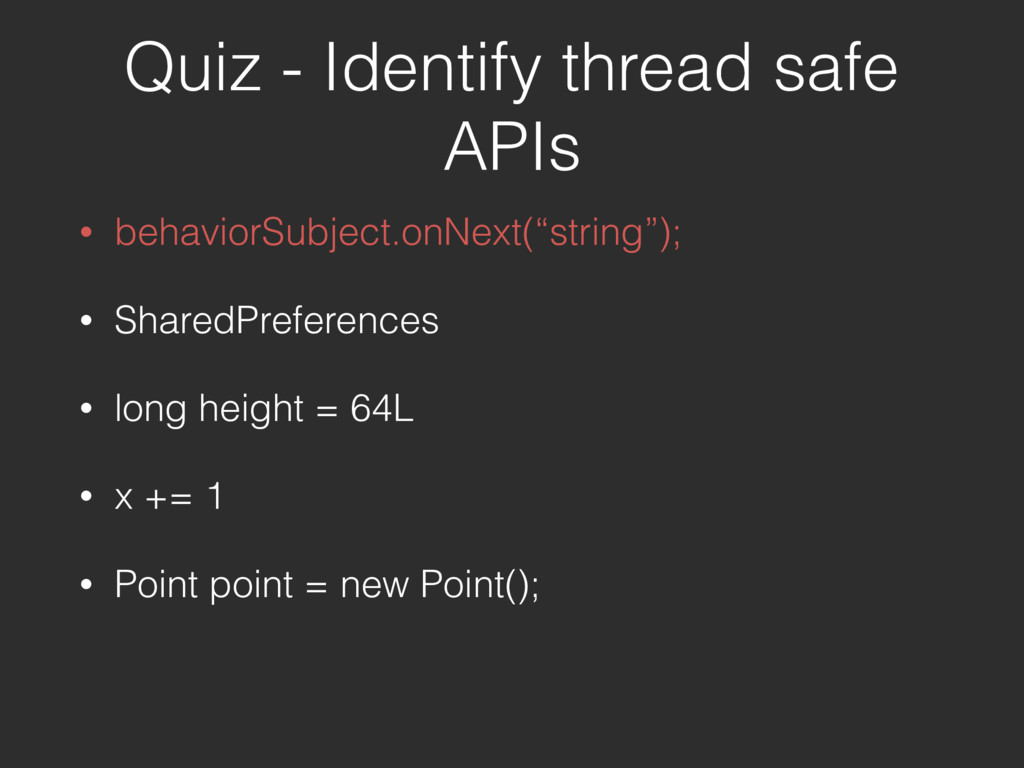
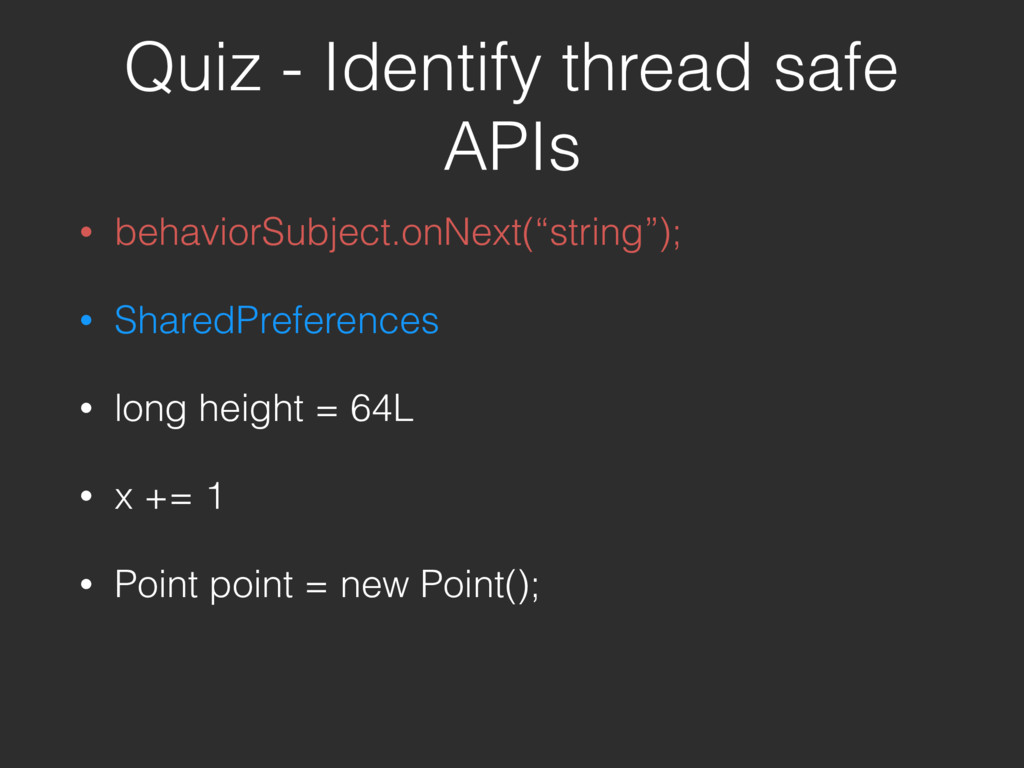
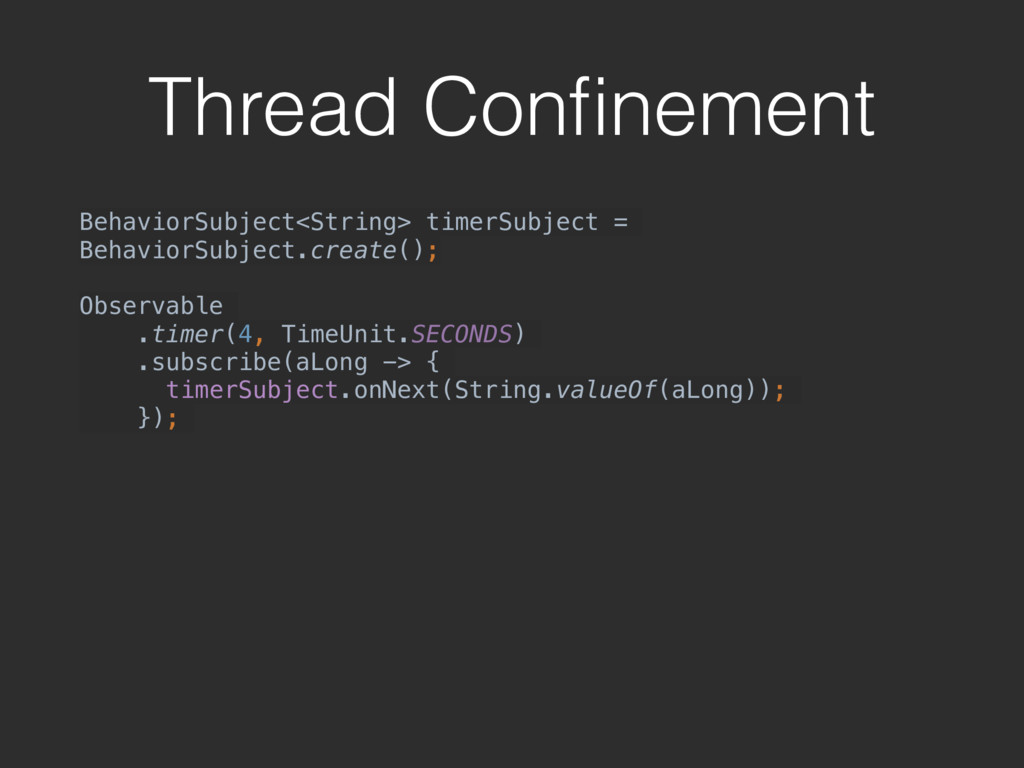
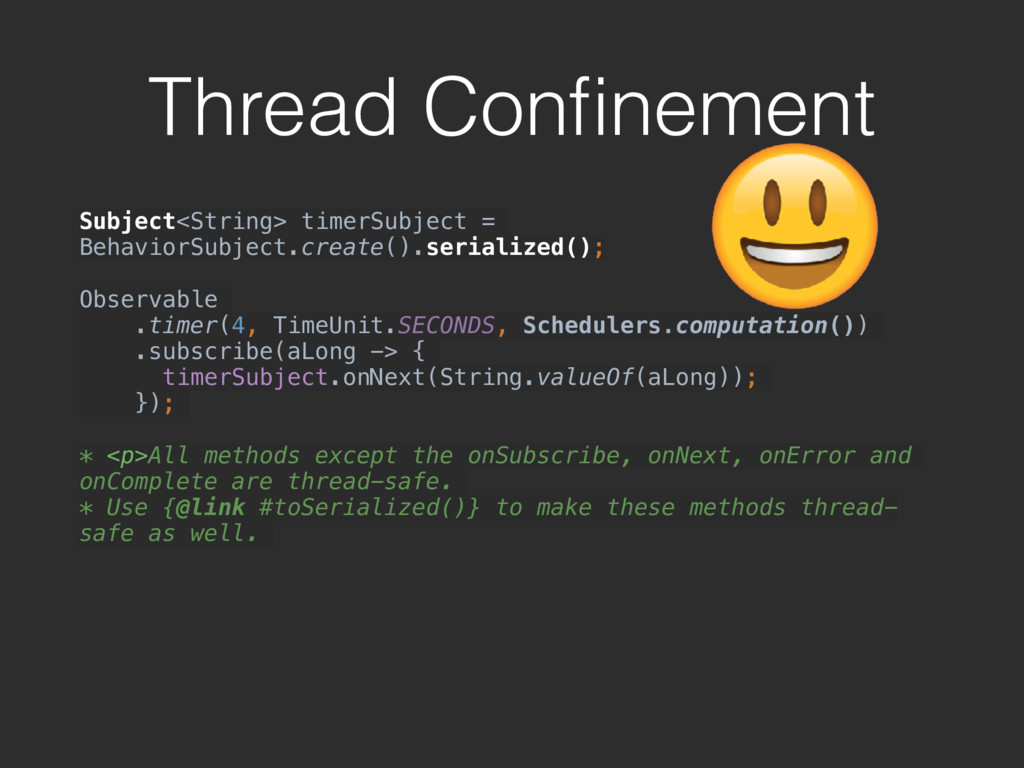
.subscribe(aLong -> { timerSubject.onNext(String.valueOf(aLong)); }); * <p>All methods except the onSubscribe, onNext, onError and onComplete are thread-safe. * Use {@link #toSerialized()} to make these methods thread- safe as well.
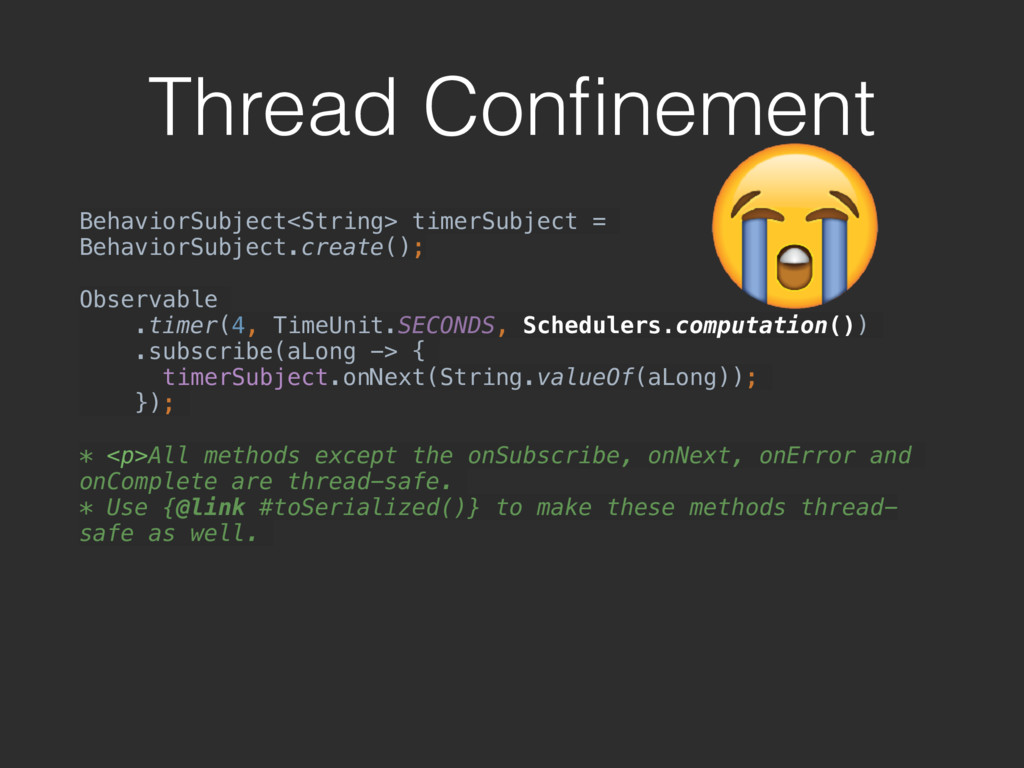
.subscribe(aLong -> { timerSubject.onNext(String.valueOf(aLong)); }); * <p>All methods except the onSubscribe, onNext, onError and onComplete are thread-safe. * Use {@link #toSerialized()} to make these methods thread- safe as well.
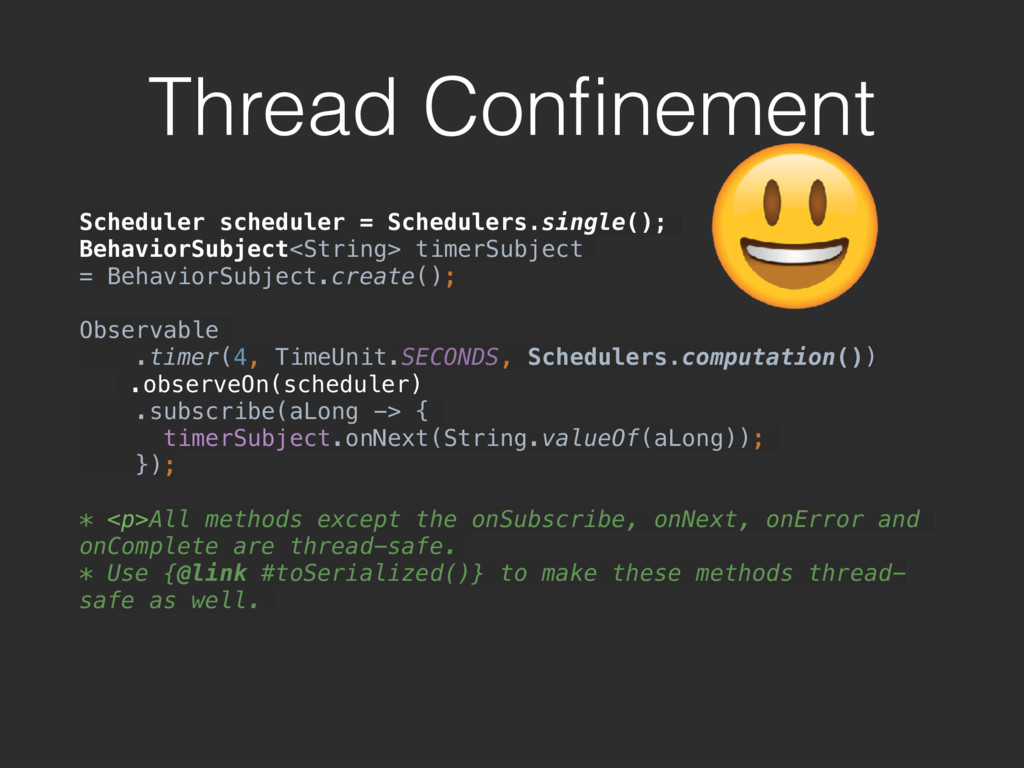
Observable .timer(4, TimeUnit.SECONDS, Schedulers.computation()) .observeOn(scheduler) .subscribe(aLong -> { timerSubject.onNext(String.valueOf(aLong)); }); * <p>All methods except the onSubscribe, onNext, onError and onComplete are thread-safe. * Use {@link #toSerialized()} to make these methods thread- safe as well.
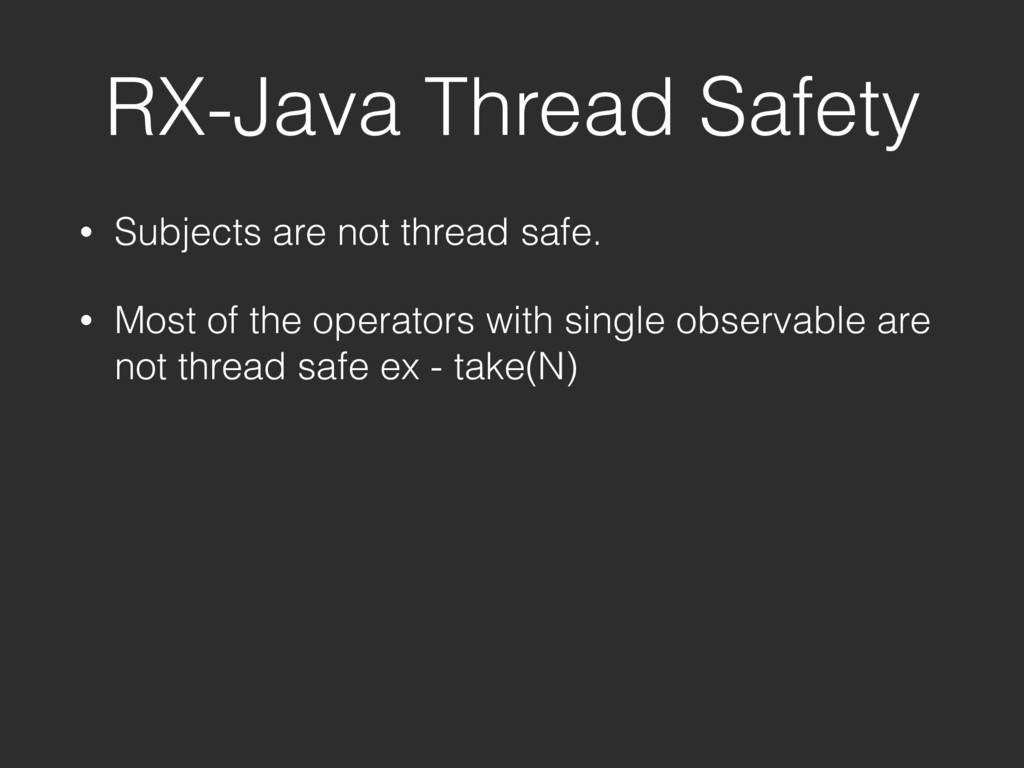
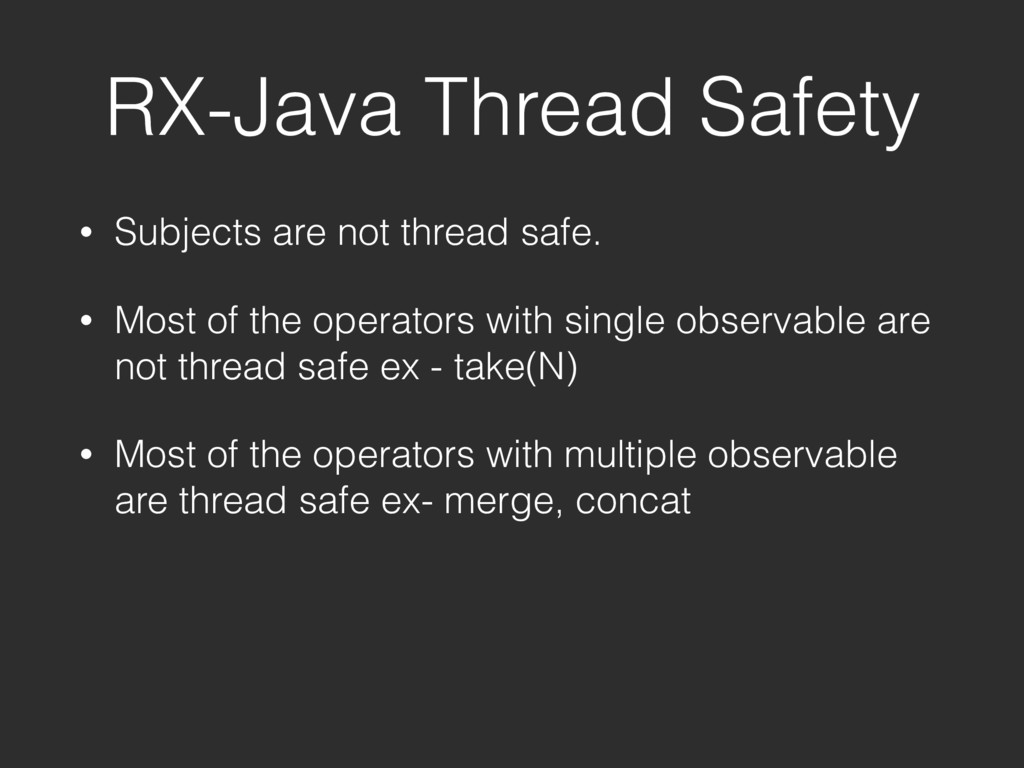
Most of the operators with single observable are not thread safe ex - take(N) • Most of the operators with multiple observable are thread safe ex- merge, concat
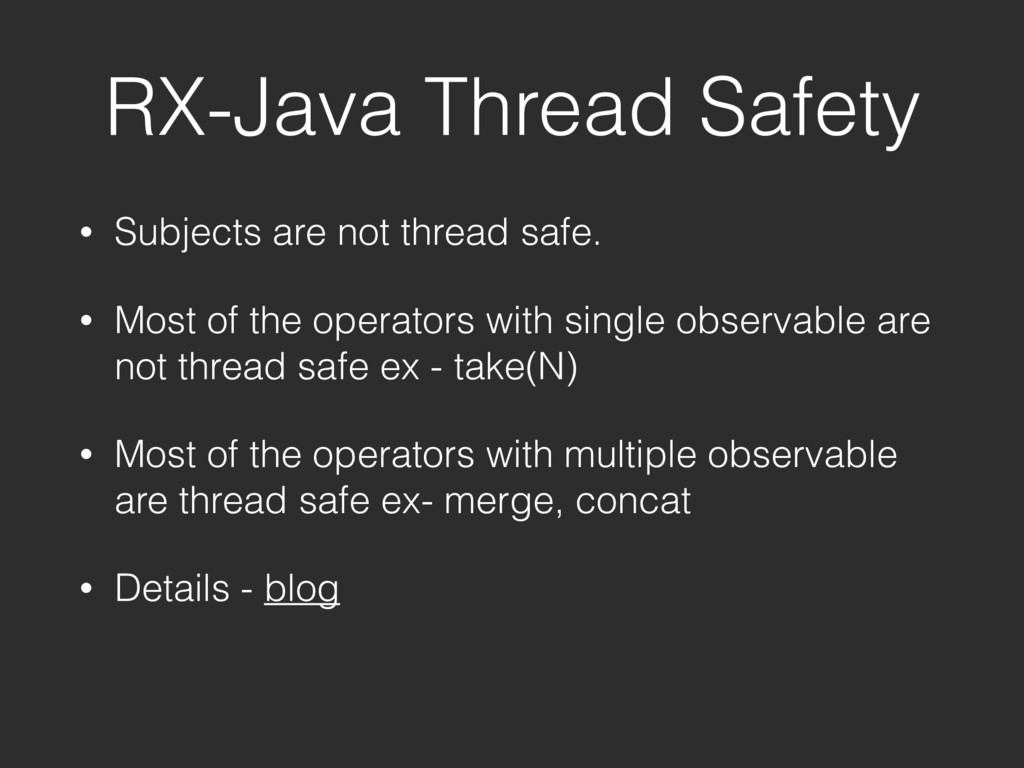
Most of the operators with single observable are not thread safe ex - take(N) • Most of the operators with multiple observable are thread safe ex- merge, concat • Details - blog
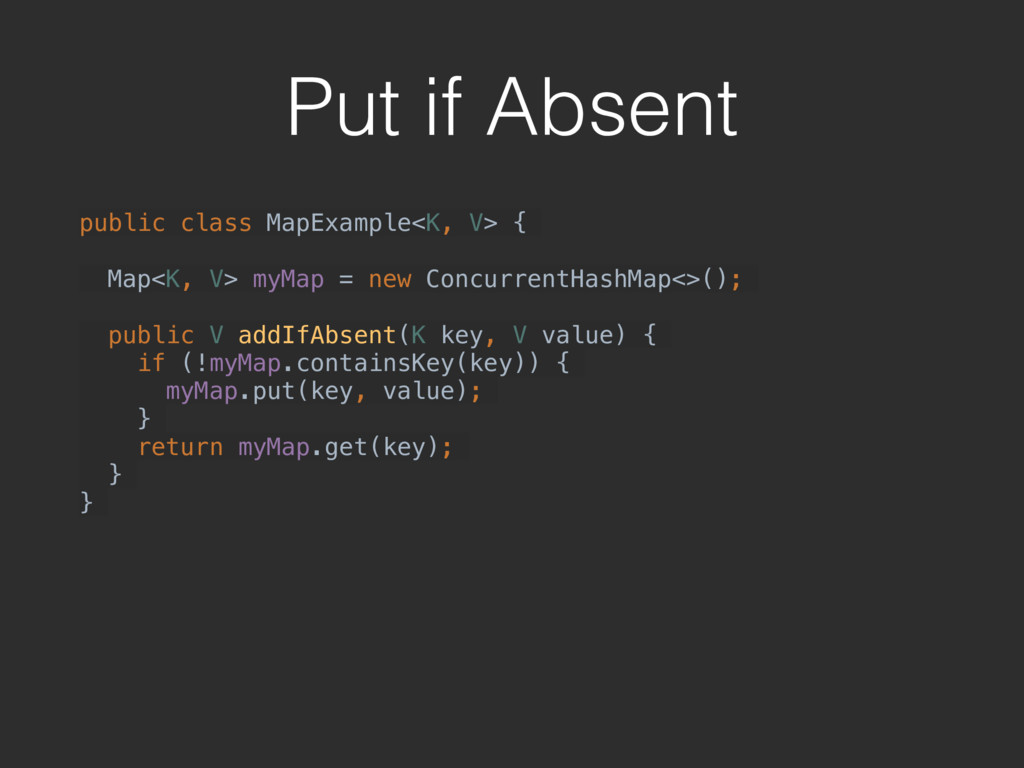
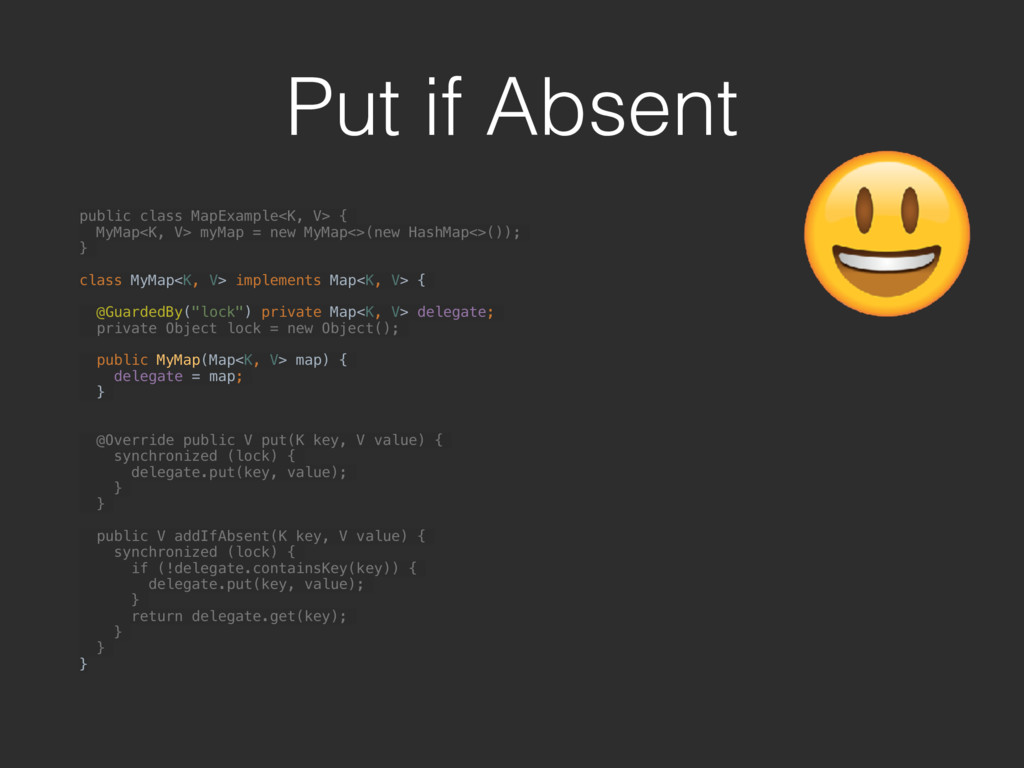
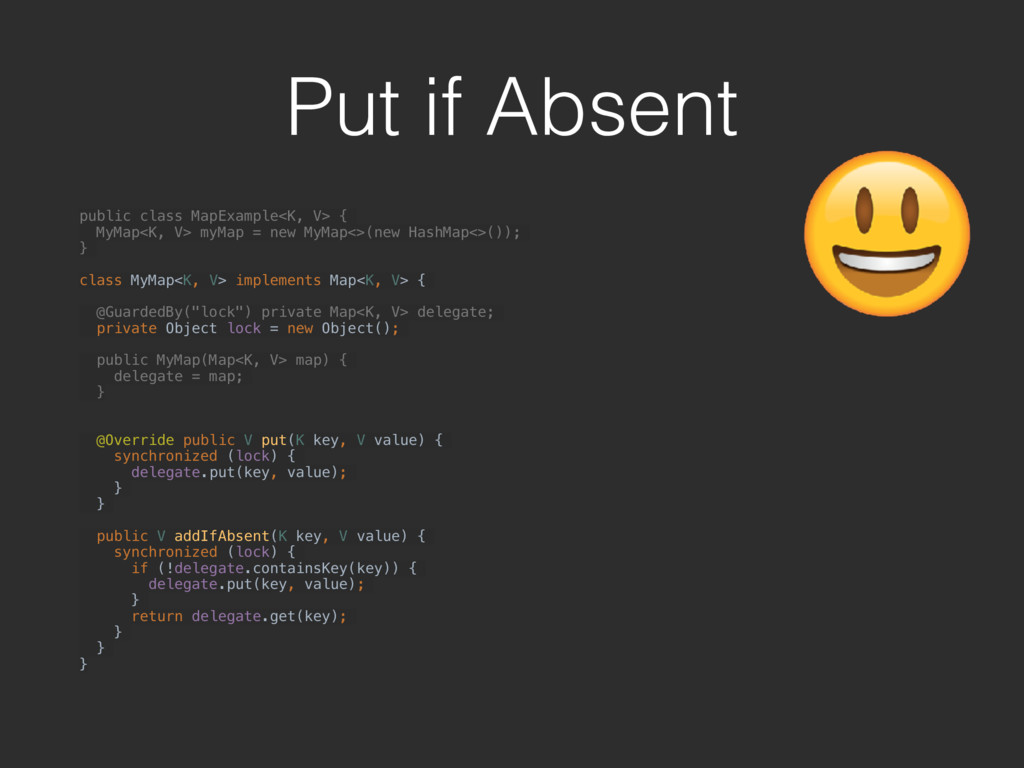
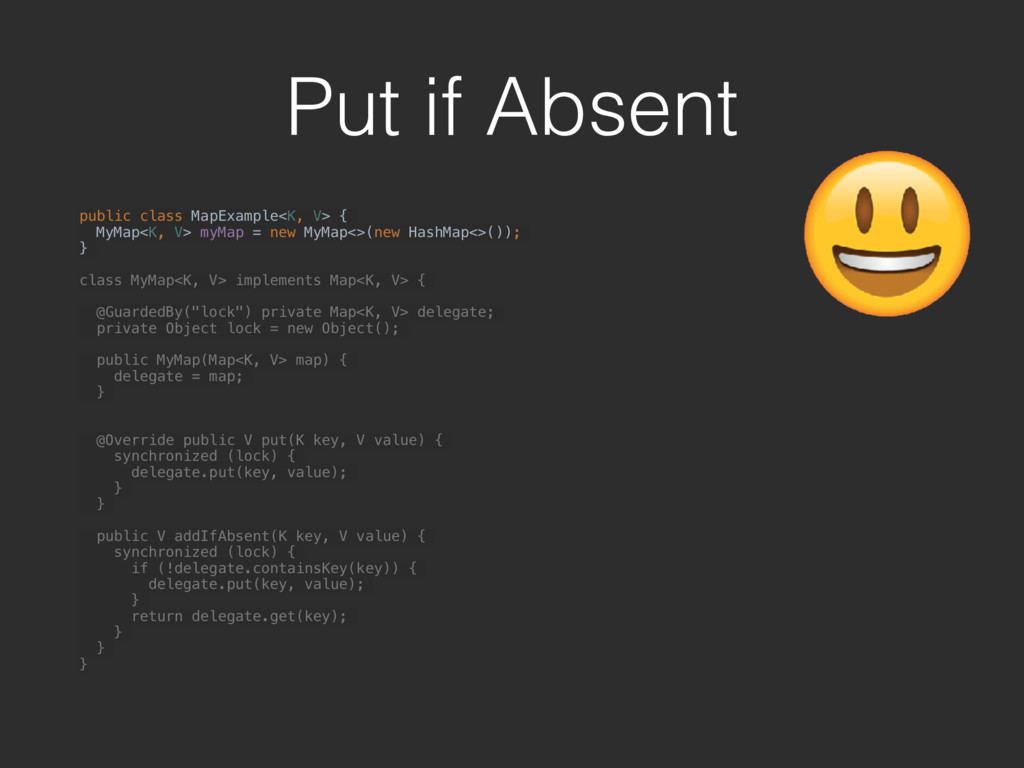
myMap = new ConcurrentHashMap<>(); public V addIfAbsent(K key, V value) { if (!myMap.containsKey(key)) { myMap.put(key, value); } return myMap.get(key); } }
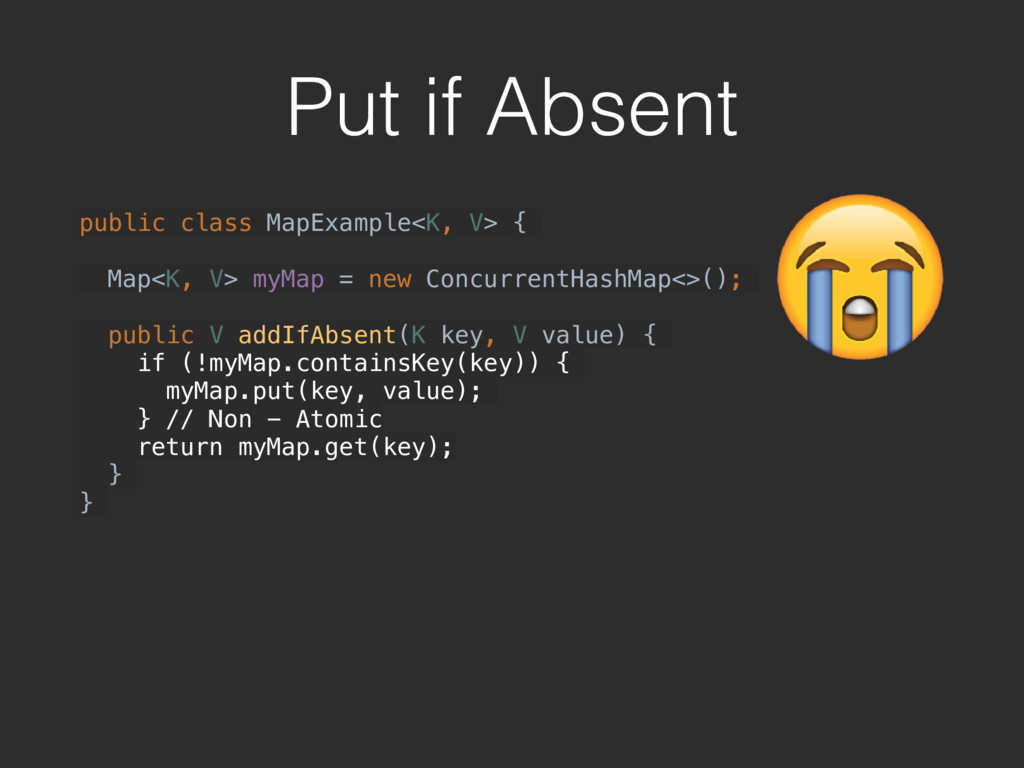
myMap = new ConcurrentHashMap<>(); public V addIfAbsent(K key, V value) { if (!myMap.containsKey(key)) { myMap.put(key, value); } // Non - Atomic return myMap.get(key); } }
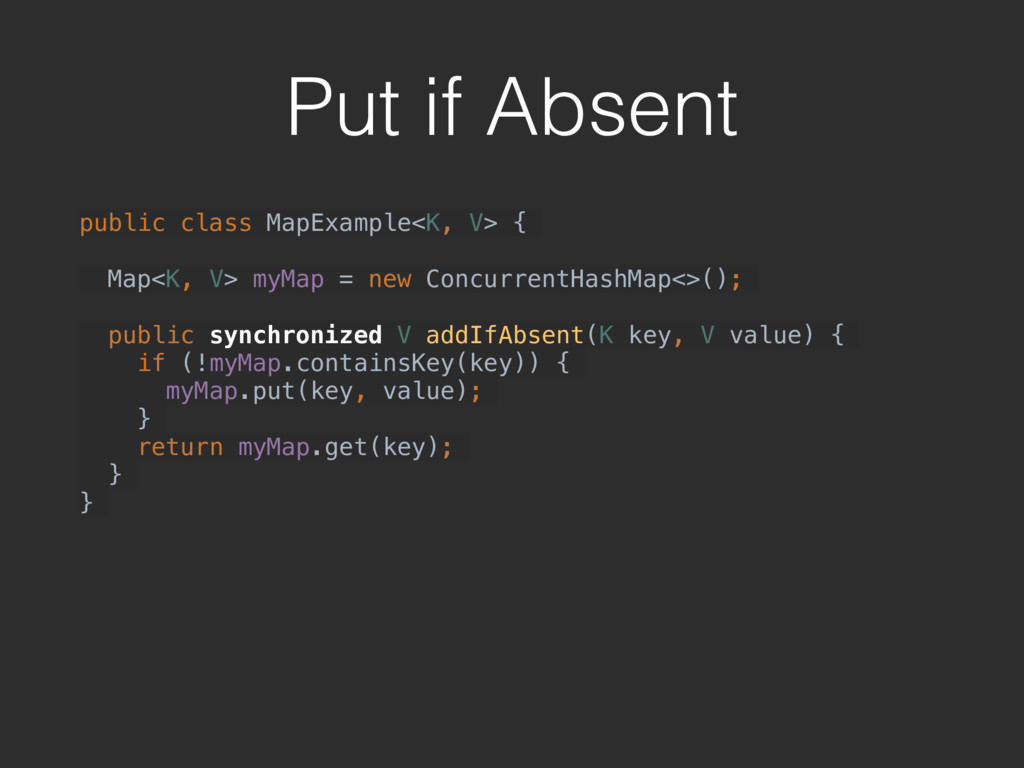
myMap = new ConcurrentHashMap<>(); public synchronized V addIfAbsent(K key, V value) { if (!myMap.containsKey(key)) { myMap.put(key, value); } return myMap.get(key); } }
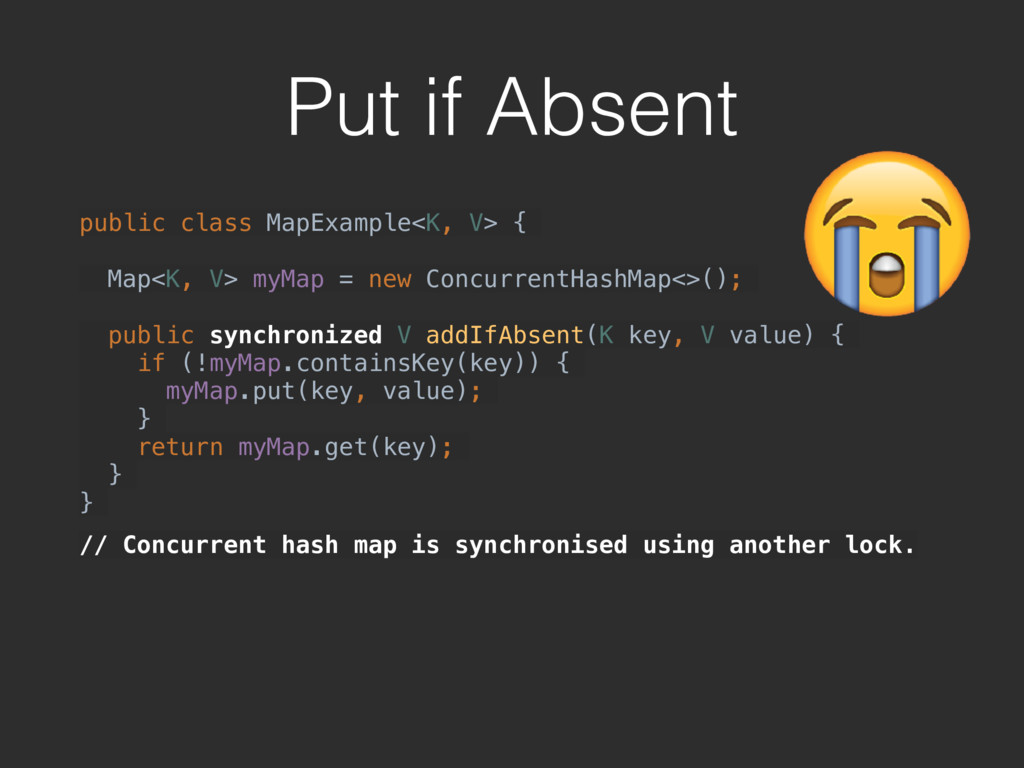
myMap = new ConcurrentHashMap<>(); public synchronized V addIfAbsent(K key, V value) { if (!myMap.containsKey(key)) { myMap.put(key, value); } return myMap.get(key); } } // Concurrent hash map is synchronised using another lock.
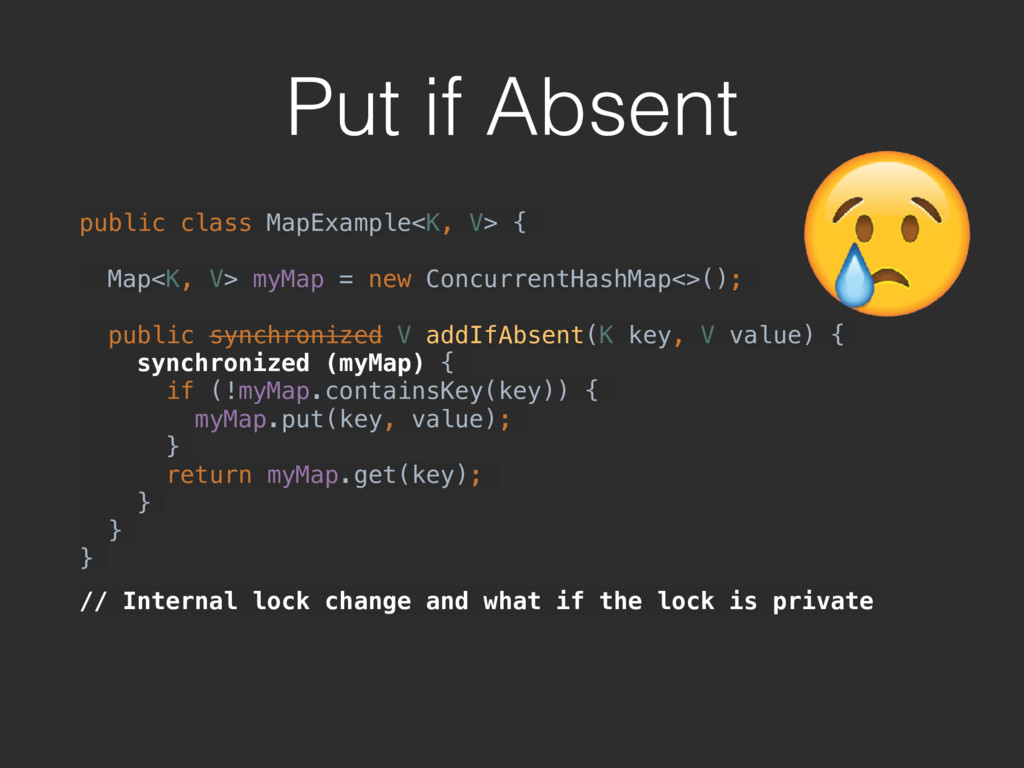
myMap = new ConcurrentHashMap<>(); public synchronized V addIfAbsent(K key, V value) { synchronized (myMap) { if (!myMap.containsKey(key)) { myMap.put(key, value); } return myMap.get(key); } } } // Internal lock change and what if the lock is private
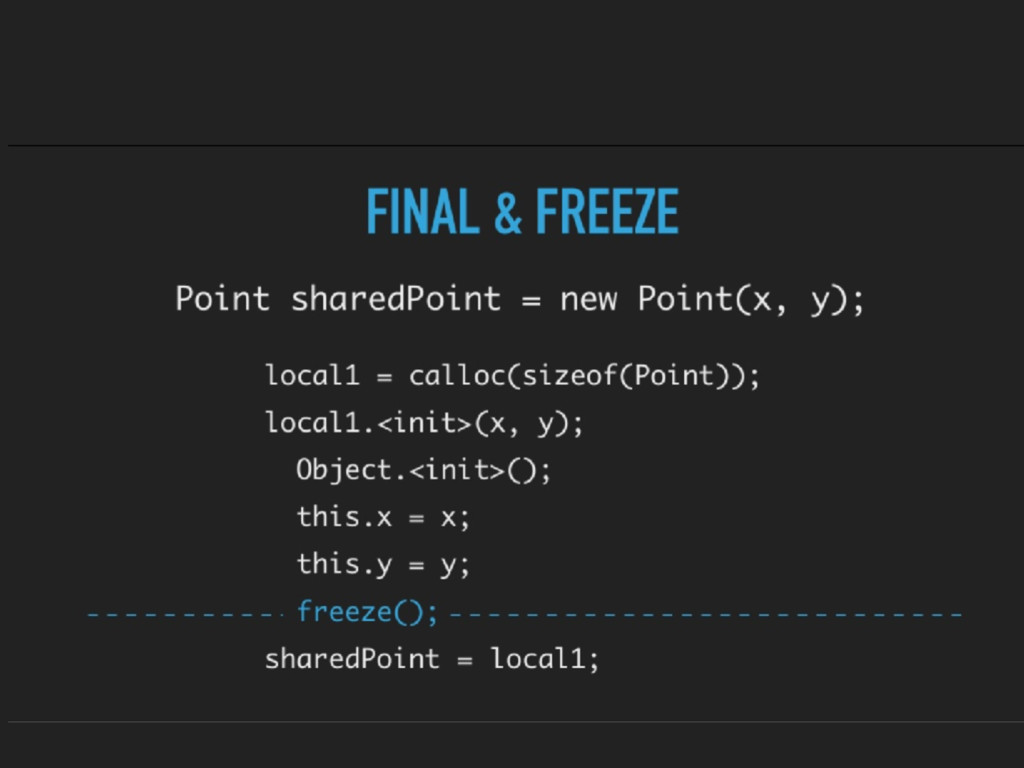
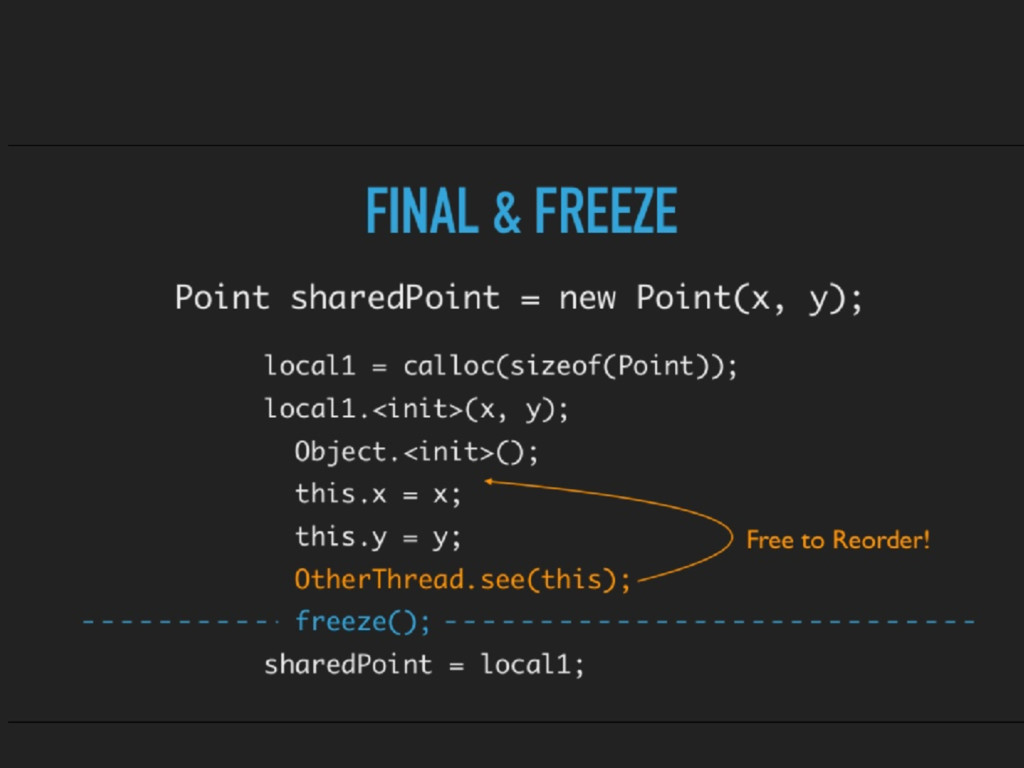
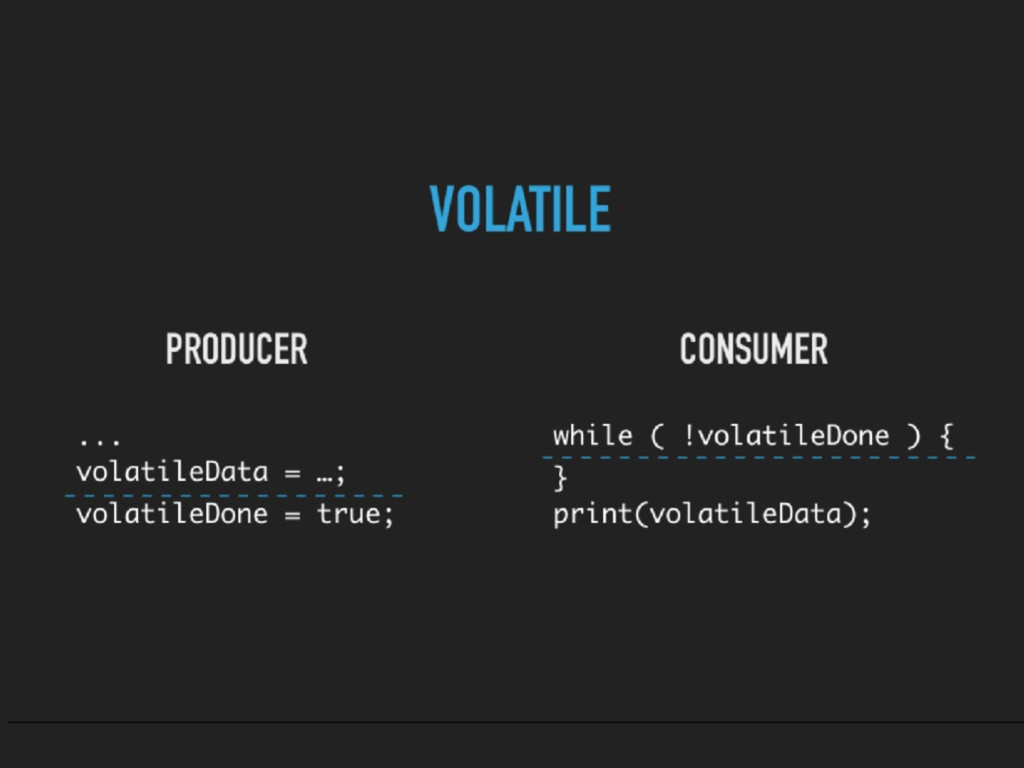
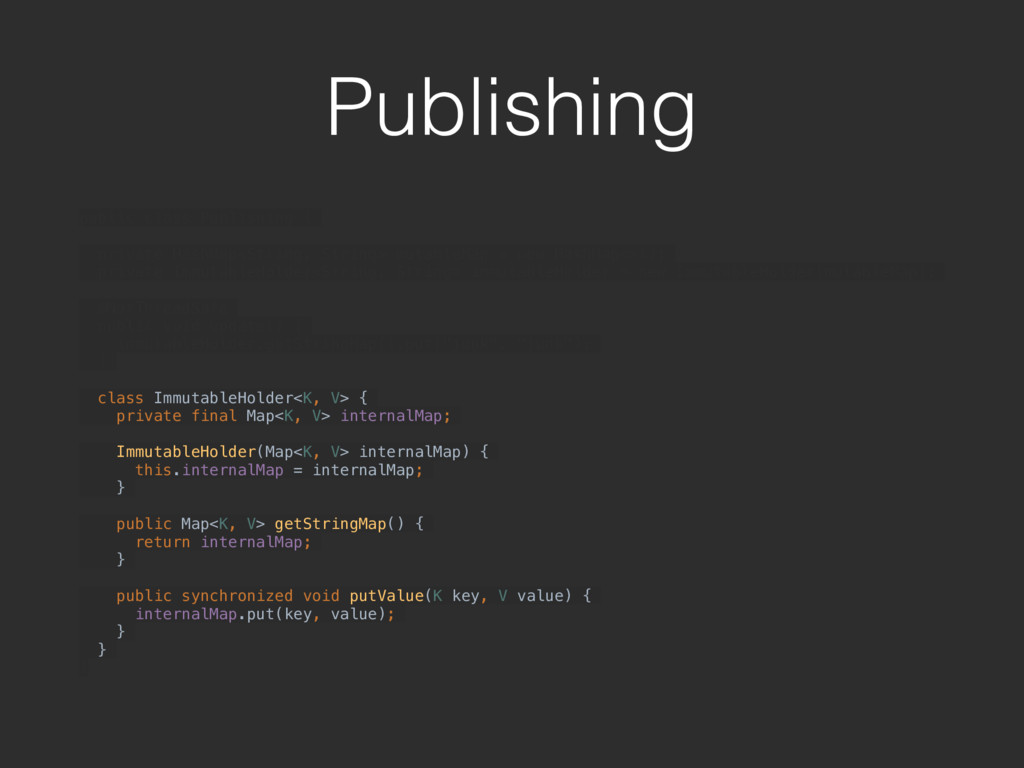
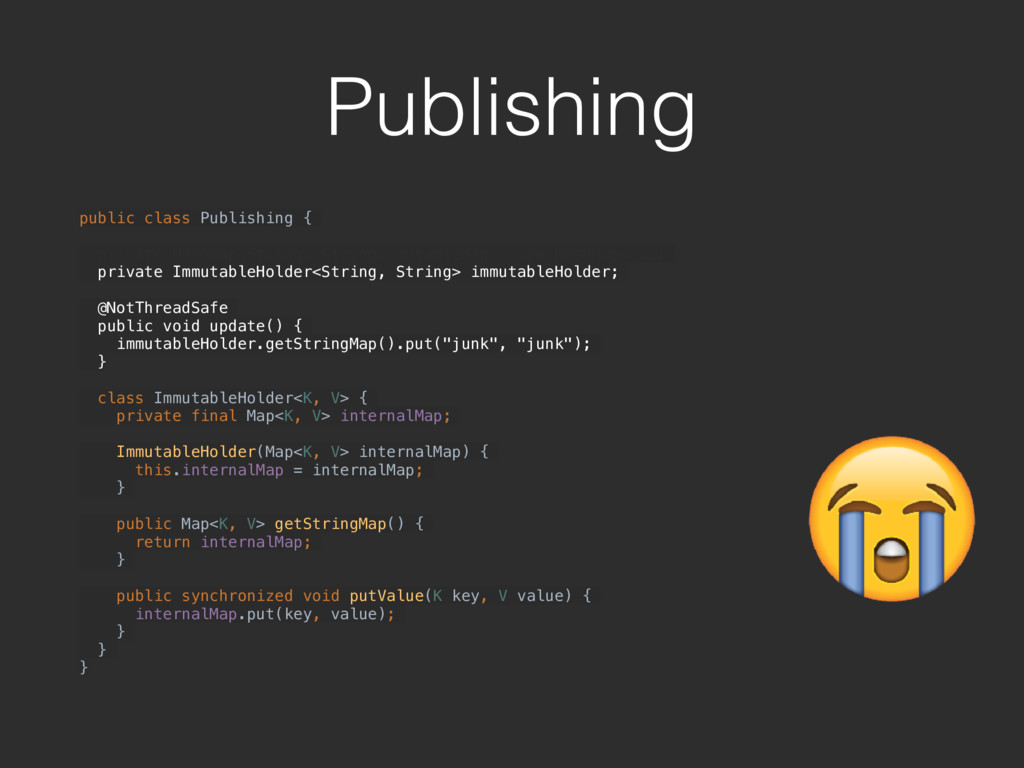
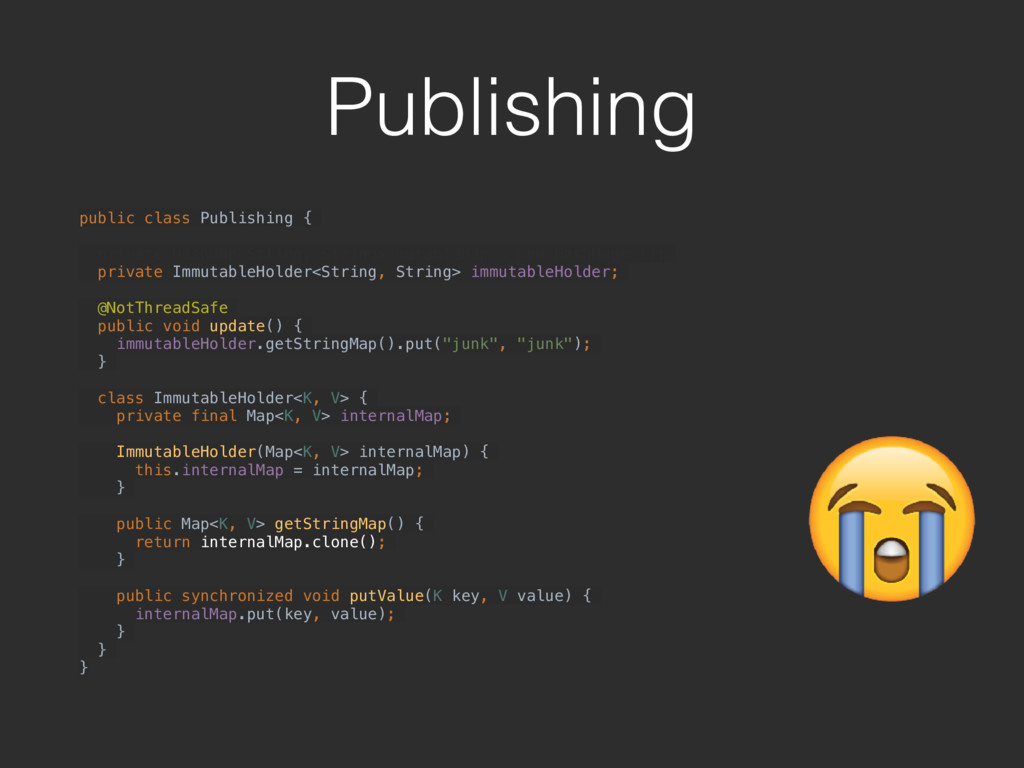
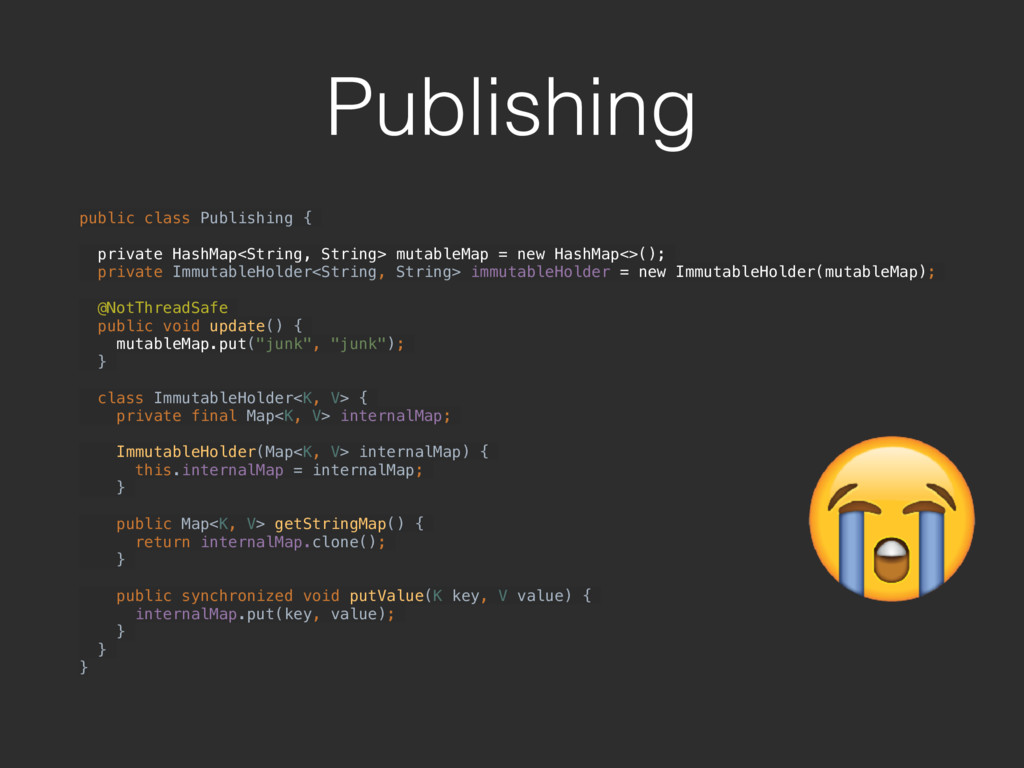
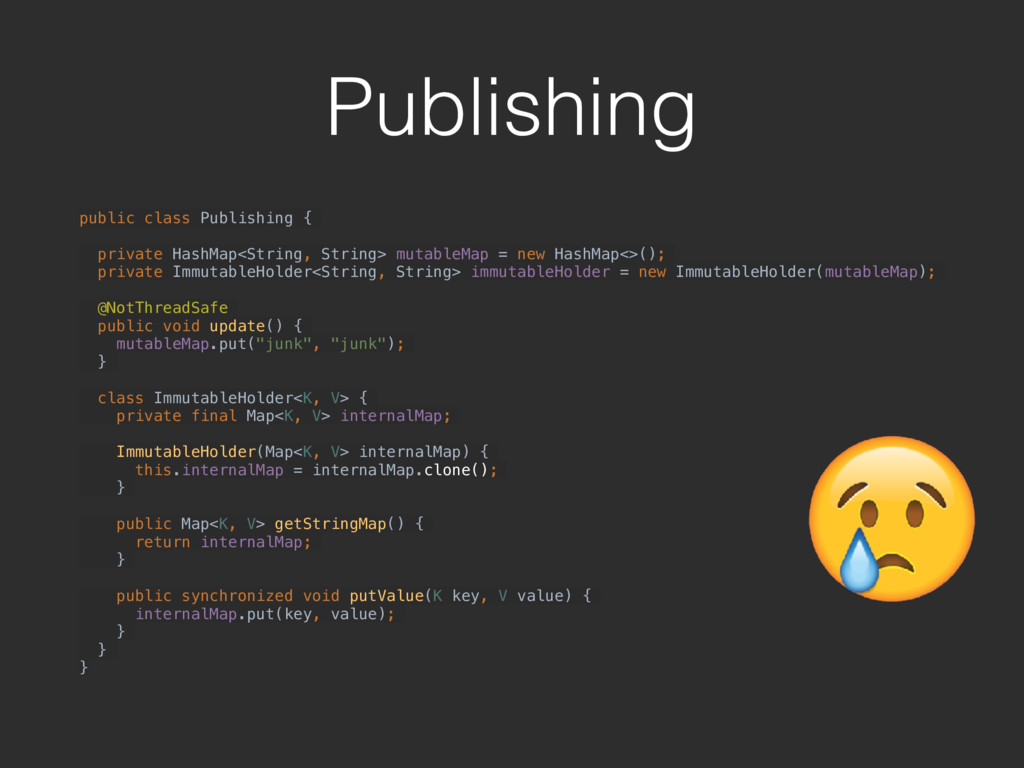
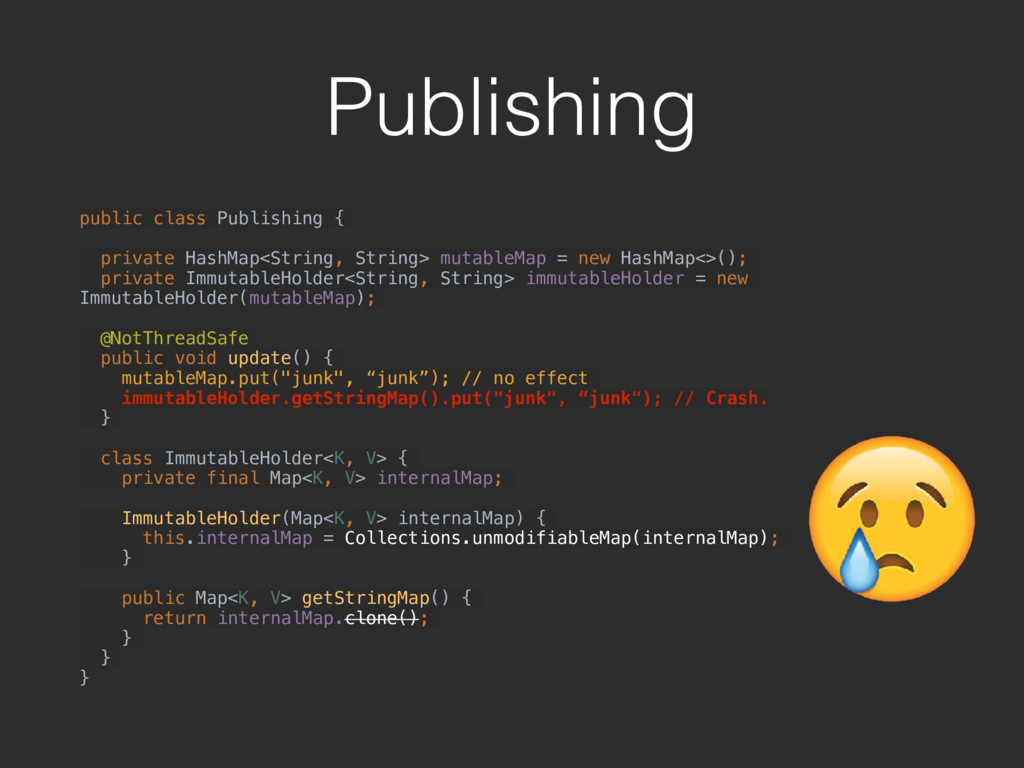
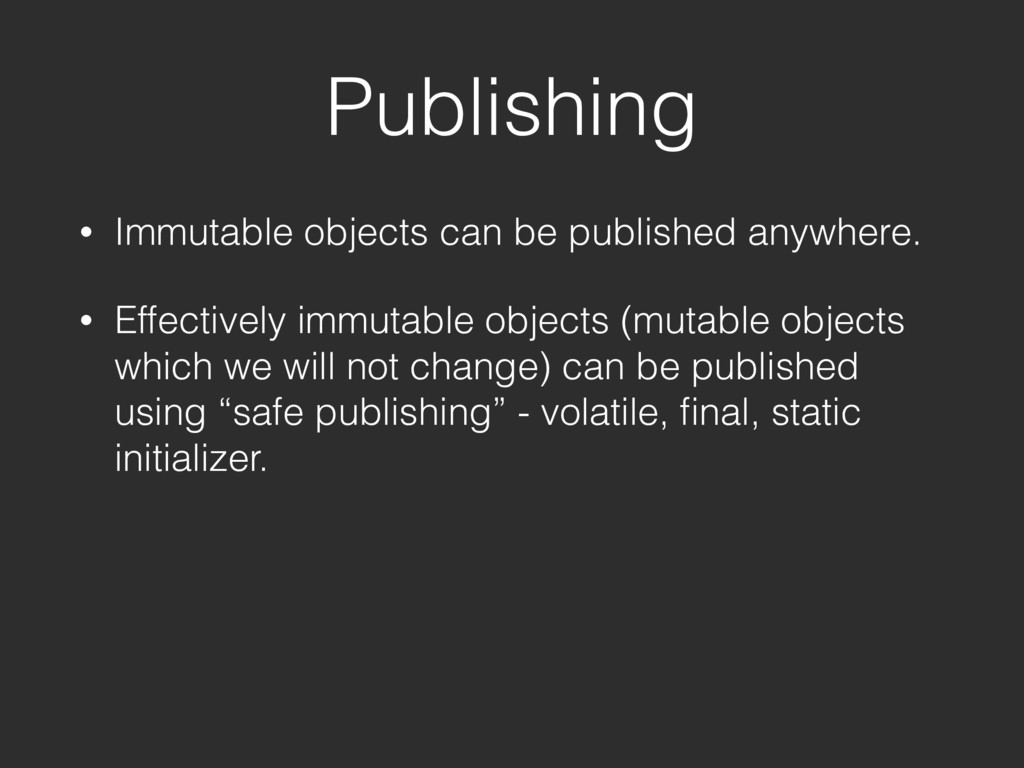
immutable objects (mutable objects which we will not change) can be published using “safe publishing” - volatile, final, static initializer. • Mutable variables must be synchronized
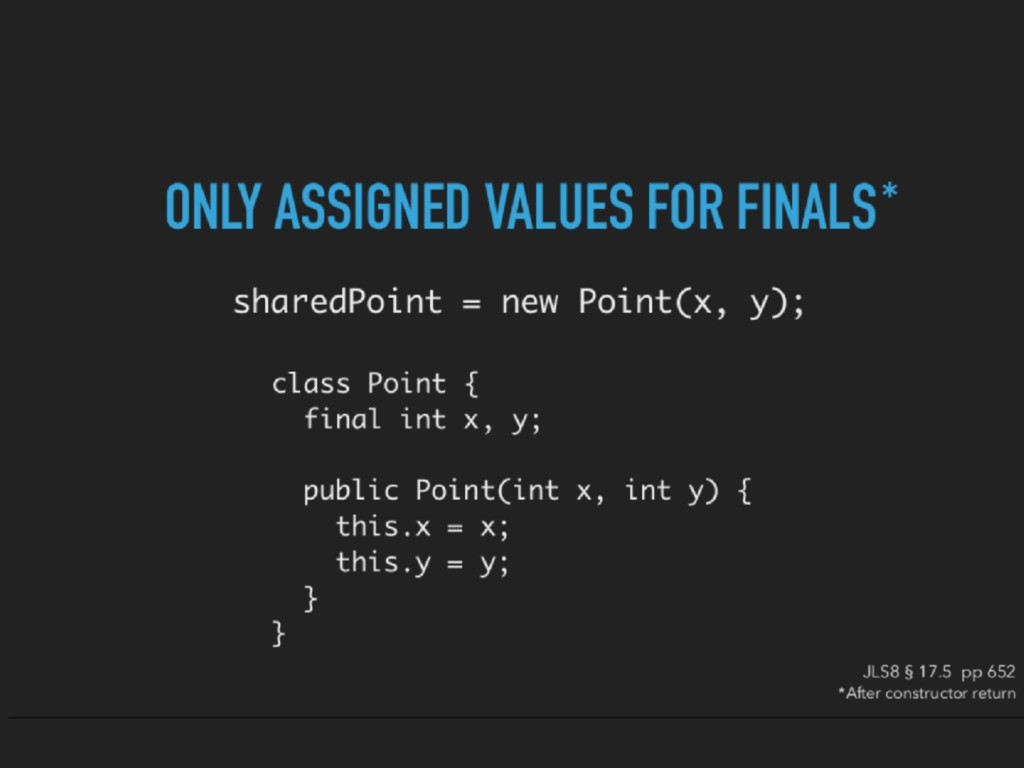
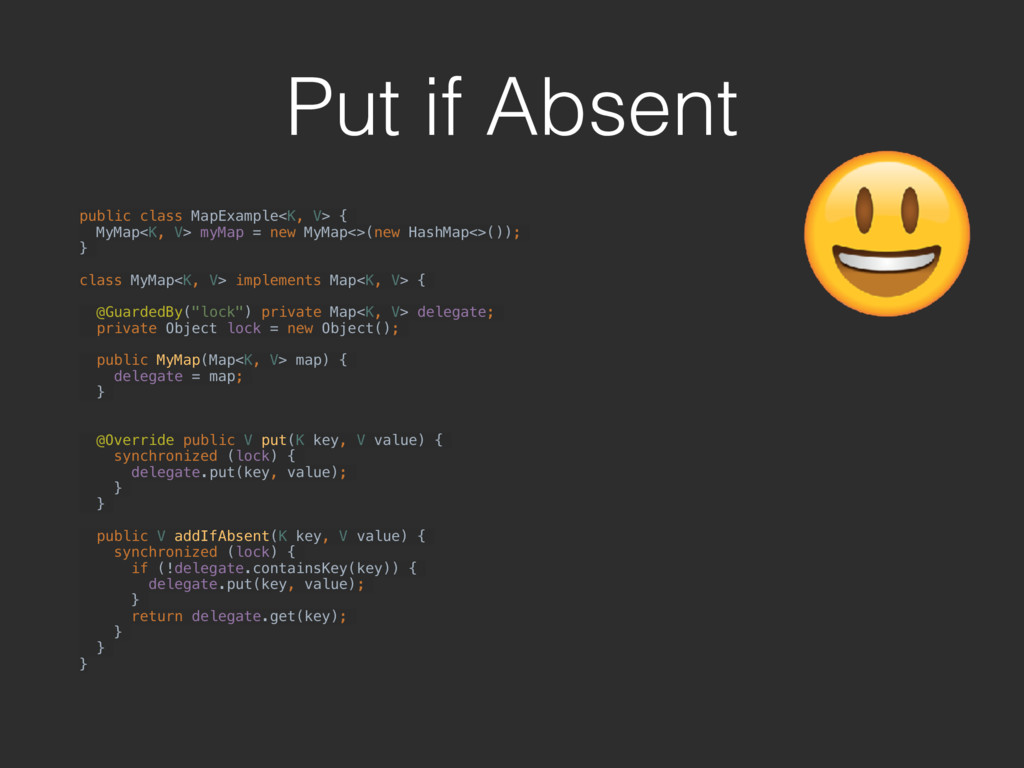
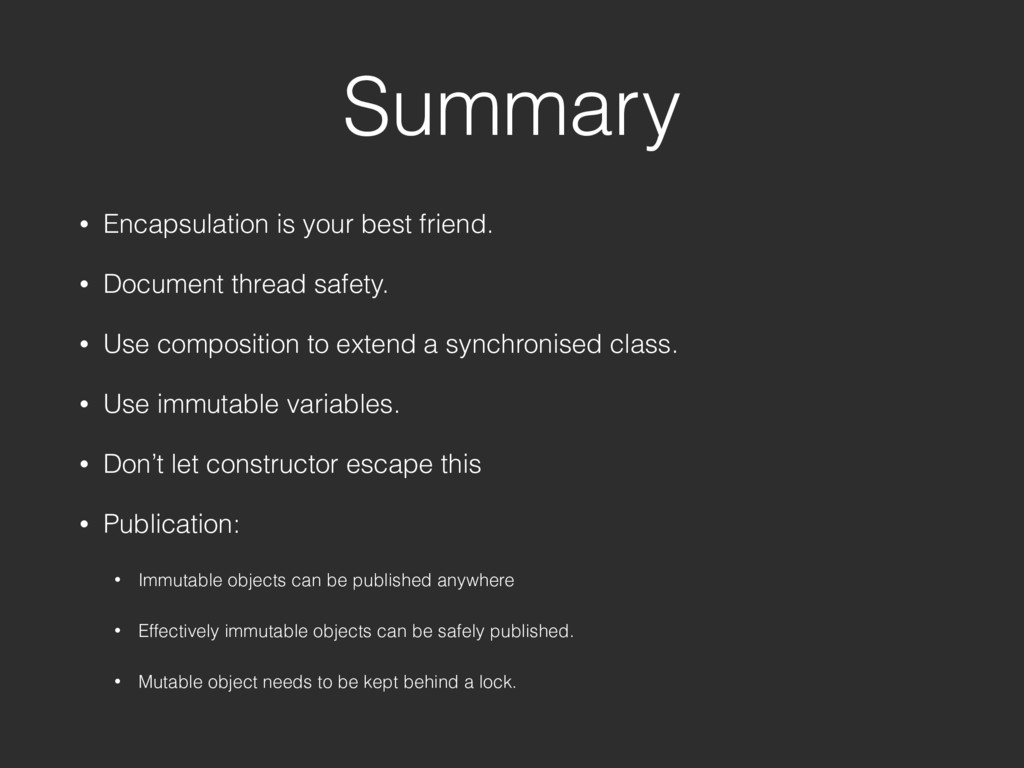
safety. • Use composition to extend a synchronised class. • Use immutable variables. • Don’t let constructor escape this • Publication: • Immutable objects can be published anywhere • Effectively immutable objects can be safely published. • Mutable object needs to be kept behind a lock.


 bangarharshit
 paigeccino
 morganepeng
 techseoconnect
 axbom
 eileencodes
 aleyda
 skipperchong
 destraynor
 lauravandoore
 wjessup
 addyosmani
 holman