Upgrade to Pro — share decks privately, control downloads, hide ads and more …

Concurrency Bojug

Concurrency Bojug

Bojug presentation for concurrency

Avatar for bangarharshit

bangarharshit

November 26, 2017

More Decks by bangarharshit

Other Decks in Technology

Transcript

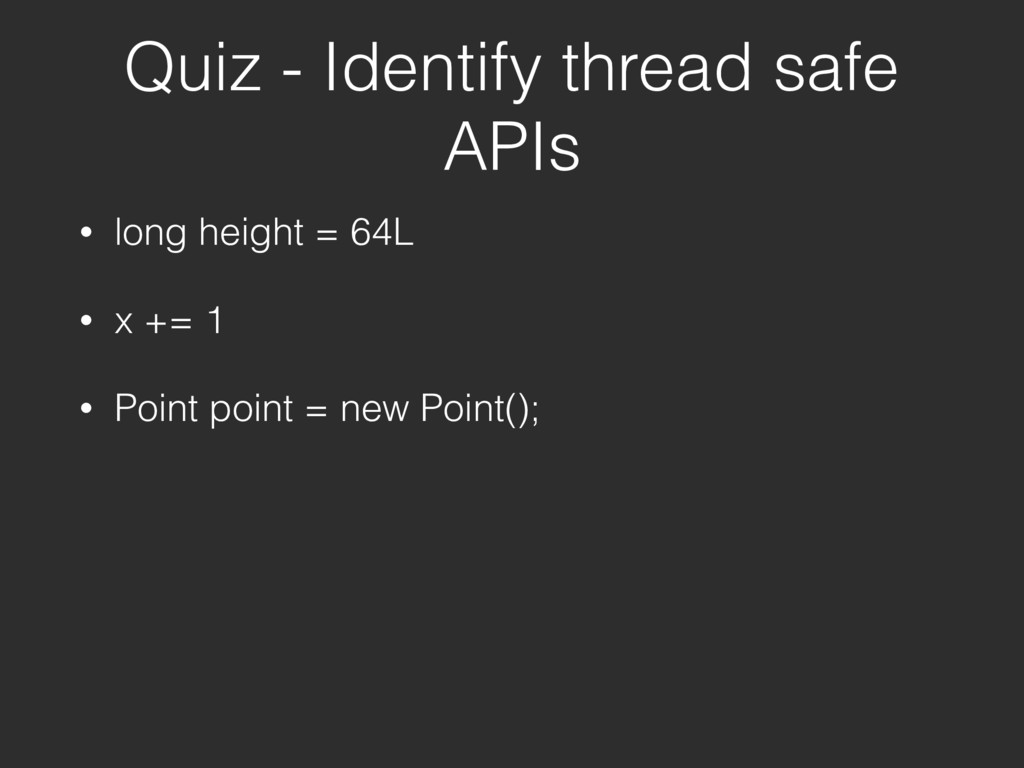
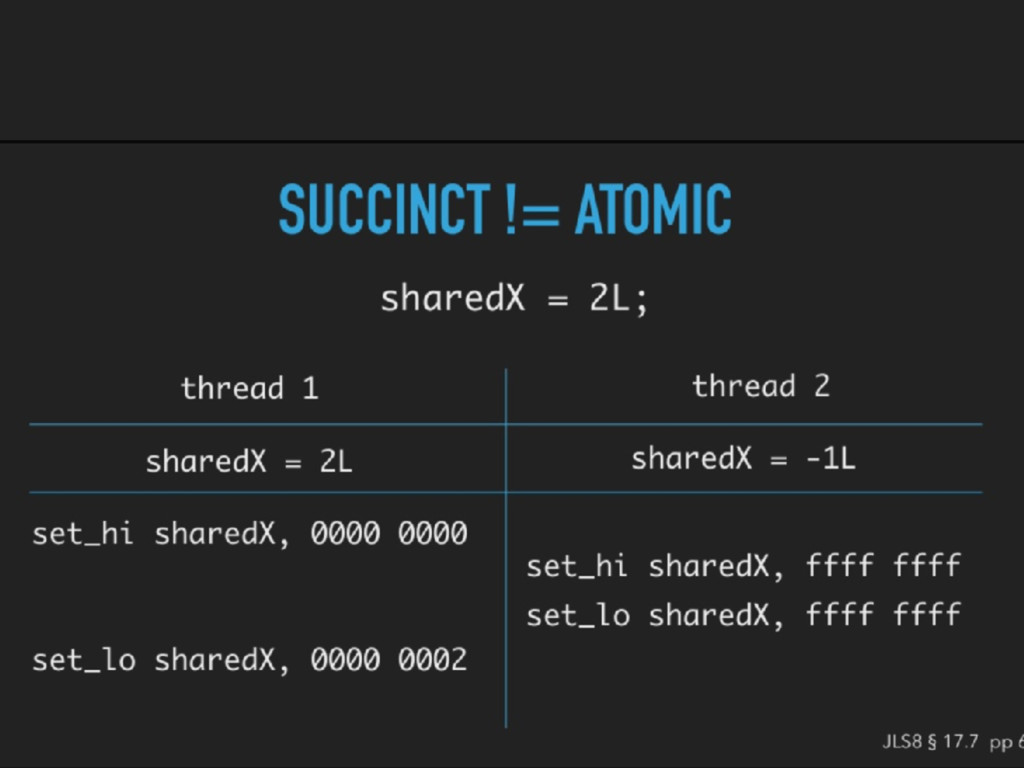
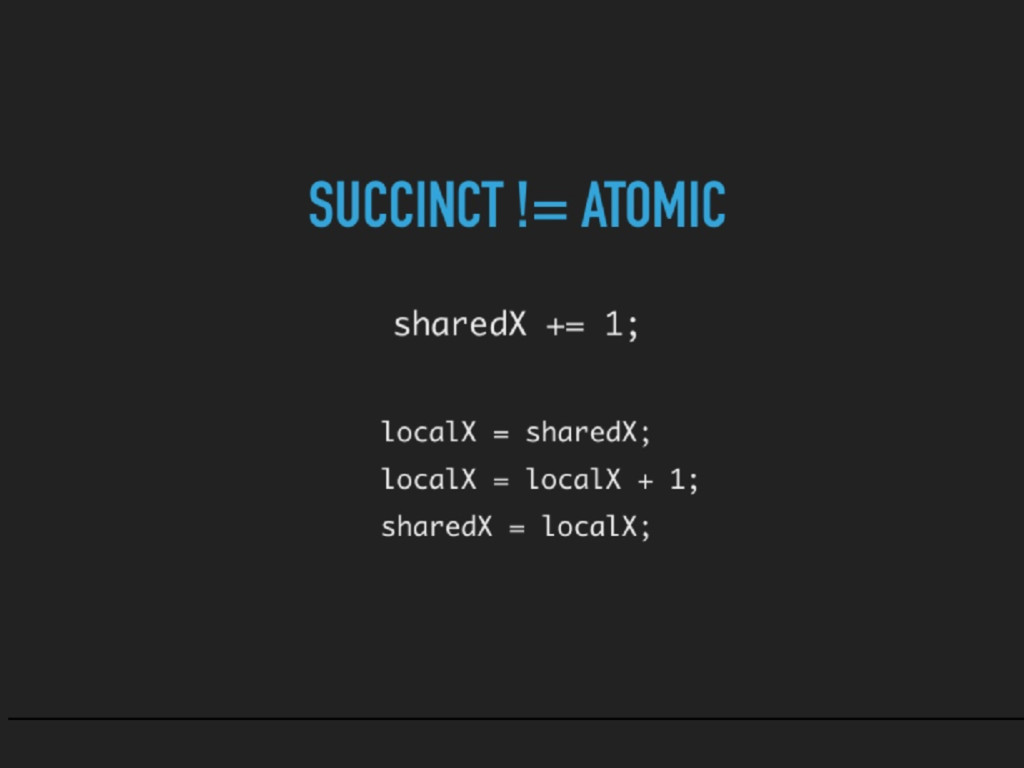
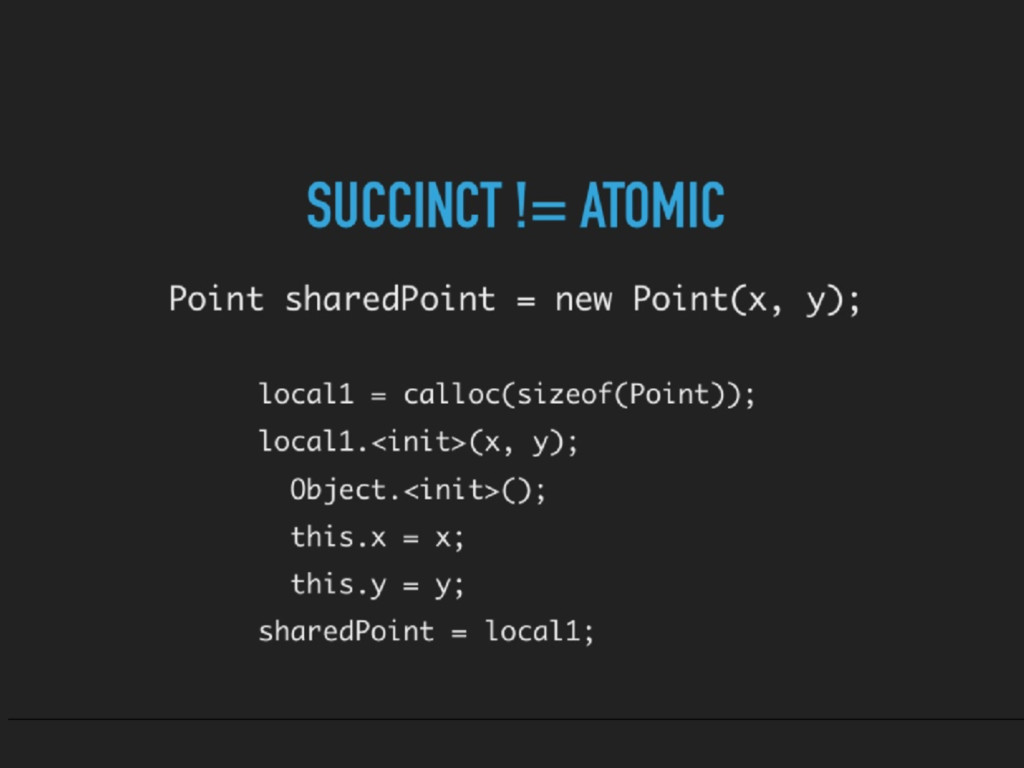
  1. Quiz - Identify thread safe APIs • long height =

    64L • x += 1 • Point point = new Point();
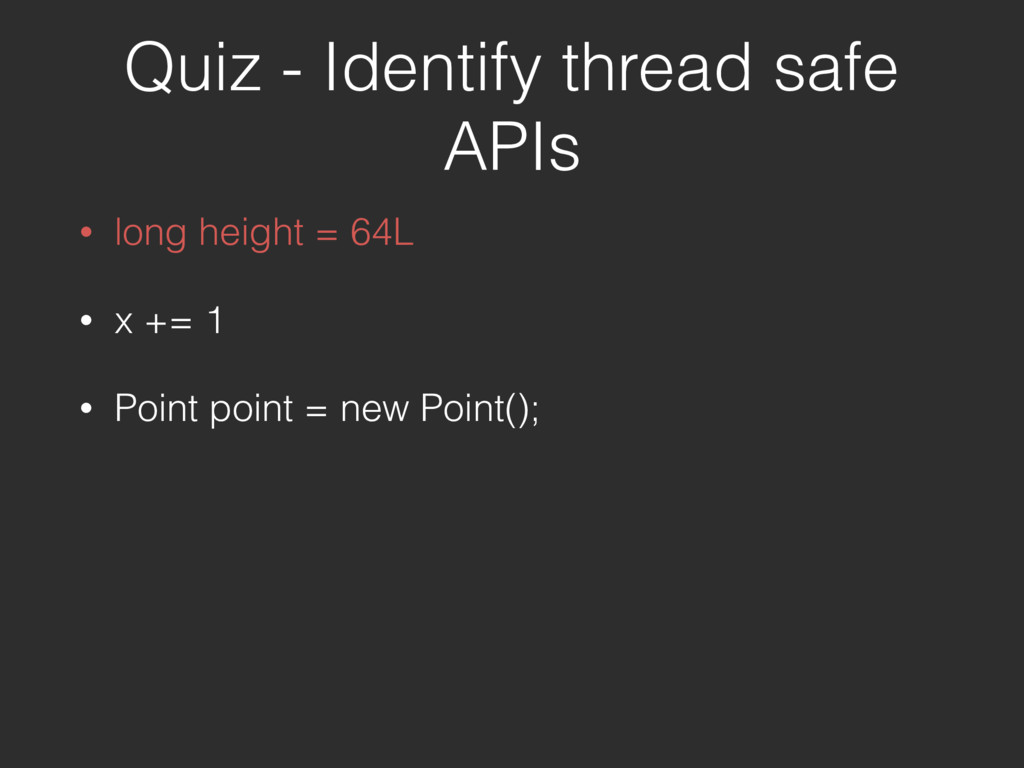
  2. Quiz - Identify thread safe APIs • long height =

    64L • x += 1 • Point point = new Point();
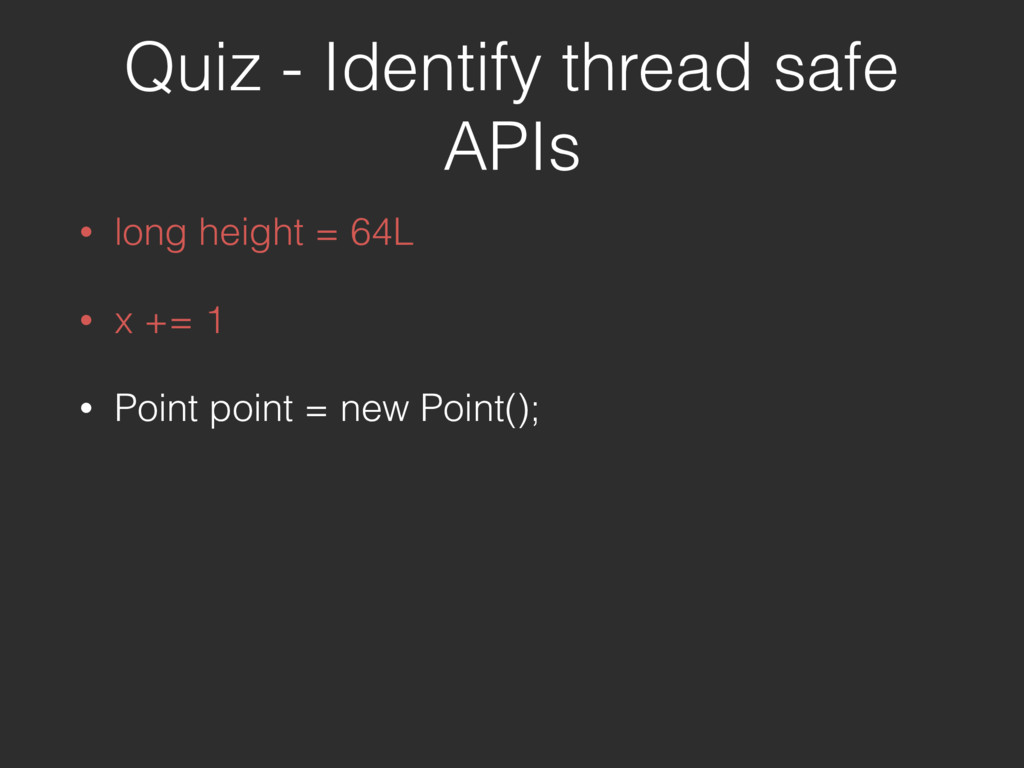
  3. Quiz - Identify thread safe APIs • long height =

    64L • x += 1 • Point point = new Point();
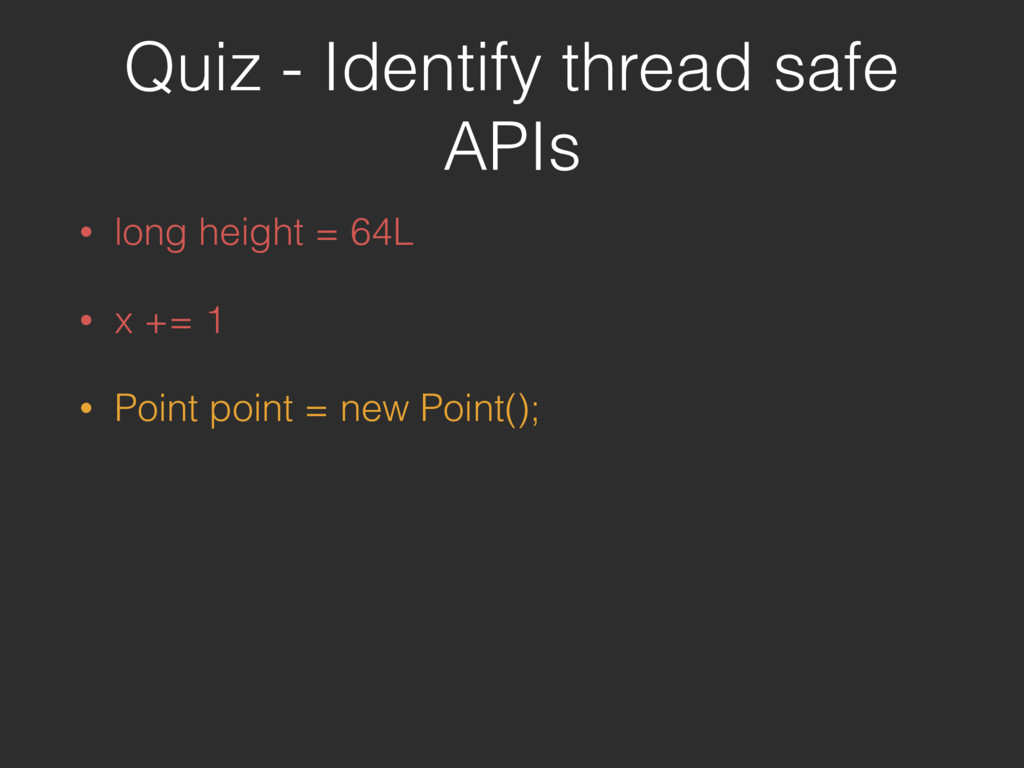
  4. Quiz - Identify thread safe APIs • long height =

    64L • x += 1 • Point point = new Point();
  5. Content • Unit testing concurrent code. • Atomicity • Visibility

    • Thread Safety • Designing a thread safe class
  6. Content • Unit testing concurrent code. • Atomicity • Visibility

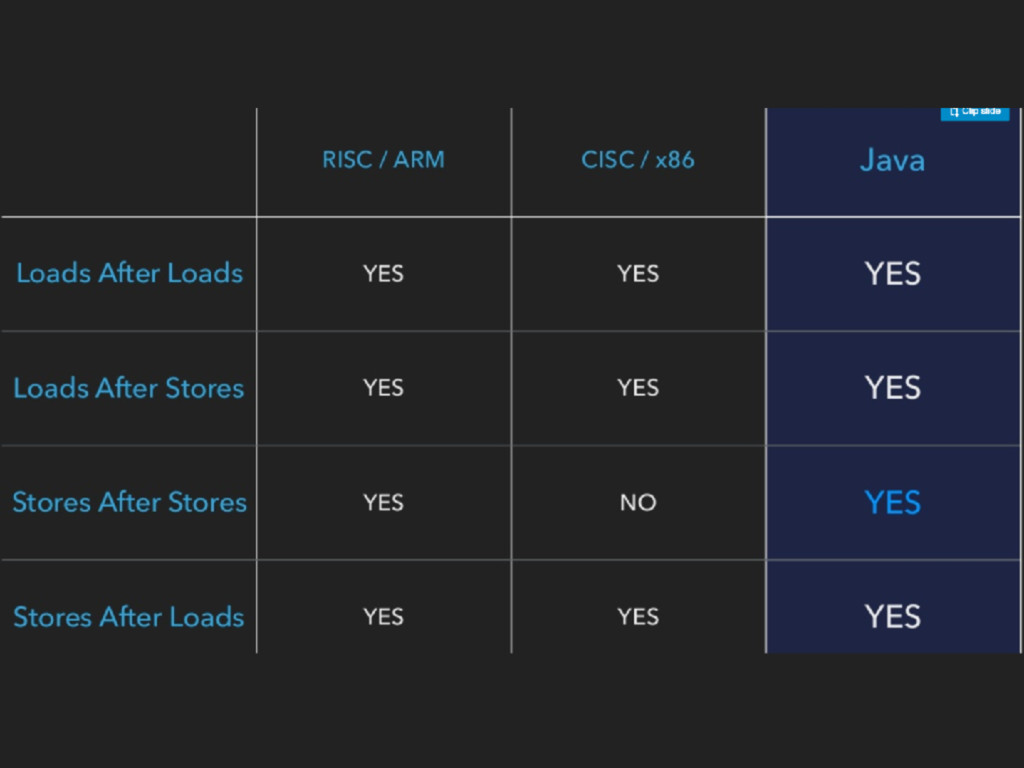
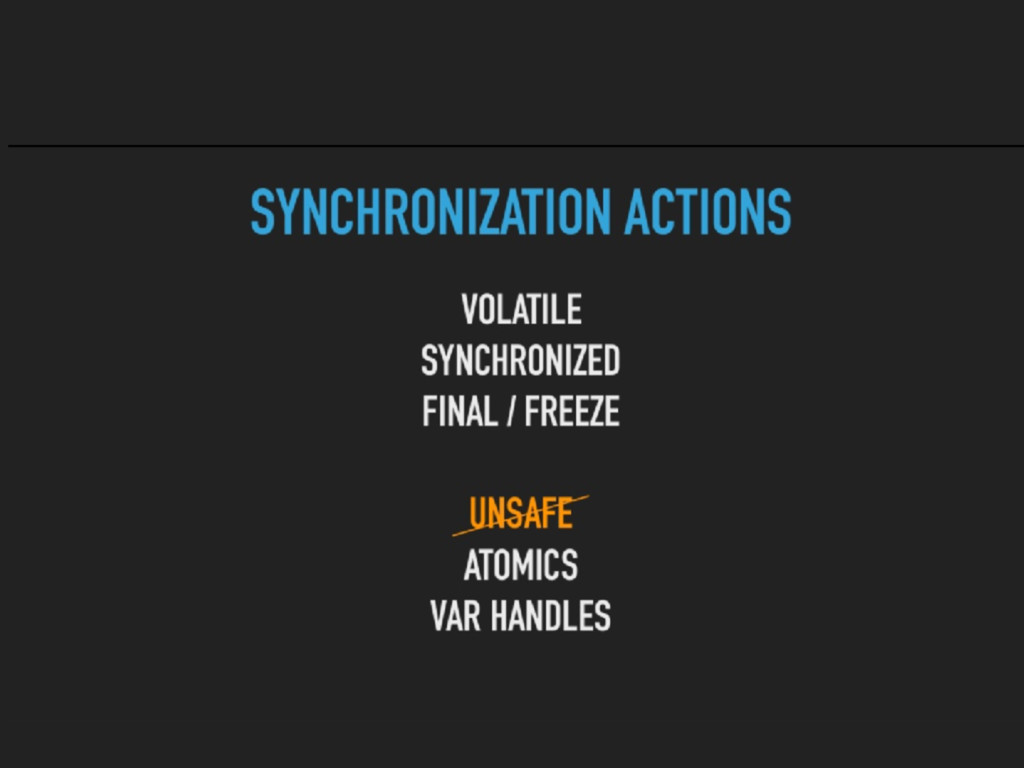
    • Thread Safety • Designing a thread safe class • Java Memory Model
  7. Unit testing 1. The biggest challenge with testing concurrent code

    is unpredictability. Unlike code which is sequential and deterministic, concurrency can yield completely random results
  8. Unit testing 1. The biggest challenge with testing concurrent code

    is unpredictability. Unlike code which is sequential and deterministic, concurrency can yield completely random results 2. Unit tests sometimes introduces sequentiality by accident
  9. Unit testing - Junit & TestNg • Junit doesn’t support

    concurrent testing. • TestNg supports testing but it is broken since it is unable to reproduce the consistent behaviour.
  10. Unit testing - Thread Weaver • Works by adding conditional

    breakpoints in the code (by inserting locks via byte code manipulation)
  11. Unit testing - Thread Weaver • Works by adding conditional

    breakpoints in the code (by inserting locks via byte code manipulation) • Theoretically should catch every race condition.
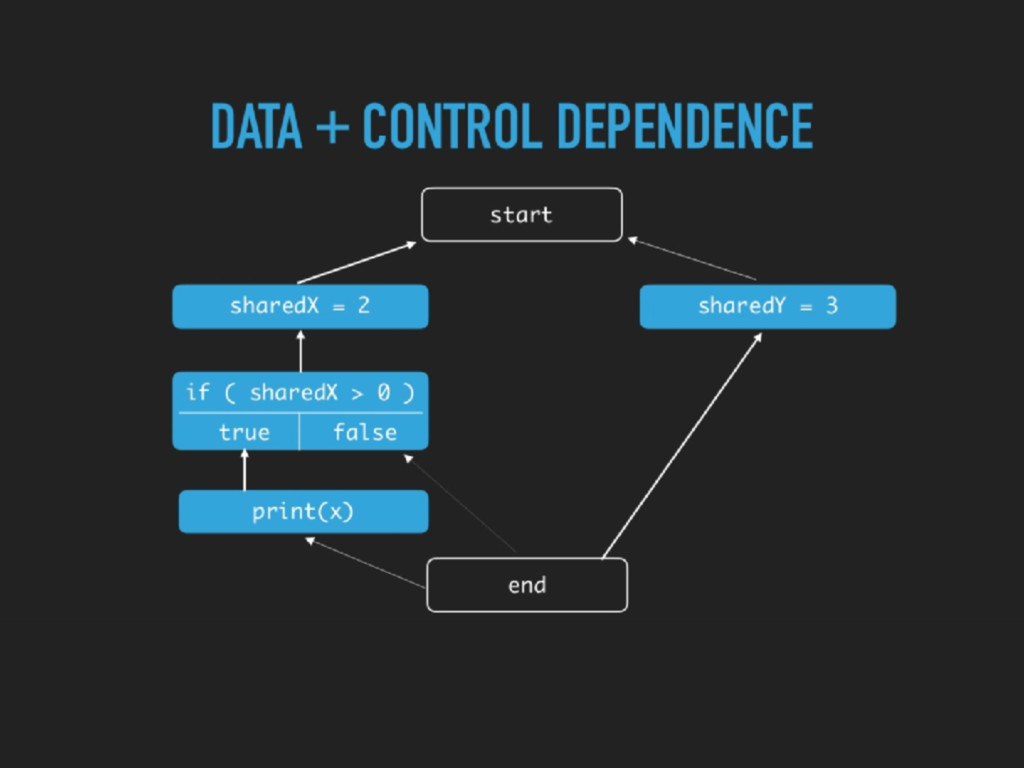
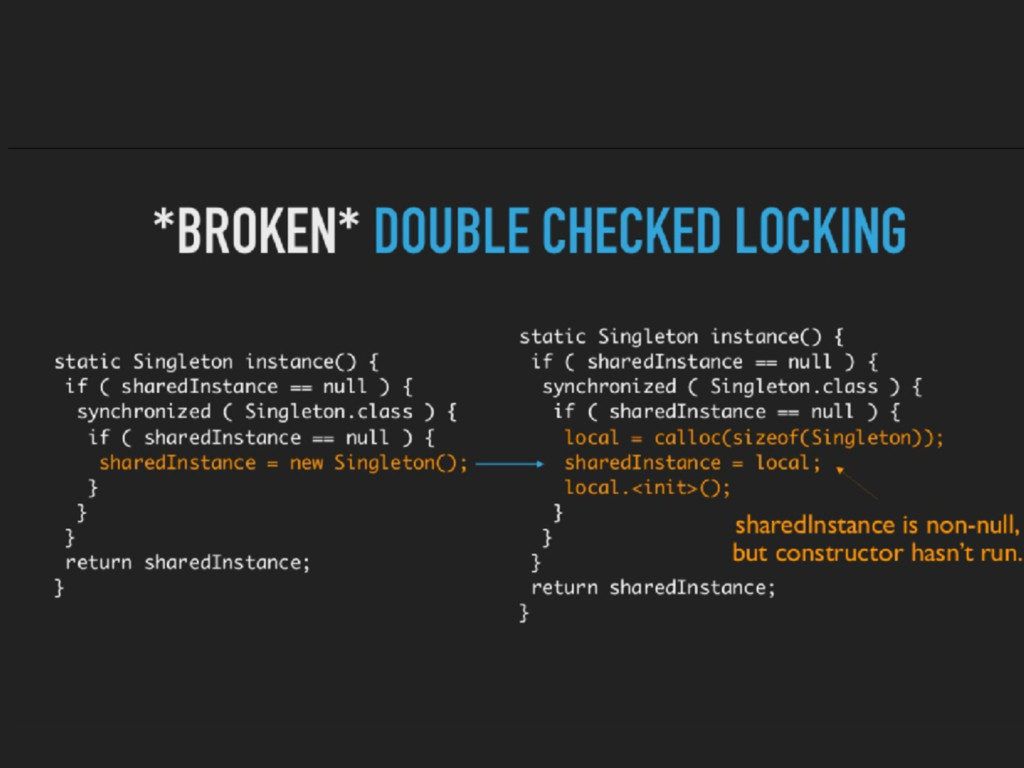
  12. Unit testing - Thread Weaver • Works by adding conditional

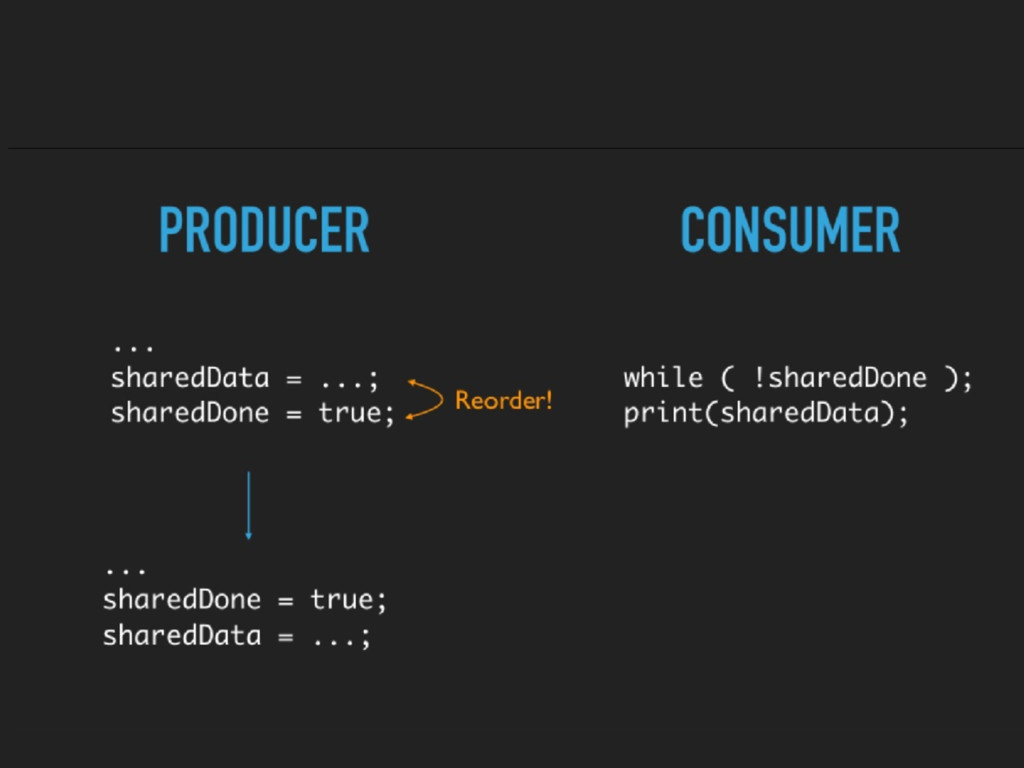
    breakpoints in the code (by inserting locks via byte code manipulation) • Theoretically should catch every race condition. • It prevent JMM re-ordering (accidentally) due to locks - details.
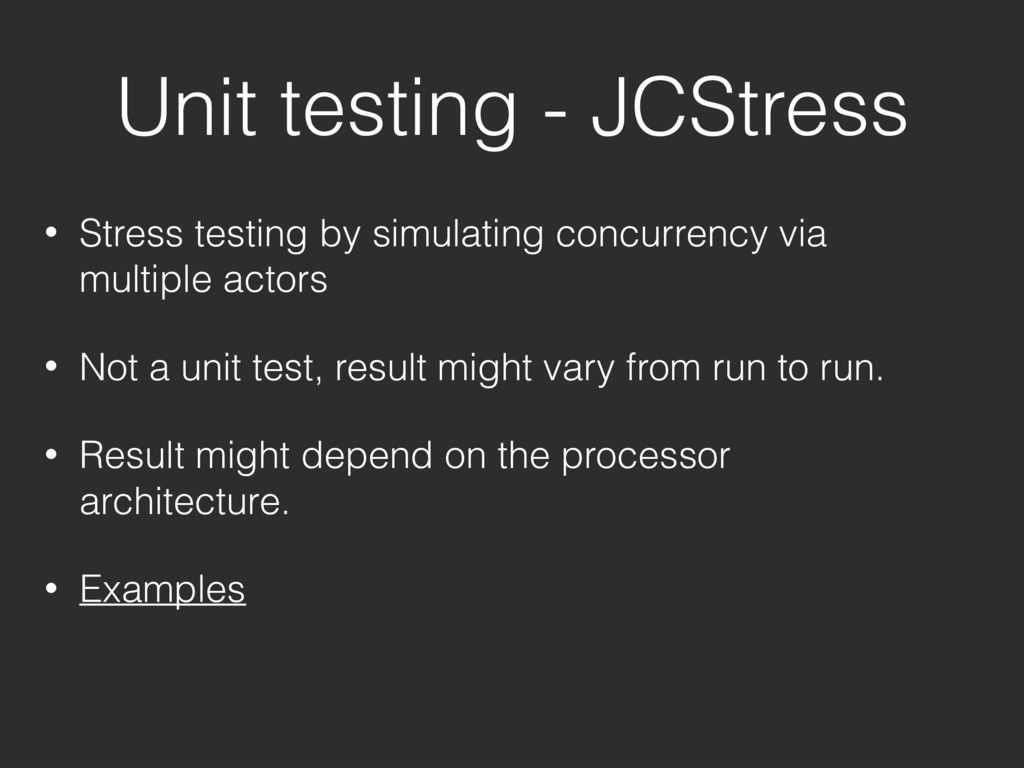
  13. Unit testing - JCStress • Stress testing by simulating concurrency

    via multiple actors • Not a unit test, result might vary from run to run.
  14. Unit testing - JCStress • Stress testing by simulating concurrency

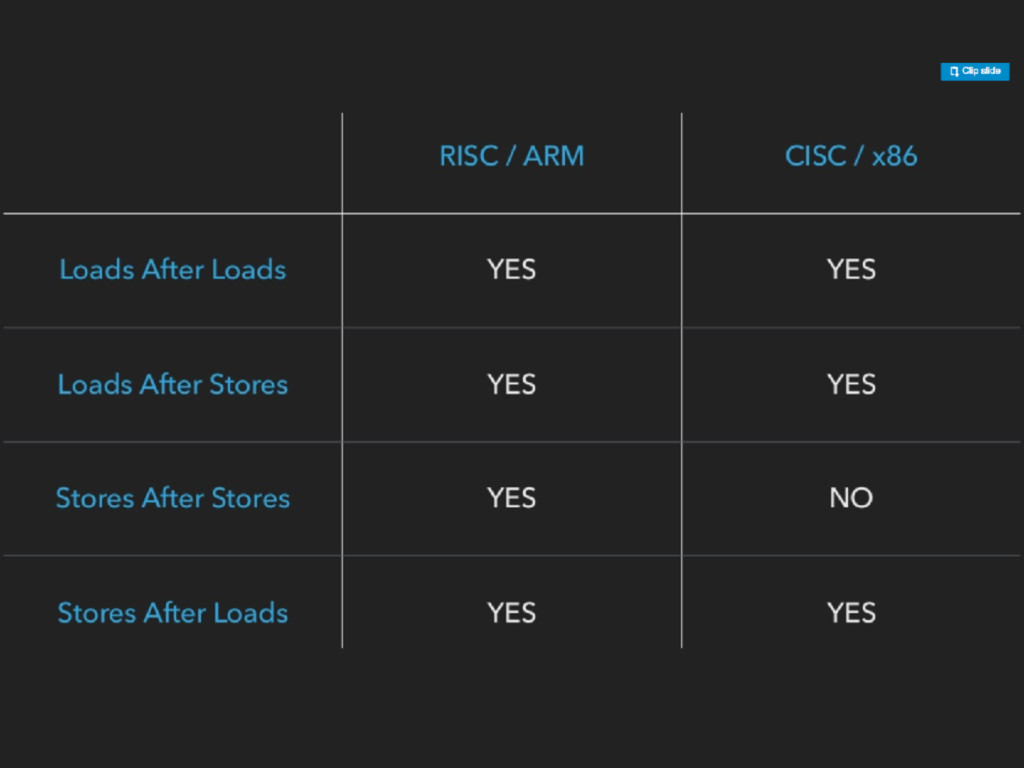
    via multiple actors • Not a unit test, result might vary from run to run. • Result might depend on the processor architecture.
  15. Unit testing - JCStress • Stress testing by simulating concurrency

    via multiple actors • Not a unit test, result might vary from run to run. • Result might depend on the processor architecture. • Examples
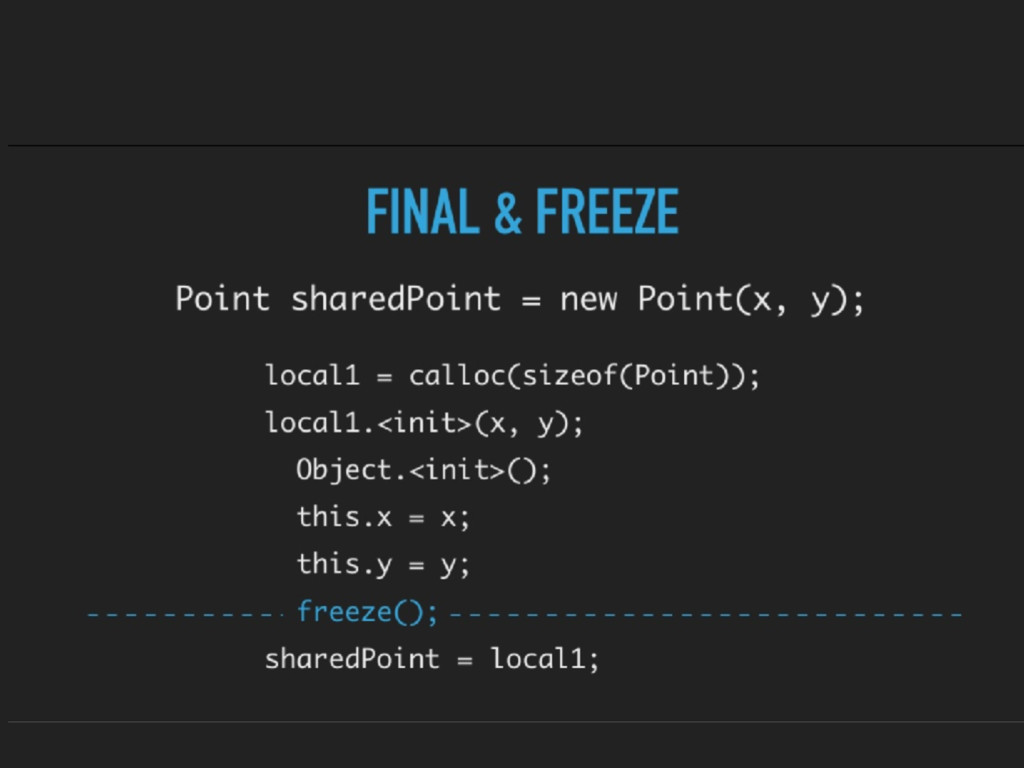
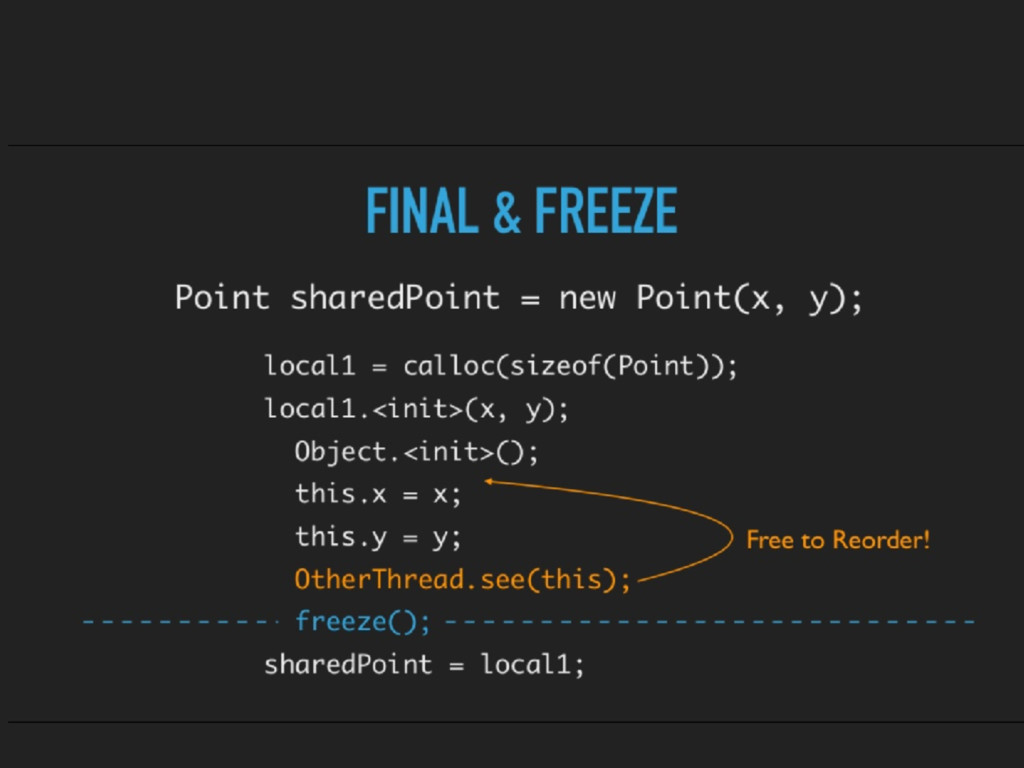
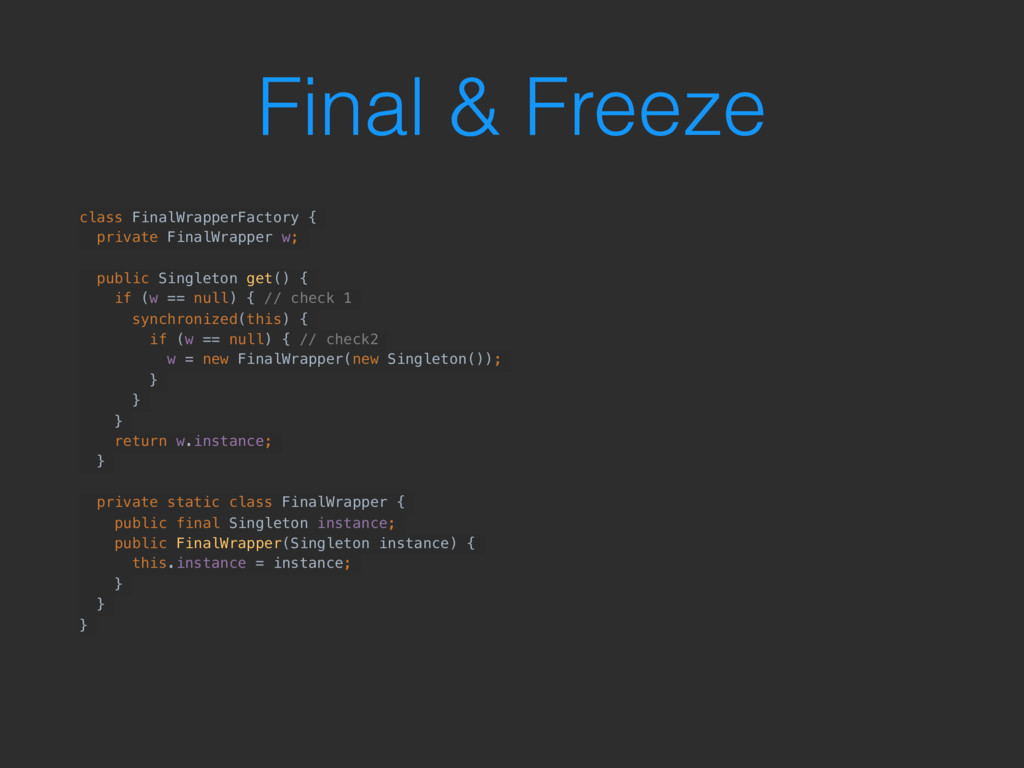
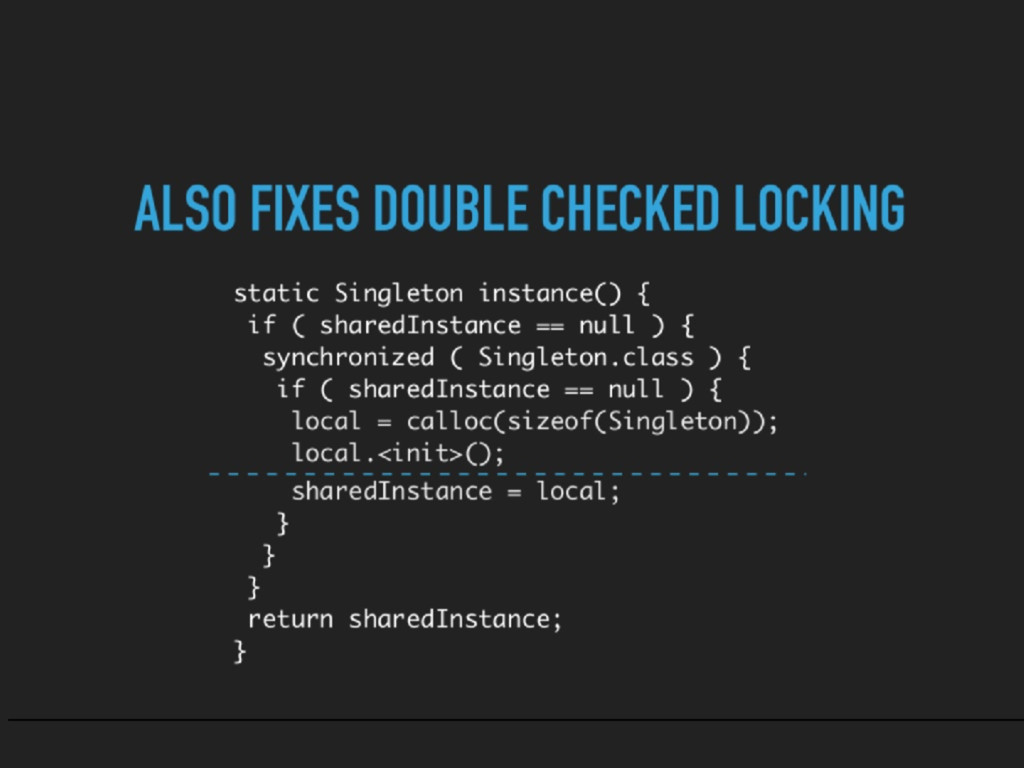
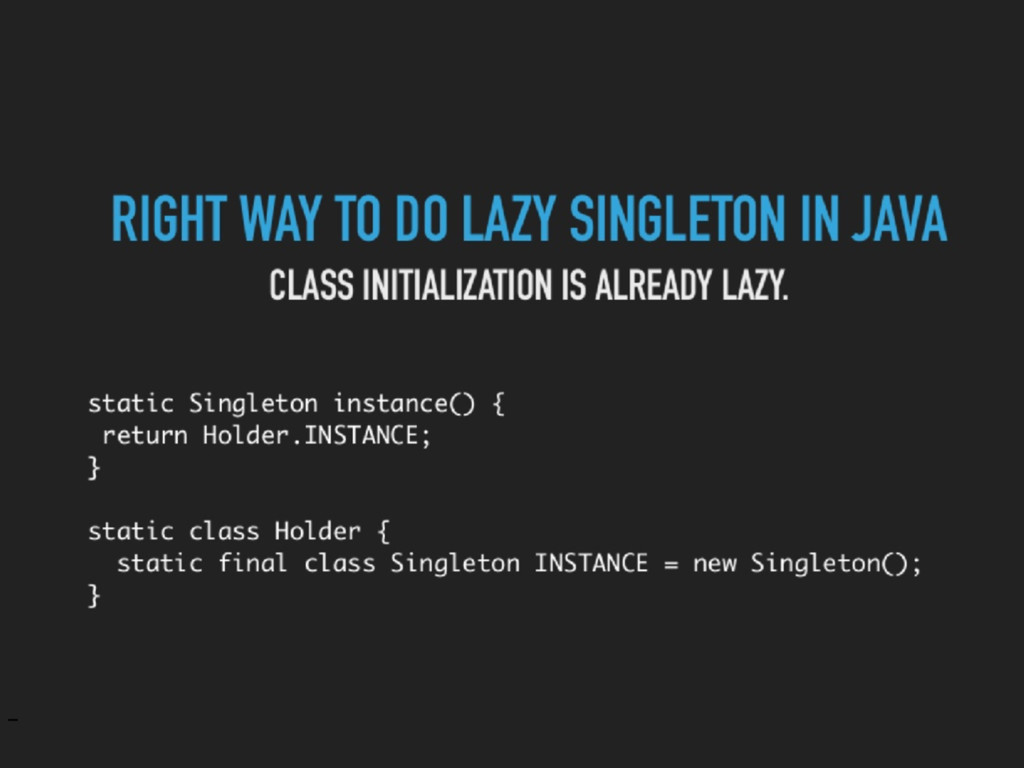
  16. Final & Freeze class FinalWrapperFactory { private FinalWrapper w; public

    Singleton get() { if (w == null) { // check 1 synchronized(this) { if (w == null) { // check2 w = new FinalWrapper(new Singleton()); } } } return w.instance; } private static class FinalWrapper { public final Singleton instance; public FinalWrapper(Singleton instance) { this.instance = instance; } } }
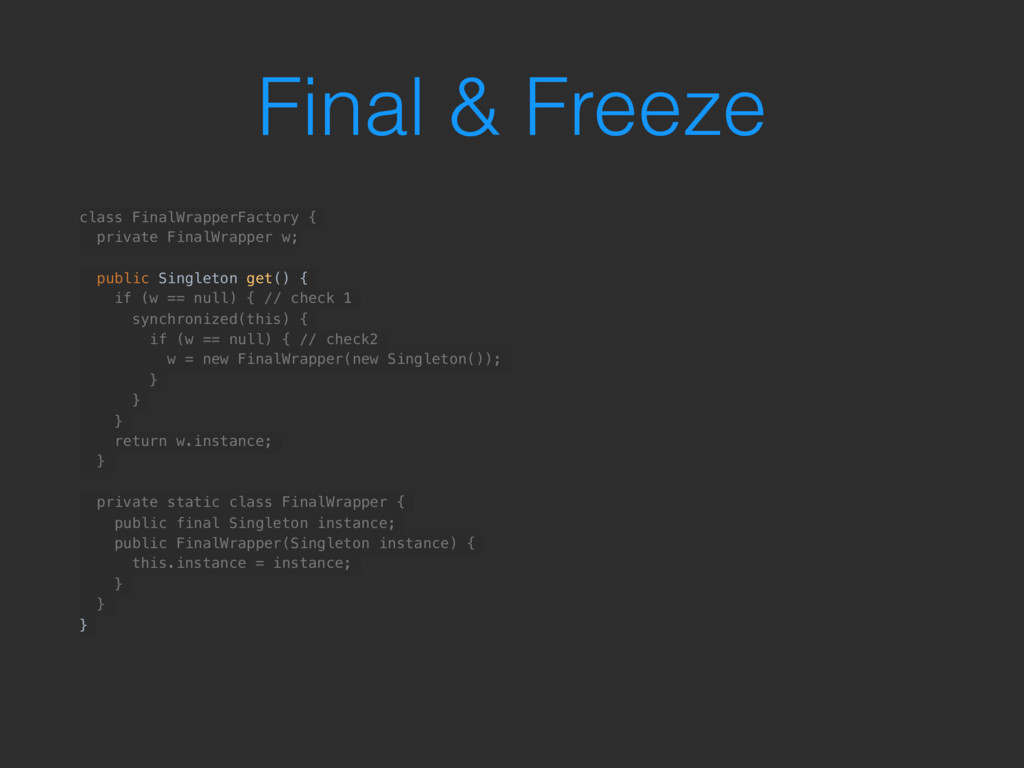
  17. Final & Freeze class FinalWrapperFactory { private FinalWrapper w; public

    Singleton get() { if (w == null) { // check 1 synchronized(this) { if (w == null) { // check2 w = new FinalWrapper(new Singleton()); } } } return w.instance; } private static class FinalWrapper { public final Singleton instance; public FinalWrapper(Singleton instance) { this.instance = instance; } } }
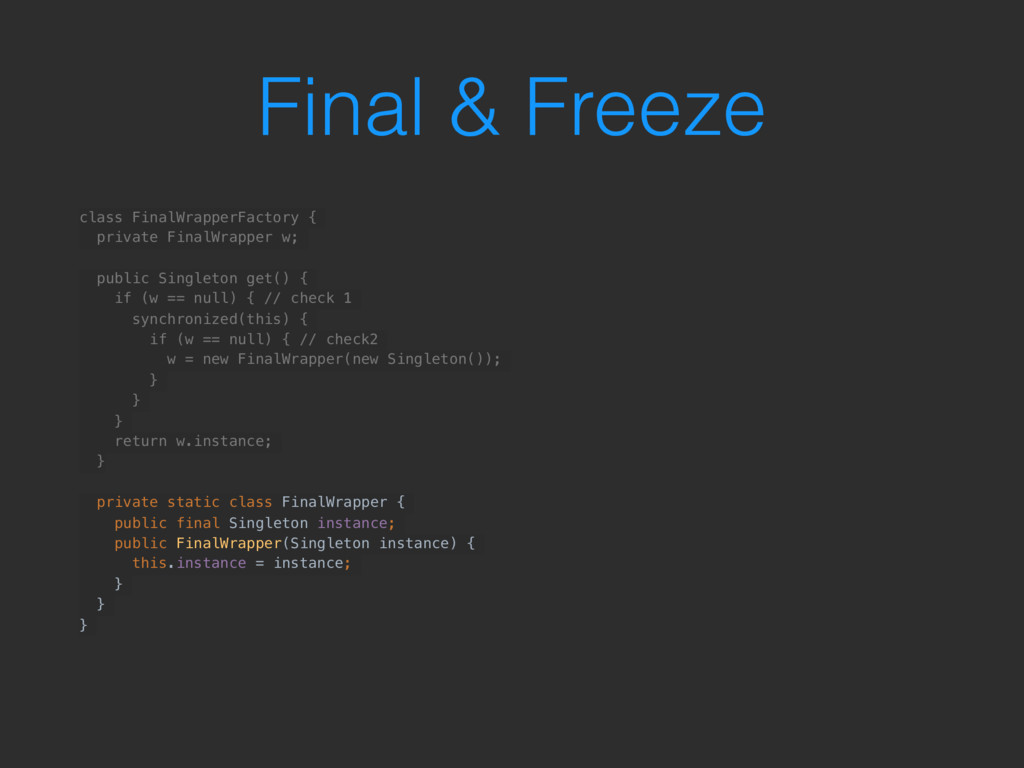
  18. Final & Freeze class FinalWrapperFactory { private FinalWrapper w; public

    Singleton get() { if (w == null) { // check 1 synchronized(this) { if (w == null) { // check2 w = new FinalWrapper(new Singleton()); } } } return w.instance; } private static class FinalWrapper { public final Singleton instance; public FinalWrapper(Singleton instance) { this.instance = instance; } } }
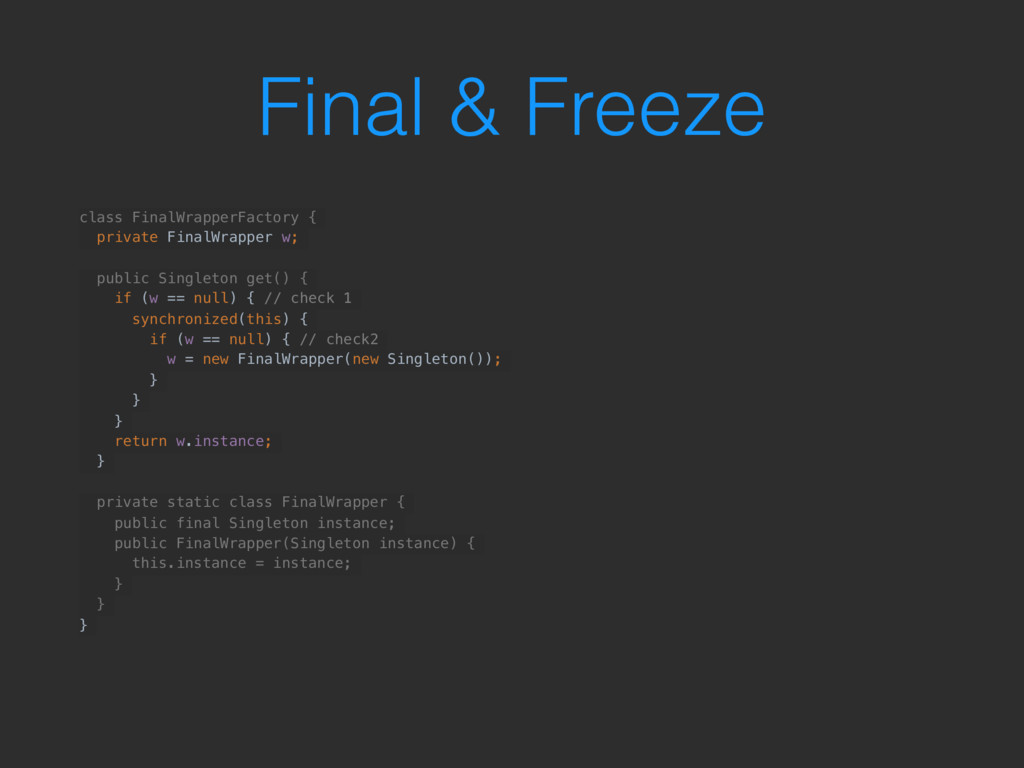
  19. Final & Freeze class FinalWrapperFactory { private FinalWrapper w; public

    Singleton get() { if (w == null) { // check 1 synchronized(this) { if (w == null) { // check2 w = new FinalWrapper(new Singleton()); } } } return w.instance; } private static class FinalWrapper { public final Singleton instance; public FinalWrapper(Singleton instance) { this.instance = instance; } } }
  20. Mutable state There are three ways to fix it: •

    Use synchronisation whenever accessing the state variable.
  21. Mutable state There are three ways to fix it: •

    Use synchronisation whenever accessing the state variable. • Don't share the state variable across threads;
  22. Mutable state There are three ways to fix it: •

    Use synchronisation whenever accessing the state variable. • Don't share the state variable across threads; • Make the state variable immutable; or
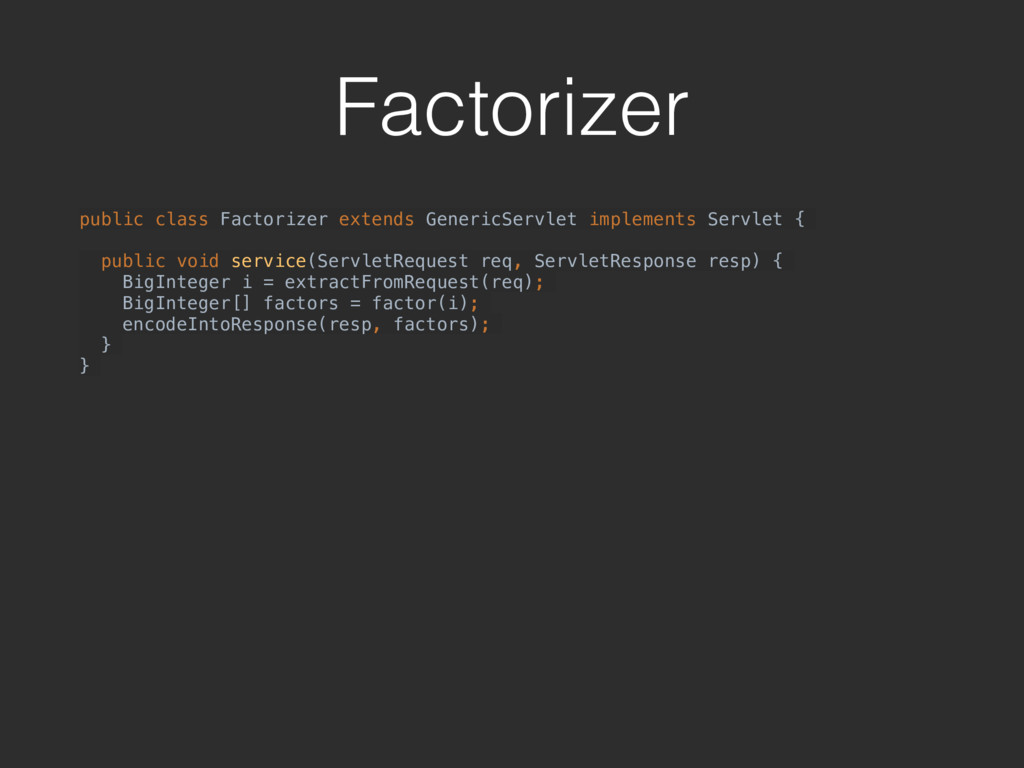
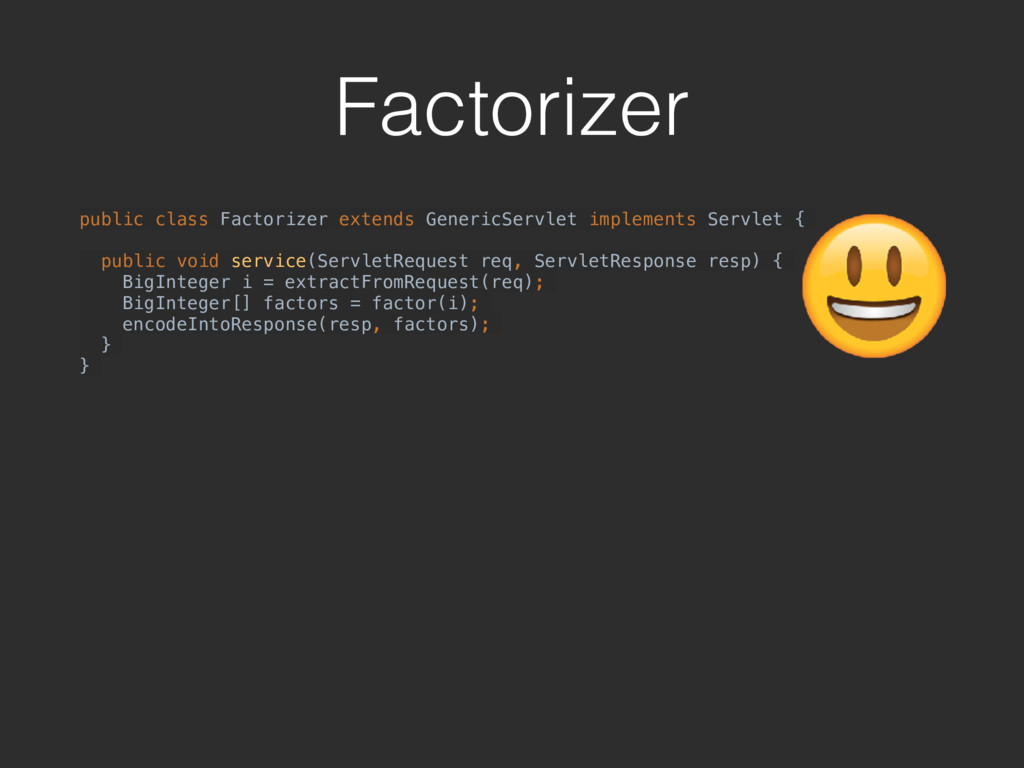
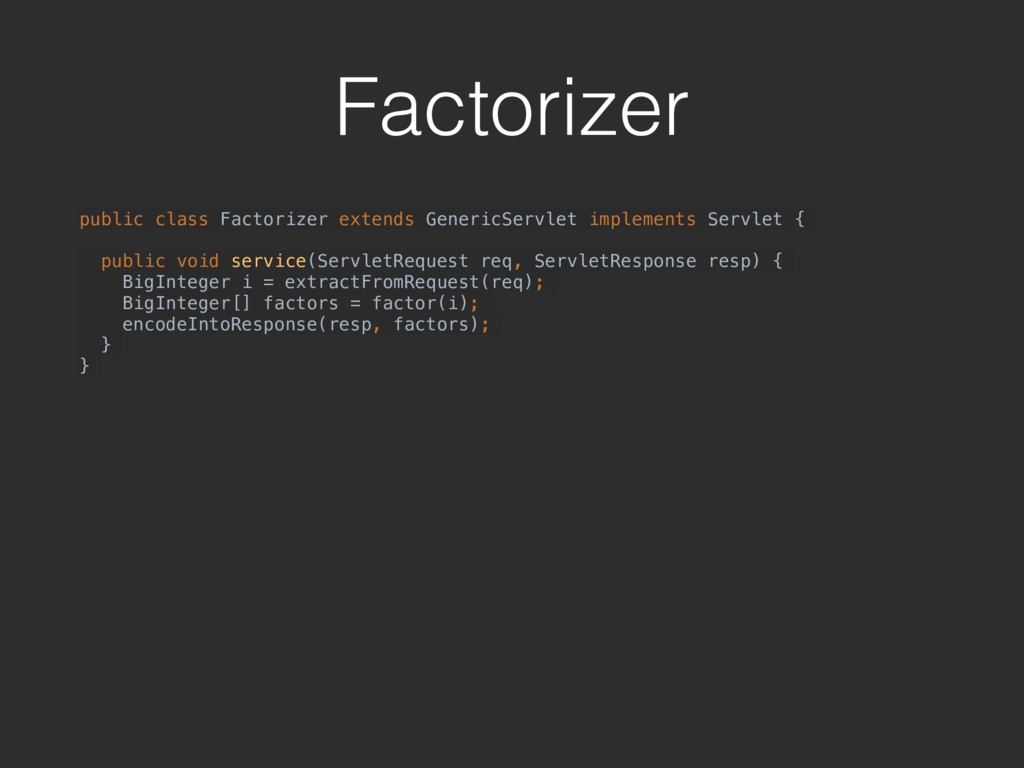
  23. Factorizer public class Factorizer extends GenericServlet implements Servlet { public

    void service(ServletRequest req, ServletResponse resp) { BigInteger i = extractFromRequest(req); BigInteger[] factors = factor(i); encodeIntoResponse(resp, factors); } }
  24. Factorizer public class Factorizer extends GenericServlet implements Servlet { public

    void service(ServletRequest req, ServletResponse resp) { BigInteger i = extractFromRequest(req); BigInteger[] factors = factor(i); encodeIntoResponse(resp, factors); } }
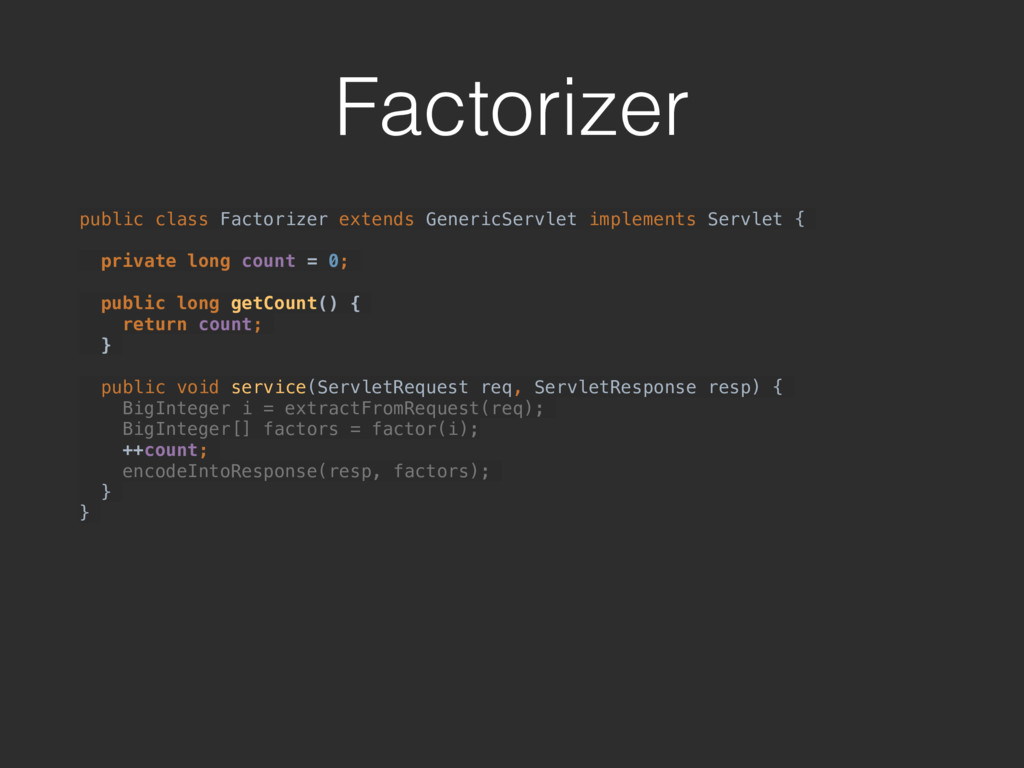
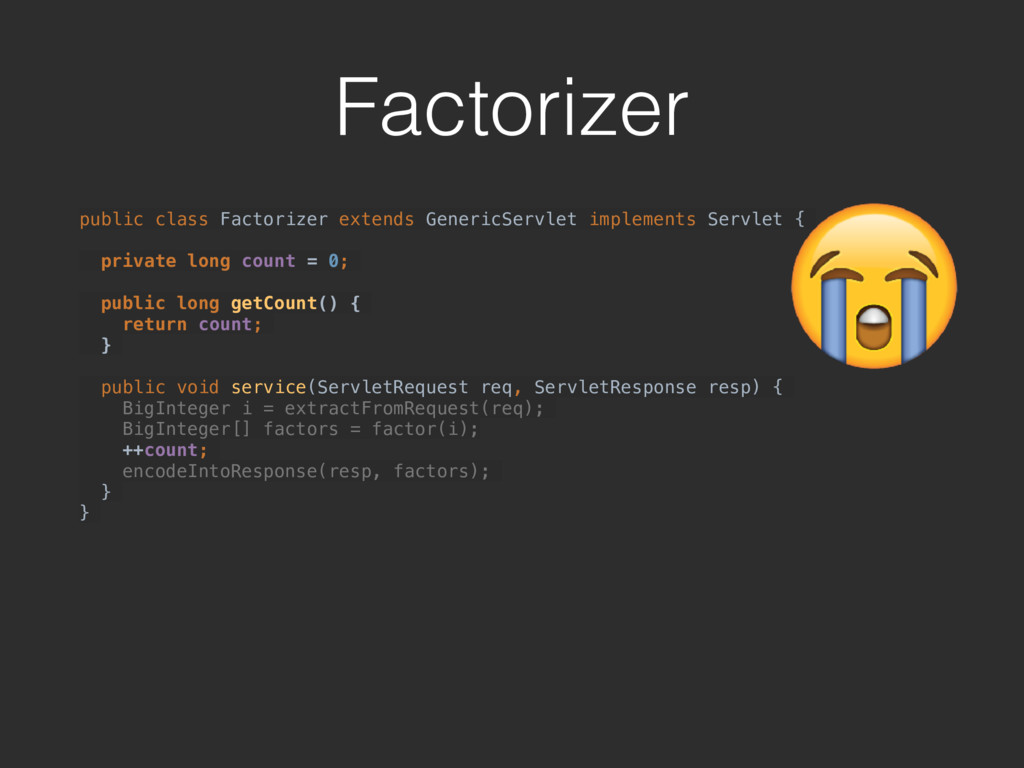
  25. Factorizer public class Factorizer extends GenericServlet implements Servlet { private

    long count = 0; public long getCount() { return count; } public void service(ServletRequest req, ServletResponse resp) { BigInteger i = extractFromRequest(req); BigInteger[] factors = factor(i); ++count; encodeIntoResponse(resp, factors); } }
  26. Factorizer public class Factorizer extends GenericServlet implements Servlet { private

    long count = 0; public long getCount() { return count; } public void service(ServletRequest req, ServletResponse resp) { BigInteger i = extractFromRequest(req); BigInteger[] factors = factor(i); ++count; encodeIntoResponse(resp, factors); } }
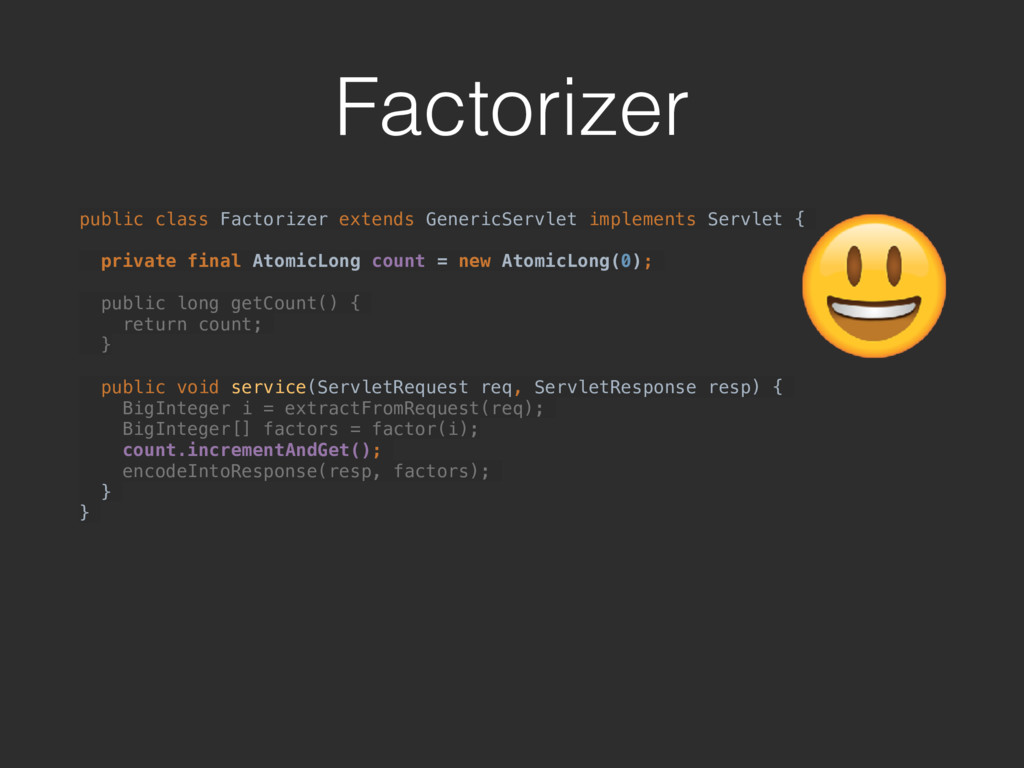
  27. Factorizer public class Factorizer extends GenericServlet implements Servlet { private

    final AtomicLong count = new AtomicLong(0); public long getCount() { return count; } public void service(ServletRequest req, ServletResponse resp) { BigInteger i = extractFromRequest(req); BigInteger[] factors = factor(i); count.incrementAndGet(); encodeIntoResponse(resp, factors); } }
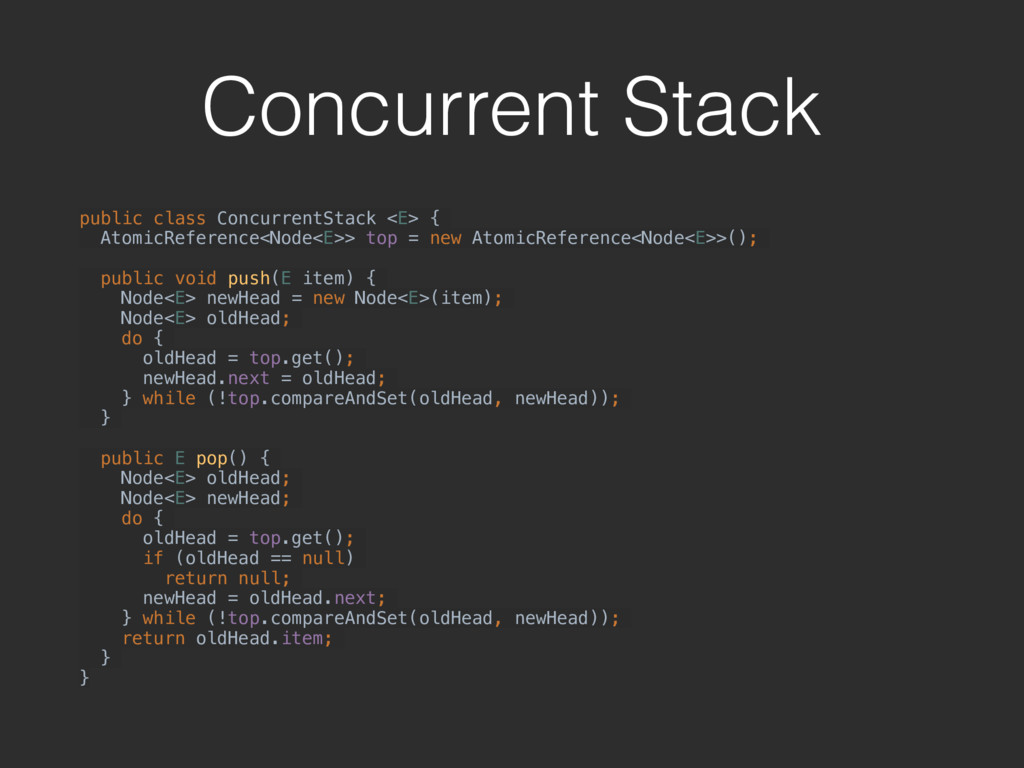
  28. Concurrent Stack public class ConcurrentStack <E> { AtomicReference<Node<E>> top =

    new AtomicReference<Node<E>>(); public void push(E item) { Node<E> newHead = new Node<E>(item); Node<E> oldHead; do { oldHead = top.get(); newHead.next = oldHead; } while (!top.compareAndSet(oldHead, newHead)); } public E pop() { Node<E> oldHead; Node<E> newHead; do { oldHead = top.get(); if (oldHead == null) return null; newHead = oldHead.next; } while (!top.compareAndSet(oldHead, newHead)); return oldHead.item; } }
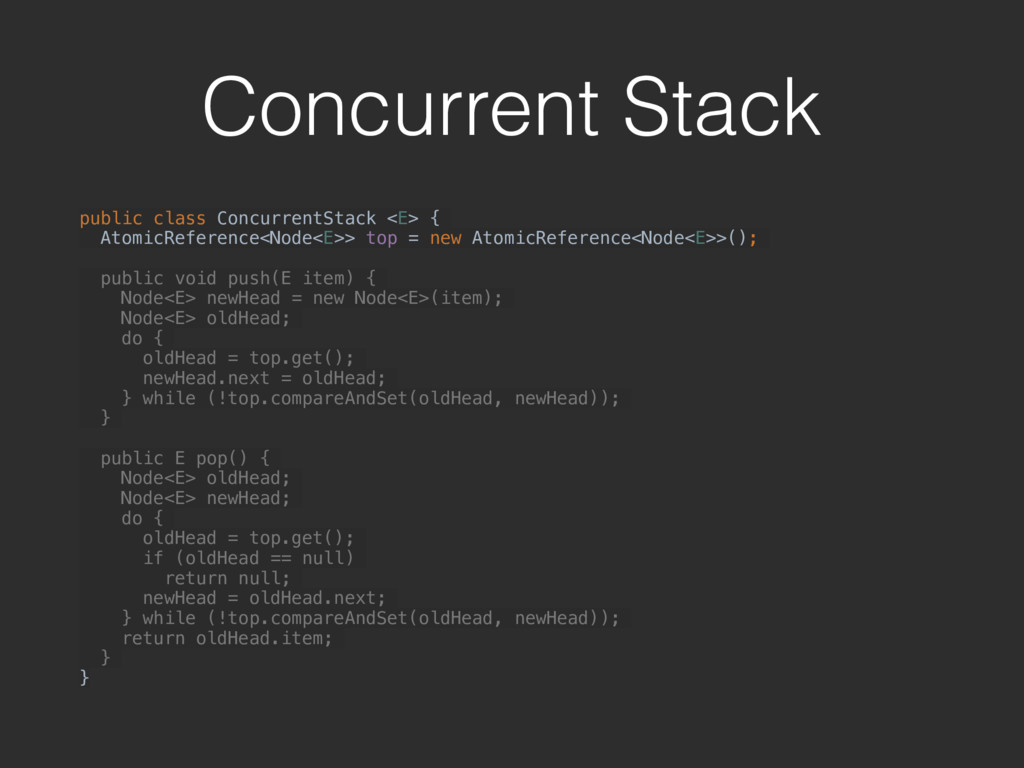
  29. Concurrent Stack public class ConcurrentStack <E> { AtomicReference<Node<E>> top =

    new AtomicReference<Node<E>>(); public void push(E item) { Node<E> newHead = new Node<E>(item); Node<E> oldHead; do { oldHead = top.get(); newHead.next = oldHead; } while (!top.compareAndSet(oldHead, newHead)); } public E pop() { Node<E> oldHead; Node<E> newHead; do { oldHead = top.get(); if (oldHead == null) return null; newHead = oldHead.next; } while (!top.compareAndSet(oldHead, newHead)); return oldHead.item; } }
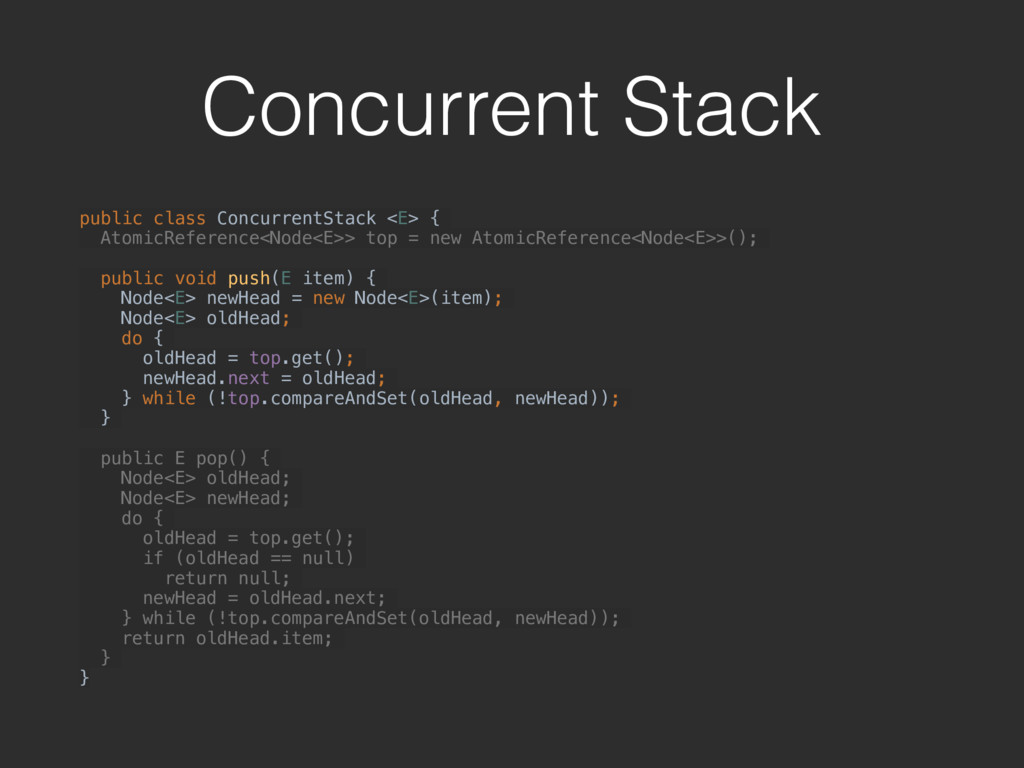
  30. Concurrent Stack public class ConcurrentStack <E> { AtomicReference<Node<E>> top =

    new AtomicReference<Node<E>>(); public void push(E item) { Node<E> newHead = new Node<E>(item); Node<E> oldHead; do { oldHead = top.get(); newHead.next = oldHead; } while (!top.compareAndSet(oldHead, newHead)); } public E pop() { Node<E> oldHead; Node<E> newHead; do { oldHead = top.get(); if (oldHead == null) return null; newHead = oldHead.next; } while (!top.compareAndSet(oldHead, newHead)); return oldHead.item; } }
  31. Factorizer public class Factorizer extends GenericServlet implements Servlet { public

    void service(ServletRequest req, ServletResponse resp) { BigInteger i = extractFromRequest(req); BigInteger[] factors = factor(i); encodeIntoResponse(resp, factors); } }
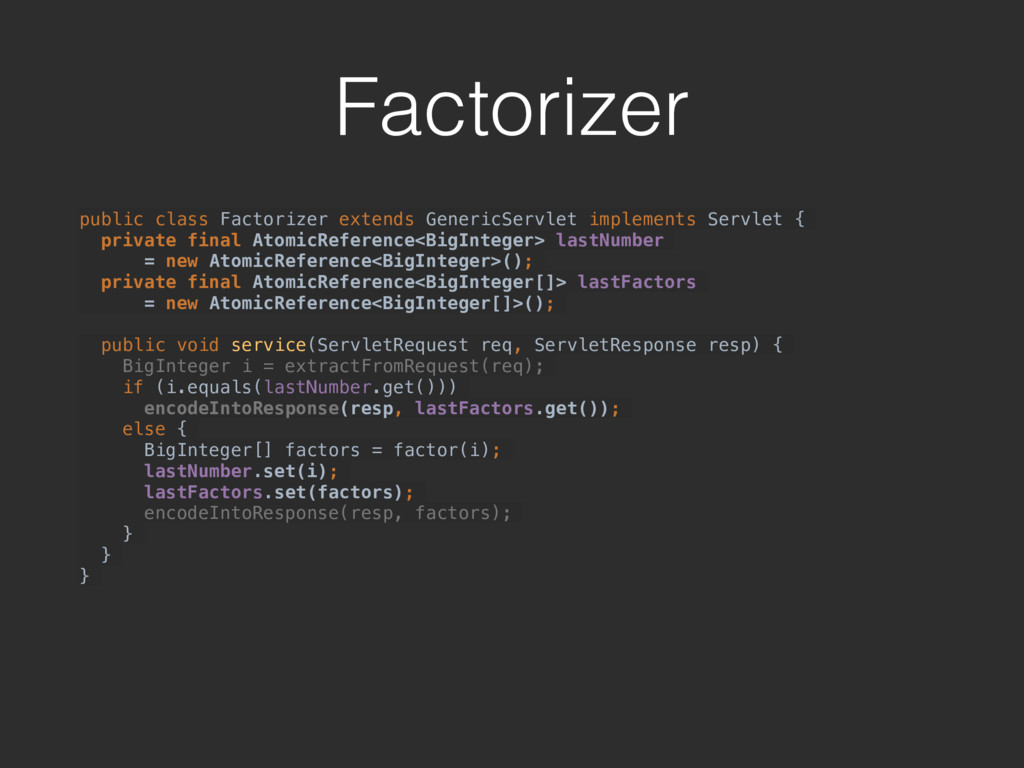
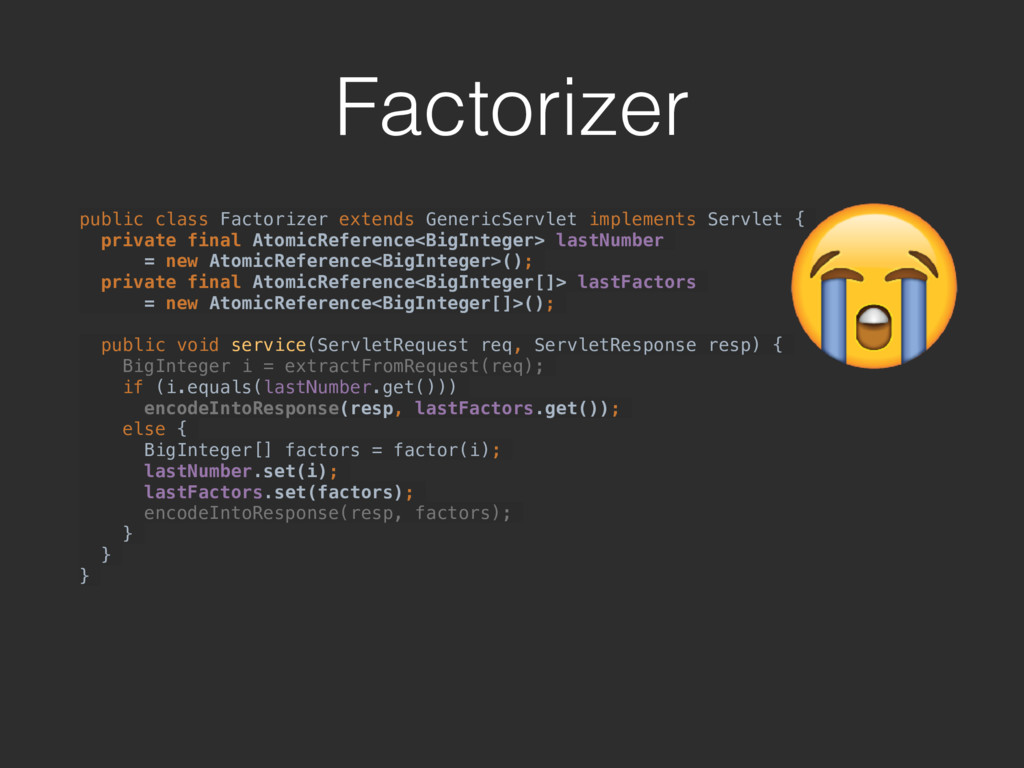
  32. Factorizer public class Factorizer extends GenericServlet implements Servlet { private

    final AtomicReference<BigInteger> lastNumber = new AtomicReference<BigInteger>(); private final AtomicReference<BigInteger[]> lastFactors = new AtomicReference<BigInteger[]>(); public void service(ServletRequest req, ServletResponse resp) { BigInteger i = extractFromRequest(req); if (i.equals(lastNumber.get())) encodeIntoResponse(resp, lastFactors.get()); else { BigInteger[] factors = factor(i); lastNumber.set(i); lastFactors.set(factors); encodeIntoResponse(resp, factors); } } }
  33. Factorizer public class Factorizer extends GenericServlet implements Servlet { private

    final AtomicReference<BigInteger> lastNumber = new AtomicReference<BigInteger>(); private final AtomicReference<BigInteger[]> lastFactors = new AtomicReference<BigInteger[]>(); public void service(ServletRequest req, ServletResponse resp) { BigInteger i = extractFromRequest(req); if (i.equals(lastNumber.get())) encodeIntoResponse(resp, lastFactors.get()); else { BigInteger[] factors = factor(i); lastNumber.set(i); lastFactors.set(factors); encodeIntoResponse(resp, factors); } } }
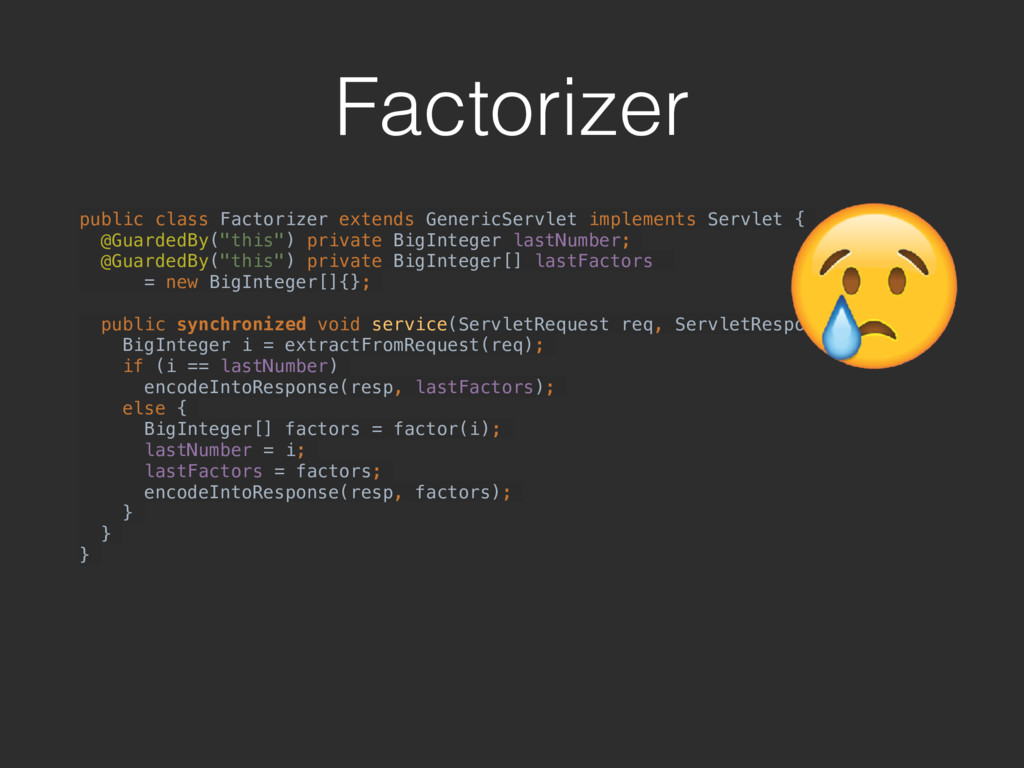
  34. Factorizer public class Factorizer extends GenericServlet implements Servlet { @GuardedBy("this")

    private BigInteger lastNumber; @GuardedBy("this") private BigInteger[] lastFactors = new BigInteger[]{}; public synchronized void service(ServletRequest req, ServletResponse resp) { BigInteger i = extractFromRequest(req); if (i == lastNumber) encodeIntoResponse(resp, lastFactors); else { BigInteger[] factors = factor(i); lastNumber = i; lastFactors = factors; encodeIntoResponse(resp, factors); } } }
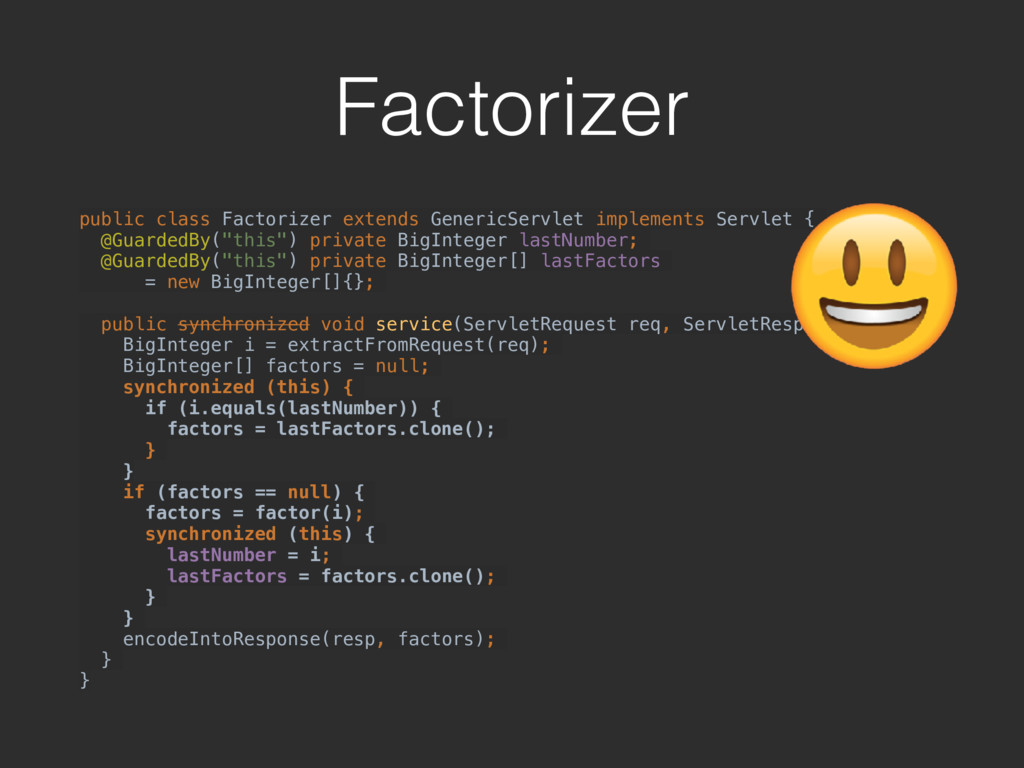
  35. Factorizer public class Factorizer extends GenericServlet implements Servlet { @GuardedBy("this")

    private BigInteger lastNumber; @GuardedBy("this") private BigInteger[] lastFactors = new BigInteger[]{}; public synchronized void service(ServletRequest req, ServletResponse resp) { BigInteger i = extractFromRequest(req); BigInteger[] factors = null; synchronized (this) { if (i.equals(lastNumber)) { factors = lastFactors.clone(); } } if (factors == null) { factors = factor(i); synchronized (this) { lastNumber = i; lastFactors = factors.clone(); } } encodeIntoResponse(resp, factors); } }
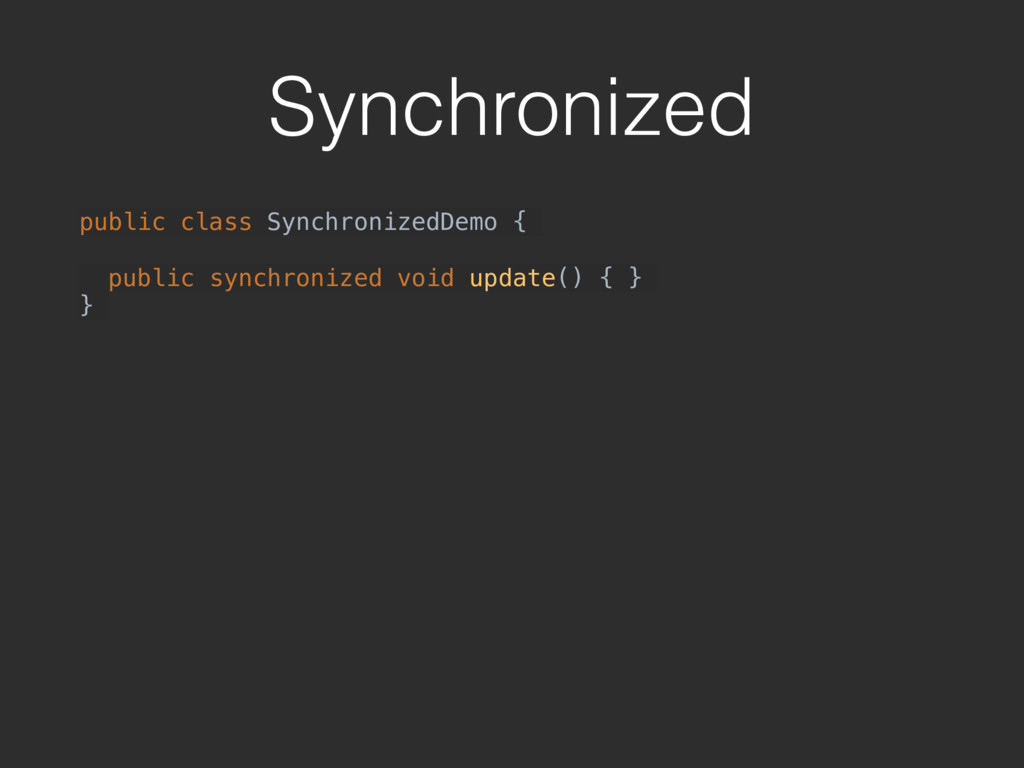
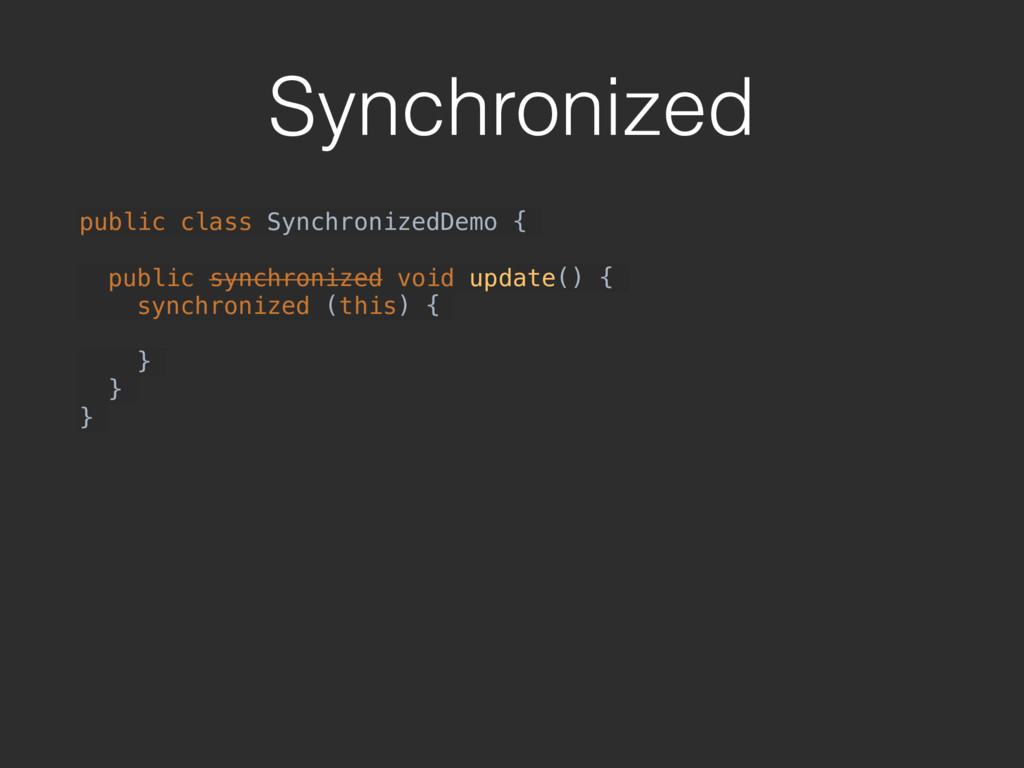
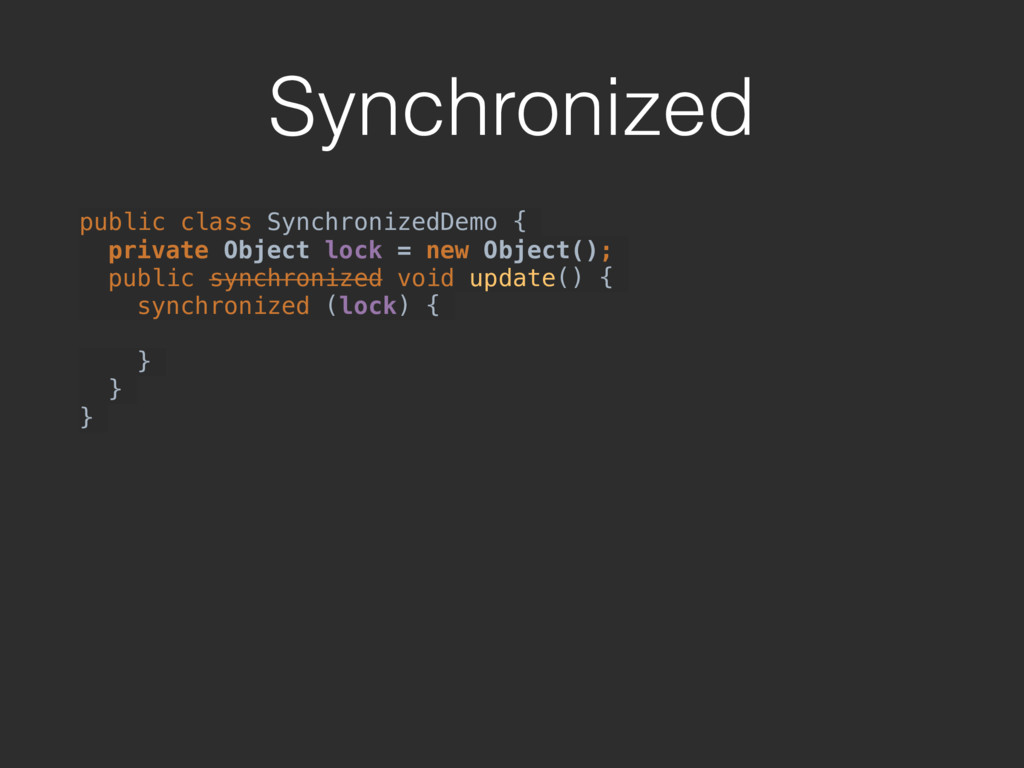
  36. Synchronized public class SynchronizedDemo { private Object lock = new

    Object(); public synchronized void update() { synchronized (lock) { } } }
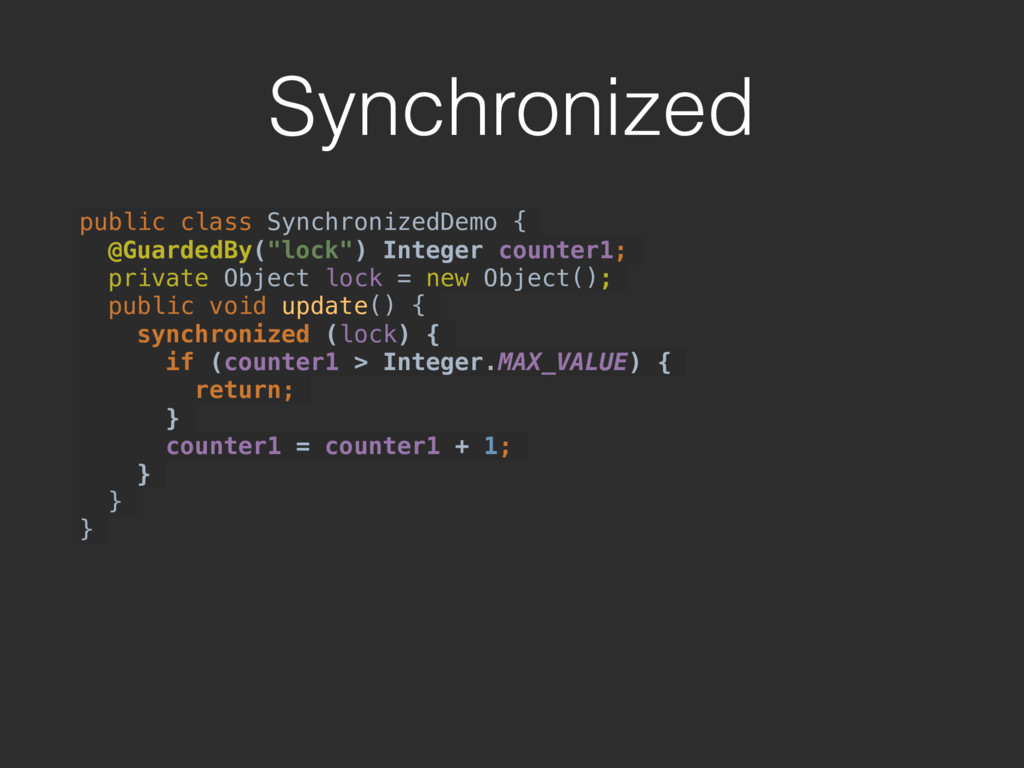
  37. Synchronized public class SynchronizedDemo { @GuardedBy("lock") Integer counter1; private Object

    lock = new Object(); public void update() { synchronized (lock) { if (counter1 > Integer.MAX_VALUE) { return; } counter1 = counter1 + 1; } } }
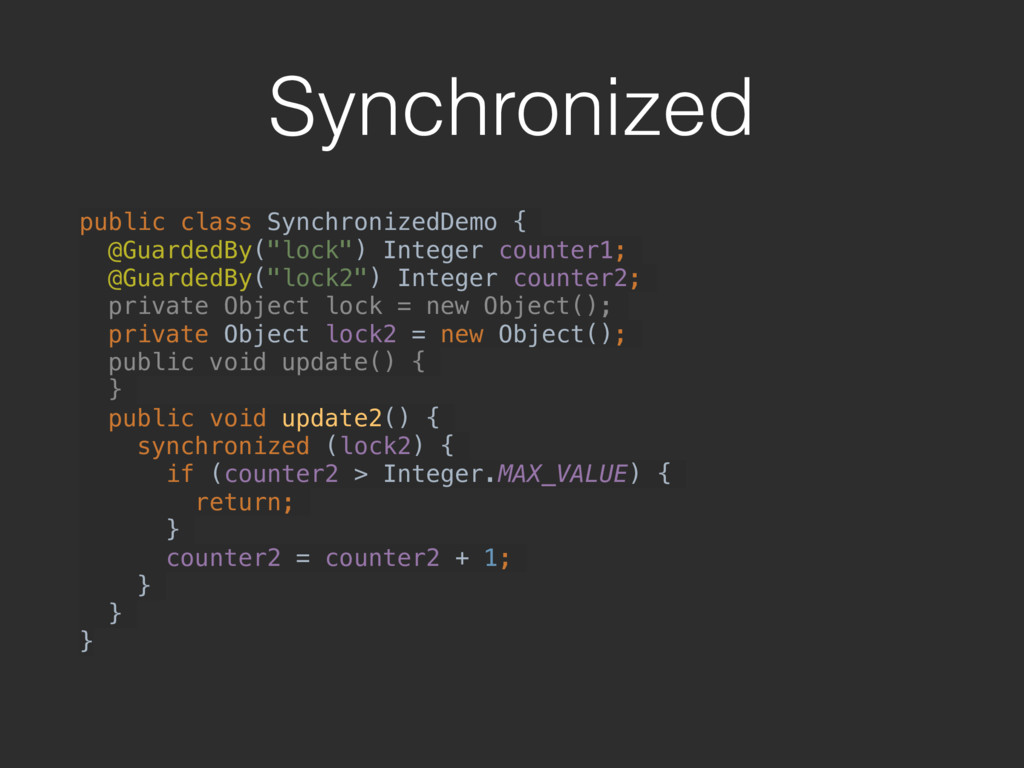
  38. Synchronized public class SynchronizedDemo { @GuardedBy("lock") Integer counter1; @GuardedBy("lock2") Integer

    counter2; private Object lock = new Object(); private Object lock2 = new Object(); public void update() { } public void update2() { synchronized (lock2) { if (counter2 > Integer.MAX_VALUE) { return; } counter2 = counter2 + 1; } } }
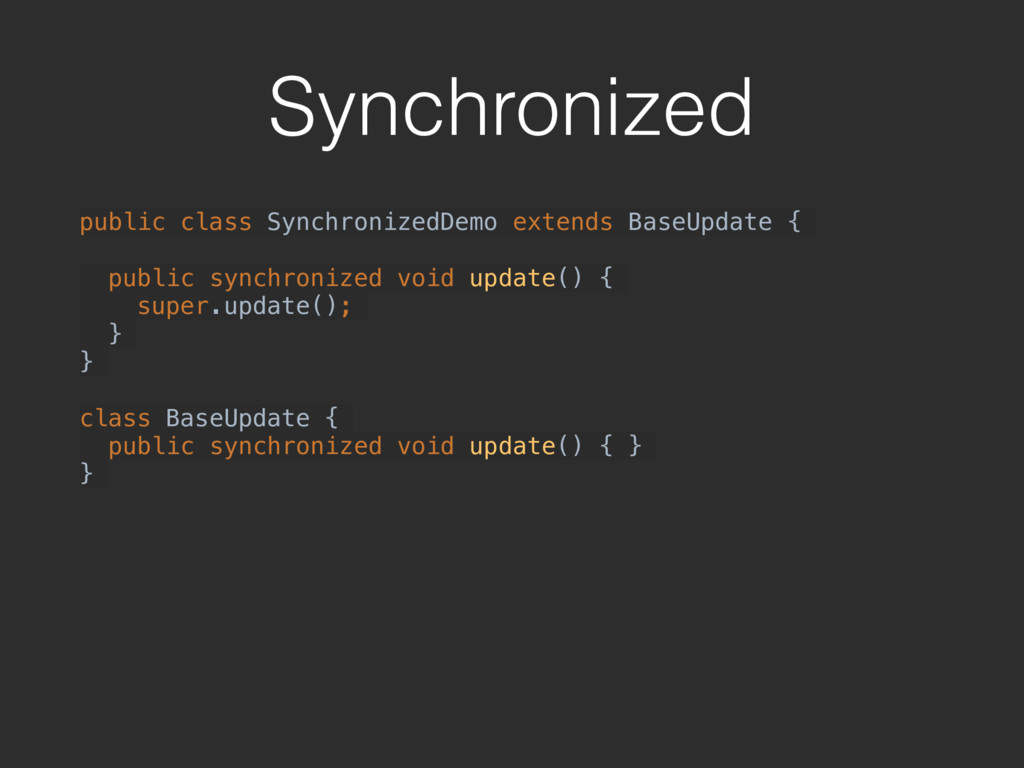
  39. Synchronized public class SynchronizedDemo extends BaseUpdate { public synchronized void

    update() { super.update(); } } class BaseUpdate { public synchronized void update() { } }
  40. Locking • Prefer explicit locking. Exception - superclass uses synchronised

    keyword, private lock will be unusable for subclasses
  41. Locking • Prefer explicit locking. Exception - superclass uses synchronised

    keyword, private lock will be unusable for subclasses • Locks are reentrant.
  42. Locking • Prefer explicit locking. Exception - superclass uses synchronised

    keyword, private lock will be unusable for subclasses • Locks are reentrant. • Add annotation @GuardedBy(“CorrectLock”) for documentation.
  43. Locking • Prefer explicit locking. Exception - superclass uses synchronised

    keyword, private lock will be unusable for subclasses • Locks are reentrant. • Add annotation @GuardedBy(“CorrectLock”) for documentation. • Perform all operations on a single variable using the same lock.
  44. Locking • Prefer explicit locking. Exception - superclass uses synchronised

    keyword, private lock will be unusable for subclasses • Locks are reentrant. • Add annotation @GuardedBy(“CorrectLock”) for documentation. • Perform all operations on a single variable using the same lock. • Perform all operations on related variables using the same lock. (i.e. Unrelated variables can have different locks)
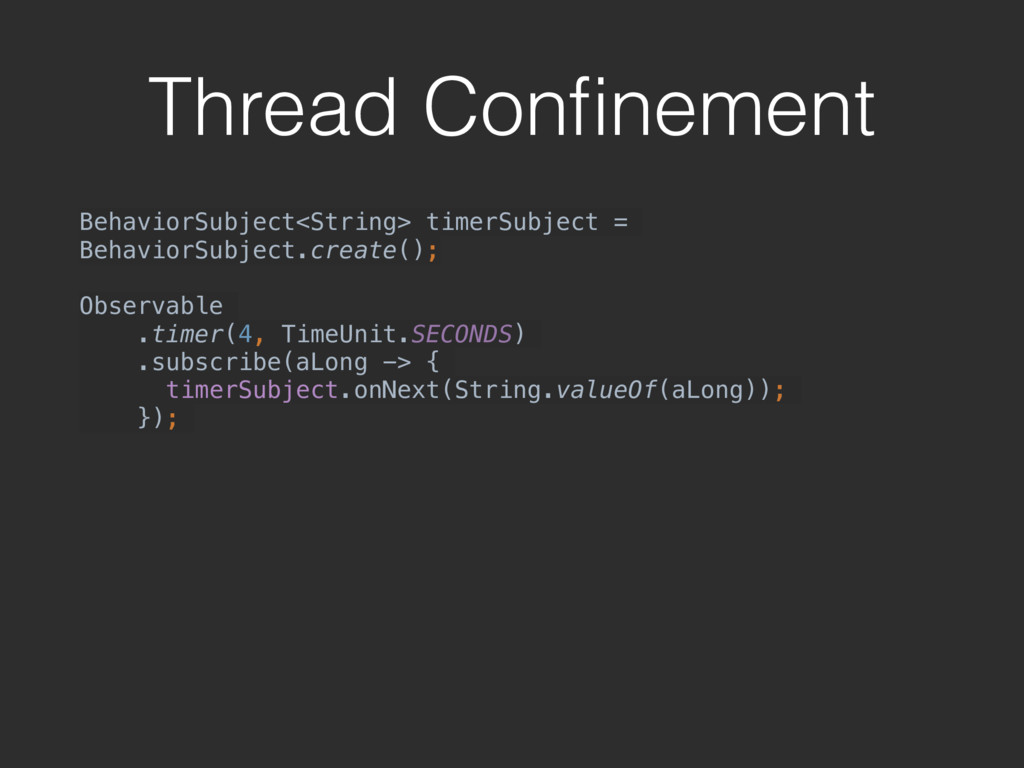
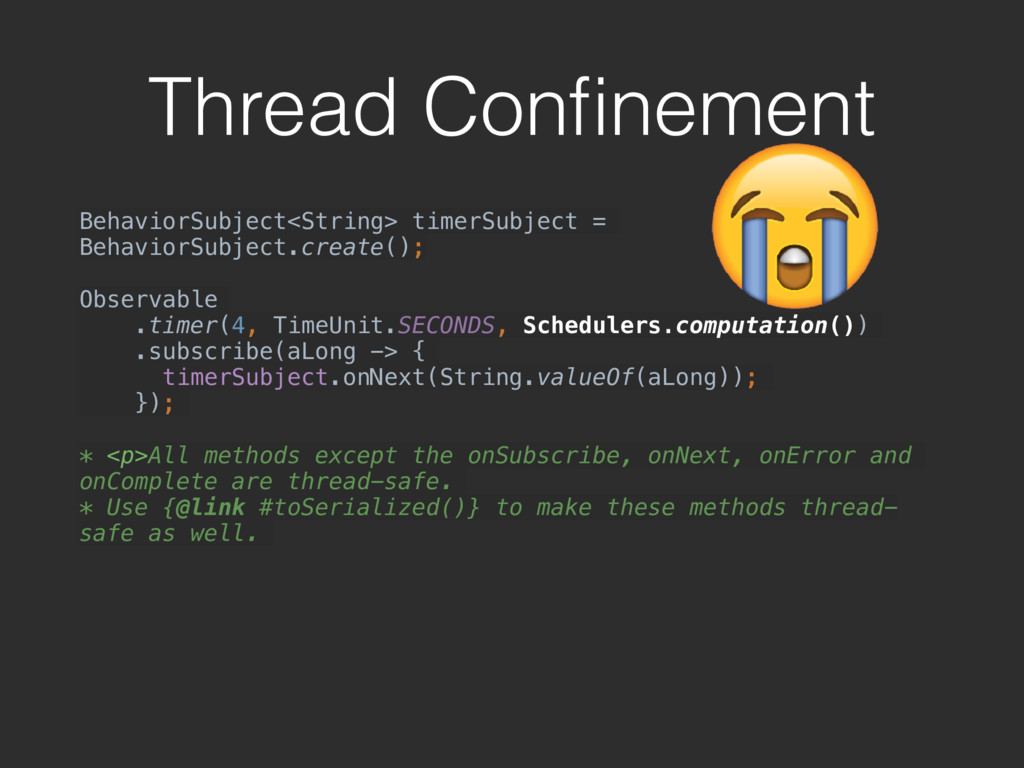
  45. Thread Confinement BehaviorSubject<String> timerSubject = BehaviorSubject.create(); Observable .timer(4, TimeUnit.SECONDS, Schedulers.computation())

    .subscribe(aLong -> { timerSubject.onNext(String.valueOf(aLong)); }); * <p>All methods except the onSubscribe, onNext, onError and onComplete are thread-safe. * Use {@link #toSerialized()} to make these methods thread- safe as well.
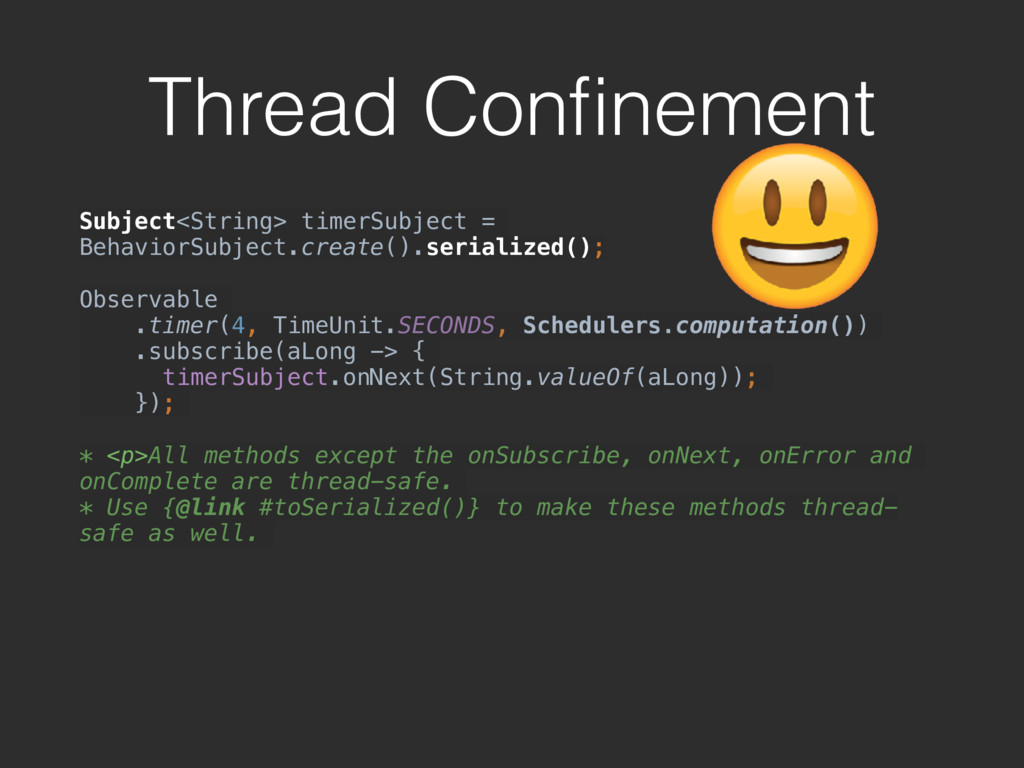
  46. Thread Confinement Subject<String> timerSubject = BehaviorSubject.create().serialized(); Observable .timer(4, TimeUnit.SECONDS, Schedulers.computation())

    .subscribe(aLong -> { timerSubject.onNext(String.valueOf(aLong)); }); * <p>All methods except the onSubscribe, onNext, onError and onComplete are thread-safe. * Use {@link #toSerialized()} to make these methods thread- safe as well.
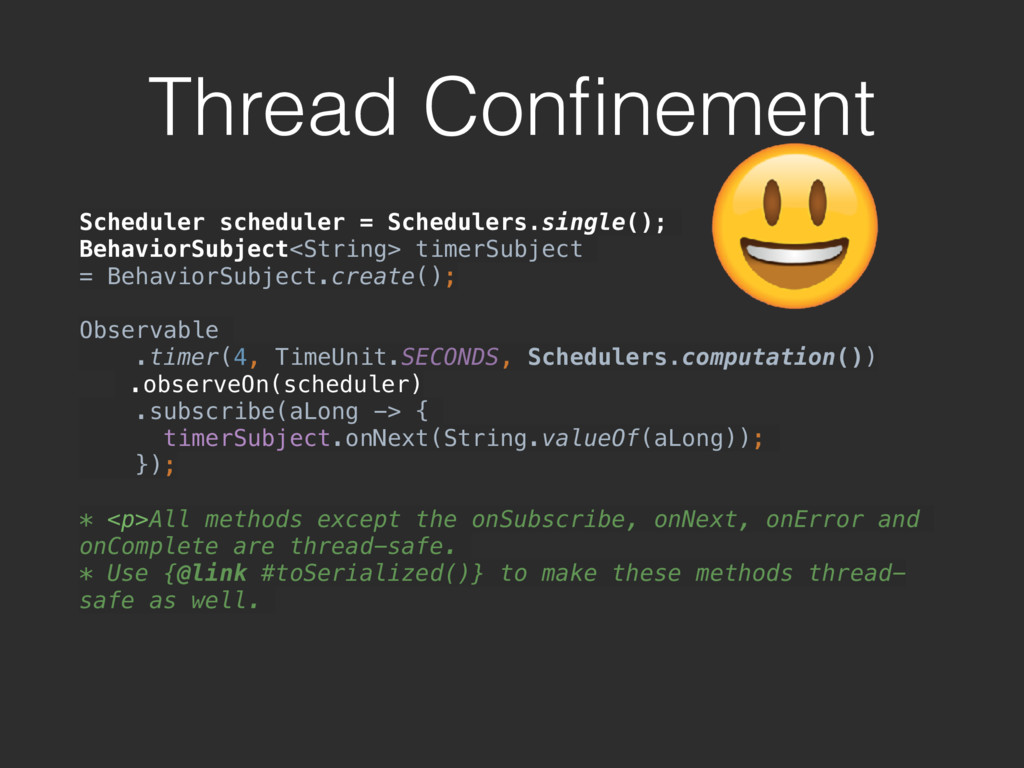
  47. Thread Confinement Scheduler scheduler = Schedulers.single(); BehaviorSubject<String> timerSubject = BehaviorSubject.create();

    Observable .timer(4, TimeUnit.SECONDS, Schedulers.computation()) .observeOn(scheduler) .subscribe(aLong -> { timerSubject.onNext(String.valueOf(aLong)); }); * <p>All methods except the onSubscribe, onNext, onError and onComplete are thread-safe. * Use {@link #toSerialized()} to make these methods thread- safe as well.
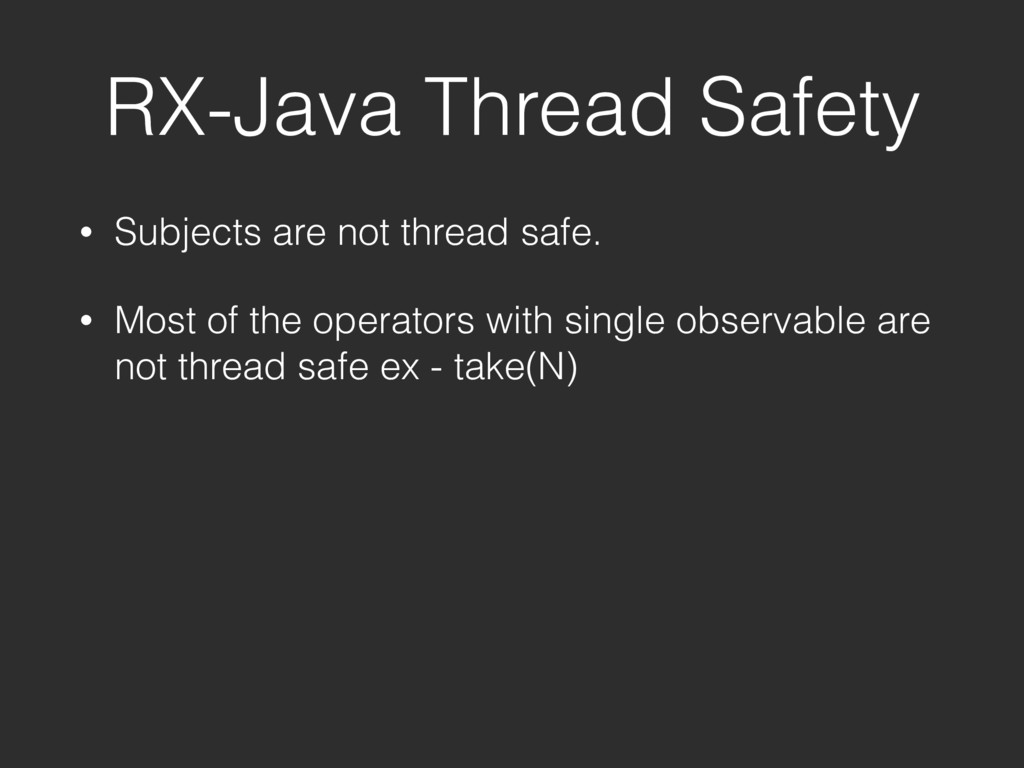
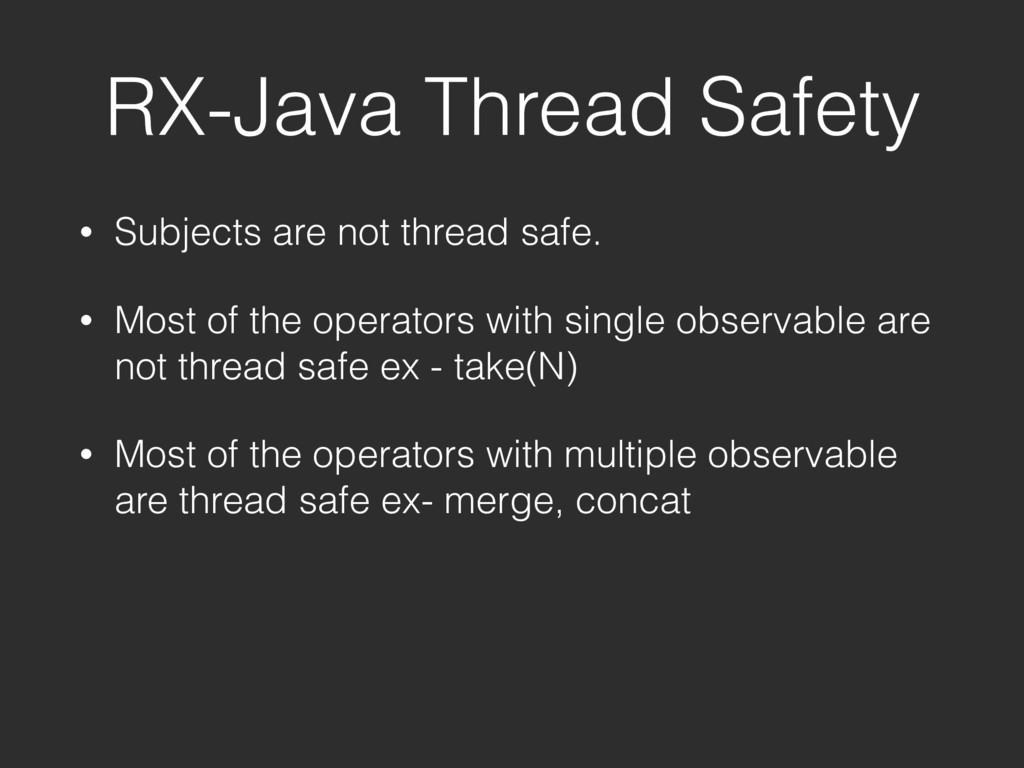
  48. RX-Java Thread Safety • Subjects are not thread safe. •

    Most of the operators with single observable are not thread safe ex - take(N)
  49. RX-Java Thread Safety • Subjects are not thread safe. •

    Most of the operators with single observable are not thread safe ex - take(N) • Most of the operators with multiple observable are thread safe ex- merge, concat
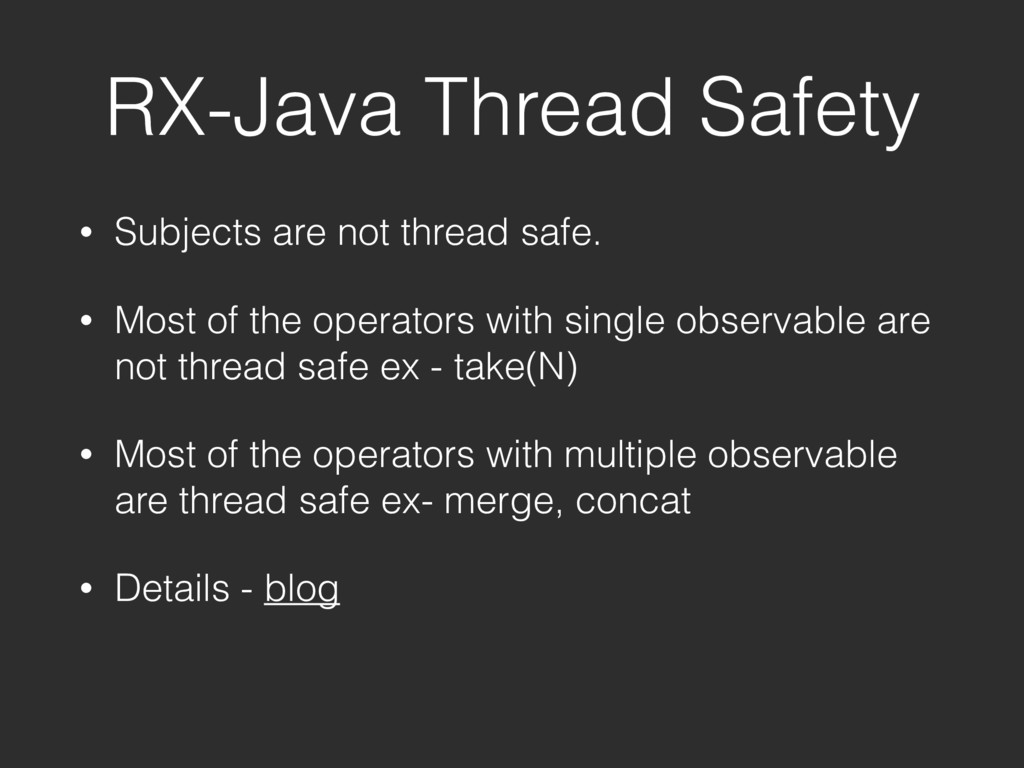
  50. RX-Java Thread Safety • Subjects are not thread safe. •

    Most of the operators with single observable are not thread safe ex - take(N) • Most of the operators with multiple observable are thread safe ex- merge, concat • Details - blog
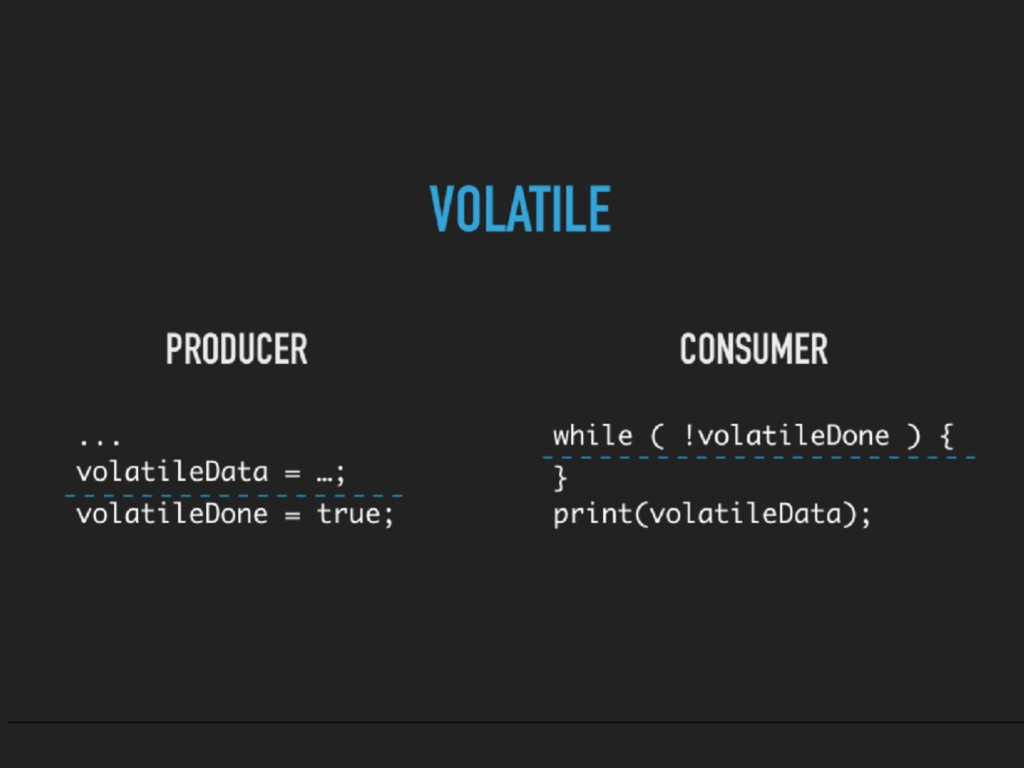
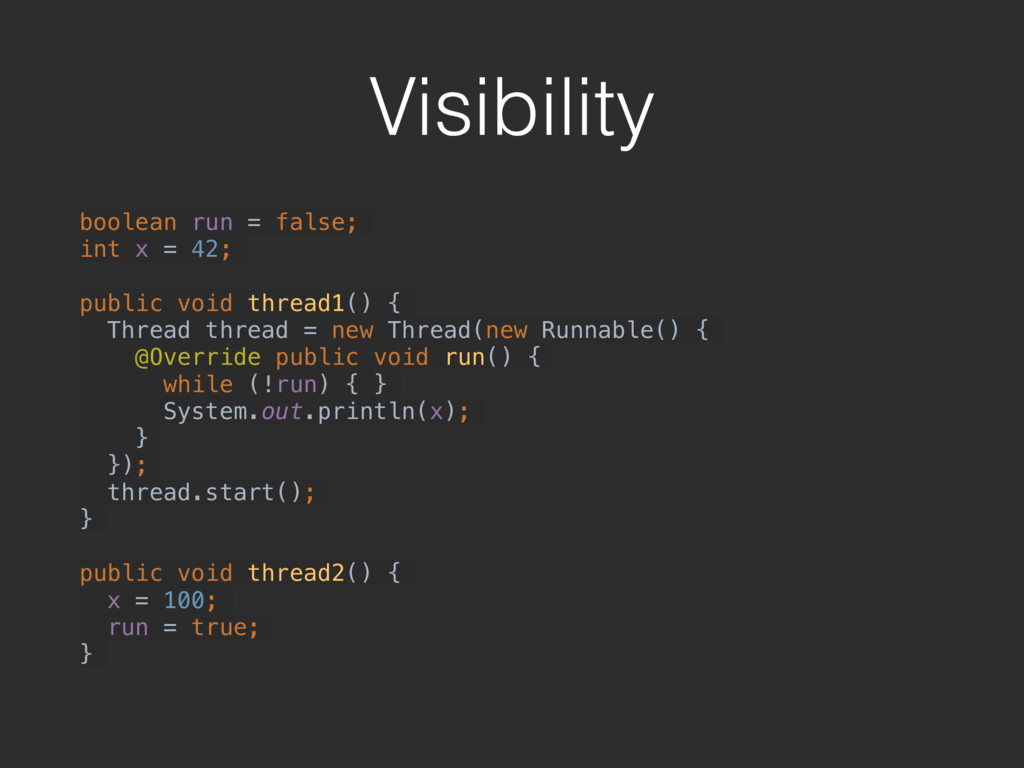
  51. Visibility boolean run = false; int x = 42; public

    void thread1() { Thread thread = new Thread(new Runnable() { @Override public void run() { while (!run) { } System.out.println(x); } }); thread.start(); } public void thread2() { x = 100; run = true; }
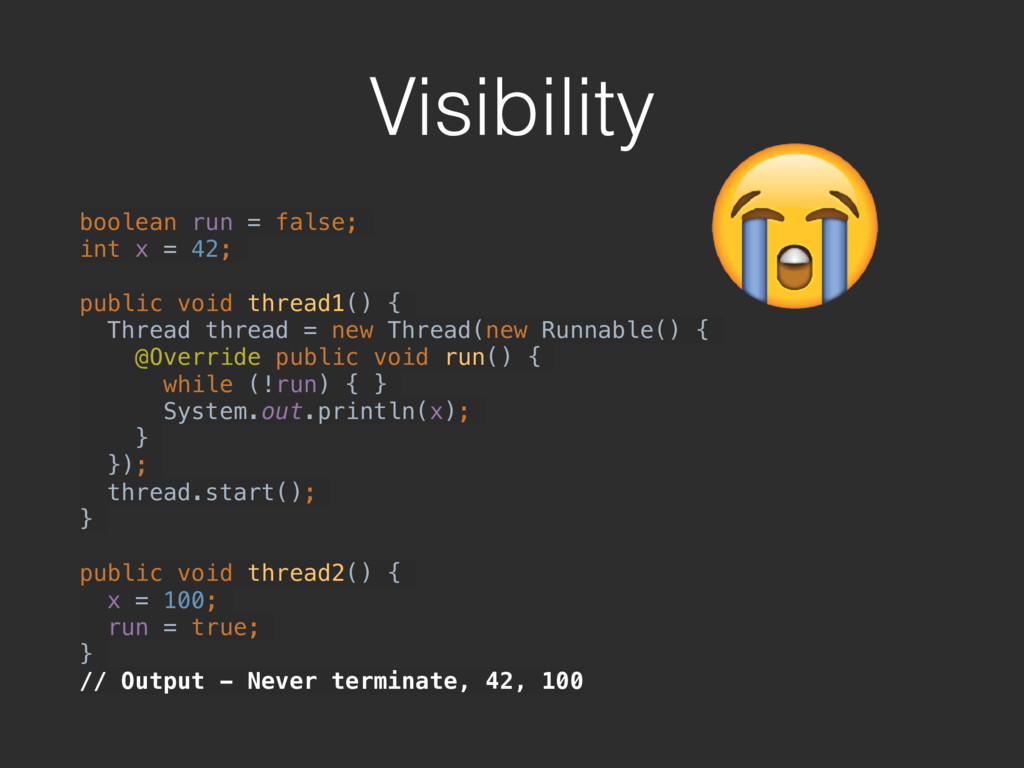
  52. Visibility boolean run = false; int x = 42; public

    void thread1() { Thread thread = new Thread(new Runnable() { @Override public void run() { while (!run) { } System.out.println(x); } }); thread.start(); } public void thread2() { x = 100; run = true; } // Output - Never terminate, 42, 100
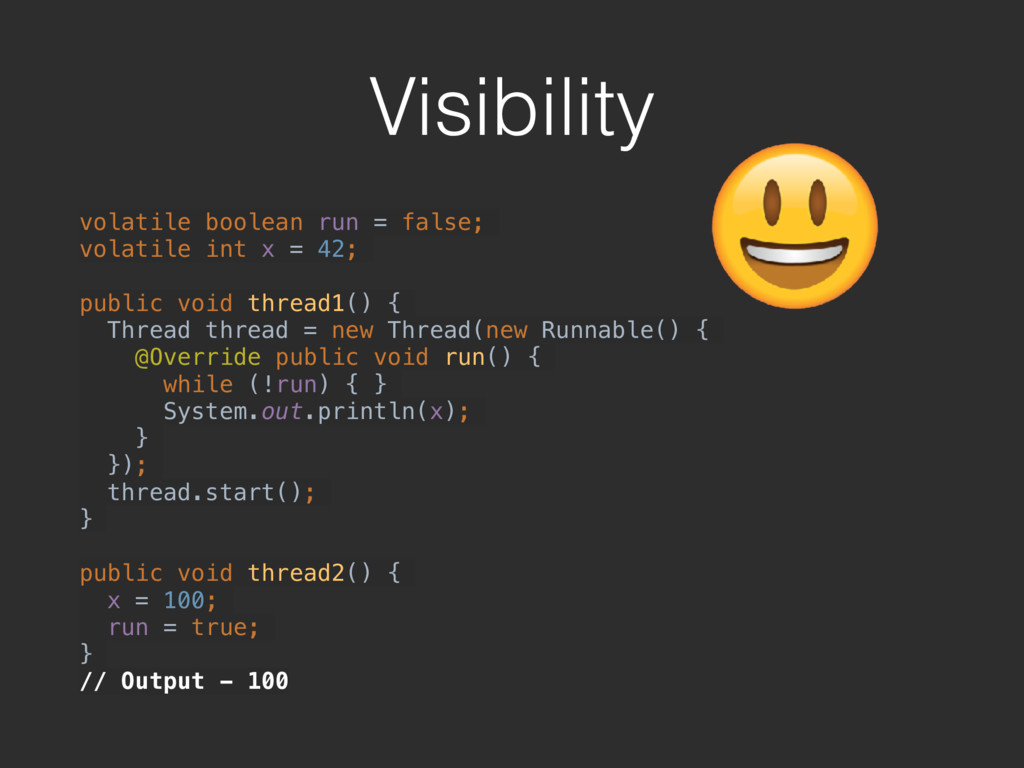
  53. Visibility volatile boolean run = false; volatile int x =

    42; public void thread1() { Thread thread = new Thread(new Runnable() { @Override public void run() { while (!run) { } System.out.println(x); } }); thread.start(); } public void thread2() { x = 100; run = true; } // Output - 100
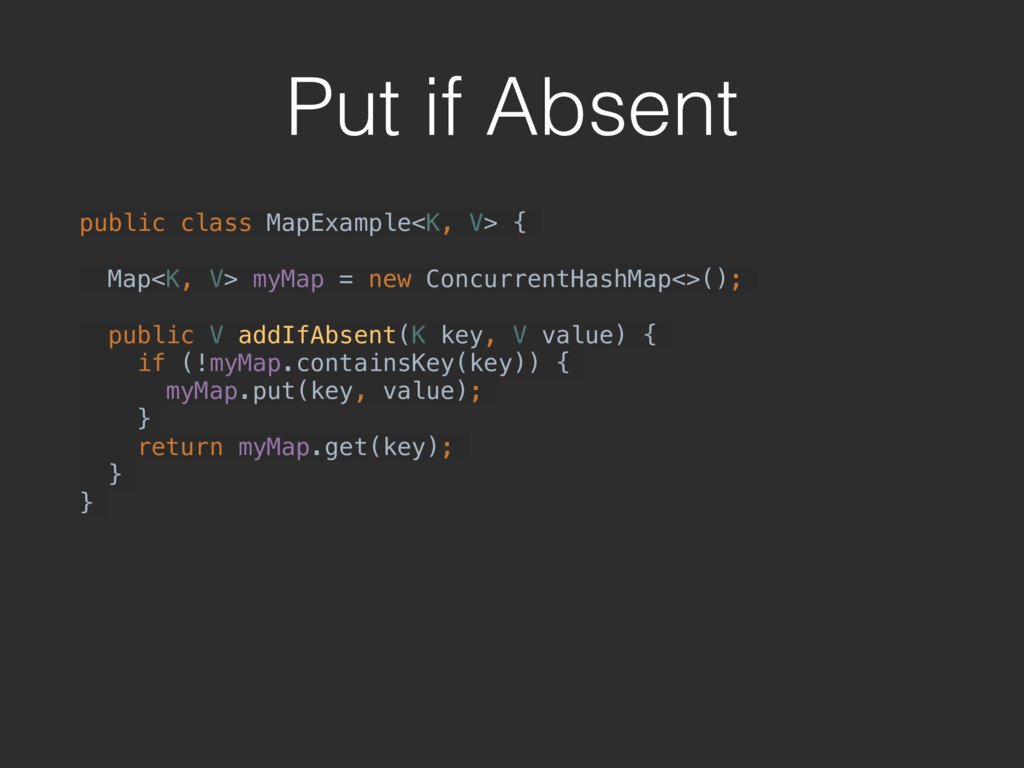
  54. Put if Absent public class MapExample<K, V> { Map<K, V>

    myMap = new ConcurrentHashMap<>(); public V addIfAbsent(K key, V value) { if (!myMap.containsKey(key)) { myMap.put(key, value); } return myMap.get(key); } }
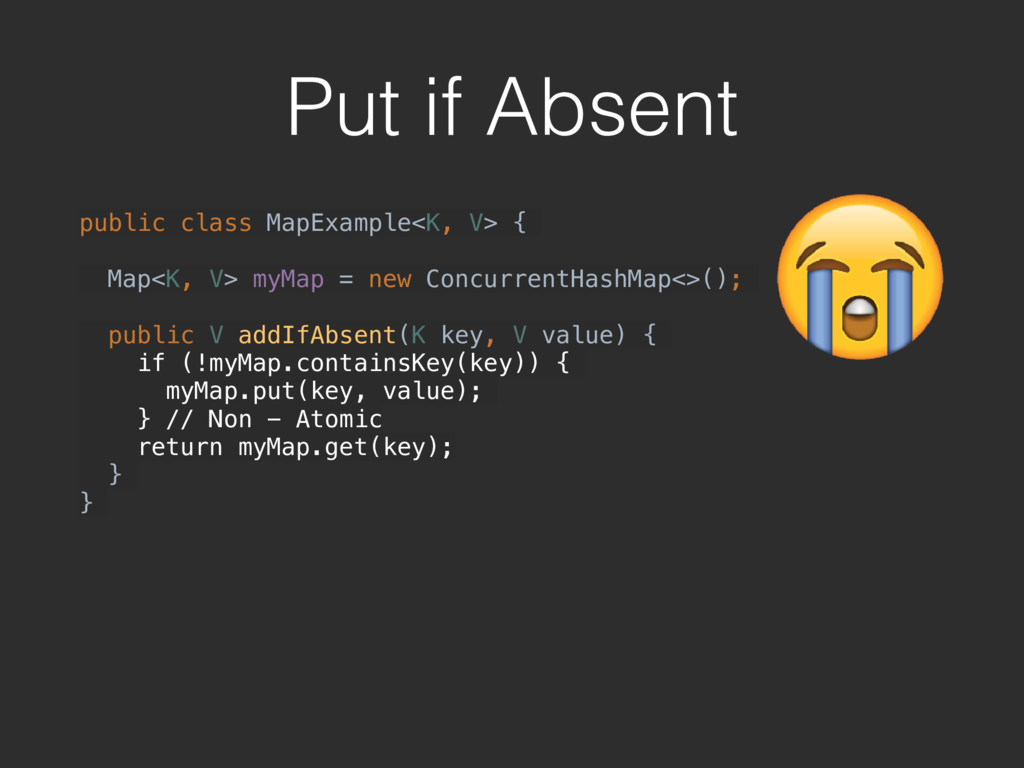
  55. Put if Absent public class MapExample<K, V> { Map<K, V>

    myMap = new ConcurrentHashMap<>(); public V addIfAbsent(K key, V value) { if (!myMap.containsKey(key)) { myMap.put(key, value); } // Non - Atomic return myMap.get(key); } }
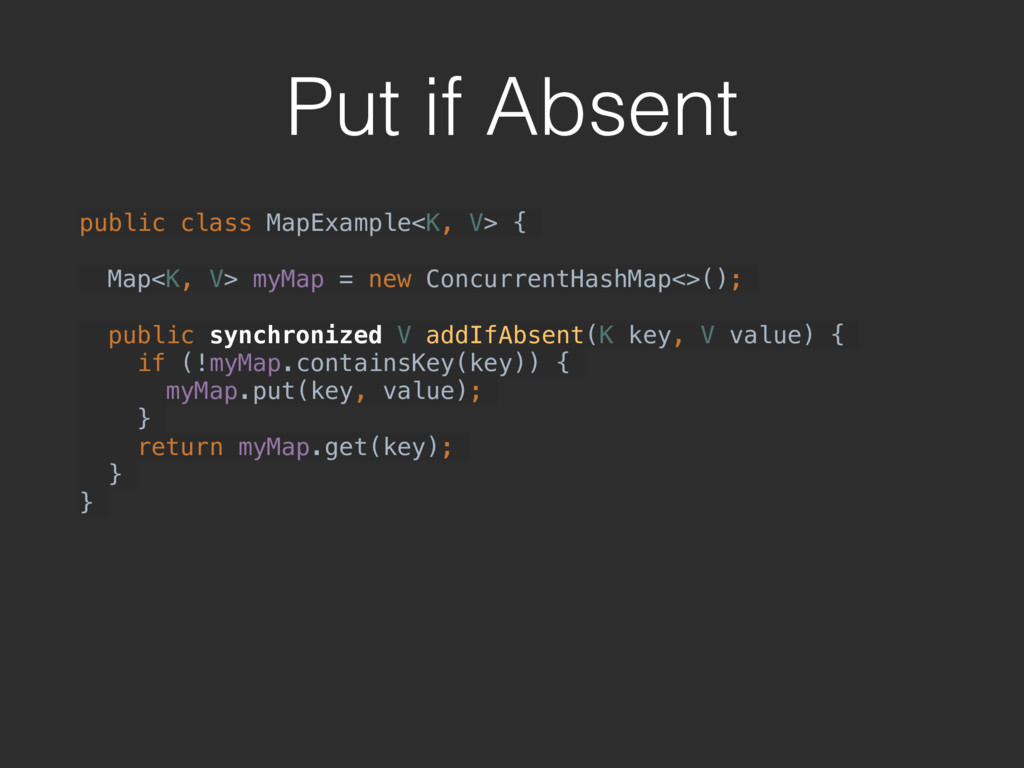
  56. Put if Absent public class MapExample<K, V> { Map<K, V>

    myMap = new ConcurrentHashMap<>(); public synchronized V addIfAbsent(K key, V value) { if (!myMap.containsKey(key)) { myMap.put(key, value); } return myMap.get(key); } }
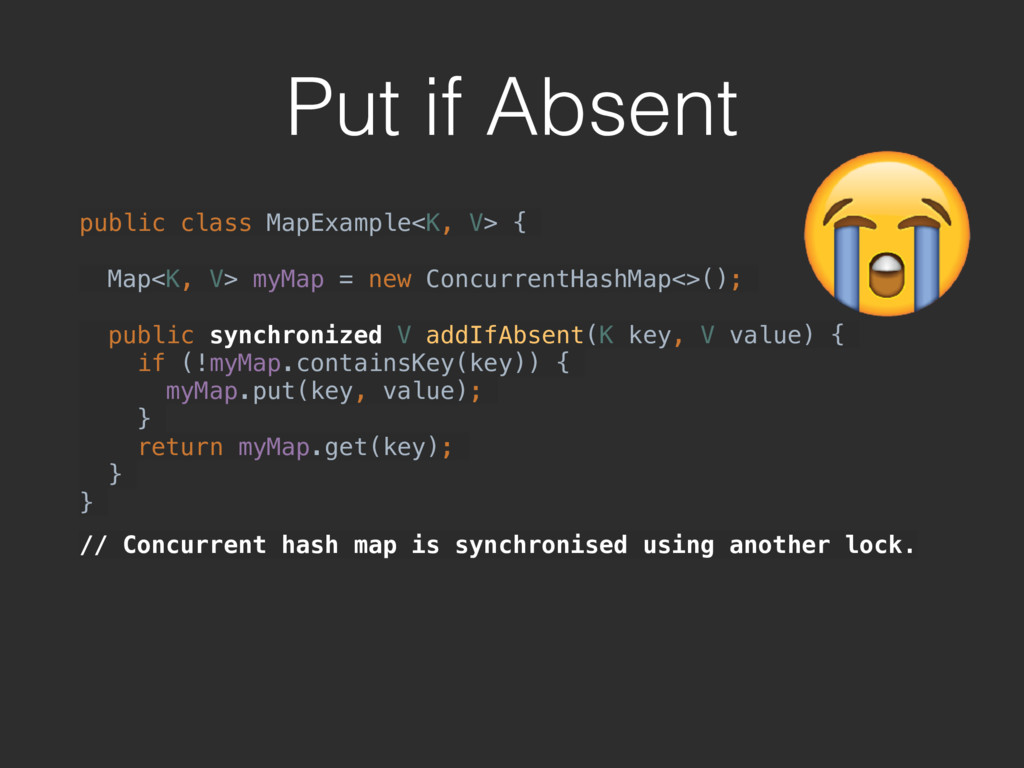
  57. Put if Absent public class MapExample<K, V> { Map<K, V>

    myMap = new ConcurrentHashMap<>(); public synchronized V addIfAbsent(K key, V value) { if (!myMap.containsKey(key)) { myMap.put(key, value); } return myMap.get(key); } } // Concurrent hash map is synchronised using another lock.
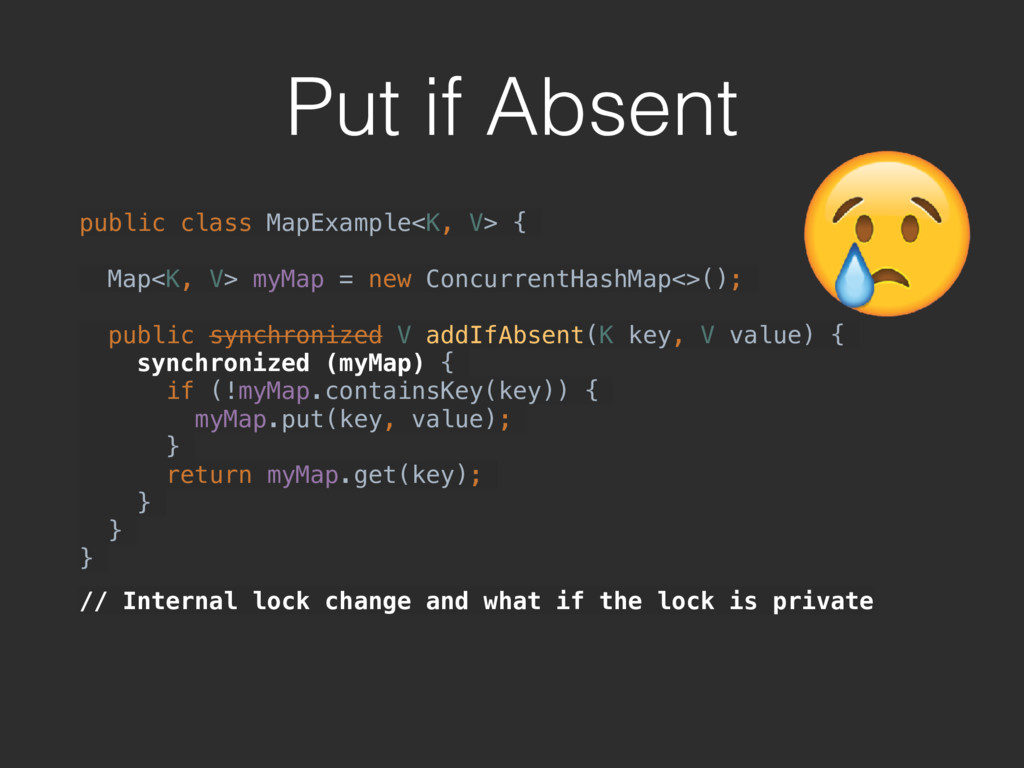
  58. Put if Absent public class MapExample<K, V> { Map<K, V>

    myMap = new ConcurrentHashMap<>(); public synchronized V addIfAbsent(K key, V value) { synchronized (myMap) { if (!myMap.containsKey(key)) { myMap.put(key, value); } return myMap.get(key); } } } // Internal lock change and what if the lock is private
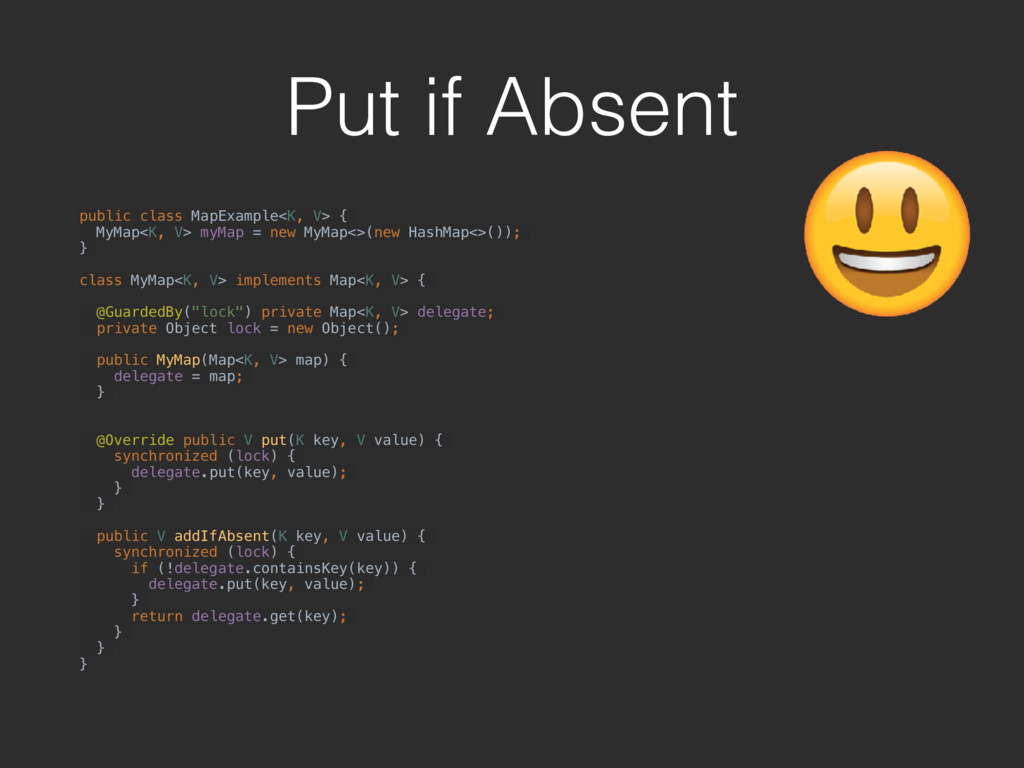
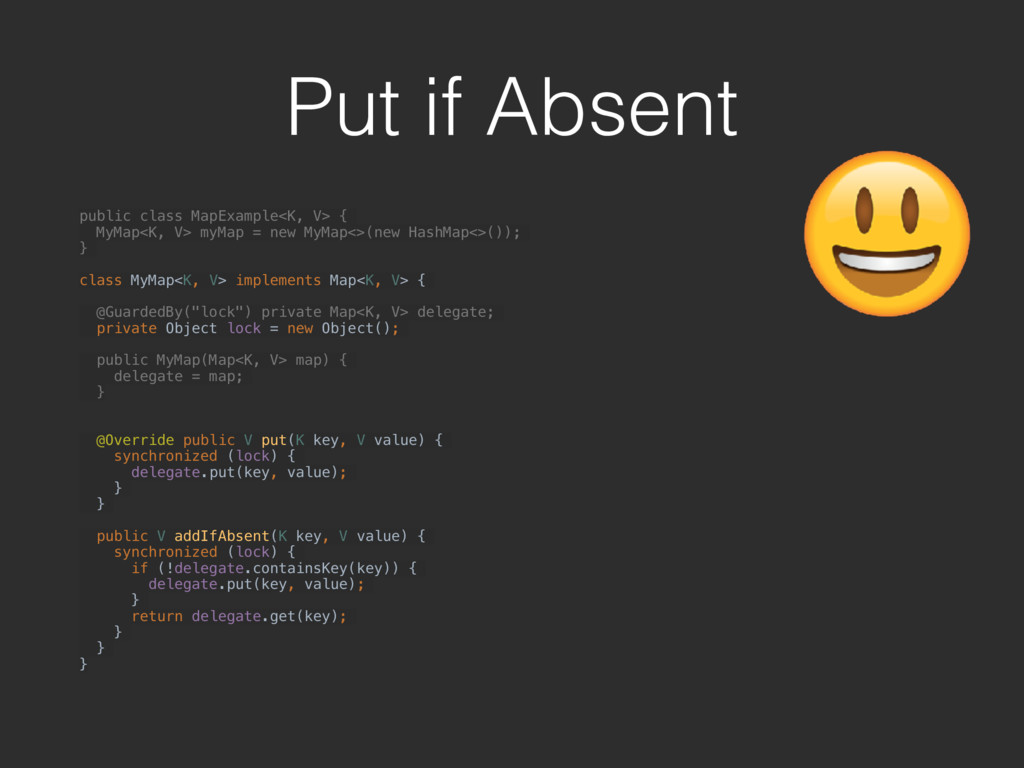
  59. Put if Absent public class MapExample<K, V> { MyMap<K, V>

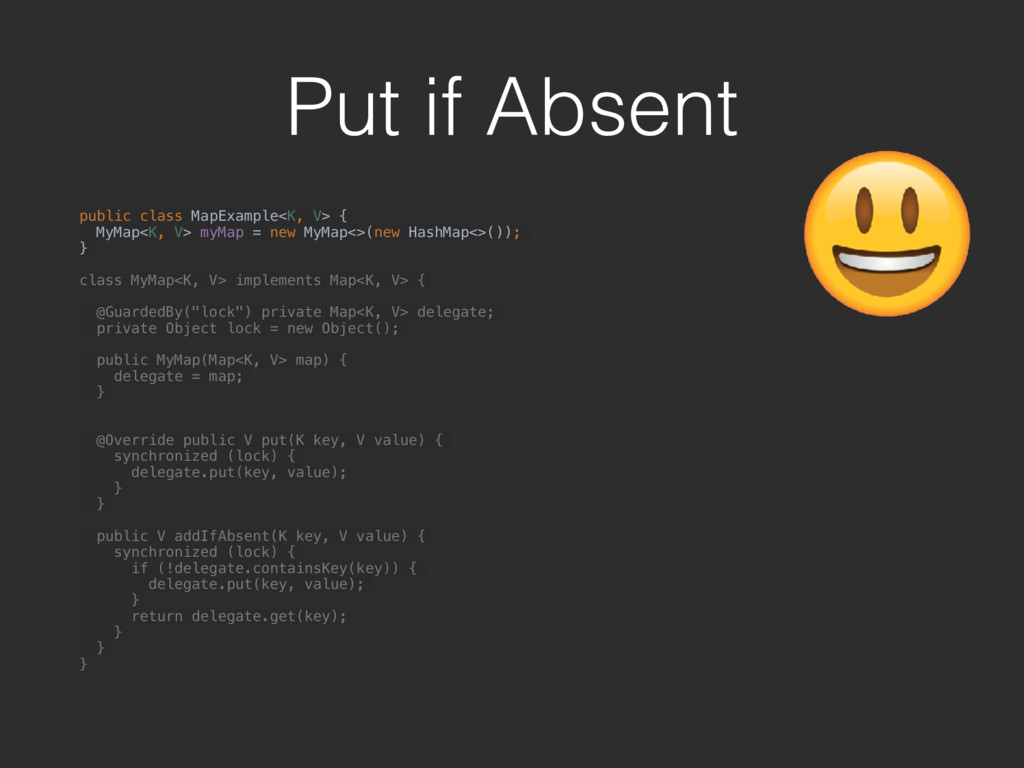
    myMap = new MyMap<>(new HashMap<>()); } class MyMap<K, V> implements Map<K, V> { @GuardedBy("lock") private Map<K, V> delegate; private Object lock = new Object(); public MyMap(Map<K, V> map) { delegate = map; } @Override public V put(K key, V value) { synchronized (lock) { delegate.put(key, value); } } public V addIfAbsent(K key, V value) { synchronized (lock) { if (!delegate.containsKey(key)) { delegate.put(key, value); } return delegate.get(key); } } }
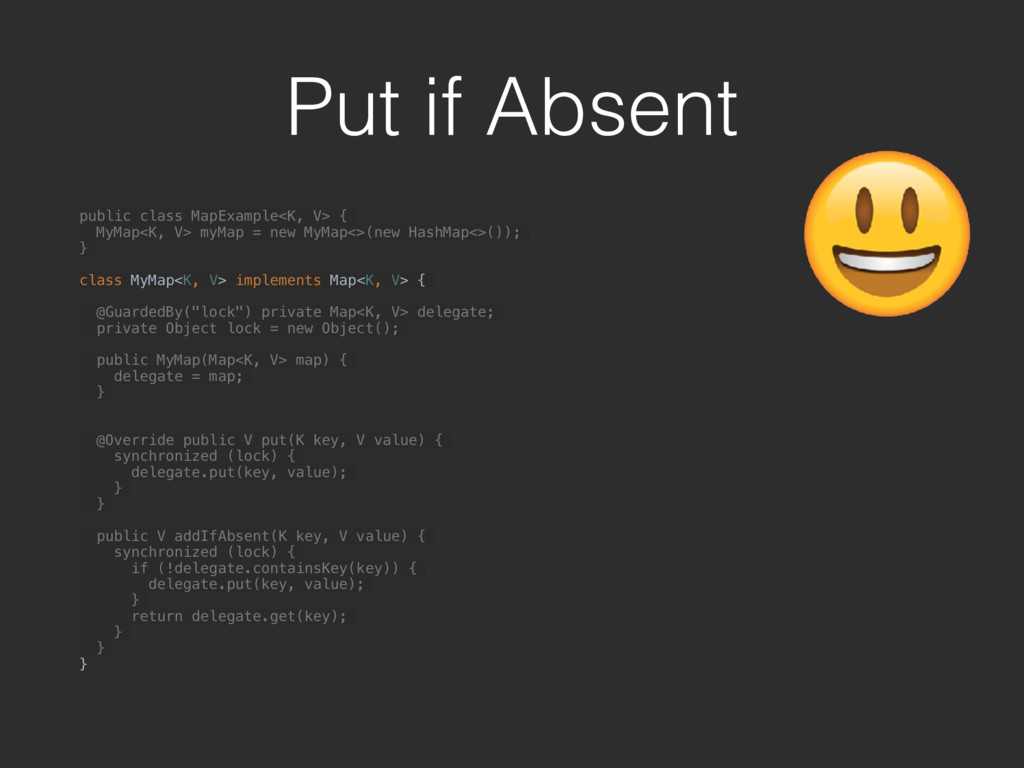
  60. Put if Absent public class MapExample<K, V> { MyMap<K, V>

    myMap = new MyMap<>(new HashMap<>()); } class MyMap<K, V> implements Map<K, V> { @GuardedBy("lock") private Map<K, V> delegate; private Object lock = new Object(); public MyMap(Map<K, V> map) { delegate = map; } @Override public V put(K key, V value) { synchronized (lock) { delegate.put(key, value); } } public V addIfAbsent(K key, V value) { synchronized (lock) { if (!delegate.containsKey(key)) { delegate.put(key, value); } return delegate.get(key); } } }
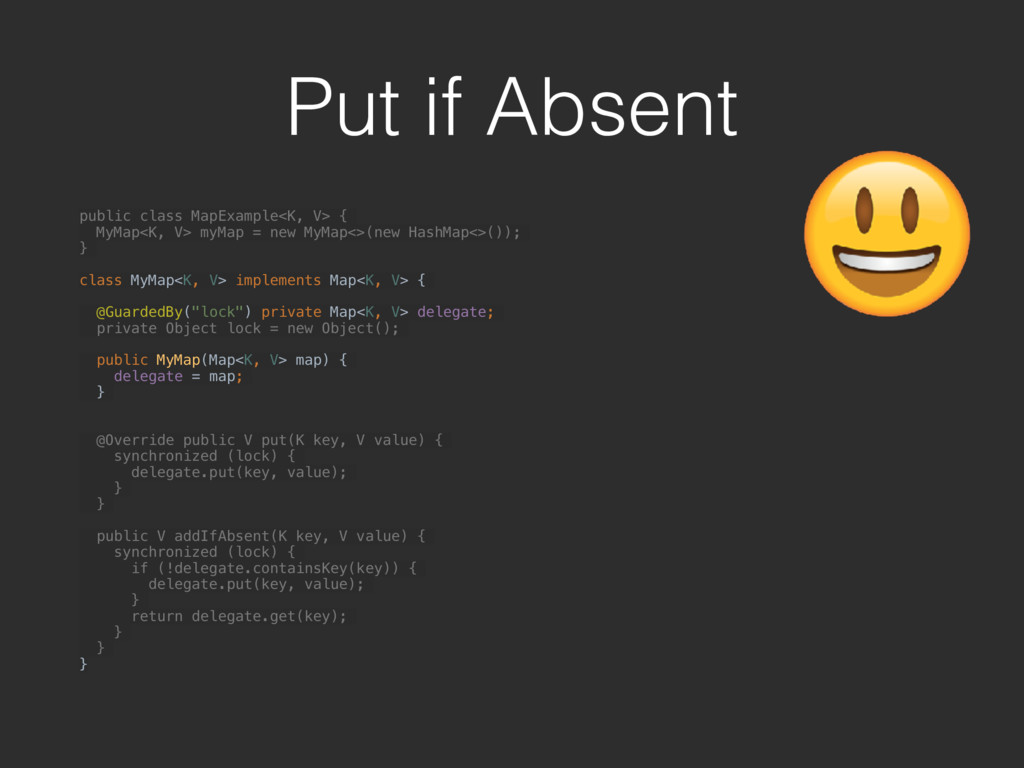
  61. Put if Absent public class MapExample<K, V> { MyMap<K, V>

    myMap = new MyMap<>(new HashMap<>()); } class MyMap<K, V> implements Map<K, V> { @GuardedBy("lock") private Map<K, V> delegate; private Object lock = new Object(); public MyMap(Map<K, V> map) { delegate = map; } @Override public V put(K key, V value) { synchronized (lock) { delegate.put(key, value); } } public V addIfAbsent(K key, V value) { synchronized (lock) { if (!delegate.containsKey(key)) { delegate.put(key, value); } return delegate.get(key); } } }
  62. Put if Absent public class MapExample<K, V> { MyMap<K, V>

    myMap = new MyMap<>(new HashMap<>()); } class MyMap<K, V> implements Map<K, V> { @GuardedBy("lock") private Map<K, V> delegate; private Object lock = new Object(); public MyMap(Map<K, V> map) { delegate = map; } @Override public V put(K key, V value) { synchronized (lock) { delegate.put(key, value); } } public V addIfAbsent(K key, V value) { synchronized (lock) { if (!delegate.containsKey(key)) { delegate.put(key, value); } return delegate.get(key); } } }
  63. Put if Absent public class MapExample<K, V> { MyMap<K, V>

    myMap = new MyMap<>(new HashMap<>()); } class MyMap<K, V> implements Map<K, V> { @GuardedBy("lock") private Map<K, V> delegate; private Object lock = new Object(); public MyMap(Map<K, V> map) { delegate = map; } @Override public V put(K key, V value) { synchronized (lock) { delegate.put(key, value); } } public V addIfAbsent(K key, V value) { synchronized (lock) { if (!delegate.containsKey(key)) { delegate.put(key, value); } return delegate.get(key); } } }
  64. Publishing public class Publishing { private HashMap<String, String> mutableMap =

    new HashMap<>(); private ImmutableHolder<String, String> immutableHolder = new ImmutableHolder(mutableMap); @NotThreadSafe public void update() { immutableHolder.getStringMap().put("junk", "junk"); } class ImmutableHolder<K, V> { private final Map<K, V> internalMap; ImmutableHolder(Map<K, V> internalMap) { this.internalMap = internalMap; } public Map<K, V> getStringMap() { return internalMap; } public synchronized void putValue(K key, V value) { internalMap.put(key, value); } } }
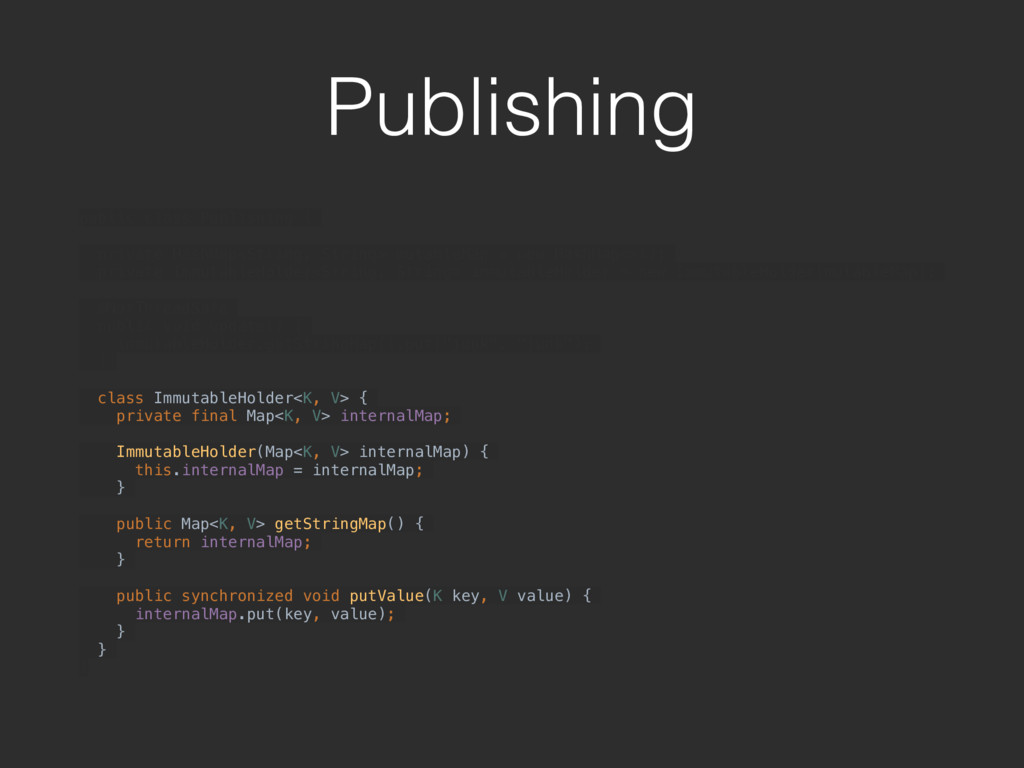
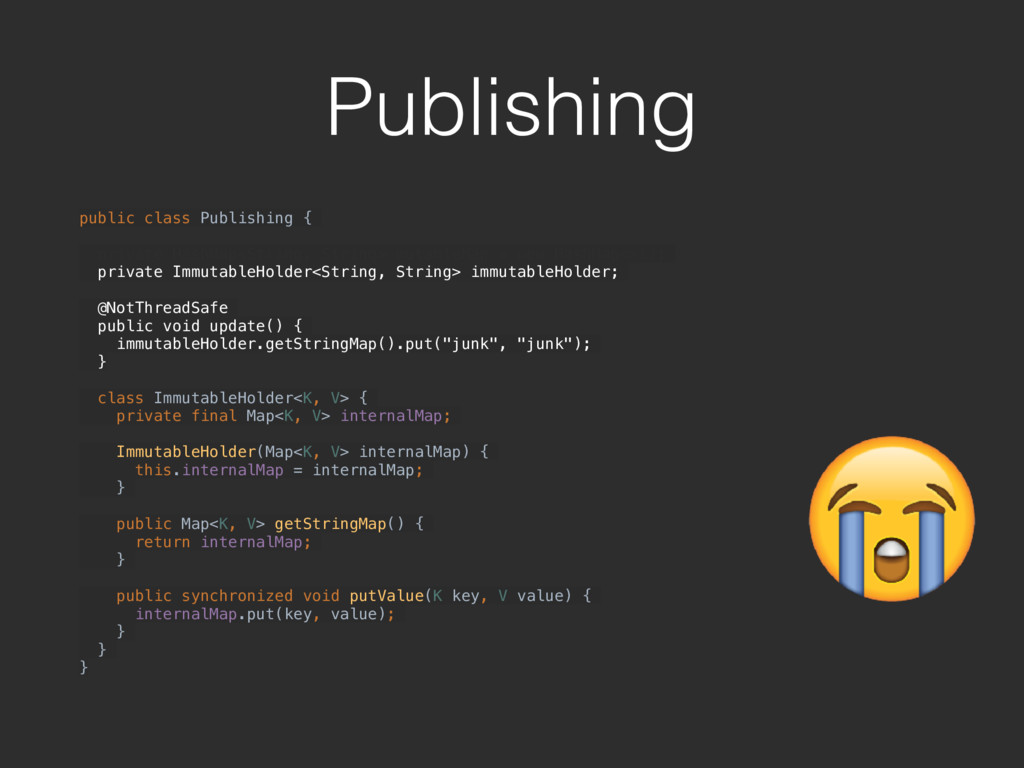
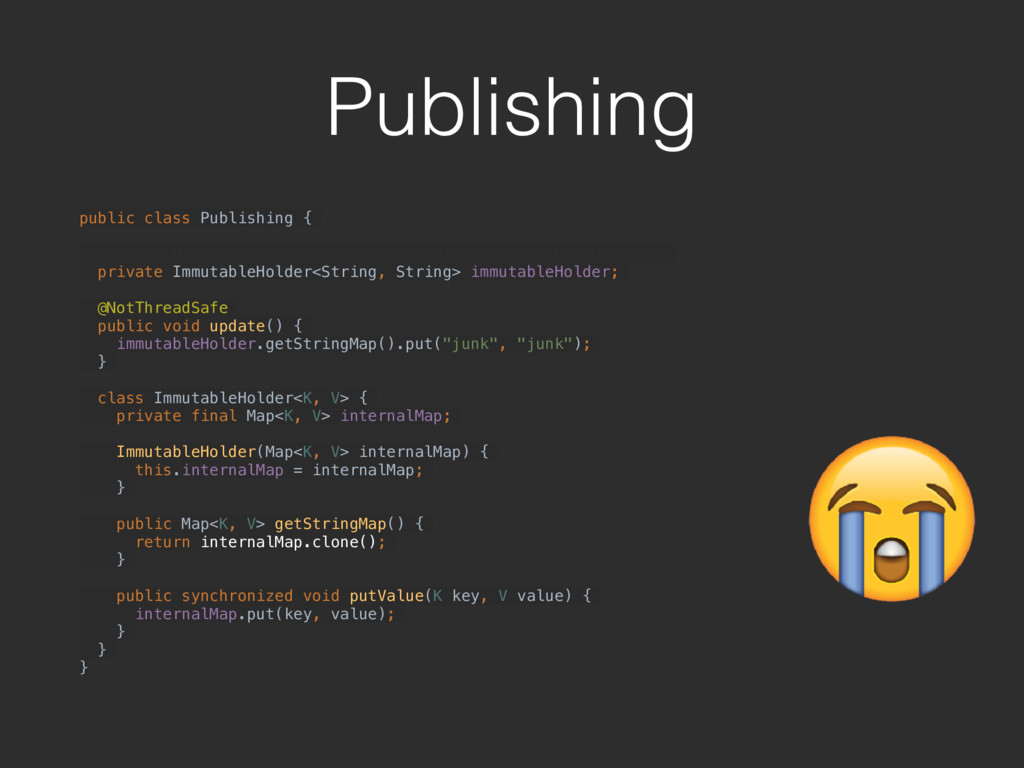
  65. Publishing public class Publishing { private HashMap<String, String> mutableMap =

    new HashMap<>(); private ImmutableHolder<String, String> immutableHolder; @NotThreadSafe public void update() { immutableHolder.getStringMap().put("junk", "junk"); } class ImmutableHolder<K, V> { private final Map<K, V> internalMap; ImmutableHolder(Map<K, V> internalMap) { this.internalMap = internalMap; } public Map<K, V> getStringMap() { return internalMap; } public synchronized void putValue(K key, V value) { internalMap.put(key, value); } } }
  66. Publishing public class Publishing { private HashMap<String, String> mutableMap =

    new HashMap<>(); private ImmutableHolder<String, String> immutableHolder; @NotThreadSafe public void update() { immutableHolder.getStringMap().put("junk", "junk"); } class ImmutableHolder<K, V> { private final Map<K, V> internalMap; ImmutableHolder(Map<K, V> internalMap) { this.internalMap = internalMap; } public Map<K, V> getStringMap() { return internalMap.clone(); } public synchronized void putValue(K key, V value) { internalMap.put(key, value); } } }
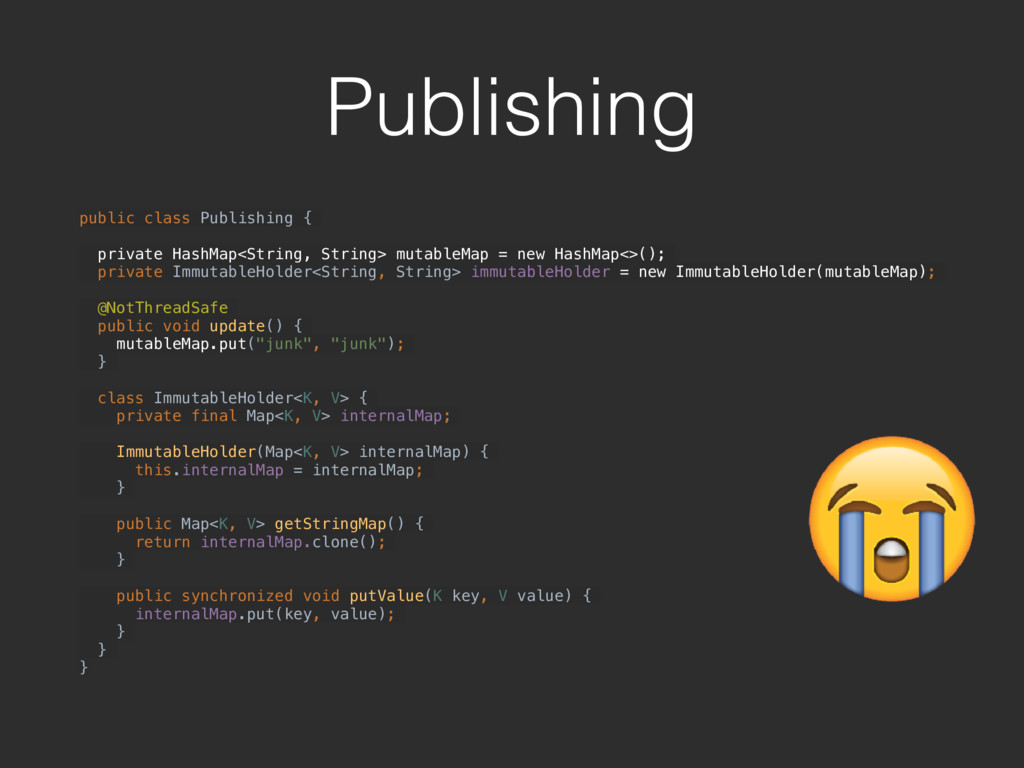
  67. Publishing public class Publishing { private HashMap<String, String> mutableMap =

    new HashMap<>(); private ImmutableHolder<String, String> immutableHolder = new ImmutableHolder(mutableMap); @NotThreadSafe public void update() { mutableMap.put("junk", "junk"); } class ImmutableHolder<K, V> { private final Map<K, V> internalMap; ImmutableHolder(Map<K, V> internalMap) { this.internalMap = internalMap; } public Map<K, V> getStringMap() { return internalMap.clone(); } public synchronized void putValue(K key, V value) { internalMap.put(key, value); } } }
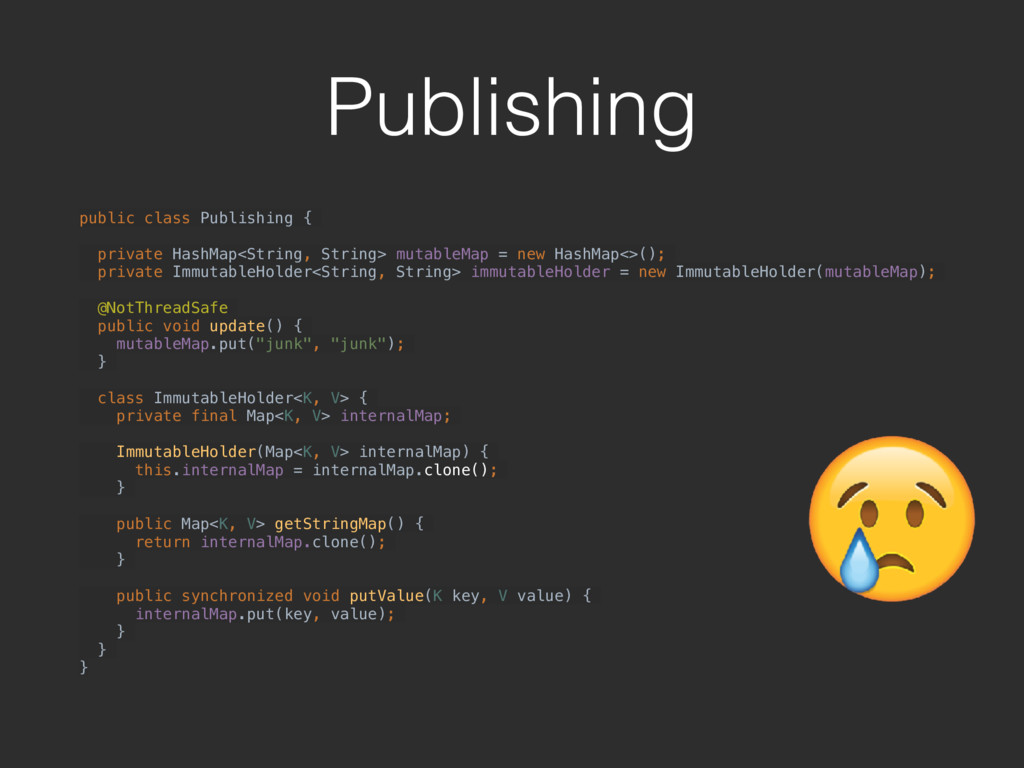
  68. Publishing public class Publishing { private HashMap<String, String> mutableMap =

    new HashMap<>(); private ImmutableHolder<String, String> immutableHolder = new ImmutableHolder(mutableMap); @NotThreadSafe public void update() { mutableMap.put("junk", "junk"); } class ImmutableHolder<K, V> { private final Map<K, V> internalMap; ImmutableHolder(Map<K, V> internalMap) { this.internalMap = internalMap.clone(); } public Map<K, V> getStringMap() { return internalMap.clone(); } public synchronized void putValue(K key, V value) { internalMap.put(key, value); } } }
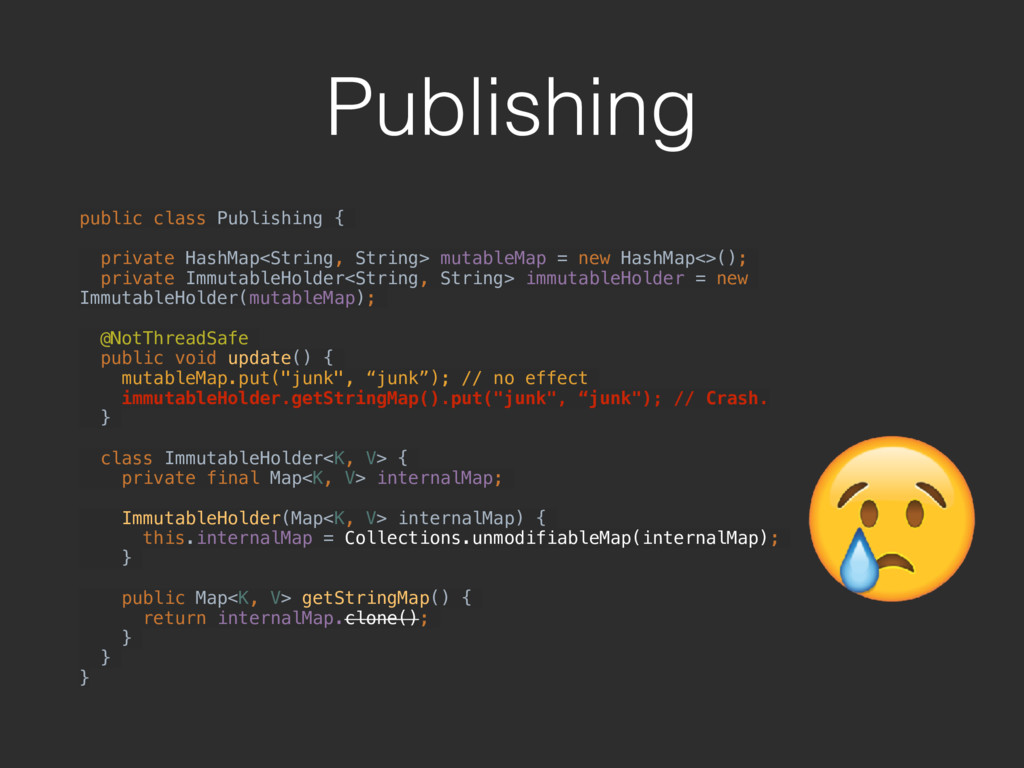
  69. Publishing public class Publishing { private HashMap<String, String> mutableMap =

    new HashMap<>(); private ImmutableHolder<String, String> immutableHolder = new ImmutableHolder(mutableMap); @NotThreadSafe public void update() { mutableMap.put("junk", “junk”); // no effect immutableHolder.getStringMap().put("junk", “junk"); // Crash. } class ImmutableHolder<K, V> { private final Map<K, V> internalMap; ImmutableHolder(Map<K, V> internalMap) { this.internalMap = Collections.unmodifiableMap(internalMap); } public Map<K, V> getStringMap() { return internalMap.clone(); } } }
  70. Publishing • Immutable objects can be published anywhere. • Effectively

    immutable objects (mutable objects which we will not change) can be published using “safe publishing” - volatile, final, static initializer.
  71. Publishing • Immutable objects can be published anywhere. • Effectively

    immutable objects (mutable objects which we will not change) can be published using “safe publishing” - volatile, final, static initializer. • Mutable variables must be synchronized
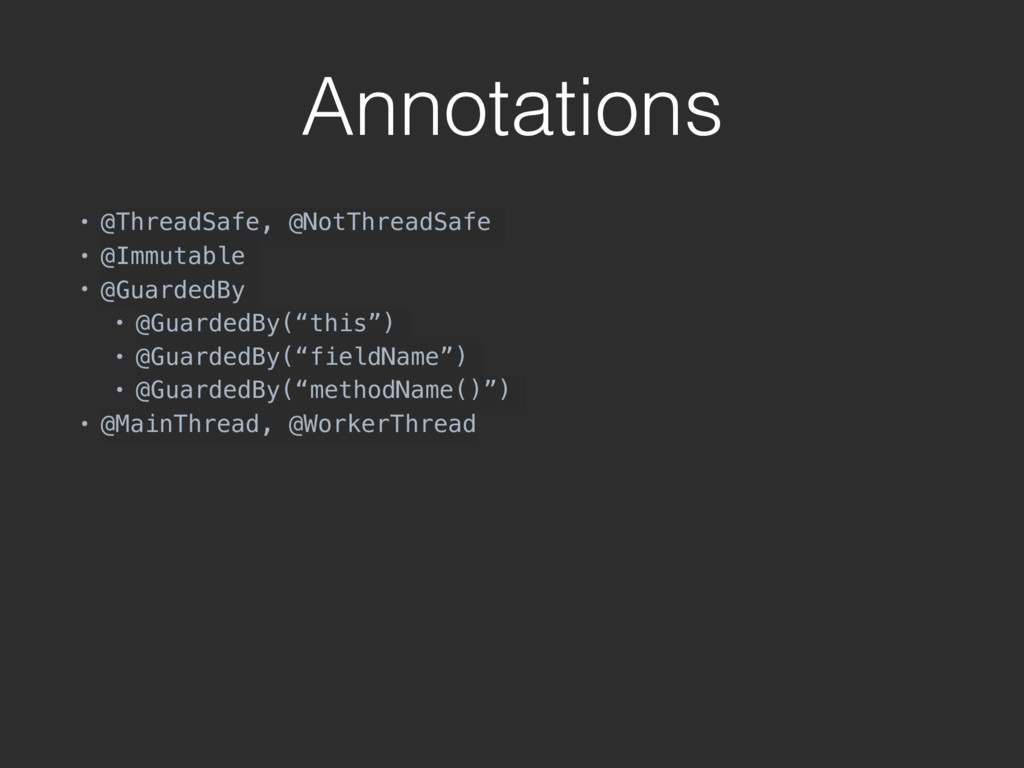
  72. Annotations • @ThreadSafe, @NotThreadSafe • @Immutable • @GuardedBy • @GuardedBy(“this”)

    • @GuardedBy(“fieldName”) • @GuardedBy(“methodName()”) • @MainThread, @WorkerThread
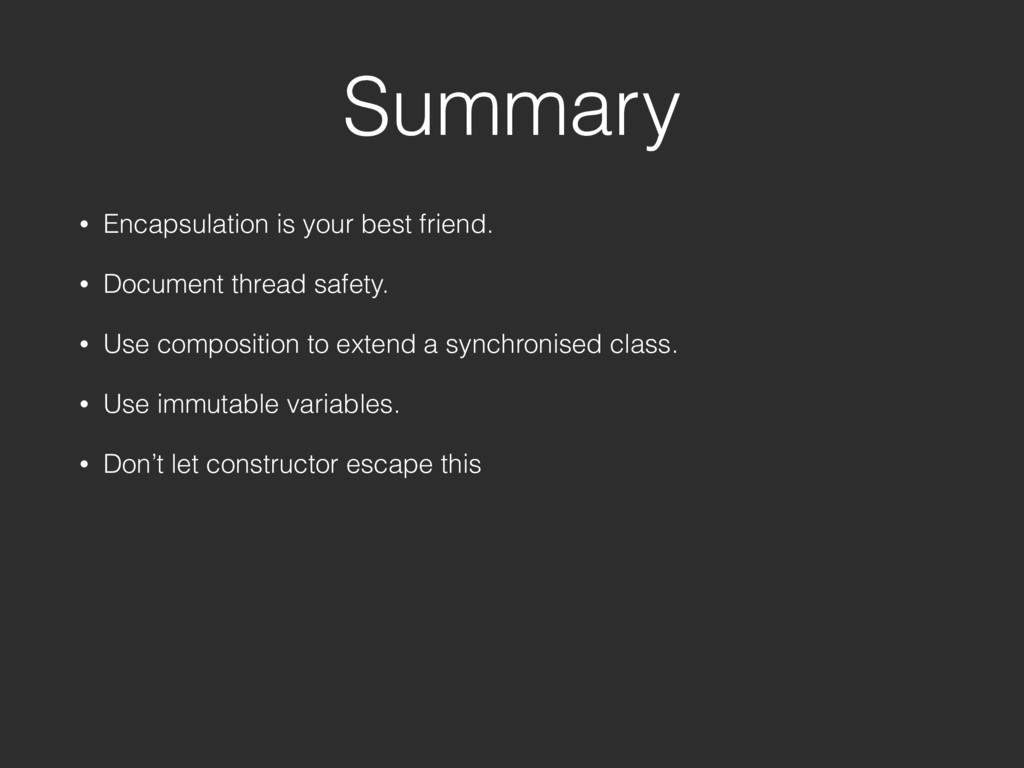
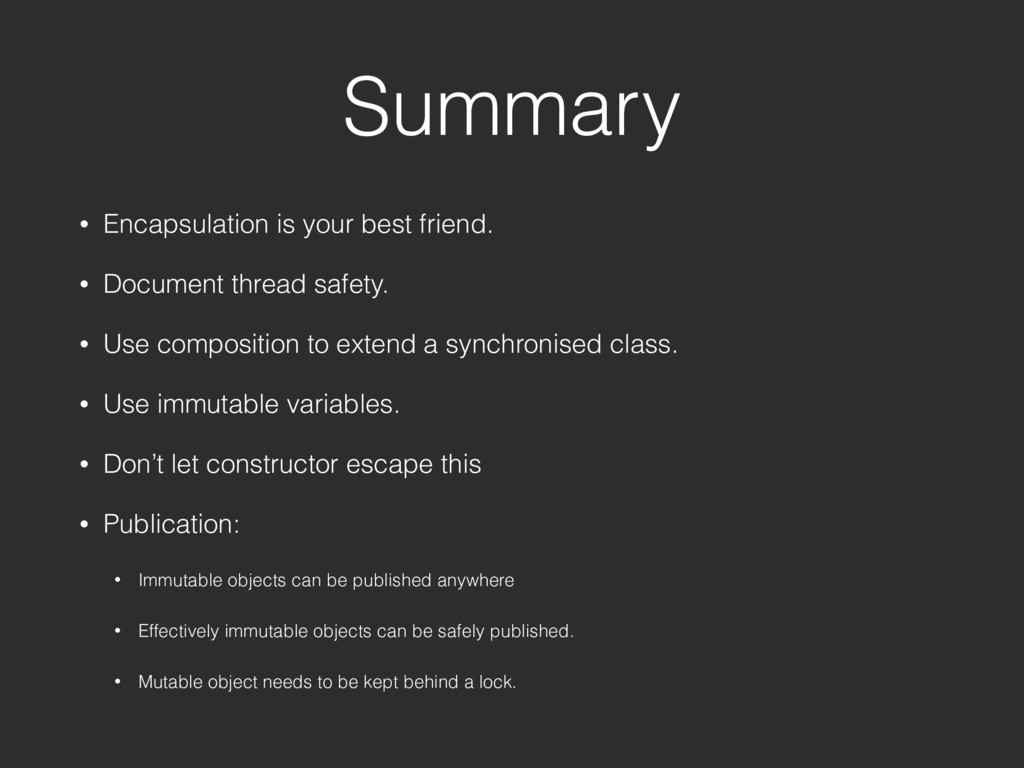
  73. Summary • Encapsulation is your best friend. • Document thread

    safety. • Use composition to extend a synchronised class.
  74. Summary • Encapsulation is your best friend. • Document thread

    safety. • Use composition to extend a synchronised class. • Use immutable variables.
  75. Summary • Encapsulation is your best friend. • Document thread

    safety. • Use composition to extend a synchronised class. • Use immutable variables. • Don’t let constructor escape this
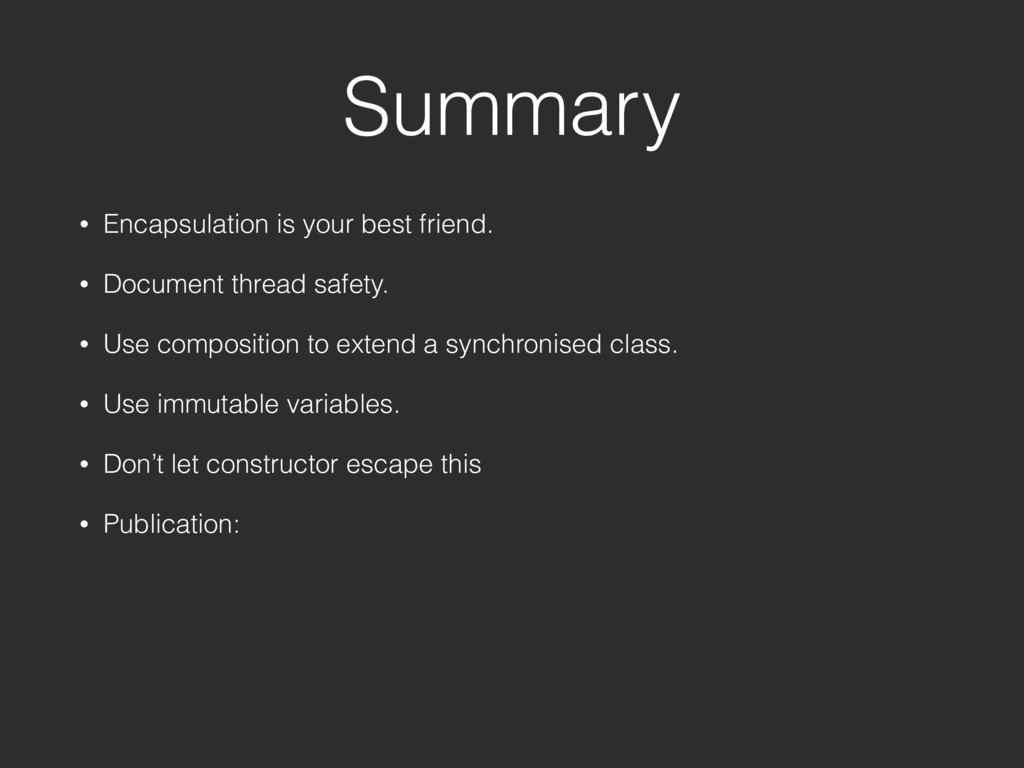
  76. Summary • Encapsulation is your best friend. • Document thread

    safety. • Use composition to extend a synchronised class. • Use immutable variables. • Don’t let constructor escape this • Publication:
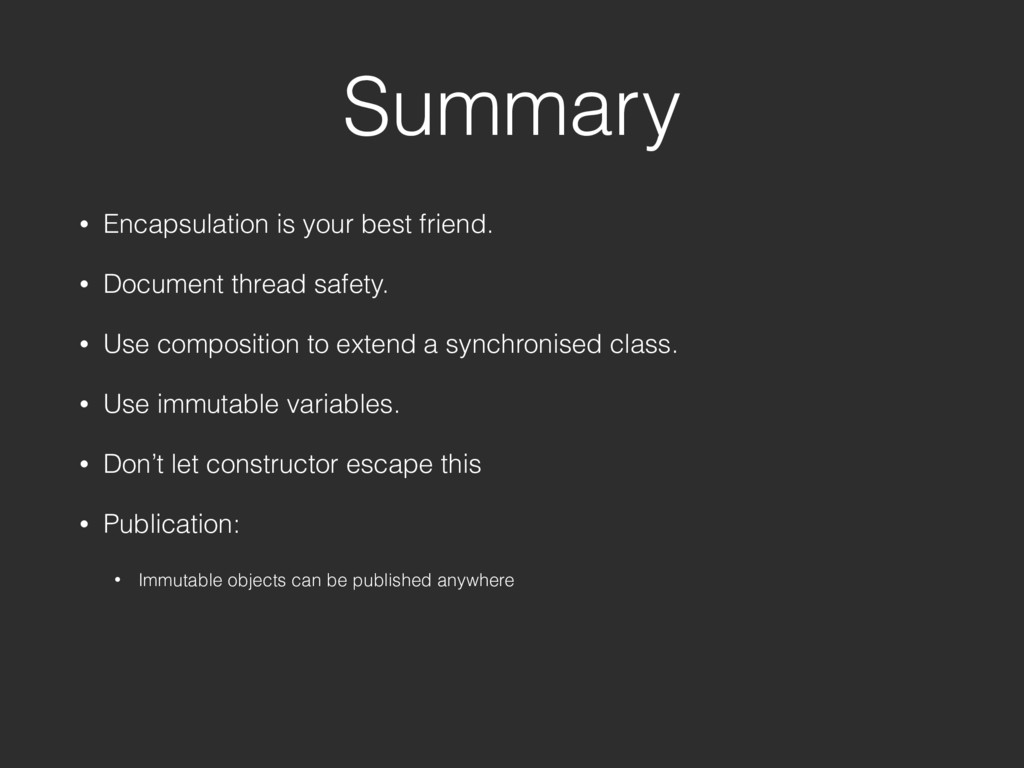
  77. Summary • Encapsulation is your best friend. • Document thread

    safety. • Use composition to extend a synchronised class. • Use immutable variables. • Don’t let constructor escape this • Publication: • Immutable objects can be published anywhere
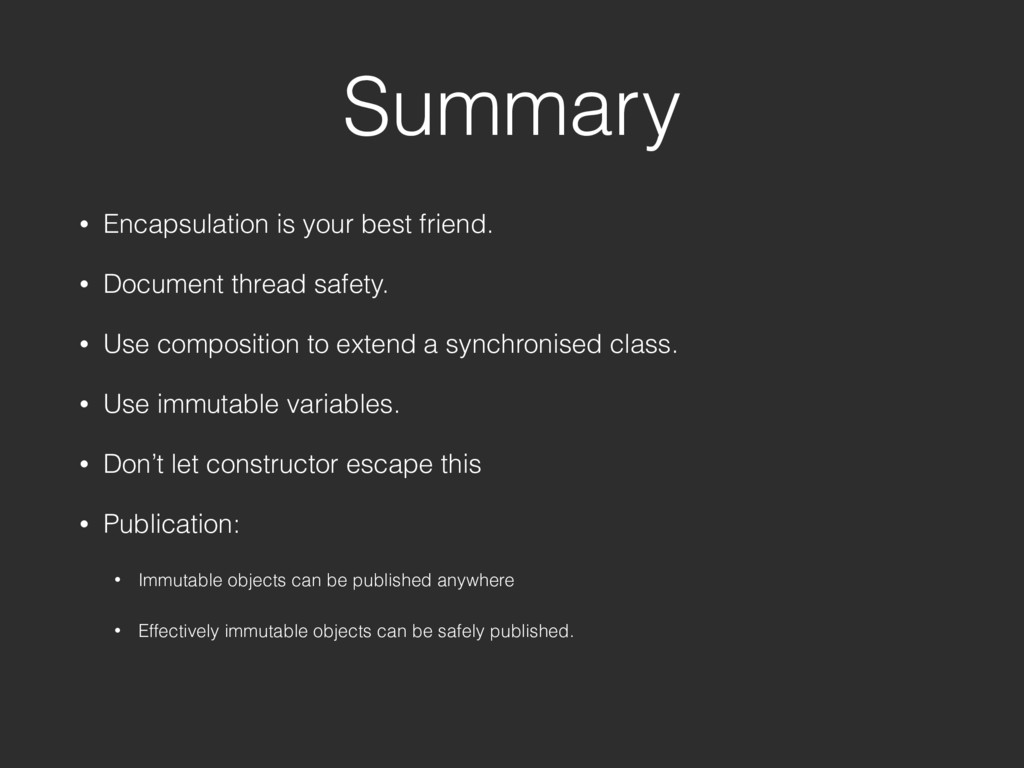
  78. Summary • Encapsulation is your best friend. • Document thread

    safety. • Use composition to extend a synchronised class. • Use immutable variables. • Don’t let constructor escape this • Publication: • Immutable objects can be published anywhere • Effectively immutable objects can be safely published.
  79. Summary • Encapsulation is your best friend. • Document thread

    safety. • Use composition to extend a synchronised class. • Use immutable variables. • Don’t let constructor escape this • Publication: • Immutable objects can be published anywhere • Effectively immutable objects can be safely published. • Mutable object needs to be kept behind a lock.
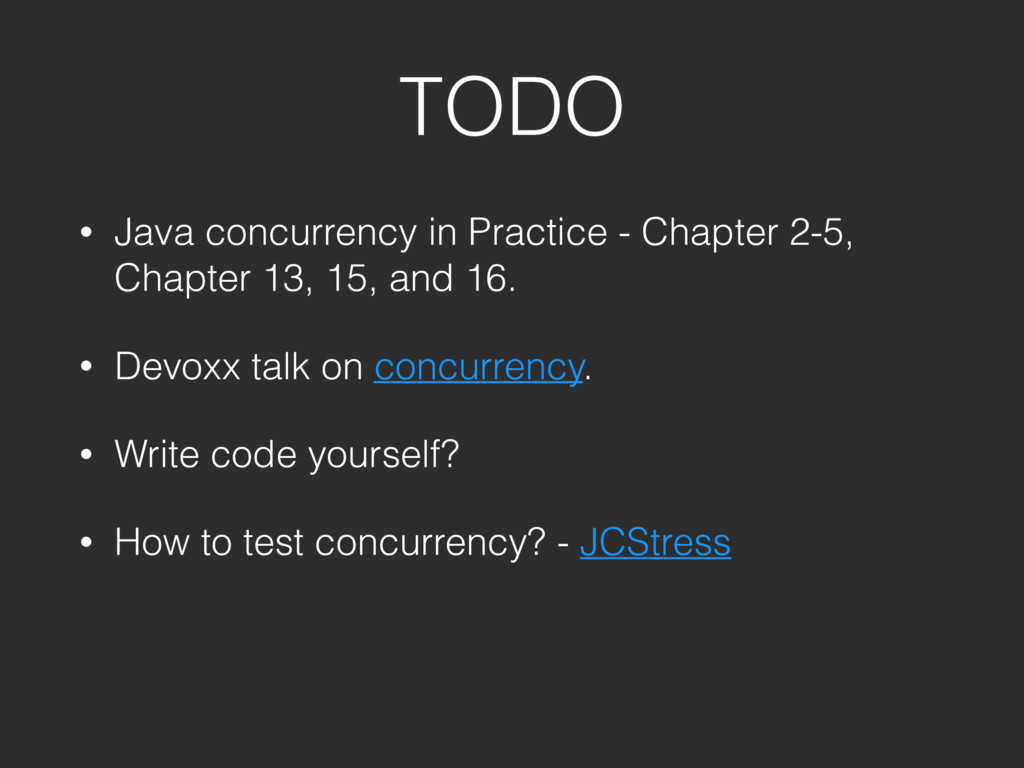
  80. TODO • Java concurrency in Practice - Chapter 2-5, Chapter
    13, 15, and 16. • Devoxx talk on concurrency. • Write code yourself? • How to test concurrency? - JCStress