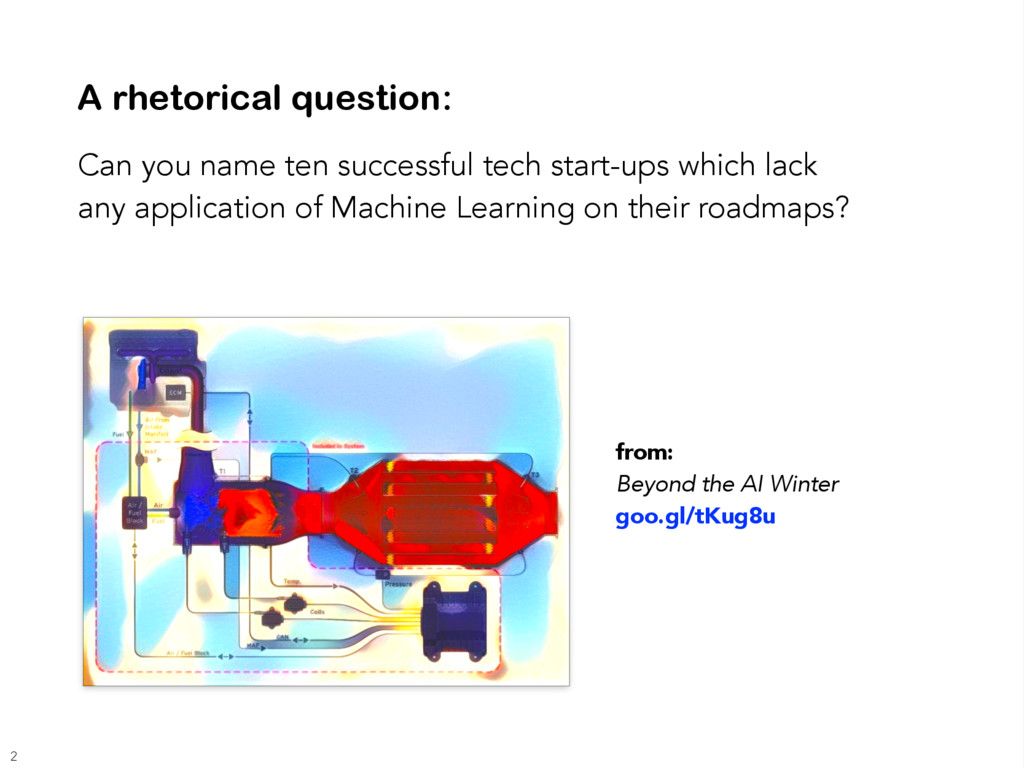
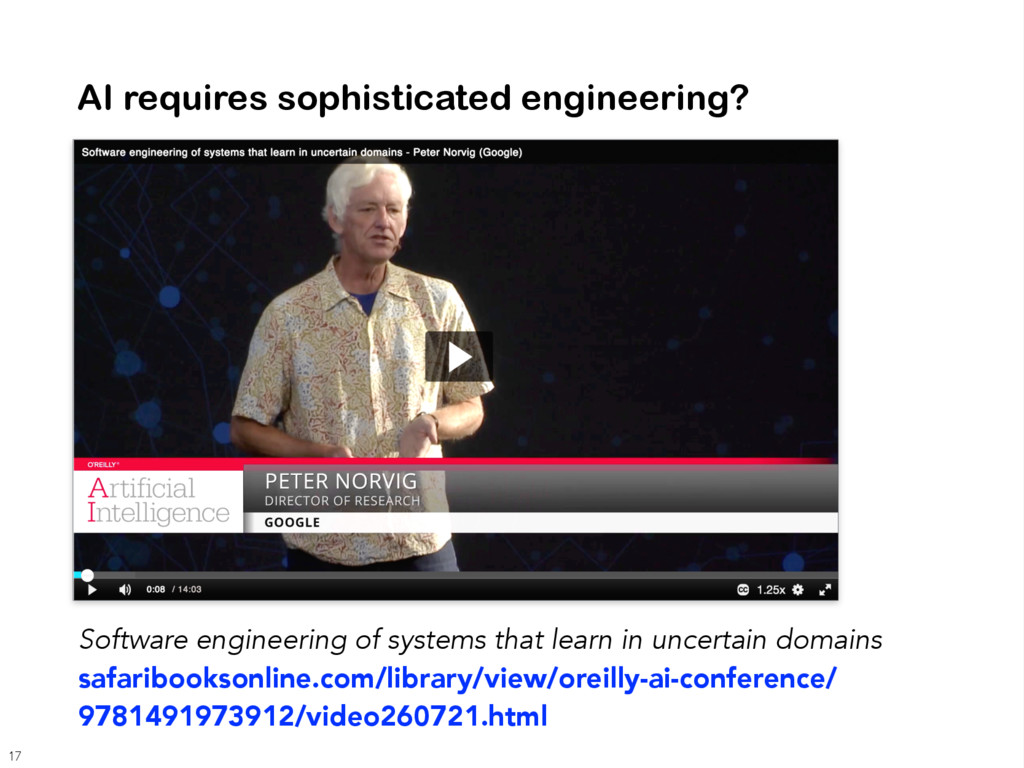
Conference 2016: Marc Andreessen noted famously how software was disrupting so many incumbents … and now Machine Learning is disrupting many incumbents from: Software engineering of systems that learn in uncertain domains safaribooksonline.com/library/view/oreilly-ai-conference/ 9781491973912/video260721.html 3
realizing a “universal learner” The future belongs to those who understand at a very deep level how to combine their unique expertise with what algorithms do best. from: The Master Algorithm goodreads.com/book/show/24612233-the-master-algorithm 4
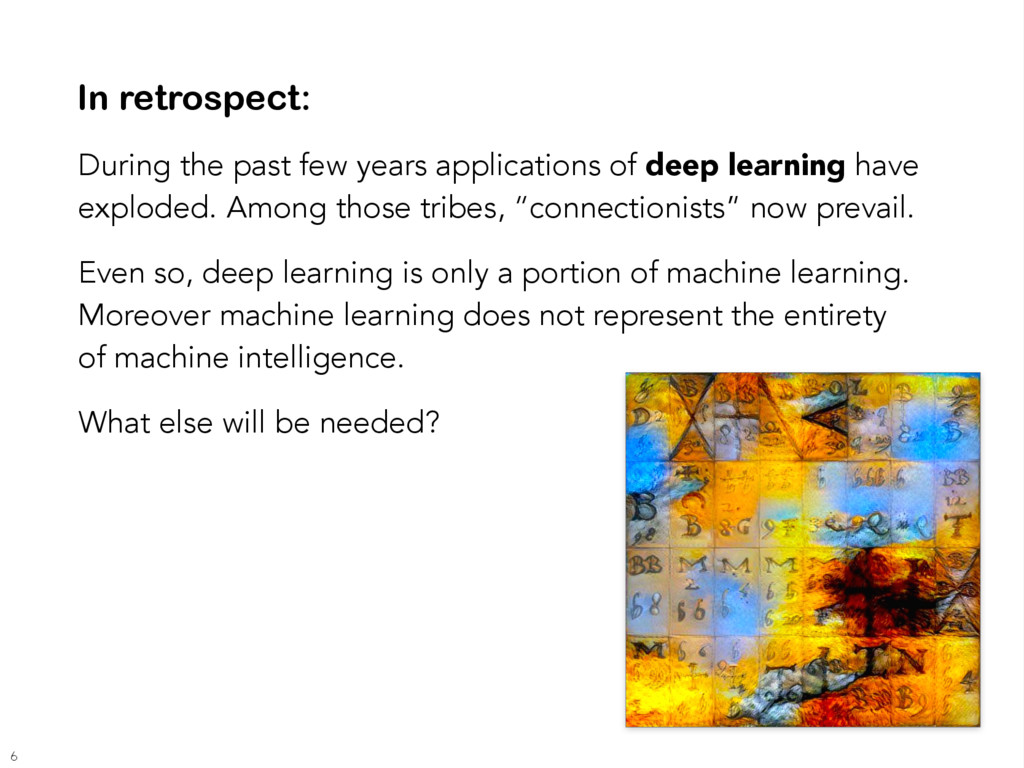
learning have exploded. Among those tribes, “connectionists” now prevail. Even so, deep learning is only a portion of machine learning. Moreover machine learning does not represent the entirety of machine intelligence. What else will be needed? 6
San Francisco (last Oct) conferences.oreilly.com/artificial-intelligence/bot-ca New York City, Jun 26-29 2017 conferences.oreilly.com/artificial-intelligence/ai-ny (CFP open through Jan 18) 15
San Francisco (last Oct) conferences.oreilly.com/artificial-intelligence/bot-ca New York City, Jun 26-29 conferences.oreilly.com/artificial-intelligence/ai-ny (CFP open through Jan 18) As one might imagine, the presenters discussed much deep learning – although there were other important points… let’s consider those 16
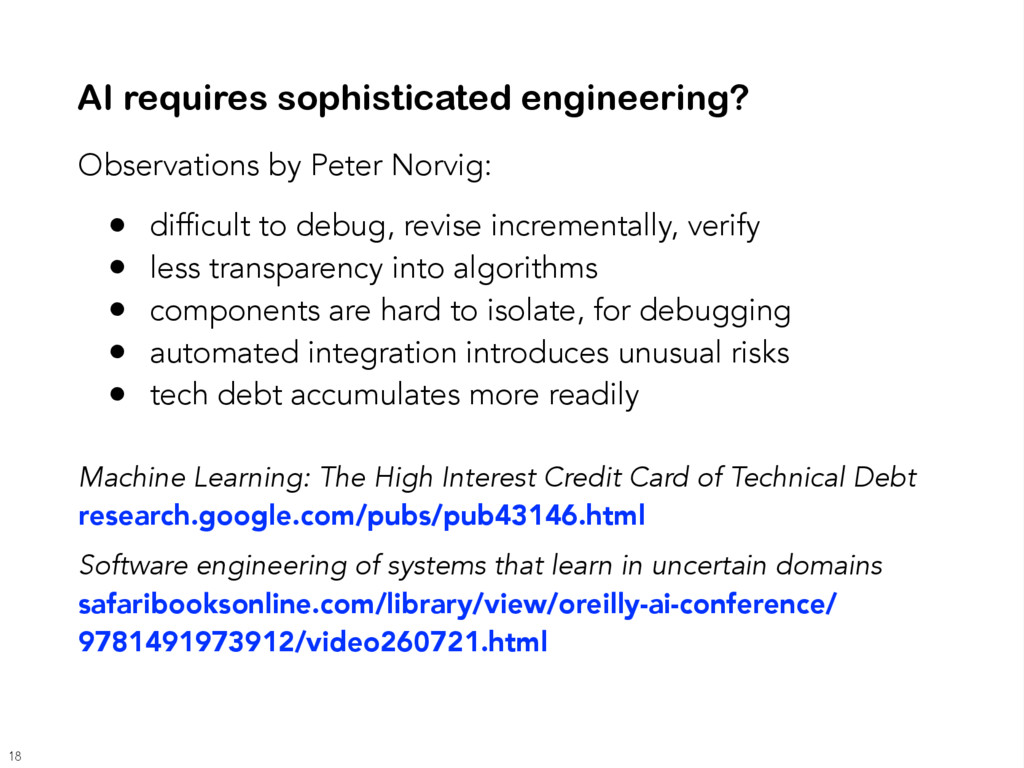
verify • less transparency into algorithms • components are hard to isolate, for debugging • automated integration introduces unusual risks • tech debt accumulates more readily Machine Learning: The High Interest Credit Card of Technical Debt research.google.com/pubs/pub43146.html Software engineering of systems that learn in uncertain domains safaribooksonline.com/library/view/oreilly-ai-conference/ 9781491973912/video260721.html AI requires sophisticated engineering? 18
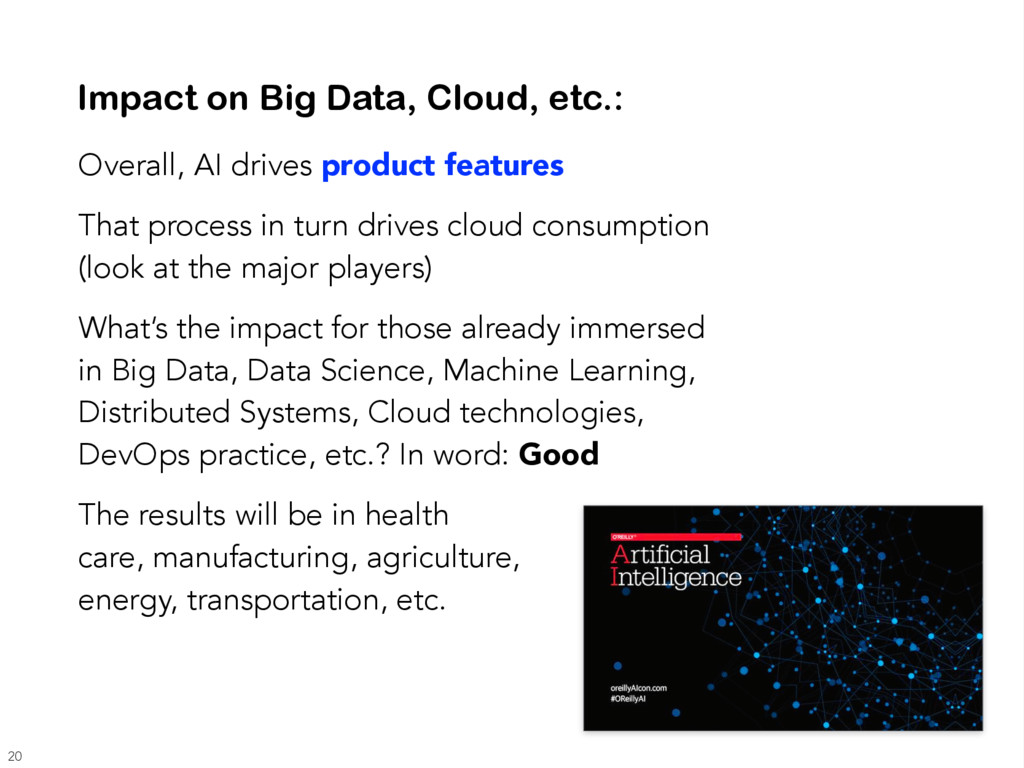
features That process in turn drives cloud consumption (look at the major players) What’s the impact for those already immersed in Big Data, Data Science, Machine Learning, Distributed Systems, Cloud technologies, DevOps practice, etc.? In word: Good The results will be in health care, manufacturing, agriculture, energy, transportation, etc. 20
“Who raised you? Who were your mummies and your daddies?” ... AI has had a lot of daddies. If we understand the founders, we can ask what do we need to bring back into the conversation? Artificial intelligence: making a human connection safaribooksonline.com/library/view/oreilly-ai-conference/ 9781491973912/video260723.html AI work is mostly human? 22
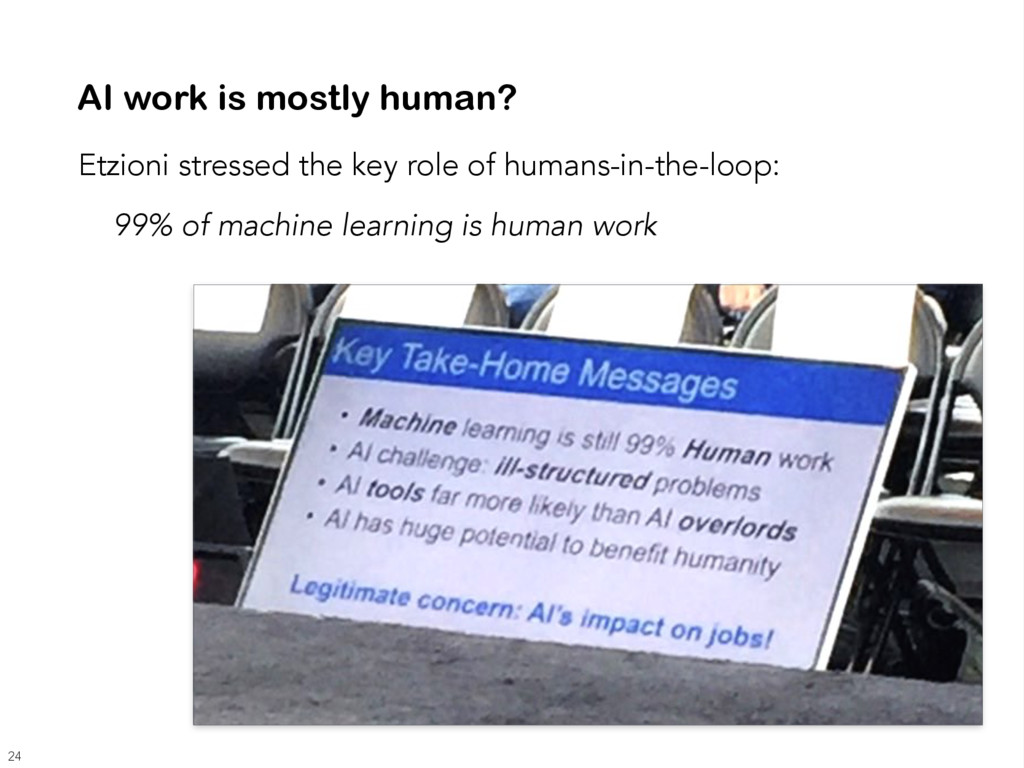
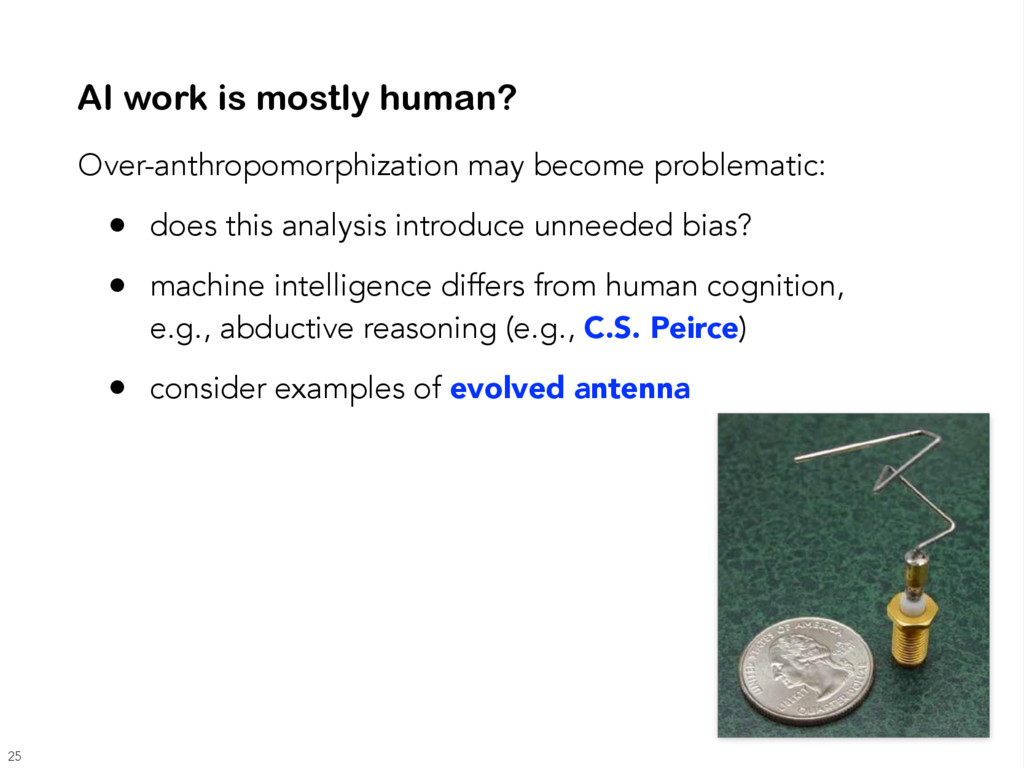
bias? • machine intelligence differs from human cognition, e.g., abductive reasoning (e.g., C.S. Peirce) • consider examples of evolved antenna AI work is mostly human? 25
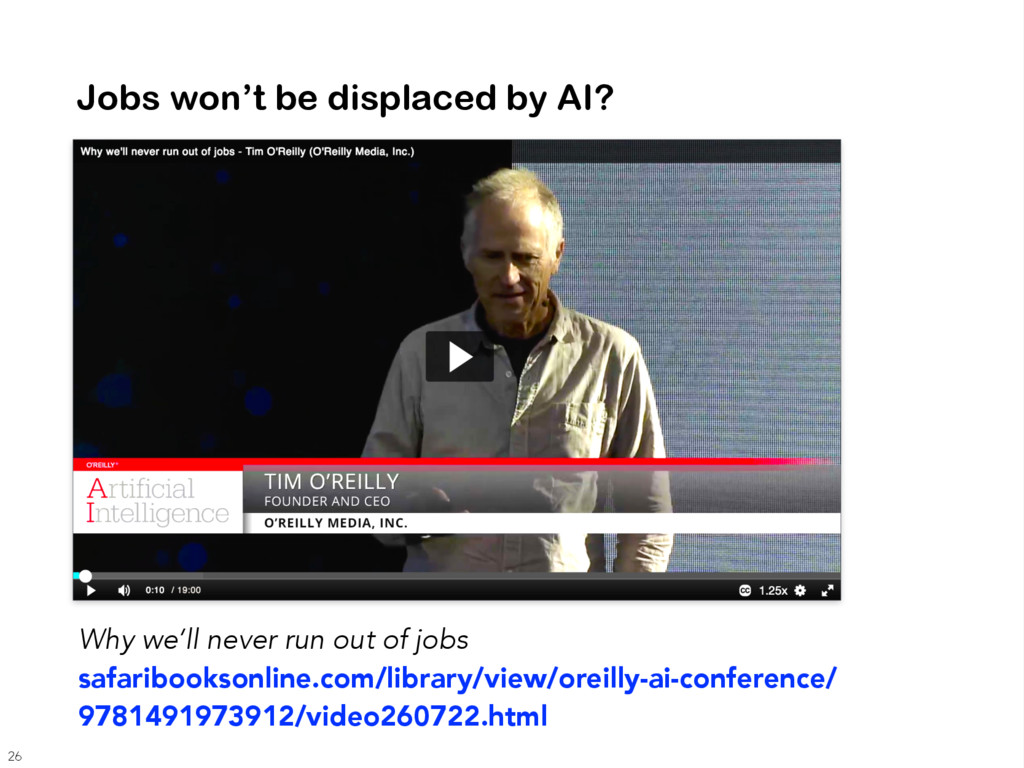
until we run out of problems Our main advances have come when we invested in other people's children – massive investment in EU following WWII, built from something that resembles Syria today 21st c great question: “Who’s black box do you trust?” Jobs won’t be displaced by AI? Why we’ll never run out of jobs safaribooksonline.com/library/view/oreilly-ai-conference/ 9781491973912/video260722.html 27
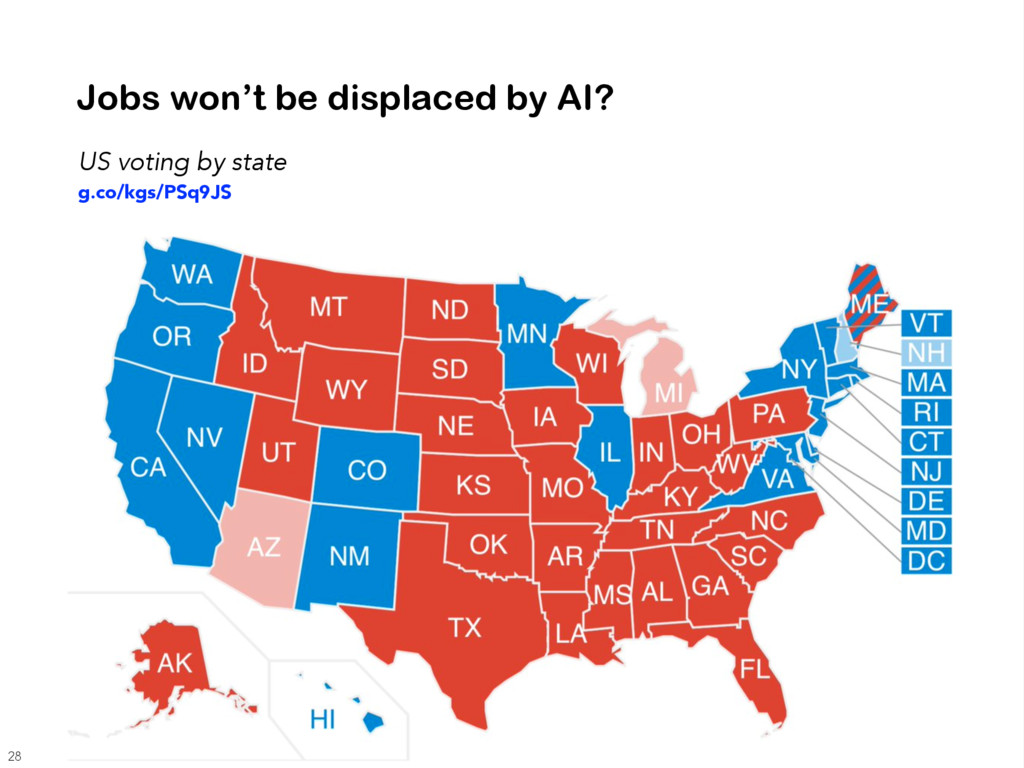
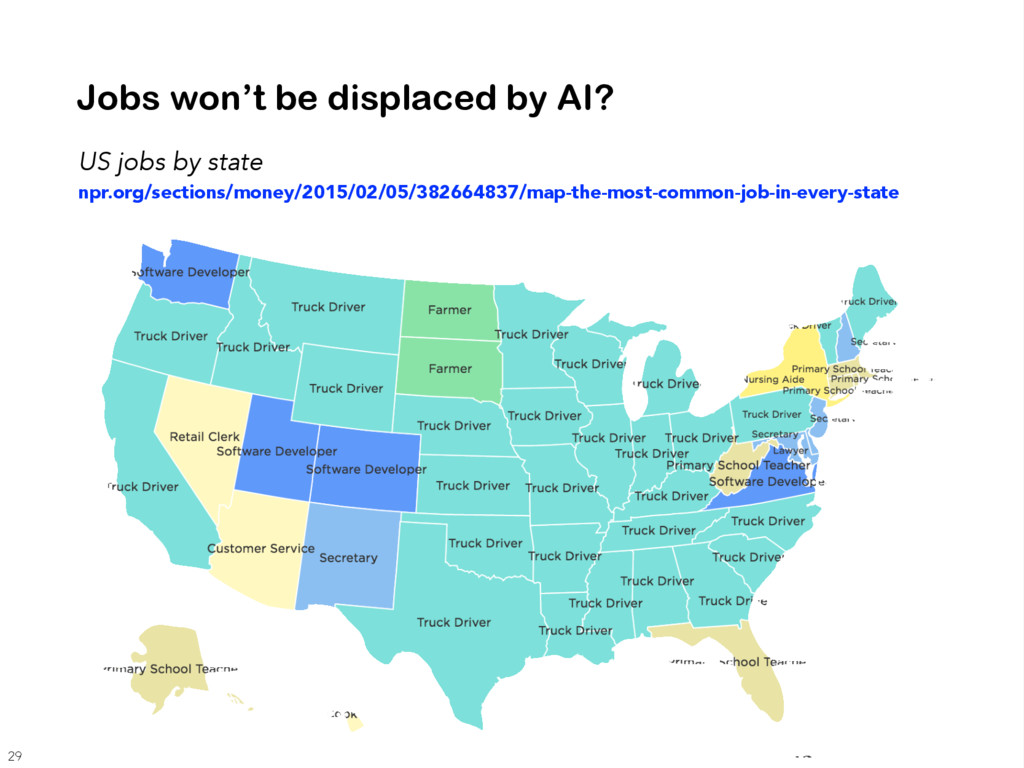
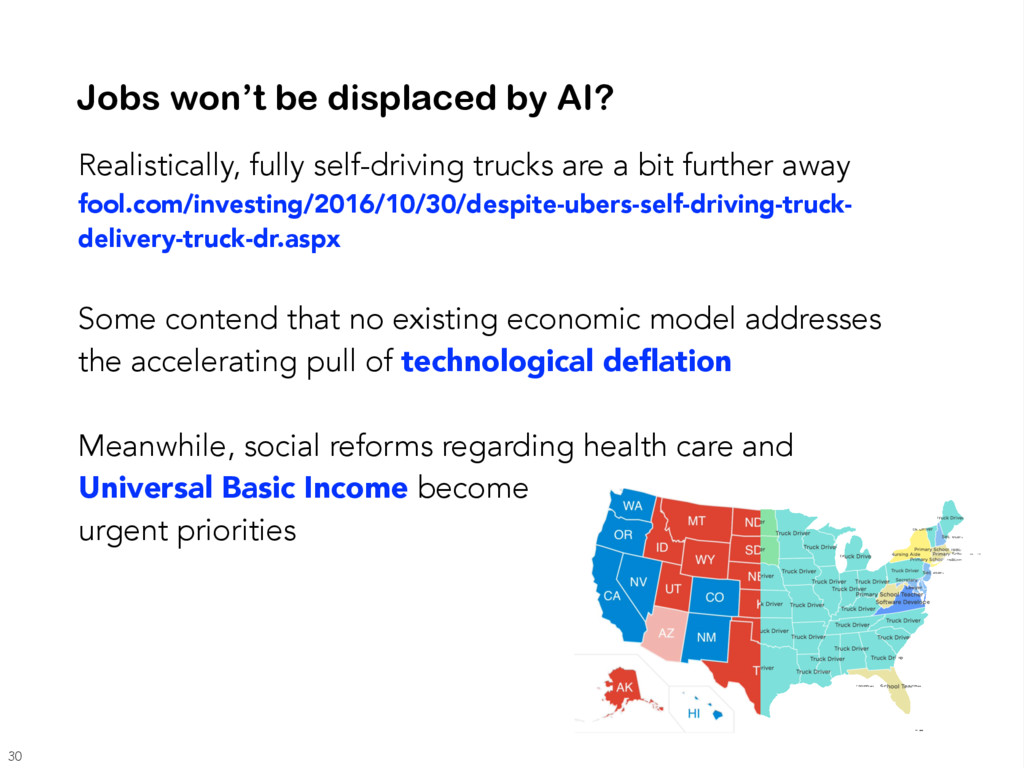
delivery-truck-dr.aspx Some contend that no existing economic model addresses the accelerating pull of technological deflation Meanwhile, social reforms regarding health care and Universal Basic Income become urgent priorities Jobs won’t be displaced by AI? 30
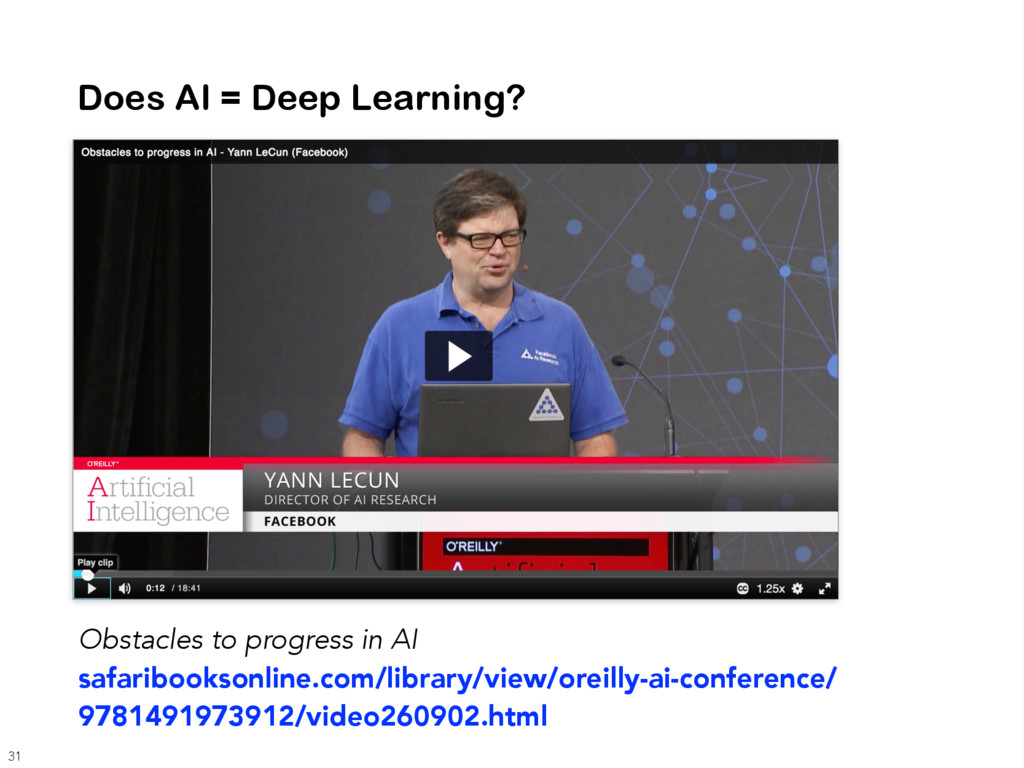
• predictive model • memory • reasoning and planning Obstacles to progress in AI safaribooksonline.com/library/view/oreilly-ai-conference/ 9781491973912/video260902.html Does AI = Deep Learning? 32
– these are necessary; however, they do not address understanding Winograd Schemas show the need for common sense and contextual understanding – replacement for Turing Test see: The Winograd Schema Challenge Hector Levesque commonsensereasoning.org/2011/papers/Levesque.pdf 33
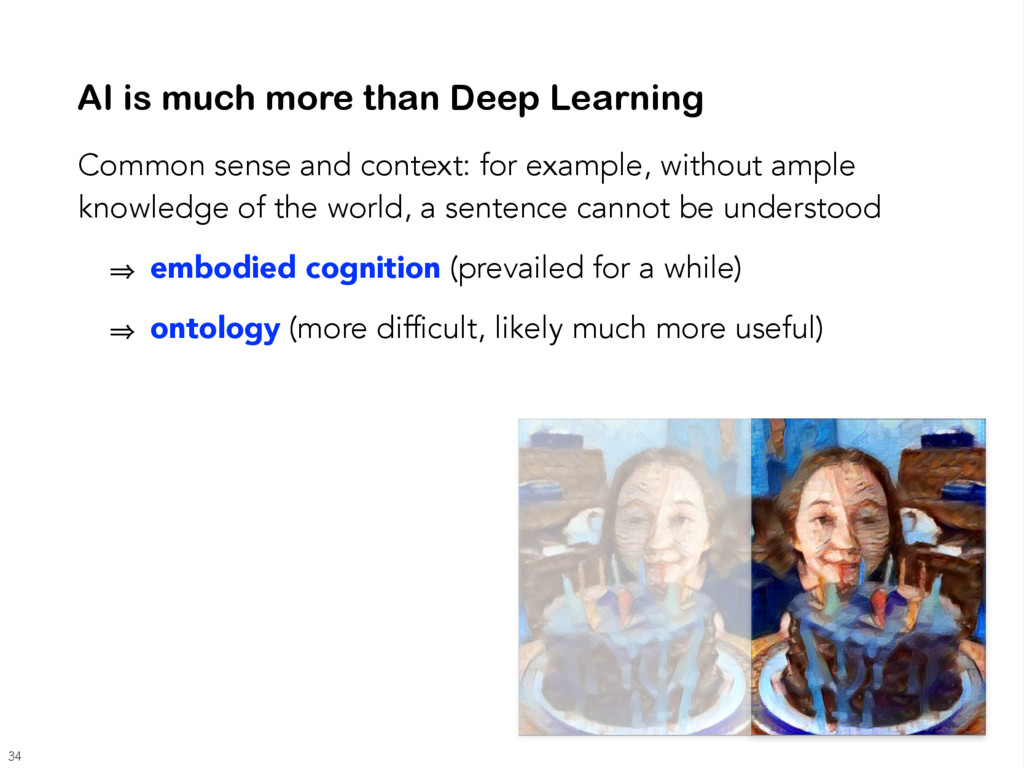
context: for example, without ample knowledge of the world, a sentence cannot be understood 㱺 embodied cognition (prevailed for a while) 㱺 ontology (more difficult, likely much more useful) 34
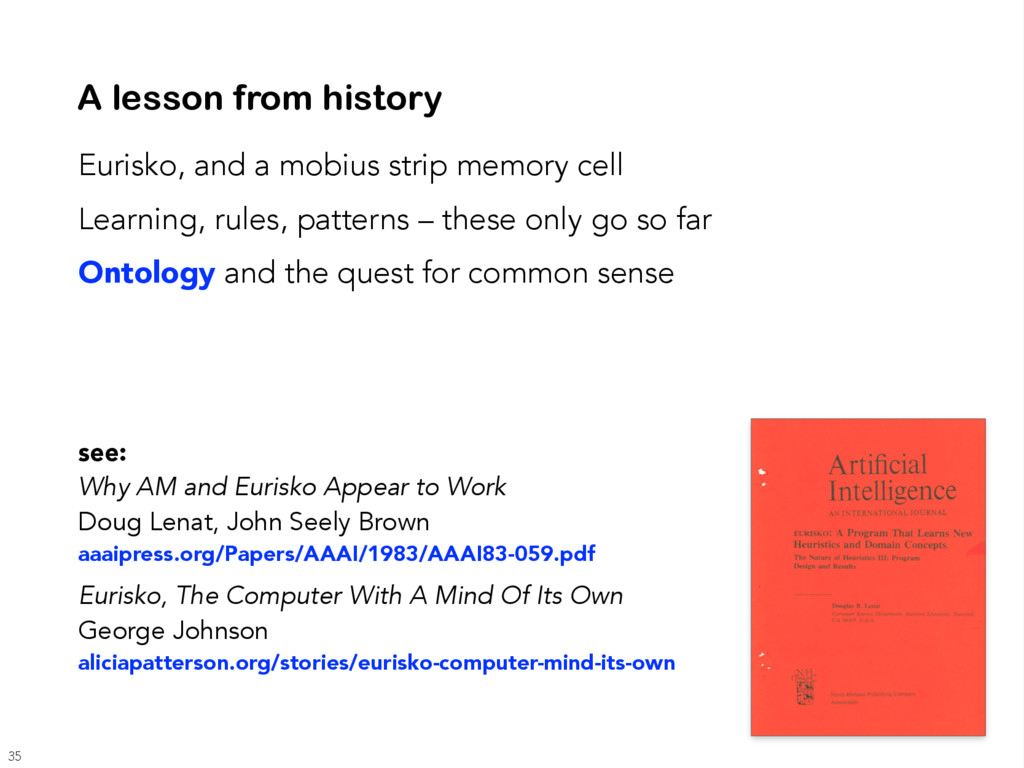
to Work Doug Lenat, John Seely Brown aaaipress.org/Papers/AAAI/1983/AAAI83-059.pdf Eurisko, The Computer With A Mind Of Its Own George Johnson aliciapatterson.org/stories/eurisko-computer-mind-its-own Eurisko, and a mobius strip memory cell Learning, rules, patterns – these only go so far Ontology and the quest for common sense 35
in the data, then build ML models to validate those assumptions However, which tools serve to identify structure? see: Persistent Homology: An Introduction and a New Text Representation for Natural Language Processing Xiaojin Zhu pages.cs.wisc.edu/~jerryzhu/pub/homology.pdf Topological Data Analysis Chad Topaz dsweb.siam.org/TheMagazine/Article/TabId/823/ArtMID/1971/ArticleID/777/ Topological-Data-Analysis.aspx 36
Media… We’re not a high-tech company; even so, the value of our data gets unlocked through AI This project makes use of cloud, Spark, Mesos, Kubernetes, Docker, etc., leveraging the tools we know, but in more complex use cases now. 37
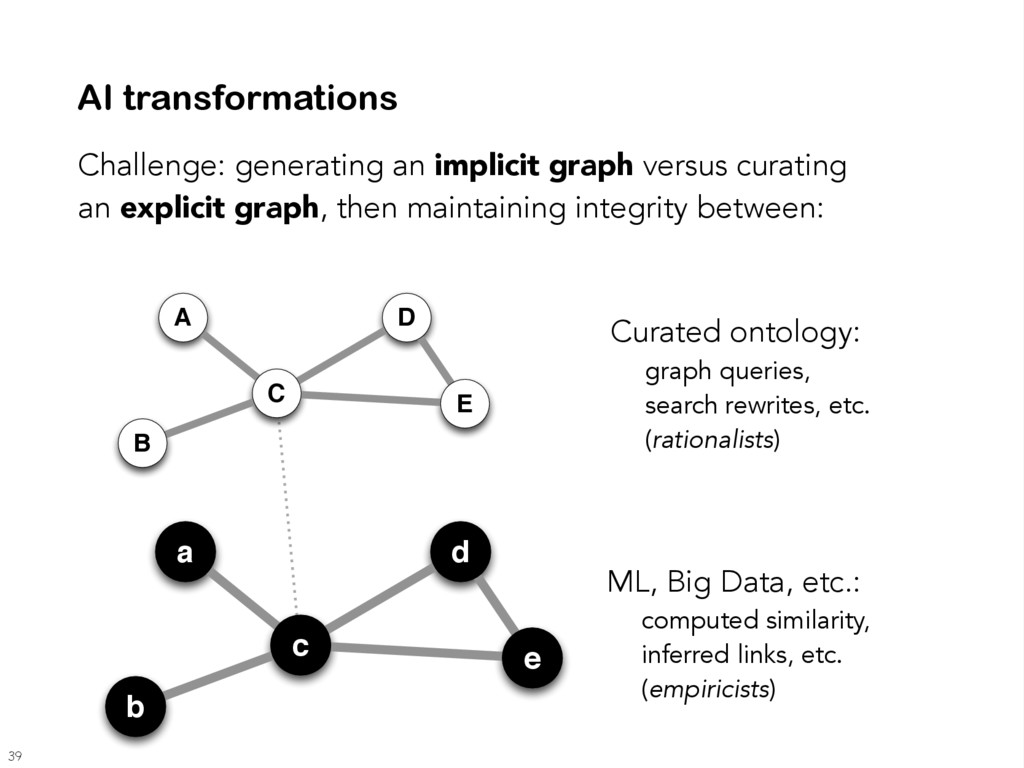
load for any editor or engineer to master; however, not so difficult for a small cluster. Curation is hard; you don’t want it full automated – related to what Norvig calls the “Inattention Valley” AI transformations 38
graph, then maintaining integrity between: A C B E D ML, Big Data, etc.: computed similarity, inferred links, etc. (empiricists) Curated ontology: graph queries, search rewrites, etc. (rationalists) a c b e d AI transformations 39
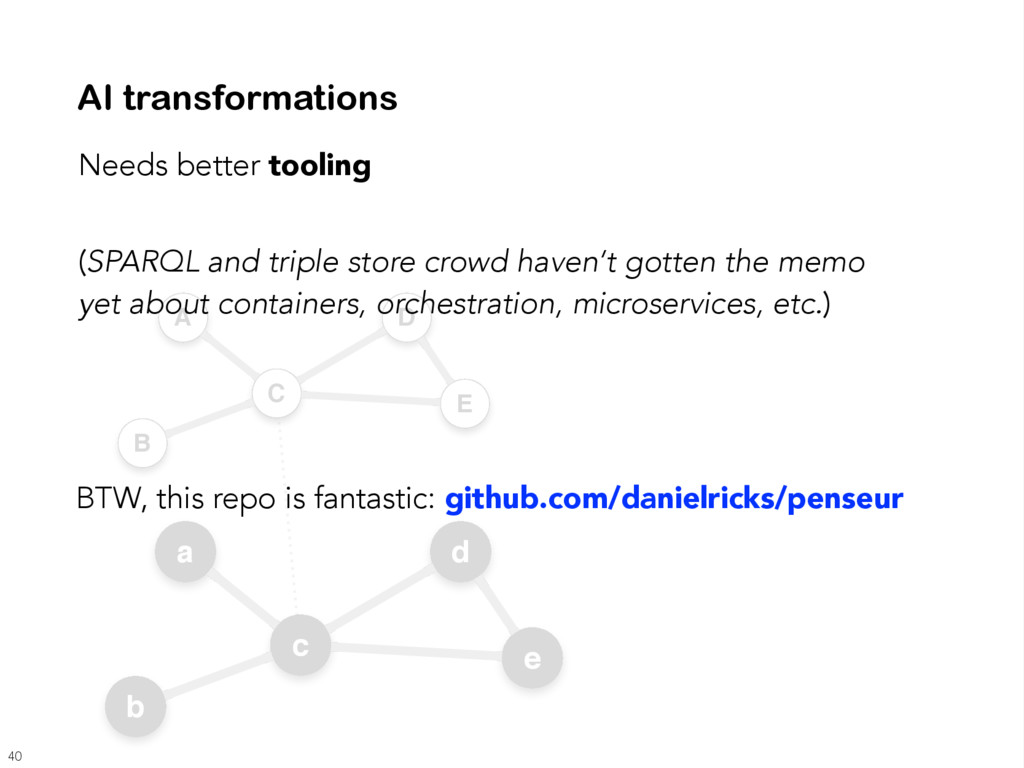
Needs better tooling (SPARQL and triple store crowd haven’t gotten the memo yet about containers, orchestration, microservices, etc.) AI transformations BTW, this repo is fantastic: github.com/danielricks/penseur 40
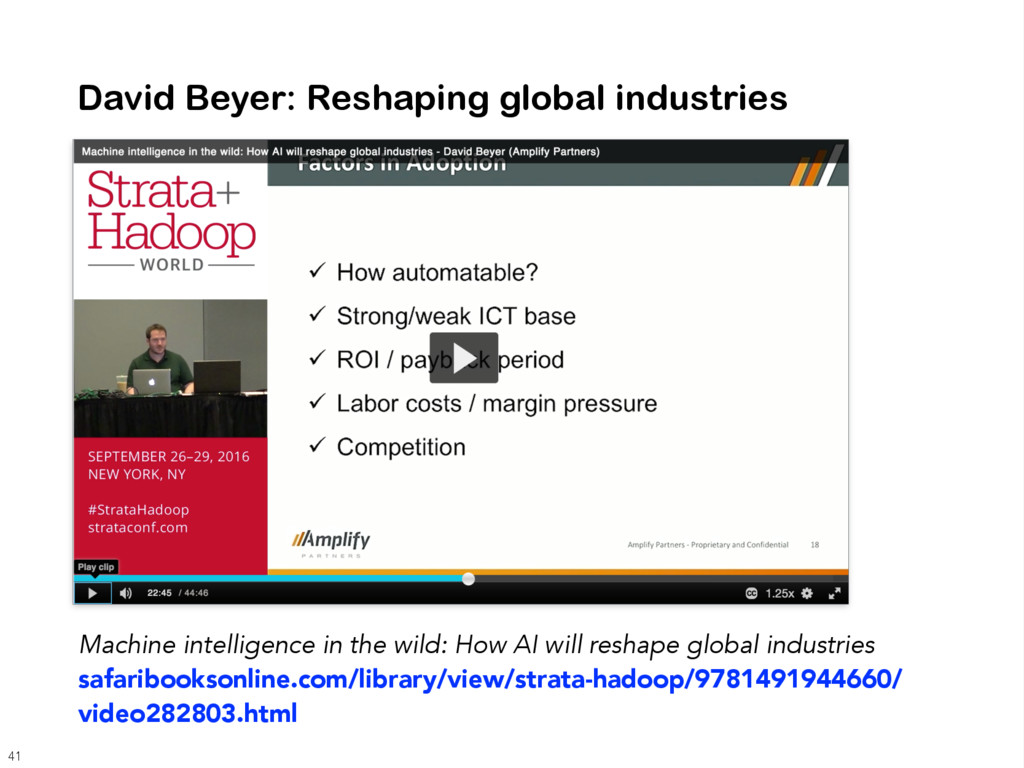
it took a generation before factory managers understood they could reconfigure the physical arrangement AI may be quicker adoption, but faces similar extremes of cognitive embrace Machine intelligence in the wild: How AI will reshape global industries safaribooksonline.com/library/view/strata-hadoop/9781491944660/ video282803.html David Beyer: Reshaping global industries 42
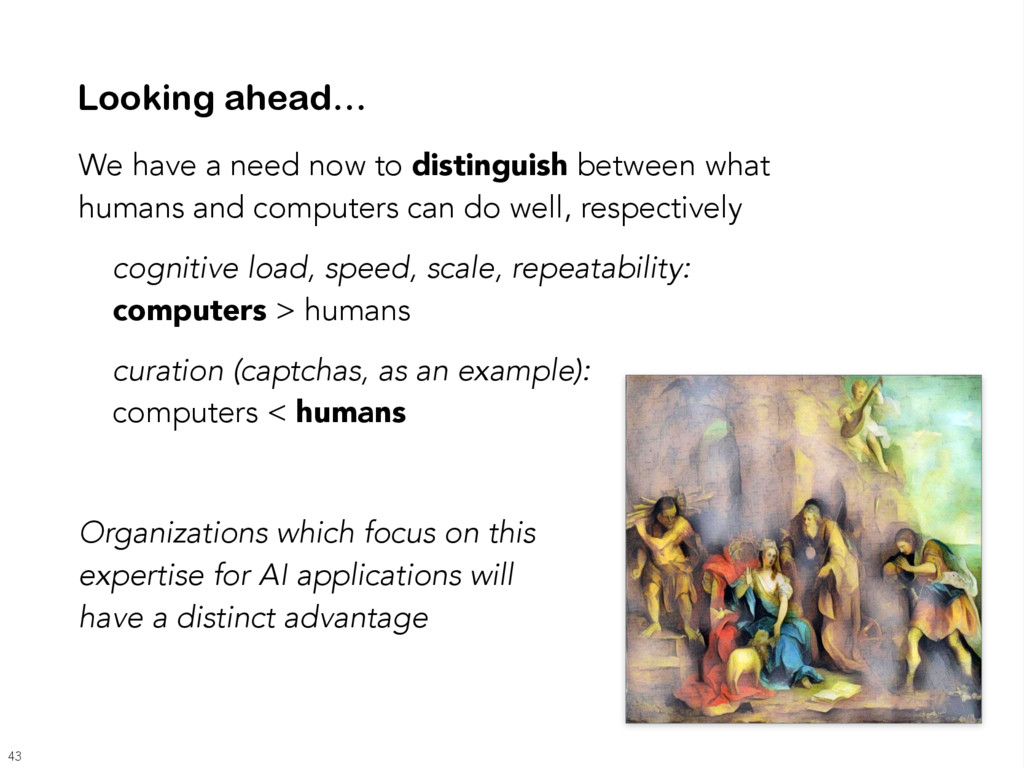
what humans and computers can do well, respectively cognitive load, speed, scale, repeatability: computers > humans curation (captchas, as an example): computers < humans Organizations which focus on this expertise for AI applications will have a distinct advantage 43


 bigdataspain
 shreyas1009
 nttcom
 marceloancelmo
 chack411
 kameitomohiro
 masasuzu
 masahirokawahara
 shichijoyuhi
 soudai
 kazukun0716
 ks91
ks91
 oracle4engineer
 aki_iinuma
 kimpetersen
 sergeychernyshev
 sarafernandez
 danielanewman
 stuffmc
 geshan
 aleyda
 gurzu
gurzu
 brettharned
 geoffreycrofte
 speakerdeck