Upgrade to Pro — share decks privately, control downloads, hide ads and more …

Dog Rescue - The Adoption Process

Avatar for brett brett
November 25, 2018

Dog Rescue - The Adoption Process

Provides an overview of the process someone goes through when they consider adopting a dog from the initial enquiry to the day they get the dog.

Also provides some examples of why an adopter and dog may not be suitable for each other and why a rescue would turn down a prospective adopter.

Avatar for brett

brett

November 25, 2018
Tweet

Other Decks in Education

Transcript

  1. Introduction Aim: Go through the steps of the adoption process

    and how the screening works. What are the steps? Go through each step. Talk about the kind of decisions that are made at each step. Q&A ask questions anytime you like.
  2. Initial Enquiry Person calls up and enquires about adopting a

    dog. They may even have a dog in mind when they call. Depending on the rescue they may be provided with a registration form via e-mail or post, or invited to the rescue to complete it face to face.
  3. Registration A form is filled in capturing details about the

    adopter. Basic Contact Information • Name • Address • Email address Details about their: • Home life - family makeup, any pets, rented/own home, garden, visitors. • Work life - working hours. • Experience with dogs • Preferences regarding breeds, size of dog, etc • What kind of life they can offer a dog
  4. Search Two approaches to finding a dog 1. The rescue

    may identify a suitable match. 2. The adopter shows interest in a dog they have seen on their website or in the kennels at the centre. Once a candidate dog has been found more details are revealed about the dog. E.g. medical issues, likes & dislikes, history. The adopter may be offered to speak to a vet or behaviourist to discuss any issues the dog may have before deciding to take things to the next stage (or deciding not to). More information about the adopter will be captured which feeds back into the criteria for search.
  5. Meet the Dog Depends on the rescue 1. Introduced to

    the dog in a controlled environment e.g. room or outside training ground. 2. Supervised interaction with the dog, or allowed to take it out independently for a walk. 3. All family members pets, cats and dogs are invited to see how they interact. This is always supervised.
  6. Home Check A visit to your home. This may be

    the first time a representative of the rescue meets with you face to face. Lots of questions asked. Some repeated from the registration. Note: We will look at an example questionnaire. Check the garden • Can the dog escape • Is the garden safe for a dog • Is the owner willing to fix any issues e.g. broken fence, raise the height of the fence e.g. with trellis
  7. Adoption • Provide identity papers. • Adopter pays a contribution

    to the rescue. • Signs forms regarding transfer of ownership / adoption contract. • Vaccination Record. • May include a chat with a vet nurse & provided with some medication.
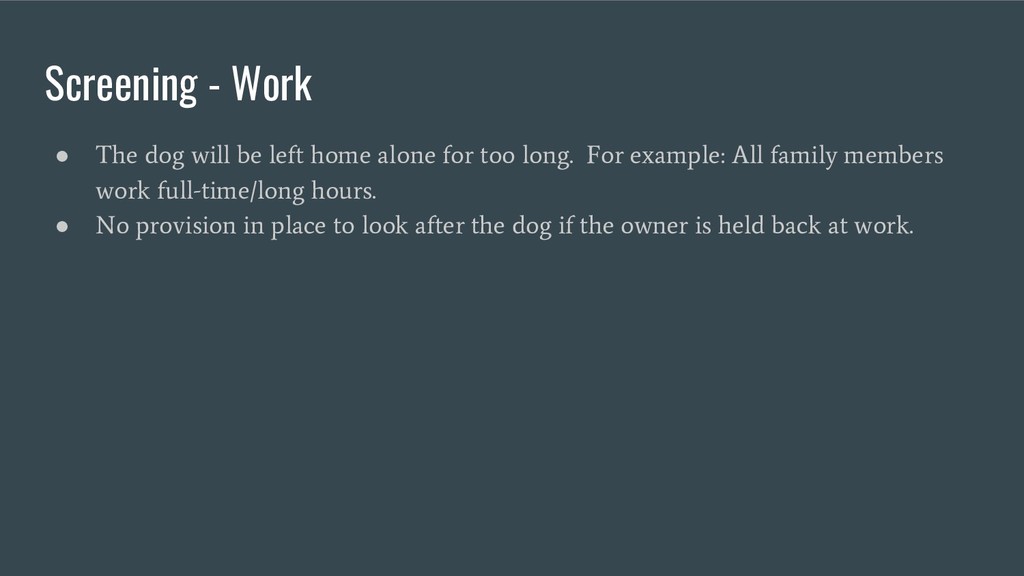
  8. Screening - Work • The dog will be left home

    alone for too long. For example: All family members work full-time/long hours. • No provision in place to look after the dog if the owner is held back at work.
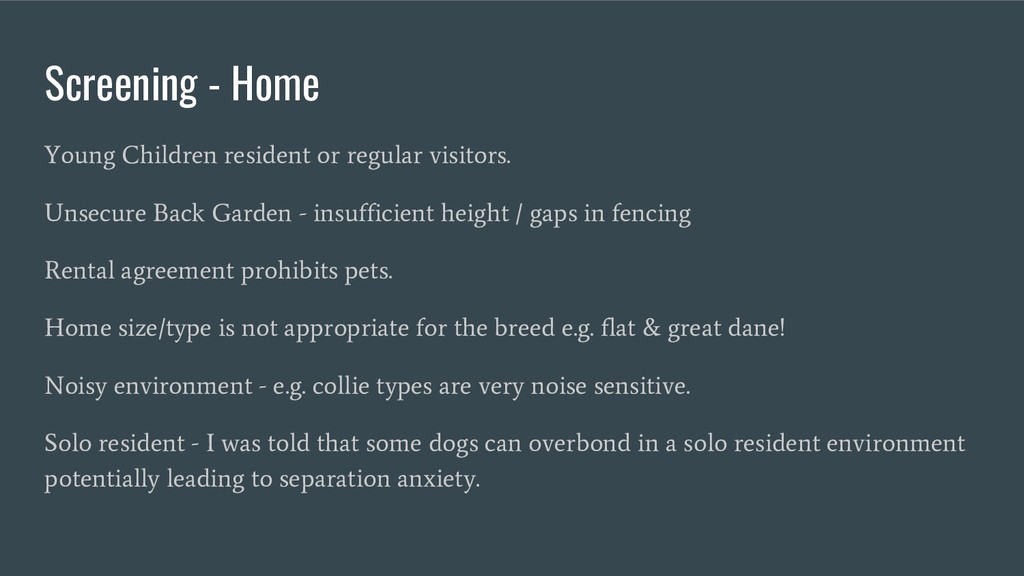
  9. Screening - Home Young Children resident or regular visitors. Unsecure

    Back Garden - insufficient height / gaps in fencing Rental agreement prohibits pets. Home size/type is not appropriate for the breed e.g. flat & great dane! Noisy environment - e.g. collie types are very noise sensitive. Solo resident - I was told that some dogs can overbond in a solo resident environment potentially leading to separation anxiety.
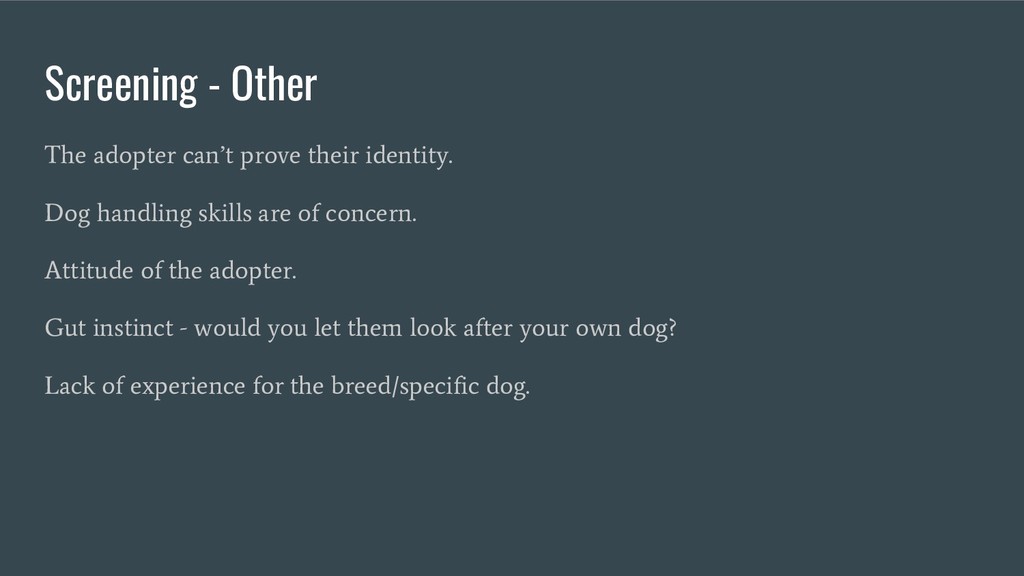
  10. Screening - Other The adopter can’t prove their identity. Dog

    handling skills are of concern. Attitude of the adopter. Gut instinct - would you let them look after your own dog? Lack of experience for the breed/specific dog.