way to exist in many different ways, from the camouflage of a Chamaeleon to the Tiny Tardigrade; which can survive in extreme temperatures, lack of atmosphere, disease and basically everything you can throw at it. So for the purpose of our tests when we say ‘life’ we mean intelligent life. Not just bacteria or a pathogen.
odds of a planet having a breathable atmosphere? It turns out pretty good Using the Hubble telescope and Spitzer NASA were able to find an exoplanet called WASP- 39b which has a vast amount of water in its atmosphere – and we know what water means: oxygen. Now we have oxygen we need to make sure there are no toxic gases in the atmosphere. We don’t know what sort of atmosphere alien life needs to be able to ‘breathe’ but maybe, just maybe they can breathe with gases toxic to us. Humans developed over millennia to adapt and suit the air earth has given us, so what’s to say an alien race couldn’t have evolved to suit there atmosphere. After all life doesn’t just pop into existence, but grows over millions of years. But do we really?
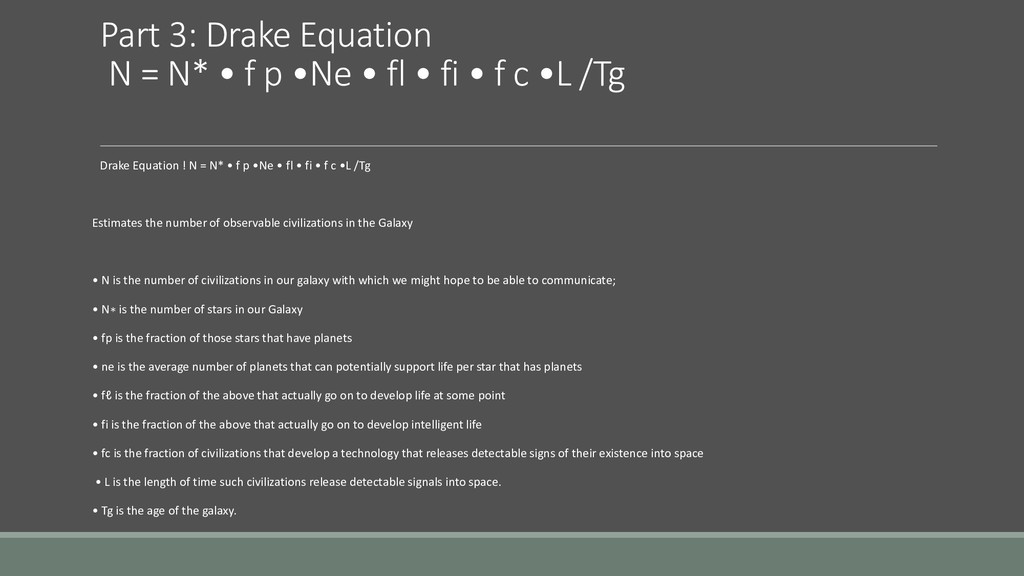
•Ne • fl • fi • f c •L /Tg Drake Equation ! N = N* • f p •Ne • fl • fi • f c •L /Tg Estimates the number of observable civilizations in the Galaxy • N is the number of civilizations in our galaxy with which we might hope to be able to communicate; • N∗ is the number of stars in our Galaxy • fp is the fraction of those stars that have planets • ne is the average number of planets that can potentially support life per star that has planets • fℓ is the fraction of the above that actually go on to develop life at some point • fi is the fraction of the above that actually go on to develop intelligent life • fc is the fraction of civilizations that develop a technology that releases detectable signs of their existence into space • L is the length of time such civilizations release detectable signals into space. • Tg is the age of the galaxy.
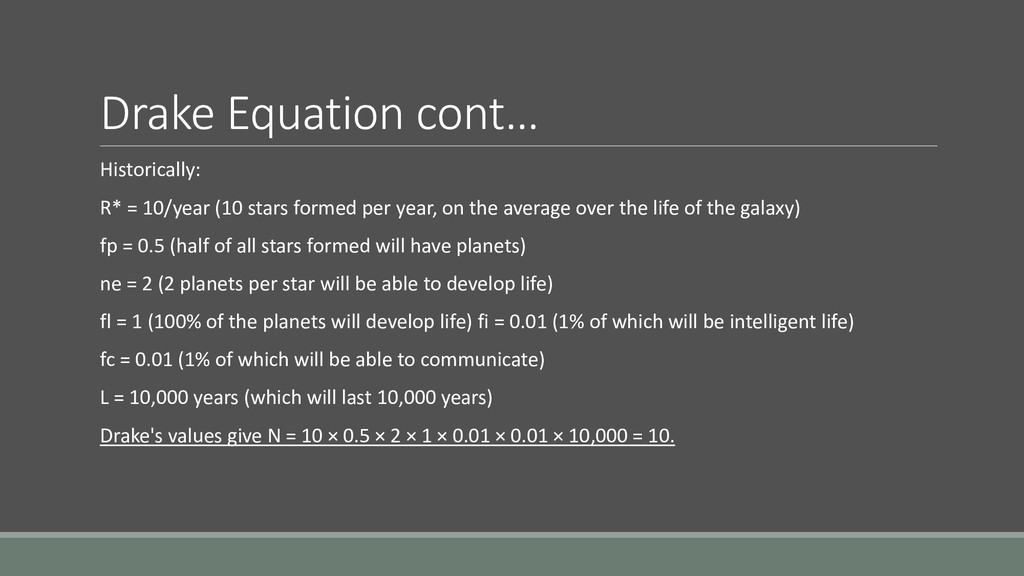
per year, on the average over the life of the galaxy) fp = 0.5 (half of all stars formed will have planets) ne = 2 (2 planets per star will be able to develop life) fl = 1 (100% of the planets will develop life) fi = 0.01 (1% of which will be intelligent life) fc = 0.01 (1% of which will be able to communicate) L = 10,000 years (which will last 10,000 years) Drake's values give N = 10 × 0.5 × 2 × 1 × 0.01 × 0.01 × 10,000 = 10.
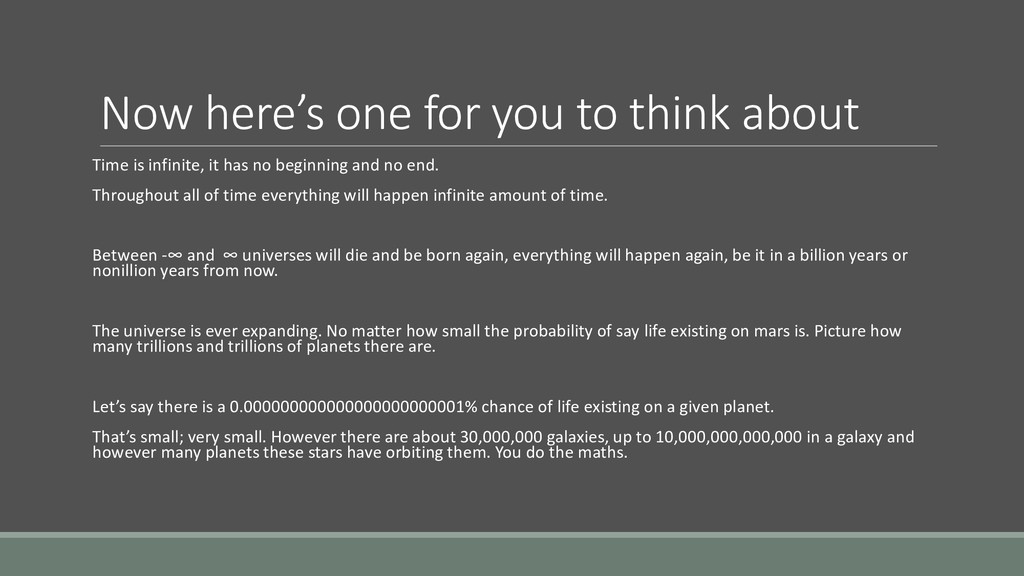
infinite, it has no beginning and no end. Throughout all of time everything will happen infinite amount of time. Between -∞ and ∞ universes will die and be born again, everything will happen again, be it in a billion years or nonillion years from now. The universe is ever expanding. No matter how small the probability of say life existing on mars is. Picture how many trillions and trillions of planets there are. Let’s say there is a 0.000000000000000000000001% chance of life existing on a given planet. That’s small; very small. However there are about 30,000,000 galaxies, up to 10,000,000,000,000 in a galaxy and however many planets these stars have orbiting them. You do the maths.
I was; sat on a bed, wondering to myself: ‘Charlie what if time IS infinite, it has no beginning nor end and if time is infinite that means everything can happen between now and infinity.’ An infinite amount of times you have sat where you are, listening to my presentation, reading my PowerPoint all in the past, future, and now. However I have also missed th letter e in this sentence an infinite number of times, but an infinite amount of times I will have spelt it right, or with a g, or maybe there is no g. Maybe at another point in time someone on the third row will cough as I finish this sentence. Maybe it will happen in our point in time, right now. My bets are it is Tom.


 sarafernandez
 tessaabrams
 katarinadahlin
 soysaucechin
 akademiya2063
 dougneiner
 addyosmani
 codingconduct
 reverentgeek
 lynnandtonic
 joshbly
 watany