Programs in Kentucky That Improve Caregivers and Kids Lives
Find how Kentucky supports caregivers and protects children with the Family Caregiver Support (FCSP) and Childhood Lead Poisoning Prevention Programs (KCLPPP).
Description: Find how Kentucky supports caregivers and protects children with the Family Caregiver Support (FCSP) and Childhood Lead Poisoning Prevention Programs (KCLPPP). Kentucky continues to build its communities with sound, user-centered programs that fill real-world needs. Two of the most vital among them are the Kentucky Family Caregiver Support Program and the Childhood Lead Poisoning Prevention Program. Both fill gaps in vital stages in life—caring for ill or disabled loved ones and shielding children from toxic environmental hazards. These programs demonstrate the state's commitment in practice to health, safety, and stability. Through education, resources, and outreach, they assist families in handling responsibilities while averting long-term problems that would otherwise crush households. The Kentucky Family Caregiver Support Program Thousands of Kentuckians give unpaid care every day to their aging parents, spouses, or disabled relatives. The Kentucky Family Caregiver Support Program (FCSP) provides organized support to these caregivers, recognizing the critical role they play in the long-term care system of the state. Supported by the Kentucky Department for Aging and Independent Living, the program reduces the stress, offers resources, and alleviates the physical and emotional burdens of caregiving. Providing Direct and Indirect Support The program offers several levels of support. While some caregivers get hands-on services like respite care—allowing them time to rest—others gain from information on community resources, caregiving techniques, or access to devices. These services are particularly valuable for those with full-time jobs balancing caregiving, dealing with health issues of their own, or having no close family available. Building a Network of Community Support Through collaborations with Area Agencies on Aging and Independent Living (AAAILs), the program brings caregivers into contact with local services relevant to them. These collaborations enable timely support for both urban and rural populations. From counseling, legal aid, and
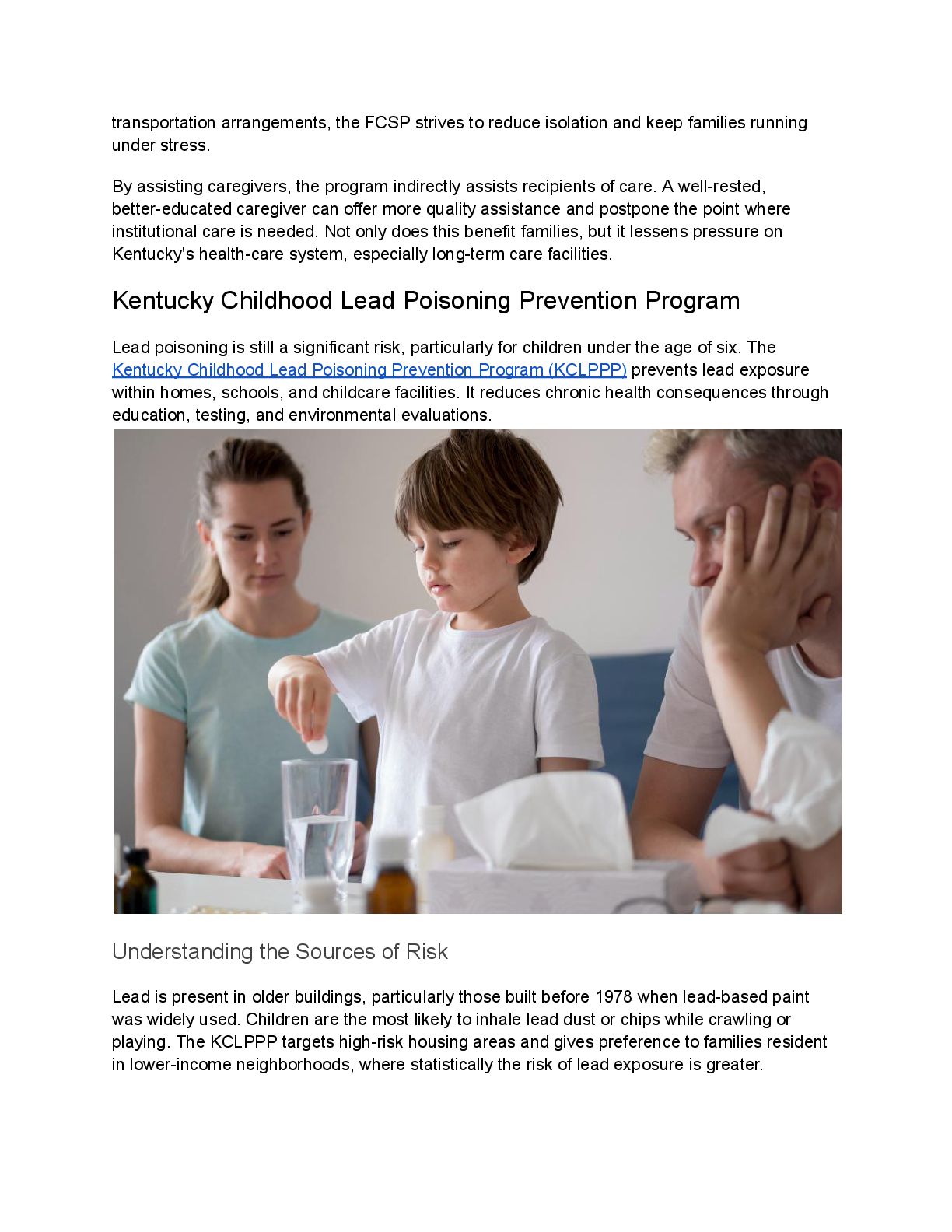
families running under stress. By assisting caregivers, the program indirectly assists recipients of care. A well-rested, better-educated caregiver can offer more quality assistance and postpone the point where institutional care is needed. Not only does this benefit families, but it lessens pressure on Kentucky's health-care system, especially long-term care facilities. Kentucky Childhood Lead Poisoning Prevention Program Lead poisoning is still a significant risk, particularly for children under the age of six. The Kentucky Childhood Lead Poisoning Prevention Program (KCLPPP) prevents lead exposure within homes, schools, and childcare facilities. It reduces chronic health consequences through education, testing, and environmental evaluations. Understanding the Sources of Risk Lead is present in older buildings, particularly those built before 1978 when lead-based paint was widely used. Children are the most likely to inhale lead dust or chips while crawling or playing. The KCLPPP targets high-risk housing areas and gives preference to families resident in lower-income neighborhoods, where statistically the risk of lead exposure is greater.
for blood lead levels, especially at well-child visits. Upon detection, high levels are met by intervention by the state in the form of coordinated follow-up, environmental investigation, and counseling on avoiding additional exposure. Intervention is conducted early to avert delay in development, behavioral problems, and permanent neurological damage. Empowering Families through Educational Outreach Through department of health home visits, workshops, and online outreach, the KCLPPP informs property owners and caregivers of risks and remediation methods. The program also works with pediatricians and schools to offer consistent messaging and early case identification. To find out more about national lead safety standards, the EPA Lead Poisoning Prevention webpage offers extensive information. Building Safer Homes and Stronger Families Both initiatives illustrate Kentucky's long-term commitment to family stability. Whether the support is for a grandparent raising a loved one or protecting a toddler from an unseen danger, these programs foster settings where people can thrive regardless of their age. The outcome is healthier homes and tighter community connections. Public Health Meets Practical Solutions Instead of one-size-fits-all solutions, they are designed to take people where they are. Caregiver support involves accommodating services in terms of individual circumstances. For kids, the interventions occur in the home or pediatric clinic—settings already at the hub of a child's life. That integration prevents problems from getting out of hand and becoming increasingly difficult to deal with. Access That Prioritizes the User Both initiatives target removing obstacles. Application processes are streamlined, language services are emphasized, and information is provided in formats sensitive to the diversity of Kentucky. Whether a caregiver is in need temporarily or a parent desires to screen a home for lead, the route to help is intended to be transparent and linear. Reaching Underserved Populations Particular emphasis is placed on serving underserved groups, such as rural families, communities of color, and those of lower income. Local outreach teams, typically from local community health departments, foster trust through door-to-door visits and continued communication, ensuring that help finds those at greatest risk.
not taken on faith. Both incorporate reporting and data collection mechanisms that monitor how services are accessed and what results they produce. An easy way to judge their progress is via visiting a source commonly describing these programs, one of the famous ones is benefitsbystate.com. From lower hospitalizations to enhanced child health screenings, actual metrics drive future funding and program planning decisions. Maintaining Programs Flexible and Responsive Public feedback is a key factor in keeping these services responsive. Feedback from families and caregivers shapes training, eligibility levels, and funding allocation. This constant loop keeps programs based on the realities of Kentuckians' daily lives, not simply administrative directives. Stronger Communities Begin at Home The Family Caregiver Support Program and the Childhood Lead Poisoning Prevention Program target separate populations and problems, but both share a premise that healthy communities start with healthy homes. Whether the mission is easing physical burden on a caregiver or protecting a child's growth from unseen threats, the common aim is enabling families to get along better with services that value their obstacles. These initiatives represent a public benefit model that listens, responds, and produces genuine impact. In each county and among each demographic, they build environments where care and safety are not indulgences but attainable standards. Frequently Asked Questions Q1. Who is eligible for the Kentucky Family Caregiver Support Program? A1. Adults caring for a person 60 years of age or older—or grandparents raising kids—may be eligible. Services are specific to the region and requirements. Q2. How are children screened for lead in Kentucky? A2. Lead testing occurs by doing uncomplicated blood tests during well-child checkups. Follow-up testing and home visits are scheduled if lead levels are high. Q3. Are free lead-related home inspections available through the KCLPPP? A3. Yes, environmental investigations for exposure to lead are provided at no charge for families with eligible children who have high levels of lead.


 eileencodes
 soudai
 signer
 vanstee
 techseoconnect
 jonyablonski
 hannesfritz
 nwiizo
 dugsong
 jmmastey
 palkan
 kimpetersen