JAX 2015: Security DevOps - Wie Sie in agilen P...
Sponsored
·
 SiteGround - Reliable hosting with speed, security, and support you can count on.
→
SiteGround - Reliable hosting with speed, security, and support you can count on.
→

Share
Embed
JAX 2015: Security DevOps - Wie Sie in agilen Projekten trotzdem sicher bleiben
Diese Session zeigt Ihnen, welche Automatisierungsoptionen zur Überwachung bestimmter Sicherheitsaspekte in der agilen Softwareentwicklung bestehen. Ausgehend von dem etablierten DevOps-Konzept, mit dem im Übergang von Entwicklung zu Betrieb Prozesse automatisiert und verzahnt werden, wird mit "Security-DevOps" dieser Antrieb aufgegriffen und auf die Absicherung von Anwendungen gegen Hackerangriffe übertragen.

Christian Schneider
April 22, 2015
Transcript
104 slides
-
Christian Schneider | @cschneider4711 Security DevOps Wie Sie in
agilen Projekten trotzdem sicher bleiben -
`whoami` • Software Developer, Whitehat Hacker & Trainer • als
Freelancer im Projektgeschäft seit 1997 • Fokus auf JavaEE Architekturen und Web Security • Speaker auf Konferenzen (JAX, WebTechCon, OWASP AppSecEU, DevOps Conference, …) + HackPra • @cschneider4711 www. mail@ Ӗ Christian-Schneider.net -
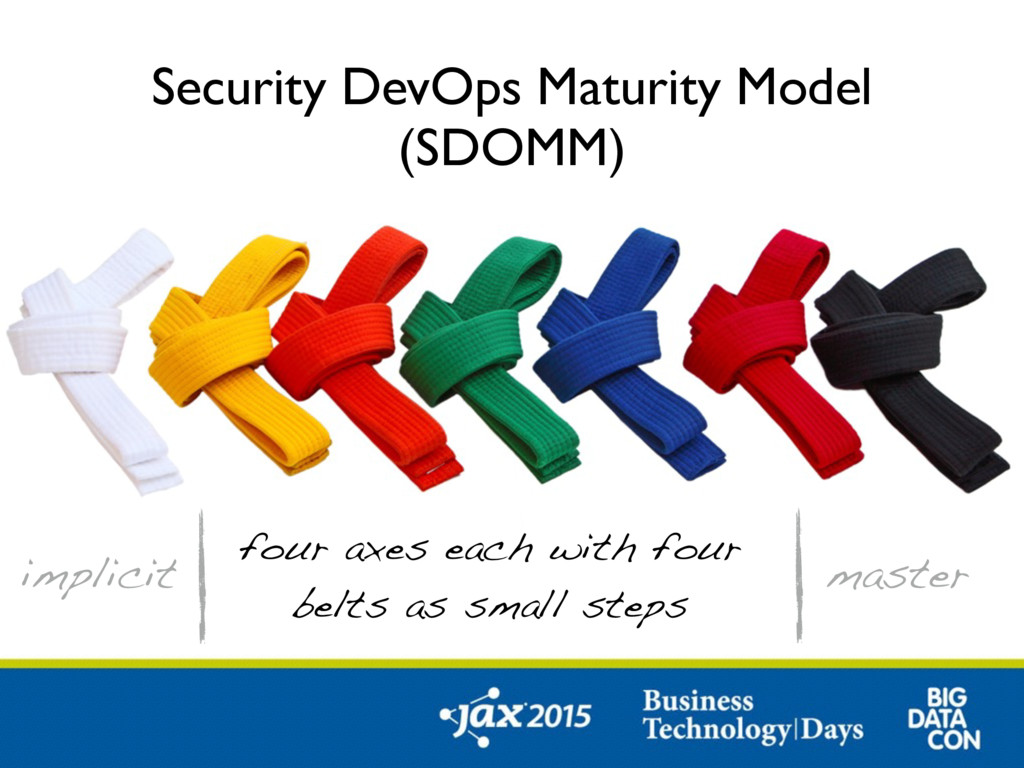
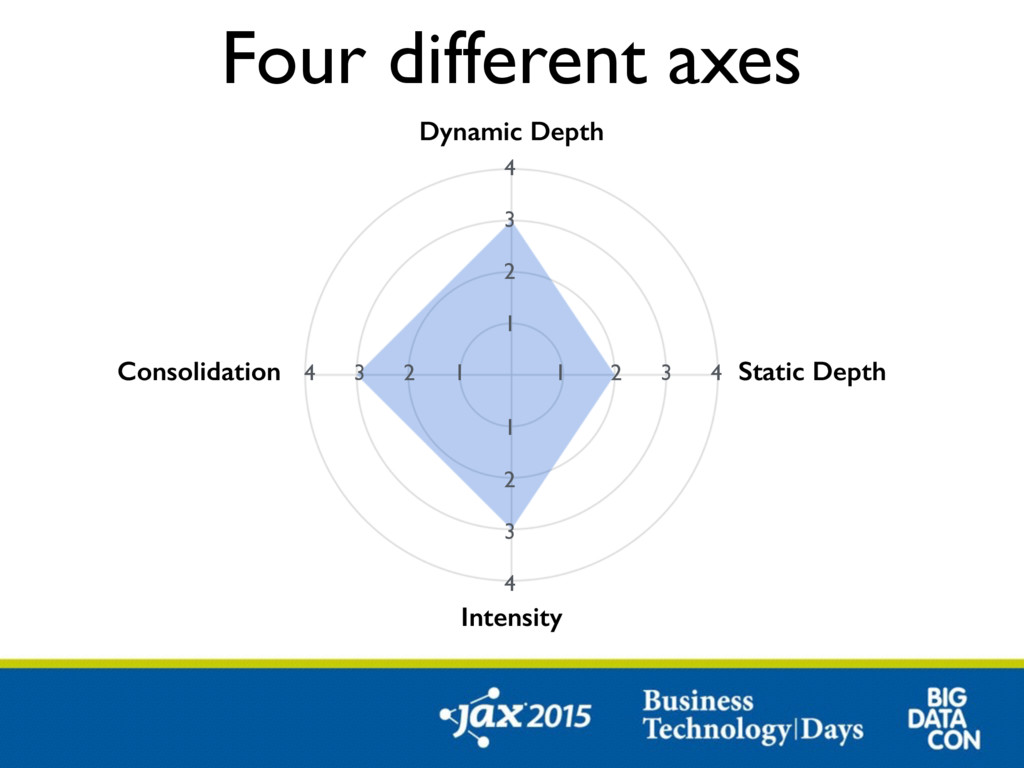
Security DevOps Maturity Model (SDOMM) implicit master four axes each
with four belts as small steps -
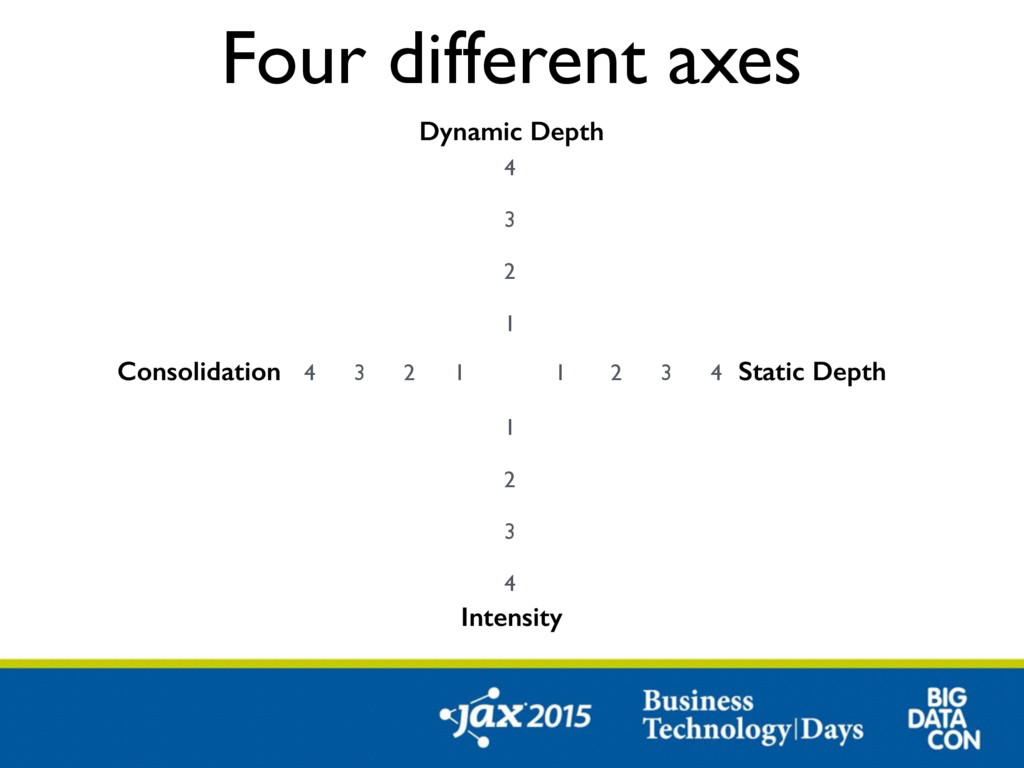
Four different axes Dynamic Depth Intensity Static Depth Consolidation 4
3 2 1 1 2 3 4 4 3 2 1 1 2 3 4 -
Four different axes Dynamic Depth Intensity Static Depth Consolidation 4
3 2 1 1 2 3 4 4 3 2 1 1 2 3 4 -
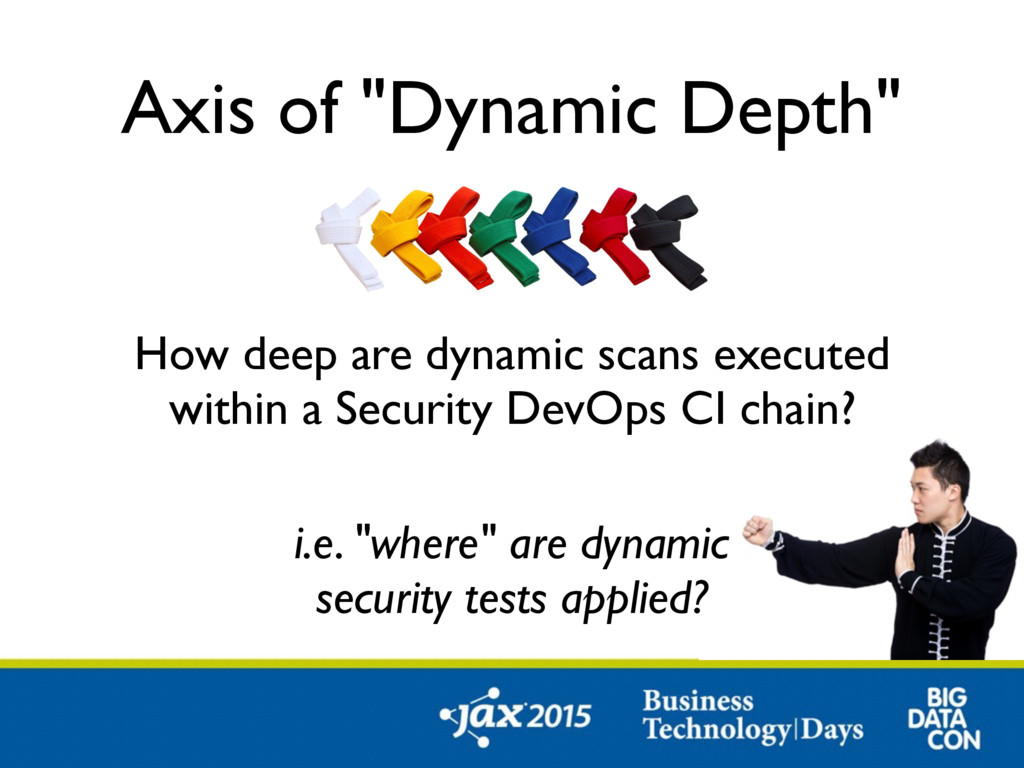
Axis of "Dynamic Depth" How deep are dynamic scans executed
within a Security DevOps CI chain? i.e. "where" are dynamic security tests applied? -
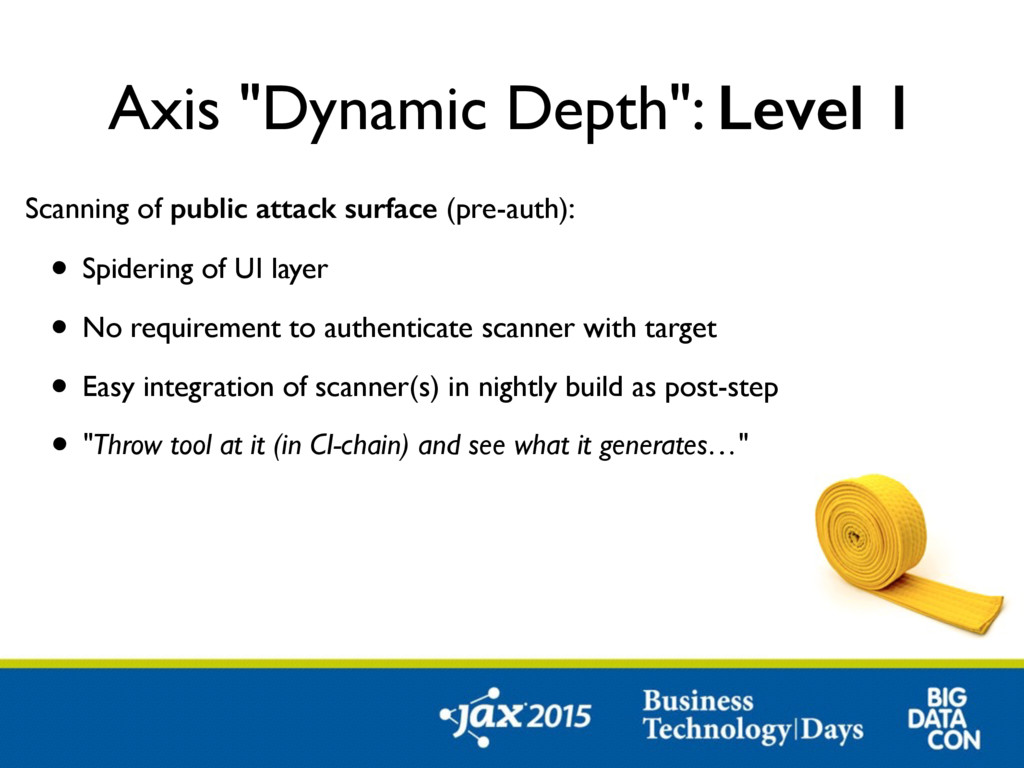
Axis "Dynamic Depth": Level 1 Scanning of public attack surface
(pre-auth): • Spidering of UI layer • No requirement to authenticate scanner with target • Easy integration of scanner(s) in nightly build as post-step • "Throw tool at it (in CI-chain) and see what it generates…" -
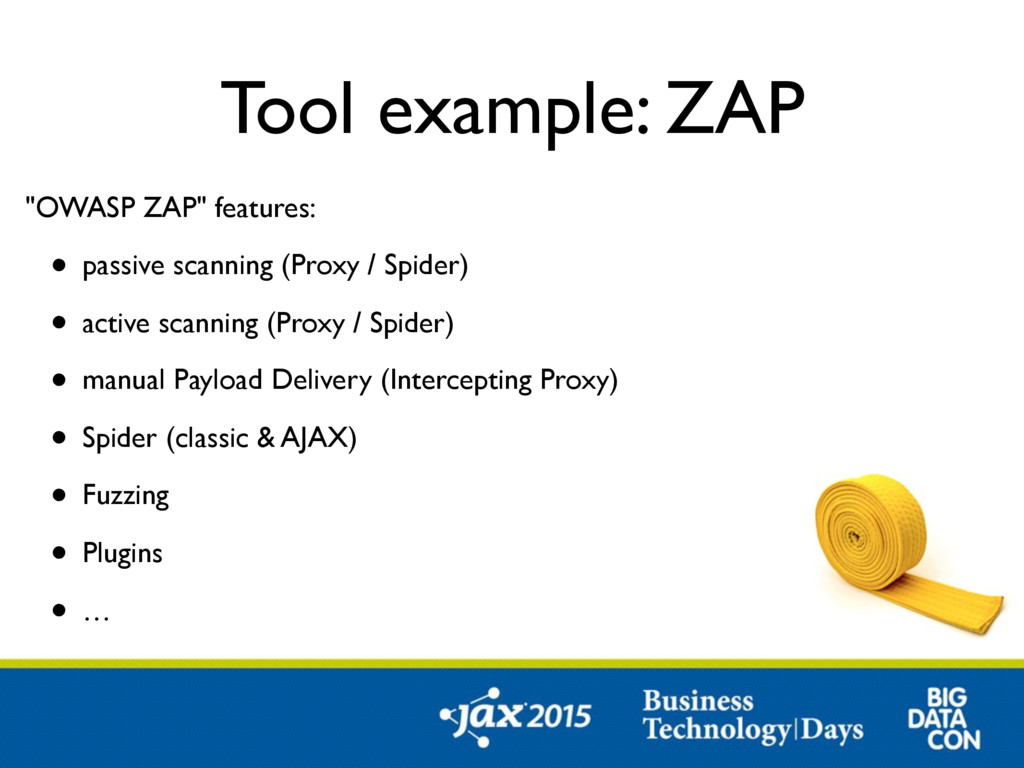
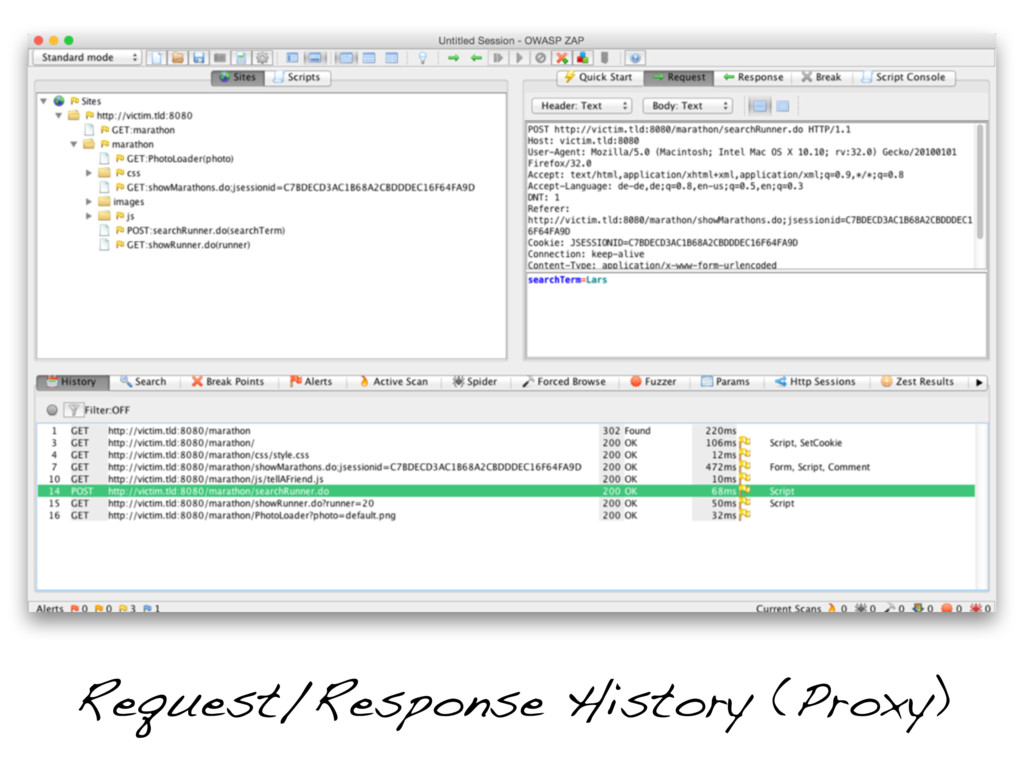
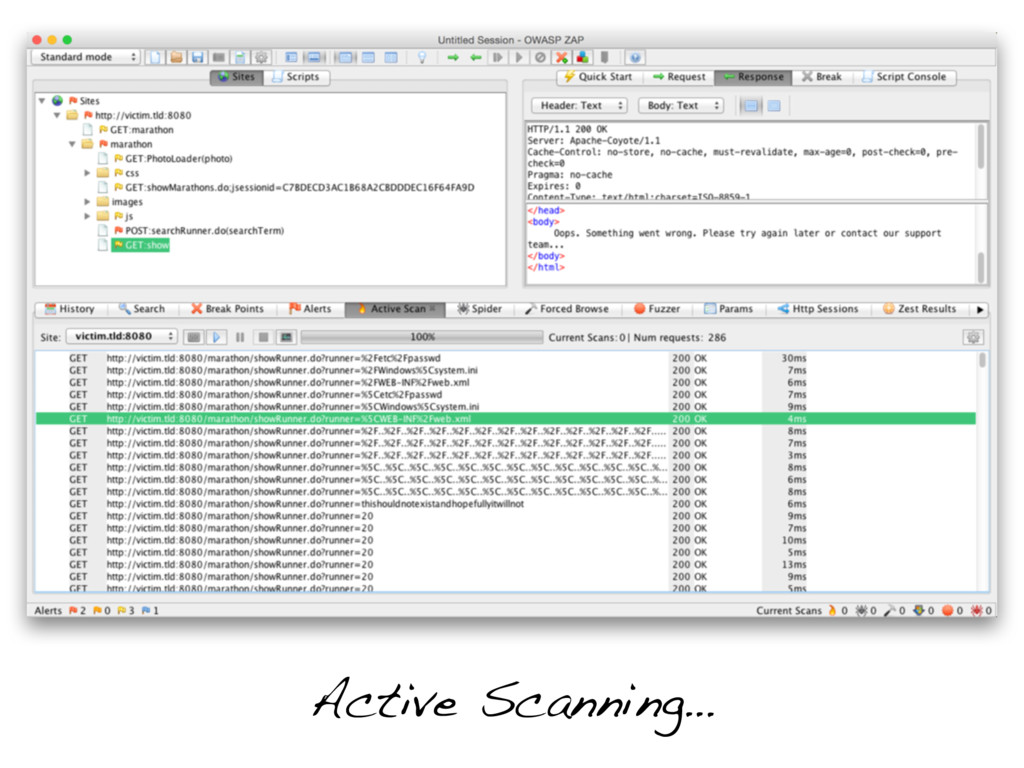
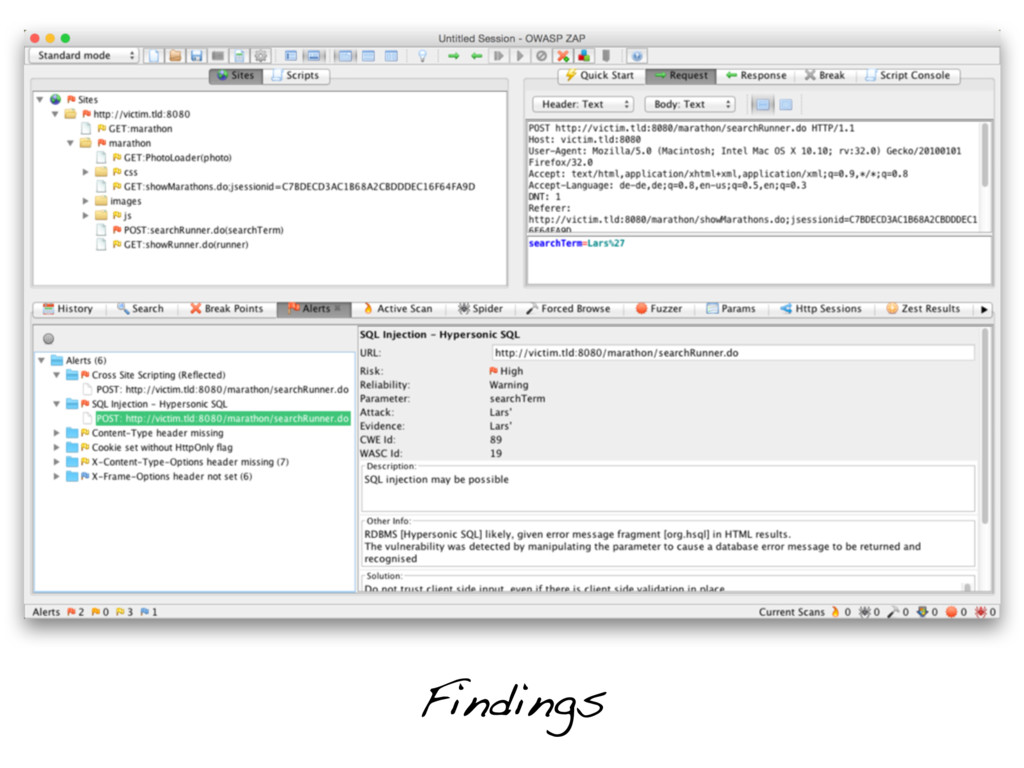
Tool example: ZAP "OWASP ZAP" features: • passive scanning (Proxy
/ Spider) • active scanning (Proxy / Spider) • manual Payload Delivery (Intercepting Proxy) • Spider (classic & AJAX) • Fuzzing • Plugins • … -
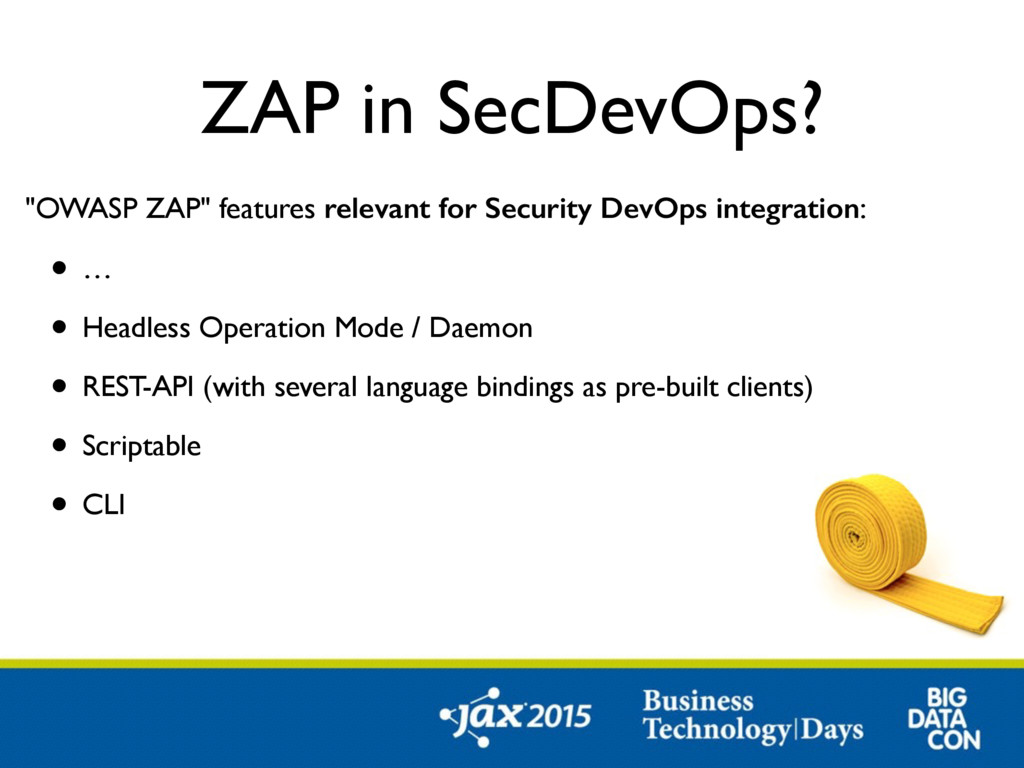
ZAP in SecDevOps? "OWASP ZAP" features relevant for Security DevOps
integration: • … • Headless Operation Mode / Daemon • REST-API (with several language bindings as pre-built clients) • Scriptable • CLI -
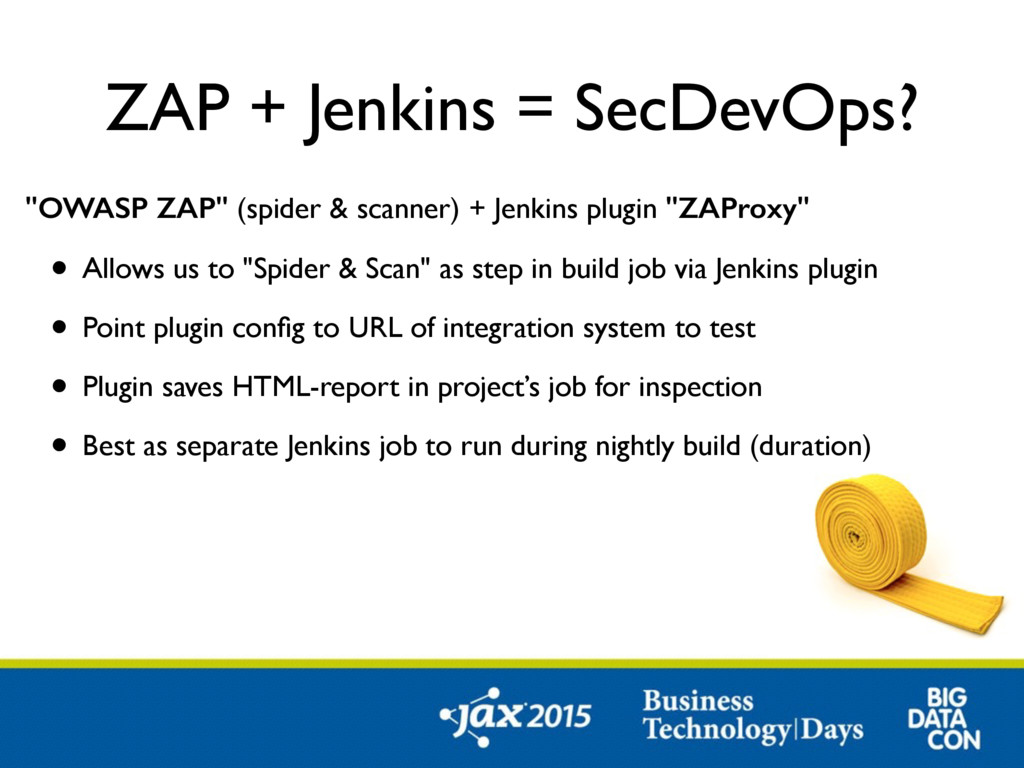
ZAP + Jenkins = SecDevOps? "OWASP ZAP" (spider & scanner)
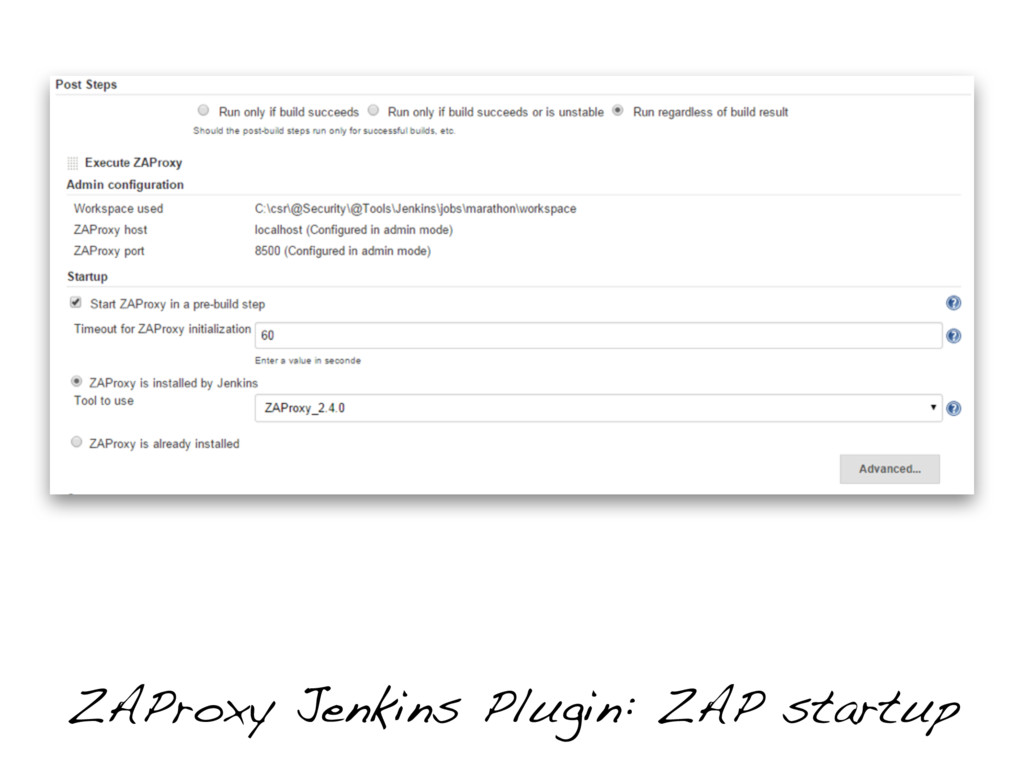
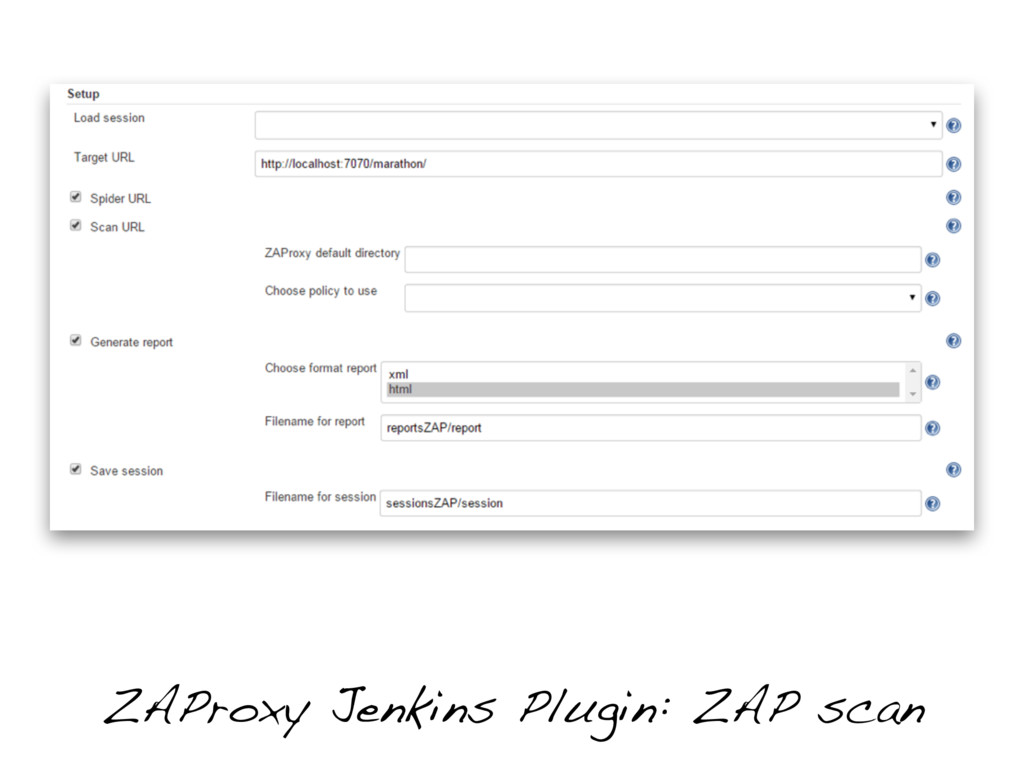
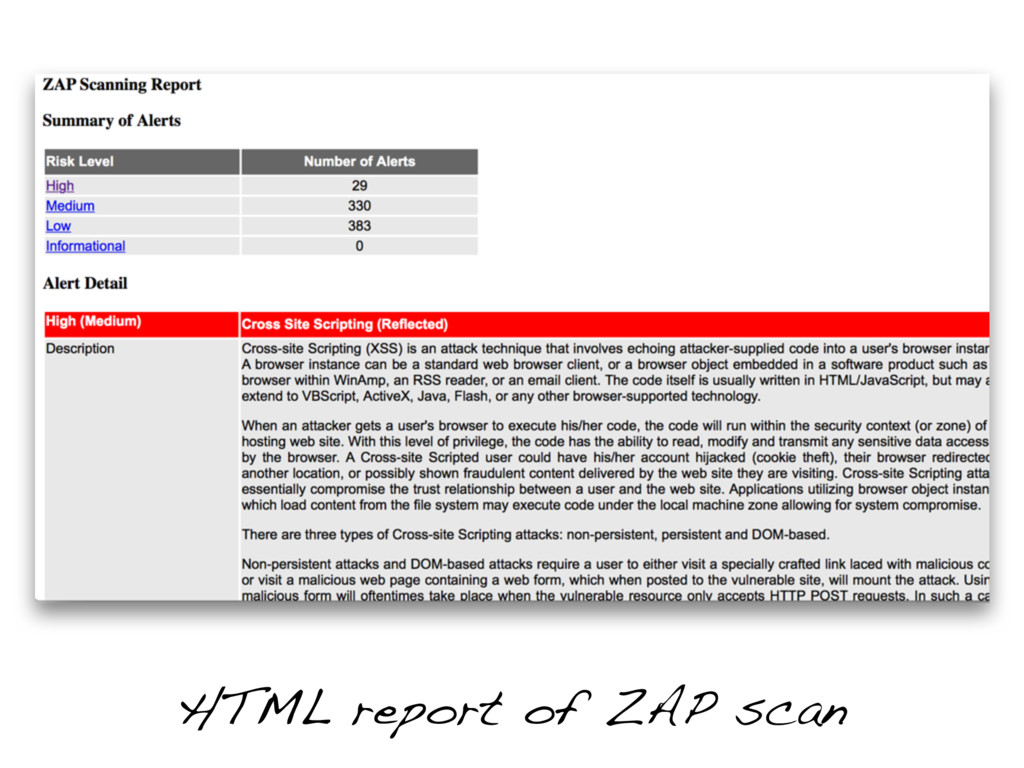
+ Jenkins plugin "ZAProxy" • Allows us to "Spider & Scan" as step in build job via Jenkins plugin • Point plugin config to URL of integration system to test • Plugin saves HTML-report in project’s job for inspection • Best as separate Jenkins job to run during nightly build (duration) -
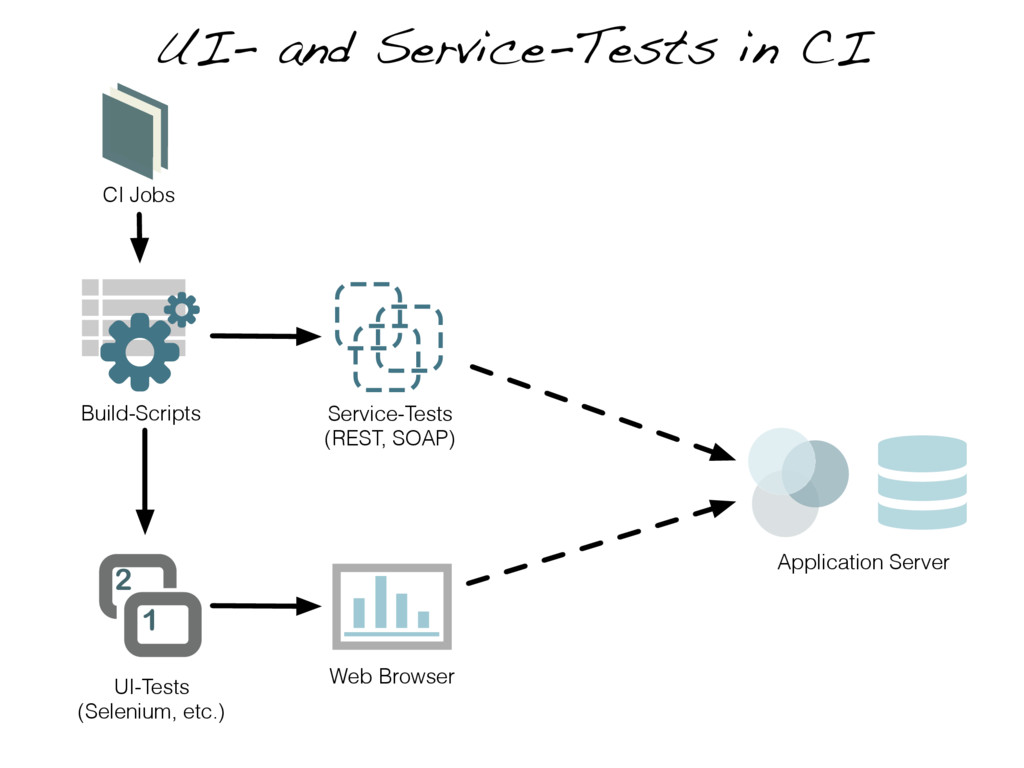
UI- and Service-Tests in CI Web Browser Build-Scripts UI-Tests (Selenium,
etc.) Service-Tests (REST, SOAP) Application Server CI Jobs -
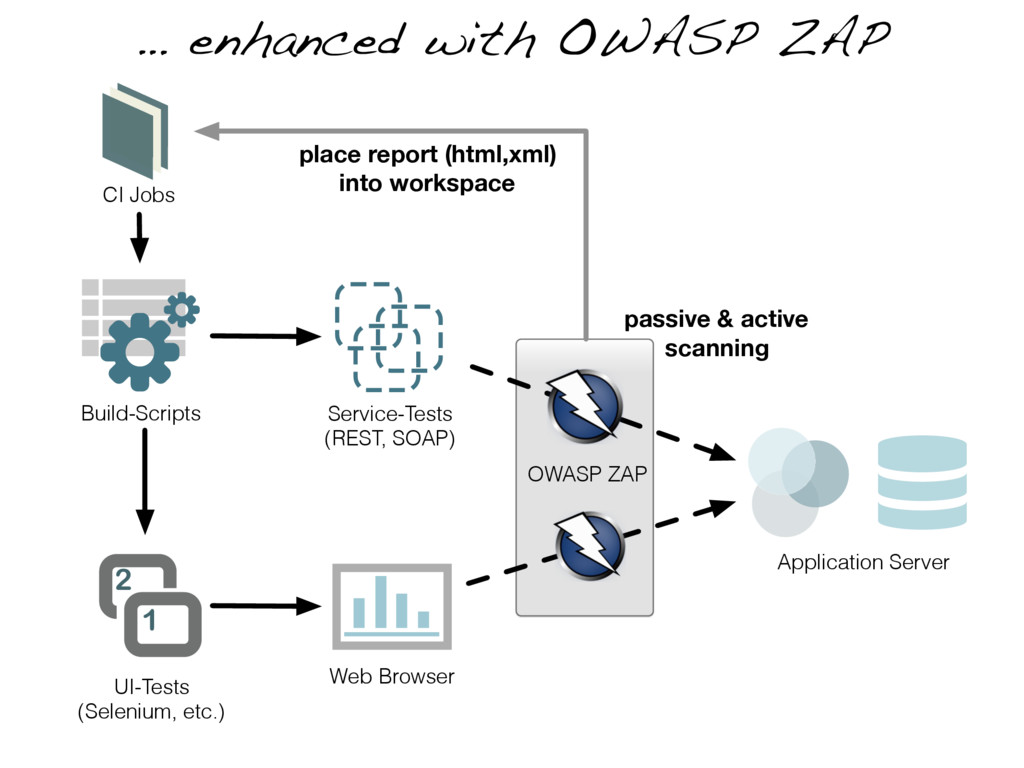
… enhanced with OWASP ZAP Web Browser Build-Scripts UI-Tests (Selenium,
etc.) Service-Tests (REST, SOAP) Application Server OWASP ZAP CI Jobs passive & active scanning place report (html,xml) into workspace -
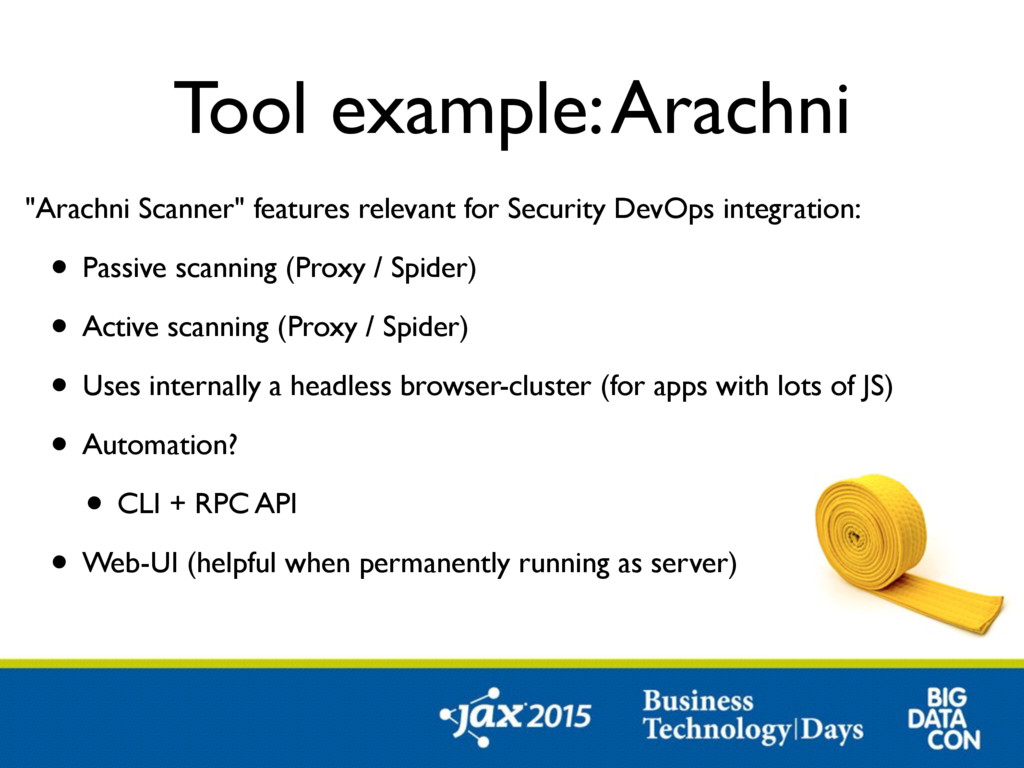
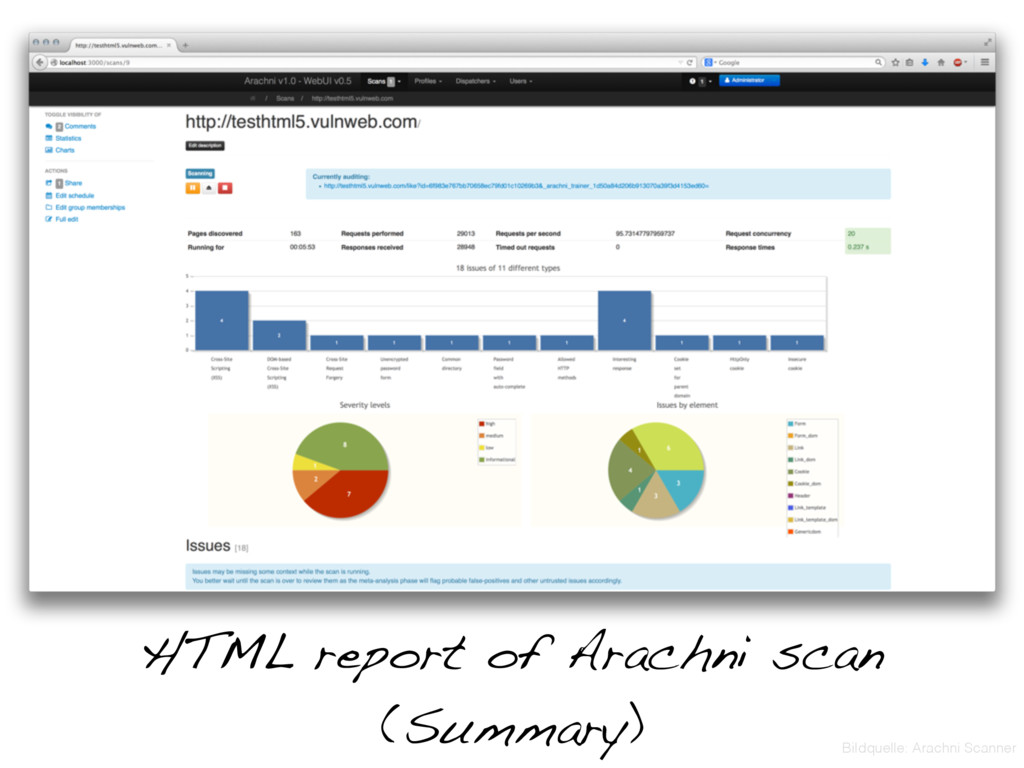
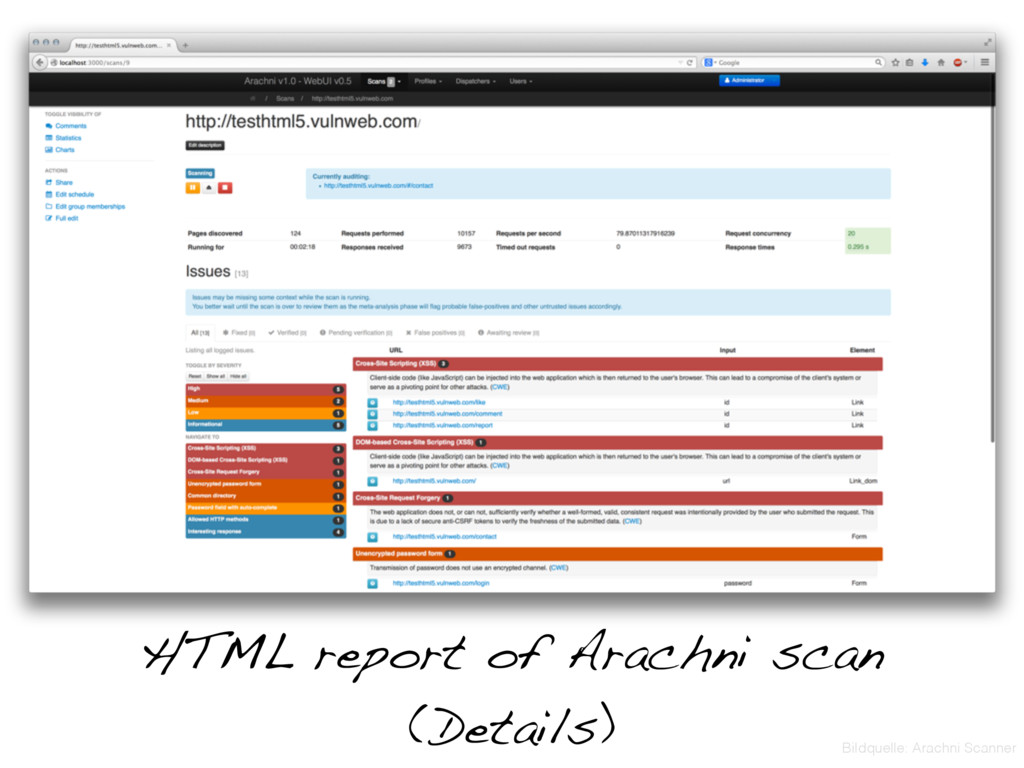
Tool example: Arachni "Arachni Scanner" features relevant for Security DevOps
integration: • Passive scanning (Proxy / Spider) • Active scanning (Proxy / Spider) • Uses internally a headless browser-cluster (for apps with lots of JS) • Automation? • CLI + RPC API • Web-UI (helpful when permanently running as server) -
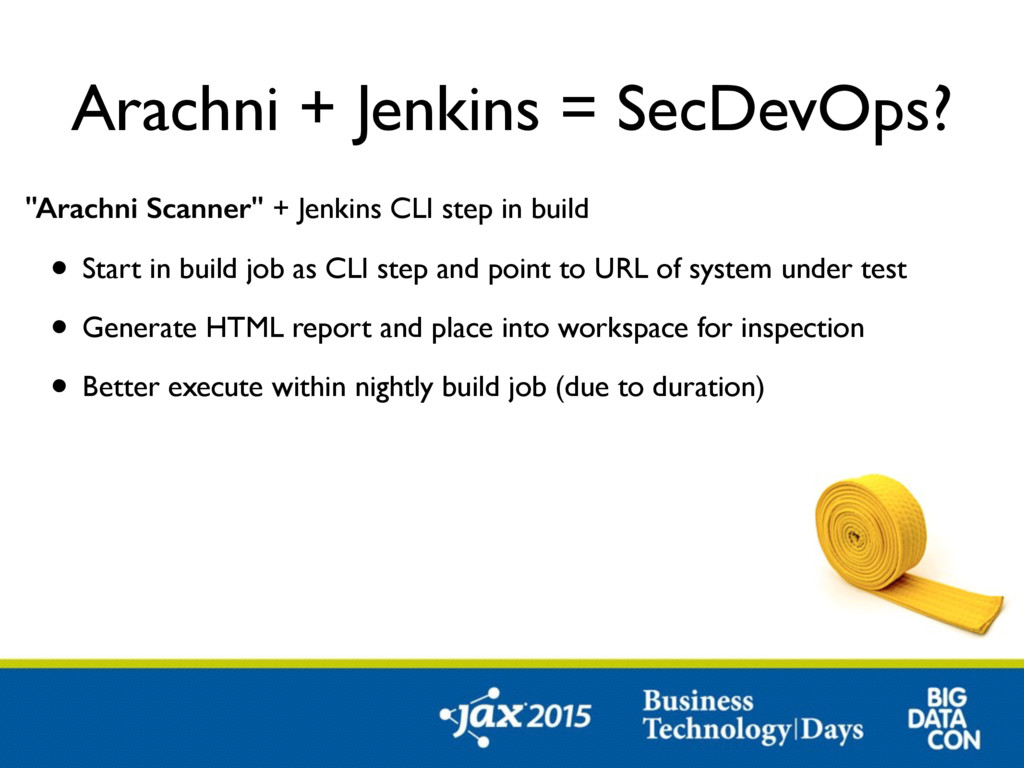
Arachni + Jenkins = SecDevOps? "Arachni Scanner" + Jenkins CLI
step in build • Start in build job as CLI step and point to URL of system under test • Generate HTML report and place into workspace for inspection • Better execute within nightly build job (due to duration) -
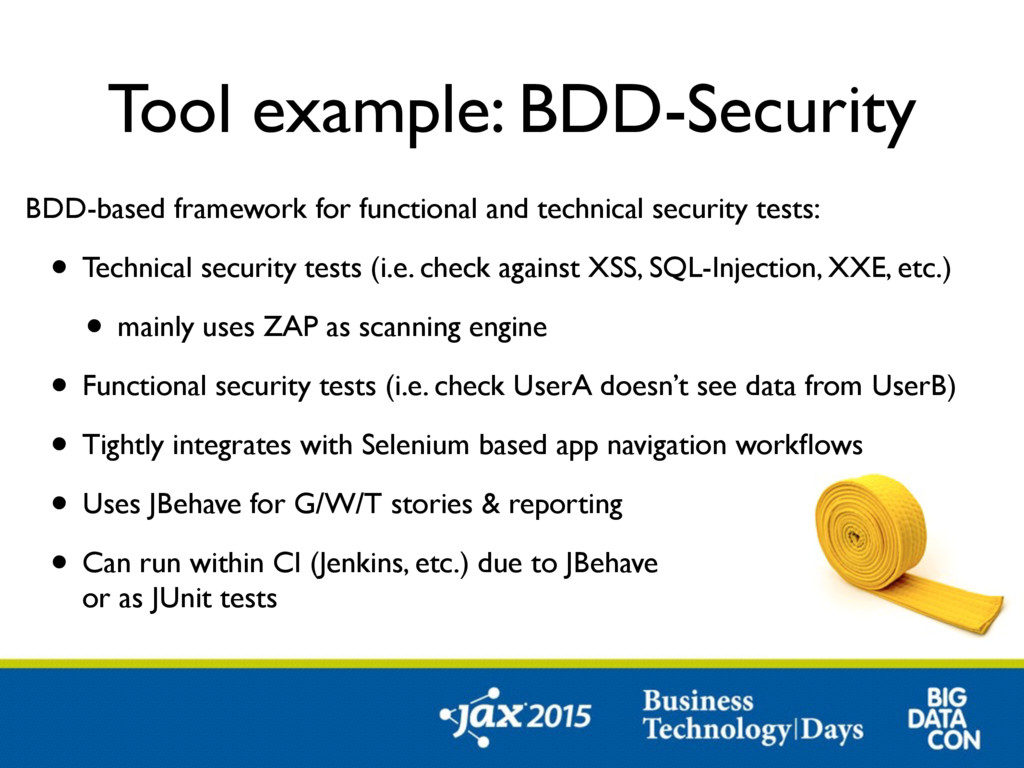
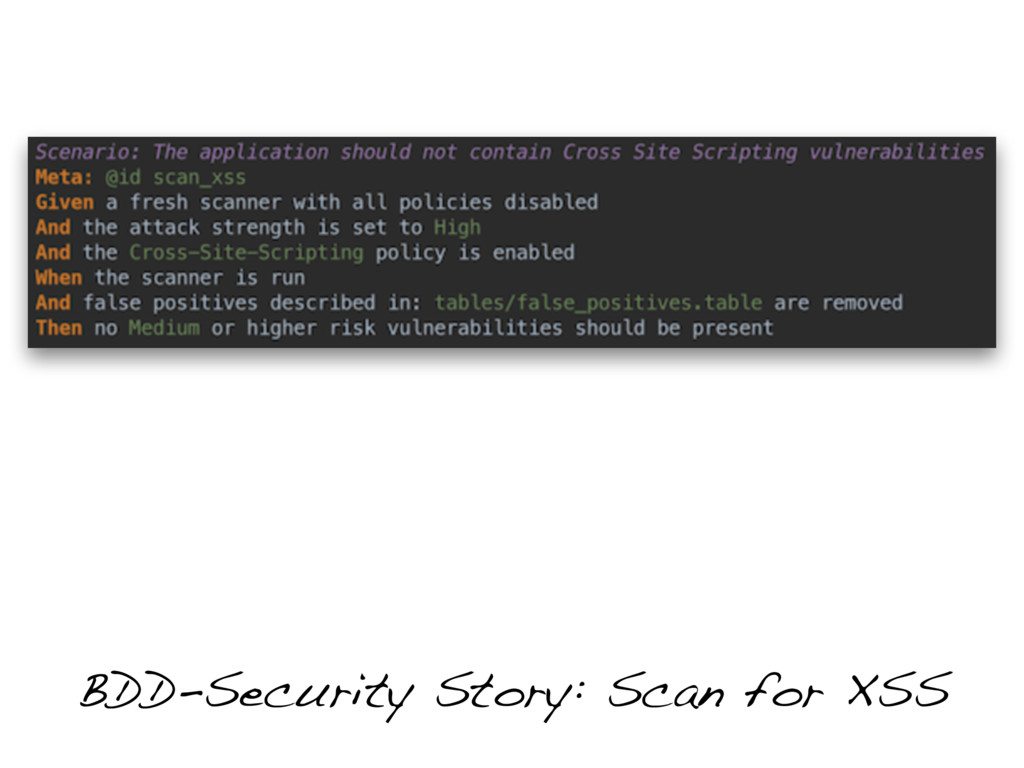
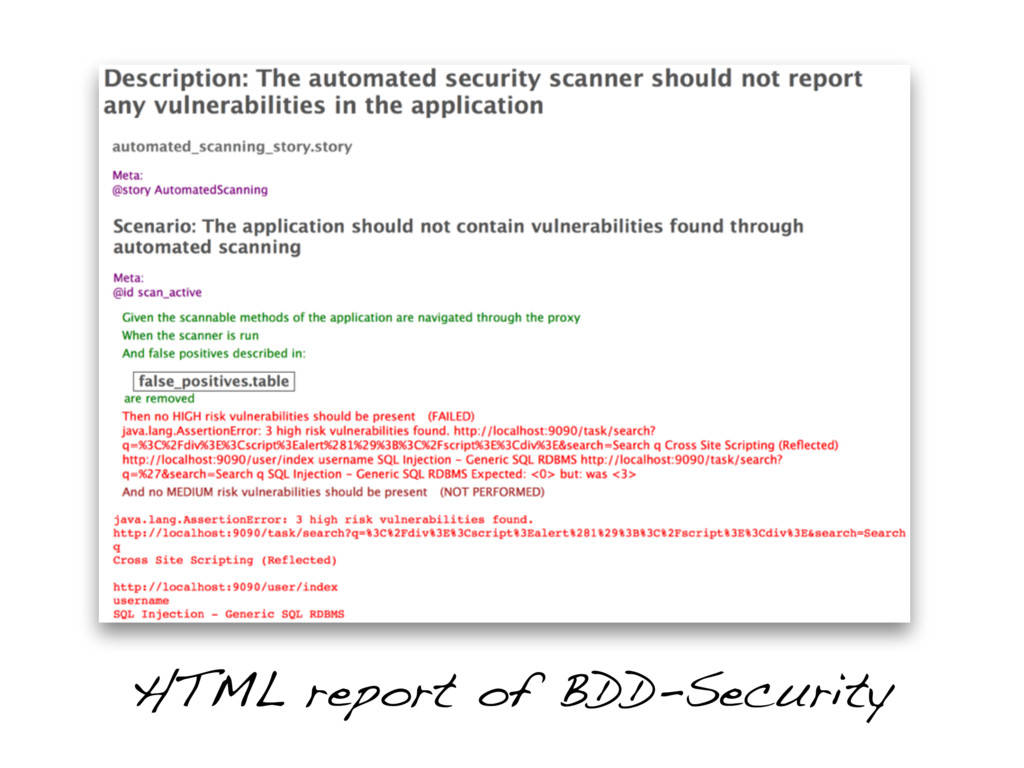
Tool example: BDD-Security BDD-based framework for functional and technical security
tests: • Technical security tests (i.e. check against XSS, SQL-Injection, XXE, etc.) • mainly uses ZAP as scanning engine • Functional security tests (i.e. check UserA doesn’t see data from UserB) • Tightly integrates with Selenium based app navigation workflows • Uses JBehave for G/W/T stories & reporting • Can run within CI (Jenkins, etc.) due to JBehave or as JUnit tests -
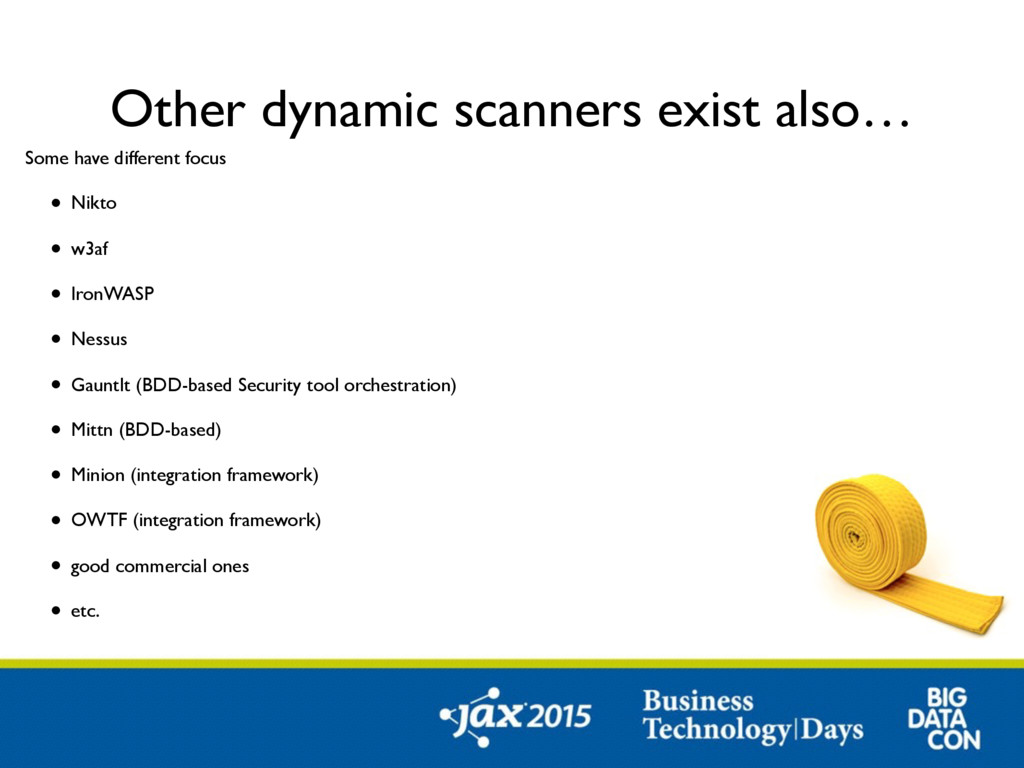
Other dynamic scanners exist also… Some have different focus •
Nikto • w3af • IronWASP • Nessus • Gauntlt (BDD-based Security tool orchestration) • Mittn (BDD-based) • Minion (integration framework) • OWTF (integration framework) • good commercial ones • etc. -
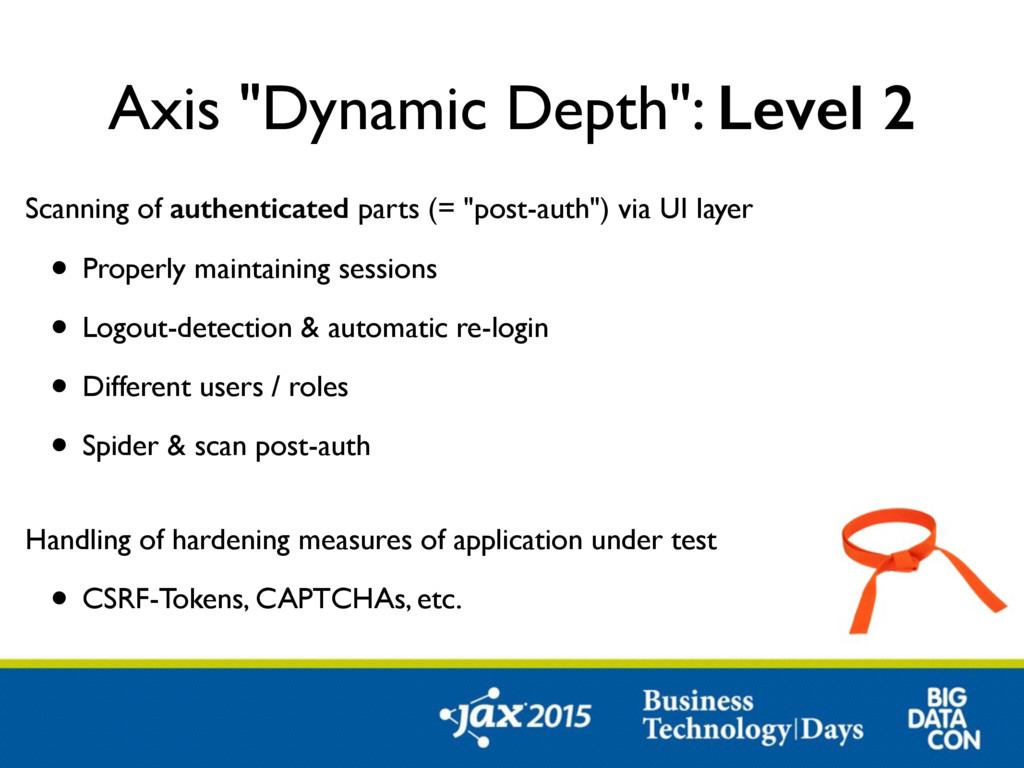
Axis "Dynamic Depth": Level 2 Scanning of authenticated parts (=
"post-auth") via UI layer • Properly maintaining sessions • Logout-detection & automatic re-login • Different users / roles • Spider & scan post-auth Handling of hardening measures of application under test • CSRF-Tokens, CAPTCHAs, etc. -
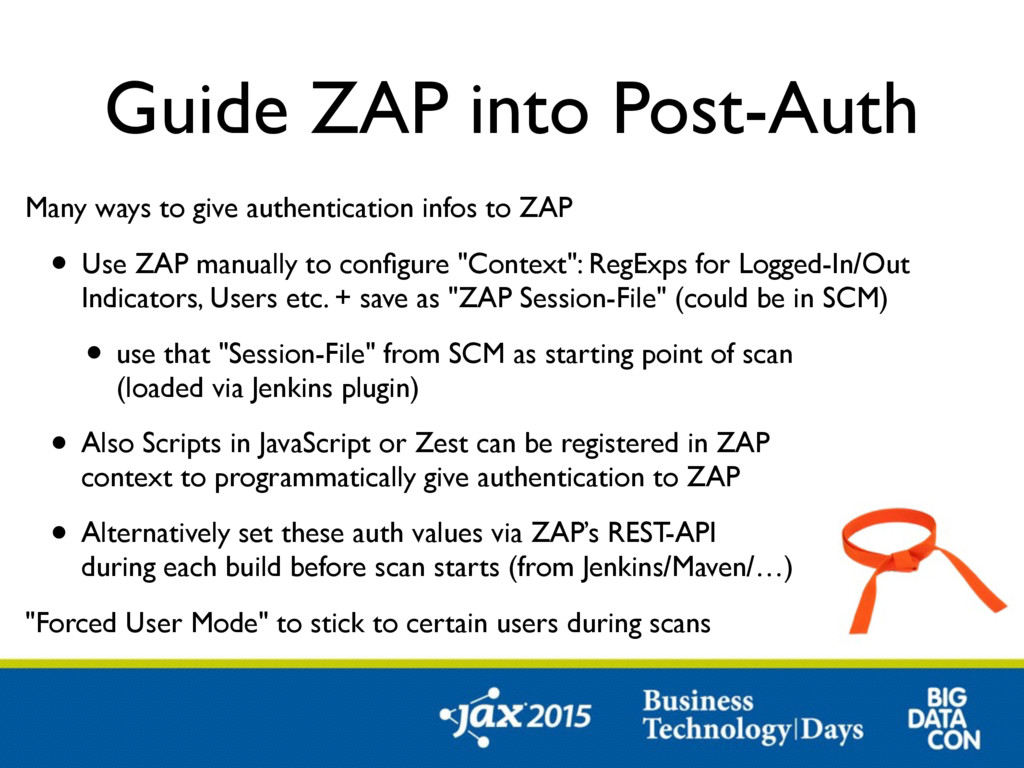
Guide ZAP into Post-Auth Many ways to give authentication infos
to ZAP • Use ZAP manually to configure "Context": RegExps for Logged-In/Out Indicators, Users etc. + save as "ZAP Session-File" (could be in SCM) • use that "Session-File" from SCM as starting point of scan (loaded via Jenkins plugin) • Also Scripts in JavaScript or Zest can be registered in ZAP context to programmatically give authentication to ZAP • Alternatively set these auth values via ZAP’s REST-API during each build before scan starts (from Jenkins/Maven/…) "Forced User Mode" to stick to certain users during scans -
Guide Arachni into Post-Auth Give authentication infos to Arachni (Auth,
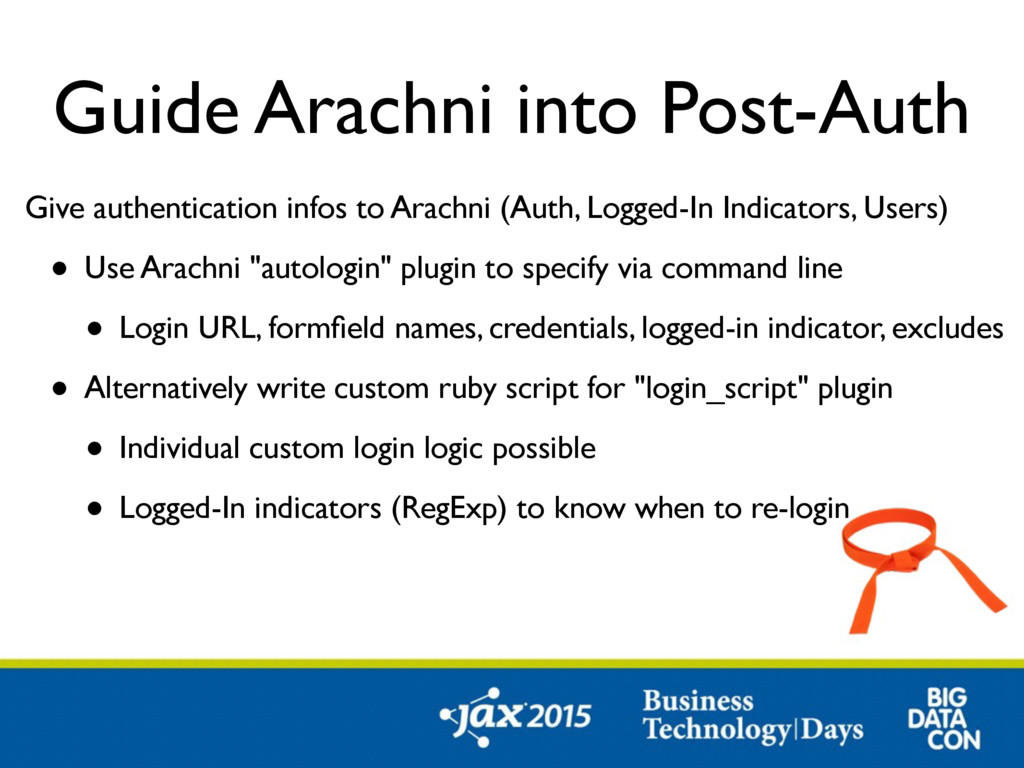
Logged-In Indicators, Users) • Use Arachni "autologin" plugin to specify via command line • Login URL, formfield names, credentials, logged-in indicator, excludes • Alternatively write custom ruby script for "login_script" plugin • Individual custom login logic possible • Logged-In indicators (RegExp) to know when to re-login -
Login config example within Arachni ./arachni --plugin=autologin: url=http://10.33.48.80/marathon/secured/profile.page,
parameters='j_username=john&j_password=john', check='Logout' --scope-exclude-pattern=logout.page http://10.33.48.80/marathon Or individual ruby script if more custom login logic required… -
Guide BDD-Security into Post-Auth Use Selenium to navigate through the
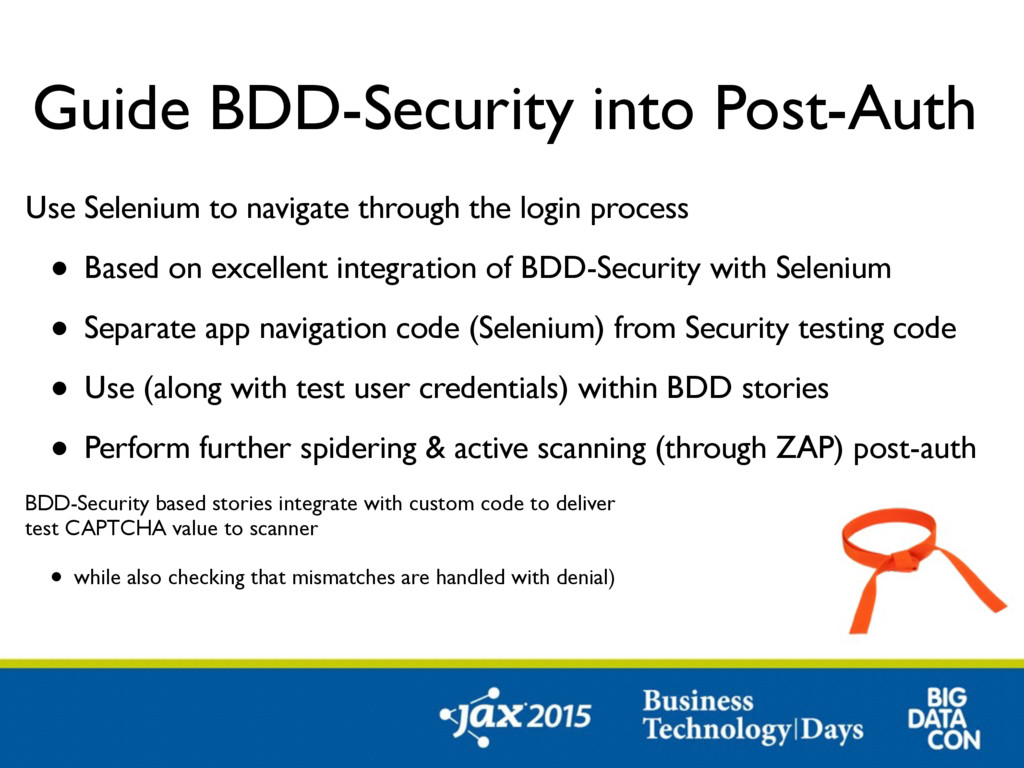
login process • Based on excellent integration of BDD-Security with Selenium • Separate app navigation code (Selenium) from Security testing code • Use (along with test user credentials) within BDD stories • Perform further spidering & active scanning (through ZAP) post-auth BDD-Security based stories integrate with custom code to deliver test CAPTCHA value to scanner • while also checking that mismatches are handled with denial) -
What about CSRF-Tokens? ZAP can handle CSRF-Tokens • Can be
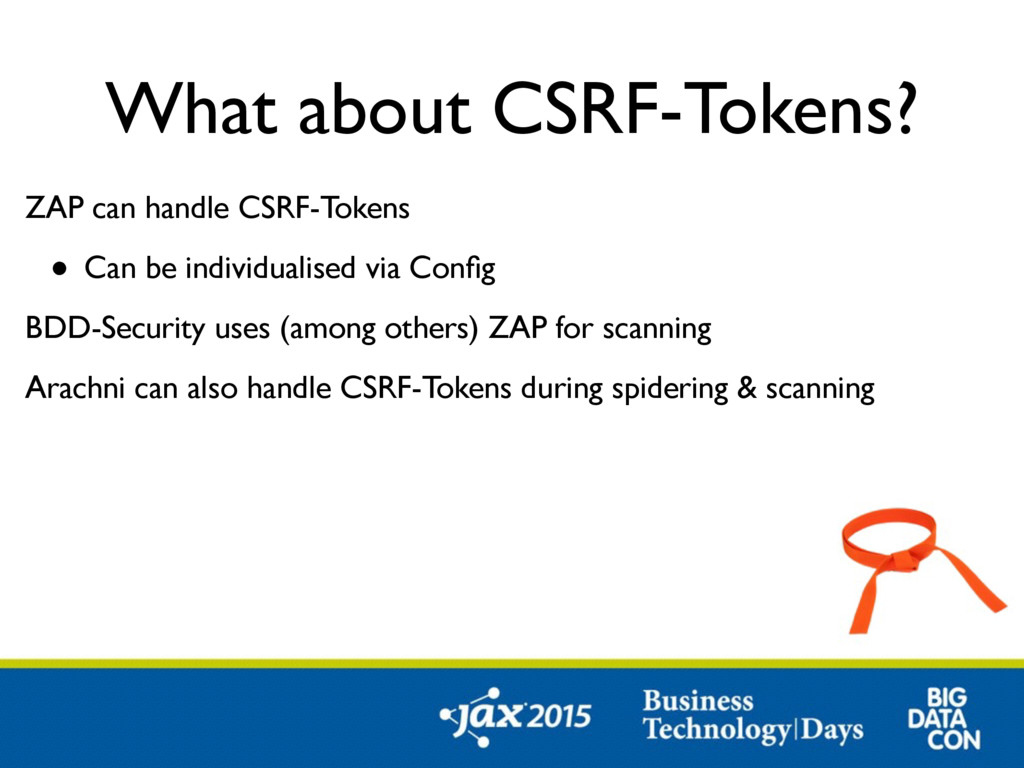
individualised via Config BDD-Security uses (among others) ZAP for scanning Arachni can also handle CSRF-Tokens during spidering & scanning -
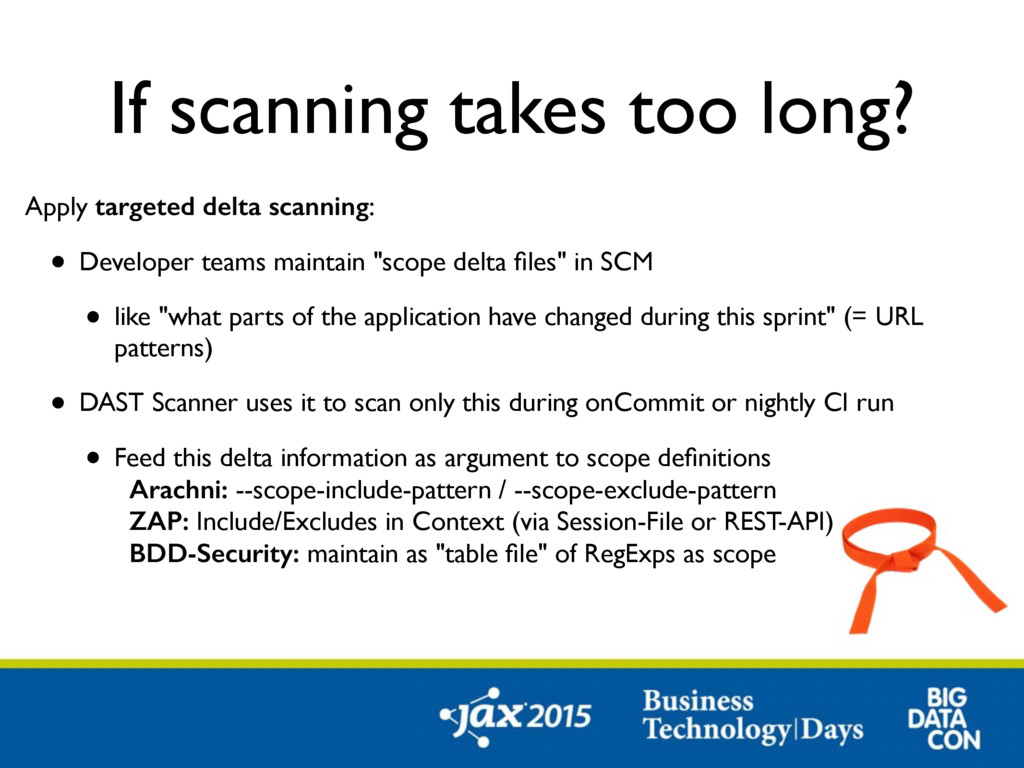
Apply targeted delta scanning: • Developer teams maintain "scope delta
files" in SCM • like "what parts of the application have changed during this sprint" (= URL patterns) • DAST Scanner uses it to scan only this during onCommit or nightly CI run • Feed this delta information as argument to scope definitions Arachni: --scope-include-pattern / --scope-exclude-pattern ZAP: Include/Excludes in Context (via Session-File or REST-API) BDD-Security: maintain as "table file" of RegExps as scope If scanning takes too long? -
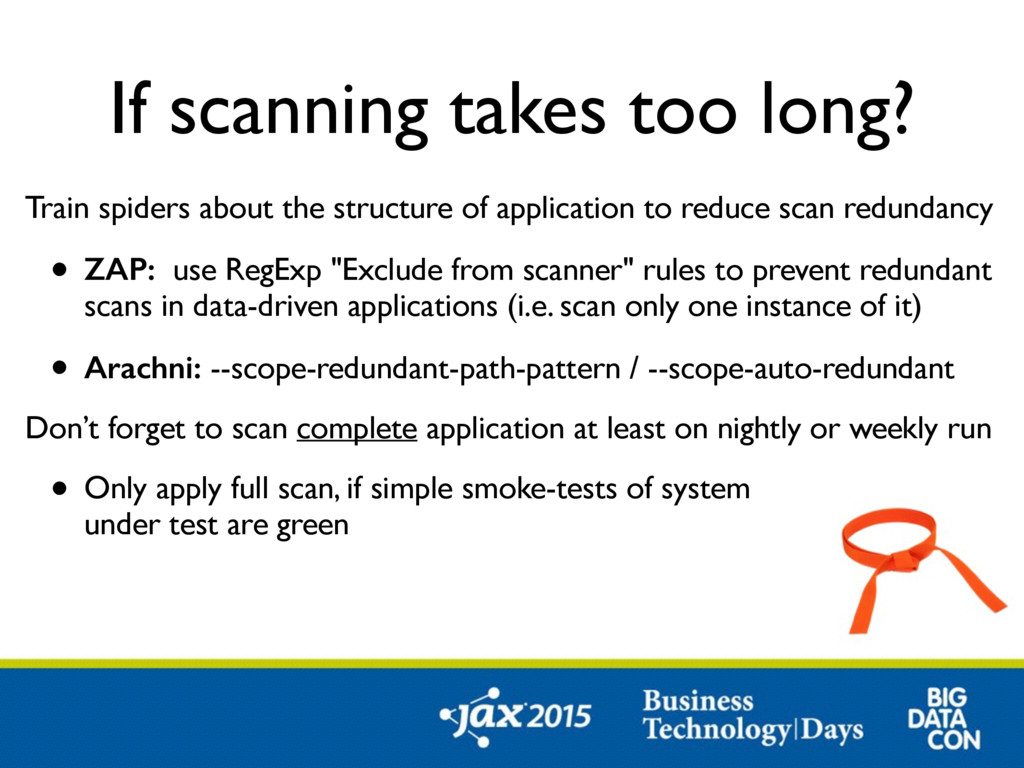
Train spiders about the structure of application to reduce scan
redundancy • ZAP: use RegExp "Exclude from scanner" rules to prevent redundant scans in data-driven applications (i.e. scan only one instance of it) • Arachni: --scope-redundant-path-pattern / --scope-auto-redundant Don’t forget to scan complete application at least on nightly or weekly run • Only apply full scan, if simple smoke-tests of system under test are green If scanning takes too long? -
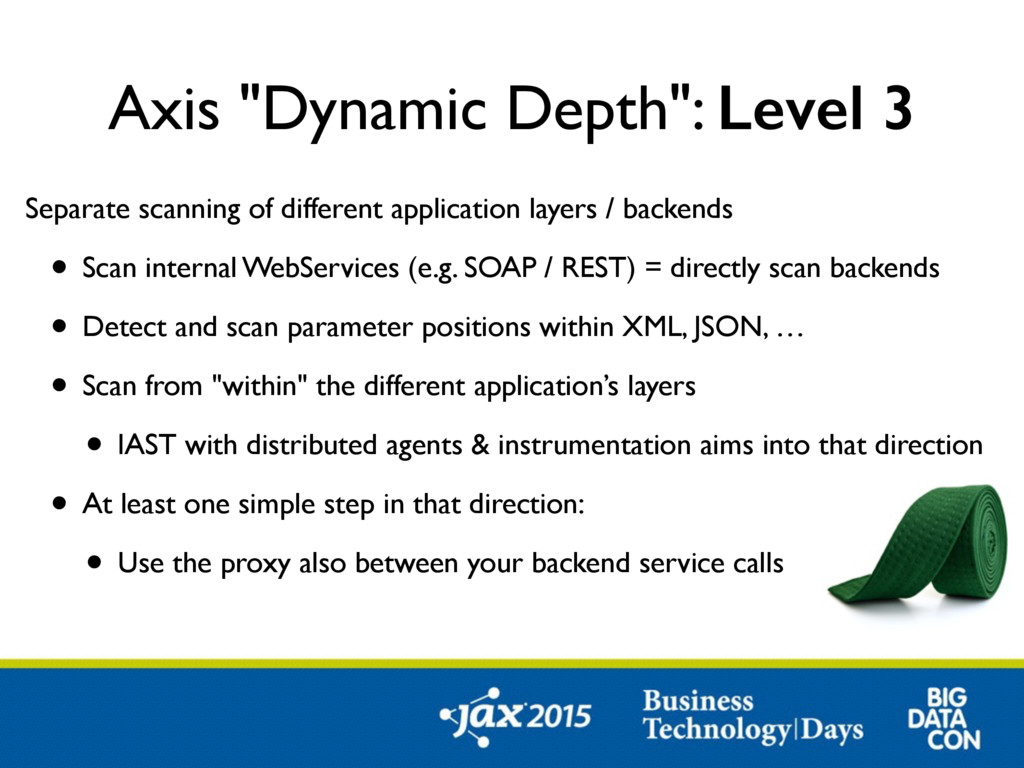
Axis "Dynamic Depth": Level 3 Separate scanning of different application
layers / backends • Scan internal WebServices (e.g. SOAP / REST) = directly scan backends • Detect and scan parameter positions within XML, JSON, … • Scan from "within" the different application’s layers • IAST with distributed agents & instrumentation aims into that direction • At least one simple step in that direction: • Use the proxy also between your backend service calls -
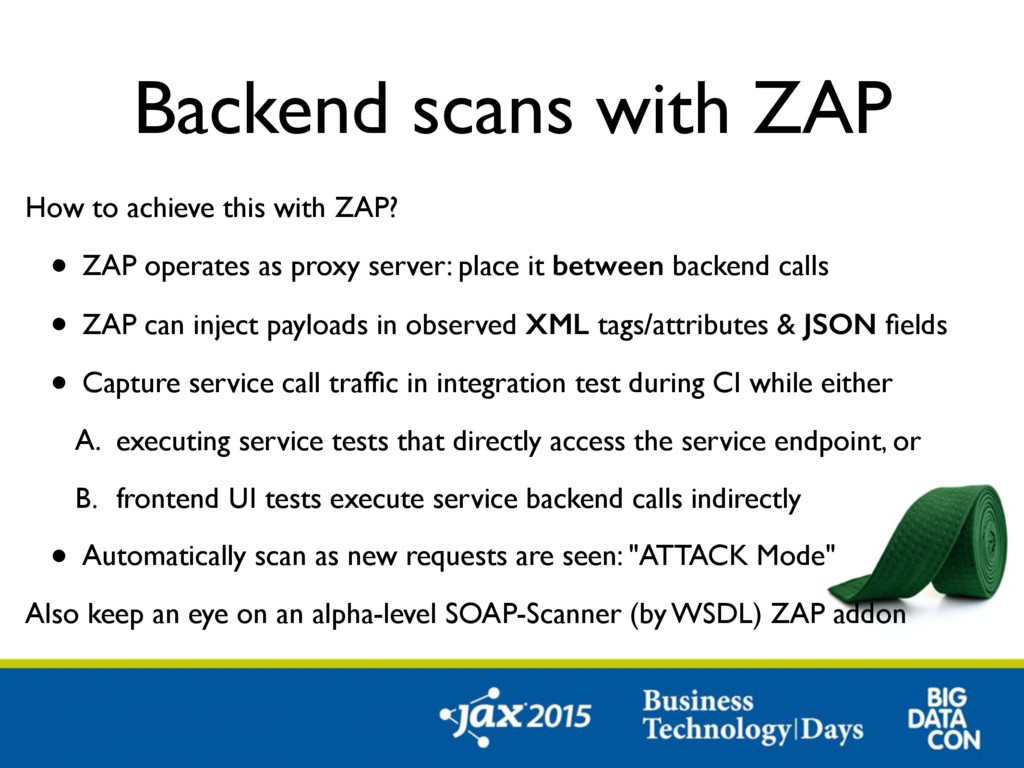
Backend scans with ZAP How to achieve this with ZAP?
• ZAP operates as proxy server: place it between backend calls • ZAP can inject payloads in observed XML tags/attributes & JSON fields • Capture service call traffic in integration test during CI while either A. executing service tests that directly access the service endpoint, or B. frontend UI tests execute service backend calls indirectly • Automatically scan as new requests are seen: "ATTACK Mode" Also keep an eye on an alpha-level SOAP-Scanner (by WSDL) ZAP addon -
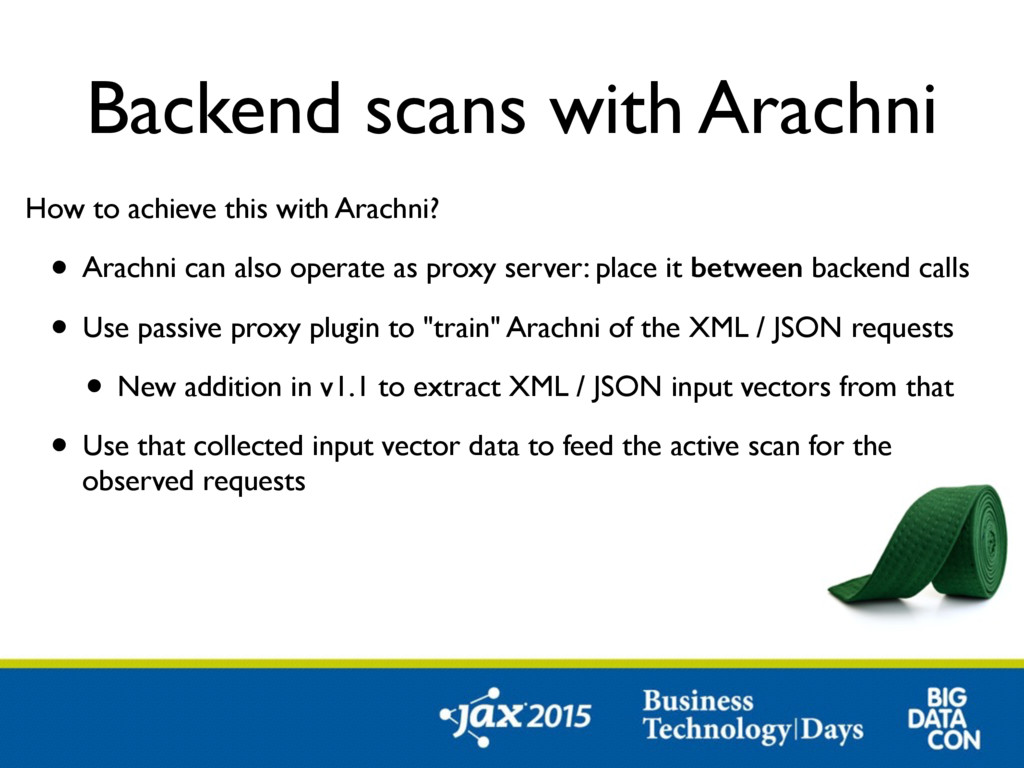
Backend scans with Arachni How to achieve this with Arachni?
• Arachni can also operate as proxy server: place it between backend calls • Use passive proxy plugin to "train" Arachni of the XML / JSON requests • New addition in v1.1 to extract XML / JSON input vectors from that • Use that collected input vector data to feed the active scan for the observed requests -
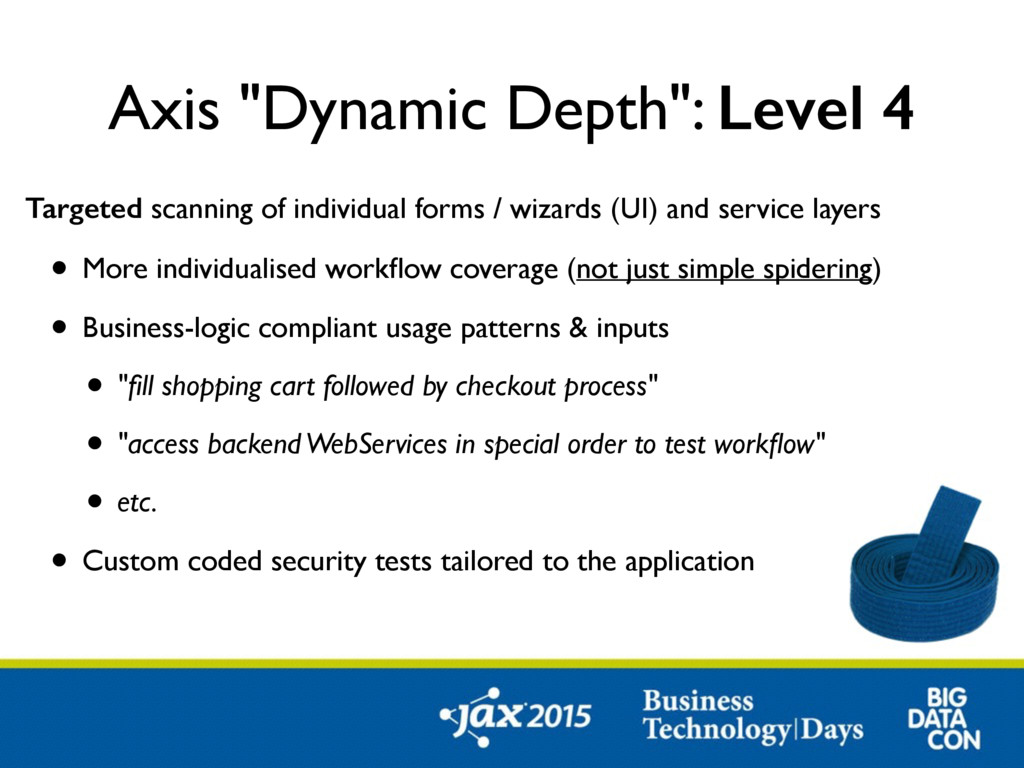
Axis "Dynamic Depth": Level 4 Targeted scanning of individual forms
/ wizards (UI) and service layers • More individualised workflow coverage (not just simple spidering) • Business-logic compliant usage patterns & inputs • "fill shopping cart followed by checkout process" • "access backend WebServices in special order to test workflow" • etc. • Custom coded security tests tailored to the application -
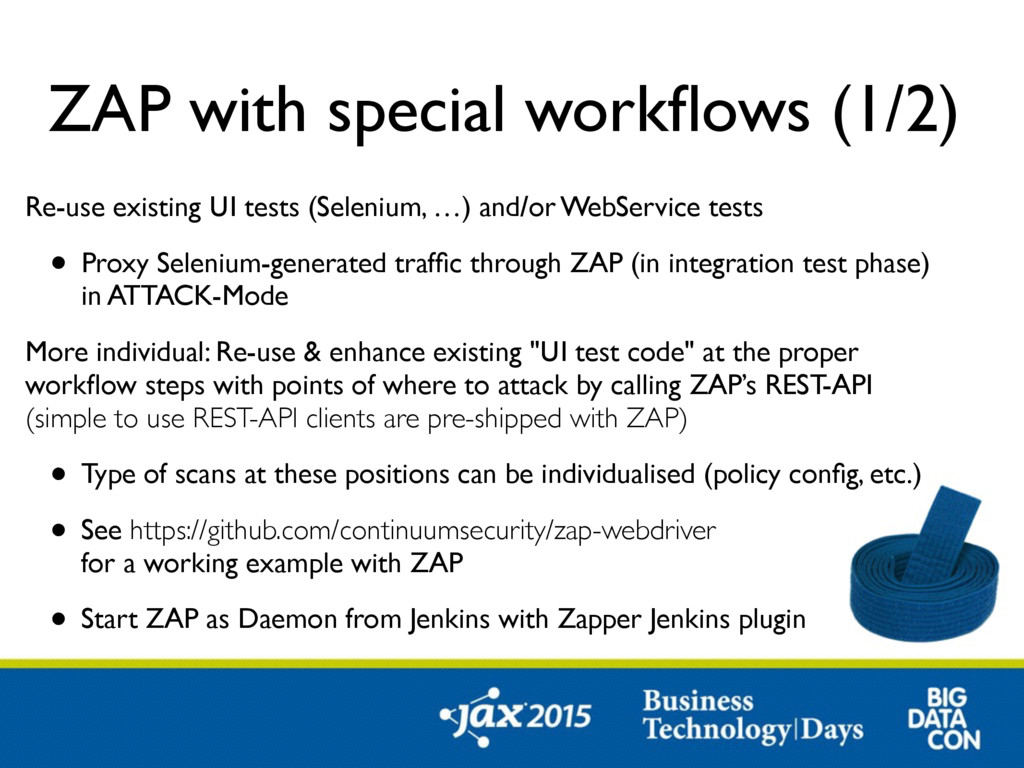
ZAP with special workflows (1/2) Re-use existing UI tests (Selenium,
…) and/or WebService tests • Proxy Selenium-generated traffic through ZAP (in integration test phase) in ATTACK-Mode More individual: Re-use & enhance existing "UI test code" at the proper workflow steps with points of where to attack by calling ZAP’s REST-API (simple to use REST-API clients are pre-shipped with ZAP) • Type of scans at these positions can be individualised (policy config, etc.) • See https://github.com/continuumsecurity/zap-webdriver for a working example with ZAP • Start ZAP as Daemon from Jenkins with Zapper Jenkins plugin -
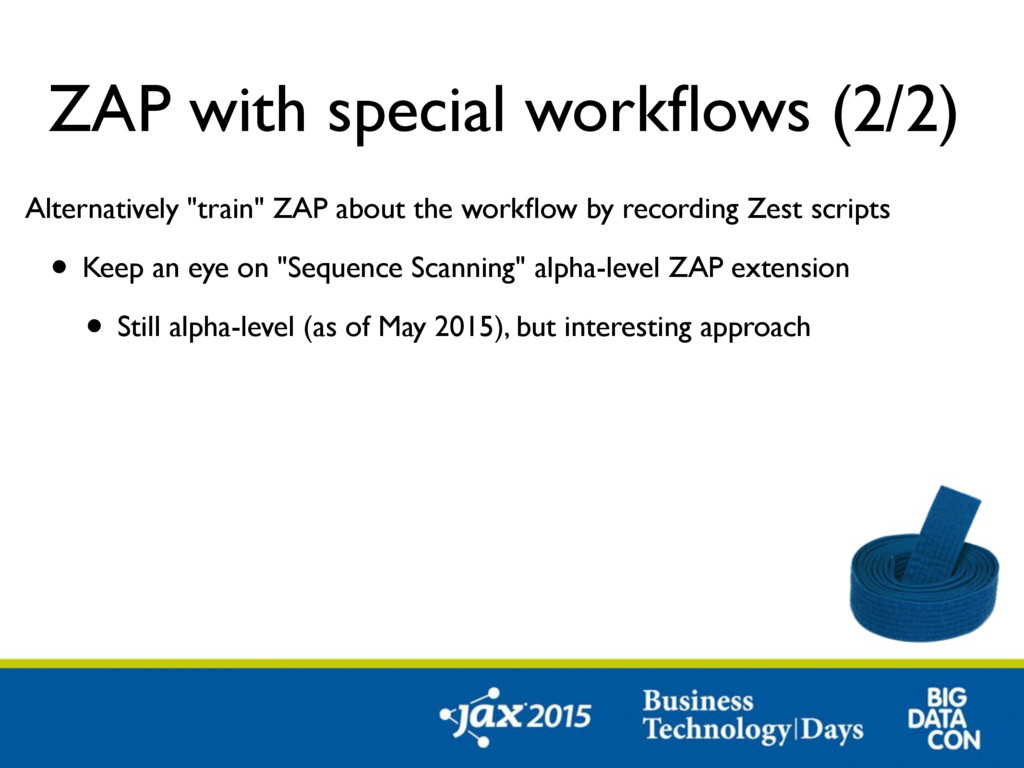
ZAP with special workflows (2/2) Alternatively "train" ZAP about the
workflow by recording Zest scripts • Keep an eye on "Sequence Scanning" alpha-level ZAP extension • Still alpha-level (as of May 2015), but interesting approach -
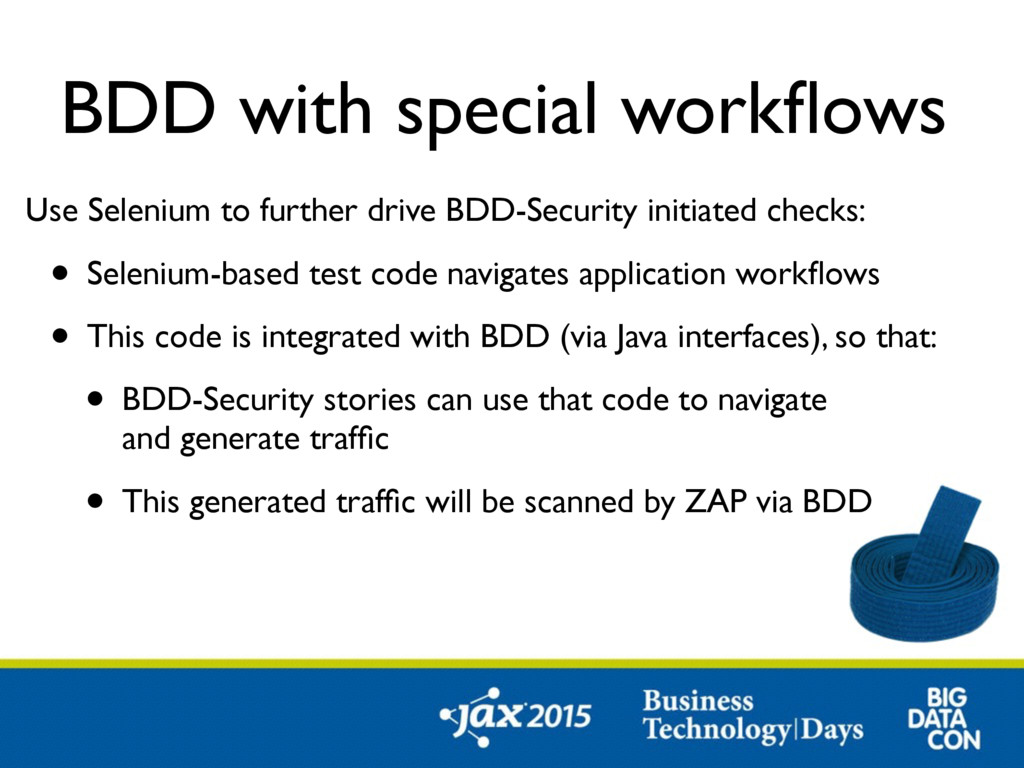
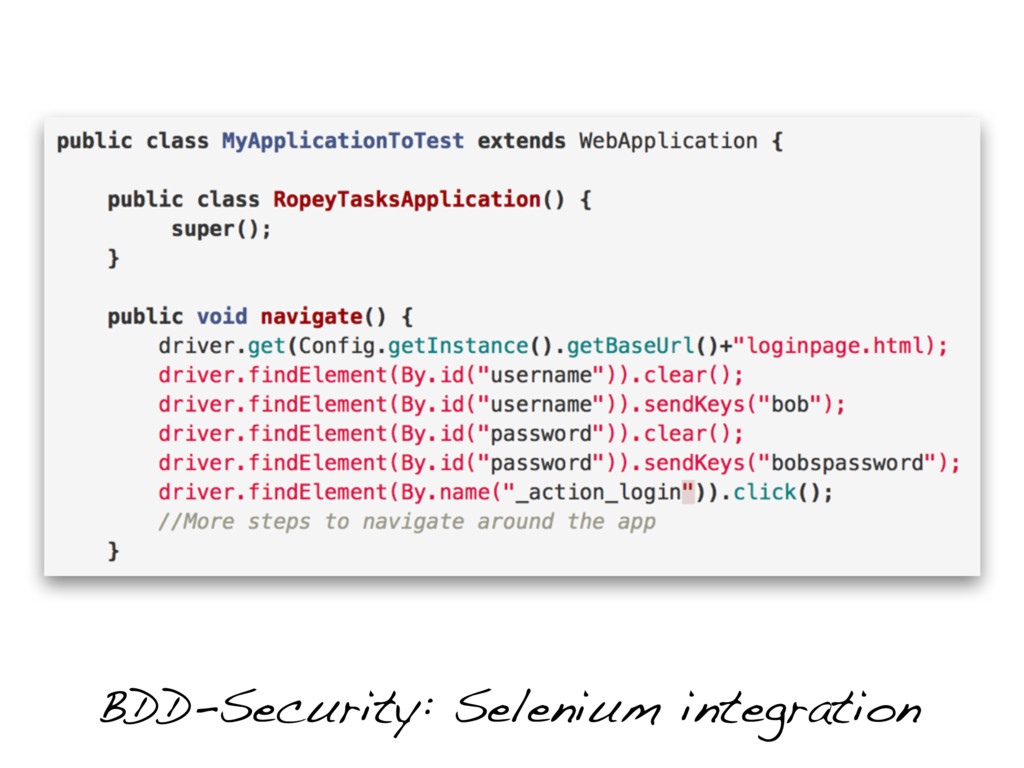
Use Selenium to further drive BDD-Security initiated checks: • Selenium-based
test code navigates application workflows • This code is integrated with BDD (via Java interfaces), so that: • BDD-Security stories can use that code to navigate and generate traffic • This generated traffic will be scanned by ZAP via BDD BDD with special workflows -
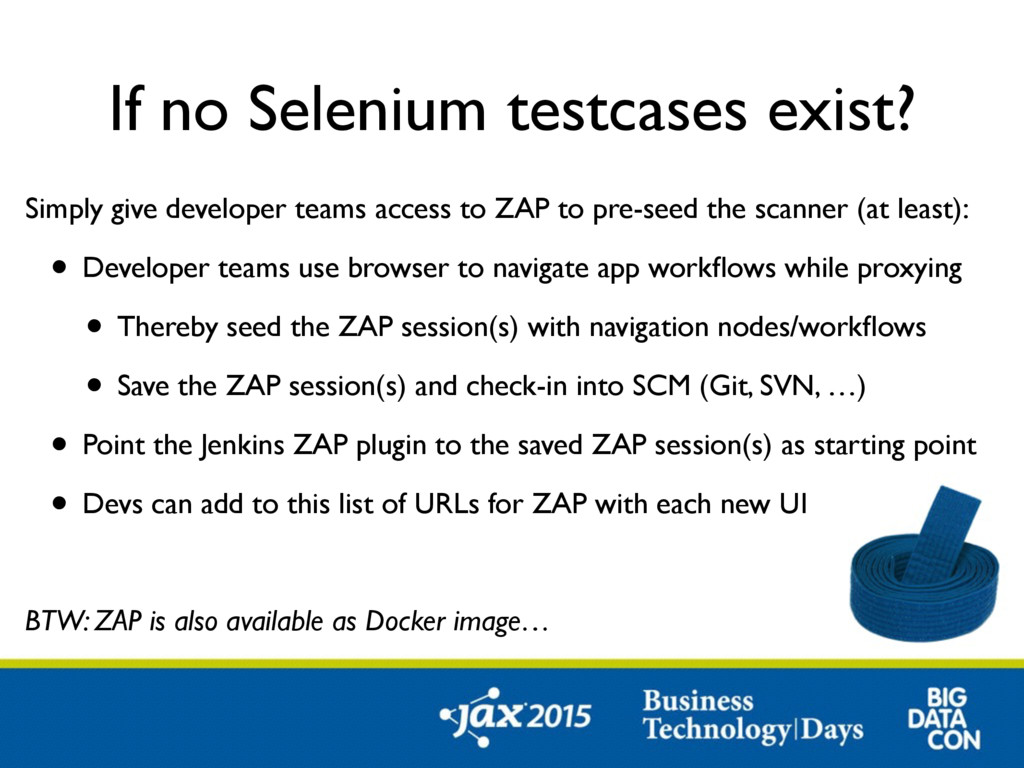
If no Selenium testcases exist? Simply give developer teams access
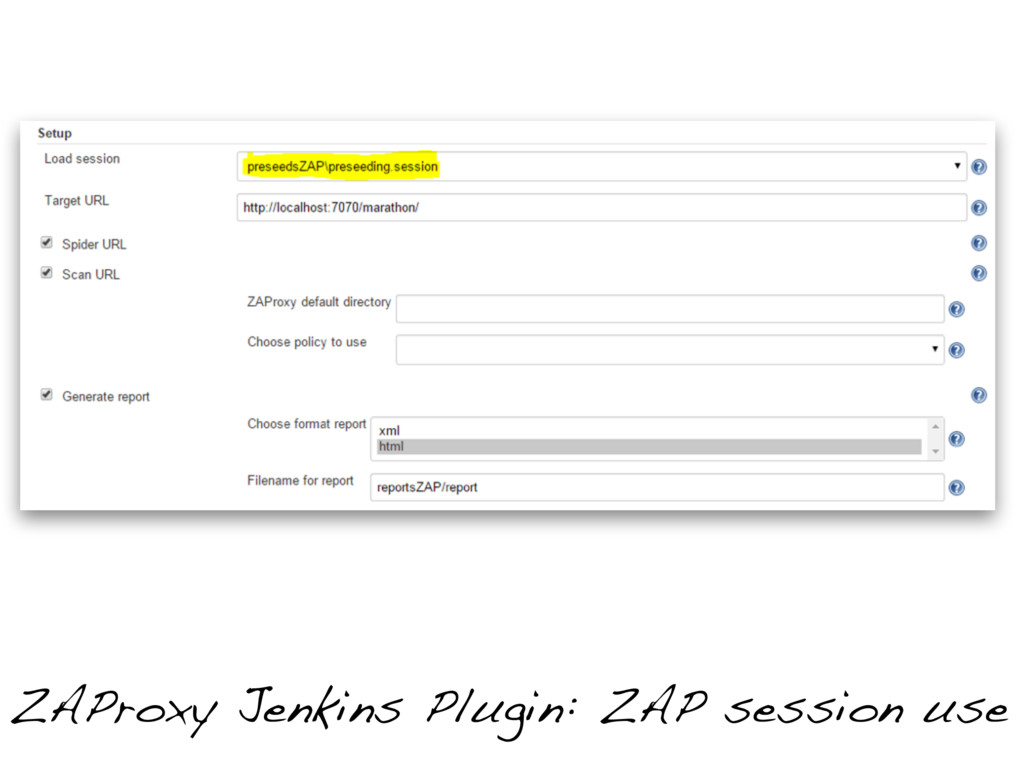
to ZAP to pre-seed the scanner (at least): • Developer teams use browser to navigate app workflows while proxying • Thereby seed the ZAP session(s) with navigation nodes/workflows • Save the ZAP session(s) and check-in into SCM (Git, SVN, …) • Point the Jenkins ZAP plugin to the saved ZAP session(s) as starting point • Devs can add to this list of URLs for ZAP with each new UI BTW: ZAP is also available as Docker image… -
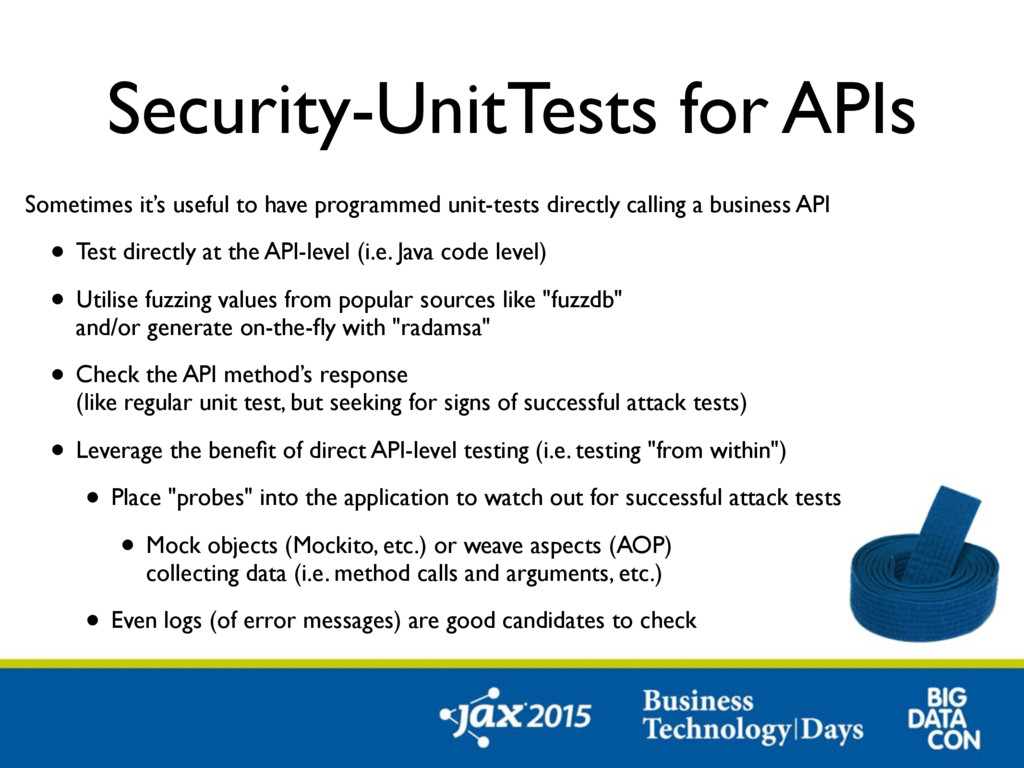
Security-UnitTests for APIs Sometimes it’s useful to have programmed unit-tests
directly calling a business API • Test directly at the API-level (i.e. Java code level) • Utilise fuzzing values from popular sources like "fuzzdb" and/or generate on-the-fly with "radamsa" • Check the API method’s response (like regular unit test, but seeking for signs of successful attack tests) • Leverage the benefit of direct API-level testing (i.e. testing "from within") • Place "probes" into the application to watch out for successful attack tests • Mock objects (Mockito, etc.) or weave aspects (AOP) collecting data (i.e. method calls and arguments, etc.) • Even logs (of error messages) are good candidates to check -
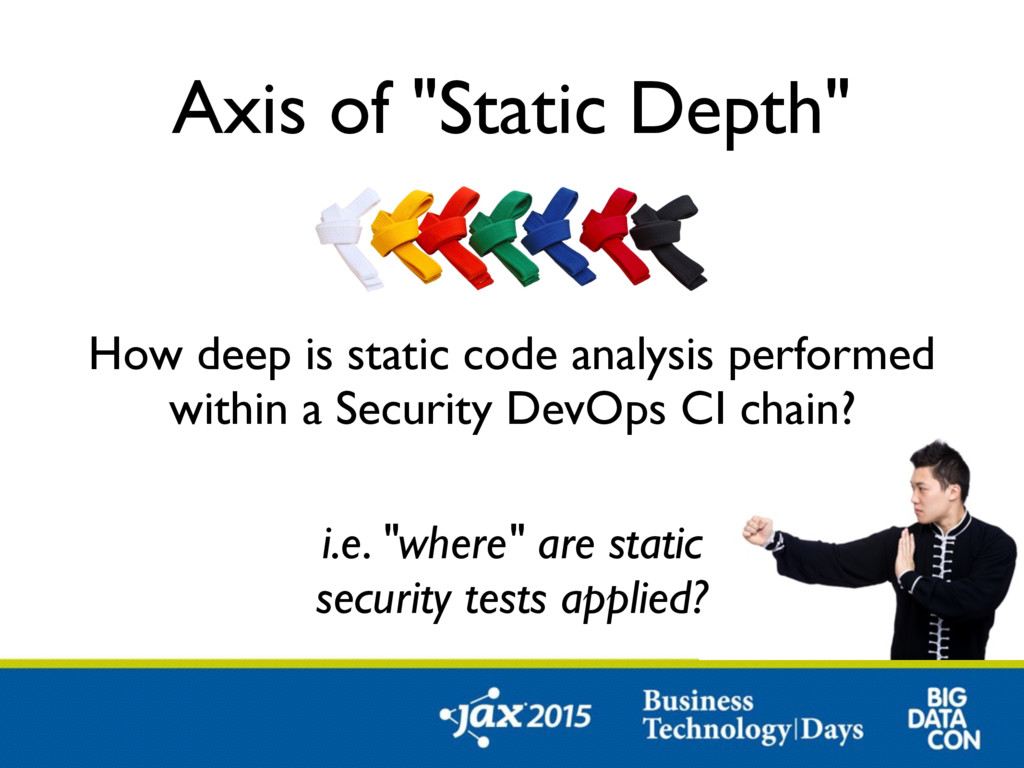
Axis of "Static Depth" How deep is static code analysis
performed within a Security DevOps CI chain? i.e. "where" are static security tests applied? -
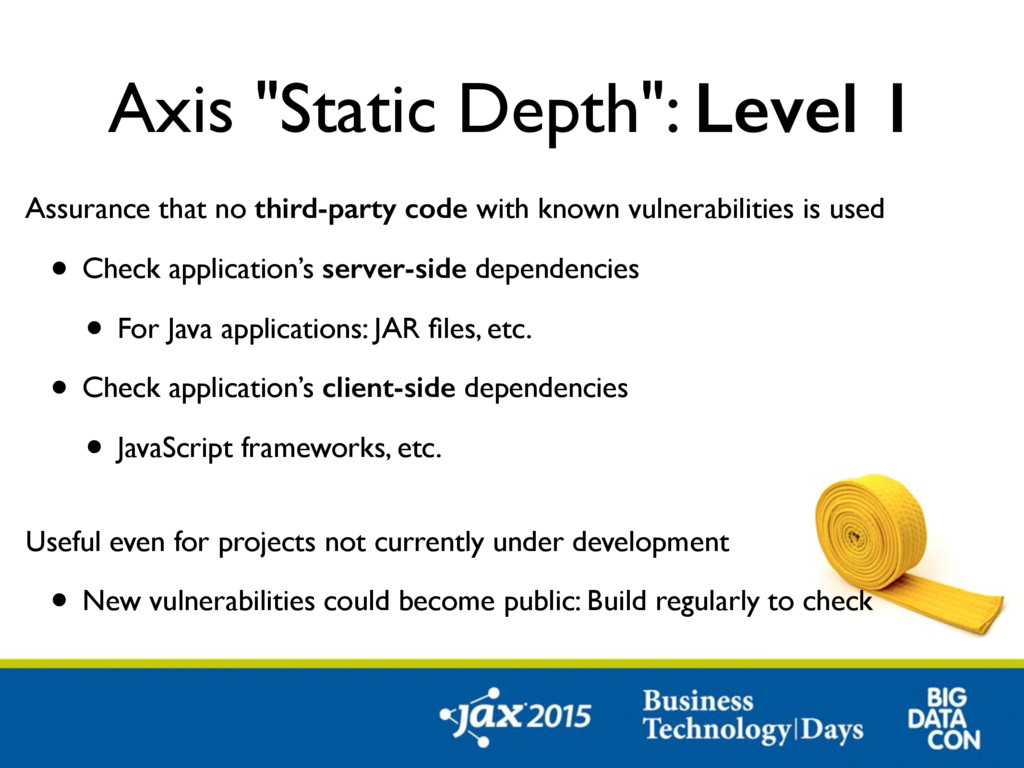
Axis "Static Depth": Level 1 Assurance that no third-party code
with known vulnerabilities is used • Check application’s server-side dependencies • For Java applications: JAR files, etc. • Check application’s client-side dependencies • JavaScript frameworks, etc. Useful even for projects not currently under development • New vulnerabilities could become public: Build regularly to check -
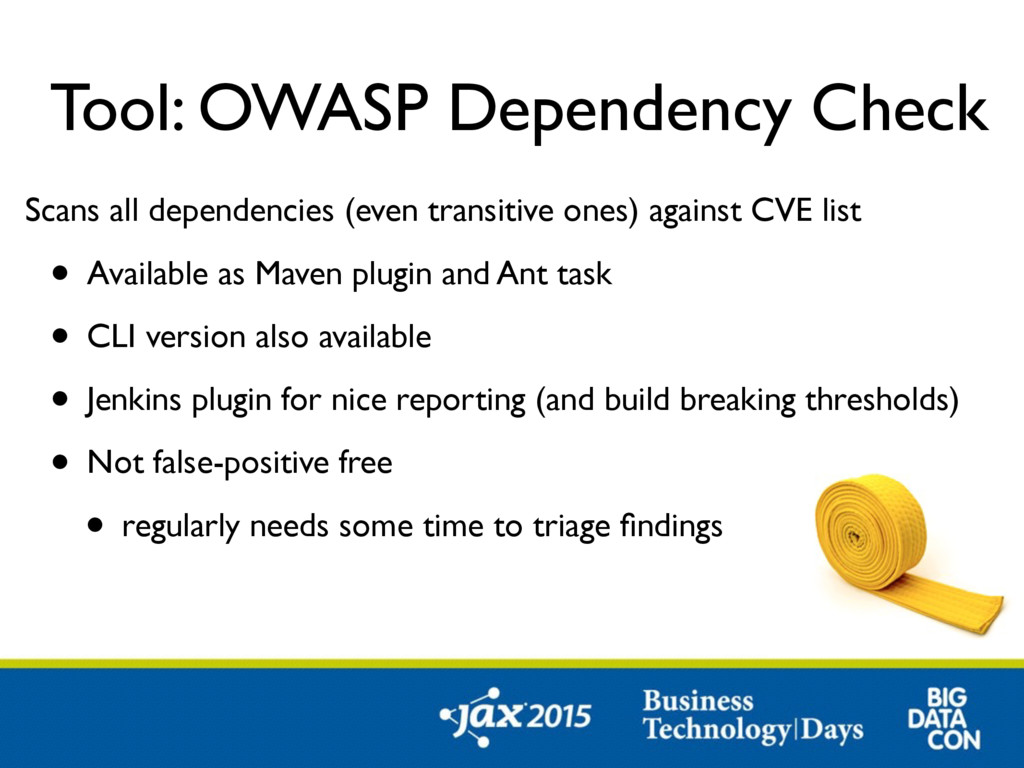
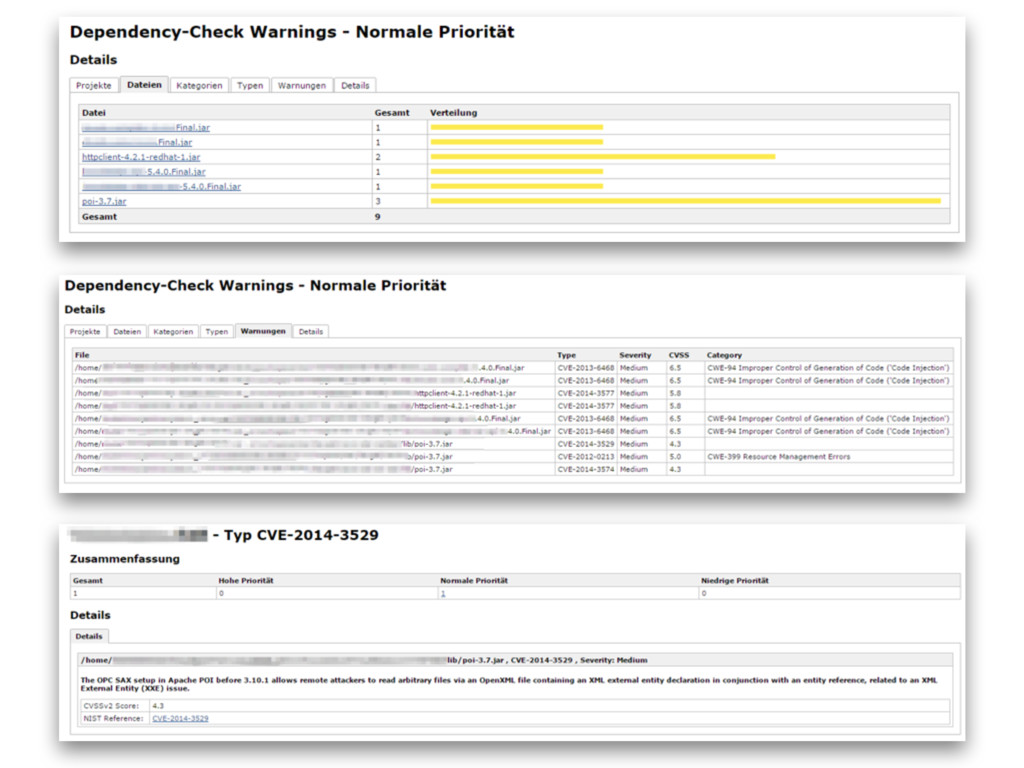
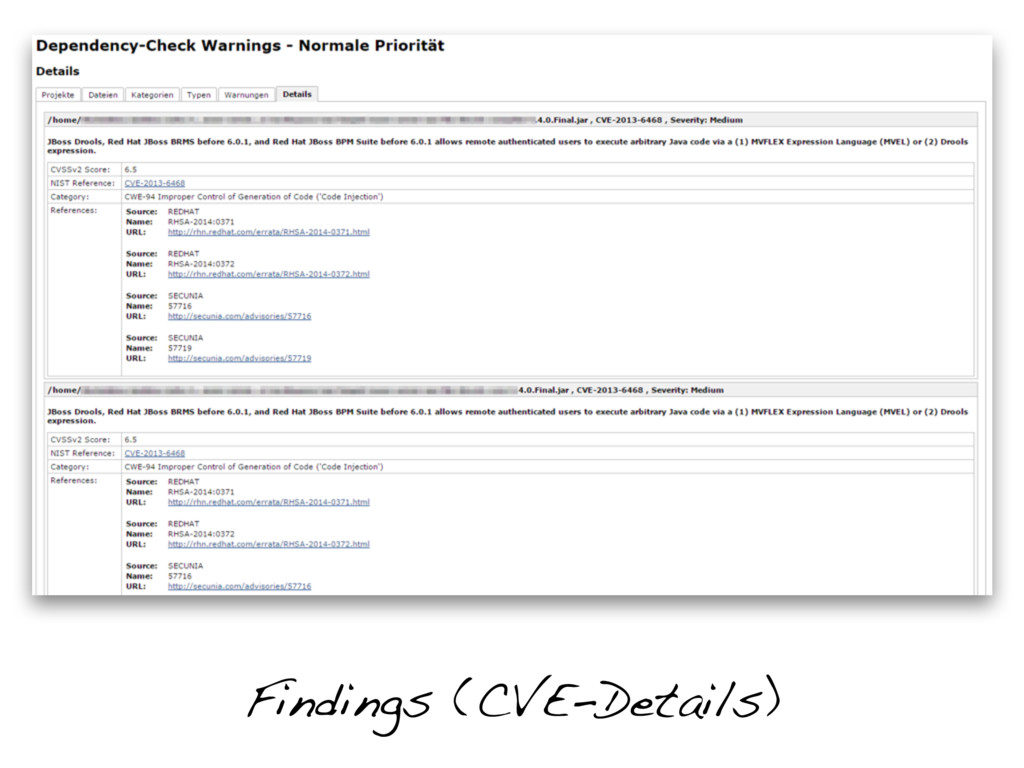
Tool: OWASP Dependency Check Scans all dependencies (even transitive ones)
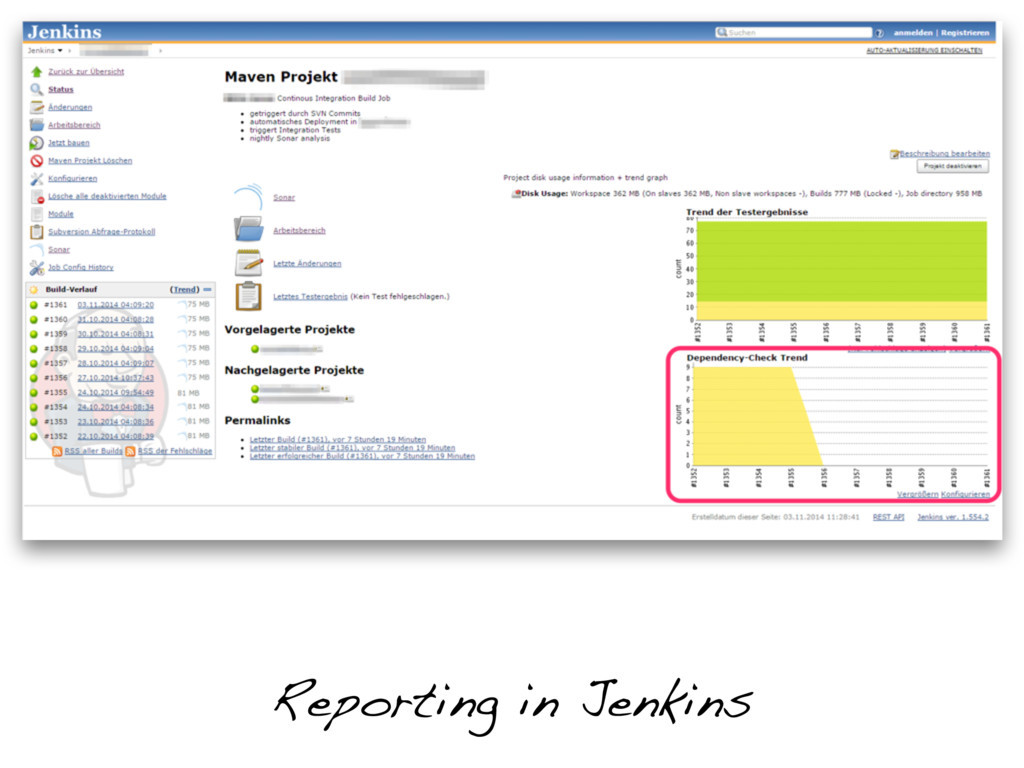
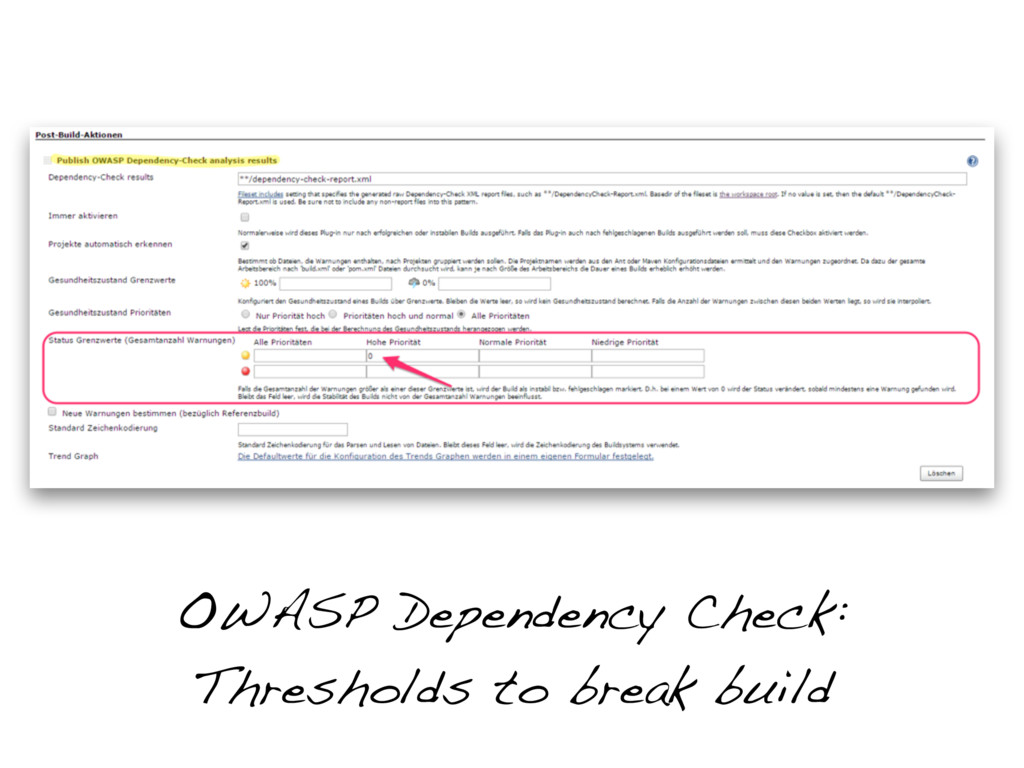
against CVE list • Available as Maven plugin and Ant task • CLI version also available • Jenkins plugin for nice reporting (and build breaking thresholds) • Not false-positive free • regularly needs some time to triage findings -
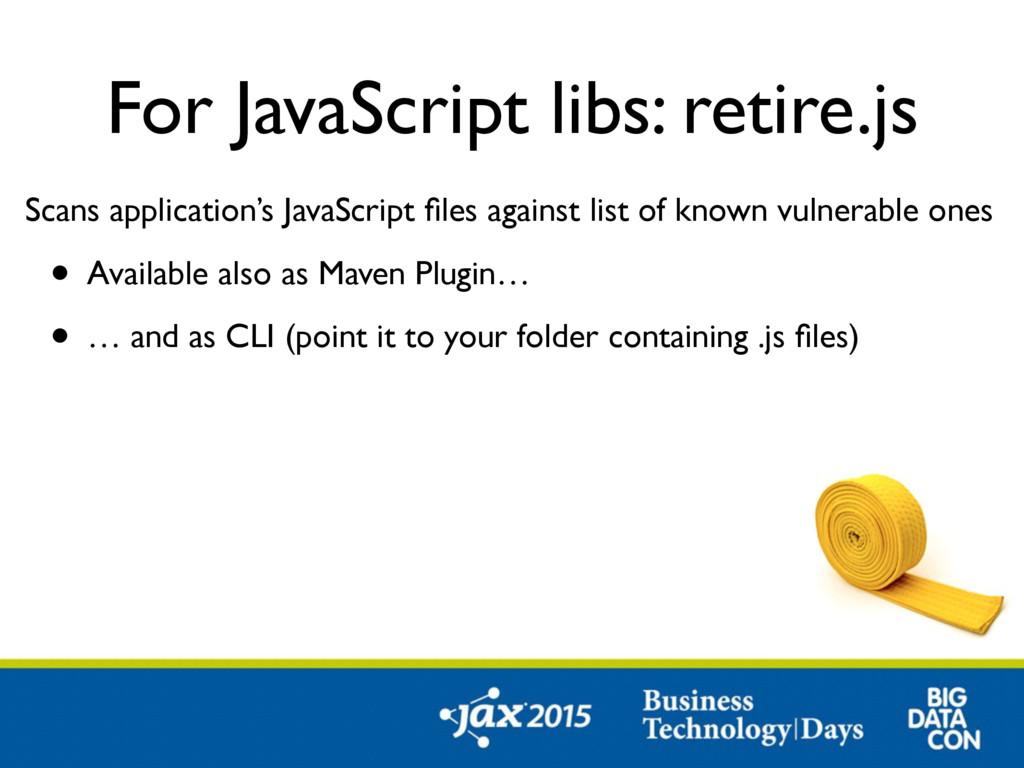
For JavaScript libs: retire.js Scans application’s JavaScript files against list
of known vulnerable ones • Available also as Maven Plugin… • … and as CLI (point it to your folder containing .js files) -
Axis "Static Depth": Level 2 Scan important parts of source
code for vulnerability patterns • At least important parts of applications’ codebases are scanned • like in-house reused code & custom developed frameworks • for big multi-project Maven projects: at least frontend and backend projects • or code of changed modules within a sprint -
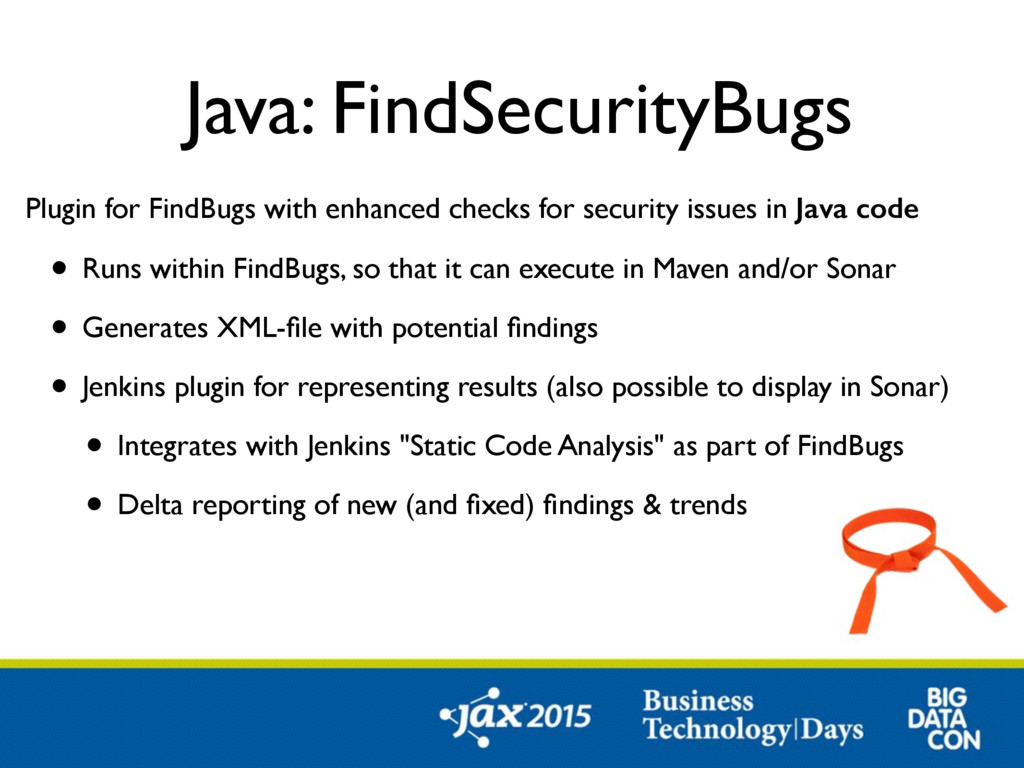
Java: FindSecurityBugs Plugin for FindBugs with enhanced checks for security
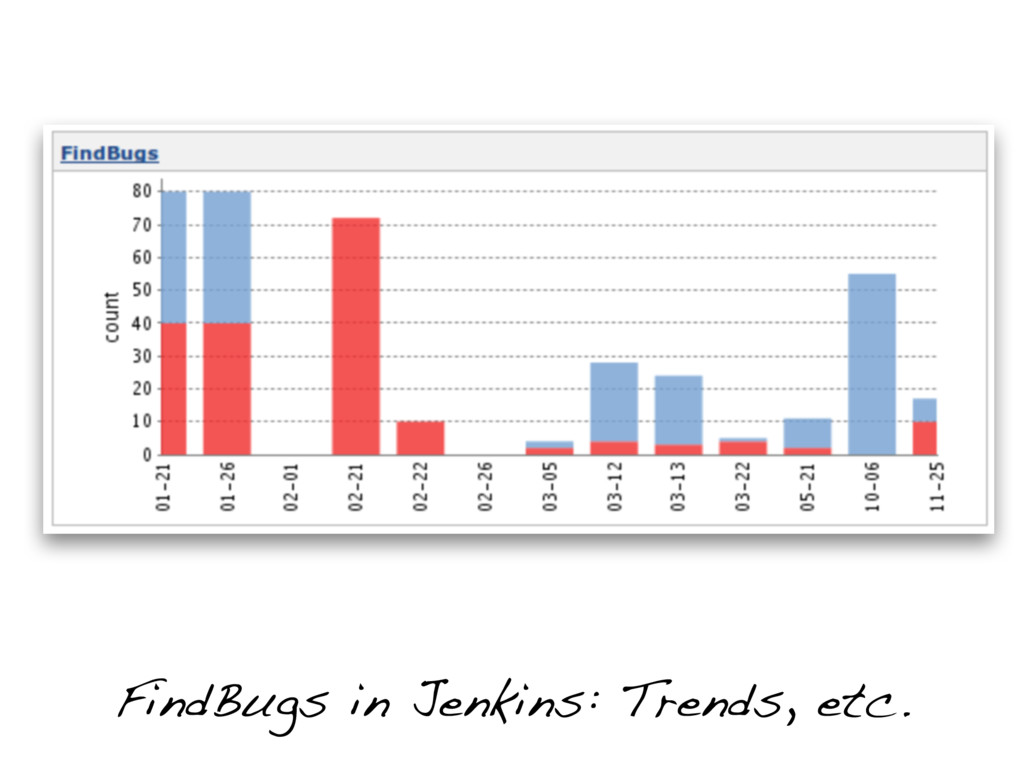
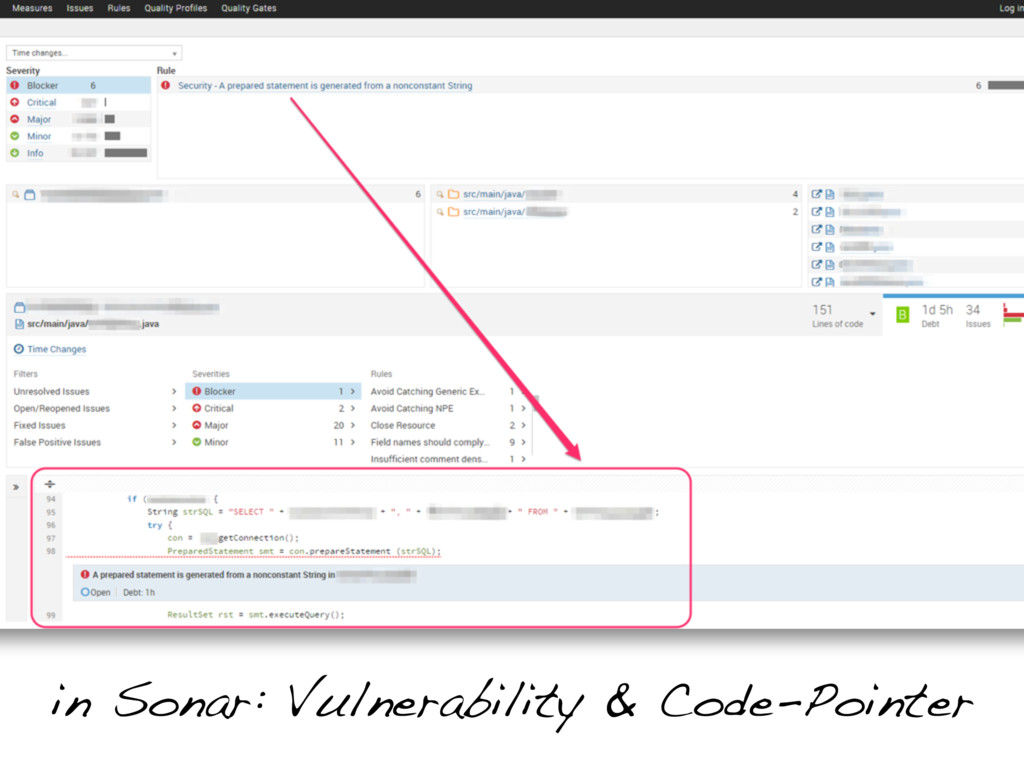
issues in Java code • Runs within FindBugs, so that it can execute in Maven and/or Sonar • Generates XML-file with potential findings • Jenkins plugin for representing results (also possible to display in Sonar) • Integrates with Jenkins "Static Code Analysis" as part of FindBugs • Delta reporting of new (and fixed) findings & trends -
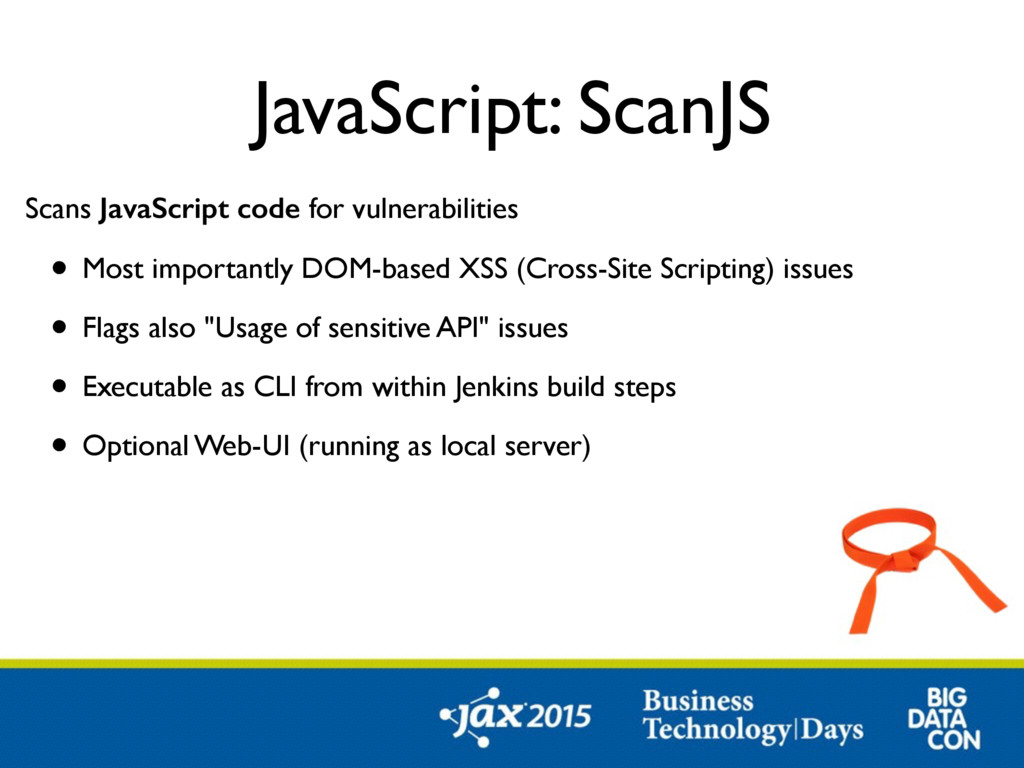
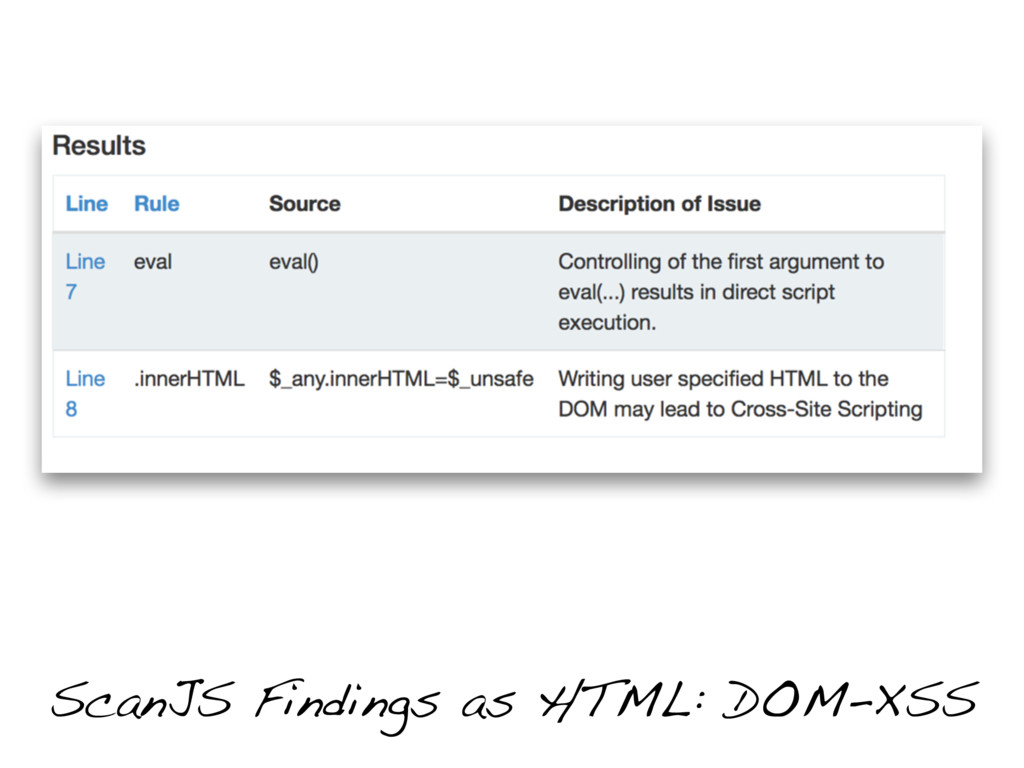
JavaScript: ScanJS Scans JavaScript code for vulnerabilities • Most importantly
DOM-based XSS (Cross-Site Scripting) issues • Flags also "Usage of sensitive API" issues • Executable as CLI from within Jenkins build steps • Optional Web-UI (running as local server) -
Ruby on Rails apps: Brakeman Scans RoR code for vulnerabilities
• CLI based • Nicely integrates with Jenkins • Rendering scan results and trend analysis • Allows to compare scan results (delta detection) • "What has been fixed and what was newly introduced?" -
Other static scanners exist also… Some have different focus •
PrimeJS (like ScanJS for JavaScript regarding DOM-XSS etc.) • PMD (for Java code regarding API safety issues) • good commercial ones • etc. -
Axis "Static Depth": Level 3 Scan the complete applications’ source
code for vulnerability patterns • Just like "Level 2", but now for the complete codebase (no excludes) • i.e. all projects of a multi-project Maven project • best via parent or corporate pom.xml For FindSecurityBugs this means: • pre-compile even all JSPs (if you have any) to scan them -
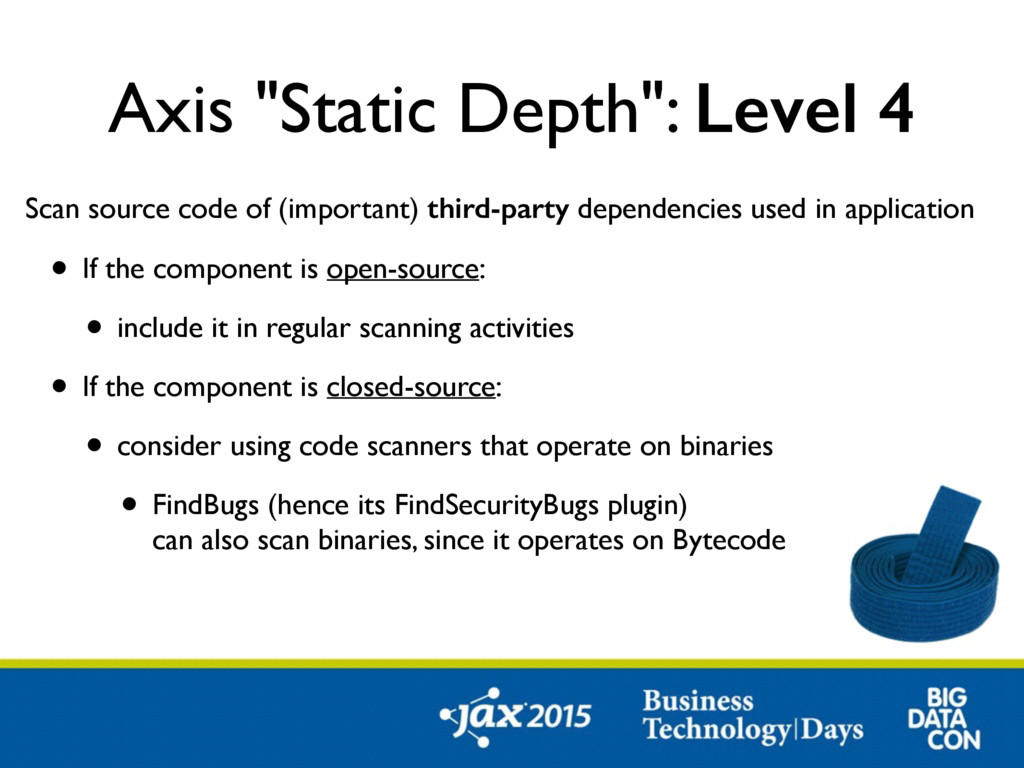
Axis "Static Depth": Level 4 Scan source code of (important)
third-party dependencies used in application • If the component is open-source: • include it in regular scanning activities • If the component is closed-source: • consider using code scanners that operate on binaries • FindBugs (hence its FindSecurityBugs plugin) can also scan binaries, since it operates on Bytecode -
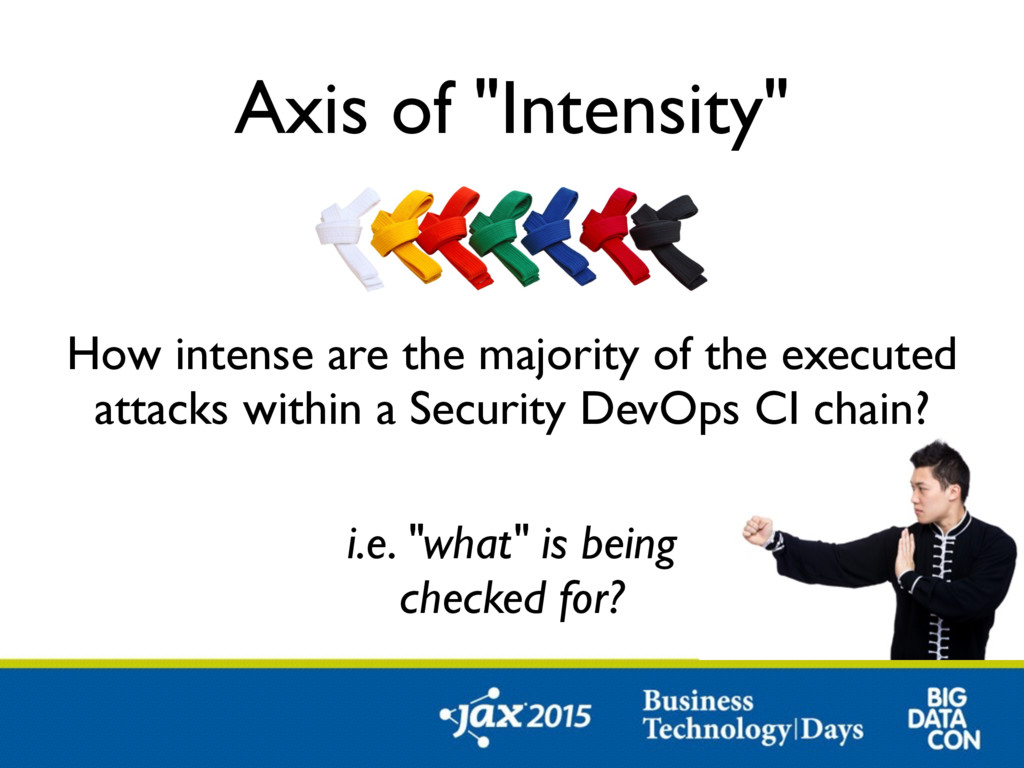
Axis of "Intensity" How intense are the majority of the
executed attacks within a Security DevOps CI chain? i.e. "what" is being checked for? -
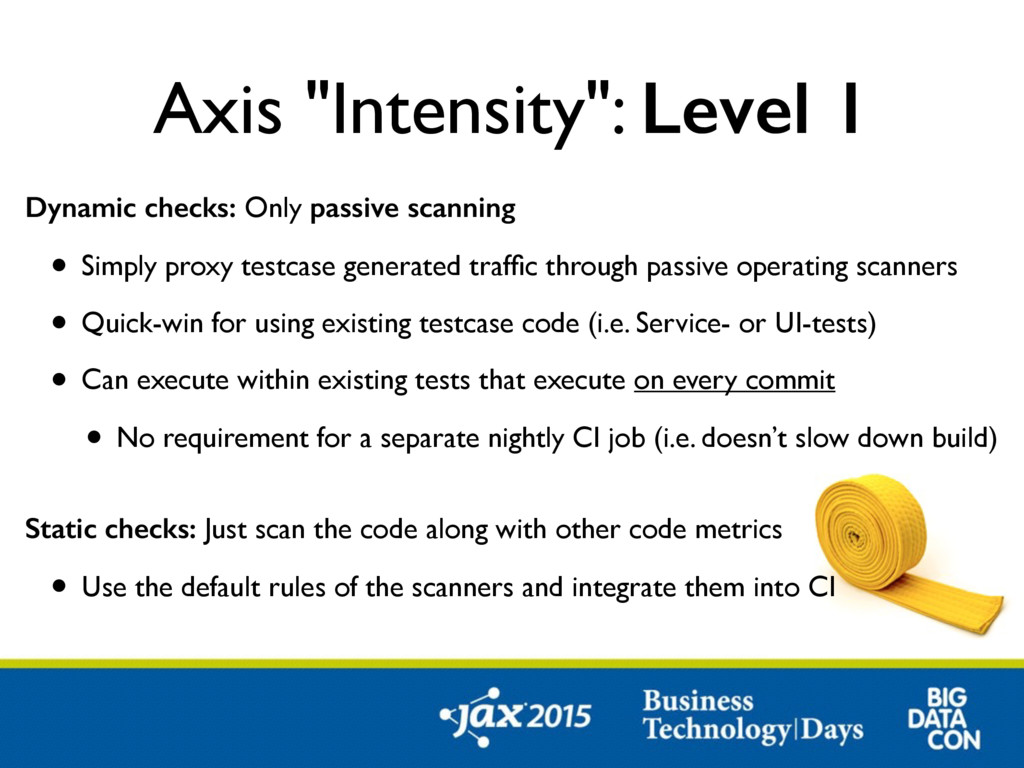
Axis "Intensity": Level 1 Dynamic checks: Only passive scanning •
Simply proxy testcase generated traffic through passive operating scanners • Quick-win for using existing testcase code (i.e. Service- or UI-tests) • Can execute within existing tests that execute on every commit • No requirement for a separate nightly CI job (i.e. doesn’t slow down build) Static checks: Just scan the code along with other code metrics • Use the default rules of the scanners and integrate them into CI -
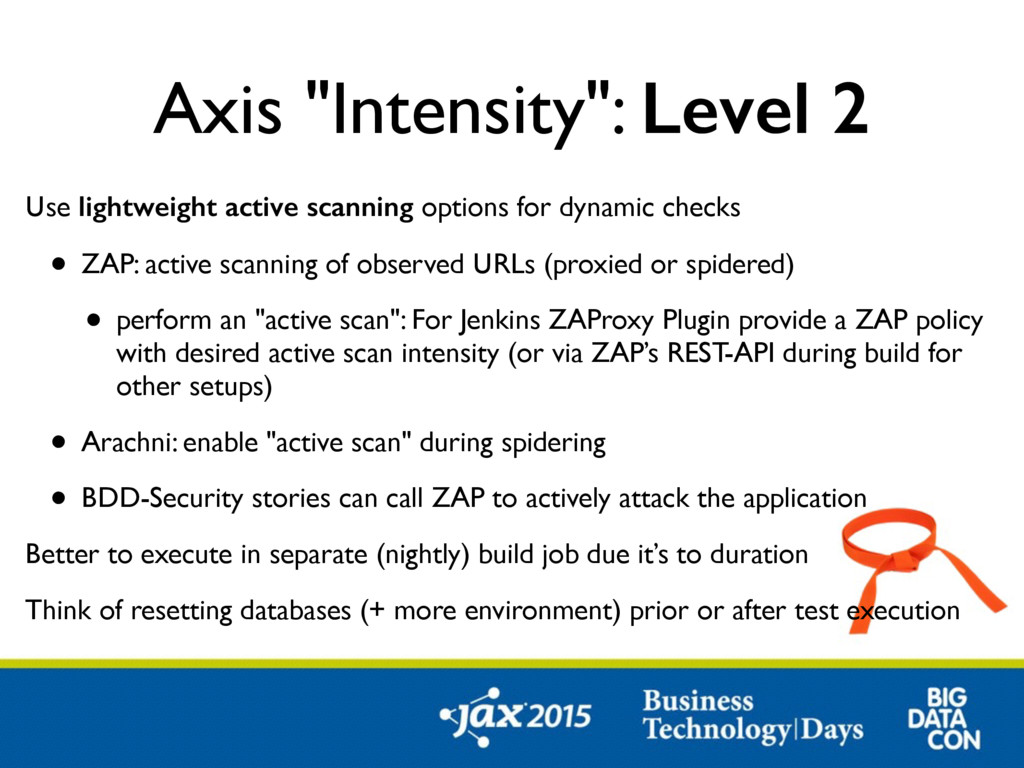
Axis "Intensity": Level 2 Use lightweight active scanning options for
dynamic checks • ZAP: active scanning of observed URLs (proxied or spidered) • perform an "active scan": For Jenkins ZAProxy Plugin provide a ZAP policy with desired active scan intensity (or via ZAP’s REST-API during build for other setups) • Arachni: enable "active scan" during spidering • BDD-Security stories can call ZAP to actively attack the application Better to execute in separate (nightly) build job due it’s to duration Think of resetting databases (+ more environment) prior or after test execution -
Axis "Intensity": Level 3 Use heavyweight scanning options on important
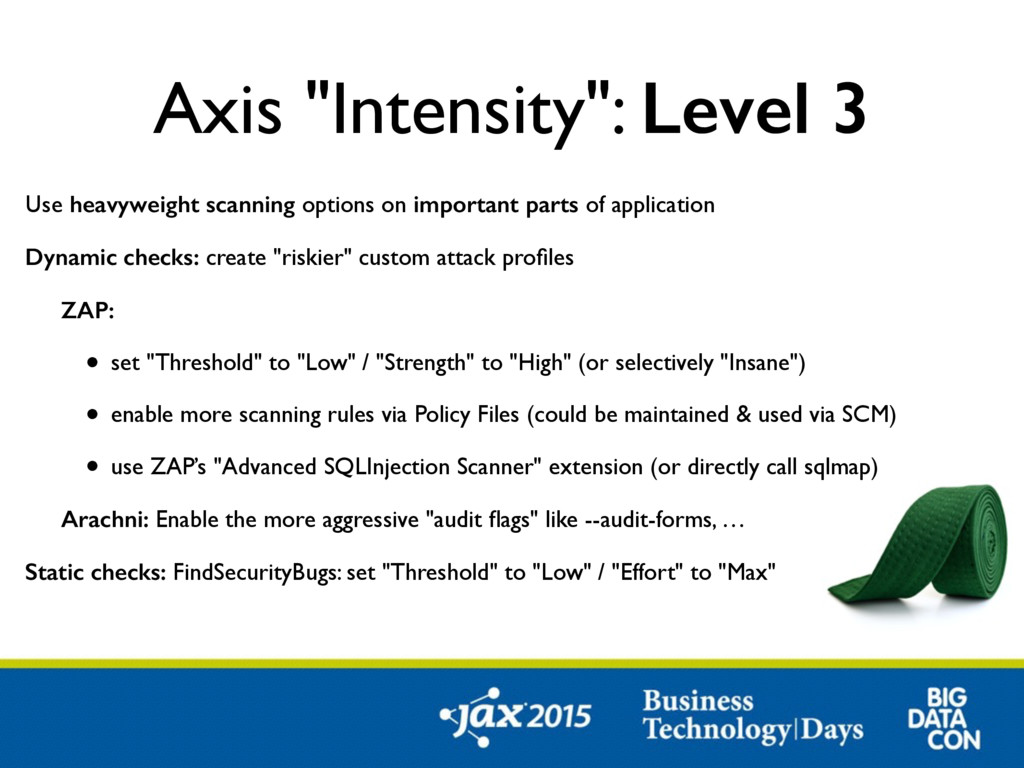
parts of application Dynamic checks: create "riskier" custom attack profiles ZAP: • set "Threshold" to "Low" / "Strength" to "High" (or selectively "Insane") • enable more scanning rules via Policy Files (could be maintained & used via SCM) • use ZAP’s "Advanced SQLInjection Scanner" extension (or directly call sqlmap) Arachni: Enable the more aggressive "audit flags" like --audit-forms, … Static checks: FindSecurityBugs: set "Threshold" to "Low" / "Effort" to "Max" -
Axis "Intensity": Level 4 Use customised rule sets for dynamic
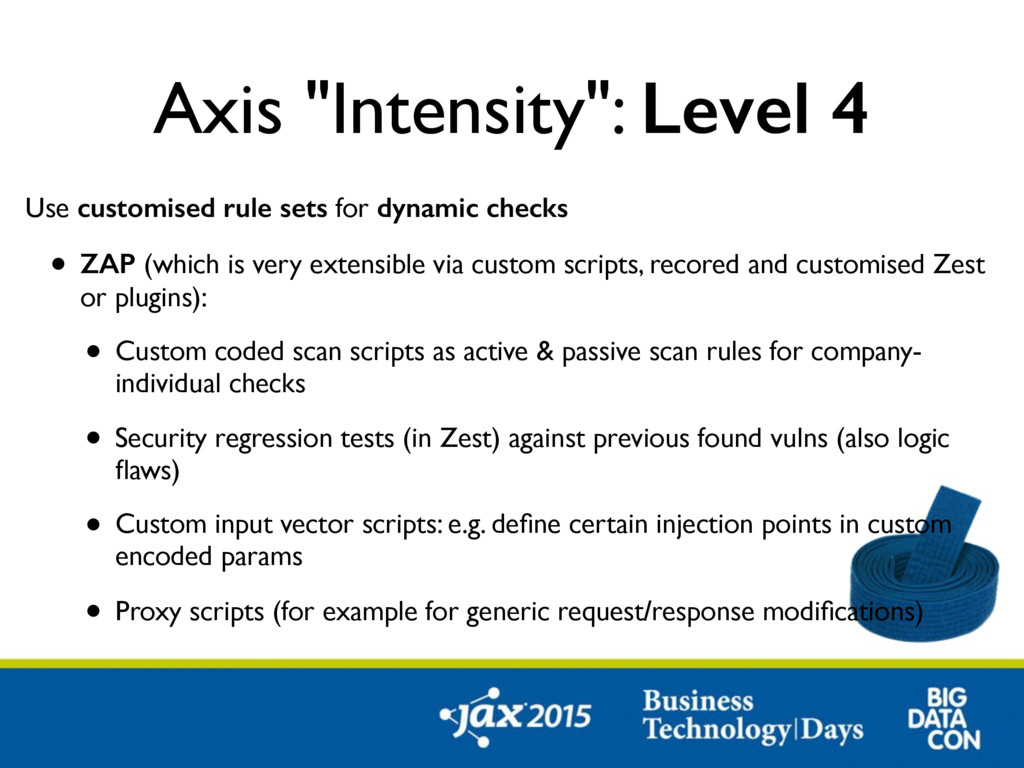
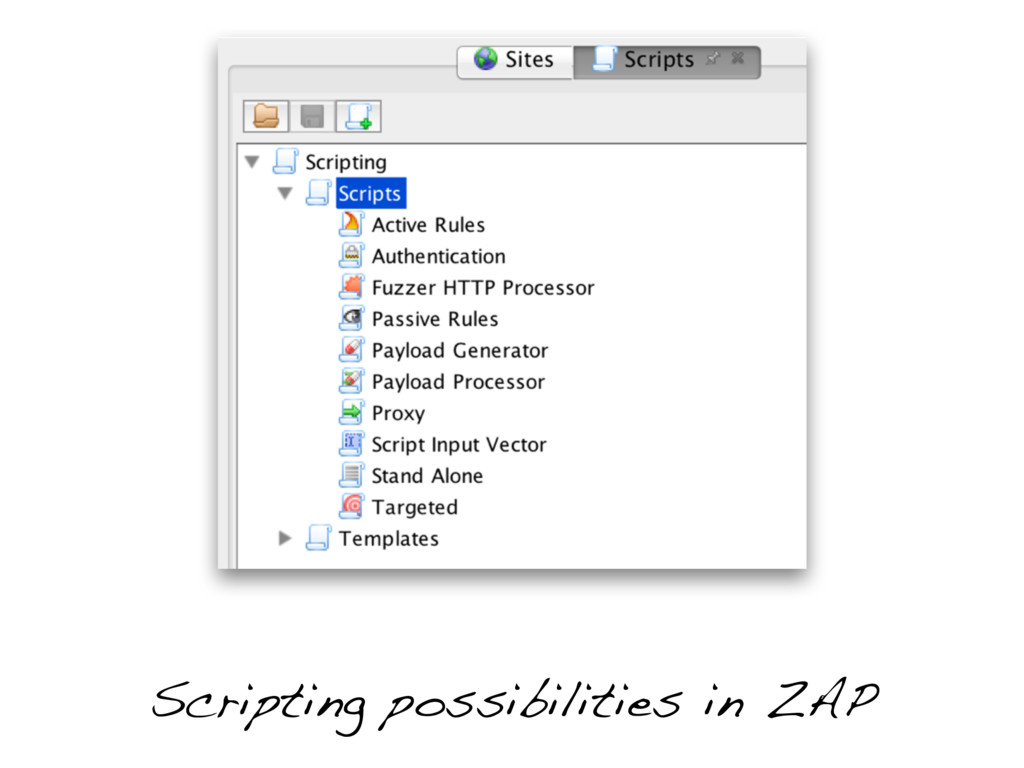
checks • ZAP (which is very extensible via custom scripts, recored and customised Zest or plugins): • Custom coded scan scripts as active & passive scan rules for company- individual checks • Security regression tests (in Zest) against previous found vulns (also logic flaws) • Custom input vector scripts: e.g. define certain injection points in custom encoded params • Proxy scripts (for example for generic request/response modifications) -
Axis "Intensity": Level 4 Use customised rule sets for static
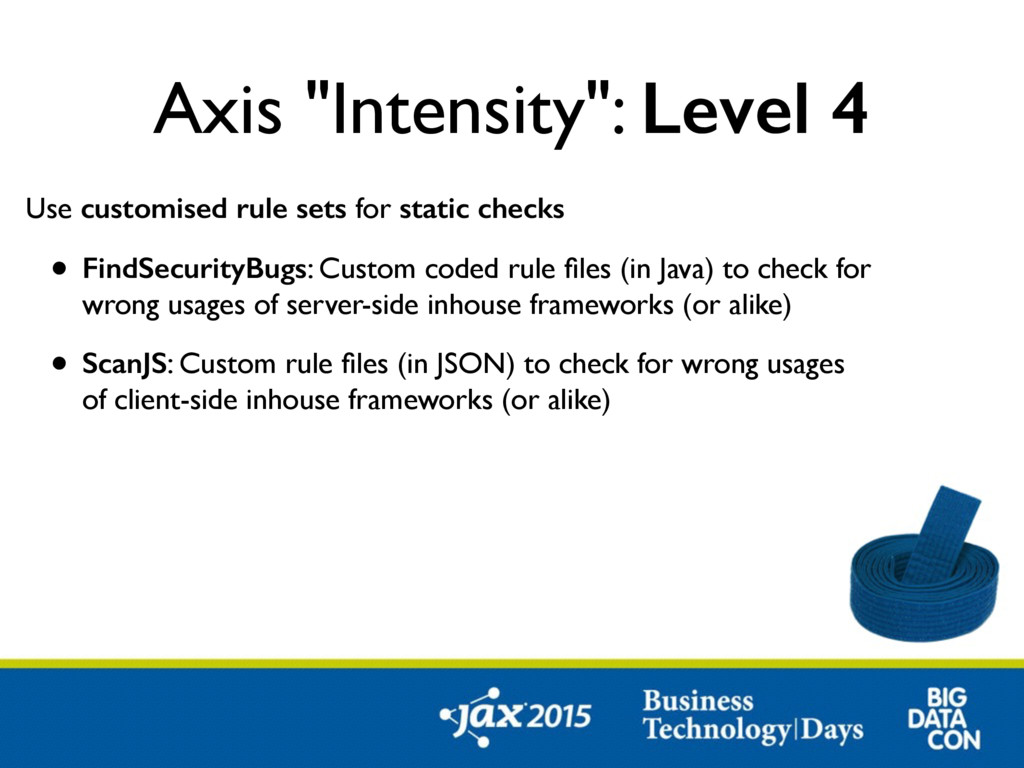
checks • FindSecurityBugs: Custom coded rule files (in Java) to check for wrong usages of server-side inhouse frameworks (or alike) • ScanJS: Custom rule files (in JSON) to check for wrong usages of client-side inhouse frameworks (or alike) -
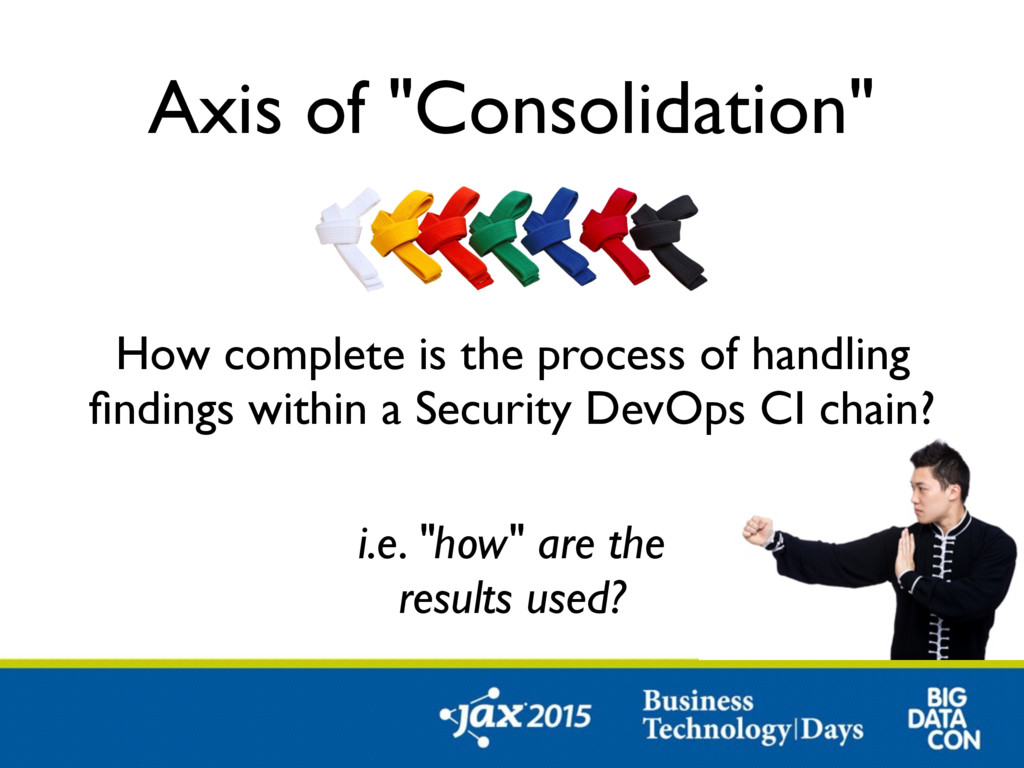
Axis of "Consolidation" How complete is the process of handling
findings within a Security DevOps CI chain? i.e. "how" are the results used? -
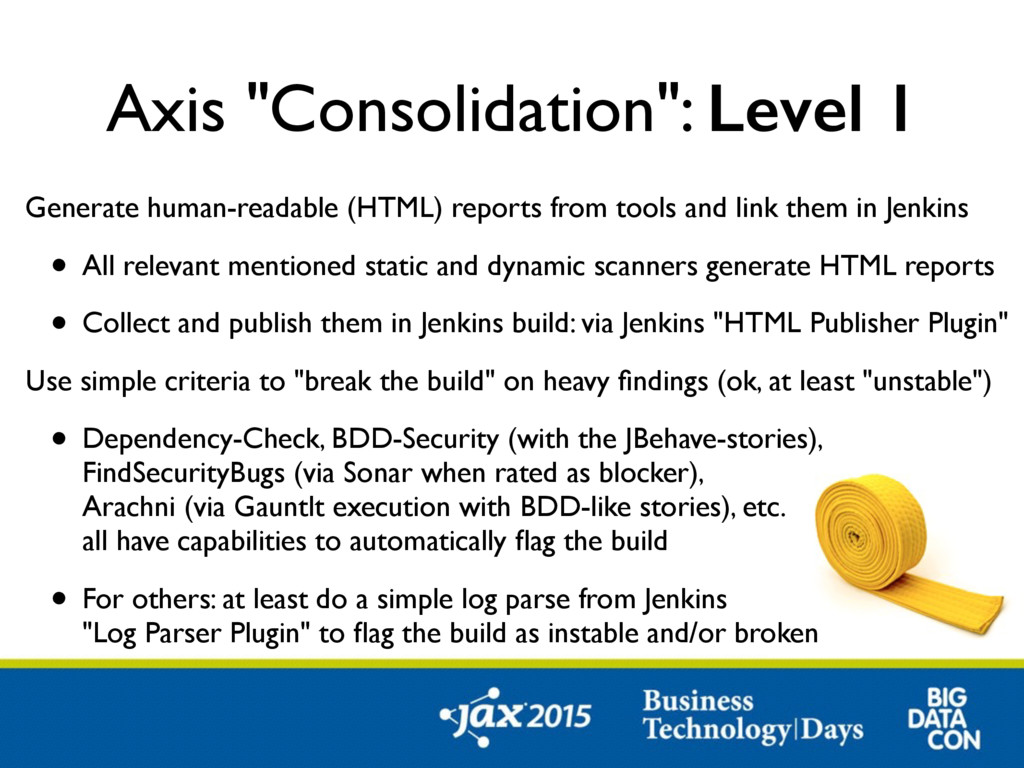
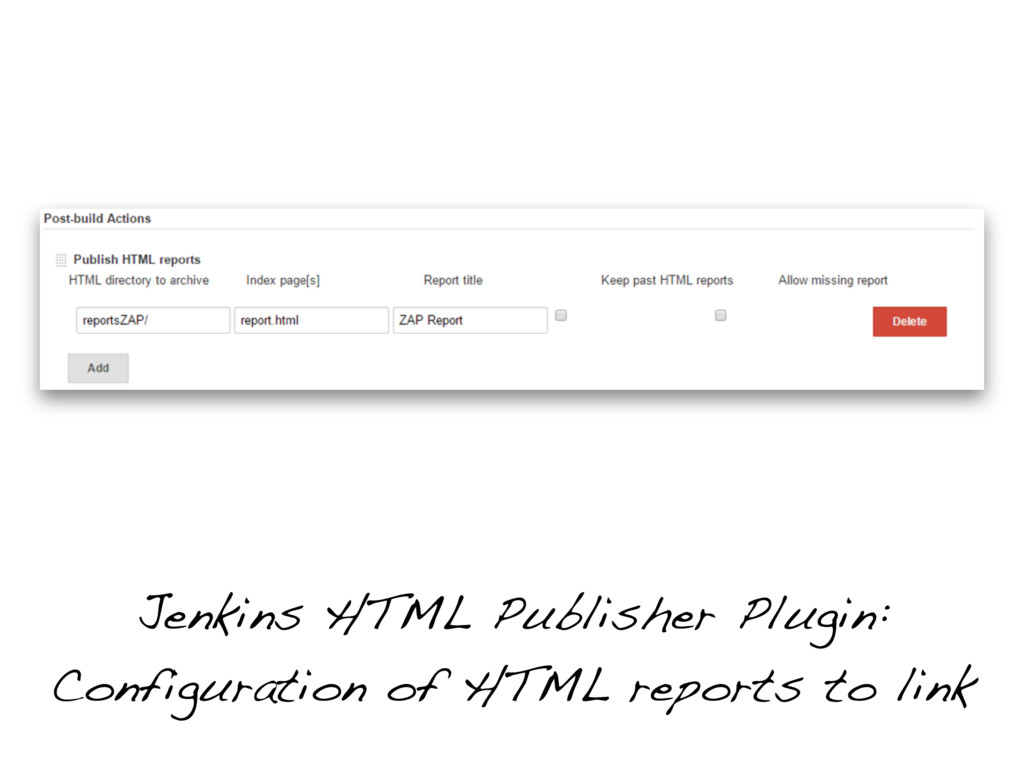
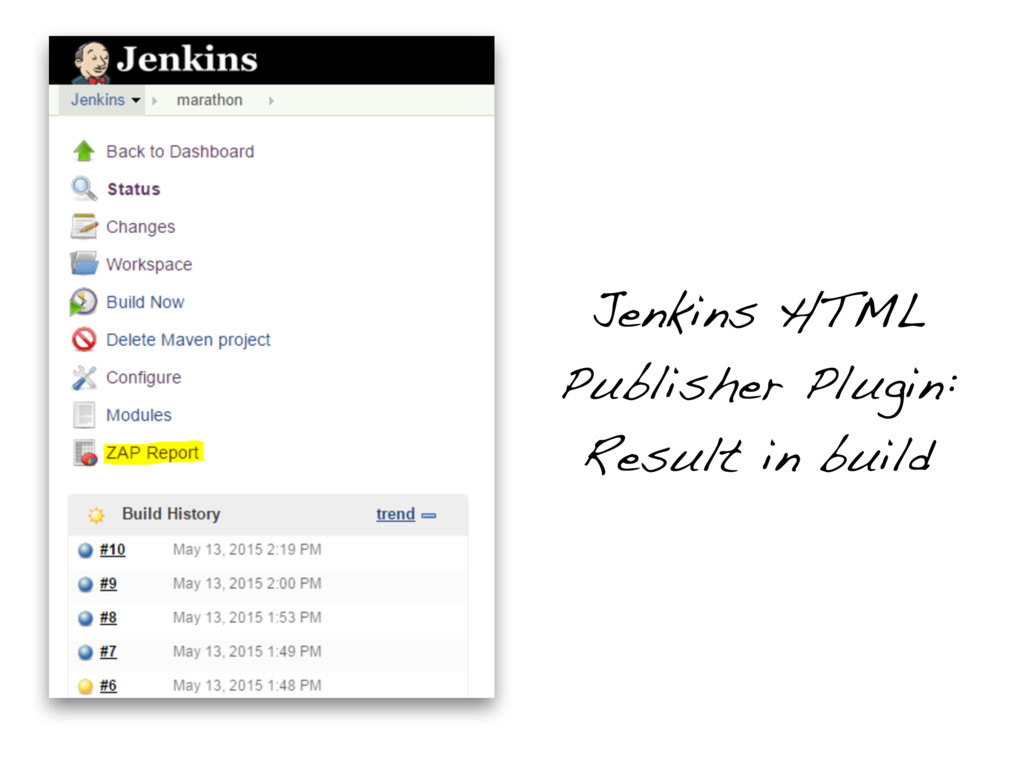
Axis "Consolidation": Level 1 Generate human-readable (HTML) reports from tools
and link them in Jenkins • All relevant mentioned static and dynamic scanners generate HTML reports • Collect and publish them in Jenkins build: via Jenkins "HTML Publisher Plugin" Use simple criteria to "break the build" on heavy findings (ok, at least "unstable") • Dependency-Check, BDD-Security (with the JBehave-stories), FindSecurityBugs (via Sonar when rated as blocker), Arachni (via Gauntlt execution with BDD-like stories), etc. all have capabilities to automatically flag the build • For others: at least do a simple log parse from Jenkins "Log Parser Plugin" to flag the build as instable and/or broken -
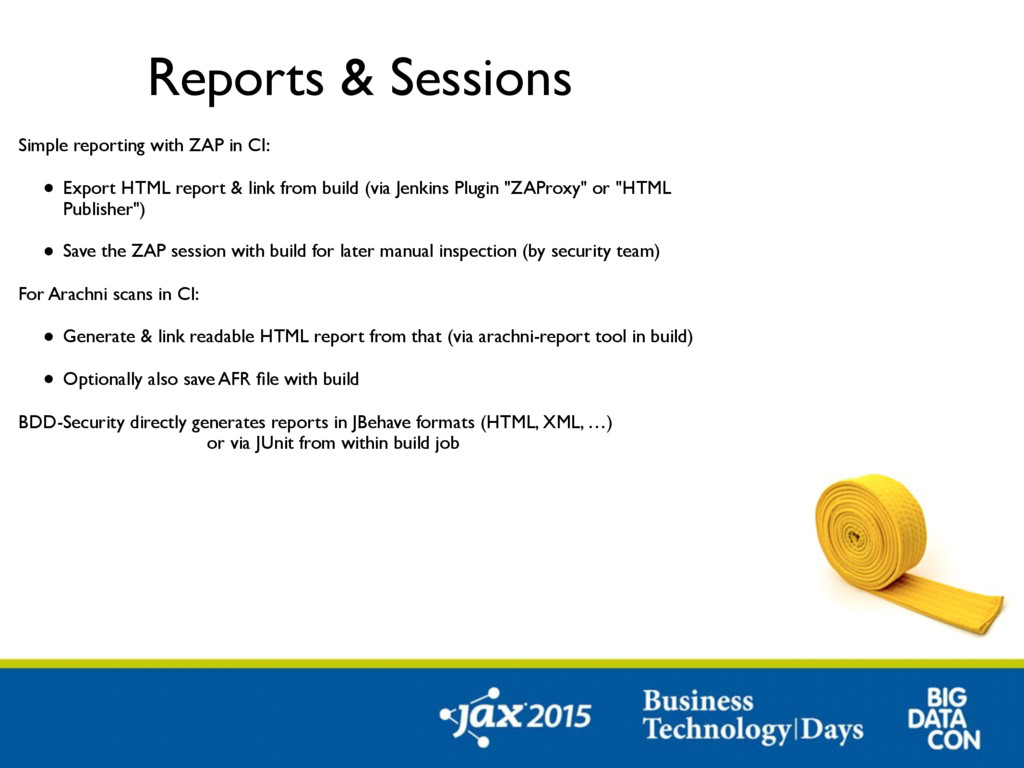
Reports & Sessions Simple reporting with ZAP in CI: •
Export HTML report & link from build (via Jenkins Plugin "ZAProxy" or "HTML Publisher") • Save the ZAP session with build for later manual inspection (by security team) For Arachni scans in CI: • Generate & link readable HTML report from that (via arachni-report tool in build) • Optionally also save AFR file with build BDD-Security directly generates reports in JBehave formats (HTML, XML, …) or via JUnit from within build job -
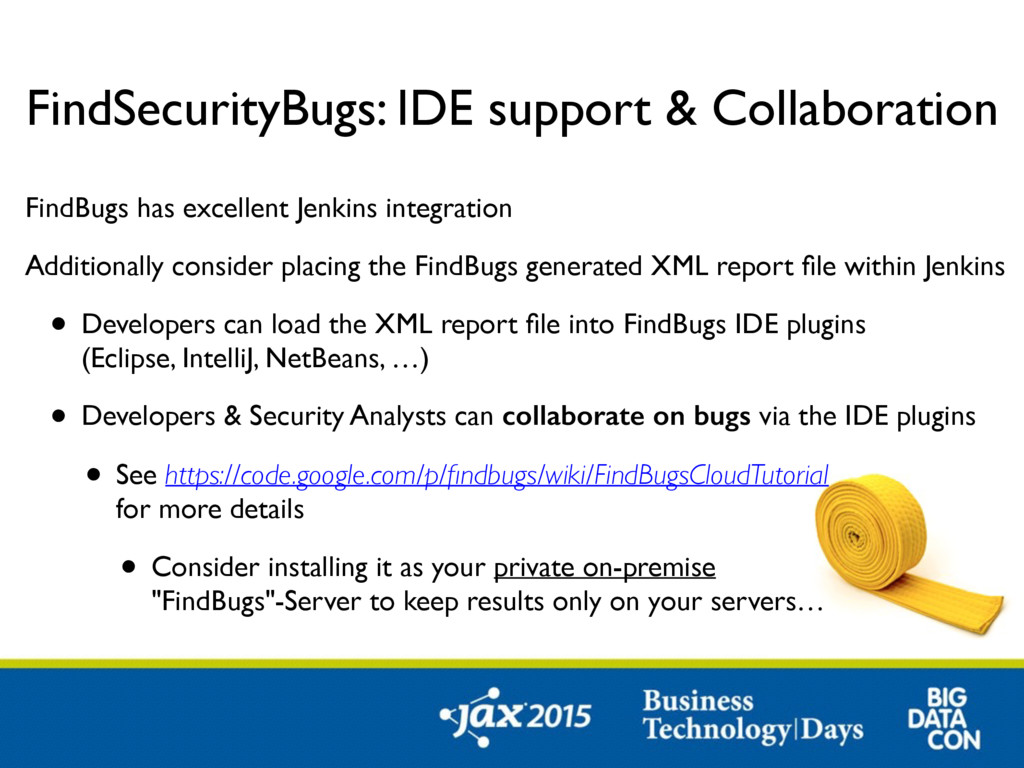
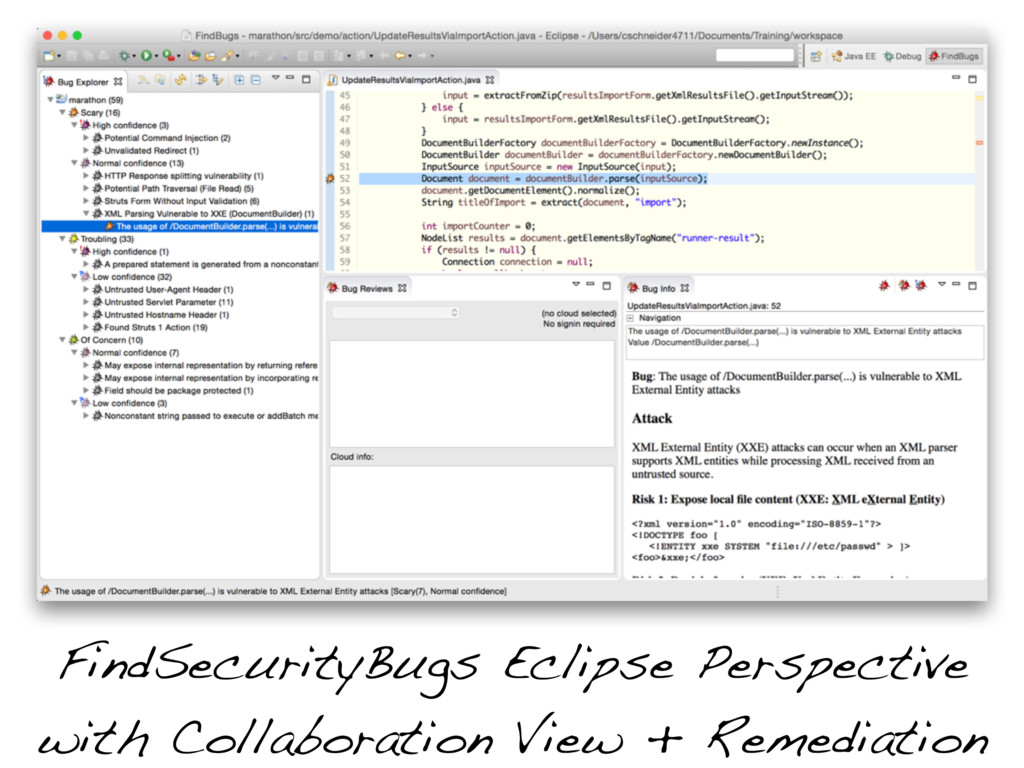
FindSecurityBugs: IDE support & Collaboration FindBugs has excellent Jenkins integration
Additionally consider placing the FindBugs generated XML report file within Jenkins • Developers can load the XML report file into FindBugs IDE plugins (Eclipse, IntelliJ, NetBeans, …) • Developers & Security Analysts can collaborate on bugs via the IDE plugins • See https://code.google.com/p/findbugs/wiki/FindBugsCloudTutorial for more details • Consider installing it as your private on-premise "FindBugs"-Server to keep results only on your servers… -
Axis "Consolidation": Level 2 Custom logic to make build unstable
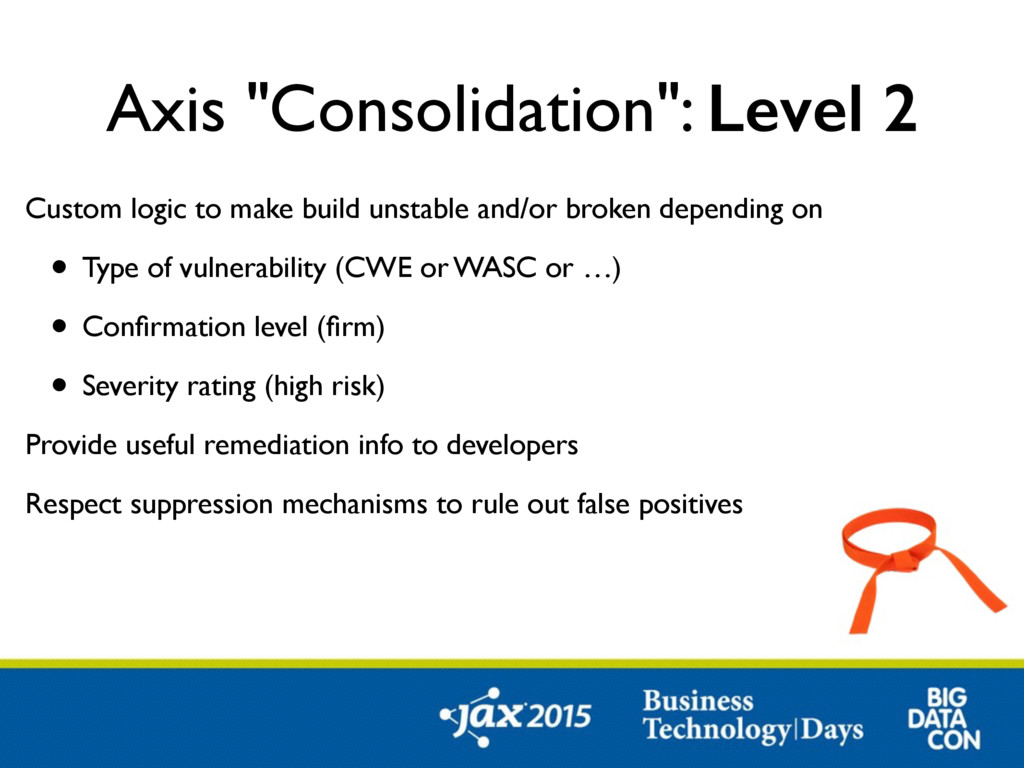
and/or broken depending on • Type of vulnerability (CWE or WASC or …) • Confirmation level (firm) • Severity rating (high risk) Provide useful remediation info to developers Respect suppression mechanisms to rule out false positives -
Flagging builds from reports How (from within a CI job)?
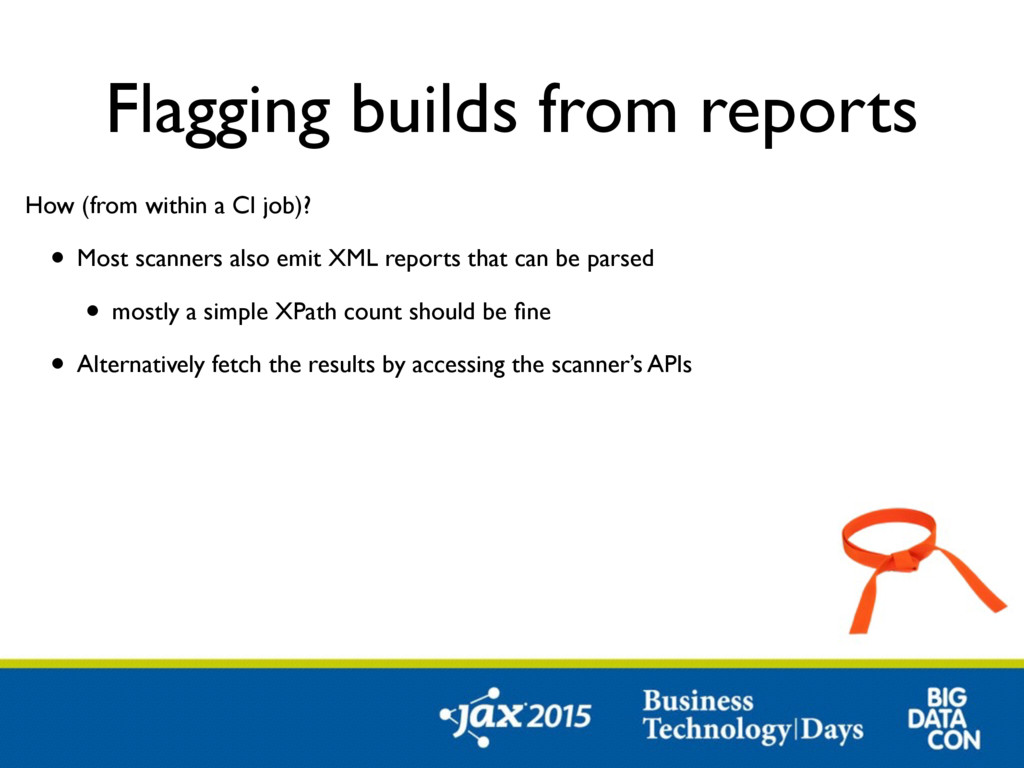
• Most scanners also emit XML reports that can be parsed • mostly a simple XPath count should be fine • Alternatively fetch the results by accessing the scanner’s APIs -
Providing useful infos to Devs Lookup findings by CWE-ID (provided
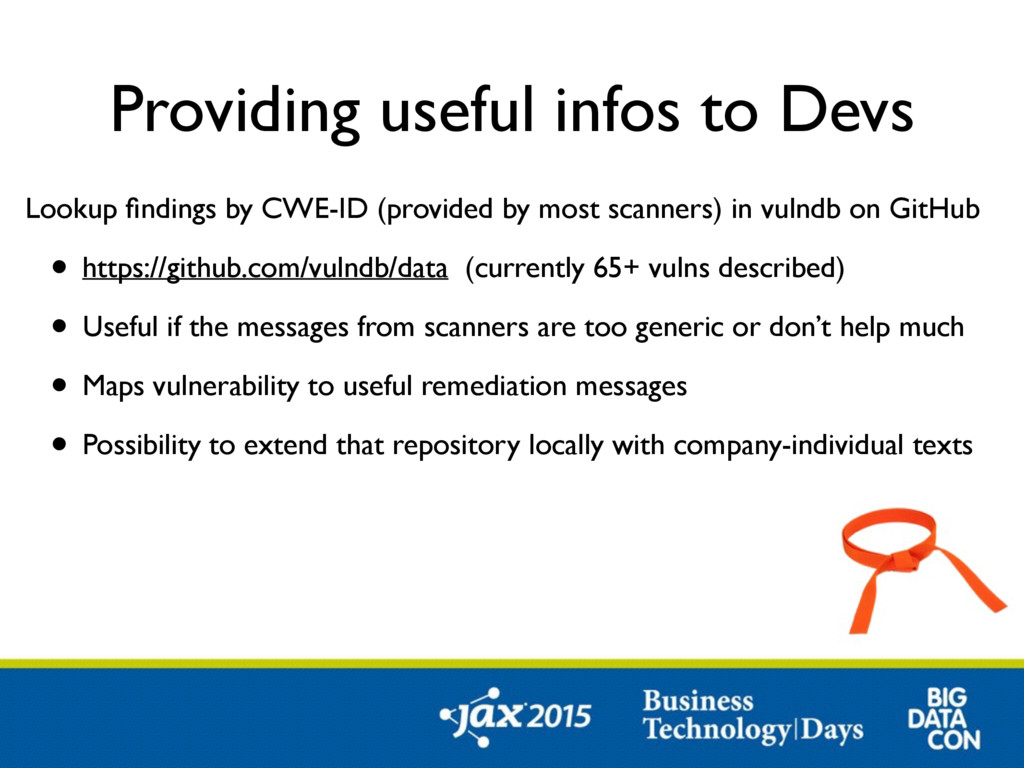
by most scanners) in vulndb on GitHub • https://github.com/vulndb/data (currently 65+ vulns described) • Useful if the messages from scanners are too generic or don’t help much • Maps vulnerability to useful remediation messages • Possibility to extend that repository locally with company-individual texts -
Suppression of false positives BDD-Security • Use false positive tables
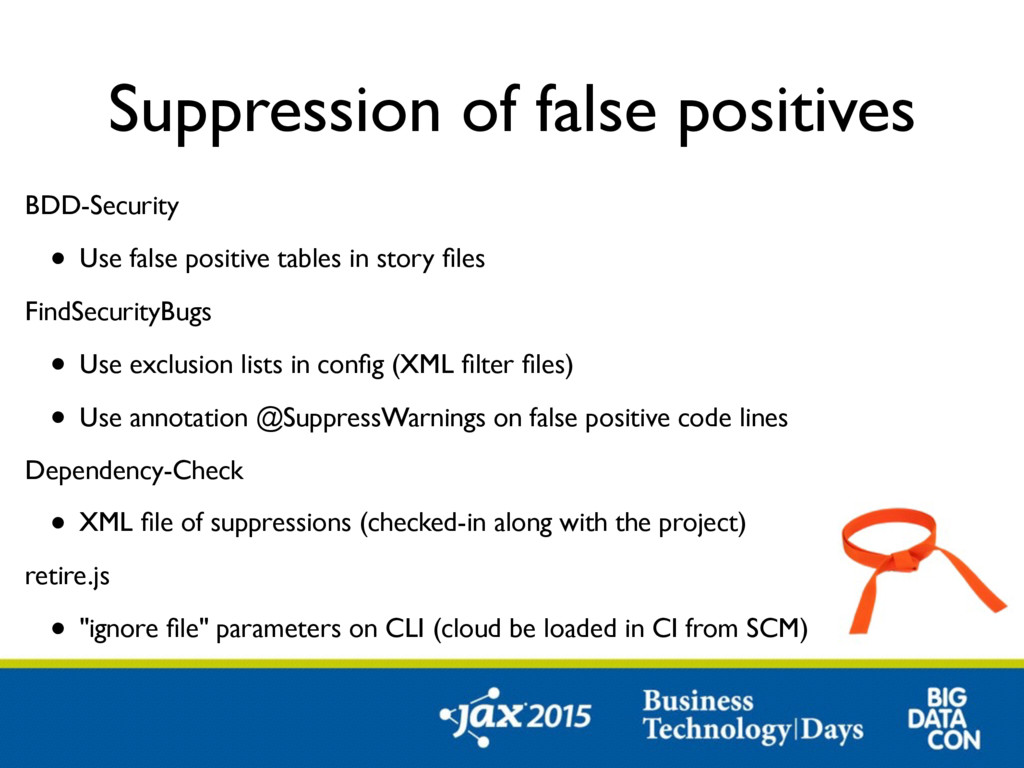
in story files FindSecurityBugs • Use exclusion lists in config (XML filter files) • Use annotation @SuppressWarnings on false positive code lines Dependency-Check • XML file of suppressions (checked-in along with the project) retire.js • "ignore file" parameters on CLI (cloud be loaded in CI from SCM) -
Axis "Consolidation": Level 3 Consolidation goals: • Consolidate & de-duplicate
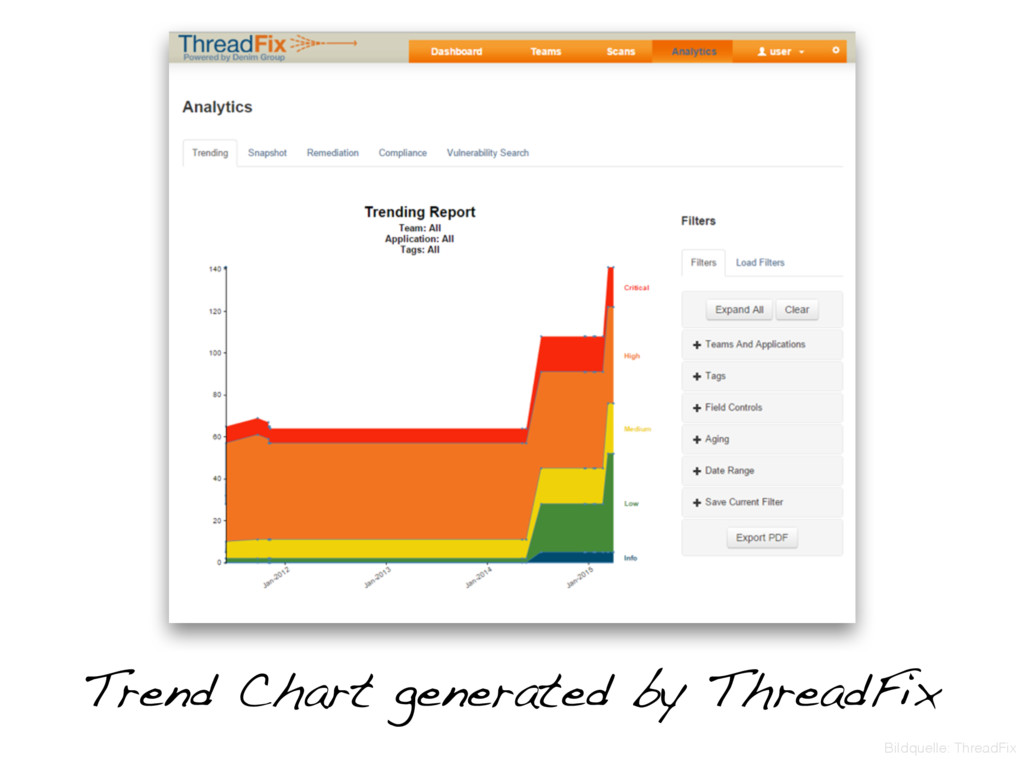
findings from different scanner reports (with better false positive handling) • Push consolidated findings into established bug-tracker (known to devs) • Delta analysis & trends over consolidated data sets -
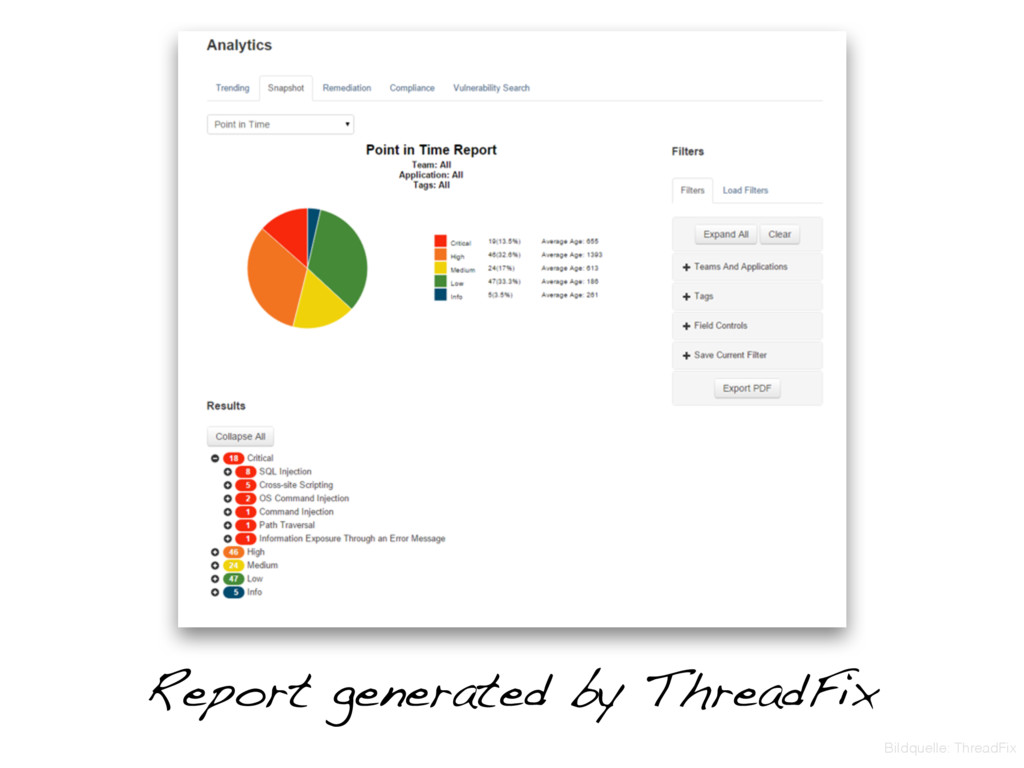
ThreadFix as result consolidator Use a local ThreadFix server, which
imports native scanner outputs • does the heavy lifting of consolidation & de-duplication • pushes findings toward bug-tracker and IDE (via plugins) • process can be customised using it’s own REST-API • ThreadFix integrates with ZAP to import scans from ZAP -
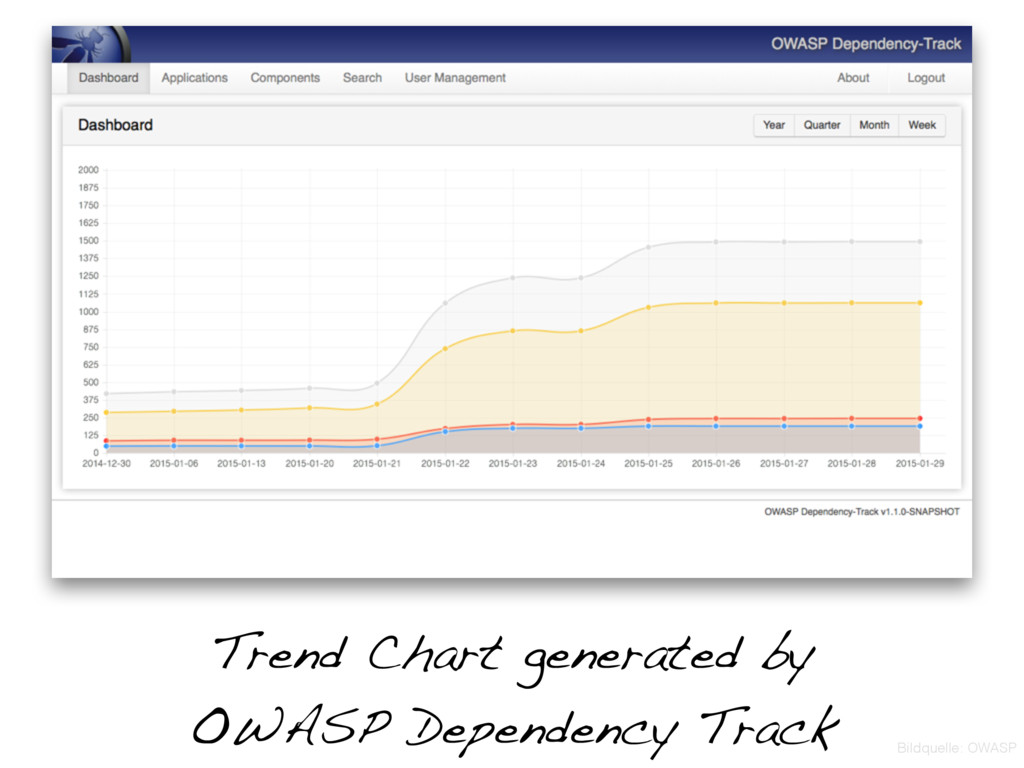
Trends about vulnerable dependencies OWASP Dependency-Track provides trend insight into
findings about use of vulnerable components (from OWASP Dependency-Check): • across multiple applications and versions • across time -
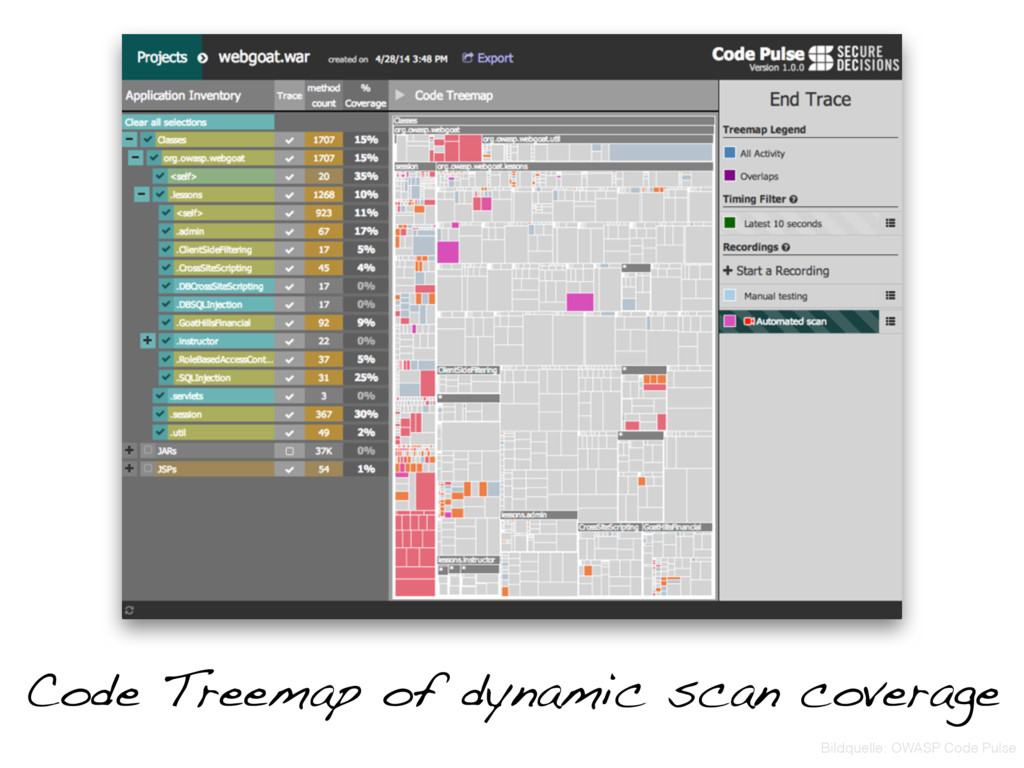
Axis "Consolidation": Level 4 Measure the concrete code coverage of
your security testing activities • Find untested "white spots" • Derive where static checks and code reviews should focus more to compensate How? • Use "OWASP Code Pulse", which instruments your Java app via agent • collects coverage data during dynamic security testing scans • generates reports ("code treemaps") of coverage -
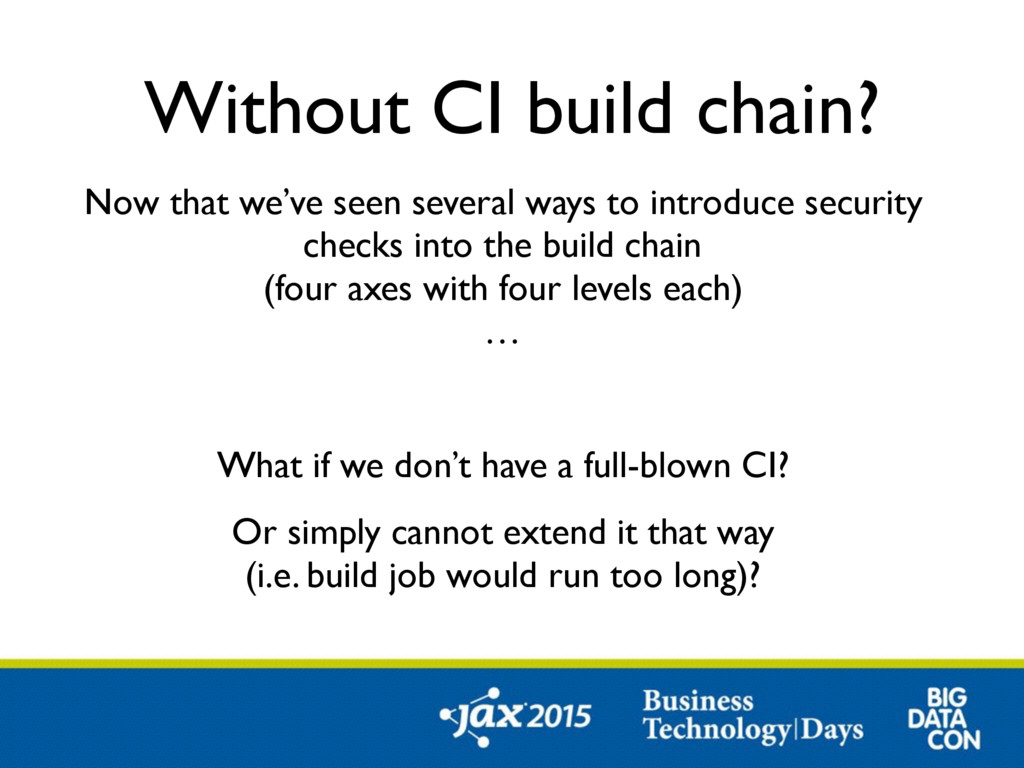
Without CI build chain? Now that we’ve seen several ways
to introduce security checks into the build chain (four axes with four levels each) … What if we don’t have a full-blown CI? Or simply cannot extend it that way (i.e. build job would run too long)? -
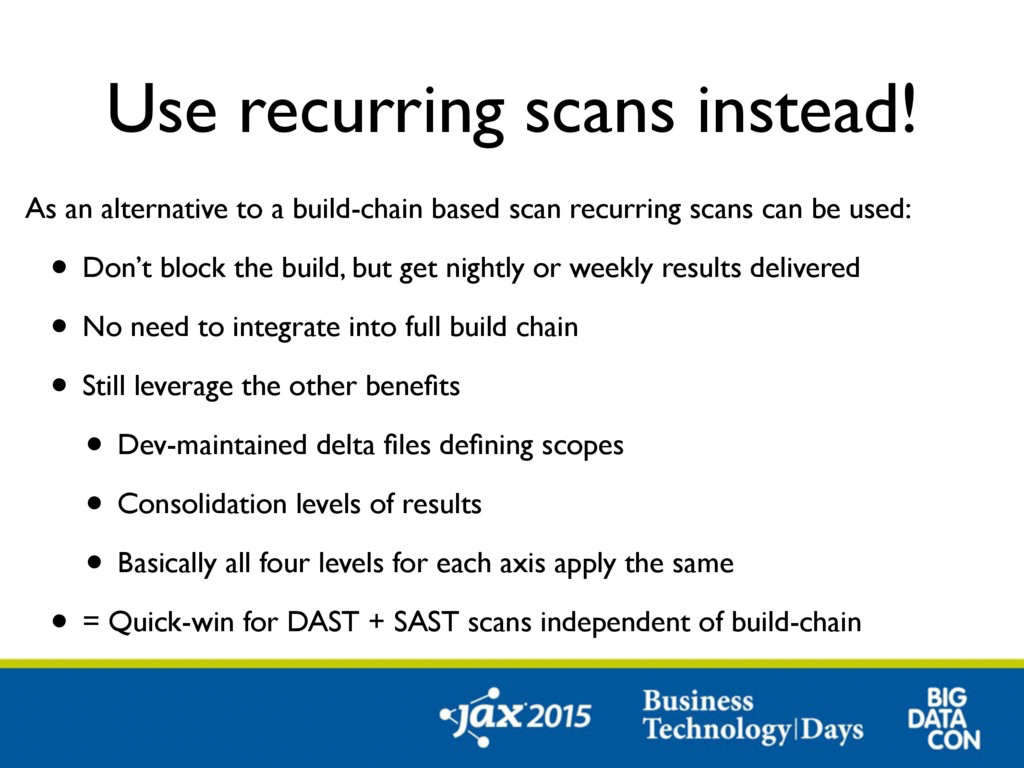
Use recurring scans instead! As an alternative to a build-chain
based scan recurring scans can be used: • Don’t block the build, but get nightly or weekly results delivered • No need to integrate into full build chain • Still leverage the other benefits • Dev-maintained delta files defining scopes • Consolidation levels of results • Basically all four levels for each axis apply the same • = Quick-win for DAST + SAST scans independent of build-chain -
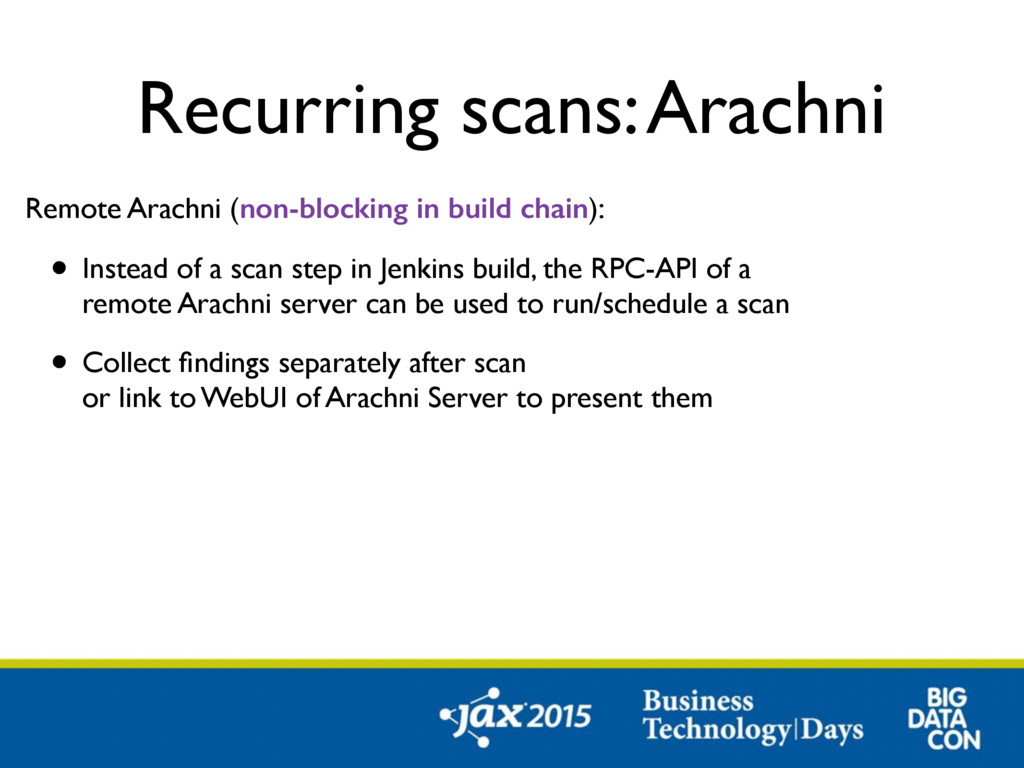
Recurring scans: Arachni Remote Arachni (non-blocking in build chain): •
Instead of a scan step in Jenkins build, the RPC-API of a remote Arachni server can be used to run/schedule a scan • Collect findings separately after scan or link to WebUI of Arachni Server to present them -
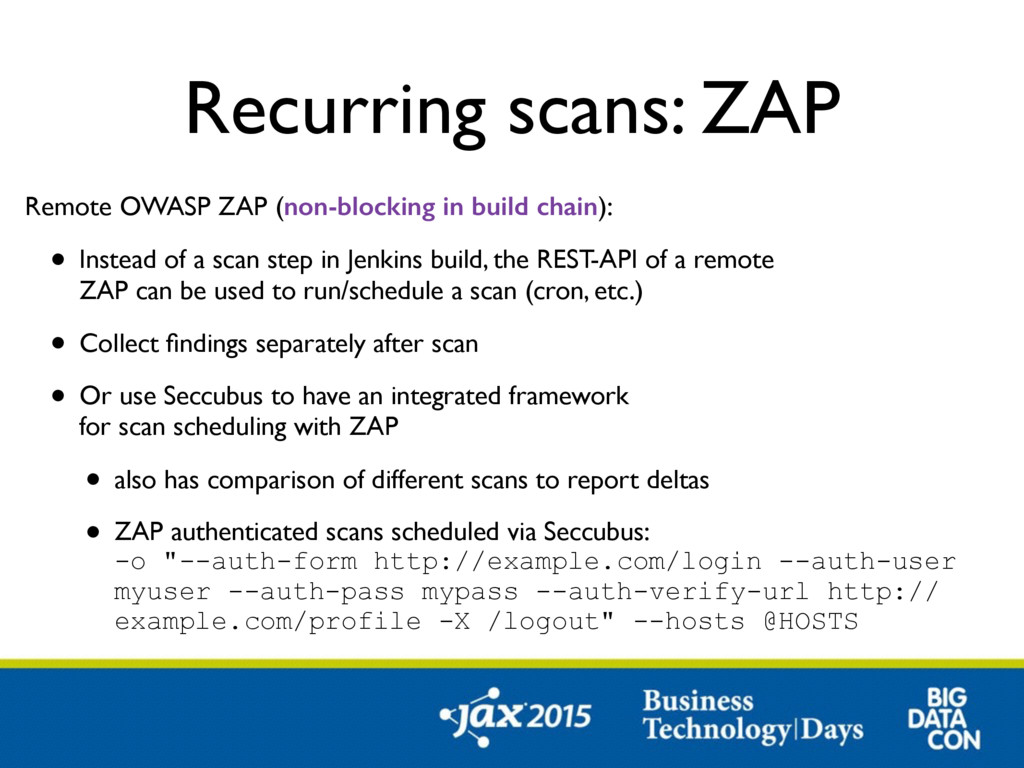
Recurring scans: ZAP Remote OWASP ZAP (non-blocking in build chain):
• Instead of a scan step in Jenkins build, the REST-API of a remote ZAP can be used to run/schedule a scan (cron, etc.) • Collect findings separately after scan • Or use Seccubus to have an integrated framework for scan scheduling with ZAP • also has comparison of different scans to report deltas • ZAP authenticated scans scheduled via Seccubus: -o "--auth-form http://example.com/login --auth-user myuser --auth-pass mypass --auth-verify-url http:// example.com/profile -X /logout" --hosts @HOSTS -
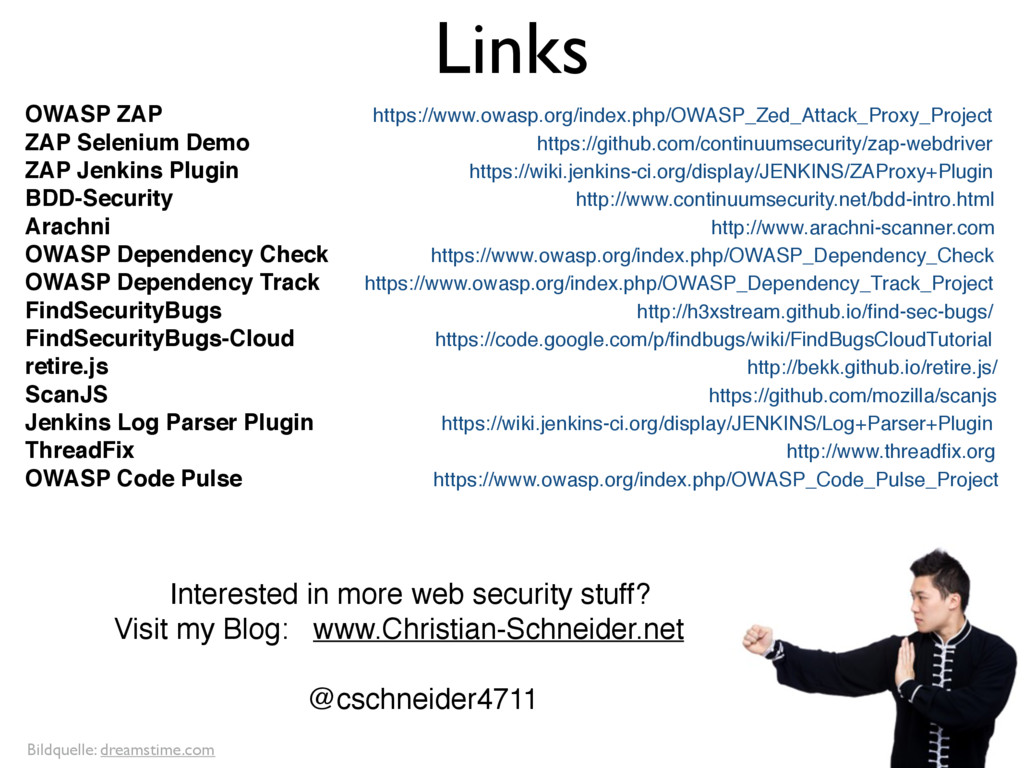
Links OWASP ZAP https://www.owasp.org/index.php/OWASP_Zed_Attack_Proxy_Project ZAP Selenium Demo https://github.com/continuumsecurity/zap-webdriver ZAP Jenkins
Plugin https://wiki.jenkins-ci.org/display/JENKINS/ZAProxy+Plugin BDD-Security http://www.continuumsecurity.net/bdd-intro.html Arachni http://www.arachni-scanner.com OWASP Dependency Check https://www.owasp.org/index.php/OWASP_Dependency_Check OWASP Dependency Track https://www.owasp.org/index.php/OWASP_Dependency_Track_Project FindSecurityBugs http://h3xstream.github.io/find-sec-bugs/ FindSecurityBugs-Cloud https://code.google.com/p/findbugs/wiki/FindBugsCloudTutorial retire.js http://bekk.github.io/retire.js/ ScanJS https://github.com/mozilla/scanjs Jenkins Log Parser Plugin https://wiki.jenkins-ci.org/display/JENKINS/Log+Parser+Plugin ThreadFix http://www.threadfix.org OWASP Code Pulse https://www.owasp.org/index.php/OWASP_Code_Pulse_Project Interested in more web security stuff? Visit my Blog: www.Christian-Schneider.net @cschneider4711 Bildquelle: dreamstime.com
 cschneider4711
 kasacchiful
 kinakomoti321
 simas
 allegrogiken
 yuuu
 leegeunhyeok
 vivion
 ooga04
 barnbarn
 nasa9084
 picopico
 pvcresin
 katarinadahlin
 ipullrank
 reverentgeek
 lauravandoore
 addyosmani
 holman
 pauljervisheath
 coloredviolet
 hannesfritz
 mlcsv
 michaelherold
 tessaabrams