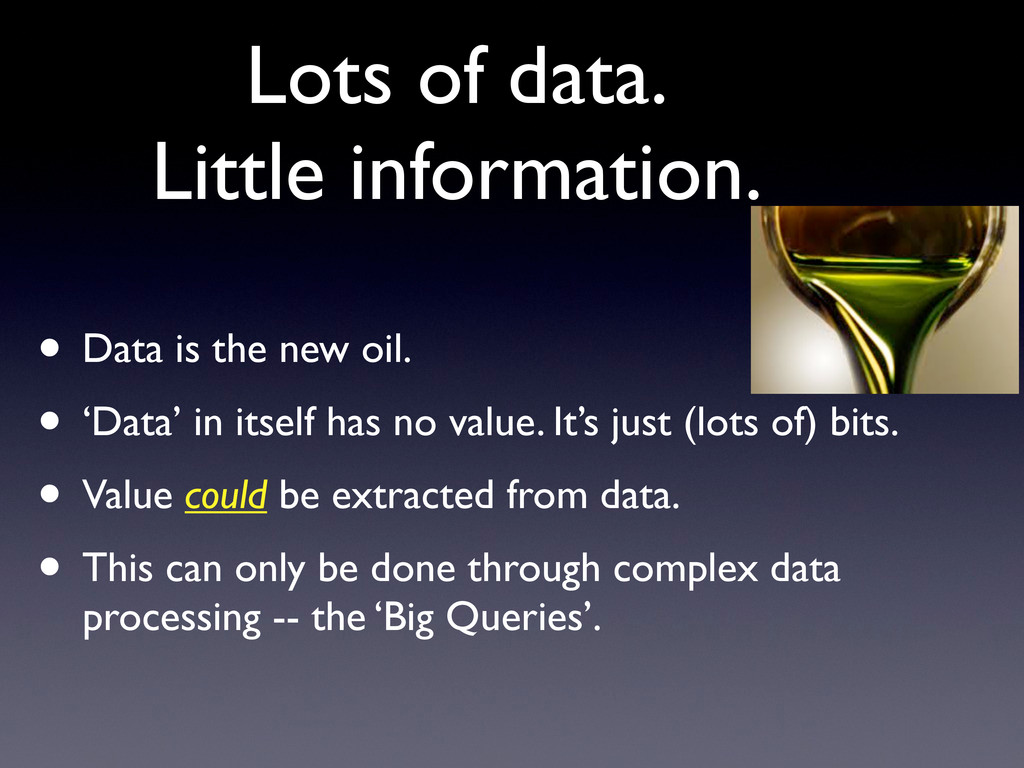
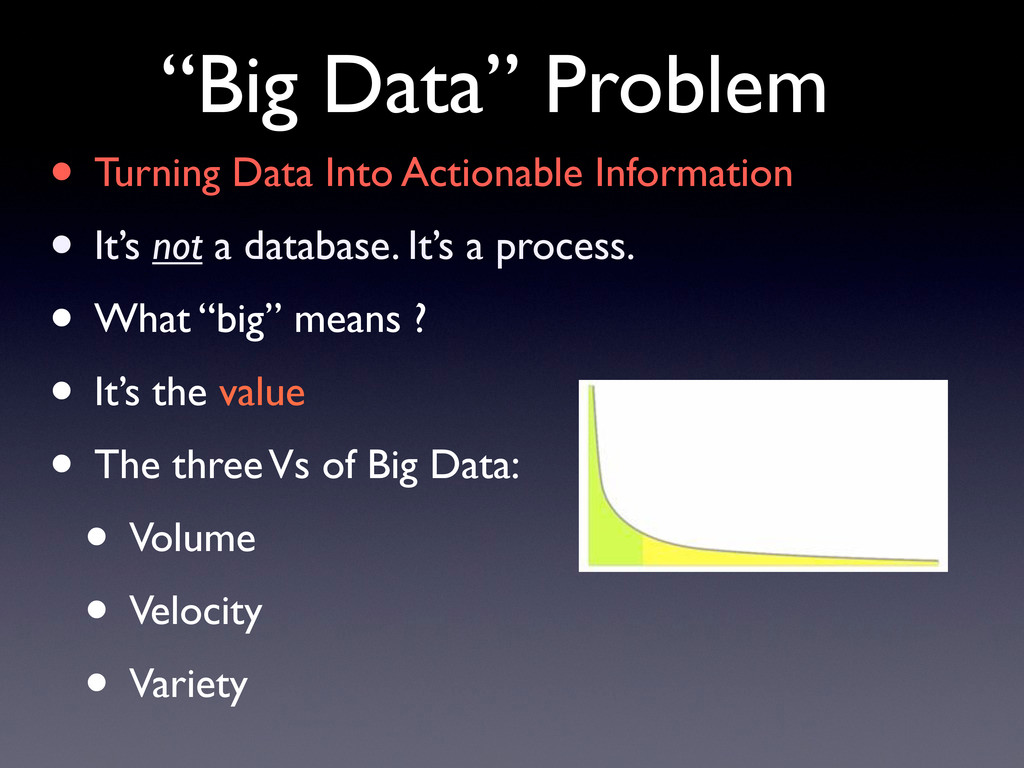
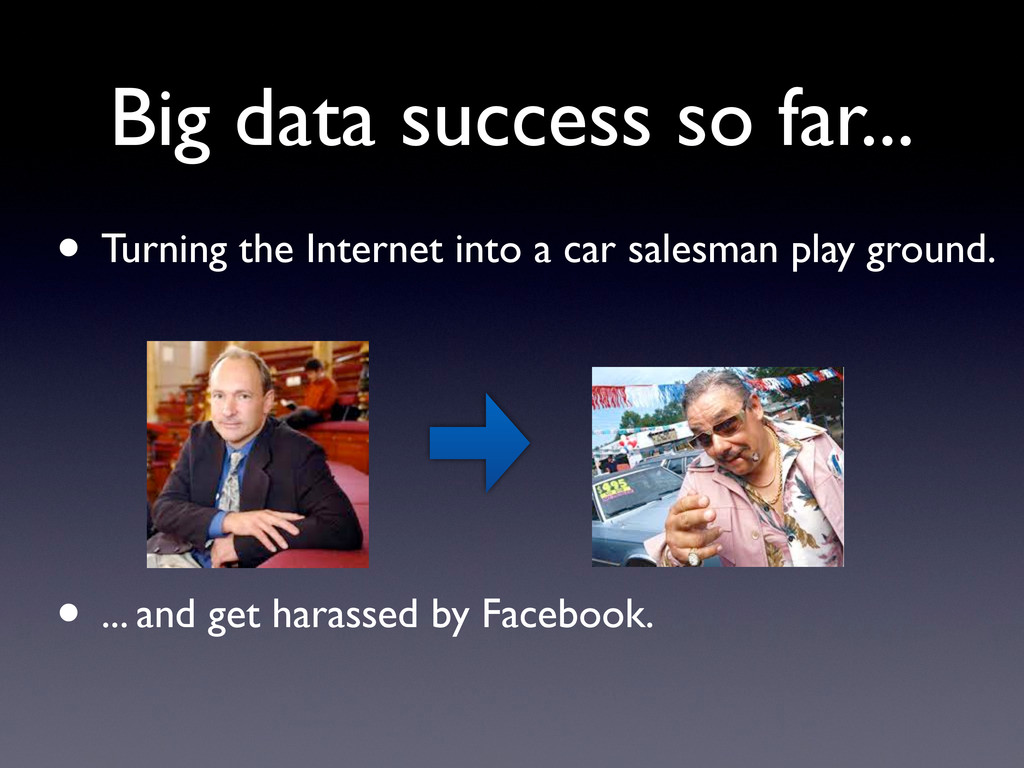
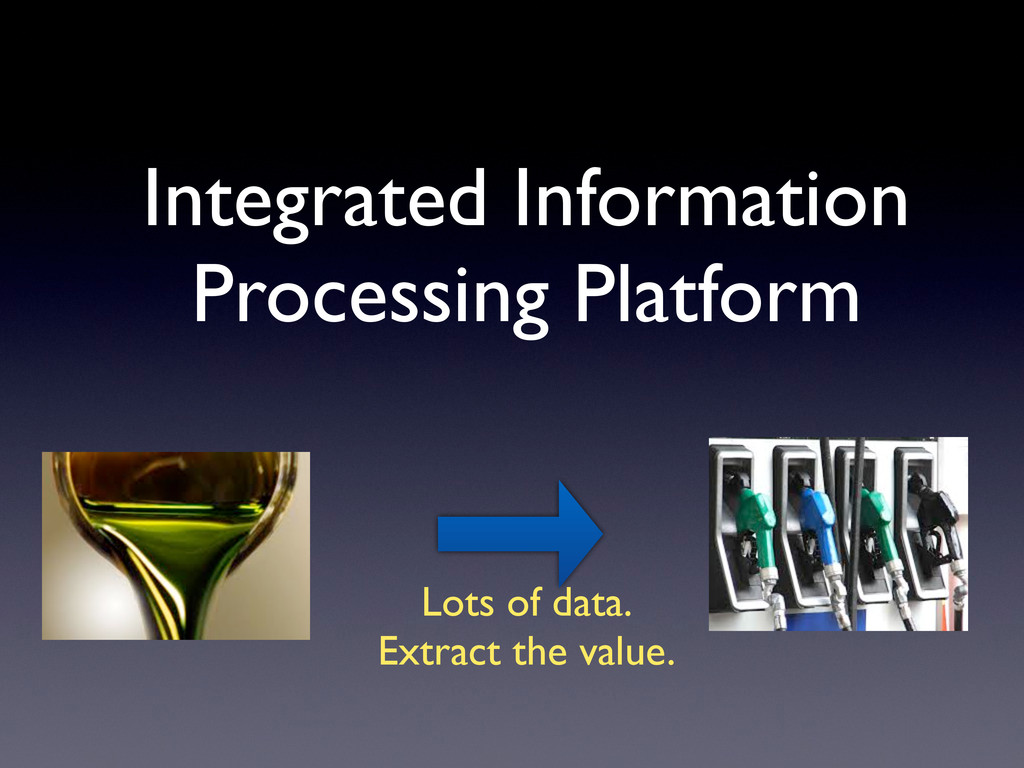
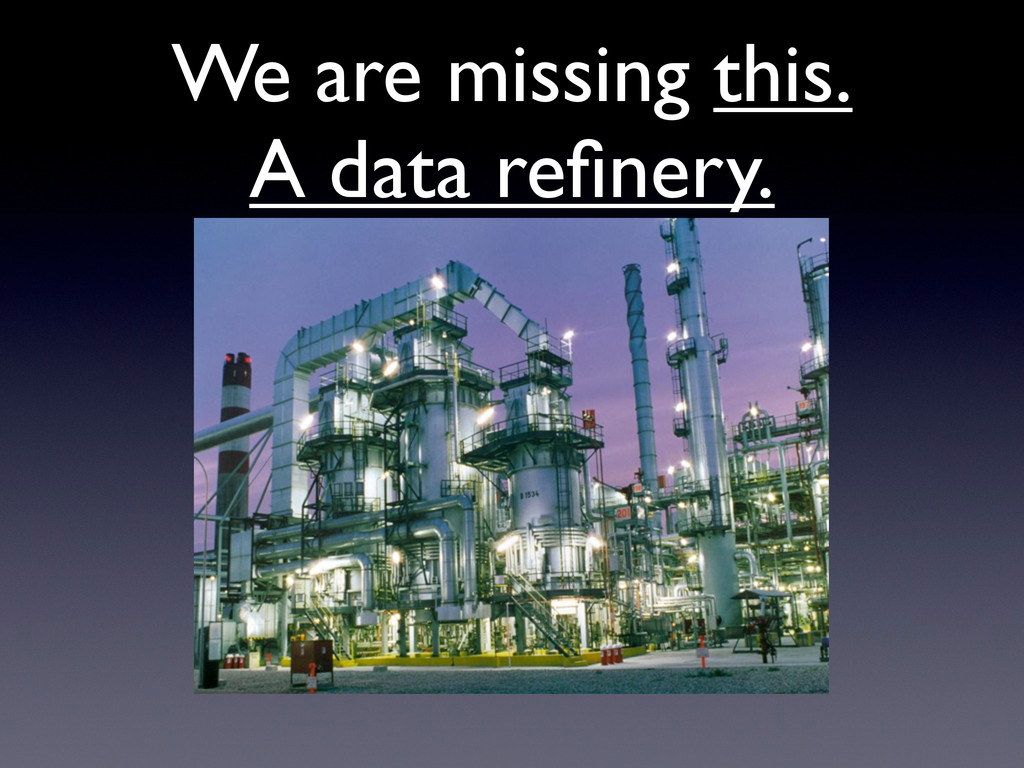
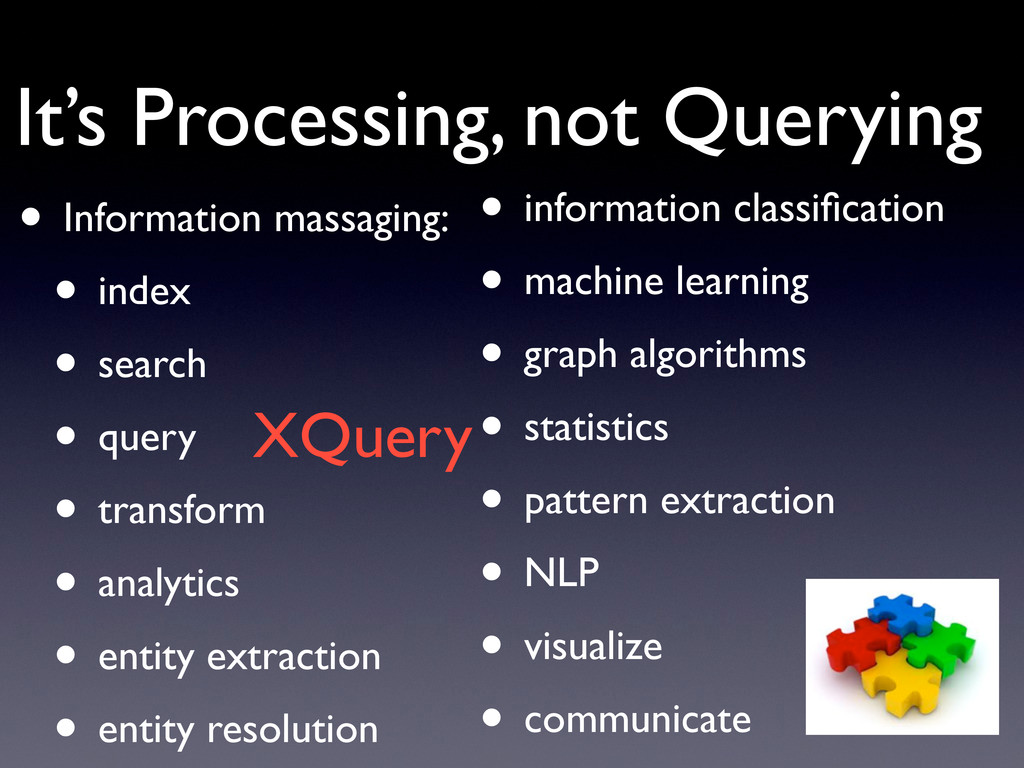
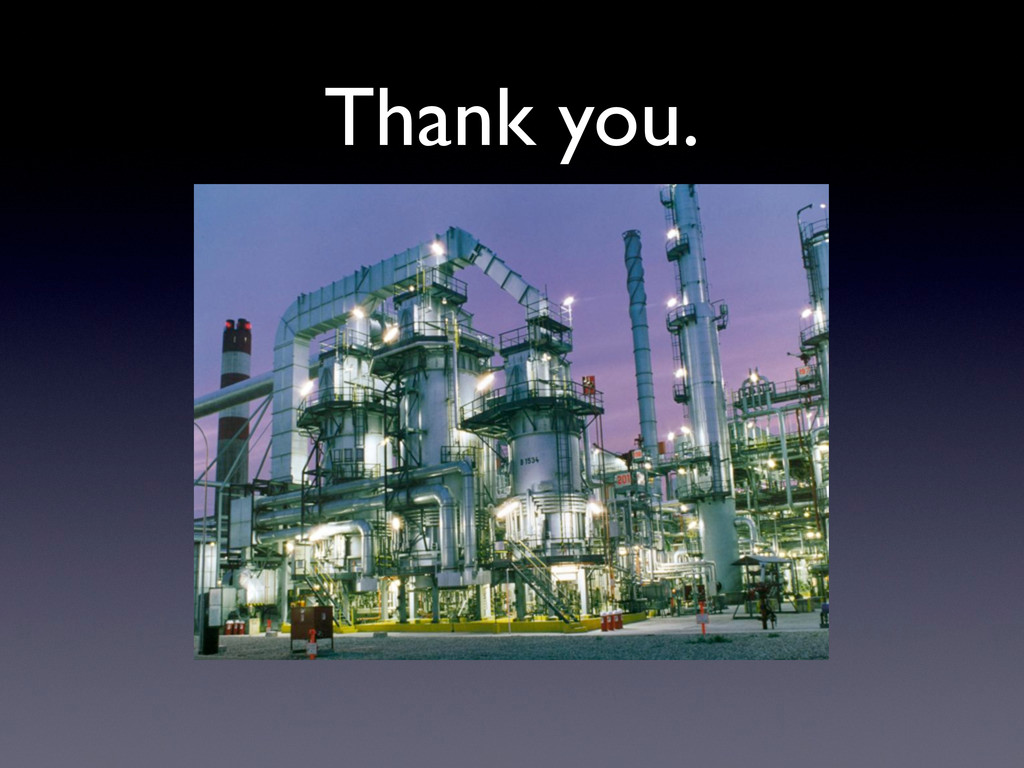
oil. • ‘Data’ in itself has no value. It’s just (lots of) bits. • Value could be extracted from data. • This can only be done through complex data processing -- the ‘Big Queries’.
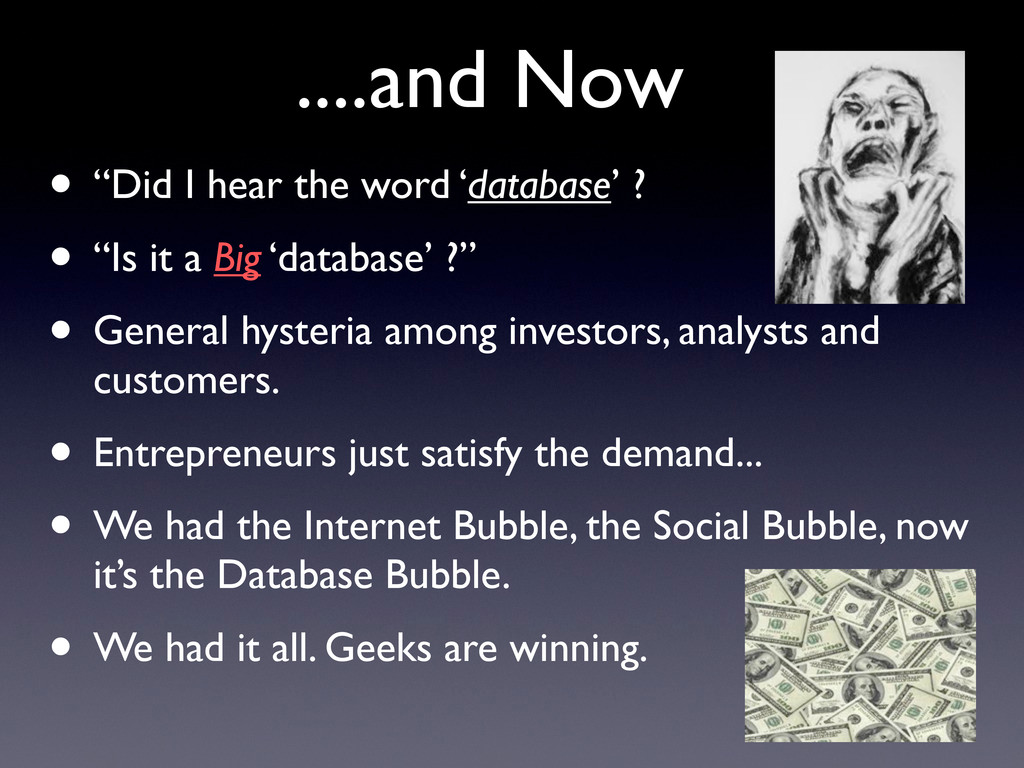
• “Is it a Big ‘database’ ?” • General hysteria among investors, analysts and customers. • Entrepreneurs just satisfy the demand... • We had the Internet Bubble, the Social Bubble, now it’s the Database Bubble. • We had it all. Geeks are winning.
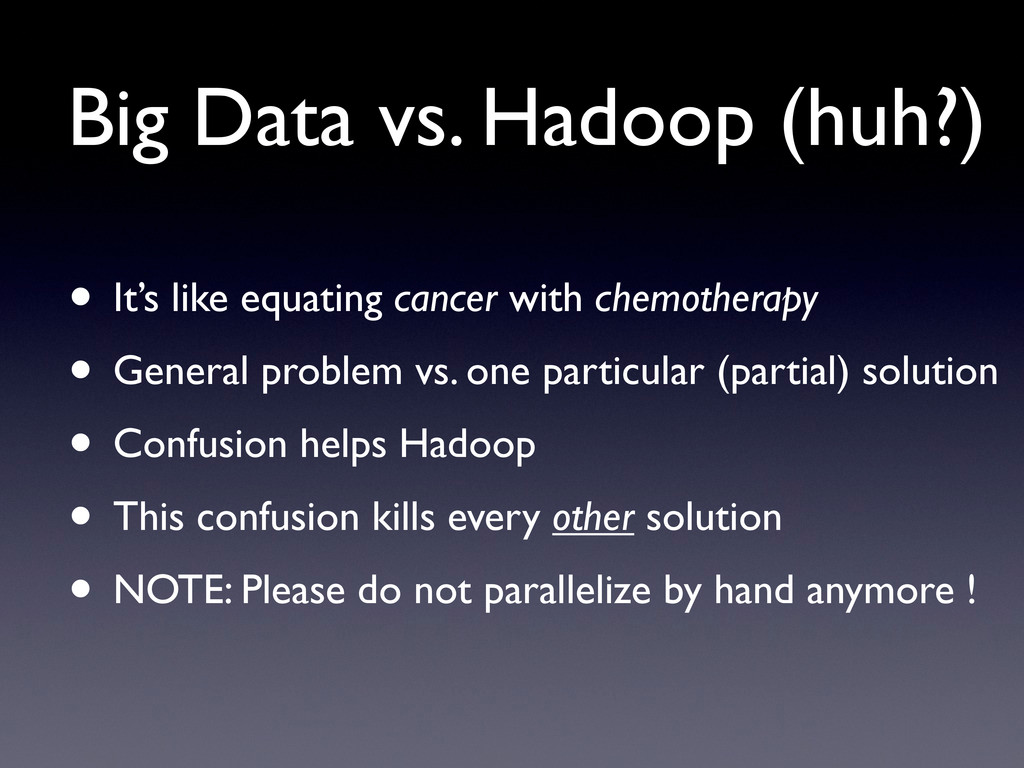
with chemotherapy • General problem vs. one particular (partial) solution • Confusion helps Hadoop • This confusion kills every other solution • NOTE: Please do not parallelize by hand anymore !
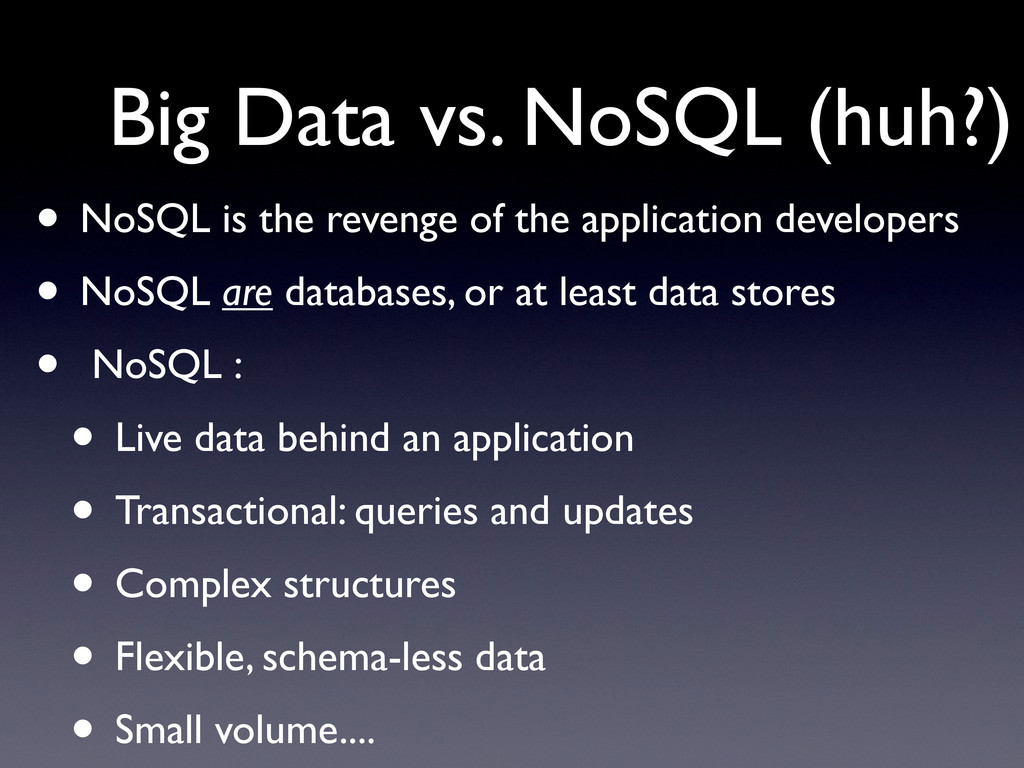
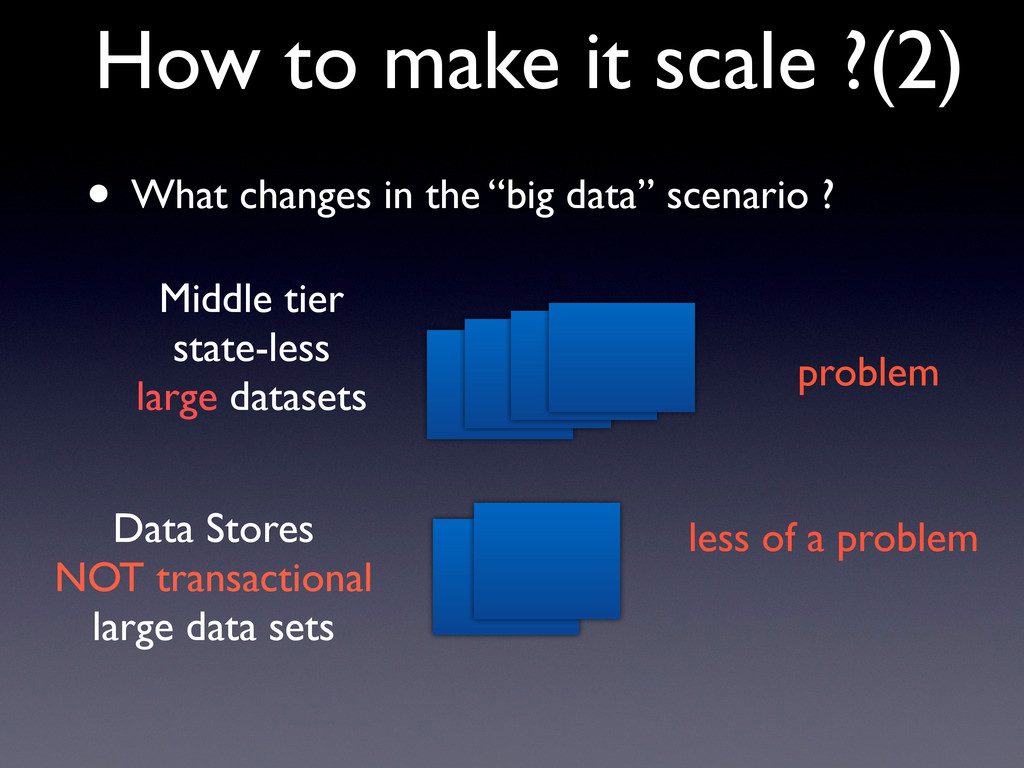
of the application developers • NoSQL are databases, or at least data stores • NoSQL : • Live data behind an application • Transactional: queries and updates • Complex structures • Flexible, schema-less data • Small volume....
developers. • We store our code, and bugs in LaunchPad. • I would like to know what’s the average of bugs solved per week per developer. • How hard can that be !?
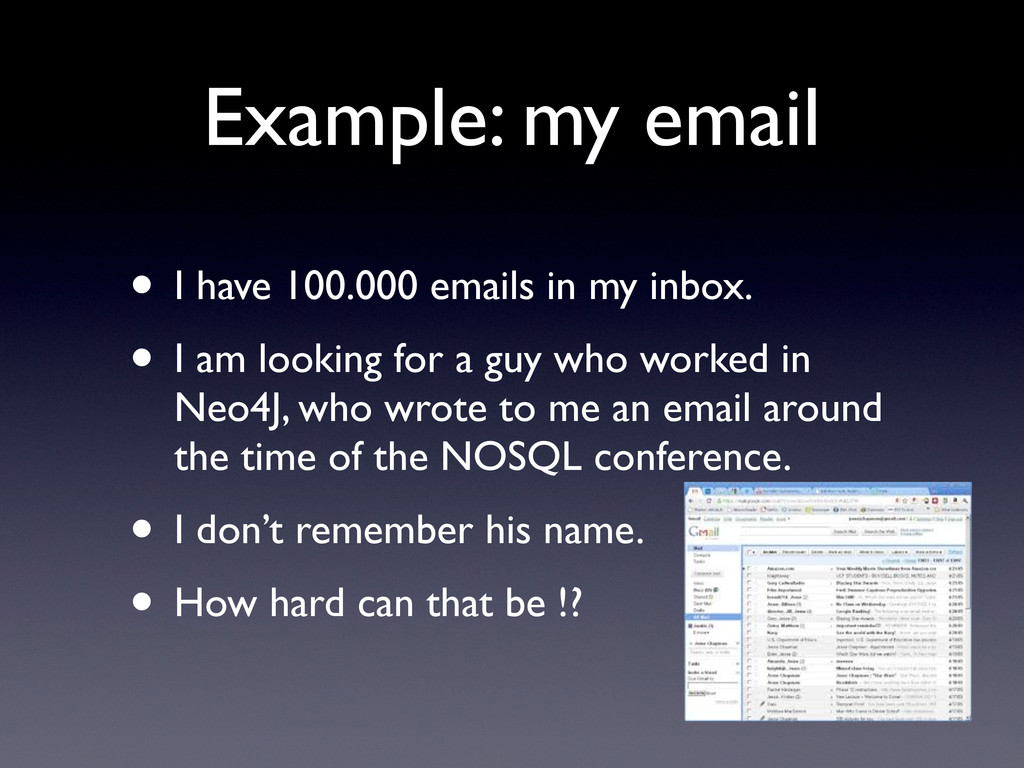
inbox. • I am looking for a guy who worked in Neo4J, who wrote to me an email around the time of the NOSQL conference. • I don’t remember his name. • How hard can that be !?
doctors treat about 100.000 with the same problem as me. About 10K have the exact precise symptoms. • They have all electronic records. • I ask: “how is this particular treatment working ?” • Answer: “we don’t know, we have no statistics”. • How hard that can be !?
Jaeger- LeCoultre, etc • I know that some of them appreciate better then others. • Ebay has all the sales data of all products in the world. • How can tell which one of the brands above appreciates better ?
tons of new potential medicines. • I have hundreds of thousands of spreasheets describing results of such testing. • I just realized that one of my testing methodology is flawed. • How can I see which results are wrong, potentially leading to serious problems with my medicine ?
to tens of thousands of prospective customers about a new product. • The conversations are stored in Salesforce. • How can I tell if my new product launch will be successful, or if there are serious problems with it ?
platform. • Purely pragmatic. • We are concerned with the global architecture, not each component in particular. • Integrate best of breed from open source • We are concerned with scaling • data size, query complexity • I can write in a matter of hours programs to solve my questions above.
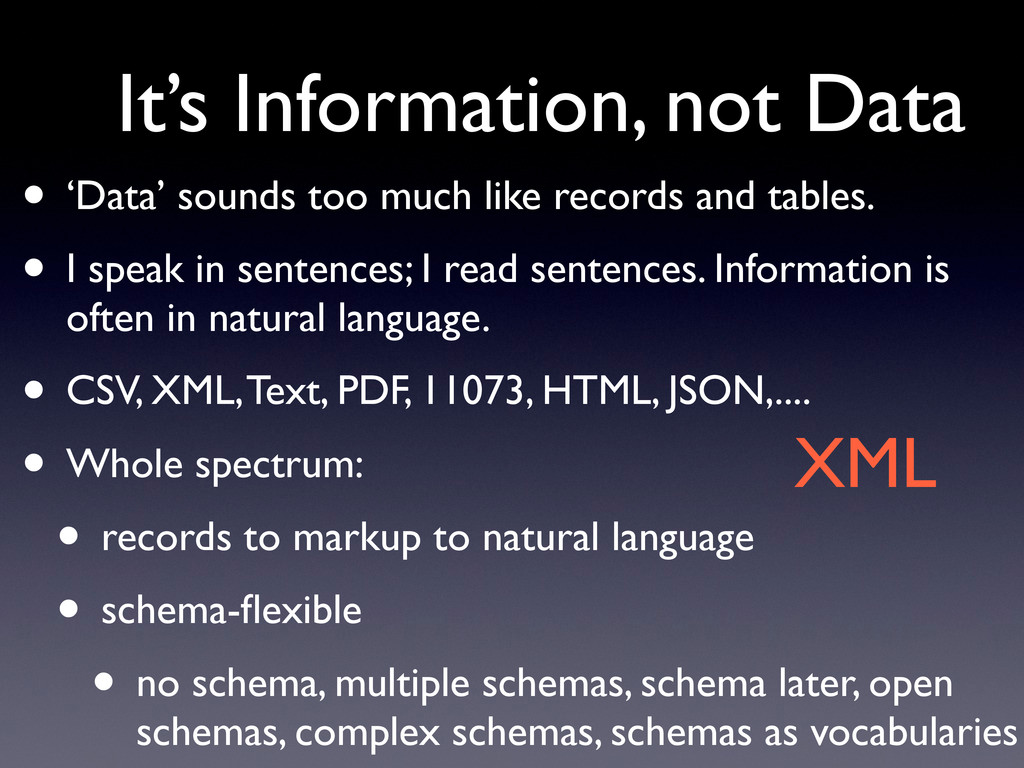
records and tables. • I speak in sentences; I read sentences. Information is often in natural language. • CSV, XML, Text, PDF, 11073, HTML, JSON,.... • Whole spectrum: • records to markup to natural language • schema-flexible • no schema, multiple schemas, schema later, open schemas, complex schemas, schemas as vocabularies XML
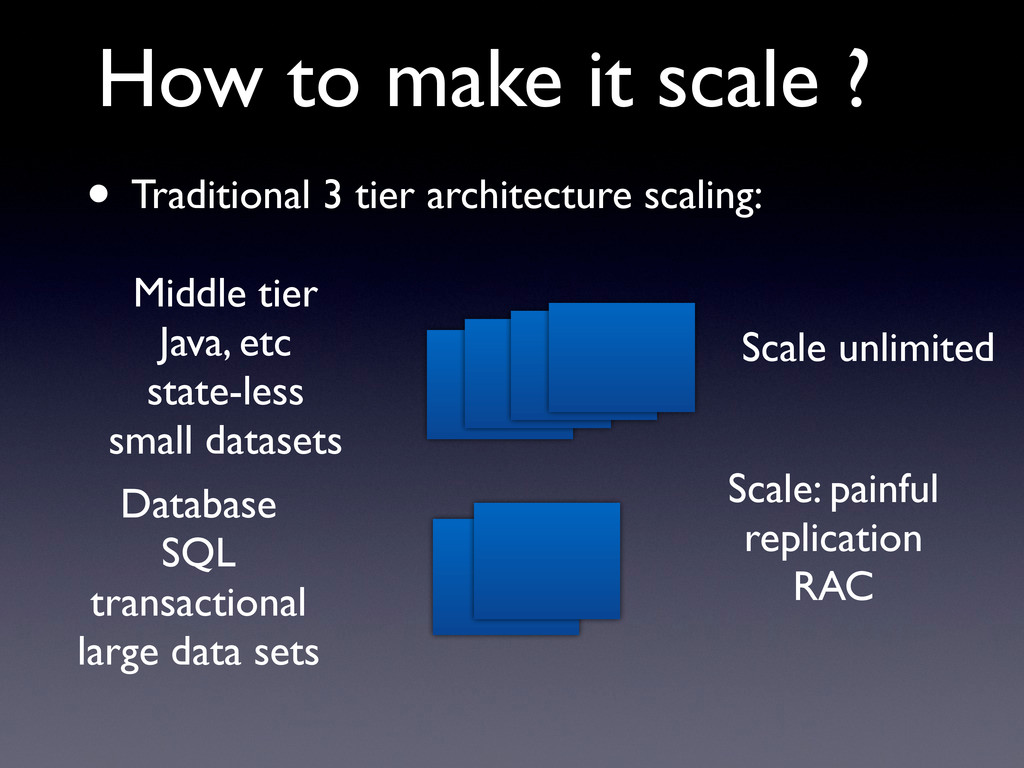
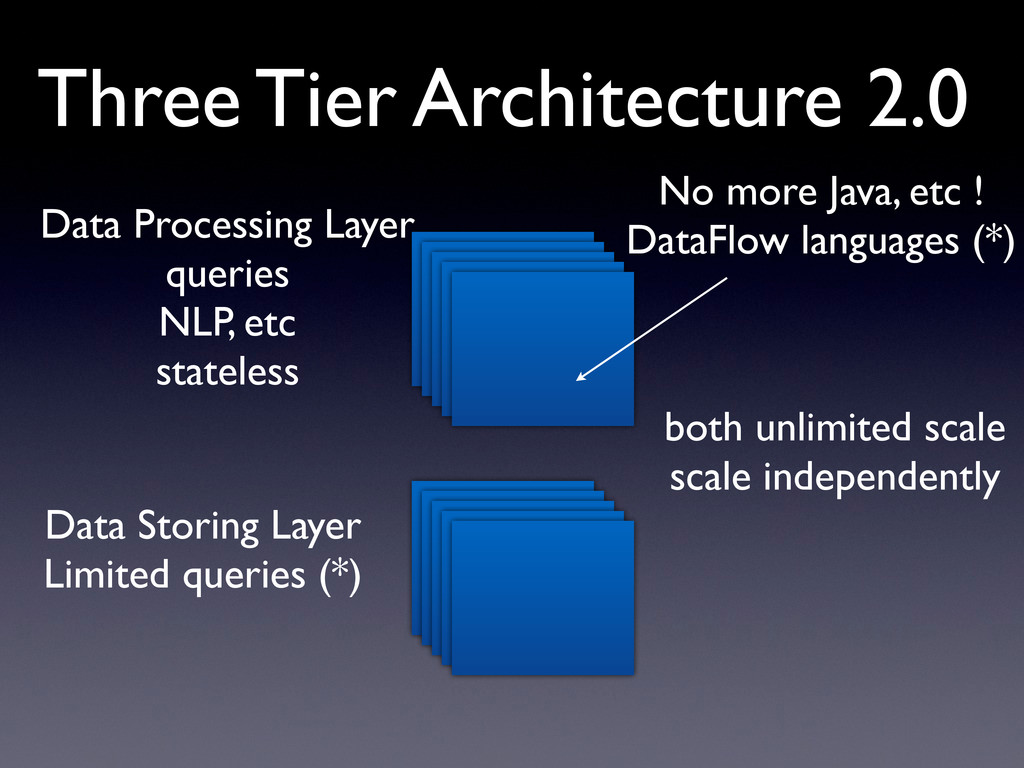
needs all the above components • Traditional ‘queries’ are just a small part • Integrate best of breed from open source • scale them independently • scale the general architecture • Has also to include components for human interaction
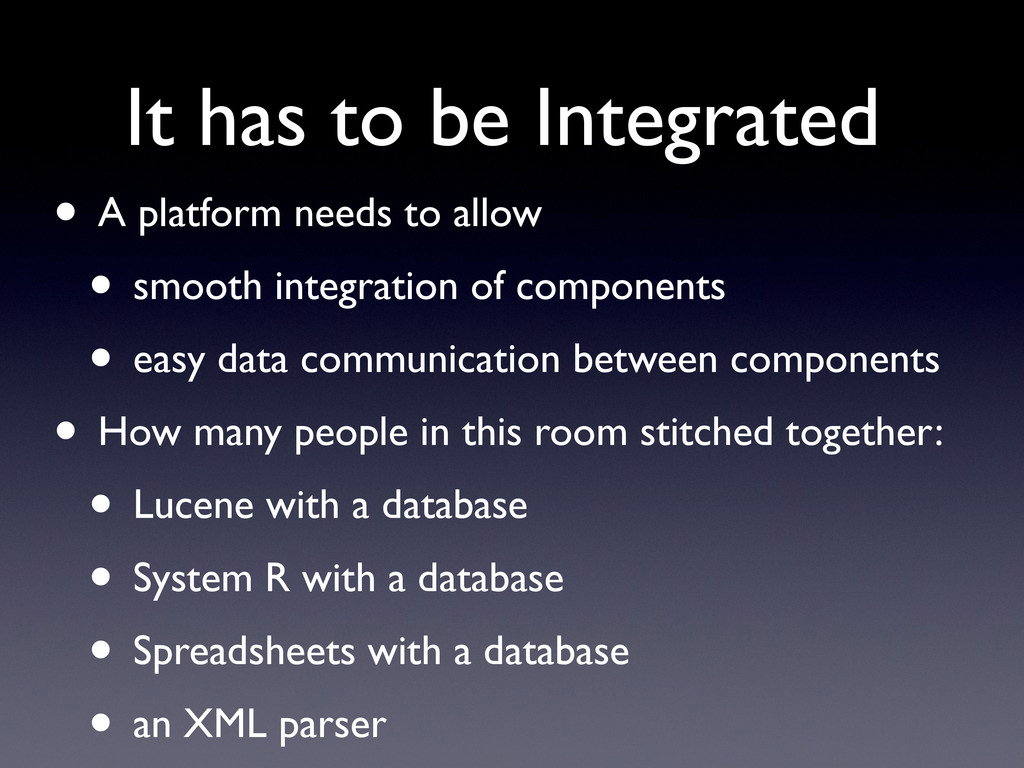
allow • smooth integration of components • easy data communication between components • How many people in this room stitched together: • Lucene with a database • System R with a database • Spreadsheets with a database • an XML parser
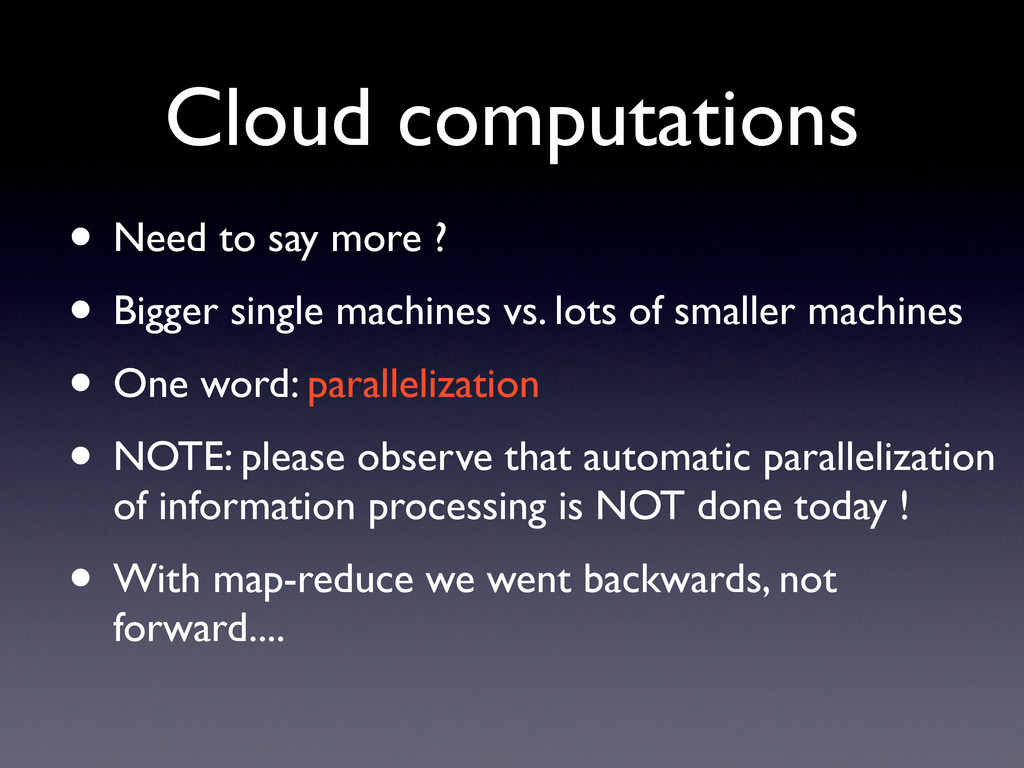
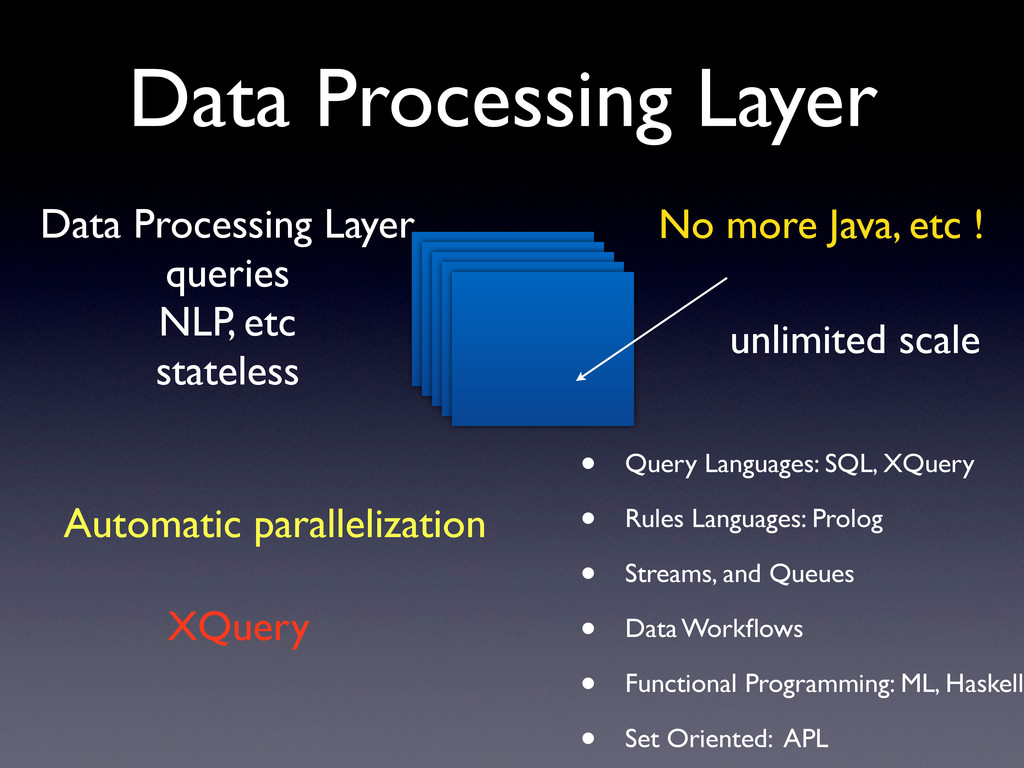
single machines vs. lots of smaller machines • One word: parallelization • NOTE: please observe that automatic parallelization of information processing is NOT done today ! • With map-reduce we went backwards, not forward....
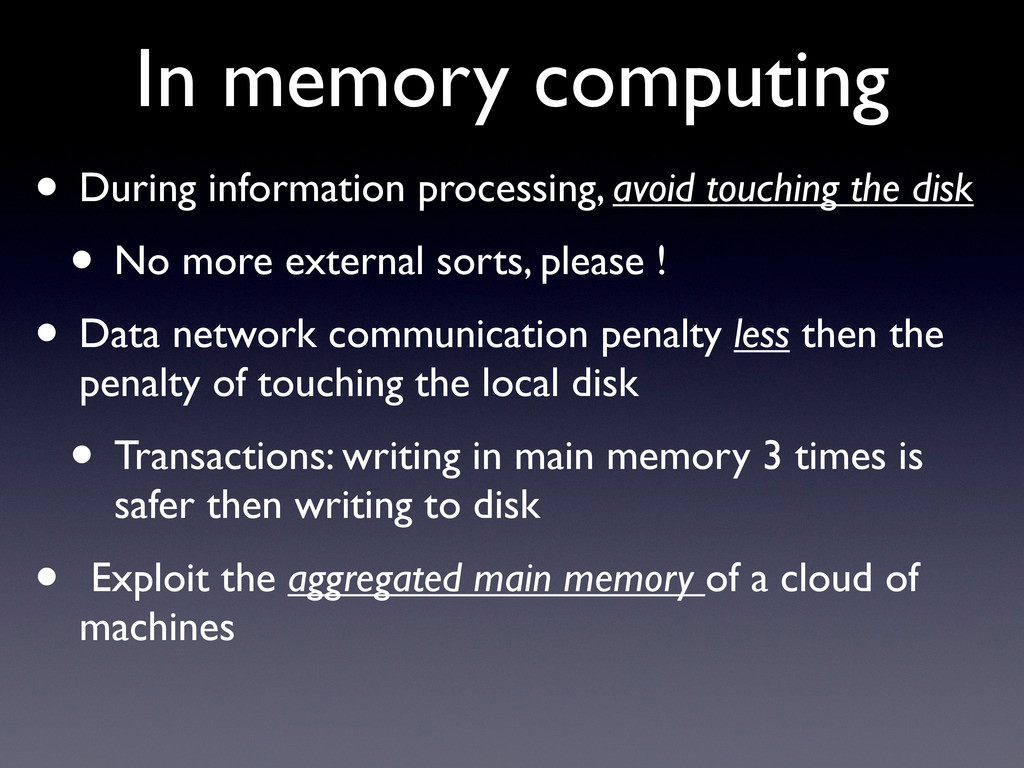
disk • No more external sorts, please ! • Data network communication penalty less then the penalty of touching the local disk • Transactions: writing in main memory 3 times is safer then writing to disk • Exploit the aggregated main memory of a cloud of machines
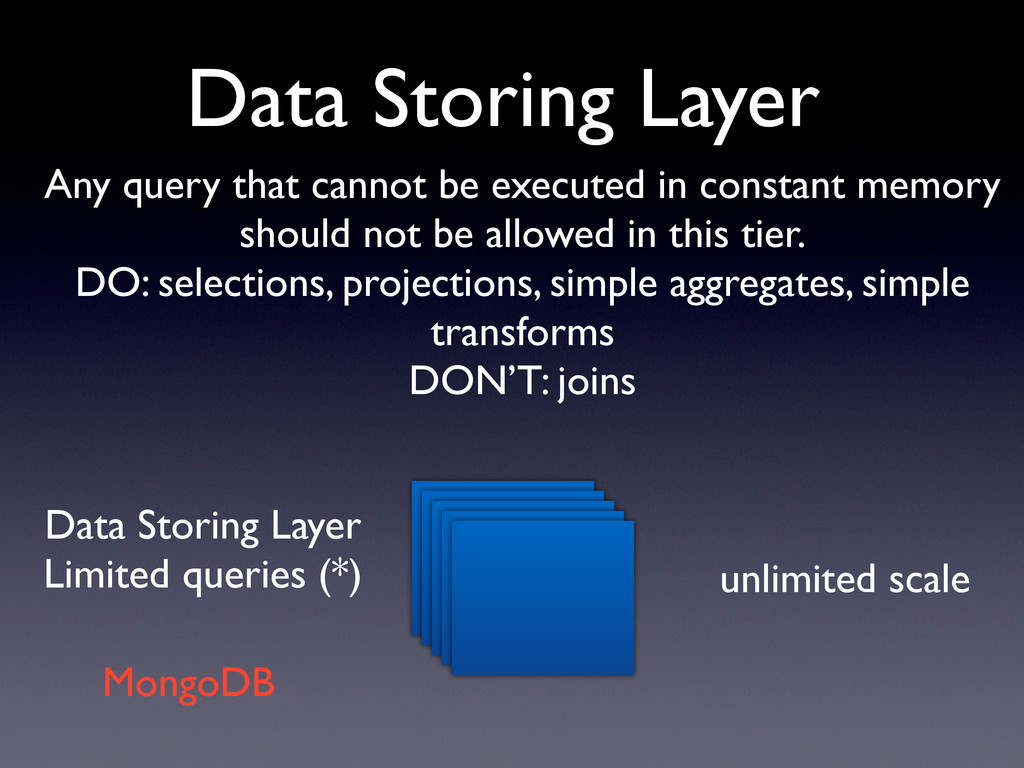
scale Any query that cannot be executed in constant memory should not be allowed in this tier. DO: selections, projections, simple aggregates, simple transforms DON’T: joins MongoDB
platform. • Purely pragmatic. • We are concerned with the global architecture, not each component in particular. • Integrate best of breed from open source • We are concerned with scaling • data size, query complexity • I can write in a matter of hours programs to solve my questions above.
$ question • Given my platform, I can write a program to do the information processing that I need. • I am a nerd....and I wrote the XQuery language.... • How can my admin do the same ?
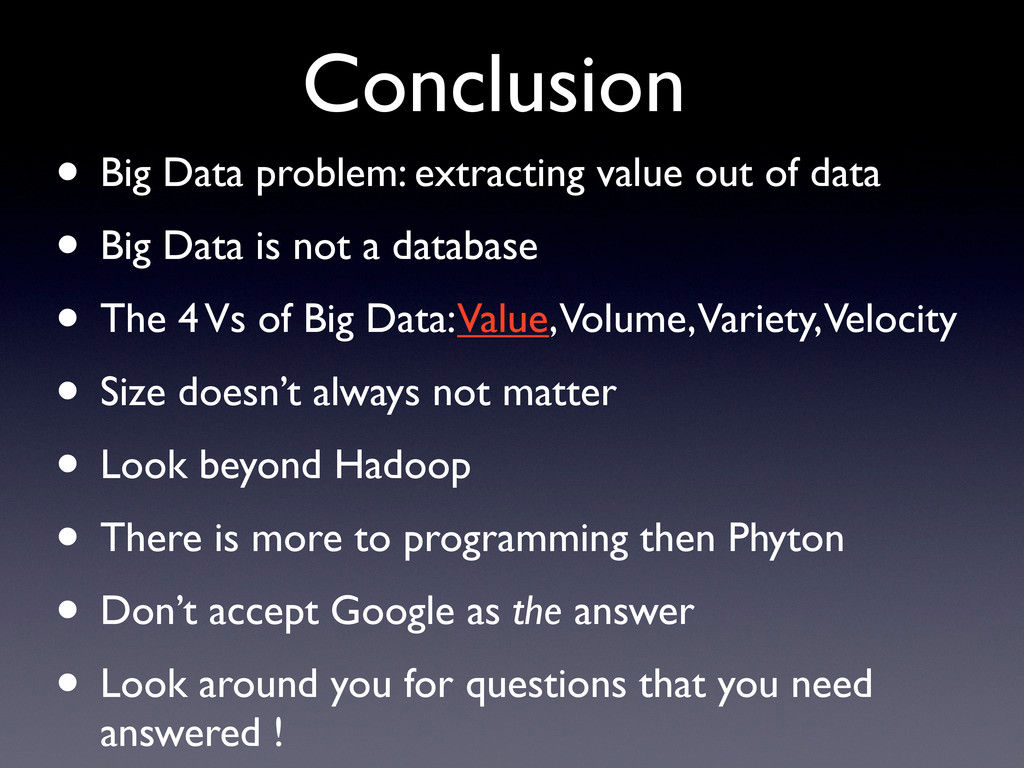
• Big Data is not a database • The 4 Vs of Big Data: Value, Volume, Variety, Velocity • Size doesn’t always not matter • Look beyond Hadoop • There is more to programming then Phyton • Don’t accept Google as the answer • Look around you for questions that you need answered !
architectures, machine learning, knowledge representation in “database” classes. • Teach functional programming, dataflow architectures • Please do not forget about query processing and automatic parallelization...


 y0hgi
 teamlab
 shumei_ito
 bitkey
 ivry_presentationmaterials
 nttcom
 yu23ki14
 yamanoku
 moznion
 gionn
 terurou
 shogo4131
 tamaranovitovic
 minecr
 mfonobong
 tammyeverts
 maltzj
 speakerdeck
 reverentgeek
 jcasabona
 skipperchong
 aarron
 trishagee
 tmiket