Upgrade to Pro — share decks privately, control downloads, hide ads and more …

Modeling with Document Databases: 5 Key Patterns

Sponsored · Ship Features Fearlessly Turn features on and off without deploys. Used by thousands of Ruby developers. →

Modeling with Document Databases: 5 Key Patterns

Document databases are more flexible in many ways than relational databases and this presents both opportunities and challenges. Poorly designed document structures adversely affect performance, increase maintenance overhead, and lead to unnecessarily complex application code. This presentation describes 5 commonly used design patterns in document databases: one-to-many, many-to-many, simple table inheritance, trees and lookup patterns. Each pattern is described in sufficient detail so attendees will understand their purpose, advantages, disadvantages and when to use them. Examples are drawn from multiple application areas. The talk will also include comparisons to relational database patterns for the benefit of relational modelers who are beginning to work with NoSQL databases.

Avatar for Dan Sullivan

Dan Sullivan

April 09, 2015

Other Decks in Technology

Transcript

  1. Modeling with Document Databases: 5 Key Patterns Dan Sullivan, Principal

    DS Applied Technologies Enterprise Data World 2015 Washington, D.C. April 1, 2015
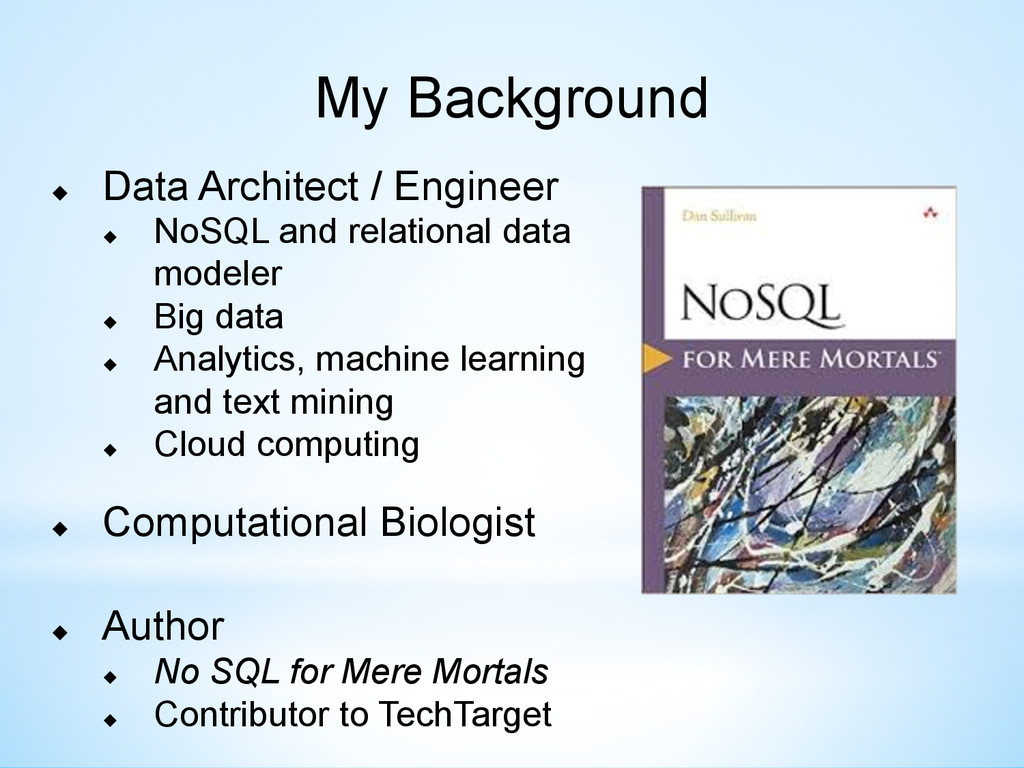
  2. My Background u  Data Architect / Engineer u  NoSQL and

    relational data modeler u  Big data u  Analytics, machine learning and text mining u  Cloud computing u  Computational Biologist u  Author u  No SQL for Mere Mortals u  Contributor to TechTarget
  3. Overview u  Patterns and Data Modeling u  5 Key Patterns

    u  Anti-Patterns to Avoid u  Last suggestions { -------------- -------------- -------------- { ------ ------ } } [ ----------- ] } Document { -------------- -------------- -------------- { ------ ------ } } [ ----------- ] } Document { -------------- -------------- -------------- { ------ ------ } } [ ----------- ] } Document { -------------- -------------- -------------- { ------ ------ } } [ ----------- ] } Document
  4. Schema-less <> Model-less u  Schema-less Document Databases u  No fixed

    schema u  Polymorphic documents u  ...however, not a Design Free for All u  Queries drives organization u  Performance Considerations u  Long-term Maintenance u  Middle Ground: Data Model Patterns u  Reusable methods for organizing data u  Model is implicit in document structures
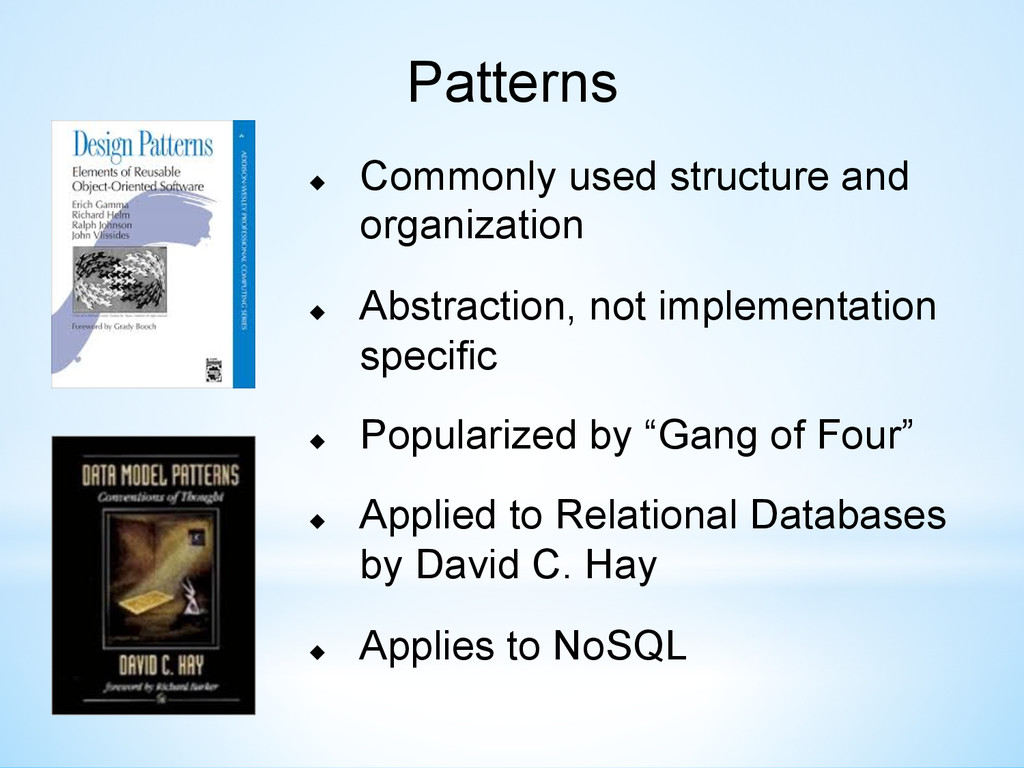
  5. Patterns u  Commonly used structure and organization u  Abstraction, not

    implementation specific u  Popularized by “Gang of Four” u  Applied to Relational Databases by David C. Hay u  Applies to NoSQL
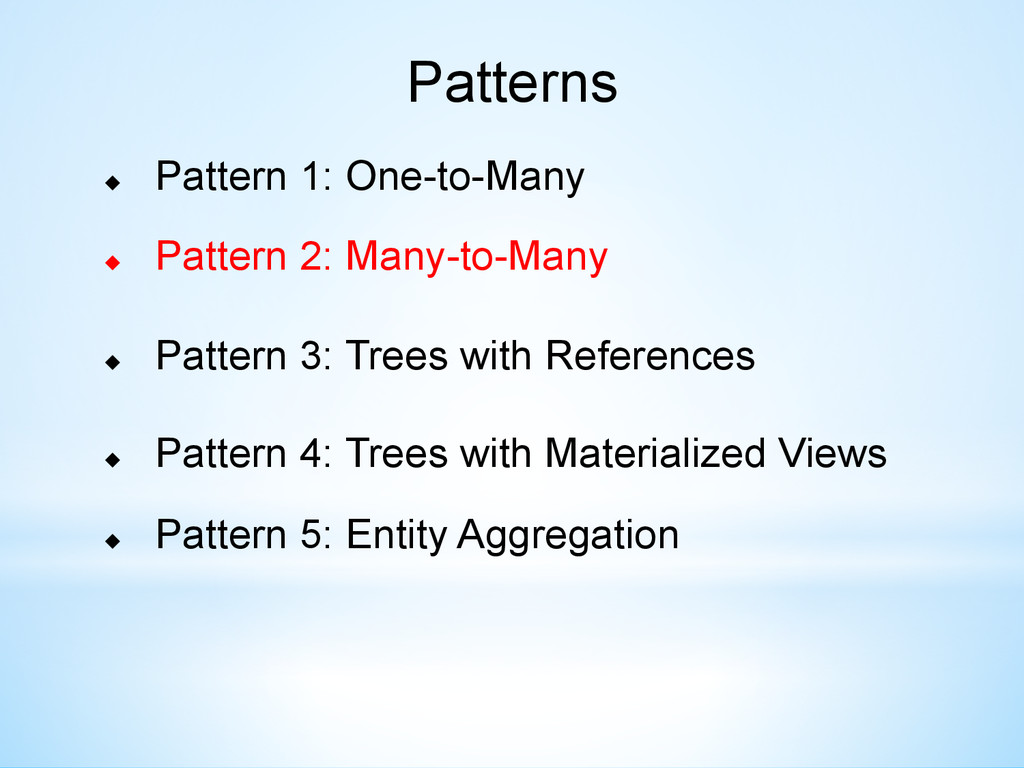
  6. Patterns u  Pattern 1: One-to-Many u  Pattern 2: Many-to-Many u 

    Pattern 3: Trees with References u  Pattern 4: Trees with Materialized Views u  Pattern 5: Entity Aggregation
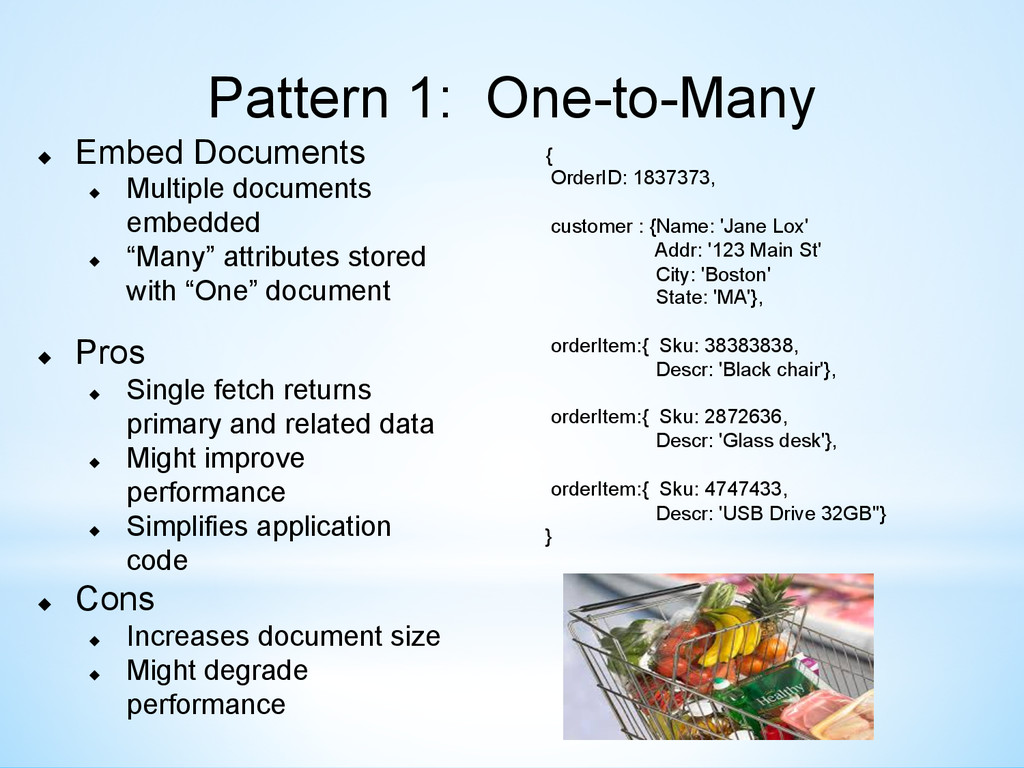
  7. Pattern 1: One-to-Many u  Embed Documents u  Multiple documents embedded

    u  “Many” attributes stored with “One” document u  Pros u  Single fetch returns primary and related data u  Might improve performance u  Simplifies application code u  Cons u  Increases document size u  Might degrade performance { OrderID: 1837373, customer : {Name: 'Jane Lox' Addr: '123 Main St' City: 'Boston' State: 'MA'}, orderItem:{ Sku: 38383838, Descr: 'Black chair'}, orderItem:{ Sku: 2872636, Descr: 'Glass desk'}, orderItem:{ Sku: 4747433, Descr: 'USB Drive 32GB''} }
  8. One-to-Many Considerations u  Query attributes in embedded documents? u  Support

    for indexing embedded documents? u  Potential for arbitrary growth after record created? u  Need for atomic writes?
  9. Patterns u  Pattern 1: One-to-Many u  Pattern 2: Many-to-Many u 

    Pattern 3: Trees with References u  Pattern 4: Trees with Materialized Views u  Pattern 5: Entity Aggregation
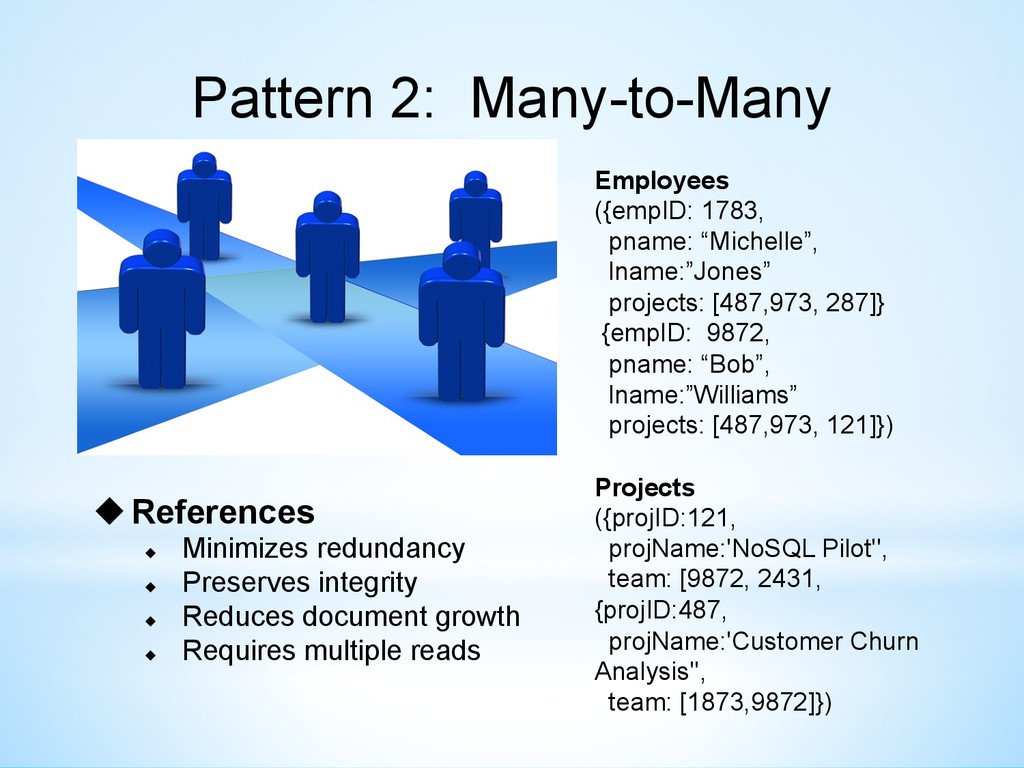
  10. Pattern 2: Many-to-Many Employees ({empID: 1783, pname: “Michelle”, lname:”Jones” projects:

    [487,973, 287]} {empID: 9872, pname: “Bob”, lname:”Williams” projects: [487,973, 121]}) Projects ({projID:121, projName:'NoSQL Pilot'', team: [9872, 2431, {projID:487, projName:'Customer Churn Analysis'', team: [1873,9872]}) u References u  Minimizes redundancy u  Preserves integrity u  Reduces document growth u  Requires multiple reads
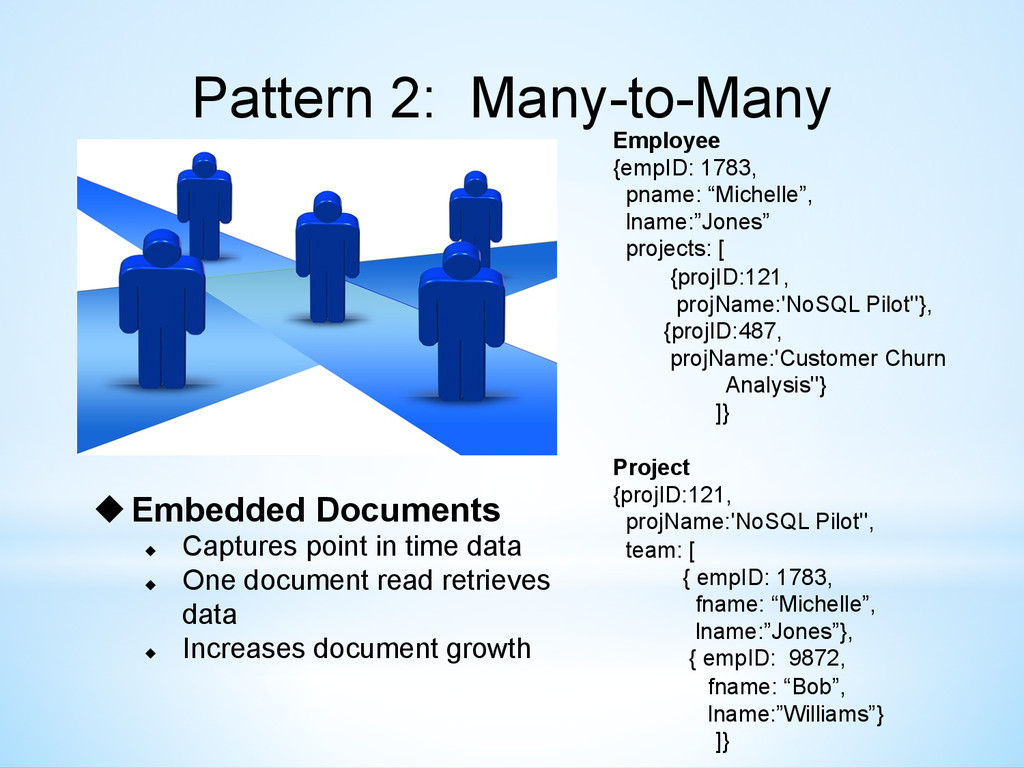
  11. Pattern 2: Many-to-Many Employee {empID: 1783, pname: “Michelle”, lname:”Jones” projects:

    [ {projID:121, projName:'NoSQL Pilot''}, {projID:487, projName:'Customer Churn Analysis''} ]} Project {projID:121, projName:'NoSQL Pilot'', team: [ { empID: 1783, fname: “Michelle”, lname:”Jones”}, { empID: 9872, fname: “Bob”, lname:”Williams”} ]} u Embedded Documents u  Captures point in time data u  One document read retrieves data u  Increases document growth
  12. Many-to-Many Considerations u  References u  Minimizes redundancy u  Preserves integrity

    u  Reduces document growth u  Requires multiple reads u  Embedded Documents u  Captures point in time data u  One document read retrieves data u  Increases document growth
  13. Patterns u  Pattern 1: One-to-Many u  Pattern 2: Many-to-Many u 

    Pattern 3: Trees with References u  Pattern 4: Trees with Materialized Views u  Pattern 5: Entity Aggregation
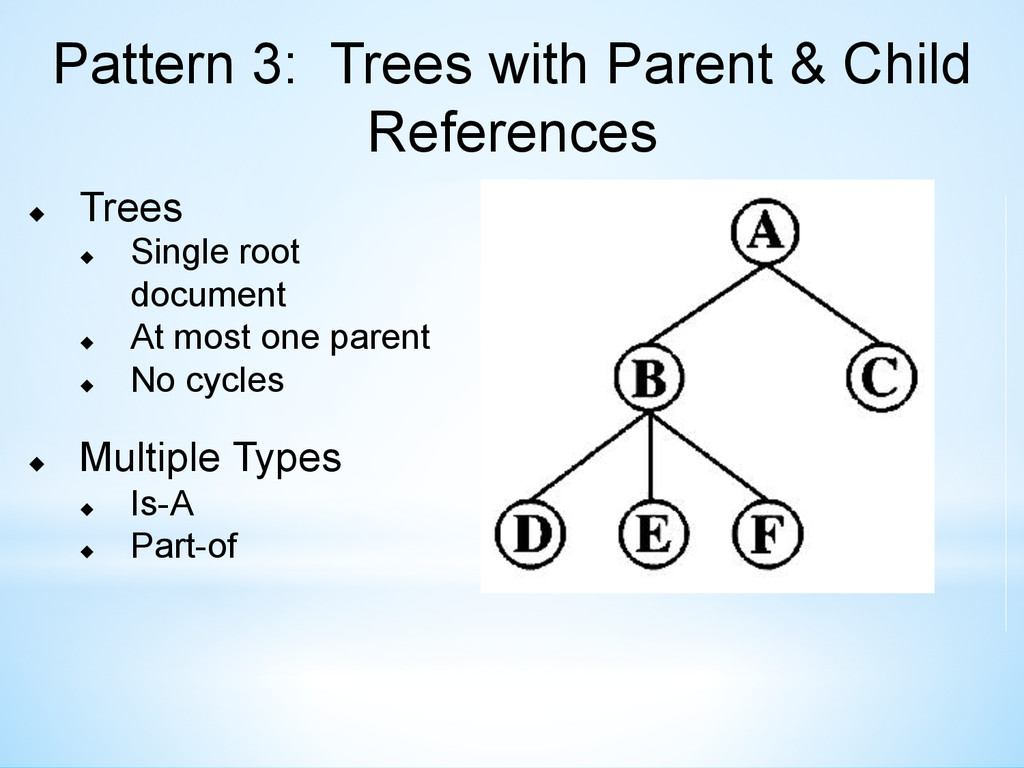
  14. Pattern 3: Trees with Parent & Child References u  Trees

    u  Single root document u  At most one parent u  No cycles u  Multiple Types u  Is-A u  Part-of
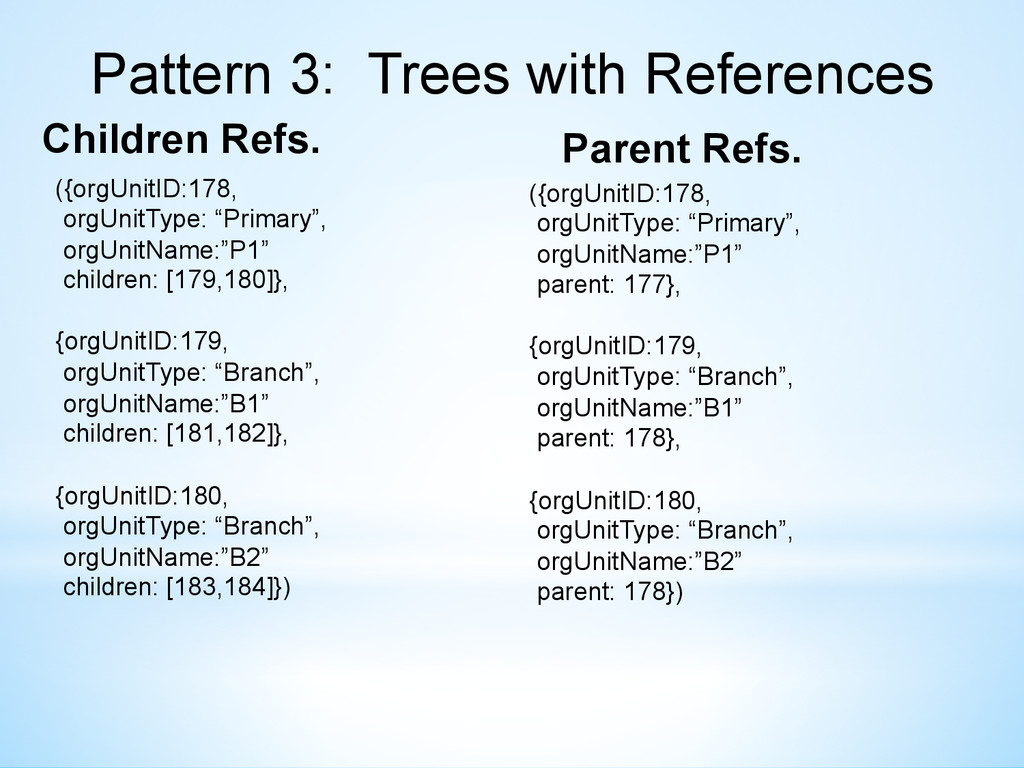
  15. Pattern 3: Trees with References Children Refs. ({orgUnitID:178, orgUnitType: “Primary”,

    orgUnitName:”P1” children: [179,180]}, {orgUnitID:179, orgUnitType: “Branch”, orgUnitName:”B1” children: [181,182]}, {orgUnitID:180, orgUnitType: “Branch”, orgUnitName:”B2” children: [183,184]}) Parent Refs. ({orgUnitID:178, orgUnitType: “Primary”, orgUnitName:”P1” parent: 177}, {orgUnitID:179, orgUnitType: “Branch”, orgUnitName:”B1” parent: 178}, {orgUnitID:180, orgUnitType: “Branch”, orgUnitName:”B2” parent: 178})
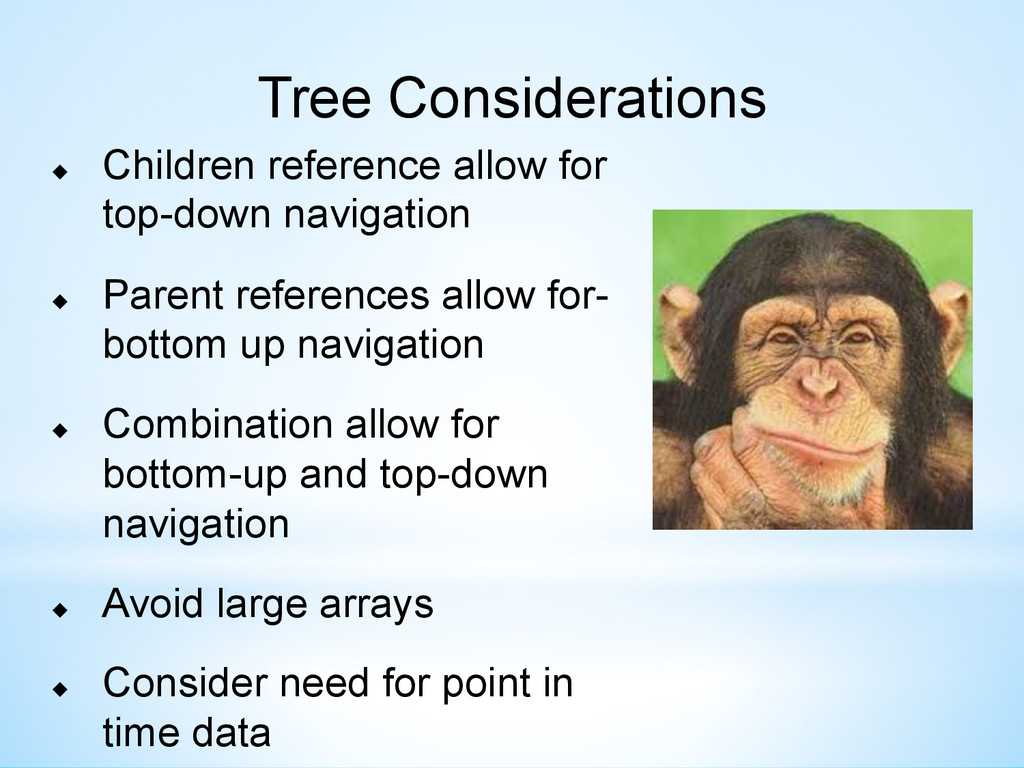
  16. Tree Considerations u  Children reference allow for top-down navigation u 

    Parent references allow for- bottom up navigation u  Combination allow for bottom-up and top-down navigation u  Avoid large arrays u  Consider need for point in time data
  17. Patterns u  Pattern 1: One-to-Many u  Pattern 2: Many-to-Many u 

    Pattern 3: Trees with References u  Pattern 4: Trees with Materialized Views u  Pattern 5: Entity Aggregation
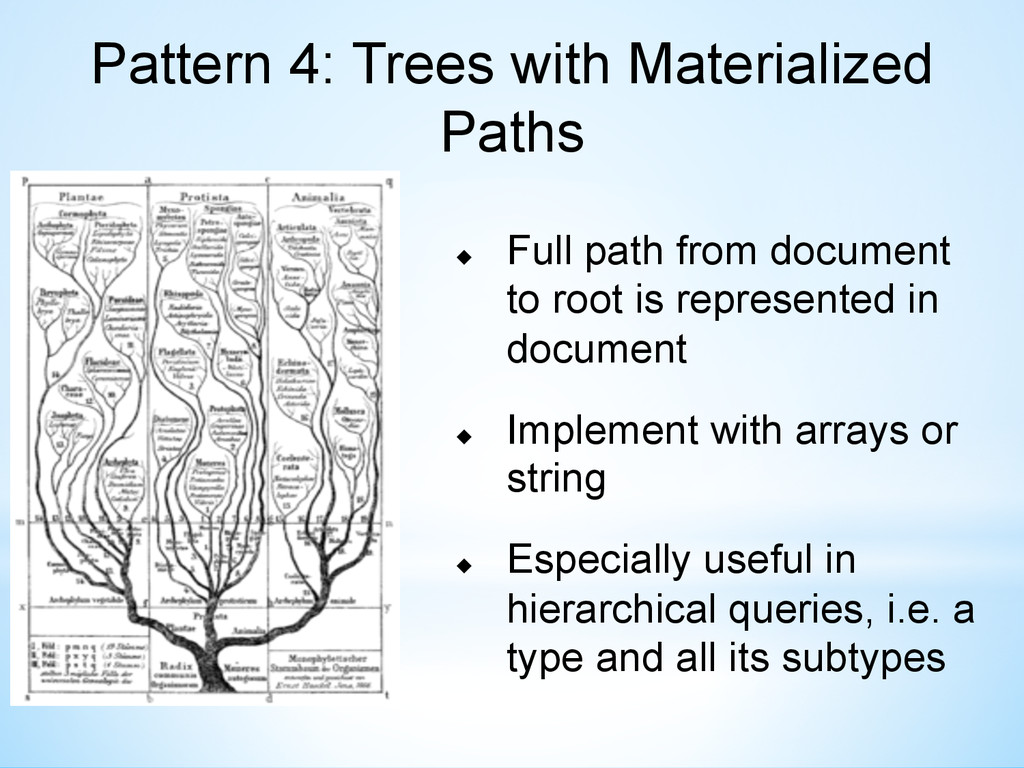
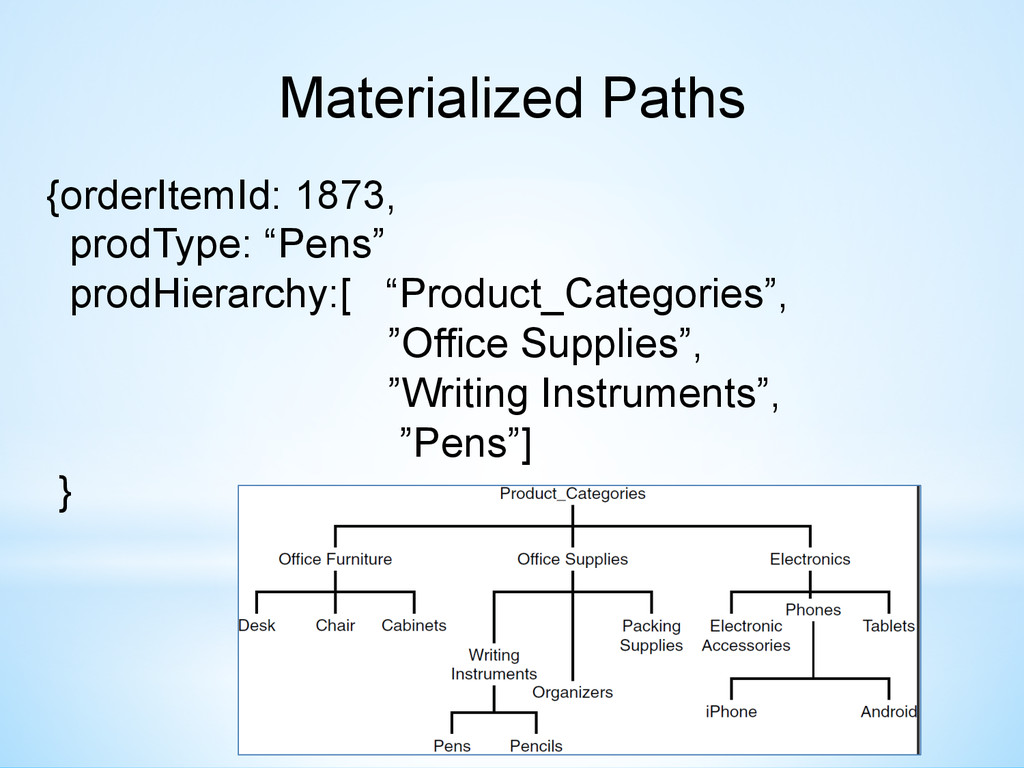
  18. Pattern 4: Trees with Materialized Paths u  Full path from

    document to root is represented in document u  Implement with arrays or string u  Especially useful in hierarchical queries, i.e. a type and all its subtypes
  19. Materialized Paths Considerations u  Support for multi-key indexing of arrays

    u  Use of regular expressions for pattern matching when string is used u  Ability to utilize indexes when string representation
  20. Patterns u  Pattern 1: One-to-Many u  Pattern 2: Many-to-Many u 

    Pattern 3: Trees with References u  Pattern 4: Trees with Materialized Views u  Pattern 5: Entity Aggregation
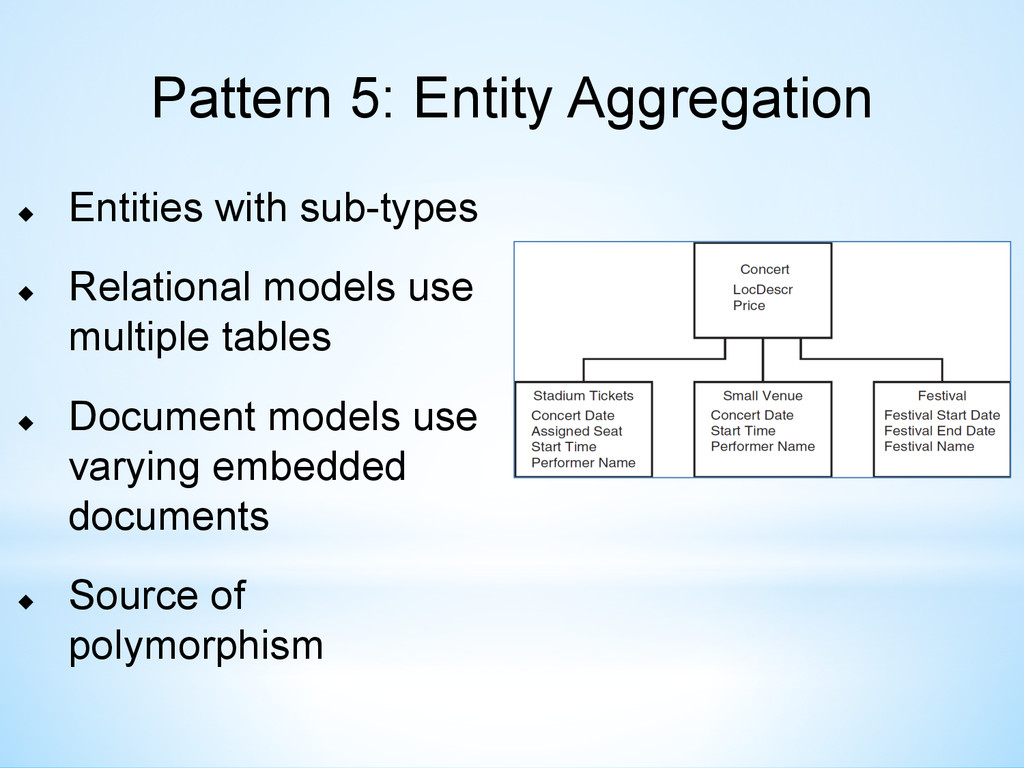
  21. Pattern 5: Entity Aggregation u  Entities with sub-types u  Relational

    models use multiple tables u  Document models use varying embedded documents u  Source of polymorphism
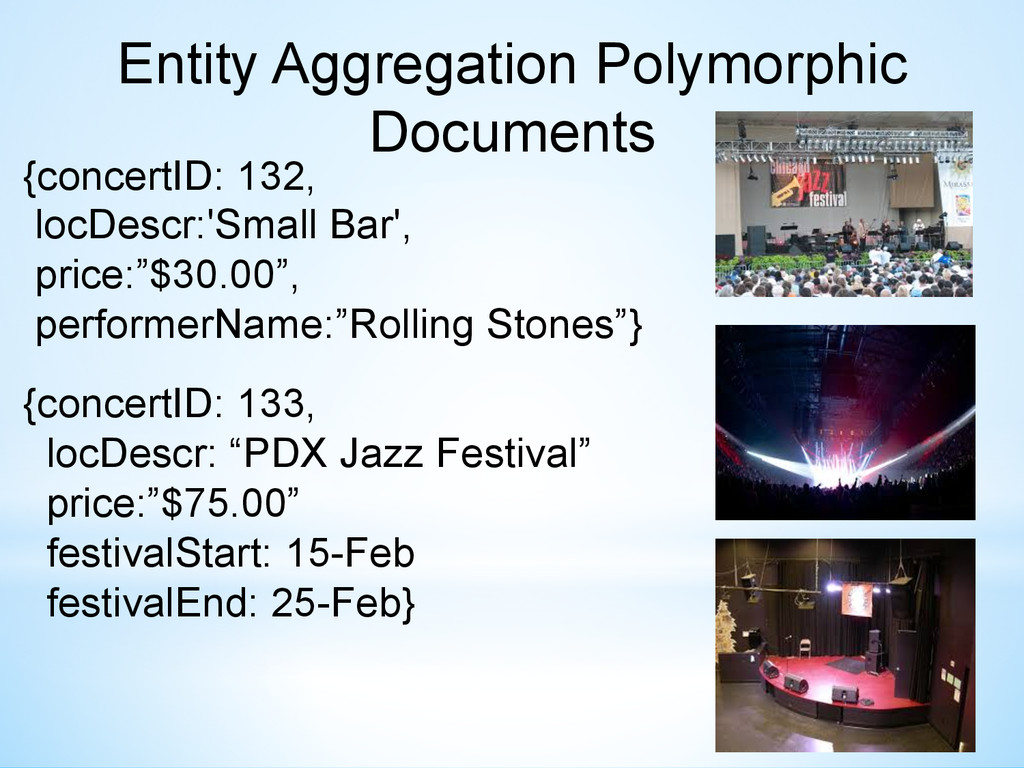
  22. Entity Aggregation Polymorphic Documents {concertID: 132, locDescr:'Small Bar', price:”$30.00”, performerName:”Rolling

    Stones”} {concertID: 133, locDescr: “PDX Jazz Festival” price:”$75.00” festivalStart: 15-Feb festivalEnd: 25-Feb}
  23. Anti-Patterns u  Large arrays u  Significant growth in document size

    u  Fetching more data than needed u  Fear of data duplication u  Thinking SQL, using NoSQL u  Normalizing without need
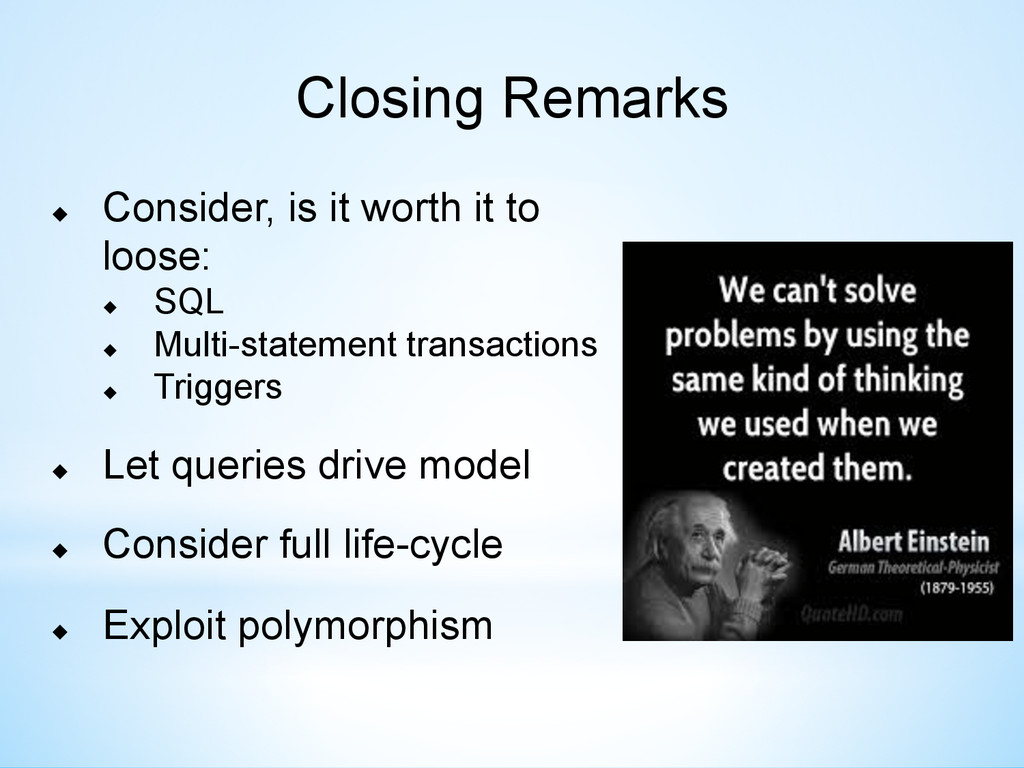
  24. Closing Remarks u  Consider, is it worth it to loose:

    u  SQL u  Multi-statement transactions u  Triggers u  Let queries drive model u  Consider full life-cycle u  Exploit polymorphism