This was an invited talk at the Central Middle School, Maryland. Without going into a lot of math, I try to explain the fundamental key exchange problem. It was a blast. 8th graders enjoyed it as much as I enjoyed it.
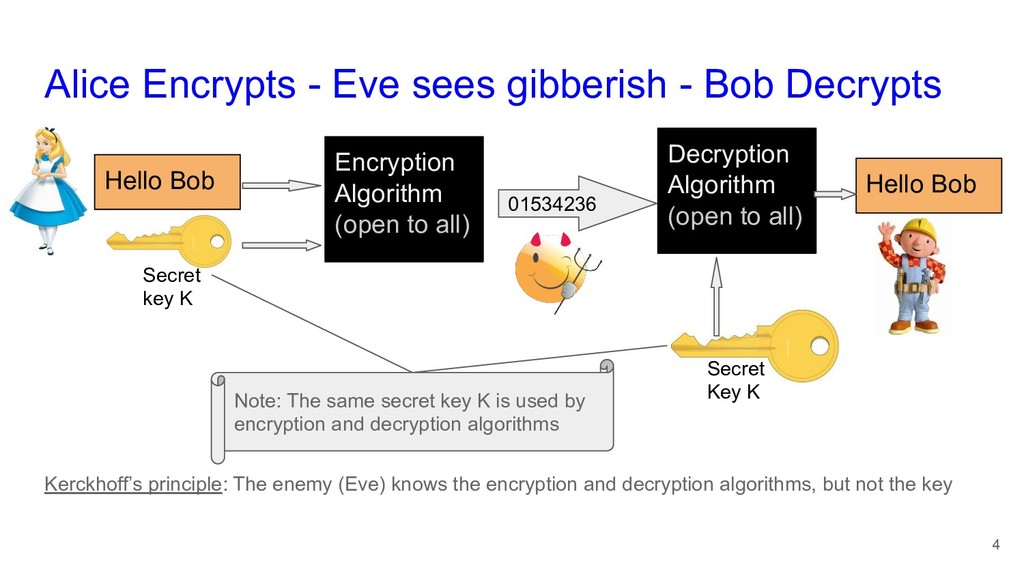
Hello Bob Encryption Algorithm (open to all) Secret key K 01534236 Secret Key K Decryption Algorithm (open to all) Hello Bob Note: The same secret key K is used by encryption and decryption algorithms Kerckhoff’s principle: The enemy (Eve) knows the encryption and decryption algorithms, but not the key
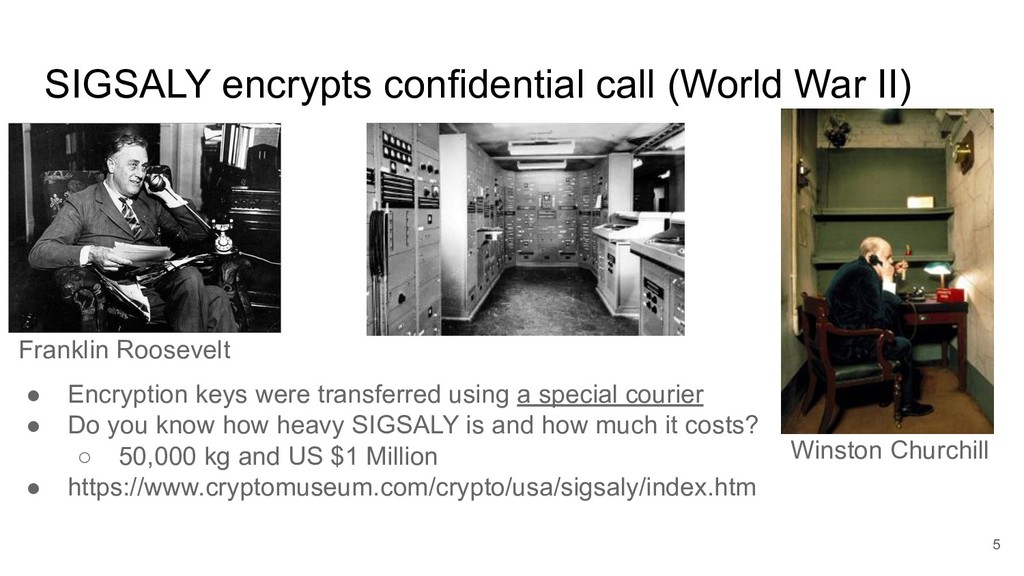
keys were transferred using a special courier • Do you know how heavy SIGSALY is and how much it costs? ◦ 50,000 kg and US $1 Million • https://www.cryptomuseum.com/crypto/usa/sigsaly/index.htm Winston Churchill Franklin Roosevelt
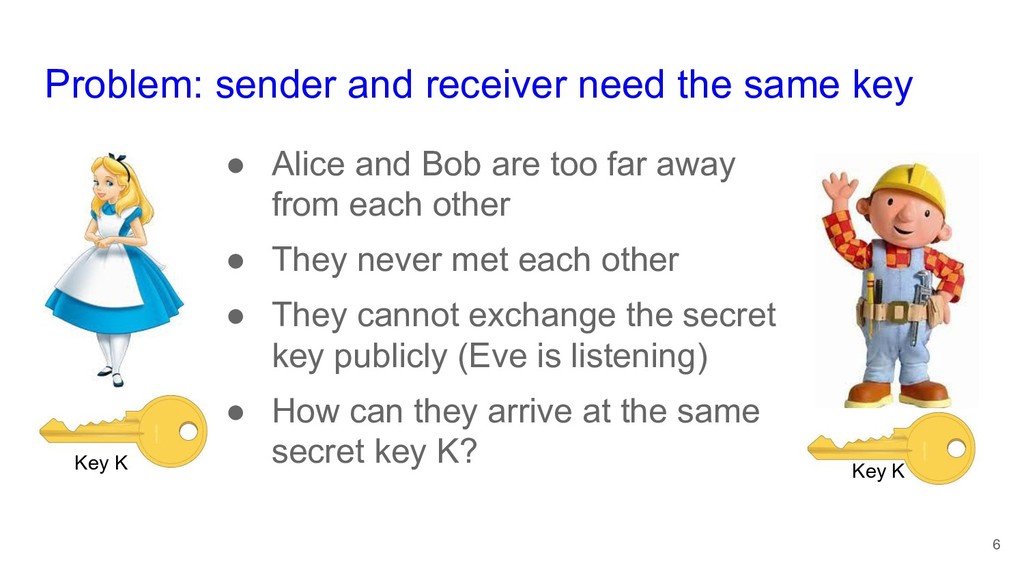
K Key K • Alice and Bob are too far away from each other • They never met each other • They cannot exchange the secret key publicly (Eve is listening) • How can they arrive at the same secret key K?
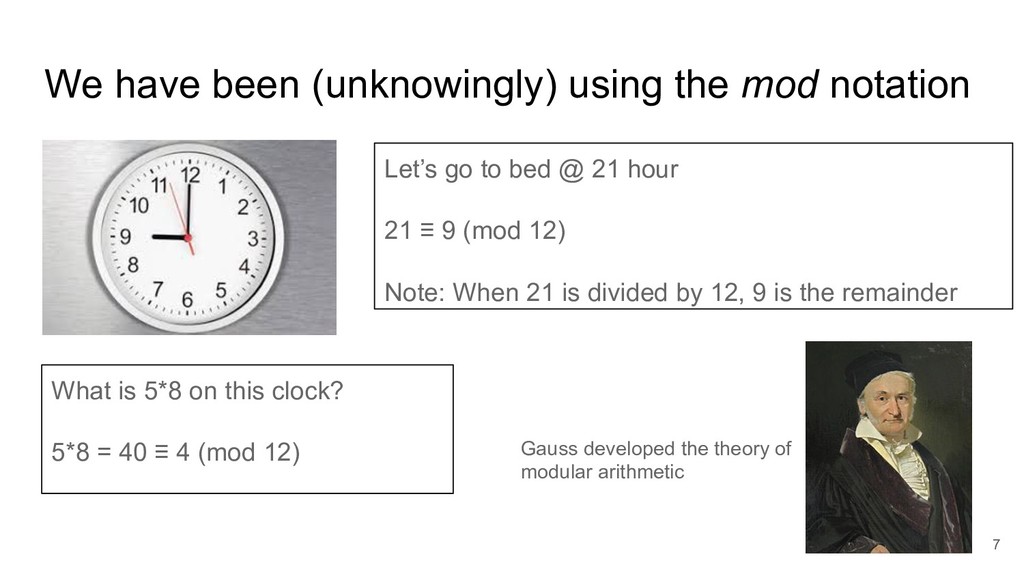
go to bed @ 21 hour 21 ≡ 9 (mod 12) Note: When 21 is divided by 12, 9 is the remainder What is 5*8 on this clock? 5*8 = 40 ≡ 4 (mod 12) Gauss developed the theory of modular arithmetic
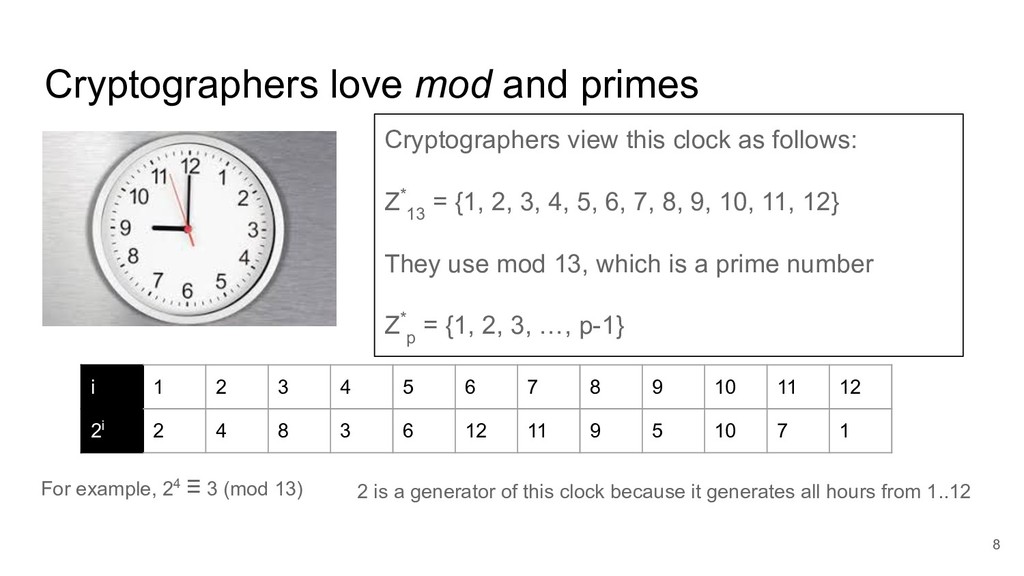
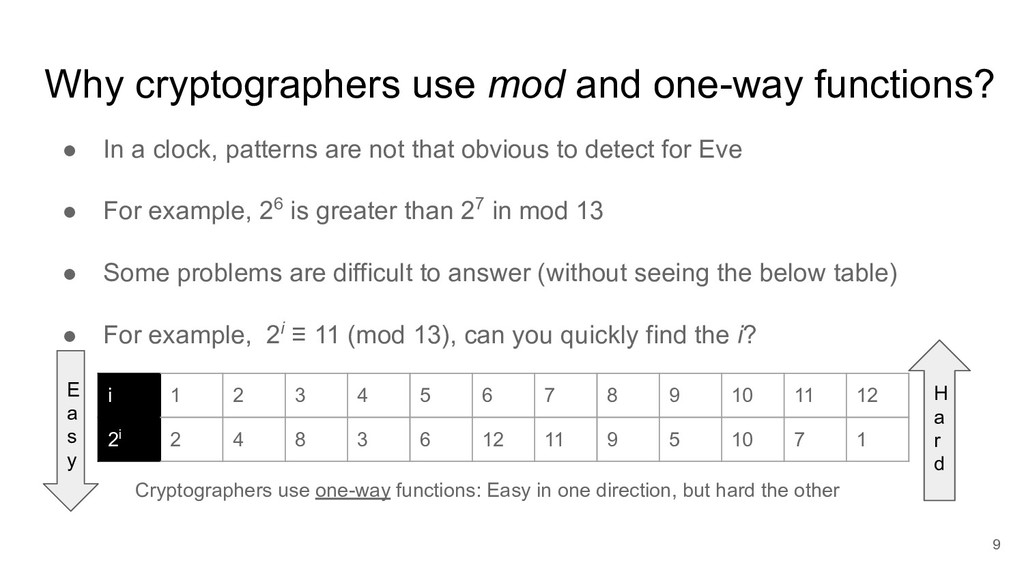
as follows: Z* 13 = {1, 2, 3, 4, 5, 6, 7, 8, 9, 10, 11, 12} They use mod 13, which is a prime number Z* p = {1, 2, 3, …, p-1} i 1 2 3 4 5 6 7 8 9 10 11 12 2i 2 4 8 3 6 12 11 9 5 10 7 1 For example, 24 ≡ 3 (mod 13) 2 is a generator of this clock because it generates all hours from 1..12
a clock, patterns are not that obvious to detect for Eve • For example, 26 is greater than 27 in mod 13 • Some problems are difficult to answer (without seeing the below table) • For example, 2i ≡ 11 (mod 13), can you quickly find the i? i 1 2 3 4 5 6 7 8 9 10 11 12 2i 2 4 8 3 6 12 11 9 5 10 7 1 E a s y H a r d Cryptographers use one-way functions: Easy in one direction, but hard the other
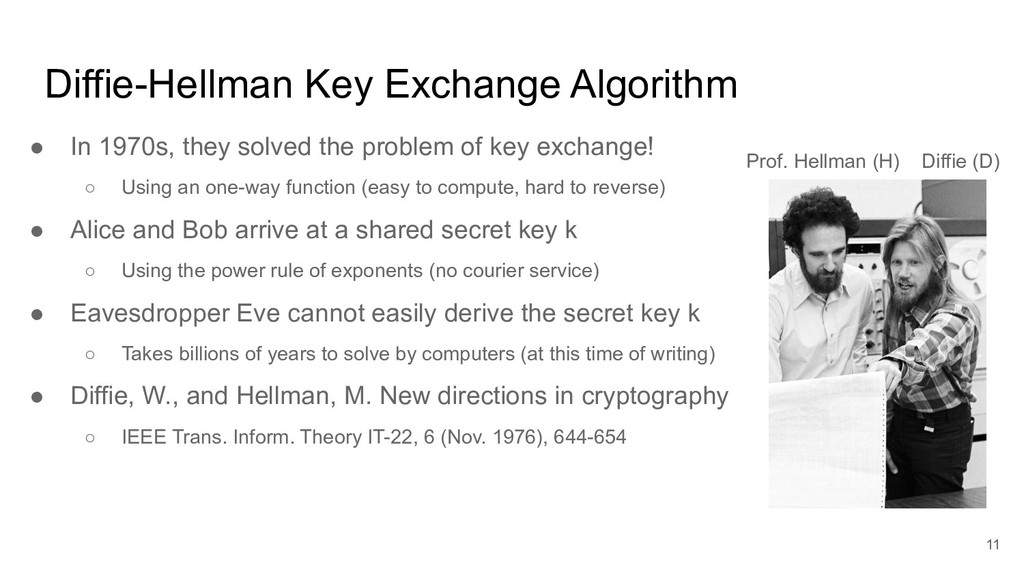
problem of key exchange! ◦ Using an one-way function (easy to compute, hard to reverse) • Alice and Bob arrive at a shared secret key k ◦ Using the power rule of exponents (no courier service) • Eavesdropper Eve cannot easily derive the secret key k ◦ Takes billions of years to solve by computers (at this time of writing) • Diffie, W., and Hellman, M. New directions in cryptography ◦ IEEE Trans. Inform. Theory IT-22, 6 (Nov. 1976), 644-654 11 Prof. Hellman (H) Diffie (D)
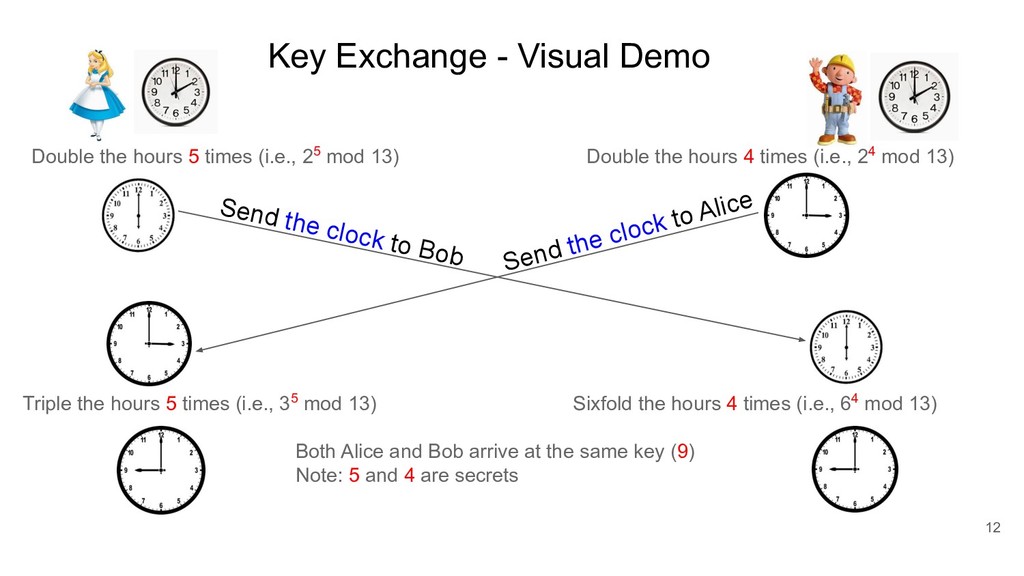
Double the hours 4 times (i.e., 24 mod 13) Send the clock to Bob Send the clock to Alice Key Exchange - Visual Demo Triple the hours 5 times (i.e., 35 mod 13) Sixfold the hours 4 times (i.e., 64 mod 13) Both Alice and Bob arrive at the same key (9) Note: 5 and 4 are secrets
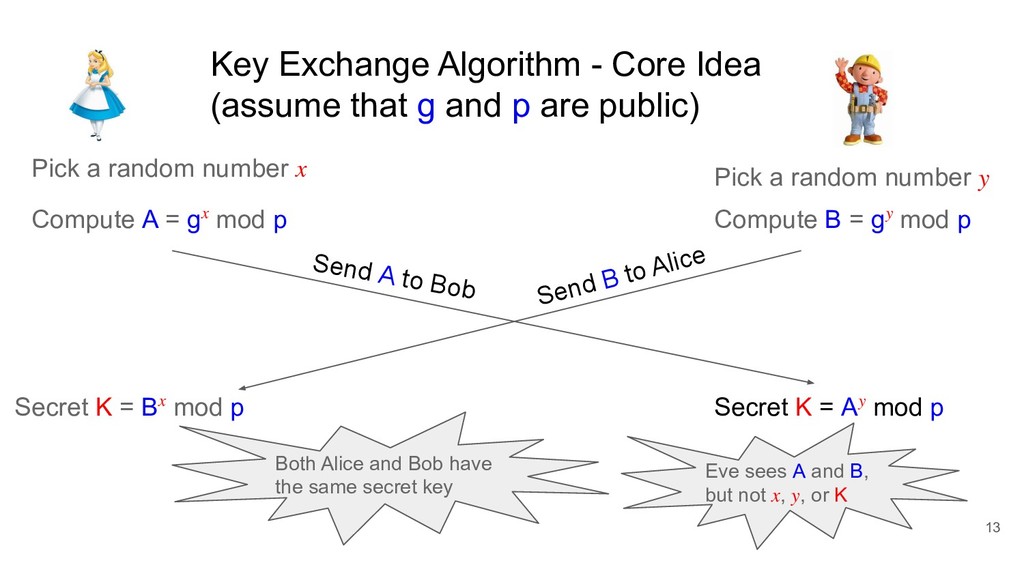
A = g mod p Compute B = g mod p Secret K = B mod p Secret K = A mod p Send A to Bob Send B to Alice Both Alice and Bob have the same secret key Eve sees A and B, but not , , or K Key Exchange Algorithm - Core Idea (assume that g and p are public)
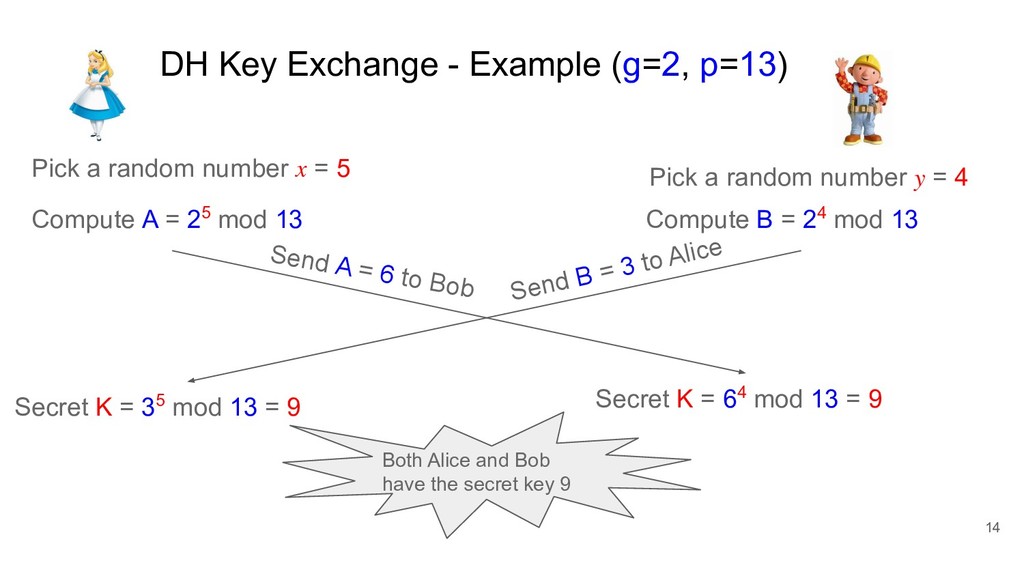
number = 4 Compute A = 25 mod 13 Compute B = 24 mod 13 Secret K = 35 mod 13 = 9 Secret K = 64 mod 13 = 9 Send A = 6 to Bob Send B = 3 to Alice Both Alice and Bob have the secret key 9 DH Key Exchange - Example (g=2, p=13)
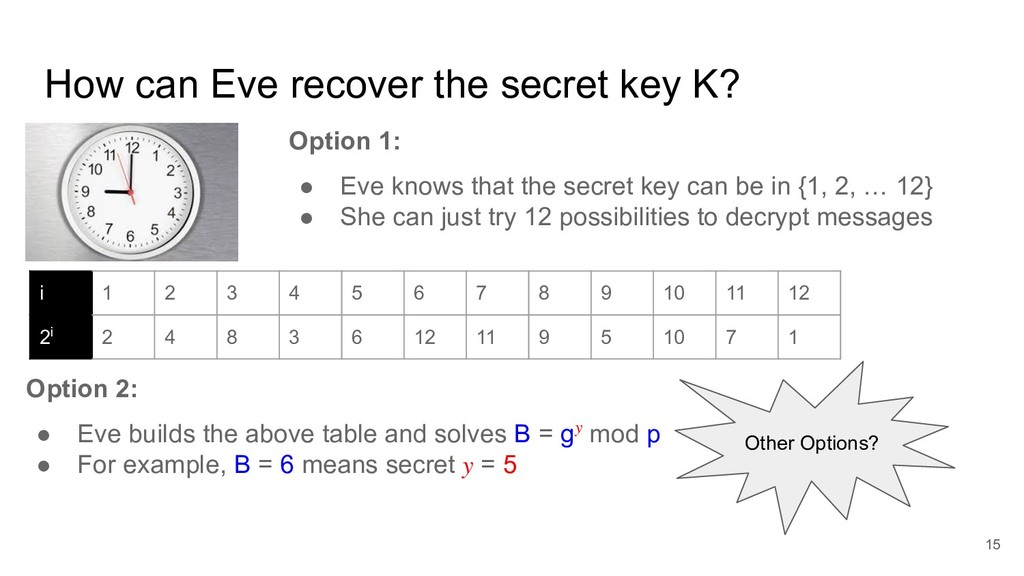
1: • Eve knows that the secret key can be in {1, 2, … 12} • She can just try 12 possibilities to decrypt messages i 1 2 3 4 5 6 7 8 9 10 11 12 2i 2 4 8 3 6 12 11 9 5 10 7 1 Option 2: • Eve builds the above table and solves B = g mod p • For example, B = 6 means secret = 5 Other Options?
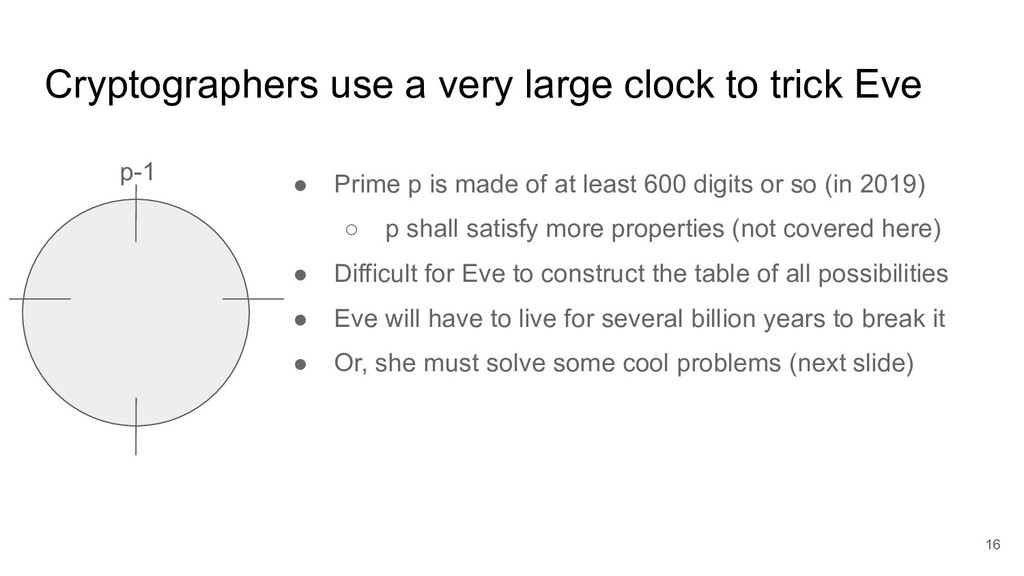
• Prime p is made of at least 600 digits or so (in 2019) ◦ p shall satisfy more properties (not covered here) • Difficult for Eve to construct the table of all possibilities • Eve will have to live for several billion years to break it • Or, she must solve some cool problems (next slide) p-1
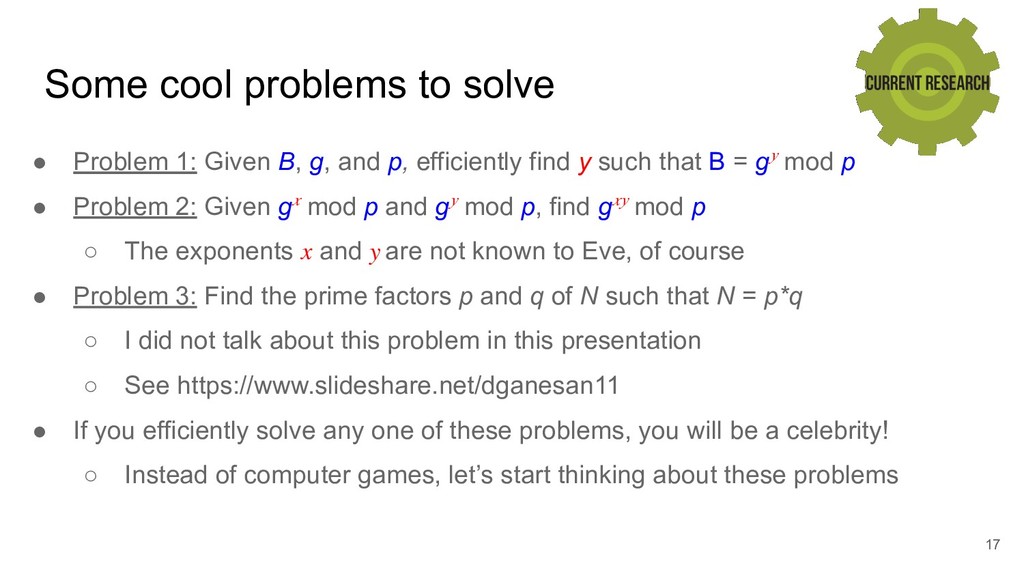
B, g, and p, efficiently find y such that B = g mod p • Problem 2: Given g mod p and g mod p, find g mod p ◦ The exponents and are not known to Eve, of course • Problem 3: Find the prime factors p and q of N such that N = p*q ◦ I did not talk about this problem in this presentation ◦ See https://www.slideshare.net/dganesan11 • If you efficiently solve any one of these problems, you will be a celebrity! ◦ Instead of computer games, let’s start thinking about these problems
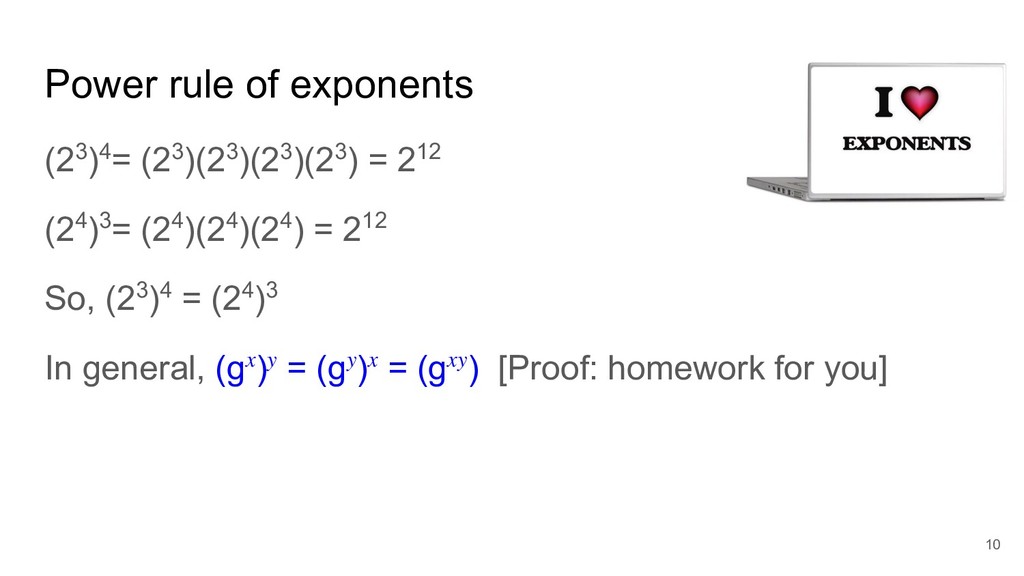
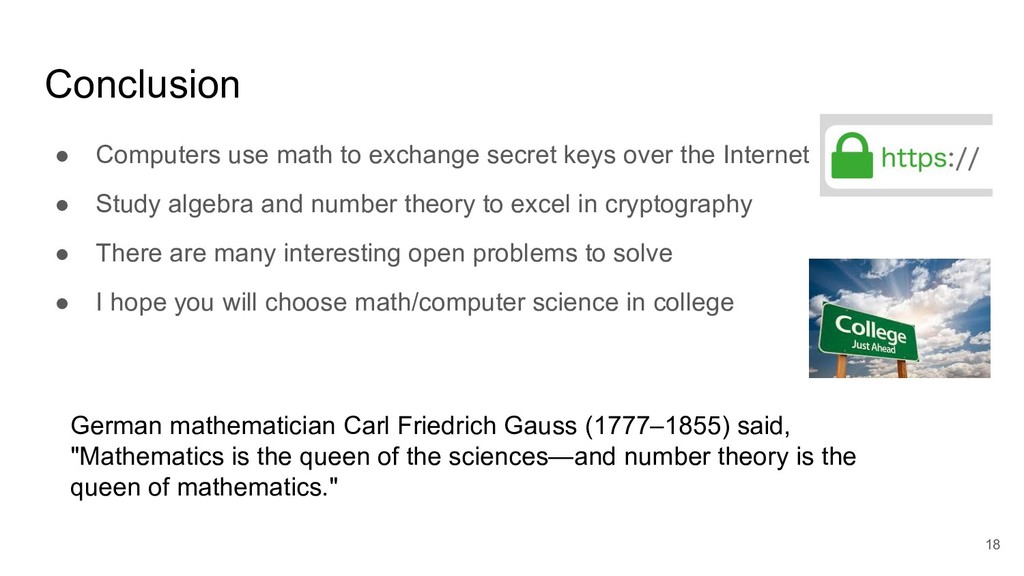
over the Internet • Study algebra and number theory to excel in cryptography • There are many interesting open problems to solve • I hope you will choose math/computer science in college German mathematician Carl Friedrich Gauss (1777–1855) said, "Mathematics is the queen of the sciences—and number theory is the queen of mathematics."


 kentarofujii
 takonda
 techtekt
 onk
 kenichiodo
 yamanoku
 carta_engineering
 pfn
 glaforge
 moznion
 prog893
 tokuty
 nmsamuel
 rabernat
 lemiorhan
 danielanewman
 helmedeiros
 codingconduct
 cassininazir
 axbom
 mfonobong
 sferik
 palkan
 carmenintech