Upgrade to Pro — share decks privately, control downloads, hide ads and more …

AI Coding Agents 2026: Autonomous Software Deve...

AI Coding Agents 2026: Autonomous Software Development Guide

A practical guide to AI coding agents, autonomous software development, repository workflows, testing, debugging, security, governance, and copy-ready prompts.

Explore more AI prompts and practical resources from Digital World Pulse: https://digitalworldpulse.com/ai-prompts/

Avatar for Cosmin Petru

Cosmin Petru

September 24, 2026

Other Decks in Technology

Transcript

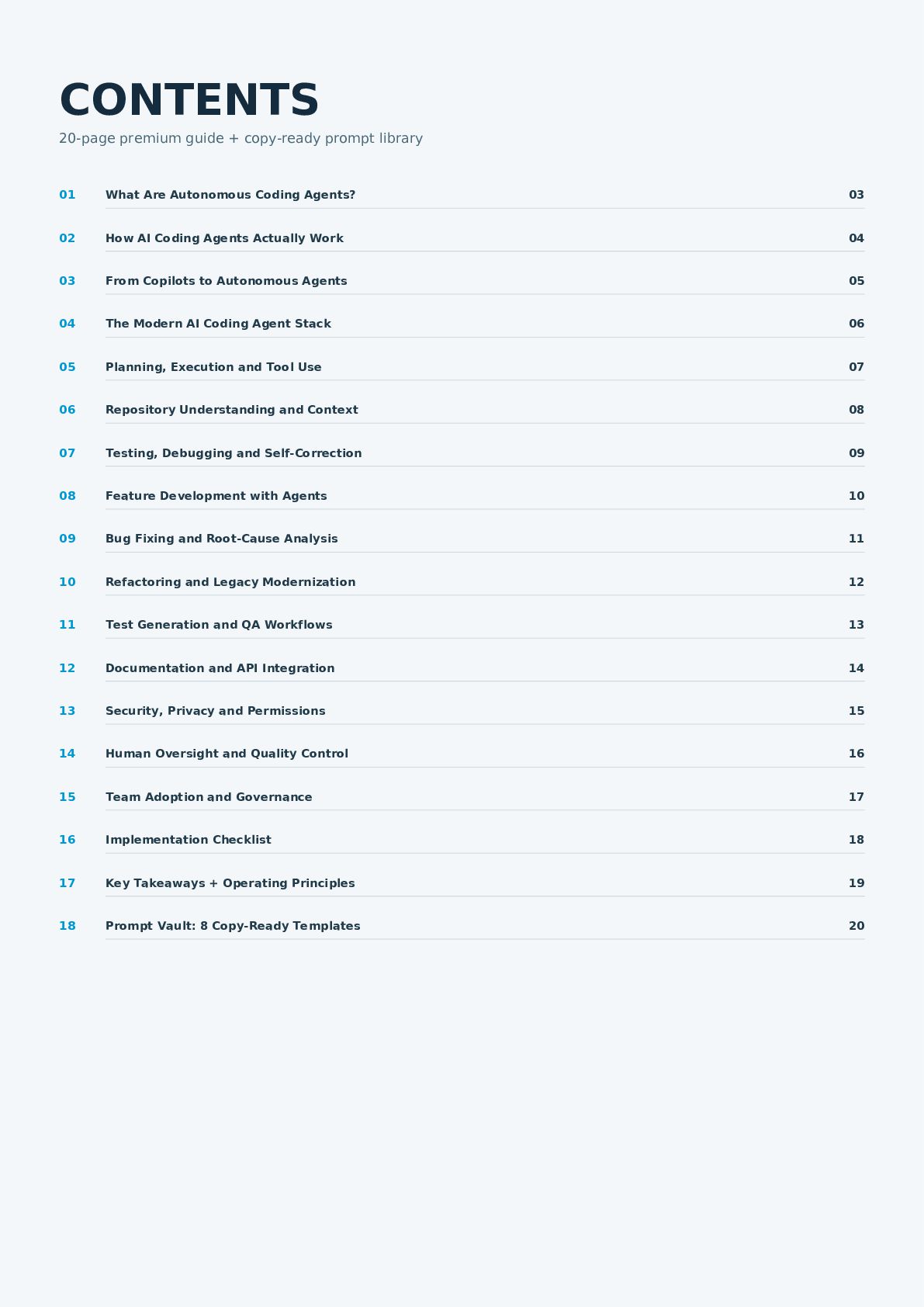
  1. CONTENTS 20-page premium guide + copy-ready prompt library 01 What

    Are Autonomous Coding Agents? 03 02 How AI Coding Agents Actually Work 04 03 From Copilots to Autonomous Agents 05 04 The Modern AI Coding Agent Stack 06 05 Planning, Execution and Tool Use 07 06 Repository Understanding and Context 08 07 Testing, Debugging and Self-Correction 09 08 Feature Development with Agents 10 09 Bug Fixing and Root-Cause Analysis 11 10 Refactoring and Legacy Modernization 12 11 Test Generation and QA Workflows 13 12 Documentation and API Integration 14 13 Security, Privacy and Permissions 15 14 Human Oversight and Quality Control 16 15 Team Adoption and Governance 17 16 Implementation Checklist 18 17 Key Takeaways + Operating Principles 19 18 Prompt Vault: 8 Copy-Ready Templates 20
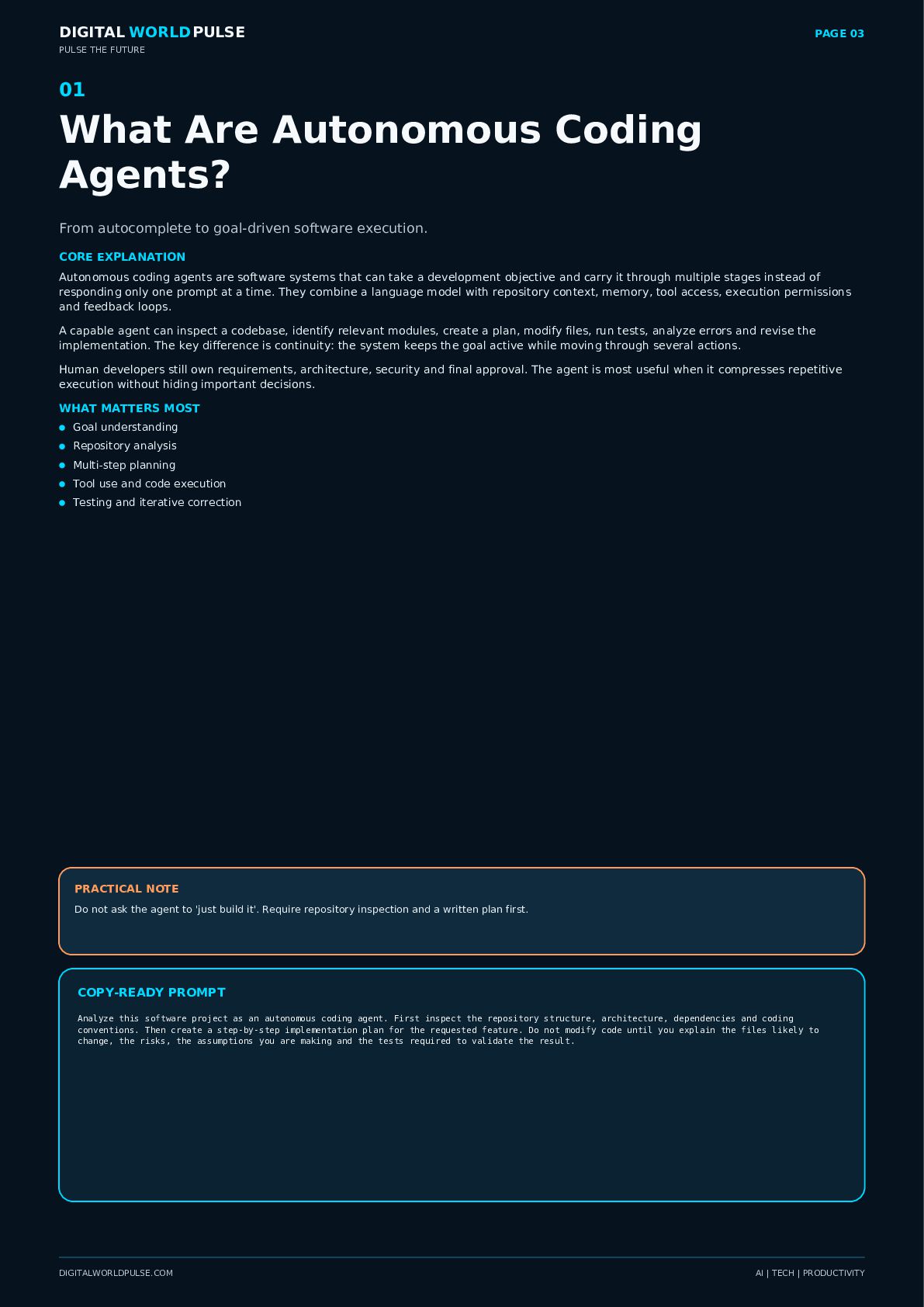
  2. DIGITAL WORLD PULSE PAGE 03 PULSE THE FUTURE 01 What

    Are Autonomous Coding Agents? From autocomplete to goal-driven software execution. CORE EXPLANATION Autonomous coding agents are software systems that can take a development objective and carry it through multiple stages instead of responding only one prompt at a time. They combine a language model with repository context, memory, tool access, execution permissions and feedback loops. A capable agent can inspect a codebase, identify relevant modules, create a plan, modify files, run tests, analyze errors and revise the implementation. The key difference is continuity: the system keeps the goal active while moving through several actions. Human developers still own requirements, architecture, security and final approval. The agent is most useful when it compresses repetitive execution without hiding important decisions. WHAT MATTERS MOST Goal understanding Repository analysis Multi-step planning Tool use and code execution Testing and iterative correction PRACTICAL NOTE Do not ask the agent to 'just build it'. Require repository inspection and a written plan first. COPY-READY PROMPT Analyze this software project as an autonomous coding agent. First inspect the repository structure, architecture, dependencies and coding conventions. Then create a step-by-step implementation plan for the requested feature. Do not modify code until you explain the files likely to change, the risks, the assumptions you are making and the tests required to validate the result. DIGITALWORLDPULSE.COM AI | TECH | PRODUCTIVITY
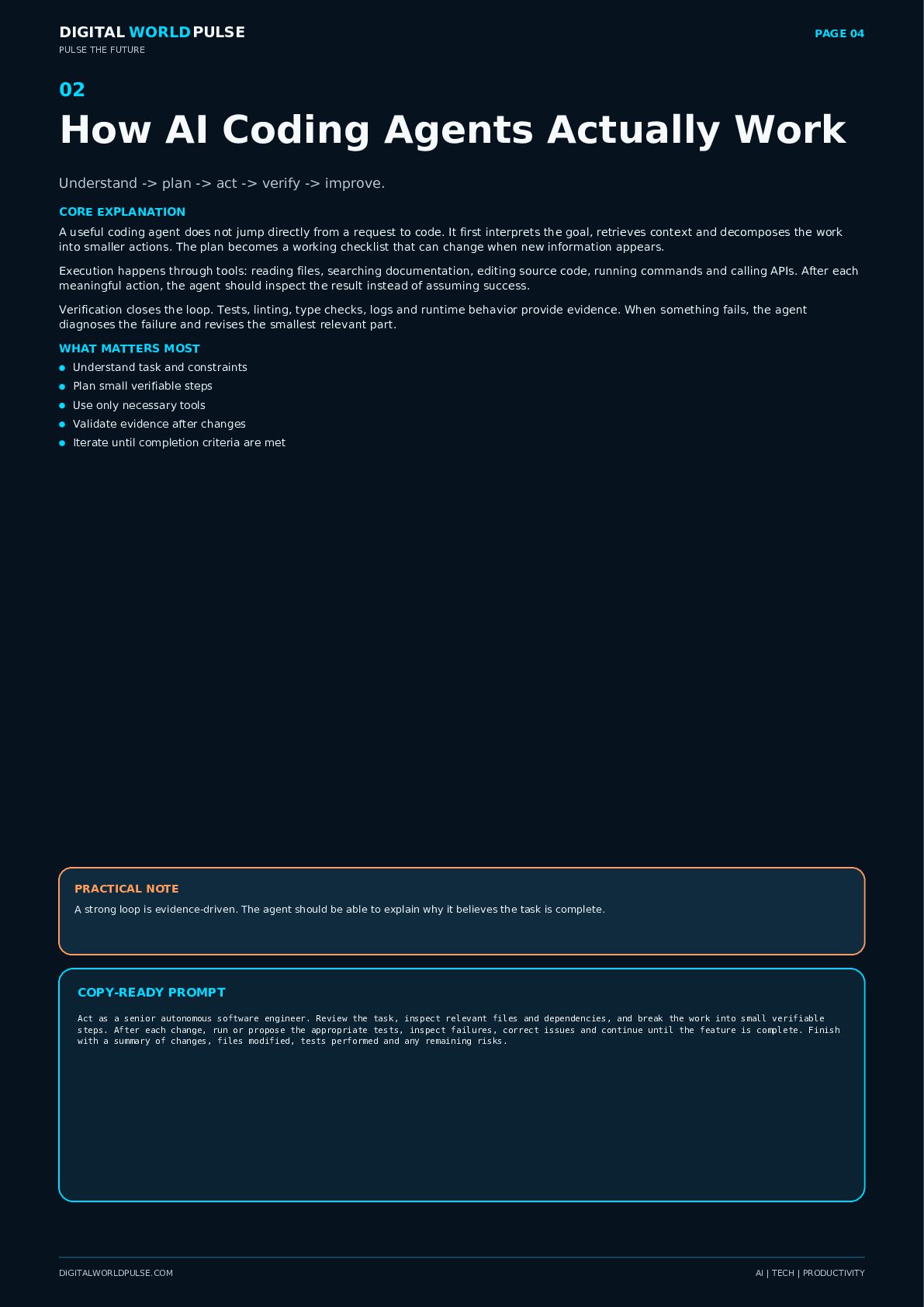
  3. DIGITAL WORLD PULSE PAGE 04 PULSE THE FUTURE 02 How

    AI Coding Agents Actually Work Understand -> plan -> act -> verify -> improve. CORE EXPLANATION A useful coding agent does not jump directly from a request to code. It first interprets the goal, retrieves context and decomposes the work into smaller actions. The plan becomes a working checklist that can change when new information appears. Execution happens through tools: reading files, searching documentation, editing source code, running commands and calling APIs. After each meaningful action, the agent should inspect the result instead of assuming success. Verification closes the loop. Tests, linting, type checks, logs and runtime behavior provide evidence. When something fails, the agent diagnoses the failure and revises the smallest relevant part. WHAT MATTERS MOST Understand task and constraints Plan small verifiable steps Use only necessary tools Validate evidence after changes Iterate until completion criteria are met PRACTICAL NOTE A strong loop is evidence-driven. The agent should be able to explain why it believes the task is complete. COPY-READY PROMPT Act as a senior autonomous software engineer. Review the task, inspect relevant files and dependencies, and break the work into small verifiable steps. After each change, run or propose the appropriate tests, inspect failures, correct issues and continue until the feature is complete. Finish with a summary of changes, files modified, tests performed and any remaining risks. DIGITALWORLDPULSE.COM AI | TECH | PRODUCTIVITY
  4. DIGITAL WORLD PULSE PAGE 05 PULSE THE FUTURE 03 From

    Copilots to Autonomous Agents The shift is from assistance toward coordinated execution. CORE EXPLANATION Coding copilots are optimized for immediate help: suggestions, completions, explanations and snippets inside the developer's active workflow. The human usually chooses every next step. Autonomous agents maintain a broader goal. They can choose tools, inspect multiple files, update the plan and continue until a completion condition is met. This makes them better suited to tasks that span several modules or require repeated testing. The distinction is not that an agent is always more intelligent. It is that the workflow is designed for persistence, tool use and verification. WHAT MATTERS MOST Copilot = local assistance Agent = multi-step task ownership Human = requirements, architecture and approval PRACTICAL NOTE Use autonomous mode only when the task has a clear boundary and an observable definition of done. COPY-READY PROMPT Instead of only suggesting code, take ownership of the complete development workflow for this task. Identify missing information, inspect the relevant project context, create an implementation plan, write the required code, define tests, review your own output for bugs and explain every important design decision before presenting the final solution. DIGITALWORLDPULSE.COM AI | TECH | PRODUCTIVITY
  5. DIGITAL WORLD PULSE PAGE 06 PULSE THE FUTURE 04 The

    Modern AI Coding Agent Stack Autonomy comes from an integrated system, not from the model alone. CORE EXPLANATION The language model is one layer. A production-ready agent also needs a context system that can index the repository, memory that preserves task state, orchestration that manages steps and a tool layer that lets the agent act. Execution should run inside a controlled environment. Sandboxes, restricted credentials and approval gates matter because an agent capable of running commands can also make damaging mistakes. Validation completes the stack. Test runners, linters, type checkers, security scanners and human review provide independent signals that the generated change behaves as intended. WHAT MATTERS MOST Model layer Repository/context layer Memory and orchestration Tools and APIs Sandboxed execution Validation and human approval PRACTICAL NOTE The model may change over time; the safety and validation architecture should remain stable. COPY-READY PROMPT Design an AI coding agent architecture for a production development team. Include the language model, repository context system, memory, terminal access, browser/documentation access, API tools, sandboxed execution, test validation and human approval gates. Explain what each layer does, how information moves between layers and where security controls should be placed. DIGITALWORLDPULSE.COM AI | TECH | PRODUCTIVITY
  6. DIGITAL WORLD PULSE PAGE 07 PULSE THE FUTURE 05 Planning,

    Execution and Tool Use Reasoning becomes valuable when it is connected to the right tools. CORE EXPLANATION A strong agent selects tools based on the task. A documentation question may need repository search and official docs; a failing build may need the terminal, logs and a test runner. Planning should stay lightweight. The purpose is to expose assumptions, identify dependencies and order the work so failures are easy to isolate - not to produce an essay before every edit. Tool use should be observable. Developers should know which files were read, which commands were executed and which external services were called. WHAT MATTERS MOST IDE/file editor Terminal Browser/documentation search APIs and databases Task planner and test runner PRACTICAL NOTE Minimal tool access reduces both risk and debugging complexity. COPY-READY PROMPT Before acting, decide which development tools are necessary for this task. For every tool you choose, explain why it is needed, what information or action it provides and what could go wrong. Prefer the minimum set of tools required. Execute the work in a logical order and verify the output after every significant action. DIGITALWORLDPULSE.COM AI | TECH | PRODUCTIVITY
  7. DIGITAL WORLD PULSE PAGE 08 PULSE THE FUTURE 06 Repository

    Understanding and Context Good changes require understanding the code around the code. CORE EXPLANATION Repository context is one of the largest differences between a generic code generator and a useful development agent. The agent should understand project structure, module boundaries, shared utilities, data models, build scripts, tests and documentation before modifying anything. Dependencies matter because a small change can alter behavior elsewhere. Mapping imports, service boundaries and configuration reduces the risk of code that works in isolation but breaks integration points. Existing patterns also reveal naming conventions, error handling and architecture decisions that are not obvious from one file. WHAT MATTERS MOST Map folders and frameworks Trace dependencies and data flow Identify shared utilities Locate tests and docs Match existing conventions PRACTICAL NOTE When the repository is unfamiliar, context gathering is often more valuable than immediate code generation. COPY-READY PROMPT Analyze this repository before making any changes. Map the main folders, frameworks, dependencies, shared utilities, API boundaries, data models, tests and coding conventions. Identify the files most likely to be affected by the requested change and explain how information flows between them. Highlight anything you are uncertain about before writing code. DIGITALWORLDPULSE.COM AI | TECH | PRODUCTIVITY
  8. DIGITAL WORLD PULSE PAGE 09 PULSE THE FUTURE 07 Testing,

    Debugging and Self-Correction Reliable agents verify their own work and use failures as feedback. CORE EXPLANATION Self-correction is useful only when tied to evidence. A good agent does not keep changing code until a test becomes green; it reads the failure, forms a hypothesis, inspects the related code path and applies the smallest safe fix. After the local issue is resolved, broader checks should run to catch regressions. Unit tests validate immediate behavior while integration tests, linting, type checks and security scans reveal side effects. A transparent agent records what failed, why the code changed and what evidence confirmed the fix. WHAT MATTERS MOST Read the complete failure Identify root cause Apply the smallest relevant fix Rerun affected tests Run broader regression checks PRACTICAL NOTE Bad automation suppresses symptoms. Good automation explains the root cause and proves the regression is fixed. COPY-READY PROMPT Treat every failing test as evidence rather than something to bypass. Read the complete error, identify the likely root cause, inspect the related code paths and propose the smallest safe fix. After applying the correction, rerun the affected tests and then the broader relevant test suite. Never disable tests simply to make the build pass. DIGITALWORLDPULSE.COM AI | TECH | PRODUCTIVITY
  9. DIGITAL WORLD PULSE PAGE 10 PULSE THE FUTURE 08 Feature

    Development with Agents Turn requirements into an implementation that can be reviewed and verified. CORE EXPLANATION Feature work is one of the strongest agent use cases when acceptance criteria are clear. The agent can inspect the current architecture, locate similar features, propose the minimum set of files to change and build the implementation incrementally. Good feature execution includes edge cases and tests from the start. The agent should identify missing requirements before coding rather than silently invent product behavior. The final output should include code changes, test evidence, assumptions and a concise explanation of how the new feature fits the existing system. WHAT MATTERS MOST Clarify acceptance criteria Find analogous code Plan minimal file changes Implement incrementally Add tests and summarize evidence PRACTICAL NOTE Ask the agent to identify missing product decisions before it invents defaults. COPY-READY PROMPT Implement this feature as a senior software engineer. First restate the acceptance criteria and identify anything ambiguous. Inspect similar features in the repository and follow existing architecture and conventions. Propose the smallest set of files to change, implement the feature in small steps, add or update tests, run relevant checks and finish with a review summary containing assumptions, files changed, tests run and remaining risks. DIGITALWORLDPULSE.COM AI | TECH | PRODUCTIVITY
  10. DIGITAL WORLD PULSE PAGE 11 PULSE THE FUTURE 09 Bug

    Fixing and Root-Cause Analysis Use the agent as an investigator before using it as a code generator. CORE EXPLANATION Bug fixing benefits from agents because investigation often requires reading logs, tracing code paths and comparing expected behavior with actual output. The agent can collect that context before proposing a patch. The critical step is reproduction. A fix is more trustworthy when the agent can describe how to reproduce the issue, identify the failing path and create a test that fails before the patch and passes afterward. Root-cause reasoning reduces the risk of superficial fixes that hide the symptom while leaving the underlying defect. WHAT MATTERS MOST Reproduce the issue Trace relevant code path Form and test a root-cause hypothesis Create a failing regression test Apply minimal fix and verify PRACTICAL NOTE Require a regression test whenever the bug is reproducible. COPY-READY PROMPT Investigate this bug before proposing code. Reproduce or model the failure, trace the relevant execution path, inspect logs and related tests, and identify the most likely root cause. Create or describe a regression test that fails before the fix. Apply the smallest safe patch, rerun the targeted test and relevant broader tests, then explain why the fix addresses the root cause rather than only the symptom. DIGITALWORLDPULSE.COM AI | TECH | PRODUCTIVITY
  11. DIGITAL WORLD PULSE PAGE 12 PULSE THE FUTURE 10 Refactoring

    and Legacy Modernization Improve structure without changing intended behavior. CORE EXPLANATION Refactoring is well suited to agents when current behavior can be protected by tests. The agent can identify duplicated logic, oversized modules, outdated patterns and migration candidates while preserving external behavior. Legacy modernization should be staged. Large rewrites make it difficult to separate functional regressions from infrastructure changes. Smaller steps create safer review points and easier rollback. Before modernization, the agent should inventory dependencies and compatibility constraints. Old systems often contain undocumented assumptions. WHAT MATTERS MOST Capture current behavior Inventory dependencies Plan incremental changes Preserve public interfaces Compare test results before and after PRACTICAL NOTE Refactor against tests, not against aesthetics. COPY-READY PROMPT Refactor this code without changing intended behavior. First summarize the current responsibilities, public interfaces, dependencies and relevant tests. Identify the structural problems and propose an incremental refactoring plan. Make one logical change at a time, run the affected tests after each step and stop if behavior changes unexpectedly. Finish with before/after notes, files changed, tests run and any remaining technical debt. DIGITALWORLDPULSE.COM AI | TECH | PRODUCTIVITY
  12. DIGITAL WORLD PULSE PAGE 13 PULSE THE FUTURE 11 Test

    Generation and QA Workflows Use agents to expand coverage without generating meaningless tests. CORE EXPLANATION Agents can create tests quickly, but quantity is not the same as quality. Useful tests protect important behavior, edge cases and failure modes rather than mirroring implementation details. A good workflow starts by identifying what the code promises to do. The agent should map requirements to test cases, then add coverage that would catch realistic regressions. Generated tests should be readable, deterministic and maintainable. Flaky tests or tests that only confirm the current implementation can create false confidence. WHAT MATTERS MOST Map behavior to test scenarios Cover edge cases and failures Avoid implementation-only assertions Keep tests deterministic Measure meaningful coverage PRACTICAL NOTE Ask 'what failure would this test catch?' If the answer is unclear, the test may not be valuable. COPY-READY PROMPT Review this module and design a high-value test plan. Identify the core behaviors, edge cases, invalid inputs, integration boundaries and likely regression risks. Generate tests that validate externally meaningful behavior rather than internal implementation details. Keep tests deterministic and readable. Explain what each test protects and identify important behavior that still lacks coverage. DIGITALWORLDPULSE.COM AI | TECH | PRODUCTIVITY
  13. DIGITAL WORLD PULSE PAGE 14 PULSE THE FUTURE 12 Documentation

    and API Integration Turn code context into accurate, usable developer documentation. CORE EXPLANATION Agents are useful for documentation because they can inspect code, configuration and examples together. The risk is generating polished text that describes behavior the code does not actually support. Documentation should be grounded in authoritative source code and current interfaces. Examples should be checked against actual function signatures, API schemas or executable tests. For API integration work, the agent should distinguish internal assumptions from external contract requirements and flag any uncertainty. WHAT MATTERS MOST Use source code as ground truth Verify examples against current APIs Document configuration and errors Mark uncertainty explicitly Test integration examples where possible PRACTICAL NOTE Documentation generated from stale assumptions is worse than missing documentation. COPY-READY PROMPT Create developer documentation for this component using the current code and tests as the source of truth. Explain purpose, setup, configuration, public interfaces, common usage, edge cases and error behavior. Verify code examples against the actual API. If the repository does not support a claim, label it as uncertain instead of inventing behavior. DIGITALWORLDPULSE.COM AI | TECH | PRODUCTIVITY
  14. DIGITAL WORLD PULSE PAGE 15 PULSE THE FUTURE 13 Security,

    Privacy and Permissions A useful agent needs explicit boundaries around data and execution. CORE EXPLANATION Source code, credentials, customer data and internal documentation may all be sensitive. Teams should know what data reaches the model, what is retained and which tools can access it. Least-privilege access is the default. The agent should receive only the permissions needed for the task, and destructive or production-level actions should require explicit approval. Security review must cover both generated code and the agent workflow itself. Tool integrations introduce new attack surfaces. WHAT MATTERS MOST Protect secrets and private repositories Use scoped credentials Sandbox commands and network access Review new dependencies Require approval for destructive actions PRACTICAL NOTE Read-only analysis is the safest default when the agent is introduced to a new environment. COPY-READY PROMPT Perform a security review of this proposed agent workflow and code change. Identify sensitive data, privileged actions, external dependencies, network calls, authentication boundaries and destructive operations. Recommend the minimum permissions required. List every action that should require explicit human approval before execution. DIGITALWORLDPULSE.COM AI | TECH | PRODUCTIVITY
  15. DIGITAL WORLD PULSE PAGE 16 PULSE THE FUTURE 14 Human

    Oversight and Quality Control Automation should reduce repetitive work without hiding important decisions. CORE EXPLANATION Human oversight is most valuable where intent or risk changes. Developers should review task interpretation, architecture decisions, security-sensitive code and production actions. Passing tests are necessary but not sufficient. Maintainability, observability, performance and product behavior still require judgment. The best agent output makes review easier: concise change summaries, assumptions, test evidence and known risks. WHAT MATTERS MOST Review requirements before implementation Inspect architecture changes Demand test evidence Review security-sensitive code Keep production authority human PRACTICAL NOTE A second-pass reviewer prompt is one of the highest-value uses of AI in an autonomous workflow. COPY-READY PROMPT Act as an independent senior reviewer. Evaluate this agent-generated change for correctness, requirement coverage, architecture fit, maintainability, security, performance, tests and regression risk. Do not assume the implementation is correct because tests pass. Separate blocking issues from optional improvements and identify any assumptions that require product or engineering confirmation. DIGITALWORLDPULSE.COM AI | TECH | PRODUCTIVITY
  16. DIGITAL WORLD PULSE PAGE 17 PULSE THE FUTURE 15 Team

    Adoption and Governance Successful adoption is a process change, not only a tool purchase. CORE EXPLANATION Teams should define which tasks are suitable for autonomous execution and which require close human control. Low-risk maintenance work is a better starting point than production-critical infrastructure. Governance includes tool permissions, approved models, data-handling rules, logging, review expectations and incident response. Adoption should be measured with quality and outcome metrics. Faster pull requests are not a win if defects, review burden or security incidents increase. WHAT MATTERS MOST Define approved and restricted tasks Standardize permissions and logging Set review and approval rules Train reviewers on agent failure modes Track quality, defects and cycle time PRACTICAL NOTE Governance should describe what the agent may do, not only which vendor or model is approved. COPY-READY PROMPT Create a governance policy for AI coding agents in a software team. Define approved tasks, restricted tasks, required human approvals, data-handling rules, tool permissions, logging, code-review standards, incident handling and metrics for evaluating whether agent use improves outcomes. DIGITALWORLDPULSE.COM AI | TECH | PRODUCTIVITY
  17. DIGITAL WORLD PULSE PAGE 18 PULSE THE FUTURE 16 Implementation

    Checklist A practical checklist for introducing coding agents safely. CORE EXPLANATION Before granting more autonomy, make the environment, permissions, validation and ownership explicit. A mature setup should make it easy to answer four questions: what the agent was allowed to do, what it actually did, what evidence supports the result and who approved the final action. Start narrow, collect evidence and expand permissions only after the workflow is consistently reliable. WHAT MATTERS MOST Define scope and acceptance criteria Connect repository context Limit credentials and tools Use branch/sandbox execution Enable tests and checks Require structured summaries Add approval before merge/deploy Keep audit logs Measure defects and review effort Expand autonomy gradually PRACTICAL NOTE The best time to add autonomy is after the project has reliable tests and repeatable build tooling. COPY-READY PROMPT Evaluate whether this project is ready for autonomous coding agents. Score readiness across repository quality, tests, documentation, CI/CD, sandboxing, secrets management, permissions, observability and review discipline. For every weak area, propose the minimum improvement needed before increasing agent autonomy. DIGITALWORLDPULSE.COM AI | TECH | PRODUCTIVITY
  18. DIGITAL WORLD PULSE PAGE 19 PULSE THE FUTURE 17 Key

    Takeaways + Operating Principles Six rules that make coding agents more useful and safer. CORE EXPLANATION AI coding agents work best when they combine strong context with controlled execution and verifiable feedback. The model is only one part of the system. High-quality outcomes depend on clear tasks, good repositories, meaningful tests, limited permissions and visible human approval points. The goal is not maximum autonomy. The goal is the right amount of autonomy for the risk and complexity of the task. WHAT MATTERS MOST Context before code Plan before execution Least privilege for tools Evidence before confidence Human review before high-impact actions Measure quality, not just speed PRACTICAL NOTE A structured completion report turns an opaque automation into a reviewable engineering artifact. COPY-READY PROMPT For every agent task, summarize: goal, context used, assumptions, plan, tools invoked, code changed, tests run, failures encountered, risks remaining and human approvals required. If any of these are missing, the task is not ready to be treated as complete. DIGITALWORLDPULSE.COM AI | TECH | PRODUCTIVITY
  19. DIGITAL WORLD PULSE PAGE 20 PULSE THE FUTURE PROMPT VAULT

    8 COPY-READY TEMPLATES FOR REAL DEVELOPMENT WORK 1. FEATURE BUILDER Inspect the repository and restate the feature requirements. Identify ambiguous product decisions before coding. Find analogous code, propose the minimum file changes, implement incrementally, add tests, run validation and finish with a structured summary of files changed, assumptions, tests and risks. 2. BUG INVESTIGATOR Reproduce the bug, trace the execution path, inspect logs and related tests, identify the likely root cause and create a regression test. Apply the smallest safe fix, rerun targeted and broader tests, and explain why the patch addresses the root cause. 3. REFACTORING AGENT Summarize current responsibilities, interfaces, dependencies and tests. Propose an incremental refactoring plan that preserves behavior. Make one logical change at a time, run tests after each step and stop if behavior changes unexpectedly. 4. TEST ARCHITECT Map the module's public behavior, edge cases, invalid inputs and integration boundaries. Generate tests that protect meaningful behavior rather than implementation details. Explain what failure each test would catch. 5. DOCUMENTATION AGENT Use source code and tests as the source of truth. Document purpose, setup, configuration, public APIs, examples, errors and edge cases. Verify examples against the actual implementation and label uncertainty explicitly. 6. SECURITY REVIEWER Identify sensitive data, privileged actions, dependencies, network calls and destructive operations. Recommend least-privilege permissions and list every action that requires explicit human approval. 7. SENIOR CODE REVIEWER Review correctness, requirements, architecture, maintainability, security, performance, tests and regression risk. Separate blocking issues from optional improvements. Do not assume passing tests prove correctness. 8. UNIVERSAL AGENT Inspect the repository, restate the task, list assumptions and risks, create a concise plan, use only required tools, execute in small steps, verify after every meaningful change, update the plan when evidence changes, and finish with a concise report of files changed, tests run, failures, risks and next steps. DIGITALWORLDPULSE.COM PROMPT VAULT | DIGITAL WORLD PULSE