# G00465217, by Tony Iams “As Kubernetes gains adoption across the industry, scenarios are arising in which I&O teams are finding they must deploy and manage multiple clusters, either in a single region on-premises or in the cloud, or across multiple regions….for a number of reasons, including multi-tenancy, disaster recovery, and with hybrid, multicloud, or edge deployments.” Kubernetes adoption leads to multicluster Red Hat Advanced Cluster Management for Kubernetes
difficult Small Scale Dev Teams • 100s of zones, 1000s of clusters and nodes across complex and air-gapped topologies Edge scale / Telco • Global organizations with 100s of clusters, hosting thousand of applications • Large Retail with 1000s of stores Large scale • Retail with small clusters across 100s of locations • Organizations with plan for growth 10-15 clusters moving to 100s Medium Scaled Organizations Red Hat Advanced Cluster Management for Kubernetes Where’s the growth in cluster deployments?
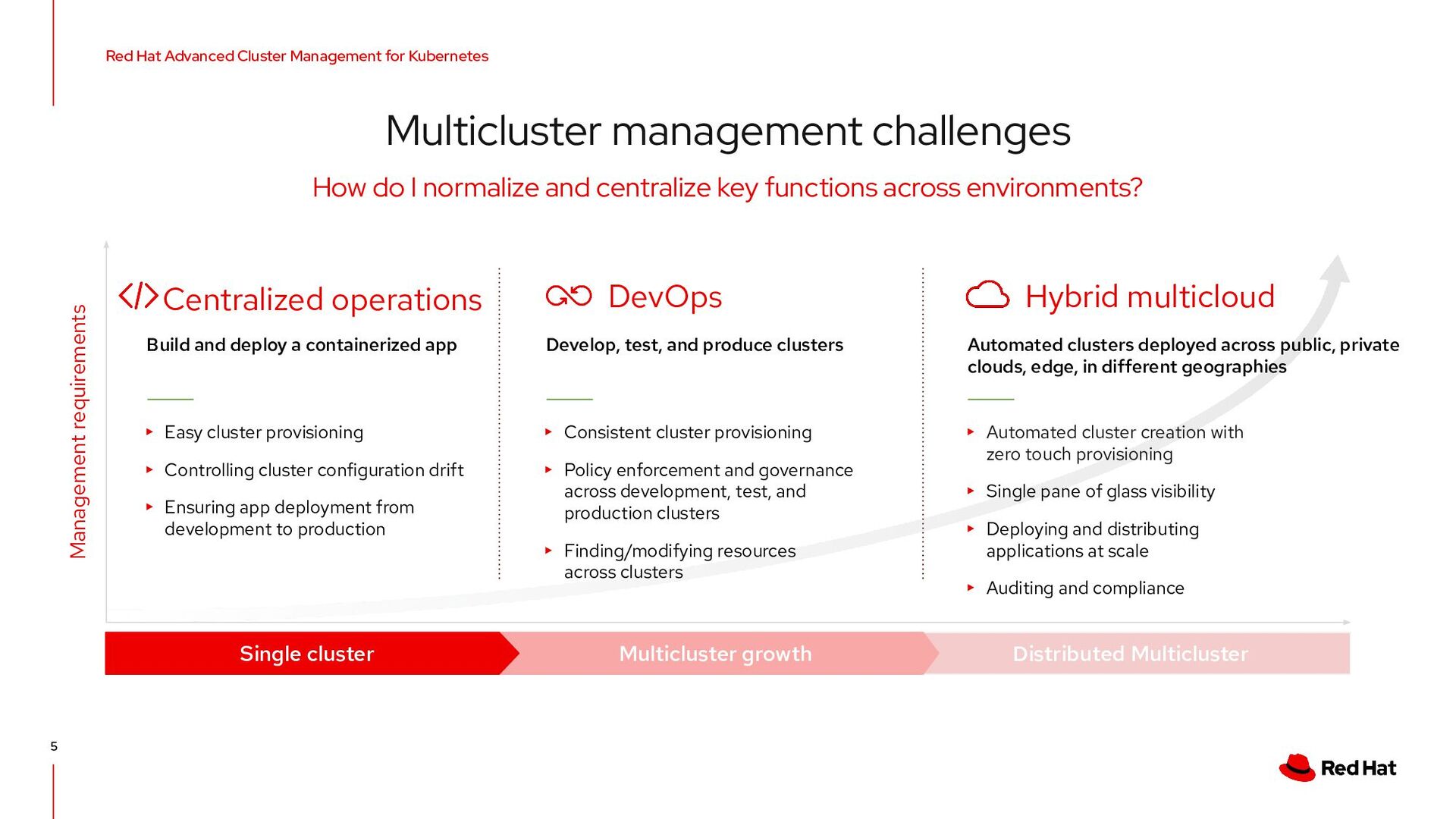
governance across development, test, and production clusters ▸ Finding/modifying resources across clusters ▸ Automated cluster creation with zero touch provisioning ▸ Single pane of glass visibility ▸ Deploying and distributing applications at scale ▸ Auditing and compliance DevOps Hybrid multicloud ▸ Easy cluster provisioning ▸ Controlling cluster configuration drift ▸ Ensuring app deployment from development to production Centralized operations Build and deploy a containerized app Develop, test, and produce clusters Automated clusters deployed across public, private clouds, edge, in different geographies Distributed Multicluster Multicluster growth Single cluster How do I normalize and centralize key functions across environments? Multicluster management challenges 5 Red Hat Advanced Cluster Management for Kubernetes
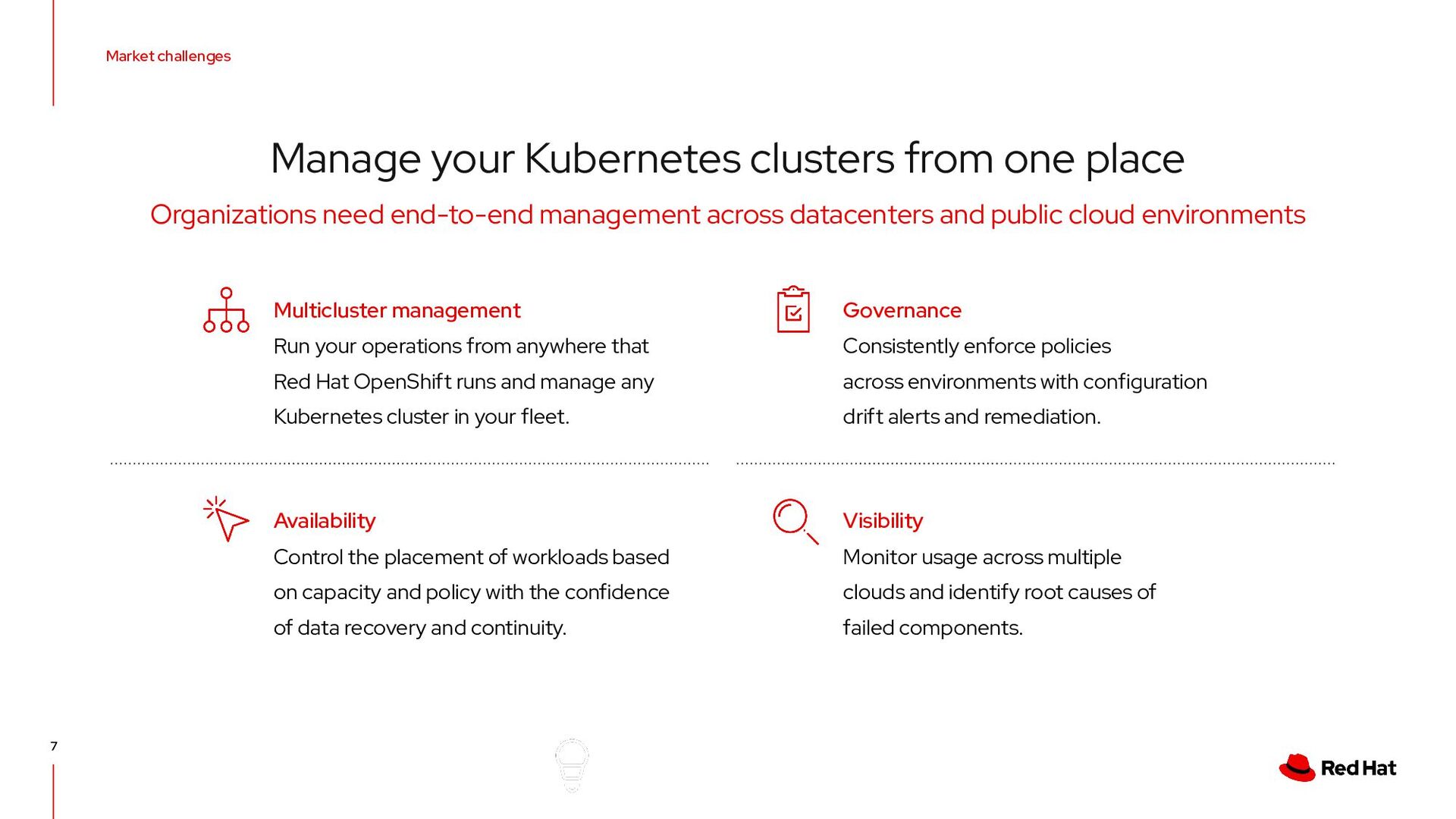
management across datacenters and public cloud environments Market challenges 7 Consistently enforce policies across environments with configuration drift alerts and remediation. Governance Monitor usage across multiple clouds and identify root causes of failed components. Visibility Run your operations from anywhere that Red Hat OpenShift runs and manage any Kubernetes cluster in your fleet. Multicluster management Control the placement of workloads based on capacity and policy with the confidence of data recovery and continuity. Availability
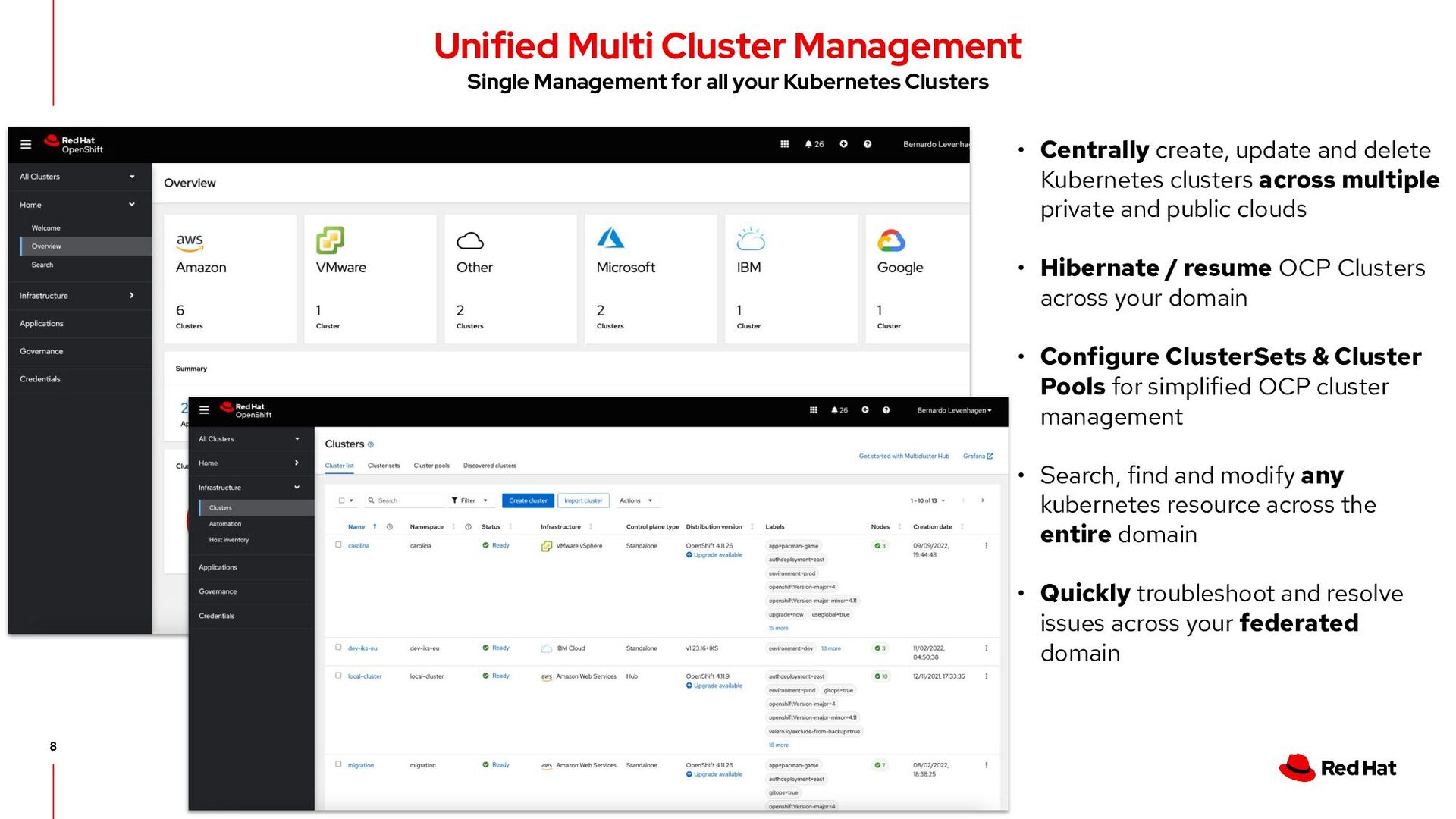
across multiple private and public clouds • Hibernate / resume OCP Clusters across your domain • Configure ClusterSets & Cluster Pools for simplified OCP cluster management • Search, find and modify any kubernetes resource across the entire domain • Quickly troubleshoot and resolve issues across your federated domain Single Management for all your Kubernetes Clusters Unified Multi Cluster Management
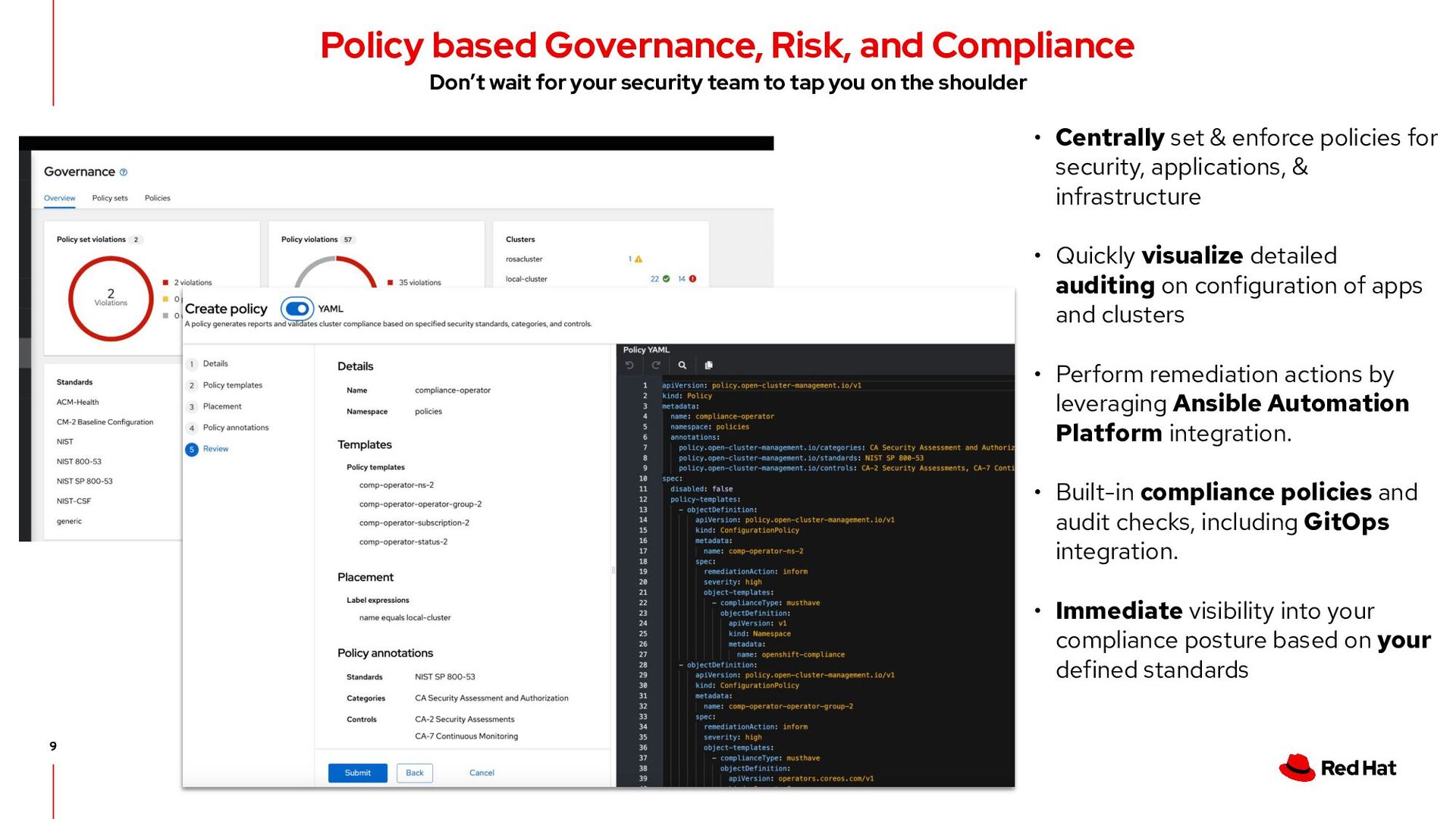
applications, & infrastructure • Quickly visualize detailed auditing on configuration of apps and clusters • Perform remediation actions by leveraging Ansible Automation Platform integration. • Built-in compliance policies and audit checks, including GitOps integration. • Immediate visibility into your compliance posture based on your defined standards Don’t wait for your security team to tap you on the shoulder Policy based Governance, Risk, and Compliance
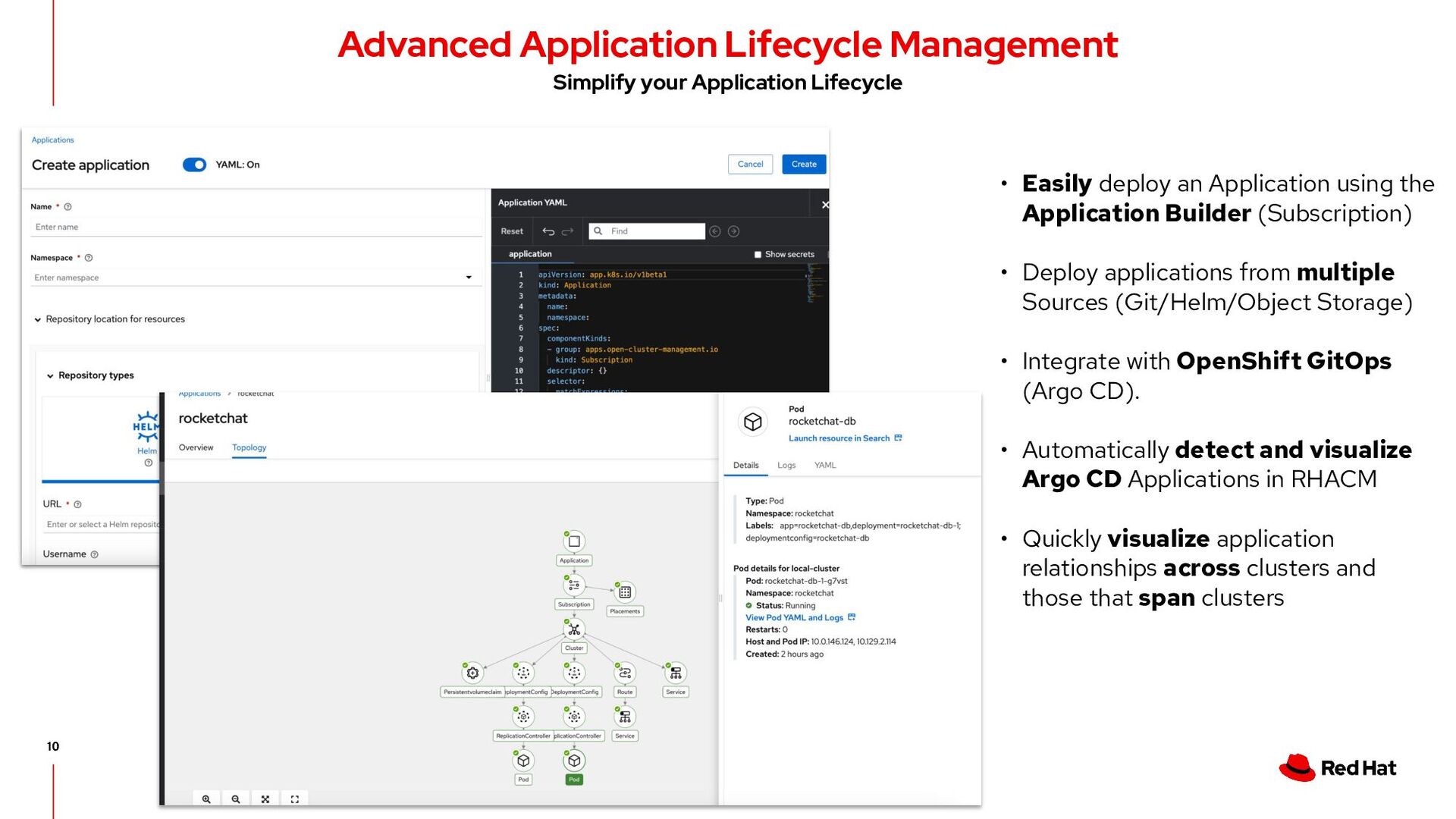
Builder (Subscription) • Deploy applications from multiple Sources (Git/Helm/Object Storage) • Integrate with OpenShift GitOps (Argo CD). • Automatically detect and visualize Argo CD Applications in RHACM • Quickly visualize application relationships across clusters and those that span clusters Simplify your Application Lifecycle Advanced Application Lifecycle Management
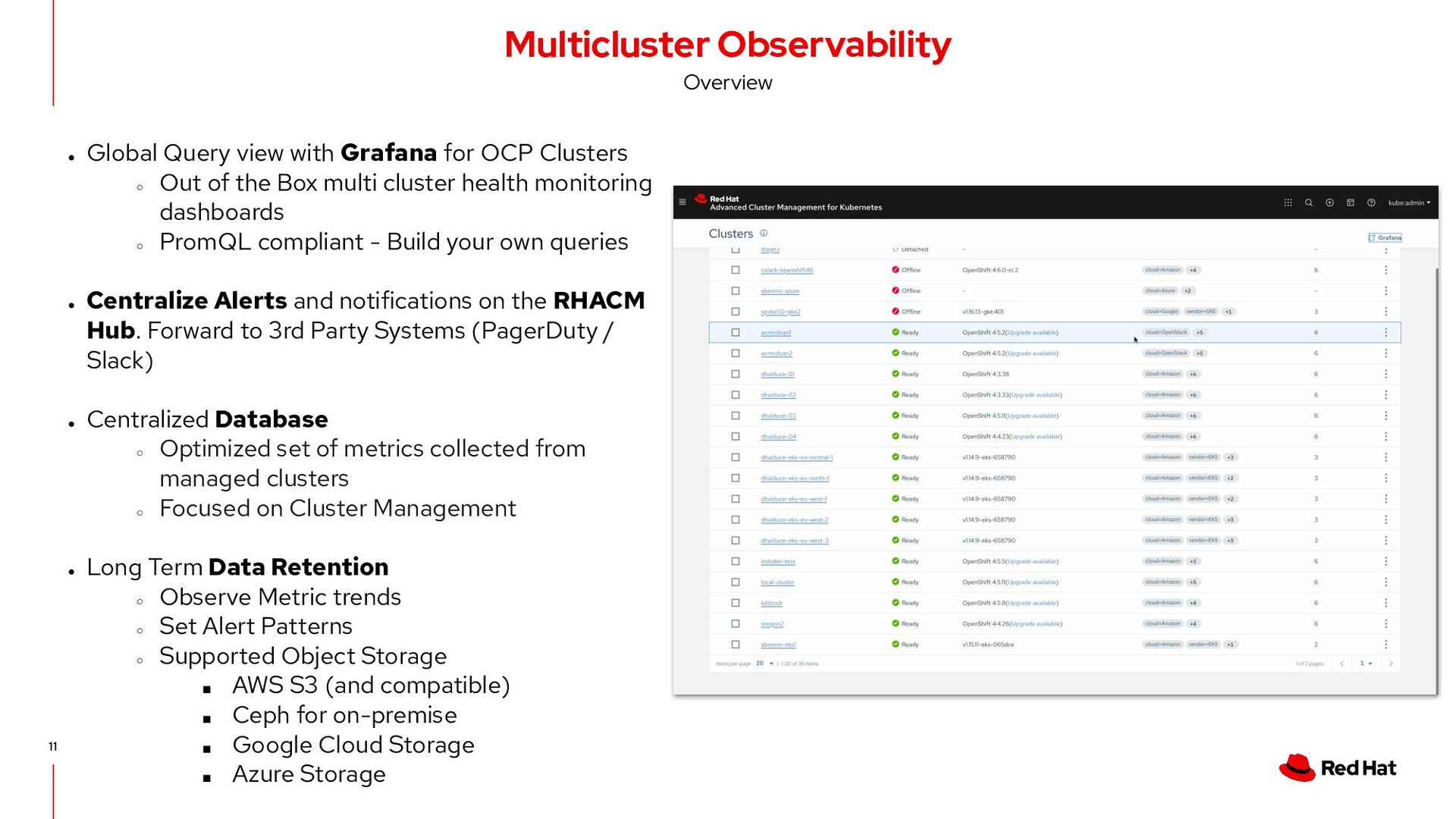
◦ Out of the Box multi cluster health monitoring dashboards ◦ PromQL compliant - Build your own queries • Centralize Alerts and notifications on the RHACM Hub. Forward to 3rd Party Systems (PagerDuty / Slack) • Centralized Database ◦ Optimized set of metrics collected from managed clusters ◦ Focused on Cluster Management • Long Term Data Retention ◦ Observe Metric trends ◦ Set Alert Patterns ◦ Supported Object Storage ▪ AWS S3 (and compatible) ▪ Ceph for on-premise ▪ Google Cloud Storage ▪ Azure Storage Overview Multicluster Observability
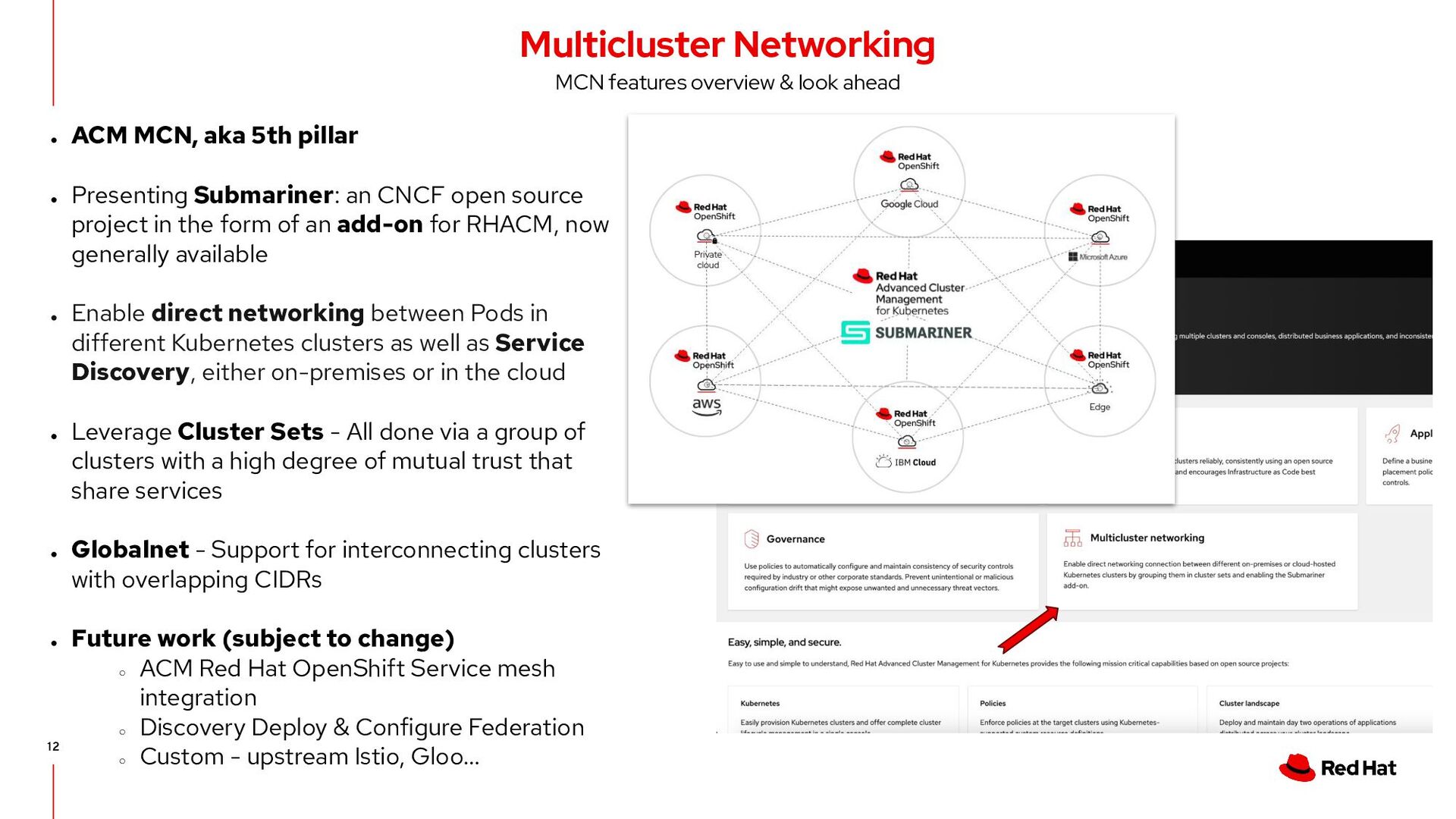
aka 5th pillar • Presenting Submariner: an CNCF open source project in the form of an add-on for RHACM, now generally available • Enable direct networking between Pods in different Kubernetes clusters as well as Service Discovery, either on-premises or in the cloud • Leverage Cluster Sets - All done via a group of clusters with a high degree of mutual trust that share services • Globalnet - Support for interconnecting clusters with overlapping CIDRs • Future work (subject to change) ◦ ACM Red Hat OpenShift Service mesh integration ◦ Discovery Deploy & Configure Federation ◦ Custom - upstream Istio, Gloo… Multicluster Networking
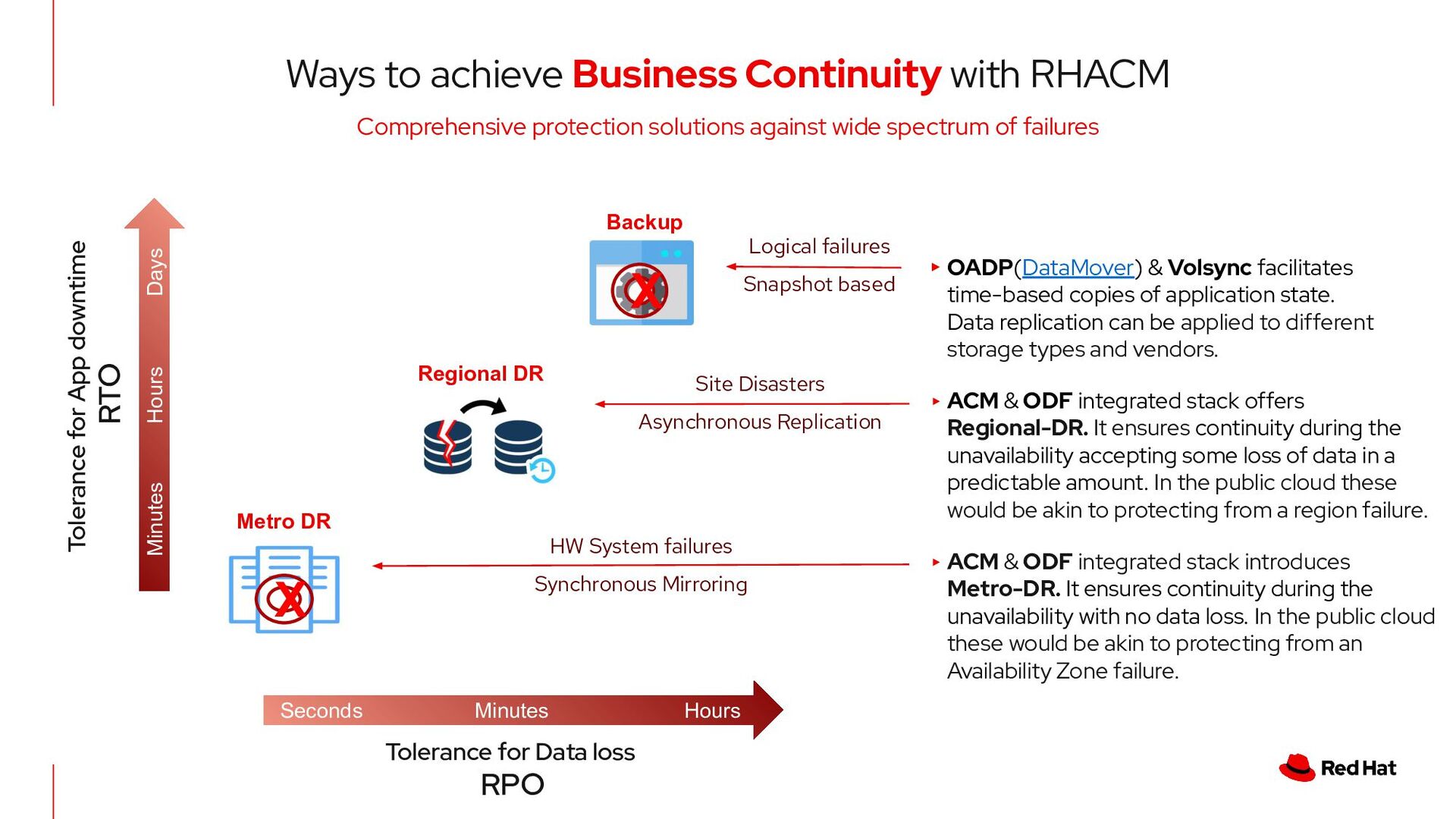
against wide spectrum of failures Seconds Minutes Hours Minutes Hours Days Tolerance for Data loss RPO Tolerance for App downtime RTO Regional DR X Metro DR X Backup Logical failures Snapshot based ▸ OADP(DataMover) & Volsync facilitates time-based copies of application state. Data replication can be applied to different storage types and vendors. ▸ ACM & ODF integrated stack offers Regional-DR. It ensures continuity during the unavailability accepting some loss of data in a predictable amount. In the public cloud these would be akin to protecting from a region failure. ▸ ACM & ODF integrated stack introduces Metro-DR. It ensures continuity during the unavailability with no data loss. In the public cloud these would be akin to protecting from an Availability Zone failure. Site Disasters Asynchronous Replication HW System failures Synchronous Mirroring


 drb
drb
 tapps
tapps
 leimatthew05
 lfama
lfama
 paigeccino
 codingconduct
 tammyeverts
 bluesmoon
 lara
lara
 lemiorhan
 jmmastey
 aleyda
 khoart