in the EHR: Venus and Mars live in Harmony with CDA4CDT Kim Stavrinaki s AHIMA Conference, October 2009 Nick van Terheyden, MD Board of Directors, MTIA Chief Medical Officer, M*Modal
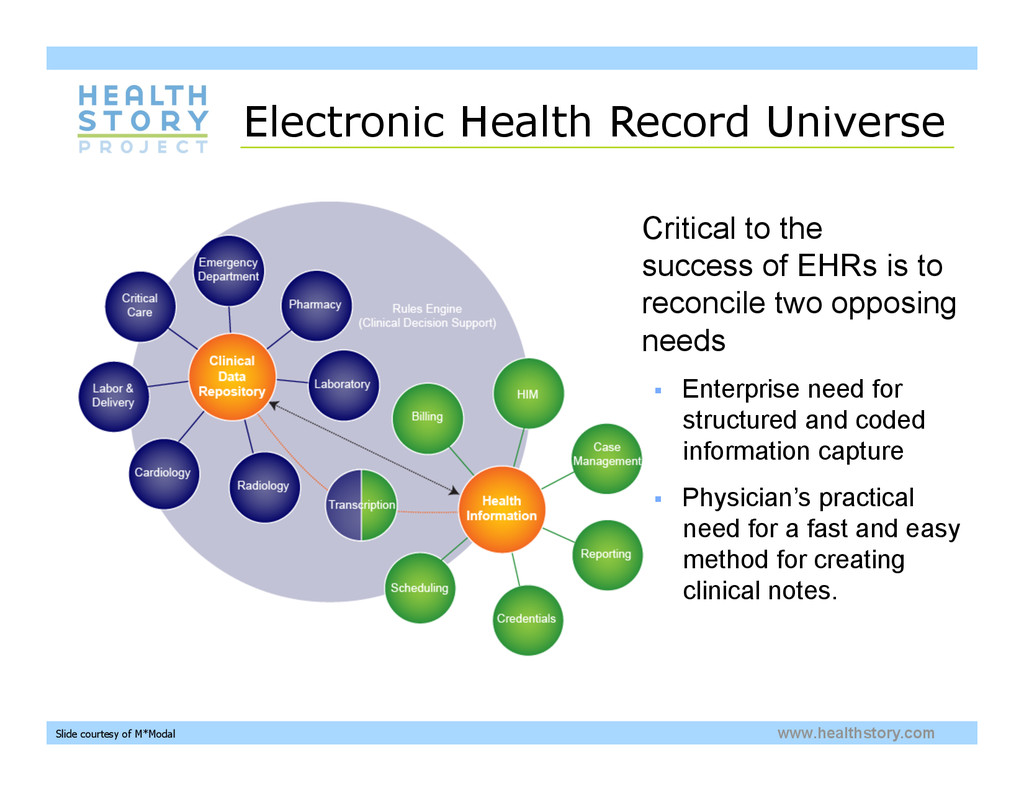
EHRs is to reconcile two opposing needs Enterprise need for structured and coded information capture Physician’s practical need for a fast and easy method for creating clinical notes. Slide courtesy of M*Modal
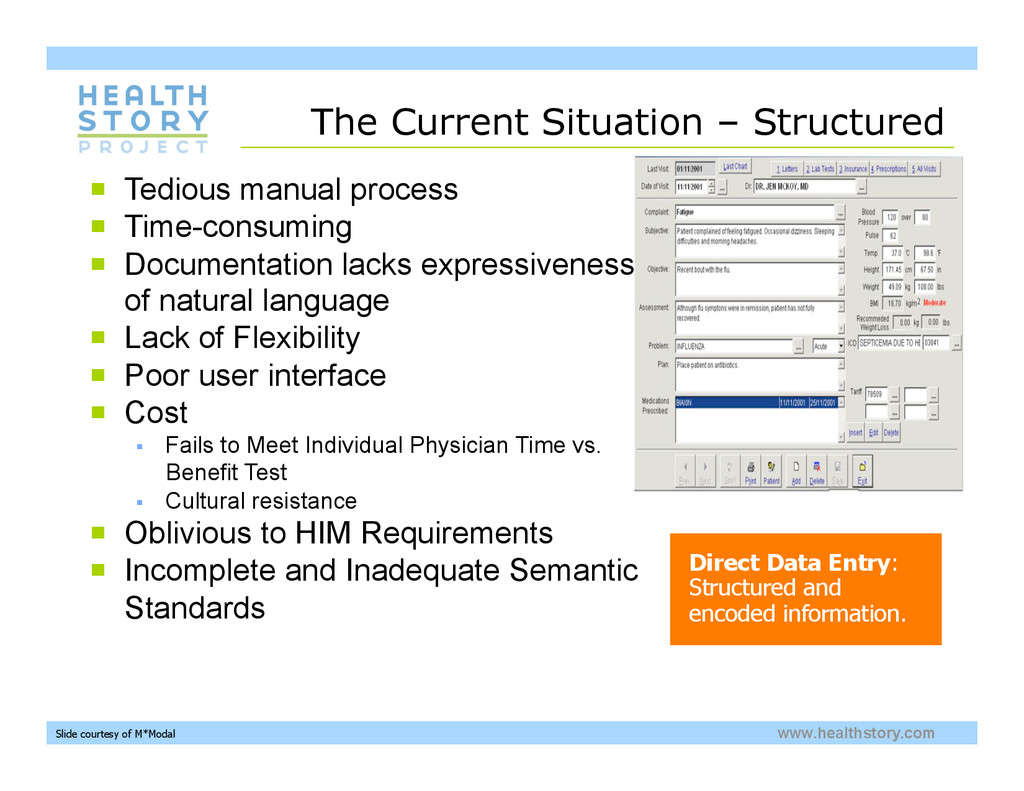
Time-consuming Documentation lacks expressiveness of natural language Lack of Flexibility Poor user interface Cost Fails to Meet Individual Physician Time vs. Benefit Test Cultural resistance Oblivious to HIM Requirements Incomplete and Inadequate Semantic Standards Direct Data Entry: Structured and encoded information. Slide courtesy of M*Modal
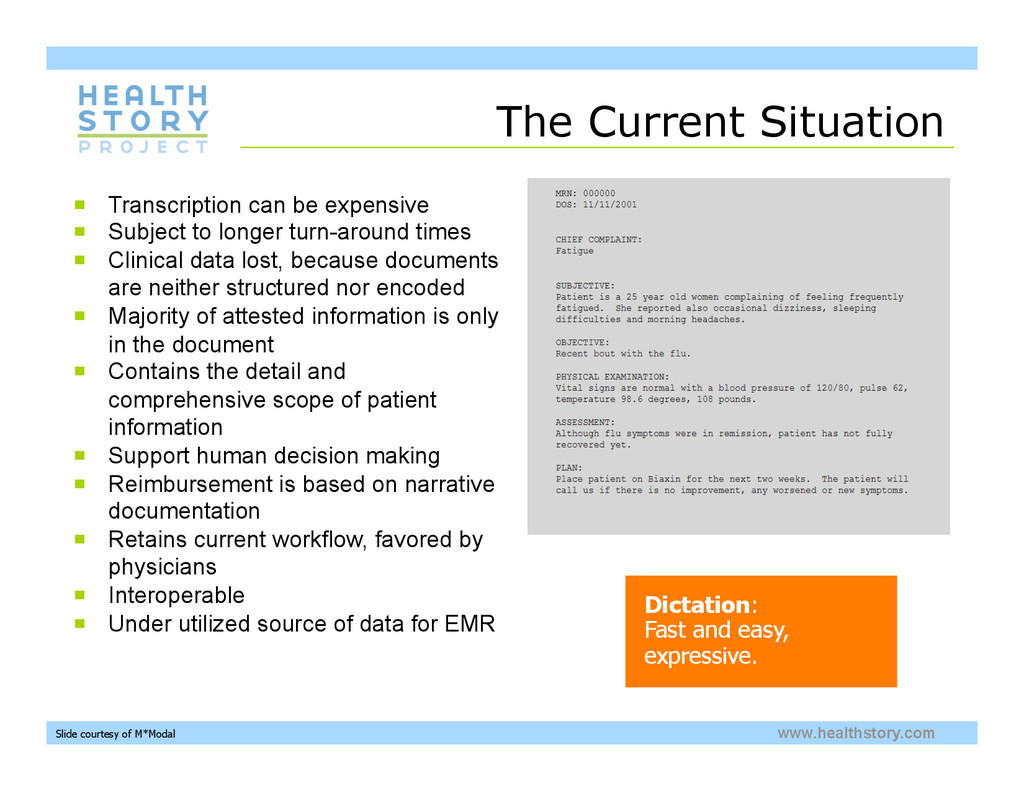
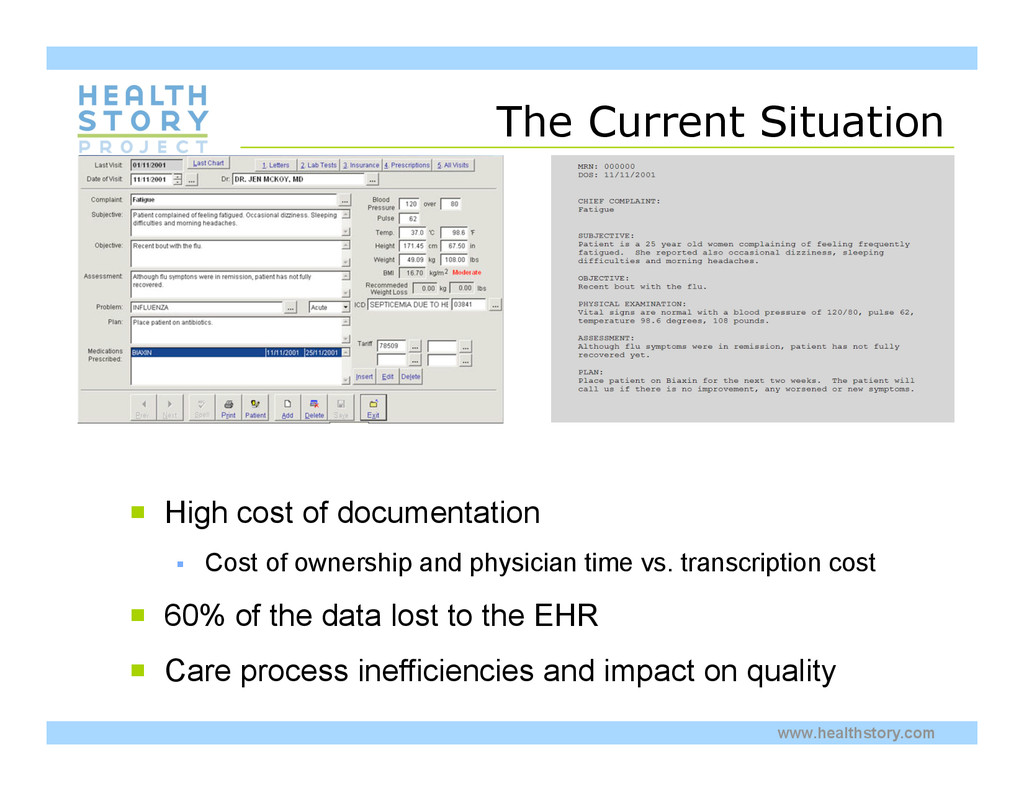
Subject to longer turn-around times Clinical data lost, because documents are neither structured nor encoded Majority of attested information is only in the document Contains the detail and comprehensive scope of patient information Support human decision making Reimbursement is based on narrative documentation Retains current workflow, favored by physicians Interoperable Under utilized source of data for EMR Dictation: Fast and easy, expressive. Slide courtesy of M*Modal
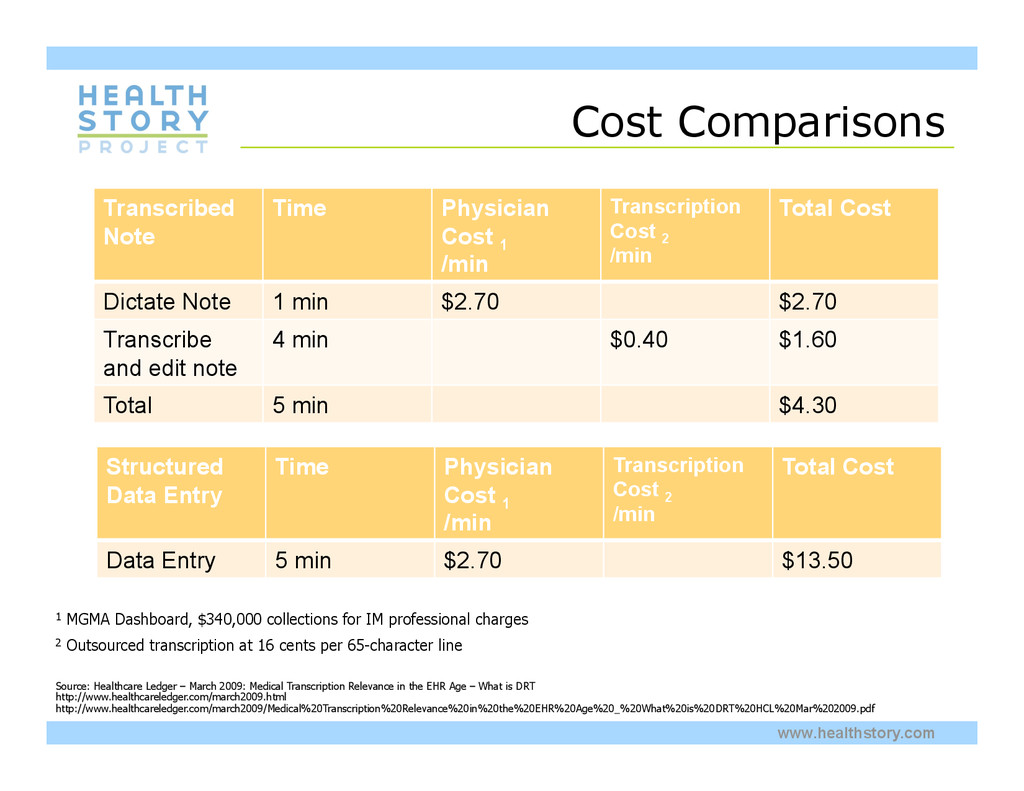
Transcription Cost 2 /min Total Cost Dictate Note 1 min $2.70 $2.70 Transcribe and edit note 4 min $0.40 $1.60 Total 5 min $4.30 Structured Data Entry Time Physician Cost 1 /min Transcription Cost 2 /min Total Cost Data Entry 5 min $2.70 $13.50 1 MGMA Dashboard, $340,000 collections for IM professional charges 2 Outsourced transcription at 16 cents per 65-character line Source: Healthcare Ledger – March 2009: Medical Transcription Relevance in the EHR Age – What is DRT http://www.healthcareledger.com/march2009.html http://www.healthcareledger.com/march2009/Medical%20Transcription%20Relevance%20in%20the%20EHR%20Age%20_%20What%20is%20DRT%20HCL%20Mar%202009.pdf
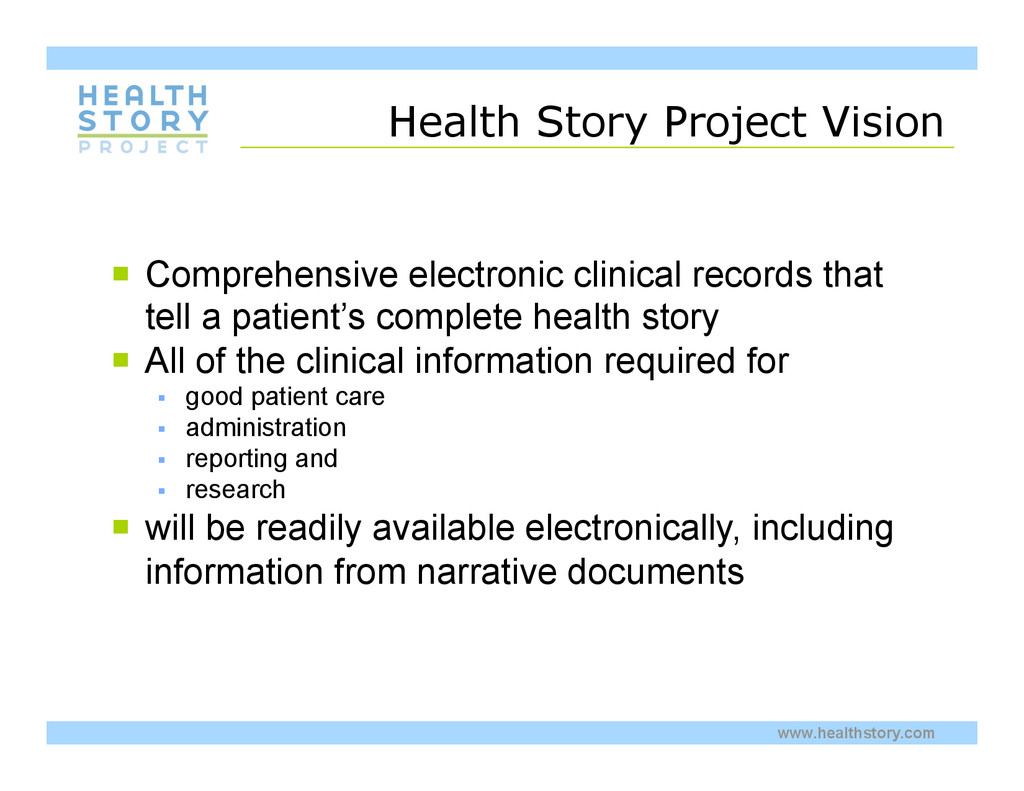
tell a patient’s complete health story All of the clinical information required for good patient care administration reporting and research will be readily available electronically, including information from narrative documents
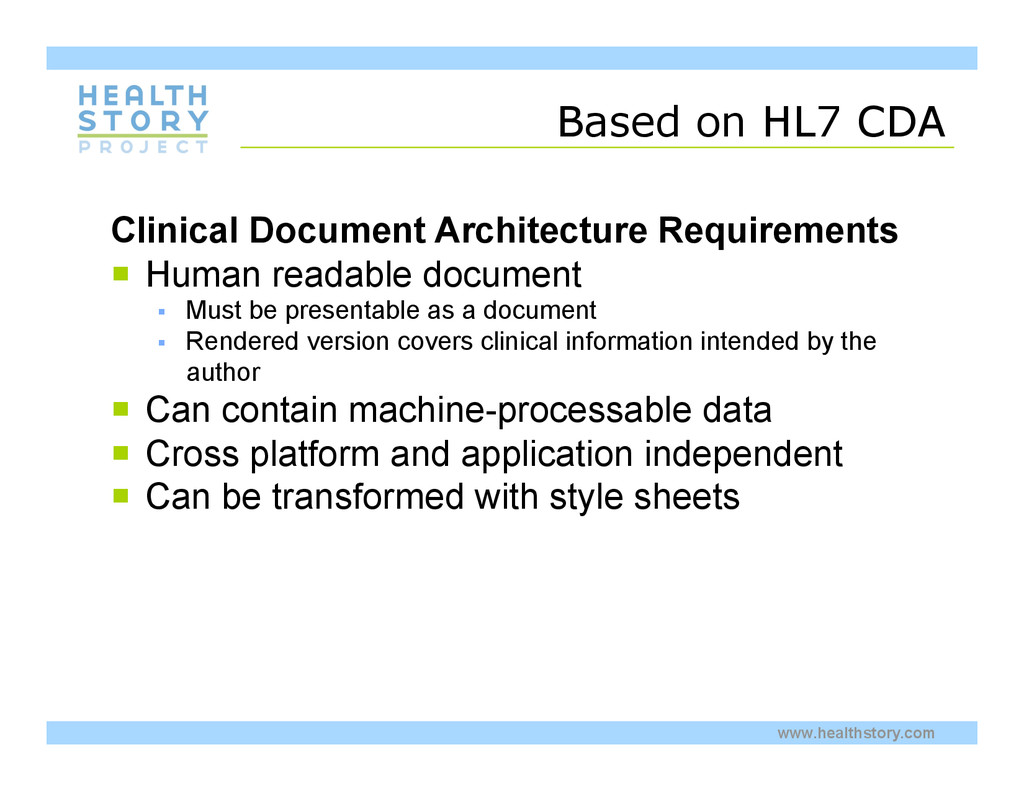
readable document Must be presentable as a document Rendered version covers clinical information intended by the author Can contain machine-processable data Cross platform and application independent Can be transformed with style sheets
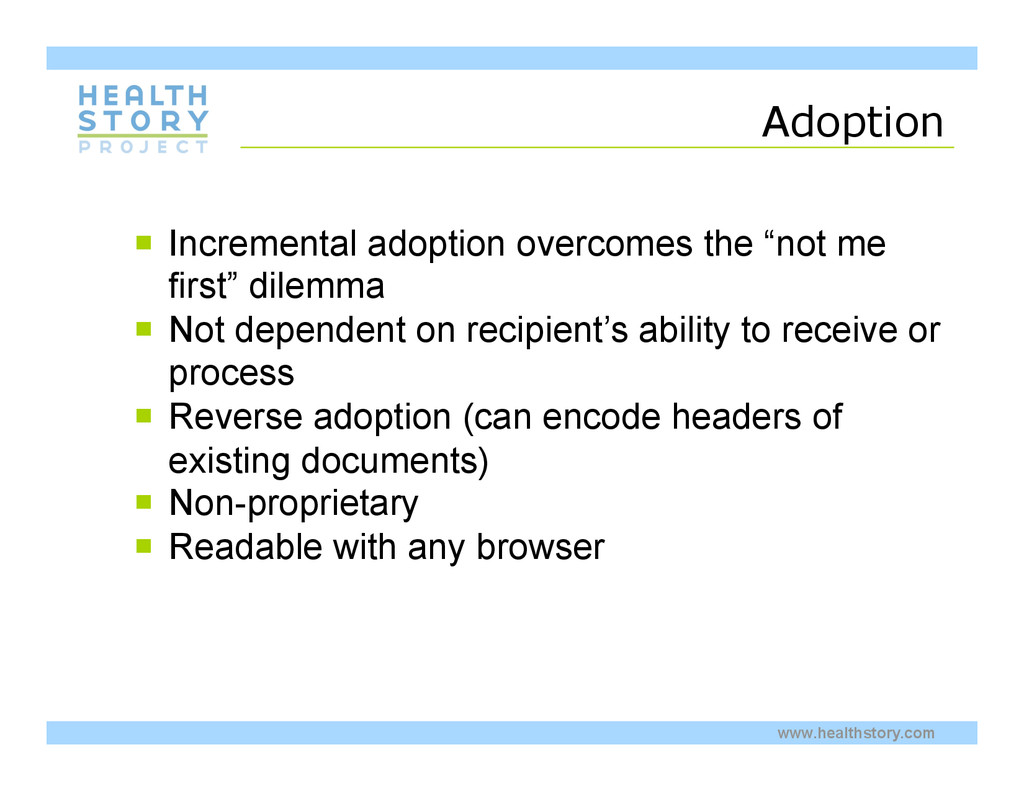
Not dependent on recipient’s ability to receive or process Reverse adoption (can encode headers of existing documents) Non-proprietary Readable with any browser
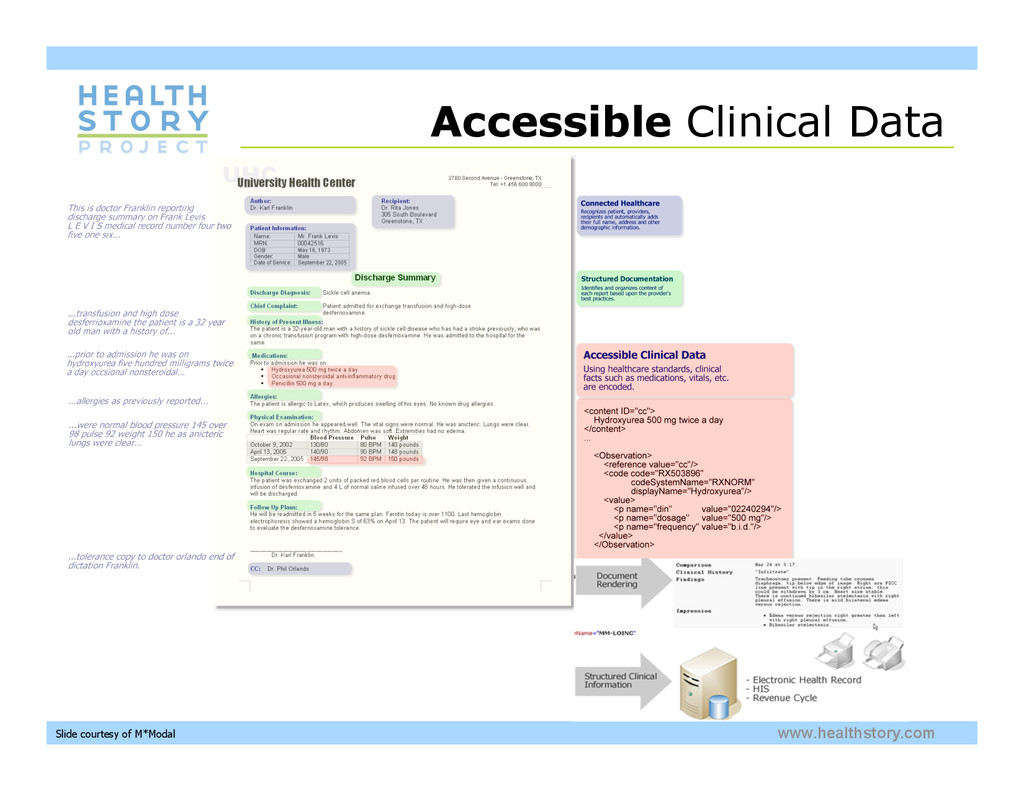
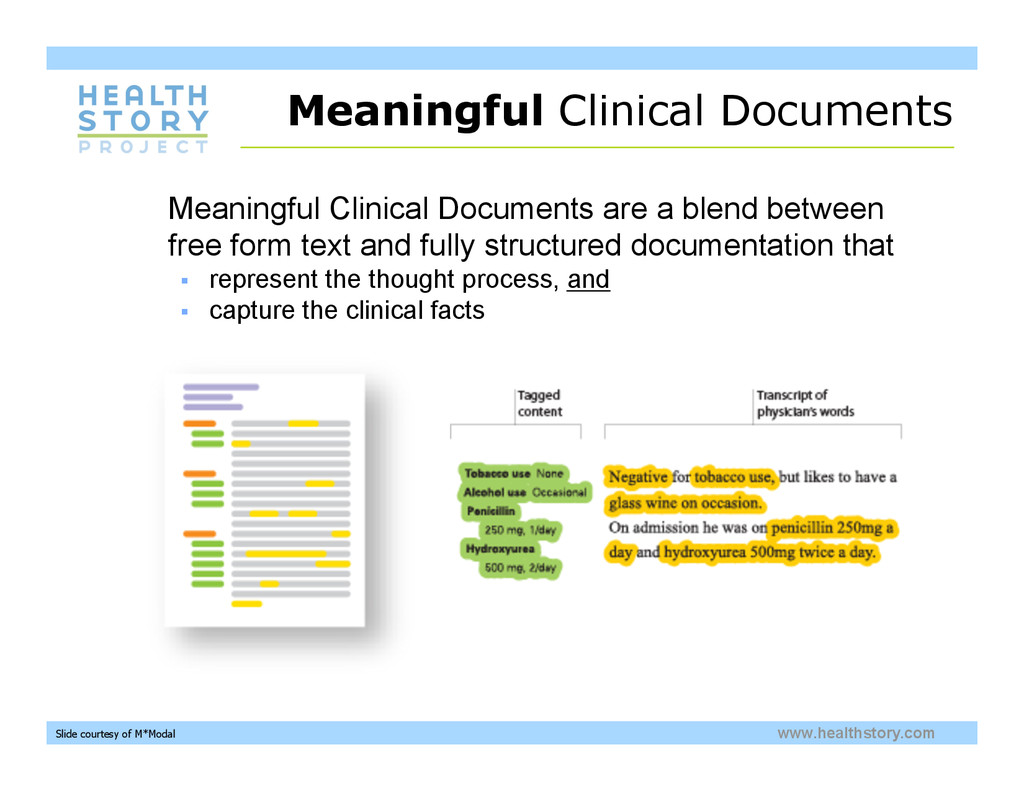
between free form text and fully structured documentation that represent the thought process, and capture the clinical facts Slide courtesy of M*Modal
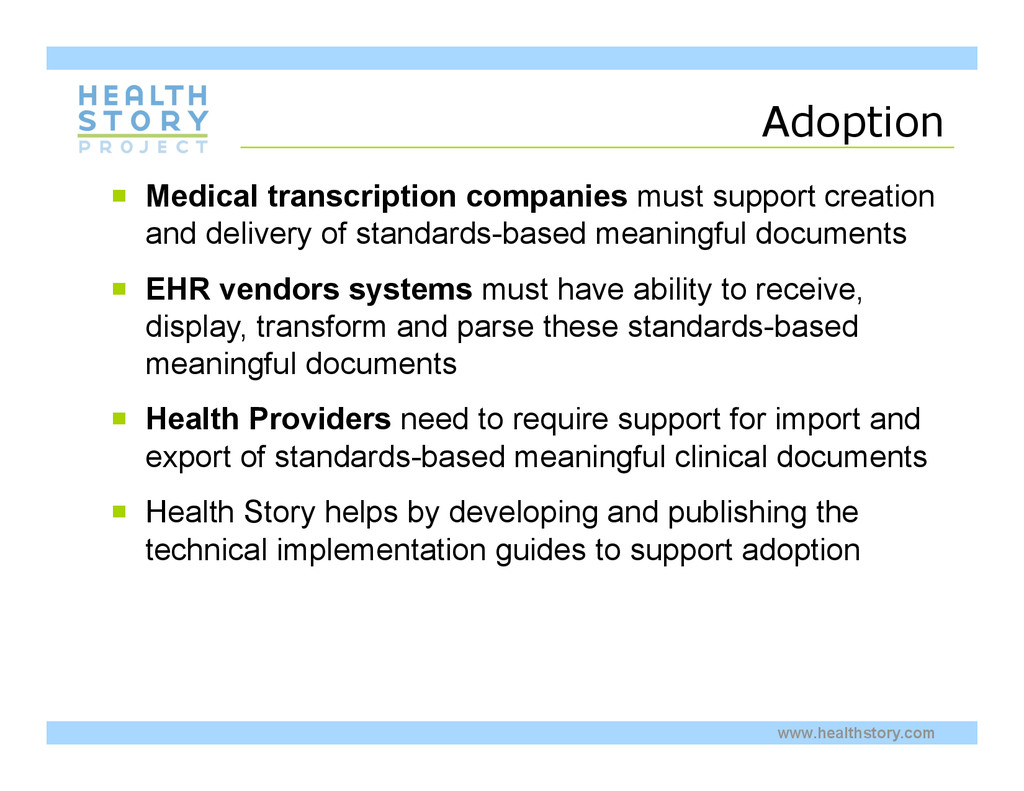
delivery of standards-based meaningful documents EHR vendors systems must have ability to receive, display, transform and parse these standards-based meaningful documents Health Providers need to require support for import and export of standards-based meaningful clinical documents Health Story helps by developing and publishing the technical implementation guides to support adoption
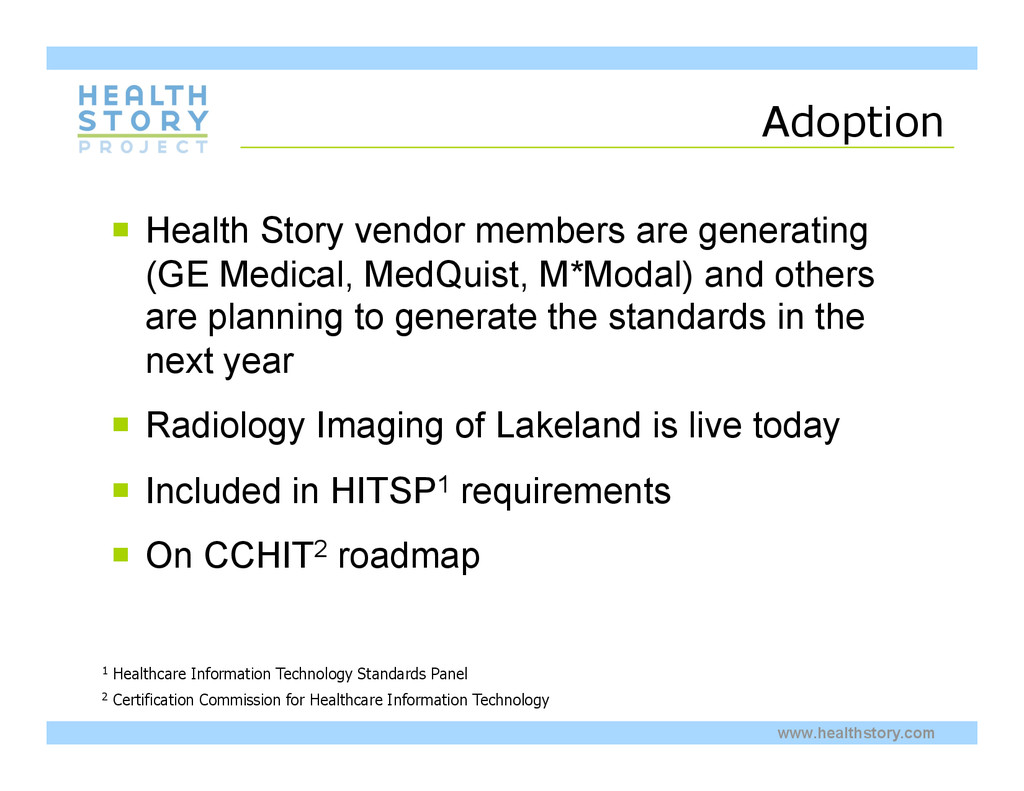
MedQuist, M*Modal) and others are planning to generate the standards in the next year Radiology Imaging of Lakeland is live today Included in HITSP1 requirements On CCHIT2 roadmap 1 Healthcare Information Technology Standards Panel 2 Certification Commission for Healthcare Information Technology
NCVHS Hearing on Meaningful Use HHS Request for Input on Meaningful Use HITSP Request for Input on ARRA Comments are posted on our site www.healthstory.com
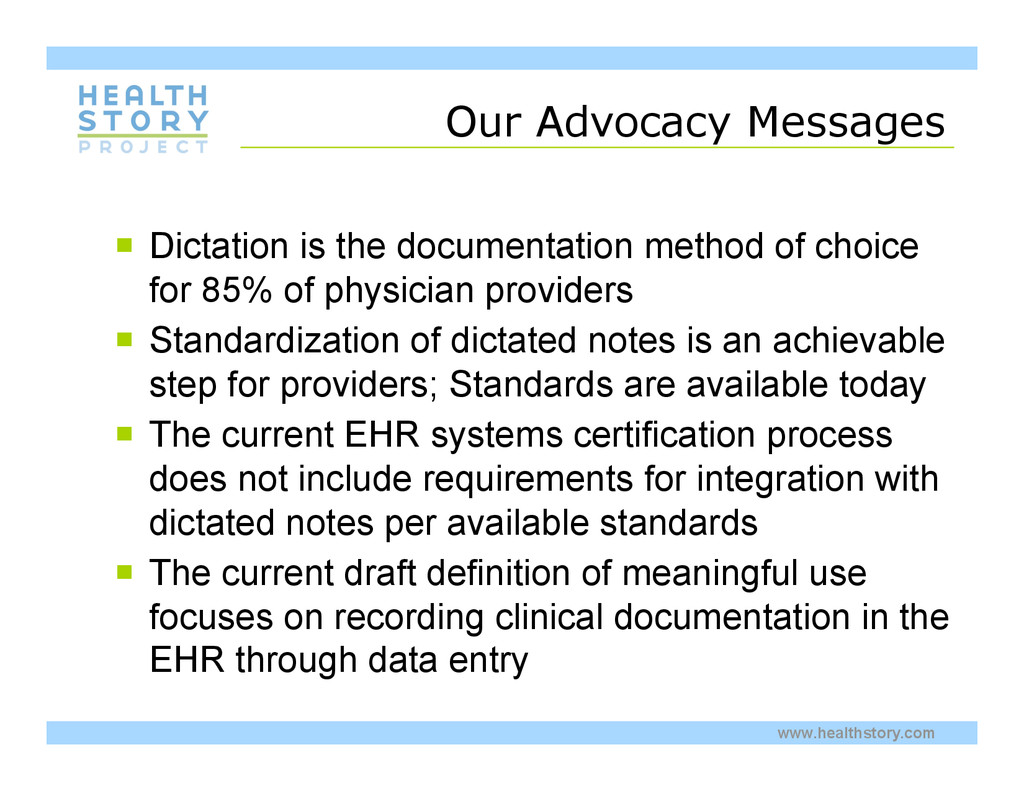
choice for 85% of physician providers Standardization of dictated notes is an achievable step for providers; Standards are available today The current EHR systems certification process does not include requirements for integration with dictated notes per available standards The current draft definition of meaningful use focuses on recording clinical documentation in the EHR through data entry
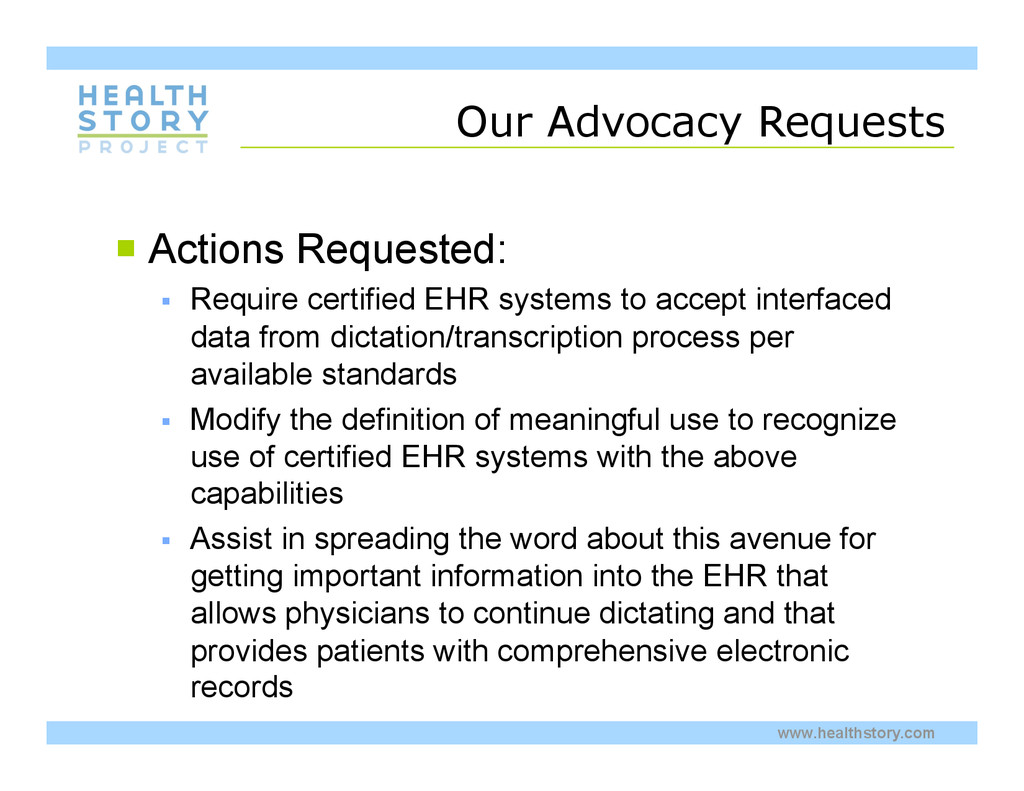
systems to accept interfaced data from dictation/transcription process per available standards Modify the definition of meaningful use to recognize use of certified EHR systems with the above capabilities Assist in spreading the word about this avenue for getting important information into the EHR that allows physicians to continue dictating and that provides patients with comprehensive electronic records
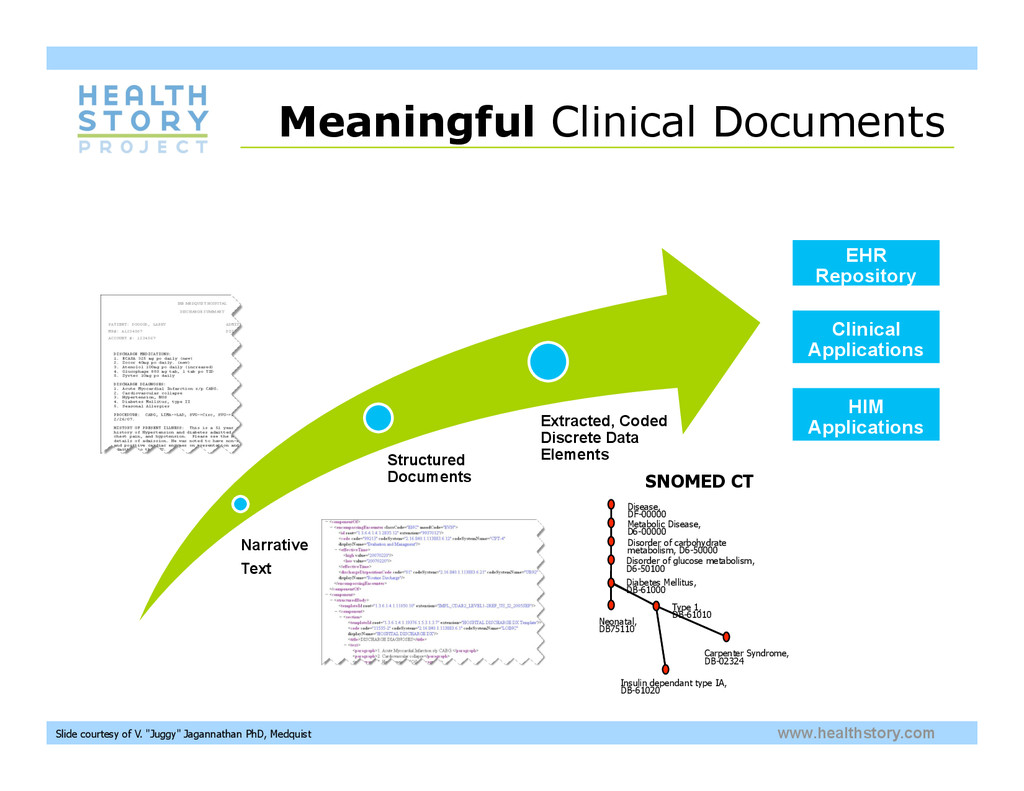
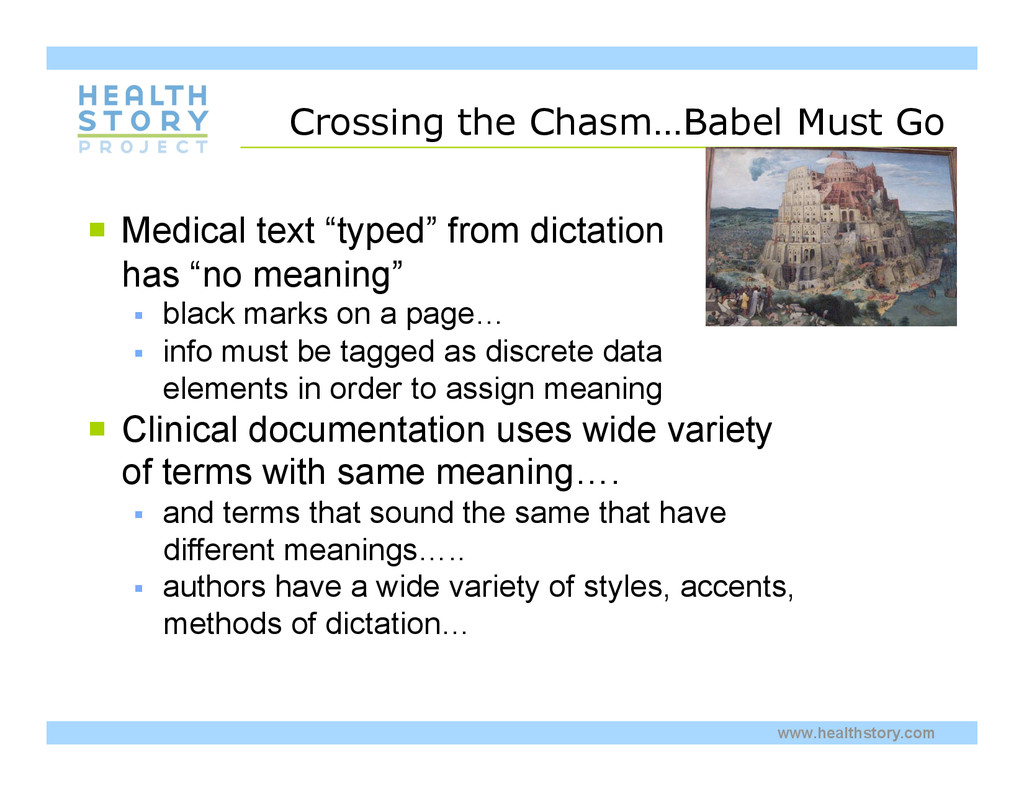
dictation has “no meaning” black marks on a page… info must be tagged as discrete data elements in order to assign meaning Clinical documentation uses wide variety of terms with same meaning…. and terms that sound the same that have different meanings….. authors have a wide variety of styles, accents, methods of dictation…
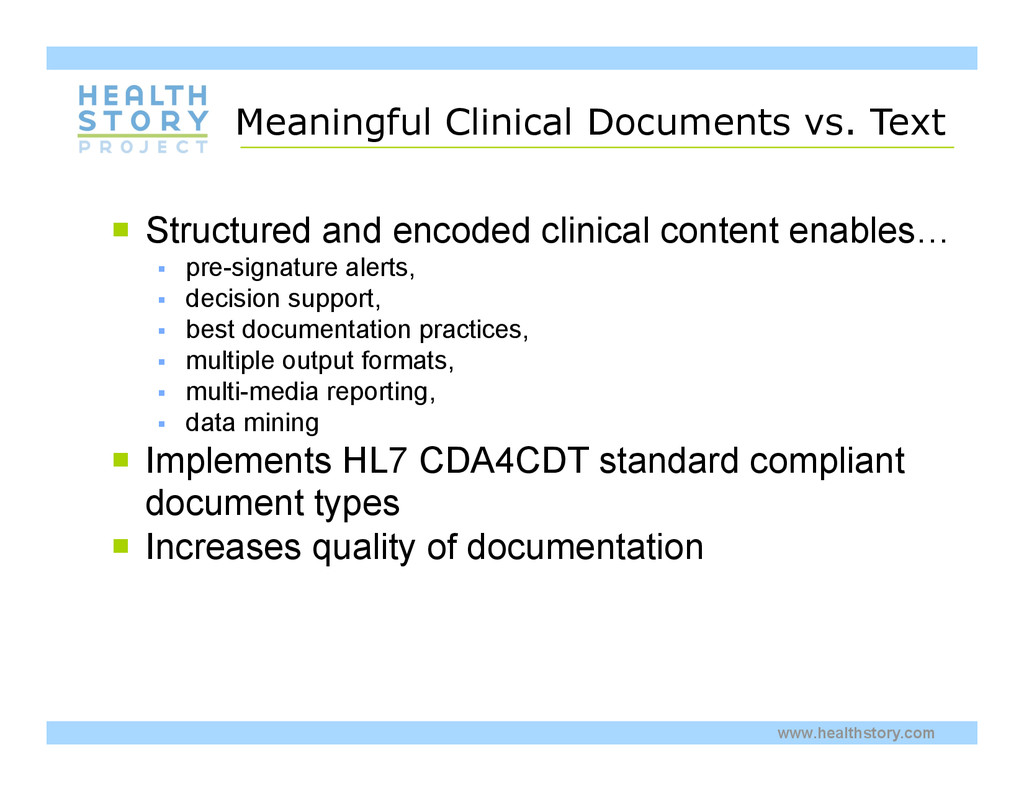
between free form narrative and expressive notes, and fully structured clinical data Improves the quality of clinical documentation Generates semantically interoperable clinical data that will solve the fundamental challenges with EMRs - allowing clinical decision support, alerts, decision support, data mining enable interoperability, reporting, patient safety initiatives, PQRI (pay for performance), PSI (patient safety indicators) and improve billing data capture
methods Increases the value and usability of narrative documents Accelerates the implementation of interoperable electronic health records Allows intelligent and meaningful reuse of information
We need a grass roots effort to help spread the word Educate your employers, clients, etc. about this pathway Join the Effort Varying membership levels, including individuals Volunteer for a Project See “data standards” section of www.healthstory.com Encourage Implementation See “data standards” section of www.healthstory.com for suggested requirements language for transcription and EMR vendors


 odashi
 persolserverworks
 4o1sobblue
 glaforge
 kentapapa
 mohab1
 camiha
 yuuuuuuu168
 akitoshiga
 hiracky16
 tokuty
 terurou
 cassininazir
 jcasabona
 dugsong
 rmw
 mfonobong
 427marketing
 katarinadahlin
 tammyeverts
 bkeepers
 tamaranovitovic
 chriscoyier
 tonyrice