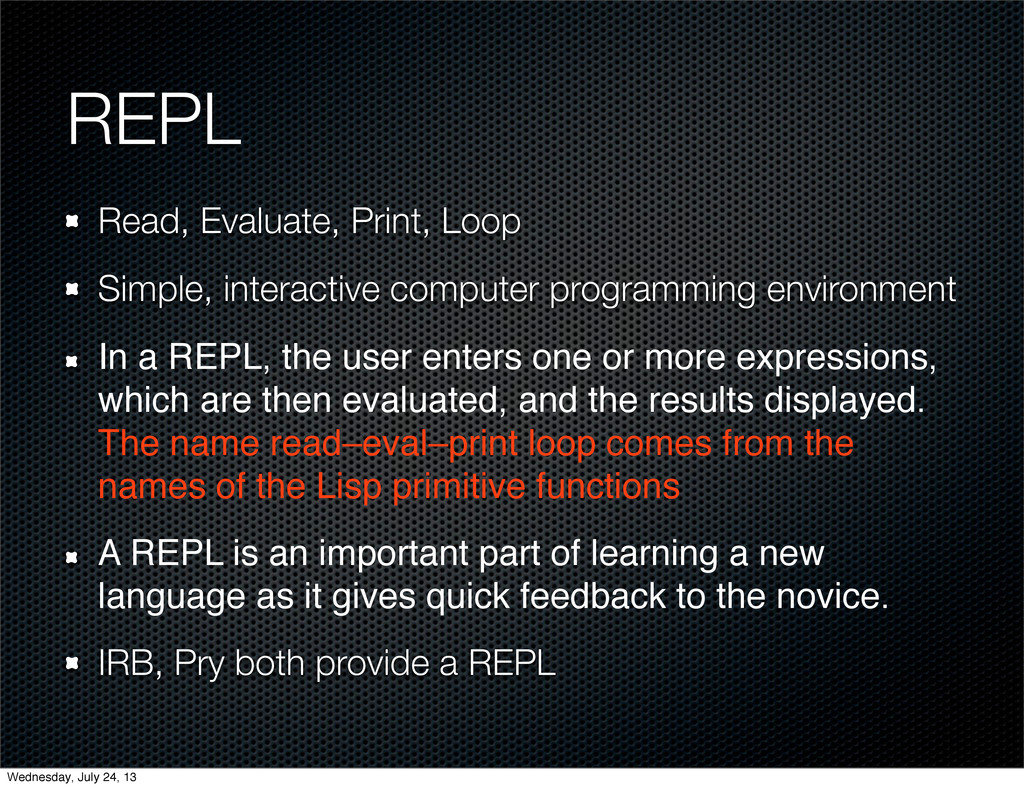
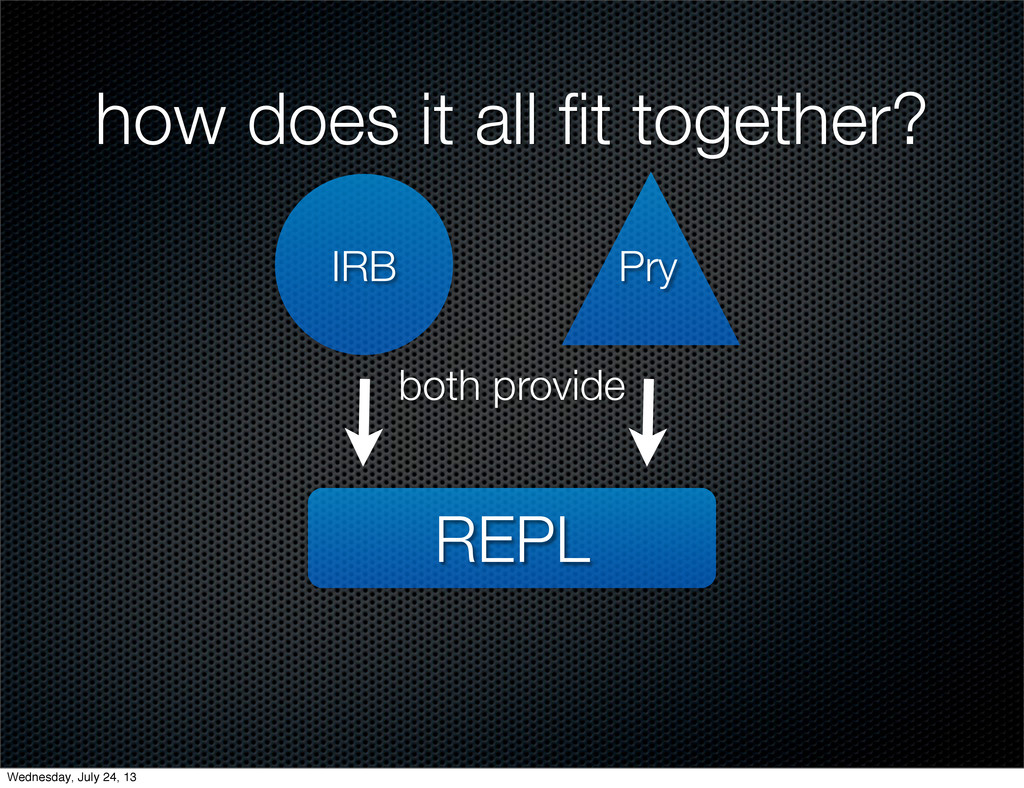
In a REPL, the user enters one or more expressions, which are then evaluated, and the results displayed. The name read–eval–print loop comes from the names of the Lisp primitive functions A REPL is an important part of learning a new language as it gives quick feedback to the novice. IRB, Pry both provide a REPL Wednesday, July 24, 13
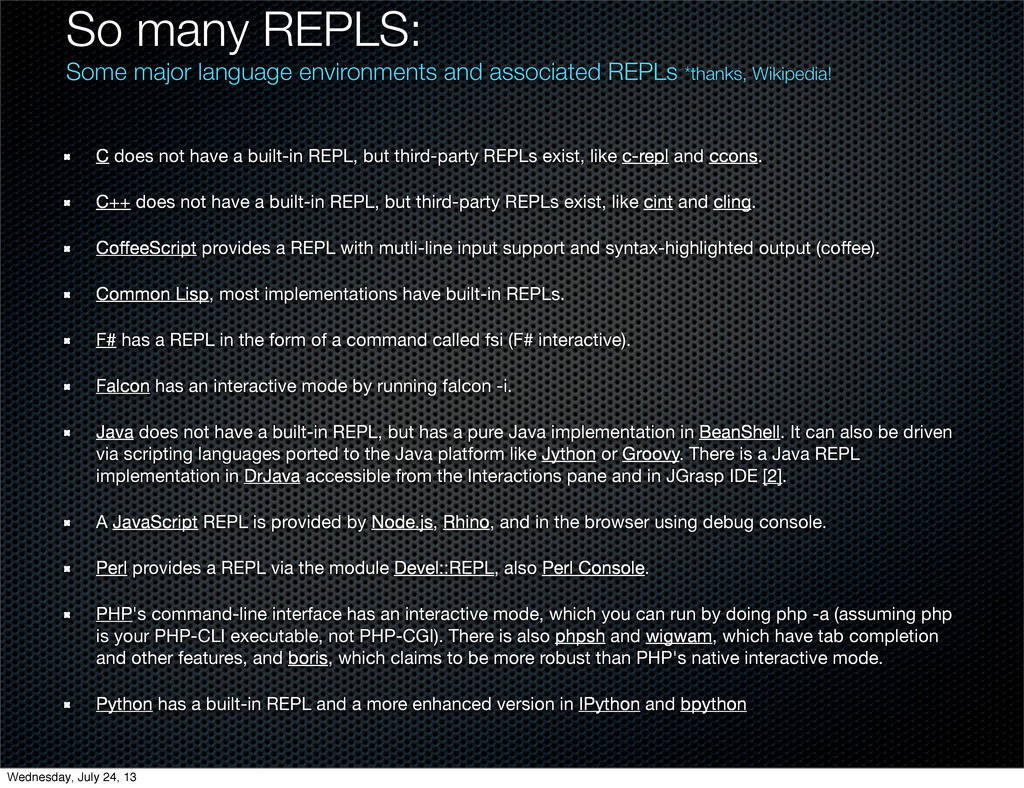
*thanks, Wikipedia! C does not have a built-in REPL, but third-party REPLs exist, like c-repl and ccons. C++ does not have a built-in REPL, but third-party REPLs exist, like cint and cling. CoffeeScript provides a REPL with mutli-line input support and syntax-highlighted output (coffee). Common Lisp, most implementations have built-in REPLs. F# has a REPL in the form of a command called fsi (F# interactive). Falcon has an interactive mode by running falcon -i. Java does not have a built-in REPL, but has a pure Java implementation in BeanShell. It can also be driven via scripting languages ported to the Java platform like Jython or Groovy. There is a Java REPL implementation in DrJava accessible from the Interactions pane and in JGrasp IDE [2]. A JavaScript REPL is provided by Node.js, Rhino, and in the browser using debug console. Perl provides a REPL via the module Devel::REPL, also Perl Console. PHP's command-line interface has an interactive mode, which you can run by doing php -a (assuming php is your PHP-CLI executable, not PHP-CGI). There is also phpsh and wigwam, which have tab completion and other features, and boris, which claims to be more robust than PHP's native interactive mode. Python has a built-in REPL and a more enhanced version in IPython and bpython Wednesday, July 24, 13
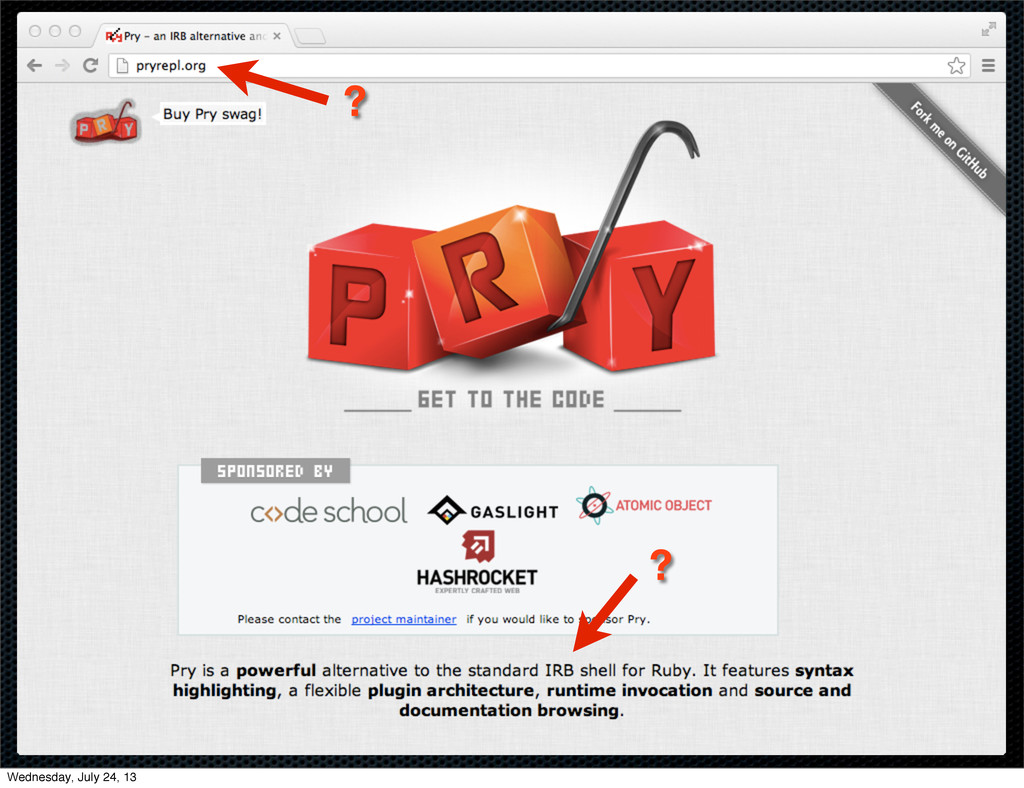
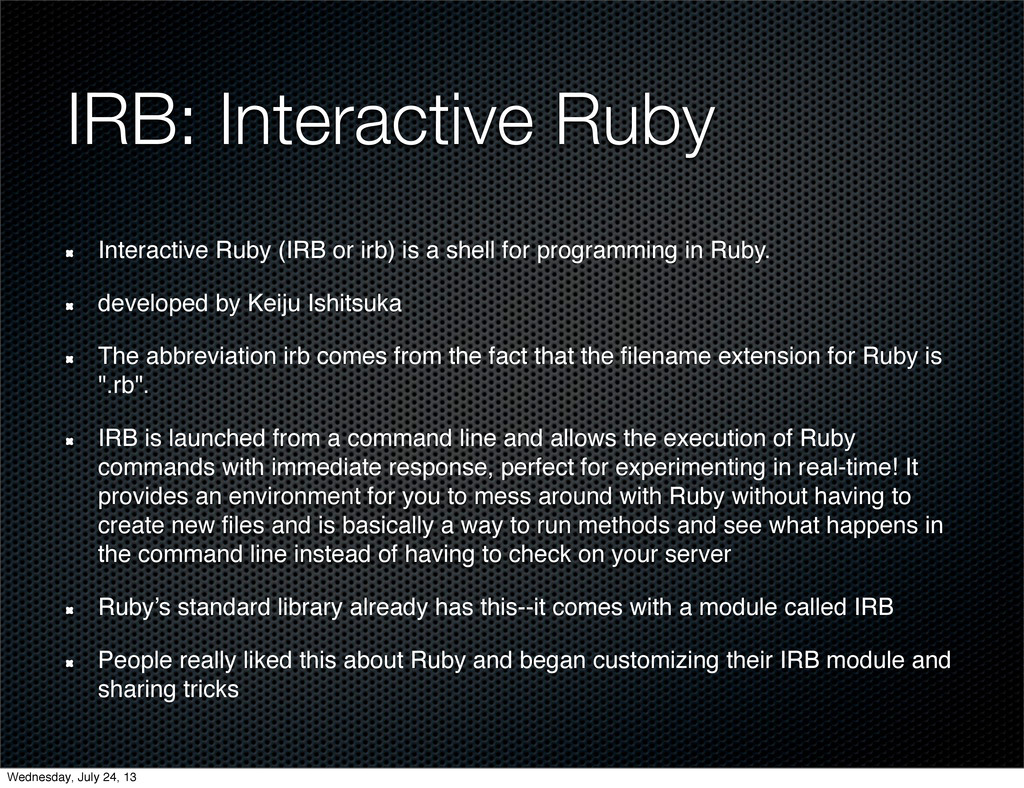
shell for programming in Ruby. developed by Keiju Ishitsuka The abbreviation irb comes from the fact that the filename extension for Ruby is ".rb". IRB is launched from a command line and allows the execution of Ruby commands with immediate response, perfect for experimenting in real-time! It provides an environment for you to mess around with Ruby without having to create new files and is basically a way to run methods and see what happens in the command line instead of having to check on your server Ruby’s standard library already has this--it comes with a module called IRB People really liked this about Ruby and began customizing their IRB module and sharing tricks Wednesday, July 24, 13
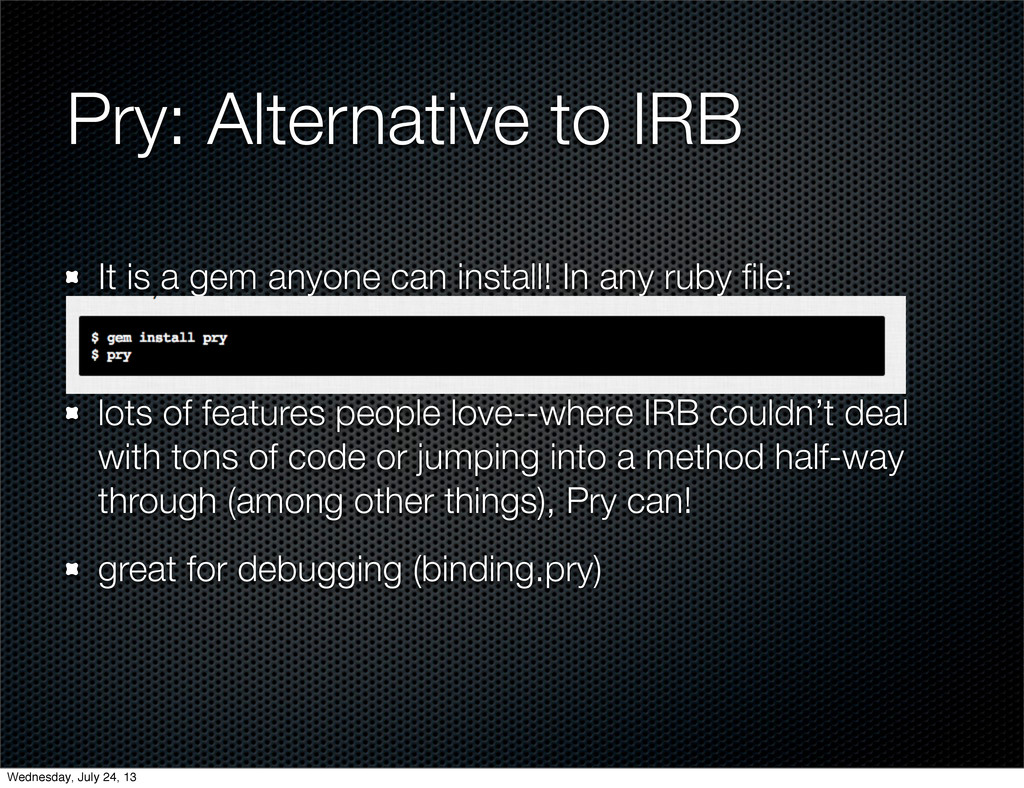
install! In any ruby file: lots of features people love--where IRB couldn’t deal with tons of code or jumping into a method half-way through (among other things), Pry can! great for debugging (binding.pry) Wednesday, July 24, 13
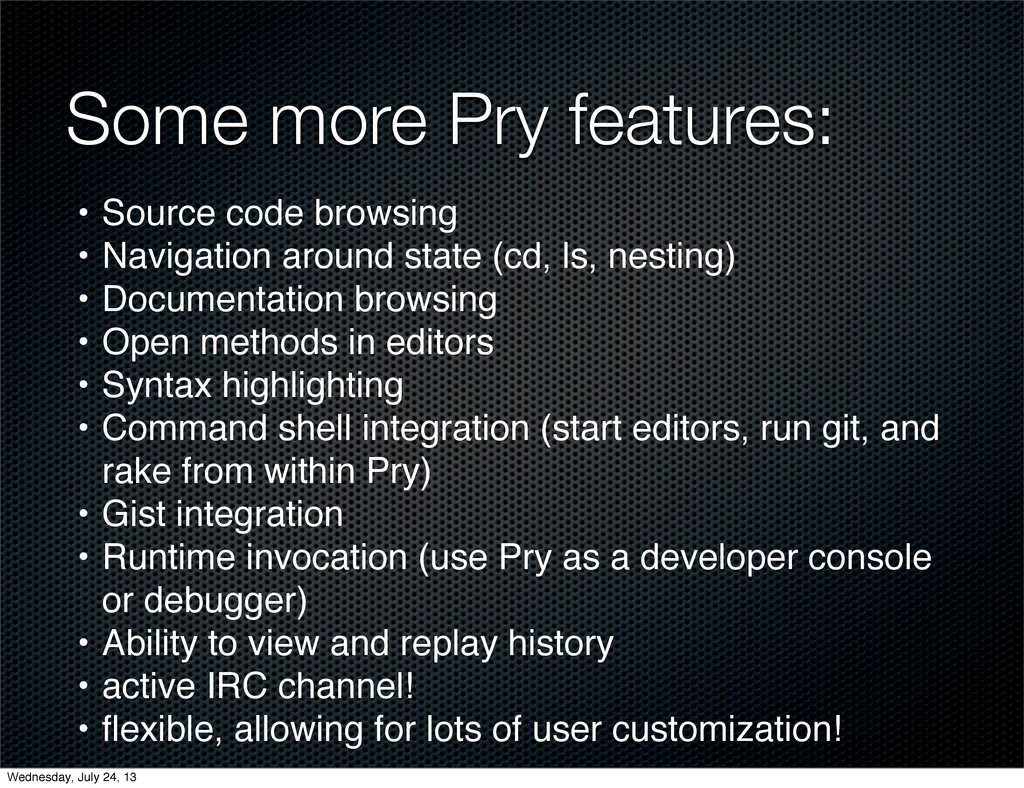
around state (cd, ls, nesting) • Documentation browsing • Open methods in editors • Syntax highlighting • Command shell integration (start editors, run git, and rake from within Pry) • Gist integration • Runtime invocation (use Pry as a developer console or debugger) • Ability to view and replay history • active IRC channel! • flexible, allowing for lots of user customization! Wednesday, July 24, 13


 emmath
 hakkadaikon
 kamina_zzz
 itsmedreamwalker
 ryunakayama
 maaaato
 sodainc
 t0yohei
 nasa9084
 yuuu
 usagi0920_pochi
 ivargrimstad
 ternbusty
 maggiecrowley
 techseoconnect
 maltzj
 ryanjones
 addyosmani
 brettharned
 marktimemedia
 lara
 moore
 uxyall
 joshbly
 bermonpainter