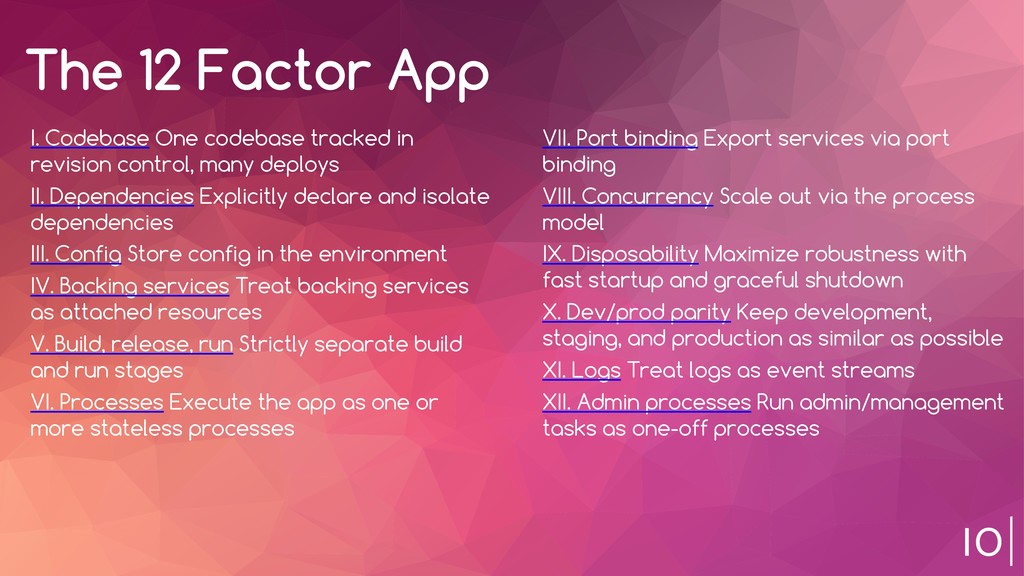
revision control, many deploys II. Dependencies Explicitly declare and isolate dependencies III. Config Store config in the environment IV. Backing services Treat backing services as attached resources V. Build, release, run Strictly separate build and run stages VI. Processes Execute the app as one or more stateless processes VII. Port binding Export services via port binding VIII. Concurrency Scale out via the process model IX. Disposability Maximize robustness with fast startup and graceful shutdown X. Dev/prod parity Keep development, staging, and production as similar as possible XI. Logs Treat logs as event streams XII. Admin processes Run admin/management tasks as one-off processes
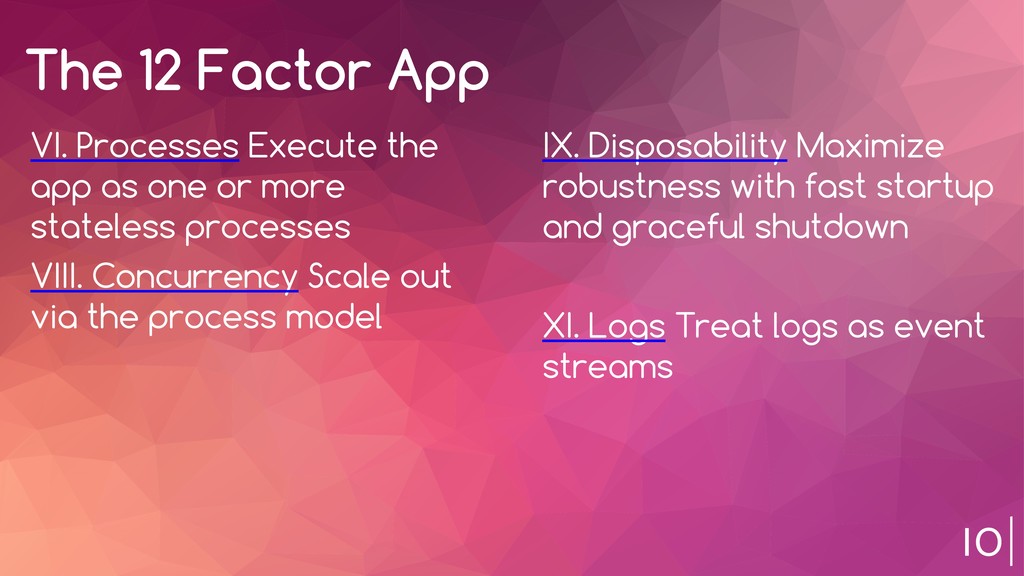
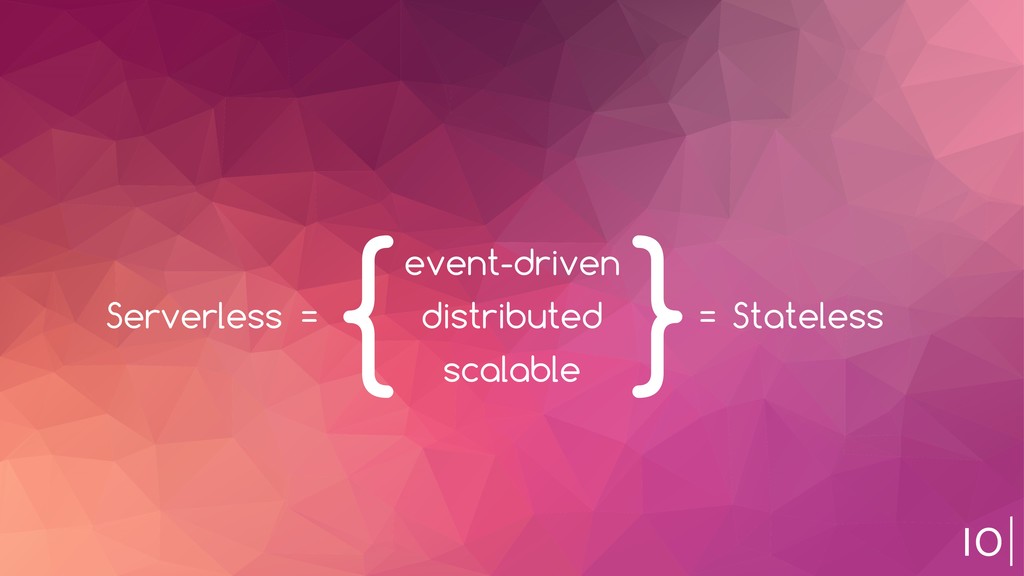
one or more stateless processes VIII. Concurrency Scale out via the process model IX. Disposability Maximize robustness with fast startup and graceful shutdown XI. Logs Treat logs as event streams
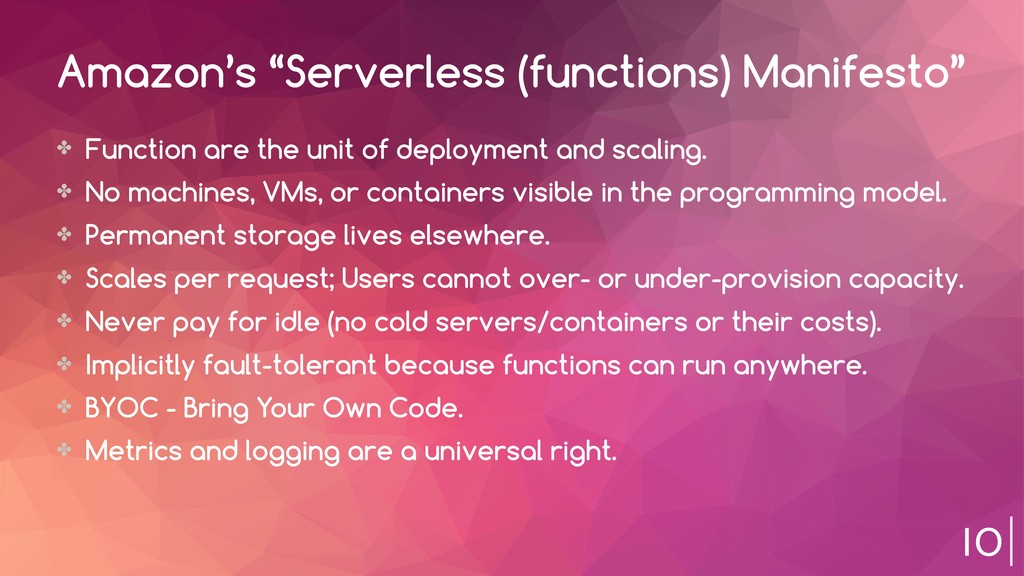
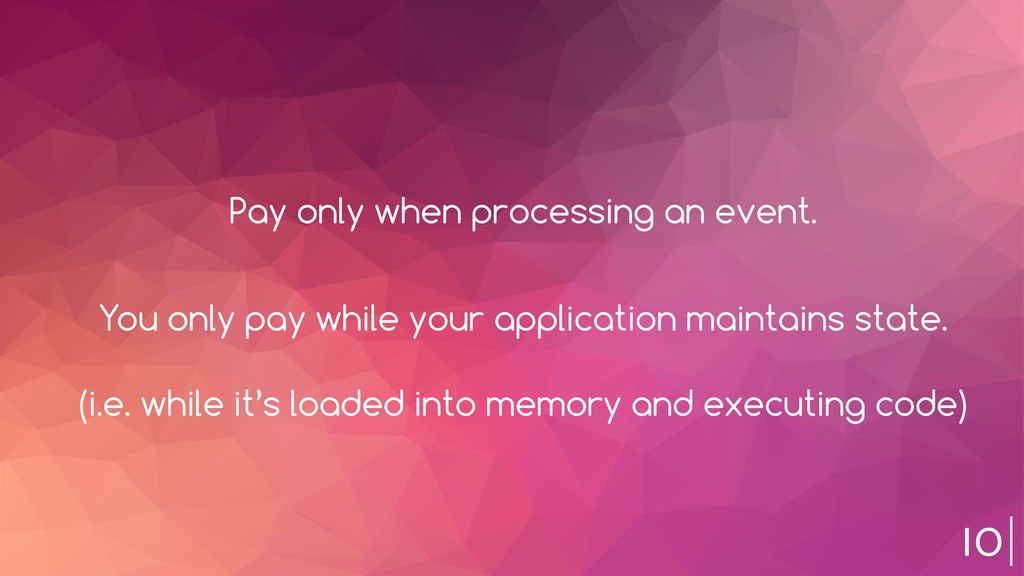
deployment and scaling. ✤ No machines, VMs, or containers visible in the programming model. ✤ Permanent storage lives elsewhere. ✤ Scales per request; Users cannot over- or under-provision capacity. ✤ Never pay for idle (no cold servers/containers or their costs). ✤ Implicitly fault-tolerant because functions can run anywhere. ✤ BYOC - Bring Your Own Code. ✤ Metrics and logging are a universal right.


 ewindisch
 deka_morita
 iwatsukayura
 akit37
 oniak3ibm
 chobishiba
 yub0n
 kenjiyoneyama
 morizo_1984
 neuecc
 timakin
 artoy
 ___akari11
 akosma
 codingconduct
 skipperchong
 mza
 lindahogenes
 csswizardry
 vanstee
 aleyda
 jonyablonski
 bcantrill
 chrislema
 mraible