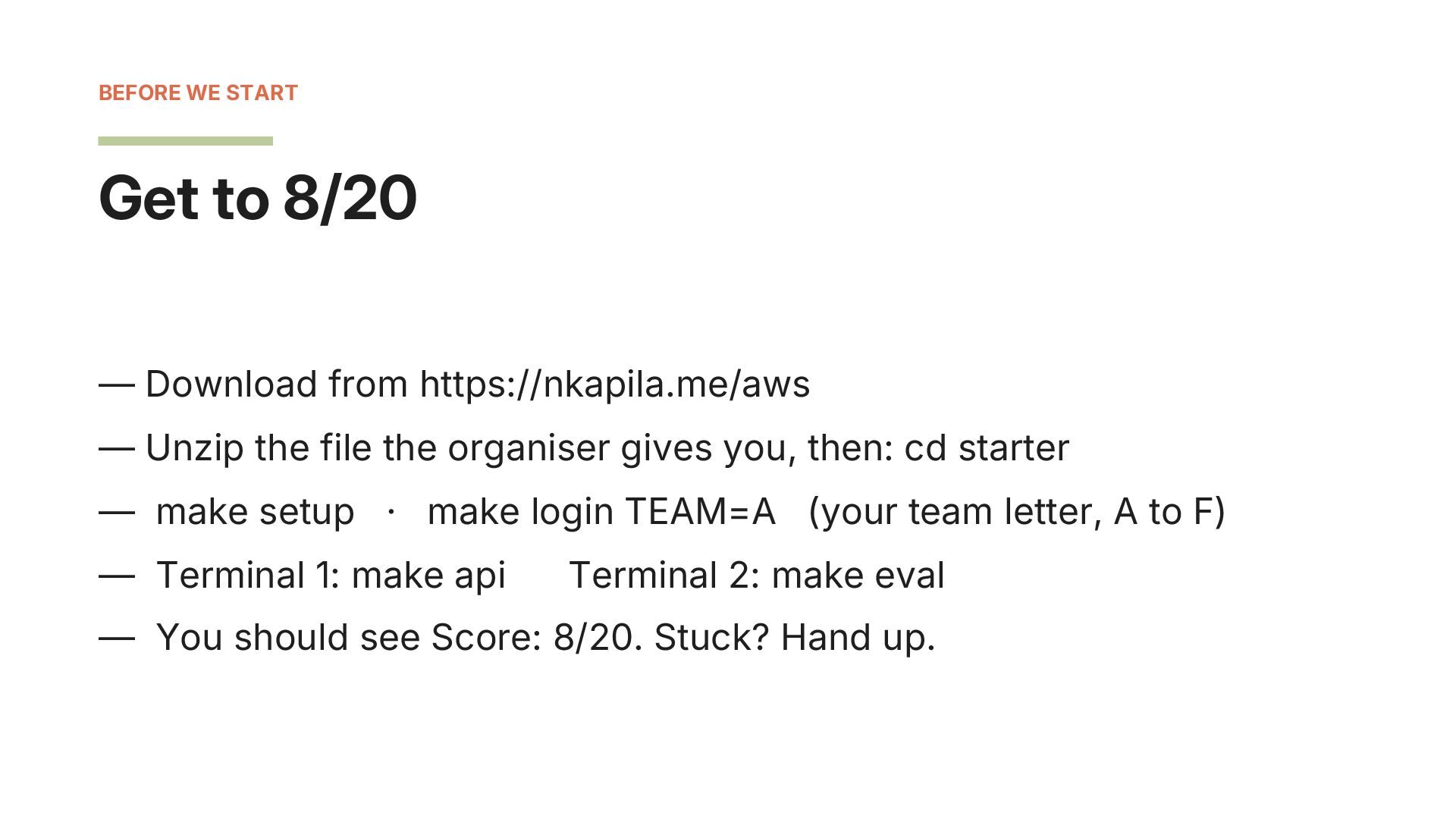
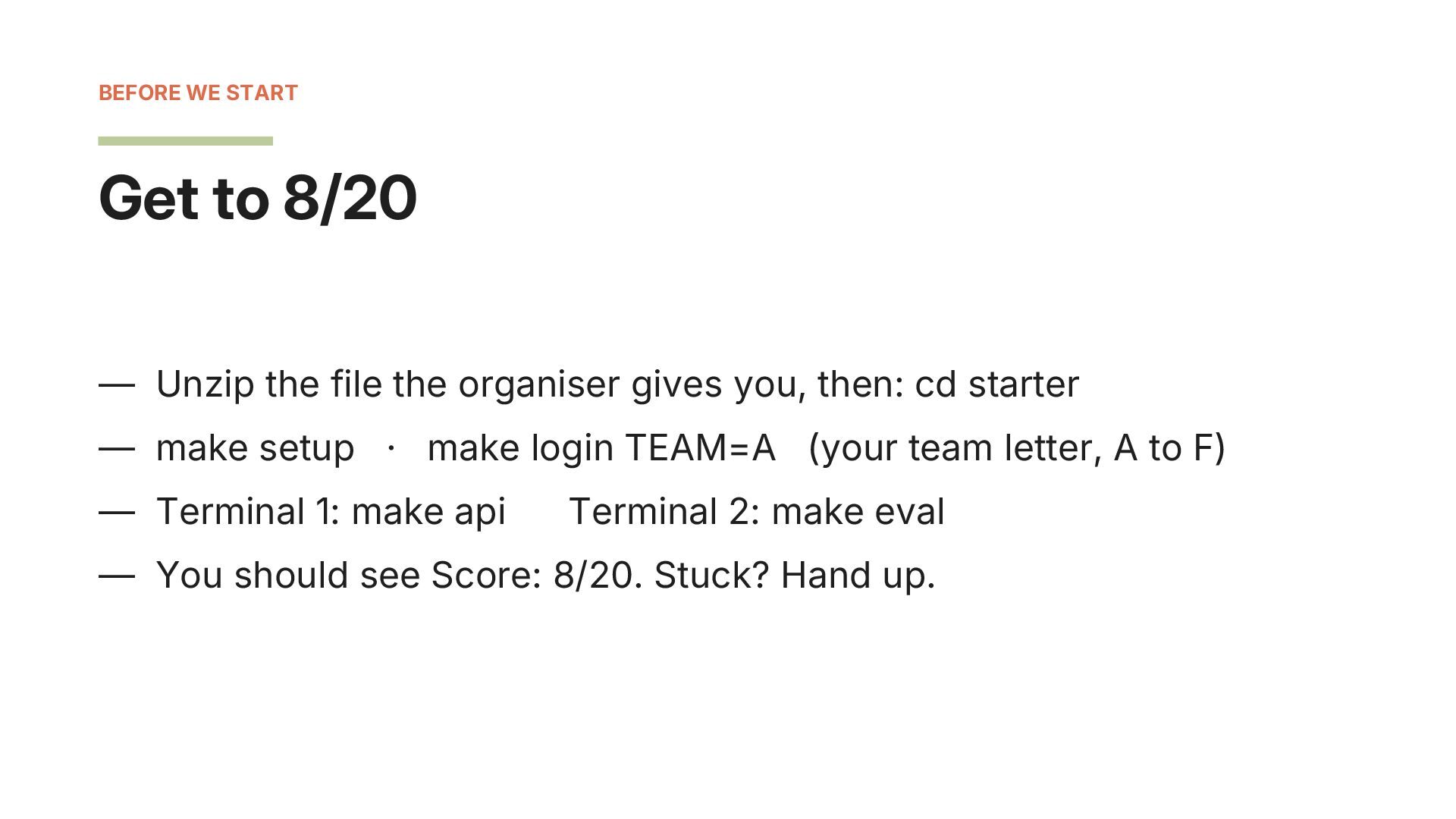
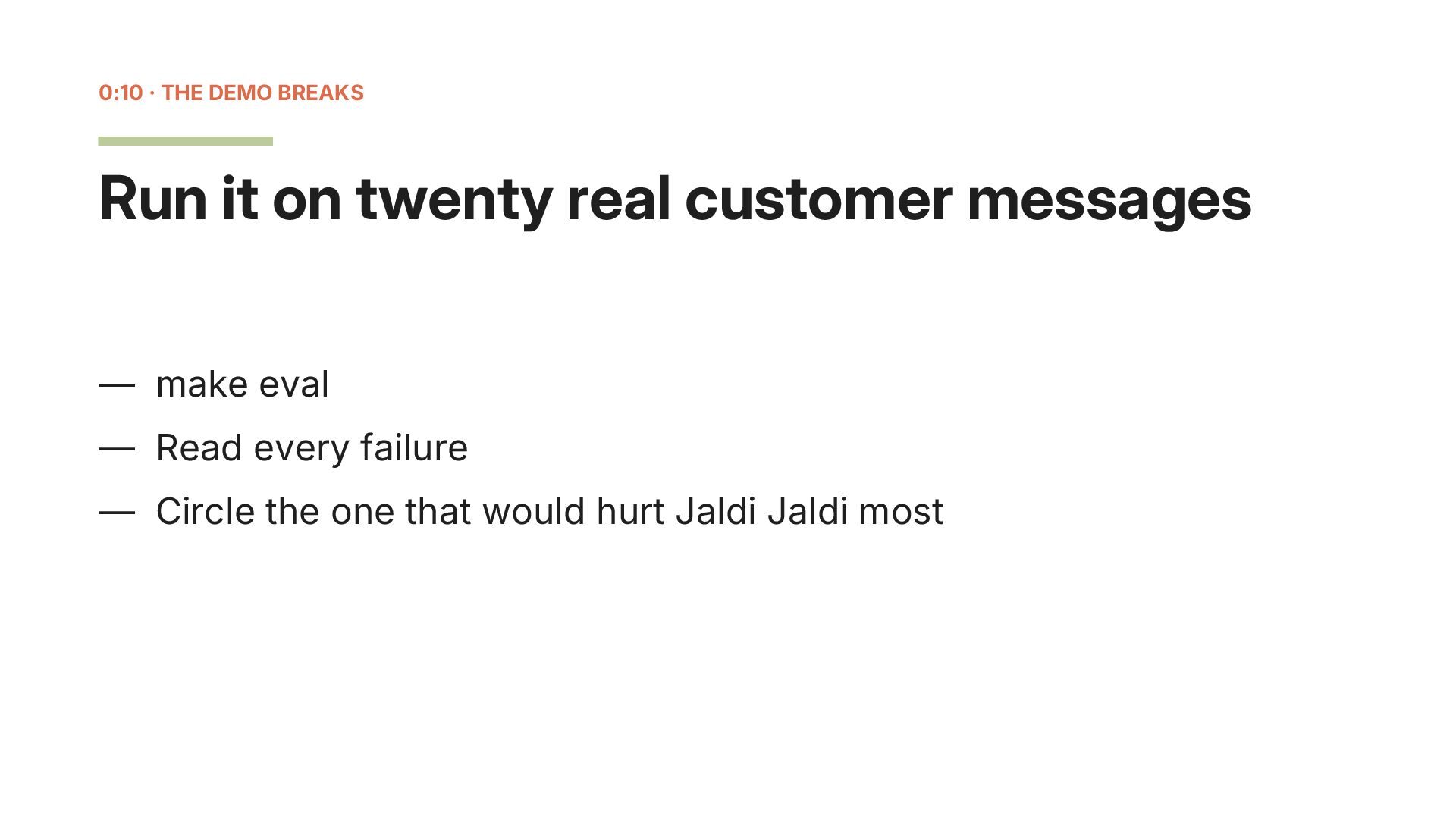
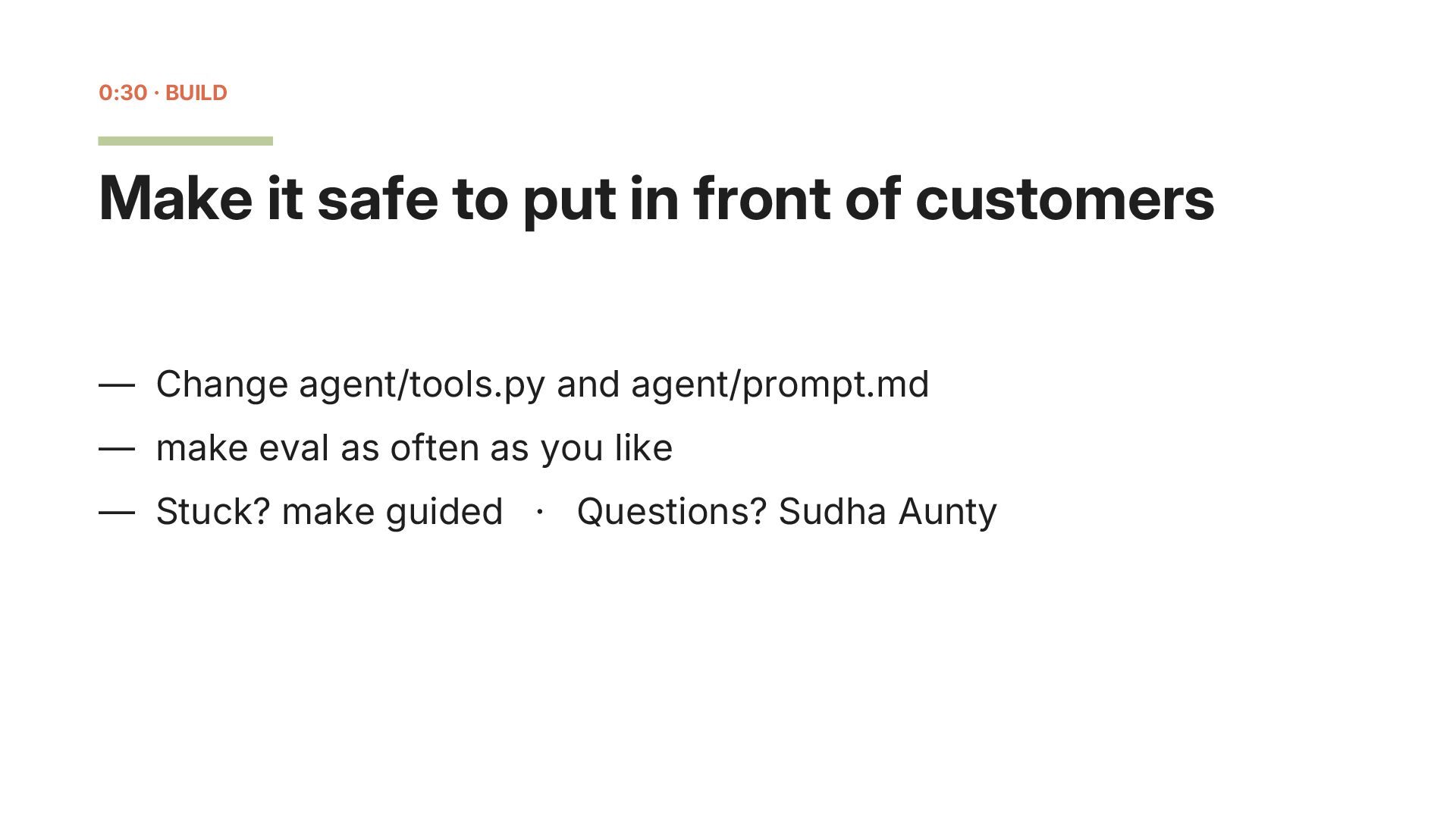
— Unzip the file the organiser gives you, then: cd starter — make setup · make login TEAM=A (your team letter, A to F) — Terminal 1: make api Terminal 2: make eval — You should see Score: 8/20. Stuck? Hand up.
the organiser gives you, then: cd starter — make setup · make login TEAM=A (your team letter, A to F) — Terminal 1: make api Terminal 2: make eval — You should see Score: 8/20. Stuck? Hand up.
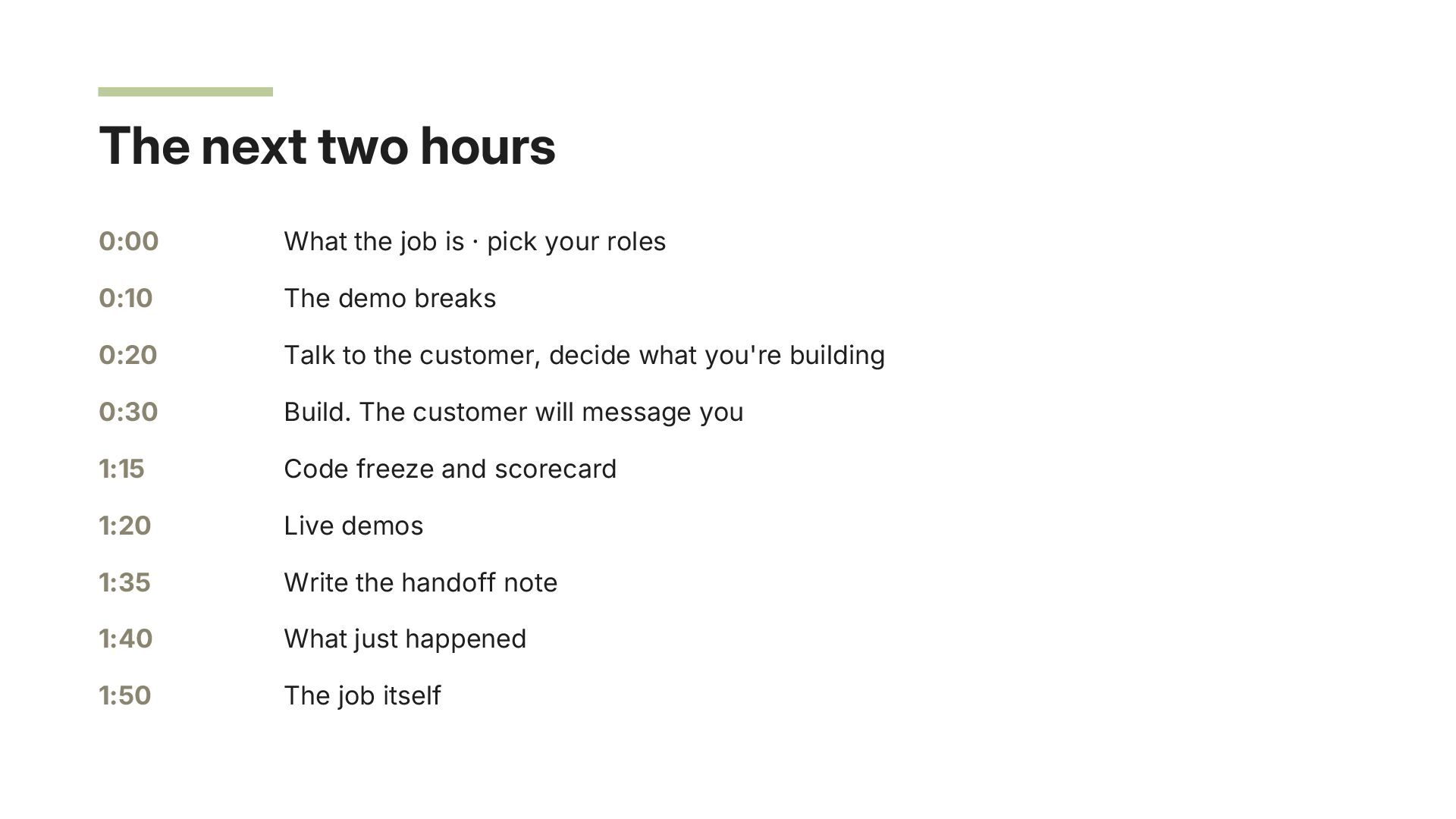
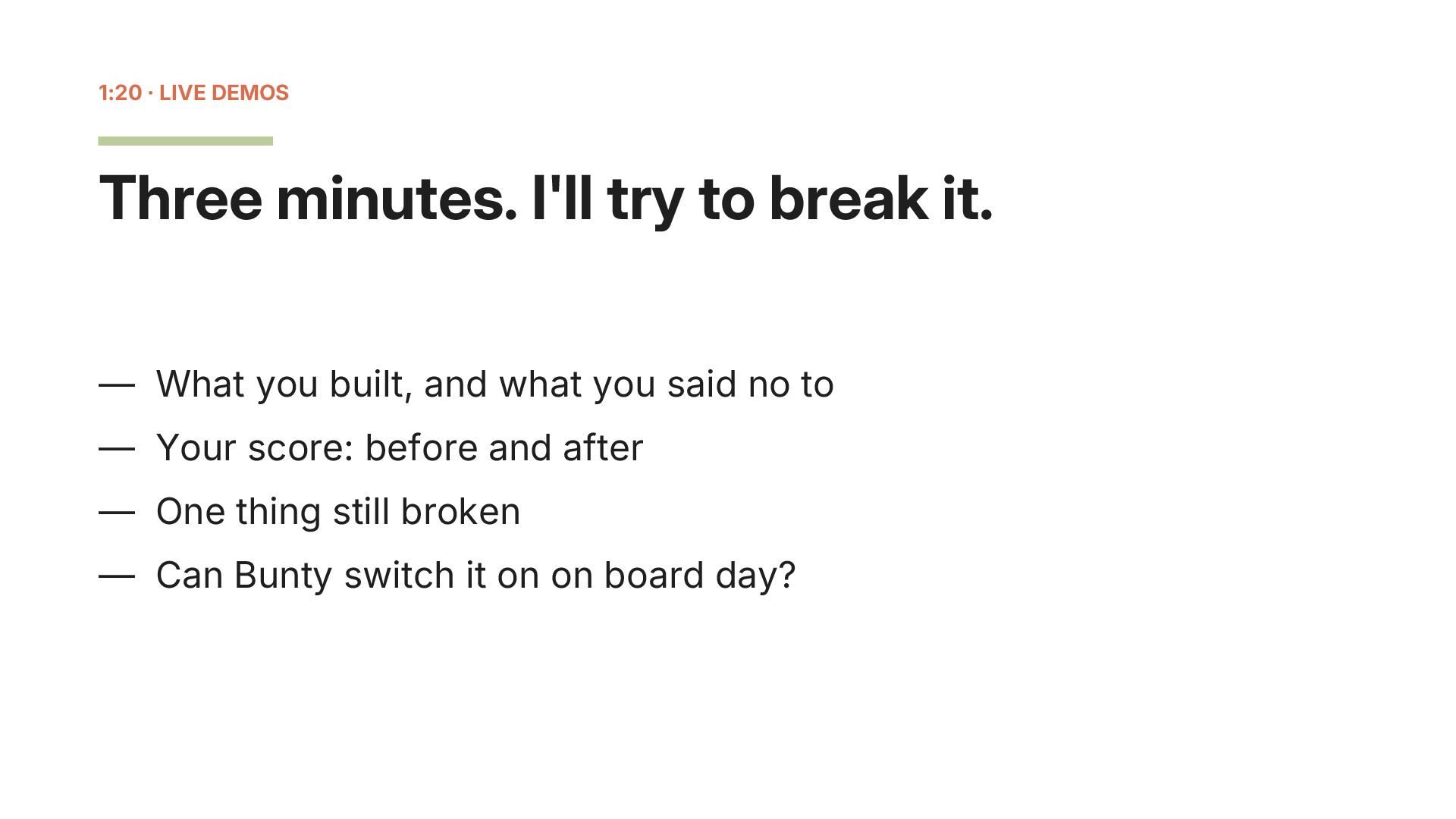
pick your roles 0:10 The demo breaks 0:20 Talk to the customer, decide what you're building 0:30 Build. The customer will message you 1:15 Code freeze and scorecard 1:20 Live demos 1:35 Write the handoff note 1:40 What just happened 1:50 The job itself
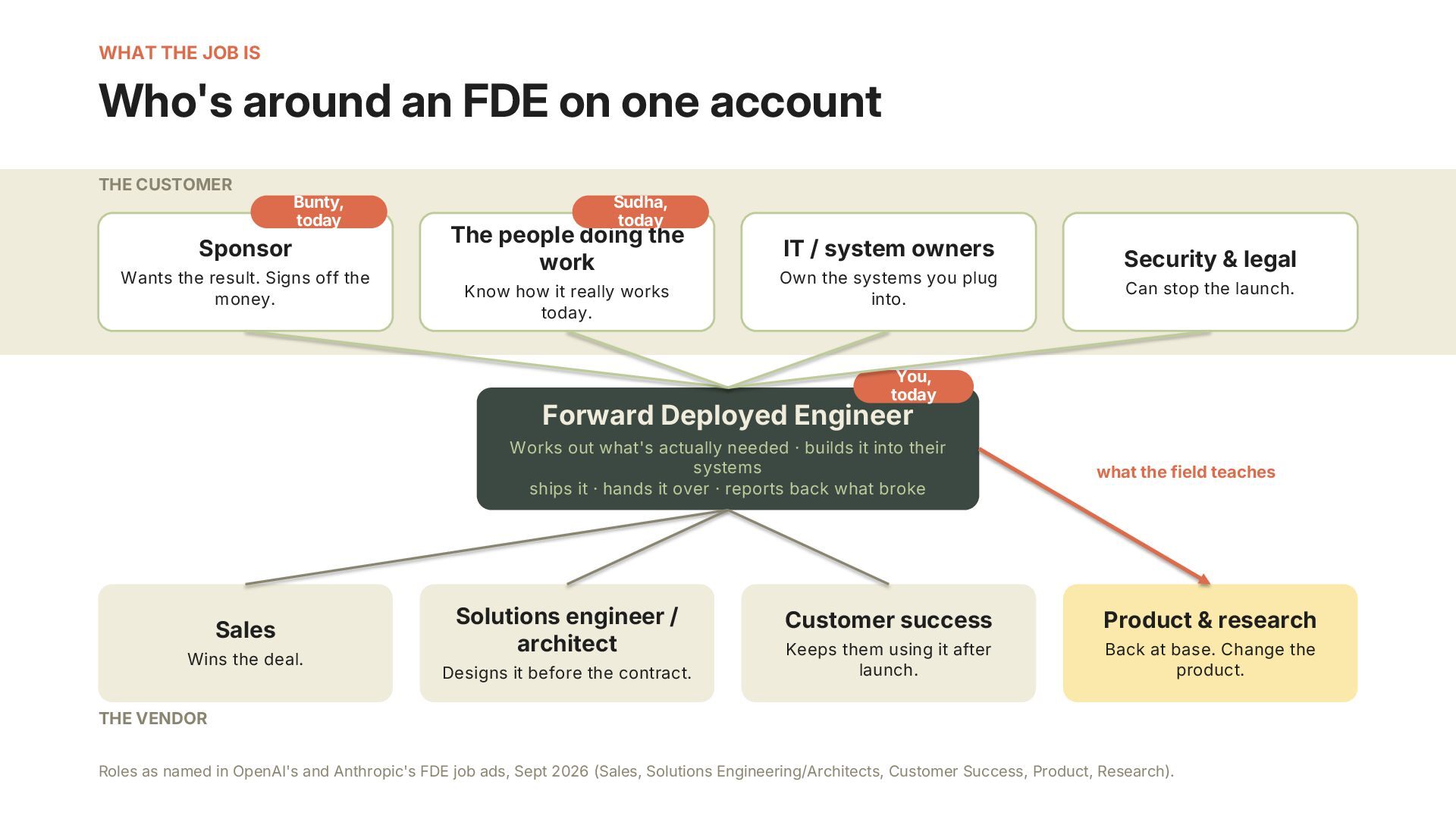
account THE CUSTOMER Bunty, today Sponsor Wants the result. Signs off the money. Sudha, today The people doing the work Know how it really works today. IT / system owners Own the systems you plug into. Security & legal Can stop the launch. You, today Forward Deployed Engineer Works out what's actually needed · builds it into their systems ships it · hands it over · reports back what broke Sales Wins the deal. Solutions engineer / architect Designs it before the contract. what the field teaches Customer success Product & research Keeps them using it after launch. Back at base. Change the product. THE VENDOR Roles as named in OpenAI's and Anthropic's FDE job ads, Sept 2026 (Sales, Solutions Engineering/Architects, Customer Success, Product, Research).
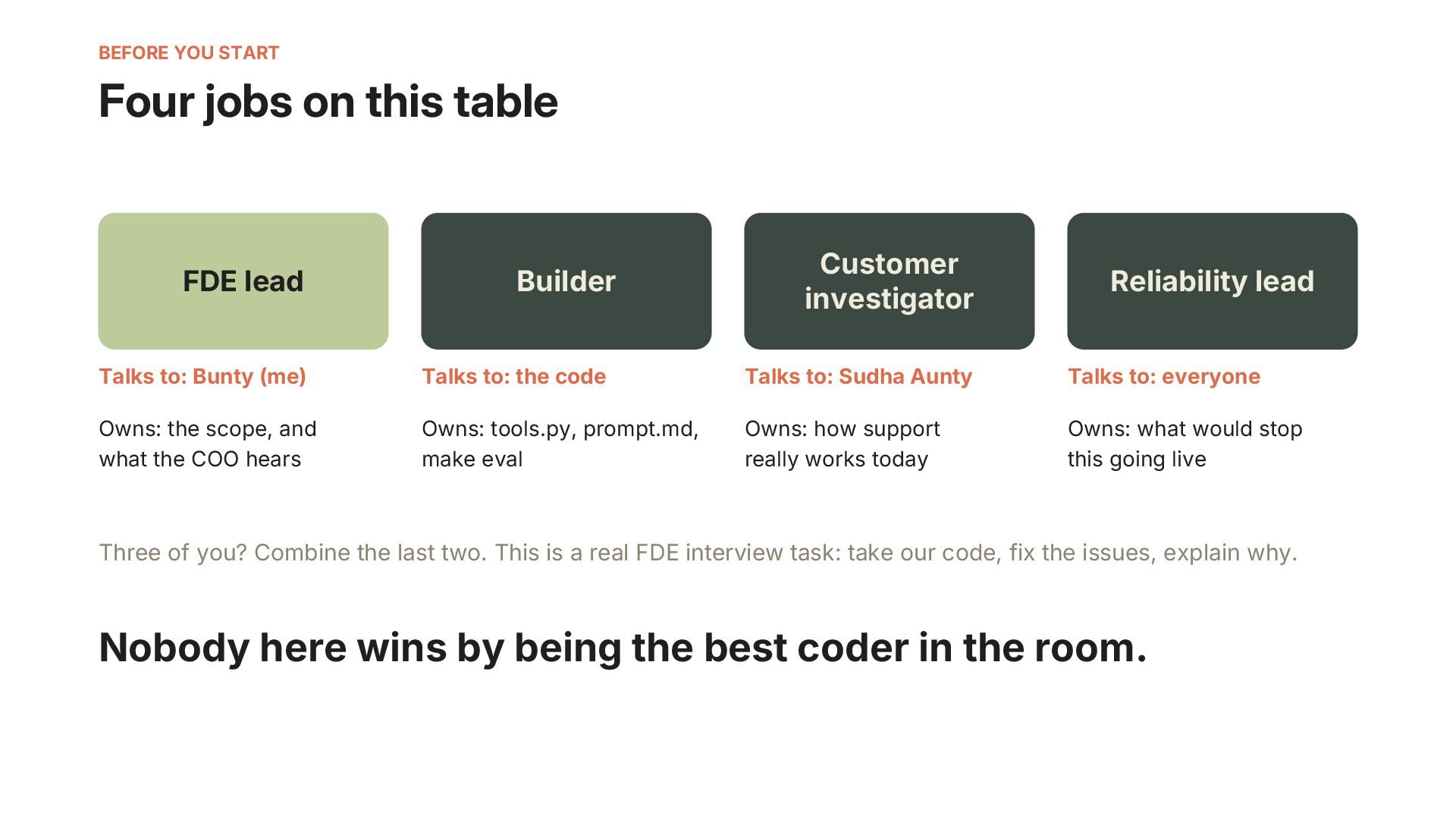
Builder Customer investigator Talks to: Bunty (me) Talks to: the code Talks to: Sudha Aunty Talks to: everyone Owns: the scope, and what the COO hears Owns: tools.py, prompt.md, make eval Owns: how support really works today Owns: what would stop this going live Reliability lead Three of you? Combine the last two. This is a real FDE interview task: take our code, fix the issues, explain why. Nobody here wins by being the best coder in the room.
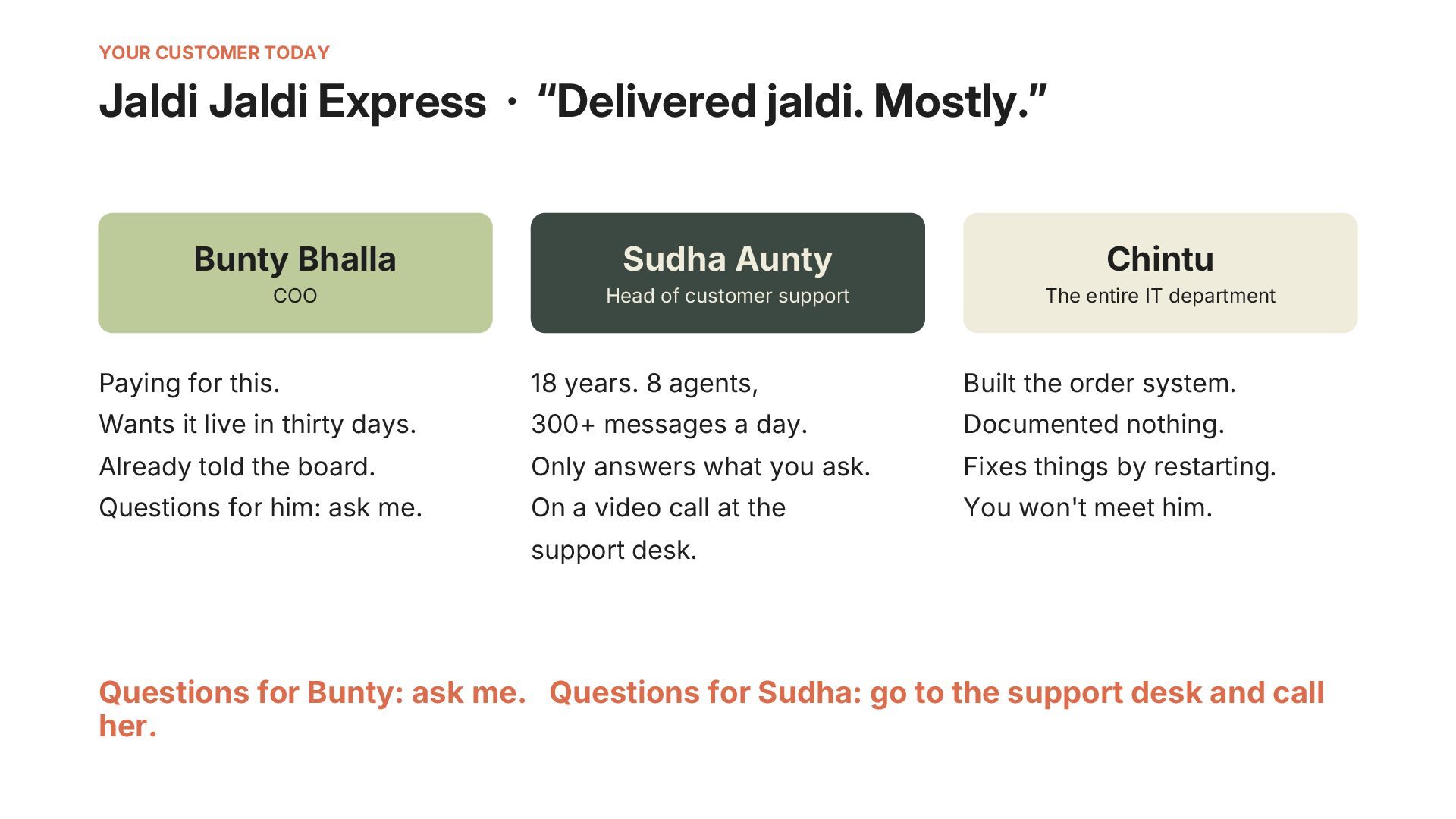
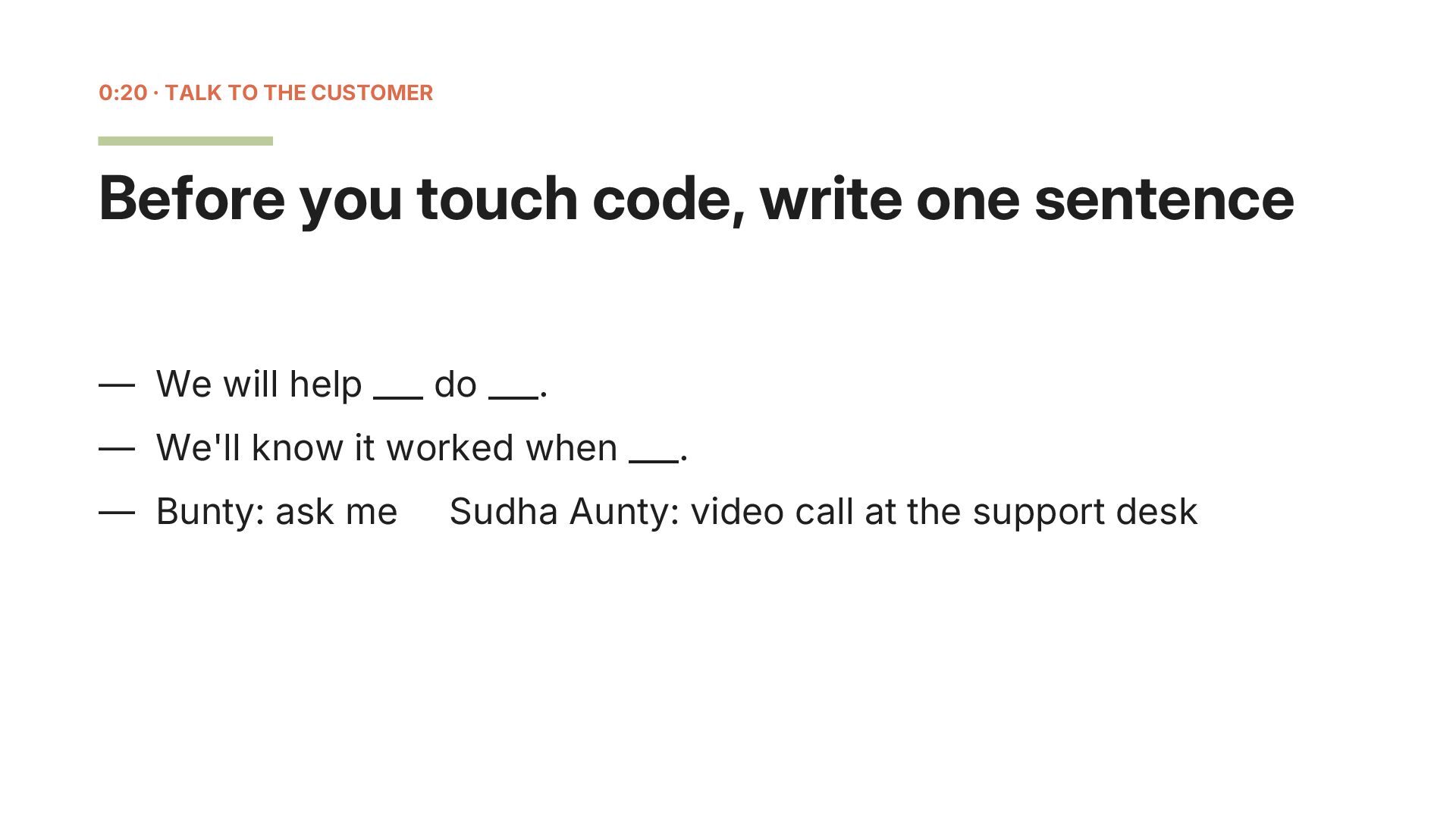
Bunty Bhalla Sudha Aunty Chintu COO Head of customer support The entire IT department Paying for this. 18 years. 8 agents, Built the order system. Wants it live in thirty days. 300+ messages a day. Documented nothing. Already told the board. Only answers what you ask. Fixes things by restarting. Questions for him: ask me. On a video call at the You won't meet him. support desk. Questions for Bunty: ask me. Questions for Sudha: go to the support desk and call her.
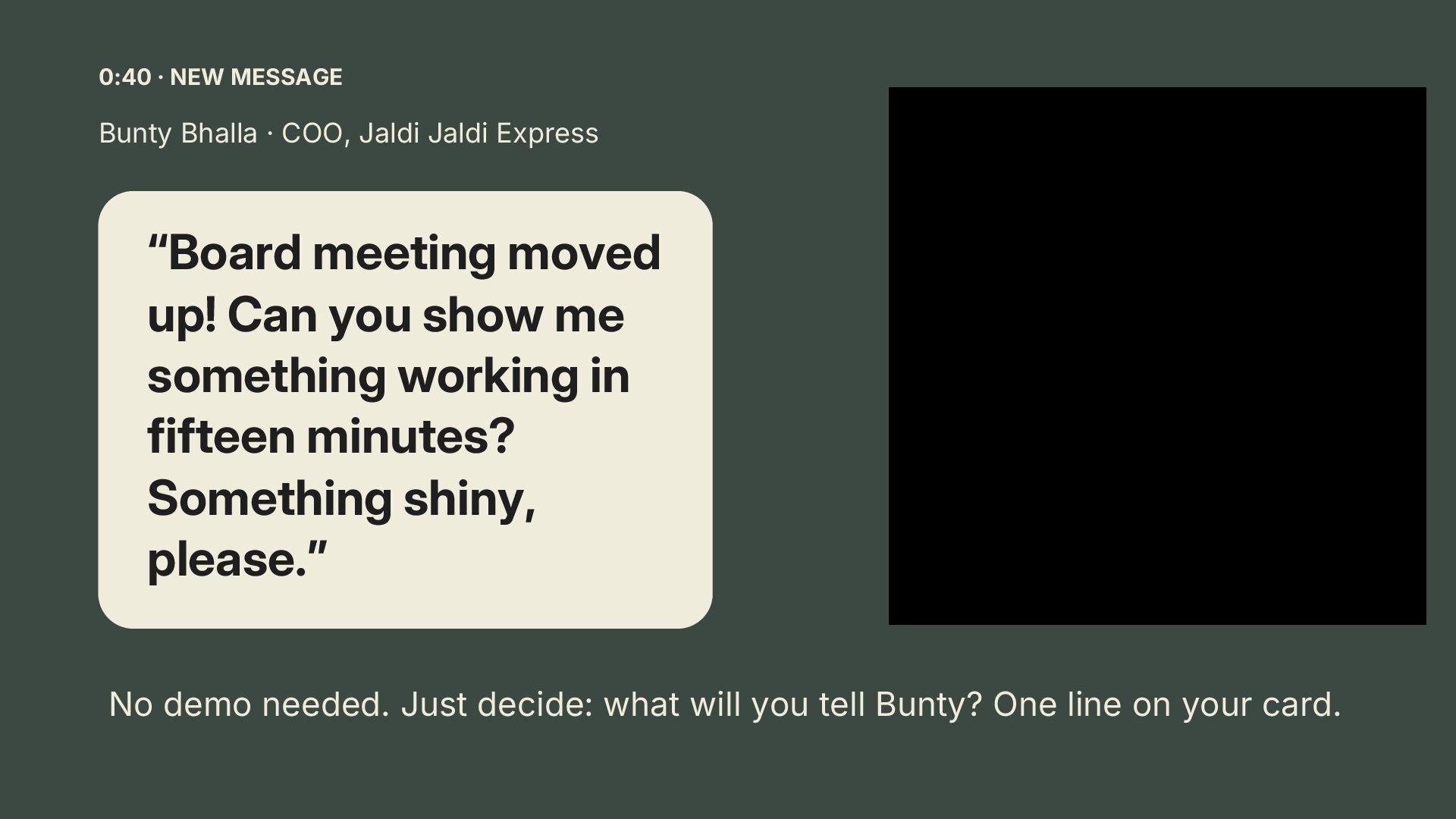
Express “Board meeting moved up! Can you show me something working in fifteen minutes? Something shiny, please.” No demo needed. Just decide: what will you tell Bunty? One line on your card.
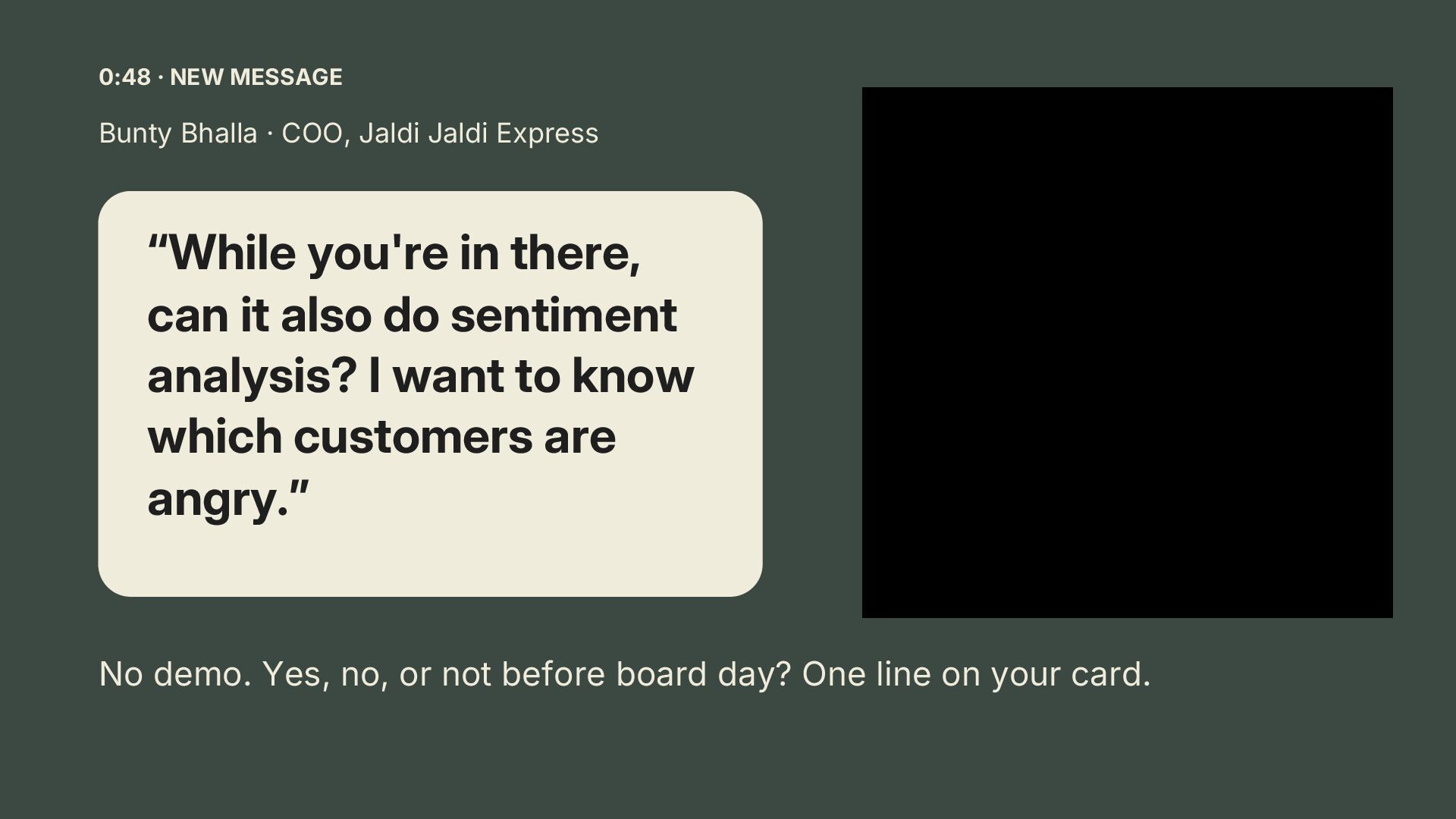
Express “While you're in there, can it also do sentiment analysis? I want to know which customers are angry.” No demo. Yes, no, or not before board day? One line on your card.
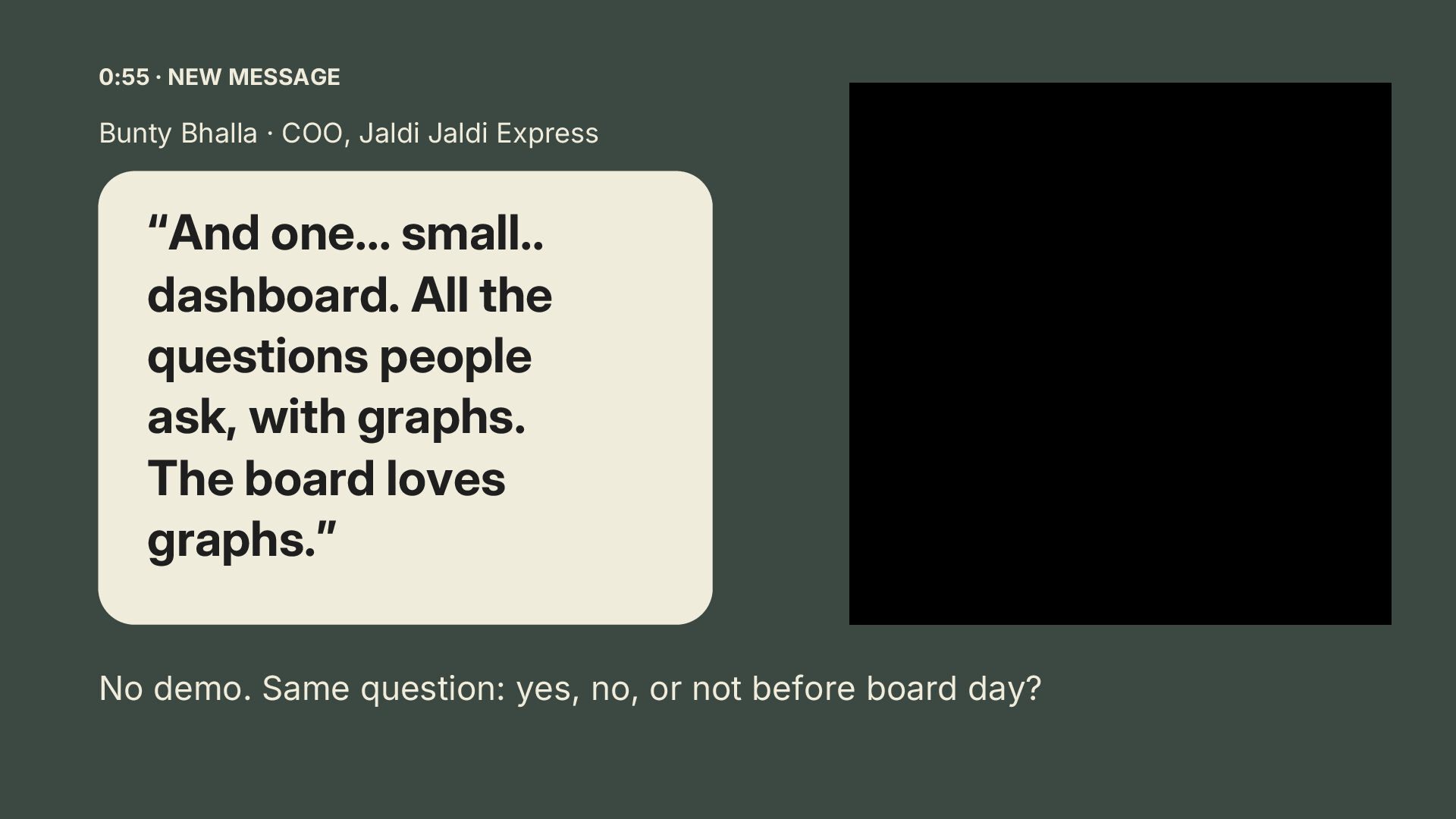
Express “And one... small.. dashboard. All the questions people ask, with graphs. The board loves graphs.” No demo. Same question: yes, no, or not before board day?
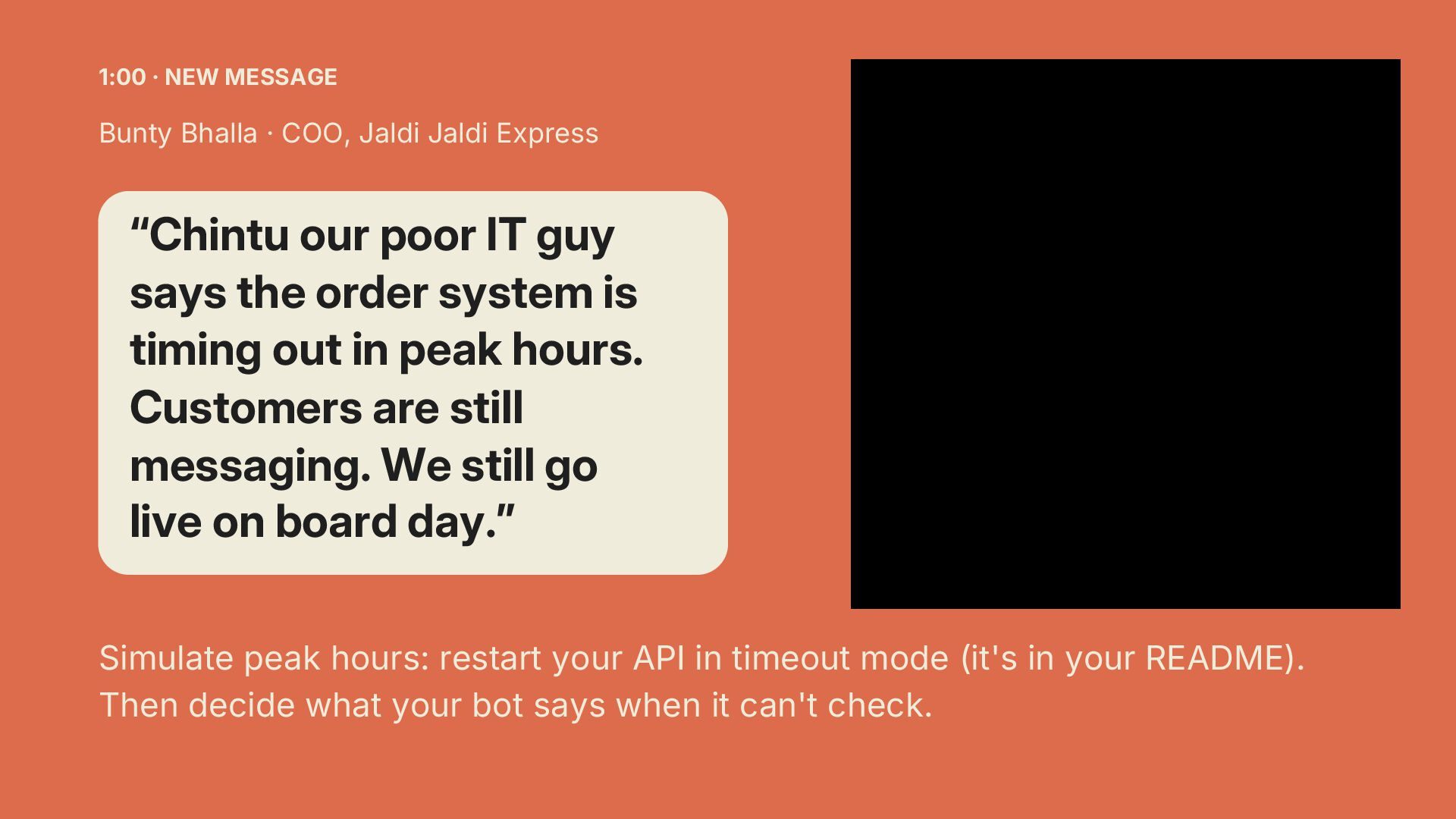
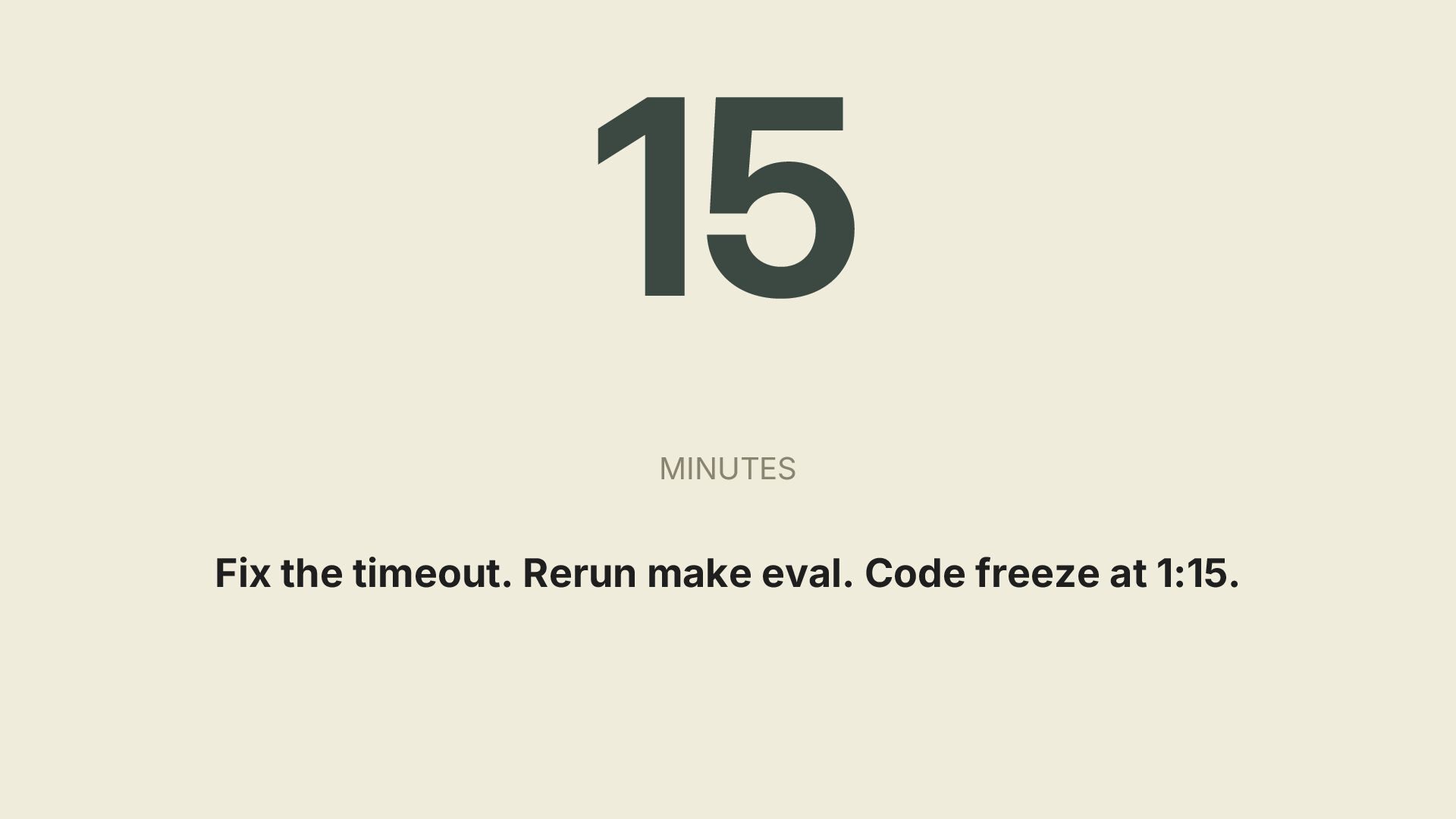
Express “Chintu our poor IT guy says the order system is timing out in peak hours. Customers are still messaging. We still go live on board day.” Simulate peak hours: restart your API in timeout mode (it's in your README). Then decide what your bot says when it can't check.
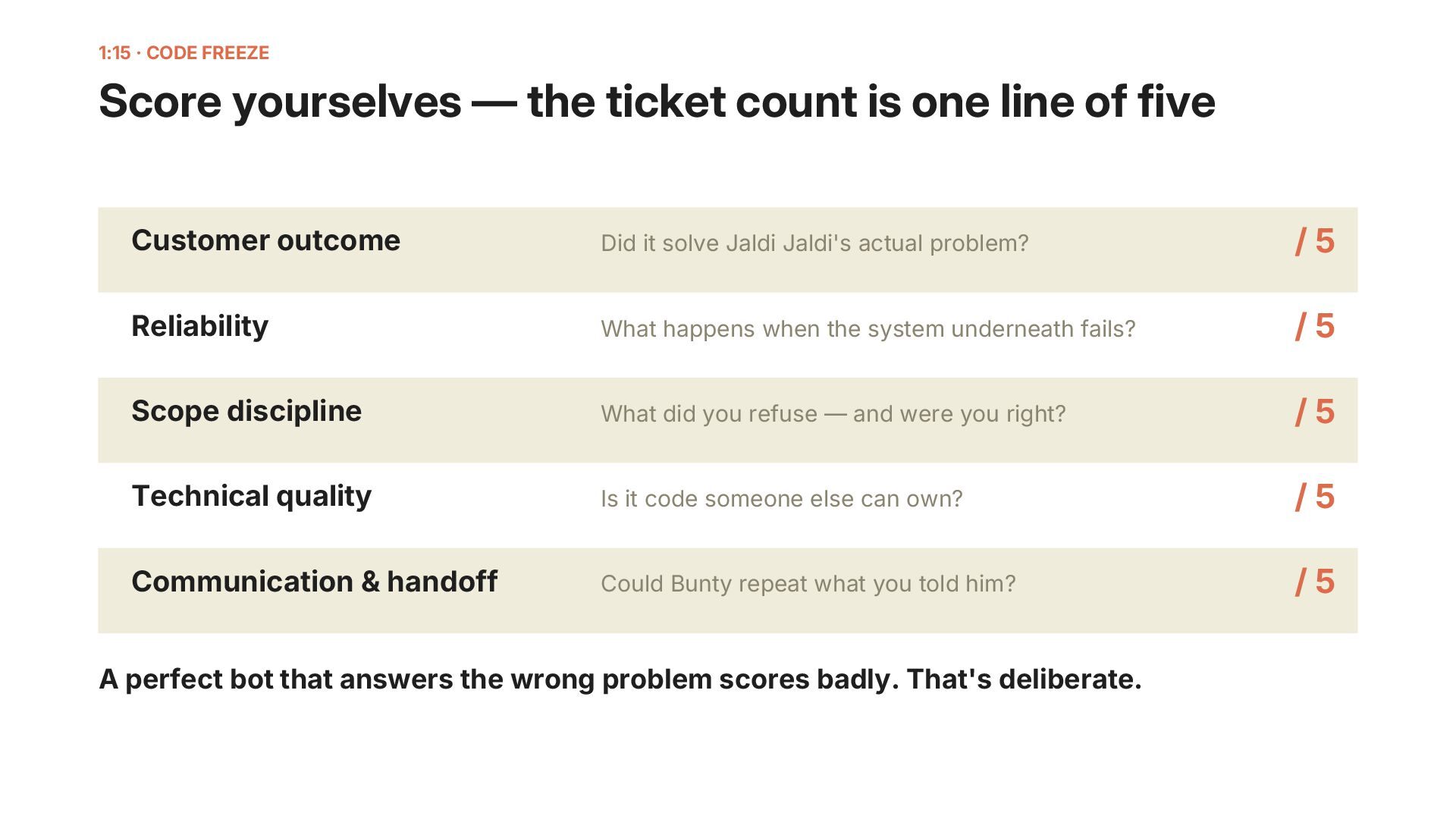
is one line of five Customer outcome Did it solve Jaldi Jaldi's actual problem? /5 Reliability What happens when the system underneath fails? /5 Scope discipline What did you refuse — and were you right? /5 Technical quality Is it code someone else can own? /5 Communication & handoff Could Bunty repeat what you told him? /5 A perfect bot that answers the wrong problem scores badly. That's deliberate.
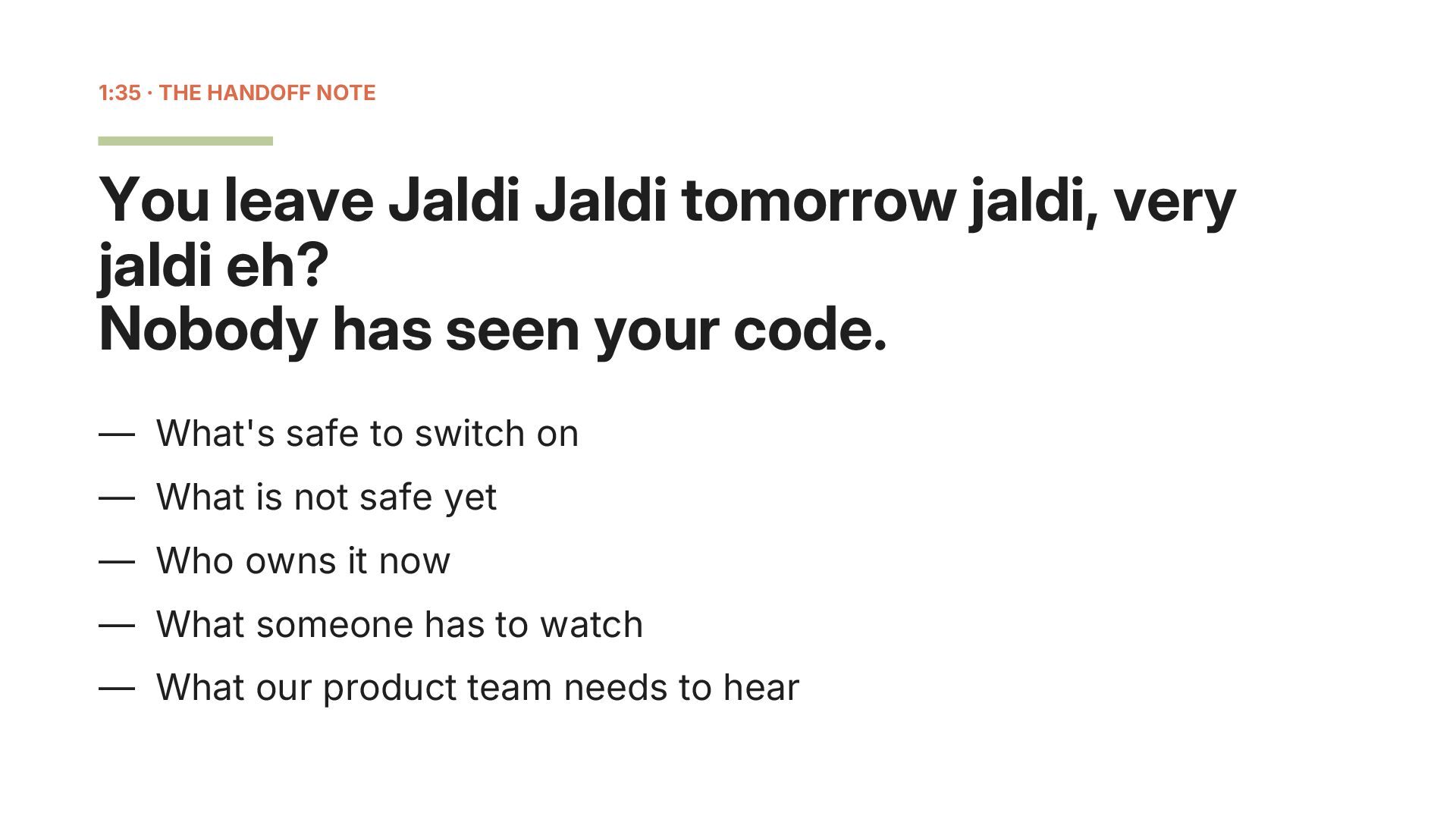
jaldi, very jaldi eh? Nobody has seen your code. — What's safe to switch on — What is not safe yet — Who owns it now — What someone has to watch — What our product team needs to hear
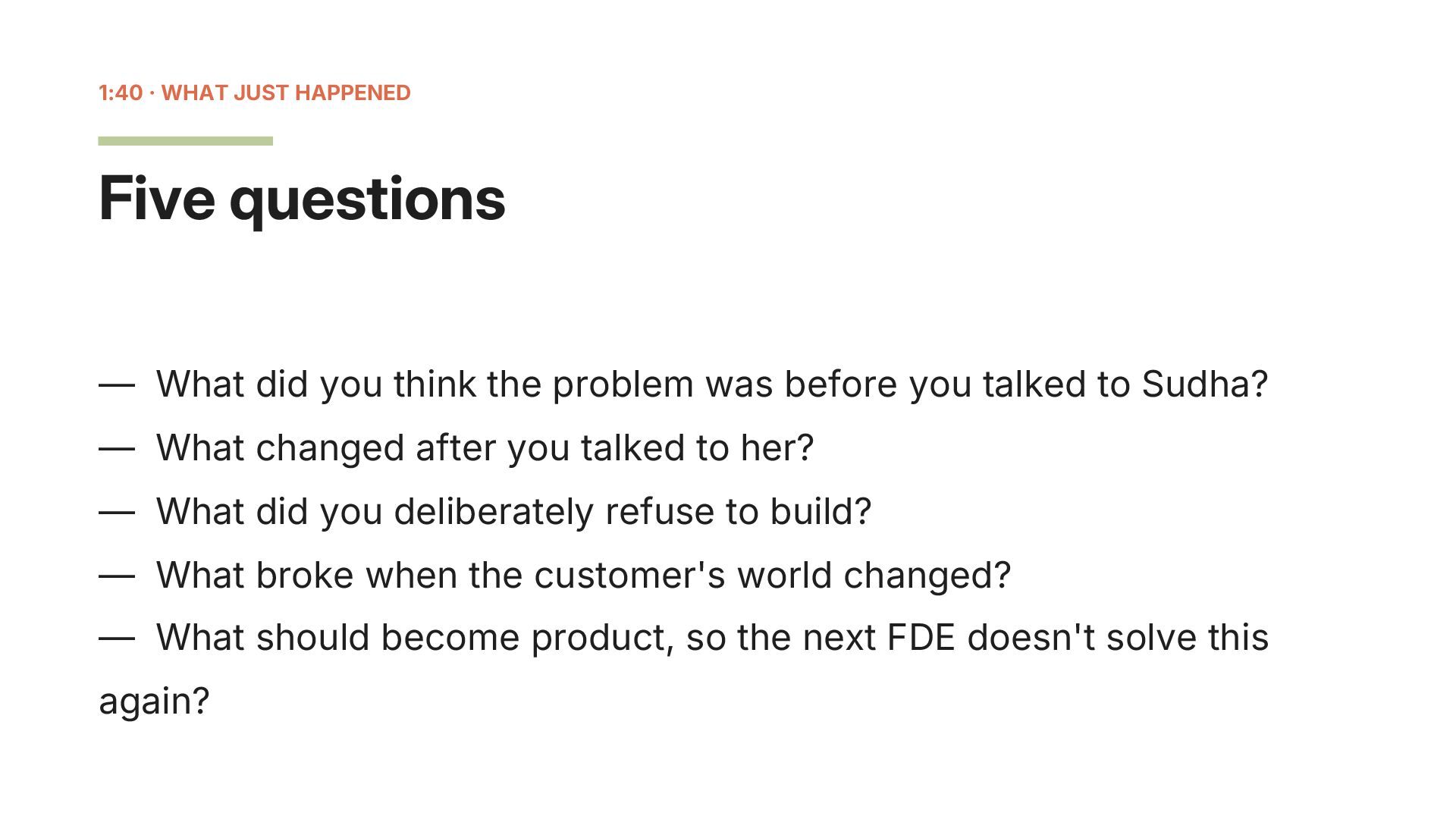
you think the problem was before you talked to Sudha? — What changed after you talked to her? — What did you deliberately refuse to build? — What broke when the customer's world changed? — What should become product, so the next FDE doesn't solve this again?
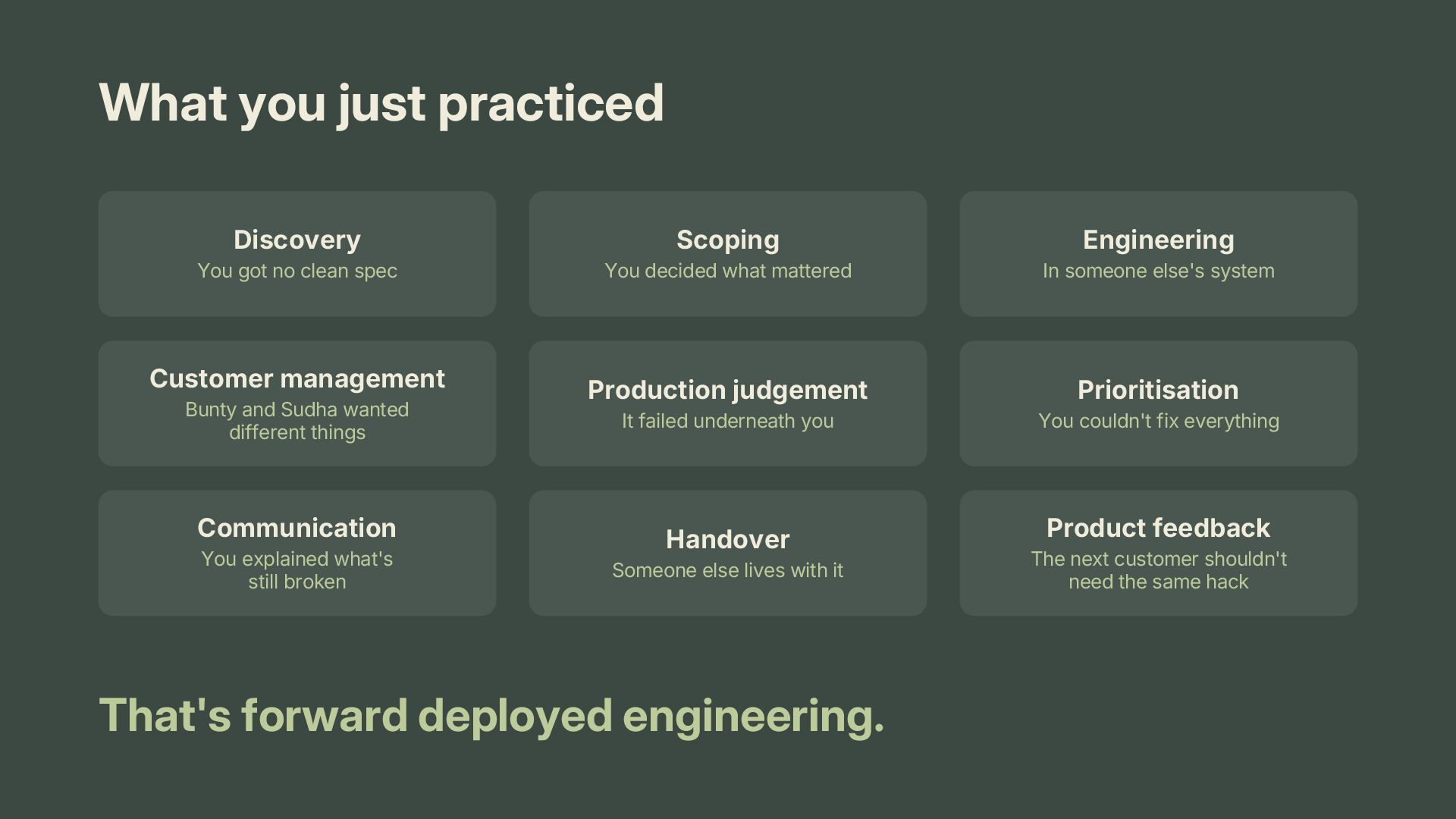
clean spec You decided what mattered In someone else's system Production judgement Prioritisation It failed underneath you You couldn't fix everything Customer management Bunty and Sudha wanted different things Communication You explained what's still broken Handover Someone else lives with it That's forward deployed engineering. Product feedback The next customer shouldn't need the same hack
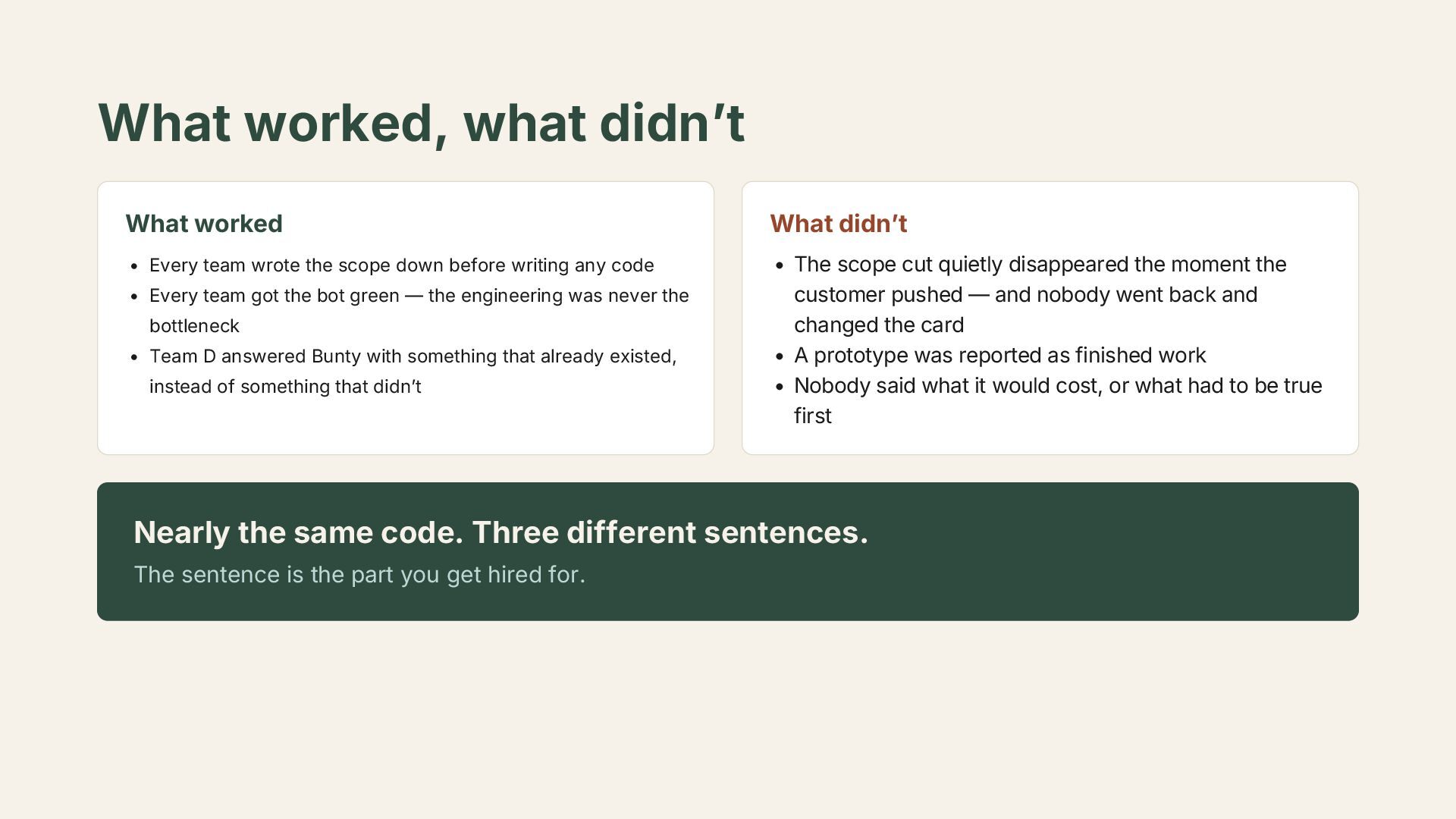
team wrote the scope down before writing any code • The scope cut quietly disappeared the moment the customer pushed — and nobody went back and changed the card • A prototype was reported as finished work • Nobody said what it would cost, or what had to be true first • Every team got the bot green — the engineering was never the bottleneck • Team D answered Bunty with something that already existed, instead of something that didn’t Nearly the same code. Three different sentences. The sentence is the part you get hired for.
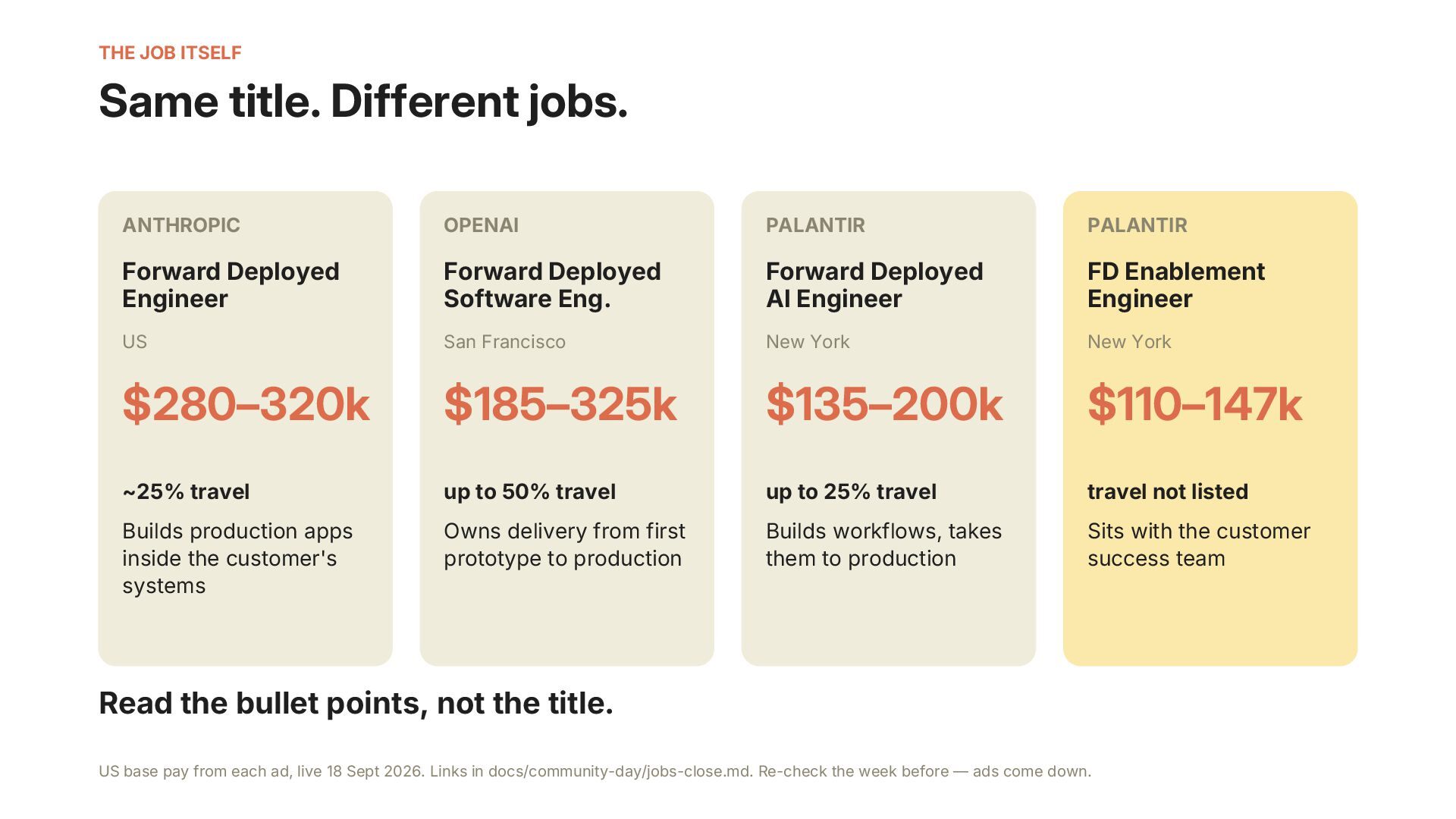
PALANTIR Forward Deployed Engineer Forward Deployed Software Eng. Forward Deployed AI Engineer FD Enablement Engineer US San Francisco New York New York $280–320k $185–325k $135–200k $110–147k ~25% travel up to 50% travel up to 25% travel travel not listed Builds production apps inside the customer's systems Owns delivery from first prototype to production Builds workflows, takes them to production Sits with the customer success team Read the bullet points, not the title. US base pay from each ad, live 18 Sept 2026. Links in docs/community-day/jobs-close.md. Re-check the week before — ads come down.
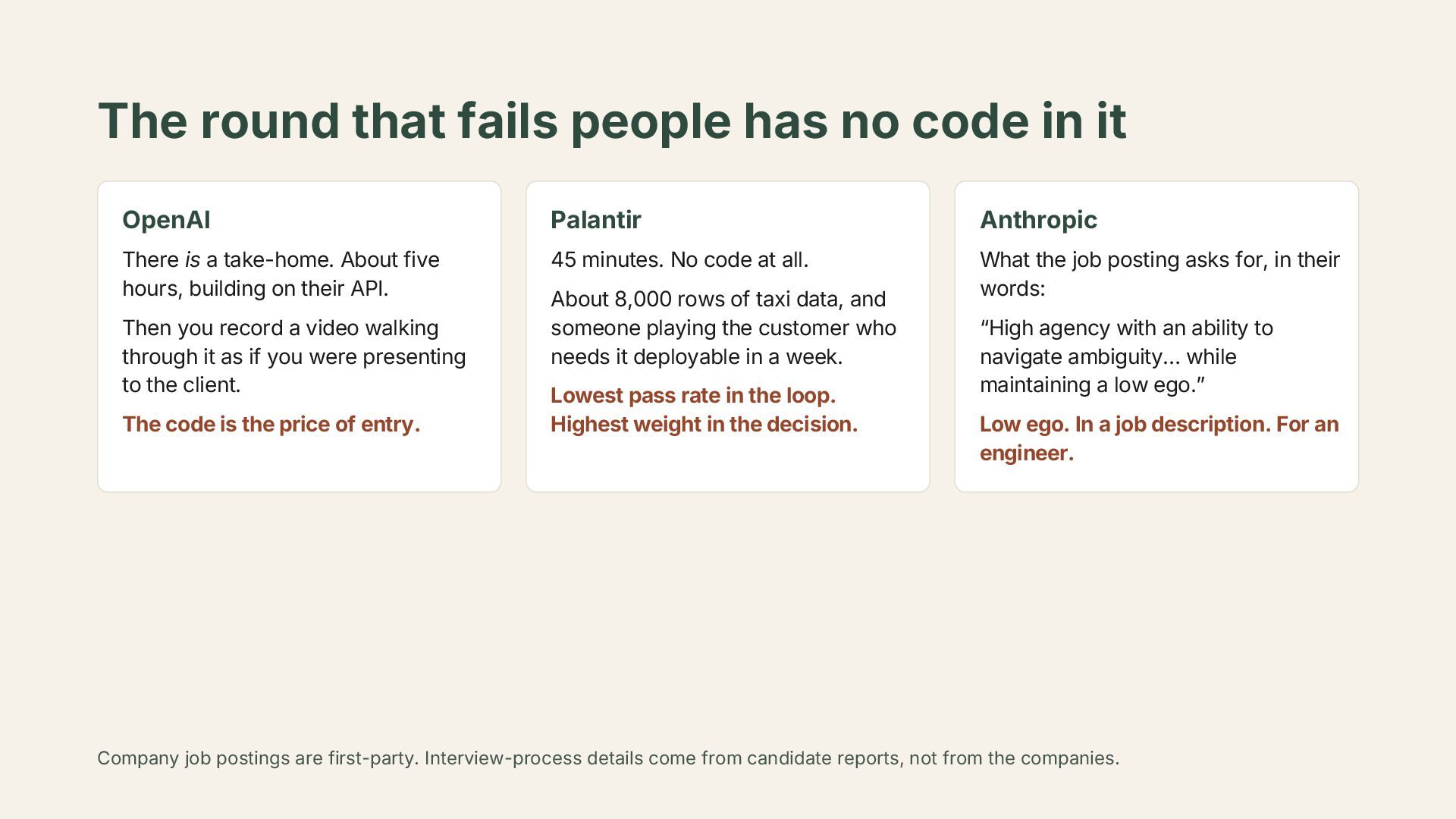
OpenAI Palantir Anthropic There is a take-home. About five hours, building on their API. 45 minutes. No code at all. What the job posting asks for, in their words: Then you record a video walking through it as if you were presenting to the client. The code is the price of entry. About 8,000 rows of taxi data, and someone playing the customer who needs it deployable in a week. Lowest pass rate in the loop. Highest weight in the decision. “High agency with an ability to navigate ambiguity… while maintaining a low ego.” Low ego. In a job description. For an engineer. Company job postings are first-party. Interview-process details come from candidate reports, not from the companies.
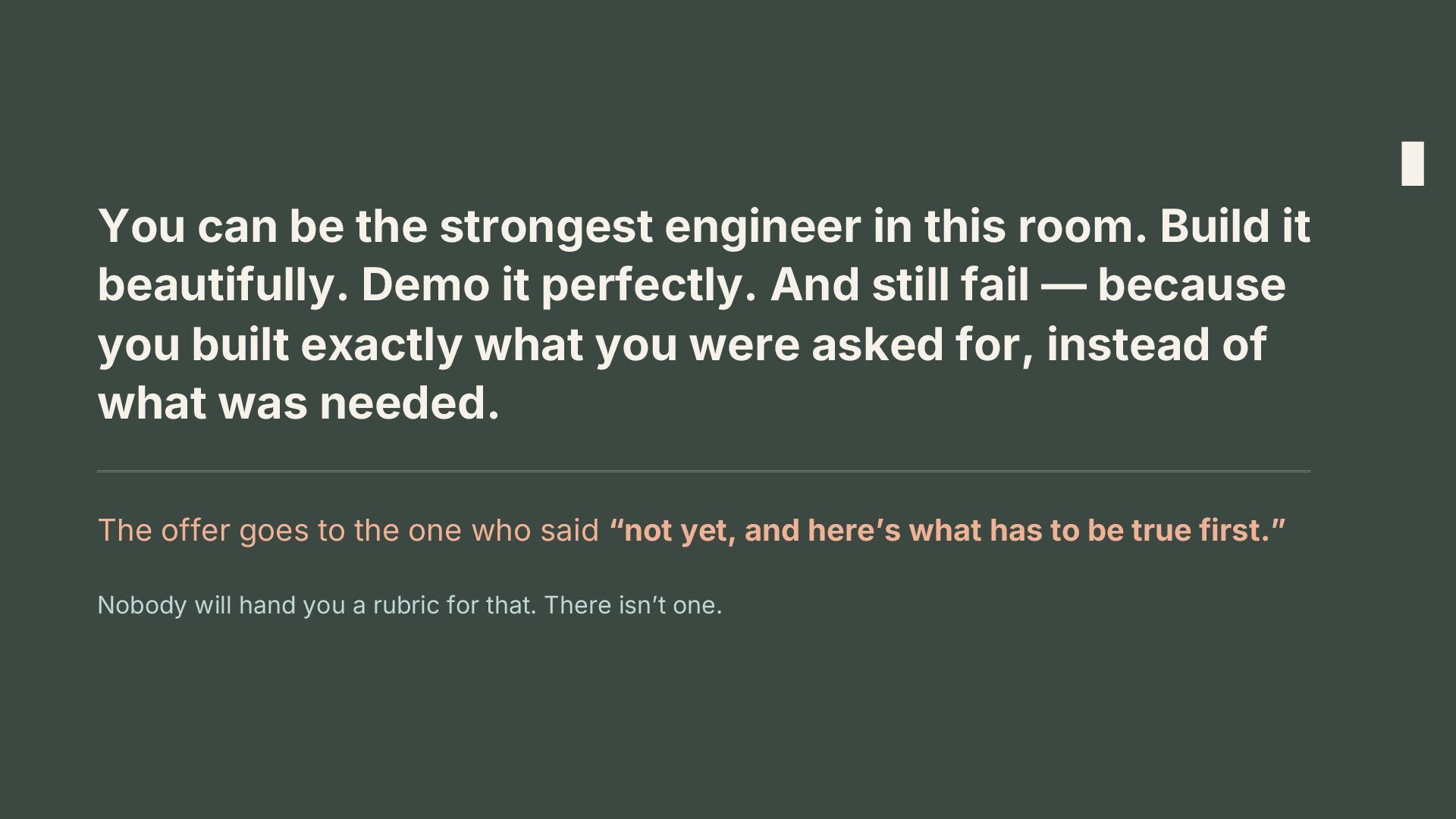
it beautifully. Demo it perfectly. And still fail — because you built exactly what you were asked for, instead of what was needed. The offer goes to the one who said “not yet, and here’s what has to be true first.” Nobody will hand you a rubric for that. There isn’t one.
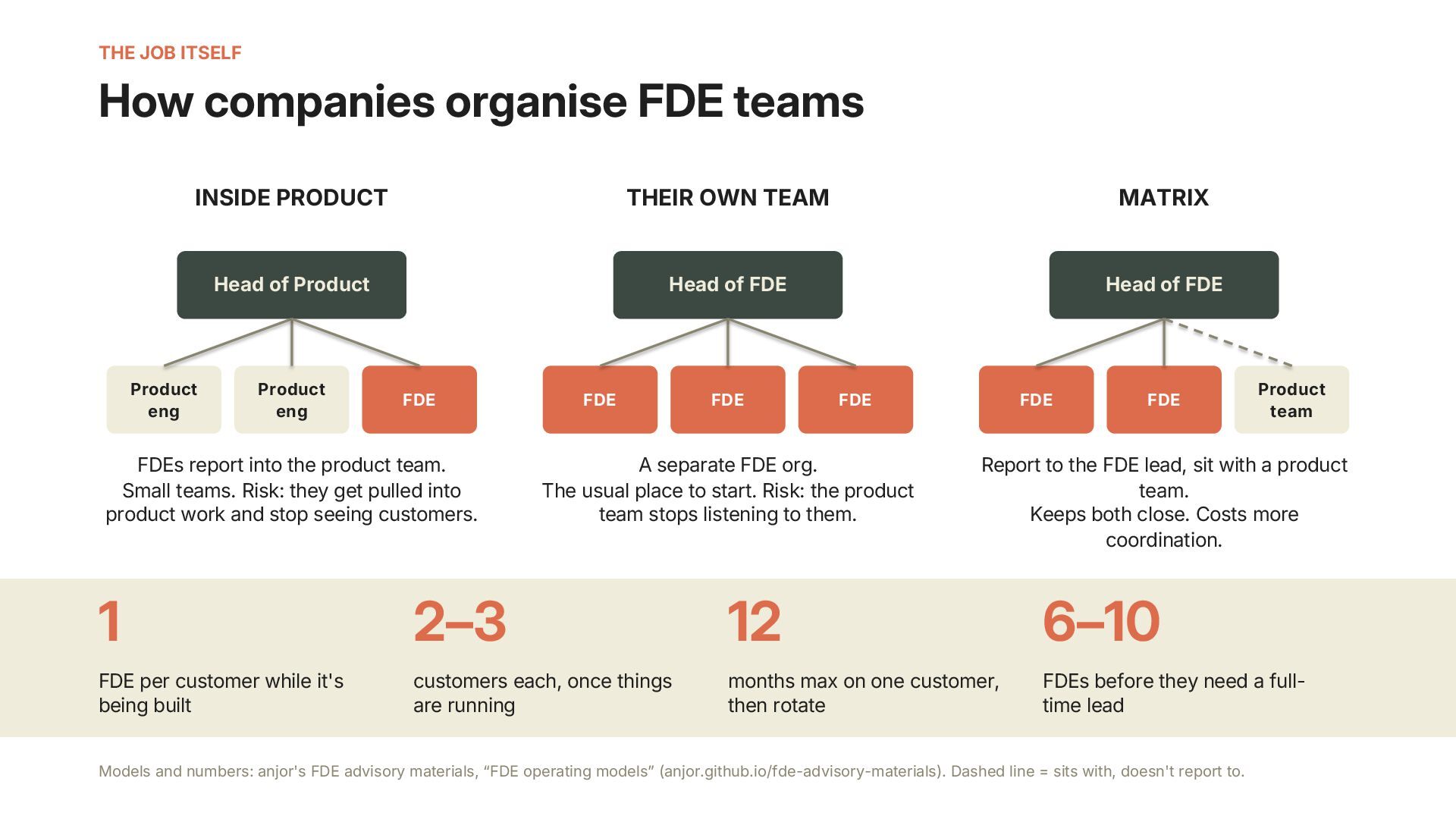
THEIR OWN TEAM MATRIX Head of Product Head of FDE Head of FDE Product eng Product eng FDE FDEs report into the product team. Small teams. Risk: they get pulled into product work and stop seeing customers. FDE FDE FDE A separate FDE org. The usual place to start. Risk: the product team stops listening to them. FDE FDE Product team Report to the FDE lead, sit with a product team. Keeps both close. Costs more coordination. 1 2–3 12 6–10 FDE per customer while it's being built customers each, once things are running months max on one customer, then rotate FDEs before they need a fulltime lead Models and numbers: anjor's FDE advisory materials, “FDE operating models” (anjor.github.io/fde-advisory-materials). Dashed line = sits with, doesn't report to.
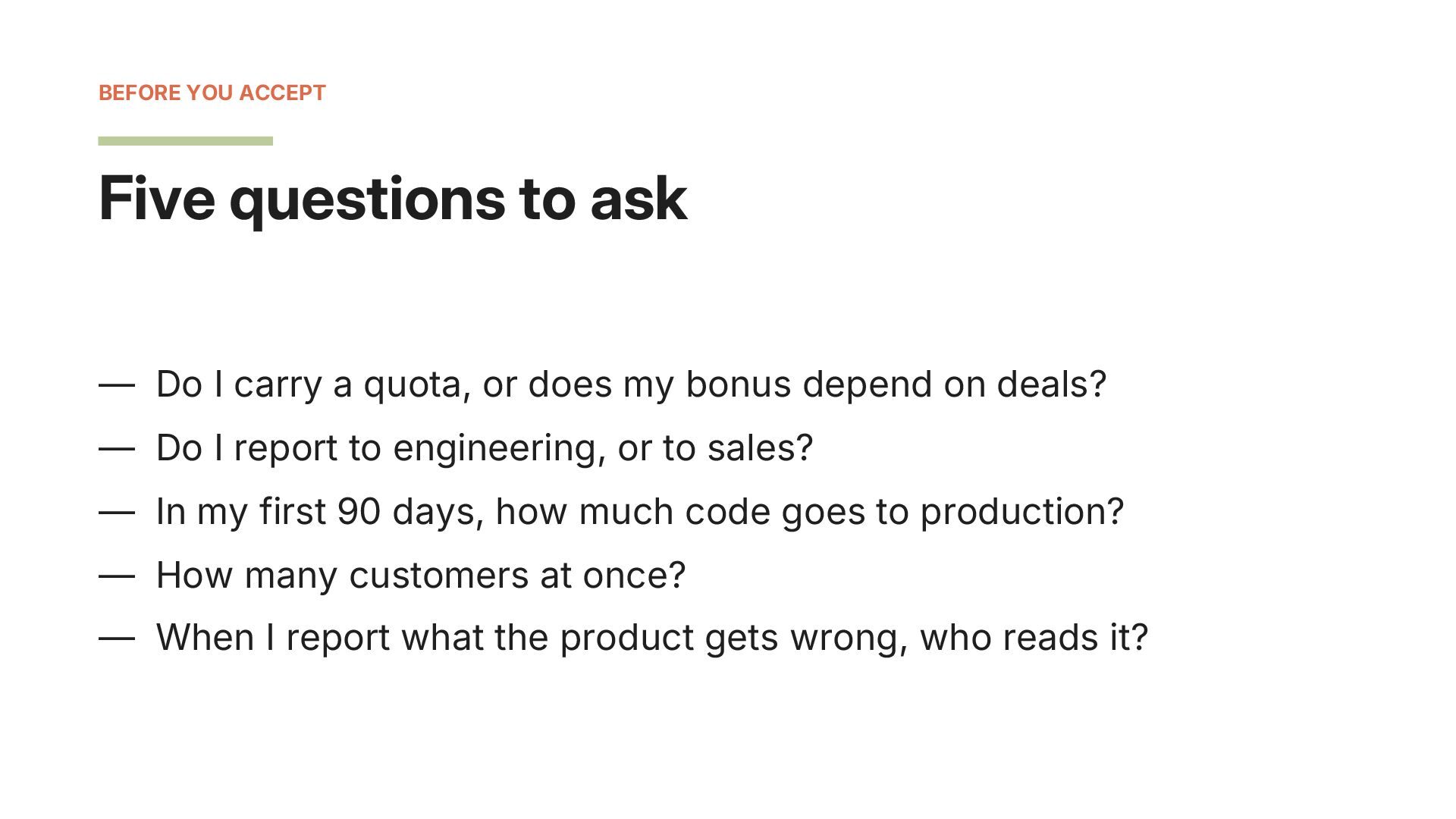
carry a quota, or does my bonus depend on deals? — Do I report to engineering, or to sales? — In my first 90 days, how much code goes to production? — How many customers at once? — When I report what the product gets wrong, who reads it?
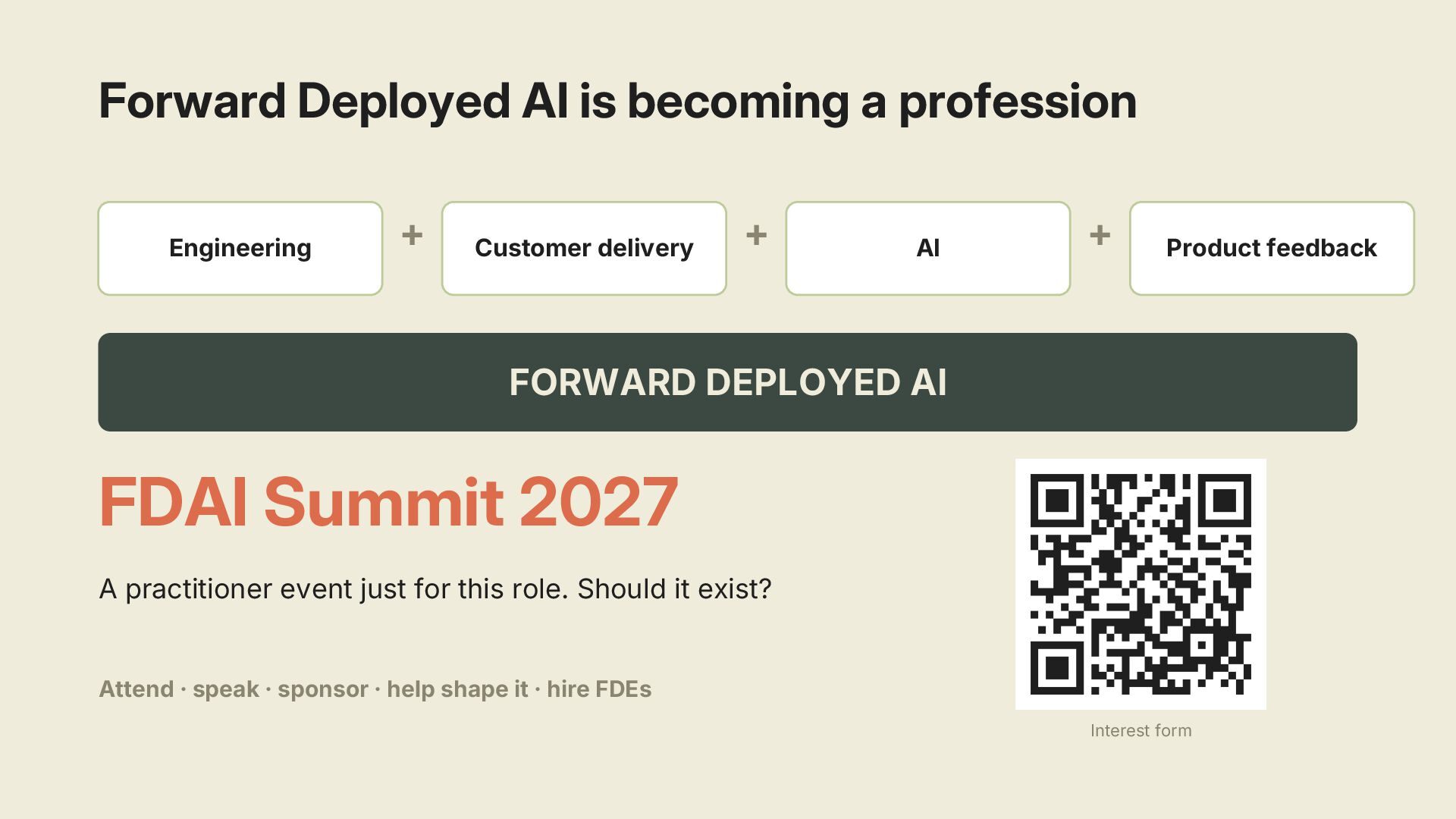
delivery + AI + Product feedback FORWARD DEPLOYED AI FDAI Summit 2027 A practitioner event just for this role. Should it exist? Attend · speak · sponsor · help shape it · hire FDEs Interest form
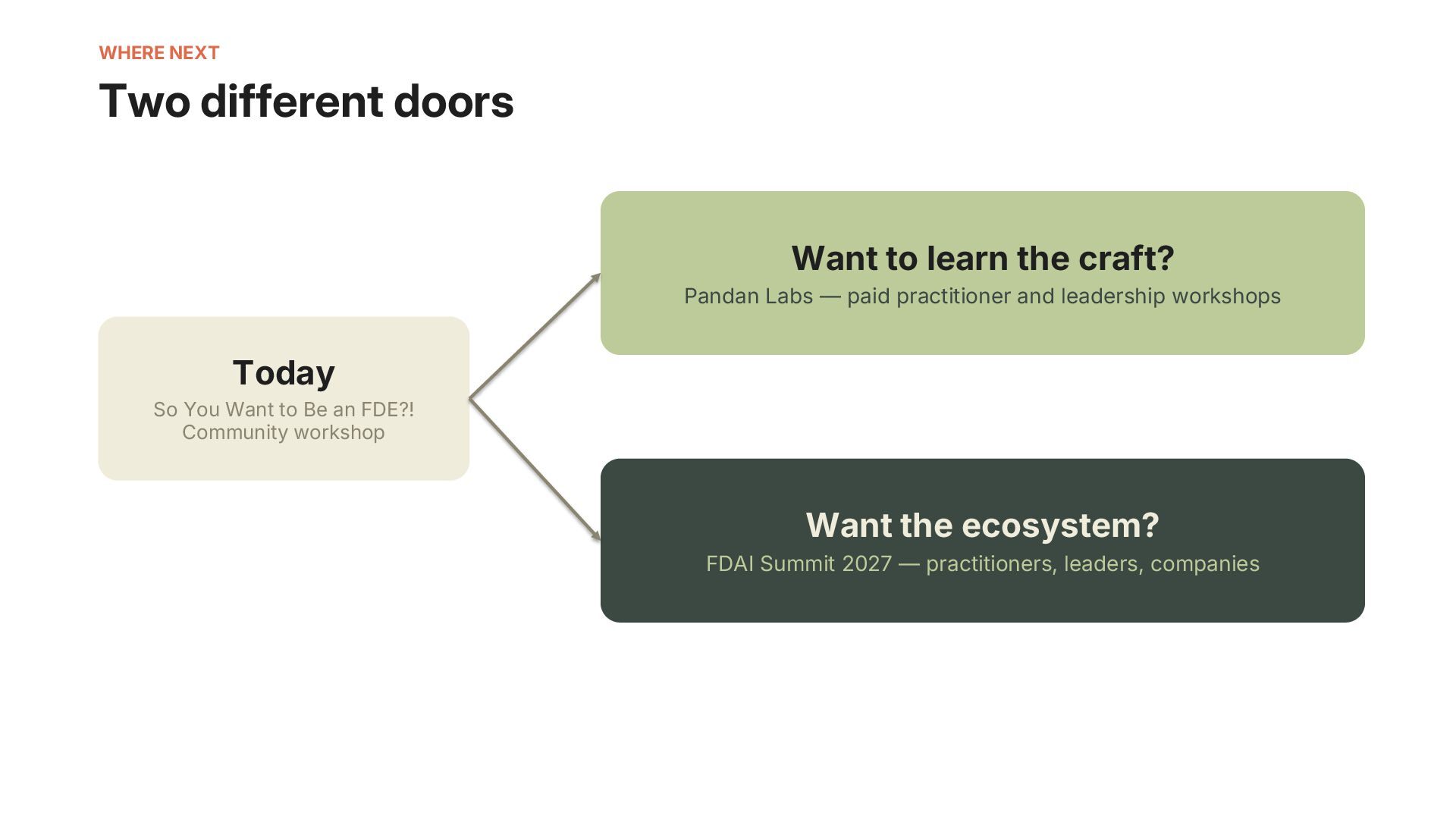
Pandan Labs — paid practitioner and leadership workshops Today So You Want to Be an FDE?! Community workshop Want the ecosystem? FDAI Summit 2027 — practitioners, leaders, companies
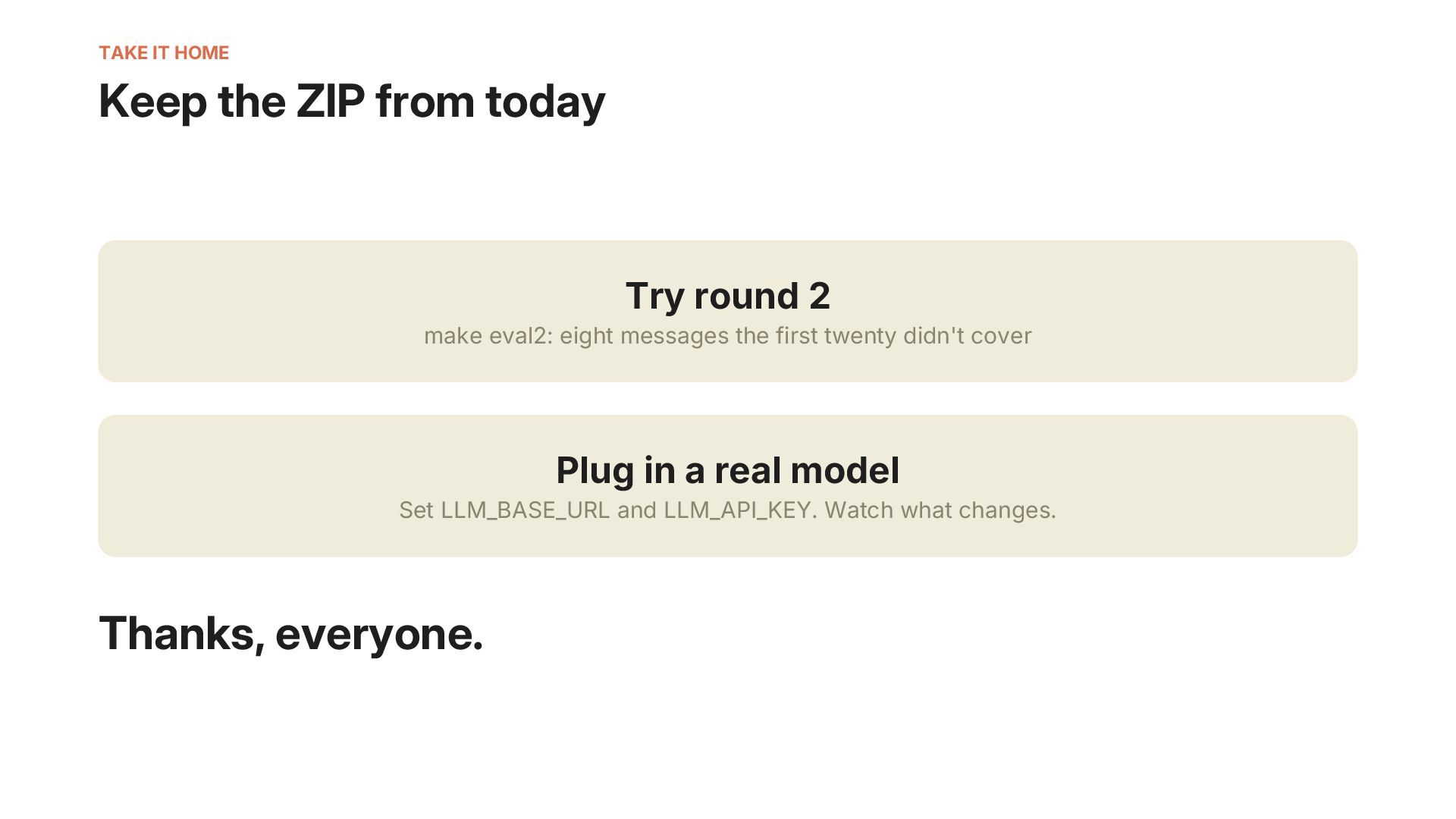
2 make eval2: eight messages the first twenty didn't cover Plug in a real model Set LLM_BASE_URL and LLM_API_KEY. Watch what changes. Thanks, everyone.


 faz
faz
 aoto
aoto
 pei0804
 yokawasa
 oracle4engineer
 shichijoyuhi
 tsho
tsho
 tosite
 thkt
thkt
 mikanichinose
 kakakakakku
 kawanago
 aleyda
 rkendrick25
 techseoconnect
 addyosmani
 carmenintech
 axbom
axbom
 greggifford
 62gerente
 tammyeverts
 samanthasiow
 danielanewman