SE STUDENTS THE LOST GUIDE FOR CREATING SOFTWARE IN THE AGE OF AI github.com/thecloudranger · CNTXT · AI Tinkerers UAE & Riyadh · Google Cloud Developer Group Riyadh 🗺️ ...IN THE AGE OF AI 1 / 45
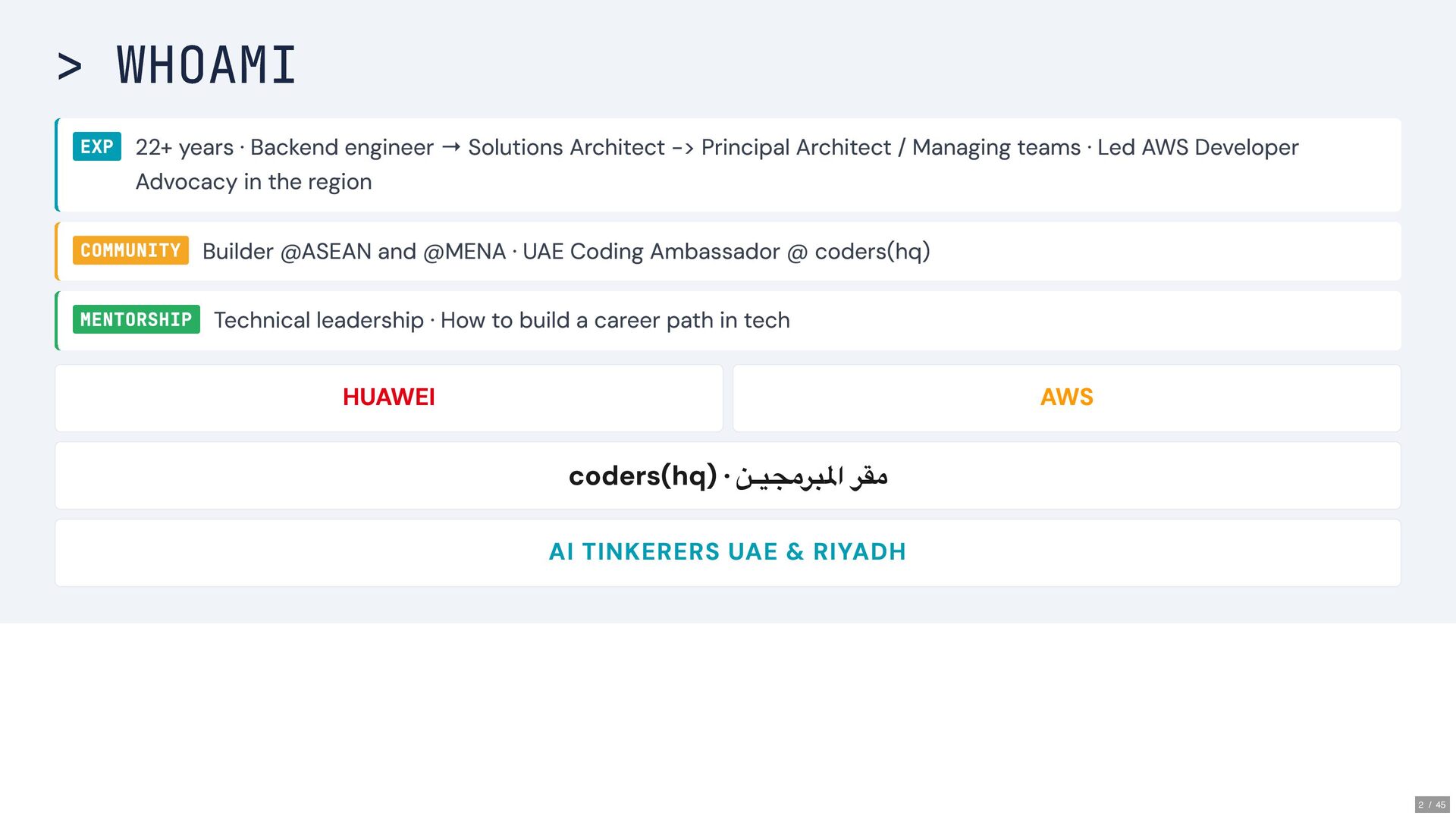
Architect -> Principal Architect / Managing teams · Led AWS Developer Advocacy in the region COMMUNITY Builder @ASEAN and @MENA · UAE Coding Ambassador @ coders(hq) MENTORSHIP Technical leadership · How to build a career path in tech HUAWEI AWS coders(hq) · نـيجمربملا رقم AI TINKERERS UAE & RIYADH 2 / 45
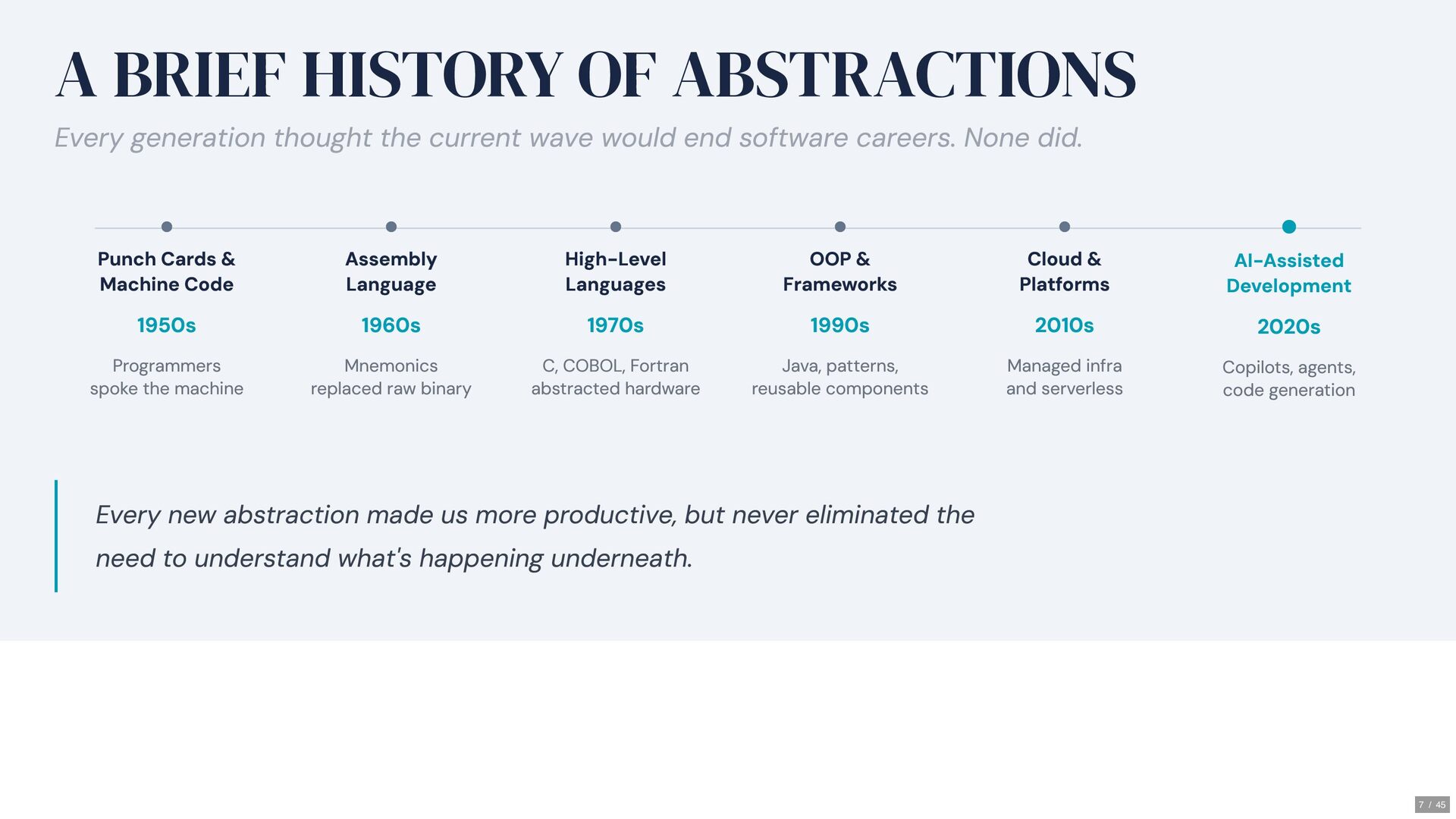
wave would end software careers. None did. Punch Cards & Machine Code 1950s Programmers spoke the machine Assembly Language 1960s Mnemonics replaced raw binary High-Level Languages 1970s C, COBOL, Fortran abstracted hardware OOP & Frameworks 1990s Java, patterns, reusable components Cloud & Platforms 2010s Managed infra and serverless AI-Assisted Development 2020s Copilots, agents, code generation Every new abstraction made us more productive, but never eliminated the need to understand what's happening underneath. 7 / 45
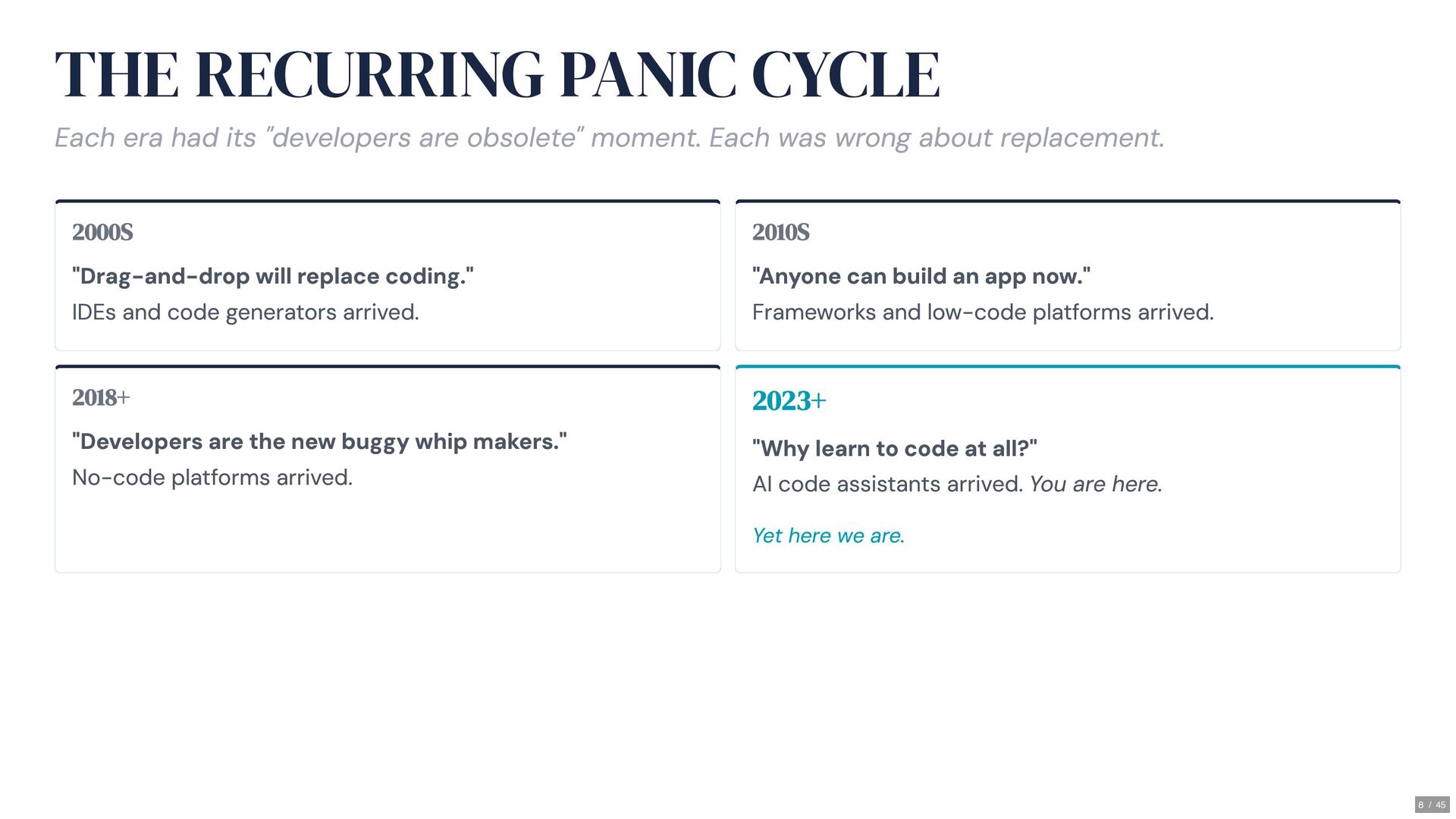
obsolete" moment. Each was wrong about replacement. 2000S "Drag-and-drop will replace coding." IDEs and code generators arrived. 2010S "Anyone can build an app now." Frameworks and low-code platforms arrived. 2018+ "Developers are the new buggy whip makers." No-code platforms arrived. 2023+ "Why learn to code at all?" AI code assistants arrived. You are here. Yet here we are. 8 / 45
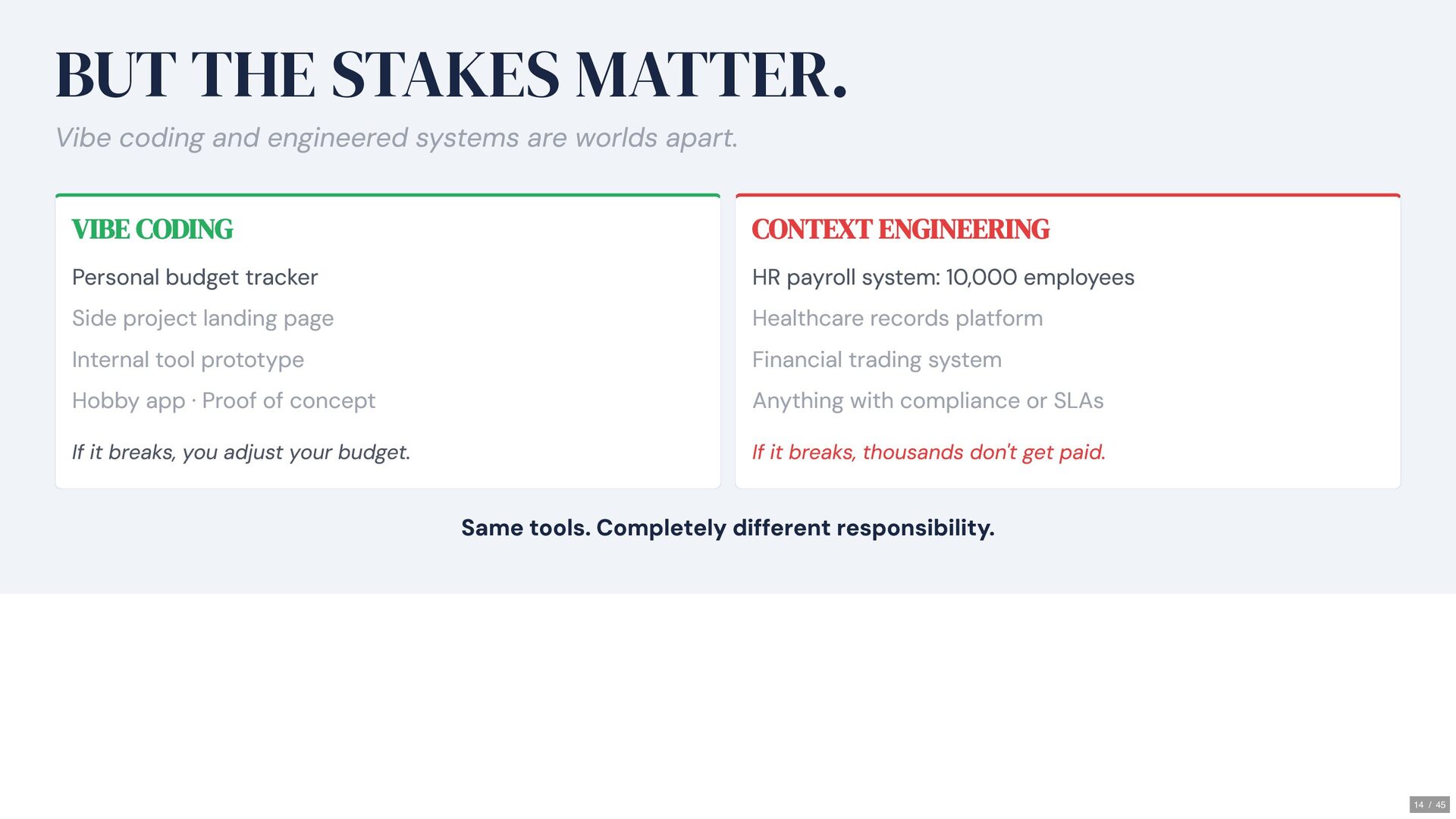
worlds apart. Same tools. Completely different responsibility. VIBE CODING Personal budget tracker Side project landing page Internal tool prototype Hobby app · Proof of concept If it breaks, you adjust your budget. CONTEXT ENGINEERING HR payroll system: 10,000 employees Healthcare records platform Financial trading system Anything with compliance or SLAs If it breaks, thousands don't get paid. 14 / 45
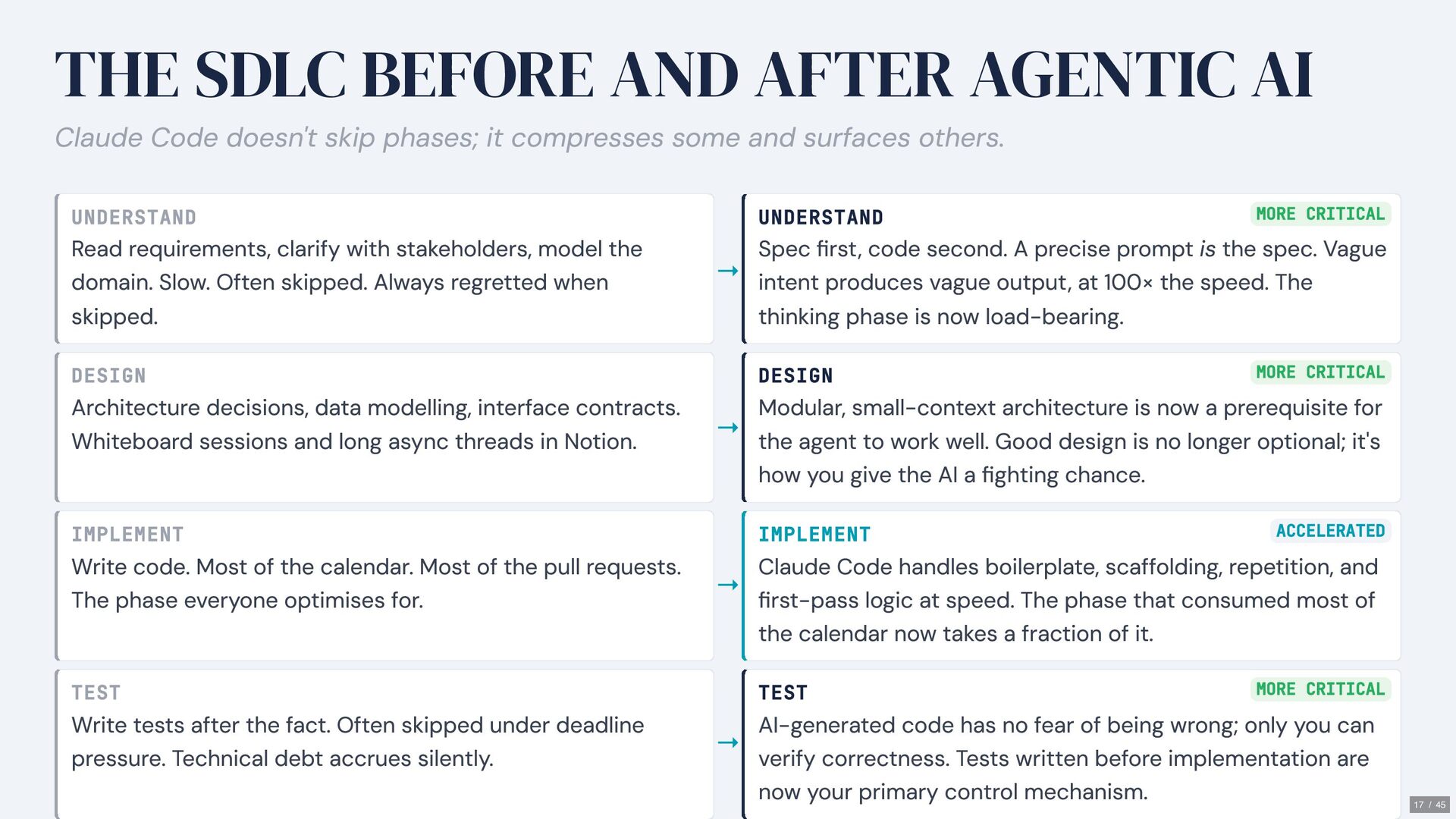
skip phases; it compresses some and surfaces others. UNDERSTAND Read requirements, clarify with stakeholders, model the domain. Slow. Often skipped. Always regretted when skipped. DESIGN Architecture decisions, data modelling, interface contracts. Whiteboard sessions and long async threads in Notion. IMPLEMENT Write code. Most of the calendar. Most of the pull requests. The phase everyone optimises for. TEST Write tests after the fact. Often skipped under deadline pressure. Technical debt accrues silently. → → → → UNDERSTAND Spec first, code second. A precise prompt is the spec. Vague intent produces vague output, at 100× the speed. The thinking phase is now load-bearing. MORE CRITICAL DESIGN Modular, small-context architecture is now a prerequisite for the agent to work well. Good design is no longer optional; it's how you give the AI a fighting chance. MORE CRITICAL IMPLEMENT Claude Code handles boilerplate, scaffolding, repetition, and first-pass logic at speed. The phase that consumed most of the calendar now takes a fraction of it. ACCELERATED TEST AI-generated code has no fear of being wrong; only you can verify correctness. Tests written before implementation are now your primary control mechanism. MORE CRITICAL 17 / 45
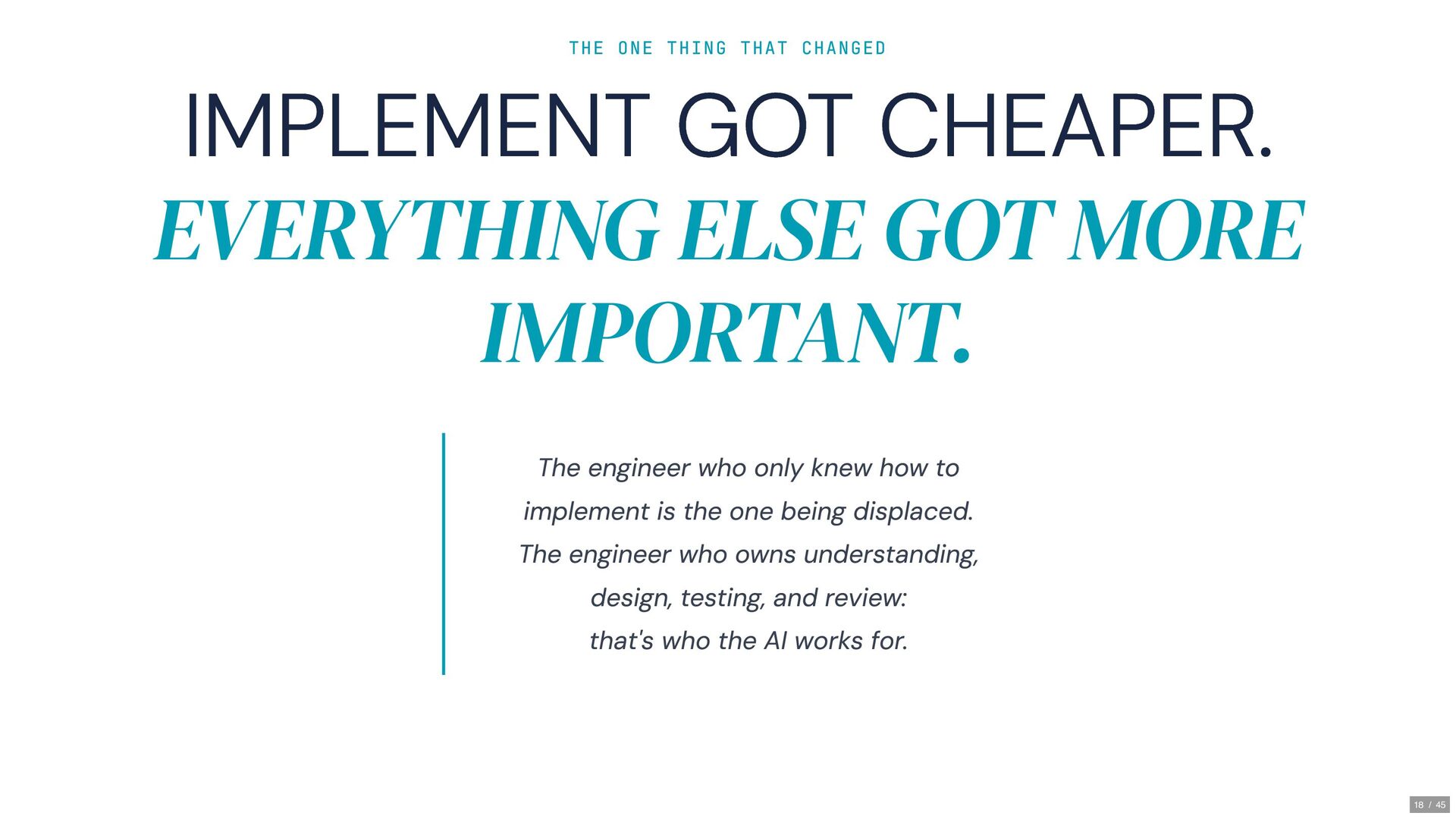
GOT MORE IMPORTANT. The engineer who only knew how to implement is the one being displaced. The engineer who owns understanding, design, testing, and review: that's who the AI works for. 18 / 45
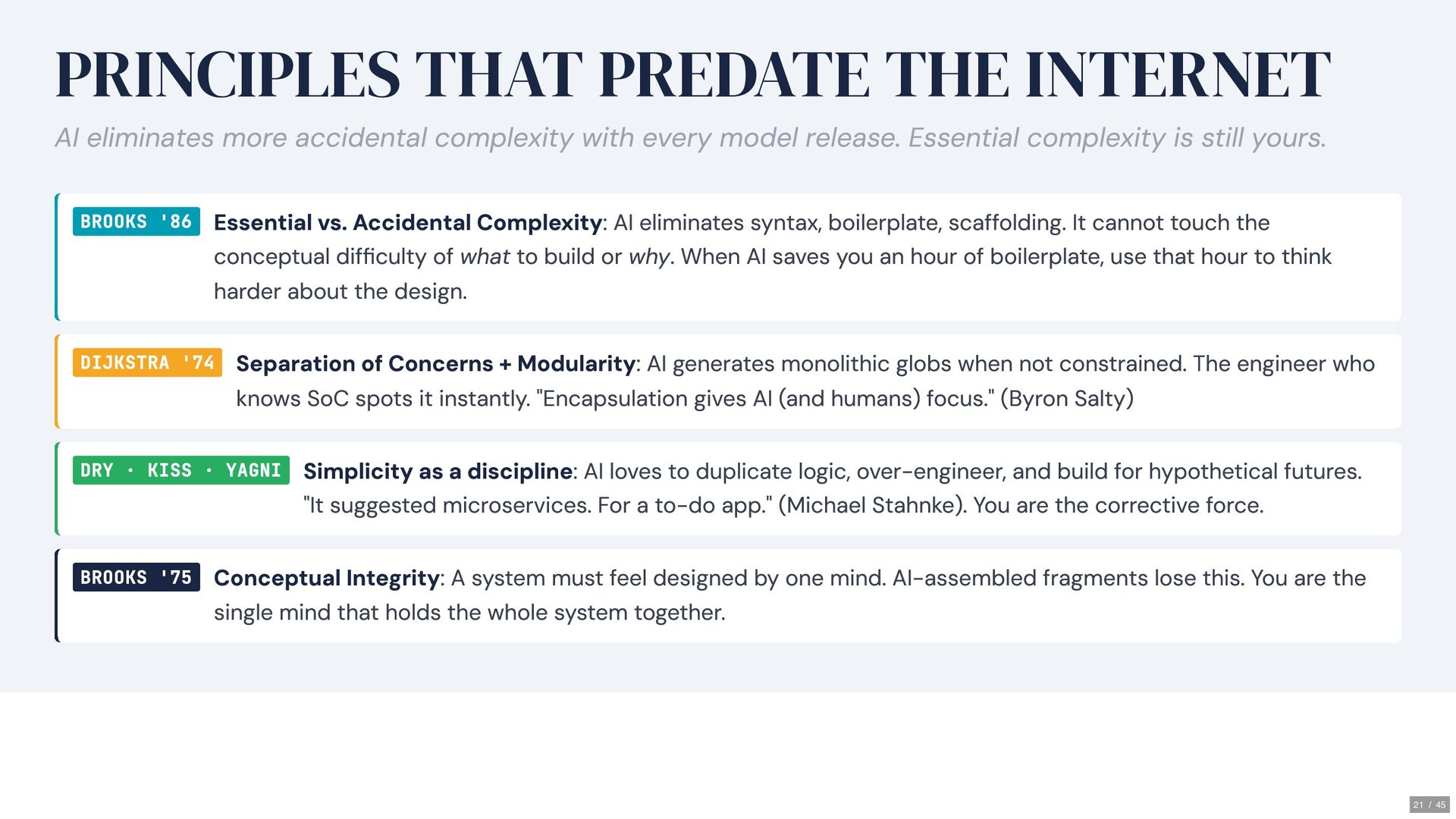
with every model release. Essential complexity is still yours. BROOKS '86 Essential vs. Accidental Complexity: AI eliminates syntax, boilerplate, scaffolding. It cannot touch the conceptual difficulty of what to build or why. When AI saves you an hour of boilerplate, use that hour to think harder about the design. DIJKSTRA '74 Separation of Concerns + Modularity: AI generates monolithic globs when not constrained. The engineer who knows SoC spots it instantly. "Encapsulation gives AI (and humans) focus." (Byron Salty) DRY · KISS · YAGNI Simplicity as a discipline: AI loves to duplicate logic, over-engineer, and build for hypothetical futures. "It suggested microservices. For a to-do app." (Michael Stahnke). You are the corrective force. BROOKS '75 Conceptual Integrity: A system must feel designed by one mind. AI-assembled fragments lose this. You are the single mind that holds the whole system together. 21 / 45
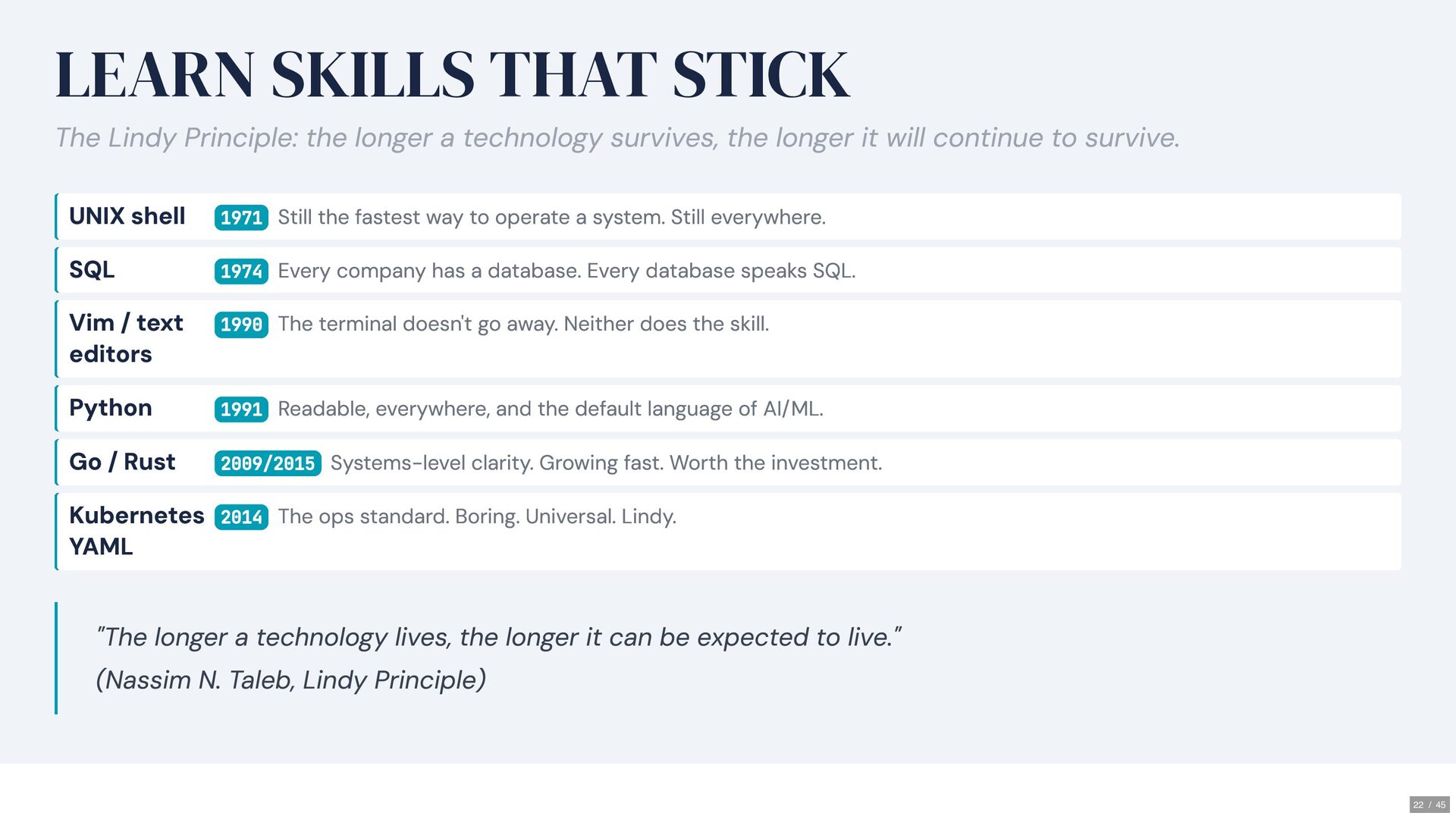
technology survives, the longer it will continue to survive. UNIX shell 1971 Still the fastest way to operate a system. Still everywhere. SQL 1974 Every company has a database. Every database speaks SQL. Vim / text editors 1990 The terminal doesn't go away. Neither does the skill. Python 1991 Readable, everywhere, and the default language of AI/ML. Go / Rust 2009/2015 Systems-level clarity. Growing fast. Worth the investment. Kubernetes YAML 2014 The ops standard. Boring. Universal. Lindy. "The longer a technology lives, the longer it can be expected to live." (Nassim N. Taleb, Lindy Principle) 22 / 45
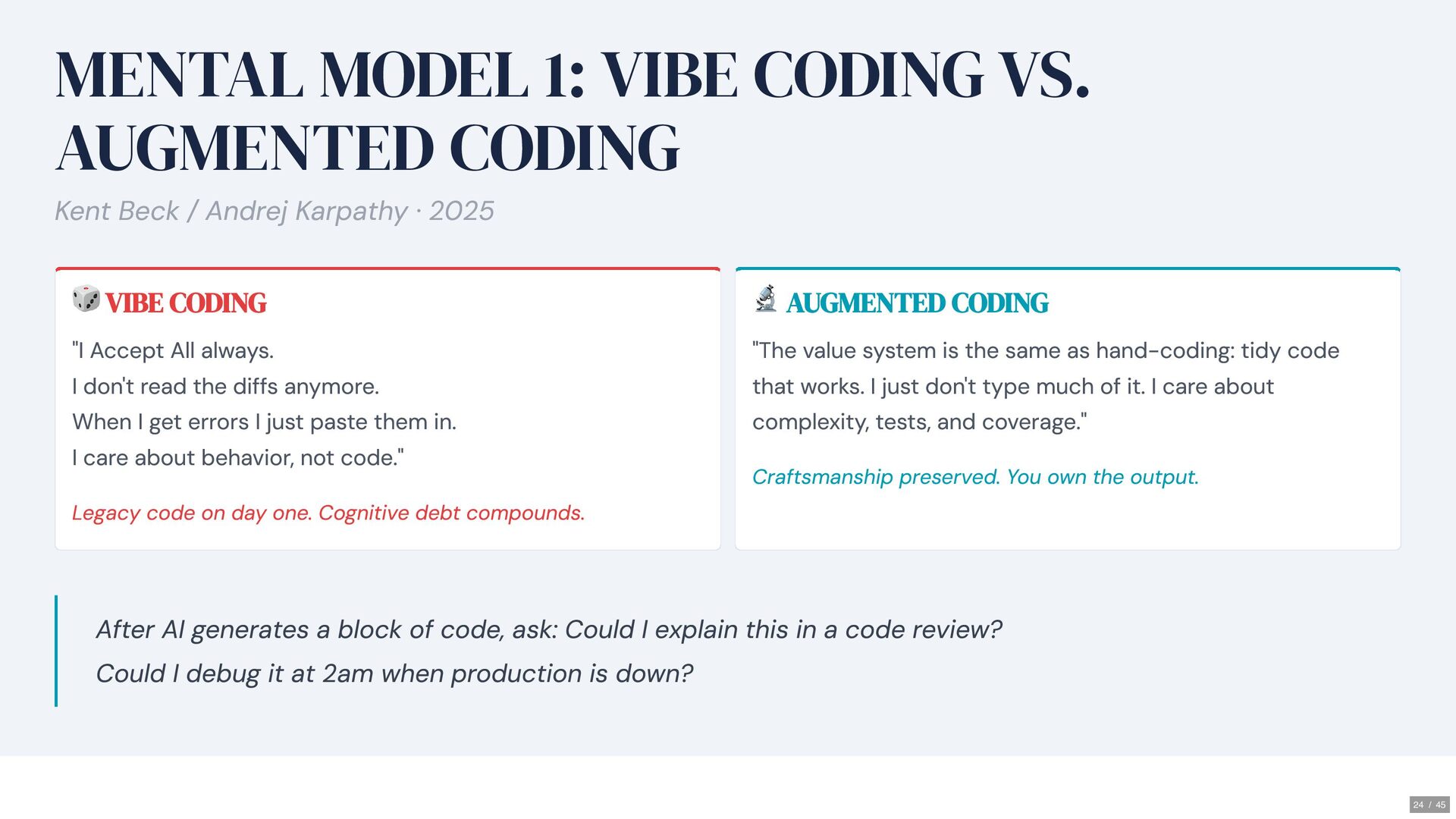
/ Andrej Karpathy · 2025 🎲 VIBE CODING "I Accept All always. I don't read the diffs anymore. When I get errors I just paste them in. I care about behavior, not code." Legacy code on day one. Cognitive debt compounds. 🔬 AUGMENTED CODING "The value system is the same as hand-coding: tidy code that works. I just don't type much of it. I care about complexity, tests, and coverage." Craftsmanship preserved. You own the output. After AI generates a block of code, ask: Could I explain this in a code review? Could I debug it at 2am when production is down? 24 / 45
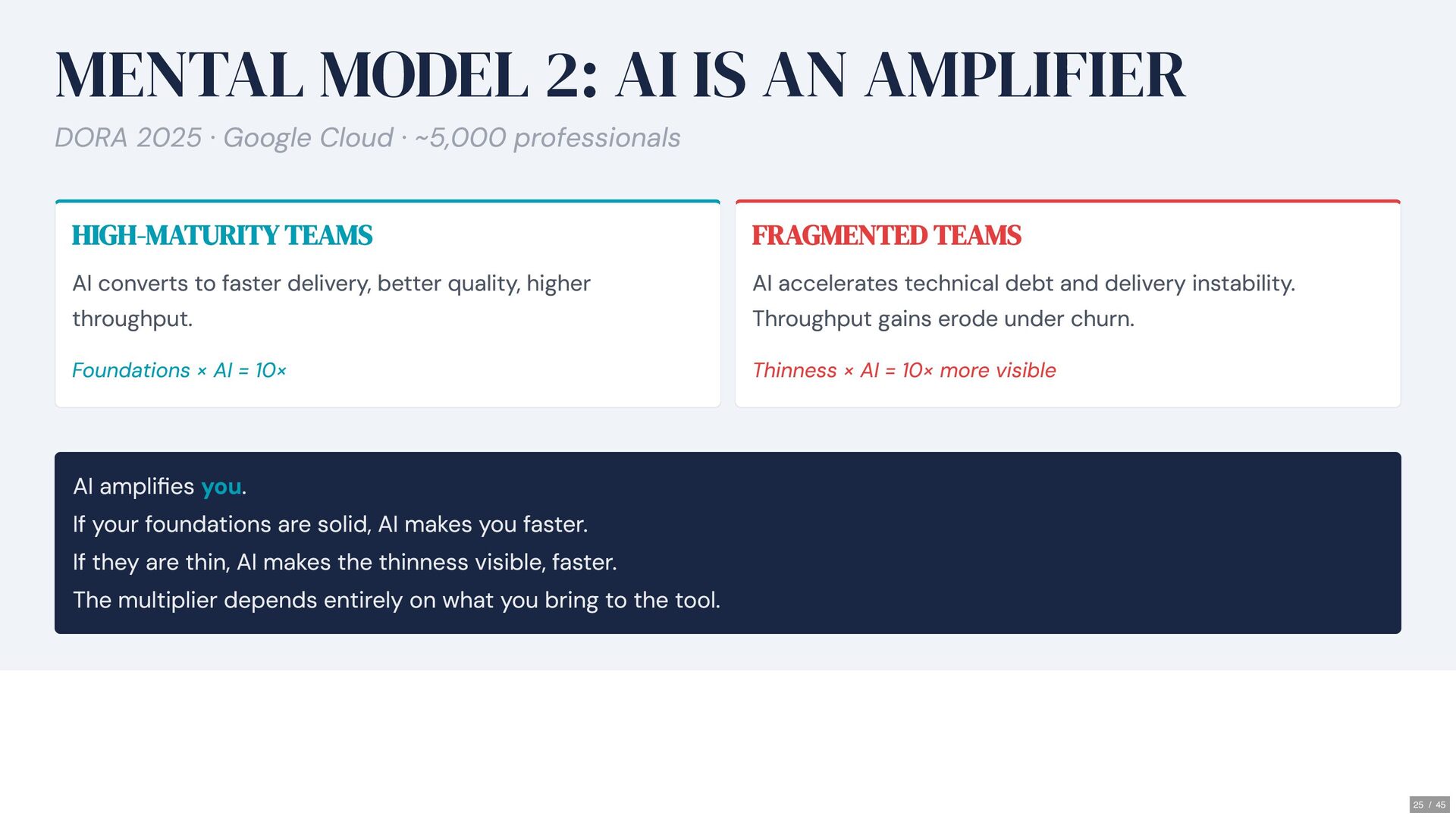
Google Cloud · ~5,000 professionals AI amplifies you. If your foundations are solid, AI makes you faster. If they are thin, AI makes the thinness visible, faster. The multiplier depends entirely on what you bring to the tool. HIGH-MATURITY TEAMS AI converts to faster delivery, better quality, higher throughput. Foundations × AI = 10× FRAGMENTED TEAMS AI accelerates technical debt and delivery instability. Throughput gains erode under churn. Thinness × AI = 10× more visible 25 / 45
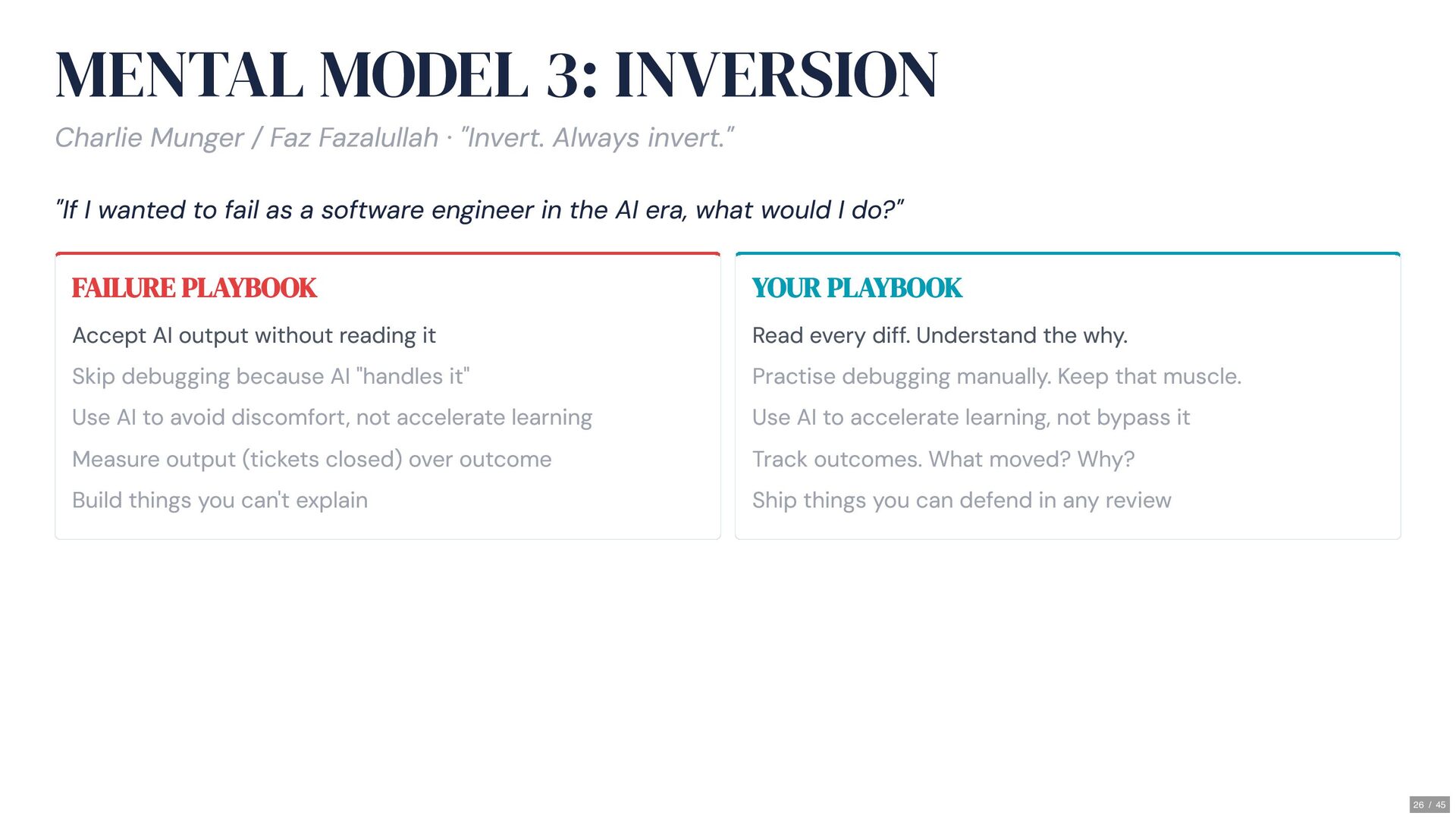
"Invert. Always invert." "If I wanted to fail as a software engineer in the AI era, what would I do?" FAILURE PLAYBOOK Accept AI output without reading it Skip debugging because AI "handles it" Use AI to avoid discomfort, not accelerate learning Measure output (tickets closed) over outcome Build things you can't explain YOUR PLAYBOOK Read every diff. Understand the why. Practise debugging manually. Keep that muscle. Use AI to accelerate learning, not bypass it Track outcomes. What moved? Why? Ship things you can defend in any review 26 / 45
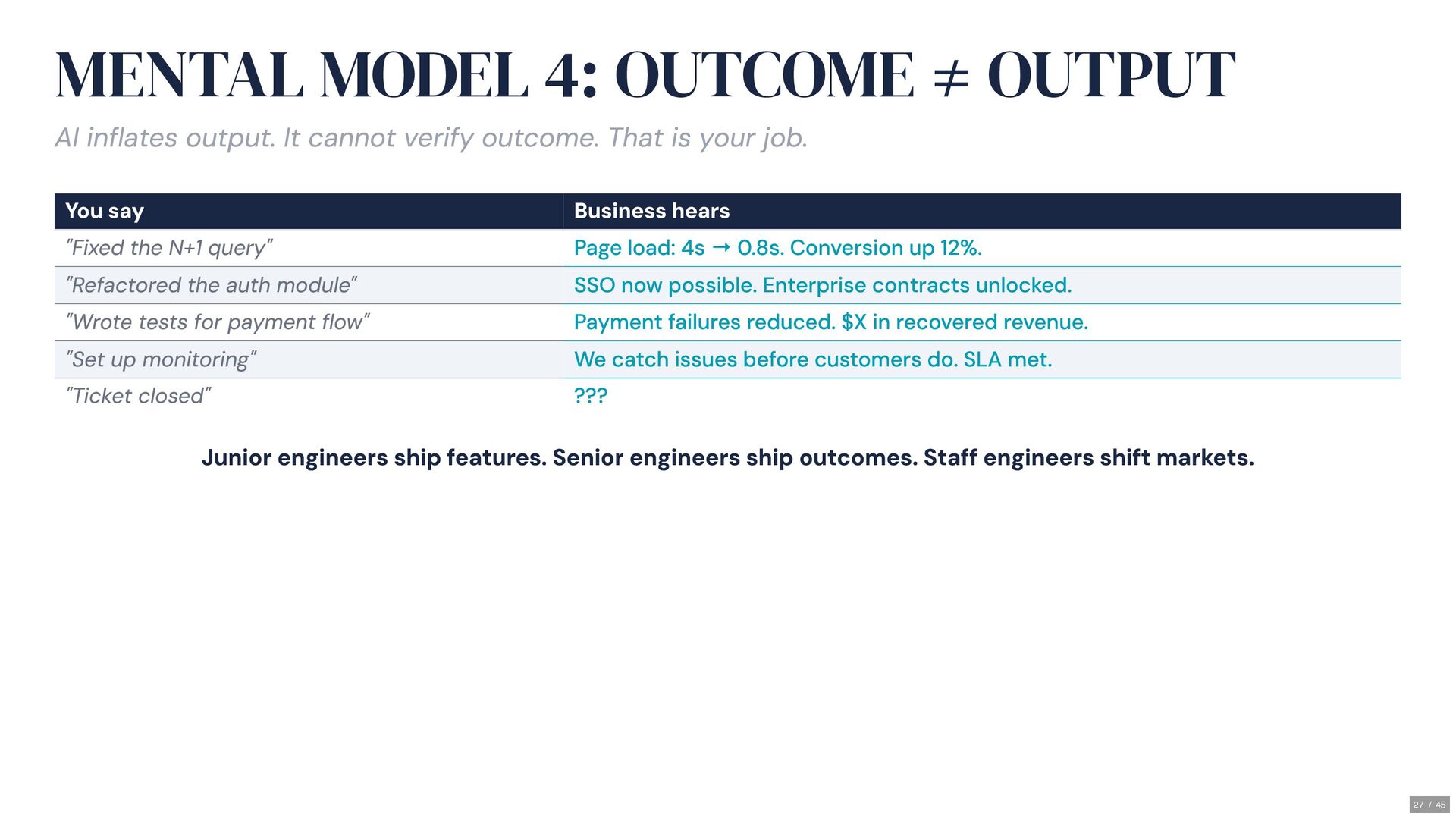
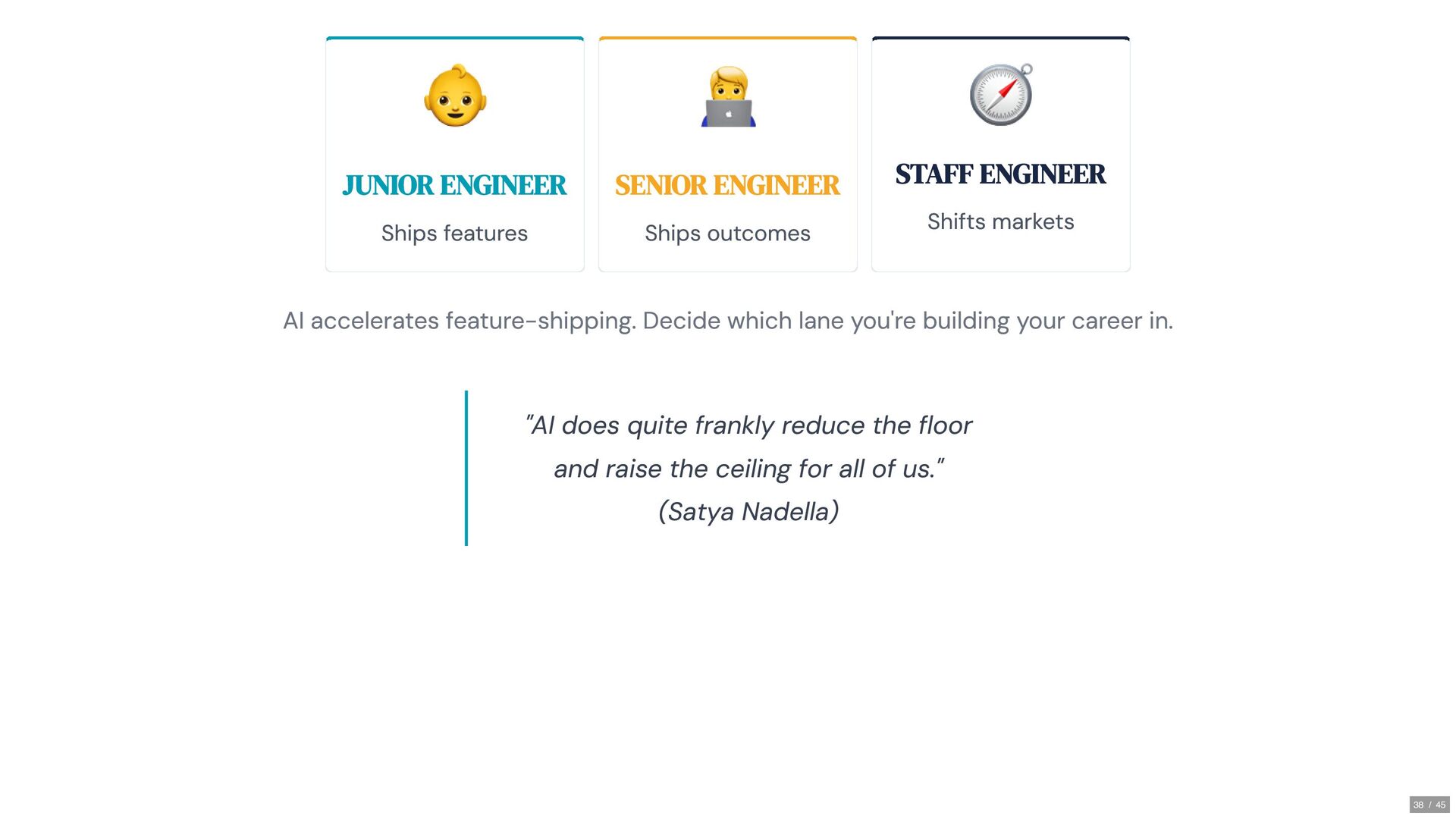
cannot verify outcome. That is your job. You say Business hears "Fixed the N+1 query" Page load: 4s → 0.8s. Conversion up 12%. "Refactored the auth module" SSO now possible. Enterprise contracts unlocked. "Wrote tests for payment flow" Payment failures reduced. $X in recovered revenue. "Set up monitoring" We catch issues before customers do. SLA met. "Ticket closed" ??? Junior engineers ship features. Senior engineers ship outcomes. Staff engineers shift markets. 27 / 45
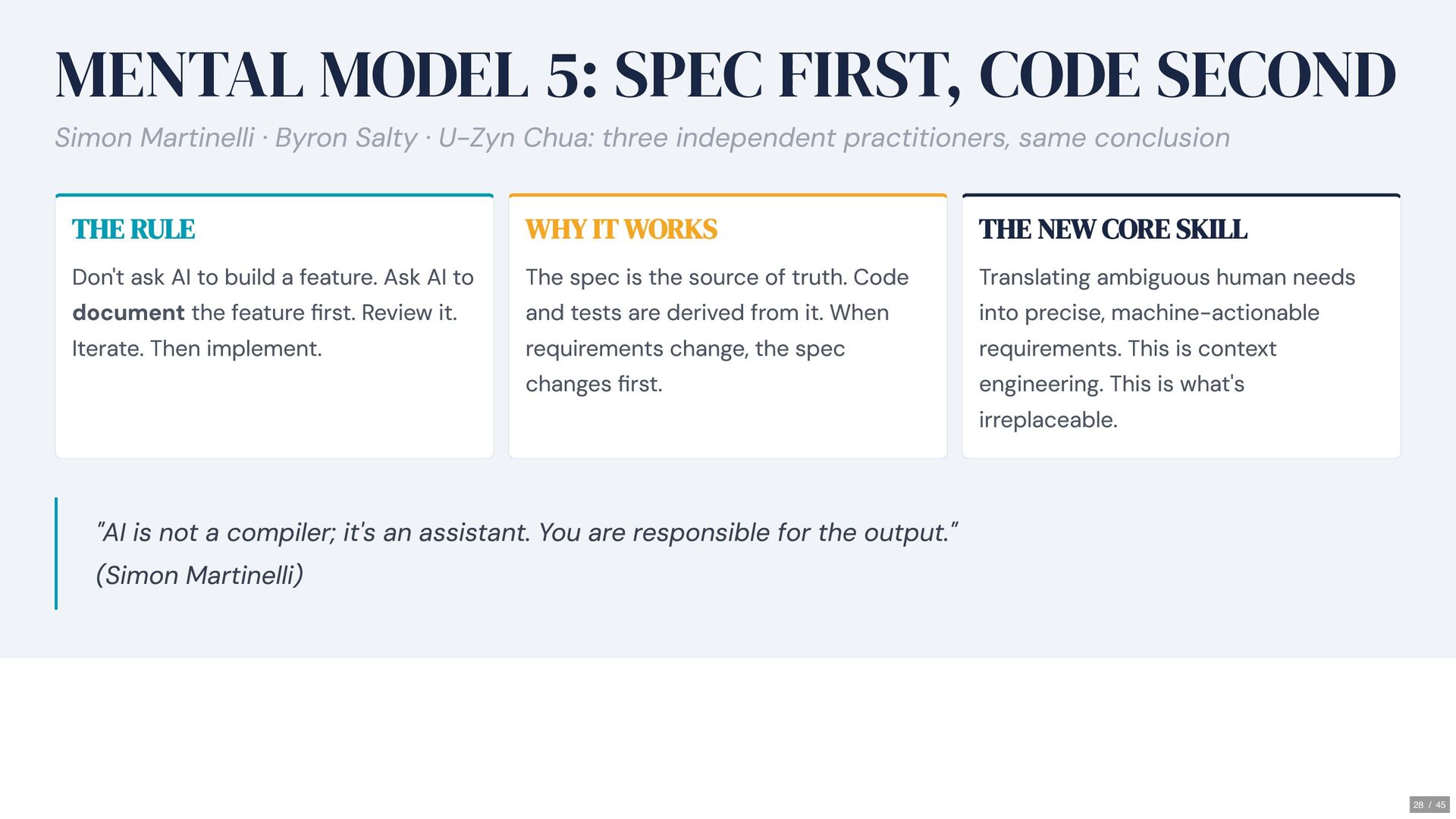
Byron Salty · U-Zyn Chua: three independent practitioners, same conclusion THE RULE Don't ask AI to build a feature. Ask AI to document the feature first. Review it. Iterate. Then implement. WHY IT WORKS The spec is the source of truth. Code and tests are derived from it. When requirements change, the spec changes first. THE NEW CORE SKILL Translating ambiguous human needs into precise, machine-actionable requirements. This is context engineering. This is what's irreplaceable. "AI is not a compiler; it's an assistant. You are responsible for the output." (Simon Martinelli) 28 / 45
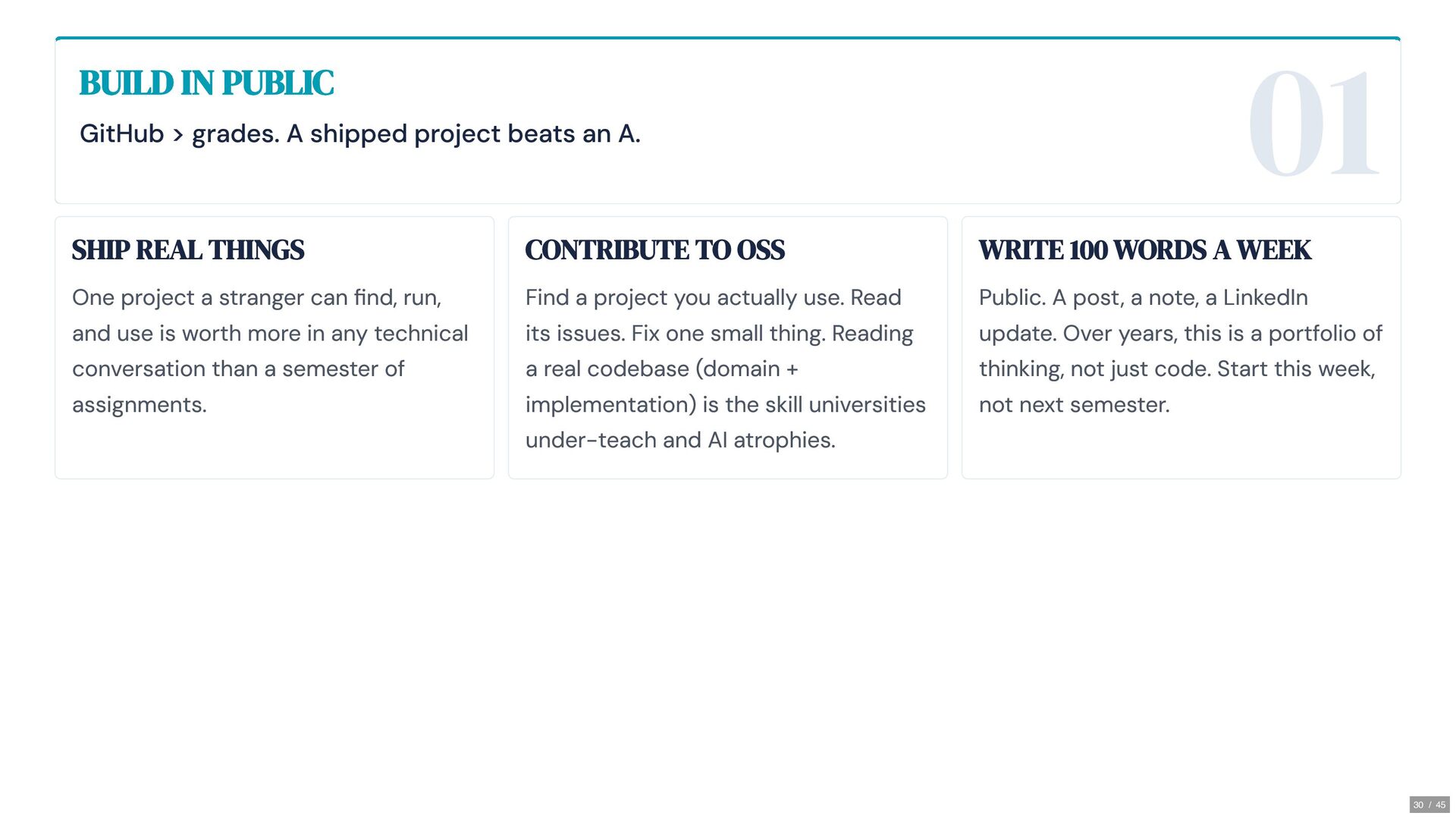
an A. 01 SHIP REAL THINGS One project a stranger can find, run, and use is worth more in any technical conversation than a semester of assignments. CONTRIBUTE TO OSS Find a project you actually use. Read its issues. Fix one small thing. Reading a real codebase (domain + implementation) is the skill universities under-teach and AI atrophies. WRITE 100 WORDS A WEEK Public. A post, a note, a LinkedIn update. Over years, this is a portfolio of thinking, not just code. Start this week, not next semester. 30 / 45
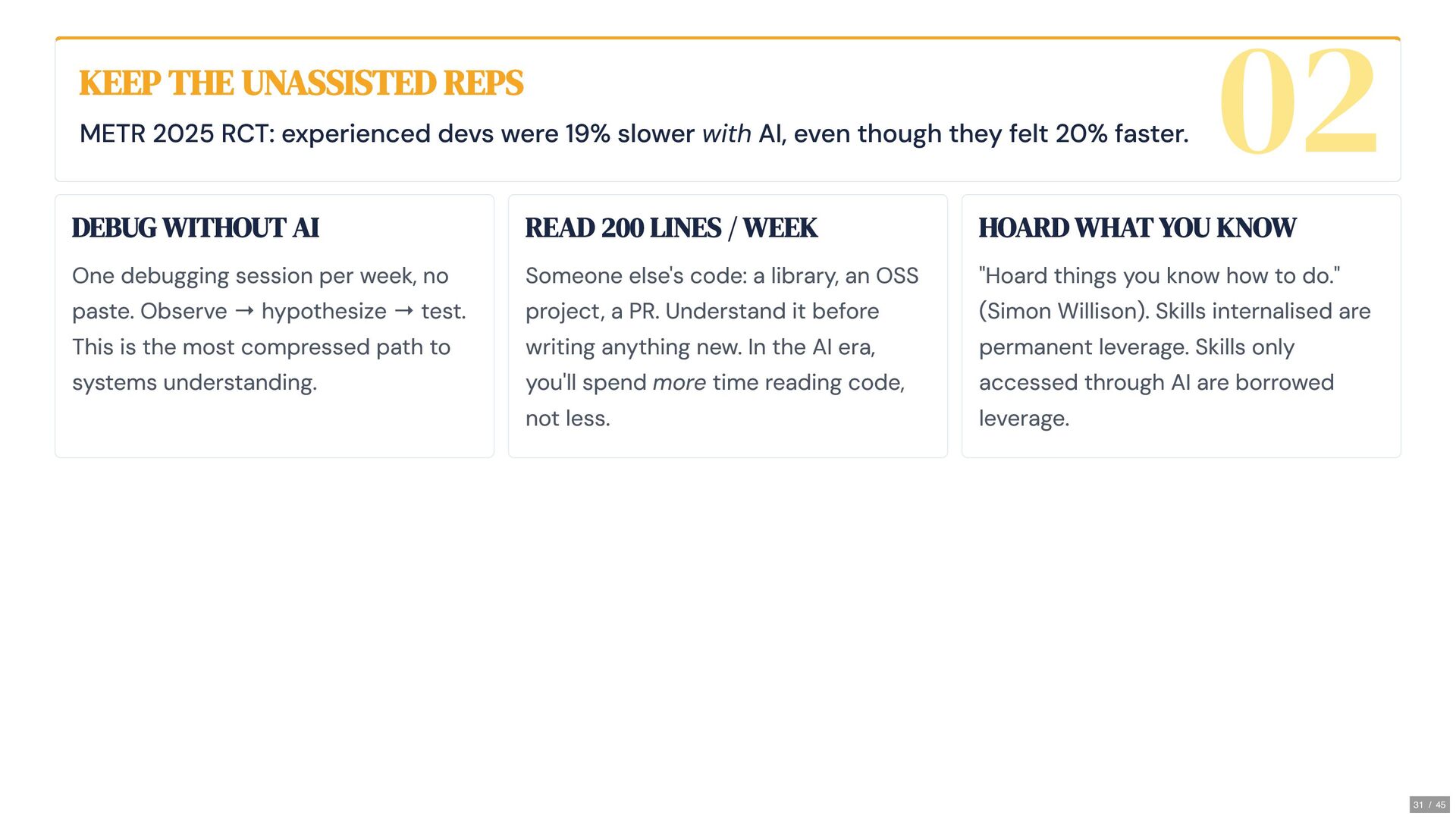
19% slower with AI, even though they felt 20% faster. 02 DEBUG WITHOUT AI One debugging session per week, no paste. Observe → hypothesize → test. This is the most compressed path to systems understanding. READ 200 LINES / WEEK Someone else's code: a library, an OSS project, a PR. Understand it before writing anything new. In the AI era, you'll spend more time reading code, not less. HOARD WHAT YOU KNOW "Hoard things you know how to do." (Simon Willison). Skills internalised are permanent leverage. Skills only accessed through AI are borrowed leverage. 31 / 45
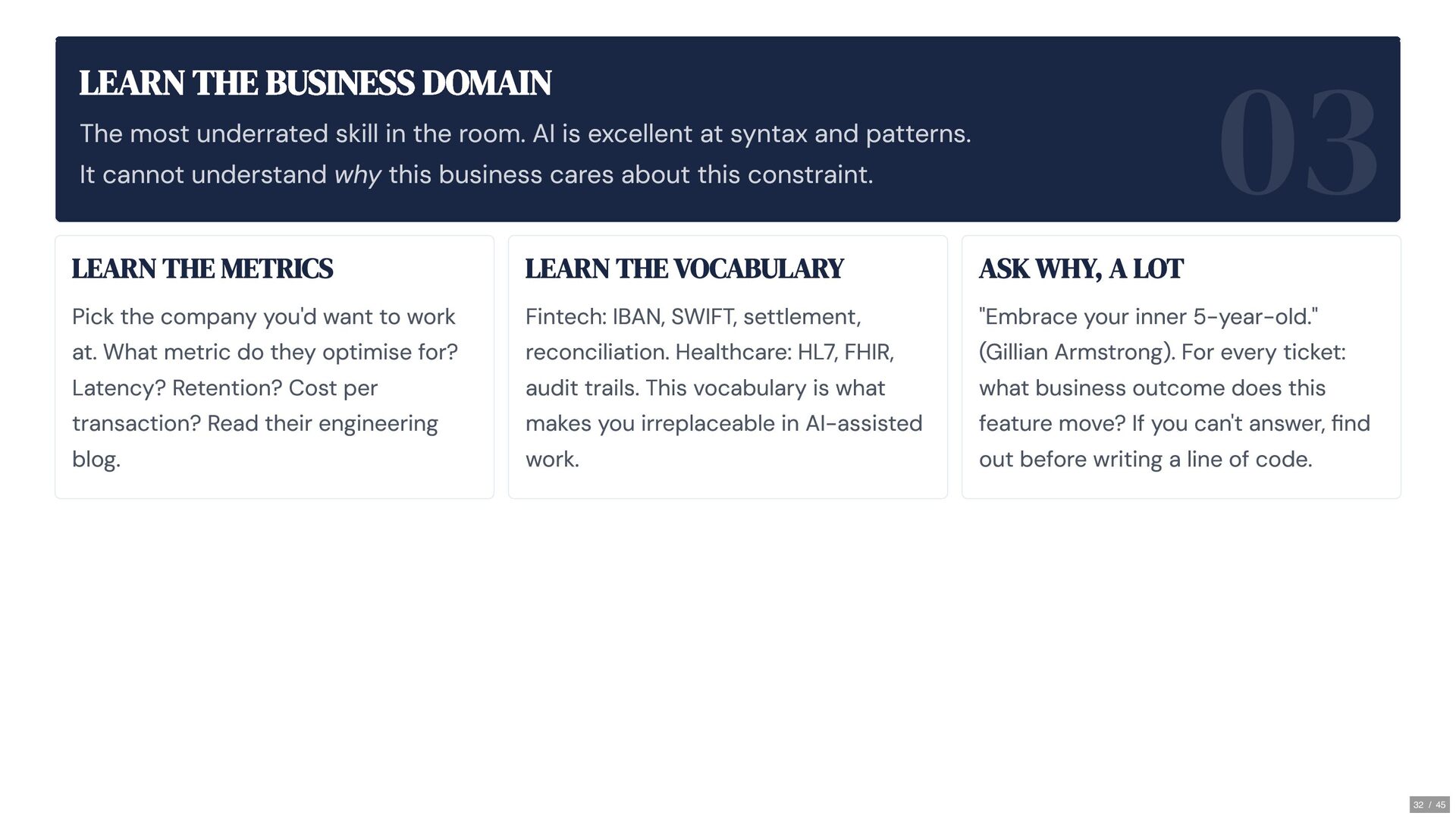
room. AI is excellent at syntax and patterns. It cannot understand why this business cares about this constraint. 03 LEARN THE METRICS Pick the company you'd want to work at. What metric do they optimise for? Latency? Retention? Cost per transaction? Read their engineering blog. LEARN THE VOCABULARY Fintech: IBAN, SWIFT, settlement, reconciliation. Healthcare: HL7, FHIR, audit trails. This vocabulary is what makes you irreplaceable in AI-assisted work. ASK WHY, A LOT "Embrace your inner 5-year-old." (Gillian Armstrong). For every ticket: what business outcome does this feature move? If you can't answer, find out before writing a line of code. 32 / 45
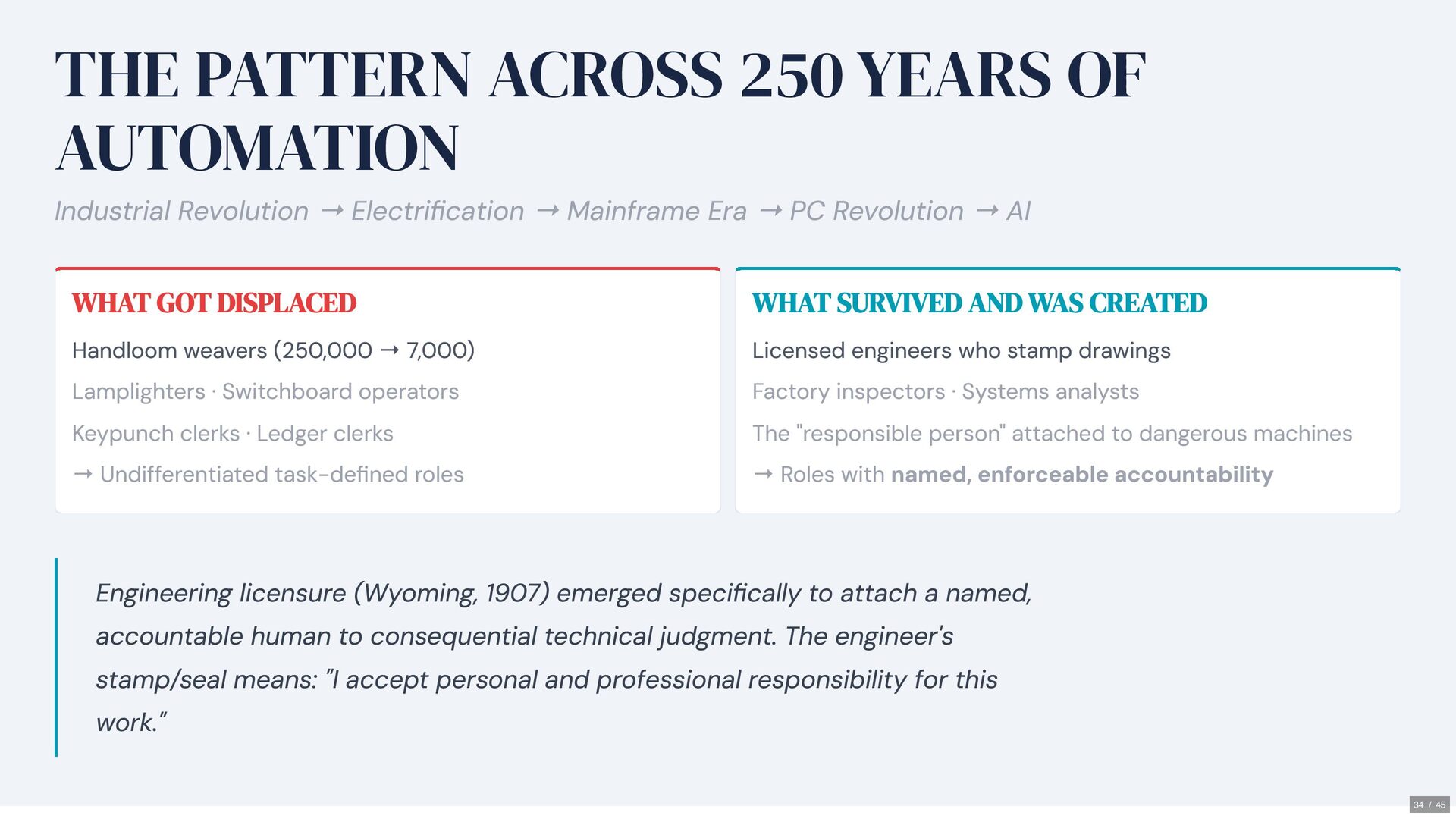
Electrification → Mainframe Era → PC Revolution → AI WHAT GOT DISPLACED Handloom weavers (250,000 → 7,000) Lamplighters · Switchboard operators Keypunch clerks · Ledger clerks → Undifferentiated task-defined roles WHAT SURVIVED AND WAS CREATED Licensed engineers who stamp drawings Factory inspectors · Systems analysts The "responsible person" attached to dangerous machines → Roles with named, enforceable accountability Engineering licensure (Wyoming, 1907) emerged specifically to attach a named, accountable human to consequential technical judgment. The engineer's stamp/seal means: "I accept personal and professional responsibility for this work." 34 / 45
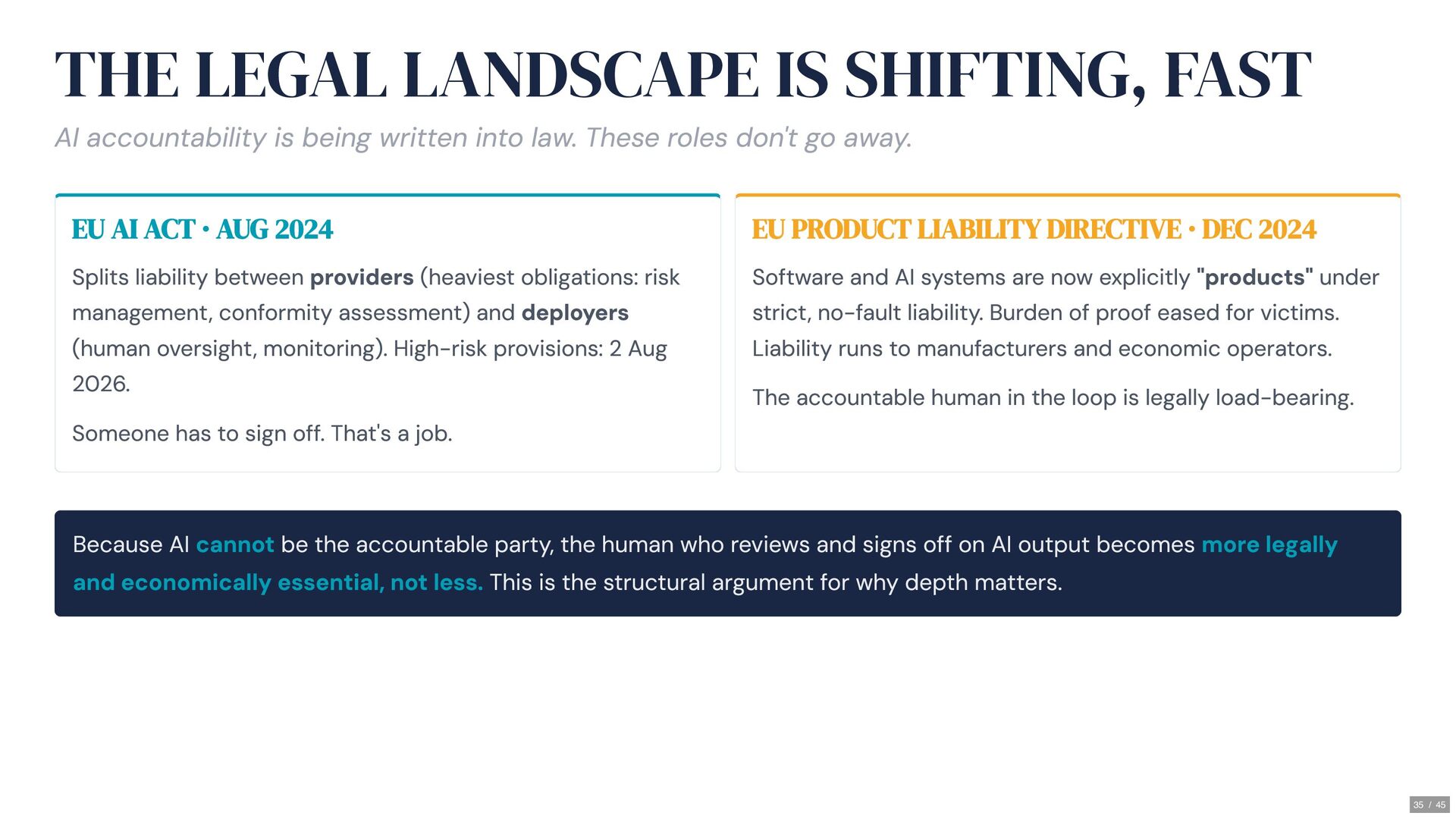
written into law. These roles don't go away. Because AI cannot be the accountable party, the human who reviews and signs off on AI output becomes more legally and economically essential, not less. This is the structural argument for why depth matters. EU AI ACT · AUG 2024 Splits liability between providers (heaviest obligations: risk management, conformity assessment) and deployers (human oversight, monitoring). High-risk provisions: 2 Aug 2026. Someone has to sign off. That's a job. EU PRODUCT LIABILITY DIRECTIVE · DEC 2024 Software and AI systems are now explicitly "products" under strict, no-fault liability. Burden of proof eased for victims. Liability runs to manufacturers and economic operators. The accountable human in the loop is legally load-bearing. 35 / 45
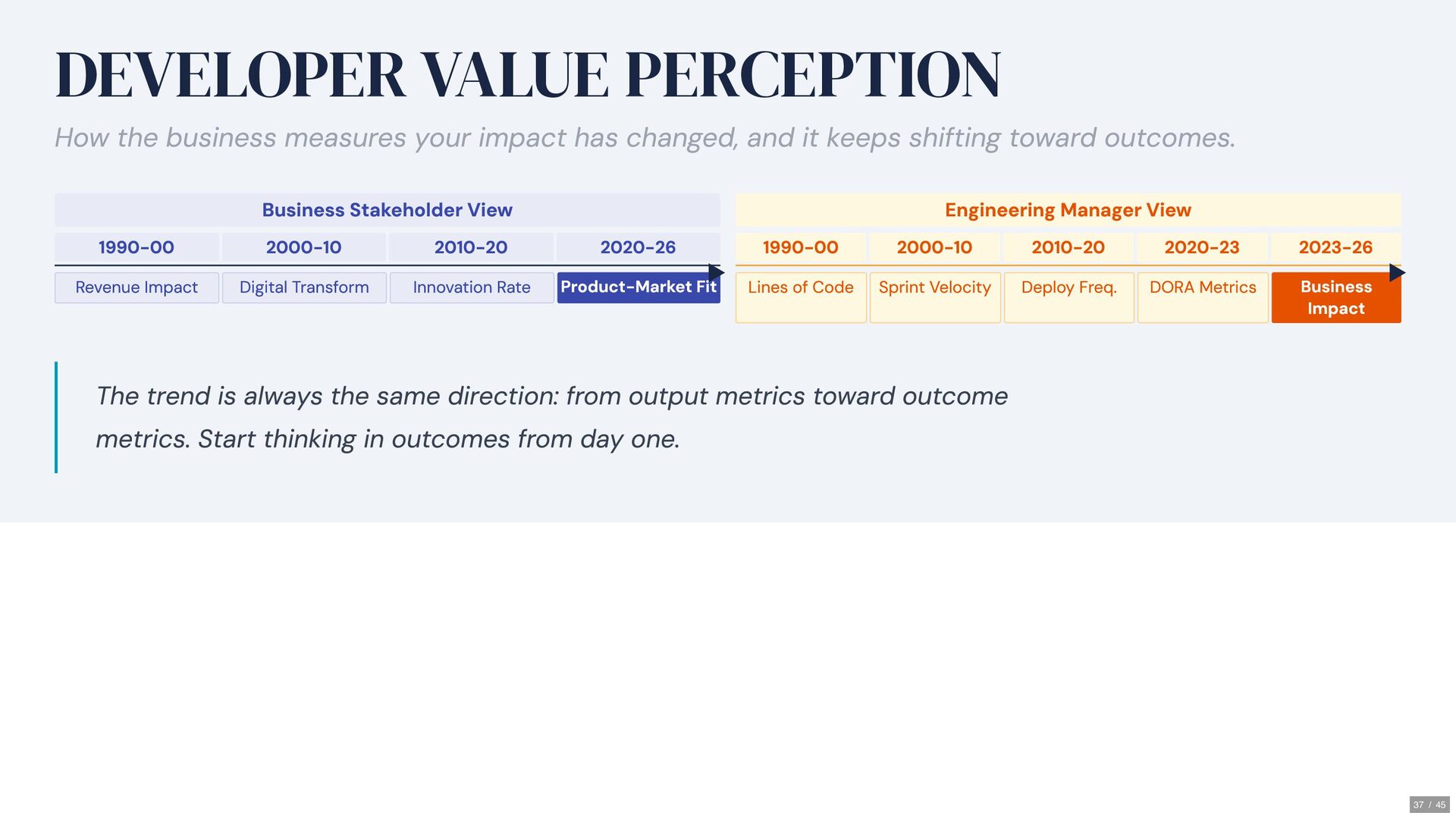
changed, and it keeps shifting toward outcomes. Business Stakeholder View 1990-00 2000-10 2010-20 2020-26 Revenue Impact Digital Transform Innovation Rate Product-Market Fit Engineering Manager View 1990-00 2000-10 2010-20 2020-23 2023-26 Lines of Code Sprint Velocity Deploy Freq. DORA Metrics Business Impact ▶ ▶ The trend is always the same direction: from output metrics toward outcome metrics. Start thinking in outcomes from day one. 37 / 45
in. 👶 JUNIOR ENGINEER Ships features 🧑💻 SENIOR ENGINEER Ships outcomes 🧭 STAFF ENGINEER Shifts markets "AI does quite frankly reduce the floor and raise the ceiling for all of us." (Satya Nadella) 38 / 45
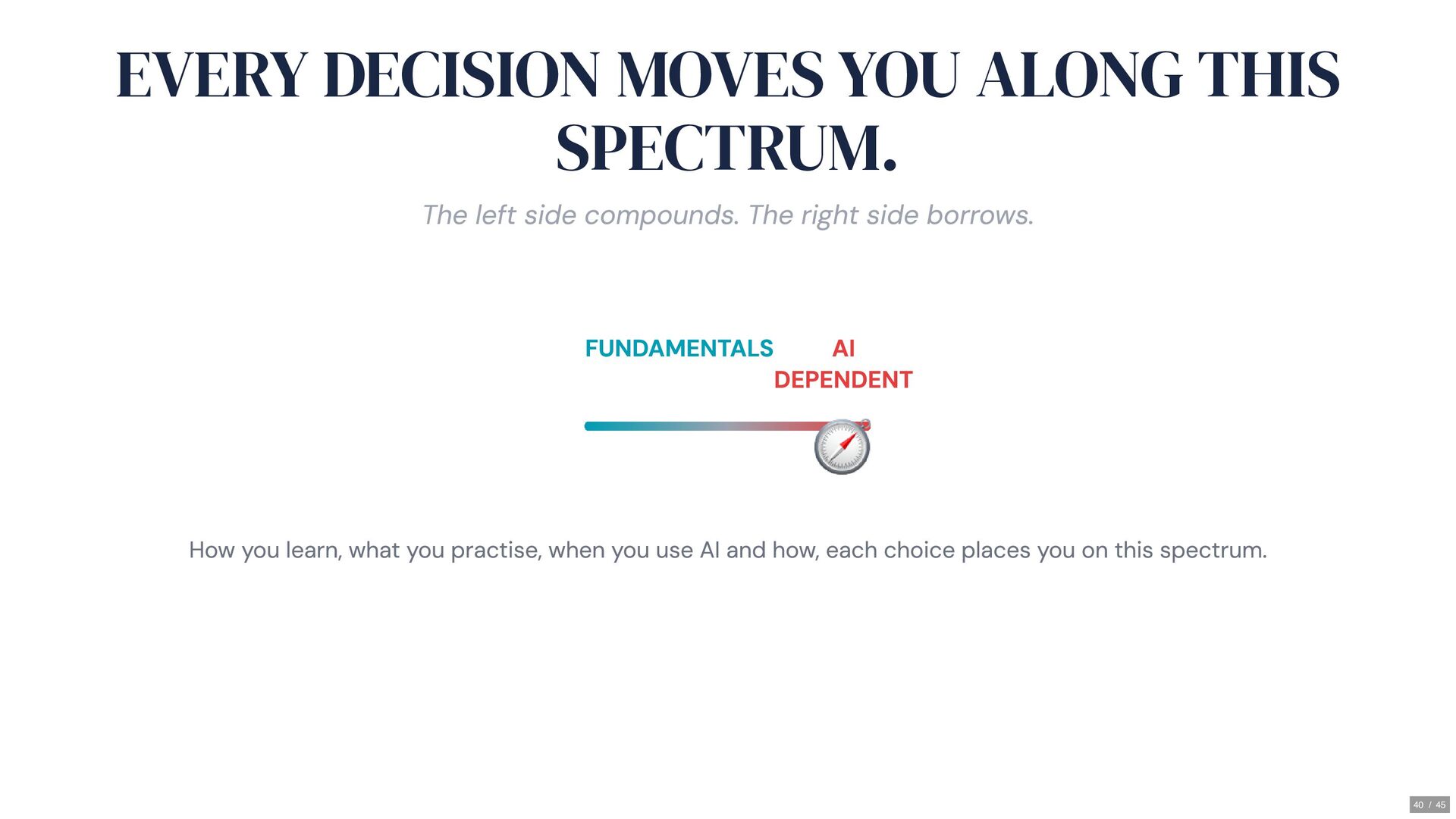
compounds. The right side borrows. FUNDAMENTALS AI DEPENDENT How you learn, what you practise, when you use AI and how, each choice places you on this spectrum. 🧭 40 / 45
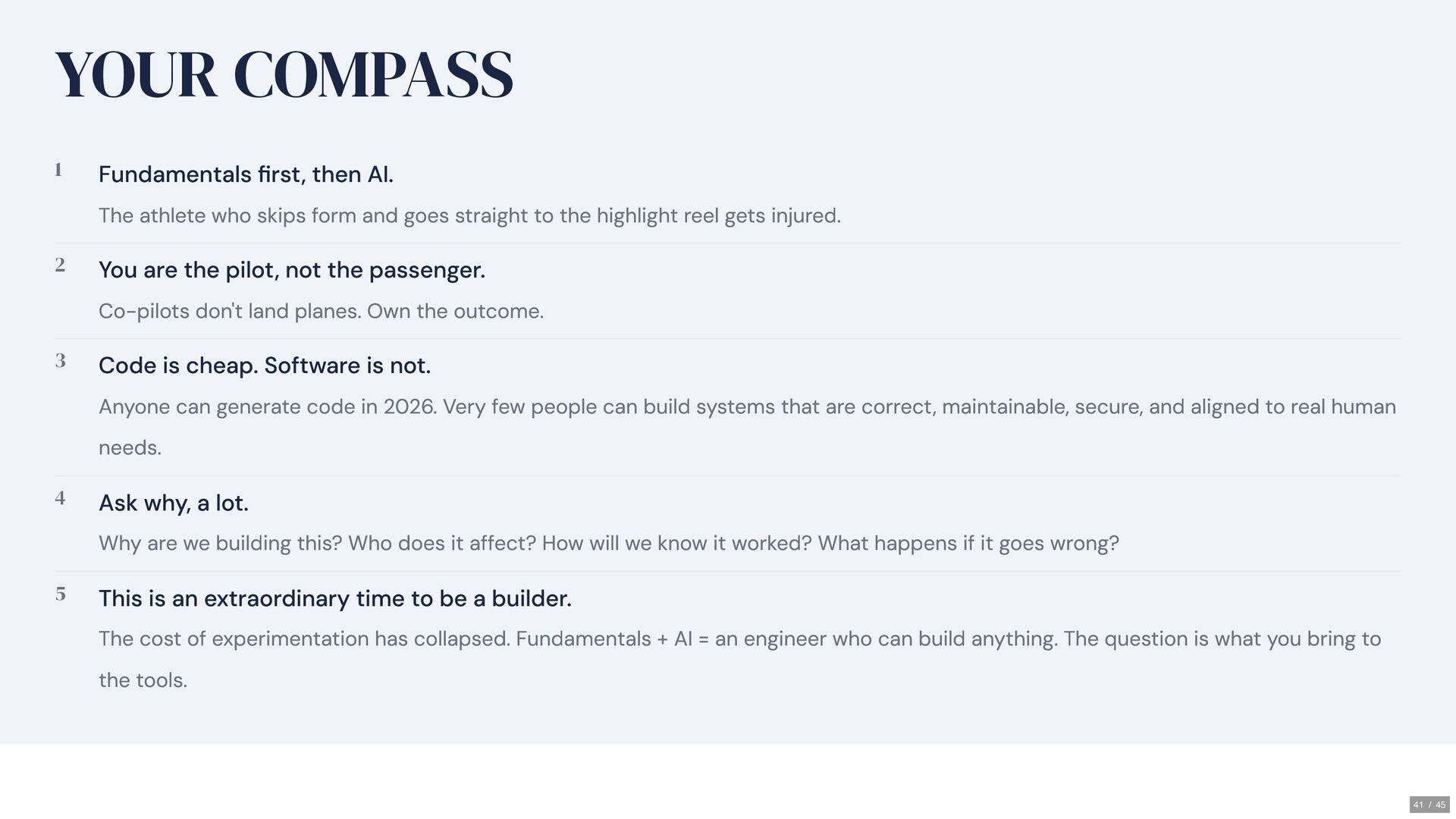
skips form and goes straight to the highlight reel gets injured. 2 You are the pilot, not the passenger. Co-pilots don't land planes. Own the outcome. 3 Code is cheap. Software is not. Anyone can generate code in 2026. Very few people can build systems that are correct, maintainable, secure, and aligned to real human needs. 4 Ask why, a lot. Why are we building this? Who does it affect? How will we know it worked? What happens if it goes wrong? 5 This is an extraordinary time to be a builder. The cost of experimentation has collapsed. Fundamentals + AI = an engineer who can build anything. The question is what you bring to the tools. 41 / 45
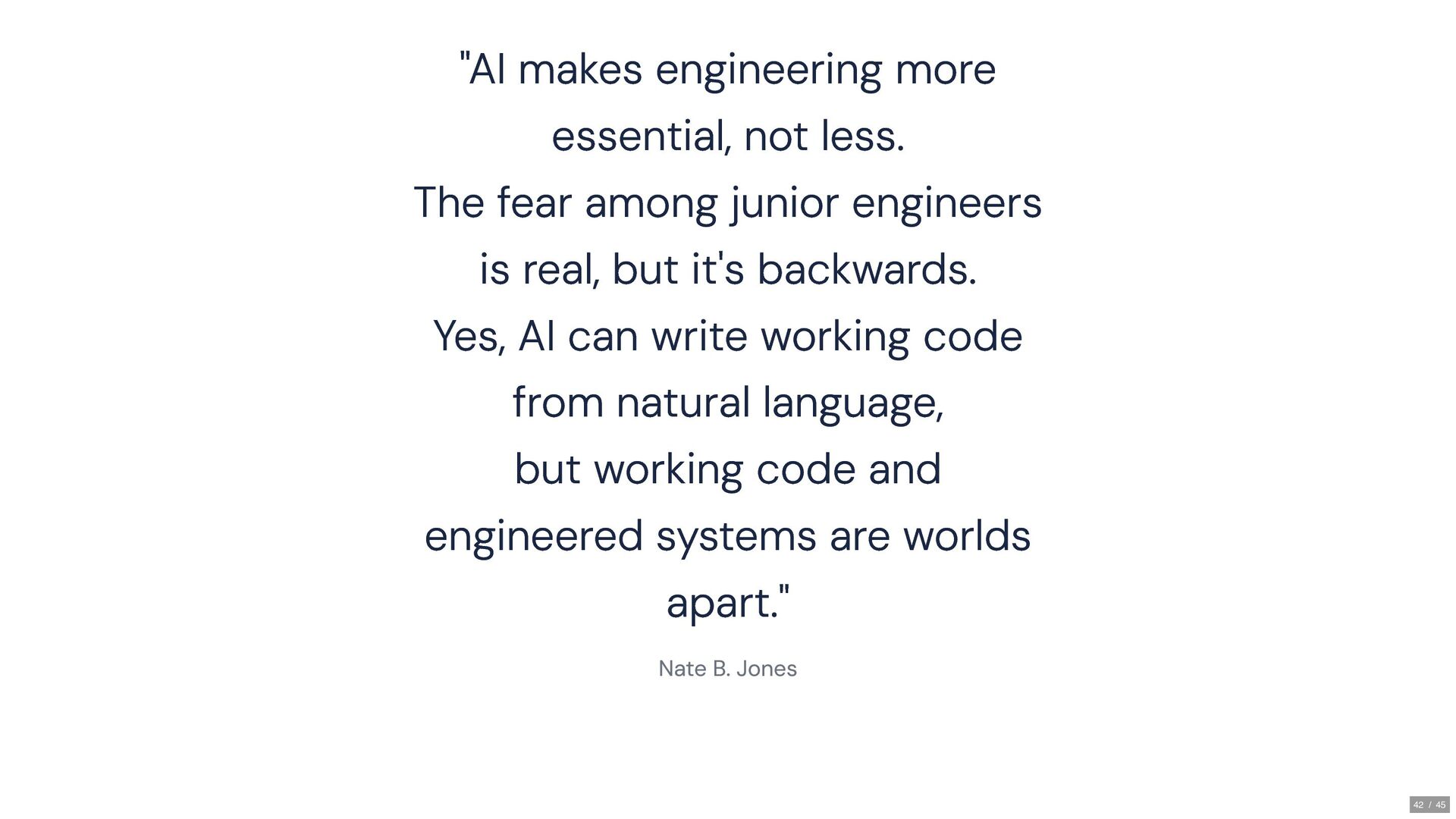
junior engineers is real, but it's backwards. Yes, AI can write working code from natural language, but working code and engineered systems are worlds apart." Nate B. Jones 42 / 45


 faz
faz
 hironobuiga
 oracle4engineer
 kawanago
 ennael
 tsukuboshi
 sansantech
 dtunkelang
 sanghyuk
 osawa
osawa
 kazuho
 axbom
axbom
 jacobian
 stephaniewalter
 62gerente
 addyosmani
 skipperchong
 gurzu
gurzu
 tammyeverts
 jlugia
 chikuwait
 chriscoyier
 rakko
rakko