Upgrade to Pro — share decks privately, control downloads, hide ads and more …

Salesforce Interview Question And Answer By Sch...

Avatar for Gourav Gourav
June 28, 2025
9

Salesforce Interview Question And Answer By Scholarhat

This PDF contains a curated list of frequently asked Salesforce interview questions and answers along with brief explanations. It's ideal for freshers, job seekers, and professionals preparing for Salesforce roles. Topics include objects, triggers, workflows, Apex, governor limits, and more. A quick reference guide to boost your interview confidence and understanding of core Salesforce concepts. By Scholarhat

Avatar for Gourav

Gourav

June 28, 2025
Tweet

Transcript

  1. Mastering Your Salesforce Interview Prepare forsuccess inSalesforceroles, understand common Salesforce

    InterviewQuestions Andanswers,and showcase yourexpertise andproblem- solving skills.
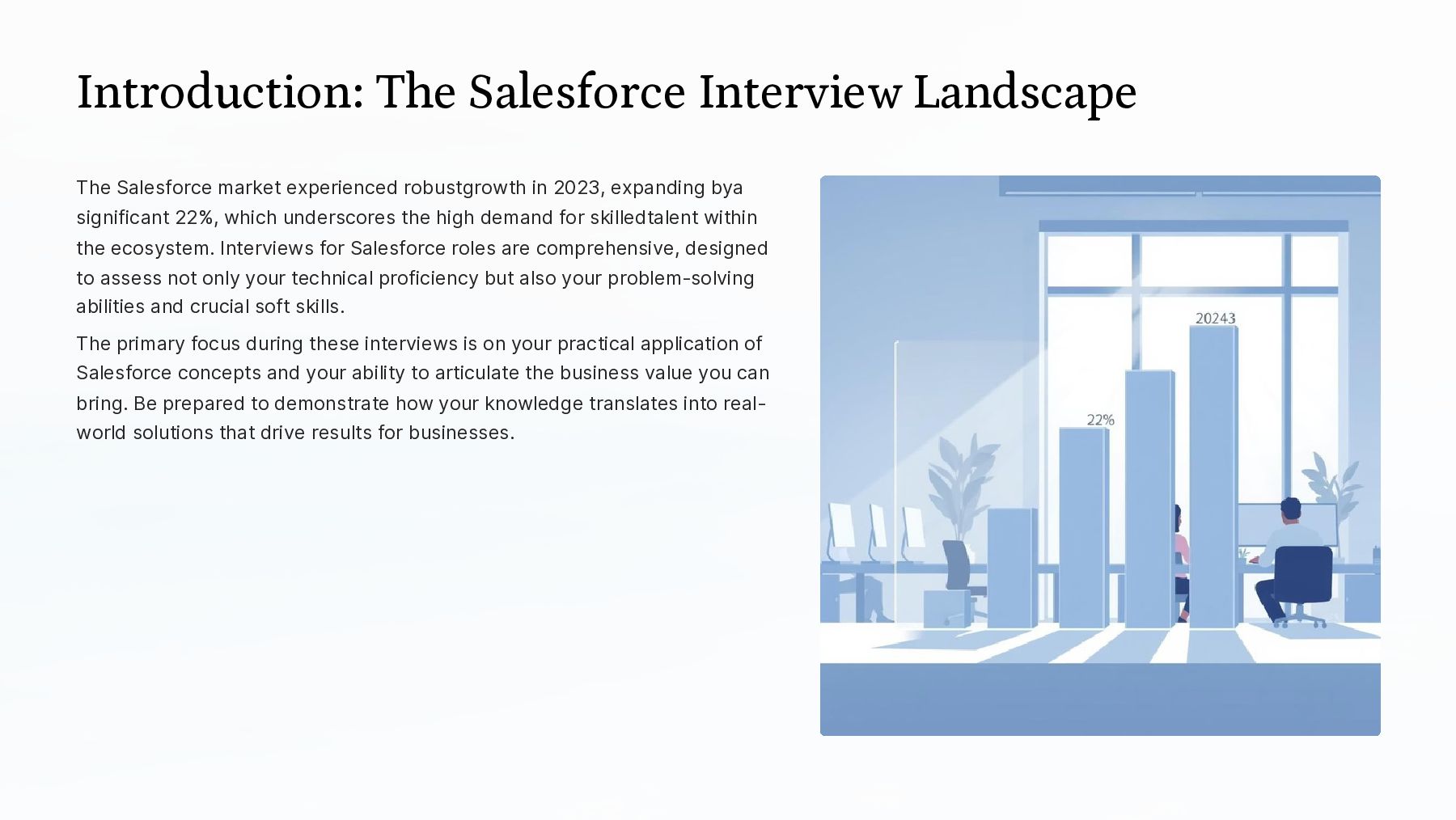
  2. Introduction: The Salesforce Interview Landscape The Salesforce market experienced robustgrowth

    in 2023, expanding bya significant 22%, which underscores the high demand for skilledtalent within the ecosystem. Interviews for Salesforce roles are comprehensive, designed to assess not only your technical proficiency but also your problem-solving abilities and crucial soft skills. The primary focus during these interviews is on your practical application of Salesforce concepts and your ability to articulate the business value you can bring. Be prepared to demonstrate how your knowledge translates into real- world solutions that drive results for businesses.
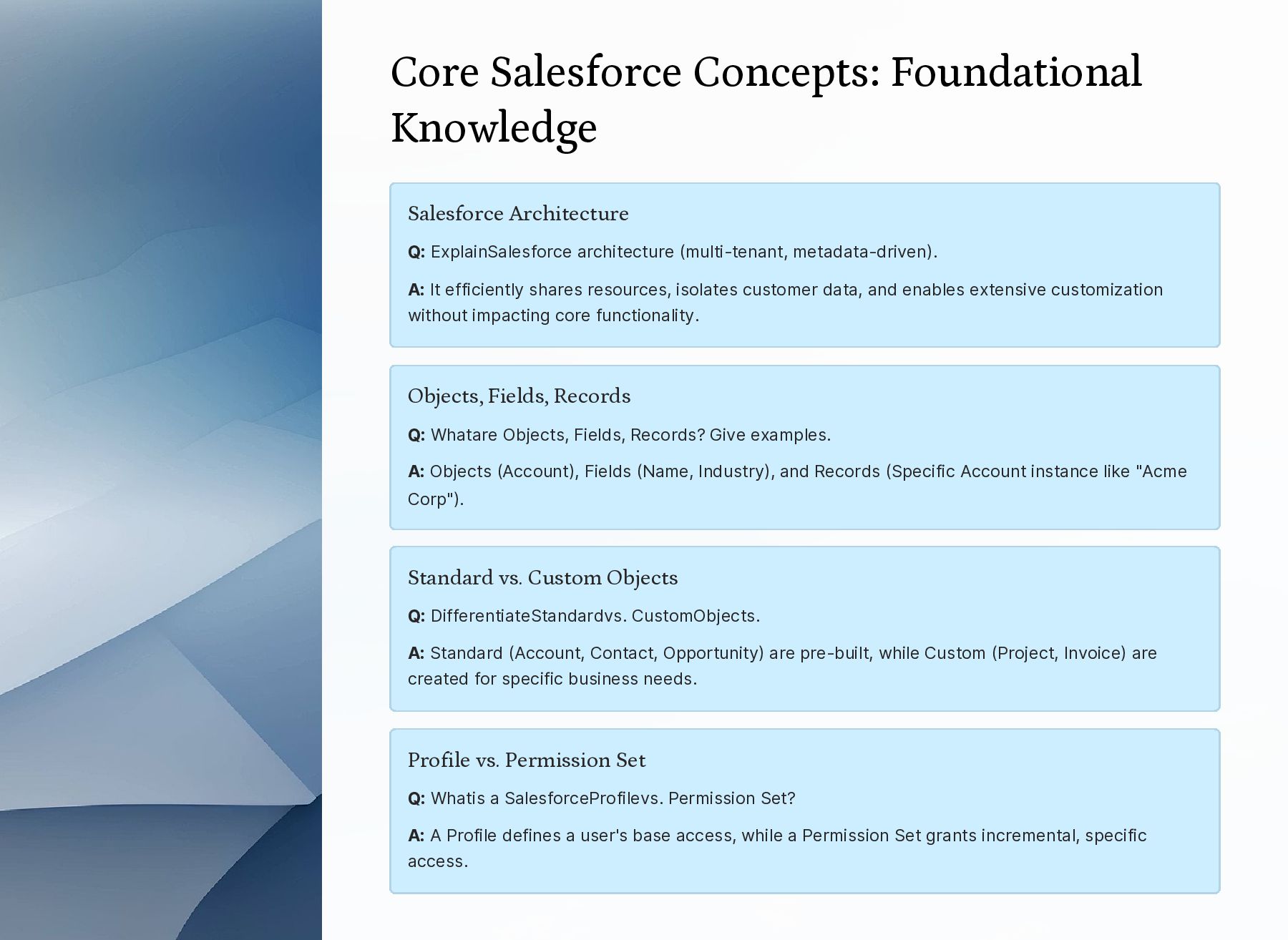
  3. Core Salesforce Concepts: Foundational Knowledge Salesforce Architecture Objects, Fields, Records

    Profile vs. Permission Set Standard vs. Custom Objects Q: Whatis a SalesforceProfilevs. Permission Set? A: A Profile defines a user's base access, while a Permission Set grants incremental, specific access. Q: DifferentiateStandardvs. CustomObjects. A: Standard (Account, Contact, Opportunity) are pre-built, while Custom (Project, Invoice) are created for specific business needs. Q: ExplainSalesforce architecture (multi-tenant, metadata-driven). A: It efficiently shares resources, isolates customer data, and enables extensive customization without impacting core functionality. Q: Whatare Objects, Fields, Records? Give examples. A: Objects (Account), Fields (Name, Industry), and Records (Specific Account instance like "Acme Corp").
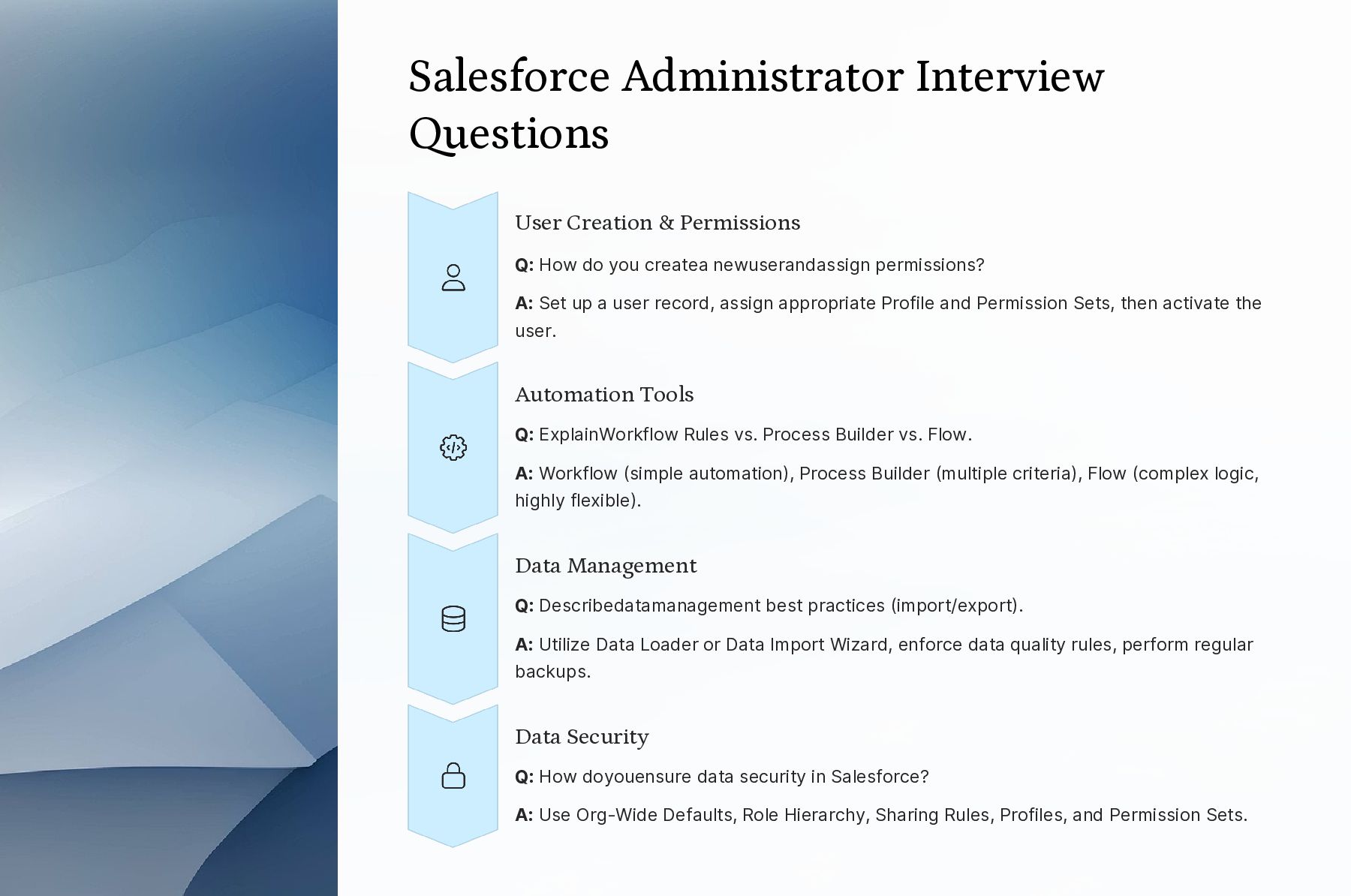
  4. Salesforce Administrator Interview Questions Data Security Automation Tools Data Management

    User Creation & Permissions Q: How doyouensure data security in Salesforce? A: Use Org-Wide Defaults, Role Hierarchy, Sharing Rules, Profiles, and Permission Sets. Q: Describedatamanagement best practices (import/export). A: Utilize Data Loader or Data Import Wizard, enforce data quality rules, perform regular backups. Q: How do you createa newuserandassign permissions? A: Set up a user record, assign appropriate Profile and Permission Sets, then activate the user. Q: ExplainWorkflow Rules vs. Process Builder vs. Flow. A: Workflow (simple automation), Process Builder (multiple criteria), Flow (complex logic, highly flexible).
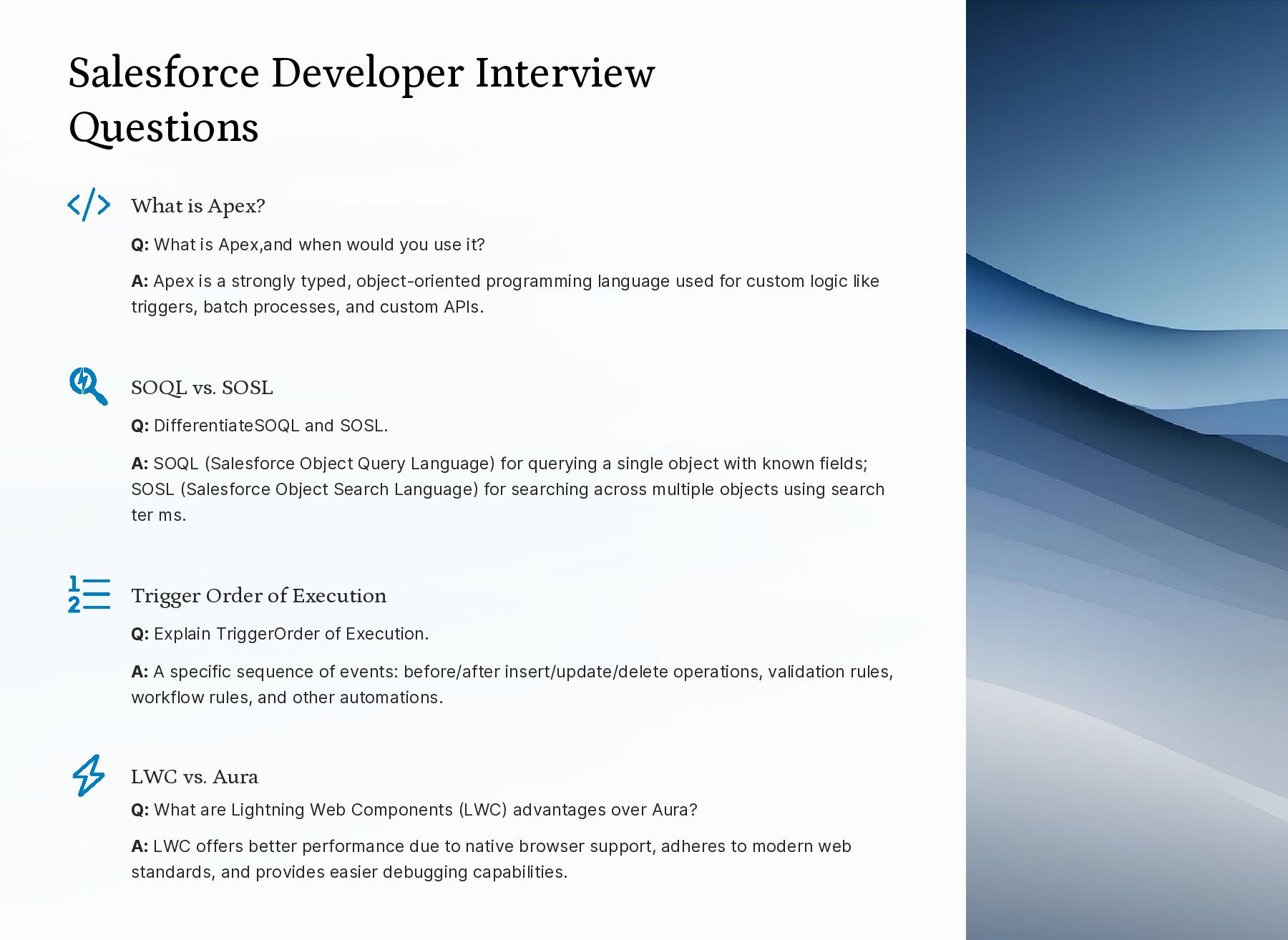
  5. Salesforce Developer Interview Questions LWC vs. Aura Q: What are

    Lightning Web Components (LWC) advantages over Aura? A: LWC offers better performance due to native browser support, adheres to modern web standards, and provides easier debugging capabilities. SOQL vs. SOSL What is Apex? Trigger Order of Execution Q: What is Apex,and when would you use it? A: Apex is a strongly typed, object-oriented programming language used for custom logic like triggers, batch processes, and custom APIs. Q: DifferentiateSOQL and SOSL. A: SOQL (Salesforce Object Query Language) for querying a single object with known fields; SOSL (Salesforce Object Search Language) for searching across multiple objects using search ter ms. Q: Explain TriggerOrder of Execution. A: A specific sequence of events: before/after insert/update/delete operations, validation rules, workflow rules, and other automations.
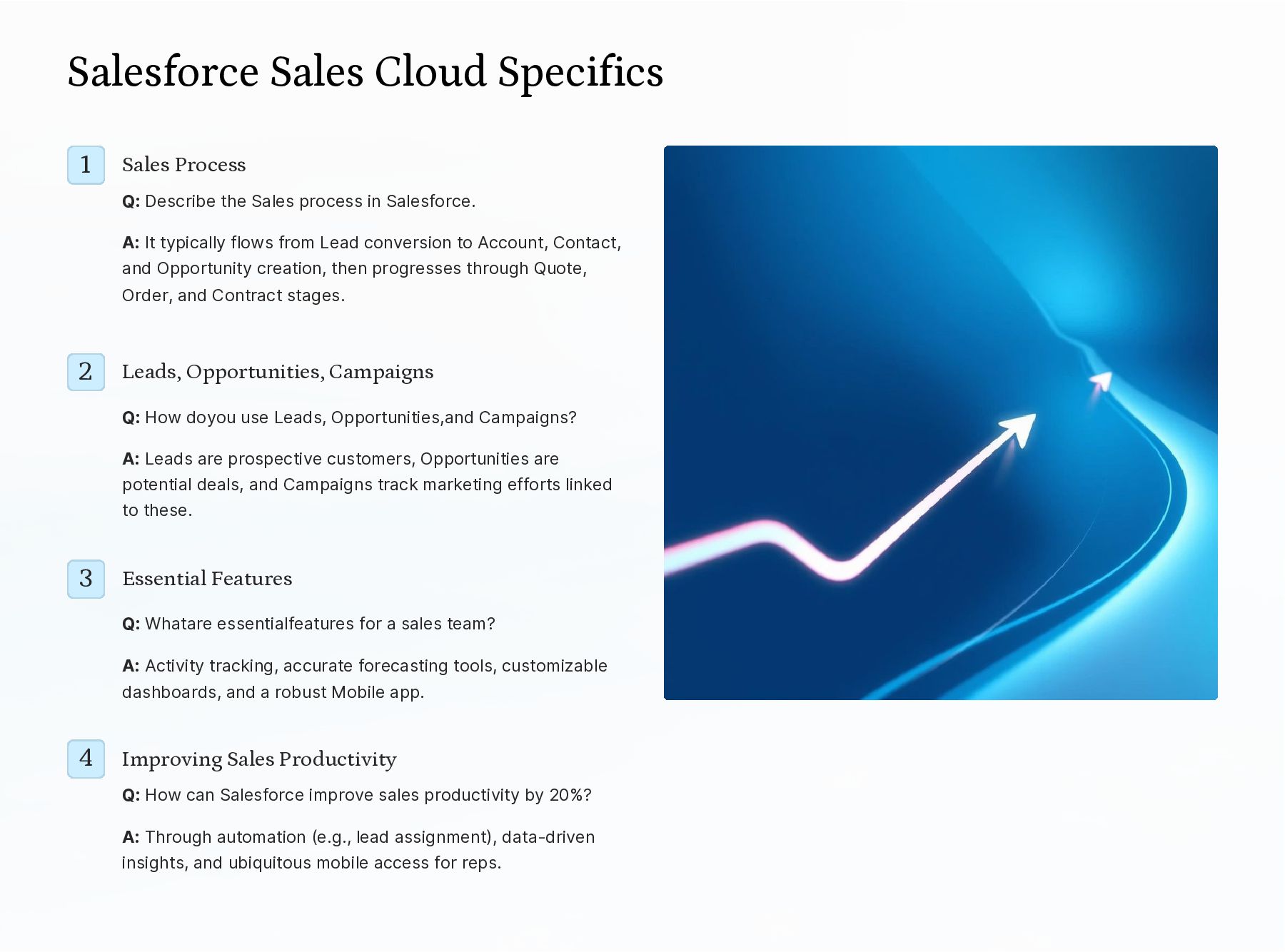
  6. Salesforce Sales Cloud Specifics 1 2 3 4 Sales Process

    Q: Describe the Sales process in Salesforce. A: It typically flows from Lead conversion to Account, Contact, and Opportunity creation, then progresses through Quote, Order, and Contract stages. Essential Features Improving Sales Productivity Q: How can Salesforce improve sales productivity by 20%? A: Through automation (e.g., lead assignment), data-driven insights, and ubiquitous mobile access for reps. Leads, Opportunities, Campaigns Q: Whatare essentialfeatures for a sales team? A: Activity tracking, accurate forecasting tools, customizable dashboards, and a robust Mobile app. Q: How doyou use Leads, Opportunities,and Campaigns? A: Leads are prospective customers, Opportunities are potential deals, and Campaigns track marketing efforts linked to these.
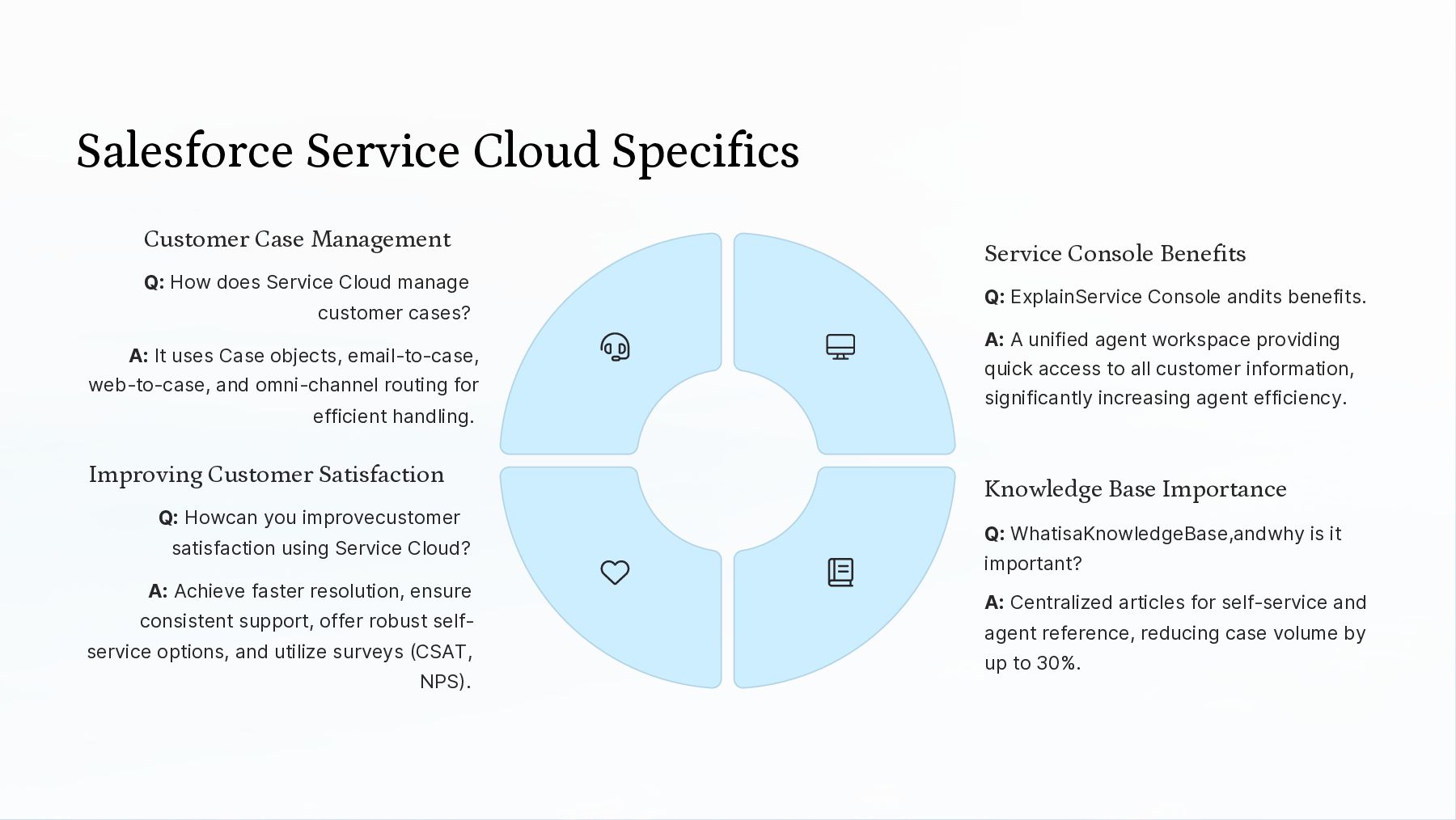
  7. Salesforce Service Cloud Specifics Improving Customer Satisfaction Customer Case Management

    Service Console Benefits Knowledge Base Importance Q: Howcan you improvecustomer satisfaction using Service Cloud? A: Achieve faster resolution, ensure consistent support, offer robust self- service options, and utilize surveys (CSAT, NPS). Q: How does Service Cloud manage customer cases? A: It uses Case objects, email-to-case, web-to-case, and omni-channel routing for efficient handling. Q: WhatisaKnowledgeBase,andwhy is it important? A: Centralized articles for self-service and agent reference, reducing case volume by up to 30%. Q: ExplainService Console andits benefits. A: A unified agent workspace providing quick access to all customer information, significantly increasing agent efficiency.
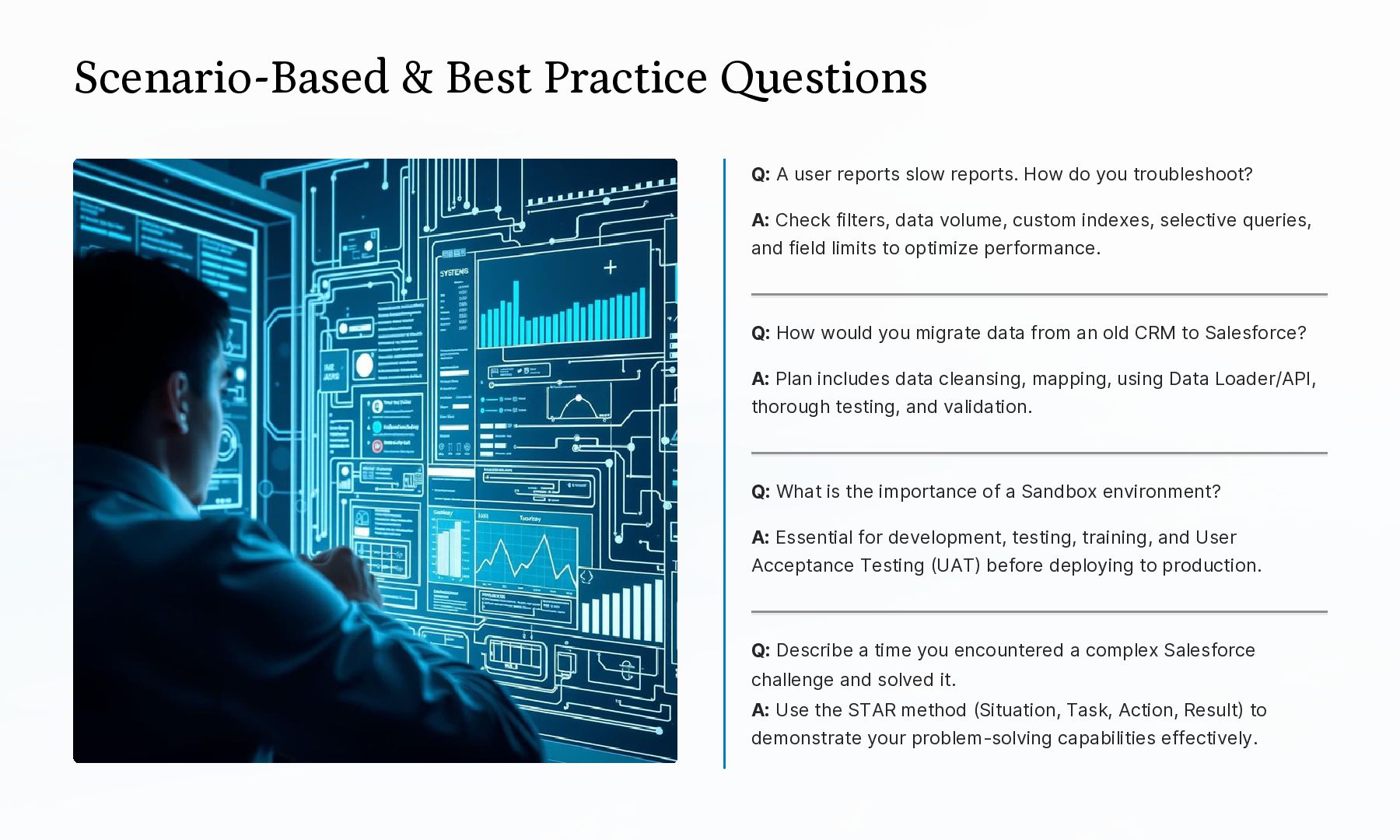
  8. Scenario-Based & Best Practice Questions Q: A user reports slow

    reports. How do you troubleshoot? A: Check filters, data volume, custom indexes, selective queries, and field limits to optimize performance. Q: How would you migrate data from an old CRM to Salesforce? A: Plan includes data cleansing, mapping, using Data Loader/API, thorough testing, and validation. Q: What is the importance of a Sandbox environment? A: Essential for development, testing, training, and User Acceptance Testing (UAT) before deploying to production. Q: Describe a time you encountered a complex Salesforce challenge and solved it. A: Use the STAR method (Situation, Task, Action, Result) to demonstrate your problem-solving capabilities effectively.
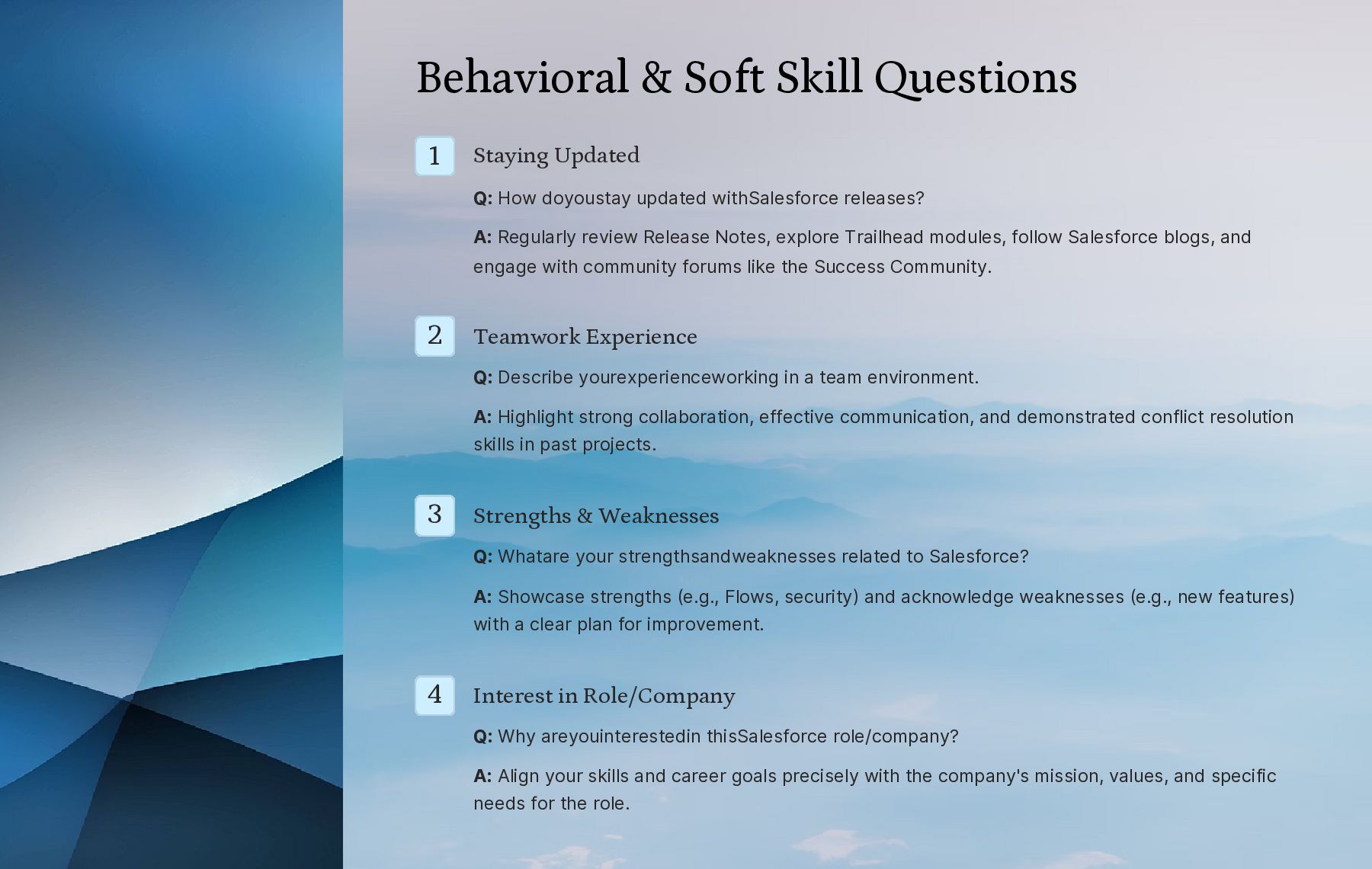
  9. Behavioral & Soft Skill Questions 1 Staying Updated 2 3

    4 Teamwork Experience Strengths & Weaknesses Interest in Role/Company Q: How doyoustay updated withSalesforce releases? A: Regularly review Release Notes, explore Trailhead modules, follow Salesforce blogs, and engage with community forums like the Success Community. Q: Why areyouinterestedin thisSalesforce role/company? A: Align your skills and career goals precisely with the company's mission, values, and specific needs for the role. Q: Describe yourexperienceworking in a team environment. A: Highlight strong collaboration, effective communication, and demonstrated conflict resolution skills in past projects. Q: Whatare your strengthsandweaknesses related to Salesforce? A: Showcase strengths (e.g., Flows, security) and acknowledge weaknesses (e.g., new features) with a clear plan for improvement.
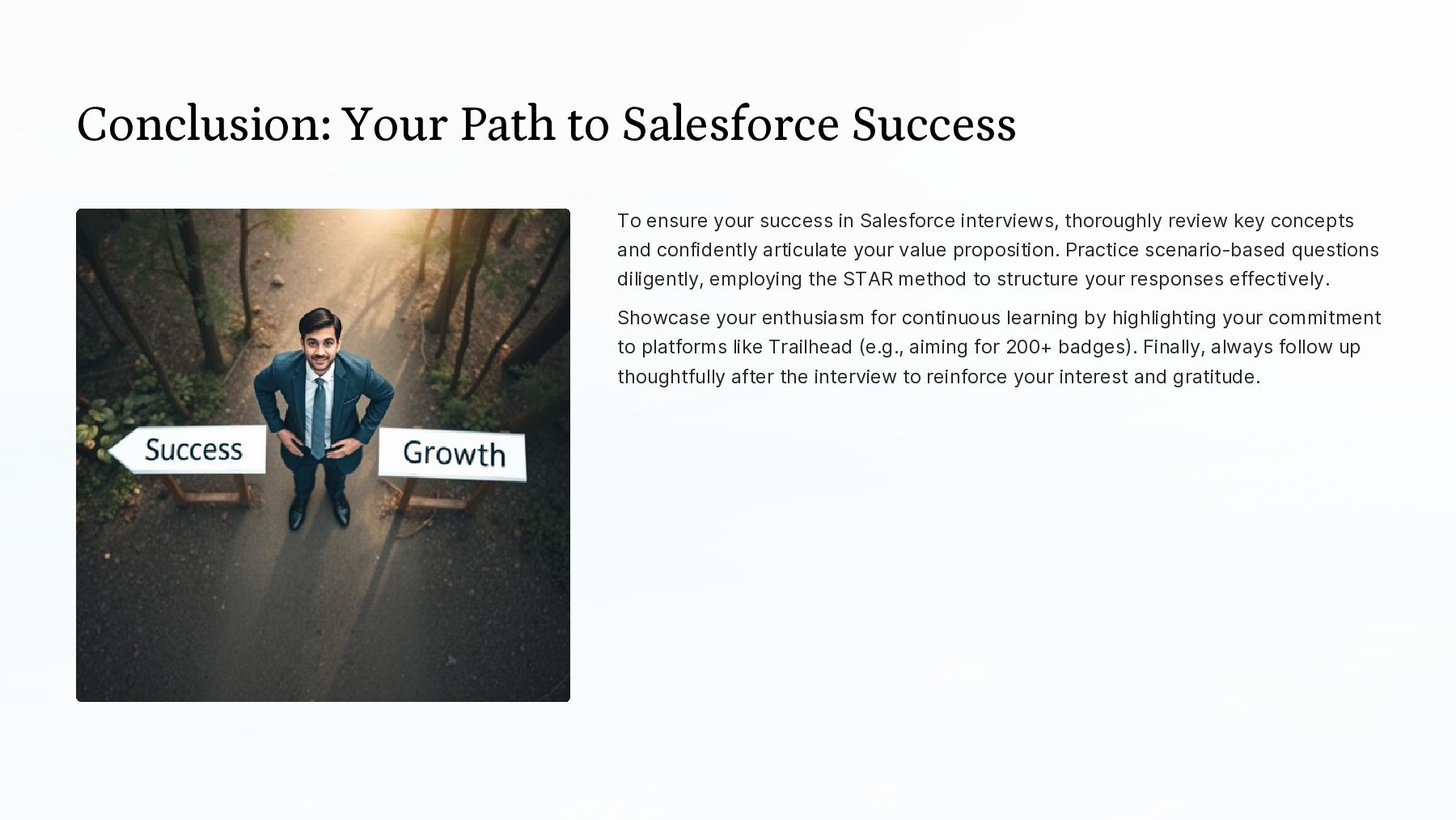
  10. Conclusion: Your Path to Salesforce Success To ensure your success

    in Salesforce interviews, thoroughly review key concepts and confidently articulate your value proposition. Practice scenario-based questions diligently, employing the STAR method to structure your responses effectively. Showcase your enthusiasm for continuous learning by highlighting your commitment to platforms like Trailhead (e.g., aiming for 200+ badges). Finally, always follow up thoughtfully after the interview to reinforce your interest and gratitude.