Techniques and tools for measuring energy efficiency of scientific software applications
Presentation for the 16th ACAT conference on tools and techniques for measuring energy efficiency of scientific applications. Research mostly done during my internship at the CERN's CMS Core Software group.
applications 16th international workshop on Advanced Computing and Analysis Techniques in Physics Research Gonçalo Pestana Giulio Eulisse Fermi National Accelerator Lab. (US) Tapio Niemi Helsinki Institute of Physics (FI) Peter Elmer Princeton University (US) David Abdurachmanov Vilnius University (LT) Goncalo Pestana Aalto University (FI) Filip Nybäck Filip Aalto University (FI) Jukka K. Nurminen Aalto University (FI) Zhonghong Ou Aalto University (FI) Robert Knight Princeton University (US)
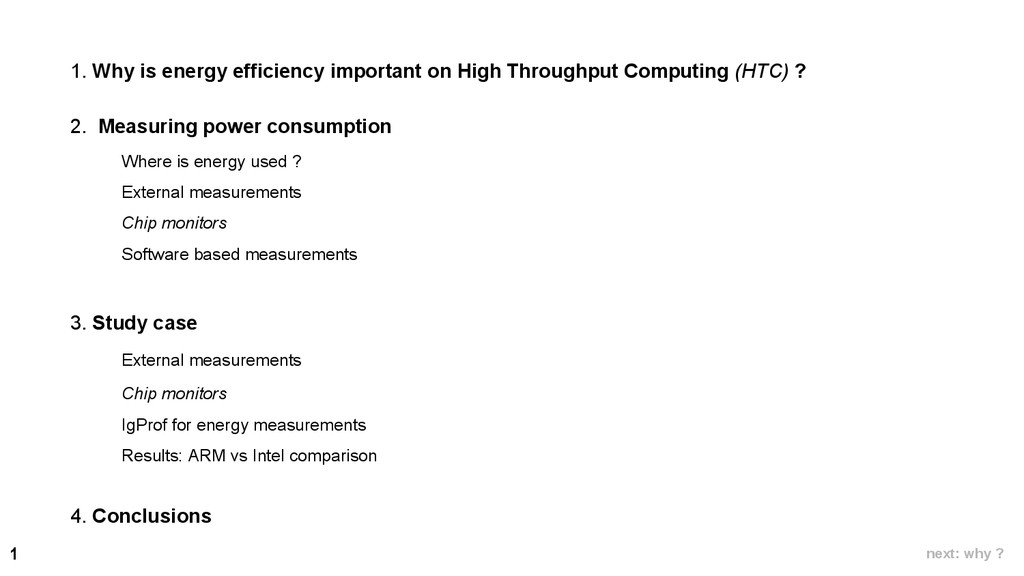
(HTC) ? 2. Measuring power consumption Where is energy used ? External measurements Chip monitors Software based measurements 3. Study case External measurements Chip monitors IgProf for energy measurements Results: ARM vs Intel comparison 4. Conclusions next: why ? 1
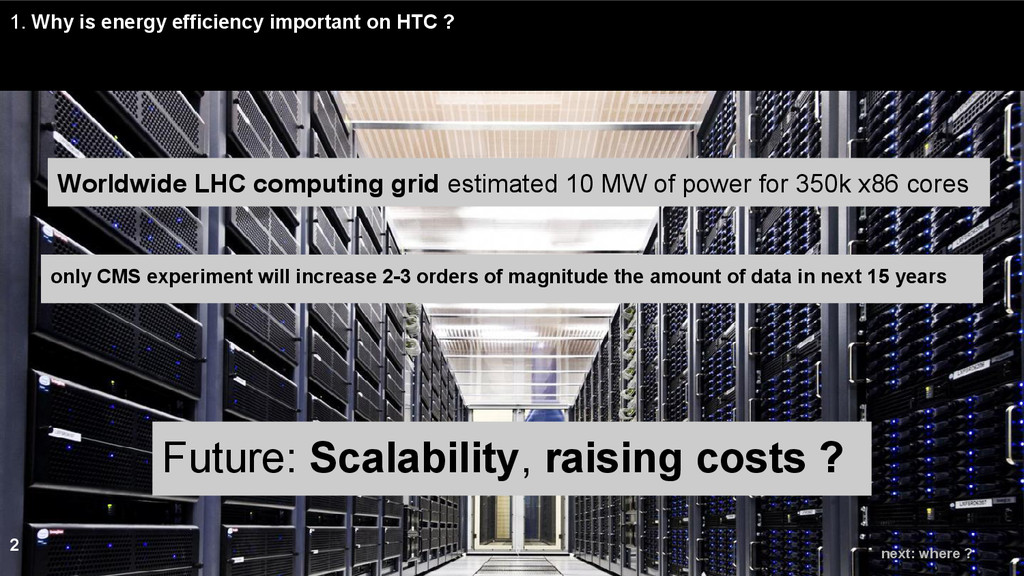
Scalability, raising costs ? Worldwide LHC computing grid estimated 10 MW of power for 350k x86 cores only CMS experiment will increase 2-3 orders of magnitude the amount of data in next 15 years next: where ? 2
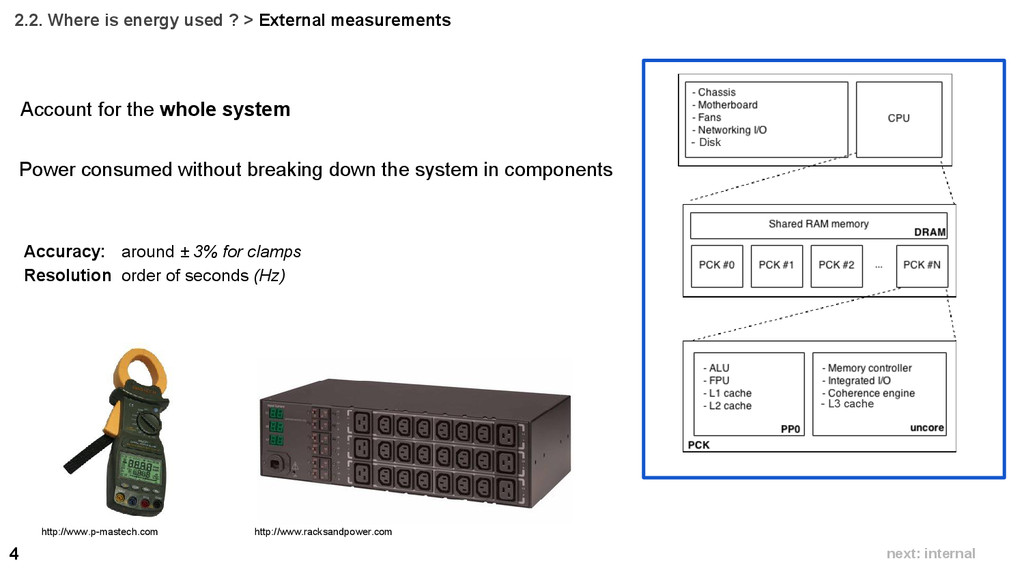
for the whole system Power consumed without breaking down the system in components Accuracy: around ± 3% for clamps Resolution order of seconds (Hz) http://www.racksandpower.com http://www.p-mastech.com - Disk next: internal 4 - L3 cache
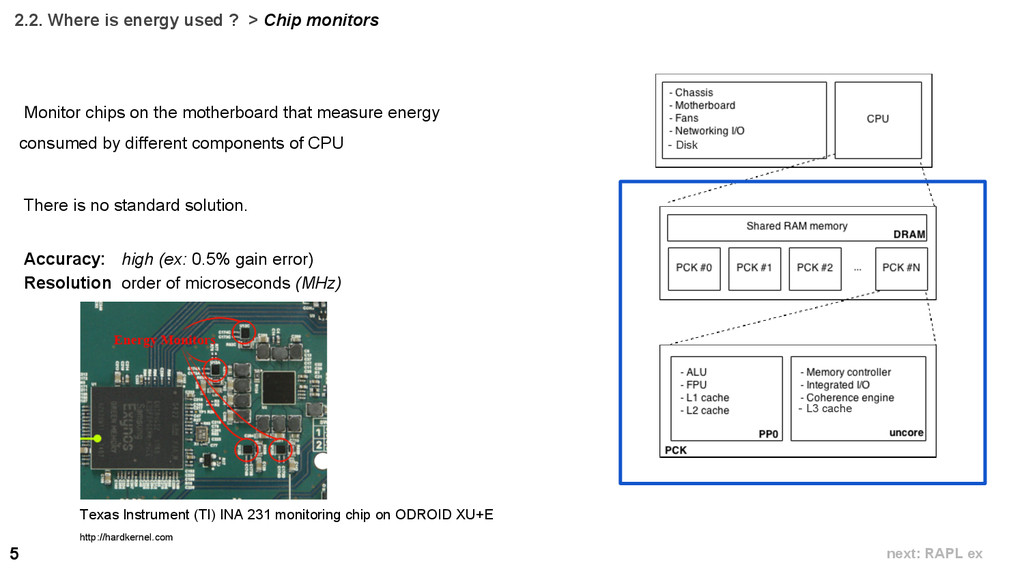
chips on the motherboard that measure energy consumed by different components of CPU There is no standard solution. Accuracy: high (ex: 0.5% gain error) Resolution order of microseconds (MHz) - Disk http://hardkernel.com Texas Instrument (TI) INA 231 monitoring chip on ODROID XU+E next: RAPL ex 5 - L3 cache
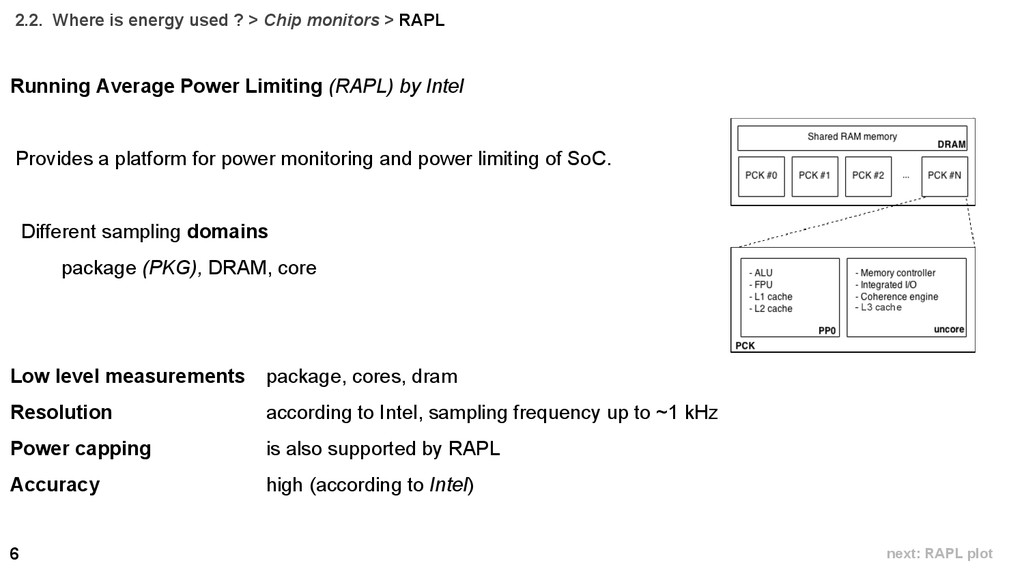
RAPL Running Average Power Limiting (RAPL) by Intel Provides a platform for power monitoring and power limiting of SoC. Different sampling domains package (PKG), DRAM, core Low level measurements package, cores, dram Resolution according to Intel, sampling frequency up to ~1 kHz Power capping is also supported by RAPL Accuracy high (according to Intel) next: RAPL plot 6 - L3 cache
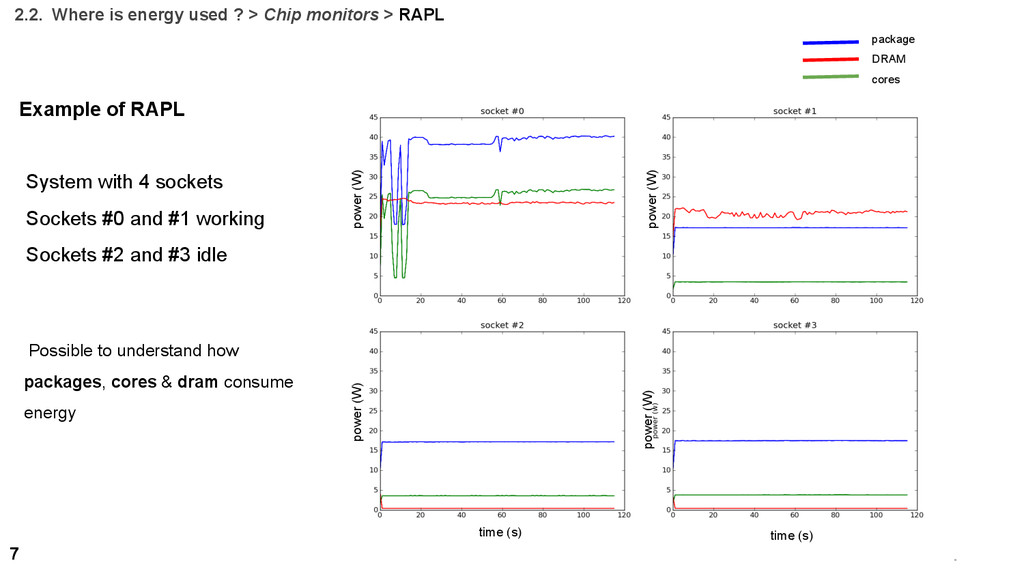
RAPL Example of RAPL System with 4 sockets Sockets #0 and #1 working Sockets #2 and #3 idle Possible to understand how packages, cores & dram consume energy next: recap 7 power (W) power (W) power (W) power (W) time (s) time (s) package DRAM cores
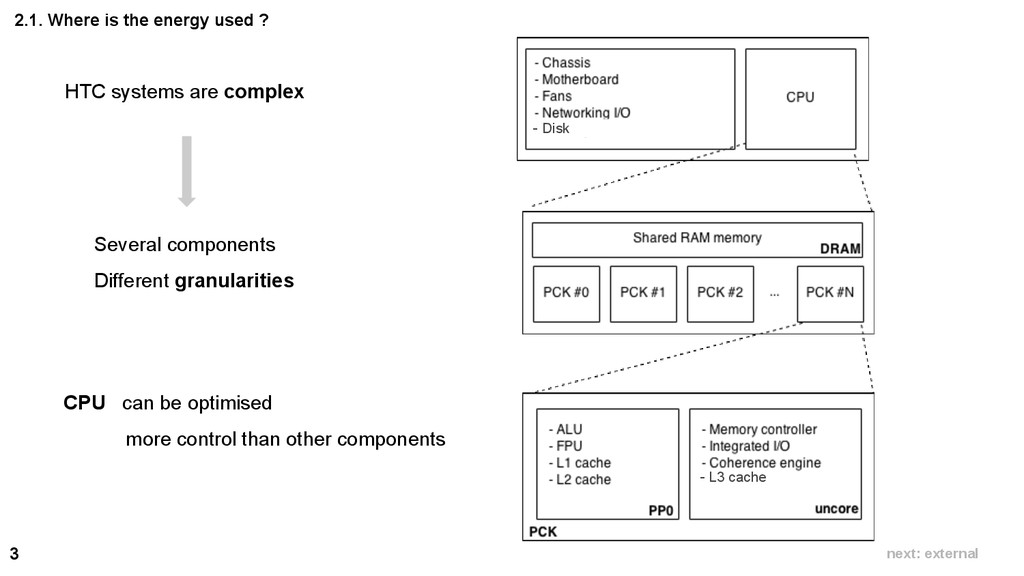
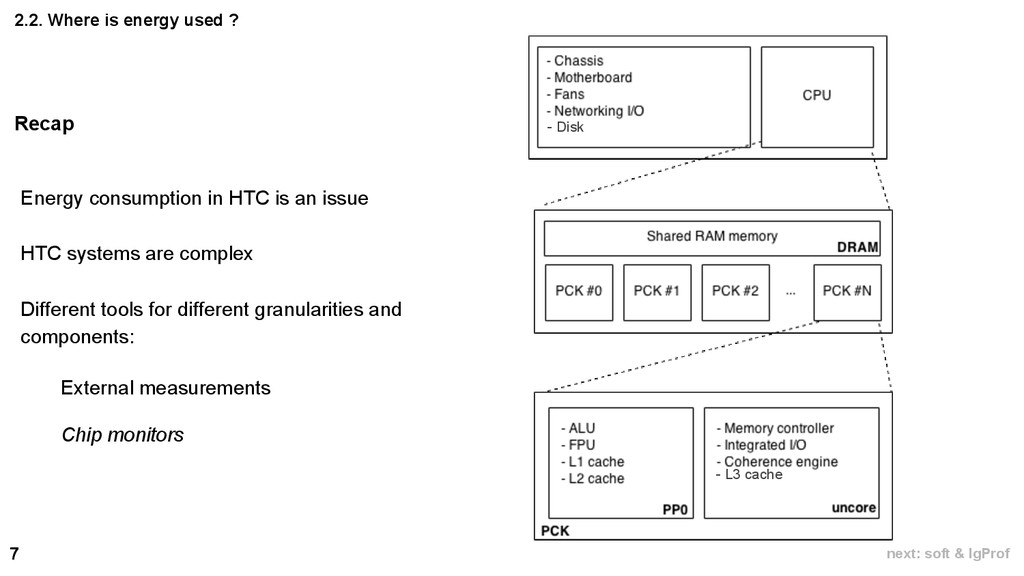
HTC is an issue HTC systems are complex Different tools for different granularities and components: External measurements Chip monitors - Disk next: soft & IgProf 7 - L3 cache
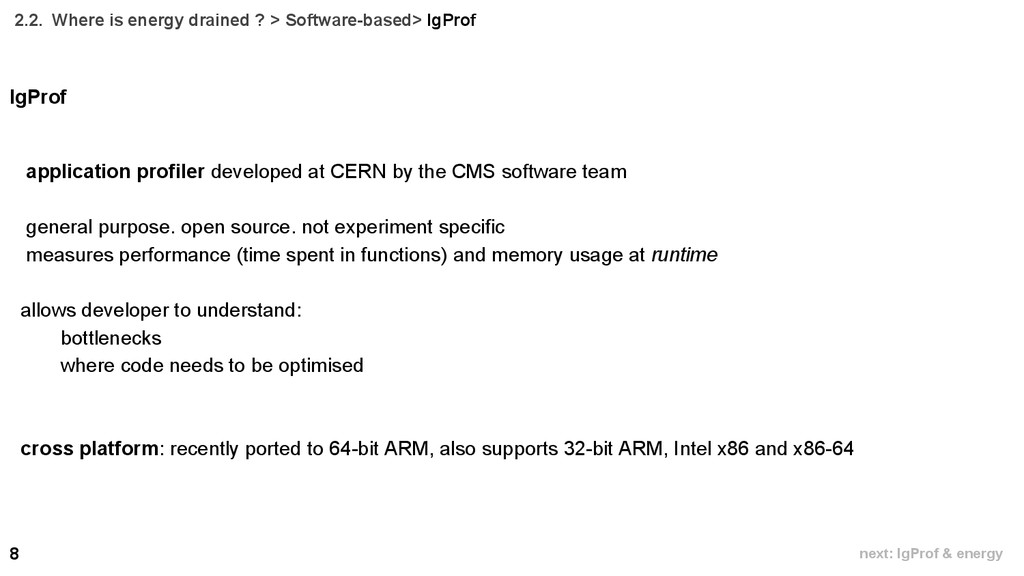
application profiler developed at CERN by the CMS software team general purpose. open source. not experiment specific measures performance (time spent in functions) and memory usage at runtime allows developer to understand: bottlenecks where code needs to be optimised cross platform: recently ported to 64-bit ARM, also supports 32-bit ARM, Intel x86 and x86-64 next: IgProf & energy 8
& energy profiling Uses RAPL and PAPI to measure energy consumed. Map functions and low level operations with energy consumption more info (strategies, results, examples) paper and http://igprof.org/ next: use case 9
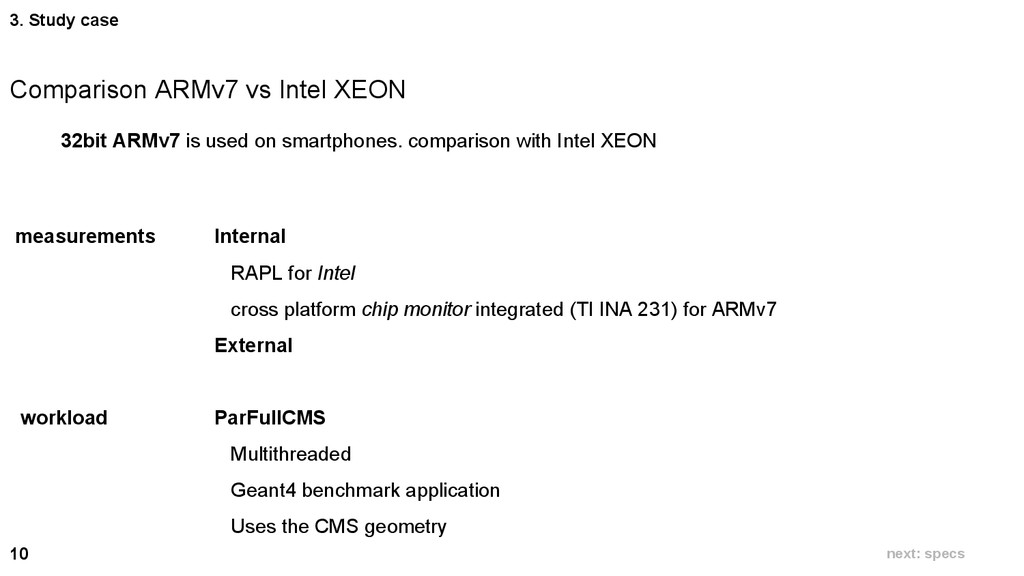
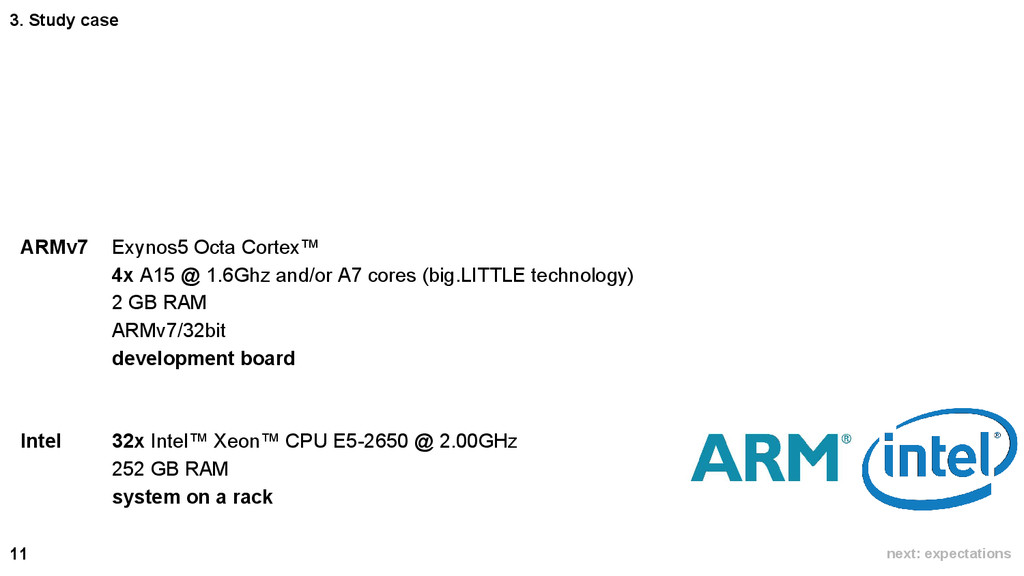
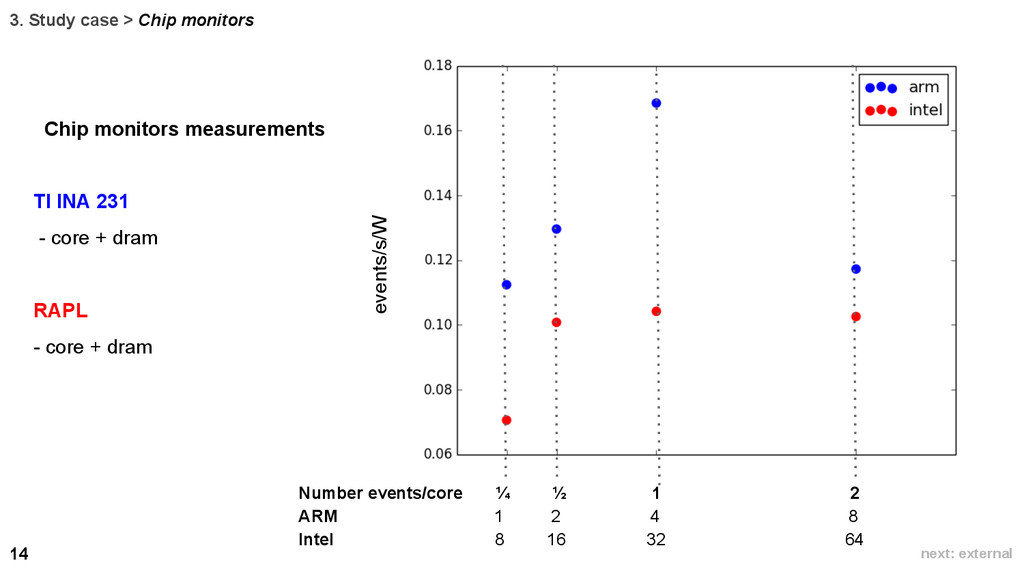
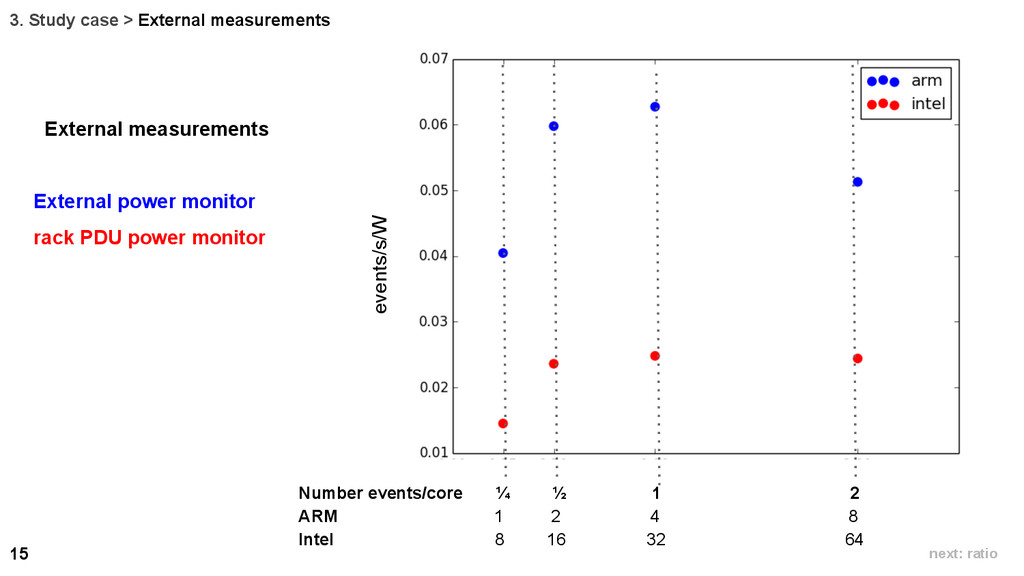
is used on smartphones. comparison with Intel XEON measurements Internal RAPL for Intel cross platform chip monitor integrated (TI INA 231) for ARMv7 External workload ParFullCMS Multithreaded Geant4 benchmark application Uses the CMS geometry next: specs 10
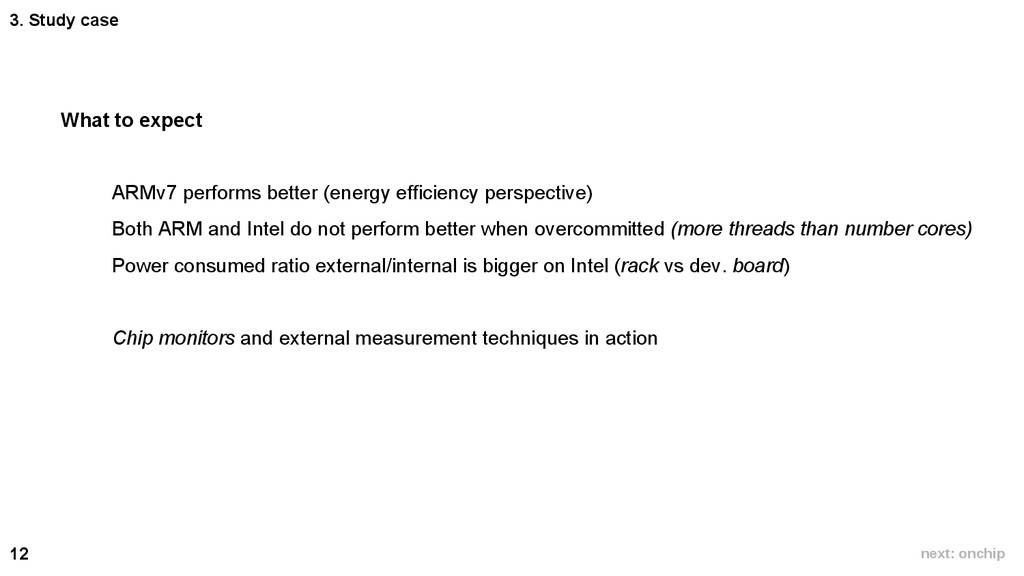
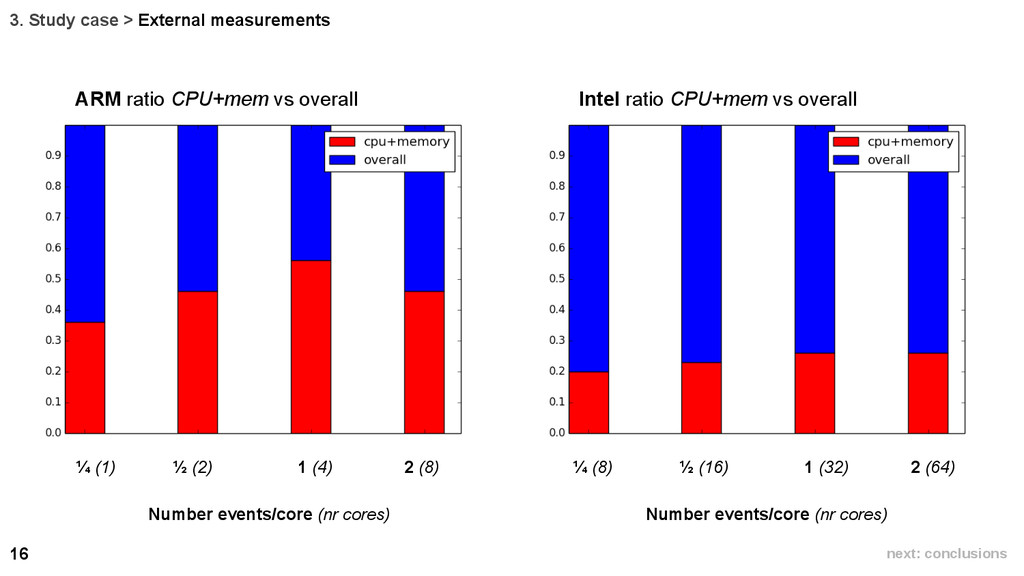
efficiency perspective) Both ARM and Intel do not perform better when overcommitted (more threads than number cores) Power consumed ratio external/internal is bigger on Intel (rack vs dev. board) Chip monitors and external measurement techniques in action next: onchip 12
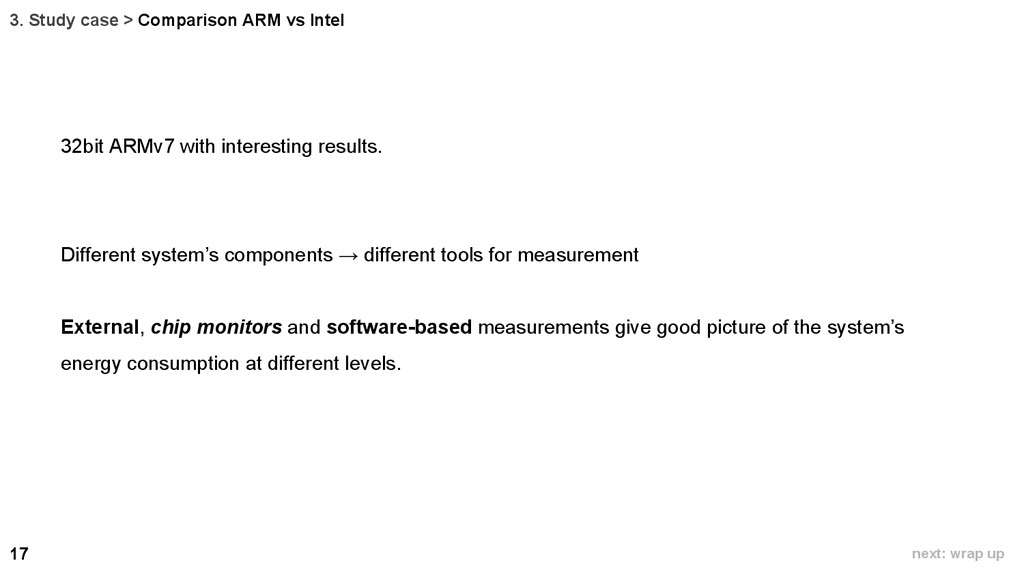
with interesting results. Different system’s components → different tools for measurement External, chip monitors and software-based measurements give good picture of the system’s energy consumption at different levels. next: wrap up 17
HTC Important to be aware of where and how energy is consumed on a HTC system There are tools and techniques that account for the different system’s components Recently, IgProf was ported for ARM 64 bit and got power profiling capabilities. ARM keeps showing potential for efficient HTC next: Q&A 18


 shuta13
 minorun365
 yamad
 bengo4com
 ivry_presentationmaterials
 carta_engineering
 genda
 kentarofujii
 ishikawa_satoru
 jozono
 satomasahiro2005
 recruitengineers
 deanohume
 brettharned
 sarafernandez
 csswizardry
 sstephenson
 aleyda
 lindahogenes
 cassininazir
 wayneb77
 philnash
 stephaniewalter
 sferik